
Articles | Volume 20, issue 6
https://doi.org/10.5194/tc-20-3705-2026
© Author(s) 2026. This work is distributed under
the Creative Commons Attribution 4.0 License.
the Creative Commons Attribution 4.0 License.
https://doi.org/10.5194/tc-20-3705-2026
© Author(s) 2026. This work is distributed under
the Creative Commons Attribution 4.0 License.
the Creative Commons Attribution 4.0 License.
Review article
| Highlight paper
| 
01 Jul 2026
Review article | Highlight paper |
| 01 Jul 2026
| 01 Jul 2026
Review article: The Foundation-Patuxent-Academy ice stream system, Antarctica

School of Geography, Politics and Sociology, Newcastle University, Newcastle upon Tyne, UK
Rebecca J. Sanderson
School of Geography, Politics and Sociology, Newcastle University, Newcastle upon Tyne, UK
Bernd Kulessa
School of Biosciences, Geography and Physics, Swansea University, Swansea, UK
School of Geography, Planning, and Spatial Sciences, University of Tasmania, Hobart, Australia
Martin Siegert
Tremough House, University of Exeter, Penryn, UK
Guy J. G. Paxman
Department of Geography, Durham University, Durham, UK
Keir A. Nichols
Scottish Universities Environmental Research Centre, East Kilbride, UK
Matthew R. Siegfried
Department of Geophysics, Colorado School of Mines, Golden, CO, USA
Stewart S. R. Jamieson
Department of Geography, Durham University, Durham, UK
Michael J. Bentley
Department of Geography, Durham University, Durham, UK
Tom A. Jordan
British Antarctic Survey, High Cross, Madingley Road, Cambridge, UK
Christine L. Batchelor
School of Geography, Politics and Sociology, Newcastle University, Newcastle upon Tyne, UK
David Small
Department of Geography, Durham University, Durham, UK
Olaf Eisen
Alfred Wegener Institute Helmholtz Centre for Polar and Marine Research, Bremerhaven, Germany
Faculty of Geosciences, University of Bremen, Bremen, Germany
Kate Winter
Department of Geography and Environmental Sciences, Northumbria University, Newcastle upon Tyne, UK
Robert G. Bingham
School of GeoSciences, University of Edinburgh, Edinburgh, UK
S. Louise Callard
School of Geography, Politics and Sociology, Newcastle University, Newcastle upon Tyne, UK
Rachel Carr
School of Geography, Politics and Sociology, Newcastle University, Newcastle upon Tyne, UK
Christine F. Dow
Department of Geography and Environmental Management, University of Waterloo, Waterloo, Canada
Helen A. Fricker
Scripps Polar Center, IGPP, Scripps Institution of Oceanography, University of California, San Diego, La Jolla, CA, USA
Emily Hill
Department of Geography and Environmental Sciences, Northumbria University, Newcastle upon Tyne, UK
Benjamin H. Hills
Department of Geophysics, Colorado School of Mines, Golden, CO, USA
Coen Hofstede
Alfred Wegener Institute Helmholtz Centre for Polar and Marine Research, Bremerhaven, Germany
Hafeez Jeofry
Faculty of Science and Marine Environment, Universiti Malaysia Terengganu, Kuala Nerus, Terengganu, Malaysia
Felipe Napoleoni
School of GeoSciences, University of Edinburgh, Edinburgh, UK
Wilson Sauthoff
Department of Geophysics, Colorado School of Mines, Golden, CO, USA
Related authors
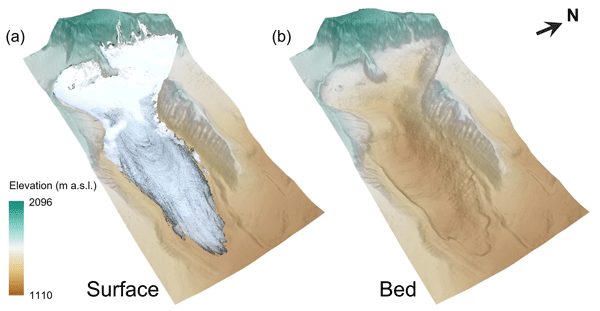
Zhuo Wang, Neil Ross, Thomas Frank, Jamie Barnett, Ilaria Santin, Martin Houssais, Johanna Dahlkvist, and Nina Kirchner
Earth Syst. Sci. Data, 18, 4241–4262, https://doi.org/10.5194/essd-18-4241-2026, https://doi.org/10.5194/essd-18-4241-2026, 2026
Short summary
Short summary
Under global warming, Sweden's remaining glaciers are shrinking rapidly, and all four Swedish reference glaciers (Mårmaglaciären, Storglaciären, Rabots glaciär, and Riukojietna) may disappear within this century. To better project their future evolution, we measured the ice thickness of the four glaciers using radio-echo sounding and mapped the bed topography beneath the ice. These maps provide essential insights into future landscapes, ecosystems, and policymaking.
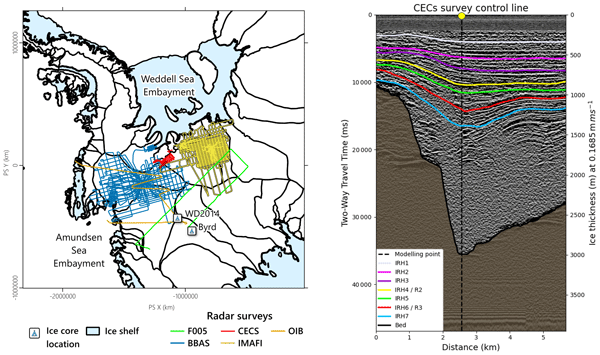
Felipe Napoleoni, Michael J. Bentley, Neil Ross, Stewart S. R. Jamieson, José A. Uribe, Jonathan Oberreuter, Rodrigo Zamora, Andrés Rivera, Andrew M. Smith, Robert G. Bingham, and Kenichi Matsuoka
The Cryosphere, 20, 2793–2824, https://doi.org/10.5194/tc-20-2793-2026, https://doi.org/10.5194/tc-20-2793-2026, 2026
Short summary
Short summary
We mapped buried layers inside West Antarctic ice across 13,000 km² near the Amundsen–Weddell divide using radar. Some layers may be up to 17 kyr old. The layers remain well preserved in slow-moving ice but become distorted where ice flows faster. Snowfall has long been greater on one side of the divide, suggesting the ice divide has remained stable for thousands of years. Our study helps connect climate records across West Antarctica and improve models used to predict future ice-sheet change.
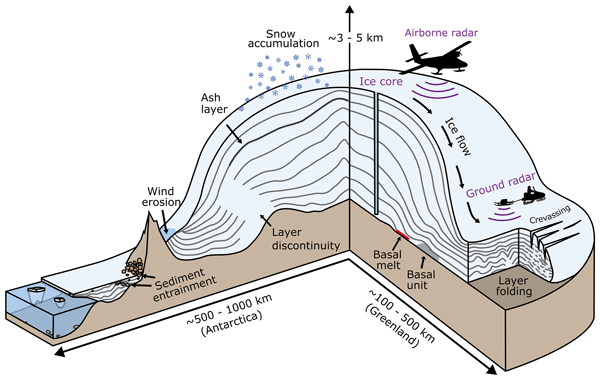
Robert G. Bingham, Julien A. Bodart, Marie G. P. Cavitte, Ailsa Chung, Rebecca J. Sanderson, Johannes C. R. Sutter, Olaf Eisen, Nanna B. Karlsson, Joseph A. MacGregor, Neil Ross, Duncan A. Young, David W. Ashmore, Andreas Born, Winnie Chu, Xiangbin Cui, Reinhard Drews, Steven Franke, Vikram Goel, John W. Goodge, A. Clara J. Henry, Antoine Hermant, Benjamin H. Hills, Nicholas Holschuh, Michelle R. Koutnik, Gwendolyn J.-M. C. Leysinger Vieli, Emma J. MacKie, Elisa Mantelli, Carlos Martín, Felix S. L. Ng, Falk M. Oraschewski, Felipe Napoleoni, Frédéric Parrenin, Sergey V. Popov, Therese Rieckh, Rebecca Schlegel, Dustin M. Schroeder, Martin J. Siegert, Xueyuan Tang, Thomas O. Teisberg, Kate Winter, Shuai Yan, Harry Davis, Christine F. Dow, Tyler J. Fudge, Tom A. Jordan, Bernd Kulessa, Kenichi Matsuoka, Clara J. Nyqvist, Maryam Rahnemoonfar, Matthew R. Siegfried, Shivangini Singh, Vjeran Višnjević, Rodrigo Zamora, and Alexandra Zuhr
The Cryosphere, 19, 4611–4655, https://doi.org/10.5194/tc-19-4611-2025, https://doi.org/10.5194/tc-19-4611-2025, 2025
Short summary
Short summary
The ice sheets covering Antarctica have built up over millenia through successive snowfall events which become buried and preserved as internal surfaces of equal age detectable with ice-penetrating radar. This paper describes an international initiative working together on these archival data to build a comprehensive 3-D picture of how old the ice is everywhere across Antarctica and how this is being used to reconstruct past and to predict future ice and climate behaviour.
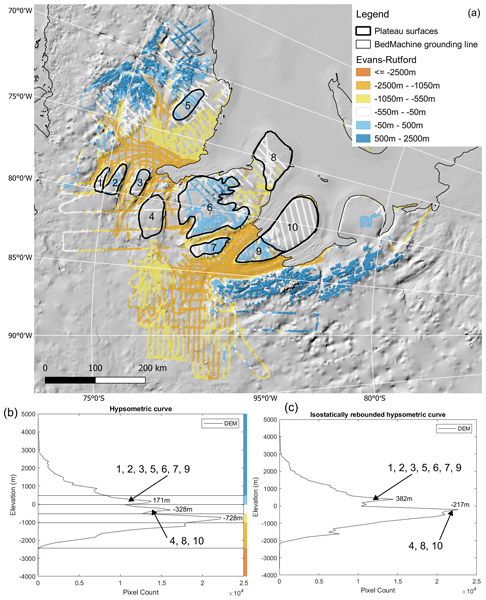
Charlotte M. Carter, Michael J. Bentley, Stewart S. R. Jamieson, Guy J. G. Paxman, Tom A. Jordan, Julien A. Bodart, Neil Ross, and Felipe Napoleoni
The Cryosphere, 18, 2277–2296, https://doi.org/10.5194/tc-18-2277-2024, https://doi.org/10.5194/tc-18-2277-2024, 2024
Short summary
Short summary
We use radio-echo sounding data to investigate the presence of flat surfaces beneath the Evans–Rutford region in West Antarctica. These surfaces may be what remains of laterally continuous surfaces, formed before the inception of the West Antarctic Ice Sheet, and we assess two hypotheses for their formation. Tectonic structures in the region may have also had a control on the growth of the ice sheet by focusing ice flow into troughs adjoining these surfaces.
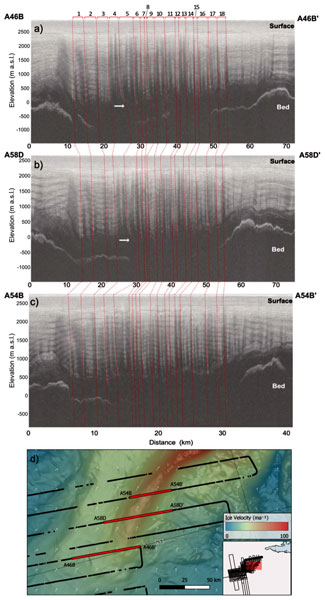
Rebecca J. Sanderson, Kate Winter, S. Louise Callard, Felipe Napoleoni, Neil Ross, Tom A. Jordan, and Robert G. Bingham
The Cryosphere, 17, 4853–4871, https://doi.org/10.5194/tc-17-4853-2023, https://doi.org/10.5194/tc-17-4853-2023, 2023
Short summary
Short summary
Ice-penetrating radar allows us to explore the internal structure of glaciers and ice sheets to constrain past and present ice-flow conditions. In this paper, we examine englacial layers within the Lambert Glacier in East Antarctica using a quantitative layer tracing tool. Analysis reveals that the ice flow here has been relatively stable, but evidence for former fast flow along a tributary suggests that changes have occurred in the past and could change again in the future.
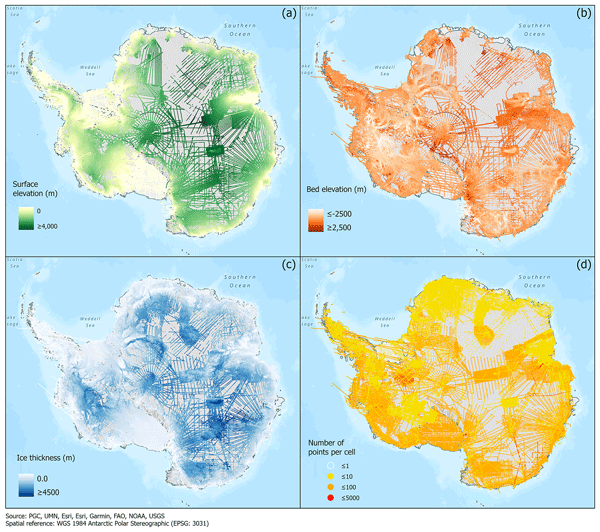
Alice C. Frémand, Peter Fretwell, Julien A. Bodart, Hamish D. Pritchard, Alan Aitken, Jonathan L. Bamber, Robin Bell, Cesidio Bianchi, Robert G. Bingham, Donald D. Blankenship, Gino Casassa, Ginny Catania, Knut Christianson, Howard Conway, Hugh F. J. Corr, Xiangbin Cui, Detlef Damaske, Volkmar Damm, Reinhard Drews, Graeme Eagles, Olaf Eisen, Hannes Eisermann, Fausto Ferraccioli, Elena Field, René Forsberg, Steven Franke, Shuji Fujita, Yonggyu Gim, Vikram Goel, Siva Prasad Gogineni, Jamin Greenbaum, Benjamin Hills, Richard C. A. Hindmarsh, Andrew O. Hoffman, Per Holmlund, Nicholas Holschuh, John W. Holt, Annika N. Horlings, Angelika Humbert, Robert W. Jacobel, Daniela Jansen, Adrian Jenkins, Wilfried Jokat, Tom Jordan, Edward King, Jack Kohler, William Krabill, Mette Kusk Gillespie, Kirsty Langley, Joohan Lee, German Leitchenkov, Carlton Leuschen, Bruce Luyendyk, Joseph MacGregor, Emma MacKie, Kenichi Matsuoka, Mathieu Morlighem, Jérémie Mouginot, Frank O. Nitsche, Yoshifumi Nogi, Ole A. Nost, John Paden, Frank Pattyn, Sergey V. Popov, Eric Rignot, David M. Rippin, Andrés Rivera, Jason Roberts, Neil Ross, Anotonia Ruppel, Dustin M. Schroeder, Martin J. Siegert, Andrew M. Smith, Daniel Steinhage, Michael Studinger, Bo Sun, Ignazio Tabacco, Kirsty Tinto, Stefano Urbini, David Vaughan, Brian C. Welch, Douglas S. Wilson, Duncan A. Young, and Achille Zirizzotti
Earth Syst. Sci. Data, 15, 2695–2710, https://doi.org/10.5194/essd-15-2695-2023, https://doi.org/10.5194/essd-15-2695-2023, 2023
Short summary
Short summary
This paper presents the release of over 60 years of ice thickness, bed elevation, and surface elevation data acquired over Antarctica by the international community. These data are a crucial component of the Antarctic Bedmap initiative which aims to produce a new map and datasets of Antarctic ice thickness and bed topography for the international glaciology and geophysical community.
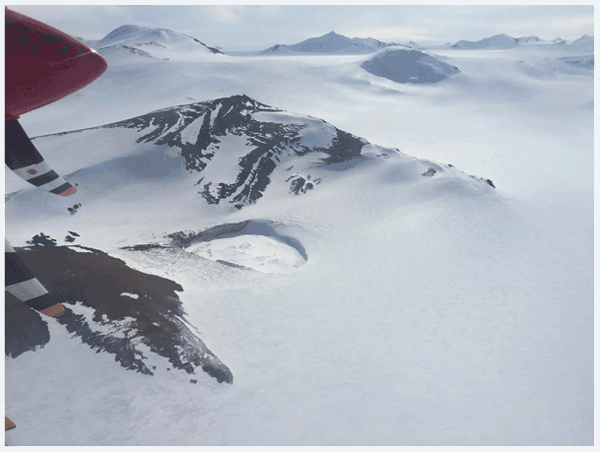
Dominic A. Hodgson, Tom A. Jordan, Neil Ross, Teal R. Riley, and Peter T. Fretwell
The Cryosphere, 16, 4797–4809, https://doi.org/10.5194/tc-16-4797-2022, https://doi.org/10.5194/tc-16-4797-2022, 2022
Short summary
Short summary
This paper describes the drainage (and refill) of a subglacial lake on the Antarctic Peninsula resulting in the collapse of the overlying ice into the newly formed subglacial cavity. It provides evidence of an active hydrological network under the region's glaciers and close coupling between surface climate processes and the base of the ice.
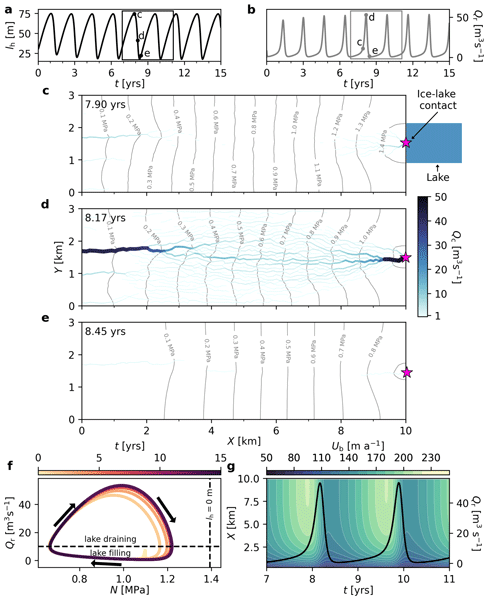
Adam J. Hepburn, Sammie Buzzard, Andrew J. Sole, Stephen J. Livingstone, Felix Ng, Mathieu Morlighem, Elizabeth A. Bagshaw, Caroline Clason, Lisa Craw, Christine F. Dow, Samuel Doyle, Jonathan Hawkins, Matthew Peacey, and Robert Storrar
The Cryosphere, 20, 5675–5696, https://doi.org/10.5194/tc-20-5675-2026, https://doi.org/10.5194/tc-20-5675-2026, 2026
Short summary
Short summary
Lakes at glacier margins can drain beneath the ice in devastating, floods called jökulhlaups. We present the first 2D model of jökulhlaup propagation, first applying it to a synthetic glacier, before then assessing its ability to reproduce an observed record of lake fill-drain cycles in Greenland. Our results match a 17-year record of flood timing but underpredicts peak discharge likely because we are missing certain physical processes. Our results hold promise for simulating jökulhlaups.
Ailsa Chung, Yéva Jeaumot, Frédéric Parrenin, Daniel Steinhage, and Olaf Eisen
EGUsphere, https://doi.org/10.5194/egusphere-2026-4351, https://doi.org/10.5194/egusphere-2026-4351, 2026
This preprint is open for discussion and under review for The Cryosphere (TC).
Short summary
Short summary
We use a 2.5D ice flow model constrained by radar data to estimate the age of ice, basal conditions and particle paths along a flow line from Dome Fuji (DF) to the EPICA Dronning Maud Land ice core site (EDML), Antarctica. Modelled basal melt rates are highest in bedrock dips and stagnant ice occurs on or slightly downstream of bedrock highs. At EDML, particle paths show that the deepest ice may originate 130 km upstream. We also identify a potential old-ice area (>1 Ma), ~200 km from DF.
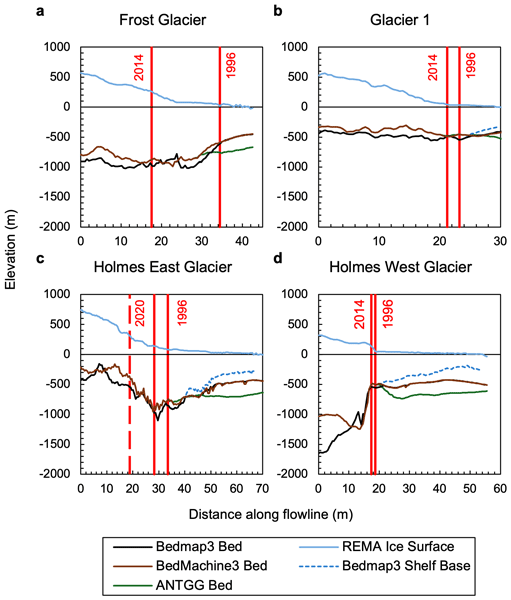
Matilda Weatherley, Chris R. Stokes, Stewart S. R. Jamieson, Sindhu Ramanath, and Alessandro Silvano
The Cryosphere, 20, 5509–5532, https://doi.org/10.5194/tc-20-5509-2026, https://doi.org/10.5194/tc-20-5509-2026, 2026
Short summary
Short summary
Parts of the East Antarctic Ice Sheet rest on a bed below sea level, making them vulnerable to ice dynamic changes and instability, but few glaciers have been studied in detail. Here we report on glaciers draining into Porpoise Bay, Wilkes Land, overlying the Aurora Subglacial Basin. We find ice surface thinning, grounding line retreat and ice surface velocity increase over recent decades, consistent with warm ocean waters intrusion. This highlights this region's vulnerability to future warming.
Yéva Jeaumot, Frédéric Parrenin, Ailsa Chung, Olaf Eisen, Daniel Steinhage, Robert Mulvaney, Marie G. P. Cavitte, David A. Lilien, and Emilie Capron
EGUsphere, https://doi.org/10.5194/egusphere-2026-4174, https://doi.org/10.5194/egusphere-2026-4174, 2026
This preprint is open for discussion and under review for The Cryosphere (TC).
Short summary
Short summary
To choose good drilling sites and interpret ice cores correctly, scientists need reliable estimates of ice age at each depth. We developed a new way to model how ice behaves at the base of ice sheets, where it can melt or stop moving entirely, using radar data from Antarctica. Our estimates matched real measurements at a well-studied site, revealed a layer of stagnant ice at another, and predicted that a newly proposed drilling site could yield ice over two million years old.
Judith Freienstein, Charlotte Carter, Georg-Maximilian Hüttner, Olaf Eisen, Wolfgang Szwillus, and Jörg Ebbing
EGUsphere, https://doi.org/10.5194/egusphere-2026-4746, https://doi.org/10.5194/egusphere-2026-4746, 2026
Short summary
Short summary
The North East Greenland Ice Stream is a fast flowing ice stream with its formation so far inland remaining unclear. We used high-resolution bed topography data in 3D modeling to investigate its effects on geothermal heat flow (GHF). Results show local deviations of up to 20 % compared to 1D solutions. Our study highlights the importance of small-scale models to reduce uncertainty in GHF estimates to improve the understanding of ice stream dynamics.
Natalie J. Burls, Nicky M. Wright, R. Paul Acosta, Catherine D. Bradshaw, Edward Gasson, Lennert B. Stap, Gilles Ramstein, Anna Ruth W. Halberstadt, Agatha M. De Boer, Funda Akgün, David J. Cantrill, Manuel Casas-Gallego, Nela Doláková, Boglarka Erdei, Alex Farnsworth, Sarah Feakins, Ran Feng, Tamara Fletcher, Frédéric Fluteau, J. A. Mattias Green, Anna S. von der Heydt, Matthew Huber, David K. Hutchinson, Dimiter Ivanov, Mine Sezgül Kayseri-Özer, Gregor Knorr, Marianna Kováčová, Caroline H. Lear, Allegra N. LeGrande, Shufeng Li, Xiaoqing Liu, Daniel J. Lunt, Katrin Meissner, Yunfa Miao, Trusha J. Naik, Javier B. Navarro, Joseph B. Novak, Diana Ochoa, Guy J.G. Paxman, Matthew J. Pound, James W. B. Rae, Tammo Reichgelt, Martin Renoult, Francesca Sangiorgi, Anta-Clarisse Sarr, Diane Segalla, Pierre Sepulchre, Amelia Shevenell, Sebastian Steinig, Eivind Straume, Caroline A. E. Strömberg, Clay Tabor, Torsten Utescher, Julia E. Weiffenbach, Elżbieta Worobiec, Yurui Zhang, Feng Zhu, Jiang Zhu, Alexandra Auderset, Florence Colleoni, Aisling Dolan, Rachel Havranek, Ann Holbourn, Nicholas Herold, Daeun Lee, James W. Marschalek, Bryce Mitsunaga, Sevi Modestou, Lina Perez-Angel, Mae Saslaw, Sinda Sosdian, Elena Stiles, Yong Sun, Ning Tan, Zhongshi Zhang, and Yan Zhao
EGUsphere, https://doi.org/10.5194/egusphere-2026-3595, https://doi.org/10.5194/egusphere-2026-3595, 2026
This preprint is open for discussion and under review for Geoscientific Model Development (GMD).
Short summary
Short summary
Simulating warm paleoclimates increases our understanding of the mechanisms that drive climatic change and tipping points. The Miocene Epoch, specifically the Miocene Climatic Optimum, has been identified as a particularly valuable past warm climate to simulate, meriting the design of a coordinated Miocene Model Intercomparison Project. Here we synthesize the latest available literature and present the experimental design for coordinated Miocene simulations and sensitivity studies.
Rebecca Schlegel, Johannes Noll, Leah Sopie Muhle, Christian T. Wild, Falk M. Oraschewski, Olaf Eisen, and Reinhard Drews
EGUsphere, https://doi.org/10.5194/egusphere-2026-3900, https://doi.org/10.5194/egusphere-2026-3900, 2026
This preprint is open for discussion and under review for The Cryosphere (TC).
Short summary
Short summary
Step-like terraces at the base of Antarctic ice shelves are known from warm-water settings, but we show for the first time that they also occur at the base of a cold-water ice shelf. Repeat radar observations reveal that the terraces melt slowly and remain almost unchanged over one year. Our results suggest they form near the grounding line and are then transported with the flowing ice while melting only slowly.
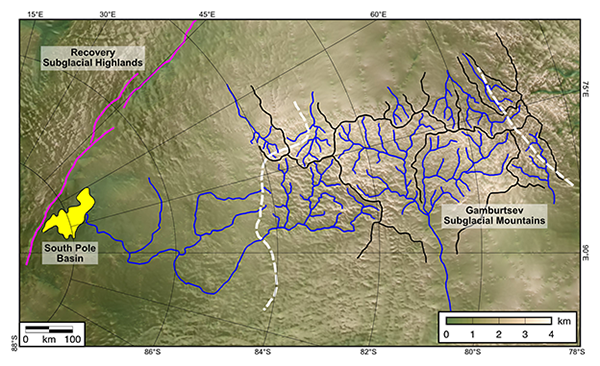
Guy J. G. Paxman, Fiona J. Clubb, Stewart S. R. Jamieson, and Alexander L. Densmore
Earth Surf. Dynam., 14, 575–599, https://doi.org/10.5194/esurf-14-575-2026, https://doi.org/10.5194/esurf-14-575-2026, 2026
Short summary
Short summary
This study focusses on the Gamburtsev Subglacial Mountains, a 600 km-long mountain range that is completely hidden beneath the Antarctic Ice Sheet. We look at the valley networks within the Gamburtsevs and use these to understand how the mountains formed. Our main findings are that the valleys were first cut by rivers that existed before Antarctica was glaciated, the shape of the valleys is affected by the bedrock geology, and the mountains are probably younger than previously thought.
Emma Pearce, Dimitri Zigone, Coen Hofstede, Andreas Fichtner, and Olaf Eisen
EGUsphere, https://doi.org/10.5194/egusphere-2026-3762, https://doi.org/10.5194/egusphere-2026-3762, 2026
Short summary
Short summary
When ice cores are drilled, they are broken before being brought back to the surface, generating small seismic signals. We tested whether these signals could be used to study the inside of the North East Greenland Ice Stream. Most possible signals were too weak or noisy, but a few clear examples produced realistic estimates of ice speed. The results show that this method is promising, but future experiments need better timing, quieter conditions, and sensors placed specifically for this purpose.
Zhuo Wang, Neil Ross, Thomas Frank, Jamie Barnett, Ilaria Santin, Martin Houssais, Johanna Dahlkvist, and Nina Kirchner
Earth Syst. Sci. Data, 18, 4241–4262, https://doi.org/10.5194/essd-18-4241-2026, https://doi.org/10.5194/essd-18-4241-2026, 2026
Short summary
Short summary
Under global warming, Sweden's remaining glaciers are shrinking rapidly, and all four Swedish reference glaciers (Mårmaglaciären, Storglaciären, Rabots glaciär, and Riukojietna) may disappear within this century. To better project their future evolution, we measured the ice thickness of the four glaciers using radio-echo sounding and mapped the bed topography beneath the ice. These maps provide essential insights into future landscapes, ecosystems, and policymaking.
Jing Zhang, Yang Lei, Laurane Charrier, Amaury Dehecq, Alex S. Gardner, Luke Copland, and Christine Dow
EGUsphere, https://doi.org/10.5194/egusphere-2026-2541, https://doi.org/10.5194/egusphere-2026-2541, 2026
This preprint is open for discussion and under review for The Cryosphere (TC).
Short summary
Short summary
Satellites can measure how fast glaciers move, which helps scientists understand ice loss and rising sea levels. However, these measurements have rarely been checked against ground-based observations on small mountain glaciers. We compared satellite-derived glacier speeds against precise ground measurements. The satellite data generally agreed well with ground observations. Our results help scientists use satellite glacier velocity data more reliably.
Ingalise Kindstedt, Andrew Johnson, Kristin M. Schild, Luke Copland, Christine Dow, Alison Criscitiello, Dominic Winski, Karl Kreutz, and Seth Campbell
EGUsphere, https://doi.org/10.5194/egusphere-2026-2431, https://doi.org/10.5194/egusphere-2026-2431, 2026
Short summary
Short summary
Mountain snow at high elevations is changing as warming causes more melting and water to linger within it. We use satellite radar images from 2015 to 2024 to track when melting starts and when snow refreezes across the Wrangell and St. Elias Mountains on the border of Alaska and Yukon. We find that melting now reaches nearly all elevations, and water often remains trapped well into fall. Only the highest areas stay fully dry, showing widespread impacts of warming on mountain snowpacks.
Felipe Napoleoni, Michael J. Bentley, Neil Ross, Stewart S. R. Jamieson, José A. Uribe, Jonathan Oberreuter, Rodrigo Zamora, Andrés Rivera, Andrew M. Smith, Robert G. Bingham, and Kenichi Matsuoka
The Cryosphere, 20, 2793–2824, https://doi.org/10.5194/tc-20-2793-2026, https://doi.org/10.5194/tc-20-2793-2026, 2026
Short summary
Short summary
We mapped buried layers inside West Antarctic ice across 13,000 km² near the Amundsen–Weddell divide using radar. Some layers may be up to 17 kyr old. The layers remain well preserved in slow-moving ice but become distorted where ice flows faster. Snowfall has long been greater on one side of the divide, suggesting the ice divide has remained stable for thousands of years. Our study helps connect climate records across West Antarctica and improve models used to predict future ice-sheet change.
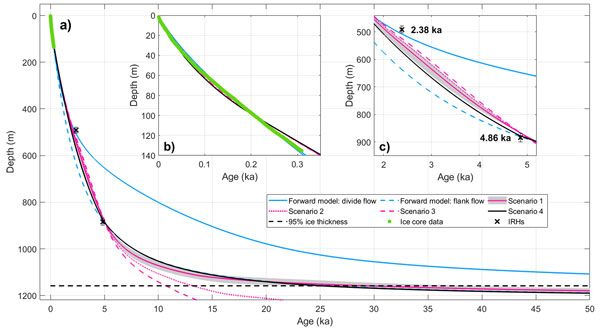
Harry J. Davis, Robert G. Bingham, Carlos Martín, Elizabeth R. Thomas, Andrew S. Hein, and Anna E. Hogg
The Cryosphere, 20, 2735–2756, https://doi.org/10.5194/tc-20-2735-2026, https://doi.org/10.5194/tc-20-2735-2026, 2026
Short summary
Short summary
Ice in the southern Antarctic Peninsula is experiencing major ice changes today and predicting the rate at which this may continue is important. One way to address this knowledge gap would be to retrieve a past climate record from an ice core. We identify a suitable site using a model constrained by radar and shallow ice core data. We find a climate record spanning the Holocene can certainly be extracted here, but a potential continuous climate record here could extend back ~ 30 000 years.
Rebecca McCerery, Joseph A. Graly, Christopher L. Hansen, Kate Winter, William P. Gilhooly III, Trinity L. Hamilton, Moses Jatta, Jeff R. Havig, Felipe Napoleoni, Alicia M. Rutledge, Matthew Terrell, Tanya M. Trott, Kayla Woodie, Bernd Kulessa, Sevi Modestou, Hannah Bahrani, Tori Kennedy, Alexandra Messerli, and Kathy Licht
EGUsphere, https://doi.org/10.5194/egusphere-2026-2131, https://doi.org/10.5194/egusphere-2026-2131, 2026
Short summary
Short summary
Ice cores from Isunnguata Sermia’s forefield reveal how proglacial naled and accreted ices form in Greenland. Naledi build up in winter from precipitation and mineral-rich subglacial water, while accreted ice forms in summer through supercooled water upwelling. Geophysical surveys indicate both are fed by subsurface flows potentially originating from the glacier bed hundreds of metres away. Here, we present the first conceptual model of these formations in Greenland.
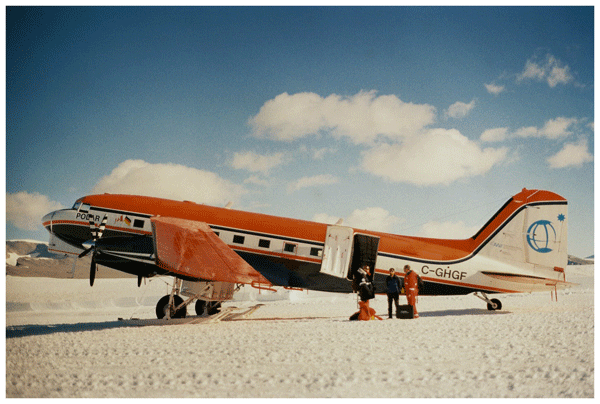
Steven Franke, Daniel Steinhage, Veit Helm, Tobias Binder, Uwe Nixdorf, Heinrich Miller, Angelika Humbert, Daniela Jansen, Graeme Eagles, Hannes Eisermann, Wilfried Jokat, Antonia Ruppel, Reinhard Drews, Alexandra Zuhr, Amelie Driemel, Andreas Walter, Peter Konopatzky, Robin Heß, Antonie Haas, Roland Koppe, Pascal H. Andreas, and Olaf Eisen
The Cryosphere, 20, 2485–2530, https://doi.org/10.5194/tc-20-2485-2026, https://doi.org/10.5194/tc-20-2485-2026, 2026
Short summary
Short summary
This review synthesizes 30 years of Alfred Wegener Institute’s (AWI) airborne radar research in Antarctica and Greenland, detailing six radar systems and their applications in studying ice dynamics, basal properties, and subglacial landscapes. Moreover, it introduces the public release of AWI's airborne radar datasets via the Radar Data over Polar Ice Sheets Viewer and PANGAEA, ensuring findable, accessible, interoperable, and reusable access for future polar research.
David Small, Réka-H. Fülöp, Rachel K. Smedley, Thomas Lees, Stephan Trabucatti, Derek Fabel, Maria Miguens-Rodriguez, Andrew M. Smith, and Grant V. Boeckmann
The Cryosphere, 20, 2035–2052, https://doi.org/10.5194/tc-20-2035-2026, https://doi.org/10.5194/tc-20-2035-2026, 2026
Short summary
Short summary
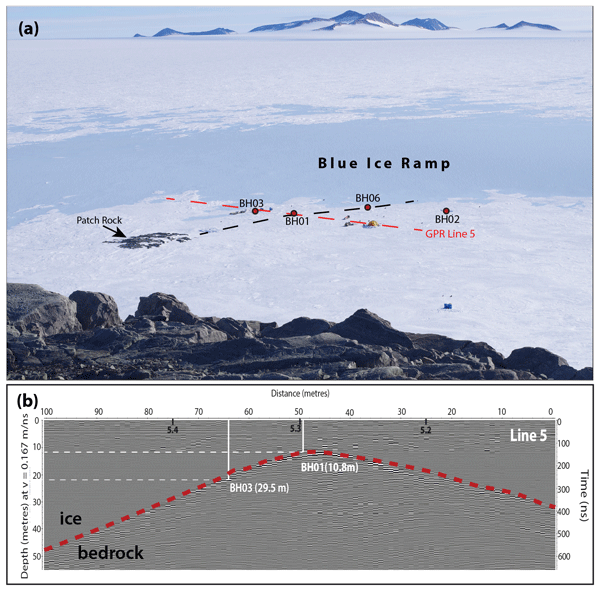
We collected bedrock currently buried by tens of metres of ice from a site in the Weddell Sea Embayment, West Antarctica. Models suggest that the ice sheet here may have been smaller than it is today at some time during the last few thousand years. The presence of rare isotopes in this bedrock requires that ice became thinner before rethickening to its present-day configuration. This fluctuation in the size of the ice sheet occurred within the last ~4000 years and may have lasted only 300 years.
Sonam Rinzin, Stuart Dunning, Rachel Joanne Carr, Simon Allen, Sonam Wangchuk, and Ashim Sattar
Nat. Hazards Earth Syst. Sci., 26, 1015–1037, https://doi.org/10.5194/nhess-26-1015-2026, https://doi.org/10.5194/nhess-26-1015-2026, 2026
Short summary
Short summary
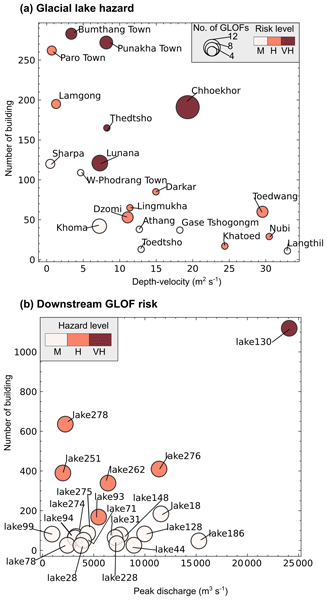
Glacial lake outburst floods pose a major threat to mountain communities worldwide. We assessed glacial lake outburst flood risk in Bhutan by integrating hydrodynamic flood modelling with downstream exposure data. Over 11,000 people and around 2,500 buildings are exposed. Thorthormi Tsho is identified as a very high hazard lake, with five additional high hazard lakes. Thirteen downstream settlements face high to very high GLOF risk, five identified for the first time in this study.
Julien A. Bodart, Vjeran Višnjević, Steven Franke, Veit Helm, Olaf Eisen, Antoine Hermant, Alexandra M. Zuhr, Daniel Steinhage, and Johannes C. R. Sutter
The Cryosphere, 20, 1379–1404, https://doi.org/10.5194/tc-20-1379-2026, https://doi.org/10.5194/tc-20-1379-2026, 2026
Short summary
Short summary
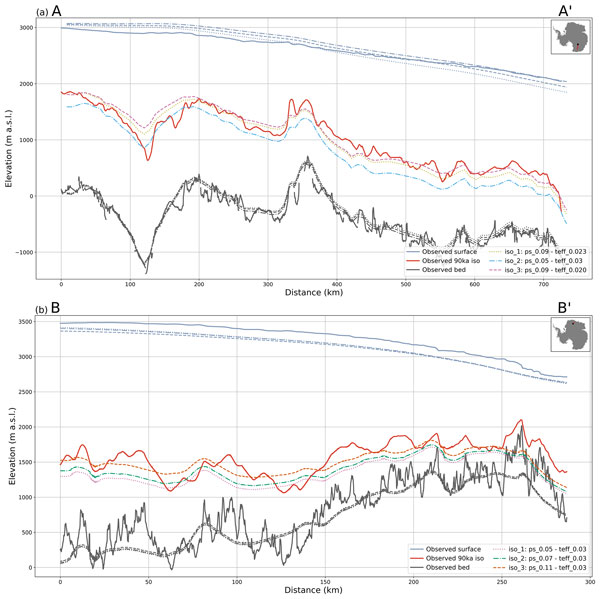
We used radar data and computer models to study layers within Antarctic ice that record past snowfall and ice-sheet changes. These layers, called isochrones, are seldomly used to model Antarctica’s past. By comparing radar observations with simulations, we show how they can greatly improve model accuracy and provide two new datasets to help refine future reconstructions of Antarctic ice evolution.
Mirko Scheinert, Weisen Shen, Richard C. Aster, Lambert Caron, Michael D. Hartinger, Matt A. King, Andrew Lloyd, Anya M. Reading, J. Paul Winberry, Terry Wilson, Lucilla Alfonsi, Michael J. Bentley, Eric Buchta, Thomas Y. Chen, Peter J. Clarke, Jörg Ebbing, Olaf Eisen, Natalya Gomez, Esra Günaydın, Samantha Hansen, Erik R. Ivins, Achraf Koulali, Grace A. Nield, Frederick Richards, Mahmut O. Selbesoglu, Stephanie Sherman, Pippa L. Whitehouse, and Matthias Willen
EGUsphere, https://doi.org/10.5194/egusphere-2025-6370, https://doi.org/10.5194/egusphere-2025-6370, 2026
Short summary
Short summary
With an ongoing mass loss the Antarctic Ice Sheet contributes to global-mean sea level rise at a rate of 0.4 mm/a. Thus, it plays a key role in global climate and provides a natural laboratory to study processes that interlink cryosphere, solid Earth, atmosphere and ocean. We discuss how GNSS and seismic networks in Antarctica were used to significantly advance our understanding of these processes, and how they should be maintained and extended to answer key science questions in the future.
Jiao Chen, Rebecca A. Hodge, Stewart S. R. Jamieson, and Chris R. Stokes
EGUsphere, https://doi.org/10.5194/egusphere-2025-5562, https://doi.org/10.5194/egusphere-2025-5562, 2026
Short summary
Short summary
Supraglacial channel networks mediate meltwater transport over ice shelves and may influence their stability. Our mapping of Nivlisen Ice Shelf from satellite imagery shows significant variation in interannual and seasonal channel extent. During warm summers channels become increasingly connected, redistributing meltwater from high to low elevations across the ice shelf. Channel location is controlled by ice shelf structure, and annual extent is correlated with regional air temperature.
Tom A. Jordan, Karen J. Heywood, Anna Wåhlin, Rob A. Hall, Atsuhiro Muto, Pierre Dutrieux, Kelly Hogan, James Girton, Karen E. Alley, and Erin Pettit
EGUsphere, https://doi.org/10.5194/egusphere-2025-6001, https://doi.org/10.5194/egusphere-2025-6001, 2026
Short summary
Short summary
The shape of the water filled cavity hidden beneath ice shelves is extremely important, but hard to measure. Gravity data collected from aircraft can be used to predict the shape. However, in the Dotson Crosson ice shelves in West Antarctica, new direct observations from autonomous platforms sent beneath the ice, and seismic observations from the ice surface showed gravity models were systematically too shallow. We explain why and provide a solution applicable her and in other ice shelves.
Holly Wytiahlowsky, Chris R. Stokes, Rebecca A. Hodge, Caroline C. Clason, and Stewart S. R. Jamieson
The Cryosphere, 19, 6461–6482, https://doi.org/10.5194/tc-19-6461-2025, https://doi.org/10.5194/tc-19-6461-2025, 2025
Short summary
Short summary
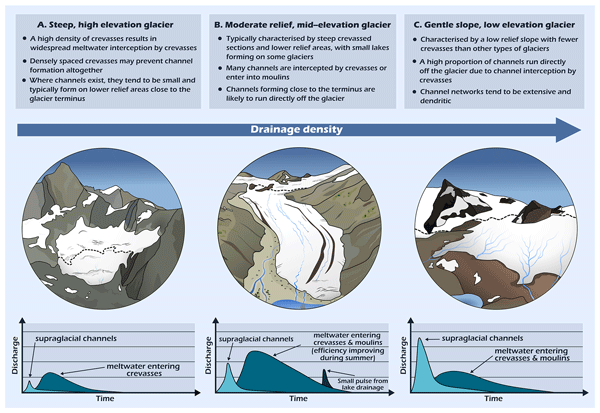
Channels on glaciers are important due to their role in transporting glacial meltwater into downstream river catchments. These channels have received little research in mountain environments. We manually mapped <2000 channels to determine their distribution and characteristics across 285 glaciers in Switzerland. We find that channels are mostly commonly found on low-elevation glaciers with gentle slopes and few crevasses. Most channels run off the glacier, but 20 % enter the glacier.
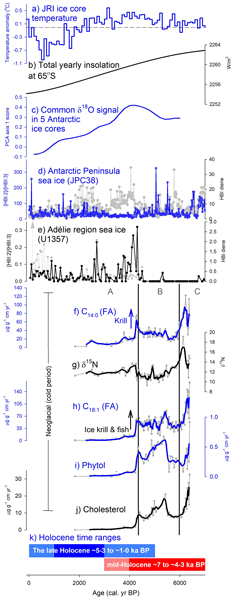
Mark A. Stevenson, Dominic A. Hodgson, Michael J. Bentley, Darren R. Gröcke, Neil Tunstall, Chris Longley, Alice Graham, and Erin L. McClymont
Clim. Past, 21, 2465–2483, https://doi.org/10.5194/cp-21-2465-2025, https://doi.org/10.5194/cp-21-2465-2025, 2025
Short summary
Short summary
We present a record of sea ice and climate inferred from novel snow petrel stomach oil deposits from East Antarctica. Snow petrels feed in the sea ice on a mixture of marine organisms and regurgitate these oils close to their nesting sites in nunatak mountains. We use makers of past diet and productivity from within a deposit to show how sea ice and climate has varied over part of the Holocene. Three periods are identified ranging from low to intermediate and increased sea ice cover.
Valerie Reppert, Olaf Eisen, Holger Schmithüsen, Stefanie Arndt, Guido Ascenso, Linda Ort, and Zsófia Jurányi
EGUsphere, https://doi.org/10.5194/egusphere-2025-5199, https://doi.org/10.5194/egusphere-2025-5199, 2025
Short summary
Short summary
We analyzed 33 years of snow accumulation measurements at Neumayer Station, Antarctica, to understand changes in the amount of snow building up on the surface over time. The long-term, high-resolution data show mostly stable accumulation, but rare positive extremes appeared in 2021 and 2023. Seasonal and multi-year patterns were identified, providing valuable data to improve climate models and satellite observations.
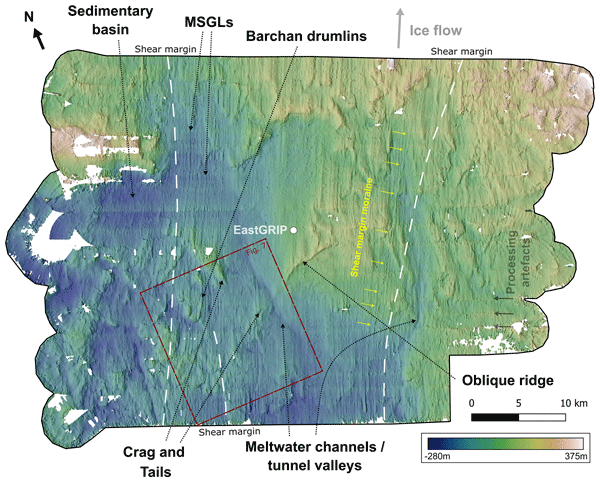
Charlotte M. Carter, Steven Franke, Daniela Jansen, Chris R. Stokes, Veit Helm, John Paden, and Olaf Eisen
The Cryosphere, 19, 5299–5315, https://doi.org/10.5194/tc-19-5299-2025, https://doi.org/10.5194/tc-19-5299-2025, 2025
Short summary
Short summary
The subglacial landforms beneath actively fast-flowing ice in Greenland have not been explored in detail, as digital elevation models have not had a high enough resolution to see these features. We use swath radar imaging to visualise landforms at the onset of an ice stream, revealing mega-scale glacial lineations, that would usually be assumed to be indicative of faster ice flow than the current velocities. Interpretation of the landscape also gives an indication of the properties of the bed.
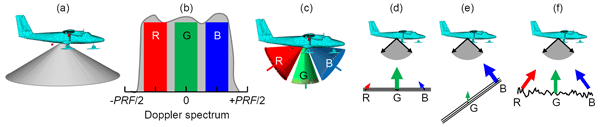
Álvaro Arenas-Pingarrón, Alex M. Brisbourne, Carlos Martín, Hugh F. J. Corr, Carl Robinson, Tom A. Jordan, and Paul V. Brennan
The Cryosphere, 19, 4657–4670, https://doi.org/10.5194/tc-19-4657-2025, https://doi.org/10.5194/tc-19-4657-2025, 2025
Short summary
Short summary
Synthetic Aperture Radar (SAR) imaging is essential for deep englacial observations. Each pixel is formed by averaging the radar echoes within an antenna beamwidth, but the echo diversity is lost after the average. We improve the SAR interpretation if three sub-images are formed with different sub-beamwidths: each is coloured in red, green, or blue, and they are overlapped, creating a coloured image. Interpreters will better identify the slopes of internal layers, crevasses, and layer roughness.
Robert G. Bingham, Julien A. Bodart, Marie G. P. Cavitte, Ailsa Chung, Rebecca J. Sanderson, Johannes C. R. Sutter, Olaf Eisen, Nanna B. Karlsson, Joseph A. MacGregor, Neil Ross, Duncan A. Young, David W. Ashmore, Andreas Born, Winnie Chu, Xiangbin Cui, Reinhard Drews, Steven Franke, Vikram Goel, John W. Goodge, A. Clara J. Henry, Antoine Hermant, Benjamin H. Hills, Nicholas Holschuh, Michelle R. Koutnik, Gwendolyn J.-M. C. Leysinger Vieli, Emma J. MacKie, Elisa Mantelli, Carlos Martín, Felix S. L. Ng, Falk M. Oraschewski, Felipe Napoleoni, Frédéric Parrenin, Sergey V. Popov, Therese Rieckh, Rebecca Schlegel, Dustin M. Schroeder, Martin J. Siegert, Xueyuan Tang, Thomas O. Teisberg, Kate Winter, Shuai Yan, Harry Davis, Christine F. Dow, Tyler J. Fudge, Tom A. Jordan, Bernd Kulessa, Kenichi Matsuoka, Clara J. Nyqvist, Maryam Rahnemoonfar, Matthew R. Siegfried, Shivangini Singh, Vjeran Višnjević, Rodrigo Zamora, and Alexandra Zuhr
The Cryosphere, 19, 4611–4655, https://doi.org/10.5194/tc-19-4611-2025, https://doi.org/10.5194/tc-19-4611-2025, 2025
Short summary
Short summary
The ice sheets covering Antarctica have built up over millenia through successive snowfall events which become buried and preserved as internal surfaces of equal age detectable with ice-penetrating radar. This paper describes an international initiative working together on these archival data to build a comprehensive 3-D picture of how old the ice is everywhere across Antarctica and how this is being used to reconstruct past and to predict future ice and climate behaviour.
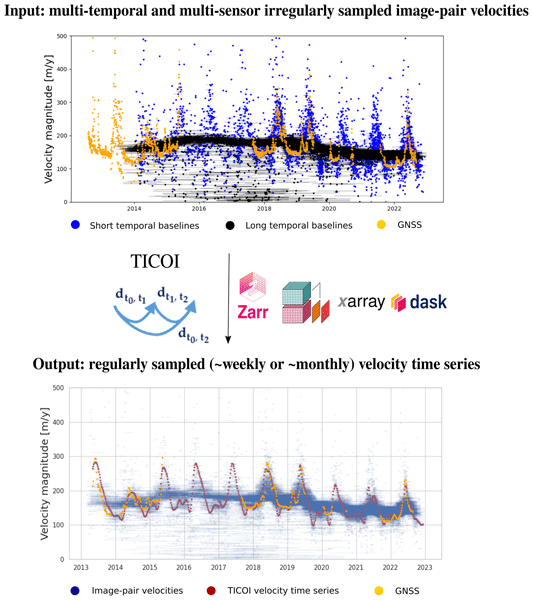
Laurane Charrier, Amaury Dehecq, Lei Guo, Fanny Brun, Romain Millan, Nathan Lioret, Luke Copland, Nathan Maier, Christine Dow, and Paul Halas
The Cryosphere, 19, 4555–4583, https://doi.org/10.5194/tc-19-4555-2025, https://doi.org/10.5194/tc-19-4555-2025, 2025
Short summary
Short summary
While global annual glacier velocities are openly accessible, sub-annual velocity time series are still lacking. This hinders our ability to understand flow processes and the integration of these observations in numerical models. We introduce an open source Python package called TICOI (Temporal Inversion using linear Combinations of Observations, and Interpolation) to fuse multi-temporal and multi-sensor image-pair velocities produced by different processing chains to produce standardized sub-annual velocity products.
Ailsa Chung, Frédéric Parrenin, Robert Mulvaney, Luca Vittuari, Massimo Frezzotti, Antonio Zanutta, David A. Lilien, Marie G. P. Cavitte, and Olaf Eisen
The Cryosphere, 19, 4125–4140, https://doi.org/10.5194/tc-19-4125-2025, https://doi.org/10.5194/tc-19-4125-2025, 2025
Short summary
Short summary
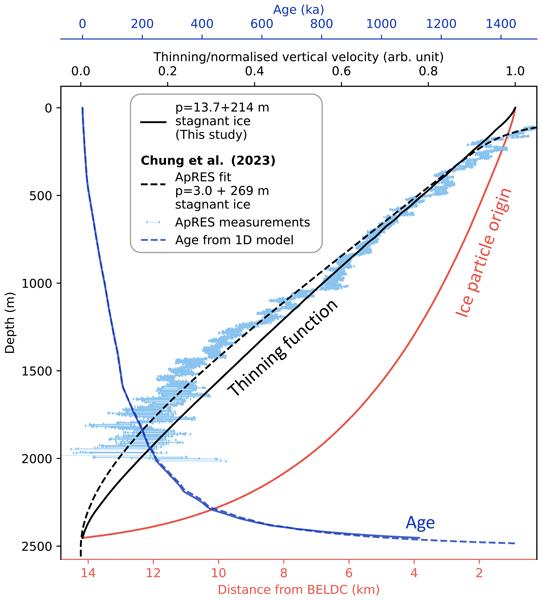
We applied an ice flow model to a flow line from the summit of Dome C to the Beyond EPICA ice core drill site on Little Dome C in Antarctica. Results show that the oldest ice at the drill site may be 1.12 Ma (at an age density of 20 kyr m-1) and originate from around 15 km upstream. We also discuss the nature of the 200–250 m thick basal layer which could be composed of stagnant ice, disturbed ice or even accreted ice (possibly containing debris).
Bertie W. J. Miles, Tian Li, and Robert G. Bingham
The Cryosphere, 19, 4027–4043, https://doi.org/10.5194/tc-19-4027-2025, https://doi.org/10.5194/tc-19-4027-2025, 2025
Short summary
Short summary
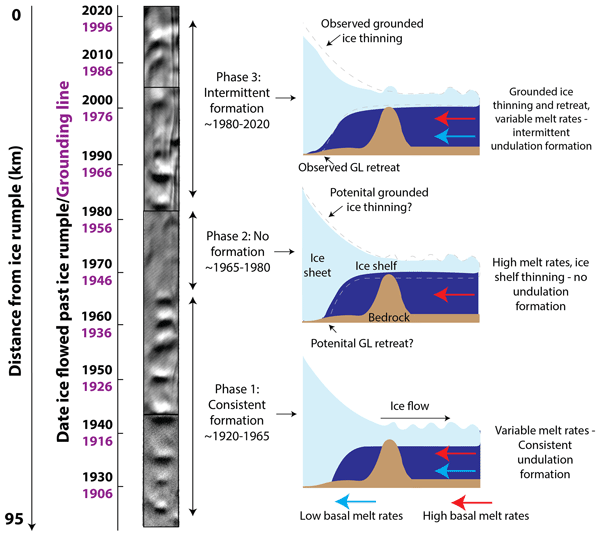
Totten Glacier, East Antarctica's largest mass-loss source, has thinned since at least the 1990s. No sustained acceleration has occurred since 1973, but earlier grounding-line retreat suggests prior loss. A ~20-year gap in surface undulations implies a mid-20th-century warm period that may have triggered ongoing loss. Collapse of a nearby ice shelf supports this. Current ~30-year satellite records are too short to capture full decadal melt-rate variability.
Ole Zeising, Tore Hattermann, Lars Kaleschke, Sophie Berger, Olaf Boebel, Reinhard Drews, M. Reza Ershadi, Tanja Fromm, Frank Pattyn, Daniel Steinhage, and Olaf Eisen
The Cryosphere, 19, 2837–2854, https://doi.org/10.5194/tc-19-2837-2025, https://doi.org/10.5194/tc-19-2837-2025, 2025
Short summary
Short summary
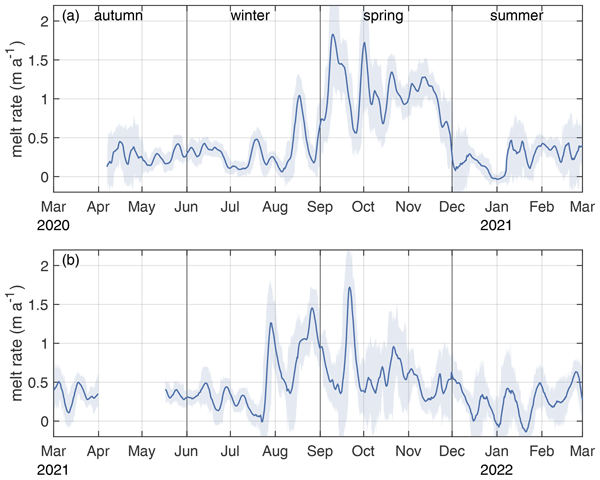
Basal melting of ice shelves impacts the mass loss of the Antarctic Ice Sheet. This study focuses on the Ekström Ice Shelf in East Antarctica, using multiyear data from an autonomous radar system. Results show a surprising seasonal pattern of high melt rates in winter and spring. The seasonalities of sea-ice growth and ocean density indicate that, in winter, dense water enhances plume activity and melt rates. Understanding these dynamics is crucial for improving future mass balance projections.
Hameed Moqadam and Olaf Eisen
The Cryosphere, 19, 2159–2196, https://doi.org/10.5194/tc-19-2159-2025, https://doi.org/10.5194/tc-19-2159-2025, 2025
Short summary
Short summary
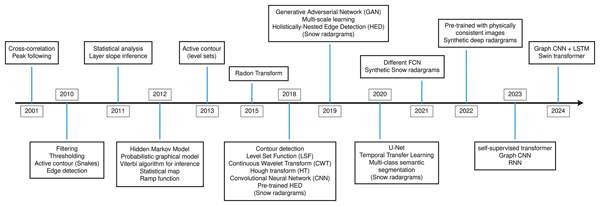
This is an overview of methodologies that have been applied to map the internal reflection horizons, or ice-layer boundaries, of ice sheets on Earth and other planets. We briefly explain radar applications in glaciology and the methods which have been used and published. There are summaries of the published work of the last 2 decades. Finally, we conclude by introducing the gaps and opportunities for further advancement in this field, and we present possible future directions.
Sonam Rinzin, Stuart Dunning, Rachel Joanne Carr, Ashim Sattar, and Martin Mergili
Nat. Hazards Earth Syst. Sci., 25, 1841–1864, https://doi.org/10.5194/nhess-25-1841-2025, https://doi.org/10.5194/nhess-25-1841-2025, 2025
Short summary
Short summary
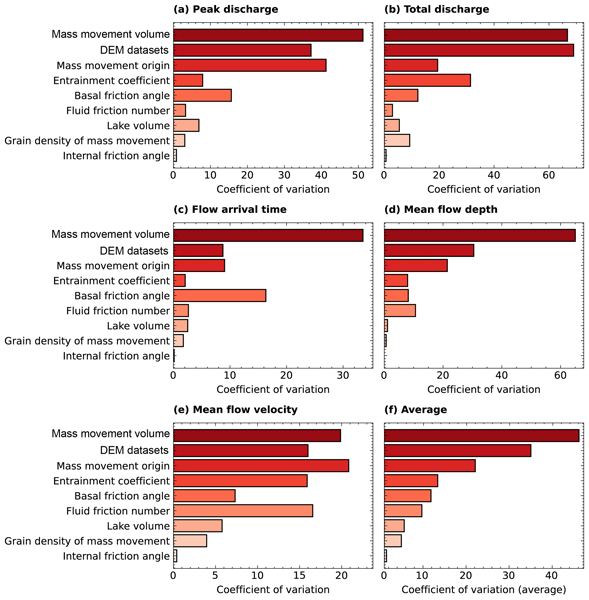
We modelled multiple glacial lake outburst flood (GLOF) scenarios (84 simulations) and tested the effect of nine key input parameters on the modelling results using r.avaflow. Our results highlight that GLOF modelling results are subject to uncertainty from the multiple input parameters. The variation in the volume of mass movement entering the lake causes the highest uncertainty in the modelled GLOF, followed by the DEM dataset and the origin of mass movement.
Tamara Annina Gerber, David A. Lilien, Niels F. Nymand, Daniel Steinhage, Olaf Eisen, and Dorthe Dahl-Jensen
The Cryosphere, 19, 1955–1971, https://doi.org/10.5194/tc-19-1955-2025, https://doi.org/10.5194/tc-19-1955-2025, 2025
Short summary
Short summary
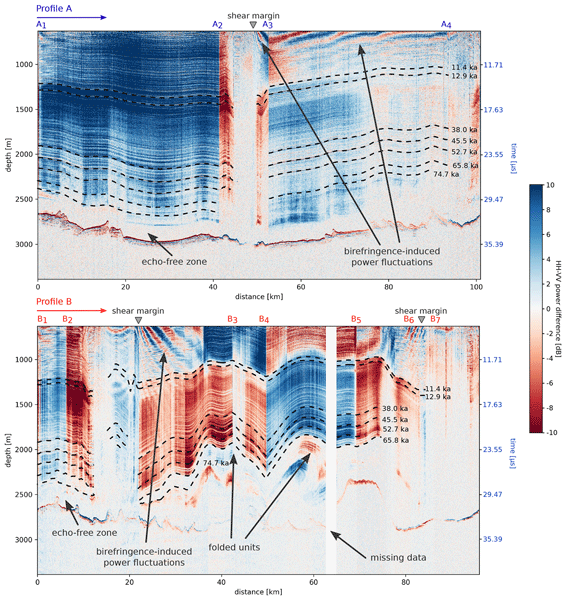
This study examines how anisotropic scattering and birefringence affect radar signals in ice sheets. Using data from northeast Greenland, we show that anisotropic scattering – driven by subtle ice crystal orientation changes – dominates the azimuthal power response. We find a strong link between scattering strength, orientation, and stratigraphy. This suggests anisotropic scattering can reveal crystal fabric orientation and differentiate ice units from distinct climatic periods.
Marnie B. Bryant, Adrian A. Borsa, Eric J. Anderson, Claire C. Masteller, Roger J. Michaelides, Matthew R. Siegfried, and Adam P. Young
The Cryosphere, 19, 1825–1847, https://doi.org/10.5194/tc-19-1825-2025, https://doi.org/10.5194/tc-19-1825-2025, 2025
Short summary
Short summary
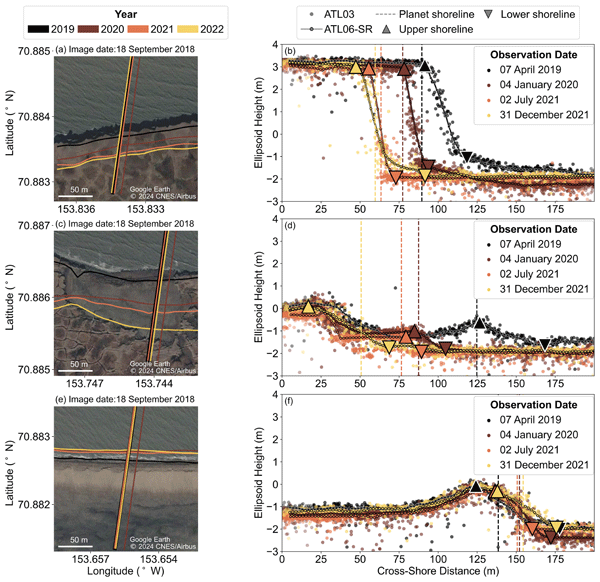
We measure shoreline change across a 7 km stretch of coastline on the Alaskan Beaufort Sea coast between 2019 and 2022 using multispectral imagery from Planet and satellite altimetry from ICESat-2. We find that shoreline change rates are high and variable and that different shoreline types show distinct patterns of change in shoreline position and topography. We discuss how the observed changes may be driven by both time-varying ocean and air conditions and spatial variations in morphology.
Steven Franke, Daniel Steinhage, Veit Helm, Alexandra M. Zuhr, Julien A. Bodart, Olaf Eisen, and Paul Bons
The Cryosphere, 19, 1153–1180, https://doi.org/10.5194/tc-19-1153-2025, https://doi.org/10.5194/tc-19-1153-2025, 2025
Short summary
Short summary
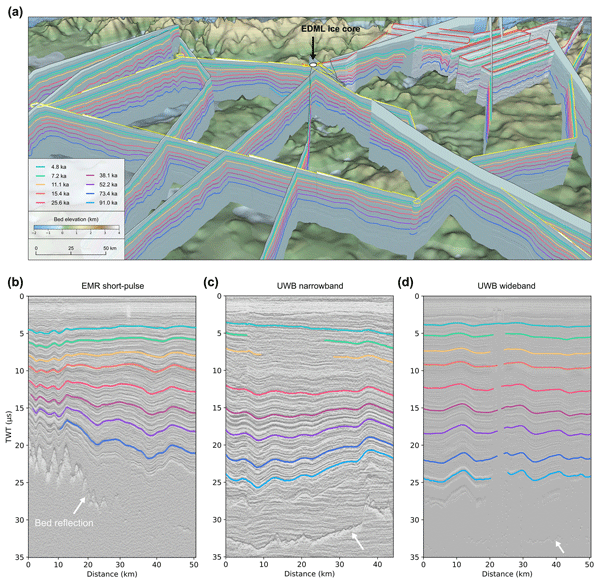
The study presents internal reflection horizons (IRHs) over an area of 450 000 km² from western Dronning Maud Land, Antarctica, spanning 4.8–91 ka. Using radar and ice core data, nine IRHs were dated and correlated with volcanic events. The data enhance our understanding of the ice sheet's age–depth architecture, accumulation, and dynamics. The findings inform ice flow models and contribute to Antarctic-wide comparisons of IRHs, supporting efforts toward a 3D age–depth ice sheet model.
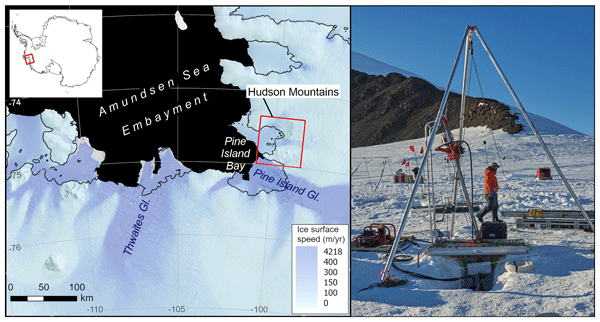
Joanne S. Johnson, John Woodward, Ian Nesbitt, Kate Winter, Seth Campbell, Keir A. Nichols, Ryan A. Venturelli, Scott Braddock, Brent M. Goehring, Brenda Hall, Dylan H. Rood, and Greg Balco
The Cryosphere, 19, 303–324, https://doi.org/10.5194/tc-19-303-2025, https://doi.org/10.5194/tc-19-303-2025, 2025
Short summary
Short summary
Determining where and when the Antarctic ice sheet was smaller than present requires recovery and exposure dating of subglacial bedrock. Here we use ice sheet model outputs and field data (geological and glaciological observations, bedrock samples, and ground-penetrating radar) to assess the suitability for subglacial drilling of sites in the Hudson Mountains, West Antarctica. We find that no sites are perfect, but two are feasible, with the most suitable being Winkie Nunatak (74.86°S, 99.77°W).
Nicolas B. Sartore, Till J. W. Wagner, Matthew R. Siegfried, Nimish Pujara, and Lucas K. Zoet
The Cryosphere, 19, 249–265, https://doi.org/10.5194/tc-19-249-2025, https://doi.org/10.5194/tc-19-249-2025, 2025
Short summary
Short summary
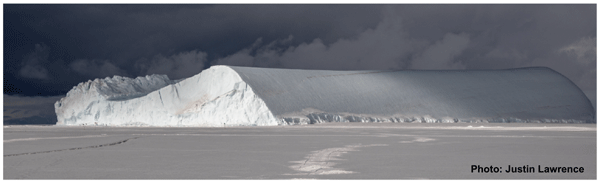
We investigate how waves may erode the front of Antarctica's largest ice shelf, Ross Ice Shelf, and how this results in bending forces that can cause deformation of the near-front shelf and trigger intermediate-scale calving (with icebergs of lengths ∼ 100 m). We compare satellite observations to theoretical estimates of erosion and ice shelf bending in order to better understand the processes underlying this type of calving and its role in the overall ice shelf mass flux.
Philipp Sebastian Arndt and Helen Amanda Fricker
The Cryosphere, 18, 5173–5206, https://doi.org/10.5194/tc-18-5173-2024, https://doi.org/10.5194/tc-18-5173-2024, 2024
Short summary
Short summary
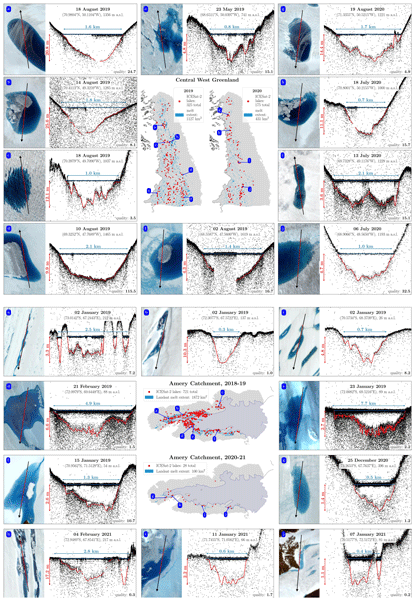
We develop a method for ice-sheet-scale retrieval of supraglacial meltwater depths using ICESat-2 photon data. We report results for two drainage basins in Greenland and Antarctica during two contrasting melt seasons, where our method reveals a total of 1249 lake segments up to 25 m deep. The large volume and wide variety of accurate depth data that our method provides enable the development of data-driven models of meltwater volumes in satellite imagery.
Adam J. Hepburn, Christine F. Dow, Antti Ojala, Joni Mäkinen, Elina Ahokangas, Jussi Hovikoski, Jukka-Pekka Palmu, and Kari Kajuutti
The Cryosphere, 18, 4873–4916, https://doi.org/10.5194/tc-18-4873-2024, https://doi.org/10.5194/tc-18-4873-2024, 2024
Short summary
Short summary
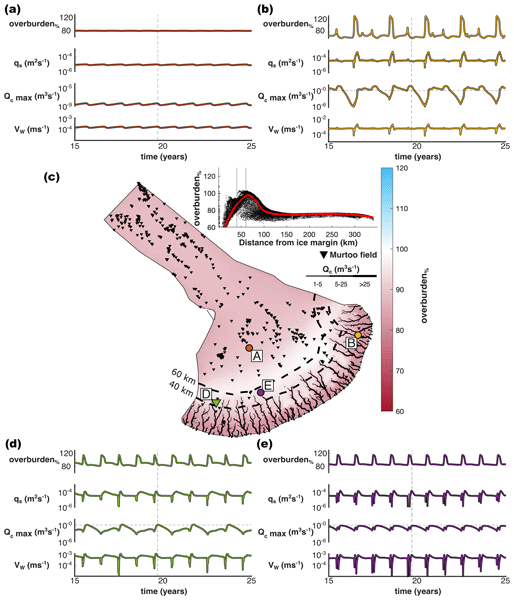
Terrain formerly occupied by ice sheets in the last ice age allows us to parameterize models of basal water flow using terrain and data unavailable beneath current ice sheets. Using GlaDS, a 2D basal hydrology model, we explore the origin of murtoos, a specific landform found throughout Finland that is thought to mark the upper limit of channels beneath the ice. Our results validate many of the predictions of murtoo origins and demonstrate that such models can be used to explore past ice sheets.
Emma Pearce, Dimitri Zigone, Coen Hofstede, Andreas Fichtner, Joachim Rimpot, Sune Olander Rasmussen, Johannes Freitag, and Olaf Eisen
The Cryosphere, 18, 4917–4932, https://doi.org/10.5194/tc-18-4917-2024, https://doi.org/10.5194/tc-18-4917-2024, 2024
Short summary
Short summary
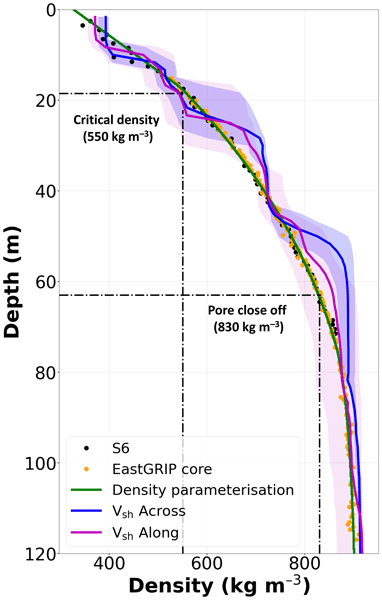
Our study near EastGRIP camp in Greenland shows varying firn properties by direction (crucial for studying ice stream stability, structure, surface mass balance, and past climate conditions). We used dispersion curve analysis of Love and Rayleigh waves to show firn is nonuniform along and across the flow of an ice stream due to wind patterns, seasonal variability, and the proximity to the edge of the ice stream. This method better informs firn structure, advancing ice stream understanding.
Falk M. Oraschewski, Inka Koch, M. Reza Ershadi, Jonathan D. Hawkins, Olaf Eisen, and Reinhard Drews
The Cryosphere, 18, 3875–3889, https://doi.org/10.5194/tc-18-3875-2024, https://doi.org/10.5194/tc-18-3875-2024, 2024
Short summary
Short summary
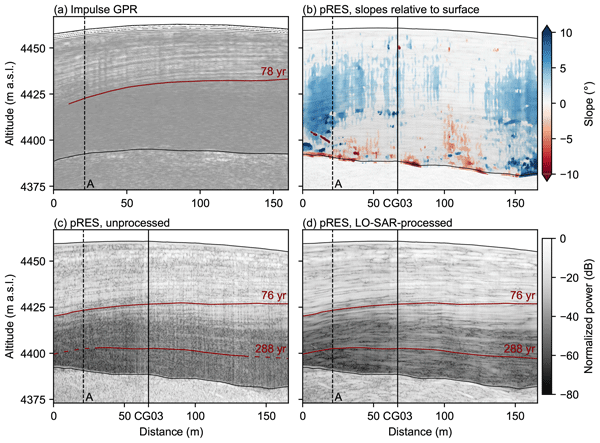
Mountain glaciers have a layered structure which contains information about past snow accumulation and ice flow. Using ground-penetrating radar instruments, the internal structure can be observed. The detection of layers in the deeper parts of a glacier is often difficult. Here, we present a new approach for imaging the englacial structure of an Alpine glacier (Colle Gnifetti, Switzerland and Italy) using a phase-sensitive radar that can detect reflection depth changes at sub-wavelength scales.
Siobhan F. Killingbeck, Anja Rutishauser, Martyn J. Unsworth, Ashley Dubnick, Alison S. Criscitiello, James Killingbeck, Christine F. Dow, Tim Hill, Adam D. Booth, Brittany Main, and Eric Brossier
The Cryosphere, 18, 3699–3722, https://doi.org/10.5194/tc-18-3699-2024, https://doi.org/10.5194/tc-18-3699-2024, 2024
Short summary
Short summary
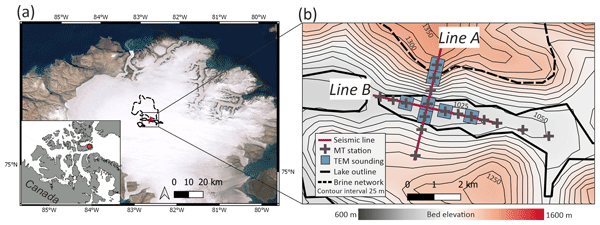
A subglacial lake was proposed to exist beneath Devon Ice Cap in the Canadian Arctic based on the analysis of airborne data. Our study presents a new interpretation of the subglacial material beneath the Devon Ice Cap from surface-based geophysical data. We show that there is no evidence of subglacial water, and the subglacial lake has likely been misidentified. Re-evaluation of the airborne data shows that overestimation of a critical processing parameter has likely occurred in prior studies.
J. Rachel Carr, Emily A. Hill, and G. Hilmar Gudmundsson
The Cryosphere, 18, 2719–2737, https://doi.org/10.5194/tc-18-2719-2024, https://doi.org/10.5194/tc-18-2719-2024, 2024
Short summary
Short summary
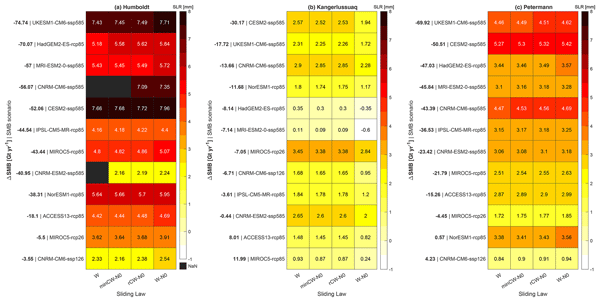
The Greenland Ice Sheet is one of the world's largest glaciers and is melting quickly in response to climate change. It contains fast-flowing channels of ice that move ice from Greenland's centre to its coasts and allow Greenland to react quickly to climate warming. As a result, we want to predict how these glaciers will behave in the future, but there are lots of uncertainties. Here we assess the impacts of two main sources of uncertainties in glacier models.
Charlotte M. Carter, Michael J. Bentley, Stewart S. R. Jamieson, Guy J. G. Paxman, Tom A. Jordan, Julien A. Bodart, Neil Ross, and Felipe Napoleoni
The Cryosphere, 18, 2277–2296, https://doi.org/10.5194/tc-18-2277-2024, https://doi.org/10.5194/tc-18-2277-2024, 2024
Short summary
Short summary
We use radio-echo sounding data to investigate the presence of flat surfaces beneath the Evans–Rutford region in West Antarctica. These surfaces may be what remains of laterally continuous surfaces, formed before the inception of the West Antarctic Ice Sheet, and we assess two hypotheses for their formation. Tectonic structures in the region may have also had a control on the growth of the ice sheet by focusing ice flow into troughs adjoining these surfaces.
Rebecca B. Latto, Ross J. Turner, Anya M. Reading, Sue Cook, Bernd Kulessa, and J. Paul Winberry
The Cryosphere, 18, 2081–2101, https://doi.org/10.5194/tc-18-2081-2024, https://doi.org/10.5194/tc-18-2081-2024, 2024
Short summary
Short summary
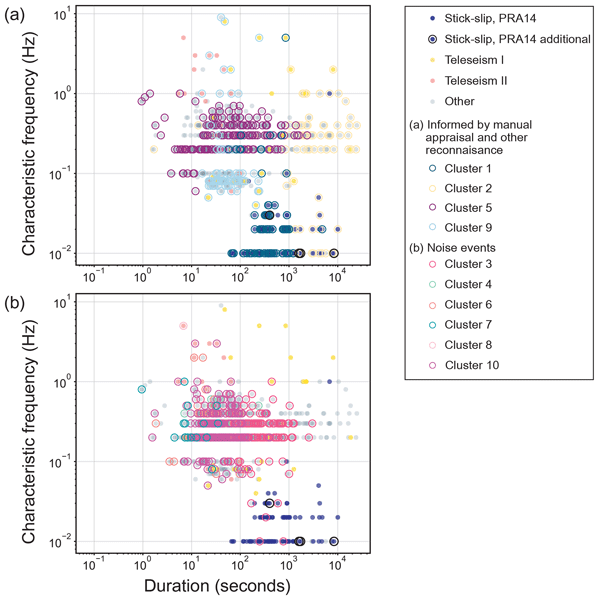
Seismic catalogues are potentially rich sources of information on glacier processes. In a companion study, we constructed an event catalogue for seismic data from the Whillans Ice Stream. Here, we provide a semi-automated workflow for consistent catalogue analysis using an unsupervised cluster analysis. We discuss the defining characteristics of identified signal types found in this catalogue and possible mechanisms for the underlying glacier processes and noise sources.
Edmund J. Lea, Stewart S. R. Jamieson, and Michael J. Bentley
The Cryosphere, 18, 1733–1751, https://doi.org/10.5194/tc-18-1733-2024, https://doi.org/10.5194/tc-18-1733-2024, 2024
Short summary
Short summary
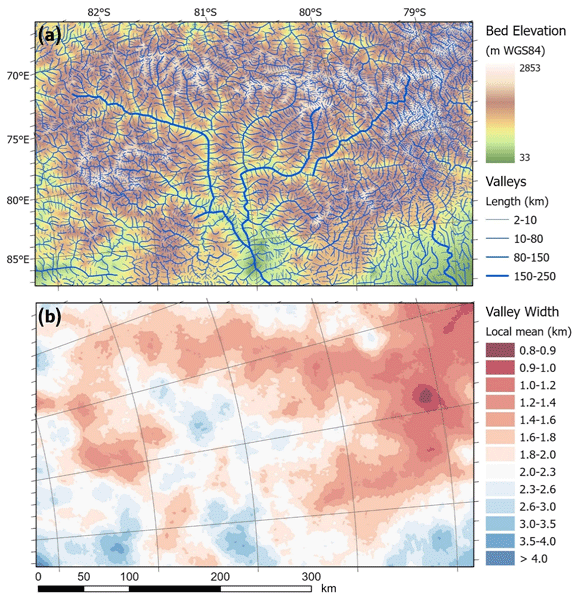
We use the ice surface expression of the Gamburtsev Subglacial Mountains in East Antarctica to map the horizontal pattern of valleys and ridges in finer detail than possible from previous methods. In upland areas, valleys are spaced much less than 5 km apart, with consequences for the distribution of melting at the bed and hence the likelihood of ancient ice being preserved. Automated mapping techniques were tested alongside manual approaches, with a hybrid approach recommended for future work.
Guy J. G. Paxman, Stewart S. R. Jamieson, Aisling M. Dolan, and Michael J. Bentley
The Cryosphere, 18, 1467–1493, https://doi.org/10.5194/tc-18-1467-2024, https://doi.org/10.5194/tc-18-1467-2024, 2024
Short summary
Short summary
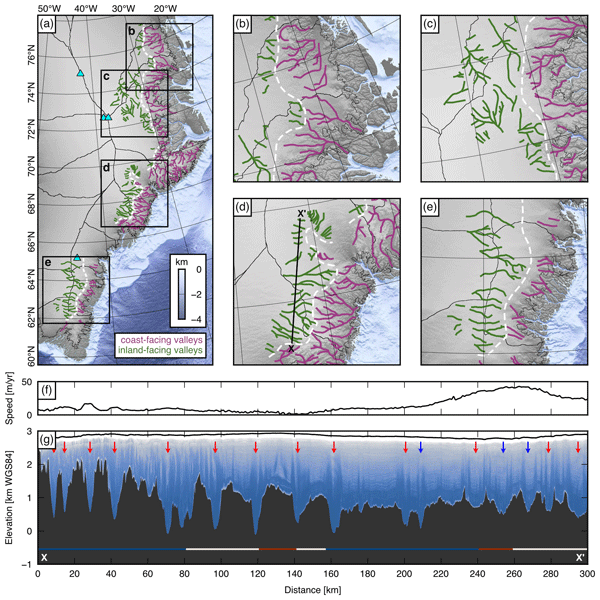
This study uses airborne radar data and satellite imagery to map mountainous topography hidden beneath the Greenland Ice Sheet. We find that the landscape records the former extent and configuration of ice masses that were restricted to areas of high topography. Computer models of ice flow indicate that valley glaciers eroded this landscape millions of years ago when local air temperatures were at least 4 °C higher than today and Greenland’s ice volume was < 10 % of that of the modern ice sheet.
Christine F. Dow, Derek Mueller, Peter Wray, Drew Friedrichs, Alexander L. Forrest, Jasmin B. McInerney, Jamin Greenbaum, Donald D. Blankenship, Choon Ki Lee, and Won Sang Lee
The Cryosphere, 18, 1105–1123, https://doi.org/10.5194/tc-18-1105-2024, https://doi.org/10.5194/tc-18-1105-2024, 2024
Short summary
Short summary
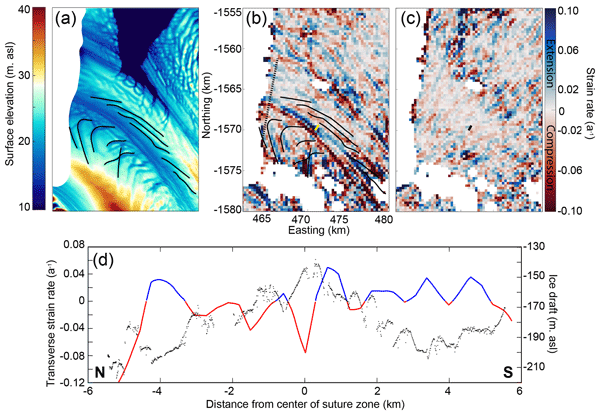
Ice shelves are a key control on Antarctic contribution to sea level rise. We examine the Nansen Ice Shelf in East Antarctica using a combination of field-based and satellite data. We find the basal topography of the ice shelf is highly variable, only partially visible in satellite datasets. We also find that the thinnest region of the ice shelf is altered over time by ice flow rates and ocean melting. These processes can cause fractures to form that eventually result in large calving events.
Tyler J. Fudge, Raphael Sauvage, Linh Vu, Benjamin H. Hills, Mirko Severi, and Edwin D. Waddington
Clim. Past, 20, 297–312, https://doi.org/10.5194/cp-20-297-2024, https://doi.org/10.5194/cp-20-297-2024, 2024
Short summary
Short summary
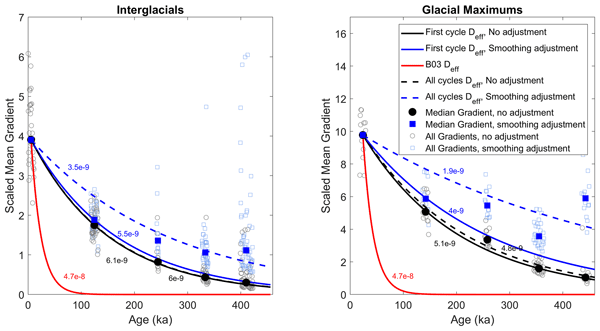
We use the oldest Antarctic ice core to estimate the rate of diffusion of sulfuric acid. Sulfuric acid is a marker of past volcanic activity and is critical in developing ice core timescales. The rate of diffusion is uncertain and is important to know, both for selecting future ice core locations and interpreting ice core records. We find the effective diffusivity of sulfate is 10 times smaller than previously estimated, indicating that the sulfuric acid signals will persist for longer.
Tobias Roylands, Robert G. Hilton, Erin L. McClymont, Mark H. Garnett, Guillaume Soulet, Sébastien Klotz, Mathis Degler, Felipe Napoleoni, and Caroline Le Bouteiller
Earth Surf. Dynam., 12, 271–299, https://doi.org/10.5194/esurf-12-271-2024, https://doi.org/10.5194/esurf-12-271-2024, 2024
Short summary
Short summary
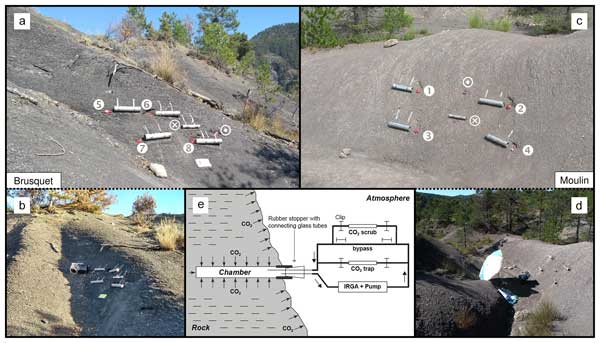
Chemical weathering of sedimentary rocks can release carbon dioxide and consume oxygen. We present a new field-based method to measure the exchange of these gases in real time, which allows us to directly compare the amount of reactants and products. By studying two sites with different rock types, we show that the chemical composition is an important factor in driving the weathering reactions. Locally, the carbon dioxide release changes alongside temperature and precipitation.
Ladina Steiner, Holger Schmithüsen, Jens Wickert, and Olaf Eisen
The Cryosphere, 17, 4903–4916, https://doi.org/10.5194/tc-17-4903-2023, https://doi.org/10.5194/tc-17-4903-2023, 2023
Short summary
Short summary
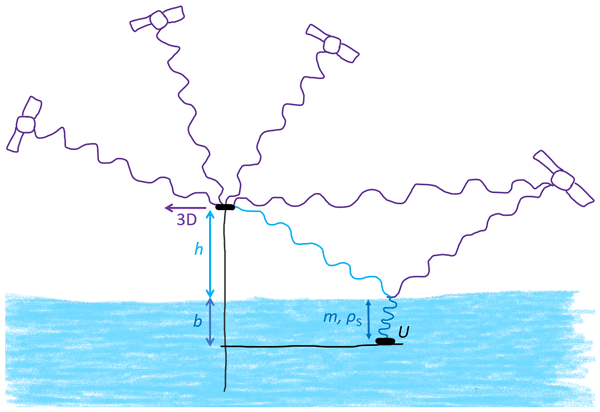
The present study illustrates the potential of a combined Global Navigation Satellite System reflectometry and refractometry (GNSS-RR) method for accurate, simultaneous, and continuous estimation of in situ snow accumulation, snow water equivalent, and snow density time series. The combined GNSS-RR method was successfully applied on a fast-moving, polar ice shelf. The combined GNSS-RR approach could be highly advantageous for a continuous quantification of ice sheet surface mass balances.
Rebecca J. Sanderson, Kate Winter, S. Louise Callard, Felipe Napoleoni, Neil Ross, Tom A. Jordan, and Robert G. Bingham
The Cryosphere, 17, 4853–4871, https://doi.org/10.5194/tc-17-4853-2023, https://doi.org/10.5194/tc-17-4853-2023, 2023
Short summary
Short summary
Ice-penetrating radar allows us to explore the internal structure of glaciers and ice sheets to constrain past and present ice-flow conditions. In this paper, we examine englacial layers within the Lambert Glacier in East Antarctica using a quantitative layer tracing tool. Analysis reveals that the ice flow here has been relatively stable, but evidence for former fast flow along a tributary suggests that changes have occurred in the past and could change again in the future.
Koi McArthur, Felicity S. McCormack, and Christine F. Dow
The Cryosphere, 17, 4705–4727, https://doi.org/10.5194/tc-17-4705-2023, https://doi.org/10.5194/tc-17-4705-2023, 2023
Short summary
Short summary
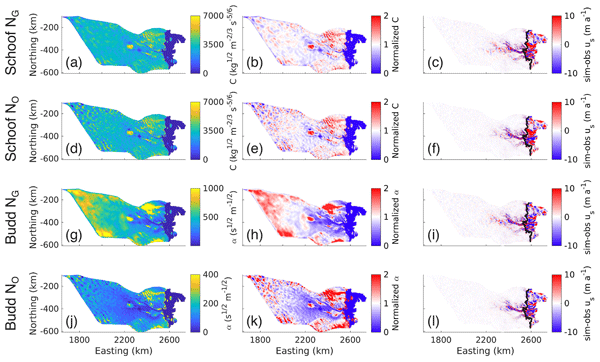
Using subglacial hydrology model outputs for Denman Glacier, East Antarctica, we investigated the effects of various friction laws and effective pressure inputs on ice dynamics modeling over the same glacier. The Schoof friction law outperformed the Budd friction law, and effective pressure outputs from the hydrology model outperformed a typically prescribed effective pressure. We propose an empirical prescription of effective pressure to be used in the absence of hydrology model outputs.
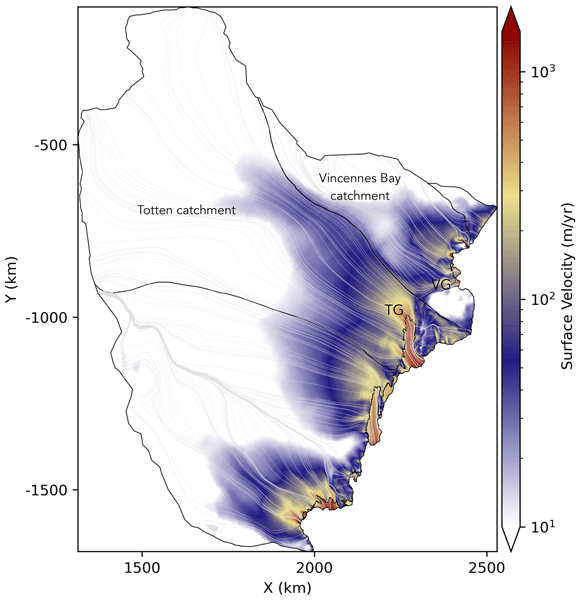
Felicity S. McCormack, Jason L. Roberts, Bernd Kulessa, Alan Aitken, Christine F. Dow, Lawrence Bird, Benjamin K. Galton-Fenzi, Katharina Hochmuth, Richard S. Jones, Andrew N. Mackintosh, and Koi McArthur
The Cryosphere, 17, 4549–4569, https://doi.org/10.5194/tc-17-4549-2023, https://doi.org/10.5194/tc-17-4549-2023, 2023
Short summary
Short summary
Changes in Antarctic surface elevation can cause changes in ice and basal water flow, impacting how much ice enters the ocean. We find that ice and basal water flow could divert from the Totten to the Vanderford Glacier, East Antarctica, under only small changes in the surface elevation, with implications for estimates of ice loss from this region. Further studies are needed to determine when this could occur and if similar diversions could occur elsewhere in Antarctica due to climate change.
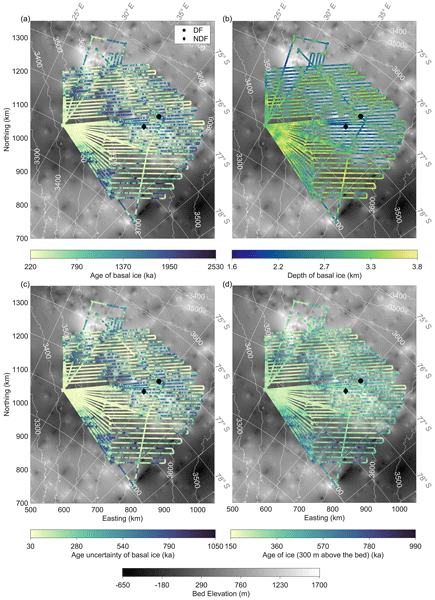
Zhuo Wang, Ailsa Chung, Daniel Steinhage, Frédéric Parrenin, Johannes Freitag, and Olaf Eisen
The Cryosphere, 17, 4297–4314, https://doi.org/10.5194/tc-17-4297-2023, https://doi.org/10.5194/tc-17-4297-2023, 2023
Short summary
Short summary
We combine radar-based observed internal layer stratigraphy of the ice sheet with a 1-D ice flow model in the Dome Fuji region. This results in maps of age and age density of the basal ice, the basal thermal conditions, and reconstructed accumulation rates. Based on modeled age we then identify four potential candidates for ice which is potentially 1.5 Myr old. Our map of basal thermal conditions indicates that melting prevails over the presence of stagnant ice in the study area.
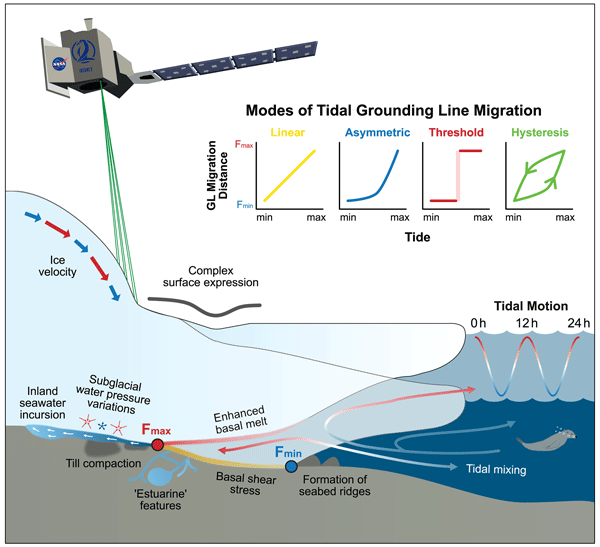
Bryony I. D. Freer, Oliver J. Marsh, Anna E. Hogg, Helen Amanda Fricker, and Laurie Padman
The Cryosphere, 17, 4079–4101, https://doi.org/10.5194/tc-17-4079-2023, https://doi.org/10.5194/tc-17-4079-2023, 2023
Short summary
Short summary
We develop a method using ICESat-2 data to measure how Antarctic grounding lines (GLs) migrate across the tide cycle. At an ice plain on the Ronne Ice Shelf we observe 15 km of tidal GL migration, the largest reported distance in Antarctica, dominating any signal of long-term migration. We identify four distinct migration modes, which provide both observational support for models of tidal ice flexure and GL migration and insights into ice shelf–ocean–subglacial interactions in grounding zones.
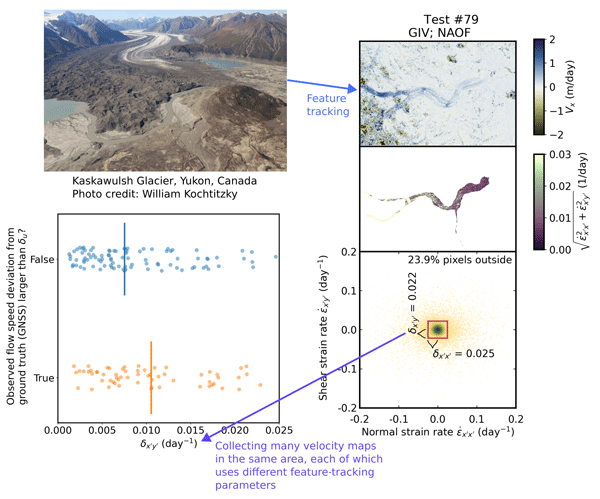
Whyjay Zheng, Shashank Bhushan, Maximillian Van Wyk De Vries, William Kochtitzky, David Shean, Luke Copland, Christine Dow, Renette Jones-Ivey, and Fernando Pérez
The Cryosphere, 17, 4063–4078, https://doi.org/10.5194/tc-17-4063-2023, https://doi.org/10.5194/tc-17-4063-2023, 2023
Short summary
Short summary
We design and propose a method that can evaluate the quality of glacier velocity maps. The method includes two numbers that we can calculate for each velocity map. Based on statistics and ice flow physics, velocity maps with numbers close to the recommended values are considered to have good quality. We test the method using the data from Kaskawulsh Glacier, Canada, and release an open-sourced software tool called GLAcier Feature Tracking testkit (GLAFT) to help users assess their velocity maps.
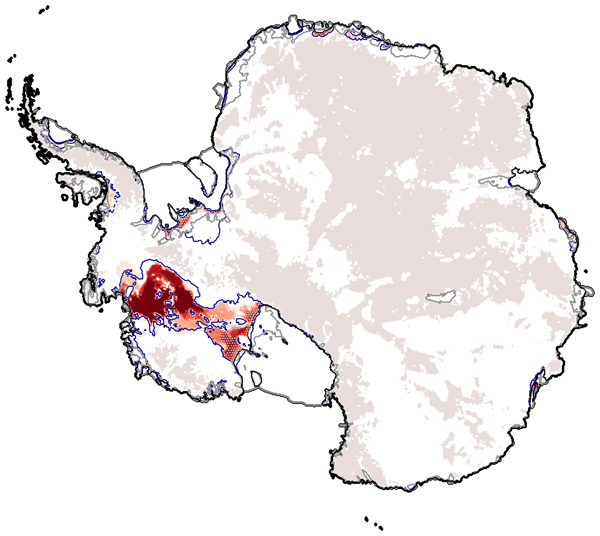
Ronja Reese, Julius Garbe, Emily A. Hill, Benoît Urruty, Kaitlin A. Naughten, Olivier Gagliardini, Gaël Durand, Fabien Gillet-Chaulet, G. Hilmar Gudmundsson, David Chandler, Petra M. Langebroek, and Ricarda Winkelmann
The Cryosphere, 17, 3761–3783, https://doi.org/10.5194/tc-17-3761-2023, https://doi.org/10.5194/tc-17-3761-2023, 2023
Short summary
Short summary
We use an ice sheet model to test where current climate conditions in Antarctica might lead. We find that present-day ocean and atmosphere conditions might commit an irreversible collapse of parts of West Antarctica which evolves over centuries to millennia. Importantly, this collapse is not irreversible yet.
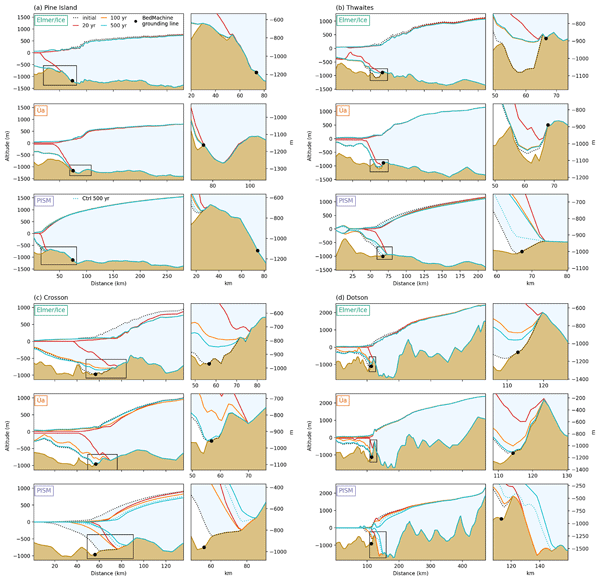
Emily A. Hill, Benoît Urruty, Ronja Reese, Julius Garbe, Olivier Gagliardini, Gaël Durand, Fabien Gillet-Chaulet, G. Hilmar Gudmundsson, Ricarda Winkelmann, Mondher Chekki, David Chandler, and Petra M. Langebroek
The Cryosphere, 17, 3739–3759, https://doi.org/10.5194/tc-17-3739-2023, https://doi.org/10.5194/tc-17-3739-2023, 2023
Short summary
Short summary
The grounding lines of the Antarctic Ice Sheet could enter phases of irreversible retreat or advance. We use three ice sheet models to show that the present-day locations of Antarctic grounding lines are reversible with respect to a small perturbation away from their current position. This indicates that present-day retreat of the grounding lines is not yet irreversible or self-enhancing.
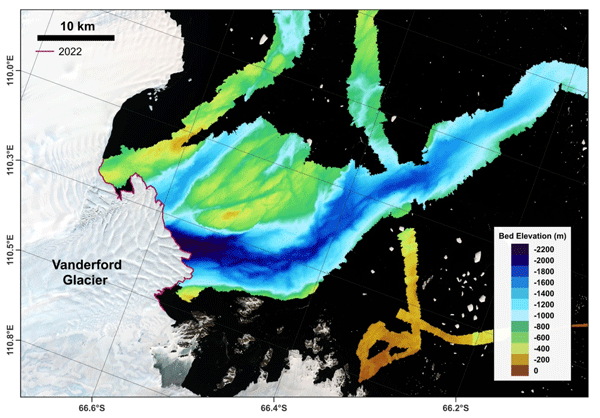
Hannah J. Picton, Chris R. Stokes, Stewart S. R. Jamieson, Dana Floricioiu, and Lukas Krieger
The Cryosphere, 17, 3593–3616, https://doi.org/10.5194/tc-17-3593-2023, https://doi.org/10.5194/tc-17-3593-2023, 2023
Short summary
Short summary
This study provides an overview of recent ice dynamics within Vincennes Bay, Wilkes Land, East Antarctica. This region was recently discovered to be vulnerable to intrusions of warm water capable of driving basal melt. Our results show extensive grounding-line retreat at Vanderford Glacier, estimated at 18.6 km between 1996 and 2020. This supports the notion that the warm water is able to access deep cavities below the Vanderford Ice Shelf, potentially making Vanderford Glacier unstable.
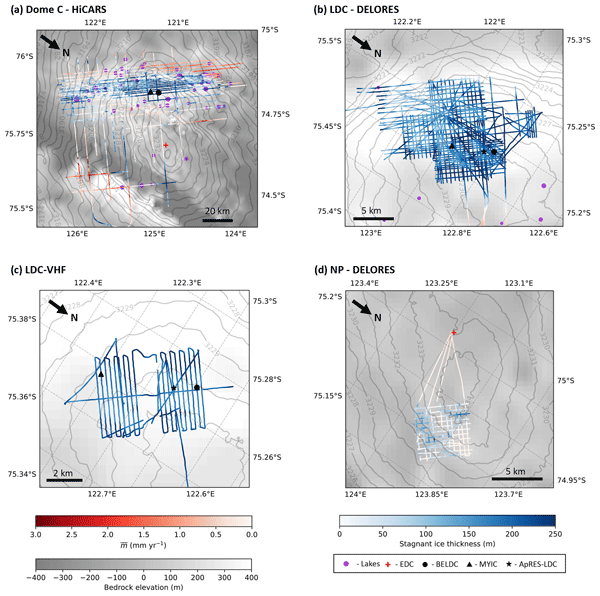
Ailsa Chung, Frédéric Parrenin, Daniel Steinhage, Robert Mulvaney, Carlos Martín, Marie G. P. Cavitte, David A. Lilien, Veit Helm, Drew Taylor, Prasad Gogineni, Catherine Ritz, Massimo Frezzotti, Charles O'Neill, Heinrich Miller, Dorthe Dahl-Jensen, and Olaf Eisen
The Cryosphere, 17, 3461–3483, https://doi.org/10.5194/tc-17-3461-2023, https://doi.org/10.5194/tc-17-3461-2023, 2023
Short summary
Short summary
We combined a numerical model with radar measurements in order to determine the age of ice in the Dome C region of Antarctica. Our results show that at the current ice core drilling sites on Little Dome C, the maximum age of the ice is almost 1.5 Ma. We also highlight a new potential drill site called North Patch with ice up to 2 Ma. Finally, we explore the nature of a stagnant ice layer at the base of the ice sheet which has been independently observed and modelled but is not well understood.
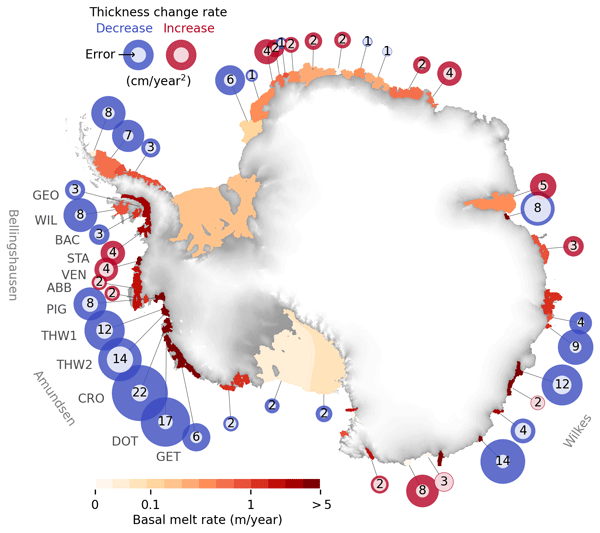
Fernando S. Paolo, Alex S. Gardner, Chad A. Greene, Johan Nilsson, Michael P. Schodlok, Nicole-Jeanne Schlegel, and Helen A. Fricker
The Cryosphere, 17, 3409–3433, https://doi.org/10.5194/tc-17-3409-2023, https://doi.org/10.5194/tc-17-3409-2023, 2023
Short summary
Short summary
We report on a slowdown in the rate of thinning and melting of West Antarctic ice shelves. We present a comprehensive assessment of the Antarctic ice shelves, where we analyze at a continental scale the changes in thickness, flow, and basal melt over the past 26 years. We also present a novel method to estimate ice shelf change from satellite altimetry and a time-dependent data set of ice shelf thickness and basal melt rates at an unprecedented resolution.
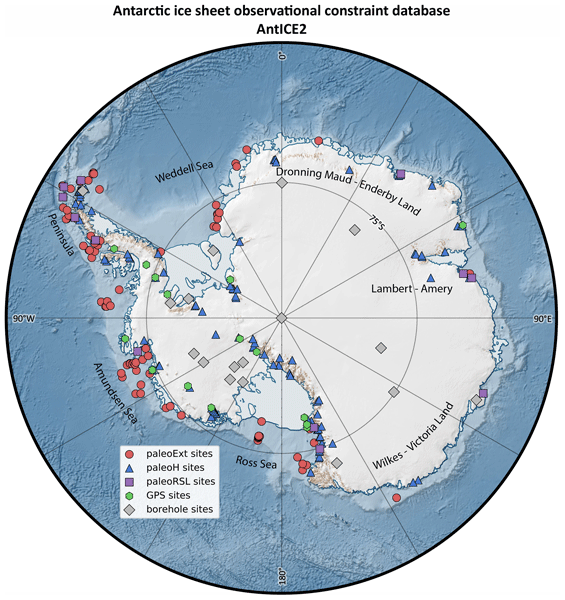
Benoit S. Lecavalier, Lev Tarasov, Greg Balco, Perry Spector, Claus-Dieter Hillenbrand, Christo Buizert, Catherine Ritz, Marion Leduc-Leballeur, Robert Mulvaney, Pippa L. Whitehouse, Michael J. Bentley, and Jonathan Bamber
Earth Syst. Sci. Data, 15, 3573–3596, https://doi.org/10.5194/essd-15-3573-2023, https://doi.org/10.5194/essd-15-3573-2023, 2023
Short summary
Short summary
The Antarctic Ice Sheet Evolution constraint database version 2 (AntICE2) consists of a large variety of observations that constrain the evolution of the Antarctic Ice Sheet over the last glacial cycle. This includes observations of past ice sheet extent, past ice thickness, past relative sea level, borehole temperature profiles, and present-day bedrock displacement rates. The database is intended to improve our understanding of past Antarctic changes and for ice sheet model calibrations.
Alice C. Frémand, Peter Fretwell, Julien A. Bodart, Hamish D. Pritchard, Alan Aitken, Jonathan L. Bamber, Robin Bell, Cesidio Bianchi, Robert G. Bingham, Donald D. Blankenship, Gino Casassa, Ginny Catania, Knut Christianson, Howard Conway, Hugh F. J. Corr, Xiangbin Cui, Detlef Damaske, Volkmar Damm, Reinhard Drews, Graeme Eagles, Olaf Eisen, Hannes Eisermann, Fausto Ferraccioli, Elena Field, René Forsberg, Steven Franke, Shuji Fujita, Yonggyu Gim, Vikram Goel, Siva Prasad Gogineni, Jamin Greenbaum, Benjamin Hills, Richard C. A. Hindmarsh, Andrew O. Hoffman, Per Holmlund, Nicholas Holschuh, John W. Holt, Annika N. Horlings, Angelika Humbert, Robert W. Jacobel, Daniela Jansen, Adrian Jenkins, Wilfried Jokat, Tom Jordan, Edward King, Jack Kohler, William Krabill, Mette Kusk Gillespie, Kirsty Langley, Joohan Lee, German Leitchenkov, Carlton Leuschen, Bruce Luyendyk, Joseph MacGregor, Emma MacKie, Kenichi Matsuoka, Mathieu Morlighem, Jérémie Mouginot, Frank O. Nitsche, Yoshifumi Nogi, Ole A. Nost, John Paden, Frank Pattyn, Sergey V. Popov, Eric Rignot, David M. Rippin, Andrés Rivera, Jason Roberts, Neil Ross, Anotonia Ruppel, Dustin M. Schroeder, Martin J. Siegert, Andrew M. Smith, Daniel Steinhage, Michael Studinger, Bo Sun, Ignazio Tabacco, Kirsty Tinto, Stefano Urbini, David Vaughan, Brian C. Welch, Douglas S. Wilson, Duncan A. Young, and Achille Zirizzotti
Earth Syst. Sci. Data, 15, 2695–2710, https://doi.org/10.5194/essd-15-2695-2023, https://doi.org/10.5194/essd-15-2695-2023, 2023
Short summary
Short summary
This paper presents the release of over 60 years of ice thickness, bed elevation, and surface elevation data acquired over Antarctica by the international community. These data are a crucial component of the Antarctic Bedmap initiative which aims to produce a new map and datasets of Antarctic ice thickness and bed topography for the international glaciology and geophysical community.
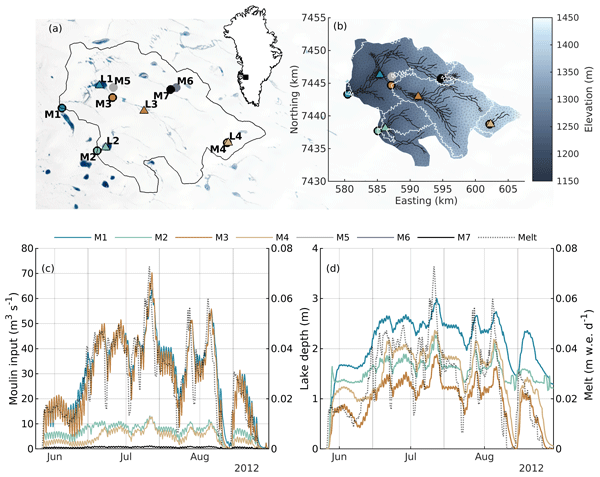
Tim Hill and Christine F. Dow
The Cryosphere, 17, 2607–2624, https://doi.org/10.5194/tc-17-2607-2023, https://doi.org/10.5194/tc-17-2607-2023, 2023
Short summary
Short summary
Water flow across the surface of the Greenland Ice Sheet controls the rate of water flow to the glacier bed. Here, we simulate surface water flow for a small catchment on the southwestern Greenland Ice Sheet. Our simulations predict significant differences in the form of surface water flow in high and low melt years depending on the rate and intensity of surface melt. These model outputs will be important in future work assessing the impact of surface water flow on subglacial water pressure.
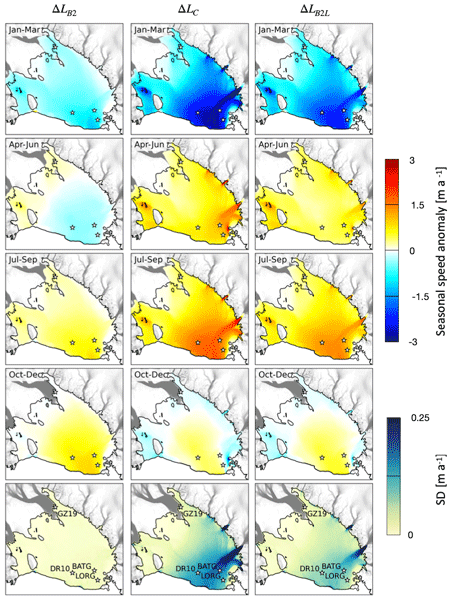
Cyrille Mosbeux, Laurie Padman, Emilie Klein, Peter D. Bromirski, and Helen A. Fricker
The Cryosphere, 17, 2585–2606, https://doi.org/10.5194/tc-17-2585-2023, https://doi.org/10.5194/tc-17-2585-2023, 2023
Short summary
Short summary
Antarctica's ice shelves (the floating extension of the ice sheet) help regulate ice flow. As ice shelves thin or lose contact with the bedrock, the upstream ice tends to accelerate, resulting in increased mass loss. Here, we use an ice sheet model to simulate the effect of seasonal sea surface height variations and see if we can reproduce observed seasonal variability of ice velocity on the ice shelf. When correctly parameterised, the model fits the observations well.
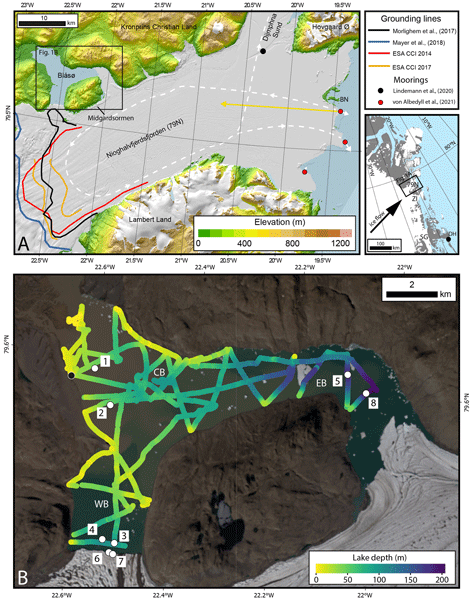
Michael J. Bentley, James A. Smith, Stewart S. R. Jamieson, Margaret R. Lindeman, Brice R. Rea, Angelika Humbert, Timothy P. Lane, Christopher M. Darvill, Jeremy M. Lloyd, Fiamma Straneo, Veit Helm, and David H. Roberts
The Cryosphere, 17, 1821–1837, https://doi.org/10.5194/tc-17-1821-2023, https://doi.org/10.5194/tc-17-1821-2023, 2023
Short summary
Short summary
The Northeast Greenland Ice Stream is a major outlet of the Greenland Ice Sheet. Some of its outlet glaciers and ice shelves have been breaking up and retreating, with inflows of warm ocean water identified as the likely reason. Here we report direct measurements of warm ocean water in an unusual lake that is connected to the ocean beneath the ice shelf in front of the 79° N Glacier. This glacier has not yet shown much retreat, but the presence of warm water makes future retreat more likely.
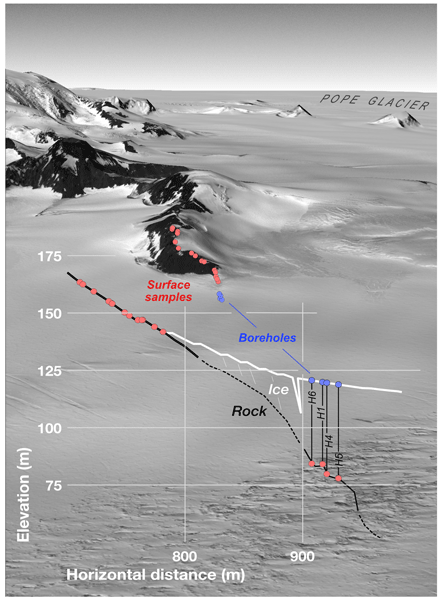
Greg Balco, Nathan Brown, Keir Nichols, Ryan A. Venturelli, Jonathan Adams, Scott Braddock, Seth Campbell, Brent Goehring, Joanne S. Johnson, Dylan H. Rood, Klaus Wilcken, Brenda Hall, and John Woodward
The Cryosphere, 17, 1787–1801, https://doi.org/10.5194/tc-17-1787-2023, https://doi.org/10.5194/tc-17-1787-2023, 2023
Short summary
Short summary
Samples of bedrock recovered from below the West Antarctic Ice Sheet show that part of the ice sheet was thinner several thousand years ago than it is now and subsequently thickened. This is important because of concern that present ice thinning in this region may lead to rapid, irreversible sea level rise. The past episode of thinning at this site that took place in a similar, although not identical, climate was not irreversible; however, reversal required at least 3000 years to complete.
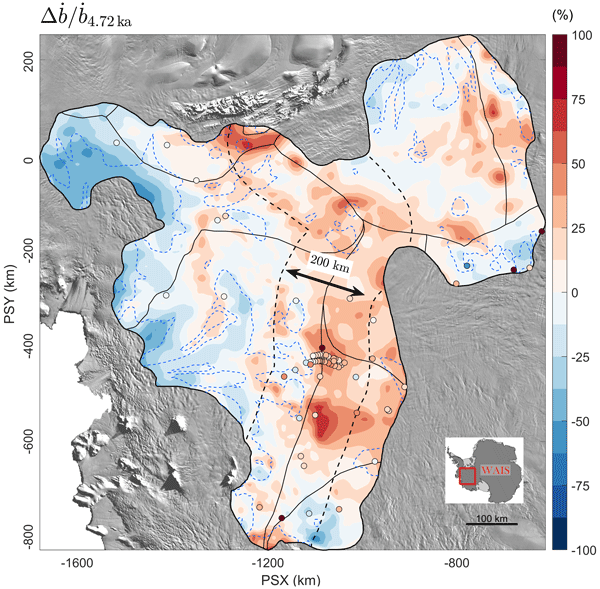
Julien A. Bodart, Robert G. Bingham, Duncan A. Young, Joseph A. MacGregor, David W. Ashmore, Enrica Quartini, Andrew S. Hein, David G. Vaughan, and Donald D. Blankenship
The Cryosphere, 17, 1497–1512, https://doi.org/10.5194/tc-17-1497-2023, https://doi.org/10.5194/tc-17-1497-2023, 2023
Short summary
Short summary
Estimating how West Antarctica will change in response to future climatic change depends on our understanding of past ice processes. Here, we use a reflector widely visible on airborne radar data across West Antarctica to estimate accumulation rates over the past 4700 years. By comparing our estimates with current atmospheric data, we find that accumulation rates were 18 % greater than modern rates. This has implications for our understanding of past ice processes in the region.
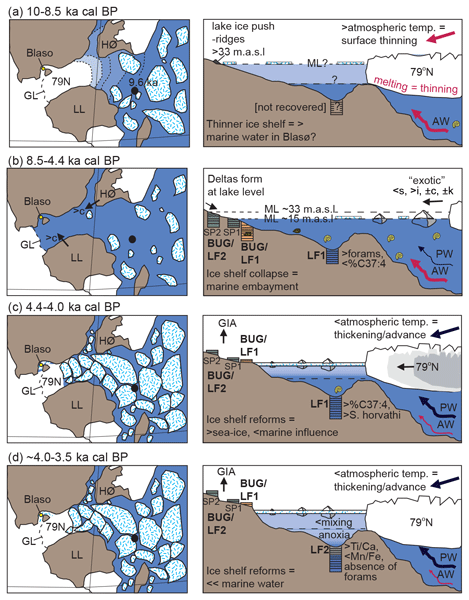
James A. Smith, Louise Callard, Michael J. Bentley, Stewart S. R. Jamieson, Maria Luisa Sánchez-Montes, Timothy P. Lane, Jeremy M. Lloyd, Erin L. McClymont, Christopher M. Darvill, Brice R. Rea, Colm O'Cofaigh, Pauline Gulliver, Werner Ehrmann, Richard S. Jones, and David H. Roberts
The Cryosphere, 17, 1247–1270, https://doi.org/10.5194/tc-17-1247-2023, https://doi.org/10.5194/tc-17-1247-2023, 2023
Short summary
Short summary
The Greenland Ice Sheet is melting at an accelerating rate. To understand the significance of these changes we reconstruct the history of one of its fringing ice shelves, known as 79° N ice shelf. We show that the ice shelf disappeared 8500 years ago, following a period of enhanced warming. An important implication of our study is that 79° N ice shelf is susceptible to collapse when atmospheric and ocean temperatures are ~2°C warmer than present, which could occur by the middle of this century.
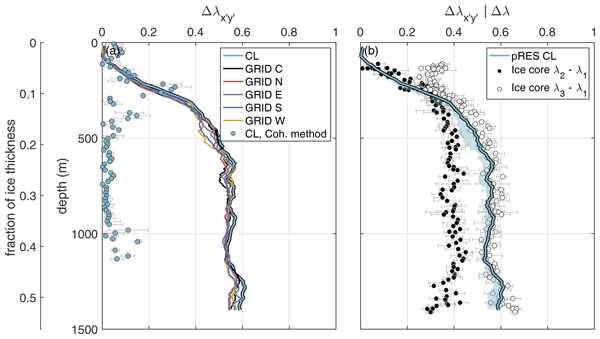
Ole Zeising, Tamara Annina Gerber, Olaf Eisen, M. Reza Ershadi, Nicolas Stoll, Ilka Weikusat, and Angelika Humbert
The Cryosphere, 17, 1097–1105, https://doi.org/10.5194/tc-17-1097-2023, https://doi.org/10.5194/tc-17-1097-2023, 2023
Short summary
Short summary
The flow of glaciers and ice streams is influenced by crystal fabric orientation. Besides sparse ice cores, these can be investigated by radar measurements. Here, we present an improved method which allows us to infer the horizontal fabric asymmetry using polarimetric phase-sensitive radar data. A validation of the method on a deep ice core from the Greenland Ice Sheet shows an excellent agreement, which is a large improvement over previously used methods.

Bertie W. J. Miles, Chris R. Stokes, Adrian Jenkins, Jim R. Jordan, Stewart S. R. Jamieson, and G. Hilmar Gudmundsson
The Cryosphere, 17, 445–456, https://doi.org/10.5194/tc-17-445-2023, https://doi.org/10.5194/tc-17-445-2023, 2023
Short summary
Short summary
Satellite observations have shown that the Shirase Glacier catchment in East Antarctica has been gaining mass over the past 2 decades, a trend largely attributed to increased snowfall. Our multi-decadal observations of Shirase Glacier show that ocean forcing has also contributed to some of this recent mass gain. This has been caused by strengthening easterly winds reducing the inflow of warm water underneath the Shirase ice tongue, causing the glacier to slow down and thicken.
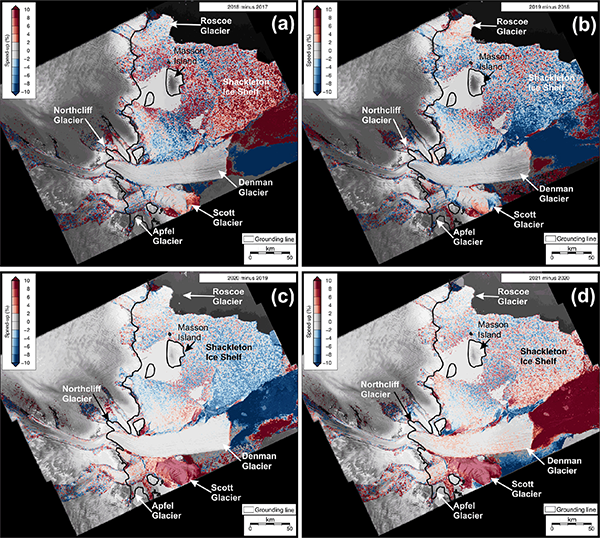
Sarah S. Thompson, Bernd Kulessa, Adrian Luckman, Jacqueline A. Halpin, Jamin S. Greenbaum, Tyler Pelle, Feras Habbal, Jingxue Guo, Lenneke M. Jong, Jason L. Roberts, Bo Sun, and Donald D. Blankenship
The Cryosphere, 17, 157–174, https://doi.org/10.5194/tc-17-157-2023, https://doi.org/10.5194/tc-17-157-2023, 2023
Short summary
Short summary
We use satellite imagery and ice penetrating radar to investigate the stability of the Shackleton system in East Antarctica. We find significant changes in surface structures across the system and observe a significant increase in ice flow speed (up to 50 %) on the floating part of Scott Glacier. We conclude that knowledge remains woefully insufficient to explain recent observed changes in the grounded and floating regions of the system.

Tancrède P. M. Leger, Andrew S. Hein, Ángel Rodés, Robert G. Bingham, Irene Schimmelpfennig, Derek Fabel, Pablo Tapia, and ASTER Team
Clim. Past, 19, 35–59, https://doi.org/10.5194/cp-19-35-2023, https://doi.org/10.5194/cp-19-35-2023, 2023
Short summary
Short summary
Over the past 800 thousand years, variations in the Earth’s orbit and tilt have caused antiphased solar insolation intensity in the Northern and Southern Hemispheres. Paradoxically, glacial records suggest that global ice sheets have responded synchronously to major cold glacial and warm interglacial episodes. To address this puzzle, we present a new detailed glacier chronology that estimates the timing of multiple Patagonian ice-sheet waxing and waning cycles over the past 300 thousand years.

Jonathan R. Adams, Joanne S. Johnson, Stephen J. Roberts, Philippa J. Mason, Keir A. Nichols, Ryan A. Venturelli, Klaus Wilcken, Greg Balco, Brent Goehring, Brenda Hall, John Woodward, and Dylan H. Rood
The Cryosphere, 16, 4887–4905, https://doi.org/10.5194/tc-16-4887-2022, https://doi.org/10.5194/tc-16-4887-2022, 2022
Short summary
Short summary
Glaciers in West Antarctica are experiencing significant ice loss. Geological data provide historical context for ongoing ice loss in West Antarctica, including constraints on likely future ice sheet behaviour in response to climatic warming. We present evidence from rare isotopes measured in rocks collected from an outcrop next to Pope Glacier. These data suggest that Pope Glacier thinned faster and sooner after the last ice age than previously thought.
Dominic A. Hodgson, Tom A. Jordan, Neil Ross, Teal R. Riley, and Peter T. Fretwell
The Cryosphere, 16, 4797–4809, https://doi.org/10.5194/tc-16-4797-2022, https://doi.org/10.5194/tc-16-4797-2022, 2022
Short summary
Short summary
This paper describes the drainage (and refill) of a subglacial lake on the Antarctic Peninsula resulting in the collapse of the overlying ice into the newly formed subglacial cavity. It provides evidence of an active hydrological network under the region's glaciers and close coupling between surface climate processes and the base of the ice.
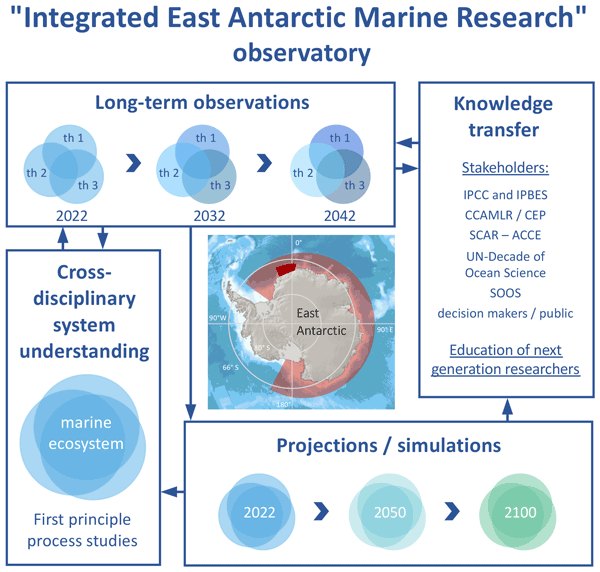
Julian Gutt, Stefanie Arndt, David Keith Alan Barnes, Horst Bornemann, Thomas Brey, Olaf Eisen, Hauke Flores, Huw Griffiths, Christian Haas, Stefan Hain, Tore Hattermann, Christoph Held, Mario Hoppema, Enrique Isla, Markus Janout, Céline Le Bohec, Heike Link, Felix Christopher Mark, Sebastien Moreau, Scarlett Trimborn, Ilse van Opzeeland, Hans-Otto Pörtner, Fokje Schaafsma, Katharina Teschke, Sandra Tippenhauer, Anton Van de Putte, Mia Wege, Daniel Zitterbart, and Dieter Piepenburg
Biogeosciences, 19, 5313–5342, https://doi.org/10.5194/bg-19-5313-2022, https://doi.org/10.5194/bg-19-5313-2022, 2022
Short summary
Short summary
Long-term ecological observations are key to assess, understand and predict impacts of environmental change on biotas. We present a multidisciplinary framework for such largely lacking investigations in the East Antarctic Southern Ocean, combined with case studies, experimental and modelling work. As climate change is still minor here but is projected to start soon, the timely implementation of this framework provides the unique opportunity to document its ecological impacts from the very onset.
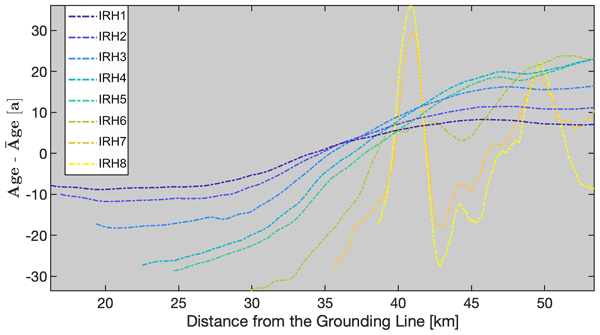
Vjeran Višnjević, Reinhard Drews, Clemens Schannwell, Inka Koch, Steven Franke, Daniela Jansen, and Olaf Eisen
The Cryosphere, 16, 4763–4777, https://doi.org/10.5194/tc-16-4763-2022, https://doi.org/10.5194/tc-16-4763-2022, 2022
Short summary
Short summary
We present a simple way to model the internal layers of an ice shelf and apply the method to the Roi Baudouin Ice Shelf in East Antarctica. Modeled results are compared to measurements obtained by radar. We distinguish between ice directly formed on the shelf and ice transported from the ice sheet, and we map the spatial changes in the volume of the locally accumulated ice. In this context, we discuss the sensitivity of the ice shelf to future changes in surface accumulation and basal melt.
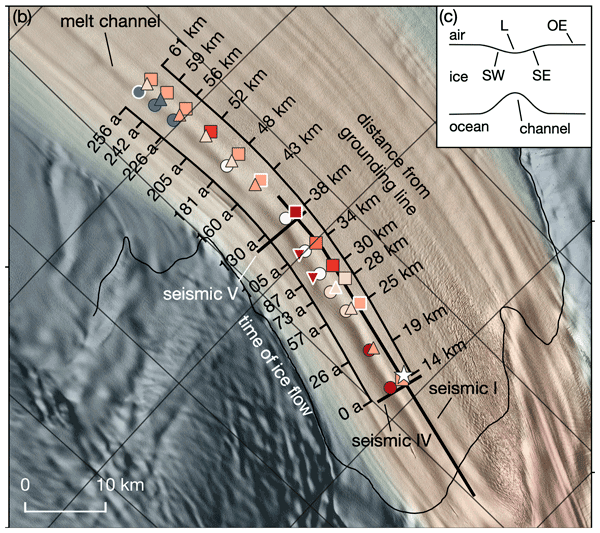
Angelika Humbert, Julia Christmann, Hugh F. J. Corr, Veit Helm, Lea-Sophie Höyns, Coen Hofstede, Ralf Müller, Niklas Neckel, Keith W. Nicholls, Timm Schultz, Daniel Steinhage, Michael Wolovick, and Ole Zeising
The Cryosphere, 16, 4107–4139, https://doi.org/10.5194/tc-16-4107-2022, https://doi.org/10.5194/tc-16-4107-2022, 2022
Short summary
Short summary
Ice shelves are normally flat structures that fringe the Antarctic continent. At some locations they have channels incised into their underside. On Filchner Ice Shelf, such a channel is more than 50 km long and up to 330 m high. We conducted field measurements of basal melt rates and found a maximum of 2 m yr−1. Simulations represent the geometry evolution of the channel reasonably well. There is no reason to assume that this type of melt channel is destabilizing ice shelves.
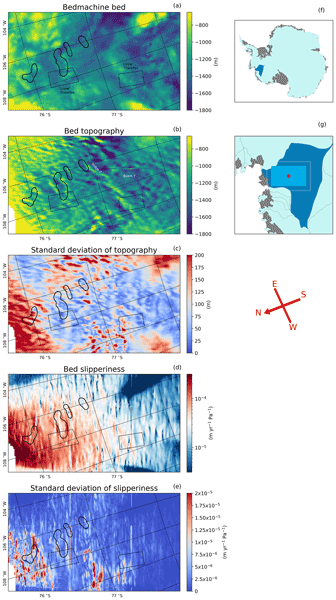
Helen Ockenden, Robert G. Bingham, Andrew Curtis, and Daniel Goldberg
The Cryosphere, 16, 3867–3887, https://doi.org/10.5194/tc-16-3867-2022, https://doi.org/10.5194/tc-16-3867-2022, 2022
Short summary
Short summary
Hills and valleys hidden under the ice of Thwaites Glacier have an impact on ice flow and future ice loss, but there are not many three-dimensional observations of their location or size. We apply a mathematical theory to new high-resolution observations of the ice surface to predict the bed topography beneath the ice. There is a good correlation with ice-penetrating radar observations. The method may be useful in areas with few direct observations or as a further constraint for other methods.
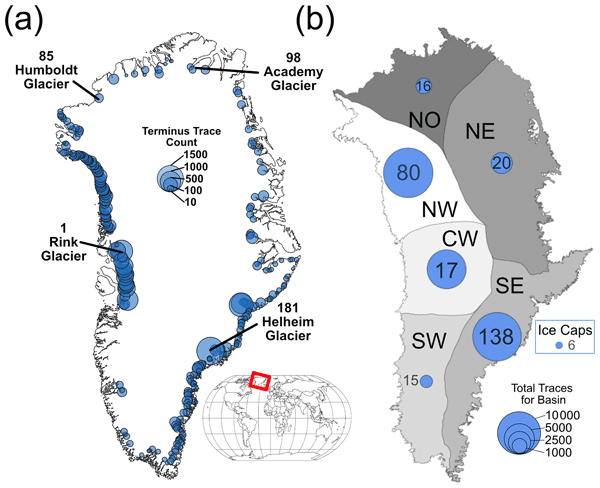
Sophie Goliber, Taryn Black, Ginny Catania, James M. Lea, Helene Olsen, Daniel Cheng, Suzanne Bevan, Anders Bjørk, Charlie Bunce, Stephen Brough, J. Rachel Carr, Tom Cowton, Alex Gardner, Dominik Fahrner, Emily Hill, Ian Joughin, Niels J. Korsgaard, Adrian Luckman, Twila Moon, Tavi Murray, Andrew Sole, Michael Wood, and Enze Zhang
The Cryosphere, 16, 3215–3233, https://doi.org/10.5194/tc-16-3215-2022, https://doi.org/10.5194/tc-16-3215-2022, 2022
Short summary
Short summary
Terminus traces have been used to understand how Greenland's glaciers have changed over time; however, manual digitization is time-intensive, and a lack of coordination leads to duplication of efforts. We have compiled a dataset of over 39 000 terminus traces for 278 glaciers for scientific and machine learning applications. We also provide an overview of an updated version of the Google Earth Engine Digitization Tool (GEEDiT), which has been developed specifically for the Greenland Ice Sheet.
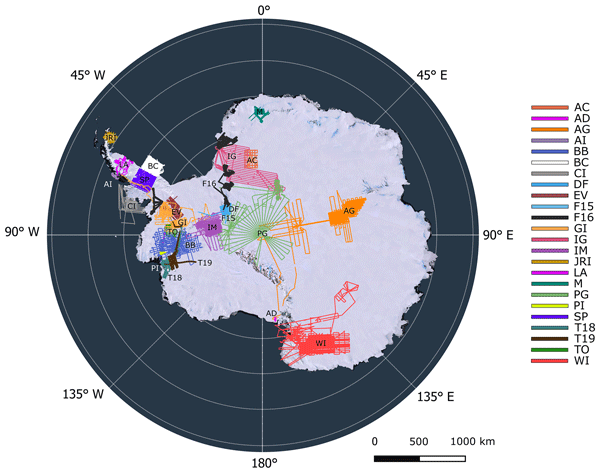
Alice C. Frémand, Julien A. Bodart, Tom A. Jordan, Fausto Ferraccioli, Carl Robinson, Hugh F. J. Corr, Helen J. Peat, Robert G. Bingham, and David G. Vaughan
Earth Syst. Sci. Data, 14, 3379–3410, https://doi.org/10.5194/essd-14-3379-2022, https://doi.org/10.5194/essd-14-3379-2022, 2022
Short summary
Short summary
This paper presents the release of large swaths of airborne geophysical data (including gravity, magnetics, and radar) acquired between 1994 and 2020 over Antarctica by the British Antarctic Survey. These include a total of 64 datasets from 24 different surveys, amounting to >30 % of coverage over the Antarctic Ice Sheet. This paper discusses how these data were acquired and processed and presents the methods used to standardize and publish the data in an interactive and reproducible manner.

Astrid Oetting, Emma C. Smith, Jan Erik Arndt, Boris Dorschel, Reinhard Drews, Todd A. Ehlers, Christoph Gaedicke, Coen Hofstede, Johann P. Klages, Gerhard Kuhn, Astrid Lambrecht, Andreas Läufer, Christoph Mayer, Ralf Tiedemann, Frank Wilhelms, and Olaf Eisen
The Cryosphere, 16, 2051–2066, https://doi.org/10.5194/tc-16-2051-2022, https://doi.org/10.5194/tc-16-2051-2022, 2022
Short summary
Short summary
This study combines a variety of geophysical measurements in front of and beneath the Ekström Ice Shelf in order to identify and interpret geomorphological evidences of past ice sheet flow, extent and retreat.
The maximal extent of grounded ice in this region was 11 km away from the continental shelf break.
The thickness of palaeo-ice on the calving front around the LGM was estimated to be at least 305 to 320 m.
We provide essential boundary conditions for palaeo-ice-sheet models.
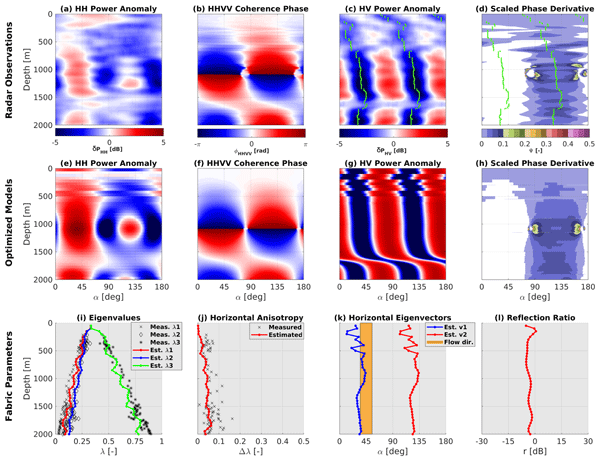
M. Reza Ershadi, Reinhard Drews, Carlos Martín, Olaf Eisen, Catherine Ritz, Hugh Corr, Julia Christmann, Ole Zeising, Angelika Humbert, and Robert Mulvaney
The Cryosphere, 16, 1719–1739, https://doi.org/10.5194/tc-16-1719-2022, https://doi.org/10.5194/tc-16-1719-2022, 2022
Short summary
Short summary
Radio waves transmitted through ice split up and inform us about the ice sheet interior and orientation of single ice crystals. This can be used to infer how ice flows and improve projections on how it will evolve in the future. Here we used an inverse approach and developed a new algorithm to infer ice properties from observed radar data. We applied this technique to the radar data obtained at two EPICA drilling sites, where ice cores were used to validate our results.

Joanne S. Johnson, Ryan A. Venturelli, Greg Balco, Claire S. Allen, Scott Braddock, Seth Campbell, Brent M. Goehring, Brenda L. Hall, Peter D. Neff, Keir A. Nichols, Dylan H. Rood, Elizabeth R. Thomas, and John Woodward
The Cryosphere, 16, 1543–1562, https://doi.org/10.5194/tc-16-1543-2022, https://doi.org/10.5194/tc-16-1543-2022, 2022
Short summary
Short summary
Recent studies have suggested that some portions of the Antarctic Ice Sheet were less extensive than present in the last few thousand years. We discuss how past ice loss and regrowth during this time would leave its mark on geological and glaciological records and suggest ways in which future studies could detect such changes. Determining timing of ice loss and gain around Antarctica and conditions under which they occurred is critical for preparing for future climate-warming-induced changes.

Erin L. McClymont, Michael J. Bentley, Dominic A. Hodgson, Charlotte L. Spencer-Jones, Thomas Wardley, Martin D. West, Ian W. Croudace, Sonja Berg, Darren R. Gröcke, Gerhard Kuhn, Stewart S. R. Jamieson, Louise Sime, and Richard A. Phillips
Clim. Past, 18, 381–403, https://doi.org/10.5194/cp-18-381-2022, https://doi.org/10.5194/cp-18-381-2022, 2022
Short summary
Short summary
Sea ice is important for our climate system and for the unique ecosystems it supports. We present a novel way to understand past Antarctic sea-ice ecosystems: using the regurgitated stomach contents of snow petrels, which nest above the ice sheet but feed in the sea ice. During a time when sea ice was more extensive than today (24 000–30 000 years ago), we show that snow petrel diet had varying contributions of fish and krill, which we interpret to show changing sea-ice distribution.
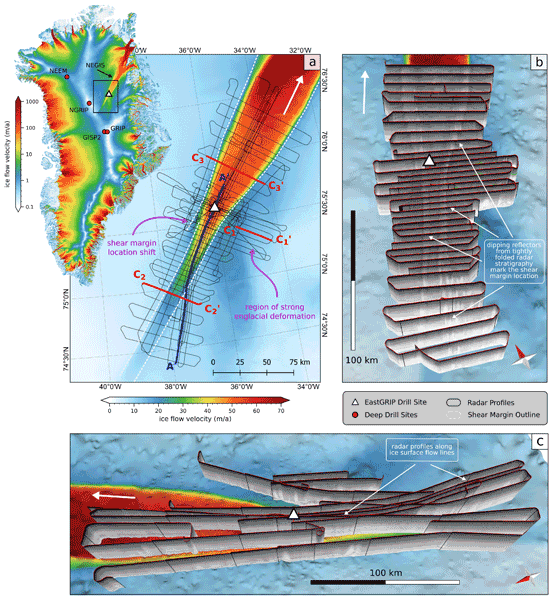
Steven Franke, Daniela Jansen, Tobias Binder, John D. Paden, Nils Dörr, Tamara A. Gerber, Heinrich Miller, Dorthe Dahl-Jensen, Veit Helm, Daniel Steinhage, Ilka Weikusat, Frank Wilhelms, and Olaf Eisen
Earth Syst. Sci. Data, 14, 763–779, https://doi.org/10.5194/essd-14-763-2022, https://doi.org/10.5194/essd-14-763-2022, 2022
Short summary
Short summary
The Northeast Greenland Ice Stream (NEGIS) is the largest ice stream in Greenland. In order to better understand the past and future dynamics of the NEGIS, we present a high-resolution airborne radar data set (EGRIP-NOR-2018) for the onset region of the NEGIS. The survey area is centered at the location of the drill site of the East Greenland Ice-Core Project (EastGRIP), and radar profiles cover both shear margins and are aligned parallel to several flow lines.
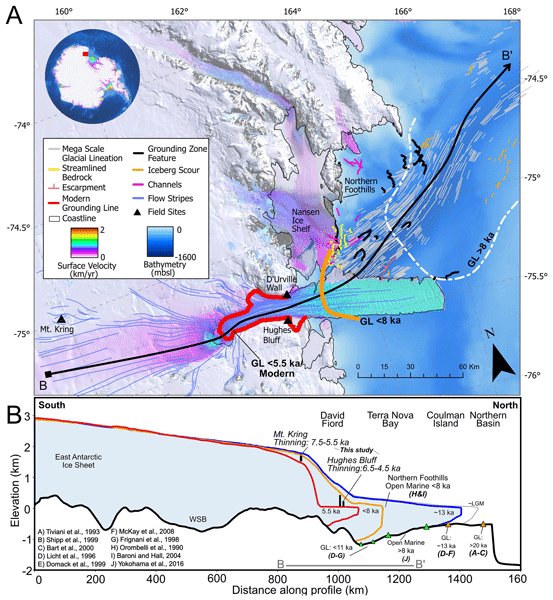
Jamey Stutz, Andrew Mackintosh, Kevin Norton, Ross Whitmore, Carlo Baroni, Stewart S. R. Jamieson, Richard S. Jones, Greg Balco, Maria Cristina Salvatore, Stefano Casale, Jae Il Lee, Yeong Bae Seong, Robert McKay, Lauren J. Vargo, Daniel Lowry, Perry Spector, Marcus Christl, Susan Ivy Ochs, Luigia Di Nicola, Maria Iarossi, Finlay Stuart, and Tom Woodruff
The Cryosphere, 15, 5447–5471, https://doi.org/10.5194/tc-15-5447-2021, https://doi.org/10.5194/tc-15-5447-2021, 2021
Short summary
Short summary
Understanding the long-term behaviour of ice sheets is essential to projecting future changes due to climate change. In this study, we use rocks deposited along the margin of the David Glacier, one of the largest glacier systems in the world, to reveal a rapid thinning event initiated over 7000 years ago and endured for ~ 2000 years. Using physical models, we show that subglacial topography and ocean heat are important drivers for change along this sector of the Antarctic Ice Sheet.
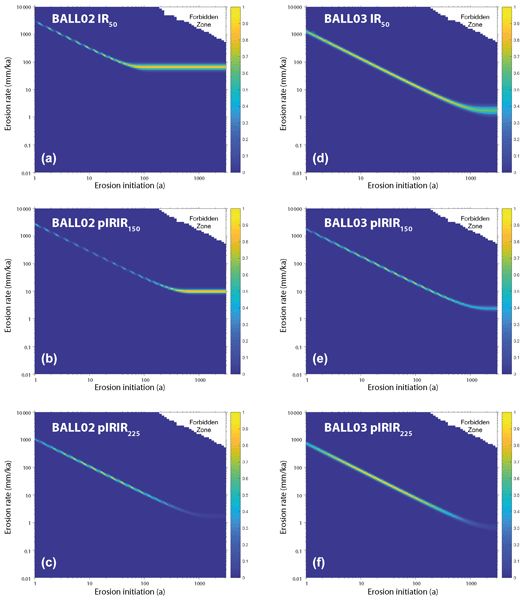
Rachel K. Smedley, David Small, Richard S. Jones, Stephen Brough, Jennifer Bradley, and Geraint T. H. Jenkins
Geochronology, 3, 525–543, https://doi.org/10.5194/gchron-3-525-2021, https://doi.org/10.5194/gchron-3-525-2021, 2021
Short summary
Short summary
We apply new rock luminescence techniques to a well-constrained scenario of the Beinn Alligin rock avalanche, NW Scotland. We measure accurate erosion rates consistent with independently derived rates and reveal a transient state of erosion over the last ~4000 years in the wet, temperate climate of NW Scotland. This study shows that the new luminescence erosion-meter has huge potential for inferring erosion rates on sub-millennial scales, which is currently impossible with existing techniques.
Cited articles
Adusumilli, S., Fricker, H. A., Medley, B., Padman, L., and Siegfried, M. R.: Interannual variations in meltwater input to the Southern Ocean from Antarctic ice shelves, Nat. Geosci., 13, 616–620, https://doi.org/10.1038/s41561-020-0616-z, 2020.
Agrios, L. M., Licht, K. J., Williams, T., Hemming, S. R., Welch, L., and Mickey, J. L.: Detrital geochronology and lithologic signatures of Weddell Sea Embayment ice streams, Antarctica – Implications for subglacial geology and ice sheet history, GSA Bull., 134, 1895–1915, https://doi.org/10.1130/B36117.1, 2021.
Alley, K. E., Scambos, T. A., Siegfried, M. R., and Fricker, H. A.: Impacts of warm water on Antarctic ice shelf stability through basal channel formation, Nat. Geosci., 9, 290–293, https://doi.org/10.1038/ngeo2675, 2016.
Alley, R. B., Anandakrishnan, S., Bentley, C. R., and Lord, N.: A water-piracy hypothesis for the stagnation of Ice Stream C, Antarctica, Ann. Glaciol., 20, 187–194, https://doi.org/10.3189/1994AoG20-1-187-194, 1994.
Aitken, A. R. A., Roberts, J. L., van Ommen, T. D., Young, D. A., Golledge, N. R., Greenbaum, J. S., Blankenship, D. D., and Siegert, M. J.: Repeated large-scale retreat and advance of Totten Glacier indicated by inland bed erosion, Nature, 533, 385–389, https://doi.org/10.1038/nature17447, 2016.
Aitken, A. R. A., Kulessa, B., Schroeder, D., Jordan, T. A., Whittaker, J. M., Anandakrishnan, S., Dawson, E. J., Wiens, D. A., Eisen, O., and Siegert, M. J.: Antarctic Sedimentary Basins and Their Influence on Ice-Sheet Dynamics, Rev. Geophys., 61, e2021RG000767, https://doi.org/10.1029/2021RG000767, 2023.
Balco, G.: Production rate calculations for cosmic-ray-muon-produced 10Be and 26Al benchmarked against geological calibration data, Quat. Geochronol., 39, 150–173, https://doi.org/10.1016/j.quageo.2017.02.001, 2017.
Balco, G., Stone, J. O., Lifton, N. A., and Dunai, T. J.: A complete and easily accessible means of calculating surface exposure ages or erosion rates from 10Be and 26Al measurements, Quat. Geochronol., 3, 174–195, https://doi.org/10.1016/j.quageo.2007.12.001, 2008.
Balco, G., Todd, C., Huybers, K., Campbell, S., Vermeulen, M., Hegland, M., Goehring, B. M., and Hillebrand, T. R.: Cosmogenic-nuclide exposure ages from the Pensacola Mountains adjacent to the Foundation Ice Stream, Antarctica, Am. J. Sci., 316, 542–577, https://doi.org/10.2475/06.2016.02, 2016.
Balco, G., Brown, N., Nichols, K., Venturelli, R. A., Adams, J., Braddock, S., Campbell, S., Goehring, B., Johnson, J. S., Rood, D. H., Wilcken, K., Hall, B., and Woodward, J.: Reversible ice sheet thinning in the Amundsen Sea Embayment during the Late Holocene, The Cryosphere, 17, 1787–1801, https://doi.org/10.5194/tc-17-1787-2023, 2023.
Batchelor, C. L., Christie, F. D. W., Ottesen, D., Montelli, A., Evans, J., Dowdeswell, E. K., Bjarnadóttir, L. R., and Dowdeswell, J. A.: Rapid, buoyancy-driven ice-sheet retreat of hundreds of metres per day, Nature, 617, 105–110, https://doi.org/10.1038/s41586-023-05876-1, 2023.
Beem, L. H., Cavitte, M. G. P., Blankenship, D. D., Carter, S. P., Young, D. A., Muldoon, G. R., Jackson, C. S., and Siegert, M. J.: Ice-flow reorganization within the East Antarctic Ice Sheet deep interior, in: Exploration of Subsurface Antarctica: Uncovering Past Changes and Modern Processes, edited by: Siegert, M. J., Jamieson, S. S. R., and White, D. A., Geol. Soc. Lond. Spec. Publ., 461, 35–47, https://doi.org/10.1144/SP461.14, 2018.
Beem, L. H., Young, D. A., Greenbaum, J. S., Blankenship, D. D., Cavitte, M. G. P., Guo, J., and Bo, S.: Aerogeophysical characterization of Titan Dome, East Antarctica, and potential as an ice core target, The Cryosphere, 15, 1719–1730, https://doi.org/10.5194/tc-15-1719-2021, 2021.
Behrendt, J. C.: Geophysical and glaciological studies in the Filchner Ice Shelf Area of Antarctica, J. Geophys. Res., 67, 221–234, https://doi.org/10.1029/JZ067i001p00221, 1962.
Behrendt, J. C., Meister, L., and Henderson, J. R.: Airborne Geophysical Study in the Pensacola Mountains of Antarctica, Science, 153, 1373–1376, https://doi.org/10.1126/science.153.3742.1373, 1966.
Behrendt, J. C., Henderson, J. R., Meister, L., and Rambo, W. L.: Geophysical investigations of the Pensacola Mountains and adjacent glacierized areas of Antarctica, Geol. Surv. Prof. Pap., 844, United States Government Printing Office, Washington, 1974.
Behrendt, J. C., Drewry, D. J., Jankowski, E., and Grim, M. S.: Aeromagnetic and radio echo ice-sounding measurements over the Dufek Intrusion, Antarctica, J. Geophys. Res., 86, 3014–3020, https://doi.org/10.1029/JB086iB04p03014, 1981.
Beitzel, J. E.: Geophysical exploration in Queen Maud Land, Antarctica, in: Antarctic Snow and Ice Studies II, edited by: Crary, A. P., Antarct. Res. Ser., 16, American Geophysical Union, Washington, D.C., 39–88, https://doi.org/10.1029/AR016, 1971.
Bell, R. E., Studinger, M., Shuman, C. A., Fahnestock, M. A., and Joughin, I.: Large subglacial lakes in East Antarctica at the onset of fast-flowing ice streams, Nature, 445, 904–907, https://doi.org/10.1038/nature05554, 2007.
Bell, R. E., Ferraccioli, F., Creyts, T. T., Braaten, D., Corr, H., Das, I., Damaske, D., Frearson, N., Jordan, T., Rose, K., Studinger, M., and Wolowick, M.: Widespread persistent thickening of the East Antarctic Ice Sheet by freezing from the base, Science, 331, 1592–1595, https://doi.org/10.1126/science.1200109, 2011.
Bentley, C., Crary, A. P., Ostenso, N. A., and Thiel, E. C.: Structure of West Antarctica: The results of United States IGY oversnow traverses reveal the nature of a large portion of ice-covered Antarctica, Science, 131, 131–136, https://doi.org/10.1126/science.131.3394.131, 1960.
Bentley, M. J., Hein, A. S., Sugden, D. E., Whitehouse, P. L., Shanks, R., Xu, S., and Freeman, S. P. H. T.: Deglacial history of the Pensacola Mountains, Antarctica from glacial geomorphology and cosmogenic nuclide surface exposure dating, Quat. Sci. Rev., 158, 58–76, https://doi.org/10.1016/j.quascirev.2016.09.028, 2017.
Bingham, R. G. and Siegert, M. J.: Radar-derived roughness characterization of Institute and Möller Ice Streams, West Antarctica: comparison with Siple Coast ice streams, Geophys. Res. Lett., 34, L21504, https://doi.org/10.1029/2007GL031483, 2007.
Bingham, R. G. and Siegert, M. J.: Quantifying subglacial bed roughness in Antarctica: implications for ice-sheet dynamics and history, Quat. Sci. Rev., 28, 223–236, https://doi.org/10.1016/j.quascirev.2008.10.014, 2009.
Bingham, R. G., Siegert, M. J., Young, D. A., and Blankenship, D. D.: Organized flow from the South Pole to the Filchner-Ronne Ice Shelf: An assessment of balance velocities in interior East Antarctica using radio echo sounding data, J. Geophys. Res., 112, F03S26, https://doi.org/10.1029/2006JF000556, 2007.
Boeckmann, G. V., Gibson, C. J., Kuhl, T. W., Moravec, E., Johnson, J. A., Meulemans, Z., and Slawny, K.: Adaptation of the Winkie Drill for subglacial bedrock sampling, Ann. Glaciol., 62, 109–117, https://doi.org/10.1017/aog.2020.73, 2021.
Borchers, B., Marrero, S., Balco, G., Caffee, M., Goehring, B., Lifton, N., Nishiizumi, K., Phillips, F., Schaefer, J., and Stone, J.: Geological calibration of spallation production rates in the CRONUS-Earth project, Quat. Geochronol., 31, 188–198, https://doi.org/10.1016/j.quageo.2015.01.009, 2016.
Braddock, S., Venturelli, R. A., Nichols, K., Moravec, E., Boeckmann, G. V., Campbell, S., Balco, G., Ackert, R., Small, D., Johnson, J. S., Dunbar, N., Woodward, J., Mukhopadhyay, S., and Goehring, B.: Lessons learned from shallow subglacial bedrock drilling campaigns in Antarctica, Ann. Glaciol., 65, e18, https://doi.org/10.1017/aog.2024.12, 2024.
Bradley, A. T. and Hewitt, I. J.: Tipping point in ice-sheet grounding-zone melting due to ocean water intrusion, Nat. Geosci., 17, 631–637, https://doi.org/10.1038/s41561-024-01465-7, 2024.
Bradley, S. L., Hindmarsh, R. C. A., Whitehouse, P. L., Bentley, M. J., and King, M. A.: Low post-glacial rebound rates in the Weddell Sea due to Late Holocene ice-sheet readvance, Earth Planet. Sc. Lett., 413, 79–89, https://doi.org/10.1016/j.epsl.2014.12.039, 2015.
Brisbourne, A. M., Martin, C., Smith, A. M., Baird, A. F., Kendall, J. M., and Kingslake, J.: Constraining recent ice flow history at Korff Ice Rise, West Antarctica, using radar and seismic measurements of ice fabric, J. Geophys. Res.-Earth Surf., 124, 175–194, https://doi.org/10.1029/2018JF004776, 2019.
Brunt, K. M., Fricker, H. A., and Padman, L.: Analysis of ice plains of the Filchner–Ronne Ice Shelf, Antarctica, using ICESat laser altimetry, J. Glaciol., 57, 965–975, https://doi.org/10.3189/002214311798043753, 2011.
Bunce, C., Carr, J. R., Nienow, P. W., Ross, N., and Killick, R.: Ice front change of marine-terminating outlet glaciers in northwest and southeast Greenland during the 21st century, J. Glaciol., 64, 523–535, https://doi.org/10.1017/jog.2018.44, 2018.
Burton-Johnson, A., Dziadek, R., and Martin, C.: Review article: Geothermal heat flow in Antarctica: current and future directions, The Cryosphere, 14, 3843–3873, https://doi.org/10.5194/tc-14-3843-2020, 2020.
Carr, J. R., Vieli, A., and Stokes, C.: Influence of sea ice decline, atmospheric warming, and glacier width on marine-terminating outlet glacier behavior in northwest Greenland at seasonal to interannual timescales, J. Geophys. Res.-Earth Surf., 118, 1210–1226, https://doi.org/10.1002/jgrf.20088, 2013.
Carter, C. M., Franke, S., Jansen, D., Stokes, C. R., Helm, V., Paden, J., and Eisen, O.: Formation of mega-scale glacial lineations far inland beneath the onset of the Northeast Greenland Ice Stream, The Cryosphere, 19, 5299–5315, https://doi.org/10.5194/tc-19-5299-2025, 2025.
Carter, S. P., Blankenship, D. D., Peters, M. E., Young, D. A., Holt, J. W., and Morse, D. L.: Radar-based subglacial lake classification in Antarctica, Geochem. Geophys. Geosyst., 8, Q03016, https://doi.org/10.1029/2006GC001408, 2007.
Carter, S. P., Fricker, H. A., and Siegfried, M. R.: Evidence of rapid subglacial water piracy under Whillans Ice Stream, West Antarctica, J. Glaciol., 59, 1147–1162, https://doi.org/10.3189/2013JoG13J085, 2013.
Christoffersen, P., Bougamont, M., Carter, S. P., Fricker, H. A., and Tulaczyk, S.: Significant groundwater contribution to Antarctic ice streams hydrologic budget, Geophys. Res. Lett., 41, 2003–2010, https://doi.org/10.1002/2014GL059250, 2014.
Conway, H., Catania, G., Raymond, C. F., Gades, A. M., Scambos, T. A., and Engelhardt, H.: Switch of flow direction in an Antarctic ice stream, Nature, 419, 465–467, https://doi.org/10.1038/nature01081, 2002.
Cornford, S. L., Martin, D. F., Payne, A. J., Ng, E. G., Le Brocq, A. M., Gladstone, R. M., Edwards, T. L., Shannon, S. R., Agosta, C., van den Broeke, M. R., Hellmer, H. H., Krinner, G., Ligtenberg, S. R. M., Timmermann, R., and Vaughan, D. G.: Century-scale simulations of the response of the West Antarctic Ice Sheet to a warming climate, The Cryosphere, 9, 1579–1600, https://doi.org/10.5194/tc-9-1579-2015, 2015.
Corr, H., Ferraccioli, F., Forsberg, R., Jordan, T., Kohler, J., Matsuoka, K., Olesen, A., and Robinson, C.: Processed bed elevation picks from the POLARGAP radar survey across the Pensacola-Pole Basin (2015/2016) (Version 1.0), NERC EDS UK Polar Data Centre [data set], https://doi.org/10.5285/d55e87dd-a74d-4182-be99-93ab805103ab, 2021.
CReSIS: Radar Depth Sounder Data, Lawrence, Kansas, USA, Digital Media, http://data.cresis.ku.edu/ (last access: 25 June 2026), 2025.
Davis, P. E. D., Nicholls, K. W., Holland, D. M., Schmidt, B. E., Washam, P., Riverman, K. L., Arthern, R. J., Vaňková, I., Eayrs, C., Smith, J. A., Anker, P. G., Mullen, A. D., Dichek, D., Lawrence, J. D., Meister, M. M., Clyne, E., Basinski-Ferris, A., Rignot, E., Queste, B. Y., Boehme, L., Heywood, K. J., Anandakrishnan, S., and Makinson, K.: Suppressed basal melting in the eastern Thwaites Glacier grounding zone, Nature, 614, 479–485, https://doi.org/10.1038/s41586-022-05586-0, 2023.
Dawson, E. J., Schroeder, D. M., Chu, W., Mantelli, E., and Seroussi, H.: Ice mass loss sensitivity to the Antarctic ice sheet basal thermal state, Nat. Commun., 13, 4957, https://doi.org/10.1038/s41467-022-32632-2, 2022.
Dawson, G. J. and Bamber, J. L.: Measuring the location and width of the Antarctic grounding zone using CryoSat-2, The Cryosphere, 14, 2071–2086, https://doi.org/10.5194/tc-14-2071-2020, 2020.
DeConto, R. and Pollard, D.: Contribution of Antarctica to past and future sea-level rise, Nature, 531, 591–597, https://doi.org/10.1038/nature17145, 2016.
DeConto, R. M., Pollard, D., Alley, R. B., Velicogna, I., Gasson, E., Gomez, N., Sadai, S., Condron, A., Gilford, D. M., Ashe, E. L., Kopp, R. E., Dawei, L., and Dutton, A.: The Paris Climate Agreement and future sea-level rise from Antarctica, Nature, 593, 83–89, https://doi.org/10.1038/s41586-021-03427-0, 2021.
Diez, A., Matsuoka, K., Ferraccioli, F., Jordan, T. A., Corr, H. F., Kohler, J., Olesen, A. V., and Forsberg, R.: Basal settings control fast ice flow in the Recovery/Slessor/Bailey Region, East Antarctica, Geophys. Res. Lett., 45, 2706–2715, https://doi.org/10.1002/2017GL076601, 2018.
Diez, A., Matsuoka, K., Jordan, T. A., Kohler, J., Ferraccioli, F., Corr, H. F., Olesen, A. V., Forsberg, R., and Casal, T. G.: Patchy lakes and topographic origin for fast flow in the Recovery Glacier System, East Antarctica, J. Geophys. Res.-Earth Surf., 124, 287–304, https://doi.org/10.1029/2018JF004799, 2019.
Doake, C. S. M., Corr, H. F. J., Jenkins, A., Makinson, K., Nicholls, K. W., Nath, C., Smith, A. M., and Vaughan, D. G.: Rutford Ice Stream, Antarctica, in: The West Antarctic Ice Sheet: Behavior and Environment, edited by: Alley, R. B. and Bindschadler, R. A., Antarct. Res. Ser., 77, American Geophysical Union, 221–235, https://doi.org/10.1029/AR077, 2001.
Dow, C. F., Lee, W. S., Greenbaum, J., Greene, C. A., Blankenship, D. D., Poinar, K., Forrest, A. L., Young, D. A., and Zappa, C. J.: Basal channels drive active surface hydrology and transverse ice shelf fracture, Sci. Adv., 4, eaao7212, https://doi.org/10.1126/sciadv.aao7212, 2018.
Dow, C. F., Ross, N., Jeofry, H., Sui, K., and Siegert, M. J.: Antarctic basal environment shaped by high-pressure flow through a subglacial river system, Nat. Geosci., 15, 892–898, https://doi.org/10.1038/s41561-022-01059-1, 2022.
Dowdeswell, J. A., Ottesen, D., and Rise, L.: Flow switching and large-scale deposition by ice streams draining former ice sheets, Geology, 34, 313–316, https://doi.org/10.1130/G22253.1, 2006.
Dralkin, A. G.: To the South Pole, Priroda, 10, 27–34, 1960.
Drewry, D. J.: Antarctica: Glaciological and geophysical folio, edited by: Drewry, D. J., Scott Polar Research Institute, University of Cambridge, Cambridge, 18 pp., ISBN 9780901021045, 1983.
Drewry, D. J.: The Land Beneath the Ice: The Pioneering Years of Radar Exploration in Antarctica, Princeton University Press, 464 pp., ISBN 9780691237916, 2023.
Drewry, D. J. and Meldrum, D. T.: Antarctic airborne radio echo sounding 1977–78, Polar Rec., 19, 267–278, https://doi.org/10.1017/S0032247400018271, 1978.
Drewry, D. J., Meldrum, D. T., and Jankowski, E.: Radio echo and magnetic sounding of the Antarctic Ice Sheet, 1978–79, Polar Rec., 20, 43–57, https://doi.org/10.1017/S0032247400002916, 1980.
Dütsch, M., Steig, E. J., Blossey, P. N., and Pauling, A. G.: Response of water isotopes in precipitation to a collapse of the West Antarctic Ice Sheet in high-resolution simulations with the Weather Research and Forecasting Model, J. Climate, 36, 5417–5430, https://doi.org/10.1175/JCLI-D-22-0647.1, 2023.
Ehrenfeucht, S., Dow, C., McArthur, K., Morlighem, M., and McCormack, F. S.: Antarctic wide subglacial hydrology modeling, Geophys. Res. Lett., 52, e2024GL111386, https://doi.org/10.1029/2024GL111386, 2025.
Engelhardt, H. and Kamb, B.: Basal sliding of Ice Stream B, West Antarctica, J. Glaciol., 44, 223–230, https://doi.org/10.3189/S0022143000002562, 1998.
Fahnestock, M. A., Scambos, T. A., Bindschadler, R. A., and Kvaran, G.: A millennium of variable ice flow recorded by the Ross Ice Shelf, Antarctica, J. Glaciol., 46, 652–664, https://doi.org/10.3189/172756500781832693, 2000.
Ferraccioli, F., Forsberg, R., Matsuoka, K., Olesen, A., Jordan, T., Corr, H., Robinson, C., and Kohler, J.: Processed airborne radio-echo sounding data from the POLARGAP survey covering the South Pole, and Foundation and Recovery Glaciers, East Antarctica (2015/2016) (Version 1.0) [data set], NERC EDS UK Polar Data Centre, https://doi.org/10.5285/e8a29fa7-a245-4a04-8b56-098defa134b9, 2021.
Foley, N., Tulaczyk, S. M., Grombacher, D., Doran, P. T., Mikucki, J., Myers, K. F., Foged, N., Dugan, H., Auken, E., and Virginia, R.: Evidence for pathways of concentrated submarine groundwater discharge in East Antarctica from helicopter-borne electrical resistivity measurements, Hydrology, 6, 54, https://doi.org/10.3390/hydrology6020054, 2019.
Franke, S., Jansen, D., Beyer, S., Neckel, N., Binder, T., Paden, J., and Eisen, O.: Complex basal conditions and their influence on ice flow at the onset of the Northeast Greenland Ice Stream, J. Geophys. Res.-Earth Surf., 126, e2020JF005689, https://doi.org/10.1029/2020JF005689, 2020.
Franke, S., Bons, P. D., Westhoff, J., Weikusat, I., Binder, T., Streng, K., Steinghage, D., Helm, V., Eisen, O., Paden, J. D., Eagles, G., and Jansen, D.: Holocene ice-stream shutdown and drainage basin reconfiguration in northeast Greenland, Nat. Geosci., 15, 995–1001, https://doi.org/10.1038/s41561-022-01082-2, 2022.
Freer, B. I. D., Marsh, O. J., Hogg, A. E., Fricker, H. A., and Padman, L.: Modes of Antarctic tidal grounding line migration revealed by Ice, Cloud, and land Elevation Satellite-2 (ICESat-2) laser altimetry, The Cryosphere, 17, 4079–4101, https://doi.org/10.5194/tc-17-4079-2023, 2023.
Frémand, A. C., Fretwell, P., Bodart, J. A., Pritchard, H. D., Aitken, A., Bamber, J. L., Bell, R., Bianchi, C., Bingham, R. G., Blankenship, D. D., Casassa, G., Catania, G., Christianson, K., Conway, H., Corr, H. F. J., Cui, X., Damaske, D., Damm, V., Drews, R., Eagles, G., Eisen, O., Eisermann, H., Ferraccioli, F., Field, E., Forsberg, R., Franke, S., Fujita, S., Gim, Y., Goel, V., Gogineni, S. P., Greenbaum, J., Hills, B., Hindmarsh, R. C. A., Hoffman, A. O., Holmlund, P., Holschuh, N., Holt, J. W., Horlings, A. N., Humbert, A., Jacobel, R. W., Jansen, D., Jenkins, A., Jokat, W., Jordan, T., King, E., Kohler, J., Krabill, W., Kusk Gillespie, M., Langley, K., Lee, J., Leitchenkov, G., Leuschen, C., Luyendyk, B., MacGregor, J., MacKie, E., Matsuoka, K., Morlighem, M., Mouginot, J., Nitsche, F. O., Nogi, Y., Nost, O. A., Paden, J., Pattyn, F., Popov, S. V., Rignot, E., Rippin, D. M., Rivera, A., Roberts, J., Ross, N., Ruppel, A., Schroeder, D. M., Siegert, M. J., Smith, A. M., Steinhage, D., Studinger, M., Sun, B., Tabacco, I., Tinto, K., Urbini, S., Vaughan, D., Welch, B. C., Wilson, D. S., Young, D. A., and Zirizzotti, A.: Antarctic Bedmap data: Findable, Accessible, Interoperable, and Reusable (FAIR) sharing of 60 years of ice bed, surface, and thickness data, Earth Syst. Sci. Data, 15, 2695–2710, https://doi.org/10.5194/essd-15-2695-2023, 2023.
Fretwell, P., Pritchard, H. D., Vaughan, D. G., Bamber, J. L., Barrand, N. E., Bell, R., Bianchi, C., Bingham, R. G., Blankenship, D. D., Casassa, G., Catania, G., Callens, D., Conway, H., Cook, A. J., Corr, H. F. J., Damaske, D., Damm, V., Ferraccioli, F., Forsberg, R., Fujita, S., Gim, Y., Gogineni, P., Griggs, J. A., Hindmarsh, R. C. A., Holmlund, P., Holt, J. W., Jacobel, R. W., Jenkins, A., Jokat, W., Jordan, T., King, E. C., Kohler, J., Krabill, W., Riger-Kusk, M., Langley, K. A., Leitchenkov, G., Leuschen, C., Luyendyk, B. P., Matsuoka, K., Mouginot, J., Nitsche, F. O., Nogi, Y., Nost, O. A., Popov, S. V., Rignot, E., Rippin, D. M., Rivera, A., Roberts, J., Ross, N., Siegert, M. J., Smith, A. M., Steinhage, D., Studinger, M., Sun, B., Tinto, B. K., Welch, B. C., Wilson, D., Young, D. A., Xiangbin, C., and Zirizzotti, A.: Bedmap2: improved ice bed, surface and thickness datasets for Antarctica, The Cryosphere, 7, 375–393, https://doi.org/10.5194/tc-7-375-2013, 2013.
Fricker, H. A. and Padman, L.: Ice shelf grounding zone structure from ICESat laser altimetry, Geophys. Res. Lett., 33, L15502, https://doi.org/10.1029/2006GL026907, 2006.
Fricker, H. A., Galton-Fenzi, B. K., Walker, C. C., Freer, B. I. D., Padman, L., and DeConto, R.: Antarctica in 2025: Drivers of deep uncertainty in projected ice loss, Science, 387, 601–609, https://doi.org/10.1126/science.adt9619, 2025.
Fudge, T. J., Hills, B. H., Horlings, A. N., Holschuh, N., Christian, J. E., Davidge, L., Hoffman, A., O'Connor, G. K., Christianson, K., and Steig, E. J.: A site for deep ice coring at West Hercules Dome: results from ground-based geophysics and modeling, J. Glaciol., 69, 538–550, https://doi.org/10.1017/jog.2022.80, 2023.
Fürst, J., Durand, G., Gillet-Chaulet, F., Tavard, L., Rankl, M., Braun, M., and Gagliardini, O.: The safety band of Antarctic ice shelves, Nat. Clim. Change, 6, 479–482, https://doi.org/10.1038/nclimate2912, 2016.
Gasson, E., DeConto, R. M., Pollard, D., and Levy, R. H.: Dynamic Antarctic ice sheet during the early to mid-Miocene, P. Natl. Acad. Sci. USA, 113, 3459–3464, https://doi.org/10.1073/pnas.1516130113, 2016.
Gerber, T. A., Lilien, D. A., Rathmann, N. M., Franke, S., Young, T. J., Valero-Delgado, F., Ershadi, M. R., Drews, R., Zeising, O., Humbert, A., Stoll, N., Weikusat, I., Grinsted, A., Hvidberg, C. S., Jansen, D., Miller, H., Helm, V., Steinhage, D., O'Neill, C., Paden, J., Gogineni, S. P., Dahl-Jense, D., and Eisen, O.: Crystal orientation fabric anisotropy causes directional hardening of the Northeast Greenland Ice Stream, Nat. Commun., 14, 2653, https://doi.org/10.1038/s41467-023-38139-8, 2023.
Golledge, N. R., Clark, P. U., He, F., Dutton, A., Turney, C. S. M., Fogwill, C. J., Naish, T. R., Levy, R. H., McKay, R. M., Lowry, D. P., Bertler, N. A. N., Dunbar, G. B., and Carlson, A. E.: Retreat of the Antarctic Ice Sheet during the Last Interglaciation and implications for future change, Geophys. Res. Lett., 48, e2021GL094513, https://doi.org/10.1029/2021GL094513, 2021.
Gooch, B. T., Young, D. A., and Blankenship, D. D.: Potential groundwater and heterogeneous heat source contributions to ice sheet dynamics in critical submarine basins of East Antarctica, Geochem. Geophys. Geosyst., 17, 395–409, https://doi.org/10.1002/2015GC006117, 2016.
Gourmelen, N., Jakob, L., Holland, P. R., Dutrieux, P., Goldberg, D., Bevan, S., Luckman, A., and Malczyk, G.: The influence of subglacial lake discharge on Thwaites Glacier ice-shelf melting and grounding-line retreat, Nat. Commun., 16, 2272, https://doi.org/10.1038/s41467-025-57417-1, 2025.
Grieman, M. M., Nehrbass-Ahles, C., Hoffmann, H. M., Bauska, T. K., King, A. C. F., Mulvaney, R., Rhodes, R. H., Rowell, I. F., Thomas, E. R., and Wolff, E.: Abrupt Holocene ice loss due to thinning and ungrounding in the Weddell Sea Embayment, Nat. Geosci., 17, 227–232, https://doi.org/10.1038/s41561-024-01375-8, 2024.
Grinsted, A., Hvidberg, C. S., Lilien, D. A., Rathmann, N. M., Karlsson, N. B., Gerber, T., Kjær, H. A., Vallelonga, P., and Dahl-Jensen, D.: Accelerating ice flow at the onset of the Northeast Greenland Ice Stream, Nat. Commun., 13, 5589, https://doi.org/10.1038/s41467-022-32999-2, 2022.
Gudmundsson, G. H.: Ice-shelf buttressing and the stability of marine ice sheets, The Cryosphere, 7, 647–655, https://doi.org/10.5194/tc-7-647-2013, 2013.
Gudmundsson, G. H., Krug, J., Durand, G., Favier, L., and Gagliardini, O.: The stability of grounding lines on retrograde slopes, The Cryosphere, 6, 1497–1505, https://doi.org/10.5194/tc-6-1497-2012, 2012.
Gustafson, C. D., Key, K., Siegfried, M. R., Winberry, J. P., Fricker, H. A., Venturelli, R. A., and Michaud, A. B.: A dynamic saline groundwater system mapped beneath an Antarctic ice stream, Science, 376, 640–644, https://doi.org/10.1126/science.abm3301, 2022.
Hanna, E., Topál, D., Box, J. E., Buzzard, S., Christie, F. D. W., Hvidberg, C., Morlighem, M., De Santis, L., Silvano, A., Colleoni, F., Sasgen, I., Banwell, A. F., van den Broeke, M. R., DeConto, R., De Rydt, J., Golzer, H., Gossart, A., Gudmundsson, G. H., Lindbäck, K., Miles, B., Mottram, R., Pattyn, F., Reese, R., Rignot, E., Srivastava, A., Sun, S., Toller, J., Tuckett, P., and Ultee, L.: Short- and long-term variability of the Antarctic and Greenland ice sheets, Nat. Rev. Earth Environ., 5, 193–210, https://doi.org/10.1038/s43017-023-00509-7, 2024.
Hattermann, T., Nicholls, K. W., Hellmer, H. H., Davis, P. E. D., Janout, M. A., Østerhus, S., Schlosser, E., Rohardt, G., and Kanzow, T.: Observed interannual changes beneath Filchner-Ronne Ice Shelf linked to large-scale atmospheric circulation, Nat. Commun., 12, 2961, https://doi.org/10.1038/s41467-021-23131-x, 2021.
Hellmer, H. H., Kauker, F., Timmermann, R., Determann, J., and Rae, J.: Twenty-first-century warming of a large Antarctic ice-shelf cavity by a redirected coastal current, Nature, 485, 225–228, https://doi.org/10.1038/nature11064, 2012.
Helm, V., Humbert, A., and Miller, H.: Elevation and elevation change of Greenland and Antarctica derived from CryoSat-2, The Cryosphere, 8, 1539–1559, https://doi.org/10.5194/tc-8-1539-2014, 2014.
Hill, E., Gudmundsson, G. H., and Chandler, D. M.: Ocean warming as a trigger for irreversible retreat of the Antarctic ice sheet, Nat. Clim. Change, 14, 1165–1171, https://doi.org/10.1038/s41558-024-02134-8, 2024.
Hill, E. A., Rosier, S. H. R., Gudmundsson, G. H., and Collins, M.: Quantifying the potential future contribution to global mean sea level from the Filchner–Ronne basin, Antarctica, The Cryosphere, 15, 4675–4702, https://doi.org/10.5194/tc-15-4675-2021, 2021.
Hillenbrand, C. D., Bentley, M. J., Stolldorf, T. D., Hein, A. S., Kuhn, G., Graham, A. G. C., Fogwill, C. J., Kristoffersen, Y., Smith, J. A., Anderson, J. B., Larter, R. D., Melles, M., Hodgson, D. A., Mulvaney, R., and Sugden, D. E.: Reconstruction of changes in the Weddell Sea sector of the Antarctic Ice Sheet since the Last Glacial Maximum, Quat. Sci. Rev., 100, 111–136, https://doi.org/10.1016/j.quascirev.2013.07.020, 2014.
Hills, B. H., Christianson, K., Hoffman, A. O., Fudge, T. J., Holschuh, N., Kahle, E. C., Conway, H., Christian, J. E., Horlings, A. N., O'Connor, G. K., and Steig, E. J.: Geophysics and thermodynamics at South Pole Lake indicate stability and a regionally thawed bed, Geophys. Res. Lett., 49, e2021GL096218, https://doi.org/10.1029/2021GL096218, 2022.
Hills, B. H., Holschuh, N., Hoffman, A. O., Horlings, A. N., Erwin, E., Kirkpatrick, L. R., Fudge, T. J., Steig, E. J., and Christianson, K.: Radar-derived crystal orientation fabric suggests dynamic stability at the summit of Hercules Dome, J. Geophys. Res.-Earth Surf., 130, e2023JF007588, https://doi.org/10.1029/2023JF007588, 2025.
Hoffman, A. O., Holschuh, N., Mueller, M., Paden, J., Muto, A., Ariho, G., Brigham, C., Christian, J. E., Davidge, L., Heitmann, E., Hills, B., Horlings, A., Morey, S., O'Connor, G., Fudge, T. J., Steig, E. J., and Christianson, K.: Scars of tectonism promote ice-sheet nucleation from Hercules Dome into West Antarctica, Nat. Geosci., 16, 1005–1013, https://doi.org/10.1038/s41561-023-01265-5, 2023.
Hofstede, C., Beyer, S., Corr, H., Eisen, O., Hattermann, T., Helm, V., Neckel, N., Smith, E. C., Steinhage, D., Zeising, O., and Humbert, A.: Evidence for a grounding line fan at the onset of a basal channel under the ice shelf of Support Force Glacier, Antarctica, revealed by reflection seismics, The Cryosphere, 15, 1517–1535, https://doi.org/10.5194/tc-15-1517-2021, 2021.
Holschuh, N., Christianson, K., Paden, J., Alley, R. B., and Anandakrishnan, S.: Linking postglacial landscapes to glacier dynamics using swath radar at Thwaites Glacier, Antarctica, Geology, 48, 268–272, https://doi.org/10.1130/G46772.1, 2020.
Horgan, H., Stewart, C., Stevens, C., Dunbar, G., Balfoort, L., Schmidt, B. E., Washam, P., Werder, M. A., Mandeno, D., Marschalek, J., Hulbe, C., Holschuh, N., Levy, R., Hurwitz, B., Jendersie, S., Johnson, K., Lawrence, J., Morgenstern, R., Mullen, A.D., Quartini, E., Sauthoff, W., Siegfried, M., Still, H., Thorpe-Loversuch, S., van de Flierdt, T., Venturelli, R., and Whiteford, A.: A West Antarctic grounding-zone environment shaped by episodic water flow, Nat. Geosci., 18, 389–395, https://doi.org/10.1038/s41561-025-01687-3, 2025.
Howat, I. M., Porter, C., Smith, B. E., Noh, M.-J., and Morin, P.: The Reference Elevation Model of Antarctica, The Cryosphere, 13, 665–674, https://doi.org/10.5194/tc-13-665-2019, 2019.
Humbert, A., Christmann, J., Corr, H. F. J., Helm, V., Höyns, L.-S., Hofstede, C., Müller, R., Neckel, N., Nicholls, K. W., Schultz, T., Steinhage, D., Wolovick, M., and Zeising, O.: On the evolution of an ice shelf melt channel at the base of Filchner Ice Shelf, from observations and viscoelastic modeling, The Cryosphere, 16, 4107–4139, https://doi.org/10.5194/tc-16-4107-2022, 2022.
Huybers, K., Roe, G., and Conway, H.: Basal topographic controls on the stability of the West Antarctic ice sheet: lessons from Foundation Ice Stream, Ann. Glaciol., 58, 193–198, https://doi.org/10.1017/aog.2017.9, 2017.
Jamieson, S. S. R., Vieli, A., Livingstone, S. J., Ó Cofaigh, C., Stokes, C., Hillenbrand, C.-D., and Dowdeswell, J. A.: Ice-stream stability on a reverse bed slope, Nat. Geosci., 5, 799–802, https://doi.org/10.1038/ngeo1600, 2012.
Jankowski, E. J. and Drewry, D. J.: The structure of West Antarctica from geophysical studies, Nature, 291, 17–21, https://doi.org/10.1038/291017a0, 1981.
Jansen, D., Franke, S., Bauer, C. C., Binder, T., Dahl-Jensen, D., Eichler, J., Eisen, O., Hu, Y., Kerch, J., Llorens, M.-G., Miller, H., Neckel, N., Paden, J., de Riese, T., Sachau, T., Stoll, N., Weikusat, I., Wilhelms, F., Zhang, Y., and Bons, P. D.: Shear margins in upper half of Northeast Greenland Ice Stream were established two millennia ago, Nat. Commun., 15, 1193, https://doi.org/10.1038/s41467-024-45021-8, 2024.
Jeofry, H., Ross, N., Corr, H. F. J., Li, J., Morlighem, M., Gogineni, P., and Siegert, M. J.: A new bed elevation model for the Weddell Sea sector of the West Antarctic Ice Sheet, Earth Syst. Sci. Data, 10, 711–725, https://doi.org/10.5194/essd-10-711-2018, 2018a.
Jeofry, H., Ross, N., Le Brocq, A., Graham, A. G. C., Li, J., Gogineni, P., Morlighem, M., Jordan, T., and Siegert, M. J.: Hard rock landforms generate 130 km ice shelf channels through water focusing in basal corrugations, Nat. Commun., 9, 4576, https://doi.org/10.1038/s41467-018-06679-z, 2018b.
Jeofry, H., Ross, N., and Siegert, M. J.: Comparing numerical ice-sheet model output with radio-echo sounding measurements in the Weddell Sea sector of West Antarctica, Ann. Glaciol., 81, 1–10, https://doi.org/10.1017/aog.2019.39, 2019.
Jezek, K. C., Curlander, J. C., Carsey, F., Wales, C., and Barry, R. G.: RAMP AMM-1 SAR Image Mosaic of Antarctica, Boulder, CO, USA, NSIDC, https://doi.org/10.5067/8af4zrpuls4h (last access: 8 July 2025), 2013.
Johnson, A., Aschwanden, A., Albrecht, T., and Hock, R.: Range of 21st century ice mass changes in the Filchner-Ronne region of Antarctica, J. Glaciol., 69, 1203–1213, https://doi.org/10.1017/jog.2023.10, 2023.
Johnson, J. S., Venturelli, R. A., Balco, G., Allen, C. S., Braddock, S., Campbell, S., Goehring, B. M., Hall, B. L., Neff, P. D., Nichols, K. A., Rood, D. H., Thomas, E. R., and Woodward, J.: Review article: Existing and potential evidence for Holocene grounding line retreat and readvance in Antarctica, The Cryosphere, 16, 1543–1562, https://doi.org/10.5194/tc-16-1543-2022, 2022.
Jordan, T. A., Martin, C., Ferraccioli, F., Matsuoka, K., Corr, H., Forsberg, R., Olesen, A., and Siegert, M.: Anomalously high geothermal flux near the South Pole, Sci. Rep., 8, 16785, https://doi.org/10.1038/s41598-018-35182-0, 2018.
Jordan, T. A., Porter, D., Tinto, K., Millan, R., Muto, A., Hogan, K., Larter, R. D., Graham, A. G. C., and Paden, J. D.: New gravity-derived bathymetry for the Thwaites, Crosson, and Dotson ice shelves revealing two ice shelf populations, The Cryosphere, 14, 2869–2882, https://doi.org/10.5194/tc-14-2869-2020, 2020.
Jordan, T. M., Martin, C., Brisbourne, A. M., Schroeder, D. M., and Smith, A. M.: Radar characterization of ice crystal orientation fabric and anisotropic viscosity within an Antarctic ice stream, J. Geophys. Res.-Earth Surf., 127, e2022JF006673, https://doi.org/10.1029/2022JF006673, 2022.
Joughin, I. and Alley, R. B.: Stability of the West Antarctic ice sheet in a warming world, Nat. Geosci., 4, 506–513, https://doi.org/10.1038/ngeo1194, 2011.
Joughin, I., Bamber, J. L., Scambos, T., Tulaczyk, S., Fahnestock, M., and MacAyeal, D. R.: Integrating satellite observations with modelling: basal shear stress of the Filchner-Ronne ice streams, Antarctica, Philos. T. R. Soc. A, 364, 1795–1814, https://doi.org/10.1098/rsta.2006.1799, 2006.
Khan, S. A., Choi, Y., Morlighem, M., Rignot, E., Helm, V., Humbert, A., Mouginot, J., Millan, R., Kjær, K. H., and Bjørk, A. A.: Extensive inland thinning and speed-up of Northeast Greenland Ice Stream, Nature, 611, 727–732, https://doi.org/10.1038/s41586-022-05301-z, 2022.
Kingslake, J., Scherer, R. P., Albrecht, T., Coenen, J., Powell, R. D., Reese, R., Stansell, N. D., Tulaczyk, S., Wearing, M. G., and Whitehouse, P. L.: Extensive retreat and re-advance of the West Antarctic Ice Sheet during the Holocene, Nature, 558, 430–434, https://doi.org/10.1038/s41586-018-0208-x, 2018.
Koerner, R. M.: A stratigraphic method of determining the snow accumulation rate at Plateau Station, Antarctica, and application to South Pole-Queen Maud Land Traverse 2, 1965–66, in: Antarctic Snow and Ice Studies II, edited by: Crary, A. P., Antarctic Res. Ser., 16, 225–238, AGU, Washington, D.C., 1971.
Kulessa, B., Key, K., Thompson, S., and Siegert, M.: Heat and groundwater transport between the Antarctic Ice Sheet and subglacial sedimentary basins from electromagnetic geophysical measurements, SEG Tech. Program Exp. Abstr., 2019, 4819–4823, https://doi.org/10.1190/segam2019-3215566.1, 2019.
Lambrecht, A.: Investigations on mass balance and dynamics of the Ronne Ice Shelf, Antarctica, Ber. Polarforsch., 265, ISSN 0176–5027, 1998.
Lambrecht, A., Mayer, C., Oerter, H., and Nixdorf, U.: Investigations of the mass balance of the southeastern Ronne Ice Shelf, Antarctica, Ann. Glaciol., 29, 250–254, https://doi.org/10.3189/172756499781820996, 1999.
Lambrecht, A., Sandhäger, H., Vaughan, D. G., and Mayer, C.: New ice thickness maps of Filchner–Ronne Ice Shelf, Antarctica, with specific focus on grounding lines and marine ice, Antarct. Sci., 19, 521–532, https://doi.org/10.1017/S0954102007000661, 2007.
Lavoie, C., Domack, E. W., Pettit, E. C., Scambos, T. A., Larter, R. D., Schenke, H.-W., Yoo, K. C., Gutt, J., Wellner, J., Canals, M., Anderson, J. B., and Amblas, D.: Configuration of the Northern Antarctic Peninsula Ice Sheet at LGM based on a new synthesis of seabed imagery, The Cryosphere, 9, 613–629, https://doi.org/10.5194/tc-9-613-2015, 2015.
Law, R., Christoffersen, P., Mackie, E., Cook, S., Haseloff, M., and Gagliardini, O.: Complex motion of Greenland Ice Sheet outlet glaciers with basal temperate ice, Sci. Adv., 9, eabq5180, https://doi.org/10.1126/sciadv.abq5180, 2023.
Le Brocq, A., Ross, N., Griggs, J. A., Bingham, R. G., Corr, H. F. J., Ferraccioli, F., Jenkins, A., Jordan, T. A., Payne, A. J., Rippin, D. M., and Siegert, M. J.: Evidence from ice shelves for channelized meltwater flow beneath the Antarctic Ice Sheet, Nat. Geosci., 6, 945–948, https://doi.org/10.1038/ngeo1977, 2013.
Lenaerts, J. T. M., Medley, B., van den Broeke, M. R., and Wouters, B.: Observing and modeling ice sheet surface mass balance, Rev. Geophys., 57, 376–420, https://doi.org/10.1029/2018RG000622, 2019.
Li, L., Aitken, A. R. A., Lindsay, M. D., and Kulessa, B.: Sedimentary basins reduce stability of Antarctic ice streams through groundwater feedbacks, Nat. Geosci., 15, 645–650, https://doi.org/10.1038/s41561-022-00992-5, 2022a.
Li, T., Dawson, G. J., Chuter, S. J., and Bamber, J. L.: A high-resolution Antarctic grounding zone product from ICESat-2 laser altimetry, Earth Syst. Sci. Data, 14, 535–557, https://doi.org/10.5194/essd-14-535-2022, 2022b.
Lifton, N., Sato, T., and Dunai, T. J.: Scaling in situ cosmogenic nuclide production rates using analytical approximations to atmospheric cosmic-ray fluxes, Earth Planet. Sc. Lett., 386, 149–160, https://doi.org/10.1016/j.epsl.2013.10.052, 2014.
Lilien, D. A., Fudge, T. J., Koutnik, M. R., Conway, H., Osterberg, E. C., Ferris, D. G., Waddington, E. D., and Stevens, C. M.: Holocene ice-flow speedup in the vicinity of the South Pole, Geophys. Res. Lett., 45, 6557–6565, https://doi.org/10.1029/2018GL078253, 2018.
Lister, H. and Pratt, G.: Geophysical investigations of the Commonwealth Trans-Antarctic Expedition, Geogr. J., 125, 343–354, https://doi.org/10.2307/1791117, 1959.
Livingstone, S. J., Clark, C. D., Woodward, J., and Kingslake, J.: Potential subglacial lake locations and meltwater drainage pathways beneath the Antarctic and Greenland ice sheets, The Cryosphere, 7, 1721–1740, https://doi.org/10.5194/tc-7-1721-2013, 2013.
Livingstone, S. J., Li, Y., Rutishauser, A., Sanderson, R. J., Winter, K., Mikucki, J. A., Björnsson, H., Bowling, J. S., Chu, W., Dow, C. F., Fricker, H. A., McMillan, M., Ng, F. S. L., Ross, N., Siegert, M. J., Siegfried, M., and Sole, A. J.: Subglacial lakes and their changing role in a warming climate, Nat. Rev. Earth Environ., 3, 106–124, https://doi.org/10.1038/s43017-021-00246-9, 2022.
Lythe, M. B. and Vaughan, D. G.: BEDMAP: A new ice thickness and subglacial topographic model of Antarctica, J. Geophys. Res.-Sol. Ea., 106, 11335–11351, 2001.
MacGregor, J. A., Boisert, L. N., Medley, B., Petty, A. A., Harbeck, J. P., Bell, R. E., Blair, J. B., Blanchard-Wrigglesworth, E., Buckley, E. M., Christianson, M. S., Cochran, J. R., Csathó, B. M., De Marco, E. L., Dominguez, R. T., Fahnestock, M. A., Farrell, S. L., Gogineni, S. P., Greenbaum, J. S., Hansen, C. M., Hofton, M. A., Holt, J. W., Jezek, K. C., Koenig, L. S., Kurtz, N. T., Kwok, R., Larsen, C. F., Leuschen, C. J., Locke, C. D., Manizade, S. S., Martin, S., Neumann, T. A., Nowicki, S. M. J., Paden, J. D., Richter-Menge, J. A., Rignot, E., Rodríguez-Morales, R., Siegfried, N. R., Smith, B. E., Sonntag, J. G., Studinger, M., Tinto, K. J., Truffer, M., Wagner, T. P., Woods, J. E., Young, D. A., and Yungel, J. K.: The scientific legacy of NASA's Operation IceBridge, Rev. Geophys., 59, e2020RG000712, https://doi.org/10.1029/2020RG000712, 2021.
Margold, M., Stokes, C. R., and Clark, C. D.: Ice streams in the Laurentide Ice Sheet: Identification, characteristics and comparison to modern ice sheets, Earth Sci. Rev., 143, 117–146, https://doi.org/10.1016/j.earscirev.2015.01.011, 2015.
Mas e Braga, M., Jones, R. S., Bernales, J., Andersen, J. L., Fredin, O., Morlighem, M., Koester, A. J., Lifton, N. A., Harbor, J. M., Suganuma, Y., Glasser, N. F., Rogozhina, I., and Stroeven, A. P.: A thicker Antarctic ice stream during the mid-Pliocene warm period, Commun. Earth Environ., 4, 321, https://doi.org/10.1038/s43247-023-00983-3, 2023.
Mayer, C., Lambrecht, A., and Oerter, H.: Glaciological investigations on the Foundation Ice Stream, in: Filchner-Ronne Ice Shelf Programme Report No. 9, edited by: Oerter, H., Alfred-Wegener-Institute for Polar and Marine Research, Bremerhaven, 57–63, 1995.
Mayewski, P. A., Frezzotti, M., Bertler, N., van Ommen, T., Hamilton, G., Jacka, T. H., Welch, B., Frey, M., Dahe, Q., Jiawen, R., Simões, J., Family, M., Oerter, H., Nishio, F., Isaksson, E., Mulvaney, R., Holmlund, P., Lipenkov, V., and Goodwin, I.: The International Trans-Antarctic Scientific Expedition (ITASE): an overview, Ann. Glaciol., 41, 180–185, https://doi.org/10.3189/172756405781813159, 2005.
McCormack, F. S., Roberts, J. L., Kulessa, B., Aitken, A., Dow, C. F., Bird, L., Galton-Fenzi, B. K., Hochmuth, K., Jones, R. S., Mackintosh, A. N., and McArthur, K.: Assessing the potential for ice flow piracy between the Totten and Vanderford glaciers, East Antarctica, The Cryosphere, 17, 4549–4569, https://doi.org/10.5194/tc-17-4549-2023, 2023.
McIntyre, N. F.: The topography and flow of the Antarctic Ice Sheet, PhD thesis, University of Cambridge, 197 pp., https://doi.org/10.17863/CAM.14156, 1983.
McIntyre, N. F.: Discharge of ice into the Filchner-Ronne ice shelves, in: Filchner-Ronne Ice Shelf Programme, Report 3, edited by: Kohnen, H., Alfred-Wegener Inst. Polar Mar. Res., Bremerhaven, 47–51, 1986.
Medley, B. and Thomas, E. R.: Increased snowfall over the Antarctic Ice Sheet mitigated twentieth-century sea-level rise, Nat. Clim. Change, 9, 34–39, https://doi.org/10.1038/s41558-018-0356-x, 2019.
Mengel, M. and Levermann, A.: Ice plug prevents irreversible discharge from East Antarctica, Nat. Clim. Change, 4, 451–455, https://doi.org/10.1038/nclimate2226, 2014.
Morlighem, M.: MEaSUREs BedMachine Antarctica (NSIDC-0756, Version 4), Boulder, Colorado USA, NASA National Snow and Ice Data Center Distributed Active Archive Center [data set], https://doi.org/10.5067/POJQI54A45HX (last access: 8 May 2026), 2025.
Morlighem, M., Rignot, E., Binder, T., Blankenship, D., Drews, R., Eagles, G., Eisen, O., Ferraccioli, F., Forsberg, R., Fretwell, P., Goel, V., Greenbaum, J. S., Gudmundsson, H., Guo, J., Helm, V., Hofstede, C., Howat, I., Humbert, A., Jokat, W., Karlsson, N. B., Sang Lee, W., Matsuoka, K., Millan, R., Mouginot, J., Paden, J., Pattyn, F., Roberts, J., Rosier, S., Ruppel, A., Seroussi, H., Smith, E. C., Steinhage, D., Bo, S., van den Broeke, M., van Ommen, T. D., van Wessem, M., and Young, D. A.: Deep glacial troughs and stabilizing ridges unveiled beneath the margins of the Antarctic ice sheet, Nat. Geosci., 13, 132–137, https://doi.org/10.1038/s41561-019-0510-8, 2020.
Morlighem, M., Goldberg, D., Barnes, J. M., Basis, J. N., Benn, D. I., Crawford, A. J., Gudmundsson, G. H., and Seroussi, H.: The West Antarctic Ice Sheet may not be vulnerable to marine ice cliff instability during the 21st century, Sci. Adv., 10, eado7794, https://doi.org/10.1126/sciadv.ado7794, 2024.
Mouginot, J., Scheuchl, B., and Rignot, E.: MEaSUREs Antarctic Boundaries for IPY 2007-2009 from Satellite Radar (NSIDC-0709, Version 2), Boulder, CO, NASA NSIDC DAAC [data set], https://doi.org/10.5067/AXE4121732AD (last access: 3 June 2025), 2017.
Mouginot, J., Rignot, E., and Scheuchl, B.: Continent-wide interferometric SAR phase mapping of Antarctic ice velocity, Geophys. Res. Lett., 46, 9710–9718, https://doi.org/10.1029/2019GL083826, 2019.
Mueller, R. D., Hattermann, T., Howard, S. L., and Padman, L.: Tidal influences on a future evolution of the Filchner–Ronne Ice Shelf cavity in the Weddell Sea, Antarctica, The Cryosphere, 12, 453–476, https://doi.org/10.5194/tc-12-453-2018, 2018.
Napoleoni, F., Jamieson, S. S. R., Ross, N., Bentley, M. J., Rivera, A., Smith, A. M., Siegert, M. J., Paxman, G. J. G., Gacitúa, G., Uribe, J. A., Zamora, R., Brisbourne, A. M., and Vaughan, D. G.: Subglacial lakes and hydrology across the Ellsworth Subglacial Highlands, West Antarctica, The Cryosphere, 14, 4507–4524, https://doi.org/10.5194/tc-14-4507-2020, 2020.
Naughten, K., De Rydt, J., Rosier, S. H. R., Jenkins, A., Holland, P. R., and Ridley, J. K.: Two-timescale response of a large Antarctic ice shelf to climate change, Nat. Commun., 12, 1991, https://doi.org/10.1038/s41467-021-22259-0, 2021.
Nicholls, K., Robinson, C., Corr, H., and Jordan, T.: Processed bed elevation picks from airborne radar depth sounding from the FISS 2015 survey covering the Foundation Ice Stream and the Filchner Ice Shelf system (2015/2016) (Version 1.0), NERC EDS UK Polar Data Centre [data set], https://doi.org/10.5285/144CEB0D-9D76-4A39-AA01-7B94AC80FAC9, 2021.
Nicholls, K., Robinson, C., Corr, H., Jordan, T., and Bodart, J.: Processed airborne radio-echo sounding data from the FISS 2015 survey covering the Foundation Ice Stream, Bungenstock Ice Rise and the Filchner Ice Shelf system, West Antarctica (2015/2016) (Version 2.0), NERC EDS UK Polar Data Centre [data set], https://doi.org/10.5285/ef482413-623b-4e71-a054-d394fc28ed54, 2024.
Nichols, K. A.: A decade of in situ cosmogenic 14C in Antarctica, Ann. Glaciol., 63, 67–72, https://doi.org/10.1017/aog.2023.13, 2022.
Nichols, K. A., Goehring, B. M., Balco, G., Johnson, J. S., Hein, A. S., and Todd, C.: New Last Glacial Maximum ice thickness constraints for the Weddell Sea Embayment, Antarctica, The Cryosphere, 13, 2935–2951, https://doi.org/10.5194/tc-13-2935-2019, 2019.
Noël, B., van Wessem, J. M., Wouters, B., Trusel, L., Lhermitte, S., and van den Broeke, M. R.: Higher Antarctic ice sheet accumulation and surface melt rates revealed at 2 km resolution, Nat. Commun., 14, 7949, https://doi.org/10.1038/s41467-023-43584-6, 2023.
Null, K. A., Corbett, D. R., Crenshaw, J., Peterson, R. N., Peterson, L. E., and Lyons, W. B.: Groundwater discharge to the western Antarctic coastal ocean, Polar Res., 38, https://doi.org/10.33265/polar.v38.3497, 2019.
Ó Cofaigh, C., Davies, B. J., Livingstone, S. J., Smith, J. A., Johnson, J. A., Hocking, E., Hodgson, D. A., Anderson, J. B., Bentley, M. J., Canals, M., Domack, E., Dowdeswell, J. A., Evans, J., Glasser, N. F., Hillenbrand, C.-D., Larter, R. D., Roberts, S. J., and Simms, A. R.: Reconstruction of ice-sheet changes in the Antarctic Peninsula since the Last Glacial Maximum, Quat. Sci. Rev., 100, 87–110, https://doi.org/10.1016/j.quascirev.2014.06.023, 2014.
Padman, L., Siegfried, M. R., and Fricker, H. A.: Ocean tide influences on the Antarctic and Greenland ice sheets, Rev. Geophys., 56, 142–184, https://doi.org/10.1002/2016RG000546, 2018.
Paxman, G. J. G., Jamieson, S. S. R., Ferraccioli, F., Jordan, T. A., Bentley, M. J., Ross, N., Forsberg, R., Matsuoka, K., Steinhage, D., Eagles, G., and Casal, T. G.: Subglacial geology and geomorphology of the Pensacola-Pole Basin, East Antarctica, Geochem. Geophys. Geosyst., 20, 2786–2807, https://doi.org/10.1029/2018GC008126, 2019.
Paxman, G. J. G., Austermann, J., and Hollyday, A.: Total isostatic response to the complete unloading of the Greenland and Antarctic ice sheets, Sci. Rep., 12, 11399, https://doi.org/10.1038/s41598-022-15440-y, 2022.
Pelle, T., Morlighem, M., and McCormack, F. S.: Aurora Basin, the weak underbelly of East Antarctica, Geophys. Res. Lett., 47, e2019GL086821, https://doi.org/10.1029/2019GL086821, 2020.
Person, M., McIntosh, J., Bense, V., and Remenda, V. H.: Pleistocene hydrology of North America: The role of ice sheets in reorganizing groundwater flow systems, Rev. Geophys., 45, RG3007, https://doi.org/10.1029/2006RG000206, 2007.
Person, M., Bense, V., Cohen, D., and Banerjee, A.: Models of ice-sheet hydrogeologic interactions: a review, Geofluids, 12, 58–78, https://doi.org/10.1111/j.1468-8123.2011.00360.x, 2012.
Peters, L. E., Anandakrishnan, S., Holland, C. W., Horgan, H. J., Blankenship, D. D., and Voigt, D. E.: Seismic detection of a subglacial lake near the South Pole, Antarctica, Geophys. Res. Lett., 35, L23501, https://doi.org/10.1029/2008GL035704, 2008.
Pingree, K., Lurie, M., and Hughes, T.: Is the East Antarctic ice sheet stable?, Quat. Res., 75, 417–429, https:/doi.org/10.1016/j.yqres.2010.12.001, 2011.
Pittard, M. L., Whitehouse, P. L., Bentley, M. J., and Small, D.: An ensemble of Antarctic deglacial simulations constrained by geological observations, Quat. Sci. Rev., 298, 107800, https://doi.org/10.1016/j.quascirev.2022.107800, 2022.
Pollard, D., DeConto, R. M., and Alley, R. B.: Potential Antarctic ice sheet retreat driven by hydrofracturing and ice cliff failure, Earth Planet. Sc. Lett., 412, 112–121, https://doi.org/10.1016/j.epsl.2014.12.035, 2015.
Pritchard, H. D., Fretwell, P., Frémand, A. C., Bodart, J. A., Kirkham, J. D., Aitken, A., Bamber, J., Bell, R., Bianchi, C., Bingham, R. G., Blankenship, D. D., Casassa, G., Christianson, K., Conway, H., Corr, H. F. J., Xiangbin, C., Damaske, D., Damm, V., Dorschel, B., Drews, R., Eagles, G., Eisen, O., Eisermann, H., Ferraccioli, F., Field, E., Forsberg, R., Franke, S., Goel, V., Gogineni, S. P., Greenbaum, J., Hills, B., Hindmarsh, R. C. A., Hoffman, A. O., Holschuh, N., Holt, J. W., Humbert, A., Jacobel, R. W., Jansen, D., Jenkins, A., Jokat, W., Jong, L., Jordan, T. A., King, E. C., Kohler, J., Krabill, W., Maton, J., Kusk Gillespie, M., Langley, K., Lee, J., Leitchenkov, G., Leuschen, C., Luyendyk, B., MacGregor, J., MacKie, E., Moholdt, G., Matsuoka, K., Morlighem, M., Mouginot, J., Nitsche, F. O., Nost, O. A., Paden, J., Pattyn, F., Popov, S., Rignot, E., Rippin, D. M., Rivera, A., Roberts, J. L., Ross, N., Ruppel, A., Schroeder, D. M., Siegert, M. J., Smith, A. M., Steinhage, D., Studinger, M., Sun, B., Tabacco, I., Tinto, K. J., Urbini, S., Vaughan, D. G., Wilson, D. S., Young, D. A., and Zirizzotti, A.: Bedmap3 updated ice bed, surface and thickness gridded datasets for Antarctica, Sci. Data, 12, 414, https://doi.org/10.1038/s41597-025-04672-y, 2025.
Raspoet, O. and Pattyn, F.: Estimates of basal and englacial thermal conditions of the Antarctic ice sheet, J. Glaciol., 71, e104, https://doi.org/10.1017/jog.2025.10087, 2025.
Reading, A. M., Stål, T., Halpin, J. A., Lösing, M., Ebbing, J., Shen, W., McCormack, F. S., Siddoway, C. S., and Hasterok, D.: Antarctic geothermal heat flow and its implications for tectonics and ice sheets, Nat. Rev. Earth Environ., 3, 814–831, https://doi.org/10.1038/s43017-022-00348-y, 2022.
Reese, R., Gudmundsson, G. H., Levermann, A., and Winkelmann, R.: The far reach of ice-shelf thinning in Antarctica, Nat. Clim. Chang., 8, 53–57, https://doi.org/10.1038/s41558-017-0020-x, 2018.
Retzlaff, R. and Bentley, C. R.: Timing of stagnation of Ice Stream C, West Antarctica, from short-pulse radar studies of buried surface crevasses, J. Glaciol., 39, 553–561, https://doi.org/10.3189/S0022143000016440, 1993.
Riedel, B., Karsten, A., Ritter, B., and Niemeier, W.: Geodetic fieldwork along the Foundation Ice Stream, in: Filchner-Ronne Ice Shelf Programm (FRISP), Report No. 9, edited by: Oerter, H., Alfred-Wegener-Institut für Polar- und Meeresforschung, Bremerhaven, 31–38, 1995.
Rignot, E., Mouginot, J., and Scheuchl, B.: MEaSUREs Antarctic Grounding Line from Differential Satellite Radar Interferometry (NSIDC-0498, Version 2), NASA Natl. Snow Ice Data Cent. Distrib. Active Arch. Cent., Boulder, CO, https://doi.org/10.5067/IKBWW4RYHF1Q [dta set], 2016.
Rignot, E., Mouginot, J., and Scheuchl, B.: MEaSUREs InSAR-Based Antarctica Ice Velocity Map, Version 2, NASA Natl. Snow Ice Data Cent. Distrib. Active Arch. Cent., Boulder, CO [data set], https://doi.org/10.5067/D7GK8F5J8M8R, 2017.
Rignot, E., Mouginot, J., Scheuchl, B., van den Broeke, M., van Wessem, M. J., and Morlighem, M.: Four decades of Antarctic Ice Sheet mass balance from 1979–2017, P. Natl. Acad. Sci. USA, 116, 1095–1103, https://doi.org/10.1073/pnas.1812883116, 2019.
Rignot, E., Ciracì, E., Scheuchl, B., Tolpekin, V., Wollersheim, M., and Dow, C.: Widespread seawater intrusions beneath the grounded ice of Thwaites Glacier, West Antarctica, P. Natl. Acad. Sci. USA, 121, e2404766121, https://doi.org/10.1073/pnas.2404766121, 2024.
Ritz, C., Edwards, T. L., Durand, G., Payne, A. J., Peyaud, V., and Hindmarsh, R. C. A.: Potential sea-level rise from Antarctic ice-sheet instability constrained by observations, Nature, 528, 115–118, https://doi.org/10.1038/nature16147, 2015.
Robel, A. A., Wilson, E., and Seroussi, H.: Layered seawater intrusion and melt under grounded ice, The Cryosphere, 16, 451–469, https://doi.org/10.5194/tc-16-451-2022, 2022.
Robel, A. A., Sim, S. J., Meyer, C., Siegfried, M. R., and Gustafson, C. D.: Contemporary ice sheet thinning drives subglacial groundwater exfiltration with potential feedbacks on glacier flow, Sci. Adv., 9, eadh3693, https://doi.org/10.1126/sciadv.adh3693, 2023.
Robin, G. de Q.: Trans-Antarctic Expedition 1955–58, Nature, 189, 781–782, 1961.
Robinson, E. S.: On the relationship of ice-surface topography to bed topography on the South Polar Plateau, J. Glaciol., 6, 43–54, https://doi.org/10.3189/S0022143000019055, 1966.
Rosier, S. H. R. and Gudmundsson, G. H.: Exploring mechanisms responsible for tidal modulation in flow of the Filchner–Ronne Ice Shelf, The Cryosphere, 14, 17–37, https://doi.org/10.5194/tc-14-17-2020, 2020.
Rosier, S. H. R., Gudmundsson, G. H., King, M. A., Nicholls, K. W., Makinson, K., and Corr, H. F. J.: Strong tidal variations in ice flow observed across the entire Ronne Ice Shelf and adjoining ice streams, Earth Syst. Sci. Data, 9, 849–860, https://doi.org/10.5194/essd-9-849-2017, 2017.
Rosier, S. H. R., Hofstede, C., Brisbourne, A. M., Hattermann, T., Nicholls, K. W., Davis, P. E. D., Anker, P. G. D., Hillenbrand, C.-D., Smooth, A. M., and Corr, H. F. J.: A new bathymetry for the southeastern Filchner-Ronne Ice Shelf: Implications for modern oceanographic processes and glacial history, J. Geophys. Res.-Oceans, 123, 4610–4623, https://doi.org/10.1029/2018JC013982, 2018.
Ross, N., Bingham, R. G., Corr, H. F. J., Ferraccioli, F., Jordan, T. A., Le Brocq, A., Rippin, D. M., Young, D., Blankenship, D. D., and Siegert, M. J.: Steep reverse bed slope at the grounding line of the Weddell Sea sector in West Antarctica, Nat. Geosci., 5, 393–396, https://doi.org/10.1038/ngeo1468, 2012.
Ross, N., Corr, H., and Siegert, M.: Large-scale englacial folding and deep-ice stratigraphy within the West Antarctic Ice Sheet, The Cryosphere, 14, 2103–2114, https://doi.org/10.5194/tc-14-2103-2020, 2020.
Sanderson, R. J., Ross, N., Winter, K., Bingham, R. G., Callard, S. L., Jordan, T. A., and Young, D. A.: Dated radar-stratigraphy between Dome A and South Pole, East Antarctica: old ice potential and ice sheet history, J. Glaciol., 70, e74, https://doi.org/10.1017/jog.2024.60, 2024.
Scambos, T. A., Bell, R. E., Alley, R. B., Anandakrishnan, S., Bromwich, D. H., Brunt, K., Christianson, K., Creyts, T., Das, S. B., DeConto, R., Dutrieux, P., Fricker, H. A., Holland, D., MacGregor, J., Medley, B., Nicolas, J. P., Pollard, D., Siegfried, M. R., Smith, A. M., Steig, E. J., Trusel, L. D., Vaughan, D. G., and Yager, P. L.: How much, how fast?: A science review and outlook for research on the instability of Antarctica's Thwaites Glacier in the 21st century, Glob. Planet. Change, 153, 16–34, https://doi.org/10.1016/j.gloplacha.2017.04.008, 2017.
Schmidt, B. E., Washam, P., Davis, P. E. D., Nicholls, K. W., Holland, D. M., Lawrence, J. D., Roverman, K. L., Smith, J. A., Spears, A., Dichek, D. J. G., Mullen, A. D., Clyne, E., Yeager, B., Anker, P., Meister, M. R., Hurwitz, B. C., Quartinin, E. S., Bryson, F. E., Basinski-Ferris, A., Thomas, C., Wake, J., Vaughan, D. G., Anandakrishnan, S., Rignot, E., Paden, J., and Makinson, K.: Heterogeneous melting near the Thwaites Glacier grounding line, Nature, 614, 471–478, https://doi.org/10.1038/s41586-022-05691-0, 2023.
Schoof, C.: Marine ice sheet stability, J. Fluid Mech., 698, 62–72, https://doi.org/10.1017/jfm.2012.43, 2012.
Schroeder, D. M., Dowdeswell, J. A., Siegert, M. J., Bingham, R. G., Chu, W., MacKie, E. J., Siegfried, M. R., Vega, K. I., Emmons, J. R., and Winstein, K.: Multidecadal observations of the Antarctic ice sheet from restored analog radar records, P. Natl. Acad. Sci. USA, 116, 18867–18873, https://doi.org/10.1073/pnas.1821646116, 2019.
Scott, W. I., Kramer, S. C., Holland, P. R., Nicholls, K. W., Siegert, M. J., and Piggott, M. D.: Towards a fully unstructured ocean model for ice shelf cavity environments: model development and verification using the Firedrake finite element framework, Ocean Model., 182, 102178, https://doi.org/10.1016/j.ocemod.2023.102178, 2023.
Secretariat SCAR: Composite Gazetteer of Antarctica, Scientific Committee on Antarctic Research, http://placenames.aq/ (last access: 25 June 2026), 1992 (updated 2025).
Seiner, O., Hugney, A., Seroussi, H., and MacGregor, J.A.: A synthesis of the basal thermal state of the Antarctic ice sheet, J. Glaciol., 71, e127, https://doi.org/10.1017/jog.2025.10102, 2025.
Selley, H. L., Hogg, A. E., Davison, B. J., Dutrieux, P., and Slater, T.: Speed-up, slowdown, and redirection of ice flow on neighbouring ice streams in the Pope, Smith, and Kohler region of West Antarctica, The Cryosphere, 19, 1725–1738, https://doi.org/10.5194/tc-19-1725-2025, 2025.
Seroussi, H., Nowicki, S., Payne, A. J., Goelzer, H., Lipscomb, W. H., Abe-Ouchi, A., Agosta, C., Albrecht, T., Asay-Davis, X., Barthel, A., Calov, R., Cullather, R., Dumas, C., Galton-Fenzi, B. K., Gladstone, R., Golledge, N. R., Gregory, J. M., Greve, R., Hattermann, T., Hoffman, M. J., Humbert, A., Huybrechts, P., Jourdain, N. C., Kleiner, T., Larour, E., Leguy, G. R., Lowry, D. P., Little, C. M., Morlighem, M., Pattyn, F., Pelle, T., Price, S. F., Quiquet, A., Reese, R., Schlegel, N.-J., Shepherd, A., Simon, E., Smith, R. S., Straneo, F., Sun, S., Trusel, L. D., Van Breedam, J., van de Wal, R. S. W., Winkelmann, R., Zhao, C., Zhang, T., and Zwinger, T.: ISMIP6 Antarctica: a multi-model ensemble of the Antarctic ice sheet evolution over the 21st century, The Cryosphere, 14, 3033–3070, https://doi.org/10.5194/tc-14-3033-2020, 2020.
Seroussi, H., Pelle, T., Lipscomb, W. H., Abe-Ouchi, A., Albrecht, T., Alvarez-Solas, J., Asay-Davis, X., Barre, J.-B., Berends, C. J., Bernales, J., Blasco, J., Caillet, J., Chandler, D. M., Coulon, V., Cullather, R., Dumas, C., Galton-Fenzi, B., Garbe, J., Gillet-Chaulet, F., Gladstone, R., Goelzer, H., Golledge, N., Greve, R., Gudmundsson, G. H., Han, H. K., Hillebrand, T. R., Hoffman, M. J., Huybrechts, P., Jourdain, N. C., Close, A. K., Langebroek, P. M., Leguy, G. R., Lowry, D. P., Mathiot, P., Montoya, M., Morlighem, M., Nowicki, S., Pattyn, F., Paynes, A. J., Quiquet, A., Reese, R., Robinson, A., Sarasate, L., Simon, E. G., Sun, S., Twarog, J. P., Trusel, L. D., Urruty, B., Van Breedam, J., van de Wal, R. S. W., Wang, Y., Zhao, C., and Zwinger, T.: Evolution of the Antarctic Ice Sheet Over the Next Three Centuries From an ISMIP6 Model Ensemble, Earth's Future, 12, e2024EF004561, https://doi.org/10.1029/2024EF004561, 2024.
Shuman, C. A., Zwally, J., Schultz, B. E., Brenner, A. C., DiMarzio, J. P., Suchdeo, V. P., and Fricker, H. A.: ICESat Antarctic elevation data: Preliminary precision and accuracy assessment, Geophys. Res. Lett., 33, L07501, https://doi.org/10.1029/2005GL025227, 2005.
Siegert, M. J.: Lakes beneath the ice sheet: The occurrence, analysis & future exploration of Lake Vostok & other Antarctic subglacial lakes, Annu. Rev. Earth Planet. Sci., 33, 215–245, https://doi.org/10.1146/annurev.earth.33.092203.122725, 2005.
Siegert, M. J. and Bamber, J. L.: Subglacial water at the heads of Antarctic ice-stream tributaries, J. Glaciol., 46, 702–703, https://doi.org/10.3189/172756500781832783, 2000.
Siegert, M. J., Dowdeswell, J. A., Gorman, M. R., and McIntyre, N. F.: An inventory of Antarctic sub-glacial lakes, Antarct. Sci., 8, 281–286, https://doi.org/10.1017/S0954102096000405, 1996.
Siegert, M. J., Welch, B., Morse, D., Vieli, A., Blankenship, D. D., Joughin, I., King, E. C., Leysinger Vieli, G. J. M. C., Payne, A. J., and Jacobel, R.: Ice flow direction change in interior West Antarctica, Science, 305, 1948–1951, https://doi.org/10.1126/science.1101072, 2004.
Siegert, M. J., Ross, N., Corr, H., Kingslake, J., and Hindmarsh, R.: Late Holocene ice-flow reconfiguration in the Weddell Sea sector of West Antarctica, Quat. Sci. Rev., 78, 98–107, https://doi.org/10.1016/j.quascirev.2013.08.003, 2013.
Siegert, M. J., Ross, N., Li, J., Schroeder, D. M., Rippin, D., Ashmore, D., Bingham, R., and Gogineni, P.: Subglacial controls on the flow of Institute Ice Stream, West Antarctica, Ann. Glaciol., 57, 19–24, https://doi.org/10.1017/aog.2016.17, 2016.
Siegert, M. J., Kulessa, B., Bougamont, M., Christoffersen, P., Key, K., Andersen, K. R., Booth, A. D., and Smith, A. M.: Antarctic subglacial groundwater: a concept paper on its measurement and potential influence on ice flow, in: Exploration of Subsurface Antarctica: Uncovering Past Changes and Modern Processes, edited by: Siegert, M. J., Jamieson, S. S. R., and White, D. A., Geol. Soc. Lond. Spec. Publ., 461, 197–213, https://doi.org/10.1144/SP461.15, 2018.
Siegert, M. J., Kingslake, J., Ross, N., Whitehouse, P. L., Woodward, J., Jamieson, S. S. R., Bentley, M. J., Winter, K., Wearing, M., Hein, A. S., Jeofry, H., and Sugden, D. E.: Major Ice Sheet Change in the Weddell Sea Sector of West Antarctica Over the Last 5,000 Years, Rev. Geophys., 57, 1197–1223, https://doi.org/10.1029/2019RG000651, 2019.
Siegert, M. J., Alley, R. B., Rignot, E., Englander, J., and Corell, R.: 21st Century sea-level rise could exceed IPCC predictions for strong-warming futures, One Earth, 3, 691–703, https://doi.org/10.1016/j.oneear.2020.11.002, 2020.
Siegfried, M. R. and Fricker, H. A.: Illuminating Active Subglacial Lake Processes With ICESat-2 Laser Altimetry, Geophys. Res. Lett., 48, e2020GL091089, https://doi.org/10.1029/2020GL091089, 2021.
Small, D., Smedley, R., Dunai, T., Lees, T., Trabucatti, S., and Boeckmann, G.: New geological constraints on Holocene retreat-readvance of the West Antarctic Ice Sheet in the Weddell Sea Embayment, EGU General Assembly 2024, Vienna, Austria, 14–19 Apr 2024, EGU24-12136, https://doi.org/10.5194/egusphere-egu24-12136, 2024.
Smith, B. E., Fricker, H. A., Gardner, A. S., Medley, B., Nilsson, J., Paolo, F. S., Holschuh, N., Adusumilli, S., Brunt, K., Csathó, B., Harbeck, K., Markus, T., Neumann, T., Siegfried, M. R., and Zwally, H. J.: Pervasive ice sheet mass loss reflects competing ocean and atmosphere processes, Science, 368, 1239–1242, https://doi.org/10.1126/science.aaz5845, 2020a.
Smith, B. E., Fricker, H. A., Joughin, I. R., and Tulaczyk, S.: An inventory of active subglacial lakes in Antarctica detected by ICESat (2003–2008), J. Glaciol., 55, 573–595, https://doi.org/10.3189/002214309789470879, 2009.
Smith, E. C., Hattermann, T., Kuhn, G., Gaedicke, C., Berger, S., Drews, R., Ehlers, T. A., Franke, D., Gromig, R., Hofstede, C., Lambrecht, A., Läufer, A, Mayer, C., Tiedemann, R., Wilhelms, F., and Eisen, O.: Detailed seismic bathymetry beneath Ekström Ice Shelf, Antarctica: Implications for glacial history and ice-ocean interaction, Geophys. Res. Lett., 47, e2019GL086187, https://doi.org/10.1029/2019GL086187, 2020b.
Spector, P., Stone, J., Pollard, D., Hillebrand, T., Lewis, C., and Gombiner, J.: West Antarctic sites for subglacial drilling to test for past ice-sheet collapse, The Cryosphere, 12, 2741–2757, https://doi.org/10.5194/tc-12-2741-2018, 2018.
Stanton, T. P., Shaw, W. J., Truffer, M., Corr, H. F. J., Peters, L. E., Riverman, K. L., Bindschadler, R., Holland, D. M., and Anandakrishnan, S.: Channelized ice melting in the ocean boundary layer beneath Pine Island Glacier, Antarctica, Science, 341, 1236–1239, https://doi.org/10.1126/science.1239373, 2013.
Stearns, L. A., Smith, B. E., and Hamilton, G. S.: Increased flow speed on a large East Antarctic outlet glacier caused by subglacial floods, Nat. Geosci., 1, 827–832, https://doi.org/10.1038/ngeo356, 2008.
Steig, E. J., Huybers, K., Singh, H. A., Steiger, N. J., Ding, Q., Frierson, D. M. W., Popp, T., and White, J. W. C.: Influence of West Antarctic Ice Sheet collapse on Antarctic surface climate, Geophys. Res. Lett., 42, 4862–4868, https://doi.org/10.1002/2015GL063861, 2015.
Stokes, C. R., Margold, M., Clark, C. D., and Tarasov, L.: Ice stream activity scaled to ice sheet volume during Laurentide Ice Sheet deglaciation, Nature, 530, 322–326, https://doi.org/10.1038/nature16947, 2016.
Stokes, C. R., Abram, N. J., Bentley, M. J., Edwards, T. L., England, M. H., Foppert, A., Jamieson, S. S. R., Jones, R. S., King, M. A., Lenarts, J. T. M., Medley, B., Miles, B. W. J., Paxman, G. J. G., Ritz, C., van de Flierdt, T., and Whitehouse, P. L.: Response of the East Antarctic Ice Sheet to past and future climate change, Nature, 608, 275–286, https://doi.org/10.1038/s41586-022-04946-0, 2022.
Studinger, M., Bell, R. E., Blankenship, D. D., Finn, C. A., Arko, R. A., Morse, D. L., and Joughin, I.: Subglacial sediments: A regional geological template for ice flow in West Antarctica, Geophys. Res. Lett., 28, 3493–3496, https://doi.org/10.1029/2000GL011788, 2001.
Studinger, M., Bell, R. E., Fitzgerald, P. G., and Buck, W. R.: Crustal architecture of the Transantarctic Mountains between the Scott and Reedy Glacier region and South Pole from aerogeophysical data, Earth Planet. Sc. Lett., 250, 182–199, https://doi.org/10.1016/j.epsl.2006.07.035, 2006.
Studinger, M., Medley, B. C., Brunt, K. M., Casey, K. A., Kurtz, N. T., Manizade, S. S., Neumann, T. A., and Overly, T. B.: Temporal and spatial variability in surface roughness and accumulation rate around 88° S from repeat airborne geophysical surveys, The Cryosphere, 14, 3287–3308, https://doi.org/10.5194/tc-14-3287-2020, 2020.
Sun, S., Cornford, S. L., Gwyther, D. E., Gladstone, R. M., Galton-Fenzi, B. K., Zhao, L., and Moore, J. C.: Impact of ocean forcing on the Aurora Basin in the 21st and 22nd centuries, Ann. Glaciol., 57, 79–86, https://doi.org/10.1017/aog.2016.27, 2016.
Sun, S., Pattyn, F., Simon, E. G., Albrecht, T., Cornford, S., Calov, R., Dumas, C., Gilet-Chaulet, F., Goelzer, H., Golledge, N. R., Greve, R., Hoffman, M. J., Humbert, A., Kazmierczak, E., Kleiner, T., Leguy, G. R., Lipscomb, W. H., Martin, D., Morlighem, M., Nowicki, S., Pollard, D., Price, S., Quiquet, A., Seroussi, H., Schlemm, T., Sutter, J., van de Wal, R. S. W., Winkelmann, R., and Zhang, T.: Antarctic ice sheet response to sudden and sustained ice-shelf collapse (ABUMIP), J. Glaciol., 66, 891–904, https://doi.org/10.1017/jog.2020.67, 2020.
Sutter, J., Gierz, P., Grosfeld, K., Thoma, M., and Lohmann, G.: Ocean temperature thresholds for Last Interglacial West Antarctic Ice Sheet collapse, Geophys. Res. Lett., 43, 2675–2682, https://doi.org/10.1002/2016GL067818, 2016.
Taylor, L. D.: Glaciological studies on the South Pole Traverse 1962–1963, in: Antarctic Snow and Ice Studies II, edited by: Crary, A. P., Antarc. Res. Ser., 16, 209–224, American Geophys. Union, Washington, D.C., https://doi.org/10.1029/AR016p0209, 1971.
Thiel, E.: Antarctica, one continent or two?, Polar Rec., 10, 335–348, https://doi.org/10.1017/S0032247400051457, 1961.
Turchetti, S., Dean, K., Naylor, S., and Siegert, M.: Accidents and opportunities: a history of the radio echo-sounding of Antarctica, 1958–79, Br. J. Hist. Sci., 41, 417–444, https://doi.org/10.1017/S0007087408000903, 2008.
Uemura, T., Taniguchi, M., and Shibuya, K.: Submarine groundwater discharge in Lützow-Holm Bay, Antarctica, Geophys. Res. Lett., 38, L08402, https://doi.org/10.1029/2010GL046394, 2011.
Vaughan, D. G., Smith, A. M., Corr, H. J., Jenkins, A., Bentley, C. R., Stenoien, M. D., Jacobs, S. S., Kellogg, T. B., Rignot, E., and Lucchitta, B. K.: A review of Pine Island Glacier, West Antarctica: hypotheses of instability vs. observations of change, in: The West Antarctic Ice Sheet: Behavior and Environment, edited by: Alley, R. B. and Bindschadler, R. A., Antarct. Res. Ser., 77, 237–256, Amer. Geophys. Union, 2001.
Vaughan, D. G., Corr, H. F. J., Smith, A. M., Pritchard, H. D., and Shepherd, A.: Flow-switching and water piracy between Rutford Ice Stream and Carlson Inlet, West Antarctica, J. Glaciol., 184, 41–48, https://doi.org/10.3189/002214308784409125, 2008.
Venturelli, R. A., Siegfried, M. R., Roush, K., Li, W., Burnett, J., Zook, R., Fricker, H. A., Priscu, J., Leventer, A., and Rosenheim, B.: Mid-Holocene Grounding Line Retreat and Readvance at Whillans Ice Stream, West Antarctica, Geophys. Res. Lett., 47, e2020GL088476, https://doi.org/10.1029/2020GL088476, 2020.
Venturelli, R. A., Boehman, B., Davis, C., Hawkings, J. R., Johnston, S. E., Gustafson, C. D., Michaud, A. B., Mosbeux, C., Siegfried, M. R., Vick-Majors, T. J., Galy, V., Spencer, R. G. M., Warny, S., Christner, B. C., Fricker, H. A., Harwood, D. M., Leventer, A., Priscu, J. C., Rosenheim, B. E., and SALSA Science Team: Constraints on the timing and extent of deglacial grounding line retreat in West Antarctica, AGU Adv., 4, e2022AV000846, https://doi.org/10.1029/2022AV000846, 2023.
Walker, R. T., Parizek, B. R., Alley, R. B., Anandakrishnan, S., Riverman, K. L., and Christianson, K.: Ice-shelf tidal flexure and subglacial pressure variations, Earth Planet. Sci. Lett., 361, 422–428, https://doi.org/10.1016/j.epsl.2012.11.008, 2013.
Weertman, J.: Stability of the junction of an ice sheet and an ice shelf, J. Glaciol., 13, 3–11, https://doi.org/10.3189/S0022143000023327, 1974.
Wessel, B., Huber, M., Wohlfart, C., Bertram, A., Osterkamp, N., Marschalk, U., Gruber, A., Reuß, F., Abdullahi, S., Georg, I., and Roth, A.: TanDEM-X PolarDEM 90 m of Antarctica: generation and error characterization, The Cryosphere, 15, 5241–5260, https://doi.org/10.5194/tc-15-5241-2021, 2021.
Whitehouse, P. L., Bentley, M. J., Vieli, A., Jamieson, S. R., Hein, A. S., and Sugden, D. E.: Controls on Last Glacial Maximum ice extent in the Weddell Sea embayment, Antarctica, J. Geophys. Res.-Earth Surf., 122, 371–397, https://doi.org/10.1002/2016JF004121, 2017.
Winter, K., Woodward, J., Ross, N., Dunning, S. A., Bingham, R. G., Corr, H. F. J., and Siegert, M. J.: Airborne radar evidence for tributary flow switching in Institute Ice Stream, West Antarctica: Implications for ice sheet configuration and dynamics, J. Geophys. Res.-Earth Surf., 120, 1611–1625, https://doi.org/10.1002/2015JF003518, 2015.
Winter, K., Ross, N., Ferraccioli, F., Jordan, T. A., Corr, H. F. J., Forsberg, R., Matsuoka, K., Olesen, A. V., and Casal, T. G.: Topographic steering of enhanced ice flow at the bottleneck between East and West Antarctica, Geophys. Res. Lett., 45, 4899–4907, https://doi.org/10.1029/2018GL077504, 2018.
Wolovick, M. J., Bell, R. E., Creyts, T. T., and Frearson, N.: Identification and control of subglacial water networks under Dome A, Antarctica, J. Geophys. Res.-Earth Surf., 118, 140–154, https://doi.org/10.1029/2012JF002555, 2013.
Wright, A. P., Siegert, M. J., Le Brocq, A., and Gore, D.: High sensitivity of subglacial hydrological pathways in Antarctica to small ice sheet changes, Geophys. Res. Lett., 35, L17504, https://doi.org/10.1029/2008GL034937, 2008.
Wright, A. P., Le Brocq, A. M., Cornford, S. L., Bingham, R. G., Corr, H. F. J., Ferraccioli, F., Jordan, T. A., Payne, A. J., Rippin, D. M., Ross, N., and Siegert, M. J.: Sensitivity of the Weddell Sea sector ice streams to sub-shelf melting and surface accumulation, The Cryosphere, 8, 2119–2134, https://doi.org/10.5194/tc-8-2119-2014, 2014.
Wrona, T., Wolovick, M. J., Ferraccioli, F., Corr, H., Jordan, T., and Siegert, M. J.: Position and variability of complex structures in the central East Antarctic Ice Sheet, in: Exploration of Subsurface Antarctica: Uncovering Past Changes and Modern Processes, edited by: Siegert, M. J., Jamieson, S. S. R., and White, D. A., Geol. Soc. Lond., Spec. Publ., 461, 113–129, https://doi.org/10.1144/SP461.15, 2018.
Yang, Z. and Kang, Z.: Antarctic-scale ice flow lines map generation and basin delineation, Remote Sens., 14, 1958, https://doi.org/10.3390/rs14091958, 2022.
Young, T. J., Schroeder, D. M., Jordan, T. M., Christoffersen, P., Tulaczyk, A. M., Culberg, R., and Bienert, N. L.: Inferring ice fabric from birefringence loss in airborne radargrams: application to the eastern shear margin of Thwaites Glacier, West Antarctica, J. Geophys. Res.-Earth Surf., 126, e2020JF006023, https://doi.org/10.1029/2020JF006023, 2021.
Young, D. A., Paden, J. D., Yan, S., Kerr, M. E., Singh, S., Vega González, A. V., Kaundinya, S. R., Greenbaum, J. S., Chan, K., Ng, G., Buhl, D. P., Kempf, S. D., and Blankenship, D. D.: Coupled Ice Sheet Structure and Bedrock Geology in the Deep Interior of East Antarctica: Results From Dome A and the South Pole Basin, Geophys. Res. Lett., 52, e2025GL115729, https://doi.org/10.1029/2025GL115729, 2025.
Zhou, Y., Franke, S., Kleiner, T., Drews, R., Humbert, A., Jansen, D., Steinhage, D., and Eisen, O.: Reactivation of a subglacial channel around the grounding zone of Roi Baudouin Ice Shelf, Antarctica, Geophys. Res. Lett., 52, e2024GL112476, https://doi.org/10.1029/2024GL112476, 2025.
Editorial statement
This manuscript provides an overview of a major Antarctic ice stream system, the Foundation-Patuxent-Academy, summarising its glaciological and hydrological properties and while offering a comprehensive overview of the extensive existing literature in the region. The review also outlines critical gaps in knowledge providing an ideal starting point for considerations of future work during the International Polar Year in 2032-33.
This manuscript provides an overview of a major Antarctic ice stream system, the...
Short summary
We review research about a group of fast-flowing Antarctic ice streams, the Foundation-Patuxent-Academy System. Previously, we knew little about how these ice streams flow, how they interact with each other and the ocean, what their geological history was, and how they might evolve in a warming world. By reviewing existing research, we have identified the future research needed to determine how these ice streams function, and how they might contribute to future global sea level rise.
We review research about a group of fast-flowing Antarctic ice streams, the...


