
the Creative Commons Attribution 4.0 License.
the Creative Commons Attribution 4.0 License.
 | 01 Jul 2026
Review article: The Foundation-Patuxent-Academy ice stream system, Antarctica
Rebecca J. Sanderson
Bernd Kulessa
Martin Siegert
Guy J. G. Paxman
Keir A. Nichols
Matthew R. Siegfried
Stewart S. R. Jamieson
Michael J. Bentley
Tom A. Jordan
Christine L. Batchelor
David Small
Olaf Eisen
Kate Winter
Robert G. Bingham
S. Louise Callard
Rachel Carr
Christine F. Dow
Helen A. Fricker
Emily Hill
Benjamin H. Hills
Coen Hofstede
Hafeez Jeofry
Felipe Napoleoni
Wilson Sauthoff
The Foundation-Patuxent-Academy system (FPAS) is a major Antarctic ice stream system, draining both East and West Antarctica, with a global sea level potential of ∼3 m. We provide a holistic catchment-scale overview of the FPAS reviewing its glaciological and hydrological systems, its glacial history, and its modelled response to past and future climate change. FPAS may be vulnerable to future change because of: (i) a deep (∼2.4 km below sea level) low-gradient retrograde bed that encourages grounding-zone retreat; (ii) a low-gradient ice surface and high tidal range, which are likely to promote flotation of grounded ice and seawater intrusion; (iii) an active and dynamic subglacial hydrological system; (iv) complex ice-meltwater-ocean interactions at the grounding zone; (v) potential for substantive expansion of the across-flow length – and cross sectional area – of the grounding zone; and (vi) susceptibility to ice flow-switching and water piracy (e.g. via the adjacent Support Force Glacier). Despite such potential vulnerabilities, existing numerical model simulations of FPAS grounding-zone retreat produce a wide and divergent range of past and future scenarios. Uncertainties in the future response of the FPAS to a warming climate result from poor constraints on its topography and hydrology, processes of ice-ocean interaction, interlinkages with the surrounding ice sheet and ice shelf, and a shortage of FPAS-specific modelling experiments. This review outlines and evaluates these critical gaps in our knowledge of the FPAS and develops a strategy to address them. This strategy would provide: (i) the first robust and comprehensive evaluation of the FPAS's vulnerability to current and near-future climate forcing; and (ii) improved constraints on projections of the future contribution of the Antarctic Ice Sheet to sea-level rise.
- Article
(15063 KB) - Full-text XML
- BibTeX
- EndNote


The Foundation-Patuxent-Academy system (FPAS) is one of the largest catchments draining the Antarctic Ice Sheet, covering 572 494 km2 (Rignot et al., 2019) and extending 1400 km from Dome A to the grounding zone of Filchner-Ronne Ice Shelf (FRIS) (Fig. 1). The FPAS contains an ice volume equivalent to ∼3 m of global sea level (Rignot et al., 2019), which is >50 % of the total sea level equivalent volume of the West Antarctic Ice Sheet (WAIS) (Fretwell et al., 2013; Morlighem et al., 2020; Pritchard et al., 2025). Between 2009 and 2017, the FPAS's mass balance was broadly in equilibrium, and it delivered an annual mass flux of 42 Gt yr−1 to FRIS, ∼2.5 % of the entire Antarctic Ice Sheet mass flux (Rignot et al., 2019). Though currently in equilibrium, this could change under a future scenario where warm circumpolar water inflows through the Filchner Trough to the southern grounding zones of FRIS (Hellmer et al., 2012), and the FPAS and adjacent ice streams respond through grounding line retreat and changes to ice flow (Naughten et al., 2021; Hill et al., 2024).
The FPAS flows in two main sub-catchments (Jeofry et al., 2018b), one in each of the WAIS and the East Antarctic Ice Sheet (EAIS) (Fig. 1). Foundation and Patuxent ice streams (WAIS) coalesce to form an enlarged Foundation Ice Stream. Academy Glacier (EAIS) then joins this ice stream, flowing side-by-side in a single ice stream trunk that is often referred to as Foundation Ice Stream. This ice stream then flows into FRIS and around Berkner Island (Fig. 1).
Here, we define the FPAS as all ice flowing through the “Foundation Ice Stream” flux gate. In mass balance assessments (e.g. Rignot et al., 2019), the two FPAS sub-catchments are separate entities, with Foundation-Patuxent (WAIS) within the wider Ronne mass balance basin (i.e. J–J′′) and Academy (EAIS) within the Filchner mass balance basin (i.e. J′′–K). Here, we retain a distinction between the FPAS and the adjacent, but separate, Support Force Glacier, which adjoins upper Academy Glacier (Fig. 1) yet has a distinct catchment and flux gate.
The goals of this community review paper are to enhance awareness of the FPAS, evaluate gaps in our knowledge, and pose new research questions, generating a framework to motivate and catalyse future directed research on the FPAS. This is a similar approach to earlier papers for other – at the time – poorly quantified Antarctic glaciers that have steered community attention and driven new understanding of ice sheet systems (e.g. Doake et al., 2001; Vaughan et al., 2001; Scambos et al., 2017). Here, we focus on the grounded parts of the FPAS. Much recent Antarctic glaciological research, including in the Weddell Sea sector, has focused on ice-ocean interactions and the potential impacts of ocean warming (e.g. Davis et al., 2023; Hill et al., 2024). However, here we pivot the focus to the grounded ice inland of FRIS with the aim of highlighting how factors other than ice-ocean interactions can potentially drive glaciological change of the FPAS. In this first synoptic catchment-scale overview of the FPAS, we compile and synthesise existing research and highlight new advances from the past two decades. We then identify outstanding research questions to be addressed in evaluating the role of the FPAS in broader Antarctic Ice Sheet dynamics and quantifying its potential contribution to future sea-level rise.
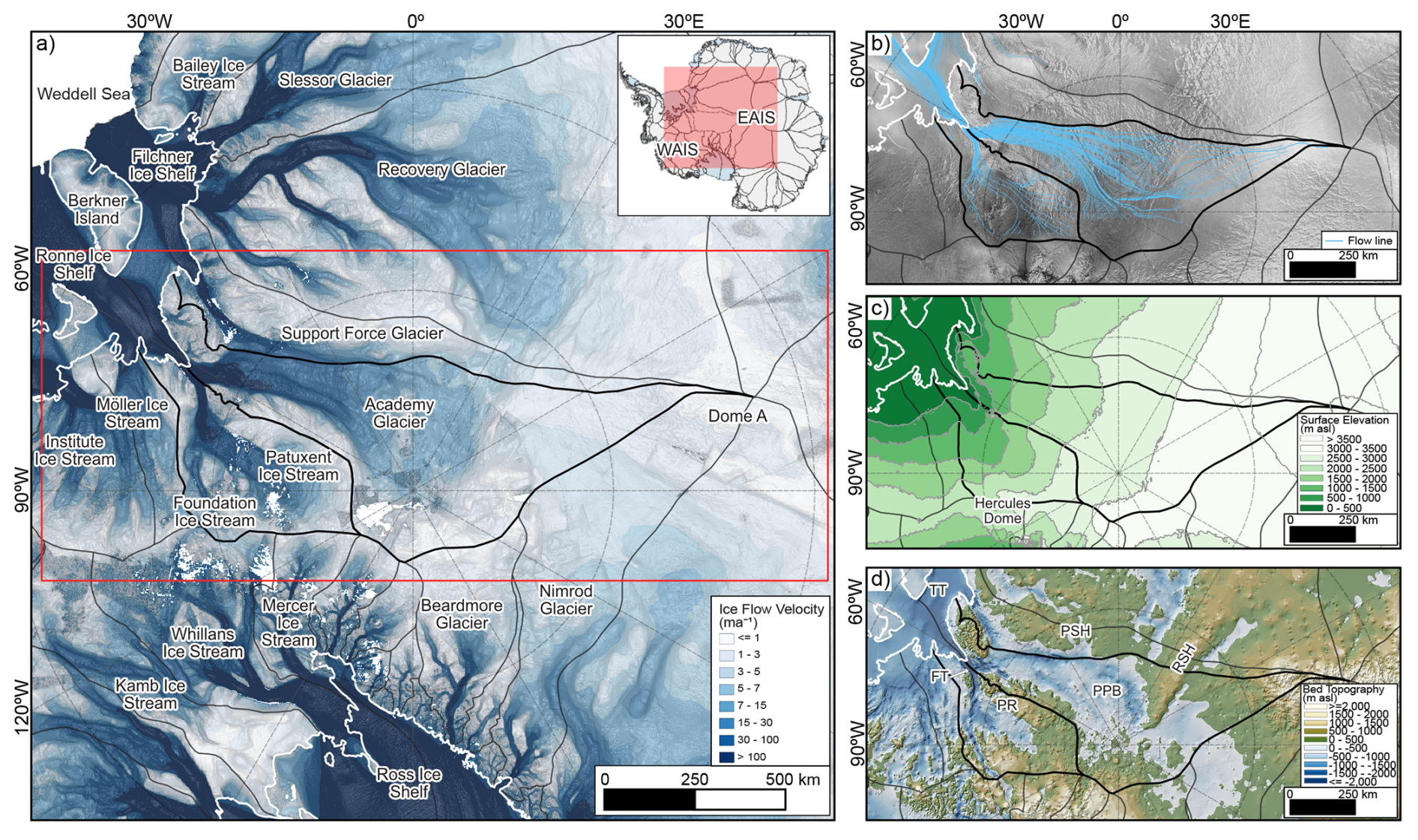
Figure 1Glaciological and topographic setting of the Foundation-Patuxent-Academy ice stream system (FPAS): (a) FPAS ice velocity (Mouginot et al., 2019), and extent and context of the FPAS relative to other ice stream catchments in East and West Antarctica. Grey lines are Ice Sheet Mass Balance Inter-comparison Exercise (IMBIE) catchments (Mouginot et al., 2017), with FPAS catchment indicated by black lines. White line is Bedmap3 grounding line (Pritchard et al., 2025). Inset map shows location (pink square) of panel (a) in Antarctica. Red rectangle on (a) shows the extent of (b)–(d); (b) Broad ice flow pattern of FPAS from Dome A to Berkner Island (thin blue lines) generated from ice velocity data (Mouginot et al., 2019). Backdrop is RADARSAT-1 Antarctic Mapping Project (RAMP) SAR Image Mosaic of Antarctica (Jezek et al., 2013); (c) FPAS ice surface elevation at contour intervals of 500 m (Bedmap3) (Pritchard et al., 2025); (d) FPAS bed topography (Bedmap3) (Pritchard et al., 2025). Bedmap3 is used in this figure as this product emphasises the deep troughs beneath the FPAS; For (b)–(d) the boundary catchment of the FPAS is marked with black lines (Mouginot et al., 2017) and Bedmap3 grounding line (white) (Pritchard et al., 2025). Geographic features in d are: Pensacola-Pole Basin (PPB), Patuxent Range (PR), Recovery Subglacial Highlands (RSH) PolarGAP Subglacial Highlands (PSH), Foundation Trough (FT), and Thiel Trough (TT).
Recent insights into the FPAS make it timely to develop a coordinated approach to address new and outstanding research questions. These have been made possible by advancements in data acquisition and techniques to investigate the FPAS, specifically: (i) new geophysical observations over the grounded ice and ice shelf (Rosier et al., 2018; Jeofry et al., 2018a; Paxman et al., 2019) and their integration into ice thickness and bed topography compilations such as Bedmap3 (Frémand et al., 2023; Pritchard et al., 2025); (ii) enhanced computing power and associated advances in numerical model simulations of ice-ocean interactions and subglacial hydrology (e.g. Naughten et al., 2021; Dow et al., 2022); (iii) new remote sensing observations of the sensitive ice-ocean boundary (e.g. Freer et al., 2023); (iv) geological sampling for cosmogenic nuclide dating (e.g. Braddock et al., 2024); and (v) new in-situ oceanographic measurements beneath FRIS (Hattermann et al., 2021). These have enabled the identification of five targets of investigation for the FPAS, which provide justification for this review and for future research:
Bed geometry near the grounding zone. The bed of the FPAS grounding zone and trunk provides a preferential pathway for oceanic water to potentially reach deep into the interior of East Antarctica. In the first 100 km upstream of the grounding zone, the FPAS is relatively narrow (∼50 km wide) and has a low gradient (∼0.005°) retrograde bed that descends from ∼1900 m below sea level (b.s.l.) at the grounding zone to a maximum depth of ∼ 2400 m b.s.l. (Jankowski and Drewry, 1981; Jeofry et al., 2018a) (Figs. 1 and 2). Inland, Academy Glacier overlies the Pensacola-Pole Basin (Figs. 1d and 2) (Drewry, 1983; Paxman et al., 2019), which is one of East Antarctica's major subglacial marine basins (Morlighem et al., 2020). The connection between the FPAS trunk and the Pensacola-Pole Basin means that a potentially contiguous, and in parts reverse sloping, valley up to 60 km wide extends from the FPAS grounding zone to over 400 km inland (Paxman et al., 2019; Pritchard et al., 2025) (Figs. 1d, 2a and 2h–i). Retrograde bed geometries are assumed to be conducive to unstable grounding-zone retreat because ice flux increases with ice thickness when the bed deepens inland (i.e. the Marine Ice Sheet Instability (MISI) hypothesis (Weertman, 1974; Schoof, 2012)). Indeed, some numerical simulations (e.g. Pollard et al., 2015; Gasson et al., 2016; DeConto and Pollard, 2016; DeConto et al., 2021) show 100s of kms of grounding-zone retreat across the Pensacola-Pole Basin over geological timescales under warm climate scenarios (e.g. driven by Pliocene-like climates). However, other modelling experiments of near-future change over shorter time periods, some of which explore the impacts of warm deep ocean water entering the FRIS cavity (e.g. Seroussi et al., 2020, 2024; Hill et al., 2024) show more limited grounding-zone retreat.
Ice surface geometry near the grounding zone. Inland of the grounding zone, the FPAS is close to flotation owing to its low-gradient bed and surface geometry (Fig. 2f–i). This makes the grounding zone highly dynamic and sensitive to changes in ice thickness. Under this geometry, moderate ice thinning would translate into significant grounding-zone retreat (Brunt et al., 2011; Batchelor et al., 2023). Over shorter timescales, the Weddell Sea has a large tidal range (up to ∼8 m) (Fricker and Padman, 2006; Padman et al., 2018), which facilitates the grounding line to migrate landward and seaward by up to 20 km on each tidal cycle (Brunt et al., 2011; Jeofry et al., 2018b; Dawson and Bamber, 2020; Li et al., 2022b; Freer et al., 2023). Such a high range of tidal motion may result in: (i) vigorous ocean circulation and high rates of basal melting at or seaward of the grounding zone (Lambrecht et al., 1999; Mueller et al., 2018; Adusumilli et al., 2020), influencing grounded ice flow (Rosier et al., 2017; Rosier and Gudmundsson, 2020); (ii) a “bellowing” effect, as the lightly grounded ice moves vertically on tidal cycles, stirring the cavity waters and increasing melt (Walker et al., 2013); and (iii) the intrusion of seawater beneath the grounded ice, which can further enhance melting (Rignot et al., 2024; Bradley and Hewitt, 2024; Fricker et al., 2025).
Glaciological configuration of the FPAS. The glaciological geometry of the FPAS means that modest grounding-zone retreat of ∼50–60 km would increase the across-flow length of the FPAS grounding zone by nearly 60 % (i.e. from ∼52 to >80 km). This would lead to an increase in the cross sectional area of the FPAS flux gate (compare Fig. 2b–d), likely enhancing ice discharge from both East and West Antarctica. This marked change in the length of the grounding zone and area of the ice flux gate, and the resultant change in boundary conditions at the ocean interface and circulation in the ice-shelf cavity, has potential implications for ice-ocean interactions and rates of ocean-driven melting (Bradley and Hewitt, 2024). A shift from a narrow to a wide flux gate would increase susceptibility of the FPAS to grounding-zone retreat by increasing the rate of ice discharge from both East and West Antarctica (Jamieson et al., 2012; Carr et al., 2013; Gudmundsson et al., 2012; Bunce et al., 2018; Mas e Braga et al., 2023). Combined with the inherently highly dynamic ice-ocean interactions over tidal cycles and the potential for ice-shelf thinning to reduce “tele-buttressing” by Berkner Island (Fürst et al., 2016; Reese et al., 2018), the FPAS grounding zone may be susceptible to substantive retreat even under minor changes to external forcing. In a scenario where the grounding zone increases in across-flow length, amplification of ocean-ice feedbacks and dynamic FPAS responses may occur (Bradley and Hewitt, 2024).
Basin location. The geography of the FPAS, which bounds many other ice stream and outlet-glacier catchments (Fig. 1), makes it sensitive to, and potentially able to drive, ice-sheet change in other sectors of West and East Antarctica (e.g., changes in West Antarctica may propagate eastwards via the FPAS), with wider-scale ice-dynamical implications. Geographically, the greatest potential for dynamical interaction with other catchments appears to be with Support Force Glacier, which has a poorly defined, and ice flow parallel boundary, with Academy Glacier (Fig. 1). Whillans Ice Stream shares an ice divide with the Foundation Ice Stream catchment at Hercules Dome (Fig. 1) and is thinning up to its ice divide (Smith et al., 2020a). This raises concerns for the potential for ice-flow piracy in this region, as has likely occurred elsewhere in Antarctica over both recent and geological timescales (Alley et al., 1994; Vaughan et al., 2008; Siegert et al., 2013, 2019; McCormack et al., 2023). Furthermore, modelling studies have suggested that a loss of the WAIS would lead to warming and changes in atmospheric circulation in adjacent areas of the EAIS (Steig et al., 2015; Dütsch et al., 2023).
Subglacial hydrology. The FPAS has a highly active, high-discharge subglacial hydrological system that may extend continuously from beyond the South Pole to the FPAS margin (Smith et al., 2009; Jordan et al., 2018; Siegfried and Fricker, 2021; Dow et al., 2022) and is vulnerable to hydrological switching. This hydrological system, which is thought to contain nineteen active subglacial lakes (Smith et al., 2009), the most of any ice stream in Antarctica, has two distinct components deriving from both the WAIS and EAIS (Jeofry et al., 2018b) and plays a significant role in ice dynamics and ice-ocean interactions at the grounding zone (Smith et al., 2009; Jordan et al., 2018; Jeofry et al., 2018b; Dow et al., 2022). Even subtle changes in interior ice-surface slopes could lead to hydrological “flow-switching” (e.g., Wright et al., 2008) between Academy Glacier and Support Force Glacier (Livingstone et al., 2013), with potential ice-dynamic implications (Alley et al., 1994; Carter et al., 2013). Furthermore, the laterally rough grounding zone of the FPAS caused by sub-ice shelf meltwater channels (Fig. 2e) (Jeofry et al., 2018b) will likely result in highly spatially variable slope-dependent grounding zone melt rates (Stanton et al., 2013; Schmidt et al., 2023).
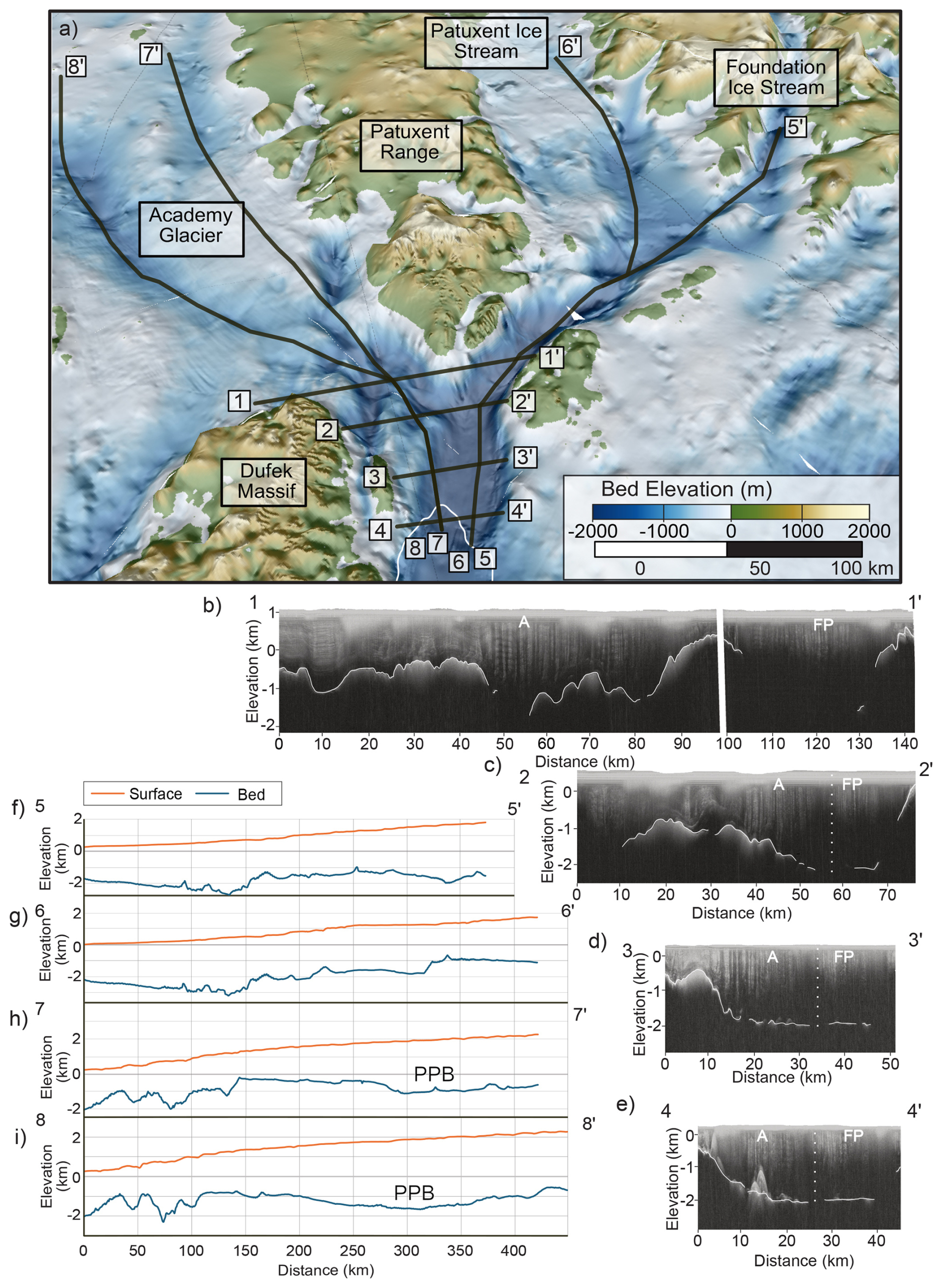
Figure 2Perspective view of topography and geometry of lower trunk of FPAS, illustrating low ice surface elevation, and extent, size and depth (>2 km below sea level) of the Foundation-Thiel trough beneath the FPAS trunk. (a) 3D bed topography (Bedmap3, Pritchard et al., 2025) with profile lines shown in subplots (b)–(i). Bedmap3 is used in this figure as this product emphasises the deep troughs beneath the FPAS. View is into the ice sheet from the grounding zone. Grounding line (Pritchard et al., 2025) is white line; Black lines are approximate locations of radar profiles shown in (b)–(e) and topographic profiles in (f)–(i); (b–e) radargrams, with ice thickness picks (white lines) overlain, from the Filchner Ice Shelf System (FISS) survey (profiles 1–4 on (a) – radar transect names: FISS2015_FOU1 (b), FISS2015_FOU2 (c), FISS2015_FOU4 (d), FISS2015_FOU6 (e)) (Nicholls et al., 2024). The bright “englacial” reflections ∼12–16 km along 4–4′ represent ice shelf channels; (f–i) Glacier surface (orange) and bed (blue) profile elevations (Bedmap3) for Foundation Ice Stream (profile 5 on a), Patuxent Ice Stream (profile 6 on a) and Academy Glacier (profiles 7 & 8 on a). 0 m on x axes of (f)–(i) represents position of Bedmap3 grounding line. On (b)–(e): A: Academy Glacier, FP: Foundation-Patuxent (vertical dashed lines mark boundary between the two flow zones). On (h)–(i): PPB: Pensacola-Pole Basin.
The major components of the FPAS trunk were first sighted during an Argentine flight to the South Pole in 1962, photographed by the U.S. Navy in 1964, and mapped by the U.S. Geological Survey (USGS) in 1968. The original Argentine name for the FPAS trunk was “Glaciar Bahia Buen Suceso” (Glacier of the Bay of the Good Event), but a USGS map in 1968 formally used the term “Foundation Ice Stream”, which was later widely adopted. Foundation Ice Stream and Academy Glacier were named after the U.S. National Science Foundation (NSF) and National Academy of Sciences (NAS), respectively, whilst Patuxent Ice Stream, and the adjacent Patuxent Range, were named after the U.S. Naval Air Station located at the mouth of the Patuxent River, Maryland (Secretariat SCAR, 1992).
The first ground-based glaciological and geophysical observations of the FPAS interior catchment were undertaken before the sighting of the trunk, however, during the Commonwealth Trans-Antarctic Expedition (1955–1958) that traversed the upper parts of the FPAS catchment (Lister and Pratt, 1959). Seismic soundings of ice thickness at the South Pole were undertaken as part of the U.S. Operation Deep Freeze programme in 1957–1958 and by the U.S.S.R. in 1959 (Robin, 1961; Dralkin, 1960). Glaciological and geophysical work was also conducted during the South Pole (1962–1963) and South Pole-Queen Maud Land (1964–1965, 1965–1966 and 1967–1968) traverses (Robinson, 1966; Beitzel, 1971; Taylor, 1971; Koerner, 1971). Parts of the Foundation Ice Stream tributary of the FPAS were traversed during, and immediately following, the International Geophysical Year (IGY) of 1957–1959 (Bentley et al., 1960; Thiel, 1961). A seismic sounding on an IGY traverse between the Stewart Hills and Sonntag Nunatak revealed a valley more than 1500 m b.s.l. (Thiel, 1961), through which the upper reaches of Foundation Ice Stream is now known to flow (Figs. 1 and 2) (Winter et al., 2018; Mouginot et al., 2019).
The first paper that made explicit reference to the ice streams of the FPAS (Behrendt et al., 1966), refers to “… an ice stream which flows between Neptune and Patuxent Ranges” (i.e. Academy Glacier), as well as “another prominent ice stream flows into the ice shelf east of the Forrestal Range” (this refers to the distinct, but FPAS-adjoining, Support Force Glacier). Based on seismic soundings, it was determined that both the FPAS and Support Force Glacier flow through deep troughs (Behrendt et al., 1966) that continue offshore (Behrendt, 1962), namely the Thiel Trough. A deep basin up to 1000 m b.s.l. between the Patuxent Range and Thiel Mountains was identified beneath what is now recognised as Patuxent Ice Stream (Behrendt et al., 1966) (Figs. 1 and 2). The first citation to Academy Glacier was Behrendt et al. (1974), although this referred to Foundation Ice Stream as “a major unnamed ice stream between the Patuxent Range and the Thiel Mountains ….”. Drewry and Meldrum (1978) made the first references to the “Foundation and Patuxent ice streams, which constitute one of the major outlets of the southern portion of the west Antarctic ice sheet”.
The pioneering ground and airborne geophysical and glaciological fieldwork campaigns of the 1950s and 1960s were followed by a series of major research programmes that targeted the FPAS, amongst many other systems and regions. During the 1970s, an international consortium combining the scientific, logistical and technical capabilities of the UK Scott Polar Research Institute (SPRI), the U.S. NSF and the Technical University of Denmark (TUD) undertook continent-scale aerogeophysical surveys across Antarctica (Turchetti et al., 2008; Schroeder et al., 2019; Drewry, 2023). During the 1974–1975, 1977–1978, and 1978–1979 Antarctic field seasons, the SPRI-NSF-TUD consortium acquired a series of radio-echo sounding (RES) and aeromagnetic transects separated by between 20 and 50 km over the FPAS and surrounding areas (Drewry and Meldrum, 1978; Drewry et al., 1980; Jankowski and Drewry, 1981; Behrendt et al., 1981). From these data, it was discovered that: (i) the Foundation and Patuxent ice streams follow a deep bedrock trench (Drewry and Meldrum, 1978; Jankowski and Drewry, 1981); and (ii) the grounding zone in this area of the Weddell Sea was described as “an unusual and diffuse boundary”, with the ice lightly grounded on soft, water-saturated sediments (Drewry et al., 1980; Jankowski and Drewry, 1981). The surveys also provided the first macro-scale quantification of the ice surface elevation, ice thickness, and subglacial topography of the area (Drewry et al., 1980; Jankowski and Drewry, 1981), and determined the extent and geophysical properties of the underlying geology (Jankowski and Drewry, 1981; Behrendt et al., 1981). Integrating this information permitted the first broad-scale understanding of ice flow dynamics and topography in this part of Antarctica (McIntyre, 1983, 1986).
No further significant research was undertaken on the FPAS until the 1990s when the Alfred Wegener Institute (AWI) undertook an integrated airborne and ground-based geophysical, glaciological and geodetic investigation (the “Filchner V campaign”) along a profile from the front of FRIS, across the ice shelf to the west of Berkner Island, and up a flowline of the FPAS trunk (Riedel et al., 1995; Lambrecht, 1998; Lambrecht et al., 1999, 2007). The Filchner V campaign was the first to determine: (i) basal melt rates at the FPAS grounding zone (>9 m a−1); (ii) a maximum ice thickness of >2000 m close to the FPAS grounding zone; and (iii) that the grounding zone was ∼40 km south of the position mapped by the United States Geological Survey in the 1960s (Lambrecht et al., 1999). Alongside ice core measurements and ice flow observations, the ice thickness data were also used to calculate a mass flux of the system (51 km3 a−1) (Lambrecht, 1998; Lambrecht et al., 1999) that is within 20 % of more recent estimations (e.g. Rignot et al., 2019). In addition, the Filchner V campaign measured the sub-ice shelf bathymetry via seismic observations (Mayer et al., 1995; Lambrecht, 1998).
Since the 1990s, radio-echo sounding (RES) data have been acquired over the FPAS, and adjacent Support Force Glacier, during a number of aerogeophysical surveys (Studinger et al., 2006; Carter et al., 2007; Winter et al., 2018; Jeofry et al, 2018a, b, Paxman et al., 2019; Hofstede et al., 2021; MacGregor et al., 2021; Young et al., 2025). However, despite fairly extensive coverage of RES data across the FPAS (Frémand et al., 2023), resulting in improved knowledge of ice thickness and bed topography (Fretwell et al., 2013; Morlighem et al., 2020; Pritchard et al., 2025) (Figs. 1d and 3), many of these surveys were acquired for scientific goals that were not primarily glaciological. For example, the PolarGAP survey (Winter et al., 2018; Paxman et al, 2019) was flown to acquire high-resolution gravity data for global gravity and geoid models. Consequently, much of the existing RES data are not optimised (e.g. in terms of survey line orientation and line-spacing, and aircraft clearance from the ice surface – each of which tend to degrade the quality of englacial and bed radar reflections), to address the important glaciological questions pertaining to the FPAS.
Historically, an important gap in our knowledge of the FPAS was the poor constraint on ice surface topography and ice velocity from remote sensing. The ice surface topography “pole hole”, was partly filled by ICESat and CryoSat-2 observations (Shuman et al., 2005; Helm et al., 2014), but complete coverage to the South Pole (Fig. 1c), and therefore the key intersections between the glaciological components of FPAS, was only completed by the TanDEM-X digital elevation model (Wessel et al., 2021). Prior to satellite observations of ice velocity, ice flow south of 87° was derived from balance velocities calculated from ice surface topography, ice thickness and surface accumulation datasets (Bingham et al., 2007). Though we now have remotely sensed observations of ice flow to 90° S (Fig. 1a), they are limited to the RADARSAT-2 derived product which has relatively high errors in the onset zones of the FPAS (e.g. Academy Glacier) (Mouginot, et al., 2019).
4.1 Subglacial topography and basal boundary conditions: relationship to ice flow
The ∼52 km-wide Foundation Trough – an informal unofficial name for this valley – underlies the FPAS trunk, with the bed at the grounding zone extending to ∼2 km below sea level (Figs. 1d and 2) (Jeofry et al., 2018a, b; Morlighem et al., 2020). The bed of the FPAS trunk is smooth in the direction of ice flow, with little evidence, at least based on current observations, of across-valley bedrock highs or topographic narrowings that could encourage grounding-zone stabilisation through increasing basal and lateral drag and reducing mass flow across the grounding zone (Jeofry et al., 2018a, b; Morlighem et al., 2020) (Fig. 2f–g). In contrast, where Academy Glacier joins the FPAS trunk the topography rises inland and is rougher, with a complex of across-glacier ridges, presumed to be bedrock (Figs. 2b–c, h, and 4). However, even after full isostatic rebound under ice-free conditions (Paxman et al., 2022), parts of this area, and the ridges, would remain over 1 km below sea level (Figs. 2h and 4). The geomorphology of the bed here is critical for assessing the potential of the FPAS grounding zone to retreat inland. For example, will future (or past) grounding-zone retreat halt here, where the topography is narrow, rough and the slope prograding (though still well below sea level), and the ice flow of Academy Glacier turns sharply by 90°, or could the grounding zone retreat much further inland towards the South Pole? The distribution of ice thickness observations (Fig. 3a), and the differences between the bed topography products of Bedmap3 and BedMachine (v4) (Fig. 3c–d), demonstrate the remaining uncertainties associated with bed topography in this area, and other parts of the FPAS catchment.
The influence of the higher and rougher topography on ice flow has, so far, only been directly evaluated using 2D flowline models with Bedmap2 data (Huybers et al. 2017). Inverse modelling of ice flow velocities, using BEDMAP (Lythe and Vaughan, 2001), had previously suggested that the rough topography (implied by high values of basal shear stress) beneath Academy Glacier might continue 200 km further inland (Joughin et al., 2006). However, a derivation of basal roughness based on more recent regional RES surveying across the region (Fig. 4a) now shows relatively low roughness – which may present fewer pinning points during grounding-zone retreat – across the parts of Pensacola-Pole Basin closest to the FPAS grounding zone.
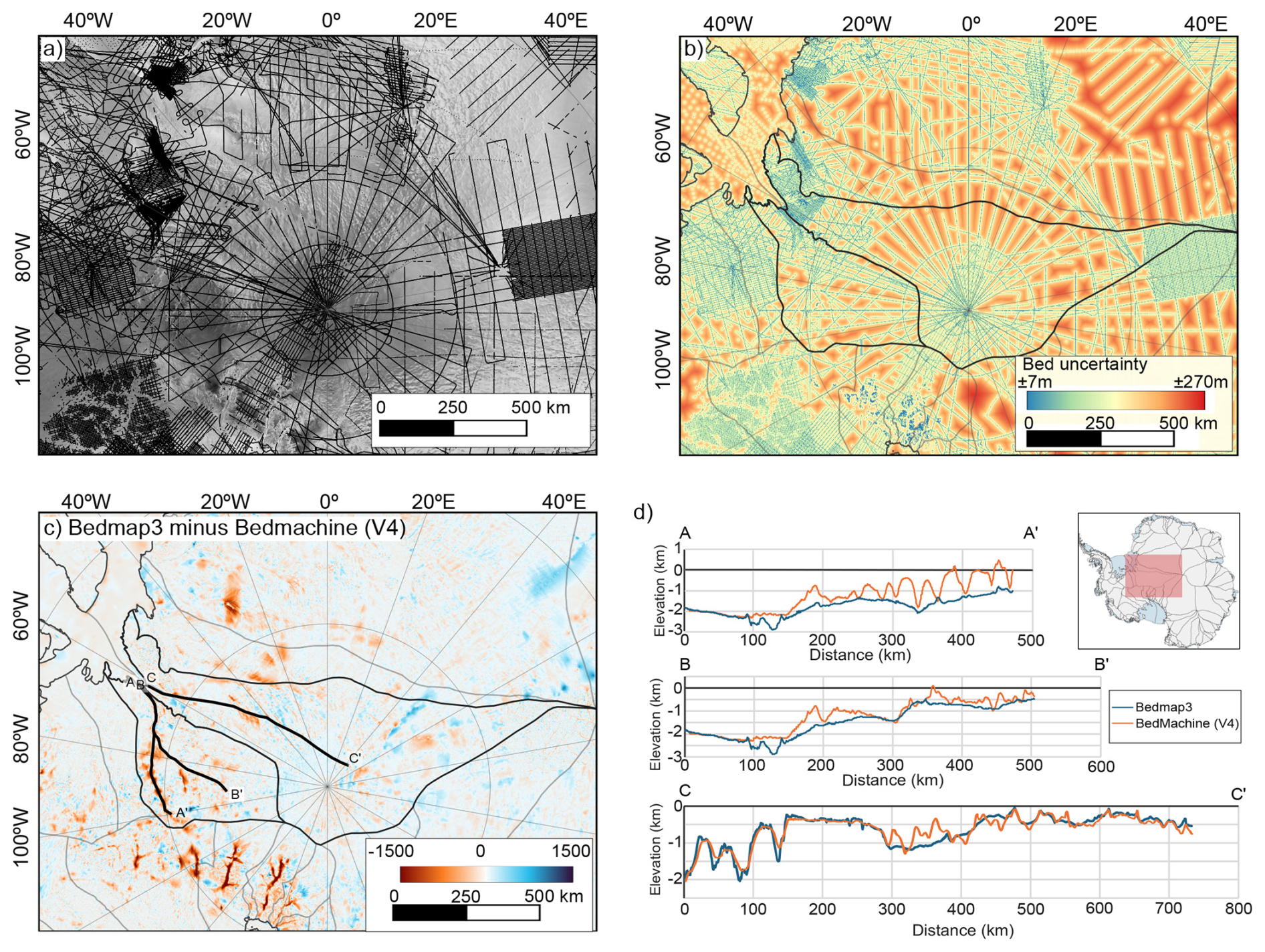
Figure 3FPAS bed topography data and uncertainty demonstrating: (i) remaining uncertainty in bed topography for the FPAS; (ii) substantive differences between Bedmap3 (Pritchard et al., 2025) and BedMachine (v4) (Morlighem, 2025) bed topography datasets; and (iii) the impact of manual modification of the Bedmap3 gridded product via “streamlines”: (a) location of the ice thickness measurements (black lines) used to derive Bedmap3 (Pritchard et al., 2025) underlain by RADARSAT-1 Antarctic Mapping Project (RAMP) SAR Image Mosaic of Antarctica (Jezek et al., 2013); (b) Uncertainty in the elevation of the grounded bed (Bedmap3) (Pritchard et al., 2025); (c) Difference in bed topography between Bedmap3 and BedMachine (v4) (blue indicates that the Bedmap3 bed is higher, red that it is lower). Profile lines for panel (d) (thick black lines) follow Bedmap3 streamlines generated to “burn-in” troughs into the dataset (Pritchard et al., 2025); (d) Along-streamline topographic profiles from Bedmap3 (blue) and BedMachine (v4) (orange) of Foundation Ice Stream (A), Patuxent Ice Stream (B) and Academy Glacier (C). Location of the three profiles is shown in (c). In (b)–(c) black line is the Bedmap3 grounding line (Pritchard et al., 2025) and the grey lines are the IMBIE mass balance basins (Mouginot et al., 2017), with FPAS sub-catchments outlined in black. Inset map shows extent of (a)–(c) (pink rectangle).
The bed of the FPAS is a complex mosaic of heterogeneous basal conditions (Fig. 4). In addition to inland Academy Glacier, relatively low RES-derived roughness values are characteristic of: (i) the lowermost 175 km of the FPAS trunk (Jeofry et al., 2018b), particularly the Foundation-Patuxent side; and (ii) the basin beneath Patuxent Ice Stream, some 225–300 km inland of the grounding zone (Fig. 4a–b). These two zones, modelled as areas of low basal shear stress (10–12 kPa) (Joughin et al., 2006), are both well below sea level (Behrendt et al., 1966, 1974) and would remain so even under fully ice-free conditions (Paxman et al., 2022) (Fig. 4b). In fact, both of these zones are neatly “enveloped” by the ice-free rebounded sea level contour, as is the relatively lower roughness zone beneath Academy Glacier (Figs. 2 and 4a–b).
There are several potential reasons for the lower roughness zones. For example: (i) a thin drape of soft fine-grained marine sediments deposited during periods of more limited glacial extent (Engelhardt and Kamb, 1998; Studinger et al., 2001); or (ii) a smooth bed surface associated with a thicker tectonically-controlled sedimentary basin (Aitken et al., 2023). Both scenarios are likely and not mutually exclusive beneath the FPAS, and warrant future investigation. Given proximity to the present-day grounding zone, the low roughness zone beneath the FPAS trunk (Fig. 4a) (Jeofry et al., 2018b) has the greatest potential to represent marine sediment. If this were to be the case, sediments recovered from this zone could be used to test ideas of Holocene retreat and readvance, or grounding-zone retreat during earlier Quaternary interglacials or even Pliocene retreat.
If the FPAS trunk is underlain by marine sediments, then there are potential modern-day ice-dynamical implications: deformable marine sediments can reduce resistance to ice flow at the ice stream bed (Joughin et al., 2006; Diez et al., 2018; Li et al., 2022a) and lead to flow instability (Joughin and Alley, 2011). Similar low roughness subglacial zones, associated with low basal shear stress, are recognised beneath the trunks of other major outlet glaciers in the Weddell Sea, including Institute Ice Stream (Bingham and Siegert, 2007; Ross et al., 2012; Siegert et al., 2016), Recovery Glacier (Bell et al., 2007; Diez et al., 2019) and Bailey Ice Stream (Diez et al., 2018). This may suggest a common mechanism of surface formation or emplacement of sediment.
The FPAS bed is characterised predominantly by higher and more variable roughness further inland, particularly up-ice of the fully rebounded 0 m (sea-level) contour (Fig. 4a and b) (Bingham and Siegert, 2009). Although this may suggest that soft, deformable sediments are more restricted or absent, modelling of gravity and magnetic data is consistent with the presence of an older sedimentary rock sequence, ∼2–3 km thick, beneath the Pensacola-Pole Basin (Paxman et al., 2019; Li et al., 2022a; Aitken et al., 2023). This sedimentary basin thins towards the coast (Paxman et al., 2019) (Fig. 5), tapering out close to where Academy Glacier joins the main FPAS trunk (Figs. 1, 2 and 5).
Across the Pensacola-Pole Basin (average elevation of 490 m b.s.l.), the relationship between present-day “enhanced” ice flow and subglacial topography is complex. For example, enhanced ice flow is not always spatially coincident with the deepest parts of the (topographic) basin (Figs. 1 and 4c–d). The Academy Glacier flows relatively fast (up to ∼100 m a−1) across the ∼1000 m b.s.l. parts of the Pensacola-Pole Basin (Fig. 4c–d). In contrast, the flow of the adjacent Support Force Glacier is currently slower (≲50 m a−1), despite overlying a system of geologically-controlled overdeepened valleys up to at least 1500 m b.s.l. (Paxman et al., 2019) (Fig. 4c–d). The upper Academy Glacier has two ice flow zones, which may be partly influenced by long-range buttressing from Berkner Island (Fig. 1a–b) (Reese et al., 2018), with the fastest flow (∼100–200 m a−1) proximal to the Patuxent Range, despite a shallower (topographic) basin in this area (Paxman et al., 2019) (Figs. 1 and 4c–d). The geometry of the FPAS ice flow, and its relationship with subglacial topography and basal boundary conditions, is important because of the potential of the FPAS to dynamically interact with other parts of the ice sheet. The mismatch between fastest flow and deepest basins in this region may reflect relatively recent changes in flow regime, where recently accelerated ice flow has not had time to erode the expected deep basins.
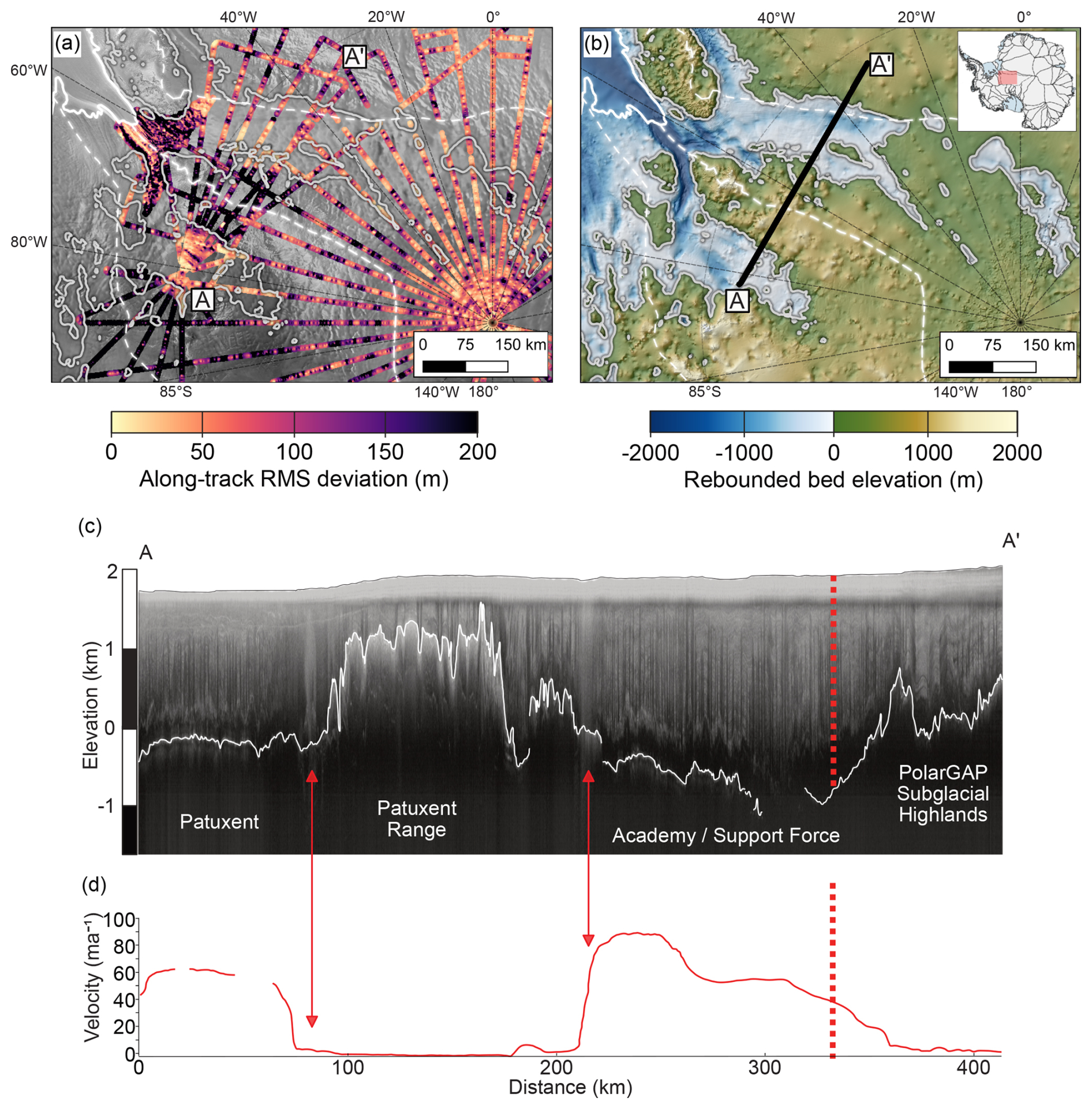
Figure 4Roughness and ice-free bed topography beneath lower parts of FPAS. (a) Along-track root mean square deviation of bed elevation within a moving window of 2 km (a proxy for roughness) from PolarGAP, FISS, and Operation IceBridge RES profiles (Corr et al., 2021; Nicholls et al., 2021; CReSIS, 2025; MacGregor et al., 2021), showing relatively smooth (pale yellow) zones beneath parts of Academy Glacier and Patuxent lce Stream; (b) Rebounded (“ice-free”) topography of lower FPAS derived from BedMachine v2 (Paxman et al., 2022). In (a) and (b) the grey contour lines represent the rebounded 0 m contour, the thick white line is the Bedmap3 grounding line (Pritchard et al., 2025) and the white dashed lines are the IMBIE mass balance basins (Mouginot et al., 2017). The smoothest bed topography beneath FPAS is located below the 0 m contour (grey line) for both Academy and Foundation-Patuxent tributaries. These “smooth” zones correspond to the model-derived low basal shear stress zones of Joughin et al. (2006), based on the BEDMAP DEM; (c) example radargram (radar transect name: POLARGAP_P13A), with ice thickness picks overlain, from the PolarGAP survey (profile A–A′ on b) (Ferraccioli et al., 2021). Ice flow direction is into page; (d) ice velocity (Mouginot et al., 2019) along profile A–A′. Vertical dashed red line on (c) and (d) is the boundary between Academy and Support Force glaciers. Vertical red arrows on (c) and (d) denote the shear margins where Patuxent Ice Stream and Academy Glacier abut the Patuxent Range. These correspond to scattering zones in the overlying radargram. Inset map shows extent (pink rectangle) of (a) and (b).
The far-reaching catchment of the FPAS interacts glaciologically, and in some cases hydrologically, with ice stream catchments across East and West Antarctica, including Support Force Glacier, Whillans Ice Stream, Mercer Ice Stream, Möller Ice Stream, Nimrod Glacier and Beardmore Glacier; (Fig. 1) (Winter et al., 2018; Yang and Kang, 2022). Potential therefore exists for the FPAS to be sensitive to, and possibly able to drive, glaciological and hydrological change in other sectors of West and East Antarctica. Change in the Ross or Weddell sea sectors of WAIS, or in other large EAIS catchments, could impact the FPAS and vice versa (e.g. Pingree et al., 2011; Steig et al., 2015; Winter et al., 2018). One potential constraint on such change is the basal topography of the upper FPAS catchment. Here, the Foundation and Patuxent troughs, which are narrow and in places above sea level, extend contiguously from the Siple Coast to Filchner-Ronne Ice Shelf (Winter et al., 2018) (Fig. 1). These troughs, which are likely tectonic in origin, are fed by smaller tributary valleys (e.g., beneath Hercules Dome; Hoffman et al., 2023) and continue to steer ice flow through upper Foundation Ice Stream and Patuxent Ice Stream today (Winter et al., 2018). Flow steering means that the orientation of these troughs and the surrounding highlands (Whitmore, Thiel and Horlick mountain blocks) (Jankowski and Drewry, 1981) likely limits the potential for WAIS-driven drawdown of the EAIS in the `bottleneck' zone between East and West Antarctica (i.e. “the gap in the Transantarctic Mountains through which the EAIS flows into the WAIS”; Pingree et al., 2011; Winter et al., 2018). However, significant potential for dynamic glaciological or hydrological change does exist between Academy and Support Force glaciers (see Sects. 4.2 and 5.2).
4.2 Subglacial hydrology, geothermal heat flow, and hydrogeology
Subglacial hydrology
The presence of subglacial lakes (Fig. 6) and their relation to the initiation of the enhanced flow zones (Fig. 1) of the FPAS has long been recognised (McIntyre, 1983; Siegert et al., 1996; Siegert and Bamber, 2000; Carter et al., 2007). More recently, nineteen hydrologically “active” subglacial lakes concentrated beneath Academy Glacier (though in later publications some of these were classified as “Foundation” lakes) were inferred from ICESat observations (Smith et al., 2009), making the FPAS one of the most hydrologically active ice stream systems in Antarctica. Of particular note, the converging ICESat sampling pattern over Academy Glacier enabled dense sampling of the largest active lake beneath the FPAS (Lake F12; 367 km2), with 174 independent repeat passes between 2003 and 2009. With additional data from the ICESat-2 mission starting in 2018, lake F12 experienced a drainage event between 2009 and 2018 with a >6 m draw down of the ice sheet surface in the centre of the lake (Siegfried and Fricker, 2021). The presence and dynamics of subglacial water are important because of their potential to enhance rates of ice flow and melting at the grounding zone.
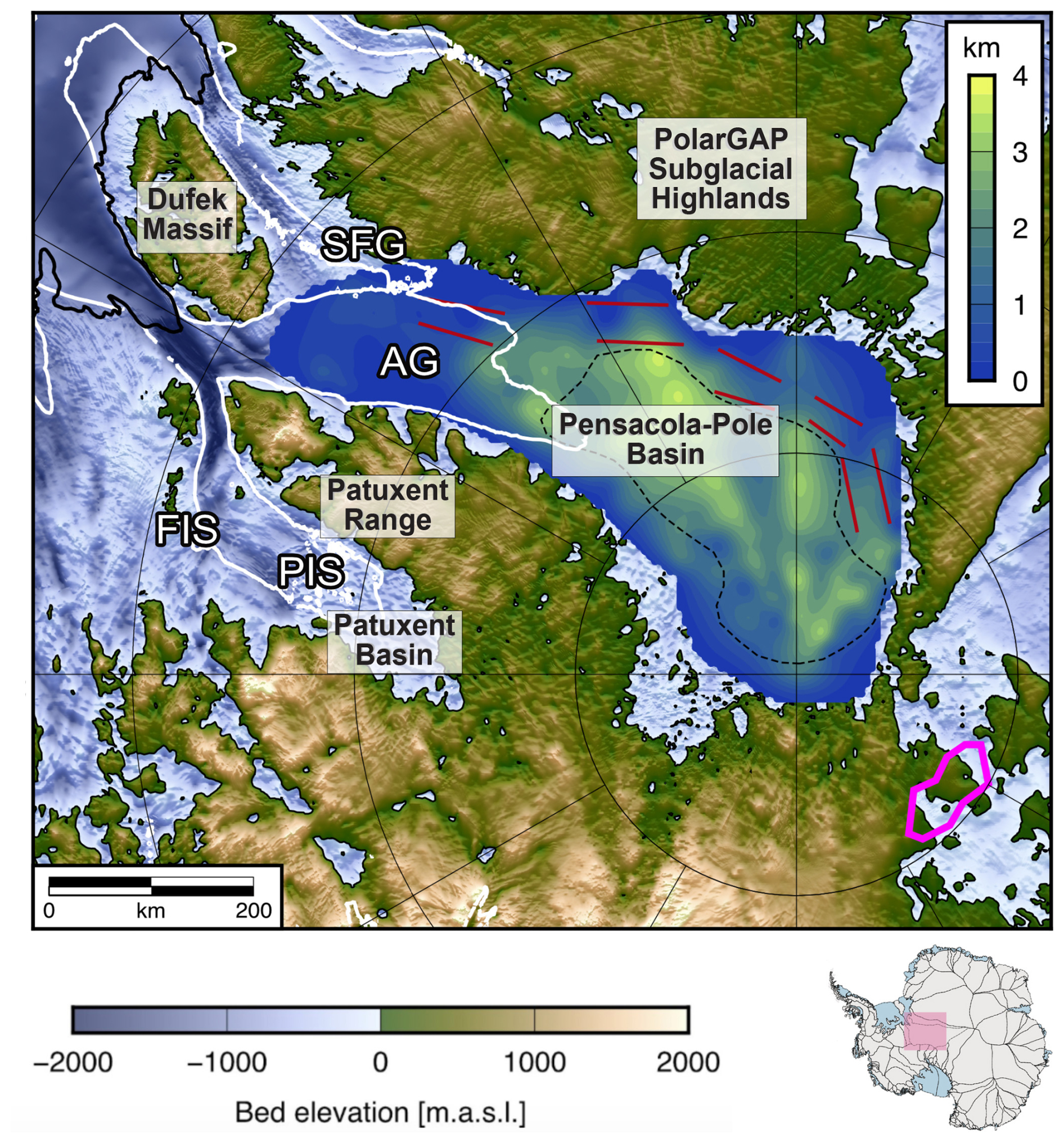
Figure 5Geological structure of the FPAS catchment. Gravity anomaly modelling indicates that the Pensacola-Pole Basin (PPB) is underlain by a sedimentary basin 2–3 km thick in places (Paxman et al., 2019; see interior colour scale); the potential sedimentary infill within the Patuxent Basin was not analysed in Paxman et al. (2019). The southern part of the PPB (thin black dashed line) is characterised by the largest thicknesses of sedimentary fill and also exhibits topography and high-frequency magnetic anomalies characteristic of Jurassic dolerite sills, which are commonly intruded into Beacon Supergroup sediments (Paxman et al., 2019). Red lines mark a series of deep (1–2 km below sea level) troughs located along the eastern margin of the PPB. Magenta polygon demarcates a zone of basal melting attributed to elevated geothermal heat flux (Jordan et al., 2018). White line marks the 50 m yr−1 ice-surface velocity contour (Mouginot et al., 2019). Thick black dashed line is Bedmap3 grounding line (Pritchard et al., 2025). Bed topography is from BedMachine v4 (Morlighem, 2025). Outlet glaciers are: Foundation Ice Stream (FIS), Academy Glacier (AG), Patuxent Ice Streams (PIS), Support Force Glacier (SFG). Inset map shows extent of figure (pink rectangle).
Subglacial lakes are present in the upper FPAS catchment near the South Pole (Siegert et al., 1996; Carter et al., 2007; Peters et al., 2008; Hills et al., 2022; Livingstone et al., 2022) (Fig. 6). The upper Academy Glacier catchment, near Dome A, is characterised by near-bed englacial reflections that have been interpreted as zones of basal freeze-on (“accretion ice”) (Bell et al., 2011) and ice deformation (Wrona et al., 2018). These features have been attributed to refreezing at the ice base over subglacial lakes and other water bodies (Wolovick et al., 2013), and several new lakes in the Gamburtsev Subglacial Mountains were identified in the most recent subglacial lake inventory (Livingstone et al., 2022).
If water were released from Academy Glacier's upper-catchment lakes, and remained liquid rather than refreezing onto the base of the ice, it could influence ice dynamics downstream (Siegert and Bamber, 2000). The interior lakes also have the potential to contain isolated life and ancient sediment sequences that may record long-term ice sheet history (Siegert, 2005).
Recent work on the subglacial hydrological system of the FPAS, as well as nearby ice streams including Support Force Glacier, has focused on better understanding the role of subglacial meltwater at the grounding zone (Jeofry et al., 2018b; Dow et al., 2022; Hofstede et al., 2021; Humbert et al., 2022). Meltwater flux from the FPAS grounding zone (∼66 m3 s−1 Dow et al., 2022; Ehrenfeucht et al., 2025) (Fig. 6) has been shown in numerical models to impact both grounding-zone melt rates and geometry (Jeofry et al., 2018b). Jeofry et al. (2018b) suggested that subglacial hydrological pathways beneath the FPAS trunk are separated into Foundation-Patuxent Ice Stream and Academy Glacier components, without coalescing or interacting. This separation is not a feature of numerical hydrological model runs (Dow et al., 2022) (Fig. 6), although there is substantial complexity in water routing and basal topography where Academy Glacier joins the FPAS trunk (Figs. 2, 6 and 7b). Separation beneath the trunk could be due to large (100–300 m of relief) flow-parallel bedforms that channel the basal water (Jeofry et al., 2018b; Pritchard et al., 2025) (Figs. 2, 6 and 7b).
Where meltwater reaches the FPAS grounding zone (Fig. 6), the water exits the ice sheet as multiple point sources that initiate upwards incision into the underside of the ice shelf to form a series of very large (>300 m high) basal channels (Fig. 2e) (Le Brocq et al., 2013; Alley et al., 2016, Jeofry et al., 2018b; Dow et al., 2022). These sub-glacial and sub-ice shelf channels, which are likely to be strongly influenced by subglacial water flux, are important because they are zones of highly variable melt rates at both the grounding zone and at the ice shelf base (Stanton et al., 2013). Such channels can impact ice shelf integrity (Alley et al., 2016; Dow et al., 2018) and have been shown to undergo rapid dynamic change (Zhou et al., 2025).
Numerical modelling of the entire FPAS (and adjacent areas) with the finite element Glacier Drainage System (GlaDS) model (Dow et al., 2022; Ehrenfeucht et al., 2025) shows that the hydrological system is spatially heterogeneous with dendritically organised channels, some of which may extend inland for up to ∼450 km and connect to some of the subglacial lakes of Academy Glacier (Figs. 6 and 7). Based on overburden hydraulic potential calculations, the FPAS subglacial hydrological system may be sensitive to water routing switching between Academy Glacier and Support Force Glacier (e.g. Fig. 2 of Livingstone et al., 2013). This is because the two glaciers flow parallel to each other for over 700 km in their mid-catchments (Fig. 7a). Relatively small changes in ice surface elevation and morphology (Fig. 7a) could result in water catchment piracy (Wright et al., 2008), with subglacial discharge from the central EAIS routing through Support Force Glacier, rather than Academy Glacier (Fig. 7). We note that water routing switching was not an outcome of numerical modelling experiments (Dow et al., 2022), although such scenarios were not explored explicitly in the model set-up.
Any switching of subglacial water pathways could have implications for ice-dynamic processes (e.g. shear margin migration in the mid- to upper-catchments of the FPAS, and grounding zone ice-ocean interactions for both the FPAS and Support Force Glacier). Several of the current active subglacial lakes (i.e. Academy lakes 12–16, Fig. 7) are located at or near the boundary between Academy and Support Force glaciers. Based on the ice flow defined mass balance catchments (Fig. 7b), some lakes classified as belonging to Academy Glacier (i.e. Academy 14 and Academy 16) could be part or entirely located beneath Support Force Glacier (Fig. 7). Water piracy could result in lakes at or near the Academy-Support Force boundary switching subglacial hydrological catchments.
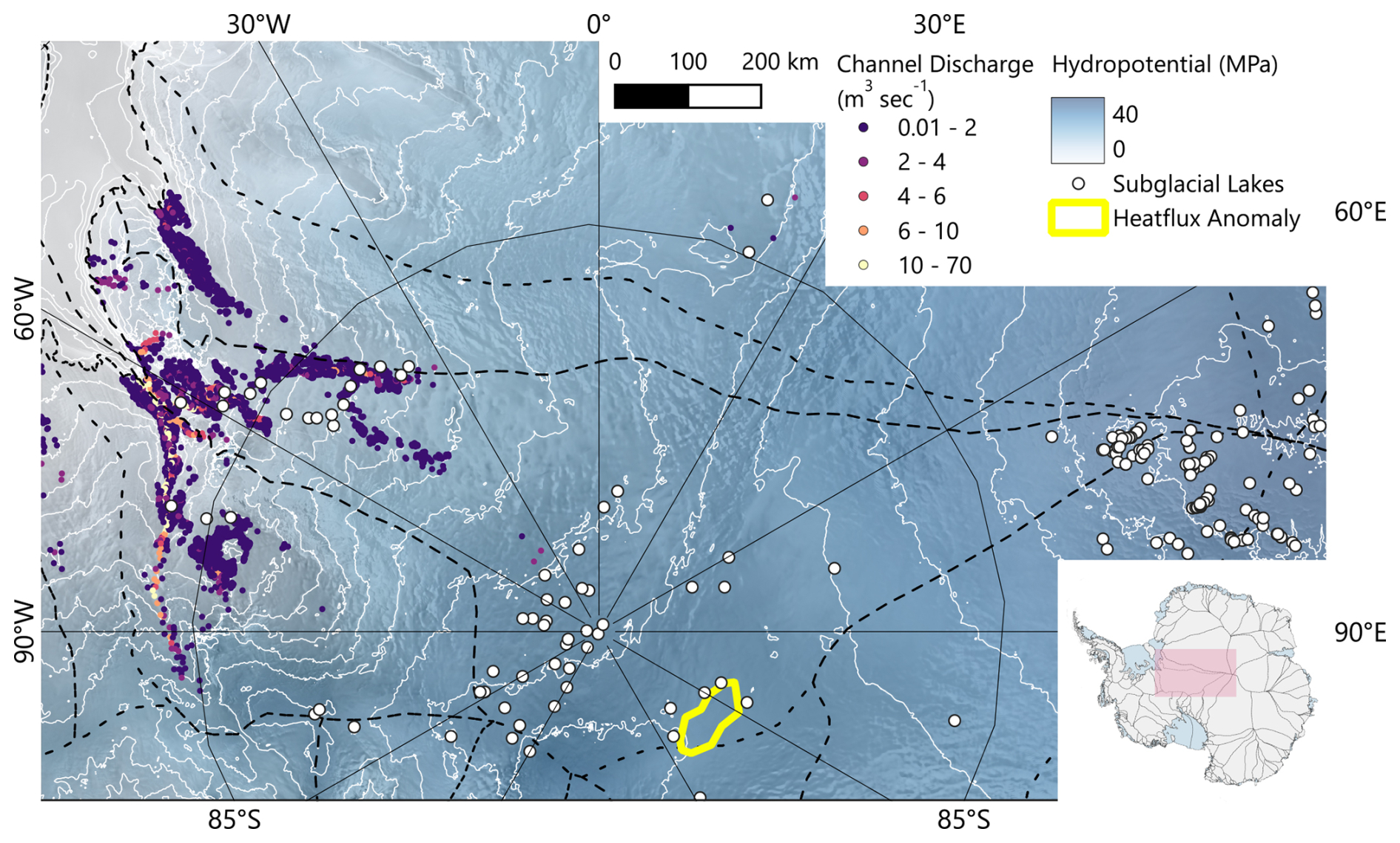
Figure 6Subglacial hydrology of the FPAS catchment showing location of subglacial lakes (Livingstone et al., 2022), modelled subglacial channel discharge (Ehrenfeucht et al., 2025), and zone of basal melting attributed to elevated geothermal heat flux (Jordan et al., 2018), underlain by hydropotential surface derived from Bedmap3 (Pritchard et al., 2025) with contours (white lines) at 2 MPa intervals. Black lines are Ice Sheet Mass Balance Inter-comparison Exercise (IMBIE) catchments (Mouginot et al., 2017) and Bedmap3 grounding zone (Pritchard et al., 2025). Inset map shows extent of figure (pink rectangle).
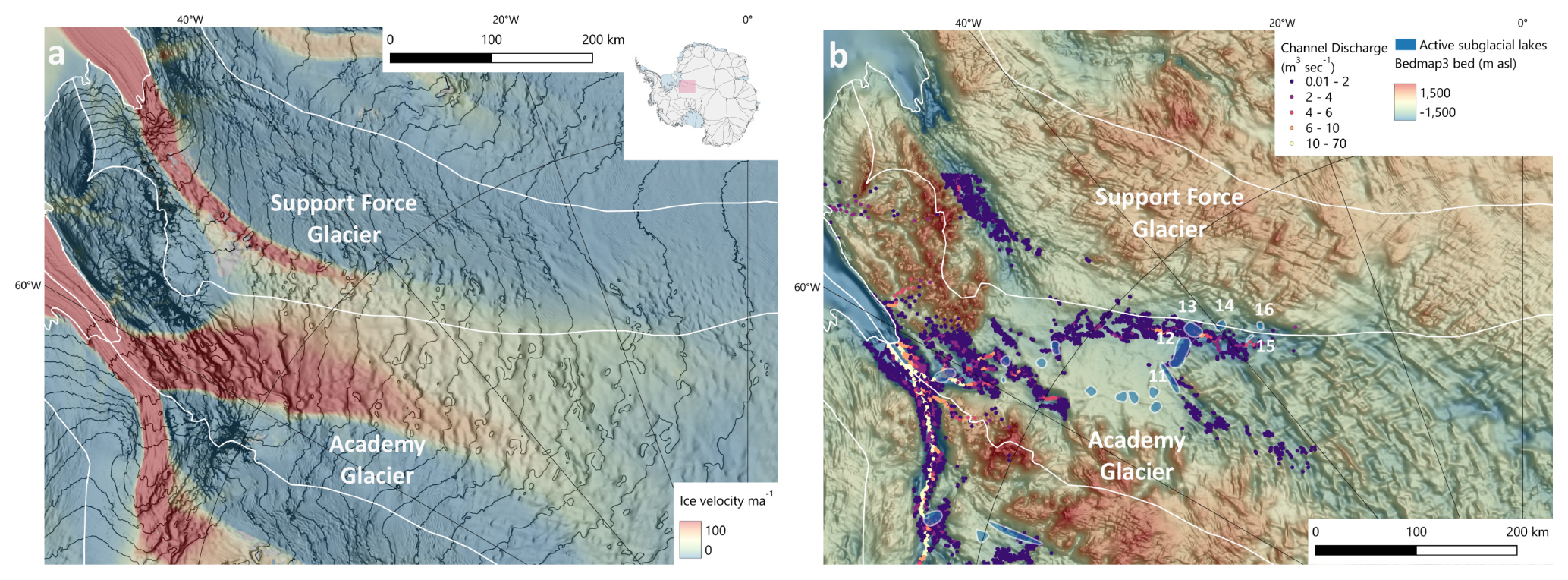
Figure 7Ice catchment boundary zone between Academy and Support Force glaciers showing potential for ice-flow switching (i.e. for Academy to capture part of the Support Force Glacier catchment, or vice versa) and for water piracy due to geometry of both ice surface and bed topography. (a) Ice velocity (Mouginot et al., 2019) overlain on hillshade of Bedmap3 ice surface DEM (Pritchard et al., 2025). Black lines are ice surface contours at 100 m intervals. White lines are Ice Sheet Mass Balance Inter-comparison Exercise (IMBIE) catchments (Mouginot et al., 2017); (b) BedMachine v4 bed topography (Morlighem, 2025), overlain by modelled subglacial channel discharge (Ehrenfeucht et al., 2025). White lines are Ice Sheet Mass Balance Inter-comparison Exercise (IMBIE) catchments (Mouginot et al., 2017) and Bedmap3 grounding zones (Pritchard et al., 2025). Active subglacial lakes (Smith et al., 2009) are shown for the FPAS catchment. Lakes (Academy 12–16) proximal to, or below, the Support Force-Academy “shear margin” as defined by the IMBIE catchment boundary are labelled. Bed topography in (b) is transparent with a hillshade of the same bed topography dataset underlying it. BedMachine v4 is used here as it demonstrates the smaller scale bed topography across the boundary between Academy and Support Force more effectively than Bedmap3. Inset map on (a) shows extent of figure subplots (pink rectangle).
Geothermal heat flow
One potential source of the subglacial water in the FPAS catchment is elevated geothermal heat flow resulting in basal melting (Burton-Johnson et al., 2020; Reading et al., 2022). The head of the Academy Glacier catchment, which is located grid southeast of the South Pole, contains a localised area with a possible elevated geothermal heat flow of 120±20 mW m−2 (Figs. 5 and 6) (Jordan et al., 2018). This is nearly twice the global average of values expected for the East Antarctic craton, and has been attributed to high-heat-producing Precambrian rocks and hydrothermal fluid circulation in a major subglacial fault system (Jordan et al., 2018). Simple hydraulic potential calculations suggest that water produced in this area would route underneath Academy Glacier, through some of the ICESat-identified active subglacial lakes, including the highly active Lake F12 (Fig. 7b), and into the FPAS trunk (Jordan et al., 2018). This discovery may indicate that localised geothermally enhanced zones are more prevalent in the East Antarctic craton than previously thought. Given the scale of the FPAS, it is possible that, collectively, such zones produce the significant quantities of subglacial meltwater that have been inferred for this system, with implications for ice geometry and melt rates at the grounding zone (Jeofry et al., 2018b).
Ice divide migration from Beardmore Glacier towards Academy Glacier could shift the location of the geothermally-enhanced zone at the head of the Academy Glacier catchment into the Beardmore Glacier catchment (Figs. 1 and 6). This would reduce subglacial water flux through the FPAS (Jordan et al., 2018). Such potential dynamic change is not without precedence. The potential for large-scale switching of hydrological flow paths, driven by even small changes in ice sheet surface elevation, has been identified elsewhere in East Antarctica (Wright et al., 2008; McCormack et al., 2023), as has ice flow reorganisation of ice sheet interiors (Siegert et al., 2004; Franke et al., 2022).
Hydrogeology
Subglacial sedimentary rocks beneath the Pensacola-Pole Basin and upper catchment of the FPAS (Fig. 5) (Paxman et al., 2019; Li et al., 2022a; Aitken et al., 2023) are likely to be unfrozen, due to geothermal heating and the pressure of the overlying ice (Raspoet and Pattyn, 2025; Seiner et al., 2025). Therefore, dependent on the permeability and porosity of the sedimentary sequence, the FPAS represents a potentially vast reservoir of subglacial groundwater (Person et al., 2007, 2012; Siegert et al., 2018) similar to that inferred under Whillans Ice Stream (Gustafson et al., 2022). Low basal shear stress values beneath parts of Patuxent Ice Stream (Joughin et al., 2006) may also indicate water-saturated sediments or an aquifer at the bed.
During interglacial periods, such as the present Holocene, ice unloading can create hydraulic gradients that exfiltrate groundwater from the sedimentary rock reservoir to the ice sheet base, where it will have at least three complementary effects that may enhance ice flow (e.g. Robel et al., 2023). First, the water itself will serve to fuel basal lubrication and elevated subglacial water pressure (Christoffersen et al., 2014; Siegert et al., 2018; Gustafson et al., 2022). Second, the flow of groundwater is an efficient mechanism to cause advective heat transport in addition to conduction from depth towards the ice sheet base (Gooch et al., 2016; Kulessa et al., 2019), facilitating further melting. Third, growing evidence now suggests that groundwater may constitute a major fraction of basal outflow across the grounding zone (Uemura et al., 2011; Null et al., 2019; Foley et al., 2019), potentially enhancing ice-shelf basal melting in this dynamically sensitive region.
One uncertainty regarding groundwater exfiltration is the loading history of the interior FPAS catchment. Whilst the downstream parts of the FPAS have undergone ice unloading since the Last Glacial Maximum (LGM) (Bentley et al., 2017; Balco et al., 2016) (see Sect. 4.3), accumulation records from ice cores and shallow radar data suggests that interior parts of the catchment may have thickened in response to a smaller ice sheet and increased accumulation in the Holocene (Lilien et al., 2018). Along with potential late-Holocene grounding-zone readvance of the margin (Bradley et al., 2015; Kingslake et al., 2018), this thickening would not be conducive to unloading-driven exfiltration in the FPAS catchment.
4.3 LGM-present glacial history
Previous reconstructions of glacial history in the southern Weddell Sea presented two contrasting scenarios of LGM ice extent: a minimum scenario with a restricted grounding zone located east of Berkner Island (Fig. 8), and a maximum scenario with a grounding zone near the shelf break (cf. Hillenbrand et al., 2014; Siegert et al., 2019). Little is known about the detailed bathymetry of the Weddell Sea continental shelf seaward of FRIS owing to the nearly perennial sea ice in the southern Weddell Sea, which precludes systematic marine survey access (Hillenbrand et al., 2014). However, seafloor glacial landforms indicate that grounded ice extended to the continental shelf break along the eastern Antarctic Peninsula at the LGM, suggesting that this may also have been the case seaward of Ronne Ice Shelf (Ó Cofaigh et al., 2014; Lavoie et al., 2015). More recent cosmogenic nuclide analyses using in situ 14C analysis of rock samples from the Shackleton Range is consistent with the more advanced/thicker scenario rather than the minimum extent scenario (Nichols et al., 2019; cf. Scenario B of Hillenbrand et al., 2014). However, an embayment in the ice shelf, implying more restricted ice extent in Filchner Trough, is a persistent feature in some numerical models of ice sheet history in the Weddell Sea. Such models also exhibit significant variations in ice thickness between simulations (e.g., Pittard et al., 2022), suggesting that processes and/or boundary conditions are not well understood or represented. As a result, the detailed configuration of the maximum LGM extent and thickness of the FPAS remain an open question.
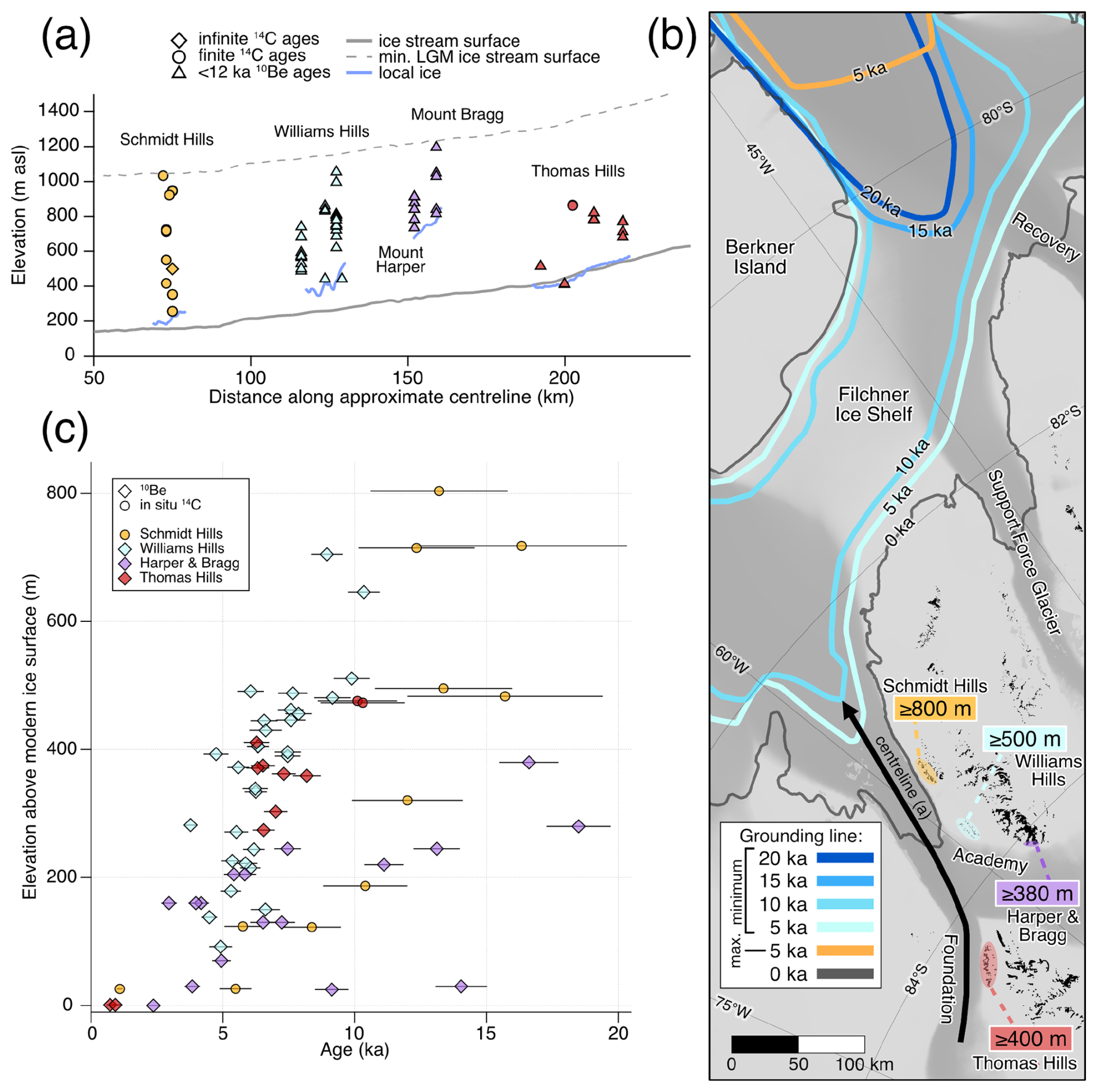
Figure 8Cosmogenic nuclide exposure ages and ice surface elevation from around the FPAS trunk. (a) Exposure ages projected onto an elevation profile along an approximate centreline of the Foundation Ice Stream. (b) Centreline location, minimum LGM ice thickness constraints interpreted from the exposure ages (coloured boxes), and former grounding zone positions with approximate ages indicated. (c) Exposure ages from samples collected from nunataks adjacent to the Foundation Ice Stream. Elevation data for ice surfaces (a) are sourced from the Reference Elevation Model of Antarctica (REMA; Howat et al., 2019). Note that local ice margins in (a) are highly simplified and the minimum LGM surface is the modern surface profile with the elevation increased above present to the elevation of the highest elevation, post-LGM exposure age. Palaeo grounding zone positions are the inferred minimum (scenario A, blue) and maximum (scenario B, orange) positions of Hillenbrand et al. (2014). The modern (2011) grounding zone position and ice velocities (grey shading) are sourced from the MEaSUREs program V2 (Rignot et al., 2016, 2017). Ice velocities are used to highlight ice streams (darker grey is faster ice). Exposure ages in (a) and (c) are collated from the Informal Cosmogenic-nuclide Exposure-age Database (ICE-D; https://version2.ice-d.org/antarctica/, last access: 25 June 2026) and originally sourced from Balco et al. (2016), Bentley et al. (2017), and Nichols et al. (2019). Ages in ICE-D are calculated using the online exposure age calculators formerly known as the CRONUS Earth online calculators (http://hess.ess.washington.edu, last access: 25 June 2026; Balco et al., 2008) with the “primary” production rate calibration data set (Borchers et al., 2016) and the “LSDn” scaling method for neutrons, protons, and muons (Lifton et al., 2014; Balco, 2017). Infinite in situ 14C ages in (a) indicate continuous exposure for at least ∼30 kyr. Panels (a) and (b) are modified from Nichols et al. (2019).
Knowledge of the post-LGM glacial history of the lower parts of the FPAS (Fig. 8b) has been improved by cosmogenic surface exposure dating constraints on ice thickness and the timing and rate of ice-surface thinning from mountains adjacent to the FPAS trunk (Balco et al., 2016; Bentley et al., 2017; Nichols et al., 2019). Initial 10Be cosmogenic nuclide exposure ages in the Pensacola Mountains and Patuxent Range were indicative of: (i) LGM ice sheet surface elevations up to 500 m above present (Balco et al., 2016); and (ii) progressive thinning of the FPAS between 10 and 2.5 ka BP, by which time ice surface elevations comparable to the present day were reached (Bentley et al., 2017). However, more recent analysis using the short-lived cosmogenic nuclide in situ 14C indicated that the FPAS trunk was at least 800 m thicker than present in the Schmidt Hills and Pensacola Mountains at the LGM (Nichols et al., 2019) (Fig. 8), and confirmed that there was major thinning of the FPAS in the Early Holocene. An ice core record from Skytrain Ice Rise at the southern edge of Ronne Ice Shelf records a decrease in ice surface elevation of ∼450 m from 8.2 to 8 ka and ice-shelf retreat between 7.7 and 7.3 ka (Grieman et al., 2024). This is consistent with both the magnitude and timing of ice thinning recorded by exposure ages adjacent to the FPAS.
The cosmogenic nuclide data indicate ice surface elevations were approaching present-day levels by ca. 2.5 ka (Fig. 8c), and therefore allow for continued thinning beyond present in the late Holocene followed by subsequent thickening (Bentley et al., 2017). Were this thinning and thickening to have occurred, then retreat (inland of present) and subsequent readvance of the grounding zone would also have occurred (Johnson et al., 2022). Indeed, this scenario has been proposed for ice stream outlets in this part of the southern Weddell Sea based on a range of glaciological, geological and solid earth deformation evidence (Siegert et al., 2013; Bradley et al., 2015; Bentley et al., 2017; Kingslake et al., 2018; Siegert et al., 2019). Existing above-ice cosmogenic nuclide data cannot, however, unequivocally demonstrate thinning and subsequent thickening of ice in response to grounding-zone migration (Whitehouse et al., 2017; Bentley et al., 2017; Siegert et al., 2019). Instead, measurements of cosmogenic nuclide concentrations (specifically in situ 14C, see Nichols, 2022) in subglacial bedrock, rather than in above-ice samples, are needed to reveal if the FPAS was thinner than present in the late-Holocene (see Balco et al., 2023). Modelling experiments have simulated Holocene retreat-readvance for the FPAS (e.g., Kingslake et al., 2018; Pittard et al., 2022), but generally produce a modern-day grounding zone more advanced than observations, potentially due to model grid resolution failing to accurately capture the narrow width of the FPAS trunk. The post-LGM, and particularly the late-Holocene, history of the FPAS has important implications for its future evolution. Specifically, a late-Holocene retreat would imply that the grounding zone could retreat landward of its current position under conditions similar to present-day.
Several alternative, observationally based approaches have been used to reconstruct other aspects of the glacial history of the FPAS, including changes in ice-flow velocity and surface accumulation. Analysis of RES-derived englacial layering and numerical modelling has suggested, for example, that major post-LGM changes in the pattern and rate of enhanced ice flow occurred in the upper Academy Glacier catchment around the South Pole and Titan Dome (Bingham et al., 2007; Beem et al., 2018, 2021). Analysis of englacial layering between Dome A and the South Pole has revealed widespread layer drawdown around the South Pole that could be attributable to past flow dynamics or higher surface accumulation rates (Sanderson et al., 2024). During the Holocene, the direction of ice flow near the South Pole and the spatial pattern of accumulation have remained unchanged, although an estimated 15 % increase in ice speed since 10.1 ka has been suggested (Lilien et al., 2018). This speed-up has been interpreted as reflecting a steepening or thickening of the ice-sheet interior at the head of Academy Glacier since the LGM (Lilien et al., 2018).
4.4 Numerical modelling – the response of the FPAS to past and future climate change
The FPAS has been subject to numerous numerical ice-sheet modelling experiments, across a range of spatial (i.e. continental, regional, FPAS-specific) and temporal scales (e.g. Pliocene, Last Interglacial, next 100–200 years). Whilst a detailed assessment of the various simulations that have resulted is beyond the scope of this review, we provide an overview of the categories of modelling efforts undertaken and a summary of the range of scenarios resulting from the model simulations.
Simulations of particularly warm (Pliocene) climates on the Antarctic Ice Sheet suggest that the grounding zone of Academy Glacier may have retreated as far inland as the South Pole (∼700 km inland from the current grounding zone), accompanied by extensive retreat of Patuxent Ice Stream (DeConto and Pollard, 2016; DeConto et al., 2021; Hanna et al., 2024) (Fig. 9d). However, such extensive retreat is only observed in simulations from one model that incorporates Marine Ice-Cliff Instability (MICI) and melt-driven hydrofracturing processes (Pollard et al., 2015; DeConto and Pollard, 2016; DeConto et al., 2021) (Fig. 9c and d). The likelihood and significance of MICI and related processes in contributing to rapid retreat in the “real world”, however, are still under debate (e.g., Morlighem et al., 2024). In contrast to models of extreme “Pliocene” warmth, simulations of last interglacial ice-sheet change (e.g. Sutter et al., 2016; DeConto and Pollard, 2016; DeConto et al., 2021; Golledge et al., 2021) are not characterised by retreat inland of the FPAS trunk (Hanna et al., 2024), even if they do incorporate MICI processes (DeConto et al., 2021).
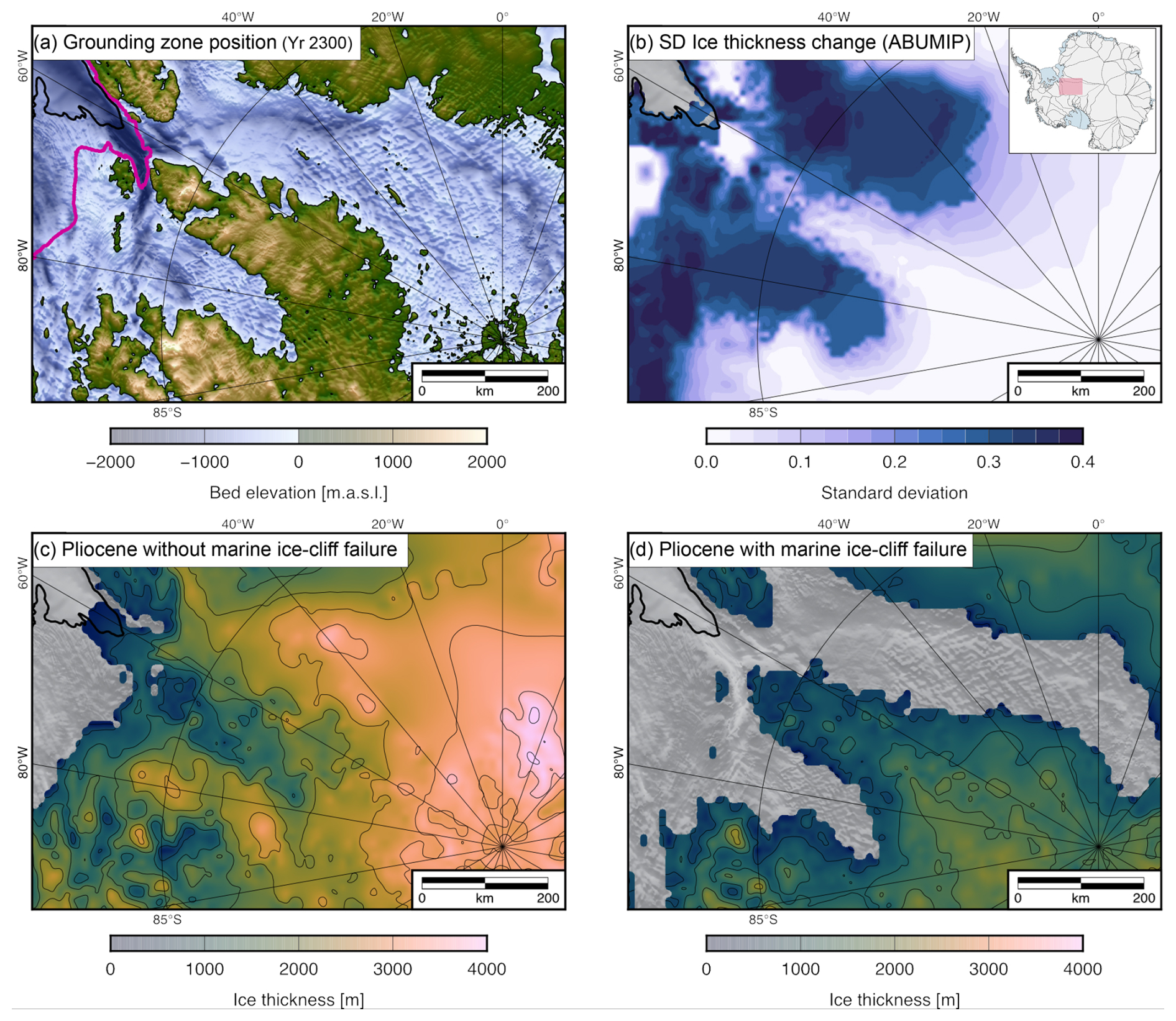
Figure 9Numerical ice-sheet modelling of past and future FPAS retreat. (a) Potential 2300 CE grounding zone position (magenta line) under RCP8.5 climate forcing from ice-sheet model simulations (Hill et al., 2021) using a high-impact, low-likelihood combination of input parameters. Present-day BedMachine v4 bed topography (Morlighem, 2025) is shown for reference. (b) Standard deviation of the percentage ice thickness change across a multi-model ensemble from the Antarctic BUttressing Model Intercomparison Project (ABUMIP); simulations are run for 500 model-years, with high melt rates applied beneath ice shelves to force rapid loss and debuttressing (Sun et al., 2020). (c) Simulated ice thickness under Pliocene conditions (DeConto et al., 2021); marine ice-sheet instability feedbacks are incorporated, but marine ice-cliff failure physics are switched off. (d) Simulated ice thickness during the warmth of the Pliocene (DeConto et al., 2021), with marine ice-cliff failure physics switched on. Modelled grounding zone position in (c) and (d) are indicated by the boundary between the grey and thickness-coloured parts of these subplots. Modern-day grounding zone position in (a)–(d) indicated by black line (Pritchard et al., 2025). Inset map shows extent of (a)–(d) (pink rectangle).
Over shorter timescales, future ice-sheet model simulations suggest that the potential sea-level contribution of the FPAS over the next 200–500 years is likely to be more limited even than that of other large marine-based catchments elsewhere in the EAIS (e.g. Aurora, and Wilkes subglacial basins). For example, ice sheet-scale and regional (i.e. Weddell Sea sector) model experiments (e.g. Wright et al., 2014; Cornford et al., 2015; Ritz et al., 2015; Seroussi et al., 2020; DeConto et al., 2021; Hill et al., 2021; Johnson et al., 2023; Seroussi et al., 2024; Hill et al., 2024) suggest that the FPAS is unlikely to undergo substantive grounding-zone retreat over the next 100–300 years (e.g. Fig. 9a and b). In these models, grounding-zone retreat is predominantly limited to the FPAS trunk only (i.e. the zone before the Foundation-Patuxent and Academy tributaries become decoupled). However, model results and projected retreat rates could vary depending on specific model choices, for example the form of the basal sliding law, and the way in which sub-shelf melt rates are imposed in stand-alone ice sheet models, both of which are known sources of uncertainty in future projections (Ritz et al., 2015; Seroussi et al., 2020, 2024).
Future glaciological change may not be fully captured in existing numerical model simulations. The FPAS may evolve differently because: (i) current numerical ice sheet models are poorly constrained (e.g. Steig et al., 2015; Bradley and Hewitt, 2024); (ii) major potential retreat has been simulated for FPAS-adjacent ice streams between 2100–2200 (e.g. Wright et al., 2014; Cornford et al., 2015; Seroussi et al., 2020; DeConto et al., 2021; Hill et al., 2021); and (iii) thinning of FRIS may reduce overall buttressing of grounded ice (Reese et al., 2018) impacting the FPAS in unanticipated ways. The potential for the FRIS cavity to shift from a cold to warm regime, driven by the inflow of warm circumpolar ocean waters on the continental shelf (Hellmer et al., 2012), may drive the glaciological change to adjacent ice streams (Hill et al., 2024), with uncertain implications for the FPAS.
FPAS-specific factors may also increase uncertainties in model outputs. First, the steep, prograde basal topography up-ice from the confluence of Academy Glacier and Foundation-Patuxent Ice Stream in Foundation Trough (Fig. 2) (Huybers et al., 2017) has been poorly constrained in observations and poorly resolved in some model experiments, particularly those that simulate the whole ice sheet and are accordingly low-resolution. Secondly, the narrow FPAS trunk (Fig. 2), situated within the Foundation-Thiel Trough (Jeofry et al., 2018b), results in high lateral shear stresses that may not be fully resolved in lower resolution numerical models (Jamieson et al., 2012; Gudmundsson, 2013; Mas e Braga et al., 2023). Thirdly, the poorly constrained potential long-range buttressing effects of Berkner Island (Fürst et al., 2016; Reese et al., 2018), may not be characterised in all models (Fig. 1a–b). Finally, many of the existing simulations (e.g. DeConto et al., 2021) were run using the Bedmap2 basal topography (Fretwell et al., 2013), which did not include the more recently acquired PolarGAP, Operation IceBridge, FISS and COLDEX RES data (Paxman et al., 2019; Morlighem et al., 2020; Frémand et al., 2023; Young et al., 2025) and only coarsely resolved sub-ice shelf bathymetry. Indeed, we note substantive topographic differences between Bedmap3 and BedMachine for the FPAS catchment (Fig. 3).
In addition to other sources of uncertainty, numerical ice sheet model experiments vary depending on resolution and due to uncertainties in bed topography. For example, Antarctic-wide warm climate model runs (e.g. for the Pliocene) using 5–20 km resolution model experiments generate deglaciation into the Pensacola-Pole Basin, whilst model runs at 40 km resolution do not (Pollard et al., 2015), potentially because the topographic complexity of the FPAS (Fig. 2) is poorly resolved at low resolution.
Only two FPAS-specific models exist to date. These simulate 2D flowlines up either Foundation Ice Stream (Whitehouse et al., 2017) or Academy Glacier (Huybers et al., 2017) only, and are therefore naturally limited in diagnostic and prognostic capabilities. In an ideal scenario, all modelling experiments would be undertaken using the most up-to-date topography at high resolution, with sub-km adaptive-mesh resolution near the grounding zone (e.g. Hill et al., 2021, 2024) and other regions of high stress gradients. Recent advances in ice-sheet-wide models have partly addressed this issue, by using fully coupled atmosphere-ocean-ice approaches with model resolutions of 4–8 km and higher-resolution adaptive grids (e.g. Pelle et al., 2020; Naughten et al., 2021). Sensitivity studies on the specific FPAS area are required to evaluate and understand which factors are critical for accurately modelling this system. Such approaches (see Siegert et al., 2020), which have already been used for modelling experiments in other catchments, can overcome these issues. In particular, such experiments would benefit from integrating existing and/or new observations and measurements of the FPAS and the offshore ice shelf. As it is more robust for model grids to be constrained by direct observations of bed topography than interpolated data (see Pritchard et al., 2025), acquiring new measurements so that bed topography resolution better approximates the resolution of current-generation numerical models would further help to improve modelling of the FPAS response to change.
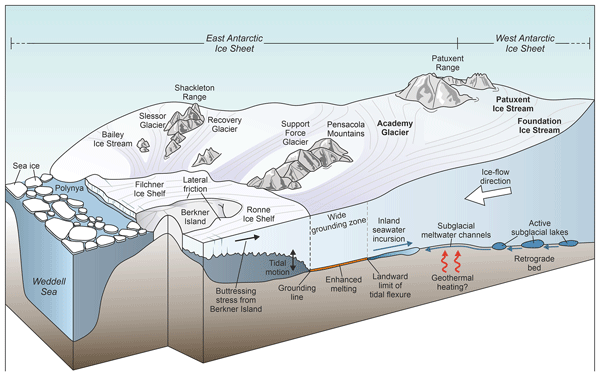
It is clear that the unique topographic and hydrological characteristics of the FPAS that may enhance its vulnerability to future climate, glaciological, and oceanographic change (Fig. 10) remain poorly characterised. Here, we outline a series of priorities for future glaciological research on the FPAS. These priorities, broadly based on the “targets of investigation” outlined in Sect. 2, are organised within three overarching research headings: (1) targeted activities to characterise basal boundary conditions and dynamic processes of the FPAS; (2) how does the FPAS interact with Support Force Glacier? and (3) what is the sensitivity of the FPAS to external forcing?
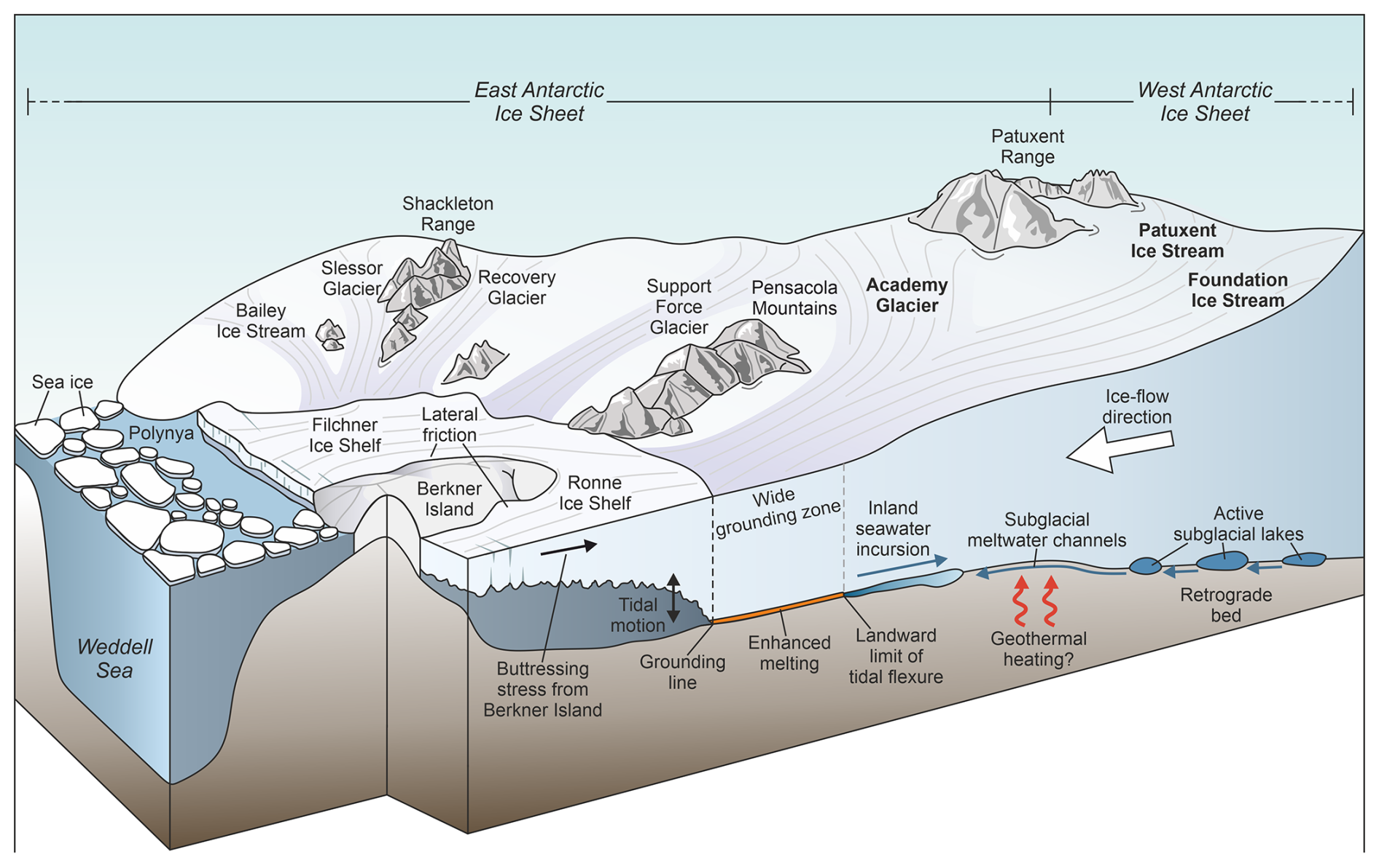
Figure 10Visualisation of the Foundation Patuxent Academy System (FPAS), showing its pattern of ice flow, landscape setting, and subglacial and grounding zone processes. Also shown is the FPAS's relationship to surrounding outlet glaciers in the Weddell Sea sector, the Filchner-Ronne Ice Shelf (including the grounded Berkner Island), the Southern Ocean, and major mountain ranges. Note that the visualisation is not true to scale, with some features exaggerated relative to others for display purposes.
5.1 Targeted activities to characterise basal boundary conditions and dynamic processes
We do not currently know: (i) why the FPAS grounding zone is positioned where it is, and whether the system is “in balance”; (ii) what the current conditions are at the FPAS grounding zone; (iii) what the physical properties of the FPAS ice and subglacial materials (e.g. rheology, anisotropy etc.) are; and (iv) what the configuration and character of the FPAS's hydrological system is.
Addressing these unknowns, essential for evaluating how the FPAS may respond to future climate or oceanographic driven change (e.g. Hellmer et al., 2012), requires four targeted activities:
-
Improved characterisation of the basal topography of the FPAS. New airborne geophysical surveys of the FPAS catchment, deploying innovative approaches such as swath imaging radar (e.g. Holschuh et al., 2020; Hoffman et al., 2023, Carter et al., 2025), are required to obtain the 10s to 100s of meter resolution required for ice-sheet modelling of grounding zone change (e.g. Seroussi et al., 2024; Hill et al., 2024) (Fig. 9). There is an urgent need for specific RES surveys of the Academy-Support Force boundary (Fig. 7) and the Foundation-Patuxent catchment (Figs. 1 and 2) of the FPAS. The design of these new surveys must prioritise glaciological needs by considering, for example, the survey targets, survey line orientation, height above ice surface etc. In this regard, we highlight the statement made by the BedMachine consortium – “… we recommend flight tracks perpendicular to the flow direction to maximize constraints on ice flux, especially upstream of Academy and Support Force glaciers….” (Morlighem et al., 2020);
-
Determination of the physical properties of the FPAS bed (any Quaternary-age sediments and the underlying geology) and how they might influence present and future ice dynamics (Diez et al., 2018). Given the importance of correctly parameterising basal drag in ice-sheet models (Ritz et al., 2015; Law et al., 2023), the lack of geophysical or direct constraints on bed properties (e.g. presence or absence of water, soft vs hard bed, bed roughness etc.) and underlying geology, as well as how they spatially vary, is a significant gap in our understanding of the FPAS. The priority must be the geophysical characterisation and direct sampling of the smooth low basal shear stress zones: (i) beneath the FPAS trunk (e.g. sampling upstream of the ∼20 km wide (along-flow) tidally influenced grounding zone, between the hard rock landforms noted by Jeofry et al., 2018b); (ii) beneath Patuxent Ice Stream; and (iii) in the low-to-medium roughness parts of the Pensacola-Pole Basin beneath Academy Glacier (Figs. 2 and 4);
-
Assessment of how the large-scale and highly active subglacial hydrological system of the FPAS functions, what the potential sources of basal water draining through Academy Glacier are, and how this water influences FPAS ice flow and dynamics and grounding zone ice-ocean-meltwater processes (Jordan et al., 2018; Dow et al., 2022; Jeofry et al., 2018b). An important component of this work is to constrain the basal thermal state (Dawson et al., 2022) of the FPAS catchment. This is a significant uncertainty at present, although localised geophysical constraints (Hills et al., 2022; Fudge et al., 2023) exist. We also need, for FPAS: (i) to understand the processes that control hydrologically-driven ice surface change; (ii) monitor and quantify in high temporal and spatial resolution how water flows in and out of active lakes (Siegfried and Fricker, 2021); and (iii) determine the impact subglacial lake filling and drainage has both on ice flow (Stearns et al., 2008; Livingstone et al., 2022) and on grounding zone processes and melt rates (Gourmelen et al., 2025; Horgan et al., 2025; Zhou et al., 2025);
-
Observations of ice-ocean interaction at the grounding zone. Given the large outflux of water from the FPAS (Jeofry et al., 2018b) and the site-specific oceanographic conditions we can expect, it is critical that we undertake airborne and detailed in-situ glaciological and oceanographic observations in the FPAS grounding zone to constrain the subglacial water flux, cavity geometry, oceanographic circulation and conditions, and the rate of melt (Davis et al., 2023; Schmidt et al., 2023). As the flat ice surface and bed geometry and high tidal range of the FPAS grounding zone are likely to drive the incursion of seawater inland of the grounded ice margin, these observations should also focus on characterising how saltwater influx, and its interaction with subglacial meltwater (Horgan et al., 2025; Zhou et al., 2025) may influence melt rates, the flow of lightly grounded ice, and the basal hydrological system (Robel et al., 2022; Rignot et al., 2024; Bradley and Hewitt, 2024) of FPAS. Seawater intrusion could be an important, large-scale process for the FPAS that is likely to change dynamically (Zhou et al., 2025) in response to any future grounding-zone retreat and/or decoupling of Foundation and Patuxent ice streams from Academy Glacier.
5.2 How does the FPAS interact with Support Force Glacier?
The upstream boundary of the FPAS catchment intersects numerous ice-stream catchments. This makes it sensitive to, and potentially capable of influencing, ice-sheet change in other sectors of West and East Antarctica, including FRIS (Pingree et al., 2011; Steig et al., 2015; Reese et al., 2018; Winter et al., 2018). However, we believe priority should go to the interaction between FPAS and Support Force Glacier, as their contact (Fig. 7) likely represents the most sensitive boundary of the FPAS catchment to change.
The pattern of ice flow, the morphology of the ice surface and bed topography, and the configuration of the subglacial hydrological system (Sect. 4.2) (Figs. 1, 2, 6 and 7) at the Academy-Support Force boundary make it is highly susceptible to both ice flow-switching (Conway et al., 2002; Dowdeswell et al., 2006; Siegert et al., 2013; Winter et al., 2015; Selley et al., 2025) and subglacial water piracy (Alley et al., 1994; Vaughan et al., 2008; McCormack et al., 2023). However, the potential for, evidence of, and glaciological consequences of flow-switching and water piracy across this hundreds-of-kilometres-long boundary (Fig. 7) have not yet been assessed. Such assessment requires improved determination of the current geometry of this boundary, the controls on boundary position, and whether the ice sheet records evidence of past changes to the ice or subglacial water catchments.
Although the contemporary ice flow boundary between these glaciers (Fig. 7a) has been defined from remote sensing-derived ice flow measurements (Mouginot et al., 2019), there are known limitations to the ice velocity dataset in this area. In addition, even small changes to ice surface geometry could cause flow direction change over short timescales (Fig. 7a). Improved constraints on the contemporary ice flow pattern will likely be realised through forthcoming SAR satellite observations (e.g. NISAR) that will result in new and improved ice velocity data products.
Characterising what controls the position of the Academy-Support Force margin, and assessment of whether the ice sheet englacial structure records evidence of past boundary migration, needs new RES data. This will provide improved bed topography (e.g. Franke et al., 2020; Carter et al., 2025) and the characterisation, analysis and deciphering of englacial layering and structure across the shear margin (Fig. 7), including ice crystal fabric from polarimetric radar (e.g. Ross et al., 2020; Young et al., 2021; Jordan et al., 2022; Franke et al., 2022; Gerber et al., 2023; Jansen et al., 2024). These data should be integrated with ground-based radar (ApRES) and seismic measurements for ice fabric anisotropy (Brisbourne et al., 2019). Before new data are acquired, analysis of the englacial structure and layers, and “radioglaciological artefacts” (Young et al., 2021) from existing RES data (e.g. PolarGAP, OiB, SPRI-NSF-TUD etc.) should also be performed. These existing datasets have not yet been used to evaluate the nature and stability of the current position of the Academy-Support Force boundary, and thus the possibility that it could migrate, or that the ice structure may record past change.
An outstanding uncertainty is whether the subglacial hydrological catchments of Support Force and Academy glaciers align directly with the ice flow catchments. Current datasets (see Fig. 7) suggest that the ice flow and subglacial water flow catchments may be non-aligned. For example, some reported “Academy Glacier” active subglacial lakes (i.e. A14 and A16) could be located beneath Support Force Glacier instead. A similar mismatch between ice flow and hydrological catchments has been proposed for Pine Island and Thwaites glaciers in West Antarctica (Napoleoni et al., 2020). We need to confirm whether this is the case for the FPAS, as any model investigation of the potential for future hydrological flow-switching requires that the current boundaries of the Support Force and Academy hydrological catchments are determined accurately. Any such offset between ice flow and hydrological catchments poses challenges for running coupled hydrology-ice dynamical models.
5.3 What is the sensitivity of the FPAS to external forcing?
Five sub-questions arise from considering the sensitivity of the FPAS to changes in external forcing (i.e. oceanographic and/or atmospheric changes) and internal dynamic feedbacks: (1) Is the FPAS susceptible to future sustained retreat via ocean-driven melt, and over what timescale(s)? (2) Is the FPAS beginning to show evidence of change, or is it likely to change, on societally relevant timescales (i.e. next 100–500 years)? (3) Is there evidence for past ice-sheet retreat (or readvance) of the FPAS, and when did this retreat (or readvance) occur? (4) How might ocean conditions, ice-shelf thickness, hydrology, surface mass balance (SMB), and grounding zone geometry change over the coming centuries, impacting the FPAS? and (5) Could changes to other parts of the Antarctic Ice Sheet lead to glaciological change in the FPAS (and vice versa)? Addressing these questions requires the following strategy:
-
To determine the susceptibility of the FPAS to sustained retreat via ocean-driven melt in the foreseeable future (i.e. next 100–500 years), high-resolution, adaptive-grid, catchment-scale numerical modelling of the FPAS with up-to-date bed topography (e.g. Siegert et al., 2020; Hill et al., 2021, 2024) is required (Fig. 9). Similar model simulations have been performed for the Aurora Subglacial Basin (Sun et al., 2016; Pelle et al., 2020), with model resolutions in those experiments sufficiently high to capture the narrow, complex, and in places prograde, bed topography of the FPAS trunk up to 200 km up-ice of the current grounding zone (Huybers et al., 2017) (Figs. 2 and 10). In addition to the ability to model changes to ocean cavity circulation in a grounding-zone retreat scenario, such experiments will require assessment of the role that the basal boundary conditions beneath the FPAS (i.e. recent marine sediments vs. older sedimentary basins) (Fig. 4) could play in controlling ice flow (Diez et al., 2018) and grounding-zone retreat (Ritz et al., 2015), given their role in determining basal friction. Improved, FPAS catchment-specific, high-resolution modelling of Last Interglacial and Pliocene scenarios are also required, as has been performed for the Wilkes and Aurora basins (e.g. Mengel and Levermann, 2014; Aitken et al., 2016);
-
Determination of FPAS surface change can be achieved through ongoing monitoring and analysis of satellite remote sensing data. This should especially address whether the FPAS trunk is undergoing surface lowering/flattening, and whether any change is persistent or the result of short-term changes. Although a low-magnitude surface-lowering signature over the FPAS trunk may be apparent between ICESat (2003–2009) and ICESat-2 (2019) (Smith et al., 2020a; Stokes et al., 2022), this could be the result of a short-term fluctuation in SMB rather than pervasive dynamic thinning. Ongoing long-term monitoring of the FPAS with currently operational satellite altimeters (e.g. ICESat-2, Cryosat-2, Sentinel-3) and those on upcoming missions (e.g. CRISTAL, NISAR) is required. Accurate interpretation of satellite-measured changes will require additional ground-truthing and calibration of SMB, as there are currently few field constraints on snow accumulation in the entire FPAS catchment (Lister and Pratt, 1959; Mayewski et al., 2005; Medley and Thomas, 2019; Noël et al., 2023). Furthermore, SMB across the FPAS catchment is spatially variable, with higher accumulation rates over the Foundation-Patuxent sub-catchment than over Academy Glacier (Noël et al., 2023).
-
To determine the geological retreat history of the FPAS requires geophysical characterisation, recovery and analysis of subglacial, sub-ice shelf and offshore materials (e.g. Kingslake et al., 2018; Spector et al., 2018; Siegert et al., 2019; Venturelli et al., 2020, 2023; Boeckmann et al., 2021; Johnson et al., 2022; Balco et al., 2023), and advances in the experimental design, resolution, input data etc. of ice-sheet models used to reconstruct post-LGM ice evolution (e.g. Whitehouse et al., 2017; Kingslake et al., 2018; Pittard et al., 2022). These will enable us to assess whether the FPAS underwent grounding-zone retreat and readvance during the late-Holocene, as has been postulated in the Weddell Sea (Bradley et al., 2015; Kingslake et al., 2018; Siegert et al., 2019). Sampling of subglacial sediments and bedrock in the Pensacola Mountains has recently been undertaken, with the goal of addressing this unknown (Braddock et al., 2024; Small et al., 2024). Re-investigation of existing RES data is required to test the idea that fast ice flow extended to the South Pole region at some point since the LGM (Bingham et al., 2007; Beem et al., 2018). Existing RES data have not yet been fully explored to test this idea, although the stratigraphy in PolarGAP data from around the South Pole suggests extensive englacial layer drawdown (Sanderson et al., 2024). Acquisition of new RES data from airborne and/or ground-based surveys, designed specifically to test this hypothesis, is needed.
-
Evaluating how the FPAS will evolve in a future scenario of ocean-warming driven grounding-zone retreat requires direct multi-year observations and monitoring of ice-ocean-hydrology interactions (Humbert et al., 2022; Freer et al., 2023; Davis et al., 2023; Schmidt et al., 2023) at, and near, the FPAS grounding zone (Fig. 10). In addition, oceanographic and glaciological constraints on the wider FRIS and its ice-shelf cavity (e.g. Smith et al., 2020b; Jordan et al., 2020) are required. At present, numerical models used to project future change are hampered by the lack of observational constraints on ocean circulation, water properties, cavity geometry and melt rates immediately beyond the FPAS grounding zone, as well as subglacial channel geometry and temporal activity upstream of the grounded ice margin (Fig. 10). Whilst we can assume that some ocean processes observed elsewhere in Antarctica (e.g. at Pine Island and Thwaites glaciers (Davis et al., 2023; Schmidt et al., 2023)) are transferable to the FPAS, the site-specific processes occurring at and proximal to the FPAS grounding zone are not well-known (e.g. in association with the large, tidally driven grounding-zone fluctuations, high subglacial meltwater flux, and cavity and ocean circulation pattern beneath FRIS). The application of coupled ice-ocean model simulations (e.g. Naughten et al., 2021), constrained where possible by direct observations, to the FPAS will help to overcome these issues, but will require improved geophysical characterisation of the ice shelf cavity (e.g. Smith et al., 2020b; Hofstede et al., 2021; Scott et al., 2023).
-
There are two approaches to identifying whether changes in other parts of the ice sheet can lead to changes in the FPAS, or vice versa. The first is exploring evidence for past change, either from the ice itself (e.g. Fahnestock et al., 2000; Bingham et al., 2007; Fudge et al., 2023, Hills et al., 2025) or from the subglacial or offshore sediments and geomorphology that have been previously deposited and formed by the ice sheet (e.g. Agrios et al., 2021; Smith et al., 2020b). We know from other ice sheets (e.g. the palaeo Laurentide Ice Sheet) that ice divides can migrate as ice streams thin and change their flow patterns (and vice-versa) (Margold et al., 2015; Stokes et al., 2016). Numerical simulations exploring how the FPAS catchment may have evolved since the LGM (e.g. Whitehouse et al., 2017; Lilien et al., 2018), or perhaps over even longer timescales, should enable us to evaluate the ability of its flow components to change (e.g. for ice stream margins or ice divides to migrate, for fast flowing ice to slow, or for the ice surface profile to steepen) (Retzlaff and Bentley, 1993; Siegert et al., 2004; Lilien et al., 2018; Khan et al., 2022; Grinsted et al., 2022). The second approach is to use numerical modelling to explore how the FPAS, and the adjacent Support Force Glacier, may change in the future, how it has changed in the past, and what factors it is particularly sensitive to (e.g. changes to ice surface elevation and the routing and nature of basal hydrology). This will enable us to evaluate how such FPAS-specific changes may impact the ice sheet more widely, or how changes in the rest of the ice sheet might impact the FPAS (e.g. Livingstone et al., 2013; Steig et al., 2015; Winter et al., 2018). To be meaningful, such simulations will require improved bed topography (Figs. 1d and 3) and knowledge of the current hydrological system (Figs. 6, 7 and 10), as well as further modern-day observations of SMB (Medley and Thomas, 2019; Lenaerts et al., 2019; Studinger et al., 2020), and more robust projections for how forcings such as SMB (e.g. Noël et al., 2023) and oceanography (e.g. Hellmer et al., 2012) will evolve over the coming centuries.
This state-of-knowledge review of the Foundation-Patuxent-Academy system (FPAS) has assessed what is presently known about: (i) the influence of subglacial topography and bed conditions on ice flow; (ii) the subglacial hydrological system; (iii) the LGM-to-present glacial history; and (iv) existing numerical modelling experiments. Our review has identified multiple “unknowns” and potential vulnerabilities to climatic, oceanographic and glaciological change that result from the FPAS's unique topographic and hydrological setting (Fig. 10).
The vulnerability of the FPAS to substantive ice mass loss driven by MISI across the Pensacola-Pole Basin (Fig. 9) is important, yet not well known. The low-gradient, retrograde bed slope of the FPAS (Fig. 2), together with regions of low bed roughness (Fig. 4), suggest it is certainly possible that future climate and ocean warming-driven forcing could instigate grounding-zone retreat across the Pensacola-Pole Basin as far inland as the South Pole (Fig. 9). This would drive major change to both the East and West Antarctic ice sheets. Given the severe glaciological and sea-level implications of such a scenario, quantifying its likelihood is a priority for investigation.
Existing numerical simulations of the FPAS (Fig. 9) cover a wide range of climate and ocean forcings, timeframes and model physics, yet have often used now out-of-date bed topography (i.e. BEDMAP or Bedmap2) that differs considerably from the true topography (Jeofry et al., 2018a), leading to simulations that differ from glaciological reality (Jeofry et al., 2019). Part of the challenge in modelling the FPAS is that the details of this system (i.e. its specific bed topography, basal hydrology and ice-ocean interactions across a broad zone of lightly grounded ice) (Fig. 10) are integral to performing robust model simulations yet remain only loosely characterised and quantified at present. Furthermore, in addition to the FPAS-specific issue of poorly-known boundary conditions there is the general issue that many small-scale processes are not currently effectively resolved in continental-scale ice-sheet models running at horizontal resolutions of 10s of km. Critically, we do not yet fully understand the consequences of any potential grounding-zone retreat along the FPAS trunk, and the likely resulting decoupling of the Foundation-Patuxent and Academy Glacier grounding zones. Retreat could nearly double the across-flow length of the grounding zone (Fig. 2), leading to an accordingly larger surface area of the FPAS interacting with the ocean. Continental-scale models do not effectively resolve the topography of the 50 km-wide FPAS trunk, and we have few constraints on ocean conditions, ice-shelf cavity geometry, and ice-ocean-hydrological interactions near, and at, the FPAS grounding zone (Fig. 10). It is possible, for example, that retreat and across-flow lengthening of the grounding zone could lead to a reduced role for seawater intrusion beneath grounded ice (as the surface slope of Academy Glacier would presumably steepen as its bed rises over higher inland topography, limiting the range of tidal flexure inland of the grounding lines). This would reduce the melt rate at the grounding zone, despite an increase in the cross sectional area of ice flow subjected to submarine melt. It is such complexity and process interplay that need to be better constrained and quantified.
Addressing the unknowns and potential vulnerabilities highlighted in this synthesis will require a dedicated research focus on the FPAS catchment in the following ways. First, there should be a focus on better exploiting existing and forthcoming datasets and observations from the FPAS and FRIS, and on exploring ways to improve and enhance ice-sheet modelling of the FPAS catchment. The goal of this initial phase of research should be to begin an assessment of the questions posed in this review, enabling the identification of priorities for future field-oriented data campaigns in the FPAS catchment, and on FRIS, leading to a second phase of research activity. Because of the remoteness of the FPAS, and the scale of the FPAS catchment, future field campaigns require a large-scale and multi-national approach, akin to that undertaken for the International Thwaites Glacier Collaboration (Scambos et al., 2017). The forthcoming International Polar Year (2032–2033) provides an opportunity to catalyse this research.
Numerical models (Fig. 9) will play an essential role in how we can address the research questions posed here. Comprehensive and focused high-resolution numerical modelling of the FPAS catchment, and the adjacent Support Force Glacier, is essential to address the unknowns we have identified, as well as to identify a priority order for the field observations and measurements we require. This paper has identified an array of possible observational targets (Fig. 10). However, the cost and logistical constraints associated with fieldwork in the FPAS region means that careful assessment and evaluation of priorities are needed to effectively undertake the data-constrained modelling necessary to determine how the FPAS has responded, and might respond, to a warmer world.
As a final point, glaciological change to the FPAS will have knock-on consequences for wider ice sheet modification in both East and West Antarctica. A catchment-scale, and potentially continent-wide, perspective and approach to ice sheet geophysical surveying, and modelling, is thus required to better comprehend how the ice sheet is likely to evolve under a variety of warming scenarios.
No new data were created during this study. All figures within this manuscript were generated using data from openly available datasets (Jezek et al., 2013; Mouginot et al., 2017; Nicholls et al., 2021; Corr et al., 2021; Ferraccioli et al., 2021; Nicholls et al., 2024; CReSIS, 2025; Morlighem, 2025) or published papers (Smith et al., 2009; Jordan et al,, 2018; Mouginot et al., 2019; Paxman et al, 2019; Sun et al. 2020; DeConto et al. 2021; Hill et al 2021; Livingstone et al. 2022; Paxman et al, 2022; Ehrenfeucht et al. 2025; Pritchard et al., 2025) referenced in the figure captions. All data are openly available via those references.
NR, MJS and BK conceived the idea for the review paper. NR, RJS, MJS, BK wrote the manuscript, with substantive additional contributions from MB, SSRJ, GJGP, DS, KN, MRS, OE. Figures created for this manuscript, and not previously published, were conceived and created by NR, RJS, KN, GJGP, CD, and CB. All authors reviewed the manuscript, providing comments, edits and feedback on draft versions.
At least one of the (co-)authors is a member of the editorial board of The Cryosphere. The peer-review process was guided by an independent editor, and the authors also have no other competing interests to declare.
Publisher's note: Copernicus Publications remains neutral with regard to jurisdictional claims made in the text, published maps, institutional affiliations, or any other geographical representation in this paper. The authors bear the ultimate responsibility for providing appropriate place names. Views expressed in the text are those of the authors and do not necessarily reflect the views of the publisher.
For the purpose of open access, the author has applied a Creative Commons Attribution (CC BY 4.0) licence to any Author Accepted Manuscript version arising from this submission. The authors acknowledge research grants, fellowships and studentships from: (i) Natural Environment Research Council (NERC) (BK, MB, GJGP, RJS, DS, EH, RGB, MJS); (ii) The Royal Society (GJGP); (iii) Canada Research Chairs Program (CD); (iv) Natural Sciences and Engineering Research Council of Canada (CD); (v) National Science Foundation (KN, BH); and (vi) NASA grants (MRS, WS, HF). NR acknowledges internal Newcastle University funding from the Humanities and Social Sciences bid preparation fund and the School of Geography Politics and Sociology visiting professor scheme (supporting a visit from MRS). We are very grateful to: (i) Keith Nicholls and Pippa Whitehouse for comments on an early draft of this manuscript: (ii) The NERC UK Polar Data Centre (UK PDC), ESA, NSIDC and CReSIS for openly available datasets used here; (iii) QGIS and Quantarctica for the support of figure creation and easy access to data resources. We acknowledge the use of data and/or data products from CReSIS generated with support from the University of Kansas, NASA Operation IceBridge grant NNX16AH54G, NSF grants ACI-1443054, OPP-1739003, and IIS-1838230, Lilly Endowment Incorporated, and Indiana METACyt Initiative. This work has been inspired by multiple SCAR Scientific Research Programmes and Action Groups, including AntArchitecture, RINGS, SCAR-INSTANT, Bedmap and Groundwater. NR would like to thank multiple seminar audiences (UK and International Glaciological Society) for providing a testing ground for ideas, as well as inspiration for driving this review forward.
This research has been supported by the Natural Environment Research Council (grant nos. NE/S006621/1, NE/R010838/1, NE/F014260/1, NE/F014252/1, NE/F014228/1, NE/L002590/1, NE/S007512/1, NE/T011963/1, NE/Y000129/1, NE/S006613/1, and NE/G013071/1), the Royal Society (grant no. URF\R1\241308), the Canada Research Chairs (grant no. 950-231237), the Natural Sciences and Engineering Research Council of Canada (grant no. RGPIN-03761-2017), the National Science Foundation (grant nos. 1542936 and 2317927), and the National Aeronautics and Space Administration (grant nos. 80NSSC21K0912, 80NSSC24K0169, and 80NSSC23K0934).
This paper was edited by Joseph MacGregor and reviewed by Duncan Young and one anonymous referee.
Adusumilli, S., Fricker, H. A., Medley, B., Padman, L., and Siegfried, M. R.: Interannual variations in meltwater input to the Southern Ocean from Antarctic ice shelves, Nat. Geosci., 13, 616–620, https://doi.org/10.1038/s41561-020-0616-z, 2020.
Agrios, L. M., Licht, K. J., Williams, T., Hemming, S. R., Welch, L., and Mickey, J. L.: Detrital geochronology and lithologic signatures of Weddell Sea Embayment ice streams, Antarctica – Implications for subglacial geology and ice sheet history, GSA Bull., 134, 1895–1915, https://doi.org/10.1130/B36117.1, 2021.
Alley, K. E., Scambos, T. A., Siegfried, M. R., and Fricker, H. A.: Impacts of warm water on Antarctic ice shelf stability through basal channel formation, Nat. Geosci., 9, 290–293, https://doi.org/10.1038/ngeo2675, 2016.
Alley, R. B., Anandakrishnan, S., Bentley, C. R., and Lord, N.: A water-piracy hypothesis for the stagnation of Ice Stream C, Antarctica, Ann. Glaciol., 20, 187–194, https://doi.org/10.3189/1994AoG20-1-187-194, 1994.
Aitken, A. R. A., Roberts, J. L., van Ommen, T. D., Young, D. A., Golledge, N. R., Greenbaum, J. S., Blankenship, D. D., and Siegert, M. J.: Repeated large-scale retreat and advance of Totten Glacier indicated by inland bed erosion, Nature, 533, 385–389, https://doi.org/10.1038/nature17447, 2016.
Aitken, A. R. A., Kulessa, B., Schroeder, D., Jordan, T. A., Whittaker, J. M., Anandakrishnan, S., Dawson, E. J., Wiens, D. A., Eisen, O., and Siegert, M. J.: Antarctic Sedimentary Basins and Their Influence on Ice-Sheet Dynamics, Rev. Geophys., 61, e2021RG000767, https://doi.org/10.1029/2021RG000767, 2023.
Balco, G.: Production rate calculations for cosmic-ray-muon-produced 10Be and 26Al benchmarked against geological calibration data, Quat. Geochronol., 39, 150–173, https://doi.org/10.1016/j.quageo.2017.02.001, 2017.
Balco, G., Stone, J. O., Lifton, N. A., and Dunai, T. J.: A complete and easily accessible means of calculating surface exposure ages or erosion rates from 10Be and 26Al measurements, Quat. Geochronol., 3, 174–195, https://doi.org/10.1016/j.quageo.2007.12.001, 2008.
Balco, G., Todd, C., Huybers, K., Campbell, S., Vermeulen, M., Hegland, M., Goehring, B. M., and Hillebrand, T. R.: Cosmogenic-nuclide exposure ages from the Pensacola Mountains adjacent to the Foundation Ice Stream, Antarctica, Am. J. Sci., 316, 542–577, https://doi.org/10.2475/06.2016.02, 2016.
Balco, G., Brown, N., Nichols, K., Venturelli, R. A., Adams, J., Braddock, S., Campbell, S., Goehring, B., Johnson, J. S., Rood, D. H., Wilcken, K., Hall, B., and Woodward, J.: Reversible ice sheet thinning in the Amundsen Sea Embayment during the Late Holocene, The Cryosphere, 17, 1787–1801, https://doi.org/10.5194/tc-17-1787-2023, 2023.
Batchelor, C. L., Christie, F. D. W., Ottesen, D., Montelli, A., Evans, J., Dowdeswell, E. K., Bjarnadóttir, L. R., and Dowdeswell, J. A.: Rapid, buoyancy-driven ice-sheet retreat of hundreds of metres per day, Nature, 617, 105–110, https://doi.org/10.1038/s41586-023-05876-1, 2023.
Beem, L. H., Cavitte, M. G. P., Blankenship, D. D., Carter, S. P., Young, D. A., Muldoon, G. R., Jackson, C. S., and Siegert, M. J.: Ice-flow reorganization within the East Antarctic Ice Sheet deep interior, in: Exploration of Subsurface Antarctica: Uncovering Past Changes and Modern Processes, edited by: Siegert, M. J., Jamieson, S. S. R., and White, D. A., Geol. Soc. Lond. Spec. Publ., 461, 35–47, https://doi.org/10.1144/SP461.14, 2018.
Beem, L. H., Young, D. A., Greenbaum, J. S., Blankenship, D. D., Cavitte, M. G. P., Guo, J., and Bo, S.: Aerogeophysical characterization of Titan Dome, East Antarctica, and potential as an ice core target, The Cryosphere, 15, 1719–1730, https://doi.org/10.5194/tc-15-1719-2021, 2021.
Behrendt, J. C.: Geophysical and glaciological studies in the Filchner Ice Shelf Area of Antarctica, J. Geophys. Res., 67, 221–234, https://doi.org/10.1029/JZ067i001p00221, 1962.
Behrendt, J. C., Meister, L., and Henderson, J. R.: Airborne Geophysical Study in the Pensacola Mountains of Antarctica, Science, 153, 1373–1376, https://doi.org/10.1126/science.153.3742.1373, 1966.
Behrendt, J. C., Henderson, J. R., Meister, L., and Rambo, W. L.: Geophysical investigations of the Pensacola Mountains and adjacent glacierized areas of Antarctica, Geol. Surv. Prof. Pap., 844, United States Government Printing Office, Washington, 1974.
Behrendt, J. C., Drewry, D. J., Jankowski, E., and Grim, M. S.: Aeromagnetic and radio echo ice-sounding measurements over the Dufek Intrusion, Antarctica, J. Geophys. Res., 86, 3014–3020, https://doi.org/10.1029/JB086iB04p03014, 1981.
Beitzel, J. E.: Geophysical exploration in Queen Maud Land, Antarctica, in: Antarctic Snow and Ice Studies II, edited by: Crary, A. P., Antarct. Res. Ser., 16, American Geophysical Union, Washington, D.C., 39–88, https://doi.org/10.1029/AR016, 1971.
Bell, R. E., Studinger, M., Shuman, C. A., Fahnestock, M. A., and Joughin, I.: Large subglacial lakes in East Antarctica at the onset of fast-flowing ice streams, Nature, 445, 904–907, https://doi.org/10.1038/nature05554, 2007.
Bell, R. E., Ferraccioli, F., Creyts, T. T., Braaten, D., Corr, H., Das, I., Damaske, D., Frearson, N., Jordan, T., Rose, K., Studinger, M., and Wolowick, M.: Widespread persistent thickening of the East Antarctic Ice Sheet by freezing from the base, Science, 331, 1592–1595, https://doi.org/10.1126/science.1200109, 2011.
Bentley, C., Crary, A. P., Ostenso, N. A., and Thiel, E. C.: Structure of West Antarctica: The results of United States IGY oversnow traverses reveal the nature of a large portion of ice-covered Antarctica, Science, 131, 131–136, https://doi.org/10.1126/science.131.3394.131, 1960.
Bentley, M. J., Hein, A. S., Sugden, D. E., Whitehouse, P. L., Shanks, R., Xu, S., and Freeman, S. P. H. T.: Deglacial history of the Pensacola Mountains, Antarctica from glacial geomorphology and cosmogenic nuclide surface exposure dating, Quat. Sci. Rev., 158, 58–76, https://doi.org/10.1016/j.quascirev.2016.09.028, 2017.
Bingham, R. G. and Siegert, M. J.: Radar-derived roughness characterization of Institute and Möller Ice Streams, West Antarctica: comparison with Siple Coast ice streams, Geophys. Res. Lett., 34, L21504, https://doi.org/10.1029/2007GL031483, 2007.
Bingham, R. G. and Siegert, M. J.: Quantifying subglacial bed roughness in Antarctica: implications for ice-sheet dynamics and history, Quat. Sci. Rev., 28, 223–236, https://doi.org/10.1016/j.quascirev.2008.10.014, 2009.
Bingham, R. G., Siegert, M. J., Young, D. A., and Blankenship, D. D.: Organized flow from the South Pole to the Filchner-Ronne Ice Shelf: An assessment of balance velocities in interior East Antarctica using radio echo sounding data, J. Geophys. Res., 112, F03S26, https://doi.org/10.1029/2006JF000556, 2007.
Boeckmann, G. V., Gibson, C. J., Kuhl, T. W., Moravec, E., Johnson, J. A., Meulemans, Z., and Slawny, K.: Adaptation of the Winkie Drill for subglacial bedrock sampling, Ann. Glaciol., 62, 109–117, https://doi.org/10.1017/aog.2020.73, 2021.
Borchers, B., Marrero, S., Balco, G., Caffee, M., Goehring, B., Lifton, N., Nishiizumi, K., Phillips, F., Schaefer, J., and Stone, J.: Geological calibration of spallation production rates in the CRONUS-Earth project, Quat. Geochronol., 31, 188–198, https://doi.org/10.1016/j.quageo.2015.01.009, 2016.
Braddock, S., Venturelli, R. A., Nichols, K., Moravec, E., Boeckmann, G. V., Campbell, S., Balco, G., Ackert, R., Small, D., Johnson, J. S., Dunbar, N., Woodward, J., Mukhopadhyay, S., and Goehring, B.: Lessons learned from shallow subglacial bedrock drilling campaigns in Antarctica, Ann. Glaciol., 65, e18, https://doi.org/10.1017/aog.2024.12, 2024.
Bradley, A. T. and Hewitt, I. J.: Tipping point in ice-sheet grounding-zone melting due to ocean water intrusion, Nat. Geosci., 17, 631–637, https://doi.org/10.1038/s41561-024-01465-7, 2024.
Bradley, S. L., Hindmarsh, R. C. A., Whitehouse, P. L., Bentley, M. J., and King, M. A.: Low post-glacial rebound rates in the Weddell Sea due to Late Holocene ice-sheet readvance, Earth Planet. Sc. Lett., 413, 79–89, https://doi.org/10.1016/j.epsl.2014.12.039, 2015.
Brisbourne, A. M., Martin, C., Smith, A. M., Baird, A. F., Kendall, J. M., and Kingslake, J.: Constraining recent ice flow history at Korff Ice Rise, West Antarctica, using radar and seismic measurements of ice fabric, J. Geophys. Res.-Earth Surf., 124, 175–194, https://doi.org/10.1029/2018JF004776, 2019.
Brunt, K. M., Fricker, H. A., and Padman, L.: Analysis of ice plains of the Filchner–Ronne Ice Shelf, Antarctica, using ICESat laser altimetry, J. Glaciol., 57, 965–975, https://doi.org/10.3189/002214311798043753, 2011.
Bunce, C., Carr, J. R., Nienow, P. W., Ross, N., and Killick, R.: Ice front change of marine-terminating outlet glaciers in northwest and southeast Greenland during the 21st century, J. Glaciol., 64, 523–535, https://doi.org/10.1017/jog.2018.44, 2018.
Burton-Johnson, A., Dziadek, R., and Martin, C.: Review article: Geothermal heat flow in Antarctica: current and future directions, The Cryosphere, 14, 3843–3873, https://doi.org/10.5194/tc-14-3843-2020, 2020.
Carr, J. R., Vieli, A., and Stokes, C.: Influence of sea ice decline, atmospheric warming, and glacier width on marine-terminating outlet glacier behavior in northwest Greenland at seasonal to interannual timescales, J. Geophys. Res.-Earth Surf., 118, 1210–1226, https://doi.org/10.1002/jgrf.20088, 2013.
Carter, C. M., Franke, S., Jansen, D., Stokes, C. R., Helm, V., Paden, J., and Eisen, O.: Formation of mega-scale glacial lineations far inland beneath the onset of the Northeast Greenland Ice Stream, The Cryosphere, 19, 5299–5315, https://doi.org/10.5194/tc-19-5299-2025, 2025.
Carter, S. P., Blankenship, D. D., Peters, M. E., Young, D. A., Holt, J. W., and Morse, D. L.: Radar-based subglacial lake classification in Antarctica, Geochem. Geophys. Geosyst., 8, Q03016, https://doi.org/10.1029/2006GC001408, 2007.
Carter, S. P., Fricker, H. A., and Siegfried, M. R.: Evidence of rapid subglacial water piracy under Whillans Ice Stream, West Antarctica, J. Glaciol., 59, 1147–1162, https://doi.org/10.3189/2013JoG13J085, 2013.
Christoffersen, P., Bougamont, M., Carter, S. P., Fricker, H. A., and Tulaczyk, S.: Significant groundwater contribution to Antarctic ice streams hydrologic budget, Geophys. Res. Lett., 41, 2003–2010, https://doi.org/10.1002/2014GL059250, 2014.
Conway, H., Catania, G., Raymond, C. F., Gades, A. M., Scambos, T. A., and Engelhardt, H.: Switch of flow direction in an Antarctic ice stream, Nature, 419, 465–467, https://doi.org/10.1038/nature01081, 2002.
Cornford, S. L., Martin, D. F., Payne, A. J., Ng, E. G., Le Brocq, A. M., Gladstone, R. M., Edwards, T. L., Shannon, S. R., Agosta, C., van den Broeke, M. R., Hellmer, H. H., Krinner, G., Ligtenberg, S. R. M., Timmermann, R., and Vaughan, D. G.: Century-scale simulations of the response of the West Antarctic Ice Sheet to a warming climate, The Cryosphere, 9, 1579–1600, https://doi.org/10.5194/tc-9-1579-2015, 2015.
Corr, H., Ferraccioli, F., Forsberg, R., Jordan, T., Kohler, J., Matsuoka, K., Olesen, A., and Robinson, C.: Processed bed elevation picks from the POLARGAP radar survey across the Pensacola-Pole Basin (2015/2016) (Version 1.0), NERC EDS UK Polar Data Centre [data set], https://doi.org/10.5285/d55e87dd-a74d-4182-be99-93ab805103ab, 2021.
CReSIS: Radar Depth Sounder Data, Lawrence, Kansas, USA, Digital Media, http://data.cresis.ku.edu/ (last access: 25 June 2026), 2025.
Davis, P. E. D., Nicholls, K. W., Holland, D. M., Schmidt, B. E., Washam, P., Riverman, K. L., Arthern, R. J., Vaňková, I., Eayrs, C., Smith, J. A., Anker, P. G., Mullen, A. D., Dichek, D., Lawrence, J. D., Meister, M. M., Clyne, E., Basinski-Ferris, A., Rignot, E., Queste, B. Y., Boehme, L., Heywood, K. J., Anandakrishnan, S., and Makinson, K.: Suppressed basal melting in the eastern Thwaites Glacier grounding zone, Nature, 614, 479–485, https://doi.org/10.1038/s41586-022-05586-0, 2023.
Dawson, E. J., Schroeder, D. M., Chu, W., Mantelli, E., and Seroussi, H.: Ice mass loss sensitivity to the Antarctic ice sheet basal thermal state, Nat. Commun., 13, 4957, https://doi.org/10.1038/s41467-022-32632-2, 2022.
Dawson, G. J. and Bamber, J. L.: Measuring the location and width of the Antarctic grounding zone using CryoSat-2, The Cryosphere, 14, 2071–2086, https://doi.org/10.5194/tc-14-2071-2020, 2020.
DeConto, R. and Pollard, D.: Contribution of Antarctica to past and future sea-level rise, Nature, 531, 591–597, https://doi.org/10.1038/nature17145, 2016.
DeConto, R. M., Pollard, D., Alley, R. B., Velicogna, I., Gasson, E., Gomez, N., Sadai, S., Condron, A., Gilford, D. M., Ashe, E. L., Kopp, R. E., Dawei, L., and Dutton, A.: The Paris Climate Agreement and future sea-level rise from Antarctica, Nature, 593, 83–89, https://doi.org/10.1038/s41586-021-03427-0, 2021.
Diez, A., Matsuoka, K., Ferraccioli, F., Jordan, T. A., Corr, H. F., Kohler, J., Olesen, A. V., and Forsberg, R.: Basal settings control fast ice flow in the Recovery/Slessor/Bailey Region, East Antarctica, Geophys. Res. Lett., 45, 2706–2715, https://doi.org/10.1002/2017GL076601, 2018.
Diez, A., Matsuoka, K., Jordan, T. A., Kohler, J., Ferraccioli, F., Corr, H. F., Olesen, A. V., Forsberg, R., and Casal, T. G.: Patchy lakes and topographic origin for fast flow in the Recovery Glacier System, East Antarctica, J. Geophys. Res.-Earth Surf., 124, 287–304, https://doi.org/10.1029/2018JF004799, 2019.
Doake, C. S. M., Corr, H. F. J., Jenkins, A., Makinson, K., Nicholls, K. W., Nath, C., Smith, A. M., and Vaughan, D. G.: Rutford Ice Stream, Antarctica, in: The West Antarctic Ice Sheet: Behavior and Environment, edited by: Alley, R. B. and Bindschadler, R. A., Antarct. Res. Ser., 77, American Geophysical Union, 221–235, https://doi.org/10.1029/AR077, 2001.
Dow, C. F., Lee, W. S., Greenbaum, J., Greene, C. A., Blankenship, D. D., Poinar, K., Forrest, A. L., Young, D. A., and Zappa, C. J.: Basal channels drive active surface hydrology and transverse ice shelf fracture, Sci. Adv., 4, eaao7212, https://doi.org/10.1126/sciadv.aao7212, 2018.
Dow, C. F., Ross, N., Jeofry, H., Sui, K., and Siegert, M. J.: Antarctic basal environment shaped by high-pressure flow through a subglacial river system, Nat. Geosci., 15, 892–898, https://doi.org/10.1038/s41561-022-01059-1, 2022.
Dowdeswell, J. A., Ottesen, D., and Rise, L.: Flow switching and large-scale deposition by ice streams draining former ice sheets, Geology, 34, 313–316, https://doi.org/10.1130/G22253.1, 2006.
Dralkin, A. G.: To the South Pole, Priroda, 10, 27–34, 1960.
Drewry, D. J.: Antarctica: Glaciological and geophysical folio, edited by: Drewry, D. J., Scott Polar Research Institute, University of Cambridge, Cambridge, 18 pp., ISBN 9780901021045, 1983.
Drewry, D. J.: The Land Beneath the Ice: The Pioneering Years of Radar Exploration in Antarctica, Princeton University Press, 464 pp., ISBN 9780691237916, 2023.
Drewry, D. J. and Meldrum, D. T.: Antarctic airborne radio echo sounding 1977–78, Polar Rec., 19, 267–278, https://doi.org/10.1017/S0032247400018271, 1978.
Drewry, D. J., Meldrum, D. T., and Jankowski, E.: Radio echo and magnetic sounding of the Antarctic Ice Sheet, 1978–79, Polar Rec., 20, 43–57, https://doi.org/10.1017/S0032247400002916, 1980.
Dütsch, M., Steig, E. J., Blossey, P. N., and Pauling, A. G.: Response of water isotopes in precipitation to a collapse of the West Antarctic Ice Sheet in high-resolution simulations with the Weather Research and Forecasting Model, J. Climate, 36, 5417–5430, https://doi.org/10.1175/JCLI-D-22-0647.1, 2023.
Ehrenfeucht, S., Dow, C., McArthur, K., Morlighem, M., and McCormack, F. S.: Antarctic wide subglacial hydrology modeling, Geophys. Res. Lett., 52, e2024GL111386, https://doi.org/10.1029/2024GL111386, 2025.
Engelhardt, H. and Kamb, B.: Basal sliding of Ice Stream B, West Antarctica, J. Glaciol., 44, 223–230, https://doi.org/10.3189/S0022143000002562, 1998.
Fahnestock, M. A., Scambos, T. A., Bindschadler, R. A., and Kvaran, G.: A millennium of variable ice flow recorded by the Ross Ice Shelf, Antarctica, J. Glaciol., 46, 652–664, https://doi.org/10.3189/172756500781832693, 2000.
Ferraccioli, F., Forsberg, R., Matsuoka, K., Olesen, A., Jordan, T., Corr, H., Robinson, C., and Kohler, J.: Processed airborne radio-echo sounding data from the POLARGAP survey covering the South Pole, and Foundation and Recovery Glaciers, East Antarctica (2015/2016) (Version 1.0) [data set], NERC EDS UK Polar Data Centre, https://doi.org/10.5285/e8a29fa7-a245-4a04-8b56-098defa134b9, 2021.
Foley, N., Tulaczyk, S. M., Grombacher, D., Doran, P. T., Mikucki, J., Myers, K. F., Foged, N., Dugan, H., Auken, E., and Virginia, R.: Evidence for pathways of concentrated submarine groundwater discharge in East Antarctica from helicopter-borne electrical resistivity measurements, Hydrology, 6, 54, https://doi.org/10.3390/hydrology6020054, 2019.
Franke, S., Jansen, D., Beyer, S., Neckel, N., Binder, T., Paden, J., and Eisen, O.: Complex basal conditions and their influence on ice flow at the onset of the Northeast Greenland Ice Stream, J. Geophys. Res.-Earth Surf., 126, e2020JF005689, https://doi.org/10.1029/2020JF005689, 2020.
Franke, S., Bons, P. D., Westhoff, J., Weikusat, I., Binder, T., Streng, K., Steinghage, D., Helm, V., Eisen, O., Paden, J. D., Eagles, G., and Jansen, D.: Holocene ice-stream shutdown and drainage basin reconfiguration in northeast Greenland, Nat. Geosci., 15, 995–1001, https://doi.org/10.1038/s41561-022-01082-2, 2022.
Freer, B. I. D., Marsh, O. J., Hogg, A. E., Fricker, H. A., and Padman, L.: Modes of Antarctic tidal grounding line migration revealed by Ice, Cloud, and land Elevation Satellite-2 (ICESat-2) laser altimetry, The Cryosphere, 17, 4079–4101, https://doi.org/10.5194/tc-17-4079-2023, 2023.
Frémand, A. C., Fretwell, P., Bodart, J. A., Pritchard, H. D., Aitken, A., Bamber, J. L., Bell, R., Bianchi, C., Bingham, R. G., Blankenship, D. D., Casassa, G., Catania, G., Christianson, K., Conway, H., Corr, H. F. J., Cui, X., Damaske, D., Damm, V., Drews, R., Eagles, G., Eisen, O., Eisermann, H., Ferraccioli, F., Field, E., Forsberg, R., Franke, S., Fujita, S., Gim, Y., Goel, V., Gogineni, S. P., Greenbaum, J., Hills, B., Hindmarsh, R. C. A., Hoffman, A. O., Holmlund, P., Holschuh, N., Holt, J. W., Horlings, A. N., Humbert, A., Jacobel, R. W., Jansen, D., Jenkins, A., Jokat, W., Jordan, T., King, E., Kohler, J., Krabill, W., Kusk Gillespie, M., Langley, K., Lee, J., Leitchenkov, G., Leuschen, C., Luyendyk, B., MacGregor, J., MacKie, E., Matsuoka, K., Morlighem, M., Mouginot, J., Nitsche, F. O., Nogi, Y., Nost, O. A., Paden, J., Pattyn, F., Popov, S. V., Rignot, E., Rippin, D. M., Rivera, A., Roberts, J., Ross, N., Ruppel, A., Schroeder, D. M., Siegert, M. J., Smith, A. M., Steinhage, D., Studinger, M., Sun, B., Tabacco, I., Tinto, K., Urbini, S., Vaughan, D., Welch, B. C., Wilson, D. S., Young, D. A., and Zirizzotti, A.: Antarctic Bedmap data: Findable, Accessible, Interoperable, and Reusable (FAIR) sharing of 60 years of ice bed, surface, and thickness data, Earth Syst. Sci. Data, 15, 2695–2710, https://doi.org/10.5194/essd-15-2695-2023, 2023.
Fretwell, P., Pritchard, H. D., Vaughan, D. G., Bamber, J. L., Barrand, N. E., Bell, R., Bianchi, C., Bingham, R. G., Blankenship, D. D., Casassa, G., Catania, G., Callens, D., Conway, H., Cook, A. J., Corr, H. F. J., Damaske, D., Damm, V., Ferraccioli, F., Forsberg, R., Fujita, S., Gim, Y., Gogineni, P., Griggs, J. A., Hindmarsh, R. C. A., Holmlund, P., Holt, J. W., Jacobel, R. W., Jenkins, A., Jokat, W., Jordan, T., King, E. C., Kohler, J., Krabill, W., Riger-Kusk, M., Langley, K. A., Leitchenkov, G., Leuschen, C., Luyendyk, B. P., Matsuoka, K., Mouginot, J., Nitsche, F. O., Nogi, Y., Nost, O. A., Popov, S. V., Rignot, E., Rippin, D. M., Rivera, A., Roberts, J., Ross, N., Siegert, M. J., Smith, A. M., Steinhage, D., Studinger, M., Sun, B., Tinto, B. K., Welch, B. C., Wilson, D., Young, D. A., Xiangbin, C., and Zirizzotti, A.: Bedmap2: improved ice bed, surface and thickness datasets for Antarctica, The Cryosphere, 7, 375–393, https://doi.org/10.5194/tc-7-375-2013, 2013.
Fricker, H. A. and Padman, L.: Ice shelf grounding zone structure from ICESat laser altimetry, Geophys. Res. Lett., 33, L15502, https://doi.org/10.1029/2006GL026907, 2006.
Fricker, H. A., Galton-Fenzi, B. K., Walker, C. C., Freer, B. I. D., Padman, L., and DeConto, R.: Antarctica in 2025: Drivers of deep uncertainty in projected ice loss, Science, 387, 601–609, https://doi.org/10.1126/science.adt9619, 2025.
Fudge, T. J., Hills, B. H., Horlings, A. N., Holschuh, N., Christian, J. E., Davidge, L., Hoffman, A., O'Connor, G. K., Christianson, K., and Steig, E. J.: A site for deep ice coring at West Hercules Dome: results from ground-based geophysics and modeling, J. Glaciol., 69, 538–550, https://doi.org/10.1017/jog.2022.80, 2023.
Fürst, J., Durand, G., Gillet-Chaulet, F., Tavard, L., Rankl, M., Braun, M., and Gagliardini, O.: The safety band of Antarctic ice shelves, Nat. Clim. Change, 6, 479–482, https://doi.org/10.1038/nclimate2912, 2016.
Gasson, E., DeConto, R. M., Pollard, D., and Levy, R. H.: Dynamic Antarctic ice sheet during the early to mid-Miocene, P. Natl. Acad. Sci. USA, 113, 3459–3464, https://doi.org/10.1073/pnas.1516130113, 2016.
Gerber, T. A., Lilien, D. A., Rathmann, N. M., Franke, S., Young, T. J., Valero-Delgado, F., Ershadi, M. R., Drews, R., Zeising, O., Humbert, A., Stoll, N., Weikusat, I., Grinsted, A., Hvidberg, C. S., Jansen, D., Miller, H., Helm, V., Steinhage, D., O'Neill, C., Paden, J., Gogineni, S. P., Dahl-Jense, D., and Eisen, O.: Crystal orientation fabric anisotropy causes directional hardening of the Northeast Greenland Ice Stream, Nat. Commun., 14, 2653, https://doi.org/10.1038/s41467-023-38139-8, 2023.
Golledge, N. R., Clark, P. U., He, F., Dutton, A., Turney, C. S. M., Fogwill, C. J., Naish, T. R., Levy, R. H., McKay, R. M., Lowry, D. P., Bertler, N. A. N., Dunbar, G. B., and Carlson, A. E.: Retreat of the Antarctic Ice Sheet during the Last Interglaciation and implications for future change, Geophys. Res. Lett., 48, e2021GL094513, https://doi.org/10.1029/2021GL094513, 2021.
Gooch, B. T., Young, D. A., and Blankenship, D. D.: Potential groundwater and heterogeneous heat source contributions to ice sheet dynamics in critical submarine basins of East Antarctica, Geochem. Geophys. Geosyst., 17, 395–409, https://doi.org/10.1002/2015GC006117, 2016.
Gourmelen, N., Jakob, L., Holland, P. R., Dutrieux, P., Goldberg, D., Bevan, S., Luckman, A., and Malczyk, G.: The influence of subglacial lake discharge on Thwaites Glacier ice-shelf melting and grounding-line retreat, Nat. Commun., 16, 2272, https://doi.org/10.1038/s41467-025-57417-1, 2025.
Grieman, M. M., Nehrbass-Ahles, C., Hoffmann, H. M., Bauska, T. K., King, A. C. F., Mulvaney, R., Rhodes, R. H., Rowell, I. F., Thomas, E. R., and Wolff, E.: Abrupt Holocene ice loss due to thinning and ungrounding in the Weddell Sea Embayment, Nat. Geosci., 17, 227–232, https://doi.org/10.1038/s41561-024-01375-8, 2024.
Grinsted, A., Hvidberg, C. S., Lilien, D. A., Rathmann, N. M., Karlsson, N. B., Gerber, T., Kjær, H. A., Vallelonga, P., and Dahl-Jensen, D.: Accelerating ice flow at the onset of the Northeast Greenland Ice Stream, Nat. Commun., 13, 5589, https://doi.org/10.1038/s41467-022-32999-2, 2022.
Gudmundsson, G. H.: Ice-shelf buttressing and the stability of marine ice sheets, The Cryosphere, 7, 647–655, https://doi.org/10.5194/tc-7-647-2013, 2013.
Gudmundsson, G. H., Krug, J., Durand, G., Favier, L., and Gagliardini, O.: The stability of grounding lines on retrograde slopes, The Cryosphere, 6, 1497–1505, https://doi.org/10.5194/tc-6-1497-2012, 2012.
Gustafson, C. D., Key, K., Siegfried, M. R., Winberry, J. P., Fricker, H. A., Venturelli, R. A., and Michaud, A. B.: A dynamic saline groundwater system mapped beneath an Antarctic ice stream, Science, 376, 640–644, https://doi.org/10.1126/science.abm3301, 2022.
Hanna, E., Topál, D., Box, J. E., Buzzard, S., Christie, F. D. W., Hvidberg, C., Morlighem, M., De Santis, L., Silvano, A., Colleoni, F., Sasgen, I., Banwell, A. F., van den Broeke, M. R., DeConto, R., De Rydt, J., Golzer, H., Gossart, A., Gudmundsson, G. H., Lindbäck, K., Miles, B., Mottram, R., Pattyn, F., Reese, R., Rignot, E., Srivastava, A., Sun, S., Toller, J., Tuckett, P., and Ultee, L.: Short- and long-term variability of the Antarctic and Greenland ice sheets, Nat. Rev. Earth Environ., 5, 193–210, https://doi.org/10.1038/s43017-023-00509-7, 2024.
Hattermann, T., Nicholls, K. W., Hellmer, H. H., Davis, P. E. D., Janout, M. A., Østerhus, S., Schlosser, E., Rohardt, G., and Kanzow, T.: Observed interannual changes beneath Filchner-Ronne Ice Shelf linked to large-scale atmospheric circulation, Nat. Commun., 12, 2961, https://doi.org/10.1038/s41467-021-23131-x, 2021.
Hellmer, H. H., Kauker, F., Timmermann, R., Determann, J., and Rae, J.: Twenty-first-century warming of a large Antarctic ice-shelf cavity by a redirected coastal current, Nature, 485, 225–228, https://doi.org/10.1038/nature11064, 2012.
Helm, V., Humbert, A., and Miller, H.: Elevation and elevation change of Greenland and Antarctica derived from CryoSat-2, The Cryosphere, 8, 1539–1559, https://doi.org/10.5194/tc-8-1539-2014, 2014.
Hill, E., Gudmundsson, G. H., and Chandler, D. M.: Ocean warming as a trigger for irreversible retreat of the Antarctic ice sheet, Nat. Clim. Change, 14, 1165–1171, https://doi.org/10.1038/s41558-024-02134-8, 2024.
Hill, E. A., Rosier, S. H. R., Gudmundsson, G. H., and Collins, M.: Quantifying the potential future contribution to global mean sea level from the Filchner–Ronne basin, Antarctica, The Cryosphere, 15, 4675–4702, https://doi.org/10.5194/tc-15-4675-2021, 2021.
Hillenbrand, C. D., Bentley, M. J., Stolldorf, T. D., Hein, A. S., Kuhn, G., Graham, A. G. C., Fogwill, C. J., Kristoffersen, Y., Smith, J. A., Anderson, J. B., Larter, R. D., Melles, M., Hodgson, D. A., Mulvaney, R., and Sugden, D. E.: Reconstruction of changes in the Weddell Sea sector of the Antarctic Ice Sheet since the Last Glacial Maximum, Quat. Sci. Rev., 100, 111–136, https://doi.org/10.1016/j.quascirev.2013.07.020, 2014.
Hills, B. H., Christianson, K., Hoffman, A. O., Fudge, T. J., Holschuh, N., Kahle, E. C., Conway, H., Christian, J. E., Horlings, A. N., O'Connor, G. K., and Steig, E. J.: Geophysics and thermodynamics at South Pole Lake indicate stability and a regionally thawed bed, Geophys. Res. Lett., 49, e2021GL096218, https://doi.org/10.1029/2021GL096218, 2022.
Hills, B. H., Holschuh, N., Hoffman, A. O., Horlings, A. N., Erwin, E., Kirkpatrick, L. R., Fudge, T. J., Steig, E. J., and Christianson, K.: Radar-derived crystal orientation fabric suggests dynamic stability at the summit of Hercules Dome, J. Geophys. Res.-Earth Surf., 130, e2023JF007588, https://doi.org/10.1029/2023JF007588, 2025.
Hoffman, A. O., Holschuh, N., Mueller, M., Paden, J., Muto, A., Ariho, G., Brigham, C., Christian, J. E., Davidge, L., Heitmann, E., Hills, B., Horlings, A., Morey, S., O'Connor, G., Fudge, T. J., Steig, E. J., and Christianson, K.: Scars of tectonism promote ice-sheet nucleation from Hercules Dome into West Antarctica, Nat. Geosci., 16, 1005–1013, https://doi.org/10.1038/s41561-023-01265-5, 2023.
Hofstede, C., Beyer, S., Corr, H., Eisen, O., Hattermann, T., Helm, V., Neckel, N., Smith, E. C., Steinhage, D., Zeising, O., and Humbert, A.: Evidence for a grounding line fan at the onset of a basal channel under the ice shelf of Support Force Glacier, Antarctica, revealed by reflection seismics, The Cryosphere, 15, 1517–1535, https://doi.org/10.5194/tc-15-1517-2021, 2021.
Holschuh, N., Christianson, K., Paden, J., Alley, R. B., and Anandakrishnan, S.: Linking postglacial landscapes to glacier dynamics using swath radar at Thwaites Glacier, Antarctica, Geology, 48, 268–272, https://doi.org/10.1130/G46772.1, 2020.
Horgan, H., Stewart, C., Stevens, C., Dunbar, G., Balfoort, L., Schmidt, B. E., Washam, P., Werder, M. A., Mandeno, D., Marschalek, J., Hulbe, C., Holschuh, N., Levy, R., Hurwitz, B., Jendersie, S., Johnson, K., Lawrence, J., Morgenstern, R., Mullen, A.D., Quartini, E., Sauthoff, W., Siegfried, M., Still, H., Thorpe-Loversuch, S., van de Flierdt, T., Venturelli, R., and Whiteford, A.: A West Antarctic grounding-zone environment shaped by episodic water flow, Nat. Geosci., 18, 389–395, https://doi.org/10.1038/s41561-025-01687-3, 2025.
Howat, I. M., Porter, C., Smith, B. E., Noh, M.-J., and Morin, P.: The Reference Elevation Model of Antarctica, The Cryosphere, 13, 665–674, https://doi.org/10.5194/tc-13-665-2019, 2019.
Humbert, A., Christmann, J., Corr, H. F. J., Helm, V., Höyns, L.-S., Hofstede, C., Müller, R., Neckel, N., Nicholls, K. W., Schultz, T., Steinhage, D., Wolovick, M., and Zeising, O.: On the evolution of an ice shelf melt channel at the base of Filchner Ice Shelf, from observations and viscoelastic modeling, The Cryosphere, 16, 4107–4139, https://doi.org/10.5194/tc-16-4107-2022, 2022.
Huybers, K., Roe, G., and Conway, H.: Basal topographic controls on the stability of the West Antarctic ice sheet: lessons from Foundation Ice Stream, Ann. Glaciol., 58, 193–198, https://doi.org/10.1017/aog.2017.9, 2017.
Jamieson, S. S. R., Vieli, A., Livingstone, S. J., Ó Cofaigh, C., Stokes, C., Hillenbrand, C.-D., and Dowdeswell, J. A.: Ice-stream stability on a reverse bed slope, Nat. Geosci., 5, 799–802, https://doi.org/10.1038/ngeo1600, 2012.
Jankowski, E. J. and Drewry, D. J.: The structure of West Antarctica from geophysical studies, Nature, 291, 17–21, https://doi.org/10.1038/291017a0, 1981.
Jansen, D., Franke, S., Bauer, C. C., Binder, T., Dahl-Jensen, D., Eichler, J., Eisen, O., Hu, Y., Kerch, J., Llorens, M.-G., Miller, H., Neckel, N., Paden, J., de Riese, T., Sachau, T., Stoll, N., Weikusat, I., Wilhelms, F., Zhang, Y., and Bons, P. D.: Shear margins in upper half of Northeast Greenland Ice Stream were established two millennia ago, Nat. Commun., 15, 1193, https://doi.org/10.1038/s41467-024-45021-8, 2024.
Jeofry, H., Ross, N., Corr, H. F. J., Li, J., Morlighem, M., Gogineni, P., and Siegert, M. J.: A new bed elevation model for the Weddell Sea sector of the West Antarctic Ice Sheet, Earth Syst. Sci. Data, 10, 711–725, https://doi.org/10.5194/essd-10-711-2018, 2018a.
Jeofry, H., Ross, N., Le Brocq, A., Graham, A. G. C., Li, J., Gogineni, P., Morlighem, M., Jordan, T., and Siegert, M. J.: Hard rock landforms generate 130 km ice shelf channels through water focusing in basal corrugations, Nat. Commun., 9, 4576, https://doi.org/10.1038/s41467-018-06679-z, 2018b.
Jeofry, H., Ross, N., and Siegert, M. J.: Comparing numerical ice-sheet model output with radio-echo sounding measurements in the Weddell Sea sector of West Antarctica, Ann. Glaciol., 81, 1–10, https://doi.org/10.1017/aog.2019.39, 2019.
Jezek, K. C., Curlander, J. C., Carsey, F., Wales, C., and Barry, R. G.: RAMP AMM-1 SAR Image Mosaic of Antarctica, Boulder, CO, USA, NSIDC, https://doi.org/10.5067/8af4zrpuls4h (last access: 8 July 2025), 2013.
Johnson, A., Aschwanden, A., Albrecht, T., and Hock, R.: Range of 21st century ice mass changes in the Filchner-Ronne region of Antarctica, J. Glaciol., 69, 1203–1213, https://doi.org/10.1017/jog.2023.10, 2023.
Johnson, J. S., Venturelli, R. A., Balco, G., Allen, C. S., Braddock, S., Campbell, S., Goehring, B. M., Hall, B. L., Neff, P. D., Nichols, K. A., Rood, D. H., Thomas, E. R., and Woodward, J.: Review article: Existing and potential evidence for Holocene grounding line retreat and readvance in Antarctica, The Cryosphere, 16, 1543–1562, https://doi.org/10.5194/tc-16-1543-2022, 2022.
Jordan, T. A., Martin, C., Ferraccioli, F., Matsuoka, K., Corr, H., Forsberg, R., Olesen, A., and Siegert, M.: Anomalously high geothermal flux near the South Pole, Sci. Rep., 8, 16785, https://doi.org/10.1038/s41598-018-35182-0, 2018.
Jordan, T. A., Porter, D., Tinto, K., Millan, R., Muto, A., Hogan, K., Larter, R. D., Graham, A. G. C., and Paden, J. D.: New gravity-derived bathymetry for the Thwaites, Crosson, and Dotson ice shelves revealing two ice shelf populations, The Cryosphere, 14, 2869–2882, https://doi.org/10.5194/tc-14-2869-2020, 2020.
Jordan, T. M., Martin, C., Brisbourne, A. M., Schroeder, D. M., and Smith, A. M.: Radar characterization of ice crystal orientation fabric and anisotropic viscosity within an Antarctic ice stream, J. Geophys. Res.-Earth Surf., 127, e2022JF006673, https://doi.org/10.1029/2022JF006673, 2022.
Joughin, I. and Alley, R. B.: Stability of the West Antarctic ice sheet in a warming world, Nat. Geosci., 4, 506–513, https://doi.org/10.1038/ngeo1194, 2011.
Joughin, I., Bamber, J. L., Scambos, T., Tulaczyk, S., Fahnestock, M., and MacAyeal, D. R.: Integrating satellite observations with modelling: basal shear stress of the Filchner-Ronne ice streams, Antarctica, Philos. T. R. Soc. A, 364, 1795–1814, https://doi.org/10.1098/rsta.2006.1799, 2006.
Khan, S. A., Choi, Y., Morlighem, M., Rignot, E., Helm, V., Humbert, A., Mouginot, J., Millan, R., Kjær, K. H., and Bjørk, A. A.: Extensive inland thinning and speed-up of Northeast Greenland Ice Stream, Nature, 611, 727–732, https://doi.org/10.1038/s41586-022-05301-z, 2022.
Kingslake, J., Scherer, R. P., Albrecht, T., Coenen, J., Powell, R. D., Reese, R., Stansell, N. D., Tulaczyk, S., Wearing, M. G., and Whitehouse, P. L.: Extensive retreat and re-advance of the West Antarctic Ice Sheet during the Holocene, Nature, 558, 430–434, https://doi.org/10.1038/s41586-018-0208-x, 2018.
Koerner, R. M.: A stratigraphic method of determining the snow accumulation rate at Plateau Station, Antarctica, and application to South Pole-Queen Maud Land Traverse 2, 1965–66, in: Antarctic Snow and Ice Studies II, edited by: Crary, A. P., Antarctic Res. Ser., 16, 225–238, AGU, Washington, D.C., 1971.
Kulessa, B., Key, K., Thompson, S., and Siegert, M.: Heat and groundwater transport between the Antarctic Ice Sheet and subglacial sedimentary basins from electromagnetic geophysical measurements, SEG Tech. Program Exp. Abstr., 2019, 4819–4823, https://doi.org/10.1190/segam2019-3215566.1, 2019.
Lambrecht, A.: Investigations on mass balance and dynamics of the Ronne Ice Shelf, Antarctica, Ber. Polarforsch., 265, ISSN 0176–5027, 1998.
Lambrecht, A., Mayer, C., Oerter, H., and Nixdorf, U.: Investigations of the mass balance of the southeastern Ronne Ice Shelf, Antarctica, Ann. Glaciol., 29, 250–254, https://doi.org/10.3189/172756499781820996, 1999.
Lambrecht, A., Sandhäger, H., Vaughan, D. G., and Mayer, C.: New ice thickness maps of Filchner–Ronne Ice Shelf, Antarctica, with specific focus on grounding lines and marine ice, Antarct. Sci., 19, 521–532, https://doi.org/10.1017/S0954102007000661, 2007.
Lavoie, C., Domack, E. W., Pettit, E. C., Scambos, T. A., Larter, R. D., Schenke, H.-W., Yoo, K. C., Gutt, J., Wellner, J., Canals, M., Anderson, J. B., and Amblas, D.: Configuration of the Northern Antarctic Peninsula Ice Sheet at LGM based on a new synthesis of seabed imagery, The Cryosphere, 9, 613–629, https://doi.org/10.5194/tc-9-613-2015, 2015.
Law, R., Christoffersen, P., Mackie, E., Cook, S., Haseloff, M., and Gagliardini, O.: Complex motion of Greenland Ice Sheet outlet glaciers with basal temperate ice, Sci. Adv., 9, eabq5180, https://doi.org/10.1126/sciadv.abq5180, 2023.
Le Brocq, A., Ross, N., Griggs, J. A., Bingham, R. G., Corr, H. F. J., Ferraccioli, F., Jenkins, A., Jordan, T. A., Payne, A. J., Rippin, D. M., and Siegert, M. J.: Evidence from ice shelves for channelized meltwater flow beneath the Antarctic Ice Sheet, Nat. Geosci., 6, 945–948, https://doi.org/10.1038/ngeo1977, 2013.
Lenaerts, J. T. M., Medley, B., van den Broeke, M. R., and Wouters, B.: Observing and modeling ice sheet surface mass balance, Rev. Geophys., 57, 376–420, https://doi.org/10.1029/2018RG000622, 2019.
Li, L., Aitken, A. R. A., Lindsay, M. D., and Kulessa, B.: Sedimentary basins reduce stability of Antarctic ice streams through groundwater feedbacks, Nat. Geosci., 15, 645–650, https://doi.org/10.1038/s41561-022-00992-5, 2022a.
Li, T., Dawson, G. J., Chuter, S. J., and Bamber, J. L.: A high-resolution Antarctic grounding zone product from ICESat-2 laser altimetry, Earth Syst. Sci. Data, 14, 535–557, https://doi.org/10.5194/essd-14-535-2022, 2022b.
Lifton, N., Sato, T., and Dunai, T. J.: Scaling in situ cosmogenic nuclide production rates using analytical approximations to atmospheric cosmic-ray fluxes, Earth Planet. Sc. Lett., 386, 149–160, https://doi.org/10.1016/j.epsl.2013.10.052, 2014.
Lilien, D. A., Fudge, T. J., Koutnik, M. R., Conway, H., Osterberg, E. C., Ferris, D. G., Waddington, E. D., and Stevens, C. M.: Holocene ice-flow speedup in the vicinity of the South Pole, Geophys. Res. Lett., 45, 6557–6565, https://doi.org/10.1029/2018GL078253, 2018.
Lister, H. and Pratt, G.: Geophysical investigations of the Commonwealth Trans-Antarctic Expedition, Geogr. J., 125, 343–354, https://doi.org/10.2307/1791117, 1959.
Livingstone, S. J., Clark, C. D., Woodward, J., and Kingslake, J.: Potential subglacial lake locations and meltwater drainage pathways beneath the Antarctic and Greenland ice sheets, The Cryosphere, 7, 1721–1740, https://doi.org/10.5194/tc-7-1721-2013, 2013.
Livingstone, S. J., Li, Y., Rutishauser, A., Sanderson, R. J., Winter, K., Mikucki, J. A., Björnsson, H., Bowling, J. S., Chu, W., Dow, C. F., Fricker, H. A., McMillan, M., Ng, F. S. L., Ross, N., Siegert, M. J., Siegfried, M., and Sole, A. J.: Subglacial lakes and their changing role in a warming climate, Nat. Rev. Earth Environ., 3, 106–124, https://doi.org/10.1038/s43017-021-00246-9, 2022.
Lythe, M. B. and Vaughan, D. G.: BEDMAP: A new ice thickness and subglacial topographic model of Antarctica, J. Geophys. Res.-Sol. Ea., 106, 11335–11351, 2001.
MacGregor, J. A., Boisert, L. N., Medley, B., Petty, A. A., Harbeck, J. P., Bell, R. E., Blair, J. B., Blanchard-Wrigglesworth, E., Buckley, E. M., Christianson, M. S., Cochran, J. R., Csathó, B. M., De Marco, E. L., Dominguez, R. T., Fahnestock, M. A., Farrell, S. L., Gogineni, S. P., Greenbaum, J. S., Hansen, C. M., Hofton, M. A., Holt, J. W., Jezek, K. C., Koenig, L. S., Kurtz, N. T., Kwok, R., Larsen, C. F., Leuschen, C. J., Locke, C. D., Manizade, S. S., Martin, S., Neumann, T. A., Nowicki, S. M. J., Paden, J. D., Richter-Menge, J. A., Rignot, E., Rodríguez-Morales, R., Siegfried, N. R., Smith, B. E., Sonntag, J. G., Studinger, M., Tinto, K. J., Truffer, M., Wagner, T. P., Woods, J. E., Young, D. A., and Yungel, J. K.: The scientific legacy of NASA's Operation IceBridge, Rev. Geophys., 59, e2020RG000712, https://doi.org/10.1029/2020RG000712, 2021.
Margold, M., Stokes, C. R., and Clark, C. D.: Ice streams in the Laurentide Ice Sheet: Identification, characteristics and comparison to modern ice sheets, Earth Sci. Rev., 143, 117–146, https://doi.org/10.1016/j.earscirev.2015.01.011, 2015.
Mas e Braga, M., Jones, R. S., Bernales, J., Andersen, J. L., Fredin, O., Morlighem, M., Koester, A. J., Lifton, N. A., Harbor, J. M., Suganuma, Y., Glasser, N. F., Rogozhina, I., and Stroeven, A. P.: A thicker Antarctic ice stream during the mid-Pliocene warm period, Commun. Earth Environ., 4, 321, https://doi.org/10.1038/s43247-023-00983-3, 2023.
Mayer, C., Lambrecht, A., and Oerter, H.: Glaciological investigations on the Foundation Ice Stream, in: Filchner-Ronne Ice Shelf Programme Report No. 9, edited by: Oerter, H., Alfred-Wegener-Institute for Polar and Marine Research, Bremerhaven, 57–63, 1995.
Mayewski, P. A., Frezzotti, M., Bertler, N., van Ommen, T., Hamilton, G., Jacka, T. H., Welch, B., Frey, M., Dahe, Q., Jiawen, R., Simões, J., Family, M., Oerter, H., Nishio, F., Isaksson, E., Mulvaney, R., Holmlund, P., Lipenkov, V., and Goodwin, I.: The International Trans-Antarctic Scientific Expedition (ITASE): an overview, Ann. Glaciol., 41, 180–185, https://doi.org/10.3189/172756405781813159, 2005.
McCormack, F. S., Roberts, J. L., Kulessa, B., Aitken, A., Dow, C. F., Bird, L., Galton-Fenzi, B. K., Hochmuth, K., Jones, R. S., Mackintosh, A. N., and McArthur, K.: Assessing the potential for ice flow piracy between the Totten and Vanderford glaciers, East Antarctica, The Cryosphere, 17, 4549–4569, https://doi.org/10.5194/tc-17-4549-2023, 2023.
McIntyre, N. F.: The topography and flow of the Antarctic Ice Sheet, PhD thesis, University of Cambridge, 197 pp., https://doi.org/10.17863/CAM.14156, 1983.
McIntyre, N. F.: Discharge of ice into the Filchner-Ronne ice shelves, in: Filchner-Ronne Ice Shelf Programme, Report 3, edited by: Kohnen, H., Alfred-Wegener Inst. Polar Mar. Res., Bremerhaven, 47–51, 1986.
Medley, B. and Thomas, E. R.: Increased snowfall over the Antarctic Ice Sheet mitigated twentieth-century sea-level rise, Nat. Clim. Change, 9, 34–39, https://doi.org/10.1038/s41558-018-0356-x, 2019.
Mengel, M. and Levermann, A.: Ice plug prevents irreversible discharge from East Antarctica, Nat. Clim. Change, 4, 451–455, https://doi.org/10.1038/nclimate2226, 2014.
Morlighem, M.: MEaSUREs BedMachine Antarctica (NSIDC-0756, Version 4), Boulder, Colorado USA, NASA National Snow and Ice Data Center Distributed Active Archive Center [data set], https://doi.org/10.5067/POJQI54A45HX (last access: 8 May 2026), 2025.
Morlighem, M., Rignot, E., Binder, T., Blankenship, D., Drews, R., Eagles, G., Eisen, O., Ferraccioli, F., Forsberg, R., Fretwell, P., Goel, V., Greenbaum, J. S., Gudmundsson, H., Guo, J., Helm, V., Hofstede, C., Howat, I., Humbert, A., Jokat, W., Karlsson, N. B., Sang Lee, W., Matsuoka, K., Millan, R., Mouginot, J., Paden, J., Pattyn, F., Roberts, J., Rosier, S., Ruppel, A., Seroussi, H., Smith, E. C., Steinhage, D., Bo, S., van den Broeke, M., van Ommen, T. D., van Wessem, M., and Young, D. A.: Deep glacial troughs and stabilizing ridges unveiled beneath the margins of the Antarctic ice sheet, Nat. Geosci., 13, 132–137, https://doi.org/10.1038/s41561-019-0510-8, 2020.
Morlighem, M., Goldberg, D., Barnes, J. M., Basis, J. N., Benn, D. I., Crawford, A. J., Gudmundsson, G. H., and Seroussi, H.: The West Antarctic Ice Sheet may not be vulnerable to marine ice cliff instability during the 21st century, Sci. Adv., 10, eado7794, https://doi.org/10.1126/sciadv.ado7794, 2024.
Mouginot, J., Scheuchl, B., and Rignot, E.: MEaSUREs Antarctic Boundaries for IPY 2007-2009 from Satellite Radar (NSIDC-0709, Version 2), Boulder, CO, NASA NSIDC DAAC [data set], https://doi.org/10.5067/AXE4121732AD (last access: 3 June 2025), 2017.
Mouginot, J., Rignot, E., and Scheuchl, B.: Continent-wide interferometric SAR phase mapping of Antarctic ice velocity, Geophys. Res. Lett., 46, 9710–9718, https://doi.org/10.1029/2019GL083826, 2019.
Mueller, R. D., Hattermann, T., Howard, S. L., and Padman, L.: Tidal influences on a future evolution of the Filchner–Ronne Ice Shelf cavity in the Weddell Sea, Antarctica, The Cryosphere, 12, 453–476, https://doi.org/10.5194/tc-12-453-2018, 2018.
Napoleoni, F., Jamieson, S. S. R., Ross, N., Bentley, M. J., Rivera, A., Smith, A. M., Siegert, M. J., Paxman, G. J. G., Gacitúa, G., Uribe, J. A., Zamora, R., Brisbourne, A. M., and Vaughan, D. G.: Subglacial lakes and hydrology across the Ellsworth Subglacial Highlands, West Antarctica, The Cryosphere, 14, 4507–4524, https://doi.org/10.5194/tc-14-4507-2020, 2020.
Naughten, K., De Rydt, J., Rosier, S. H. R., Jenkins, A., Holland, P. R., and Ridley, J. K.: Two-timescale response of a large Antarctic ice shelf to climate change, Nat. Commun., 12, 1991, https://doi.org/10.1038/s41467-021-22259-0, 2021.
Nicholls, K., Robinson, C., Corr, H., and Jordan, T.: Processed bed elevation picks from airborne radar depth sounding from the FISS 2015 survey covering the Foundation Ice Stream and the Filchner Ice Shelf system (2015/2016) (Version 1.0), NERC EDS UK Polar Data Centre [data set], https://doi.org/10.5285/144CEB0D-9D76-4A39-AA01-7B94AC80FAC9, 2021.
Nicholls, K., Robinson, C., Corr, H., Jordan, T., and Bodart, J.: Processed airborne radio-echo sounding data from the FISS 2015 survey covering the Foundation Ice Stream, Bungenstock Ice Rise and the Filchner Ice Shelf system, West Antarctica (2015/2016) (Version 2.0), NERC EDS UK Polar Data Centre [data set], https://doi.org/10.5285/ef482413-623b-4e71-a054-d394fc28ed54, 2024.
Nichols, K. A.: A decade of in situ cosmogenic 14C in Antarctica, Ann. Glaciol., 63, 67–72, https://doi.org/10.1017/aog.2023.13, 2022.
Nichols, K. A., Goehring, B. M., Balco, G., Johnson, J. S., Hein, A. S., and Todd, C.: New Last Glacial Maximum ice thickness constraints for the Weddell Sea Embayment, Antarctica, The Cryosphere, 13, 2935–2951, https://doi.org/10.5194/tc-13-2935-2019, 2019.
Noël, B., van Wessem, J. M., Wouters, B., Trusel, L., Lhermitte, S., and van den Broeke, M. R.: Higher Antarctic ice sheet accumulation and surface melt rates revealed at 2 km resolution, Nat. Commun., 14, 7949, https://doi.org/10.1038/s41467-023-43584-6, 2023.
Null, K. A., Corbett, D. R., Crenshaw, J., Peterson, R. N., Peterson, L. E., and Lyons, W. B.: Groundwater discharge to the western Antarctic coastal ocean, Polar Res., 38, https://doi.org/10.33265/polar.v38.3497, 2019.
Ó Cofaigh, C., Davies, B. J., Livingstone, S. J., Smith, J. A., Johnson, J. A., Hocking, E., Hodgson, D. A., Anderson, J. B., Bentley, M. J., Canals, M., Domack, E., Dowdeswell, J. A., Evans, J., Glasser, N. F., Hillenbrand, C.-D., Larter, R. D., Roberts, S. J., and Simms, A. R.: Reconstruction of ice-sheet changes in the Antarctic Peninsula since the Last Glacial Maximum, Quat. Sci. Rev., 100, 87–110, https://doi.org/10.1016/j.quascirev.2014.06.023, 2014.
Padman, L., Siegfried, M. R., and Fricker, H. A.: Ocean tide influences on the Antarctic and Greenland ice sheets, Rev. Geophys., 56, 142–184, https://doi.org/10.1002/2016RG000546, 2018.
Paxman, G. J. G., Jamieson, S. S. R., Ferraccioli, F., Jordan, T. A., Bentley, M. J., Ross, N., Forsberg, R., Matsuoka, K., Steinhage, D., Eagles, G., and Casal, T. G.: Subglacial geology and geomorphology of the Pensacola-Pole Basin, East Antarctica, Geochem. Geophys. Geosyst., 20, 2786–2807, https://doi.org/10.1029/2018GC008126, 2019.
Paxman, G. J. G., Austermann, J., and Hollyday, A.: Total isostatic response to the complete unloading of the Greenland and Antarctic ice sheets, Sci. Rep., 12, 11399, https://doi.org/10.1038/s41598-022-15440-y, 2022.
Pelle, T., Morlighem, M., and McCormack, F. S.: Aurora Basin, the weak underbelly of East Antarctica, Geophys. Res. Lett., 47, e2019GL086821, https://doi.org/10.1029/2019GL086821, 2020.
Person, M., McIntosh, J., Bense, V., and Remenda, V. H.: Pleistocene hydrology of North America: The role of ice sheets in reorganizing groundwater flow systems, Rev. Geophys., 45, RG3007, https://doi.org/10.1029/2006RG000206, 2007.
Person, M., Bense, V., Cohen, D., and Banerjee, A.: Models of ice-sheet hydrogeologic interactions: a review, Geofluids, 12, 58–78, https://doi.org/10.1111/j.1468-8123.2011.00360.x, 2012.
Peters, L. E., Anandakrishnan, S., Holland, C. W., Horgan, H. J., Blankenship, D. D., and Voigt, D. E.: Seismic detection of a subglacial lake near the South Pole, Antarctica, Geophys. Res. Lett., 35, L23501, https://doi.org/10.1029/2008GL035704, 2008.
Pingree, K., Lurie, M., and Hughes, T.: Is the East Antarctic ice sheet stable?, Quat. Res., 75, 417–429, https:/doi.org/10.1016/j.yqres.2010.12.001, 2011.
Pittard, M. L., Whitehouse, P. L., Bentley, M. J., and Small, D.: An ensemble of Antarctic deglacial simulations constrained by geological observations, Quat. Sci. Rev., 298, 107800, https://doi.org/10.1016/j.quascirev.2022.107800, 2022.
Pollard, D., DeConto, R. M., and Alley, R. B.: Potential Antarctic ice sheet retreat driven by hydrofracturing and ice cliff failure, Earth Planet. Sc. Lett., 412, 112–121, https://doi.org/10.1016/j.epsl.2014.12.035, 2015.
Pritchard, H. D., Fretwell, P., Frémand, A. C., Bodart, J. A., Kirkham, J. D., Aitken, A., Bamber, J., Bell, R., Bianchi, C., Bingham, R. G., Blankenship, D. D., Casassa, G., Christianson, K., Conway, H., Corr, H. F. J., Xiangbin, C., Damaske, D., Damm, V., Dorschel, B., Drews, R., Eagles, G., Eisen, O., Eisermann, H., Ferraccioli, F., Field, E., Forsberg, R., Franke, S., Goel, V., Gogineni, S. P., Greenbaum, J., Hills, B., Hindmarsh, R. C. A., Hoffman, A. O., Holschuh, N., Holt, J. W., Humbert, A., Jacobel, R. W., Jansen, D., Jenkins, A., Jokat, W., Jong, L., Jordan, T. A., King, E. C., Kohler, J., Krabill, W., Maton, J., Kusk Gillespie, M., Langley, K., Lee, J., Leitchenkov, G., Leuschen, C., Luyendyk, B., MacGregor, J., MacKie, E., Moholdt, G., Matsuoka, K., Morlighem, M., Mouginot, J., Nitsche, F. O., Nost, O. A., Paden, J., Pattyn, F., Popov, S., Rignot, E., Rippin, D. M., Rivera, A., Roberts, J. L., Ross, N., Ruppel, A., Schroeder, D. M., Siegert, M. J., Smith, A. M., Steinhage, D., Studinger, M., Sun, B., Tabacco, I., Tinto, K. J., Urbini, S., Vaughan, D. G., Wilson, D. S., Young, D. A., and Zirizzotti, A.: Bedmap3 updated ice bed, surface and thickness gridded datasets for Antarctica, Sci. Data, 12, 414, https://doi.org/10.1038/s41597-025-04672-y, 2025.
Raspoet, O. and Pattyn, F.: Estimates of basal and englacial thermal conditions of the Antarctic ice sheet, J. Glaciol., 71, e104, https://doi.org/10.1017/jog.2025.10087, 2025.
Reading, A. M., Stål, T., Halpin, J. A., Lösing, M., Ebbing, J., Shen, W., McCormack, F. S., Siddoway, C. S., and Hasterok, D.: Antarctic geothermal heat flow and its implications for tectonics and ice sheets, Nat. Rev. Earth Environ., 3, 814–831, https://doi.org/10.1038/s43017-022-00348-y, 2022.
Reese, R., Gudmundsson, G. H., Levermann, A., and Winkelmann, R.: The far reach of ice-shelf thinning in Antarctica, Nat. Clim. Chang., 8, 53–57, https://doi.org/10.1038/s41558-017-0020-x, 2018.
Retzlaff, R. and Bentley, C. R.: Timing of stagnation of Ice Stream C, West Antarctica, from short-pulse radar studies of buried surface crevasses, J. Glaciol., 39, 553–561, https://doi.org/10.3189/S0022143000016440, 1993.
Riedel, B., Karsten, A., Ritter, B., and Niemeier, W.: Geodetic fieldwork along the Foundation Ice Stream, in: Filchner-Ronne Ice Shelf Programm (FRISP), Report No. 9, edited by: Oerter, H., Alfred-Wegener-Institut für Polar- und Meeresforschung, Bremerhaven, 31–38, 1995.
Rignot, E., Mouginot, J., and Scheuchl, B.: MEaSUREs Antarctic Grounding Line from Differential Satellite Radar Interferometry (NSIDC-0498, Version 2), NASA Natl. Snow Ice Data Cent. Distrib. Active Arch. Cent., Boulder, CO, https://doi.org/10.5067/IKBWW4RYHF1Q [dta set], 2016.
Rignot, E., Mouginot, J., and Scheuchl, B.: MEaSUREs InSAR-Based Antarctica Ice Velocity Map, Version 2, NASA Natl. Snow Ice Data Cent. Distrib. Active Arch. Cent., Boulder, CO [data set], https://doi.org/10.5067/D7GK8F5J8M8R, 2017.
Rignot, E., Mouginot, J., Scheuchl, B., van den Broeke, M., van Wessem, M. J., and Morlighem, M.: Four decades of Antarctic Ice Sheet mass balance from 1979–2017, P. Natl. Acad. Sci. USA, 116, 1095–1103, https://doi.org/10.1073/pnas.1812883116, 2019.
Rignot, E., Ciracì, E., Scheuchl, B., Tolpekin, V., Wollersheim, M., and Dow, C.: Widespread seawater intrusions beneath the grounded ice of Thwaites Glacier, West Antarctica, P. Natl. Acad. Sci. USA, 121, e2404766121, https://doi.org/10.1073/pnas.2404766121, 2024.
Ritz, C., Edwards, T. L., Durand, G., Payne, A. J., Peyaud, V., and Hindmarsh, R. C. A.: Potential sea-level rise from Antarctic ice-sheet instability constrained by observations, Nature, 528, 115–118, https://doi.org/10.1038/nature16147, 2015.
Robel, A. A., Wilson, E., and Seroussi, H.: Layered seawater intrusion and melt under grounded ice, The Cryosphere, 16, 451–469, https://doi.org/10.5194/tc-16-451-2022, 2022.
Robel, A. A., Sim, S. J., Meyer, C., Siegfried, M. R., and Gustafson, C. D.: Contemporary ice sheet thinning drives subglacial groundwater exfiltration with potential feedbacks on glacier flow, Sci. Adv., 9, eadh3693, https://doi.org/10.1126/sciadv.adh3693, 2023.
Robin, G. de Q.: Trans-Antarctic Expedition 1955–58, Nature, 189, 781–782, 1961.
Robinson, E. S.: On the relationship of ice-surface topography to bed topography on the South Polar Plateau, J. Glaciol., 6, 43–54, https://doi.org/10.3189/S0022143000019055, 1966.
Rosier, S. H. R. and Gudmundsson, G. H.: Exploring mechanisms responsible for tidal modulation in flow of the Filchner–Ronne Ice Shelf, The Cryosphere, 14, 17–37, https://doi.org/10.5194/tc-14-17-2020, 2020.
Rosier, S. H. R., Gudmundsson, G. H., King, M. A., Nicholls, K. W., Makinson, K., and Corr, H. F. J.: Strong tidal variations in ice flow observed across the entire Ronne Ice Shelf and adjoining ice streams, Earth Syst. Sci. Data, 9, 849–860, https://doi.org/10.5194/essd-9-849-2017, 2017.
Rosier, S. H. R., Hofstede, C., Brisbourne, A. M., Hattermann, T., Nicholls, K. W., Davis, P. E. D., Anker, P. G. D., Hillenbrand, C.-D., Smooth, A. M., and Corr, H. F. J.: A new bathymetry for the southeastern Filchner-Ronne Ice Shelf: Implications for modern oceanographic processes and glacial history, J. Geophys. Res.-Oceans, 123, 4610–4623, https://doi.org/10.1029/2018JC013982, 2018.
Ross, N., Bingham, R. G., Corr, H. F. J., Ferraccioli, F., Jordan, T. A., Le Brocq, A., Rippin, D. M., Young, D., Blankenship, D. D., and Siegert, M. J.: Steep reverse bed slope at the grounding line of the Weddell Sea sector in West Antarctica, Nat. Geosci., 5, 393–396, https://doi.org/10.1038/ngeo1468, 2012.
Ross, N., Corr, H., and Siegert, M.: Large-scale englacial folding and deep-ice stratigraphy within the West Antarctic Ice Sheet, The Cryosphere, 14, 2103–2114, https://doi.org/10.5194/tc-14-2103-2020, 2020.
Sanderson, R. J., Ross, N., Winter, K., Bingham, R. G., Callard, S. L., Jordan, T. A., and Young, D. A.: Dated radar-stratigraphy between Dome A and South Pole, East Antarctica: old ice potential and ice sheet history, J. Glaciol., 70, e74, https://doi.org/10.1017/jog.2024.60, 2024.
Scambos, T. A., Bell, R. E., Alley, R. B., Anandakrishnan, S., Bromwich, D. H., Brunt, K., Christianson, K., Creyts, T., Das, S. B., DeConto, R., Dutrieux, P., Fricker, H. A., Holland, D., MacGregor, J., Medley, B., Nicolas, J. P., Pollard, D., Siegfried, M. R., Smith, A. M., Steig, E. J., Trusel, L. D., Vaughan, D. G., and Yager, P. L.: How much, how fast?: A science review and outlook for research on the instability of Antarctica's Thwaites Glacier in the 21st century, Glob. Planet. Change, 153, 16–34, https://doi.org/10.1016/j.gloplacha.2017.04.008, 2017.
Schmidt, B. E., Washam, P., Davis, P. E. D., Nicholls, K. W., Holland, D. M., Lawrence, J. D., Roverman, K. L., Smith, J. A., Spears, A., Dichek, D. J. G., Mullen, A. D., Clyne, E., Yeager, B., Anker, P., Meister, M. R., Hurwitz, B. C., Quartinin, E. S., Bryson, F. E., Basinski-Ferris, A., Thomas, C., Wake, J., Vaughan, D. G., Anandakrishnan, S., Rignot, E., Paden, J., and Makinson, K.: Heterogeneous melting near the Thwaites Glacier grounding line, Nature, 614, 471–478, https://doi.org/10.1038/s41586-022-05691-0, 2023.
Schoof, C.: Marine ice sheet stability, J. Fluid Mech., 698, 62–72, https://doi.org/10.1017/jfm.2012.43, 2012.
Schroeder, D. M., Dowdeswell, J. A., Siegert, M. J., Bingham, R. G., Chu, W., MacKie, E. J., Siegfried, M. R., Vega, K. I., Emmons, J. R., and Winstein, K.: Multidecadal observations of the Antarctic ice sheet from restored analog radar records, P. Natl. Acad. Sci. USA, 116, 18867–18873, https://doi.org/10.1073/pnas.1821646116, 2019.
Scott, W. I., Kramer, S. C., Holland, P. R., Nicholls, K. W., Siegert, M. J., and Piggott, M. D.: Towards a fully unstructured ocean model for ice shelf cavity environments: model development and verification using the Firedrake finite element framework, Ocean Model., 182, 102178, https://doi.org/10.1016/j.ocemod.2023.102178, 2023.
Secretariat SCAR: Composite Gazetteer of Antarctica, Scientific Committee on Antarctic Research, http://placenames.aq/ (last access: 25 June 2026), 1992 (updated 2025).
Seiner, O., Hugney, A., Seroussi, H., and MacGregor, J.A.: A synthesis of the basal thermal state of the Antarctic ice sheet, J. Glaciol., 71, e127, https://doi.org/10.1017/jog.2025.10102, 2025.
Selley, H. L., Hogg, A. E., Davison, B. J., Dutrieux, P., and Slater, T.: Speed-up, slowdown, and redirection of ice flow on neighbouring ice streams in the Pope, Smith, and Kohler region of West Antarctica, The Cryosphere, 19, 1725–1738, https://doi.org/10.5194/tc-19-1725-2025, 2025.
Seroussi, H., Nowicki, S., Payne, A. J., Goelzer, H., Lipscomb, W. H., Abe-Ouchi, A., Agosta, C., Albrecht, T., Asay-Davis, X., Barthel, A., Calov, R., Cullather, R., Dumas, C., Galton-Fenzi, B. K., Gladstone, R., Golledge, N. R., Gregory, J. M., Greve, R., Hattermann, T., Hoffman, M. J., Humbert, A., Huybrechts, P., Jourdain, N. C., Kleiner, T., Larour, E., Leguy, G. R., Lowry, D. P., Little, C. M., Morlighem, M., Pattyn, F., Pelle, T., Price, S. F., Quiquet, A., Reese, R., Schlegel, N.-J., Shepherd, A., Simon, E., Smith, R. S., Straneo, F., Sun, S., Trusel, L. D., Van Breedam, J., van de Wal, R. S. W., Winkelmann, R., Zhao, C., Zhang, T., and Zwinger, T.: ISMIP6 Antarctica: a multi-model ensemble of the Antarctic ice sheet evolution over the 21st century, The Cryosphere, 14, 3033–3070, https://doi.org/10.5194/tc-14-3033-2020, 2020.
Seroussi, H., Pelle, T., Lipscomb, W. H., Abe-Ouchi, A., Albrecht, T., Alvarez-Solas, J., Asay-Davis, X., Barre, J.-B., Berends, C. J., Bernales, J., Blasco, J., Caillet, J., Chandler, D. M., Coulon, V., Cullather, R., Dumas, C., Galton-Fenzi, B., Garbe, J., Gillet-Chaulet, F., Gladstone, R., Goelzer, H., Golledge, N., Greve, R., Gudmundsson, G. H., Han, H. K., Hillebrand, T. R., Hoffman, M. J., Huybrechts, P., Jourdain, N. C., Close, A. K., Langebroek, P. M., Leguy, G. R., Lowry, D. P., Mathiot, P., Montoya, M., Morlighem, M., Nowicki, S., Pattyn, F., Paynes, A. J., Quiquet, A., Reese, R., Robinson, A., Sarasate, L., Simon, E. G., Sun, S., Twarog, J. P., Trusel, L. D., Urruty, B., Van Breedam, J., van de Wal, R. S. W., Wang, Y., Zhao, C., and Zwinger, T.: Evolution of the Antarctic Ice Sheet Over the Next Three Centuries From an ISMIP6 Model Ensemble, Earth's Future, 12, e2024EF004561, https://doi.org/10.1029/2024EF004561, 2024.
Shuman, C. A., Zwally, J., Schultz, B. E., Brenner, A. C., DiMarzio, J. P., Suchdeo, V. P., and Fricker, H. A.: ICESat Antarctic elevation data: Preliminary precision and accuracy assessment, Geophys. Res. Lett., 33, L07501, https://doi.org/10.1029/2005GL025227, 2005.
Siegert, M. J.: Lakes beneath the ice sheet: The occurrence, analysis & future exploration of Lake Vostok & other Antarctic subglacial lakes, Annu. Rev. Earth Planet. Sci., 33, 215–245, https://doi.org/10.1146/annurev.earth.33.092203.122725, 2005.
Siegert, M. J. and Bamber, J. L.: Subglacial water at the heads of Antarctic ice-stream tributaries, J. Glaciol., 46, 702–703, https://doi.org/10.3189/172756500781832783, 2000.
Siegert, M. J., Dowdeswell, J. A., Gorman, M. R., and McIntyre, N. F.: An inventory of Antarctic sub-glacial lakes, Antarct. Sci., 8, 281–286, https://doi.org/10.1017/S0954102096000405, 1996.
Siegert, M. J., Welch, B., Morse, D., Vieli, A., Blankenship, D. D., Joughin, I., King, E. C., Leysinger Vieli, G. J. M. C., Payne, A. J., and Jacobel, R.: Ice flow direction change in interior West Antarctica, Science, 305, 1948–1951, https://doi.org/10.1126/science.1101072, 2004.
Siegert, M. J., Ross, N., Corr, H., Kingslake, J., and Hindmarsh, R.: Late Holocene ice-flow reconfiguration in the Weddell Sea sector of West Antarctica, Quat. Sci. Rev., 78, 98–107, https://doi.org/10.1016/j.quascirev.2013.08.003, 2013.
Siegert, M. J., Ross, N., Li, J., Schroeder, D. M., Rippin, D., Ashmore, D., Bingham, R., and Gogineni, P.: Subglacial controls on the flow of Institute Ice Stream, West Antarctica, Ann. Glaciol., 57, 19–24, https://doi.org/10.1017/aog.2016.17, 2016.
Siegert, M. J., Kulessa, B., Bougamont, M., Christoffersen, P., Key, K., Andersen, K. R., Booth, A. D., and Smith, A. M.: Antarctic subglacial groundwater: a concept paper on its measurement and potential influence on ice flow, in: Exploration of Subsurface Antarctica: Uncovering Past Changes and Modern Processes, edited by: Siegert, M. J., Jamieson, S. S. R., and White, D. A., Geol. Soc. Lond. Spec. Publ., 461, 197–213, https://doi.org/10.1144/SP461.15, 2018.
Siegert, M. J., Kingslake, J., Ross, N., Whitehouse, P. L., Woodward, J., Jamieson, S. S. R., Bentley, M. J., Winter, K., Wearing, M., Hein, A. S., Jeofry, H., and Sugden, D. E.: Major Ice Sheet Change in the Weddell Sea Sector of West Antarctica Over the Last 5,000 Years, Rev. Geophys., 57, 1197–1223, https://doi.org/10.1029/2019RG000651, 2019.
Siegert, M. J., Alley, R. B., Rignot, E., Englander, J., and Corell, R.: 21st Century sea-level rise could exceed IPCC predictions for strong-warming futures, One Earth, 3, 691–703, https://doi.org/10.1016/j.oneear.2020.11.002, 2020.
Siegfried, M. R. and Fricker, H. A.: Illuminating Active Subglacial Lake Processes With ICESat-2 Laser Altimetry, Geophys. Res. Lett., 48, e2020GL091089, https://doi.org/10.1029/2020GL091089, 2021.
Small, D., Smedley, R., Dunai, T., Lees, T., Trabucatti, S., and Boeckmann, G.: New geological constraints on Holocene retreat-readvance of the West Antarctic Ice Sheet in the Weddell Sea Embayment, EGU General Assembly 2024, Vienna, Austria, 14–19 Apr 2024, EGU24-12136, https://doi.org/10.5194/egusphere-egu24-12136, 2024.
Smith, B. E., Fricker, H. A., Gardner, A. S., Medley, B., Nilsson, J., Paolo, F. S., Holschuh, N., Adusumilli, S., Brunt, K., Csathó, B., Harbeck, K., Markus, T., Neumann, T., Siegfried, M. R., and Zwally, H. J.: Pervasive ice sheet mass loss reflects competing ocean and atmosphere processes, Science, 368, 1239–1242, https://doi.org/10.1126/science.aaz5845, 2020a.
Smith, B. E., Fricker, H. A., Joughin, I. R., and Tulaczyk, S.: An inventory of active subglacial lakes in Antarctica detected by ICESat (2003–2008), J. Glaciol., 55, 573–595, https://doi.org/10.3189/002214309789470879, 2009.
Smith, E. C., Hattermann, T., Kuhn, G., Gaedicke, C., Berger, S., Drews, R., Ehlers, T. A., Franke, D., Gromig, R., Hofstede, C., Lambrecht, A., Läufer, A, Mayer, C., Tiedemann, R., Wilhelms, F., and Eisen, O.: Detailed seismic bathymetry beneath Ekström Ice Shelf, Antarctica: Implications for glacial history and ice-ocean interaction, Geophys. Res. Lett., 47, e2019GL086187, https://doi.org/10.1029/2019GL086187, 2020b.
Spector, P., Stone, J., Pollard, D., Hillebrand, T., Lewis, C., and Gombiner, J.: West Antarctic sites for subglacial drilling to test for past ice-sheet collapse, The Cryosphere, 12, 2741–2757, https://doi.org/10.5194/tc-12-2741-2018, 2018.
Stanton, T. P., Shaw, W. J., Truffer, M., Corr, H. F. J., Peters, L. E., Riverman, K. L., Bindschadler, R., Holland, D. M., and Anandakrishnan, S.: Channelized ice melting in the ocean boundary layer beneath Pine Island Glacier, Antarctica, Science, 341, 1236–1239, https://doi.org/10.1126/science.1239373, 2013.
Stearns, L. A., Smith, B. E., and Hamilton, G. S.: Increased flow speed on a large East Antarctic outlet glacier caused by subglacial floods, Nat. Geosci., 1, 827–832, https://doi.org/10.1038/ngeo356, 2008.
Steig, E. J., Huybers, K., Singh, H. A., Steiger, N. J., Ding, Q., Frierson, D. M. W., Popp, T., and White, J. W. C.: Influence of West Antarctic Ice Sheet collapse on Antarctic surface climate, Geophys. Res. Lett., 42, 4862–4868, https://doi.org/10.1002/2015GL063861, 2015.
Stokes, C. R., Margold, M., Clark, C. D., and Tarasov, L.: Ice stream activity scaled to ice sheet volume during Laurentide Ice Sheet deglaciation, Nature, 530, 322–326, https://doi.org/10.1038/nature16947, 2016.
Stokes, C. R., Abram, N. J., Bentley, M. J., Edwards, T. L., England, M. H., Foppert, A., Jamieson, S. S. R., Jones, R. S., King, M. A., Lenarts, J. T. M., Medley, B., Miles, B. W. J., Paxman, G. J. G., Ritz, C., van de Flierdt, T., and Whitehouse, P. L.: Response of the East Antarctic Ice Sheet to past and future climate change, Nature, 608, 275–286, https://doi.org/10.1038/s41586-022-04946-0, 2022.
Studinger, M., Bell, R. E., Blankenship, D. D., Finn, C. A., Arko, R. A., Morse, D. L., and Joughin, I.: Subglacial sediments: A regional geological template for ice flow in West Antarctica, Geophys. Res. Lett., 28, 3493–3496, https://doi.org/10.1029/2000GL011788, 2001.
Studinger, M., Bell, R. E., Fitzgerald, P. G., and Buck, W. R.: Crustal architecture of the Transantarctic Mountains between the Scott and Reedy Glacier region and South Pole from aerogeophysical data, Earth Planet. Sc. Lett., 250, 182–199, https://doi.org/10.1016/j.epsl.2006.07.035, 2006.
Studinger, M., Medley, B. C., Brunt, K. M., Casey, K. A., Kurtz, N. T., Manizade, S. S., Neumann, T. A., and Overly, T. B.: Temporal and spatial variability in surface roughness and accumulation rate around 88° S from repeat airborne geophysical surveys, The Cryosphere, 14, 3287–3308, https://doi.org/10.5194/tc-14-3287-2020, 2020.
Sun, S., Cornford, S. L., Gwyther, D. E., Gladstone, R. M., Galton-Fenzi, B. K., Zhao, L., and Moore, J. C.: Impact of ocean forcing on the Aurora Basin in the 21st and 22nd centuries, Ann. Glaciol., 57, 79–86, https://doi.org/10.1017/aog.2016.27, 2016.
Sun, S., Pattyn, F., Simon, E. G., Albrecht, T., Cornford, S., Calov, R., Dumas, C., Gilet-Chaulet, F., Goelzer, H., Golledge, N. R., Greve, R., Hoffman, M. J., Humbert, A., Kazmierczak, E., Kleiner, T., Leguy, G. R., Lipscomb, W. H., Martin, D., Morlighem, M., Nowicki, S., Pollard, D., Price, S., Quiquet, A., Seroussi, H., Schlemm, T., Sutter, J., van de Wal, R. S. W., Winkelmann, R., and Zhang, T.: Antarctic ice sheet response to sudden and sustained ice-shelf collapse (ABUMIP), J. Glaciol., 66, 891–904, https://doi.org/10.1017/jog.2020.67, 2020.
Sutter, J., Gierz, P., Grosfeld, K., Thoma, M., and Lohmann, G.: Ocean temperature thresholds for Last Interglacial West Antarctic Ice Sheet collapse, Geophys. Res. Lett., 43, 2675–2682, https://doi.org/10.1002/2016GL067818, 2016.
Taylor, L. D.: Glaciological studies on the South Pole Traverse 1962–1963, in: Antarctic Snow and Ice Studies II, edited by: Crary, A. P., Antarc. Res. Ser., 16, 209–224, American Geophys. Union, Washington, D.C., https://doi.org/10.1029/AR016p0209, 1971.
Thiel, E.: Antarctica, one continent or two?, Polar Rec., 10, 335–348, https://doi.org/10.1017/S0032247400051457, 1961.
Turchetti, S., Dean, K., Naylor, S., and Siegert, M.: Accidents and opportunities: a history of the radio echo-sounding of Antarctica, 1958–79, Br. J. Hist. Sci., 41, 417–444, https://doi.org/10.1017/S0007087408000903, 2008.
Uemura, T., Taniguchi, M., and Shibuya, K.: Submarine groundwater discharge in Lützow-Holm Bay, Antarctica, Geophys. Res. Lett., 38, L08402, https://doi.org/10.1029/2010GL046394, 2011.
Vaughan, D. G., Smith, A. M., Corr, H. J., Jenkins, A., Bentley, C. R., Stenoien, M. D., Jacobs, S. S., Kellogg, T. B., Rignot, E., and Lucchitta, B. K.: A review of Pine Island Glacier, West Antarctica: hypotheses of instability vs. observations of change, in: The West Antarctic Ice Sheet: Behavior and Environment, edited by: Alley, R. B. and Bindschadler, R. A., Antarct. Res. Ser., 77, 237–256, Amer. Geophys. Union, 2001.
Vaughan, D. G., Corr, H. F. J., Smith, A. M., Pritchard, H. D., and Shepherd, A.: Flow-switching and water piracy between Rutford Ice Stream and Carlson Inlet, West Antarctica, J. Glaciol., 184, 41–48, https://doi.org/10.3189/002214308784409125, 2008.
Venturelli, R. A., Siegfried, M. R., Roush, K., Li, W., Burnett, J., Zook, R., Fricker, H. A., Priscu, J., Leventer, A., and Rosenheim, B.: Mid-Holocene Grounding Line Retreat and Readvance at Whillans Ice Stream, West Antarctica, Geophys. Res. Lett., 47, e2020GL088476, https://doi.org/10.1029/2020GL088476, 2020.
Venturelli, R. A., Boehman, B., Davis, C., Hawkings, J. R., Johnston, S. E., Gustafson, C. D., Michaud, A. B., Mosbeux, C., Siegfried, M. R., Vick-Majors, T. J., Galy, V., Spencer, R. G. M., Warny, S., Christner, B. C., Fricker, H. A., Harwood, D. M., Leventer, A., Priscu, J. C., Rosenheim, B. E., and SALSA Science Team: Constraints on the timing and extent of deglacial grounding line retreat in West Antarctica, AGU Adv., 4, e2022AV000846, https://doi.org/10.1029/2022AV000846, 2023.
Walker, R. T., Parizek, B. R., Alley, R. B., Anandakrishnan, S., Riverman, K. L., and Christianson, K.: Ice-shelf tidal flexure and subglacial pressure variations, Earth Planet. Sci. Lett., 361, 422–428, https://doi.org/10.1016/j.epsl.2012.11.008, 2013.
Weertman, J.: Stability of the junction of an ice sheet and an ice shelf, J. Glaciol., 13, 3–11, https://doi.org/10.3189/S0022143000023327, 1974.
Wessel, B., Huber, M., Wohlfart, C., Bertram, A., Osterkamp, N., Marschalk, U., Gruber, A., Reuß, F., Abdullahi, S., Georg, I., and Roth, A.: TanDEM-X PolarDEM 90 m of Antarctica: generation and error characterization, The Cryosphere, 15, 5241–5260, https://doi.org/10.5194/tc-15-5241-2021, 2021.
Whitehouse, P. L., Bentley, M. J., Vieli, A., Jamieson, S. R., Hein, A. S., and Sugden, D. E.: Controls on Last Glacial Maximum ice extent in the Weddell Sea embayment, Antarctica, J. Geophys. Res.-Earth Surf., 122, 371–397, https://doi.org/10.1002/2016JF004121, 2017.
Winter, K., Woodward, J., Ross, N., Dunning, S. A., Bingham, R. G., Corr, H. F. J., and Siegert, M. J.: Airborne radar evidence for tributary flow switching in Institute Ice Stream, West Antarctica: Implications for ice sheet configuration and dynamics, J. Geophys. Res.-Earth Surf., 120, 1611–1625, https://doi.org/10.1002/2015JF003518, 2015.
Winter, K., Ross, N., Ferraccioli, F., Jordan, T. A., Corr, H. F. J., Forsberg, R., Matsuoka, K., Olesen, A. V., and Casal, T. G.: Topographic steering of enhanced ice flow at the bottleneck between East and West Antarctica, Geophys. Res. Lett., 45, 4899–4907, https://doi.org/10.1029/2018GL077504, 2018.
Wolovick, M. J., Bell, R. E., Creyts, T. T., and Frearson, N.: Identification and control of subglacial water networks under Dome A, Antarctica, J. Geophys. Res.-Earth Surf., 118, 140–154, https://doi.org/10.1029/2012JF002555, 2013.
Wright, A. P., Siegert, M. J., Le Brocq, A., and Gore, D.: High sensitivity of subglacial hydrological pathways in Antarctica to small ice sheet changes, Geophys. Res. Lett., 35, L17504, https://doi.org/10.1029/2008GL034937, 2008.
Wright, A. P., Le Brocq, A. M., Cornford, S. L., Bingham, R. G., Corr, H. F. J., Ferraccioli, F., Jordan, T. A., Payne, A. J., Rippin, D. M., Ross, N., and Siegert, M. J.: Sensitivity of the Weddell Sea sector ice streams to sub-shelf melting and surface accumulation, The Cryosphere, 8, 2119–2134, https://doi.org/10.5194/tc-8-2119-2014, 2014.
Wrona, T., Wolovick, M. J., Ferraccioli, F., Corr, H., Jordan, T., and Siegert, M. J.: Position and variability of complex structures in the central East Antarctic Ice Sheet, in: Exploration of Subsurface Antarctica: Uncovering Past Changes and Modern Processes, edited by: Siegert, M. J., Jamieson, S. S. R., and White, D. A., Geol. Soc. Lond., Spec. Publ., 461, 113–129, https://doi.org/10.1144/SP461.15, 2018.
Yang, Z. and Kang, Z.: Antarctic-scale ice flow lines map generation and basin delineation, Remote Sens., 14, 1958, https://doi.org/10.3390/rs14091958, 2022.
Young, T. J., Schroeder, D. M., Jordan, T. M., Christoffersen, P., Tulaczyk, A. M., Culberg, R., and Bienert, N. L.: Inferring ice fabric from birefringence loss in airborne radargrams: application to the eastern shear margin of Thwaites Glacier, West Antarctica, J. Geophys. Res.-Earth Surf., 126, e2020JF006023, https://doi.org/10.1029/2020JF006023, 2021.
Young, D. A., Paden, J. D., Yan, S., Kerr, M. E., Singh, S., Vega González, A. V., Kaundinya, S. R., Greenbaum, J. S., Chan, K., Ng, G., Buhl, D. P., Kempf, S. D., and Blankenship, D. D.: Coupled Ice Sheet Structure and Bedrock Geology in the Deep Interior of East Antarctica: Results From Dome A and the South Pole Basin, Geophys. Res. Lett., 52, e2025GL115729, https://doi.org/10.1029/2025GL115729, 2025.
Zhou, Y., Franke, S., Kleiner, T., Drews, R., Humbert, A., Jansen, D., Steinhage, D., and Eisen, O.: Reactivation of a subglacial channel around the grounding zone of Roi Baudouin Ice Shelf, Antarctica, Geophys. Res. Lett., 52, e2024GL112476, https://doi.org/10.1029/2024GL112476, 2025.
- Abstract
- Introduction
- Justification for new research
- Discovery and geophysical exploration of the FPAS since the International Geophysical Year (IGY)
- Current understanding and recent advances
- Future research directions
- Conclusions
- Data availability
- Author contributions
- Competing interests
- Disclaimer
- Acknowledgements
- Financial support
- Review statement
- References
- Abstract
- Introduction
- Justification for new research
- Discovery and geophysical exploration of the FPAS since the International Geophysical Year (IGY)
- Current understanding and recent advances
- Future research directions
- Conclusions
- Data availability
- Author contributions
- Competing interests
- Disclaimer
- Acknowledgements
- Financial support
- Review statement
- References