Articles | Volume 19, issue 12
https://doi.org/10.5194/tc-19-6887-2025
© Author(s) 2025. This work is distributed under
the Creative Commons Attribution 4.0 License.

https://doi.org/10.5194/tc-19-6887-2025
© Author(s) 2025. This work is distributed under
the Creative Commons Attribution 4.0 License.
Extending the range and reach of physically-based Greenland ice sheet sea-level projections

NORCE Research, Bjerknes Centre for Climate Research, Bergen, Norway
Constantijn J. Berends
Institute for Marine and Atmospheric research Utrecht, Utrecht University, Utrecht, the Netherlands
Fredrik Boberg
Danish Meteorological Institute (DMI), Copenhagen, Denmark
Gael Durand
Univ. Grenoble Alpes, CNRS, INRAE, IRD, Grenoble INP, IGE, 38000 Grenoble, France
Tamsin L. Edwards
Department of Geography, King's College London, London, UK
Xavier Fettweis
Laboratory of Climatology, Department of Geography, SPHERES research unit, University of Liège, Liège, Belgium
Fabien Gillet-Chaulet
Univ. Grenoble Alpes, CNRS, INRAE, IRD, Grenoble INP, IGE, 38000 Grenoble, France
Quentin Glaude
Laboratory of Climatology, Department of Geography, SPHERES research unit, University of Liège, Liège, Belgium
Applied and Computational Electronics Laboratory, University of Liège, Liège, Belgium
Philippe Huybrechts
Vrije Universiteit Brussel, Earth System Sciences and Departement Geografie, Pleinlaan 2, Brussel, Belgium
Sébastien Le clec'h
Vrije Universiteit Brussel, Earth System Sciences and Departement Geografie, Pleinlaan 2, Brussel, Belgium
Ruth Mottram
Danish Meteorological Institute (DMI), Copenhagen, Denmark
Brice Noël
Laboratory of Climatology, Department of Geography, SPHERES research unit, University of Liège, Liège, Belgium
Martin Olesen
Danish Meteorological Institute (DMI), Copenhagen, Denmark
Charlotte Rahlves
NORCE Research, Bjerknes Centre for Climate Research, Bergen, Norway
Department of Earth Science, University of Bergen, Bjerknes Centre for Climate Research, Bergen, Norway
Jeremy Rohmer
BRGM, 3 av. C. Guillemin, 45060 Orléans CEDEX 2, France
Michiel van den Broeke
Institute for Marine and Atmospheric research Utrecht, Utrecht University, Utrecht, the Netherlands
Roderik S. W. van de Wal
Institute for Marine and Atmospheric research Utrecht, Utrecht University, Utrecht, the Netherlands
Faculty of Geosciences, Department of Physical Geography, Utrecht University, Utrecht, the Netherlands
Royal Netherlands Meteorological Institute (KNMI), De Bilt, the Netherlands
Related authors
Jeremy Rohmer, Heiko Goelzer, Tamsin L. Edwards, Goneri Le Cozannet, and Gael Durand
The Cryosphere, 19, 6421–6444, https://doi.org/10.5194/tc-19-6421-2025, https://doi.org/10.5194/tc-19-6421-2025, 2025
Short summary
Short summary
Developing robust protocols to design multi-model ensembles is of primary importance for the uncertainty quantification of sea level projections. Here, we set up a series of computer experiments to reflect design decisions for the prediction of future sea level contribution of the Greenland ice sheet in 2100. We show the importance of including the most extreme climate scenario and the implications of using a single type of numerical model for ice sheets or regional climate.
Charlotte Rahlves, Heiko Goelzer, Andreas Born, and Petra M. Langebroek
The Cryosphere, 19, 6403–6419, https://doi.org/10.5194/tc-19-6403-2025, https://doi.org/10.5194/tc-19-6403-2025, 2025
Short summary
Short summary
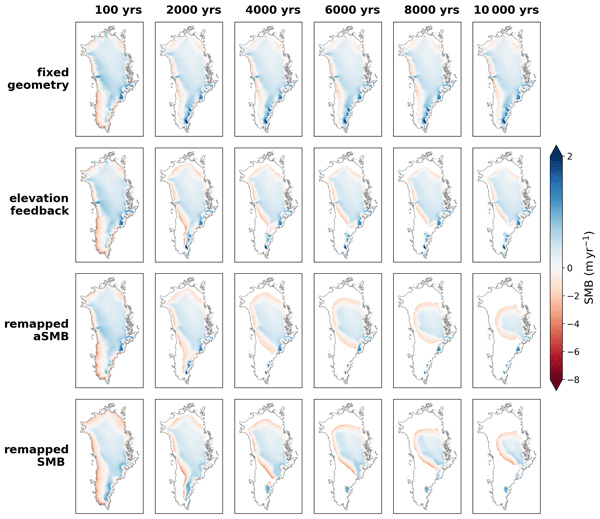
We present a method to better simulate how Greenland’s ice sheet may change over thousands of years in response to climate change. Using a stand-alone ice sheet model, we adjust snowfall and melting patterns based on changes in the ice sheet’s shape. This approach avoids complex coupled models and enables faster testing of many future scenarios to understand the long-term stability of Greenland’s ice.
Heiko Goelzer, Petra M. Langebroek, Andreas Born, Stefan Hofer, Konstanze Haubner, Michele Petrini, Gunter Leguy, William H. Lipscomb, and Katherine Thayer-Calder
Geosci. Model Dev., 18, 7853–7867, https://doi.org/10.5194/gmd-18-7853-2025, https://doi.org/10.5194/gmd-18-7853-2025, 2025
Short summary
Short summary
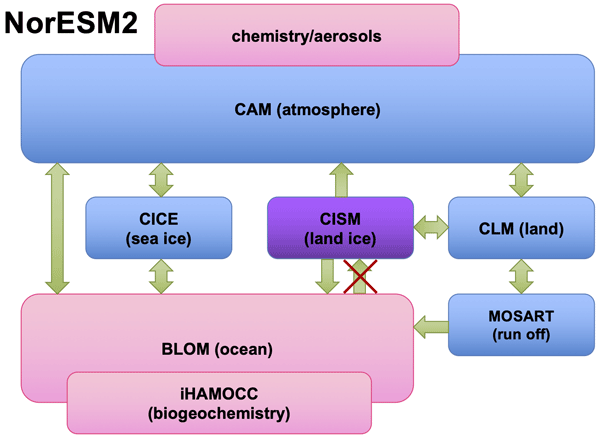
On the backdrop of observed accelerating ice sheet mass loss over the last few decades, there is growing interest in the role of ice sheet changes in global climate projections. In this regard, we have coupled an Earth system model with an ice sheet model and have produced an initial set of climate projections including an interactive coupling with a dynamic Greenland ice sheet.
Johanna Beckmann, Ronja Reese, Felicity S. McCormack, Sue Cook, Lawrence Bird, Dawid Gwyther, Daniel Richards, Matthias Scheiter, Yu Wang, Hélène Seroussi, Ayako Abe‐Ouchi, Torsten Albrecht, Jorge Alvarez‐Solas, Xylar S. Asay‐Davis, Jean‐Baptiste Barre, Constantijn J. Berends, Jorge Bernales, Javier Blasco, Justine Caillet, David M. Chandler, Violaine Coulon, Richard Cullather, Christophe Dumas, Benjamin K. Galton‐Fenzi, Julius Garbe, Fabien Gillet‐Chaulet, Rupert Gladstone, Heiko Goelzer, Nicholas R. Golledge, Ralf Greve, G. Hilmar Gudmundsson, Holly Kyeore Han, Trevor R. Hillebrand, Matthew J. Hoffman, Philippe Huybrechts, Nicolas C. Jourdain, Ann Kristin Klose, Petra M. Langebroek, Gunter R. Leguy, William H. Lipscomb, Daniel P. Lowry, Pierre Mathiot, Marisa Montoya, Mathieu Morlighem, Sophie Nowicki, Frank Pattyn, Antony J. Payne, Tyler Pelle, Aurélien Quiquet, Alexander Robinson, Leopekka Saraste, Erika G. Simon, Sainan Sun, Jake P. Twarog, Luke D. Trusel, Benoit Urruty, Jonas Van Breedam, Roderik S. W. van de Wal, Chen Zhao, and Thomas Zwinger
EGUsphere, https://doi.org/10.5194/egusphere-2025-4069, https://doi.org/10.5194/egusphere-2025-4069, 2025
This preprint is open for discussion and under review for The Cryosphere (TC).
Short summary
Short summary
Antarctica holds enough ice to raise sea levels by many meters, but its future is uncertain. Warm ocean water melts ice shelves from below, letting inland ice flow faster into the sea. By 2300, Antarctica could add 0.6–4.4 m to sea levels. Our study identifies two key factors—how strongly shelves melt and how the ice responds. These explain much of the range, and refining them in models may improve future predictions.
Lise Seland Graff, Jerry Tjiputra, Ada Gjermundsen, Andreas Born, Jens Boldingh Debernard, Heiko Goelzer, Yan-Chun He, Petra Margaretha Langebroek, Aleksi Nummelin, Dirk Olivié, Øyvind Seland, Trude Storelvmo, Mats Bentsen, Chuncheng Guo, Andrea Rosendahl, Dandan Tao, Thomas Toniazzo, Camille Li, Stephen Outten, and Michael Schulz
Earth Syst. Dynam., 16, 1671–1698, https://doi.org/10.5194/esd-16-1671-2025, https://doi.org/10.5194/esd-16-1671-2025, 2025
Short summary
Short summary
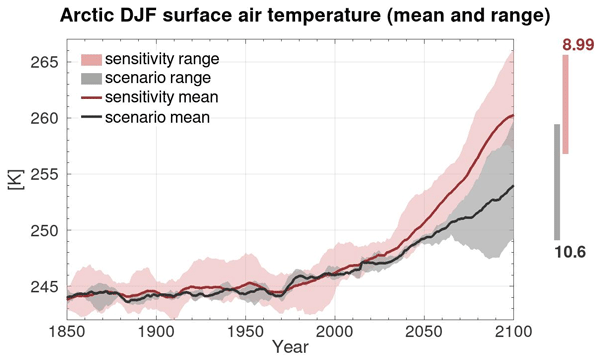
The magnitude of future Arctic amplification is highly uncertain. Using the Norwegian Earth System Model, we explore the effect of improving the representation of clouds, ocean eddies, the Greenland ice sheet, sea ice, and ozone on the projected Arctic winter warming in a coordinated experiment set. These improvements all lead to enhanced projected Arctic warming, with the largest changes found in the sea ice retreat regions and the largest uncertainty found on the Atlantic side.
Ricarda Winkelmann, Donovan P. Dennis, Jonathan F. Donges, Sina Loriani, Ann Kristin Klose, Jesse F. Abrams, Jorge Alvarez-Solas, Torsten Albrecht, David Armstrong McKay, Sebastian Bathiany, Javier Blasco Navarro, Victor Brovkin, Eleanor Burke, Gokhan Danabasoglu, Reik V. Donner, Markus Drüke, Goran Georgievski, Heiko Goelzer, Anna B. Harper, Gabriele Hegerl, Marina Hirota, Aixue Hu, Laura C. Jackson, Colin Jones, Hyungjun Kim, Torben Koenigk, Peter Lawrence, Timothy M. Lenton, Hannah Liddy, José Licón-Saláiz, Maxence Menthon, Marisa Montoya, Jan Nitzbon, Sophie Nowicki, Bette Otto-Bliesner, Francesco Pausata, Stefan Rahmstorf, Karoline Ramin, Alexander Robinson, Johan Rockström, Anastasia Romanou, Boris Sakschewski, Christina Schädel, Steven Sherwood, Robin S. Smith, Norman J. Steinert, Didier Swingedouw, Matteo Willeit, Wilbert Weijer, Richard Wood, Klaus Wyser, and Shuting Yang
EGUsphere, https://doi.org/10.5194/egusphere-2025-1899, https://doi.org/10.5194/egusphere-2025-1899, 2025
Short summary
Short summary
The Tipping Points Modelling Intercomparison Project (TIPMIP) is an international collaborative effort to systematically assess tipping point risks in the Earth system using state-of-the-art coupled and stand-alone domain models. TIPMIP will provide a first global atlas of potential tipping dynamics, respective critical thresholds and key uncertainties, generating an important building block towards a comprehensive scientific basis for policy- and decision-making.
Charlotte Rahlves, Heiko Goelzer, Andreas Born, and Petra M. Langebroek
The Cryosphere, 19, 1205–1220, https://doi.org/10.5194/tc-19-1205-2025, https://doi.org/10.5194/tc-19-1205-2025, 2025
Short summary
Short summary
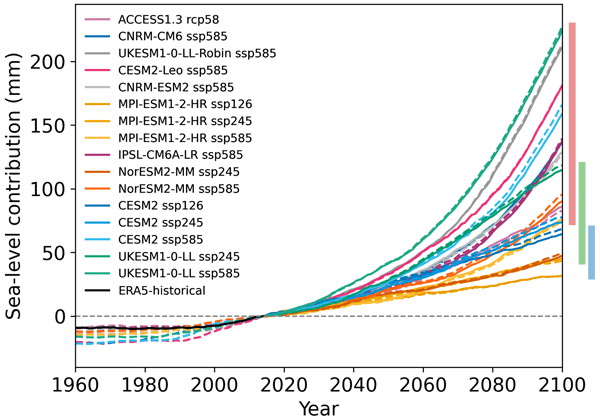
Mass loss from the Greenland ice sheet significantly contributes to rising sea levels, threatening coastal communities globally. To improve future sea-level projections, we simulated ice sheet behavior until 2100, initializing the model with observed geometry and using various climate models. Predictions indicate a sea-level rise of 32 to 228 mm by 2100, with climate model uncertainty being the main source of variability in projections.
Konstanze Haubner, Heiko Goelzer, and Andreas Born
EGUsphere, https://doi.org/10.5194/egusphere-2024-3785, https://doi.org/10.5194/egusphere-2024-3785, 2025
Short summary
Short summary
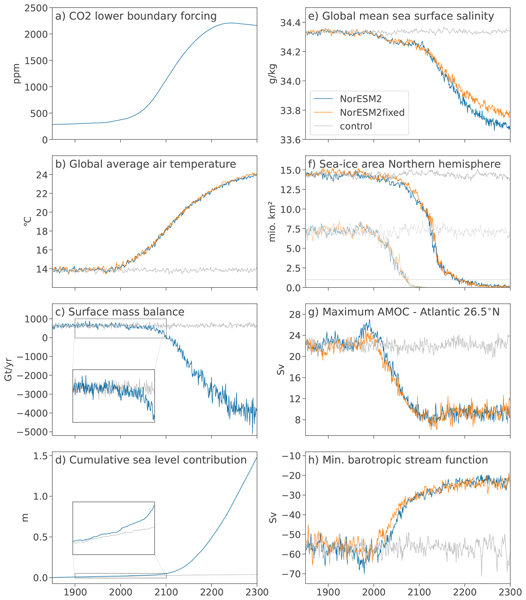
We add a new dynamic component – an ice sheet model simulating the Greenland ice sheet – to an Earth system model that already captures the global climate evolution including ocean, atmosphere, land and sea ice. Under a strong warming scenario, the global warming of 10 °C over 250 yrs is dominating the climate evolution. Changes from the ice-climate interaction are mainly local yet impacting the evolution of the Greenland ice sheet. Hence, ice-climate feedbacks should be considered beyond 2100.
Michele Petrini, Meike D. W. Scherrenberg, Laura Muntjewerf, Miren Vizcaino, Raymond Sellevold, Gunter R. Leguy, William H. Lipscomb, and Heiko Goelzer
The Cryosphere, 19, 63–81, https://doi.org/10.5194/tc-19-63-2025, https://doi.org/10.5194/tc-19-63-2025, 2025
Short summary
Short summary
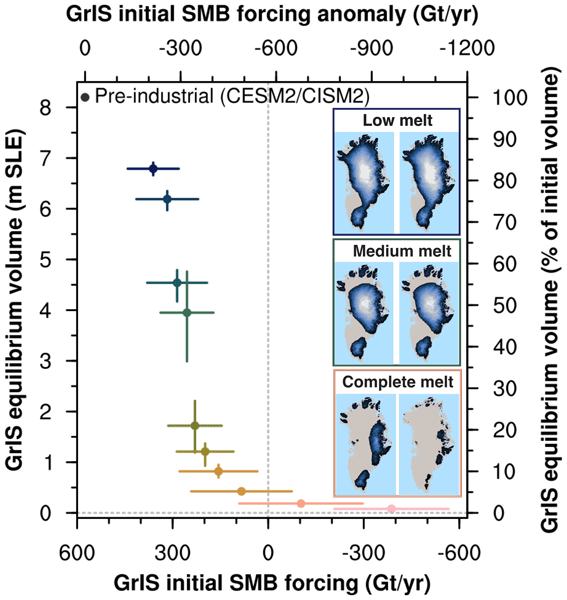
Anthropogenic warming is causing accelerated Greenland ice sheet melt. Here, we use a computer model to understand how prolonged warming and ice melt could threaten ice sheet stability. We find a threshold beyond which Greenland will lose more than 80 % of its ice over several thousand years, due to the interaction of surface and solid-Earth processes. Nearly complete Greenland ice sheet melt occurs when the ice margin disconnects from a region of high elevation in western Greenland.
Eliot Jager, Fabien Gillet-Chaulet, Nicolas Champollion, Romain Millan, Heiko Goelzer, and Jérémie Mouginot
The Cryosphere, 18, 5519–5550, https://doi.org/10.5194/tc-18-5519-2024, https://doi.org/10.5194/tc-18-5519-2024, 2024
Short summary
Short summary
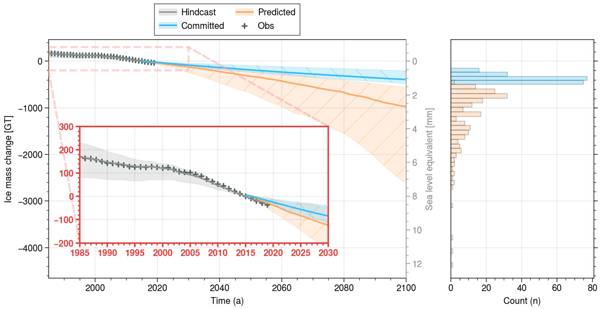
Inspired by a previous intercomparison framework, our study better constrains uncertainties in glacier evolution using an innovative method to validate Bayesian calibration. Upernavik Isstrøm, one of Greenland's largest glaciers, has lost significant mass since 1985. By integrating observational data, climate models, human emissions, and internal model parameters, we project its evolution until 2100. We show that future human emissions are the main source of uncertainty in 2100, making up half.
Hélène Seroussi, Vincent Verjans, Sophie Nowicki, Antony J. Payne, Heiko Goelzer, William H. Lipscomb, Ayako Abe-Ouchi, Cécile Agosta, Torsten Albrecht, Xylar Asay-Davis, Alice Barthel, Reinhard Calov, Richard Cullather, Christophe Dumas, Benjamin K. Galton-Fenzi, Rupert Gladstone, Nicholas R. Golledge, Jonathan M. Gregory, Ralf Greve, Tore Hattermann, Matthew J. Hoffman, Angelika Humbert, Philippe Huybrechts, Nicolas C. Jourdain, Thomas Kleiner, Eric Larour, Gunter R. Leguy, Daniel P. Lowry, Chistopher M. Little, Mathieu Morlighem, Frank Pattyn, Tyler Pelle, Stephen F. Price, Aurélien Quiquet, Ronja Reese, Nicole-Jeanne Schlegel, Andrew Shepherd, Erika Simon, Robin S. Smith, Fiammetta Straneo, Sainan Sun, Luke D. Trusel, Jonas Van Breedam, Peter Van Katwyk, Roderik S. W. van de Wal, Ricarda Winkelmann, Chen Zhao, Tong Zhang, and Thomas Zwinger
The Cryosphere, 17, 5197–5217, https://doi.org/10.5194/tc-17-5197-2023, https://doi.org/10.5194/tc-17-5197-2023, 2023
Short summary
Short summary
Mass loss from Antarctica is a key contributor to sea level rise over the 21st century, and the associated uncertainty dominates sea level projections. We highlight here the Antarctic glaciers showing the largest changes and quantify the main sources of uncertainty in their future evolution using an ensemble of ice flow models. We show that on top of Pine Island and Thwaites glaciers, Totten and Moscow University glaciers show rapid changes and a strong sensitivity to warmer ocean conditions.
Jeremy Rohmer, Remi Thieblemont, Goneri Le Cozannet, Heiko Goelzer, and Gael Durand
The Cryosphere, 16, 4637–4657, https://doi.org/10.5194/tc-16-4637-2022, https://doi.org/10.5194/tc-16-4637-2022, 2022
Short summary
Short summary
To improve the interpretability of process-based projections of the sea-level contribution from land ice components, we apply the machine-learning-based
SHapley Additive exPlanationsapproach to a subset of a multi-model ensemble study for the Greenland ice sheet. This allows us to quantify the influence of particular modelling decisions (related to numerical implementation, initial conditions, or parametrisation of ice-sheet processes) directly in terms of sea-level change contribution.
Nidheesh Gangadharan, Hugues Goosse, David Parkes, Heiko Goelzer, Fabien Maussion, and Ben Marzeion
Earth Syst. Dynam., 13, 1417–1435, https://doi.org/10.5194/esd-13-1417-2022, https://doi.org/10.5194/esd-13-1417-2022, 2022
Short summary
Short summary
We describe the contributions of ocean thermal expansion and land-ice melting (ice sheets and glaciers) to global-mean sea-level (GMSL) changes in the Common Era. The mass contributions are the major sources of GMSL changes in the pre-industrial Common Era and glaciers are the largest contributor. The paper also describes the current state of climate modelling, uncertainties and knowledge gaps along with the potential implications of the past variabilities in the contemporary sea-level rise.
Constantijn J. Berends, Heiko Goelzer, Thomas J. Reerink, Lennert B. Stap, and Roderik S. W. van de Wal
Geosci. Model Dev., 15, 5667–5688, https://doi.org/10.5194/gmd-15-5667-2022, https://doi.org/10.5194/gmd-15-5667-2022, 2022
Short summary
Short summary
The rate at which marine ice sheets such as the West Antarctic ice sheet will retreat in a warming climate and ocean is still uncertain. Numerical ice-sheet models, which solve the physical equations that describe the way glaciers and ice sheets deform and flow, have been substantially improved in recent years. Here we present the results of several years of work on IMAU-ICE, an ice-sheet model of intermediate complexity, which can be used to study ice sheets of both the past and the future.
Constantijn J. Berends, Heiko Goelzer, and Roderik S. W. van de Wal
Geosci. Model Dev., 14, 2443–2470, https://doi.org/10.5194/gmd-14-2443-2021, https://doi.org/10.5194/gmd-14-2443-2021, 2021
Short summary
Short summary
The largest uncertainty in projections of sea-level rise comes from ice-sheet retreat. To better understand how these ice sheets respond to the changing climate, ice-sheet models are used, which must be able to reproduce both their present and past evolution. We have created a model that is fast enough to simulate an ice sheet at a high resolution over the course of an entire 120 000-year glacial cycle. This allows us to study processes that cannot be captured by lower-resolution models.
Valeria Di Biase, Peter Kuipers Munneke, Bert Wouters, Michiel R. van den Broeke, and Maurice van Tiggelen
The Cryosphere, 20, 87–96, https://doi.org/10.5194/tc-20-87-2026, https://doi.org/10.5194/tc-20-87-2026, 2026
Short summary
Short summary
We produce annual maps of Antarctic surface melt volumes from 2012 to 2021 using satellite microwave data. We detect melting days from thresholds on the satellite signal and then use actual melt measurements from weather stations to convert those signals into water‑equivalent volumes. Our maps capture known melt hotspots and show slightly lower totals than climate models. This dataset supports climate and ice‑shelf studies.
Ian Castellanos, Martin Ménégoz, Juliette Blanchet, Julien Beaumet, Hubert Gallée, Eduardo Moreno-Chamarro, Chantal Staquet, and Xavier Fettweis
EGUsphere, https://doi.org/10.5194/egusphere-2025-6211, https://doi.org/10.5194/egusphere-2025-6211, 2025
This preprint is open for discussion and under review for Earth System Dynamics (ESD).
Short summary
Short summary
The Alps host glaciers, distinct ecosystems, socio-economic interests and water resources that are being impacted by climate change. In this study, we aim at understanding how warming occurs in the Alps in projected scenarios and what physical processes drive it. We find under these scenarios that elevations around the snowline will warm faster than elsewhere, because snow retreats to higher elevations. Indeed, snow slows down warming due to its high albedo and the energy consumed to melt it.
Florian Vacek, Faezeh M. Nick, Douglas Benn, Maarten P. A. Zwarts, Walter Immerzeel, and Roderik S. W. van de Wal
EGUsphere, https://doi.org/10.5194/egusphere-2025-5733, https://doi.org/10.5194/egusphere-2025-5733, 2025
This preprint is open for discussion and under review for The Cryosphere (TC).
Short summary
Short summary
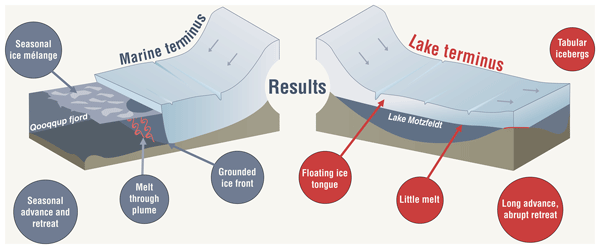
We studied a unique glacier in South Greenland that ends in both a lake and the ocean. Using satellite data and field work, we found that the two glacier fronts behave very differently even under the same climate. At the lake glacier little melt below water and the presence of lake ice reduce the production of icebergs. The lake glacier experienced a sudden large breakup. Our work suggests that lake and marine glacier fronts must be treated differently in model simulations.
Jeremy Rohmer, Heiko Goelzer, Tamsin L. Edwards, Goneri Le Cozannet, and Gael Durand
The Cryosphere, 19, 6421–6444, https://doi.org/10.5194/tc-19-6421-2025, https://doi.org/10.5194/tc-19-6421-2025, 2025
Short summary
Short summary
Developing robust protocols to design multi-model ensembles is of primary importance for the uncertainty quantification of sea level projections. Here, we set up a series of computer experiments to reflect design decisions for the prediction of future sea level contribution of the Greenland ice sheet in 2100. We show the importance of including the most extreme climate scenario and the implications of using a single type of numerical model for ice sheets or regional climate.
Charlotte Rahlves, Heiko Goelzer, Andreas Born, and Petra M. Langebroek
The Cryosphere, 19, 6403–6419, https://doi.org/10.5194/tc-19-6403-2025, https://doi.org/10.5194/tc-19-6403-2025, 2025
Short summary
Short summary
We present a method to better simulate how Greenland’s ice sheet may change over thousands of years in response to climate change. Using a stand-alone ice sheet model, we adjust snowfall and melting patterns based on changes in the ice sheet’s shape. This approach avoids complex coupled models and enables faster testing of many future scenarios to understand the long-term stability of Greenland’s ice.
Thirza N. Feenstra, Willem Jan van de Berg, Gerd-Jan van Zadelhoff, David P. Donovan, Christiaan T. van Dalum, and Michiel R. van den Broeke
EGUsphere, https://doi.org/10.5194/egusphere-2025-5623, https://doi.org/10.5194/egusphere-2025-5623, 2025
Short summary
Short summary
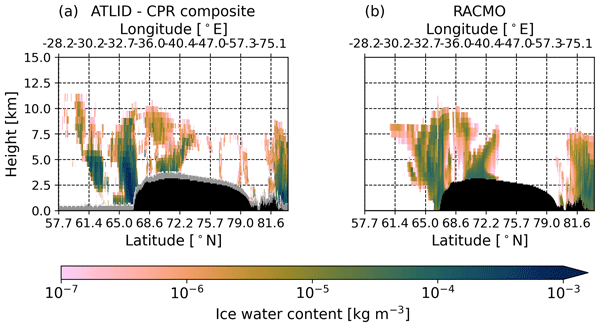
Cloud representation brings large uncertainties in polar climate modeling. We show the first evaluation of Greenland clouds in the regional climate model RACMO2.4 using new EarthCARE satellite data. Comparing lidar and radar observations and retrieved cloud profiles with co-located RACMO output, we find RACMO captures lower ice clouds but underestimates thin high clouds, mid-altitude liquid clouds, and snowfall. These results highlight EarthCARE’s potential to improve polar climate models.
Tim H. J. Hermans, Chiheb Ben Hammouda, Simon Treu, Timothy Tiggeloven, Anaïs Couasnon, Julius J. M. Busecke, and Roderik S. W. van de Wal
Nat. Hazards Earth Syst. Sci., 25, 4593–4612, https://doi.org/10.5194/nhess-25-4593-2025, https://doi.org/10.5194/nhess-25-4593-2025, 2025
Short summary
Short summary
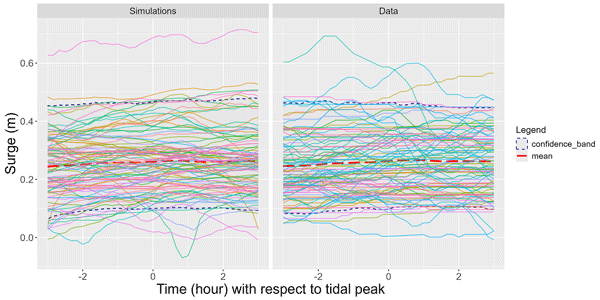
We studied the performance of different types of neural networks at predicting extreme storm surges. We found that that performance improves when during model training, storm surges that are rarer are given a higher weight than moderate storm surges. Additionally, we found that the performance of some of the neural networks approaches that of a state-of-the-art hydrodynamic model. This is promising for the future application of neural networks to climate model simulations.
Mirna Badillo-Interiano, Jérémy Rohmer, Gonéri Le Cozannet, and Virginie Duvat
Nat. Hazards Earth Syst. Sci., 25, 4527–4543, https://doi.org/10.5194/nhess-25-4527-2025, https://doi.org/10.5194/nhess-25-4527-2025, 2025
Short summary
Short summary
Small islands face increasing threats from climate change. In this context, exploring new modeling approaches is needed to improve climate risk assessments. We applied Bayesian Networks to assess the risk to future habitability on four atoll islands. The findings show that Bayesian Networks are powerful tools for efficiently assessing climate-related risks by combining expert judgments and confidence levels, providing a comprehensive framework to assess risks in data-limited island settings.
Fredrik Boberg, Nicolaj Hansen, Ruth Mottram, Xavier Fettweis, and Michiel R. van den Broeke
EGUsphere, https://doi.org/10.5194/egusphere-2025-4360, https://doi.org/10.5194/egusphere-2025-4360, 2025
This preprint is open for discussion and under review for The Cryosphere (TC).
Short summary
Short summary
An ensemble of regional climate model simulations is used to estimate the 21st century change in precipitation on the Greenland ice sheet. For the end of the century, the change is in the range 40 to 170 Gt per year, depending on the emission scenario. Using annual values of 2 m air temperature and precipitation, we estimate an increase in precipitation of 35 Gt per year for every degree of warming.
Gavin A. Schmidt, Kenneth D. Mankoff, Jonathan L. Bamber, Clara Burgard, Dustin Carroll, David M. Chandler, Violaine Coulon, Benjamin J. Davison, Matthew H. England, Paul R. Holland, Nicolas C. Jourdain, Qian Li, Juliana M. Marson, Pierre Mathiot, Clive R. McMahon, Twila A. Moon, Ruth Mottram, Sophie Nowicki, Anna Olivé Abelló, Andrew G. Pauling, Thomas Rackow, and Damien Ringeisen
Geosci. Model Dev., 18, 8333–8361, https://doi.org/10.5194/gmd-18-8333-2025, https://doi.org/10.5194/gmd-18-8333-2025, 2025
Short summary
Short summary
The impact of increasing mass loss from the Greenland and Antarctic ice sheets has not so far been included in historical climate model simulations. This paper describes the protocols and data available for modeling groups to add this anomalous freshwater to their ocean modules to better represent the impacts of these fluxes on ocean circulation, sea ice, salinity and sea level.
Nicole A. Loeb, Alex Crawford, Brice Noël, and Julienne Stroeve
The Cryosphere, 19, 5403–5422, https://doi.org/10.5194/tc-19-5403-2025, https://doi.org/10.5194/tc-19-5403-2025, 2025
Short summary
Short summary
We examine how extreme precipitation days affect the seasonal mass balance (SMB) of land ice in Greenland and the Eastern Canadian Arctic in historical and future simulations. Past extreme precipitation led to higher SMB with snowfall. Future extreme precipitation may lead to the loss of ice mass as more falls as rain rather than snow in some regions, such as southwestern Greenland. Across the region, extreme precipitation becomes more important to seasonal SMB in the future, warmer climate.
Sanne B. M. Veldhuijsen, Willem Jan van de Berg, Peter Kuipers Munneke, Nicolaj Hansen, Fredrik Boberg, Christoph Kittel, Charles Amory, and Michiel R. van den Broeke
The Cryosphere, 19, 5157–5173, https://doi.org/10.5194/tc-19-5157-2025, https://doi.org/10.5194/tc-19-5157-2025, 2025
Short summary
Short summary
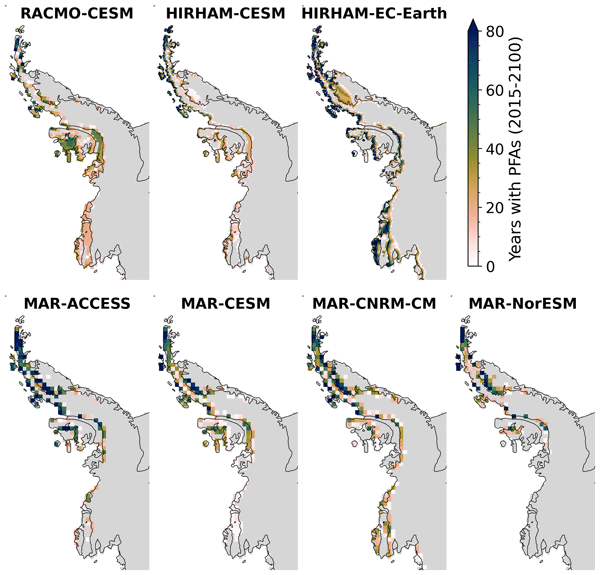
Perennial firn aquifers (PFAs), year-round bodies of liquid water within firns, can potentially impact ice-shelf and ice-sheet stability. We developed a fast XGBoost firn emulator to predict the 21st-century distribution of PFAs in Antarctica for 12 climatic forcing datasets. Our findings suggest that, in low-emission scenarios, PFAs remain confined to the Antarctic Peninsula. However, in a high-emission scenario, PFAs are projected to expand to a region in West Antarctica and East Antarctica.
Heiko Goelzer, Petra M. Langebroek, Andreas Born, Stefan Hofer, Konstanze Haubner, Michele Petrini, Gunter Leguy, William H. Lipscomb, and Katherine Thayer-Calder
Geosci. Model Dev., 18, 7853–7867, https://doi.org/10.5194/gmd-18-7853-2025, https://doi.org/10.5194/gmd-18-7853-2025, 2025
Short summary
Short summary
On the backdrop of observed accelerating ice sheet mass loss over the last few decades, there is growing interest in the role of ice sheet changes in global climate projections. In this regard, we have coupled an Earth system model with an ice sheet model and have produced an initial set of climate projections including an interactive coupling with a dynamic Greenland ice sheet.
Thomas Dethinne, Nicolas Ghilain, Christoph Kittel, Benjamin Lecart, Xavier Fettweis, and François Jonard
EGUsphere, https://doi.org/10.5194/egusphere-2025-3907, https://doi.org/10.5194/egusphere-2025-3907, 2025
Short summary
Short summary
This study replace standard vegetation input of a regional climate model with a satellite-based vegetation dataset to assess how vegetation influences climate during extreme events and to test the sensitivity of the model. The results show a non-linear sensitivity to vegetation, and using an observation-based vegetation input allows for a better representation of the extreme events, highlight the need for an advanced representation of vegetation in climate model to improve climate predictions.
Johanna Beckmann, Ronja Reese, Felicity S. McCormack, Sue Cook, Lawrence Bird, Dawid Gwyther, Daniel Richards, Matthias Scheiter, Yu Wang, Hélène Seroussi, Ayako Abe‐Ouchi, Torsten Albrecht, Jorge Alvarez‐Solas, Xylar S. Asay‐Davis, Jean‐Baptiste Barre, Constantijn J. Berends, Jorge Bernales, Javier Blasco, Justine Caillet, David M. Chandler, Violaine Coulon, Richard Cullather, Christophe Dumas, Benjamin K. Galton‐Fenzi, Julius Garbe, Fabien Gillet‐Chaulet, Rupert Gladstone, Heiko Goelzer, Nicholas R. Golledge, Ralf Greve, G. Hilmar Gudmundsson, Holly Kyeore Han, Trevor R. Hillebrand, Matthew J. Hoffman, Philippe Huybrechts, Nicolas C. Jourdain, Ann Kristin Klose, Petra M. Langebroek, Gunter R. Leguy, William H. Lipscomb, Daniel P. Lowry, Pierre Mathiot, Marisa Montoya, Mathieu Morlighem, Sophie Nowicki, Frank Pattyn, Antony J. Payne, Tyler Pelle, Aurélien Quiquet, Alexander Robinson, Leopekka Saraste, Erika G. Simon, Sainan Sun, Jake P. Twarog, Luke D. Trusel, Benoit Urruty, Jonas Van Breedam, Roderik S. W. van de Wal, Chen Zhao, and Thomas Zwinger
EGUsphere, https://doi.org/10.5194/egusphere-2025-4069, https://doi.org/10.5194/egusphere-2025-4069, 2025
This preprint is open for discussion and under review for The Cryosphere (TC).
Short summary
Short summary
Antarctica holds enough ice to raise sea levels by many meters, but its future is uncertain. Warm ocean water melts ice shelves from below, letting inland ice flow faster into the sea. By 2300, Antarctica could add 0.6–4.4 m to sea levels. Our study identifies two key factors—how strongly shelves melt and how the ice responds. These explain much of the range, and refining them in models may improve future predictions.
Lise Seland Graff, Jerry Tjiputra, Ada Gjermundsen, Andreas Born, Jens Boldingh Debernard, Heiko Goelzer, Yan-Chun He, Petra Margaretha Langebroek, Aleksi Nummelin, Dirk Olivié, Øyvind Seland, Trude Storelvmo, Mats Bentsen, Chuncheng Guo, Andrea Rosendahl, Dandan Tao, Thomas Toniazzo, Camille Li, Stephen Outten, and Michael Schulz
Earth Syst. Dynam., 16, 1671–1698, https://doi.org/10.5194/esd-16-1671-2025, https://doi.org/10.5194/esd-16-1671-2025, 2025
Short summary
Short summary
The magnitude of future Arctic amplification is highly uncertain. Using the Norwegian Earth System Model, we explore the effect of improving the representation of clouds, ocean eddies, the Greenland ice sheet, sea ice, and ozone on the projected Arctic winter warming in a coordinated experiment set. These improvements all lead to enhanced projected Arctic warming, with the largest changes found in the sea ice retreat regions and the largest uncertainty found on the Atlantic side.
Kristiina Verro, Cecilia Äijälä, Roberta Pirazzini, Ruzica Dadic, Damien Maure, Willem Jan van de Berg, Giacomo Traversa, Christiaan T. van Dalum, Petteri Uotila, Xavier Fettweis, Biagio Di Mauro, and Milla Johansson
The Cryosphere, 19, 4409–4436, https://doi.org/10.5194/tc-19-4409-2025, https://doi.org/10.5194/tc-19-4409-2025, 2025
Short summary
Short summary
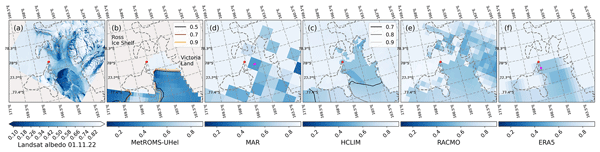
Accurately representing Antarctic sea ice is essential for reliable climate and ocean model predictions. We evaluated how different models simulate the sea ice's sunlight reflectivity (called albedo) using field and satellite data. Models with simple albedo schemes performed well in limited cases but missed key processes. The advanced scheme in the MetROMS-UHel ocean model provided the most accurate results, including observed day–night albedo changes observed during a field campaign.
Ella Gilbert, José Abraham Torres-Alavez, Marte G. Hofsteenge, Willem Jan van de Berg, Fredrik Boberg, Ole Bøssing Christensen, Christiaan Timo van Dalum, Xavier Fettweis, Siddharth Gumber, Nicolaj Hansen, Christoph Kittel, Clara Lambin, Damien Maure, Ruth Mottram, Martin Olesen, Andrew Orr, Tony Phillips, Maurice van Tiggelen, Kristiina Verro, and Priscilla A. Mooney
EGUsphere, https://doi.org/10.5194/egusphere-2025-4214, https://doi.org/10.5194/egusphere-2025-4214, 2025
Short summary
Short summary
Here we present a new dataset – the PolarRES ensemble – of four state-of-the-art regional climate models, which capture the full complexity of Antarctica's climate. The ensemble out-performs other available tools, advancing our ability to explore Antarctic climate. While it still has limitations, the PolarRES ensemble offers a novel and exciting way of evaluating climate processes and features, and we encourage researchers to use the data, which are freely available.
Jonathon R. Preece, Patrick Alexander, Thomas L. Mote, Gabriel J. Kooperman, Xavier Fettweis, and Marco Tedesco
EGUsphere, https://doi.org/10.5194/egusphere-2025-4140, https://doi.org/10.5194/egusphere-2025-4140, 2025
Short summary
Short summary
Surface melt of the Greenland Ice Sheet has increased dramatically since the turn of the century, aided by an increase in persistent atmospheric circulation patterns that promote anomalously warm conditions. Through modeling experiments, this study shows that surface mass loss would have been reduced by 62% relative to historical conditions if this shift in atmospheric circulation would have occurred in a preindustrial climate, highlighting the important contribution of anthropogenic warming.
Christiaan T. van Dalum, Willem Jan van de Berg, Michiel R. van den Broeke, and Maurice van Tiggelen
The Cryosphere, 19, 4061–4090, https://doi.org/10.5194/tc-19-4061-2025, https://doi.org/10.5194/tc-19-4061-2025, 2025
Short summary
Short summary
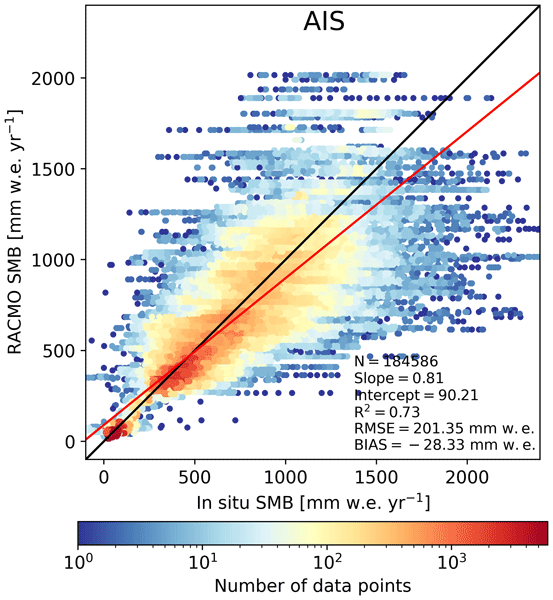
In this study, we present a new surface mass balance (SMB) and near-surface climate product for Antarctica with the regional climate model RACMO2.4p1. We assess the impact of major model updates on the climate of Antarctica. Locally, the SMB has changed substantially but also agrees well with observations. In addition, we show that the SMB components, surface energy budget, albedo, pressure, temperature, and wind speed compare well with in situ and remote sensing observations.
Maurice van Tiggelen, Paul C. J. P. Smeets, Carleen H. Reijmer, Peter Kuipers Munneke, and Michiel R. van den Broeke
Earth Syst. Sci. Data, 17, 4933–4955, https://doi.org/10.5194/essd-17-4933-2025, https://doi.org/10.5194/essd-17-4933-2025, 2025
Short summary
Short summary
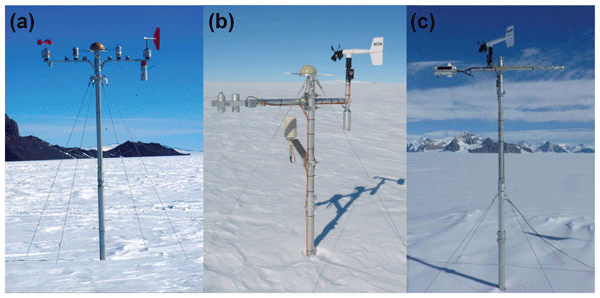
This paper describes the measurements from the 19 IMAU (Institute for Marine and Atmospheric research Utrecht) automatic weather stations that operated on the Antarctic ice sheet from 1995 through 2022. These stations also measured the net surface radiation and surface height change, allowing for the quantification of the surface energy and mass balance at hourly resolution. These data are invaluable for the evaluation of atmospheric models and for the detection of climatological changes.
Marte Gé Hofsteenge, Willem Jan van de Berg, Christiaan van Dalum, Kristiina Verro, Maurice van Tiggelen, and Michiel van den Broeke
EGUsphere, https://doi.org/10.5194/egusphere-2025-4176, https://doi.org/10.5194/egusphere-2025-4176, 2025
Short summary
Short summary
We use a regional climate model to study how surface melt on Antarctic ice shelves responds to air temperature changes. The relationship is strongly non-linear, mainly due to feedbacks in surface reflectivity, with other energy sources also contributing. Currently colder, drier, and more stable ice shelves will experience more melt at the same temperature than wetter ice shelves, highlighting their vulnerability to fracturing, ice shelf instability, and contributions to global sea-level rise.
Hideo Aochi, Masumi Yamada, Tung-Cheng Ho, Gonéri Le Cozannet, Arno Christian Hammann, and Ruth Mottram
EGUsphere, https://doi.org/10.5194/egusphere-2025-3803, https://doi.org/10.5194/egusphere-2025-3803, 2025
Short summary
Short summary
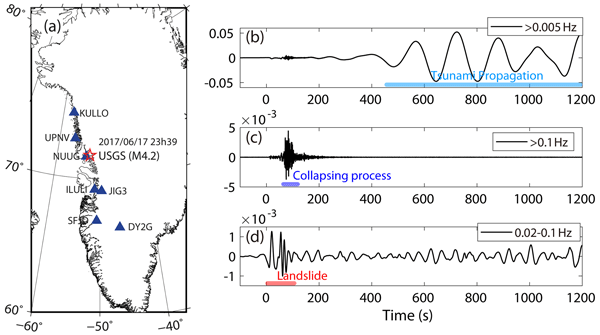
The 2017 Landslide-made tsunami in Greenland occurred in a context of global warming and heavily impacted local communities. We analyze this event using seismic data to reconstruct the whole chain of processes from the landslide to the tsunami. Our results validate a new approach to analyze crustal deformations caused by tsunami propagation in fjords, suggesting that alert systems based on seismic data are feasible, potentially allowing to reduce tsunami risks in polar regions.
Anneke L. Vries, Willem Jan van de Berg, Brice Noël, Lorenz Meire, and Michiel R. van den Broeke
The Cryosphere, 19, 3897–3914, https://doi.org/10.5194/tc-19-3897-2025, https://doi.org/10.5194/tc-19-3897-2025, 2025
Short summary
Short summary
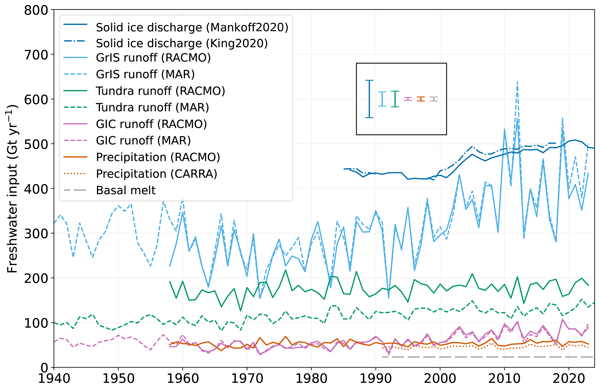
Freshwater flows into Greenland's fjords from various sources. Solid ice discharge (e.g. calving icebergs) dominates freshwater input in the southeast and northwest. In contrast, in the southwest, runoff from the ice sheet and tundra are the most significant. Seasonal data revealed that fjord precipitation and tundra runoff contribute up to 11 % and 35 % of the monthly freshwater input, respectively. Our results provide valuable input for ocean models and for researchers studying fjord ecosystems.
Franka Jesse, Erwin Lambert, and Roderik S. W. van de Wal
The Cryosphere, 19, 3849–3872, https://doi.org/10.5194/tc-19-3849-2025, https://doi.org/10.5194/tc-19-3849-2025, 2025
Short summary
Short summary
We introduce the coupling of a sub-shelf melt model with an ice sheet model to explore how horizontal meltwater flow below ice shelves affects ice sheet mass loss over time. We show that accurately modelling the meltwater flow direction leads to distinct feedbacks and transient volume loss not captured by melt parameterisations that simplify flow direction. Our results highlight the importance of refining the meltwater flow representation in ice sheet models to improve sea level projections.
Mikkel Langgaard Lauritzen, Anne Solgaard, Nicholas Mossor Rathmann, Bo Møllesøe Vinther, Aslak Grindsted, Brice Noël, Guðfinna Aðalgeirsdóttir, and Christine Schøtt Hvidberg
The Cryosphere, 19, 3599–3622, https://doi.org/10.5194/tc-19-3599-2025, https://doi.org/10.5194/tc-19-3599-2025, 2025
Short summary
Short summary
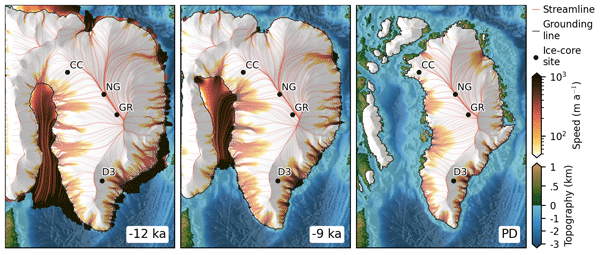
We studied the Holocene (past 11 700 years) to understand how the Greenland Ice Sheet has changed. Using 841 computer simulations, we tested different scenarios and matched them to historical ice elevation data, confirming our model's accuracy. Results show that Greenland's melting has raised sea levels by about 5.3 m since the Holocene began and by around 12 mm in just the past 500 years.
Weiran Li, Stef Lhermitte, Bert Wouters, Cornelis Slobbe, Max Brils, and Xavier Fettweis
The Cryosphere, 19, 3419–3442, https://doi.org/10.5194/tc-19-3419-2025, https://doi.org/10.5194/tc-19-3419-2025, 2025
Short summary
Short summary
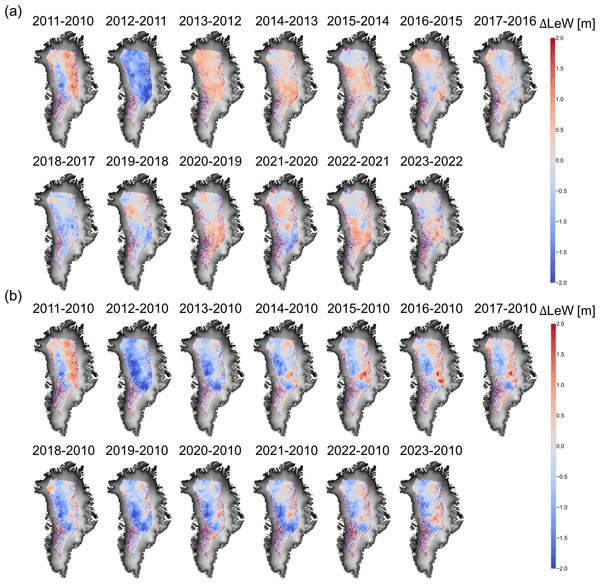
Due to recurrent melt and refreezing events in recent decades, the snow conditions over Greenland have changed. To observe this, we use a parameter (leading edge width; LeW) derived from satellite altimetry and analyse its spatial and temporal variations. By comparing the LeW variations with modelled firn parameters, we concluded that the 2012 melt event and the recent and increasingly frequent melt events have a long-lasting impact on the volume scattering of Greenland firn.
Zhengwen Yan, Jiangjun Ran, Pavel Ditmar, C. K. Shum, Roland Klees, Patrick Smith, and Xavier Fettweis
Earth Syst. Sci. Data, 17, 4253–4275, https://doi.org/10.5194/essd-17-4253-2025, https://doi.org/10.5194/essd-17-4253-2025, 2025
Short summary
Short summary
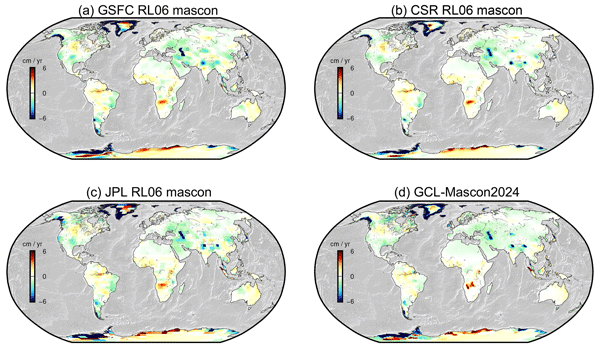
The Gravity Recovery And Climate Experiment (GRACE) mission has greatly improved our understanding of changes in Earth's gravity field over time. A novel mass concentration (mascon) dataset, GCL-Mascon2024, was determined by leveraging the short-arc approach, advanced spatial constraints, a frequency-dependent noise processing strategy, and parameterization-integrating natural boundaries, aiming to enhance accuracy for monitoring mass transportation on Earth.
Tim van den Akker, William H. Lipscomb, Gunter R. Leguy, Willem Jan van de Berg, and Roderik S. W. van de Wal
EGUsphere, https://doi.org/10.5194/egusphere-2025-3380, https://doi.org/10.5194/egusphere-2025-3380, 2025
Short summary
Short summary
The Antarctic Ice Sheet is currently thinning, especially at major outlet glaciers. Including present-day thinning rates in models is a modeller's choice and can affect future projections. This study quantifies the impact of current imbalance on forced future projections, revealing strong regional and short-term (up to 2100) effects when these mass change rates are included.
Cyrille Mosbeux, Peter Råback, Adrien Gilbert, Julien Brondex, Fabien Gillet-Chaulet, Nicolas C. Jourdain, Mondher Chekki, Olivier Gagliardini, and Gaël Durand
EGUsphere, https://doi.org/10.5194/egusphere-2025-3039, https://doi.org/10.5194/egusphere-2025-3039, 2025
Short summary
Short summary
Transport processes like rocks carried by ice flow and damage evolution – a proxy for crevasses – are key in ice sheet modeling and should occur without diffusion. Yet, standard numerical methods often blur these features. We explore a particle-based Semi-Lagrangian approach, comparing it to a Discontinuous Galerkin method, and show it can accurately simulate such transport when run at high enough resolution.
Audrey Goutard, Marion Réveillet, Fanny Brun, Delphine Six, Kevin Fourteau, Charles Amory, Xavier Fettweis, Mathieu Fructus, Arbindra Khadka, and Matthieu Lafaysse
EGUsphere, https://doi.org/10.5194/egusphere-2025-2947, https://doi.org/10.5194/egusphere-2025-2947, 2025
Short summary
Short summary
A new scheme has been developed in the SURFEX/ISBA-Crocus model, to consider the impact of liquid water dynamics on bare ice, including albedo feedback and refreezing. When applied to the Mera Glacier in Nepal, the model reveals strong seasonal effects on the energy and mass balance, with increased melting in dry seasons and significant refreezing during the monsoon. This development improves mass balance modeling under increasing rainfall and bare ice exposure due to climate warming.
Anna Puggaard, Nicolaj Hansen, Ruth Mottram, Thomas Nagler, Stefan Scheiblauer, Sebastian B. Simonsen, Louise S. Sørensen, Jan Wuite, and Anne M. Solgaard
The Cryosphere, 19, 2963–2981, https://doi.org/10.5194/tc-19-2963-2025, https://doi.org/10.5194/tc-19-2963-2025, 2025
Short summary
Short summary
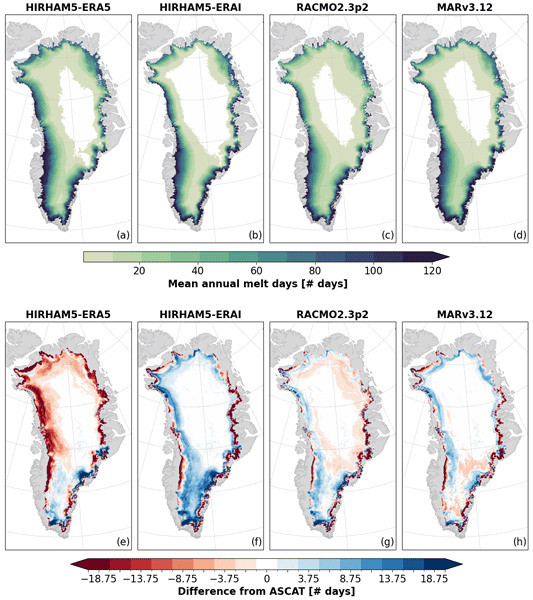
Regional climate models are currently the only source for assessing the melt volume of the Greenland Ice Sheet on a global scale. This study compares the modeled melt volume with observations from weather stations and melt extent observed from the Advanced SCATterometer (ASCAT) to assess the performance of the models. It highlights the importance of critically evaluating model outputs with high-quality satellite measurements to improve the understanding of variability among models.
Sophie Lecacheux, Jeremy Rohmer, Eva Membrado, Rodrigo Pedreros, Andrea Filippini, Déborah Idier, Servane Gueben-Vénière, Denis Paradis, Alice Dalphinet, and David Ayache
EGUsphere, https://doi.org/10.5194/egusphere-2024-3615, https://doi.org/10.5194/egusphere-2024-3615, 2025
This preprint is open for discussion and under review for Natural Hazards and Earth System Sciences (NHESS).
Short summary
Short summary
This study comparer three data-driven methodologies to overcome the computational burden of numerical simulations for early warning purpose. They are all based on the statistical analysis of pre-calculated databases, to downscale total sea levels and predict marine flooding maps from offshore metocean forecasts. Conclusions highlight the relevance of metamodel-based approaches for fast prediction and the added value of precalculated databases during the prepardness phase.
Davor Dundovic, Joseph G. Wallwork, Stephan C. Kramer, Fabien Gillet-Chaulet, Regine Hock, and Matthew D. Piggott
Geosci. Model Dev., 18, 4023–4044, https://doi.org/10.5194/gmd-18-4023-2025, https://doi.org/10.5194/gmd-18-4023-2025, 2025
Short summary
Short summary
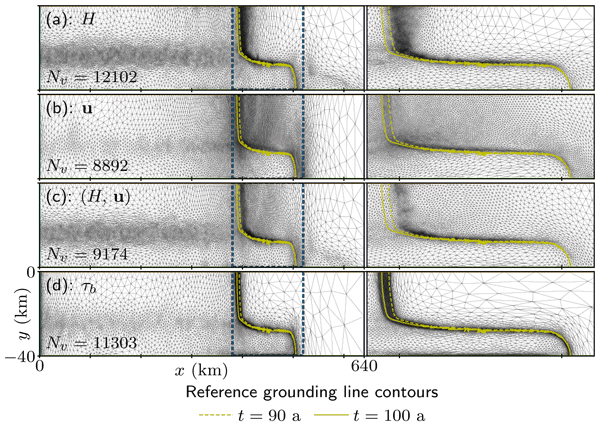
Accurate numerical studies of glaciers often require high-resolution simulations, which often prove too demanding even for modern computers. In this paper we develop a method that identifies whether different parts of a glacier require high or low resolution based on its physical features, such as its thickness and velocity. We show that by doing so we can achieve a more optimal simulation accuracy for the available computing resources compared to uniform-resolution simulations.
Shfaqat A. Khan, Helene Seroussi, Mathieu Morlighem, William Colgan, Veit Helm, Gong Cheng, Danjal Berg, Valentina R. Barletta, Nicolaj K. Larsen, William Kochtitzky, Michiel van den Broeke, Kurt H. Kjær, Andy Aschwanden, Brice Noël, Jason E. Box, Joseph A. MacGregor, Robert S. Fausto, Kenneth D. Mankoff, Ian M. Howat, Kuba Oniszk, Dominik Fahrner, Anja Løkkegaard, Eigil Y. H. Lippert, Alicia Bråtner, and Javed Hassan
Earth Syst. Sci. Data, 17, 3047–3071, https://doi.org/10.5194/essd-17-3047-2025, https://doi.org/10.5194/essd-17-3047-2025, 2025
Short summary
Short summary
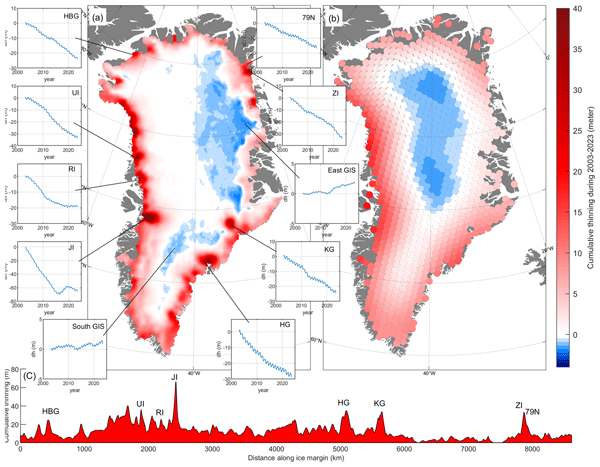
The surface elevation of the Greenland Ice Sheet is changing due to surface mass balance processes and ice dynamics, each exhibiting distinct spatiotemporal patterns. Here, we employ satellite and airborne altimetry data with fine spatial (1 km) and temporal (monthly) resolutions to document this spatiotemporal evolution from 2003 to 2023. This dataset of fine-resolution altimetry data in both space and time will support studies of ice mass loss and be useful for GIS ice sheet modeling.
Chloë Marie Paice, Xavier Fettweis, and Philippe Huybrechts
EGUsphere, https://doi.org/10.5194/egusphere-2025-2465, https://doi.org/10.5194/egusphere-2025-2465, 2025
Short summary
Short summary
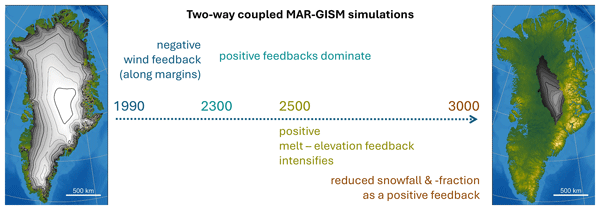
To study the interactions between the Greenland ice sheet and the atmosphere, we coupled an ice sheet model to a regional climate model and performed simulations of differing coupling complexity over 1000 years. They reveal that at first melt at the ice sheet margin is reduced by changing wind patterns. But over time, as the ice sheet surface lowers, precipitation patterns and cloudiness also change and amplify ice mass loss over the entire ice sheet.
Sofie Hedetoft, Olivia Bang Brinck, Ruth Mottram, Andrea M. U. Gierisch, Steffen Malskær Olsen, Martin Olesen, Nicolaj Hansen, Anders Anker Bjørk, Erik Loebel, Anne Solgaard, and Peter Thejll
EGUsphere, https://doi.org/10.5194/egusphere-2025-1907, https://doi.org/10.5194/egusphere-2025-1907, 2025
Short summary
Short summary
Iceberg mélange is the jumble of icebergs in front of some glaciers that calve into the sea. Some studies suggest mélange might help to control the retreat of glaciers. We studied 3 glaciers in NW Greenland where we used GPS sensors and satellites to track ice movement. We found that glaciers push forward and calve all year, including when mélange and landfast sea ice are present, suggesting mélange is not important in supporting glaciers, but may influence the seasonal calving cycle.
Meike D. W. Scherrenberg, Constantijn J. Berends, and Roderik S. W. van de Wal
Clim. Past, 21, 1061–1077, https://doi.org/10.5194/cp-21-1061-2025, https://doi.org/10.5194/cp-21-1061-2025, 2025
Short summary
Short summary
Glacial cycle duration changed from 41 000 to 100 000 years during the Mid-Pleistocene Transition (MPT), but the cause is still under debate. We simulate the MPT with an ice sheet model forced by prescribed CO2 and insolation and simple ice–climate interactions. Before the MPT, glacial cycles follow insolation. After the MPT, low CO2 levels may compensate for warming at insolation maxima, increasing the length of glacial cycles until the North American ice sheet becomes large and thereby unstable.
Alexander T. Bradley, David T. Bett, C. Rosie Williams, Robert J. Arthern, Paul R. Holland, James Bryne, and Tamsin L. Edwards
EGUsphere, https://doi.org/10.5194/egusphere-2025-2315, https://doi.org/10.5194/egusphere-2025-2315, 2025
Short summary
Short summary
At least since we started measuring in detail, the West Antarctic Ice Sheet has lost a lot of ice, but we don't know if climate change is responsible. In this work, we put a number on the role of climate change in retreat of a glacier in this ice sheet, for the first time. We show that climate change made the shrinking of this glacier much worse. Our work also suggests that what happened on very long timescales (the last 10,000 years) might also matter for retreat of the ice sheets today.
Constantijn J. Berends, Victor Azizi, Jorge A. Bernales, and Roderik S. W. van de Wal
Geosci. Model Dev., 18, 3635–3659, https://doi.org/10.5194/gmd-18-3635-2025, https://doi.org/10.5194/gmd-18-3635-2025, 2025
Short summary
Short summary
Ice-sheet models are computer programs that can simulate how the Greenland and Antarctic ice sheets will evolve in the future. The accuracy of these models depends on their resolution: how small the details are that the model can resolve. We have created a model with a variable resolution that can resolve a lot of detail in areas where lots of changes happen in the ice and less detail in areas where the ice does not move so much. This makes the model both accurate and fast.
Ricarda Winkelmann, Donovan P. Dennis, Jonathan F. Donges, Sina Loriani, Ann Kristin Klose, Jesse F. Abrams, Jorge Alvarez-Solas, Torsten Albrecht, David Armstrong McKay, Sebastian Bathiany, Javier Blasco Navarro, Victor Brovkin, Eleanor Burke, Gokhan Danabasoglu, Reik V. Donner, Markus Drüke, Goran Georgievski, Heiko Goelzer, Anna B. Harper, Gabriele Hegerl, Marina Hirota, Aixue Hu, Laura C. Jackson, Colin Jones, Hyungjun Kim, Torben Koenigk, Peter Lawrence, Timothy M. Lenton, Hannah Liddy, José Licón-Saláiz, Maxence Menthon, Marisa Montoya, Jan Nitzbon, Sophie Nowicki, Bette Otto-Bliesner, Francesco Pausata, Stefan Rahmstorf, Karoline Ramin, Alexander Robinson, Johan Rockström, Anastasia Romanou, Boris Sakschewski, Christina Schädel, Steven Sherwood, Robin S. Smith, Norman J. Steinert, Didier Swingedouw, Matteo Willeit, Wilbert Weijer, Richard Wood, Klaus Wyser, and Shuting Yang
EGUsphere, https://doi.org/10.5194/egusphere-2025-1899, https://doi.org/10.5194/egusphere-2025-1899, 2025
Short summary
Short summary
The Tipping Points Modelling Intercomparison Project (TIPMIP) is an international collaborative effort to systematically assess tipping point risks in the Earth system using state-of-the-art coupled and stand-alone domain models. TIPMIP will provide a first global atlas of potential tipping dynamics, respective critical thresholds and key uncertainties, generating an important building block towards a comprehensive scientific basis for policy- and decision-making.
Daniel F. J. Gunning, Kerim H. Nisancioglu, Emilie Capron, and Roderik S. W. van de Wal
Geosci. Model Dev., 18, 2479–2508, https://doi.org/10.5194/gmd-18-2479-2025, https://doi.org/10.5194/gmd-18-2479-2025, 2025
Short summary
Short summary
This work documents the first results from ZEMBA: an energy balance model of the climate system. The model is a computationally efficient tool designed to study the response of climate to changes in the Earth's orbit. We demonstrate that ZEMBA reproduces many features of the Earth's climate for both the pre-industrial period and the Earth's most recent cold extreme – the Last Glacial Maximum. We intend to develop ZEMBA further and investigate the glacial cycles of the last 2.5 million years.
Nicolas C. Jourdain, Charles Amory, Christoph Kittel, and Gaël Durand
The Cryosphere, 19, 1641–1674, https://doi.org/10.5194/tc-19-1641-2025, https://doi.org/10.5194/tc-19-1641-2025, 2025
Short summary
Short summary
A mixed statistical–physical approach is used to reproduce the behaviour of a regional climate model. From that, we estimate the contribution of snowfall and melting at the surface of the Antarctic Ice Sheet to changes in global mean sea level. We also investigate the impact of surface melting in a warmer climate on the stability of the Antarctic ice shelves that provide back stress on the ice flow to the ocean.
Jean-François Grailet, Robin J. Hogan, Nicolas Ghilain, David Bolsée, Xavier Fettweis, and Marilaure Grégoire
Geosci. Model Dev., 18, 1965–1988, https://doi.org/10.5194/gmd-18-1965-2025, https://doi.org/10.5194/gmd-18-1965-2025, 2025
Short summary
Short summary
The MAR (Modèle Régional Atmosphérique) is a regional climate model used for weather forecasting and studying the climate over various regions. This paper presents an update of MAR thanks to which it can precisely decompose solar radiation, in particular in the UV (ultraviolet) and photosynthesis ranges, both being critical to human health and ecosystems. As a first application of this new capability, this paper presents a method for predicting UV indices with MAR.
Charlotte Rahlves, Heiko Goelzer, Andreas Born, and Petra M. Langebroek
The Cryosphere, 19, 1205–1220, https://doi.org/10.5194/tc-19-1205-2025, https://doi.org/10.5194/tc-19-1205-2025, 2025
Short summary
Short summary
Mass loss from the Greenland ice sheet significantly contributes to rising sea levels, threatening coastal communities globally. To improve future sea-level projections, we simulated ice sheet behavior until 2100, initializing the model with observed geometry and using various climate models. Predictions indicate a sea-level rise of 32 to 228 mm by 2100, with climate model uncertainty being the main source of variability in projections.
Tim van den Akker, William H. Lipscomb, Gunter R. Leguy, Willem Jan van de Berg, and Roderik S. W. van de Wal
EGUsphere, https://doi.org/10.5194/egusphere-2025-441, https://doi.org/10.5194/egusphere-2025-441, 2025
Short summary
Short summary
Ice sheet models to simulate future sea level rise require parameterizations, like for the friction at the bedrock. Studies have quantified the effect of using different parameterizations, and some have concluded that projections are sensitive to the choice of the specific parameterization. In this study, we show that you can make an ice sheet model sensitive to the basal friction parameterization, and that for equally defendable modellers choices you can also make the model insensitive to this.
Ida Haven, Hans Christian Steen-Larsen, Laura J. Dietrich, Sonja Wahl, Jason E. Box, Michiel R. Van den Broeke, Alun Hubbard, Stephan T. Kral, Joachim Reuder, and Maurice Van Tiggelen
EGUsphere, https://doi.org/10.5194/egusphere-2025-711, https://doi.org/10.5194/egusphere-2025-711, 2025
Short summary
Short summary
Three independent Eddy-Covariance measurement systems deployed on top of the Greenland Ice Sheet are compared. Using this dataset, we evaluate the reproducibility and quantify the differences between the systems. The fidelity of two regional climate models in capturing the seasonal variability in the latent and sensible heat flux between the snow surface and the atmosphere is assessed. We identify differences between observations and model simulations, especially during the winter period.
Emily Glen, Amber Leeson, Alison F. Banwell, Jennifer Maddalena, Diarmuid Corr, Olivia Atkins, Brice Noël, and Malcolm McMillan
The Cryosphere, 19, 1047–1066, https://doi.org/10.5194/tc-19-1047-2025, https://doi.org/10.5194/tc-19-1047-2025, 2025
Short summary
Short summary
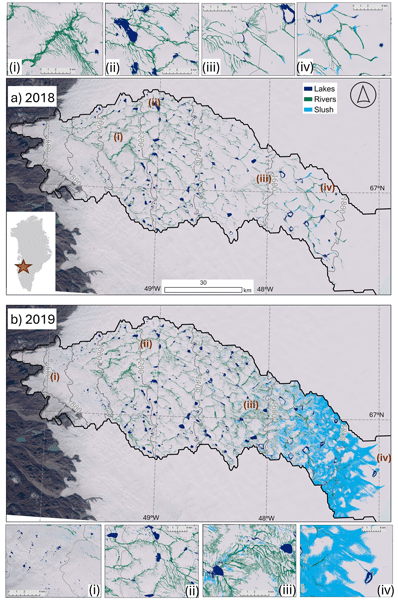
We compare surface meltwater features from optical satellite imagery in the Russell–Leverett glacier catchment during high (2019) and low (2018) melt years. In the high melt year, features appear at higher elevations, meltwater systems are more connected, small lakes are more frequent, and slush is more widespread. These findings provide insights into how a warming climate, where high melt years become common, could alter meltwater distribution and dynamics on the Greenland Ice Sheet.
Ny Riana Randresihaja, Olivier Gourgue, Lauranne Alaerts, Xavier Fettweis, Jonathan Lambrechts, Miguel De Le Court, Marilaure Grégoire, and Emmanuel Hanert
EGUsphere, https://doi.org/10.5194/egusphere-2025-634, https://doi.org/10.5194/egusphere-2025-634, 2025
Preprint archived
Short summary
Short summary
Coastal areas face rising flood threats as storms intensifies with climate change. With an advanced model of the Scheldt Estuary-North Sea, we studied how detailed atmospheric data must be to predict storm surge peaks in estuaries. We found that high-resolution atmospheric data gives the best results, and coarser data with same resolution as current global climate models give poorer results. We show that investing in localized, high-resolution atmospheric data can significantly improve results.
Justine Caillet, Nicolas C. Jourdain, Pierre Mathiot, Fabien Gillet-Chaulet, Benoit Urruty, Clara Burgard, Charles Amory, Mondher Chekki, and Christoph Kittel
Earth Syst. Dynam., 16, 293–315, https://doi.org/10.5194/esd-16-293-2025, https://doi.org/10.5194/esd-16-293-2025, 2025
Short summary
Short summary
Internal climate variability, resulting from processes intrinsic to the climate system, modulates the Antarctic response to climate change by delaying or offsetting its effects. Using climate and ice-sheet models, we highlight that irreducible internal climate variability significantly enlarges the likely range of Antarctic contribution to sea-level rise until 2100. Thus, we recommend considering internal climate variability as a source of uncertainty for future ice-sheet projections.
Kim de Wit, Kim M. Cohen, and Roderik S. W. van de Wal
Earth Syst. Sci. Data, 17, 545–577, https://doi.org/10.5194/essd-17-545-2025, https://doi.org/10.5194/essd-17-545-2025, 2025
Short summary
Short summary
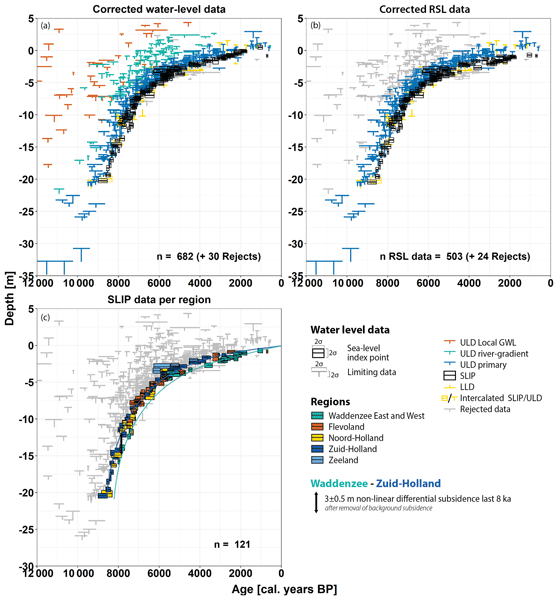
In the Holocene, deltas and coastal plains developed due to relative sea level rise (RSLR). Past coastal and inland water levels are preserved in geological indicators, like basal peats. We present a dataset of 712 Holocene water level indicators from the Dutch coastal plain, relevant for studying RSLR and regional subsidence, compiled in HOLSEA workbook format. Our new, internally consistent, expanded documentation encourages multiple data uses and to report RSLR uncertainties transparently.
James F. O'Neill, Tamsin L. Edwards, Daniel F. Martin, Courtney Shafer, Stephen L. Cornford, Hélène L. Seroussi, Sophie Nowicki, Mira Adhikari, and Lauren J. Gregoire
The Cryosphere, 19, 541–563, https://doi.org/10.5194/tc-19-541-2025, https://doi.org/10.5194/tc-19-541-2025, 2025
Short summary
Short summary
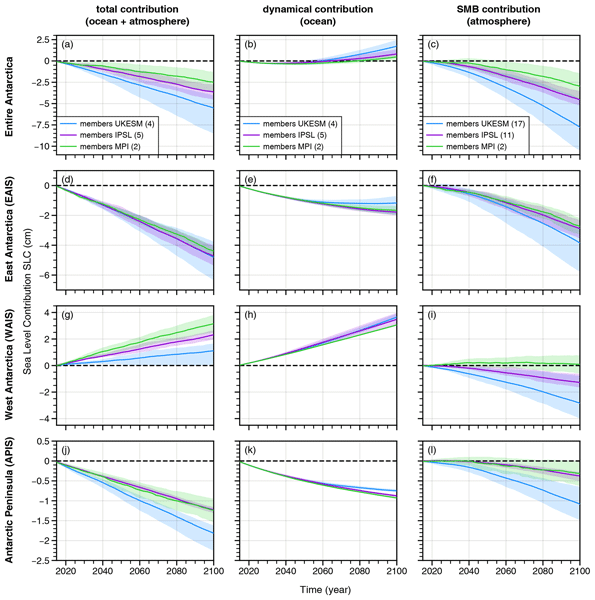
We use an ice sheet model to simulate the Antarctic contribution to sea level over the 21st century under a range of future climates and varying how sensitive the ice sheet is to different processes. We find that ocean temperatures increase and more snow falls on the ice sheet under stronger warming scenarios. When the ice sheet is sensitive to ocean warming, ocean melt-driven loss exceeds snowfall-driven gains, meaning that the sea level contribution is greater with more climate warming.
Tim van den Akker, William H. Lipscomb, Gunter R. Leguy, Jorjo Bernales, Constantijn J. Berends, Willem Jan van de Berg, and Roderik S. W. van de Wal
The Cryosphere, 19, 283–301, https://doi.org/10.5194/tc-19-283-2025, https://doi.org/10.5194/tc-19-283-2025, 2025
Short summary
Short summary
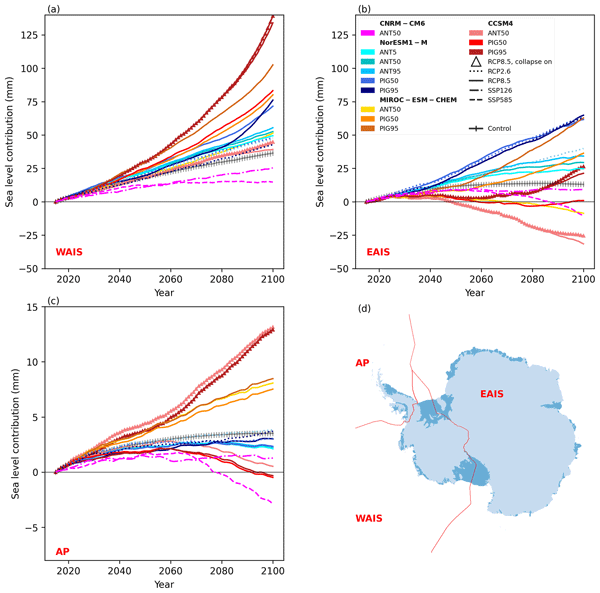
In this study, we present an improved way of representing ice thickness change rates in an ice sheet model. We apply this method using two ice sheet models of the Antarctic Ice Sheet. We found that the two largest outlet glaciers on the Antarctic Ice Sheet, Thwaites Glacier and Pine Island Glacier, will collapse without further warming on a timescale of centuries. This would cause a sea level rise of about 1.2 m globally.
Konstanze Haubner, Heiko Goelzer, and Andreas Born
EGUsphere, https://doi.org/10.5194/egusphere-2024-3785, https://doi.org/10.5194/egusphere-2024-3785, 2025
Short summary
Short summary
We add a new dynamic component – an ice sheet model simulating the Greenland ice sheet – to an Earth system model that already captures the global climate evolution including ocean, atmosphere, land and sea ice. Under a strong warming scenario, the global warming of 10 °C over 250 yrs is dominating the climate evolution. Changes from the ice-climate interaction are mainly local yet impacting the evolution of the Greenland ice sheet. Hence, ice-climate feedbacks should be considered beyond 2100.
Michele Petrini, Meike D. W. Scherrenberg, Laura Muntjewerf, Miren Vizcaino, Raymond Sellevold, Gunter R. Leguy, William H. Lipscomb, and Heiko Goelzer
The Cryosphere, 19, 63–81, https://doi.org/10.5194/tc-19-63-2025, https://doi.org/10.5194/tc-19-63-2025, 2025
Short summary
Short summary
Anthropogenic warming is causing accelerated Greenland ice sheet melt. Here, we use a computer model to understand how prolonged warming and ice melt could threaten ice sheet stability. We find a threshold beyond which Greenland will lose more than 80 % of its ice over several thousand years, due to the interaction of surface and solid-Earth processes. Nearly complete Greenland ice sheet melt occurs when the ice margin disconnects from a region of high elevation in western Greenland.
Constantijn J. Berends
EGUsphere, https://doi.org/10.5194/egusphere-2024-3610, https://doi.org/10.5194/egusphere-2024-3610, 2024
Preprint archived
Short summary
Short summary
Computer models of ice sheets solve mathematical equations describing the physics of flowing ice. While observations from satellites or other sources can be used to check if these equations describe the ice sheet correctly, one must first ensure the model solves the equations correctly. I here present a small extension to a previously derived solution on paper to one of those equations, so that modellers can verify their models.
Eliot Jager, Fabien Gillet-Chaulet, Nicolas Champollion, Romain Millan, Heiko Goelzer, and Jérémie Mouginot
The Cryosphere, 18, 5519–5550, https://doi.org/10.5194/tc-18-5519-2024, https://doi.org/10.5194/tc-18-5519-2024, 2024
Short summary
Short summary
Inspired by a previous intercomparison framework, our study better constrains uncertainties in glacier evolution using an innovative method to validate Bayesian calibration. Upernavik Isstrøm, one of Greenland's largest glaciers, has lost significant mass since 1985. By integrating observational data, climate models, human emissions, and internal model parameters, we project its evolution until 2100. We show that future human emissions are the main source of uncertainty in 2100, making up half.
Sylvie Charbit, Christophe Dumas, Fabienne Maignan, Catherine Ottlé, Nina Raoult, Xavier Fettweis, and Philippe Conesa
The Cryosphere, 18, 5067–5099, https://doi.org/10.5194/tc-18-5067-2024, https://doi.org/10.5194/tc-18-5067-2024, 2024
Short summary
Short summary
The evolution of the Greenland ice sheet is highly dependent on surface melting and therefore on the processes operating at the snow–atmosphere interface and within the snow cover. Here we present new developments to apply a snow model to the Greenland ice sheet. The performance of this model is analysed in terms of its ability to simulate ablation processes. Our analysis shows that the model performs well when compared with the MAR regional polar atmospheric model.
Caroline Jacoba van Calcar, Pippa L. Whitehouse, Roderik S. W. van de Wal, and Wouter van der Wal
EGUsphere, https://doi.org/10.5194/egusphere-2024-2982, https://doi.org/10.5194/egusphere-2024-2982, 2024
Short summary
Short summary
The bedrock response to a melting Antarctic ice sheet delays grounding line retreat by up to 130 years and reduces sea level rise by up to 23% compared to excluding this effect. Current ice sheet models often use computationally fast but simplified Earth models that do not capture this feedback well. We recommend parameters for simple Earth models that approximate bedrock uplift and ice sheet evolution from a complex ice sheet - Earth model to improve sea level projections of the next centuries.
Angélique Melet, Roderik van de Wal, Angel Amores, Arne Arns, Alisée A. Chaigneau, Irina Dinu, Ivan D. Haigh, Tim H. J. Hermans, Piero Lionello, Marta Marcos, H. E. Markus Meier, Benoit Meyssignac, Matthew D. Palmer, Ronja Reese, Matthew J. R. Simpson, and Aimée B. A. Slangen
State Planet, 3-slre1, 4, https://doi.org/10.5194/sp-3-slre1-4-2024, https://doi.org/10.5194/sp-3-slre1-4-2024, 2024
Short summary
Short summary
The EU Knowledge Hub on Sea Level Rise’s Assessment Report strives to synthesize the current scientific knowledge on sea level rise and its impacts across local, national, and EU scales to support evidence-based policy and decision-making, primarily targeting coastal areas. This paper complements IPCC reports by documenting the state of knowledge of observed and 21st century projected changes in mean and extreme sea levels with more regional information for EU seas as scoped with stakeholders.
Roderik van de Wal, Angélique Melet, Debora Bellafiore, Paula Camus, Christian Ferrarin, Gualbert Oude Essink, Ivan D. Haigh, Piero Lionello, Arjen Luijendijk, Alexandra Toimil, Joanna Staneva, and Michalis Vousdoukas
State Planet, 3-slre1, 5, https://doi.org/10.5194/sp-3-slre1-5-2024, https://doi.org/10.5194/sp-3-slre1-5-2024, 2024
Short summary
Short summary
Sea level rise has major impacts in Europe, which vary from place to place and in time, depending on the source of the impacts. Flooding, erosion, and saltwater intrusion lead, via different pathways, to various consequences for coastal regions across Europe. This causes damage to assets, the environment, and people for all three categories of impacts discussed in this paper. The paper provides an overview of the various impacts in Europe.
Bart van den Hurk, Nadia Pinardi, Alexander Bisaro, Giulia Galluccio, José A. Jiménez, Kate Larkin, Angélique Melet, Lavinia Giulia Pomarico, Kristin Richter, Kanika Singh, Roderik van de Wal, and Gundula Winter
State Planet, 3-slre1, 1, https://doi.org/10.5194/sp-3-slre1-1-2024, https://doi.org/10.5194/sp-3-slre1-1-2024, 2024
Short summary
Short summary
The Summary for Policymakers compiles findings from “Sea Level Rise in Europe: 1st Assessment Report of the Knowledge Hub on Sea Level Rise”. It covers knowledge gaps, observations, projections, impacts, adaptation measures, decision-making principles, and governance challenges. It provides information for each European basin (Mediterranean, Black Sea, North Sea, Baltic Sea, Atlantic, and Arctic) and aims to assist policymakers in enhancing the preparedness of European coasts for sea level rise.
Jeremy Rohmer, Stephane Belbeze, and Dominique Guyonnet
SOIL, 10, 679–697, https://doi.org/10.5194/soil-10-679-2024, https://doi.org/10.5194/soil-10-679-2024, 2024
Short summary
Short summary
Machine learning (ML) models have become key ingredients for digital soil mapping. To explain why the ML model is reliable, we apply a popular method from explainable artificial intelligence to the uncertainty prediction, with an application to the mapping of hydrocarbon pollutants on urban soil. We show the benefit of a joint analysis of the influence on the best estimate and the uncertainty to improve communication with end users and support decisions regarding covariates’ characterisation.
Maria T. Kappelsberger, Martin Horwath, Eric Buchta, Matthias O. Willen, Ludwig Schröder, Sanne B. M. Veldhuijsen, Peter Kuipers Munneke, and Michiel R. van den Broeke
The Cryosphere, 18, 4355–4378, https://doi.org/10.5194/tc-18-4355-2024, https://doi.org/10.5194/tc-18-4355-2024, 2024
Short summary
Short summary
The interannual variations in the height of the Antarctic Ice Sheet (AIS) are mainly due to natural variations in snowfall. Precise knowledge of these variations is important for the detection of any long-term climatic trends in AIS surface elevation. We present a new product that spatially resolves these height variations over the period 1992–2017. The product combines the strengths of atmospheric modeling results and satellite altimetry measurements.
Horst Machguth, Andrew Tedstone, Peter Kuipers Munneke, Max Brils, Brice Noël, Nicole Clerx, Nicolas Jullien, Xavier Fettweis, and Michiel van den Broeke
EGUsphere, https://doi.org/10.5194/egusphere-2024-2750, https://doi.org/10.5194/egusphere-2024-2750, 2024
Short summary
Short summary
Due to increasing air temperatures, surface melt expands to higher elevations on the Greenland ice sheet. This is visible on satellite imagery in the form of rivers of meltwater running across the surface of the ice sheet. We compare model results of meltwater at high elevations on the ice sheet to satellite observations. We find that each of the models shows strengths and weaknesses. A detailed look into the model results reveals potential reasons for the differences between models.
Christiaan T. van Dalum, Willem Jan van de Berg, Srinidhi N. Gadde, Maurice van Tiggelen, Tijmen van der Drift, Erik van Meijgaard, Lambertus H. van Ulft, and Michiel R. van den Broeke
The Cryosphere, 18, 4065–4088, https://doi.org/10.5194/tc-18-4065-2024, https://doi.org/10.5194/tc-18-4065-2024, 2024
Short summary
Short summary
We present a new version of the polar Regional Atmospheric Climate Model (RACMO), version 2.4p1, and show first results for Greenland, Antarctica and the Arctic. We provide an overview of all changes and investigate the impact that they have on the climate of polar regions. By comparing the results with observations and the output from the previous model version, we show that the model performs well regarding the surface mass balance of the ice sheets and near-surface climate.
Meike D. W. Scherrenberg, Constantijn J. Berends, and Roderik S. W. van de Wal
Clim. Past, 20, 1761–1784, https://doi.org/10.5194/cp-20-1761-2024, https://doi.org/10.5194/cp-20-1761-2024, 2024
Short summary
Short summary
During Late Pleistocene glacial cycles, the Eurasian and North American ice sheets grew and melted, resulting in over 100 m of sea-level change. Studying the melting of past ice sheets can improve our understanding of how ice sheets might respond in the future. In this study, we find that melting increases due to proglacial lakes forming at the margins of the ice sheets, primarily due to the reduced basal friction of floating ice. Furthermore, bedrock uplift rates can strongly influence melting.
Sam Sherriff-Tadano, Ruza Ivanovic, Lauren Gregoire, Charlotte Lang, Niall Gandy, Jonathan Gregory, Tamsin L. Edwards, Oliver Pollard, and Robin S. Smith
Clim. Past, 20, 1489–1512, https://doi.org/10.5194/cp-20-1489-2024, https://doi.org/10.5194/cp-20-1489-2024, 2024
Short summary
Short summary
Ensemble simulations of the climate and ice sheets of the Last Glacial Maximum (LGM) are performed with a new coupled climate–ice sheet model. Results show a strong sensitivity of the North American ice sheet to the albedo scheme, while the Greenland ice sheet appeared more sensitive to basal sliding schemes. Our result implies a potential connection between the North American ice sheet at the LGM and the future Greenland ice sheet through the albedo scheme.
Nicolaj Hansen, Andrew Orr, Xun Zou, Fredrik Boberg, Thomas J. Bracegirdle, Ella Gilbert, Peter L. Langen, Matthew A. Lazzara, Ruth Mottram, Tony Phillips, Ruth Price, Sebastian B. Simonsen, and Stuart Webster
The Cryosphere, 18, 2897–2916, https://doi.org/10.5194/tc-18-2897-2024, https://doi.org/10.5194/tc-18-2897-2024, 2024
Short summary
Short summary
We investigated a melt event over the Ross Ice Shelf. We use regional climate models and a firn model to simulate the melt and compare the results with satellite data. We find that the firn model aligned well with observed melt days in certain parts of the ice shelf. The firn model had challenges accurately simulating the melt extent in the western sector. We identified potential reasons for these discrepancies, pointing to limitations in the models related to representing the cloud properties.
Xueyu Zhang, Lin Liu, Brice Noël, and Zhicai Luo
EGUsphere, https://doi.org/10.5194/egusphere-2024-1726, https://doi.org/10.5194/egusphere-2024-1726, 2024
Preprint archived
Short summary
Short summary
This study indicates that the overall characteristics of the upper firn density in the percolation zone could be captured by the choice of appropriate model configurations and climatic forcing, which is necessary for understanding the current mass balance of the GrIS and predicting its future. The modelled firn density in this study generally aligns well with observations from 16 cores, with the relative bias in density ranging from 0.36 % to 6 % at Dye-2 and being within ±5 % at KAN_U.
Sanne B. M. Veldhuijsen, Willem Jan van de Berg, Peter Kuipers Munneke, and Michiel R. van den Broeke
The Cryosphere, 18, 1983–1999, https://doi.org/10.5194/tc-18-1983-2024, https://doi.org/10.5194/tc-18-1983-2024, 2024
Short summary
Short summary
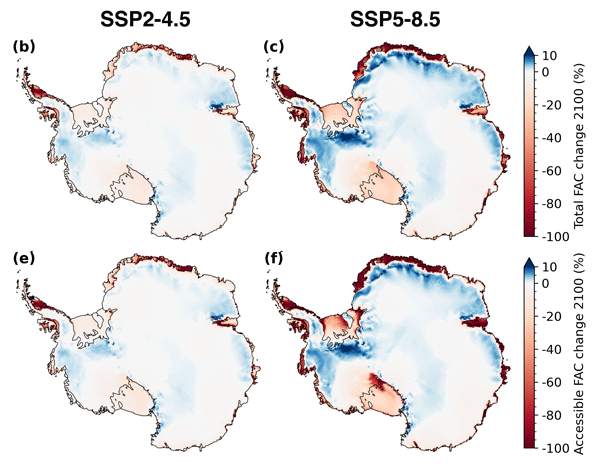
We use the IMAU firn densification model to simulate the 21st-century evolution of Antarctic firn air content. Ice shelves on the Antarctic Peninsula and the Roi Baudouin Ice Shelf in Dronning Maud Land are particularly vulnerable to total firn air content (FAC) depletion. Our results also underline the potentially large vulnerability of low-accumulation ice shelves to firn air depletion through ice slab formation.
Aslak Grinsted, Nicholas Mossor Rathmann, Ruth Mottram, Anne Munck Solgaard, Joachim Mathiesen, and Christine Schøtt Hvidberg
The Cryosphere, 18, 1947–1957, https://doi.org/10.5194/tc-18-1947-2024, https://doi.org/10.5194/tc-18-1947-2024, 2024
Short summary
Short summary
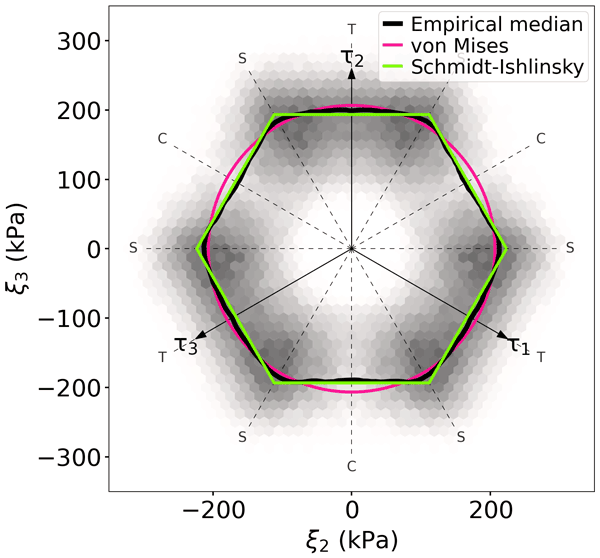
Ice fracture can cause glacier crevassing and calving. These natural hazards can also modulate the flow and evolution of ice sheets. In a new study, we use a new high-resolution dataset to determine a new failure criterion for glacier ice. Surprisingly, the strength of ice depends on the mode of deformation, and this has potential implications for the currently used flow law of ice.
Tom Keel, Chris Brierley, and Tamsin Edwards
Geosci. Model Dev., 17, 1229–1247, https://doi.org/10.5194/gmd-17-1229-2024, https://doi.org/10.5194/gmd-17-1229-2024, 2024
Short summary
Short summary
Jet streams are an important control on surface weather as their speed and shape can modify the properties of weather systems. Establishing trends in the operation of jet streams may provide some indication of the future of weather in a warming world. Despite this, it has not been easy to establish trends, as many methods have been used to characterise them in data. We introduce a tool containing various implementations of jet stream statistics and algorithms that works in a standardised manner.
Alison Delhasse, Johanna Beckmann, Christoph Kittel, and Xavier Fettweis
The Cryosphere, 18, 633–651, https://doi.org/10.5194/tc-18-633-2024, https://doi.org/10.5194/tc-18-633-2024, 2024
Short summary
Short summary
Aiming to study the long-term influence of an extremely warm climate in the Greenland Ice Sheet contribution to sea level rise, a new regional atmosphere–ice sheet model setup was established. The coupling, explicitly considering the melt–elevation feedback, is compared to an offline method to consider this feedback. We highlight mitigation of the feedback due to local changes in atmospheric circulation with changes in surface topography, making the offline correction invalid on the margins.
Baptiste Vandecrux, Robert S. Fausto, Jason E. Box, Federico Covi, Regine Hock, Åsa K. Rennermalm, Achim Heilig, Jakob Abermann, Dirk van As, Elisa Bjerre, Xavier Fettweis, Paul C. J. P. Smeets, Peter Kuipers Munneke, Michiel R. van den Broeke, Max Brils, Peter L. Langen, Ruth Mottram, and Andreas P. Ahlstrøm
The Cryosphere, 18, 609–631, https://doi.org/10.5194/tc-18-609-2024, https://doi.org/10.5194/tc-18-609-2024, 2024
Short summary
Short summary
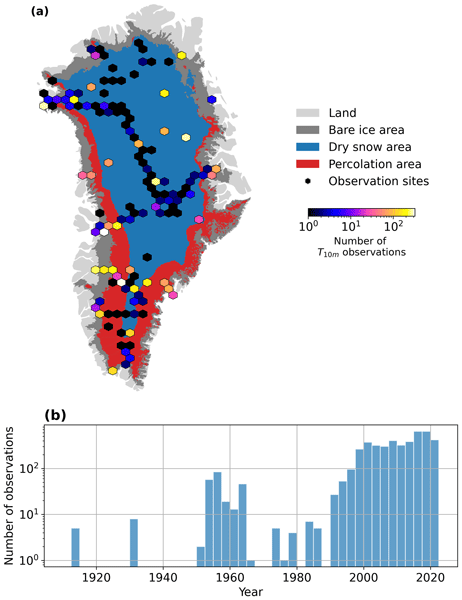
How fast is the Greenland ice sheet warming? In this study, we compiled 4500+ temperature measurements at 10 m below the ice sheet surface (T10m) from 1912 to 2022. We trained a machine learning model on these data and reconstructed T10m for the ice sheet during 1950–2022. After a slight cooling during 1950–1985, the ice sheet warmed at a rate of 0.7 °C per decade until 2022. Climate models showed mixed results compared to our observations and underestimated the warming in key regions.
Violaine Coulon, Ann Kristin Klose, Christoph Kittel, Tamsin Edwards, Fiona Turner, Ricarda Winkelmann, and Frank Pattyn
The Cryosphere, 18, 653–681, https://doi.org/10.5194/tc-18-653-2024, https://doi.org/10.5194/tc-18-653-2024, 2024
Short summary
Short summary
We present new projections of the evolution of the Antarctic ice sheet until the end of the millennium, calibrated with observations. We show that the ocean will be the main trigger of future ice loss. As temperatures continue to rise, the atmosphere's role may shift from mitigating to amplifying Antarctic mass loss already by the end of the century. For high-emission scenarios, this may lead to substantial sea-level rise. Adopting sustainable practices would however reduce the rate of ice loss.
Xueyu Zhang, Lin Liu, Brice Noël, and Zhicai Luo
EGUsphere, https://doi.org/10.5194/egusphere-2024-122, https://doi.org/10.5194/egusphere-2024-122, 2024
Preprint archived
Short summary
Short summary
In this study, an improved firn densification model is developed by integrating the Bucket scheme and Darcy’s law to assess the capillary retention, refreezing, and runoff of liquid water within the firn layer. This model captures high-density peaks (~917 kg · m-3) or the features of high-density layers caused by the refreezing of liquid water. In general, the modelled firn depth-density profiles at KAN_U and Dye-2 agree well with the in situ measurements.
Idunn Aamnes Mostue, Stefan Hofer, Trude Storelvmo, and Xavier Fettweis
The Cryosphere, 18, 475–488, https://doi.org/10.5194/tc-18-475-2024, https://doi.org/10.5194/tc-18-475-2024, 2024
Short summary
Short summary
The latest generation of climate models (Coupled Model Intercomparison Project Phase 6 – CMIP6) warm more over Greenland and the Arctic and thus also project a larger mass loss from the Greenland Ice Sheet (GrIS) compared to the previous generation of climate models (CMIP5). Our work suggests for the first time that part of the greater mass loss in CMIP6 over the GrIS is driven by a difference in the surface mass balance sensitivity from a change in cloud representation in the CMIP6 models.
Lennert B. Stap, Constantijn J. Berends, and Roderik S. W. van de Wal
Clim. Past, 20, 257–266, https://doi.org/10.5194/cp-20-257-2024, https://doi.org/10.5194/cp-20-257-2024, 2024
Short summary
Short summary
Analysing simulations of Antarctic Ice Sheet variability during the early and mid-Miocene (23 to 14 Myr ago), we find that the ice sheet area adapts faster and more strongly than volume to climate change on quasi-orbital timescales. Considering the recent discovery that ice area, rather than volume, influences deep-ocean temperatures, this implies that the Miocene Antarctic Ice Sheet affects deep-ocean temperatures more than its volume suggests.
Laura J. Dietrich, Hans Christian Steen-Larsen, Sonja Wahl, Anne-Katrine Faber, and Xavier Fettweis
The Cryosphere, 18, 289–305, https://doi.org/10.5194/tc-18-289-2024, https://doi.org/10.5194/tc-18-289-2024, 2024
Short summary
Short summary
The contribution of the humidity flux to the surface mass balance in the accumulation zone of the Greenland Ice Sheet is uncertain. Here, we evaluate the regional climate model MAR using a multi-annual dataset of eddy covariance measurements and bulk estimates of the humidity flux. The humidity flux largely contributes to the summer surface mass balance (SMB) in the accumulation zone, indicating its potential importance for the annual SMB in a warming climate.
Robert E. Kopp, Gregory G. Garner, Tim H. J. Hermans, Shantenu Jha, Praveen Kumar, Alexander Reedy, Aimée B. A. Slangen, Matteo Turilli, Tamsin L. Edwards, Jonathan M. Gregory, George Koubbe, Anders Levermann, Andre Merzky, Sophie Nowicki, Matthew D. Palmer, and Chris Smith
Geosci. Model Dev., 16, 7461–7489, https://doi.org/10.5194/gmd-16-7461-2023, https://doi.org/10.5194/gmd-16-7461-2023, 2023
Short summary
Short summary
Future sea-level rise projections exhibit multiple forms of uncertainty, all of which must be considered by scientific assessments intended to inform decision-making. The Framework for Assessing Changes To Sea-level (FACTS) is a new software package intended to support assessments of global mean, regional, and extreme sea-level rise. An early version of FACTS supported the development of the IPCC Sixth Assessment Report sea-level projections.
Jonas Van Breedam, Philippe Huybrechts, and Michel Crucifix
Clim. Past, 19, 2551–2568, https://doi.org/10.5194/cp-19-2551-2023, https://doi.org/10.5194/cp-19-2551-2023, 2023
Short summary
Short summary
We investigated the different boundary conditions to allow ice sheet growth and ice sheet decline of the Antarctic ice sheet when it appeared ∼38–34 Myr ago. The thresholds for ice sheet growth and decline differ because of the different climatological conditions above an ice sheet (higher elevation and higher albedo) compared to a bare topography. We found that the ice–albedo feedback and the isostasy feedback respectively ease and delay the transition from a deglacial to glacial state.
Hélène Seroussi, Vincent Verjans, Sophie Nowicki, Antony J. Payne, Heiko Goelzer, William H. Lipscomb, Ayako Abe-Ouchi, Cécile Agosta, Torsten Albrecht, Xylar Asay-Davis, Alice Barthel, Reinhard Calov, Richard Cullather, Christophe Dumas, Benjamin K. Galton-Fenzi, Rupert Gladstone, Nicholas R. Golledge, Jonathan M. Gregory, Ralf Greve, Tore Hattermann, Matthew J. Hoffman, Angelika Humbert, Philippe Huybrechts, Nicolas C. Jourdain, Thomas Kleiner, Eric Larour, Gunter R. Leguy, Daniel P. Lowry, Chistopher M. Little, Mathieu Morlighem, Frank Pattyn, Tyler Pelle, Stephen F. Price, Aurélien Quiquet, Ronja Reese, Nicole-Jeanne Schlegel, Andrew Shepherd, Erika Simon, Robin S. Smith, Fiammetta Straneo, Sainan Sun, Luke D. Trusel, Jonas Van Breedam, Peter Van Katwyk, Roderik S. W. van de Wal, Ricarda Winkelmann, Chen Zhao, Tong Zhang, and Thomas Zwinger
The Cryosphere, 17, 5197–5217, https://doi.org/10.5194/tc-17-5197-2023, https://doi.org/10.5194/tc-17-5197-2023, 2023
Short summary
Short summary
Mass loss from Antarctica is a key contributor to sea level rise over the 21st century, and the associated uncertainty dominates sea level projections. We highlight here the Antarctic glaciers showing the largest changes and quantify the main sources of uncertainty in their future evolution using an ensemble of ice flow models. We show that on top of Pine Island and Thwaites glaciers, Totten and Moscow University glaciers show rapid changes and a strong sensitivity to warmer ocean conditions.
Marco Tedesco, Paolo Colosio, Xavier Fettweis, and Guido Cervone
The Cryosphere, 17, 5061–5074, https://doi.org/10.5194/tc-17-5061-2023, https://doi.org/10.5194/tc-17-5061-2023, 2023
Short summary
Short summary
We developed a technique to improve the outputs of a model that calculates the gain and loss of Greenland and consequently its contribution to sea level rise. Our technique generates “sharper” images of the maps generated by the model to better understand and quantify where losses occur. This has implications for improving models, understanding what drives the contributions of Greenland to sea level rise, and more.
Damien Maure, Christoph Kittel, Clara Lambin, Alison Delhasse, and Xavier Fettweis
The Cryosphere, 17, 4645–4659, https://doi.org/10.5194/tc-17-4645-2023, https://doi.org/10.5194/tc-17-4645-2023, 2023
Short summary
Short summary
The Arctic is warming faster than the rest of the Earth. Studies have already shown that Greenland and the Canadian Arctic are experiencing a record increase in melting rates, while Svalbard has been relatively less impacted. Looking at those regions but also extending the study to Iceland and the Russian Arctic archipelagoes, we see a heterogeneity in the melting-rate response to the Arctic warming, with the Russian archipelagoes experiencing lower melting rates than other regions.
Lander Van Tricht and Philippe Huybrechts
The Cryosphere, 17, 4463–4485, https://doi.org/10.5194/tc-17-4463-2023, https://doi.org/10.5194/tc-17-4463-2023, 2023
Short summary
Short summary
We modelled the historical and future evolution of six ice masses in the Tien Shan, Central Asia, with a 3D ice-flow model under the newest climate scenarios. We show that in all scenarios the ice masses retreat significantly but with large differences. It is highlighted that, because the main precipitation occurs in spring and summer, the ice masses respond to climate change with an accelerating retreat. In all scenarios, the total runoff peaks before 2050, with a (drastic) decrease afterwards.
Prateek Gantayat, Alison F. Banwell, Amber A. Leeson, James M. Lea, Dorthe Petersen, Noel Gourmelen, and Xavier Fettweis
Geosci. Model Dev., 16, 5803–5823, https://doi.org/10.5194/gmd-16-5803-2023, https://doi.org/10.5194/gmd-16-5803-2023, 2023
Short summary
Short summary
We developed a new supraglacial hydrology model for the Greenland Ice Sheet. This model simulates surface meltwater routing, meltwater drainage, supraglacial lake (SGL) overflow, and formation of lake ice. The model was able to reproduce 80 % of observed lake locations and provides a good match between the observed and modelled temporal evolution of SGLs.
Lander Van Tricht, Chloë Marie Paice, Oleg Rybak, and Philippe Huybrechts
The Cryosphere, 17, 4315–4323, https://doi.org/10.5194/tc-17-4315-2023, https://doi.org/10.5194/tc-17-4315-2023, 2023
Short summary
Short summary
We performed a field campaign to measure the ice thickness of the Grigoriev ice cap (Central Asia). We interpolated the ice thickness data to obtain an ice thickness distribution representing the state of the ice cap in 2021, with a total volume of ca. 0.4 km3. We then compared our results with global ice thickness datasets composed without our local measurements. The main takeaway is that these datasets do not perform well enough yet for ice caps such as the Grigoriev ice cap.
Thomas Dethinne, Quentin Glaude, Ghislain Picard, Christoph Kittel, Patrick Alexander, Anne Orban, and Xavier Fettweis
The Cryosphere, 17, 4267–4288, https://doi.org/10.5194/tc-17-4267-2023, https://doi.org/10.5194/tc-17-4267-2023, 2023
Short summary
Short summary
We investigate the sensitivity of the regional climate model
Modèle Atmosphérique Régional(MAR) to the assimilation of wet-snow occurrence estimated by remote sensing datasets. The assimilation is performed by nudging the MAR snowpack temperature. The data assimilation is performed over the Antarctic Peninsula for the 2019–2021 period. The results show an increase in the melt production (+66.7 %) and a decrease in surface mass balance (−4.5 %) of the model for the 2019–2020 melt season.
Lena G. Buth, Valeria Di Biase, Peter Kuipers Munneke, Stef Lhermitte, Sanne B. M. Veldhuijsen, Sophie de Roda Husman, Michiel R. van den Broeke, and Bert Wouters
EGUsphere, https://doi.org/10.5194/egusphere-2023-2000, https://doi.org/10.5194/egusphere-2023-2000, 2023
Preprint archived
Short summary
Short summary
Liquid meltwater which is stored in air bubbles in the compacted snow near the surface of Antarctica can affect ice shelf stability. In order to detect the presence of such firn aquifers over large scales, satellite remote sensing is needed. In this paper, we present our new detection method using radar satellite data as well as the results for the whole Antarctic Peninsula. Firn aquifers are found in the north and northwest of the peninsula, in agreement with locations predicted by models.
Caroline J. van Calcar, Roderik S. W. van de Wal, Bas Blank, Bas de Boer, and Wouter van der Wal
Geosci. Model Dev., 16, 5473–5492, https://doi.org/10.5194/gmd-16-5473-2023, https://doi.org/10.5194/gmd-16-5473-2023, 2023
Short summary
Short summary
The waxing and waning of the Antarctic ice sheet caused the Earth’s surface to deform, which is stabilizing the ice sheet and mainly determined by the spatially variable viscosity of the mantle. Including this feedback in model simulations led to significant differences in ice sheet extent and ice thickness over the last glacial cycle. The results underline and quantify the importance of including this local feedback effect in ice sheet models when simulating the Antarctic ice sheet evolution.
Emily A. Hill, Benoît Urruty, Ronja Reese, Julius Garbe, Olivier Gagliardini, Gaël Durand, Fabien Gillet-Chaulet, G. Hilmar Gudmundsson, Ricarda Winkelmann, Mondher Chekki, David Chandler, and Petra M. Langebroek
The Cryosphere, 17, 3739–3759, https://doi.org/10.5194/tc-17-3739-2023, https://doi.org/10.5194/tc-17-3739-2023, 2023
Short summary
Short summary
The grounding lines of the Antarctic Ice Sheet could enter phases of irreversible retreat or advance. We use three ice sheet models to show that the present-day locations of Antarctic grounding lines are reversible with respect to a small perturbation away from their current position. This indicates that present-day retreat of the grounding lines is not yet irreversible or self-enhancing.
Ronja Reese, Julius Garbe, Emily A. Hill, Benoît Urruty, Kaitlin A. Naughten, Olivier Gagliardini, Gaël Durand, Fabien Gillet-Chaulet, G. Hilmar Gudmundsson, David Chandler, Petra M. Langebroek, and Ricarda Winkelmann
The Cryosphere, 17, 3761–3783, https://doi.org/10.5194/tc-17-3761-2023, https://doi.org/10.5194/tc-17-3761-2023, 2023
Short summary
Short summary
We use an ice sheet model to test where current climate conditions in Antarctica might lead. We find that present-day ocean and atmosphere conditions might commit an irreversible collapse of parts of West Antarctica which evolves over centuries to millennia. Importantly, this collapse is not irreversible yet.
Erwin Lambert, André Jüling, Roderik S. W. van de Wal, and Paul R. Holland
The Cryosphere, 17, 3203–3228, https://doi.org/10.5194/tc-17-3203-2023, https://doi.org/10.5194/tc-17-3203-2023, 2023
Short summary
Short summary
A major uncertainty in the study of sea level rise is the melting of the Antarctic ice sheet by the ocean. Here, we have developed a new model, named LADDIE, that simulates this ocean-driven melting of the floating parts of the Antarctic ice sheet. This model simulates fine-scale patterns of melting and freezing and requires significantly fewer computational resources than state-of-the-art ocean models. LADDIE can be used as a new tool to force high-resolution ice sheet models.
Lander Van Tricht, Harry Zekollari, Matthias Huss, Daniel Farinotti, and Philippe Huybrechts
The Cryosphere Discuss., https://doi.org/10.5194/tc-2023-87, https://doi.org/10.5194/tc-2023-87, 2023
Manuscript not accepted for further review
Short summary
Short summary
Detailed 3D models can be applied for well-studied glaciers, whereas simplified approaches are used for regional/global assessments. We conducted a comparison of six Tien Shan glaciers employing different models and investigated the impact of in-situ measurements. Our results reveal that the choice of mass balance and ice flow model as well as calibration have minimal impact on the projected volume. The initial ice thickness exerts the greatest influence on the future remaining ice volume.
Nicolaj Hansen, Louise Sandberg Sørensen, Giorgio Spada, Daniele Melini, Rene Forsberg, Ruth Mottram, and Sebastian B. Simonsen
The Cryosphere Discuss., https://doi.org/10.5194/tc-2023-104, https://doi.org/10.5194/tc-2023-104, 2023
Preprint withdrawn
Short summary
Short summary
We use ICESat-2 to estimate the surface elevation change over Greenland and Antarctica in the period of 2018 to 2021. Numerical models have been used the compute the firn compaction and the vertical bedrock movement so non-mass-related elevation changes can be taken into account. We have made a parameterization of the surface density so we can convert the volume change to mass change. We find that Antarctica has lost 135.7±27.3 Gt per year, and the Greenland ice sheet 237.5±14.0 Gt per year.
Iris Keizer, Dewi Le Bars, Cees de Valk, André Jüling, Roderik van de Wal, and Sybren Drijfhout
Ocean Sci., 19, 991–1007, https://doi.org/10.5194/os-19-991-2023, https://doi.org/10.5194/os-19-991-2023, 2023
Short summary
Short summary
Using tide gauge observations, we show that the acceleration of sea-level rise (SLR) along the coast of the Netherlands started in the 1960s but was masked by wind field and nodal-tide variations. This finding aligns with global SLR observations and expectations based on a physical understanding of SLR related to global warming.
Inès N. Otosaka, Andrew Shepherd, Erik R. Ivins, Nicole-Jeanne Schlegel, Charles Amory, Michiel R. van den Broeke, Martin Horwath, Ian Joughin, Michalea D. King, Gerhard Krinner, Sophie Nowicki, Anthony J. Payne, Eric Rignot, Ted Scambos, Karen M. Simon, Benjamin E. Smith, Louise S. Sørensen, Isabella Velicogna, Pippa L. Whitehouse, Geruo A, Cécile Agosta, Andreas P. Ahlstrøm, Alejandro Blazquez, William Colgan, Marcus E. Engdahl, Xavier Fettweis, Rene Forsberg, Hubert Gallée, Alex Gardner, Lin Gilbert, Noel Gourmelen, Andreas Groh, Brian C. Gunter, Christopher Harig, Veit Helm, Shfaqat Abbas Khan, Christoph Kittel, Hannes Konrad, Peter L. Langen, Benoit S. Lecavalier, Chia-Chun Liang, Bryant D. Loomis, Malcolm McMillan, Daniele Melini, Sebastian H. Mernild, Ruth Mottram, Jeremie Mouginot, Johan Nilsson, Brice Noël, Mark E. Pattle, William R. Peltier, Nadege Pie, Mònica Roca, Ingo Sasgen, Himanshu V. Save, Ki-Weon Seo, Bernd Scheuchl, Ernst J. O. Schrama, Ludwig Schröder, Sebastian B. Simonsen, Thomas Slater, Giorgio Spada, Tyler C. Sutterley, Bramha Dutt Vishwakarma, Jan Melchior van Wessem, David Wiese, Wouter van der Wal, and Bert Wouters
Earth Syst. Sci. Data, 15, 1597–1616, https://doi.org/10.5194/essd-15-1597-2023, https://doi.org/10.5194/essd-15-1597-2023, 2023
Short summary
Short summary
By measuring changes in the volume, gravitational attraction, and ice flow of Greenland and Antarctica from space, we can monitor their mass gain and loss over time. Here, we present a new record of the Earth’s polar ice sheet mass balance produced by aggregating 50 satellite-based estimates of ice sheet mass change. This new assessment shows that the ice sheets have lost (7.5 x 10¹²) t of ice between 1992 and 2020, contributing 21 mm to sea level rise.
Sanne B. M. Veldhuijsen, Willem Jan van de Berg, Max Brils, Peter Kuipers Munneke, and Michiel R. van den Broeke
The Cryosphere, 17, 1675–1696, https://doi.org/10.5194/tc-17-1675-2023, https://doi.org/10.5194/tc-17-1675-2023, 2023
Short summary
Short summary
Firn is the transition of snow to glacier ice and covers 99 % of the Antarctic ice sheet. Knowledge about the firn layer and its variability is important, as it impacts satellite-based estimates of ice sheet mass change. Also, firn contains pores in which nearly all of the surface melt is retained. Here, we improve a semi-empirical firn model and simulate the firn characteristics for the period 1979–2020. We evaluate the performance with field and satellite measures and test its sensitivity.
Constantijn J. Berends, Roderik S. W. van de Wal, Tim van den Akker, and William H. Lipscomb
The Cryosphere, 17, 1585–1600, https://doi.org/10.5194/tc-17-1585-2023, https://doi.org/10.5194/tc-17-1585-2023, 2023
Short summary
Short summary
The rate at which the Antarctic ice sheet will melt because of anthropogenic climate change is uncertain. Part of this uncertainty stems from processes occurring beneath the ice, such as the way the ice slides over the underlying bedrock.
Inversion methodsattempt to use observations of the ice-sheet surface to calculate how these sliding processes work. We show that such methods cannot fully solve this problem, so a substantial uncertainty still remains in projections of sea-level rise.
Benjamin E. Smith, Brooke Medley, Xavier Fettweis, Tyler Sutterley, Patrick Alexander, David Porter, and Marco Tedesco
The Cryosphere, 17, 789–808, https://doi.org/10.5194/tc-17-789-2023, https://doi.org/10.5194/tc-17-789-2023, 2023
Short summary
Short summary
We use repeated satellite measurements of the height of the Greenland ice sheet to learn about how three computational models of snowfall, melt, and snow compaction represent actual changes in the ice sheet. We find that the models do a good job of estimating how the parts of the ice sheet near the coast have changed but that two of the models have trouble representing surface melt for the highest part of the ice sheet. This work provides suggestions for how to better model snowmelt.
Meike D. W. Scherrenberg, Constantijn J. Berends, Lennert B. Stap, and Roderik S. W. van de Wal
Clim. Past, 19, 399–418, https://doi.org/10.5194/cp-19-399-2023, https://doi.org/10.5194/cp-19-399-2023, 2023
Short summary
Short summary
Ice sheets have a large effect on climate and vice versa. Here we use an ice sheet computer model to simulate the last glacial cycle and compare two methods, one that implicitly includes these feedbacks and one that does not. We found that when including simple climate feedbacks, the North American ice sheet develops from two domes instead of many small domes. Each ice sheet melts slower when including feedbacks. We attribute this difference mostly to air temperature–ice sheet interactions.
Jilu Li, Fernando Rodriguez-Morales, Xavier Fettweis, Oluwanisola Ibikunle, Carl Leuschen, John Paden, Daniel Gomez-Garcia, and Emily Arnold
The Cryosphere, 17, 175–193, https://doi.org/10.5194/tc-17-175-2023, https://doi.org/10.5194/tc-17-175-2023, 2023
Short summary
Short summary
Alaskan glaciers' loss of ice mass contributes significantly to ocean surface rise. It is important to know how deeply and how much snow accumulates on these glaciers to comprehend and analyze the glacial mass loss process. We reported the observed seasonal snow depth distribution from our radar data taken in Alaska in 2018 and 2021, developed a method to estimate the annual snow accumulation rate at Mt. Wrangell caldera, and identified transition zones from wet-snow zones to ablation zones.
Marte G. Hofsteenge, Nicolas J. Cullen, Carleen H. Reijmer, Michiel van den Broeke, Marwan Katurji, and John F. Orwin
The Cryosphere, 16, 5041–5059, https://doi.org/10.5194/tc-16-5041-2022, https://doi.org/10.5194/tc-16-5041-2022, 2022
Short summary
Short summary
In the McMurdo Dry Valleys (MDV), foehn winds can impact glacial meltwater production and the fragile ecosystem that depends on it. We study these dry and warm winds at Joyce Glacier and show they are caused by a different mechanism than that found for nearby valleys, demonstrating the complex interaction of large-scale winds with the mountains in the MDV. We find that foehn winds increase sublimation of ice, increase heating from the atmosphere, and increase the occurrence and rates of melt.
Jeremy Rohmer, Remi Thieblemont, Goneri Le Cozannet, Heiko Goelzer, and Gael Durand
The Cryosphere, 16, 4637–4657, https://doi.org/10.5194/tc-16-4637-2022, https://doi.org/10.5194/tc-16-4637-2022, 2022
Short summary
Short summary
To improve the interpretability of process-based projections of the sea-level contribution from land ice components, we apply the machine-learning-based
SHapley Additive exPlanationsapproach to a subset of a multi-model ensemble study for the Greenland ice sheet. This allows us to quantify the influence of particular modelling decisions (related to numerical implementation, initial conditions, or parametrisation of ice-sheet processes) directly in terms of sea-level change contribution.
Lander Van Tricht and Philippe Huybrechts
The Cryosphere, 16, 4513–4535, https://doi.org/10.5194/tc-16-4513-2022, https://doi.org/10.5194/tc-16-4513-2022, 2022
Short summary
Short summary
We examine the thermal regime of the Grigoriev ice cap and the Sary-Tor glacier, both located in the inner Tien Shan in Kyrgyzstan. Our findings are important as the ice dynamics can only be understood and modelled precisely if ice temperature is considered correctly in ice flow models. The calibrated parameters of this study can be used in applications with ice flow models for individual ice masses as well as to optimise more general models for large-scale regional simulations.
Nidheesh Gangadharan, Hugues Goosse, David Parkes, Heiko Goelzer, Fabien Maussion, and Ben Marzeion
Earth Syst. Dynam., 13, 1417–1435, https://doi.org/10.5194/esd-13-1417-2022, https://doi.org/10.5194/esd-13-1417-2022, 2022
Short summary
Short summary
We describe the contributions of ocean thermal expansion and land-ice melting (ice sheets and glaciers) to global-mean sea-level (GMSL) changes in the Common Era. The mass contributions are the major sources of GMSL changes in the pre-industrial Common Era and glaciers are the largest contributor. The paper also describes the current state of climate modelling, uncertainties and knowledge gaps along with the potential implications of the past variabilities in the contemporary sea-level rise.
Raf M. Antwerpen, Marco Tedesco, Xavier Fettweis, Patrick Alexander, and Willem Jan van de Berg
The Cryosphere, 16, 4185–4199, https://doi.org/10.5194/tc-16-4185-2022, https://doi.org/10.5194/tc-16-4185-2022, 2022
Short summary
Short summary
The ice on Greenland has been melting more rapidly over the last few years. Most of this melt comes from the exposure of ice when the overlying snow melts. This ice is darker than snow and absorbs more sunlight, leading to more melt. It remains challenging to accurately simulate the brightness of the ice. We show that the color of ice simulated by Modèle Atmosphérique Régional (MAR) is too bright. We then show that this means that MAR may underestimate how fast the Greenland ice is melting.
Jeremy Rohmer, Deborah Idier, Remi Thieblemont, Goneri Le Cozannet, and François Bachoc
Nat. Hazards Earth Syst. Sci., 22, 3167–3182, https://doi.org/10.5194/nhess-22-3167-2022, https://doi.org/10.5194/nhess-22-3167-2022, 2022
Short summary
Short summary
We quantify the influence of wave–wind characteristics, offshore water level and sea level rise (projected up to 2200) on the occurrence of flooding events at Gâvres, French Atlantic coast. Our results outline the overwhelming influence of sea level rise over time compared to the others. By showing the robustness of our conclusions to the errors in the estimation procedure, our approach proves to be valuable for exploring and characterizing uncertainties in assessments of future flooding.
Lena G. Buth, Bert Wouters, Sanne B. M. Veldhuijsen, Stef Lhermitte, Peter Kuipers Munneke, and Michiel R. van den Broeke
The Cryosphere Discuss., https://doi.org/10.5194/tc-2022-127, https://doi.org/10.5194/tc-2022-127, 2022
Manuscript not accepted for further review
Short summary
Short summary
Liquid meltwater which is stored in air bubbles in the compacted snow near the surface of Antarctica can affect ice shelf stability. In order to detect the presence of such firn aquifers over large scales, satellite remote sensing is needed. In this paper, we present our new detection method using radar satellite data as well as the results for the whole Antarctic Peninsula. Firn aquifers are found in the north and northwest of the peninsula, in agreement with locations predicted by models.
Max Brils, Peter Kuipers Munneke, Willem Jan van de Berg, and Michiel van den Broeke
Geosci. Model Dev., 15, 7121–7138, https://doi.org/10.5194/gmd-15-7121-2022, https://doi.org/10.5194/gmd-15-7121-2022, 2022
Short summary
Short summary
Firn covers the Greenland ice sheet (GrIS) and can temporarily prevent mass loss. Here, we present the latest version of our firn model, IMAU-FDM, with an application to the GrIS. We improved the density of fallen snow, the firn densification rate and the firn's thermal conductivity. This leads to a higher air content and 10 m temperatures. Furthermore we investigate three case studies and find that the updated model shows greater variability and an increased sensitivity in surface elevation.
Ioanna Karagali, Magnus Barfod Suhr, Ruth Mottram, Pia Nielsen-Englyst, Gorm Dybkjær, Darren Ghent, and Jacob L. Høyer
The Cryosphere, 16, 3703–3721, https://doi.org/10.5194/tc-16-3703-2022, https://doi.org/10.5194/tc-16-3703-2022, 2022
Short summary
Short summary
Ice surface temperature (IST) products were used to develop the first multi-sensor, gap-free Level 4 (L4) IST product of the Greenland Ice Sheet (GIS) for 2012, when a significant melt event occurred. For the melt season, mean IST was −15 to −1 °C, and almost the entire GIS experienced at least 1 to 5 melt days. Inclusion of the L4 IST to a surface mass budget (SMB) model improved simulated surface temperatures during the key onset of the melt season, where biases are typically large.
Tiago Silva, Jakob Abermann, Brice Noël, Sonika Shahi, Willem Jan van de Berg, and Wolfgang Schöner
The Cryosphere, 16, 3375–3391, https://doi.org/10.5194/tc-16-3375-2022, https://doi.org/10.5194/tc-16-3375-2022, 2022
Short summary
Short summary
To overcome internal climate variability, this study uses k-means clustering to combine NAO, GBI and IWV over the Greenland Ice Sheet (GrIS) and names the approach as the North Atlantic influence on Greenland (NAG). With the support of a polar-adapted RCM, spatio-temporal changes on SEB components within NAG phases are investigated. We report atmospheric warming and moistening across all NAG phases as well as large-scale and regional-scale contributions to GrIS mass loss and their interactions.
Constantijn J. Berends, Heiko Goelzer, Thomas J. Reerink, Lennert B. Stap, and Roderik S. W. van de Wal
Geosci. Model Dev., 15, 5667–5688, https://doi.org/10.5194/gmd-15-5667-2022, https://doi.org/10.5194/gmd-15-5667-2022, 2022
Short summary
Short summary
The rate at which marine ice sheets such as the West Antarctic ice sheet will retreat in a warming climate and ocean is still uncertain. Numerical ice-sheet models, which solve the physical equations that describe the way glaciers and ice sheets deform and flow, have been substantially improved in recent years. Here we present the results of several years of work on IMAU-ICE, an ice-sheet model of intermediate complexity, which can be used to study ice sheets of both the past and the future.
Christoph Kittel, Charles Amory, Stefan Hofer, Cécile Agosta, Nicolas C. Jourdain, Ella Gilbert, Louis Le Toumelin, Étienne Vignon, Hubert Gallée, and Xavier Fettweis
The Cryosphere, 16, 2655–2669, https://doi.org/10.5194/tc-16-2655-2022, https://doi.org/10.5194/tc-16-2655-2022, 2022
Short summary
Short summary
Model projections suggest large differences in future Antarctic surface melting even for similar greenhouse gas scenarios and warming rates. We show that clouds containing a larger amount of liquid water lead to stronger melt. As surface melt can trigger the collapse of the ice shelves (the safety band of the Antarctic Ice Sheet), clouds could be a major source of uncertainties in projections of sea level rise.
Sébastien Doutreloup, Xavier Fettweis, Ramin Rahif, Essam Elnagar, Mohsen S. Pourkiaei, Deepak Amaripadath, and Shady Attia
Earth Syst. Sci. Data, 14, 3039–3051, https://doi.org/10.5194/essd-14-3039-2022, https://doi.org/10.5194/essd-14-3039-2022, 2022
Short summary
Short summary
This data set provides historical (1980–2014) and future (2015–2100) weather data for 12 cities in Belgium. This data set is intended for architects or building or energy designers. In particular, it makes available to all users hourly open-access weather data according to certain standards to recreate a Typical and an Extreme Meteorological Year. In addition, it provides hourly data on heatwaves from 1980 to 2100. Weather data were produced from the outputs of the MAR model simulations.
Charlotte Rahlves, Frank Beyrich, and Siegfried Raasch
Atmos. Meas. Tech., 15, 2839–2856, https://doi.org/10.5194/amt-15-2839-2022, https://doi.org/10.5194/amt-15-2839-2022, 2022
Short summary
Short summary
Lidars can measure the wind profile in the lower part of the atmosphere, provided that the wind field is horizontally uniform and does not change during the time of the measurement. These requirements are mostly not fulfilled in reality, and the lidar wind measurement will thus hold a certain error. We investigate different strategies for lidar wind profiling using a lidar simulator implemented in a numerical simulation of the wind field. Our findings can help to improve wind measurements.
Lennert B. Stap, Constantijn J. Berends, Meike D. W. Scherrenberg, Roderik S. W. van de Wal, and Edward G. W. Gasson
The Cryosphere, 16, 1315–1332, https://doi.org/10.5194/tc-16-1315-2022, https://doi.org/10.5194/tc-16-1315-2022, 2022
Short summary
Short summary
To gain understanding of how the Antarctic ice sheet responded to CO2 changes during past warm climate conditions, we simulate its variability during the Miocene. We include feedbacks between the ice sheet and atmosphere in our model and force the model using time-varying climate conditions. We find that these feedbacks reduce the amplitude of ice volume variations. Erosion-induced changes in the bedrock below the ice sheet that manifested during the Miocene also have a damping effect.
Christiaan T. van Dalum, Willem Jan van de Berg, and Michiel R. van den Broeke
The Cryosphere, 16, 1071–1089, https://doi.org/10.5194/tc-16-1071-2022, https://doi.org/10.5194/tc-16-1071-2022, 2022
Short summary
Short summary
In this study, we improve the regional climate model RACMO2 and investigate the climate of Antarctica. We have implemented a new radiative transfer and snow albedo scheme and do several sensitivity experiments. When fully tuned, the results compare well with observations and snow temperature profiles improve. Moreover, small changes in the albedo and the investigated processes can lead to a strong overestimation of melt, locally leading to runoff and a reduced surface mass balance.
Nicolaj Hansen, Sebastian B. Simonsen, Fredrik Boberg, Christoph Kittel, Andrew Orr, Niels Souverijns, J. Melchior van Wessem, and Ruth Mottram
The Cryosphere, 16, 711–718, https://doi.org/10.5194/tc-16-711-2022, https://doi.org/10.5194/tc-16-711-2022, 2022
Short summary
Short summary
We investigate the impact of different ice masks when modelling surface mass balance over Antarctica. We used ice masks and data from five of the most used regional climate models and a common mask. We see large disagreement between the ice masks, which has a large impact on the surface mass balance, especially around the Antarctic Peninsula and some of the largest glaciers. We suggest a solution for creating a new, up-to-date, high-resolution ice mask that can be used in Antarctic modelling.
Ryota Wada, Jeremy Rohmer, Yann Krien, and Philip Jonathan
Nat. Hazards Earth Syst. Sci., 22, 431–444, https://doi.org/10.5194/nhess-22-431-2022, https://doi.org/10.5194/nhess-22-431-2022, 2022
Short summary
Short summary
Characterizing extreme wave environments caused by tropical cyclones in the Caribbean Sea near Guadeloupe is difficult because cyclones rarely pass near the location of interest. STM-E (space-time maxima and exposure) model utilizes wave data during cyclones on a spatial neighbourhood. Long-duration wave data generated from a database of synthetic tropical cyclones are used to evaluate the performance of STM-E. Results indicate STM-E provides estimates with small bias and realistic uncertainty.
Fredrik Boberg, Ruth Mottram, Nicolaj Hansen, Shuting Yang, and Peter L. Langen
The Cryosphere, 16, 17–33, https://doi.org/10.5194/tc-16-17-2022, https://doi.org/10.5194/tc-16-17-2022, 2022
Short summary
Short summary
Using the regional climate model HIRHAM5, we compare two versions (v2 and v3) of the global climate model EC-Earth for the Greenland and Antarctica ice sheets. We are interested in the surface mass balance of the ice sheets due to its importance when making estimates of future sea level rise. We find that the end-of-century change in the surface mass balance for Antarctica is 420 Gt yr−1 (v2) and 80 Gt yr−1 (v3), and for Greenland it is −290 Gt yr−1 (v2) and −1640 Gt yr−1 (v3).
Anna Derkacheva, Fabien Gillet-Chaulet, Jeremie Mouginot, Eliot Jager, Nathan Maier, and Samuel Cook
The Cryosphere, 15, 5675–5704, https://doi.org/10.5194/tc-15-5675-2021, https://doi.org/10.5194/tc-15-5675-2021, 2021
Short summary
Short summary
Along the edges of the Greenland Ice Sheet surface melt lubricates the bed and causes large seasonal fluctuations in ice speeds during summer. Accurately understanding how these ice speed changes occur is difficult due to the inaccessibility of the glacier bed. We show that by using surface velocity maps with high temporal resolution and numerical modelling we can infer the basal conditions that control seasonal fluctuations in ice speed and gain insight into seasonal dynamics over large areas.
Zhongyang Hu, Peter Kuipers Munneke, Stef Lhermitte, Maaike Izeboud, and Michiel van den Broeke
The Cryosphere, 15, 5639–5658, https://doi.org/10.5194/tc-15-5639-2021, https://doi.org/10.5194/tc-15-5639-2021, 2021
Short summary
Short summary
Antarctica is shrinking, and part of the mass loss is caused by higher temperatures leading to more snowmelt. We use computer models to estimate the amount of melt, but this can be inaccurate – specifically in the areas with the most melt. This is because the model cannot account for small, darker areas like rocks or darker ice. Thus, we trained a computer using artificial intelligence and satellite images that showed these darker areas. The model computed an improved estimate of melt.
Kenneth D. Mankoff, Xavier Fettweis, Peter L. Langen, Martin Stendel, Kristian K. Kjeldsen, Nanna B. Karlsson, Brice Noël, Michiel R. van den Broeke, Anne Solgaard, William Colgan, Jason E. Box, Sebastian B. Simonsen, Michalea D. King, Andreas P. Ahlstrøm, Signe Bech Andersen, and Robert S. Fausto
Earth Syst. Sci. Data, 13, 5001–5025, https://doi.org/10.5194/essd-13-5001-2021, https://doi.org/10.5194/essd-13-5001-2021, 2021
Short summary
Short summary
We estimate the daily mass balance and its components (surface, marine, and basal mass balance) for the Greenland ice sheet. Our time series begins in 1840 and has annual resolution through 1985 and then daily from 1986 through next week. Results are operational (updated daily) and provided for the entire ice sheet or by commonly used regions or sectors. This is the first input–output mass balance estimate to include the basal mass balance.
Jonas Van Breedam, Philippe Huybrechts, and Michel Crucifix
Geosci. Model Dev., 14, 6373–6401, https://doi.org/10.5194/gmd-14-6373-2021, https://doi.org/10.5194/gmd-14-6373-2021, 2021
Short summary
Short summary
Ice sheets are an important component of the climate system and interact with the atmosphere through albedo variations and changes in the surface height. On very long timescales, it is impossible to directly couple ice sheet models with climate models and other techniques have to be used. Here we present a novel coupling method between ice sheets and the atmosphere by making use of an emulator to simulate ice sheet–climate interactions for several million years.
Lander Van Tricht, Philippe Huybrechts, Jonas Van Breedam, Alexander Vanhulle, Kristof Van Oost, and Harry Zekollari
The Cryosphere, 15, 4445–4464, https://doi.org/10.5194/tc-15-4445-2021, https://doi.org/10.5194/tc-15-4445-2021, 2021
Short summary
Short summary
We conducted innovative research on the use of drones to determine the surface mass balance (SMB) of two glaciers. Considering appropriate spatial scales, we succeeded in determining the SMB in the ablation area with large accuracy. Consequently, we are convinced that our method and the use of drones to monitor the mass balance of a glacier’s ablation area can be an add-on to stake measurements in order to obtain a broader picture of the heterogeneity of the SMB of glaciers.
Nicolaj Hansen, Peter L. Langen, Fredrik Boberg, Rene Forsberg, Sebastian B. Simonsen, Peter Thejll, Baptiste Vandecrux, and Ruth Mottram
The Cryosphere, 15, 4315–4333, https://doi.org/10.5194/tc-15-4315-2021, https://doi.org/10.5194/tc-15-4315-2021, 2021
Short summary
Short summary
We have used computer models to estimate the Antarctic surface mass balance (SMB) from 1980 to 2017. Our estimates lies between 2473.5 ± 114.4 Gt per year and 2564.8 ± 113.7 Gt per year. To evaluate our models, we compared the modelled snow temperatures and densities to in situ measurements. We also investigated the spatial distribution of the SMB. It is very important to have estimates of the Antarctic SMB because then it is easier to understand global sea level changes.
Ruth Mottram, Nicolaj Hansen, Christoph Kittel, J. Melchior van Wessem, Cécile Agosta, Charles Amory, Fredrik Boberg, Willem Jan van de Berg, Xavier Fettweis, Alexandra Gossart, Nicole P. M. van Lipzig, Erik van Meijgaard, Andrew Orr, Tony Phillips, Stuart Webster, Sebastian B. Simonsen, and Niels Souverijns
The Cryosphere, 15, 3751–3784, https://doi.org/10.5194/tc-15-3751-2021, https://doi.org/10.5194/tc-15-3751-2021, 2021
Short summary
Short summary
We compare the calculated surface mass budget (SMB) of Antarctica in five different regional climate models. On average ~ 2000 Gt of snow accumulates annually, but different models vary by ~ 10 %, a difference equivalent to ± 0.5 mm of global sea level rise. All models reproduce observed weather, but there are large differences in regional patterns of snowfall, especially in areas with very few observations, giving greater uncertainty in Antarctic mass budget than previously identified.
Amy Solomon, Céline Heuzé, Benjamin Rabe, Sheldon Bacon, Laurent Bertino, Patrick Heimbach, Jun Inoue, Doroteaciro Iovino, Ruth Mottram, Xiangdong Zhang, Yevgeny Aksenov, Ronan McAdam, An Nguyen, Roshin P. Raj, and Han Tang
Ocean Sci., 17, 1081–1102, https://doi.org/10.5194/os-17-1081-2021, https://doi.org/10.5194/os-17-1081-2021, 2021
Short summary
Short summary
Freshwater in the Arctic Ocean plays a critical role in the global climate system by impacting ocean circulations, stratification, mixing, and emergent regimes. In this review paper we assess how Arctic Ocean freshwater changed in the 2010s relative to the 2000s. Estimates from observations and reanalyses show a qualitative stabilization in the 2010s due to a compensation between a freshening of the Beaufort Gyre and a reduction in freshwater in the Amerasian and Eurasian basins.
Louis Le Toumelin, Charles Amory, Vincent Favier, Christoph Kittel, Stefan Hofer, Xavier Fettweis, Hubert Gallée, and Vinay Kayetha
The Cryosphere, 15, 3595–3614, https://doi.org/10.5194/tc-15-3595-2021, https://doi.org/10.5194/tc-15-3595-2021, 2021
Short summary
Short summary
Snow is frequently eroded from the surface by the wind in Adelie Land (Antarctica) and suspended in the lower atmosphere. By performing model simulations, we show firstly that suspended snow layers interact with incoming radiation similarly to a near-surface cloud. Secondly, suspended snow modifies the atmosphere's thermodynamic structure and energy exchanges with the surface. Our results suggest snow transport by the wind should be taken into account in future model studies over the region.
Rémi Thiéblemont, Gonéri Le Cozannet, Jérémy Rohmer, Alexandra Toimil, Moisés Álvarez-Cuesta, and Iñigo J. Losada
Nat. Hazards Earth Syst. Sci., 21, 2257–2276, https://doi.org/10.5194/nhess-21-2257-2021, https://doi.org/10.5194/nhess-21-2257-2021, 2021
Short summary
Short summary
Sea level rise and its acceleration are projected to aggravate coastal erosion over the 21st century. Resulting shoreline projections are deeply uncertain, however, which constitutes a major challenge for coastal planning and management. Our work presents a new extra-probabilistic framework to develop future shoreline projections and shows that deep uncertainties could be drastically reduced by better constraining sea level projections and improving coastal impact models.
Xavier Fettweis, Stefan Hofer, Roland Séférian, Charles Amory, Alison Delhasse, Sébastien Doutreloup, Christoph Kittel, Charlotte Lang, Joris Van Bever, Florent Veillon, and Peter Irvine
The Cryosphere, 15, 3013–3019, https://doi.org/10.5194/tc-15-3013-2021, https://doi.org/10.5194/tc-15-3013-2021, 2021
Short summary
Short summary
Without any reduction in our greenhouse gas emissions, the Greenland ice sheet surface mass loss can be brought in line with a medium-mitigation emissions scenario by reducing the solar downward flux at the top of the atmosphere by 1.5 %. In addition to reducing global warming, these solar geoengineering measures also dampen the well-known positive melt–albedo feedback over the ice sheet by 6 %. However, only stronger reductions in solar radiation could maintain a stable ice sheet in 2100.
Paolo Colosio, Marco Tedesco, Roberto Ranzi, and Xavier Fettweis
The Cryosphere, 15, 2623–2646, https://doi.org/10.5194/tc-15-2623-2021, https://doi.org/10.5194/tc-15-2623-2021, 2021
Short summary
Short summary
We use a new satellite dataset to study the spatiotemporal evolution of surface melting over Greenland at an enhanced resolution of 3.125 km. Using meteorological data and the MAR model, we observe that a dynamic algorithm can best detect surface melting. We found that the melting season is elongating, the melt extent is increasing and that high-resolution data better describe the spatiotemporal evolution of the melting season, which is crucial to improve estimates of sea level rise.
Maurice van Tiggelen, Paul C. J. P. Smeets, Carleen H. Reijmer, Bert Wouters, Jakob F. Steiner, Emile J. Nieuwstraten, Walter W. Immerzeel, and Michiel R. van den Broeke
The Cryosphere, 15, 2601–2621, https://doi.org/10.5194/tc-15-2601-2021, https://doi.org/10.5194/tc-15-2601-2021, 2021
Short summary
Short summary
We developed a method to estimate the aerodynamic properties of the Greenland Ice Sheet surface using either UAV or ICESat-2 elevation data. We show that this new method is able to reproduce the important spatiotemporal variability in surface aerodynamic roughness, measured by the field observations. The new maps of surface roughness can be used in atmospheric models to improve simulations of surface turbulent heat fluxes and therefore surface energy and mass balance over rough ice worldwide.
Charles Amory, Christoph Kittel, Louis Le Toumelin, Cécile Agosta, Alison Delhasse, Vincent Favier, and Xavier Fettweis
Geosci. Model Dev., 14, 3487–3510, https://doi.org/10.5194/gmd-14-3487-2021, https://doi.org/10.5194/gmd-14-3487-2021, 2021
Short summary
Short summary
This paper presents recent developments in the drifting-snow scheme of the regional climate model MAR and its application to simulate drifting snow and the surface mass balance of Adélie Land in East Antarctica. The model is extensively described and evaluated against a multi-year drifting-snow dataset and surface mass balance estimates available in the area. The model sensitivity to input parameters and improvements over a previously published version are also assessed.
Constantijn J. Berends, Heiko Goelzer, and Roderik S. W. van de Wal
Geosci. Model Dev., 14, 2443–2470, https://doi.org/10.5194/gmd-14-2443-2021, https://doi.org/10.5194/gmd-14-2443-2021, 2021
Short summary
Short summary
The largest uncertainty in projections of sea-level rise comes from ice-sheet retreat. To better understand how these ice sheets respond to the changing climate, ice-sheet models are used, which must be able to reproduce both their present and past evolution. We have created a model that is fast enough to simulate an ice sheet at a high resolution over the course of an entire 120 000-year glacial cycle. This allows us to study processes that cannot be captured by lower-resolution models.
Christiaan T. van Dalum, Willem Jan van de Berg, and Michiel R. van den Broeke
The Cryosphere, 15, 1823–1844, https://doi.org/10.5194/tc-15-1823-2021, https://doi.org/10.5194/tc-15-1823-2021, 2021
Short summary
Short summary
Absorption of solar radiation is often limited to the surface in regional climate models. Therefore, we have implemented a new radiative transfer scheme in the model RACMO2, which allows for internal heating and improves the surface reflectivity. Here, we evaluate its impact on the surface mass and energy budget and (sub)surface temperature, by using observations and the previous model version for the Greenland ice sheet. New results match better with observations and introduce subsurface melt.
Nathan Maier, Florent Gimbert, Fabien Gillet-Chaulet, and Adrien Gilbert
The Cryosphere, 15, 1435–1451, https://doi.org/10.5194/tc-15-1435-2021, https://doi.org/10.5194/tc-15-1435-2021, 2021
Short summary
Short summary
In Greenland, ice motion and the surface geometry depend on the friction at the bed. We use satellite measurements and modeling to determine how ice speeds and friction are related across the ice sheet. The relationships indicate that ice flowing over bed bumps sets the friction across most of the ice sheet's on-land regions. This result helps simplify and improve our understanding of how ice motion will change in the future.
Christoph Kittel, Charles Amory, Cécile Agosta, Nicolas C. Jourdain, Stefan Hofer, Alison Delhasse, Sébastien Doutreloup, Pierre-Vincent Huot, Charlotte Lang, Thierry Fichefet, and Xavier Fettweis
The Cryosphere, 15, 1215–1236, https://doi.org/10.5194/tc-15-1215-2021, https://doi.org/10.5194/tc-15-1215-2021, 2021
Short summary
Short summary
The future surface mass balance (SMB) of the Antarctic ice sheet (AIS) will influence the ice dynamics and the contribution of the ice sheet to the sea level rise. We investigate the AIS sensitivity to different warmings using physical and statistical downscaling of CMIP5 and CMIP6 models. Our results highlight a contrasting effect between the grounded ice sheet (where the SMB is projected to increase) and ice shelves (where the future SMB depends on the emission scenario).
J. Melchior van Wessem, Christian R. Steger, Nander Wever, and Michiel R. van den Broeke
The Cryosphere, 15, 695–714, https://doi.org/10.5194/tc-15-695-2021, https://doi.org/10.5194/tc-15-695-2021, 2021
Short summary
Short summary
This study presents the first modelled estimates of perennial firn aquifers (PFAs) in Antarctica. PFAs are subsurface meltwater bodies that do not refreeze in winter due to the isolating effects of the snow they are buried underneath. They were first identified in Greenland, but conditions for their existence are also present in the Antarctic Peninsula. These PFAs can have important effects on meltwater retention, ice shelf stability, and, consequently, sea level rise.
Constantijn J. Berends, Bas de Boer, and Roderik S. W. van de Wal
Clim. Past, 17, 361–377, https://doi.org/10.5194/cp-17-361-2021, https://doi.org/10.5194/cp-17-361-2021, 2021
Short summary
Short summary
For the past 2.6 million years, the Earth has experienced glacial cycles, where vast ice sheets periodically grew to cover large parts of North America and Eurasia. In the earlier part of this period, this happened every 40 000 years. This value changed 1.2 million years ago to 100 000 years: the Mid-Pleistocene Transition. We investigate this interesting period using an ice-sheet model, studying the interactions between ice sheets and the global climate.
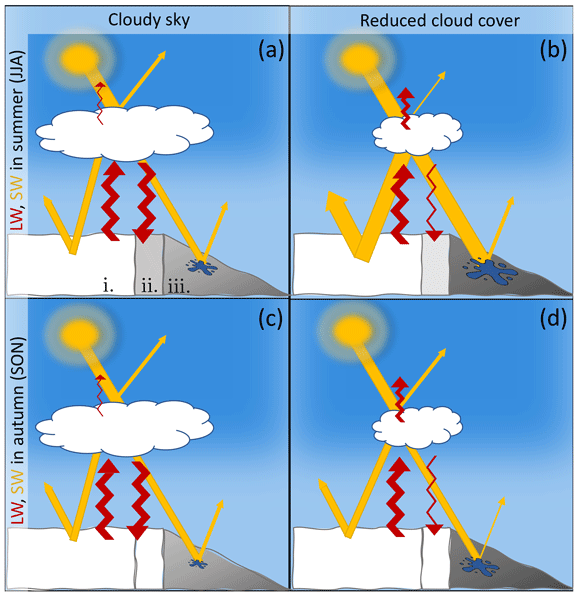
Torben Schmith, Peter Thejll, Peter Berg, Fredrik Boberg, Ole Bøssing Christensen, Bo Christiansen, Jens Hesselbjerg Christensen, Marianne Sloth Madsen, and Christian Steger
Hydrol. Earth Syst. Sci., 25, 273–290, https://doi.org/10.5194/hess-25-273-2021, https://doi.org/10.5194/hess-25-273-2021, 2021
Short summary
Short summary
European extreme precipitation is expected to change in the future; this is based on climate model projections. But, since climate models have errors, projections are uncertain. We study this uncertainty in the projections by comparing results from an ensemble of 19 climate models. Results can be used to give improved estimates of future extreme precipitation for Europe.
Helle Astrid Kjær, Patrick Zens, Ross Edwards, Martin Olesen, Ruth Mottram, Gabriel Lewis, Christian Terkelsen Holme, Samuel Black, Kasper Holst Lund, Mikkel Schmidt, Dorthe Dahl-Jensen, Bo Vinther, Anders Svensson, Nanna Karlsson, Jason E. Box, Sepp Kipfstuhl, and Paul Vallelonga
The Cryosphere Discuss., https://doi.org/10.5194/tc-2020-337, https://doi.org/10.5194/tc-2020-337, 2021
Manuscript not accepted for further review
Short summary
Short summary
We have reconstructed accumulation in 6 firn cores and 8 snow cores in Northern Greenland and compared with a regional Climate model over Greenland. We find the model underestimate precipitation especially in north-eastern part of the ice cap- an important finding if aiming to reconstruct surface mass balance.
Temperatures at 10 meters depth at 6 sites in Greenland were also determined and show a significant warming since the 1990's of 0.9 to 2.5 °C.
Cited articles
Aschwanden, A., Bartholomaus, T. C., Brinkerhoff, D. J., and Truffer, M.: Brief communication: A roadmap towards credible projections of ice sheet contribution to sea level, The Cryosphere, 15, 5705–5715, https://doi.org/10.5194/tc-15-5705-2021, 2021.
Bales, R. C., Guo, Q., Shen, D., McConnell, J. R., Du, G., Burkhart, J. F., Spikes, V. B., Hanna, E., and Cappelen, J.: Annual accumulation for Greenland updated using ice core data developed during 2000–2006 and analysis of daily coastal meteorological data, Journal of Geophysical Research-Atmospheres, 114, https://doi.org/10.1029/2008JD011208, 2009.
Berends, C. J., de Boer, B., and van de Wal, R. S. W.: Application of HadCM3@Bristolv1.0 simulations of paleoclimate as forcing for an ice-sheet model, ANICE2.1: set-up and benchmark experiments, Geosci. Model Dev., 11, 4657–4675, https://doi.org/10.5194/gmd-11-4657-2018, 2018.
Berends, C. J., Goelzer, H., Reerink, T. J., Stap, L. B., and van de Wal, R. S. W.: Benchmarking the vertically integrated ice-sheet model IMAU-ICE (version 2.0), Geosci. Model Dev., 15, 5667–5688, https://doi.org/10.5194/gmd-15-5667-2022, 2022.
Berends, C. J., van de Wal, R. S. W., van den Akker, T., and Lipscomb, W. H.: Compensating errors in inversions for subglacial bed roughness: same steady state, different dynamic response, The Cryosphere, 17, 1585–1600, https://doi.org/10.5194/tc-17-1585-2023, 2023.
Brady, E. C., Otto-Bliesner, B. L., Kay, J. E., and Rosenbloom, N.: Sensitivity to Glacial Forcing in the CCSM4, Journal of Climate, 26, 1901–1925, https://doi.org/10.1175/JCLI-D-11-00416.1, 2013.
Citterio, M. and Ahlstrøm, A. P.: Brief communication “The aerophotogrammetric map of Greenland ice masses”, The Cryosphere, 7, 445–449, https://doi.org/10.5194/tc-7-445-2013, 2013.
Copernicus Climate Change Service, Climate Data Store: Ice sheet velocity for Antarctica and Greenland derived from satellite observations, Copernicus Climate Change Service (C3S) Climate Data Store (CDS)[data set], https://doi.org/10.24381/cds.0b96b838, 2020.
Delhasse, A., Kittel, C., Amory, C., Hofer, S., van As, D., S. Fausto, R., and Fettweis, X.: Brief communication: Evaluation of the near-surface climate in ERA5 over the Greenland Ice Sheet, The Cryosphere, 14, 957–965, https://doi.org/10.5194/tc-14-957-2020, 2020.
Delhasse, A., Beckmann, J., Kittel, C., and Fettweis, X.: Coupling MAR (Modèle Atmosphérique Régional) with PISM (Parallel Ice Sheet Model) mitigates the positive melt–elevation feedback, The Cryosphere, 18, 633–651, https://doi.org/10.5194/tc-18-633-2024, 2024.
Durand, G., van den Broeke, M. R., Le Cozannet, G., Edwards, T. L., Holland, P. R., Jourdain, N. C., Marzeion, B., Mottram, R., Nicholls, R. J., Pattyn, F., Paul, F., Slangen, A. B. A., Winkelmann, R., Burgard, C., van Calcar, C. J., Barré, J.-B., Bataille, A., and Chapuis, A.: Sea-Level Rise: From Global Perspectives to Local Services, Frontiers in Marine Science, 8, 709595, https://doi.org/10.3389/fmars.2021.709595, 2022.
Edwards, T. L., Nowicki, S., Marzeion, B., Hock, R., Goelzer, H., Seroussi, H., Jourdain, N. C., Slater, D. A., Turner, F. E., Smith, C. J., McKenna, C. M., Simon, E., Abe-Ouchi, A., Gregory, J. M., Larour, E., Lipscomb, W. H., Payne, A. J., Shepherd, A., Agosta, C., Alexander, P., Albrecht, T., Anderson, B., Asay-Davis, X., Aschwanden, A., Barthel, A., Bliss, A., Calov, R., Chambers, C., Champollion, N., Choi, Y., Cullather, R., Cuzzone, J., Dumas, C., Felikson, D., Fettweis, X., Fujita, K., Galton-Fenzi, B. K., Gladstone, R., Golledge, N. R., Greve, R., Hattermann, T., Hoffman, M. J., Humbert, A., Huss, M., Huybrechts, P., Immerzeel, W., Kleiner, T., Kraaijenbrink, P., Le clec'h, S., Lee, V., Leguy, G. R., Little, C. M., Lowry, D. P., Malles, J. H., Martin, D. F., Maussion, F., Morlighem, M., O'Neill, J. F., Nias, I., Pattyn, F., Pelle, T., Price, S. F., Quiquet, A., Radić, V., Reese, R., Rounce, D. R., Rückamp, M., Sakai, A., Shafer, C., Schlegel, N. J., Shannon, S., Smith, R. S., Straneo, F., Sun, S., Tarasov, L., Trusel, L. D., Van Breedam, J., van de Wal, R., van den Broeke, M., Winkelmann, R., Zekollari, H., Zhao, C., Zhang, T., and Zwinger, T.: Projected land ice contributions to twenty-first-century sea level rise, Nature, 593, 74–82, https://doi.org/10.1038/s41586-021-03302-y, 2021.
Fettweis, X., Box, J. E., Agosta, C., Amory, C., Kittel, C., Lang, C., van As, D., Machguth, H., and Gallée, H.: Reconstructions of the 1900–2015 Greenland ice sheet surface mass balance using the regional climate MAR model, The Cryosphere, 11, 1015–1033, https://doi.org/10.5194/tc-11-1015-2017, 2017.
Fettweis, X., Hofer, S., Krebs-Kanzow, U., Amory, C., Aoki, T., Berends, C. J., Born, A., Box, J. E., Delhasse, A., Fujita, K., Gierz, P., Goelzer, H., Hanna, E., Hashimoto, A., Huybrechts, P., Kapsch, M.-L., King, M. D., Kittel, C., Lang, C., Langen, P. L., Lenaerts, J. T. M., Liston, G. E., Lohmann, G., Mernild, S. H., Mikolajewicz, U., Modali, K., Mottram, R. H., Niwano, M., Noël, B., Ryan, J. C., Smith, A., Streffing, J., Tedesco, M., van de Berg, W. J., van den Broeke, M., van de Wal, R. S. W., van Kampenhout, L., Wilton, D., Wouters, B., Ziemen, F., and Zolles, T.: GrSMBMIP: intercomparison of the modelled 1980–2012 surface mass balance over the Greenland Ice Sheet, The Cryosphere, 14, 3935–3958, https://doi.org/10.5194/tc-14-3935-2020, 2020.
Fox-Kemper, B., Hewitt, H. T., Xiao, C., Adalgeirsdottir, G., Drijfhout, S. S., Edwards, T. L., Golledge, N. R., Hemer, M., Kopp, R. E., Krinner, G., Mix, A., Notz, D., Nowicki, S., Nurhati, I. S., Ruiz, L., Sallee, J.-B., Slangen, A. B. A., and Yu, Y.: Climate Change 2021: The Physical Science Basis. Contribution of Working Group I to the Sixth Assessment Report of the Intergovernmental Panel on Climate Change, edited by: Masson-Delmotte, V., Zhai, P., Pirani, A., Connors, S. L., Péan, C., Berger, S., Caud, N., Chen, Y., Goldfarb, L., Gomis, M. I., Huang, M., Leitzell, K., Lonnoy, E., Matthews, J. B. R., Maycock, T. K., Waterfield, T., Yelekçi, O., Yu, R., and Zhou, B., Cambridge University Press, United Kingdom and New York, NY, USA, 1211–1362, https://doi.org/10.1017/9781009157896.011, 2021.
Franco, B., Fettweis, X., Lang, C., and Erpicum, M.: Impact of spatial resolution on the modelling of the Greenland ice sheet surface mass balance between 1990–2010, using the regional climate model MAR, The Cryosphere, 6, 695–711, https://doi.org/10.5194/tc-6-695-2012, 2012.
Fürst, J. J., Goelzer, H., and Huybrechts, P.: Effect of higher-order stress gradients on the centennial mass evolution of the Greenland ice sheet, The Cryosphere, 7, 183–199, https://doi.org/10.5194/tc-7-183-2013, 2013.
Fürst, J. J., Goelzer, H., and Huybrechts, P.: Ice-dynamic projections of the Greenland ice sheet in response to atmospheric and oceanic warming, The Cryosphere, 9, 1039–1062, https://doi.org/10.5194/tc-9-1039-2015, 2015.
Gillet-Chaulet, F., Gagliardini, O., Seddik, H., Nodet, M., Durand, G., Ritz, C., Zwinger, T., Greve, R., and Vaughan, D. G.: Greenland ice sheet contribution to sea-level rise from a new-generation ice-sheet model, The Cryosphere, 6, 1561–1576, https://doi.org/10.5194/tc-6-1561-2012, 2012.
Glaude, Q., Noel, B., Olesen, M., Van den Broeke, M., van de Berg, W. J., Mottram, R., Hansen, N., Delhasse, A., Amory, C., Kittel, C., Goelzer, H., and Fettweis, X.: A Factor Two Difference in 21st-Century Greenland Ice Sheet Surface Mass Balance Projections From Three Regional Climate Models Under a Strong Warming Scenario (SSP5-8.5), Geophysical Research Letters, 51, e2024GL111902, https://doi.org/10.1029/2024GL111902, 2024.
Goelzer, H.: Forcing for PROTECT Greenland ice sheet projections, NIRD RDA [data set], https://doi.org/10.11582/2025.prm9am5n, 2025a.
Goelzer, H.: Ice sheet model output fields from PROTECT Greenland ice sheet projections, NIRD RDA [data set], https://doi.org/10.11582/2025.dlmefxt5, 2025b.
Goelzer, H.: Greenland ice sheet projections for EU-project PROTECT, NIRD RDA [data set], https://doi.org/10.11582/2025.lf9m2wd0, 2025c.
Goelzer, H.: hgoelzer/protect-gris-atmos-forcing: v1.0, Zenodo [code], https://doi.org/10.5281/zenodo.17882933, 2025d.
Goelzer, H.: hgoelzer/protect-gris-generate-overshoot: v1.0, Zenodo [code], https://doi.org/10.5281/zenodo.17882454, 2025e.
Goelzer, H.: hgoelzer/protect-gris-generate-repeat: v1.0, Zenodo [code], https://doi.org/10.5281/zenodo.17882611, 2025f.
Goelzer, H.: hgoelzer/protect-gris-ocean-forcing: v1.0, Zenodo [code], https://doi.org/10.5281/zenodo.17882904, 2025g.
Goelzer, H.: hgoelzer/protect-gris-ocean-processing: v1.0, Zenodo [code], https://doi.org/10.5281/zenodo.17882890, 2025h.
Goelzer, H., Nowicki, S., Edwards, T., Beckley, M., Abe-Ouchi, A., Aschwanden, A., Calov, R., Gagliardini, O., Gillet-Chaulet, F., Golledge, N. R., Gregory, J., Greve, R., Humbert, A., Huybrechts, P., Kennedy, J. H., Larour, E., Lipscomb, W. H., Le clec'h, S., Lee, V., Morlighem, M., Pattyn, F., Payne, A. J., Rodehacke, C., Rückamp, M., Saito, F., Schlegel, N., Seroussi, H., Shepherd, A., Sun, S., van de Wal, R., and Ziemen, F. A.: Design and results of the ice sheet model initialisation experiments initMIP-Greenland: an ISMIP6 intercomparison, The Cryosphere, 12, 1433–1460, https://doi.org/10.5194/tc-12-1433-2018, 2018.
Goelzer, H., Nowicki, S., Payne, A., Larour, E., Seroussi, H., Lipscomb, W. H., Gregory, J., Abe-Ouchi, A., Shepherd, A., Simon, E., Agosta, C., Alexander, P., Aschwanden, A., Barthel, A., Calov, R., Chambers, C., Choi, Y., Cuzzone, J., Dumas, C., Edwards, T., Felikson, D., Fettweis, X., Golledge, N. R., Greve, R., Humbert, A., Huybrechts, P., Le clec'h, S., Lee, V., Leguy, G., Little, C., Lowry, D. P., Morlighem, M., Nias, I., Quiquet, A., Rückamp, M., Schlegel, N.-J., Slater, D. A., Smith, R. S., Straneo, F., Tarasov, L., van de Wal, R., and van den Broeke, M.: The future sea-level contribution of the Greenland ice sheet: a multi-model ensemble study of ISMIP6, The Cryosphere, 14, 3071–3096, https://doi.org/10.5194/tc-14-3071-2020, 2020a.
Goelzer, H., Coulon, V., Pattyn, F., de Boer, B., and van de Wal, R.: Brief communication: On calculating the sea-level contribution in marine ice-sheet models , The Cryosphere, 14, 833–840, https://doi.org/10.5194/tc-14-833-2020, 2020b.
Goelzer, H., Noël, B. P. Y., Edwards, T. L., Fettweis, X., Gregory, J. M., Lipscomb, W. H., van de Wal, R. S. W., and van den Broeke, M. R.: Remapping of Greenland ice sheet surface mass balance anomalies for large ensemble sea-level change projections, The Cryosphere, 14, 1747–1762, https://doi.org/10.5194/tc-14-1747-2020, 2020c.
Goelzer, H., Langebroek, P. M., Born, A., Hofer, S., Haubner, K., Petrini, M., Leguy, G., Lipscomb, W. H., and Thayer-Calder, K.: Interactive coupling of a Greenland ice sheet model in NorESM2, Geosci. Model Dev., 18, 7853–7867, https://doi.org/10.5194/gmd-18-7853-2025, 2025.
Goldberg, D. N.: A variationally derived, depth-integrated approximation to a higher-order glaciological flow model, Journal of Glaciology, 57, 157–170, https://doi.org/10.3189/002214311795306763, 2011.
Hersbach, H., Bell, B., Berrisford, P., Hirahara, S., Horányi, A., Muñoz-Sabater, J., Nicolas, J., Peubey, C., Radu, R., Schepers, D., Simmons, A., Soci, C., Abdalla, S., Abellan, X., Balsamo, G., Bechtold, P., Biavati, G., Bidlot, J., Bonavita, M., De Chiara, G., Dahlgren, P., Dee, D., Diamantakis, M., Dragani, R., Flemming, J., Forbes, R., Fuentes, M., Geer, A., Haimberger, L., Healy, S., Hogan, R. J., Hólm, E., Janisková, M., Keeley, S., Laloyaux, P., Lopez, P., Lupu, C., Radnoti, G., de Rosnay, P., Rozum, I., Vamborg, F., Villaume, S., and Thépaut, J.-N.: The ERA5 global reanalysis, Quarterly Journal of the Royal Meteorological Society, 146, 1999–2049, https://doi.org/10.1002/qj.3803, 2020.
Hofer, S., Lang, C., Amory, C., Tedstone, A., Fettweis, X., Kittel, C., and Delhasse, A.: Greater Greenland Ice Sheet contribution to global sea level rise in CMIP6, Nature Communications, 11, https://doi.org/10.1038/s41467-020-20011-8, 2020.
Howat, I. M., Negrete, A., and Smith, B. E.: The Greenland Ice Mapping Project (GIMP) land classification and surface elevation data sets, The Cryosphere, 8, 1509–1518, https://doi.org/10.5194/tc-8-1509-2014, 2014.
Huybrechts, P.: Sea-level changes at the LGM from ice-dynamic reconstructions of the Greenland and Antarctic ice sheets during the glacial cycles, Quaternary Science Reviews, 21, 203–231, https://doi.org/10.1016/S0277-3791(01)00082-8, 2002.
Joughin, I., Smith, B. E., Howat, I. M., Scambos, T., and Moon, T.: Greenland flow variability from ice-sheet-wide velocity mapping, Journal of Glaciology, 56, 415–430, https://doi.org/10.3189/002214310792447734, 2010.
Langen, P. L., Fausto, R. S., Vandecrux, B., Mottram, R. H., and Box, J. E.: Liquid Water Flow and Retention on the Greenland Ice Sheet in the Regional Climate Model HIRHAM5: Local and Large-Scale Impacts, Frontiers in Earth Science, 4, 110, https://doi.org/10.3389/feart.2016.00110, 2017.
Le clec'h, S., Quiquet, A., Charbit, S., Dumas, C., Kageyama, M., and Ritz, C.: A rapidly converging initialisation method to simulate the present-day Greenland ice sheet using the GRISLI ice sheet model (version 1.3), Geosci. Model Dev., 12, 2481–2499, https://doi.org/10.5194/gmd-12-2481-2019, 2019.
Lipscomb, W. H., Price, S. F., Hoffman, M. J., Leguy, G. R., Bennett, A. R., Bradley, S. L., Evans, K. J., Fyke, J. G., Kennedy, J. H., Perego, M., Ranken, D. M., Sacks, W. J., Salinger, A. G., Vargo, L. J., and Worley, P. H.: Description and evaluation of the Community Ice Sheet Model (CISM) v2.1, Geosci. Model Dev., 12, 387–424, https://doi.org/10.5194/gmd-12-387-2019, 2019.
MacFarling Meure, C., Etheridge, D., Trudinger, C., Steele, P., Langenfelds, R., van Ommen, T., Smith, A., and Elkins, J.: Law Dome CO2, CH4 and N2O ice core records extended to 2000 years BP, Geophysical Research Letters, 33, https://doi.org/10.1029/2006GL026152, 2006.
Morlighem, M., Williams, C. N., Rignot, E., An, L., Arndt, J. E., Bamber, J. L., Catania, G., Chauché, N., Dowdeswell, J. A., Dorschel, B., Fenty, I., Hogan, K., Howat, I., Hubbard, A., Jakobsson, M., Jordan, T. M., Kjeldsen, K. K., Millan, R., Mayer, L., Mouginot, J., Noël, B. P. Y. Y., O'Cofaigh, C., Palmer, S., Rysgaard, S., Seroussi, H., Siegert, M. J., Slabon, P., Straneo, F., van den Broeke, M. R., Weinrebe, W., Wood, M., Zinglersen, K. B., Cofaigh, C. Ó., Palmer, S., Rysgaard, S., Seroussi, H., Siegert, M. J., Slabon, P., Straneo, F., van den Broeke, M. R., Weinrebe, W., Wood, M., and Zinglersen, K. B.: BedMachine v3: Complete bed topography and ocean bathymetry mapping of Greenland from multi-beam echo sounding combined with mass conservation, Geophysical Research Letters, 44, 11,051-11,061, https://doi.org/10.1002/2017GL074954, 2017.
Mottram, R., Boberg, F., Langen, P., Yang, S., Rodehacke, C., Christensen, J. H., and Madsen, M. S.: Surface mass balance of the Greenland ice sheet in the regional climate model HIRHAM5: Present state and future prospects, Low Temperature Science, 75, 105–115, https://doi.org/10.14943/lowtemsci.75.105, 2017.
Muntjewerf, L., Petrini, M., Vizcaino, M., Ernani da Silva, C., Sellevold, R., Scherrenberg, M. D. W., Thayer-Calder, K., Bradley, S. L., Lenaerts, J. T. M., Lipscomb, W. H., and Lofverstrom, M.: Greenland Ice Sheet Contribution to 21st Century Sea Level Rise as Simulated by the Coupled CESM2.1-CISM2.1, Geophysical Research Letters, 47, https://doi.org/10.1029/2019GL086836, 2020.
Noël, B., van de Berg, W. J., Machguth, H., Lhermitte, S., Howat, I., Fettweis, X., and van den Broeke, M. R.: A daily, 1 km resolution data set of downscaled Greenland ice sheet surface mass balance (1958–2015), The Cryosphere, 10, 2361–2377, https://doi.org/10.5194/tc-10-2361-2016, 2016.
Noël, B., van de Berg, W. J., van Wessem, J. M., van Meijgaard, E., van As, D., Lenaerts, J. T. M., Lhermitte, S., Kuipers Munneke, P., Smeets, C. J. P. P., van Ulft, L. H., van de Wal, R. S. W., and van den Broeke, M. R.: Modelling the climate and surface mass balance of polar ice sheets using RACMO2 – Part 1: Greenland (1958–2016), The Cryosphere, 12, 811–831, https://doi.org/10.5194/tc-12-811-2018, 2018.
Noël, B., van Kampenhout, L., van de Berg, W. J., Lenaerts, J. T. M., Wouters, B., and van den Broeke, M. R.: Brief communication: CESM2 climate forcing (1950–2014) yields realistic Greenland ice sheet surface mass balance, The Cryosphere, 14, 1425–1435, https://doi.org/10.5194/tc-14-1425-2020, 2020.
Noël, B., Lenaerts, J. T. M., Lipscomb, W. H., Thayer-Calder, K., and van den Broeke, M. R.: Peak refreezing in the Greenland firn layer under future warming scenarios, Nature Communications, 13, 6870, https://doi.org/10.1038/s41467-022-34524-x, 2022.
Nowicki, S. M. J., Payne, A., Larour, E., Seroussi, H., Goelzer, H., Lipscomb, W., Gregory, J., Abe-Ouchi, A., and Shepherd, A.: Ice Sheet Model Intercomparison Project (ISMIP6) contribution to CMIP6, Geosci. Model Dev., 9, 4521–4545, https://doi.org/10.5194/gmd-9-4521-2016, 2016.
Nowicki, S., Goelzer, H., Seroussi, H., Payne, A. J., Lipscomb, W. H., Abe-Ouchi, A., Agosta, C., Alexander, P., Asay-Davis, X. S., Barthel, A., Bracegirdle, T. J., Cullather, R., Felikson, D., Fettweis, X., Gregory, J. M., Hattermann, T., Jourdain, N. C., Kuipers Munneke, P., Larour, E., Little, C. M., Morlighem, M., Nias, I., Shepherd, A., Simon, E., Slater, D., Smith, R. S., Straneo, F., Trusel, L. D., van den Broeke, M. R., and van de Wal, R.: Experimental protocol for sea level projections from ISMIP6 stand-alone ice sheet models, The Cryosphere, 14, 2331–2368, https://doi.org/10.5194/tc-14-2331-2020, 2020.
O'Neill, B. C., Tebaldi, C., van Vuuren, D. P., Eyring, V., Friedlingstein, P., Hurtt, G., Knutti, R., Kriegler, E., Lamarque, J.-F., Lowe, J., Meehl, G. A., Moss, R., Riahi, K., and Sanderson, B. M.: The Scenario Model Intercomparison Project (ScenarioMIP) for CMIP6, Geosci. Model Dev., 9, 3461–3482, https://doi.org/10.5194/gmd-9-3461-2016, 2016.
Payne, A. J., Nowicki, S., Abe-Ouchi, A., Agosta, C., Alexander, P., Albrecht, T., Asay-Davis, X., Aschwanden, A., Barthel, A., Bracegirdle, T. J., Calov, R., Chambers, C., Choi, Y., Cullather, R., Cuzzone, J., Dumas, C., Edwards, T. L., Felikson, D., Fettweis, X., Galton-Fenzi, B. K., Goelzer, H., Gladstone, R., Golledge, N. R., Gregory, J. M., Greve, R., Hattermann, T., Hoffman, M. J., Humbert, A., Huybrechts, P., Jourdain, N. C., Kleiner, T., Munneke, P. K., Larour, E., Le clec'h, S., Lee, V., Leguy, G., Lipscomb, W. H., Little, C. M., Lowry, D. P., Morlighem, M., Nias, I., Pattyn, F., Pelle, T., Price, S. F., Quiquet, A., Reese, R., Rückamp, M., Schlegel, N. J., Seroussi, H., Shepherd, A., Simon, E., Slater, D., Smith, R. S., Straneo, F., Sun, S., Tarasov, L., Trusel, L. D., Van Breedam, J., van de Wal, R., van den Broeke, M., Winkelmann, R., Zhao, C., Zhang, T., and Zwinger, T.: Future Sea Level Change Under Coupled Model Intercomparison Project Phase 5 and Phase 6 Scenarios From the Greenland and Antarctic Ice Sheets, Geophysical Research Letters, 48, 1–8, https://doi.org/10.1029/2020GL091741, 2021.
Rahlves, C., Goelzer, H., Born, A., and Langebroek, P. M.: Historically consistent mass loss projections of the Greenland ice sheet, The Cryosphere, 19, 1205–1220, https://doi.org/10.5194/tc-19-1205-2025, 2025a.
Rahlves, C., Goelzer, H., Born, A., and Langebroek, P. M.: Investigating the multi-millennial evolution and stability of the Greenland ice sheet using remapped surface mass balance forcing, The Cryosphere, 19, 6403–6419, https://doi.org/10.5194/tc-19-6403-2025, 2025.
Rantanen, M., Karpechko, A. Yu., Lipponen, A., Nordling, K., Hyvärinen, O., Ruosteenoja, K., Vihma, T., and Laaksonen, A.: The Arctic has warmed nearly four times faster than the globe since 1979, Communications Earth & Environment, 3, 168, https://doi.org/10.1038/s43247-022-00498-3, 2022.
Rohmer, J., Thieblemont, R., Le Cozannet, G., Goelzer, H., and Durand, G.: Improving interpretation of sea-level projections through a machine-learning-based local explanation approach, The Cryosphere, 16, 4637–4657, https://doi.org/10.5194/tc-16-4637-2022, 2022.
Rohmer, J., Goelzer, H., Edwards, T. L., Le Cozannet, G., and Durand, G.: Lessons for multi-model ensemble design drawn from emulator experiments: application to a large ensemble for 2100 sea level contributions of the Greenland ice sheet, The Cryosphere, 19, 6421–6444, https://doi.org/10.5194/tc-19-6421-2025, 2025.
Scherrenberg, M. D. W., Berends, C. J., Stap, L. B., and van de Wal, R. S. W.: Modelling feedbacks between the Northern Hemisphere ice sheets and climate during the last glacial cycle, Clim. Past, 19, 399–418, https://doi.org/10.5194/cp-19-399-2023, 2023.
Schoof, C.: The effect of cavitation on glacier sliding, Proceedings of the Royal Society A: Mathematical, Physical and Engineering Sciences, 461, 609–627, https://doi.org/10.1098/rspa.2004.1350, 2005.
Shapiro, N. M. and Ritzwoller, M. H.: Inferring surface heat flux distributions guided by a global seismic model: particular application to Antarctica, Earth and Planetary Science Letters, 223, 213–224, https://doi.org/10.1016/j.epsl.2004.04.011, 2004.
Singarayer, J. S. and Valdes, P. J.: High-latitude climate sensitivity to ice-sheet forcing over the last 120 kyr, Quaternary Science Reviews, 29, 43–55, https://doi.org/10.1016/j.quascirev.2009.10.011, 2010.
Slater, D. A., Straneo, F., Felikson, D., Little, C. M., Goelzer, H., Fettweis, X., and Holte, J.: Estimating Greenland tidewater glacier retreat driven by submarine melting, The Cryosphere, 13, 2489–2509, https://doi.org/10.5194/tc-13-2489-2019, 2019.
Slater, D. A., Felikson, D., Straneo, F., Goelzer, H., Little, C. M., Morlighem, M., Fettweis, X., and Nowicki, S.: Twenty-first century ocean forcing of the Greenland ice sheet for modelling of sea level contribution, The Cryosphere, 14, 985–1008, https://doi.org/10.5194/tc-14-985-2020, 2020.
Smith, R. S., Mathiot, P., Siahaan, A., Lee, V., Cornford, S. L., Gregory, J. M., Payne, A. J., Jenkins, A., Holland, P. R., Ridley, J. K., and Jones, C. G.: Coupling the U. K. Earth System Model to Dynamic Models of the Greenland and Antarctic Ice Sheets, Journal of Advances in Modeling Earth Systems, 13, e2021MS002520, https://doi.org/10.1029/2021MS002520, 2021.
van den Broeke, M., Box, J., Fettweis, X., Hanna, E., Noël, B., Tedesco, M., van As, D., van de Berg, W. J., and van Kampenhout, L.: Greenland Ice Sheet Surface Mass Loss: Recent Developments in Observation and Modeling, Current Climate Change Reports, 3, 345–356, https://doi.org/10.1007/s40641-017-0084-8, 2017.
Short summary
We present an ensemble of ice sheet model projections for the Greenland ice sheet. The focus is on providing projections that improve our understanding of the range future sea-level rise and the inherent uncertainties over the next 100 to 300 years. Compared to earlier work we more fully account for some of the uncertainties in sea-level projections. We include a wider range of climate model output, more climate change scenarios and we extend projections schematically up to year 2300.
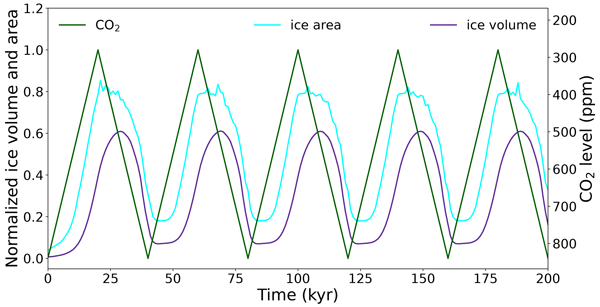
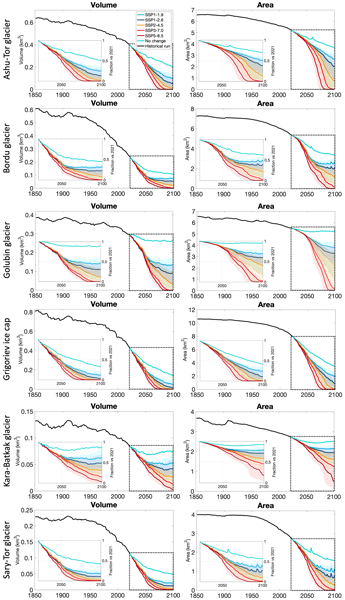
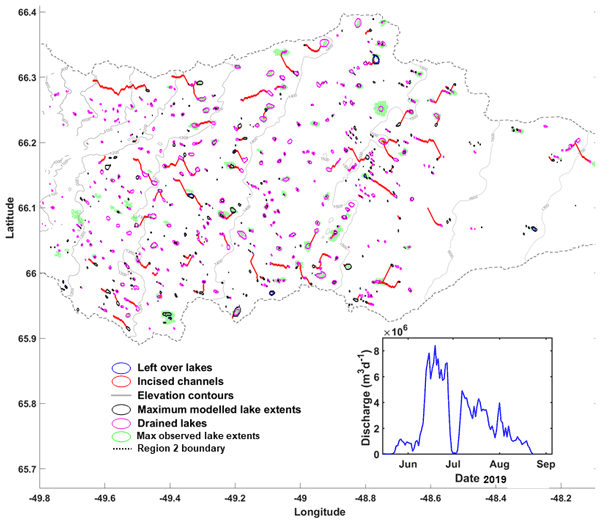
We present an ensemble of ice sheet model projections for the Greenland ice sheet. The focus is...