Articles | Volume 18, issue 11
https://doi.org/10.5194/tc-18-5301-2024
Research article
 | 
19 Nov 2024
Research article |  | 19 Nov 2024

Two-way coupling between ice flow and channelized subglacial drainage enhances modeled marine-ice-sheet retreat

George Lu and Jonathan Kingslake

Related authors

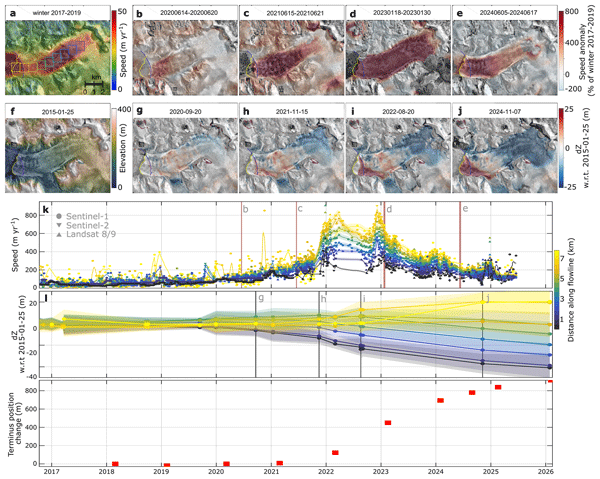
Glacier surges on James Ross Island, Antarctica, and their relationship with climate
Benjamin J. Davison, Andrew J. Sole, Gregoire Guillet, Douglas I. Benn, Jonathan Kingslake, Jeremy C. Ely, Stephen J. Livingstone, Christopher D. Stringer, Jonathan L. Carrivick, and Anna E. Hogg
EGUsphere, https://doi.org/10.5194/egusphere-2026-1894,https://doi.org/10.5194/egusphere-2026-1894, 2026
This preprint is open for discussion and under review for The Cryosphere (TC).
Short summary
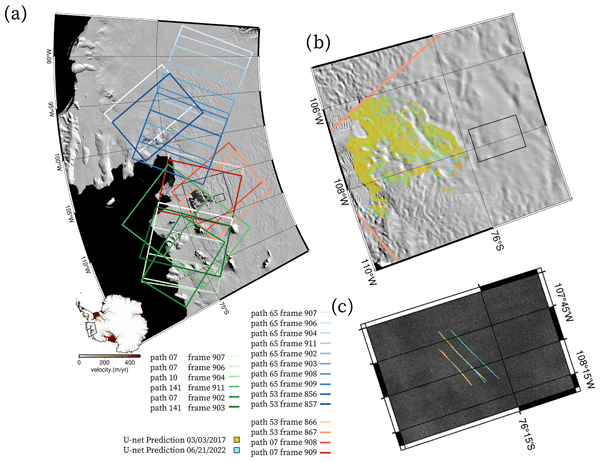
Inland migration of near-surface crevasses in the Amundsen Sea Sector, West Antarctica
Andrew O. Hoffman, Knut Christianson, Ching-Yao Lai, Ian Joughin, Nicholas Holschuh, Elizabeth Case, Jonathan Kingslake, and the GHOST science team
The Cryosphere, 19, 1353–1372, https://doi.org/10.5194/tc-19-1353-2025,https://doi.org/10.5194/tc-19-1353-2025, 2025
Short summary
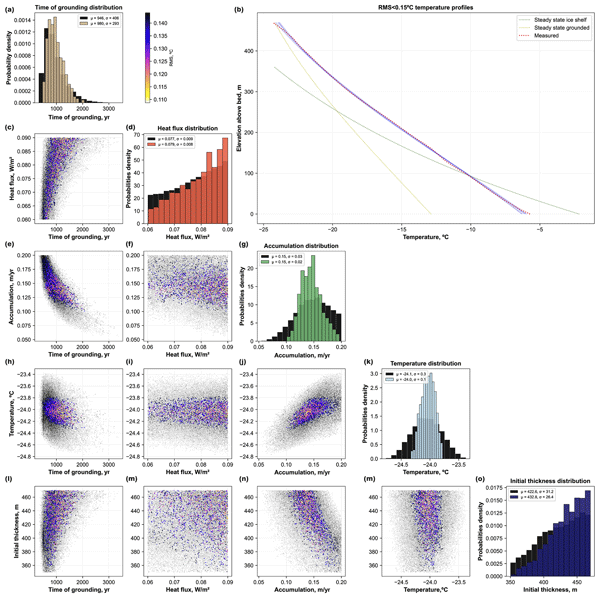
Geothermal heat flux is the dominant source of uncertainty in englacial-temperature-based dating of ice rise formation
Aleksandr Montelli and Jonathan Kingslake
The Cryosphere, 17, 195–210, https://doi.org/10.5194/tc-17-195-2023,https://doi.org/10.5194/tc-17-195-2023, 2023
Short summary
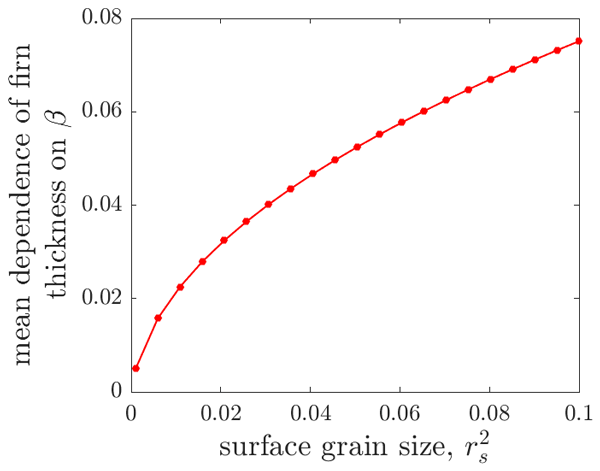
Grain-size evolution controls the accumulation dependence of modelled firn thickness
Jonathan Kingslake, Robert Skarbek, Elizabeth Case, and Christine McCarthy
The Cryosphere, 16, 3413–3430, https://doi.org/10.5194/tc-16-3413-2022,https://doi.org/10.5194/tc-16-3413-2022, 2022
Short summary
Long-period variability in ice-dammed glacier outburst floods due to evolving catchment geometry
Amy Jenson, Jason M. Amundson, Jonathan Kingslake, and Eran Hood
The Cryosphere, 16, 333–347, https://doi.org/10.5194/tc-16-333-2022,https://doi.org/10.5194/tc-16-333-2022, 2022
Short summary

Cited articles

Alley, R. B., Anandakrishnan, S., Bentley, C. R., and Lord, N.: A water-piracy hypothesis for the stagnation of Ice Stream C, Antarctica, Ann. Glaciol., 20, 187–194, https://doi.org/10.3189/1994AoG20-1-187-194, 1994. a
Arnold, N. and Sharp, M.: Flow variability in the Scandinavian ice sheet: modelling the coupling between ice sheet flow and hydrology, Quaternary Sci. Rev., 21, 485–502, https://doi.org/10.1016/S0277-3791(01)00059-2, 2002. a
Arthern, R. J. and Gudmundsson, G. H.: Initialization of ice-sheet forecasts viewed as an inverse Robin problem, J. Glaciol., 56, 527–533, https://doi.org/10.3189/002214310792447699, 2010. a, b
Arthern, R. J. and Williams, C. R.: The sensitivity of West Antarctica to the submarine melting feedback, Geophys. Res. Lett., 44, 2352–2359, https://doi.org/10.1002/2017GL072514, 2017. a
Arthern, R. J., Hindmarsh, R. C. A., and Williams, C. R.: Flow speed within the Antarctic ice sheet and its controls inferred from satellite observations, J. Geophys. Res.-Earth, 120, 1171–1188, https://doi.org/10.1002/2014JF003239, 2015. a, b, c
Download
Short summary
Water below ice sheets affects ice-sheet motion, while the evolution of ice sheets likewise affects the water below. We create a model that allows for water and ice to affect each other and use it to see how this coupling or lack thereof may impact ice-sheet retreat. We find that coupling an evolving water system with the ice sheet results in more retreat than if we assume unchanging conditions under the ice, which indicates a need to better represent the effects of water in ice-sheet models.
Share