
Articles | Volume 20, issue 4
https://doi.org/10.5194/tc-20-2393-2026
© Author(s) 2026. This work is distributed under
the Creative Commons Attribution 4.0 License.
the Creative Commons Attribution 4.0 License.
https://doi.org/10.5194/tc-20-2393-2026
© Author(s) 2026. This work is distributed under
the Creative Commons Attribution 4.0 License.
the Creative Commons Attribution 4.0 License.
Research article
| 
24 Apr 2026
Research article |
| 24 Apr 2026
| 24 Apr 2026
Explicit representation of liquid water retention over bare ice using the SURFEX/ISBA-Crocus model: implications for mass balance at Mera glacier (Nepal)
Audrey Goutard
CORRESPONDING AUTHOR

Institut des Géosciences de l’Environnement (IGE), IRD, CNRS, UGA, Grenoble, France
Marion Réveillet
Institut des Géosciences de l’Environnement (IGE), IRD, CNRS, UGA, Grenoble, France
Fanny Brun
Institut des Géosciences de l’Environnement (IGE), IRD, CNRS, UGA, Grenoble, France
Delphine Six
Institut des Géosciences de l’Environnement (IGE), IRD, CNRS, UGA, Grenoble, France
Kevin Fourteau
Université Grenoble Alpes, Université de Toulouse, Météo-France, CNRS, CNRM, Centre d’Études de la Neige, Grenoble, France
Charles Amory
Institut des Géosciences de l’Environnement (IGE), IRD, CNRS, UGA, Grenoble, France
Xavier Fettweis
University of Liège, Laboratory of Climatology, Department of Geography, SPHERE research unit, Liège, Belgium
Mathieu Fructus
Université Grenoble Alpes, Université de Toulouse, Météo-France, CNRS, CNRM, Centre d’Études de la Neige, Grenoble, France
Arbindra Khadka
Institut des Géosciences de l’Environnement (IGE), IRD, CNRS, UGA, Grenoble, France
International Centre for Integrated Mountain Development, Kathmandu, Nepal
Central Department of Hydrology and Meteorology, Tribhuvan University, Kirtipur, Nepal
Matthieu Lafaysse
Université Grenoble Alpes, Université de Toulouse, Météo-France, CNRS, CNRM, Centre d’Études de la Neige, Grenoble, France
Related authors
Navaraj Pokhrel, Patrick Wagnon, Fanny Brun, Arbindra Khadka, Tom Matthews, Audrey Goutard, Dibas Shrestha, Baker Perry, and Marion Réveillet
The Cryosphere, 18, 5913–5920, https://doi.org/10.5194/tc-18-5913-2024, https://doi.org/10.5194/tc-18-5913-2024, 2024
Short summary
Short summary
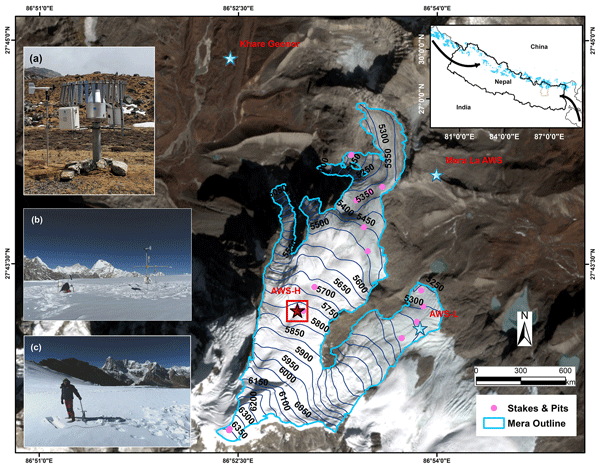
We studied snow processes in the accumulation area of Mera Glacier (central Himalaya, Nepal) by deploying a cosmic ray counting sensor that allows one to track the evolution of snow water equivalent. We suspect significant surface melting, water percolation, and refreezing within the snowpack, which might be missed by traditional mass balance surveys.
Neige Calonne, Pascal Hagenmuller, Rémi Granger, Lisa Bouvet, Kévin Fourteau, Julien Brondex, François Tuzet, Yves Lejeune, Anne Dufour, Mathieu Fructus, Teruo Aoki, and Marie Dumont
Earth Syst. Sci. Data Discuss., https://doi.org/10.5194/essd-2026-718, https://doi.org/10.5194/essd-2026-718, 2026
Preprint under review for ESSD
Short summary
Short summary
We collected weekly measurements of snow microstructural properties over two winters at Col de Porte in the French Alps, a relatively warm alpine site, using complementary techniques including X-ray tomography, the SnowMicroPen, and optical instruments. The dataset captures snowpack evolution at fine vertical resolution and is a valuable resource for snow model evaluation and instrument comparisons. It also provides guidance for future snow monitoring campaigns in warm mountain environments.
Marin Kneib, Patrick Wagnon, Laurent Arnaud, Louise Balmas, Olivier Laarman, Bruno Jourdain, Amaury Dehecq, Emmanuel Lemeur, Fanny Brun, Andrea Kneib-Walter, Ilaria Santin, Laurane Charrier, Thierry Faug, Giulia Mazzotti, Antoine Rabatel, Delphine Six, and Daniel Farinotti
The Cryosphere, 20, 5327–5344, https://doi.org/10.5194/tc-20-5327-2026, https://doi.org/10.5194/tc-20-5327-2026, 2026
Short summary
Short summary
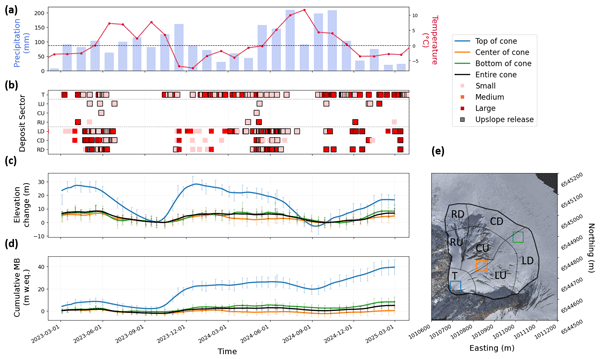
Avalanches are vital for glacier survival, yet their impact is difficult to quantify. We used low-cost cameras and drones to monitor an avalanche cone in the French Alps for two years. By accounting for ice flow, we found that avalanches can deposit 30 meters of snow annually – 50 times more than normal snowfall. This high-frequency data reveals that these cones fill until reaching a specific steepness, after which new snow slides further down to the base.
Tom Matthews, Baker Perry, Ben Graves, Fanny Brun, Maria Sanolaria-Otin, Navaraj Pokhrel, Arbindra Khadka, Dibas Shrestha, Ludving Cano, Aris Kwadijk, Walter Immereel, Brandt Maxwell, and Anton Seimon
EGUsphere, https://doi.org/10.5194/egusphere-2026-5200, https://doi.org/10.5194/egusphere-2026-5200, 2026
This preprint is open for discussion and under review for The Cryosphere (TC).
Short summary
Short summary
Extreme precipitation shapes hazards and water resources in high mountains, but is rarely observed directly. On 4 October 2025, weather stations on Mt. Everest recorded one of the most extreme snowfall events ever measured. The storm revealed that Himalayan snowfall extremes can be far larger than previously documented, and that intense snowfall can cool the atmosphere sufficiently to prevent rain at impact-sensitive elevations, complicating the picture of how warming will affect future storms.
Thomas Pauze, Axel Bouchet, Isabelle Gouttevin, Aaron Boone, Mathieu Fructus, Matthieu Lafaysse, Erwan Le Gac, Agnès Rivière, and Yves Lejeune
EGUsphere, https://doi.org/10.5194/egusphere-2026-4137, https://doi.org/10.5194/egusphere-2026-4137, 2026
This preprint is open for discussion and under review for Geoscientific Model Development (GMD).
Short summary
Short summary
In mid-altitude mountainous areas, snow acts as a water reservoir and is impacted by forest: to represent it we use a model called MEB/Crocus. It has been developed in boreal forests. Its results at a mid-altitude alpine site (the Col de Porte) were not convincing. We modify parametrizations that govern the behavior of intercepted snow to have a more realistic representation. We improve results of simulated snowpack under forest at Col de Porte and do not change performance in boreal sites.
Ben Tyler, Anaïs Orsi, Cécile Davrinche, and Charles Amory
EGUsphere, https://doi.org/10.5194/egusphere-2026-4032, https://doi.org/10.5194/egusphere-2026-4032, 2026
This preprint is open for discussion and under review for The Cryosphere (TC).
Short summary
Short summary
Using a regional climate model, we quantify the proportion of Antarctic near-surface warming caused by the change of the surface temperature inversion strength under a high-emissions scenario. The inversion contributes a minority of warming but drives spatial variability in warming, which we attribute to sea ice loss and atmospheric stratification. Sea ice loss could explain why Earth’s poles will warm asymmetrically, and the inversion may cause discrepancies between records of past climate.
Diego Monteiro, Léo Viallon-Galinier, Kévin Fourteau, Oscar Dick, and Pascal Hagenmuller
The Cryosphere, 20, 4515–4536, https://doi.org/10.5194/tc-20-4515-2026, https://doi.org/10.5194/tc-20-4515-2026, 2026
Short summary
Short summary
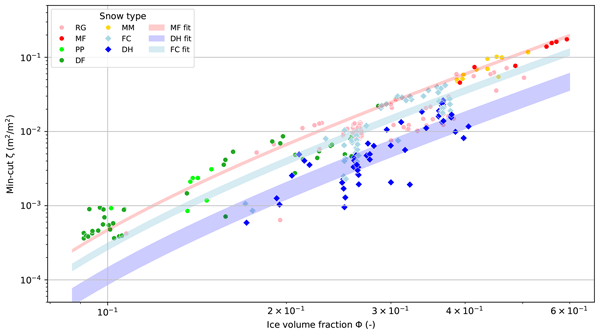
This research aims to improve dry-snow slab avalanche forecasts, particularly the propagation of cracks in weak layers, as current models rely on uncertain and difficult-to-measure parameters. We combined snowpack simulations with field measurements to link fracture energy to measurable and modelable snow properties. This new approach better reproduces observed crack lengths and allows weak layers to be tracked throughout the season, thereby improving operational avalanche risk assessment.
Christian Torres, Deniz Bozkurt, Vincent Favier, Victoire Buffet, Claudio Bravo, Xavier Fettweis, Thomas Dethinne, Antoine Rabatel, Maximiliano Viale, Sang-Jong Park, and Jorge Arigony-Neto
EGUsphere, https://doi.org/10.5194/egusphere-2026-3508, https://doi.org/10.5194/egusphere-2026-3508, 2026
This preprint is open for discussion and under review for The Cryosphere (TC).
Short summary
Short summary
We investigated periods when unusually warm conditions in Patagonia occurred at the same time as precipitation events on the Antarctic Peninsula. By combining observations and simulations, we identified 127 such events between 1980 and 2022. These events increased ice melt in Patagonia while enhancing accumulation on the Antarctic Peninsula, highlighting how large-scale weather patterns can simultaneously affect ice-covered regions in different ways.
Marco Tedesco, Racheet Matai, and Xavier Fettweis
The Cryosphere, 20, 4235–4253, https://doi.org/10.5194/tc-20-4235-2026, https://doi.org/10.5194/tc-20-4235-2026, 2026
Short summary
Short summary
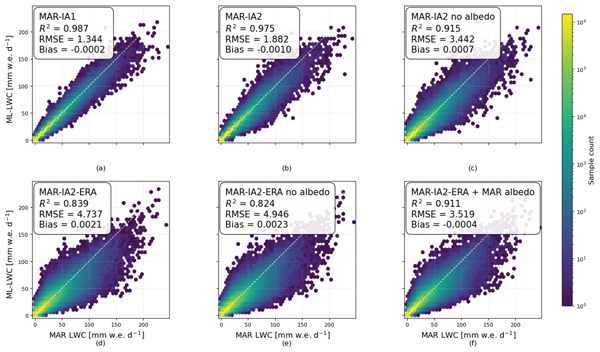
We developed a machine learning emulator of a climate model simulating melting over Greenland that performs as well as the original model but it is much faster. We show that this emulator can be used as powerful tools to complement regional climate models by enabling computationally efficient ensemble simulations and physically interpretable attribution of past and future Greenland surface melt. Development of regional climate models should go hand in hand with ML-based tools.
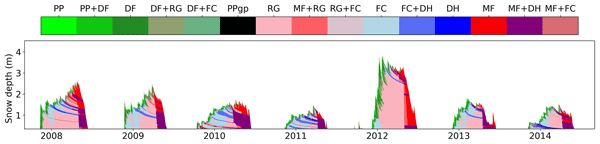
Matthieu Lafaysse, Marie Dumont, Basile De Fleurian, Mathieu Fructus, Rafife Nheili, Léo Viallon-Galinier, Matthieu Baron, Aaron Boone, Axel Bouchet, Julien Brondex, Carlo Carmagnola, Bertrand Cluzet, Kévin Fourteau, Ange Haddjeri, Pascal Hagenmuller, Giulia Mazzotti, Marie Minvielle, Samuel Morin, Louis Quéno, Léon Roussel, Pierre Spandre, François Tuzet, and Vincent Vionnet
Geosci. Model Dev., 19, 6273–6334, https://doi.org/10.5194/gmd-19-6273-2026, https://doi.org/10.5194/gmd-19-6273-2026, 2026
Short summary
Short summary
This article is a comprehensive description of the 3.0.2 stable release of the Crocus snowpack model. It describes various new implementations since the last reference article in 2012 and a review of the available scientific evaluations and applications of the model. This provides guidance for the future of numerical snow modelling.
Guillaume Timmermans, Brice Noël, Christoph Kittel, Thomas Dethinne, Nicolas Ghilain, and Xavier Fettweis
EGUsphere, https://doi.org/10.5194/egusphere-2026-2341, https://doi.org/10.5194/egusphere-2026-2341, 2026
Short summary
Short summary
We assess how well a regional climate model reproduces changes in the mass of the Greenland Ice Sheet due to surface processes, an important driver of sea level rise. By comparing model results with observations, we show that high-resolution simulations closely match reality. Coarser simulations are less detailed near the edges but remain reliable overall. A resolution of 10 kilometers provides a good balance between accuracy and computing cost for long-term projections.
Paul Fournier, Antoine Blanc, Juliette Blanchet, and Matthieu Lafaysse
EGUsphere, https://doi.org/10.5194/egusphere-2026-2497, https://doi.org/10.5194/egusphere-2026-2497, 2026
Short summary
Short summary
When rain falls on snow, the combined effect of rainfall and snowmelt can generate flooding. Using hourly weather data across the French Alps over 1958–2024, we identified and characterized such rain-on-snow events and linked them to documented natural hazard events. While these events have become less frequent overall due to shorter snow seasons, the most intense ones have shifted toward lower, more populated elevations, meaning they are increasingly likely to impact communities.
Ian Simpson, Edward Hanna, Ryan S. Williams, Linh Luu, Andrew Orr, Julie Jones, Xavier Fettweis, Jose Abraham Torres Alavez, Ole Bøssing Christensen, Ella Gilbert, Sid Gumber, Christoph Kittel, Sihan Li, Damien Maure, Ruth Mottram, Tony Phillips, Willem Jan van de Berg, and Kristiina Verro
EGUsphere, https://doi.org/10.5194/egusphere-2026-2270, https://doi.org/10.5194/egusphere-2026-2270, 2026
Short summary
Short summary
The warming trend in global temperatures has potential to result in accelerated break up of the Antarctic ice shelves, which would contribute to rising sea levels. Here we present a novel database of Antarctic extreme weather events over a selection of the Antarctic ice shelves. We examine air temperature, precipitation, wind and surface pressure. In addition, we examine trends in the frequency of extreme events and the links with weather patterns around Antarctica.
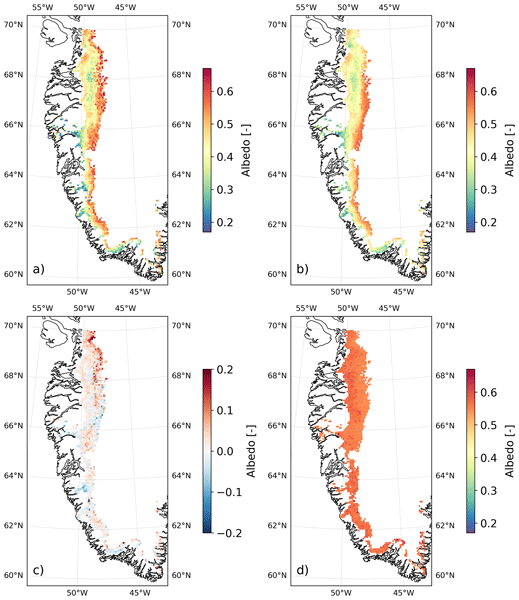
Raf Antwerpen, Marco Tedesco, Pierre Gentine, Willem Jan van de Berg, and Xavier Fettweis
The Cryosphere, 20, 3131–3149, https://doi.org/10.5194/tc-20-3131-2026, https://doi.org/10.5194/tc-20-3131-2026, 2026
Short summary
Short summary
We study why Greenland ice melts faster by improving how ice brightness is represented. This is important because it controls how much sunlight is absorbed by the ice. Using satellite data and a new transparent machine learning method trained with climate model information, we capture how the shape of the ice sheet, temperature, and meltwater change ice brightness. Our approach outperforms existing climate models and can reduce uncertainty in future sea level rise projections.
Giulia Mazzotti, Félix Vaccaro, Antoine Courteaud, Mathieu Fructus, Jan Magnusson, Isabelle Gouttevin, Jari-Pekka Nousu, and Matthieu Lafaysse
EGUsphere, https://doi.org/10.5194/egusphere-2026-1464, https://doi.org/10.5194/egusphere-2026-1464, 2026
Short summary
Short summary
This study evaluates spatial simulations with the new snow model MEB-Crocus over mountainous, forested terrain. In lack of forest snow observations over large areas, simulations are assessed against simulations with the state-of-the art model FSM2oshd. Results show that the data characterizing the vegetation is as important for model performance as the mathematical description of physical processes. These insights inform future improvements of MEB-Crocus for its application to alpine regions.
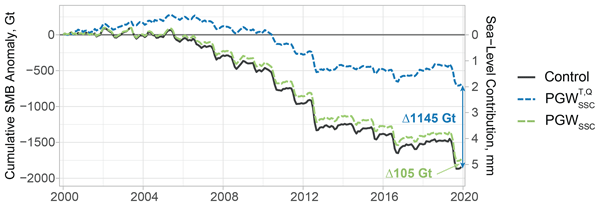
Jonathon R. Preece, Patrick Alexander, Thomas L. Mote, Gabriel J. Kooperman, Xavier Fettweis, and Marco Tedesco
The Cryosphere, 20, 2871–2894, https://doi.org/10.5194/tc-20-2871-2026, https://doi.org/10.5194/tc-20-2871-2026, 2026
Short summary
Short summary
Surface melt of the Greenland Ice Sheet has increased dramatically since the turn of the century, aided by an increase in persistent atmospheric circulation patterns that promote anomalously warm conditions. Through modeling experiments, this study shows that surface mass loss would have been reduced by 62% relative to historical conditions if this shift in atmospheric circulation would have occurred under the lower average temperatures of a preindustrial climate.
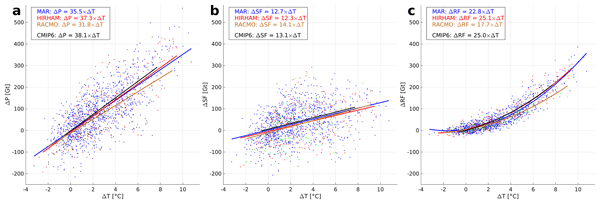
Fredrik Boberg, Xavier Fettweis, Nicolaj Hansen, Ruth Mottram, and Michiel R. van den Broeke
The Cryosphere, 20, 2947–2960, https://doi.org/10.5194/tc-20-2947-2026, https://doi.org/10.5194/tc-20-2947-2026, 2026
Short summary
Short summary
An ensemble of regional climate model simulations is used to estimate the 21st century change in precipitation on the Greenland ice sheet. For the end of the century, the change is in the range 40 to 170 Gt per year, depending on the emission scenario. Using annual values of 2 m air temperature and precipitation, we estimate an increase in precipitation of 35 Gt per year for every degree of warming.
Ian Castellanos, Martin Ménégoz, Juliette Blanchet, Julien Beaumet, Hubert Gallée, Eduardo Moreno-Chamarro, Chantal Staquet, and Xavier Fettweis
Earth Syst. Dynam., 17, 581–605, https://doi.org/10.5194/esd-17-581-2026, https://doi.org/10.5194/esd-17-581-2026, 2026
Short summary
Short summary
The Alps host glaciers, distinct ecosystems, socio-economic interests and water resources that are being impacted by climate change. In this study, we aim at understanding how warming occurs in the Alps in projected scenarios and what physical processes drive it. We find under these scenarios that elevations around the snowline will warm faster than elsewhere, because snow retreats to higher elevations. Indeed, snow slows down warming due to its high albedo and the energy consumed to melt it.
Ella Gilbert, José Abraham Torres-Alavez, Marte G. Hofsteenge, Willem Jan van de Berg, Fredrik Boberg, Ole Bøssing Christensen, Christiaan Timo van Dalum, Xavier Fettweis, Siddharth Gumber, Nicolaj Hansen, Christoph Kittel, Clara Lambin, Damien Maure, Ruth Mottram, Martin Olesen, Andrew Orr, Tony Phillips, Maurice van Tiggelen, Kristiina Verro, and Priscilla A. Mooney
The Cryosphere, 20, 2629–2658, https://doi.org/10.5194/tc-20-2629-2026, https://doi.org/10.5194/tc-20-2629-2026, 2026
Short summary
Short summary
Here we present a new dataset – the PolarRES ensemble – of four state-of-the-art regional climate models, which capture the full complexity of Antarctica's climate. The ensemble out-performs other available tools, advancing our ability to explore Antarctic climate. While it still has limitations, the PolarRES ensemble offers a novel and exciting way of evaluating climate processes and features, and we encourage researchers to use the data, which are freely available.
Kévin Fourteau, Julien Brondex, Clément Cancès, and Marie Dumont
Geosci. Model Dev., 19, 3193–3212, https://doi.org/10.5194/gmd-19-3193-2026, https://doi.org/10.5194/gmd-19-3193-2026, 2026
Short summary
Short summary
The percolation of liquid water down snowpacks is a complex phenomenon, and its representation can sometimes be complicated for snowpack models. The goal of this article is to transpose some state-of-the-art strategies used for modeling liquid percolation in other media (such as rocks or soil) into snowpack models. With this, snowpack models can be made more efficient, requiring less time and power to perform their computation.
Nicola Imperatore, Simon Gascoin, Matthieu Lafaysse, Marie Dumont, Adrien Mauss, Stéphane Guével, and Jean-Baptiste Hernandez
EGUsphere, https://doi.org/10.5194/egusphere-2026-1122, https://doi.org/10.5194/egusphere-2026-1122, 2026
Short summary
Short summary
Daily satellite snow cover observations are beneficial for water management in mountain regions, but it's crucial to understand their uncertainties. We evaluate the next-generation NASA constellation in mountainous terrain using higher-resolution satellite imagery as reference. We find an overall consistent performance across the platforms and combine their data to reduce cloud cover. These results support a confident transition and open new opportunities in snowpack modeling.
Laurane Charrier, Nathan Lioret, Fanny Brun, Amaury Dehecq, Romain Millan, Anuar Togaibekov, Andrea Walpersdorf, Diego Cusicanqui, and Antoine Rabatel
EGUsphere, https://doi.org/10.5194/egusphere-2026-946, https://doi.org/10.5194/egusphere-2026-946, 2026
Short summary
Short summary
Sub-annual glacier surface velocity derived from remote sensing images are receiving increasing attention. In the meantime, systematic seasonal errors (i.e. biases) have been reported in time series derived from optical images on various landforms, such as landslides or dunes. The extent to which such biases affect glacier velocity maps remains poorly investigated. Here, we propose characterizing the amplitude and spatial distribution of these seasonal biases.
Benjamin Heurgue, Charles Amory, Christoph Kittel, Fredrik Boberg, Gaël Durand, Vincent Favier, Xavier Fettweis, Quentin Glaude, Heiko Goelzer, Nicolaj Hansen, Nicolas C. Jourdain, Ruth Mottram, Martin Olesen, Willem Jan Van de Berg, Michiel R. Van den Broeke, and René R. Wijngaard
EGUsphere, https://doi.org/10.5194/egusphere-2026-624, https://doi.org/10.5194/egusphere-2026-624, 2026
Short summary
Short summary
We studied how the Antarctic ice sheet surface mass balance may change by 2100 using three high-resolution climate models forced by the same future climate scenario. While the models agree for present-day conditions, they project very different futures, especially over floating ice shelves. These differences mainly come from how melting, refreezing, and temperature are represented. Our results show that future sea level projections strongly depend on how well models simulate today’s climate.
Kevin Fourteau, Kaoane Jondeau, Clément Cancès, and Marie Dumont
EGUsphere, https://doi.org/10.5194/egusphere-2026-510, https://doi.org/10.5194/egusphere-2026-510, 2026
Short summary
Short summary
In physics, entropy and the second principle of thermodynamics are related to the notion of stability. In applied mathematics, the same idea of entropy can be transposed to computer models, to ensure that they do not spontaneously oscillate or diverge. The goal of this work is to apply this type of methods to snowpack modelling. We show that entropy-consistent, and thus more robust models, can be designed following a few general criteria.

Horst Machguth, Andrew Tedstone, Peter Kuipers Munneke, Max Brils, Brice Noël, Nicole Clerx, Nicolas Jullien, Xavier Fettweis, and Michiel van den Broeke
The Cryosphere, 20, 427–452, https://doi.org/10.5194/tc-20-427-2026, https://doi.org/10.5194/tc-20-427-2026, 2026
Short summary
Short summary
Due to increasing air temperatures, surface melt expands to higher elevations on the Greenland ice sheet. This is visible on satellite imagery in the form of rivers of meltwater running across the surface of the ice sheet. We compare model results of meltwater at high elevations on the ice sheet to satellite observations. We find that each of the models shows strengths and weaknesses. A detailed look into the model results reveals potential reasons for the differences between models.
Chloë Marie Paice, Xavier Fettweis, and Philippe Huybrechts
The Cryosphere, 20, 309–332, https://doi.org/10.5194/tc-20-309-2026, https://doi.org/10.5194/tc-20-309-2026, 2026
Short summary
Short summary
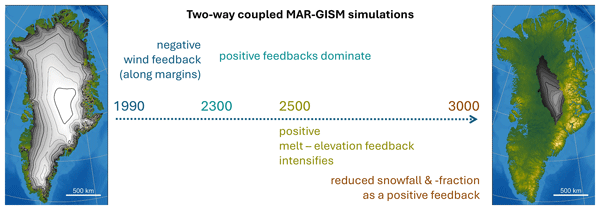
To study Greenland ice sheet–atmosphere interactions, we coupled an ice sheet model to a regional climate model and performed simulations of differing coupling complexity over 1000 years under a high-warming climate scenario. They reveal that at first melt at the ice sheet margin is reduced by changing wind patterns. But over time, as the ice sheet melts and its surface lowers, precipitation patterns and cloudiness also change and amplify ice mass loss over the entire ice sheet.
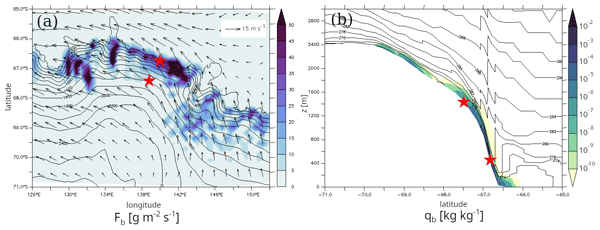
Étienne Vignon, Nicolas Chiabrando, Cécile Agosta, Charles Amory, Valentin Wiener, Justine Charrel, Thomas Dubos, and Christophe Genthon
Geosci. Model Dev., 19, 239–259, https://doi.org/10.5194/gmd-19-239-2026, https://doi.org/10.5194/gmd-19-239-2026, 2026
Short summary
Short summary
The erosion of surface snow by the wind is an important process for the Antarctic surface mass balance. This study presents the first development of a parameterisation of blowing snow for a global climate model. Simulations avec evaluated using measurements in Antarctica. Results show an overall decrease of the snow accumulation in the escarpment region of the ice sheet due to snow erosion and an increase at the coast due to blowing snow deposition and increase in precipitation.

Heiko Goelzer, Constantijn J. Berends, Fredrik Boberg, Gael Durand, Tamsin L. Edwards, Xavier Fettweis, Fabien Gillet-Chaulet, Quentin Glaude, Philippe Huybrechts, Sébastien Le clec'h, Ruth Mottram, Brice Noël, Martin Olesen, Charlotte Rahlves, Jeremy Rohmer, Michiel van den Broeke, and Roderik S. W. van de Wal
The Cryosphere, 19, 6887–6906, https://doi.org/10.5194/tc-19-6887-2025, https://doi.org/10.5194/tc-19-6887-2025, 2025
Short summary
Short summary
We present an ensemble of ice sheet model projections for the Greenland ice sheet. The focus is on providing projections that improve our understanding of the range future sea-level rise and the inherent uncertainties over the next 100 to 300 years. Compared to earlier work we more fully account for some of the uncertainties in sea-level projections. We include a wider range of climate model output, more climate change scenarios and we extend projections schematically up to year 2300.
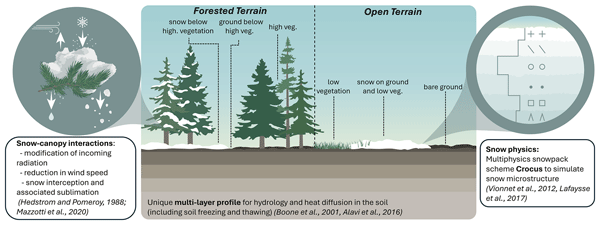
Vincent Vionnet, Nicolas R. Leroux, Vincent Fortin, Maria Abrahamowicz, Georgina Woolley, Giulia Mazzotti, Manon Gaillard, Matthieu Lafaysse, Alain Royer, Florent Domine, Nathalie Gauthier, Nick Rutter, Chris Derksen, and Stéphane Bélair
Geosci. Model Dev., 18, 9119–9147, https://doi.org/10.5194/gmd-18-9119-2025, https://doi.org/10.5194/gmd-18-9119-2025, 2025
Short summary
Short summary
Snow microstructure controls snowpack properties, but most land surface models overlook this factor. To support future satellite missions, we created a new land surface model based on the Crocus scheme that simulates snow microstructure. Key improvements include better snow albedo representation, enhanced Arctic snow modeling, and improved forest module to capture Canada's diverse snow conditions. Results demonstrate improved simulations of snow density and melt across large regions of Canada.
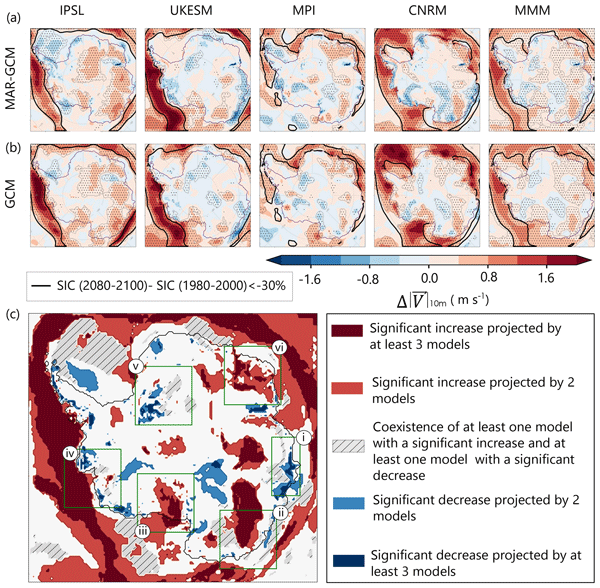
Cécile Davrinche, Anaïs Orsi, Charles Amory, Christoph Kittel, and Cécile Agosta
The Cryosphere, 19, 6023–6042, https://doi.org/10.5194/tc-19-6023-2025, https://doi.org/10.5194/tc-19-6023-2025, 2025
Short summary
Short summary
We analyse changes in Antarctic winter surface winds projected by 4 models. Depending on the area and model, changes on the continent by 2100 reveal opposing trends. Nevertheless, models agree on a strengthening of surface winds in Adélie Land for example and a weakening in some other areas such as the Amundsen region. We attribute the strengthening of near-surface winds to changes in the large-sale atmospheric circulation and the weakening to changes in the structure of the lower atmosphere.
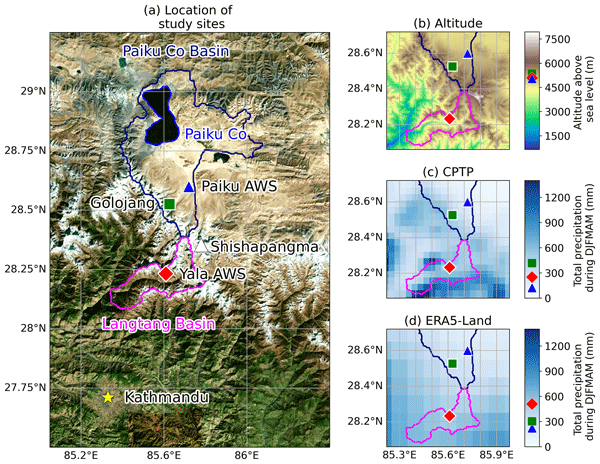
Titouan Biget, Fanny Brun, Walter Immerzeel, Léo Martin, Hamish Pritchard, Emily Collier, Yanbin Lei, and Tandong Yao
The Cryosphere, 19, 5863–5870, https://doi.org/10.5194/tc-19-5863-2025, https://doi.org/10.5194/tc-19-5863-2025, 2025
Short summary
Short summary
This study explore the precipitation in the southern Tibetan plateau using the water pressure of an high altitude lake and meteorological models and shows that snowfall could be much stronger on the Plateau than what is predicted by the models.
Léon Roussel, Marie Dumont, Marion Réveillet, Delphine Six, Marin Kneib, Pierre Nabat, Kévin Fourteau, Diego Monteiro, Simon Gascoin, Emmanuel Thibert, Antoine Rabatel, Jean-Emmanuel Sicart, Mylène Bonnefoy, Luc Piard, Olivier Laarman, Bruno Jourdain, Mathieu Fructus, Matthieu Vernay, and Matthieu Lafaysse
The Cryosphere, 19, 5201–5230, https://doi.org/10.5194/tc-19-5201-2025, https://doi.org/10.5194/tc-19-5201-2025, 2025
Short summary
Short summary
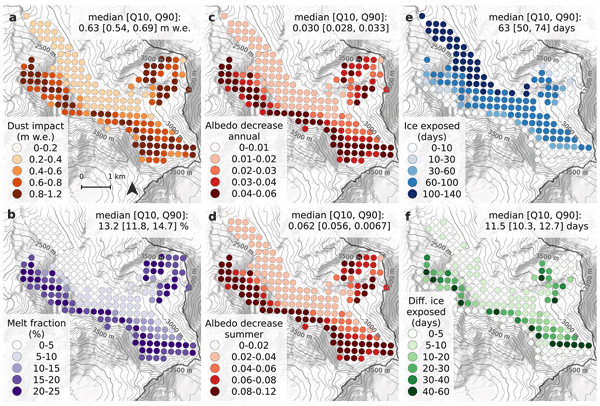
Saharan dust deposits frequently turn alpine glaciers orange. Mineral dust reduces snow albedo and increases snow and glaciers melt rate. Using physical modeling, we quantified the impact of dust on the Argentière Glacier over the period 2019–2022. We found that the contribution of mineral dust to the melt represents between 8 % and 16 % of Argentière Glacier summer melt. At specific locations, the impact of dust over one year can rise to an equivalent of 1.2 m of melted ice.
Sanne B. M. Veldhuijsen, Willem Jan van de Berg, Peter Kuipers Munneke, Nicolaj Hansen, Fredrik Boberg, Christoph Kittel, Charles Amory, and Michiel R. van den Broeke
The Cryosphere, 19, 5157–5173, https://doi.org/10.5194/tc-19-5157-2025, https://doi.org/10.5194/tc-19-5157-2025, 2025
Short summary
Short summary
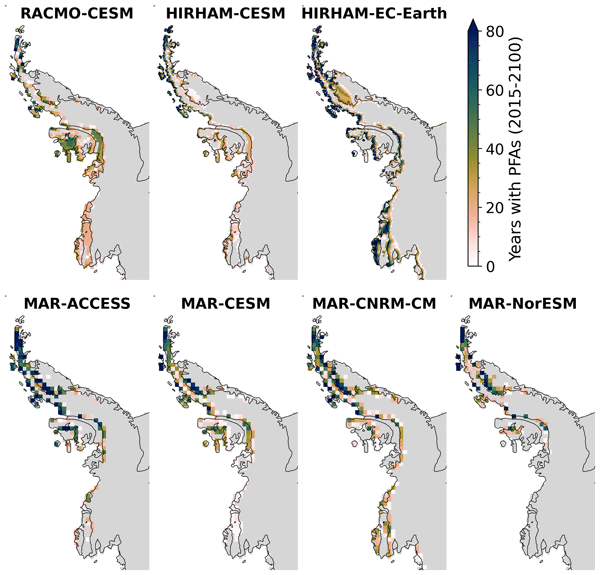
Perennial firn aquifers (PFAs), year-round bodies of liquid water within firns, can potentially impact ice-shelf and ice-sheet stability. We developed a fast XGBoost firn emulator to predict the 21st-century distribution of PFAs in Antarctica for 12 climatic forcing datasets. Our findings suggest that, in low-emission scenarios, PFAs remain confined to the Antarctic Peninsula. However, in a high-emission scenario, PFAs are projected to expand to a region in West Antarctica and East Antarctica.
Luc Beraud, Fanny Brun, Amaury Dehecq, Romain Hugonnet, and Prashant Shekhar
The Cryosphere, 19, 5075–5094, https://doi.org/10.5194/tc-19-5075-2025, https://doi.org/10.5194/tc-19-5075-2025, 2025
Short summary
Short summary
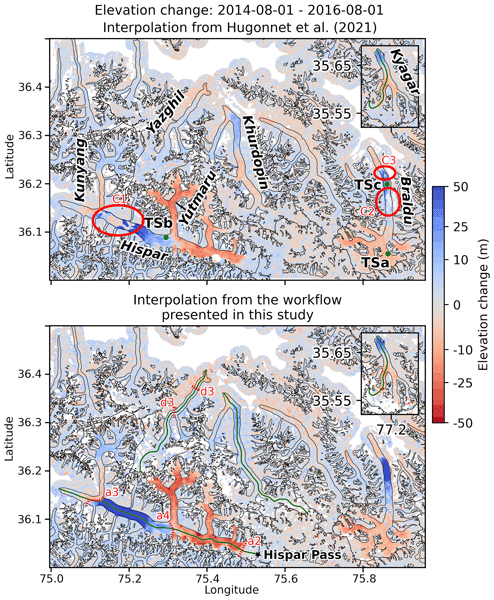
This study introduces a new workflow to process the elevation time series of glacier surges, an ice flow instability. Applied to a dense, 20-year satellite dataset of glacier surface elevation, the method filters and interpolates these changes on a monthly scale, revealing detailed patterns and estimates of mass transport. The dataset produced by this method allows for a more accurate and a remarkably detailed description of glacier surges at the scale of a large region.
Thomas Dethinne, Nicolas Ghilain, Christoph Kittel, Benjamin Lecart, Xavier Fettweis, and François Jonard
EGUsphere, https://doi.org/10.5194/egusphere-2025-3907, https://doi.org/10.5194/egusphere-2025-3907, 2025
Short summary
Short summary
This study replace standard vegetation input of a regional climate model with a satellite-based vegetation dataset to assess how vegetation influences climate during extreme events and to test the sensitivity of the model. The results show a non-linear sensitivity to vegetation, and using an observation-based vegetation input allows for a better representation of the extreme events, highlight the need for an advanced representation of vegetation in climate model to improve climate predictions.
Laurane Charrier, Amaury Dehecq, Lei Guo, Fanny Brun, Romain Millan, Nathan Lioret, Luke Copland, Nathan Maier, Christine Dow, and Paul Halas
The Cryosphere, 19, 4555–4583, https://doi.org/10.5194/tc-19-4555-2025, https://doi.org/10.5194/tc-19-4555-2025, 2025
Short summary
Short summary
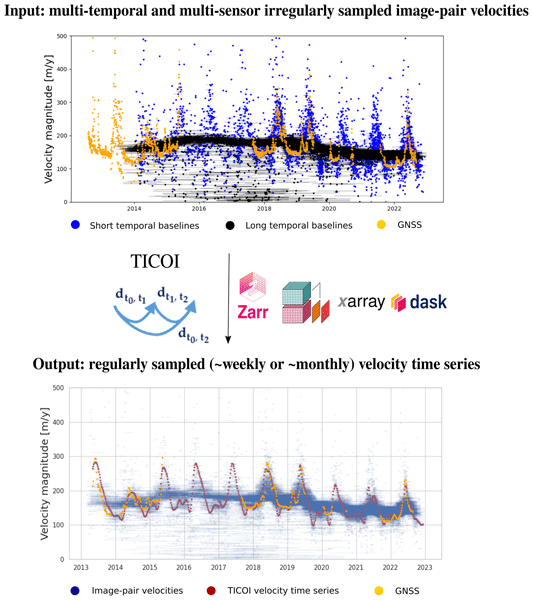
While global annual glacier velocities are openly accessible, sub-annual velocity time series are still lacking. This hinders our ability to understand flow processes and the integration of these observations in numerical models. We introduce an open source Python package called TICOI (Temporal Inversion using linear Combinations of Observations, and Interpolation) to fuse multi-temporal and multi-sensor image-pair velocities produced by different processing chains to produce standardized sub-annual velocity products.
Kristiina Verro, Cecilia Äijälä, Roberta Pirazzini, Ruzica Dadic, Damien Maure, Willem Jan van de Berg, Giacomo Traversa, Christiaan T. van Dalum, Petteri Uotila, Xavier Fettweis, Biagio Di Mauro, and Milla Johansson
The Cryosphere, 19, 4409–4436, https://doi.org/10.5194/tc-19-4409-2025, https://doi.org/10.5194/tc-19-4409-2025, 2025
Short summary
Short summary
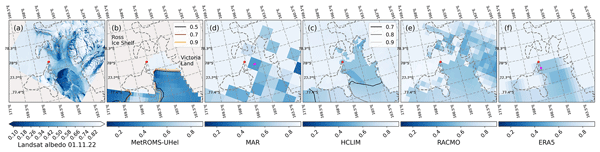
Accurately representing Antarctic sea ice is essential for reliable climate and ocean model predictions. We evaluated how different models simulate the sea ice's sunlight reflectivity (called albedo) using field and satellite data. Models with simple albedo schemes performed well in limited cases but missed key processes. The advanced scheme in the MetROMS-UHel ocean model provided the most accurate results, including observed day–night albedo changes observed during a field campaign.
Zhengwen Yan, Jiangjun Ran, Pavel Ditmar, C. K. Shum, Roland Klees, Patrick Smith, and Xavier Fettweis
Earth Syst. Sci. Data, 17, 4253–4275, https://doi.org/10.5194/essd-17-4253-2025, https://doi.org/10.5194/essd-17-4253-2025, 2025
Short summary
Short summary
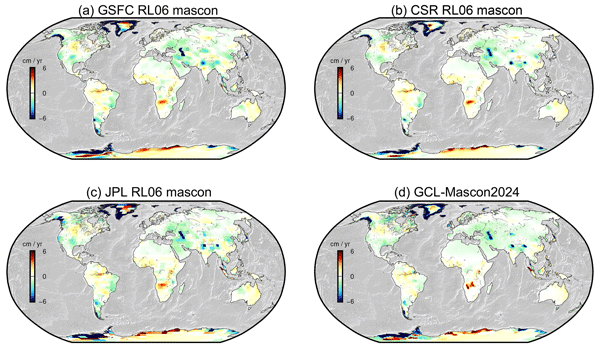
The Gravity Recovery And Climate Experiment (GRACE) mission has greatly improved our understanding of changes in Earth's gravity field over time. A novel mass concentration (mascon) dataset, GCL-Mascon2024, was determined by leveraging the short-arc approach, advanced spatial constraints, a frequency-dependent noise processing strategy, and parameterization-integrating natural boundaries, aiming to enhance accuracy for monitoring mass transportation on Earth.
Weiran Li, Stef Lhermitte, Bert Wouters, Cornelis Slobbe, Max Brils, and Xavier Fettweis
The Cryosphere, 19, 3419–3442, https://doi.org/10.5194/tc-19-3419-2025, https://doi.org/10.5194/tc-19-3419-2025, 2025
Short summary
Short summary
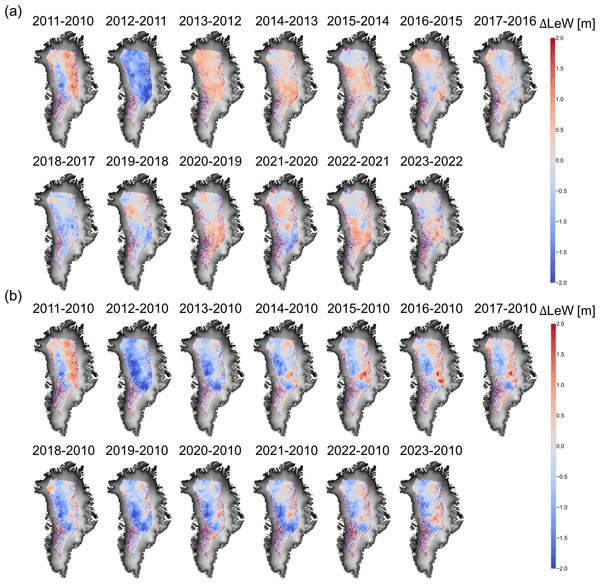
Due to recurrent melt and refreezing events in recent decades, the snow conditions over Greenland have changed. To observe this, we use a parameter (leading edge width; LeW) derived from satellite altimetry and analyse its spatial and temporal variations. By comparing the LeW variations with modelled firn parameters, we concluded that the 2012 melt event and the recent and increasingly frequent melt events have a long-lasting impact on the volume scattering of Greenland firn.
Zacharie Barrou Dumont, Simon Gascoin, Jordi Inglada, Andreas Dietz, Jonas Köhler, Matthieu Lafaysse, Diego Monteiro, Carlo Carmagnola, Arthur Bayle, Jean-Pierre Dedieu, Olivier Hagolle, and Philippe Choler
The Cryosphere, 19, 2407–2429, https://doi.org/10.5194/tc-19-2407-2025, https://doi.org/10.5194/tc-19-2407-2025, 2025
Short summary
Short summary
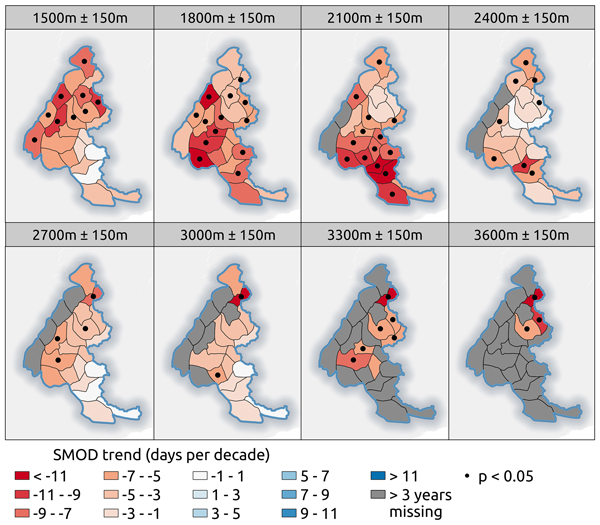
We generated annual maps of snow melt-out days at 20 m resolution over a period of 38 years from 10 different satellites. This study fills a knowledge gap regarding the evolution of mountain snow in Europe by covering a much longer period and characterizing trends at much higher resolutions than previous studies. We found a trend for earlier melt-out with average reductions of 5.51 d per decade over the French Alps and 4.04 d per decade over the Pyrenees for the period 1986–2023.
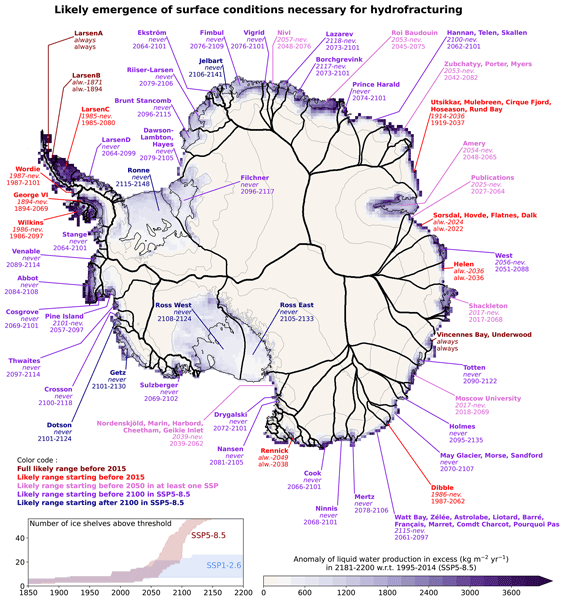
Nicolas C. Jourdain, Charles Amory, Christoph Kittel, and Gaël Durand
The Cryosphere, 19, 1641–1674, https://doi.org/10.5194/tc-19-1641-2025, https://doi.org/10.5194/tc-19-1641-2025, 2025
Short summary
Short summary
A mixed statistical–physical approach is used to reproduce the behaviour of a regional climate model. From that, we estimate the contribution of snowfall and melting at the surface of the Antarctic Ice Sheet to changes in global mean sea level. We also investigate the impact of surface melting in a warmer climate on the stability of the Antarctic ice shelves that provide back stress on the ice flow to the ocean.
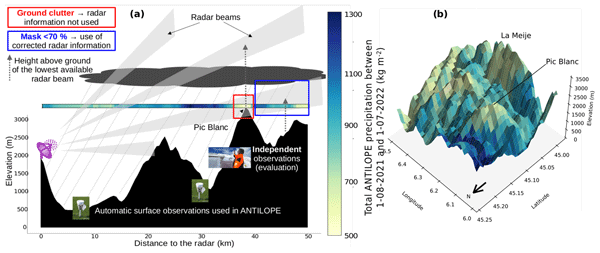
Matthieu Vernay, Matthieu Lafaysse, and Clotilde Augros
Atmos. Meas. Tech., 18, 1731–1755, https://doi.org/10.5194/amt-18-1731-2025, https://doi.org/10.5194/amt-18-1731-2025, 2025
Short summary
Short summary
This paper provides a comprehensive evaluation of the quality of radar-based precipitation estimation in mountainous areas and presents a method to mitigate the main shortcomings identified. It then compares three different ensemble analysis methods that combine radar-based precipitation estimates with forecasts from an ensemble numerical weather prediction model.
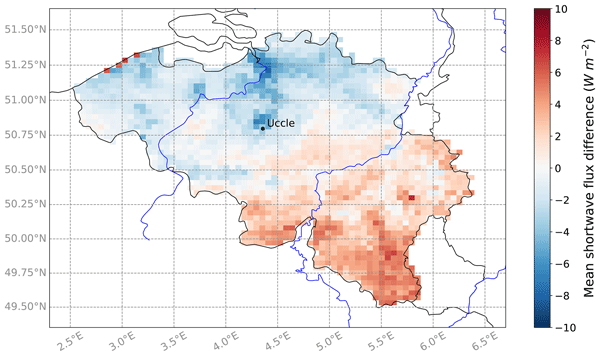
Jean-François Grailet, Robin J. Hogan, Nicolas Ghilain, David Bolsée, Xavier Fettweis, and Marilaure Grégoire
Geosci. Model Dev., 18, 1965–1988, https://doi.org/10.5194/gmd-18-1965-2025, https://doi.org/10.5194/gmd-18-1965-2025, 2025
Short summary
Short summary
The MAR (Modèle Régional Atmosphérique) is a regional climate model used for weather forecasting and studying the climate over various regions. This paper presents an update of MAR thanks to which it can precisely decompose solar radiation, in particular in the UV (ultraviolet) and photosynthesis ranges, both being critical to human health and ecosystems. As a first application of this new capability, this paper presents a method for predicting UV indices with MAR.
Ny Riana Randresihaja, Olivier Gourgue, Lauranne Alaerts, Xavier Fettweis, Jonathan Lambrechts, Miguel De Le Court, Marilaure Grégoire, and Emmanuel Hanert
EGUsphere, https://doi.org/10.5194/egusphere-2025-634, https://doi.org/10.5194/egusphere-2025-634, 2025
Preprint archived
Short summary
Short summary
Coastal areas face rising flood threats as storms intensifies with climate change. With an advanced model of the Scheldt Estuary-North Sea, we studied how detailed atmospheric data must be to predict storm surge peaks in estuaries. We found that high-resolution atmospheric data gives the best results, and coarser data with same resolution as current global climate models give poorer results. We show that investing in localized, high-resolution atmospheric data can significantly improve results.
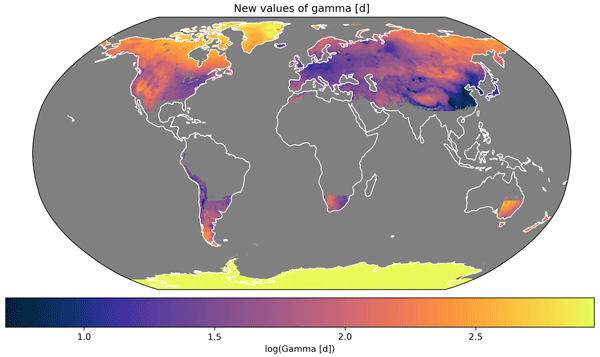
Manon Gaillard, Vincent Vionnet, Matthieu Lafaysse, Marie Dumont, and Paul Ginoux
The Cryosphere, 19, 769–792, https://doi.org/10.5194/tc-19-769-2025, https://doi.org/10.5194/tc-19-769-2025, 2025
Short summary
Short summary
This study presents an efficient method to improve large-scale snow albedo simulations by considering the spatial variability in light-absorbing particles (LAPs) like black carbon and dust. A global climatology of LAP deposition was created and used to optimize a parameter in the Crocus snow model. Testing at 10 global sites improved albedo predictions by 10 % on average and over 25 % in the Arctic. This method can enhance other snow models' predictions without complex simulations.
Justine Caillet, Nicolas C. Jourdain, Pierre Mathiot, Fabien Gillet-Chaulet, Benoit Urruty, Clara Burgard, Charles Amory, Mondher Chekki, and Christoph Kittel
Earth Syst. Dynam., 16, 293–315, https://doi.org/10.5194/esd-16-293-2025, https://doi.org/10.5194/esd-16-293-2025, 2025
Short summary
Short summary
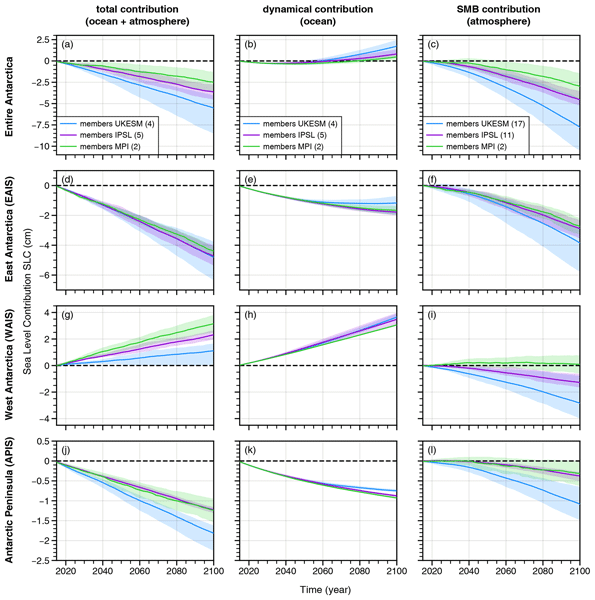
Internal climate variability, resulting from processes intrinsic to the climate system, modulates the Antarctic response to climate change by delaying or offsetting its effects. Using climate and ice-sheet models, we highlight that irreducible internal climate variability significantly enlarges the likely range of Antarctic contribution to sea-level rise until 2100. Thus, we recommend considering internal climate variability as a source of uncertainty for future ice-sheet projections.
Xavier Faïn, Sophie Szopa, Vaishali Naïk, Patricia Martinerie, David M. Etheridge, Rachael H. Rhodes, Cathy M. Trudinger, Vasilii V. Petrenko, Kévin Fourteau, and Philip Place
Atmos. Chem. Phys., 25, 1105–1119, https://doi.org/10.5194/acp-25-1105-2025, https://doi.org/10.5194/acp-25-1105-2025, 2025
Short summary
Short summary
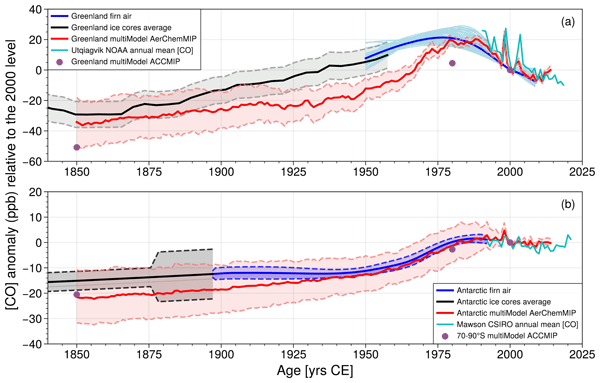
Carbon monoxide (CO) plays a crucial role in the atmosphere's oxidizing capacity. In this study, we analyse how historical (1850–2014) [CO] outputs from state-of-the-art global chemistry–climate models over Greenland and Antarctica are able to capture both absolute values and trends recorded in multi-site ice archives. A disparity in [CO] growth rates emerges in the Northern Hemisphere between models and observations from 1920–1975 CE, possibly linked to uncertainties in CO emission factors.
Marin Kneib, Amaury Dehecq, Adrien Gilbert, Auguste Basset, Evan S. Miles, Guillaume Jouvet, Bruno Jourdain, Etienne Ducasse, Luc Beraud, Antoine Rabatel, Jérémie Mouginot, Guillem Carcanade, Olivier Laarman, Fanny Brun, and Delphine Six
The Cryosphere, 18, 5965–5983, https://doi.org/10.5194/tc-18-5965-2024, https://doi.org/10.5194/tc-18-5965-2024, 2024
Short summary
Short summary
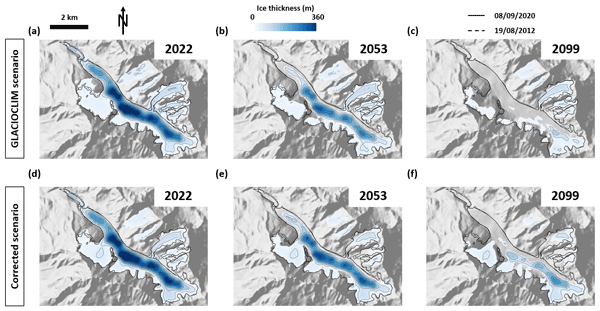
Avalanches contribute to increasing the accumulation on mountain glaciers by redistributing snow from surrounding mountains slopes. Here we quantified the contribution of avalanches to the mass balance of Argentière Glacier in the French Alps, by combining satellite and field observations to model the glacier dynamics. We show that the contribution of avalanches locally increases the accumulation by 60–70 % and that accounting for this effect results in less ice loss by the end of the century.
Navaraj Pokhrel, Patrick Wagnon, Fanny Brun, Arbindra Khadka, Tom Matthews, Audrey Goutard, Dibas Shrestha, Baker Perry, and Marion Réveillet
The Cryosphere, 18, 5913–5920, https://doi.org/10.5194/tc-18-5913-2024, https://doi.org/10.5194/tc-18-5913-2024, 2024
Short summary
Short summary
We studied snow processes in the accumulation area of Mera Glacier (central Himalaya, Nepal) by deploying a cosmic ray counting sensor that allows one to track the evolution of snow water equivalent. We suspect significant surface melting, water percolation, and refreezing within the snowpack, which might be missed by traditional mass balance surveys.
Georgina J. Woolley, Nick Rutter, Leanne Wake, Vincent Vionnet, Chris Derksen, Richard Essery, Philip Marsh, Rosamond Tutton, Branden Walker, Matthieu Lafaysse, and David Pritchard
The Cryosphere, 18, 5685–5711, https://doi.org/10.5194/tc-18-5685-2024, https://doi.org/10.5194/tc-18-5685-2024, 2024
Short summary
Short summary
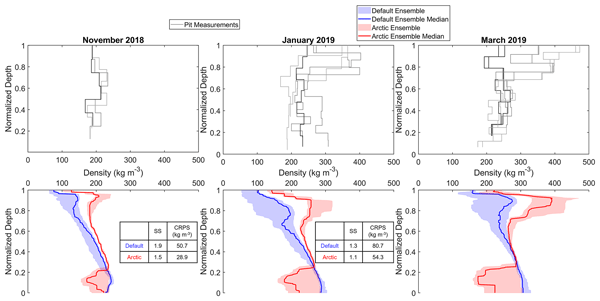
Parameterisations of Arctic snow processes were implemented into the multi-physics ensemble version of the snow model Crocus (embedded within the Soil, Vegetation, and Snow version 2 land surface model) and evaluated at an Arctic tundra site. Optimal combinations of parameterisations that improved the simulation of density and specific surface area featured modifications that raise wind speeds to increase compaction in surface layers, prevent snowdrift, and increase viscosity in basal layers.
Etienne Berthier, Jérôme Lebreton, Delphine Fontannaz, Steven Hosford, Joaquín Muñoz-Cobo Belart, Fanny Brun, Liss M. Andreassen, Brian Menounos, and Charlotte Blondel
The Cryosphere, 18, 5551–5571, https://doi.org/10.5194/tc-18-5551-2024, https://doi.org/10.5194/tc-18-5551-2024, 2024
Short summary
Short summary
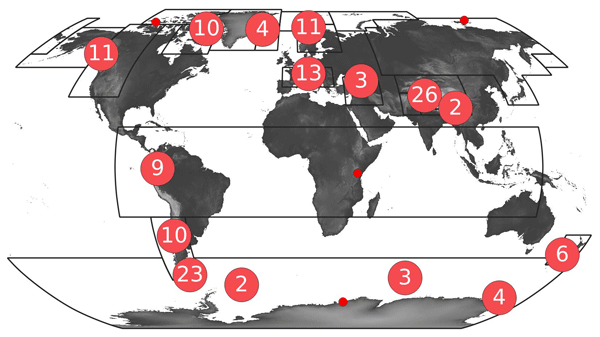
Repeat elevation measurements are crucial for monitoring glacier health and to understand how glaciers affect river flows and sea level. Until recently, high-resolution elevation data were mostly available for polar regions and High Mountain Asia. Our project, the Pléiades Glacier Observatory, now provides high-resolution topographies of 140 glacier sites worldwide. This is a novel and open dataset to monitor the impact of climate change on glaciers at high resolution and accuracy.
Sylvie Charbit, Christophe Dumas, Fabienne Maignan, Catherine Ottlé, Nina Raoult, Xavier Fettweis, and Philippe Conesa
The Cryosphere, 18, 5067–5099, https://doi.org/10.5194/tc-18-5067-2024, https://doi.org/10.5194/tc-18-5067-2024, 2024
Short summary
Short summary
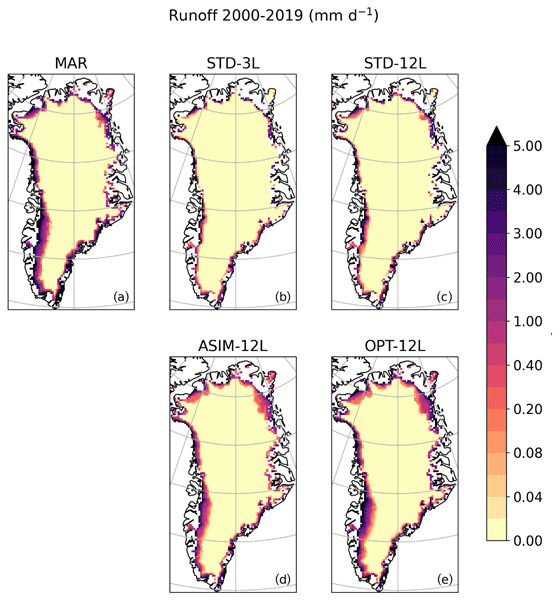
The evolution of the Greenland ice sheet is highly dependent on surface melting and therefore on the processes operating at the snow–atmosphere interface and within the snow cover. Here we present new developments to apply a snow model to the Greenland ice sheet. The performance of this model is analysed in terms of its ability to simulate ablation processes. Our analysis shows that the model performs well when compared with the MAR regional polar atmospheric model.
Diego Monteiro, Cécile Caillaud, Matthieu Lafaysse, Adrien Napoly, Mathieu Fructus, Antoinette Alias, and Samuel Morin
Geosci. Model Dev., 17, 7645–7677, https://doi.org/10.5194/gmd-17-7645-2024, https://doi.org/10.5194/gmd-17-7645-2024, 2024
Short summary
Short summary
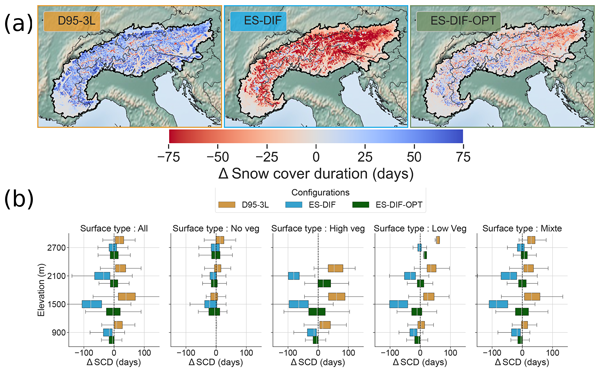
Modeling snow cover in climate and weather forecasting models is a challenge even for high-resolution models. Recent simulations with CNRM-AROME have shown difficulties when representing snow in the European Alps. Using remote sensing data and in situ observations, we evaluate modifications of the land surface configuration in order to improve it. We propose a new surface configuration, enabling a more realistic simulation of snow cover, relevant for climate and weather forecasting applications.
Giulia Mazzotti, Jari-Pekka Nousu, Vincent Vionnet, Tobias Jonas, Rafife Nheili, and Matthieu Lafaysse
The Cryosphere, 18, 4607–4632, https://doi.org/10.5194/tc-18-4607-2024, https://doi.org/10.5194/tc-18-4607-2024, 2024
Short summary
Short summary
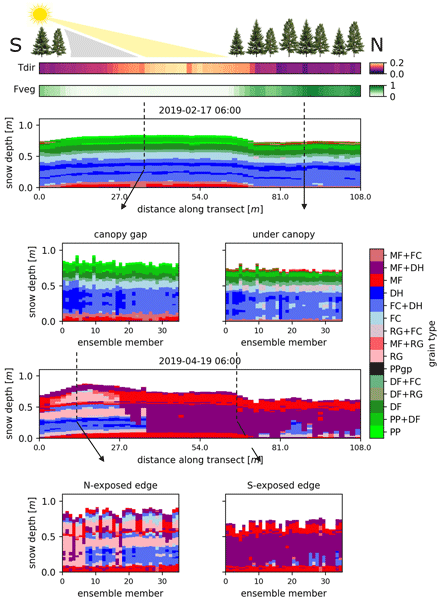
As many boreal and alpine forests have seasonal snow, models are needed to predict forest snow under future environmental conditions. We have created a new forest snow model by combining existing, very detailed model components for the canopy and the snowpack. We applied it to forests in Switzerland and Finland and showed how complex forest cover leads to a snowpack layering that is very variable in space and time because different processes prevail at different locations in the forest.
Julien Westhoff, Johannes Freitag, Anaïs Orsi, Patricia Martinerie, Ilka Weikusat, Michael Dyonisius, Xavier Faïn, Kevin Fourteau, and Thomas Blunier
The Cryosphere, 18, 4379–4397, https://doi.org/10.5194/tc-18-4379-2024, https://doi.org/10.5194/tc-18-4379-2024, 2024
Short summary
Short summary
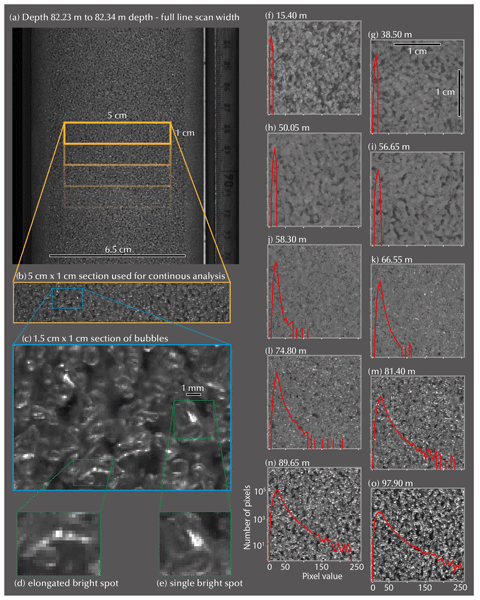
We study the EastGRIP area, Greenland, in detail with traditional and novel techniques. Due to the compaction of the ice, at a certain depth, atmospheric gases can no longer exchange, and the atmosphere is trapped in air bubbles in the ice. We find this depth by pumping air from a borehole, modeling, and using a new technique based on the optical appearance of the ice. Our results suggest that the close-off depth lies at around 58–61 m depth and more precisely at 58.3 m depth.
Livia Piermattei, Michael Zemp, Christian Sommer, Fanny Brun, Matthias H. Braun, Liss M. Andreassen, Joaquín M. C. Belart, Etienne Berthier, Atanu Bhattacharya, Laura Boehm Vock, Tobias Bolch, Amaury Dehecq, Inés Dussaillant, Daniel Falaschi, Caitlyn Florentine, Dana Floricioiu, Christian Ginzler, Gregoire Guillet, Romain Hugonnet, Matthias Huss, Andreas Kääb, Owen King, Christoph Klug, Friedrich Knuth, Lukas Krieger, Jeff La Frenierre, Robert McNabb, Christopher McNeil, Rainer Prinz, Louis Sass, Thorsten Seehaus, David Shean, Désirée Treichler, Anja Wendt, and Ruitang Yang
The Cryosphere, 18, 3195–3230, https://doi.org/10.5194/tc-18-3195-2024, https://doi.org/10.5194/tc-18-3195-2024, 2024
Short summary
Short summary
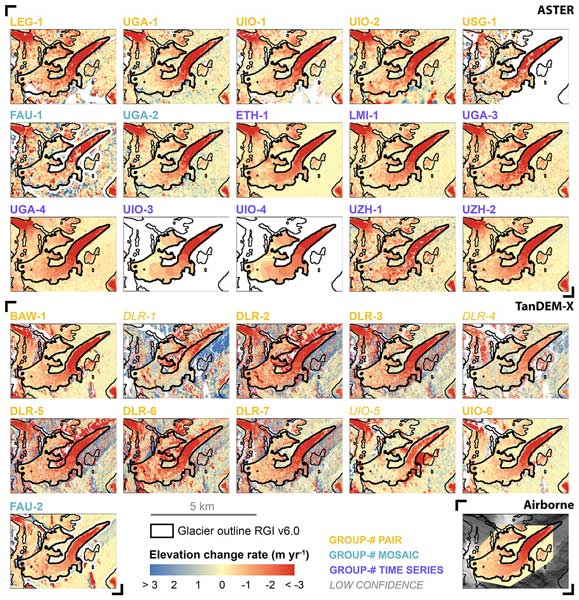
Satellites have made it possible to observe glacier elevation changes from all around the world. In the present study, we compared the results produced from two different types of satellite data between different research groups and against validation measurements from aeroplanes. We found a large spread between individual results but showed that the group ensemble can be used to reliably estimate glacier elevation changes and related errors from satellite data.
Ange Haddjeri, Matthieu Baron, Matthieu Lafaysse, Louis Le Toumelin, César Deschamps-Berger, Vincent Vionnet, Simon Gascoin, Matthieu Vernay, and Marie Dumont
The Cryosphere, 18, 3081–3116, https://doi.org/10.5194/tc-18-3081-2024, https://doi.org/10.5194/tc-18-3081-2024, 2024
Short summary
Short summary
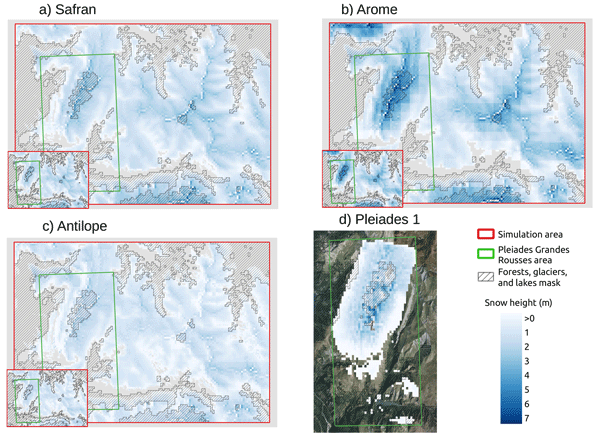
Our study addresses the complex challenge of evaluating distributed alpine snow simulations with snow transport against snow depths from Pléiades stereo imagery and snow melt-out dates from Sentinel-2 and Landsat-8 satellites. Additionally, we disentangle error contributions between blowing snow, precipitation heterogeneity, and unresolved subgrid variability. Snow transport enhances the snow simulations at high elevations, while precipitation biases are the main error source in other areas.
Marin Kneib, Amaury Dehecq, Fanny Brun, Fatima Karbou, Laurane Charrier, Silvan Leinss, Patrick Wagnon, and Fabien Maussion
The Cryosphere, 18, 2809–2830, https://doi.org/10.5194/tc-18-2809-2024, https://doi.org/10.5194/tc-18-2809-2024, 2024
Short summary
Short summary
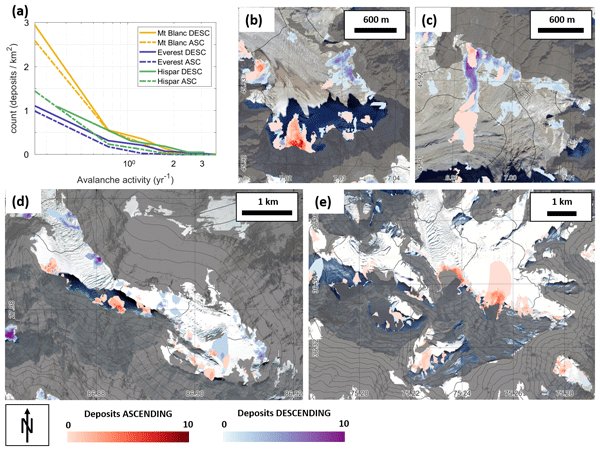
Avalanches are important for the mass balance of mountain glaciers, but few data exist on where and when they occur and which glaciers they affect the most. We developed an approach to map avalanches over large glaciated areas and long periods of time using satellite radar data. The application of this method to various regions in the Alps and High Mountain Asia reveals the variability of avalanches on these glaciers and provides key data to better represent these processes in glacier models.
Kévin Fourteau, Johannes Freitag, Mika Malinen, and Henning Löwe
The Cryosphere, 18, 2831–2846, https://doi.org/10.5194/tc-18-2831-2024, https://doi.org/10.5194/tc-18-2831-2024, 2024
Short summary
Short summary
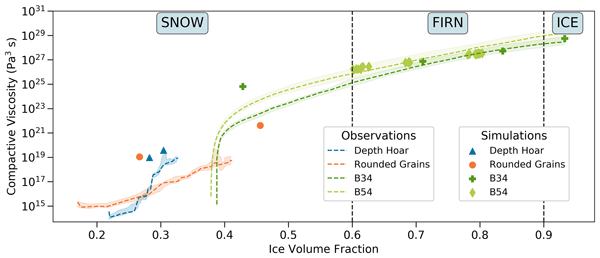
Understanding the settling of snow under its own weight has applications from avalanche forecasts to ice core interpretations. We study how this settling can be modeled using 3D images of the internal structure of snow and ice deformation mechanics. We found that classical ice mechanics, as used, for instance, in glacier flow, explain the compaction of dense polar snow but not that of lighter seasonal snow. How, exactly, the ice deforms during light snow compaction thus remains an open question.

Cécile Davrinche, Anaïs Orsi, Cécile Agosta, Charles Amory, and Christoph Kittel
The Cryosphere, 18, 2239–2256, https://doi.org/10.5194/tc-18-2239-2024, https://doi.org/10.5194/tc-18-2239-2024, 2024
Short summary
Short summary
Coastal surface winds in Antarctica are amongst the strongest winds on Earth. They are either driven by the cooling of the surface air mass by the ice sheet (katabatic) or by large-scale pressure systems. Here we compute the relative contribution of these drivers. We find that seasonal variations in the wind speed come from the katabatic acceleration, but, at a 3-hourly timescale, none of the large-scale or katabatic accelerations can be considered as the main driver.
Anna Braun, Kévin Fourteau, and Henning Löwe
The Cryosphere, 18, 1653–1668, https://doi.org/10.5194/tc-18-1653-2024, https://doi.org/10.5194/tc-18-1653-2024, 2024
Short summary
Short summary
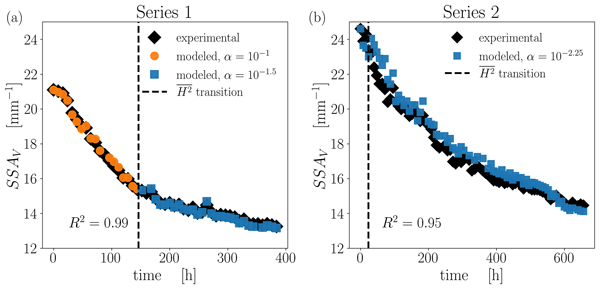
The specific surface of snow dictates key physical properties and continuously evolves in natural snowpacks. This is referred to as metamorphism. This work develops a rigorous physical model for this evolution, which is able to reproduce X-ray tomography measurements without using unphysical tuning parameters. Our results emphasize that snow crystal growth at the micrometer scale ultimately controls the pace of metamorphism.
Kavitha Sundu, Johannes Freitag, Kévin Fourteau, and Henning Löwe
The Cryosphere, 18, 1579–1596, https://doi.org/10.5194/tc-18-1579-2024, https://doi.org/10.5194/tc-18-1579-2024, 2024
Short summary
Short summary
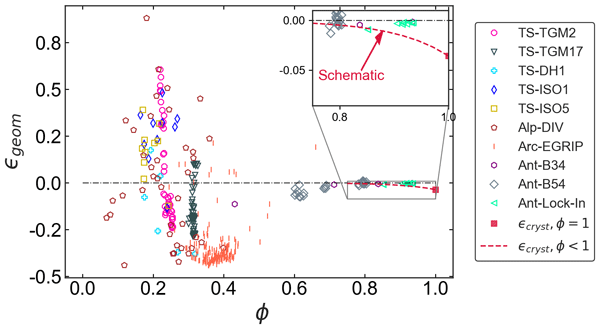
Ice crystals often show a rod-like, vertical orientation in snow and firn; they are said to be anisotropic. The stiffness in the vertical direction therefore differs from the horizontal, which, for example, impacts the propagation of seismic waves. To quantify this anisotropy, we conducted finite-element simulations of 391 snow, firn, and ice core microstructures obtained from X-ray tomography. We then derived a parameterization that may be employed for advanced seismic studies in polar regions.
Kévin Fourteau, Julien Brondex, Fanny Brun, and Marie Dumont
Geosci. Model Dev., 17, 1903–1929, https://doi.org/10.5194/gmd-17-1903-2024, https://doi.org/10.5194/gmd-17-1903-2024, 2024
Short summary
Short summary
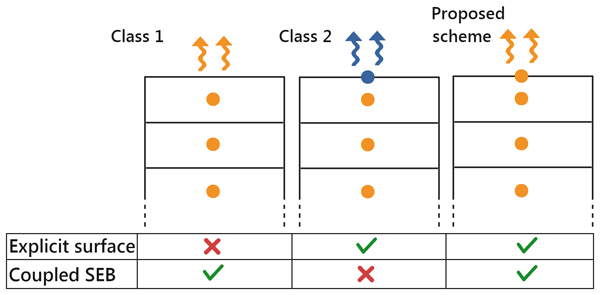
In this paper, we provide a novel numerical implementation for solving the energy exchanges at the surface of snow and ice. By combining the strong points of previous models, our solution leads to more accurate and robust simulations of the energy exchanges, surface temperature, and melt while preserving a reasonable computation time.
Matthieu Baron, Ange Haddjeri, Matthieu Lafaysse, Louis Le Toumelin, Vincent Vionnet, and Mathieu Fructus
Geosci. Model Dev., 17, 1297–1326, https://doi.org/10.5194/gmd-17-1297-2024, https://doi.org/10.5194/gmd-17-1297-2024, 2024
Short summary
Short summary
Increasing the spatial resolution of numerical systems simulating snowpack evolution in mountain areas requires representing small-scale processes such as wind-induced snow transport. We present SnowPappus, a simple scheme coupled with the Crocus snow model to compute blowing-snow fluxes and redistribute snow among grid points at 250 m resolution. In terms of numerical cost, it is suitable for large-scale applications. We present point-scale evaluations of fluxes and snow transport occurrence.
Baptiste Vandecrux, Robert S. Fausto, Jason E. Box, Federico Covi, Regine Hock, Åsa K. Rennermalm, Achim Heilig, Jakob Abermann, Dirk van As, Elisa Bjerre, Xavier Fettweis, Paul C. J. P. Smeets, Peter Kuipers Munneke, Michiel R. van den Broeke, Max Brils, Peter L. Langen, Ruth Mottram, and Andreas P. Ahlstrøm
The Cryosphere, 18, 609–631, https://doi.org/10.5194/tc-18-609-2024, https://doi.org/10.5194/tc-18-609-2024, 2024
Short summary
Short summary
How fast is the Greenland ice sheet warming? In this study, we compiled 4500+ temperature measurements at 10 m below the ice sheet surface (T10m) from 1912 to 2022. We trained a machine learning model on these data and reconstructed T10m for the ice sheet during 1950–2022. After a slight cooling during 1950–1985, the ice sheet warmed at a rate of 0.7 °C per decade until 2022. Climate models showed mixed results compared to our observations and underestimated the warming in key regions.
Alison Delhasse, Johanna Beckmann, Christoph Kittel, and Xavier Fettweis
The Cryosphere, 18, 633–651, https://doi.org/10.5194/tc-18-633-2024, https://doi.org/10.5194/tc-18-633-2024, 2024
Short summary
Short summary
Aiming to study the long-term influence of an extremely warm climate in the Greenland Ice Sheet contribution to sea level rise, a new regional atmosphere–ice sheet model setup was established. The coupling, explicitly considering the melt–elevation feedback, is compared to an offline method to consider this feedback. We highlight mitigation of the feedback due to local changes in atmospheric circulation with changes in surface topography, making the offline correction invalid on the margins.
Idunn Aamnes Mostue, Stefan Hofer, Trude Storelvmo, and Xavier Fettweis
The Cryosphere, 18, 475–488, https://doi.org/10.5194/tc-18-475-2024, https://doi.org/10.5194/tc-18-475-2024, 2024
Short summary
Short summary
The latest generation of climate models (Coupled Model Intercomparison Project Phase 6 – CMIP6) warm more over Greenland and the Arctic and thus also project a larger mass loss from the Greenland Ice Sheet (GrIS) compared to the previous generation of climate models (CMIP5). Our work suggests for the first time that part of the greater mass loss in CMIP6 over the GrIS is driven by a difference in the surface mass balance sensitivity from a change in cloud representation in the CMIP6 models.
Laura J. Dietrich, Hans Christian Steen-Larsen, Sonja Wahl, Anne-Katrine Faber, and Xavier Fettweis
The Cryosphere, 18, 289–305, https://doi.org/10.5194/tc-18-289-2024, https://doi.org/10.5194/tc-18-289-2024, 2024
Short summary
Short summary
The contribution of the humidity flux to the surface mass balance in the accumulation zone of the Greenland Ice Sheet is uncertain. Here, we evaluate the regional climate model MAR using a multi-annual dataset of eddy covariance measurements and bulk estimates of the humidity flux. The humidity flux largely contributes to the summer surface mass balance (SMB) in the accumulation zone, indicating its potential importance for the annual SMB in a warming climate.
Jari-Pekka Nousu, Matthieu Lafaysse, Giulia Mazzotti, Pertti Ala-aho, Hannu Marttila, Bertrand Cluzet, Mika Aurela, Annalea Lohila, Pasi Kolari, Aaron Boone, Mathieu Fructus, and Samuli Launiainen
The Cryosphere, 18, 231–263, https://doi.org/10.5194/tc-18-231-2024, https://doi.org/10.5194/tc-18-231-2024, 2024
Short summary
Short summary
The snowpack has a major impact on the land surface energy budget. Accurate simulation of the snowpack energy budget is difficult, and studies that evaluate models against energy budget observations are rare. We compared predictions from well-known models with observations of energy budgets, snow depths and soil temperatures in Finland. Our study identified contrasting strengths and limitations for the models. These results can be used for choosing the right models depending on the use cases.
Léo C. P. Martin, Sebastian Westermann, Michele Magni, Fanny Brun, Joel Fiddes, Yanbin Lei, Philip Kraaijenbrink, Tamara Mathys, Moritz Langer, Simon Allen, and Walter W. Immerzeel
Hydrol. Earth Syst. Sci., 27, 4409–4436, https://doi.org/10.5194/hess-27-4409-2023, https://doi.org/10.5194/hess-27-4409-2023, 2023
Short summary
Short summary
Across the Tibetan Plateau, many large lakes have been changing level during the last decades as a response to climate change. In high-mountain environments, water fluxes from the land to the lakes are linked to the ground temperature of the land and to the energy fluxes between the ground and the atmosphere, which are modified by climate change. With a numerical model, we test how these water and energy fluxes have changed over the last decades and how they influence the lake level variations.
Julien Brondex, Kévin Fourteau, Marie Dumont, Pascal Hagenmuller, Neige Calonne, François Tuzet, and Henning Löwe
Geosci. Model Dev., 16, 7075–7106, https://doi.org/10.5194/gmd-16-7075-2023, https://doi.org/10.5194/gmd-16-7075-2023, 2023
Short summary
Short summary
Vapor diffusion is one of the main processes governing snowpack evolution, and it must be accounted for in models. Recent attempts to represent vapor diffusion in numerical models have faced several difficulties regarding computational cost and mass and energy conservation. Here, we develop our own finite-element software to explore numerical approaches and enable us to overcome these difficulties. We illustrate the capability of these approaches on established numerical benchmarks.
Samuel Morin, Hugues François, Marion Réveillet, Eric Sauquet, Louise Crochemore, Flora Branger, Étienne Leblois, and Marie Dumont
Hydrol. Earth Syst. Sci., 27, 4257–4277, https://doi.org/10.5194/hess-27-4257-2023, https://doi.org/10.5194/hess-27-4257-2023, 2023
Short summary
Short summary
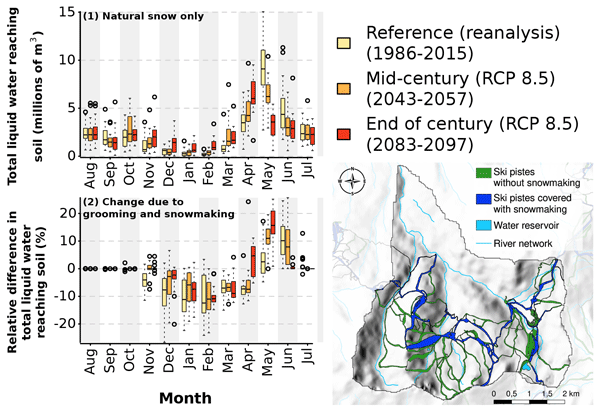
Ski resorts are a key socio-economic asset of several mountain areas. Grooming and snowmaking are routinely used to manage the snow cover on ski pistes, but despite vivid debate, little is known about their impact on water resources downstream. This study quantifies, for the pilot ski resort La Plagne in the French Alps, the impact of grooming and snowmaking on downstream river flow. Hydrological impacts are mostly apparent at the seasonal scale and rather neutral on the annual scale.
Marco Tedesco, Paolo Colosio, Xavier Fettweis, and Guido Cervone
The Cryosphere, 17, 5061–5074, https://doi.org/10.5194/tc-17-5061-2023, https://doi.org/10.5194/tc-17-5061-2023, 2023
Short summary
Short summary
We developed a technique to improve the outputs of a model that calculates the gain and loss of Greenland and consequently its contribution to sea level rise. Our technique generates “sharper” images of the maps generated by the model to better understand and quantify where losses occur. This has implications for improving models, understanding what drives the contributions of Greenland to sea level rise, and more.
Xavier Faïn, David M. Etheridge, Kévin Fourteau, Patricia Martinerie, Cathy M. Trudinger, Rachael H. Rhodes, Nathan J. Chellman, Ray L. Langenfelds, Joseph R. McConnell, Mark A. J. Curran, Edward J. Brook, Thomas Blunier, Grégory Teste, Roberto Grilli, Anthony Lemoine, William T. Sturges, Boris Vannière, Johannes Freitag, and Jérôme Chappellaz
Clim. Past, 19, 2287–2311, https://doi.org/10.5194/cp-19-2287-2023, https://doi.org/10.5194/cp-19-2287-2023, 2023
Short summary
Short summary
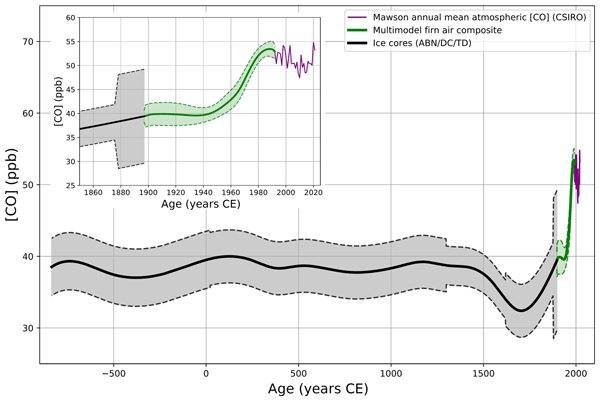
We report on a 3000-year record of carbon monoxide (CO) levels in the Southern Hemisphere's high latitudes by combining ice core and firn air measurements with modern direct atmospheric samples. Antarctica [CO] remained stable (–835 to 1500 CE), decreased during the Little Ice Age, and peaked around 1985 CE. Such evolution reflects stable biomass burning CO emissions before industrialization, followed by growth from CO anthropogenic sources, which decline after 1985 due to improved combustion.
Damien Maure, Christoph Kittel, Clara Lambin, Alison Delhasse, and Xavier Fettweis
The Cryosphere, 17, 4645–4659, https://doi.org/10.5194/tc-17-4645-2023, https://doi.org/10.5194/tc-17-4645-2023, 2023
Short summary
Short summary
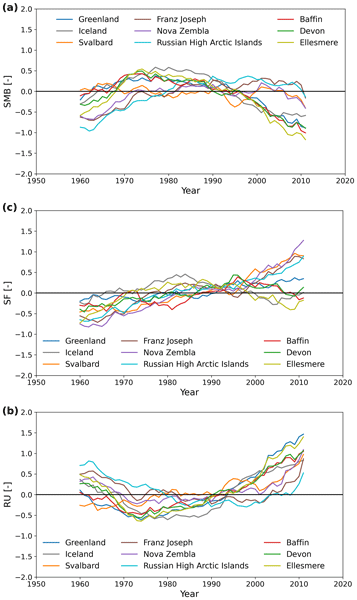
The Arctic is warming faster than the rest of the Earth. Studies have already shown that Greenland and the Canadian Arctic are experiencing a record increase in melting rates, while Svalbard has been relatively less impacted. Looking at those regions but also extending the study to Iceland and the Russian Arctic archipelagoes, we see a heterogeneity in the melting-rate response to the Arctic warming, with the Russian archipelagoes experiencing lower melting rates than other regions.
Prateek Gantayat, Alison F. Banwell, Amber A. Leeson, James M. Lea, Dorthe Petersen, Noel Gourmelen, and Xavier Fettweis
Geosci. Model Dev., 16, 5803–5823, https://doi.org/10.5194/gmd-16-5803-2023, https://doi.org/10.5194/gmd-16-5803-2023, 2023
Short summary
Short summary
We developed a new supraglacial hydrology model for the Greenland Ice Sheet. This model simulates surface meltwater routing, meltwater drainage, supraglacial lake (SGL) overflow, and formation of lake ice. The model was able to reproduce 80 % of observed lake locations and provides a good match between the observed and modelled temporal evolution of SGLs.
Thomas Dethinne, Quentin Glaude, Ghislain Picard, Christoph Kittel, Patrick Alexander, Anne Orban, and Xavier Fettweis
The Cryosphere, 17, 4267–4288, https://doi.org/10.5194/tc-17-4267-2023, https://doi.org/10.5194/tc-17-4267-2023, 2023
Short summary
Short summary
We investigate the sensitivity of the regional climate model
Modèle Atmosphérique Régional(MAR) to the assimilation of wet-snow occurrence estimated by remote sensing datasets. The assimilation is performed by nudging the MAR snowpack temperature. The data assimilation is performed over the Antarctic Peninsula for the 2019–2021 period. The results show an increase in the melt production (+66.7 %) and a decrease in surface mass balance (−4.5 %) of the model for the 2019–2020 melt season.
Fanny Brun, Owen King, Marion Réveillet, Charles Amory, Anton Planchot, Etienne Berthier, Amaury Dehecq, Tobias Bolch, Kévin Fourteau, Julien Brondex, Marie Dumont, Christoph Mayer, Silvan Leinss, Romain Hugonnet, and Patrick Wagnon
The Cryosphere, 17, 3251–3268, https://doi.org/10.5194/tc-17-3251-2023, https://doi.org/10.5194/tc-17-3251-2023, 2023
Short summary
Short summary
The South Col Glacier is a small body of ice and snow located on the southern ridge of Mt. Everest. A recent study proposed that South Col Glacier is rapidly losing mass. In this study, we examined the glacier thickness change for the period 1984–2017 and found no thickness change. To reconcile these results, we investigate wind erosion and surface energy and mass balance and find that melt is unlikely a dominant process, contrary to previous findings.
Marie Dumont, Simon Gascoin, Marion Réveillet, Didier Voisin, François Tuzet, Laurent Arnaud, Mylène Bonnefoy, Montse Bacardit Peñarroya, Carlo Carmagnola, Alexandre Deguine, Aurélie Diacre, Lukas Dürr, Olivier Evrard, Firmin Fontaine, Amaury Frankl, Mathieu Fructus, Laure Gandois, Isabelle Gouttevin, Abdelfateh Gherab, Pascal Hagenmuller, Sophia Hansson, Hervé Herbin, Béatrice Josse, Bruno Jourdain, Irene Lefevre, Gaël Le Roux, Quentin Libois, Lucie Liger, Samuel Morin, Denis Petitprez, Alvaro Robledano, Martin Schneebeli, Pascal Salze, Delphine Six, Emmanuel Thibert, Jürg Trachsel, Matthieu Vernay, Léo Viallon-Galinier, and Céline Voiron
Earth Syst. Sci. Data, 15, 3075–3094, https://doi.org/10.5194/essd-15-3075-2023, https://doi.org/10.5194/essd-15-3075-2023, 2023
Short summary
Short summary
Saharan dust outbreaks have profound effects on ecosystems, climate, health, and the cryosphere, but the spatial deposition pattern of Saharan dust is poorly known. Following the extreme dust deposition event of February 2021 across Europe, a citizen science campaign was launched to sample dust on snow over the Pyrenees and the European Alps. This campaign triggered wide interest and over 100 samples. The samples revealed the high variability of the dust properties within a single event.
Oscar Dick, Léo Viallon-Galinier, François Tuzet, Pascal Hagenmuller, Mathieu Fructus, Benjamin Reuter, Matthieu Lafaysse, and Marie Dumont
The Cryosphere, 17, 1755–1773, https://doi.org/10.5194/tc-17-1755-2023, https://doi.org/10.5194/tc-17-1755-2023, 2023
Short summary
Short summary
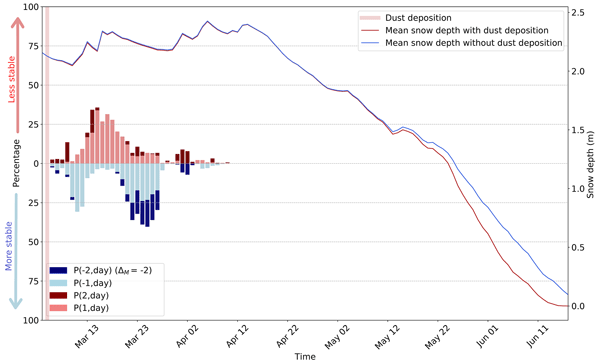
Saharan dust deposition can drastically change the snow color, turning mountain landscapes into sepia scenes. Dust increases the absorption of solar energy by the snow cover and thus modifies the snow evolution and potentially the avalanche risk. Here we show that dust can lead to increased or decreased snowpack stability depending on the snow and meteorological conditions after the deposition event. We also show that wet-snow avalanches happen earlier in the season due to the presence of dust.
Inès N. Otosaka, Andrew Shepherd, Erik R. Ivins, Nicole-Jeanne Schlegel, Charles Amory, Michiel R. van den Broeke, Martin Horwath, Ian Joughin, Michalea D. King, Gerhard Krinner, Sophie Nowicki, Anthony J. Payne, Eric Rignot, Ted Scambos, Karen M. Simon, Benjamin E. Smith, Louise S. Sørensen, Isabella Velicogna, Pippa L. Whitehouse, Geruo A, Cécile Agosta, Andreas P. Ahlstrøm, Alejandro Blazquez, William Colgan, Marcus E. Engdahl, Xavier Fettweis, Rene Forsberg, Hubert Gallée, Alex Gardner, Lin Gilbert, Noel Gourmelen, Andreas Groh, Brian C. Gunter, Christopher Harig, Veit Helm, Shfaqat Abbas Khan, Christoph Kittel, Hannes Konrad, Peter L. Langen, Benoit S. Lecavalier, Chia-Chun Liang, Bryant D. Loomis, Malcolm McMillan, Daniele Melini, Sebastian H. Mernild, Ruth Mottram, Jeremie Mouginot, Johan Nilsson, Brice Noël, Mark E. Pattle, William R. Peltier, Nadege Pie, Mònica Roca, Ingo Sasgen, Himanshu V. Save, Ki-Weon Seo, Bernd Scheuchl, Ernst J. O. Schrama, Ludwig Schröder, Sebastian B. Simonsen, Thomas Slater, Giorgio Spada, Tyler C. Sutterley, Bramha Dutt Vishwakarma, Jan Melchior van Wessem, David Wiese, Wouter van der Wal, and Bert Wouters
Earth Syst. Sci. Data, 15, 1597–1616, https://doi.org/10.5194/essd-15-1597-2023, https://doi.org/10.5194/essd-15-1597-2023, 2023
Short summary
Short summary
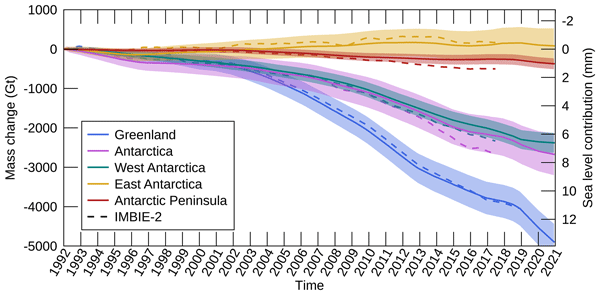
By measuring changes in the volume, gravitational attraction, and ice flow of Greenland and Antarctica from space, we can monitor their mass gain and loss over time. Here, we present a new record of the Earth’s polar ice sheet mass balance produced by aggregating 50 satellite-based estimates of ice sheet mass change. This new assessment shows that the ice sheets have lost (7.5 x 10¹²) t of ice between 1992 and 2020, contributing 21 mm to sea level rise.

Benjamin E. Smith, Brooke Medley, Xavier Fettweis, Tyler Sutterley, Patrick Alexander, David Porter, and Marco Tedesco
The Cryosphere, 17, 789–808, https://doi.org/10.5194/tc-17-789-2023, https://doi.org/10.5194/tc-17-789-2023, 2023
Short summary
Short summary
We use repeated satellite measurements of the height of the Greenland ice sheet to learn about how three computational models of snowfall, melt, and snow compaction represent actual changes in the ice sheet. We find that the models do a good job of estimating how the parts of the ice sheet near the coast have changed but that two of the models have trouble representing surface melt for the highest part of the ice sheet. This work provides suggestions for how to better model snowmelt.
Jilu Li, Fernando Rodriguez-Morales, Xavier Fettweis, Oluwanisola Ibikunle, Carl Leuschen, John Paden, Daniel Gomez-Garcia, and Emily Arnold
The Cryosphere, 17, 175–193, https://doi.org/10.5194/tc-17-175-2023, https://doi.org/10.5194/tc-17-175-2023, 2023
Short summary
Short summary
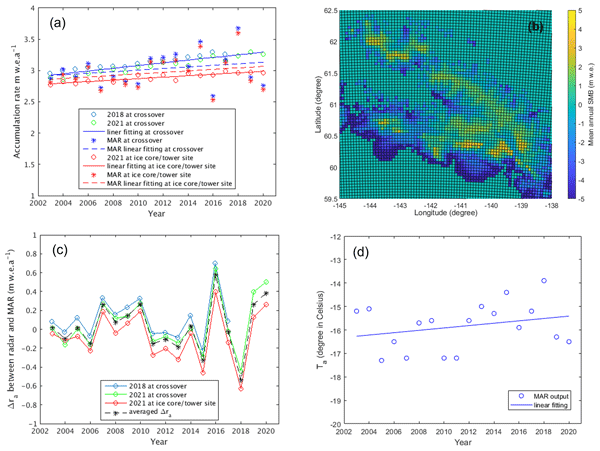
Alaskan glaciers' loss of ice mass contributes significantly to ocean surface rise. It is important to know how deeply and how much snow accumulates on these glaciers to comprehend and analyze the glacial mass loss process. We reported the observed seasonal snow depth distribution from our radar data taken in Alaska in 2018 and 2021, developed a method to estimate the annual snow accumulation rate at Mt. Wrangell caldera, and identified transition zones from wet-snow zones to ablation zones.
Raf M. Antwerpen, Marco Tedesco, Xavier Fettweis, Patrick Alexander, and Willem Jan van de Berg
The Cryosphere, 16, 4185–4199, https://doi.org/10.5194/tc-16-4185-2022, https://doi.org/10.5194/tc-16-4185-2022, 2022
Short summary
Short summary
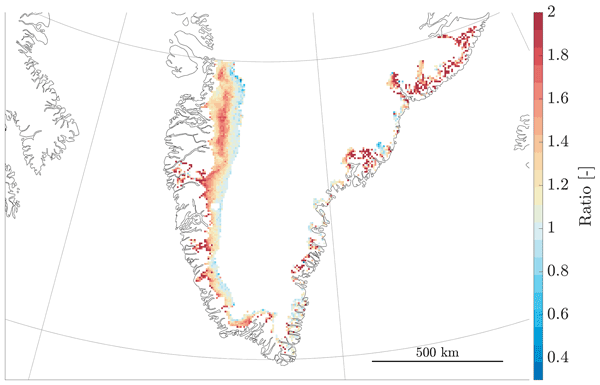
The ice on Greenland has been melting more rapidly over the last few years. Most of this melt comes from the exposure of ice when the overlying snow melts. This ice is darker than snow and absorbs more sunlight, leading to more melt. It remains challenging to accurately simulate the brightness of the ice. We show that the color of ice simulated by Modèle Atmosphérique Régional (MAR) is too bright. We then show that this means that MAR may underestimate how fast the Greenland ice is melting.
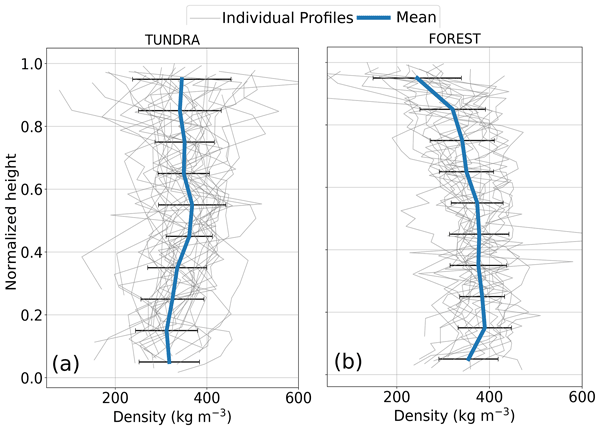
Georg Lackner, Florent Domine, Daniel F. Nadeau, Matthieu Lafaysse, and Marie Dumont
The Cryosphere, 16, 3357–3373, https://doi.org/10.5194/tc-16-3357-2022, https://doi.org/10.5194/tc-16-3357-2022, 2022
Short summary
Short summary
We compared the snowpack at two sites separated by less than 1 km, one in shrub tundra and the other one within the boreal forest. Even though the snowpack was twice as thick at the forested site, we found evidence that the vertical transport of water vapor from the bottom of the snowpack to its surface was important at both sites. The snow model Crocus simulates no water vapor fluxes and consequently failed to correctly simulate the observed density profiles.
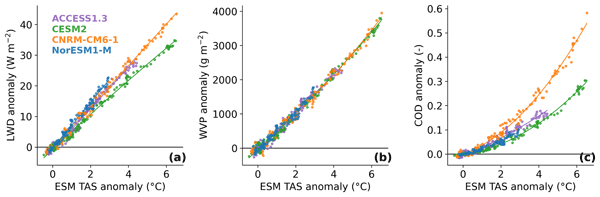
Christoph Kittel, Charles Amory, Stefan Hofer, Cécile Agosta, Nicolas C. Jourdain, Ella Gilbert, Louis Le Toumelin, Étienne Vignon, Hubert Gallée, and Xavier Fettweis
The Cryosphere, 16, 2655–2669, https://doi.org/10.5194/tc-16-2655-2022, https://doi.org/10.5194/tc-16-2655-2022, 2022
Short summary
Short summary
Model projections suggest large differences in future Antarctic surface melting even for similar greenhouse gas scenarios and warming rates. We show that clouds containing a larger amount of liquid water lead to stronger melt. As surface melt can trigger the collapse of the ice shelves (the safety band of the Antarctic Ice Sheet), clouds could be a major source of uncertainties in projections of sea level rise.
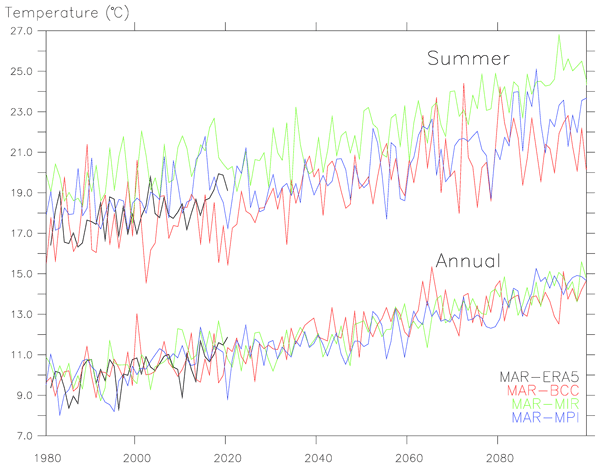
Sébastien Doutreloup, Xavier Fettweis, Ramin Rahif, Essam Elnagar, Mohsen S. Pourkiaei, Deepak Amaripadath, and Shady Attia
Earth Syst. Sci. Data, 14, 3039–3051, https://doi.org/10.5194/essd-14-3039-2022, https://doi.org/10.5194/essd-14-3039-2022, 2022
Short summary
Short summary
This data set provides historical (1980–2014) and future (2015–2100) weather data for 12 cities in Belgium. This data set is intended for architects or building or energy designers. In particular, it makes available to all users hourly open-access weather data according to certain standards to recreate a Typical and an Extreme Meteorological Year. In addition, it provides hourly data on heatwaves from 1980 to 2100. Weather data were produced from the outputs of the MAR model simulations.

Matthieu Vernay, Matthieu Lafaysse, Diego Monteiro, Pascal Hagenmuller, Rafife Nheili, Raphaëlle Samacoïts, Deborah Verfaillie, and Samuel Morin
Earth Syst. Sci. Data, 14, 1707–1733, https://doi.org/10.5194/essd-14-1707-2022, https://doi.org/10.5194/essd-14-1707-2022, 2022
Short summary
Short summary
This paper introduces the latest version of the freely available S2M dataset which provides estimates of both meteorological and snow cover variables, as well as various avalanche hazard diagnostics at different elevations, slopes and aspects for the three main French high-elevation mountainous regions. A complete description of the system and the dataset is provided, as well as an overview of the possible uses of this dataset and an objective assessment of its limitations.
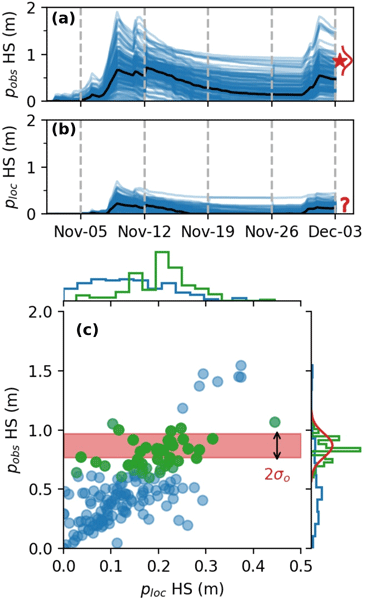
Bertrand Cluzet, Matthieu Lafaysse, César Deschamps-Berger, Matthieu Vernay, and Marie Dumont
The Cryosphere, 16, 1281–1298, https://doi.org/10.5194/tc-16-1281-2022, https://doi.org/10.5194/tc-16-1281-2022, 2022
Short summary
Short summary
The mountainous snow cover is highly variable at all temporal and spatial scales. Snow cover models suffer from large errors, while snowpack observations are sparse. Data assimilation combines them into a better estimate of the snow cover. A major challenge is to propagate information from observed into unobserved areas. This paper presents a spatialized version of the particle filter, in which information from in situ snow depth observations is successfully used to constrain nearby simulations.
Xavier Faïn, Rachael H. Rhodes, Philip Place, Vasilii V. Petrenko, Kévin Fourteau, Nathan Chellman, Edward Crosier, Joseph R. McConnell, Edward J. Brook, Thomas Blunier, Michel Legrand, and Jérôme Chappellaz
Clim. Past, 18, 631–647, https://doi.org/10.5194/cp-18-631-2022, https://doi.org/10.5194/cp-18-631-2022, 2022
Short summary
Short summary
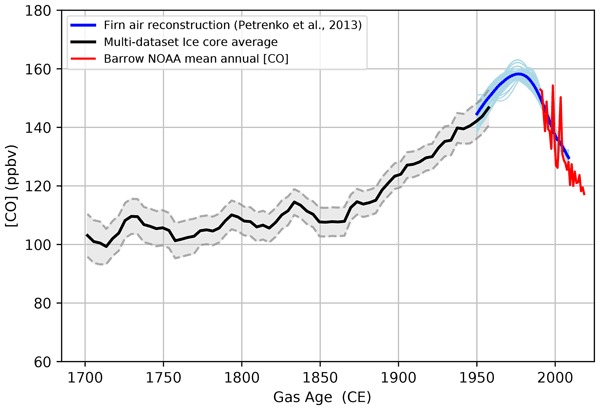
Carbon monoxide (CO) is a regulated pollutant and one of the key components determining the oxidizing capacity of the atmosphere. In this study, we analyzed five ice cores from Greenland at high resolution for CO concentrations by coupling laser spectrometry with continuous melting. By combining these new datasets, we produced an upper-bound estimate of past atmospheric CO abundance since preindustrial times for the Northern Hemisphere high latitudes, covering the period from 1700 to 1957 CE.
Georg Lackner, Florent Domine, Daniel F. Nadeau, Annie-Claude Parent, François Anctil, Matthieu Lafaysse, and Marie Dumont
The Cryosphere, 16, 127–142, https://doi.org/10.5194/tc-16-127-2022, https://doi.org/10.5194/tc-16-127-2022, 2022
Short summary
Short summary
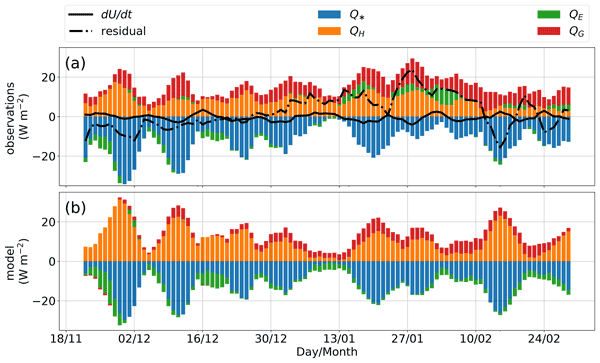
The surface energy budget is the sum of all incoming and outgoing energy fluxes at the Earth's surface and has a key role in the climate. We measured all these fluxes for an Arctic snowpack and found that most incoming energy from radiation is counterbalanced by thermal radiation and heat convection while sublimation was negligible. Overall, the snow model Crocus was able to simulate the observed energy fluxes well.
Christophe Genthon, Dana Veron, Etienne Vignon, Delphine Six, Jean-Louis Dufresne, Jean-Baptiste Madeleine, Emmanuelle Sultan, and François Forget
Earth Syst. Sci. Data, 13, 5731–5746, https://doi.org/10.5194/essd-13-5731-2021, https://doi.org/10.5194/essd-13-5731-2021, 2021
Short summary
Short summary
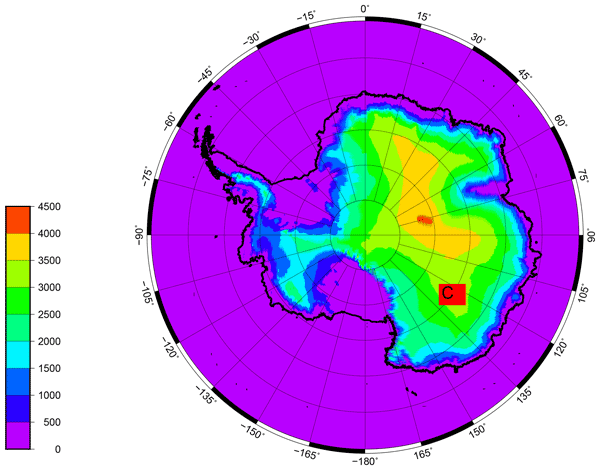
A 10-year dataset of observation in the atmospheric boundary layer at Dome C on the high Antarctic plateau is presented. This is obtained with sensors at six levels along a tower higher than 40 m. The temperature inversion can reach more than 25 °C along the tower in winter, while full mixing by convection can occur in summer. Different amplitudes of variability for wind and temperature at the different levels reflect different signatures of solar vs. synoptic forcing of the boundary layer.
Florent Veillon, Marie Dumont, Charles Amory, and Mathieu Fructus
Geosci. Model Dev., 14, 7329–7343, https://doi.org/10.5194/gmd-14-7329-2021, https://doi.org/10.5194/gmd-14-7329-2021, 2021
Short summary
Short summary
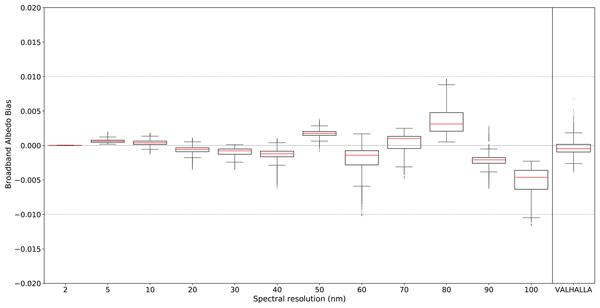
In climate models, the snow albedo scheme generally calculates only a narrowband or broadband albedo. Therefore, we have developed the VALHALLA method to optimize snow spectral albedo calculations through the determination of spectrally fixed radiative variables. The development of VALHALLA v1.0 with the use of the snow albedo model TARTES and the spectral irradiance model SBDART indicates a considerable reduction in calculation time while maintaining an adequate accuracy of albedo values.
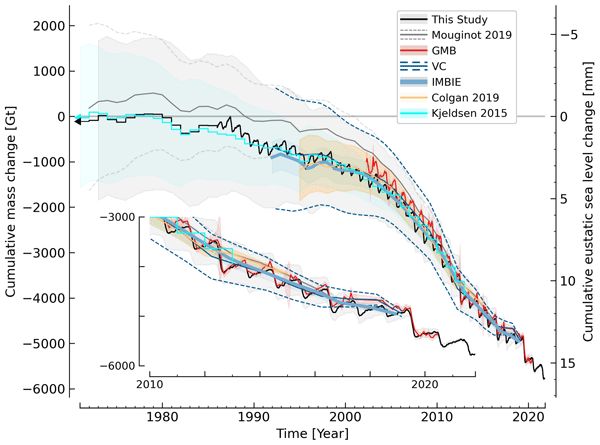
Kenneth D. Mankoff, Xavier Fettweis, Peter L. Langen, Martin Stendel, Kristian K. Kjeldsen, Nanna B. Karlsson, Brice Noël, Michiel R. van den Broeke, Anne Solgaard, William Colgan, Jason E. Box, Sebastian B. Simonsen, Michalea D. King, Andreas P. Ahlstrøm, Signe Bech Andersen, and Robert S. Fausto
Earth Syst. Sci. Data, 13, 5001–5025, https://doi.org/10.5194/essd-13-5001-2021, https://doi.org/10.5194/essd-13-5001-2021, 2021
Short summary
Short summary
We estimate the daily mass balance and its components (surface, marine, and basal mass balance) for the Greenland ice sheet. Our time series begins in 1840 and has annual resolution through 1985 and then daily from 1986 through next week. Results are operational (updated daily) and provided for the entire ice sheet or by commonly used regions or sectors. This is the first input–output mass balance estimate to include the basal mass balance.
Cited articles
Alexander, P. M., Tedesco, M., Fettweis, X., van de Wal, R. S. W., Smeets, C. J. P. P., and van den Broeke, M. R.: Assessing spatio-temporal variability and trends in modelled and measured Greenland Ice Sheet albedo (2000–2013), The Cryosphere, 8, 2293–2312, https://doi.org/10.5194/tc-8-2293-2014, 2014. a
Barandun, M., Bravo, C., Grobety, B., Jenk, T., Fang, L., Naegeli, K., Rivera, A., Cisternas, S., Münster, T., and Schwikowski, M.: Anthropogenic influence on surface changes at the Olivares glaciers; Central Chile, The Science of the Total Environment, 833, 155068, https://doi.org/10.1016/j.scitotenv.2022.155068, 2022. a
Boone, A. and Etchevers, P.: An Intercomparison of Three Snow Schemes of Varying Complexity Coupled to the Same Land Surface Model: Local-Scale Evaluation at an Alpine Site, Journal of Hydrometeorology, 2, 374–394, https://doi.org/10.1175/1525-7541(2001)002<0374:AIOTSS>2.0.CO;2, 2001. a
Brock, B. W., Willis, I. C., Sharp, M. J., and Arnold, N. S.: Modelling seasonal and spatial variations in the surface energy balance of Haut Glacier d'Arolla, Switzerland, Annals of Glaciology, 31, 53–62, https://doi.org/10.3189/172756400781820183, 2000. a
Brock, B. W., Willis, I. C., and Sharp, M. J.: Measurement and parameterization of aerodynamic roughness length variations at Haut Glacier d'Arolla, Switzerland, Journal of Glaciology, 52, 281–297, https://doi.org/10.3189/172756506781828746, 2006. a, b
Brun, F., Dumont, M., Wagnon, P., Berthier, E., Azam, M. F., Shea, J. M., Sirguey, P., Rabatel, A., and Ramanathan, Al.: Seasonal changes in surface albedo of Himalayan glaciers from MODIS data and links with the annual mass balance, The Cryosphere, 9, 341–355, https://doi.org/10.5194/tc-9-341-2015, 2015. a
Brun, F., Berthier, E., Wagnon, P., Kääb, A., and Treichler, D.: A spatially resolved estimate of High Mountain Asia glacier mass balances from 2000 to 2016, Nature Geoscience, 10, 668–673, https://doi.org/10.1038/ngeo2999, 2017. a
Buzzard, S., Feltham, D., and Flocco, D.: Modelling the fate of surface melt on the Larsen C Ice Shelf, The Cryosphere, 12, 3565–3575, https://doi.org/10.5194/tc-12-3565-2018, 2018. a
Coléou, C. and Lesaffre, B.: Irreducible water saturation in snow: experimental results in a cold laboratory, Annals of Glaciology, 26, 64–68, https://doi.org/10.3189/1998AoG26-1-64-68, 1998. a
Cook, J. M., Hodson, A. J., and Irvine-Fynn, T. D. L.: Supraglacial weathering crust dynamics inferred from cryoconite hole hydrology, Hydrological Processes, 30, 433–446, https://doi.org/10.1002/hyp.10602, 2016. a
Cooper, M. G., Smith, L. C., Rennermalm, A. K., Miège, C., Pitcher, L. H., Ryan, J. C., Yang, K., and Cooley, S. W.: Meltwater storage in low-density near-surface bare ice in the Greenland ice sheet ablation zone, The Cryosphere, 12, 955–970, https://doi.org/10.5194/tc-12-955-2018, 2018. a, b
Dadic, R., Mullen, P. C., Schneebeli, M., Brandt, R. E., and Warren, S. G.: Effects of bubbles, cracks, and volcanic tephra on the spectral albedo of bare ice near the Transantarctic Mountains: Implications for sea glaciers on Snowball Earth, Journal of Geophysical Research: Earth Surface, 118, 1658–1676, https://doi.org/10.1002/jgrf.20098, 2013. a
D'Amboise, C. J. L., Müller, K., Oxarango, L., Morin, S., and Schuler, T. V.: Implementation of a physically based water percolation routine in the Crocus/SURFEX (V7.3) snowpack model, Geosci. Model Dev., 10, 3547–3566, https://doi.org/10.5194/gmd-10-3547-2017, 2017. a
Di Mauro, B.: A darker cryosphere in a warming world, Nature Climate Change, 10, 979–980, https://doi.org/10.1038/s41558-020-00911-9, 2020. a
Di Mauro, B., Baccolo, G., Garzonio, R., Giardino, C., Massabò, D., Piazzalunga, A., Rossini, M., and Colombo, R.: Impact of impurities and cryoconite on the optical properties of the Morteratsch Glacier (Swiss Alps), The Cryosphere, 11, 2393–2409, https://doi.org/10.5194/tc-11-2393-2017, 2017. a, b
Dumont, M., Sirguey, P., Arnaud, Y., and Six, D.: Monitoring spatial and temporal variations of surface albedo on Saint Sorlin Glacier (French Alps) using terrestrial photography, The Cryosphere, 5, 759–771, https://doi.org/10.5194/tc-5-759-2011, 2011. a
Dumont, M., Durand, Y., Arnaud, Y., and Six, D.: Variational assimilation of albedo in a snowpack model and reconstruction of the spatial mass-balance distribution of an alpine glacier, Journal of Glaciology, 58, 151–164, https://doi.org/10.3189/2012JoG11J163, 2012. a
Fehlmann, M., Gascón, E., Rohrer, M., Schwarb, M., and Stoffel, M.: Estimating the snowfall limit in alpine and pre-alpine valleys: A local evaluation of operational approaches, Atmospheric Research, 204, 136–148, https://doi.org/10.1016/j.atmosres.2018.01.016, 2018. a, b
Fettweis, X.: Reconstruction of the 1979–2006 Greenland ice sheet surface mass balance using the regional climate model MAR, The Cryosphere, 1, 21–40, https://doi.org/10.5194/tc-1-21-2007, 2007. a, b
Fettweis, X., Box, J. E., Agosta, C., Amory, C., Kittel, C., Lang, C., van As, D., Machguth, H., and Gallée, H.: Reconstructions of the 1900–2015 Greenland ice sheet surface mass balance using the regional climate MAR model, The Cryosphere, 11, 1015–1033, https://doi.org/10.5194/tc-11-1015-2017, 2017. a
Fujita, K.: Influence of precipitation seasonality on glacier mass balance and its sensitivity to climate change, Annals of Glaciology, 48, 88–92, https://doi.org/10.3189/172756408784700824, 2008. a
Fyffe, C. L., Brock, B. W., Kirkbride, M. P., Mair, D. W. F., Arnold, N. S., Smiraglia, C., Diolaiuti, G., and Diotri, F.: Do debris-covered glaciers demonstrate distinctive hydrological behaviour compared to clean glaciers?, Journal of Hydrology, 570, 584–597, https://doi.org/10.1016/j.jhydrol.2018.12.069, 2019. a
Gabbi, J., Carenzo, M., Pellicciotti, F., Bauder, A., and Funk, M.: A comparison of empirical and physically based glacier surface melt models for long-term simulations of glacier response, Journal of Glaciology, 60, 1140–1154, https://doi.org/10.3189/2014JoG14J011, 2014. a, b
Gardner, A. S. and Sharp, M. J.: A review of snow and ice albedo and the development of a new physically based broadband albedo parameterization, Journal of Geophysical Research: Earth Surface, 115, https://doi.org/10.1029/2009JF001444, 2010. a, b
Gerbaux, M., Genthon, C., Etchevers, P., Vincent, C., and Dedieu, J. P.: Surface mass balance of glaciers in the French Alps: distributed modeling and sensitivity to climate change, Journal of Glaciology, 51, 561–572, https://doi.org/10.3189/172756505781829133, 2005. a, b
Giese, A., Boone, A., Wagnon, P., and Hawley, R.: Incorporating moisture content in surface energy balance modeling of a debris-covered glacier, The Cryosphere, 14, 1555–1577, https://doi.org/10.5194/tc-14-1555-2020, 2020. a
Gilardoni, S., Di Mauro, B., and Bonasoni, P.: Black carbon, organic carbon, and mineral dust in South American tropical glaciers: A review, Global and Planetary Change, 213, 103837, https://doi.org/10.1016/j.gloplacha.2022.103837, 2022. a, b
Gilbert, A., Vincent, C., Six, D., Wagnon, P., Piard, L., and Ginot, P.: Modeling near-surface firn temperature in a cold accumulation zone (Col du Dôme, French Alps): from a physical to a semi-parameterized approach, The Cryosphere, 8, 689–703, https://doi.org/10.5194/tc-8-689-2014, 2014. a
Goutard, A.: Code for paper Explicit representation of liquid water retention over bare ice using the SURFEX/ISBA-Crocus model: implications for mass balance at Mera glacier (Nepal), Zenodo [code], https://doi.org/10.5281/zenodo.18500494, 2026a. a
Goutard, A.: Simulation outputs, Zenodo [data set], https://doi.org/10.5281/zenodo.18504830, 2026b. a
Guo, Z., Geng, L., Shen, B., Wu, Y., Chen, A., and Wang, N.: Spatiotemporal Variability in the Glacier Snowline Altitude across High Mountain Asia and Potential Driving Factors, Remote Sensing, 13, 425, https://doi.org/10.3390/rs13030425, 2021. a, b
Hartl, L., Felbauer, L., Schwaizer, G., and Fischer, A.: Small-scale spatial variability in bare-ice reflectance at Jamtalferner, Austria, The Cryosphere, 14, 4063–4081, https://doi.org/10.5194/tc-14-4063-2020, 2020. a, b, c
Hartl, L., Covi, F., Stocker-Waldhuber, M., Baldo, A., Fugazza, D., Di Mauro, B., and Naegeli, K.: Loss of accumulation zone exposes dark ice and drives increased ablation at Weißseespitze, Austria, The Cryosphere, 19, 3329–3353, https://doi.org/10.5194/tc-19-3329-2025, 2025. a, b
Hock, R.: Glacier melt: a review of processes and their modelling, Progress in Physical Geography: Earth and Environment, 29, 362–391, https://doi.org/10.1191/0309133305pp453ra, 2005. a, b
Hock, R., Bliss, A., Marzeion, B., Giesen, R. H., Hirabayashi, Y., Huss, M., Radić, V., and Slangen, A. B. A.: GlacierMIP – A model intercomparison of global-scale glacier mass-balance models and projections, Journal of Glaciology, 65, 453–467, https://doi.org/10.1017/jog.2019.22, 2019. a, b
Hunke, E. C., Hebert, D. A., and Lecomte, O.: Level-ice melt ponds in the Los Alamos sea ice model, CICE, Ocean Modelling, 71, 26–42, https://doi.org/10.1016/j.ocemod.2012.11.008, 2013. a, b
Huss, M., Farinotti, D., Bauder, A., and Funk, M.: Modelling runoff from highly glacierized alpine drainage basins in a changing climate, Hydrological Processes, 22, 3888–3902, https://doi.org/10.1002/hyp.7055, 2008. a
Immerzeel, W. W., Lutz, A. F., Andrade, M., Bahl, A., Biemans, H., Bolch, T., Hyde, S., Brumby, S., Davies, B. J., Elmore, A. C., Emmer, A., Feng, M., Fernández, A., Haritashya, U., Kargel, J. S., Koppes, M., Kraaijenbrink, P. D. A., Kulkarni, A. V., Mayewski, P. A., Nepal, S., Pacheco, P., Painter, T. H., Pellicciotti, F., Rajaram, H., Rupper, S., Sinisalo, A., Shrestha, A. B., Viviroli, D., Wada, Y., Xiao, C., Yao, T., and Baillie, J. E. M.: Importance and vulnerability of the world's water towers, Nature, 577, 364–369, https://doi.org/10.1038/s41586-019-1822-y, 2020. a
Irvine-Fynn, T. D. L., Hodson, A. J., Moorman, B. J., Vatne, G., and Hubbard, A. L.: Polythermal Glacier Hydrology: A Review, Reviews of Geophysics, 49, https://doi.org/10.1029/2010RG000350, 2011. a
Irvine-Fynn, T. D. L., Porter, P. R., Rowan, A. V., Quincey, D. J., Gibson, M. J., Bridge, J. W., Watson, C. S., Hubbard, A., and Glasser, N. F.: Supraglacial Ponds Regulate Runoff From Himalayan Debris-Covered Glaciers, Geophysical Research Letters, 44, https://doi.org/10.1002/2017GL075398, 2017. a
Johnson, E. and Rupper, S.: An Examination of Physical Processes That Trigger the Albedo-Feedback on Glacier Surfaces and Implications for Regional Glacier Mass Balance Across High Mountain Asia, Frontiers in Earth Science, 8, https://doi.org/10.3389/feart.2020.00129, 2020. a
Khadka, A., Wagnon, P., Brun, F., Shrestha, D., Lejeune, Y., and Arnaud, Y.: Evaluation of ERA5-Land and HARv2 Reanalysis Data at High Elevation in the Upper Dudh Koshi Basin (Everest Region, Nepal), Journal of Applied Meteorology and Climatology, 61, 931–954, https://doi.org/10.1175/JAMC-D-21-0091.1, 2022. a, b
Khadka, A., Brun, F., Wagnon, P., Shrestha, D., and Sherpa, T. C.: Surface energy and mass balance of Mera Glacier (Nepal, Central Himalaya) and their sensitivity to temperature and precipitation, Journal of Glaciology, 70, https://doi.org/10.1017/jog.2024.42, 2024. a, b, c, d
Kraaijenbrink, P. D. A., Bierkens, M. F. P., Lutz, A. F., and Immerzeel, W. W.: Impact of a global temperature rise of 1.5 degrees Celsius on Asia's glaciers, Nature, 549, 257–260, https://doi.org/10.1038/nature23878, 2017. a
Lafaysse, M., Cluzet, B., Dumont, M., Lejeune, Y., Vionnet, V., and Morin, S.: A multiphysical ensemble system of numerical snow modelling, The Cryosphere, 11, 1173–1198, https://doi.org/10.5194/tc-11-1173-2017, 2017. a, b, c
Lafaysse, M., Dumont, M., De Fleurian, B., Fructus, M., Nheili, R., Viallon-Galinier, L., Baron, M., Boone, A., Bouchet, A., Brondex, J., Carmagnola, C., Cluzet, B., Fourteau, K., Haddjeri, A., Hagenmuller, P., Mazzotti, G., Minvielle, M., Morin, S., Quéno, L., Roussel, L., Spandre, P., Tuzet, F., and Vionnet, V.: Version 3.0 of the Crocus snowpack model, EGUsphere [preprint], https://doi.org/10.5194/egusphere-2025-4540, 2025. a
Larue, F., Picard, G., Arnaud, L., Ollivier, I., Delcourt, C., Lamare, M., Tuzet, F., Revuelto, J., and Dumont, M.: Snow albedo sensitivity to macroscopic surface roughness using a new ray-tracing model, The Cryosphere, 14, 1651–1672, https://doi.org/10.5194/tc-14-1651-2020, 2020. a
Lefebre, F., Gallée, H., van Ypersele, J.-P., and Greuell, W.: Modeling of snow and ice melt at ETH Camp (West Greenland): A study of surface albedo, Journal of Geophysical Research: Atmospheres, 108, https://doi.org/10.1029/2001JD001160, 2003. a, b
Lejeune, Y., Bouilloud, L., Etchevers, P., Wagnon, P., Chevallier, P., Sicart, J.-E., Martin, E., and Habets, F.: Melting of Snow Cover in a Tropical Mountain Environment in Bolivia: Processes and Modeling, Journal of Hydrometeorology, 8, 922–937, https://doi.org/10.1175/JHM590.1, 2007. a, b, c
Lejeune, Y., Bertrand, J.-M., Wagnon, P., and Morin, S.: A physically based model of the year-round surface energy and mass balance of debris-covered glaciers, Journal of Glaciology, 59, 327–344, https://doi.org/10.3189/2013JoG12J149, 2013. a
Łupikasza, E. B., Ignatiuk, D., Grabiec, M., Cielecka-Nowak, K., Laska, M., Jania, J., Luks, B., Uszczyk, A., and Budzik, T.: The Role of Winter Rain in the Glacial System on Svalbard, Water, 11, 334, https://doi.org/10.3390/w11020334, 2019. a
Lüthje, M., Feltham, D. L., Taylor, P. D., and Worster, M. G.: Modeling the summertime evolution of sea-ice melt ponds, Journal of Geophysical Research: Oceans, 111, https://doi.org/10.1029/2004JC002818, 2006. a, b
Marshall, S. J. and Miller, K.: Seasonal and interannual variability of melt-season albedo at Haig Glacier, Canadian Rocky Mountains, The Cryosphere, 14, 3249–3267, https://doi.org/10.5194/tc-14-3249-2020, 2020. a
Masson, V., Le Moigne, P., Martin, E., Faroux, S., Alias, A., Alkama, R., Belamari, S., Barbu, A., Boone, A., Bouyssel, F., Brousseau, P., Brun, E., Calvet, J.-C., Carrer, D., Decharme, B., Delire, C., Donier, S., Essaouini, K., Gibelin, A.-L., Giordani, H., Habets, F., Jidane, M., Kerdraon, G., Kourzeneva, E., Lafaysse, M., Lafont, S., Lebeaupin Brossier, C., Lemonsu, A., Mahfouf, J.-F., Marguinaud, P., Mokhtari, M., Morin, S., Pigeon, G., Salgado, R., Seity, Y., Taillefer, F., Tanguy, G., Tulet, P., Vincendon, B., Vionnet, V., and Voldoire, A.: The SURFEXv7.2 land and ocean surface platform for coupled or offline simulation of earth surface variables and fluxes, Geosci. Model Dev., 6, 929–960, https://doi.org/10.5194/gmd-6-929-2013, 2013. a
Mattea, E., Machguth, H., Kronenberg, M., van Pelt, W., Bassi, M., and Hoelzle, M.: Firn changes at Colle Gnifetti revealed with a high-resolution process-based physical model approach, The Cryosphere, 15, 3181–3205, https://doi.org/10.5194/tc-15-3181-2021, 2021. a
McLaughlin, E.: The Thermal Conductivity of Liquids and Dense Gases, Chemical Reviews, 64, 389–428, https://doi.org/10.1021/cr60230a003, 1964. a
Miles, E. S., Willis, I., Buri, P., Steiner, J. F., Arnold, N. S., and Pellicciotti, F.: Surface Pond Energy Absorption Across Four Himalayan Glaciers Accounts for
Mölg, T. and Hardy, D. R.: Ablation and associated energy balance of a horizontal glacier surface on Kilimanjaro, Journal of Geophysical Research: Atmospheres, 109, https://doi.org/10.1029/2003JD004338, 2004. a
Naegeli, K. and Huss, M.: Sensitivity of mountain glacier mass balance to changes in bare-ice albedo, Annals of Glaciology, 58, 119–129, https://doi.org/10.1017/aog.2017.25, 2017. a
Naegeli, K., Huss, M., and Hoelzle, M.: Change detection of bare-ice albedo in the Swiss Alps , The Cryosphere, 13, 397–412, https://doi.org/10.5194/tc-13-397-2019, 2019. a, b
Picard, G., Dumont, M., Lamare, M., Tuzet, F., Larue, F., Pirazzini, R., and Arnaud, L.: Spectral albedo measurements over snow-covered slopes: theory and slope effect corrections, The Cryosphere, 14, 1497–1517, https://doi.org/10.5194/tc-14-1497-2020, 2020. a
Pokhrel, N., Wagnon, P., Brun, F., Khadka, A., Matthews, T., Goutard, A., Shrestha, D., Perry, B., and Réveillet, M.: Brief communication: Accurate and autonomous snow water equivalent measurements using a cosmic ray sensor on a Himalayan glacier, The Cryosphere, 18, 5913–5920, https://doi.org/10.5194/tc-18-5913-2024, 2024. a
Popović, P. and Abbot, D.: A simple model for the evolution of melt pond coverage on permeable Arctic sea ice, The Cryosphere, 11, 1149–1172, https://doi.org/10.5194/tc-11-1149-2017, 2017. a
Pritchard, H. D.: Asia's shrinking glaciers protect large populations from drought stress, Nature, 569, 649–654, https://doi.org/10.1038/s41586-019-1240-1, 2019. a, b
Rabatel, A., Francou, B., Soruco, A., Gomez, J., Cáceres, B., Ceballos, J. L., Basantes, R., Vuille, M., Sicart, J.-E., Huggel, C., Scheel, M., Lejeune, Y., Arnaud, Y., Collet, M., Condom, T., Consoli, G., Favier, V., Jomelli, V., Galarraga, R., Ginot, P., Maisincho, L., Mendoza, J., Ménégoz, M., Ramirez, E., Ribstein, P., Suarez, W., Villacis, M., and Wagnon, P.: Current state of glaciers in the tropical Andes: a multi-century perspective on glacier evolution and climate change, The Cryosphere, 7, 81–102, https://doi.org/10.5194/tc-7-81-2013, 2013. a
Rounce, D. R., Hock, R., Maussion, F., Hugonnet, R., Kochtitzky, W., Huss, M., Berthier, E., Brinkerhoff, D., Compagno, L., Copland, L., Farinotti, D., Menounos, B., and McNabb, R. W.: Global glacier change in the 21st century: Every increase in temperature matters, Science, 379, 78–83, https://doi.org/10.1126/science.abo1324, 2023. a
Royer, A., Picard, G., Vargel, C., Langlois, A., Gouttevin, I., and Dumont, M.: Improved Simulation of Arctic Circumpolar Land Area Snow Properties and Soil Temperatures, Frontiers in Earth Science, 9, https://doi.org/10.3389/feart.2021.685140, 2021. a
Ryan, J. C., Hubbard, A., Stibal, M., Irvine-Fynn, T. D., Cook, J., Smith, L. C., Cameron, K., and Box, J.: Dark zone of the Greenland Ice Sheet controlled by distributed biologically-active impurities, Nature Communications, 9, 1065, https://doi.org/10.1038/s41467-018-03353-2, 2018. a
Réveillet, M., Six, D., Vincent, C., Rabatel, A., Dumont, M., Lafaysse, M., Morin, S., Vionnet, V., and Litt, M.: Relative performance of empirical and physical models in assessing the seasonal and annual glacier surface mass balance of Saint-Sorlin Glacier (French Alps), The Cryosphere, 12, 1367–1386, https://doi.org/10.5194/tc-12-1367-2018, 2018. a, b, c, d, e, f
Schauwecker, S., Rohrer, M., Huggel, C., Endries, J., Montoya, N., Neukom, R., Perry, B., Salzmann, N., Schwarb, M., and Suarez, W.: The freezing level in the tropical Andes, Peru: An indicator for present and future glacier extents, Journal of Geophysical Research: Atmospheres, 122, 5172–5189, https://doi.org/10.1002/2016JD025943, 2017. a
Schauwecker, S., Palma, G., MacDonell, S., Ayala, Á., and Viale, M.: The Snowline and 0 °C Isotherm Altitudes During Precipitation Events in the Dry Subtropical Chilean Andes as Seen by Citizen Science, Surface Stations, and ERA5 Reanalysis Data, Frontiers in Earth Science, 10, https://doi.org/10.3389/feart.2022.875795, 2022. a, b
Sicart, J. E., Ribstein, P., Wagnon, P., and Brunstein, D.: Clear-sky albedo measurements on a sloping glacier surface: A case study in the Bolivian Andes, Journal of Geophysical Research: Atmospheres, 106, 31729–31737, https://doi.org/10.1029/2000JD000153, 2001. a
Skyllingstad, E. D., Shell, K. M., Collins, L., and Polashenski, C.: Simulation of the melt season using a resolved sea ice model with snow cover and melt ponds, Journal of Geophysical Research: Oceans, 120, 5194–5215, https://doi.org/10.1002/2014JC010569, 2015. a, b, c
Sneed, W. A. and Hamilton, G. S.: Validation of a method for determining the depth of glacial melt ponds using satellite imagery, Annals of Glaciology, 52, 15–22, https://doi.org/10.3189/172756411799096240, 2011. a
Tedstone, A. J., Cook, J. M., Williamson, C. J., Hofer, S., McCutcheon, J., Irvine-Fynn, T., Gribbin, T., and Tranter, M.: Algal growth and weathering crust state drive variability in western Greenland Ice Sheet ice albedo, The Cryosphere, 14, 521–538, https://doi.org/10.5194/tc-14-521-2020, 2020. a, b, c
Thakuri, S., Salerno, F., Smiraglia, C., Bolch, T., D'Agata, C., Viviano, G., and Tartari, G.: Tracing glacier changes since the 1960s on the south slope of Mt. Everest (central Southern Himalaya) using optical satellite imagery, The Cryosphere, 8, 1297–1315, https://doi.org/10.5194/tc-8-1297-2014, 2014. a
The GlaMBIE Team, Jakob, L., Zemp, M., Dussaillant, I., Nussbaumer, S. U., Gourmelen, N., Dubber, S., A, G., Abdullahi, S., Andreassen, L. M., Berthier, E., Bhattacharya, A., Blazquez, A., Boehm Vock, L. F., Bolch, T., Box, J., Braun, M. H., Brun, F., Cicero, E., Colgan, W., Eckert, N., Farinotti, D., Florentine, C., Floricioiu, D., Gardner, A., Harig, C., Hassan, J., Hugonnet, R., Huss, M., Jóhannesson, T., Liang, C.-C. A., Ke, C.-Q., Khan, S. A., King, O., Kneib, M., Krieger, L., Maussion, F., Mattea, E., McNabb, R., Menounos, B., Miles, E., Moholdt, G., Nilsson, J., Pálsson, F., Pfeffer, J., Piermattei, L., Plummer, S., Richter, A., Sasgen, I., Schuster, L., Seehaus, T., Shen, X., Sommer, C., Sutterley, T., Treichler, D., Velicogna, I., Wouters, B., Zekollari, H., and Zheng, W.: Community estimate of global glacier mass changes from 2000 to 2023, Nature, 639, 382–388, https://doi.org/10.1038/s41586-024-08545-z, 2025. a
Thibert, E., Dkengne Sielenou, P., Vionnet, V., Eckert, N., and Vincent, C.: Causes of Glacier Melt Extremes in the Alps Since 1949, Geophysical Research Letters, 45, 817–825, https://doi.org/10.1002/2017GL076333, 2018. a
Traversa, G. and Di Mauro, B.: Weathering crust formation outpaces melt-albedo feedback on blue ice shelves of East Antarctica, Communications Earth & Environment, 5, 1–9, https://doi.org/10.1038/s43247-024-01896-5, 2024. a, b
Vionnet, V., Brun, E., Morin, S., Boone, A., Faroux, S., Le Moigne, P., Martin, E., and Willemet, J.-M.: The detailed snowpack scheme Crocus and its implementation in SURFEX v7.2, Geosci. Model Dev., 5, 773–791, https://doi.org/10.5194/gmd-5-773-2012, 2012. a, b, c, d
Volery, A., Naegeli, K., and Barandun, M.: The sub-seasonal and interannual spatio-temporal variability of bare-ice albedo of Abramov Glacier, Kyrgyzstan, Journal of Glaciology, 71, https://doi.org/10.1017/jog.2024.90, 2025. a, b
Wagnon, P., Lafaysse, M., Lejeune, Y., Maisincho, L., Rojas, M., and Chazarin, J. P.: Understanding and modeling the physical processes that govern the melting of snow cover in a tropical mountain environment in Ecuador, Journal of Geophysical Research: Atmospheres, 114, https://doi.org/10.1029/2009jd012292, 2009. a
Wagnon, P., Vincent, C., Arnaud, Y., Berthier, E., Vuillermoz, E., Gruber, S., Ménégoz, M., Gilbert, A., Dumont, M., Shea, J. M., Stumm, D., and Pokhrel, B. K.: Seasonal and annual mass balances of Mera and Pokalde glaciers (Nepal Himalaya) since 2007, The Cryosphere, 7, 1769–1786, https://doi.org/10.5194/tc-7-1769-2013, 2013. a, b
Watson, C. S., Quincey, D. J., Carrivick, J. L., and Smith, M. W.: The dynamics of supraglacial ponds in the Everest region, central Himalaya, Global and Planetary Change, 142, 14–27, https://doi.org/10.1016/j.gloplacha.2016.04.008, 2016. a
Wever, N., Fierz, C., Mitterer, C., Hirashima, H., and Lehning, M.: Solving Richards Equation for snow improves snowpack meltwater runoff estimations in detailed multi-layer snowpack model, The Cryosphere, 8, 257–274, https://doi.org/10.5194/tc-8-257-2014, 2014. a
Zemp, M., Huss, M., Thibert, E., Eckert, N., McNabb, R., Huber, J., Barandun, M., Machguth, H., Nussbaumer, S. U., Gärtner-Roer, I., Thomson, L., Paul, F., Maussion, F., Kutuzov, S., and Cogley, J. G.: Global glacier mass changes and their contributions to sea-level rise from 1961 to 2016, Nature, 568, 382–386, https://doi.org/10.1038/s41586-019-1071-0, 2019. a
Short summary
A new scheme has been developed in a snowpack model (SURFEX/ISBA-Crocus), to consider the impact of liquid water dynamics on bare ice, including albedo feedback and refreezing. When applied to the Mera Glacier in Nepal, the model reveals strong seasonal effects on the energy and mass balance, with increased melting in dry seasons and significant refreezing during the monsoon. This development improves mass balance modeling under increasing rainfall and bare ice exposure due to climate warming.
A new scheme has been developed in a snowpack model (SURFEX/ISBA-Crocus), to consider the impact...


