
Articles | Volume 20, issue 1
https://doi.org/10.5194/tc-20-427-2026
© Author(s) 2026. This work is distributed under
the Creative Commons Attribution 4.0 License.
the Creative Commons Attribution 4.0 License.
https://doi.org/10.5194/tc-20-427-2026
© Author(s) 2026. This work is distributed under
the Creative Commons Attribution 4.0 License.
the Creative Commons Attribution 4.0 License.
Research article
| 
20 Jan 2026
Research article |
| 20 Jan 2026
| 20 Jan 2026
Runoff from Greenland's firn area – why do MODIS, RCMs and a firn model disagree?

Department of Geosciences, University of Fribourg, Fribourg, Switzerland
Andrew Tedstone
Department of Geosciences, University of Fribourg, Fribourg, Switzerland
Institute of Earth Surface Dynamics, University of Lausanne, Lausanne, Switzerland
Peter Kuipers Munneke
Institute for Marine and Atmospheric research Utrecht, Utrecht University, Utrecht, the Netherlands
Max Brils
Institute for Marine and Atmospheric research Utrecht, Utrecht University, Utrecht, the Netherlands
Geography and Environmental Sciences Department, Northumbria University, Newcastle, United Kingdom
Brice Noël
Laboratory of Climatology, Department of Geography, SPHERES research unit, University of Liège, Liège, Belgium
Nicole Clerx
Department of Geosciences, University of Fribourg, Fribourg, Switzerland
Environmental Remote Sensing Laboratory, EPFL, Lausanne, Switzerland
Nicolas Jullien
Department of Geosciences, University of Fribourg, Fribourg, Switzerland
Xavier Fettweis
Laboratory of Climatology, Department of Geography, SPHERES research unit, University of Liège, Liège, Belgium
Michiel van den Broeke
Institute for Marine and Atmospheric research Utrecht, Utrecht University, Utrecht, the Netherlands
Related authors
Marcus Gastaldello, Enrico Mattea, Martin Hoelzle, and Horst Machguth
The Cryosphere, 19, 2983–3008, https://doi.org/10.5194/tc-19-2983-2025, https://doi.org/10.5194/tc-19-2983-2025, 2025
Short summary
Short summary
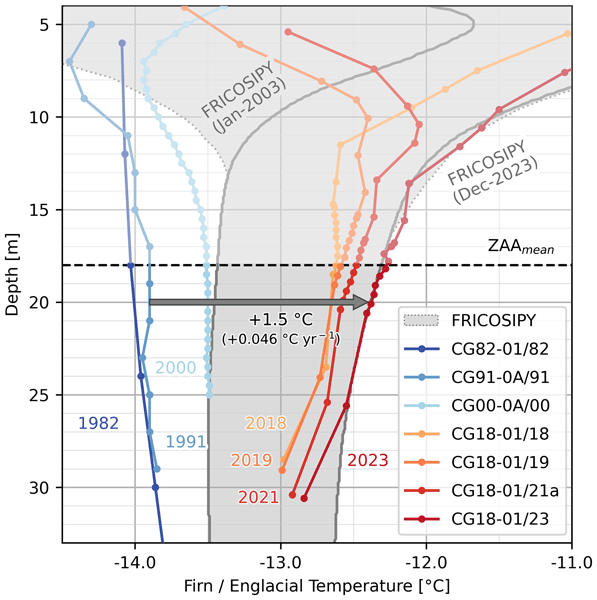
Inside the highest glaciers of the Alps lies an invaluable archive of data revealing the Earth's historic climate. However, as the atmosphere warms due to climate change, so does the glaciers' internal temperature, threatening the future longevity of these records. Using our customised Python model, validated by on-site measurements, we show how a doubling in surface melt has caused a warming of 1.5 °C in the past 21 years and explore the challenges of modelling in complex mountainous terrain.
Horst Machguth, Anja Eichler, Margit Schwikowski, Sabina Brütsch, Enrico Mattea, Stanislav Kutuzov, Martin Heule, Ryskul Usubaliev, Sultan Belekov, Vladimir N. Mikhalenko, Martin Hoelzle, and Marlene Kronenberg
The Cryosphere, 18, 1633–1646, https://doi.org/10.5194/tc-18-1633-2024, https://doi.org/10.5194/tc-18-1633-2024, 2024
Short summary
Short summary
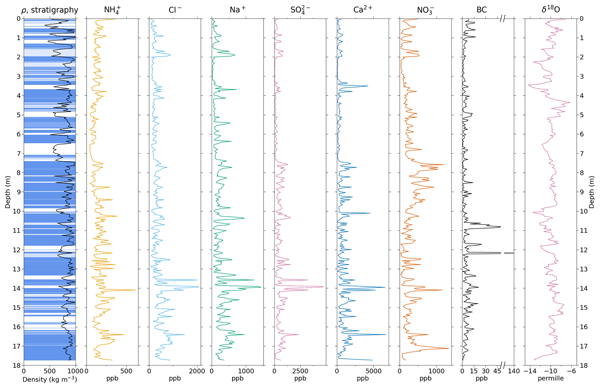
In 2018 we drilled an 18 m ice core on the summit of Grigoriev ice cap, located in the Tien Shan mountains of Kyrgyzstan. The core analysis reveals strong melting since the early 2000s. Regardless of this, we find that the structure and temperature of the ice have changed little since the 1980s. The probable cause of this apparent stability is (i) an increase in snowfall and (ii) the fact that meltwater nowadays leaves the glacier and thereby removes so-called latent heat.
Marlene Kronenberg, Ward van Pelt, Horst Machguth, Joel Fiddes, Martin Hoelzle, and Felix Pertziger
The Cryosphere, 16, 5001–5022, https://doi.org/10.5194/tc-16-5001-2022, https://doi.org/10.5194/tc-16-5001-2022, 2022
Short summary
Short summary
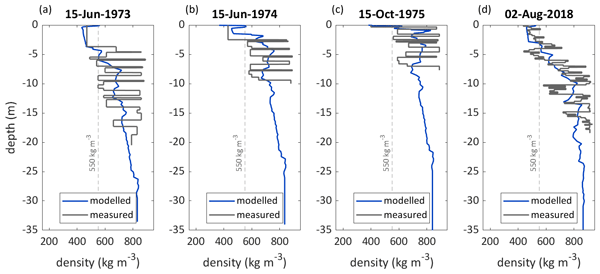
The Pamir Alay is located at the edge of regions with anomalous glacier mass changes. Unique long-term in situ data are available for Abramov Glacier, located in the Pamir Alay. In this study, we use this extraordinary data set in combination with reanalysis data and a coupled surface energy balance–multilayer subsurface model to compute and analyse the distributed climatic mass balance and firn evolution from 1968 to 2020.
Nicole Clerx, Horst Machguth, Andrew Tedstone, Nicolas Jullien, Nander Wever, Rolf Weingartner, and Ole Roessler
The Cryosphere, 16, 4379–4401, https://doi.org/10.5194/tc-16-4379-2022, https://doi.org/10.5194/tc-16-4379-2022, 2022
Short summary
Short summary
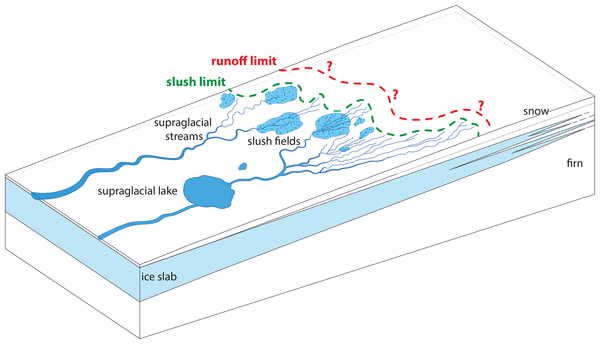
Meltwater runoff is one of the main contributors to mass loss on the Greenland Ice Sheet that influences global sea level rise. However, it remains unclear where meltwater runs off and what processes cause this. We measured the velocity of meltwater flow through snow on the ice sheet, which ranged from 0.17–12.8 m h−1 for vertical percolation and from 1.3–15.1 m h−1 for lateral flow. This is an important step towards understanding where, when and why meltwater runoff occurs on the ice sheet.
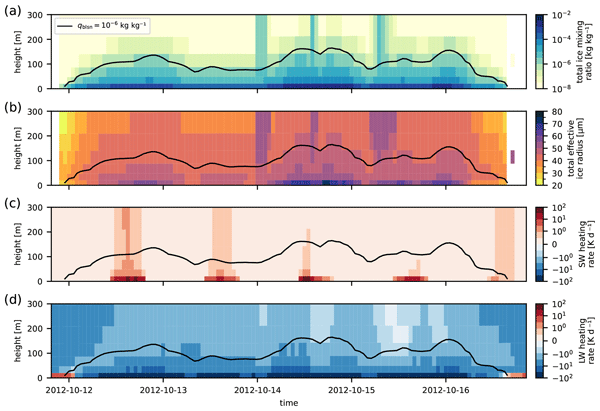
Samuel M. Tax, Maurice van Tiggelen, Thirza N. Feenstra, Paul C. J. P. Smeets, Srinidhi N. Gadde, Christiaan T. van Dalum, Willem Jan van de Berg, and Michiel R. van den Broeke
The Cryosphere, 20, 5609–5627, https://doi.org/10.5194/tc-20-5609-2026, https://doi.org/10.5194/tc-20-5609-2026, 2026
Short summary
Short summary
Strong winds can lift snow into the air, which influences the energy exchange between the surface and the atmosphere. We studied this phenomenon over the Greenland Ice Sheet using observations and a climate model. We found that blowing snow traps heat near the surface like a blanket and reflects incoming sunlight like a mirror. Simulating these processes increases the net energy at the surface and improves model accuracy. Therefore, we recommend including these effects in climate models.
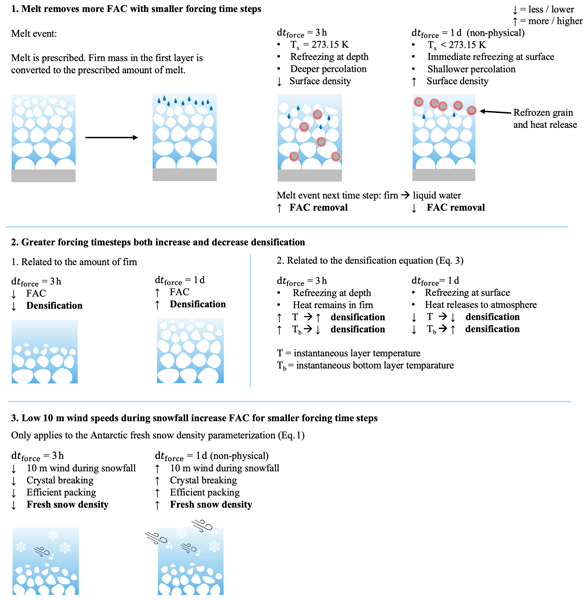
Tesse E. A. van den Aker, Peter Kuipers Munneke, Willem Jan van de Berg, Walter W. Immerzeel, and Michiel R. van den Broeke
The Cryosphere, 20, 5475–5490, https://doi.org/10.5194/tc-20-5475-2026, https://doi.org/10.5194/tc-20-5475-2026, 2026
Short summary
Short summary
The firn layer, i.e. permanent snow, regulates how an ice sheet responds to climate change. Firn models are forced with with climate data at time steps from sub-daily to annual in literature, however, implications are barely evaluated. We test the impact of different climate forcing time steps on the modeled firn layer. We conclude that the climate forcing time step (1) affects firn model output, (2) can lead to non-physical behaviour, and (3) that resolving at least a diurnal cycle is required.
Ioannis Chaniotis, Paraskevi Georgakaki, Romanos Foskinis, Marilena Gidarakou, Maria Gini, Platon Patlakas, Konstantinos Eleftheriadis, Alexandros Papagiannis, Elissavet Bossioli, Nicole Clerx, Alexis Berne, Helena Flocas, and Athanasios Nenes
EGUsphere, https://doi.org/10.5194/egusphere-2026-4645, https://doi.org/10.5194/egusphere-2026-4645, 2026
This preprint is open for discussion and under review for Atmospheric Chemistry and Physics (ACP).
Short summary
Short summary
This study implements three secondary ice production mechanisms in the RAMS-ICLAMS model to better represent mixed-phase clouds. Validated against CHOPIN campaign data and for two characteristic alpine cloud formations, these mechanisms improve ice crystal concentrations, cloud structure, and reflectivity. However, opposing precipitation responses have been predicted, highlighting a non linear response, which aligns with independent previous findings.
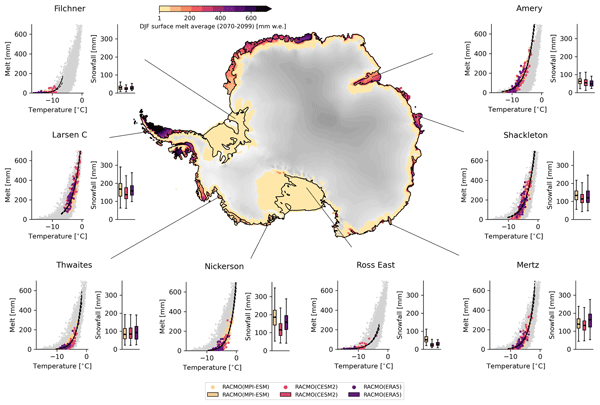
Marte Gé Hofsteenge, Willem Jan van de Berg, Christiaan van Dalum, Kristiina Verro, Maurice van Tiggelen, and Michiel van den Broeke
The Cryosphere, 20, 4747–4766, https://doi.org/10.5194/tc-20-4747-2026, https://doi.org/10.5194/tc-20-4747-2026, 2026
Short summary
Short summary
We use a regional climate model to study how surface melt on Antarctic ice shelves responds to air temperature. The relationship is strongly non-linear, mainly due to feedbacks in surface albedo, with other energy sources also contributing. Currently colder, drier, and more stable ice shelves will experience more melt at the same temperature than ice shelves in wetter climates, highlighting their vulnerability to fracturing, ice shelf instability, and contributions to global sea-level rise.
Sanne B. M. Veldhuijsen, Peter Kuipers Munneke, Willem Jan van de Berg, Michiel R. van den Broeke, and Luke D. Trusel
EGUsphere, https://doi.org/10.5194/egusphere-2026-3453, https://doi.org/10.5194/egusphere-2026-3453, 2026
This preprint is open for discussion and under review for The Cryosphere (TC).
Short summary
Short summary
Antarctica has floating ice shelves around its perimeter that provide stability to the ice sheet. As temperature rises, snow on the ice shelves may melt away, and ponding of meltwater may cause the ice shelves to collapse. If that happens, Antarctica may start to lose ice faster than before, resulting in accelerated sea-level rise. The tool presented in this article will be used in simulations of future climate to determine when climate change leads to collapse of the ice shelves in Antarctica.
Christian Torres, Deniz Bozkurt, Vincent Favier, Victoire Buffet, Claudio Bravo, Xavier Fettweis, Thomas Dethinne, Antoine Rabatel, Maximiliano Viale, Sang-Jong Park, and Jorge Arigony-Neto
EGUsphere, https://doi.org/10.5194/egusphere-2026-3508, https://doi.org/10.5194/egusphere-2026-3508, 2026
This preprint is open for discussion and under review for The Cryosphere (TC).
Short summary
Short summary
We investigated periods when unusually warm conditions in Patagonia occurred at the same time as precipitation events on the Antarctic Peninsula. By combining observations and simulations, we identified 127 such events between 1980 and 2022. These events increased ice melt in Patagonia while enhancing accumulation on the Antarctic Peninsula, highlighting how large-scale weather patterns can simultaneously affect ice-covered regions in different ways.
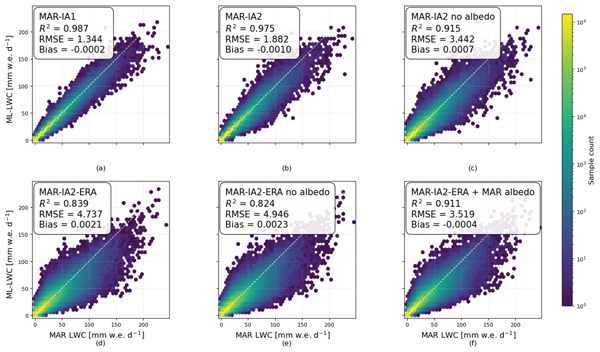
Marco Tedesco, Racheet Matai, and Xavier Fettweis
The Cryosphere, 20, 4235–4253, https://doi.org/10.5194/tc-20-4235-2026, https://doi.org/10.5194/tc-20-4235-2026, 2026
Short summary
Short summary
We developed a machine learning emulator of a climate model simulating melting over Greenland that performs as well as the original model but it is much faster. We show that this emulator can be used as powerful tools to complement regional climate models by enabling computationally efficient ensemble simulations and physically interpretable attribution of past and future Greenland surface melt. Development of regional climate models should go hand in hand with ML-based tools.
Guillaume Timmermans, Brice Noël, Christoph Kittel, Thomas Dethinne, Nicolas Ghilain, and Xavier Fettweis
EGUsphere, https://doi.org/10.5194/egusphere-2026-2341, https://doi.org/10.5194/egusphere-2026-2341, 2026
Short summary
Short summary
We assess how well a regional climate model reproduces changes in the mass of the Greenland Ice Sheet due to surface processes, an important driver of sea level rise. By comparing model results with observations, we show that high-resolution simulations closely match reality. Coarser simulations are less detailed near the edges but remain reliable overall. A resolution of 10 kilometers provides a good balance between accuracy and computing cost for long-term projections.
Ian Simpson, Edward Hanna, Ryan S. Williams, Linh Luu, Andrew Orr, Julie Jones, Xavier Fettweis, Jose Abraham Torres Alavez, Ole Bøssing Christensen, Ella Gilbert, Sid Gumber, Christoph Kittel, Sihan Li, Damien Maure, Ruth Mottram, Tony Phillips, Willem Jan van de Berg, and Kristiina Verro
EGUsphere, https://doi.org/10.5194/egusphere-2026-2270, https://doi.org/10.5194/egusphere-2026-2270, 2026
Short summary
Short summary
The warming trend in global temperatures has potential to result in accelerated break up of the Antarctic ice shelves, which would contribute to rising sea levels. Here we present a novel database of Antarctic extreme weather events over a selection of the Antarctic ice shelves. We examine air temperature, precipitation, wind and surface pressure. In addition, we examine trends in the frequency of extreme events and the links with weather patterns around Antarctica.
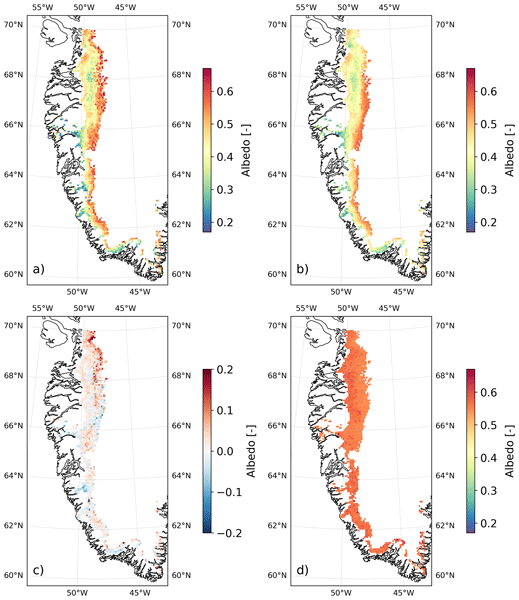
Raf Antwerpen, Marco Tedesco, Pierre Gentine, Willem Jan van de Berg, and Xavier Fettweis
The Cryosphere, 20, 3131–3149, https://doi.org/10.5194/tc-20-3131-2026, https://doi.org/10.5194/tc-20-3131-2026, 2026
Short summary
Short summary
We study why Greenland ice melts faster by improving how ice brightness is represented. This is important because it controls how much sunlight is absorbed by the ice. Using satellite data and a new transparent machine learning method trained with climate model information, we capture how the shape of the ice sheet, temperature, and meltwater change ice brightness. Our approach outperforms existing climate models and can reduce uncertainty in future sea level rise projections.
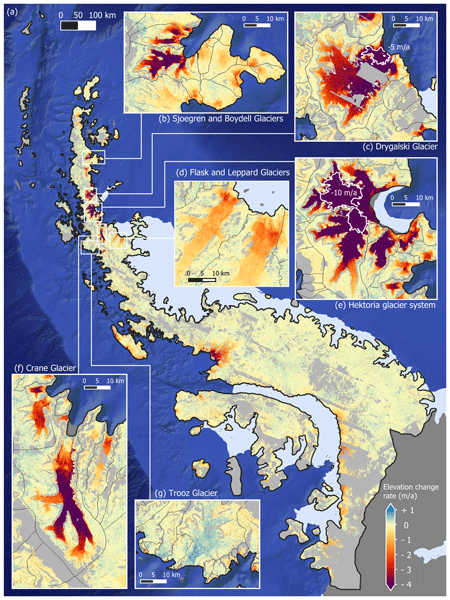
Maud Bernat, Etienne Berthier, Amaury Dehecq, Romain Hugonnet, Joaquin M. C. Belart, Naomi Ochwat, Peter Kuipers Munneke, Elizabeth Case, Ted Scambos, Louis-Marie Gauer, and David Youssefi
The Cryosphere, 20, 3025–3049, https://doi.org/10.5194/tc-20-3025-2026, https://doi.org/10.5194/tc-20-3025-2026, 2026
Short summary
Short summary
The Antarctic Peninsula is a mountainous region containing an ice sheet and peripheral glaciers. Differences remain between the methods used to estimate its mass changes. We use thousands of digital elevation models derived from high resolution stereoscopic images to calculate a new estimate of mass changes. We find that between 2007 and 2021, the ice sheet lost -28±6Gt/a and its peripheral glaciers -14±3Gt/a. We highlight the importance of resolving fine-scale changes in complex coastal areas.
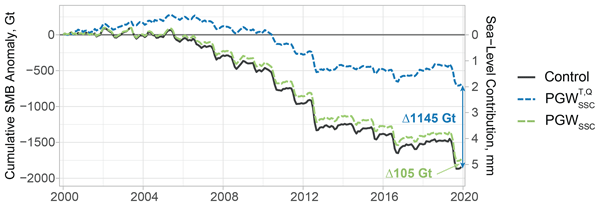
Jonathon R. Preece, Patrick Alexander, Thomas L. Mote, Gabriel J. Kooperman, Xavier Fettweis, and Marco Tedesco
The Cryosphere, 20, 2871–2894, https://doi.org/10.5194/tc-20-2871-2026, https://doi.org/10.5194/tc-20-2871-2026, 2026
Short summary
Short summary
Surface melt of the Greenland Ice Sheet has increased dramatically since the turn of the century, aided by an increase in persistent atmospheric circulation patterns that promote anomalously warm conditions. Through modeling experiments, this study shows that surface mass loss would have been reduced by 62% relative to historical conditions if this shift in atmospheric circulation would have occurred under the lower average temperatures of a preindustrial climate.
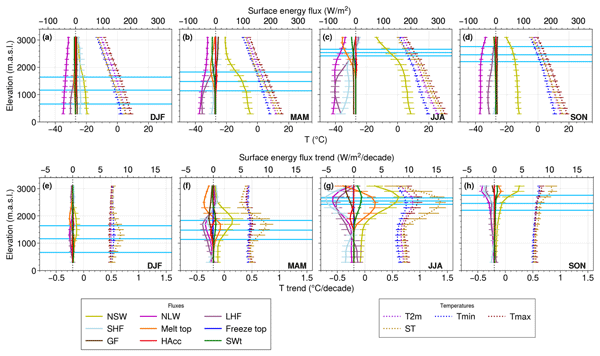
Ian Castellanos, Martin Ménégoz, Juliette Blanchet, Julien Beaumet, Hubert Gallée, Eduardo Moreno-Chamarro, Chantal Staquet, and Xavier Fettweis
Earth Syst. Dynam., 17, 581–605, https://doi.org/10.5194/esd-17-581-2026, https://doi.org/10.5194/esd-17-581-2026, 2026
Short summary
Short summary
The Alps host glaciers, distinct ecosystems, socio-economic interests and water resources that are being impacted by climate change. In this study, we aim at understanding how warming occurs in the Alps in projected scenarios and what physical processes drive it. We find under these scenarios that elevations around the snowline will warm faster than elsewhere, because snow retreats to higher elevations. Indeed, snow slows down warming due to its high albedo and the energy consumed to melt it.
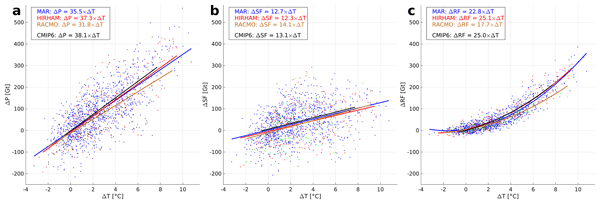
Fredrik Boberg, Xavier Fettweis, Nicolaj Hansen, Ruth Mottram, and Michiel R. van den Broeke
The Cryosphere, 20, 2947–2960, https://doi.org/10.5194/tc-20-2947-2026, https://doi.org/10.5194/tc-20-2947-2026, 2026
Short summary
Short summary
An ensemble of regional climate model simulations is used to estimate the 21st century change in precipitation on the Greenland ice sheet. For the end of the century, the change is in the range 40 to 170 Gt per year, depending on the emission scenario. Using annual values of 2 m air temperature and precipitation, we estimate an increase in precipitation of 35 Gt per year for every degree of warming.
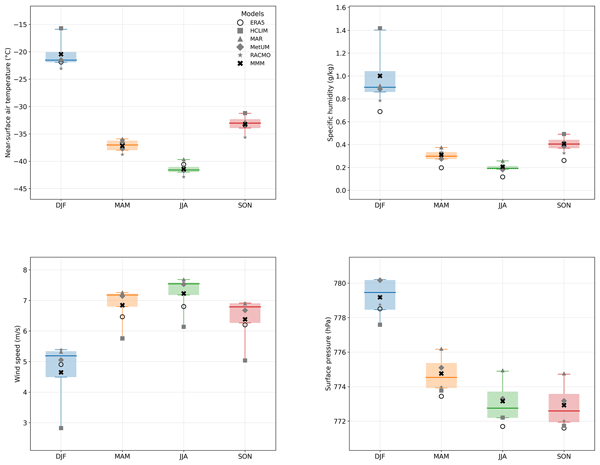
Ella Gilbert, José Abraham Torres-Alavez, Marte G. Hofsteenge, Willem Jan van de Berg, Fredrik Boberg, Ole Bøssing Christensen, Christiaan Timo van Dalum, Xavier Fettweis, Siddharth Gumber, Nicolaj Hansen, Christoph Kittel, Clara Lambin, Damien Maure, Ruth Mottram, Martin Olesen, Andrew Orr, Tony Phillips, Maurice van Tiggelen, Kristiina Verro, and Priscilla A. Mooney
The Cryosphere, 20, 2629–2658, https://doi.org/10.5194/tc-20-2629-2026, https://doi.org/10.5194/tc-20-2629-2026, 2026
Short summary
Short summary
Here we present a new dataset – the PolarRES ensemble – of four state-of-the-art regional climate models, which capture the full complexity of Antarctica's climate. The ensemble out-performs other available tools, advancing our ability to explore Antarctic climate. While it still has limitations, the PolarRES ensemble offers a novel and exciting way of evaluating climate processes and features, and we encourage researchers to use the data, which are freely available.
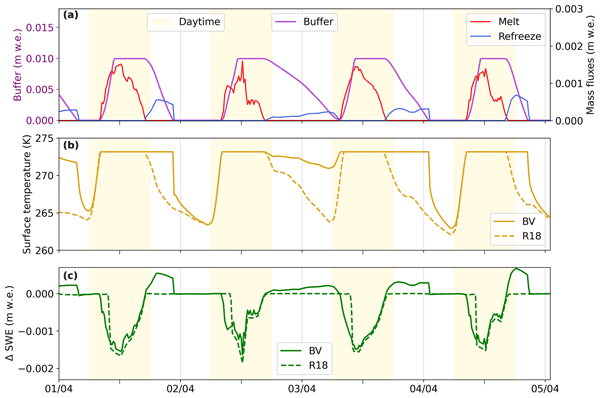
Audrey Goutard, Marion Réveillet, Fanny Brun, Delphine Six, Kevin Fourteau, Charles Amory, Xavier Fettweis, Mathieu Fructus, Arbindra Khadka, and Matthieu Lafaysse
The Cryosphere, 20, 2393–2416, https://doi.org/10.5194/tc-20-2393-2026, https://doi.org/10.5194/tc-20-2393-2026, 2026
Short summary
Short summary
A new scheme has been developed in a snowpack model (SURFEX/ISBA-Crocus), to consider the impact of liquid water dynamics on bare ice, including albedo feedback and refreezing. When applied to the Mera Glacier in Nepal, the model reveals strong seasonal effects on the energy and mass balance, with increased melting in dry seasons and significant refreezing during the monsoon. This development improves mass balance modeling under increasing rainfall and bare ice exposure due to climate warming.
Benjamin Heurgue, Charles Amory, Christoph Kittel, Fredrik Boberg, Gaël Durand, Vincent Favier, Xavier Fettweis, Quentin Glaude, Heiko Goelzer, Nicolaj Hansen, Nicolas C. Jourdain, Ruth Mottram, Martin Olesen, Willem Jan Van de Berg, Michiel R. Van den Broeke, and René R. Wijngaard
EGUsphere, https://doi.org/10.5194/egusphere-2026-624, https://doi.org/10.5194/egusphere-2026-624, 2026
Short summary
Short summary
We studied how the Antarctic ice sheet surface mass balance may change by 2100 using three high-resolution climate models forced by the same future climate scenario. While the models agree for present-day conditions, they project very different futures, especially over floating ice shelves. These differences mainly come from how melting, refreezing, and temperature are represented. Our results show that future sea level projections strongly depend on how well models simulate today’s climate.
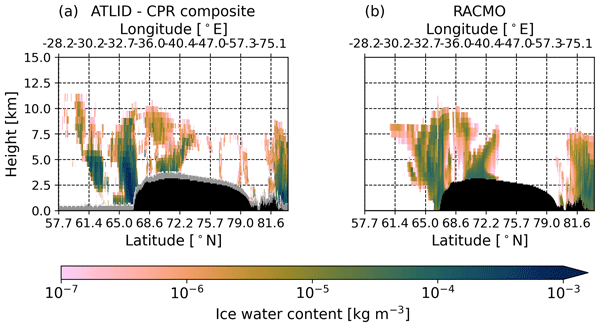
Thirza N. Feenstra, Willem Jan van de Berg, Gerd-Jan van Zadelhoff, David P. Donovan, Christiaan T. van Dalum, and Michiel R. van den Broeke
Atmos. Meas. Tech., 19, 1323–1344, https://doi.org/10.5194/amt-19-1323-2026, https://doi.org/10.5194/amt-19-1323-2026, 2026
Short summary
Short summary
Cloud representation brings large uncertainties in polar climate modeling. We show the first evaluation of Greenland clouds in the Regional Atmospheric Climate Model (RACMO2.4) with new EarthCARE satellite data. Comparing lidar and radar observations and retrieved cloud profiles with co-located RACMO output, we find RACMO captures low ice clouds but underestimates high clouds, mid-altitude liquid clouds, and snowfall. These results highlight EarthCARE's potential to improve polar climate models.
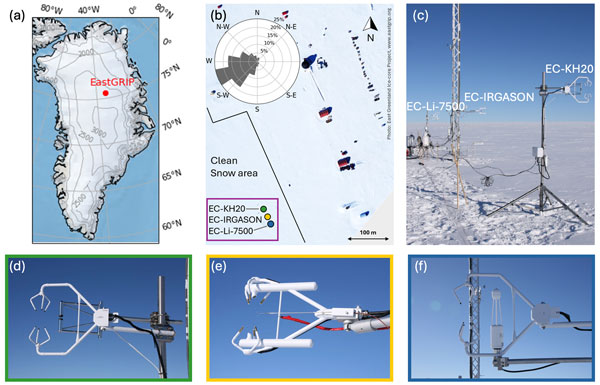
Ida Haven, Hans Christian Steen-Larsen, Laura J. Dietrich, Sonja Wahl, Jason E. Box, Michiel R. van den Broeke, Alun Hubbard, Stephan T. Kral, Joachim Reuder, and Maurice van Tiggelen
The Cryosphere, 20, 573–593, https://doi.org/10.5194/tc-20-573-2026, https://doi.org/10.5194/tc-20-573-2026, 2026
Short summary
Short summary
Three independent Eddy-Covariance measurement systems deployed on top of the Greenland Ice Sheet are compared. Using this dataset, we evaluate the reproducibility and quantify the differences between the systems. The fidelity of two regional climate models in capturing the seasonal variability in the latent and sensible heat flux between the snow surface and the atmosphere is assessed. We identify differences between observations and model simulations, especially during the winter period.
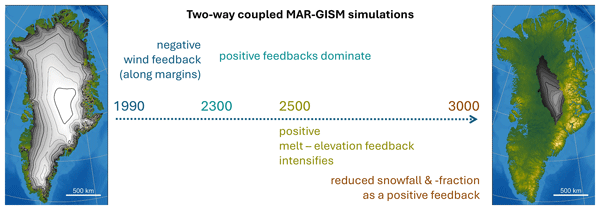
Chloë Marie Paice, Xavier Fettweis, and Philippe Huybrechts
The Cryosphere, 20, 309–332, https://doi.org/10.5194/tc-20-309-2026, https://doi.org/10.5194/tc-20-309-2026, 2026
Short summary
Short summary
To study Greenland ice sheet–atmosphere interactions, we coupled an ice sheet model to a regional climate model and performed simulations of differing coupling complexity over 1000 years under a high-warming climate scenario. They reveal that at first melt at the ice sheet margin is reduced by changing wind patterns. But over time, as the ice sheet melts and its surface lowers, precipitation patterns and cloudiness also change and amplify ice mass loss over the entire ice sheet.
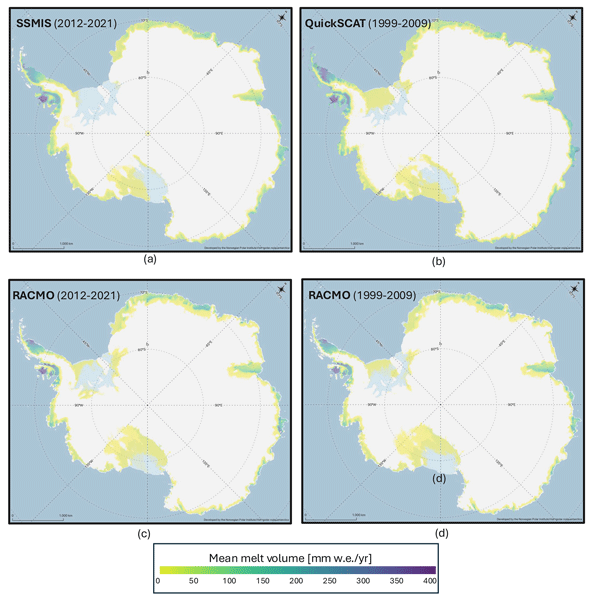
Valeria Di Biase, Peter Kuipers Munneke, Bert Wouters, Michiel R. van den Broeke, and Maurice van Tiggelen
The Cryosphere, 20, 87–96, https://doi.org/10.5194/tc-20-87-2026, https://doi.org/10.5194/tc-20-87-2026, 2026
Short summary
Short summary
We produce annual maps of Antarctic surface melt volumes from 2012 to 2021 using satellite microwave data. We detect melting days from thresholds on the satellite signal and then use actual melt measurements from weather stations to convert those signals into water‑equivalent volumes. Our maps capture known melt hotspots and show slightly lower totals than climate models. This dataset supports climate and ice‑shelf studies.

Heiko Goelzer, Constantijn J. Berends, Fredrik Boberg, Gael Durand, Tamsin L. Edwards, Xavier Fettweis, Fabien Gillet-Chaulet, Quentin Glaude, Philippe Huybrechts, Sébastien Le clec'h, Ruth Mottram, Brice Noël, Martin Olesen, Charlotte Rahlves, Jeremy Rohmer, Michiel van den Broeke, and Roderik S. W. van de Wal
The Cryosphere, 19, 6887–6906, https://doi.org/10.5194/tc-19-6887-2025, https://doi.org/10.5194/tc-19-6887-2025, 2025
Short summary
Short summary
We present an ensemble of ice sheet model projections for the Greenland ice sheet. The focus is on providing projections that improve our understanding of the range future sea-level rise and the inherent uncertainties over the next 100 to 300 years. Compared to earlier work we more fully account for some of the uncertainties in sea-level projections. We include a wider range of climate model output, more climate change scenarios and we extend projections schematically up to year 2300.
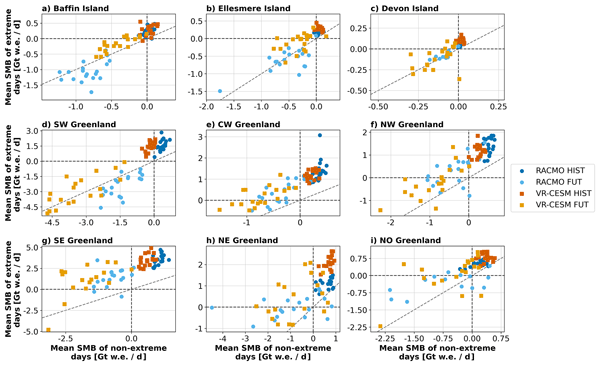
Nicole A. Loeb, Alex Crawford, Brice Noël, and Julienne Stroeve
The Cryosphere, 19, 5403–5422, https://doi.org/10.5194/tc-19-5403-2025, https://doi.org/10.5194/tc-19-5403-2025, 2025
Short summary
Short summary
We examine how extreme precipitation days affect the seasonal mass balance (SMB) of land ice in Greenland and the Eastern Canadian Arctic in historical and future simulations. Past extreme precipitation led to higher SMB with snowfall. Future extreme precipitation may lead to the loss of ice mass as more falls as rain rather than snow in some regions, such as southwestern Greenland. Across the region, extreme precipitation becomes more important to seasonal SMB in the future, warmer climate.
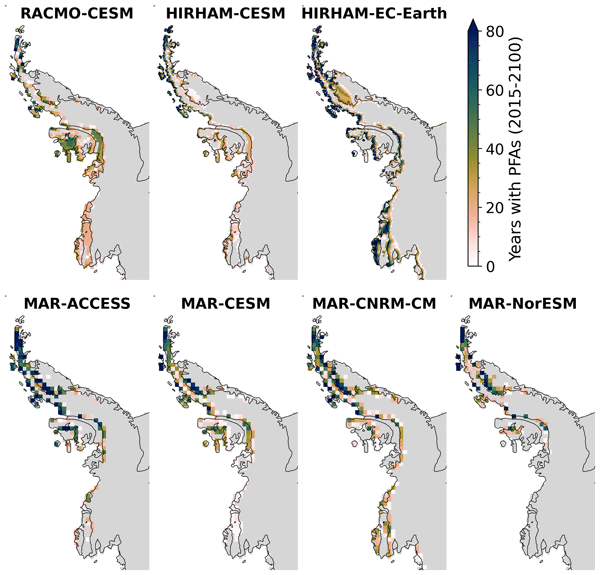
Sanne B. M. Veldhuijsen, Willem Jan van de Berg, Peter Kuipers Munneke, Nicolaj Hansen, Fredrik Boberg, Christoph Kittel, Charles Amory, and Michiel R. van den Broeke
The Cryosphere, 19, 5157–5173, https://doi.org/10.5194/tc-19-5157-2025, https://doi.org/10.5194/tc-19-5157-2025, 2025
Short summary
Short summary
Perennial firn aquifers (PFAs), year-round bodies of liquid water within firns, can potentially impact ice-shelf and ice-sheet stability. We developed a fast XGBoost firn emulator to predict the 21st-century distribution of PFAs in Antarctica for 12 climatic forcing datasets. Our findings suggest that, in low-emission scenarios, PFAs remain confined to the Antarctic Peninsula. However, in a high-emission scenario, PFAs are projected to expand to a region in West Antarctica and East Antarctica.
Thomas Dethinne, Nicolas Ghilain, Christoph Kittel, Benjamin Lecart, Xavier Fettweis, and François Jonard
EGUsphere, https://doi.org/10.5194/egusphere-2025-3907, https://doi.org/10.5194/egusphere-2025-3907, 2025
Short summary
Short summary
This study replace standard vegetation input of a regional climate model with a satellite-based vegetation dataset to assess how vegetation influences climate during extreme events and to test the sensitivity of the model. The results show a non-linear sensitivity to vegetation, and using an observation-based vegetation input allows for a better representation of the extreme events, highlight the need for an advanced representation of vegetation in climate model to improve climate predictions.
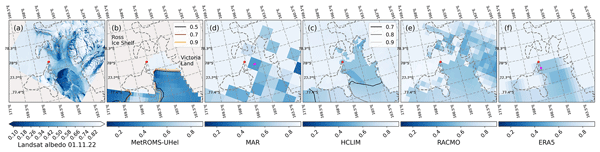
Kristiina Verro, Cecilia Äijälä, Roberta Pirazzini, Ruzica Dadic, Damien Maure, Willem Jan van de Berg, Giacomo Traversa, Christiaan T. van Dalum, Petteri Uotila, Xavier Fettweis, Biagio Di Mauro, and Milla Johansson
The Cryosphere, 19, 4409–4436, https://doi.org/10.5194/tc-19-4409-2025, https://doi.org/10.5194/tc-19-4409-2025, 2025
Short summary
Short summary
Accurately representing Antarctic sea ice is essential for reliable climate and ocean model predictions. We evaluated how different models simulate the sea ice's sunlight reflectivity (called albedo) using field and satellite data. Models with simple albedo schemes performed well in limited cases but missed key processes. The advanced scheme in the MetROMS-UHel ocean model provided the most accurate results, including observed day–night albedo changes observed during a field campaign.
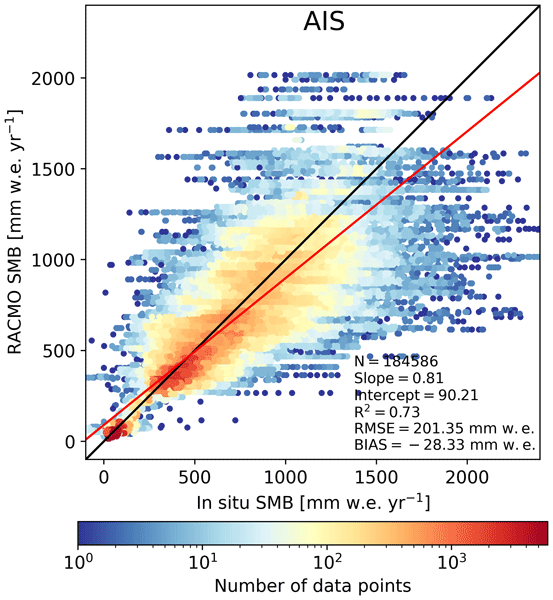
Christiaan T. van Dalum, Willem Jan van de Berg, Michiel R. van den Broeke, and Maurice van Tiggelen
The Cryosphere, 19, 4061–4090, https://doi.org/10.5194/tc-19-4061-2025, https://doi.org/10.5194/tc-19-4061-2025, 2025
Short summary
Short summary
In this study, we present a new surface mass balance (SMB) and near-surface climate product for Antarctica with the regional climate model RACMO2.4p1. We assess the impact of major model updates on the climate of Antarctica. Locally, the SMB has changed substantially but also agrees well with observations. In addition, we show that the SMB components, surface energy budget, albedo, pressure, temperature, and wind speed compare well with in situ and remote sensing observations.
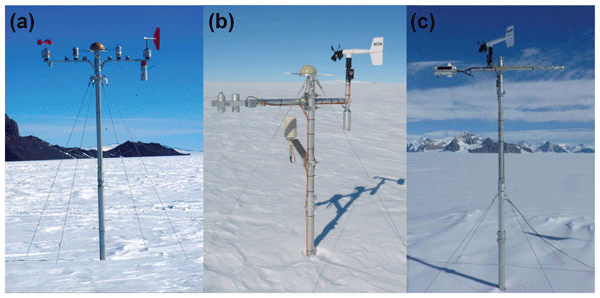
Maurice van Tiggelen, Paul C. J. P. Smeets, Carleen H. Reijmer, Peter Kuipers Munneke, and Michiel R. van den Broeke
Earth Syst. Sci. Data, 17, 4933–4955, https://doi.org/10.5194/essd-17-4933-2025, https://doi.org/10.5194/essd-17-4933-2025, 2025
Short summary
Short summary
This paper describes the measurements from the 19 IMAU (Institute for Marine and Atmospheric research Utrecht) automatic weather stations that operated on the Antarctic ice sheet from 1995 through 2022. These stations also measured the net surface radiation and surface height change, allowing for the quantification of the surface energy and mass balance at hourly resolution. These data are invaluable for the evaluation of atmospheric models and for the detection of climatological changes.
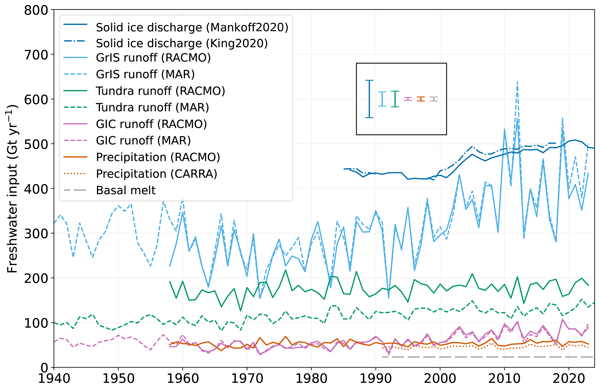
Anneke L. Vries, Willem Jan van de Berg, Brice Noël, Lorenz Meire, and Michiel R. van den Broeke
The Cryosphere, 19, 3897–3914, https://doi.org/10.5194/tc-19-3897-2025, https://doi.org/10.5194/tc-19-3897-2025, 2025
Short summary
Short summary
Freshwater flows into Greenland's fjords from various sources. Solid ice discharge (e.g. calving icebergs) dominates freshwater input in the southeast and northwest. In contrast, in the southwest, runoff from the ice sheet and tundra are the most significant. Seasonal data revealed that fjord precipitation and tundra runoff contribute up to 11 % and 35 % of the monthly freshwater input, respectively. Our results provide valuable input for ocean models and for researchers studying fjord ecosystems.
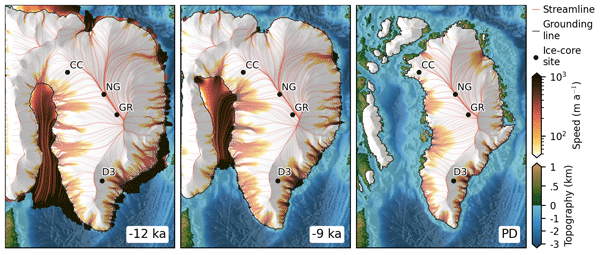
Mikkel Langgaard Lauritzen, Anne Solgaard, Nicholas Mossor Rathmann, Bo Møllesøe Vinther, Aslak Grindsted, Brice Noël, Guðfinna Aðalgeirsdóttir, and Christine Schøtt Hvidberg
The Cryosphere, 19, 3599–3622, https://doi.org/10.5194/tc-19-3599-2025, https://doi.org/10.5194/tc-19-3599-2025, 2025
Short summary
Short summary
We studied the Holocene (past 11 700 years) to understand how the Greenland Ice Sheet has changed. Using 841 computer simulations, we tested different scenarios and matched them to historical ice elevation data, confirming our model's accuracy. Results show that Greenland's melting has raised sea levels by about 5.3 m since the Holocene began and by around 12 mm in just the past 500 years.
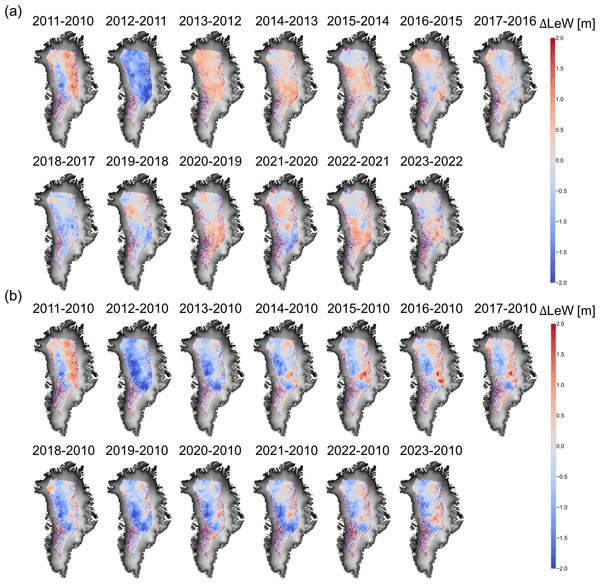
Weiran Li, Stef Lhermitte, Bert Wouters, Cornelis Slobbe, Max Brils, and Xavier Fettweis
The Cryosphere, 19, 3419–3442, https://doi.org/10.5194/tc-19-3419-2025, https://doi.org/10.5194/tc-19-3419-2025, 2025
Short summary
Short summary
Due to recurrent melt and refreezing events in recent decades, the snow conditions over Greenland have changed. To observe this, we use a parameter (leading edge width; LeW) derived from satellite altimetry and analyse its spatial and temporal variations. By comparing the LeW variations with modelled firn parameters, we concluded that the 2012 melt event and the recent and increasingly frequent melt events have a long-lasting impact on the volume scattering of Greenland firn.
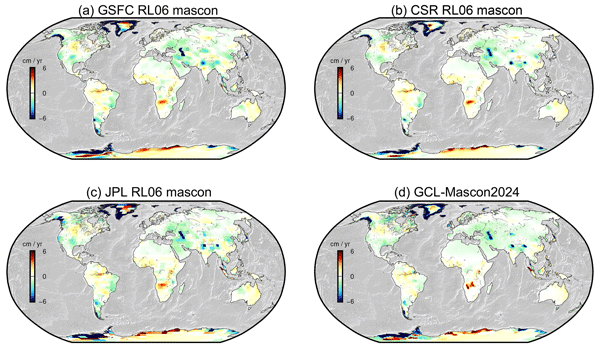
Zhengwen Yan, Jiangjun Ran, Pavel Ditmar, C. K. Shum, Roland Klees, Patrick Smith, and Xavier Fettweis
Earth Syst. Sci. Data, 17, 4253–4275, https://doi.org/10.5194/essd-17-4253-2025, https://doi.org/10.5194/essd-17-4253-2025, 2025
Short summary
Short summary
The Gravity Recovery And Climate Experiment (GRACE) mission has greatly improved our understanding of changes in Earth's gravity field over time. A novel mass concentration (mascon) dataset, GCL-Mascon2024, was determined by leveraging the short-arc approach, advanced spatial constraints, a frequency-dependent noise processing strategy, and parameterization-integrating natural boundaries, aiming to enhance accuracy for monitoring mass transportation on Earth.
Marcus Gastaldello, Enrico Mattea, Martin Hoelzle, and Horst Machguth
The Cryosphere, 19, 2983–3008, https://doi.org/10.5194/tc-19-2983-2025, https://doi.org/10.5194/tc-19-2983-2025, 2025
Short summary
Short summary
Inside the highest glaciers of the Alps lies an invaluable archive of data revealing the Earth's historic climate. However, as the atmosphere warms due to climate change, so does the glaciers' internal temperature, threatening the future longevity of these records. Using our customised Python model, validated by on-site measurements, we show how a doubling in surface melt has caused a warming of 1.5 °C in the past 21 years and explore the challenges of modelling in complex mountainous terrain.
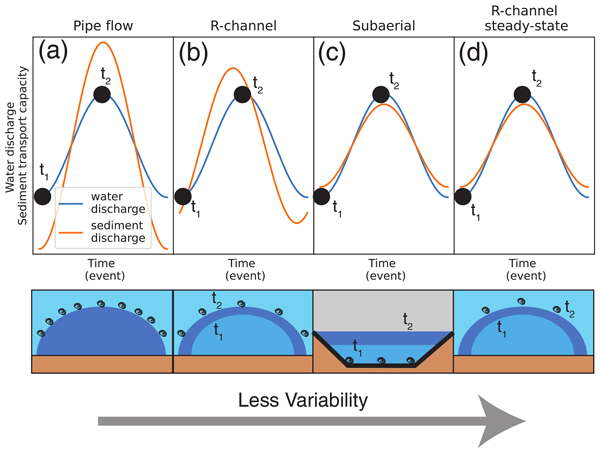
Ian Delaney, Andrew J. Tedstone, Mauro A. Werder, and Daniel Farinotti
The Cryosphere, 19, 2779–2795, https://doi.org/10.5194/tc-19-2779-2025, https://doi.org/10.5194/tc-19-2779-2025, 2025
Short summary
Short summary
Sediment transport capacity depends on water velocity and channel width. In rivers, water discharge changes affect flow depth, width, and velocity. Yet, under glaciers, discharge variations alter velocity more than channel shape. Due to these differences, this study shows that sediment transport capacity under glaciers varies widely and peaks before water flow, creating a complex relationship. Understanding these dynamics helps interpret sediment discharge from glaciers in different climates.
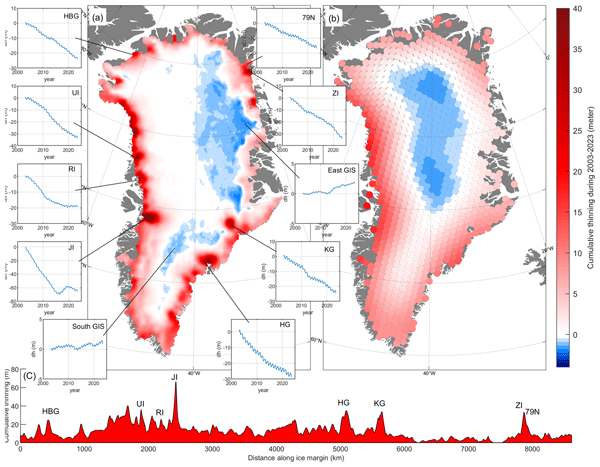
Shfaqat A. Khan, Helene Seroussi, Mathieu Morlighem, William Colgan, Veit Helm, Gong Cheng, Danjal Berg, Valentina R. Barletta, Nicolaj K. Larsen, William Kochtitzky, Michiel van den Broeke, Kurt H. Kjær, Andy Aschwanden, Brice Noël, Jason E. Box, Joseph A. MacGregor, Robert S. Fausto, Kenneth D. Mankoff, Ian M. Howat, Kuba Oniszk, Dominik Fahrner, Anja Løkkegaard, Eigil Y. H. Lippert, Alicia Bråtner, and Javed Hassan
Earth Syst. Sci. Data, 17, 3047–3071, https://doi.org/10.5194/essd-17-3047-2025, https://doi.org/10.5194/essd-17-3047-2025, 2025
Short summary
Short summary
The surface elevation of the Greenland Ice Sheet is changing due to surface mass balance processes and ice dynamics, each exhibiting distinct spatiotemporal patterns. Here, we employ satellite and airborne altimetry data with fine spatial (1 km) and temporal (monthly) resolutions to document this spatiotemporal evolution from 2003 to 2023. This dataset of fine-resolution altimetry data in both space and time will support studies of ice mass loss and be useful for GIS ice sheet modeling.
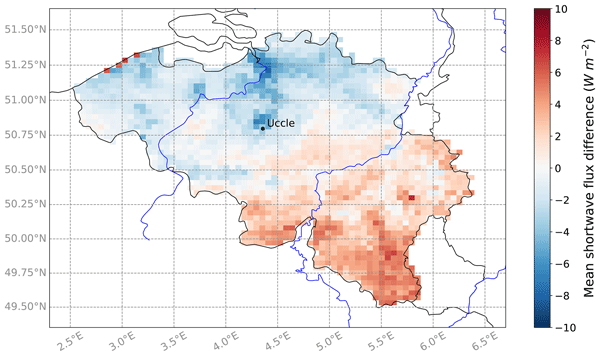
Jean-François Grailet, Robin J. Hogan, Nicolas Ghilain, David Bolsée, Xavier Fettweis, and Marilaure Grégoire
Geosci. Model Dev., 18, 1965–1988, https://doi.org/10.5194/gmd-18-1965-2025, https://doi.org/10.5194/gmd-18-1965-2025, 2025
Short summary
Short summary
The MAR (Modèle Régional Atmosphérique) is a regional climate model used for weather forecasting and studying the climate over various regions. This paper presents an update of MAR thanks to which it can precisely decompose solar radiation, in particular in the UV (ultraviolet) and photosynthesis ranges, both being critical to human health and ecosystems. As a first application of this new capability, this paper presents a method for predicting UV indices with MAR.
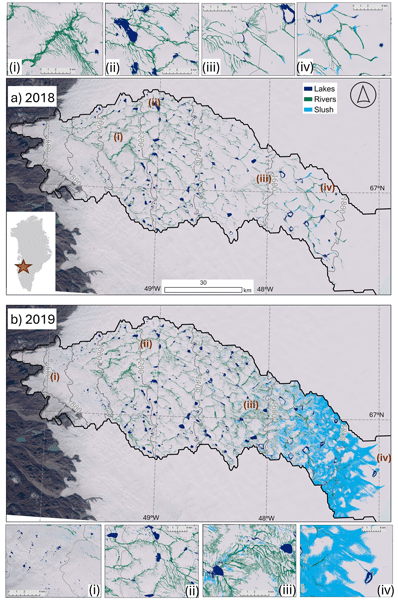
Emily Glen, Amber Leeson, Alison F. Banwell, Jennifer Maddalena, Diarmuid Corr, Olivia Atkins, Brice Noël, and Malcolm McMillan
The Cryosphere, 19, 1047–1066, https://doi.org/10.5194/tc-19-1047-2025, https://doi.org/10.5194/tc-19-1047-2025, 2025
Short summary
Short summary
We compare surface meltwater features from optical satellite imagery in the Russell–Leverett glacier catchment during high (2019) and low (2018) melt years. In the high melt year, features appear at higher elevations, meltwater systems are more connected, small lakes are more frequent, and slush is more widespread. These findings provide insights into how a warming climate, where high melt years become common, could alter meltwater distribution and dynamics on the Greenland Ice Sheet.
Ny Riana Randresihaja, Olivier Gourgue, Lauranne Alaerts, Xavier Fettweis, Jonathan Lambrechts, Miguel De Le Court, Marilaure Grégoire, and Emmanuel Hanert
EGUsphere, https://doi.org/10.5194/egusphere-2025-634, https://doi.org/10.5194/egusphere-2025-634, 2025
Preprint archived
Short summary
Short summary
Coastal areas face rising flood threats as storms intensifies with climate change. With an advanced model of the Scheldt Estuary-North Sea, we studied how detailed atmospheric data must be to predict storm surge peaks in estuaries. We found that high-resolution atmospheric data gives the best results, and coarser data with same resolution as current global climate models give poorer results. We show that investing in localized, high-resolution atmospheric data can significantly improve results.
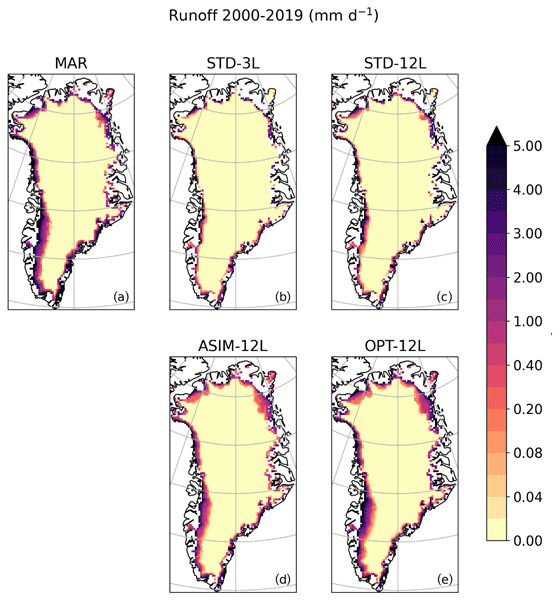
Sylvie Charbit, Christophe Dumas, Fabienne Maignan, Catherine Ottlé, Nina Raoult, Xavier Fettweis, and Philippe Conesa
The Cryosphere, 18, 5067–5099, https://doi.org/10.5194/tc-18-5067-2024, https://doi.org/10.5194/tc-18-5067-2024, 2024
Short summary
Short summary
The evolution of the Greenland ice sheet is highly dependent on surface melting and therefore on the processes operating at the snow–atmosphere interface and within the snow cover. Here we present new developments to apply a snow model to the Greenland ice sheet. The performance of this model is analysed in terms of its ability to simulate ablation processes. Our analysis shows that the model performs well when compared with the MAR regional polar atmospheric model.
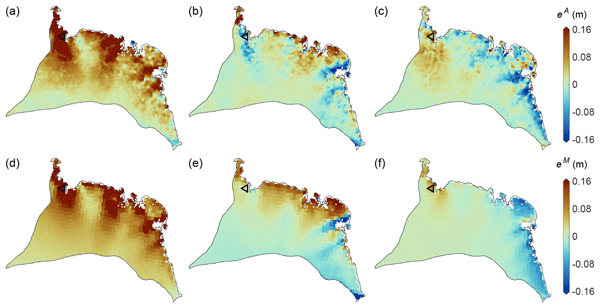
Maria T. Kappelsberger, Martin Horwath, Eric Buchta, Matthias O. Willen, Ludwig Schröder, Sanne B. M. Veldhuijsen, Peter Kuipers Munneke, and Michiel R. van den Broeke
The Cryosphere, 18, 4355–4378, https://doi.org/10.5194/tc-18-4355-2024, https://doi.org/10.5194/tc-18-4355-2024, 2024
Short summary
Short summary
The interannual variations in the height of the Antarctic Ice Sheet (AIS) are mainly due to natural variations in snowfall. Precise knowledge of these variations is important for the detection of any long-term climatic trends in AIS surface elevation. We present a new product that spatially resolves these height variations over the period 1992–2017. The product combines the strengths of atmospheric modeling results and satellite altimetry measurements.
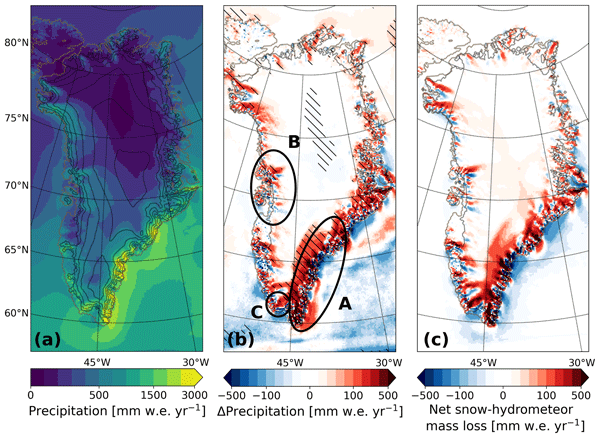
Christiaan T. van Dalum, Willem Jan van de Berg, Srinidhi N. Gadde, Maurice van Tiggelen, Tijmen van der Drift, Erik van Meijgaard, Lambertus H. van Ulft, and Michiel R. van den Broeke
The Cryosphere, 18, 4065–4088, https://doi.org/10.5194/tc-18-4065-2024, https://doi.org/10.5194/tc-18-4065-2024, 2024
Short summary
Short summary
We present a new version of the polar Regional Atmospheric Climate Model (RACMO), version 2.4p1, and show first results for Greenland, Antarctica and the Arctic. We provide an overview of all changes and investigate the impact that they have on the climate of polar regions. By comparing the results with observations and the output from the previous model version, we show that the model performs well regarding the surface mass balance of the ice sheets and near-surface climate.
Xueyu Zhang, Lin Liu, Brice Noël, and Zhicai Luo
EGUsphere, https://doi.org/10.5194/egusphere-2024-1726, https://doi.org/10.5194/egusphere-2024-1726, 2024
Preprint archived
Short summary
Short summary
This study indicates that the overall characteristics of the upper firn density in the percolation zone could be captured by the choice of appropriate model configurations and climatic forcing, which is necessary for understanding the current mass balance of the GrIS and predicting its future. The modelled firn density in this study generally aligns well with observations from 16 cores, with the relative bias in density ranging from 0.36 % to 6 % at Dye-2 and being within ±5 % at KAN_U.
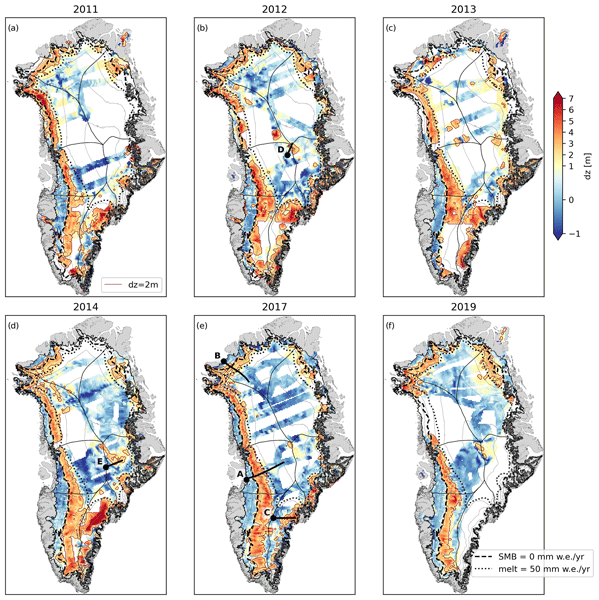
Anja Rutishauser, Kirk M. Scanlan, Baptiste Vandecrux, Nanna B. Karlsson, Nicolas Jullien, Andreas P. Ahlstrøm, Robert S. Fausto, and Penelope How
The Cryosphere, 18, 2455–2472, https://doi.org/10.5194/tc-18-2455-2024, https://doi.org/10.5194/tc-18-2455-2024, 2024
Short summary
Short summary
The Greenland Ice Sheet interior is covered by a layer of firn, which is important for surface meltwater runoff and contributions to global sea-level rise. Here, we combine airborne radar sounding and laser altimetry measurements to delineate vertically homogeneous and heterogeneous firn. Our results reveal changes in firn between 2011–2019, aligning well with known climatic events. This approach can be used to outline firn areas primed for significantly changing future meltwater runoff.
Sanne B. M. Veldhuijsen, Willem Jan van de Berg, Peter Kuipers Munneke, and Michiel R. van den Broeke
The Cryosphere, 18, 1983–1999, https://doi.org/10.5194/tc-18-1983-2024, https://doi.org/10.5194/tc-18-1983-2024, 2024
Short summary
Short summary
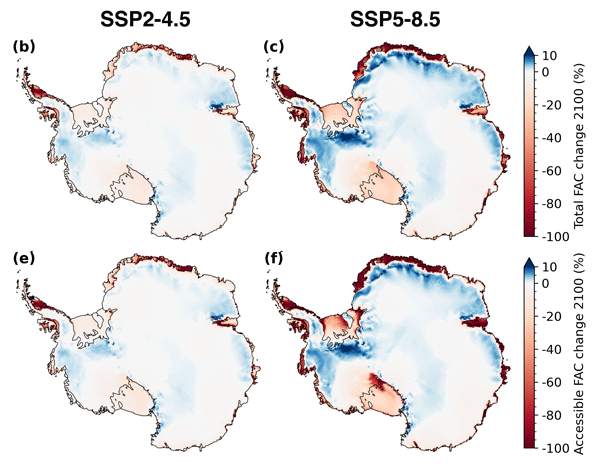
We use the IMAU firn densification model to simulate the 21st-century evolution of Antarctic firn air content. Ice shelves on the Antarctic Peninsula and the Roi Baudouin Ice Shelf in Dronning Maud Land are particularly vulnerable to total firn air content (FAC) depletion. Our results also underline the potentially large vulnerability of low-accumulation ice shelves to firn air depletion through ice slab formation.
Horst Machguth, Anja Eichler, Margit Schwikowski, Sabina Brütsch, Enrico Mattea, Stanislav Kutuzov, Martin Heule, Ryskul Usubaliev, Sultan Belekov, Vladimir N. Mikhalenko, Martin Hoelzle, and Marlene Kronenberg
The Cryosphere, 18, 1633–1646, https://doi.org/10.5194/tc-18-1633-2024, https://doi.org/10.5194/tc-18-1633-2024, 2024
Short summary
Short summary
In 2018 we drilled an 18 m ice core on the summit of Grigoriev ice cap, located in the Tien Shan mountains of Kyrgyzstan. The core analysis reveals strong melting since the early 2000s. Regardless of this, we find that the structure and temperature of the ice have changed little since the 1980s. The probable cause of this apparent stability is (i) an increase in snowfall and (ii) the fact that meltwater nowadays leaves the glacier and thereby removes so-called latent heat.
Alison Delhasse, Johanna Beckmann, Christoph Kittel, and Xavier Fettweis
The Cryosphere, 18, 633–651, https://doi.org/10.5194/tc-18-633-2024, https://doi.org/10.5194/tc-18-633-2024, 2024
Short summary
Short summary
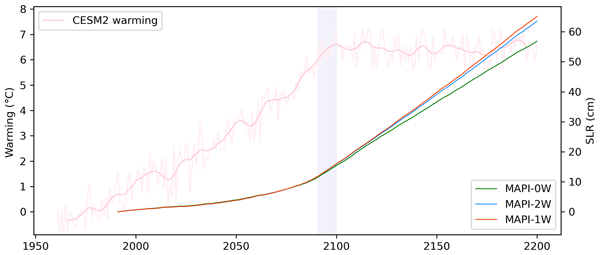
Aiming to study the long-term influence of an extremely warm climate in the Greenland Ice Sheet contribution to sea level rise, a new regional atmosphere–ice sheet model setup was established. The coupling, explicitly considering the melt–elevation feedback, is compared to an offline method to consider this feedback. We highlight mitigation of the feedback due to local changes in atmospheric circulation with changes in surface topography, making the offline correction invalid on the margins.
Baptiste Vandecrux, Robert S. Fausto, Jason E. Box, Federico Covi, Regine Hock, Åsa K. Rennermalm, Achim Heilig, Jakob Abermann, Dirk van As, Elisa Bjerre, Xavier Fettweis, Paul C. J. P. Smeets, Peter Kuipers Munneke, Michiel R. van den Broeke, Max Brils, Peter L. Langen, Ruth Mottram, and Andreas P. Ahlstrøm
The Cryosphere, 18, 609–631, https://doi.org/10.5194/tc-18-609-2024, https://doi.org/10.5194/tc-18-609-2024, 2024
Short summary
Short summary
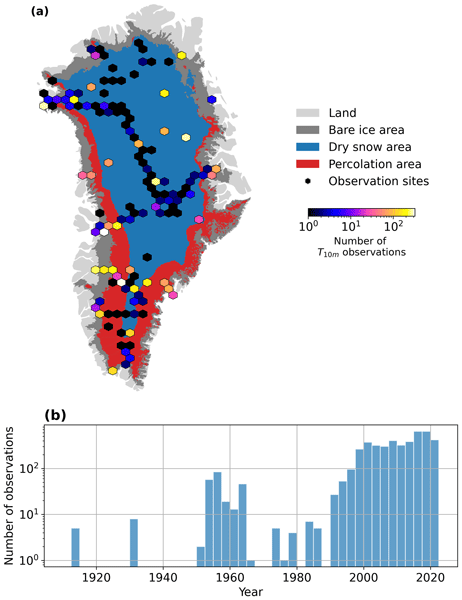
How fast is the Greenland ice sheet warming? In this study, we compiled 4500+ temperature measurements at 10 m below the ice sheet surface (T10m) from 1912 to 2022. We trained a machine learning model on these data and reconstructed T10m for the ice sheet during 1950–2022. After a slight cooling during 1950–1985, the ice sheet warmed at a rate of 0.7 °C per decade until 2022. Climate models showed mixed results compared to our observations and underestimated the warming in key regions.
Xueyu Zhang, Lin Liu, Brice Noël, and Zhicai Luo
EGUsphere, https://doi.org/10.5194/egusphere-2024-122, https://doi.org/10.5194/egusphere-2024-122, 2024
Preprint archived
Short summary
Short summary
In this study, an improved firn densification model is developed by integrating the Bucket scheme and Darcy’s law to assess the capillary retention, refreezing, and runoff of liquid water within the firn layer. This model captures high-density peaks (~917 kg · m-3) or the features of high-density layers caused by the refreezing of liquid water. In general, the modelled firn depth-density profiles at KAN_U and Dye-2 agree well with the in situ measurements.
Idunn Aamnes Mostue, Stefan Hofer, Trude Storelvmo, and Xavier Fettweis
The Cryosphere, 18, 475–488, https://doi.org/10.5194/tc-18-475-2024, https://doi.org/10.5194/tc-18-475-2024, 2024
Short summary
Short summary
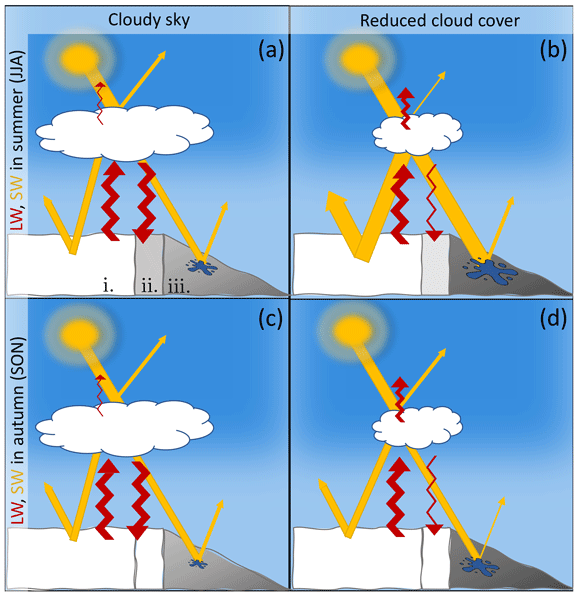
The latest generation of climate models (Coupled Model Intercomparison Project Phase 6 – CMIP6) warm more over Greenland and the Arctic and thus also project a larger mass loss from the Greenland Ice Sheet (GrIS) compared to the previous generation of climate models (CMIP5). Our work suggests for the first time that part of the greater mass loss in CMIP6 over the GrIS is driven by a difference in the surface mass balance sensitivity from a change in cloud representation in the CMIP6 models.
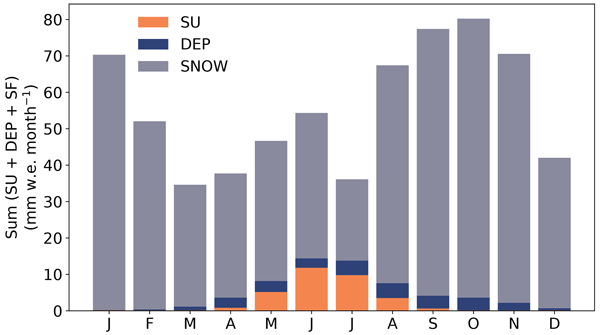
Laura J. Dietrich, Hans Christian Steen-Larsen, Sonja Wahl, Anne-Katrine Faber, and Xavier Fettweis
The Cryosphere, 18, 289–305, https://doi.org/10.5194/tc-18-289-2024, https://doi.org/10.5194/tc-18-289-2024, 2024
Short summary
Short summary
The contribution of the humidity flux to the surface mass balance in the accumulation zone of the Greenland Ice Sheet is uncertain. Here, we evaluate the regional climate model MAR using a multi-annual dataset of eddy covariance measurements and bulk estimates of the humidity flux. The humidity flux largely contributes to the summer surface mass balance (SMB) in the accumulation zone, indicating its potential importance for the annual SMB in a warming climate.
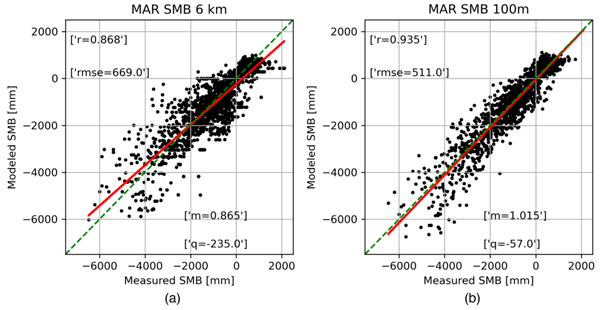
Marco Tedesco, Paolo Colosio, Xavier Fettweis, and Guido Cervone
The Cryosphere, 17, 5061–5074, https://doi.org/10.5194/tc-17-5061-2023, https://doi.org/10.5194/tc-17-5061-2023, 2023
Short summary
Short summary
We developed a technique to improve the outputs of a model that calculates the gain and loss of Greenland and consequently its contribution to sea level rise. Our technique generates “sharper” images of the maps generated by the model to better understand and quantify where losses occur. This has implications for improving models, understanding what drives the contributions of Greenland to sea level rise, and more.
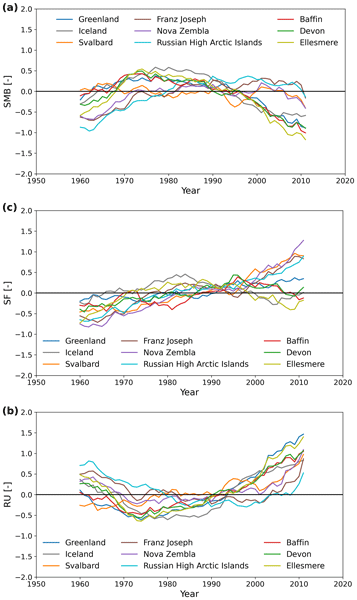
Damien Maure, Christoph Kittel, Clara Lambin, Alison Delhasse, and Xavier Fettweis
The Cryosphere, 17, 4645–4659, https://doi.org/10.5194/tc-17-4645-2023, https://doi.org/10.5194/tc-17-4645-2023, 2023
Short summary
Short summary
The Arctic is warming faster than the rest of the Earth. Studies have already shown that Greenland and the Canadian Arctic are experiencing a record increase in melting rates, while Svalbard has been relatively less impacted. Looking at those regions but also extending the study to Iceland and the Russian Arctic archipelagoes, we see a heterogeneity in the melting-rate response to the Arctic warming, with the Russian archipelagoes experiencing lower melting rates than other regions.
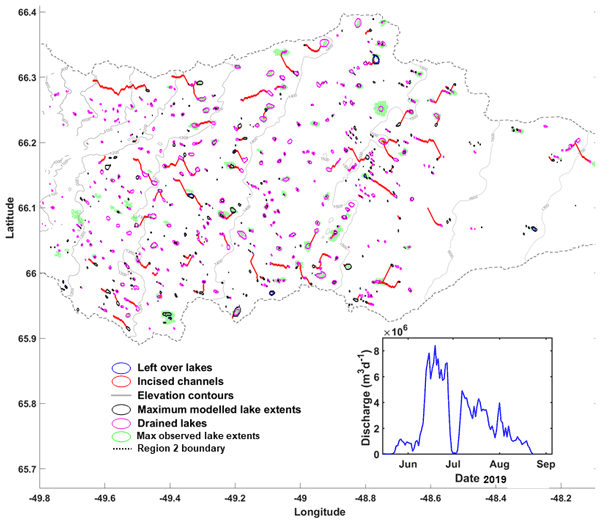
Prateek Gantayat, Alison F. Banwell, Amber A. Leeson, James M. Lea, Dorthe Petersen, Noel Gourmelen, and Xavier Fettweis
Geosci. Model Dev., 16, 5803–5823, https://doi.org/10.5194/gmd-16-5803-2023, https://doi.org/10.5194/gmd-16-5803-2023, 2023
Short summary
Short summary
We developed a new supraglacial hydrology model for the Greenland Ice Sheet. This model simulates surface meltwater routing, meltwater drainage, supraglacial lake (SGL) overflow, and formation of lake ice. The model was able to reproduce 80 % of observed lake locations and provides a good match between the observed and modelled temporal evolution of SGLs.
Thomas Dethinne, Quentin Glaude, Ghislain Picard, Christoph Kittel, Patrick Alexander, Anne Orban, and Xavier Fettweis
The Cryosphere, 17, 4267–4288, https://doi.org/10.5194/tc-17-4267-2023, https://doi.org/10.5194/tc-17-4267-2023, 2023
Short summary
Short summary
We investigate the sensitivity of the regional climate model
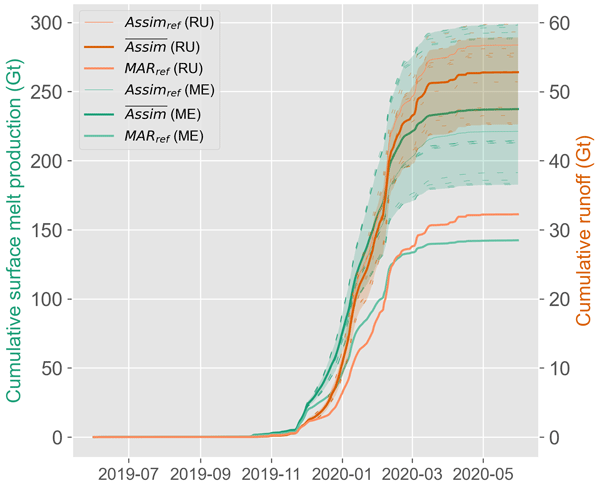
Modèle Atmosphérique Régional(MAR) to the assimilation of wet-snow occurrence estimated by remote sensing datasets. The assimilation is performed by nudging the MAR snowpack temperature. The data assimilation is performed over the Antarctic Peninsula for the 2019–2021 period. The results show an increase in the melt production (+66.7 %) and a decrease in surface mass balance (−4.5 %) of the model for the 2019–2020 melt season.
Lena G. Buth, Valeria Di Biase, Peter Kuipers Munneke, Stef Lhermitte, Sanne B. M. Veldhuijsen, Sophie de Roda Husman, Michiel R. van den Broeke, and Bert Wouters
EGUsphere, https://doi.org/10.5194/egusphere-2023-2000, https://doi.org/10.5194/egusphere-2023-2000, 2023
Preprint archived
Short summary
Short summary
Liquid meltwater which is stored in air bubbles in the compacted snow near the surface of Antarctica can affect ice shelf stability. In order to detect the presence of such firn aquifers over large scales, satellite remote sensing is needed. In this paper, we present our new detection method using radar satellite data as well as the results for the whole Antarctic Peninsula. Firn aquifers are found in the north and northwest of the peninsula, in agreement with locations predicted by models.
Timo Schmid, Valentina Radić, Andrew Tedstone, James M. Lea, Stephen Brough, and Mauro Hermann
The Cryosphere, 17, 3933–3954, https://doi.org/10.5194/tc-17-3933-2023, https://doi.org/10.5194/tc-17-3933-2023, 2023
Short summary
Short summary
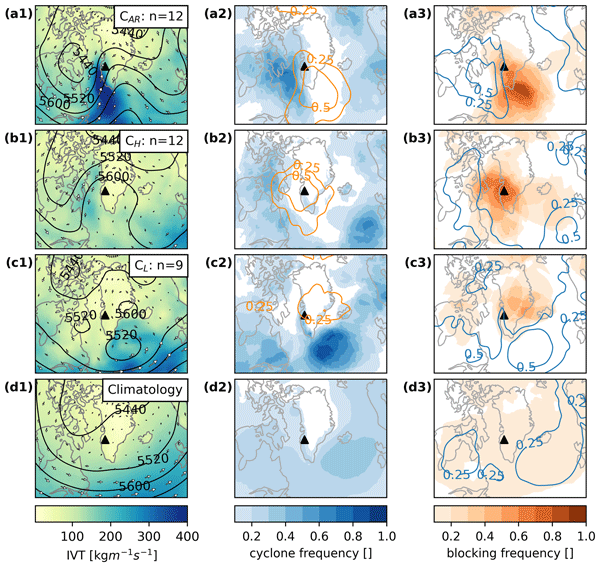
The Greenland Ice Sheet contributes strongly to sea level rise in the warming climate. One process that can affect the ice sheet's mass balance is short-term ice speed-up events. These can be caused by high melting or rainfall as the water flows underneath the glacier and allows for faster sliding. In this study we found three main weather patterns that cause such ice speed-up events on the Russell Glacier in southwest Greenland and analyzed how they induce local melting and ice accelerations.
Inès N. Otosaka, Andrew Shepherd, Erik R. Ivins, Nicole-Jeanne Schlegel, Charles Amory, Michiel R. van den Broeke, Martin Horwath, Ian Joughin, Michalea D. King, Gerhard Krinner, Sophie Nowicki, Anthony J. Payne, Eric Rignot, Ted Scambos, Karen M. Simon, Benjamin E. Smith, Louise S. Sørensen, Isabella Velicogna, Pippa L. Whitehouse, Geruo A, Cécile Agosta, Andreas P. Ahlstrøm, Alejandro Blazquez, William Colgan, Marcus E. Engdahl, Xavier Fettweis, Rene Forsberg, Hubert Gallée, Alex Gardner, Lin Gilbert, Noel Gourmelen, Andreas Groh, Brian C. Gunter, Christopher Harig, Veit Helm, Shfaqat Abbas Khan, Christoph Kittel, Hannes Konrad, Peter L. Langen, Benoit S. Lecavalier, Chia-Chun Liang, Bryant D. Loomis, Malcolm McMillan, Daniele Melini, Sebastian H. Mernild, Ruth Mottram, Jeremie Mouginot, Johan Nilsson, Brice Noël, Mark E. Pattle, William R. Peltier, Nadege Pie, Mònica Roca, Ingo Sasgen, Himanshu V. Save, Ki-Weon Seo, Bernd Scheuchl, Ernst J. O. Schrama, Ludwig Schröder, Sebastian B. Simonsen, Thomas Slater, Giorgio Spada, Tyler C. Sutterley, Bramha Dutt Vishwakarma, Jan Melchior van Wessem, David Wiese, Wouter van der Wal, and Bert Wouters
Earth Syst. Sci. Data, 15, 1597–1616, https://doi.org/10.5194/essd-15-1597-2023, https://doi.org/10.5194/essd-15-1597-2023, 2023
Short summary
Short summary
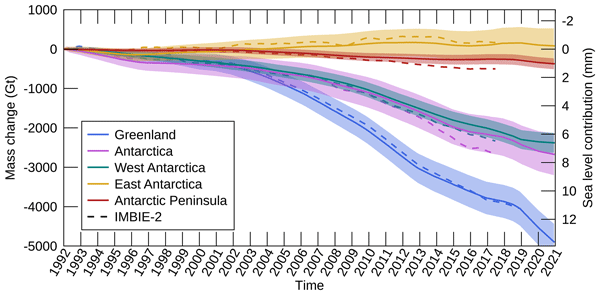
By measuring changes in the volume, gravitational attraction, and ice flow of Greenland and Antarctica from space, we can monitor their mass gain and loss over time. Here, we present a new record of the Earth’s polar ice sheet mass balance produced by aggregating 50 satellite-based estimates of ice sheet mass change. This new assessment shows that the ice sheets have lost (7.5 x 10¹²) t of ice between 1992 and 2020, contributing 21 mm to sea level rise.

Sanne B. M. Veldhuijsen, Willem Jan van de Berg, Max Brils, Peter Kuipers Munneke, and Michiel R. van den Broeke
The Cryosphere, 17, 1675–1696, https://doi.org/10.5194/tc-17-1675-2023, https://doi.org/10.5194/tc-17-1675-2023, 2023
Short summary
Short summary
Firn is the transition of snow to glacier ice and covers 99 % of the Antarctic ice sheet. Knowledge about the firn layer and its variability is important, as it impacts satellite-based estimates of ice sheet mass change. Also, firn contains pores in which nearly all of the surface melt is retained. Here, we improve a semi-empirical firn model and simulate the firn characteristics for the period 1979–2020. We evaluate the performance with field and satellite measures and test its sensitivity.

Benjamin E. Smith, Brooke Medley, Xavier Fettweis, Tyler Sutterley, Patrick Alexander, David Porter, and Marco Tedesco
The Cryosphere, 17, 789–808, https://doi.org/10.5194/tc-17-789-2023, https://doi.org/10.5194/tc-17-789-2023, 2023
Short summary
Short summary
We use repeated satellite measurements of the height of the Greenland ice sheet to learn about how three computational models of snowfall, melt, and snow compaction represent actual changes in the ice sheet. We find that the models do a good job of estimating how the parts of the ice sheet near the coast have changed but that two of the models have trouble representing surface melt for the highest part of the ice sheet. This work provides suggestions for how to better model snowmelt.
Jilu Li, Fernando Rodriguez-Morales, Xavier Fettweis, Oluwanisola Ibikunle, Carl Leuschen, John Paden, Daniel Gomez-Garcia, and Emily Arnold
The Cryosphere, 17, 175–193, https://doi.org/10.5194/tc-17-175-2023, https://doi.org/10.5194/tc-17-175-2023, 2023
Short summary
Short summary
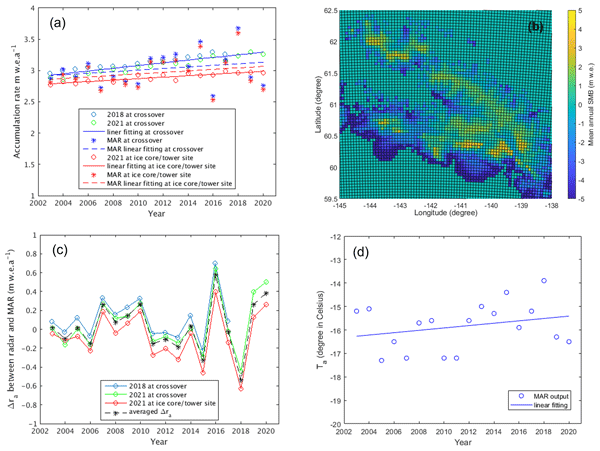
Alaskan glaciers' loss of ice mass contributes significantly to ocean surface rise. It is important to know how deeply and how much snow accumulates on these glaciers to comprehend and analyze the glacial mass loss process. We reported the observed seasonal snow depth distribution from our radar data taken in Alaska in 2018 and 2021, developed a method to estimate the annual snow accumulation rate at Mt. Wrangell caldera, and identified transition zones from wet-snow zones to ablation zones.
Marte G. Hofsteenge, Nicolas J. Cullen, Carleen H. Reijmer, Michiel van den Broeke, Marwan Katurji, and John F. Orwin
The Cryosphere, 16, 5041–5059, https://doi.org/10.5194/tc-16-5041-2022, https://doi.org/10.5194/tc-16-5041-2022, 2022
Short summary
Short summary
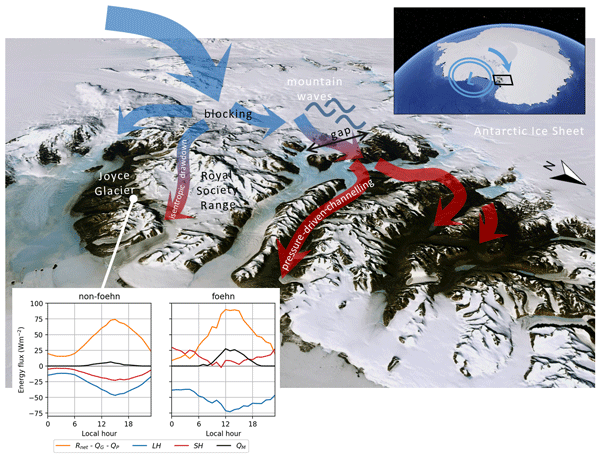
In the McMurdo Dry Valleys (MDV), foehn winds can impact glacial meltwater production and the fragile ecosystem that depends on it. We study these dry and warm winds at Joyce Glacier and show they are caused by a different mechanism than that found for nearby valleys, demonstrating the complex interaction of large-scale winds with the mountains in the MDV. We find that foehn winds increase sublimation of ice, increase heating from the atmosphere, and increase the occurrence and rates of melt.
Marlene Kronenberg, Ward van Pelt, Horst Machguth, Joel Fiddes, Martin Hoelzle, and Felix Pertziger
The Cryosphere, 16, 5001–5022, https://doi.org/10.5194/tc-16-5001-2022, https://doi.org/10.5194/tc-16-5001-2022, 2022
Short summary
Short summary
The Pamir Alay is located at the edge of regions with anomalous glacier mass changes. Unique long-term in situ data are available for Abramov Glacier, located in the Pamir Alay. In this study, we use this extraordinary data set in combination with reanalysis data and a coupled surface energy balance–multilayer subsurface model to compute and analyse the distributed climatic mass balance and firn evolution from 1968 to 2020.
Nicole Clerx, Horst Machguth, Andrew Tedstone, Nicolas Jullien, Nander Wever, Rolf Weingartner, and Ole Roessler
The Cryosphere, 16, 4379–4401, https://doi.org/10.5194/tc-16-4379-2022, https://doi.org/10.5194/tc-16-4379-2022, 2022
Short summary
Short summary
Meltwater runoff is one of the main contributors to mass loss on the Greenland Ice Sheet that influences global sea level rise. However, it remains unclear where meltwater runs off and what processes cause this. We measured the velocity of meltwater flow through snow on the ice sheet, which ranged from 0.17–12.8 m h−1 for vertical percolation and from 1.3–15.1 m h−1 for lateral flow. This is an important step towards understanding where, when and why meltwater runoff occurs on the ice sheet.
Raf M. Antwerpen, Marco Tedesco, Xavier Fettweis, Patrick Alexander, and Willem Jan van de Berg
The Cryosphere, 16, 4185–4199, https://doi.org/10.5194/tc-16-4185-2022, https://doi.org/10.5194/tc-16-4185-2022, 2022
Short summary
Short summary
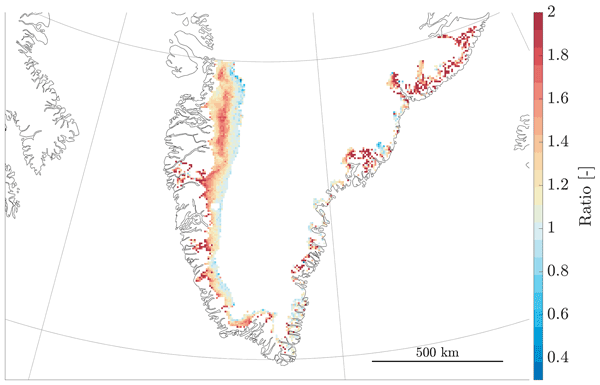
The ice on Greenland has been melting more rapidly over the last few years. Most of this melt comes from the exposure of ice when the overlying snow melts. This ice is darker than snow and absorbs more sunlight, leading to more melt. It remains challenging to accurately simulate the brightness of the ice. We show that the color of ice simulated by Modèle Atmosphérique Régional (MAR) is too bright. We then show that this means that MAR may underestimate how fast the Greenland ice is melting.
Lena G. Buth, Bert Wouters, Sanne B. M. Veldhuijsen, Stef Lhermitte, Peter Kuipers Munneke, and Michiel R. van den Broeke
The Cryosphere Discuss., https://doi.org/10.5194/tc-2022-127, https://doi.org/10.5194/tc-2022-127, 2022
Manuscript not accepted for further review
Short summary
Short summary
Liquid meltwater which is stored in air bubbles in the compacted snow near the surface of Antarctica can affect ice shelf stability. In order to detect the presence of such firn aquifers over large scales, satellite remote sensing is needed. In this paper, we present our new detection method using radar satellite data as well as the results for the whole Antarctic Peninsula. Firn aquifers are found in the north and northwest of the peninsula, in agreement with locations predicted by models.
Max Brils, Peter Kuipers Munneke, Willem Jan van de Berg, and Michiel van den Broeke
Geosci. Model Dev., 15, 7121–7138, https://doi.org/10.5194/gmd-15-7121-2022, https://doi.org/10.5194/gmd-15-7121-2022, 2022
Short summary
Short summary
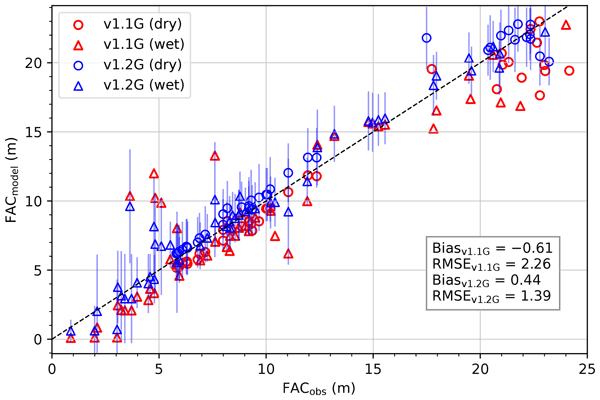
Firn covers the Greenland ice sheet (GrIS) and can temporarily prevent mass loss. Here, we present the latest version of our firn model, IMAU-FDM, with an application to the GrIS. We improved the density of fallen snow, the firn densification rate and the firn's thermal conductivity. This leads to a higher air content and 10 m temperatures. Furthermore we investigate three case studies and find that the updated model shows greater variability and an increased sensitivity in surface elevation.

Tiago Silva, Jakob Abermann, Brice Noël, Sonika Shahi, Willem Jan van de Berg, and Wolfgang Schöner
The Cryosphere, 16, 3375–3391, https://doi.org/10.5194/tc-16-3375-2022, https://doi.org/10.5194/tc-16-3375-2022, 2022
Short summary
Short summary
To overcome internal climate variability, this study uses k-means clustering to combine NAO, GBI and IWV over the Greenland Ice Sheet (GrIS) and names the approach as the North Atlantic influence on Greenland (NAG). With the support of a polar-adapted RCM, spatio-temporal changes on SEB components within NAG phases are investigated. We report atmospheric warming and moistening across all NAG phases as well as large-scale and regional-scale contributions to GrIS mass loss and their interactions.
Christoph Kittel, Charles Amory, Stefan Hofer, Cécile Agosta, Nicolas C. Jourdain, Ella Gilbert, Louis Le Toumelin, Étienne Vignon, Hubert Gallée, and Xavier Fettweis
The Cryosphere, 16, 2655–2669, https://doi.org/10.5194/tc-16-2655-2022, https://doi.org/10.5194/tc-16-2655-2022, 2022
Short summary
Short summary
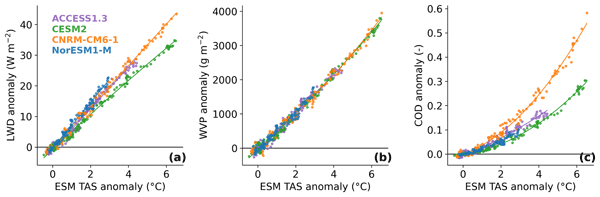
Model projections suggest large differences in future Antarctic surface melting even for similar greenhouse gas scenarios and warming rates. We show that clouds containing a larger amount of liquid water lead to stronger melt. As surface melt can trigger the collapse of the ice shelves (the safety band of the Antarctic Ice Sheet), clouds could be a major source of uncertainties in projections of sea level rise.
Sébastien Doutreloup, Xavier Fettweis, Ramin Rahif, Essam Elnagar, Mohsen S. Pourkiaei, Deepak Amaripadath, and Shady Attia
Earth Syst. Sci. Data, 14, 3039–3051, https://doi.org/10.5194/essd-14-3039-2022, https://doi.org/10.5194/essd-14-3039-2022, 2022
Short summary
Short summary
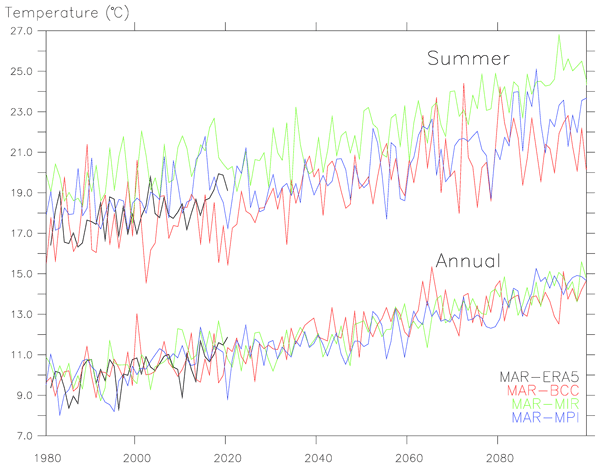
This data set provides historical (1980–2014) and future (2015–2100) weather data for 12 cities in Belgium. This data set is intended for architects or building or energy designers. In particular, it makes available to all users hourly open-access weather data according to certain standards to recreate a Typical and an Extreme Meteorological Year. In addition, it provides hourly data on heatwaves from 1980 to 2100. Weather data were produced from the outputs of the MAR model simulations.
Christiaan T. van Dalum, Willem Jan van de Berg, and Michiel R. van den Broeke
The Cryosphere, 16, 1071–1089, https://doi.org/10.5194/tc-16-1071-2022, https://doi.org/10.5194/tc-16-1071-2022, 2022
Short summary
Short summary
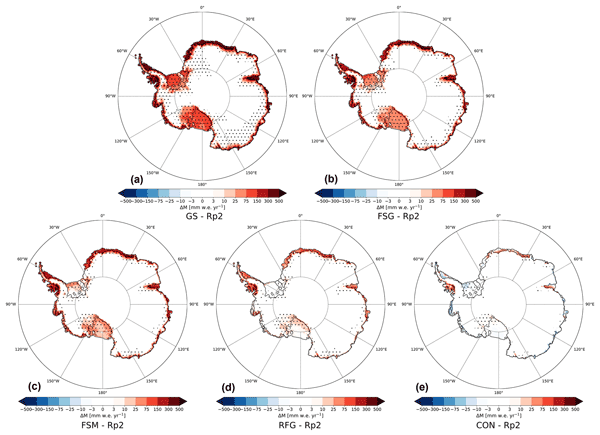
In this study, we improve the regional climate model RACMO2 and investigate the climate of Antarctica. We have implemented a new radiative transfer and snow albedo scheme and do several sensitivity experiments. When fully tuned, the results compare well with observations and snow temperature profiles improve. Moreover, small changes in the albedo and the investigated processes can lead to a strong overestimation of melt, locally leading to runoff and a reduced surface mass balance.
Zhongyang Hu, Peter Kuipers Munneke, Stef Lhermitte, Maaike Izeboud, and Michiel van den Broeke
The Cryosphere, 15, 5639–5658, https://doi.org/10.5194/tc-15-5639-2021, https://doi.org/10.5194/tc-15-5639-2021, 2021
Short summary
Short summary
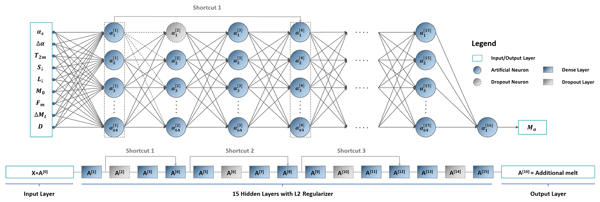
Antarctica is shrinking, and part of the mass loss is caused by higher temperatures leading to more snowmelt. We use computer models to estimate the amount of melt, but this can be inaccurate – specifically in the areas with the most melt. This is because the model cannot account for small, darker areas like rocks or darker ice. Thus, we trained a computer using artificial intelligence and satellite images that showed these darker areas. The model computed an improved estimate of melt.
Kenneth D. Mankoff, Xavier Fettweis, Peter L. Langen, Martin Stendel, Kristian K. Kjeldsen, Nanna B. Karlsson, Brice Noël, Michiel R. van den Broeke, Anne Solgaard, William Colgan, Jason E. Box, Sebastian B. Simonsen, Michalea D. King, Andreas P. Ahlstrøm, Signe Bech Andersen, and Robert S. Fausto
Earth Syst. Sci. Data, 13, 5001–5025, https://doi.org/10.5194/essd-13-5001-2021, https://doi.org/10.5194/essd-13-5001-2021, 2021
Short summary
Short summary
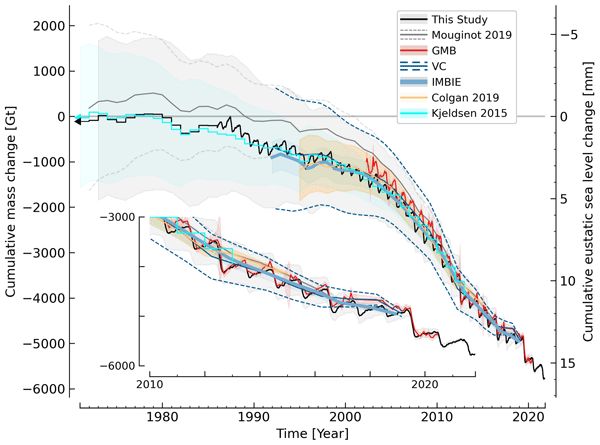
We estimate the daily mass balance and its components (surface, marine, and basal mass balance) for the Greenland ice sheet. Our time series begins in 1840 and has annual resolution through 1985 and then daily from 1986 through next week. Results are operational (updated daily) and provided for the entire ice sheet or by commonly used regions or sectors. This is the first input–output mass balance estimate to include the basal mass balance.
Cited articles
Alexander, P. M., Tedesco, M., Koenig, L., and Fettweis, X.: Evaluating a regional climate model simulation of Greenland Ice Sheet snow and firn density for improved surface mass balance estimates, Geophys. Res. Lett., 46, 12073–12082, https://doi.org/10.1029/2019gl084101, 2019. a
Benson, C. S.: Stratigraphic Studies in the Snow and Firn of the Greenland Ice Sheet, Research Report 70, U. S. Army Snow, Ice and Permafrost Research Establishment, 1962. a
Box, J. E., Bromwich, D. H., and Bai, L.-S.: Greenland ice sheet surface mass balance for 1991–2000: application of Polar MM5 mesoscale model and in-situ data, J. Geophys. Res., 109, D16105, https://doi.org/10.1029/2003JD004451, 2004. a
Brils, M., Kuipers Munneke, P., van de Berg, W. J., and van den Broeke, M.: Improved representation of the contemporary Greenland ice sheet firn layer by IMAU-FDM v1.2G, Geosci. Model Dev., 15, 7121–7138, https://doi.org/10.5194/gmd-15-7121-2022, 2022. a, b
Brun, E., David, P., Sudul, M., and Brunot, G.: A numerical model to simulate snow-cover stratigraphy for operational avalanche forecasting, J. Glaciol., 38, 13–22, https://doi.org/10.3189/s0022143000009552, 1992. a
Cabral, B. and Leedom, L. C.: Imaging vector fields using line integral convolution, in: Proceedings of the 20th Annual Conference on Computer Graphics and Interactive Techniques, ACM, 263–270, https://doi.org/10.1145/166117.166151, 1993. a
Charalampidis, C., van As, D., Colgan, W. T., Fausto, R. S., MacFerrin, M., and Machguth, H.: Thermal tracking of meltwater retention in the lower accumulation area of the Greenland ice sheet, Ann. Glaciol., 57, 1–10, https://doi.org/10.1017/aog.2016.2, 2016. a, b
Clerx, N., Machguth, H., Tedstone, A., Jullien, N., Wever, N., Weingartner, R., and Roessler, O.: In situ measurements of meltwater flow through snow and firn in the accumulation zone of the SW Greenland Ice Sheet, The Cryosphere, 16, 4379–4401, https://doi.org/10.5194/tc-16-4379-2022, 2022. a, b, c, d, e, f
Coléou, C. and Lesaffre, B.: Irreducible water saturation in snow: experimental results in a cold laboratory, Annals of Glaciology, 26, 64–68, https://doi.org/10.3189/1998aog26-1-64-68, 1998. a
Covi, F., Hock, R., and Reijmer, C. H.: Challenges in modeling the energy balance and melt in the percolation zone of the Greenland ice sheet, J. Glaciol., https://doi.org/10.1017/jog.2022.54, 2022. a
Delhasse, A., Kittel, C., Amory, C., Hofer, S., van As, D., S. Fausto, R., and Fettweis, X.: Brief communication: Evaluation of the near-surface climate in ERA5 over the Greenland Ice Sheet, The Cryosphere, 14, 957–965, https://doi.org/10.5194/tc-14-957-2020, 2020. a
Fausto, R. S., van As, D., Mankoff, K. D., Vandecrux, B., Citterio, M., Ahlstrøm, A. P., Andersen, S. B., Colgan, W., Karlsson, N. B., Kjeldsen, K. K., Korsgaard, N. J., Larsen, S. H., Nielsen, S., Pedersen, A. Ø., Shields, C. L., Solgaard, A. M., and Box, J. E.: Programme for Monitoring of the Greenland Ice Sheet (PROMICE) automatic weather station data, Earth Syst. Sci. Data, 13, 3819–3845, https://doi.org/10.5194/essd-13-3819-2021, 2021. a, b
Fettweis, X., Gallée, H., Lefebre, F., and van Ypersele, J.-P.: The 1988–2003 Greenland ice sheet melt extent using passive microwave satellite data and a regional climate model, Climate Dyn., 27, 531–541, https://doi.org/10.1007/s00382-006-0150-8, 2006. a
Fettweis, X., Hanna, E., Gallée, H., Huybrechts, P., and Erpicum, M.: Estimation of the Greenland ice sheet surface mass balance for the 20th and 21st centuries, The Cryosphere, 2, 117–129, https://doi.org/10.5194/tc-2-117-2008, 2008. a
Fettweis, X., Tedesco, M., van den Broeke, M., and Ettema, J.: Melting trends over the Greenland ice sheet (1958–2009) from spaceborne microwave data and regional climate models, The Cryosphere, 5, 359–375, https://doi.org/10.5194/tc-5-359-2011, 2011. a
Fettweis, X., Franco, B., Tedesco, M., van Angelen, J. H., Lenaerts, J. T. M., van den Broeke, M. R., and Gallée, H.: Estimating the Greenland ice sheet surface mass balance contribution to future sea level rise using the regional atmospheric climate model MAR, The Cryosphere, 7, 469–489, https://doi.org/10.5194/tc-7-469-2013, 2013. a
Fettweis, X., Box, J. E., Agosta, C., Amory, C., Kittel, C., Lang, C., van As, D., Machguth, H., and Gallée, H.: Reconstructions of the 1900–2015 Greenland ice sheet surface mass balance using the regional climate MAR model, The Cryosphere, 11, 1015–1033, https://doi.org/10.5194/tc-11-1015-2017, 2017. a, b, c
Fettweis, X., Hofer, S., Krebs-Kanzow, U., Amory, C., Aoki, T., Berends, C. J., Born, A., Box, J. E., Delhasse, A., Fujita, K., Gierz, P., Goelzer, H., Hanna, E., Hashimoto, A., Huybrechts, P., Kapsch, M.-L., King, M. D., Kittel, C., Lang, C., Langen, P. L., Lenaerts, J. T. M., Liston, G. E., Lohmann, G., Mernild, S. H., Mikolajewicz, U., Modali, K., Mottram, R. H., Niwano, M., Noël, B., Ryan, J. C., Smith, A., Streffing, J., Tedesco, M., van de Berg, W. J., van den Broeke, M., van de Wal, R. S. W., van Kampenhout, L., Wilton, D., Wouters, B., Ziemen, F., and Zolles, T.: GrSMBMIP: intercomparison of the modelled 1980–2012 surface mass balance over the Greenland Ice Sheet, The Cryosphere, 14, 3935–3958, https://doi.org/10.5194/tc-14-3935-2020, 2020. a, b, c
Gallee, H. and Duynkerke, P. G.: Air-snow interactions and the surface energy and mass balance over the melting zone of west Greenland during the Greenland Ice Margin Experiment, J. Geophys. Res., 102, 13813–13824, 1997. a
Glaude, Q., Noel, B., Olesen, M., Van den Broeke, M., van de Berg, W. J., Mottram, R., Hansen, N., Delhasse, A., Amory, C., Kittel, C., Goelzer, H., and Fettweis, X.: A factor two difference in 21st-century Greenland Ice Sheet surface mass balance projections from three regional climate models under a strong warming scenario (SSP5-8.5), Geophys. Res. Lett., 51, https://doi.org/10.1029/2024gl111902, 2024. a, b, c, d
Gleason, C. J., Smith, L. C., Chu, V. W., Legleiter, C. J., Pitcher, L. H., Overstreet, B. T., Rennermalm, A. K., Forster, R. R., and Yang, K.: Characterizing supraglacial meltwater channel hydraulics on the Greenland Ice Sheet from in situ observations, Earth Surf. Process. Landforms, 41, 2111–2122, https://doi.org/10.1002/esp.3977, 2016. a
Grailet, J.-F., Hogan, R. J., Ghilain, N., Bolsée, D., Fettweis, X., and Grégoire, M.: Inclusion of the ECMWF ecRad radiation scheme (v1.5.0) in the MAR (v3.14), regional evaluation for Belgium, and assessment of surface shortwave spectral fluxes at Uccle, Geosci. Model Dev., 18, 1965–1988, https://doi.org/10.5194/gmd-18-1965-2025, 2025. a
Greuell, W. B. and Knap, W. H.: Remote sensing of the albedo and detection of the slush line on the Greenland ice sheet, J. Geophys. Res., 105, 15567–15576, https://doi.org/10.1029/1999JD901162, 2000. a, b
Greuell, W., Denby, B., van de Wal, R., and Oerlemans, J.: 10 years of mass-balance measurements along a transect near Kangerlussuaq, central West Greenland, J. Glaciol., 47, 157–158, 2001 a
Hall, D. K. and Riggs, G. A.: MODIS/Terra Snow Cover Daily L3 Global 500 m SIN Grid, Version 6, MOD10A1, NASA National Snow and Ice Data Center Distributed Active Archive Center [data set], Boulder, Colorado, USA, https://doi.org/10.5067/MODIS/MOD10A1.006, 2016. a
Hogan, R. J. and Bozzo, A.: A flexible and efficient radiation scheme for the ECMWF model, Journal of Advances in Modeling Earth Systems, 10, 1990–2008, https://doi.org/10.1029/2018ms001364, 2018. a
Holmes, C. W.: Morphology and hydrology of the Mint Julep area, Southwest Greenland, in: Project Mint Julep Investigation of Smooth Ice Areas of the Greenland Ice Cap, 1953; Part II Special Scientific Reports, Arctic, Desert, Tropic Information Center; Research Studies Institute; Air University, 1955. a, b, c, d
How, P., Abermann, J., Ahlstrøm, A., Andersen, S., Box, J. E., Citterio, M., Colgan, W., Fausto., R., Karlsson, N., Jakobsen, J., Langley, K., Larsen, S., Lund, M., Mankoff, K., Pedersen, A., Rutishauser, A., Shield, C., Solgaard, A., Van As, D., Vandecrux, B., and Wright, P.: PROMICE and GC-Net automated weather station data in Greenland, GEUS Dataverse [data set], https://doi.org/10.22008/FK2/IW73UU, 2022. a
IMBIE Team: Mass balance of the Antarctic ice sheet from 1992 to 2017, Nature, 558, 219–221, https://doi.org/10.1038/s41586-018-0179-y, 2018. a
IMBIE Team: Mass balance of the Greenland ice sheet from 1992 to 2018, Nature, 233–239, https://doi.org/10.1038/s41586-019-1855-2, 2020. a
Joughin, I., Smith, B., Howat, I., and Scambos, T.: MEaSUREs Multi-year Greenland Ice Sheet Velocity Mosaic, Version 1, NASA National Snow and Ice Data Center Distributed Active Archive Center [data set], Boulder, Colorado, USA, https://doi.org/10.5067/QUA5Q9SVMSJG, 2016. a
Joughin, I., Smith, B., and Howat, I.: A complete map of Greenland ice velocity derived from satellite data collected over 20 years, J. Glaciol., 64, 1–11, https://doi.org/10.1017/jog.2017.73, 2017. a
Jullien, N., Tedstone, A. J., and Machguth, H.: Constraining ice slab thickness at the onset of visible surface runoff from the Greenland ice sheet, J. Glaciol., 71, https://doi.org/10.1017/jog.2025.25, 2025. a
Karlsson, N. B., Eisen, O., Dahl-Jensen, D., Freitag, J., Kipfstuhl, S., Lewis, C., T.Nielsen, L., D.Paden, J., Winter, A., and Wilhelms, F.: Accumulation Rates during 1311–2011 CE in North-Central Greenland Derived from Air-Borne Radar Data, Frontiers, 4, https://doi.org/10.3389/feart.2016.00097, 2016. a
Kuipers Munneke, P., van den Broeke, M. R., Lenaerts, J. T. M., Flanner, M. G., Gardner, A. S., and van de Berg, W. J.: A new albedo parameterization for use in climate models over the Antarctic ice sheet, J. Geophys. Res., 116, https://doi.org/10.1029/2010jd015113, 2011. a
Langen, P. L., Fausto, R. S., Vandecrux, B., Mottram, R. H., and Box, J. E.: Liquid Water Flow and Retention on the Greenland Ice Sheet in the Regional Climate Model HIRHAM5: Local and Large-Scale Impacts, Front. Earth Sci., 4, 110, https://doi.org/10.3389/feart.2016.00110, 2017. a
Lefebre, F., Gallée, H., van Ypersele, J., and Greuell, W.: Modeling of snow and ice melt at ETH Camp (West Greenland): A study of surface albedo, J. Geophys. Res.-Atmos., 108, https://doi.org/10.1029/2001jd001160, 2003. a
Lefebre, F., Fettweis, X., Gallée, H., Ypersele, J.-P. V., Marbaix, P., Greuell, W., and Calanca, P.: Evaluation of a high-resolution regional climate simulation over Greenland, Climate Dyn., 25, 99–116, 2005. a
Ligtenberg, S. R. M., Helsen, M. M., and van den Broeke, M. R.: An improved semi-empirical model for the densification of Antarctic firn, The Cryosphere, 5, 809–819, https://doi.org/10.5194/tc-5-809-2011, 2011. a
Ligtenberg, S. R. M., Kuipers Munneke, P., Noël, B. P. Y., and van den Broeke, M. R.: Brief communication: Improved simulation of the present-day Greenland firn layer (1960–2016), The Cryosphere, 12, 1643–1649, https://doi.org/10.5194/tc-12-1643-2018, 2018. a
MacFerrin, M., Machguth, H., van As, D., Charalampidis, C., Stevens, C. M., Heilig, A., Vandecrux, B., Langen, P. L., Mottram, R., Fettweis, X., van den Broeke, M. R., Pfeffer, W. T., Moussavi, M. S., and Abdalati, W.: Rapid expansion of Greenland's low-permeability ice slabs, Nature, 573, 403–407, https://doi.org/10.1038/s41586-019-1550-3, 2019. a
Machguth, H. and Huss, M.: The length of the world's glaciers – a new approach for the global calculation of center lines, The Cryosphere, 8, 1741–1755, https://doi.org/10.5194/tc-8-1741-2014, 2014. a
Machguth, H., MacFerrin, M., van As, D., Box, J. E., Charalampidis, C., Colgan, W., Fausto, R. S., Meijer, H. A. J., Mosley-Thompson, E., and van de Wal, R. S. W.: Greenland meltwater storage in firn limited by near-surface ice formation, Nature Climate Change, 6, 390–393, https://doi.org/10.1038/nclimate2899, 2016a. a
Machguth, H., Thomsen, H., Weidick, A., Ahlstrøm, A. P., Abermann, J., Andersen, M. L., Andersen, S., Bjørk, A. A., Box, J. E., Braithwaite, R. J., Bøggild, C. E., Citterio, M., Clement, P., Colgan, W., Fausto, R. S., Gleie, K., Gubler, S., Hasholt, B., Hynek, B., Knudsen, N., Larsen, S., Mernild, S., Oerlemans, J., Oerter, H., Olesen, O., Smeets, C., Steffen, K., Stober, M., Sugiyama, S., van As, D., van den Broeke, M., and van de Wal, R. S.: Greenland surface mass balance observations from the ice sheet ablation area and local glaciers, J. Glaciol., 62, 861–887, https://doi.org/10.1017/jog.2016.75, 2016b. a
Machguth, H., Tedstone, A., Kuipers Munneke, P., Brils, M., Noël, B., Clerx, N., Jullien, N., Fettweis, X., and Van den Broeke, M.: Runoff from Greenland's Firn Area – Why do MODIS, RCMs and a Firn Model disagree?, Zenodo [code/data set], https://doi.org/10.5281/zenodo.13332326, 2024. a
Miège, C., Forster, R. R., Brucker, L., Koenig, L. S., Solomon, D. K., Paden, J. D., Box, J. E., Burgess, E. W., Miller, J. Z., McNerney, L., Brautigam, N., Fausto, R. S., and Gogineni, S.: Spatial extent and temporal variability of Greenland firn aquifers detected by ground and airborne radars, J. Geophys. Res., 121, 2381–2398, https://doi.org/10.1002/2016JF003869, 2016. a
Mikkelsen, A. B., Hubbard, A., MacFerrin, M., Box, J. E., Doyle, S. H., Fitzpatrick, A., Hasholt, B., Bailey, H. L., Lindbäck, K., and Pettersson, R.: Extraordinary runoff from the Greenland ice sheet in 2012 amplified by hypsometry and depleted firn retention, The Cryosphere, 10, 1147–1159, https://doi.org/10.5194/tc-10-1147-2016, 2016. a
Mohajerani, Y., Velicogna, I., and Rignot, E.: Evaluation of regional climate models using regionally optimized GRACE mascons in the Amery and Getz ice shelves basins, Antarctica, Geophys. Res. Lett., 46, 13883–13891, https://doi.org/10.1029/2019gl084665, 2019. a
Morcrette, J.-J.: Assessment of the ECMWF model cloudiness and surface radiation fields at the ARM SGP site, Monthly Weather Review, 130, 257–277, https://doi.org/10.1175/1520-0493(2002)130<0257:aotemc>2.0.co;2, 2002. a
Noël, B., van de Berg, W. J., Machguth, H., Lhermitte, S., Howat, I., Fettweis, X., and van den Broeke, M. R.: A daily, 1 km resolution data set of downscaled Greenland ice sheet surface mass balance (1958–2015), The Cryosphere, 10, 2361–2377, https://doi.org/10.5194/tc-10-2361-2016, 2016. a, b, c, d
Noël, B., van de Berg, W. J., van Wessem, J. M., van Meijgaard, E., van As, D., Lenaerts, J. T. M., Lhermitte, S., Kuipers Munneke, P., Smeets, C. J. P. P., van Ulft, L. H., van de Wal, R. S. W., and van den Broeke, M. R.: Modelling the climate and surface mass balance of polar ice sheets using RACMO2 – Part 1: Greenland (1958–2016), The Cryosphere, 12, 811–831, https://doi.org/10.5194/tc-12-811-2018, 2018. a
Noël, B., van de Berg, W. J., Lhermitte, S., and van den Broeke, M. R.: Rapid ablation zone expansion amplifies north Greenland mass loss, Science Advances, 5, https://doi.org/10.1126/sciadv.aaw0123, 2019. a, b, c
Poinar, K., Joughin, I., Das, S. B., Behn, M. D., Lenaerts, J. T. M., and van den Broeke, M. R.: Limits to future expansion of surface-melt-enhanced ice flow into the interior of western Greenland, Geophys. Res. Lett., 42, 1800–1807, https://doi.org/10.1002/2015GL063192, 2015. a
Porter, C., Morin, P., Howat, I., Noh, M.-J., Bates, B., Peterman, K., Keesey, S., Schlenk, M., Gardiner, J., Tomko, K., Willis, M., Kelleher, C., Cloutier, M., Husby, E., Foga, S., Nakamura, H., Platson, M., Wethington, M., Williamson, C., Bauer, G., Enos, J., Arnold, G., Kramer, W., Becker, P., Doshi, A., D'Souza, C., Cummens, P., Laurier, F., and Bojesen, M.: “ArcticDEM”, V1, Harvard Dataverse [data set], https://doi.org/10.7910/DVN/OHHUKH, 2018. a
Rae, J. G. L., Aðalgeirsdóttir, G., Edwards, T. L., Fettweis, X., Gregory, J. M., Hewitt, H. T., Lowe, J. A., Lucas-Picher, P., Mottram, R. H., Payne, A. J., Ridley, J. K., Shannon, S. R., van de Berg, W. J., van de Wal, R. S. W., and van den Broeke, M. R.: Greenland ice sheet surface mass balance: evaluating simulations and making projections with regional climate models, The Cryosphere, 6, 1275–1294, https://doi.org/10.5194/tc-6-1275-2012, 2012. a
Rastner, P., Bolch, T., Mölg, N., Machguth, H., Le Bris, R., and Paul, F.: The first complete inventory of the local glaciers and ice caps on Greenland, The Cryosphere, 6, 1483–1495, https://doi.org/10.5194/tc-6-1483-2012, 2012. a
Rennermalm, A. K., Hock, R., Covi, F., Xiao, J., Corti, G., Kingslake, J., Leidman, S. Z., Miège, C., Macferrin, M., Machguth, H., Osterberg, E., Kameda, T., and McConnell, J.: Shallow firn cores 1989–2019 in southwest Greenland's percolation zone reveal decreasing density and ice layer thickness after 2012, J. Glaciol., 68, 431–442, https://doi.org/10.1017/jog.2021.102, 2021. a, b, c
Ryan, J. C., Smith, L. C., van As, D., Cooley, S. W., Cooper, M. G., Pitcher, L. H., and Hubbard, A.: Greenland Ice Sheet surface melt amplified by snowline migration and bare ice exposure, Science Advances, 5, eaav3738, https://doi.org/10.1126/sciadv.aav3738, 2019. a, b
Shumskii, P. A.: Osnovy Strukturnogo Ledovedeniya, Izdatel'stvo Akademii Nauk SSSR, 1955. a
Shumskii, P. A.: Principles of structural glaciology (Translated from the Russian by David Kraus), Dover Publications, New York, 1964. a
Slater, T., Shepherd, A., McMillan, M., Leeson, A., Gilbert, L., Muir, A., Munneke, P. K., Noël, B., Fettweis, X., van den Broeke, M., and Briggs, K.: Increased variability in Greenland Ice Sheet runoff from satellite observations, Nat. Commun., https://doi.org/10.1038/s41467-021-26229-4, 2021. a
Steffen, K. and Box, J. E.: Surface climatology of the Greenland ice sheet: Greenland Climate Network 1995–1999, J. Geophys. Res., 106, 33951–33964, https://doi.org/10.1029/2001JD900161, 2001. a
Tedstone, A., Machguth, H., Clerx, N., Jullien, N., Picton, H., Ducrey, J., van As, D., Colosio, P., Tedesco, M., and Lhermitte, S.: Concurrent superimposed ice formation and meltwater runoff on Greenland's ice slabs, Nat. Commun., 16, https://doi.org/10.1038/s41467-025-59237-9, 2025. a
van As, D., Bech Mikkelsen, A., Holtegaard Nielsen, M., Box, J. E., Claesson Liljedahl, L., Lindbäck, K., Pitcher, L., and Hasholt, B.: Hypsometric amplification and routing moderation of Greenland ice sheet meltwater release, The Cryosphere, 11, 1371–1386, https://doi.org/10.5194/tc-11-1371-2017, 2017. a
van de Berg, W. J., van den Broeke, M. R., Reijmer, C. H., and van Meijgaard, E.: Reassessment of the Antarctic surface mass balance using calibrated output of a regional atmospheric climate model, J. Geophys. Res.-Atmos., 111, https://doi.org/10.1029/2005jd006495, 2006. a
Vandecrux, B.: Greenland ice sheet 10 m subsurface temperature compilation 1912–2022, GEUS Dataverse [data set], https://doi.org/10.22008/FK2/TURMGZ, 2023. a
Vandecrux, B., Mottram, R., Langen, P. L., Fausto, R. S., Olesen, M., Stevens, C. M., Verjans, V., Leeson, A., Ligtenberg, S., Kuipers Munneke, P., Marchenko, S., van Pelt, W., Meyer, C. R., Simonsen, S. B., Heilig, A., Samimi, S., Marshall, S., Machguth, H., MacFerrin, M., Niwano, M., Miller, O., Voss, C. I., and Box, J. E.: The firn meltwater Retention Model Intercomparison Project (RetMIP): evaluation of nine firn models at four weather station sites on the Greenland ice sheet, The Cryosphere, 14, 3785–3810, https://doi.org/10.5194/tc-14-3785-2020, 2020. a
Vandecrux, B., Fausto, R. S., Box, J. E., Covi, F., Hock, R., Rennermalm, Å. K., Heilig, A., Abermann, J., van As, D., Bjerre, E., Fettweis, X., Smeets, P. C. J. P., Kuipers Munneke, P., van den Broeke, M. R., Brils, M., Langen, P. L., Mottram, R., and Ahlstrøm, A. P.: Recent warming trends of the Greenland ice sheet documented by historical firn and ice temperature observations and machine learning, The Cryosphere, 18, 609–631, https://doi.org/10.5194/tc-18-609-2024, 2024. a, b, c, d, e, f
van den Broeke, M., Duynkerke, P., and Oerlemans, J.: The observed katabatic flow at the edge of the Greenland ice sheet during GIMEX-91, Global Planet. Change, 9, 3–15, https://doi.org/10.1016/0921-8181(94)90003-5, 1994. a
Van de Wal, R., Greuell, W., van den Broeke, M., Reijmer, C., and Oerlemans, J.: Surface mass-balance observations and automatic weather station data along a transect near Kangerlussuaq, west Greenland, Ann. Glaciol., 42, 311–316, 2005. a
van de Wal, R. S. W., Boot, W., Smeets, C. J. P. P., Snellen, H., van den Broeke, M. R., and Oerlemans, J.: Twenty-one years of mass balance observations along the K-transect, West Greenland, Earth Syst. Sci. Data, 4, 31–35, https://doi.org/10.5194/essd-4-31-2012, 2012. a
Vermote, E. and Wolfe, R.: MOD09GA MODIS/Terra Surface Reflectance Daily L2G Global 1 km and 500 m SIN Grid V006, NASA Land Processes Distributed Active Archive Center [data set], https://doi.org/10.5067/MODIS/MOD09GA.006, 2015. a
Wever, N., Fierz, C., Mitterer, C., Hirashima, H., and Lehning, M.: Solving Richards Equation for snow improves snowpack meltwater runoff estimations in detailed multi-layer snowpack model, The Cryosphere, 8, 257–274, https://doi.org/10.5194/tc-8-257-2014, 2014. a
Wever, N., Würzer, S., Fierz, C., and Lehning, M.: Simulating ice layer formation under the presence of preferential flow in layered snowpacks, The Cryosphere, 10, 2731–2744, https://doi.org/10.5194/tc-10-2731-2016, 2016. a
Yang, K., Smith, L. C., Cooper, M. G., Pitcher, L. H., van As, D., Lu, Y., Lu, X., and Li, M.: Seasonal evolution of supraglacial lakes and rivers on the southwest Greenland ice sheet, J. Glaciol., 67, 592–602, https://doi.org/10.1017/jog.2021.10, 2021. a
Zhang, W., Yang, K., Smith, L. C., Wang, Y., van As, D., Noël, B., Lu, Y., and Liu, J.: Pan-Greenland mapping of supraglacial rivers, lakes, and water-filled crevasses in a cool summer (2018) and a warm summer (2019), Remote Sens. Environ., 297, 113781, https://doi.org/10.1016/j.rse.2023.113781, 2023. a
Short summary
Due to increasing air temperatures, surface melt expands to higher elevations on the Greenland ice sheet. This is visible on satellite imagery in the form of rivers of meltwater running across the surface of the ice sheet. We compare model results of meltwater at high elevations on the ice sheet to satellite observations. We find that each of the models shows strengths and weaknesses. A detailed look into the model results reveals potential reasons for the differences between models.
Due to increasing air temperatures, surface melt expands to higher elevations on the Greenland...


