
Articles | Volume 20, issue 9
https://doi.org/10.5194/tc-20-5327-2026
© Author(s) 2026. This work is distributed under
the Creative Commons Attribution 4.0 License.
the Creative Commons Attribution 4.0 License.
https://doi.org/10.5194/tc-20-5327-2026
© Author(s) 2026. This work is distributed under
the Creative Commons Attribution 4.0 License.
the Creative Commons Attribution 4.0 License.
Research article
| 
21 Sep 2026
Research article |
| 21 Sep 2026
| 21 Sep 2026
Substantial accumulation rates on a glacier avalanche cone from time-lapse photogrammetry and field measurements

Laboratory of Hydraulics, Hydrology and Glaciology (VAW), ETH Zürich, Zürich, Switzerland
Swiss Federal Institute for Forest, Snow and Landscape Research (WSL), bâtiment ALPOLE, Sion, Switzerland
Institut des Géosciences de l'Environnement, Université Grenoble Alpes, CNRS, IRD, INRAE, Grenoble, France
Patrick Wagnon
Institut des Géosciences de l'Environnement, Université Grenoble Alpes, CNRS, IRD, INRAE, Grenoble, France
Laurent Arnaud
Institut des Géosciences de l'Environnement, Université Grenoble Alpes, CNRS, IRD, INRAE, Grenoble, France
Louise Balmas
Institut des Géosciences de l'Environnement, Université Grenoble Alpes, CNRS, IRD, INRAE, Grenoble, France
Olivier Laarman
Institut des Géosciences de l'Environnement, Université Grenoble Alpes, CNRS, IRD, INRAE, Grenoble, France
Bruno Jourdain
Institut des Géosciences de l'Environnement, Université Grenoble Alpes, CNRS, IRD, INRAE, Grenoble, France
Amaury Dehecq
Institut des Géosciences de l'Environnement, Université Grenoble Alpes, CNRS, IRD, INRAE, Grenoble, France
Emmanuel Lemeur
Institut des Géosciences de l'Environnement, Université Grenoble Alpes, CNRS, IRD, INRAE, Grenoble, France
Fanny Brun
Institut des Géosciences de l'Environnement, Université Grenoble Alpes, CNRS, IRD, INRAE, Grenoble, France
Andrea Kneib-Walter
Glaciology and Geomorphodynamics Group, Department of Geography, University of Zürich, Zürich, Switzerland
Ilaria Santin
Laboratory of Hydraulics, Hydrology and Glaciology (VAW), ETH Zürich, Zürich, Switzerland
Swiss Federal Institute for Forest, Snow and Landscape Research (WSL), bâtiment ALPOLE, Sion, Switzerland
Laurane Charrier
Institut des Géosciences de l'Environnement, Université Grenoble Alpes, CNRS, IRD, INRAE, Grenoble, France
Thierry Faug
Institut des Géosciences de l'Environnement, Université Grenoble Alpes, CNRS, IRD, INRAE, Grenoble, France
Giulia Mazzotti
Institut des Géosciences de l'Environnement, Université Grenoble Alpes, CNRS, IRD, INRAE, Grenoble, France
Antoine Rabatel
Institut des Géosciences de l'Environnement, Université Grenoble Alpes, CNRS, IRD, INRAE, Grenoble, France
Delphine Six
Institut des Géosciences de l'Environnement, Université Grenoble Alpes, CNRS, IRD, INRAE, Grenoble, France
Daniel Farinotti
Laboratory of Hydraulics, Hydrology and Glaciology (VAW), ETH Zürich, Zürich, Switzerland
Swiss Federal Institute for Forest, Snow and Landscape Research (WSL), bâtiment ALPOLE, Sion, Switzerland
Related authors
Shaoting Ren, Evan S. Miles, Michael McCarthy, Achille Jouberton, Thomas E. Shaw, Pascal Buri, Marin Kneib, Prateek Gantayat, Anneli Guthke, and Francesca Pellicciotti
EGUsphere, https://doi.org/10.5194/egusphere-2026-2524, https://doi.org/10.5194/egusphere-2026-2524, 2026
Short summary
Short summary
Local meteorology is curial to understand glaciers’ response to climate change, yet is hard to quantify due to rare measurements. By combining physical modeling and satellite observations, this study develops a new inference framework to accurately estimate on-glacier temperature and precipitation, therefore derive reliable seasonal glacier melt. Reliable accuracy of this framework paves a way to map these key two meteorological variables for regional and global unmonitored glacier.
Francesca Pellicciotti, Adrià Fontrodona-Bach, David R. Rounce, Catriona L. Fyffe, Leif S. Anderson, Álvaro Ayala, Ben W. Brock, Pascal Buri, Stefan Fugger, Koji Fujita, Prateek Gantayat, Alexander R. Groos, Walter Immerzeel, Marin Kneib, Christoph Mayer, Shelley MacDonell, Michael McCarthy, James McPhee, Evan Miles, Heather Purdie, Ekaterina Rets, Akiko Sakai, Thomas E. Shaw, Jakob Steiner, Patrick Wagnon, and Alex Winter-Billington
The Cryosphere, 20, 1895–1928, https://doi.org/10.5194/tc-20-1895-2026, https://doi.org/10.5194/tc-20-1895-2026, 2026
Short summary
Short summary
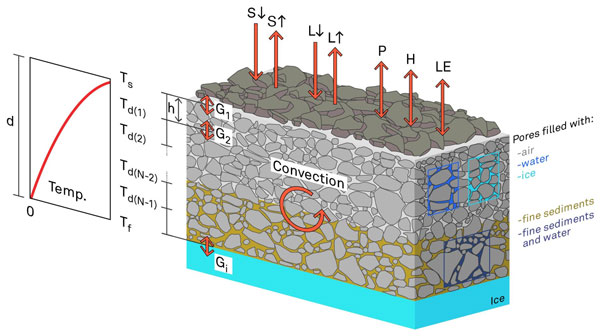
Rock debris covers many of the world glaciers, modifying the transfer of atmospheric energy to the debris and into the ice. Models of different complexity simulate this process, and we compare 15 models at 9 sites to show that the most complex models at the debris-atmosphere interface have the highest performance. However, we lack debris properties and their derivation from measurements is ambiguous, hindering global modelling and calling for both model development and data collection.
Léon Roussel, Marie Dumont, Marion Réveillet, Delphine Six, Marin Kneib, Pierre Nabat, Kévin Fourteau, Diego Monteiro, Simon Gascoin, Emmanuel Thibert, Antoine Rabatel, Jean-Emmanuel Sicart, Mylène Bonnefoy, Luc Piard, Olivier Laarman, Bruno Jourdain, Mathieu Fructus, Matthieu Vernay, and Matthieu Lafaysse
The Cryosphere, 19, 5201–5230, https://doi.org/10.5194/tc-19-5201-2025, https://doi.org/10.5194/tc-19-5201-2025, 2025
Short summary
Short summary
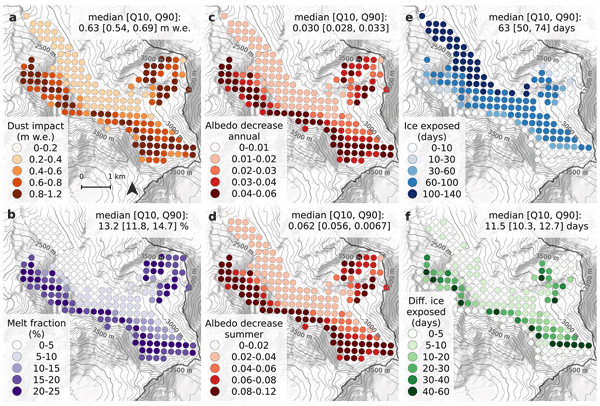
Saharan dust deposits frequently turn alpine glaciers orange. Mineral dust reduces snow albedo and increases snow and glaciers melt rate. Using physical modeling, we quantified the impact of dust on the Argentière Glacier over the period 2019–2022. We found that the contribution of mineral dust to the melt represents between 8 % and 16 % of Argentière Glacier summer melt. At specific locations, the impact of dust over one year can rise to an equivalent of 1.2 m of melted ice.
Marin Kneib, Amaury Dehecq, Adrien Gilbert, Auguste Basset, Evan S. Miles, Guillaume Jouvet, Bruno Jourdain, Etienne Ducasse, Luc Beraud, Antoine Rabatel, Jérémie Mouginot, Guillem Carcanade, Olivier Laarman, Fanny Brun, and Delphine Six
The Cryosphere, 18, 5965–5983, https://doi.org/10.5194/tc-18-5965-2024, https://doi.org/10.5194/tc-18-5965-2024, 2024
Short summary
Short summary
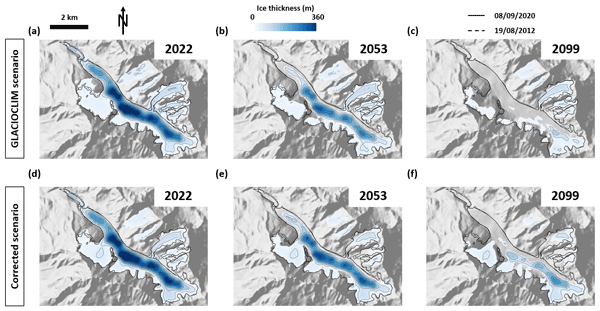
Avalanches contribute to increasing the accumulation on mountain glaciers by redistributing snow from surrounding mountains slopes. Here we quantified the contribution of avalanches to the mass balance of Argentière Glacier in the French Alps, by combining satellite and field observations to model the glacier dynamics. We show that the contribution of avalanches locally increases the accumulation by 60–70 % and that accounting for this effect results in less ice loss by the end of the century.
Marin Kneib, Amaury Dehecq, Fanny Brun, Fatima Karbou, Laurane Charrier, Silvan Leinss, Patrick Wagnon, and Fabien Maussion
The Cryosphere, 18, 2809–2830, https://doi.org/10.5194/tc-18-2809-2024, https://doi.org/10.5194/tc-18-2809-2024, 2024
Short summary
Short summary
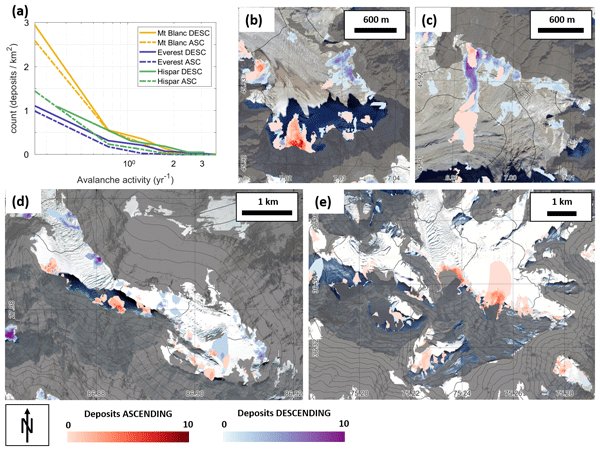
Avalanches are important for the mass balance of mountain glaciers, but few data exist on where and when they occur and which glaciers they affect the most. We developed an approach to map avalanches over large glaciated areas and long periods of time using satellite radar data. The application of this method to various regions in the Alps and High Mountain Asia reveals the variability of avalanches on these glaciers and provides key data to better represent these processes in glacier models.
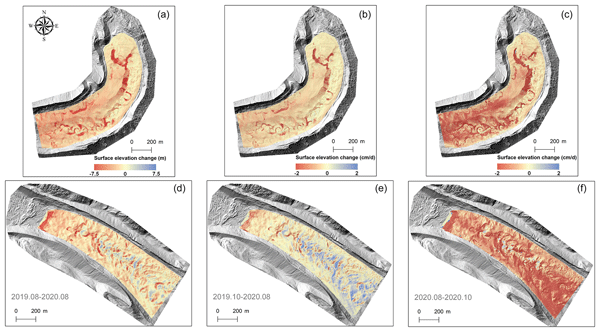
Chuanxi Zhao, Wei Yang, Evan Miles, Matthew Westoby, Marin Kneib, Yongjie Wang, Zhen He, and Francesca Pellicciotti
The Cryosphere, 17, 3895–3913, https://doi.org/10.5194/tc-17-3895-2023, https://doi.org/10.5194/tc-17-3895-2023, 2023
Short summary
Short summary
This paper quantifies the thinning and surface mass balance of two neighbouring debris-covered glaciers in the southeastern Tibetan Plateau during different seasons, based on high spatio-temporal resolution UAV-derived (unpiloted aerial
vehicle) data and in situ observations. Through a comparison approach and high-precision results, we identify that the glacier dynamic and debris thickness are strongly related to the future fate of the debris-covered glaciers in this region.
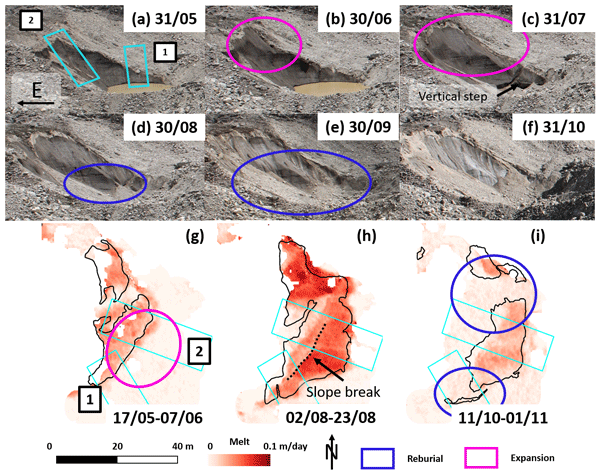
Marin Kneib, Evan S. Miles, Pascal Buri, Stefan Fugger, Michael McCarthy, Thomas E. Shaw, Zhao Chuanxi, Martin Truffer, Matthew J. Westoby, Wei Yang, and Francesca Pellicciotti
The Cryosphere, 16, 4701–4725, https://doi.org/10.5194/tc-16-4701-2022, https://doi.org/10.5194/tc-16-4701-2022, 2022
Short summary
Short summary
Ice cliffs are believed to be important contributors to the melt of debris-covered glaciers, but this has rarely been quantified as the cliffs can disappear or rapidly expand within a few weeks. We used photogrammetry techniques to quantify the weekly evolution and melt of four cliffs. We found that their behaviour and melt during the monsoon is strongly controlled by supraglacial debris, streams and ponds, thus providing valuable insights on the melt and evolution of debris-covered glaciers.
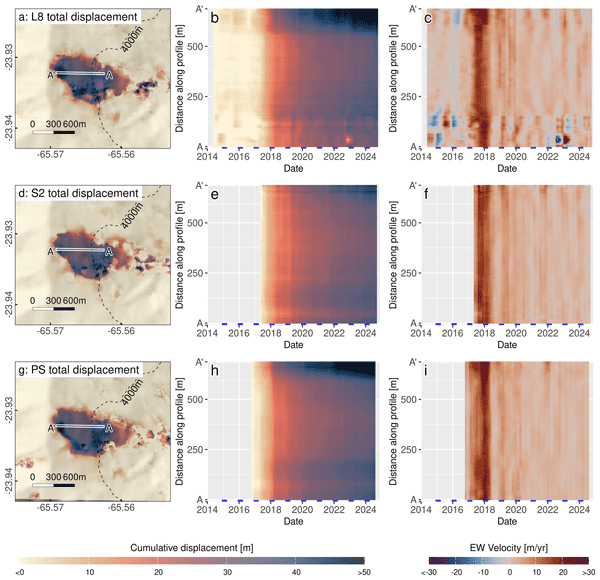
Ariane Mueting, Laurane Charrier, and Bodo Bookhagen
Earth Surf. Dynam., 14, 781–800, https://doi.org/10.5194/esurf-14-781-2026, https://doi.org/10.5194/esurf-14-781-2026, 2026
Short summary
Short summary
Slow-moving landslides respond to seasonal climate variations, but displacement time series from optical satellite imagery often contain illumination and shadow related biases that obscure true signals. This study assesses methods to mitigate these errors and reveals kinematic changes and controlling factors of a large slow-moving landslide in the Argentinean Andes.
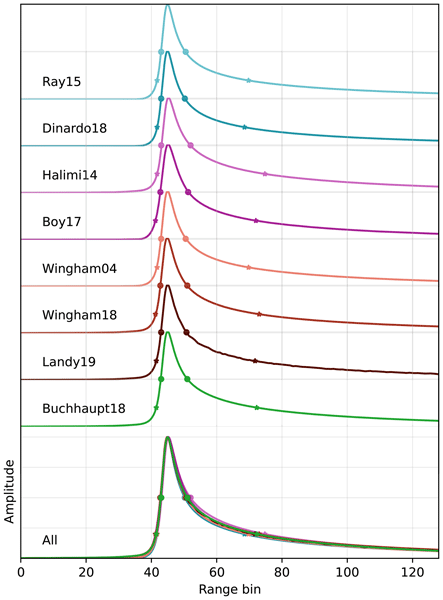
Ghislain Picard, Justin Murfitt, Elena Zakharova, Pierre Zeiger, Laurent Arnaud, Jeremie Aublanc, Jack C. Landy, Michele Scagliola, and Claude Duguay
Geosci. Model Dev., 19, 9103–9129, https://doi.org/10.5194/gmd-19-9103-2026, https://doi.org/10.5194/gmd-19-9103-2026, 2026
Short summary
Short summary
Radar altimeters measure ice-sheet elevation and sea-ice thickness. To improve their accuracy, we developed a model that simulates altimeter waveforms based on the physical properties of snow and sea ice. It computes the power, time, and Doppler shift of radar echoes as waves travel to the surface, interact with snow and ice, and return to the satellite. The model was verified internally, validated against other models and applied in Antarctica using in-situ snow measurements.
Janosch Beer, Mylène Jacquemart, Matthias Huss, Ilaria Santin, Gabriela Clara Racz, Christophe Ogier, Saskia Gindraux, Leo Hösli, Raphael Moser, James Irving, Mauro Fischer, and Daniel Farinotti
The Cryosphere, 20, 5453–5473, https://doi.org/10.5194/tc-20-5453-2026, https://doi.org/10.5194/tc-20-5453-2026, 2026
Short summary
Short summary
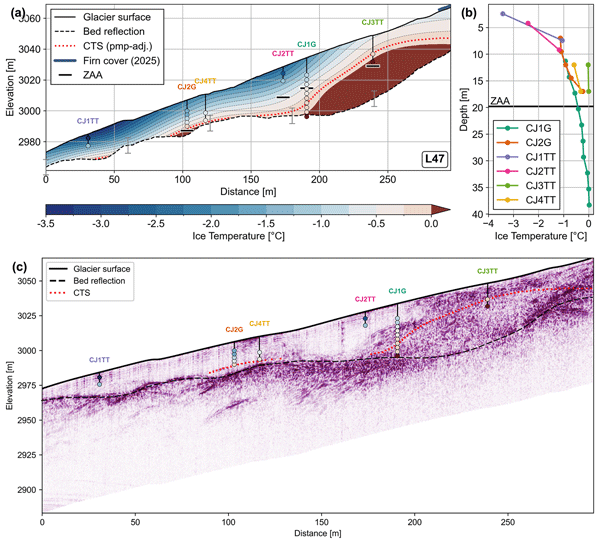
Small Alpine glaciers can exhibit a mix of cold and temperate ice, a polythermal structure, which can promote hazardous conditions. We drilled into six small Swiss glaciers and measured ice temperatures in boreholes. We found polythermal conditions in three of six sites and show that the thermal structure is linked to firn cover loss. Our results suggest that polythermal glaciers may be more common in the Alps than previously recognised.
Tom Matthews, Baker Perry, Ben Graves, Fanny Brun, Maria Sanolaria-Otin, Navaraj Pokhrel, Arbindra Khadka, Dibas Shrestha, Ludving Cano, Aris Kwadijk, Walter Immereel, Brandt Maxwell, and Anton Seimon
EGUsphere, https://doi.org/10.5194/egusphere-2026-5200, https://doi.org/10.5194/egusphere-2026-5200, 2026
This preprint is open for discussion and under review for The Cryosphere (TC).
Short summary
Short summary
Extreme precipitation shapes hazards and water resources in high mountains, but is rarely observed directly. On 4 October 2025, weather stations on Mt. Everest recorded one of the most extreme snowfall events ever measured. The storm revealed that Himalayan snowfall extremes can be far larger than previously documented, and that intense snowfall can cool the atmosphere sufficiently to prevent rain at impact-sensitive elevations, complicating the picture of how warming will affect future storms.
Adrien Ooms, Mathieu Casado, Sonja Wahl, Thomas Laepple, Alexandra Zuhr, Pete Akers, Ghislain Picard, Laurent Arnaud, Joel Savarino, Kira Rehfeld, Barbara Stenni, Giuliano Dreossi, Mauro Masiol, Amaelle Landais, and Valérie Masson-Delmotte
EGUsphere, https://doi.org/10.5194/egusphere-2026-4801, https://doi.org/10.5194/egusphere-2026-4801, 2026
This preprint is open for discussion and under review for Climate of the Past (CP).
Short summary
Short summary
This work presents new insights in the archival process of multi-annual climatic signal in the near surface firn at Concordia Station, East-Antarctica, from the new data set of high resolution stable water isotope profiles measured in a snow trench. The dated isotopic profiles covering 20 years are compared against overlapping precipitation and surface snow observations. This highlights the strong contribution of stratigraphic noise and post depositional effects to individual trench profiles.
Adrien Gilbert, Fabrizio Troilo, Olivier Gagliardini, Christian Vincent, Paolo Perret, Luca Mondardini, Luc Piard, Olivier Laarman, and Emmanuel Le Meur
EGUsphere, https://doi.org/10.5194/egusphere-2026-4058, https://doi.org/10.5194/egusphere-2026-4058, 2026
This preprint is open for discussion and under review for The Cryosphere (TC).
Short summary
Short summary
This study reports on long-term temperature changes observed on the Whymper hanging glacier in Italy from 1997 to 2021, which are interpreted using a numerical modeling approach. Our results show that recent surface warming, driven by increased melting, has raised the glacier's basal temperature significantly, which could reach its melting point by 2050. However, this warming is partially offset by cooling from the mountain's cold north face, which may keep the glacier frozen and stable.

Christophe Ogier, Mauro A. Werder, Olivier Gagliardini, Ilaria Santin, Raphael Moser, Romain Hugonnet, Antoine Blanc, and Daniel Farinotti
Nat. Hazards Earth Syst. Sci., 26, 3901–3917, https://doi.org/10.5194/nhess-26-3901-2026, https://doi.org/10.5194/nhess-26-3901-2026, 2026
Short summary
Short summary
In June 2024, a destructive flood impacted the village of La Bérarde in the French Alps. Rain, snowmelt, and the drainage of a surface lake on a glacier cannot fully explain the flood magnitude. We used glacier topography to estimate how much water could also have been stored beneath the glacier before the event. Our results show that large volumes of hidden water may have existed and could have amplified the flood, highlighting an overlooked hazard in debris-covered mountain glaciers.
Valentine Bellet, Romain Hugonnet, Amaury Dehecq, Alice de Bardonneche-Richard, Marine Bouchet, Valentin Schaffner, and Emmanuel Dubois
Int. Arch. Photogramm. Remote Sens. Spatial Inf. Sci., XLIX-B5-2026, 63–69, https://doi.org/10.5194/isprs-archives-XLIX-B5-2026-63-2026, https://doi.org/10.5194/isprs-archives-XLIX-B5-2026-63-2026, 2026
Christian Torres, Deniz Bozkurt, Vincent Favier, Victoire Buffet, Claudio Bravo, Xavier Fettweis, Thomas Dethinne, Antoine Rabatel, Maximiliano Viale, Sang-Jong Park, and Jorge Arigony-Neto
EGUsphere, https://doi.org/10.5194/egusphere-2026-3508, https://doi.org/10.5194/egusphere-2026-3508, 2026
This preprint is open for discussion and under review for The Cryosphere (TC).
Short summary
Short summary
We investigated periods when unusually warm conditions in Patagonia occurred at the same time as precipitation events on the Antarctic Peninsula. By combining observations and simulations, we identified 127 such events between 1980 and 2022. These events increased ice melt in Patagonia while enhancing accumulation on the Antarctic Peninsula, highlighting how large-scale weather patterns can simultaneously affect ice-covered regions in different ways.
Sandra Wells, Ivan Utkin, Ian J. Hewitt, Daniel Farinotti, and Mauro A. Werder
EGUsphere, https://doi.org/10.5194/egusphere-2026-4310, https://doi.org/10.5194/egusphere-2026-4310, 2026
Short summary
Short summary
We present GlaDS-2, a new subglacial drainage model that builds upon GlaDS by including the regimes of ice uplift and free-surface flow. We demonstrate its capabilities by simulating the rapid drainage of a supraglacial lake, both for a synthetic setup and for North Lake in Greenland. Our results show the formation of a traveling subglacial water blister inducing transient ice uplift, which align well with observations, and capture free-surface flow at the ice margins and in the proglacial zone.
Nora Bergner, Grace Marsh, Kevin Barry, Larissa Lacher, Alexander Böhmländer, Joanna Alden, Carina Ahlqvist, Ianina Altshuler, Lisa Bröder, Daniel Farinotti, Lionel Favre, Coline Guillosson, Benjamin Heutte, Kristina Höhler, Roman Pohorsky, Julian Weng, and Julia Schmale
Atmos. Chem. Phys., 26, 10557–10585, https://doi.org/10.5194/acp-26-10557-2026, https://doi.org/10.5194/acp-26-10557-2026, 2026
Short summary
Short summary
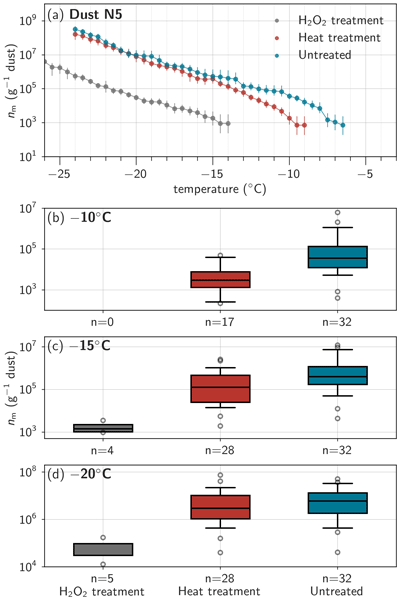
Dust from Greenlandic glacial outwash plains can form ice in clouds, a process relevant for climate. Its ice-nucleating activity varies strongly and is largely controlled by small amounts of biological material. During summer, the influence on atmospheric ice-nucleating particles is mostly local. Lower activity compared to other high-latitude dust sources highlights the need to account for regional differences in Arctic dust.
Amaury Dehecq, Friedrich Knuth, Joaquín M. C. Belart, Livia Piermattei, Camillo Ressl, Adina Racoviteanu, Robert McNabb, David Shean, and Luc Godin
Int. Arch. Photogramm. Remote Sens. Spatial Inf. Sci., XLIX-B2-2026, 9–16, https://doi.org/10.5194/isprs-archives-XLIX-B2-2026-9-2026, https://doi.org/10.5194/isprs-archives-XLIX-B2-2026-9-2026, 2026
Yacouba Nouhou Chaweye, Guillaume Favreau, Amaury Dehecq, Marie Boucher, Boukari Issoufou Ousmane, Rabilou Abdou Mahaman, and Yahaya Nazoumou
EGUsphere, https://doi.org/10.5194/egusphere-2026-4118, https://doi.org/10.5194/egusphere-2026-4118, 2026
Short summary
Short summary
This study provides an empirical yet finely documented example highlighting a significant but often overlooked or misunderstood trade-off between land restoration strategies and groundwater sustainability in drylands at a global scale. It emphasizes that interventions to achieve climate change adaptation and land restoration goals may inadvertently compromise fragile water resources when hydrological feedbacks are not sufficiently considered.
Matthieu Lafaysse, Marie Dumont, Basile De Fleurian, Mathieu Fructus, Rafife Nheili, Léo Viallon-Galinier, Matthieu Baron, Aaron Boone, Axel Bouchet, Julien Brondex, Carlo Carmagnola, Bertrand Cluzet, Kévin Fourteau, Ange Haddjeri, Pascal Hagenmuller, Giulia Mazzotti, Marie Minvielle, Samuel Morin, Louis Quéno, Léon Roussel, Pierre Spandre, François Tuzet, and Vincent Vionnet
Geosci. Model Dev., 19, 6273–6334, https://doi.org/10.5194/gmd-19-6273-2026, https://doi.org/10.5194/gmd-19-6273-2026, 2026
Short summary
Short summary
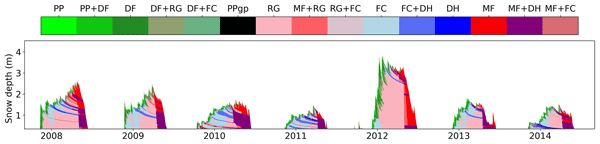
This article is a comprehensive description of the 3.0.2 stable release of the Crocus snowpack model. It describes various new implementations since the last reference article in 2012 and a review of the available scientific evaluations and applications of the model. This provides guidance for the future of numerical snow modelling.
Zhuo Wang, Neil Ross, Thomas Frank, Jamie Barnett, Ilaria Santin, Martin Houssais, Johanna Dahlkvist, and Nina Kirchner
Earth Syst. Sci. Data, 18, 4241–4262, https://doi.org/10.5194/essd-18-4241-2026, https://doi.org/10.5194/essd-18-4241-2026, 2026
Short summary
Short summary
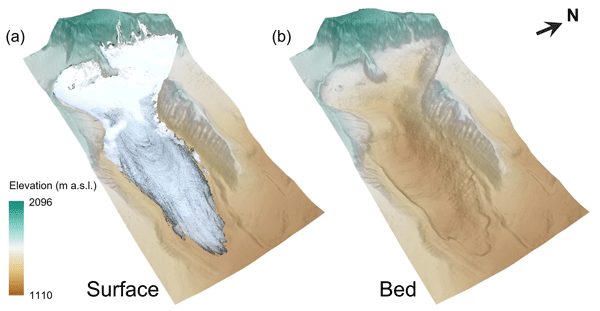
Under global warming, Sweden's remaining glaciers are shrinking rapidly, and all four Swedish reference glaciers (Mårmaglaciären, Storglaciären, Rabots glaciär, and Riukojietna) may disappear within this century. To better project their future evolution, we measured the ice thickness of the four glaciers using radio-echo sounding and mapped the bed topography beneath the ice. These maps provide essential insights into future landscapes, ecosystems, and policymaking.
Ilaria Santin, Huw J. Horgan, Raphael Moser, Nanna Bjørnholt Karlsson, Faezeh M. Nick, Andreas Vieli, Anja Rutishauser, Hansruedi Maurer, and Daniel Farinotti
The Cryosphere, 20, 3435–3441, https://doi.org/10.5194/tc-20-3435-2026, https://doi.org/10.5194/tc-20-3435-2026, 2026
Short summary
Short summary
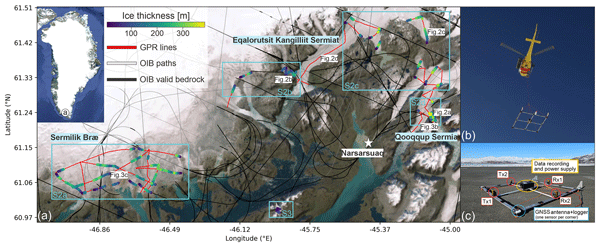
Ice thickness near Greenland’s coast is still poorly measured, yet it is vital for predicting sea level rise. We flew a helicopter ice-penetrating radar over three outlet glaciers in southern Greenland and mapped the glacier bed where basal reflections were clear. We measured ice up to about 340 meters thick, with reliable penetration typically to about 300 meters, providing new constraints that can improve regional bed maps.
Moritz Oberrauch, Bertrand Cluzet, Jan Magnusson, Giulia Mazzotti, Rebecca Mott, Louis Quéno, Clare Webster, Tobias Zolles, and Tobias Jonas
The Cryosphere, 20, 3387–3403, https://doi.org/10.5194/tc-20-3387-2026, https://doi.org/10.5194/tc-20-3387-2026, 2026
Short summary
Short summary
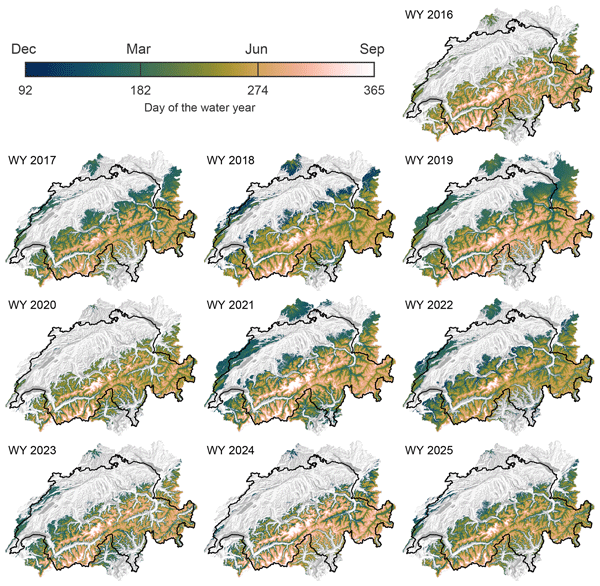
We present a snow dataset that provides daily information on snow depth, snow amount, and meltwater for Switzerland from 2016 to 2025. It combines weather data, computer simulations, and ground observations to give the most complete picture of how snow changes over time. Because mountain snow strongly affects avalanches, floods, water resources, and ecosystems, this freely available dataset supports better understanding and decision-making in these areas.
Jing Zhang, Yang Lei, Laurane Charrier, Amaury Dehecq, Alex S. Gardner, Luke Copland, and Christine Dow
EGUsphere, https://doi.org/10.5194/egusphere-2026-2541, https://doi.org/10.5194/egusphere-2026-2541, 2026
This preprint is open for discussion and under review for The Cryosphere (TC).
Short summary
Short summary
Satellites can measure how fast glaciers move, which helps scientists understand ice loss and rising sea levels. However, these measurements have rarely been checked against ground-based observations on small mountain glaciers. We compared satellite-derived glacier speeds against precise ground measurements. The satellite data generally agreed well with ground observations. Our results help scientists use satellite glacier velocity data more reliably.
Adrien Ooms, Mathieu Casado, Ghislain Picard, Laurent Arnaud, Maria Hörhold, Andrea Spolaor, Rita Traversi, Joel Savarino, Patrick Ginot, Pete Akers, Birthe Twarloh, and Valérie Masson-Delmotte
The Cryosphere, 20, 3235–3255, https://doi.org/10.5194/tc-20-3235-2026, https://doi.org/10.5194/tc-20-3235-2026, 2026
Short summary
Short summary
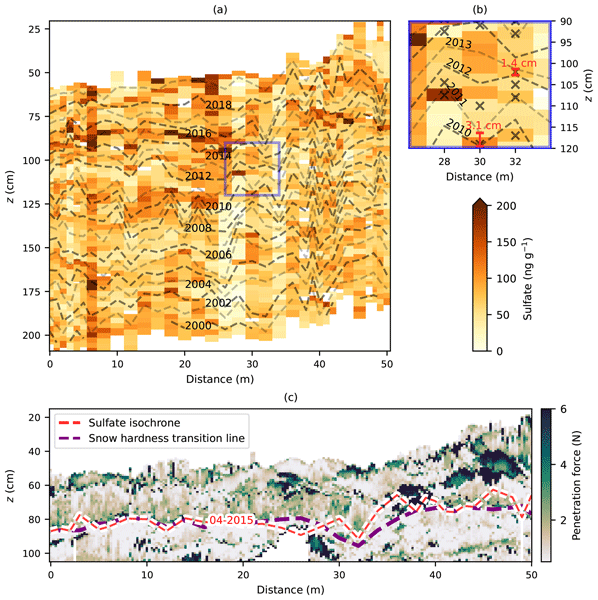
This work presents a new approach to the estimation of accumulation rates at Concordia Station, East-Antarctica, for the last 20 years, from a new data set of chemical tracers and snow micro-scale properties measured in a snow trench. Multi-annual and meter to decameter scale variability of accumulation rates are compared again in-situ measurements of surface laser scanner and stake farm, with very good agreement. This further constrains SMB estimation for Antarctica at high temporal resolution.
Aaron Cremona, Matthias Huss, Johannes Marian Landmann, Mauro Marty, Marijn van der Meer, Christian Ginzler, and Daniel Farinotti
The Cryosphere, 20, 3111–3130, https://doi.org/10.5194/tc-20-3111-2026, https://doi.org/10.5194/tc-20-3111-2026, 2026
Short summary
Short summary
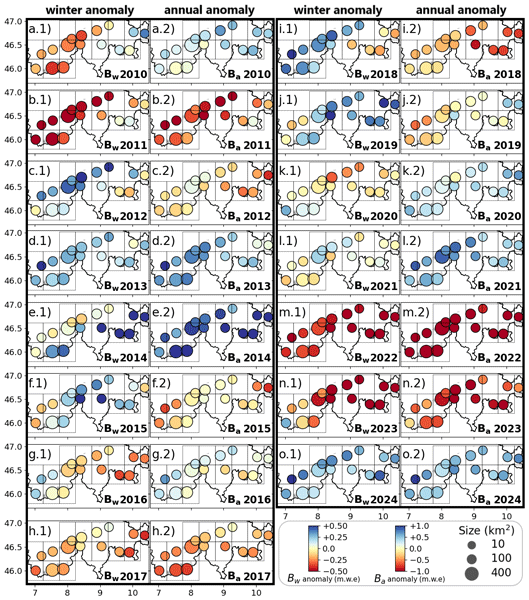
Our study provides daily mass balance estimates for every Swiss glacier from 2010–2024 using modelling, remote sensing observations, and machine learning. Over the period, Swiss glaciers lost nearly a quarter of their ice volume. The approach enables investigating the spatio-temporal variability of glacier mass balance in relation to the driving climatic factors.
Shaoting Ren, Evan S. Miles, Michael McCarthy, Achille Jouberton, Thomas E. Shaw, Pascal Buri, Marin Kneib, Prateek Gantayat, Anneli Guthke, and Francesca Pellicciotti
EGUsphere, https://doi.org/10.5194/egusphere-2026-2524, https://doi.org/10.5194/egusphere-2026-2524, 2026
Short summary
Short summary
Local meteorology is curial to understand glaciers’ response to climate change, yet is hard to quantify due to rare measurements. By combining physical modeling and satellite observations, this study develops a new inference framework to accurately estimate on-glacier temperature and precipitation, therefore derive reliable seasonal glacier melt. Reliable accuracy of this framework paves a way to map these key two meteorological variables for regional and global unmonitored glacier.
Nicolás Acuña Reyes, Léo Martin, Adrien Gilbert, Vincent Jomelli, Antoine Rabatel, Simon Filhol, Deborah Verfaillie, Pierre-Henri Blard, and Jérôme Lavé
EGUsphere, https://doi.org/10.5194/egusphere-2026-2638, https://doi.org/10.5194/egusphere-2026-2638, 2026
Short summary
Short summary
Glacier landforms are often used to reconstruct past climate, but the same glacier shape can result from different combinations of temperature and snowfall. Using computer simulations of glaciers in the Bolivian Andes, we show that climate reconstructions based on a single glacier can lead to large uncertainties. By combining several neighboring glaciers, we estimate temperatures about 0.8°C cooler during the Little Ice Age and 1.3°C cooler during the Early Holocene (~10,000 years ago).
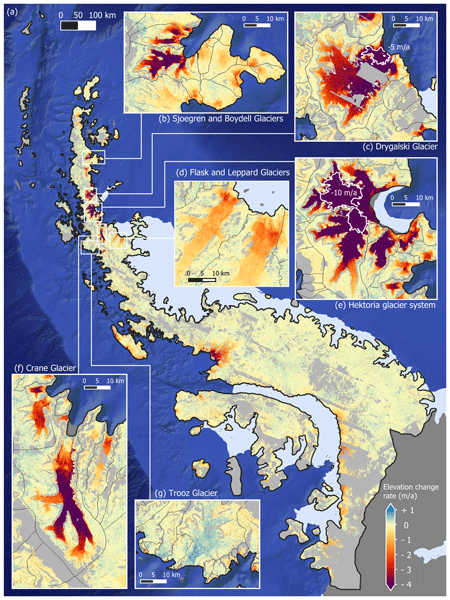
Maud Bernat, Etienne Berthier, Amaury Dehecq, Romain Hugonnet, Joaquin M. C. Belart, Naomi Ochwat, Peter Kuipers Munneke, Elizabeth Case, Ted Scambos, Louis-Marie Gauer, and David Youssefi
The Cryosphere, 20, 3025–3049, https://doi.org/10.5194/tc-20-3025-2026, https://doi.org/10.5194/tc-20-3025-2026, 2026
Short summary
Short summary
The Antarctic Peninsula is a mountainous region containing an ice sheet and peripheral glaciers. Differences remain between the methods used to estimate its mass changes. We use thousands of digital elevation models derived from high resolution stereoscopic images to calculate a new estimate of mass changes. We find that between 2007 and 2021, the ice sheet lost -28±6Gt/a and its peripheral glaciers -14±3Gt/a. We highlight the importance of resolving fine-scale changes in complex coastal areas.
Giulia Mazzotti, Félix Vaccaro, Antoine Courteaud, Mathieu Fructus, Jan Magnusson, Isabelle Gouttevin, Jari-Pekka Nousu, and Matthieu Lafaysse
EGUsphere, https://doi.org/10.5194/egusphere-2026-1464, https://doi.org/10.5194/egusphere-2026-1464, 2026
Short summary
Short summary
This study evaluates spatial simulations with the new snow model MEB-Crocus over mountainous, forested terrain. In lack of forest snow observations over large areas, simulations are assessed against simulations with the state-of-the art model FSM2oshd. Results show that the data characterizing the vegetation is as important for model performance as the mathematical description of physical processes. These insights inform future improvements of MEB-Crocus for its application to alpine regions.
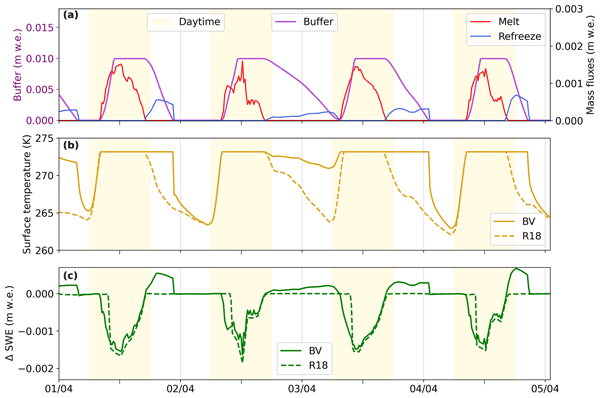
Audrey Goutard, Marion Réveillet, Fanny Brun, Delphine Six, Kevin Fourteau, Charles Amory, Xavier Fettweis, Mathieu Fructus, Arbindra Khadka, and Matthieu Lafaysse
The Cryosphere, 20, 2393–2416, https://doi.org/10.5194/tc-20-2393-2026, https://doi.org/10.5194/tc-20-2393-2026, 2026
Short summary
Short summary
A new scheme has been developed in a snowpack model (SURFEX/ISBA-Crocus), to consider the impact of liquid water dynamics on bare ice, including albedo feedback and refreezing. When applied to the Mera Glacier in Nepal, the model reveals strong seasonal effects on the energy and mass balance, with increased melting in dry seasons and significant refreezing during the monsoon. This development improves mass balance modeling under increasing rainfall and bare ice exposure due to climate warming.
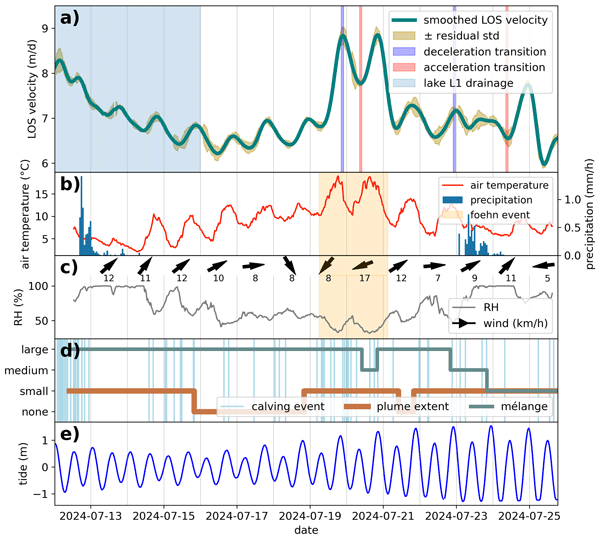
Armin Dachauer, Andrea Kneib-Walter, Dominik Gräff, and Andreas Vieli
The Cryosphere, 20, 2099–2125, https://doi.org/10.5194/tc-20-2099-2026, https://doi.org/10.5194/tc-20-2099-2026, 2026
Short summary
Short summary
Terrestrial radar observations were used to investigate flow speed changes at Eqalorutsit Kangilliit Sermiat, a marine-terminating glacier in Greenland. The velocity varied on both daily and multi-day timescales, showing that the glacier speeds up markedly when meltwater or lake drainage increases basal water pressure. Usually speed changes move downstream with time towards the glacier front, but during multi-day speed-up events they start at the front and travel upstream.
Francesca Pellicciotti, Adrià Fontrodona-Bach, David R. Rounce, Catriona L. Fyffe, Leif S. Anderson, Álvaro Ayala, Ben W. Brock, Pascal Buri, Stefan Fugger, Koji Fujita, Prateek Gantayat, Alexander R. Groos, Walter Immerzeel, Marin Kneib, Christoph Mayer, Shelley MacDonell, Michael McCarthy, James McPhee, Evan Miles, Heather Purdie, Ekaterina Rets, Akiko Sakai, Thomas E. Shaw, Jakob Steiner, Patrick Wagnon, and Alex Winter-Billington
The Cryosphere, 20, 1895–1928, https://doi.org/10.5194/tc-20-1895-2026, https://doi.org/10.5194/tc-20-1895-2026, 2026
Short summary
Short summary
Rock debris covers many of the world glaciers, modifying the transfer of atmospheric energy to the debris and into the ice. Models of different complexity simulate this process, and we compare 15 models at 9 sites to show that the most complex models at the debris-atmosphere interface have the highest performance. However, we lack debris properties and their derivation from measurements is ambiguous, hindering global modelling and calling for both model development and data collection.
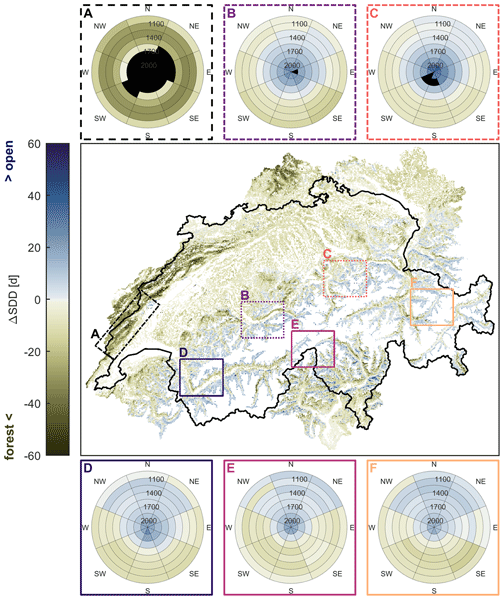
Vincent Haagmans, Giulia Mazzotti, Clare Webster, and Tobias Jonas
Hydrol. Earth Syst. Sci., 30, 1691–1717, https://doi.org/10.5194/hess-30-1691-2026, https://doi.org/10.5194/hess-30-1691-2026, 2026
Short summary
Short summary
In the Central European Alps, forests store about 20–30 % of midwinter snow. The effect of forests on snow cover varies greatly with topography, forest structure, weather, and regions. Forests usually decrease snow accumulation and decelerate melt, often leading to a later snow disappearance, especially on sunny slopes. But annual variations are considerable and can even reverse such effects. Environmental shifts will further complicate snow cover dynamics in these mountain forests.
Titouan Tcheng, Elise Fourré, Christophe Leroy-Dos Santos, Frédéric Parrenin, Emmanuel Le Meur, Frédéric Prié, Olivier Jossoud, Roxanne Jacob, Bénédicte Minster, Olivier Magand, Cécile Agosta, Niels Dutrievoz, Vincent Favier, Léa Baubant, Coralie Lassalle-Bernard, Mathieu Casado, Martin Werner, Alexandre Cauquoin, Laurent Arnaud, Bruno Jourdain, Ghislain Picard, Marie Bouchet, and Amaëlle Landais
The Cryosphere, 20, 1599–1618, https://doi.org/10.5194/tc-20-1599-2026, https://doi.org/10.5194/tc-20-1599-2026, 2026
Short summary
Short summary
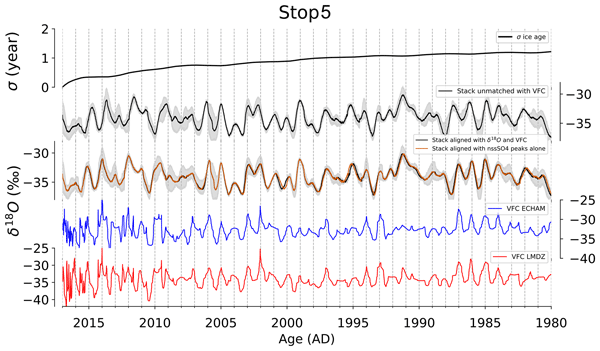
Studying Antarctic ice cores is crucial to assess past climate changes, as they hold historical climate data. This study examines multiple ice cores from three sites in coastal Adélie Land to see if combining cores improves data interpretability. It does at two sites, but at a third, wind-driven snow layer mixing limited benefits. We show that using multiple ice cores from one location can better uncover climate history, especially in areas with less wind disturbance.
Gabriela Quispe, Carlos Cárdenas, Pablo Fuchs, Alvaro Soruco, and Antoine Rabatel
ISPRS Ann. Photogramm. Remote Sens. Spatial Inf. Sci., X-3-W4-2025, 307–312, https://doi.org/10.5194/isprs-annals-X-3-W4-2025-307-2026, https://doi.org/10.5194/isprs-annals-X-3-W4-2025-307-2026, 2026
Laurane Charrier, Nathan Lioret, Fanny Brun, Amaury Dehecq, Romain Millan, Anuar Togaibekov, Andrea Walpersdorf, Diego Cusicanqui, and Antoine Rabatel
EGUsphere, https://doi.org/10.5194/egusphere-2026-946, https://doi.org/10.5194/egusphere-2026-946, 2026
Short summary
Short summary
Sub-annual glacier surface velocity derived from remote sensing images are receiving increasing attention. In the meantime, systematic seasonal errors (i.e. biases) have been reported in time series derived from optical images on various landforms, such as landslides or dunes. The extent to which such biases affect glacier velocity maps remains poorly investigated. Here, we propose characterizing the amplitude and spatial distribution of these seasonal biases.
Tifenn Le Bris, Guilhem Barruol, Florent Gimbert, Emmanuel Le Meur, Dimitri Zigone, Maxime Bès de Berc, and Armelle Bernard
EGUsphere, https://doi.org/10.5194/egusphere-2026-76, https://doi.org/10.5194/egusphere-2026-76, 2026
Short summary
Short summary
When Antarctic glaciers meet the ocean, they shift from resting on the bedrock to floating, at a boundary called the grounding line. Using a dense array of seismic sensors deployed on the Astrolabe Glacier, East Antarctica, we investigate daily spatial and temporal variations of seismicity at this critical boundary. We show that ice deformation at the surface and the base of the glacier serves as an efficient proxy to track the grounding line position and its daily motion under tidal forcing.
Anna Wirbel, Felix Oesterle, Guillaume Chambon, Thierry Faug, Johan Gaume, Julia Glaus, Stefan Hergarten, Dieter Issler, Yoichi Ito, Marco Martini, Martin Mergili, Matthias Rauter, Jörg Robl, Giorgio Rosatti, Kae Tsunematsu, Christian Tollinger, Hervé Vicari, Daniel Zugliani, and Jan-Thomas Fischer
EGUsphere, https://doi.org/10.5194/egusphere-2025-6053, https://doi.org/10.5194/egusphere-2025-6053, 2026
This preprint is open for discussion and under review for Geoscientific Model Development (GMD).
Short summary
Short summary
We present the first extended intercomparison of snow avalanche flow simulation tools. In this pilot-study, simulation results of mainly thickness/depth-integrated shallow flow models are compared for three simple test cases representative of standard applications. This analysis serves as a first quantitative assessment of the uncertainty introduced by the different implementation workflows (e.g., numerical schemes, ad-hoc treatments, geo-data handling, curvature treatment, etc.).
Vijaya Kumar Thota, Thorsten Seehaus, Friedrich Knuth, Amaury Dehecq, Christian Salewski, David Farías-Barahona, and Matthias H. Braun
Earth Syst. Sci. Data, 18, 597–615, https://doi.org/10.5194/essd-18-597-2026, https://doi.org/10.5194/essd-18-597-2026, 2026
Short summary
Short summary
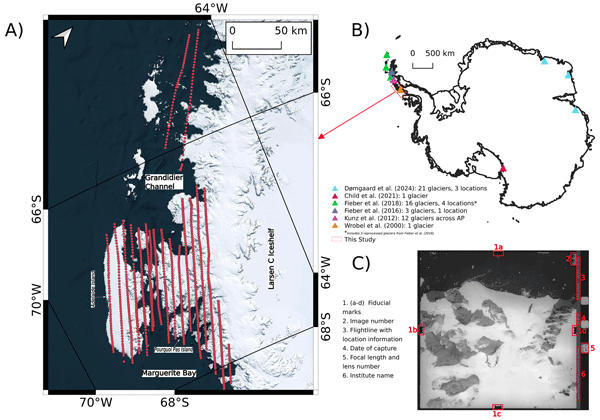
We reconstruct historical topography for a rapidly warming Antarctic region with limited existing data. Using approximately 2000 aerial photographs from the year 1989 over the western Antarctic Peninsula and nearby islands, we created detailed elevation models and orthoimages that have high accuracy compared to recent satellite data. This open dataset aids tracking historical ice loss and its role in sea level rise.
Marit van Tiel, Matthias Huss, Massimiliano Zappa, Tobias Jonas, and Daniel Farinotti
Hydrol. Earth Syst. Sci., 30, 23–43, https://doi.org/10.5194/hess-30-23-2026, https://doi.org/10.5194/hess-30-23-2026, 2026
Short summary
Short summary
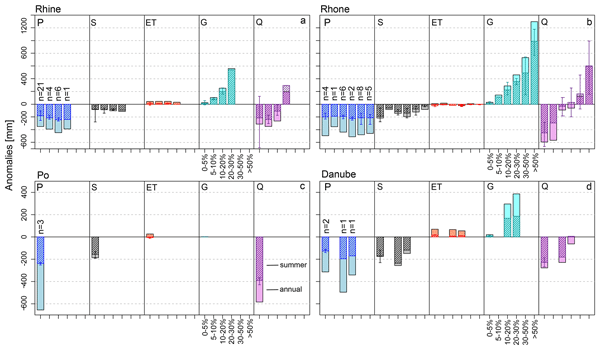
The summer of 2022 was extremely warm and dry in Europe, severely impacting water availability. We calculated water balance anomalies for 88 glacierized catchments in Switzerland, showing that glaciers played a crucial role in alleviating the drought situation by melting at record rates, partially compensating for the lack of rain and snowmelt. By comparing 2022 with past extreme years, we show that while glacier meltwater remains essential during droughts, its contribution is declining.
Thomas Chauve, Florent Gimbert, Adrien Gilbert, Olivier Gagliardini, Luc Piard, Arnaud Reboud, Olivier Laarman, Paolo Perret, William Boffelli, Pietro Di Sopra, Luca Mondardini, and Fabrizio Troilo
EGUsphere, https://doi.org/10.5194/egusphere-2025-5714, https://doi.org/10.5194/egusphere-2025-5714, 2025
Short summary
Short summary
A field campaign on the Planpincieux Glacier investigated how hidden heterogeneities inside the ice affect its deformation. A borehole logged with optical and acoustic tools and equipped with tilt sensors revealed that these heterogeneities cause strong deformation localization. Such weak zones significantly influence glacier motion, showing that internal structure is key to understanding how glaciers flow.
Alexandra von der Esch, Matthias Huss, Marit van Tiel, Justine Berg, and Daniel Farinotti
Hydrol. Earth Syst. Sci., 29, 6761–6780, https://doi.org/10.5194/hess-29-6761-2025, https://doi.org/10.5194/hess-29-6761-2025, 2025
Short summary
Short summary
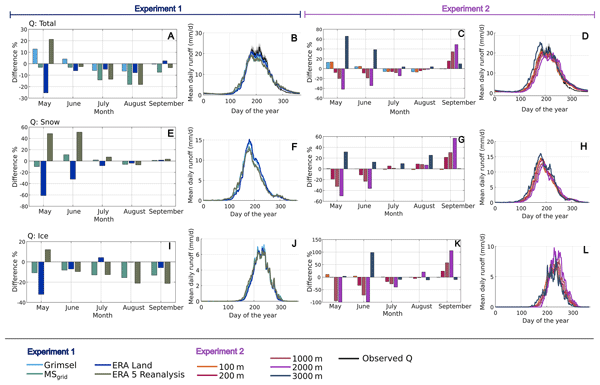
Glaciers are vital water sources, especially in alpine regions. Using the Glacier Evolution Runoff Model (GERM), we examined how forcing data and model resolution impact glacio-hydrological model results. We find that precipitation biases greatly affect results, and coarse resolutions miss critical small-scale details. This highlights the trade-offs between computational efficiency and model accuracy, emphasizing the need for high-resolution data and precise calibration for reliable predictions.
Vincent Vionnet, Nicolas R. Leroux, Vincent Fortin, Maria Abrahamowicz, Georgina Woolley, Giulia Mazzotti, Manon Gaillard, Matthieu Lafaysse, Alain Royer, Florent Domine, Nathalie Gauthier, Nick Rutter, Chris Derksen, and Stéphane Bélair
Geosci. Model Dev., 18, 9119–9147, https://doi.org/10.5194/gmd-18-9119-2025, https://doi.org/10.5194/gmd-18-9119-2025, 2025
Short summary
Short summary
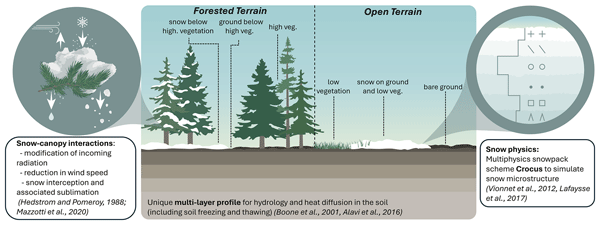
Snow microstructure controls snowpack properties, but most land surface models overlook this factor. To support future satellite missions, we created a new land surface model based on the Crocus scheme that simulates snow microstructure. Key improvements include better snow albedo representation, enhanced Arctic snow modeling, and improved forest module to capture Canada's diverse snow conditions. Results demonstrate improved simulations of snow density and melt across large regions of Canada.
Laura Gabriel, Marian Hertrich, Christophe Ogier, Mike Müller-Petke, Raphael Moser, Hansruedi Maurer, and Daniel Farinotti
The Cryosphere, 19, 6261–6281, https://doi.org/10.5194/tc-19-6261-2025, https://doi.org/10.5194/tc-19-6261-2025, 2025
Short summary
Short summary
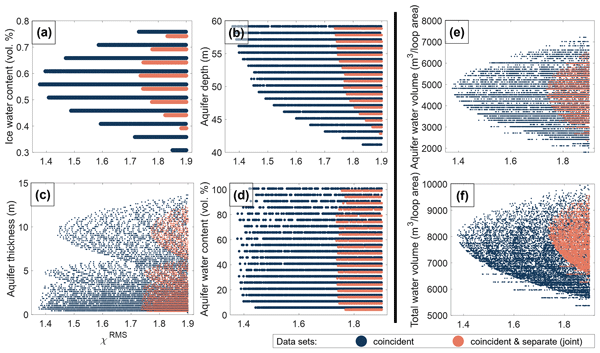
Surface nuclear magnetic resonance (SNMR) is a geophysical technique directly sensitive to liquid water. We expand the limited applications of SNMR on glaciers by detecting water within Rhonegletscher, Switzerland. By carefully processing the data to reduce noise, we identified signals indicating a water layer near the base of the glacier, surrounded by ice with low water content. Our findings, validated by radar measurements, show SNMR's potential and limitations in studying water in glaciers.
Titouan Biget, Fanny Brun, Walter Immerzeel, Léo Martin, Hamish Pritchard, Emily Collier, Yanbin Lei, and Tandong Yao
The Cryosphere, 19, 5863–5870, https://doi.org/10.5194/tc-19-5863-2025, https://doi.org/10.5194/tc-19-5863-2025, 2025
Short summary
Short summary
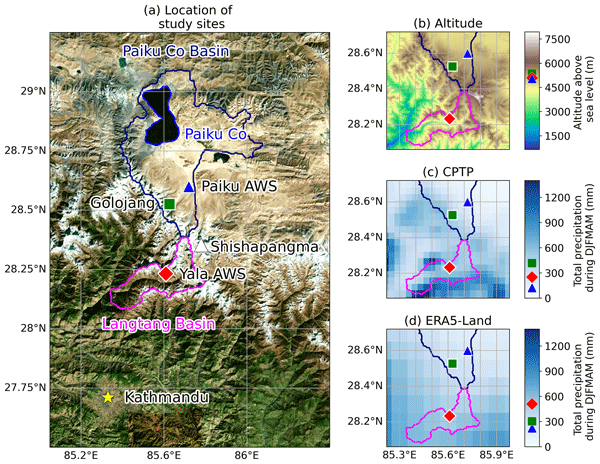
This study explore the precipitation in the southern Tibetan plateau using the water pressure of an high altitude lake and meteorological models and shows that snowfall could be much stronger on the Plateau than what is predicted by the models.
Léon Roussel, Marie Dumont, Marion Réveillet, Delphine Six, Marin Kneib, Pierre Nabat, Kévin Fourteau, Diego Monteiro, Simon Gascoin, Emmanuel Thibert, Antoine Rabatel, Jean-Emmanuel Sicart, Mylène Bonnefoy, Luc Piard, Olivier Laarman, Bruno Jourdain, Mathieu Fructus, Matthieu Vernay, and Matthieu Lafaysse
The Cryosphere, 19, 5201–5230, https://doi.org/10.5194/tc-19-5201-2025, https://doi.org/10.5194/tc-19-5201-2025, 2025
Short summary
Short summary
Saharan dust deposits frequently turn alpine glaciers orange. Mineral dust reduces snow albedo and increases snow and glaciers melt rate. Using physical modeling, we quantified the impact of dust on the Argentière Glacier over the period 2019–2022. We found that the contribution of mineral dust to the melt represents between 8 % and 16 % of Argentière Glacier summer melt. At specific locations, the impact of dust over one year can rise to an equivalent of 1.2 m of melted ice.
Luc Beraud, Fanny Brun, Amaury Dehecq, Romain Hugonnet, and Prashant Shekhar
The Cryosphere, 19, 5075–5094, https://doi.org/10.5194/tc-19-5075-2025, https://doi.org/10.5194/tc-19-5075-2025, 2025
Short summary
Short summary
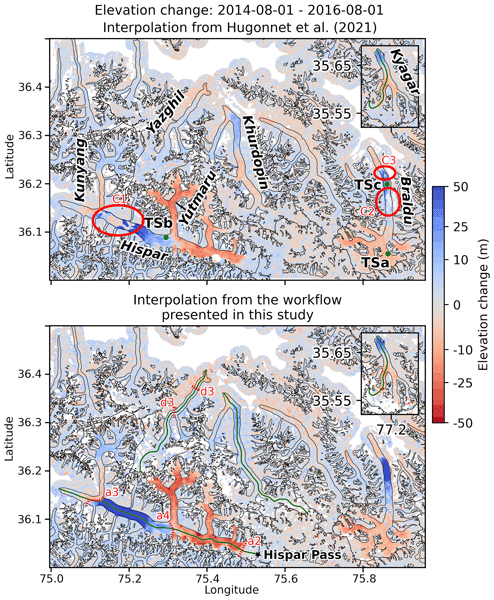
This study introduces a new workflow to process the elevation time series of glacier surges, an ice flow instability. Applied to a dense, 20-year satellite dataset of glacier surface elevation, the method filters and interpolates these changes on a monthly scale, revealing detailed patterns and estimates of mass transport. The dataset produced by this method allows for a more accurate and a remarkably detailed description of glacier surges at the scale of a large region.
Laurane Charrier, Amaury Dehecq, Lei Guo, Fanny Brun, Romain Millan, Nathan Lioret, Luke Copland, Nathan Maier, Christine Dow, and Paul Halas
The Cryosphere, 19, 4555–4583, https://doi.org/10.5194/tc-19-4555-2025, https://doi.org/10.5194/tc-19-4555-2025, 2025
Short summary
Short summary
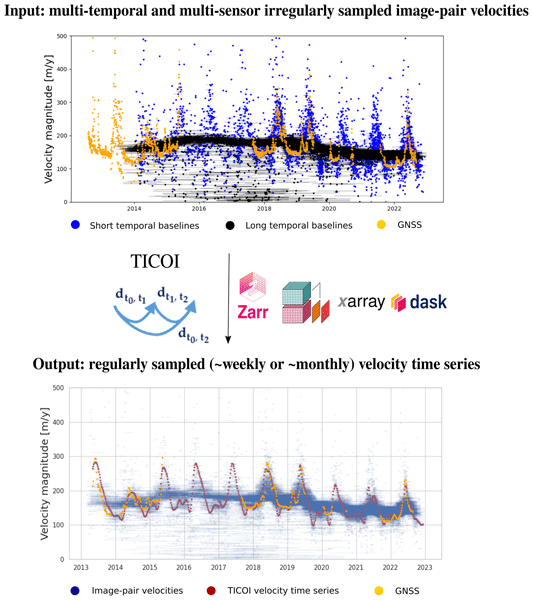
While global annual glacier velocities are openly accessible, sub-annual velocity time series are still lacking. This hinders our ability to understand flow processes and the integration of these observations in numerical models. We introduce an open source Python package called TICOI (Temporal Inversion using linear Combinations of Observations, and Interpolation) to fuse multi-temporal and multi-sensor image-pair velocities produced by different processing chains to produce standardized sub-annual velocity products.
Bastien Ruols, Johanna Klahold, Daniel Farinotti, and James Irving
The Cryosphere, 19, 4045–4059, https://doi.org/10.5194/tc-19-4045-2025, https://doi.org/10.5194/tc-19-4045-2025, 2025
Short summary
Short summary
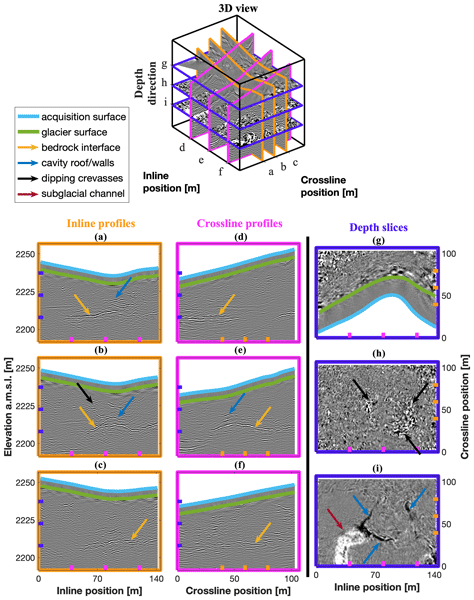
We demonstrate the use of a drone-based ground-penetrating radar (GPR) system to gather high-resolution, high-density 4D data over a near-terminus glacier collapse feature. We monitor the growth of an air cavity and the evolution of the subglacial drainage system, providing insights into the dynamics of the collapse event. This work highlights potential future applications of drone-based GPR for monitoring glaciers, in particular in regions which are inaccessible by surface-based methods.
Alex S. Gardner, Chad A. Greene, Joseph H. Kennedy, Mark A. Fahnestock, Maria Liukis, Luis A. López, Yang Lei, Ted A. Scambos, and Amaury Dehecq
The Cryosphere, 19, 3517–3533, https://doi.org/10.5194/tc-19-3517-2025, https://doi.org/10.5194/tc-19-3517-2025, 2025
Short summary
Short summary
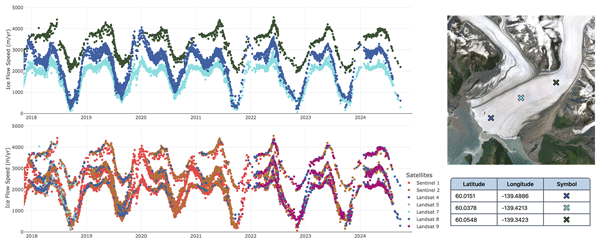
The NASA MEaSUREs Inter-mission Time Series of Land Ice Velocity and Elevation (ITS_LIVE) project provides glacier and ice sheet velocity products for the full Landsat, Sentinel-1, and Sentinel-2 satellite archives and will soon include data from the NISAR satellite. This paper describes the ITS_LIVE processing chain and gives guidance for working with the cloud-optimized glacier and ice sheet velocity products.
Ian Delaney, Andrew J. Tedstone, Mauro A. Werder, and Daniel Farinotti
The Cryosphere, 19, 2779–2795, https://doi.org/10.5194/tc-19-2779-2025, https://doi.org/10.5194/tc-19-2779-2025, 2025
Short summary
Short summary
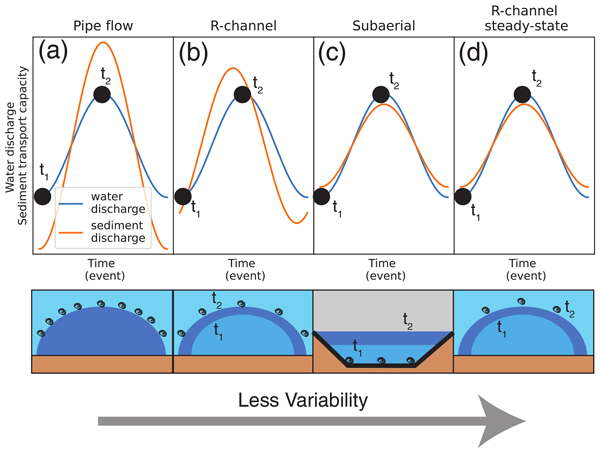
Sediment transport capacity depends on water velocity and channel width. In rivers, water discharge changes affect flow depth, width, and velocity. Yet, under glaciers, discharge variations alter velocity more than channel shape. Due to these differences, this study shows that sediment transport capacity under glaciers varies widely and peaks before water flow, creating a complex relationship. Understanding these dynamics helps interpret sediment discharge from glaciers in different climates.
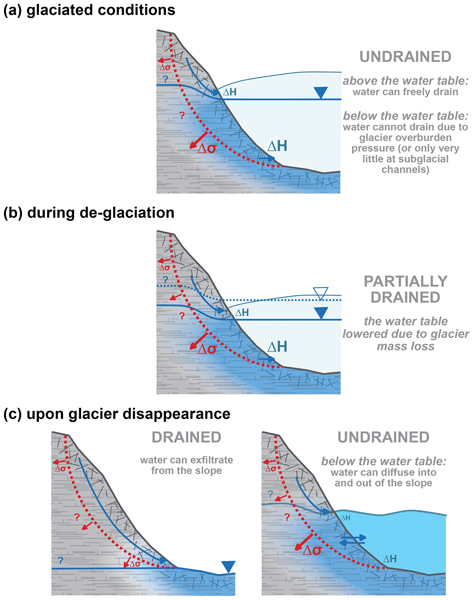
Jane Walden, Mylène Jacquemart, Bretwood Higman, Romain Hugonnet, Andrea Manconi, and Daniel Farinotti
Nat. Hazards Earth Syst. Sci., 25, 2045–2073, https://doi.org/10.5194/nhess-25-2045-2025, https://doi.org/10.5194/nhess-25-2045-2025, 2025
Short summary
Short summary
We studied eight glacier-adjacent landslides in Alaska and found that slope movement increased at four sites as the glacier retreated past the landslide area. Movement at other sites may be due to heavy precipitation or increased glacier thinning, and two sites showed little to no motion. We suggest that landslides near waterbodies may be especially vulnerable to acceleration, which we guess is due to faster retreat rates of water-terminating glaciers and changing water flow in the slope.
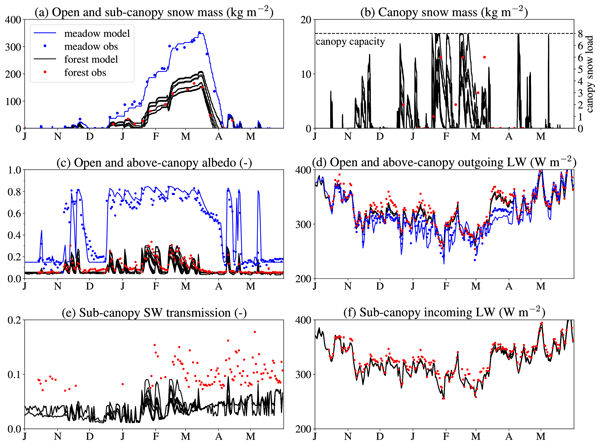
Richard Essery, Giulia Mazzotti, Sarah Barr, Tobias Jonas, Tristan Quaife, and Nick Rutter
Geosci. Model Dev., 18, 3583–3605, https://doi.org/10.5194/gmd-18-3583-2025, https://doi.org/10.5194/gmd-18-3583-2025, 2025
Short summary
Short summary
How forests influence accumulation and melt of snow on the ground is of long-standing interest, but uncertainty remains in how best to model forest snow processes. We developed the Flexible Snow Model version 2 to quantify these uncertainties. In a first model demonstration, how unloading of intercepted snow from the forest canopy is represented is responsible for the largest uncertainty. Global mapping of forest distribution is also likely to be a large source of uncertainty in existing models.
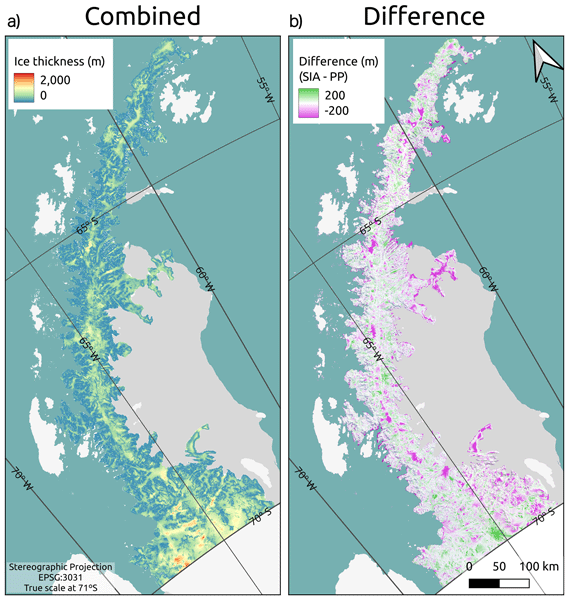
Kaian Shahateet, Johannes J. Fürst, Francisco Navarro, Thorsten Seehaus, Daniel Farinotti, and Matthias Braun
The Cryosphere, 19, 1577–1597, https://doi.org/10.5194/tc-19-1577-2025, https://doi.org/10.5194/tc-19-1577-2025, 2025
Short summary
Short summary
In the present work, we provide a new ice thickness reconstruction of the Antarctic Peninsula Ice Sheet north of 70º S using inversion modeling. This model consists of two steps: the first uses basic assumptions of the rheology of the glacier, and the second uses mass conservation to improve the reconstruction where the assumptions made previously are expected to fail. Validation with independent data showed that our reconstruction improved compared to other reconstructions that are available.
Etienne Ducasse, Romain Millan, Jonas Kvist Andersen, and Antoine Rabatel
The Cryosphere, 19, 911–917, https://doi.org/10.5194/tc-19-911-2025, https://doi.org/10.5194/tc-19-911-2025, 2025
Short summary
Short summary
Our study examines glacier movement in the tropical Andes from 2013 to 2022 using satellite data. Despite challenges like small glacier size and frequent cloud cover, we tracked annual speeds and seasonal changes. We found stable annual speeds but significant shifts between wet and dry seasons, likely due to changes in meltwater production and glacier–bedrock conditions. This research enhances understanding of how tropical glaciers react to climate change.
Marijn van der Meer, Harry Zekollari, Matthias Huss, Jordi Bolibar, Kamilla Hauknes Sjursen, and Daniel Farinotti
The Cryosphere, 19, 805–826, https://doi.org/10.5194/tc-19-805-2025, https://doi.org/10.5194/tc-19-805-2025, 2025
Short summary
Short summary
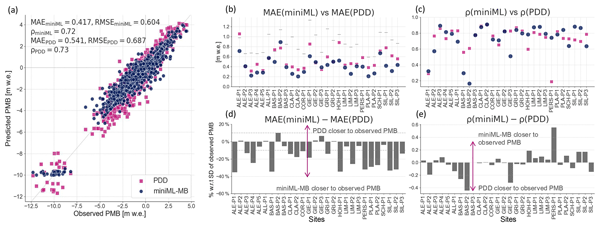
Glacier retreat poses big challenges, making understanding how climate affects glaciers vital. But glacier measurements worldwide are limited. We created a simple machine-learning model called miniML-MB, which estimates annual changes in glacier mass in the Swiss Alps. As input, miniML-MB uses two climate variables: average temperature (May–Aug) and total precipitation (Oct–Feb). Our model can accurately predict glacier mass from 1961 to 2021 but struggles for extreme years (2022 and 2023).
Jan Magnusson, Yves Bühler, Louis Quéno, Bertrand Cluzet, Giulia Mazzotti, Clare Webster, Rebecca Mott, and Tobias Jonas
Earth Syst. Sci. Data, 17, 703–717, https://doi.org/10.5194/essd-17-703-2025, https://doi.org/10.5194/essd-17-703-2025, 2025
Short summary
Short summary
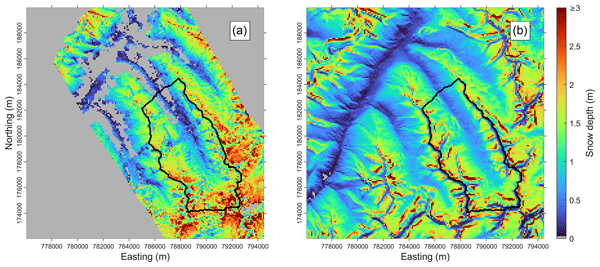
In this study, we present a dataset for the Dischma catchment in eastern Switzerland, which represents a typical high-alpine watershed in the European Alps. Accurate monitoring and reliable forecasting of snow and water resources in such basins are crucial for a wide range of applications. Our dataset is valuable for improving physics-based snow, land surface, and hydrological models, with potential applications in similar high-alpine catchments.
Nilo Lima-Quispe, Denis Ruelland, Antoine Rabatel, Waldo Lavado-Casimiro, and Thomas Condom
Hydrol. Earth Syst. Sci., 29, 655–682, https://doi.org/10.5194/hess-29-655-2025, https://doi.org/10.5194/hess-29-655-2025, 2025
Short summary
Short summary
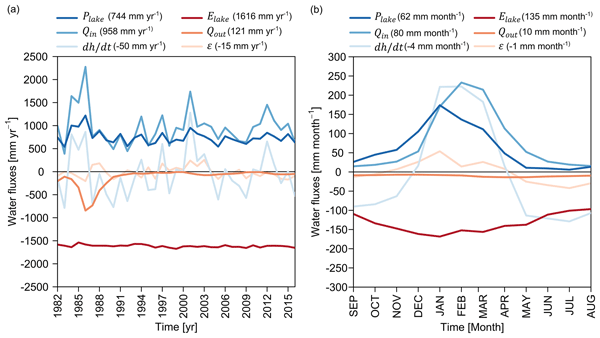
This study estimated the water balance of Lake Titicaca using an integrated modeling framework that considers natural hydrological processes and net irrigation consumption. The proposed approach was implemented at a daily scale for a period of 35 years. This framework is able to simulate lake water levels with good accuracy over a wide range of hydroclimatic conditions. The findings demonstrate that a simple representation of hydrological processes is suitable for use in poorly gauged regions.
Enrico Mattea, Etienne Berthier, Amaury Dehecq, Tobias Bolch, Atanu Bhattacharya, Sajid Ghuffar, Martina Barandun, and Martin Hoelzle
The Cryosphere, 19, 219–247, https://doi.org/10.5194/tc-19-219-2025, https://doi.org/10.5194/tc-19-219-2025, 2025
Short summary
Short summary
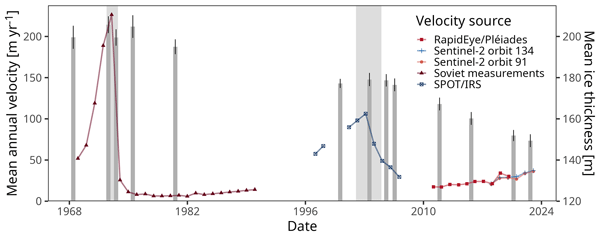
We reconstruct the evolution of terminus position, ice thickness, and surface flow velocity of the reference Abramov glacier (Kyrgyzstan) from 1968 to present. We describe a front pulsation in the early 2000s and the multi-annual present-day buildup of a new pulsation. Such dynamic instabilities can challenge the representativity of Abramov as a reference glacier. For our work we used satellite‑based optical remote sensing from multiple platforms, including recently declassified archives.
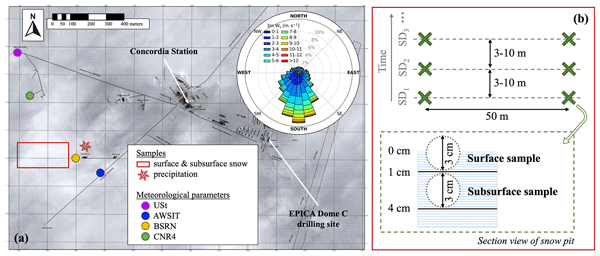
Inès Ollivier, Hans Christian Steen-Larsen, Barbara Stenni, Laurent Arnaud, Mathieu Casado, Alexandre Cauquoin, Giuliano Dreossi, Christophe Genthon, Bénédicte Minster, Ghislain Picard, Martin Werner, and Amaëlle Landais
The Cryosphere, 19, 173–200, https://doi.org/10.5194/tc-19-173-2025, https://doi.org/10.5194/tc-19-173-2025, 2025
Short summary
Short summary
The role of post-depositional processes taking place at the ice sheet's surface on the water stable isotope signal measured in polar ice cores is not fully understood. Using field observations and modelling results, we show that the original precipitation isotopic signal at Dome C, East Antarctica, is modified by post-depositional processes and provide the first quantitative estimation of their mean impact on the isotopic signal observed in the snow.
Marin Kneib, Amaury Dehecq, Adrien Gilbert, Auguste Basset, Evan S. Miles, Guillaume Jouvet, Bruno Jourdain, Etienne Ducasse, Luc Beraud, Antoine Rabatel, Jérémie Mouginot, Guillem Carcanade, Olivier Laarman, Fanny Brun, and Delphine Six
The Cryosphere, 18, 5965–5983, https://doi.org/10.5194/tc-18-5965-2024, https://doi.org/10.5194/tc-18-5965-2024, 2024
Short summary
Short summary
Avalanches contribute to increasing the accumulation on mountain glaciers by redistributing snow from surrounding mountains slopes. Here we quantified the contribution of avalanches to the mass balance of Argentière Glacier in the French Alps, by combining satellite and field observations to model the glacier dynamics. We show that the contribution of avalanches locally increases the accumulation by 60–70 % and that accounting for this effect results in less ice loss by the end of the century.
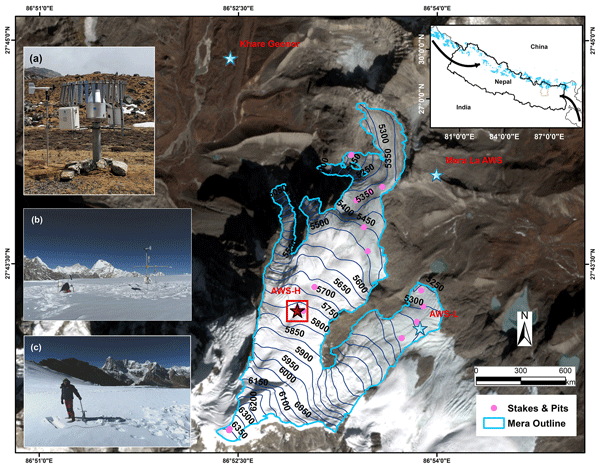
Navaraj Pokhrel, Patrick Wagnon, Fanny Brun, Arbindra Khadka, Tom Matthews, Audrey Goutard, Dibas Shrestha, Baker Perry, and Marion Réveillet
The Cryosphere, 18, 5913–5920, https://doi.org/10.5194/tc-18-5913-2024, https://doi.org/10.5194/tc-18-5913-2024, 2024
Short summary
Short summary
We studied snow processes in the accumulation area of Mera Glacier (central Himalaya, Nepal) by deploying a cosmic ray counting sensor that allows one to track the evolution of snow water equivalent. We suspect significant surface melting, water percolation, and refreezing within the snowpack, which might be missed by traditional mass balance surveys.
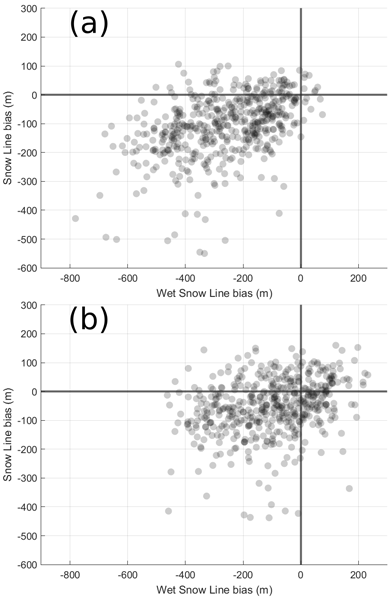
Bertrand Cluzet, Jan Magnusson, Louis Quéno, Giulia Mazzotti, Rebecca Mott, and Tobias Jonas
The Cryosphere, 18, 5753–5767, https://doi.org/10.5194/tc-18-5753-2024, https://doi.org/10.5194/tc-18-5753-2024, 2024
Short summary
Short summary
We use novel wet-snow maps from Sentinel-1 to evaluate simulations of a snow-hydrological model over Switzerland. These data are complementary to available in situ snow depth observations as they capture a broad diversity of topographic conditions. Wet-snow maps allow us to detect a delayed melt onset in the model, which we resolve thanks to an improved parametrization. This paves the way to further evaluation, calibration, and data assimilation using wet-snow maps.
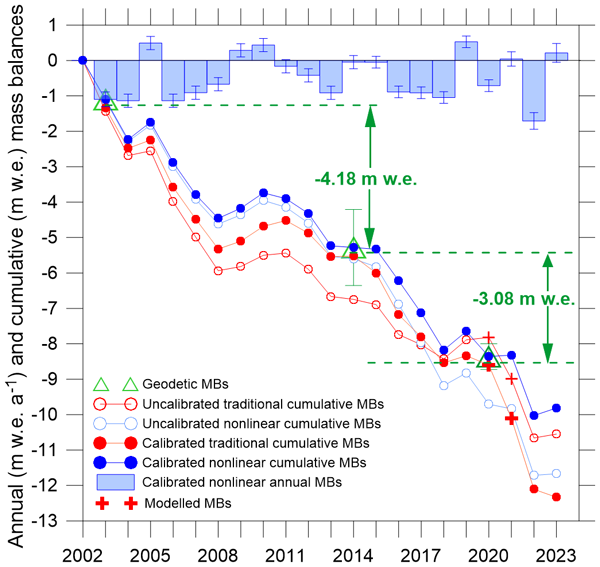
Mohd Farooq Azam, Christian Vincent, Smriti Srivastava, Etienne Berthier, Patrick Wagnon, Himanshu Kaushik, Md. Arif Hussain, Manoj Kumar Munda, Arindan Mandal, and Alagappan Ramanathan
The Cryosphere, 18, 5653–5672, https://doi.org/10.5194/tc-18-5653-2024, https://doi.org/10.5194/tc-18-5653-2024, 2024
Short summary
Short summary
Mass balance series on Chhota Shigri Glacier has been reanalysed by combining the traditional mass balance reanalysis framework and a nonlinear model. The nonlinear model is preferred over traditional glaciological methods to compute the mass balances, as the former can capture the spatiotemporal variability in point mass balances from a heterogeneous in situ point mass balance network. The nonlinear model outperforms the traditional method and agrees better with the geodetic estimates.
Etienne Berthier, Jérôme Lebreton, Delphine Fontannaz, Steven Hosford, Joaquín Muñoz-Cobo Belart, Fanny Brun, Liss M. Andreassen, Brian Menounos, and Charlotte Blondel
The Cryosphere, 18, 5551–5571, https://doi.org/10.5194/tc-18-5551-2024, https://doi.org/10.5194/tc-18-5551-2024, 2024
Short summary
Short summary
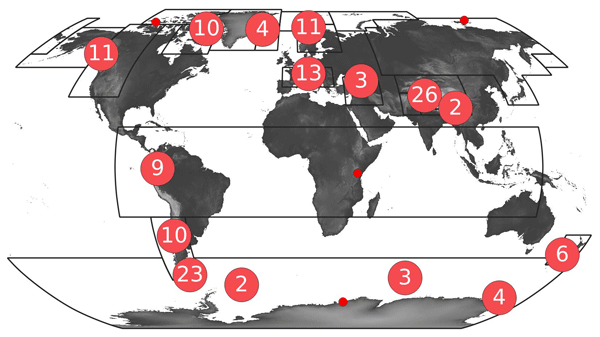
Repeat elevation measurements are crucial for monitoring glacier health and to understand how glaciers affect river flows and sea level. Until recently, high-resolution elevation data were mostly available for polar regions and High Mountain Asia. Our project, the Pléiades Glacier Observatory, now provides high-resolution topographies of 140 glacier sites worldwide. This is a novel and open dataset to monitor the impact of climate change on glaciers at high resolution and accuracy.
Harry Zekollari, Matthias Huss, Lilian Schuster, Fabien Maussion, David R. Rounce, Rodrigo Aguayo, Nicolas Champollion, Loris Compagno, Romain Hugonnet, Ben Marzeion, Seyedhamidreza Mojtabavi, and Daniel Farinotti
The Cryosphere, 18, 5045–5066, https://doi.org/10.5194/tc-18-5045-2024, https://doi.org/10.5194/tc-18-5045-2024, 2024
Short summary
Short summary
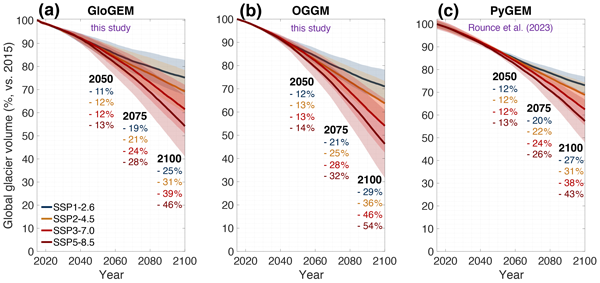
Glaciers are major contributors to sea-level rise and act as key water resources. Here, we model the global evolution of glaciers under the latest generation of climate scenarios. We show that the type of observations used for model calibration can strongly affect the projections at the local scale. Our newly projected 21st century global mass loss is higher than the current community estimate as reported in the latest Intergovernmental Panel on Climate Change (IPCC) report.

Jari-Pekka Nousu, Kersti Leppä, Hannu Marttila, Pertti Ala-aho, Giulia Mazzotti, Terhikki Manninen, Mika Korkiakoski, Mika Aurela, Annalea Lohila, and Samuli Launiainen
Hydrol. Earth Syst. Sci., 28, 4643–4666, https://doi.org/10.5194/hess-28-4643-2024, https://doi.org/10.5194/hess-28-4643-2024, 2024
Short summary
Short summary
We used hydrological models, field measurements, and satellite-based data to study the soil moisture dynamics in a subarctic catchment. The role of groundwater was studied with different ways to model the groundwater dynamics and via comparisons to the observational data. The choice of groundwater model was shown to have a strong impact, and representation of lateral flow was important to capture wet soil conditions. Our results provide insights for ecohydrological studies in boreal regions.
Giulia Mazzotti, Jari-Pekka Nousu, Vincent Vionnet, Tobias Jonas, Rafife Nheili, and Matthieu Lafaysse
The Cryosphere, 18, 4607–4632, https://doi.org/10.5194/tc-18-4607-2024, https://doi.org/10.5194/tc-18-4607-2024, 2024
Short summary
Short summary
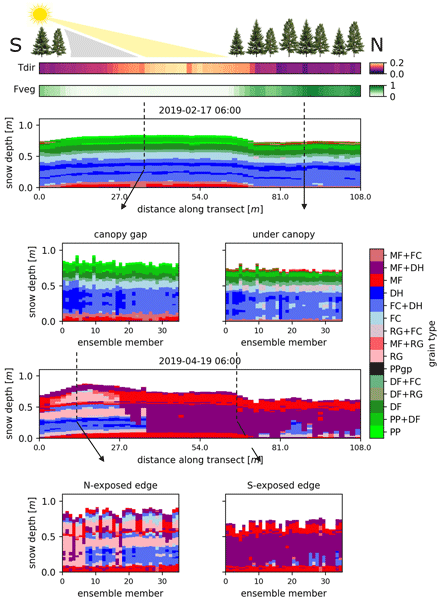
As many boreal and alpine forests have seasonal snow, models are needed to predict forest snow under future environmental conditions. We have created a new forest snow model by combining existing, very detailed model components for the canopy and the snowpack. We applied it to forests in Switzerland and Finland and showed how complex forest cover leads to a snowpack layering that is very variable in space and time because different processes prevail at different locations in the forest.
Sara Arioli, Ghislain Picard, Laurent Arnaud, Simon Gascoin, Esteban Alonso-González, Marine Poizat, and Mark Irvine
Earth Syst. Sci. Data, 16, 3913–3934, https://doi.org/10.5194/essd-16-3913-2024, https://doi.org/10.5194/essd-16-3913-2024, 2024
Short summary
Short summary
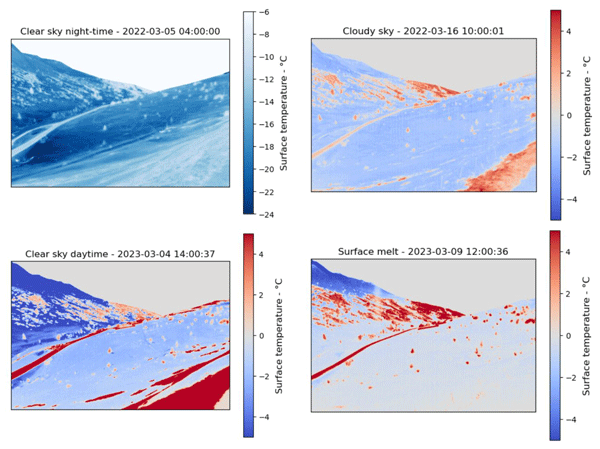
High-accuracy precision maps of the surface temperature of snow were acquired with an uncooled thermal-infrared camera during winter 2021–2022 and spring 2023. The accuracy – i.e., mean absolute error – improved from 1.28 K to 0.67 K between the seasons thanks to an improved camera setup and temperature stabilization. The dataset represents a major advance in the validation of satellite measurements and physical snow models over a complex topography.
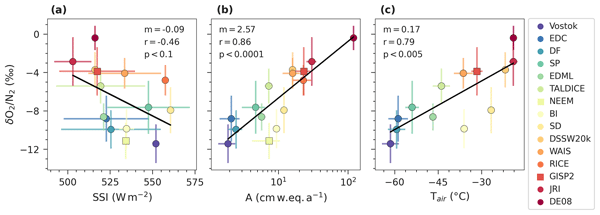
Romilly Harris Stuart, Amaëlle Landais, Laurent Arnaud, Christo Buizert, Emilie Capron, Marie Dumont, Quentin Libois, Robert Mulvaney, Anaïs Orsi, Ghislain Picard, Frédéric Prié, Jeffrey Severinghaus, Barbara Stenni, and Patricia Martinerie
The Cryosphere, 18, 3741–3763, https://doi.org/10.5194/tc-18-3741-2024, https://doi.org/10.5194/tc-18-3741-2024, 2024
Short summary
Short summary
Ice core δO2/N2 records are useful dating tools due to their local insolation pacing. A precise understanding of the physical mechanism driving this relationship, however, remain ambiguous. By compiling data from 15 polar sites, we find a strong dependence of mean δO2/N2 on accumulation rate and temperature in addition to the well-documented insolation dependence. Snowpack modelling is used to investigate which physical properties drive the mechanistic dependence on these local parameters.
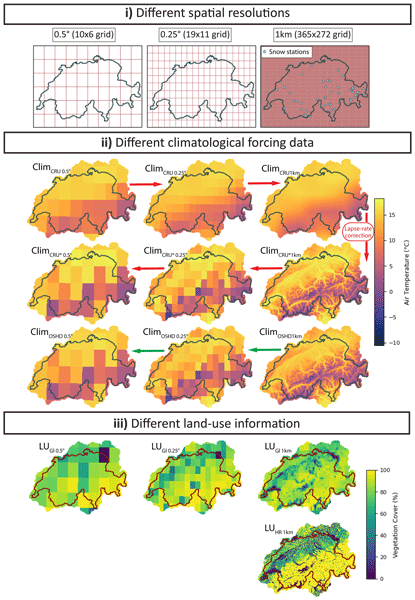
Johanna Teresa Malle, Giulia Mazzotti, Dirk Nikolaus Karger, and Tobias Jonas
Earth Syst. Dynam., 15, 1073–1115, https://doi.org/10.5194/esd-15-1073-2024, https://doi.org/10.5194/esd-15-1073-2024, 2024
Short summary
Short summary
Land surface processes are crucial for the exchange of carbon, nitrogen, and energy in the Earth system. Using meteorological and land use data, we found that higher resolution improved not only the model representation of snow cover but also plant productivity and that water returned to the atmosphere. Only by combining high-resolution models with high-quality input data can we accurately represent complex spatially heterogeneous processes and improve our understanding of the Earth system.
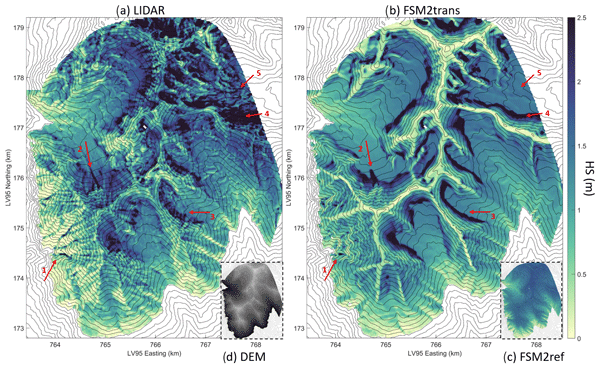
Louis Quéno, Rebecca Mott, Paul Morin, Bertrand Cluzet, Giulia Mazzotti, and Tobias Jonas
The Cryosphere, 18, 3533–3557, https://doi.org/10.5194/tc-18-3533-2024, https://doi.org/10.5194/tc-18-3533-2024, 2024
Short summary
Short summary
Snow redistribution by wind and avalanches strongly influences snow hydrology in mountains. This study presents a novel modelling approach to best represent these processes in an operational context. The evaluation of the simulations against airborne snow depth measurements showed remarkable improvement in the snow distribution in mountains of the eastern Swiss Alps, with a representation of snow accumulation and erosion areas, suggesting promising benefits for operational snow melt forecasts.
Saoirse Robin Goodwin, Thierry Faug, and Guillaume Chambon
Nat. Hazards Earth Syst. Sci. Discuss., https://doi.org/10.5194/nhess-2024-123, https://doi.org/10.5194/nhess-2024-123, 2024
Preprint withdrawn
Short summary
Short summary
This paper considers how we can objectivity define stoppage of numerically-modelled snow avalanches. When modelling real topographies, numerically-modelled avalanche snow velocities typically do not converge to 0, so stoppage is defined with arbitrary criteria, which must be tuned on a case-by-case basis. We propose a new objective arrest criterion based on local flow properties, in tandem with a newly-implemented physical yielding criterion.
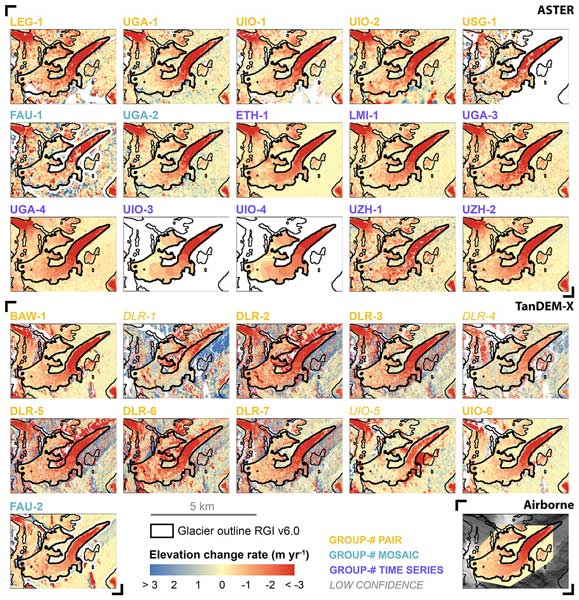
Livia Piermattei, Michael Zemp, Christian Sommer, Fanny Brun, Matthias H. Braun, Liss M. Andreassen, Joaquín M. C. Belart, Etienne Berthier, Atanu Bhattacharya, Laura Boehm Vock, Tobias Bolch, Amaury Dehecq, Inés Dussaillant, Daniel Falaschi, Caitlyn Florentine, Dana Floricioiu, Christian Ginzler, Gregoire Guillet, Romain Hugonnet, Matthias Huss, Andreas Kääb, Owen King, Christoph Klug, Friedrich Knuth, Lukas Krieger, Jeff La Frenierre, Robert McNabb, Christopher McNeil, Rainer Prinz, Louis Sass, Thorsten Seehaus, David Shean, Désirée Treichler, Anja Wendt, and Ruitang Yang
The Cryosphere, 18, 3195–3230, https://doi.org/10.5194/tc-18-3195-2024, https://doi.org/10.5194/tc-18-3195-2024, 2024
Short summary
Short summary
Satellites have made it possible to observe glacier elevation changes from all around the world. In the present study, we compared the results produced from two different types of satellite data between different research groups and against validation measurements from aeroplanes. We found a large spread between individual results but showed that the group ensemble can be used to reliably estimate glacier elevation changes and related errors from satellite data.
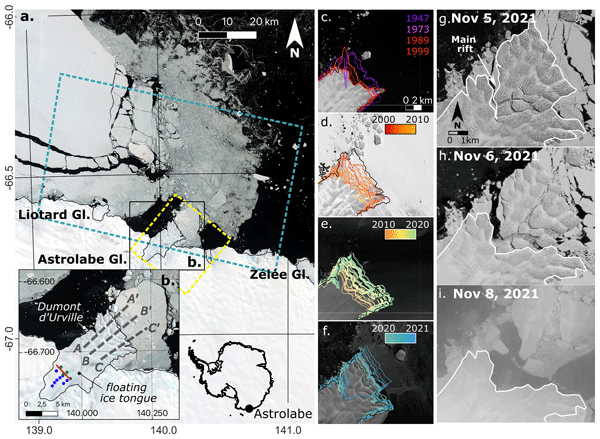
Floriane Provost, Dimitri Zigone, Emmanuel Le Meur, Jean-Philippe Malet, and Clément Hibert
The Cryosphere, 18, 3067–3079, https://doi.org/10.5194/tc-18-3067-2024, https://doi.org/10.5194/tc-18-3067-2024, 2024
Short summary
Short summary
The recent calving of Astrolabe Glacier in November 2021 presents an opportunity to better understand the processes leading to ice fracturing. Optical-satellite imagery is used to retrieve the calving cycle of the glacier ice tongue and to measure the ice velocity and strain rates in order to document fracture evolution. We observed that the presence of sea ice for consecutive years has favoured the glacier extension but failed to inhibit the growth of fractures that accelerated in June 2021.
Marin Kneib, Amaury Dehecq, Fanny Brun, Fatima Karbou, Laurane Charrier, Silvan Leinss, Patrick Wagnon, and Fabien Maussion
The Cryosphere, 18, 2809–2830, https://doi.org/10.5194/tc-18-2809-2024, https://doi.org/10.5194/tc-18-2809-2024, 2024
Short summary
Short summary
Avalanches are important for the mass balance of mountain glaciers, but few data exist on where and when they occur and which glaciers they affect the most. We developed an approach to map avalanches over large glaciated areas and long periods of time using satellite radar data. The application of this method to various regions in the Alps and High Mountain Asia reveals the variability of avalanches on these glaciers and provides key data to better represent these processes in glacier models.
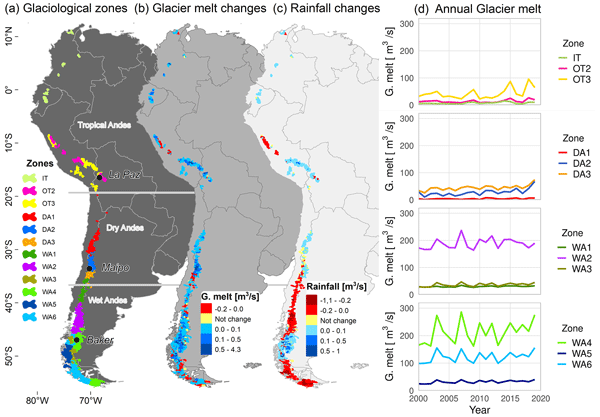
Alexis Caro, Thomas Condom, Antoine Rabatel, Nicolas Champollion, Nicolás García, and Freddy Saavedra
The Cryosphere, 18, 2487–2507, https://doi.org/10.5194/tc-18-2487-2024, https://doi.org/10.5194/tc-18-2487-2024, 2024
Short summary
Short summary
The glacier runoff changes are still unknown in most of the Andean catchments, thereby increasing uncertainties in estimating water availability, especially during the dry season. Here, we simulate glacier evolution and related glacier runoff changes across the Andes between 2000 and 2019. Our results indicate a glacier reduction in 93 % of the catchments, leading to a 12 % increase in glacier melt. These results can be downloaded and integrated with discharge measurements in each catchment.
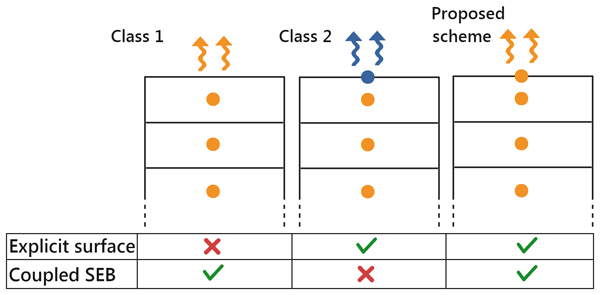
Kévin Fourteau, Julien Brondex, Fanny Brun, and Marie Dumont
Geosci. Model Dev., 17, 1903–1929, https://doi.org/10.5194/gmd-17-1903-2024, https://doi.org/10.5194/gmd-17-1903-2024, 2024
Short summary
Short summary
In this paper, we provide a novel numerical implementation for solving the energy exchanges at the surface of snow and ice. By combining the strong points of previous models, our solution leads to more accurate and robust simulations of the energy exchanges, surface temperature, and melt while preserving a reasonable computation time.
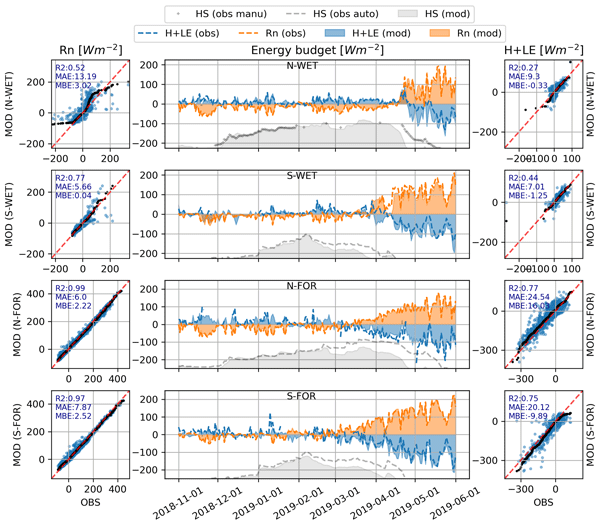
Jari-Pekka Nousu, Matthieu Lafaysse, Giulia Mazzotti, Pertti Ala-aho, Hannu Marttila, Bertrand Cluzet, Mika Aurela, Annalea Lohila, Pasi Kolari, Aaron Boone, Mathieu Fructus, and Samuli Launiainen
The Cryosphere, 18, 231–263, https://doi.org/10.5194/tc-18-231-2024, https://doi.org/10.5194/tc-18-231-2024, 2024
Short summary
Short summary
The snowpack has a major impact on the land surface energy budget. Accurate simulation of the snowpack energy budget is difficult, and studies that evaluate models against energy budget observations are rare. We compared predictions from well-known models with observations of energy budgets, snow depths and soil temperatures in Finland. Our study identified contrasting strengths and limitations for the models. These results can be used for choosing the right models depending on the use cases.
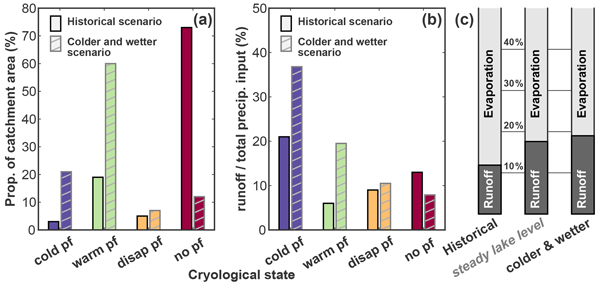
Léo C. P. Martin, Sebastian Westermann, Michele Magni, Fanny Brun, Joel Fiddes, Yanbin Lei, Philip Kraaijenbrink, Tamara Mathys, Moritz Langer, Simon Allen, and Walter W. Immerzeel
Hydrol. Earth Syst. Sci., 27, 4409–4436, https://doi.org/10.5194/hess-27-4409-2023, https://doi.org/10.5194/hess-27-4409-2023, 2023
Short summary
Short summary
Across the Tibetan Plateau, many large lakes have been changing level during the last decades as a response to climate change. In high-mountain environments, water fluxes from the land to the lakes are linked to the ground temperature of the land and to the energy fluxes between the ground and the atmosphere, which are modified by climate change. With a numerical model, we test how these water and energy fluxes have changed over the last decades and how they influence the lake level variations.
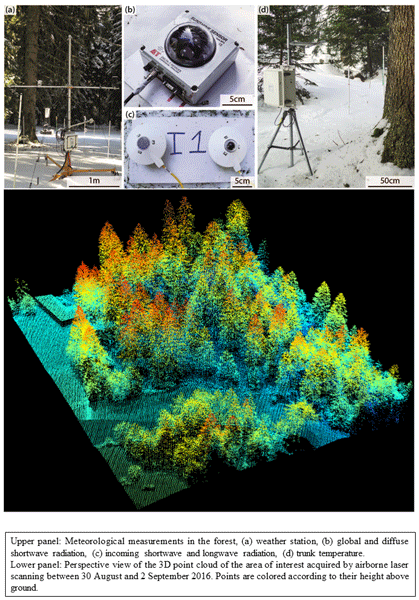
Jean Emmanuel Sicart, Victor Ramseyer, Ghislain Picard, Laurent Arnaud, Catherine Coulaud, Guilhem Freche, Damien Soubeyrand, Yves Lejeune, Marie Dumont, Isabelle Gouttevin, Erwan Le Gac, Frédéric Berger, Jean-Matthieu Monnet, Laurent Borgniet, Éric Mermin, Nick Rutter, Clare Webster, and Richard Essery
Earth Syst. Sci. Data, 15, 5121–5133, https://doi.org/10.5194/essd-15-5121-2023, https://doi.org/10.5194/essd-15-5121-2023, 2023
Short summary
Short summary
Forests strongly modify the accumulation, metamorphism and melting of snow in midlatitude and high-latitude regions. Two field campaigns during the winters 2016–17 and 2017–18 were conducted in a coniferous forest in the French Alps to study interactions between snow and vegetation. This paper presents the field site, instrumentation and collection methods. The observations include forest characteristics, meteorology, snow cover and snow interception by the canopy during precipitation events.
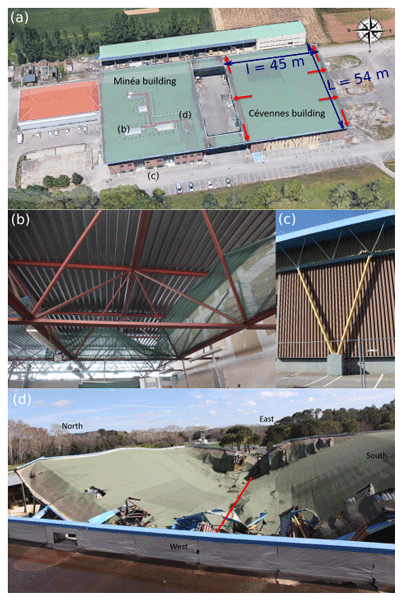
Isabelle Ousset, Guillaume Evin, Damien Raynaud, and Thierry Faug
Nat. Hazards Earth Syst. Sci., 23, 3509–3523, https://doi.org/10.5194/nhess-23-3509-2023, https://doi.org/10.5194/nhess-23-3509-2023, 2023
Short summary
Short summary
This paper deals with an exceptional snow and rain event in a Mediterranean region of France which is usually not prone to heavy snowfall and its consequences on a particular building that collapsed completely. Independent analyses of the meteorological episode are carried out, and the response of the building to different snow and rain loads is confronted to identify the main critical factors that led to the collapse.
Chuanxi Zhao, Wei Yang, Evan Miles, Matthew Westoby, Marin Kneib, Yongjie Wang, Zhen He, and Francesca Pellicciotti
The Cryosphere, 17, 3895–3913, https://doi.org/10.5194/tc-17-3895-2023, https://doi.org/10.5194/tc-17-3895-2023, 2023
Short summary
Short summary
This paper quantifies the thinning and surface mass balance of two neighbouring debris-covered glaciers in the southeastern Tibetan Plateau during different seasons, based on high spatio-temporal resolution UAV-derived (unpiloted aerial
vehicle) data and in situ observations. Through a comparison approach and high-precision results, we identify that the glacier dynamic and debris thickness are strongly related to the future fate of the debris-covered glaciers in this region.
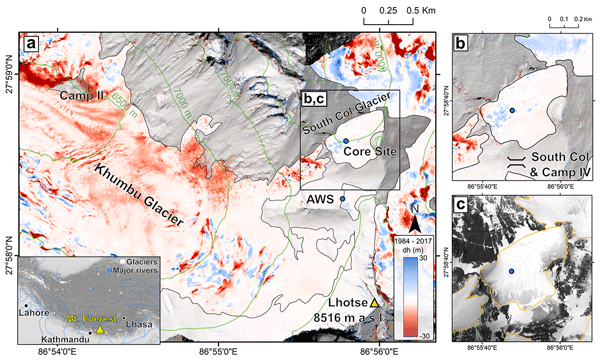
Fanny Brun, Owen King, Marion Réveillet, Charles Amory, Anton Planchot, Etienne Berthier, Amaury Dehecq, Tobias Bolch, Kévin Fourteau, Julien Brondex, Marie Dumont, Christoph Mayer, Silvan Leinss, Romain Hugonnet, and Patrick Wagnon
The Cryosphere, 17, 3251–3268, https://doi.org/10.5194/tc-17-3251-2023, https://doi.org/10.5194/tc-17-3251-2023, 2023
Short summary
Short summary
The South Col Glacier is a small body of ice and snow located on the southern ridge of Mt. Everest. A recent study proposed that South Col Glacier is rapidly losing mass. In this study, we examined the glacier thickness change for the period 1984–2017 and found no thickness change. To reconcile these results, we investigate wind erosion and surface energy and mass balance and find that melt is unlikely a dominant process, contrary to previous findings.
Lander Van Tricht, Harry Zekollari, Matthias Huss, Daniel Farinotti, and Philippe Huybrechts
The Cryosphere Discuss., https://doi.org/10.5194/tc-2023-87, https://doi.org/10.5194/tc-2023-87, 2023
Manuscript not accepted for further review
Short summary
Short summary
Detailed 3D models can be applied for well-studied glaciers, whereas simplified approaches are used for regional/global assessments. We conducted a comparison of six Tien Shan glaciers employing different models and investigated the impact of in-situ measurements. Our results reveal that the choice of mass balance and ice flow model as well as calibration have minimal impact on the projected volume. The initial ice thickness exerts the greatest influence on the future remaining ice volume.
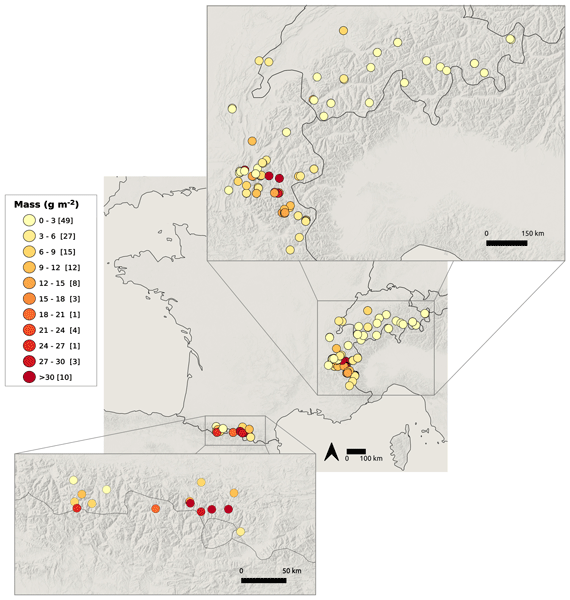
Marie Dumont, Simon Gascoin, Marion Réveillet, Didier Voisin, François Tuzet, Laurent Arnaud, Mylène Bonnefoy, Montse Bacardit Peñarroya, Carlo Carmagnola, Alexandre Deguine, Aurélie Diacre, Lukas Dürr, Olivier Evrard, Firmin Fontaine, Amaury Frankl, Mathieu Fructus, Laure Gandois, Isabelle Gouttevin, Abdelfateh Gherab, Pascal Hagenmuller, Sophia Hansson, Hervé Herbin, Béatrice Josse, Bruno Jourdain, Irene Lefevre, Gaël Le Roux, Quentin Libois, Lucie Liger, Samuel Morin, Denis Petitprez, Alvaro Robledano, Martin Schneebeli, Pascal Salze, Delphine Six, Emmanuel Thibert, Jürg Trachsel, Matthieu Vernay, Léo Viallon-Galinier, and Céline Voiron
Earth Syst. Sci. Data, 15, 3075–3094, https://doi.org/10.5194/essd-15-3075-2023, https://doi.org/10.5194/essd-15-3075-2023, 2023
Short summary
Short summary
Saharan dust outbreaks have profound effects on ecosystems, climate, health, and the cryosphere, but the spatial deposition pattern of Saharan dust is poorly known. Following the extreme dust deposition event of February 2021 across Europe, a citizen science campaign was launched to sample dust on snow over the Pyrenees and the European Alps. This campaign triggered wide interest and over 100 samples. The samples revealed the high variability of the dust properties within a single event.
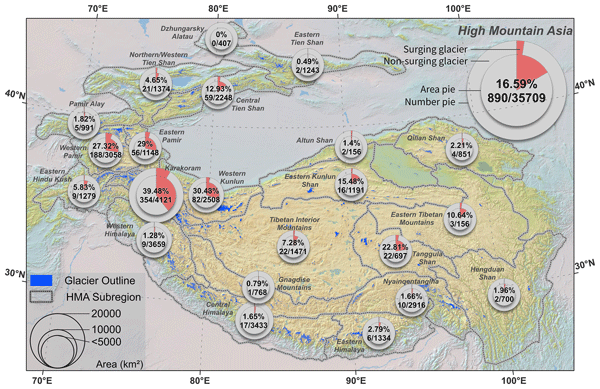
Lei Guo, Jia Li, Amaury Dehecq, Zhiwei Li, Xin Li, and Jianjun Zhu
Earth Syst. Sci. Data, 15, 2841–2861, https://doi.org/10.5194/essd-15-2841-2023, https://doi.org/10.5194/essd-15-2841-2023, 2023
Short summary
Short summary
We established a new inventory of surging glaciers across High Mountain Asia based on glacier elevation changes and morphological changes during 1970s–2020. A total of 890 surging and 336 probably or possibly surging glaciers were identified. Compared to the most recent inventory, this one incorporates 253 previously unidentified surging glaciers. Our results demonstrate a more widespread surge behavior in HMA and find that surging glaciers are prone to have steeper slopes than non-surging ones.
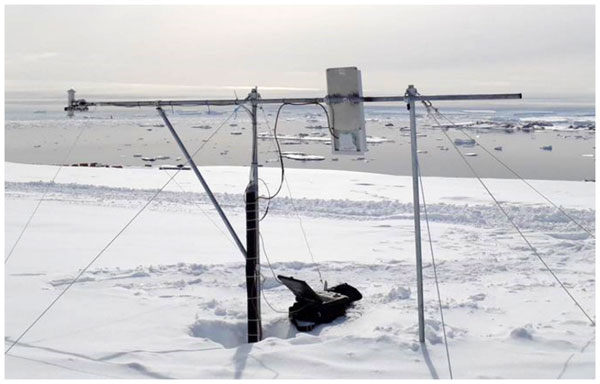
Sara Arioli, Ghislain Picard, Laurent Arnaud, and Vincent Favier
The Cryosphere, 17, 2323–2342, https://doi.org/10.5194/tc-17-2323-2023, https://doi.org/10.5194/tc-17-2323-2023, 2023
Short summary
Short summary
To assess the drivers of the snow grain size evolution during snow drift, we exploit a 5-year time series of the snow grain size retrieved from spectral-albedo observations made with a new, autonomous, multi-band radiometer and compare it to observations of snow drift, snowfall and snowmelt at a windy location of coastal Antarctica. Our results highlight the complexity of the grain size evolution in the presence of snow drift and show an overall tendency of snow drift to limit its variations.
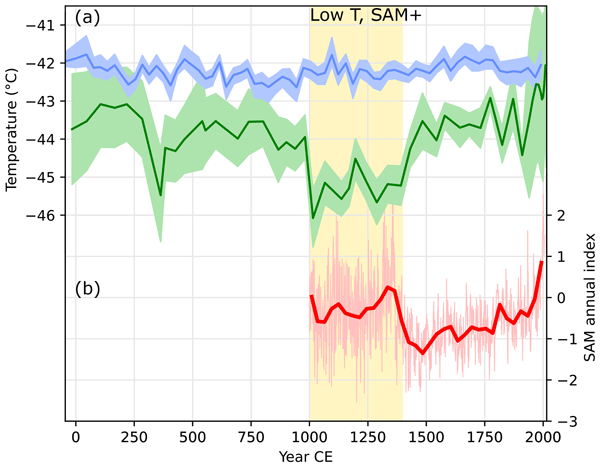
Aymeric P. M. Servettaz, Anaïs J. Orsi, Mark A. J. Curran, Andrew D. Moy, Amaelle Landais, Joseph R. McConnell, Trevor J. Popp, Emmanuel Le Meur, Xavier Faïn, and Jérôme Chappellaz
Clim. Past, 19, 1125–1152, https://doi.org/10.5194/cp-19-1125-2023, https://doi.org/10.5194/cp-19-1125-2023, 2023
Short summary
Short summary
The temperature of the past 2000 years is still poorly known in vast parts of the East Antarctic plateau. In this study, we present temperature reconstructions based on water and gas stable isotopes from the Aurora Basin North ice core. Spatial and temporal significance of each proxy differs, and we can identify some cold periods in the snow temperature up to 2°C cooler in the 1000–1400 CE period, which could not be determined with water isotopes only.
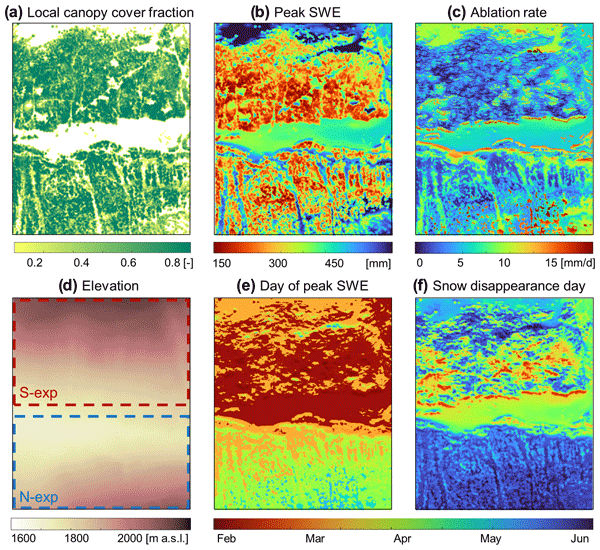
Giulia Mazzotti, Clare Webster, Louis Quéno, Bertrand Cluzet, and Tobias Jonas
Hydrol. Earth Syst. Sci., 27, 2099–2121, https://doi.org/10.5194/hess-27-2099-2023, https://doi.org/10.5194/hess-27-2099-2023, 2023
Short summary
Short summary
This study analyses snow cover evolution in mountainous forested terrain based on 2 m resolution simulations from a process-based model. We show that snow accumulation patterns are controlled by canopy structure, but topographic shading modulates the timing of melt onset, and variability in weather can cause snow accumulation and melt patterns to vary between years. These findings advance our ability to predict how snow regimes will react to rising temperatures and forest disturbances.
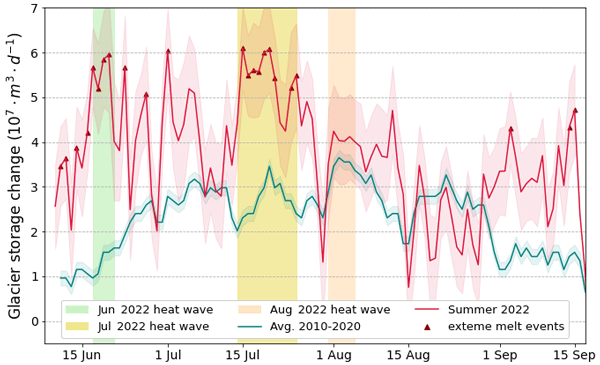
Aaron Cremona, Matthias Huss, Johannes Marian Landmann, Joël Borner, and Daniel Farinotti
The Cryosphere, 17, 1895–1912, https://doi.org/10.5194/tc-17-1895-2023, https://doi.org/10.5194/tc-17-1895-2023, 2023
Short summary
Short summary
Summer heat waves have a substantial impact on glacier melt as emphasized by the extreme summer of 2022. This study presents a novel approach for detecting extreme glacier melt events at the regional scale based on the combination of automatically retrieved point mass balance observations and modelling approaches. The in-depth analysis of summer 2022 evidences the strong correspondence between heat waves and extreme melt events and demonstrates their significance for seasonal melt.
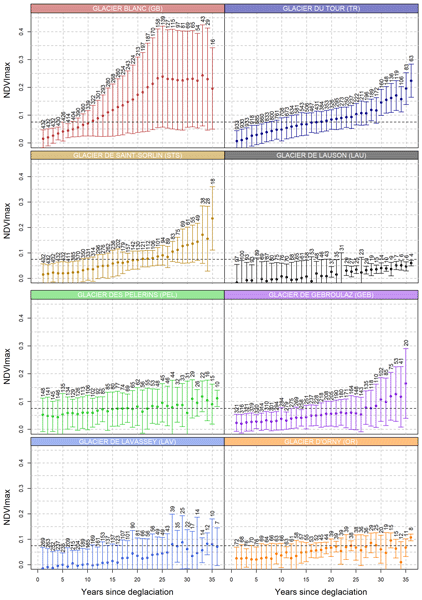
Arthur Bayle, Bradley Z. Carlson, Anaïs Zimmer, Sophie Vallée, Antoine Rabatel, Edoardo Cremonese, Gianluca Filippa, Cédric Dentant, Christophe Randin, Andrea Mainetti, Erwan Roussel, Simon Gascoin, Dov Corenblit, and Philippe Choler
Biogeosciences, 20, 1649–1669, https://doi.org/10.5194/bg-20-1649-2023, https://doi.org/10.5194/bg-20-1649-2023, 2023
Short summary
Short summary
Glacier forefields have long provided ecologists with a model to study patterns of plant succession following glacier retreat. We used remote sensing approaches to study early succession dynamics as it allows to analyze the deglaciation, colonization, and vegetation growth within a single framework. We found that the heterogeneity of early succession dynamics is deterministic and can be explained well by local environmental context. This work has been done by an international consortium.

Fabian Walter, Elias Hodel, Erik S. Mannerfelt, Kristen Cook, Michael Dietze, Livia Estermann, Michaela Wenner, Daniel Farinotti, Martin Fengler, Lukas Hammerschmidt, Flavia Hänsli, Jacob Hirschberg, Brian McArdell, and Peter Molnar
Nat. Hazards Earth Syst. Sci., 22, 4011–4018, https://doi.org/10.5194/nhess-22-4011-2022, https://doi.org/10.5194/nhess-22-4011-2022, 2022
Short summary
Short summary
Debris flows are dangerous sediment–water mixtures in steep terrain. Their formation takes place in poorly accessible terrain where instrumentation cannot be installed. Here we propose to monitor such source terrain with an autonomous drone for mapping sediments which were left behind by debris flows or may contribute to future events. Short flight intervals elucidate changes of such sediments, providing important information for landscape evolution and the likelihood of future debris flows.
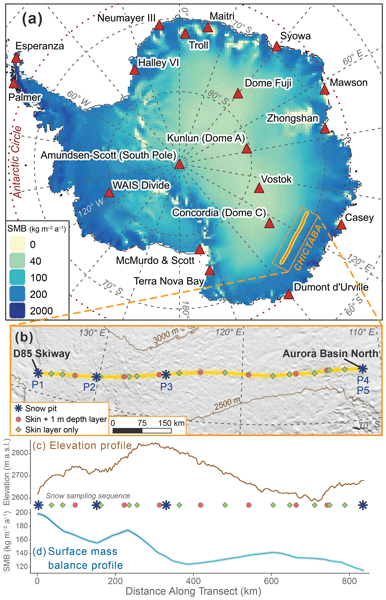
Pete D. Akers, Joël Savarino, Nicolas Caillon, Olivier Magand, and Emmanuel Le Meur
Atmos. Chem. Phys., 22, 15637–15657, https://doi.org/10.5194/acp-22-15637-2022, https://doi.org/10.5194/acp-22-15637-2022, 2022
Short summary
Short summary
Nitrate isotopes in Antarctic ice do not preserve the seasonal isotopic cycles of the atmosphere, which limits their use to study the past. We studied nitrate along an 850 km Antarctic transect to learn how these cycles are changed by sunlight-driven chemistry in the snow. Our findings suggest that the snow accumulation rate and other environmental signals can be extracted from nitrate with the right sampling and analytical approaches.
Marin Kneib, Evan S. Miles, Pascal Buri, Stefan Fugger, Michael McCarthy, Thomas E. Shaw, Zhao Chuanxi, Martin Truffer, Matthew J. Westoby, Wei Yang, and Francesca Pellicciotti
The Cryosphere, 16, 4701–4725, https://doi.org/10.5194/tc-16-4701-2022, https://doi.org/10.5194/tc-16-4701-2022, 2022
Short summary
Short summary
Ice cliffs are believed to be important contributors to the melt of debris-covered glaciers, but this has rarely been quantified as the cliffs can disappear or rapidly expand within a few weeks. We used photogrammetry techniques to quantify the weekly evolution and melt of four cliffs. We found that their behaviour and melt during the monsoon is strongly controlled by supraglacial debris, streams and ponds, thus providing valuable insights on the melt and evolution of debris-covered glaciers.
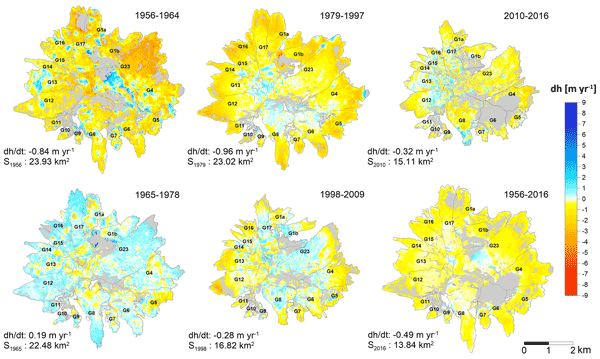
Rubén Basantes-Serrano, Antoine Rabatel, Bernard Francou, Christian Vincent, Alvaro Soruco, Thomas Condom, and Jean Carlo Ruíz
The Cryosphere, 16, 4659–4677, https://doi.org/10.5194/tc-16-4659-2022, https://doi.org/10.5194/tc-16-4659-2022, 2022
Short summary
Short summary
We assessed the volume variation of 17 glaciers on the Antisana ice cap, near the Equator. We used aerial and satellite images for the period 1956–2016. We highlight very negative changes in 1956–1964 and 1979–1997 and slightly negative or even positive conditions in 1965–1978 and 1997–2016, the latter despite the recent increase in temperatures. Glaciers react according to regional climate variability, while local humidity and topography influence the specific behaviour of each glacier.
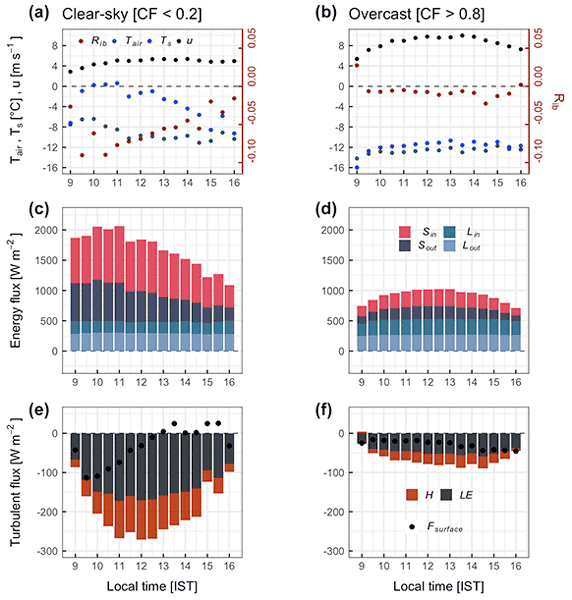
Arindan Mandal, Thupstan Angchuk, Mohd Farooq Azam, Alagappan Ramanathan, Patrick Wagnon, Mohd Soheb, and Chetan Singh
The Cryosphere, 16, 3775–3799, https://doi.org/10.5194/tc-16-3775-2022, https://doi.org/10.5194/tc-16-3775-2022, 2022
Short summary
Short summary
Snow sublimation is an important component of glacier surface mass balance; however, it is seldom studied in detail in the Himalayan region owing to data scarcity. We present an 11-year record of wintertime snow-surface energy balance and sublimation characteristics at the Chhota Shigri Glacier moraine site at 4863 m a.s.l. The estimated winter sublimation is 16 %–42 % of the winter snowfall at the study site, which signifies how sublimation is important in the Himalayan region.
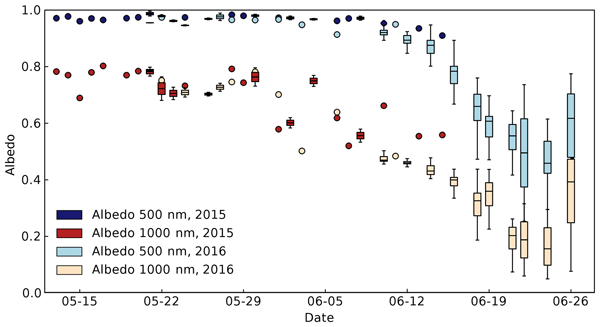
Gauthier Vérin, Florent Domine, Marcel Babin, Ghislain Picard, and Laurent Arnaud
The Cryosphere, 16, 3431–3449, https://doi.org/10.5194/tc-16-3431-2022, https://doi.org/10.5194/tc-16-3431-2022, 2022
Short summary
Short summary
Snow physical properties on Arctic sea ice are monitored during the melt season. As snow grains grow, and the snowpack thickness is reduced, the surface albedo decreases. The extra absorbed energy accelerates melting. Radiative transfer modeling shows that more radiation is then transmitted to the snow–sea-ice interface. A sharp increase in transmitted radiation takes place when the snowpack thins significantly, and this coincides with the initiation of the phytoplankton bloom in the seawater.
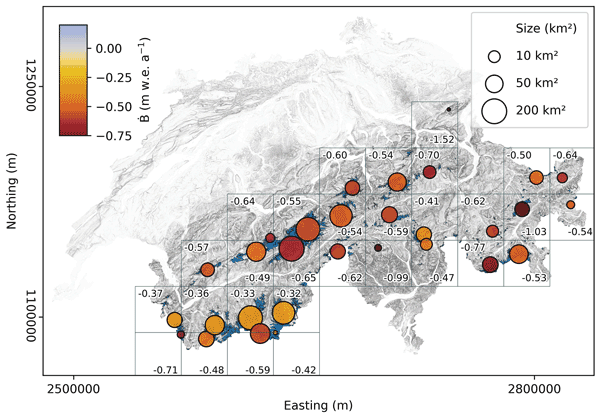
Erik Schytt Mannerfelt, Amaury Dehecq, Romain Hugonnet, Elias Hodel, Matthias Huss, Andreas Bauder, and Daniel Farinotti
The Cryosphere, 16, 3249–3268, https://doi.org/10.5194/tc-16-3249-2022, https://doi.org/10.5194/tc-16-3249-2022, 2022
Short summary
Short summary
How glaciers have responded to climate change over the last 20 years is well-known, but earlier data are much more scarce. We change this in Switzerland by using 22 000 photographs taken from mountain tops between the world wars and find a halving of Swiss glacier volume since 1931. This was done through new automated processing techniques that we created. The data are interesting for more than just glaciers, such as mapping forest changes, landslides, and human impacts on the terrain.
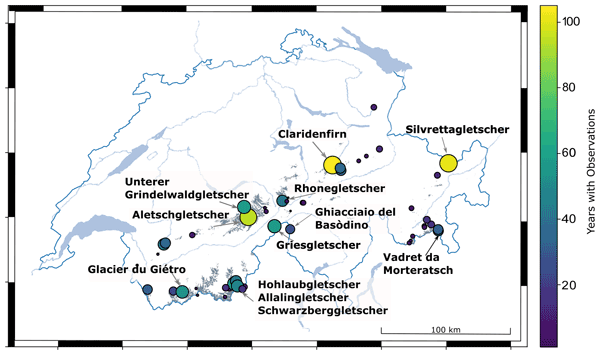
Lea Geibel, Matthias Huss, Claudia Kurzböck, Elias Hodel, Andreas Bauder, and Daniel Farinotti
Earth Syst. Sci. Data, 14, 3293–3312, https://doi.org/10.5194/essd-14-3293-2022, https://doi.org/10.5194/essd-14-3293-2022, 2022
Short summary
Short summary
Glacier monitoring in Switzerland started in the 19th century, providing exceptional data series documenting snow accumulation and ice melt. Raw point observations of surface mass balance have, however, never been systematically compiled so far, including complete metadata. Here, we present an extensive dataset with more than 60 000 point observations of surface mass balance covering 60 Swiss glaciers and almost 140 years, promoting a better understanding of the drivers of recent glacier change.
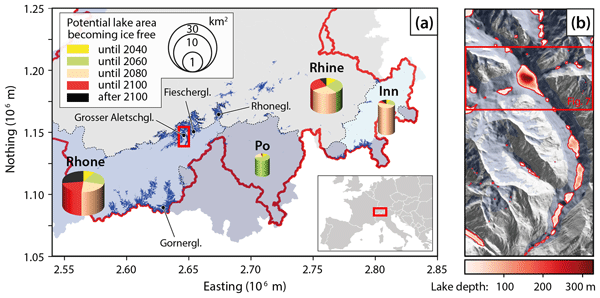
Tim Steffen, Matthias Huss, Rebekka Estermann, Elias Hodel, and Daniel Farinotti
Earth Surf. Dynam., 10, 723–741, https://doi.org/10.5194/esurf-10-723-2022, https://doi.org/10.5194/esurf-10-723-2022, 2022
Short summary
Short summary
Climate change is rapidly altering high-alpine landscapes. The formation of new lakes in areas becoming ice free due to glacier retreat is one of the many consequences of this process. Here, we provide an estimate for the number, size, time of emergence, and sediment infill of future glacier lakes that will emerge in the Swiss Alps. We estimate that up to ~ 680 potential lakes could form over the course of the 21st century, with the potential to hold a total water volume of up to ~ 1.16 km3.
L. Charrier, T. di Martino, E. Colin Koeniguer, F. Weissgerber, and A. Plyer
Int. Arch. Photogramm. Remote Sens. Spatial Inf. Sci., XLIII-B3-2022, 1309–1316, https://doi.org/10.5194/isprs-archives-XLIII-B3-2022-1309-2022, https://doi.org/10.5194/isprs-archives-XLIII-B3-2022-1309-2022, 2022
L. Charrier, Y. Yan, E. Colin Koeniguer, J. Mouginot, R. Millan, and E. Trouvé
ISPRS Ann. Photogramm. Remote Sens. Spatial Inf. Sci., V-3-2022, 311–318, https://doi.org/10.5194/isprs-annals-V-3-2022-311-2022, https://doi.org/10.5194/isprs-annals-V-3-2022-311-2022, 2022

Loris Compagno, Matthias Huss, Evan Stewart Miles, Michael James McCarthy, Harry Zekollari, Amaury Dehecq, Francesca Pellicciotti, and Daniel Farinotti
The Cryosphere, 16, 1697–1718, https://doi.org/10.5194/tc-16-1697-2022, https://doi.org/10.5194/tc-16-1697-2022, 2022
Short summary
Short summary
We present a new approach for modelling debris area and thickness evolution. We implement the module into a combined mass-balance ice-flow model, and we apply it using different climate scenarios to project the future evolution of all glaciers in High Mountain Asia. We show that glacier geometry, volume, and flow velocity evolve differently when modelling explicitly debris cover compared to glacier evolution without the debris-cover module, demonstrating the importance of accounting for debris.
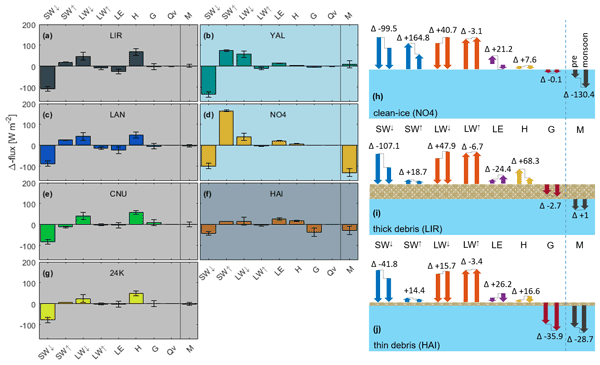
Stefan Fugger, Catriona L. Fyffe, Simone Fatichi, Evan Miles, Michael McCarthy, Thomas E. Shaw, Baohong Ding, Wei Yang, Patrick Wagnon, Walter Immerzeel, Qiao Liu, and Francesca Pellicciotti
The Cryosphere, 16, 1631–1652, https://doi.org/10.5194/tc-16-1631-2022, https://doi.org/10.5194/tc-16-1631-2022, 2022
Short summary
Short summary
The monsoon is important for the shrinking and growing of glaciers in the Himalaya during summer. We calculate the melt of seven glaciers in the region using a complex glacier melt model and weather data. We find that monsoonal weather affects glaciers that are covered with a layer of rocky debris and glaciers without such a layer in different ways. It is important to take so-called turbulent fluxes into account. This knowledge is vital for predicting the future of the Himalayan glaciers.
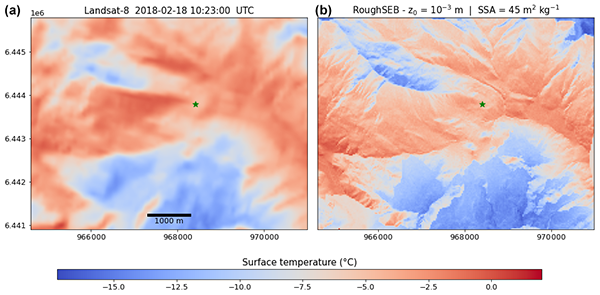
Alvaro Robledano, Ghislain Picard, Laurent Arnaud, Fanny Larue, and Inès Ollivier
The Cryosphere, 16, 559–579, https://doi.org/10.5194/tc-16-559-2022, https://doi.org/10.5194/tc-16-559-2022, 2022
Short summary
Short summary
Topography controls the surface temperature of snow-covered, mountainous areas. We developed a modelling chain that uses ray-tracing methods to quantify the impact of a few topographic effects on snow surface temperature at high spatial resolution. Its large spatial and temporal variations are correctly simulated over a 50 km2 area in the French Alps, and our results show that excluding a single topographic effect results in cooling (or warming) effects on the order of 1 °C.
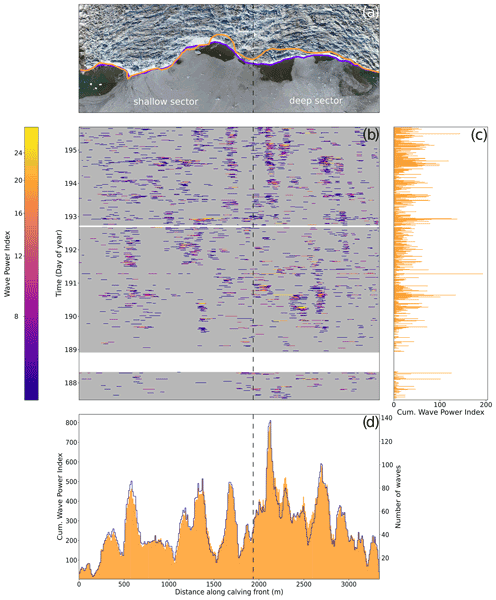
Adrien Wehrlé, Martin P. Lüthi, Andrea Walter, Guillaume Jouvet, and Andreas Vieli
The Cryosphere, 15, 5659–5674, https://doi.org/10.5194/tc-15-5659-2021, https://doi.org/10.5194/tc-15-5659-2021, 2021
Short summary
Short summary
We developed a novel automated method for the detection and the quantification of ocean waves generated by glacier calving. This method was applied to data recorded with a terrestrial radar interferometer at Eqip Sermia, Greenland. Results show a high calving activity at the glacier front sector ending in deep water linked with more frequent meltwater plumes. This suggests that rising subglacial meltwater plumes strongly affect glacier calving in deep water, but weakly in shallow water.
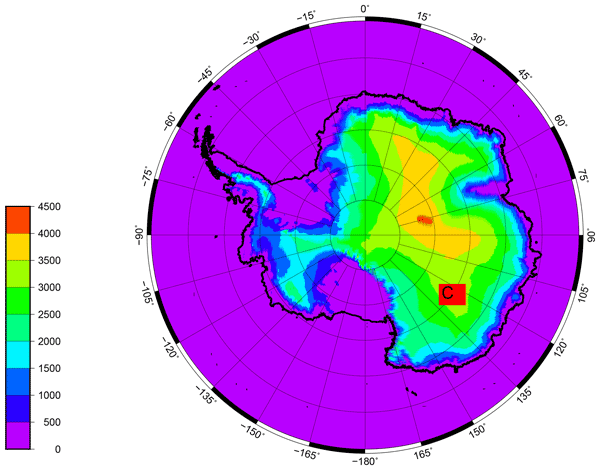
Christophe Genthon, Dana Veron, Etienne Vignon, Delphine Six, Jean-Louis Dufresne, Jean-Baptiste Madeleine, Emmanuelle Sultan, and François Forget
Earth Syst. Sci. Data, 13, 5731–5746, https://doi.org/10.5194/essd-13-5731-2021, https://doi.org/10.5194/essd-13-5731-2021, 2021
Short summary
Short summary
A 10-year dataset of observation in the atmospheric boundary layer at Dome C on the high Antarctic plateau is presented. This is obtained with sensors at six levels along a tower higher than 40 m. The temperature inversion can reach more than 25 °C along the tower in winter, while full mixing by convection can occur in summer. Different amplitudes of variability for wind and temperature at the different levels reflect different signatures of solar vs. synoptic forcing of the boundary layer.
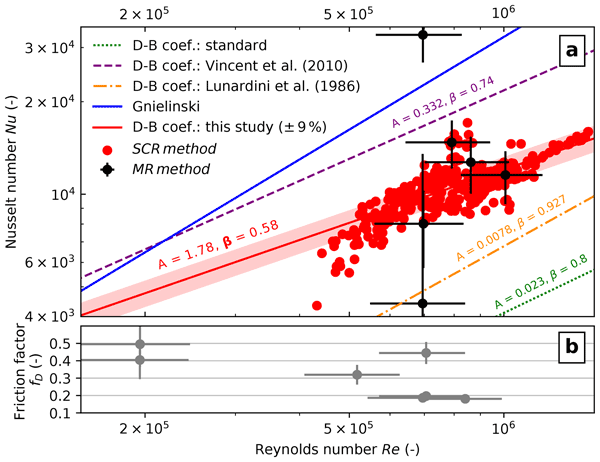
Christophe Ogier, Mauro A. Werder, Matthias Huss, Isabelle Kull, David Hodel, and Daniel Farinotti
The Cryosphere, 15, 5133–5150, https://doi.org/10.5194/tc-15-5133-2021, https://doi.org/10.5194/tc-15-5133-2021, 2021
Short summary
Short summary
Glacier-dammed lakes are prone to draining rapidly when the ice dam breaks and constitute a serious threat to populations downstream. Such a lake drainage can proceed through an open-air channel at the glacier surface. In this study, we present what we believe to be the most complete dataset to date of an ice-dammed lake drainage through such an open-air channel. We provide new insights for future glacier-dammed lake drainage modelling studies and hazard assessments.
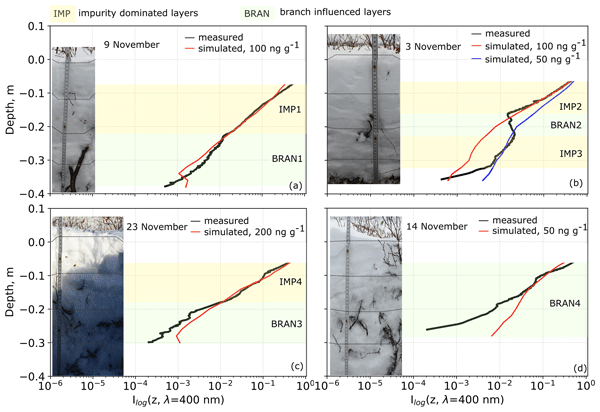
Maria Belke-Brea, Florent Domine, Ghislain Picard, Mathieu Barrere, and Laurent Arnaud
Biogeosciences, 18, 5851–5869, https://doi.org/10.5194/bg-18-5851-2021, https://doi.org/10.5194/bg-18-5851-2021, 2021
Short summary
Short summary
Expanding shrubs in the Arctic change snowpacks into a mix of snow, impurities and buried branches. Snow is a translucent medium into which light penetrates and gets partly absorbed by branches or impurities. Measurements of light attenuation in snow in Northern Quebec, Canada, showed (1) black-carbon-dominated light attenuation in snowpacks without shrubs and (2) buried branches influence radiation attenuation in snow locally, leading to melting and pockets of large crystals close to branches.
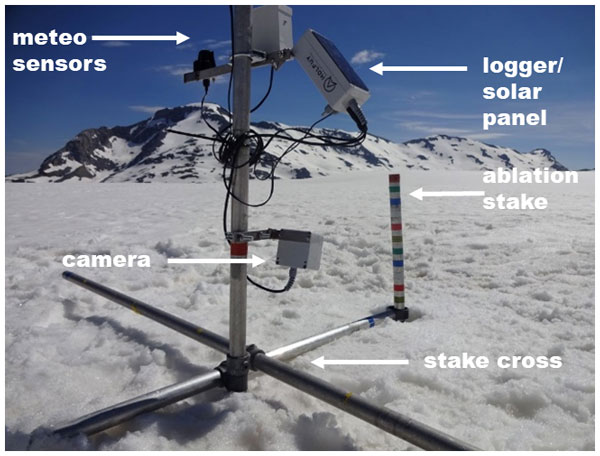
Johannes Marian Landmann, Hans Rudolf Künsch, Matthias Huss, Christophe Ogier, Markus Kalisch, and Daniel Farinotti
The Cryosphere, 15, 5017–5040, https://doi.org/10.5194/tc-15-5017-2021, https://doi.org/10.5194/tc-15-5017-2021, 2021
Short summary
Short summary
In this study, we (1) acquire real-time information on point glacier mass balance with autonomous real-time cameras and (2) assimilate these observations into a mass balance model ensemble driven by meteorological input. For doing so, we use a customized particle filter that we designed for the specific purposes of our study. We find melt rates of up to 0.12 m water equivalent per day and show that our assimilation method has a higher performance than reference mass balance models.
Cited articles
Aguayo, R., Maussion, F., Schuster, L., Schaefer, M., Caro, A., Schmitt, P., Mackay, J., Ultee, L., Leon-Muñoz, J., and Aguayo, M.: Unravelling the sources of uncertainty in glacier runoff projections in the Patagonian Andes (40–56° S), The Cryosphere, 18, 5383–5406, https://doi.org/10.5194/tc-18-5383-2024, 2024.
Benn, D. I. and Lehmkuhl, F.: Mass balance and equilibrium-line altitudes of glaciers in high-mountain environments, Quatern. Int., 65–66, 15–29, https://doi.org/10.1016/S1040-6182(99)00034-8, 2000.
Bernhardt, M. and Schulz, K.: SnowSlide: A simple routine for calculating gravitational snow transport, Geophys. Res. Lett., 37, https://doi.org/10.1029/2010GL043086, 2010.
Besl, P. J. and McKay, N. D.: Method for registration of 3-D shapes, 586–606, https://doi.org/10.1117/12.57955, 1992.
Brun, F., Wagnon, P., Berthier, E., Jomelli, V., Maharjan, S. B., Shrestha, F., and Kraaijenbrink, P. D. A.: Heterogeneous Influence of Glacier Morphology on the Mass Balance Variability in High Mountain Asia, J. Geophys. Res.-Earth, 124, 1331–1345, https://doi.org/10.1029/2018JF004838, 2019.
Burger, F., Ayala, A., Farias, D., Shaw, T. E., MacDonell, S., Brock, B., Mcphee, J., and Pellicciotti, F.: Interannual variability in glacier contribution to runoff from a high-elevation Andean catchment: understanding the role of debris cover in glacier hydrology, Hydrol. Process., 33, 214–229, https://doi.org/10.1002/hyp.13354, 2018.
Cuffey, C. and Paterson, W. S. B.: The Physics of Glaciers, Academic Press, ISBN 9780123694614, 2010.
Dadic, R., Mott, R., Lehning, M., and Burlando, P.: Wind influence on snow depth distribution and accumulation over glaciers, J. Geophys. Res.-Earth, 115, https://doi.org/10.1029/2009JF001261, 2010.
Dent, J. D., Burrell, K. J., Schmidt, D. S., Louge, M. Y., Adams, E. E., and Jazbutis, T. G.: Density, velocity and friction measurements in a dry-snow avalanche, Ann. Glaciol., 26, 247–252, https://doi.org/10.3189/1998AoG26-1-247-252, 1998.
Filhol, S., Perret, A., Girod, L., Sutter, G., Schuler, T. v, and Burkhart, J. F.: Time‐Lapse Photogrammetry of Distributed Snow Depth During Snowmelt, Water Resour. Res., 55, 7916–7926, https://doi.org/10.1029/2018WR024530, 2019.
Gruber, S.: A mass-conserving fast algorithm to parameterize gravitational transport and deposition using digital elevation models, Water Resour. Res., 43, https://doi.org/10.1029/2006WR004868, 2007.
Hao, J., Mind'je, R., Liu, Y., Huang, F., Zhou, H., and Li, L.: Characteristics and hazards of different snow avalanche types in a continental snow climate region in the Central Tianshan Mountains, J. Arid Land, 13, 317–331, https://doi.org/10.1007/s40333-021-0058-5, 2021.
Hugonnet, R., Brun, F., Berthier, E., Dehecq, A., Mannerfelt, E. S., Eckert, N., and Farinotti, D.: Uncertainty Analysis of Digital Elevation Models by Spatial Inference From Stable Terrain, IEEE J. Sel. Top. Appl. Earth Obs. Remote Sens., 15, 6456–6472, https://doi.org/10.1109/JSTARS.2022.3188922, 2022.
Hynek, B., Binder, D., Citterio, M., Larsen, S. H., Abermann, J., Verhoeven, G., Ludewig, E., and Schöner, W.: Accumulation by avalanches as a significant contributor to the mass balance of a peripheral glacier of Greenland, The Cryosphere, 18, 5481–5494, https://doi.org/10.5194/tc-18-5481-2024, 2024.
Immerzeel, W. W., Wanders, N., Lutz, A. F., Shea, J. M., and Bierkens, M. F. P.: Reconciling high-altitude precipitation in the upper Indus basin with glacier mass balances and runoff, Hydrol. Earth Syst. Sci., 19, 4673–4687, https://doi.org/10.5194/hess-19-4673-2015, 2015.
Ioli, F., Dematteis, N., Giordan, D., Nex, F., and Pinto, L.: Deep Learning Low-cost Photogrammetry for 4D Short-term Glacier Dynamics Monitoring, PFG – Journal of Photogrammetry, Remote Sensing and Geoinformation Science, 92, 657–678, https://doi.org/10.1007/s41064-023-00272-w, 2024.
Jacob, R. W., Trop, J. M., and Kochel, R. C.: Subsurface architecture of alpine icy debris fans: Integration of ground-penetrating radar and surface observations in Alaska and New Zealand, Geomorphology, 375, 107544, https://doi.org/10.1016/j.geomorph.2020.107544, 2021.
James, M. R. and Robson, S.: Straightforward reconstruction of 3D surfaces and topography with a camera: Accuracy and geoscience application, J. Geophys. Res.-Earth, 117, https://doi.org/10.1029/2011JF002289, 2012.
Jouberton, A., Shaw, T. E., Miles, E., Kneib, M., Fugger, S., Buri, P., McCarthy, M., Kayumov, A., Navruzshoev, H., Halimov, A., Kabutov, K., Homidov, F., and Pellicciotti, F.: Snowfall decrease in recent years undermines glacier health and meltwater resources in the Northwestern Pamirs, Commun. Earth Environ., 6, 691, https://doi.org/10.1038/s43247-025-02611-8, 2025.
Jourdain, B., Vincent, C., Réveillet, M., Rabatel, A., Brun, F., Six, D., Laarman, O., Piard, L., Ginot, P., Sanchez, O., and Berthier, E.: A method to estimate surface mass-balance in glacier accumulation areas based on digital elevation models and submergence velocities, J. Glaciol., 69, 1403–1418, https://doi.org/10.1017/jog.2023.29, 2023.
Kern, H.: Le dépôt d'avalanche: une nouvelle variable dans la connaissance du risque avalancheux, https://theses.fr/2023PA01H003 (last access: 16 September 2026), 2023.
Kneib, M.: MarinKneib/TimeLapse_photogrammetry: TLphotogrammetry_v0.0.1, Zenodo [software], https://doi.org/10.5281/zenodo.22800142, 2026a.
Kneib, M.: Data for 'Substantial accumulation rates on a glacier avalanche cone from time-lapse photogrammetry and field measurements', Zenodo [data set], https://doi.org/10.5281/zenodo.22712764, 2026b.
Kneib, M., Miles, E. S., Buri, P., Fugger, S., McCarthy, M., Shaw, T. E., Chuanxi, Z., Truffer, M., Westoby, M. J., Yang, W., and Pellicciotti, F.: Sub-seasonal variability of supraglacial ice cliff melt rates and associated processes from time-lapse photogrammetry, The Cryosphere, 16, 4701–4725, https://doi.org/10.5194/tc-16-4701-2022, 2022.
Kneib, M., Dehecq, A., Brun, F., Karbou, F., Charrier, L., Leinss, S., Wagnon, P., and Maussion, F.: Mapping and characterization of avalanches on mountain glaciers with Sentinel-1 satellite imagery, The Cryosphere, 18, 2809–2830, https://doi.org/10.5194/tc-18-2809-2024, 2024a.
Kneib, M., Dehecq, A., Gilbert, A., Basset, A., Miles, E. S., Jouvet, G., Jourdain, B., Ducasse, E., Beraud, L., Rabatel, A., Mouginot, J., Carcanade, G., Laarman, O., Brun, F., and Six, D.: Distributed surface mass balance of an avalanche-fed glacier, The Cryosphere, 18, 5965–5983, https://doi.org/10.5194/tc-18-5965-2024, 2024b.
Kneib, M., Maussion, F., Brun, F., Carcanade, G., Farinotti, D., Huss, M., van Tiel, M., Jouberton, A., Schmitt, P., Schuster, L., Dehecq, A., and Champollion, N.: Topographically-controlled contribution of avalanches to glacier mass balance in the 21st century, Nat. Commun., 16, 10122, https://doi.org/10.1038/s41467-025-65608-z, 2025.
Kochel, R. C. and Trop, J. M.: Active processes, morphology, and dynamics of icy debris fans: Landform evolution along rapidly degrading escarpments in alpine regions undergoing recent deglaciation, Geomorphology, 151–152, 59–76, https://doi.org/10.1016/j.geomorph.2012.01.014, 2012.
Kovacs, A., Gow, A. J., and Morey, R. M.: The in-situ dielectric constant of polar firn revisited, Cold Reg. Sci. Technol., 23, 245–256, https://doi.org/10.1016/0165-232X(94)00016-Q, 1995.
Lague, D., Brodu, N., and Leroux, J.: Accurate 3D comparison of complex topography with terrestrial laser scanner: application to the Rangitikei canyon (N-Z), ISPRS J. Photogramm., 82, 10–26, https://doi.org/10.1016/j.isprsjprs.2013.04.009, 2013.
Laha, S., Kumari, R., Singh, S., Mishra, A., Sharma, T., Banerjee, A., Nainwal, H. C., and Shankar, R.: Evaluating the contribution of avalanching to the mass balance of Himalayan glaciers, Ann. Glaciol., 58, 110–118, https://doi.org/10.1017/aog.2017.27, 2017.
Mayer, C., Lambrecht, A., Oerter, H., Schwikowski, M., Vuillermoz, E., Frank, N., and Diolaiuti, G.: Accumulation Studies at a High Elevation Glacier Site in Central Karakoram, Adv. Meteorol., 2014, https://doi.org/10.1155/2014/215162, 2014.
McClung, D. M. and Schaerer, P. A.: Characteristics of Flowing Snow and Avalanche Impact Pressures, Ann. Glaciol., 6, 9–14, https://doi.org/10.3189/1985AoG6-1-9-14, 1985.
Miao, C., Immerzeel, W. W., Xu, B., Yang, K., Duan, Q., and Li, X.: Understanding the Asian water tower requires a redesigned precipitation observation strategy, P. Natl. Acad. Sci. USA, 121, https://doi.org/10.1073/pnas.2403557121, 2024.
Mimeau, L., Esteves, M., Zin, I., Jacobi, H.-W., Brun, F., Wagnon, P., Koirala, D., and Arnaud, Y.: Quantification of different flow components in a high-altitude glacierized catchment (Dudh Koshi, Himalaya): some cryospheric-related issues, Hydrol. Earth Syst. Sci., 23, 3969–3996, https://doi.org/10.5194/hess-23-3969-2019, 2019.
Mott, R., Wolf, A., Kehl, M., Kunstmann, H., Warscher, M., and Grünewald, T.: Avalanches and micrometeorology driving mass and energy balance of the lowest perennial ice field of the Alps: a case study, The Cryosphere, 13, 1247–1265, https://doi.org/10.5194/tc-13-1247-2019, 2019.
Over, J.-S. R., Ritchie, A. C., Kranenburg, C. J., Brown, J. A., Buscombe, D. D., Noble, T., Sherwood, C. R., Warrick, J. A., and Wernette, P. A.: Processing coastal imagery with Agisoft Metashape Professional Edition, version 1.6 – Structure from motion workflow documentation, USGS, https://doi.org/10.3133/ofr20211039, 2021.
Patil, A. M., Mayer, C., Seehaus, T., Groos, A. R., and Bauder, A.: Investigating firn structure and density in the accumulation area of the Grosser Aletschgletscher using ground-penetrating radar, The Cryosphere, 19, 5547–5577, https://doi.org/10.5194/tc-19-5547-2025, 2025.
Piermattei, L., Carturan, L., and Guarnieri, A.: Use of terrestrial photogrammetry based on structure-from-motion for mass balance estimation of a small glacier in the Italian alps, Earth Surf. Process. Landf., 40, 1791–1802, https://doi.org/10.1002/ESP.3756, 2015.
Purdie, H., Mackintosh, A., Lawson, W., and Anderson, B.: Synoptic Influences on Snow Accumulation on Glaciers East and West of a Topographic Divide: Southern Alps, New Zealand, Arct. Antarct. Alp. Res., 43, 82–94, https://doi.org/10.1657/1938-4246-43.1.82, 2011.
Purdie, H., Rack, W., Anderson, B., Kerr, T., Chinn, T., Owens, I., and Linton, M.: The impact of extreme summer melt on net accumulation of an avalanche fed glacier, as determined by ground‐penetrating radar, Geogr. Ann. A, 97, 779–791, https://doi.org/10.1111/geoa.12117, 2015.
py4dgeo Development Core Team: py4dgeo: library for change analysis in 4D point clouds, GitHub [code], https://github.com/3dgeo-heidelberg/py4dgeo (last access: 16 September 2026), 2022.
Quéno, L., Mott, R., Morin, P., Cluzet, B., Mazzotti, G., and Jonas, T.: Snow redistribution in an intermediate-complexity snow hydrology modelling framework, The Cryosphere, 18, 3533–3557, https://doi.org/10.5194/tc-18-3533-2024, 2024.
Ravanel, L., Guillet, G., Kaushik, S., Preunkert, S., Malet, E., Magnin, F., Trouvé, E., Montagnat, M., Yan, Y., and Deline, P.: Ice aprons on steep high-alpine slopes: insights from the Mont-Blanc massif, Western Alps, J. Glaciol., 69, 1275–1291, https://doi.org/10.1017/jog.2023.15, 2023.
Revuelto, J., Alonso-Gonzalez, E., Vidaller-Gayan, I., Lacroix, E., Izagirre, E., Rodríguez-López, G., and López-Moreno, J. I.: Intercomparison of UAV platforms for mapping snow depth distribution in complex alpine terrain, Cold Reg. Sci. Technol., 190, 103344, https://doi.org/10.1016/j.coldregions.2021.103344, 2021.
RGI Consortium: Randolph Glacier Inventory – A Dataset of Global Glacier Outlines: Version 6.0: Technical Report, Global Land Ice Measurements from Space, Colorado, USA, Digital Media, https://doi.org/10.7265/N5-RGI-60, 2017.
Roussel, L., Dumont, M., Réveillet, M., Six, D., Kneib, M., Nabat, P., Fourteau, K., Monteiro, D., Gascoin, S., Thibert, E., Rabatel, A., Sicart, J.-E., Bonnefoy, M., Piard, L., Laarman, O., Jourdain, B., Fructus, M., Vernay, M., and Lafaysse, M.: Saharan dust impacts on the surface mass balance of Argentière Glacier (French Alps), The Cryosphere, 19, 5201–5230, https://doi.org/10.5194/tc-19-5201-2025, 2025.
Six, D. and Vincent, C.: Sensitivity of mass balance and equilibrium-line altitude to climate change in the French Alps, J. Glaciol., 60, 867–878, https://doi.org/10.3189/2014JoG14J014, 2014.
Smith, M. W. and Vericat, D.: From experimental plots to experimental landscapes: topography, erosion and deposition in sub‐humid badlands from Structure‐from‐Motion photogrammetry, Earth Surf. Process. Landf., 40, 1656–1671, https://doi.org/10.1002/esp.3747, 2015.
Sovilla, B., Burlando, P., and Bartelt, P.: Field experiments and numerical modeling of mass entrainment in snow avalanches, J. Geophys. Res.-Earth, 111, https://doi.org/10.1029/2005JF000391, 2006.
Sovilla, B., McElwaine, J. N., Schaer, M., and Vallet, J.: Variation of deposition depth with slope angle in snow avalanches: Measurements from Vallée de la Sionne, J. Geophys. Res.-Earth, 115, https://doi.org/10.1029/2009JF001390, 2010.
Stocker-Waldhuber, M., Fischer, A., Helfricht, K., and Kuhn, M.: Long-term records of glacier surface velocities in the Ötztal Alps (Austria), Earth Syst. Sci. Data, 11, 705–715, https://doi.org/10.5194/essd-11-705-2019, 2019.
Tadono, T., Ishida, H., Oda, F., Naito, S., Minakawa, K., and Iwamoto, H.: Precise Global DEM Generation by ALOS PRISM, ISPRS Ann. Photogramm. Remote Sens. Spatial Inf. Sci., II-4, 71–76, https://doi.org/10.5194/isprsannals-II-4-71-2014, 2014.
Terleth, Y., van Pelt, W. J. J., and Pettersson, R.: Spatial variability in winter mass balance on Storglaciären modelled with a terrain-based approach, J. Glaciol., 69, 749–761, https://doi.org/10.1017/jog.2022.96, 2023.
Thibert, E., Blanc, R., Vincent, C., and Eckert, N.: Glaciological and volumetric mass-balance measurements: error analysis over 51 years for Glacier de Sarennes, French Alps, J. Glaciol., 54, 522–532, https://doi.org/10.3189/002214308785837093, 2008.
Turchaninova, A. S., Lazarev, A. v., Marchenko, E. S., Seliverstov, Yu. G., Sokratov, S. A., Petrakov, D. A., Barandun, M., Kenzhebaev, R., and Saks, T.: Methods of snow avalanche nourishment assessment (on the example of three Tian Shan glaciers), Ice and Snow, 59, 460–474, https://doi.org/10.15356/2076-6734-2019-4-438, 2019.
Vallet, J., Gruber, U., and Dufour, F.: Photogrammetric avalanche volume measurements at Vallée de la Sionne, Switzerland, Ann. Glaciol., 32, 141–146, https://doi.org/10.3189/172756401781819689, 2001.
Vincent, C., Soruco, A., Six, D., and le Meur, E.: Glacier thickening and decay analysis from 50 years of glaciological observations performed on Glacier d'Argentière, Mont Blanc area, France, Ann. Glaciol., 50, 73–79, https://doi.org/10.3189/172756409787769500, 2009.
Vincent, C., Gilbert, A., Jourdain, B., Piard, L., Ginot, P., Mikhalenko, V., Possenti, P., Le Meur, E., Laarman, O., and Six, D.: Strong changes in englacial temperatures despite insignificant changes in ice thickness at Dôme du Goûter glacier (Mont Blanc area), The Cryosphere, 14, 925–934, https://doi.org/10.5194/tc-14-925-2020, 2020.
Wackrow, R. and Chandler, J. H.: Minimising systematic error surfaces in digital elevation models using oblique convergent imagery, Photogramm. Rec., 26, 16–31, https://doi.org/10.1111/j.1477-9730.2011.00623.x, 2011.
Wagnon, P., Brun, F., Khadka, A., Berthier, E., Shrestha, D., Vincent, C., Arnaud, Y., Six, D., Dehecq, A., Ménégoz, M., and Jomelli, V.: Reanalysing the 2007–19 glaciological mass-balance series of Mera Glacier, Nepal, Central Himalaya, using geodetic mass balance, J. Glaciol., 67, 117–125, https://doi.org/10.1017/jog.2020.88, 2021.
xDEM contributors: xDEM version 0.2, Zenodo [code], https://doi.org/10.5281/zenodo.19636034, 2024.
Zemp, M., Thibert, E., Huss, M., Stumm, D., Rolstad Denby, C., Nuth, C., Nussbaumer, S. U., Moholdt, G., Mercer, A., Mayer, C., Joerg, P. C., Jansson, P., Hynek, B., Fischer, A., Escher-Vetter, H., Elvehøy, H., and Andreassen, L. M.: Reanalysing glacier mass balance measurement series, The Cryosphere, 7, 1227–1245, https://doi.org/10.5194/tc-7-1227-2013, 2013.
Short summary
Avalanches are vital for glacier survival, yet their impact is difficult to quantify. We used low-cost cameras and drones to monitor an avalanche cone in the French Alps for two years. By accounting for ice flow, we found that avalanches can deposit 30 meters of snow annually – 50 times more than normal snowfall. This high-frequency data reveals that these cones fill until reaching a specific steepness, after which new snow slides further down to the base.
Avalanches are vital for glacier survival, yet their impact is difficult to quantify. We used...


