
Articles | Volume 20, issue 8
https://doi.org/10.5194/tc-20-4465-2026
© Author(s) 2026. This work is distributed under
the Creative Commons Attribution 4.0 License.
the Creative Commons Attribution 4.0 License.
https://doi.org/10.5194/tc-20-4465-2026
© Author(s) 2026. This work is distributed under
the Creative Commons Attribution 4.0 License.
the Creative Commons Attribution 4.0 License.
Research article
| 
17 Aug 2026
Research article |
| 17 Aug 2026
| 17 Aug 2026
Sensitivity of the Bootstrap sea ice concentration algorithm to surface parameters in the Antarctic marginal ice zone using passive microwave retrievals
Marta Stentella
CORRESPONDING AUTHOR

Institut des Géosciences de l'Environnement (IGE),Université Grenoble Alpes, Grenoble, France
Australian Antarctic Program Partnership (AAPP), Hobart, Australia
Institute for Marine and Antarctic Studies (IMAS), University of Tasmania, Hobart, Australia
Ghislain Picard
Institut des Géosciences de l'Environnement (IGE),Université Grenoble Alpes, Grenoble, France
Petra Heil
British Antarctic Survey (BAS), Cambridge, UK
Australian Antarctic Program Partnership (AAPP), Hobart, Australia
Jacqueline Boutin
LOCEAN, Sorbonne Université, CNRS, IRD, MNHN, Laboratoire d’Océanographie et du Climat: Expérimentations et Approches Numériques, LOCEAN/IPSL, 75005 Paris, France
Emmanuel Dinnat
NASA Goddard Space Flight Center, Greenbelt, MD, USA
Stuart Corney
Australian Antarctic Program Partnership (AAPP), Hobart, Australia
Institute for Marine and Antarctic Studies (IMAS), University of Tasmania, Hobart, Australia
Related authors
No articles found.
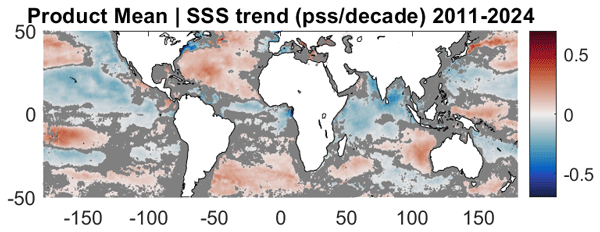
Ana Claudia Parracho, Patricia Zunino, Michela Sammartino, Jacqueline Boutin, Eric Greiner, Bruno Buongiorno Nardelli, and Nicolas Kolodziejczyk
State Planet, 7-osr10, 12, https://doi.org/10.5194/sp-7-osr10-12-2026, https://doi.org/10.5194/sp-7-osr10-12-2026, 2026
Short summary
Short summary
We compared six global sea surface salinity datasets and found consistent trends between them. Many regions follow the known pattern of fresh areas getting fresher and salty areas saltier, with a growing contrast between the North Atlantic and North Pacific. However, comparison with longer-term data shows that short-term trends are strongly shaped by natural climate variability, especially in the Pacific.
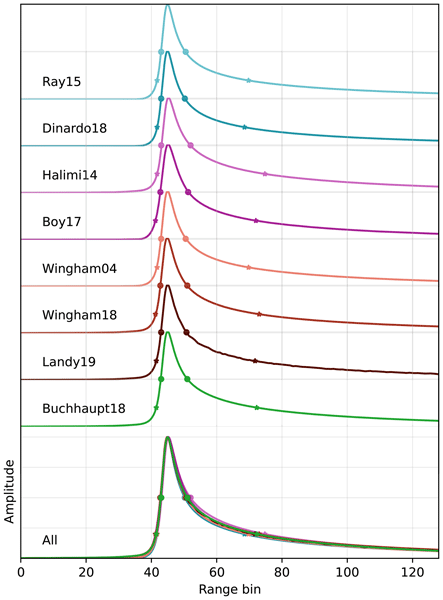
Ghislain Picard, Justin Murfitt, Elena Zakharova, Pierre Zeiger, Laurent Arnaud, Jeremie Aublanc, Jack C. Landy, Michele Scagliola, and Claude Duguay
Geosci. Model Dev., 19, 9103–9129, https://doi.org/10.5194/gmd-19-9103-2026, https://doi.org/10.5194/gmd-19-9103-2026, 2026
Short summary
Short summary
Radar altimeters measure ice-sheet elevation and sea-ice thickness. To improve their accuracy, we developed a model that simulates altimeter waveforms based on the physical properties of snow and sea ice. It computes the power, time, and Doppler shift of radar echoes as waves travel to the surface, interact with snow and ice, and return to the satellite. The model was verified internally, validated against other models and applied in Antarctica using in-situ snow measurements.
Adrien Ooms, Mathieu Casado, Sonja Wahl, Thomas Laepple, Alexandra Zuhr, Pete Akers, Ghislain Picard, Laurent Arnaud, Joel Savarino, Kira Rehfeld, Barbara Stenni, Giuliano Dreossi, Mauro Masiol, Amaelle Landais, and Valérie Masson-Delmotte
EGUsphere, https://doi.org/10.5194/egusphere-2026-4801, https://doi.org/10.5194/egusphere-2026-4801, 2026
This preprint is open for discussion and under review for Climate of the Past (CP).
Short summary
Short summary
This work presents new insights in the archival process of multi-annual climatic signal in the near surface firn at Concordia Station, East-Antarctica, from the new data set of high resolution stable water isotope profiles measured in a snow trench. The dated isotopic profiles covering 20 years are compared against overlapping precipitation and surface snow observations. This highlights the strong contribution of stratigraphic noise and post depositional effects to individual trench profiles.
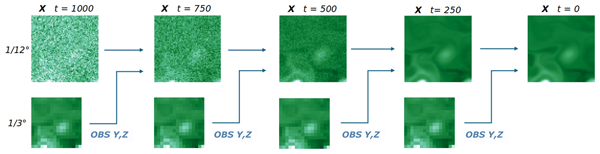
Enzo Forestier, Luther Ollier, Roy El Hourany, Jacqueline Boutin, Carlos Mejia, and Sylvie Thiria
Ocean Sci., 22, 2357–2373, https://doi.org/10.5194/os-22-2357-2026, https://doi.org/10.5194/os-22-2357-2026, 2026
Short summary
Short summary
This study evaluates deep generative diffusion models for downscaling sea surface salinity in the Gulf Stream. Using a reanalysis dataset as a controlled framework, it assesses the added value of high-resolution sea surface temperature and sea surface height as auxiliary constraints. The results show that diffusion-based reconstructions preserve plausible fine-scale variability, highlighting the method’s potential for future applications to satellite products.
Philippe Gamet, Bimal K. Bhattacharya, Jean-Louis Roujean, Gilles Boulet, Corinne Salcedo, Albert Olioso, Kanishka Mallick, Marie Weiss, Emmanuelle Sarrazin, Emmanuelle Autret, Laure Roupioz, José Antonio Sobrino, Olivier Merlin, Ghislain Picard, Thomas H. G. Vidal, Mark Irvine, Rahul Nigam, Mehul Pandya, Simon Gascoin, Sébastien Marcq, Manoj K. Mishra, Emilie Delogu, Vincent Rivalland, Jordi Etchanchu, Jean-Louis Raynaud, Meenakshi Sarkar, Rishi K. Gangwar, Sushil K. Singh, Renaud Binet, Sara Arioli, Hervé Yésou, Isabelle Dadou, Alexei Kouraev, Julien Michel, Benoit Coudert, Samuel Mwangi, Nesrine Farhani, Ayan Das, Stéphane Saux-Picart, Thierry Tormos, Jean-François Piollé, Charles Verpoorter, Auline Rodler, Jonathan Leon Tavares, Jennifer Adams, Anand S. Sahadevan, Besavaraju Santhi Sree, Manikumar Vedantam, Dheeraj Adlakha, Laurence Buffet, Kathrin Naegeli, Itziar Barat, Jerome Demarty, Olivier Hagolle, and Philippe Maisongrande
EGUsphere, https://doi.org/10.5194/egusphere-2026-4492, https://doi.org/10.5194/egusphere-2026-4492, 2026
Short summary
Short summary
This paper highlights how the upcoming TRISHNA satellite mission (launching 2027) will transform Earth observation by providing high-resolution (60 m) thermal infrared imagery with sub-weekly revisits. It details the mission's design and its synergies with other future missions to significantly improve the monitoring of global surface temperature and its dynamics, water stress, and ecosystem energy processes.
Julien Meloche, Melody Sandells, Henning Löwe, Nick Rutter, Ghislain Picard, Richard Essery, Randall K. Scharien, Alexandre Langlois, Matthias Jaggi, Josh King, Peter Toose, Michele Scagliola, Jerome Bouffard, Alessandro Di Bella, and Christian Haas
EGUsphere, https://doi.org/10.5194/egusphere-2026-3615, https://doi.org/10.5194/egusphere-2026-3615, 2026
Short summary
Short summary
Sea ice thickness is essential for climate studies. Radar altimetry has provided sea ice thickness measurements, but uncertainty arises from the interaction of the signal with the snow cover. Therefore, modelling the signal interaction with the snow is necessary to improve retrieval. A radar model was used to simulate the radar signal from the snow-covered sea ice. This work paved the way to improved physical algorithms to retrieve snow depth and sea ice thickness for radar altimeter missions.
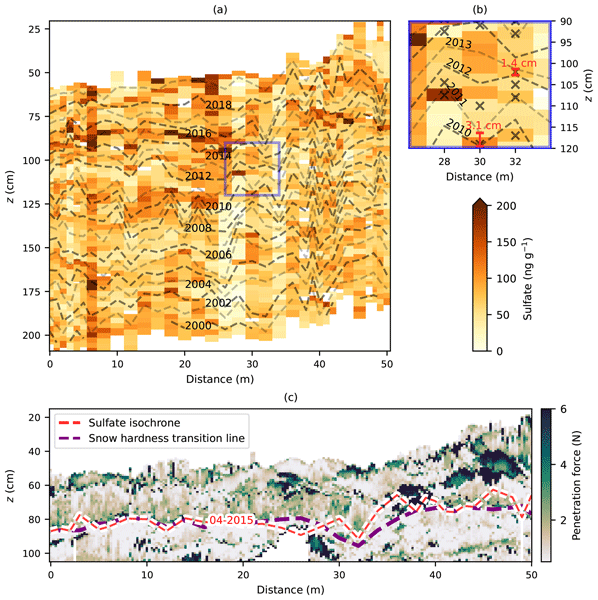
Adrien Ooms, Mathieu Casado, Ghislain Picard, Laurent Arnaud, Maria Hörhold, Andrea Spolaor, Rita Traversi, Joel Savarino, Patrick Ginot, Pete Akers, Birthe Twarloh, and Valérie Masson-Delmotte
The Cryosphere, 20, 3235–3255, https://doi.org/10.5194/tc-20-3235-2026, https://doi.org/10.5194/tc-20-3235-2026, 2026
Short summary
Short summary
This work presents a new approach to the estimation of accumulation rates at Concordia Station, East-Antarctica, for the last 20 years, from a new data set of chemical tracers and snow micro-scale properties measured in a snow trench. Multi-annual and meter to decameter scale variability of accumulation rates are compared again in-situ measurements of surface laser scanner and stake farm, with very good agreement. This further constrains SMB estimation for Antarctica at high temporal resolution.
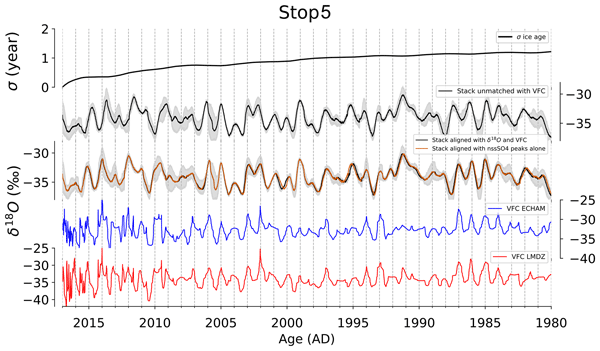
Titouan Tcheng, Elise Fourré, Christophe Leroy-Dos Santos, Frédéric Parrenin, Emmanuel Le Meur, Frédéric Prié, Olivier Jossoud, Roxanne Jacob, Bénédicte Minster, Olivier Magand, Cécile Agosta, Niels Dutrievoz, Vincent Favier, Léa Baubant, Coralie Lassalle-Bernard, Mathieu Casado, Martin Werner, Alexandre Cauquoin, Laurent Arnaud, Bruno Jourdain, Ghislain Picard, Marie Bouchet, and Amaëlle Landais
The Cryosphere, 20, 1599–1618, https://doi.org/10.5194/tc-20-1599-2026, https://doi.org/10.5194/tc-20-1599-2026, 2026
Short summary
Short summary
Studying Antarctic ice cores is crucial to assess past climate changes, as they hold historical climate data. This study examines multiple ice cores from three sites in coastal Adélie Land to see if combining cores improves data interpretability. It does at two sites, but at a third, wind-driven snow layer mixing limited benefits. We show that using multiple ice cores from one location can better uncover climate history, especially in areas with less wind disturbance.
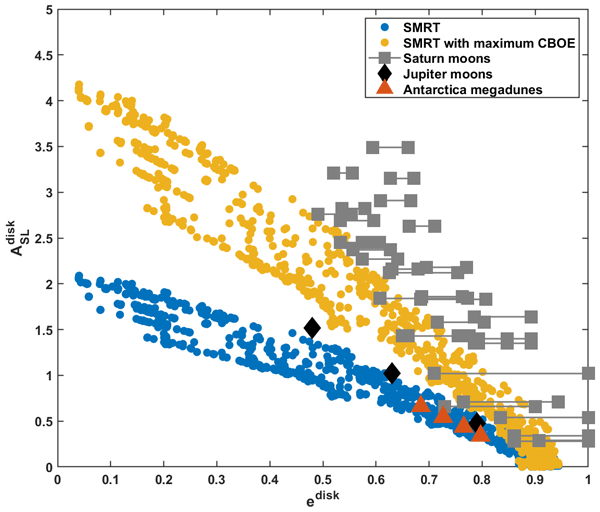
Léa Elise Bonnefoy, Catherine Prigent, Ghislain Picard, Clément Soriot, Alice Le Gall, Lise Kilic, and Carlos Jimenez
The Cryosphere, 20, 1297–1314, https://doi.org/10.5194/tc-20-1297-2026, https://doi.org/10.5194/tc-20-1297-2026, 2026
Short summary
Short summary
Microwave radiometry senses the thermal emission from a target, whereas its active counterpart, radar, sends a signal to the target and measures the reflected signal. We simultaneously model radar and radiometry over the East Antarctic ice sheet, which we propose as an analog for icy moons: we can reproduce most data with a unique model. The radar response of Saturn's moons cannot be reproduced and is likely caused by processes unaccounted for in the model and less efficient in the Antarctic.
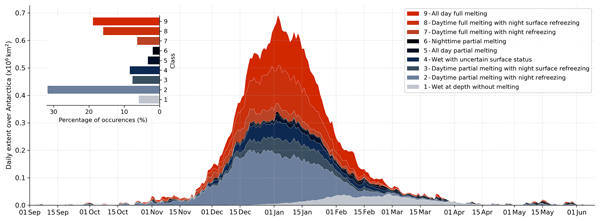
Marion Leduc-Leballeur, Ghislain Picard, Pierre Zeiger, and Giovanni Macelloni
The Cryosphere, 20, 1199–1216, https://doi.org/10.5194/tc-20-1199-2026, https://doi.org/10.5194/tc-20-1199-2026, 2026
Short summary
Short summary
This study presents a quantitative and synthetic classification of the snowpack in 10 dry-wet status by aggregating separate binary indicators derived from satellite observations. The classification follows the expected evolution of the melt season: night refreezing is frequent at the onset, sustained melting is observed during the summer peak, and remnant liquid water at depth occurs at the end. This dataset improves the knowledge of melt processes using passive microwave remote sensing.
Xinlong Liu, Stuart Paul Corney, Rachel Louise Tilling, and Petra Heil
EGUsphere, https://doi.org/10.5194/egusphere-2026-662, https://doi.org/10.5194/egusphere-2026-662, 2026
Short summary
Short summary
Antarctic sea-ice thickness from satellites depends on how snow is treated. We compared four widely used CryoSat-2 radar products for winters 2013–2018 on the same map grid. All show similar large-scale patterns, but each gives systematically higher or lower values, with the biggest differences in the snowier western Weddell Sea. Year-to-year changes are similar across products, yet these offsets can shift thickness estimates, so users should account for product choice and snow assumptions.
Diana Francis, Ricardo Fonseca, Narendra Nelli, Petra Heil, Jonathan D. Wille, Irina V. Gorodetskaya, and Robert A. Massom
The Cryosphere, 20, 1–28, https://doi.org/10.5194/tc-20-1-2026, https://doi.org/10.5194/tc-20-1-2026, 2026
Short summary
Short summary
This study investigates the role of atmospheric dynamics in sea-ice thickness and snow depth at a coastal site in East Antarctica using in situ measurements and numerical modeling. The snow thickness variability is impacted by atmospheric forcing, with significant contributions from precipitation, Foehn effects, blowing snow, and episodic warm and moist air intrusions, which led to changes of up to 0.08 m within a day for a field that is in the range of 0.02–0.18 m during July–November 2022.
Jean Rabault, Joey Voermans, Takehiko Nose, Graig Sutherland, Alexander Babanin, Takuji Waseda, Tsubasa Kodaira, Atle Jensen, Lars Willas Dreyer, Øyvind Breivik, Gaute Hope, Malte Müller, Zhaohui Cheng, Lichuan Wu, Aleksey Marchenko, Brian Ward, Kai H. Christensen, Petra Heil, and Karsten Trulsen
EGUsphere, https://doi.org/10.48550/arXiv.2507.19034, https://doi.org/10.48550/arXiv.2507.19034, 2025
Short summary
Short summary
We observe harmonics of the main incoming wave peak in sea ice motion data. These harmonics match non-linear 3-wave interactions predicted from the dispersion relation. This may indicate that wave in ice triads are empirically observed, which suggests that non-linear energy transfers play a role in wave in ice propagation.
Léa Olivier, Jacqueline Boutin, Gilles Reverdin, Christopher Hunt, Thomas Linkowski, Alison Chase, Nils Haentjens, Pedro C. Junger, Stéphane Pesant, and Douglas Vandemark
Earth Syst. Sci. Data, 17, 3583–3598, https://doi.org/10.5194/essd-17-3583-2025, https://doi.org/10.5194/essd-17-3583-2025, 2025
Short summary
Short summary
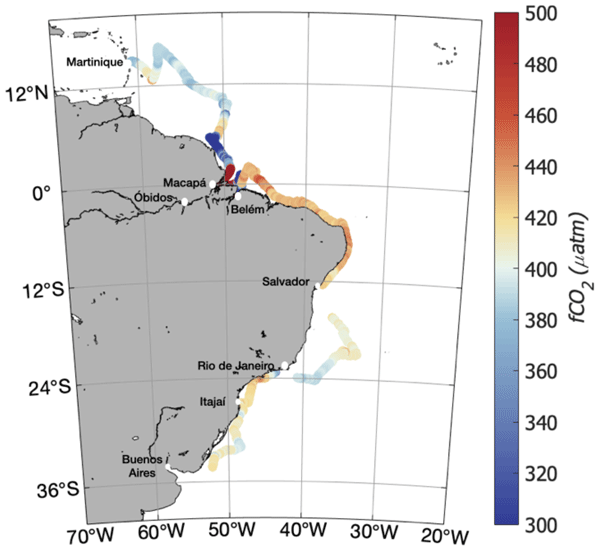
The air–sea CO2 flux in coastal waters plays a key role in the global carbon budget but remains poorly understood. In 2021, the Tara schooner collected 14 000 km of CO2 fugacity (fCO2) data along the South American coast. This dataset improves our understanding of fCO2 in the under-sampled Brazilian coastal region and provides a unique insight into the complex biogeochemistry of the Amazon River–ocean continuum.
Florent Domine, Mireille Quémener, Ludovick Bégin, Benjamin Bouchard, Valérie Dionne, Sébastien Jerczynski, Raphaël Larouche, Félix Lévesque-Desrosiers, Simon-Olivier Philibert, Marc-André Vigneault, Ghislain Picard, and Daniel C. Côté
The Cryosphere, 19, 1757–1774, https://doi.org/10.5194/tc-19-1757-2025, https://doi.org/10.5194/tc-19-1757-2025, 2025
Short summary
Short summary
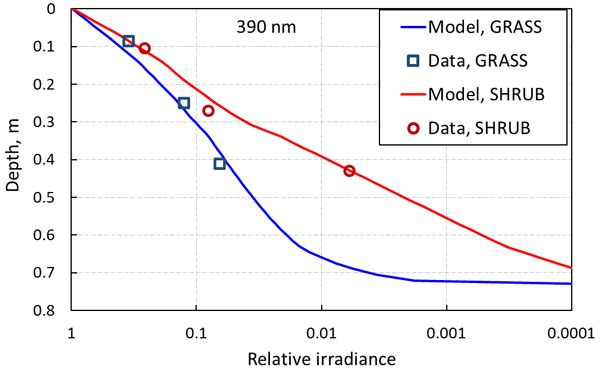
Shrubs buried in snow absorb solar radiation and reduce irradiance in the snowpack. This decreases photochemical reaction rates and emissions to the atmosphere. By monitoring irradiance in snowpacks with and without shrubs, we conclude that shrubs absorb solar radiation as much as 140 ppb of soot and reduce irradiance by a factor of 2. Shrub expansion in the Arctic may therefore affect tropospheric composition during the snow season with climatic effects.
Kirtana Naëck, Jacqueline Boutin, Sebastiaan Swart, Marcel du Plessis, Liliane Merlivat, Laurence Beaumont, Antonio Lourenco, Francesco d'Ovidio, Louise Rousselet, Brian Ward, and Jean-Baptiste Sallée
Biogeosciences, 22, 1947–1968, https://doi.org/10.5194/bg-22-1947-2025, https://doi.org/10.5194/bg-22-1947-2025, 2025
Short summary
Short summary
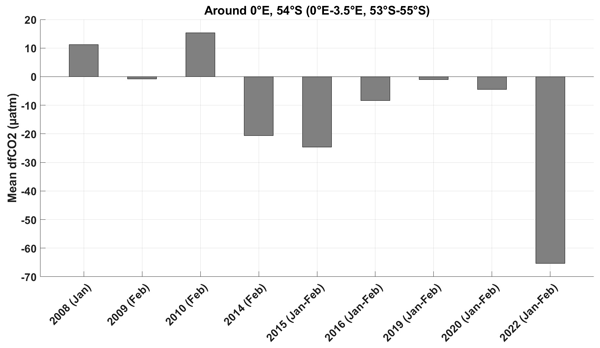
In summer 2022, a CARbon Interface OCean Atmosphere (CARIOCA) drifting buoy observed an anomalously strong ocean carbon sink in the subpolar Southern Ocean associated with large plumes of chlorophyll a. Lagrangian backward trajectories indicate that these waters originated from the sea ice edge in spring 2021. Our study highlights the northward migration of the CO2 sink associated with early sea ice retreat.
Mukund Gupta, Heather Regan, Younghyun Koo, Sean Minhui Tashi Chua, Xueke Li, and Petra Heil
The Cryosphere, 19, 1241–1257, https://doi.org/10.5194/tc-19-1241-2025, https://doi.org/10.5194/tc-19-1241-2025, 2025
Short summary
Short summary
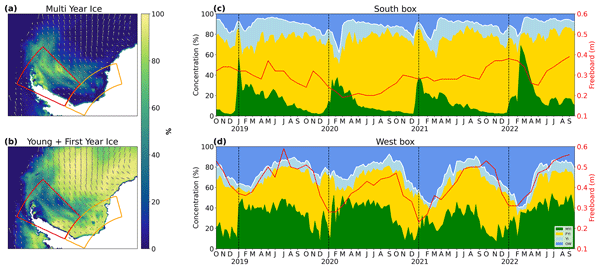
The sea ice cover is composed of floes, whose shapes set the material properties of the pack. Here, we use a satellite product (ICESat-2) to investigate these floe shapes within the Weddell Sea in Antarctica. We find that floes tend to become smaller during the melt season, while their thickness distribution exhibits different behavior between the western and southern regions of the pack. These metrics will help calibrate models and improve our understanding of sea ice physics across scales.
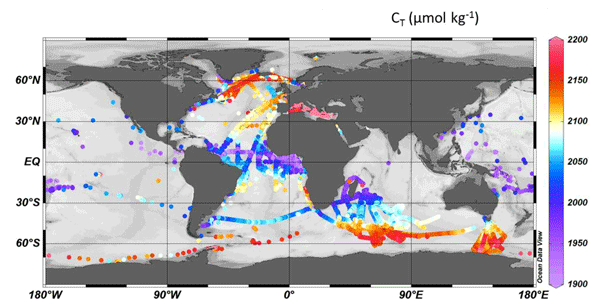
Nicolas Metzl, Jonathan Fin, Claire Lo Monaco, Claude Mignon, Samir Alliouane, Bruno Bombled, Jacqueline Boutin, Yann Bozec, Steeve Comeau, Pascal Conan, Laurent Coppola, Pascale Cuet, Eva Ferreira, Jean-Pierre Gattuso, Frédéric Gazeau, Catherine Goyet, Emilie Grossteffan, Bruno Lansard, Dominique Lefèvre, Nathalie Lefèvre, Coraline Leseurre, Sébastien Petton, Mireille Pujo-Pay, Christophe Rabouille, Gilles Reverdin, Céline Ridame, Peggy Rimmelin-Maury, Jean-François Ternon, Franck Touratier, Aline Tribollet, Thibaut Wagener, and Cathy Wimart-Rousseau
Earth Syst. Sci. Data, 17, 1075–1100, https://doi.org/10.5194/essd-17-1075-2025, https://doi.org/10.5194/essd-17-1075-2025, 2025
Short summary
Short summary
This work presents a new synthesis of 67 000 total alkalinity and total dissolved inorganic carbon observations obtained between 1993 and 2023 in the global ocean, coastal zones, and the Mediterranean Sea. We describe the data assemblage and associated quality control and discuss some potential uses of this dataset. The dataset is provided in a single format and includes the quality flag for each sample.
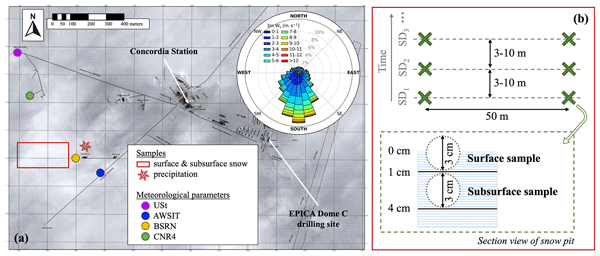
Inès Ollivier, Hans Christian Steen-Larsen, Barbara Stenni, Laurent Arnaud, Mathieu Casado, Alexandre Cauquoin, Giuliano Dreossi, Christophe Genthon, Bénédicte Minster, Ghislain Picard, Martin Werner, and Amaëlle Landais
The Cryosphere, 19, 173–200, https://doi.org/10.5194/tc-19-173-2025, https://doi.org/10.5194/tc-19-173-2025, 2025
Short summary
Short summary
The role of post-depositional processes taking place at the ice sheet's surface on the water stable isotope signal measured in polar ice cores is not fully understood. Using field observations and modelling results, we show that the original precipitation isotopic signal at Dome C, East Antarctica, is modified by post-depositional processes and provide the first quantitative estimation of their mean impact on the isotopic signal observed in the snow.
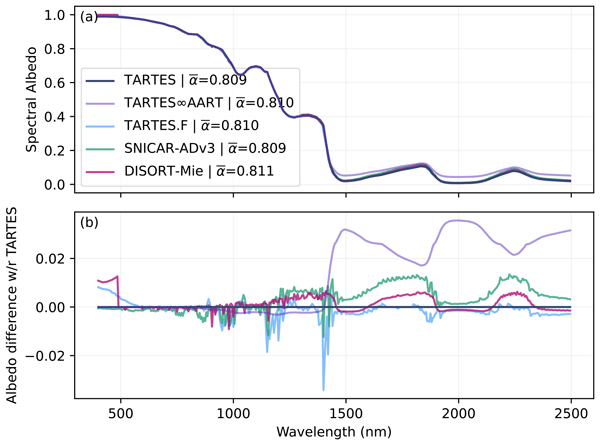
Ghislain Picard and Quentin Libois
Geosci. Model Dev., 17, 8927–8953, https://doi.org/10.5194/gmd-17-8927-2024, https://doi.org/10.5194/gmd-17-8927-2024, 2024
Short summary
Short summary
The Two-streAm Radiative TransfEr in Snow (TARTES) is a radiative transfer model to compute snow albedo in the solar domain and the profiles of light and energy absorption in a multi-layered snowpack whose physical properties are user defined. It uniquely considers snow grain shape flexibly, based on recent insights showing that snow does not behave as a collection of ice spheres but instead as a random medium. TARTES is user-friendly yet performs comparably to more complex models.
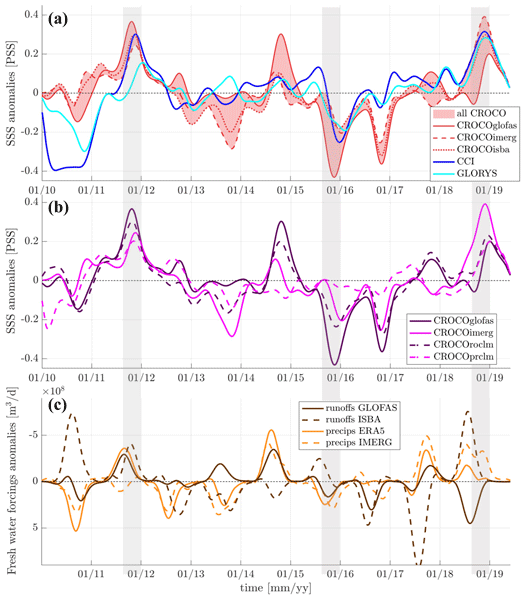
Clovis Thouvenin-Masson, Jacqueline Boutin, Vincent Échevin, Alban Lazar, and Jean-Luc Vergely
Ocean Sci., 20, 1547–1566, https://doi.org/10.5194/os-20-1547-2024, https://doi.org/10.5194/os-20-1547-2024, 2024
Short summary
Short summary
We focus on understanding the impact of river runoff and precipitation on sea surface salinity (SSS) in the eastern North Tropical Atlantic (e-NTA) region off northwestern Africa. By analyzing regional simulations and observational data, we find that river flows significantly influence SSS variability, particularly after the rainy season. Our findings underscore that a main source of uncertainty representing SSS variability in this region is from river runoff estimates.
Melody Sandells, Nick Rutter, Kirsty Wivell, Richard Essery, Stuart Fox, Chawn Harlow, Ghislain Picard, Alexandre Roy, Alain Royer, and Peter Toose
The Cryosphere, 18, 3971–3990, https://doi.org/10.5194/tc-18-3971-2024, https://doi.org/10.5194/tc-18-3971-2024, 2024
Short summary
Short summary
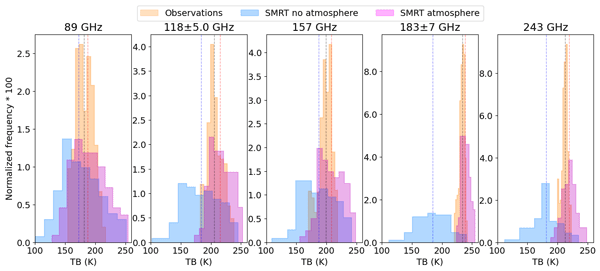
Satellite microwave observations are used for weather forecasting. In Arctic regions this is complicated by natural emission from snow. By simulating airborne observations from in situ measurements of snow, this study shows how snow properties affect the signal within the atmosphere. Fresh snowfall between flights changed airborne measurements. Good knowledge of snow layering and structure can be used to account for the effects of snow and could unlock these data to improve forecasts.
Sara Arioli, Ghislain Picard, Laurent Arnaud, Simon Gascoin, Esteban Alonso-González, Marine Poizat, and Mark Irvine
Earth Syst. Sci. Data, 16, 3913–3934, https://doi.org/10.5194/essd-16-3913-2024, https://doi.org/10.5194/essd-16-3913-2024, 2024
Short summary
Short summary
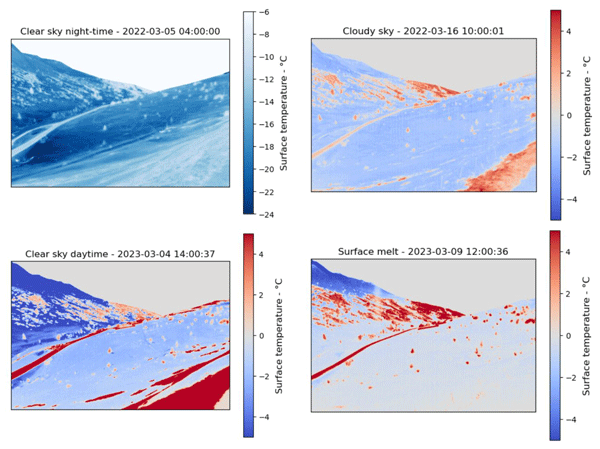
High-accuracy precision maps of the surface temperature of snow were acquired with an uncooled thermal-infrared camera during winter 2021–2022 and spring 2023. The accuracy – i.e., mean absolute error – improved from 1.28 K to 0.67 K between the seasons thanks to an improved camera setup and temperature stabilization. The dataset represents a major advance in the validation of satellite measurements and physical snow models over a complex topography.
Romilly Harris Stuart, Amaëlle Landais, Laurent Arnaud, Christo Buizert, Emilie Capron, Marie Dumont, Quentin Libois, Robert Mulvaney, Anaïs Orsi, Ghislain Picard, Frédéric Prié, Jeffrey Severinghaus, Barbara Stenni, and Patricia Martinerie
The Cryosphere, 18, 3741–3763, https://doi.org/10.5194/tc-18-3741-2024, https://doi.org/10.5194/tc-18-3741-2024, 2024
Short summary
Short summary
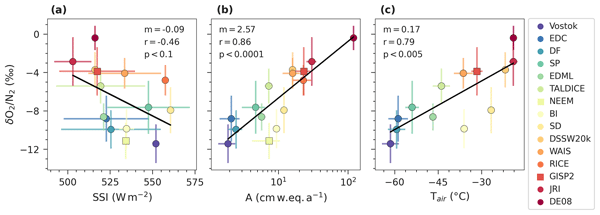
Ice core δO2/N2 records are useful dating tools due to their local insolation pacing. A precise understanding of the physical mechanism driving this relationship, however, remain ambiguous. By compiling data from 15 polar sites, we find a strong dependence of mean δO2/N2 on accumulation rate and temperature in addition to the well-documented insolation dependence. Snowpack modelling is used to investigate which physical properties drive the mechanistic dependence on these local parameters.
Julien Meloche, Melody Sandells, Henning Löwe, Nick Rutter, Richard Essery, Ghislain Picard, Randall K. Scharien, Alexandre Langlois, Matthias Jaggi, Josh King, Peter Toose, Jérôme Bouffard, Alessandro Di Bella, and Michele Scagliola
EGUsphere, https://doi.org/10.5194/egusphere-2024-1583, https://doi.org/10.5194/egusphere-2024-1583, 2024
Preprint archived
Short summary
Short summary
Sea ice thickness is essential for climate studies. Radar altimetry has provided sea ice thickness measurement, but uncertainty arises from interaction of the signal with the snow cover. Therefore, modelling the signal interaction with the snow is necessary to improve retrieval. A radar model was used to simulate the radar signal from the snow-covered sea ice. This work paved the way to improved physical algorithm to retrieve snow depth and sea ice thickness for radar altimeter missions.
Naomi E. Ochwat, Ted A. Scambos, Alison F. Banwell, Robert S. Anderson, Michelle L. Maclennan, Ghislain Picard, Julia A. Shates, Sebastian Marinsek, Liliana Margonari, Martin Truffer, and Erin C. Pettit
The Cryosphere, 18, 1709–1731, https://doi.org/10.5194/tc-18-1709-2024, https://doi.org/10.5194/tc-18-1709-2024, 2024
Short summary
Short summary
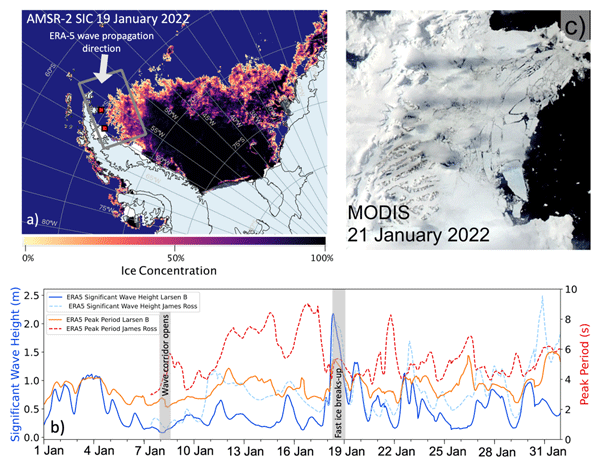
On the Antarctic Peninsula, there is a small bay that had sea ice fastened to the shoreline (
fast ice) for over a decade. The fast ice stabilized the glaciers that fed into the ocean. In January 2022, the fast ice broke away. Using satellite data we found that this was because of low sea ice concentrations and a high long-period ocean wave swell. We find that the glaciers have responded to this event by thinning, speeding up, and retreating by breaking off lots of icebergs at remarkable rates.
Justin Murfitt, Claude Duguay, Ghislain Picard, and Juha Lemmetyinen
The Cryosphere, 18, 869–888, https://doi.org/10.5194/tc-18-869-2024, https://doi.org/10.5194/tc-18-869-2024, 2024
Short summary
Short summary
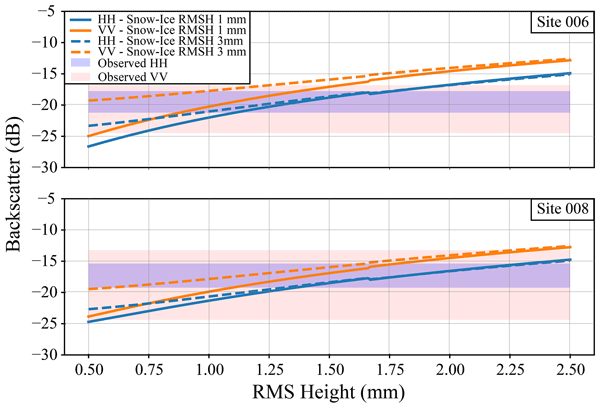
This research focuses on the interaction between microwave signals and lake ice under wet conditions. Field data collected for Lake Oulujärvi in Finland were used to model backscatter under different conditions. The results of the modelling likely indicate that a combination of increased water content and roughness of different interfaces caused backscatter to increase. These results could help to identify areas where lake ice is unsafe for winter transportation.
Claudio Stefanini, Giovanni Macelloni, Marion Leduc-Leballeur, Vincent Favier, Benjamin Pohl, and Ghislain Picard
The Cryosphere, 18, 593–608, https://doi.org/10.5194/tc-18-593-2024, https://doi.org/10.5194/tc-18-593-2024, 2024
Short summary
Short summary
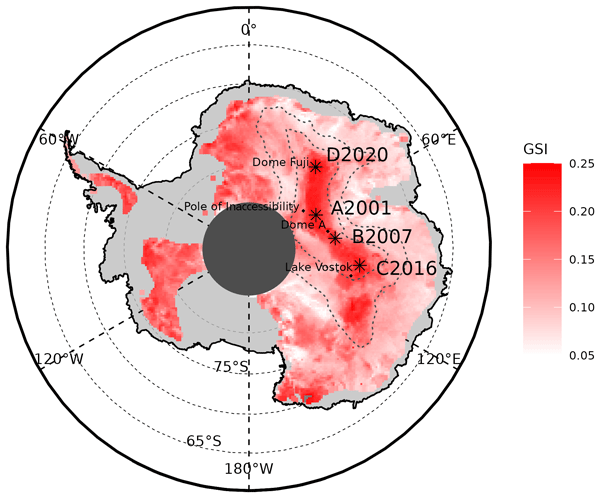
Local and large-scale meteorological conditions have been considered in order to explain some peculiar changes of snow grains on the East Antarctic Plateau from 2000 to 2022, by using remote sensing observations and reanalysis. We identified some extreme grain size events on the highest ice divide, resulting from a combination of conditions of low wind speed and low temperature. Moreover, the beginning of seasonal grain growth has been linked to the occurrence of atmospheric rivers.
Nicolas Metzl, Jonathan Fin, Claire Lo Monaco, Claude Mignon, Samir Alliouane, David Antoine, Guillaume Bourdin, Jacqueline Boutin, Yann Bozec, Pascal Conan, Laurent Coppola, Frédéric Diaz, Eric Douville, Xavier Durrieu de Madron, Jean-Pierre Gattuso, Frédéric Gazeau, Melek Golbol, Bruno Lansard, Dominique Lefèvre, Nathalie Lefèvre, Fabien Lombard, Férial Louanchi, Liliane Merlivat, Léa Olivier, Anne Petrenko, Sébastien Petton, Mireille Pujo-Pay, Christophe Rabouille, Gilles Reverdin, Céline Ridame, Aline Tribollet, Vincenzo Vellucci, Thibaut Wagener, and Cathy Wimart-Rousseau
Earth Syst. Sci. Data, 16, 89–120, https://doi.org/10.5194/essd-16-89-2024, https://doi.org/10.5194/essd-16-89-2024, 2024
Short summary
Short summary
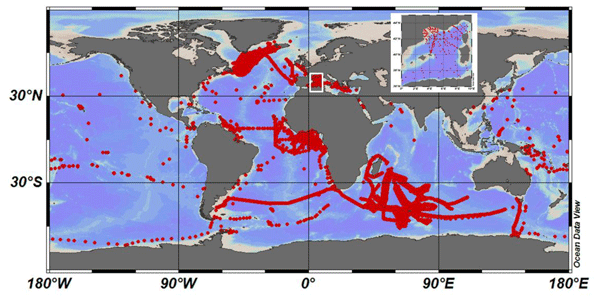
This work presents a synthesis of 44 000 total alkalinity and dissolved inorganic carbon observations obtained between 1993 and 2022 in the Global Ocean and the Mediterranean Sea at the surface and in the water column. Seawater samples were measured using the same method and calibrated with international Certified Reference Material. We describe the data assemblage, quality control and some potential uses of this dataset.
Jean Emmanuel Sicart, Victor Ramseyer, Ghislain Picard, Laurent Arnaud, Catherine Coulaud, Guilhem Freche, Damien Soubeyrand, Yves Lejeune, Marie Dumont, Isabelle Gouttevin, Erwan Le Gac, Frédéric Berger, Jean-Matthieu Monnet, Laurent Borgniet, Éric Mermin, Nick Rutter, Clare Webster, and Richard Essery
Earth Syst. Sci. Data, 15, 5121–5133, https://doi.org/10.5194/essd-15-5121-2023, https://doi.org/10.5194/essd-15-5121-2023, 2023
Short summary
Short summary
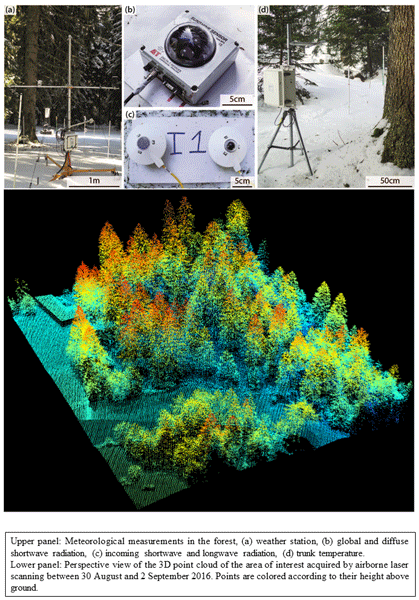
Forests strongly modify the accumulation, metamorphism and melting of snow in midlatitude and high-latitude regions. Two field campaigns during the winters 2016–17 and 2017–18 were conducted in a coniferous forest in the French Alps to study interactions between snow and vegetation. This paper presents the field site, instrumentation and collection methods. The observations include forest characteristics, meteorology, snow cover and snow interception by the canopy during precipitation events.
Thomas Dethinne, Quentin Glaude, Ghislain Picard, Christoph Kittel, Patrick Alexander, Anne Orban, and Xavier Fettweis
The Cryosphere, 17, 4267–4288, https://doi.org/10.5194/tc-17-4267-2023, https://doi.org/10.5194/tc-17-4267-2023, 2023
Short summary
Short summary
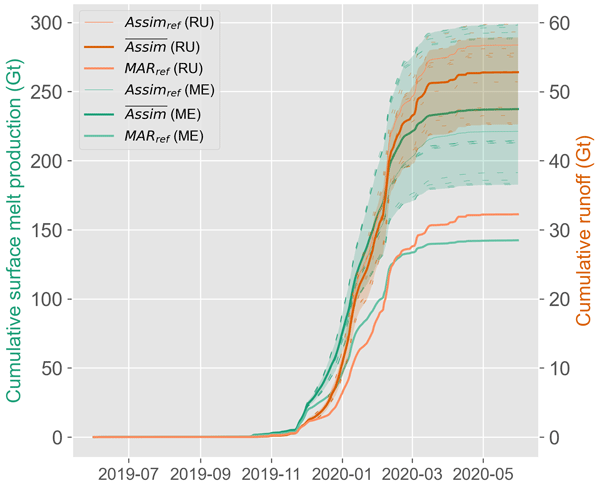
We investigate the sensitivity of the regional climate model
Modèle Atmosphérique Régional(MAR) to the assimilation of wet-snow occurrence estimated by remote sensing datasets. The assimilation is performed by nudging the MAR snowpack temperature. The data assimilation is performed over the Antarctic Peninsula for the 2019–2021 period. The results show an increase in the melt production (+66.7 %) and a decrease in surface mass balance (−4.5 %) of the model for the 2019–2020 melt season.
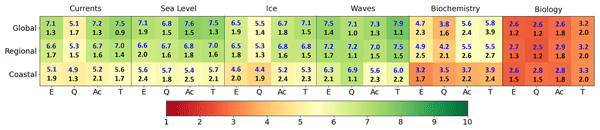
Stefania A. Ciliberti, Enrique Alvarez Fanjul, Jay Pearlman, Kirsten Wilmer-Becker, Pierre Bahurel, Fabrice Ardhuin, Alain Arnaud, Mike Bell, Segolene Berthou, Laurent Bertino, Arthur Capet, Eric Chassignet, Stefano Ciavatta, Mauro Cirano, Emanuela Clementi, Gianpiero Cossarini, Gianpaolo Coro, Stuart Corney, Fraser Davidson, Marie Drevillon, Yann Drillet, Renaud Dussurget, Ghada El Serafy, Katja Fennel, Marcos Garcia Sotillo, Patrick Heimbach, Fabrice Hernandez, Patrick Hogan, Ibrahim Hoteit, Sudheer Joseph, Simon Josey, Pierre-Yves Le Traon, Simone Libralato, Marco Mancini, Pascal Matte, Angelique Melet, Yasumasa Miyazawa, Andrew M. Moore, Antonio Novellino, Andrew Porter, Heather Regan, Laia Romero, Andreas Schiller, John Siddorn, Joanna Staneva, Cecile Thomas-Courcoux, Marina Tonani, Jose Maria Garcia-Valdecasas, Jennifer Veitch, Karina von Schuckmann, Liying Wan, John Wilkin, and Romane Zufic
State Planet, 1-osr7, 2, https://doi.org/10.5194/sp-1-osr7-2-2023, https://doi.org/10.5194/sp-1-osr7-2-2023, 2023
Yaowen Zheng, Nicholas R. Golledge, Alexandra Gossart, Ghislain Picard, and Marion Leduc-Leballeur
The Cryosphere, 17, 3667–3694, https://doi.org/10.5194/tc-17-3667-2023, https://doi.org/10.5194/tc-17-3667-2023, 2023
Short summary
Short summary
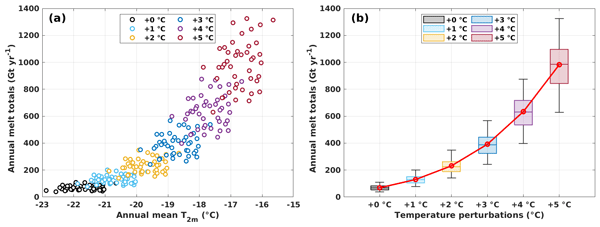
Positive degree-day (PDD) schemes are widely used in many Antarctic numerical ice sheet models. However, the PDD approach has not been systematically explored for its application in Antarctica. We have constructed a novel grid-cell-level spatially distributed PDD (dist-PDD) model and assessed its accuracy. We suggest that an appropriately parameterized dist-PDD model can be a valuable tool for exploring Antarctic surface melt beyond the satellite era.
Esteban Alonso-González, Simon Gascoin, Sara Arioli, and Ghislain Picard
The Cryosphere, 17, 3329–3342, https://doi.org/10.5194/tc-17-3329-2023, https://doi.org/10.5194/tc-17-3329-2023, 2023
Short summary
Short summary
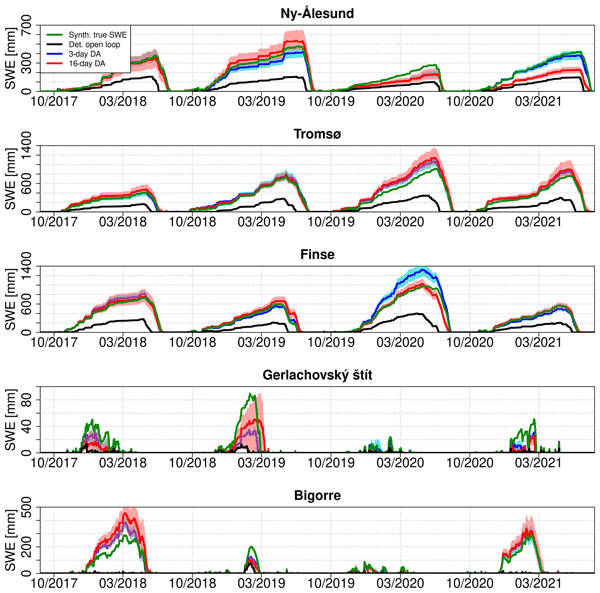
Data assimilation techniques are a promising approach to improve snowpack simulations in remote areas that are difficult to monitor. This paper studies the ability of satellite-observed land surface temperature to improve snowpack simulations through data assimilation. We show that it is possible to improve snowpack simulations, but the temporal resolution of the observations and the algorithm used are critical to obtain satisfactory results.
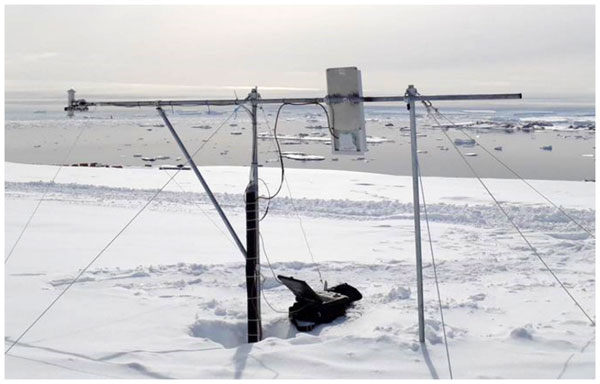
Sara Arioli, Ghislain Picard, Laurent Arnaud, and Vincent Favier
The Cryosphere, 17, 2323–2342, https://doi.org/10.5194/tc-17-2323-2023, https://doi.org/10.5194/tc-17-2323-2023, 2023
Short summary
Short summary
To assess the drivers of the snow grain size evolution during snow drift, we exploit a 5-year time series of the snow grain size retrieved from spectral-albedo observations made with a new, autonomous, multi-band radiometer and compare it to observations of snow drift, snowfall and snowmelt at a windy location of coastal Antarctica. Our results highlight the complexity of the grain size evolution in the presence of snow drift and show an overall tendency of snow drift to limit its variations.
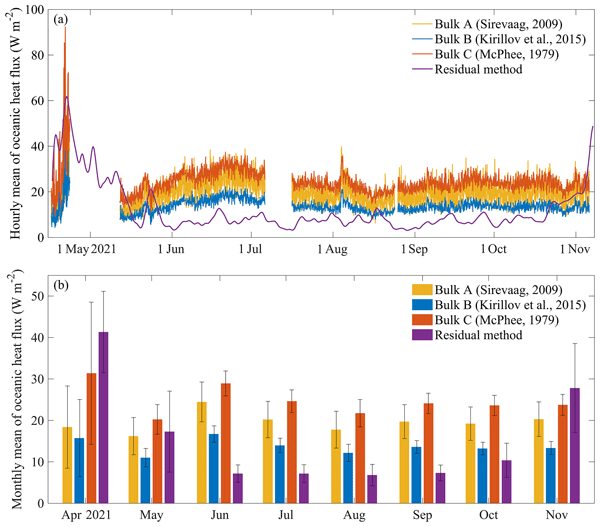
Haihan Hu, Jiechen Zhao, Petra Heil, Zhiliang Qin, Jingkai Ma, Fengming Hui, and Xiao Cheng
The Cryosphere, 17, 2231–2244, https://doi.org/10.5194/tc-17-2231-2023, https://doi.org/10.5194/tc-17-2231-2023, 2023
Short summary
Short summary
The oceanic characteristics beneath sea ice significantly affect ice growth and melting. The high-frequency and long-term observations of oceanic variables allow us to deeply investigate their diurnal and seasonal variation and evaluate their influences on sea ice evolution. The large-scale sea ice distribution and ocean circulation contributed to the seasonal variation of ocean variables, revealing the important relationship between large-scale and local phenomena.
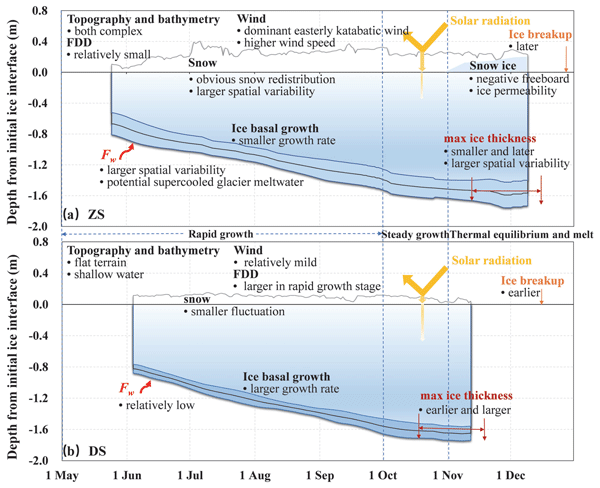
Na Li, Ruibo Lei, Petra Heil, Bin Cheng, Minghu Ding, Zhongxiang Tian, and Bingrui Li
The Cryosphere, 17, 917–937, https://doi.org/10.5194/tc-17-917-2023, https://doi.org/10.5194/tc-17-917-2023, 2023
Short summary
Short summary
The observed annual maximum landfast ice (LFI) thickness off Zhongshan (Davis) was 1.59±0.17 m (1.64±0.08 m). Larger interannual and local spatial variabilities for the seasonality of LFI were identified at Zhongshan, with the dominant influencing factors of air temperature anomaly, snow atop, local topography and wind regime, and oceanic heat flux. The variability of LFI properties across the study domain prevailed at interannual timescales, over any trend during the recent decades.
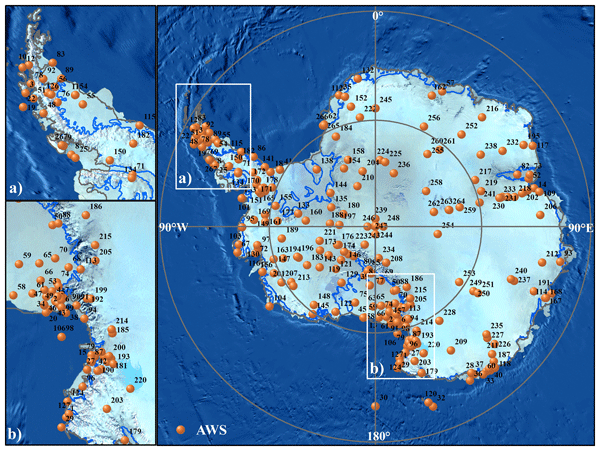
Yetang Wang, Xueying Zhang, Wentao Ning, Matthew A. Lazzara, Minghu Ding, Carleen H. Reijmer, Paul C. J. P. Smeets, Paolo Grigioni, Petra Heil, Elizabeth R. Thomas, David Mikolajczyk, Lee J. Welhouse, Linda M. Keller, Zhaosheng Zhai, Yuqi Sun, and Shugui Hou
Earth Syst. Sci. Data, 15, 411–429, https://doi.org/10.5194/essd-15-411-2023, https://doi.org/10.5194/essd-15-411-2023, 2023
Short summary
Short summary
Here we construct a new database of Antarctic automatic weather station (AWS) meteorological records, which is quality-controlled by restrictive criteria. This dataset compiled all available Antarctic AWS observations, and its resolutions are 3-hourly, daily and monthly, which is very useful for quantifying spatiotemporal variability in weather conditions. Furthermore, this compilation will be used to estimate the performance of the regional climate models or meteorological reanalysis products.
Ghislain Picard, Marion Leduc-Leballeur, Alison F. Banwell, Ludovic Brucker, and Giovanni Macelloni
The Cryosphere, 16, 5061–5083, https://doi.org/10.5194/tc-16-5061-2022, https://doi.org/10.5194/tc-16-5061-2022, 2022
Short summary
Short summary
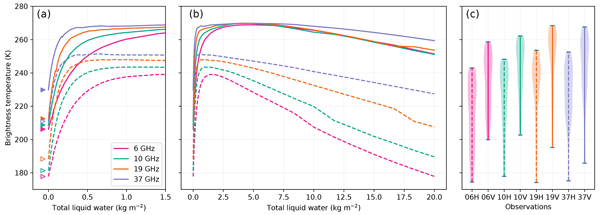
Using a snowpack radiative transfer model, we investigate in which conditions meltwater can be detected from passive microwave satellite observations from 1.4 to 37 GHz. In particular, we determine the minimum detectable liquid water content, the maximum depth of detection of a buried wet snow layer and the risk of false alarm due to supraglacial lakes. These results provide information for the developers of new, more advanced satellite melt products and for the users of the existing products.
Minghu Ding, Xiaowei Zou, Qizhen Sun, Diyi Yang, Wenqian Zhang, Lingen Bian, Changgui Lu, Ian Allison, Petra Heil, and Cunde Xiao
Earth Syst. Sci. Data, 14, 5019–5035, https://doi.org/10.5194/essd-14-5019-2022, https://doi.org/10.5194/essd-14-5019-2022, 2022
Short summary
Short summary
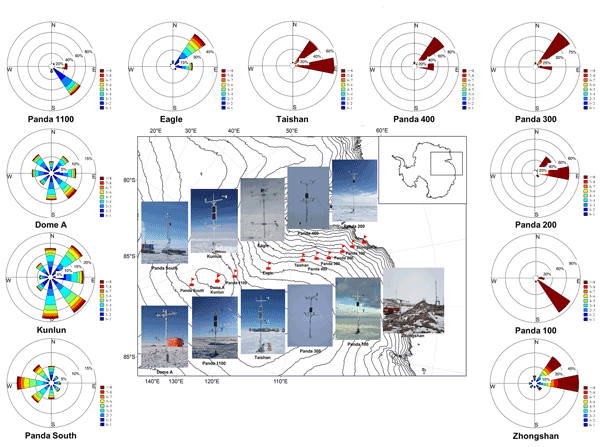
The PANDA automatic weather station (AWS) network consists of 11 stations deployed along a transect from the coast (Zhongshan Station) to the summit of the East Antarctic Ice Sheet (Dome A). It covers the different climatic and topographic units of East Antarctica. All stations record hourly air temperature, relative humidity, air pressure, wind speed and direction at two or three heights. The PANDA AWS dataset commences from 1989 and is planned to be publicly available into the future.
Dominic Saunderson, Andrew Mackintosh, Felicity McCormack, Richard Selwyn Jones, and Ghislain Picard
The Cryosphere, 16, 4553–4569, https://doi.org/10.5194/tc-16-4553-2022, https://doi.org/10.5194/tc-16-4553-2022, 2022
Short summary
Short summary
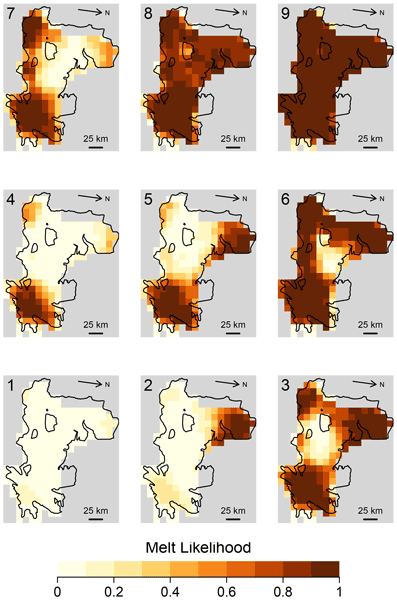
We investigate the variability in surface melt on the Shackleton Ice Shelf in East Antarctica over the last 2 decades (2003–2021). Using daily satellite observations and the machine learning approach of a self-organising map, we identify nine distinct spatial patterns of melt. These patterns allow comparisons of melt within and across melt seasons and highlight the importance of both air temperatures and local controls such as topography, katabatic winds, and albedo in driving surface melt.

Ghislain Picard, Henning Löwe, and Christian Mätzler
The Cryosphere, 16, 3861–3866, https://doi.org/10.5194/tc-16-3861-2022, https://doi.org/10.5194/tc-16-3861-2022, 2022
Short summary
Short summary
Microwave satellite observations used to monitor the cryosphere require radiative transfer models for their interpretation. These models represent how microwaves are scattered by snow and ice. However no existing theory is suitable for all types of snow and ice found on Earth. We adapted a recently published generic scattering theory to snow and show how it may improve the representation of snows with intermediate densities (~500 kg/m3) and/or with coarse grains at high microwave frequencies.
Gauthier Vérin, Florent Domine, Marcel Babin, Ghislain Picard, and Laurent Arnaud
The Cryosphere, 16, 3431–3449, https://doi.org/10.5194/tc-16-3431-2022, https://doi.org/10.5194/tc-16-3431-2022, 2022
Short summary
Short summary
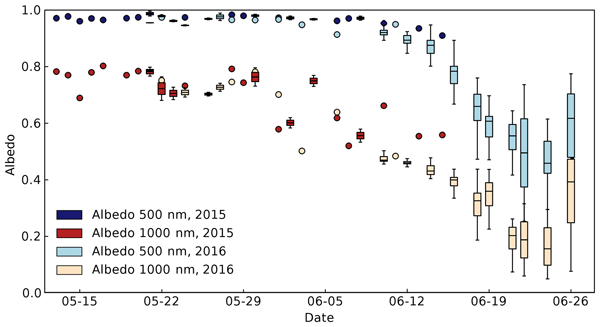
Snow physical properties on Arctic sea ice are monitored during the melt season. As snow grains grow, and the snowpack thickness is reduced, the surface albedo decreases. The extra absorbed energy accelerates melting. Radiative transfer modeling shows that more radiation is then transmitted to the snow–sea-ice interface. A sharp increase in transmitted radiation takes place when the snowpack thins significantly, and this coincides with the initiation of the phytoplankton bloom in the seawater.
Michael P. Hemming, Jan Kaiser, Jacqueline Boutin, Liliane Merlivat, Karen J. Heywood, Dorothee C. E. Bakker, Gareth A. Lee, Marcos Cobas García, David Antoine, and Kiminori Shitashima
Ocean Sci., 18, 1245–1262, https://doi.org/10.5194/os-18-1245-2022, https://doi.org/10.5194/os-18-1245-2022, 2022
Short summary
Short summary
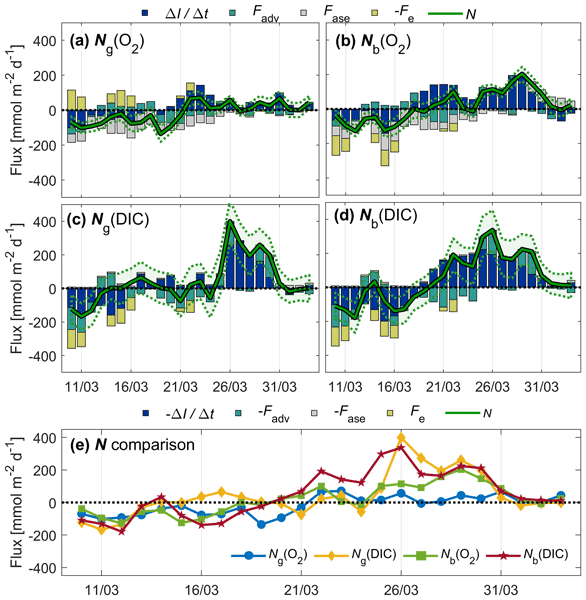
An underwater glider mission was carried out in spring 2016 near a mooring in the northwestern Mediterranean Sea. The glider deployment served as a test of a prototype ion-sensitive field-effect transistor pH sensor. Mean net community production rates were estimated from glider and buoy measurements of dissolved oxygen and inorganic carbon concentrations before and during the spring bloom. Incorporating advection is important for accurate mass budgets. Unexpected metabolic quotients were found.

Liliane Merlivat, Michael Hemming, Jacqueline Boutin, David Antoine, Vincenzo Vellucci, Melek Golbol, Gareth A. Lee, and Laurence Beaumont
Biogeosciences, 19, 3911–3920, https://doi.org/10.5194/bg-19-3911-2022, https://doi.org/10.5194/bg-19-3911-2022, 2022
Short summary
Short summary
We use in situ high-temporal-resolution measurements of dissolved inorganic carbon and atmospheric parameters at the air–sea interface to analyse phytoplankton bloom initiation identified as the net rate of biological carbon uptake in the Mediterranean Sea. The shift from wind-driven to buoyancy-driven mixing creates conditions for blooms to begin. Active mixing at the air–sea interface leads to the onset of the surface phytoplankton bloom due to the relaxation of wind speed following storms.
Léa Olivier, Jacqueline Boutin, Gilles Reverdin, Nathalie Lefèvre, Peter Landschützer, Sabrina Speich, Johannes Karstensen, Matthieu Labaste, Christophe Noisel, Markus Ritschel, Tobias Steinhoff, and Rik Wanninkhof
Biogeosciences, 19, 2969–2988, https://doi.org/10.5194/bg-19-2969-2022, https://doi.org/10.5194/bg-19-2969-2022, 2022
Short summary
Short summary
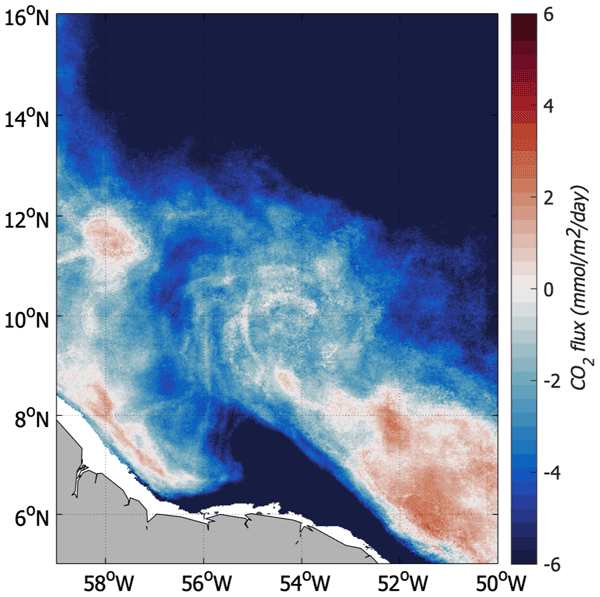
We investigate the impact of the interactions between eddies and the Amazon River plume on the CO2 air–sea fluxes to better characterize the ocean carbon sink in winter 2020. The region is a strong CO2 sink, previously underestimated by a factor of 10 due to a lack of data and understanding of the processes responsible for the variability in ocean carbon parameters. The CO2 absorption is mainly driven by freshwater from the Amazon entrained by eddies and by the winter seasonal cooling.
Fengguan Gu, Qinghua Yang, Frank Kauker, Changwei Liu, Guanghua Hao, Chao-Yuan Yang, Jiping Liu, Petra Heil, Xuewei Li, and Bo Han
The Cryosphere, 16, 1873–1887, https://doi.org/10.5194/tc-16-1873-2022, https://doi.org/10.5194/tc-16-1873-2022, 2022
Short summary
Short summary
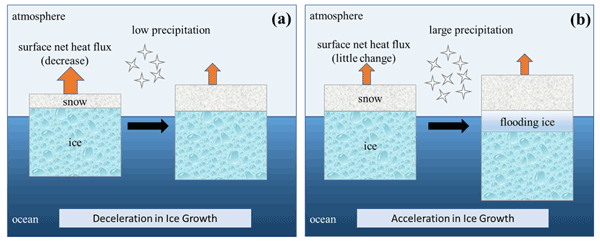
The sea ice thickness was simulated by a single-column model and compared with in situ observations obtained off Zhongshan Station in the Antarctic. It is shown that the unrealistic precipitation in the atmospheric forcing data leads to the largest bias in sea ice thickness and snow depth modeling. In addition, the increasing snow depth gradually inhibits the growth of sea ice associated with thermal blanketing by the snow.
Tian R. Tian, Alexander D. Fraser, Noriaki Kimura, Chen Zhao, and Petra Heil
The Cryosphere, 16, 1299–1314, https://doi.org/10.5194/tc-16-1299-2022, https://doi.org/10.5194/tc-16-1299-2022, 2022
Short summary
Short summary
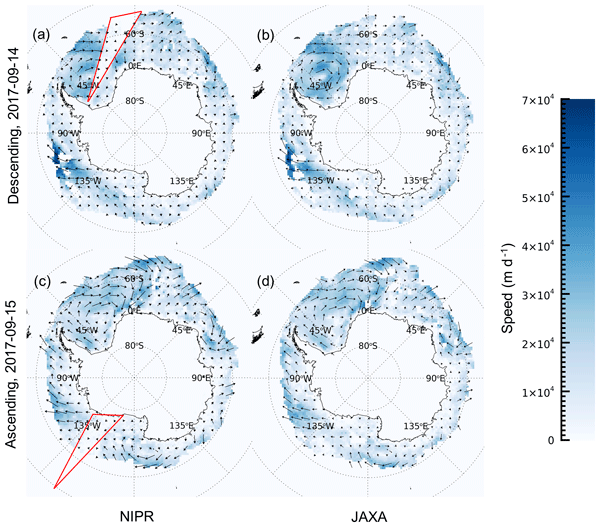
This study presents a comprehensive validation of a satellite observational sea ice motion product in Antarctica by using drifting buoys. Two problems existing in this sea ice motion product have been noticed. After rectifying problems, we use it to investigate the impacts of satellite observational configuration and timescale on Antarctic sea ice kinematics and suggest the future improvement of satellite missions specifically designed for retrieval of sea ice motion.
Alvaro Robledano, Ghislain Picard, Laurent Arnaud, Fanny Larue, and Inès Ollivier
The Cryosphere, 16, 559–579, https://doi.org/10.5194/tc-16-559-2022, https://doi.org/10.5194/tc-16-559-2022, 2022
Short summary
Short summary
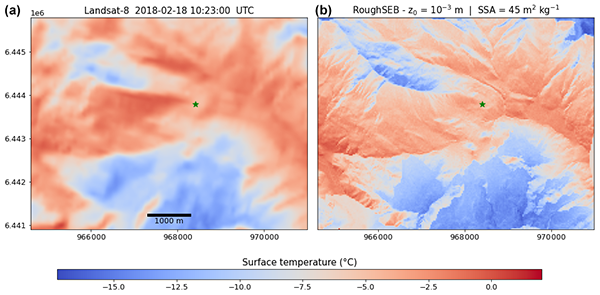
Topography controls the surface temperature of snow-covered, mountainous areas. We developed a modelling chain that uses ray-tracing methods to quantify the impact of a few topographic effects on snow surface temperature at high spatial resolution. Its large spatial and temporal variations are correctly simulated over a 50 km2 area in the French Alps, and our results show that excluding a single topographic effect results in cooling (or warming) effects on the order of 1 °C.
Joey J. Voermans, Qingxiang Liu, Aleksey Marchenko, Jean Rabault, Kirill Filchuk, Ivan Ryzhov, Petra Heil, Takuji Waseda, Takehiko Nose, Tsubasa Kodaira, Jingkai Li, and Alexander V. Babanin
The Cryosphere, 15, 5557–5575, https://doi.org/10.5194/tc-15-5557-2021, https://doi.org/10.5194/tc-15-5557-2021, 2021
Short summary
Short summary
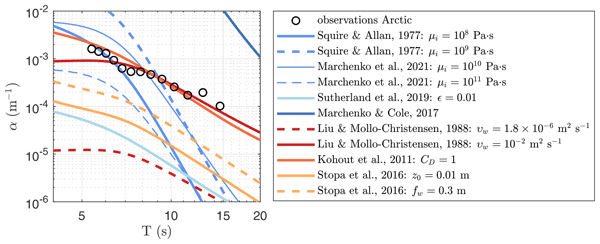
We have shown through field experiments that the amount of wave energy dissipated in landfast ice, sea ice attached to land, is much larger than in broken ice. By comparing our measurements against predictions of contemporary wave–ice interaction models, we determined which models can explain our observations and which cannot. Our results will improve our understanding of how waves and ice interact and how we can model such interactions to better forecast waves and ice in the polar regions.
Maria Belke-Brea, Florent Domine, Ghislain Picard, Mathieu Barrere, and Laurent Arnaud
Biogeosciences, 18, 5851–5869, https://doi.org/10.5194/bg-18-5851-2021, https://doi.org/10.5194/bg-18-5851-2021, 2021
Short summary
Short summary
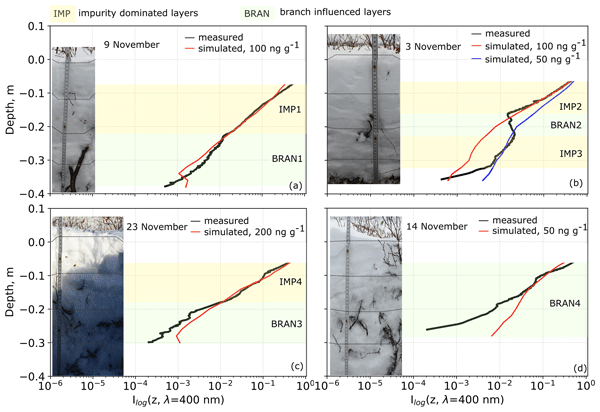
Expanding shrubs in the Arctic change snowpacks into a mix of snow, impurities and buried branches. Snow is a translucent medium into which light penetrates and gets partly absorbed by branches or impurities. Measurements of light attenuation in snow in Northern Quebec, Canada, showed (1) black-carbon-dominated light attenuation in snowpacks without shrubs and (2) buried branches influence radiation attenuation in snow locally, leading to melting and pockets of large crystals close to branches.
Cited articles
Akitaya, E.: Studies on depth hoar, Contributions from the Institute of Low Temperature Science, 26, 1–67, 1974. a
Andersen, S., Tonboe, R., Kern, S., and Schyberg, H.: Improved Retrieval of Sea Ice Total Concentration from Spaceborne Passive Microwave Observations Using Numerical Weather Prediction Model Fields: An Intercomparison of Nine Algorithms, Remote Sens. Environ., 104, 374–392, https://doi.org/10.1016/j.rse.2006.05.013, 2006. a, b, c, d, e, f, g, h
Andersen, S., Tonboe, R., Kaleschke, L., Heygster, G., and Pedersen, L. T.: Intercomparison of Passive Microwave Sea Ice Concentration Retrievals over the High-concentration Arctic Sea Ice, J. Geophys. Res.- Oceans, 112, 2006JC003543, https://doi.org/10.1029/2006JC003543, 2007. a, b
Bennetts, L. G., Bitz, C. M., Feltham, D. L., Kohout, A. L., and Meylan, M. H.: Marginal Ice Zone Dynamics: Future Research Perspectives and Pathways, Philos. T. R. Soc. A., 380, 20210267, https://doi.org/10.1098/rsta.2021.0267, 2022. a, b
Cavalieri, D. J.: A Microwave Technique for Mapping Thin Sea Ice, J. Geophys. Res.-Oceans, 99, 12561–12572, https://doi.org/10.1029/94JC00707, 1994. a
Cavalieri, D. J., Gloersen, P., and Campbell, W. J.: Determination of Sea Ice Parameters with the NIMBUS 7 SMMR, J. Geophys. Res.-Atmos., 89, 5355–5369, https://doi.org/10.1029/JD089iD04p05355, 1984. a, b
Cavalieri, D. J., St. Germain, K. M., and Swift, C. T.: Reduction of Weather Effects in the Calculation of Sea-Ice Concentration with the DMSP SSM/I, J. Glaciol., 41, 455–464, https://doi.org/10.3189/S0022143000034791, 1995. a
Comiso, J. C.: Characteristics of Arctic Winter Sea Ice from Satellite Multispectral Microwave Observations, J. Geophys. Res.-Oceans, 91, 975–994, https://doi.org/10.1029/JC091iC01p00975, 1986. a, b
Comiso, J. C.: Enhanced Sea Ice Concentrations and Ice Extents from AMSR-E Data, J. Remote Sens. Soc. Jpn., 29, 199–215, https://doi.org/10.11440/rssj.29.199, 2009. a
Comiso, J. C.: Polar Oceans from Space, Springer, New York, 1st edn., https://doi.org/10.1007/978-0-387-68300-3, 2010. a, b
Comiso, J. C.: Sea Ice Concentration Algorithm, in: Descriptions of GCOM-W1 AMSR2 Level 1R and Level 2 Algorithms, Japan Aerospace Exploration Agency (JAXA), Earth Observation Research Center, Doc. No. NDX-120015A, https://suzaku.eorc.jaxa.jp/GCOM_W/data/doc/NDX-120015A.pdf (last access: 16 June 2026), 2013. a, b, c, d
Comiso, J. C. and Steffen, K.: Studies of Antarctic Sea Ice Concentrations from Satellite Data and Their Applications, J. Geophys. Res.-Oceans, 106, 31361–31385, https://doi.org/10.1029/2001JC000823, 2001. a
Comiso, J. C. and Sullivan, C. W.: Satellite Microwave and in Situ Observations of the Weddell Sea Ice Cover and Its Marginal Ice Zone, J. Geophys. Res.-Oceans, 91, 9663–9681, https://doi.org/10.1029/JC091iC08p09663, 1986. a, b
Comiso, J. C., Ackley, S. F., and Gordon, A. L.: Antarctic Sea Ice Microwave Signatures and Their Correlation with in Situ Ice Observations, J. Geophys. Res.-Oceans, 89, 662–672, https://doi.org/10.1029/JC089iC01p00662, 1984. a
Comiso, J. C., Cavalieri, D. J., Parkinson, C. L., and Gloersen, P.: Passive Microwave Algorithms for Sea Ice Concentration: A Comparison of Two Techniques, Remote Sens. Environ., 60, 357–384, https://doi.org/10.1016/S0034-4257(96)00220-9, 1997. a
Comiso, J., Cavalieri, D., and Markus, T.: Sea Ice Concentration, Ice Temperature, and Snow Depth Using AMSR-E Data, IEEE T. Geosci. Remote, 41, 243–252, https://doi.org/10.1109/TGRS.2002.808317, 2003. a
Comiso, J. C., Gersten, R. A., Stock, L. V., Turner, J., Perez, G. J., and Cho, K.: Positive Trend in the Antarctic Sea Ice Cover and Associated Changes in Surface Temperature, J. Climate, 30, 2251–2267, https://doi.org/10.1175/JCLI-D-16-0408.1, 2017a. a
Comiso, J. C., Meier, W. N., and Gersten, R.: Variability and Trends in the Arctic Sea Ice Cover: Results from Different Techniques, J. Geophys. Res.-Oceans, 122, 6883–6900, https://doi.org/10.1002/2017JC012768, 2017b. a, b
Cox, G. F. N. and Weeks, W. F.: Equations for Determining the Gas and Brine Volumes in Sea-Ice Samples, J. Glaciol., 29, 306–316, https://doi.org/10.3189/S0022143000008364, 1983. a
Cox, G. F. N. and Weeks, W. F.: Numerical Simulations of the Profile Properties of Undeformed First-year Sea Ice during the Growth Season, J. Geophys. Res.-Oceans, 93, 12449–12460, https://doi.org/10.1029/JC093iC10p12449, 1988. a, b
Dinnat, E., English, S., Prigent, C., Kilic, L., Anguelova, M., Newman, S., Meissner, T., Boutin, J., Stoffelen, A., Yueh, S., Johnson, B., Weng, F., and Jimenez, C.: PARMIO: A Reference Quality Model for Ocean Surface Emissivity and Backscatter from the Microwave to the Infrared, B. Am. Meteorol. Soc., 104, E742–E748, https://doi.org/10.1175/BAMS-D-23-0023.1, 2023. a, b
Donelan, M. A., Dobson, F. W., Smith, S. D., and Anderson, R. J.: On the Dependence of Sea Surface Roughness on Wave Development, J. Phys. Oceanogr., 23, 2143–2149, https://doi.org/10.1175/1520-0485(1993)023<2143:OTDOSS>2.0.CO;2, 1993. a
Dumont, D.: Marginal Ice Zone Dynamics: History, Definitions and Research Perspectives, Philos. T. R. Soc. A, 380, 20210253, https://doi.org/10.1098/rsta.2021.0253, 2022. a
Elfouhaily, T., Chapron, B., Katsaros, K., and Vandemark, D.: A Unified Directional Spectrum for Long and Short Wind-driven Waves, J. Geophys. Res.-Oceans, 102, 15781–15796, https://doi.org/10.1029/97JC00467, 1997. a, b
Hersbach, H., Bell, B., Berrisford, P., Hirahara, S., Horányi, A., Muñoz-Sabater, J., Nicolas, J., Peubey, C., Radu, R., Schepers, D., Simmons, A., Soci, C., Abdalla, S., Abellan, X., Balsamo, G., Bechtold, P., Biavati, G., Bidlot, J., Bonavita, M., De Chiara, G., Dahlgren, P., Dee, D., Diamantakis, M., Dragani, R., Flemming, J., Forbes, R., Fuentes, M., Geer, A., Haimberger, L., Healy, S., Hogan, R. J., Hólm, E., Janisková, M., Keeley, S., Laloyaux, P., Lopez, P., Lupu, C., Radnoti, G., De Rosnay, P., Rozum, I., Vamborg, F., Villaume, S., and Thépaut, J.-N.: The ERA5 Global Reanalysis, Q. J. Roy. Meteor. Soc., 146, 1999–2049, https://doi.org/10.1002/qj.3803, 2020. a
Ivanova, N., Johannessen, O. M., Pedersen, L. T., and Tonboe, R. T.: Retrieval of Arctic Sea Ice Parameters by Satellite Passive Microwave Sensors: A Comparison of Eleven Sea Ice Concentration Algorithms, IEEE T. Geosci. Remote, 52, 7233–7246, https://doi.org/10.1109/TGRS.2014.2310136, 2014. a
Ivanova, N., Pedersen, L. T., Tonboe, R. T., Kern, S., Heygster, G., Lavergne, T., Sørensen, A., Saldo, R., Dybkjær, G., Brucker, L., and Shokr, M.: Inter-comparison and evaluation of sea ice algorithms: towards further identification of challenges and optimal approach using passive microwave observations, The Cryosphere, 9, 1797–1817, https://doi.org/10.5194/tc-9-1797-2015, 2015. a, b, c, d, e, f, g, h
Kern, S.: A New Method for Medium-Resolution Sea Ice Analysis Using Weather-Influence Corrected Special Sensor Microwave/Imager 85 GHz Data, Int. J. Remote Sens., 25, 4555–4582, https://doi.org/10.1080/01431160410001698898, 2004. a, b
Kern, S., Lavergne, T., Notz, D., Pedersen, L. T., Tonboe, R. T., Saldo, R., and Sørensen, A. M.: Satellite passive microwave sea-ice concentration data set intercomparison: closed ice and ship-based observations, The Cryosphere, 13, 3261–3307, https://doi.org/10.5194/tc-13-3261-2019, 2019. a, b, c, d, e
Kern, S., Lavergne, T., Pedersen, L. T., Tonboe, R. T., Bell, L., Meyer, M., and Zeigermann, L.: Satellite passive microwave sea-ice concentration data set intercomparison using Landsat data, The Cryosphere, 16, 349–378, https://doi.org/10.5194/tc-16-349-2022, 2022. a, b, c
Kwok, R., Comiso, J. C., Martin, S., and Drucker, R.: Ross Sea Polynyas: Response of Ice Concentration Retrievals to Large Areas of Thin Ice, J. Geophys. Res.-Oceans, 112, 2006JC003967, https://doi.org/10.1029/2006JC003967, 2007. a
Larosa, S., Cimini, D., Gallucci, D., Nilo, S. T., and Romano, F.: PyRTlib: an educational Python-based library for non-scattering atmospheric microwave radiative transfer computations, Geosci. Model Dev., 17, 2053–2076, https://doi.org/10.5194/gmd-17-2053-2024, 2024. a
Lavergne, T., Sørensen, A. M., Kern, S., Tonboe, R., Notz, D., Aaboe, S., Bell, L., Dybkjær, G., Eastwood, S., Gabarro, C., Heygster, G., Killie, M. A., Brandt Kreiner, M., Lavelle, J., Saldo, R., Sandven, S., and Pedersen, L. T.: Version 2 of the EUMETSAT OSI SAF and ESA CCI sea-ice concentration climate data records, The Cryosphere, 13, 49–78, https://doi.org/10.5194/tc-13-49-2019, 2019. a, b, c, d, e, f, g, h
Lavergne, T., Kern, S., Aaboe, S., Derby, L., Dybkjaer, G., Garric, G., Heil, P., Hendricks, S., Holfort, J., Howell, S., Key, J., Lieser, J. L., Maksym, T., Maslowski, W., Meier, W., Muñoz-Sabater, J., Nicolas, J., Özsoy, B., Rabe, B., Rack, W., Raphael, M., De Rosnay, P., Smolyanitsky, V., Tietsche, S., Ukita, J., Vichi, M., Wagner, P., Willmes, S., and Zhao, X.: A New Structure for the Sea Ice Essential Climate Variables of the Global Climate Observing System, B. Am. Meteorol. Soc., 103, E1502–E1521, https://doi.org/10.1175/BAMS-D-21-0227.1, 2022. a
Lawrence, I. R., Ridout, A. L., Shepherd, A., and Tilling, R.: A Simulation of Snow on Antarctic Sea Ice Based on Satellite Data and Climate Reanalyses, J. Geophys. Res.-Oceans, 129, e2022JC019002, https://doi.org/10.1029/2022JC019002, 2024. a
Lewis, M., Tison, J., Weissling, B., Delille, B., Ackley, S., Brabant, F., and Xie, H.: Sea Ice and Snow Cover Characteristics during the Winter–Spring Transition in the Bellingshausen Sea: An Overview of SIMBA 2007, Deep-Sea Res. Pt. II, 58, 1019–1038, https://doi.org/10.1016/j.dsr2.2010.10.027, 2011. a, b, c, d, e, f, g
Macelloni, G., Paloscia, S., Pampaloni, P., and Tedesco, M.: Microwave Emission from Dry Snow: A Comparison of Experimental and Model Results, IEEE T. Geosci. Remote, 39, 2649–2656, https://doi.org/10.1109/36.974999, 2001. a, b
Makarov, D., Tretyakov, M. Y., and Rosenkranz, P.: 60-GHz Oxygen Band: Precise Experimental Profiles and Extended Absorption Modeling in a Wide Temperature Range, J. Quant. Spectrosc. Ra., 112, 1420–1428, https://doi.org/10.1016/j.jqsrt.2011.02.018, 2011. a
Maksym, T.: Arctic and Antarctic Sea Ice Change: Contrasts, Commonalities, and Causes, Annu. Rev. Mar. Sci., 11, 187–213, https://doi.org/10.1146/annurev-marine-010816-060610, 2019. a
Markus, T. and Cavalieri, D.: An Enhancement of the NASA Team Sea Ice Algorithm, IEEE T. Geosci. Remote, 38, 1387–1398, https://doi.org/10.1109/36.843033, 2000. a
Massom, R. A., Eicken, H., Hass, C., Jeffries, M. O., Drinkwater, M. R., Sturm, M., Worby, A. P., Wu, X., Lytle, V. I., Ushio, S., Morris, K., Reid, P. A., Warren, S. G., and Allison, I.: Snow on Antarctic Sea Ice, Rev. Geophys., 39, 413–445, https://doi.org/10.1029/2000RG000085, 2001. a, b, c, d, e, f, g, h, i, j, k, l
Mathew, N., Heygster, G., and Melsheimer, C.: Surface Emissivity of the Arctic Sea Ice at AMSR-E Frequencies, IEEE T. Geosci. Remote, 47, 4115–4124, https://doi.org/10.1109/TGRS.2009.2023667, 2009. a
Matsumura, Y. and Ohshima, K. I.: Lagrangian Modelling of Frazil Ice in the Ocean, Ann. Glaciol., 56, 373–382, https://doi.org/10.3189/2015aog69a657, 2015. a
Mätzler, C. (Ed.): Thermal Microwave Radiation: Applications for Remote Sensing, in: IET Electromagnetic Waves Series, IET, London, ISBN 978-0-86341-573-9978-1-84919-002-2, https://doi.org/10.1049/PBEW052E, 2006. a
Mätzler, C. and Wiesmann, A.: Documentation for MEMLS, Version 3, Microwave Emission Model of Layered Snowpacks, Tech. rep., Institute of Applied Physics, University of Bern, Bern, Switzerland, https://github.com/akasurak/memls_TVC/blob/master/ (last access: 12 August 26), 2012. a
Meier, W. N. and Notz, D.: A note on the accuracy and reliability of satellite-derived passive microwave estimates of sea-ice extent, CliC Arctic Sea Ice Working Group, Consensus Document, CliC International Project Office, Tromsø, Norway, https://www.arcus.org/files/sio/936/clicseaicereliabilityreport.pdf (last access: 12 August 2026), 2010. a
Meier, W. N. and Stewart, J. S.: Assessment of the Stability of Passive Microwave Brightness Temperatures for NASA Team Sea Ice Concentration Retrievals, Remote Sens., 12, 2197, https://doi.org/10.3390/rs12142197, 2020. a, b
Meier, W. N. and Stroeve, J.: Comparison of Sea-Ice Extent and Ice-Edge Location Estimates from Passive Microwave and Enhanced-Resolution Scatterometer Data, Ann. Glaciol., 48, 65–70, https://doi.org/10.3189/172756408784700743, 2008. a
Meissner, T. and Wentz, F.: An Updated Analysis of the Ocean Surface Wind Direction Signal in Passive Microwave Brightness Temperatures, IEEE T. Geosci. Remote, 40, 1230–1240, https://doi.org/10.1109/TGRS.2002.800231, 2002. a
Meshkov, A. I. and De Lucia, F. C.: Laboratory Measurements of Dry Air Atmospheric Absorption with a Millimeter Wave Cavity Ringdown Spectrometer, J. Quant. Spectrosc. Ra., 108, 256–276, https://doi.org/10.1016/j.jqsrt.2007.04.001, 2007. a
Monahan, E. and Lu, M.: Acoustically Relevant Bubble Assemblages and Their Dependence on Meteorological Parameters, IEEE J. Oceanic Eng., 15, 340–349, https://doi.org/10.1109/48.103530, 1990. a
Montpetit, B., Royer, A., Roy, A., Langlois, A., and Derksen, C.: Snow Microwave Emission Modeling of Ice Lenses Within a Snowpack Using the Microwave Emission Model for Layered Snowpacks, IEEE T. Geosci. Remote, 51, 4705–4717, https://doi.org/10.1109/TGRS.2013.2250509, 2013. a
Morison, J. and McPhee, M.: Ice–Ocean Interaction, in: Encyclopedia of Ocean Sciences, Elsevier, 1271–1281, ISBN 978-0-12-227430-5, https://doi.org/10.1006/rwos.2001.0003, 2001. a
Naoki, K., Ukita, J., Nishio, F., Nakayama, M., Comiso, J. C., and Gasiewski, A.: Thin Sea Ice Thickness as Inferred from Passive Microwave and in Situ Observations, J. Geophys. Res.-Oceans, 113, 2007JC004270, https://doi.org/10.1029/2007JC004270, 2008. a, b, c
Nicolaus, M., Haas, C., and Willmes, S.: Evolution of First-year and Second-year Snow Properties on Sea Ice in the Weddell Sea during Spring-summer Transition, J. Geophys. Res.-Atmos., 114, 2008JD011227, https://doi.org/10.1029/2008JD011227, 2009. a, b, c
Niederdrenk, A. L. and Notz, D.: Arctic Sea Ice in a 1.5 °C Warmer World, Geophys. Res. Lett., 45, 1963–1971, https://doi.org/10.1002/2017GL076159, 2018. a
Nose, T., Waseda, T., Kodaira, T., and Inoue, J.: Satellite-retrieved sea ice concentration uncertainty and its effect on modelling wave evolution in marginal ice zones, The Cryosphere, 14, 2029–2052, https://doi.org/10.5194/tc-14-2029-2020, 2020. a
Notz, D. and Worster, M. G.: In Situ Measurements of the Evolution of Young Sea Ice, J. Geophys. Res.-Oceans, 113, 2007JC004333, https://doi.org/10.1029/2007JC004333, 2008. a, b
Notz, D. and Worster, M. G.: Desalination Processes of Sea Ice Revisited, J. Geophys. Res.-Oceans, 114, 2008JC004885, https://doi.org/10.1029/2008JC004885, 2009. a
Oelke, C.: Atmospheric Signatures in Sea-Ice Concentration Estimates from Passive Microwaves: Modelled and Observed, International Journal of Remote Sensing, 18, 1113–1136, https://doi.org/10.1080/014311697218601, 1997. a, b, c
Parkinson, C. L. and Cavalieri, D. J.: Arctic Sea Ice Variability and Trends, 1979–2006, J. Geophys. Res.-Oceans, 113, https://doi.org/10.1029/2007jc004558, 2008. a
Petrich, C. and Eicken, H.: Overview of Sea Ice Growth and Properties, in: Sea Ice, edited by: Thomas, D. N., Wiley, 1st edn., 1–41, ISBN 978-1-118-77838-8 978-1-118-77837-1, https://doi.org/10.1002/9781118778371.ch1, 2017. a, b, c
Picard, G., Royer, A., Arnaud, L., and Fily, M.: Influence of meter-scale wind-formed features on the variability of the microwave brightness temperature around Dome C in Antarctica, The Cryosphere, 8, 1105–1119, https://doi.org/10.5194/tc-8-1105-2014, 2014. a
Picard, G., Sandells, M., and Löwe, H.: SMRT: an active–passive microwave radiative transfer model for snow with multiple microstructure and scattering formulations (v1.0), Geosci. Model Dev., 11, 2763–2788, https://doi.org/10.5194/gmd-11-2763-2018, 2018. a, b
Picard, G., Löwe, H., Domine, F., Arnaud, L., Larue, F., Favier, V., Le Meur, E., Lefebvre, E., Savarino, J., and Royer, A.: The Microwave Snow Grain Size: A New Concept to Predict Satellite Observations Over Snow-Covered Regions, AGU Advances, 3, e2021AV000630, https://doi.org/10.1029/2021AV000630, 2022a. a, b, c
Picard, G., Löwe, H., and Mätzler, C.: Brief communication: A continuous formulation of microwave scattering from fresh snow to bubbly ice from first principles, The Cryosphere, 16, 3861–3866, https://doi.org/10.5194/tc-16-3861-2022, 2022b. a, b
Polder, D. and Van Santeen, J.: The Effective Permeability of Mixtures of Solids, Physica, 12, 257–271, https://doi.org/10.1016/S0031-8914(46)80066-1, 1946. a
Purich, A. and Doddridge, E. W.: Record Low Antarctic Sea Ice Coverage Indicates a New Sea Ice State, Communications Earth & Environment, 4, 314, https://doi.org/10.1038/s43247-023-00961-9, 2023. a
Raphael, M. N. and Hobbs, W.: The Influence of the Large-scale Atmospheric Circulation on Antarctic Sea Ice during Ice Advance and Retreat Seasons, Geophys. Res. Lett., 41, 5037–5045, https://doi.org/10.1002/2014GL060365, 2014. a
Soriot, C., Picard, G., Prigent, C., Frappart, F., and Domine, F.: Year-Round Sea Ice and Snow Characterization from Combined Passive and Active Microwave Observations and Radiative Transfer Modeling, Remote Sens. Environ., 278, 113061, https://doi.org/10.1016/j.rse.2022.113061, 2022. a
Spreen, G., Kaleschke, L., and Heygster, G.: Sea Ice Remote Sensing Using AMSR-E 89-GHz Channels, J. Geophys. Res.-Oceans, 113, 2005JC003384, https://doi.org/10.1029/2005JC003384, 2008. a
Steffen, K. and Schweiger, A.: NASA Team Algorithm for Sea Ice Concentration Retrieval from Defense Meteorological Satellite Program Special Sensor Microwave Imager: Comparison with Landsat Satellite Imagery, J. Geophys. Res.-Oceans, 96, 21971–21987, https://doi.org/10.1029/91JC02334, 1991. a
Stentella, M.: StentelMarta/Uncertainty_Antarctic_SIC_retrievals: v1.0 (Version v1.0), Zenodo [computer software], https://doi.org/10.5281/zenodo.21915970, 2026. a
Strong, C. and Rigor, I. G.: Arctic Marginal Ice Zone Trending Wider in Summer and Narrower in Winter, Geophys. Res. Lett., 40, 4864–4868, https://doi.org/10.1002/grl.50928, 2013. a, b
Swift, C. T., Fedor, L. S., and Ramseier, R. O.: An Algorithm to Measure Sea Ice Concentration with Microwave Radiometers, J. Geophys. Res.-Oceans, 90, 1087–1099, https://doi.org/10.1029/jc090ic01p01087, 1985. a, b
Tonboe, R. T.: The Simulated Sea Ice Thermal Microwave Emission at Window and Sounding Frequencies, Tellus A, 62, 333–344, https://doi.org/10.1111/j.1600-0870.2010.00434.x, 2010. a
Tonboe, R. T., Dybkjær, G., and Høyer, J. L.: Simulations of the Snow Covered Sea Ice Surface Temperature and Microwave Effective Temperature, Tellus A, 63, 1028, https://doi.org/10.1111/j.1600-0870.2011.00530.x, 2011. a, b
Tonboe, R. T., Eastwood, S., Lavergne, T., Sørensen, A. M., Rathmann, N., Dybkjær, G., Pedersen, L. T., Høyer, J. L., and Kern, S.: The EUMETSAT sea ice concentration climate data record, The Cryosphere, 10, 2275–2290, https://doi.org/10.5194/tc-10-2275-2016, 2016. a, b
Tonboe, R. T., Nandan, V., Makynen, M., Pedersen, L. T., Kern, S., Lavergne, T., Oelund, J., Dybkjaer, G., Saldo, R., and Huntemann, M.: Simulated Geophysical Noise in Sea Ice Concentration Estimates of Open Water and Snow-Covered Sea Ice, IEEE J. Sel. Top. Appl., 15, 1309–1326, https://doi.org/10.1109/JSTARS.2021.3134021, 2022. a, b, c, d, e, f, g
Tonboe, R. T., Nandan, V., Huntemann, M., Stroeve, J., Scharien, R., Yackel, J., Kaleschke, L., Shi, H., and Casal, T.: Estimation of sea ice air-bubble and brine pocket distribution for scattering and emission model parametrization, EGUsphere [preprint], https://doi.org/10.5194/egusphere-2026-1440, 2026. a, b
Torquato, S. and Kim, J.: Nonlocal Effective Electromagnetic Wave Characteristics of Composite Media: Beyond the Quasistatic Regime, Phys. Rev. X, 11, 021002, https://doi.org/10.1103/PhysRevX.11.021002, 2021. a
Toyota, T., Massom, R., Tateyama, K., Tamura, T., and Fraser, A.: Properties of Snow Overlying the Sea Ice off East Antarctica in Late Winter, 2007, Deep-Sea Res. Pt. II, 58, 1137–1148, https://doi.org/10.1016/j.dsr2.2010.12.002, 2011. a
Tsang, L., Kong, J. A., and Shin, R. T.: Theory of Microwave Remote Sensing, Wiley Series in Remote Sensing, Wiley, New York, ISBN 978-0-471-88860-4, 1985. a
Vichi, M.: An indicator of sea ice variability for the Antarctic marginal ice zone, The Cryosphere, 16, 4087–4106, https://doi.org/10.5194/tc-16-4087-2022, 2022. a, b
Wang, Z., Fraser, A. D., Reid, P., O'Farrell, S., and Coleman, R.: Antarctic Sea Ice Surface Temperature Bias in Atmospheric Reanalyses Induced by the Combined Effects of Sea Ice and Clouds, Communications Earth & Environment, 5, 552, https://doi.org/10.1038/s43247-024-01692-1, 2024. a
Weeks, W. and Lee, O.: The Salinity Distribution in Young Sea-Ice, ARCTIC, 15, 92–108, https://doi.org/10.14430/arctic3562, 1962. a, b
Worby, A.: Studies of the Antarctic Sea Ice Edge and Ice Extent from Satellite and Ship Observations, Remote Sens. Environ., 92, 98–111, https://doi.org/10.1016/j.rse.2004.05.007, 2004. a
Yin, X., Boutin, J., Dinnat, E., Song, Q., and Martin, A.: Roughness and Foam Signature on SMOS-MIRAS Brightness Temperatures: A Semi-Theoretical Approach, Remote Sens. Environ., 180, 221–233, https://doi.org/10.1016/j.rse.2016.02.005, 2016. a
Short summary
Passive microwave radiometers are the primary tool for monitoring Antarctic sea ice, but their reliability decreases in the marginal ice zone between the pack ice and the open ocean. We simulate satellite observations to assess the impact of varying physical parameters on sea ice concentration retrievals. The largest errors are due to flooded/wet snow, thin ice, and roughened ocean surfaces. These findings can improve our interpretation of satellite observations and forecast sea ice changes.
Passive microwave radiometers are the primary tool for monitoring Antarctic sea ice, but their...


