
Articles | Volume 20, issue 5
https://doi.org/10.5194/tc-20-2793-2026
© Author(s) 2026. This work is distributed under
the Creative Commons Attribution 4.0 License.
the Creative Commons Attribution 4.0 License.
https://doi.org/10.5194/tc-20-2793-2026
© Author(s) 2026. This work is distributed under
the Creative Commons Attribution 4.0 License.
the Creative Commons Attribution 4.0 License.
Research article
| 
20 May 2026
Research article |
| 20 May 2026
| 20 May 2026
Radiostratigraphy and surface accumulation history of the Amundsen-Weddell Ice Divide, West Antarctica
Felipe Napoleoni
CORRESPONDING AUTHOR

Department of Geography, Durham University, Durham, UK
School of Geosciences, University of Edinburgh, Edinburgh, UK
Michael J. Bentley
Department of Geography, Durham University, Durham, UK
Neil Ross
School of Geography, Politics and Sociology, Newcastle University, Newcastle upon Tyne, UK
Stewart S. R. Jamieson
Department of Geography, Durham University, Durham, UK
José A. Uribe
Instituto de Ciencia y Exploración, Santiago, Chile
Jonathan Oberreuter
Instituto de Ciencia y Exploración, Santiago, Chile
Instituto de Ciencias de la Tierra, Universidad Austral de Chile, Valdivia, Chile
Rodrigo Zamora
Instituto de Ciencia y Exploración, Santiago, Chile
Andrés Rivera
Departamento de Geografía, Universidad de Chile, Santiago, Chile
Andrew M. Smith
British Antarctic Survey, Cambridge, UK
Robert G. Bingham
School of Geosciences, University of Edinburgh, Edinburgh, UK
Kenichi Matsuoka
Norwegian Polar Institute, Framsenteret, Hjalmar Johansens gate 14, 9296 Tromsø, Norway
Related authors
Neil Ross, Rebecca J. Sanderson, Bernd Kulessa, Martin Siegert, Guy J. G. Paxman, Keir A. Nichols, Matthew R. Siegfried, Stewart S. R. Jamieson, Michael J. Bentley, Tom A. Jordan, Christine L. Batchelor, David Small, Olaf Eisen, Kate Winter, Robert G. Bingham, S. Louise Callard, Rachel Carr, Christine F. Dow, Helen A. Fricker, Emily Hill, Benjamin H. Hills, Coen Hofstede, Hafeez Jeofry, Felipe Napoleoni, and Wilson Sauthoff
The Cryosphere, 20, 3705–3737, https://doi.org/10.5194/tc-20-3705-2026, https://doi.org/10.5194/tc-20-3705-2026, 2026
Short summary
Short summary
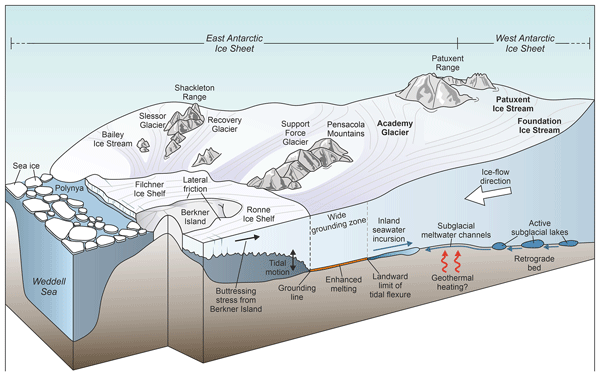
We review research about a group of fast-flowing Antarctic ice streams, the Foundation-Patuxent-Academy System. Previously, we knew little about how these ice streams flow, how they interact with each other and the ocean, what their geological history was, and how they might evolve in a warming world. By reviewing existing research, we have identified the future research needed to determine how these ice streams function, and how they might contribute to future global sea level rise.
Rebecca McCerery, Joseph A. Graly, Christopher L. Hansen, Kate Winter, William P. Gilhooly III, Trinity L. Hamilton, Moses Jatta, Jeff R. Havig, Felipe Napoleoni, Alicia M. Rutledge, Matthew Terrell, Tanya M. Trott, Kayla Woodie, Bernd Kulessa, Sevi Modestou, Hannah Bahrani, Tori Kennedy, Alexandra Messerli, and Kathy Licht
EGUsphere, https://doi.org/10.5194/egusphere-2026-2131, https://doi.org/10.5194/egusphere-2026-2131, 2026
Short summary
Short summary
Ice cores from Isunnguata Sermia’s forefield reveal how proglacial naled and accreted ices form in Greenland. Naledi build up in winter from precipitation and mineral-rich subglacial water, while accreted ice forms in summer through supercooled water upwelling. Geophysical surveys indicate both are fed by subsurface flows potentially originating from the glacier bed hundreds of metres away. Here, we present the first conceptual model of these formations in Greenland.
Robert G. Bingham, Julien A. Bodart, Marie G. P. Cavitte, Ailsa Chung, Rebecca J. Sanderson, Johannes C. R. Sutter, Olaf Eisen, Nanna B. Karlsson, Joseph A. MacGregor, Neil Ross, Duncan A. Young, David W. Ashmore, Andreas Born, Winnie Chu, Xiangbin Cui, Reinhard Drews, Steven Franke, Vikram Goel, John W. Goodge, A. Clara J. Henry, Antoine Hermant, Benjamin H. Hills, Nicholas Holschuh, Michelle R. Koutnik, Gwendolyn J.-M. C. Leysinger Vieli, Emma J. MacKie, Elisa Mantelli, Carlos Martín, Felix S. L. Ng, Falk M. Oraschewski, Felipe Napoleoni, Frédéric Parrenin, Sergey V. Popov, Therese Rieckh, Rebecca Schlegel, Dustin M. Schroeder, Martin J. Siegert, Xueyuan Tang, Thomas O. Teisberg, Kate Winter, Shuai Yan, Harry Davis, Christine F. Dow, Tyler J. Fudge, Tom A. Jordan, Bernd Kulessa, Kenichi Matsuoka, Clara J. Nyqvist, Maryam Rahnemoonfar, Matthew R. Siegfried, Shivangini Singh, Vjeran Višnjević, Rodrigo Zamora, and Alexandra Zuhr
The Cryosphere, 19, 4611–4655, https://doi.org/10.5194/tc-19-4611-2025, https://doi.org/10.5194/tc-19-4611-2025, 2025
Short summary
Short summary
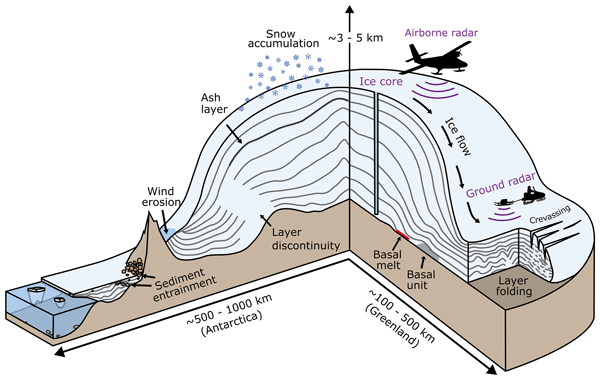
The ice sheets covering Antarctica have built up over millenia through successive snowfall events which become buried and preserved as internal surfaces of equal age detectable with ice-penetrating radar. This paper describes an international initiative working together on these archival data to build a comprehensive 3-D picture of how old the ice is everywhere across Antarctica and how this is being used to reconstruct past and to predict future ice and climate behaviour.
Charlotte M. Carter, Michael J. Bentley, Stewart S. R. Jamieson, Guy J. G. Paxman, Tom A. Jordan, Julien A. Bodart, Neil Ross, and Felipe Napoleoni
The Cryosphere, 18, 2277–2296, https://doi.org/10.5194/tc-18-2277-2024, https://doi.org/10.5194/tc-18-2277-2024, 2024
Short summary
Short summary
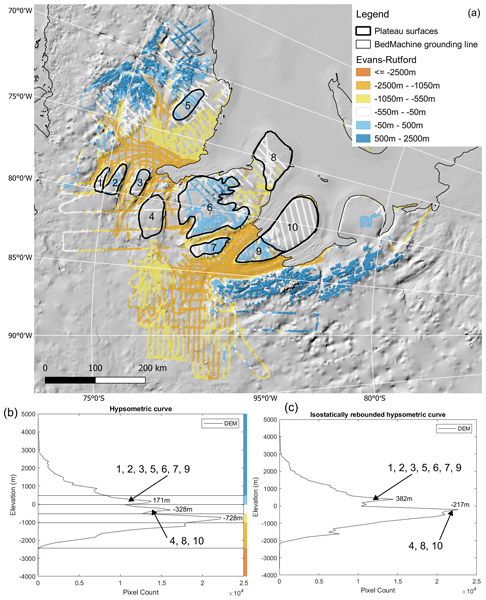
We use radio-echo sounding data to investigate the presence of flat surfaces beneath the Evans–Rutford region in West Antarctica. These surfaces may be what remains of laterally continuous surfaces, formed before the inception of the West Antarctic Ice Sheet, and we assess two hypotheses for their formation. Tectonic structures in the region may have also had a control on the growth of the ice sheet by focusing ice flow into troughs adjoining these surfaces.
Tobias Roylands, Robert G. Hilton, Erin L. McClymont, Mark H. Garnett, Guillaume Soulet, Sébastien Klotz, Mathis Degler, Felipe Napoleoni, and Caroline Le Bouteiller
Earth Surf. Dynam., 12, 271–299, https://doi.org/10.5194/esurf-12-271-2024, https://doi.org/10.5194/esurf-12-271-2024, 2024
Short summary
Short summary
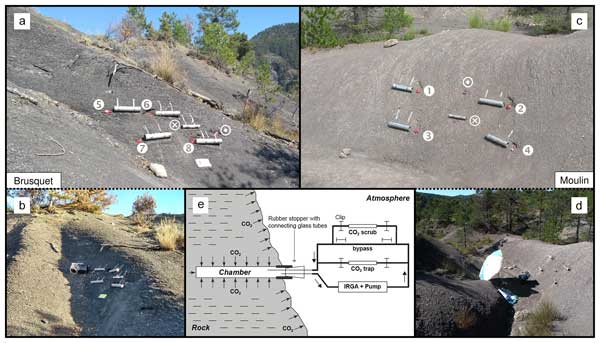
Chemical weathering of sedimentary rocks can release carbon dioxide and consume oxygen. We present a new field-based method to measure the exchange of these gases in real time, which allows us to directly compare the amount of reactants and products. By studying two sites with different rock types, we show that the chemical composition is an important factor in driving the weathering reactions. Locally, the carbon dioxide release changes alongside temperature and precipitation.
Rebecca J. Sanderson, Kate Winter, S. Louise Callard, Felipe Napoleoni, Neil Ross, Tom A. Jordan, and Robert G. Bingham
The Cryosphere, 17, 4853–4871, https://doi.org/10.5194/tc-17-4853-2023, https://doi.org/10.5194/tc-17-4853-2023, 2023
Short summary
Short summary
Ice-penetrating radar allows us to explore the internal structure of glaciers and ice sheets to constrain past and present ice-flow conditions. In this paper, we examine englacial layers within the Lambert Glacier in East Antarctica using a quantitative layer tracing tool. Analysis reveals that the ice flow here has been relatively stable, but evidence for former fast flow along a tributary suggests that changes have occurred in the past and could change again in the future.
Matilda Weatherley, Chris R. Stokes, Stewart S. R. Jamieson, Sindhu Ramanath, and Alessandro Silvano
The Cryosphere, 20, 5509–5532, https://doi.org/10.5194/tc-20-5509-2026, https://doi.org/10.5194/tc-20-5509-2026, 2026
Short summary
Short summary
Parts of the East Antarctic Ice Sheet rest on a bed below sea level, making them vulnerable to ice dynamic changes and instability, but few glaciers have been studied in detail. Here we report on glaciers draining into Porpoise Bay, Wilkes Land, overlying the Aurora Subglacial Basin. We find ice surface thinning, grounding line retreat and ice surface velocity increase over recent decades, consistent with warm ocean waters intrusion. This highlights this region's vulnerability to future warming.
Guy J. G. Paxman, Fiona J. Clubb, Stewart S. R. Jamieson, and Alexander L. Densmore
Earth Surf. Dynam., 14, 575–599, https://doi.org/10.5194/esurf-14-575-2026, https://doi.org/10.5194/esurf-14-575-2026, 2026
Short summary
Short summary
This study focusses on the Gamburtsev Subglacial Mountains, a 600 km-long mountain range that is completely hidden beneath the Antarctic Ice Sheet. We look at the valley networks within the Gamburtsevs and use these to understand how the mountains formed. Our main findings are that the valleys were first cut by rivers that existed before Antarctica was glaciated, the shape of the valleys is affected by the bedrock geology, and the mountains are probably younger than previously thought.
Rahul Dey, Chavarukonam M. Laluraj, Kenichi Matsuoka, Ashish Paiguinkar, Bhikaji L. Redkar, and Meloth Thamban
The Cryosphere, 20, 4117–4131, https://doi.org/10.5194/tc-20-4117-2026, https://doi.org/10.5194/tc-20-4117-2026, 2026
Short summary
Short summary
We present a 250-year reconstruction of the Maud Rise Polynya opening, using an ice core collected from coastal Antarctica. This polynya is considered a rare phenomenon in the Weddell Sea, with only two well-documented openings since the 1970s. However, our 250-year record reveals numerous past polynya events, including occurrences possibly comparable in scale to the Great Weddell Polynya of 1974–1976, suggesting that these openings are a part of the Southern Ocean's natural variability.
Neil Ross, Rebecca J. Sanderson, Bernd Kulessa, Martin Siegert, Guy J. G. Paxman, Keir A. Nichols, Matthew R. Siegfried, Stewart S. R. Jamieson, Michael J. Bentley, Tom A. Jordan, Christine L. Batchelor, David Small, Olaf Eisen, Kate Winter, Robert G. Bingham, S. Louise Callard, Rachel Carr, Christine F. Dow, Helen A. Fricker, Emily Hill, Benjamin H. Hills, Coen Hofstede, Hafeez Jeofry, Felipe Napoleoni, and Wilson Sauthoff
The Cryosphere, 20, 3705–3737, https://doi.org/10.5194/tc-20-3705-2026, https://doi.org/10.5194/tc-20-3705-2026, 2026
Short summary
Short summary
We review research about a group of fast-flowing Antarctic ice streams, the Foundation-Patuxent-Academy System. Previously, we knew little about how these ice streams flow, how they interact with each other and the ocean, what their geological history was, and how they might evolve in a warming world. By reviewing existing research, we have identified the future research needed to determine how these ice streams function, and how they might contribute to future global sea level rise.
Zhuo Wang, Neil Ross, Thomas Frank, Jamie Barnett, Ilaria Santin, Martin Houssais, Johanna Dahlkvist, and Nina Kirchner
Earth Syst. Sci. Data, 18, 4241–4262, https://doi.org/10.5194/essd-18-4241-2026, https://doi.org/10.5194/essd-18-4241-2026, 2026
Short summary
Short summary
Under global warming, Sweden's remaining glaciers are shrinking rapidly, and all four Swedish reference glaciers (Mårmaglaciären, Storglaciären, Rabots glaciär, and Riukojietna) may disappear within this century. To better project their future evolution, we measured the ice thickness of the four glaciers using radio-echo sounding and mapped the bed topography beneath the ice. These maps provide essential insights into future landscapes, ecosystems, and policymaking.
Harry J. Davis, Robert G. Bingham, Carlos Martín, Elizabeth R. Thomas, Andrew S. Hein, and Anna E. Hogg
The Cryosphere, 20, 2735–2756, https://doi.org/10.5194/tc-20-2735-2026, https://doi.org/10.5194/tc-20-2735-2026, 2026
Short summary
Short summary
Ice in the southern Antarctic Peninsula is experiencing major ice changes today and predicting the rate at which this may continue is important. One way to address this knowledge gap would be to retrieve a past climate record from an ice core. We identify a suitable site using a model constrained by radar and shallow ice core data. We find a climate record spanning the Holocene can certainly be extracted here, but a potential continuous climate record here could extend back ~ 30 000 years.
Calvin Shackleton, Kenichi Matsuoka, Brett Fraysher, Joohan Lee, Jørgen Dall, Allain Rapadas, Prasad Gogineni, Drew Taylor, Hyeon Tae Ju, Changhyun Chung, and Anders Kusk
EGUsphere, https://doi.org/10.5194/egusphere-2026-2357, https://doi.org/10.5194/egusphere-2026-2357, 2026
Short summary
Short summary
We map new details of the landscape beneath the Antarctic Ice Sheet near Dome C using radar data and simulation methods. The terrain is rougher than previously thought, and we identify where water flow is either well or poorly understood. We also show that valleys and ridges could amplify or reduce geothermal heating, impacting melting at the ice sheet base. These results improve confidence in locating sites where ancient ice may be preserved for drilling and studying past climates.
Rebecca McCerery, Joseph A. Graly, Christopher L. Hansen, Kate Winter, William P. Gilhooly III, Trinity L. Hamilton, Moses Jatta, Jeff R. Havig, Felipe Napoleoni, Alicia M. Rutledge, Matthew Terrell, Tanya M. Trott, Kayla Woodie, Bernd Kulessa, Sevi Modestou, Hannah Bahrani, Tori Kennedy, Alexandra Messerli, and Kathy Licht
EGUsphere, https://doi.org/10.5194/egusphere-2026-2131, https://doi.org/10.5194/egusphere-2026-2131, 2026
Short summary
Short summary
Ice cores from Isunnguata Sermia’s forefield reveal how proglacial naled and accreted ices form in Greenland. Naledi build up in winter from precipitation and mineral-rich subglacial water, while accreted ice forms in summer through supercooled water upwelling. Geophysical surveys indicate both are fed by subsurface flows potentially originating from the glacier bed hundreds of metres away. Here, we present the first conceptual model of these formations in Greenland.
Vikram Goel, Carlos Martín, Kenichi Matsuoka, Bhanu Pratap, Geir Moholdt, Rahul Dey, Chavarukonam M. Laluraj, and Meloth Thamban
The Cryosphere, 20, 1363–1378, https://doi.org/10.5194/tc-20-1363-2026, https://doi.org/10.5194/tc-20-1363-2026, 2026
Short summary
Short summary
We identified an ideal site in coastal East Antarctica for extracting ice core that contain detailed climate records dating back 20 000 years. We surveyed two ice rises combining radar measurements with ice flow modeling to assess their suitability. One site emerged as optimal, offering well-preserved climate history with high temporal resolution. An ice core record from this site could help us understand historical interactions between sea ice, winds, and precipitation patterns in the region.
Mirko Scheinert, Weisen Shen, Richard C. Aster, Lambert Caron, Michael D. Hartinger, Matt A. King, Andrew Lloyd, Anya M. Reading, J. Paul Winberry, Terry Wilson, Lucilla Alfonsi, Michael J. Bentley, Eric Buchta, Thomas Y. Chen, Peter J. Clarke, Jörg Ebbing, Olaf Eisen, Natalya Gomez, Esra Günaydın, Samantha Hansen, Erik R. Ivins, Achraf Koulali, Grace A. Nield, Frederick Richards, Mahmut O. Selbesoglu, Stephanie Sherman, Pippa L. Whitehouse, and Matthias Willen
EGUsphere, https://doi.org/10.5194/egusphere-2025-6370, https://doi.org/10.5194/egusphere-2025-6370, 2026
Short summary
Short summary
With an ongoing mass loss the Antarctic Ice Sheet contributes to global-mean sea level rise at a rate of 0.4 mm/a. Thus, it plays a key role in global climate and provides a natural laboratory to study processes that interlink cryosphere, solid Earth, atmosphere and ocean. We discuss how GNSS and seismic networks in Antarctica were used to significantly advance our understanding of these processes, and how they should be maintained and extended to answer key science questions in the future.
Jiao Chen, Rebecca A. Hodge, Stewart S. R. Jamieson, and Chris R. Stokes
EGUsphere, https://doi.org/10.5194/egusphere-2025-5562, https://doi.org/10.5194/egusphere-2025-5562, 2026
Short summary
Short summary
Supraglacial channel networks mediate meltwater transport over ice shelves and may influence their stability. Our mapping of Nivlisen Ice Shelf from satellite imagery shows significant variation in interannual and seasonal channel extent. During warm summers channels become increasingly connected, redistributing meltwater from high to low elevations across the ice shelf. Channel location is controlled by ice shelf structure, and annual extent is correlated with regional air temperature.
Kevin Hank, Robert J. Arthern, C. Rosie Williams, Alex M. Brisbourne, Andrew M. Smith, James A. Smith, Anna Wåhlin, and Sridhar Anandakrishnan
The Cryosphere, 20, 495–510, https://doi.org/10.5194/tc-20-495-2026, https://doi.org/10.5194/tc-20-495-2026, 2026
Short summary
Short summary
The slipperiness at the ice base is a key uncertainty in sea level rise projections. Alternative formulations of the sliding law exist, but limited access to the ice base makes it difficult to validate them. We introduce a new approach using observations and model output to infer a basal sliding law. For Pine Island Glacier, currently the largest single contributor to sea level rise in Antarctica, the results provide support for a Coulomb-type sliding law and widespread low effective pressures.
Holly Wytiahlowsky, Chris R. Stokes, Rebecca A. Hodge, Caroline C. Clason, and Stewart S. R. Jamieson
The Cryosphere, 19, 6461–6482, https://doi.org/10.5194/tc-19-6461-2025, https://doi.org/10.5194/tc-19-6461-2025, 2025
Short summary
Short summary
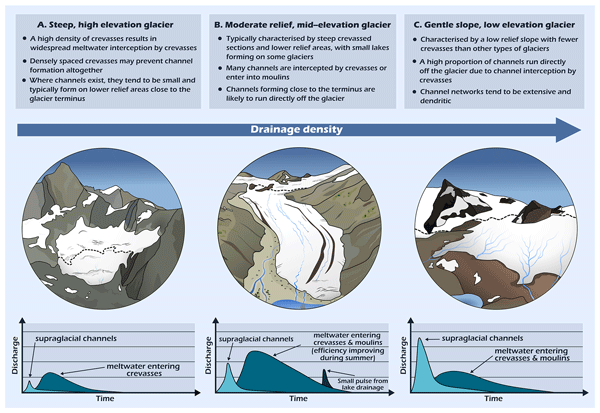
Channels on glaciers are important due to their role in transporting glacial meltwater into downstream river catchments. These channels have received little research in mountain environments. We manually mapped <2000 channels to determine their distribution and characteristics across 285 glaciers in Switzerland. We find that channels are mostly commonly found on low-elevation glaciers with gentle slopes and few crevasses. Most channels run off the glacier, but 20 % enter the glacier.
Mark A. Stevenson, Dominic A. Hodgson, Michael J. Bentley, Darren R. Gröcke, Neil Tunstall, Chris Longley, Alice Graham, and Erin L. McClymont
Clim. Past, 21, 2465–2483, https://doi.org/10.5194/cp-21-2465-2025, https://doi.org/10.5194/cp-21-2465-2025, 2025
Short summary
Short summary
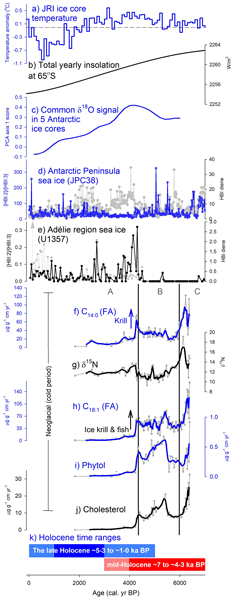
We present a record of sea ice and climate inferred from novel snow petrel stomach oil deposits from East Antarctica. Snow petrels feed in the sea ice on a mixture of marine organisms and regurgitate these oils close to their nesting sites in nunatak mountains. We use makers of past diet and productivity from within a deposit to show how sea ice and climate has varied over part of the Holocene. Three periods are identified ranging from low to intermediate and increased sea ice cover.
Guojun Li, Tong Hao, Zhongbo Huang, Chen Lv, Liang Tang, Shi Li, Xiangbin Cui, Bo Sun, Kenichi Matsuoka, and Rongxing Li
Int. Arch. Photogramm. Remote Sens. Spatial Inf. Sci., XLVIII-4-W14-2025, 113–119, https://doi.org/10.5194/isprs-archives-XLVIII-4-W14-2025-113-2025, https://doi.org/10.5194/isprs-archives-XLVIII-4-W14-2025-113-2025, 2025
Jonas Liebsch, Jörg Ebbing, and Kenichi Matsuoka
Solid Earth, 16, 1401–1420, https://doi.org/10.5194/se-16-1401-2025, https://doi.org/10.5194/se-16-1401-2025, 2025
Short summary
Short summary
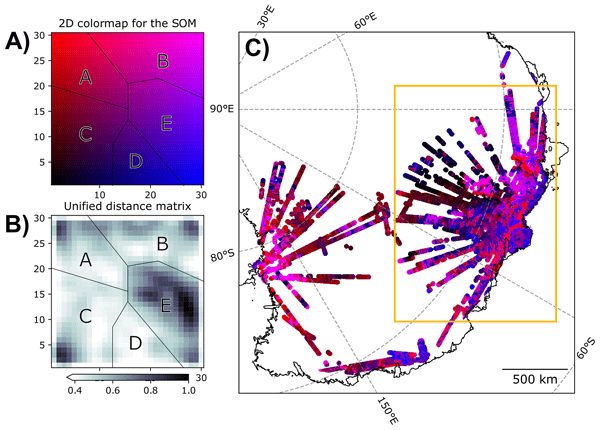
The evolution of the Antarctic ice sheets depends, in addition to factors representing the warming climate, on the earth structure beneath the ice. What’s beneath the ice is largely inaccessible for direct sampling, but can be interpreted with the use of airborne measurements. We apply an unsupervised machine learning method to such data in East Antarctica to test whether this can ease interpretation and hence our understanding of what rocks types are beneath the ice.
Robert G. Bingham, Julien A. Bodart, Marie G. P. Cavitte, Ailsa Chung, Rebecca J. Sanderson, Johannes C. R. Sutter, Olaf Eisen, Nanna B. Karlsson, Joseph A. MacGregor, Neil Ross, Duncan A. Young, David W. Ashmore, Andreas Born, Winnie Chu, Xiangbin Cui, Reinhard Drews, Steven Franke, Vikram Goel, John W. Goodge, A. Clara J. Henry, Antoine Hermant, Benjamin H. Hills, Nicholas Holschuh, Michelle R. Koutnik, Gwendolyn J.-M. C. Leysinger Vieli, Emma J. MacKie, Elisa Mantelli, Carlos Martín, Felix S. L. Ng, Falk M. Oraschewski, Felipe Napoleoni, Frédéric Parrenin, Sergey V. Popov, Therese Rieckh, Rebecca Schlegel, Dustin M. Schroeder, Martin J. Siegert, Xueyuan Tang, Thomas O. Teisberg, Kate Winter, Shuai Yan, Harry Davis, Christine F. Dow, Tyler J. Fudge, Tom A. Jordan, Bernd Kulessa, Kenichi Matsuoka, Clara J. Nyqvist, Maryam Rahnemoonfar, Matthew R. Siegfried, Shivangini Singh, Vjeran Višnjević, Rodrigo Zamora, and Alexandra Zuhr
The Cryosphere, 19, 4611–4655, https://doi.org/10.5194/tc-19-4611-2025, https://doi.org/10.5194/tc-19-4611-2025, 2025
Short summary
Short summary
The ice sheets covering Antarctica have built up over millenia through successive snowfall events which become buried and preserved as internal surfaces of equal age detectable with ice-penetrating radar. This paper describes an international initiative working together on these archival data to build a comprehensive 3-D picture of how old the ice is everywhere across Antarctica and how this is being used to reconstruct past and to predict future ice and climate behaviour.
Bertie W. J. Miles, Tian Li, and Robert G. Bingham
The Cryosphere, 19, 4027–4043, https://doi.org/10.5194/tc-19-4027-2025, https://doi.org/10.5194/tc-19-4027-2025, 2025
Short summary
Short summary
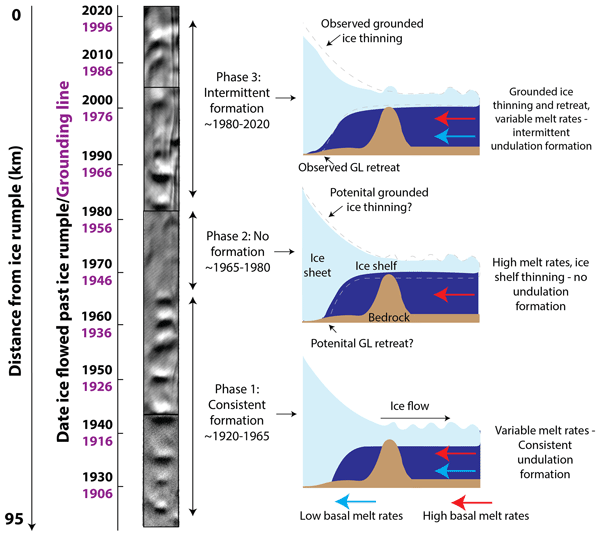
Totten Glacier, East Antarctica's largest mass-loss source, has thinned since at least the 1990s. No sustained acceleration has occurred since 1973, but earlier grounding-line retreat suggests prior loss. A ~20-year gap in surface undulations implies a mid-20th-century warm period that may have triggered ongoing loss. Collapse of a nearby ice shelf supports this. Current ~30-year satellite records are too short to capture full decadal melt-rate variability.
Jennifer F. Arthur, Calvin Shackleton, Geir Moholdt, Kenichi Matsuoka, and Jelte van Oostveen
The Cryosphere, 19, 375–392, https://doi.org/10.5194/tc-19-375-2025, https://doi.org/10.5194/tc-19-375-2025, 2025
Short summary
Short summary
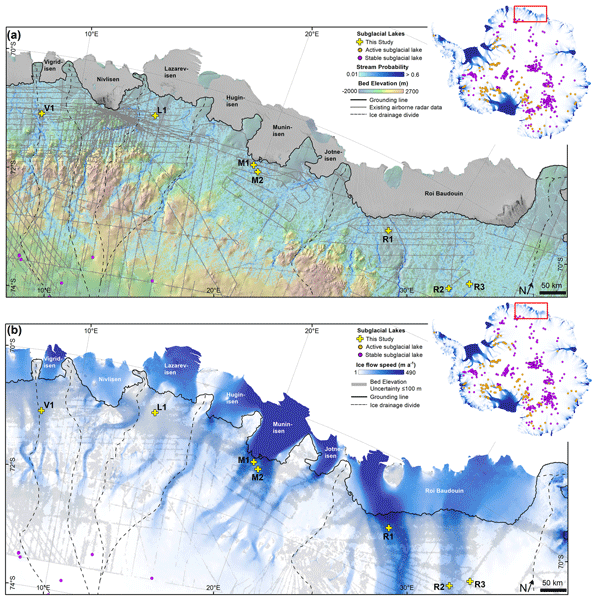
Lakes can form beneath the large ice sheets and can influence ice-sheet dynamics and stability. Some of these subglacial lakes are active, meaning that they periodically drain and refill. Here we report seven new active subglacial lakes close to the Antarctic Ice Sheet margin using satellite measurements of ice surface height changes in a region where little was known previously. These findings improve our understanding of subglacial hydrology and will help refine subglacial hydrological models.
Camilo Rada, Andrés Rivera, and Sebastián Alfaro
Int. Arch. Photogramm. Remote Sens. Spatial Inf. Sci., XLVIII-2-W6-2024, 37–43, https://doi.org/10.5194/isprs-archives-XLVIII-2-W6-2024-37-2024, https://doi.org/10.5194/isprs-archives-XLVIII-2-W6-2024-37-2024, 2024
Esteban Lannutti, Pablo Marmolejo, José Sanchez, Ignacio Ortíz, María G. Lenzano, Silvana Moragues, Andrés Rivera, Paulina Vacaflor, Gustavo Pereyra, and Hugo Morales
Int. Arch. Photogramm. Remote Sens. Spatial Inf. Sci., XLVIII-2-W6-2024, 13–18, https://doi.org/10.5194/isprs-archives-XLVIII-2-W6-2024-13-2024, https://doi.org/10.5194/isprs-archives-XLVIII-2-W6-2024-13-2024, 2024
Eledath M. Gayathri, Chavarukonam M. Laluraj, Karathazhiyath Satheesan, Kenichi Matsuoka, Mahalinganathan Kanthanathan, and Meloth Thamban
EGUsphere, https://doi.org/10.5194/egusphere-2024-1666, https://doi.org/10.5194/egusphere-2024-1666, 2024
Preprint archived
Short summary
Short summary
Here, we study the effects of short–term atmospheric warming events on the ice sheet surface and subsurface temperatures of coastal Dronning Maud Land during 2014–2018. Our results revealed that the impact of warming events over ice sheet surface and subsurface temperatures varies with the mechanism of warming and prevailing meteorological conditions. The frequency and duration of such events are important for the surface and sub-surface processes of ice sheets.
Charlotte M. Carter, Michael J. Bentley, Stewart S. R. Jamieson, Guy J. G. Paxman, Tom A. Jordan, Julien A. Bodart, Neil Ross, and Felipe Napoleoni
The Cryosphere, 18, 2277–2296, https://doi.org/10.5194/tc-18-2277-2024, https://doi.org/10.5194/tc-18-2277-2024, 2024
Short summary
Short summary
We use radio-echo sounding data to investigate the presence of flat surfaces beneath the Evans–Rutford region in West Antarctica. These surfaces may be what remains of laterally continuous surfaces, formed before the inception of the West Antarctic Ice Sheet, and we assess two hypotheses for their formation. Tectonic structures in the region may have also had a control on the growth of the ice sheet by focusing ice flow into troughs adjoining these surfaces.
Edmund J. Lea, Stewart S. R. Jamieson, and Michael J. Bentley
The Cryosphere, 18, 1733–1751, https://doi.org/10.5194/tc-18-1733-2024, https://doi.org/10.5194/tc-18-1733-2024, 2024
Short summary
Short summary
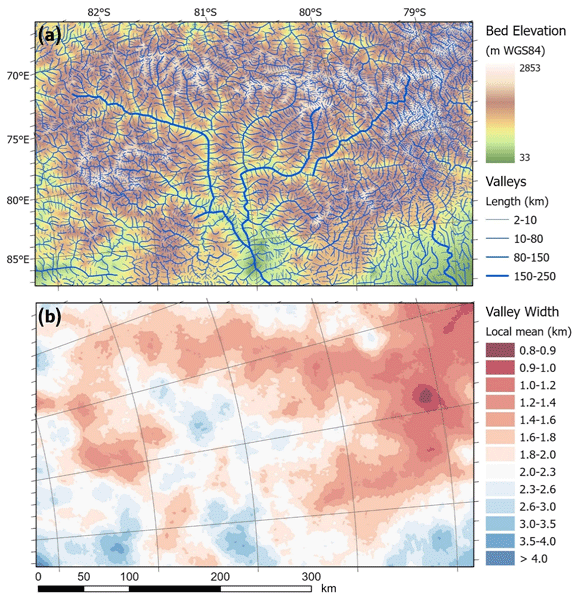
We use the ice surface expression of the Gamburtsev Subglacial Mountains in East Antarctica to map the horizontal pattern of valleys and ridges in finer detail than possible from previous methods. In upland areas, valleys are spaced much less than 5 km apart, with consequences for the distribution of melting at the bed and hence the likelihood of ancient ice being preserved. Automated mapping techniques were tested alongside manual approaches, with a hybrid approach recommended for future work.
Guy J. G. Paxman, Stewart S. R. Jamieson, Aisling M. Dolan, and Michael J. Bentley
The Cryosphere, 18, 1467–1493, https://doi.org/10.5194/tc-18-1467-2024, https://doi.org/10.5194/tc-18-1467-2024, 2024
Short summary
Short summary
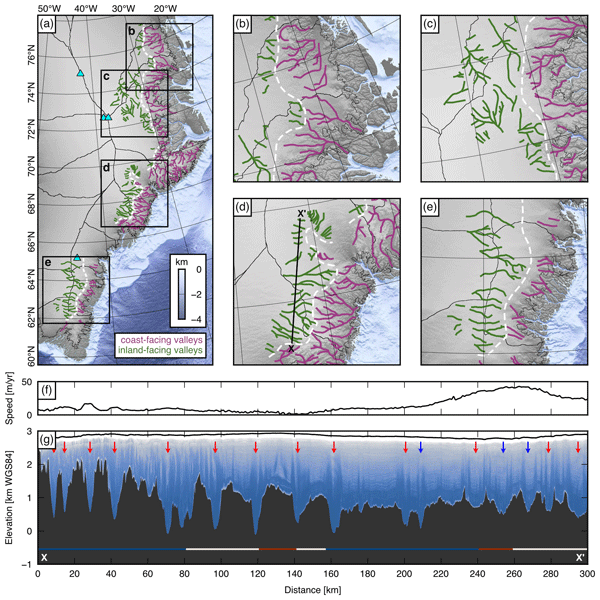
This study uses airborne radar data and satellite imagery to map mountainous topography hidden beneath the Greenland Ice Sheet. We find that the landscape records the former extent and configuration of ice masses that were restricted to areas of high topography. Computer models of ice flow indicate that valley glaciers eroded this landscape millions of years ago when local air temperatures were at least 4 °C higher than today and Greenland’s ice volume was < 10 % of that of the modern ice sheet.
Tobias Roylands, Robert G. Hilton, Erin L. McClymont, Mark H. Garnett, Guillaume Soulet, Sébastien Klotz, Mathis Degler, Felipe Napoleoni, and Caroline Le Bouteiller
Earth Surf. Dynam., 12, 271–299, https://doi.org/10.5194/esurf-12-271-2024, https://doi.org/10.5194/esurf-12-271-2024, 2024
Short summary
Short summary
Chemical weathering of sedimentary rocks can release carbon dioxide and consume oxygen. We present a new field-based method to measure the exchange of these gases in real time, which allows us to directly compare the amount of reactants and products. By studying two sites with different rock types, we show that the chemical composition is an important factor in driving the weathering reactions. Locally, the carbon dioxide release changes alongside temperature and precipitation.
Eledath M. Gayathri, Chavarukonam M. Laluraj, Karathazhiyath Satheesan, Kenichi Matsuoka, and Meloth Thamban
EGUsphere, https://doi.org/10.5194/egusphere-2023-2515, https://doi.org/10.5194/egusphere-2023-2515, 2023
Preprint archived
Short summary
Short summary
Episodic Antarctic Ice Sheet Surface Warming events can affect the mass balance of ice sheets by sublimation and melting during summer. Our study using five-year borehole thermistor measurements revealed two types of events over the coastal Dronning Maud Land region: cloud-induced and wind-induced. Understanding the frequency and duration of these events is important for predicting their future impacts on ice shelves and ice sheets.
Rebecca J. Sanderson, Kate Winter, S. Louise Callard, Felipe Napoleoni, Neil Ross, Tom A. Jordan, and Robert G. Bingham
The Cryosphere, 17, 4853–4871, https://doi.org/10.5194/tc-17-4853-2023, https://doi.org/10.5194/tc-17-4853-2023, 2023
Short summary
Short summary
Ice-penetrating radar allows us to explore the internal structure of glaciers and ice sheets to constrain past and present ice-flow conditions. In this paper, we examine englacial layers within the Lambert Glacier in East Antarctica using a quantitative layer tracing tool. Analysis reveals that the ice flow here has been relatively stable, but evidence for former fast flow along a tributary suggests that changes have occurred in the past and could change again in the future.
Marie G. P. Cavitte, Hugues Goosse, Kenichi Matsuoka, Sarah Wauthy, Vikram Goel, Rahul Dey, Bhanu Pratap, Brice Van Liefferinge, Thamban Meloth, and Jean-Louis Tison
The Cryosphere, 17, 4779–4795, https://doi.org/10.5194/tc-17-4779-2023, https://doi.org/10.5194/tc-17-4779-2023, 2023
Short summary
Short summary
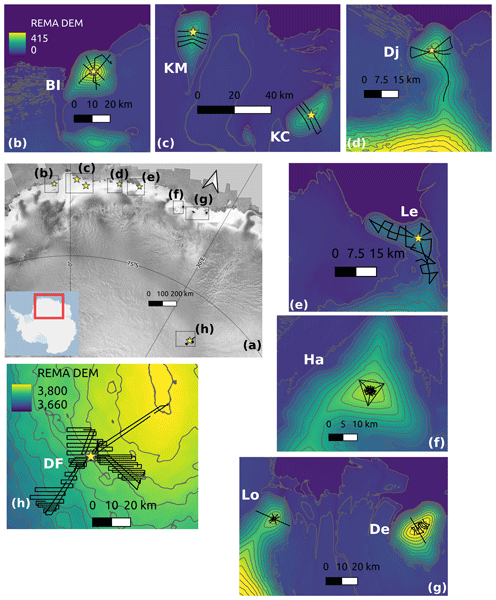
The net accumulation of snow over Antarctica is key for assessing current and future sea-level rise. Ice cores record a noisy snowfall signal to verify model simulations. We find that ice core net snowfall is biased to lower values for ice rises and the Dome Fuji site (Antarctica), while the relative uncertainty in measuring snowfall increases rapidly with distance away from the ice core sites at the ice rises but not at Dome Fuji. Spatial variation in snowfall must therefore be considered.
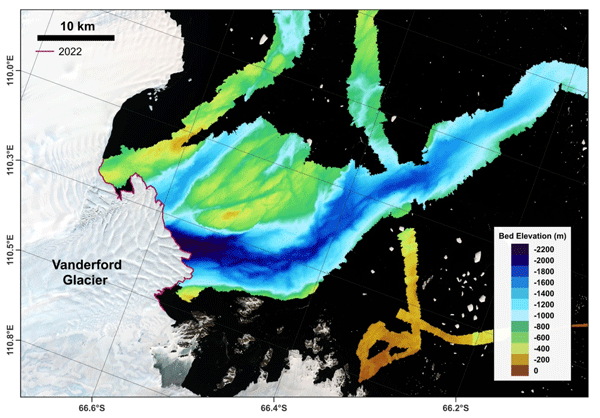
Hannah J. Picton, Chris R. Stokes, Stewart S. R. Jamieson, Dana Floricioiu, and Lukas Krieger
The Cryosphere, 17, 3593–3616, https://doi.org/10.5194/tc-17-3593-2023, https://doi.org/10.5194/tc-17-3593-2023, 2023
Short summary
Short summary
This study provides an overview of recent ice dynamics within Vincennes Bay, Wilkes Land, East Antarctica. This region was recently discovered to be vulnerable to intrusions of warm water capable of driving basal melt. Our results show extensive grounding-line retreat at Vanderford Glacier, estimated at 18.6 km between 1996 and 2020. This supports the notion that the warm water is able to access deep cavities below the Vanderford Ice Shelf, potentially making Vanderford Glacier unstable.
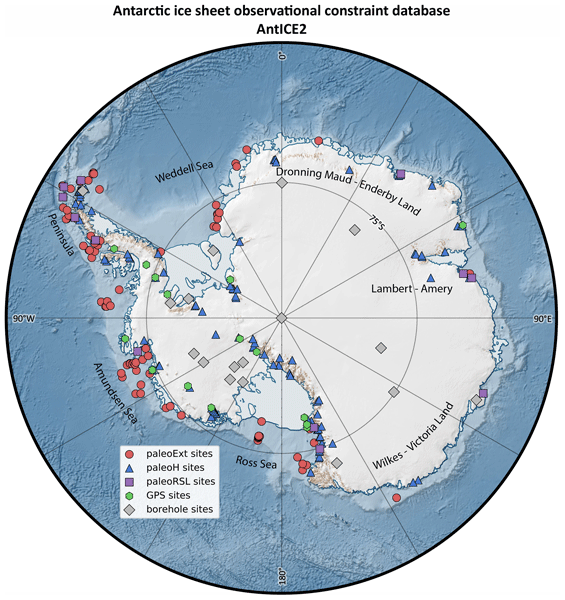
Benoit S. Lecavalier, Lev Tarasov, Greg Balco, Perry Spector, Claus-Dieter Hillenbrand, Christo Buizert, Catherine Ritz, Marion Leduc-Leballeur, Robert Mulvaney, Pippa L. Whitehouse, Michael J. Bentley, and Jonathan Bamber
Earth Syst. Sci. Data, 15, 3573–3596, https://doi.org/10.5194/essd-15-3573-2023, https://doi.org/10.5194/essd-15-3573-2023, 2023
Short summary
Short summary
The Antarctic Ice Sheet Evolution constraint database version 2 (AntICE2) consists of a large variety of observations that constrain the evolution of the Antarctic Ice Sheet over the last glacial cycle. This includes observations of past ice sheet extent, past ice thickness, past relative sea level, borehole temperature profiles, and present-day bedrock displacement rates. The database is intended to improve our understanding of past Antarctic changes and for ice sheet model calibrations.
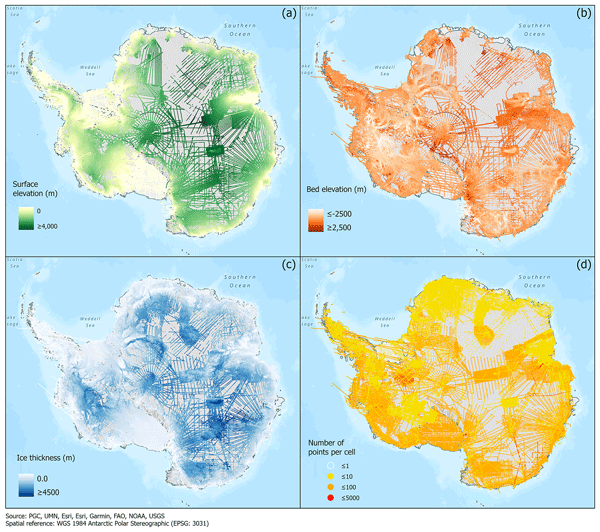
Alice C. Frémand, Peter Fretwell, Julien A. Bodart, Hamish D. Pritchard, Alan Aitken, Jonathan L. Bamber, Robin Bell, Cesidio Bianchi, Robert G. Bingham, Donald D. Blankenship, Gino Casassa, Ginny Catania, Knut Christianson, Howard Conway, Hugh F. J. Corr, Xiangbin Cui, Detlef Damaske, Volkmar Damm, Reinhard Drews, Graeme Eagles, Olaf Eisen, Hannes Eisermann, Fausto Ferraccioli, Elena Field, René Forsberg, Steven Franke, Shuji Fujita, Yonggyu Gim, Vikram Goel, Siva Prasad Gogineni, Jamin Greenbaum, Benjamin Hills, Richard C. A. Hindmarsh, Andrew O. Hoffman, Per Holmlund, Nicholas Holschuh, John W. Holt, Annika N. Horlings, Angelika Humbert, Robert W. Jacobel, Daniela Jansen, Adrian Jenkins, Wilfried Jokat, Tom Jordan, Edward King, Jack Kohler, William Krabill, Mette Kusk Gillespie, Kirsty Langley, Joohan Lee, German Leitchenkov, Carlton Leuschen, Bruce Luyendyk, Joseph MacGregor, Emma MacKie, Kenichi Matsuoka, Mathieu Morlighem, Jérémie Mouginot, Frank O. Nitsche, Yoshifumi Nogi, Ole A. Nost, John Paden, Frank Pattyn, Sergey V. Popov, Eric Rignot, David M. Rippin, Andrés Rivera, Jason Roberts, Neil Ross, Anotonia Ruppel, Dustin M. Schroeder, Martin J. Siegert, Andrew M. Smith, Daniel Steinhage, Michael Studinger, Bo Sun, Ignazio Tabacco, Kirsty Tinto, Stefano Urbini, David Vaughan, Brian C. Welch, Douglas S. Wilson, Duncan A. Young, and Achille Zirizzotti
Earth Syst. Sci. Data, 15, 2695–2710, https://doi.org/10.5194/essd-15-2695-2023, https://doi.org/10.5194/essd-15-2695-2023, 2023
Short summary
Short summary
This paper presents the release of over 60 years of ice thickness, bed elevation, and surface elevation data acquired over Antarctica by the international community. These data are a crucial component of the Antarctic Bedmap initiative which aims to produce a new map and datasets of Antarctic ice thickness and bed topography for the international glaciology and geophysical community.
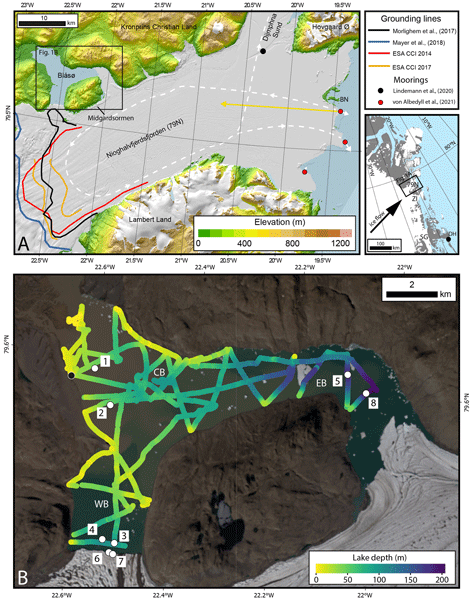
Michael J. Bentley, James A. Smith, Stewart S. R. Jamieson, Margaret R. Lindeman, Brice R. Rea, Angelika Humbert, Timothy P. Lane, Christopher M. Darvill, Jeremy M. Lloyd, Fiamma Straneo, Veit Helm, and David H. Roberts
The Cryosphere, 17, 1821–1837, https://doi.org/10.5194/tc-17-1821-2023, https://doi.org/10.5194/tc-17-1821-2023, 2023
Short summary
Short summary
The Northeast Greenland Ice Stream is a major outlet of the Greenland Ice Sheet. Some of its outlet glaciers and ice shelves have been breaking up and retreating, with inflows of warm ocean water identified as the likely reason. Here we report direct measurements of warm ocean water in an unusual lake that is connected to the ocean beneath the ice shelf in front of the 79° N Glacier. This glacier has not yet shown much retreat, but the presence of warm water makes future retreat more likely.
Julien A. Bodart, Robert G. Bingham, Duncan A. Young, Joseph A. MacGregor, David W. Ashmore, Enrica Quartini, Andrew S. Hein, David G. Vaughan, and Donald D. Blankenship
The Cryosphere, 17, 1497–1512, https://doi.org/10.5194/tc-17-1497-2023, https://doi.org/10.5194/tc-17-1497-2023, 2023
Short summary
Short summary
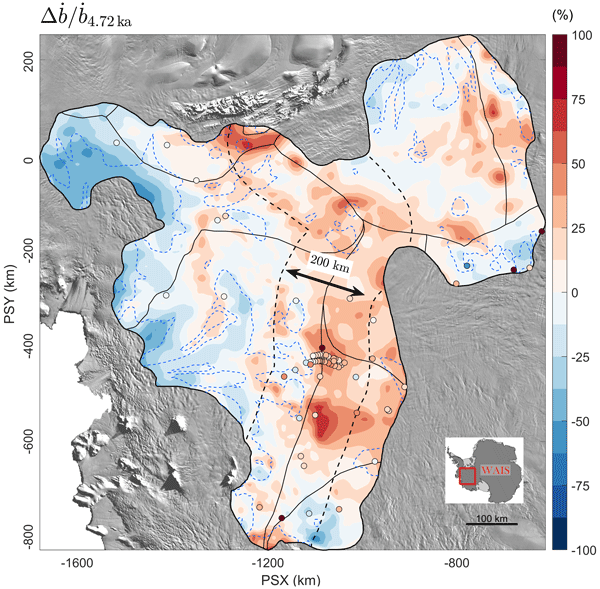
Estimating how West Antarctica will change in response to future climatic change depends on our understanding of past ice processes. Here, we use a reflector widely visible on airborne radar data across West Antarctica to estimate accumulation rates over the past 4700 years. By comparing our estimates with current atmospheric data, we find that accumulation rates were 18 % greater than modern rates. This has implications for our understanding of past ice processes in the region.
James A. Smith, Louise Callard, Michael J. Bentley, Stewart S. R. Jamieson, Maria Luisa Sánchez-Montes, Timothy P. Lane, Jeremy M. Lloyd, Erin L. McClymont, Christopher M. Darvill, Brice R. Rea, Colm O'Cofaigh, Pauline Gulliver, Werner Ehrmann, Richard S. Jones, and David H. Roberts
The Cryosphere, 17, 1247–1270, https://doi.org/10.5194/tc-17-1247-2023, https://doi.org/10.5194/tc-17-1247-2023, 2023
Short summary
Short summary
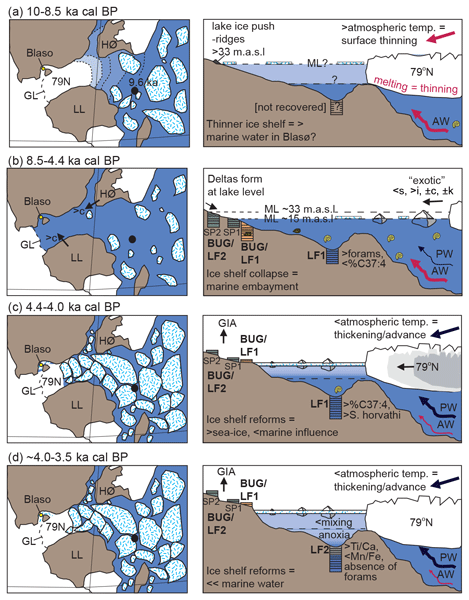
The Greenland Ice Sheet is melting at an accelerating rate. To understand the significance of these changes we reconstruct the history of one of its fringing ice shelves, known as 79° N ice shelf. We show that the ice shelf disappeared 8500 years ago, following a period of enhanced warming. An important implication of our study is that 79° N ice shelf is susceptible to collapse when atmospheric and ocean temperatures are ~2°C warmer than present, which could occur by the middle of this century.
Michał Pętlicki, Andrés Rivera, Jonathan Oberreuter, José Uribe, Johannes Reinthaler, and Francisca Bown
The Cryosphere Discuss., https://doi.org/10.5194/tc-2023-10, https://doi.org/10.5194/tc-2023-10, 2023
Manuscript not accepted for further review
Short summary
Short summary
The terminus of San Quintín glacier, the largest of the Northern Patagonia Icefield in southern Chile, is rapidly disintegrating with large tabular icebergs into a proglacial lake left behind by this retreating glacier. We show that the ongoing retreat is caused by recent detachment of a floating terminus from the glacier bed. This process may lead to the disappearance of the last existing piedmont lobe in Patagonia, and one of the few remaining glaciers of this type in the world.

Bertie W. J. Miles, Chris R. Stokes, Adrian Jenkins, Jim R. Jordan, Stewart S. R. Jamieson, and G. Hilmar Gudmundsson
The Cryosphere, 17, 445–456, https://doi.org/10.5194/tc-17-445-2023, https://doi.org/10.5194/tc-17-445-2023, 2023
Short summary
Short summary
Satellite observations have shown that the Shirase Glacier catchment in East Antarctica has been gaining mass over the past 2 decades, a trend largely attributed to increased snowfall. Our multi-decadal observations of Shirase Glacier show that ocean forcing has also contributed to some of this recent mass gain. This has been caused by strengthening easterly winds reducing the inflow of warm water underneath the Shirase ice tongue, causing the glacier to slow down and thicken.

Tancrède P. M. Leger, Andrew S. Hein, Ángel Rodés, Robert G. Bingham, Irene Schimmelpfennig, Derek Fabel, Pablo Tapia, and ASTER Team
Clim. Past, 19, 35–59, https://doi.org/10.5194/cp-19-35-2023, https://doi.org/10.5194/cp-19-35-2023, 2023
Short summary
Short summary
Over the past 800 thousand years, variations in the Earth’s orbit and tilt have caused antiphased solar insolation intensity in the Northern and Southern Hemispheres. Paradoxically, glacial records suggest that global ice sheets have responded synchronously to major cold glacial and warm interglacial episodes. To address this puzzle, we present a new detailed glacier chronology that estimates the timing of multiple Patagonian ice-sheet waxing and waning cycles over the past 300 thousand years.
Dominic A. Hodgson, Tom A. Jordan, Neil Ross, Teal R. Riley, and Peter T. Fretwell
The Cryosphere, 16, 4797–4809, https://doi.org/10.5194/tc-16-4797-2022, https://doi.org/10.5194/tc-16-4797-2022, 2022
Short summary
Short summary
This paper describes the drainage (and refill) of a subglacial lake on the Antarctic Peninsula resulting in the collapse of the overlying ice into the newly formed subglacial cavity. It provides evidence of an active hydrological network under the region's glaciers and close coupling between surface climate processes and the base of the ice.
Helen Ockenden, Robert G. Bingham, Andrew Curtis, and Daniel Goldberg
The Cryosphere, 16, 3867–3887, https://doi.org/10.5194/tc-16-3867-2022, https://doi.org/10.5194/tc-16-3867-2022, 2022
Short summary
Short summary
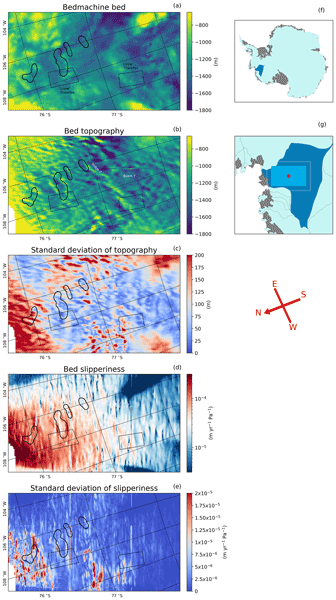
Hills and valleys hidden under the ice of Thwaites Glacier have an impact on ice flow and future ice loss, but there are not many three-dimensional observations of their location or size. We apply a mathematical theory to new high-resolution observations of the ice surface to predict the bed topography beneath the ice. There is a good correlation with ice-penetrating radar observations. The method may be useful in areas with few direct observations or as a further constraint for other methods.
Alice C. Frémand, Julien A. Bodart, Tom A. Jordan, Fausto Ferraccioli, Carl Robinson, Hugh F. J. Corr, Helen J. Peat, Robert G. Bingham, and David G. Vaughan
Earth Syst. Sci. Data, 14, 3379–3410, https://doi.org/10.5194/essd-14-3379-2022, https://doi.org/10.5194/essd-14-3379-2022, 2022
Short summary
Short summary
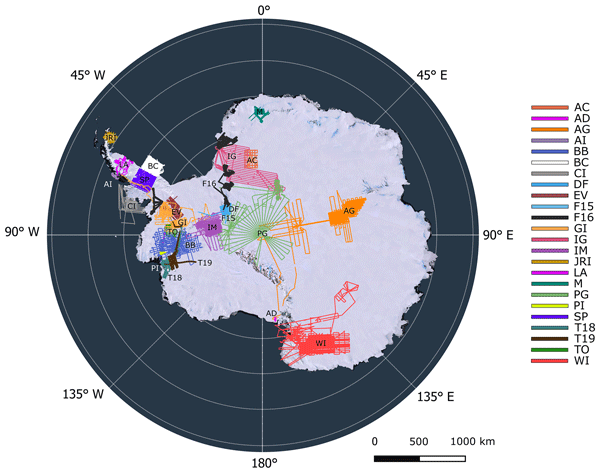
This paper presents the release of large swaths of airborne geophysical data (including gravity, magnetics, and radar) acquired between 1994 and 2020 over Antarctica by the British Antarctic Survey. These include a total of 64 datasets from 24 different surveys, amounting to >30 % of coverage over the Antarctic Ice Sheet. This paper discusses how these data were acquired and processed and presents the methods used to standardize and publish the data in an interactive and reproducible manner.

Erin L. McClymont, Michael J. Bentley, Dominic A. Hodgson, Charlotte L. Spencer-Jones, Thomas Wardley, Martin D. West, Ian W. Croudace, Sonja Berg, Darren R. Gröcke, Gerhard Kuhn, Stewart S. R. Jamieson, Louise Sime, and Richard A. Phillips
Clim. Past, 18, 381–403, https://doi.org/10.5194/cp-18-381-2022, https://doi.org/10.5194/cp-18-381-2022, 2022
Short summary
Short summary
Sea ice is important for our climate system and for the unique ecosystems it supports. We present a novel way to understand past Antarctic sea-ice ecosystems: using the regurgitated stomach contents of snow petrels, which nest above the ice sheet but feed in the sea ice. During a time when sea ice was more extensive than today (24 000–30 000 years ago), we show that snow petrel diet had varying contributions of fish and krill, which we interpret to show changing sea-ice distribution.
Jonathan Oberreuter, Edwin Badillo-Rivera, Edwin Loarte, Katy Medina, Alejo Cochachin, and José Uribe
Earth Syst. Sci. Data Discuss., https://doi.org/10.5194/essd-2021-336, https://doi.org/10.5194/essd-2021-336, 2022
Manuscript not accepted for further review
Short summary
Short summary
We present a representative set of data of interpreted ice thickness and ice surface elevation of the ablation area of the Artesonraju glacier between 2012 and 2020. The results show a maximum depth of 235 ± 18 m and a decreasing mean depth ranging from 134 ± 18 m in 2013 to 110 ± 18 m in 2020. Additionally, we estimate a mean ice thickness change rate of −4.2 ± 3.2 m yr−1 between 2014 and 2020, which is in agreement with the elevation change in the same period of −3.2 ± 0.2 m yr−1.
Jamey Stutz, Andrew Mackintosh, Kevin Norton, Ross Whitmore, Carlo Baroni, Stewart S. R. Jamieson, Richard S. Jones, Greg Balco, Maria Cristina Salvatore, Stefano Casale, Jae Il Lee, Yeong Bae Seong, Robert McKay, Lauren J. Vargo, Daniel Lowry, Perry Spector, Marcus Christl, Susan Ivy Ochs, Luigia Di Nicola, Maria Iarossi, Finlay Stuart, and Tom Woodruff
The Cryosphere, 15, 5447–5471, https://doi.org/10.5194/tc-15-5447-2021, https://doi.org/10.5194/tc-15-5447-2021, 2021
Short summary
Short summary
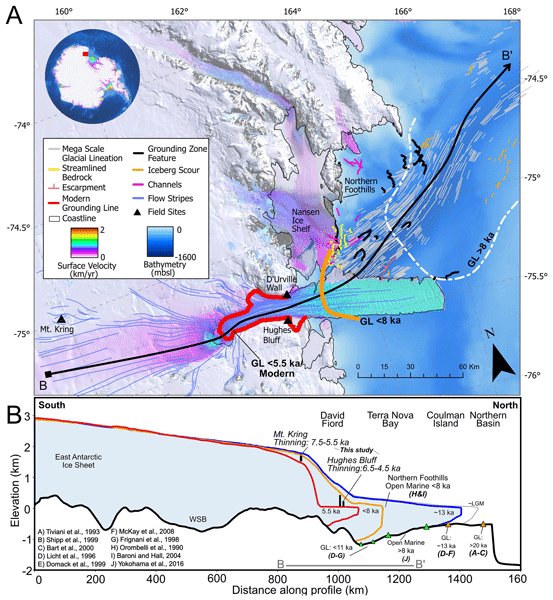
Understanding the long-term behaviour of ice sheets is essential to projecting future changes due to climate change. In this study, we use rocks deposited along the margin of the David Glacier, one of the largest glacier systems in the world, to reveal a rapid thinning event initiated over 7000 years ago and endured for ~ 2000 years. Using physical models, we show that subglacial topography and ocean heat are important drivers for change along this sector of the Antarctic Ice Sheet.
Cited articles
Arcone, S. A., Jacobel, R., and Hamilton, G.: Unconformable stratigraphy in East Antarctica: Part I. Large firn cosets, recrystallized growth, and model evidence for intensified accumulation, J. Glaciol., 58, 240–252, https://doi.org/10.3189/2012JoJ11J044, 2012. a
Artemieva, I. M.: Antarctica ice sheet basal melting enhanced by high mantle heat, Earth-Sci. Rev., 226, 103954, https://doi.org/10.1016/j.earscirev.2022.103954, 2022. a
Ashmore, D. W., Bingham, R. G., Ross, N., Siegert, M. J., Jordan, T. A., and Mair, D. W. F.: Englacial Architecture and Age-Depth Constraints Across the West Antarctic Ice Sheet, Geophys. Res. Lett., 47, e2019GL086663, https://doi.org/10.1029/2019GL086663, 2020. a, b, c, d, e, f, g, h, i, j, k, l, m, n, o, p, q, r, s, t, u, v, w, x, y, z
Bentley, M. J., Fogwill, C. J., Le Brocq, A. M., Hubbard, A. L., Sugden, D. E., Dunai, T. J., and Freeman, S. P.: Deglacial history of the West Antarctic Ice Sheet in the Weddell Sea embayment: Constraints on past ice volume change, Geology, 38, 411–414, https://doi.org/10.1130/G30754.1, 2010. a, b, c
Bingham, R. G., Rippin, D. M., Karlsson, N. B., Corr, H. F. J., Ferraccioli, F., Jordan, T. A., Le Brocq, A. M., Rose, K. C., Ross, N., and Siegert, M. J.: Ice-flow structure and ice dynamic changes in the Weddell Sea sector of West Antarctica from radar-imaged internal layering, J. Geophys. Res.-Earth, 120, 655–670, https://doi.org/10.1002/2014JF003291, 2015. a, b
Bingham, R. G., Bodart, J. A., Cavitte, M. G. P., Chung, A., Sanderson, R. J., Sutter, J. C. R., Eisen, O., Karlsson, N. B., MacGregor, J. A., Ross, N., Young, D. A., Ashmore, D. W., Born, A., Chu, W., Cui, X., Drews, R., Franke, S., Goel, V., Goodge, J. W., Henry, A. C. J., Hermant, A., Hills, B. H., Holschuh, N., Koutnik, M. R., Leysinger Vieli, G. J.-M. C., MacKie, E. J., Mantelli, E., Martín, C., Ng, F. S. L., Oraschewski, F. M., Napoleoni, F., Parrenin, F., Popov, S. V., Rieckh, T., Schlegel, R., Schroeder, D. M., Siegert, M. J., Tang, X., Teisberg, T. O., Winter, K., Yan, S., Davis, H., Dow, C. F., Fudge, T. J., Jordan, T. A., Kulessa, B., Matsuoka, K., Nyqvist, C. J., Rahnemoonfar, M., Siegfried, M. R., Singh, S., Višnjević, V., Zamora, R., and Zuhr, A.: Review article: AntArchitecture – building an age–depth model from Antarctica's radiostratigraphy to explore ice-sheet evolution, The Cryosphere, 19, 4611–4655, https://doi.org/10.5194/tc-19-4611-2025, 2025. a, b, c, d, e
Blunier, T. and Brook, E. J.: Timing of Millennial-Scale Climate Change in Antarctica and Greenland During the Last Glacial Period, Science, 291, 109–112, https://doi.org/10.1126/science.291.5501.109, 2001. a
Bodart, J. A., Bingham, R. G., Ashmore, D. W., Karlsson, N. B., Hein, A. S., and Vaughan, D. G.: Age-Depth Stratigraphy of Pine Island Glacier Inferred From Airborne Radar and Ice-Core Chronology, J. Geophys. Res.-Earth, 126, e2020JF005927, https://doi.org/10.1029/2020JF005927, 2021. a, b, c, d, e, f, g, h, i, j, k, l, m, n, o, p, q, r, s, t, u, v, w, x, y, z, aa, ab, ac, ad, ae, af, ag, ah, ai, aj, ak, al, am, an
Bodart, J. A., Bingham, R. G., Young, D. A., MacGregor, J. A., Ashmore, D. W., Quartini, E., Hein, A. S., Vaughan, D. G., and Blankenship, D. D.: High mid-Holocene accumulation rates over West Antarctica inferred from a pervasive ice-penetrating radar reflector, The Cryosphere, 17, 1497–1512, https://doi.org/10.5194/tc-17-1497-2023, 2023. a, b
Bons, P. D., Jansen, D., Mundel, F., Bauer, C. C., Binder, T., Eisen, O., Jessell, M. W., Llorens, M.-G., Steinbach, F., Steinhage, D., and Weikusat, I.: Converging flow and anisotropy cause large-scale folding in Greenland's ice sheet, Nat. Commun., 7, 11427, https://doi.org/10.1038/ncomms11427, 2016. a
Born, A.: Tracer transport in an isochronal ice-sheet model, J. Glaciol., 63, 22–38, 2017. a
Brisbourne, A. M., Smith, A. M., Rivera, A., Zamora, R., Napoleoni, F., Uribe, J. A., and Ortega, M.: Bathymetry and bed conditions of Lago Subglacial CECs, West Antarctica, Jo. Glaciol., 69, 1546–1555, https://doi.org/10.1017/jog.2023.38, 2023. a
Cavitte, M. G. P., Blankenship, D. D., Young, D. A., Schroeder, D. M., Parrenin, F., Lemeur, E., MacGregor, J. A., and Siegert, M. J.: Deep radiostratigraphy of the East Antarctic plateau: connecting the Dome C and Vostok ice core sites, J. Glaciol., 62, 323–334, https://doi.org/10.1017/jog.2016.11, 2016. a, b, c, d
Clough, J. W.: Radio-Echo Sounding: Reflections From Internal Layers In Ice Sheets, J. Glaciol., 18, 3–14, https://doi.org/10.3189/S002214300002147X, 1977. a
Conway, H. and Rasmussen, L. A.: Recent thinning and migration of the Western Divide, central West Antarctica, Geophys. Res. Lett., 36, https://doi.org/10.1029/2009GL038072, 2009. a
Corr, H., Ferraccioli, F., and Vaughan, D.: Processed airborne radio-echo sounding data from the BBAS survey covering the Pine Island Glacier basin, West Antarctica (2004/2005), NERC EDS UK Polar Data Centre [data set], https://doi.org/10.5285/db8bdbad-6893-4a77-9d12-a9bcb7325b70, 2021. a, b
Corr, H. F., Ferraccioli, F., Frearson, N., Jordan, T., Robinson, C., Armadillo, E., Caneva, G., Bozzo, E., and Tabacco, I.: Airborne radio-echo sounding of the Wilkes Subglacial Basin, the Transantarctic Mountains and the Dome C region, Terra Ant. Reports, 13, 55–63, 2007. a
Dansgaard, W. and Johnsen, S. J.: A Flow Model and a Time Scale for the Ice Core from Camp Century, Greenland, J. Glaciol., 8, 215–223, https://doi.org/10.3189/S0022143000031208, 1969. a, b, c, d
Dattler, M. E., Lenaerts, J. T. M., and Medley, B.: Significant Spatial Variability in Radar-Derived West Antarctic Accumulation Linked to Surface Winds and Topography, Geophys. Res. Lett., 46, 13126–13134, https://doi.org/10.1029/2019GL085363, 2019. a
Denton, G. H., Bockheim, J. G., Rutford, R. H., and Andersen, B. G.: Chapter 22: Glacial history of the Ellsworth Mountains, West Antarctica, in: Geology and Paleontology of the Ellsworth Mountains, West Antarctica, vol. 170 of Geological Society of America Memoir, Geological Society of America, 403–432, https://doi.org/10.1130/MEM170-p403, 1992. a
Dowdeswell, J. A. and Evans, S.: Investigations of the form and flow of ice sheets and glaciers using radio-echo sounding, Rep. Prog. Phys., 67, 1821–1861, https://doi.org/10.1088/0034-4885/67/10/r03, 2004. a, b, c
Drewry, D. J. and Meldrum, D. T.: Antarctic airborne radio echo sounding, 1977–78, Polar Record, 19, 267–273, https://doi.org/10.1017/S0032247400018271, 1978. a
Drews, R., Eisen, O., Weikusat, I., Kipfstuhl, S., Lambrecht, A., Steinhage, D., Wilhelms, F., and Miller, H.: Layer disturbances and the radio-echo free zone in ice sheets, The Cryosphere, 3, 195–203, https://doi.org/10.5194/tc-3-195-2009, 2009. a
Evans, J. and Hagfors, T.: Radar astronomy, McGraw-Hill, New York, USA, OCLC Number: 435741, 1968. a
Franke, S., Gerber, T., Warren, C., Jansen, D., Eisen, O., and Dahl-Jensen, D.: Investigating the Radar Response of Englacial Debris Entrained Basal Ice Units in East Antarctica Using Electromagnetic Forward Modeling, IEEE T. Geosci. Remote, 61, 1–16, https://doi.org/10.1109/TGRS.2023.3277874, 2023. a, b
Franke, S., Steinhage, D., Helm, V., Zuhr, A. M., Bodart, J. A., Eisen, O., and Bons, P.: Age–depth distribution in western Dronning Maud Land, East Antarctica, and Antarctic-wide comparisons of internal reflection horizons, The Cryosphere, 19, 1153–1180, https://doi.org/10.5194/tc-19-1153-2025, 2025. a, b
Fremand, A., Fretwell, P., Bodart, J., et al.: BEDMAP3 – Ice thickness, bed and surface elevation for Antarctica – standardised data points (Version 1.0), NERC EDS UK Polar Data Centre [data set], https://doi.org/10.5285/91523FF9-D621-46B3-87F7-FFB6EFCD1847, 2022. a, b
Fudge, T. J., Markle, B. R., Cuffey, K. M., Buizert, C., Taylor, K. C., Steig, E. J., Waddington, E. D., Conway, H., and Koutnik, M.: Variable relationship between accumulation and temperature in West Antarctica for the past 31,000 years, Geophys. Res. Lett., 43, 3795–3803, https://doi.org/10.1002/2016GL068356, 2016. a
Fujita, S., Maeno, H., Uratsuka, S., Furukawa, T., Mae, S., Fujii, Y., and Watanabe, O.: Nature of radio echo layering in the Antarctic Ice Sheet detected by a two-frequency experiment, J. Geophys. Res.-Sol. Ea., 104, 13013–13024, https://doi.org/10.1029/1999JB900034, 1999. a, b, c
Fujita, S., Matsuoka, T., Ishida, T., Matsuoka, K., and Mae, S.: A summary of the complex dielectric permittivity of ice in the megahertz range and its applications for radar sounding of polar ice sheets, in: Physics of ice core records, Hokkaido University Press, 185–212, http://hdl.handle.net/2115/32469 (last access: 18 May 2026), 2000. a
Gogineni, S., Tammana, D., Braaten, D., Leuschen, C., Akins, T., Legarsky, J., Kanagaratnam, P., Stiles, J., Allen, C., and Jezek, K.: Coherent radar ice thickness measurements over the Greenland ice sheet, J. Geophys. Res.-Atmos., 106, 33761–33772, https://doi.org/10.1029/2001JD900183, 2001. a
Grieman, M. M., Nehrbass-Ahles, C., Hoffmann, H. M., Bauska, T. K., King, A. C., Mulvaney, R., Rhodes, R. H., Rowell, I. F., Thomas, E. R., and Wolff, E. W.: Abrupt Holocene ice loss due to thinning and ungrounding in the Weddell Sea Embayment, Nat. Geosci., 17, 227–232, 2024. a
Groh, A. and Horwath, M.: Antarctic Ice Mass Change Products from GRACE/GRACE-FO Using Tailored Sensitivity Kernels, Remote Sens., 13, https://doi.org/10.3390/rs13091736, 2021. a
Hammer, C., Clausen, H., and Langway, C.: Electrical conductivity method (ECM) stratigraphic dating of the Byrd Station ice core, Antarctica, Ann. Glaciol., 20, 115–120, https://doi.org/10.3189/1994AoG20-1-115-120, 1994. a
Hammer, C. U.: Acidity of polar ice cores in relation to absolute dating, past volcanism, and radio–echoes, J. Glaciol., 25, 359–372, https://doi.org/10.3189/S0022143000015227, 1980. a
Hein, A. S., Marrero, S. M., Woodward, J., Dunning, S. A., Winter, K., Westoby, M. J., Freeman, S. P., Shanks, R. P., and Sugden, D. E.: Mid-Holocene pulse of thinning in the Weddell Sea sector of the West Antarctic ice sheet, Nat. Commun., 7, 12511, https://doi.org/10.1038/ncomms12511, 2016a. a
Hein, A. S., Woodward, J., Marrero, S. M., Dunning, S. A., Steig, E. J., Freeman, S. P., Stuart, F. M., Winter, K., Westoby, M. J., and Sugden, D. E.: Evidence for the stability of the West Antarctic Ice Sheet divide for 1.4 million years, Nat. Commun., 7, 1–8, https://doi.org/10.1038/ncomms10325, 2016b. a, b, c, d
Hillenbrand, C.-D., Kuhn, G., Smith, J. A., Gohl, K., Graham, A. G., Larter, R. D., Klages, J. P., Downey, R., Moreton, S. G., Forwick, M., and Vaughan, D. G.: Grounding-line retreat of the West Antarctic Ice Sheet from inner Pine Island Bay, Geology, 41, 35–38, https://doi.org/10.1130/G33469.1, 2013. a
Hindmarsh, R. C., Leysinger Vieli, G. J.-M., Raymond, M. J., and Gudmundsson, G. H.: Draping or overriding: The effect of horizontal stress gradients on internal layer architecture in ice sheets, J. Geophys. Res.-Earth, 111, https://doi.org/10.1029/2005JF000309, 2006. a
Holschuh, N., Christianson, K., Conway, H., Jacobel, R. W., and Welch, B. C.: Persistent tracers of historic ice flow in glacial stratigraphy near Kamb Ice Stream, West Antarctica, The Cryosphere, 12, 2821–2829, https://doi.org/10.5194/tc-12-2821-2018, 2018. a
Jacobel, R. W. and Welch, B. C.: A time marker at 17.5 kyr BP detected throughout West Antarctica, Ann. Glaciol., 41, 47–51, https://doi.org/10.3189/172756405781813348, 2005. a, b, c
Jordan, T., Martin, C., Ferraccioli, F., Matsuoka, K., Corr, H., Forsberg, R., Olesen, A., and Siegert, M.: Anomalously high geothermal flux near the South Pole, Sci. Rep., 8, 16785, https://doi.org/10.1038/s41598-018-35182-0, 2018. a
Karlsson, N. B., Bingham, R. G., Rippin, D. M., Hindmarsh, R. C., Corr, H. F., and Vaughan, D. G.: Constraining past accumulation in the central Pine Island Glacier basin, West Antarctica, using radio-echo sounding, J. Glaciol., 60, 553–562, https://doi.org/10.3189/2014JoG13J180, 2014. a, b, c, d, e, f, g
Kingslake, J., Scherer, R., Albrecht, T., Coenen, J., Powell, R., Reese, R., Stansell, N., Tulaczyk, S., Wearing, M., and Whitehouse, P.: Extensive retreat and re-advance of the West Antarctic Ice Sheet during the Holocene, Nature, 558, 430–434, https://doi.org/10.1038/s41586-018-0208-x, 2018. a
Lambert, F., Delmonte, B., Petit, J.-R., Bigler, M., Kaufmann, P. R., Hutterli, M. A., Stocker, T. F., Ruth, U., Steffensen, J. P., and Maggi, V.: Dust-climate couplings over the past 800,000 years from the EPICA Dome C ice core, Nature, 452, 616–619, 2008. a
Larter, R. D., Anderson, J. B., Graham, A. G., Gohl, K., Hillenbrand, C.-D., Jakobsson, M., Johnson, J. S., Kuhn, G., Nitsche, F. O., Smith, J. A., Witus, A. E., Bentley, M. J., Dowdeswell, J. A., Ehrmann, W., Klages, J. P., Lindow, J., Cofaigh, C. O., and Spiegel, C.: Reconstruction of changes in the Amundsen Sea and Bellingshausen Sea sector of the West Antarctic Ice Sheet since the Last Glacial Maximum, Quaternary Sci. Rev., 100, 55–86, https://doi.org/10.1016/j.quascirev.2013.10.016, 2014. a
Liu, H., Jezek, K., Li, B., and Zhao, Z.: Radarsat Antarctic Mapping Project digital elevation model version 2, Boulder, Colorado USA, NASA National Snow and Ice Data Center Distributed Active Archive Center, https://doi.org/10.5067/8JKNEW6BFRVD, 2015. a, b
MacGregor, J. A., Fahnestock, M. A., Catania, G. A., Paden, J. D., Prasad Gogineni, S., Young, S. K., Rybarski, S. C., Mabrey, A. N., Wagman, B. M., and Morlighem, M.: Radiostratigraphy and age structure of the Greenland Ice Sheet, J. Geophys. Res.-Earth, 120, 212–241, https://doi.org/10.1002/2014JF003215, 2015. a, b, c, d, e, f
MacGregor, J. A., Fahnestock, M. A., Catania, G. A., Aschwanden, A., Clow, G. D., Colgan, W. T., Gogineni, S. P., Morlighem, M., Nowicki, S. M., Paden, J. D., Price, S. F., and Seroussi, H.: A synthesis of the basal thermal state of the Greenland Ice Sheet, J. Geophys. Res.-Earth, 121, 1328–1350, https://doi.org/10.1002/2015jf003803, 2016. a
Medley, B. and Thomas, E.: Increased snowfall over the Antarctic Ice Sheet mitigated twentieth-century sea-level rise, Nat. Clim. Change, 9, 34–39, 2019. a
Medley, B., Neumann, T. A., Zwally, H. J., Smith, B. E., and Stevens, C. M.: Simulations of firn processes over the Greenland and Antarctic ice sheets: 1980–2021, The Cryosphere, 16, 3971–4011, https://doi.org/10.5194/tc-16-3971-2022, 2022. a
Mills, S. C., Le Brocq, A. M., Winter, K., Smith, M., Hillier, J., Ardakova, E., Boston, C. M., Sugden, D., and Woodward, J.: Testing and application of a model for snow redistribution (Snow Blow) in the Ellsworth Mountains, Antarctica, J. Glaciol., 65, 957–970, https://doi.org/10.1017/jog.2019.70, 2019. a
Morlighem, M., Rignot, E., Binder, T., et al.: Deep glacial troughs and stabilizing ridges unveiled beneath the margins of the Antarctic ice sheet, Nat. Geosci., 13, 132–137, 2020. a
Mouginot, J., Rignot, E., and Scheuchl, B.: Continent-Wide, Interferometric SAR Phase, Mapping of Antarctic Ice Velocity, Geophys. Res. Lett., 46, 9710–9718, https://doi.org/10.1029/2019GL083826, 2019. a
Napoleoni, F., Jamieson, S. S. R., Ross, N., Bentley, M. J., Rivera, A., Smith, A. M., Siegert, M. J., Paxman, G. J. G., Gacitúa, G., Uribe, J. A., Zamora, R., Brisbourne, A. M., and Vaughan, D. G.: Subglacial lakes and hydrology across the Ellsworth Subglacial Highlands, West Antarctica, The Cryosphere, 14, 4507–4524, https://doi.org/10.5194/tc-14-4507-2020, 2020. a, b, c, d
Nye, J. F. and Perutz, M. F.: The distribution of stress and velocity in glaciers and ice-sheets, P. Roy. Soc. Lond. A Mat., 239, 113–133, https://doi.org/10.1098/rspa.1957.0026, 1957. a
Otosaka, I. N., Shepherd, A., Ivins, E. R., Schlegel, N.-J., Amory, C., van den Broeke, M. R., Horwath, M., Joughin, I., King, M. D., Krinner, G., Nowicki, S., Payne, A. J., Rignot, E., Scambos, T., Simon, K. M., Smith, B. E., Sørensen, L. S., Velicogna, I., Whitehouse, P. L., A, G., Agosta, C., Ahlstrøm, A. P., Blazquez, A., Colgan, W., Engdahl, M. E., Fettweis, X., Forsberg, R., Gallée, H., Gardner, A., Gilbert, L., Gourmelen, N., Groh, A., Gunter, B. C., Harig, C., Helm, V., Khan, S. A., Kittel, C., Konrad, H., Langen, P. L., Lecavalier, B. S., Liang, C.-C., Loomis, B. D., McMillan, M., Melini, D., Mernild, S. H., Mottram, R., Mouginot, J., Nilsson, J., Noël, B., Pattle, M. E., Peltier, W. R., Pie, N., Roca, M., Sasgen, I., Save, H. V., Seo, K.-W., Scheuchl, B., Schrama, E. J. O., Schröder, L., Simonsen, S. B., Slater, T., Spada, G., Sutterley, T. C., Vishwakarma, B. D., van Wessem, J. M., Wiese, D., van der Wal, W., and Wouters, B.: Mass balance of the Greenland and Antarctic ice sheets from 1992 to 2020, Earth Syst. Sci. Data, 15, 1597–1616, https://doi.org/10.5194/essd-15-1597-2023, 2023. a
Peters, M. E., Blankenship, D. D., and Morse, D. L.: Analysis techniques for coherent airborne radar sounding: Application to West Antarctic ice streams, J. Geophys. Res.-Sol. Ea., 110, https://doi.org/10.1029/2004JB003222, 2005. a
Pritchard, H. D., Fretwell, P. T., Fremand, A. C., et al.: Bedmap3 updated ice bed, surface and thickness gridded datasets for Antarctica, Sci. Data, 12, 414, https://doi.org/10.1038/s41597-025-04672-y, 2025. a
Rieckh, T., Born, A., Robinson, A., Law, R., and Gülle, G.: Design and performance of ELSA v2.0: an isochronal model for ice-sheet layer tracing, Geosci. Model Dev., 17, 6987–7000, https://doi.org/10.5194/gmd-17-6987-2024, 2024. a
Rignot, E., Mouginot, J., Scheuchl, B., van den Broeke, M., van Wessem, M. J., and Morlighem, M.: Four decades of Antarctic Ice Sheet mass balance from 1979–2017, P. Natl. Acad. Sci. USA, 116, 1095–1103, https://doi.org/10.1073/pnas.1812883116, 2019. a
Ross, N. and Siegert, M.: Basal melting over Subglacial Lake Ellsworth and its catchment: insights from englacial layering, Ann. Glaciol., 61, 198–205, https://doi.org/10.1017/aog.2020.50, 2020. a
Ross, N., Siegert, M., Woodward, J., Smith, A., Corr, H., Bentley, M., Hindmarsh, R., King, E., and Rivera, A.: Holocene stability of the Amundsen-Weddell ice divide, West Antarctica, Geology, 39, 935–938, https://doi.org/10.1130/G31920.1, 2011. a, b, c
Ross, N., Jordan, T. A., Bingham, R. G., Corr, H. F., Ferraccioli, F., Le Brocq, A., Rippin, D. M., Wright, A. P., and Siegert, M. J.: The Ellsworth Subglacial Highlands: Inception and retreat of the West Antarctic Ice Sheet, GSA Bulletin, 126, 3–15, https://doi.org/10.1130/B30794.1, 2014. a, b
Ross, N., Corr, H., and Siegert, M.: Large-scale englacial folding and deep-ice stratigraphy within the West Antarctic Ice Sheet, The Cryosphere, 14, 2103–2114, https://doi.org/10.5194/tc-14-2103-2020, 2020. a
Ross, N., Bingham, R., Ferraccioli, F., Jordan, T., Le Brocq, A., Rippin, D., and Siegert, M.: Processed airborne radio-echo sounding data from the IMAFI survey covering the Institute and Moller ice streams and the Patriot Hills, West Antarctica (2010/2011), NERC EDS UK Polar Data Centre [data set], https://doi.org/10.5285/f32b298b-7906-4360-9e34-16739af73bb7, 2021. a, b
Sanderson, R. J., Winter, K., Callard, S. L., Napoleoni, F., Ross, N., Jordan, T. A., and Bingham, R. G.: Englacial architecture of Lambert Glacier, East Antarctica, The Cryosphere, 17, 4853–4871, https://doi.org/10.5194/tc-17-4853-2023, 2023. a, b
Sanderson, R. J., Ross, N., Winter, K., Bingham, R. G., Callard, S. L., Jordan, T. A., and Young, D. A.: Dated radar-stratigraphy between Dome A and South Pole, East Antarctica: old ice potential and ice sheet history, J. Glaciol., 1–14, https://doi.org/10.1017/jog.2024.60, 2024. a
Shepherd, A., Gilbert, L., Muir, A. S., Konrad, H., McMillan, M., Slater, T., Briggs, K. H., Sundal, A. V., Hogg, A. E., and Engdahl, M. E.: Trends in Antarctic Ice Sheet Elevation and Mass, Geophys. Res. Lett., 46, 8174–8183, https://doi.org/10.1029/2019GL082182, 2019. a
Siegert, M. J.: On the origin, nature and uses of Antarctic ice-sheet radio-echo layering, Progress in Physical Geography: Earth and Environment, 23, 159–179, https://doi.org/10.1177/030913339902300201, 1999. a
Siegert, M. J.: Lakes Beneath the Ice Sheet: The Occurrence, Analysis, and Future Exploration of Lake Vostok and Other Antarctic Subglacial Lakes, Annu. Rev. Earth Pl. Sc., 33, 215–245, https://doi.org/10.1146/annurev.earth.33.092203.122725, 2005. a
Siegert, M. J., Clarke, R. J., Mowlem, M., Ross, N., Hill, C. S., Tait, A., Hodgson, D., Parnell, J., Tranter, M., Pearce, D., Bentley, M. J., Cockell, C., Tsaloglou, M.-N., Smith, A., Woodward, J., Brito, M. P., and Waugh, E.: Clean access, measurement, and sampling of Ellsworth Subglacial Lake: A method for exploring deep Antarctic subglacial lake environments, Rev. Geophys., 50, https://doi.org/10.1029/2011RG000361, 2012. a
Siegert, M. J., Kingslake, J., Ross, N., Whitehouse, P. L., Woodward, J., Jamieson, S. S. R., Bentley, M. J., Winter, K., Wearing, M., Hein, A. S., Jeofry, H., and Sugden, D. E.: Major Ice Sheet Change in the Weddell Sea Sector of West Antarctica Over the Last 5,000 Years, Rev. Geophys., 57, 1197–1223, https://doi.org/10.1029/2019RG000651, 2019. a, b
Sigl, M., McConnell, J. R., Toohey, M., Curran, M., Das, S. B., Edwards, R., Isaksson, E., Kawamura, K., Kipfstuhl, S., Krüger, K., Layman, L., Maselli, O. J., Motizuki, Y., Motoyama, H., Pasteris, D. R., and Severi, M.: Insights from Antarctica on volcanic forcing during the Common Era, Nat. Clim. Change, 4, 693–697, 2014. a, b
Sigl, M., Fudge, T. J., Winstrup, M., Cole-Dai, J., Ferris, D., McConnell, J. R., Taylor, K. C., Welten, K. C., Woodruff, T. E., Adolphi, F., Bisiaux, M., Brook, E. J., Buizert, C., Caffee, M. W., Dunbar, N. W., Edwards, R., Geng, L., Iverson, N., Koffman, B., Layman, L., Maselli, O. J., McGwire, K., Muscheler, R., Nishiizumi, K., Pasteris, D. R., Rhodes, R. H., and Sowers, T. A.: The WAIS Divide deep ice core WD2014 chronology – Part 2: Annual-layer counting (0–31 ka BP), Clim. Past, 12, 769–786, https://doi.org/10.5194/cp-12-769-2016, 2016. a, b
Small, D., Bentley, M. J., Freeman, S. P., Rodés, A., and Xu, S.: A pre-Pliocene origin of the glacial trimline in the Ellsworth Mountains and the prevalence of old landscapes at high elevations in West Antarctica, Geomorphology, 473, 109634, https://doi.org/10.1016/j.geomorph.2025.109634, 2025. a, b, c
Smith, B., Fricker, H. A., Gardner, A. S., Medley, B., Nilsson, J., Paolo, F. S., Holschuh, N., Adusumilli, S., Brunt, K., Csatho, B., Harbeck, K., Markus, T., Neumann, T., Siegfried, M. R., and Zwally, H. J.: Pervasive ice sheet mass loss reflects competing ocean and atmosphere processes, Science, 368, 1239–1242, https://doi.org/10.1126/science.aaz5845, 2020. a
Sutter, J., Fischer, H., and Eisen, O.: Investigating the internal structure of the Antarctic ice sheet: the utility of isochrones for spatiotemporal ice-sheet model calibration, The Cryosphere, 15, 3839–3860, https://doi.org/10.5194/tc-15-3839-2021, 2021. a
Thomas, E. R., Hosking, J. S., Tuckwell, R. R., Warren, R. A., and Ludlow, E. C.: Twentieth century increase in snowfall in coastal West Antarctica, Geophys. Res. Lett., 42, 9387–9393, https://doi.org/10.1002/2015GL065750, 2015. a
Uribe, J., Zamora, R., and Rivera, A.: High resolution FM-CW radar for internal layers mapping in cold ice, in: 2017 First IEEE International Symposium of Geoscience and Remote Sensing (GRSS-CHILE), IEEE, 1–4, https://doi.org/10.1109/GRSS-CHILE.2017.7996001, 2017. a
Uribe, J. A., Zamora, R., Gacitúa, G., Rivera, A., and Ulloa, D.: A low power consumption radar system for measuring ice thickness and snow/firn accumulation in Antarctica, Ann. Glaciol., 55, 39–48, https://doi.org/10.3189/2014AoG67A055, 2014. a
Vaughan, D. G., Corr, H. F. J., Ferraccioli, F., Frearson, N., O'Hare, A., Mach, D., Holt, J. W., Blankenship, D. D., Morse, D. L., and Young, D. A.: New boundary conditions for the West Antarctic ice sheet: Subglacial topography beneath Pine Island Glacier, Geophys. Res. Lett., 33, https://doi.org/10.1029/2005GL025588, 2006. a
Vaughan, D. G., Rivera, A., Woodward, J., Corr, H. F. J., Wendt, J., and Zamora, R.: Topographic and hydrological controls on Subglacial Lake Ellsworth, West Antarctica, Geophys. Res. Lett., 34, L18501, https://doi.org/10.1029/2007GL030769, 2007. a
Vaughan, D. G., Barnes, D. K. A., Fretwell, P. T., and Bingham, R. G.: Potential seaways across West Antarctica, Geochem. Geophy. Geosy., 12, https://doi.org/10.1029/2011GC003688, 2011. a
Waddington, E., Conway, H., Steig, E., Alley, R., Brook, E., Taylor, K., and White, J.: Decoding the dipstick: thickness of Siple Dome, West Antarctica, at the last glacial maximum, Geology, 33, 281–284, https://doi.org/10.1130/G21165.1, 2005. a
Wilson, D. J., van de Flierdt, T., McKay, R. M., and Naish, T. R.: Chapter 10 – Pleistocene Antarctic climate variability: ice sheet, ocean and climate interactions, in: Antarctic Climate Evolution (Second Edition), edited by: Florindo, F., Siegert, M., Santis, L. D., and Naish, T., Elsevier, Amsterdam, second edition edn., 523–621, https://doi.org/10.1016/B978-0-12-819109-5.00001-3, 2022. a
Winter, A., Steinhage, D., Creyts, T. T., Kleiner, T., and Eisen, O.: Age stratigraphy in the East Antarctic Ice Sheet inferred from radio-echo sounding horizons, Earth Syst. Sci. Data, 11, 1069–1081, https://doi.org/10.5194/essd-11-1069-2019, 2019. a, b
Winter, K., Woodward, J., Ross, N., Dunning, S. A., Bingham, R. G., Corr, H. F. J., and Siegert, M. J.: Airborne radar evidence for tributary flow switching in Institute Ice Stream, West Antarctica: Implications for ice sheet configuration and dynamics, J. Geophys. Res.-Earth, 120, 1611–1625, https://doi.org/10.1002/2015JF003518, 2015. a, b
Short summary
We mapped buried layers inside West Antarctic ice across 13,000 km² near the Amundsen–Weddell divide using radar. Some layers may be up to 17 kyr old. The layers remain well preserved in slow-moving ice but become distorted where ice flows faster. Snowfall has long been greater on one side of the divide, suggesting the ice divide has remained stable for thousands of years. Our study helps connect climate records across West Antarctica and improve models used to predict future ice-sheet change.
We mapped buried layers inside West Antarctic ice across 13,000 km² near the Amundsen–Weddell...


