
Articles | Volume 20, issue 6
https://doi.org/10.5194/tc-20-3271-2026
© Author(s) 2026. This work is distributed under
the Creative Commons Attribution 4.0 License.
the Creative Commons Attribution 4.0 License.
https://doi.org/10.5194/tc-20-3271-2026
© Author(s) 2026. This work is distributed under
the Creative Commons Attribution 4.0 License.
the Creative Commons Attribution 4.0 License.
Research article
| Highlight paper
| 
09 Jun 2026
Research article | Highlight paper |
| 09 Jun 2026
| 09 Jun 2026
The influence of ocean waves on Antarctic sea-ice albedo and seasonal melting, and potential coupled physical and biological feedbacks

Australian Antarctic Division, Department of Climate Change, Energy, the Environment and Water, Kingston, Tasmania 7050, Australia
Australian Antarctic Program Partnership, Institute for Marine and Antarctic Studies, Battery Point, Tasmania 7004, Australia
ARC Australian Centre for Excellence in Antarctic Science, Institute for Marine and Antarctic Studies, Battery Point, Tasmania 7004, Australia
Phillip A. Reid
Australian Bureau of Meteorology, Hobart, Tasmania 7000, Australia
Australian Antarctic Program Partnership, Institute for Marine and Antarctic Studies, Battery Point, Tasmania 7004, Australia
Stephen G. Warren
Department of Atmospheric and Climate Science, University of Washington, Seattle, Washington 98195, USA
Bonnie Light
Department of Atmospheric and Climate Science, University of Washington, Seattle, Washington 98195, USA
Polar Science Center, University of Washington, Seattle, Washington 98195, USA
Donald K. Perovich
Thayer School of Engineering, Dartmouth College, Hanover, New Hampshire 03755, USA
Luke G. Bennetts
School of Mathematics and Statistics, University of Melbourne, Parkville, Victoria 3010, Australia
formerly at: School of Computer and Mathematical Sciences, University of Adelaide, Adelaide, South Australia 5005, Australia
Petteri Uotila
Institute for Atmospheric and Earth System Research/Physics, Faculty of Science, University of Helsinki, 00170 Helsinki, Finland
Siobhan P. O'Farrell
CSIRO Environment, Aspendale, Victoria 3195, Australia
Michael H. Meylan
School of Computer and Information Sciences, University of Newcastle, Callaghan, New South Wales 2308, Australia
Klaus M. Meiners
Australian Antarctic Division, Department of Climate Change, Energy, the Environment and Water, Kingston, Tasmania 7050, Australia
Australian Antarctic Program Partnership, Institute for Marine and Antarctic Studies, Battery Point, Tasmania 7004, Australia
ARC Australian Centre for Excellence in Antarctic Science, Institute for Marine and Antarctic Studies, Battery Point, Tasmania 7004, Australia
Pat Wongpan
Australian Antarctic Division, Department of Climate Change, Energy, the Environment and Water, Kingston, Tasmania 7050, Australia
Australian Antarctic Program Partnership, Institute for Marine and Antarctic Studies, Battery Point, Tasmania 7004, Australia
Alexander D. Fraser
Institute for Marine and Antarctic Studies, Battery Point, Tasmania 7004, Australia
Australian Antarctic Program Partnership, Institute for Marine and Antarctic Studies, Battery Point, Tasmania 7004, Australia
Alessandro Toffoli
Department of Infrastructure Engineering, University of Melbourne, Parkville, Victoria 3010, Australia
Giulio Passerotti
Department of Infrastructure Engineering, University of Melbourne, Parkville, Victoria 3010, Australia
School of Computing and Information Systems, University of Melbourne, Parkville, Victoria 3010, Australia
Peter G. Strutton
Institute for Marine and Antarctic Studies, Battery Point, Tasmania 7004, Australia
ARC Australian Centre for Excellence in Antarctic Science, Institute for Marine and Antarctic Studies, Battery Point, Tasmania 7004, Australia
Sean M. T. Chua
Australian Antarctic Division, Department of Climate Change, Energy, the Environment and Water, Kingston, Tasmania 7050, Australia
Australian Antarctic Program Partnership, Institute for Marine and Antarctic Studies, Battery Point, Tasmania 7004, Australia
Melissa Fedrigo
Australian Antarctic Division, Department of Climate Change, Energy, the Environment and Water, Kingston, Tasmania 7050, Australia
Related authors
Nathan J. Teder, Luke G. Bennetts, Phillp A. Reid, and Robert A. Massom
EGUsphere, https://doi.org/10.5194/egusphere-2026-3544, https://doi.org/10.5194/egusphere-2026-3544, 2026
Short summary
Short summary
Motivated by evidence of Antarctic ice shelf calving events being triggered by sea ice loss allowing ocean swell to flex ice shelf fronts, we use data and models to assess the flexural stress imposed on 14 ice shelves over a decade. We quantify major increases in ice shelf flexure during the record sea ice lows of 2022–2023 alongside identifying the drivers of this increase. We use future scenarios to highlight the most vulnerable Antarctic ice shelves to sea ice loss and swell impacts.
Diana Francis, Ricardo Fonseca, Narendra Nelli, Petra Heil, Jonathan D. Wille, Irina V. Gorodetskaya, and Robert A. Massom
The Cryosphere, 20, 1–28, https://doi.org/10.5194/tc-20-1-2026, https://doi.org/10.5194/tc-20-1-2026, 2026
Short summary
Short summary
This study investigates the role of atmospheric dynamics in sea-ice thickness and snow depth at a coastal site in East Antarctica using in situ measurements and numerical modeling. The snow thickness variability is impacted by atmospheric forcing, with significant contributions from precipitation, Foehn effects, blowing snow, and episodic warm and moist air intrusions, which led to changes of up to 0.08 m within a day for a field that is in the range of 0.02–0.18 m during July–November 2022.
Kaihong Jiao, Alexander D. Fraser, Johannes Lohse, Pat Wongpan, Caitlin Adams, and Alexander C. Bradley
Earth Syst. Sci. Data, 18, 6017–6041, https://doi.org/10.5194/essd-18-6017-2026, https://doi.org/10.5194/essd-18-6017-2026, 2026
Short summary
Short summary
Grounded icebergs anchor Antarctic sea ice and support marine ecosystems, yet their continent-wide distribution was previously unknown. Using satellite radar imagery and an automated artificial intelligence tool, we mapped nearly 40 000 stationary icebergs. We discovered that tiny, frequently overlooked icebergs actually dominate both the total number and area. This public dataset offers a crucial new baseline for modelling coastal ice stability and understanding broader environmental changes.
Tereza Uhlíková, Timo Vihma, Alexey Yu Karpechko, and Petteri Uotila
The Cryosphere, 20, 4585–4604, https://doi.org/10.5194/tc-20-4585-2026, https://doi.org/10.5194/tc-20-4585-2026, 2026
Short summary
Short summary
Understanding of the local effects of sea-ice concentration variations on the Arctic atmosphere is a prerequisite for assessing the role of Arctic sea-ice decline in the climate system, including its influence on mid-latitudes. In our study, using data from atmospheric reanalysis, we present how the relationships of sea-ice concentration, temperature, and specific humidity and their direction change depending on region and season over the Arctic.
Nathan J. Teder, Luke G. Bennetts, Phillp A. Reid, and Robert A. Massom
EGUsphere, https://doi.org/10.5194/egusphere-2026-3544, https://doi.org/10.5194/egusphere-2026-3544, 2026
Short summary
Short summary
Motivated by evidence of Antarctic ice shelf calving events being triggered by sea ice loss allowing ocean swell to flex ice shelf fronts, we use data and models to assess the flexural stress imposed on 14 ice shelves over a decade. We quantify major increases in ice shelf flexure during the record sea ice lows of 2022–2023 alongside identifying the drivers of this increase. We use future scenarios to highlight the most vulnerable Antarctic ice shelves to sea ice loss and swell impacts.
Daniel Patrick Atwater, Pat Wongpan, Siobhan O’Farrell, Will Hobbs, Paul Spence, Mathieu Plante, Jean-Francois Lemieux, Alexander C. Bradley, Caitlin Adams, and Alexander D. Fraser
EGUsphere, https://doi.org/10.5194/egusphere-2026-1541, https://doi.org/10.5194/egusphere-2026-1541, 2026
Short summary
Short summary
This study improves how Antarctic landfast sea ice is represented in a computer model. By testing different settings and adding a new map of grounded icebergs, we found a setup that closely matches the observed location and seasonal cycle of this type of sea ice. We also show that most of the simulated landfast sea ice depends on grounded icebergs for support. These results provide a practical way to improve climate models without harming their broader sea ice performance.
Elio Campitelli, Ariaan Purich, Julie Arblaster, Eun-Pa Lim, Matthew C. Wheeler, and Phillip Reid
The Cryosphere, 20, 2557–2587, https://doi.org/10.5194/tc-20-2557-2026, https://doi.org/10.5194/tc-20-2557-2026, 2026
Short summary
Short summary
By comparing sea-ice forecasts made by the same model but using different initial conditions, we show that better initial sea-ice initial conditions improve sea-ice forecasts a lot in Summer and Autumn, but not as much in winter. This means that forecasting groups should focus efforts in assimilating observations in Summer and that research on how easy it is to predict sea ice need to analyse all seasons.
Cecilia Äijälä, Lucía Gutiérrez-Loza, Wolfgang Dorn, Siv K. Lauvset, Wieslaw Maslowski, and Petteri Uotila
EGUsphere, https://doi.org/10.5194/egusphere-2026-1849, https://doi.org/10.5194/egusphere-2026-1849, 2026
Short summary
Short summary
This study compares coupled ocean–atmosphere models, reanalyses, and satellite data for 1991–2020 in the Barents and Kara Seas, where Arctic sea‑ice loss has been greatest. The results evaluate how well these products asses sea ice and ocean temperature. Reanalyses and satellites show strong sea‑ice decline, while models show little or none – only HIRHAM‑NAOSIM shows a weak decline in the Barents Sea. Reanalyses also indicate stronger mixed‑layer warming then the models, especially in autumn.
Noah Shepherd Day, Siobhan Patricia O'Farrel, and Luke George Bennetts
EGUsphere, https://doi.org/10.5194/egusphere-2025-5209, https://doi.org/10.5194/egusphere-2025-5209, 2026
Short summary
Short summary
Antarctica’s marginal sea ice zone is bombarded by storms and cyclones during winter, driving winds, waves, ice motion and thermodynamics. Using a state-of-the-art sea ice model, we analysed around 400 cyclones and their effect on the marginal zone. Cyclones shift the outer boundary by about twenty kilometres, while wave-driven breakup shapes the inner boundary and widens the zone by roughly thirty, highlighting the unique role of waves in the evolution of Antarctic sea ice.
Guillaume Liniger, Delphine Lannuzel, Sébastien Moreau, Michael S. Dinniman, and Peter G. Strutton
Biogeosciences, 23, 665–682, https://doi.org/10.5194/bg-23-665-2026, https://doi.org/10.5194/bg-23-665-2026, 2026
Short summary
Short summary
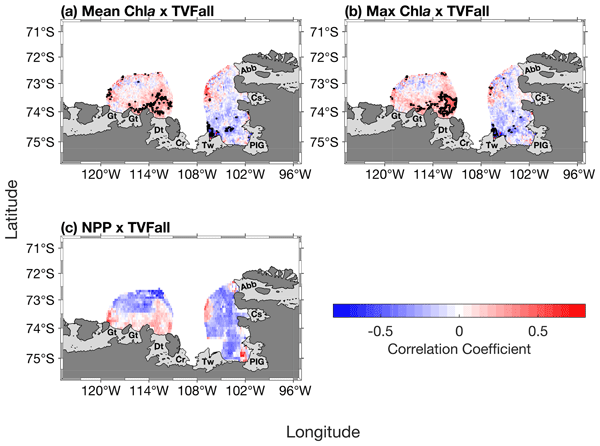
We investigate the phytoplankton bloom variability and its drivers in the Amundsen polynyas (areas of open water within sea ice). Between 1998 and 2017, we find that changes in melting ice shelves may have different impacts on biological productivity between the Amundsen Sea (ASP) and Pine Island (PIP) polynyas. While ice shelves melting seems to play an important role for phytoplankton growth variability in the ASP, light and warmer waters appear to be more important in the PIP.
Diana Francis, Ricardo Fonseca, Narendra Nelli, Petra Heil, Jonathan D. Wille, Irina V. Gorodetskaya, and Robert A. Massom
The Cryosphere, 20, 1–28, https://doi.org/10.5194/tc-20-1-2026, https://doi.org/10.5194/tc-20-1-2026, 2026
Short summary
Short summary
This study investigates the role of atmospheric dynamics in sea-ice thickness and snow depth at a coastal site in East Antarctica using in situ measurements and numerical modeling. The snow thickness variability is impacted by atmospheric forcing, with significant contributions from precipitation, Foehn effects, blowing snow, and episodic warm and moist air intrusions, which led to changes of up to 0.08 m within a day for a field that is in the range of 0.02–0.18 m during July–November 2022.
Wilma G. C. Huneke, Andrew McC. Hogg, Martin Dix, Daohua Bi, Arnold Sullivan, Shayne McGregor, Chiara M. Holgate, Siobhan P. O'Farrell, and Micael J. T. Oliveira
Geosci. Model Dev., 18, 9991–10015, https://doi.org/10.5194/gmd-18-9991-2025, https://doi.org/10.5194/gmd-18-9991-2025, 2025
Short summary
Short summary
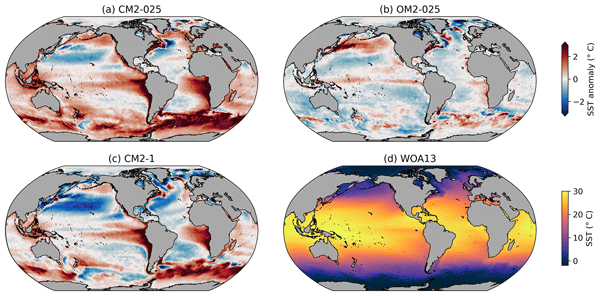
A new configuration of the Australian Community Climate and Earth System Simulator coupled model, ACCESS-CM2, with a higher resolution ocean-sea ice component is introduced. The new version of the coupled climate model was designed to better capture smaller-scale ocean motions. While this configuration improves the representation of many aspects of the climate system, some biases from the existing lower-resolution version persist.
Ian A. Raphael, Donald K. Perovich, Christopher M. Polashenski, and Robert L. Hawley
The Cryosphere, 19, 6059–6076, https://doi.org/10.5194/tc-19-6059-2025, https://doi.org/10.5194/tc-19-6059-2025, 2025
Short summary
Short summary
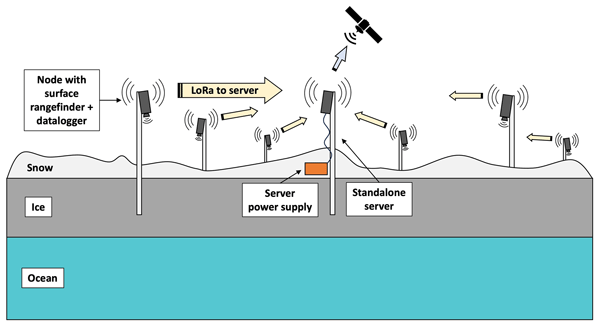
Snow plays competing roles in the sea ice cycle by reflecting sunlight during summer (reducing melt) and insulating the ice from the cold atmosphere during winter (reducing growth). Observing where, when, and how much snow accumulates on sea ice is thus central to understanding the Arctic. Here, we describe a new snow depth observation system that is substantially cheaper and lighter than existing tools and present a study demonstrating its potential to improve snow measurements on sea ice.
Kristiina Verro, Cecilia Äijälä, Roberta Pirazzini, Ruzica Dadic, Damien Maure, Willem Jan van de Berg, Giacomo Traversa, Christiaan T. van Dalum, Petteri Uotila, Xavier Fettweis, Biagio Di Mauro, and Milla Johansson
The Cryosphere, 19, 4409–4436, https://doi.org/10.5194/tc-19-4409-2025, https://doi.org/10.5194/tc-19-4409-2025, 2025
Short summary
Short summary
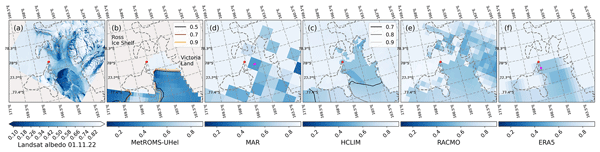
Accurately representing Antarctic sea ice is essential for reliable climate and ocean model predictions. We evaluated how different models simulate the sea ice's sunlight reflectivity (called albedo) using field and satellite data. Models with simple albedo schemes performed well in limited cases but missed key processes. The advanced scheme in the MetROMS-UHel ocean model provided the most accurate results, including observed day–night albedo changes observed during a field campaign.
Joey J. Voermans, Alexander D. Fraser, Jill Brouwer, Michael H. Meylan, Qingxiang Liu, and Alexander V. Babanin
The Cryosphere, 19, 3381–3395, https://doi.org/10.5194/tc-19-3381-2025, https://doi.org/10.5194/tc-19-3381-2025, 2025
Short summary
Short summary
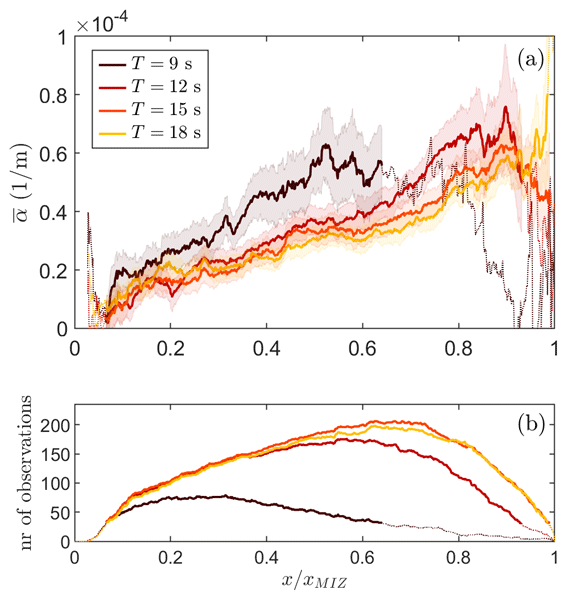
Limited measurements of waves in sea ice exist, preventing our understanding of wave attenuation in sea ice under a wide range of ice conditions. Using satellite observations from ICESat-2, we observe an overall linear increase in the wave attenuation rate with distance into the marginal ice zone. While attenuation may vary greatly locally, this finding may provide opportunities for the modeling of waves in sea ice at global and climate scales when such fine detail may not be needed.
Cecilia Äijälä, Yafei Nie, Lucía Gutiérrez-Loza, Chiara De Falco, Siv Kari Lauvset, Bin Cheng, David Anthony Bailey, and Petteri Uotila
Geosci. Model Dev., 18, 4823–4853, https://doi.org/10.5194/gmd-18-4823-2025, https://doi.org/10.5194/gmd-18-4823-2025, 2025
Short summary
Short summary
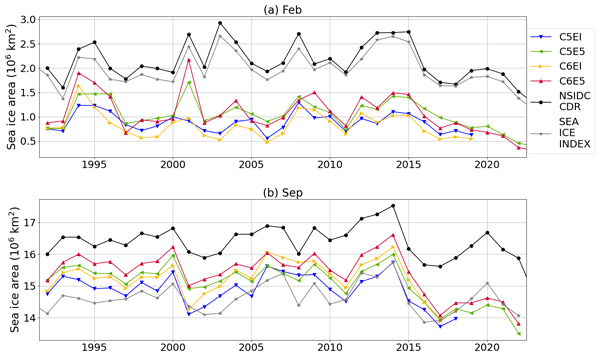
The sea ice around Antarctica has experienced record lows in recent years. To understand these changes, models are needed. MetROMS-UHel is a new version of an ocean–sea ice model with updated sea ice code and the atmospheric data. We investigate the effect of our updates on different variables with a focus on sea ice and show an improved sea ice representation as compared with observations.
Tereza Uhlíková, Timo Vihma, Alexey Yu Karpechko, and Petteri Uotila
The Cryosphere, 19, 1031–1046, https://doi.org/10.5194/tc-19-1031-2025, https://doi.org/10.5194/tc-19-1031-2025, 2025
Short summary
Short summary
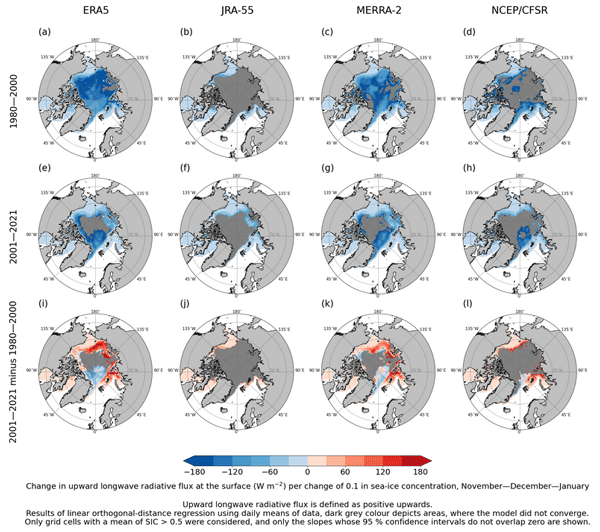
To better understand the local, regional, and global impacts of the recent rapid sea-ice decline in the Arctic, one of the key issues is to quantify the effects of sea-ice concentration on the surface radiative fluxes. We analyse these effects utilising four data sets called atmospheric reanalyses, and we evaluate uncertainties in these effects arising from inter-reanalysis differences in the sensitivity of the surface radiative fluxes to sea-ice concentration.
Madison M. Smith, Niels Fuchs, Evgenii Salganik, Donald K. Perovich, Ian Raphael, Mats A. Granskog, Kirstin Schulz, Matthew D. Shupe, and Melinda Webster
The Cryosphere, 19, 619–644, https://doi.org/10.5194/tc-19-619-2025, https://doi.org/10.5194/tc-19-619-2025, 2025
Short summary
Short summary
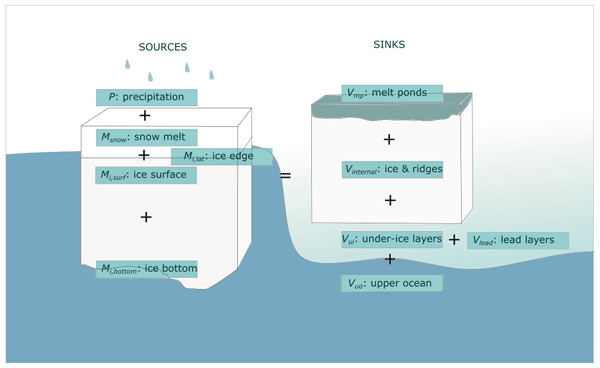
The fate of freshwater from Arctic sea ice and snowmelt impacts interactions of the atmosphere, sea ice, and ocean. We complete a comprehensive analysis of datasets from a 2020 central Arctic field campaign to understand the drivers of the sea ice freshwater budget and the fate of this water. Over half of the freshwater comes from surface melt, and a majority fraction is incorporated into the ocean. Results suggest that the representation of melt ponds is a key area for future development.
Yi Zhou, Xianwei Wang, Ruibo Lei, Arttu Jutila, Donald K. Perovich, Luisa von Albedyll, Dmitry V. Divine, Yu Zhang, and Christian Haas
EGUsphere, https://doi.org/10.5194/egusphere-2024-2821, https://doi.org/10.5194/egusphere-2024-2821, 2024
Preprint archived
Short summary
Short summary
This study examines how the bulk density of Arctic sea ice varies seasonally, a factor often overlooked in satellite measurements of sea ice thickness. From October to April, we found significant seasonal variations in sea ice bulk density at different spatial scales using direct observations as well as airborne and satellite data. New models were then developed to indirectly predict sea ice bulk density. This advance can improve our ability to monitor changes in Arctic sea ice.
Yi Zhou, Xianwei Wang, Ruibo Lei, Luisa von Albedyll, Donald K. Perovich, Yu Zhang, and Christian Haas
EGUsphere, https://doi.org/10.5194/egusphere-2024-1240, https://doi.org/10.5194/egusphere-2024-1240, 2024
Preprint archived
Short summary
Short summary
This study examines how the density of Arctic sea ice varies seasonally, a factor often overlooked in satellite measurements of sea ice thickness. From October to April, using direct observations and satellite data, we found that sea ice density decreases significantly until mid-January due to increased porosity as the ice ages, and then stabilizes until April. We then developed new models to estimate sea ice density. This advance can improve our ability to monitor changes in Arctic sea ice.
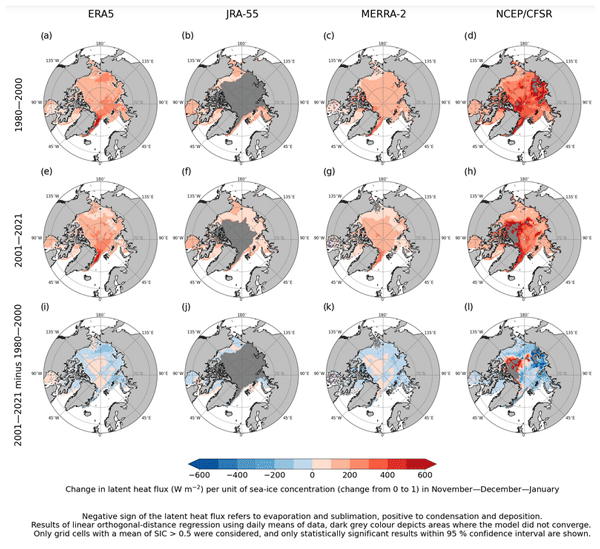
Tereza Uhlíková, Timo Vihma, Alexey Yu Karpechko, and Petteri Uotila
The Cryosphere, 18, 957–976, https://doi.org/10.5194/tc-18-957-2024, https://doi.org/10.5194/tc-18-957-2024, 2024
Short summary
Short summary
A prerequisite for understanding the local, regional, and hemispherical impacts of Arctic sea-ice decline on the atmosphere is to quantify the effects of sea-ice concentration (SIC) on the sensible and latent heat fluxes in the Arctic. We analyse these effects utilising four data sets called atmospheric reanalyses, and we evaluate uncertainties in these effects arising from inter-reanalysis differences in SIC and in the sensitivity of the latent and sensible heat fluxes to SIC.
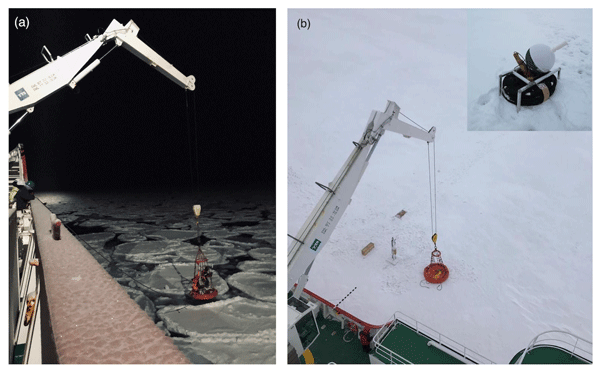
Ashleigh Womack, Alberto Alberello, Marc de Vos, Alessandro Toffoli, Robyn Verrinder, and Marcello Vichi
The Cryosphere, 18, 205–229, https://doi.org/10.5194/tc-18-205-2024, https://doi.org/10.5194/tc-18-205-2024, 2024
Short summary
Short summary
Synoptic events have a significant influence on the evolution of Antarctic sea ice. Our current understanding of the interactions between cyclones and sea ice remains limited. Using two ensembles of buoys, deployed in the north-eastern Weddell Sea region during winter and spring of 2019, we show how the evolution and spatial pattern of sea ice drift and deformation in the Antarctic marginal ice zone were affected by the balance between atmospheric and oceanic forcing and the local ice.
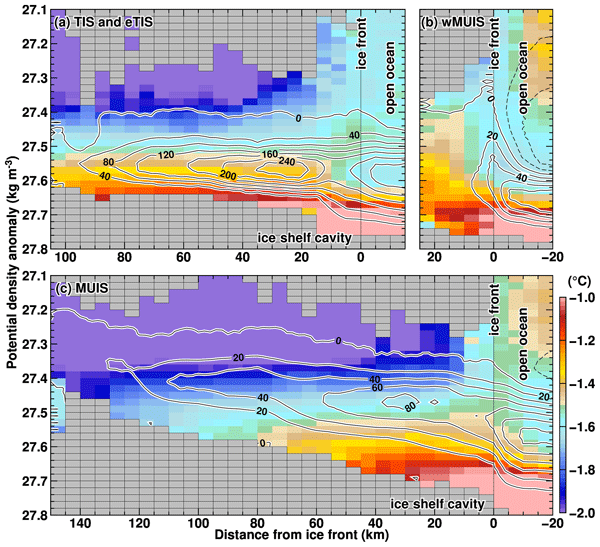
Kazuya Kusahara, Daisuke Hirano, Masakazu Fujii, Alexander D. Fraser, Takeshi Tamura, Kohei Mizobata, Guy D. Williams, and Shigeru Aoki
The Cryosphere, 18, 43–73, https://doi.org/10.5194/tc-18-43-2024, https://doi.org/10.5194/tc-18-43-2024, 2024
Short summary
Short summary
This study focuses on the Totten and Moscow University ice shelves, East Antarctica. We used an ocean–sea ice–ice shelf model to better understand regional interactions between ocean, sea ice, and ice shelf. We found that a combination of warm ocean water and local sea ice production influences the regional ice shelf basal melting. Furthermore, the model reproduced the summertime undercurrent on the upper continental slope, regulating ocean heat transport onto the continental shelf.
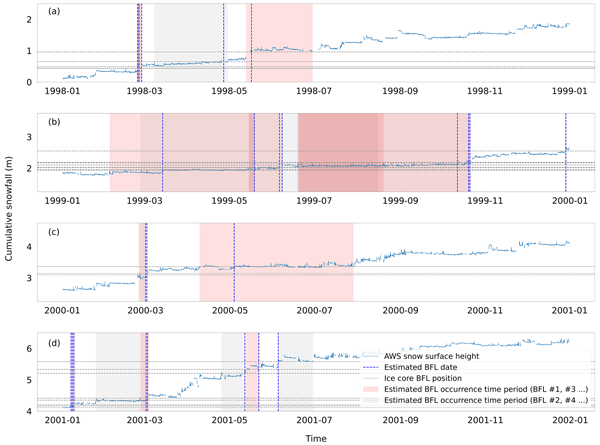
Lingwei Zhang, Tessa R. Vance, Alexander D. Fraser, Lenneke M. Jong, Sarah S. Thompson, Alison S. Criscitiello, and Nerilie J. Abram
The Cryosphere, 17, 5155–5173, https://doi.org/10.5194/tc-17-5155-2023, https://doi.org/10.5194/tc-17-5155-2023, 2023
Short summary
Short summary
Physical features in ice cores provide unique records of past variability. We identified 1–2 mm ice layers without bubbles in surface ice cores from Law Dome, East Antarctica, occurring on average five times per year. The origin of these bubble-free layers is unknown. In this study, we investigate whether they have the potential to record past atmospheric processes and circulation. We find that the bubble-free layers are linked to accumulation hiatus events and meridional moisture transport.
Xiaoqiao Wang, Zhaoru Zhang, Michael S. Dinniman, Petteri Uotila, Xichen Li, and Meng Zhou
The Cryosphere, 17, 1107–1126, https://doi.org/10.5194/tc-17-1107-2023, https://doi.org/10.5194/tc-17-1107-2023, 2023
Short summary
Short summary
The bottom water of the global ocean originates from high-salinity water formed in polynyas in the Southern Ocean where sea ice coverage is low. This study reveals the impacts of cyclones on sea ice and water mass formation in the Ross Ice Shelf Polynya using numerical simulations. Sea ice production is rapidly increased caused by enhancement in offshore wind, promoting high-salinity water formation in the polynya. Cyclones also modulate the transport of this water mass by wind-driven currents.
Yafei Nie, Chengkun Li, Martin Vancoppenolle, Bin Cheng, Fabio Boeira Dias, Xianqing Lv, and Petteri Uotila
Geosci. Model Dev., 16, 1395–1425, https://doi.org/10.5194/gmd-16-1395-2023, https://doi.org/10.5194/gmd-16-1395-2023, 2023
Short summary
Short summary
State-of-the-art Earth system models simulate the observed sea ice extent relatively well, but this is often due to errors in the dynamic and other processes in the simulated sea ice changes cancelling each other out. We assessed the sensitivity of these processes simulated by the coupled ocean–sea ice model NEMO4.0-SI3 to 18 parameters. The performance of the model in simulating sea ice change processes was ultimately improved by adjusting the three identified key parameters.
Ruibo Lei, Mario Hoppmann, Bin Cheng, Marcel Nicolaus, Fanyi Zhang, Benjamin Rabe, Long Lin, Julia Regnery, and Donald K. Perovich
The Cryosphere Discuss., https://doi.org/10.5194/tc-2023-25, https://doi.org/10.5194/tc-2023-25, 2023
Manuscript not accepted for further review
Short summary
Short summary
To characterize the freezing and melting of different types of sea ice, we deployed four IMBs during the MOSAiC second drift. The drifting pattern, together with a large snow accumulation, relatively warm air temperatures, and a rapid increase in oceanic heat close to Fram Strait, determined the seasonal evolution of the ice mass balance. The refreezing of ponded ice and voids within the unconsolidated ridges amplifies the anisotropy of the heat exchange between the ice and the atmosphere/ocean.
Long Lin, Ruibo Lei, Mario Hoppmann, Donald K. Perovich, and Hailun He
The Cryosphere, 16, 4779–4796, https://doi.org/10.5194/tc-16-4779-2022, https://doi.org/10.5194/tc-16-4779-2022, 2022
Short summary
Short summary
Ice mass balance observations indicated that average basal melt onset was comparable in the central Arctic Ocean and approximately 17 d earlier than surface melt in the Beaufort Gyre. The average onset of basal growth lagged behind the surface of the pan-Arctic Ocean for almost 3 months. In the Beaufort Gyre, both drifting-buoy observations and fixed-point observations exhibit a trend towards earlier basal melt onset, which can be ascribed to the earlier warming of the surface ocean.
Jill Brouwer, Alexander D. Fraser, Damian J. Murphy, Pat Wongpan, Alberto Alberello, Alison Kohout, Christopher Horvat, Simon Wotherspoon, Robert A. Massom, Jessica Cartwright, and Guy D. Williams
The Cryosphere, 16, 2325–2353, https://doi.org/10.5194/tc-16-2325-2022, https://doi.org/10.5194/tc-16-2325-2022, 2022
Short summary
Short summary
The marginal ice zone is the region where ocean waves interact with sea ice. Although this important region influences many sea ice, ocean and biological processes, it has been difficult to accurately measure on a large scale from satellite instruments. We present new techniques for measuring wave attenuation using the NASA ICESat-2 laser altimeter. By measuring how waves attenuate within the sea ice, we show that the marginal ice zone may be far wider than previously realised.

Juha Karvonen, Eero Rinne, Heidi Sallila, Petteri Uotila, and Marko Mäkynen
The Cryosphere, 16, 1821–1844, https://doi.org/10.5194/tc-16-1821-2022, https://doi.org/10.5194/tc-16-1821-2022, 2022
Short summary
Short summary
We propose a method to provide sea ice thickness (SIT) estimates over a test area in the Arctic utilizing radar altimeter (RA) measurement lines and C-band SAR imagery. The RA data are from CryoSat-2, and SAR imagery is from Sentinel-1. By combining them we get a SIT grid covering the whole test area instead of only narrow measurement lines from RA. This kind of SIT estimation can be extended to cover the whole Arctic (and Antarctic) for operational SIT monitoring.
Tian R. Tian, Alexander D. Fraser, Noriaki Kimura, Chen Zhao, and Petra Heil
The Cryosphere, 16, 1299–1314, https://doi.org/10.5194/tc-16-1299-2022, https://doi.org/10.5194/tc-16-1299-2022, 2022
Short summary
Short summary
This study presents a comprehensive validation of a satellite observational sea ice motion product in Antarctica by using drifting buoys. Two problems existing in this sea ice motion product have been noticed. After rectifying problems, we use it to investigate the impacts of satellite observational configuration and timescale on Antarctic sea ice kinematics and suggest the future improvement of satellite missions specifically designed for retrieval of sea ice motion.
Ralf Döscher, Mario Acosta, Andrea Alessandri, Peter Anthoni, Thomas Arsouze, Tommi Bergman, Raffaele Bernardello, Souhail Boussetta, Louis-Philippe Caron, Glenn Carver, Miguel Castrillo, Franco Catalano, Ivana Cvijanovic, Paolo Davini, Evelien Dekker, Francisco J. Doblas-Reyes, David Docquier, Pablo Echevarria, Uwe Fladrich, Ramon Fuentes-Franco, Matthias Gröger, Jost v. Hardenberg, Jenny Hieronymus, M. Pasha Karami, Jukka-Pekka Keskinen, Torben Koenigk, Risto Makkonen, François Massonnet, Martin Ménégoz, Paul A. Miller, Eduardo Moreno-Chamarro, Lars Nieradzik, Twan van Noije, Paul Nolan, Declan O'Donnell, Pirkka Ollinaho, Gijs van den Oord, Pablo Ortega, Oriol Tintó Prims, Arthur Ramos, Thomas Reerink, Clement Rousset, Yohan Ruprich-Robert, Philippe Le Sager, Torben Schmith, Roland Schrödner, Federico Serva, Valentina Sicardi, Marianne Sloth Madsen, Benjamin Smith, Tian Tian, Etienne Tourigny, Petteri Uotila, Martin Vancoppenolle, Shiyu Wang, David Wårlind, Ulrika Willén, Klaus Wyser, Shuting Yang, Xavier Yepes-Arbós, and Qiong Zhang
Geosci. Model Dev., 15, 2973–3020, https://doi.org/10.5194/gmd-15-2973-2022, https://doi.org/10.5194/gmd-15-2973-2022, 2022
Short summary
Short summary
The Earth system model EC-Earth3 is documented here. Key performance metrics show physical behavior and biases well within the frame known from recent models. With improved physical and dynamic features, new ESM components, community tools, and largely improved physical performance compared to the CMIP5 version, EC-Earth3 represents a clear step forward for the only European community ESM. We demonstrate here that EC-Earth3 is suited for a range of tasks in CMIP6 and beyond.
Hanna K. Lappalainen, Tuukka Petäjä, Timo Vihma, Jouni Räisänen, Alexander Baklanov, Sergey Chalov, Igor Esau, Ekaterina Ezhova, Matti Leppäranta, Dmitry Pozdnyakov, Jukka Pumpanen, Meinrat O. Andreae, Mikhail Arshinov, Eija Asmi, Jianhui Bai, Igor Bashmachnikov, Boris Belan, Federico Bianchi, Boris Biskaborn, Michael Boy, Jaana Bäck, Bin Cheng, Natalia Chubarova, Jonathan Duplissy, Egor Dyukarev, Konstantinos Eleftheriadis, Martin Forsius, Martin Heimann, Sirkku Juhola, Vladimir Konovalov, Igor Konovalov, Pavel Konstantinov, Kajar Köster, Elena Lapshina, Anna Lintunen, Alexander Mahura, Risto Makkonen, Svetlana Malkhazova, Ivan Mammarella, Stefano Mammola, Stephany Buenrostro Mazon, Outi Meinander, Eugene Mikhailov, Victoria Miles, Stanislav Myslenkov, Dmitry Orlov, Jean-Daniel Paris, Roberta Pirazzini, Olga Popovicheva, Jouni Pulliainen, Kimmo Rautiainen, Torsten Sachs, Vladimir Shevchenko, Andrey Skorokhod, Andreas Stohl, Elli Suhonen, Erik S. Thomson, Marina Tsidilina, Veli-Pekka Tynkkynen, Petteri Uotila, Aki Virkkula, Nadezhda Voropay, Tobias Wolf, Sayaka Yasunaka, Jiahua Zhang, Yubao Qiu, Aijun Ding, Huadong Guo, Valery Bondur, Nikolay Kasimov, Sergej Zilitinkevich, Veli-Matti Kerminen, and Markku Kulmala
Atmos. Chem. Phys., 22, 4413–4469, https://doi.org/10.5194/acp-22-4413-2022, https://doi.org/10.5194/acp-22-4413-2022, 2022
Short summary
Short summary
We summarize results during the last 5 years in the northern Eurasian region, especially from Russia, and introduce recent observations of the air quality in the urban environments in China. Although the scientific knowledge in these regions has increased, there are still gaps in our understanding of large-scale climate–Earth surface interactions and feedbacks. This arises from limitations in research infrastructures and integrative data analyses, hindering a comprehensive system analysis.

Yu Yan, Wei Gu, Andrea M. U. Gierisch, Yingjun Xu, and Petteri Uotila
Geosci. Model Dev., 15, 1269–1288, https://doi.org/10.5194/gmd-15-1269-2022, https://doi.org/10.5194/gmd-15-1269-2022, 2022
Short summary
Short summary
In this study, we developed NEMO-Bohai, an ocean–ice model for the Bohai Sea, China. This study presented the scientific design and technical choices of the parameterizations for the NEMO-Bohai model. The model was calibrated and evaluated with in situ and satellite observations of ocean and sea ice. NEMO-Bohai is intended to be a valuable tool for long-term ocean and ice simulations and climate change studies.
Jessica Cartwright, Alexander D. Fraser, and Richard Porter-Smith
Earth Syst. Sci. Data, 14, 479–490, https://doi.org/10.5194/essd-14-479-2022, https://doi.org/10.5194/essd-14-479-2022, 2022
Short summary
Short summary
Due to the scale and remote nature of the polar regions, it is essential to use satellite remote sensing to monitor and understand them and their dynamics. Here we present data from the Advanced Scatterometer (ASCAT), processed in a manner proven for use in cryosphere studies. The data have been processed on three timescales (5 d, 2 d and 1 d) in order to optimise temporal resolution as each of the three MetOp satellites is launched.
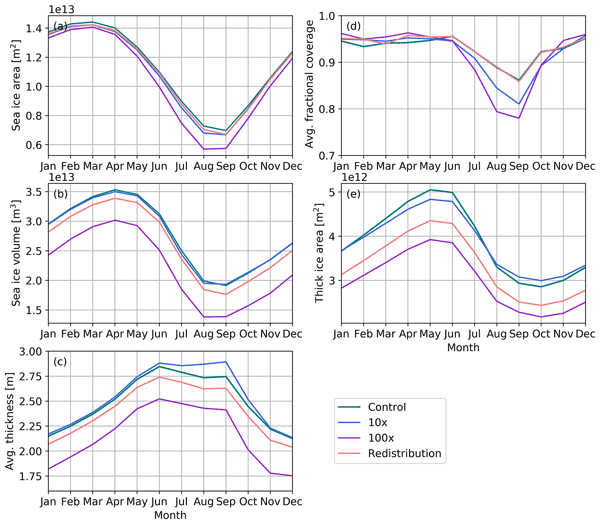
Madison M. Smith, Marika Holland, and Bonnie Light
The Cryosphere, 16, 419–434, https://doi.org/10.5194/tc-16-419-2022, https://doi.org/10.5194/tc-16-419-2022, 2022
Short summary
Short summary
Climate models represent the atmosphere, ocean, sea ice, and land with equations of varying complexity and are important tools for understanding changes in global climate. Here, we explore how realistic variations in the equations describing how sea ice melt occurs at the edges (called lateral melting) impact ice and climate. We find that these changes impact the progression of the sea-ice–albedo feedback in the Arctic and so make significant changes to the predicted Arctic sea ice.
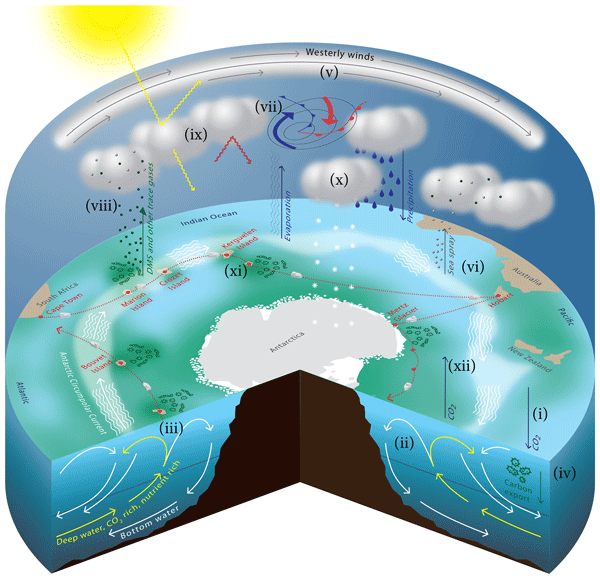
Sebastian Landwehr, Michele Volpi, F. Alexander Haumann, Charlotte M. Robinson, Iris Thurnherr, Valerio Ferracci, Andrea Baccarini, Jenny Thomas, Irina Gorodetskaya, Christian Tatzelt, Silvia Henning, Rob L. Modini, Heather J. Forrer, Yajuan Lin, Nicolas Cassar, Rafel Simó, Christel Hassler, Alireza Moallemi, Sarah E. Fawcett, Neil Harris, Ruth Airs, Marzieh H. Derkani, Alberto Alberello, Alessandro Toffoli, Gang Chen, Pablo Rodríguez-Ros, Marina Zamanillo, Pau Cortés-Greus, Lei Xue, Conor G. Bolas, Katherine C. Leonard, Fernando Perez-Cruz, David Walton, and Julia Schmale
Earth Syst. Dynam., 12, 1295–1369, https://doi.org/10.5194/esd-12-1295-2021, https://doi.org/10.5194/esd-12-1295-2021, 2021
Short summary
Short summary
The Antarctic Circumnavigation Expedition surveyed a large number of variables describing the dynamic state of ocean and atmosphere, freshwater cycle, atmospheric chemistry, ocean biogeochemistry, and microbiology in the Southern Ocean. To reduce the dimensionality of the dataset, we apply a sparse principal component analysis and identify temporal patterns from diurnal to seasonal cycles, as well as geographical gradients and
hotspotsof interaction. Code and data are open access.
Hakase Hayashida, Meibing Jin, Nadja S. Steiner, Neil C. Swart, Eiji Watanabe, Russell Fiedler, Andrew McC. Hogg, Andrew E. Kiss, Richard J. Matear, and Peter G. Strutton
Geosci. Model Dev., 14, 6847–6861, https://doi.org/10.5194/gmd-14-6847-2021, https://doi.org/10.5194/gmd-14-6847-2021, 2021
Short summary
Short summary
Ice algae are tiny plants like phytoplankton but they grow within sea ice. In polar regions, both phytoplankton and ice algae are the foundation of marine ecosystems and play an important role in taking up carbon dioxide in the atmosphere. However, state-of-the-art climate models typically do not include ice algae, and therefore their role in the climate system remains unclear. This project aims to address this knowledge gap by coordinating a set of experiments using sea-ice–ocean models.
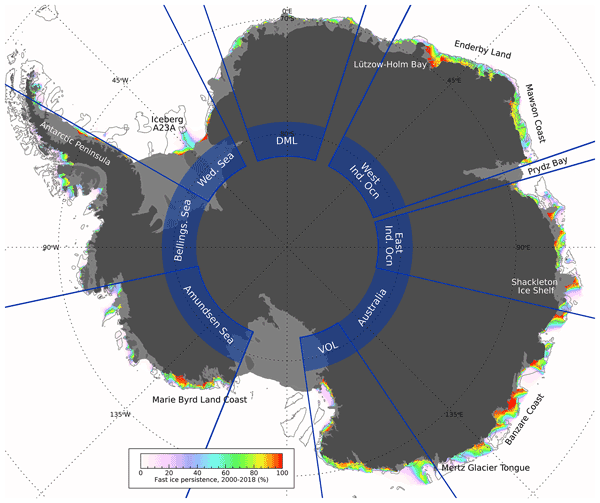
Alexander D. Fraser, Robert A. Massom, Mark S. Handcock, Phillip Reid, Kay I. Ohshima, Marilyn N. Raphael, Jessica Cartwright, Andrew R. Klekociuk, Zhaohui Wang, and Richard Porter-Smith
The Cryosphere, 15, 5061–5077, https://doi.org/10.5194/tc-15-5061-2021, https://doi.org/10.5194/tc-15-5061-2021, 2021
Short summary
Short summary
Landfast ice is sea ice that remains stationary by attaching to Antarctica's coastline and grounded icebergs. Although a variable feature, landfast ice exerts influence on key coastal processes involving pack ice, the ice sheet, ocean, and atmosphere and is of ecological importance. We present a first analysis of change in landfast ice over an 18-year period and quantify trends (−0.19 ± 0.18 % yr−1). This analysis forms a reference of landfast-ice extent and variability for use in other studies.
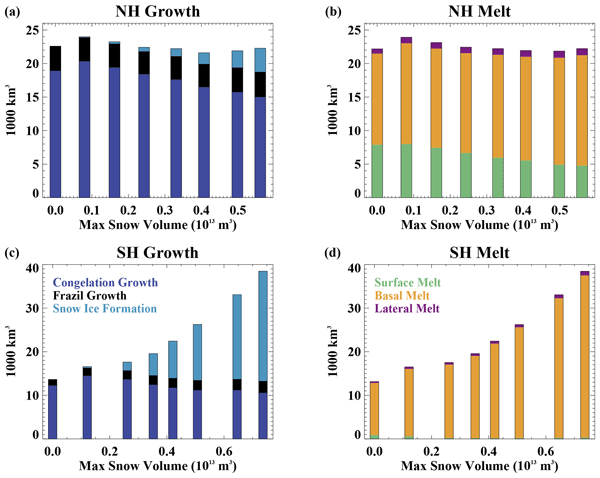
Marika M. Holland, David Clemens-Sewall, Laura Landrum, Bonnie Light, Donald Perovich, Chris Polashenski, Madison Smith, and Melinda Webster
The Cryosphere, 15, 4981–4998, https://doi.org/10.5194/tc-15-4981-2021, https://doi.org/10.5194/tc-15-4981-2021, 2021
Short summary
Short summary
As the most reflective and most insulative natural material, snow has important climate effects. For snow on sea ice, its high reflectivity reduces ice melt. However, its high insulating capacity limits ice growth. These counteracting effects make its net influence on sea ice uncertain. We find that with increasing snow, sea ice in both hemispheres is thicker and more extensive. However, the drivers of this response are different in the two hemispheres due to different climate conditions.
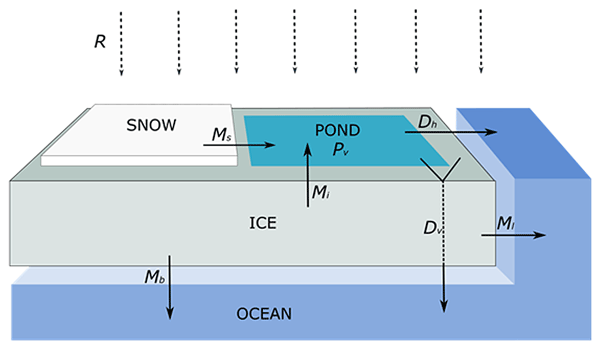
Don Perovich, Madison Smith, Bonnie Light, and Melinda Webster
The Cryosphere, 15, 4517–4525, https://doi.org/10.5194/tc-15-4517-2021, https://doi.org/10.5194/tc-15-4517-2021, 2021
Short summary
Short summary
During summer, Arctic sea ice melts on its surface and bottom and lateral edges. Some of this fresh meltwater is stored on the ice surface in features called melt ponds. The rest flows into the ocean. The meltwater flowing into the upper ocean affects ice growth and melt, upper ocean properties, and ocean ecosystems. Using field measurements, we found that the summer meltwater was equal to an 80 cm thick layer; 85 % of this meltwater flowed into the ocean and 15 % was stored in melt ponds.
Cited articles
Abram, N. J., Purich, A., England, M. H., McCormack, F. S., Strugnell, J. M., Bergstrom, D. M., Vance, T. R., Stål, T., Wienecke, B., Heil, P., Doddridge, E. W., Sallée, J.-B., Williams, T. J., Reading, A. M., Mackintosh, A., Reese, R., Winkelmann, R., Klose, A. K., Boyd, P. W., Chown, S. L., and Robinson, S. A.: Emerging evidence of abrupt changes in the Antarctic environment, Nature, 644, 621–633, https://doi.org/10.1038/s41586-025-09349-5, 2025.
Ackley, S. F.: Pressure ridge associated microbial communities in Antarctic sea ice, Eos, Trans. Am. Geophys. Union, 66, 1278, https://doi.org/10.1029/EO066i051p01257, 1985.
Ackley, S. F. and Sullivan, C. W.: Physical controls on the development and characteristics of Antarctic sea ice biological communities - A review and synthesis, Deep-Sea Res. Part I: Oceanogr. Res. Papers, 41, 1583–1604, https://doi.org/10.1016/0967-0637(94)90062-0, 1994.
Ackley, S. F., Stammerjohn, S., Maksym, T., Smith, M., Cassano, J., Guest, P., Tison, J. L., Delille, B., Loose, B., Sedwick, P., DePace, L., Roach, L., and Parno, J.: Sea-ice production and air/ice/ocean/biogeochemistry interactions in the Ross Sea during the PIPERS 2017 autumn field campaign, Ann. Glaciol., 61, 181–195, https://doi.org/10.1017/aog.2020.31, 2020.
Alberello, A., Bennetts, L. G., Onorato, M., Vichi, M., MacHutchon, K., Eayrs, C., Ntamba, B. N., Benetazzo, A., Bergamasco, F., Nelli, F., Pattani, R., Clarke, H., Tersigni, I., and Toffoli, A.: Three-dimensional imaging of waves and floes in the marginal ice zone during a cyclone, Nat. Commun., 13, 4590, https://doi.org/10.1038/s41467-022-32036-2, 2022.
Allison, I., Brandt, R. E., and Warren, S. G.: East Antarctic sea ice: Albedo, thickness distribution, and snow cover, J. Geophys. Res.-Oceans, 98, 12417–12429, https://doi.org/10.1029/93jc00648, 1993.
Andreas, E. L. and Ackley, S. F.: On the Differences in Ablation Seasons of Arctic and Antarctic Sea Ice, J. Atmos. Sci., 39, 440–447, https://doi.org/10.1175/1520-0469(1982)039<0440:Otdias>2.0.Co;2, 1982.
Arrigo, K. R., Perovich, D. K., Pickart, R. S., Brown, Z. W., van Dijken, G. L., Lowry, K. E., Mills, M. M., Palmer, M. A., Balch, W. M., Bahr, F., Bates, N. R., Benitez-Nelson, C., Bowler, B., Brownlee, E., Ehn, J. K., Frey, K. E., Garley, R., Laney, S. R., Lubelczyk, Mathis, J., Matsuoka, A., Mitchell, B. G., Moore, G. W. K., Ortega-Retuerta, E., Pal, S., Polashenski, C. M., Reynolds, R. A., Schieber, B., Sosik, H. M., Stephens, M., and Swift, J. H.: Massive Phytoplankton Blooms Under Arctic Sea Ice, Science, 336, 1408–1408, https://doi.org/10.1126/science.1215065, 2012.
Arrigo, K. R., Brown, Z. W., Mills, M. M., Deming, J. W., and Tremblay, J.-É.: Sea ice algal biomass and physiology in the Amundsen Sea, Antarctica, Elem. Sc. Anthrop., 2, https://doi.org/10.12952/journal.elementa.000028, 2014.
Arrigo, K. R. and van Dijken, G. L.: Phytoplankton dynamics within 37 Antarctic coastal polynya systems, J. Geophys. Res.-Oceans, 108, https://doi.org/10.1029/2002jc001739, 2003.
Asplin, M. G., Galley, R., Barber, D. G., and Prinsenberg, S.: Fracture of summer perennial sea ice by ocean swell as a result of Arctic storms, J. Geophys. Res.-Oceans, 117, https://doi.org/10.1029/2011jc007221, 2012.
Asplin, M. G., Scharien, R., Else, B., Howell, S., Barber, D. G., Papakyriakou, T., and Prinsenberg, S.: Implications of fractured Arctic perennial ice cover on thermodynamic and dynamic sea ice processes, J. Geophys. Res.-Oceans, 119, 2327–2343, https://doi.org/10.1002/2013jc009557, 2014.
Auger, M., Sallée, J. B., Thompson, A. F., Pauthenet, E., and Prandi, P.: Southern Ocean Ice-Covered Eddy Properties From Satellite Altimetry, J. Geophys. Res.-Oceans, 128, https://doi.org/10.1029/2022jc019363, 2023.
Ayres, H. C., Screen, J. A., Blockley, E. W., and Bracegirdle, T. J.: The Coupled Atmosphere–Ocean Response to Antarctic Sea Ice Loss, J. Climate, 35, 4665–4685, https://doi.org/10.1175/jcli-d-21-0918.1, 2022.
Barber, D. G. and Massom, R. A.: The Role of Sea Ice in Arctic and Antarctic Polynyas, in: Polynyas: Windows to the World, edited by: Smith, W. O. and Barber, D. G., Elsevier Oceanography Series, 1–54, https://doi.org/10.1016/s0422-9894(06)74001-6, 2007.
Bateson, A. W., Feltham, D. L., Schröder, D., Hosekova, L., Ridley, J. K., and Aksenov, Y.: Impact of sea ice floe size distribution on seasonal fragmentation and melt of Arctic sea ice, The Cryosphere, 14, 403–428, https://doi.org/10.5194/tc-14-403-2020, 2020.
Bennetts, L. G., O'Farrell, S., and Uotila, P.: Brief communication: Impacts of ocean-wave-induced breakup of Antarctic sea ice via thermodynamics in a stand-alone version of the CICE sea-ice model, The Cryosphere, 11, 1035–1040, https://doi.org/10.5194/tc-11-1035-2017, 2017.
Bennetts, L. G., Shakespeare, C. J., Vreugdenhil, C. A., Foppert, A., Gayen, B., Meyer, A., Morrison, A. K., Padman, L., Phillips, H. E., Stevens, C. L., Toffoli, A., Constantinou, N. C., Cusack, J. M., Cyriac, A., Doddridge, E. W., England, M. H., Evans, D. G., Heil, P., Hogg, A. M., Holmes, R. M., Huneke, W. G. C., Jones, N. L., Keating, S. R., Kiss, A. E., Kraitzman, N., Malyarenko, A., McConnochie, C. D., Meucci, A., Montiel, F., Neme, J., Nikurashin, M., Patel, R. S., Peng, J. P., Rayson, M., Rosevear, M. G., Sohail, T., Spence, P., and Stanley, G. J.: Closing the Loops on Southern Ocean Dynamics: From the Circumpolar Current to Ice Shelves and From Bottom Mixing to Surface Waves, Rev. Geophys., 62, https://doi.org/10.1029/2022rg000781, 2024.
Bennetts, L. G. and Williams, T. D.: Water wave transmission by an array of floating discs, P. Roy. Soc. A-Math. Phy., 471, https://doi.org/10.1098/rspa.2014.0698, 2015.
Brandt, R. E., Warren, S. G., Worby, A. P., and Grenfell, T. C.: Surface Albedo of the Antarctic Sea Ice Zone, J. Climate, 18, 3606–3622, https://doi.org/10.1175/jcli3489.1, 2005.
Brouwer, J., Fraser, A. D., Murphy, D. J., Wongpan, P., Alberello, A., Kohout, A., Horvat, C., Wotherspoon, S., Massom, R. A., Cartwright, J., and Williams, G. D.: Altimetric observation of wave attenuation through the Antarctic marginal ice zone using ICESat-2, The Cryosphere, 16, 2325–2353, https://doi.org/10.5194/tc-16-2325-2022, 2022.
Casas-Prat, M., Hemer, M. A., Dodet, G., Morim, J., Wang, X. L., Mori, N., Young, I., Erikson, L., Kamranzad, B., Kumar, P., Menéndez, M., and Feng, Y.: Wind-wave climate changes and their impacts, Nature Reviews Earth & Environment, 5, 23–42, https://doi.org/10.1038/s43017-023-00502-0, 2024.
Cavalieri, D., Parkinson, C., Gloersen, P., and Zwally, H. J.: Sea ice concentrations from Nimbus-7 SMMR and DMSP SSM/I-SSMIS passive microwave data, NSIDC-0051 Version 1, Boulder, Colorado, USA, NASA National Snow and Ice Data Center Distributed Active Archive Center [data set], https://doi.org/10.5067/8GQ8LZQVL0VL, 1996.
Chai, W., Leira, B. J., Høyland, K. V., Sinsabvarodom, C., and Yu, Z.: Statistics of thickness and strength of first-year ice along the Northern Sea Route, J. Mar. Sci. Tech., 26, 331–343, https://doi.org/10.1007/s00773-020-00742-5, 2020.
Charlson, R. J., Lovelock, J. E., Andreae, M. O., and Warren, S. G.: Oceanic phytoplankton, atmospheric sulphur, cloud albedo and climate, Nature, 326, 655–661, https://doi.org/10.1038/326655a0, 1987.
Comiso, J. C., Gersten, R. A., Stock, L. V., Turner, J., Perez, G. J., and Cho, K.: Positive Trend in the Antarctic Sea Ice Cover and Associated Changes in Surface Temperature, J. Climate, 30, 2251–2267, https://doi.org/10.1175/jcli-d-16-0408.1, 2017a.
Comiso, J. C., Meier, W. N., and Gersten, R.: Variability and trends in the Arctic Sea ice cover: Results from different techniques, J. Geophys. Res.-Oceans, 122, 6883–6900, https://doi.org/10.1002/2017jc012768, 2017b.
Comiso, J. C. and Steffen, K.: Studies of Antarctic sea ice concentrations from satellite data and their applications, J. Geophys. Res.-Oceans, 106, 31361–31385, https://doi.org/10.1029/2001jc000823, 2001.
Comiso, J. C., Grenfell, T. C., Lange, M., Lohanick, A. W., Moore, R. K., and Wadhams, P.: Microwave remote sensing of the Southern Ocean ice cover, in: Microwave Remote Sensing of Sea Ice, edited by Carsey, F. D., Geophysical Monograph Series, American Geophysical Union, Washington DC, USA, 243–259, https://doi.org/10.1029/GM068p0243, 1992.
Corkill, M., Moreau, S., Janssens, J., Fraser, A. D., Heil, P., Tison, J. L., Cougnon, E. A., Genovese, C., Kimura, N., Meiners, K. M., Wongpan, P., and Lannuzel, D.: Physical and Biogeochemical Properties of Rotten East Antarctic Summer Sea Ice, J. Geophys. Res.-Oceans, 128, https://doi.org/10.1029/2022jc018875, 2023.
Curry, J. A., Schramm, J. L., and Ebert, E. E.: Sea Ice-Albedo Climate Feedback Mechanism, J. Climate, 8, 240–247, https://doi.org/10.1175/1520-0442(1995)008<0240:Siacfm>2.0.Co;2, 1995.
Curry, J. A., Schramm, J. L., Perovich, D. K., and Pinto, J. O.: Applications of SHEBA/FIRE data to evaluation of snow/ice albedo parameterizations, J. Geophys. Res. Atmos., 106, 15345–15355, https://doi.org/10.1029/2000jd900311, 2001.
Dai, M., Shen, H. H., Hopkins, M. A., and Ackley, S. F.: Wave rafting and the equilibrium pancake ice cover thickness, J. Geophys. Res.-Oceans, 109, https://doi.org/10.1029/2003jc002192, 2004.
Dalman, L. A., Meiners, K. M., Thomas, D. N., Deman, F., Bestley, S., Moreau, S., Arrigo, K. R., Campbell, K., Corkill, M., Cozzi, S., Delille, B., Fransson, A., Fraser, A. D., Henley, S. F., Janssens, J., Lannuzel, D., Munro, D. R., Nomura, D., Norman, L., Papadimitriou, S., Schallenberg, C., Tison, J. L., Vancoppenolle, M., van der Merwe, P., and Fripiat, F.: Observation-Based Estimate of Net Community Production in Antarctic Sea Ice, Geophys. Res. Lett., 52, https://doi.org/10.1029/2024gl113717, 2025.
Day, N. S., Bennetts, L. G., O'Farrell, S. P., Alberello, A., and Montiel, F.: Analysis of the Antarctic Marginal Ice Zone Based on Unsupervised Classification of Standalone Sea Ice Model Data, J. Geophys. Res.-Oceans, 129, https://doi.org/10.1029/2024jc020953, 2024.
Diamond, R., Schroeder, D., Sime, L. C., Ridley, J., and Feltham, D.: The significance of the melt-pond scheme in a CMIP6 Global Climate Mode. J. Climate, 37, 249-268, https://doi.org/10.1175/JCLI-D-22-0902.1, 2023.
Drinkwater, M. R. and Liu, X.: Seasonal to interannual variability in Antarctic sea-ice surface melt, IEEE Trans. Geosc. Rem. Sens., 38, 1827–1842, https://doi.org/10.1109/36.851767, 2000.
Dubey, U., Willmes, S., and Heinemann, G.: Southern Ocean sea-ice leads: first insights into regional lead patterns, seasonality, and trends, 2003–2023, The Cryosphere, 19, 3535–3552, https://doi.org/10.5194/tc-19-3535-2025, 2025.
Ducklow, H., Fraser, W., Meredith, M., Stammerjohn, S., Doney, S., Martinson, D., Sailley, S., Schofield, O., Steinberg, D., Venables, H., and Amsler, C.: West Antarctic Peninsula: An Ice-Dependent Coastal Marine Ecosystem in Transition, Oceanog., 26, 190–203, https://doi.org/10.5670/oceanog.2013.62, 2013.
Eayrs, C., Holland, D., Francis, D., Wagner, T., Kumar, R., and Li, X.: Understanding the Seasonal Cycle of Antarctic Sea Ice Extent in the Context of Longer-Term Variability, Rev. Geophys., 57, 1037–1064, https://doi.org/10.1029/2018rg000631, 2019.
Ebert, E. E. and Curry, J. A.: An intermediate one-dimensional thermodynamic sea ice model for investigating ice-atmosphere interactions, J. Geophys. Res.-Oceans, 98, 10085–10109, https://doi.org/10.1029/93jc00656, 1993.
Eicken, H., Ackley, S. F., Richter-Menge, J. A., and Lange, M. A.: Is the strength of sea ice related to its chlorophyll content?, Polar Biol., 11, https://doi.org/10.1007/bf00239027, 1991.
Eicken, H., Fischer, H., and Lemke, P.: Effects of the snow cover on Antarctic sea ice and potential modulation of its response to climate change, Ann. Glaciol., 21, 369–376, https://doi.org/10.3189/s0260305500016086, 1995.
Eicken, H., Lange, M. A., and Wadhams, P.: Characteristics and distribution patterns of snow and meteoric ice in the Weddell Sea and their contribution to the mass balance of sea ice, Ann. Geophys., 12, 80–93, https://doi.org/10.1007/s00585-994-0080-x, 1994.
England, M., Polvani, L., and Sun, L.: Contrasting the Antarctic and Arctic Atmospheric Responses to Projected Sea Ice Loss in the Late Twenty-First Century, J. Climate, 31, 6353–6370, https://doi.org/10.1175/jcli-d-17-0666.1, 2018.
England, M. R., Polvani, L. M., Sun, L., and Deser, C.: Tropical climate responses to projected Arctic and Antarctic sea-ice loss, Nat. Geosci., 13, 275–281, https://doi.org/10.1038/s41561-020-0546-9, 2020.
Enomoto, H. and Ohmura, A.: The influences of atmospheric half-yearly cycle on the sea ice extent in the Antarctic, J. Geophys. Res.-Oceans, 95, 9497–9511, https://doi.org/10.1029/JC095iC06p09497, 1990.
Fang, Y., Wu, T., Hu, A., and Chu, M.: A modified thermodynamic sea ice model and its application, Ocean Model., 178, https://doi.org/10.1016/j.ocemod.2022.102096, 2022.
Fetterer, F. and Untersteiner, N.: Observations of melt ponds on Arctic sea ice, J. Geophys. Res.-Oceans, 103, 24821–24835, https://doi.org/10.1029/98jc02034, 1998.
Fitzpatrick, M. F. and Warren, S. G.: Transmission of Solar Radiation by Clouds over Snow and Ice Surfaces. Part II: Cloud Optical Depth and Shortwave Radiative Forcing from Pyranometer Measurements in the Southern Ocean, J. Climate, 18, 4637–4648, https://doi.org/10.1175/jcli3562.1, 2005.
Fitzpatrick, M. F. and Warren, S. G.: The Relative Importance of Clouds and Sea Ice for the Solar Energy Budget of the Southern Ocean, J. Climate, 20, 941–954, https://doi.org/10.1175/jcli4040.1, 2007.
Flocco, D., Feltham, D. L., and Turner, A. K.: Incorporation of a physically based melt pond scheme into the sea ice component of a climate model, J. Geophys. Res.-Oceans, 115, https://doi.org/10.1029/2009jc005568, 2010.
Fraser, A. D., Wongpan, P., Langhorne, P. J., Klekociuk, A. R., Kusahara, K., Lannuzel, D., Massom, R. A., Meiners, K. M., Swadling, K. M., Atwater, D. P., Brett, G. M., Corkill, M., Dalman, L. A., Fiddes, S., Granata, A., Gugliemo, L., Heil, P., Leonard, G. H., Mahoney, A. R., McMinn, A., van der Merwe, P., Weldrick C. K., and Wienecke, B.: Antarctic landfast sea ice: A review of its physics, biogeochemistry and ecology, Rev. Geophys., 61, e2022RG000770, https://doi.org/10.1029/2022RG000770, 2023.
Fraser, A. D., Day, N., Wang, Z., Bennetts, L. G., Liu, Q., O'Farrell, S., Coleman, R., Voermans, J., Xu, S., Zhu, W., Auger, M., Massom, R. A., Wongpan, P., Craw, L., Brouwer, J., Toyota, T., Heil, P., and Horvat, C.: Revealing the Antarctic marginal ice zone: a decade-long wave-in-ice climatology, Nat. Commun., in press, 2026.
Frölicher, T. L., Sarmiento, J. L., Paynter, D. J., Dunne, J. P., Krasting, J. P., and Winton, M.: Dominance of the Southern Ocean in Anthropogenic Carbon and Heat Uptake in CMIP5 Models, J. Climate, 28, 862–886, https://doi.org/10.1175/jcli-d-14-00117.1, 2015.
Garrison, D. L., Jeffries, M. O., Gibson, A., Coale, S. L., Neenan, D., Fritsen, C., Okolodkov, Y. B., and Gowing, M. M.: Development of sea ice microbial communities during autumn ice formation in the Ross Sea, Mar. Ecol. Prog. Ser., 259, 1–15, https://doi.org/10.3354/meps259001, 2003.
Gebhardt, C., Bidlot, J.-R., Gemmrich, J., Lehner, S., Pleskachevsky, A., and Rosenthal, W.: Wave observation in the marginal ice zone with the TerraSAR-X satellite, Ocean Dynam., 66, 839–852, https://doi.org/10.1007/s10236-016-0957-8, 2016.
Godfred-Spenning, C. R. and Simmonds, I.: An Analysis of Antarctic Sea-Ice and Extratropical Cyclone Associations, Int. J. Climatol., 16, 1315–1332, https://doi.org/10.1002/(sici)1097-0088(199612)16:12<1315::Aid-joc92>3.0.Co;2-m, 1996.
Golden, K. M., Ackley, S. F., and Lytle, V. I.: The Percolation Phase Transition in Sea Ice, Science, 282, 2238–2241, https://doi.org/10.1126/science.282.5397.2238, 1998.
Goosse, H., Allende Contador, S., Bitz, C. M., Blanchard-Wrigglesworth, E., Eayrs, C., Fichefet, T., Himmich, K., Huot, P.-V., Klein, F., Marchi, S., Massonnet, F., Mezzina, B., Pelletier, C., Roach, L., Vancoppenolle, M., and van Lipzig, N. P. M.: Modulation of the seasonal cycle of the Antarctic sea ice extent by sea ice processes and feedbacks with the ocean and the atmosphere, The Cryosphere, 17, 407–425, https://doi.org/10.5194/tc-17-407-2023, 2023.
Goosse, H., Kay, J. E., Armour, K. C., Bodas-Salcedo, A., Chepfer, H., Docquier, D., Jonko, A., Kushner, P. J., Lecomte, O., Massonnet, F., Park, H. S., Pithan, F., Svensson, G., and Vancoppenolle, M.: Quantifying climate feedbacks in polar regions, Nat. Commun., 9, 1919, https://doi.org/10.1038/s41467-018-04173-0, 2018.
Gordon, A. L.: Seasonality of Southern Ocean sea ice, J. Geophys. Res. Oceans, 86, 4193–4197, https://doi.org/10.1029/JC086iC05p04193, 1981.
Gordon, A. L. and Taylor, H. W.: Seasonal change of Antarctic sea ice cover, Science, 187, 346–347, https://doi.org/10.1126/science.187.4174.346, 1975.
Grenfell, T. C. and Maykut, G. A.: The Optical Properties of Ice and Snow in the Arctic Basin, J. Glaciol., 18, 445–463, https://doi.org/10.3189/s0022143000021122, 1977.
Grenfell, T. C. and Perovich, D. K.: Seasonal and spatial evolution of albedo in a snow-ice-land-ocean environment, J. Geophys. Res.-Oceans, 109, https://doi.org/10.1029/2003jc001866, 2004.
Hague, M. and Vichi, M.: Southern Ocean Biogeochemical Argo detect under-ice phytoplankton growth before sea ice retreat, Biogeosciences, 18, 25–38, https://doi.org/10.5194/bg-18-25-2021, 2021.
Hartmann, D. L.: Global Physical Climatology (Second Edition), Elsevier, Boston, ISBN 978-0-12-328531-7, 2016.
Hauck, J., Völker, C., Wolf-Gladrow, D. A., Laufkötter, C., Vogt, M., Aumont, O., Bopp, L., Buitenhuis, E. T., Doney, S. C., Dunne, J., Gruber, N., Hashioka, T., John, J., Le Quéré, C., Lima, I. D., Nakano, H., Séférian, R., and Totterd, I.: On the Southern Ocean CO2 uptake and the role of the biological carbon pump in the 21st century, Global Biogeochem. Cy., 29, 1451–1470, https://doi.org/10.1002/2015GB005140, 2015.
Haumann, F. A., Gruber, N., Munnich, M., Frenger, I., and Kern, S.: Sea-ice transport driving Southern Ocean salinity and its recent trends, Nature, 537, 89–92, https://doi.org/10.1038/nature19101, 2016.
Henley, S. F., Cavan, E. L., Fawcett, S. E., Kerr, R., Monteiro, T., Sherrell, R. M., Bowie, A. R., Boyd, P. W., Barnes, D. K. A, Schloss, I. R., Marshall, T., Flynn, R., and Smith, S.: Changing biogeochemistry of the Southern Ocean and its ecosystem implications, Frontiers in Marine Science, 7, https://doi.org/10.3389/fmars.2020.00581, 2020.
Herman, A. and Bradtke, K.: Fetch-Limited, Strongly Forced Wind Waves in Waters With Frazil and Grease Ice – Spectral Modeling and Satellite Observations in an Antarctic Coastal Polynya, J. Geophys. Res.-Oceans, 129, https://doi.org/10.1029/2023jc020452, 2024.
Hobbs, W., Spence, P., Meyer, A., Schroeter, S., Fraser, A. D., Reid, P., Tian, T. R., Wang, Z., Liniger, G., Doddridge, E. W., and Boyd, P. W.: Observational Evidence for a Regime Shift in Summer Antarctic Sea Ice, J. Climate, 37, 2263–2275, https://doi.org/10.1175/jcli-d-23-0479.1, 2024.
Holland, M. M. and Bitz, C. M.: Polar amplification of climate change in coupled models, Clim. Dynam., 21, 221–232, https://doi.org/10.1007/s00382-003-0332-6, 2003.
Horvat, C.: Floes, the marginal ice zone and coupled wave-sea-ice feedbacks, Phil. Trans. A. Math. Phys. Eng. Sci., 380, 20210252, https://doi.org/10.1098/rsta.2021.0252, 2022.
Horvat, C. and Tziperman, E.: Understanding Melting due to Ocean Eddy Heat Fluxes at the Edge of Sea-Ice Floes, Geophys. Res. Lett., 45, 9721–9730, https://doi.org/10.1029/2018gl079363, 2018.
Horvat, C., Bisson, K., Seabrook, S., Cristi, A., and Matthes, L. C.: Evidence of phytoplankton blooms under Antarctic sea ice, Front. Mar. Sci. 9, 942799, https://doi.org/10.3389/fmars.2022.942799, 2022.
Inoue, J., Kikuchi, T., and Perovich, D. K.: Effect of heat transmission through melt ponds and ice on melting during summer in the Arctic Ocean, J. Geophys. Res.-Oceans, 113, https://doi.org/10.1029/2007jc004182, 2008.
Intergovernmental Panel on Climate Change (IPCC): Observations: Atmosphere and Surface, in: Climate Change 2013 – The Physical Science Basis: Working Group I Contribution to the Fifth Assessment Report of the Intergovernmental Panel on Climate Change, 159-254, Cambridge University Press, https://doi.org/10.1017/CBO9781107415324, 2014.
Ishida, K. and Ohshima, K. I.: Ice-band characteristics of the Antarctic seasonal ice zone observed using MOS MESSR images, Atmos.-Ocean, 47, 169–183, https://doi.org/10.3137/oc300.2009, 2009.
Ivanova, N., Pedersen, L. T., Tonboe, R. T., Kern, S., Heygster, G., Lavergne, T., Sørensen, A., Saldo, R., Dybkjær, G., Brucker, L., and Shokr, M.: Inter-comparison and evaluation of sea ice algorithms: towards further identification of challenges and optimal approach using passive microwave observations, The Cryosphere, 9, 1797–1817, https://doi.org/10.5194/tc-9-1797-2015, 2015.
Kacimi, S. and Kwok, R.: The Antarctic sea ice cover from ICESat-2 and CryoSat-2: freeboard, snow depth, and ice thickness, The Cryosphere, 14, 4453–4474, https://doi.org/10.5194/tc-14-4453-2020, 2020.
Kashiwase, H., Ohshima, K. I., Nihashi, S., and Eicken, H.: Evidence for ice-ocean albedo feedback in the Arctic Ocean shifting to a seasonal ice zone, Sci. Rep., 7, 8170, https://doi.org/10.1038/s41598-017-08467-z, 2017.
Kennicutt, M. C., Chown, S. L., Cassano, J. J., Liggett, D., Peck, L. S., Massom, R., Rintoul, S. R., Storey, J., Vaughan, D. G., Wilson, T. J., Allison, I., Ayton, J., Badhe, R., Baeseman, J., Barrett, P. J., Bell, R. E., Bertler, N., Bo, S., Brandt, A., Bromwich, D., Cary, S. C., Clark, M. S., Convey, P., Costa, E. S., Cowan, D., Deconto, R., Dunbar, R., Elfring, C., Escutia, C., Francis, J., Fricker, H. A., Fukuchi, M., Gilbert, N., Gutt, J., Havermans, C., Hik, D., Hosie, G., Jones, C., Kim, Y. D., Le Maho, Y., Lee, S. H., Leppe, M., Leitchenkov, G., Li, X., Lipenkov, V., Lochte, K., López-Martínez, J., Lüdecke, C., Lyons, W., Marenssi, S., Miller, H., Morozova, P., Naish, T., Nayak, S., Ravindra, R., Retamales, J., Ricci, C. A., Rogan-Finnemore, M., Ropert-Coudert, Y., Samah, A. A., Sanson, L., Scambos, T., Schloss, I. R., Shiraishi, K., Siegert, M. J., Simões, J. C., Storey, B., Sparrow, M. D., Wall, D. H., Walsh, J. C., Wilson, G., Winther, J. G., Xavier, J. C., Yang, H., and Sutherland, W. J.: A roadmap for Antarctic and Southern Ocean science for the next two decades and beyond, Antarct. Sci., 27, 3–18, https://doi.org/10.1017/s0954102014000674, 2014.
Kimura, N., Onomura, T., and Kikuchi, T.: Processes governing seasonal and interannual change of the Antarctic sea-ice area, J. Oceanogr., 79, 109–121, https://doi.org/10.1007/s10872-022-00669-y, 2022.
Kohout, A. L., Williams, M. J., Dean, S. M., and Meylan, M. H.: Storm-induced sea-ice breakup and the implications for ice extent, Nature, 509, 604–607, https://doi.org/10.1038/nature13262, 2014.
Kohout, A. L., Williams, M. J. M., Toyota, T., Lieser, J., and Hutchings, J.: In situ observations of wave-induced sea ice breakup, Deep-Sea Res. Part B: Top. St. Oceanog., 131, 22–27, https://doi.org/10.1016/j.dsr2.2015.06.010, 2016.
Kottmeier, S. T. and Sullivan, C. W.: Bacterial biomass and production in pack ice of Antarctic marginal ice edge zones, Deep-Sea Res. Part A. Oceanogr. Res. Papers, 37, 1311–1330, https://doi.org/10.1016/0198-0149(90)90045-w, 1990.
Light, B., Perovich, D. K., Webster, M. A., Polashenski, C., and Dadic, R.: Optical properties of melting first-year Arctic sea ice, J. Geophys. Res.-Oceans, 120, 7657–7675, https://doi.org/10.1002/2015jc011163, 2015.
Light, B., Smith, M. M., Perovich, D. K., Webster, M. A., Holland, M. M., Linhardt, F., Raphael, I. A., Clemens-Sewall, D., Macfarlane, A. R., Anhaus, P., and Bailey, D. A.: Arctic sea ice albedo: Spectral composition, spatial heterogeneity, and temporal evolution observed during the MOSAiC drift, Elem.: Sc. Anthrop., 10, https://doi.org/10.1525/elementa.2021.000103, 2022.
Liu, A. K. and Mollo-Christensen, E.: Wave Propagation in a Solid Ice Pack, J. Phys. Oceanogr., 18, 1702–1712, https://doi.org/10.1175/1520-0485(1988)018<1702:Wpiasi>2.0.Co;2, 1988.
Liu, J., Li, R., Li, S., Meucci, A., and Young, I. R.: Increasing wave power due to global climate change and intensification of Antarctic Oscillation, Applied Energy, 358, 122572, https://doi.org/10.1016/j.apenergy.2023.122572, 2024.
Louw, S. D. V., Walker, D. R., and Fawcett, S. E.: Factors influencing sea-ice algae abundance, community composition, and distribution in the marginal ice zone of the Southern Ocean during winter, Deep-Sea Res. Part A. Oceanogr. Res. Papers, 185, https://doi.org/10.1016/j.dsr.2022.103805, 2022.
Lubin, D. and Massom, R. A.: Polar Remote Sensing. Volume 1: Atmosphere and Oceans. Praxis/Springer, Chichester, UK, and Berlin, Germany, 756 pp., https://doi.org/10.1007/3-540-30785-0, 2006.
Lüthje, M., Feltham, D. L., Taylor, P. D., and Worster, M. G.: Modeling the summertime evolution of sea-ice melt ponds, J. Geophys. Res.-Oceans, 111, https://doi.org/10.1029/2004jc002818, 2006.
Maksym, T.: Arctic and Antarctic Sea Ice Change: Contrasts, Commonalities, and Causes, Ann. Rev. Mar. Sci., 11, 187–213, https://doi.org/10.1146/annurev-marine-010816-060610, 2019.
Maksym, T. and Markus, T.: Antarctic sea ice thickness and snow-to-ice conversion from atmospheric reanalysis and passive microwave snow depth, J. Geophys. Res.-Oceans, 113, https://doi.org/10.1029/2006jc004085, 2008.
Maksym, T., Stammerjohn, S., Ackley, S., and Massom, R.: Antarctic Sea Ice – A Polar Opposite?, Oceanogr., 25, 140–151, https://doi.org/10.5670/oceanog.2012.88, 2012.
Mallet, M. D., Miljevic, B., Humphries, R. S., Mace, G, Alexander, S. P., Protat, A., Chambers, S., Cravigan, L., DeMott, P. J., Fiddes, S., Harnwell, J., Keywood, M. D., McFarquhar, G. M., McRobert, I., Moore, K. A., Mynard, C., Godday Osuagwu, C., Ristovski, Z., Selleck, P., Taylor, S., Ward, J., and Williams, A.: Biological enhancement of cloud droplet concentrations observed off East Antarctica, npj Clim. Atmos. Sci., 8, 113, https://doi.org/10.1038/s41612-025-00990-5, 2025.
Manabe, S. and Stouffer, R. J.: Sensitivity of a global climate model to an increase of CO2 concentration in the atmosphere, J. Geophys. Res.-Oceans, 85, 5529–5554, https://doi.org/10.1029/JC085iC10p05529, 1980.
Martin, S., Kauffman, P., and Parkinson, C.: The movement and decay of ice edge bands in the winter Bering Sea, J. Geophys. Res.-Oceans, 88, 2803–2812, https://doi.org/10.1029/JC088iC05p02803, 1983.
Maslanik, J. A., Fowler, C., Stroeve, J., Drobot, S., Zwally, J., Yi, D., and Emery, W.: A younger, thinner Arctic ice cover: Increased potential for rapid, extensive sea-ice loss, Geophys. Res. Lett., 34, https://doi.org/10.1029/2007gl032043, 2007.
Massom, R. A.: Satellite Remote Sensing of Polar Regions: Applications, Limitations and Data Availability, Belhaven Press, London (UK) and Lewis Publishers, Boca Raton (USA), 307 pp., ISBN O-87372-607-8, 1991.
Massom, R. A. and Stammerjohn, S. E.: Antarctic sea ice change and variability – Physical and ecological implications, Polar Sci., 4, 149–186, https://doi.org/10.1016/j.polar.2010.05.001, 2010.
Massom, R. A., Drinkwater, M. R., and Haas, C.: Winter snow cover on sea ice in the Weddell Sea, J. Geophys. Res.-Oceans, 102, 1101–1117, https://doi.org/10.1029/96jc02992, 1997.
Massom, R. A., Lytle, V. I., Worby, A. P., and Allison, I.: Winter snow cover variability on East Antarctic sea ice, J. Geophys. Res.-Oceans, 103, 24837–24855, https://doi.org/10.1029/98jc01617, 1998.
Massom, R. A., Comiso, J. C., Worby, A. P., Lytle, V. I., and Stock, L.: Regional Classes of Sea Ice Cover in the East Antarctic Pack Observed from Satellite and In Situ Data during a Winter Time Period, Remote Sens. Environ., 68, 61–76, https://doi.org/10.1016/s0034-4257(98)00100-x, 1999.
Massom, R. A., Eicken, H., Hass, C., Jeffries, M. O., Drinkwater, M. R., Sturm, M., Worby, A. P., Wu, X., Lytle, V. I., Ushio, S., Morris, K., Reid, P. A., Warren, S. G., and Allison, I.: Snow on Antarctic sea ice, Rev. Geophys., 39, 413–445, https://doi.org/10.1029/2000rg000085, 2001.
Massom, R. A., Jacka, K., Pook, M. J., Fowler, C., Adams, N., and Bindoff, N.: An anomalous late-season change in the regional sea ice regime in the vicinity of the Mertz Glacier Polynya, East Antarctica, J. Geophys. Res.-Oceans, 108, https://doi.org/10.1029/2002jc001354, 2003.
Massom, R. A., Stammerjohn, S. E., Smith, R. C., Pook, M. J., Iannuzzi, R. A., Adams, N., Martinson, D. G., Vernet, M., Fraser, W. R., Quetin, L. B., Ross, R. M., Massom, Y., and Krouse, H. R.: Extreme Anomalous Atmospheric Circulation in the West Antarctic Peninsula Region in Austral Spring and Summer 2001/02, and Its Profound Impact on Sea Ice and Biota, J. Climate, 19, 3544–3571, https://doi.org/10.1175/jcli3805.1, 2006.
Massom, R. A., Stammerjohn, S. E., Lefebvre, W., Harangozo, S. A., Adams, N., Scambos, T. A., Pook, M. J., and Fowler, C.: West Antarctic Peninsula sea ice in 2005: Extreme ice compaction and ice edge retreat due to strong anomaly with respect to climate, J. Geophys. Res.-Oceans, 113, https://doi.org/10.1029/2007jc004239, 2008.
Massom, R. A., Reid, P., Stammerjohn, S., Raymond, B., Fraser, A., and Ushio, S.: Change and variability in East Antarctic sea ice seasonality, 1979/80–2009/10, PLoS One, 8, e64756, https://doi.org/10.1371/journal.pone.0064756, 2013.
Massom, R. A., Scambos, T. A., Bennetts, L. G., Reid, P., Squire, V. A., and Stammerjohn, S. E.: Antarctic ice shelf disintegration triggered by sea ice loss and ocean swell, Nature, 558, 383–389, https://doi.org/10.1038/s41586-018-0212-1, 2018.
Maykut, G. A. and Perovich, D. K.: The role of shortwave radiation in the summer decay of a sea ice cover, J. Geophys. Res.-Oceans, 92, 7032–7044, https://doi.org/10.1029/JC092iC07p07032, 1987.
Meehl, G. A. and Washington, W. M.: CO2 climate sensitivity and snow-sea-ice albedo parameterization in an atmospheric GCM coupled to a mixed-layer ocean model, Climatic Change, 16, 283–306, https://doi.org/10.1007/bf00144505, 1990.
Mellor, M.: Mechanical Behavior of Sea Ice, in: The Geophysics of Sea Ice, edited by: Untersteiner, N., Springer, Boston, USA, 165–281, https://doi.org/10.1007/978-1-4899-5352-0_3, 1986.
Meredith, M., Sommerkorn, M., Cassotta, S., Derksen, C., Ekaykin, A., Hollowed, A., Kofinas, G., Mackintosh, A., Melbourne-Thomas, J., Muelbert, M. M. C., Ottersen, G., Pritchard, H., and Schuur, E. A. G.: Polar Regions. In: The Ocean and Cryosphere in a Changing Climate, Cambridge University Press, Cambridge UK, 203–320, https://doi.org/10.1017/9781009157964.005, 2022.
Meredith, M. P. and Brandon, M. A.: Oceanography and sea ice in the Southern Ocean, in: Sea Ice, edited by: Thomas, D. N., Wiley-Blackwell, Oxford (UK), 216–238, https://doi.org/10.1002/9781118778371.ch8, 2017.
Morim, J., Hemer, M., Wang, X. L., Cartwright, N., Trenham, C., Semedo, A., Young, I., Bricheno, L., Camus, P., Casas-Prat, M., Erikson, L., Mentaschi, L., Mori, N., Shimura, T., Timmermans, B., Aarnes, O., Breivik, Ø., Behrens, A., Dobrynin, M., Menendez, M., Staneva, J., Wehner, M., Wolf, J., Kamranzad, B., Webb, A., Stopa, J., and Andutta, F.: Robustness and uncertainties in global multivariate wind-wave climate projections, Nat. Clim. Change, 9, 711–718, https://doi.org/10.1038/s41558-019-0542-5, 2019.
Morris, K., Jeffries, M., and Li, S.: Sea Ice Characteristics and Seasonal Variability of ERS-1 SAR Backscatter in the Bellingshausen Sea, in Antarctic Sea Ice Physical Processes, Interactions and Variability, edited by: Jeffries, M. O., American Geophysical Union, Washington DC, USA, 213–242, https://doi.org/10.1029/AR074, 1998.
Muchow, M., Schmitt, A. U., and Kaleschke, L.: A lead-width distribution for Antarctic sea ice: a case study for the Weddell Sea with high-resolution Sentinel-2 images, The Cryosphere, 15, 4527–4537, https://doi.org/10.5194/tc-15-4527-2021, 2021.
National Academies of Sciences, Engineering, and Medicine (NAS): Antarctic Sea Ice Variability in the Southern Ocean-Climate System: Proceedings of a Workshop, The National Academies Press, Washington DC, USA, https://doi.org/10.17226/24696, 2017.
Nelli, F., Bennetts, Luke G., Skene, David M., and Toffoli, A.: Water wave transmission and energy dissipation by a floating plate in the presence of overwash, J. Fluid Mech., 889, https://doi.org/10.1017/jfm.2020.75, 2020.
Nicolaus, M., Gerland, S., Hudson, S. R., Hanson, S., Haapala, J., and Perovich, D. K.: Seasonality of spectral albedo and transmittance as observed in the Arctic Transpolar Drift in 2007, J. Geophys. Res.-Oceans, 115, https://doi.org/10.1029/2009jc006074, 2010.
Nicolaus, M., Katlein, C., Maslanik, J., and Hendricks, S.: Changes in Arctic sea ice result in increasing light transmittance and absorption, Geophys. Res. Lett., 39, https://doi.org/10.1029/2012gl053738, 2012.
Nihashi, S. and Cavalieri, D. J.: Observational evidence of a hemispheric-wide ice–ocean albedo feedback effect on Antarctic sea-ice decay, J. Geophys. Res.-Oceans, 111, https://doi.org/10.1029/2005jc003447, 2006.
Nihashi, S. and Ohshima, K. I.: Relationship between ice decay and solar heating through open water in the Antarctic sea ice zone, J. Geophys. Res.-Oceans, 106, 16767–16782, https://doi.org/10.1029/2000jc000399, 2001.
Nissen, C., Lovenduski, N. S., Brooks, C. M., Hoppema, M., Timmermann, R., and Hauck, J.: Severe 21st-century ocean acidification in Antarctic Marine Protected Areas, Nat. Comm., 15, 259, https://doi.org/10.1038/s41467-023-44438-x, 2024.
Nose, T., Katsuno, T., Waseda, T., Ushio, S., Rabault, J., Kodaira, T., and Voermans, J.: Observation of wave propagation over 1000 km into Antarctica winter pack ice, Coastal Eng. J., 66, 115–131, https://doi.org/10.1080/21664250.2023.2283243, 2023.
Notz, D. and Bitz, C. M.: Sea ice in Earth system models. In: Sea Ice, edited by: Thomas, D. N., Wiley-Blackwell, Oxford, UK, 304–325, https://doi.org/10.1002/9781118778371.ch12, 2017.
Ohshima, K. I. and Nihashi, S.: A Simplified Ice–Ocean Coupled Model for the Antarctic Ice Melt Season, J. Phys. Oceanogr., 35, 188–201, https://doi.org/10.1175/jpo-2675.1, 2005.
Parkinson, C. L.: Global Sea Ice Coverage from Satellite Data: Annual Cycle and 35-Yr Trends, J. Climate, 27, 9377–9382, https://doi.org/10.1175/jcli-d-14-00605.1, 2014.
Parkinson, C. L.: A 40-y record reveals gradual Antarctic sea ice increases followed by decreases at rates far exceeding the rates seen in the Arctic, P. Natl. Acad. Sci. USA, 116, 14414–14423, https://doi.org/10.1073/pnas.1906556116, 2019.
Passerotti, G., Bennetts, L. G., von Bock und Polach, F., Alberello, A., Puolakka, O., Dolatshah, A., Monbaliu, J., and Toffoli, A.: Interactions between Irregular Wave Fields and Sea Ice: A Physical Model for Wave Attenuation and Ice Breakup in an Ice Tank, J. Phys. Oceanogr., 52, 1431–1446, https://doi.org/10.1175/jpo-d-21-0238.1, 2022.
Perovich, D. K.: The optical properties of sea ice, CRREL Monograph 96-1, US Army Corps of Engineers, Cold Regions Research and Engineering Laboratory, Hanover, USA, 25 pp., https://apps.dtic.mil/sti/tr/pdf/ADA310586.pdf (last access: 15 May 2025), 1996.
Perovich, D. K.: On the aggregate-scale partitioning of solar radiation in Arctic sea ice during the Surface Heat Budget of the Arctic Ocean (SHEBA) field experiment, J. Geophys. Res.-Oceans, 110, https://doi.org/10.1029/2004jc002512, 2005.
Perovich, D. K. and Richter-Menge, J. A.: Loss of sea ice in the Arctic, Annu. Rev. Mar. Sci., 1, 417–441, https://doi.org/10.1146/annurev.marine.010908.163805, 2009.
Perovich, D. K. and Jones, K. F.: The seasonal evolution of sea ice floe size distribution, J. Geophys. Res.-Oceans, 119, 8767–8777, https://doi.org/10.1002/2014jc010136, 2014.
Perovich, D. K., Grenfell, T. C., Richter-Menge, J. A., Light, B., Tucker, W. B., and Eicken, H.: Thin and thinner: Sea ice mass balance measurements during SHEBA, J. Geophys. Res.-Oceans, 108, https://doi.org/10.1029/2001jc001079, 2003.
Perovich, D. K., Richter-Menge, J. A., Jones, K. F., and Light, B.: Sunlight, water, and ice: Extreme Arctic sea ice melt during the summer of 2007, Geophys. Res. Lett., 35, https://doi.org/10.1029/2008gl034007, 2008.
Perovich, D. K., Grenfell, T. C., Light, B., Elder, B. C., Harbeck, J., Polashenski, C., Tucker, W. B., and Stelmach, C.: Transpolar observations of the morphological properties of Arctic sea ice, J. Geophys. Res.-Oceans, 114, https://doi.org/10.1029/2008jc004892, 2009.
Petrich, C., Eicken, H., Polashenski, C. M., Sturm, M., Harbeck, J. P., Perovich, D. K., and Finnegan, D. C.: Snow dunes: A controlling factor of melt pond distribution on Arctic sea ice, J. Geophys. Res.-Oceans, 117, https://doi.org/10.1029/2012jc008192, 2012.
Pitt, J. P. A., Bennetts, L. G., Meylan, M. H., Massom, R. A., and Toffoli, A.: Model Predictions of Wave Overwash Extent Into the Marginal Ice Zone, J. Geophys. Res.-Oceans, 127, https://doi.org/10.1029/2022jc018707, 2022.
Reid, P.: Calculation of Antarctic sea ice melt rate enhancements for ”The influence of ocean waves on Antarctic sea-ice albedo and seasonal melting, and potential coupled physical and biological feedbacks”, Zenodo [code and data set], https://doi.org/10.5281/zenodo.18995070, 2026.
Reid, P. and Massom, R.: Successive Antarctic sea ice extent records during 2012, 2013, and 2014, B. Am. Meteorol. Soc., 96, S163–S164, 2015.
Reid, P., Stammerjohn, S., Massom, R. A., Barreira, S., Scambos, T., and Lieser, J. L.: Sea-ice extent, concentration, and seasonality, in: State of the Climate in 2023, B. Am. Meteorol. Soc., 105, S331–S370, https://doi.org/10.1175/bams-d-24-0099.1, 2024.
Reid, P., Stammerjohn, S., Massom, R. A., Barreira, S., Scambos, T., and Lieser, J. L.: Sea-ice extent, concentration, and seasonality, in: State of the Climate in 2024, B. Am. Meteorol. Soc., 108, S378–S381, https://doi.org/10.1175/BAMS-D-25-0087.1, 2025.
Riihelä, A., Bright, R. M., and Anttila, K.: Recent strengthening of snow and ice albedo feedback driven by Antarctic sea-ice loss, Nat. Geosci., 14, 832–836, https://doi.org/10.1038/s41561-021-00841-x, 2021.
Roach, L. A., Bitz, C. M., Horvat, C., and Dean, S. M.: Advances in Modeling Interactions Between Sea Ice and Ocean Surface Waves, J. Adv. Model. Earth Syst., 11, 4167–4181, https://doi.org/10.1029/2019ms001836, 2019.
Roach, L. A., Dörr, J., Holmes, C. R., Massonnet, F., Blockley, E. W., Notz, D., Rackow, T., Raphael, M. N., O'Farrell, S. P., Bailey, D. A., and Bitz, C. M.: Antarctic Sea Ice Area in CMIP6, Geophys. Res. Lett., 47, https://doi.org/10.1029/2019gl086729, 2020.
Roach, L. A., Eisenman, I., Wagner, T. J. W., Blanchard-Wrigglesworth, E., and Bitz, C. M.: Asymmetry in the seasonal cycle of Antarctic sea ice driven by insolation, Nat. Geosci., 15, 277–281, https://doi.org/10.1038/s41561-022-00913-6, 2022.
Saenz, B. T. and Arrigo, K. R.: Annual primary production in Antarctic sea ice during 2005–2006 from a sea ice state estimate, J. Geophys. Res.-Oceans, 119, 3645–3678, https://doi.org/10.1002/2013jc009677, 2014.
Saiki, R. and Mitsudera, H.: A Mechanism of Ice-Band Pattern Formation Caused by Resonant Interaction between Sea Ice and Internal Waves: A Theory, J. Phys. Oceanogr., 46, 583–600, https://doi.org/10.1175/jpo-d-14-0162.1, 2016.
Saiki, R., Mitsudera, H., Fujisaki-Manome, A., Kimura, N., Ukita, J., Toyota, T., and Nakamura, T.: Mechanism of ice-band pattern formation caused by resonant interaction between sea ice and internal waves in a continuously stratified ocean, Progr. Oceanogr., 190, https://doi.org/10.1016/j.pocean.2020.102474, 2021.
Screen, J. A. and Simmonds, I.: The central role of diminishing sea ice in recent Arctic temperature amplification, Nature, 464, 1334–1337, https://doi.org/10.1038/nature09051, 2010.
Simmonds, I., Keay, K., and Lim, E.-P.: Synoptic Activity in the Seas around Antarctica, Mon. Weather Rev., 131, 272–288, https://doi.org/10.1175/1520-0493(2003)131<0272:Saitsa>2.0.Co;2, 2003.
Skene, D. M., Bennetts, L. G., Meylan, M. H., and Toffoli, A.: Modelling water wave overwash of a thin floating plate, J. Fluid Mech., 777, https://doi.org/10.1017/jfm.2015.378, 2015.
Smith, D. M., Dunstone, N. J., Scaife, A. A., Fiedler, E. K., Copsey, D., and Hardiman, S. C.: Atmospheric Response to Arctic and Antarctic Sea Ice: The Importance of Ocean–Atmosphere Coupling and the Background State, J. Climate, 30, 4547–4565, https://doi.org/10.1175/jcli-d-16-0564.1, 2017.
Sørensen, H. L., Thamdrup, B., Jeppesen, E., Rysgaard, S., and Glud, R. N.: Nutrient availability limits biological production in Arctic sea ice melt ponds, Polar Biol., 40, 1593–1606, https://doi.org/10.1007/s00300-017-2082-7, 2017.
Squire, V. A.: Of ocean waves and sea-ice revisited, Cold Reg. Sci. Technol., 49, 110–133, https://doi.org/10.1016/j.coldregions.2007.04.007, 2007.
Squire, V. A.: Ocean Wave Interactions with Sea Ice: A Reappraisal, Ann. Rev. Fluid Mech., 52, 37–60, https://doi.org/10.1146/annurev-fluid-010719-060301, 2020.
Squire, V. A., Vaughan, G, L., and Bennetts, L. G.: Ocean surface wave evolvement in the Arctic Basin, Geophys. Res. Lett., 36, L22502, https://doi.org/10.1029/2009GL040676, 2009.
Stammerjohn, S., Massom, R., Rind, D., and Martinson, D.: Regions of rapid sea ice change: An inter-hemispheric seasonal comparison, Geophys. Res. Lett., 39, https://doi.org/10.1029/2012gl050874, 2012.
Steele, M.: Sea ice melting and floe geometry in a simple ice-ocean model, J. Geophys. Res.-Oceans, 97, 17729–17738, https://doi.org/10.1029/92jc01755, 1992.
Stopa, J. E., Sutherland, P., and Ardhuin, F.: Strong and highly variable push of ocean waves on Southern Ocean sea ice, P. Natl. Acad. Sci. USA, 115, 5861–5865, https://doi.org/10.1073/pnas.1802011115, 2018.
Sturm, M. and Massom, R. A.: Snow in the sea ice system: Friend or foe?, in: Sea Ice, edited by: Thomas, D. N., Wiley-Blackwell, Oxford, UK, 65–109, https://doi.org/10.1002/9781118778371.ch3, 2017.
Sutherland, P. and Dumont, D.: Marginal Ice Zone Thickness and Extent due to Wave Radiation Stress, J. Phys. Oceanogr., 48, 1885–1901, https://doi.org/10.1175/JPO-D-17-0167.1, 2018.
Takahashi, Y.: On the puddles of Lützow-Holm Bay, Ant. Meteorol., Pergamon Press, New York, 321–332, 1960.
Taylor, M. H., Losch, M., and Bracher, A.: On the drivers of phytoplankton blooms in the Antarctic marginal ice zone: A modeling approach, J. Geophys. Res.-Oceans, 118, 63–75, https://doi.org/10.1029/2012JC008418, 2013.
Taylor, P. D. and Feltham, D. L.: A model of melt pond evolution on sea ice, J. Geophys. Res.-Oceans, 109, https://doi.org/10.1029/2004jc002361, 2004.
Teder, N. J., Bennetts, L. G., Reid, P. A., Massom, R. A., Pitt, J. P. A., Scambos, T. A., and Fraser, A. D.: Large-scale ice shelf calving events follow prolonged amplifications in flexure, Nat. Geosci., 18, 559–606, https://doi.org/10.1038/s41561-025-01713-4, 2025.
Thomson, J. and Rogers, W. E.: Swell and sea in the emerging Arctic Ocean, Geophys. Res. Lett., 41, 3136–3140, https://doi.org/10.1002/2014gl059983, 2014.
Timco, G. W. and Weeks, W. F.: A review of the engineering properties of sea ice, Cold Reg. Sci. Technol., 60, 107–129, https://doi.org/10.1016/j.coldregions.2009.10.003, 2010.
Tison, J. L., Schwegmann, S., Dieckmann, G., Rintala, J. M., Meyer, H., Moreau, S., Vancoppenolle, M., Nomura, D., Engberg, S., Blomster, L. J., Hendricks, S., Uhlig, C., Luhtanen, A. M., de Jong, J., Janssens, J., Carnat, G., Zhou, J., and Delille, B.: Biogeochemical Impact of Snow Cover and Cyclonic Intrusions on the Winter Weddell Sea Ice Pack, J. Geophys. Res.-Oceans, 122, 9548–9571, https://doi.org/10.1002/2017jc013288, 2017.
Toffoli, A., Bennetts, L. G., Meylan, M. H., Cavaliere, C., Alberello, A., Elsnab, J., and Monty, J. P.: Sea ice floes dissipate the energy of steep ocean waves, Geophys. Res. Lett., 42, 8547–8554, https://doi.org/10.1002/2015GL065937, 2015.
Toyota, T., Takatsuji, S., and Nakayama, M.: Characteristics of sea ice floe size distribution in the seasonal ice zone, Geophys. Res. Lett., 33, https://doi.org/10.1029/2005gl024556, 2006.
Trevena, A. J. and Jones, G. B.: Dimethylsulphide and dimethylsulphoniopropionate in Antarctic sea ice and their release during sea ice melting, Mar. Chem., 98, 210–222, https://doi.org/10.1016/j.marchem.2005.09.005, 2006.
Tsamados, M., Feltham, D., Petty, A., Schroeder, D., and Flocco, D.: Processes controlling surface, bottom and lateral melt of Arctic sea ice in a state of the art sea ice model, Philos. T. R. Soc. A, 373, https://doi.org/10.1098/rsta.2014.0167, 2015.
Tschudi, M. A., Maslanik, J. A., and Perovich, D. K.: Derivation of melt pond coverage on Arctic sea ice using MODIS observations, Remote Sens. Environ., 112, 2605–2614, https://doi.org/10.1016/j.rse.2007.12.009, 2008.
Turner, J. and Comiso, J.: Solve Antarctica's sea-ice puzzle, Nature, 547, 275–277, https://doi.org/10.1038/547275a, 2017.
Uotila, P., Vihma, T., Pezza, A. B., Simmonds, I., Keay, K., and Lynch, A. H.: Relationships between Antarctic cyclones and surface conditions as derived from high-resolution numerical weather prediction data, J. Geophys. Res., 116, https://doi.org/10.1029/2010jd015358, 2011.
Urabe, N. and Inoue, M.: Mechanical Properties of Antarctic Sea Ice, J. Offshore Mech. Arct. Eng., 110, 403–408, https://doi.org/10.1115/1.3257079, 1988.
van Loon, H.: The Half-Yearly Oscillations in Middle and High Southern Latitudes and the Coreless Winter, J. Atmos. Sc., 24, 472–486, https://doi.org/10.1175/1520-0469(1967)024<0472:Thyoim>2.0.Co;2, 1967.
Vancoppenolle, M., Bopp, L., Madec, G., Dunne, J., Ilyina, T., Halloran, P. R., and Steiner, N.: Future Arctic Ocean primary productivity from CMIP5 simulations: Uncertain outcome, but consistent mechanisms, Global Biogeochem. Cy., 27, 605–619, https://doi.org/10.1002/gbc.20055, 2013.
Vichi, M., Eayrs, C., Alberello, A., Bekker, A., Bennetts, L., Holland, D., de Jong, E., Joubert, W., MacHutchon, K., Messori, G., Mojica, J. F., Onorato, M., Saunders, C., Skatulla, S., and Toffoli, A.: Effects of an Explosive Polar Cyclone Crossing the Antarctic Marginal Ice Zone, Geophys. Res. Lett., 46, 5948–5958, https://doi.org/10.1029/2019gl082457, 2019.
Vihma, T., Johansson, M. M., and Launiainen, J.: Radiative and turbulent surface heat fluxes over sea ice in the western Weddell Sea in early summer, J. Geophys. Res.-Oceans, 114, https://doi.org/10.1029/2008jc004995, 2009.
Wadhams, P.: The Seasonal Ice Zone. In: The Geophysics of Sea Ice, edited by: Untersteiner, N., Springer, Boston, USA, 825–991, https://doi.org/10.1007/978-1-4899-5352-0_15, 1986.
Wadhams, P.: Ice In The Ocean, CRC Press, UK, 364 pp, ISBN 9789056992965, 2000.
Wadhams, P., Lange, M. A., and Ackley, S. F.: The ice thickness distribution across the Atlantic sector of the Antarctic Ocean in midwinter, J. Geophys. Res.-Oceans, 92, 14535–14552, https://doi.org/10.1029/JC092iC13p14535, 1987.
Wang, Q., Li, Z., Lu, P., Xu, Y., and Li, Z.: Flexural and compressive strength of the landfast sea ice in the Prydz Bay, East Antarctic, The Cryosphere, 16, 1941–1961, https://doi.org/10.5194/tc-16-1941-2022, 2022.
Wang, S., Maltrud, M., Elliott, S., Cameron-Smith, P., and Jonko, A.: Influence of dimethyl sulfide on the carbon cycle and biological production, Biogeochemistry, 138, 49–68, https://doi.org/10.1007/s10533-018-0430-5, 2018.
Warren, S. G.: Optical properties of snow, Rev. Geophys. Space Phys., 20, 67–89, https://doi.org/10.1029/RG020i001p00067, 1982.
Warren, S. G.: Optical properties of ice and snow, Philos. T. R. Soc. A., 377, 20180161, https://doi.org/10.1098/rsta.2018.0161, 2019.
Warren, S. G., Hahn, C. J., London, J., Chervin, R. M., and Jenne, R. L.: Global distribution of total cloud cover and cloud type amounts over the ocean, USDOE Office of Energy Research, Washington, DC (USA). Carbon Dioxide Research Div.; National Center for Atmospheric Research, Boulder (USA), https://doi.org/10.5065/D6QC01D1, 1988.
Webster, M., Gerland, S., Holland, M., Hunke, E., Kwok, R., Lecomte, O., Massom, R., Perovich, D., and Sturm, M.: Snow in the changing sea-ice systems, Nat. Clim. Change, 8, 946–953, https://doi.org/10.1038/s41558-018-0286-7, 2018.
Webster, M. A., Holland, M., Wright, N. C., Hendricks, S., Hutter, N., Itkin, P., Light, B., Linhardt, F., Perovich, D. K., Raphael, I. A., Smith, M. M., von Albedyll, L., and Zhang, J.: Spatiotemporal evolution of melt ponds on Arctic sea ice, Elem. Sc. Anthrop., 10, https://doi.org/10.1525/elementa.2021.000072, 2022.
Williams, R. G., Ceppi, P., Roussenov, V., Katavouta, A., and Meijers, A. J. S.: The role of the Southern Ocean in the global climate response to carbon emissions, Philos. T. R. Soc. A, 381, 20220062, https://doi.org/10.1098/rsta.2022.0062, 2023.
Williams, T. D., Bennetts, L. G., Squire, V. A., Dumont, D., and Bertino, L.: Wave–ice interactions in the marginal ice zone. Part 1: Theoretical foundations, Ocean Model., 71, 81–91, https://doi.org/10.1016/j.ocemod.2013.05.010, 2013.
Worby, A. P., Massom, R. A., Allison, I., Lytle, V. I., and Heil, P.: East Antarctic Sea Ice: A Review of Its Structure, Properties and Drift. In: Antarctic Sea Ice: Physical Processes, Interactions and Variability, edited by: Jeffries, M. O., Antarctic Research Series, American Geophysical Union, Washington DC, USA, 41–67, https://doi.org/10.1029/AR074p0041, 1998.
Young, I. R. and Ribal, A.: Multiplatform evaluation of global trends in wind speed and wave height, Science, 364, 548–552, https://doi.org/10.1126/science.aav9527, 2019.
Young, I. R., Fontaine, E., Liu, Q., and Babanin, A. V.: The Wave Climate of the Southern Ocean, J. Phys. Oceanogr., 50, 1417–1433, https://doi.org/10.1175/jpo-d-20-0031.1, 2020.
Zatko, M. C. and Warren, S. G.: East Antarctic sea ice in spring: spectral albedo of snow, nilas, frost flowers and slush, and light-absorbing impurities in snow, Ann. Glaciol., 56, 53–64, https://doi.org/10.3189/2015AoG69A574, 2015.
Zeebe, R. E., Eicken, H., Robinson, D. H., Wolf-Gladrow, D., and Dieckmann, G. S.: Modeling the heating and melting of sea ice through light absorption by microalgae, J. Geophys. Res.-Oceans, 101, 1163–1181, https://doi.org/10.1029/95jc02687, 1996.
Editorial statement
This manuscript is relevant for the broader geoscience community and the broader public/media as it discusses in depth the role of waves in ice that goes beyond commonly considered mechanical break up but includes implications for radiation, melting, and biology, and the feedbacks thereof. It thus also discusses critical missing processes in climate models. The manuscript includes recommendations for future research focused in the role of waves in ice that will direct future research projects and cruises. Compelling visuals make the material particularly accessible for a broader public.
This manuscript is relevant for the broader geoscience community and the broader public/media as...
Short summary
This paper advances understanding of why and how Antarctic sea ice can retreat so rapidly each summer, and identifies critical gaps in climate models, by highlighting 3 previously-neglected wave-driven processes and 5 associated feedbacks that accelerate seasonal ice melting and link physics to biology (wave flooding, wave pulverisation and wave greening). There are major implications for Earth’s radiation budget, Antarctic ecosystems and the accuracy of future sea-ice and climate projections.
This paper advances understanding of why and how Antarctic sea ice can retreat so rapidly each...


