
Articles | Volume 20, issue 3
https://doi.org/10.5194/tc-20-1895-2026
© Author(s) 2026. This work is distributed under
the Creative Commons Attribution 4.0 License.
the Creative Commons Attribution 4.0 License.
https://doi.org/10.5194/tc-20-1895-2026
© Author(s) 2026. This work is distributed under
the Creative Commons Attribution 4.0 License.
the Creative Commons Attribution 4.0 License.
Research article
| 
02 Apr 2026
Research article |
| 02 Apr 2026
| 02 Apr 2026
DCG-MIP: the Debris-Covered Glacier melt Model Intercomparison exPeriment
Francesca Pellicciotti
CORRESPONDING AUTHOR

Institute of Science and Technology Austria, Klosterneuburg, Austria
formerly at: Swiss Federal Institute for Forest, Snow and Landscape Research WSL, Birmensdorf, Switzerland
Adrià Fontrodona-Bach
CORRESPONDING AUTHOR
Institute of Science and Technology Austria, Klosterneuburg, Austria
formerly at: Swiss Federal Institute for Forest, Snow and Landscape Research WSL, Birmensdorf, Switzerland
David R. Rounce
Department of Civil and Environmental Engineering, Carnegie Mellon University, Pittsburgh, PA, USA
Catriona L. Fyffe
Institute of Science and Technology Austria, Klosterneuburg, Austria
formerly at: School of Geography and Natural Sciences, Northumbria University, Newcastle-Upon-Tyne, UK
Leif S. Anderson
Department of Geology and Geophysics, University of Utah, Salt Lake City, UT, USA
Álvaro Ayala
Centro de Estudios Avanzados en Zonas Áridas (CEAZA), La Serena, Chile
Ben W. Brock
School of Geography and Natural Sciences, Northumbria University, Newcastle-Upon-Tyne, UK
Pascal Buri
Geophysical Institute, University of Alaska Fairbanks, Fairbanks, AK, USA
formerly at: Swiss Federal Institute for Forest, Snow and Landscape Research WSL, Birmensdorf, Switzerland
Stefan Fugger
Department of Geosciences, University of Fribourg, Fribourg, Switzerland
formerly at: Swiss Federal Institute for Forest, Snow and Landscape Research WSL, Birmensdorf, Switzerland
Koji Fujita
Graduate School of Environmental Studies, Nagoya University, Nagoya, Japan
Prateek Gantayat
Institute of Science and Technology Austria, Klosterneuburg, Austria
formerly at: Lancaster Environment Center, Lancaster University, Bailrigg, Lancaster, UK
Alexander R. Groos
Institute of Geography, University of Bern, Bern, Switzerland
Institute of Geography, Friedrich-Alexander-Universität Erlangen-Nürnberg, Erlangen, Germany
Walter Immerzeel
Department of Physical Geography, Utrecht University, Utrecht, the Netherlands
Marin Kneib
Swiss Federal Institute for Forest, Snow and Landscape Research WSL, Birmensdorf, Switzerland
Laboratory of Hydraulics, Hydrology and Glaciology (VAW), ETH Zurich, Zurich, Switzerland
Christoph Mayer
Geodesy and Glaciology, Bavarian Academy of Sciences and Humanities, Munich, Germany
Shelley MacDonell
Centro de Estudios Avanzados en Zonas Áridas (CEAZA), La Serena, Chile
Waterways Centre, University of Canterbury, Christchurch, New Zealand
Michael McCarthy
Institute of Science and Technology Austria, Klosterneuburg, Austria
Swiss Federal Institute for Forest, Snow and Landscape Research WSL, Birmensdorf, Switzerland
James McPhee
Department of Civil Engineering, University of Chile, Santiago, Chile
Advanced Mining Technology Center, University of Chile, Santiago, Chile
Evan Miles
Department of Geosciences, University of Fribourg, Fribourg, Switzerland
Swiss Federal Institute for Forest, Snow and Landscape Research WSL, Birmensdorf, Switzerland
Glaciology and Geomorphodynamics Group, University of Zurich, Zurich, Switzerland
Heather Purdie
School of Earth & Environment, University of Canterbury, Christchurch, New Zealand
Ekaterina Rets
Institute of Geophysics, Polish Academy of Sciences, Warsaw, Poland
Akiko Sakai
Graduate School of Environmental Studies, Nagoya University, Nagoya, Japan
Thomas E. Shaw
Institute of Science and Technology Austria, Klosterneuburg, Austria
Jakob Steiner
Department of Physical Geography, Utrecht University, Utrecht, the Netherlands
Himalayan University Consortium, Lalitpur, Nepal
Institute of Geography and Regional Science, University of Graz, Graz, Austria
Patrick Wagnon
Univ. Grenoble Alpes, CNRS, IRD, IGE, Grenoble, France
Alex Winter-Billington
Te Puna Pātiotio Antarctic Research Centre, Te Herenga Waka Victoria University of Wellington, New Zealand
Related authors
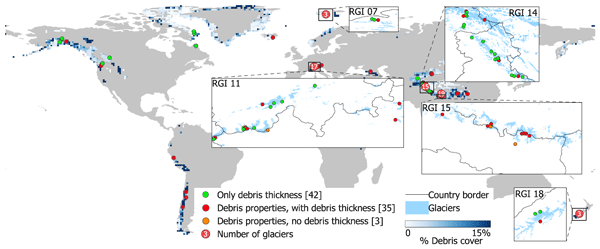
Adrià Fontrodona-Bach, Lars Groeneveld, Evan Miles, Michael McCarthy, Thomas Shaw, Vicente Melo Velasco, and Francesca Pellicciotti
Earth Syst. Sci. Data, 17, 4213–4234, https://doi.org/10.5194/essd-17-4213-2025, https://doi.org/10.5194/essd-17-4213-2025, 2025
Short summary
Short summary
Glaciers with a layer of rocky debris on their surfaces are distinct from clean-ice glaciers, with debris mostly insulating the glacier ice. However, debris data are scarce. We present the Debris Database (DebDaB), a database of debris thickness and physical properties of debris, with data from 84 glaciers in 13 global glacier regions compiled from 172 sources and including previously unpublished data. DebDaB serves as an open central repository for the scientific community to do research on debris-covered glaciers.
María Santolaria-Otín, Charles Amory, Martin Ménégoz, Fanny Brun, Xavier Faïn, Xavier Fettweis, Mondher Chekki, Patrick Wagnon, Dibas Shrestha, and Arbindra Khadka
EGUsphere, https://doi.org/10.5194/egusphere-2026-4572, https://doi.org/10.5194/egusphere-2026-4572, 2026
This preprint is open for discussion and under review for Geoscientific Model Development (GMD).
Short summary
Short summary
High Mountain Asia contains the largest concentration of glacier ice outside the polar regions and supplies water to hundreds of millions of people, yet its climate remains poorly understood because of its complex terrain and limited observations. We produced a high-resolution climate dataset for the Pamir and Central Himalaya covering 1950–2025. It captures seasonal climate and snow changes and will support studies of water resources, glaciers, and natural hazards.
Marie Schroeder, Ivana Stiperski, Michael Winkler, Georg Kaser, Jakob Steiner, Jakob Abermann, Georg Wohlfahrt, and Rainer Prinz
EGUsphere, https://doi.org/10.5194/egusphere-2026-5112, https://doi.org/10.5194/egusphere-2026-5112, 2026
This preprint is open for discussion and under review for The Cryosphere (TC).
Short summary
Short summary
Steep ice cliffs can lose ice much faster than flat glacier surfaces, yet little is known about how they interact with the air around them. Measurements at a 25-metre-high ice cliff on Kilimanjaro revealed distinct day–night air flows and major differences in how heat is transported. Higher up, heat is transported in an organised way, while near the cliff base this exchange was more complex. The cliff shape and its surroundings can strongly influence how heat reaches the ice and how it is lost.
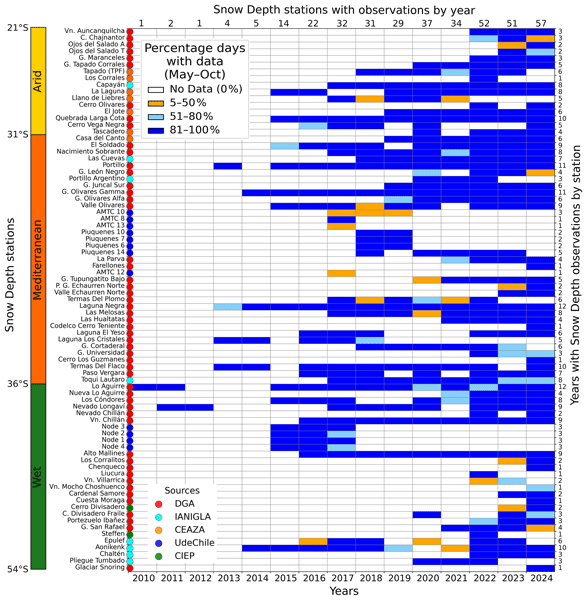
Alexis Caro, Javier Medina, Freddy Saavedra, Fernando Gimeno, Jorge Huenante, Mariano Masiokas, Cristian Orrego, Ana Hernández, James McPhee, Pierre Pitte, Sebastián Krogh, David Farías-Barahona, Nevenka Bulovic, Iñigo Irarrázaval, Shelley MacDonell, Mauricio Zambrano-Bigiarini, and Carlos Romero
Earth Syst. Sci. Data, 18, 7097–7123, https://doi.org/10.5194/essd-18-7097-2026, https://doi.org/10.5194/essd-18-7097-2026, 2026
Short summary
Short summary
Snowpack dynamics in the Southern Andes remain poorly quantified due to sparse and inconsistent in situ data, limiting hydrological modeling. We compile and quality-control daily snow depth observations from 81 stations (21–54° S, 2010–2024). The resulting dataset improves the Physical Consistency Index (up to 95 %) despite reduced data availability, reveals a north–south increase in snow depth but no consistent positive relationship with elevation across river basins.
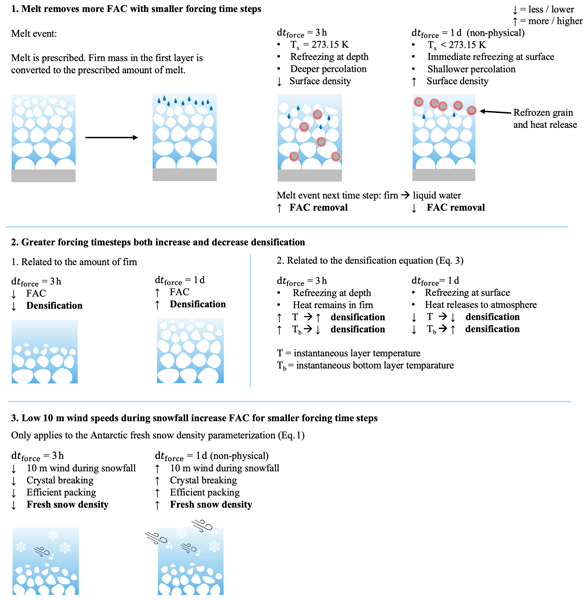
Tesse E. A. van den Aker, Peter Kuipers Munneke, Willem Jan van de Berg, Walter W. Immerzeel, and Michiel R. van den Broeke
The Cryosphere, 20, 5475–5490, https://doi.org/10.5194/tc-20-5475-2026, https://doi.org/10.5194/tc-20-5475-2026, 2026
Short summary
Short summary
The firn layer, i.e. permanent snow, regulates how an ice sheet responds to climate change. Firn models are forced with with climate data at time steps from sub-daily to annual in literature, however, implications are barely evaluated. We test the impact of different climate forcing time steps on the modeled firn layer. We conclude that the climate forcing time step (1) affects firn model output, (2) can lead to non-physical behaviour, and (3) that resolving at least a diurnal cycle is required.
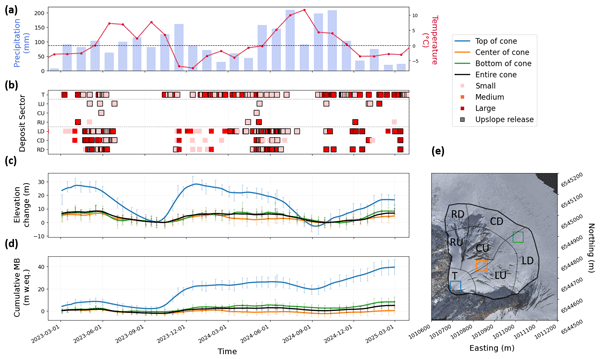
Marin Kneib, Patrick Wagnon, Laurent Arnaud, Louise Balmas, Olivier Laarman, Bruno Jourdain, Amaury Dehecq, Emmanuel Lemeur, Fanny Brun, Andrea Kneib-Walter, Ilaria Santin, Laurane Charrier, Thierry Faug, Giulia Mazzotti, Antoine Rabatel, Delphine Six, and Daniel Farinotti
The Cryosphere, 20, 5327–5344, https://doi.org/10.5194/tc-20-5327-2026, https://doi.org/10.5194/tc-20-5327-2026, 2026
Short summary
Short summary
Avalanches are vital for glacier survival, yet their impact is difficult to quantify. We used low-cost cameras and drones to monitor an avalanche cone in the French Alps for two years. By accounting for ice flow, we found that avalanches can deposit 30 meters of snow annually – 50 times more than normal snowfall. This high-frequency data reveals that these cones fill until reaching a specific steepness, after which new snow slides further down to the base.
Akiko Sakai, Kino Kobayashi, Masato Ono, Sayako Ueda, Sho Ohata, Akira Watanabe, Kazuo Osada, Nozomu Takeuchi, Prevdagva Khalzan, Sumito Matoba, Tomonori Tanikawa, and Teruo Aoki
The Cryosphere, 20, 5181–5198, https://doi.org/10.5194/tc-20-5181-2026, https://doi.org/10.5194/tc-20-5181-2026, 2026
Short summary
Short summary
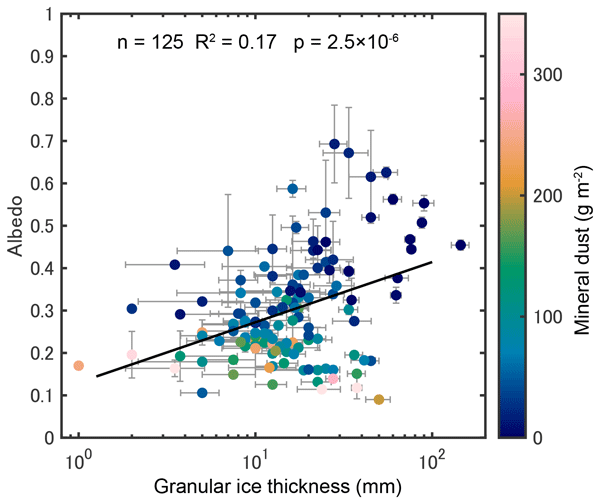
Glacier ice surfaces appear dark due to many light-absorbing particles (LAPs), such as mineral dust, microbial organic matter, and black carbon. In contrast, the development of a weathering crust on bare ice brightens the surface by increasing albedo. Field studies on the Potanin Glacier, Mongolia, defined a low-density surface layer as weathering granular ice. Broad-band albedo increased with this layer’s thickness but decreased with organic matter. High LAP amounts hindered crust growth.
Mariia Usoltseva, Roland Pail, Christoph Mayer, Martin Rückamp, and Anja Wendt
EGUsphere, https://doi.org/10.5194/egusphere-2026-4284, https://doi.org/10.5194/egusphere-2026-4284, 2026
This preprint is open for discussion and under review for The Cryosphere (TC).
Short summary
Short summary
This study investigates how two neighbouring glaciers in southern Chile changed between 2000 and 2026 using digital elevation models and climate data. Although both glaciers experienced warming temperatures and reduced snowfall, their responses were very different. The glacier with large outlets at low elevations lost mass rapidly, while the ice-cap glacier remained relatively stable for longer. The results show that glacier shape strongly influences how glaciers respond to climate change.
Lea Hartl, Jakob Abermann, Ayla Akgün, Giulia Bertolotti, Tobias Bolch, Svenja Conzelmann, Codrut-Andrei Diaconu, Iris Hansche, Anne Hartig, Anna Haut, Kay Helfricht, Bernhard Hynek, Marie Sophie Kaucher, Andreas Kellerer-Pirklbauer, Ann Christin Kogel, Julie Krippes, Marcela Violeta Lauria, Christoph Mayer, Jan-Christoph Otto, Rainer Prinz, Sina Prölß, Lorenzo Rieg, Lea Schönleber, Gabriele Schwaizer, Bernd Seiser, Martin Stocker-Waldhuber, Markus Strudl, Martin Verhounik, and Harald Zandler
The Cryosphere, 20, 5157–5180, https://doi.org/10.5194/tc-20-5157-2026, https://doi.org/10.5194/tc-20-5157-2026, 2026
Short summary
Short summary
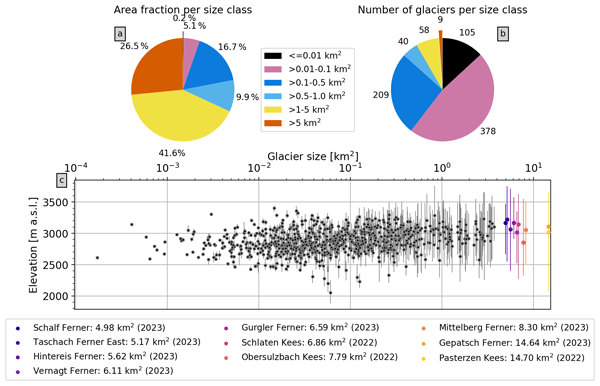
We mapped glacier outlines in Austria using recent, high resolution imagery. The resulting glacier inventory provides an update on glacier area in Austria in 2021-2023. More than 30% of glacier area was lost and 95 glaciers have disappeared since the mid-2000s. Glacier recession is accelerating and regular updates to glacier inventories are needed to understand downstream changes to the hydrological system, quantify glacier mass loss, and support planning and adaptation measures.
Tom Matthews, Baker Perry, Ben Graves, Fanny Brun, Maria Sanolaria-Otin, Navaraj Pokhrel, Arbindra Khadka, Dibas Shrestha, Ludving Cano, Aris Kwadijk, Walter Immereel, Brandt Maxwell, and Anton Seimon
EGUsphere, https://doi.org/10.5194/egusphere-2026-5200, https://doi.org/10.5194/egusphere-2026-5200, 2026
This preprint is open for discussion and under review for The Cryosphere (TC).
Short summary
Short summary
Extreme precipitation shapes hazards and water resources in high mountains, but is rarely observed directly. On 4 October 2025, weather stations on Mt. Everest recorded one of the most extreme snowfall events ever measured. The storm revealed that Himalayan snowfall extremes can be far larger than previously documented, and that intense snowfall can cool the atmosphere sufficiently to prevent rain at impact-sensitive elevations, complicating the picture of how warming will affect future storms.
Celia A. Baumhoer, Selina Straßburger, Sarah Leibrock, Andreas J. Dietz, and Christoph Mayer
EGUsphere, https://doi.org/10.5194/egusphere-2026-4768, https://doi.org/10.5194/egusphere-2026-4768, 2026
This preprint is open for discussion and under review for The Cryosphere (TC).
Short summary
Short summary
As glaciers move, cracks called crevasses form, and knowing where they occur matters both for science and for safety. We created the first nationwide map of visible crevasses across all glaciers in Austria, using aerial images. We found that crevasses are most common on steep, fast-moving glaciers and rarer on large, gently sloping ones, with surface shape and flow influencing where they appear. This dataset is already being used to improve hiking maps, helping people plan safer mountain routes
Aris Kwadijk, Philip D. A. Kraaijenbrink, Faezeh M. Nick, Joseph M. Shea, Jakob F. Steiner, René R. Wijngaard, and Walter W. Immerzeel
EGUsphere, https://doi.org/10.5194/egusphere-2026-5005, https://doi.org/10.5194/egusphere-2026-5005, 2026
This preprint is open for discussion and under review for Hydrology and Earth System Sciences (HESS).
Short summary
Short summary
The Himalayas supply water to millions of people downstream, yet high-altitude rainfall remains poorly understood. Using thirteen years of data from weather stations across Nepal's Langtang Valley, we found that during the monsoon the moist atmosphere causes rainfall to be highly sensitive to topography. We show how precipitation-elevation gradients shift during the day. This shift is captured in a numerical relation, that can serve to validate weather models.
Akash M. Patil, Christoph Mayer, Theo M. Jenk, Astrid Lambrecht, Thorsten Seehaus, Alexander R. Groos, and Michelle Worek
The Cryosphere, 20, 4927–4955, https://doi.org/10.5194/tc-20-4927-2026, https://doi.org/10.5194/tc-20-4927-2026, 2026
Short summary
Short summary
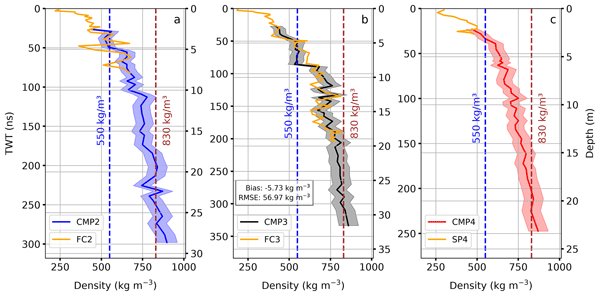
Our study focused on understanding how a warming climate affects the Aletsch Glacier accumulation area. We used multi-year radar measurements and direct firn‑core analyses to estimate changes in density and compaction rate of snow-to-ice over a year. Our results show that the upper layers of the glacier are changing faster due to stronger summer melt in the lower parts of the accumulation zone. Our findings help to improve firn densification models and glacier mass-balance estimation.
Koji Fujita and Rijan B. Kayastha
The Cryosphere, 20, 4005–4015, https://doi.org/10.5194/tc-20-4005-2026, https://doi.org/10.5194/tc-20-4005-2026, 2026
Short summary
Short summary
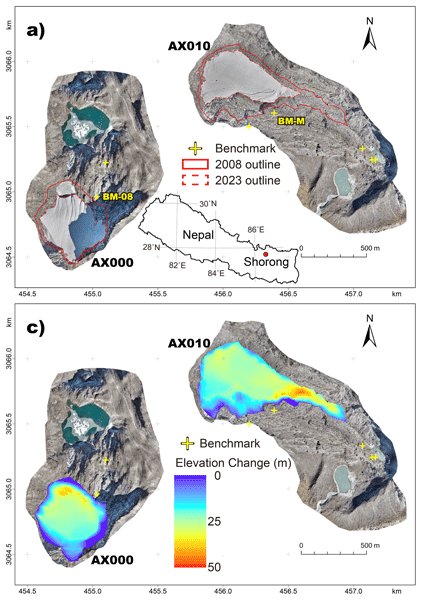
Glacier AX010 in Nepal, monitored since the 1970s, has been shrinking at an accelerating rate, mainly due to rising temperatures. Drone surveys, modeling, and reanalysis data show mass loss began in the early 1970s and intensified after 2000. While rising temperatures drive shrinkage, precipitation changes have neither accelerated nor mitigated mass loss. At the current rate, the glacier may disappear within 10–20 years.
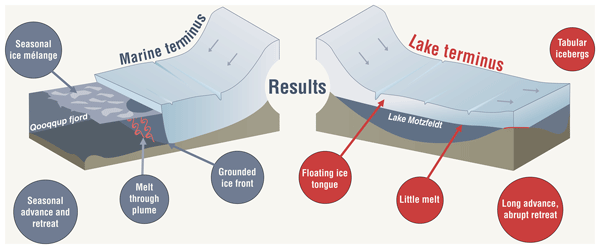
Florian Vacek, Faezeh M. Nick, Douglas Benn, Maarten P. A. Zwarts, Walter Immerzeel, and Roderik S. W. van de Wal
The Cryosphere, 20, 3827–3845, https://doi.org/10.5194/tc-20-3827-2026, https://doi.org/10.5194/tc-20-3827-2026, 2026
Short summary
Short summary
We studied a unique glacier in South Greenland that ends in both a lake and the ocean. Using satellite data and field work, we found that the two glacier fronts behave very differently even under the same climate. At the lake glacier we identify a floating ice tongue and we infer little melt below water. The lake glacier experienced a sudden large breakup. Our work suggests that lake and marine glacier fronts must be treated differently in model simulations.
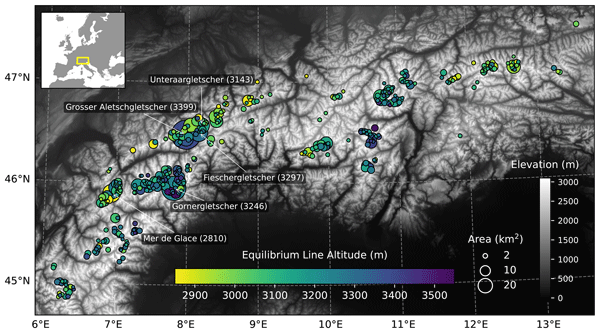
Oskar Herrmann, Veena Prasad, Anna Zöller, Alexander R. Groos, Samuel Cook, Christian Sommer, and Johannes J. Fürst
The Cryosphere, 20, 3817–3825, https://doi.org/10.5194/tc-20-3817-2026, https://doi.org/10.5194/tc-20-3817-2026, 2026
Short summary
Short summary
Glaciers in the European Alps are shrinking rapidly because of climate change. We developed a new open-source method that combines satellite observations with computer models to estimate where glaciers gain and lose ice. Applied to hundreds of glaciers, the results agree well with field measurements. This approach improves our understanding of glacier change and helps make more reliable predictions of their future.
Shaoting Ren, Evan S. Miles, Michael McCarthy, Achille Jouberton, Thomas E. Shaw, Pascal Buri, Marin Kneib, Prateek Gantayat, Anneli Guthke, and Francesca Pellicciotti
EGUsphere, https://doi.org/10.5194/egusphere-2026-2524, https://doi.org/10.5194/egusphere-2026-2524, 2026
Short summary
Short summary
Local meteorology is curial to understand glaciers’ response to climate change, yet is hard to quantify due to rare measurements. By combining physical modeling and satellite observations, this study develops a new inference framework to accurately estimate on-glacier temperature and precipitation, therefore derive reliable seasonal glacier melt. Reliable accuracy of this framework paves a way to map these key two meteorological variables for regional and global unmonitored glacier.
Martin Rückamp, Gong Cheng, Karlheinz Gutjahr, Marco Möller, Petri K. E. Pellikka, and Christoph Mayer
The Cryosphere, 20, 2999–3024, https://doi.org/10.5194/tc-20-2999-2026, https://doi.org/10.5194/tc-20-2999-2026, 2026
Short summary
Short summary
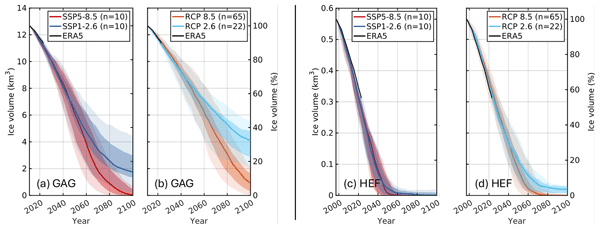
The study simulates the 21st-century evolution of Great Aletsch Glacier and Hintereisferner using full-Stokes ice dynamics and surface mass balance under different emission scenarios. Results show significant ice loss, with Hintereisferner expected to disappear by mid-century. Great Aletsch Glacier vanish by the end of the century under high-emission scenarios, but persist under lower-emission scenarios. These trends agree with large-scale models except some variability.
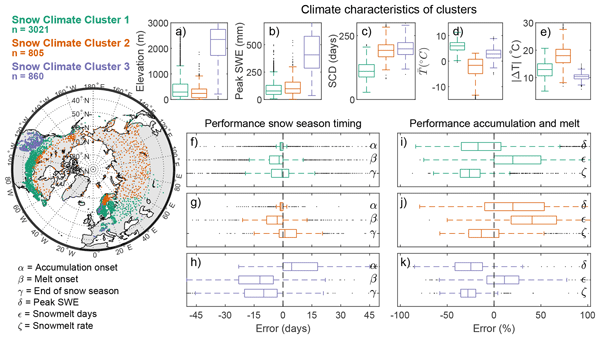
Adrià Fontrodona-Bach, Bettina Schaefli, Ross Woods, and Joshua R. Larsen
Hydrol. Earth Syst. Sci., 30, 2613–2636, https://doi.org/10.5194/hess-30-2613-2026, https://doi.org/10.5194/hess-30-2613-2026, 2026
Short summary
Short summary
Investigating changing snow in response to global warming can be done with a simple model and only temperature and precipitation data, simplifying snow dynamics with assumptions and parameters. We provide a large-scale and long-term evaluation of this approach and its performance across diverse climates. Temperature thresholds are more robust over cold climates but melt parameters are more robust over warmer climates with deep snow. The model performs well across climates despite its simplicity.
Ruitang Yang, Lizz Ultee, Kristoffer Aalstad, Matvey V. Debolskiy, Regine Hock, Patrick Schmitt, David Rounce, and Tian Li
EGUsphere, https://doi.org/10.5194/egusphere-2026-1081, https://doi.org/10.5194/egusphere-2026-1081, 2026
Short summary
Short summary
We present a new framework to model frontal ablation of marine-terminating glaciers by linking two global glacier models with a simple physics-based calving scheme and Bayesian calibration. Applied to 71 Svalbard glaciers (2000–2019) and projected to 2100, it reproduces seasonal front changes but overestimates ablation due to uncertain geometry and velocity. This efficient approach can improve regional to global simulations.
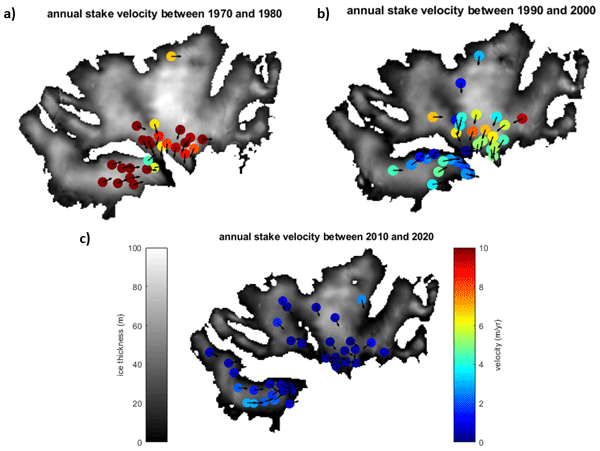
Theresa Dobler, Wilfried Hagg, Martin Rückamp, Thorsten Seehaus, and Christoph Mayer
The Cryosphere, 20, 2531–2555, https://doi.org/10.5194/tc-20-2531-2026, https://doi.org/10.5194/tc-20-2531-2026, 2026
Short summary
Short summary
We studied how a glacier in the Austrian Alps moves more slowly over time due to climate change. By combining long-term field data with recent aerial images, we show how thinning reduce glacier flow. Our findings help understand changes in glacier behavior in a warming climate.
Mustafo Safarov, Junli Li, Evan Miles, Majid Gulayozov, Ruonan Li, Ali Fazylov, Kamoliddin Nazirzoda, Firdavs Vosidov, Murodkhudzha Murodov, Hofiz Navruzshoev, and Ardamehr Halimov
EGUsphere, https://doi.org/10.5194/egusphere-2026-1923, https://doi.org/10.5194/egusphere-2026-1923, 2026
Short summary
Short summary
This study investigates a rapidly surging glacier in the Pamir Mountains using daily satellite imagery and unmanned aerial vehicle (UAV) data. It reveals that surge-driven ice detachment can rapidly displace ice downstream and transform valley morphology. The findings show that even small glaciers can cause large, rapid environmental impacts and highlight the need for high-frequency observations to understand glacier instability and improve hazard assessment in a warming climate.
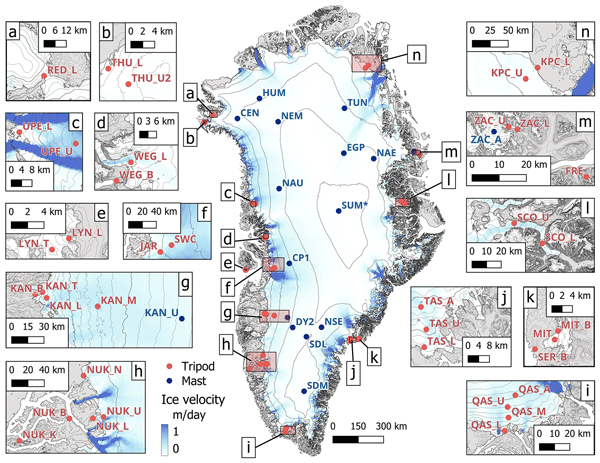
Robert S. Fausto, Penelope How, Baptiste Vandecrux, Mads C. Lund, Jason E. Box, Kenneth D. Mankoff, Signe B. Andersen, Dirk van As, Rasmus Bahbah, Michele Citterio, William Colgan, Henrik T. Jakobsgaard, Nanna B. Karlsson, Kristian K. Kjeldsen, Signe H. Larsen, Charlotte Olsen, Falk M. Oraschewski, Anja Rutishauser, Christopher L. Shields, Anne M. Solgaard, Ian T. Stevens, Synne H. Svendsen, Kirsty Langley, Alexandra Messerli, Anders A. Bjørk, Jonas K. Andersen, Jakob Abermann, Jakob Steiner, Rainer Prinz, Berhard Hynek, James M. Lea, Stephen Brough, and Andreas P. Ahlstrøm
Earth Syst. Sci. Data, 18, 2829–2873, https://doi.org/10.5194/essd-18-2829-2026, https://doi.org/10.5194/essd-18-2829-2026, 2026
Short summary
Short summary
In summary, the PROMICE (Programme for Monitoring of the Greenland Ice Sheet ) | GC-NET AWS (Greenland Climate Network automatic weather station) data product update represents a significant advancement in Arctic climate monitoring. Through enhanced station designs, state-of-the-art instrumentation, and a transparent, automated data processing workflow, the dataset offers an essential resource for studying the Greenland Ice Sheet and its periphery, validating climate models, and supporting global assessments of cryospheric change.
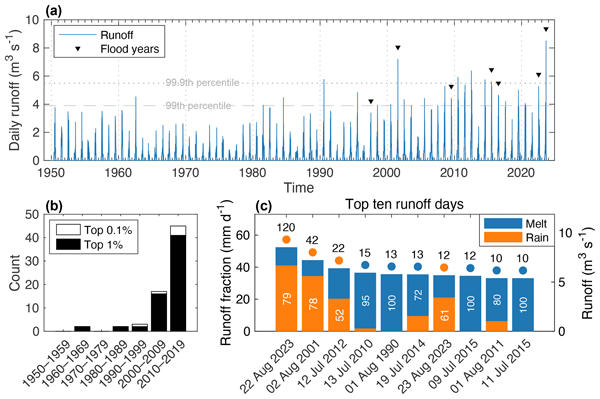
Ken Kondo and Koji Fujita
Hydrol. Earth Syst. Sci., 30, 1849–1864, https://doi.org/10.5194/hess-30-1849-2026, https://doi.org/10.5194/hess-30-1849-2026, 2026
Short summary
Short summary
Increased runoff due to ice melt in Greenland contributes to sea-level rise and flooding in coastal settlements. We reconstructed glacier runoff in northwestern Greenland in 1950–2023. Long-term modeling shows a recent increase in runoff linked to changes in atmospheric circulation, characterized by enhanced northward transport of heat and moisture. The results highlight a strong influence of atmospheric variability on glacier runoff and its impacts on local communities in northern Greenland.
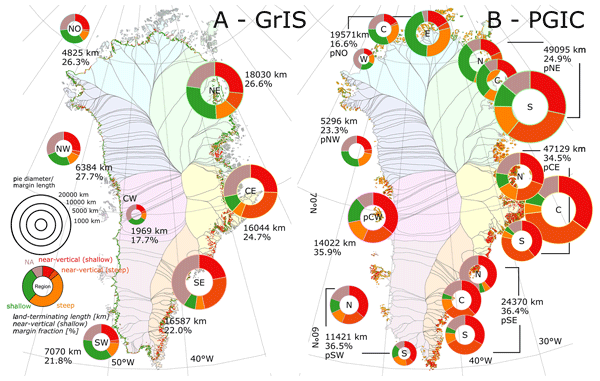
Jakob Steiner, Jakob Abermann, and Rainer Prinz
The Cryosphere, 20, 1797–1814, https://doi.org/10.5194/tc-20-1797-2026, https://doi.org/10.5194/tc-20-1797-2026, 2026
Short summary
Short summary
Nearly 95% of the Greenland ice margin ends on land, where meltwater leaves the ice to supply surrounding ecosystems. Here we show that nearly 30% of this land-terminating margin ends in extremely steep, often vertical sections, previously only described in individual locations. Less than 20% are shallow ramps. Knowledge of these margin shapes and their locations allows us to further investigate what they can potentially tell us about the current ice sheet health and its future evolution.
Christian Sommer, Alexander Raphael Groos, Johannes Fürst, and Matthias Braun
Earth Syst. Sci. Data Discuss., https://doi.org/10.5194/essd-2026-35, https://doi.org/10.5194/essd-2026-35, 2026
Preprint under review for ESSD
Short summary
Short summary
Measurements of glacier snow line altitudes (transition between ice and snow) provide information to constrain surface mass balance modelling. This study presents a database of ~200,000 snow lines from glaciers in the European Alps (2000–2025). Exposed ice and snow are automatically classified using adaptive thresholding of surface reflectance in visible and infrared spectra. Since 2000, we observe an increase in late summer snow lines of ~150 m, indicating widespread melt at high altitudes.
Jakob Steiner, William Armstrong, Will Kochtitzky, Robert McNabb, Rodrigo Aguayo, Tobias Bolch, Fabien Maussion, Vibhor Agarwal, Iestyn Barr, Nathaniel R. Baurley, Mike Cloutier, Katelyn DeWater, Frank Donachie, Yoann Drocourt, Siddhi Garg, Gunjan Joshi, Byron Guzman, Stanislav Kutuzov, Thomas Loriaux, Caleb Mathias, Brian Menounos, Evan Miles, Aleksandra Osika, Kaleigh Potter, Adina Racoviteanu, Brianna Rick, Miles Sterner, Guy D. Tallentire, Levan Tielidze, Rebecca White, Kunpeng Wu, and Whyjay Zheng
Earth Syst. Sci. Data, 18, 1665–1681, https://doi.org/10.5194/essd-18-1665-2026, https://doi.org/10.5194/essd-18-1665-2026, 2026
Short summary
Short summary
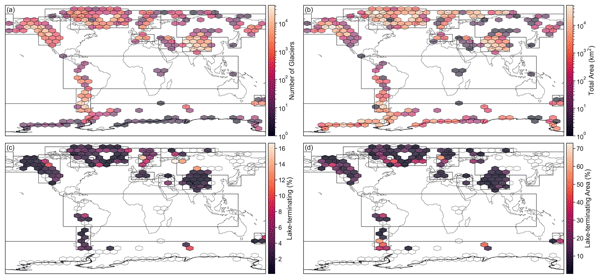
Many mountain glaciers around the world flow into lakes – exactly how many however, has never been mapped. Across a large team of experts we have now identified all glaciers that end in lakes. Only about 1% do so, but they are generally larger than those which end on land. This is important to understand, as lakes can influence the behaviour of glacier ice, including how fast it disappears. This new dataset allows us to better model glaciers at a global scale, accounting for the effect of lakes.

Oriol Pomarol Moya, Madlene Nussbaum, Siamak Mehrkanoon, Philip D. A. Kraaijenbrink, Isabelle Gouttevin, Derek Karssenberg, and Walter W. Immerzeel
The Cryosphere, 20, 1427–1444, https://doi.org/10.5194/tc-20-1427-2026, https://doi.org/10.5194/tc-20-1427-2026, 2026
Short summary
Short summary
Two hybrid Machine Learning (ML) approaches predicting daily Snow Water Equivalent (SWE) were evaluated across ten Northern Hemisphere sites. By integrating meteorological data with Crocus snow model simulations, these hybrid models outperformed both standalone Crocus and traditional ML models. Notably, augmenting measured SWE data with Crocus simulations significantly improved performance at unseen locations, offering a promising new approach to long-term SWE prediction.
Veena Prasad, Oskar Herrmann, Ilaria Tabone, Mamta K C, Alexander R. Groos, Guillaume Jouvet, James R. Jordan, and Johannes J. Fürst
EGUsphere, https://doi.org/10.5194/egusphere-2026-508, https://doi.org/10.5194/egusphere-2026-508, 2026
Short summary
Short summary
We present the testing and implementation of a calving framework for simulating the evolution of glacier fronts in grounded glacier tongues. The approach is coupled with a level set method to track changes in the glacier front over time and with an eigen-calving law that allows calving to respond to ice flow and stress conditions. The framework is evaluated using a synthetic glacier domain and, when applied to marine-terminating glaciers in Svalbard, reproduces observed calving front patterns.
Titouan Biget, Fanny Brun, Walter Immerzeel, Léo Martin, Hamish Pritchard, Emily Collier, Yanbin Lei, and Tandong Yao
The Cryosphere, 19, 5863–5870, https://doi.org/10.5194/tc-19-5863-2025, https://doi.org/10.5194/tc-19-5863-2025, 2025
Short summary
Short summary
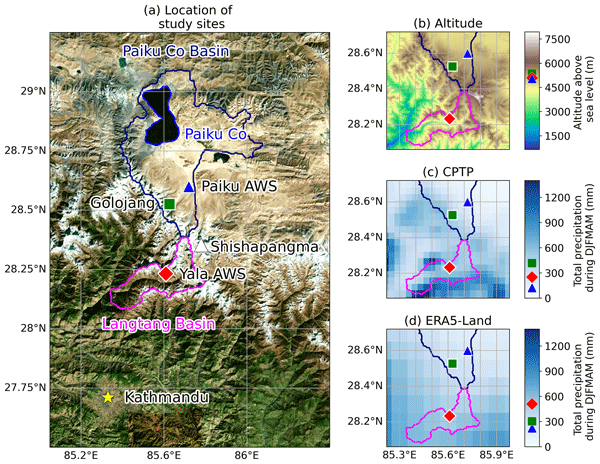
This study explore the precipitation in the southern Tibetan plateau using the water pressure of an high altitude lake and meteorological models and shows that snowfall could be much stronger on the Plateau than what is predicted by the models.
Kamilla Hauknes Sjursen, Jordi Bolibar, Marijn van der Meer, Liss Marie Andreassen, Julian Peter Biesheuvel, Thorben Dunse, Matthias Huss, Fabien Maussion, David R. Rounce, and Brandon Tober
The Cryosphere, 19, 5801–5826, https://doi.org/10.5194/tc-19-5801-2025, https://doi.org/10.5194/tc-19-5801-2025, 2025
Short summary
Short summary
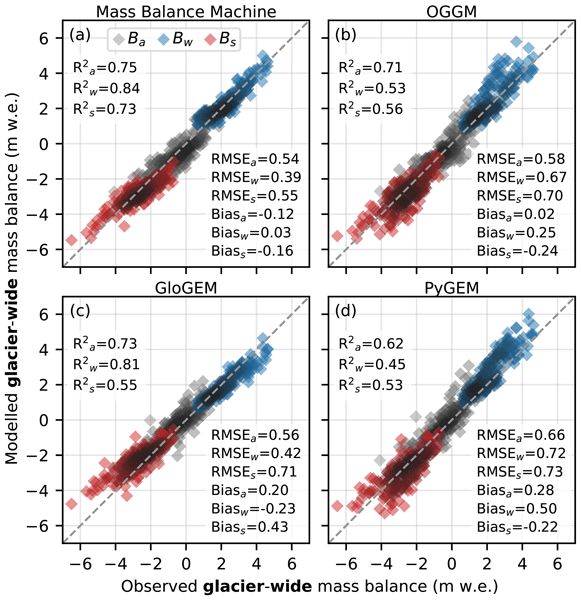
Understanding glacier mass changes is crucial for assessing freshwater availability in many regions of the world. We present the Mass Balance Machine, a machine learning model that learns from sparse measurements of glacier mass change to make predictions on unmonitored glaciers. Using data from Norway, we show that the model provides accurate estimates of mass changes at different spatiotemporal scales. Our findings show that machine learning can be a valuable tool to improve such predictions.
Alexander R. Groos, Nicolas Brand, Murat Bronz, and Andreas Philipp
Atmos. Meas. Tech., 18, 6493–6512, https://doi.org/10.5194/amt-18-6493-2025, https://doi.org/10.5194/amt-18-6493-2025, 2025
Short summary
Short summary
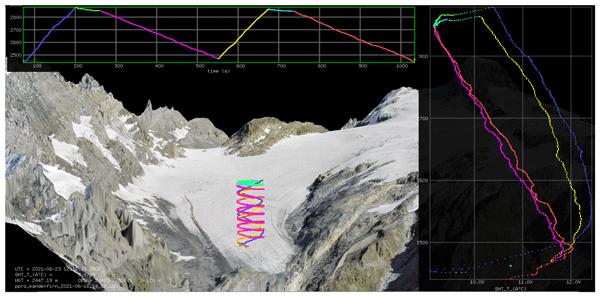
We have developed a low-cost, lightweight, and open-source fixed-wing drone to study vertical changes in air temperature, humidity, pressure, wind speed, wind direction and turbulence in the atmospheric boundary layer over mountain glaciers. The results of four measurement campaigns on a glacier in the Swiss Alps demonstrate the potential of the new measurement technique and reveal characteristic insights into glacier-atmosphere interactions and the mountain-valley wind circulation.
Akash M. Patil, Christoph Mayer, Thorsten Seehaus, Alexander R. Groos, and Andreas Bauder
The Cryosphere, 19, 5547–5577, https://doi.org/10.5194/tc-19-5547-2025, https://doi.org/10.5194/tc-19-5547-2025, 2025
Short summary
Short summary
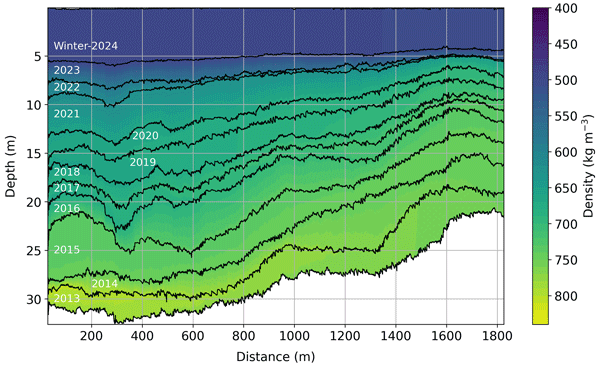
We studied how the density of snow to ice transition varies with depth in the Aletsch glacier using radar-based field measurements and some simple models. We showed that it is possible to track how much snow has accumulated in the last 10–14 years. This helps improve the uncertainties in glacier mass balance estimates. Overall, by utilising non-invasive radar techniques and models, we provide a novel approach to understanding the evolution of glaciers under regional climate conditions.
Orie Sasaki, Evan S. Miles, Francesca Pellicciotti, Akiko Sakai, and Koji Fujita
The Cryosphere, 19, 5283–5298, https://doi.org/10.5194/tc-19-5283-2025, https://doi.org/10.5194/tc-19-5283-2025, 2025
Short summary
Short summary
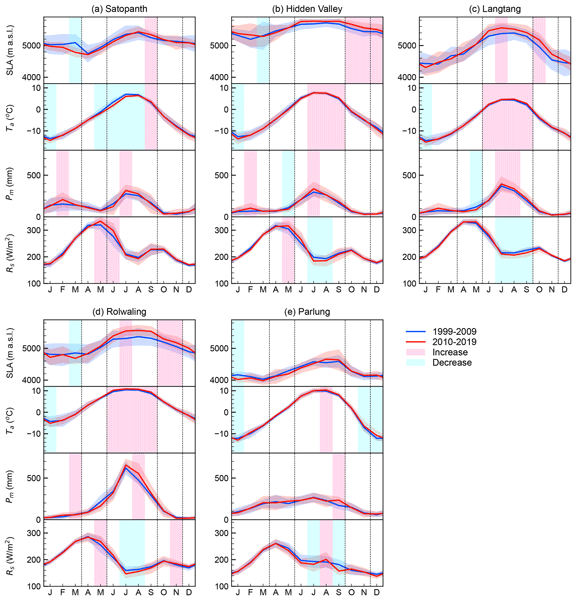
This study adapts a method to detect snowline altitude (SLA) using Google Earth Engine with high-resolution satellite imagery. Applying this method to five glaciated watersheds in the Himalayas reveals regional consistencies and differences in snow dynamics, as well as 20-year trends of snowline increases (3 catchments) and decreases (1) and no trend (1). We investigate the controls of these dynamics by analyzing climatic factors and topographic characteristics.
Léon Roussel, Marie Dumont, Marion Réveillet, Delphine Six, Marin Kneib, Pierre Nabat, Kévin Fourteau, Diego Monteiro, Simon Gascoin, Emmanuel Thibert, Antoine Rabatel, Jean-Emmanuel Sicart, Mylène Bonnefoy, Luc Piard, Olivier Laarman, Bruno Jourdain, Mathieu Fructus, Matthieu Vernay, and Matthieu Lafaysse
The Cryosphere, 19, 5201–5230, https://doi.org/10.5194/tc-19-5201-2025, https://doi.org/10.5194/tc-19-5201-2025, 2025
Short summary
Short summary
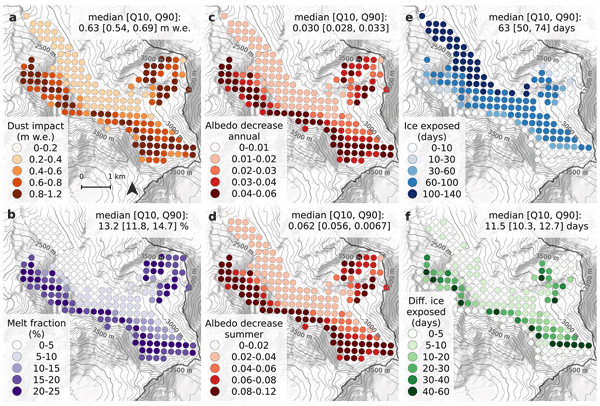
Saharan dust deposits frequently turn alpine glaciers orange. Mineral dust reduces snow albedo and increases snow and glaciers melt rate. Using physical modeling, we quantified the impact of dust on the Argentière Glacier over the period 2019–2022. We found that the contribution of mineral dust to the melt represents between 8 % and 16 % of Argentière Glacier summer melt. At specific locations, the impact of dust over one year can rise to an equivalent of 1.2 m of melted ice.
Adrià Fontrodona-Bach, Lars Groeneveld, Evan Miles, Michael McCarthy, Thomas Shaw, Vicente Melo Velasco, and Francesca Pellicciotti
Earth Syst. Sci. Data, 17, 4213–4234, https://doi.org/10.5194/essd-17-4213-2025, https://doi.org/10.5194/essd-17-4213-2025, 2025
Short summary
Short summary
Glaciers with a layer of rocky debris on their surfaces are distinct from clean-ice glaciers, with debris mostly insulating the glacier ice. However, debris data are scarce. We present the Debris Database (DebDaB), a database of debris thickness and physical properties of debris, with data from 84 glaciers in 13 global glacier regions compiled from 172 sources and including previously unpublished data. DebDaB serves as an open central repository for the scientific community to do research on debris-covered glaciers.
Marc Girona-Mata, Andrew Orr, Martin Widmann, Daniel Bannister, Ghulam Hussain Dars, Scott Hosking, Jesse Norris, David Ocio, Tony Phillips, Jakob Steiner, and Richard E. Turner
Hydrol. Earth Syst. Sci., 29, 3073–3100, https://doi.org/10.5194/hess-29-3073-2025, https://doi.org/10.5194/hess-29-3073-2025, 2025
Short summary
Short summary
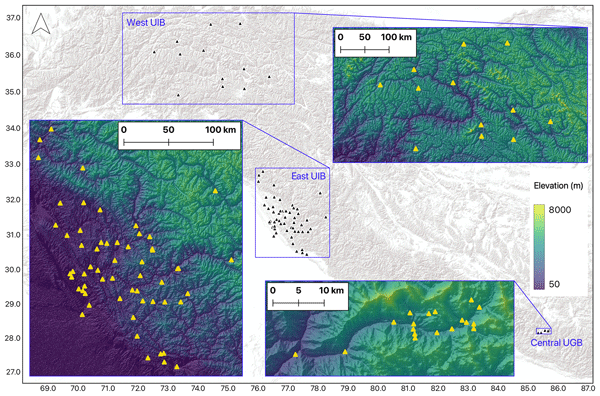
We introduce a novel method for improving daily precipitation maps in mountain regions and pilot it across three basins in the Hindu Kush Himalaya (HKH). The approach leverages climate model and weather station data, along with statistical or machine learning techniques. Our results show that this approach outperforms traditional methods, especially in remote ungauged areas, suggesting that it could be used to improve precipitation maps across much of the HKH, as well as other mountain regions.
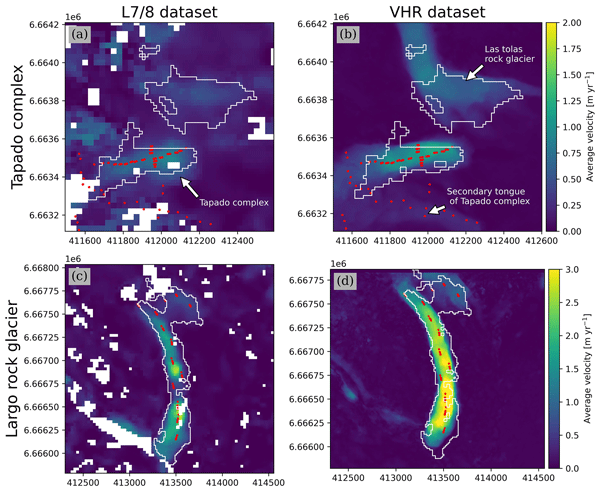
Diego Cusicanqui, Pascal Lacroix, Xavier Bodin, Benjamin Aubrey Robson, Andreas Kääb, and Shelley MacDonell
The Cryosphere, 19, 2559–2581, https://doi.org/10.5194/tc-19-2559-2025, https://doi.org/10.5194/tc-19-2559-2025, 2025
Short summary
Short summary
This study presents a robust methodological approach to detect and analyse rock glacier kinematics using Landsat 7/Landsat 8 imagery. In the semiarid Andes, 382 landforms were monitored, showing an average velocity of 0.37 ± 0.07 m yr⁻¹ over 24 years, with rock glaciers moving 23 % faster. Results demonstrate the feasibility of using medium-resolution optical imagery, combined with radar interferometry, to monitor rock glacier kinematics with widely available satellite datasets.
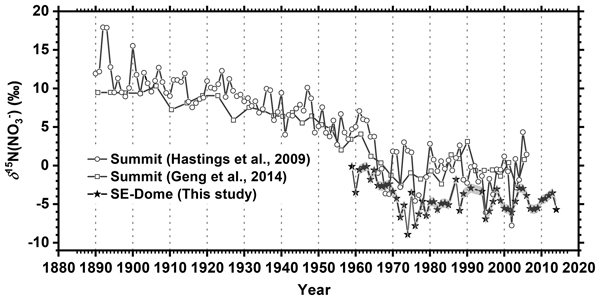
Zhao Wei, Shohei Hattori, Asuka Tsuruta, Zhuang Jiang, Sakiko Ishino, Koji Fujita, Sumito Matoba, Lei Geng, Alexis Lamothe, Ryu Uemura, Naohiro Yoshida, Joel Savarino, and Yoshinori Iizuka
Atmos. Chem. Phys., 25, 5727–5742, https://doi.org/10.5194/acp-25-5727-2025, https://doi.org/10.5194/acp-25-5727-2025, 2025
Short summary
Short summary
Nitrate isotope records in ice cores reveal changes in NOₓ emissions and atmospheric oxidation chemistry driven by human activity. However, UV-driven postdepositional processes can alter nitrate in snow, making snow accumulation rates critical for preserving these records. This study examines nitrate isotopes in a southeastern Greenland ice core, where high snow accumulation minimizes these effects, providing a reliable archive of atmospheric nitrogen cycling.
Naoko Nagatsuka, Kumiko Goto-Azuma, Kana Nagashima, Koji Fujita, Yuki Komuro, Motohiro Hirabayashi, Jun Ogata, Kaori Fukuda, Yoshimi Ogawa-Tsukagawa, Kyotaro Kitamura, Ayaka Yonekura, Fumio Nakazawa, Yukihiko Onuma, Naoyuki Kurita, Sune Olander Rasmussen, Giulia Sinnl, Trevor James Popp, and Dorthe Dahl-Jensen
EGUsphere, https://doi.org/10.5194/egusphere-2025-1522, https://doi.org/10.5194/egusphere-2025-1522, 2025
Preprint archived
Short summary
Short summary
We present the first continuous records of dust size, composition, and temporal variations in potential sources from the northeastern Greenland ice core (EGRIP) over the past 100 years. Using a multi-proxy provenance approach based on individual particle analysis, we identify the primary dust sources as the Asian (Gobi) and African (Sahara) deserts. Our findings show shifts in their contributions since the 1970s–1980s, highlighting the effectiveness of this approach during low dust periods.
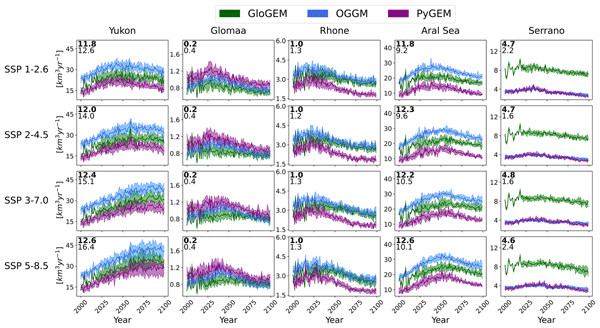
Finn Wimberly, Lizz Ultee, Lilian Schuster, Matthias Huss, David R. Rounce, Fabien Maussion, Sloan Coats, Jonathan Mackay, and Erik Holmgren
The Cryosphere, 19, 1491–1511, https://doi.org/10.5194/tc-19-1491-2025, https://doi.org/10.5194/tc-19-1491-2025, 2025
Short summary
Short summary
Glacier models have historically been used to understand glacier melt’s contribution to sea level rise. The capacity to project seasonal glacier runoff is a relatively recent development for these models. In this study we provide the first model intercomparison of runoff projections for the glacier evolution models capable of simulating future runoff globally. We compare model projections from 2000 to 2100 for all major river basins larger than 3000 km2 with over 30 km2 of initial glacier cover.

Kumiko Goto-Azuma, Yoshimi Ogawa-Tsukagawa, Kaori Fukuda, Koji Fujita, Motohiro Hirabayashi, Remi Dallmayr, Jun Ogata, Nobuhiro Moteki, Tatsuhiro Mori, Sho Ohata, Yutaka Kondo, Makoto Koike, Sumito Matoba, Moe Kadota, Akane Tsushima, Naoko Nagatsuka, and Teruo Aoki
Atmos. Chem. Phys., 25, 657–683, https://doi.org/10.5194/acp-25-657-2025, https://doi.org/10.5194/acp-25-657-2025, 2025
Short summary
Short summary
Monthly ice core records spanning 350 years from Greenland show trends in refractory black carbon (rBC) concentrations and sizes. rBC levels have increased since the 1870s due to the inflow of anthropogenic rBC, with larger diameters than those from biomass burning (BB) rBC. High summer BB rBC peaks may reduce the ice sheet albedo, but BB rBC showed no increase until the early 2000s. These results are vital for validating aerosol and climate models.
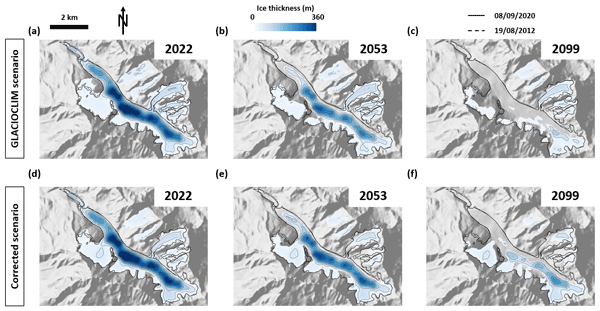
Marin Kneib, Amaury Dehecq, Adrien Gilbert, Auguste Basset, Evan S. Miles, Guillaume Jouvet, Bruno Jourdain, Etienne Ducasse, Luc Beraud, Antoine Rabatel, Jérémie Mouginot, Guillem Carcanade, Olivier Laarman, Fanny Brun, and Delphine Six
The Cryosphere, 18, 5965–5983, https://doi.org/10.5194/tc-18-5965-2024, https://doi.org/10.5194/tc-18-5965-2024, 2024
Short summary
Short summary
Avalanches contribute to increasing the accumulation on mountain glaciers by redistributing snow from surrounding mountains slopes. Here we quantified the contribution of avalanches to the mass balance of Argentière Glacier in the French Alps, by combining satellite and field observations to model the glacier dynamics. We show that the contribution of avalanches locally increases the accumulation by 60–70 % and that accounting for this effect results in less ice loss by the end of the century.
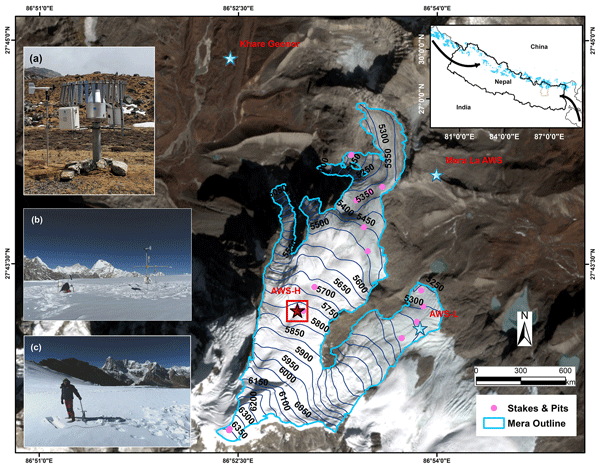
Navaraj Pokhrel, Patrick Wagnon, Fanny Brun, Arbindra Khadka, Tom Matthews, Audrey Goutard, Dibas Shrestha, Baker Perry, and Marion Réveillet
The Cryosphere, 18, 5913–5920, https://doi.org/10.5194/tc-18-5913-2024, https://doi.org/10.5194/tc-18-5913-2024, 2024
Short summary
Short summary
We studied snow processes in the accumulation area of Mera Glacier (central Himalaya, Nepal) by deploying a cosmic ray counting sensor that allows one to track the evolution of snow water equivalent. We suspect significant surface melting, water percolation, and refreezing within the snowpack, which might be missed by traditional mass balance surveys.
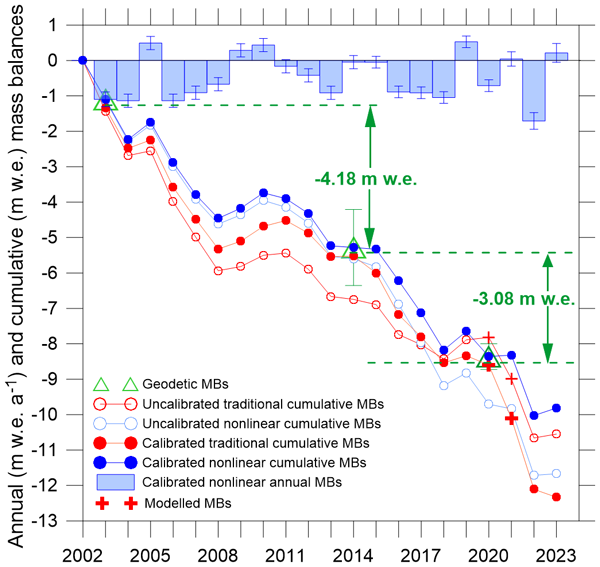
Mohd Farooq Azam, Christian Vincent, Smriti Srivastava, Etienne Berthier, Patrick Wagnon, Himanshu Kaushik, Md. Arif Hussain, Manoj Kumar Munda, Arindan Mandal, and Alagappan Ramanathan
The Cryosphere, 18, 5653–5672, https://doi.org/10.5194/tc-18-5653-2024, https://doi.org/10.5194/tc-18-5653-2024, 2024
Short summary
Short summary
Mass balance series on Chhota Shigri Glacier has been reanalysed by combining the traditional mass balance reanalysis framework and a nonlinear model. The nonlinear model is preferred over traditional glaciological methods to compute the mass balances, as the former can capture the spatiotemporal variability in point mass balances from a heterogeneous in situ point mass balance network. The nonlinear model outperforms the traditional method and agrees better with the geodetic estimates.
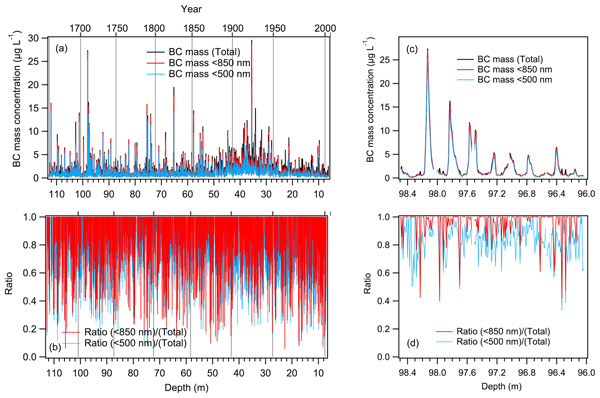
Kumiko Goto-Azuma, Remi Dallmayr, Yoshimi Ogawa-Tsukagawa, Nobuhiro Moteki, Tatsuhiro Mori, Sho Ohata, Yutaka Kondo, Makoto Koike, Motohiro Hirabayashi, Jun Ogata, Kyotaro Kitamura, Kenji Kawamura, Koji Fujita, Sumito Matoba, Naoko Nagatsuka, Akane Tsushima, Kaori Fukuda, and Teruo Aoki
Atmos. Chem. Phys., 24, 12985–13000, https://doi.org/10.5194/acp-24-12985-2024, https://doi.org/10.5194/acp-24-12985-2024, 2024
Short summary
Short summary
We developed a continuous flow analysis system to analyze an ice core from northwestern Greenland and coupled it with an improved refractory black carbon (rBC) measurement technique. This allowed accurate high-resolution analyses of size distributions and concentrations of rBC particles with diameters of 70 nm–4 μm for the past 350 years. Our results provide crucial insights into rBC's climatic effects. We also found previous ice core studies substantially underestimated rBC mass concentrations.
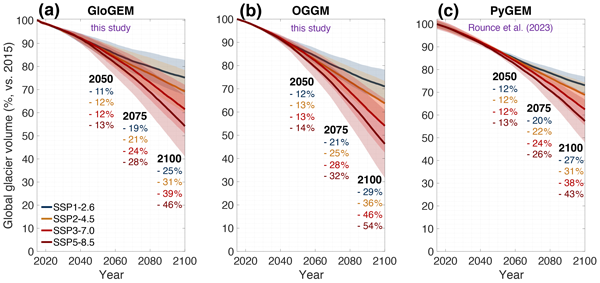
Harry Zekollari, Matthias Huss, Lilian Schuster, Fabien Maussion, David R. Rounce, Rodrigo Aguayo, Nicolas Champollion, Loris Compagno, Romain Hugonnet, Ben Marzeion, Seyedhamidreza Mojtabavi, and Daniel Farinotti
The Cryosphere, 18, 5045–5066, https://doi.org/10.5194/tc-18-5045-2024, https://doi.org/10.5194/tc-18-5045-2024, 2024
Short summary
Short summary
Glaciers are major contributors to sea-level rise and act as key water resources. Here, we model the global evolution of glaciers under the latest generation of climate scenarios. We show that the type of observations used for model calibration can strongly affect the projections at the local scale. Our newly projected 21st century global mass loss is higher than the current community estimate as reported in the latest Intergovernmental Panel on Climate Change (IPCC) report.
Marin Kneib, Amaury Dehecq, Fanny Brun, Fatima Karbou, Laurane Charrier, Silvan Leinss, Patrick Wagnon, and Fabien Maussion
The Cryosphere, 18, 2809–2830, https://doi.org/10.5194/tc-18-2809-2024, https://doi.org/10.5194/tc-18-2809-2024, 2024
Short summary
Short summary
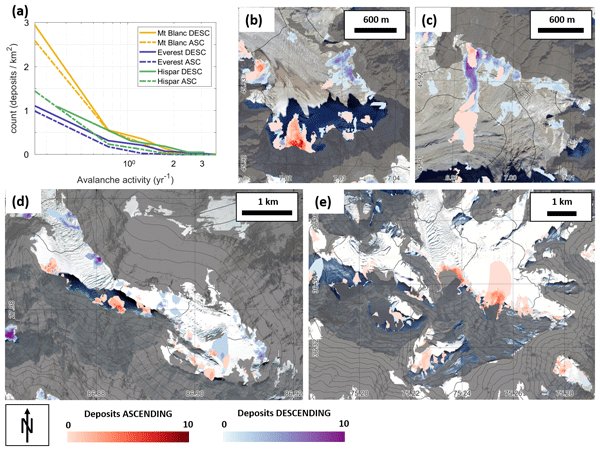
Avalanches are important for the mass balance of mountain glaciers, but few data exist on where and when they occur and which glaciers they affect the most. We developed an approach to map avalanches over large glaciated areas and long periods of time using satellite radar data. The application of this method to various regions in the Alps and High Mountain Asia reveals the variability of avalanches on these glaciers and provides key data to better represent these processes in glacier models.
Yu Zhu, Shiyin Liu, Ben W. Brock, Lide Tian, Ying Yi, Fuming Xie, Donghui Shangguan, and Yiyuan Shen
Hydrol. Earth Syst. Sci., 28, 2023–2045, https://doi.org/10.5194/hess-28-2023-2024, https://doi.org/10.5194/hess-28-2023-2024, 2024
Short summary
Short summary
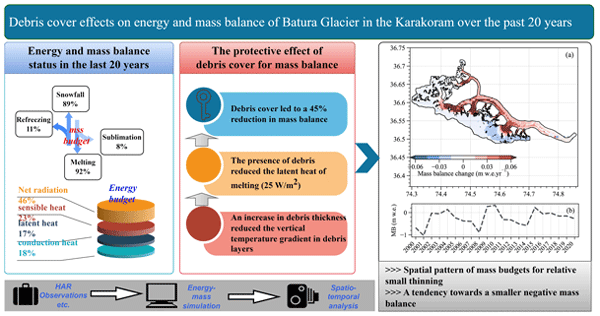
This modeling-based study focused on Batura Glacier from 2000 to 2020, revealing that debris alters its energy budget, affecting mass balance. We propose that the presence of debris on the glacier surface effectively reduces the amount of latent heat available for ablation, which creates a favorable condition for Batura Glacier's relatively low negative mass balance. Batura Glacier shows a trend toward a less negative mass balance due to reduced ablation.
Anna Wendleder, Jasmin Bramboeck, Jamie Izzard, Thilo Erbertseder, Pablo d'Angelo, Andreas Schmitt, Duncan J. Quincey, Christoph Mayer, and Matthias H. Braun
The Cryosphere, 18, 1085–1103, https://doi.org/10.5194/tc-18-1085-2024, https://doi.org/10.5194/tc-18-1085-2024, 2024
Short summary
Short summary
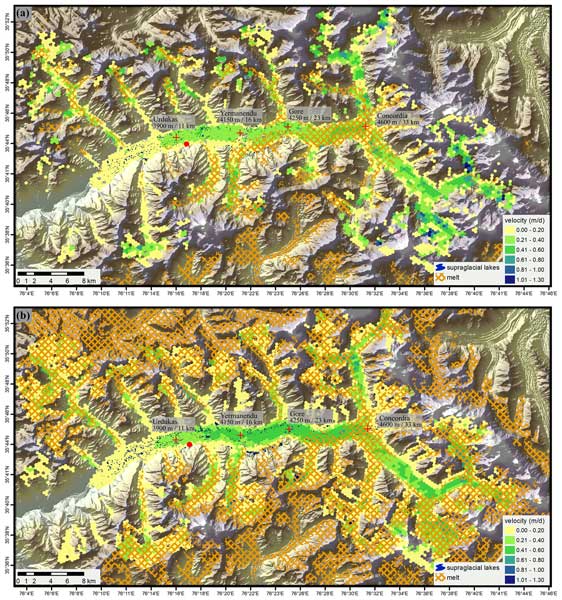
This study analyses the basal sliding and the hydrological drainage of Baltoro Glacier, Pakistan. The surface velocity was characterized by a spring speed-up, summer peak, and autumn speed-up. Snow melt has the largest impact on the spring speed-up, summer velocity peak, and the transition from inefficient to efficient drainage. Drainage from supraglacial lakes contributed to the fall speed-up. Increased summer temperatures will intensify the magnitude of meltwater and thus surface velocities.
Jérôme Messmer and Alexander Raphael Groos
The Cryosphere, 18, 719–746, https://doi.org/10.5194/tc-18-719-2024, https://doi.org/10.5194/tc-18-719-2024, 2024
Short summary
Short summary
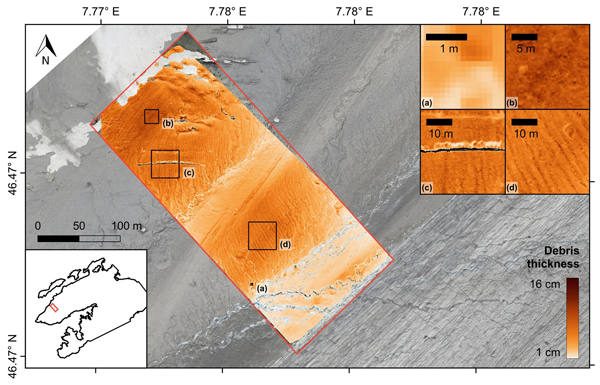
The lower part of mountain glaciers is often covered with debris. Knowing the thickness of the debris is important as it influences the melting and future evolution of the affected glaciers. We have developed an open-source approach to map variations in debris thickness on glaciers using a low-cost drone equipped with a thermal infrared camera. The resulting high-resolution maps of debris surface temperature and thickness enable more accurate monitoring and modelling of debris-covered glaciers.
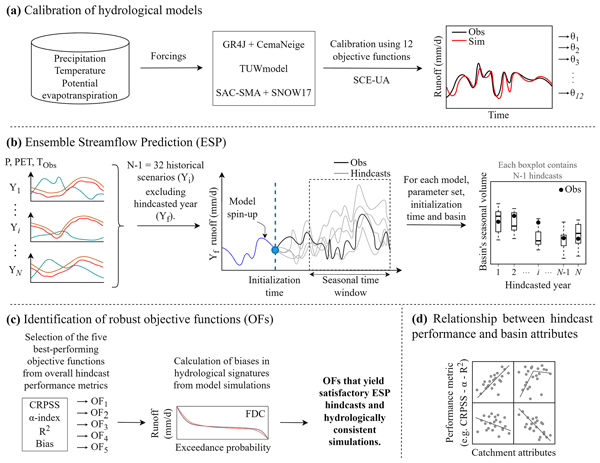
Diego Araya, Pablo A. Mendoza, Eduardo Muñoz-Castro, and James McPhee
Hydrol. Earth Syst. Sci., 27, 4385–4408, https://doi.org/10.5194/hess-27-4385-2023, https://doi.org/10.5194/hess-27-4385-2023, 2023
Short summary
Short summary
Dynamical systems are used by many agencies worldwide to produce seasonal streamflow forecasts, which are critical for decision-making. Such systems rely on hydrology models, which contain parameters that are typically estimated using a target performance metric (i.e., objective function). This study explores the effects of this decision across mountainous basins in Chile, illustrating tradeoffs between seasonal forecast quality and the models' capability to simulate streamflow characteristics.
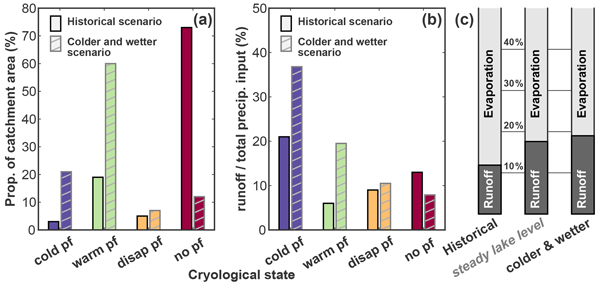
Léo C. P. Martin, Sebastian Westermann, Michele Magni, Fanny Brun, Joel Fiddes, Yanbin Lei, Philip Kraaijenbrink, Tamara Mathys, Moritz Langer, Simon Allen, and Walter W. Immerzeel
Hydrol. Earth Syst. Sci., 27, 4409–4436, https://doi.org/10.5194/hess-27-4409-2023, https://doi.org/10.5194/hess-27-4409-2023, 2023
Short summary
Short summary
Across the Tibetan Plateau, many large lakes have been changing level during the last decades as a response to climate change. In high-mountain environments, water fluxes from the land to the lakes are linked to the ground temperature of the land and to the energy fluxes between the ground and the atmosphere, which are modified by climate change. With a numerical model, we test how these water and energy fluxes have changed over the last decades and how they influence the lake level variations.
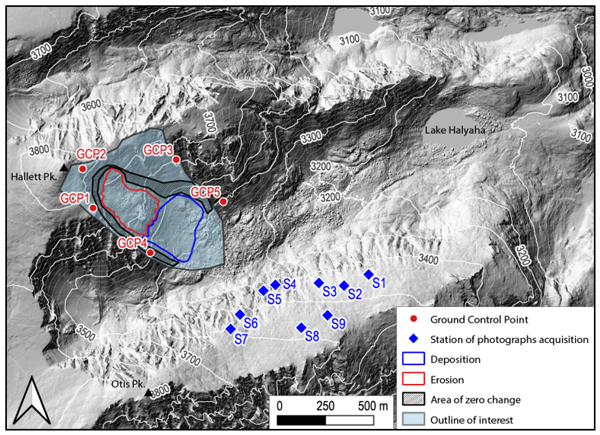
Matthew C. Morriss, Benjamin Lehmann, Benjamin Campforts, George Brencher, Brianna Rick, Leif S. Anderson, Alexander L. Handwerger, Irina Overeem, and Jeffrey Moore
Earth Surf. Dynam., 11, 1251–1274, https://doi.org/10.5194/esurf-11-1251-2023, https://doi.org/10.5194/esurf-11-1251-2023, 2023
Short summary
Short summary
In this paper, we investigate the 28 June 2022 collapse of the Chaos Canyon landslide in Rocky Mountain National Park, Colorado, USA. We find that the landslide was moving prior to its collapse and took place at peak spring snowmelt; temperature modeling indicates the potential presence of permafrost. We hypothesize that this landslide could be part of the broader landscape evolution changes to alpine terrain caused by a warming climate, leading to thawing alpine permafrost.
Vigan Mensah, Koji Fujita, Stephen Howell, Miho Ikeda, Mizuki Komatsu, and Kay I. Ohshima
EGUsphere, https://doi.org/10.5194/egusphere-2023-2492, https://doi.org/10.5194/egusphere-2023-2492, 2023
Preprint archived
Short summary
Short summary
We estimated the volume of freshwater released by sea ice, glaciers, rivers, and precipitation into Baffin Bay and the Labrador Sea, and their changes over the past 70 years. We found that the freshwater volume has risen in Baffin Bay due to increased glacier melting, and dropped in the Labrador Sea because of the decline in sea ice production. We also infer that freshwater from the Arctic Ocean has been exported to our study region for the past 30 years, possibly as a result of global warming.
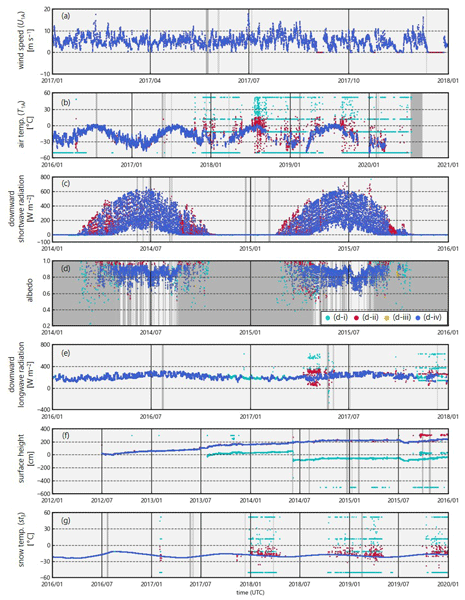
Motoshi Nishimura, Teruo Aoki, Masashi Niwano, Sumito Matoba, Tomonori Tanikawa, Tetsuhide Yamasaki, Satoru Yamaguchi, and Koji Fujita
Earth Syst. Sci. Data, 15, 5207–5226, https://doi.org/10.5194/essd-15-5207-2023, https://doi.org/10.5194/essd-15-5207-2023, 2023
Short summary
Short summary
We presented the method of data quality checks and the dataset for two ground weather observations in northwest Greenland. We found that the warm and clear weather conditions in the 2015, 2019, and 2020 summers caused the snowmelt and the decline in surface reflectance of solar radiation at a low-elevated site (SIGMA-B; 944 m), but those were not seen at the high-elevated site (SIGMA-A; 1490 m). We hope that our data management method and findings will help climate scientists.
Álvaro Ayala, Simone Schauwecker, and Shelley MacDonell
Hydrol. Earth Syst. Sci., 27, 3463–3484, https://doi.org/10.5194/hess-27-3463-2023, https://doi.org/10.5194/hess-27-3463-2023, 2023
Short summary
Short summary
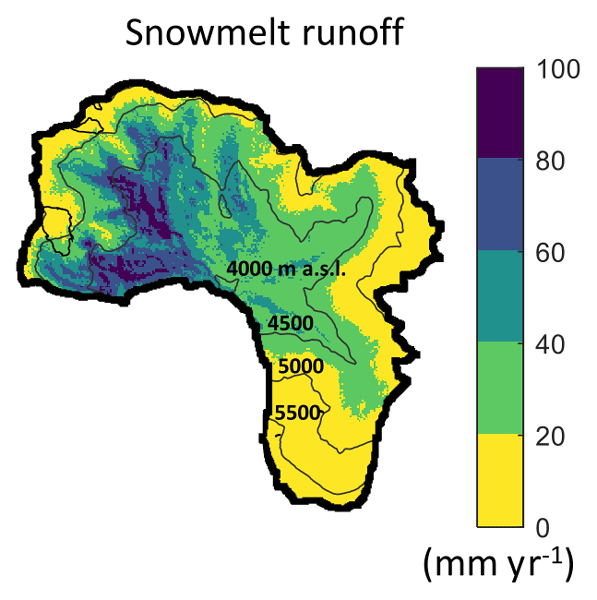
As the climate of the semiarid Andes is very dry, much of the seasonal snowpack is lost to the atmosphere through sublimation. We propose that snowmelt runoff originates from specific areas that we define as snowmelt hotspots. We estimate that snowmelt hotspots produce half of the snowmelt runoff in a small study catchment but represent about a quarter of the total area. Snowmelt hotspots may be important for groundwater recharge, rock glaciers, and mountain peatlands.
Chuanxi Zhao, Wei Yang, Evan Miles, Matthew Westoby, Marin Kneib, Yongjie Wang, Zhen He, and Francesca Pellicciotti
The Cryosphere, 17, 3895–3913, https://doi.org/10.5194/tc-17-3895-2023, https://doi.org/10.5194/tc-17-3895-2023, 2023
Short summary
Short summary
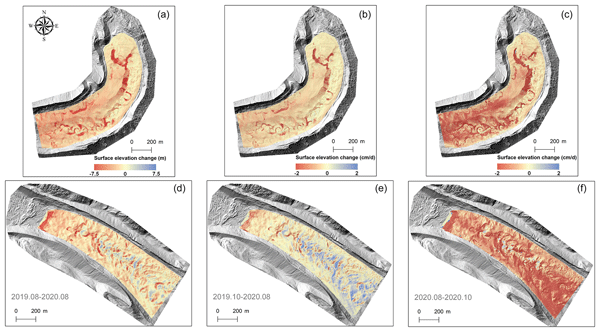
This paper quantifies the thinning and surface mass balance of two neighbouring debris-covered glaciers in the southeastern Tibetan Plateau during different seasons, based on high spatio-temporal resolution UAV-derived (unpiloted aerial
vehicle) data and in situ observations. Through a comparison approach and high-precision results, we identify that the glacier dynamic and debris thickness are strongly related to the future fate of the debris-covered glaciers in this region.
Finu Shrestha, Jakob F. Steiner, Reeju Shrestha, Yathartha Dhungel, Sharad P. Joshi, Sam Inglis, Arshad Ashraf, Sher Wali, Khwaja M. Walizada, and Taigang Zhang
Earth Syst. Sci. Data, 15, 3941–3961, https://doi.org/10.5194/essd-15-3941-2023, https://doi.org/10.5194/essd-15-3941-2023, 2023
Short summary
Short summary
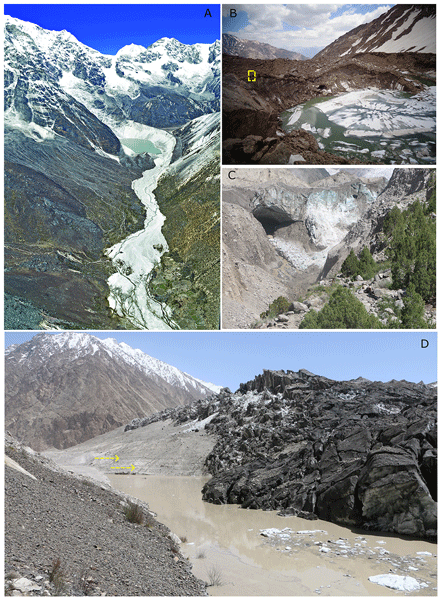
A new inventory of glacial lake outburst floods (GLOFs) in High Mountain Asia found 697 events, causing 906 deaths, 3 times more than previously reported. This study provides insights into the contributing factors behind GLOFs on a regional scale and highlights the need for interdisciplinary approaches, including scientific communities and local knowledge, to understand GLOF risks in Asia. This study allows integration with other datasets, enabling future local and regional risk assessments.
Yukihiko Onuma, Koji Fujita, Nozomu Takeuchi, Masashi Niwano, and Teruo Aoki
The Cryosphere, 17, 3309–3328, https://doi.org/10.5194/tc-17-3309-2023, https://doi.org/10.5194/tc-17-3309-2023, 2023
Short summary
Short summary
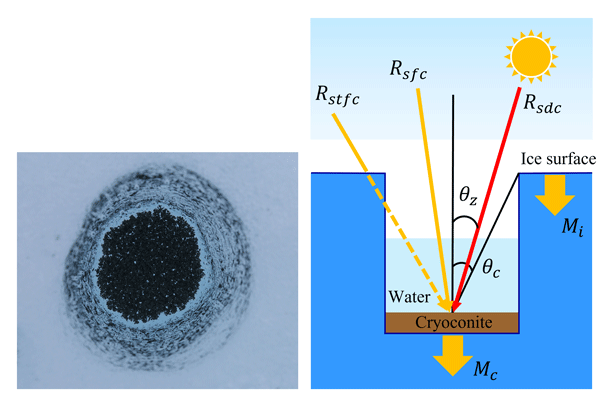
We established a novel model that simulates the temporal changes in cryoconite hole (CH) depth using heat budgets calculated independently at the ice surface and CH bottom based on hole shape geometry. The simulations suggest that CH depth is governed by the balance between the intensity of the diffuse component of downward shortwave radiation and the wind speed. The meteorological conditions may be important factors contributing to the recent ice surface darkening via the redistribution of CHs.
Naoko Nagatsuka, Kumiko Goto-Azuma, Koji Fujita, Yuki Komuro, Motohiro Hirabayashi, Jun Ogata, Kaori Fukuda, Yoshimi Ogawa-Tsukagawa, Kyotaro Kitamura, Ayaka Yonekura, Fumio Nakazawa, Yukihiko Onuma, Naoyuki Kurita, Sune Olander Rasmussen, Giulia Sinnl, Trevor James Popp, and Dorthe Dahl-Jensen
EGUsphere, https://doi.org/10.5194/egusphere-2023-1666, https://doi.org/10.5194/egusphere-2023-1666, 2023
Preprint archived
Short summary
Short summary
We present a new high-temporal-resolution record of mineral composition in a northeastern Greenland ice-core (EGRIP) over the past 100 years. The ice core dust composition and its variation differed significantly from a northwestern Greenland ice core, which is likely due to differences in the geological sources of the dust. Our results suggest that the EGRIP ice core dust was constantly supplied from Northern Eurasia, North America, and Asia with minor contribution from Greenland coast.
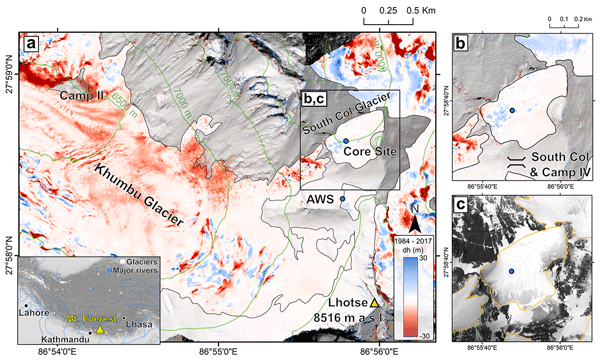
Fanny Brun, Owen King, Marion Réveillet, Charles Amory, Anton Planchot, Etienne Berthier, Amaury Dehecq, Tobias Bolch, Kévin Fourteau, Julien Brondex, Marie Dumont, Christoph Mayer, Silvan Leinss, Romain Hugonnet, and Patrick Wagnon
The Cryosphere, 17, 3251–3268, https://doi.org/10.5194/tc-17-3251-2023, https://doi.org/10.5194/tc-17-3251-2023, 2023
Short summary
Short summary
The South Col Glacier is a small body of ice and snow located on the southern ridge of Mt. Everest. A recent study proposed that South Col Glacier is rapidly losing mass. In this study, we examined the glacier thickness change for the period 1984–2017 and found no thickness change. To reconcile these results, we investigate wind erosion and surface energy and mass balance and find that melt is unlikely a dominant process, contrary to previous findings.
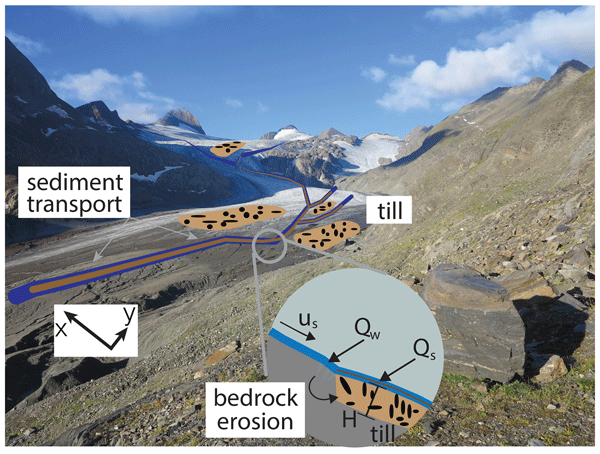
Ian Delaney, Leif Anderson, and Frédéric Herman
Earth Surf. Dynam., 11, 663–680, https://doi.org/10.5194/esurf-11-663-2023, https://doi.org/10.5194/esurf-11-663-2023, 2023
Short summary
Short summary
This paper presents a two-dimensional subglacial sediment transport model that evolves a sediment layer in response to subglacial sediment transport conditions. The model captures sediment transport in supply- and transport-limited regimes across a glacier's bed and considers both the creation and transport of sediment. Model outputs show how the spatial distribution of sediment and water below a glacier can impact the glacier's discharge of sediment and erosion of bedrock.
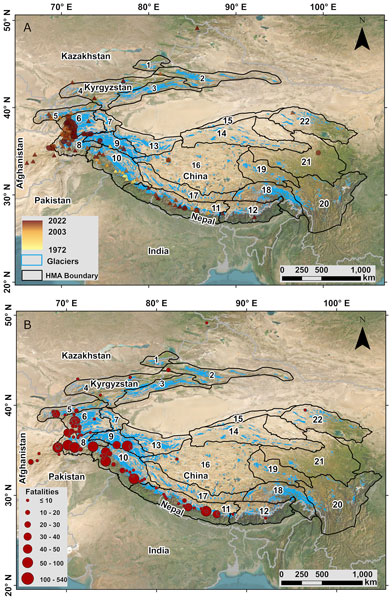
Anushilan Acharya, Jakob F. Steiner, Khwaja Momin Walizada, Salar Ali, Zakir Hussain Zakir, Arnaud Caiserman, and Teiji Watanabe
Nat. Hazards Earth Syst. Sci., 23, 2569–2592, https://doi.org/10.5194/nhess-23-2569-2023, https://doi.org/10.5194/nhess-23-2569-2023, 2023
Short summary
Short summary
All accessible snow and ice avalanches together with previous scientific research, local knowledge, and existing or previously active adaptation and mitigation solutions were investigated in the high mountain Asia (HMA) region to have a detailed overview of the state of knowledge and identify gaps. A comprehensive avalanche database from 1972–2022 is generated, including 681 individual events. The database provides a basis for the forecasting of avalanche hazards in different parts of HMA.
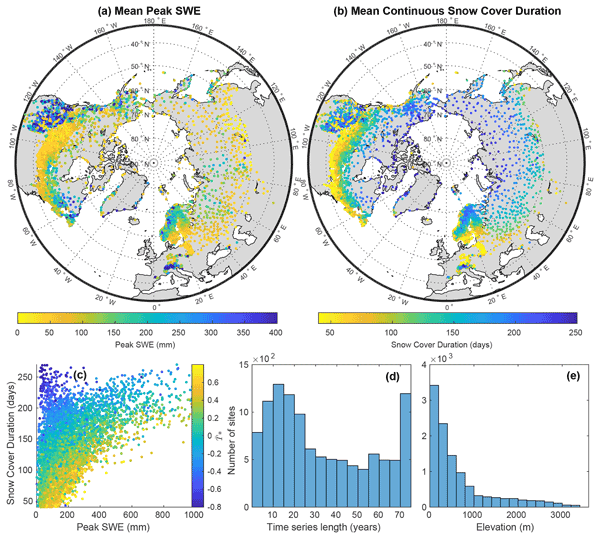
Adrià Fontrodona-Bach, Bettina Schaefli, Ross Woods, Adriaan J. Teuling, and Joshua R. Larsen
Earth Syst. Sci. Data, 15, 2577–2599, https://doi.org/10.5194/essd-15-2577-2023, https://doi.org/10.5194/essd-15-2577-2023, 2023
Short summary
Short summary
We provide a dataset of snow water equivalent, the depth of liquid water that results from melting a given depth of snow. The dataset contains 11 071 sites over the Northern Hemisphere, spans the period 1950–2022, and is based on daily observations of snow depth on the ground and a model. The dataset fills a lack of accessible historical ground snow data, and it can be used for a variety of applications such as the impact of climate change on global and regional snow and water resources.

Lena Katharina Schmidt, Till Francke, Peter Martin Grosse, Christoph Mayer, and Axel Bronstert
Hydrol. Earth Syst. Sci., 27, 1841–1863, https://doi.org/10.5194/hess-27-1841-2023, https://doi.org/10.5194/hess-27-1841-2023, 2023
Short summary
Short summary
We present a suitable method to reconstruct sediment export from decadal records of hydroclimatic predictors (discharge, precipitation, temperature) and shorter suspended sediment measurements. This lets us fill the knowledge gap on how sediment export from glacierized high-alpine areas has responded to climate change. We find positive trends in sediment export from the two investigated nested catchments with step-like increases around 1981 which are linked to crucial changes in glacier melt.
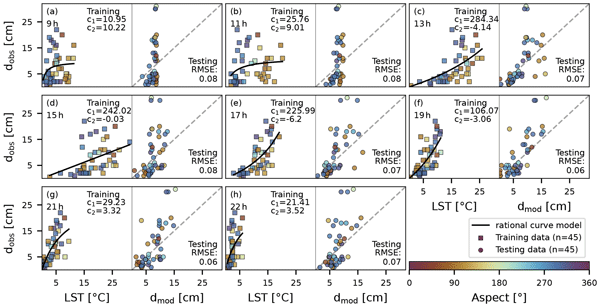
Deniz Tobias Gök, Dirk Scherler, and Leif Stefan Anderson
The Cryosphere, 17, 1165–1184, https://doi.org/10.5194/tc-17-1165-2023, https://doi.org/10.5194/tc-17-1165-2023, 2023
Short summary
Short summary
We performed high-resolution debris-thickness mapping using land surface temperature (LST) measured from an unpiloted aerial vehicle (UAV) at various times of the day. LSTs from UAVs require calibration that varies in time. We test two approaches to quantify supraglacial debris cover, and we find that the non-linearity of the relationship between LST and debris thickness increases with LST. Choosing the best model to predict debris thickness depends on the time of the day and the terrain aspect.
Julia Chizhova, Maria Kireeva, Ekaterina Rets, Alexey Ekaykin, Anna Kozachek, Arina Veres, Olga Zolina, Natalia Varentsova, Artem Gorbarenko, Nikita Povalyaev, Valentina Plotnikova, Timofey Samsonov, and Maxim Kharlamov
Earth Syst. Sci. Data Discuss., https://doi.org/10.5194/essd-2022-377, https://doi.org/10.5194/essd-2022-377, 2022
Manuscript not accepted for further review
Short summary
Short summary
Empirical study of the isotopic features of river runoff were conducted at three hydrological posts in three different river basins: the Zakza river in the center of East European Plane (southwest of Moscow), the Dubna river (north of Moscow) and the Sosna Bystraya river in the south of central region.
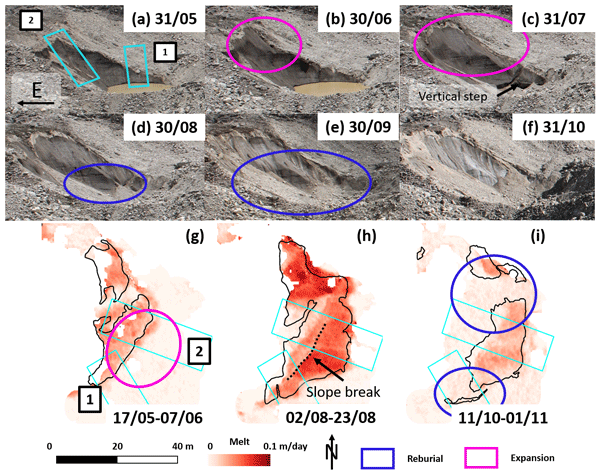
Marin Kneib, Evan S. Miles, Pascal Buri, Stefan Fugger, Michael McCarthy, Thomas E. Shaw, Zhao Chuanxi, Martin Truffer, Matthew J. Westoby, Wei Yang, and Francesca Pellicciotti
The Cryosphere, 16, 4701–4725, https://doi.org/10.5194/tc-16-4701-2022, https://doi.org/10.5194/tc-16-4701-2022, 2022
Short summary
Short summary
Ice cliffs are believed to be important contributors to the melt of debris-covered glaciers, but this has rarely been quantified as the cliffs can disappear or rapidly expand within a few weeks. We used photogrammetry techniques to quantify the weekly evolution and melt of four cliffs. We found that their behaviour and melt during the monsoon is strongly controlled by supraglacial debris, streams and ponds, thus providing valuable insights on the melt and evolution of debris-covered glaciers.
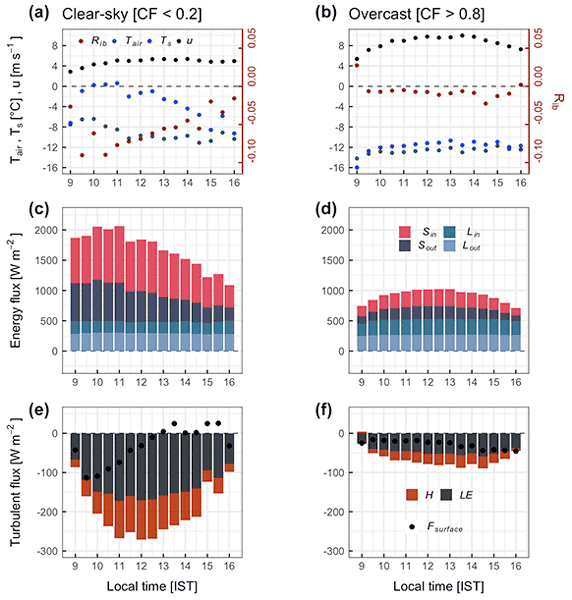
Arindan Mandal, Thupstan Angchuk, Mohd Farooq Azam, Alagappan Ramanathan, Patrick Wagnon, Mohd Soheb, and Chetan Singh
The Cryosphere, 16, 3775–3799, https://doi.org/10.5194/tc-16-3775-2022, https://doi.org/10.5194/tc-16-3775-2022, 2022
Short summary
Short summary
Snow sublimation is an important component of glacier surface mass balance; however, it is seldom studied in detail in the Himalayan region owing to data scarcity. We present an 11-year record of wintertime snow-surface energy balance and sublimation characteristics at the Chhota Shigri Glacier moraine site at 4863 m a.s.l. The estimated winter sublimation is 16 %–42 % of the winter snowfall at the study site, which signifies how sublimation is important in the Himalayan region.
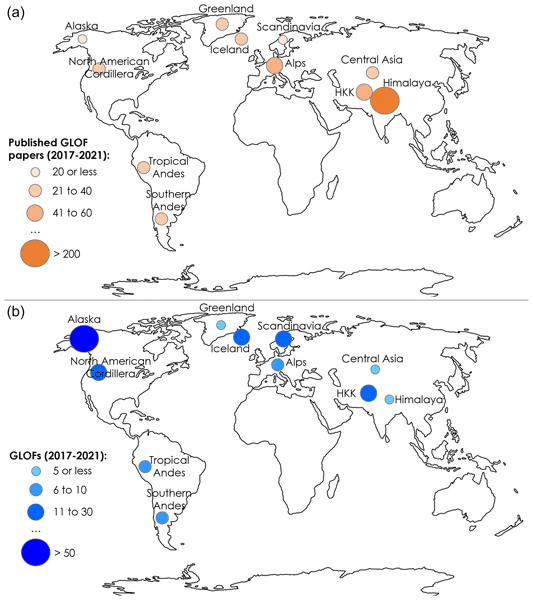
Adam Emmer, Simon K. Allen, Mark Carey, Holger Frey, Christian Huggel, Oliver Korup, Martin Mergili, Ashim Sattar, Georg Veh, Thomas Y. Chen, Simon J. Cook, Mariana Correas-Gonzalez, Soumik Das, Alejandro Diaz Moreno, Fabian Drenkhan, Melanie Fischer, Walter W. Immerzeel, Eñaut Izagirre, Ramesh Chandra Joshi, Ioannis Kougkoulos, Riamsara Kuyakanon Knapp, Dongfeng Li, Ulfat Majeed, Stephanie Matti, Holly Moulton, Faezeh Nick, Valentine Piroton, Irfan Rashid, Masoom Reza, Anderson Ribeiro de Figueiredo, Christian Riveros, Finu Shrestha, Milan Shrestha, Jakob Steiner, Noah Walker-Crawford, Joanne L. Wood, and Jacob C. Yde
Nat. Hazards Earth Syst. Sci., 22, 3041–3061, https://doi.org/10.5194/nhess-22-3041-2022, https://doi.org/10.5194/nhess-22-3041-2022, 2022
Short summary
Short summary
Glacial lake outburst floods (GLOFs) have attracted increased research attention recently. In this work, we review GLOF research papers published between 2017 and 2021 and complement the analysis with research community insights gained from the 2021 GLOF conference we organized. The transdisciplinary character of the conference together with broad geographical coverage allowed us to identify progress, trends and challenges in GLOF research and outline future research needs and directions.
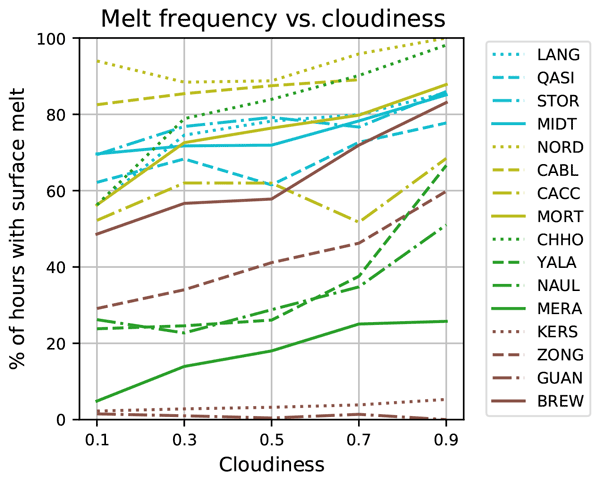
Jonathan P. Conway, Jakob Abermann, Liss M. Andreassen, Mohd Farooq Azam, Nicolas J. Cullen, Noel Fitzpatrick, Rianne H. Giesen, Kirsty Langley, Shelley MacDonell, Thomas Mölg, Valentina Radić, Carleen H. Reijmer, and Jean-Emmanuel Sicart
The Cryosphere, 16, 3331–3356, https://doi.org/10.5194/tc-16-3331-2022, https://doi.org/10.5194/tc-16-3331-2022, 2022
Short summary
Short summary
We used data from automatic weather stations on 16 glaciers to show how clouds influence glacier melt in different climates around the world. We found surface melt was always more frequent when it was cloudy but was not universally faster or slower than under clear-sky conditions. Also, air temperature was related to clouds in opposite ways in different climates – warmer with clouds in cold climates and vice versa. These results will help us improve how we model past and future glacier melt.
Julia Chizhova, Maria Kireeva, Ekaterina Rets, Alexey Ekaykin, Anna Kozachek, Arina Veres, Olga Zolina, Natalia Varentsova, Artem Gorbarenko, Nikita Povalyaev, Valentina Plotnikova, Timofey Samsonov, and Maxim Kharlamov
Earth Syst. Sci. Data Discuss., https://doi.org/10.5194/essd-2022-145, https://doi.org/10.5194/essd-2022-145, 2022
Revised manuscript not accepted
Short summary
Short summary
Empirical study of the isotopic features of river runoff were carried out at three hydrological posts in 3 different river basins Eastern Europe. Samples of river water, groundwater and precipitation for the October 2019–October 2021 were collected at weekly intervals. A significant supply of melted snow during spring freshet was the key factor influencing water regimes for these three river basins; varying degrees of anthropogenic flow regulation are also presented.
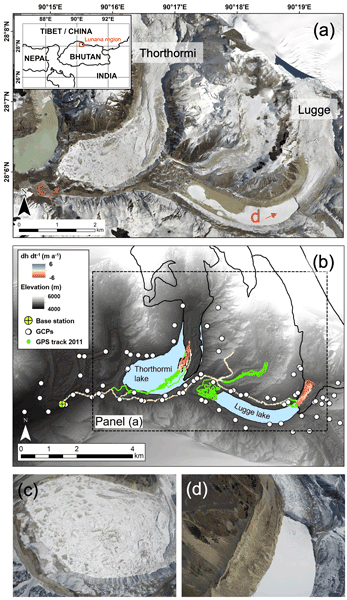
Yota Sato, Koji Fujita, Hiroshi Inoue, Akiko Sakai, and Karma
The Cryosphere, 16, 2643–2654, https://doi.org/10.5194/tc-16-2643-2022, https://doi.org/10.5194/tc-16-2643-2022, 2022
Short summary
Short summary
We investigate fluctuations in Bhutanese lake-terminating glaciers focusing on the dynamics change before and after proglacial lake formation at Thorthormi Glacier (TG) based on photogrammetry, satellite, and GPS surveys. The thinning rate of TG became double compared to before proglacial lake formation, and the flow velocity has also sped up considerably. Those changes would be due to the reduction in longitudinal ice compression by the detachment of the glacier terminus from the end moraine.

Astrid Oetting, Emma C. Smith, Jan Erik Arndt, Boris Dorschel, Reinhard Drews, Todd A. Ehlers, Christoph Gaedicke, Coen Hofstede, Johann P. Klages, Gerhard Kuhn, Astrid Lambrecht, Andreas Läufer, Christoph Mayer, Ralf Tiedemann, Frank Wilhelms, and Olaf Eisen
The Cryosphere, 16, 2051–2066, https://doi.org/10.5194/tc-16-2051-2022, https://doi.org/10.5194/tc-16-2051-2022, 2022
Short summary
Short summary
This study combines a variety of geophysical measurements in front of and beneath the Ekström Ice Shelf in order to identify and interpret geomorphological evidences of past ice sheet flow, extent and retreat.
The maximal extent of grounded ice in this region was 11 km away from the continental shelf break.
The thickness of palaeo-ice on the calving front around the LGM was estimated to be at least 305 to 320 m.
We provide essential boundary conditions for palaeo-ice-sheet models.
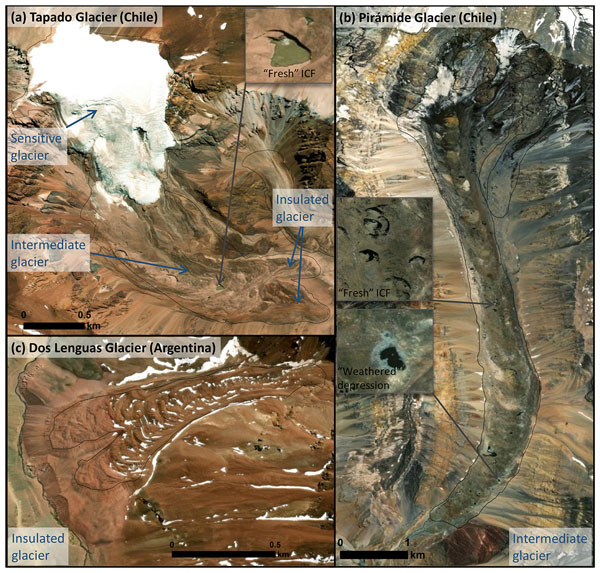
Nicole Schaffer and Shelley MacDonell
The Cryosphere, 16, 1779–1791, https://doi.org/10.5194/tc-16-1779-2022, https://doi.org/10.5194/tc-16-1779-2022, 2022
Short summary
Short summary
Over the last 2 decades the importance of Andean glaciers, particularly as water resources, has been recognized in both scientific literature and the public sphere. This has led to the inclusion of glaciers in environmental impact assessment and the development of glacier protection laws. We propose three categories that group glaciers based on their environmental sensitivity to hopefully help facilitate the effective application of these measures and evaluation of water resources in general.

Loris Compagno, Matthias Huss, Evan Stewart Miles, Michael James McCarthy, Harry Zekollari, Amaury Dehecq, Francesca Pellicciotti, and Daniel Farinotti
The Cryosphere, 16, 1697–1718, https://doi.org/10.5194/tc-16-1697-2022, https://doi.org/10.5194/tc-16-1697-2022, 2022
Short summary
Short summary
We present a new approach for modelling debris area and thickness evolution. We implement the module into a combined mass-balance ice-flow model, and we apply it using different climate scenarios to project the future evolution of all glaciers in High Mountain Asia. We show that glacier geometry, volume, and flow velocity evolve differently when modelling explicitly debris cover compared to glacier evolution without the debris-cover module, demonstrating the importance of accounting for debris.
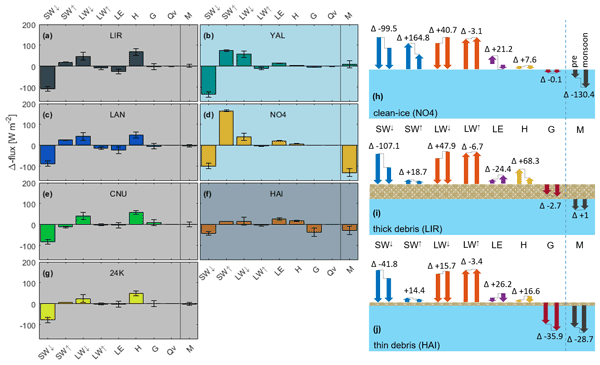
Stefan Fugger, Catriona L. Fyffe, Simone Fatichi, Evan Miles, Michael McCarthy, Thomas E. Shaw, Baohong Ding, Wei Yang, Patrick Wagnon, Walter Immerzeel, Qiao Liu, and Francesca Pellicciotti
The Cryosphere, 16, 1631–1652, https://doi.org/10.5194/tc-16-1631-2022, https://doi.org/10.5194/tc-16-1631-2022, 2022
Short summary
Short summary
The monsoon is important for the shrinking and growing of glaciers in the Himalaya during summer. We calculate the melt of seven glaciers in the region using a complex glacier melt model and weather data. We find that monsoonal weather affects glaciers that are covered with a layer of rocky debris and glaciers without such a layer in different ways. It is important to take so-called turbulent fluxes into account. This knowledge is vital for predicting the future of the Himalayan glaciers.
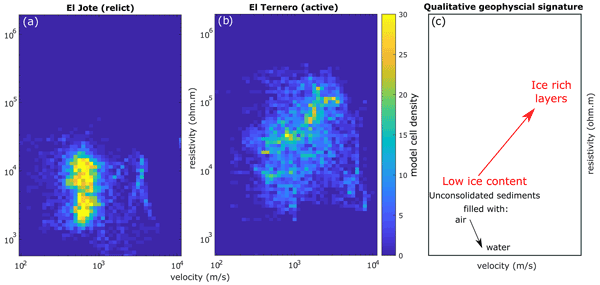
Giulia de Pasquale, Rémi Valois, Nicole Schaffer, and Shelley MacDonell
The Cryosphere, 16, 1579–1596, https://doi.org/10.5194/tc-16-1579-2022, https://doi.org/10.5194/tc-16-1579-2022, 2022
Short summary
Short summary
We presented a geophysical study of one intact and one relict rock glacier in semi-arid Chile. The interpretation of the collected data through different methods identifies geophysical signature differences between the two rock glaciers and characterizes their subsurface structure and composition. This is of great importance because of rock glaciers' relevant role in freshwater production, transfer and storage, especially in this area of increasing human pressure and high rainfall variability.
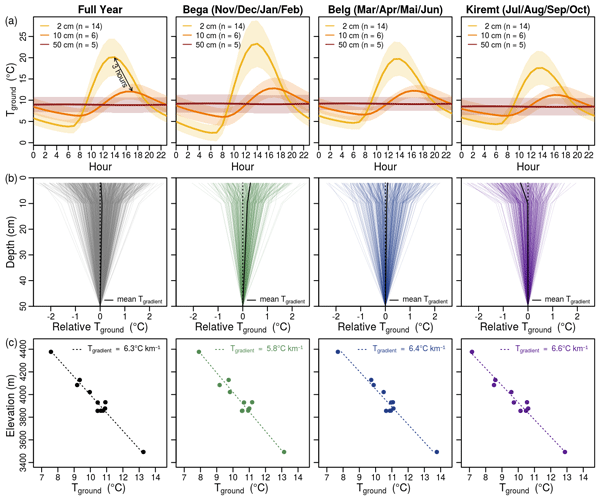
Alexander R. Groos, Janik Niederhauser, Bruk Lemma, Mekbib Fekadu, Wolfgang Zech, Falk Hänsel, Luise Wraase, Naki Akçar, and Heinz Veit
Earth Syst. Sci. Data, 14, 1043–1062, https://doi.org/10.5194/essd-14-1043-2022, https://doi.org/10.5194/essd-14-1043-2022, 2022
Short summary
Short summary
Continuous observations and measurements from high elevations are necessary to monitor recent climate and environmental changes in the tropical mountains of eastern Africa, but meteorological and ground temperature data from above 3000 m are very rare. Here we present a comprehensive ground temperature monitoring network that has been established between 3493 and 4377 m in the Bale Mountains (Ethiopian Highlands) to monitor and study the afro-alpine climate and ecosystem in this region.

Benjamin Aubrey Robson, Shelley MacDonell, Álvaro Ayala, Tobias Bolch, Pål Ringkjøb Nielsen, and Sebastián Vivero
The Cryosphere, 16, 647–665, https://doi.org/10.5194/tc-16-647-2022, https://doi.org/10.5194/tc-16-647-2022, 2022
Short summary
Short summary
This work uses satellite and aerial data to study glaciers and rock glacier changes in La Laguna catchment within the semi-arid Andes of Chile, where ice melt is an important factor in river flow. The results show the rate of ice loss of Tapado Glacier has been increasing since the 1950s, which possibly relates to a dryer, warmer climate over the previous decades. Several rock glaciers show high surface velocities and elevation changes between 2012 and 2020, indicating they may be ice-rich.
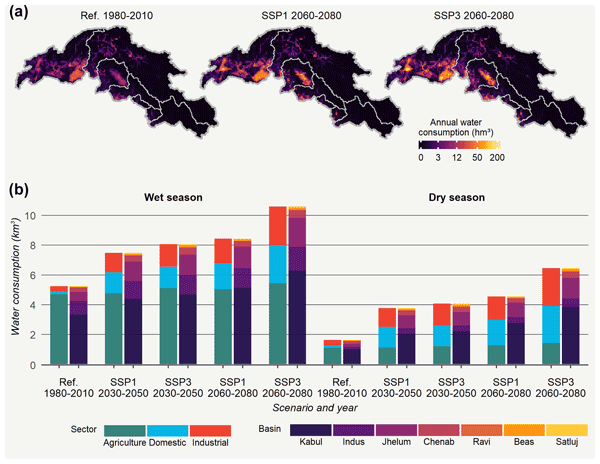
Wouter J. Smolenaars, Sanita Dhaubanjar, Muhammad K. Jamil, Arthur Lutz, Walter Immerzeel, Fulco Ludwig, and Hester Biemans
Hydrol. Earth Syst. Sci., 26, 861–883, https://doi.org/10.5194/hess-26-861-2022, https://doi.org/10.5194/hess-26-861-2022, 2022
Short summary
Short summary
The arid plains of the lower Indus Basin rely heavily on the water provided by the mountainous upper Indus. Rapid population growth in the upper Indus is expected to increase the water that is consumed there. This will subsequently reduce the water that is available for the downstream plains, where the population and water demand are also expected to grow. In future, this may aggravate tensions over the division of water between the countries that share the Indus Basin.
Cited articles
Anderson, L., Fontrodona-Bach, A., Fujita, K., Fyffe, C., Gantayat, P., Groos, A. R., Immerzeel, W., Mayer, C., McCarthy, M., Rets, E., Rounce, D., Sakai, A., Steiner, J., and Winter-Billington, A.: Debris-Covered Glacier Melt Model Intercomparison Experiment: Model Outputs, Zenodo [data set], https://doi.org/10.5281/zenodo.15754456, 2025. a
Anderson, L. S. and Anderson, R. S.: Debris thickness patterns on debris-covered glaciers, Geomorphology, 311, 1–12, https://doi.org/10.1016/j.geomorph.2018.03.014, 2018. a
Anderson, L. S., Armstrong, W. H., Anderson, R. S., and Buri, P.: Debris cover and the thinning of Kennicott Glacier, Alaska: in situ measurements, automated ice cliff delineation and distributed melt estimates, The Cryosphere, 15, 265–282, https://doi.org/10.5194/tc-15-265-2021, 2021. a, b, c, d, e
Anderson, R. S.: Near-surface thermal profiles in alpine bedrock: Implications for the frost weathering of rock, Arct. Alp. Res., 30, 362–372, 1998. a
Anderson, R. S.: A model of ablation-dominated medial moraines and the generation of debris-mantled glacier snouts, J. Glaciol., 46, 459–469, https://doi.org/10.3189/172756500781833025, 2000. a
Anslow, F. S., Hostetler, S., Bidlake, W. R., and Clark, P. U.: Distributed energy balance modeling of South Cascade Glacier, Washington and assessment of model uncertainty, J. Geophys. Res.-Earth Surf., 113, 2007JF000850, https://doi.org/10.1029/2007JF000850, 2008. a
Azzoni, R. S., Senese, A., Zerboni, A., Maugeri, M., Smiraglia, C., and Diolaiuti, G. A.: Estimating ice albedo from fine debris cover quantified by a semi-automatic method: the case study of Forni Glacier, Italian Alps, The Cryosphere, 10, 665–679, https://doi.org/10.5194/tc-10-665-2016, 2016. a
Banerjee, A.: Brief communication: Thinning of debris-covered and debris-free glaciers in a warming climate, The Cryosphere, 11, 133–138, https://doi.org/10.5194/tc-11-133-2017, 2017. a
Bhambri, R., Bolch, T., and Chaujar, R. K.: Mapping of debris-covered glaciers in the Garhwal Himalayas using ASTER DEMs and thermal data, Int. J. Remote Sens., 32, 8095–8119, https://doi.org/10.1080/01431161.2010.532821, 2011. a
Bisset, R. R., Nienow, P. W., Goldberg, D. N., Wigmore, O., Loayza-Muro, R. A., Wadham, J. L., Macdonald, M. L., and Bingham, R. G.: Using thermal UAV imagery to model distributed debris thicknesses and sub-debris melt rates on debris-covered glaciers, J. Glaciol., 69, 981–996, https://doi.org/10.1017/jog.2022.116, 2023. a, b
Bonekamp, P. N. J., van Heerwaarden, C. C., Steiner, J. F., and Immerzeel, W. W.: Using 3D turbulence-resolving simulations to understand the impact of surface properties on the energy balance of a debris-covered glacier, The Cryosphere, 14, 1611–1632, https://doi.org/10.5194/tc-14-1611-2020, 2020. a
Bozhinskiy, A. N., Krass, M. S., and Popovnin, V. V.: Role of Debris Cover in the Thermal Physics of Glaciers, J. Glaciol., 32, 255–266, https://doi.org/10.3189/S0022143000015598, 1986. a
Brock, B. W.: 5_Miage Data, Zenodo [data set], https://doi.org/10.5281/zenodo.3050557, 2019. a
Brock, B. W., Mihalcea, C., Kirkbride, M. P., Diolaiuti, G., Cutler, M. E. J., and Smiraglia, C.: Meteorology and surface energy fluxes in the 2005–2007 ablation seasons at the Miage debris-covered glacier, Mont Blanc Massif, Italian Alps, J. Geophys. Res.-Atmos., 115, https://doi.org/10.1029/2009JD013224, 2010. a, b, c, d, e, f, g, h, i
Brook, M., Hagg, W., and Winkler, S.: Debris cover and surface melt at a temperate maritime alpine glacier: Franz Josef Glacier, New Zealand, New Zeal. J. Geol. Geop., 56, 27–38, https://doi.org/10.1080/00288306.2012.736391, 2013. a, b
Brun, F., Buri, P., Miles, E. S., Wagnon, P., Steiner, J., Berthier, E., Ragettli, S., Kraaijenbrink, P., Immerzeel, W. W., and Pellicciotti, F.: Quantifying volume loss from ice cliffs on debris-covered glaciers using high-resolution terrestrial and aerial photogrammetry, J. Glaciol., 62, 684–695, https://doi.org/10.1017/jog.2016.54, 2016. a
Brun, F., Wagnon, P., Berthier, E., Shea, J. M., Immerzeel, W. W., Kraaijenbrink, P. D. A., Vincent, C., Reverchon, C., Shrestha, D., and Arnaud, Y.: Ice cliff contribution to the tongue-wide ablation of Changri Nup Glacier, Nepal, central Himalaya, The Cryosphere, 12, 3439–3457, https://doi.org/10.5194/tc-12-3439-2018, 2018. a, b
Brun, F., Wagnon, P., Berthier, E., Jomelli, V., Maharjan, S. B., Shrestha, F., and Kraaijenbrink, P. D. A.: Heterogeneous Influence of Glacier Morphology on the Mass Balance Variability in High Mountain Asia, J. Geophys. Res.-Earth Surf., 124, 1331–1345, https://doi.org/10.1029/2018JF004838, 2019. a
Buri, P. and Pellicciotti, F.: Aspect controls the survival of ice cliffs on debris-covered glaciers, P. Natl. Acad. Sci. USA, 115, 4369–4374, https://doi.org/10.1073/pnas.1713892115, 2018. a, b
Buri, P., Miles, E. S., Steiner, J. F., Immerzeel, W. W., Wagnon, P., and Pellicciotti, F.: A physically based 3-D model of ice cliff evolution over debris-covered glaciers, J. Geophys. Res.-Earth Surf., 121, 2471–2493, https://doi.org/10.1002/2016JF004039, 2016a. a, b
Buri, P., Pellicciotti, F., Steiner, J. F., Miles, E. S., and Immerzeel, W. W.: A grid-based model of backwasting of supraglacial ice cliffs on debris-covered glaciers, Ann. Glaciol., 57, 199–211, https://doi.org/10.3189/2016AoG71A059, 2016b. a, b
Collier, E., Nicholson, L. I., Brock, B. W., Maussion, F., Essery, R., and Bush, A. B. G.: Representing moisture fluxes and phase changes in glacier debris cover using a reservoir approach, The Cryosphere, 8, 1429–1444, https://doi.org/10.5194/tc-8-1429-2014, 2014. a, b, c
Deline, P.: Change in surface debris cover on Mont Blanc massif glaciers after the `Little Ice Age' termination, Holocene, 15, 302–309, https://doi.org/10.1191/0959683605hl809rr, 2005. a
Elagina, N., Rets, E., Korneva, I., Toropov, P., and Lavrentiev, I.: Simulation of mass balance and glacial runoff of Mount Elbrus from 1984 to 2022, Hydrol. Sci. J., https://doi.org/10.1080/02626667.2025.2516080, 2025. a
Farinotti, D., Brinkerhoff, D. J., Clarke, G. K. C., Fürst, J. J., Frey, H., Gantayat, P., Gillet-Chaulet, F., Girard, C., Huss, M., Leclercq, P. W., Linsbauer, A., Machguth, H., Martin, C., Maussion, F., Morlighem, M., Mosbeux, C., Pandit, A., Portmann, A., Rabatel, A., Ramsankaran, R., Reerink, T. J., Sanchez, O., Stentoft, P. A., Singh Kumari, S., van Pelt, W. J. J., Anderson, B., Benham, T., Binder, D., Dowdeswell, J. A., Fischer, A., Helfricht, K., Kutuzov, S., Lavrentiev, I., McNabb, R., Gudmundsson, G. H., Li, H., and Andreassen, L. M.: How accurate are estimates of glacier ice thickness? Results from ITMIX, the Ice Thickness Models Intercomparison eXperiment, The Cryosphere, 11, 949–970, https://doi.org/10.5194/tc-11-949-2017, 2017. a
Fontrodona-Bach, A., Groeneveld, L., Miles, E., McCarthy, M., Shaw, T., Melo Velasco, V., and Pellicciotti, F.: DebDaB: a database of supraglacial debris thickness and physical properties, Earth Syst. Sci. Data, 17, 4213–4234, https://doi.org/10.5194/essd-17-4213-2025, 2025. a, b
Fujita, K. and Sakai, A.: Modelling runoff from a Himalayan debris-covered glacier, Hydrol. Earth Syst. Sci., 18, 2679–2694, https://doi.org/10.5194/hess-18-2679-2014, 2014. a, b
Fyffe, C. L., Reid, T. D., Brock, B. W., Kirkbride, M. P., Diolaiuti, G., Smiraglia, C., and Diotri, F.: A distributed energy-balance melt model of an alpine debris-covered glacier, J. Glaciol., 60, 587–602, https://doi.org/10.3189/2014JoG13J148, 2014. a, b, c
Fyffe, C. L., Woodget, A. S., Kirkbride, M. P., Deline, P., Westoby, M. J., and Brock, B. W.: Processes at the margins of supraglacial debris cover: Quantifying dirty ice ablation and debris redistribution, Earth Surf. Proc. Land., 45, 2272–2290, https://doi.org/10.1002/esp.4879, 2020. a, b, c, d, e, f, g
Gabbi, J., Carenzo, M., Pellicciotti, F., Bauder, A., and Funk, M.: A comparison of empirical and physically based glacier surface melt models for long-term simulations of glacier response, J. Glaciol., 60, 1140–1154, https://doi.org/10.3189/2014JoG14J011, 2014. a, b
Gabbi, J., Huss, M., Bauder, A., Cao, F., and Schwikowski, M.: The impact of Saharan dust and black carbon on albedo and long-term mass balance of an Alpine glacier, The Cryosphere, 9, 1385–1400, https://doi.org/10.5194/tc-9-1385-2015, 2015. a
Giese, A., Boone, A., Wagnon, P., and Hawley, R.: Incorporating moisture content in surface energy balance modeling of a debris-covered glacier, The Cryosphere, 14, 1555–1577, https://doi.org/10.5194/tc-14-1555-2020, 2020. a, b, c
Groeneveld, L., Fontrodona-Bach, A., Miles, E., McCarthy, M., Melo Velasco, V., Shaw, T., Pellicciotti, F., Bauder, A., Buri, P., Kneib, M., Kumar, A., Mishra, A., Petersen, L., Renner, R., and Schmid, S.: DebDaB: A database of supraglacial debris thickness and physical properties (Version v2), Zenodo [data set], https://doi.org/10.5281/zenodo.15441000, 2025. a, b
Groos, A. R. and Mayer, C.: glacierSMBM: Glacier Surface Mass Balance Model, r package version 0.1, https://CRAN.R-project.org/package=glacierSMBM (last access: 20 February 2026), 2017. a
Groos, A. R., Mayer, C., Smiraglia, C., Diolaiuti, G., and Lambrecht, A.: A first attempt to model region-wide glacier surface mass balances in the Karakoram: Findings and future challenges, Geografia Fisica e Dinamica Quaternaria, 40, 137–159, https://doi.org/10.4461/GFDQ.2017.40.10, 2017. a, b, c
Gruber, S., Fleiner, R., Guegan, E., Panday, P., Schmid, M.-O., Stumm, D., Wester, P., Zhang, Y., and Zhao, L.: Review article: Inferring permafrost and permafrost thaw in the mountains of the Hindu Kush Himalaya region, The Cryosphere, 11, 81–99, https://doi.org/10.5194/tc-11-81-2017, 2017. a
Hagg, W., Mayer, C., Lambrecht, A., and Helm, A.: Sub-debris melt rates on southern Inylchek Glacier, central Tian Shan, Geogr. Ann. A, 90, 55–63, https://doi.org/10.1111/j.1468-0459.2008.00333.x, 2008. a, b
Han, H., Wang, J., Wei, J., and Liu, S.: Backwasting rate on debris-covered Koxkar Glacier, Tuomuer Mountain, China, J. Glaciol., 56, 287–296, https://doi.org/10.3189/002214310791968430, 2010. a
Herreid, S. and Pellicciotti, F.: The state of rock debris covering Earth’s glaciers, Nat. Geosci., 13, 621–627, https://doi.org/10.1038/s41561-020-0615-0, 2020. a, b
Hock, R.: Temperature index melt modelling in mountain areas, J. Hydrol., 282, 104–115, https://doi.org/10.1016/S0022-1694(03)00257-9, 2003. a
Huss, M., Farinotti, D., Bauder, A., and Funk, M.: Modelling runoff from highly glacierized alpine drainage basins in a changing climate, Hydrol. Process., 22, 3888–3902, https://doi.org/10.1002/hyp.7055, 2008. a
Immerzeel, W. W., Van Beek, L. P. H., Konz, M., Shrestha, A. B., and Bierkens, M. F. P.: Hydrological response to climate change in a glacierized catchment in the Himalayas, Climatic Change, 110, 721–736, https://doi.org/10.1007/s10584-011-0143-4, 2012. a
Immerzeel, W. W., Pellicciotti, F., and Bierkens, M. F. P.: Rising river flows throughout the twenty-first century in two Himalayan glacierized watersheds, Nat. Geosci., 6, 742–745, https://doi.org/10.1038/ngeo1896, 2013. a
Immerzeel, W. W., Kraaijenbrink, P. D. A., Shea, J. M., Shrestha, A. B., Pellicciotti, F., Bierkens, M. F. P., and De Jong, S. M.: High-resolution monitoring of Himalayan glacier dynamics using unmanned aerial vehicles, Remote Sens. Environ., 150, 93–103, https://doi.org/10.1016/j.rse.2014.04.025, 2014. a, b
Jouvet, G., Huss, M., Funk, M., and Blatter, H.: Modelling the retreat of Grosser Aletschgletscher, Switzerland, in a changing climate, J. Glaciol., 57, 1033–1045, https://doi.org/10.3189/002214311798843359, 2011. a
Juen, M., Mayer, C., Lambrecht, A., Han, H., and Liu, S.: Impact of varying debris cover thickness on ablation: a case study for Koxkar Glacier in the Tien Shan, The Cryosphere, 8, 377–386, https://doi.org/10.5194/tc-8-377-2014, 2014. a, b
Kääb, A., Berthier, E., Nuth, C., Gardelle, J., and Arnaud, Y.: Contrasting patterns of early twenty-first-century glacier mass change in the Himalayas, Nature, 488, 495–498, https://doi.org/10.1038/nature11324, 2012. a
Khan, M. I.: Ablation on Barpu Glacier, Karakoram Himalaya, Pakistan: A Study of Melt Processes on a Faceted, Debris-Covered Ice Surface, Master's thesis, Wilfrid Laurier University, 1989. a
Kirkbride, M. P. and Deline, P.: The formation of supraglacial debris covers by primary dispersal from transverse englacial debris bands, Earth Surf. Proc. Land., 38, 1779–1792, https://doi.org/10.1002/esp.3416, 2013. a
Kirkbride, M. P. and Dugmore, A. J.: Glaciological response to distal tephra fallout from the 1947 eruption of Hekla, south Iceland, J. Glaciol., 49, 420–428, https://doi.org/10.3189/172756503781830575, 2003. a, b, c, d
Kirkbride, M. P., Sherriff, S. C., Rowan, A. V., Egholm, D. L., Quincey, D. J., Miles, E., Hubbard, B., and Miles, K.: Provenance and transport of supraglacial debris revealed by variations in debris geochemistry on Khumbu Glacier, Nepal Himalaya, Earth Surf. Proc. Land., 48, 2737–2753, https://doi.org/10.1002/esp.5657, 2023. a
Konovalov, V.: Computations of melting under moraine as a part of regional modelling of glacier runoff, in: Debris-Covered Glaciers, IAHS Publication, 264, 109–118, 2000. a
Kraaijenbrink, P. D. A., Shea, J. M., Pellicciotti, F., De Jong, S. M., and Immerzeel, W. W.: Object-based analysis of unmanned aerial vehicle imagery to map and characterise surface features on a debris-covered glacier, Remote Sens. Environ., 186, 581–595, https://doi.org/10.1016/j.rse.2016.09.013, 2016. a
Kraaijenbrink, P. D. A., Bierkens, M. F. P., Lutz, A. F., and Immerzeel, W. W.: Impact of a global temperature rise of 1.5 degrees Celsius on Asia’s glaciers, Nature, 549, 257–260, https://doi.org/10.1038/nature23878, 2017. a
Kraaijenbrink, P. D. A., Shea, J. M., Litt, M., Steiner, J. F., Treichler, D., Koch, I., and Immerzeel, W. W.: Mapping Surface Temperatures on a Debris-Covered Glacier With an Unmanned Aerial Vehicle, Front. Earth Sci., 6, 64, https://doi.org/10.3389/feart.2018.00064, 2018. a
Lejeune, Y., Bertrand, J.-M., Wagnon, P., and Morin, S.: A physically based model of the year-round surface energy and mass balance of debris-covered glaciers, J. Glaciol., 59, 327–344, https://doi.org/10.3189/2013JoG12J149, 2013. a, b, c
Lukas, S., Nicholson, L. I., Ross, F. H., and Humlum, O.: Formation, Meltout Processes and Landscape Alteration of High-Arctic Ice-Cored Moraines – Examples From Nordenskiold Land, Central Spitsbergen, Polar Geography, 29, 157–187, https://doi.org/10.1080/789610198, 2005. a
MacDonell, S., Ayala, Á., and McPhee, J.: 8_Tapado Data, Zenodo [data set], https://doi.org/10.5281/zenodo.3362402, 2019. a
MacDougall, A. H. and Flowers, G. E.: Spatial and Temporal Transferability of a Distributed Energy-Balance Glacier Melt Model, J. Climate, 24, 1480–1498, https://doi.org/10.1175/2010JCLI3821.1, 2011. a
Machguth, H., Purves, R. S., Oerlemans, J., Hoelzle, M., and Paul, F.: Exploring uncertainty in glacier mass balance modelling with Monte Carlo simulation, The Cryosphere, 2, 191–204, https://doi.org/10.5194/tc-2-191-2008, 2008. a
Margirier, A., Brondex, J., Rowan, A. V., Schmidt, C., Pedersen, V. K., Lehmann, B., Anderson, L. S., Veness, R., Watson, C. S., Swift, D., and King, G. E.: Tracking Sediment Transport Through Miage Glacier, Italy, Using a Lagrangian Approach With Luminescence Rock Surface Burial Dating of Englacial Clasts, J. Geophys. Res.-Earth Surf., 130, e2024JF007773, https://doi.org/10.1029/2024JF007773, 2025. a
McCarthy, M., Pritchard, H., Willis, I., and King, E.: Ground-penetrating radar measurements of debris thickness on Lirung Glacier, Nepal, J. Glaciol., 63, 543–555, https://doi.org/10.1017/jog.2017.18, 2017. a, b
McCarthy, M., Miles, E., Kneib, M., Buri, P., Fugger, S., and Pellicciotti, F.: Supraglacial debris thickness and supply rate in High-Mountain Asia, Commun. Earth Environ., 3, 269, https://doi.org/10.1038/s43247-022-00588-2, 2022. a
McPhee, J., MacDonnel, S., and Shaw, T.: 6_Pirámide Data, Zenodo [data set], https://doi.org/10.5281/zenodo.3056072, 2019. a
McSaveney, M. J.: The Sherman Glacier rock avalanche of 1964: Its emplacement and subsequent effects on the glacier beneath it, Ph.D. thesis, The Ohio State University, 1975. a
Melo-Velasco, V., Miles, E., McCarthy, M., Shaw, T. E., Fyffe, C., Fontrodona-Bach, A., and Pellicciotti, F.: Method dependence in thermal conductivity and aerodynamic roughness length estimates on a debris-covered glacier, J. Geophys. Res.-Earth Surf., 130, e2025JF008360, https://doi.org/10.1029/2025JF008360, 2025. a, b, c, d
Messmer, J. and Groos, A. R.: A low-cost and open-source approach for supraglacial debris thickness mapping using UAV-based infrared thermography, The Cryosphere, 18, 719–746, https://doi.org/10.5194/tc-18-719-2024, 2024. a, b
Mihalcea, C., Mayer, C., Diolaiuti, G., Lambrecht, A., Smiraglia, C., and Tartari, G.: Ice ablation and meteorological conditions on the debris-covered area of Baltoro glacier, Karakoram, Pakistan, Ann. Glaciol., 43, 292–300, https://doi.org/10.3189/172756406781812104, 2006. a, b
Miles, E. S., Pellicciotti, F., Willis, I. C., Steiner, J. F., Buri, P., and Arnold, N. S.: Refined energy-balance modelling of a supraglacial pond, Langtang Khola, Nepal, Ann. Glaciol., 57, 29–40, https://doi.org/10.3189/2016AoG71A421, 2016. a
Miles, E. S., Steiner, J. F., and Brun, F.: Highly variable aerodynamic roughness length (z0) for a hummocky debris-covered glacier, J. Geophys. Res.-Atmos., 122, 8447–8466, https://doi.org/10.1002/2017JD026510, 2017. a, b
Miles, E. S., Willis, I., Buri, P., Steiner, J. F., Arnold, N. S., and Pellicciotti, F.: Surface Pond Energy Absorption Across Four Himalayan Glaciers Accounts for 1/8 of Total Catchment Ice Loss, Geophys. Res. Lett., 45, https://doi.org/10.1029/2018GL079678, 2018. a
Miles, K. E., Hubbard, B., Irvine-Fynn, T. D. L., Miles, E. S., Quincey, D. J., and Rowan, A. V.: Hydrology of debris-covered glaciers in High Mountain Asia, Earth-Sci. Rev., 207, 103212, https://doi.org/10.1016/j.earscirev.2020.103212, 2020. a
Mölg, N., Bolch, T., Walter, A., and Vieli, A.: Unravelling the evolution of Zmuttgletscher and its debris cover since the end of the Little Ice Age, The Cryosphere, 13, 1889–1909, https://doi.org/10.5194/tc-13-1889-2019, 2019. a, b
Nakawo, M. and Young, G. J.: Estimate of Glacier Ablation under a Debris Layer from Surface Temperature and Meteorological Variables, J. Glaciol., 28, 29–34, https://doi.org/10.3189/S002214300001176X, 1982. a
Nicholson, L.: 7_Suldenferner Data, Zenodo [data set], https://doi.org/10.5281/zenodo.3056524, 2019. a
Nicholson, L. and Benn, D. I.: Properties of natural supraglacial debris in relation to modelling sub-debris ice ablation, Earth Surf. Proc. Land., 38, 490–501, https://doi.org/10.1002/esp.3299, 2013. a, b, c, d
Nicholson, L. and Mertes, J.: Thickness estimation of supraglacial debris above ice cliff exposures using a high-resolution digital surface model derived from terrestrial photography, J. Glaciol., 63, 989–998, https://doi.org/10.1017/jog.2017.68, 2017. a
Nicholson, L. and Stiperski, I.: Comparison of turbulent structures and energy fluxes over exposed and debris-covered glacier ice, J. Glaciol., 66, 543–555, https://doi.org/10.1017/jog.2020.23, 2020. a, b, c, d
Nicholson, L. I., McCarthy, M., Pritchard, H. D., and Willis, I.: Supraglacial debris thickness variability: impact on ablation and relation to terrain properties, The Cryosphere, 12, 3719–3734, https://doi.org/10.5194/tc-12-3719-2018, 2018. a, b
Oerlemans, J.: Glaciers and Climate Change, CRC Press, ISBN 9026518137, 2001. a
Østrem, G.: Problems of Dating Ice-Cored Moraines, Geogr. Ann. A, 47, 1–38, https://doi.org/10.1080/04353676.1965.11879710, 1965. a, b
Pellicciotti, F., Brock, B., Strasser, U., Burlando, P., Funk, M., and Corripio, J.: An enhanced temperature-index glacier melt model including the shortwave radiation balance: Development and testing for Haut Glacier d'Arolla, Switzerland, J. Glaciol., 51, 573–587, https://doi.org/10.3189/172756505781829124, 2005. a
Pellicciotti, F., Buri, P., Fugger, S., Heynen, M., Miles, E., Petersen, L., Ragettli, S., and Steiner, J.: 4_Lirung Data, Zenodo [data set], https://doi.org/10.5281/zenodo.3050327, 2019a. a
ellicciotti, F., Carenzo, M., Fontrodona-Bach, A., and Petersen, L.: 1_Arolla Data, Zenodo [data set], https://doi.org/10.5281/zenodo.3047649, 2019b. a
Popovnin, V. V. and Rozova, A. V.: Influence of Sub-Debris Thawing on Ablation and Runoff of the Djankuat Glacier in the Caucasus, Hydrol. Res., 33, 75–94, https://doi.org/10.2166/nh.2002.0005, 2002. a
Potter, E. R., Orr, A., Willis, I. C., Bannister, D., and Wagnon, P.: Meteorological impacts of a novel debris-covered glacier category in a regional climate model across a Himalayan catchment, Atmos. Sci. Lett., 22, e1018, https://doi.org/10.1002/asl.1018, 2021. a
Purdie, H.: 9_Tasman Data, Zenodo [data set], https://doi.org/10.5281/zenodo.3354105, 2019. a
Quincey, D., Smith, M., Rounce, D., Ross, A., King, O., and Watson, C.: Evaluating morphological estimates of the aerodynamic roughness of debris covered glacier ice, Earth Surf. Proc. Land., 42, 2541–2553, https://doi.org/10.1002/esp.4198, 2017. a, b
Ragettli, S., Pellicciotti, F., Immerzeel, W. W., Miles, E. S., Petersen, L., Heynen, M., Shea, J. M., Stumm, D., Joshi, S., and Shrestha, A.: Unraveling the hydrology of a Himalayan catchment through integration of high resolution in situ data and remote sensing with an advanced simulation model, Adv. Water Resour., 78, 94–111, https://doi.org/10.1016/j.advwatres.2015.01.013, 2015. a
Reid, T. D. and Brock, B. W.: Assessing ice-cliff backwasting and its contribution to total ablation of debris-covered Miage glacier, Mont Blanc massif, Italy, J. Glaciol., 60, 3–13, https://doi.org/10.3189/2014JoG13J045, 2014. a
Reid, T. D., Carenzo, M., Pellicciotti, F., and Brock, B. W.: Including debris cover effects in a distributed model of glacier ablation, J. Geophys. Res.-Atmos., 117, 2012JD017795, https://doi.org/10.1029/2012JD017795, 2012. a, b, c, d
Rets, E. and Kireeva, M.: Hazardous hydrological processes in mountainous areas under the impact of recent climate change: case study of Terek River basin, IAHS Publ., 340, 126–134, 2010. a
Rets, E., Popovnin, V., and Shahgedanova, M.: 3_Djankuat Data, Zenodo [data set], https://doi.org/10.5281/zenodo.3049871, 2019a. a
Rets, E. P., Popovnin, V. V., Toropov, P. A., Smirnov, A. M., Tokarev, I. V., Chizhova, J. N., Budantseva, N. A., Vasil'chuk, Y. K., Kireeva, M. B., Ekaykin, A. A., Veres, A. N., Aleynikov, A. A., Frolova, N. L., Tsyplenkov, A. S., Poliukhov, A. A., Chalov, S. R., Aleshina, M. A., and Kornilova, E. D.: Djankuat glacier station in the North Caucasus, Russia: a database of glaciological, hydrological, and meteorological observations and stable isotope sampling results during 2007–2017, Earth Syst. Sci. Data, 11, 1463–1481, https://doi.org/10.5194/essd-11-1463-2019, 2019b. a
Reznichenko, N., Davies, T., Shulmeister, J., and McSaveney, M.: Effects of debris on ice-surface melting rates: An experimental study, J. Glaciol., 56, 384–394, https://doi.org/10.3189/002214310792447725, 2010. a
Röhl, K.: Characteristics and evolution of supraglacial ponds on debris-covered Tasman Glacier, New Zealand, J. Glaciol., 54, 867–880, https://doi.org/10.3189/002214308787779861, 2008. a
Rounce, D. R. and McKinney, D. C.: Debris thickness of glaciers in the Everest area (Nepal Himalaya) derived from satellite imagery using a nonlinear energy balance model, The Cryosphere, 8, 1317–1329, https://doi.org/10.5194/tc-8-1317-2014, 2014. a
Rounce, D. R., King, O., McCarthy, M., Shean, D. E., and Salerno, F.: Quantifying Debris Thickness of Debris-Covered Glaciers in the Everest Region of Nepal Through Inversion of a Subdebris Melt Model, J. Geophys. Res.-Earth Surf., 123, 1094–1115, https://doi.org/10.1029/2017JF004395, 2018. a
Rounce, D. R., Hock, R., McNabb, R. W., Millan, R., Sommer, C., Braun, M. H., Malz, P., Maussion, F., Mouginot, J., Seehaus, T. C., and Shean, D. E.: Distributed Global Debris Thickness Estimates Reveal Debris Significantly Impacts Glacier Mass Balance, Geophys. Res. Lett., 48, e2020GL091311, https://doi.org/10.1029/2020GL091311, 2021. a
Rowan, A. V., Egholm, D. L., Quincey, D. J., and Glasser, N. F.: Modelling the feedbacks between mass balance, ice flow and debris transport to predict the response to climate change of debris-covered glaciers in the Himalaya, Earth Planet. Sc. Lett., 430, 427–438, https://doi.org/10.1016/j.epsl.2015.09.004, 2015. a, b, c
Rye, C. J., Arnold, N. S., Willis, I. C., and Kohler, J.: Modeling the surface mass balance of a high Arctic glacier using the ERA-40 reanalysis, J. Geophys. Res.-Earth Surf., 115, 2009JF001364, https://doi.org/10.1029/2009JF001364, 2010. a
Sakai, A., Takeuchi, N., Fujita, K., and Nakawo, M.: Role of supraglacial ponds in the ablation process of a debris-covered glacier in the Nepal Himalayas, in: IAHS Publication, 264, 119–130, 2000. a
Sakai, A., Nakawo, M., and Fujita, K.: Distribution Characteristics and Energy Balance of Ice Cliffs on Debris-covered Glaciers, Nepal Himalaya, Arct. Antarct. Alp. Res., 34, 12–19, https://doi.org/10.1080/15230430.2002.12003463, 2002. a
Sakai, A., Fujita, K., and Kubota, J.: Evaporation and percolation effect on melting at debris-covered Lirung Glacier, Nepal Himalayas, 1996, Bulletin of Glaciological Research, 21, 9–16, 2004. a
Salerno, F., Thakuri, S., Tartari, G., Nuimura, T., Sunako, S., Sakai, A., and Fujita, K.: Debris-covered glacier anomaly? Morphological factors controlling changes in the mass balance, surface area, terminus position, and snow line altitude of Himalayan glaciers, Earth Planet. Sc. Lett., 471, 19–31, https://doi.org/10.1016/j.epsl.2017.04.039, 2017. a
Schauwecker, S., Rohrer, M., Huggel, C., Kulkarni, A., Ramanathan, A., Salzmann, N., Stoffel, M., and Brock, B.: Remotely sensed debris thickness mapping of Bara Shigri Glacier, Indian Himalaya, J. Glaciol., 61, 675–688, https://doi.org/10.3189/2015JoG14J102, 2015. a
Scherler, D. and Egholm, D. L.: Production and Transport of Supraglacial Debris: Insights From Cosmogenic 10Be and Numerical Modeling, Chhota Shigri Glacier, Indian Himalaya, J. Geophys. Res.-Earth Surf., 125, e2020JF005586, https://doi.org/10.1029/2020JF005586, 2020. a
Scherler, D., Wulf, H., and Gorelick, N.: Global Assessment of Supraglacial Debris-Cover Extents, Geophys. Res. Lett., 45, https://doi.org/10.1029/2018GL080158, 2018. a, b, c
Shaw, T. E., Brock, B. W., Fyffe, C. L., Pellicciotti, F., Rutter, N., and Diotri, F.: Air temperature distribution and energy-balance modelling of a debris-covered glacier, J. Glaciol., 62, 185–198, https://doi.org/10.1017/jog.2016.31, 2016. a, b, c
Shea, J. M., Immerzeel, W. W., Wagnon, P., Vincent, C., and Bajracharya, S.: Modelling glacier change in the Everest region, Nepal Himalaya, The Cryosphere, 9, 1105–1128, https://doi.org/10.5194/tc-9-1105-2015, 2015. a
Steiner, J. F. and Pellicciotti, F.: Variability of air temperature over a debris-covered glacier in the Nepalese Himalaya, Ann. Glaciol., 57, 295–307, https://doi.org/10.3189/2016AoG71A066, 2016. a
Steiner, J. F., Kraaijenbrink, P. D. A., and Immerzeel, W. W.: Distributed Melt on a Debris-Covered Glacier: Field Observations and Melt Modeling on the Lirung Glacier in the Himalaya, Front. Earth Sci., 9, 678375, https://doi.org/10.3389/feart.2021.678375, 2021. a, b, c, d
Stokes, C. R., Popovnin, V., Aleynikov, A., Gurney, S. D., and Shahgedanova, M.: Recent glacier retreat in the Caucasus Mountains, Russia, and associated increase in supraglacial debris cover and supra-/proglacial lake development, Ann. Glaciol., 46, 195–203, https://doi.org/10.3189/172756407782871468, 2007. a
Thakuri, S., Salerno, F., Smiraglia, C., Bolch, T., D'Agata, C., Viviano, G., and Tartari, G.: Tracing glacier changes since the 1960s on the south slope of Mt. Everest (central Southern Himalaya) using optical satellite imagery, The Cryosphere, 8, 1297–1315, https://doi.org/10.5194/tc-8-1297-2014, 2014. a
Thompson, S., Benn, D. I., Mertes, J., and Luckman, A.: Stagnation and mass loss on a Himalayan debris-covered glacier: Processes, patterns and rates, J. Glaciol., 62, 467–485, https://doi.org/10.1017/jog.2016.37, 2016. a
Tielidze, L. G., Bolch, T., Wheate, R. D., Kutuzov, S. S., Lavrentiev, I. I., and Zemp, M.: Supra-glacial debris cover changes in the Greater Caucasus from 1986 to 2014, The Cryosphere, 14, 585–598, https://doi.org/10.5194/tc-14-585-2020, 2020. a
van Woerkom, T., Steiner, J. F., Kraaijenbrink, P. D. A., Miles, E. S., and Immerzeel, W. W.: Sediment supply from lateral moraines to a debris-covered glacier in the Himalaya, Earth Surf. Dynam., 7, 411–427, https://doi.org/10.5194/esurf-7-411-2019, 2019. a
Vincent, C., Wagnon, P., Shea, J. M., Immerzeel, W. W., Kraaijenbrink, P., Shrestha, D., Soruco, A., Arnaud, Y., Brun, F., Berthier, E., and Sherpa, S. F.: Reduced melt on debris-covered glaciers: investigations from Changri Nup Glacier, Nepal, The Cryosphere, 10, 1845–1858, https://doi.org/10.5194/tc-10-1845-2016, 2016. a
Wagnon, P.: 2_Changri Nup Data, Zenodo [data set], https://doi.org/10.5281/zenodo.3048780, 2019. a
Wang, L., Li, Z., and Wang, F.: Spatial distribution of the debris layer on glaciers of the Tuomuer Peak, western Tian Shan, J. Earth Sci., 22, 528–538, https://doi.org/10.1007/s12583-011-0205-6, 2011. a
Watson, C. S., Quincey, D. J., Carrivick, J. L., Smith, M. W., Rowan, A. V., and Richardson, R.: Heterogeneous water storage and thermal regime of supraglacial ponds on debris-covered glaciers, Earth Surf. Proc. Land., 43, 229–241, https://doi.org/10.1002/esp.4236, 2018. a
Wei, Y., Yao, T., Xu, B., and Zhang, H.: Influence of supraglacial debris on summer ablation and mass balance in the 24K glacier, southeast Tibetan Plateau, Geogr. Ann. A, 92, 353–360, https://doi.org/10.1111/j.1468-0459.2010.00400.x, 2010. a
Westoby, M. J., Rounce, D. R., Shaw, T. E., Fyffe, C. L., Moore, P. L., Stewart, R. L., and Brock, B. W.: Geomorphological evolution of a debris-covered glacier surface, Earth Surf. Proc. Land., 45, 3431–3448, https://doi.org/10.1002/esp.4973, 2020. a
Wicky, J. and Hauck, C.: Air Convection in the Active Layer of Rock Glaciers, Front. Earth Sci., 8, 335, https://doi.org/10.3389/feart.2020.00335, 2020. a
Winter-Billington, A., Dadić, R., Moore, R. D., Flerchinger, G., Wagnon, P., and Banerjee, A.: Modelling Debris-Covered Glacier Ablation Using the Simultaneous Heat and Water Transport Model. Part 1: Model Development and Application to North Changri Nup, Front. Earth Sci., 10, 796877, https://doi.org/10.3389/feart.2022.796877, 2022. a
Wirbel, A., Jarosch, A. H., and Nicholson, L.: Modelling debris transport within glaciers by advection in a full-Stokes ice flow model, The Cryosphere, 12, 189–204, https://doi.org/10.5194/tc-12-189-2018, 2018. a, b
Xie, F., Liu, S., Wu, K., Zhu, Y., Gao, Y., Qi, M., Duan, S., Saifullah, M., and Tahir, A. A.: Upward Expansion of Supra-Glacial Debris Cover in the Hunza Valley, Karakoram, During 1990–2019, Front. Earth Sci., 8, 308, https://doi.org/10.3389/feart.2020.00308, 2020. a
Yang, W., Yao, T., Zhu, M., and Wang, Y.: Comparison of the meteorology and surface energy fluxes of debris-free and debris-covered glaciers in the southeastern Tibetan Plateau, J. Glaciol., 63, 1090–1104, https://doi.org/10.1017/jog.2017.77, 2017. a
Short summary
Rock debris covers many of the world glaciers, modifying the transfer of atmospheric energy to the debris and into the ice. Models of different complexity simulate this process, and we compare 15 models at 9 sites to show that the most complex models at the debris-atmosphere interface have the highest performance. However, we lack debris properties and their derivation from measurements is ambiguous, hindering global modelling and calling for both model development and data collection.
Rock debris covers many of the world glaciers, modifying the transfer of atmospheric energy to...


