
Articles | Volume 20, issue 11
https://doi.org/10.5194/tc-20-6767-2026
© Author(s) 2026. This work is distributed under
the Creative Commons Attribution 4.0 License.
the Creative Commons Attribution 4.0 License.
https://doi.org/10.5194/tc-20-6767-2026
© Author(s) 2026. This work is distributed under
the Creative Commons Attribution 4.0 License.
the Creative Commons Attribution 4.0 License.
Research article
| 
20 Nov 2026
Research article |
| 20 Nov 2026
| 20 Nov 2026
Seasonal biases induced by illumination changes and shadow casting in remote sensing derived glacier flow velocities
Laurane Charrier
CORRESPONDING AUTHOR

Institut des Géosciences de l’Environnement (IGE, UMR 5001), Univ. Grenoble Alpes, CNRS, IRD, INRAE, Grenoble-INP, 38000 Grenoble, France
Laboratoire Jean Kuntzmann (LJK), Univ. Grenoble Alpes, CNRS, Inria, Grenoble INP (Institute of Engineering University Grenoble Alpes), 38000 Grenoble, France
Centre d’Etudes de la Neige, Meteo-France, CNRS, Univ. Grenoble Alpes, Univ. Toulouse, CNRM, , 38000 Grenoble, France
Nathan Lioret
Institut des Géosciences de l’Environnement (IGE, UMR 5001), Univ. Grenoble Alpes, CNRS, IRD, INRAE, Grenoble-INP, 38000 Grenoble, France
Fanny Brun
Institut des Géosciences de l’Environnement (IGE, UMR 5001), Univ. Grenoble Alpes, CNRS, IRD, INRAE, Grenoble-INP, 38000 Grenoble, France
Amaury Dehecq
Institut des Géosciences de l’Environnement (IGE, UMR 5001), Univ. Grenoble Alpes, CNRS, IRD, INRAE, Grenoble-INP, 38000 Grenoble, France
Romain Millan
Institut des Géosciences de l’Environnement (IGE, UMR 5001), Univ. Grenoble Alpes, CNRS, IRD, INRAE, Grenoble-INP, 38000 Grenoble, France
Anuar Togaibekov
DTU Space, Technical University of Denmark, 2800 Kgs. Lyngby, Denmark
Institut des Géosciences de l’Environnement (IGE, UMR 5001), Univ. Grenoble Alpes, CNRS, IRD, INRAE, Grenoble-INP, 38000 Grenoble, France
Andrea Walpersdorf
Institut des Sciences de la Terre (ISTerre), Univ. Grenoble Alpes, Grenoble CNES, CNRS, IRD, 38000 Grenoble, France
Diego Cusicanqui
Institut des Sciences de la Terre (ISTerre), Univ. Grenoble Alpes, Grenoble CNES, CNRS, IRD, 38000 Grenoble, France
Antoine Rabatel
Institut des Géosciences de l’Environnement (IGE, UMR 5001), Univ. Grenoble Alpes, CNRS, IRD, INRAE, Grenoble-INP, 38000 Grenoble, France
Related authors
Ariane Mueting, Laurane Charrier, and Bodo Bookhagen
Earth Surf. Dynam., 14, 781–800, https://doi.org/10.5194/esurf-14-781-2026, https://doi.org/10.5194/esurf-14-781-2026, 2026
Short summary
Short summary
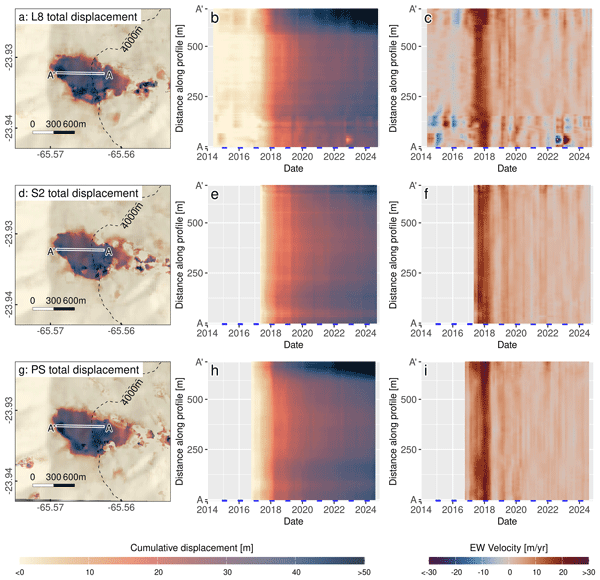
Slow-moving landslides respond to seasonal climate variations, but displacement time series from optical satellite imagery often contain illumination and shadow related biases that obscure true signals. This study assesses methods to mitigate these errors and reveals kinematic changes and controlling factors of a large slow-moving landslide in the Argentinean Andes.
Marin Kneib, Patrick Wagnon, Laurent Arnaud, Louise Balmas, Olivier Laarman, Bruno Jourdain, Amaury Dehecq, Emmanuel Lemeur, Fanny Brun, Andrea Kneib-Walter, Ilaria Santin, Laurane Charrier, Thierry Faug, Giulia Mazzotti, Antoine Rabatel, Delphine Six, and Daniel Farinotti
The Cryosphere, 20, 5327–5344, https://doi.org/10.5194/tc-20-5327-2026, https://doi.org/10.5194/tc-20-5327-2026, 2026
Short summary
Short summary
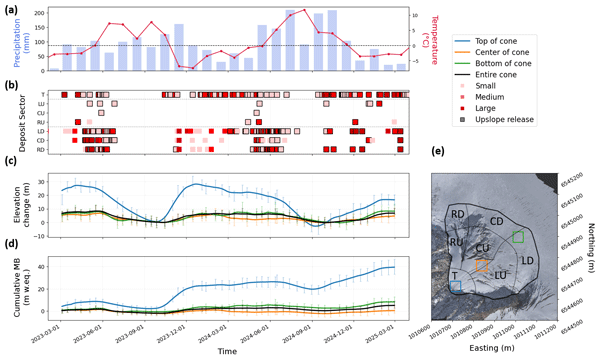
Avalanches are vital for glacier survival, yet their impact is difficult to quantify. We used low-cost cameras and drones to monitor an avalanche cone in the French Alps for two years. By accounting for ice flow, we found that avalanches can deposit 30 meters of snow annually – 50 times more than normal snowfall. This high-frequency data reveals that these cones fill until reaching a specific steepness, after which new snow slides further down to the base.
Jing Zhang, Yang Lei, Laurane Charrier, Amaury Dehecq, Alex S. Gardner, Luke Copland, and Christine Dow
EGUsphere, https://doi.org/10.5194/egusphere-2026-2541, https://doi.org/10.5194/egusphere-2026-2541, 2026
Short summary
Short summary
Satellites can measure how fast glaciers move, which helps scientists understand ice loss and rising sea levels. However, these measurements have rarely been checked against ground-based observations on small mountain glaciers. We compared satellite-derived glacier speeds against precise ground measurements. The satellite data generally agreed well with ground observations. Our results help scientists use satellite glacier velocity data more reliably.
Laurane Charrier, Amaury Dehecq, Lei Guo, Fanny Brun, Romain Millan, Nathan Lioret, Luke Copland, Nathan Maier, Christine Dow, and Paul Halas
The Cryosphere, 19, 4555–4583, https://doi.org/10.5194/tc-19-4555-2025, https://doi.org/10.5194/tc-19-4555-2025, 2025
Short summary
Short summary
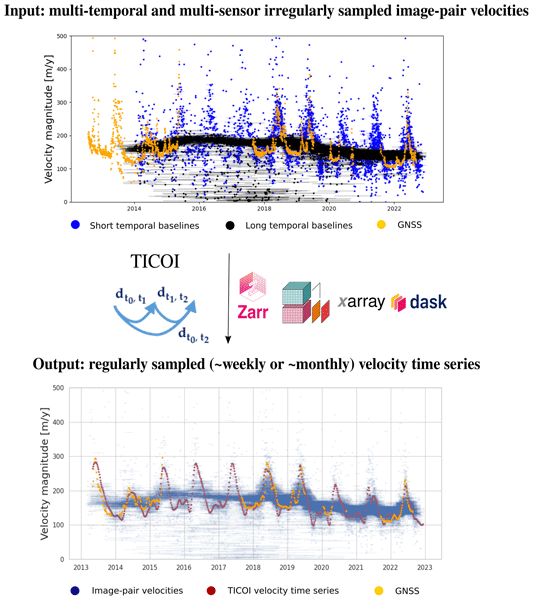
While global annual glacier velocities are openly accessible, sub-annual velocity time series are still lacking. This hinders our ability to understand flow processes and the integration of these observations in numerical models. We introduce an open source Python package called TICOI (Temporal Inversion using linear Combinations of Observations, and Interpolation) to fuse multi-temporal and multi-sensor image-pair velocities produced by different processing chains to produce standardized sub-annual velocity products.
Marin Kneib, Amaury Dehecq, Fanny Brun, Fatima Karbou, Laurane Charrier, Silvan Leinss, Patrick Wagnon, and Fabien Maussion
The Cryosphere, 18, 2809–2830, https://doi.org/10.5194/tc-18-2809-2024, https://doi.org/10.5194/tc-18-2809-2024, 2024
Short summary
Short summary
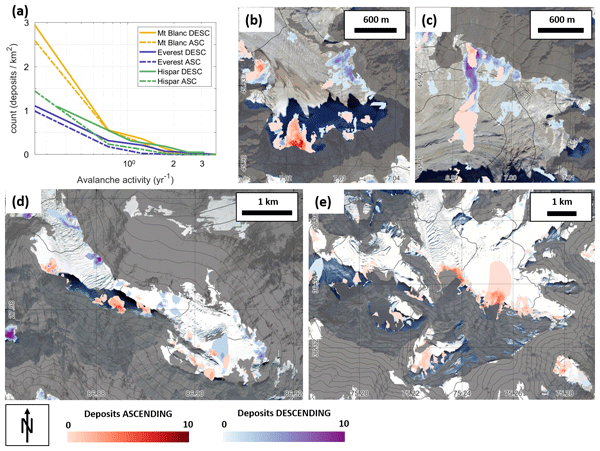
Avalanches are important for the mass balance of mountain glaciers, but few data exist on where and when they occur and which glaciers they affect the most. We developed an approach to map avalanches over large glaciated areas and long periods of time using satellite radar data. The application of this method to various regions in the Alps and High Mountain Asia reveals the variability of avalanches on these glaciers and provides key data to better represent these processes in glacier models.
L. Charrier, T. di Martino, E. Colin Koeniguer, F. Weissgerber, and A. Plyer
Int. Arch. Photogramm. Remote Sens. Spatial Inf. Sci., XLIII-B3-2022, 1309–1316, https://doi.org/10.5194/isprs-archives-XLIII-B3-2022-1309-2022, https://doi.org/10.5194/isprs-archives-XLIII-B3-2022-1309-2022, 2022
L. Charrier, Y. Yan, E. Colin Koeniguer, J. Mouginot, R. Millan, and E. Trouvé
ISPRS Ann. Photogramm. Remote Sens. Spatial Inf. Sci., V-3-2022, 311–318, https://doi.org/10.5194/isprs-annals-V-3-2022-311-2022, https://doi.org/10.5194/isprs-annals-V-3-2022-311-2022, 2022
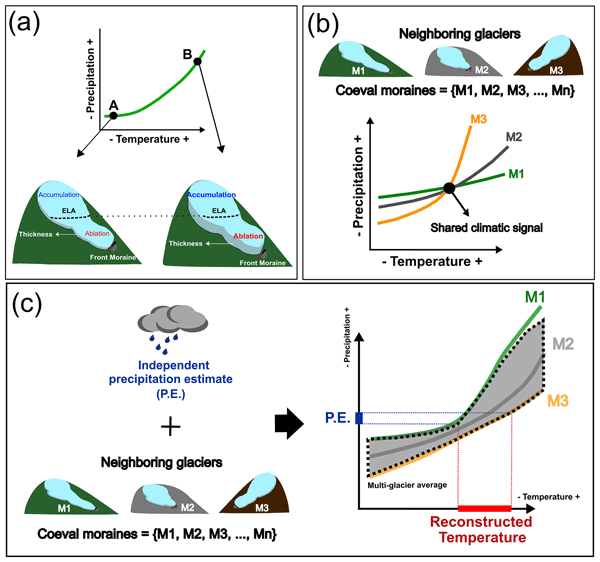
Nicolás Acuña Reyes, Léo Martin, Adrien Gilbert, Vincent Jomelli, Antoine Rabatel, Simon Filhol, Deborah Verfaillie, Pierre-Henri Blard, and Jérôme Lavé
Clim. Past, 22, 1941–1961, https://doi.org/10.5194/cp-22-1941-2026, https://doi.org/10.5194/cp-22-1941-2026, 2026
Short summary
Short summary
Glacier deposits are used to reconstruct past climate, but the same glacier size can result from different mixes of temperature and snowfall. Using numerical glacier simulations in the Bolivian Andes, we explored how to overcome this ambiguity. We show that combining several neighboring glaciers with independent rainfall records partly resolves it, giving temperatures 0.8°C and 1.3°C lower during the Little Ice Age and Early Holocene (~10,000 years ago), respectively.
María Santolaria-Otín, Charles Amory, Martin Ménégoz, Fanny Brun, Xavier Faïn, Xavier Fettweis, Mondher Chekki, Patrick Wagnon, Dibas Shrestha, and Arbindra Khadka
EGUsphere, https://doi.org/10.5194/egusphere-2026-4572, https://doi.org/10.5194/egusphere-2026-4572, 2026
This preprint is open for discussion and under review for Geoscientific Model Development (GMD).
Short summary
Short summary
High Mountain Asia contains the largest concentration of glacier ice outside the polar regions and supplies water to hundreds of millions of people, yet its climate remains poorly understood because of its complex terrain and limited observations. We produced a high-resolution climate dataset for the Pamir and Central Himalaya covering 1950–2025. It captures seasonal climate and snow changes and will support studies of water resources, glaciers, and natural hazards.
Ariane Mueting, Laurane Charrier, and Bodo Bookhagen
Earth Surf. Dynam., 14, 781–800, https://doi.org/10.5194/esurf-14-781-2026, https://doi.org/10.5194/esurf-14-781-2026, 2026
Short summary
Short summary
Slow-moving landslides respond to seasonal climate variations, but displacement time series from optical satellite imagery often contain illumination and shadow related biases that obscure true signals. This study assesses methods to mitigate these errors and reveals kinematic changes and controlling factors of a large slow-moving landslide in the Argentinean Andes.
Kaian Shahateet, Colin Prieur, Romain Millan, Lucille Gimenes, Andrea Sofie Haastrup-Vang, Jaime Roas, Maaike Izeboud, Raphaelle Charrassin, Emil Giraldi, and Romain Santiard
EGUsphere, https://doi.org/10.5194/egusphere-2026-5765, https://doi.org/10.5194/egusphere-2026-5765, 2026
This preprint is open for discussion and under review for Earth Observation (EO).
Short summary
Short summary
We developed a deep-learning tool that uses satellite observations to map fractures across Antarctica’s floating ice shelves over nearly four decades. Applied to images collected since the 1980s, it detects both visible surface cracks and subtle signatures of fractures beneath the ice. The method works across several satellite sensors, paving the way for long-term records of ice-shelf damage across Antarctica.
Marin Kneib, Patrick Wagnon, Laurent Arnaud, Louise Balmas, Olivier Laarman, Bruno Jourdain, Amaury Dehecq, Emmanuel Lemeur, Fanny Brun, Andrea Kneib-Walter, Ilaria Santin, Laurane Charrier, Thierry Faug, Giulia Mazzotti, Antoine Rabatel, Delphine Six, and Daniel Farinotti
The Cryosphere, 20, 5327–5344, https://doi.org/10.5194/tc-20-5327-2026, https://doi.org/10.5194/tc-20-5327-2026, 2026
Short summary
Short summary
Avalanches are vital for glacier survival, yet their impact is difficult to quantify. We used low-cost cameras and drones to monitor an avalanche cone in the French Alps for two years. By accounting for ice flow, we found that avalanches can deposit 30 meters of snow annually – 50 times more than normal snowfall. This high-frequency data reveals that these cones fill until reaching a specific steepness, after which new snow slides further down to the base.
Tom Matthews, Baker Perry, Ben Graves, Fanny Brun, Maria Sanolaria-Otin, Navaraj Pokhrel, Arbindra Khadka, Dibas Shrestha, Ludving Cano, Aris Kwadijk, Walter Immereel, Brandt Maxwell, and Anton Seimon
EGUsphere, https://doi.org/10.5194/egusphere-2026-5200, https://doi.org/10.5194/egusphere-2026-5200, 2026
This preprint is open for discussion and under review for The Cryosphere (TC).
Short summary
Short summary
Extreme precipitation shapes hazards and water resources in high mountains, but is rarely observed directly. On 4 October 2025, weather stations on Mt. Everest recorded one of the most extreme snowfall events ever measured. The storm revealed that Himalayan snowfall extremes can be far larger than previously documented, and that intense snowfall can cool the atmosphere sufficiently to prevent rain at impact-sensitive elevations, complicating the picture of how warming will affect future storms.
Valentine Bellet, Romain Hugonnet, Amaury Dehecq, Alice de Bardonneche-Richard, Marine Bouchet, Valentin Schaffner, and Emmanuel Dubois
Int. Arch. Photogramm. Remote Sens. Spatial Inf. Sci., XLIX-B5-2026, 63–69, https://doi.org/10.5194/isprs-archives-XLIX-B5-2026-63-2026, https://doi.org/10.5194/isprs-archives-XLIX-B5-2026-63-2026, 2026
Christian Torres, Deniz Bozkurt, Vincent Favier, Victoire Buffet, Claudio Bravo, Xavier Fettweis, Thomas Dethinne, Antoine Rabatel, Maximiliano Viale, Sang-Jong Park, and Jorge Arigony-Neto
EGUsphere, https://doi.org/10.5194/egusphere-2026-3508, https://doi.org/10.5194/egusphere-2026-3508, 2026
Short summary
Short summary
We investigated periods when unusually warm conditions in Patagonia occurred at the same time as precipitation events on the Antarctic Peninsula. By combining observations and simulations, we identified 127 such events between 1980 and 2022. These events increased ice melt in Patagonia while enhancing accumulation on the Antarctic Peninsula, highlighting how large-scale weather patterns can simultaneously affect ice-covered regions in different ways.
Amaury Dehecq, Friedrich Knuth, Joaquín M. C. Belart, Livia Piermattei, Camillo Ressl, Adina Racoviteanu, Robert McNabb, David Shean, and Luc Godin
Int. Arch. Photogramm. Remote Sens. Spatial Inf. Sci., XLIX-B2-2026, 9–16, https://doi.org/10.5194/isprs-archives-XLIX-B2-2026-9-2026, https://doi.org/10.5194/isprs-archives-XLIX-B2-2026-9-2026, 2026
Yacouba Nouhou Chaweye, Guillaume Favreau, Amaury Dehecq, Marie Boucher, Boukari Issoufou Ousmane, Rabilou Abdou Mahaman, and Yahaya Nazoumou
EGUsphere, https://doi.org/10.5194/egusphere-2026-4118, https://doi.org/10.5194/egusphere-2026-4118, 2026
Preprint archived
Short summary
Short summary
This study provides an empirical yet finely documented example highlighting a significant but often overlooked or misunderstood trade-off between land restoration strategies and groundwater sustainability in drylands at a global scale. It emphasizes that interventions to achieve climate change adaptation and land restoration goals may inadvertently compromise fragile water resources when hydrological feedbacks are not sufficiently considered.
Jing Zhang, Yang Lei, Laurane Charrier, Amaury Dehecq, Alex S. Gardner, Luke Copland, and Christine Dow
EGUsphere, https://doi.org/10.5194/egusphere-2026-2541, https://doi.org/10.5194/egusphere-2026-2541, 2026
Short summary
Short summary
Satellites can measure how fast glaciers move, which helps scientists understand ice loss and rising sea levels. However, these measurements have rarely been checked against ground-based observations on small mountain glaciers. We compared satellite-derived glacier speeds against precise ground measurements. The satellite data generally agreed well with ground observations. Our results help scientists use satellite glacier velocity data more reliably.
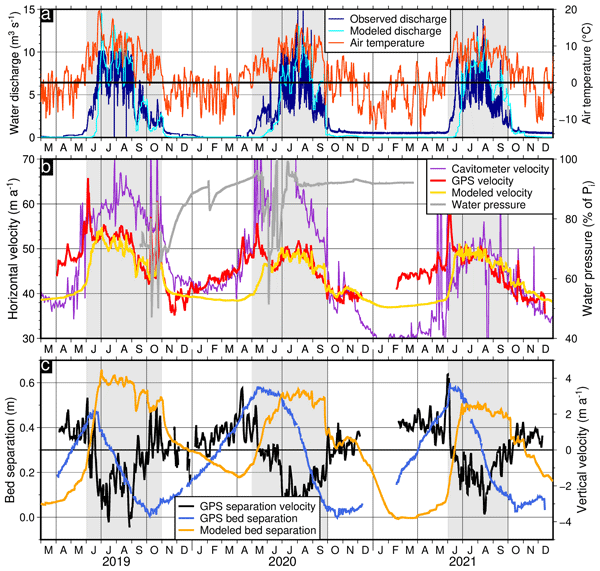
Anuar Togaibekov, Adrien Gilbert, Florent Gimbert, and Andrea Walpersdorf
The Cryosphere, 20, 3257–3270, https://doi.org/10.5194/tc-20-3257-2026, https://doi.org/10.5194/tc-20-3257-2026, 2026
Short summary
Short summary
Changes in water reaching the base of glaciers strongly affect their sliding speed by altering water pressure beneath the ice. High water pressure is often thought to develop during summer melt, enlarging cavities at the glacier base and increasing sliding speed. Our observations show instead that the cavities mainly grow during winter, when water pressure builds up in isolated cavities. As the cavities become connected during the melt season, water pressure decreases and the glacier slows down.
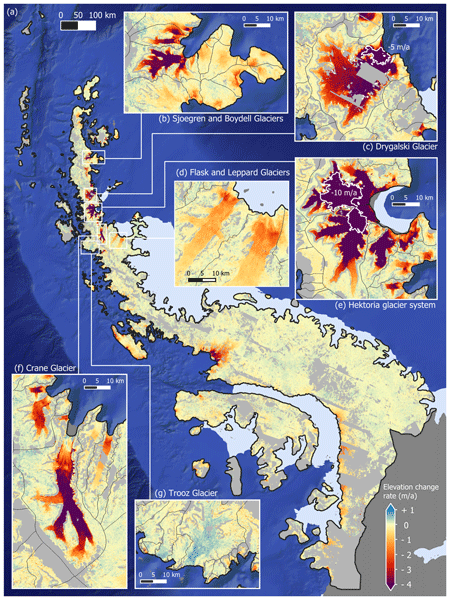
Maud Bernat, Etienne Berthier, Amaury Dehecq, Romain Hugonnet, Joaquin M. C. Belart, Naomi Ochwat, Peter Kuipers Munneke, Elizabeth Case, Ted Scambos, Louis-Marie Gauer, and David Youssefi
The Cryosphere, 20, 3025–3049, https://doi.org/10.5194/tc-20-3025-2026, https://doi.org/10.5194/tc-20-3025-2026, 2026
Short summary
Short summary
The Antarctic Peninsula is a mountainous region containing an ice sheet and peripheral glaciers. Differences remain between the methods used to estimate its mass changes. We use thousands of digital elevation models derived from high resolution stereoscopic images to calculate a new estimate of mass changes. We find that between 2007 and 2021, the ice sheet lost -28±6Gt/a and its peripheral glaciers -14±3Gt/a. We highlight the importance of resolving fine-scale changes in complex coastal areas.
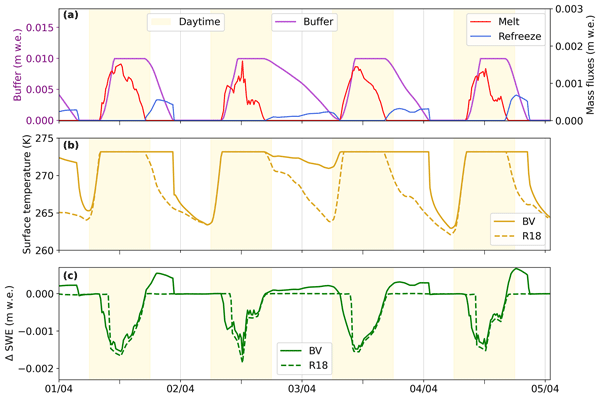
Audrey Goutard, Marion Réveillet, Fanny Brun, Delphine Six, Kevin Fourteau, Charles Amory, Xavier Fettweis, Mathieu Fructus, Arbindra Khadka, and Matthieu Lafaysse
The Cryosphere, 20, 2393–2416, https://doi.org/10.5194/tc-20-2393-2026, https://doi.org/10.5194/tc-20-2393-2026, 2026
Short summary
Short summary
A new scheme has been developed in a snowpack model (SURFEX/ISBA-Crocus), to consider the impact of liquid water dynamics on bare ice, including albedo feedback and refreezing. When applied to the Mera Glacier in Nepal, the model reveals strong seasonal effects on the energy and mass balance, with increased melting in dry seasons and significant refreezing during the monsoon. This development improves mass balance modeling under increasing rainfall and bare ice exposure due to climate warming.
Melanie Stammler, Jan Blöthe, Diego Cusicanqui, Simon Ebert, Rainer Bell, Xavier Bodin, and Lothar Schrott
The Cryosphere, 20, 2257–2277, https://doi.org/10.5194/tc-20-2257-2026, https://doi.org/10.5194/tc-20-2257-2026, 2026
Short summary
Short summary
Dry Andean (debris-covered) glaciers and rock glaciers are essential to river runoff by contributing meltwaters in this extremely arid area. We quantify surface lowering for 19 glaciers and 3 debris-covered glaciers, and unchanged velocities for 47 rock glaciers in a ground-truthed and Pléiades satellite imagery based integrative glacier-permafrost study on catchment-scale for 2019-2025. For this period, our findings indicate glacial decline next to permafrost stability.
Jonas K. Andersen, Romain Millan, Eric Rignot, Lucille Gimenes, Bernd Scheuchl, Jean Baptiste Barré, and Anders A. Bjørk
The Cryosphere, 20, 1589–1598, https://doi.org/10.5194/tc-20-1589-2026, https://doi.org/10.5194/tc-20-1589-2026, 2026
Short summary
Short summary
We used new satellite radar data from 2025 to map the border where Antarctic glaciers lose contact with the ground and begin to float. This updated map shows recent changes to many glaciers in the Amundsen Sea region, some of which have retreated by several kilometers. Our results help track how Antarctica is responding to climate change and highlight the value of future satellite missions for monitoring ice sheet stability.
Gabriela Quispe, Carlos Cárdenas, Pablo Fuchs, Alvaro Soruco, and Antoine Rabatel
ISPRS Ann. Photogramm. Remote Sens. Spatial Inf. Sci., X-3-W4-2025, 307–312, https://doi.org/10.5194/isprs-annals-X-3-W4-2025-307-2026, https://doi.org/10.5194/isprs-annals-X-3-W4-2025-307-2026, 2026
Simon Filhol, Clément Misset, Noélie Bontemps, Diego Cusicanqui, Emmanuel Paquet, Marie Dumont, Olivier Gagliardini, Pascal Lacroix, Simon Gascoin, Guillaume Thirel, Julien Brondex, Pascal Hagenmuller, Eric Larose, Philipp Schoeneich, Denis Roy, Emmanuel Thibert, Nicolas Eckert, Félix de Montety, Robin Mainieri, Alexandre Hauet, Frédéric Gottardi, Johan Berthet, Alexandre Baratier, Frédéric Liébault, Małgorzata Chmiel, Guillaume Piton, Guillaume Chambon, Guillaume James, Philippe Frey, Philip Deline, Laurent Astrade, Christian Vincent, Dominique Laigle, Alain Recking, Fatima Karbou, Adrien Mauss, Mylène Bonnefoy-Demongeot, Firmin Fontaine, Mickael Langlais, Etienne Berthier, and Antoine Blanc
EGUsphere, https://doi.org/10.5194/egusphere-2026-971, https://doi.org/10.5194/egusphere-2026-971, 2026
Short summary
Short summary
On June 21 2024, the village of La Bérarde, in the French Alps, was devastated by a flood destroying centuries old buildings. This study is an interdisciplinary work to decipher the causes and chronology of the event. The flood started with decadal rain falling on a thick snowpack. A lake observed on top of a glacier few days prior, had drained post event. With climate change, should we expect more similar compound events for alpine communities?
Vijaya Kumar Thota, Thorsten Seehaus, Friedrich Knuth, Amaury Dehecq, Christian Salewski, David Farías-Barahona, and Matthias H. Braun
Earth Syst. Sci. Data, 18, 597–615, https://doi.org/10.5194/essd-18-597-2026, https://doi.org/10.5194/essd-18-597-2026, 2026
Short summary
Short summary
We reconstruct historical topography for a rapidly warming Antarctic region with limited existing data. Using approximately 2000 aerial photographs from the year 1989 over the western Antarctic Peninsula and nearby islands, we created detailed elevation models and orthoimages that have high accuracy compared to recent satellite data. This open dataset aids tracking historical ice loss and its role in sea level rise.
Lucille Gimenes, Romain Millan, Nicolas Champollion, and Jordi Bolibar
The Cryosphere, 20, 171–182, https://doi.org/10.5194/tc-20-171-2026, https://doi.org/10.5194/tc-20-171-2026, 2026
Short summary
Short summary
This study looks how changes in glacier thickness estimates and temperature will affect the timing when meltwater from glaciers in the western Kunlun Mountains will reach its peak. Using a global glacier model and two different datasets, we found that thinner glaciers and warmer temperatures cause peak meltwater to happen sooner. This is of interests since it affects future water supplies for people relying on glacier runoff, highlighting the need for accurate ice volume estimates.
Victoria Mowbray, Christian Sue, Stéphane Baize, Céline Beauval, Marguerite Mathey, Anne Lemoine, Andrea Walpersdorf, and Eloïse Granier
Earth Syst. Sci. Data Discuss., https://doi.org/10.5194/essd-2025-601, https://doi.org/10.5194/essd-2025-601, 2025
Manuscript not accepted for further review
Short summary
Short summary
We present a fault-related data compilation, named South-East France Potentially Active Faults (SEFPAF). It integrates structural components and presents a fault classification by importance, amount of documentation and seismogenic potential. This last parameter is assessed by analysing the amount of observed seismicity near the faults, amount of surface deformation estimated from GNSS velocities, and the age of the last known rupture on the fault.
Titouan Biget, Fanny Brun, Walter Immerzeel, Léo Martin, Hamish Pritchard, Emily Collier, Yanbin Lei, and Tandong Yao
The Cryosphere, 19, 5863–5870, https://doi.org/10.5194/tc-19-5863-2025, https://doi.org/10.5194/tc-19-5863-2025, 2025
Short summary
Short summary
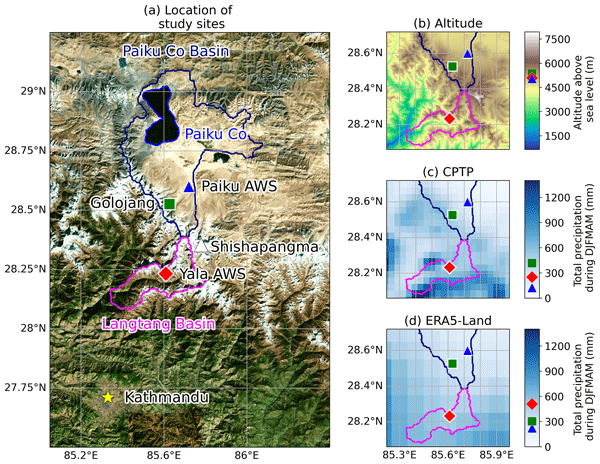
This study explore the precipitation in the southern Tibetan plateau using the water pressure of an high altitude lake and meteorological models and shows that snowfall could be much stronger on the Plateau than what is predicted by the models.
Léon Roussel, Marie Dumont, Marion Réveillet, Delphine Six, Marin Kneib, Pierre Nabat, Kévin Fourteau, Diego Monteiro, Simon Gascoin, Emmanuel Thibert, Antoine Rabatel, Jean-Emmanuel Sicart, Mylène Bonnefoy, Luc Piard, Olivier Laarman, Bruno Jourdain, Mathieu Fructus, Matthieu Vernay, and Matthieu Lafaysse
The Cryosphere, 19, 5201–5230, https://doi.org/10.5194/tc-19-5201-2025, https://doi.org/10.5194/tc-19-5201-2025, 2025
Short summary
Short summary
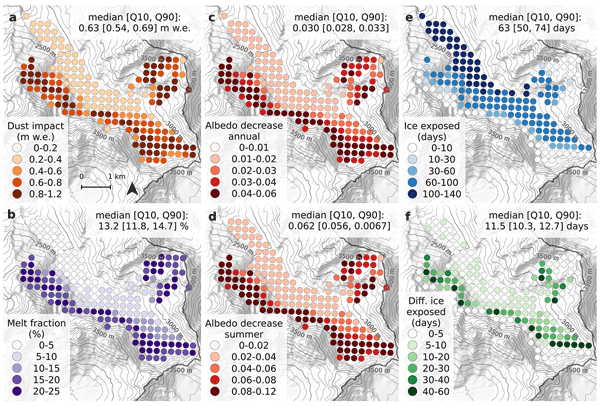
Saharan dust deposits frequently turn alpine glaciers orange. Mineral dust reduces snow albedo and increases snow and glaciers melt rate. Using physical modeling, we quantified the impact of dust on the Argentière Glacier over the period 2019–2022. We found that the contribution of mineral dust to the melt represents between 8 % and 16 % of Argentière Glacier summer melt. At specific locations, the impact of dust over one year can rise to an equivalent of 1.2 m of melted ice.
Luc Beraud, Fanny Brun, Amaury Dehecq, Romain Hugonnet, and Prashant Shekhar
The Cryosphere, 19, 5075–5094, https://doi.org/10.5194/tc-19-5075-2025, https://doi.org/10.5194/tc-19-5075-2025, 2025
Short summary
Short summary
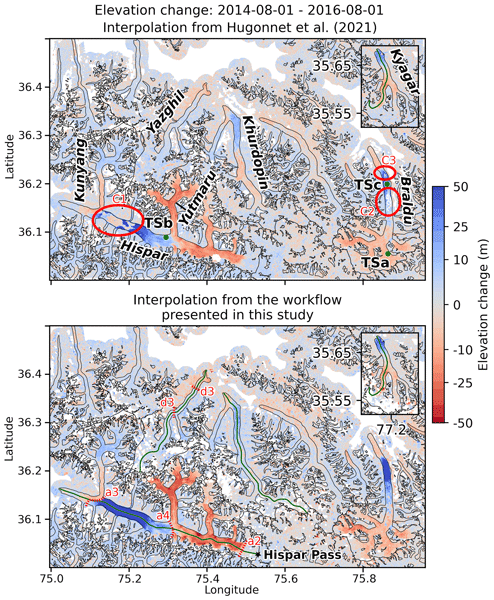
This study introduces a new workflow to process the elevation time series of glacier surges, an ice flow instability. Applied to a dense, 20-year satellite dataset of glacier surface elevation, the method filters and interpolates these changes on a monthly scale, revealing detailed patterns and estimates of mass transport. The dataset produced by this method allows for a more accurate and a remarkably detailed description of glacier surges at the scale of a large region.
Laurane Charrier, Amaury Dehecq, Lei Guo, Fanny Brun, Romain Millan, Nathan Lioret, Luke Copland, Nathan Maier, Christine Dow, and Paul Halas
The Cryosphere, 19, 4555–4583, https://doi.org/10.5194/tc-19-4555-2025, https://doi.org/10.5194/tc-19-4555-2025, 2025
Short summary
Short summary
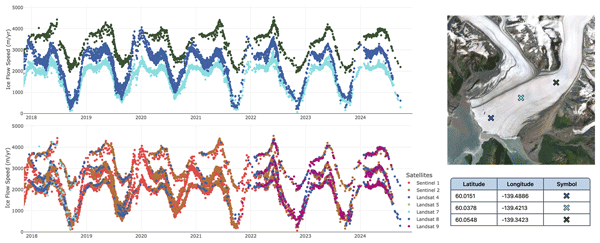
While global annual glacier velocities are openly accessible, sub-annual velocity time series are still lacking. This hinders our ability to understand flow processes and the integration of these observations in numerical models. We introduce an open source Python package called TICOI (Temporal Inversion using linear Combinations of Observations, and Interpolation) to fuse multi-temporal and multi-sensor image-pair velocities produced by different processing chains to produce standardized sub-annual velocity products.
Alex S. Gardner, Chad A. Greene, Joseph H. Kennedy, Mark A. Fahnestock, Maria Liukis, Luis A. López, Yang Lei, Ted A. Scambos, and Amaury Dehecq
The Cryosphere, 19, 3517–3533, https://doi.org/10.5194/tc-19-3517-2025, https://doi.org/10.5194/tc-19-3517-2025, 2025
Short summary
Short summary
The NASA MEaSUREs Inter-mission Time Series of Land Ice Velocity and Elevation (ITS_LIVE) project provides glacier and ice sheet velocity products for the full Landsat, Sentinel-1, and Sentinel-2 satellite archives and will soon include data from the NISAR satellite. This paper describes the ITS_LIVE processing chain and gives guidance for working with the cloud-optimized glacier and ice sheet velocity products.
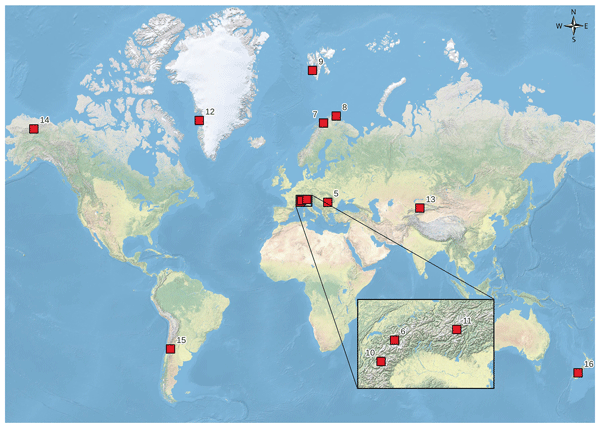
Line Rouyet, Tobias Bolch, Francesco Brardinoni, Rafael Caduff, Diego Cusicanqui, Margaret Darrow, Reynald Delaloye, Thomas Echelard, Christophe Lambiel, Cécile Pellet, Lucas Ruiz, Lea Schmid, Flavius Sirbu, and Tazio Strozzi
Earth Syst. Sci. Data, 17, 4125–4157, https://doi.org/10.5194/essd-17-4125-2025, https://doi.org/10.5194/essd-17-4125-2025, 2025
Short summary
Short summary
Rock glaciers are landforms generated by the creep of frozen ground (permafrost) in cold-climate mountains. Mapping rock glaciers contributes to documenting the distribution and the dynamics of mountain permafrost. We compiled inventories documenting the location, the characteristics, and the extent of rock glaciers in 12 mountain regions around the world. In each region, a team of operators performed the work following common rules and agreed on final solutions when discrepancies were identified.
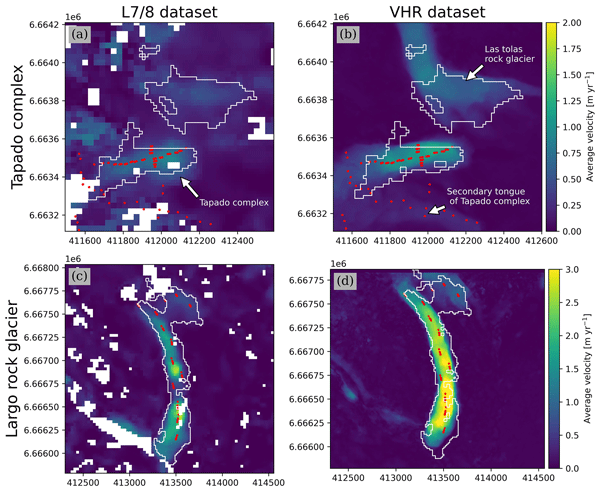
Diego Cusicanqui, Pascal Lacroix, Xavier Bodin, Benjamin Aubrey Robson, Andreas Kääb, and Shelley MacDonell
The Cryosphere, 19, 2559–2581, https://doi.org/10.5194/tc-19-2559-2025, https://doi.org/10.5194/tc-19-2559-2025, 2025
Short summary
Short summary
This study presents a robust methodological approach to detect and analyse rock glacier kinematics using Landsat 7/Landsat 8 imagery. In the semiarid Andes, 382 landforms were monitored, showing an average velocity of 0.37 ± 0.07 m yr⁻¹ over 24 years, with rock glaciers moving 23 % faster. Results demonstrate the feasibility of using medium-resolution optical imagery, combined with radar interferometry, to monitor rock glacier kinematics with widely available satellite datasets.
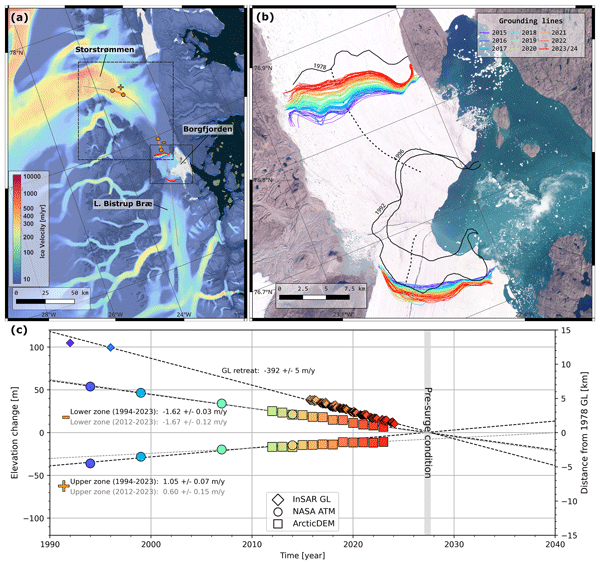
Jonas K. Andersen, Rasmus P. Meyer, Flora S. Huiban, Mads L. Dømgaard, Romain Millan, and Anders A. Bjørk
The Cryosphere, 19, 1717–1724, https://doi.org/10.5194/tc-19-1717-2025, https://doi.org/10.5194/tc-19-1717-2025, 2025
Short summary
Short summary
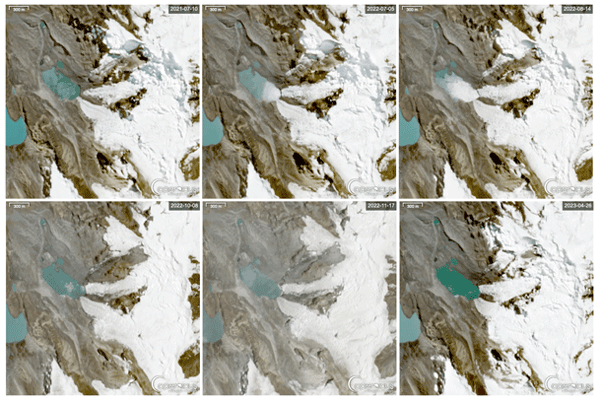
Storstrømmen Glacier in northeastern Greenland goes through cycles of sudden flow speed-ups (known as surges) followed by long quiet phases. It is currently in its quiet phase, but recent measurements suggest it may be nearing conditions for a new surge, possibly between 2027 and 2040. We also observed several lake drainages that caused brief increases in glacier flow but did not trigger a surge. Continued monitoring is essential to understand how these processes influence glacier behavior.
Etienne Ducasse, Romain Millan, Jonas Kvist Andersen, and Antoine Rabatel
The Cryosphere, 19, 911–917, https://doi.org/10.5194/tc-19-911-2025, https://doi.org/10.5194/tc-19-911-2025, 2025
Short summary
Short summary
Our study examines glacier movement in the tropical Andes from 2013 to 2022 using satellite data. Despite challenges like small glacier size and frequent cloud cover, we tracked annual speeds and seasonal changes. We found stable annual speeds but significant shifts between wet and dry seasons, likely due to changes in meltwater production and glacier–bedrock conditions. This research enhances understanding of how tropical glaciers react to climate change.
Nilo Lima-Quispe, Denis Ruelland, Antoine Rabatel, Waldo Lavado-Casimiro, and Thomas Condom
Hydrol. Earth Syst. Sci., 29, 655–682, https://doi.org/10.5194/hess-29-655-2025, https://doi.org/10.5194/hess-29-655-2025, 2025
Short summary
Short summary
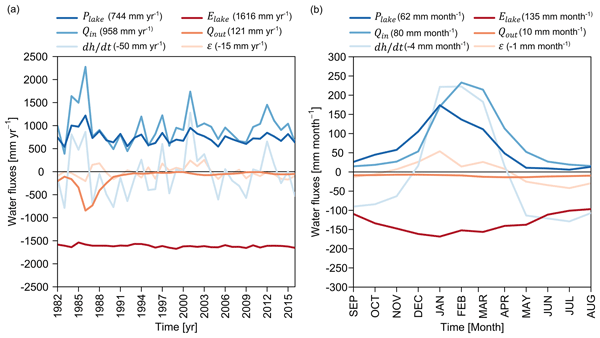
This study estimated the water balance of Lake Titicaca using an integrated modeling framework that considers natural hydrological processes and net irrigation consumption. The proposed approach was implemented at a daily scale for a period of 35 years. This framework is able to simulate lake water levels with good accuracy over a wide range of hydroclimatic conditions. The findings demonstrate that a simple representation of hydrological processes is suitable for use in poorly gauged regions.
Juan-Pedro Roldán-Blasco, Adrien Gilbert, Luc Piard, Florent Gimbert, Christian Vincent, Olivier Gagliardini, Anuar Togaibekov, Andrea Walpersdorf, and Nathan Maier
The Cryosphere, 19, 267–282, https://doi.org/10.5194/tc-19-267-2025, https://doi.org/10.5194/tc-19-267-2025, 2025
Short summary
Short summary
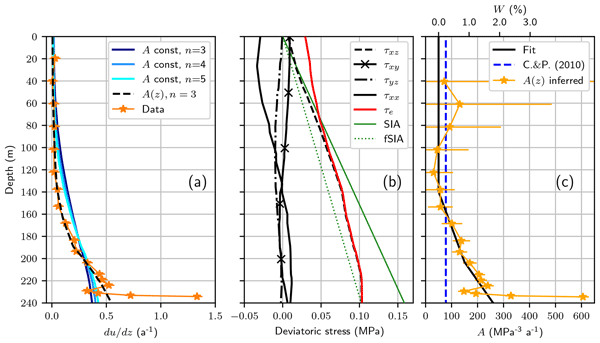
The flow of glaciers and ice sheets results from ice deformation and basal sliding driven by gravitational forces. Quantifying the rate at which ice deforms under its own weight is critical for assessing glacier evolution. This study uses borehole instrumentation in an Alpine glacier to quantify ice deformation and constrain ice viscosity in a natural setting. Our results show that the viscosity of ice at 0 °C is largely influenced by interstitial liquid water, which enhances ice deformation.
Enrico Mattea, Etienne Berthier, Amaury Dehecq, Tobias Bolch, Atanu Bhattacharya, Sajid Ghuffar, Martina Barandun, and Martin Hoelzle
The Cryosphere, 19, 219–247, https://doi.org/10.5194/tc-19-219-2025, https://doi.org/10.5194/tc-19-219-2025, 2025
Short summary
Short summary
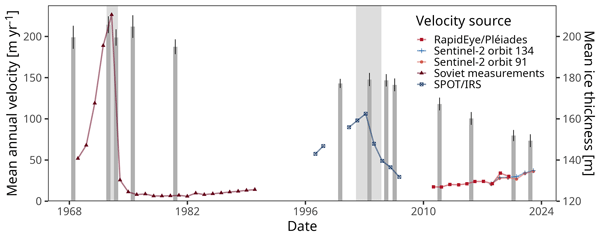
We reconstruct the evolution of terminus position, ice thickness, and surface flow velocity of the reference Abramov glacier (Kyrgyzstan) from 1968 to present. We describe a front pulsation in the early 2000s and the multi-annual present-day buildup of a new pulsation. Such dynamic instabilities can challenge the representativity of Abramov as a reference glacier. For our work we used satellite‑based optical remote sensing from multiple platforms, including recently declassified archives.
Marin Kneib, Amaury Dehecq, Adrien Gilbert, Auguste Basset, Evan S. Miles, Guillaume Jouvet, Bruno Jourdain, Etienne Ducasse, Luc Beraud, Antoine Rabatel, Jérémie Mouginot, Guillem Carcanade, Olivier Laarman, Fanny Brun, and Delphine Six
The Cryosphere, 18, 5965–5983, https://doi.org/10.5194/tc-18-5965-2024, https://doi.org/10.5194/tc-18-5965-2024, 2024
Short summary
Short summary
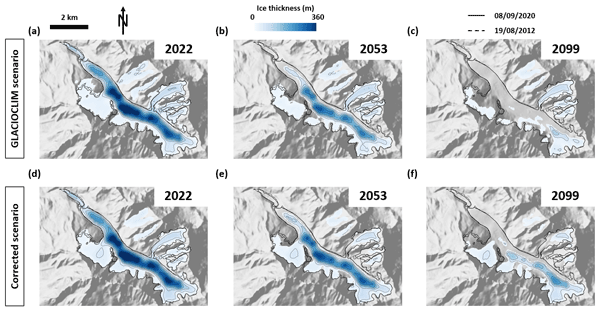
Avalanches contribute to increasing the accumulation on mountain glaciers by redistributing snow from surrounding mountains slopes. Here we quantified the contribution of avalanches to the mass balance of Argentière Glacier in the French Alps, by combining satellite and field observations to model the glacier dynamics. We show that the contribution of avalanches locally increases the accumulation by 60–70 % and that accounting for this effect results in less ice loss by the end of the century.
Navaraj Pokhrel, Patrick Wagnon, Fanny Brun, Arbindra Khadka, Tom Matthews, Audrey Goutard, Dibas Shrestha, Baker Perry, and Marion Réveillet
The Cryosphere, 18, 5913–5920, https://doi.org/10.5194/tc-18-5913-2024, https://doi.org/10.5194/tc-18-5913-2024, 2024
Short summary
Short summary
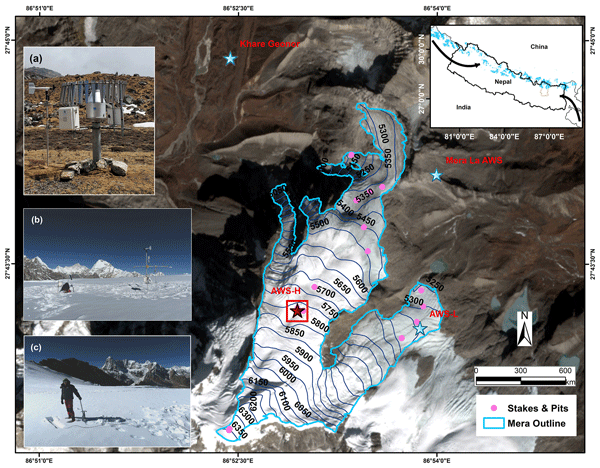
We studied snow processes in the accumulation area of Mera Glacier (central Himalaya, Nepal) by deploying a cosmic ray counting sensor that allows one to track the evolution of snow water equivalent. We suspect significant surface melting, water percolation, and refreezing within the snowpack, which might be missed by traditional mass balance surveys.
Etienne Berthier, Jérôme Lebreton, Delphine Fontannaz, Steven Hosford, Joaquín Muñoz-Cobo Belart, Fanny Brun, Liss M. Andreassen, Brian Menounos, and Charlotte Blondel
The Cryosphere, 18, 5551–5571, https://doi.org/10.5194/tc-18-5551-2024, https://doi.org/10.5194/tc-18-5551-2024, 2024
Short summary
Short summary
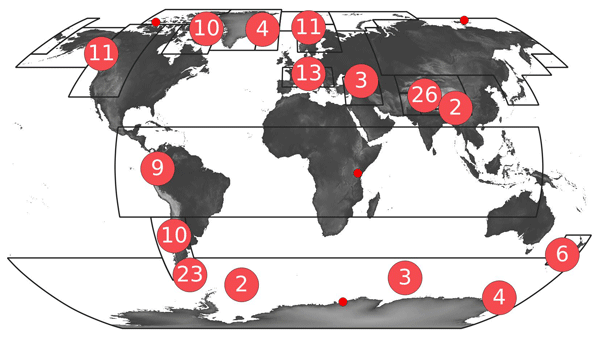
Repeat elevation measurements are crucial for monitoring glacier health and to understand how glaciers affect river flows and sea level. Until recently, high-resolution elevation data were mostly available for polar regions and High Mountain Asia. Our project, the Pléiades Glacier Observatory, now provides high-resolution topographies of 140 glacier sites worldwide. This is a novel and open dataset to monitor the impact of climate change on glaciers at high resolution and accuracy.
Eliot Jager, Fabien Gillet-Chaulet, Nicolas Champollion, Romain Millan, Heiko Goelzer, and Jérémie Mouginot
The Cryosphere, 18, 5519–5550, https://doi.org/10.5194/tc-18-5519-2024, https://doi.org/10.5194/tc-18-5519-2024, 2024
Short summary
Short summary
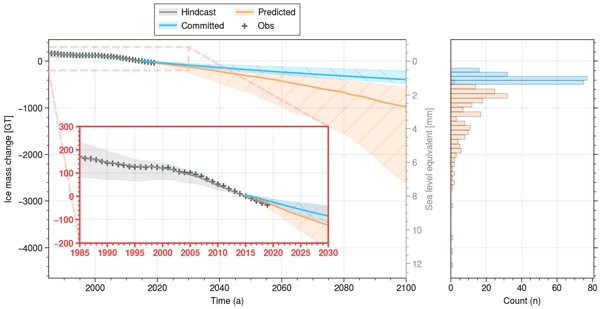
Inspired by a previous intercomparison framework, our study better constrains uncertainties in glacier evolution using an innovative method to validate Bayesian calibration. Upernavik Isstrøm, one of Greenland's largest glaciers, has lost significant mass since 1985. By integrating observational data, climate models, human emissions, and internal model parameters, we project its evolution until 2100. We show that future human emissions are the main source of uncertainty in 2100, making up half.
Livia Piermattei, Michael Zemp, Christian Sommer, Fanny Brun, Matthias H. Braun, Liss M. Andreassen, Joaquín M. C. Belart, Etienne Berthier, Atanu Bhattacharya, Laura Boehm Vock, Tobias Bolch, Amaury Dehecq, Inés Dussaillant, Daniel Falaschi, Caitlyn Florentine, Dana Floricioiu, Christian Ginzler, Gregoire Guillet, Romain Hugonnet, Matthias Huss, Andreas Kääb, Owen King, Christoph Klug, Friedrich Knuth, Lukas Krieger, Jeff La Frenierre, Robert McNabb, Christopher McNeil, Rainer Prinz, Louis Sass, Thorsten Seehaus, David Shean, Désirée Treichler, Anja Wendt, and Ruitang Yang
The Cryosphere, 18, 3195–3230, https://doi.org/10.5194/tc-18-3195-2024, https://doi.org/10.5194/tc-18-3195-2024, 2024
Short summary
Short summary
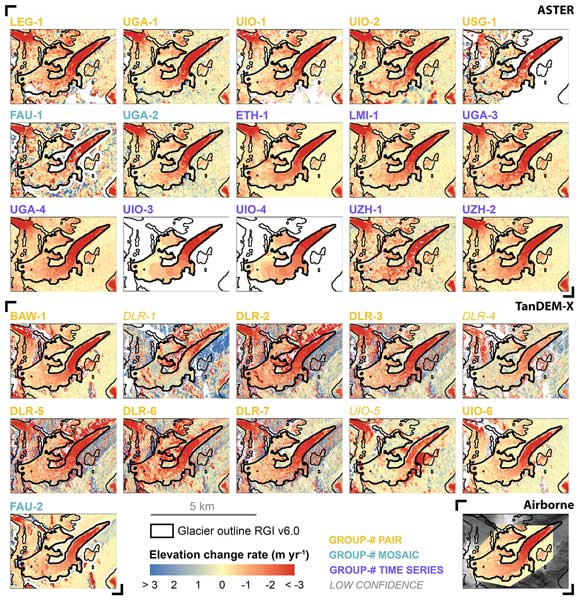
Satellites have made it possible to observe glacier elevation changes from all around the world. In the present study, we compared the results produced from two different types of satellite data between different research groups and against validation measurements from aeroplanes. We found a large spread between individual results but showed that the group ensemble can be used to reliably estimate glacier elevation changes and related errors from satellite data.
Marin Kneib, Amaury Dehecq, Fanny Brun, Fatima Karbou, Laurane Charrier, Silvan Leinss, Patrick Wagnon, and Fabien Maussion
The Cryosphere, 18, 2809–2830, https://doi.org/10.5194/tc-18-2809-2024, https://doi.org/10.5194/tc-18-2809-2024, 2024
Short summary
Short summary
Avalanches are important for the mass balance of mountain glaciers, but few data exist on where and when they occur and which glaciers they affect the most. We developed an approach to map avalanches over large glaciated areas and long periods of time using satellite radar data. The application of this method to various regions in the Alps and High Mountain Asia reveals the variability of avalanches on these glaciers and provides key data to better represent these processes in glacier models.
Alexis Caro, Thomas Condom, Antoine Rabatel, Nicolas Champollion, Nicolás García, and Freddy Saavedra
The Cryosphere, 18, 2487–2507, https://doi.org/10.5194/tc-18-2487-2024, https://doi.org/10.5194/tc-18-2487-2024, 2024
Short summary
Short summary
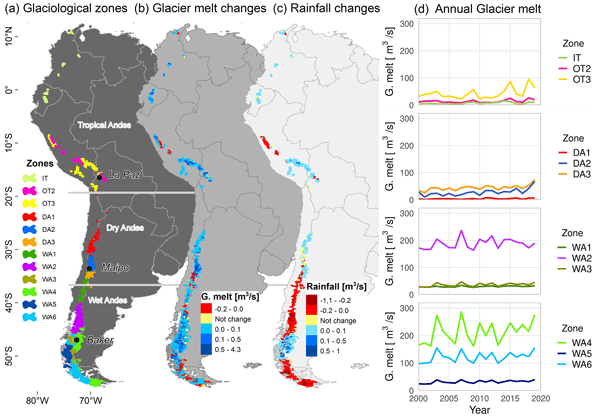
The glacier runoff changes are still unknown in most of the Andean catchments, thereby increasing uncertainties in estimating water availability, especially during the dry season. Here, we simulate glacier evolution and related glacier runoff changes across the Andes between 2000 and 2019. Our results indicate a glacier reduction in 93 % of the catchments, leading to a 12 % increase in glacier melt. These results can be downloaded and integrated with discharge measurements in each catchment.
Kévin Fourteau, Julien Brondex, Fanny Brun, and Marie Dumont
Geosci. Model Dev., 17, 1903–1929, https://doi.org/10.5194/gmd-17-1903-2024, https://doi.org/10.5194/gmd-17-1903-2024, 2024
Short summary
Short summary
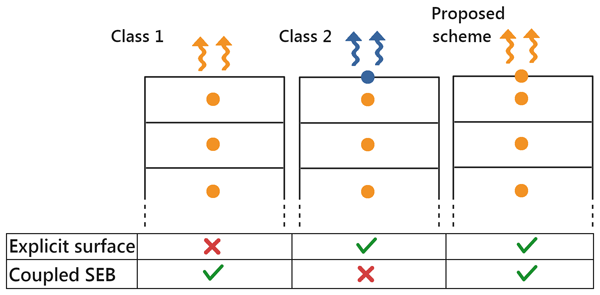
In this paper, we provide a novel numerical implementation for solving the energy exchanges at the surface of snow and ice. By combining the strong points of previous models, our solution leads to more accurate and robust simulations of the energy exchanges, surface temperature, and melt while preserving a reasonable computation time.
Léo C. P. Martin, Sebastian Westermann, Michele Magni, Fanny Brun, Joel Fiddes, Yanbin Lei, Philip Kraaijenbrink, Tamara Mathys, Moritz Langer, Simon Allen, and Walter W. Immerzeel
Hydrol. Earth Syst. Sci., 27, 4409–4436, https://doi.org/10.5194/hess-27-4409-2023, https://doi.org/10.5194/hess-27-4409-2023, 2023
Short summary
Short summary
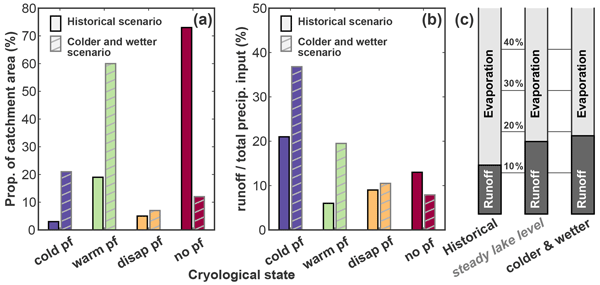
Across the Tibetan Plateau, many large lakes have been changing level during the last decades as a response to climate change. In high-mountain environments, water fluxes from the land to the lakes are linked to the ground temperature of the land and to the energy fluxes between the ground and the atmosphere, which are modified by climate change. With a numerical model, we test how these water and energy fluxes have changed over the last decades and how they influence the lake level variations.
Fanny Brun, Owen King, Marion Réveillet, Charles Amory, Anton Planchot, Etienne Berthier, Amaury Dehecq, Tobias Bolch, Kévin Fourteau, Julien Brondex, Marie Dumont, Christoph Mayer, Silvan Leinss, Romain Hugonnet, and Patrick Wagnon
The Cryosphere, 17, 3251–3268, https://doi.org/10.5194/tc-17-3251-2023, https://doi.org/10.5194/tc-17-3251-2023, 2023
Short summary
Short summary
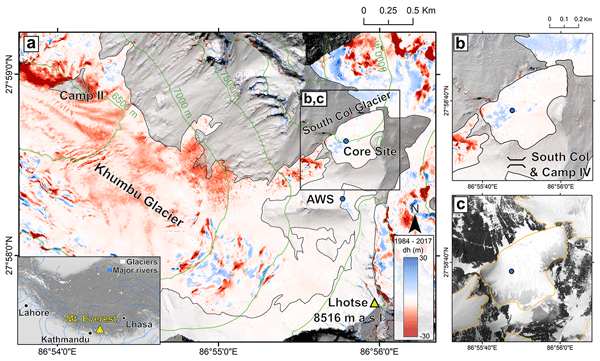
The South Col Glacier is a small body of ice and snow located on the southern ridge of Mt. Everest. A recent study proposed that South Col Glacier is rapidly losing mass. In this study, we examined the glacier thickness change for the period 1984–2017 and found no thickness change. To reconcile these results, we investigate wind erosion and surface energy and mass balance and find that melt is unlikely a dominant process, contrary to previous findings.
Lei Guo, Jia Li, Amaury Dehecq, Zhiwei Li, Xin Li, and Jianjun Zhu
Earth Syst. Sci. Data, 15, 2841–2861, https://doi.org/10.5194/essd-15-2841-2023, https://doi.org/10.5194/essd-15-2841-2023, 2023
Short summary
Short summary
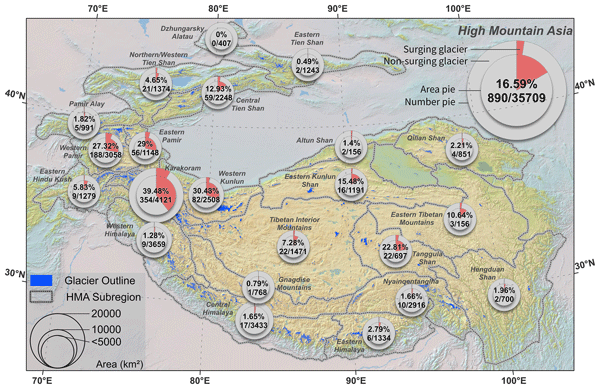
We established a new inventory of surging glaciers across High Mountain Asia based on glacier elevation changes and morphological changes during 1970s–2020. A total of 890 surging and 336 probably or possibly surging glaciers were identified. Compared to the most recent inventory, this one incorporates 253 previously unidentified surging glaciers. Our results demonstrate a more widespread surge behavior in HMA and find that surging glaciers are prone to have steeper slopes than non-surging ones.
Arthur Bayle, Bradley Z. Carlson, Anaïs Zimmer, Sophie Vallée, Antoine Rabatel, Edoardo Cremonese, Gianluca Filippa, Cédric Dentant, Christophe Randin, Andrea Mainetti, Erwan Roussel, Simon Gascoin, Dov Corenblit, and Philippe Choler
Biogeosciences, 20, 1649–1669, https://doi.org/10.5194/bg-20-1649-2023, https://doi.org/10.5194/bg-20-1649-2023, 2023
Short summary
Short summary
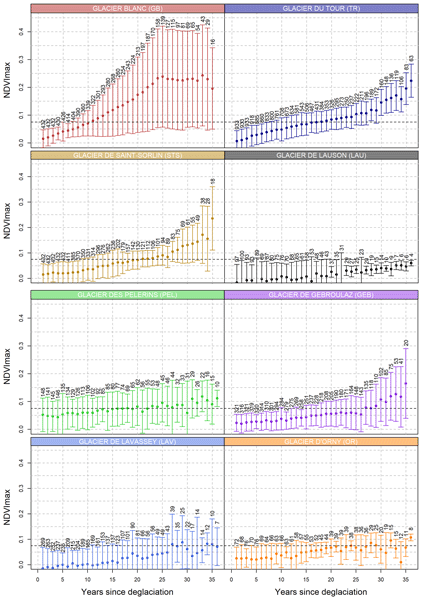
Glacier forefields have long provided ecologists with a model to study patterns of plant succession following glacier retreat. We used remote sensing approaches to study early succession dynamics as it allows to analyze the deglaciation, colonization, and vegetation growth within a single framework. We found that the heterogeneity of early succession dynamics is deterministic and can be explained well by local environmental context. This work has been done by an international consortium.
Ugo Nanni, Dirk Scherler, Francois Ayoub, Romain Millan, Frederic Herman, and Jean-Philippe Avouac
The Cryosphere, 17, 1567–1583, https://doi.org/10.5194/tc-17-1567-2023, https://doi.org/10.5194/tc-17-1567-2023, 2023
Short summary
Short summary
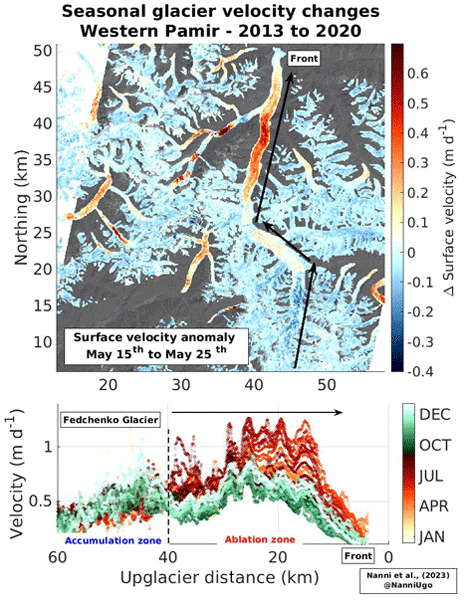
Surface melt is a major factor driving glacier movement. Using satellite images, we have tracked the movements of 38 glaciers in the Pamirs over 7 years, capturing their responses to rapid meteorological changes with unprecedented resolution. We show that in spring, glacier accelerations propagate upglacier, while in autumn, they propagate downglacier – all resulting from changes in meltwater input. This provides critical insights into the interplay between surface melt and glacier movement.
Rubén Basantes-Serrano, Antoine Rabatel, Bernard Francou, Christian Vincent, Alvaro Soruco, Thomas Condom, and Jean Carlo Ruíz
The Cryosphere, 16, 4659–4677, https://doi.org/10.5194/tc-16-4659-2022, https://doi.org/10.5194/tc-16-4659-2022, 2022
Short summary
Short summary
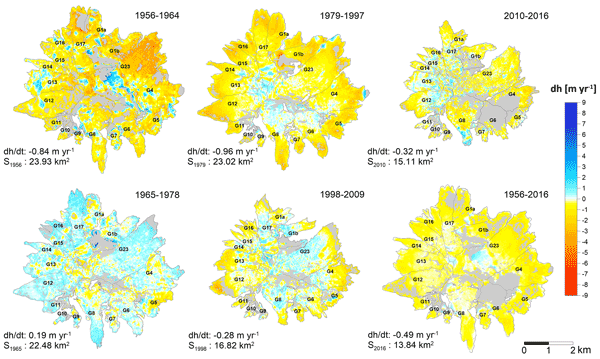
We assessed the volume variation of 17 glaciers on the Antisana ice cap, near the Equator. We used aerial and satellite images for the period 1956–2016. We highlight very negative changes in 1956–1964 and 1979–1997 and slightly negative or even positive conditions in 1965–1978 and 1997–2016, the latter despite the recent increase in temperatures. Glaciers react according to regional climate variability, while local humidity and topography influence the specific behaviour of each glacier.
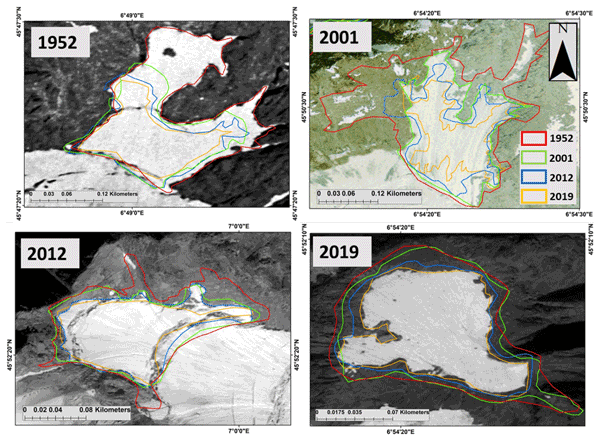
Suvrat Kaushik, Ludovic Ravanel, Florence Magnin, Yajing Yan, Emmanuel Trouve, and Diego Cusicanqui
The Cryosphere, 16, 4251–4271, https://doi.org/10.5194/tc-16-4251-2022, https://doi.org/10.5194/tc-16-4251-2022, 2022
Short summary
Short summary
Climate change impacts all parts of the cryosphere but most importantly the smaller ice bodies like ice aprons (IAs). This study is the first attempt on a regional scale to assess the impacts of the changing climate on these small but very important ice bodies. Our study shows that IAs have consistently lost mass over the past decades. The effects of climate variables, particularly temperature and precipitation and topographic factors, were analysed on the loss of IA area.
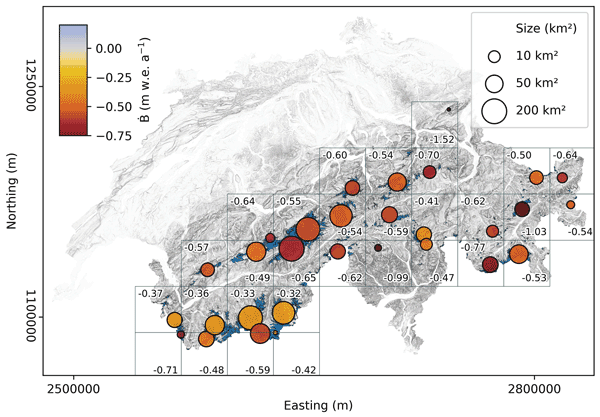
Erik Schytt Mannerfelt, Amaury Dehecq, Romain Hugonnet, Elias Hodel, Matthias Huss, Andreas Bauder, and Daniel Farinotti
The Cryosphere, 16, 3249–3268, https://doi.org/10.5194/tc-16-3249-2022, https://doi.org/10.5194/tc-16-3249-2022, 2022
Short summary
Short summary
How glaciers have responded to climate change over the last 20 years is well-known, but earlier data are much more scarce. We change this in Switzerland by using 22 000 photographs taken from mountain tops between the world wars and find a halving of Swiss glacier volume since 1931. This was done through new automated processing techniques that we created. The data are interesting for more than just glaciers, such as mapping forest changes, landslides, and human impacts on the terrain.
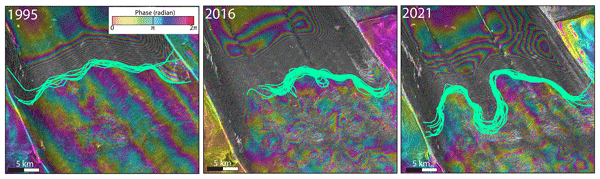
Romain Millan, Jeremie Mouginot, Anna Derkacheva, Eric Rignot, Pietro Milillo, Enrico Ciraci, Luigi Dini, and Anders Bjørk
The Cryosphere, 16, 3021–3031, https://doi.org/10.5194/tc-16-3021-2022, https://doi.org/10.5194/tc-16-3021-2022, 2022
Short summary
Short summary
We detect for the first time a dramatic retreat of the grounding line of Petermann Glacier, a major glacier of the Greenland Ice Sheet. Using satellite data, we also observe a speedup of the glacier and a fracturing of the ice shelf. This sequence of events is coherent with ocean warming in this region and suggests that Petermann Glacier has initiated a phase of destabilization, which is of prime importance for the stability and future contribution of the Greenland Ice Sheet to sea level rise.
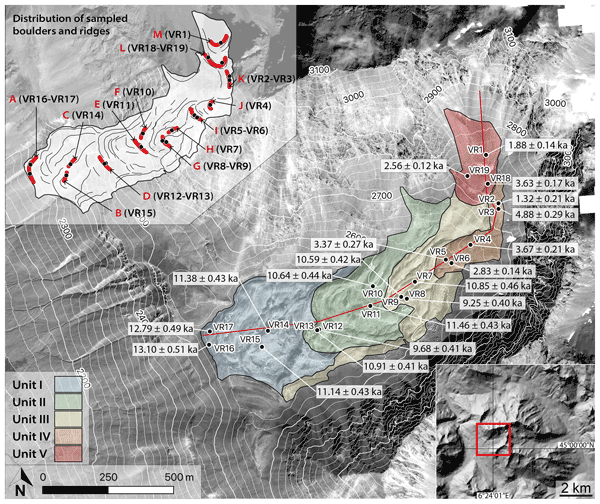
Benjamin Lehmann, Robert S. Anderson, Xavier Bodin, Diego Cusicanqui, Pierre G. Valla, and Julien Carcaillet
Earth Surf. Dynam., 10, 605–633, https://doi.org/10.5194/esurf-10-605-2022, https://doi.org/10.5194/esurf-10-605-2022, 2022
Short summary
Short summary
Rock glaciers are some of the most frequently occurring landforms containing ice in mountain environments. Here, we use field observations, analysis of aerial and satellite images, and dating methods to investigate the activity of the rock glacier of the Vallon de la Route in the French Alps. Our results suggest that the rock glacier is characterized by two major episodes of activity and that the rock glacier system promotes the maintenance of mountain erosion.
L. Charrier, T. di Martino, E. Colin Koeniguer, F. Weissgerber, and A. Plyer
Int. Arch. Photogramm. Remote Sens. Spatial Inf. Sci., XLIII-B3-2022, 1309–1316, https://doi.org/10.5194/isprs-archives-XLIII-B3-2022-1309-2022, https://doi.org/10.5194/isprs-archives-XLIII-B3-2022-1309-2022, 2022
L. Charrier, Y. Yan, E. Colin Koeniguer, J. Mouginot, R. Millan, and E. Trouvé
ISPRS Ann. Photogramm. Remote Sens. Spatial Inf. Sci., V-3-2022, 311–318, https://doi.org/10.5194/isprs-annals-V-3-2022-311-2022, https://doi.org/10.5194/isprs-annals-V-3-2022-311-2022, 2022

Loris Compagno, Matthias Huss, Evan Stewart Miles, Michael James McCarthy, Harry Zekollari, Amaury Dehecq, Francesca Pellicciotti, and Daniel Farinotti
The Cryosphere, 16, 1697–1718, https://doi.org/10.5194/tc-16-1697-2022, https://doi.org/10.5194/tc-16-1697-2022, 2022
Short summary
Short summary
We present a new approach for modelling debris area and thickness evolution. We implement the module into a combined mass-balance ice-flow model, and we apply it using different climate scenarios to project the future evolution of all glaciers in High Mountain Asia. We show that glacier geometry, volume, and flow velocity evolve differently when modelling explicitly debris cover compared to glacier evolution without the debris-cover module, demonstrating the importance of accounting for debris.
R. Akhmetov, G. Makhmetova, E. Orynbassarova, A. Baltiyeva, A. Togaibekov, K. Roberts, and A. Yerzhankyzy
Int. Arch. Photogramm. Remote Sens. Spatial Inf. Sci., XLVI-5-W1-2022, 7–14, https://doi.org/10.5194/isprs-archives-XLVI-5-W1-2022-7-2022, https://doi.org/10.5194/isprs-archives-XLVI-5-W1-2022-7-2022, 2022
Cited articles
Altena, B., Scambos, T., Fahnestock, M., and Kääb, A.: Extracting recent short-term glacier velocity evolution over southern Alaska and the Yukon from a large collection of Landsat data, The Cryosphere, 13, 795–814, https://doi.org/10.5194/tc-13-795-2019, 2019. a
Anderson, K. S., Hansen, C. W., Holmgren, W. F., Jensen, A. R., Mikofski, M. A., and Driesse, A.: pvlib python: 2023 project update, J. Open Source Softw., 8, 5994, https://doi.org/10.21105/joss.05994, 2023. a
Antoine, S. L. and Liu, Z.: Impact of Optical Imagery and Topography Data Resolution on the Measurement of Surface Fault Displacement Using Sub-Pixel Image Correlation, Earth Space Sci., 12, e2024EA003660, https://doi.org/10.1029/2024EA003660, 2025. a
Armstrong, W. H., Anderson, R. S., and Fahnestock, M. A.: Spatial patterns of summer speedup on south central Alaska glaciers, Geophys. Res. Lett., 44, 9379–9388, https://doi.org/10.1002/2017GL074370, 2017. a, b
Baldacchino, F., Zheng, W., Wu, K., Kapitsa, V., Yegorov, A., and Bolch, T.: Investigating seasonal velocity variations of selected glaciers in high mountain asia, Sci. Remote Sens., 12, 100266, https://doi.org/10.1016/j.srs.2025.100266, 2025. a
Beaud, F., Aati, S., Delaney, I., Adhikari, S., and Avouac, J.-P.: Surge dynamics of Shisper Glacier revealed by time-series correlation of optical satellite images and their utility to substantiate a generalized sliding law, The Cryosphere, 16, 3123–3148, https://doi.org/10.5194/tc-16-3123-2022, 2022. a
Beraud, L., Cusicanqui, D., Rabatel, A., Brun, F., Vincent, C., and Six, D.: Glacier-wide seasonal and annual geodetic mass balances from Pléiades stereo images: application to the Glacier d'Argentière, French Alps, J. Glaciol., 69, 525–537, https://doi.org/10.1017/jog.2022.79, 2023. a
Bontemps, N., Lacroix, P., and Doin, M.-P.: Inversion of deformation fields time-series from optical images, and application to the long term kinematics of slow-moving landslides in Peru, Remote Sens. Environ., 210, 144–158, https://doi.org/10.1016/j.rse.2018.02.023, 2018. a, b
Charrier, L.: LauraneC/SeBVel: v 0.0.2 (Version v.0.0.2), Zenodo [software], https://doi.org/10.5281/zenodo.23923112, 2026a. a
Charrier, L.: Shadow maps and estimated seasonal biases over the Mont-Blanc Massif, Zenodo [data set], https://doi.org/10.5281/zenodo.23420040, 2026b. a
Charrier, L., Yan, Y., Koeniguer, E. C., Leinss, S., and Trouvé, E.: Extraction of Velocity Time Series With an Optimal Temporal Sampling From Displacement Observation Networks, IEEE T. Geosci. Remote, 60, 1–10, https://doi.org/10.1109/TGRS.2021.3128289, 2022. a, b
Choi, Y., Seroussi, H., Morlighem, M., Schlegel, N.-J., and Gardner, A.: Impact of time-dependent data assimilation on ice flow model initialization and projections: a case study of Kjer Glacier, Greenland, The Cryosphere, 17, 5499–5517, https://doi.org/10.5194/tc-17-5499-2023, 2023. a
Copernicus Sentinels: Sentinel-2 User Handbook, European Space Agency (ESA), https://sentinels.copernicus.eu/documents/247904/685211/Sentinel-2_User_Handbook (last access: 29 July 2026), 2015. a
Dehecq, A., Gourmelen, N., Gardner, A. S., Brun, F., Goldberg, D., Nienow, P. W., Berthier, E., Vincent, C., Wagnon, P., and Trouvé, E.: Twenty-first century glacier slowdown driven by mass loss in High Mountain Asia, Nat. Geosci., 12, 22–27, https://doi.org/10.1038/s41561-018-0271-9, 2019. a
Derkacheva, A.: Seasonal flow variability of Greenlandic glaciers: satellite observations and numerical modeling to study driving processes, Ph.D. thesis, Université Grenoble Alpes, 2021. a
Derkacheva, A., Gillet-Chaulet, F., Mouginot, J., Jager, E., Maier, N., and Cook, S.: Seasonal evolution of basal environment conditions of Russell sector, West Greenland, inverted from satellite observation of surface flow, The Cryosphere, 15, 5675–5704, https://doi.org/10.5194/tc-15-5675-2021, 2021. a, b
Devaux-Chupin, V., Truffer, M., Brinkerhoff, D., Fahnestock, M., Loso, M. G., Christoffersen, M. S., Daniel, M., Tober, B. S., Larsen, C., and Holt, J. W.: A century of flow and surge history of Sít’ Tlein (Malaspina Glacier), Southeast Alaska, J. Glaciol., 71, e99, https://doi.org/10.1017/jog.2025.10079, 2025. a
Ding, C., Zhang, L., Liao, M., Feng, G., Dong, J., Ao, M., and Yu, Y.: Quantifying the spatio-temporal patterns of dune migration near Minqin Oasis in northwestern China with time series of Landsat-8 and Sentinel-2 observations, Remote Sens. Environ., 236, 111498, https://doi.org/10.1016/j.rse.2019.111498, 2020. a, b, c, d
Dirscherl, M., Dietz, A. J., Dech, S., and Kuenzer, C.: Remote sensing of ice motion in Antarctica–A review, Remote Sens. Environ., 237, 111595, https://doi.org/10.1016/j.rse.2019.111595, 2020. a
ESA: Copernicus Global Digital Elevation Model, OpenTopography, https://doi.org/10.5069/G9028PQB (last access: 27 February 2025), 2024. a, b, c, d
Fallourd, R., Vernier, F., Friedt, J.-M., Martin, G., Trouvé, E., Moreau, L., and Nicolas, J.-M.: Monitoring temperate glacier with high resolution automated digital cameras-application to the Argentiere glacier, in: PCV 2010, ISPRS Commission III Symposium, Paris France, https://www.isprs.org/proceedings/XXXVIII/part3/b/pdf/19_XXXVIII-part3B.pdf (last access: 10 November 2026), 2010. a
Gardner, A. S., Moholdt, G., Scambos, T., Fahnstock, M., Ligtenberg, S., van den Broeke, M., and Nilsson, J.: Increased West Antarctic and unchanged East Antarctic ice discharge over the last 7 years, The Cryosphere, 12, 521–547, https://doi.org/10.5194/tc-12-521-2018, 2018. a, b
Gardner, A. S., Greene, C. A., Kennedy, J. H., Fahnestock, M. A., Liukis, M., López, L. A., Lei, Y., Scambos, T. A., and Dehecq, A.: ITS_LIVE global glacier velocity data in near-real time, The Cryosphere, 19, 3517–3533, https://doi.org/10.5194/tc-19-3517-2025, 2025. a, b, c
Gilbert, A., Leinss, S., Kargel, J., Kääb, A., Gascoin, S., Leonard, G., Berthier, E., Karki, A., and Yao, T.: Mechanisms leading to the 2016 giant twin glacier collapses, Aru Range, Tibet, The Cryosphere, 12, 2883–2900, https://doi.org/10.5194/tc-12-2883-2018, 2018. a
Goldberg, D. N., Heimbach, P., Joughin, I., and Smith, B.: Committed retreat of Smith, Pope, and Kohler Glaciers over the next 30 years inferred by transient model calibration, The Cryosphere, 9, 2429–2446, https://doi.org/10.5194/tc-9-2429-2015, 2015. a, b
Greene, C. A. and Gardner, A. S.: Seasonal dynamics of Earth’s glaciers and ice sheets, Science, 390, 945–950, https://doi.org/10.1126/science.adx6654, 2025. a, b
Greene, C. A., Gardner, A. S., and Andrews, L. C.: Detecting seasonal ice dynamics in satellite images, The Cryosphere, 14, 4365–4378, https://doi.org/10.5194/tc-14-4365-2020, 2020. a, b, c, d
Guillet, G., Benn, D. I., King, O., Shean, D., Schytt Mannerfelt, E., and Hugonnet, R.: Global detection of glacier surges from surface velocities, elevation change and SAR backscatter data between 2000 and 2024: a test of surge mechanism theories, J. Glaciol., 71, e88, https://doi.org/10.1017/jog.2025.10065, 2025. a
Guo, L., Li, J., Li, Z.-W., Wu, L.-X., Li, X., Hu, J., Li, H.-L., Li, H.-Y., Miao, Z.-L., and Li, Z.-Q.: The surge of the Hispar Glacier, Central Karakoram: SAR 3-D flow velocity time series and thickness changes, J. Geophys. Res.-Sol. Ea., 125, e2019JB018945, https://doi.org/10.1029/2019JB018945, 2020. a
Guo, L., Li, J., Charrier, L., Dehecq, A., Beraud, L., Li, Z., Li, X., Zhu, J., Li, L., and Wang, Y.: Surging Processes and Mechanisms at Small Glaciers in the Qilian Mountains, Northwestern China, Revealed by Long-Term, Temporally Dense Remote Sensing Observations, J. Geophys. Res.-Earth Surf., 130, e2024JF008157, https://doi.org/10.1029/2024JF008157, 2025. a
Herring, T. A., King, R. W., Floyd, M. A., and McClusky, S. C.: Introduction to GAMIT/GLOBK, Release 10.7, Technical Report, Massachusetts Institute of Technology, Cambridge, MA, http://geoweb.mit.edu/gg/Intro_GG.pdf (last access: 10 November 2026), 2018. a
Jay-Allemand, M., Gillet-Chaulet, F., Gagliardini, O., and Nodet, M.: Investigating changes in basal conditions of Variegated Glacier prior to and during its 1982–1983 surge, The Cryosphere, 5, 659–672, https://doi.org/10.5194/tc-5-659-2011, 2011. a
Joughin, I., Smith, B. E., and Howat, I.: Greenland Ice Mapping Project: ice flow velocity variation at sub-monthly to decadal timescales, The Cryosphere, 12, 2211–2227, https://doi.org/10.5194/tc-12-2211-2018, 2018. a
Koch, M., Seehaus, T., Friedl, P., and Braun, M.: Automated Detection of Glacier Surges from Sentinel-1 Surface Velocity Time Series – An Example from Svalbard, Remote Sens., 15, https://doi.org/10.3390/rs15061545, 2023. a
Luetzenburg, G., Korsgaard, N. J., Deichmann, A. K., Socher, T., Gleie, K., Scharffenberger, T., Fahrner, D., Nielsen, E. B., How, P., Bjørk, A. A., Kjeldsen, K. K., Ahlstrøm, A. P., and Fausto, R. S.: PROMICE-2022 Ice Mask, GEUS Dataverse, V3 [data set], https://doi.org/10.22008/FK2/O8CLRE, 2025. a
Luetzenburg, G., Korsgaard, N. J., Deichmann, A. K., Socher, T., Gleie, K., Scharffenberger, T., Fahrner, D., Nielsen, E. B., How, P., Bjørk, A. A., Kjeldsen, K. K., Ahlstrøm, A. P., and Fausto, R. S.: PROMICE-2022 ice mask: a high-resolution outline of the Greenland Ice Sheet from August 2022, Earth Syst. Sci. Data, 18, 411–427, https://doi.org/10.5194/essd-18-411-2026, 2026. a
Maier, N., Andersen, J. K., Mouginot, J., Gimbert, F., and Gagliardini, O.: Wintertime supraglacial lake drainage cascade triggers large-scale ice flow response in Greenland, Geophys. Res. Lett., 50, e2022GL102251, https://doi.org/10.1029/2022GL102251, 2023. a, b
Marcer, M., Bodin, X., Brenning, A., Schoeneich, P., Charvet, R., and Gottardi, F.: Permafrost favorability index: spatial modeling in the French Alps using a rock glacier inventory, Front. Earth Sci., 5, 105, https://doi.org/10.3389/feart.2017.00105, 2017. a
Martin, M. D., Barr, I., Edwards, B., Spagnolo, M., Symeonakis, E., Mallalieu, J., Adamson, K., Mullan, D., and de Vries, M. V. W.: Glacier speed-up as a possible precursor to volcanic eruptions at Mount Veniaminof, Alaska, J. Glaciol., 71, e20, https://doi.org/10.1017/jog.2024.107, 2025. a
Millan, R., Mouginot, J., Rabatel, A., Jeong, S., Cusicanqui, D., Derkacheva, A., and Chekki, M.: Mapping Surface Flow Velocity of Glaciers at Regional Scale Using a Multiple Sensors Approach, Remote Sens., 11, 2498, https://doi.org/10.3390/rs11212498, 2019. a, b
Millan, R., Mouginot, J., Rabatel, A., and Morlighem, M.: Ice velocity and thickness of the world’s glaciers, Nat. Geosci., 15, 124–129, https://doi.org/10.1038/s41561-021-00885-z, 2022. a
Moon, T., Joughin, I., Smith, B., Van Den Broeke, M. R., Van De Berg, W. J., Noël, B., and Usher, M.: Distinct patterns of seasonal Greenland glacier velocity, Geophys. Res. Lett., 41, 7209–7216, https://doi.org/10.1002/2014GL061836, 2014. a
Morin, A., Flowers, G. E., Nolan, A., Brinkerhoff, D., and Berthier, E.: Exploiting high-slip flow regimes to improve inference of glacier bed topography, J. Glaciol., 69, 658–664, https://doi.org/10.1017/jog.2022.121, 2023. a
Mouginot, J. and Rignot, E.: Ice motion of the Patagonian Icefields of South America: 1984–2014, Geophys. Res. Lett., 42, 1441–1449, https://doi.org/10.1002/2014GL062661, 2015. a
Mouginot, J., Rignot, E., Scheuchl, B., and Millan, R.: Comprehensive annual ice sheet velocity mapping using Landsat-8, Sentinel-1, and RADARSAT-2 data, Remote Sens., 9, 364, https://doi.org/10.3390/rs9040364, 2017. a
Mouginot, J., Rabatel, A., Ducasse, E., and Millan, R.: Optimization of cross correlation algorithm for annual mapping of alpine glacier flow velocities; application to Sentinel-2, IEEE T. Geoscience Remote, 61, 1–12, https://doi.org/10.1109/TGRS.2022.3223259, 2023. a
Mueting, A., Charrier, L., and Bookhagen, B.: Challenges in reconstructing seasonally driven landslide motion from optical satellite data: insights from the Del Medio catchment, NW Argentina, Earth Surf. Dynam., 14, 781–800, https://doi.org/10.5194/esurf-14-781-2026, 2026. a, b, c, d
Nanni, U., Scherler, D., Ayoub, F., Millan, R., Herman, F., and Avouac, J.-P.: Climatic control on seasonal variations in mountain glacier surface velocity, The Cryosphere, 17, 1567–1583, https://doi.org/10.5194/tc-17-1567-2023, 2023. a
Provost, F.: Les chaînes de traitement en corrélation d'image du pôle FormaTerre pour le suivi des déformations du sol, in: Journée Thématique PNTS 2025, Programme National de Télédétection Spatiale/SciencesConf, Villenave d'Ornon, France (hybride), présentation invitée, ITES/Université de Strasbourg, 2025. a
Provost, F., Michéa, D., Malet, J.-P., Boissier, E., Pointal, E., Stumpf, A., Pacini, F., Doin, M.-P., Lacroix, P., Proy, C., and Bally, P.: Terrain deformation measurements from optical satellite imagery: The MPIC-OPT processing services for geohazards monitoring, Remote Sens. Environ., 274, 112949, https://doi.org/10.1016/j.rse.2022.112949, 2022. a
Provost, F., Zigone, D., Le Meur, E., Malet, J.-P., and Hibert, C.: Surface dynamics and history of the calving cycle of Astrolabe Glacier (Adélie Coast, Antarctica) derived from satellite imagery, The Cryosphere, 18, 3067–3079, https://doi.org/10.5194/tc-18-3067-2024, 2024. a
Quincey, D., Braun, M., Glasser, N. F., Bishop, M., Hewitt, K., and Luckman, A.: Karakoram glacier surge dynamics, Geophys. Res. Lett., 38, https://doi.org/10.1029/2011GL049004, 2011. a
Rabatel, A., Ducasse, E., Millan, R., and Mouginot, J.: Satellite-derived annual glacier surface flow velocity products for the European alps, 2015–2021, Data, 8, 66, https://doi.org/10.3390/data8040066, 2023. a, b, c, d
RGI Consortium: Randolph Glacier Inventory – A Dataset of Global Glacier Outlines, Version 7, Boulder, Colorado USA, NASA National Snow and Ice Data Center Distributed Active Archive Center [data set], https://doi.org/10.5067/F6JMOVY5NAVZ, 2023. a, b
Riel, B., Minchew, B., and Joughin, I.: Observing traveling waves in glaciers with remote sensing: new flexible time series methods and application to Sermeq Kujalleq (Jakobshavn Isbræ), Greenland, The Cryosphere, 15, 407–429, https://doi.org/10.5194/tc-15-407-2021, 2021. a
Round, V., Leinss, S., Huss, M., Haemmig, C., and Hajnsek, I.: Surge dynamics and lake outbursts of Kyagar Glacier, Karakoram, The Cryosphere, 11, 723–739, https://doi.org/10.5194/tc-11-723-2017, 2017. a
Roussel, L., Dumont, M., Réveillet, M., Six, D., Kneib, M., Nabat, P., Fourteau, K., Monteiro, D., Gascoin, S., Thibert, E., Rabatel, A., Sicart, J.-E., Bonnefoy, M., Piard, L., Laarman, O., Jourdain, B., Fructus, M., Vernay, M., and Lafaysse, M.: Saharan dust impacts on the surface mass balance of Argentière Glacier (French Alps), The Cryosphere, 19, 5201–5230, https://doi.org/10.5194/tc-19-5201-2025, 2025. a
Roux, P.-F., Marsan, D., Métaxian, J.-P., O’Brien, G., and Moreau, L.: Microseismic activity within a serac zone in an alpine glacier (Glacier d’Argentiere, Mont Blanc, France), J. Glaciol., 54, 157–168, https://doi.org/10.3189/002214308784409053, 2008. a
Six, D. and Vincent, C.: Sensitivity of mass balance and equilibrium-line altitude to climate change in the French Alps, J. Glaciol., 60, 867–878, https://doi.org/10.3189/2014JoG14J014, 2014. a
Steger, C. R., Steger, B., and Schär, C.: HORAYZON v1.2: an efficient and flexible ray-tracing algorithm to compute horizon and sky view factor, Geosci. Model Dev., 15, 6817–6840, https://doi.org/10.5194/gmd-15-6817-2022, 2022. a
Togaibekov, A., Gimbert, F., Gilbert, A., and Walpersdorf, A.: Observing and modeling short-term changes in basal friction during rain-induced speed-ups on an Alpine glacier, Geophys. Res. Lett., 51, e2023GL107999, https://doi.org/10.1029/2023GL107999, 2024. a, b
Togaibekov, A., Gimbert, F., Rabatel, A., and Walpersdorf, A.: Surface mass balance monitoring of an alpine glacier using GNSS Interferometric Reflectometry, J. Glaciol., 71, e111, https://doi.org/10.1017/jog.2025.10086, 2025. a, b
Togaibekov, A., Gilbert, A., Gimbert, F., and Walpersdorf, A.: Seasonal glacier motion variations and underlying hydro-mechanical processes at Glacier d'Argentière, French Alps, The Cryosphere, 20, 3257–3270, https://doi.org/10.5194/tc-20-3257-2026, 2026. a
Ultee, L.: How does glacier flow vary by season?, Science, 390, 886–886, https://doi.org/10.1126/science.aec7025, 2025. a
Van Wychen, W., Bayer, C., Copland, L., Brummell, E., and Dow, C.: Radarsat Constellation Mission Derived Winter Glacier Velocities for the St. Elias Icefield, Yukon/Alaska: 2022 and 2023, Can. J. Remote Sens., 49, 2264395, https://doi.org/10.1080/07038992.2023.2264395, 2023. a
Van Wyk de Vries, M. and Wickert, A. D.: Glacier Image Velocimetry: an open-source toolbox for easy and rapid calculation of high-resolution glacier velocity fields, The Cryosphere, 15, 2115–2132, https://doi.org/10.5194/tc-15-2115-2021, 2021. a
Vijay, S., Khan, S. A., Kusk, A., Solgaard, A. M., Moon, T., and Bjørk, A. A.: Resolving Seasonal Ice Velocity of 45 Greenlandic Glaciers With Very High Temporal Details, Geophys. Res. Lett., 46, 1485–1495, https://doi.org/10.1029/2018GL081503, 2019. a
Vincent, C., Soruco, A., Six, D., and Le Meur, E.: Glacier thickening and decay analysis from 50 years of glaciological observations performed on Glacier d’Argentière, Mont Blanc area, France, Ann. Glaciol., 50, 73–79, https://doi.org/10.3189/172756409787769500, 2009. a
Vincent, C., Gilbert, A., Walpersdorf, A., Gimbert, F., Gagliardini, O., Jourdain, B., Roldan Blasco, J. P., Laarman, O., Piard, L., Six, D., Moreau, L., Cusicanqui, D., and Thibert, E.: Evidence of seasonal uplift in the Argentière glacier (Mont Blanc area, France), J. Geophys. Res.-Earth Surf., 127, e2021JF006454, https://doi.org/10.1029/2021JF006454, 2022. a, b, c
Waechter, A., Copland, L., and Herdes, E.: Modern glacier velocities across the Icefield Ranges, St Elias Mountains, and variability at selected glaciers from 1959 to 2012, J. Glaciol., 61, 624–634, https://doi.org/10.3189/2015JoG14J147, 2015. a
Wallis, B. J., Hogg, A. E., van Wessem, J. M., Davison, B. J., and van den Broeke, M. R.: Widespread seasonal speed-up of west Antarctic Peninsula glaciers from 2014 to 2021, Nat. Geosci., 16, 231–237, https://doi.org/10.1038/s41561-023-01131-4, 2023. a, b
Wendleder, A., Bramboeck, J., Izzard, J., Erbertseder, T., d'Angelo, P., Schmitt, A., Quincey, D. J., Mayer, C., and Braun, M. H.: Velocity variations and hydrological drainage at Baltoro Glacier, Pakistan, The Cryosphere, 18, 1085–1103, https://doi.org/10.5194/tc-18-1085-2024, 2024. a, b
Zheng, W., Pritchard, M. E., Willis, M. J., and Stearns, L. A.: The Possible Transition From Glacial Surge to Ice Stream on Vavilov Ice Cap, Geophys. Res. Lett., 46, 13892–13902, https://doi.org/10.1029/2019GL084948, 2019. a
Short summary
Sub-annual glacier surface velocity derived from remote sensing images are receiving increasing attention. In the meantime, systematic seasonal errors (i.e. biases) have been reported in time series derived from optical images on various landforms, such as landslides or dunes. The extent to which such biases affect glacier velocity maps remains poorly investigated. Here, we propose characterizing the amplitude and spatial distribution of these seasonal biases.
Sub-annual glacier surface velocity derived from remote sensing images are receiving increasing...


Altmetrics
Final-revised paper
Preprint