
Articles | Volume 20, issue 9
https://doi.org/10.5194/tc-20-5225-2026
© Author(s) 2026. This work is distributed under
the Creative Commons Attribution 4.0 License.
the Creative Commons Attribution 4.0 License.
https://doi.org/10.5194/tc-20-5225-2026
© Author(s) 2026. This work is distributed under
the Creative Commons Attribution 4.0 License.
the Creative Commons Attribution 4.0 License.
Research article
| 
18 Sep 2026
Research article |
| 18 Sep 2026
| 18 Sep 2026
Modelling climate-induced instability of ice-rich permafrost slopes

Department of Geosciences, University of Oslo, Oslo, Norway
Antoni G. Lewkowicz
Department of Geography, Environment and Geomatics, University of Ottawa, Ottawa, Ontario, Canada
Sebastian Westermann
Department of Geosciences, University of Oslo, Oslo, Norway
Centre for Biogeochemistry in the Anthropocene, University of Oslo, Oslo, Norway
Related authors
Andreas Aspaas, Grégory Bievre, Pascal Lacroix, Nadège Langet, Juditha Aga, Ingrid Skrede, Lene Kristensen, Bernd Etzelmüller, and François Renard
Earth Surf. Dynam., 14, 729–761, https://doi.org/10.5194/esurf-14-729-2026, https://doi.org/10.5194/esurf-14-729-2026, 2026
Short summary
Short summary
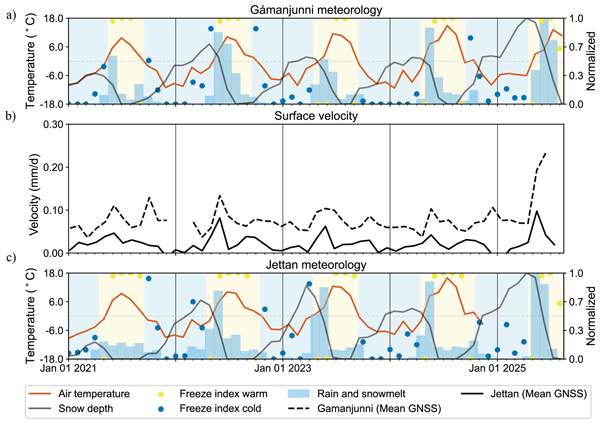
Climate change increases landslide risk in cold regions. We analyzed 12 years of GPS, borehole, water, and seismic data from two landslides in Arctic Norway, one with permafrost and one without. Both accelerate in spring and autumn due to water infiltration. One slip zone shows increasing snowmelt sensitivity while seismic data reveal seasonal stiffness changes. Results advance understanding of water-driven landslide dynamics in Arctic climates.
Juditha Aga, Livia Piermattei, Luc Girod, Kristoffer Aalstad, Trond Eiken, Andreas Kääb, and Sebastian Westermann
Earth Surf. Dynam., 12, 1049–1070, https://doi.org/10.5194/esurf-12-1049-2024, https://doi.org/10.5194/esurf-12-1049-2024, 2024
Short summary
Short summary
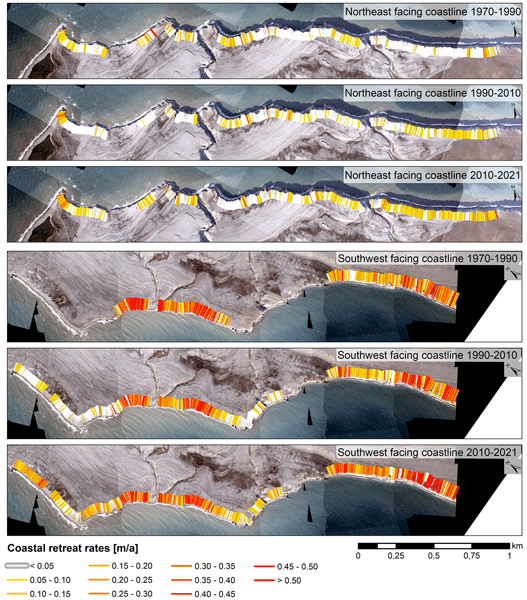
Coastal rock cliffs on Svalbard are considered to be fairly stable; however, long-term trends in coastal-retreat rates remain unknown. This study examines changes in the coastline position along Brøggerhalvøya, Svalbard, using aerial images from 1970, 1990, 2010, and 2021. Our analysis shows that coastal-retreat rates accelerate during the period 2010–2021, which coincides with increasing storminess and retreating sea ice.
Juditha Aga, Julia Boike, Moritz Langer, Thomas Ingeman-Nielsen, and Sebastian Westermann
The Cryosphere, 17, 4179–4206, https://doi.org/10.5194/tc-17-4179-2023, https://doi.org/10.5194/tc-17-4179-2023, 2023
Short summary
Short summary
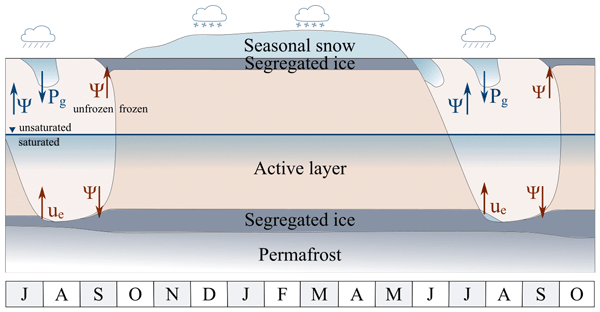
This study presents a new model scheme for simulating ice segregation and thaw consolidation in permafrost environments, depending on ground properties and climatic forcing. It is embedded in the CryoGrid community model, a land surface model for the terrestrial cryosphere. We describe the model physics and functionalities, followed by a model validation and a sensitivity study of controlling factors.
Sebastian Westermann, Thomas Ingeman-Nielsen, Johanna Scheer, Kristoffer Aalstad, Juditha Aga, Nitin Chaudhary, Bernd Etzelmüller, Simon Filhol, Andreas Kääb, Cas Renette, Louise Steffensen Schmidt, Thomas Vikhamar Schuler, Robin B. Zweigel, Léo Martin, Sarah Morard, Matan Ben-Asher, Michael Angelopoulos, Julia Boike, Brian Groenke, Frederieke Miesner, Jan Nitzbon, Paul Overduin, Simone M. Stuenzi, and Moritz Langer
Geosci. Model Dev., 16, 2607–2647, https://doi.org/10.5194/gmd-16-2607-2023, https://doi.org/10.5194/gmd-16-2607-2023, 2023
Short summary
Short summary
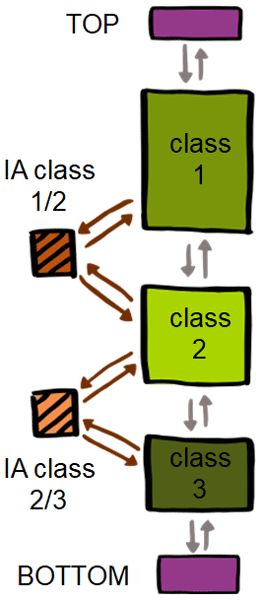
The CryoGrid community model is a new tool for simulating ground temperatures and the water and ice balance in cold regions. It is a modular design, which makes it possible to test different schemes to simulate, for example, permafrost ground in an efficient way. The model contains tools to simulate frozen and unfrozen ground, snow, glaciers, and other massive ice bodies, as well as water bodies.
Cas Renette, Kristoffer Aalstad, Juditha Aga, Robin Benjamin Zweigel, Bernd Etzelmüller, Karianne Staalesen Lilleøren, Ketil Isaksen, and Sebastian Westermann
Earth Surf. Dynam., 11, 33–50, https://doi.org/10.5194/esurf-11-33-2023, https://doi.org/10.5194/esurf-11-33-2023, 2023
Short summary
Short summary
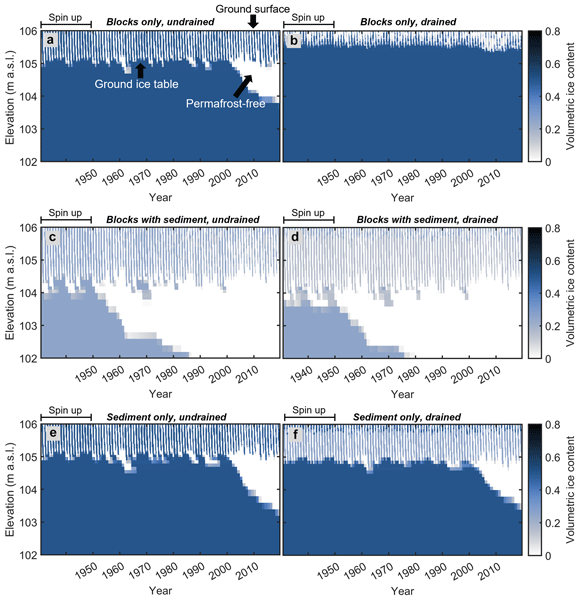
One of the reasons for lower ground temperatures in coarse, blocky terrain is a low or varying soil moisture content, which most permafrost modelling studies did not take into account. We used the CryoGrid community model to successfully simulate this effect and found markedly lower temperatures in well-drained, blocky deposits compared to other set-ups. The inclusion of this drainage effect is another step towards a better model representation of blocky mountain terrain in permafrost regions.

Kristoffer Aalstad, Esteban Alonso-González, Norbert Pirk, Sebastian Westermann, Clarissa Willmes, and Ruitang Yang
Geosci. Model Dev., 19, 8565–8596, https://doi.org/10.5194/gmd-19-8565-2026, https://doi.org/10.5194/gmd-19-8565-2026, 2026
Short summary
Short summary
AdaPBS (Adaptive Particle Batch Smoother) is a new algorithm to combine observations with cryospheric numerical models. AdaPBS is an iterative algorithm that automatically adjusts computing effort to the task, allowing the implementation of early stopping strategies. We tested AdaPBS at multiple sites with different models, matching or outperforming standard methods, when compared against more complex (computationally expensive) algorithms.
Andreas Aspaas, Grégory Bievre, Pascal Lacroix, Nadège Langet, Juditha Aga, Ingrid Skrede, Lene Kristensen, Bernd Etzelmüller, and François Renard
Earth Surf. Dynam., 14, 729–761, https://doi.org/10.5194/esurf-14-729-2026, https://doi.org/10.5194/esurf-14-729-2026, 2026
Short summary
Short summary
Climate change increases landslide risk in cold regions. We analyzed 12 years of GPS, borehole, water, and seismic data from two landslides in Arctic Norway, one with permafrost and one without. Both accelerate in spring and autumn due to water infiltration. One slip zone shows increasing snowmelt sensitivity while seismic data reveal seasonal stiffness changes. Results advance understanding of water-driven landslide dynamics in Arctic climates.
Anna-Maria Virkkala, Isabel Wargowsky, Judith Vogt, McKenzie A. Kuhn, Simran Madaan, Tiffany Windholz, Kyle A. Arndt, Gerard Rocher-Ros, Mathias Göckede, David Olefeldt, Edward A. G. Schuur, David Bastviken, Richard O'Keefe, Brendan M. Rogers, Jennifer D. Watts, Kelcy Kent, Kristoffer Aalstad, Kelly Aho, Joonatan Ala-Könni, Haley Alcock, Inge Althuizen, Christopher D. Arp, Jun Asanuma, Mika Aurela, Sivakiruthika Balathandayuthabani, Katrin Attermeyer, Alan Barr, Maialen Barret, Ochirbat Batkhishig, Christina Biasi, Mats P. Björkman, Andrew Black, Elena Blanc-Betes, Pascal Bodmer, Julia Boike, Abdullah Bolek, Frédéric Bouchard, Ingeborg Bussmann, Lea Cabrol, Eleonora Canfora, Sean Carey, Karel Castro-Morales, Namyi Chae, Andreas Christen, Torben R. Christensen, Casper T. Christiansen, Housen Chu, Graham Clark, Francois Clayer, Patrick Crill, Christopher Cunada, Scott J. Davidson, Joshua F. Dean, Sigrid Dengel, Matteo Detto, Catherine Dieleman, Florent Domine, Egor Dyukarev, Colin Edgar, Bo Elberling, Craig A. Emmerton, Eugenie Euskirchen, Grant Falvo, Thomas Friborg, Michelle Garneau, Mariasilvia Giamberini, Mikhail V. Glagolev, Miquel A. Gonzalez-Meler, Gustaf Granath, Jón Guðmundsson, Konsta Happonen, Yoshinobu Harazono, Lorna Harris, Josh Hashemi, Nicholas Hasson, Janna Heerah, Liam Heffernan, Manuel Helbig, Warren Helgason, Michal Heliasz, Greg Henry, Geert Hensgens, Tetsuya Hiyama, Beth Holmes, Macall Hock, David Holl, Jutta Holst, Thomas Holst, Gabriel Hould-Gosselin, Elyn Humphreys, Jacqueline Hung, Jussi Huotari, Hiroki Ikawa, Danil V. Ilyasov, Mamoru Ishikawa, Go Iwahana, Hiroki Iwata, Marcin Antoni Jackowicz-Korczynski, Joachim Jansen, Järvi Järveoja, Vincent E. J. Jassey, Rasmus Jensen, Katharina Jentzsch, Robert G. Jespersen, Carl-Fredrik Johannesson, Cheristy P. Jones, Anders Jonsson, Ji Young Jung, Sari Juutinen, Evan Kane, Jan Karlsson, Sergey Karsanaev, Kuno Kasak, Julia Kelly, Kasha Kempton, Marcus Klaus, George W. Kling, Natascha Kljun, Jacqueline Knutson, Hideki Kobayashi, John Kochendorfer, Kukka-Maaria Kohonen, Pasi Kolari, Mika Korkiakoski, Aino Korrensalo, Pirkko Kortelainen, Egle Koster, Kajar Koster, Ayumi Kotani, Praveena Krishnan, Juliya Kurbatova, Lars Kutzbach, Min Jung Kwon, Ethan D. Kyzivat, Jessica Lagroix, Theodore Langhorst, Elena Lapshina, Tuula Larmola, Klaus S. Larsen, Isabelle Laurion, Justin Ledman, Hanna Lee, A. Joshua Leffler, Lance Lesack, Anders Lindroth, David Lipson, Annalea Lohila, Efrén López-Blanco, Vincent L. St. Louis, Erik Lundin, Miska Luoto, Takashi Machimura, Marta Magnani, Avni Malhotra, Marja Maljanen, Ivan Mammarella, Elisa Männistö, Luca Belelli Marchesini, Phil Marsh, Pertti J. Martikainen, Maija E. Marushchak, Mikhail Mastepanov, Alex Mavrovic, Trofim Maximov, Christina Minions, Daniel F. Nadeau, Marco Montemayor, Tomoaki Morishita, Patrick Murphy, Erin Nicholls, Mats B. Nilsson, Anastasia Niyazova, Jenni Nordén, Koffi Dodji Noumonvi, Hannu Nykänen, Walter Oechel, Anne Ojala, Tomohiro Okadera, Sujan Pal, Alexey V. Panov, Tim Papakyriakou, Dario Papale, Sang-Jong Park, Frans-Jan W. Parmentier, Gilberto Pastorello, Mike Peacock, Matthias Peichl, Roman Petrov, Kyra St. Pierre, Norbert Pirk, Jessica Plein, Vilmantas Preskienis, Anatoly Prokushkin, Jukka Pumpanen, Hilary A. Rains, Niklas Rakos, Aleksi Räsänen, Helena Rautakoski, Riikka Rinnan, Janne Rinne, Adrian Rocha, Nigel Roulet, Alexandre Roy, Anna Rutgersson, Aleksandr F. Sabrekov, Torsten Sachs, Erik Sahlée, Alejandro Salazar, Henrique Oliveira Sawakuchi, Christopher Schulze, Roger Seco, Armando Sepulveda-Jauregui, Svetlana Serikova, Abbey Serrone, Hanna M. Silvennoinen, Sofie Sjogersten, June Skeeter, Jo Snöälv, Sebastian Sobek, Oliver Sonnentag, Emily H. Stanley, Maria Strack, Lena Strom, Patrick Sullivan, Ryan Sullivan, Anna Sytiuk, Torbern Tagesson, Pierre Taillardat, Julie Talbot, Suzanne E. Tank, Mario Tenuta, Irina Terenteva, Frederic Thalasso, Antoine Thiboult, Halldor Thorgeirsson, Fenix Garcia Tigreros, Margaret Torn, Amy Townsend-Small, Claire Treat, Alain Tremblay, Carlo Trotta, Eeva-Stiina Tuittila, Merritt Turetsky, Masahito Ueyama, Muhammad Umair, Aki Vähä, Lona van Delden, Maarten van Hardenbroek, Andrej Varlagin, Ruth K. Varner, Tarmo Virtanen, Elena Veretennikova, Timo Vesala, Carolina Voigt, Jorien E. Vonk, Robert Wagner, Katey Walter Anthony, Qinxue Wang, Masataka Watanabe, Hailey Webb, Jeffrey M. Welker, Andreas Westergaard-Nielsen, Sebastian Westermann, Jeffrey R. White, Christian Wille, Scott N. Williamson, Scott Zolkos, Donatella Zona, and Susan M. Natali
Earth Syst. Sci. Data, 18, 6357–6409, https://doi.org/10.5194/essd-18-6357-2026, https://doi.org/10.5194/essd-18-6357-2026, 2026
Short summary
Short summary
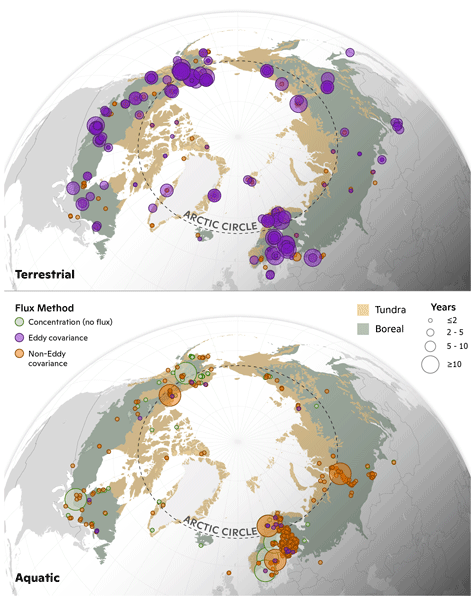
This dataset includes monthly measurements of carbon dioxide and methane exchange between land, water, and the atmosphere from over 1000 sites in Arctic and boreal regions. It combines measurements from a variety of ecosystems, including wetlands, forests, tundra, lakes, and rivers, gathered by over 260 researchers from 1984–2024. This dataset can be used to improve and reduce uncertainty in carbon budgets in order to strengthen our understanding of climate feedbacks in a warming world.
Tamara Mathys, Sergey S. Marchenko, Sebastian Westermann, Luke Gregor, Léo C. P. Martin, Murataly Duishonakunov, Christian Hauck, Mohammad Farzamian, Teddi Herring, Christin Hilbich, Ruslan Kenzhebaev, Mukhammad Esenaman uulu, Timur Musaev, Zhoodarbeshim Bektursunov, Ryskul Usubaliev, Isabella Brining, Tomas Saks, and Martin Hoelzle
EGUsphere, https://doi.org/10.5194/egusphere-2026-2756, https://doi.org/10.5194/egusphere-2026-2756, 2026
This preprint is open for discussion and under review for Earth Surface Dynamics (ESurf).
Short summary
Short summary
CryoGrid simulations constrained by geophysical and borehole data were used to assess permafrost thermal conditions and thaw depth in the Inner Tien Shan (Kyrgyzstan) at 30 m resolution. Surface-type-specific stratigraphies derived from geophysical surveys improved representation of subsurface heterogeneity. Results indicate widespread but spatially variable permafrost, with evidence of approximately 1 °C warming since the 1980s and increasing thaw depths.
Joana Baptista, Sebastian Westermann, and Gonçalo Vieira
EGUsphere, https://doi.org/10.5194/egusphere-2026-1914, https://doi.org/10.5194/egusphere-2026-1914, 2026
Short summary
Short summary
Permafrost underlies most ice-free areas of the Antarctic Peninsula being crucial for ecosystems. Yet its response to climate warming is uncertain. Using the CryoGrid Community Model at five PERMANTAR observatories, we simulated past and future permafrost evolution. Results revealed a warming of 0.22 °C dec⁻¹ since 1950–2020 and a progressive degradation under all CMIP6 scenarios, with positive MAGTs at 20 m depth before 2100, driven by elevation, snow cover, and ocean–atmosphere interactions.
Esther Karin Bender, Matvey Debolskiy, Kjetil Aas, Sebastian Westermann, Fang Li, Jiawen Zhu, and Hanna Lee
EGUsphere, https://doi.org/10.5194/egusphere-2026-1039, https://doi.org/10.5194/egusphere-2026-1039, 2026
Short summary
Short summary
This paper introduces a new method to represent ice-rich permafrost soils in the Community Land Model used for climate prediction. The approach includes key processes previously missing, enabling simulation of rapid thaw events from ground-ice melt. It improves representation of soil temperature, hydrology, and landscape dynamics, leading to more accurate future greenhouse-gas estimates.
Madeleine C. Garibaldi, Philip P. Bonnaventure, Robert G. Way, Alexandre Bevington, Sharon L. Smith, Scott F. Lamoureux, Jean E. Holloway, Antoni G. Lewkowicz, and Hannah Ackerman
The Cryosphere, 20, 2375–2392, https://doi.org/10.5194/tc-20-2375-2026, https://doi.org/10.5194/tc-20-2375-2026, 2026
Short summary
Short summary
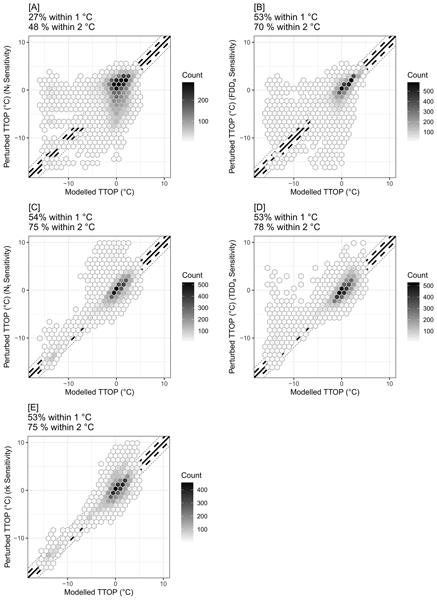
We assessed the sensitivity of a simple permafrost model to changes in parameter values using measured data across northern Canada. We altered the value of one parameter at a time to assess the changes in the resulting temperature. The model was most sensitive to changes in the freezing season parameters and least sensitive to changes in the thawing parameters. However, the importance of specific parameters varied across Canada. The findings of this study can aid in development of future models.
Olivia Meier-Legault, Nicholas Brown, Larry Adjun, Michel Allard, Alejandro Alvarez, Maude Auclair, Alex Bevington, Samuel Bilodeau, William Cable, Olivia Carpino, Ariane Castagner, Lin Chen, Alexandre Chiasson, Ryan Connon, Stephanie Coulombe, Jeffrey Crompton, Derek Cronmiller, Gautier Davesne, Mason Dominico, Marc-André Ducharme, Timothy Ensom, Louise Farquharson, Vanessa Foord, Daniel Fortier, Philippe Fortier, Duane Froese, Samuel Gagnon, Francis Gauthier, Marten Geertsema, Etienne Godin, Galina Jonat, Steven V. Kokelj, Michelle Landry, Antoni Lewkowicz, Panya Lipovsky, Emmanual L’Hérault, Hannah Macdonell, Lancelot Massé, Dmitry Nicolsky, Moya Painter, Leesee Papatsie, Victor Pozsgay, William Quinton, Vladimir Romanovsky, Ashley C.A. Rudy, Denis Sarrazin, Emilie Stewart-Jones, Donald Walker, Thomas Wright, Joseph Young, and Stephan Gruber
Earth Syst. Sci. Data Discuss., https://doi.org/10.5194/essd-2026-96, https://doi.org/10.5194/essd-2026-96, 2026
Revised manuscript accepted for ESSD
Short summary
Short summary
Ground temperature data is vital for permafrost and climate research yet data is often fragmented. We created a standardized collection of ground temperatures from over 900 sites across Canada. From 42 published and unpublished sources, we manually verified, cleaned and standardized data with a new software tool. This dataset supports permafrost research on a nationwide scale and can help improve models by acting as a reliable benchmark.
Anfisa Pismeniuk, Peter Dörsch, Mats Ippach, Clarissa Willmes, Sunniva Sheffield, Norbert Pirk, and Sebastian Westermann
Biogeosciences, 23, 1497–1514, https://doi.org/10.5194/bg-23-1497-2026, https://doi.org/10.5194/bg-23-1497-2026, 2026
Short summary
Short summary
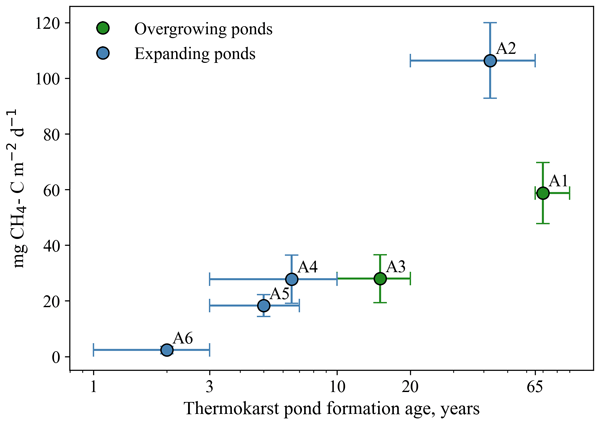
Thermokarst ponds in high latitudes are important methane (CH4) sources in summer. Meanwhile, these ponds are ice-covered for around 60 % of the year and can accumulate CH4 in the ice and within the underlying water column, which potentially results in high emissions during the ice-off. Here, we present data on wintertime CH4 storage of ponds located within two peat plateaus in Northern Norway. Our results show that the wintertime CH4 storage can contribute up to 40 % to the annual CH4 budget.

Lotte Wendt, Line Rouyet, Hanne H. Christiansen, Tom Rune Lauknes, and Sebastian Westermann
The Cryosphere, 20, 1179–1197, https://doi.org/10.5194/tc-20-1179-2026, https://doi.org/10.5194/tc-20-1179-2026, 2026
Short summary
Short summary
In permafrost environments, the ground surface moves due to the formation and melt of ice in the ground. This study compares ground surface displacements measured from satellite images against field data of ground ice contents. We find good agreement between the detected seasonal subsidence and observed ground ice melt. Our results show the potential of satellite remote sensing for mapping ground ice variability, but also indicate that ice in excess of the pore space must be considered.
Robin B. Zweigel, Dashtseren Avirmed, Khurelbaatar Temuujin, Clare Webster, Hanna Lee, and Sebastian Westermann
The Cryosphere, 20, 1001–1023, https://doi.org/10.5194/tc-20-1001-2026, https://doi.org/10.5194/tc-20-1001-2026, 2026
Short summary
Short summary
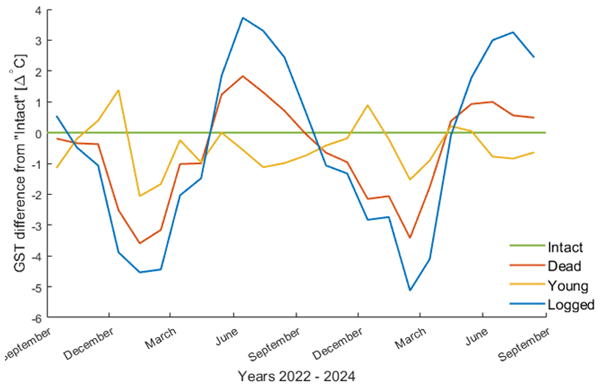
Two years of data along a forest disturbance gradient in Mongolia show a larger annual ground surface temperature range in dead and logged forests than intact forest, while the range is dampened in stands of young regrowth. Compared to intact forest, mean annual ground surface temperatures are 0.5 °C colder in dead and logged forest and dense stands of young regrowth. This is linked to differences in vegetation and surface cover due to the disturbance and patterns in livestock activity.
Clarissa Willmes, Kristoffer Aalstad, and Sebastian Westermann
EGUsphere, https://doi.org/10.5194/egusphere-2025-3142, https://doi.org/10.5194/egusphere-2025-3142, 2025
Short summary
Short summary
In permafrost areas, the spatial variability of the snow cover significantly affects the ground thermal regime. This study presents an algorithm that integrates satellite data into a permafrost model to enhance the spatial detail of ground temperature simulations. At a site on Svalbard, the algorithm improves simulations of ground temperatures especially for wind-blown ridges with little snow, as well as snow-drift sites.
Marco Mazzolini, Kristoffer Aalstad, Esteban Alonso-González, Sebastian Westermann, and Désirée Treichler
The Cryosphere, 19, 3831–3848, https://doi.org/10.5194/tc-19-3831-2025, https://doi.org/10.5194/tc-19-3831-2025, 2025
Short summary
Short summary
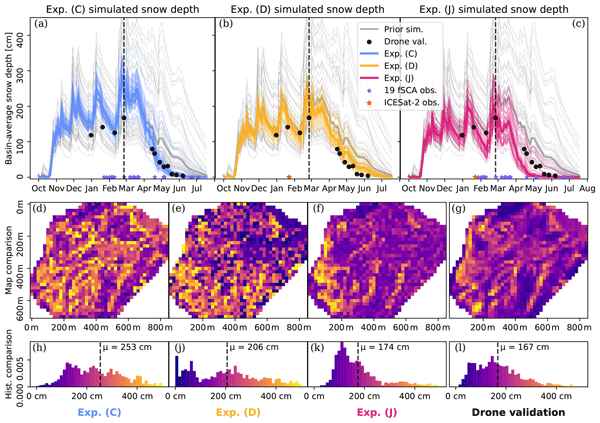
In this work, we showcase the use the satellite laser altimeter ICESat-2, which is able to retrieve snow depth in areas where snow amounts are still poorly estimated despite the importance of these water resources. We can update snow models with these observations through algorithms that spatially propagate the information beyond the satellite profiles. The positive results show the potential of the approach to improve snow simulations, in terms of average snow depth and spatial distribution.
Joana Pedro Baptista, Gonçalo Brito Guapo Teles Vieira, António Manuel de Carvalho Soares Correia, Hyoungseok Lee, and Sebastian Westermann
The Cryosphere, 19, 3459–3476, https://doi.org/10.5194/tc-19-3459-2025, https://doi.org/10.5194/tc-19-3459-2025, 2025
Short summary
Short summary
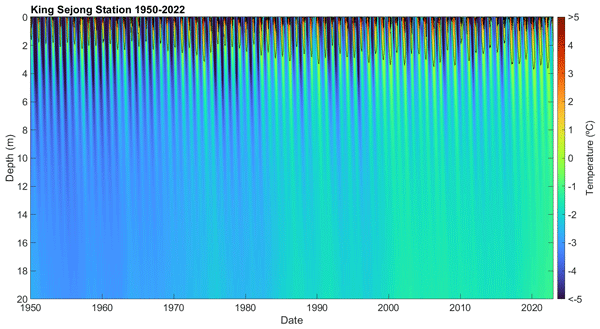
Permafrost underlies ice-free areas of Antarctica, but its response to long-term warming is unclear due to a limited number of monitoring sites. To address this, we used the CryoGrid model, forced with climate data, to estimate permafrost temperatures and active layer thickness at King Sejong Station since 1950. The results show ground temperatures rising 0.25 °C per decade and the active layer thickening by 2 m. Warming has accelerated since 2015, highlighting the need for continued monitoring.
Jacqueline K. Knutson, François Clayer, Peter Dörsch, Sebastian Westermann, and Heleen A. de Wit
Biogeosciences, 22, 3899–3914, https://doi.org/10.5194/bg-22-3899-2025, https://doi.org/10.5194/bg-22-3899-2025, 2025
Short summary
Short summary
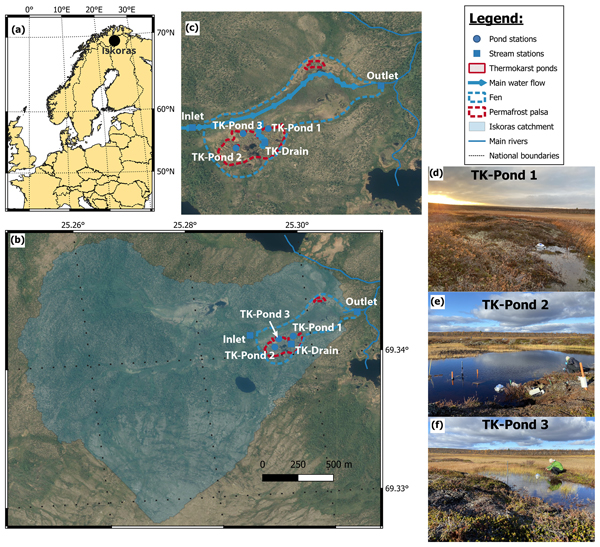
Thawing permafrost at Iškoras in northern Norway is transforming peat plateaus into thermokarst ponds and wetlands. These small ponds show striking oversaturation of dissolved greenhouse gases, such as carbon dioxide (CO2) and methane (CH4), partly owing to organic matter processing. Streams nearby emit CO2, driven by turbulence. As permafrost disappears, carbon dynamics will change, potentially increasing emissions of CH4. This study highlights the need to integrate these changes into climate models.
Robin Benjamin Zweigel, Avirmed Dashtseren, Khurelbaatar Temuujin, Anarmaa Sharkhuu, Clare Webster, Hanna Lee, and Sebastian Westermann
Biogeosciences, 21, 5059–5077, https://doi.org/10.5194/bg-21-5059-2024, https://doi.org/10.5194/bg-21-5059-2024, 2024
Short summary
Short summary
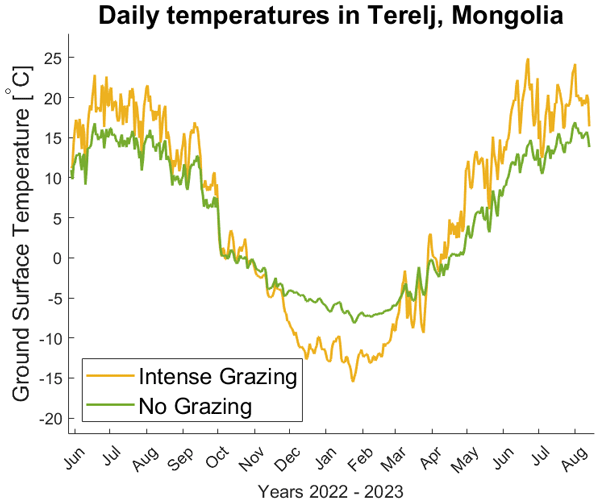
Intense grazing at grassland sites removes vegetation, reduces the snow cover, and inhibits litter layers from forming. Grazed sites generally have a larger annual ground surface temperature amplitude than ungrazed sites, but the net effect depends on effects in the transitional seasons. Our results also suggest that seasonal use of pastures can reduce ground temperatures, which can be a strategy to protect currently degrading grassland permafrost.
Sigrid Trier Kjær, Sebastian Westermann, Nora Nedkvitne, and Peter Dörsch
Biogeosciences, 21, 4723–4737, https://doi.org/10.5194/bg-21-4723-2024, https://doi.org/10.5194/bg-21-4723-2024, 2024
Short summary
Short summary
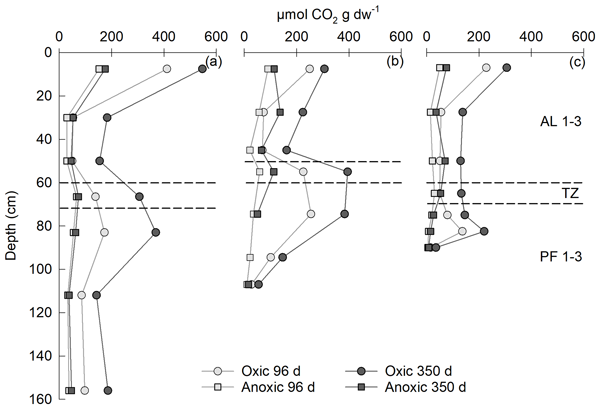
Permafrost peatlands are thawing due to climate change, releasing large quantities of carbon that degrades upon thawing and is released as CO2, CH4 or dissolved organic carbon (DOC). We incubated thawed Norwegian permafrost peat plateaus and thermokarst pond sediment found next to permafrost for up to 350 d to measure carbon loss. CO2 production was initially the highest, whereas CH4 production increased over time. The largest carbon loss was measured at the top of the peat plateau core as DOC.
Juditha Aga, Livia Piermattei, Luc Girod, Kristoffer Aalstad, Trond Eiken, Andreas Kääb, and Sebastian Westermann
Earth Surf. Dynam., 12, 1049–1070, https://doi.org/10.5194/esurf-12-1049-2024, https://doi.org/10.5194/esurf-12-1049-2024, 2024
Short summary
Short summary
Coastal rock cliffs on Svalbard are considered to be fairly stable; however, long-term trends in coastal-retreat rates remain unknown. This study examines changes in the coastline position along Brøggerhalvøya, Svalbard, using aerial images from 1970, 1990, 2010, and 2021. Our analysis shows that coastal-retreat rates accelerate during the period 2010–2021, which coincides with increasing storminess and retreating sea ice.
Moritz Langer, Jan Nitzbon, Brian Groenke, Lisa-Marie Assmann, Thomas Schneider von Deimling, Simone Maria Stuenzi, and Sebastian Westermann
The Cryosphere, 18, 363–385, https://doi.org/10.5194/tc-18-363-2024, https://doi.org/10.5194/tc-18-363-2024, 2024
Short summary
Short summary
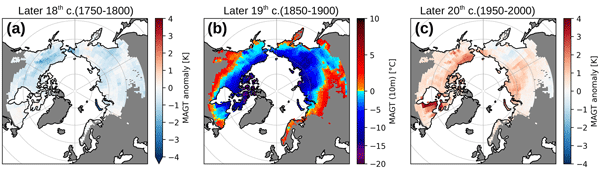
Using a model that can simulate the evolution of Arctic permafrost over centuries to millennia, we find that post-industrialization permafrost warming has three "hotspots" in NE Canada, N Alaska, and W Siberia. The extent of near-surface permafrost has decreased substantially since 1850, with the largest area losses occurring in the last 50 years. The simulations also show that volcanic eruptions have in some cases counteracted the loss of near-surface permafrost for a few decades.
Bernd Etzelmüller, Ketil Isaksen, Justyna Czekirda, Sebastian Westermann, Christin Hilbich, and Christian Hauck
The Cryosphere, 17, 5477–5497, https://doi.org/10.5194/tc-17-5477-2023, https://doi.org/10.5194/tc-17-5477-2023, 2023
Short summary
Short summary
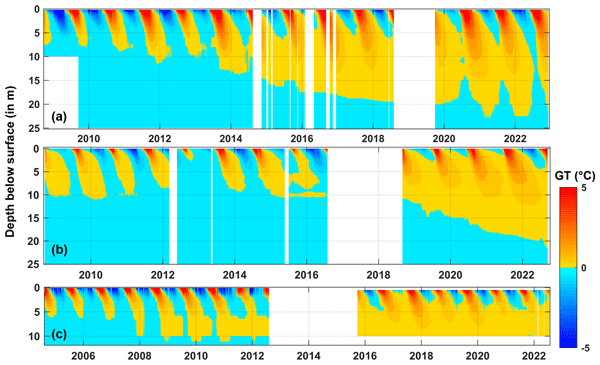
Permafrost (permanently frozen ground) is widespread in the mountains of Norway and Iceland. Several boreholes were drilled after 1999 for long-term permafrost monitoring. We document a strong warming of permafrost, including the development of unfrozen bodies in the permafrost. Warming and degradation of mountain permafrost may lead to more natural hazards.
Esteban Alonso-González, Kristoffer Aalstad, Norbert Pirk, Marco Mazzolini, Désirée Treichler, Paul Leclercq, Sebastian Westermann, Juan Ignacio López-Moreno, and Simon Gascoin
Hydrol. Earth Syst. Sci., 27, 4637–4659, https://doi.org/10.5194/hess-27-4637-2023, https://doi.org/10.5194/hess-27-4637-2023, 2023
Short summary
Short summary
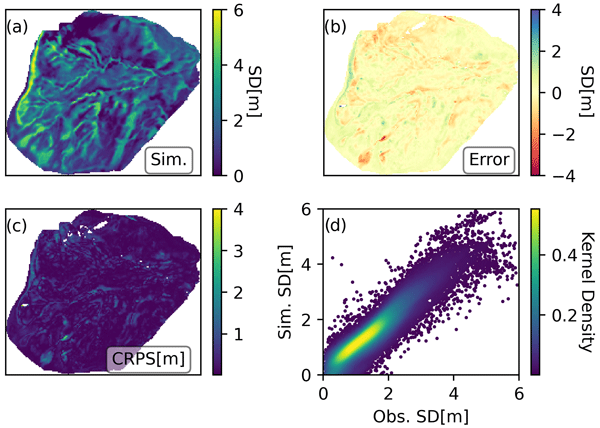
Here we explore how to improve hyper-resolution (5 m) distributed snowpack simulations using sparse observations, which do not provide information from all the areas of the simulation domain. We propose a new way of propagating information throughout the simulations adapted to the hyper-resolution, which could also be used to improve simulations of other nature. The method has been implemented in an open-source data assimilation tool that is readily accessible to everyone.
Anatoly O. Sinitsyn, Sara Bazin, Rasmus Benestad, Bernd Etzelmüller, Ketil Isaksen, Hanne Kvitsand, Julia Lutz, Andrea L. Popp, Lena Rubensdotter, and Sebastian Westermann
EGUsphere, https://doi.org/10.5194/egusphere-2023-2950, https://doi.org/10.5194/egusphere-2023-2950, 2023
Preprint archived
Short summary
Short summary
This study looked at under the ground on Svalbard, an archipelago close to the North Pole. We found something very surprising – there is water under the all year around frozen soil. This was not known before. This water could be used for drinking if we manage it carefully. This is important because getting clean drinking water is very difficult in Svalbard, and other Arctic places. Also, because the climate is getting warmer, there might be even more water underground in the future.
Léo C. P. Martin, Sebastian Westermann, Michele Magni, Fanny Brun, Joel Fiddes, Yanbin Lei, Philip Kraaijenbrink, Tamara Mathys, Moritz Langer, Simon Allen, and Walter W. Immerzeel
Hydrol. Earth Syst. Sci., 27, 4409–4436, https://doi.org/10.5194/hess-27-4409-2023, https://doi.org/10.5194/hess-27-4409-2023, 2023
Short summary
Short summary
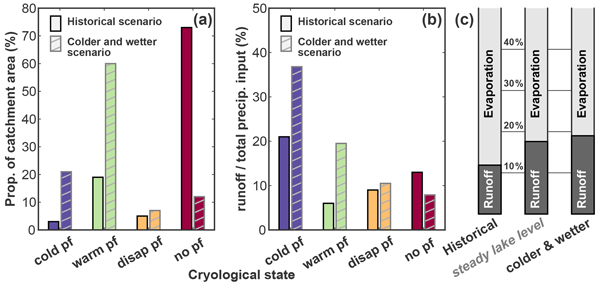
Across the Tibetan Plateau, many large lakes have been changing level during the last decades as a response to climate change. In high-mountain environments, water fluxes from the land to the lakes are linked to the ground temperature of the land and to the energy fluxes between the ground and the atmosphere, which are modified by climate change. With a numerical model, we test how these water and energy fluxes have changed over the last decades and how they influence the lake level variations.
Juditha Aga, Julia Boike, Moritz Langer, Thomas Ingeman-Nielsen, and Sebastian Westermann
The Cryosphere, 17, 4179–4206, https://doi.org/10.5194/tc-17-4179-2023, https://doi.org/10.5194/tc-17-4179-2023, 2023
Short summary
Short summary
This study presents a new model scheme for simulating ice segregation and thaw consolidation in permafrost environments, depending on ground properties and climatic forcing. It is embedded in the CryoGrid community model, a land surface model for the terrestrial cryosphere. We describe the model physics and functionalities, followed by a model validation and a sensitivity study of controlling factors.
Matan Ben-Asher, Florence Magnin, Sebastian Westermann, Josué Bock, Emmanuel Malet, Johan Berthet, Ludovic Ravanel, and Philip Deline
Earth Surf. Dynam., 11, 899–915, https://doi.org/10.5194/esurf-11-899-2023, https://doi.org/10.5194/esurf-11-899-2023, 2023
Short summary
Short summary
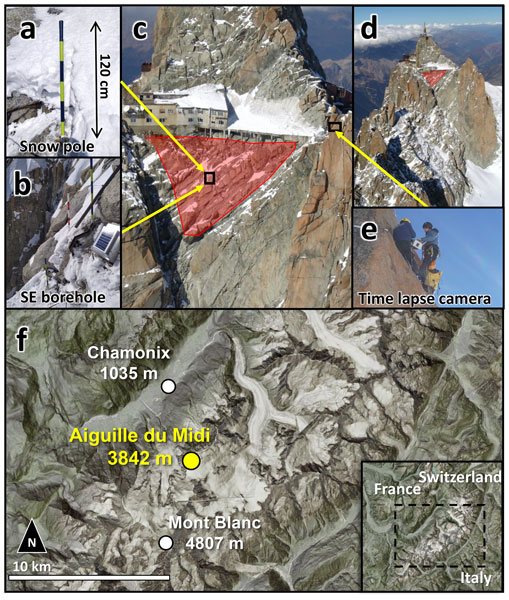
Quantitative knowledge of water availability on high mountain rock slopes is very limited. We use a numerical model and field measurements to estimate the water balance at a steep rock wall site. We show that snowmelt is the main source of water at elevations >3600 m and that snowpack hydrology and sublimation are key factors. The new information presented here can be used to improve the understanding of thermal, hydrogeological, and mechanical processes on steep mountain rock slopes.
Brian Groenke, Moritz Langer, Jan Nitzbon, Sebastian Westermann, Guillermo Gallego, and Julia Boike
The Cryosphere, 17, 3505–3533, https://doi.org/10.5194/tc-17-3505-2023, https://doi.org/10.5194/tc-17-3505-2023, 2023
Short summary
Short summary
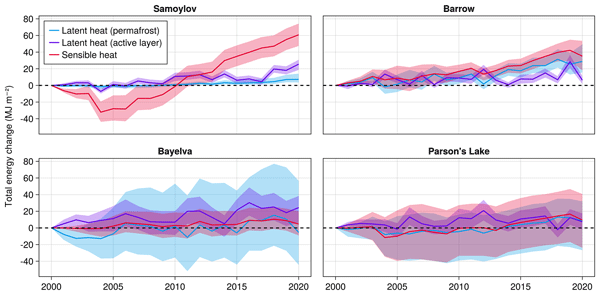
It is now well known from long-term temperature measurements that Arctic permafrost, i.e., ground that remains continuously frozen for at least 2 years, is warming in response to climate change. Temperature, however, only tells half of the story. In this study, we use computer modeling to better understand how the thawing and freezing of water in the ground affects the way permafrost responds to climate change and what temperature trends can and cannot tell us about how permafrost is changing.
Louise Steffensen Schmidt, Thomas Vikhamar Schuler, Erin Emily Thomas, and Sebastian Westermann
The Cryosphere, 17, 2941–2963, https://doi.org/10.5194/tc-17-2941-2023, https://doi.org/10.5194/tc-17-2941-2023, 2023
Short summary
Short summary
Here, we present high-resolution simulations of glacier mass balance (the gain and loss of ice over a year) and runoff on Svalbard from 1991–2022, one of the fastest warming regions in the Arctic. The simulations are created using the CryoGrid community model. We find a small overall loss of mass over the simulation period of −0.08 m yr−1 but with no statistically significant trend. The average runoff was found to be 41 Gt yr−1, with a significant increasing trend of 6.3 Gt per decade.
Justyna Czekirda, Bernd Etzelmüller, Sebastian Westermann, Ketil Isaksen, and Florence Magnin
The Cryosphere, 17, 2725–2754, https://doi.org/10.5194/tc-17-2725-2023, https://doi.org/10.5194/tc-17-2725-2023, 2023
Short summary
Short summary
We assess spatio-temporal permafrost variations in selected rock walls in Norway over the last 120 years. Ground temperature is modelled using the two-dimensional ground heat flux model CryoGrid 2D along nine profiles. Permafrost probably occurs at most sites. All simulations show increasing ground temperature from the 1980s. Our simulations show that rock wall permafrost with a temperature of −1 °C at 20 m depth could thaw at this depth within 50 years.
Norbert Pirk, Kristoffer Aalstad, Yeliz A. Yilmaz, Astrid Vatne, Andrea L. Popp, Peter Horvath, Anders Bryn, Ane Victoria Vollsnes, Sebastian Westermann, Terje Koren Berntsen, Frode Stordal, and Lena Merete Tallaksen
Biogeosciences, 20, 2031–2047, https://doi.org/10.5194/bg-20-2031-2023, https://doi.org/10.5194/bg-20-2031-2023, 2023
Short summary
Short summary
We measured the land–atmosphere exchange of CO2 and water vapor in alpine Norway over 3 years. The extremely snow-rich conditions in 2020 reduced the total annual evapotranspiration to 50 % and reduced the growing-season carbon assimilation to turn the ecosystem from a moderate annual carbon sink to an even stronger source. Our analysis suggests that snow cover anomalies are driving the most consequential short-term responses in this ecosystem’s functioning.
Sebastian Westermann, Thomas Ingeman-Nielsen, Johanna Scheer, Kristoffer Aalstad, Juditha Aga, Nitin Chaudhary, Bernd Etzelmüller, Simon Filhol, Andreas Kääb, Cas Renette, Louise Steffensen Schmidt, Thomas Vikhamar Schuler, Robin B. Zweigel, Léo Martin, Sarah Morard, Matan Ben-Asher, Michael Angelopoulos, Julia Boike, Brian Groenke, Frederieke Miesner, Jan Nitzbon, Paul Overduin, Simone M. Stuenzi, and Moritz Langer
Geosci. Model Dev., 16, 2607–2647, https://doi.org/10.5194/gmd-16-2607-2023, https://doi.org/10.5194/gmd-16-2607-2023, 2023
Short summary
Short summary
The CryoGrid community model is a new tool for simulating ground temperatures and the water and ice balance in cold regions. It is a modular design, which makes it possible to test different schemes to simulate, for example, permafrost ground in an efficient way. The model contains tools to simulate frozen and unfrozen ground, snow, glaciers, and other massive ice bodies, as well as water bodies.
Cas Renette, Kristoffer Aalstad, Juditha Aga, Robin Benjamin Zweigel, Bernd Etzelmüller, Karianne Staalesen Lilleøren, Ketil Isaksen, and Sebastian Westermann
Earth Surf. Dynam., 11, 33–50, https://doi.org/10.5194/esurf-11-33-2023, https://doi.org/10.5194/esurf-11-33-2023, 2023
Short summary
Short summary
One of the reasons for lower ground temperatures in coarse, blocky terrain is a low or varying soil moisture content, which most permafrost modelling studies did not take into account. We used the CryoGrid community model to successfully simulate this effect and found markedly lower temperatures in well-drained, blocky deposits compared to other set-ups. The inclusion of this drainage effect is another step towards a better model representation of blocky mountain terrain in permafrost regions.

Norbert Pirk, Kristoffer Aalstad, Sebastian Westermann, Astrid Vatne, Alouette van Hove, Lena Merete Tallaksen, Massimo Cassiani, and Gabriel Katul
Atmos. Meas. Tech., 15, 7293–7314, https://doi.org/10.5194/amt-15-7293-2022, https://doi.org/10.5194/amt-15-7293-2022, 2022
Short summary
Short summary
In this study, we show how sparse and noisy drone measurements can be combined with an ensemble of turbulence-resolving wind simulations to estimate uncertainty-aware surface energy exchange. We demonstrate the feasibility of this drone data assimilation framework in a series of synthetic and real-world experiments. This new framework can, in future, be applied to estimate energy and gas exchange in heterogeneous landscapes more representatively than conventional methods.
Juri Palmtag, Jaroslav Obu, Peter Kuhry, Andreas Richter, Matthias B. Siewert, Niels Weiss, Sebastian Westermann, and Gustaf Hugelius
Earth Syst. Sci. Data, 14, 4095–4110, https://doi.org/10.5194/essd-14-4095-2022, https://doi.org/10.5194/essd-14-4095-2022, 2022
Short summary
Short summary
The northern permafrost region covers 22 % of the Northern Hemisphere and holds almost twice as much carbon as the atmosphere. This paper presents data from 651 soil pedons encompassing more than 6500 samples from 16 different study areas across the northern permafrost region. We use this dataset together with ESA's global land cover dataset to estimate soil organic carbon and total nitrogen storage up to 300 cm soil depth, with estimated values of 813 Pg for carbon and 55 Pg for nitrogen.
Noah D. Smith, Eleanor J. Burke, Kjetil Schanke Aas, Inge H. J. Althuizen, Julia Boike, Casper Tai Christiansen, Bernd Etzelmüller, Thomas Friborg, Hanna Lee, Heather Rumbold, Rachael H. Turton, Sebastian Westermann, and Sarah E. Chadburn
Geosci. Model Dev., 15, 3603–3639, https://doi.org/10.5194/gmd-15-3603-2022, https://doi.org/10.5194/gmd-15-3603-2022, 2022
Short summary
Short summary
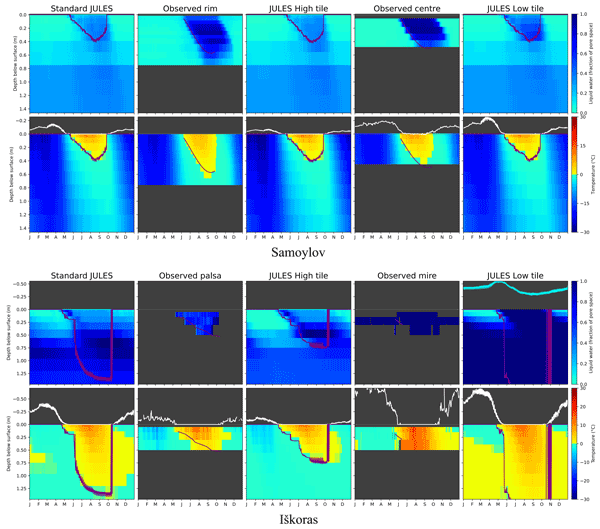
The Arctic has large areas of small mounds that are caused by ice lifting up the soil. Snow blown by wind gathers in hollows next to these mounds, insulating them in winter. The hollows tend to be wetter, and thus the soil absorbs more heat in summer. The warm wet soil in the hollows decomposes, releasing methane. We have made a model of this, and we have tested how it behaves and whether it looks like sites in Scandinavia and Siberia. Sometimes we get more methane than a model without mounds.
Sarah E. Chadburn, Eleanor J. Burke, Angela V. Gallego-Sala, Noah D. Smith, M. Syndonia Bret-Harte, Dan J. Charman, Julia Drewer, Colin W. Edgar, Eugenie S. Euskirchen, Krzysztof Fortuniak, Yao Gao, Mahdi Nakhavali, Włodzimierz Pawlak, Edward A. G. Schuur, and Sebastian Westermann
Geosci. Model Dev., 15, 1633–1657, https://doi.org/10.5194/gmd-15-1633-2022, https://doi.org/10.5194/gmd-15-1633-2022, 2022
Short summary
Short summary
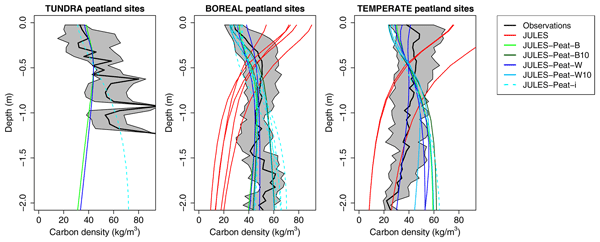
We present a new method to include peatlands in an Earth system model (ESM). Peatlands store huge amounts of carbon that accumulates very slowly but that can be rapidly destabilised, emitting greenhouse gases. Our model captures the dynamic nature of peat by simulating the change in surface height and physical properties of the soil as carbon is added or decomposed. Thus, we model, for the first time in an ESM, peat dynamics and its threshold behaviours that can lead to destabilisation.
Bernd Etzelmüller, Justyna Czekirda, Florence Magnin, Pierre-Allain Duvillard, Ludovic Ravanel, Emanuelle Malet, Andreas Aspaas, Lene Kristensen, Ingrid Skrede, Gudrun D. Majala, Benjamin Jacobs, Johannes Leinauer, Christian Hauck, Christin Hilbich, Martina Böhme, Reginald Hermanns, Harald Ø. Eriksen, Tom Rune Lauknes, Michael Krautblatter, and Sebastian Westermann
Earth Surf. Dynam., 10, 97–129, https://doi.org/10.5194/esurf-10-97-2022, https://doi.org/10.5194/esurf-10-97-2022, 2022
Short summary
Short summary
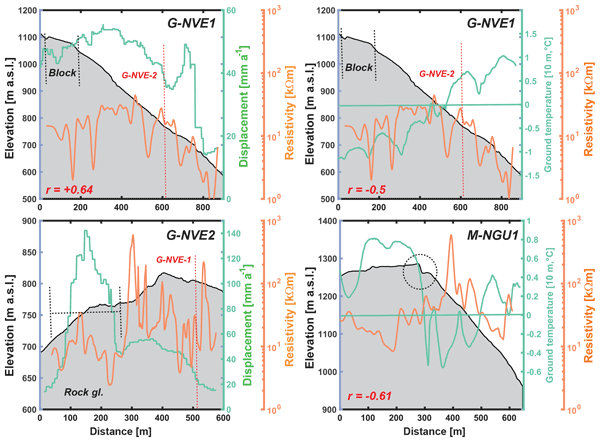
This paper is a multi-authored study documenting the possible existence of permafrost in permanently monitored rockslides in Norway for the first time by combining a multitude of field data, including geophysical surveys in rock walls. The paper discusses the possible role of thermal regime and rockslide movement, and it evaluates the possible impact of atmospheric warming on rockslide dynamics in Norwegian mountains.
Cited articles
Aga, J.: CryoGrid source code for “Modelling climate-induced instability of ice-rich permafrost slopes”, Zenodo [code], https://doi.org/10.5281/zenodo.18492186, 2026. a
Avila-Diaz, A., Bromwich, D. H., Wilson, A. B., Justino, F., and Wang, S.-H.: Climate extremes across the North American Arctic in modern reanalyses, J. Climate, 34, 2385–2410, https://doi.org/10.1175/JCLI-D-20-0093.1, 2021. a, b
Balser, A. W., Jones, J. B., and Gens, R.: Timing of retrogressive thaw slump initiation in the Noatak Basin, northwest Alaska, USA, J. Geophys. Res.-Earth, 119, 1106–1120, https://doi.org/10.1002/2013JF002889, 2014. a, b
Barrere, M., Domine, F., Decharme, B., Morin, S., Vionnet, V., and Lafaysse, M.: Evaluating the performance of coupled snow–soil models in SURFEXv8 to simulate the permafrost thermal regime at a high Arctic site, Geosci. Model Dev., 10, 3461–3479, https://doi.org/10.5194/gmd-10-3461-2017, 2017. a, b
Bernhard, P., Zwieback, S., Bergner, N., and Hajnsek, I.: Assessing volumetric change distributions and scaling relations of retrogressive thaw slumps across the Arctic, The Cryosphere, 16, 1–15, https://doi.org/10.5194/tc-16-1-2022, 2022. a, b
Biskaborn, B. K., Smith, S. L., Noetzli, J., Matthes, H., Vieira, G., Streletskiy, D. A., Schoeneich, P., Romanovsky, V. E., Lewkowicz, A. G., Abramov, A., Allard, M., Boike, J., Cable, W. L., Christiansen, H. H., Delaloye, R., Diekmann, B., Drozdov, D., Etzelmüller, B., Grosse, G., Guglielmin, M., Ingeman-Nielsen, T., Isaksen, K., Ishikawa, M., Johansson, M., Johannsson, H., Joo, A., Kaverin, D., Kholodov, A., Konstantinov, P., Kröger, T., Lambiel, C., Lanckman, J.-P., Luo, D., Malkova, G., Meiklejohn, I., Moskalenko, N., Oliva, M., Phillips, M., Ramos, M., Sannel, A. B. K., Sergeev, D., Seybold, C., Skryabin, P., Vasiliev, A., Wu, Q., Yoshikawa, K., Zheleznyak, M., and Lantuit, H.: Permafrost is warming at a global scale, Nat. Commun., 10, 264, https://doi.org/10.1038/s41467-018-08240-4, 2019. a
Blais-Stevens, A., Kremer, M., Bonnaventure, P. P., Smith, S. L., Lipovsky, P., and Lewkowicz, A. G.: Active layer detachment slides and retrogressive thaw slumps susceptibility mapping for current and future permafrost distribution, Yukon Alaska Highway Corridor, in: Engineering Geology for Society and Territory-Volume 1: Climate Change and Engineering Geology, 449–453, Springer, https://doi.org/10.1007/978-3-319-09300-0_86, 2015. a
Brown, J., Sidlauskas, F. J., and Delinski, G.: Circum-arctic map of permafrost and ground ice conditions, https://web.archive.org/web/20170226114554id_/https://pubs.usgs.gov/cp/45/report.pdf (last access: 1 February 2026), 1997. a
Burn, C. R. and Lewkowicz, A.: Canadian landform examples-17 retrogressive thaw slumps, Can. Geogr.-Geogr. Can., 34, 273–276, https://doi.org/10.1111/j.1541-0064.1990.tb01092.x, 1990. a
Chandler, R. J.: Periglacial mudslides in Vestspitsbergen and their bearing on the origin of fossil ‘solifluction’shears in low angled clay slopes, Q. J. Eng. Geol. Hydroge., 5, 223–241, https://doi.org/10.1144/GSL.QJEG.1972.005.03.02, 1972. a, b
Chen, Y., Cheng, X., Liu, A., Chen, Q., and Wang, C.: Tracking lake drainage events and drained lake basin vegetation dynamics across the Arctic, Nat. Commun., 14, 7359, https://doi.org/10.1038/s41467-023-43207-0, 2023. a
Chiasson-Poirier, G., Franssen, J., Lafrenière, M., Fortier, D., and Lamoureux, S.: Seasonal evolution of active layer thaw depth and hillslope-stream connectivity in a permafrost watershed, Water Resour. Res., 56, https://doi.org/10.1029/2019WR025828, 2020. a
Copernicus Climate Change Service: ERA5 hourly data on single levels from 1940 to present, Copernicus Climate Change Service (C3S) Climate Data Store [data set], https://doi.org/10.24381/cds.adbb2d47, 2023. a
Dai, C., Ward Jones, M. K., van der Sluijs, J., Nesterova, N., Howat, I. M., Liljedahl, A. K., Higman, B., Freymueller, J. T., Kokelj, S. V., and Sriram, S.: Volumetric quantifications and dynamics of areas undergoing retrogressive thaw slumping in the Northern Hemisphere, Nat. Commun., 16, 6795, https://doi.org/10.1038/s41467-025-62017-0, 2025. a, b
Dall'Amico, M., Endrizzi, S., Gruber, S., and Rigon, R.: A robust and energy-conserving model of freezing variably-saturated soil, The Cryosphere, 5, 469–484, https://doi.org/10.5194/tc-5-469-2011, 2011. a
Dumais, S. and Konrad, J.-M.: One-dimensional large-strain thaw consolidation using nonlinear effective stress – void ratio – hydraulic conductivity relationships, Can. Geotech. J., 55, 414–426, https://doi.org/10.1139/cgj-2017-0221, 2018. a
Dumais, S. and Konrad, J.-M.: Large-strain nonlinear thaw consolidation analysis of the Inuvik warm-oil experimental pipeline buried in permafrost, J. Cold Reg. Eng., 33, 04018014, https://doi.org/10.1061/(ASCE)CR.1943-5495.0000179, 2019. a
Evans, S. G., Godsey, S. E., Rushlow, C. R., and Voss, C.: Water tracks enhance water flow above permafrost in upland Arctic Alaska hillslopes, J. Geophys. Res.-Earth, 125, https://doi.org/10.1029/2019JF005256, 2020. a
Farquharson, L. M., Romanovsky, V. E., Cable, W. L., Walker, D. A., Kokelj, S. V., and Nicolsky, D.: Climate change drives widespread and rapid thermokarst development in very cold permafrost in the Canadian High Arctic, Geophys. Res. Lett., 46, 6681–6689, https://doi.org/10.1029/2019GL082187, 2019. a
Feng, H.-P., Su, B., Duan, J.-P., Zhao, H.-Y., Zhang, T., and Xiao, C.-D.: Increasing extreme heat events in the permafrost region of the Northern Hemisphere, Adv. Clim. Change Res., https://doi.org/10.1016/j.accre.2025.11.001, 2025. a
Fiddes, J. and Gruber, S.: TopoSUB: a tool for efficient large area numerical modelling in complex topography at sub-grid scales, Geosci. Model Dev., 5, 1245–1257, https://doi.org/10.5194/gmd-5-1245-2012, 2012. a
Fiddes, J. and Gruber, S.: TopoSCALE v.1.0: downscaling gridded climate data in complex terrain, Geosci. Model Dev., 7, 387–405, https://doi.org/10.5194/gmd-7-387-2014, 2014. a
Fiolleau, S., Uhlemann, S., Shirley, I., Wang, C., Wielandt, S., Rowland, J., and Dafflon, B.: Insights on seasonal solifluction processes in warm permafrost Arctic landscape using a dense monitoring approach across adjacent hillslopes, Environ. Res. Lett., 19, 044021, https://doi.org/10.1088/1748-9326/ad28dc, 2024. a
Fraser, R. H., Kokelj, S. V., Lantz, T. C., McFarlane-Winchester, M., Olthof, I., and Lacelle, D.: Climate sensitivity of high Arctic permafrost terrain demonstrated by widespread ice-wedge thermokarst on Banks Island, Remote Sens., 10, 954, https://doi.org/10.3390/rs10060954, 2018. a
French, H.: Active thermokarst processes, eastern Banks Island, western Canadian arctic, Can. J. Earth Sci., 11, 785–794, https://doi.org/10.1139/e74-078, 1974. a
Galley, R., Key, E., Barber, D., Hwang, B., and Ehn, J.: Spatial and temporal variability of sea ice in the southern Beaufort Sea and Amundsen Gulf: 1980–2004, J. Geophys. Res.-Oceans, 113, https://doi.org/10.1029/2007JC004553, 2008. a
Griffiths, D., Huang, J., and Fenton, G. A.: Probabilistic infinite slope analysis, Comput. Geotech., 38, 577–584, https://doi.org/10.1016/j.compgeo.2011.03.006, 2011. a
Gudehus, G.: Bodenmechanik, https://trid.trb.org/View/1039033 (last access: 1 February 2026), 1981. a
Hansson, K., Sǐmunek, J., Mizoguchi, M., Lundin, L.-C., and Van Genuchten, M. T.: Water flow and heat transport in frozen soil: Numerical solution and freeze–thaw applications, Vadose Zone J., 3, 693–704, https://doi.org/10.2113/3.2.693, 2004. a
Harris, C. and Lewkowicz, A. G.: An analysis of the stability of thawing slopes, Ellesmere Island, Nunavut, Canada, Can. Geotech. J., 37, 449–462, https://doi.org/10.1139/t99-118, 2000. a
Heijmans, M. M., Magnússon, R. Í., Lara, M. J., Frost, G. V., Myers-Smith, I. H., van Huissteden, J., Jorgenson, M. T., Fedorov, A. N., Epstein, H. E., Lawrence, D. M., and Limpens, J.: Tundra vegetation change and impacts on permafrost, Nat. Rev. Earth Environ., 3, 68–84, https://doi.org/10.1038/s43017-021-00233-0, 2022. a
Hersbach, H., Bell, B., Berrisford, P., Biavati, G., Horányi, A., Muñoz Sabater, J., Nicolas, J., Peubey, C., Radu, R., Rozum, I., Schepers, D., Simmons, A., Soci, C., Dee, D., Thépaut, J-N.: ERA5 hourly data on single levels from 1940 to present, Copernicus Climate Change Service (C3S) Climate Data Store [data set], https://doi.org/10.24381/cds.adbb2d47, 2018. a
Hersbach, H., Bell, B., Berrisford, P., Hirahara, S., Horányi, A., Muñoz-Sabater, J., Nicolas, J., Peubey, C., Radu, R., Schepers, D., Simmons, A., Soci, C., Abdalla, S., Abellan, X., Balsamo, G., Bechtold, P., Biavati, G., Bidlot, J., Bonavita, M., De Chiara, G., Dahlgren, P., Dee, D., Diamantakis, M., Dragani, R., Flemming, J., Forbes, R., Fuentes, M., Geer, A., Haimberger, L., Healy, S., Hogan, R. J., Hólm, E., Janisková, M., Keeley, S., Laloyaux, P., Lopez, P., Lupu, C., Radnoti, G., de Rosnay, P., Rozum, I., Vamborg, F., Villaume, S., and Thépaut, J.-N.: The ERA5 global reanalysis, Q. J. R. Meteorol. Soc., 146, 1999–2049, https://doi.org/10.1002/qj.3803, 2020. a
Hjort, J., Streletskiy, D., Doré, G., Wu, Q., Bjella, K., and Luoto, M.: Impacts of permafrost degradation on infrastructure, Nat. Rev. Earth Environ., 3, 24–38, https://doi.org/10.1038/s43017-021-00247-8, 2022. a
Holloway, J. E., Lewkowicz, A. G., Douglas, T. A., Li, X., Turetsky, M. R., Baltzer, J. L., and Jin, H.: Impact of wildfire on permafrost landscapes: A review of recent advances and future prospects, Permafrost Periglac., 31, 371–382, https://doi.org/10.1002/ppp.2048, 2020. a
Hutchinson, J.: Periglacial solifluxion: an approximate mechanism for clayey soils, Geotechnique, 24, 438–443, https://doi.org/10.1680/geot.1974.24.3.438, 1974. a, b
Jones, B. M., Grosse, G., Arp, C., Jones, M., Walter Anthony, K., and Romanovsky, V.: Modern thermokarst lake dynamics in the continuous permafrost zone, northern Seward Peninsula, Alaska, J. Geophys. Res.-Biogeosci., 116, https://doi.org/10.1029/2011JG001666, 2011. a
Jones, B. M., Grosse, G., Arp, C. D., Miller, E., Liu, L., Hayes, D. J., and Larsen, C. F.: Recent Arctic tundra fire initiates widespread thermokarst development, Sci. Rep., 5, 15865, https://doi.org/10.1038/srep15865, 2015. a
Jorgenson, M. and Osterkamp, T.: Response of boreal ecosystems to varying modes of permafrost degradation, Can. J. Forest Res., 35, 2100–2111, https://doi.org/10.1139/x05-153, 2005. a
Kizyakov, A. I., Wetterich, S., Günther, F., Opel, T., Jongejans, L. L., Courtin, J., Meyer, H., Shepelev, A. G., Syromyatnikov, I. I., Fedorov, A. N., Zimin, M. V., and Grosse, G.: Landforms and degradation pattern of the Batagay thaw slump, Northeastern Siberia, Geomorphology, 420, 108501, https://doi.org/10.1016/j.geomorph.2022.108501, 2023. a
Kokelj, S. V. and Jorgenson, M.: Advances in thermokarst research, Permafrost Periglac., 24, 108–119, https://doi.org/10.1002/ppp.1779, 2013. a
Kokelj, S. V., Lacelle, D., Lantz, T., Tunnicliffe, J., Malone, L., Clark, I., and Chin, K.: Thawing of massive ground ice in mega slumps drives increases in stream sediment and solute flux across a range of watershed scales, J. Geophys. Res.-Earth, 118, 681–692, https://doi.org/10.1002/jgrf.20063, 2013. a
Kokelj, S. V., Kokoszka, J., van der Sluijs, J., Rudy, A. C. A., Tunnicliffe, J., Shakil, S., Tank, S. E., and Zolkos, S.: Thaw-driven mass wasting couples slopes with downstream systems, and effects propagate through Arctic drainage networks, The Cryosphere, 15, 3059–3081, https://doi.org/10.5194/tc-15-3059-2021, 2021. a
Lacelle, D., Bjornson, J., and Lauriol, B.: Climatic and geomorphic factors affecting contemporary (1950–2004) activity of retrogressive thaw slumps on the Aklavik Plateau, Richardson Mountains, NWT, Canada, Permafrost Periglac., 21, 1–15, https://doi.org/10.1002/ppp.666, 2010. a, b
Lakeman, T. R. and England, J. H.: Paleoglaciological insights from the age and morphology of the Jesse moraine belt, western Canadian Arctic, Quaternary Sci. Rev., 47, 82–100, https://doi.org/10.1016/j.quascirev.2012.04.018, 2012. a, b, c
Lamoureux, S. F. and Lafrenière, M. J.: Fluvial impact of extensive active layer detachments, Cape Bounty, Melville Island, Canada, Arctic, Antarctic, and Alpine Research, 41, 59–68, https://doi.org/10.1657/1523-0430-41.1.59, 2009. a, b, c
Langer, M., Nitzbon, J., Groenke, B., Assmann, L.-M., Schneider von Deimling, T., Stuenzi, S. M., and Westermann, S.: The evolution of Arctic permafrost over the last 3 centuries from ensemble simulations with the CryoGridLite permafrost model, The Cryosphere, 18, 363–385, https://doi.org/10.5194/tc-18-363-2024, 2024. a
Leibman, M., Nesterova, N., and Altukhov, M.: Distribution and morphometry of thermocirques in the north of west siberia, russia, Geosciences, 13, 167, https://doi.org/10.3390/geosciences13060167, 2023. a, b
Lewkowicz, A. G.: Nature and importance of thermokarst processes, Sand Hills moraine, Banks Island, Canada, Geogr. Ann. A, 69, 321–327, https://doi.org/10.1080/04353676.1987.11880218, 1987. a
Lewkowicz, A. G.: Dynamics of active-layer detachment failures, Fosheim peninsula, Ellesmere Island, Nunavut, Canada, Permafrost Periglac., 18, 89–103, https://doi.org/10.1002/ppp.578, 2007. a, b, c
Lewkowicz, A. G.: Retrogressive thaw slump activity in the western Canadian Arctic (1984–2016), in: Proceedings, edited by: Beddoe, R. and Karunaratne, K., 12th International Conference on Permafrost, Whitehorse, Canada, vol. 1, 216–223, https://doi.org/10.52381/ICOP2024.213.1, 2024. a
Lewkowicz, A. G., O'Neill, H. B., Wolfe, S. A., Roy-Léveillée, P., Roujanski, V. E., Hoever, E., Gruber, S., Brooks, H., Rudy, A. C., Koenig, C. E., Brown, N., and Bonnaventure, P. P.: Glossary of Permafrost Science and Engineering, https://doi.org/10.3138/cpa-gpse, 2025. a, b
Li, X., Zhao, L., Wang, S., Cheng, X., and Wang, L.: Unstable permafrost regions experience more severe heatwaves in a warming climate, npj Climate and Atmospheric Science, 8, 147, https://doi.org/10.1038/s41612-025-01037-5, 2025. a
Li, Y., Liu, Y., Chen, J., Dang, H., Zhang, S., Mei, Q., Zhao, J., Wang, J., Dong, T., and Zhao, Y.: Advances in retrogressive thaw slump research in permafrost regions, Permafrost Periglac., 35, 125–142, https://doi.org/10.1002/ppp.2218, 2024. a
Lipovsky, P. S., Coates, J., Lewkowicz, A. G., and Trochim, E.: Active-layer detachments following the summer 2004 forest fires near Dawson City, Yukon, Yukon exploration and geology, https://emrlibrary.gov.yk.ca/ygs/yeg/2005/2005_p175-194.pdf (last access: 1 February 2026), 175–194, 2005. a
Liu, L., Schaefer, K., Chen, A., Gusmeroli, A., Zebker, H., and Zhang, T.: Remote sensing measurements of thermokarst subsidence using InSAR, J. Geophys. Res.-Earth, 120, 1935–1948, https://doi.org/10.1002/2015JF003599, 2015. a
Liu, Q., Huang, D., Tang, A., and Han, X.: Model performance analysis for landslide susceptibility in cold regions using accuracy rate and fluctuation characteristics, Nat. Hazards, 108, 1047–1067, https://doi.org/10.1007/s11069-021-04719-4, 2021. a
Makopoulou, E., Karjalainen, O., Elia, L., Blais-Stevens, A., Lantz, T., Lipovsky, P., Lombardo, L., Nicu, I. C., Rubensdotter, L., Rudy, A. C., and Hjort, J.: Retrogressive thaw slump susceptibility in the northern hemisphere permafrost region, Earth Surf. Proc. Land., 49, 3319–3331, https://doi.org/10.1002/esp.5890, 2024. a
Makopoulou, E., Karjalainen, O., Lipovsky, P., Blais-Stevens, A., and Hjort, J.: Susceptibility of active-layer detachment failures and vulnerability of infrastructure in Alaska and northwestern Canada, Landslides, 22, 3561–3575, https://doi.org/10.1007/s10346-025-02603-x, 2025. a
Malone, L., Lacelle, D., Kokelj, S., and Clark, I. D.: Impacts of hillslope thaw slumps on the geochemistry of permafrost catchments (Stony Creek watershed, NWT, Canada), Chem. Geol., 356, 38–49, https://doi.org/10.1016/j.chemgeo.2013.07.010, 2013. a
Martin, L. C. P., Nitzbon, J., Scheer, J., Aas, K. S., Eiken, T., Langer, M., Filhol, S., Etzelmüller, B., and Westermann, S.: Lateral thermokarst patterns in permafrost peat plateaus in northern Norway, The Cryosphere, 15, 3423–3442, https://doi.org/10.5194/tc-15-3423-2021, 2021. a, b
McRoberts, E. and Morgenstern, N. R.: The stability of thawing slopes, Can. Geotech. J., 11, 447–469, https://doi.org/10.1139/t74-052, 1974. a, b, c, d
Milledge, D., Griffiths, D., Lane, S., and Warburton, J.: Limits on the validity of infinite length assumptions for modelling shallow landslides, Earth Surf. Proc. Land., 37, 1158–1166, https://doi.org/10.1002/esp.3235, 2012. a
Miner, K. R., Turetsky, M. R., Malina, E., Bartsch, A., Tamminen, J., McGuire, A. D., Fix, A., Sweeney, C., Elder, C. D., and Miller, C. E.: Permafrost carbon emissions in a changing Arctic, Nat. Rev. Earth Environ., 3, 55–67, https://doi.org/10.1038/s43017-021-00230-3, 2022. a, b
Morgenstern, N. T. and Nixon, J.: One-dimensional consolidation of thawing soils, Can. Geotech. J., 8, 558–565, https://doi.org/10.1139/t71-057, 1971. a
Mu, C., Shang, J., Zhang, T., Fan, C., Wang, S., Peng, X., Zhong, W., Zhang, F., Mu, M., and Jia, L.: Acceleration of thaw slump during 1997–2017 in the Qilian Mountains of the northern Qinghai-Tibetan plateau, Landslides, 17, 1051–1062, https://doi.org/10.1007/s10346-020-01344-3, 2020. a
Nater, P., Arenson, L. U., and Springman, S. M.: Choosing geotechnical parameters for slope stability assessments in alpine permafrost soils, in: Ninth International Conference on Permafrost, University of Alaska Fairbanks, vol. 29, 1261–1266, https://www.researchgate.net/profile/Philippe-Nater (last access: 1 February 2026), 2008. a, b
Nesterova, N., Khomutov, A., Leibman, M., Safonov, T., and Belova, N.: The inventory of retrogressive thaw slumps (thermocirques) in the north of West Siberia based on 2016–2018 satellite imagery mosaic, Earth’s Cryosphere, 25, 34–41, https://doi.org/10.15372/KZ20210604, 2021. a
Nesterova, N., Leibman, M., Kizyakov, A., Lantuit, H., Tarasevich, I., Nitze, I., Veremeeva, A., and Grosse, G.: Review article: Retrogressive thaw slump characteristics and terminology, The Cryosphere, 18, 4787–4810, https://doi.org/10.5194/tc-18-4787-2024, 2024. a, b, c, d
Nitzbon, J., Langer, M., Westermann, S., Martin, L., Aas, K. S., and Boike, J.: Pathways of ice-wedge degradation in polygonal tundra under different hydrological conditions, The Cryosphere, 13, 1089–1123, https://doi.org/10.5194/tc-13-1089-2019, 2019. a, b
Nitzbon, J., Westermann, S., Langer, M., Martin, L. C., Strauss, J., Laboor, S., and Boike, J.: Fast response of cold ice-rich permafrost in northeast Siberia to a warming climate, Nat. Commun., 11, 2201, https://doi.org/10.1038/s41467-020-15725-8, 2020. a, b
Nitze, I., Heidler, K., Nesterova, N., Küpper, J., Schütt, E., Hölzer, T., Barth, S., Lara, M. J., Liljedahl, A. K., and Grosse, G.: DARTS: Multi-year database of AI-detected retrogressive thaw slumps in the circum-arctic permafrost region, Sci. Data, 12, 1512, https://doi.org/10.1038/s41597-025-05810-2, 2025. a
Niu, F., Luo, J., Lin, Z., Liu, M., and Yin, G.: Thaw-induced slope failures and susceptibility mapping in permafrost regions of the Qinghai–Tibet Engineering Corridor, China, Nat. Hazards, 74, 1667–1682, https://doi.org/10.1007/s11069-014-1267-4, 2014. a
Niu, F., Luo, J., Lin, Z., Fang, J., and Liu, M.: Thaw-induced slope failures and stability analyses in permafrost regions of the Qinghai-Tibet Plateau, China, Landslides, 13, 55–65, https://doi.org/10.1007/s10346-014-0545-2, 2016. a, b, c
Olefeldt, D., Goswami, S., Grosse, G., Hayes, D., Hugelius, G., Kuhry, P., McGuire, A. D., Romanovsky, V., Sannel, A. B. K., Schuur, E., and Turetsky, M. R.: Circumpolar distribution and carbon storage of thermokarst landscapes, Nat. Commun., 7, 13043, https://doi.org/10.1038/ncomms13043, 2016. a
O'Neill, H., Wolfe, S., and Duchesne, C.: Ground ice map of Canada, Geological Survey of Canada, Open file, Natural Resources Canada, 8713, 8, https://doi.org/10.4095/330294, 2022. a, b
O'Neill, H. B., Wolfe, S. A., and Duchesne, C.: New ground ice maps for Canada using a paleogeographic modelling approach, The Cryosphere, 13, 753–773, https://doi.org/10.5194/tc-13-753-2019, 2019. a, b
Painter, S. L. and Karra, S.: Constitutive model for unfrozen water content in subfreezing unsaturated soils, Vadose Zone J., 13, https://doi.org/10.2136/vzj2013.04.0071, 2014. a
Pernov, J. B., Gros-Daillon, J., and Schmale, J.: Comparison of selected surface level ERA5 variables against in-situ observations in the continental Arctic, Q. J. R. Meteorol. Soc., 150, 2123–2146, https://doi.org/10.1002/qj.4700, 2024. a
Pham, B. T., Pradhan, B., Bui, D. T., Prakash, I., and Dholakia, M.: A comparative study of different machine learning methods for landslide susceptibility assessment: A case study of Uttarakhand area (India), Environ. Modell. Softw., 84, 240–250, https://doi.org/10.1016/j.envsoft.2016.07.005, 2016. a
Porter, C., Howat, I., Noh, M.-J., Husby, E., Khuvis, S., Danish, E., Tomko, K., Gardiner, J., Negrete, A., Yadav, B., Klassen, J., Kelleher, C., Cloutier, M., Bakker, J., Enos, J., Arnold, G., Bauer, G., and Morin, P.: ArcticDEM – Mosaics, Version 4.1, Harvard Dataverse [data set], https://doi.org/10.7910/DVN/3VDC4W, 2023. a, b
Prinz, H. and Strauß, R.: Ingenieurgeologie, Springer-Verlag, ISBN: 978-3-8274-2472-3, 2012. a
Raynolds, M. K., Walker, D. A., Balser, A., Bay, C., Campbell, M., Cherosov, M. M., Daniëls, F. J., Eidesen, P. B., Ermokhina, K. A., Frost, G. V., Jedrzejek, B., Torre Jorgenson, M., Kennedy, B. E., Kholod, S. S., Lavrinenko, I. A., Lavrinenko, O. V., Magnússon, B., Matveyeva, N. V., Metúsalemsson, S., Nilsen, L., Olthof, I., Pospelov, I. N., Pospelova, E. B., Pouliot, D., Razzhivin, V., Schaepman-Strub, G., Šibík, J., Telyatnikov, M. Y., and Troeva, E.: A raster version of the Circumpolar Arctic Vegetation Map (CAVM), Remote Sens. Environ., 232, 111297, https://doi.org/10.1016/j.rse.2019.111297, 2019. a
Renfrew, I. A., Barrell, C., Elvidge, A., Brooke, J., Duscha, C., King, J., Kristiansen, J., Cope, T. L., Moore, G. W. K., Pickart, R. S., Reuder, J., Sandu, I., Sergeev, D., Terpstra, A., Våge, K., and Weiss, A.: An evaluation of surface meteorology and fluxes over the Iceland and Greenland Seas in ERA5 reanalysis: The impact of sea ice distribution, Q. J. R. Meteorol. Soc., 147, 691–712, https://doi.org/10.1002/qj.3941, 2021. a, b
Richards, L. A.: Capillary conduction of liquids through porous mediums, Physics, 1, 318–333, 1931. a
Royer, A., Picard, G., Vargel, C., Langlois, A., Gouttevin, I., and Dumont, M.: Improved Simulation of Arctic Circumpolar Land Area Snow Properties and Soil Temperatures, Front. Earth Sci., 9, 515, https://doi.org/10.3389/feart.2021.685140, 2021. a, b
Rudy, A. C., Lamoureux, S. F., Treitz, P., Ewijk, K. V., Bonnaventure, P. P., and Budkewitsch, P.: Terrain controls and landscape-scale susceptibility modelling of active-layer detachments, Sabine Peninsula, Melville Island, Nunavut, Permafrost Periglac., 28, 79–91, https://doi.org/10.1002/ppp.1900, 2017. a
Schmidt, J. U., Etzelmüller, B., Schuler, T. V., Magnin, F., Boike, J., Langer, M., and Westermann, S.: Surface temperatures and their influence on the permafrost thermal regime in high-Arctic rock walls on Svalbard, The Cryosphere, 15, 2491–2509, https://doi.org/10.5194/tc-15-2491-2021, 2021. a
Schuur, E. A., Bockheim, J., Canadell, J. G., Euskirchen, E., Field, C. B., Goryachkin, S. V., Hagemann, S., Kuhry, P., Lafleur, P. M., Lee, H., Mazhitova, G., Nelson, F. E., Rinke, A., Romanovsky, V. E., Shiklomanov, N., Tarnocai, C., Venevsky, S., Vogel, J. G., and Zimov, S. A.: Vulnerability of permafrost carbon to climate change: Implications for the global carbon cycle, BioScience, 58, 701–714, https://doi.org/10.1641/B580807, 2008. a
Segal, R. A., Lantz, T. C., and Kokelj, S. V.: Acceleration of thaw slump activity in glaciated landscapes of the Western Canadian Arctic, Environ. Res. Lett., 11, 034025, https://doi.org/10.1088/1748-9326/11/3/034025, 2016. a
Sheridan, S. C., Lee, C. C., and Smith, E. T.: A comparison between station observations and reanalysis data in the identification of extreme temperature events, Geophys. Res. Lett., 47, https://doi.org/10.1029/2020GL088120, 2020. a
Swanson, D. K.: Permafrost thaw-related slope failures in Alaska’s Arctic National Parks, c. 1980–2019, Permafrost Periglac., 32, 392–406, https://doi.org/10.1002/ppp.2098, 2021. a
Turetsky, M. R., Abbott, B. W., Jones, M. C., Walter Anthony, K., Olefeldt, D., Schuur, E. A., Koven, C., McGuire, A. D., Grosse, G., Kuhry, P., Hugelius, G., Lawrence, D. M., Gibson, C., and Sannel, A. B. K.: Permafrost collapse is accelerating carbon release, Nature, 569, 32–34, https://doi.org/10.1038/d41586-019-01313-4, 2019. a
Turetsky, M. R., Abbott, B. W., Jones, M. C., Anthony, K. W., Olefeldt, D., Schuur, E. A., Grosse, G., Kuhry, P., Hugelius, G., Koven, C., Lawrence, D. M., Gibson, C., Sannel, A. B. K., and McGuire, A. D.: Carbon release through abrupt permafrost thaw, Nat. Geosci., 13, 138–143, https://doi.org/10.1038/s41561-019-0526-0, 2020. a
Van Genuchten, M. T.: A closed-form equation for predicting the hydraulic conductivity of unsaturated soils, Soil Sci. Soc. Am. J., 44, 892–898, https://doi.org/10.2136/sssaj1980.03615995004400050002x, 1980. a, b, c
Vargas Ceron, M., Cecílio, D. L., Linn, R. V., and Maghous, S.: Stability Analysis of Slope Subjected to Seepage Forces Considering Spatial Variability of Soil Properties, Int. J. Numer. Anal. Met., 49, 2459–2491, https://doi.org/10.1002/nag.3993, 2025. a
Vincent, J.-S.: The Quaternary history of Banks Island, NWT, Canada, Geogr. Phys. Quatern., 36, 209–232, https://doi.org/10.7202/032478ar, 1982. a
Vionnet, V., Brun, E., Morin, S., Boone, A., Faroux, S., Le Moigne, P., Martin, E., and Willemet, J.-M.: The detailed snowpack scheme Crocus and its implementation in SURFEX v7.2, Geosci. Model Dev., 5, 773–791, https://doi.org/10.5194/gmd-5-773-2012, 2012. a
Westermann, S., Langer, M., Boike, J., Heikenfeld, M., Peter, M., Etzelmüller, B., and Krinner, G.: Simulating the thermal regime and thaw processes of ice-rich permafrost ground with the land-surface model CryoGrid 3, Geosci. Model Dev., 9, 523–546, https://doi.org/10.5194/gmd-9-523-2016, 2016. a, b, c, d
Westermann, S., Ingeman-Nielsen, T., Scheer, J., Aalstad, K., Aga, J., Chaudhary, N., Etzelmüller, B., Filhol, S., Kääb, A., Renette, C., Schmidt, L. S., Schuler, T. V., Zweigel, R. B., Martin, L., Morard, S., Ben-Asher, M., Angelopoulos, M., Boike, J., Groenke, B., Miesner, F., Nitzbon, J., Overduin, P., Stuenzi, S. M., and Langer, M.: The CryoGrid community model (version 1.0) – a multi-physics toolbox for climate-driven simulations in the terrestrial cryosphere, Geosci. Model Dev., 16, 2607–2647, https://doi.org/10.5194/gmd-16-2607-2023, 2023. a, b, c, d, e, f, g, h, i, j, k, l
Yin, G., Luo, J., Niu, F., Lin, Z., and Liu, M.: Machine learning-based thermokarst landslide susceptibility modeling across the permafrost region on the Qinghai-Tibet Plateau, Landslides, 18, 2639–2649, https://doi.org/10.1007/s10346-021-01669-7, 2021. a
Zhang, H., Liu, X., Cao, C., Ma, X., Yao, X., Wang, W., Zhou, R., and Wang, L.: Study on stability of permafrost slopes during thawing, Research in Cold and Arid Regions, 14, 293–297, https://doi.org/10.1016/j.rcar.2022.12.004, 2022. a, b
Zhang, Z., Wang, Y., Ma, Z., Lv, M., and Gao, Z.: Thaw slump development in permafrost regions alters the soil hydrothermal processes and responses to precipitation, Eng. Geol., 108183, https://doi.org/10.1016/j.enggeo.2025.108183, 2025. a
Zweigel, R. B., Westermann, S., Nitzbon, J., Langer, M., Boike, J., Etzelmüller, B., and Vikhamar Schuler, T.: Simulating snow redistribution and its effect on ground surface temperature at a high-Arctic site on Svalbard, J. Geophys. Res.-Earth, 126, https://doi.org/10.1029/2020JF005673, 2021. a, b, c, d
Zweigel, R. B., Dashtseren, A., Temuujin, K., Aalstad, K., Webster, C., Stuenzi, S. M., Aas, K. S., Lee, H., and Westermann, S.: Simulating the thermal regime and surface energy balance of a permafrost-underlain forest in Mongolia, J. Geophys. Res.-Earth, 129, https://doi.org/10.1029/2023JF007609, 2024. a
Short summary
In this study, we explore the influence of a warming climate on landslides in ice-rich permafrost slopes. Using climate, terrain and soil data, we built a model that simulates permafrost thaw and its impact on slope stability over time. We tested the model on Banks Island, Canada, and it reproduced years with many new landslide observations and identified the most susceptible slopes. The model can also be applied to other permafrost regions, and to both past and future climate conditions.
In this study, we explore the influence of a warming climate on landslides in ice-rich...


