
Articles | Volume 20, issue 6
https://doi.org/10.5194/tc-20-3369-2026
© Author(s) 2026. This work is distributed under
the Creative Commons Attribution 4.0 License.
the Creative Commons Attribution 4.0 License.
https://doi.org/10.5194/tc-20-3369-2026
© Author(s) 2026. This work is distributed under
the Creative Commons Attribution 4.0 License.
the Creative Commons Attribution 4.0 License.
Research article
| 
11 Jun 2026
Research article |
| 11 Jun 2026
| 11 Jun 2026
A multisensor C-band synthetic aperture radar (SAR) approach to retrieve freeze/thaw cycles: a case study for a low Arctic environment
Charlotte Crevier
Centre d'Applications et de Recherches en Télédétection (CARTEL), Université de Sherbrooke, Sherbrooke, J1K 2R1, Canada
Centre d'Études Nordiques, Université Laval, Québec, QC, G1V 0A6, Canada
Alexandre Langlois
Centre d'Applications et de Recherches en Télédétection (CARTEL), Université de Sherbrooke, Sherbrooke, J1K 2R1, Canada
Centre d'Études Nordiques, Université Laval, Québec, QC, G1V 0A6, Canada
Chris Derksen
Environment and Climate Change Canada, Climate Research Division, Toronto, ON, M3H 5T4, Canada

Centre d'Études Nordiques, Université Laval, Québec, QC, G1V 0A6, Canada
Département des Sciences de l'Environnement, Université du Québec à Trois-Rivières, Trois-Rivières, QC, G9A 5H7, Canada
Related authors
No articles found.
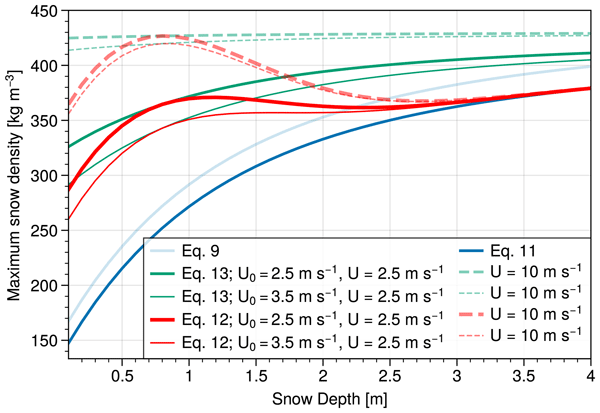
Mickaël Lalande, Alexandre Roy, Libo Wang, Diana Verseghy, Vincent Vionnet, Florent Dominé, and Christophe Kinnard
Geosci. Model Dev., 19, 9581–9625, https://doi.org/10.5194/gmd-19-9581-2026, https://doi.org/10.5194/gmd-19-9581-2026, 2026
Short summary
Short summary
This study enhances a snow model for Arctic environments by improving the heat exchanges within the snowpack and at its interfaces, revising the compaction scheme, and adding consideration of blowing snow sublimation losses. Simulations at ten Arctic, mid-latitude, and Alpine sites show significant reductions in simulated soil and snow temperature biases and improved simulated snow depth and density, which are key features to improve simulated energy, water, and carbon budgets in the Arctic.
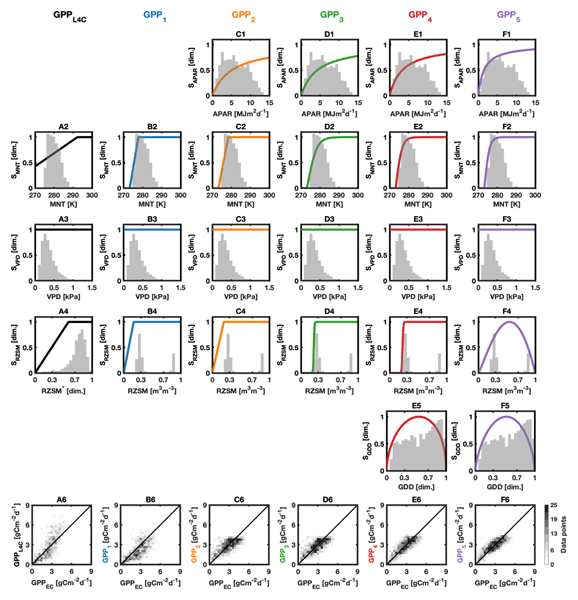
Rémi Madelon, K. Arthur Endsley, John S. Kimball, Gabriëlle J. M. De Lannoy, Oliver Sonnentag, Haley Alcock, Alex Mavrovic, Scott N. Williamson, Vincent Maire, Arnaud Mialon, and Alexandre Roy
Biogeosciences, 23, 6359–6407, https://doi.org/10.5194/bg-23-6359-2026, https://doi.org/10.5194/bg-23-6359-2026, 2026
Short summary
Short summary
This study aims to improve estimates of carbon dioxide release and uptake in the North American Arctic and subarctic regions. Several modeling approaches were tested, showing that a better representation of sunlight and temperature effects on ecosystems leads to improved estimates. This work provides new perspectives to better assess whether these regions act as sources or sinks of greenhouse gases and how they may influence the climate system by amplifying or slowing global warming.
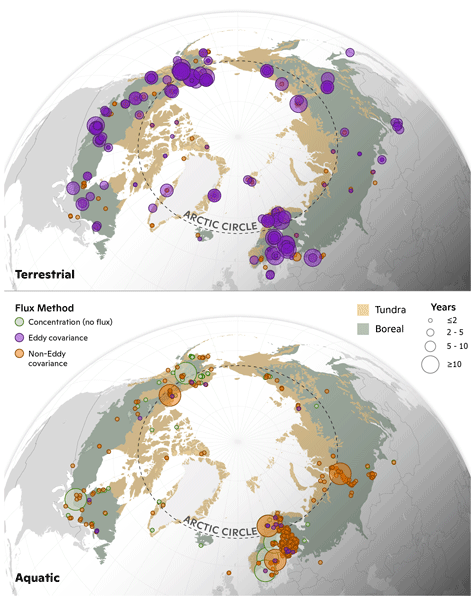
Anna-Maria Virkkala, Isabel Wargowsky, Judith Vogt, McKenzie A. Kuhn, Simran Madaan, Tiffany Windholz, Kyle A. Arndt, Gerard Rocher-Ros, Mathias Göckede, David Olefeldt, Edward A. G. Schuur, David Bastviken, Richard O'Keefe, Brendan M. Rogers, Jennifer D. Watts, Kelcy Kent, Kristoffer Aalstad, Kelly Aho, Joonatan Ala-Könni, Haley Alcock, Inge Althuizen, Christopher D. Arp, Jun Asanuma, Mika Aurela, Sivakiruthika Balathandayuthabani, Katrin Attermeyer, Alan Barr, Maialen Barret, Ochirbat Batkhishig, Christina Biasi, Mats P. Björkman, Andrew Black, Elena Blanc-Betes, Pascal Bodmer, Julia Boike, Abdullah Bolek, Frédéric Bouchard, Ingeborg Bussmann, Lea Cabrol, Eleonora Canfora, Sean Carey, Karel Castro-Morales, Namyi Chae, Andreas Christen, Torben R. Christensen, Casper T. Christiansen, Housen Chu, Graham Clark, Francois Clayer, Patrick Crill, Christopher Cunada, Scott J. Davidson, Joshua F. Dean, Sigrid Dengel, Matteo Detto, Catherine Dieleman, Florent Domine, Egor Dyukarev, Colin Edgar, Bo Elberling, Craig A. Emmerton, Eugenie Euskirchen, Grant Falvo, Thomas Friborg, Michelle Garneau, Mariasilvia Giamberini, Mikhail V. Glagolev, Miquel A. Gonzalez-Meler, Gustaf Granath, Jón Guðmundsson, Konsta Happonen, Yoshinobu Harazono, Lorna Harris, Josh Hashemi, Nicholas Hasson, Janna Heerah, Liam Heffernan, Manuel Helbig, Warren Helgason, Michal Heliasz, Greg Henry, Geert Hensgens, Tetsuya Hiyama, Beth Holmes, Macall Hock, David Holl, Jutta Holst, Thomas Holst, Gabriel Hould-Gosselin, Elyn Humphreys, Jacqueline Hung, Jussi Huotari, Hiroki Ikawa, Danil V. Ilyasov, Mamoru Ishikawa, Go Iwahana, Hiroki Iwata, Marcin Antoni Jackowicz-Korczynski, Joachim Jansen, Järvi Järveoja, Vincent E. J. Jassey, Rasmus Jensen, Katharina Jentzsch, Robert G. Jespersen, Carl-Fredrik Johannesson, Cheristy P. Jones, Anders Jonsson, Ji Young Jung, Sari Juutinen, Evan Kane, Jan Karlsson, Sergey Karsanaev, Kuno Kasak, Julia Kelly, Kasha Kempton, Marcus Klaus, George W. Kling, Natascha Kljun, Jacqueline Knutson, Hideki Kobayashi, John Kochendorfer, Kukka-Maaria Kohonen, Pasi Kolari, Mika Korkiakoski, Aino Korrensalo, Pirkko Kortelainen, Egle Koster, Kajar Koster, Ayumi Kotani, Praveena Krishnan, Juliya Kurbatova, Lars Kutzbach, Min Jung Kwon, Ethan D. Kyzivat, Jessica Lagroix, Theodore Langhorst, Elena Lapshina, Tuula Larmola, Klaus S. Larsen, Isabelle Laurion, Justin Ledman, Hanna Lee, A. Joshua Leffler, Lance Lesack, Anders Lindroth, David Lipson, Annalea Lohila, Efrén López-Blanco, Vincent L. St. Louis, Erik Lundin, Miska Luoto, Takashi Machimura, Marta Magnani, Avni Malhotra, Marja Maljanen, Ivan Mammarella, Elisa Männistö, Luca Belelli Marchesini, Phil Marsh, Pertti J. Martikainen, Maija E. Marushchak, Mikhail Mastepanov, Alex Mavrovic, Trofim Maximov, Christina Minions, Daniel F. Nadeau, Marco Montemayor, Tomoaki Morishita, Patrick Murphy, Erin Nicholls, Mats B. Nilsson, Anastasia Niyazova, Jenni Nordén, Koffi Dodji Noumonvi, Hannu Nykänen, Walter Oechel, Anne Ojala, Tomohiro Okadera, Sujan Pal, Alexey V. Panov, Tim Papakyriakou, Dario Papale, Sang-Jong Park, Frans-Jan W. Parmentier, Gilberto Pastorello, Mike Peacock, Matthias Peichl, Roman Petrov, Kyra St. Pierre, Norbert Pirk, Jessica Plein, Vilmantas Preskienis, Anatoly Prokushkin, Jukka Pumpanen, Hilary A. Rains, Niklas Rakos, Aleksi Räsänen, Helena Rautakoski, Riikka Rinnan, Janne Rinne, Adrian Rocha, Nigel Roulet, Alexandre Roy, Anna Rutgersson, Aleksandr F. Sabrekov, Torsten Sachs, Erik Sahlée, Alejandro Salazar, Henrique Oliveira Sawakuchi, Christopher Schulze, Roger Seco, Armando Sepulveda-Jauregui, Svetlana Serikova, Abbey Serrone, Hanna M. Silvennoinen, Sofie Sjogersten, June Skeeter, Jo Snöälv, Sebastian Sobek, Oliver Sonnentag, Emily H. Stanley, Maria Strack, Lena Strom, Patrick Sullivan, Ryan Sullivan, Anna Sytiuk, Torbern Tagesson, Pierre Taillardat, Julie Talbot, Suzanne E. Tank, Mario Tenuta, Irina Terenteva, Frederic Thalasso, Antoine Thiboult, Halldor Thorgeirsson, Fenix Garcia Tigreros, Margaret Torn, Amy Townsend-Small, Claire Treat, Alain Tremblay, Carlo Trotta, Eeva-Stiina Tuittila, Merritt Turetsky, Masahito Ueyama, Muhammad Umair, Aki Vähä, Lona van Delden, Maarten van Hardenbroek, Andrej Varlagin, Ruth K. Varner, Tarmo Virtanen, Elena Veretennikova, Timo Vesala, Carolina Voigt, Jorien E. Vonk, Robert Wagner, Katey Walter Anthony, Qinxue Wang, Masataka Watanabe, Hailey Webb, Jeffrey M. Welker, Andreas Westergaard-Nielsen, Sebastian Westermann, Jeffrey R. White, Christian Wille, Scott N. Williamson, Scott Zolkos, Donatella Zona, and Susan M. Natali
Earth Syst. Sci. Data, 18, 6357–6409, https://doi.org/10.5194/essd-18-6357-2026, https://doi.org/10.5194/essd-18-6357-2026, 2026
Short summary
Short summary
This dataset includes monthly measurements of carbon dioxide and methane exchange between land, water, and the atmosphere from over 1000 sites in Arctic and boreal regions. It combines measurements from a variety of ecosystems, including wetlands, forests, tundra, lakes, and rivers, gathered by over 260 researchers from 1984–2024. This dataset can be used to improve and reduce uncertainty in carbon budgets in order to strengthen our understanding of climate feedbacks in a warming world.
Victoria R. Dutch, Nick Rutter, Muhammad Waqas Khan, Alex Mavrovic, Alexandre Roy, Sevi Modestou, Oliver Sonnentag, Carolina Voigt, Philip Marsh, and Paul J. Mann
EGUsphere, https://doi.org/10.5194/egusphere-2026-3835, https://doi.org/10.5194/egusphere-2026-3835, 2026
This preprint is open for discussion and under review for Biogeosciences (BG).
Short summary
Short summary
We use low-cost CO2 sensors to measure the release of CO2 from an Arctic tundra environment in two winters. We find CO2 emissions to be positive across a range of snow depths and different vegetation types. The winter-to-spring transition influences the release of CO2, with warming temperatures allowing more CO2 to be released, similar to other data from across the Arctic. We show our low-cost sensors may be used to investigate processes controlling CO2 release at high temporal resolution.
Julien Meloche, Melody Sandells, Henning Löwe, Nick Rutter, Ghislain Picard, Richard Essery, Randall K. Scharien, Alexandre Langlois, Matthias Jaggi, Josh King, Peter Toose, Michele Scagliola, Jerome Bouffard, Alessandro Di Bella, and Christian Haas
EGUsphere, https://doi.org/10.5194/egusphere-2026-3615, https://doi.org/10.5194/egusphere-2026-3615, 2026
Short summary
Short summary
Sea ice thickness is essential for climate studies. Radar altimetry has provided sea ice thickness measurements, but uncertainty arises from the interaction of the signal with the snow cover. Therefore, modelling the signal interaction with the snow is necessary to improve retrieval. A radar model was used to simulate the radar signal from the snow-covered sea ice. This work paved the way to improved physical algorithms to retrieve snow depth and sea ice thickness for radar altimeter missions.
Alex Gélinas, Benoît Montpetit, Julien Meloche, Peter Toose, Zeinab Akhavan, Wei Wang, Richard Kelly, Alexandre Langlois, and Alexandre Roy
EGUsphere, https://doi.org/10.5194/egusphere-2026-656, https://doi.org/10.5194/egusphere-2026-656, 2026
Short summary
Short summary
This research validates a method to link radar measurements to soil properties beneath snow in a temperate farming region. By using multiple radar sensors and computer models, we successfully decoupled the ground's interference from the snow signal. Our results show that radar captures unique information that traditional ground tools miss during freeze-thaw cycles. This work provides a vital framework for the future Canadian Terrestrial Snow Mass Mission to monitor water resources.
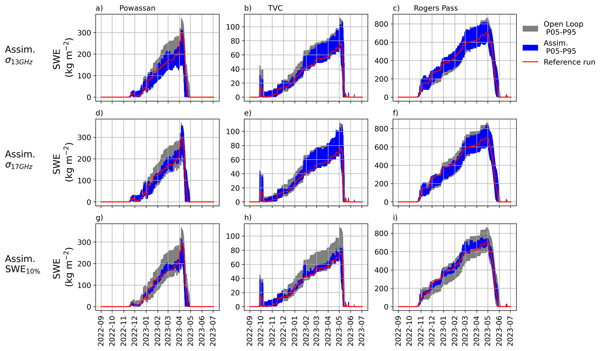
Nicolas R. Leroux, Vincent Vionnet, Courtney Bayer, Julien Meloche, Arlan Dirkson, Franck Lespinas, Mark Buehner, Marco Carrera, Benoit Montpetit, Bernard Bilodeau, Maria Abrahamowicz, and Chris Derksen
The Cryosphere, 20, 2773–2792, https://doi.org/10.5194/tc-20-2773-2026, https://doi.org/10.5194/tc-20-2773-2026, 2026
Short summary
Short summary
This study evaluates the assimilation of Ku-band radar backscatter into a multilayer snowpack model to support the upcoming Terrestrial Snow Mass Mission. Synthetic experiments were conducted at Arctic, continental, and alpine sites over three winters using a particle filter. Results show that assimilating backscatter improves estimates of snow water equivalent, depth, and vertical snow properties, laying the groundwork for future satellite missions focused on radar-based snow monitoring.
Zeinab Akhavan, Richard Kelly, Peter Toose, Aaron Thompson, Wei Wang, Benoit Montpetit, Alex Gélinas, and Alexandre Roy
EGUsphere, https://doi.org/10.5194/egusphere-2026-1065, https://doi.org/10.5194/egusphere-2026-1065, 2026
Short summary
Short summary
Soils in cold regions freeze and thaw seasonally, affecting water flow, flooding, and carbon exchange, but these changes are hard to track beneath snow. We studied a Canadian agricultural field using high-resolution airborne radar and ground measurements through winter. Radar signals changed clearly as soils froze and thawed, with one polarization being most sensitive. Our results improve understanding of frozen soils and support future satellite monitoring.
Hesam Salmabadi, Renato Pardo Lara, Aaron Berg, Alex Mavrovic, Chelene Hanes, Benoit Montpetit, and Alexandre Roy
The Cryosphere, 20, 1635–1654, https://doi.org/10.5194/tc-20-1635-2026, https://doi.org/10.5194/tc-20-1635-2026, 2026
Short summary
Short summary
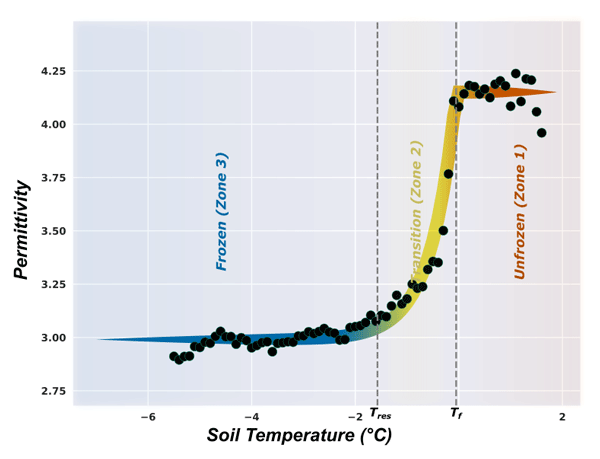
Current satellite monitoring often oversimplifies soil freezing by assuming it happens exactly at 0°C. We analyzed ground data across Canada and found that soil often stays in a partially frozen state for months, even when air temperatures are well below freezing, revealing a major gap in how we track seasonally frozen ground.
Georgina J. Woolley, Nick Rutter, Leanne Wake, Vincent Vionnet, Chris Derksen, Julien Meloche, Benoit Montpetit, Nicolas R. Leroux, Richard Essery, Gabriel Hould Gosselin, and Philip Marsh
The Cryosphere, 20, 1315–1338, https://doi.org/10.5194/tc-20-1315-2026, https://doi.org/10.5194/tc-20-1315-2026, 2026
Short summary
Short summary
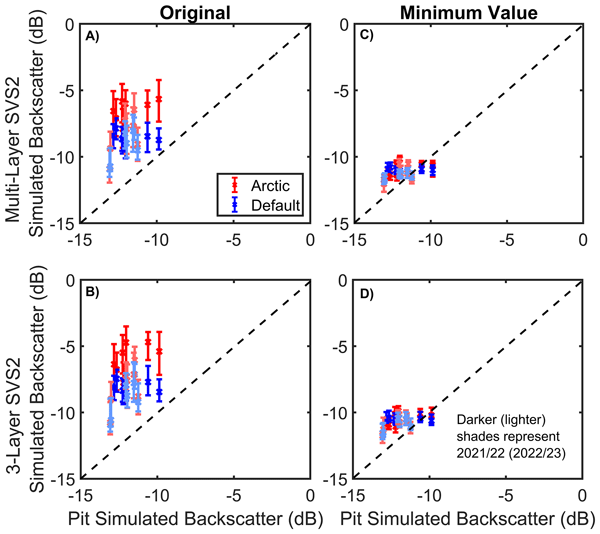
The impact of uncertainties in the simulation of density and specific surface area (SSA) by the snow model Crocus (embedded in the Soil, Vegetation and Snow v2 land surface model) on the simulation of snow backscatter (13.5 GHz) using the Snow Microwave Radiative Transfer model were quantified. The simulation of SSA was found to be a key model uncertainty. Underestimated SSA values lead to high errors in the simulation of backscatter, reduced by implementing a minimum SSA value (8.7 m2 kg−1).
Vincent Vionnet, Nicolas R. Leroux, Vincent Fortin, Maria Abrahamowicz, Georgina Woolley, Giulia Mazzotti, Manon Gaillard, Matthieu Lafaysse, Alain Royer, Florent Domine, Nathalie Gauthier, Nick Rutter, Chris Derksen, and Stéphane Bélair
Geosci. Model Dev., 18, 9119–9147, https://doi.org/10.5194/gmd-18-9119-2025, https://doi.org/10.5194/gmd-18-9119-2025, 2025
Short summary
Short summary
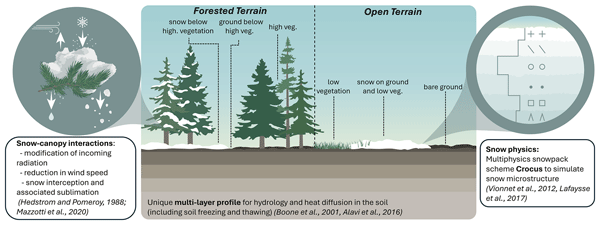
Snow microstructure controls snowpack properties, but most land surface models overlook this factor. To support future satellite missions, we created a new land surface model based on the Crocus scheme that simulates snow microstructure. Key improvements include better snow albedo representation, enhanced Arctic snow modeling, and improved forest module to capture Canada's diverse snow conditions. Results demonstrate improved simulations of snow density and melt across large regions of Canada.
Benoit Montpetit, Julien Meloche, Vincent Vionnet, Chris Derksen, Georgina Woolley, Nicolas R. Leroux, Paul Siqueira, J. Max Adam, and Mike Brady
The Cryosphere, 19, 5465–5484, https://doi.org/10.5194/tc-19-5465-2025, https://doi.org/10.5194/tc-19-5465-2025, 2025
Short summary
Short summary
This paper presents the workflow to retrieve snow water equivalent from radar measurements for the future Canadian radar satellite mission, Terrestrial Snow Mass Mission. The workflow is validated by using airborne radar data collected at Trail Valley Creek, Canada, during winter 2018–2019. We detail important considerations to have in the context of a satellite mission over a vast region such as Canada. Results show that it is possible to achieve the desired accuracy over an Arctic environment.
Juliette Ortet, Arnaud Mialon, Alain Royer, Mike Schwank, Manu Holmberg, Kimmo Rautiainen, Simone Bircher-Adrot, Andreas Colliander, Yann Kerr, and Alexandre Roy
The Cryosphere, 19, 3571–3598, https://doi.org/10.5194/tc-19-3571-2025, https://doi.org/10.5194/tc-19-3571-2025, 2025
Short summary
Short summary
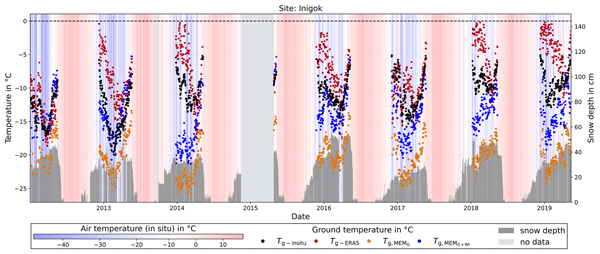
We propose a new method to determine the ground surface temperature under the snowpack in the Arctic area from satellite observations. The obtained ground temperature time series were evaluated over 21 reference sites in Northern Alaska and compared with ground temperatures obtained with global models. The method is extremely promising for monitoring ground temperature below the snowpack and studying the spatio-temporal variability thanks to 15 years of observations over the whole Arctic area.
Julien Meloche, Nicolas R. Leroux, Benoit Montpetit, Vincent Vionnet, and Chris Derksen
The Cryosphere, 19, 2949–2962, https://doi.org/10.5194/tc-19-2949-2025, https://doi.org/10.5194/tc-19-2949-2025, 2025
Short summary
Short summary
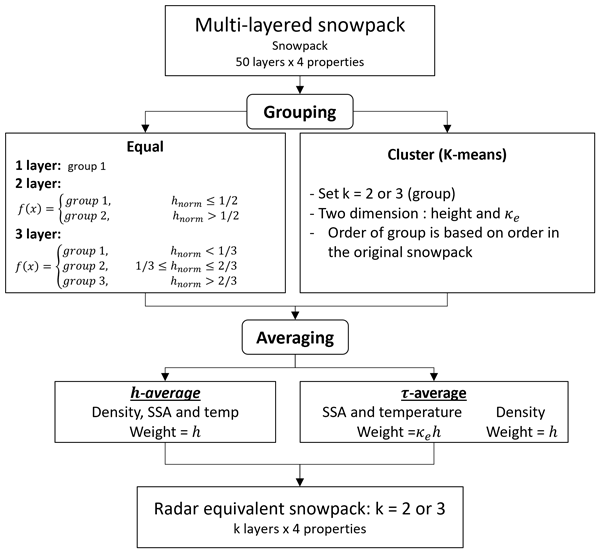
Measuring snow mass from radar measurements is possible with information on snow and a radar model to link the measurements to snow. A key variable in a retrieval is the number of snow layers, with more layers yielding richer information but at increased computational cost. Here, we show the capabilities of a new method for simplifying a complex snowpack while preserving the scattering behavior of the snowpack and conserving its mass.
Haorui Sun, Yiwen Fang, Steven A. Margulis, Colleen Mortimer, Lawrence Mudryk, and Chris Derksen
The Cryosphere, 19, 2017–2036, https://doi.org/10.5194/tc-19-2017-2025, https://doi.org/10.5194/tc-19-2017-2025, 2025
Short summary
Short summary
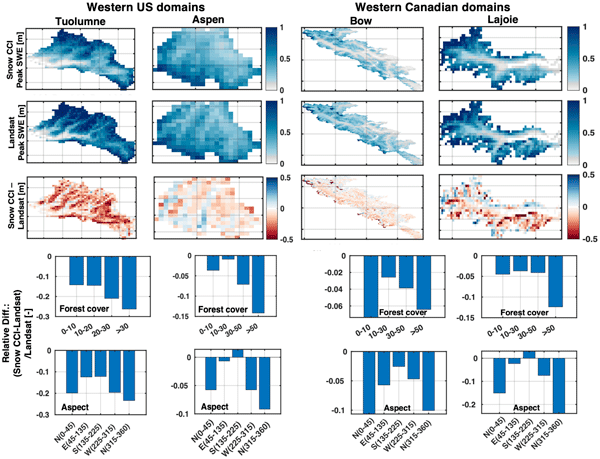
The European Space Agency's Snow Climate Change Initiative (Snow CCI) developed a high-quality snow cover extent and snow water equivalent (SWE) climate data record. However, gaps exist in complex terrain due to challenges in using passive microwave sensing and in situ measurements. This study presents a methodology to fill the mountain SWE gap using Snow CCI snow cover fraction within a Bayesian SWE reanalysis framework, with potential applications in untested regions and with other sensors.
Lawrence Mudryk, Colleen Mortimer, Chris Derksen, Aleksandra Elias Chereque, and Paul Kushner
The Cryosphere, 19, 201–218, https://doi.org/10.5194/tc-19-201-2025, https://doi.org/10.5194/tc-19-201-2025, 2025
Short summary
Short summary
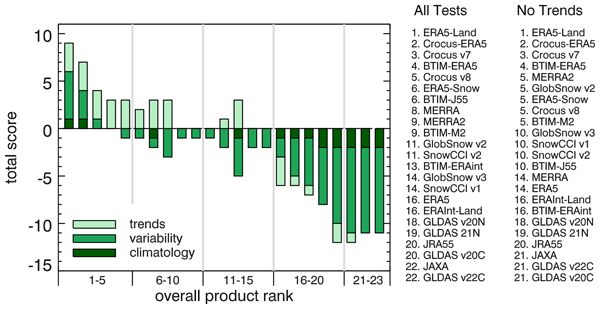
We evaluate and rank 23 different datasets on their ability to accurately estimate historical snow amounts. The evaluation uses new a set of surface snow measurements with improved spatial coverage, enabling evaluation across both mountainous and nonmountainous regions. Performance measures vary tremendously across the products: while most perform reasonably in nonmountainous regions, accurate representation of snow amounts in mountainous regions and of historical trends is much more variable.
Georgina J. Woolley, Nick Rutter, Leanne Wake, Vincent Vionnet, Chris Derksen, Richard Essery, Philip Marsh, Rosamond Tutton, Branden Walker, Matthieu Lafaysse, and David Pritchard
The Cryosphere, 18, 5685–5711, https://doi.org/10.5194/tc-18-5685-2024, https://doi.org/10.5194/tc-18-5685-2024, 2024
Short summary
Short summary
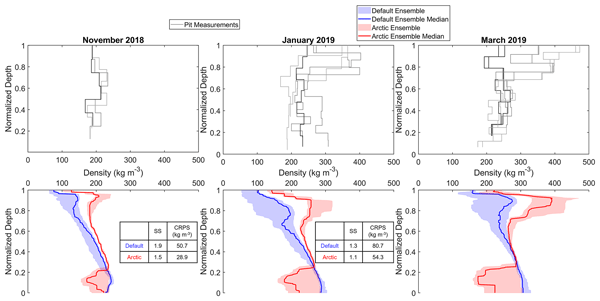
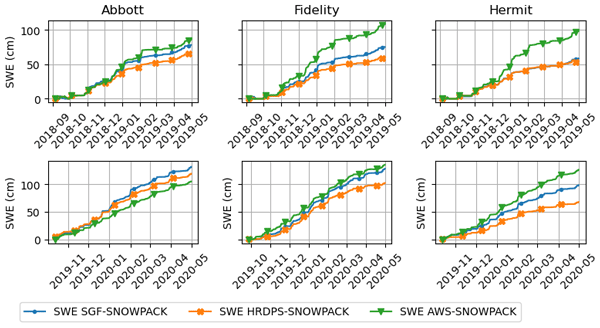
Parameterisations of Arctic snow processes were implemented into the multi-physics ensemble version of the snow model Crocus (embedded within the Soil, Vegetation, and Snow version 2 land surface model) and evaluated at an Arctic tundra site. Optimal combinations of parameterisations that improved the simulation of density and specific surface area featured modifications that raise wind speeds to increase compaction in surface layers, prevent snowdrift, and increase viscosity in basal layers.
Colleen Mortimer, Lawrence Mudryk, Eunsang Cho, Chris Derksen, Mike Brady, and Carrie Vuyovich
The Cryosphere, 18, 5619–5639, https://doi.org/10.5194/tc-18-5619-2024, https://doi.org/10.5194/tc-18-5619-2024, 2024
Short summary
Short summary
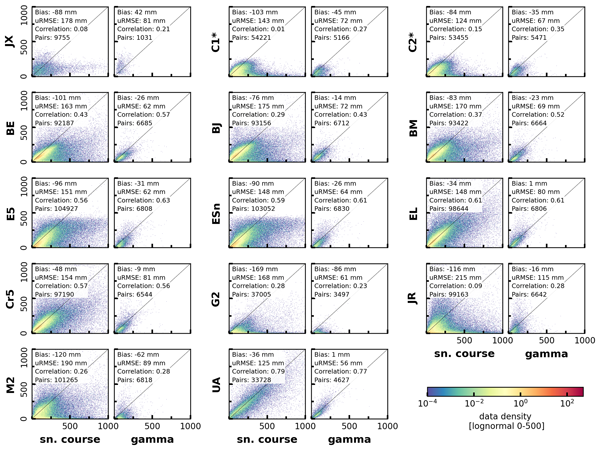
Ground measurements of snow water equivalent (SWE) are vital for understanding the accuracy of large-scale estimates from satellites and climate models. We compare two types of measurements – snow courses and airborne gamma SWE estimates – and analyze how measurement type impacts the accuracy assessment of gridded SWE products. We use this analysis to produce a combined reference SWE dataset for North America, applicable for future gridded SWE product evaluations and other applications.

Aleksandra Elias Chereque, Paul J. Kushner, Lawrence Mudryk, Chris Derksen, and Colleen Mortimer
The Cryosphere, 18, 4955–4969, https://doi.org/10.5194/tc-18-4955-2024, https://doi.org/10.5194/tc-18-4955-2024, 2024
Short summary
Short summary
We look at three commonly used snow depth datasets that are produced through a combination of snow modelling and historical measurements (reanalysis). When compared with each other, these datasets have differences that arise for various reasons. We show that a simple snow model can be used to examine these inconsistencies and highlight issues. This method indicates that one of the complex datasets should be excluded from further studies.
Cecile B. Menard, Sirpa Rasmus, Ioanna Merkouriadi, Gianpaolo Balsamo, Annett Bartsch, Chris Derksen, Florent Domine, Marie Dumont, Dorothee Ehrich, Richard Essery, Bruce C. Forbes, Gerhard Krinner, David Lawrence, Glen Liston, Heidrun Matthes, Nick Rutter, Melody Sandells, Martin Schneebeli, and Sari Stark
The Cryosphere, 18, 4671–4686, https://doi.org/10.5194/tc-18-4671-2024, https://doi.org/10.5194/tc-18-4671-2024, 2024
Short summary
Short summary
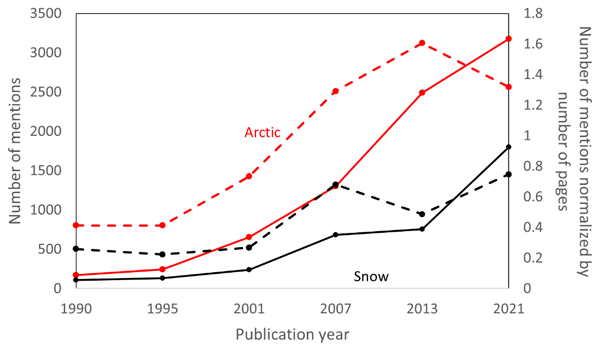
Computer models, like those used in climate change studies, are written by modellers who have to decide how best to construct the models in order to satisfy the purpose they serve. Using snow modelling as an example, we examine the process behind the decisions to understand what motivates or limits modellers in their decision-making. We find that the context in which research is undertaken is often more crucial than scientific limitations. We argue for more transparency in our research practice.
Melody Sandells, Nick Rutter, Kirsty Wivell, Richard Essery, Stuart Fox, Chawn Harlow, Ghislain Picard, Alexandre Roy, Alain Royer, and Peter Toose
The Cryosphere, 18, 3971–3990, https://doi.org/10.5194/tc-18-3971-2024, https://doi.org/10.5194/tc-18-3971-2024, 2024
Short summary
Short summary
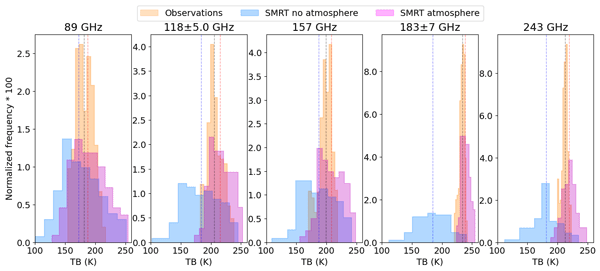
Satellite microwave observations are used for weather forecasting. In Arctic regions this is complicated by natural emission from snow. By simulating airborne observations from in situ measurements of snow, this study shows how snow properties affect the signal within the atmosphere. Fresh snowfall between flights changed airborne measurements. Good knowledge of snow layering and structure can be used to account for the effects of snow and could unlock these data to improve forecasts.
Benoit Montpetit, Joshua King, Julien Meloche, Chris Derksen, Paul Siqueira, J. Max Adam, Peter Toose, Mike Brady, Anna Wendleder, Vincent Vionnet, and Nicolas R. Leroux
The Cryosphere, 18, 3857–3874, https://doi.org/10.5194/tc-18-3857-2024, https://doi.org/10.5194/tc-18-3857-2024, 2024
Short summary
Short summary
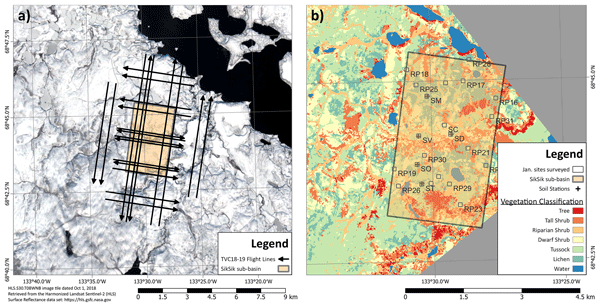
This paper validates the use of free open-source models to link distributed snow measurements to radar measurements in the Canadian Arctic. Using multiple radar sensors, we can decouple the soil from the snow contribution. We then retrieve the "microwave snow grain size" to characterize the interaction between the snow mass and the radar signal. This work supports future satellite mission development to retrieve snow mass information such as the future Canadian Terrestrial Snow Mass Mission.
Paul Billecocq, Alexandre Langlois, and Benoit Montpetit
The Cryosphere, 18, 2765–2782, https://doi.org/10.5194/tc-18-2765-2024, https://doi.org/10.5194/tc-18-2765-2024, 2024
Short summary
Short summary
Snow covers a vast part of the globe, making snow water equivalent (SWE) crucial for climate science and hydrology. SWE can be inversed from satellite data, but the snow's complex structure highly affects the signal, and thus an educated first guess is mandatory. In this study, a subgridding framework was developed to model snow at the local scale from model weather data. The framework enhanced snow parameter modeling, paving the way for SWE inversion algorithms from satellite data.
Julien Meloche, Melody Sandells, Henning Löwe, Nick Rutter, Richard Essery, Ghislain Picard, Randall K. Scharien, Alexandre Langlois, Matthias Jaggi, Josh King, Peter Toose, Jérôme Bouffard, Alessandro Di Bella, and Michele Scagliola
EGUsphere, https://doi.org/10.5194/egusphere-2024-1583, https://doi.org/10.5194/egusphere-2024-1583, 2024
Preprint archived
Short summary
Short summary
Sea ice thickness is essential for climate studies. Radar altimetry has provided sea ice thickness measurement, but uncertainty arises from interaction of the signal with the snow cover. Therefore, modelling the signal interaction with the snow is necessary to improve retrieval. A radar model was used to simulate the radar signal from the snow-covered sea ice. This work paved the way to improved physical algorithm to retrieve snow depth and sea ice thickness for radar altimeter missions.
Francis Meloche, Francis Gauthier, and Alexandre Langlois
The Cryosphere, 18, 1359–1380, https://doi.org/10.5194/tc-18-1359-2024, https://doi.org/10.5194/tc-18-1359-2024, 2024
Short summary
Short summary
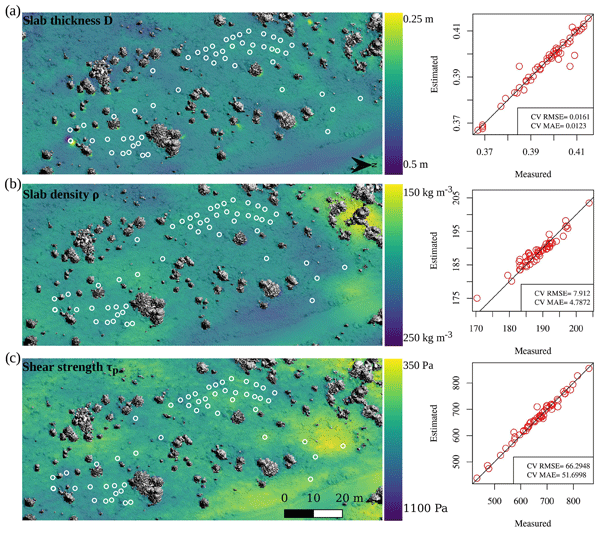
Snow avalanches are a dangerous natural hazard. Backcountry recreationists and avalanche practitioners try to predict avalanche hazard based on the stability of snow cover. However, snow cover is variable in space, and snow stability observations can vary within several meters. We measure the snow stability several times on a small slope to create high-resolution maps of snow cover stability. These results help us to understand the snow variation for scientists and practitioners.
Victoria R. Dutch, Nick Rutter, Leanne Wake, Oliver Sonnentag, Gabriel Hould Gosselin, Melody Sandells, Chris Derksen, Branden Walker, Gesa Meyer, Richard Essery, Richard Kelly, Phillip Marsh, Julia Boike, and Matteo Detto
Biogeosciences, 21, 825–841, https://doi.org/10.5194/bg-21-825-2024, https://doi.org/10.5194/bg-21-825-2024, 2024
Short summary
Short summary
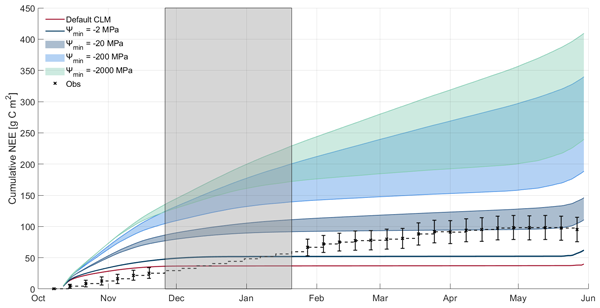
We undertake a sensitivity study of three different parameters on the simulation of net ecosystem exchange (NEE) during the snow-covered non-growing season at an Arctic tundra site. Simulations are compared to eddy covariance measurements, with near-zero NEE simulated despite observed CO2 release. We then consider how to parameterise the model better in Arctic tundra environments on both sub-seasonal timescales and cumulatively throughout the snow-covered non-growing season.
Alex Mavrovic, Oliver Sonnentag, Juha Lemmetyinen, Carolina Voigt, Nick Rutter, Paul Mann, Jean-Daniel Sylvain, and Alexandre Roy
Biogeosciences, 20, 5087–5108, https://doi.org/10.5194/bg-20-5087-2023, https://doi.org/10.5194/bg-20-5087-2023, 2023
Short summary
Short summary
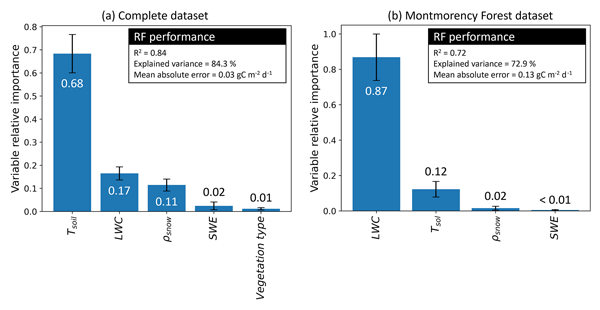
We present an analysis of soil CO2 emissions in boreal and tundra regions during the non-growing season. We show that when the soil is completely frozen, soil temperature is the main control on CO2 emissions. When the soil is around the freezing point, with a mix of liquid water and ice, the liquid water content is the main control on CO2 emissions. This study highlights that the vegetation–snow–soil interactions must be considered to understand soil CO2 emissions during the non-growing season.
Konstantin Muzalevskiy, Zdenek Ruzicka, Alexandre Roy, Michael Loranty, and Alexander Vasiliev
The Cryosphere, 17, 4155–4164, https://doi.org/10.5194/tc-17-4155-2023, https://doi.org/10.5194/tc-17-4155-2023, 2023
Short summary
Short summary
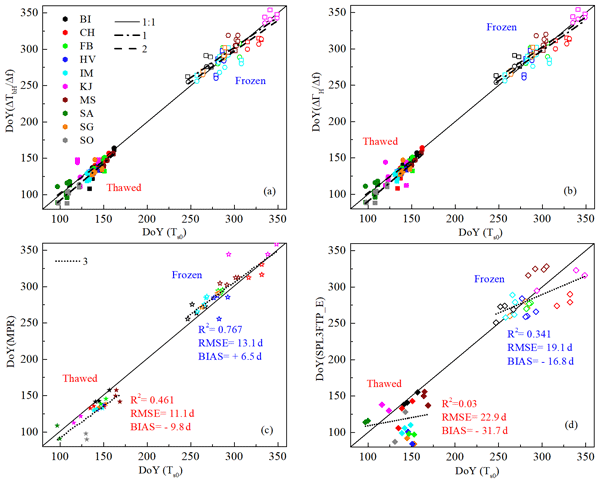
A new all-weather method for determining the frozen/thawed (FT) state of soils in the Arctic region based on satellite data was proposed. The method is based on multifrequency measurement of brightness temperatures by the SMAP and GCOM-W1/AMSR2 satellites. The created method was tested at sites in Canada, Finland, Russia, and the USA, based on climatic weather station data. The proposed method identifies the FT state of Arctic soils with better accuracy than existing methods.
Alex Mavrovic, Oliver Sonnentag, Juha Lemmetyinen, Jennifer L. Baltzer, Christophe Kinnard, and Alexandre Roy
Biogeosciences, 20, 2941–2970, https://doi.org/10.5194/bg-20-2941-2023, https://doi.org/10.5194/bg-20-2941-2023, 2023
Short summary
Short summary
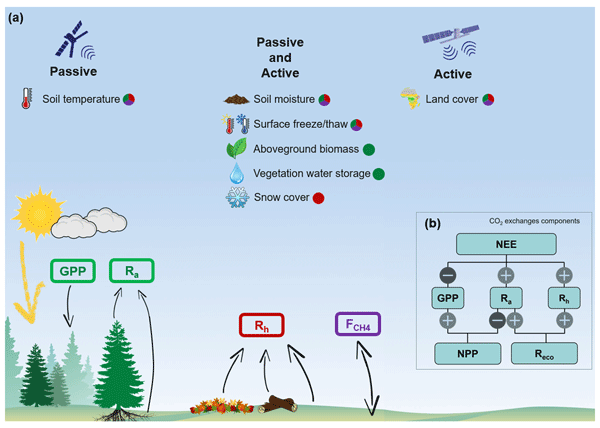
This review supports the integration of microwave spaceborne information into carbon cycle science for Arctic–boreal regions. The microwave data record spans multiple decades with frequent global observations of soil moisture and temperature, surface freeze–thaw cycles, vegetation water storage, snowpack properties, and land cover. This record holds substantial unexploited potential to better understand carbon cycle processes.
Bo Qu, Alexandre Roy, Joe R. Melton, Jennifer L. Baltzer, Youngryel Ryu, Matteo Detto, and Oliver Sonnentag
EGUsphere, https://doi.org/10.5194/egusphere-2023-1167, https://doi.org/10.5194/egusphere-2023-1167, 2023
Preprint archived
Short summary
Short summary
Accurately simulating photosynthesis and evapotranspiration challenges terrestrial biosphere models across North America’s boreal biome, in part due to uncertain representation of the maximum rate of photosynthetic carboxylation (Vcmax). This study used forest stand scale observations in an optimization framework to improve Vcmax values for representative vegetation types. Several stand characteristics well explained spatial Vcmax variability and were useful to improve boreal forest modelling.
Chris Derksen and Lawrence Mudryk
The Cryosphere, 17, 1431–1443, https://doi.org/10.5194/tc-17-1431-2023, https://doi.org/10.5194/tc-17-1431-2023, 2023
Short summary
Short summary
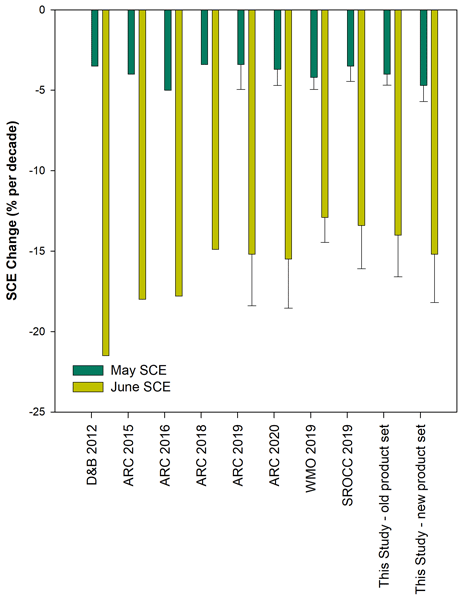
We examine Arctic snow cover trends through the lens of climate assessments. We determine the sensitivity of change in snow cover extent to year-over-year increases in time series length, reference period, the use of a statistical methodology to improve inter-dataset agreement, version changes in snow products, and snow product ensemble size. By identifying the sensitivity to the range of choices available to investigators, we increase confidence in reported Arctic snow extent changes.
Victoria R. Dutch, Nick Rutter, Leanne Wake, Melody Sandells, Chris Derksen, Branden Walker, Gabriel Hould Gosselin, Oliver Sonnentag, Richard Essery, Richard Kelly, Phillip Marsh, Joshua King, and Julia Boike
The Cryosphere, 16, 4201–4222, https://doi.org/10.5194/tc-16-4201-2022, https://doi.org/10.5194/tc-16-4201-2022, 2022
Short summary
Short summary
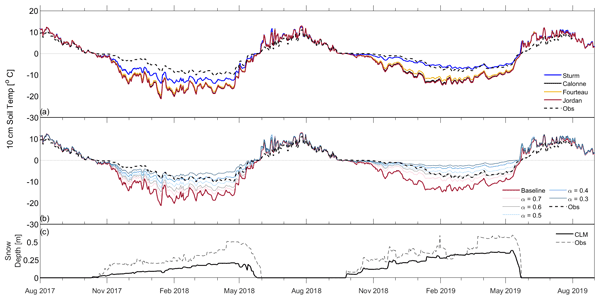
Measurements of the properties of the snow and soil were compared to simulations of the Community Land Model to see how well the model represents snow insulation. Simulations underestimated snow thermal conductivity and wintertime soil temperatures. We test two approaches to reduce the transfer of heat through the snowpack and bring simulated soil temperatures closer to measurements, with an alternative parameterisation of snow thermal conductivity being more appropriate.
Leung Tsang, Michael Durand, Chris Derksen, Ana P. Barros, Do-Hyuk Kang, Hans Lievens, Hans-Peter Marshall, Jiyue Zhu, Joel Johnson, Joshua King, Juha Lemmetyinen, Melody Sandells, Nick Rutter, Paul Siqueira, Anne Nolin, Batu Osmanoglu, Carrie Vuyovich, Edward Kim, Drew Taylor, Ioanna Merkouriadi, Ludovic Brucker, Mahdi Navari, Marie Dumont, Richard Kelly, Rhae Sung Kim, Tien-Hao Liao, Firoz Borah, and Xiaolan Xu
The Cryosphere, 16, 3531–3573, https://doi.org/10.5194/tc-16-3531-2022, https://doi.org/10.5194/tc-16-3531-2022, 2022
Short summary
Short summary
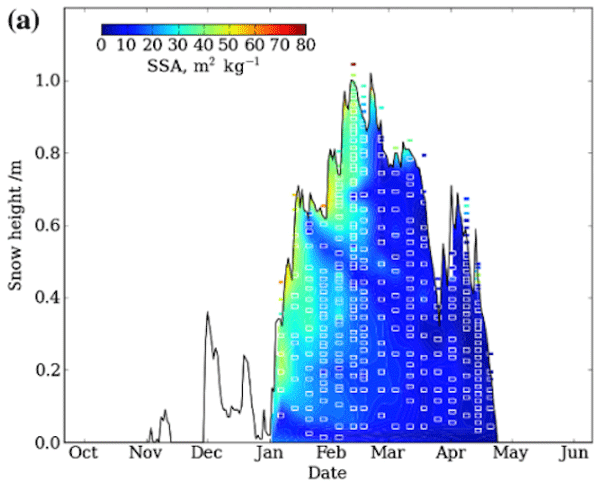
Snow water equivalent (SWE) is of fundamental importance to water, energy, and geochemical cycles but is poorly observed globally. Synthetic aperture radar (SAR) measurements at X- and Ku-band can address this gap. This review serves to inform the broad snow research, monitoring, and application communities about the progress made in recent decades to move towards a new satellite mission capable of addressing the needs of the geoscience researchers and users.
Juha Lemmetyinen, Juval Cohen, Anna Kontu, Juho Vehviläinen, Henna-Reetta Hannula, Ioanna Merkouriadi, Stefan Scheiblauer, Helmut Rott, Thomas Nagler, Elisabeth Ripper, Kelly Elder, Hans-Peter Marshall, Reinhard Fromm, Marc Adams, Chris Derksen, Joshua King, Adriano Meta, Alex Coccia, Nick Rutter, Melody Sandells, Giovanni Macelloni, Emanuele Santi, Marion Leduc-Leballeur, Richard Essery, Cecile Menard, and Michael Kern
Earth Syst. Sci. Data, 14, 3915–3945, https://doi.org/10.5194/essd-14-3915-2022, https://doi.org/10.5194/essd-14-3915-2022, 2022
Short summary
Short summary
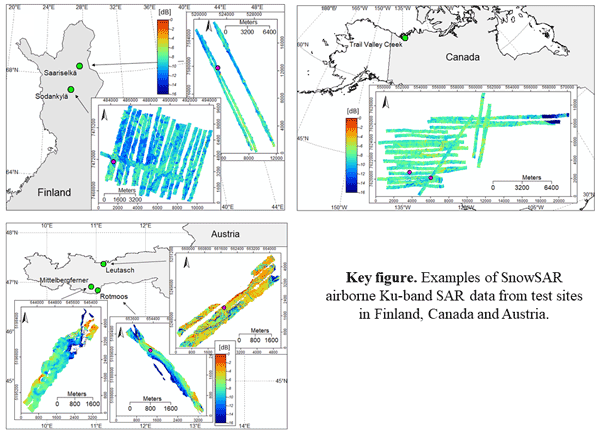
The manuscript describes airborne, dual-polarised X and Ku band synthetic aperture radar (SAR) data collected over several campaigns over snow-covered terrain in Finland, Austria and Canada. Colocated snow and meteorological observations are also presented. The data are meant for science users interested in investigating X/Ku band radar signatures from natural environments in winter conditions.
Joëlle Voglimacci-Stephanopoli, Anna Wendleder, Hugues Lantuit, Alexandre Langlois, Samuel Stettner, Andreas Schmitt, Jean-Pierre Dedieu, Achim Roth, and Alain Royer
The Cryosphere, 16, 2163–2181, https://doi.org/10.5194/tc-16-2163-2022, https://doi.org/10.5194/tc-16-2163-2022, 2022
Short summary
Short summary
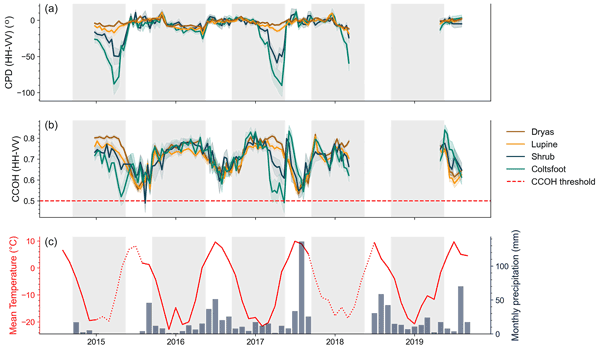
Changes in the state of the snowpack in the context of observed global warming must be considered to improve our understanding of the processes within the cryosphere. This study aims to characterize an arctic snowpack using the TerraSAR-X satellite. Using a high-spatial-resolution vegetation classification, we were able to quantify the variability in snow depth, as well as the topographic soil wetness index, which provided a better understanding of the electromagnetic wave–ground interaction.

Julien Meloche, Alexandre Langlois, Nick Rutter, Alain Royer, Josh King, Branden Walker, Philip Marsh, and Evan J. Wilcox
The Cryosphere, 16, 87–101, https://doi.org/10.5194/tc-16-87-2022, https://doi.org/10.5194/tc-16-87-2022, 2022
Short summary
Short summary
To estimate snow water equivalent from space, model predictions of the satellite measurement (brightness temperature in our case) have to be used. These models allow us to estimate snow properties from the brightness temperature by inverting the model. To improve SWE estimate, we proposed incorporating the variability of snow in these model as it has not been taken into account yet. A new parameter (coefficient of variation) is proposed because it improved simulation of brightness temperature.

Alain Royer, Alexandre Roy, Sylvain Jutras, and Alexandre Langlois
The Cryosphere, 15, 5079–5098, https://doi.org/10.5194/tc-15-5079-2021, https://doi.org/10.5194/tc-15-5079-2021, 2021
Short summary
Short summary
Dense spatially distributed networks of autonomous instruments for continuously measuring the amount of snow on the ground are needed for operational water resource and flood management and the monitoring of northern climate change. Four new-generation non-invasive sensors are compared. A review of their advantages, drawbacks and accuracy is discussed. This performance analysis is intended to help researchers and decision-makers choose the one system that is best suited to their needs.
Cited articles
Arndt, K. A., Hashemi, J., Natali, S. M., Schiferl, L. D., and Virkkala, A.-M.: Recent advances and challenges in monitoring and modeling non-growing season carbon dioxide fluxes from the arctic boreal zone, Curr. Clim. Change Rep., 9, 27–40, 2022.
Baghdadi, N., Bazzi, H., el Hajj, M., and Zribi, M.: Detection of Frozen Soil Using Sentinel-1 SAR Data, Remote Sens.-Basel, 10, https://doi.org/10.3390/rs10081182, 2018.
Barrere, M., Domine, F., Belke-Brea, M., and Sarrazin, D.: Snowmelt Events in Autumn Can Reduce or Cancel the Soil Warming Effect of Snow–Vegetation Interactions in the Arctic, J. Climate, 31, 9507–9518, https://doi.org/10.1175/JCLI-D-18-0135.1, 2018.
Bartsch, A., Muri, X., Hetzenecker, M., Rautiainen, K., Bergstedt, H., Wuite, J., Nagler, T., and Nicolsky, D.: Benchmarking passive-microwave-satellite-derived freeze–thaw datasets, The Cryosphere, 19, 459–483, https://doi.org/10.5194/tc-19-459-2025, 2025.
Bourbigot, M., Johnsen, H., Piantanida, R., Hajduch, G., and Poullaouec, J.: Sentinel-1 Product Definition, scientific report, S1-RS-MDA-52-7440, https://sentinels.copernicus.eu/documents/247904/1877131/Sentinel-1-Product-Definition.pdf (last access: April 2026), 2016.
Brown, R., Vikhamar Schuler, D., Bulygina, O., Derksen, C., Luojus, K., Mudryk, L., Wang, L., and Yang, D.: Chapter 3, in: Snow, Water, Ice and Permafrost in the Arctic (SWIPA) 2017, Arctic Monitoring and Assessment Programme (AMAP), Oslo, Norway, 26–55, ISBN 978-82-7971-101-8, 2017.
Busseau, B. C., Royer, A., Roy, A., Langlois, A., and Domine, F.: Analysis of snow-vegetation interactions in the low Arctic-Subarctic transition zone (northeastern Canada), Phys. Geogr., 38, 159–175, https://doi.org/10.1080/02723646.2017.1283477, 2017.
Callaghan, T. V., Johansson, M., Brown, R. D., Groisman, P. Ya., Labba, N., Radionov, V., Bradley, R. S., Blangy, S., Bulygina, O. N., Christensen, T. R., Colman, J. E., Essery, R. L. H., Forbes, B. C., Forchhammer, M. C., Golubev, V. N., Honrath, R. E., Juday, G. P., Meshcherskaya, A. V., Phoenix, G. K., Pomeroy, J., Rautio, A., Robinson, D. A., Schmidt, N. M., Serreze, M. C., Shevchenko, V. P., Shiklomanov, A. I., Shmakin, A. B., Sköld, P., Sturm, M., Woo, M., and Wood, E. F.: Multiple Effects of Changes in Arctic Snow Cover, AMBIO, 40, 32–45, https://doi.org/10.1007/s13280-011-0213-x, 2011.
Chen, R. H., Tabatabaeenejad, A., and Moghaddam, M.: Retrieval of Permafrost Active Layer Properties Using Time-Series P-Band Radar Observations, IEEE T. Geosci. Remote, 57, 6037–6054, https://doi.org/10.1109/TGRS.2019.2903935, 2019a.
Chen, X., Liu, L., and Bartsch, A.: Detecting soil freeze/thaw onsets in Alaska using SMAP and ASCAT data, Remote Sens. Environ., 220, 59–70, https://doi.org/10.1016/j.rse.2018.10.010, 2019b.
Chen, Y., Wang, L., Bernier, M., and Ludwig, R.: Retrieving freeze/thaw cycles using Sentinel-1 data in eastern Nunavik (Québec, Canada), Remote Sens.-Basel, 14, 802, https://doi.org/10.3390/rs14030802, 2022.
Cohen, J., Rautiainen, J. L., Smolander, T., Vehviläinen, J., and Pulliainen, J.: Sentinel-1 based soil freeze/thaw estimation in boreal forest environments, Remote Sens. Environ., 254, 112267, https://doi.org/10.1016/j.rse.2020.112267, 2021.
Cohen, J., Lemmetyinen, J., Ruiz, J., Rautiainen, K., Ikonen, J., Kontu, A., and Pulliainen, J.: Detection of soil and canopy freeze/thaw state in boreal region with L and C band synthetic aperture radar, Remote Sens. Environ., 305, 114102, https://doi.org/10.1016/j.rse.2024.114102, 2024.
Dai, A., Luo, D., Song, M., and Liu, J.: Arctic amplification is caused by sea-ice loss under increasing CO2, Nat. Commun., 10, 121, https://doi.org/10.1038/s41467-018-07954-9, 2019.
Davesne, G., Domine, F., and Fortier, D.: Effects of meteorology and soil moisture on the spatio-temporal evolution of the depth hoar layer in the polar desert snowpack, J. Glaciol., 68, 457–472, https://doi.org/10.1017/jog.2021.105, 2022.
Derksen, C. and Brown, R.: Spring snow cover extent reductions in the 2008–2012 period exceeding climate model projections, Geophys. Res. Lett., 39, https://doi.org/10.1029/2012GL053387, 2012.
Derksen, C., Xu, X., Scott Dunbar, R., Colliander, A., Kim, Y., Kimball, J. S., Black, T. A., Euskirchen, E., Langlois, A., Loranty, M. M., Marsh, P., Rautiainen, K., Roy, A., Royer, A., and Stephens, J.: Retrieving landscape freeze/thaw state from Soil Moisture Active Passive (SMAP) radar and radiometer measurements, Remote Sens. Environ., 194, 48–62, https://doi.org/10.1016/j.rse.2017.03.007, 2017.
Domine, F., Barrere, M., and Morin, S.: The growth of shrubs on high Arctic tundra at Bylot Island: impact on snow physical properties and permafrost thermal regime, Biogeosciences, 13, 6471–6486, https://doi.org/10.5194/bg-13-6471-2016, 2016.
Domine, F., Belke-Brea, M., Sarrazin, D., Arnaud, L., Barrere, M., and Poirier, M.: Soil moisture, wind speed and depth hoar formation in the Arctic snowpack, J. Glaciol., 64, 990–1002, https://doi.org/10.1017/jog.2018.89, 2018a.
Domine, F., Picard, G., Morin, S., Barrere, M., Madore, J. B., and Langlois, A.: Major Issues in Simulating Some Arctic Snowpack Properties Using Current Detailed Snow Physics Models: Consequences for the Thermal Regime and Water Budget of Permafrost, J. Adv. Model. Earth Sy., 11, 34–44, https://doi.org/10.1029/2018MS001445, 2018b.
Domine, F., Fourteau, K., Picard, G., Lackner, G., Sarrazin, D., and Poirier, M.: Permafrost cooled in winter by thermal bridging through snow-covered shrub branches, Nat. Geosci., 15, 554–560, https://doi.org/10.21203/rs.3.rs-679013/v1, 2022.
Entekhabi, D., Yueh, S., O’neill, P., Kellogg, K., Allen, A., Bindlish, R., Brown, M. E., Chan, S., Colliander, A., Crow, W., Das, N., Lannoy, G., Dunbar, R., Edelstein, W., Entin, J., Escobar, V., Goodman, S. D., Jackson, T., Jai, B., Johnson, J., Kim, E. J., Kim, S., Kimball, J., Koster, R., Leon, A., McDonald, K., Moghaddam, M., Mohammed, P., Moran, S., Njoku, E., Piepmeier, J., Reichle, R., Rogez, F., Shi, J., Spencer, M., Thurman, S., Tsang, L., Zyl, J. V., Weiss, B. H., and West, R.: SMAP Handbook – Soil Moisture Active Passive: Mapping Soil Moisture and Freeze/Thaw from Space, Corpus ID: 132836213, 2014.
Fayad, I., Baghdadi, N., Bazzi, H., and Zribi, M.: Near Real-Time Freeze Detection over Agricultural Plots Using Sentinel-1 Data, Remote Sens.-Basel, 12, 1976, https://doi.org/10.3390/rs12121976, 2020.
Gehrmann, F., Ziegler, C., and Cooper, E. J.: Onset of autumn senescence in high Arctic plants shows similar patterns in natural and experimental snow depth gradients, Arctic Science, 8, 744–766, 2022.
Hoppinen, Z., Palomaki, R. T., Brencher, G., Dunmire, D., Gagliano, E., Marziliano, A., Tarricone, J., and Marshall, H.-P.: Evaluating snow depth retrievals from Sentinel-1 volume scattering over NASA SnowEx sites, The Cryosphere, 18, 5407–5430, https://doi.org/10.5194/tc-18-5407-2024, 2024.
Jagdhuber, T., Stockamp, J., Hajnsek, I., and Ludwig, R.: Identification of soil freezing and thawing states using SAR polarimetry at C-band, Remote Sens.-Basel, 6, 2008–2023, https://doi.org/10.3390/rs6032008, 2014.
Jeong, D. and Sushama, L.: Rain-on-snow events over North America based on two Canadian regional climate models, Clim. Dynam., 50, 303–316, https://doi.org/10.1007/s00382-017-3609-x, 2018.
Kim, Y., Kimball, J. S., McDonald, K. C., and Glassy, J.: Developing a global data record of daily landscape freeze/thaw status using satellite passive microwave remote sensing, IEEE T. Geosci. Remote, 49, 949–960, https://doi.org/10.1109/TGRS.2010.2070515, 2011.
Kim, Y., Kimball, J. S., Zhang, K., and McDonald, K. C.: Satellite detection of increasing Northern Hemisphere non-frozen seasons from 1979 to 2008: Implications for regional vegetation growth, Remote Sens. Environ., 121, 472–487, https://doi.org/10.1016/j.rse.2012.02.014, 2012.
King, J., Derksen, C., Toose, P., Langlois, L., Larsen, C., Lemmetyinen, J., Marsh, P., Montpetit, B., Roy, A., Rutter, N., and Sturm, M.: The influence of snow microstructure on dual-frequency radar measurements in a tundra environment, Remote Sens. Environ., 215, 242–254, https://doi.org/10.1016/j.rse.2018.05.028, 2018.
Langlois, A., Barber, D. G., and Hwang, B. J.: Development of a winter snow water equivalent algorithm using in situ passive microwave radiometry over snow-covered first-year sea ice, Remote Sens. Environ., 106, 75–88, https://doi.org/10.1016/j.rse.2006.07.018, 2007.
Langlois, A., Johnson, C. A., Montpetit, B., Royer, A., Blukacz-Richards, E. A., Neave, E., Dolant, C., Roy, A., Arhonditsis, G., Kim, D. K., Kaluskar, S., and Brucker, L.: Detection of rain-on-snow (ROS) events and ice layer formation using passive microwave radiometry: A context for Peary caribou habitat in the Canadian Arctic, Remote Sens. Environ., 189, 84–95, https://doi.org/10.1016/j.rse.2016.11.006, 2017.
Lievens, H., Demuzere, M., Marshall, H.-P., Reichle, R. H., Brucker, L., Brangers, I., de Rosnay, P., Dumont, M., Girotto, M., Immerzeel, W. W., Jonas, T., Kim, E. J., Koch, I., Marty, C., Saloranta, T., Schöber, J., and De Lannoy, G.: Snow depth variability in the Northern Hemisphere mountains observed from space, Nat. Commun., 10, 4629, https://doi.org/10.1038/s41467-019-12566-y, 2019.
Liu, X., Wigneron, J.-P., Wagner, W., Frappart, F., Fan, L., Vreugdenhil, M., Baghdadi, N., Zribi, M., Jaghuber, T., Tao, S., Li, X., Wang, H., Wang, M., Bai, X., Mousa, B. G., and Ciais, P.: A new global C-band vegetation optical depth product from ASCAT: Description, evaluation and inter-comparison, Remote Sens. Environ., 299, 113850, https://doi.org/10.1016/j.rse.2023.113850, 2023.
Mäkynen, M. P., Manninen, A. T., Similä, M. H., Karvonen, J. A., and Hallikainen, M. T.: Incidence Angle Dependence of the Statistical Properties of C-Band HH-Polarization Backscattering Signatures of the Baltic Sea Ice, IEEE T. Geosci. Remote, 40, 2593–2605, https://doi.org/10.1109/TGRS.2002.806991, 2002.
Martin, A. C., Jeffers, E. S., Petrokofsky, G., Myers-Smith, I., and MacIas-Fauria, M.: Shrub growth and expansion in the Arctic tundra: An assessment of controlling factors using an evidence-based approach, Environ. Res. Lett., 12, https://doi.org/10.1088/1748-9326/aa7989, 2017.
Mavrovic, A., Sonnentag, O., Lemmetyinen, J., Voigt, C., Rutter, N., Mann, P., Sylvain, J.-D., and Roy, A.: Environmental controls of winter soil carbon dioxide fluxes in boreal and tundra environments, Biogeosciences, 20, 5087–5108, https://doi.org/10.5194/bg-20-5087-2023, 2023.
Mavrovic, A., Sonnentag, O., Voigt, C., Lemmetyinen, J., Aurela, M., and Roy, A.: Winter methane fluxes over boreal and Arctic environments, Geophys. Res. Lett., https://doi.org/10.1029/2025GL118367, 2025.
McLennan, D. S., MacKenzie, W. H., Meidinger, D., Wagner, J., and Arko, C.: A Standardized Ecosystem Classification for the Coordination and Design of Long-term Terrestrial Ecosystem Monitoring in Arctic-Subarctic Biomes, Arctic, 71, 1–15, https://doi.org/10.14430/arctic4621, 2018.
Meloche, J., Langlois, A., Rutter, N., McLennan, D., Royer, A., Billecocq, P., and Ponomarenko, S.: High-resolution snow depth prediction using random forest algorithm with topographic parameters: a case study in the Greiner watershed, Nunavut, Hydrol. Process., 36, 14546, https://doi.org/10.1002/hyp.14546, 2022.
Moradi, M., Kraatz, S., Johnston, J., and Jacobs, J. M.: Comparing three freeze-thaw schemes using C-band radar data in southeastern New Hampshire, USA, Remote Sens.-Basel, 16, 2784, https://doi.org/10.3390/rs16152784, 2024.
Park, S.-E., Bartsch, A., Sabel, D., Wagner, W., Naeimi, V., and Yamaguchi, Y.: Monitoring freeze/thaw cycles using ENVISAT ASAR Global Mode, Remote Sens. Environ., 115, 3457–3467, https://doi.org/10.1016/j.rse.2011.08.009, 2011.
Ponomarenko, S., McLennan, D., Pouliot, D., and Wagner, J.: High Resolution Mapping of Tundra Ecosystems on Victoria Island, Nunavut–Application of a Standardized Terrestrial Ecosystem Classification, Can. J. Remote Sens., 45, 551–571, https://doi.org/10.1080/07038992.2019.1682980, 2019.
Porter, C., Howat, I., Noh, M.-J., Husby, E., Khuvis, S., Danish, E., Tomko, K., Gardiner, J., Negrete, A., Yadav, B., Klassen, J., Kelleher, C., Cloutier, M., Bakker, J., Enos, J., Arnold, G., Bauer, G., and Morin, P.: “ArcticDEM, Version 4.1”, Harvard Dataverse, V1, https://doi.org/10.7910/DVN/3VDC4W, 2023.
Prince, M., Roy, A., Brucker, L., Royer, A., Kim, Y., and Zhao, T.: Northern Hemisphere surface freeze–thaw product from Aquarius L-band radiometers, Earth Syst. Sci. Data, 10, 2055–2067, https://doi.org/10.5194/essd-10-2055-2018, 2018.
Prince, M., Roy, A., Royer, A., and Langlois, A.: Timing and spatial variability of fall soil freezing in boreal forest and its effect on SMAP L-band radiometer measurements, Remote Sens. Environ., 231, https://doi.org/10.1016/j.rse.2019.111230, 2019.
Rautiainen, K., Lemmetyinen, J., Schwank, M., Kontu, A., Ménard, C. B., Mätzler, C., Drusch, M., Wiesmann, A., Ikonen, J., and Pulliainen, J.: Detection of soil freezing from L-band passive microwave observations, Remote Sens. Environ., 147, 206–218, https://doi.org/10.1016/j.rse.2014.03.007, 2014.
Rautiainen, K., Parkkinen, T., Lemmetyinen, J., Schwank, M., Wiesmann, A., Ikonen, J., Derksen, C., Davydov, S., Davydova, A., Boike, J., Langer, M., Drusch, M., and Pulliainen, J.: SMOS prototype algorithm for detecting autumn soil freezing, Remote Sens. Environ., 180, 346–360, https://doi.org/10.1016/j.rse.2016.01.012, 2016.
Rowlandson, T. L., Berg, A. A., Roy, A., Kim, E., Pardo Lara, R., Powers, J., Lewis, K., Houser, P., McDonald, K., Toose, P., Wu, A., de Marco, E., Derksen, C., Entin, J., Colliander, A., Xu, X., and Mavrovic, A.: Capturing agricultural soil freeze/thaw state through remote sensing and ground observations: A soil freeze/thaw validation campaign, Remote Sens. Environ., 211, 59–70, https://doi.org/10.1016/j.rse.2018.04.003, 2018.
Roy, A., Royer, A., Derksen, C., Brucker, L., Langlois, A., Mialon, A., and Kerr, Y. H.: Evaluation of Spaceborne L-Band Radiometer Measurements for Terrestrial Freeze/Thaw Retrievals in Canada, IEEE J. Sel. Top. Appl., 8, 4442–4459, https://doi.org/10.1109/JSTARS.2015.2476358, 2015.
Roy, A., Toose, P., Mavrovic, A., Pappas, C., Royer, A., Derksen, C., Berg, A., Rowlandson, T., El-Amine, M., Barr, A., Black, A., Langlois, A., and Sonnentag, O.: L-Band response to freeze/thaw in a boreal forest stand from ground- and tower-based radiometer observations, Remote Sens. Environ., 237, https://doi.org/10.1016/j.rse.2019.111542, 2020.
Royer, A., Domine, F., Roy, A., Langlois, A., Marchand, N., and Davesne, G.: New northern snowpack classification linked to vegetation cover on a latitudinal mega-transect across northeastern Canada, Ecoscience, 28, 225–242, https://doi.org/10.1080/11956860.2021.1898775, 2021.
Schuur, E. A. G., McGuire, A. D., Schädel, C., Grosse, G., Harden, J. W., Hayes, D. J., Hugelius, G., Koven, C. D., Kuhry, P., Lawrence, D. M., Natali, S. M., Olefeldt, D., Romanovsky, V. E., Schaefer, K., Turetsky, M. R., Treat, C. C., and Vonk, J. E.: Climate change and the permafrost carbon feedback, Nature, 520, 171–179, https://doi.org/10.1038/nature14338, 2015.
Serreze, M. C. and Barry, R. G.: Processes and impacts of Arctic amplification: A research synthesis, Global Planet. Change, 77, 85–96, https://doi.org/10.1016/j.gloplacha.2011.03.004, 2011.
Smith, S. L., Romanovsky, V. E., Lewkowicz, A. G., Burn, C. R., Allard, M., Clow, G. D., Yoshikawa, K., and Throop, J.: Thermal state of permafrost in North America: A contribution to the international polar year, Permafrost Periglac., 21, 117–135, https://doi.org/10.1002/ppp.690, 2010.
Sturm, M., Schimel, J., Michaelson, G., Welker, J. M., Oberbauer, S. F., Liston, G. E., Fahnestock, J., and Romanovsky, V. E.: Winter biological processes could help convert arctic tundra to shrubland, BioScience, 55, 17–26, https://doi.org/10.1641/0006-3568(2005)055[0017:WBPCHC]2.0.CO;2, 2005.
Sturm, M., McFadden, J. P., Liston, G. E., Stuart Chapin, F., Racine, C. H., and Holmgren, J.: Snow-shrub interactions in Arctic Tundra: A hypothesis with climatic implications, J. Climate, 14, 336–344, https://doi.org/10.1175/1520-0442(2001)014<0336:SSIIAT>2.0.CO;2, 2001.
Taghavi-Bayat, A., Ullmann, T., Riedel, B., and Gerke, M.: Detecting soil freeze-thaw dynamics with C-band SAR over permafrost in Northern Sweden and seasonally frozen ground in the Tibetan Plateau China, Int. J. Remote Sens., 45, 5317–5358, 2024.
Taghipourjavi, S., Kinnard, C., and Roy, A.: Sentinel-1 based soil freeze-thaw detection in agro-forested areas: a case study in southern Québec, Canada, Remote Sens.-Basel, 16, 1294, https://doi.org/10.3390/rs16071294, 2024.
Tsai, Y. L. S., Dietz, A., Oppelt, N., and Kuenzer, C.: Remote sensing of snow cover using spaceborne SAR: A review, Remote Sens.-Basel, 11, https://doi.org/10.3390/rs11121456, 2019.
Ulaby, F. T., Moore, R. K., and Fung, A. K.: Microwave Remote Sensing: Active and Passive, vol. III, Volume Scattering and Emission Theory, Advanced Systems and Applications, Artech House, Dedham, Massachusetts, USA, Norwood, Massachusetts, USA, ISBN-13 978-0890061923, 1986.
U.S. National Ice Center: IMS Daily Northern Hemisphere Snow and Ice Analysis at 1 km, 4 km, and 24 km Resolutions, Version 1, National Snow and Ice Data Center (NSIDC) [data set], Boulder, Colorado, USA, https://doi.org/10.7265/N52R3PMC, 2008.
Wang, G., Hu, H., and Li, T.: The influence of freeze-thaw cycles of active soil layer on surface runoff in a permafrost watershed, J. Hydrol., 375, 438–449, https://doi.org/10.1016/j.jhydrol.2009.06.046, 2009.
Wang, J., Jiang, L., Rautiainen, K., Zhang, C., Xiao, Z., Li, H., Yang, J., and Cui, H.: Daily high-resolution land surface freeze/thaw detection using Sentinel-1 and AMSR2 data, Remote Sens.-Basel, 14, 2854, https://doi.org/10.3390/rs14122854, 2022.
Widhalm, B., Bartsch, A., and Goler, R.: Simplified normalization of C-band synthetic aperture radar data for terrestrial applications in high latitude environments, Remote Sens.-Basel, 10, 1–18, https://doi.org/10.3390/rs10040551, 2018.
Woodhouse, I. H.: Introduction to Microwave Remote Sensing, 1st edn., CRC Press, 400 pp., https://doi.org/10.1201/9781315272573, 2006.
Xu, X., Derksen, C., Yueh, S. H., Dunbar, R. S., and Colliander, A.: Freeze/Thaw Detection and Validation Using Aquarius' L-Band Backscattering Data, IEEE J. Sel. Top. Appl., 9, 1370–1381, https://doi.org/10.1109/JSTARS.2016.2519347, 2016.
Yi, Y., Kimball, J. S., Chen, R. H., Moghaddam, M., and Miller, C. E.: Sensitivity of active-layer freezing process to snow cover in Arctic Alaska, The Cryosphere, 13, 197–218, https://doi.org/10.5194/tc-13-197-2019, 2019.
Zhang, Y., Sherstiukov, A. B., Qian, B., Kokelj, S. V., and Lantz, T. C.: Impacts of snow on soil temperature observed across the circumpolar north, Environ. Res. Lett., 13, https://doi.org/10.1088/1748-9326/aab1e7, 2018.
Zheng, D., Wang, X., van der Velde, R., Zeng, Y., Wen, J., Wang, Z., Schwank, M., Ferrazzoli, P., and Su, Z.: L-band microwave emission of soil freeze-thaw process in the third pole environment, IEEE T. Geosci. Remote, 55, 5324–5338, https://doi.org/10.1109/TGRS.2017.2705248, 2017.
Zhou, X., Zhou, J., Xie, Q., Zhang, Z., Chen, Q., and Liu, X.: Detection of soil freeze/thaw states at a high spatial resolution in Qinghai-Tibet engineering corridor, IEEE Geosci. Remote S., 19, 200805, https://doi.org/10.1109/LGRS.2022.3152864, 2022.
Short summary
A multisensor C-Band Synthetic Aperture Radar (SAR) near-daily time series in an Arctic environment was developed to create a high-resolution freeze/thaw (FT) algorithm with an accuracy of 96 %. The FT detection was highly correlated to near-surface state as measured by soil temperature. Small but significant FT date differences were identified for different Arctic ecotypes, showing the spatial variability of freeze/thaw process in Arctic environment.
A multisensor C-Band Synthetic Aperture Radar (SAR) near-daily time series in an Arctic...


