
Articles | Volume 20, issue 8
https://doi.org/10.5194/tc-20-4515-2026
© Author(s) 2026. This work is distributed under
the Creative Commons Attribution 4.0 License.
the Creative Commons Attribution 4.0 License.
https://doi.org/10.5194/tc-20-4515-2026
© Author(s) 2026. This work is distributed under
the Creative Commons Attribution 4.0 License.
the Creative Commons Attribution 4.0 License.
Research article
| 
19 Aug 2026
Research article |
| 19 Aug 2026
| 19 Aug 2026
Parameterization of the snow fracture energy to model the onset of crack propagation in snowpack models

Centre d’Études de la Neige, Centre Nationale Recherches Météorologiques (CNRM), Météo-France/CNRS, Grenoble 38000, France
Université Grenoble Alpes, Grenoble 38000, France
Université de Toulouse, Toulouse 31000, France
Léo Viallon-Galinier
Centre d’Études de la Neige, Centre Nationale Recherches Météorologiques (CNRM), Météo-France/CNRS, Grenoble 38000, France
Université Grenoble Alpes, Grenoble 38000, France
Université de Toulouse, Toulouse 31000, France
Kévin Fourteau
Centre d’Études de la Neige, Centre Nationale Recherches Météorologiques (CNRM), Météo-France/CNRS, Grenoble 38000, France
Université Grenoble Alpes, Grenoble 38000, France
Université de Toulouse, Toulouse 31000, France
Oscar Dick
Centre d’Études de la Neige, Centre Nationale Recherches Météorologiques (CNRM), Météo-France/CNRS, Grenoble 38000, France
Université Grenoble Alpes, Grenoble 38000, France
Université de Toulouse, Toulouse 31000, France
Pascal Hagenmuller
Centre d’Études de la Neige, Centre Nationale Recherches Météorologiques (CNRM), Météo-France/CNRS, Grenoble 38000, France
Université Grenoble Alpes, Grenoble 38000, France
Université de Toulouse, Toulouse 31000, France
Related authors
Léon Roussel, Marie Dumont, Marion Réveillet, Delphine Six, Marin Kneib, Pierre Nabat, Kévin Fourteau, Diego Monteiro, Simon Gascoin, Emmanuel Thibert, Antoine Rabatel, Jean-Emmanuel Sicart, Mylène Bonnefoy, Luc Piard, Olivier Laarman, Bruno Jourdain, Mathieu Fructus, Matthieu Vernay, and Matthieu Lafaysse
The Cryosphere, 19, 5201–5230, https://doi.org/10.5194/tc-19-5201-2025, https://doi.org/10.5194/tc-19-5201-2025, 2025
Short summary
Short summary
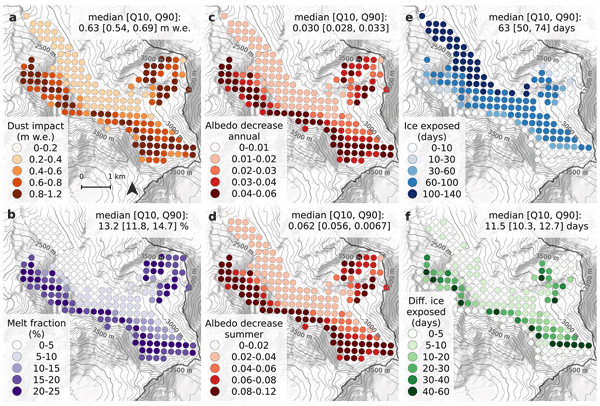
Saharan dust deposits frequently turn alpine glaciers orange. Mineral dust reduces snow albedo and increases snow and glaciers melt rate. Using physical modeling, we quantified the impact of dust on the Argentière Glacier over the period 2019–2022. We found that the contribution of mineral dust to the melt represents between 8 % and 16 % of Argentière Glacier summer melt. At specific locations, the impact of dust over one year can rise to an equivalent of 1.2 m of melted ice.
Zacharie Barrou Dumont, Simon Gascoin, Jordi Inglada, Andreas Dietz, Jonas Köhler, Matthieu Lafaysse, Diego Monteiro, Carlo Carmagnola, Arthur Bayle, Jean-Pierre Dedieu, Olivier Hagolle, and Philippe Choler
The Cryosphere, 19, 2407–2429, https://doi.org/10.5194/tc-19-2407-2025, https://doi.org/10.5194/tc-19-2407-2025, 2025
Short summary
Short summary
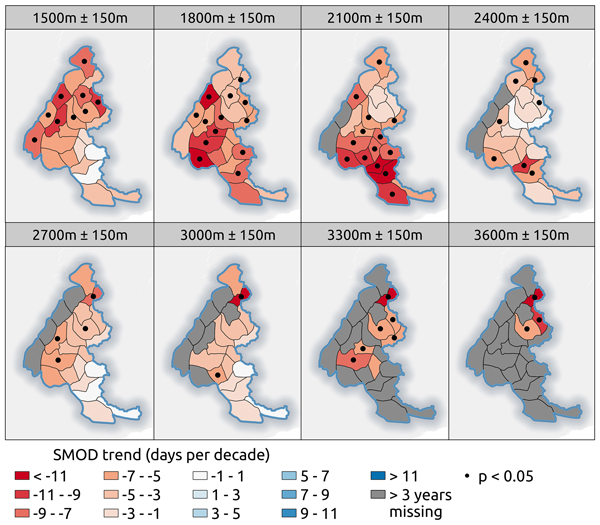
We generated annual maps of snow melt-out days at 20 m resolution over a period of 38 years from 10 different satellites. This study fills a knowledge gap regarding the evolution of mountain snow in Europe by covering a much longer period and characterizing trends at much higher resolutions than previous studies. We found a trend for earlier melt-out with average reductions of 5.51 d per decade over the French Alps and 4.04 d per decade over the Pyrenees for the period 1986–2023.
Diego Monteiro, Cécile Caillaud, Matthieu Lafaysse, Adrien Napoly, Mathieu Fructus, Antoinette Alias, and Samuel Morin
Geosci. Model Dev., 17, 7645–7677, https://doi.org/10.5194/gmd-17-7645-2024, https://doi.org/10.5194/gmd-17-7645-2024, 2024
Short summary
Short summary
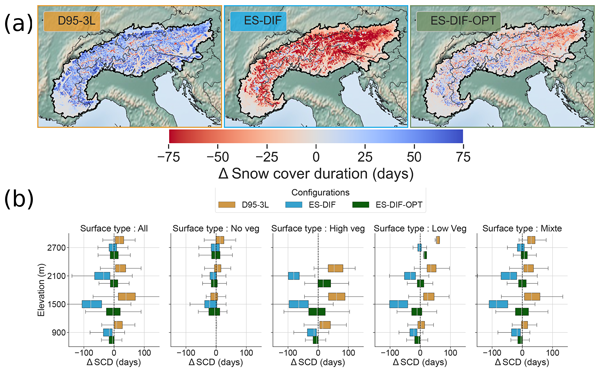
Modeling snow cover in climate and weather forecasting models is a challenge even for high-resolution models. Recent simulations with CNRM-AROME have shown difficulties when representing snow in the European Alps. Using remote sensing data and in situ observations, we evaluate modifications of the land surface configuration in order to improve it. We propose a new surface configuration, enabling a more realistic simulation of snow cover, relevant for climate and weather forecasting applications.
Diego Monteiro and Samuel Morin
The Cryosphere, 17, 3617–3660, https://doi.org/10.5194/tc-17-3617-2023, https://doi.org/10.5194/tc-17-3617-2023, 2023
Short summary
Short summary
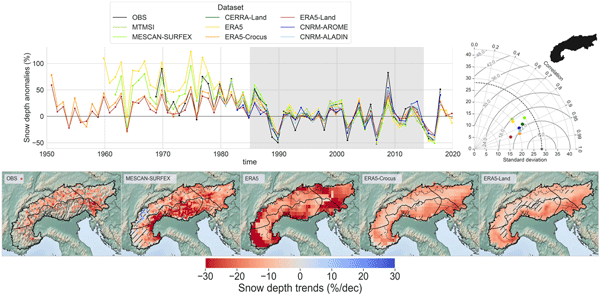
Beyond directly using in situ observations, often sparsely available in mountain regions, climate model simulations and so-called reanalyses are increasingly used for climate change impact studies. Here we evaluate such datasets in the European Alps from 1950 to 2020, with a focus on snow cover information and its main drivers: air temperature and precipitation. In terms of variability and trends, we identify several limitations and provide recommendations for future use of these datasets.

Matthieu Vernay, Matthieu Lafaysse, Diego Monteiro, Pascal Hagenmuller, Rafife Nheili, Raphaëlle Samacoïts, Deborah Verfaillie, and Samuel Morin
Earth Syst. Sci. Data, 14, 1707–1733, https://doi.org/10.5194/essd-14-1707-2022, https://doi.org/10.5194/essd-14-1707-2022, 2022
Short summary
Short summary
This paper introduces the latest version of the freely available S2M dataset which provides estimates of both meteorological and snow cover variables, as well as various avalanche hazard diagnostics at different elevations, slopes and aspects for the three main French high-elevation mountainous regions. A complete description of the system and the dataset is provided, as well as an overview of the possible uses of this dataset and an objective assessment of its limitations.
Neige Calonne, Pascal Hagenmuller, Rémi Granger, Lisa Bouvet, Kévin Fourteau, Julien Brondex, François Tuzet, Yves Lejeune, Anne Dufour, Mathieu Fructus, Teruo Aoki, and Marie Dumont
Earth Syst. Sci. Data Discuss., https://doi.org/10.5194/essd-2026-718, https://doi.org/10.5194/essd-2026-718, 2026
Preprint under review for ESSD
Short summary
Short summary
We collected weekly measurements of snow microstructural properties over two winters at Col de Porte in the French Alps, a relatively warm alpine site, using complementary techniques including X-ray tomography, the SnowMicroPen, and optical instruments. The dataset captures snowpack evolution at fine vertical resolution and is a valuable resource for snow model evaluation and instrument comparisons. It also provides guidance for future snow monitoring campaigns in warm mountain environments.

François Doussot, Léo Viallon-Galinier, Nicolas Eckert, and Pascal Hagenmuller
Nat. Hazards Earth Syst. Sci., 26, 4383–4406, https://doi.org/10.5194/nhess-26-4383-2026, https://doi.org/10.5194/nhess-26-4383-2026, 2026
Short summary
Short summary
Avalanches are sensitive to climate warming, but long and reliable records are rare. We combined avalanche observations with weather and snow simulations in the Haute-Maurienne valley (French Alps). This allowed us to reconstruct past avalanche activity and explore future changes. The results show a strong long-term decline in avalanche occurrence, especially in spring, while extreme events decrease more slowly. This study provides quantitative insights to support mountain risk management.
Oscar Dick, Neige Calonne, and Pascal Hagenmuller
EGUsphere, https://doi.org/10.5194/egusphere-2026-4897, https://doi.org/10.5194/egusphere-2026-4897, 2026
This preprint is open for discussion and under review for The Cryosphere (TC).
Short summary
Short summary
This work aims to pave the way towards an objective description of snow microstructure in snowpack models. We investigate the temporal evolution of several grain-size and grain-shape descriptors under a large range of dry snow metamorphism scenarios. Our results reveal that the evolution of several geometrical descriptors is more diverse than generally assumed, and that future models could benefit from representing multiple grain-size and shape descriptors.
Matthieu Lafaysse, Marie Dumont, Basile De Fleurian, Mathieu Fructus, Rafife Nheili, Léo Viallon-Galinier, Matthieu Baron, Aaron Boone, Axel Bouchet, Julien Brondex, Carlo Carmagnola, Bertrand Cluzet, Kévin Fourteau, Ange Haddjeri, Pascal Hagenmuller, Giulia Mazzotti, Marie Minvielle, Samuel Morin, Louis Quéno, Léon Roussel, Pierre Spandre, François Tuzet, and Vincent Vionnet
Geosci. Model Dev., 19, 6273–6334, https://doi.org/10.5194/gmd-19-6273-2026, https://doi.org/10.5194/gmd-19-6273-2026, 2026
Short summary
Short summary
This article is a comprehensive description of the 3.0.2 stable release of the Crocus snowpack model. It describes various new implementations since the last reference article in 2012 and a review of the available scientific evaluations and applications of the model. This provides guidance for the future of numerical snow modelling.
Suvrat Kaushik, Fatima Karbou, Léo Viallon-Galinier, and Adrien Mauss
ISPRS Ann. Photogramm. Remote Sens. Spatial Inf. Sci., XI-3-2026, 903–910, https://doi.org/10.5194/isprs-annals-XI-3-2026-903-2026, https://doi.org/10.5194/isprs-annals-XI-3-2026-903-2026, 2026
Louis Védrine, Marius Brun, Mathis Bozon, Benoît Laurent, and Pascal Hagenmuller
EGUsphere, https://doi.org/10.5194/egusphere-2026-2612, https://doi.org/10.5194/egusphere-2026-2612, 2026
Short summary
Short summary
Snow slowly compacts under its own weight, and this process depends strongly on temperature, but past estimates vary widely. We developed a device to precisely control temperature and tested the same snow sample under different conditions. We found two distinct temperature regimes and a stronger sensitivity than assumed in existing snowpack models, improving how snow compaction is represented.
Audrey Goutard, Marion Réveillet, Fanny Brun, Delphine Six, Kevin Fourteau, Charles Amory, Xavier Fettweis, Mathieu Fructus, Arbindra Khadka, and Matthieu Lafaysse
The Cryosphere, 20, 2393–2416, https://doi.org/10.5194/tc-20-2393-2026, https://doi.org/10.5194/tc-20-2393-2026, 2026
Short summary
Short summary
A new scheme has been developed in a snowpack model (SURFEX/ISBA-Crocus), to consider the impact of liquid water dynamics on bare ice, including albedo feedback and refreezing. When applied to the Mera Glacier in Nepal, the model reveals strong seasonal effects on the energy and mass balance, with increased melting in dry seasons and significant refreezing during the monsoon. This development improves mass balance modeling under increasing rainfall and bare ice exposure due to climate warming.
Oscar Dick, Neige Calonne, Benoît Laurent, and Pascal Hagenmuller
Earth Syst. Sci. Data, 18, 2875–2889, https://doi.org/10.5194/essd-18-2875-2026, https://doi.org/10.5194/essd-18-2875-2026, 2026
Short summary
Short summary
Snow microstructure undergoes constant shape transformations known as snow metamorphism. Observing first-hand snow metamorphism is key to improving the modelling of these transformations. In this work, we monitor snow microstructure evolution during metamorphism by X-ray tomography. We provide a data set at high spatial and temporal resolution of 3D images of snow microstructure evolving through a wide range of experimental conditions, along with videos showing these transformations.
Kévin Fourteau, Julien Brondex, Clément Cancès, and Marie Dumont
Geosci. Model Dev., 19, 3193–3212, https://doi.org/10.5194/gmd-19-3193-2026, https://doi.org/10.5194/gmd-19-3193-2026, 2026
Short summary
Short summary
The percolation of liquid water down snowpacks is a complex phenomenon, and its representation can sometimes be complicated for snowpack models. The goal of this article is to transpose some state-of-the-art strategies used for modeling liquid percolation in other media (such as rocks or soil) into snowpack models. With this, snowpack models can be made more efficient, requiring less time and power to perform their computation.
Simon Filhol, Clément Misset, Noélie Bontemps, Diego Cusicanqui, Emmanuel Paquet, Marie Dumont, Olivier Gagliardini, Pascal Lacroix, Simon Gascoin, Guillaume Thirel, Julien Brondex, Pascal Hagenmuller, Eric Larose, Philipp Schoeneich, Denis Roy, Emmanuel Thibert, Nicolas Eckert, Félix de Montety, Robin Mainieri, Alexandre Hauet, Frédéric Gottardi, Johan Berthet, Alexandre Baratier, Frédéric Liébault, Małgorzata Chmiel, Guillaume Piton, Guillaume Chambon, Guillaume James, Philippe Frey, Philip Deline, Laurent Astrade, Christian Vincent, Dominique Laigle, Alain Recking, Fatima Karbou, Adrien Mauss, Mylène Bonnefoy-Demongeot, Firmin Fontaine, Mickael Langlais, Etienne Berthier, and Antoine Blanc
EGUsphere, https://doi.org/10.5194/egusphere-2026-971, https://doi.org/10.5194/egusphere-2026-971, 2026
Short summary
Short summary
On June 21 2024, the village of La Bérarde, in the French Alps, was devastated by a flood destroying centuries old buildings. This study is an interdisciplinary work to decipher the causes and chronology of the event. The flood started with decadal rain falling on a thick snowpack. A lake observed on top of a glacier few days prior, had drained post event. With climate change, should we expect more similar compound events for alpine communities?

Louis Védrine and Pascal Hagenmuller
The Cryosphere, 20, 1257–1277, https://doi.org/10.5194/tc-20-1257-2026, https://doi.org/10.5194/tc-20-1257-2026, 2026
Short summary
Short summary
This study investigates how snow settles under its own weight. Using three-dimensional simulations of real snow microstructures and more than 178 past experiments, we show that settlement follows a power law depending on stress and density. This unifies previously conflicting approaches, reconciles contradictory results, and provides a solid basis for improving the representation of snowpack.
Kevin Fourteau, Kaoane Jondeau, Clément Cancès, and Marie Dumont
EGUsphere, https://doi.org/10.5194/egusphere-2026-510, https://doi.org/10.5194/egusphere-2026-510, 2026
Short summary
Short summary
In physics, entropy and the second principle of thermodynamics are related to the notion of stability. In applied mathematics, the same idea of entropy can be transposed to computer models, to ensure that they do not spontaneously oscillate or diverge. The goal of this work is to apply this type of methods to snowpack modelling. We show that entropy-consistent, and thus more robust models, can be designed following a few general criteria.
Léon Roussel, Marie Dumont, Marion Réveillet, Delphine Six, Marin Kneib, Pierre Nabat, Kévin Fourteau, Diego Monteiro, Simon Gascoin, Emmanuel Thibert, Antoine Rabatel, Jean-Emmanuel Sicart, Mylène Bonnefoy, Luc Piard, Olivier Laarman, Bruno Jourdain, Mathieu Fructus, Matthieu Vernay, and Matthieu Lafaysse
The Cryosphere, 19, 5201–5230, https://doi.org/10.5194/tc-19-5201-2025, https://doi.org/10.5194/tc-19-5201-2025, 2025
Short summary
Short summary
Saharan dust deposits frequently turn alpine glaciers orange. Mineral dust reduces snow albedo and increases snow and glaciers melt rate. Using physical modeling, we quantified the impact of dust on the Argentière Glacier over the period 2019–2022. We found that the contribution of mineral dust to the melt represents between 8 % and 16 % of Argentière Glacier summer melt. At specific locations, the impact of dust over one year can rise to an equivalent of 1.2 m of melted ice.
Zacharie Barrou Dumont, Simon Gascoin, Jordi Inglada, Andreas Dietz, Jonas Köhler, Matthieu Lafaysse, Diego Monteiro, Carlo Carmagnola, Arthur Bayle, Jean-Pierre Dedieu, Olivier Hagolle, and Philippe Choler
The Cryosphere, 19, 2407–2429, https://doi.org/10.5194/tc-19-2407-2025, https://doi.org/10.5194/tc-19-2407-2025, 2025
Short summary
Short summary
We generated annual maps of snow melt-out days at 20 m resolution over a period of 38 years from 10 different satellites. This study fills a knowledge gap regarding the evolution of mountain snow in Europe by covering a much longer period and characterizing trends at much higher resolutions than previous studies. We found a trend for earlier melt-out with average reductions of 5.51 d per decade over the French Alps and 4.04 d per decade over the Pyrenees for the period 1986–2023.
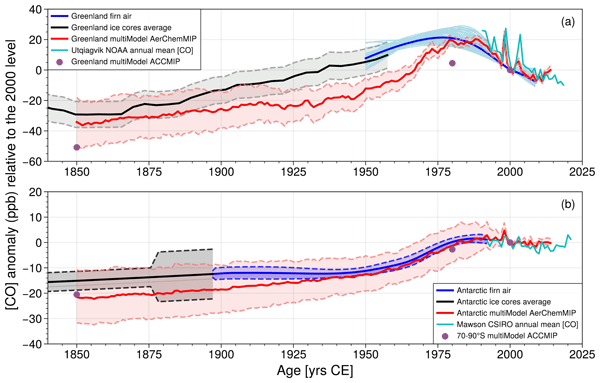
Xavier Faïn, Sophie Szopa, Vaishali Naïk, Patricia Martinerie, David M. Etheridge, Rachael H. Rhodes, Cathy M. Trudinger, Vasilii V. Petrenko, Kévin Fourteau, and Philip Place
Atmos. Chem. Phys., 25, 1105–1119, https://doi.org/10.5194/acp-25-1105-2025, https://doi.org/10.5194/acp-25-1105-2025, 2025
Short summary
Short summary
Carbon monoxide (CO) plays a crucial role in the atmosphere's oxidizing capacity. In this study, we analyse how historical (1850–2014) [CO] outputs from state-of-the-art global chemistry–climate models over Greenland and Antarctica are able to capture both absolute values and trends recorded in multi-site ice archives. A disparity in [CO] growth rates emerges in the Northern Hemisphere between models and observations from 1920–1975 CE, possibly linked to uncertainties in CO emission factors.
Diego Monteiro, Cécile Caillaud, Matthieu Lafaysse, Adrien Napoly, Mathieu Fructus, Antoinette Alias, and Samuel Morin
Geosci. Model Dev., 17, 7645–7677, https://doi.org/10.5194/gmd-17-7645-2024, https://doi.org/10.5194/gmd-17-7645-2024, 2024
Short summary
Short summary
Modeling snow cover in climate and weather forecasting models is a challenge even for high-resolution models. Recent simulations with CNRM-AROME have shown difficulties when representing snow in the European Alps. Using remote sensing data and in situ observations, we evaluate modifications of the land surface configuration in order to improve it. We propose a new surface configuration, enabling a more realistic simulation of snow cover, relevant for climate and weather forecasting applications.
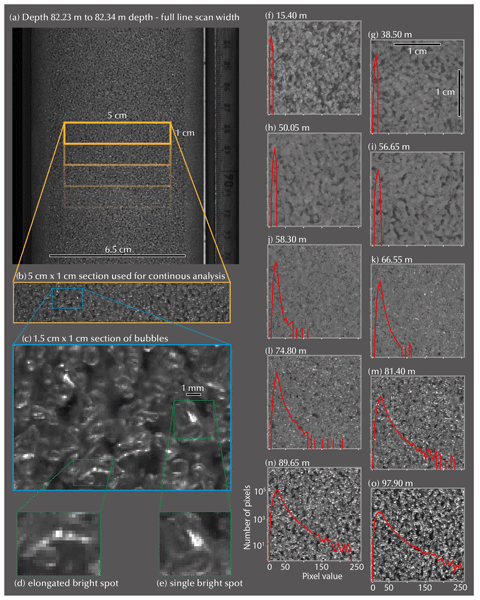
Julien Westhoff, Johannes Freitag, Anaïs Orsi, Patricia Martinerie, Ilka Weikusat, Michael Dyonisius, Xavier Faïn, Kevin Fourteau, and Thomas Blunier
The Cryosphere, 18, 4379–4397, https://doi.org/10.5194/tc-18-4379-2024, https://doi.org/10.5194/tc-18-4379-2024, 2024
Short summary
Short summary
We study the EastGRIP area, Greenland, in detail with traditional and novel techniques. Due to the compaction of the ice, at a certain depth, atmospheric gases can no longer exchange, and the atmosphere is trapped in air bubbles in the ice. We find this depth by pumping air from a borehole, modeling, and using a new technique based on the optical appearance of the ice. Our results suggest that the close-off depth lies at around 58–61 m depth and more precisely at 58.3 m depth.
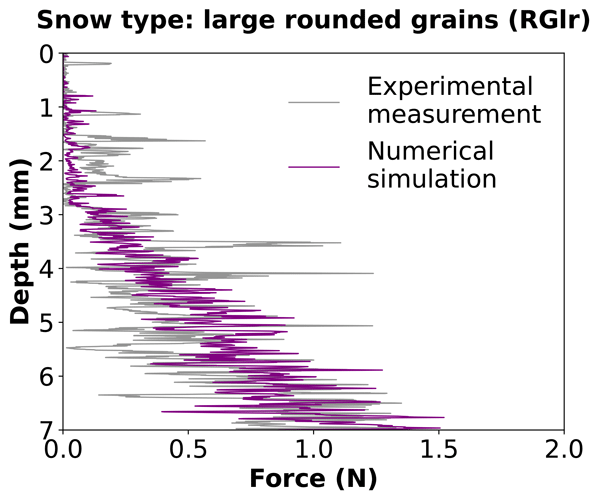
Clémence Herny, Pascal Hagenmuller, Guillaume Chambon, Isabel Peinke, and Jacques Roulle
The Cryosphere, 18, 3787–3805, https://doi.org/10.5194/tc-18-3787-2024, https://doi.org/10.5194/tc-18-3787-2024, 2024
Short summary
Short summary
This paper presents the evaluation of a numerical discrete element method (DEM) by simulating cone penetration tests in different snow samples. The DEM model demonstrated a good ability to reproduce the measured mechanical behaviour of the snow, namely the force evolution on the cone and the grain displacement field. Systematic sensitivity tests showed that the mechanical response depends not only on the microstructure of the sample but also on the mechanical parameters of grain contacts.
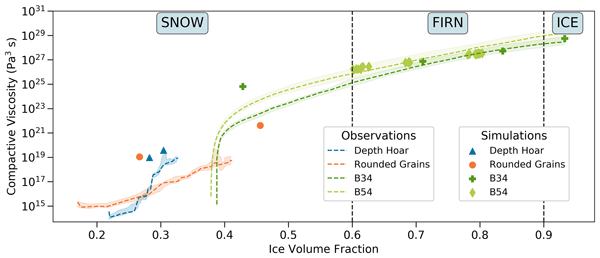
Kévin Fourteau, Johannes Freitag, Mika Malinen, and Henning Löwe
The Cryosphere, 18, 2831–2846, https://doi.org/10.5194/tc-18-2831-2024, https://doi.org/10.5194/tc-18-2831-2024, 2024
Short summary
Short summary
Understanding the settling of snow under its own weight has applications from avalanche forecasts to ice core interpretations. We study how this settling can be modeled using 3D images of the internal structure of snow and ice deformation mechanics. We found that classical ice mechanics, as used, for instance, in glacier flow, explain the compaction of dense polar snow but not that of lighter seasonal snow. How, exactly, the ice deforms during light snow compaction thus remains an open question.
Anna Braun, Kévin Fourteau, and Henning Löwe
The Cryosphere, 18, 1653–1668, https://doi.org/10.5194/tc-18-1653-2024, https://doi.org/10.5194/tc-18-1653-2024, 2024
Short summary
Short summary
The specific surface of snow dictates key physical properties and continuously evolves in natural snowpacks. This is referred to as metamorphism. This work develops a rigorous physical model for this evolution, which is able to reproduce X-ray tomography measurements without using unphysical tuning parameters. Our results emphasize that snow crystal growth at the micrometer scale ultimately controls the pace of metamorphism.
Kavitha Sundu, Johannes Freitag, Kévin Fourteau, and Henning Löwe
The Cryosphere, 18, 1579–1596, https://doi.org/10.5194/tc-18-1579-2024, https://doi.org/10.5194/tc-18-1579-2024, 2024
Short summary
Short summary
Ice crystals often show a rod-like, vertical orientation in snow and firn; they are said to be anisotropic. The stiffness in the vertical direction therefore differs from the horizontal, which, for example, impacts the propagation of seismic waves. To quantify this anisotropy, we conducted finite-element simulations of 391 snow, firn, and ice core microstructures obtained from X-ray tomography. We then derived a parameterization that may be employed for advanced seismic studies in polar regions.
Kévin Fourteau, Julien Brondex, Fanny Brun, and Marie Dumont
Geosci. Model Dev., 17, 1903–1929, https://doi.org/10.5194/gmd-17-1903-2024, https://doi.org/10.5194/gmd-17-1903-2024, 2024
Short summary
Short summary
In this paper, we provide a novel numerical implementation for solving the energy exchanges at the surface of snow and ice. By combining the strong points of previous models, our solution leads to more accurate and robust simulations of the energy exchanges, surface temperature, and melt while preserving a reasonable computation time.
Julien Brondex, Kévin Fourteau, Marie Dumont, Pascal Hagenmuller, Neige Calonne, François Tuzet, and Henning Löwe
Geosci. Model Dev., 16, 7075–7106, https://doi.org/10.5194/gmd-16-7075-2023, https://doi.org/10.5194/gmd-16-7075-2023, 2023
Short summary
Short summary
Vapor diffusion is one of the main processes governing snowpack evolution, and it must be accounted for in models. Recent attempts to represent vapor diffusion in numerical models have faced several difficulties regarding computational cost and mass and energy conservation. Here, we develop our own finite-element software to explore numerical approaches and enable us to overcome these difficulties. We illustrate the capability of these approaches on established numerical benchmarks.
Xavier Faïn, David M. Etheridge, Kévin Fourteau, Patricia Martinerie, Cathy M. Trudinger, Rachael H. Rhodes, Nathan J. Chellman, Ray L. Langenfelds, Joseph R. McConnell, Mark A. J. Curran, Edward J. Brook, Thomas Blunier, Grégory Teste, Roberto Grilli, Anthony Lemoine, William T. Sturges, Boris Vannière, Johannes Freitag, and Jérôme Chappellaz
Clim. Past, 19, 2287–2311, https://doi.org/10.5194/cp-19-2287-2023, https://doi.org/10.5194/cp-19-2287-2023, 2023
Short summary
Short summary
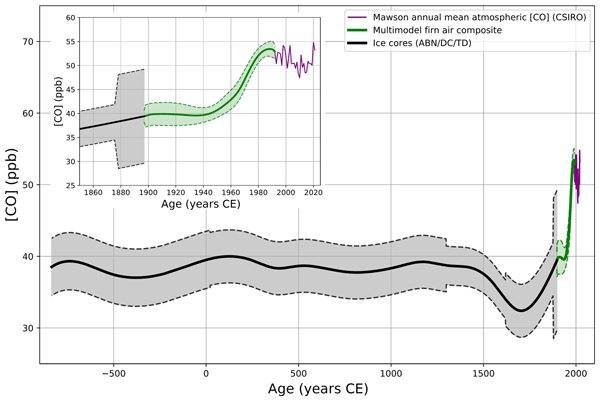
We report on a 3000-year record of carbon monoxide (CO) levels in the Southern Hemisphere's high latitudes by combining ice core and firn air measurements with modern direct atmospheric samples. Antarctica [CO] remained stable (–835 to 1500 CE), decreased during the Little Ice Age, and peaked around 1985 CE. Such evolution reflects stable biomass burning CO emissions before industrialization, followed by growth from CO anthropogenic sources, which decline after 1985 due to improved combustion.
Diego Monteiro and Samuel Morin
The Cryosphere, 17, 3617–3660, https://doi.org/10.5194/tc-17-3617-2023, https://doi.org/10.5194/tc-17-3617-2023, 2023
Short summary
Short summary
Beyond directly using in situ observations, often sparsely available in mountain regions, climate model simulations and so-called reanalyses are increasingly used for climate change impact studies. Here we evaluate such datasets in the European Alps from 1950 to 2020, with a focus on snow cover information and its main drivers: air temperature and precipitation. In terms of variability and trends, we identify several limitations and provide recommendations for future use of these datasets.
Fanny Brun, Owen King, Marion Réveillet, Charles Amory, Anton Planchot, Etienne Berthier, Amaury Dehecq, Tobias Bolch, Kévin Fourteau, Julien Brondex, Marie Dumont, Christoph Mayer, Silvan Leinss, Romain Hugonnet, and Patrick Wagnon
The Cryosphere, 17, 3251–3268, https://doi.org/10.5194/tc-17-3251-2023, https://doi.org/10.5194/tc-17-3251-2023, 2023
Short summary
Short summary
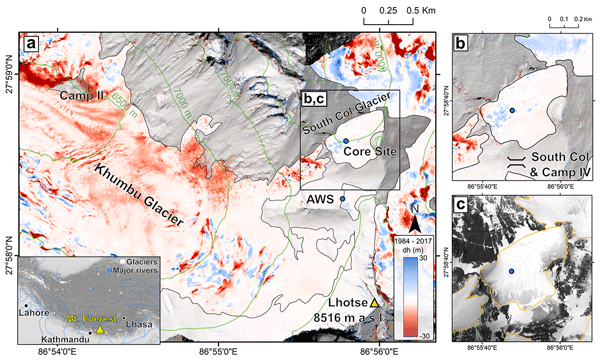
The South Col Glacier is a small body of ice and snow located on the southern ridge of Mt. Everest. A recent study proposed that South Col Glacier is rapidly losing mass. In this study, we examined the glacier thickness change for the period 1984–2017 and found no thickness change. To reconcile these results, we investigate wind erosion and surface energy and mass balance and find that melt is unlikely a dominant process, contrary to previous findings.
Marie Dumont, Simon Gascoin, Marion Réveillet, Didier Voisin, François Tuzet, Laurent Arnaud, Mylène Bonnefoy, Montse Bacardit Peñarroya, Carlo Carmagnola, Alexandre Deguine, Aurélie Diacre, Lukas Dürr, Olivier Evrard, Firmin Fontaine, Amaury Frankl, Mathieu Fructus, Laure Gandois, Isabelle Gouttevin, Abdelfateh Gherab, Pascal Hagenmuller, Sophia Hansson, Hervé Herbin, Béatrice Josse, Bruno Jourdain, Irene Lefevre, Gaël Le Roux, Quentin Libois, Lucie Liger, Samuel Morin, Denis Petitprez, Alvaro Robledano, Martin Schneebeli, Pascal Salze, Delphine Six, Emmanuel Thibert, Jürg Trachsel, Matthieu Vernay, Léo Viallon-Galinier, and Céline Voiron
Earth Syst. Sci. Data, 15, 3075–3094, https://doi.org/10.5194/essd-15-3075-2023, https://doi.org/10.5194/essd-15-3075-2023, 2023
Short summary
Short summary
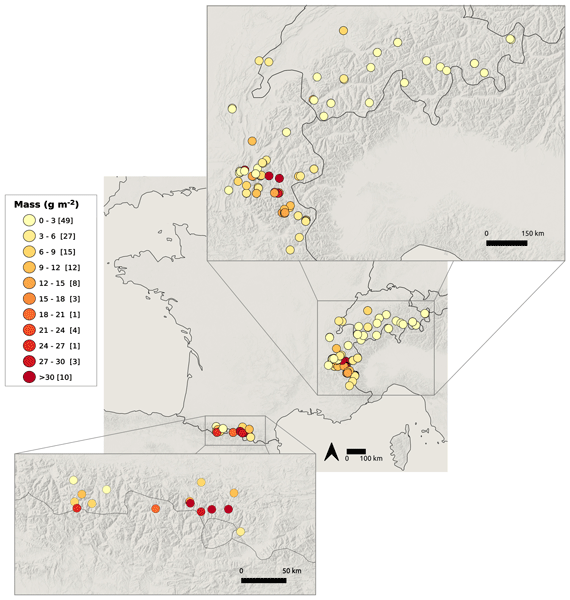
Saharan dust outbreaks have profound effects on ecosystems, climate, health, and the cryosphere, but the spatial deposition pattern of Saharan dust is poorly known. Following the extreme dust deposition event of February 2021 across Europe, a citizen science campaign was launched to sample dust on snow over the Pyrenees and the European Alps. This campaign triggered wide interest and over 100 samples. The samples revealed the high variability of the dust properties within a single event.
Léo Viallon-Galinier, Pascal Hagenmuller, and Nicolas Eckert
The Cryosphere, 17, 2245–2260, https://doi.org/10.5194/tc-17-2245-2023, https://doi.org/10.5194/tc-17-2245-2023, 2023
Short summary
Short summary
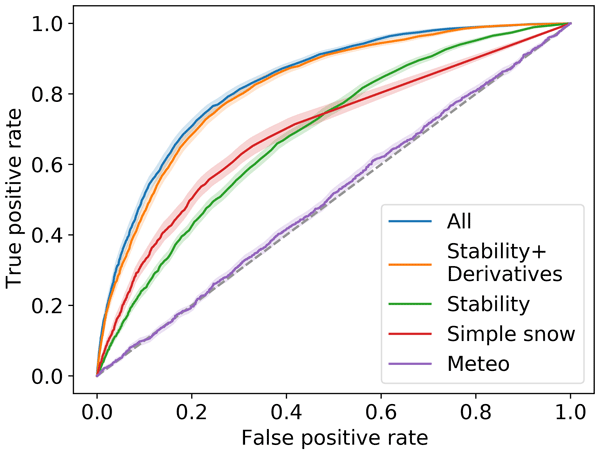
Avalanches are a significant issue in mountain areas where they threaten recreationists and human infrastructure. Assessments of avalanche hazards and the related risks are therefore an important challenge for local authorities. Meteorological and snow cover simulations are thus important to support operational forecasting. In this study we combine it with mechanical analysis of snow profiles and find that observed avalanche data improve avalanche activity prediction through statistical methods.
Oscar Dick, Léo Viallon-Galinier, François Tuzet, Pascal Hagenmuller, Mathieu Fructus, Benjamin Reuter, Matthieu Lafaysse, and Marie Dumont
The Cryosphere, 17, 1755–1773, https://doi.org/10.5194/tc-17-1755-2023, https://doi.org/10.5194/tc-17-1755-2023, 2023
Short summary
Short summary
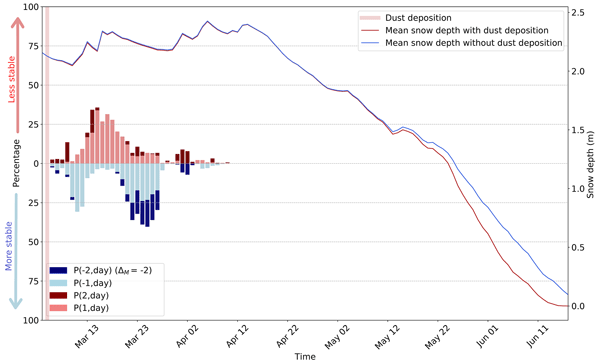
Saharan dust deposition can drastically change the snow color, turning mountain landscapes into sepia scenes. Dust increases the absorption of solar energy by the snow cover and thus modifies the snow evolution and potentially the avalanche risk. Here we show that dust can lead to increased or decreased snowpack stability depending on the snow and meteorological conditions after the deposition event. We also show that wet-snow avalanches happen earlier in the season due to the presence of dust.
Pyei Phyo Lin, Isabel Peinke, Pascal Hagenmuller, Matthias Wächter, M. Reza Rahimi Tabar, and Joachim Peinke
The Cryosphere, 16, 4811–4822, https://doi.org/10.5194/tc-16-4811-2022, https://doi.org/10.5194/tc-16-4811-2022, 2022
Short summary
Short summary
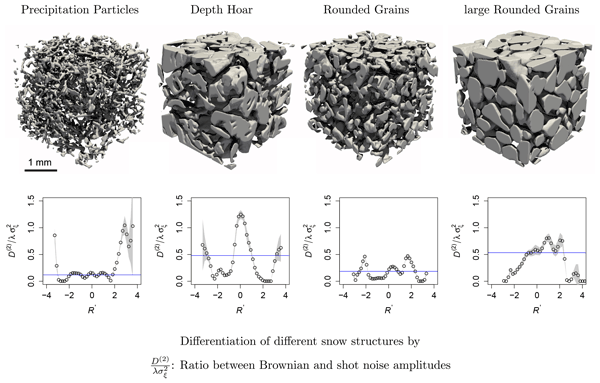
Characterization of layers of snowpack with highly resolved micro-cone penetration tests leads to detailed fluctuating signals. We used advanced stochastic analysis to differentiate snow types by interpreting the signals as a mixture of continuous and discontinuous random fluctuations. These two types of fluctuation seem to correspond to different mechanisms of drag force generation during the experiments. The proposed methodology provides new insights into the characterization of snow layers.
Matthieu Vernay, Matthieu Lafaysse, Diego Monteiro, Pascal Hagenmuller, Rafife Nheili, Raphaëlle Samacoïts, Deborah Verfaillie, and Samuel Morin
Earth Syst. Sci. Data, 14, 1707–1733, https://doi.org/10.5194/essd-14-1707-2022, https://doi.org/10.5194/essd-14-1707-2022, 2022
Short summary
Short summary
This paper introduces the latest version of the freely available S2M dataset which provides estimates of both meteorological and snow cover variables, as well as various avalanche hazard diagnostics at different elevations, slopes and aspects for the three main French high-elevation mountainous regions. A complete description of the system and the dataset is provided, as well as an overview of the possible uses of this dataset and an objective assessment of its limitations.
Xavier Faïn, Rachael H. Rhodes, Philip Place, Vasilii V. Petrenko, Kévin Fourteau, Nathan Chellman, Edward Crosier, Joseph R. McConnell, Edward J. Brook, Thomas Blunier, Michel Legrand, and Jérôme Chappellaz
Clim. Past, 18, 631–647, https://doi.org/10.5194/cp-18-631-2022, https://doi.org/10.5194/cp-18-631-2022, 2022
Short summary
Short summary
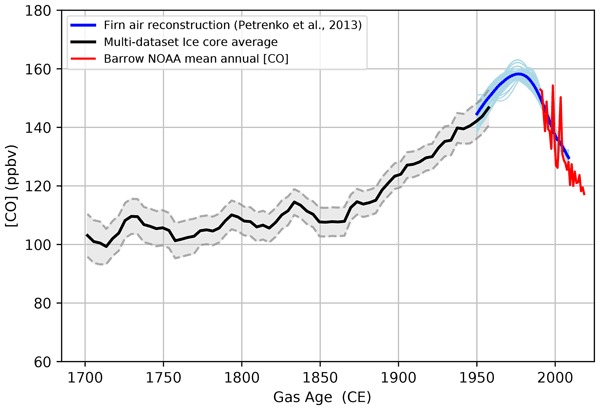
Carbon monoxide (CO) is a regulated pollutant and one of the key components determining the oxidizing capacity of the atmosphere. In this study, we analyzed five ice cores from Greenland at high resolution for CO concentrations by coupling laser spectrometry with continuous melting. By combining these new datasets, we produced an upper-bound estimate of past atmospheric CO abundance since preindustrial times for the Northern Hemisphere high latitudes, covering the period from 1700 to 1957 CE.
Cited articles
Adam, V., Bergfeld, B., Weißgraeber, P., van Herwijnen, A., and Rosendahl, P. L.: Fracture toughness of mixed-mode anticracks in highly porous materials, Nat. Commun., 15, 7379, https://doi.org/10.1038/s41467-024-51491-7, 2024. a, b, c, d
Bergfeld, B., van Herwijnen, A., Bobillier, G., Rosendahl, P. L., Weißgraeber, P., Adam, V., Dual, J., and Schweizer, J.: Temporal evolution of crack propagation characteristics in a weak snowpack layer: conditions of crack arrest and sustained propagation, Nat. Hazards Earth Syst. Sci., 23, 293–315, https://doi.org/10.5194/nhess-23-293-2023, 2023. a, b, c, d, e, f, g, h
Bernard, A., Hagenmuller, P., Montagnat, M., and Chambon, G.: Disentangling creep and isothermal metamorphism during snow settlement with X-ray tomography, J. Glaciol., 69, 899–910, https://doi.org/10.1017/jog.2022.109, 2023. a
Brun, E., David, P., Sudul, M., and Brunot, G.: A numerical model to simulate snow-cover stratigraphy for operational avalanche forecasting, J. Glaciol., 38, 13–22, 1992. a
Calonne, N., Flin, F., Morin, S., Lesaffre, B., du Roscoat, S. R., and Geindreau, C.: Numerical and experimental investigations of the effective thermal conductivity of snow, Geophys. Res. Lett., 38, https://doi.org/10.1029/2011GL049234, 2011. a
Dick, O., Calonne, N., Laurent, B., and Hagenmuller, P.: Monitoring dry snow metamorphism using 4D tomography across 20 experimental conditions, Earth Syst. Sci. Data, 18, 2875–2889, https://doi.org/10.5194/essd-18-2875-2026, 2026. a
EAWS: EAWS, https://www.avalanches.org/ (last access: 17 August 2026), 2026. a
Fourteau, K., Hagenmuller, P., Roulle, J., and Domine, F.: On the use of heated needle probes for measuring snow thermal conductivity, J. Glaciol., 68, 705–719, https://doi.org/10.1017/jog.2021.127, 2022. a
Gaume, J., van Herwijnen, A., Chambon, G., Birkeland, K. W., and Schweizer, J.: Modeling of crack propagation in weak snowpack layers using the discrete element method, The Cryosphere, 9, 1915–1932, https://doi.org/10.5194/tc-9-1915-2015, 2015. a, b
Gaume, J., van Herwijnen, A., Chambon, G., Wever, N., and Schweizer, J.: Snow fracture in relation to slab avalanche release: critical state for the onset of crack propagation, The Cryosphere, 11, 217–228, https://doi.org/10.5194/tc-11-217-2017, 2017. a
Gaume, J., Meloche, F., Reiweger, I., and Hagenmuller, P.: Propagation of weak layer failure in snow slab avalanche release: analytical solutions for a compliant interface with finite softening, arXiv [preprint], https://doi.org/10.48550/arXiv.2605.05061, 2026. a, b
Gauthier, D. and Jamieson, B.: Towards a field test for fracture propagation propensity in weak snowpack layers, J. Glaciol., 52, 164–168, https://doi.org/10.3189/172756506781828962, 2006. a
Gauthier, D. and Jamieson, B.: Fracture propagation propensity in relation to snow slab avalanche release: Validating the Propagation Saw Test, Geophys. Res. Lett., 35, https://doi.org/10.1029/2008GL034245, 2008. a, b
Gerling, B., Löwe, H., and van Herwijnen, A.: Measuring the Elastic Modulus of Snow, Geophys. Res. Lett., 44, https://doi.org/10.1002/2017GL075110, 2017. a, b, c
Giraud, G., Navarre, J.-P., and Coléou, C.: Estimation du risque avalancheux dans le système expert MEPRA, CNRM – Centre National de Recherches Météorologiques, Météo-France, hal-02638748, 2002. a
Griffith, A.: The phenomena of rupture and flow in solids, Philos. T. R. Soc. Lond., 221, 163–198, https://doi.org/10.1098/rsta.1921.0006, 1920. a
Hagenmuller, P. and Carmagnola, C.: Granulométrie de la neige de culture, ANENA – Association Nationale pour l'Étude de la Neige et des Avalanches, 10–13, https://ens.syracuse.cloud/Default/doc/SYRACUSE/70156/granulometrie-de-la-neige-de-culture (last access: 17 August 2026), 2020. a
Hagenmuller, P., Matzl, M., Chambon, G., and Schneebeli, M.: Sensitivity of snow density and specific surface area measured by microtomography to different image processing algorithms, The Cryosphere, 10, 1039–1054, https://doi.org/10.5194/tc-10-1039-2016, 2016. a
Hagenmuller, P., Flin, F., Dumont, M., Tuzet, F., Peinke, I., Lapalus, P., Dufour, A., Roulle, J., Pézard, L., Voisin, D., Ando, E., Rolland du Roscoat, S., and Charrier, P.: Motion of dust particles in dry snow under temperature gradient metamorphism, The Cryosphere, 13, 2345–2359, https://doi.org/10.5194/tc-13-2345-2019, 2019. a
Helfricht, K., Hartl, L., Koch, R., Marty, C., and Olefs, M.: Obtaining sub-daily new snow density from automated measurements in high mountain regions, Hydrol. Earth Syst. Sci., 22, 2655–2668, https://doi.org/10.5194/hess-22-2655-2018, 2018. a
Köchle, B. and Schneebeli, M.: Three-dimensional microstructure and numerical calculation of elastic properties of alpine snow with a focus on weak layers, J. Glaciol., 60, 705–713, doi10.3189/2014JoG13J220, 2014. a
Lafaysse, M., Dumont, M., De Fleurian, B., Fructus, M., Nheili, R., Viallon-Galinier, L., Baron, M., Boone, A., Bouchet, A., Brondex, J., Carmagnola, C., Cluzet, B., Fourteau, K., Haddjeri, A., Hagenmuller, P., Mazzotti, G., Minvielle, M., Morin, S., Quéno, L., Roussel, L., Spandre, P., Tuzet, F., and Vionnet, V.: Version 3.0 of the Crocus snowpack model: source code of implementation within SURFEX and externalized version, Version 3.0, Zenodo [code], https://doi.org/10.5281/zenodo.16943240, 2025. a, b, c, d, e
Leguillon, D.: Strength or toughness? A criterion for crack onset at a notch, Eur. J. Mech. A-Solid., 21, 61–72, 2002. a
Leone, F., Colas, A., Garcin, Y., Eckert, N., Jomelli, V., and Gherardi, M.: The snow avalanches risk on Alpine roads network. Assessment of impacts and mapping of accessibility loss, Journal of Alpine Research | Revue de géographie alpine, 102-4, https://doi.org/10.4000/rga.2501, 2014. a
Margolin, L. G.: A generalized Griffith criterion for crack propagation, Eng. Fract. Mech., 19, 539–543, https://doi.org/10.1016/0013-7944(84)90010-9, 1984. a
Masson, V., Le Moigne, P., Martin, E., Faroux, S., Alias, A., Alkama, R., Belamari, S., Barbu, A., Boone, A., Bouyssel, F., Brousseau, P., Brun, E., Calvet, J.-C., Carrer, D., Decharme, B., Delire, C., Donier, S., Essaouini, K., Gibelin, A.-L., Giordani, H., Habets, F., Jidane, M., Kerdraon, G., Kourzeneva, E., Lafaysse, M., Lafont, S., Lebeaupin Brossier, C., Lemonsu, A., Mahfouf, J.-F., Marguinaud, P., Mokhtari, M., Morin, S., Pigeon, G., Salgado, R., Seity, Y., Taillefer, F., Tanguy, G., Tulet, P., Vincendon, B., Vionnet, V., and Voldoire, A.: The SURFEXv7.2 land and ocean surface platform for coupled or offline simulation of earth surface variables and fluxes, Geosci. Model Dev., 6, 929–960, https://doi.org/10.5194/gmd-6-929-2013, 2013. a
McClung, D. and Schaerer, P. A.: The avalanche handbook, The Mountaineers Books, ISBN: 0-89886-809-2, 2006. a
McClung, D. M.: Shear fracture precipitated by strain softening as a mechanism of dry slab avalanche release, J. Geophys. Res.-Sol. Ea., 84, 3519–3526, 1979. a
Monteiro, D., Viallon-Galinier, L., Fourteau, K., Dick, O., and Hagenmuller, P.: meteodmonteir/Article_Wf_param_2026: Replication code and assets, Version v2.0-zenodo, submission, Zenodo [code], https://doi.org/10.5281/zenodo.21904421, 2026. a
Morin, S., Horton, S., Techel, F., Bavay, M., Coléou, C., Fierz, C., Gobiet, A., Hagenmuller, P., Lafaysse, M., Ližar, M., Mitterer, C., Monti, F., Müller, K., Olefs, M., Snook, J. S., van Herwijnen, A., and Vionnet, V.: Application of physical snowpack models in support of operational avalanche hazard forecasting: A status report on current implementations and prospects for the future, Cold Reg. Sci. Technol., 170, 102910, https://doi.org/10.1016/j.coldregions.2019.102910, 2020. a, b
Noilhan, J. and Mahfouf, J.-F.: The ISBA land surface parameterisation scheme, Global Planet. Change, 13, 145–159, 1996. a
Ortner, G., Michel, A., Kropf, C. M., Bründl, M., and Bresch, D. N.: Assessing the impacts of climate change on snow avalanche-induced risk in alpine regions, Nat. Hazards, 121, 10877–10904, https://doi.org/10.1007/s11069-025-07229-9, 2025. a
Park, K. and Paulino, G. H.: Cohesive Zone Models: A Critical Review of Traction-Separation Relationships Across Fracture Surfaces, Appl. Mech. Rev., 64, 060802, https://doi.org/10.1115/1.4023110, 2013. a
Peinke, I., Hagenmuller, P., Andò, E., Chambon, G., Flin, F., and Roulle, J.: Experimental study of cone penetration in snow using x-ray tomography, Frontiers in Earth Science, 8, 63, https://doi.org/10.3389/feart.2020.00063, 2020. a
Proksch, M., Rutter, N., Fierz, C., and Schneebeli, M.: Intercomparison of snow density measurements: bias, precision, and vertical resolution, The Cryosphere, 10, 371–384, https://doi.org/10.5194/tc-10-371-2016, 2016. a, b
Quéno, L., Vionnet, V., Dombrowski-Etchevers, I., Lafaysse, M., Dumont, M., and Karbou, F.: Snowpack modelling in the Pyrenees driven by kilometric-resolution meteorological forecasts, The Cryosphere, 10, 1571–1589, https://doi.org/10.5194/tc-10-1571-2016, 2016. a
Reuter, B. and Schweizer, J.: Describing Snow Instability by Failure Initiation, Crack Propagation, and Slab Tensile Support, Geophys. Res. Lett., 45, 7019–7027, https://doi.org/10.1029/2018GL078069, 2018. a, b, c
Reuter, B., Proksch, M., Loewe, H., van Herwijnen, A., and Schweizer, J.: On how to measure snow mechanical properties relevant to slab avalanche release, in: Proceedings ISSW, 7–11, 2013. a
Reuter, B., Schweizer, J., and van Herwijnen, A.: A process-based approach to estimate point snow instability, The Cryosphere, 9, 837–847, https://doi.org/10.5194/tc-9-837-2015, 2015. a, b
Reuter, B., Proksch, M., Löwe, H., Van Herwijnen, A., and Schweizer, J.: Comparing measurements of snow mechanical properties relevant for slab avalanche release, J. Glaciol., 65, 55–67, https://doi.org/10.1017/jog.2018.93, 2019. a
Schöttner, J., Zeller-Plumhoff, B., Hagenmuller, P., Weißgraeber, P., Rosendahl, P. L., Löwe, H., Schweizer, J., and van Herwijnen, A.: The influence of snow microstructure on the compressive mechanical properties of weak snowpack layers, Acta Mater., 302, 121657, https://doi.org/10.1016/j.actamat.2025.121657, 2026. a, b
Schweizer, J., Bruce Jamieson, J., and Schneebeli, M.: Snow avalanche formation, Rev. Geophys., 41, https://doi.org/10.1029/2002RG000123, 2003. a, b
Schweizer, J., Reuter, B., van Herwijnen, A., Richter, B., and Gaume, J.: Temporal evolution of crack propagation propensity in snow in relation to slab and weak layer properties, The Cryosphere, 10, 2637–2653, https://doi.org/10.5194/tc-10-2637-2016, 2016. a, b, c
Schweizer, J., Bartelt, P., and van Herwijnen, A.: Chapter 12 – Snow avalanches, in: Snow and Ice-Related Hazards, Risks, and Disasters, 2nd edn., edited by: Haeberli, W. and Whiteman, C., Hazards and Disasters Series, Elsevier, 377–416, https://doi.org/10.1016/B978-0-12-817129-5.00001-9, ISBN 978-0-12-817129-5, 2021. a
Sigrist, C. and Schweizer, J.: Critical energy release rates of weak snowpack layers determined in field experiments, Geophys. Res. Lett., 34, https://doi.org/10.1029/2006GL028576, 2007. a
Sundu, K., Freitag, J., Fourteau, K., and Löwe, H.: A microstructure-based parameterization of the effective anisotropic elasticity tensor of snow, firn, and bubbly ice, The Cryosphere, 18, 1579–1596, https://doi.org/10.5194/tc-18-1579-2024, 2024. a
Techel, F., Jarry, F., Kronthaler, G., Mitterer, S., Nairz, P., Pavšek, M., Valt, M., and Darms, G.: Avalanche fatalities in the European Alps: long-term trends and statistics, Geogr. Helv., 71, 147–159, https://doi.org/10.5194/gh-71-147-2016, 2016. a
van Herwijnen, A. and Jamieson, B.: High-speed photography of fractures in weak snowpack layers, Cold Reg. Sci. Technol., 43, 71–82, https://doi.org/10.1016/j.coldregions.2005.05.005, 2005. a, b
van Herwijnen, A. and Jamieson, B.: Snowpack properties associated with fracture initiation and propagation resulting in skier-triggered dry snow slab avalanches, Cold Reg. Sci. Technol., 50, 13–22, https://doi.org/10.1016/j.coldregions.2007.02.004, 2007. a
Van Herwijnen, A., Gaume, J., Bair, E. H., Reuter, B., Birkeland, K. W., and Schweizer, J.: Estimating the effective elastic modulus and specific fracture energy of snowpack layers from field experiments, J. Glaciol., 62, 997–1007, https://doi.org/10.1017/jog.2016.90, 2016. a, b
Védrine, L., Hagenmuller, P., Gélébart, L., Montagnat, M., and Löwe, H.: Sensitivity of the viscoplasticity of polycrystals to porosity and pore-to-crystal size ratio, Acta Mater., 301, 121507, https://doi.org/10.1016/j.actamat.2025.121507, 2025. a
Vernay, M., Lafaysse, M., Monteiro, D., Hagenmuller, P., Nheili, R., Samacoïts, R., Verfaillie, D., and Morin, S.: The S2M meteorological and snow cover reanalysis over the French mountainous areas: description and evaluation (1958–2021), Earth Syst. Sci. Data, 14, 1707–1733, https://doi.org/10.5194/essd-14-1707-2022, 2022. a
Vionnet, V., Brun, E., Morin, S., Boone, A., Faroux, S., Le Moigne, P., Martin, E., and Willemet, J.-M.: The detailed snowpack scheme Crocus and its implementation in SURFEX v7.2, Geosci. Model Dev., 5, 773–791, https://doi.org/10.5194/gmd-5-773-2012, 2012. a, b, c
Wever, N., Schmid, L., Heilig, A., Eisen, O., Fierz, C., and Lehning, M.: Verification of the multi-layer SNOWPACK model with different water transport schemes, The Cryosphere, 9, 2271–2293, https://doi.org/10.5194/tc-9-2271-2015, 2015. a, b
Short summary
This research aims to improve dry-snow slab avalanche forecasts, particularly the propagation of cracks in weak layers, as current models rely on uncertain and difficult-to-measure parameters. We combined snowpack simulations with field measurements to link fracture energy to measurable and modelable snow properties. This new approach better reproduces observed crack lengths and allows weak layers to be tracked throughout the season, thereby improving operational avalanche risk assessment.
This research aims to improve dry-snow slab avalanche forecasts, particularly the propagation of...


