
Articles | Volume 20, issue 1
https://doi.org/10.5194/tc-20-209-2026
© Author(s) 2026. This work is distributed under
the Creative Commons Attribution 4.0 License.
the Creative Commons Attribution 4.0 License.
https://doi.org/10.5194/tc-20-209-2026
© Author(s) 2026. This work is distributed under
the Creative Commons Attribution 4.0 License.
the Creative Commons Attribution 4.0 License.
Research article
| 
14 Jan 2026
Research article |
| 14 Jan 2026
| 14 Jan 2026
Ensemble-based data assimilation improves hyperresolution snowpack simulations in forests
Esteban Alonso-González
CORRESPONDING AUTHOR
Instituto Pirenaico de Ecología, Consejo Superior de Investigaciones Científicas (IPE- CSIC), Jaca, Spain
Adrian Harpold
Department of Natural Resources and Environmental Science, University of Nevada, Reno, Nevada, USA
Jessica D. Lundquist
Civil and Environmental Engineering, University of Washington, Seattle, Washington, USA
Cara Piske
Department of Natural Resources and Environmental Science, University of Nevada, Reno, Nevada, USA
Airborne Snow Observatories Inc. Mammoth Lakes, California, USA
Laura Sourp
Université de Toulouse, CNRS, CNES, IRD, INRAE, Centre d’études spatiales de la biosphère, Toulouse, France
MAGELLIUM, Ramonville Saint-Agne, France
Kristoffer Aalstad
Department of Geosciences, University of Oslo, Oslo, Norway
Simon Gascoin
Université de Toulouse, CNRS, CNES, IRD, INRAE, Centre d’études spatiales de la biosphère, Toulouse, France
Related authors
Javier Bandrés, Jorge Pey, Esteban Alonso-González, Pablo Domínguez-Aguilar, Jesús Revuelto, Eñaut Izagirre, Francisco Rojas-Heredia, Eric Allan Sproles, and Juan Ignacio López-Moreno
EGUsphere, https://doi.org/10.5194/egusphere-2026-4306, https://doi.org/10.5194/egusphere-2026-4306, 2026
This preprint is open for discussion and under review for The Cryosphere (TC).
Short summary
Short summary
Snow in the Pyrenees is increasingly affected by African dust and black carbon, which darken the snow surface and accelerate melting. We developed a simple field experiment to measure how realistic amounts of these particles change snow properties and melt. Mineral dust consistently produced stronger effects than black carbon, showing that even common dust events can substantially shorten snow cover and improve estimates of snowmelt in mountain regions.
Kristoffer Aalstad, Esteban Alonso-González, Norbert Pirk, Sebastian Westermann, Clarissa Willmes, and Ruitang Yang
EGUsphere, https://doi.org/10.48550/arXiv.2601.20049, https://doi.org/10.48550/arXiv.2601.20049, 2026
Short summary
Short summary
AdaPBS is a new algorithm to combine observations with cryospheric numerical models. AdaPBS is an iterative algorithm that automatically adjusts computing effort to the task, allowing the implementation of early stopping strategies. We tested AdaPBS at multiple sites with different models, matching or outperforming standard methods, when compared against more complex (computationally expensive) algorithms.
Marco Mazzolini, Kristoffer Aalstad, Esteban Alonso-González, Sebastian Westermann, and Désirée Treichler
The Cryosphere, 19, 3831–3848, https://doi.org/10.5194/tc-19-3831-2025, https://doi.org/10.5194/tc-19-3831-2025, 2025
Short summary
Short summary
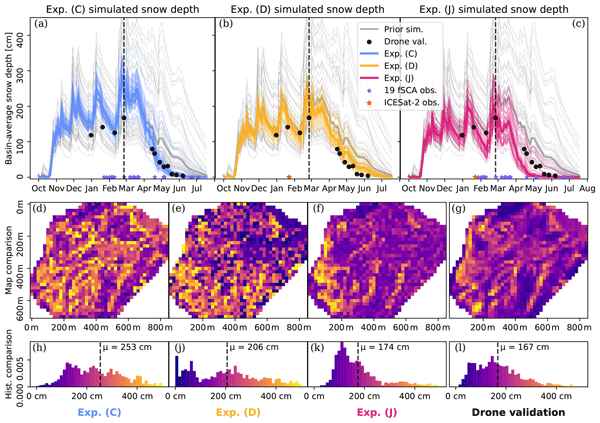
In this work, we showcase the use the satellite laser altimeter ICESat-2, which is able to retrieve snow depth in areas where snow amounts are still poorly estimated despite the importance of these water resources. We can update snow models with these observations through algorithms that spatially propagate the information beyond the satellite profiles. The positive results show the potential of the approach to improve snow simulations, in terms of average snow depth and spatial distribution.
Thibault Xavier, Laurent Orgogozo, Anatoly S. Prokushkin, Esteban Alonso-González, Simon Gascoin, and Oleg S. Pokrovsky
The Cryosphere, 18, 5865–5885, https://doi.org/10.5194/tc-18-5865-2024, https://doi.org/10.5194/tc-18-5865-2024, 2024
Short summary
Short summary
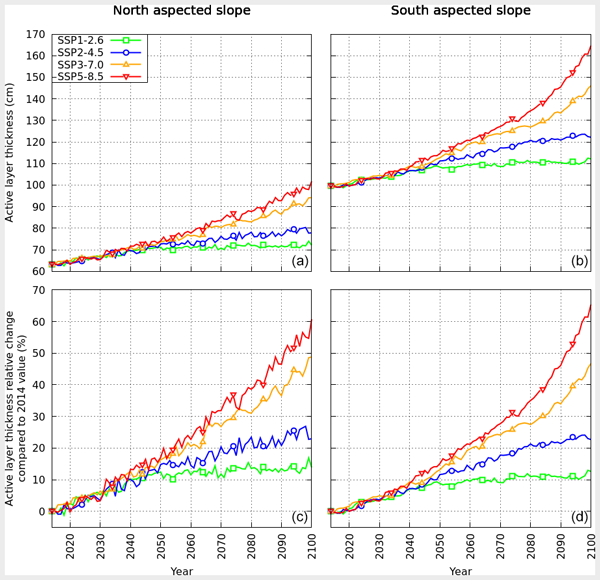
Permafrost (permanently frozen soil at depth) is thawing as a result of climate change. However, estimating its future degradation is particularly challenging due to the complex multi-physical processes involved. In this work, we designed and ran numerical simulations for months on a supercomputer to quantify the impact of climate change in a forested valley of central Siberia. There, climate change could increase the thickness of the seasonally thawed soil layer in summer by up to 65 % by 2100.
Sara Arioli, Ghislain Picard, Laurent Arnaud, Simon Gascoin, Esteban Alonso-González, Marine Poizat, and Mark Irvine
Earth Syst. Sci. Data, 16, 3913–3934, https://doi.org/10.5194/essd-16-3913-2024, https://doi.org/10.5194/essd-16-3913-2024, 2024
Short summary
Short summary
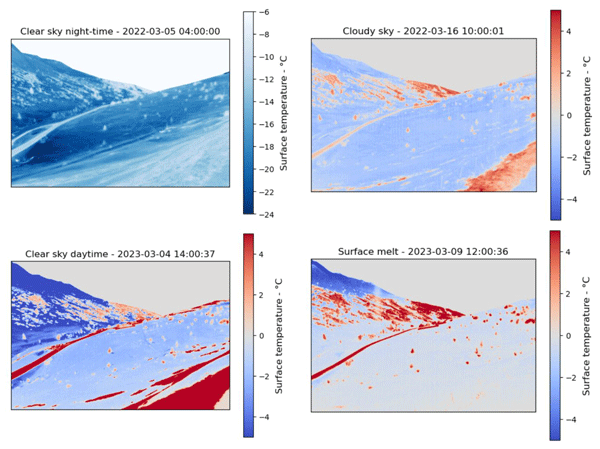
High-accuracy precision maps of the surface temperature of snow were acquired with an uncooled thermal-infrared camera during winter 2021–2022 and spring 2023. The accuracy – i.e., mean absolute error – improved from 1.28 K to 0.67 K between the seasons thanks to an improved camera setup and temperature stabilization. The dataset represents a major advance in the validation of satellite measurements and physical snow models over a complex topography.
Josep Bonsoms, Juan I. López-Moreno, Esteban Alonso-González, César Deschamps-Berger, and Marc Oliva
Nat. Hazards Earth Syst. Sci., 24, 245–264, https://doi.org/10.5194/nhess-24-245-2024, https://doi.org/10.5194/nhess-24-245-2024, 2024
Short summary
Short summary
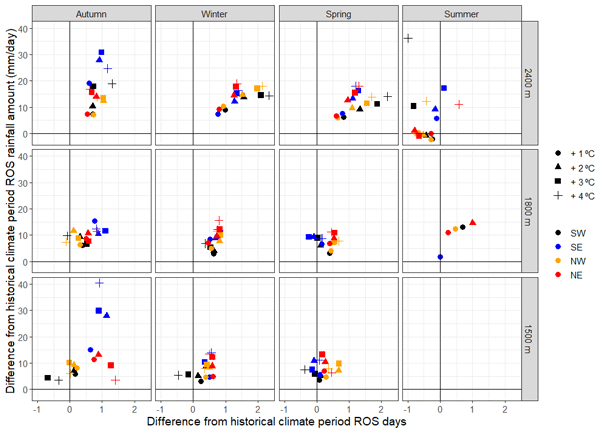
Climate warming is changing mountain snowpack patterns, leading in some cases to rain-on-snow (ROS) events. Here we analyzed near-present ROS and its sensitivity to climate warming across the Pyrenees. ROS increases during the coldest months of the year but decreases in the warmest months and areas under severe warming due to snow cover depletion. Faster snow ablation is anticipated in the coldest and northern slopes of the range. Relevant implications in mountain ecosystem are anticipated.
Esteban Alonso-González, Kristoffer Aalstad, Norbert Pirk, Marco Mazzolini, Désirée Treichler, Paul Leclercq, Sebastian Westermann, Juan Ignacio López-Moreno, and Simon Gascoin
Hydrol. Earth Syst. Sci., 27, 4637–4659, https://doi.org/10.5194/hess-27-4637-2023, https://doi.org/10.5194/hess-27-4637-2023, 2023
Short summary
Short summary
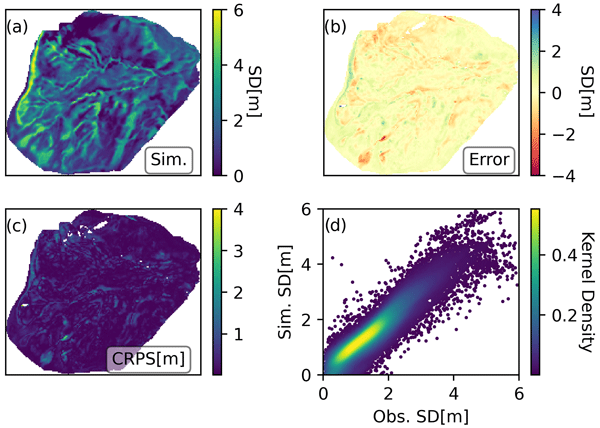
Here we explore how to improve hyper-resolution (5 m) distributed snowpack simulations using sparse observations, which do not provide information from all the areas of the simulation domain. We propose a new way of propagating information throughout the simulations adapted to the hyper-resolution, which could also be used to improve simulations of other nature. The method has been implemented in an open-source data assimilation tool that is readily accessible to everyone.
Esteban Alonso-González, Simon Gascoin, Sara Arioli, and Ghislain Picard
The Cryosphere, 17, 3329–3342, https://doi.org/10.5194/tc-17-3329-2023, https://doi.org/10.5194/tc-17-3329-2023, 2023
Short summary
Short summary
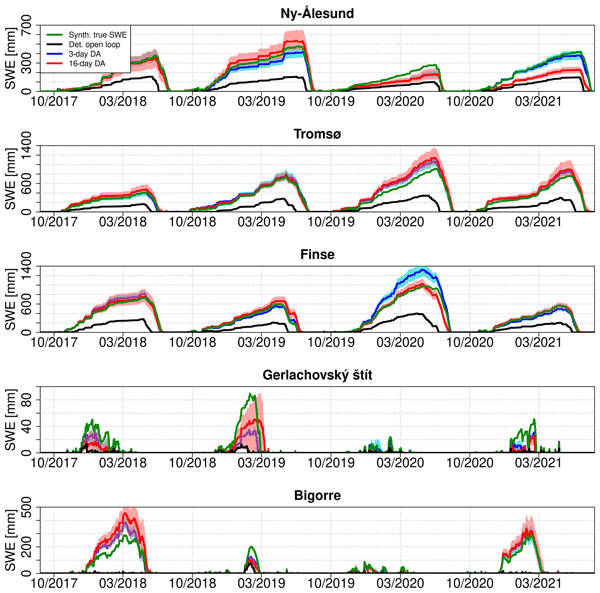
Data assimilation techniques are a promising approach to improve snowpack simulations in remote areas that are difficult to monitor. This paper studies the ability of satellite-observed land surface temperature to improve snowpack simulations through data assimilation. We show that it is possible to improve snowpack simulations, but the temporal resolution of the observations and the algorithm used are critical to obtain satisfactory results.
Ixeia Vidaller, Eñaut Izagirre, Luis Mariano del Rio, Esteban Alonso-González, Francisco Rojas-Heredia, Enrique Serrano, Ana Moreno, Juan Ignacio López-Moreno, and Jesús Revuelto
The Cryosphere, 17, 3177–3192, https://doi.org/10.5194/tc-17-3177-2023, https://doi.org/10.5194/tc-17-3177-2023, 2023
Short summary
Short summary
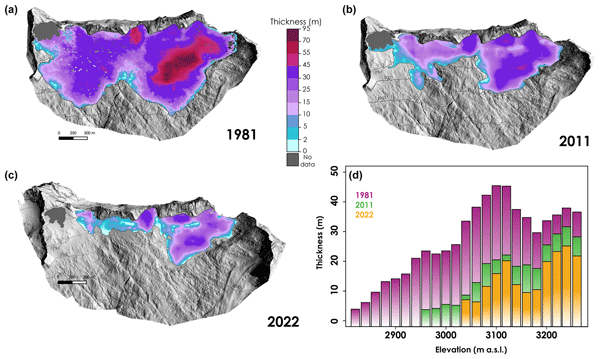
The Aneto glacier, the largest glacier in the Pyrenees, has shown continuous surface and ice thickness losses in the last decades. In this study, we examine changes in its surface and ice thickness for 1981–2022 and the remaining ice thickness in 2020. During these 41 years, the glacier has shrunk by 64.7 %, and the ice thickness has decreased by 30.5 m on average. The mean ice thickness in 2022 was 11.9 m, compared to 32.9 m in 1981. The results highlight the critical situation of the glacier.

Josep Bonsoms, Juan Ignacio López-Moreno, and Esteban Alonso-González
The Cryosphere, 17, 1307–1326, https://doi.org/10.5194/tc-17-1307-2023, https://doi.org/10.5194/tc-17-1307-2023, 2023
Short summary
Short summary
This work analyzes the snow response to temperature and precipitation in the Pyrenees. During warm and wet seasons, seasonal snow depth is expected to be reduced by −37 %, −34 %, and −27 % per degree Celsius at low-, mid-, and high-elevation areas, respectively. The largest snow reductions are anticipated at low elevations of the eastern Pyrenees. Results anticipate important impacts on the nearby ecological and socioeconomic systems.
Esteban Alonso-González, Kristoffer Aalstad, Mohamed Wassim Baba, Jesús Revuelto, Juan Ignacio López-Moreno, Joel Fiddes, Richard Essery, and Simon Gascoin
Geosci. Model Dev., 15, 9127–9155, https://doi.org/10.5194/gmd-15-9127-2022, https://doi.org/10.5194/gmd-15-9127-2022, 2022
Short summary
Short summary
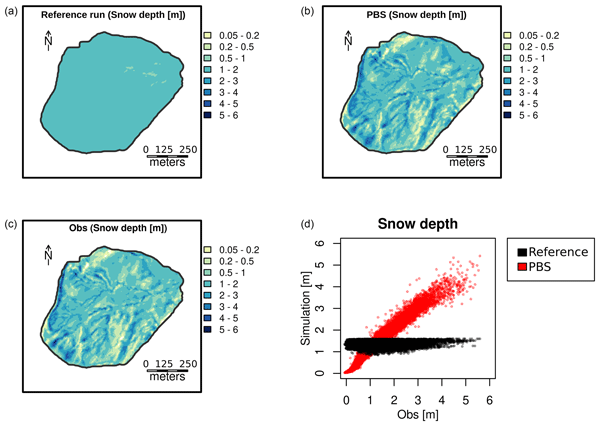
Snow cover plays an important role in many processes, but its monitoring is a challenging task. The alternative is usually to simulate the snowpack, and to improve these simulations one of the most promising options is to fuse simulations with available observations (data assimilation). In this paper we present MuSA, a data assimilation tool which facilitates the implementation of snow monitoring initiatives, allowing the assimilation of a wide variety of remotely sensed snow cover information.
Javier Bandrés, Jorge Pey, Esteban Alonso-González, Pablo Domínguez-Aguilar, Jesús Revuelto, Eñaut Izagirre, Francisco Rojas-Heredia, Eric Allan Sproles, and Juan Ignacio López-Moreno
EGUsphere, https://doi.org/10.5194/egusphere-2026-4306, https://doi.org/10.5194/egusphere-2026-4306, 2026
This preprint is open for discussion and under review for The Cryosphere (TC).
Short summary
Short summary
Snow in the Pyrenees is increasingly affected by African dust and black carbon, which darken the snow surface and accelerate melting. We developed a simple field experiment to measure how realistic amounts of these particles change snow properties and melt. Mineral dust consistently produced stronger effects than black carbon, showing that even common dust events can substantially shorten snow cover and improve estimates of snowmelt in mountain regions.
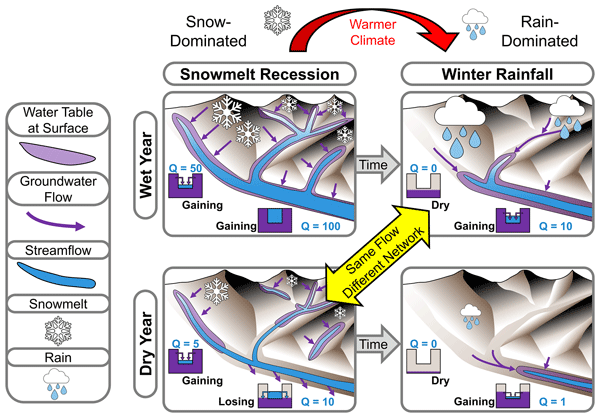
Elijah N. Boardman, Mark S. Wigmosta, Nicole M. Fernandez, John A. Whiting, and Adrian A. Harpold
Hydrol. Earth Syst. Sci., 30, 5145–5171, https://doi.org/10.5194/hess-30-5145-2026, https://doi.org/10.5194/hess-30-5145-2026, 2026
Short summary
Short summary
Distributed simulations and geochemical data indicate that groundwater hysteresis dampens the elasticity of flowing stream networks. This effect is expected to become more important as intense rainfall events replace gradual snowmelt in a warmer climate.
Philippe Gamet, Bimal K. Bhattacharya, Jean-Louis Roujean, Gilles Boulet, Corinne Salcedo, Albert Olioso, Kanishka Mallick, Marie Weiss, Emmanuelle Sarrazin, Emmanuelle Autret, Laure Roupioz, José Antonio Sobrino, Olivier Merlin, Ghislain Picard, Thomas H. G. Vidal, Mark Irvine, Rahul Nigam, Mehul Pandya, Simon Gascoin, Sébastien Marcq, Manoj K. Mishra, Emilie Delogu, Vincent Rivalland, Jordi Etchanchu, Jean-Louis Raynaud, Meenakshi Sarkar, Rishi K. Gangwar, Sushil K. Singh, Renaud Binet, Sara Arioli, Hervé Yésou, Isabelle Dadou, Alexei Kouraev, Julien Michel, Benoit Coudert, Samuel Mwangi, Nesrine Farhani, Ayan Das, Stéphane Saux-Picart, Thierry Tormos, Jean-François Piollé, Charles Verpoorter, Auline Rodler, Jonathan Leon Tavares, Jennifer Adams, Anand S. Sahadevan, Besavaraju Santhi Sree, Manikumar Vedantam, Dheeraj Adlakha, Laurence Buffet, Kathrin Naegeli, Itziar Barat, Jerome Demarty, Olivier Hagolle, and Philippe Maisongrande
EGUsphere, https://doi.org/10.5194/egusphere-2026-4492, https://doi.org/10.5194/egusphere-2026-4492, 2026
This preprint is open for discussion and under review for Earth Observation (EO).
Short summary
Short summary
This paper highlights how the upcoming TRISHNA satellite mission (launching 2027) will transform Earth observation by providing high-resolution (60 m) thermal infrared imagery with sub-weekly revisits. It details the mission's design and its synergies with other future missions to significantly improve the monitoring of global surface temperature and its dynamics, water stress, and ecosystem energy processes.
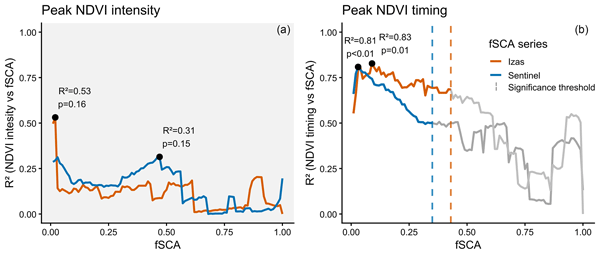
Pablo Domínguez-Aguilar, Jesús Revuelto, Simon Gascoin, and Juan I. López-Moreno
Biogeosciences, 23, 3793–3806, https://doi.org/10.5194/bg-23-3793-2026, https://doi.org/10.5194/bg-23-3793-2026, 2026
Short summary
Short summary
We studied how the timing of snowmelt shapes the growth of mountain grasslands in the western Spanish Pyrenees. Using satellite images and weather data, we found that grasslands start growing as soon as the snow disappears. However their maximum growth, occurring during summer, depends more on temperature and rainfall than on snowmelt timing. Stable patterns of productive areas suggest a strong influence of local soil and microclimate in shaping the distribution of vegetation and its growth.
Eli Schwat, Michael Haugeneder, Dylan Reynolds, Daniel Hogan, Ethan Gutmann, and Jessica D. Lundquist
EGUsphere, https://doi.org/10.5194/egusphere-2026-1633, https://doi.org/10.5194/egusphere-2026-1633, 2026
This preprint is open for discussion and under review for The Cryosphere (TC).
Short summary
Short summary
When snow covers the ground in disparate patches, heat can move sideways and cause snow melt. Using field measurements in Colorado, we found that "sideways" heat warms the edges of snow patches and causes faster melt. When snow cover was low, this sideways heat was as important as sunlight. Standard models miss this effect, so including it can improve snowmelt predictions.
Elijah N. Boardman, Karen L. Boardman, Christopher A. Jones, Sean D. Shipman, John A. Whiting, Joseph W. Boardman, and Adrian A. Harpold
EGUsphere, https://doi.org/10.5194/egusphere-2026-1933, https://doi.org/10.5194/egusphere-2026-1933, 2026
Short summary
Short summary
Alpine snow drifts are an important component of the mountain water cycle, but these extreme environments are underrepresented by automatic monitoring networks and extrapolated spatial datasets. Our field surveys, statistical modeling, and remote sensing synthesis quantifies snow drifts heterogeneity across scales, from the vertical structure at a single location to the kilometer-scale patterning of snow within mountain watersheds.
Ruitang Yang, Lizz Ultee, Kristoffer Aalstad, Matvey V. Debolskiy, Regine Hock, Patrick Schmitt, David Rounce, and Tian Li
EGUsphere, https://doi.org/10.5194/egusphere-2026-1081, https://doi.org/10.5194/egusphere-2026-1081, 2026
This preprint is open for discussion and under review for Geoscientific Model Development (GMD).
Short summary
Short summary
We present a new framework to model frontal ablation of marine-terminating glaciers by linking two global glacier models with a simple physics-based calving scheme and Bayesian calibration. Applied to 71 Svalbard glaciers (2000–2019) and projected to 2100, it reproduces seasonal front changes but overestimates ablation due to uncertain geometry and velocity. This efficient approach can improve regional to global simulations.
Steven A. Margulis, Maya Hildebrand, Xiaolan Xu, Manuela Girotto, Hans-Peter Marshall, Rashmi Shah, Elias Deeb, Simon Yueh, Dara Entekhabi, and Jessica Lundquist
EGUsphere, https://doi.org/10.5194/egusphere-2026-1594, https://doi.org/10.5194/egusphere-2026-1594, 2026
This preprint is open for discussion and under review for The Cryosphere (TC).
Short summary
Short summary
This paper demonstrates the feasibility of using a Bayesian framework for estimating snow water equivalent (SWE) from InSAR phase data at C-, L-, and P-band wavelengths. The Bayesian approach shows promise as a value-added approach to estimating SWE from phase delay measurements that are not only accurate at the measurement times, but interpolate between measurements and extrapolate beyond measurements and provide distributional (uncertainty) estimates for SWE.
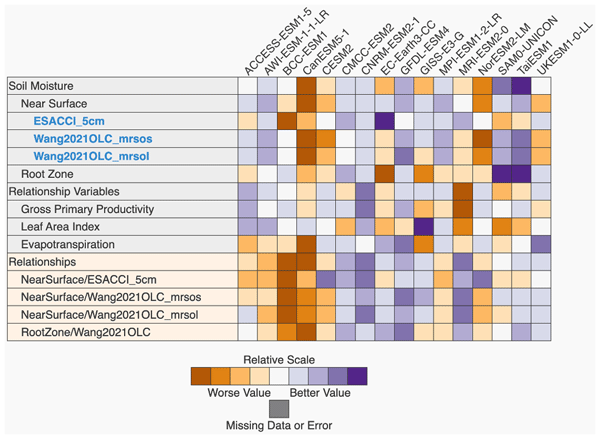
Elias C. Massoud, Nathan Collier, Yaoping Wang, Jiafu Mao, Adrian Harpold, Steven A. Kannenberg, Gerbrand Koren, Mukesh Kumar, Pushpendra Raghav, Pallav Ray, Mingjie Shi, Jing Tao, Sreedevi P. Vasu, Huiqi Wang, Qing Zhu, and Forrest M. Hoffman
Geosci. Model Dev., 19, 3427–3453, https://doi.org/10.5194/gmd-19-3427-2026, https://doi.org/10.5194/gmd-19-3427-2026, 2026
Short summary
Short summary
Soil moisture helps control how plants grow and how land exchanges water and energy with the atmosphere. We evaluated how well 16 Earth System Models represent soil moisture and its links to plant activity using a benchmarking system and observational data. Many models simulate surface soil moisture well but show larger errors deeper in the soil and in colder regions. Models that represent plant–soil water interactions more directly better capture how ecosystems respond to water availability.
Kristoffer Aalstad, Esteban Alonso-González, Norbert Pirk, Sebastian Westermann, Clarissa Willmes, and Ruitang Yang
EGUsphere, https://doi.org/10.48550/arXiv.2601.20049, https://doi.org/10.48550/arXiv.2601.20049, 2026
Short summary
Short summary
AdaPBS is a new algorithm to combine observations with cryospheric numerical models. AdaPBS is an iterative algorithm that automatically adjusts computing effort to the task, allowing the implementation of early stopping strategies. We tested AdaPBS at multiple sites with different models, matching or outperforming standard methods, when compared against more complex (computationally expensive) algorithms.
Nicola Imperatore, Simon Gascoin, Matthieu Lafaysse, Marie Dumont, Adrien Mauss, Stéphane Guével, and Jean-Baptiste Hernandez
EGUsphere, https://doi.org/10.5194/egusphere-2026-1122, https://doi.org/10.5194/egusphere-2026-1122, 2026
Short summary
Short summary
Daily satellite snow cover observations are beneficial for water management in mountain regions, but it's crucial to understand their uncertainties. We evaluate the next-generation NASA constellation in mountainous terrain using higher-resolution satellite imagery as reference. We find an overall consistent performance across the platforms and combine their data to reduce cloud cover. These results support a confident transition and open new opportunities in snowpack modeling.
Simon Filhol, Clément Misset, Noélie Bontemps, Diego Cusicanqui, Emmanuel Paquet, Marie Dumont, Olivier Gagliardini, Pascal Lacroix, Simon Gascoin, Guillaume Thirel, Julien Brondex, Pascal Hagenmuller, Eric Larose, Philipp Schoeneich, Denis Roy, Emmanuel Thibert, Nicolas Eckert, Félix de Montety, Robin Mainieri, Alexandre Hauet, Frédéric Gottardi, Johan Berthet, Alexandre Baratier, Frédéric Liébault, Małgorzata Chmiel, Guillaume Piton, Guillaume Chambon, Guillaume James, Philippe Frey, Philip Deline, Laurent Astrade, Christian Vincent, Dominique Laigle, Alain Recking, Fatima Karbou, Adrien Mauss, Mylène Bonnefoy-Demongeot, Firmin Fontaine, Mickael Langlais, Etienne Berthier, and Antoine Blanc
EGUsphere, https://doi.org/10.5194/egusphere-2026-971, https://doi.org/10.5194/egusphere-2026-971, 2026
This preprint is open for discussion and under review for Natural Hazards and Earth System Sciences (NHESS).
Short summary
Short summary
On June 21 2024, the village of La Bérarde, in the French Alps, was devastated by a flood destroying centuries old buildings. This study is an interdisciplinary work to decipher the causes and chronology of the event. The flood started with decadal rain falling on a thick snowpack. A lake observed on top of a glacier few days prior, had drained post event. With climate change, should we expect more similar compound events for alpine communities?
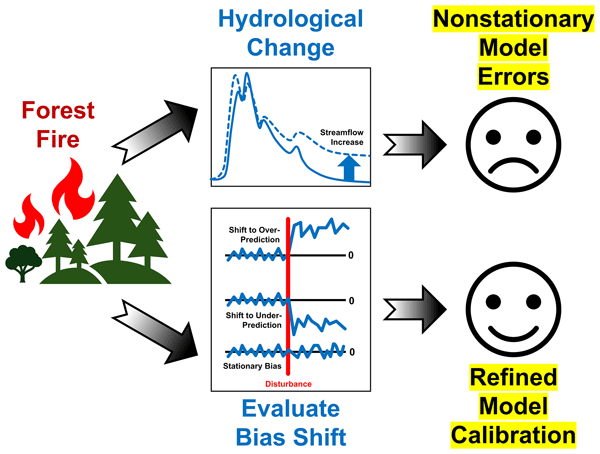
Elijah N. Boardman, Gabrielle F. S. Boisramé, Mark S. Wigmosta, Robert K. Shriver, and Adrian A. Harpold
Hydrol. Earth Syst. Sci., 29, 6333–6352, https://doi.org/10.5194/hess-29-6333-2025, https://doi.org/10.5194/hess-29-6333-2025, 2025
Short summary
Short summary
Environmental changes can cause hydrological model biases that vary over time (nonstationarity). We demonstrate a new calibration framework to detect and correct nonstationary streamflow biases after a large wildfire, which reduces predictive uncertainty and constrains parameter equifinality.
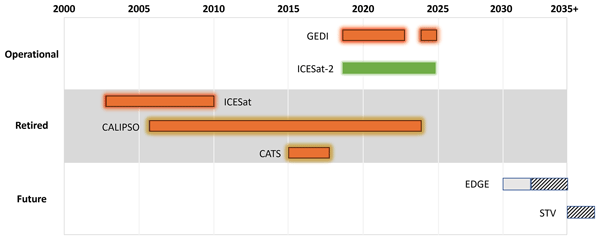
Zachary Fair, Carrie Vuyovich, Thomas Neumann, Justin Pflug, David Shean, Ellyn M. Enderlin, Karina Zikan, Hannah Besso, Jessica Lundquist, Cesar Deschamps-Berger, and Désirée Treichler
The Cryosphere, 19, 5671–5691, https://doi.org/10.5194/tc-19-5671-2025, https://doi.org/10.5194/tc-19-5671-2025, 2025
Short summary
Short summary
Lidar is commonly used to measure snow over global water reservoirs. However, ground-based and airborne lidar surveys are expensive, so satellite-based methods are needed. In this review, we outline the latest research using satellite-based lidar to monitor snow. Best practices for lidar-based snow monitoring are given, as is a discussion on challenges in this field of research.
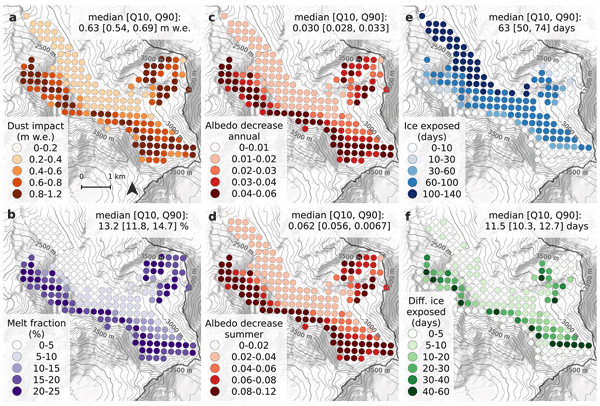
Léon Roussel, Marie Dumont, Marion Réveillet, Delphine Six, Marin Kneib, Pierre Nabat, Kévin Fourteau, Diego Monteiro, Simon Gascoin, Emmanuel Thibert, Antoine Rabatel, Jean-Emmanuel Sicart, Mylène Bonnefoy, Luc Piard, Olivier Laarman, Bruno Jourdain, Mathieu Fructus, Matthieu Vernay, and Matthieu Lafaysse
The Cryosphere, 19, 5201–5230, https://doi.org/10.5194/tc-19-5201-2025, https://doi.org/10.5194/tc-19-5201-2025, 2025
Short summary
Short summary
Saharan dust deposits frequently turn alpine glaciers orange. Mineral dust reduces snow albedo and increases snow and glaciers melt rate. Using physical modeling, we quantified the impact of dust on the Argentière Glacier over the period 2019–2022. We found that the contribution of mineral dust to the melt represents between 8 % and 16 % of Argentière Glacier summer melt. At specific locations, the impact of dust over one year can rise to an equivalent of 1.2 m of melted ice.
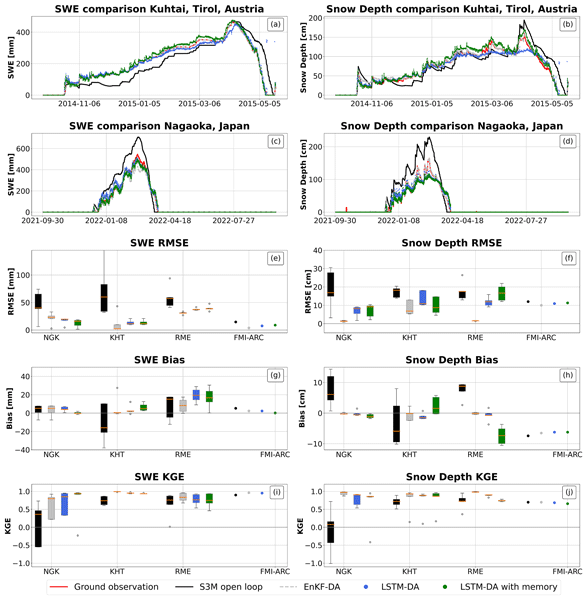
Giulia Blandini, Francesco Avanzi, Lorenzo Campo, Simone Gabellani, Kristoffer Aalstad, Manuela Girotto, Satoru Yamaguchi, Hiroyuki Hirashima, and Luca Ferraris
The Cryosphere, 19, 4759–4783, https://doi.org/10.5194/tc-19-4759-2025, https://doi.org/10.5194/tc-19-4759-2025, 2025
Short summary
Short summary
Reliable snow water equivalent and snow depth estimates are key for water management in snow regions. To tackle computational challenges in data assimilation, we propose a Long Short-Term Memory neural network for operational use in snow hydrology. Once trained, it reduces computational cost by 70 percent compared to the Ensemble Kalman Filter, with a slight decrease in performances. This deep learning approach provides a scalable, efficient, and cost-effective modeling solution for hydrology.
Anna-Maria Virkkala, Isabel Wargowsky, Judith Vogt, McKenzie A. Kuhn, Simran Madaan, Richard O'Keefe, Tiffany Windholz, Kyle A. Arndt, Brendan M. Rogers, Jennifer D. Watts, Kelcy Kent, Mathias Göckede, David Olefeldt, Gerard Rocher-Ros, Edward A. G. Schuur, David Bastviken, Kristoffer Aalstad, Kelly Aho, Joonatan Ala-Könni, Haley Alcock, Inge Althuizen, Christopher D. Arp, Jun Asanuma, Katrin Attermeyer, Mika Aurela, Sivakiruthika Balathandayuthabani, Alan Barr, Maialen Barret, Ochirbat Batkhishig, Christina Biasi, Mats P. Björkman, Andrew Black, Elena Blanc-Betes, Pascal Bodmer, Julia Boike, Abdullah Bolek, Frédéric Bouchard, Ingeborg Bussmann, Lea Cabrol, Eleonora Canfora, Sean Carey, Karel Castro-Morales, Namyi Chae, Andres Christen, Torben R. Christensen, Casper T. Christiansen, Housen Chu, Graham Clark, Francois Clayer, Patrick Crill, Christopher Cunada, Scott J. Davidson, Joshua F. Dean, Sigrid Dengel, Matteo Detto, Catherine Dieleman, Florent Domine, Egor Dyukarev, Colin Edgar, Bo Elberling, Craig A. Emmerton, Eugenie Euskirchen, Grant Falvo, Thomas Friborg, Michelle Garneau, Mariasilvia Giamberini, Mikhail V. Glagolev, Miquel A. Gonzalez-Meler, Gustaf Granath, Jón Guðmundsson, Konsta Happonen, Yoshinobu Harazono, Lorna Harris, Josh Hashemi, Nicholas Hasson, Janna Heerah, Liam Heffernan, Manuel Helbig, Warren Helgason, Michal Heliasz, Greg Henry, Geert Hensgens, Tetsuya Hiyama, Macall Hock, David Holl, Beth Holmes, Jutta Holst, Thomas Holst, Gabriel Hould-Gosselin, Elyn Humphreys, Jacqueline Hung, Jussi Huotari, Hiroki Ikawa, Danil V. Ilyasov, Mamoru Ishikawa, Go Iwahana, Hiroki Iwata, Marcin Antoni Jackowicz-Korczynski, Joachim Jansen, Järvi Järveoja, Vincent E. J. Jassey, Rasmus Jensen, Katharina Jentzsch, Robert G. Jespersen, Carl-Fredrik Johannesson, Chersity P. Jones, Anders Jonsson, Ji Young Jung, Sari Juutinen, Evan Kane, Jan Karlsson, Sergey Karsanaev, Kuno Kasak, Julia Kelly, Kasha Kempton, Marcus Klaus, George W. Kling, Natacha Kljun, Jacqueline Knutson, Hideki Kobayashi, John Kochendorfer, Kukka-Maaria Kohonen, Pasi Kolari, Mika Korkiakoski, Aino Korrensalo, Pirkko Kortelainen, Egle Koster, Kajar Koster, Ayumi Kotani, Praveena Krishnan, Juliya Kurbatova, Lars Kutzbach, Min Jung Kwon, Ethan D. Kyzivat, Jessica Lagroix, Theodore Langhorst, Elena Lapshina, Tuula Larmola, Klaus S. Larsen, Isabelle Laurion, Justin Ledman, Hanna Lee, A. Joshua Leffler, Lance Lesack, Anders Lindroth, David Lipson, Annalea Lohila, Efrén López-Blanco, Vincent L. St. Louis, Erik Lundin, Misha Luoto, Takashi Machimura, Marta Magnani, Avni Malhotra, Marja Maljanen, Ivan Mammarella, Elisa Männistö, Luca Belelli Marchesini, Phil Marsh, Pertti J. Martkainen, Maija E. Marushchak, Mikhail Mastepanov, Alex Mavrovic, Trofim Maximov, Christina Minions, Marco Montemayor, Tomoaki Morishita, Patrick Murphy, Daniel F. Nadeau, Erin Nicholls, Mats B. Nilsson, Anastasia Niyazova, Jenni Nordén, Koffi Dodji Noumonvi, Hannu Nykanen, Walter Oechel, Anne Ojala, Tomohiro Okadera, Sujan Pal, Alexey V. Panov, Tim Papakyriakou, Dario Papale, Sang-Jong Park, Frans-Jan W. Parmentier, Gilberto Pastorello, Mike Peacock, Matthias Peichl, Roman Petrov, Kyra St. Pierre, Norbert Pirk, Jessica Plein, Vilmantas Preskienis, Anatoly Prokushkin, Jukka Pumpanen, Hilary A. Rains, Niklas Rakos, Aleski Räsänen, Helena Rautakoski, Riika Rinnan, Janne Rinne, Adrian Rocha, Nigel Roulet, Alexandre Roy, Anna Rutgersson, Aleksandr F. Sabrekov, Torsten Sachs, Erik Sahlée, Alejandro Salazar, Henrique Oliveira Sawakuchi, Christopher Schulze, Roger Seco, Armando Sepulveda-Jauregui, Svetlana Serikova, Abbey Serrone, Hanna M. Silvennoinen, Sofie Sjogersten, June Skeeter, Jo Snöälv, Sebastian Sobek, Oliver Sonnentag, Emily H. Stanley, Maria Strack, Lena Strom, Patrick Sullivan, Ryan Sullivan, Anna Sytiuk, Torbern Tagesson, Pierre Taillardat, Julie Talbot, Suzanne E. Tank, Mario Tenuta, Irina Terenteva, Frederic Thalasso, Antoine Thiboult, Halldor Thorgeirsson, Fenix Garcia Tigreros, Margaret Torn, Amy Townsend-Small, Claire Treat, Alain Tremblay, Carlo Trotta, Eeva-Stiina Tuittila, Merritt Turetsky, Masahito Ueyama, Muhammad Umair, Aki Vähä, Lona van Delden, Maarten van Hardenbroek, Andrej Varlagin, Ruth K. Varner, Elena Veretennikova, Timo Vesala, Tarmo Virtanen, Carolina Voigt, Jorien E. Vonk, Robert Wagner, Katey Walter Anthony, Qinxue Wang, Masataka Watanabe, Hailey Webb, Jeffrey M. Welker, Andreas Westergaard-Nielsen, Sebastian Westermann, Jeffrey R. White, Christian Wille, Scott N. Williamson, Scott Zolkos, Donatella Zona, and Susan M. Natali
Earth Syst. Sci. Data Discuss., https://doi.org/10.5194/essd-2025-585, https://doi.org/10.5194/essd-2025-585, 2025
Revised manuscript accepted for ESSD
Short summary
Short summary
This dataset includes monthly measurements of carbon dioxide and methane exchange between land, water, and the atmosphere from over 1,000 sites in Arctic and boreal regions. It combines measurements from a variety of ecosystems, including wetlands, forests, tundra, lakes, and rivers, gathered by over 260 researchers from 1984–2024. This dataset can be used to improve and reduce uncertainty in carbon budgets in order to strengthen our understanding of climate feedbacks in a warming world.
Clarissa Willmes, Kristoffer Aalstad, and Sebastian Westermann
EGUsphere, https://doi.org/10.5194/egusphere-2025-3142, https://doi.org/10.5194/egusphere-2025-3142, 2025
Short summary
Short summary
In permafrost areas, the spatial variability of the snow cover significantly affects the ground thermal regime. This study presents an algorithm that integrates satellite data into a permafrost model to enhance the spatial detail of ground temperature simulations. At a site on Svalbard, the algorithm improves simulations of ground temperatures especially for wind-blown ridges with little snow, as well as snow-drift sites.
Marco Mazzolini, Kristoffer Aalstad, Esteban Alonso-González, Sebastian Westermann, and Désirée Treichler
The Cryosphere, 19, 3831–3848, https://doi.org/10.5194/tc-19-3831-2025, https://doi.org/10.5194/tc-19-3831-2025, 2025
Short summary
Short summary
In this work, we showcase the use the satellite laser altimeter ICESat-2, which is able to retrieve snow depth in areas where snow amounts are still poorly estimated despite the importance of these water resources. We can update snow models with these observations through algorithms that spatially propagate the information beyond the satellite profiles. The positive results show the potential of the approach to improve snow simulations, in terms of average snow depth and spatial distribution.
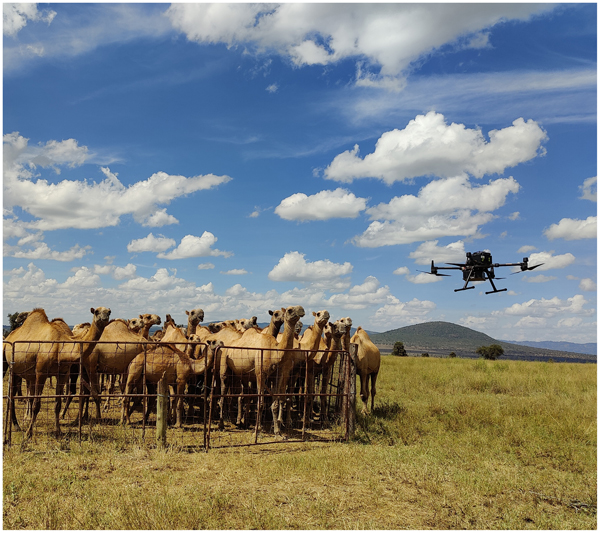
Alouette van Hove, Kristoffer Aalstad, Vibeke Lind, Claudia Arndt, Vincent Odongo, Rodolfo Ceriani, Francesco Fava, John Hulth, and Norbert Pirk
Biogeosciences, 22, 4163–4186, https://doi.org/10.5194/bg-22-4163-2025, https://doi.org/10.5194/bg-22-4163-2025, 2025
Short summary
Short summary
Research on methane emissions from African livestock is limited. We used a probabilistic method fusing drone and flux tower observations with an atmospheric model to estimate emissions from various herds. This approach proved robust under non-stationary wind conditions and effective in estimating emissions as low as 100 g h-1. We also detected spectral anomalies in satellite data associated with the herds. Our method can be used for diverse point sources, thereby improving emission inventories.
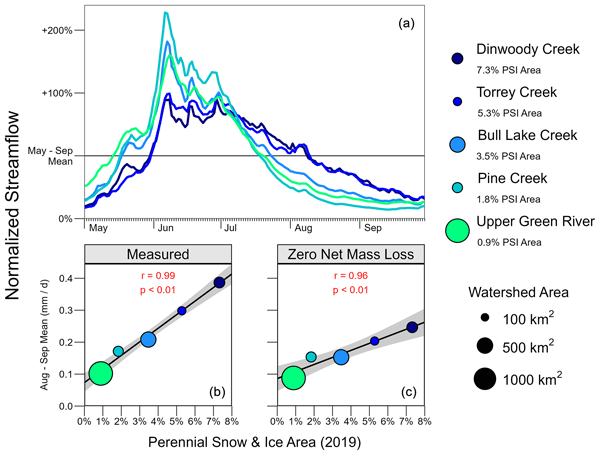
Elijah N. Boardman, Andrew G. Fountain, Joseph W. Boardman, Thomas H. Painter, Evan W. Burgess, Laura Wilson, and Adrian A. Harpold
The Cryosphere, 19, 3193–3225, https://doi.org/10.5194/tc-19-3193-2025, https://doi.org/10.5194/tc-19-3193-2025, 2025
Short summary
Short summary
Watersheds on the downwind side of a mountain range have deeper seasonal snow and more abundant glaciers due to topographic controls that favor wind drifting. Despite receiving less total snow, these drift-prone watersheds produce relatively more late-summer streamflow due to a combination of slow-melting snow drifts and mass loss from glaciers (and other perennial snow/ice features).
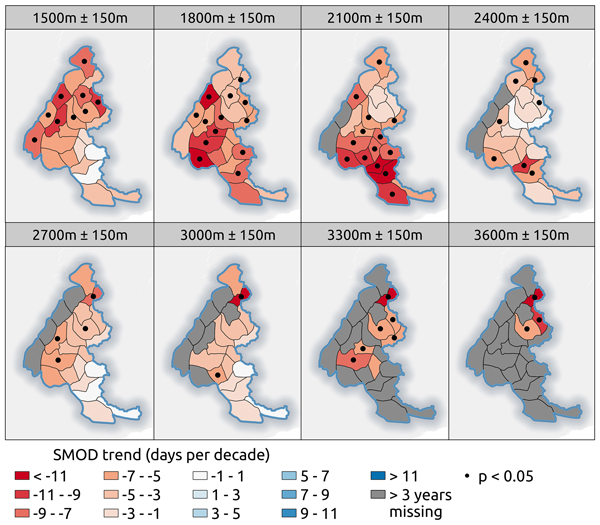
Zacharie Barrou Dumont, Simon Gascoin, Jordi Inglada, Andreas Dietz, Jonas Köhler, Matthieu Lafaysse, Diego Monteiro, Carlo Carmagnola, Arthur Bayle, Jean-Pierre Dedieu, Olivier Hagolle, and Philippe Choler
The Cryosphere, 19, 2407–2429, https://doi.org/10.5194/tc-19-2407-2025, https://doi.org/10.5194/tc-19-2407-2025, 2025
Short summary
Short summary
We generated annual maps of snow melt-out days at 20 m resolution over a period of 38 years from 10 different satellites. This study fills a knowledge gap regarding the evolution of mountain snow in Europe by covering a much longer period and characterizing trends at much higher resolutions than previous studies. We found a trend for earlier melt-out with average reductions of 5.51 d per decade over the French Alps and 4.04 d per decade over the Pyrenees for the period 1986–2023.
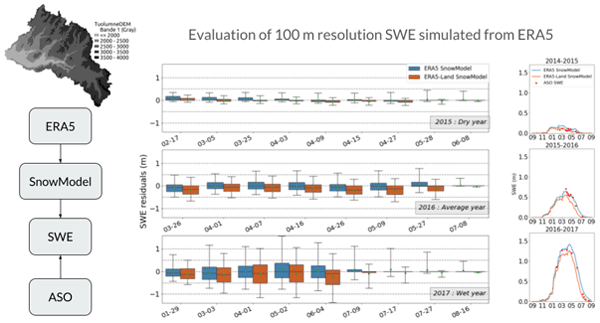
Laura Sourp, Simon Gascoin, Lionel Jarlan, Vanessa Pedinotti, Kat J. Bormann, and Mohamed Wassim Baba
Hydrol. Earth Syst. Sci., 29, 597–611, https://doi.org/10.5194/hess-29-597-2025, https://doi.org/10.5194/hess-29-597-2025, 2025
Short summary
Short summary
Accurate knowledge of the spatial distribution of snow masses across landscapes is important for water management in mountain catchments. We present a new tool for estimating snow water resources without ground measurements. We evaluate the output of this tool using accurate airborne measurements in the Sierra Nevada and find that it provides realistic estimates of snow mass and snow depth at the catchment scale.
Thibault Xavier, Laurent Orgogozo, Anatoly S. Prokushkin, Esteban Alonso-González, Simon Gascoin, and Oleg S. Pokrovsky
The Cryosphere, 18, 5865–5885, https://doi.org/10.5194/tc-18-5865-2024, https://doi.org/10.5194/tc-18-5865-2024, 2024
Short summary
Short summary
Permafrost (permanently frozen soil at depth) is thawing as a result of climate change. However, estimating its future degradation is particularly challenging due to the complex multi-physical processes involved. In this work, we designed and ran numerical simulations for months on a supercomputer to quantify the impact of climate change in a forested valley of central Siberia. There, climate change could increase the thickness of the seasonally thawed soil layer in summer by up to 65 % by 2100.
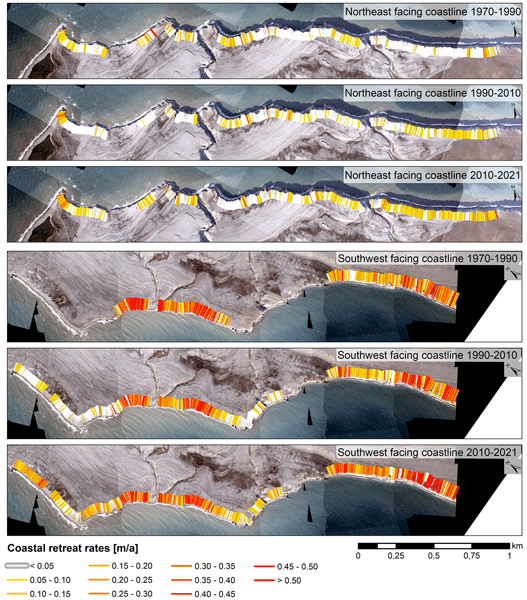
Juditha Aga, Livia Piermattei, Luc Girod, Kristoffer Aalstad, Trond Eiken, Andreas Kääb, and Sebastian Westermann
Earth Surf. Dynam., 12, 1049–1070, https://doi.org/10.5194/esurf-12-1049-2024, https://doi.org/10.5194/esurf-12-1049-2024, 2024
Short summary
Short summary
Coastal rock cliffs on Svalbard are considered to be fairly stable; however, long-term trends in coastal-retreat rates remain unknown. This study examines changes in the coastline position along Brøggerhalvøya, Svalbard, using aerial images from 1970, 1990, 2010, and 2021. Our analysis shows that coastal-retreat rates accelerate during the period 2010–2021, which coincides with increasing storminess and retreating sea ice.
Sara Arioli, Ghislain Picard, Laurent Arnaud, Simon Gascoin, Esteban Alonso-González, Marine Poizat, and Mark Irvine
Earth Syst. Sci. Data, 16, 3913–3934, https://doi.org/10.5194/essd-16-3913-2024, https://doi.org/10.5194/essd-16-3913-2024, 2024
Short summary
Short summary
High-accuracy precision maps of the surface temperature of snow were acquired with an uncooled thermal-infrared camera during winter 2021–2022 and spring 2023. The accuracy – i.e., mean absolute error – improved from 1.28 K to 0.67 K between the seasons thanks to an improved camera setup and temperature stabilization. The dataset represents a major advance in the validation of satellite measurements and physical snow models over a complex topography.
Ange Haddjeri, Matthieu Baron, Matthieu Lafaysse, Louis Le Toumelin, César Deschamps-Berger, Vincent Vionnet, Simon Gascoin, Matthieu Vernay, and Marie Dumont
The Cryosphere, 18, 3081–3116, https://doi.org/10.5194/tc-18-3081-2024, https://doi.org/10.5194/tc-18-3081-2024, 2024
Short summary
Short summary
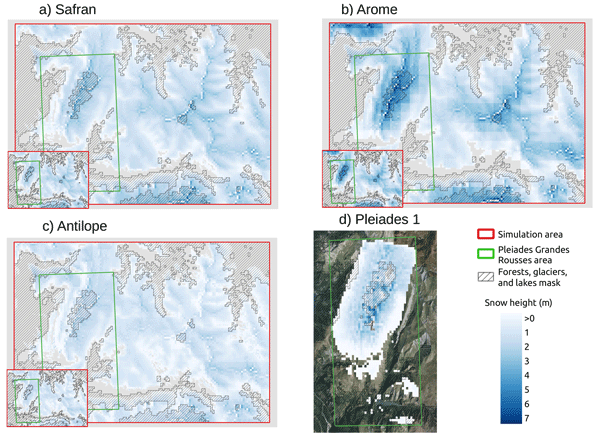
Our study addresses the complex challenge of evaluating distributed alpine snow simulations with snow transport against snow depths from Pléiades stereo imagery and snow melt-out dates from Sentinel-2 and Landsat-8 satellites. Additionally, we disentangle error contributions between blowing snow, precipitation heterogeneity, and unresolved subgrid variability. Snow transport enhances the snow simulations at high elevations, while precipitation biases are the main error source in other areas.
Ross Mower, Ethan D. Gutmann, Glen E. Liston, Jessica Lundquist, and Soren Rasmussen
Geosci. Model Dev., 17, 4135–4154, https://doi.org/10.5194/gmd-17-4135-2024, https://doi.org/10.5194/gmd-17-4135-2024, 2024
Short summary
Short summary
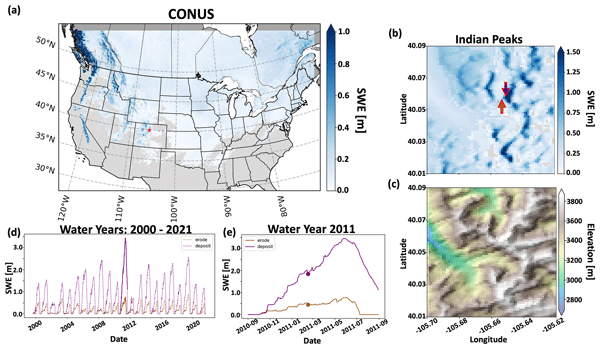
Higher-resolution model simulations are better at capturing winter snowpack changes across space and time. However, increasing resolution also increases the computational requirements. This work provides an overview of changes made to a distributed snow-evolution modeling system (SnowModel) to allow it to leverage high-performance computing resources. Continental simulations that were previously estimated to take 120 d can now be performed in 5 h.
Steven J. Pestana, C. Chris Chickadel, and Jessica D. Lundquist
The Cryosphere, 18, 2257–2276, https://doi.org/10.5194/tc-18-2257-2024, https://doi.org/10.5194/tc-18-2257-2024, 2024
Short summary
Short summary
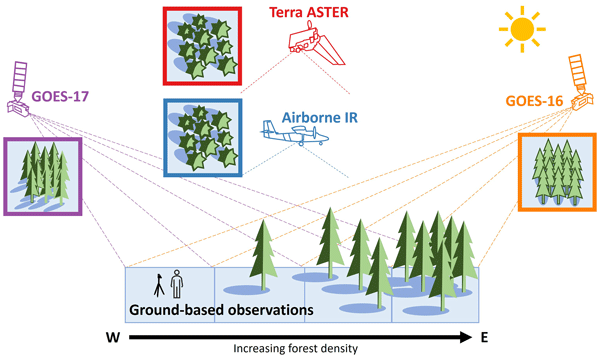
We compared infrared images taken by GOES-R satellites of an area with snow and forests against surface temperature measurements taken on the ground, from an aircraft, and by another satellite. We found that GOES-R measured warmer temperatures than the other measurements, especially in areas with more forest and when the Sun was behind the satellite. From this work, we learned that the position of the Sun and surface features such as trees that can cast shadows impact GOES-R infrared images.
Lahoucine Hanich, Ouiaam Lahnik, Simon Gascoin, Adnane Chakir, and Vincent Simonneaux
Proc. IAHS, 385, 387–391, https://doi.org/10.5194/piahs-385-387-2024, https://doi.org/10.5194/piahs-385-387-2024, 2024
Short summary
Short summary
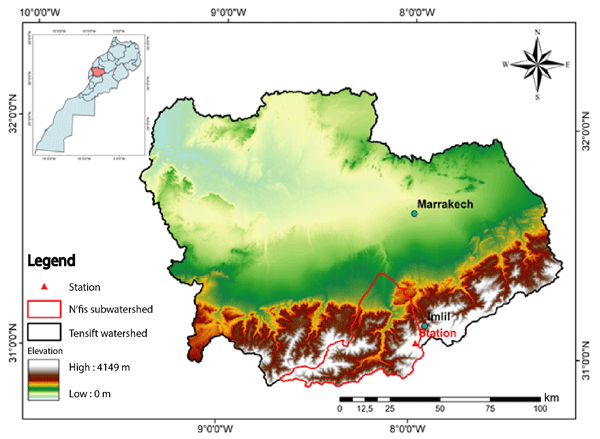
Using a dataset measured with the eddy covariance system (EC) for a period from September 2020 to January 2021 at the Tazaghart plateau, located in the High Atlas of Marrakech, the sublimation was estimated. The average daily sublimation rate measured was 0.41 mm per day. Measured sublimation accounted for 42 % and 40 % of snow ablation, based on the energy and water balances, respectively.
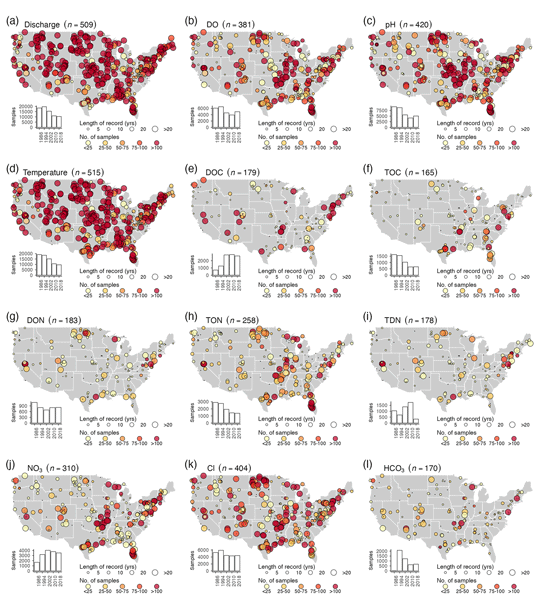
Gary Sterle, Julia Perdrial, Dustin W. Kincaid, Kristen L. Underwood, Donna M. Rizzo, Ijaz Ul Haq, Li Li, Byung Suk Lee, Thomas Adler, Hang Wen, Helena Middleton, and Adrian A. Harpold
Hydrol. Earth Syst. Sci., 28, 611–630, https://doi.org/10.5194/hess-28-611-2024, https://doi.org/10.5194/hess-28-611-2024, 2024
Short summary
Short summary
We develop stream water chemistry to pair with the existing CAMELS (Catchment Attributes and Meteorology for Large-sample Studies) dataset. The newly developed dataset, termed CAMELS-Chem, includes common stream water chemistry constituents and wet deposition chemistry in 516 catchments. Examples show the value of CAMELS-Chem to trend and spatial analyses, as well as its limitations in sampling length and consistency.
Josep Bonsoms, Juan I. López-Moreno, Esteban Alonso-González, César Deschamps-Berger, and Marc Oliva
Nat. Hazards Earth Syst. Sci., 24, 245–264, https://doi.org/10.5194/nhess-24-245-2024, https://doi.org/10.5194/nhess-24-245-2024, 2024
Short summary
Short summary
Climate warming is changing mountain snowpack patterns, leading in some cases to rain-on-snow (ROS) events. Here we analyzed near-present ROS and its sensitivity to climate warming across the Pyrenees. ROS increases during the coldest months of the year but decreases in the warmest months and areas under severe warming due to snow cover depletion. Faster snow ablation is anticipated in the coldest and northern slopes of the range. Relevant implications in mountain ecosystem are anticipated.
Esteban Alonso-González, Kristoffer Aalstad, Norbert Pirk, Marco Mazzolini, Désirée Treichler, Paul Leclercq, Sebastian Westermann, Juan Ignacio López-Moreno, and Simon Gascoin
Hydrol. Earth Syst. Sci., 27, 4637–4659, https://doi.org/10.5194/hess-27-4637-2023, https://doi.org/10.5194/hess-27-4637-2023, 2023
Short summary
Short summary
Here we explore how to improve hyper-resolution (5 m) distributed snowpack simulations using sparse observations, which do not provide information from all the areas of the simulation domain. We propose a new way of propagating information throughout the simulations adapted to the hyper-resolution, which could also be used to improve simulations of other nature. The method has been implemented in an open-source data assimilation tool that is readily accessible to everyone.
Esteban Alonso-González, Simon Gascoin, Sara Arioli, and Ghislain Picard
The Cryosphere, 17, 3329–3342, https://doi.org/10.5194/tc-17-3329-2023, https://doi.org/10.5194/tc-17-3329-2023, 2023
Short summary
Short summary
Data assimilation techniques are a promising approach to improve snowpack simulations in remote areas that are difficult to monitor. This paper studies the ability of satellite-observed land surface temperature to improve snowpack simulations through data assimilation. We show that it is possible to improve snowpack simulations, but the temporal resolution of the observations and the algorithm used are critical to obtain satisfactory results.
Ixeia Vidaller, Eñaut Izagirre, Luis Mariano del Rio, Esteban Alonso-González, Francisco Rojas-Heredia, Enrique Serrano, Ana Moreno, Juan Ignacio López-Moreno, and Jesús Revuelto
The Cryosphere, 17, 3177–3192, https://doi.org/10.5194/tc-17-3177-2023, https://doi.org/10.5194/tc-17-3177-2023, 2023
Short summary
Short summary
The Aneto glacier, the largest glacier in the Pyrenees, has shown continuous surface and ice thickness losses in the last decades. In this study, we examine changes in its surface and ice thickness for 1981–2022 and the remaining ice thickness in 2020. During these 41 years, the glacier has shrunk by 64.7 %, and the ice thickness has decreased by 30.5 m on average. The mean ice thickness in 2022 was 11.9 m, compared to 32.9 m in 1981. The results highlight the critical situation of the glacier.
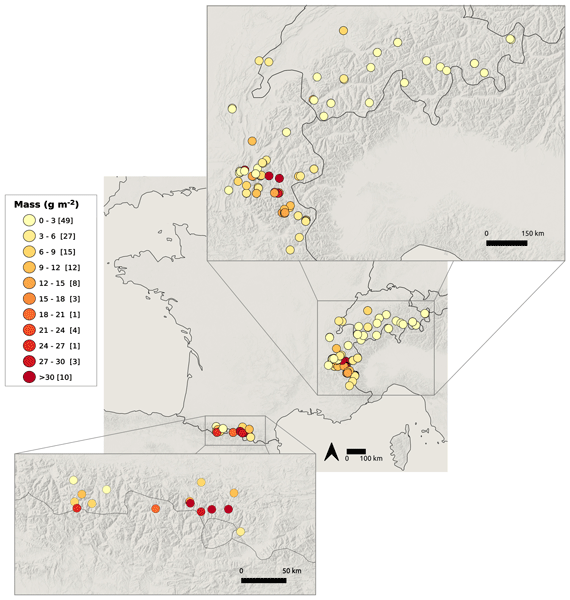
Marie Dumont, Simon Gascoin, Marion Réveillet, Didier Voisin, François Tuzet, Laurent Arnaud, Mylène Bonnefoy, Montse Bacardit Peñarroya, Carlo Carmagnola, Alexandre Deguine, Aurélie Diacre, Lukas Dürr, Olivier Evrard, Firmin Fontaine, Amaury Frankl, Mathieu Fructus, Laure Gandois, Isabelle Gouttevin, Abdelfateh Gherab, Pascal Hagenmuller, Sophia Hansson, Hervé Herbin, Béatrice Josse, Bruno Jourdain, Irene Lefevre, Gaël Le Roux, Quentin Libois, Lucie Liger, Samuel Morin, Denis Petitprez, Alvaro Robledano, Martin Schneebeli, Pascal Salze, Delphine Six, Emmanuel Thibert, Jürg Trachsel, Matthieu Vernay, Léo Viallon-Galinier, and Céline Voiron
Earth Syst. Sci. Data, 15, 3075–3094, https://doi.org/10.5194/essd-15-3075-2023, https://doi.org/10.5194/essd-15-3075-2023, 2023
Short summary
Short summary
Saharan dust outbreaks have profound effects on ecosystems, climate, health, and the cryosphere, but the spatial deposition pattern of Saharan dust is poorly known. Following the extreme dust deposition event of February 2021 across Europe, a citizen science campaign was launched to sample dust on snow over the Pyrenees and the European Alps. This campaign triggered wide interest and over 100 samples. The samples revealed the high variability of the dust properties within a single event.
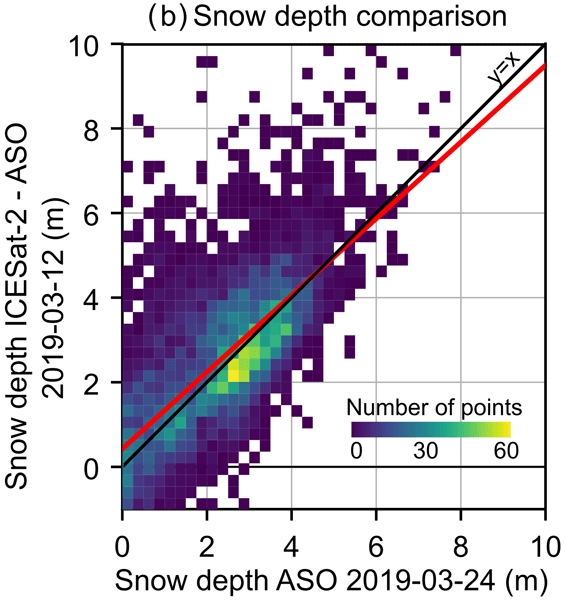
César Deschamps-Berger, Simon Gascoin, David Shean, Hannah Besso, Ambroise Guiot, and Juan Ignacio López-Moreno
The Cryosphere, 17, 2779–2792, https://doi.org/10.5194/tc-17-2779-2023, https://doi.org/10.5194/tc-17-2779-2023, 2023
Short summary
Short summary
The estimation of the snow depth in mountains is hard, despite the importance of the snowpack for human societies and ecosystems. We measured the snow depth in mountains by comparing the elevation of points measured with snow from the high-precision altimetric satellite ICESat-2 to the elevation without snow from various sources. Snow depths derived only from ICESat-2 were too sparse, but using external airborne/satellite products results in spatially richer and sufficiently precise snow depths.
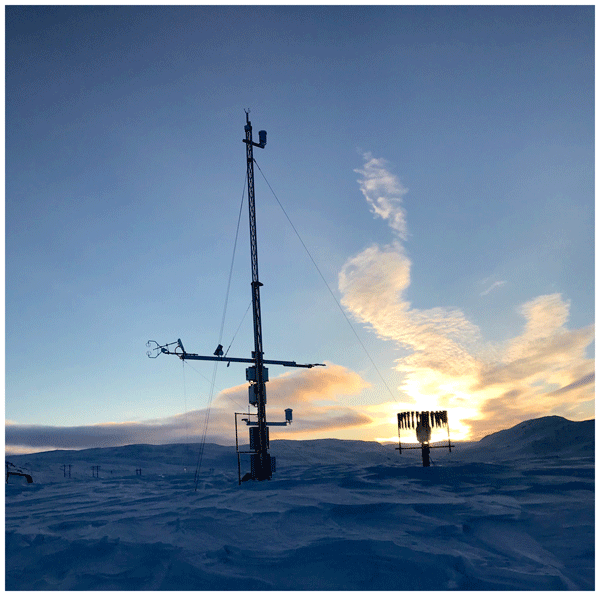
Norbert Pirk, Kristoffer Aalstad, Yeliz A. Yilmaz, Astrid Vatne, Andrea L. Popp, Peter Horvath, Anders Bryn, Ane Victoria Vollsnes, Sebastian Westermann, Terje Koren Berntsen, Frode Stordal, and Lena Merete Tallaksen
Biogeosciences, 20, 2031–2047, https://doi.org/10.5194/bg-20-2031-2023, https://doi.org/10.5194/bg-20-2031-2023, 2023
Short summary
Short summary
We measured the land–atmosphere exchange of CO2 and water vapor in alpine Norway over 3 years. The extremely snow-rich conditions in 2020 reduced the total annual evapotranspiration to 50 % and reduced the growing-season carbon assimilation to turn the ecosystem from a moderate annual carbon sink to an even stronger source. Our analysis suggests that snow cover anomalies are driving the most consequential short-term responses in this ecosystem’s functioning.
Sebastian Westermann, Thomas Ingeman-Nielsen, Johanna Scheer, Kristoffer Aalstad, Juditha Aga, Nitin Chaudhary, Bernd Etzelmüller, Simon Filhol, Andreas Kääb, Cas Renette, Louise Steffensen Schmidt, Thomas Vikhamar Schuler, Robin B. Zweigel, Léo Martin, Sarah Morard, Matan Ben-Asher, Michael Angelopoulos, Julia Boike, Brian Groenke, Frederieke Miesner, Jan Nitzbon, Paul Overduin, Simone M. Stuenzi, and Moritz Langer
Geosci. Model Dev., 16, 2607–2647, https://doi.org/10.5194/gmd-16-2607-2023, https://doi.org/10.5194/gmd-16-2607-2023, 2023
Short summary
Short summary
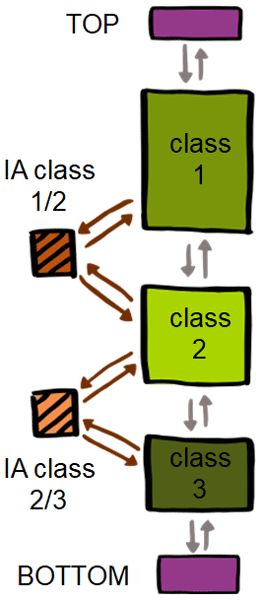
The CryoGrid community model is a new tool for simulating ground temperatures and the water and ice balance in cold regions. It is a modular design, which makes it possible to test different schemes to simulate, for example, permafrost ground in an efficient way. The model contains tools to simulate frozen and unfrozen ground, snow, glaciers, and other massive ice bodies, as well as water bodies.
Arthur Bayle, Bradley Z. Carlson, Anaïs Zimmer, Sophie Vallée, Antoine Rabatel, Edoardo Cremonese, Gianluca Filippa, Cédric Dentant, Christophe Randin, Andrea Mainetti, Erwan Roussel, Simon Gascoin, Dov Corenblit, and Philippe Choler
Biogeosciences, 20, 1649–1669, https://doi.org/10.5194/bg-20-1649-2023, https://doi.org/10.5194/bg-20-1649-2023, 2023
Short summary
Short summary
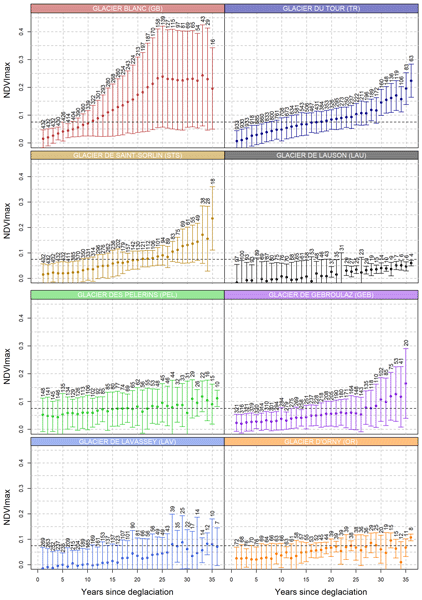
Glacier forefields have long provided ecologists with a model to study patterns of plant succession following glacier retreat. We used remote sensing approaches to study early succession dynamics as it allows to analyze the deglaciation, colonization, and vegetation growth within a single framework. We found that the heterogeneity of early succession dynamics is deterministic and can be explained well by local environmental context. This work has been done by an international consortium.
Josep Bonsoms, Juan Ignacio López-Moreno, and Esteban Alonso-González
The Cryosphere, 17, 1307–1326, https://doi.org/10.5194/tc-17-1307-2023, https://doi.org/10.5194/tc-17-1307-2023, 2023
Short summary
Short summary
This work analyzes the snow response to temperature and precipitation in the Pyrenees. During warm and wet seasons, seasonal snow depth is expected to be reduced by −37 %, −34 %, and −27 % per degree Celsius at low-, mid-, and high-elevation areas, respectively. The largest snow reductions are anticipated at low elevations of the eastern Pyrenees. Results anticipate important impacts on the nearby ecological and socioeconomic systems.
Cas Renette, Kristoffer Aalstad, Juditha Aga, Robin Benjamin Zweigel, Bernd Etzelmüller, Karianne Staalesen Lilleøren, Ketil Isaksen, and Sebastian Westermann
Earth Surf. Dynam., 11, 33–50, https://doi.org/10.5194/esurf-11-33-2023, https://doi.org/10.5194/esurf-11-33-2023, 2023
Short summary
Short summary
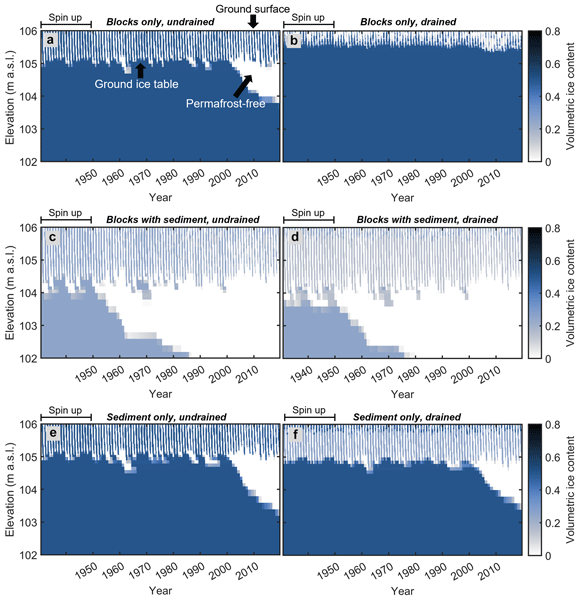
One of the reasons for lower ground temperatures in coarse, blocky terrain is a low or varying soil moisture content, which most permafrost modelling studies did not take into account. We used the CryoGrid community model to successfully simulate this effect and found markedly lower temperatures in well-drained, blocky deposits compared to other set-ups. The inclusion of this drainage effect is another step towards a better model representation of blocky mountain terrain in permafrost regions.
Esteban Alonso-González, Kristoffer Aalstad, Mohamed Wassim Baba, Jesús Revuelto, Juan Ignacio López-Moreno, Joel Fiddes, Richard Essery, and Simon Gascoin
Geosci. Model Dev., 15, 9127–9155, https://doi.org/10.5194/gmd-15-9127-2022, https://doi.org/10.5194/gmd-15-9127-2022, 2022
Short summary
Short summary
Snow cover plays an important role in many processes, but its monitoring is a challenging task. The alternative is usually to simulate the snowpack, and to improve these simulations one of the most promising options is to fuse simulations with available observations (data assimilation). In this paper we present MuSA, a data assimilation tool which facilitates the implementation of snow monitoring initiatives, allowing the assimilation of a wide variety of remotely sensed snow cover information.

Norbert Pirk, Kristoffer Aalstad, Sebastian Westermann, Astrid Vatne, Alouette van Hove, Lena Merete Tallaksen, Massimo Cassiani, and Gabriel Katul
Atmos. Meas. Tech., 15, 7293–7314, https://doi.org/10.5194/amt-15-7293-2022, https://doi.org/10.5194/amt-15-7293-2022, 2022
Short summary
Short summary
In this study, we show how sparse and noisy drone measurements can be combined with an ensemble of turbulence-resolving wind simulations to estimate uncertainty-aware surface energy exchange. We demonstrate the feasibility of this drone data assimilation framework in a series of synthetic and real-world experiments. This new framework can, in future, be applied to estimate energy and gas exchange in heterogeneous landscapes more representatively than conventional methods.
Maximillian Van Wyk de Vries, Shashank Bhushan, Mylène Jacquemart, César Deschamps-Berger, Etienne Berthier, Simon Gascoin, David E. Shean, Dan H. Shugar, and Andreas Kääb
Nat. Hazards Earth Syst. Sci., 22, 3309–3327, https://doi.org/10.5194/nhess-22-3309-2022, https://doi.org/10.5194/nhess-22-3309-2022, 2022
Short summary
Short summary
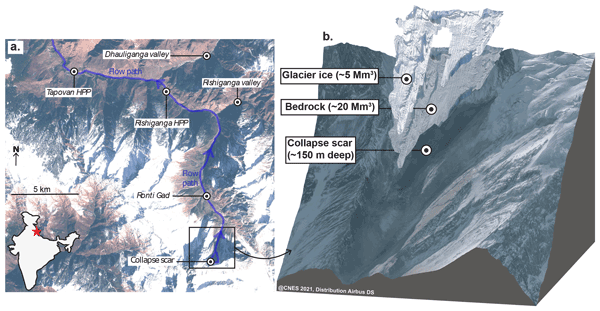
On 7 February 2021, a large rock–ice avalanche occurred in Chamoli, Indian Himalaya. The resulting debris flow swept down the nearby valley, leaving over 200 people dead or missing. We use a range of satellite datasets to investigate how the collapse area changed prior to collapse. We show that signs of instability were visible as early 5 years prior to collapse. However, it would likely not have been possible to predict the timing of the event from current satellite datasets.
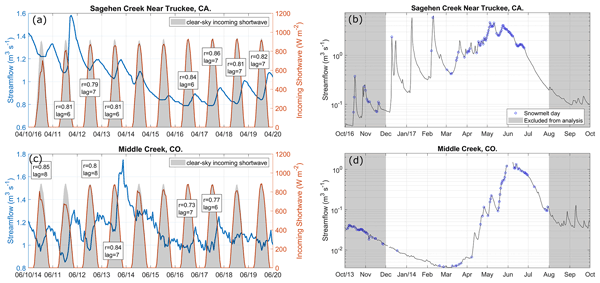
Sebastian A. Krogh, Lucia Scaff, James W. Kirchner, Beatrice Gordon, Gary Sterle, and Adrian Harpold
Hydrol. Earth Syst. Sci., 26, 3393–3417, https://doi.org/10.5194/hess-26-3393-2022, https://doi.org/10.5194/hess-26-3393-2022, 2022
Short summary
Short summary
We present a new way to detect snowmelt using daily cycles in streamflow driven by solar radiation. Results show that warmer sites have earlier and more intermittent snowmelt than colder sites, and the timing of early snowmelt events is strongly correlated with the timing of streamflow volume. A space-for-time substitution shows greater sensitivity of streamflow timing to climate change in colder rather than in warmer places, which is then contrasted with land surface simulations.
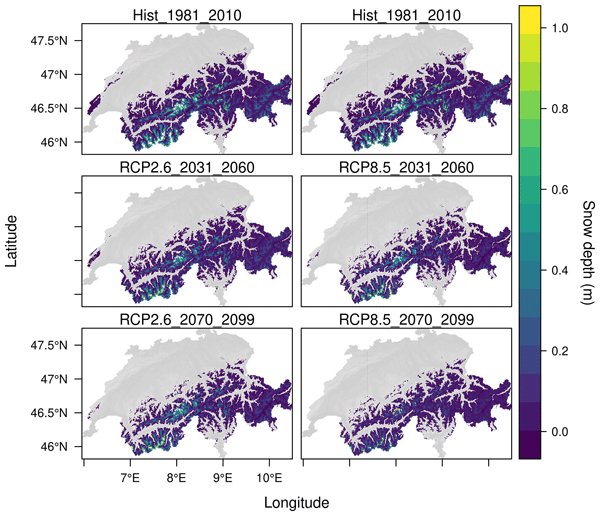
Joel Fiddes, Kristoffer Aalstad, and Michael Lehning
Geosci. Model Dev., 15, 1753–1768, https://doi.org/10.5194/gmd-15-1753-2022, https://doi.org/10.5194/gmd-15-1753-2022, 2022
Short summary
Short summary
This study describes and evaluates a new downscaling scheme that addresses the need for hillslope-scale atmospheric forcing time series for modelling the local impact of regional climate change on the land surface in mountain areas. The method has a global scope and is able to generate all model forcing variables required for hydrological and land surface modelling. This is important, as impact models require high-resolution forcings such as those generated here to produce meaningful results.
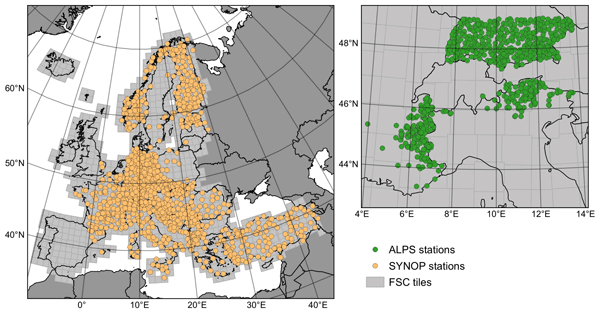
Zacharie Barrou Dumont, Simon Gascoin, Olivier Hagolle, Michaël Ablain, Rémi Jugier, Germain Salgues, Florence Marti, Aurore Dupuis, Marie Dumont, and Samuel Morin
The Cryosphere, 15, 4975–4980, https://doi.org/10.5194/tc-15-4975-2021, https://doi.org/10.5194/tc-15-4975-2021, 2021
Short summary
Short summary
Since 2020, the Copernicus High Resolution Snow & Ice Monitoring Service has distributed snow cover maps at 20 m resolution over Europe in near-real time. These products are derived from the Sentinel-2 Earth observation mission, with a revisit time of 5 d or less (cloud-permitting). Here we show the good accuracy of the snow detection over a wide range of regions in Europe, except in dense forest regions where the snow cover is hidden by the trees.
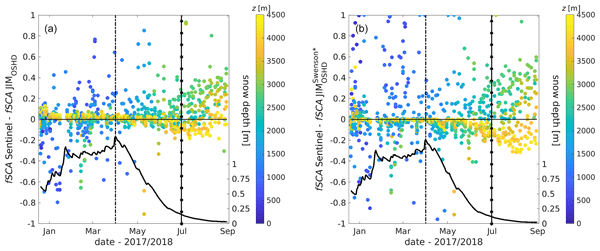
Nora Helbig, Michael Schirmer, Jan Magnusson, Flavia Mäder, Alec van Herwijnen, Louis Quéno, Yves Bühler, Jeff S. Deems, and Simon Gascoin
The Cryosphere, 15, 4607–4624, https://doi.org/10.5194/tc-15-4607-2021, https://doi.org/10.5194/tc-15-4607-2021, 2021
Short summary
Short summary
The snow cover spatial variability in mountains changes considerably over the course of a snow season. In applications such as weather, climate and hydrological predictions the fractional snow-covered area is therefore an essential parameter characterizing how much of the ground surface in a grid cell is currently covered by snow. We present a seasonal algorithm and a spatiotemporal evaluation suggesting that the algorithm can be applied in other geographic regions by any snow model application.
Cited articles
Aalstad, K., Westermann, S., Schuler, T. V., Boike, J., and Bertino, L.: Ensemble-based assimilation of fractional snow-covered area satellite retrievals to estimate the snow distribution at Arctic sites, The Cryosphere, 12, 247–270, https://doi.org/10.5194/tc-12-247-2018, 2018. a
Alonso-González, E., Aalstad, K., Pirk, N., Mazzolini, M., Treichler, D., Leclercq, P., Westermann, S., López-Moreno, J. I., and Gascoin, S.: Spatio-temporal information propagation using sparse observations in hyper-resolution ensemble-based snow data assimilation, Hydrol. Earth Syst. Sci., 27, 4637–4659, https://doi.org/10.5194/hess-27-4637-2023, 2023a. a, b, c, d, e
Alonso-González, E., López-Moreno, J. I., Ertaş, M. C., Şensoy, A., and Şorman, A. A.: A performance assessment of gridded snow products in the Upper Euphrates, Cuadernos de Investigación Geográfica, 49, 55–68, https://doi.org/10.18172/cig.5275, 2023b. a, b, c
Alonso-González, E., Mazzolini, M., and Aalstad, K.: ealonsogzl/MuSA: Forest submission, Zenodo [code], https://doi.org/10.5281/zenodo.14065646, 2024. a, b
Aversano, G., Bellemans, A., Li, Z., Coussement, A., Gicquel, O., and Parente, A.: Application of reduced-order models based on PCA & Kriging for the development of digital twins of reacting flow applications, Computers & Chemical Engineering, 121, 422–441, https://doi.org/10.1016/j.compchemeng.2018.09.022, 2019. a
Barber, J.: Sparse Gaussian Processes via Parametric Families of Compactly-supported Kernels, arXiv, https://doi.org/10.48550/arXiv.2006.03673, 2020. a
Barnett, T. P., Adam, J. C., and Lettenmaier, D. P.: Potential impacts of a warming climate on water availability in snow-dominated regions, Nature, 438, 303–309, https://doi.org/10.1038/nature04141, 2005. a
Bennett, K. E., Miller, G., Busey, R., Chen, M., Lathrop, E. R., Dann, J. B., Nutt, M., Crumley, R., Dillard, S. L., Dafflon, B., Kumar, J., Bolton, W. R., Wilson, C. J., Iversen, C. M., and Wullschleger, S. D.: Spatial patterns of snow distribution in the sub-Arctic, The Cryosphere, 16, 3269–3293, https://doi.org/10.5194/tc-16-3269-2022, 2022. a
Bertino, L., Evensen, G., and Wackernagel, H.: Sequential Data Assimilation Techniques in Oceanography, International Statistical Review, 71, 223–241, https://doi.org/10.1111/j.1751-5823.2003.tb00194.x, 2003. a
Beven, K. and Freer, J.: Equifinality, data assimilation, and uncertainty estimation in mechanistic modelling of complex environmental systems using the GLUE methodology, Journal of Hydrology, 249, 11–29, https://doi.org/10.1016/S0022-1694(01)00421-8, 2001. a
Broxton, P. D., Harpold, A. A., Biederman, J. A., Troch, P. A., Molotch, N. P., and Brooks, P. D.: Quantifying the effects of vegetation structure on snow accumulation and ablation in mixed-conifer forests, Ecohydrology, 8, 1073–1094, https://doi.org/10.1002/eco.1565, 2015. a
Broxton, P. D., Moeser, C. D., and Harpold, A.: Accounting for Fine-Scale Forest Structure is Necessary to Model Snowpack Mass and Energy Budgets in Montane Forests, Water Resources Research, 57, e2021WR029716, https://doi.org/10.1029/2021WR029716, 2021. a
Cho, E., Kwon, Y., Kumar, S. V., and Vuyovich, C. M.: Assimilation of airborne gamma observations provides utility for snow estimation in forested environments, Hydrol. Earth Syst. Sci., 27, 4039–4056, https://doi.org/10.5194/hess-27-4039-2023, 2023. a, b
Currier, W. R., Pflug, J., Mazzotti, G., Jonas, T., Deems, J. S., Bormann, K. J., Painter, T. H., Hiemstra, C. A., Gelvin, A., Uhlmann, Z., Spaete, L., Glenn, N. F., and Lundquist, J. D.: Comparing Aerial Lidar Observations With Terrestrial Lidar and Snow-Probe Transects From NASA's 2017 SnowEx Campaign, Water Resources Research, 55, 6285–6294, https://doi.org/10.1029/2018WR024533, 2019. a
Curriero, F. C.: On the Use of Non-Euclidean Distance Measures in Geostatistics, Mathematical Geology, 38, 907–926, https://doi.org/10.1007/s11004-006-9055-7, 2006. a, b
Davis, B. J. K. and Curriero, F. C.: Development and Evaluation of Geostatistical Methods for Non-Euclidean-Based Spatial Covariance Matrices, Mathematical Geosciences, 51, 767–791, https://doi.org/10.1007/s11004-019-09791-y, 2019. a, b
De Lannoy, G. J. M., Reichle, R. H., Arsenault, K. R., Houser, P. R., Kumar, S., Verhoest, N. E. C., and Pauwels, V. R. N.: Multiscale assimilation of Advanced Microwave Scanning Radiometer–EOS snow water equivalent and Moderate Resolution Imaging Spectroradiometer snow cover fraction observations in northern Colorado, Water Resources Research, 48, https://doi.org/10.1029/2011WR010588, 2012. a
Dharmadasa, V., Kinnard, C., and Baraër, M.: Topographic and vegetation controls of the spatial distribution of snow depth in agro-forested environments by UAV lidar, The Cryosphere, 17, 1225–1246, https://doi.org/10.5194/tc-17-1225-2023, 2023. a
Dharmadasa, V., Kinnard, C., and Baraër, M.: A new interpolation method to resolve under-sampling of UAV-lidar snow depth observations in coniferous forests, Cold Regions Science and Technology, 220, 104134, https://doi.org/10.1016/j.coldregions.2024.104134, 2024. a
Dickerson-Lange, S. E., Gersonde, R. F., Hubbart, J. A., Link, T. E., Nolin, A. W., Perry, G. H., Roth, T. R., Wayand, N. E., and Lundquist, J. D.: Snow disappearance timing is dominated by forest effects on snow accumulation in warm winter climates of the Pacific Northwest, United States, Hydrological Processes, 31, 1846–1862, https://doi.org/10.1002/hyp.11144, 2017. a
Dickerson-Lange, S. E., Howe, E. R., Patrick, K., Gersonde, R., and Lundquist, J. D.: Forest gap effects on snow storage in the transitional climate of the Eastern Cascade Range, Washington, United States, Frontiers in Water, 5, https://doi.org/10.3389/frwa.2023.1115264, 2023. a
Emerick, A. A.: Deterministic ensemble smoother with multiple data assimilation as an alternative for history-matching seismic data, Computational Geosciences, 22, 1175–1186, https://doi.org/10.1007/s10596-018-9745-5, 2018. a, b, c
Essery, R. and Pomeroy, J.: Vegetation and topographic control of wind-blown snow distributions in distributed and aggregated simulations for an arctic tundra basin, Journal of Hydrometeorology, 5, 735–744, https://doi.org/10.1175/1525-7541(2004)005<0735:VATCOW>2.0.CO;2, 2004. a
Essery, R., Morin, S., Lejeune, Y., and B Ménard, C.: A comparison of 1701 snow models using observations from an alpine site, Advances in Water Resources, 55, 131–148, https://doi.org/10.1016/j.advwatres.2012.07.013, 2013. a
Essery, R., Mazzotti, G., Barr, S., Jonas, T., Quaife, T., and Rutter, N.: A Flexible Snow Model (FSM 2.1.1) including a forest canopy, Geosci. Model Dev., 18, 3583–3605, https://doi.org/10.5194/gmd-18-3583-2025, 2025. a
Evensen, G., Vossepoel, F. C., and van Leeuwen, P. J.: Data Assimilation Fundamentals: A Unified Formulation of the State and Parameter Estimation Problem, Cham: Springer International Publishing, https://doi.org/10.1007/978-3-030-96709-3, 2022. a, b
Fiddes, J. and Gruber, S.: TopoSCALE v.1.0: downscaling gridded climate data in complex terrain, Geosci. Model Dev., 7, 387–405, https://doi.org/10.5194/gmd-7-387-2014, 2014. a
Gascoin, S., Luojus, K., Nagler, T., Lievens, H., Masiokas, M., Jonas, T., Zheng, Z., and De Rosnay, P.: Remote sensing of mountain snow from space: status and recommendations, Frontiers in Earth Science, 12, https://doi.org/10.3389/feart.2024.1381323, 2024. a, b, c
Gaspari, G. and Cohn, S. E.: Construction of correlation functions in two and three dimensions, Quarterly Journal of the Royal Meteorological Society, 125, 723–757, https://doi.org/10.1002/qj.49712555417, 1999. a
Geissler, J., Rathmann, L., and Weiler, M.: Combining Daily Sensor Observations and Spatial LiDAR Data for Mapping Snow Water Equivalent in a Sub-Alpine Forest, Water Resources Research, 59, e2023WR034460, https://doi.org/10.1029/2023WR034460, 2023. a
Geissler, J., Mazzotti, G., Rathmann, L., Webster, C., and Weiler, M.: Forest Snow Patterns Derived Using ClustSnow Are Temporally Persistent Under Variable Environmental Conditions, Water Resources Research, 61, e2024WR038442, https://doi.org/10.1029/2024WR038442, 2025. a, b
Graup, L.: Preserving Mountains with Forest Management, CA 2020, Preserving Mountains with Forest Management, CA 2020, National Center for Airborne Laser Mapping (NCALM) [data set], https://doi.org/10.5069/G96H4FMX, 2021. a
Gutmann, E. D., Rasmussen, R. M., Liu, C., Ikeda, K., Gochis, D. J., Clark, M. P., Dudhia, J., and Thompson, G.: A comparison of statistical and dynamical downscaling of winter precipitation over complex terrain, Journal of Climate, 25, 262–281, https://doi.org/10.1175/2011JCLI4109.1, 2012. a
Han, J., Liu, Z., Woods, R. A., McVicar, T. R., Yang, D., Wang, T., Hou, Y., Guo, Y., Li, C., and Yang, Y.: Streamflow seasonality in a snow-dwindling world, Nature, 629, 1075–1081, https://doi.org/10.1038/s41586-024-07299-y, 2024. a
Harder, P. and Pomeroy, J.: Estimating precipitation phase using a psychrometric energy balance method, Hydrological Processes, 27, 1901–1914, https://doi.org/10.1002/hyp.9799, 2013. a
Harpold, A. A., Guo, Q., Molotch, N., Brooks, P. D., Bales, R., Fernandez-Diaz, J. C., Musselman, K. N., Swetnam, T. L., Kirchner, P., Meadows, M. W., Flanagan, J., and Lucas, R.: LiDAR-derived snowpack data sets from mixed conifer forests across the Western United States, Water Resources Research, 50, 2749–2755, https://doi.org/10.1002/2013WR013935, 2014. a
Helfricht, K., Schöber, J., Schneider, K., Sailer, R., and Kuhn, M.: Interannual persistence of the seasonal snow cover in a glacierized catchment, Journal of Glaciology, 60, 889–904, https://doi.org/10.3189/2014JoG13J197, 2014. a
Hersbach, H.: Decomposition of the Continuous Ranked Probability Score for Ensemble Prediction Systems, Weather and Forecasting, 15, 559–570, https://doi.org/10.1175/1520-0434(2000)015<0559:DOTCRP>2.0.CO;2, 2000. a, b
Kinar, N. J. and Pomeroy, J. W.: Measurement of the physical properties of the snowpack, Reviews of Geophysics, 53, 481–544, https://doi.org/10.1002/2015RG000481, 2015. a
Kostadinov, T. S., Schumer, R., Hausner, M., Bormann, K. J., Gaffney, R., McGwire, K., Painter, T. H., Tyler, S., and Harpold, A. A.: Watershed-scale mapping of fractional snow cover under conifer forest canopy using lidar, Remote Sensing of Environment, 222, 34–49, https://doi.org/10.1016/j.rse.2018.11.037, 2019. a, b, c, d
Krinner, G., Derksen, C., Essery, R., Flanner, M., Hagemann, S., Clark, M., Hall, A., Rott, H., Brutel-Vuilmet, C., Kim, H., Ménard, C. B., Mudryk, L., Thackeray, C., Wang, L., Arduini, G., Balsamo, G., Bartlett, P., Boike, J., Boone, A., Chéruy, F., Colin, J., Cuntz, M., Dai, Y., Decharme, B., Derry, J., Ducharne, A., Dutra, E., Fang, X., Fierz, C., Ghattas, J., Gusev, Y., Haverd, V., Kontu, A., Lafaysse, M., Law, R., Lawrence, D., Li, W., Marke, T., Marks, D., Ménégoz, M., Nasonova, O., Nitta, T., Niwano, M., Pomeroy, J., Raleigh, M. S., Schaedler, G., Semenov, V., Smirnova, T. G., Stacke, T., Strasser, U., Svenson, S., Turkov, D., Wang, T., Wever, N., Yuan, H., Zhou, W., and Zhu, D.: ESM-SnowMIP: assessing snow models and quantifying snow-related climate feedbacks, Geosci. Model Dev., 11, 5027–5049, https://doi.org/10.5194/gmd-11-5027-2018, 2018. a
Kruyt, B., Mott, R., Fiddes, J., Gerber, F., Sharma, V., and Reynolds, D.: A Downscaling Intercomparison Study: The Representation of Slope- and Ridge-Scale Processes in Models of Different Complexity, Frontiers in Earth Science, 10, https://doi.org/10.3389/feart.2022.789332, 2022. a
Largeron, C., Dumont, M., Morin, S., Boone, A., Lafaysse, M., Metref, S., Cosme, E., Jonas, T., Winstral, A., and Margulis, S. A.: Toward Snow Cover Estimation in Mountainous Areas Using Modern Data Assimilation Methods: A Review, 8, https://doi.org/10.3389/feart.2020.00325, 2020. a
Liston, G. E. and Elder, K.: A meteorological distribution system for high-resolution terrestrial modeling (MicroMet, Journal of Hydrometeorology, 7, 217–234, https://doi.org/10.1175/JHM486.1, 2006. a, b
Lundquist, J. D., Dickerson-Lange, S. E., Lutz, J. A., and Cristea, N. C.: Lower forest density enhances snow retention in regions with warmer winters: A global framework developed from plot-scale observations and modeling, Water Resources Research, 49, 6356–6370, https://doi.org/10.1002/wrcr.20504, 2013. a, b
Lundquist, J. D., Dickerson-Lange, S., Gutmann, E., Jonas, T., Lumbrazo, C., and Reynolds, D.: Snow interception modelling: Isolated observations have led to many land surface models lacking appropriate temperature sensitivities, Hydrological Processes, 35, e14274, https://doi.org/10.1002/hyp.14274, 2021. a
Magnusson, J., Gustafsson, D., Hüsler, F., and Jonas, T.: Assimilation of point SWE data into a distributed snow cover model comparing two contrasting methods, Water Resources Research, 50, 7816–7835, https://doi.org/10.1002/2014WR015302, 2014. a
Magnusson, J., Bühler, Y., Quéno, L., Cluzet, B., Mazzotti, G., Webster, C., Mott, R., and Jonas, T.: High-resolution hydrometeorological and snow data for the Dischma catchment in Switzerland, Earth Syst. Sci. Data, 17, 703–717, https://doi.org/10.5194/essd-17-703-2025, 2025. a
Mazzolini, M., Aalstad, K., Alonso-González, E., Westermann, S., and Treichler, D.: Spatio-temporal snow data assimilation with the ICESat-2 laser altimeter, The Cryosphere, 19, 3831–3848, https://doi.org/10.5194/tc-19-3831-2025, 2025. a, b
Mazzotti, G., Currier, W. R., Deems, J. S., Pflug, J. M., Lundquist, J. D., and Jonas, T.: Revisiting Snow Cover Variability and Canopy Structure Within Forest Stands: Insights From Airborne Lidar Data, Water Resources Research, 55, 6198–6216, https://doi.org/10.1029/2019WR024898, 2019. a, b
Mazzotti, G., Essery, R., Moeser, C. D., and Jonas, T.: Resolving Small-Scale Forest Snow Patterns Using an Energy Balance Snow Model With a One-Layer Canopy, Water Resources Research, 56, e2019WR026129, https://doi.org/10.1029/2019WR026129, 2020a. a
Mazzotti, G., Essery, R., Webster, C., Malle, J., and Jonas, T.: Process-Level Evaluation of a Hyper-Resolution Forest Snow Model Using Distributed Multisensor Observations, Water Resources Research, 56, e2020WR027572, https://doi.org/10.1029/2020WR027572, 2020b. a
Morzfeld, M. and Hodyss, D.: A Theory for Why Even Simple Covariance Localization Is So Useful in Ensemble Data Assimilation, Monthly Weather Review, 151, 717–736, https://doi.org/10.1175/MWR-D-22-0255.1, 2023. a
Murphy, K. P.: Probabilistic Machine Learning: Advanced Topics, MIT Press, ISBN 9780262375993, 2023. a
Murphy, R. R., Perlman, E., Ball, W. P., and Curriero, F. C.: Water-Distance-Based Kriging in Chesapeake Bay, Journal of Hydrologic Engineering, 20, 05014034, https://doi.org/10.1061/(ASCE)HE.1943-5584.0001135, 2015. a, b
Neal, R. M.: Regression and Classification Using Gaussian Process Priors, in: Bayesian Statistics 6: Proceedings of the Sixth Valencia International Meeting, 6–10 June 1998, Oxford University Press, ISBN 9780198504856, https://doi.org/10.1093/oso/9780198504856.003.0021, 1999. a
Painter, T. H., Berisford, D. F., Boardman, J. W., Bormann, K. J., Deems, J. S., Gehrke, F., Hedrick, A., Joyce, M., Laidlaw, R., Marks, D., Mattmann, C., McGurk, B., Ramirez, P., Richardson, M., Skiles, S. M., Seidel, F. C., and Winstral, A.: The Airborne Snow Observatory: Fusion of scanning lidar, imaging spectrometer, and physically-based modeling for mapping snow water equivalent and snow albedo, Remote Sensing of Environment, 184, 139–152, https://doi.org/10.1016/j.rse.2016.06.018, 2016. a, b
Pflug, J. M., Wrzesien, M. L., Kumar, S. V., Cho, E., Arsenault, K. R., Houser, P. R., and Vuyovich, C. M.: Extending the utility of space-borne snow water equivalent observations over vegetated areas with data assimilation, Hydrol. Earth Syst. Sci., 28, 631–648, https://doi.org/10.5194/hess-28-631-2024, 2024. a, b, c
Piske, C.: Forest-Snow Interactions in a High Elevation Critical Zone, CA 2022, Forest-Snow Interactions in a High Elevation Critical Zone, CA 2022, National Center for Airborne Laser Mapping (NCALM) [data set], https://doi.org/10.5069/G9ZG6QF7, 2022. a, b, c
Piske, C. R., Carroll, R. W. H., Boisrame, G. F. S., Krogh, S. A., Manning, A. L., Underwood, K. L., Lewis, G., and Harpold, A. A.: Lidar-Derived Forest Metrics Predict Snow Accumulation in the Central Sierra Nevada, USA, Ecohydrology, 18, e70109, https://doi.org/10.1002/eco.70109, 2025. a, b, c
Qin, Y., Abatzoglou, J. T., Siebert, S., Huning, L. S., AghaKouchak, A., Mankin, J. S., Hong, C., Tong, D., Davis, S. J., and Mueller, N. D.: Agricultural risks from changing snowmelt, Nature Climate Change, 10, 459–465, https://doi.org/10.1038/s41558-020-0746-8, 2020. a
Raleigh, M. S., Lundquist, J. D., and Clark, M. P.: Exploring the impact of forcing error characteristics on physically based snow simulations within a global sensitivity analysis framework, Hydrol. Earth Syst. Sci., 19, 3153–3179, https://doi.org/10.5194/hess-19-3153-2015, 2015. a
Rasmussen, C. E. and Williams, C. K. I.: Gaussian Processes for Machine Learning, The MIT Press, https://doi.org/10.7551/mitpress/3206.001.0001, 2005. a
Rasmussen, R. M., Chen, F., Liu, C., Ikeda, K., Prein, A., Kim, J., Schneider, T., Dai, A., Gochis, D., Dugger, A., Zhang, Y., Jaye, A., Dudhia, J., He, C., Harrold, M., Xue, L., Chen, S., Newman, A., Dougherty, E., Abolafia-Rosenzweig, R., Lybarger, N. D., Viger, R., Lesmes, D., Skalak, K., Brakebill, J., Cline, D., Dunne, K., Rasmussen, K., and Miguez-Macho, G.: CONUS404: The NCAR–USGS 4-km Long-Term Regional Hydroclimate Reanalysis over the CONUS, Bulletin of the American Meteorological Society, 104, E1382–E1408, https://doi.org/10.1175/BAMS-D-21-0326.1, 2023. a
Revuelto, J., López-Moreno, J. I., Azorin-Molina, C., and Vicente-Serrano, S. M.: Topographic control of snowpack distribution in a small catchment in the central Spanish Pyrenees: intra- and inter-annual persistence, The Cryosphere, 8, 1989–2006, https://doi.org/10.5194/tc-8-1989-2014, 2014. a, b
Reynolds, D., Gutmann, E., Kruyt, B., Haugeneder, M., Jonas, T., Gerber, F., Lehning, M., and Mott, R.: The High-resolution Intermediate Complexity Atmospheric Research (HICAR v1.1) model enables fast dynamic downscaling to the hectometer scale, Geosci. Model Dev., 16, 5049–5068, https://doi.org/10.5194/gmd-16-5049-2023, 2023. a
Rutter, N., Essery, R., Pomeroy, J., Altimir, N., Andreadis, K., Baker, I., Barr, A., Bartlett, P., Boone, A., Deng, H., Douville, H., Dutra, E., Elder, K., Ellis, C., Feng, X., Gelfan, A., Goodbody, A., Gusev, Y., Gustafsson, D., Hellström, R., Hirabayashi, Y., Hirota, T., Jonas, T., Koren, V., Kuragina, A., Lettenmaier, D., Li, W.-P., Luce, C., Martin, E., Nasonova, O., Pumpanen, J., Pyles, R. D., Samuelsson, P., Sandells, M., Schädler, G., Shmakin, A., Smirnova, T. G., Stähli, M., Stöckli, R., Strasser, U., Su, H., Suzuki, K., Takata, K., Tanaka, K., Thompson, E., Vesala, T., Viterbo, P., Wiltshire, A., Xia, K., Xue, Y., and Yamazaki, T.: Evaluation of forest snow processes models (SnowMIP2), Journal of Geophysical Research: Atmospheres, 114, https://doi.org/10.1029/2008JD011063, 2009. a
Safa, H., Krogh, S. A., Greenberg, J., Kostadinov, T. S., and Harpold, A. A.: Unraveling the Controls on Snow Disappearance in Montane Conifer Forests Using Multi-Site Lidar, Water Resources Research, 57, e2020WR027522, https://doi.org/10.1029/2020WR027522, 2021. a, b, c, d
Sakov, P. and Oke, P. R.: A deterministic formulation of the ensemble Kalman filter: an alternative to ensemble square root filters, Tellus A, 60, 361–371, https://doi.org/10.1111/j.1600-0870.2007.00299.x, 2008. a
Slatyer, R. A., Umbers, K. D. L., and Arnold, P. A.: Ecological responses to variation in seasonal snow cover, Conservation Biology, 36, e13727, https://doi.org/10.1111/cobi.13727, 2022. a
Smyth, E. J., Raleigh, M. S., and Small, E. E.: The Challenges of Simulating SWE Beneath Forest Canopies are Reduced by Data Assimilation of Snow Depth, Water Resources Research, 58, e2021WR030563, https://doi.org/10.1029/2021WR030563, 2022. a
Sourp, L., Gascoin, S., Jarlan, L., Pedinotti, V., Bormann, K. J., and Baba, M. W.: Evaluation of high-resolution snowpack simulations from global datasets and comparison with Sentinel-1 snow depth retrievals in the Sierra Nevada, USA, Hydrol. Earth Syst. Sci., 29, 597–611, https://doi.org/10.5194/hess-29-597-2025, 2025. a
Sturm, M., Goldstein, M. A., and Parr, C.: Water and life from snow: A trillion dollar science question, Water Resources Research, 53, 3534–3544, https://doi.org/10.1002/2017WR020840, 2017. a
Tennant, C. J., Harpold, A. A., Lohse, K. A., Godsey, S. E., Crosby, B. T., Larsen, L. G., Brooks, P. D., Van Kirk, R. W., and Glenn, N. F.: Regional sensitivities of seasonal snowpack to elevation, aspect, and vegetation cover in western North America, Water Resources Research, 53, 6908–6926, https://doi.org/10.1002/2016WR019374, 2017. a
Tsang, L., Durand, M., Derksen, C., Barros, A. P., Kang, D.-H., Lievens, H., Marshall, H.-P., Zhu, J., Johnson, J., King, J., Lemmetyinen, J., Sandells, M., Rutter, N., Siqueira, P., Nolin, A., Osmanoglu, B., Vuyovich, C., Kim, E., Taylor, D., Merkouriadi, I., Brucker, L., Navari, M., Dumont, M., Kelly, R., Kim, R. S., Liao, T.-H., Borah, F., and Xu, X.: Review article: Global monitoring of snow water equivalent using high-frequency radar remote sensing, The Cryosphere, 16, 3531–3573, https://doi.org/10.5194/tc-16-3531-2022, 2022. a
van Leeuwen, P. J.: Non-local Observations and Information Transfer in Data Assimilation, Frontiers in Applied Mathematics and Statistics, 5, 48, https://doi.org/10.3389/fams.2019.00048, 2019. a
Varhola, A., Coops, N. C., Weiler, M., and Moore, R. D.: Forest canopy effects on snow accumulation and ablation: An integrative review of empirical results, Journal of Hydrology, 392, 219–233, https://doi.org/10.1016/j.jhydrol.2010.08.009, 2010. a, b, c
Vionnet, V., Marsh, C. B., Menounos, B., Gascoin, S., Wayand, N. E., Shea, J., Mukherjee, K., and Pomeroy, J. W.: Multi-scale snowdrift-permitting modelling of mountain snowpack, The Cryosphere, 15, 743–769, https://doi.org/10.5194/tc-15-743-2021, 2021. a
Virtanen, P., Gommers, R., Oliphant, T. E., Haberland, M., Reddy, T., Cournapeau, D., Burovski, E., Peterson, P., Weckesser, W., Bright, J., van der Walt, S. J., Brett, M., Wilson, J., Millman, K. J., Mayorov, N., Nelson, A. R. J., Jones, E., Kern, R., Larson, E., Carey, C. J., Polat, İ., Feng, Y., Moore, E. W., VanderPlas, J., Laxalde, D., Perktold, J., Cimrman, R., Henriksen, I., Quintero, E. A., Harris, C. R., Archibald, A. M., Ribeiro, A. H., Pedregosa, F., van Mulbregt, P., and SciPy 1.0 Contributors: SciPy 1.0: Fundamental Algorithms for Scientific Computing in Python, Nature Methods, 17, 261–272, https://doi.org/10.1038/s41592-019-0686-2, 2020. a
Xiao, X., He, T., Liang, S., Liu, X., Ma, Y., Liang, S., and Chen, X.: Estimating fractional snow cover in vegetated environments using MODIS surface reflectance data, International Journal of Applied Earth Observation and Geoinformation, 114, 103030, https://doi.org/10.1016/j.jag.2022.103030, 2022. a
Yatheendradas, S., Lidard, C. D. P., Koren, V., Cosgrove, B. A., De Goncalves, L. G. G., Smith, M., Geiger, J., Cui, Z., Borak, J., Kumar, S. V., Toll, D. L., Riggs, G., and Mizukami, N.: Distributed assimilation of satellite-based snow extent for improving simulated streamflow in mountainous, dense forests: An example over the DMIP2 western basins, Water Resources Research, 48, https://doi.org/10.1029/2011WR011347, 2012. a
Zheng, Z., Ma, Q., Jin, S., Su, Y., Guo, Q., and Bales, R. C.: Canopy and Terrain Interactions Affecting Snowpack Spatial Patterns in the Sierra Nevada of California, Water Resources Research, 55, 8721–8739, https://doi.org/10.1029/2018WR023758, 2019. a
Short summary
Simulating the snowpack is challenging, as there are several sources of uncertainty due to e.g. the meteorological forcing. Using data assimilation techniques, it is possible to improve the simulations by fusing models and snow observations. However in forests, observations are difficult to obtain, because they cannot be retrieved through the canopy. Here, we explore the possibility of propagating the information obtained in forest clearings to areas covered by the canopy.
Simulating the snowpack is challenging, as there are several sources of uncertainty due to e.g....


