
Articles | Volume 20, issue 1
https://doi.org/10.5194/tc-20-511-2026
© Author(s) 2026. This work is distributed under
the Creative Commons Attribution 4.0 License.
the Creative Commons Attribution 4.0 License.
https://doi.org/10.5194/tc-20-511-2026
© Author(s) 2026. This work is distributed under
the Creative Commons Attribution 4.0 License.
the Creative Commons Attribution 4.0 License.
Research article
| 
21 Jan 2026
Research article |
| 21 Jan 2026
| 21 Jan 2026
Sentinel-1 cross-polarization ratio as a proxy for surface mass balance across east Antarctic ice rises

Delft University of Technology, Mekelweg 5, 2628 CD Delft, the Netherlands
Stef Lhermitte
Delft University of Technology, Mekelweg 5, 2628 CD Delft, the Netherlands
Department of Earth and Environmental Sciences, KU Leuven, Celestijnenlaan 200E, 3001 Leuven, Belgium
Marie G. P. Cavitte
Earth and Life Institute, Université catholique de Louvain, Louvain-la-Neuve, Belgium
Eric Keenan
University of Colorado Boulder, Department of Atmospheric and Oceanic Sciences, 4001 Discovery Dr., CO 80309 Boulder, USA
Shashwat Shukla
Delft University of Technology, Mekelweg 5, 2628 CD Delft, the Netherlands
Related authors
No articles found.
Yéva Jeaumot, Frédéric Parrenin, Ailsa Chung, Olaf Eisen, Daniel Steinhage, Robert Mulvaney, Marie G. P. Cavitte, David A. Lilien, and Emilie Capron
EGUsphere, https://doi.org/10.5194/egusphere-2026-4174, https://doi.org/10.5194/egusphere-2026-4174, 2026
This preprint is open for discussion and under review for The Cryosphere (TC).
Short summary
Short summary
To choose good drilling sites and interpret ice cores correctly, scientists need reliable estimates of ice age at each depth. We developed a new way to model how ice behaves at the base of ice sheets, where it can melt or stop moving entirely, using radar data from Antarctica. Our estimates matched real measurements at a well-studied site, revealed a layer of stagnant ice at another, and predicted that a newly proposed drilling site could yield ice over two million years old.
Shashwat Shukla, Bert Wouters, Sanne Veldhuijsen, Sophie de Roda Husman, Weiran Li, and Stef Lhermitte
Earth Obs., 1, 15–41, https://doi.org/10.5194/eo-1-15-2026, https://doi.org/10.5194/eo-1-15-2026, 2026
Short summary
Short summary
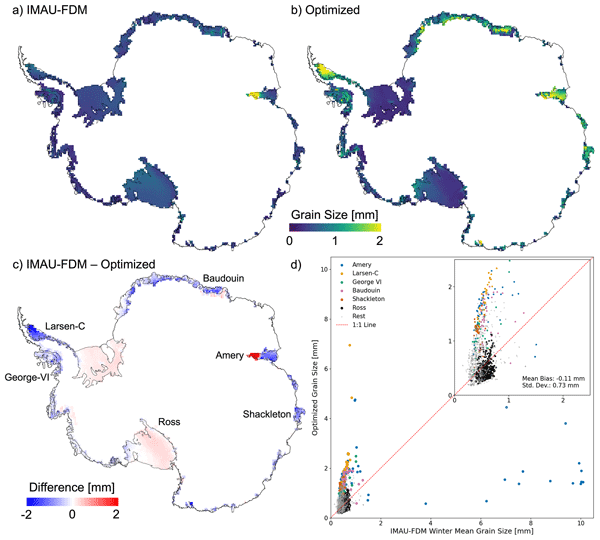
Antarctic ice shelves help slow ice flow into the ocean, but their stability depends partly on the upper firn layer. Air in firn affects how much meltwater can be stored, while grain size helps describe firn structure. We combined fifteen years of satellite radar data with physical models to estimate these properties across Antarctic ice shelves. Our results provide a new way to monitor conditions linked to meltwater build-up and possible instability.
Celia A. Baumhoer, Jonas Koehler, Bert Wouters, Stef Lhermitte, Andreas J. Dietz, and Claudia Kuenzer
Earth Syst. Sci. Data Discuss., https://doi.org/10.5194/essd-2025-569, https://doi.org/10.5194/essd-2025-569, 2026
Revised manuscript under review for ESSD
Short summary
Short summary
PolarLakes is a new open dataset tracking meltwater lakes on Antarctic ice shelves every two weeks from 2015–2024. Using AI and satellite data from different sensors the monitoring of lakes is improved even during cloudy conditions. The record shows significant variations in ponding and lake formation, with a continent-wide peak occurring in 2020 within the observed period. To end, the PolarLakes dataset helps us to better understand the dynamics of surface hydrology in Antarctica.
Johanna Van Passel, Koenraad Van Meerbeek, Paulo Negri Bernardino, Wanda De Keersmaecker, Stef Lhermitte, Bianca Fazio Rius, and Ben Somers
Biogeosciences, 23, 2545–2567, https://doi.org/10.5194/bg-23-2545-2026, https://doi.org/10.5194/bg-23-2545-2026, 2026
Short summary
Short summary
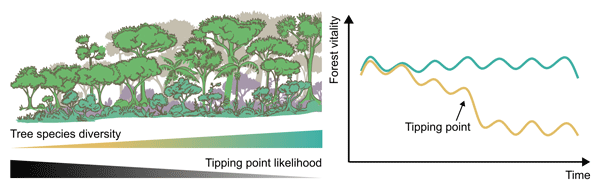
The Amazon forest is important for carbon storage, but climate change might push parts of it towards a tipping point into a degraded state. By studying satellite trends and tree diversity across different spatial scales, we found a larger tipping risk at smaller spatial scales than for the whole region. We also found that higher tree diversity makes the forest more stable and thus less likely to tip, although the effect is relatively weak, highlighting the importance of protecting biodiversity.
Charlotte Braat, Stef Lhermitte, Marie Claire ten Veldhuis, Rolf Hut, and Ruud van der Ent
EGUsphere, https://doi.org/10.5194/egusphere-2026-1439, https://doi.org/10.5194/egusphere-2026-1439, 2026
This preprint is open for discussion and under review for The Cryosphere (TC).
Short summary
Short summary
Deforestation influences the regional and global water cycle. In this paper, deforestation data is combined with data that links rainfall to where this water evaporated. We estimate to what extent rainfall in the region is potentially impacted by deforestation elsewhere. We find that most regions are mostly impacted by deforestation outside of the region. We could not yet confirm a generic link with actual rainfall due to limitations, complex system interactions and region specific dynamics.
Marie G. P. Cavitte, Hugues Goosse, Quentin Dalaiden, and Nicolas Ghilain
The Cryosphere, 19, 6483–6492, https://doi.org/10.5194/tc-19-6483-2025, https://doi.org/10.5194/tc-19-6483-2025, 2025
Short summary
Short summary
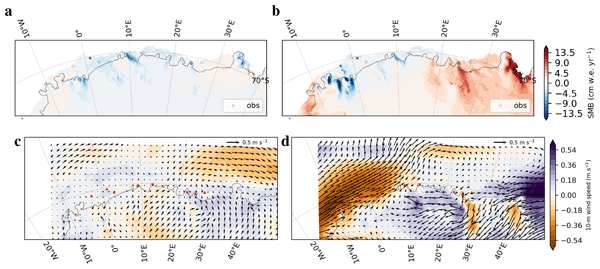
Ice cores are influenced by local processes that alter SMB (surface mass balance) records. To evaluate if atmospheric circulation on large spatial scales can explain differing snowfall trends at 8 East Antarctic ice rises, we assimilated their ice core SMB records within a high-resolution downscaled atmospheric model with quantified local errors from radar constraints. The reconstruction captures the SMB records’ variability but may over-fit by introducing unrealistic spatial heterogeneity.
Julius Sommer, Maaike Izeboud, Sophie de Roda Husman, Bert Wouters, and Stef Lhermitte
The Cryosphere, 19, 5903–5912, https://doi.org/10.5194/tc-19-5903-2025, https://doi.org/10.5194/tc-19-5903-2025, 2025
Short summary
Short summary
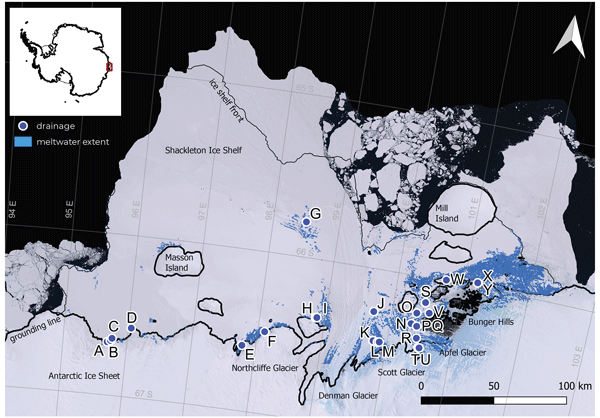
Ice shelves, the floating extensions of Antarctica’s ice sheet, play a crucial role in preventing mass ice loss, and understanding their stability is crucial. If surface meltwater lakes drain rapidly through fractures, the ice shelf can destabilize. We analyzed satellite images of four years from the Shackleton Ice Shelf and found that lake drainages occurred in areas where damage is present and developing, and coincided with rising tides, offering insights into the drivers of this process.
Ann-Sofie P. Zinck, Bert Wouters, Franka Jesse, and Stef Lhermitte
The Cryosphere, 19, 5509–5529, https://doi.org/10.5194/tc-19-5509-2025, https://doi.org/10.5194/tc-19-5509-2025, 2025
Short summary
Short summary
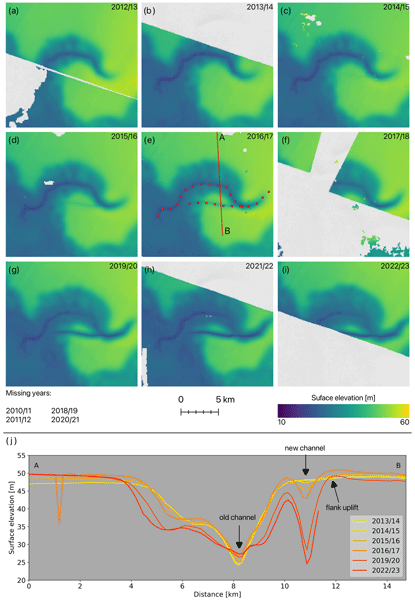
Ocean-driven basal melting of ice shelves can carve channels into the ice shelf base. These channels represent potential weak areas of the ice shelf. On George VI Ice shelf we discover a new channel which onset coincides with the 2015 El-Nino Southern Oscillation event. Since the channel has developed rapidly and is located within a highly channelized area close to the ice shelf front it poses a potential thread of ice shelf retreat.
Filippo Emilio Scarsi, Alessandro Battaglia, Maximilian Maahn, and Stef Lhermitte
The Cryosphere, 19, 4875–4892, https://doi.org/10.5194/tc-19-4875-2025, https://doi.org/10.5194/tc-19-4875-2025, 2025
Short summary
Short summary
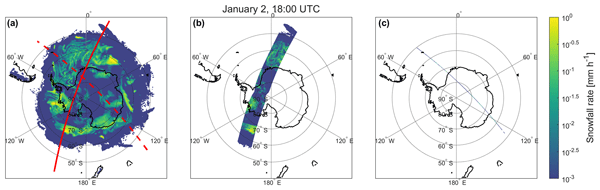
Snowfall measurements at high latitudes are crucial for estimating ice sheet mass balance. Spaceborne radar and radiometer missions help estimate snowfall but face uncertainties. This work evaluates uncertainties in snowfall estimates from a fixed near-nadir radar (CloudSat-like) and a conically scanning radar (WIVERN-like), showing that a WIVERN-like radar will provide better estimates than a CloudSat-like radar at smaller spatial and temporal scales.
Robert G. Bingham, Julien A. Bodart, Marie G. P. Cavitte, Ailsa Chung, Rebecca J. Sanderson, Johannes C. R. Sutter, Olaf Eisen, Nanna B. Karlsson, Joseph A. MacGregor, Neil Ross, Duncan A. Young, David W. Ashmore, Andreas Born, Winnie Chu, Xiangbin Cui, Reinhard Drews, Steven Franke, Vikram Goel, John W. Goodge, A. Clara J. Henry, Antoine Hermant, Benjamin H. Hills, Nicholas Holschuh, Michelle R. Koutnik, Gwendolyn J.-M. C. Leysinger Vieli, Emma J. MacKie, Elisa Mantelli, Carlos Martín, Felix S. L. Ng, Falk M. Oraschewski, Felipe Napoleoni, Frédéric Parrenin, Sergey V. Popov, Therese Rieckh, Rebecca Schlegel, Dustin M. Schroeder, Martin J. Siegert, Xueyuan Tang, Thomas O. Teisberg, Kate Winter, Shuai Yan, Harry Davis, Christine F. Dow, Tyler J. Fudge, Tom A. Jordan, Bernd Kulessa, Kenichi Matsuoka, Clara J. Nyqvist, Maryam Rahnemoonfar, Matthew R. Siegfried, Shivangini Singh, Vjeran Višnjević, Rodrigo Zamora, and Alexandra Zuhr
The Cryosphere, 19, 4611–4655, https://doi.org/10.5194/tc-19-4611-2025, https://doi.org/10.5194/tc-19-4611-2025, 2025
Short summary
Short summary
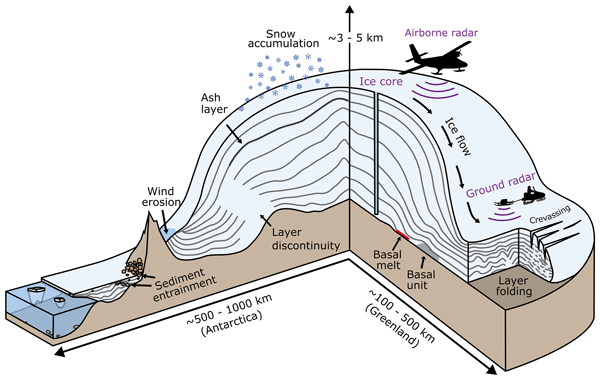
The ice sheets covering Antarctica have built up over millenia through successive snowfall events which become buried and preserved as internal surfaces of equal age detectable with ice-penetrating radar. This paper describes an international initiative working together on these archival data to build a comprehensive 3-D picture of how old the ice is everywhere across Antarctica and how this is being used to reconstruct past and to predict future ice and climate behaviour.
Ailsa Chung, Frédéric Parrenin, Robert Mulvaney, Luca Vittuari, Massimo Frezzotti, Antonio Zanutta, David A. Lilien, Marie G. P. Cavitte, and Olaf Eisen
The Cryosphere, 19, 4125–4140, https://doi.org/10.5194/tc-19-4125-2025, https://doi.org/10.5194/tc-19-4125-2025, 2025
Short summary
Short summary
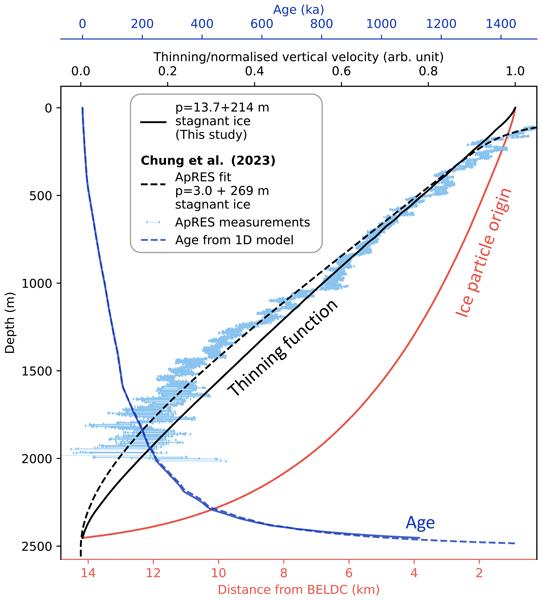
We applied an ice flow model to a flow line from the summit of Dome C to the Beyond EPICA ice core drill site on Little Dome C in Antarctica. Results show that the oldest ice at the drill site may be 1.12 Ma (at an age density of 20 kyr m-1) and originate from around 15 km upstream. We also discuss the nature of the 200–250 m thick basal layer which could be composed of stagnant ice, disturbed ice or even accreted ice (possibly containing debris).
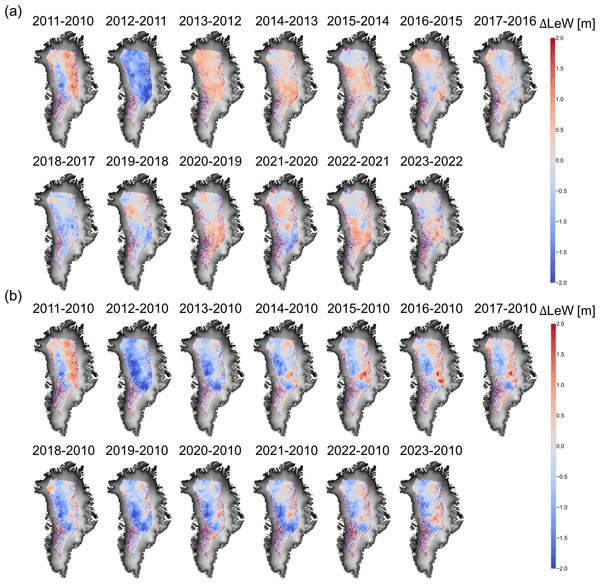
Weiran Li, Stef Lhermitte, Bert Wouters, Cornelis Slobbe, Max Brils, and Xavier Fettweis
The Cryosphere, 19, 3419–3442, https://doi.org/10.5194/tc-19-3419-2025, https://doi.org/10.5194/tc-19-3419-2025, 2025
Short summary
Short summary
Due to recurrent melt and refreezing events in recent decades, the snow conditions over Greenland have changed. To observe this, we use a parameter (leading edge width; LeW) derived from satellite altimetry and analyse its spatial and temporal variations. By comparing the LeW variations with modelled firn parameters, we concluded that the 2012 melt event and the recent and increasingly frequent melt events have a long-lasting impact on the volume scattering of Greenland firn.
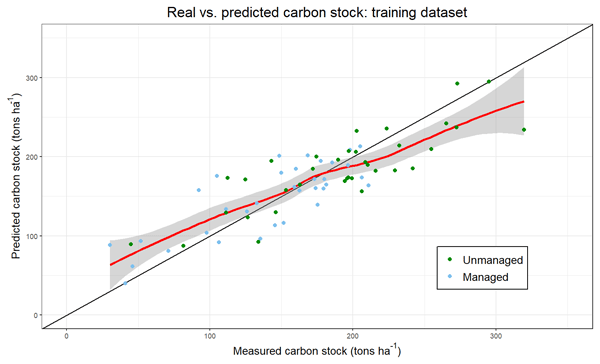
Sofie Van Winckel, Jonas Simons, Stef Lhermitte, and Bart Muys
Biogeosciences, 22, 4291–4307, https://doi.org/10.5194/bg-22-4291-2025, https://doi.org/10.5194/bg-22-4291-2025, 2025
Short summary
Short summary
Insights on management's impact on forest carbon stocks are crucial for sustainable forest management practices. However, accurately monitoring carbon stocks remains a technological challenge. This study estimates above-ground carbon stock in managed and unmanaged forests using passive optical, synthetic aperture radar (SAR), and light detection and ranging (lidar) remote sensing data. Results show promising potential in using multiple remote sensing predictors and publicly available high-resolution data for mapping forest carbon stocks.
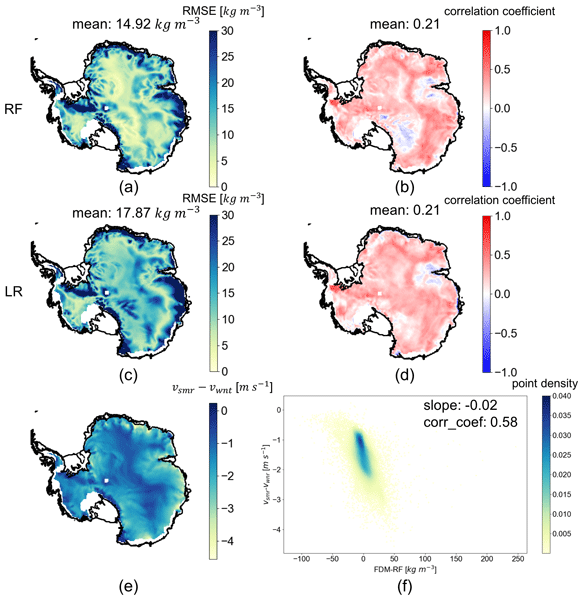
Weiran Li, Sanne B. M. Veldhuijsen, and Stef Lhermitte
The Cryosphere, 19, 37–61, https://doi.org/10.5194/tc-19-37-2025, https://doi.org/10.5194/tc-19-37-2025, 2025
Short summary
Short summary
This study used a machine learning approach to estimate the densities over the Antarctic Ice Sheet, particularly in the areas where the snow is usually dry. The motivation is to establish a link between satellite parameters to snow densities, as measurements are difficult for people to take on site. It provides valuable insights into the complexities of the relationship between satellite parameters and firn density and provides potential for further studies.
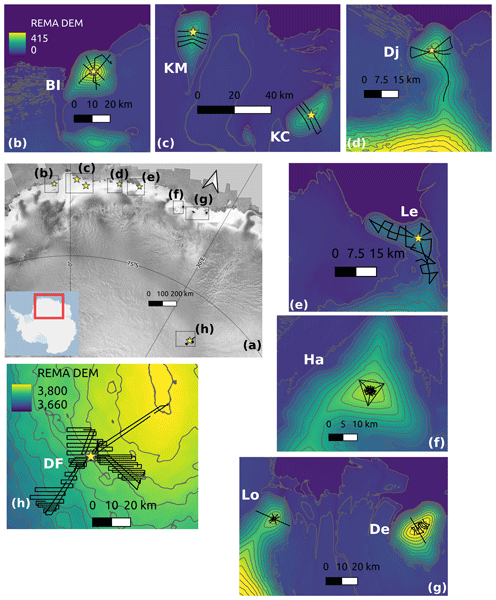
Marie G. P. Cavitte, Hugues Goosse, Kenichi Matsuoka, Sarah Wauthy, Vikram Goel, Rahul Dey, Bhanu Pratap, Brice Van Liefferinge, Thamban Meloth, and Jean-Louis Tison
The Cryosphere, 17, 4779–4795, https://doi.org/10.5194/tc-17-4779-2023, https://doi.org/10.5194/tc-17-4779-2023, 2023
Short summary
Short summary
The net accumulation of snow over Antarctica is key for assessing current and future sea-level rise. Ice cores record a noisy snowfall signal to verify model simulations. We find that ice core net snowfall is biased to lower values for ice rises and the Dome Fuji site (Antarctica), while the relative uncertainty in measuring snowfall increases rapidly with distance away from the ice core sites at the ice rises but not at Dome Fuji. Spatial variation in snowfall must therefore be considered.
Lena G. Buth, Valeria Di Biase, Peter Kuipers Munneke, Stef Lhermitte, Sanne B. M. Veldhuijsen, Sophie de Roda Husman, Michiel R. van den Broeke, and Bert Wouters
EGUsphere, https://doi.org/10.5194/egusphere-2023-2000, https://doi.org/10.5194/egusphere-2023-2000, 2023
Preprint archived
Short summary
Short summary
Liquid meltwater which is stored in air bubbles in the compacted snow near the surface of Antarctica can affect ice shelf stability. In order to detect the presence of such firn aquifers over large scales, satellite remote sensing is needed. In this paper, we present our new detection method using radar satellite data as well as the results for the whole Antarctic Peninsula. Firn aquifers are found in the north and northwest of the peninsula, in agreement with locations predicted by models.
Ann-Sofie Priergaard Zinck, Bert Wouters, Erwin Lambert, and Stef Lhermitte
The Cryosphere, 17, 3785–3801, https://doi.org/10.5194/tc-17-3785-2023, https://doi.org/10.5194/tc-17-3785-2023, 2023
Short summary
Short summary
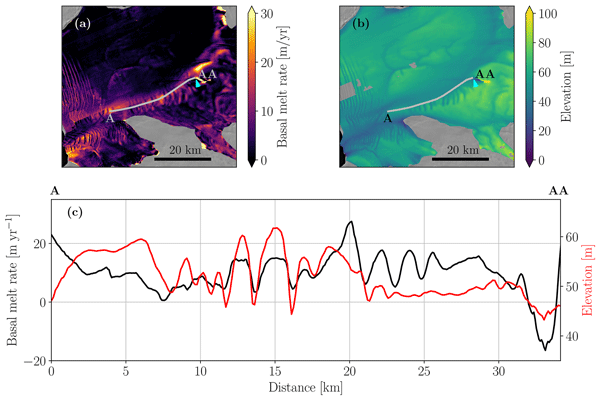
The ice shelves in Antarctica are melting from below, which puts their stability at risk. Therefore, it is important to observe how much and where they are melting. In this study we use high-resolution satellite imagery to derive 50 m resolution basal melt rates of the Dotson Ice Shelf. With the high resolution of our product we are able to uncover small-scale features which may in the future help us to understand the state and fate of the Antarctic ice shelves and their (in)stability.
Ailsa Chung, Frédéric Parrenin, Daniel Steinhage, Robert Mulvaney, Carlos Martín, Marie G. P. Cavitte, David A. Lilien, Veit Helm, Drew Taylor, Prasad Gogineni, Catherine Ritz, Massimo Frezzotti, Charles O'Neill, Heinrich Miller, Dorthe Dahl-Jensen, and Olaf Eisen
The Cryosphere, 17, 3461–3483, https://doi.org/10.5194/tc-17-3461-2023, https://doi.org/10.5194/tc-17-3461-2023, 2023
Short summary
Short summary
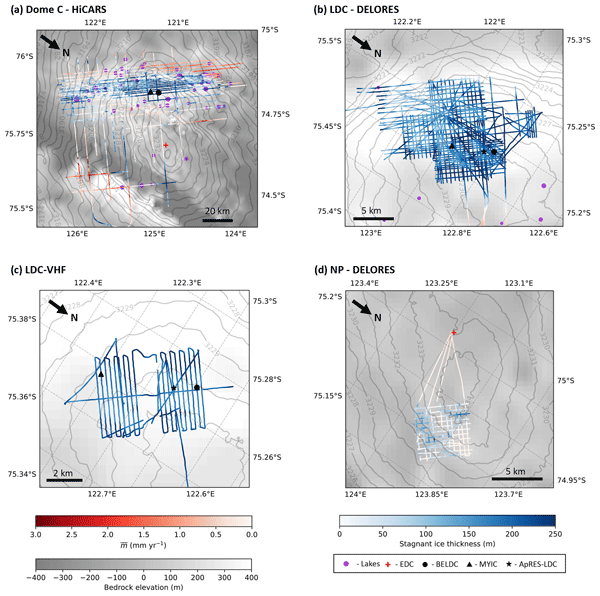
We combined a numerical model with radar measurements in order to determine the age of ice in the Dome C region of Antarctica. Our results show that at the current ice core drilling sites on Little Dome C, the maximum age of the ice is almost 1.5 Ma. We also highlight a new potential drill site called North Patch with ice up to 2 Ma. Finally, we explore the nature of a stagnant ice layer at the base of the ice sheet which has been independently observed and modelled but is not well understood.
Diana Francis, Ricardo Fonseca, Kyle S. Mattingly, Stef Lhermitte, and Catherine Walker
The Cryosphere, 17, 3041–3062, https://doi.org/10.5194/tc-17-3041-2023, https://doi.org/10.5194/tc-17-3041-2023, 2023
Short summary
Short summary
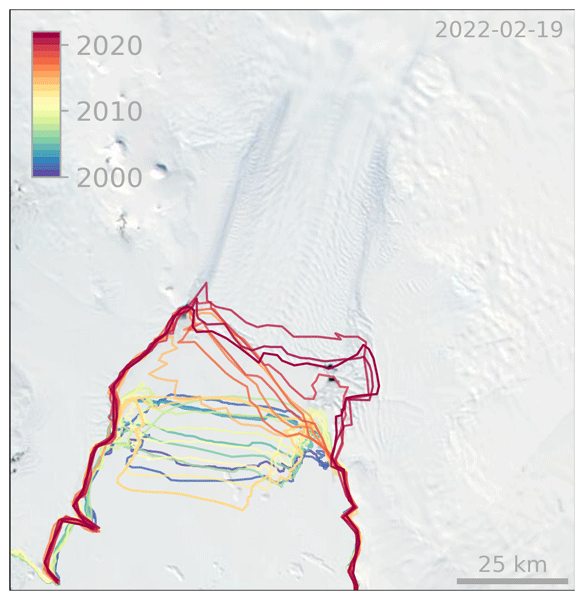
Role of Foehn Winds in ice and snow conditions at the Pine Island Glacier, West Antarctica.
Lena G. Buth, Bert Wouters, Sanne B. M. Veldhuijsen, Stef Lhermitte, Peter Kuipers Munneke, and Michiel R. van den Broeke
The Cryosphere Discuss., https://doi.org/10.5194/tc-2022-127, https://doi.org/10.5194/tc-2022-127, 2022
Manuscript not accepted for further review
Short summary
Short summary
Liquid meltwater which is stored in air bubbles in the compacted snow near the surface of Antarctica can affect ice shelf stability. In order to detect the presence of such firn aquifers over large scales, satellite remote sensing is needed. In this paper, we present our new detection method using radar satellite data as well as the results for the whole Antarctic Peninsula. Firn aquifers are found in the north and northwest of the peninsula, in agreement with locations predicted by models.

Weiran Li, Cornelis Slobbe, and Stef Lhermitte
The Cryosphere, 16, 2225–2243, https://doi.org/10.5194/tc-16-2225-2022, https://doi.org/10.5194/tc-16-2225-2022, 2022
Short summary
Short summary
This study proposes a new method for correcting the slope-induced errors in satellite radar altimetry. The slope-induced errors can significantly affect the height estimations of ice sheets if left uncorrected. This study applies the method to radar altimetry data (CryoSat-2) and compares the performance with two existing methods. The performance is assessed by comparison with independent height measurements from ICESat-2. The assessment shows that the method performs promisingly.
Zhongyang Hu, Peter Kuipers Munneke, Stef Lhermitte, Maaike Izeboud, and Michiel van den Broeke
The Cryosphere, 15, 5639–5658, https://doi.org/10.5194/tc-15-5639-2021, https://doi.org/10.5194/tc-15-5639-2021, 2021
Short summary
Short summary
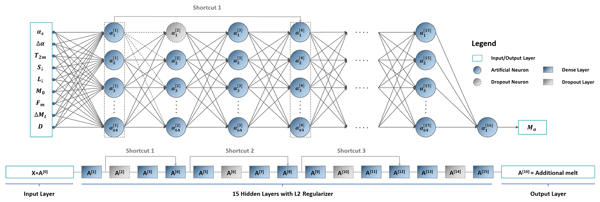
Antarctica is shrinking, and part of the mass loss is caused by higher temperatures leading to more snowmelt. We use computer models to estimate the amount of melt, but this can be inaccurate – specifically in the areas with the most melt. This is because the model cannot account for small, darker areas like rocks or darker ice. Thus, we trained a computer using artificial intelligence and satellite images that showed these darker areas. The model computed an improved estimate of melt.
Weiran Li, Stef Lhermitte, and Paco López-Dekker
The Cryosphere, 15, 5309–5322, https://doi.org/10.5194/tc-15-5309-2021, https://doi.org/10.5194/tc-15-5309-2021, 2021
Short summary
Short summary
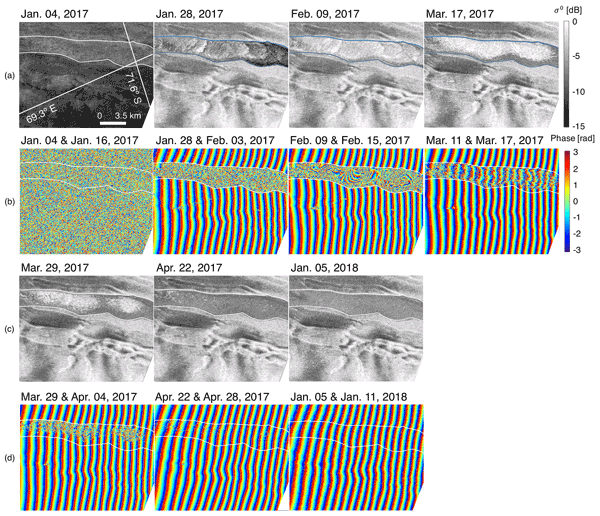
Surface meltwater lakes have been observed on several Antarctic ice shelves in field studies and optical images. Meltwater lakes can drain and refreeze, increasing the fragility of the ice shelves. The combination of synthetic aperture radar (SAR) backscatter and interferometric information (InSAR) can provide the cryosphere community with the possibility to continuously assess the dynamics of the meltwater lakes, potentially helping to facilitate the study of ice shelves in a changing climate.

Marie G. P. Cavitte, Duncan A. Young, Robert Mulvaney, Catherine Ritz, Jamin S. Greenbaum, Gregory Ng, Scott D. Kempf, Enrica Quartini, Gail R. Muldoon, John Paden, Massimo Frezzotti, Jason L. Roberts, Carly R. Tozer, Dustin M. Schroeder, and Donald D. Blankenship
Earth Syst. Sci. Data, 13, 4759–4777, https://doi.org/10.5194/essd-13-4759-2021, https://doi.org/10.5194/essd-13-4759-2021, 2021
Short summary
Short summary
We present a data set consisting of ice-penetrating-radar internal stratigraphy: 26 internal reflecting horizons that cover the greater Dome C area, East Antarctica, the most extensive IRH data set to date in the region. This data set uses radar surveys collected over the span of 10 years, starting with an airborne international collaboration in 2008 to explore the region, up to the detailed ground-based surveys in support of the European Beyond EPICA – Oldest Ice (BE-OI) project.
Cited articles
Agosta, C., Amory, C., Kittel, C., Orsi, A., Favier, V., Gallée, H., van den Broeke, M. R., Lenaerts, J. T. M., van Wessem, J. M., van de Berg, W. J., and Fettweis, X.: Estimation of the Antarctic surface mass balance using the regional climate model MAR (1979–2015) and identification of dominant processes, The Cryosphere, 13, 281–296, https://doi.org/10.5194/tc-13-281-2019, 2019. a
Bartelt, P. and Lehning, M.: A Physical SNOWPACK Model for the Swiss Avalanche Warning Part I: Numerical Model, Cold Regions Science and Technology, 35, https://doi.org/10.1016/S0165-232X(02)00074-5, 2002. a
Calonne, N., Richter, B., Löwe, H., Cetti, C., ter Schure, J., Van Herwijnen, A., Fierz, C., Jaggi, M., and Schneebeli, M.: The RHOSSA campaign: multi-resolution monitoring of the seasonal evolution of the structure and mechanical stability of an alpine snowpack, The Cryosphere, 14, 1829–1848, https://doi.org/10.5194/tc-14-1829-2020, 2020. a
Cavitte, M. G., Goosse, H., Wauthy, S., Kausch, T., Tison, J.-L., Van Liefferinge, B., Pattyn, F., Lenaerts, J. T., and Claeys, P.: From Ice Core to Ground-Penetrating Radar: Representativeness of SMB at Three Ice Rises along the Princess Ragnhild Coast, East Antarctica, J. Glaciol., 68, 1221–1233, https://doi.org/10.1017/jog.2022.39, 2022. a, b, c, d, e, f, g
Drews, R., Matsuoka, K., Martín, C., Callens, D., Bergeot, N., and Pattyn, F.: Evolution of Derwael Ice Rise in Dronning Maud Land, Antarctica, over the Last Millennia: DREWS ET AL, Journal of Geophysical Research: Earth Surface, 120, 564–579, https://doi.org/10.1002/2014JF003246, 2015. a, b
Gorelick, N., Hancher, M., Dixon, M., Ilyushchenko, S., Thau, D., and Moore, R.: Google Earth Engine: Planetary-scale Geospatial Analysis for Everyone, Remote Sensing of Environment, 202, 18–27, https://doi.org/10.1016/j.rse.2017.06.031, 2017. a
Herron, M. M. and Langway, C. C.: Firn densification: an empirical model, Journal of Glaciology, 25, 373–385, https://doi.org/10.3189/S0022143000015239, 1980. a
Hersbach, H., Bell, B., Berrisford, P., Hirahara, S., Horányi, A., Muñoz-Sabater, J., Nicolas, J., Peubey, C., Radu, R., Schepers, D., Simmons, A., Soci, C., Abdalla, S., Abellan, X., Balsamo, G., Bechtold, P., Biavati, G., Bidlot, J., Bonavita, M., De Chiara, G., Dahlgren, P., Dee, D., Diamantakis, M., Dragani, R., Flemming, J., Forbes, R., Fuentes, M., Geer, A., Haimberger, L., Healy, S., Hogan, R. J., Hólm, E., Janisková, M., Keeley, S., Laloyaux, P., Lopez, P., Lupu, C., Radnoti, G., De Rosnay, P., Rozum, I., Vamborg, F., Villaume, S., and Thépaut, J.-N.: The ERA5 Global Reanalysis, Quart. J. Royal Meteoro. Soc., 146, 1999–2049, https://doi.org/10.1002/qj.3803, 2020. a
Joughin, I., Smith, B. E., Howat, I. M., Moon, T., and Scambos, T. A.: A SAR Record of Early 21st Century Change in Greenland, Journal of Glaciology, 62, 62–71, https://doi.org/10.1017/jog.2016.10, 2016. a
Kausch, T. and Lhermitte, S.: Weather data underlying the publication: Sentinel-1 cross-polarization ratio as a proxy for surface mass balance across east Antarctic ice rises, 4TU.ResearchData [data set], https://doi.org/10.4121/21665813, 2026. a, b
Kausch, T., Lhermitte, S., Lenaerts, J. T. M., Wever, N., Inoue, M., Pattyn, F., Sun, S., Wauthy, S., Tison, J.-L., and van de Berg, W. J.: Impact of coastal East Antarctic ice rises on surface mass balance: insights from observations and modeling, The Cryosphere, 14, 3367–3380, https://doi.org/10.5194/tc-14-3367-2020, 2020. a, b, c, d, e
Keenan, E., Wever, N., Lenaerts, J. T. M., and Medley, B.: A wind-driven snow redistribution module for Alpine3D v3.3.0: adaptations designed for downscaling ice sheet surface mass balance, Geosci. Model Dev., 16, 3203–3219, https://doi.org/10.5194/gmd-16-3203-2023, 2023. a
Lehning, M., Bartelt, P., Brown, B., and Fierz, C.: A Physical SNOWPACK Model for the Swiss Avalanche Warning Part III: Meteorological Forcing, Thin Layer Formation and Evaluation, Cold Regions Science and Technology, 35, https://doi.org/10.1016/S0165-232X(02)00072-1, 2002a. a
Lehning, M., Bartelt, P., Brown, B., Fierz, C., and Satyawali, P.: A Physical SNOWPACK Model for the Swiss Avalanche Warning Part II. Snow Microstructure, Cold Regions Science and Technology, p. 21, https://doi.org/10.1016/S0165-232X(02)00073-3, 2002b. a
Leinss, S., Löwe, H., Proksch, M., and Kontu, A.: Modeling the evolution of the structural anisotropy of snow, The Cryosphere, 14, 51–75, https://doi.org/10.5194/tc-14-51-2020, 2020. a, b
Lenaerts, J. T., Brown, J., Van Den Broeke, M. R., Matsuoka, K., Drews, R., Callens, D., Philippe, M., Gorodetskaya, I. V., Van Meijgaard, E., Reijmer, C. H., Pattyn, F., and Van Lipzig, N. P.: High Variability of Climate and Surface Mass Balance Induced by Antarctic Ice Rises, Journal of Glaciology, 60, 1101–1110, https://doi.org/10.3189/2014JoG14J040, 2014. a, b
Lenaerts, J. T. M., Medley, B., Broeke, M. R., and Wouters, B.: Observing and Modeling Ice Sheet Surface Mass Balance, Reviews of Geophysics, 57, 376–420, https://doi.org/10.1029/2018RG000622, 2019. a
Lievens, H., Demuzere, M., Marshall, H.-P., Reichle, R. H., Brucker, L., Brangers, I., de Rosnay, P., Dumont, M., Girotto, M., Immerzeel, W. W., Jonas, T., Kim, E. J., Koch, I., Marty, C., Saloranta, T., Schöber, J., and De Lannoy, G. J. M.: Snow Depth Variability in the Northern Hemisphere Mountains Observed from Space, Nature Communications, 10, 4629, https://doi.org/10.1038/s41467-019-12566-y, 2019. a, b, c, d, e
Löwe, H. and Picard, G.: Microwave scattering coefficient of snow in MEMLS and DMRT-ML revisited: the relevance of sticky hard spheres and tomography-based estimates of stickiness, The Cryosphere, 9, 2101–2117, https://doi.org/10.5194/tc-9-2101-2015, 2015. a
Matsuoka, K., Hindmarsh, R. C., Moholdt, G., Bentley, M. J., Pritchard, H. D., Brown, J., Conway, H., Drews, R., Durand, G., Goldberg, D., Hattermann, T., Kingslake, J., Lenaerts, J. T., Martín, C., Mulvaney, R., Nicholls, K. W., Pattyn, F., Ross, N., Scambos, T., and Whitehouse, P. L.: Antarctic Ice Rises and Rumples: Their Properties and Significance for Ice-Sheet Dynamics and Evolution, Earth-Science Reviews, 150, 724–745, https://doi.org/10.1016/j.earscirev.2015.09.004, 2015. a, b
Mätzler, C.: Improved Born Approximation for Scattering of Radiation in a Granular Medium, Journal of Applied Physics, 83, 6111–6117, https://doi.org/10.1063/1.367496, 1998. a, b
Medley, B., Joughin, I., Das, S. B., Steig, E. J., Conway, H., Gogineni, S., Criscitiello, A. S., McConnell, J. R., Smith, B. E., van den Broeke, M. R., Lenaerts, J. T. M., Bromwich, D. H., and Nicolas, J. P.: Airborne-Radar and Ice-Core Observations of Annual Snow Accumulation over Thwaites Glacier, West Antarctica Confirm the Spatiotemporal Variability of Global and Regional Atmospheric Models: Snow accumulation over thwaites glacier, Geophys. Res. Lett., 40, 3649–3654, https://doi.org/10.1002/grl.50706, 2013. a
Parrella, G., Hajnsek, I., and Papathanassiou, K. P.: Retrieval of Firn Thickness by Means of Polarisation Phase Differences in L-Band SAR Data, Remote Sensing, 13, 4448, https://doi.org/10.3390/rs13214448, 2021. a
Patil, A., Singh, G., and Rüdiger, C.: Retrieval of Snow Depth and Snow Water Equivalent Using Dual Polarization SAR Data, Remote Sensing, 12, 1183, https://doi.org/10.3390/rs12071183, 2020. a
Philippe, M., Tison, J.-L., Fjøsne, K., Hubbard, B., Kjær, H. A., Lenaerts, J. T. M., Drews, R., Sheldon, S. G., De Bondt, K., Claeys, P., and Pattyn, F.: Ice core evidence for a 20th century increase in surface mass balance in coastal Dronning Maud Land, East Antarctica, The Cryosphere, 10, 2501–2516, https://doi.org/10.5194/tc-10-2501-2016, 2016. a
Picard, G., Sandells, M., and Lowe, H.: A New Active/Passive Microwave Radiative Transfer Model for Snow (SMRT) to Foster Inter-Comparisons of Model Components, in: IGARSS 2018–2018 IEEE International Geoscience and Remote Sensing Symposium, IEEE, Valencia, 6276–6279, ISBN 978-1-5386-7150-4, https://doi.org/10.1109/IGARSS.2018.8517407, 2018a. a, b
Picard, G., Sandells, M., and Löwe, H.: SMRT: an active–passive microwave radiative transfer model for snow with multiple microstructure and scattering formulations (v1.0), Geosci. Model Dev., 11, 2763–2788, https://doi.org/10.5194/gmd-11-2763-2018, 2018b. a, b, c
Picard, G., Arnaud, L., and Sandells, M.: SMRT: Snow Microwave Radiative Transfer model – API documentation, https://smrt.readthedocs.io/en/v1.5.1/smrt.microstructure_model.html (last access: 16 January 2026), 2023. a
Proksch, M., Löwe, H., and Schneebeli, M.: Density, specific surface area, and correlation length of snow measured by high-resolution penetrometry, Journal of Geophysical Research: Earth Surface, 120, 346–362, https://doi.org/10.1002/2014JF003266, 2015. a
Rignot, E., Mouginot, J., Scheuchl, B., van den Broeke, M., van Wessem, M. J., and Morlighem, M.: Four Decades of Antarctic Ice Sheet Mass Balance from 1979–2017, Proceedings of the National Academy of Sciences, 116, 1095–1103, https://doi.org/10.1073/pnas.1812883116, 2019. a
Rott, H., Scheiblauer, S., Wuite, J., Krieger, L., Floricioiu, D., Rizzoli, P., Libert, L., and Nagler, T.: Penetration of interferometric radar signals in Antarctic snow, The Cryosphere, 15, 4399–4419, https://doi.org/10.5194/tc-15-4399-2021, 2021. a
Souverijns, N., Gossart, A., Demuzere, M., Lenaerts, J. T. M., Medley, B., Gorodetskaya, I. V., Vanden Broucke, S., and van Lipzig, N. P. M.: A New Regional Climate Model for POLAR-CORDEX: Evaluation of a 30-Year Hindcast with COSMO-CLM 2 Over Antarctica, Journal of Geophysical Research: Atmospheres, 124, 1405–1427, https://doi.org/10.1029/2018JD028862, 2019. a
Stiles, W. H. and Ulaby, F. T.: The active and passive microwave response to snow parameters: 1. Wetness, Journal of Geophysical Research: Oceans, 85, 1037–1044, https://doi.org/10.1029/JC085iC02p01037, 1980. a
Studinger, M., Medley, B. C., Brunt, K. M., Casey, K. A., Kurtz, N. T., Manizade, S. S., Neumann, T. A., and Overly, T. B.: Temporal and spatial variability in surface roughness and accumulation rate around 88° S from repeat airborne geophysical surveys, The Cryosphere, 14, 3287–3308, https://doi.org/10.5194/tc-14-3287-2020, 2020. a
The IMBIE team: Mass Balance of the Antarctic Ice Sheet from 1992 to 2017, Nature, 558, 219–222, https://doi.org/10.1038/s41586-018-0179-y, 2018. a, b
Ulaby, F. T. and Stiles, W. H.: The active and passive microwave response to snow parameters: 2. Water equivalent of dry snow, Journal of Geophysical Research: Oceans, 85, 1045–1049, https://doi.org/10.1029/JC085iC02p01045, 1980. a
van Wessem, J. M., van de Berg, W. J., Noël, B. P. Y., van Meijgaard, E., Amory, C., Birnbaum, G., Jakobs, C. L., Krüger, K., Lenaerts, J. T. M., Lhermitte, S., Ligtenberg, S. R. M., Medley, B., Reijmer, C. H., van Tricht, K., Trusel, L. D., van Ulft, L. H., Wouters, B., Wuite, J., and van den Broeke, M. R.: Modelling the climate and surface mass balance of polar ice sheets using RACMO2 – Part 2: Antarctica (1979–2016), The Cryosphere, 12, 1479–1498, https://doi.org/10.5194/tc-12-1479-2018, 2018. a
Vionnet, V., Brun, E., Morin, S., Boone, A., Faroux, S., Le Moigne, P., Martin, E., and Willemet, J.-M.: The detailed snowpack scheme Crocus and its implementation in SURFEX v7.2, Geosci. Model Dev., 5, 773–791, https://doi.org/10.5194/gmd-5-773-2012, 2012. a
Walter, B., Weigel, H., Wahl, S., and Löwe, H.: Wind tunnel experiments to quantify the effect of aeolian snow transport on the surface snow microstructure, The Cryosphere, 18, 3633–3652, https://doi.org/10.5194/tc-18-3633-2024, 2024. a, b
Wauthy, S., Tison, J.-L., Inoue, M., El Amri, S., Sun, S., Fripiat, F., Claeys, P., and Pattyn, F.: Spatial and temporal variability of environmental proxies from the top 120 m of two ice cores in Dronning Maud Land (East Antarctica), Earth Syst. Sci. Data, 16, 35–58, https://doi.org/10.5194/essd-16-35-2024, 2024. a
Wever, N., Keenan, E., Kausch, T., and Lehning, M.: SnowMicroPen measurements and manual snowpits from Dronning Maud Land, East Antarctica, EnviDat [data set], https://doi.org/10.16904/envidat.331, 2022. a, b
Wever, N., Keenan, E., Amory, C., Lehning, M., Sigmund, A., Huwald, H., and Lenaerts, J. T. M.: Observations and Simulations of New Snow Density in the Drifting Snow-Dominated Environment of Antarctica, J. Glaciol., 69, 823–840, https://doi.org/10.1017/jog.2022.102, 2023. a
Zebker, H. and Weber Hoen, E.: Penetration Depths Inferred from Interferometric Volume Decorrelation Observed over the Greenland Ice Sheet, IEEE Transactions on Geoscience and Remote Sensing, 38, 2571–2583, https://doi.org/10.1109/36.885204, 2000. a
Short summary
Determining the net balance of snow accumulation on the surface of Antarctica is challenging. Sentinel-1 satellite sensors, which can see through snow, offer a promising method. However, linking their signals to snow amounts is complex due to snow's internal structure and limited on-the-ground data. This study found a connection between satellite signals and snow levels at three locations in Dronning Maud Land. Using models and field data, the method shows potential for wider use in Antarctica.
Determining the net balance of snow accumulation on the surface of Antarctica is challenging....


