
Articles | Volume 19, issue 12
https://doi.org/10.5194/tc-19-6421-2025
© Author(s) 2025. This work is distributed under
the Creative Commons Attribution 4.0 License.
the Creative Commons Attribution 4.0 License.
https://doi.org/10.5194/tc-19-6421-2025
© Author(s) 2025. This work is distributed under
the Creative Commons Attribution 4.0 License.
the Creative Commons Attribution 4.0 License.
Research article
| 
02 Dec 2025
Research article |
| 02 Dec 2025
| 02 Dec 2025
Lessons for multi-model ensemble design drawn from emulator experiments: application to a large ensemble for 2100 sea level contributions of the Greenland ice sheet

BRGM, 3 av. C. Guillemin, 45060 Orléans CEDEX 2, France
Heiko Goelzer
NORCE Norwegian Research Centre, Bjerknes Centre for Climate Research, Bergen, Norway
Tamsin L. Edwards
Department of Geography, King's College London, Bush House, North East Wing, 40 Aldwych, London, WC2B 4BG, London, UK
Goneri Le Cozannet
BRGM, 3 av. C. Guillemin, 45060 Orléans CEDEX 2, France
Gael Durand
Univ. Grenoble Alpes, CNRS, IRD, Grenoble INP, IGE, 38000 Grenoble, France
Related authors
Sophie Lecacheux, Jeremy Rohmer, Eva Membrado, Rodrigo Pedreros, Andrea Filippini, Deborah Idier, Servane Gueben-Vénière, Denis Paradis, Alice Dalphinet, and David Ayache
Nat. Hazards Earth Syst. Sci., 26, 3919–3942, https://doi.org/10.5194/nhess-26-3919-2026, https://doi.org/10.5194/nhess-26-3919-2026, 2026
Short summary
Short summary
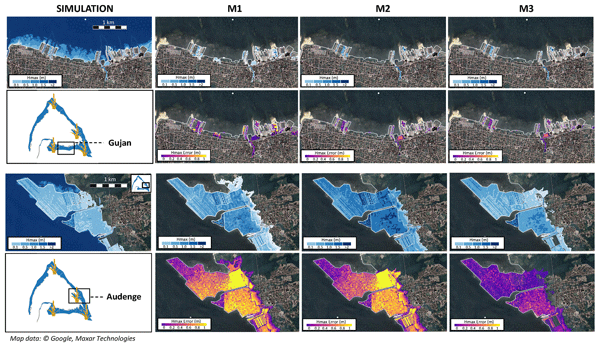
This study comparer three data-driven methodologies to overcome the computational burden of numerical simulations for early warning purpose. They are all based on the statistical analysis of pre-calculated databases, to downscale total sea levels and predict marine flooding maps from offshore metocean forecasts. Conclusions highlight the relevance of metamodel-based approaches for fast prediction and the added value of precalculated databases during the prepardness phase.
Min Chung, Ryota Wada, Jeremy Rohmer, and Philip Jonathan
EGUsphere, https://doi.org/10.5194/egusphere-2026-1899, https://doi.org/10.5194/egusphere-2026-1899, 2026
Short summary
Short summary
This study examines how tropical cyclones cause coastal flooding by combining waves and sea level changes over time. Using long-term storm data for Guadeloupe, we simulated realistic storm evolution rather than relying on single peak values. The results show that accounting for timing reduces errors in estimating extreme flood levels and reveals that wave-driven effects dominate the most severe events, improving reliability for coastal risk planning.
Nathan Gorse, Olivier Roustant, Jérémy Rohmer, and Déborah Idier
Adv. Stat. Clim. Meteorol. Oceanogr., 12, 123–148, https://doi.org/10.5194/ascmo-12-123-2026, https://doi.org/10.5194/ascmo-12-123-2026, 2026
Short summary
Short summary
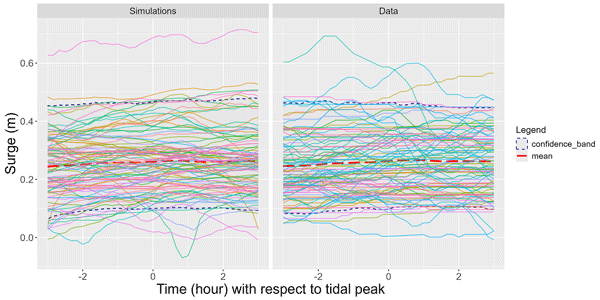
The analysis of the effect of extreme meteoceanic conditions is usually based on physical simulators, which rely on simulated extreme inputs consistent with the observations. However, surge measurements often fail to meet the theoretical assumptions. To address this, we propose a new simulation method which makes it possible to adjust the desired level of extremes after retrieving standard hypotheses. The consistency of simulations with the observations is then validated by using several tools.

Heiko Goelzer, Constantijn J. Berends, Fredrik Boberg, Gael Durand, Tamsin L. Edwards, Xavier Fettweis, Fabien Gillet-Chaulet, Quentin Glaude, Philippe Huybrechts, Sébastien Le clec'h, Ruth Mottram, Brice Noël, Martin Olesen, Charlotte Rahlves, Jeremy Rohmer, Michiel van den Broeke, and Roderik S. W. van de Wal
The Cryosphere, 19, 6887–6906, https://doi.org/10.5194/tc-19-6887-2025, https://doi.org/10.5194/tc-19-6887-2025, 2025
Short summary
Short summary
We present an ensemble of ice sheet model projections for the Greenland ice sheet. The focus is on providing projections that improve our understanding of the range future sea-level rise and the inherent uncertainties over the next 100 to 300 years. Compared to earlier work we more fully account for some of the uncertainties in sea-level projections. We include a wider range of climate model output, more climate change scenarios and we extend projections schematically up to year 2300.
Mirna Badillo-Interiano, Jérémy Rohmer, Gonéri Le Cozannet, and Virginie Duvat
Nat. Hazards Earth Syst. Sci., 25, 4527–4543, https://doi.org/10.5194/nhess-25-4527-2025, https://doi.org/10.5194/nhess-25-4527-2025, 2025
Short summary
Short summary
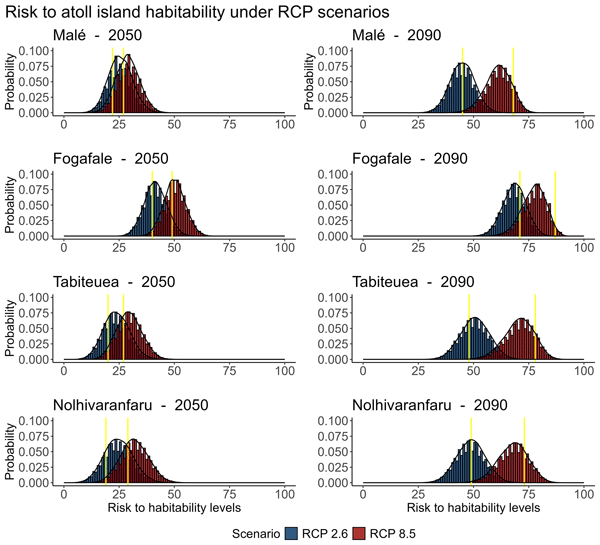
Small islands face increasing threats from climate change. In this context, exploring new modeling approaches is needed to improve climate risk assessments. We applied Bayesian Networks to assess the risk to future habitability on four atoll islands. The findings show that Bayesian Networks are powerful tools for efficiently assessing climate-related risks by combining expert judgments and confidence levels, providing a comprehensive framework to assess risks in data-limited island settings.
Jeremy Rohmer, Stephane Belbeze, and Dominique Guyonnet
SOIL, 10, 679–697, https://doi.org/10.5194/soil-10-679-2024, https://doi.org/10.5194/soil-10-679-2024, 2024
Short summary
Short summary
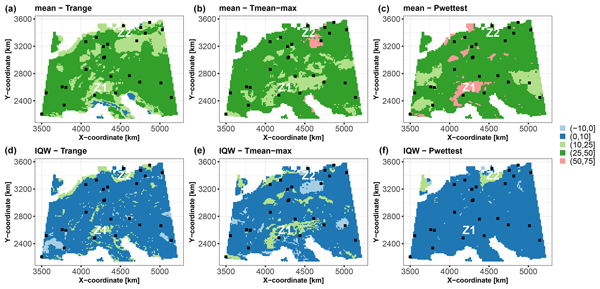
Machine learning (ML) models have become key ingredients for digital soil mapping. To explain why the ML model is reliable, we apply a popular method from explainable artificial intelligence to the uncertainty prediction, with an application to the mapping of hydrocarbon pollutants on urban soil. We show the benefit of a joint analysis of the influence on the best estimate and the uncertainty to improve communication with end users and support decisions regarding covariates’ characterisation.
Jeremy Rohmer, Remi Thieblemont, Goneri Le Cozannet, Heiko Goelzer, and Gael Durand
The Cryosphere, 16, 4637–4657, https://doi.org/10.5194/tc-16-4637-2022, https://doi.org/10.5194/tc-16-4637-2022, 2022
Short summary
Short summary
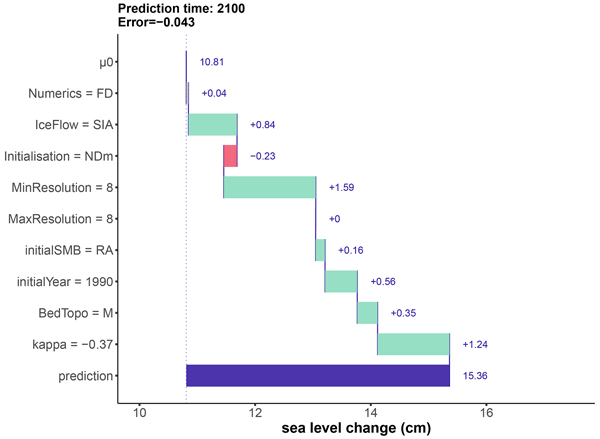
To improve the interpretability of process-based projections of the sea-level contribution from land ice components, we apply the machine-learning-based
SHapley Additive exPlanationsapproach to a subset of a multi-model ensemble study for the Greenland ice sheet. This allows us to quantify the influence of particular modelling decisions (related to numerical implementation, initial conditions, or parametrisation of ice-sheet processes) directly in terms of sea-level change contribution.
Jeremy Rohmer, Deborah Idier, Remi Thieblemont, Goneri Le Cozannet, and François Bachoc
Nat. Hazards Earth Syst. Sci., 22, 3167–3182, https://doi.org/10.5194/nhess-22-3167-2022, https://doi.org/10.5194/nhess-22-3167-2022, 2022
Short summary
Short summary
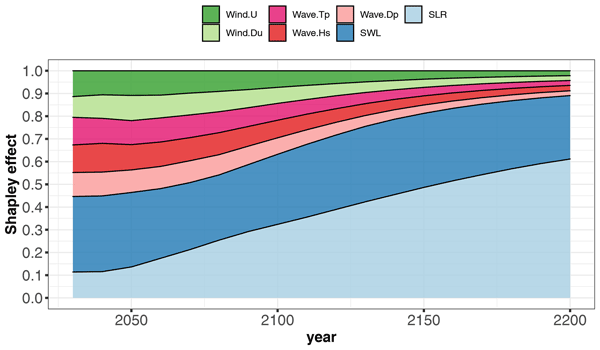
We quantify the influence of wave–wind characteristics, offshore water level and sea level rise (projected up to 2200) on the occurrence of flooding events at Gâvres, French Atlantic coast. Our results outline the overwhelming influence of sea level rise over time compared to the others. By showing the robustness of our conclusions to the errors in the estimation procedure, our approach proves to be valuable for exploring and characterizing uncertainties in assessments of future flooding.
Ryota Wada, Jeremy Rohmer, Yann Krien, and Philip Jonathan
Nat. Hazards Earth Syst. Sci., 22, 431–444, https://doi.org/10.5194/nhess-22-431-2022, https://doi.org/10.5194/nhess-22-431-2022, 2022
Short summary
Short summary
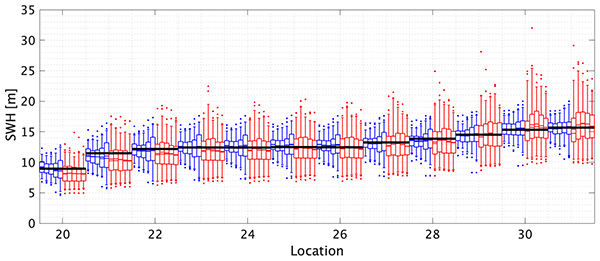
Characterizing extreme wave environments caused by tropical cyclones in the Caribbean Sea near Guadeloupe is difficult because cyclones rarely pass near the location of interest. STM-E (space-time maxima and exposure) model utilizes wave data during cyclones on a spatial neighbourhood. Long-duration wave data generated from a database of synthetic tropical cyclones are used to evaluate the performance of STM-E. Results indicate STM-E provides estimates with small bias and realistic uncertainty.
Benjamin Graves, Tom Matthews, Tamsin Edwards, Richard Taylor, Megan James, Baker Perry, and Magali Ponds
EGUsphere, https://doi.org/10.5194/egusphere-2026-5187, https://doi.org/10.5194/egusphere-2026-5187, 2026
This preprint is open for discussion and under review for The Cryosphere (TC).
Short summary
Short summary
The future of the world’s glaciers under climate change is simulated using models. However, the modelled response of glaciers to rising temperatures is stronger in some models than in others. This study compares the simulated behaviour of a glacier at high elevation using four models to compare how each one reacts to rising temperatures. Simple models respond more strongly than is realistic, because they do not account for the full range of environmental factors which affect the glacier.
Cyrille Mosbeux, Peter Råback, Adrien Gilbert, Julien Brondex, Fabien Gillet-Chaulet, Nicolas C. Jourdain, Mondher Chekki, Olivier Gagliardini, and Gaël Durand
Geosci. Model Dev., 19, 8269–8288, https://doi.org/10.5194/gmd-19-8269-2026, https://doi.org/10.5194/gmd-19-8269-2026, 2026
Short summary
Short summary
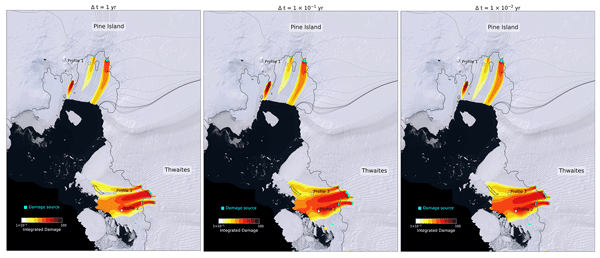
Transport processes like rocks carried by ice flow and damage evolution – a proxy for crevasses – are key in ice sheet modeling and should occur without diffusion. Yet, standard numerical methods often blur these features. We explore a particle-based Semi-Lagrangian approach, comparing it to a Discontinuous Galerkin method, and show it can accurately simulate such transport when run at high enough resolution.
Sophie Lecacheux, Jeremy Rohmer, Eva Membrado, Rodrigo Pedreros, Andrea Filippini, Deborah Idier, Servane Gueben-Vénière, Denis Paradis, Alice Dalphinet, and David Ayache
Nat. Hazards Earth Syst. Sci., 26, 3919–3942, https://doi.org/10.5194/nhess-26-3919-2026, https://doi.org/10.5194/nhess-26-3919-2026, 2026
Short summary
Short summary
This study comparer three data-driven methodologies to overcome the computational burden of numerical simulations for early warning purpose. They are all based on the statistical analysis of pre-calculated databases, to downscale total sea levels and predict marine flooding maps from offshore metocean forecasts. Conclusions highlight the relevance of metamodel-based approaches for fast prediction and the added value of precalculated databases during the prepardness phase.
Ethan Lee, Jeremy C. Ely, Sarah L. Bradley, Tamsin L. Edwards, and Bethan J. Davies
The Cryosphere, 20, 4209–4233, https://doi.org/10.5194/tc-20-4209-2026, https://doi.org/10.5194/tc-20-4209-2026, 2026
Short summary
Short summary
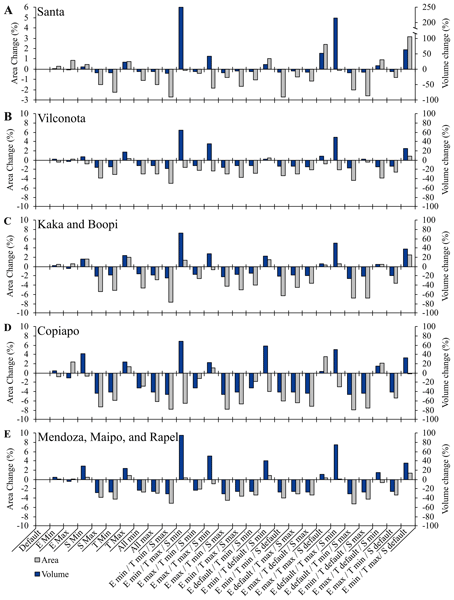
South American Andean glaciers are the least well known in their futures. We can use numerical models to estimate the change of these glaciers to future climate change. However, options within the numerical model which effect the results are unknown. We vary these selected important options to understand their effect on the numerical model output across the South American Andes. We find that how the model approximates sediment friction, and sliding, to be important on model output.
Hideo Aochi, Masumi Yamada, Tung-Cheng Ho, Gonéri Le Cozannet, Arno Christian Hammann, and Ruth Mottram
Nat. Hazards Earth Syst. Sci., 26, 3291–3304, https://doi.org/10.5194/nhess-26-3291-2026, https://doi.org/10.5194/nhess-26-3291-2026, 2026
Short summary
Short summary
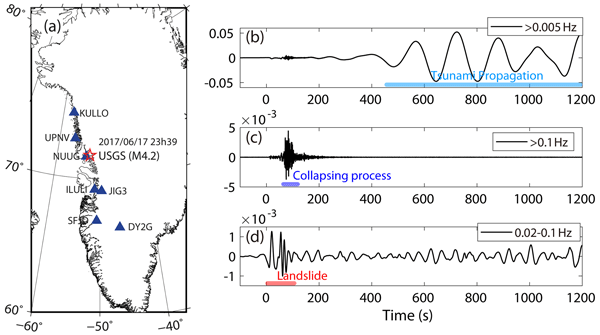
The 2017 Landslide-made tsunami in Greenland occurred in a context of global warming and heavily impacted local communities. We analyze this event using seismic data to reconstruct the whole chain of processes from the landslide to the tsunami. Our results validate a new approach to analyze crustal deformations caused by tsunami propagation in fjords, suggesting that alert systems based on seismic data are feasible, potentially allowing to reduce tsunami risks in polar regions.
Alexander T. Bradley, David T. Bett, C. Rosie Williams, Robert J. Arthern, Paul R. Holland, James Byrne, Tamsin L. Edwards, and Mira Adhikari
The Cryosphere, 20, 3443–3465, https://doi.org/10.5194/tc-20-3443-2026, https://doi.org/10.5194/tc-20-3443-2026, 2026
Short summary
Short summary
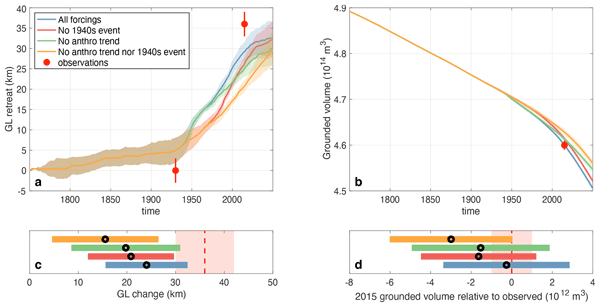
At least since we began measuring in detail, the West Antarctic Ice Sheet has lost a lot of ice, but we don't know precisely how important climate change is in this. Here, we put a number on the role of climate change in retreat of a glacier in this ice sheet, for the first time. We show that climate change made the shrinking of this glacier much worse. Our work also suggests that what happened on very long timescales (the last 10,000 years) might also matter for retreat of the ice sheets today.
Megan C. James, Tamsin L. Edwards, Tom Matthews, Alexander T. Bradley, James F. O'Neill, and Harry Zekollari
EGUsphere, https://doi.org/10.5194/egusphere-2026-2069, https://doi.org/10.5194/egusphere-2026-2069, 2026
Short summary
Short summary
As the climate warms, glaciers are shrinking, contributing to sea-level rise, natural hazards and water insecurity. We show for one case study – the very long-term response of Iceland’s glaciers to global warming – that large uncertainties arise from the poorly known parameters within models. This is usually overlooked, but we show neglecting it underestimates uncertainty in our glacier model by as much as 90 %, highlighting the importance of accounting for it in future glacier projections.
Min Chung, Ryota Wada, Jeremy Rohmer, and Philip Jonathan
EGUsphere, https://doi.org/10.5194/egusphere-2026-1899, https://doi.org/10.5194/egusphere-2026-1899, 2026
Short summary
Short summary
This study examines how tropical cyclones cause coastal flooding by combining waves and sea level changes over time. Using long-term storm data for Guadeloupe, we simulated realistic storm evolution rather than relying on single peak values. The results show that accounting for timing reduces errors in estimating extreme flood levels and reveals that wave-driven effects dominate the most severe events, improving reliability for coastal risk planning.
Nathan Gorse, Olivier Roustant, Jérémy Rohmer, and Déborah Idier
Adv. Stat. Clim. Meteorol. Oceanogr., 12, 123–148, https://doi.org/10.5194/ascmo-12-123-2026, https://doi.org/10.5194/ascmo-12-123-2026, 2026
Short summary
Short summary
The analysis of the effect of extreme meteoceanic conditions is usually based on physical simulators, which rely on simulated extreme inputs consistent with the observations. However, surge measurements often fail to meet the theoretical assumptions. To address this, we propose a new simulation method which makes it possible to adjust the desired level of extremes after retrieving standard hypotheses. The consistency of simulations with the observations is then validated by using several tools.
Susan E. Hanson, Robert J. Nicholls, Floris R. Calkoen, Gonéri Le Cozannet, and Arjen P. Luijendijk
Nat. Hazards Earth Syst. Sci., 26, 1685–1703, https://doi.org/10.5194/nhess-26-1685-2026, https://doi.org/10.5194/nhess-26-1685-2026, 2026
Short summary
Short summary
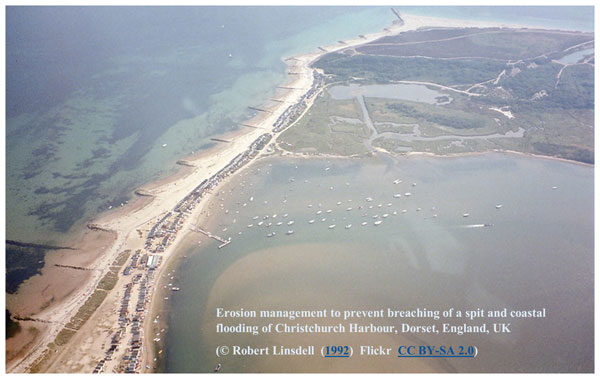
The CoasTER geographic database provides erosion relevant characteristics (sediment type, land use, geomorphology, historical shoreline movement trend) for Europe’s coastal floodplains. Building on earlier erosion research, it also includes a coastal geomorphological typology incorporating hard engineering and other infrastructure. Analysis demonstrates that episodic/long-term erosion and coastal flooding interactions are widespread and an important aspect within any management strategy.
Didier Swingedouw, Laura Jackson, Aixue Hu, Anastasia Romanou, Nicole C. Laureanti, Wilbert Weijer, Sina Loriani, Bette Otto-Bliesner, Ayako Abe-Ouchi, Lucas Almeida, Alessio Bellucci, Reyk Börner, Gokhan Danabasoglu, Donovan P. Dennis, Marion Devilliers, Sybren Drijfhout, Jonathan Donges, Friederike Fröb, Thomas L. Frölicher, Guillaume Gastineau, Heiko Goelzer, Chuncheng Guo, Urs Hofmann, Anna Höse, Colin Jones, Torben Koenigk, Ann Kristin Klose, Valerio Lembo, Jose Licon-Salaiz, Ken Mankoff, Virna Meccia, Irina Melnikova, Oliver Mehling, Laurie Menviel, Juliette Mignot, Jon I. Robson, Gavin A. Schmidt, Robin Smith, Yuchen Sun, Irene Trombini, Matteo Willeit, Richard Wood, Fanghua Wu, Lin Zhaohui, and Ricarda Winkelmann
EGUsphere, https://doi.org/10.5194/egusphere-2026-1698, https://doi.org/10.5194/egusphere-2026-1698, 2026
Short summary
Short summary
This study presents a plan for climate model experiments to better understand how changes in freshwater in the North Atlantic affect major ocean currents. We designed coordinated simulations to test their response to warming, added freshwater, and possible recovery after weakening. Comparing results across models and past climate evidence helps improve confidence in projections and assess risks of large ocean circulation changes.
Pierre Mathiot, Nicolas C. Jourdain, Benoit Urruty, Fabien Gillet-Chaulet, Olivier Gagliardini, and Gaël Durand
EGUsphere, https://doi.org/10.5194/egusphere-2026-927, https://doi.org/10.5194/egusphere-2026-927, 2026
Short summary
Short summary
How the Antarctic ice sheet responds to rapid ocean warming remains uncertain. To explore this, we used a coupled ocean–ice sheet model. We compared simulations under present-day conditions with simulations under strong future warming for 50 years, then returned to today’s climate. The ocean warmed quickly but recovered within decades. In contrast, several ice streams continued to retreat for centuries. This shows that even brief warming could cause lasting ice loss and sea-level rise.
Benjamin Heurgue, Charles Amory, Christoph Kittel, Fredrik Boberg, Gaël Durand, Vincent Favier, Xavier Fettweis, Quentin Glaude, Heiko Goelzer, Nicolaj Hansen, Nicolas C. Jourdain, Ruth Mottram, Martin Olesen, Willem Jan Van de Berg, Michiel R. Van den Broeke, and René R. Wijngaard
EGUsphere, https://doi.org/10.5194/egusphere-2026-624, https://doi.org/10.5194/egusphere-2026-624, 2026
Short summary
Short summary
We studied how the Antarctic ice sheet surface mass balance may change by 2100 using three high-resolution climate models forced by the same future climate scenario. While the models agree for present-day conditions, they project very different futures, especially over floating ice shelves. These differences mainly come from how melting, refreezing, and temperature are represented. Our results show that future sea level projections strongly depend on how well models simulate today’s climate.
Konstanze Haubner, Heiko Goelzer, and Andreas Born
Earth Syst. Dynam., 17, 57–80, https://doi.org/10.5194/esd-17-57-2026, https://doi.org/10.5194/esd-17-57-2026, 2026
Short summary
Short summary
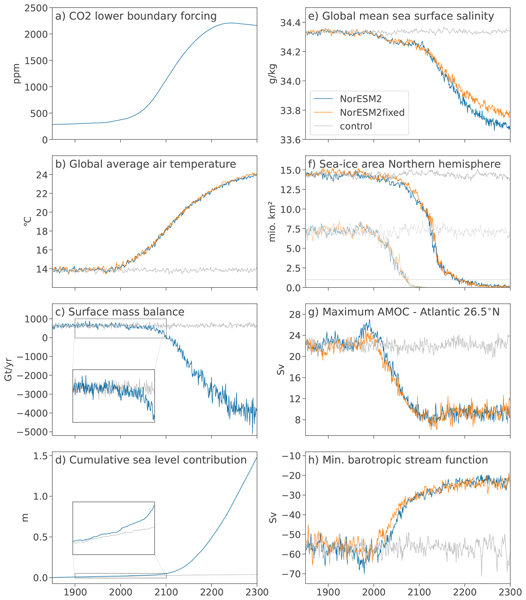
We add a new dynamic component – an ice sheet model simulating the Greenland ice sheet – to an Earth system model that already captures the global climate evolution including ocean, atmosphere, land and sea ice. Under a strong warming scenario, the global warming of 10°C over 250 years is dominating the climate evolution. Changes from the ice-climate interaction are mainly local yet impacting the evolution of the Greenland ice sheet. Hence, ice-climate feedbacks should be considered beyond 2100.
Heiko Goelzer, Constantijn J. Berends, Fredrik Boberg, Gael Durand, Tamsin L. Edwards, Xavier Fettweis, Fabien Gillet-Chaulet, Quentin Glaude, Philippe Huybrechts, Sébastien Le clec'h, Ruth Mottram, Brice Noël, Martin Olesen, Charlotte Rahlves, Jeremy Rohmer, Michiel van den Broeke, and Roderik S. W. van de Wal
The Cryosphere, 19, 6887–6906, https://doi.org/10.5194/tc-19-6887-2025, https://doi.org/10.5194/tc-19-6887-2025, 2025
Short summary
Short summary
We present an ensemble of ice sheet model projections for the Greenland ice sheet. The focus is on providing projections that improve our understanding of the range future sea-level rise and the inherent uncertainties over the next 100 to 300 years. Compared to earlier work we more fully account for some of the uncertainties in sea-level projections. We include a wider range of climate model output, more climate change scenarios and we extend projections schematically up to year 2300.
Charlotte Rahlves, Heiko Goelzer, Andreas Born, and Petra M. Langebroek
The Cryosphere, 19, 6403–6419, https://doi.org/10.5194/tc-19-6403-2025, https://doi.org/10.5194/tc-19-6403-2025, 2025
Short summary
Short summary
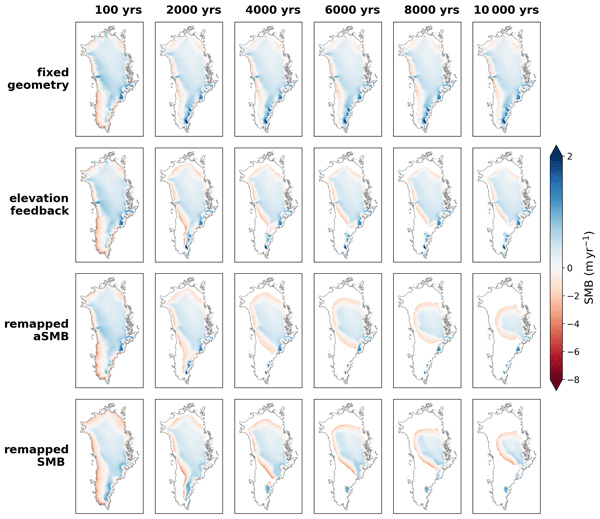
We present a method to better simulate how Greenland’s ice sheet may change over thousands of years in response to climate change. Using a stand-alone ice sheet model, we adjust snowfall and melting patterns based on changes in the ice sheet’s shape. This approach avoids complex coupled models and enables faster testing of many future scenarios to understand the long-term stability of Greenland’s ice.
Mirna Badillo-Interiano, Jérémy Rohmer, Gonéri Le Cozannet, and Virginie Duvat
Nat. Hazards Earth Syst. Sci., 25, 4527–4543, https://doi.org/10.5194/nhess-25-4527-2025, https://doi.org/10.5194/nhess-25-4527-2025, 2025
Short summary
Short summary
Small islands face increasing threats from climate change. In this context, exploring new modeling approaches is needed to improve climate risk assessments. We applied Bayesian Networks to assess the risk to future habitability on four atoll islands. The findings show that Bayesian Networks are powerful tools for efficiently assessing climate-related risks by combining expert judgments and confidence levels, providing a comprehensive framework to assess risks in data-limited island settings.
Heiko Goelzer, Petra M. Langebroek, Andreas Born, Stefan Hofer, Konstanze Haubner, Michele Petrini, Gunter Leguy, William H. Lipscomb, and Katherine Thayer-Calder
Geosci. Model Dev., 18, 7853–7867, https://doi.org/10.5194/gmd-18-7853-2025, https://doi.org/10.5194/gmd-18-7853-2025, 2025
Short summary
Short summary
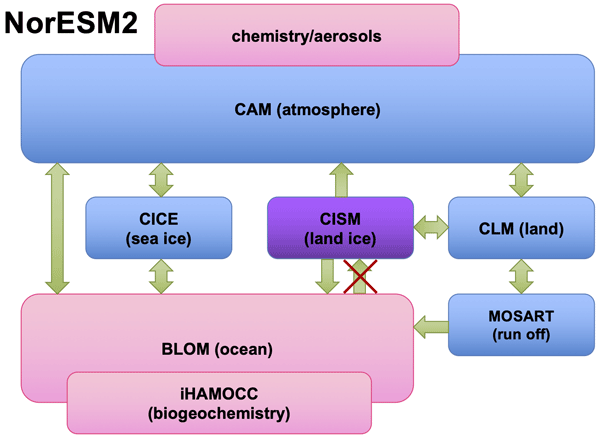
On the backdrop of observed accelerating ice sheet mass loss over the last few decades, there is growing interest in the role of ice sheet changes in global climate projections. In this regard, we have coupled an Earth system model with an ice sheet model and have produced an initial set of climate projections including an interactive coupling with a dynamic Greenland ice sheet.
Johanna Beckmann, Ronja Reese, Felicity S. McCormack, Sue Cook, Lawrence Bird, Dawid Gwyther, Daniel Richards, Matthias Scheiter, Yu Wang, Hélène Seroussi, Ayako Abe‐Ouchi, Torsten Albrecht, Jorge Alvarez‐Solas, Xylar S. Asay‐Davis, Jean‐Baptiste Barre, Constantijn J. Berends, Jorge Bernales, Javier Blasco, Justine Caillet, David M. Chandler, Violaine Coulon, Richard Cullather, Christophe Dumas, Benjamin K. Galton‐Fenzi, Julius Garbe, Fabien Gillet‐Chaulet, Rupert Gladstone, Heiko Goelzer, Nicholas R. Golledge, Ralf Greve, G. Hilmar Gudmundsson, Holly Kyeore Han, Trevor R. Hillebrand, Matthew J. Hoffman, Philippe Huybrechts, Nicolas C. Jourdain, Ann Kristin Klose, Petra M. Langebroek, Gunter R. Leguy, William H. Lipscomb, Daniel P. Lowry, Pierre Mathiot, Marisa Montoya, Mathieu Morlighem, Sophie Nowicki, Frank Pattyn, Antony J. Payne, Tyler Pelle, Aurélien Quiquet, Alexander Robinson, Leopekka Saraste, Erika G. Simon, Sainan Sun, Jake P. Twarog, Luke D. Trusel, Benoit Urruty, Jonas Van Breedam, Roderik S. W. van de Wal, Chen Zhao, and Thomas Zwinger
EGUsphere, https://doi.org/10.5194/egusphere-2025-4069, https://doi.org/10.5194/egusphere-2025-4069, 2025
Short summary
Short summary
Antarctica holds enough ice to raise sea levels by many meters, but its future is uncertain. Warm ocean water melts ice shelves from below, letting inland ice flow faster into the sea. By 2300, Antarctica could add 0.6–4.4 m to sea levels. Our study identifies two key factors—how strongly shelves melt and how the ice responds. These explain much of the range, and refining them in models may improve future predictions.
Lise Seland Graff, Jerry Tjiputra, Ada Gjermundsen, Andreas Born, Jens Boldingh Debernard, Heiko Goelzer, Yan-Chun He, Petra Margaretha Langebroek, Aleksi Nummelin, Dirk Olivié, Øyvind Seland, Trude Storelvmo, Mats Bentsen, Chuncheng Guo, Andrea Rosendahl, Dandan Tao, Thomas Toniazzo, Camille Li, Stephen Outten, and Michael Schulz
Earth Syst. Dynam., 16, 1671–1698, https://doi.org/10.5194/esd-16-1671-2025, https://doi.org/10.5194/esd-16-1671-2025, 2025
Short summary
Short summary
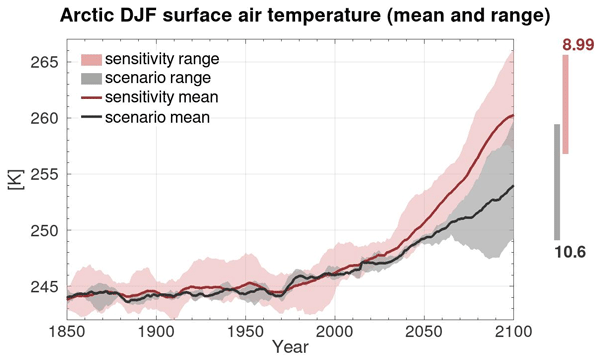
The magnitude of future Arctic amplification is highly uncertain. Using the Norwegian Earth System Model, we explore the effect of improving the representation of clouds, ocean eddies, the Greenland ice sheet, sea ice, and ozone on the projected Arctic winter warming in a coordinated experiment set. These improvements all lead to enhanced projected Arctic warming, with the largest changes found in the sea ice retreat regions and the largest uncertainty found on the Atlantic side.
Ricarda Winkelmann, Donovan P. Dennis, Jonathan F. Donges, Sina Loriani, Ann Kristin Klose, Jesse F. Abrams, Jorge Alvarez-Solas, Torsten Albrecht, David Armstrong McKay, Sebastian Bathiany, Javier Blasco Navarro, Victor Brovkin, Eleanor Burke, Gokhan Danabasoglu, Reik V. Donner, Markus Drüke, Goran Georgievski, Heiko Goelzer, Anna B. Harper, Gabriele Hegerl, Marina Hirota, Aixue Hu, Laura C. Jackson, Colin Jones, Hyungjun Kim, Torben Koenigk, Peter Lawrence, Timothy M. Lenton, Hannah Liddy, José Licón-Saláiz, Maxence Menthon, Marisa Montoya, Jan Nitzbon, Sophie Nowicki, Bette Otto-Bliesner, Francesco Pausata, Stefan Rahmstorf, Karoline Ramin, Alexander Robinson, Johan Rockström, Anastasia Romanou, Boris Sakschewski, Christina Schädel, Steven Sherwood, Robin S. Smith, Norman J. Steinert, Didier Swingedouw, Matteo Willeit, Wilbert Weijer, Richard Wood, Klaus Wyser, and Shuting Yang
EGUsphere, https://doi.org/10.5194/egusphere-2025-1899, https://doi.org/10.5194/egusphere-2025-1899, 2025
Short summary
Short summary
The Tipping Points Modelling Intercomparison Project (TIPMIP) is an international collaborative effort to systematically assess tipping point risks in the Earth system using state-of-the-art coupled and stand-alone domain models. TIPMIP will provide a first global atlas of potential tipping dynamics, respective critical thresholds and key uncertainties, generating an important building block towards a comprehensive scientific basis for policy- and decision-making.
Nicolas C. Jourdain, Charles Amory, Christoph Kittel, and Gaël Durand
The Cryosphere, 19, 1641–1674, https://doi.org/10.5194/tc-19-1641-2025, https://doi.org/10.5194/tc-19-1641-2025, 2025
Short summary
Short summary
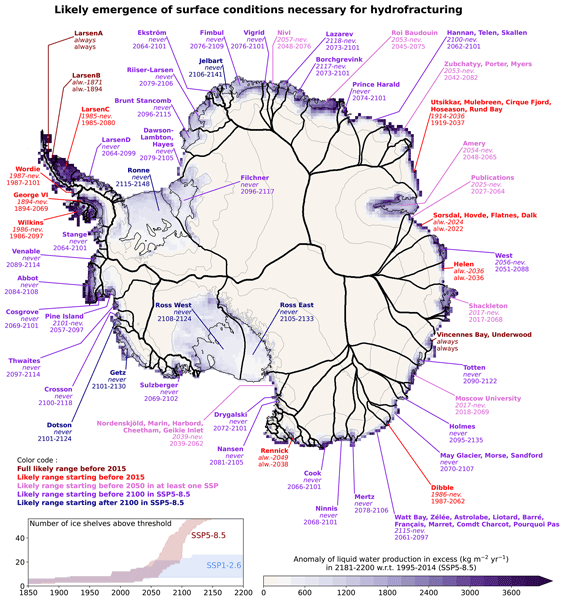
A mixed statistical–physical approach is used to reproduce the behaviour of a regional climate model. From that, we estimate the contribution of snowfall and melting at the surface of the Antarctic Ice Sheet to changes in global mean sea level. We also investigate the impact of surface melting in a warmer climate on the stability of the Antarctic ice shelves that provide back stress on the ice flow to the ocean.
Charlotte Rahlves, Heiko Goelzer, Andreas Born, and Petra M. Langebroek
The Cryosphere, 19, 1205–1220, https://doi.org/10.5194/tc-19-1205-2025, https://doi.org/10.5194/tc-19-1205-2025, 2025
Short summary
Short summary
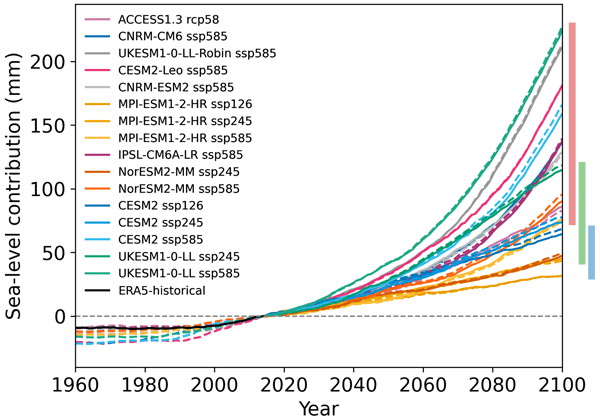
Mass loss from the Greenland ice sheet significantly contributes to rising sea levels, threatening coastal communities globally. To improve future sea-level projections, we simulated ice sheet behavior until 2100, initializing the model with observed geometry and using various climate models. Predictions indicate a sea-level rise of 32 to 228 mm by 2100, with climate model uncertainty being the main source of variability in projections.
James F. O'Neill, Tamsin L. Edwards, Daniel F. Martin, Courtney Shafer, Stephen L. Cornford, Hélène L. Seroussi, Sophie Nowicki, Mira Adhikari, and Lauren J. Gregoire
The Cryosphere, 19, 541–563, https://doi.org/10.5194/tc-19-541-2025, https://doi.org/10.5194/tc-19-541-2025, 2025
Short summary
Short summary
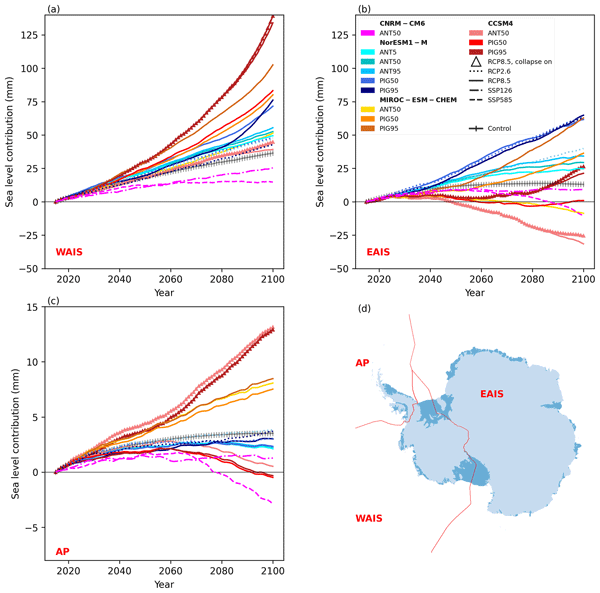
We use an ice sheet model to simulate the Antarctic contribution to sea level over the 21st century under a range of future climates and varying how sensitive the ice sheet is to different processes. We find that ocean temperatures increase and more snow falls on the ice sheet under stronger warming scenarios. When the ice sheet is sensitive to ocean warming, ocean melt-driven loss exceeds snowfall-driven gains, meaning that the sea level contribution is greater with more climate warming.
Michele Petrini, Meike D. W. Scherrenberg, Laura Muntjewerf, Miren Vizcaino, Raymond Sellevold, Gunter R. Leguy, William H. Lipscomb, and Heiko Goelzer
The Cryosphere, 19, 63–81, https://doi.org/10.5194/tc-19-63-2025, https://doi.org/10.5194/tc-19-63-2025, 2025
Short summary
Short summary
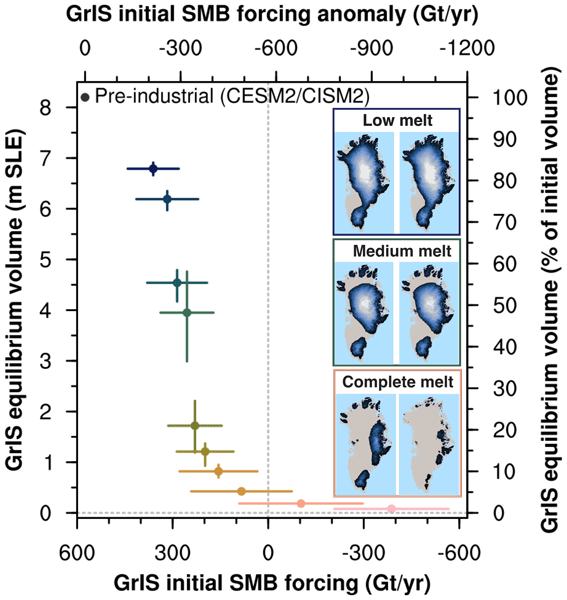
Anthropogenic warming is causing accelerated Greenland ice sheet melt. Here, we use a computer model to understand how prolonged warming and ice melt could threaten ice sheet stability. We find a threshold beyond which Greenland will lose more than 80 % of its ice over several thousand years, due to the interaction of surface and solid-Earth processes. Nearly complete Greenland ice sheet melt occurs when the ice margin disconnects from a region of high elevation in western Greenland.
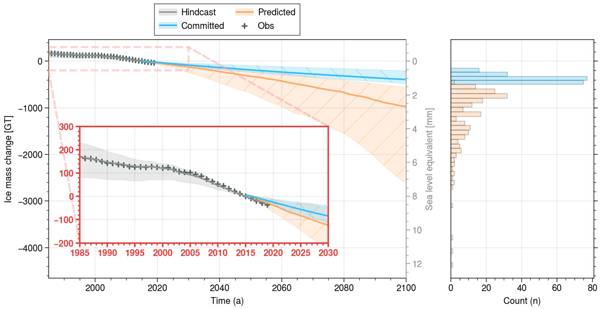
Eliot Jager, Fabien Gillet-Chaulet, Nicolas Champollion, Romain Millan, Heiko Goelzer, and Jérémie Mouginot
The Cryosphere, 18, 5519–5550, https://doi.org/10.5194/tc-18-5519-2024, https://doi.org/10.5194/tc-18-5519-2024, 2024
Short summary
Short summary
Inspired by a previous intercomparison framework, our study better constrains uncertainties in glacier evolution using an innovative method to validate Bayesian calibration. Upernavik Isstrøm, one of Greenland's largest glaciers, has lost significant mass since 1985. By integrating observational data, climate models, human emissions, and internal model parameters, we project its evolution until 2100. We show that future human emissions are the main source of uncertainty in 2100, making up half.
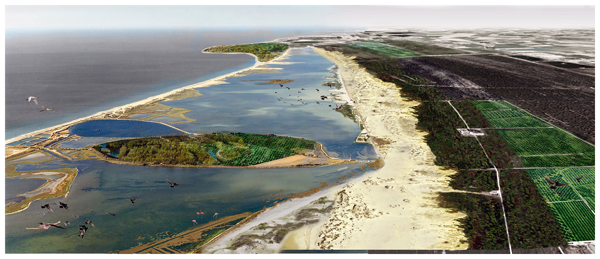
Alexander Bisaro, Giulia Galluccio, Elisa Fiorini Beckhauser, Fulvio Biddau, Ruben David, Floortje d'Hont, Antonio Góngora Zurro, Gonéri Le Cozannet, Sadie McEvoy, Begoña Pérez Gómez, Claudia Romagnoli, Eugenio Sini, and Jill Slinger
State Planet, 3-slre1, 7, https://doi.org/10.5194/sp-3-slre1-7-2024, https://doi.org/10.5194/sp-3-slre1-7-2024, 2024
Short summary
Short summary
This paper assesses coastal adaptation governance by examining socio-economic and political contexts, reviewing policy frameworks, and identifying challenges. Results show that regional and basin-scale frameworks lack sea level rise provisions, but significant national progress is observed. The main governance challenges are time horizons and uncertainty, coordination, and social vulnerability. These, however, can be addressed if flexible planning and nature-based solutions are implemented.
Jeremy Rohmer, Stephane Belbeze, and Dominique Guyonnet
SOIL, 10, 679–697, https://doi.org/10.5194/soil-10-679-2024, https://doi.org/10.5194/soil-10-679-2024, 2024
Short summary
Short summary
Machine learning (ML) models have become key ingredients for digital soil mapping. To explain why the ML model is reliable, we apply a popular method from explainable artificial intelligence to the uncertainty prediction, with an application to the mapping of hydrocarbon pollutants on urban soil. We show the benefit of a joint analysis of the influence on the best estimate and the uncertainty to improve communication with end users and support decisions regarding covariates’ characterisation.
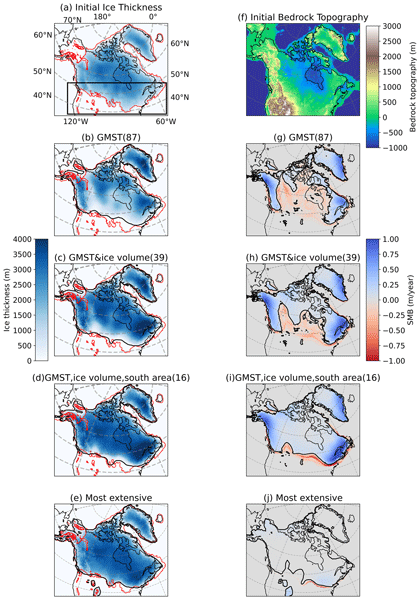
Sam Sherriff-Tadano, Ruza Ivanovic, Lauren Gregoire, Charlotte Lang, Niall Gandy, Jonathan Gregory, Tamsin L. Edwards, Oliver Pollard, and Robin S. Smith
Clim. Past, 20, 1489–1512, https://doi.org/10.5194/cp-20-1489-2024, https://doi.org/10.5194/cp-20-1489-2024, 2024
Short summary
Short summary
Ensemble simulations of the climate and ice sheets of the Last Glacial Maximum (LGM) are performed with a new coupled climate–ice sheet model. Results show a strong sensitivity of the North American ice sheet to the albedo scheme, while the Greenland ice sheet appeared more sensitive to basal sliding schemes. Our result implies a potential connection between the North American ice sheet at the LGM and the future Greenland ice sheet through the albedo scheme.
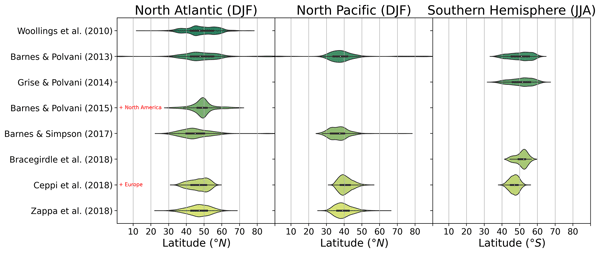
Tom Keel, Chris Brierley, and Tamsin Edwards
Geosci. Model Dev., 17, 1229–1247, https://doi.org/10.5194/gmd-17-1229-2024, https://doi.org/10.5194/gmd-17-1229-2024, 2024
Short summary
Short summary
Jet streams are an important control on surface weather as their speed and shape can modify the properties of weather systems. Establishing trends in the operation of jet streams may provide some indication of the future of weather in a warming world. Despite this, it has not been easy to establish trends, as many methods have been used to characterise them in data. We introduce a tool containing various implementations of jet stream statistics and algorithms that works in a standardised manner.
Violaine Coulon, Ann Kristin Klose, Christoph Kittel, Tamsin Edwards, Fiona Turner, Ricarda Winkelmann, and Frank Pattyn
The Cryosphere, 18, 653–681, https://doi.org/10.5194/tc-18-653-2024, https://doi.org/10.5194/tc-18-653-2024, 2024
Short summary
Short summary
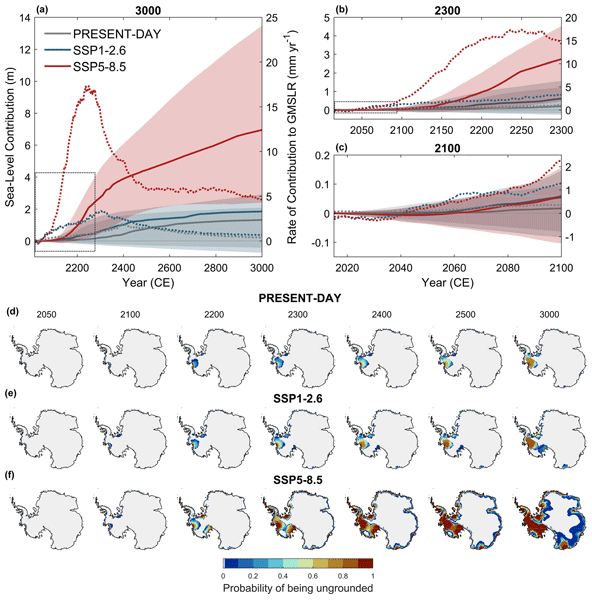
We present new projections of the evolution of the Antarctic ice sheet until the end of the millennium, calibrated with observations. We show that the ocean will be the main trigger of future ice loss. As temperatures continue to rise, the atmosphere's role may shift from mitigating to amplifying Antarctic mass loss already by the end of the century. For high-emission scenarios, this may lead to substantial sea-level rise. Adopting sustainable practices would however reduce the rate of ice loss.
Robert E. Kopp, Gregory G. Garner, Tim H. J. Hermans, Shantenu Jha, Praveen Kumar, Alexander Reedy, Aimée B. A. Slangen, Matteo Turilli, Tamsin L. Edwards, Jonathan M. Gregory, George Koubbe, Anders Levermann, Andre Merzky, Sophie Nowicki, Matthew D. Palmer, and Chris Smith
Geosci. Model Dev., 16, 7461–7489, https://doi.org/10.5194/gmd-16-7461-2023, https://doi.org/10.5194/gmd-16-7461-2023, 2023
Short summary
Short summary
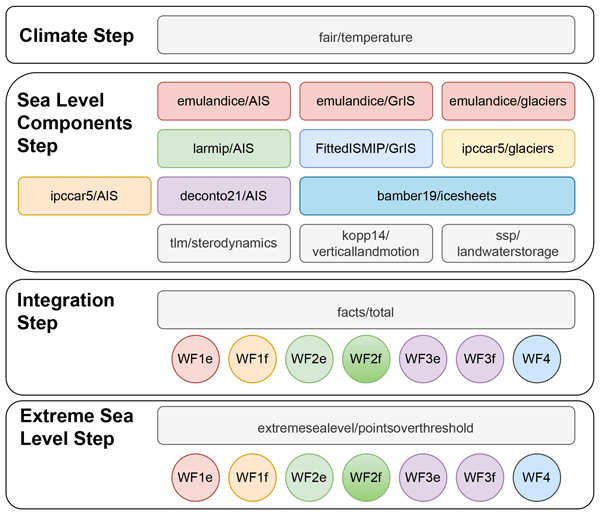
Future sea-level rise projections exhibit multiple forms of uncertainty, all of which must be considered by scientific assessments intended to inform decision-making. The Framework for Assessing Changes To Sea-level (FACTS) is a new software package intended to support assessments of global mean, regional, and extreme sea-level rise. An early version of FACTS supported the development of the IPCC Sixth Assessment Report sea-level projections.
Hélène Seroussi, Vincent Verjans, Sophie Nowicki, Antony J. Payne, Heiko Goelzer, William H. Lipscomb, Ayako Abe-Ouchi, Cécile Agosta, Torsten Albrecht, Xylar Asay-Davis, Alice Barthel, Reinhard Calov, Richard Cullather, Christophe Dumas, Benjamin K. Galton-Fenzi, Rupert Gladstone, Nicholas R. Golledge, Jonathan M. Gregory, Ralf Greve, Tore Hattermann, Matthew J. Hoffman, Angelika Humbert, Philippe Huybrechts, Nicolas C. Jourdain, Thomas Kleiner, Eric Larour, Gunter R. Leguy, Daniel P. Lowry, Chistopher M. Little, Mathieu Morlighem, Frank Pattyn, Tyler Pelle, Stephen F. Price, Aurélien Quiquet, Ronja Reese, Nicole-Jeanne Schlegel, Andrew Shepherd, Erika Simon, Robin S. Smith, Fiammetta Straneo, Sainan Sun, Luke D. Trusel, Jonas Van Breedam, Peter Van Katwyk, Roderik S. W. van de Wal, Ricarda Winkelmann, Chen Zhao, Tong Zhang, and Thomas Zwinger
The Cryosphere, 17, 5197–5217, https://doi.org/10.5194/tc-17-5197-2023, https://doi.org/10.5194/tc-17-5197-2023, 2023
Short summary
Short summary
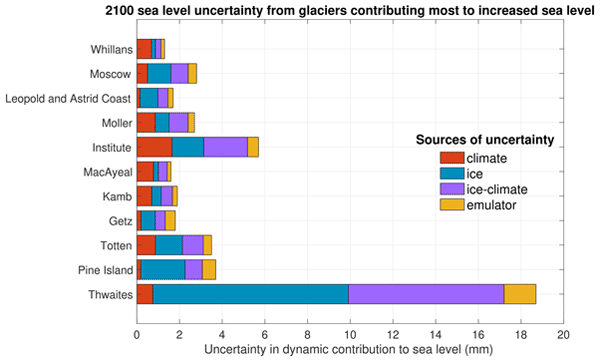
Mass loss from Antarctica is a key contributor to sea level rise over the 21st century, and the associated uncertainty dominates sea level projections. We highlight here the Antarctic glaciers showing the largest changes and quantify the main sources of uncertainty in their future evolution using an ensemble of ice flow models. We show that on top of Pine Island and Thwaites glaciers, Totten and Moscow University glaciers show rapid changes and a strong sensitivity to warmer ocean conditions.
Emily A. Hill, Benoît Urruty, Ronja Reese, Julius Garbe, Olivier Gagliardini, Gaël Durand, Fabien Gillet-Chaulet, G. Hilmar Gudmundsson, Ricarda Winkelmann, Mondher Chekki, David Chandler, and Petra M. Langebroek
The Cryosphere, 17, 3739–3759, https://doi.org/10.5194/tc-17-3739-2023, https://doi.org/10.5194/tc-17-3739-2023, 2023
Short summary
Short summary
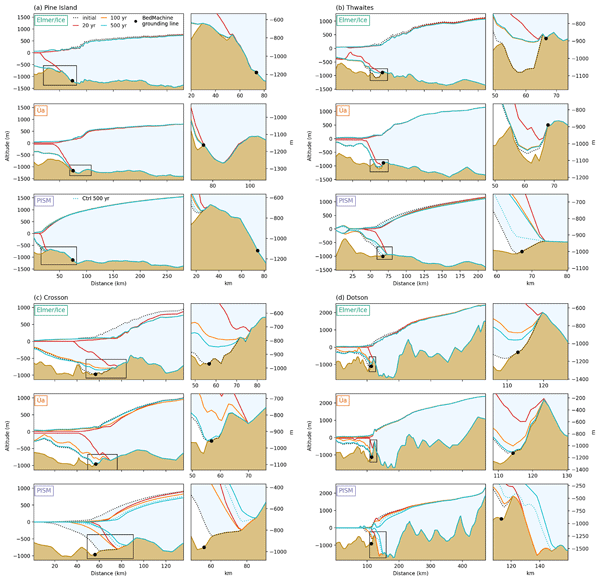
The grounding lines of the Antarctic Ice Sheet could enter phases of irreversible retreat or advance. We use three ice sheet models to show that the present-day locations of Antarctic grounding lines are reversible with respect to a small perturbation away from their current position. This indicates that present-day retreat of the grounding lines is not yet irreversible or self-enhancing.
Ronja Reese, Julius Garbe, Emily A. Hill, Benoît Urruty, Kaitlin A. Naughten, Olivier Gagliardini, Gaël Durand, Fabien Gillet-Chaulet, G. Hilmar Gudmundsson, David Chandler, Petra M. Langebroek, and Ricarda Winkelmann
The Cryosphere, 17, 3761–3783, https://doi.org/10.5194/tc-17-3761-2023, https://doi.org/10.5194/tc-17-3761-2023, 2023
Short summary
Short summary
We use an ice sheet model to test where current climate conditions in Antarctica might lead. We find that present-day ocean and atmosphere conditions might commit an irreversible collapse of parts of West Antarctica which evolves over centuries to millennia. Importantly, this collapse is not irreversible yet.
Jeremy Rohmer, Remi Thieblemont, Goneri Le Cozannet, Heiko Goelzer, and Gael Durand
The Cryosphere, 16, 4637–4657, https://doi.org/10.5194/tc-16-4637-2022, https://doi.org/10.5194/tc-16-4637-2022, 2022
Short summary
Short summary
To improve the interpretability of process-based projections of the sea-level contribution from land ice components, we apply the machine-learning-based
SHapley Additive exPlanationsapproach to a subset of a multi-model ensemble study for the Greenland ice sheet. This allows us to quantify the influence of particular modelling decisions (related to numerical implementation, initial conditions, or parametrisation of ice-sheet processes) directly in terms of sea-level change contribution.
Nidheesh Gangadharan, Hugues Goosse, David Parkes, Heiko Goelzer, Fabien Maussion, and Ben Marzeion
Earth Syst. Dynam., 13, 1417–1435, https://doi.org/10.5194/esd-13-1417-2022, https://doi.org/10.5194/esd-13-1417-2022, 2022
Short summary
Short summary
We describe the contributions of ocean thermal expansion and land-ice melting (ice sheets and glaciers) to global-mean sea-level (GMSL) changes in the Common Era. The mass contributions are the major sources of GMSL changes in the pre-industrial Common Era and glaciers are the largest contributor. The paper also describes the current state of climate modelling, uncertainties and knowledge gaps along with the potential implications of the past variabilities in the contemporary sea-level rise.
Jeremy Rohmer, Deborah Idier, Remi Thieblemont, Goneri Le Cozannet, and François Bachoc
Nat. Hazards Earth Syst. Sci., 22, 3167–3182, https://doi.org/10.5194/nhess-22-3167-2022, https://doi.org/10.5194/nhess-22-3167-2022, 2022
Short summary
Short summary
We quantify the influence of wave–wind characteristics, offshore water level and sea level rise (projected up to 2200) on the occurrence of flooding events at Gâvres, French Atlantic coast. Our results outline the overwhelming influence of sea level rise over time compared to the others. By showing the robustness of our conclusions to the errors in the estimation procedure, our approach proves to be valuable for exploring and characterizing uncertainties in assessments of future flooding.
Constantijn J. Berends, Heiko Goelzer, Thomas J. Reerink, Lennert B. Stap, and Roderik S. W. van de Wal
Geosci. Model Dev., 15, 5667–5688, https://doi.org/10.5194/gmd-15-5667-2022, https://doi.org/10.5194/gmd-15-5667-2022, 2022
Short summary
Short summary
The rate at which marine ice sheets such as the West Antarctic ice sheet will retreat in a warming climate and ocean is still uncertain. Numerical ice-sheet models, which solve the physical equations that describe the way glaciers and ice sheets deform and flow, have been substantially improved in recent years. Here we present the results of several years of work on IMAU-ICE, an ice-sheet model of intermediate complexity, which can be used to study ice sheets of both the past and the future.
Ryota Wada, Jeremy Rohmer, Yann Krien, and Philip Jonathan
Nat. Hazards Earth Syst. Sci., 22, 431–444, https://doi.org/10.5194/nhess-22-431-2022, https://doi.org/10.5194/nhess-22-431-2022, 2022
Short summary
Short summary
Characterizing extreme wave environments caused by tropical cyclones in the Caribbean Sea near Guadeloupe is difficult because cyclones rarely pass near the location of interest. STM-E (space-time maxima and exposure) model utilizes wave data during cyclones on a spatial neighbourhood. Long-duration wave data generated from a database of synthetic tropical cyclones are used to evaluate the performance of STM-E. Results indicate STM-E provides estimates with small bias and realistic uncertainty.
Cited articles
Altmann, A., Tolosi, L., Sander, O., and Lengauer, T.: Permutation importance: a corrected feature importance measure, Bioinformatics, 26, 1340–1347, 2010.
Aschwanden, A. and Brinkerhoff, D. J.: Calibrated mass loss predictions for the Greenland ice sheet. Geophysical Research Letters, 49, e2022GL099058, https://doi.org/10.1029/2022GL099058, 2022.
Aschwanden, A., Bartholomaus, T. C., Brinkerhoff, D. J., and Truffer, M.: Brief communication: A roadmap towards credible projections of ice sheet contribution to sea level, The Cryosphere, 15, 5705–5715, https://doi.org/10.5194/tc-15-5705-2021, 2021.
Au, T. C.: Random forests, decision trees, and categorical predictors: the “absent levels” problem. Journal of Machine Learning Research, 19, 1–30, 2018.
Barthel, A., Agosta, C., Little, C. M., Hattermann, T., Jourdain, N. C., Goelzer, H., Nowicki, S., Seroussi, H., Straneo, F., and Bracegirdle, T. J.: CMIP5 model selection for ISMIP6 ice sheet model forcing: Greenland and Antarctica, The Cryosphere, 14, 855–879, https://doi.org/10.5194/tc-14-855-2020, 2020.
Bellon-Maurel, V., Fernandez-Ahumada, E., Palagos, B., Roger, J. M., and McBratney, A.: Critical review of chemometric indicators commonly used for assessing the quality of the prediction of soil attributes by NIR spectroscopy, TrAC Trends in Analytical Chemistry, 29, 1073–1081, 2010.
Bischl, B., Binder, M., Lang, M., Pielok, T., Richter, J., Coors, S., Thomas, J., Ullmann, T., Becker, M., Boulesteix, A.-L., Deng, D., and Lindauer, M.: Hyperparameter optimization: Foundations, algorithms, best practices, and open challenges, Wiley Interdisciplinary Reviews: Data Mining and Knowledge Discovery, 13, e1484, https://doi.org/10.1002/widm.1484, 2023.
Bracher, J., Ray, E. L., Gneiting, T., and Reich, N. G.: Evaluating epidemic forecasts in an interval format, PLoS computational biology, 17, e1008618, https://doi.org/10.1371/journal.pcbi.1008618, 2021.
Breiman, L.: Random forests, Mach. Learn., 45, 5–32, 2001.
Breiman, L., Friedman, J. H., Olshen, R. A., and Stone, C. J.: Classification and regression trees, Wadsworth, California, ISBN 9780534980542, 1984.
Buriticá, G. and Engelke, S.: Progression: an extrapolation principle for regression, arXiv [preprint], arXiv:2410.23246, https://doi.org/10.48550/arXiv.2410.23246, 2024.
Ettema, J., van den Broeke, M. R., van Meijgaard, E., van de Berg, W. J., Box, J. E., and Steffen, K.: Climate of the Greenland ice sheet using a high-resolution climate model – Part 1: Evaluation, The Cryosphere, 4, 511–527, https://doi.org/10.5194/tc-4-511-2010, 2010.
Evin, G., Hingray, B., Blanchet, J., Eckert, N., Morin, S., and Verfaillie, D.: Partitioning uncertainty components of an incomplete ensemble of climate projections using data augmentation, Journal of Climate, 32, 2423–2440, 2019.
Fettweis, X., Box, J. E., Agosta, C., Amory, C., Kittel, C., Lang, C., van As, D., Machguth, H., and Gallée, H.: Reconstructions of the 1900–2015 Greenland ice sheet surface mass balance using the regional climate MAR model, The Cryosphere, 11, 1015–1033, https://doi.org/10.5194/tc-11-1015-2017, 2017.
Fox-Kemper, B., Hewitt, H. T., Xiao, C., Aðalgeirsdóttir, G., Drijfhout, S. S., Edwards, T. L., Golledge, N. R., Hemer, M., Kopp, R. E., Krinner, G., Mix, A., Notz, D., Nowicki, S., Nurhati, I. S., Ruiz, L., Sallée, J.-B., Slangen, A. B. A., and Yu, Y.: Ocean, Cryosphere and Sea Level Change, in: Climate Change 2021: The Physical Science Basis. Contribution of Working Group I to the Sixth Assessment Report of the Intergovernmental Panel on Climate Change, edited by: Masson-Delmotte, V., Zhai, P., Pirani, A., Connors, S. L., Péan, C., Berger, S., Caud, N., Chen, Y., Goldfarb, L., Gomis, M. I., Huang, M., Leitzell, K., Lonnoy, E., Matthews, J. B. R., Maycock, T. K., Waterfield, T., Yelekçi, O., Yu, R., and Zhou, B., Cambridge University Press, Cambridge, United Kingdom and New York, NY, USA, 1211–1362, https://doi.org/10.1017/9781009157896.011, 2021.
Gneiting, T., Raftery, A. E., Westveld III, A. H., and Goldman, T.: Calibrated probabilistic forecasting using ensemble model output statistics and minimum crps estimation, Monthly Weather Review, 133, 1098–1118, 2005.
Goelzer, H., Nowicki, S., Edwards, T., Beckley, M., Abe-Ouchi, A., Aschwanden, A., Calov, R., Gagliardini, O., Gillet-Chaulet, F., Golledge, N. R., Gregory, J., Greve, R., Humbert, A., Huybrechts, P., Kennedy, J. H., Larour, E., Lipscomb, W. H., Le clec'h, S., Lee, V., Morlighem, M., Pattyn, F., Payne, A. J., Rodehacke, C., Rückamp, M., Saito, F., Schlegel, N., Seroussi, H., Shepherd, A., Sun, S., van de Wal, R., and Ziemen, F. A.: Design and results of the ice sheet model initialisation experiments initMIP-Greenland: an ISMIP6 intercomparison, The Cryosphere, 12, 1433–1460, https://doi.org/10.5194/tc-12-1433-2018, 2018.
Goelzer, H., Nowicki, S., Payne, A., Larour, E., Seroussi, H., Lipscomb, W. H., Gregory, J., Abe-Ouchi, A., Shepherd, A., Simon, E., Agosta, C., Alexander, P., Aschwanden, A., Barthel, A., Calov, R., Chambers, C., Choi, Y., Cuzzone, J., Dumas, C., Edwards, T., Felikson, D., Fettweis, X., Golledge, N. R., Greve, R., Humbert, A., Huybrechts, P., Le clec'h, S., Lee, V., Leguy, G., Little, C., Lowry, D. P., Morlighem, M., Nias, I., Quiquet, A., Rückamp, M., Schlegel, N.-J., Slater, D. A., Smith, R. S., Straneo, F., Tarasov, L., van de Wal, R., and van den Broeke, M.: The future sea-level contribution of the Greenland ice sheet: a multi-model ensemble study of ISMIP6, The Cryosphere, 14, 3071–3096, https://doi.org/10.5194/tc-14-3071-2020, 2020.
Goelzer, H., Berends, C. J., Boberg, F., Durand, G., Edwards, T., Fettweis, X., Gillet-Chaulet, F., Glaude, Q., Huybrechts, P., Le clec'h, S., Mottram, R., Noël, B., Olesen, M., Rahlves, C., Rohmer, J., van den Broeke, M., and van de Wal, R. S. W.: Extending the range and reach of physically-based Greenland ice sheet sea-level projections, EGUsphere [preprint], https://doi.org/10.5194/egusphere-2025-3098, 2025.
Hastie, T., Tibshirani, R., and Friedman, J.: The Elements of Statistical Learning: Data Mining, Inference, and Prediction, Springer, Berlin/Heidelberg, Germany, https://doi.org/10.1007/978-0-387-84858-7, 2009.
Hinkel, J., Church, J. A., Gregory, J. M., Lambert, E., Le Cozannet, G., Lowe, J., McInnes, K. L., Nicholls, R. J., van Der Pol, T. D., and Van De Wal, R.: Meeting user needs for sea level rise information: A decision analysis perspective, Earth's Future, 7, 320–337, 2019.
Hough, A. and Wong, T. E.: Analysis of the evolution of parametric drivers of high-end sea-level hazards, Advances in Statistical Climatology, Meteorology and Oceanography, 8, 117–134, 2022.
Knutti, R., Furrer, R., Tebaldi, C., Cermak, J., and Meehl, G.: Challenges in combining projections from multiple climate models, J. Climate, 23, 2739–2758, 2010.
Langen, P. L., Fausto, R. S., Vandecrux, B., Mottram, R. H., and Box, J. E.: Liquid water flow and retention on the Greenland ice sheet in the regional climate model HIRHAM5: Local and large-scale impacts, Frontiers in Earth Science, 4, 110, https://doi.org/10.3389/feart.2016.00110, 2017.
Le Cozannet, G., Thiéblemont, R., Rohmer, J., and Capderrey, C.: Sea-level scenarios aligned with the 3rd adaptation plan in France, Comptes Rendus Géoscience, 357, 105–123, 2025.
Lee, J.-Y., Marotzke, J., Bala, G., Cao, L., Corti, S., Dunne, J. P., Engelbrecht, F., Fischer, E., Fyfe, J. C., Jones, C., Maycock, A., Mutemi, J., Ndiaye, O., Panickal, S., and Zhou, T.: Future Global Climate: Scenario-Based Projections and NearTerm Information, in: Climate Change 2021: The Physical Science Basis. Contribution of Working Group I to the Sixth Assessment Report of the Intergovernmental Panel on Climate Change, edited by: Masson-Delmotte, V., Zhai, P., Pirani, A., Connors, S. L., Péan, C., Berger, S., Caud, N., Chen, Y., Goldfarb, L., Gomis, M. I., Huang, M., Leitzell, K., Lonnoy, E., Matthews, J. B. R., Maycock, T. K., Waterfield, T., Yelekçi, O., Yu, R., and Zhou, B., Cambridge University Press, Cambridge, United Kingdom and New York, NY, USA, 553–672, https://doi.org/10.1017/9781009157896.006, 2021.
Levermann, A., Winkelmann, R., Albrecht, T., Goelzer, H., Golledge, N. R., Greve, R., Huybrechts, P., Jordan, J., Leguy, G., Martin, D., Morlighem, M., Pattyn, F., Pollard, D., Quiquet, A., Rodehacke, C., Seroussi, H., Sutter, J., Zhang, T., Van Breedam, J., Calov, R., DeConto, R., Dumas, C., Garbe, J., Gudmundsson, G. H., Hoffman, M. J., Humbert, A., Kleiner, T., Lipscomb, W. H., Meinshausen, M., Ng, E., Nowicki, S. M. J., Perego, M., Price, S. F., Saito, F., Schlegel, N.-J., Sun, S., and van de Wal, R. S. W.: Projecting Antarctica's contribution to future sea level rise from basal ice shelf melt using linear response functions of 16 ice sheet models (LARMIP-2), Earth Syst. Dynam., 11, 35–76, https://doi.org/10.5194/esd-11-35-2020, 2020.
Lipscomb, W. H., Price, S. F., Hoffman, M. J., Leguy, G. R., Bennett, A. R., Bradley, S. L., Evans, K. J., Fyke, J. G., Kennedy, J. H., Perego, M., Ranken, D. M., Sacks, W. J., Salinger, A. G., Vargo, L. J., and Worley, P. H.: Description and evaluation of the Community Ice Sheet Model (CISM) v2.1, Geosci. Model Dev., 12, 387–424, https://doi.org/10.5194/gmd-12-387-2019, 2019.
Mastrandrea, M. D., Field, C. B., Stocker, T. F., Edenhofer, O., Ebi, K. L., Frame, D. J., Held, H., Kriegler, E., Mach, K. J., Matschoss, P. R., Plattner, G.-K., Yohe, G. W., and Zwiers, A. F. W.: Guidance note for lead authors of the IPCC fifth assessment report on consistent treatment of uncertainties, Intergovernmental Panel on Climate Change (IPCC), https://www.ipcc.ch (last access: 28 November 2025), 2010.
Marzeion, B., Hock, R., Anderson, B., Bliss, A., Champollion, N., Fujita, K., Huss, M., Immerzeel, W. W., Kraaijenbrink, P., J.-H., Malles, Maussion, F., Radic, V., Rounce, D. R., Sakai, A., Shannon, S., van de Wal, R., and Zekollari, H.: Partitioning the uncertainty of ensemble projections of global glacier mass change, Earth's Future, 8, e2019EF001470, https://doi.org/10.1029/2019EF001470, 2020.
Meinshausen, N.: Quantile regression forests, Journal of Machine Learning Research, 7, 983–999, 2006.
Meinshausen, M., Schleussner, C.-F., Beyer, K., Bodeker, G., Boucher, O., Canadell, J. G., Daniel, J. S., Diongue-Niang, A., Driouech, F., Fischer, E., Forster, P., Grose, M., Hansen, G., Hausfather, Z., Ilyina, T., Kikstra, J. S., Kimutai, J., King, A. D., Lee, J.-Y., Lennard, C., Lissner, T., Nauels, A., Peters, G. P., Pirani, A., Plattner, G.-K., Pörtner, H., Rogelj, J., Rojas, M., Roy, J., Samset, B. H., Sanderson, B. M., Séférian, R., Seneviratne, S., Smith, C. J., Szopa, S., Thomas, A., Urge-Vorsatz, D., Velders, G. J. M., Yokohata, T., Ziehn, T., and Nicholls, Z.: A perspective on the next generation of Earth system model scenarios: towards representative emission pathways (REPs), Geosci. Model Dev., 17, 4533–4559, https://doi.org/10.5194/gmd-17-4533-2024, 2024.
Merrifield, A. L., Brunner, L., Lorenz, R., Medhaug, I., and Knutti, R.: An investigation of weighting schemes suitable for incorporating large ensembles into multi-model ensembles, Earth Syst. Dynam., 11, 807–834, https://doi.org/10.5194/esd-11-807-2020, 2020.
Merrifield, A. L., Brunner, L., Lorenz, R., Humphrey, V., and Knutti, R.: Climate model Selection by Independence, Performance, and Spread (ClimSIPS v1.0.1) for regional applications, Geosci. Model Dev., 16, 4715–4747, https://doi.org/10.5194/gmd-16-4715-2023, 2023.
Nowicki, S. M. J., Payne, A., Larour, E., Seroussi, H., Goelzer, H., Lipscomb, W., Gregory, J., Abe-Ouchi, A., and Shepherd, A.: Ice Sheet Model Intercomparison Project (ISMIP6) contribution to CMIP6, Geosci. Model Dev., 9, 4521–4545, https://doi.org/10.5194/gmd-9-4521-2016, 2016.
Nowicki, S., Goelzer, H., Seroussi, H., Payne, A. J., Lipscomb, W. H., Abe-Ouchi, A., Agosta, C., Alexander, P., Asay-Davis, X. S., Barthel, A., Bracegirdle, T. J., Cullather, R., Felikson, D., Fettweis, X., Gregory, J. M., Hattermann, T., Jourdain, N. C., Kuipers Munneke, P., Larour, E., Little, C. M., Morlighem, M., Nias, I., Shepherd, A., Simon, E., Slater, D., Smith, R. S., Straneo, F., Trusel, L. D., van den Broeke, M. R., and van de Wal, R.: Experimental protocol for sea level projections from ISMIP6 stand-alone ice sheet models, The Cryosphere, 14, 2331–2368, https://doi.org/10.5194/tc-14-2331-2020, 2020.
Nowicki, S., Payne, A. J., Seroussi, H. L., Goelzer, H., Smith, R. S., Asay-Davis, X., Lipscomb, W. H., Abe-Ouchi, A., and Csatho, B. M.: Plans for the Ice Sheet Model Intercomparison Project for CMIP7, in: AGU Fall Meeting Abstracts, 2023, G52A-07, https://ui.adsabs.harvard.edu/abs/2023AGUFM.G52A..07N/abstract (last access: 28 November 2025), 2023.
Probst, P., Wright, M. N., and Boulesteix, A. L.: Hyperparameters and tuning strategies for random forest, Wiley Interdisciplinary Reviews: Data Mining and Knowledge Discovery, 9, e1301, https://doi.org/10.1002/widm.1301, 2019.
Rahlves, C., Goelzer, H., Born, A., and Langebroek, P. M.: Historically consistent mass loss projections of the Greenland ice sheet, The Cryosphere, 19, 1205–1220, https://doi.org/10.5194/tc-19-1205-2025, 2025.
Rohmer, J., Thieblemont, R., Le Cozannet, G., Goelzer, H., and Durand, G.: Improving interpretation of sea-level projections through a machine-learning-based local explanation approach, The Cryosphere, 16, 4637–4657, https://doi.org/10.5194/tc-16-4637-2022, 2022.
Rohmer, J.: Codes supporting the manuscript “Lessons for multi-model ensemble design drawn from emulator experiments: application to a large ensemble for 2100 sea level contributions of the Greenland ice sheet” (zenodo_release), Zenodo [data set], https://doi.org/10.5281/zenodo.17761003, 2025.
Rohmer, J., Idier, D., Paris, F., Pedreros, R., and Louisor, J.: Casting light on forcing and breaching scenarios that lead to marine inundation: Combining numerical simulations with a random-forest classification approach, Environmental Modelling & Software, 104, 64–80, 2018.
Seroussi, H., Nowicki, S., Payne, A. J., Goelzer, H., Lipscomb, W. H., Abe-Ouchi, A., Agosta, C., Albrecht, T., Asay-Davis, X., Barthel, A., Calov, R., Cullather, R., Dumas, C., Galton-Fenzi, B. K., Gladstone, R., Golledge, N. R., Gregory, J. M., Greve, R., Hattermann, T., Hoffman, M. J., Humbert, A., Huybrechts, P., Jourdain, N. C., Kleiner, T., Larour, E., Leguy, G. R., Lowry, D. P., Little, C. M., Morlighem, M., Pattyn, F., Pelle, T., Price, S. F., Quiquet, A., Reese, R., Schlegel, N.-J., Shepherd, A., Simon, E., Smith, R. S., Straneo, F., Sun, S., Trusel, L. D., Van Breedam, J., van de Wal, R. S. W., Winkelmann, R., Zhao, C., Zhang, T., and Zwinger, T.: ISMIP6 Antarctica: a multi-model ensemble of the Antarctic ice sheet evolution over the 21st century, The Cryosphere, 14, 3033–3070, https://doi.org/10.5194/tc-14-3033-2020, 2020.
Seroussi, H., Verjans, V., Nowicki, S., Payne, A. J., Goelzer, H., Lipscomb, W. H., Abe-Ouchi, A., Agosta, C., Albrecht, T., Asay-Davis, X., Barthel, A., Calov, R., Cullather, R., Dumas, C., Galton-Fenzi, B. K., Gladstone, R., Golledge, N. R., Gregory, J. M., Greve, R., Hattermann, T., Hoffman, M. J., Humbert, A., Huybrechts, P., Jourdain, N. C., Kleiner, T., Larour, E., Leguy, G. R., Lowry, D. P., Little, C. M., Morlighem, M., Pattyn, F., Pelle, T., Price, S. F., Quiquet, A., Reese, R., Schlegel, N.-J., Shepherd, A., Simon, E., Smith, R. S., Straneo, F., Sun, S., Trusel, L. D., Van Breedam, J., Van Katwyk, P., van de Wal, R. S. W., Winkelmann, R., Zhao, C., Zhang, T., and Zwinger, T.: Insights into the vulnerability of Antarctic glaciers from the ISMIP6 ice sheet model ensemble and associated uncertainty, The Cryosphere, 17, 5197–5217, https://doi.org/10.5194/tc-17-5197-2023, 2023.
Seroussi, H., Pelle, T., Lipscomb, W. H., Abe-Ouchi, A., Albrecht, T., Alvarez-Solas, J., Asay-Davis, X., Barre, J.-B., Berends, C. J., Bernales, J., Blasco, J., Caillet, J., Chandler, D. M., Coulon, V., Cullather, R., Dumas, C., Galton-Fenzi, B. K., Garbe, J., Gillet-Chaulet, F., Gladstone, R., Goelzer, H., Golledge, N., Greve, R., Gudmundsson, G. H., Han, H. K., Hillebrand, T. R., Hoffman, M. J., Huybrechts, P., Jourdain, N. C., Klose, A. K., Langebroek, P. M.; Leguy, G. R., Lowry, D. P., Mathiot, P., Montoya, M., Morlighem, M., Nowicki, S., Pattyn, F., Payne, A. J., Quiquet, A., Reese, R., Robinson, A., Saraste, L., Simon, E. G., Sun, S., Twarog, J. P., Trusel, L. D., Urruty, B., Van Breedam, J., van de Wal, R. S. W., Wang, Y., Zhao, C., and Zwinger, T.: Evolution of the Antarctic Ice Sheet over the next three centuries from an ISMIP6 model ensemble, Earth's Future, 12, e2024EF004561, https://doi.org/10.1029/2024EF004561, 2024.
Shiogama, H., Fujimori, S., Hasegawa, T., Hayashi, M., Hirabayashi, Y., Ogura, T., Iizumi, T., Takahashi, K., and Takemura, T.: Important distinctiveness of SSP3–7.0 for use in impact assessments, Nature Climate Change, 13, 1276–1278, https://doi.org/10.1038/s41558-023-01883-2, 2023.
Sim, R. H. L., Xu, X., and Low, B. K. H.: Data Valuation in Machine Learning: “Ingredients”, Strategies, and Open Challenges, Proceedings of the Thirty-First International Joint Conference on Artificial Intelligence Survey Track, 5607–5614, https://doi.org/10.24963/ijcai.2022/782, 2022.
Slater, D. A., Straneo, F., Felikson, D., Little, C. M., Goelzer, H., Fettweis, X., and Holte, J.: Estimating Greenland tidewater glacier retreat driven by submarine melting, The Cryosphere, 13, 2489–2509, https://doi.org/10.5194/tc-13-2489-2019, 2019.
Slater, D. A., Felikson, D., Straneo, F., Goelzer, H., Little, C. M., Morlighem, M., Fettweis, X., and Nowicki, S.: Twenty-first century ocean forcing of the Greenland ice sheet for modelling of sea level contribution , The Cryosphere, 14, 985–1008, https://doi.org/10.5194/tc-14-985-2020, 2020.
Smith, H. L., Biggs, P. J., French, N. P., Smith, A. N., and Marshall, J. C.: Lost in the Forest: Encoding categorical variables and the absent levels problem, Data Mining and Knowledge Discovery, 38, 1889–1908, 2024.
Storlie, C. B., Swiler, L. P., Helton, J. C., and Sallaberry, C. J.: Implementation and evaluation of nonparametric regression procedures for sensitivity analysis of computationally demanding models, Reliability Engineering & System Safety, 94, 1735–1763, 2009.
Tadesse, M., Wahl, T., and Cid, A.: Data-Driven Modeling of Global Storm Surges, Frontiers in Marine Science, 7, 260, https://doi.org/10.3389/fmars.2020.00260, 2020.
Tebaldi, C. and Knutti, R.: The use of the multi-model ensemble in probabilistic climate projections, Philos. T. Roy. Soc. A, 365, 2053–2075, https://doi.org/10.1098/rsta.2007.2076, 2007.
Turner, F., Rougier, J., Edwards, T., Coulon, V., and Klose, A. K.: Building probabilistic projections of the Antarctic contribution to global sea level rise using a random forests emulato, EGU General Assembly 2024, Vienna, Austria, 14–19 April 2024, EGU24-16820, https://doi.org/10.5194/egusphere-egu24-16820, 2024.
Tyralis, H., Papacharalampous, G., and Langousis, A.: A Brief Review of Random Forests for Water Scientists and Practitioners and Their Recent History in Water Resources, Water, 11, 910, https://doi.org/10.3390/w11050910, 2019.
Van Breedam, J., Huybrechts, P., and Crucifix, M.: A Gaussian process emulator for simulating ice sheet–climate interactions on a multi-million-year timescale: CLISEMv1.0, Geosci. Model Dev., 14, 6373–6401, https://doi.org/10.5194/gmd-14-6373-2021, 2021.
Van Katwyk, P., Fox-Kemper, B., Nowicki, S., Seroussi, H., and Bergen, K. J.: ISEFlow v1.0: A Flow-Based Neural Network Emulator for Improved Sea Level Projections and Uncertainty Quantification, EGUsphere [preprint], https://doi.org/10.5194/egusphere-2025-870, 2025.
Verjans, V., Robel, A. A., Ultee, L., Seroussi, H., Thompson, A. F., Ackermann, L., Choi, Y., and Krebs-Kanzow, U.: The Greenland Ice Sheet Large Ensemble (GrISLENS): simulating the future of Greenland under climate variability, The Cryosphere, 19, 3749–3783, https://doi.org/10.5194/tc-19-3749-2025, 2025.
Wright, M. N. and König, I. R.: Splitting on categorical predictors in random forests, PeerJ, 7, e6339, https://doi.org/10.7717/peerj.6339, 2019.
Yoo, M., Gopalan, G., Hoffman, M., Coulson, S., Han, H. K., Wikle, C. K., and Hillebrand, T.: Emulation with uncertainty quantification of regional sea-level change caused by the Antarctic Ice Sheet, Journal of Geophysical Research: Machine Learning and Computation, 2, e2024JH000349, https://doi.org/10.1029/2024JH000349, 2025.
Short summary
Developing robust protocols to design multi-model ensembles is of primary importance for the uncertainty quantification of sea level projections. Here, we set up a series of computer experiments to reflect design decisions for the prediction of future sea level contribution of the Greenland ice sheet in 2100. We show the importance of including the most extreme climate scenario and the implications of using a single type of numerical model for ice sheets or regional climate.
Developing robust protocols to design multi-model ensembles is of primary importance for the...


