Articles | Volume 10, issue 5
https://doi.org/10.5194/tc-10-2329-2016
© Author(s) 2016. This work is distributed under
the Creative Commons Attribution 3.0 License.
https://doi.org/10.5194/tc-10-2329-2016
© Author(s) 2016. This work is distributed under
the Creative Commons Attribution 3.0 License.
On retrieving sea ice freeboard from ICESat laser altimeter
Kirill Khvorostovsky
CORRESPONDING AUTHOR
Nansen Environmental and Remote Sensing Center, 5006 Bergen, Norway
Pierre Rampal
Nansen Environmental and Remote Sensing Center, 5006 Bergen, Norway
Related authors
No articles found.
Fabien Salmon, Pierre Rampal, Stéphanie Leroux, Timothy Williams, Einar Ólason, and Nicolas Barral
EGUsphere, https://doi.org/10.5194/egusphere-2026-1869, https://doi.org/10.5194/egusphere-2026-1869, 2026
This preprint is open for discussion and under review for Geoscientific Model Development (GMD).
Short summary
Short summary
Accurate modeling of sea ice dynamics is a major challenge for forecasting its future evolution and assessing its impact on climate change. This paper presents the parallelisation of state-of-the art sea-ice dynamics model NeXtSIM. The code was interfaced with a new parallel version of the remeshing library MMG. Validation and performance of the code are discussed. Simulations with a uniform 1km spatial resolution are run, which is unprecedented with this kind of lagrangian sea-ice models.
Lohenn Fiol, Stephanie Leroux, Pierre Rampal, and Jean-Michel Brankart
EGUsphere, https://doi.org/10.5194/egusphere-2025-6379, https://doi.org/10.5194/egusphere-2025-6379, 2026
Short summary
Short summary
We examine how uncertainty in the initial position of sea ice features (leads, ridges), affects daily-to-weekly winter sea-ice forecasts. Using ensemble simulations with a sea ice–ocean model, we compare two formulations of sea ice mechanics. We show that pack-ice dynamics are highly sensitive to this choice: one formulation strongly amplifies small initial errors, while the other damps them. Our results highlight the need for ensemble forecasts to capture uncertainty and risks in the Arctic.
Einar Ólason, Guillaume Boutin, Timothy Williams, Anton Korosov, Heather Regan, Jonathan Rheinlænder, Pierre Rampal, Daniela Flocco, Abdoulaye Samaké, Richard Davy, Timothy Spain, and Sean Chua
EGUsphere, https://doi.org/10.5194/egusphere-2024-3521, https://doi.org/10.5194/egusphere-2024-3521, 2025
Short summary
Short summary
This paper introduces a new version of the neXtSIM sea-ice model. NeXtSIM is unique among sea-ice models in how it represents sea-ice dynamics, focusing on features such as cracks and ridges and how these impact interactions between the atmosphere and ocean where sea ice is present. The new version introduces some physical parameterisations and model options detailed and explained in the paper. Following the paper's publication, the neXtSIM code will be released publicly for the first time.
Rémy Lapere, Louis Marelle, Pierre Rampal, Laurent Brodeau, Christian Melsheimer, Gunnar Spreen, and Jennie L. Thomas
Atmos. Chem. Phys., 24, 12107–12132, https://doi.org/10.5194/acp-24-12107-2024, https://doi.org/10.5194/acp-24-12107-2024, 2024
Short summary
Short summary
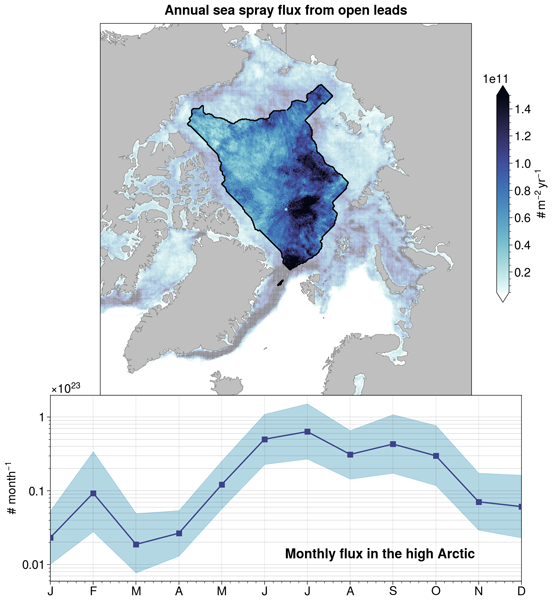
Elongated open-water areas in sea ice, called leads, can release marine aerosols into the atmosphere. In the Arctic, this source of atmospheric particles could play an important role for climate. However, the amount, seasonality and spatial distribution of such emissions are all mostly unknown. Here, we propose a first parameterization for sea spray aerosols emitted through leads in sea ice and quantify their impact on aerosol populations in the high Arctic.
Laurent Brodeau, Pierre Rampal, Einar Ólason, and Véronique Dansereau
Geosci. Model Dev., 17, 6051–6082, https://doi.org/10.5194/gmd-17-6051-2024, https://doi.org/10.5194/gmd-17-6051-2024, 2024
Short summary
Short summary
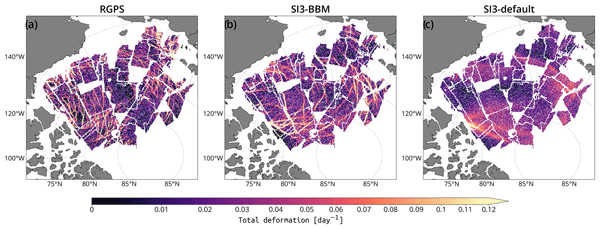
A new brittle sea ice rheology, BBM, has been implemented into the sea ice component of NEMO. We describe how a new spatial discretization framework was introduced to achieve this. A set of idealized and realistic ocean and sea ice simulations of the Arctic have been performed using BBM and the standard viscous–plastic rheology of NEMO. When compared to satellite data, our simulations show that our implementation of BBM leads to a fairly good representation of sea ice deformations.
Yumeng Chen, Polly Smith, Alberto Carrassi, Ivo Pasmans, Laurent Bertino, Marc Bocquet, Tobias Sebastian Finn, Pierre Rampal, and Véronique Dansereau
The Cryosphere, 18, 2381–2406, https://doi.org/10.5194/tc-18-2381-2024, https://doi.org/10.5194/tc-18-2381-2024, 2024
Short summary
Short summary
We explore multivariate state and parameter estimation using a data assimilation approach through idealised simulations in a dynamics-only sea-ice model based on novel rheology. We identify various potential issues that can arise in complex operational sea-ice models when model parameters are estimated. Even though further investigation will be needed for such complex sea-ice models, we show possibilities of improving the observed and the unobserved model state forecast and parameter accuracy.
Anton Korosov, Pierre Rampal, Yue Ying, Einar Ólason, and Timothy Williams
The Cryosphere, 17, 4223–4240, https://doi.org/10.5194/tc-17-4223-2023, https://doi.org/10.5194/tc-17-4223-2023, 2023
Short summary
Short summary
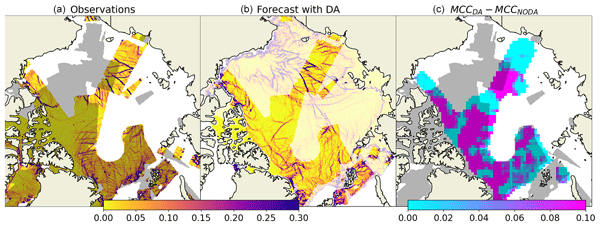
It is possible to compute sea ice motion from satellite observations and detect areas where ice converges (moves together), forms ice ridges or diverges (moves apart) and opens leads. However, it is difficult to predict the exact motion of sea ice and position of ice ridges or leads using numerical models. We propose a new method to initialise a numerical model from satellite observations to improve the accuracy of the forecasted position of leads and ridges for safer navigation.
Heather Regan, Pierre Rampal, Einar Ólason, Guillaume Boutin, and Anton Korosov
The Cryosphere, 17, 1873–1893, https://doi.org/10.5194/tc-17-1873-2023, https://doi.org/10.5194/tc-17-1873-2023, 2023
Short summary
Short summary
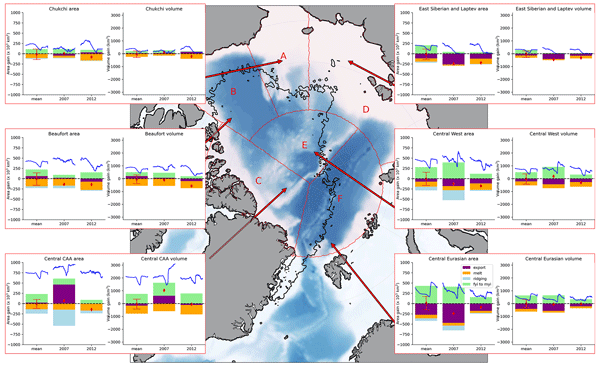
Multiyear ice (MYI), sea ice that survives the summer, is more resistant to changes than younger ice in the Arctic, so it is a good indicator of sea ice resilience. We use a model with a new way of tracking MYI to assess the contribution of different processes affecting MYI. We find two important years for MYI decline: 2007, when dynamics are important, and 2012, when melt is important. These affect MYI volume and area in different ways, which is important for the interpretation of observations.
Sukun Cheng, Yumeng Chen, Ali Aydoğdu, Laurent Bertino, Alberto Carrassi, Pierre Rampal, and Christopher K. R. T. Jones
The Cryosphere, 17, 1735–1754, https://doi.org/10.5194/tc-17-1735-2023, https://doi.org/10.5194/tc-17-1735-2023, 2023
Short summary
Short summary
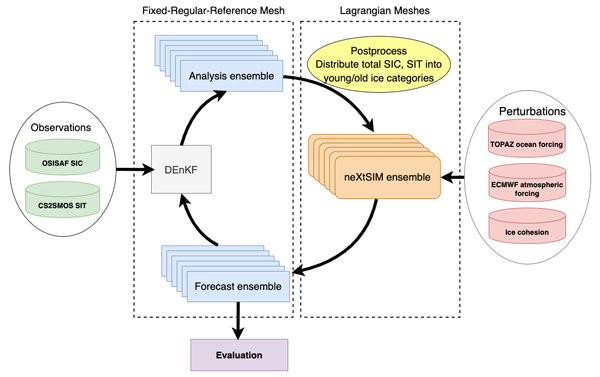
This work studies a novel application of combining a Lagrangian sea ice model, neXtSIM, and data assimilation. It uses a deterministic ensemble Kalman filter to incorporate satellite-observed ice concentration and thickness in simulations. The neXtSIM Lagrangian nature is handled using a remapping strategy on a common homogeneous mesh. The ensemble is formed by perturbing air–ocean boundary conditions and ice cohesion. Thanks to data assimilation, winter Arctic sea ice forecasting is enhanced.
Guillaume Boutin, Einar Ólason, Pierre Rampal, Heather Regan, Camille Lique, Claude Talandier, Laurent Brodeau, and Robert Ricker
The Cryosphere, 17, 617–638, https://doi.org/10.5194/tc-17-617-2023, https://doi.org/10.5194/tc-17-617-2023, 2023
Short summary
Short summary
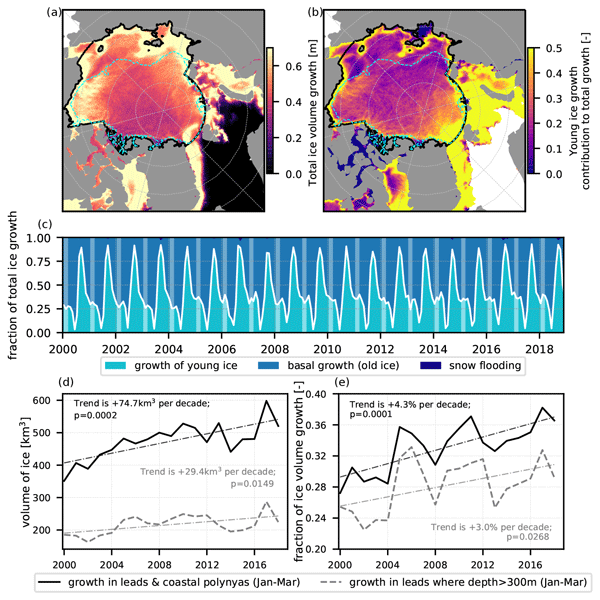
Sea ice cover in the Arctic is full of cracks, which we call leads. We suspect that these leads play a role for atmosphere–ocean interactions in polar regions, but their importance remains challenging to estimate. We use a new ocean–sea ice model with an original way of representing sea ice dynamics to estimate their impact on winter sea ice production. This model successfully represents sea ice evolution from 2000 to 2018, and we find that about 30 % of ice production takes place in leads.
Timothy Williams, Anton Korosov, Pierre Rampal, and Einar Ólason
The Cryosphere, 15, 3207–3227, https://doi.org/10.5194/tc-15-3207-2021, https://doi.org/10.5194/tc-15-3207-2021, 2021
Short summary
Short summary
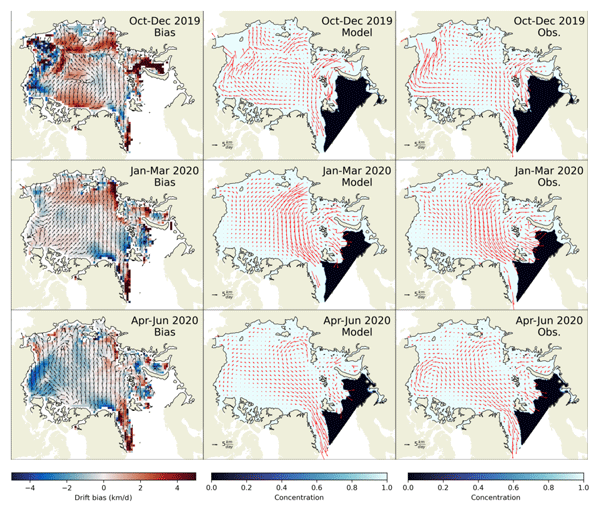
neXtSIM (neXt-generation Sea Ice Model) includes a novel and extremely realistic way of modelling sea ice dynamics – i.e. how the sea ice moves and deforms in response to the drag from winds and ocean currents. It has been developed over the last few years for a variety of applications, but this paper represents its first demonstration in a forecast context. We present results for the time period from November 2018 to June 2020 and show that it agrees well with satellite observations.
Marcel Kleinherenbrink, Anton Korosov, Thomas Newman, Andreas Theodosiou, Alexander S. Komarov, Yuanhao Li, Gert Mulder, Pierre Rampal, Julienne Stroeve, and Paco Lopez-Dekker
The Cryosphere, 15, 3101–3118, https://doi.org/10.5194/tc-15-3101-2021, https://doi.org/10.5194/tc-15-3101-2021, 2021
Short summary
Short summary
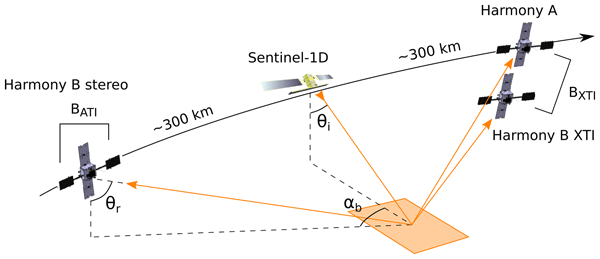
Harmony is one of the Earth Explorer 10 candidates that has the chance of being selected for launch in 2028. The mission consists of two satellites that fly in formation with Sentinel-1D, which carries a side-looking radar system. By receiving Sentinel-1's signals reflected from the surface, Harmony is able to observe instantaneous elevation and two-dimensional velocity at the surface. As such, Harmony's data allow the retrieval of sea-ice drift and wave spectra in sea-ice-covered regions.
Cited articles
Bröhan, D. and Kaleschke, L.: A Nine-Year Climatology of Arctic Sea Ice Lead Orientation and Frequency from AMSR-E, Remote Sens. 6, 1451–1475, https://doi.org/10.3390/rs6021451, 2014.
Cavalieri, D. J., Markus, T., and Comiso, J. C.: AMSR-E/Aqua Daily L3 25 km Brightness Temperature & Sea Ice Concentration Polar Grids, Version 3. Boulder, Colorado USA, NASA National Snow and Ice Data Center Distributed Active Archive Center, https://doi.org/10.5067/AMSR-E/AE_SI25.003, 2014.
Farrell, S. L., Laxon, S. W., McAdoo, D. C., Yi, D., and Zwally, H. J.: Five years of Arctic sea ice freeboard measurements from the Ice, Cloud and land Elevation Satellite, J. Geophys. Res., 114, C04008, https://doi.org/10.1029/2008JC005074, 2009.
Ivanova, N., Rampal, P., and Bouillon, S.: Error assessment of satellite-derived lead fraction in the Arctic, The Cryosphere, 10, 585–595, https://doi.org/10.5194/tc-10-585-2016, 2016.
Kern, S. and Spreen, G.: Uncertainties in Antarctic sea-ice thickness retrieval from ICESat, Ann. Glaciol., 56, 107–119, https://doi.org/10.3189/2015AoG69A736, 2015.
Kurtz, N. T. and Markus, T.: Satellite observations of Antarctic sea ice thickness and volume, J. Geophys. Res., 117, C08025, https://doi.org/10.1029/2012JC008141, 2012.
Kurtz, N. T., Markus, T., Cavalieri, D. J., Sparling, L. C., Krabill, W. B., Gasiewski, A. J., and Sonntag, J. G.:. Estimation of sea ice thickness distributions through the combination of snow depth and satellite laser altimetry data, J. Geophys. Res.-Oceans, 114, C10007, https://doi.org/10.1029/2009JC005292, 2009.
Kurtz, N. T., Markus, T., Farrell, S. L., Worthen, D. L., and Boisvert, L. N.: Observations of recent Arctic sea ice volume loss and its impact on ocean-atmosphere energy exchange and ice production, J. Geophys. Res., 116, C04015, https://doi.org/10.1029/2010JC006235, 2011.
Kwok, R.: Annual cycles of multiyear sea ice coverage of the Arctic Ocean: 1999–2003, J. Geophys. Res., 109, C11004, https://doi.org/10.1029/2003JC002238, 2004.
Kwok, R. and Cunningham, G. F.: ICESat over Arctic sea ice: estimation of snow depth and ice thickness, J. Geophys. Res., 113, C08010, https://doi.org/10.1029/2008JC004753, 2008.
Kwok, R, Zwally, H. J., and Yi, D.: ICESat observations of Arctic sea ice: a first look, Geophys. Res. Lett., 31, L16401, https://doi.org/10.1029/2004GL020309, 2004.
Kwok, R., Cunningham, G. F., Zwally, H. J., and Yi, D.: ICESat over Arctic sea ice: Interpretation of altimetric and reflectivity profiles, J. Geophys. Res., 111, C06006, https://doi.org/10.1029/2005JC003175, 2006.
Kwok, R., Cunningham, G. F., Zwally, H. J., and Yi, D.: Ice, Cloud, and land Elevation Satellite (ICESat) over Arctic sea ice: Retrieval of freeboard, J. Geophys. Res., 112, C12013, https://doi.org/10.1029/2006JC003978, 2007.
Kwok, R., Cunningham, G. F., Wensnahan, M., Rigor, I., Zwally, H. J., and Yi, D.: Thinning and volume loss of the Arctic Ocean sea ice cover: 2003–2008, J. Geophys. Res., 114, C07005, https://doi.org/10.1029/2009JC005312, 2009.
Laxon, S., Peacock, N., and Smith, D.: High interannual variability of sea ice thickness in the Arctic region, Nature, 425, 947–950, 2003.
Laxon, S. W., Giles, K. A., Ridout, A. L., Wingham, D. J., Willatt, R., Cullen, R., Kwok, R., Schweiger, A., Zhang, J., Haas, C., Hendricks, S., Krishfield, R., Kurtz, N., Farrell, S., and Davidson, M.: CryoSat-2 estimates of Arctic sea ice thickness and volume, Geophys. Res. Lett., 40, 732–737, https://doi.org/10.1002/grl.50193, 2013.
Lindsay, R. and Schweiger, A.: Arctic sea ice thickness loss determined using subsurface, aircraft, and satellite observations, The Cryosphere, 9, 269–283, https://doi.org/10.5194/tc-9-269-2015, 2015.
Markus, T., Massom, R., Worby, A., Lytle, V., Kurtz, N., and Maksym, T.: Freeboard, snow depth and sea-ice roughness in East Antarctica from in situ and multiple satellite data, Ann. Glaciol., 52, 242–248, 2011.
Pavlis, N. K., Holmes, S. A., Kenyon, S. C., and Factor, J. K.: The development and evaluation of the Earth Gravitational Model 2008 (EGM2008), J. Geophys. Res., 117, B04406, https://doi.org/10.1029/2011JB008916, 2012.
Ricker, R., Hendricks, S., Helm, V., Skourup, H., and Davidson, M.: Sensitivity of CryoSat-2 Arctic sea-ice freeboard and thickness on radar-waveform interpretation, The Cryosphere, 8, 1607–1622, https://doi.org/10.5194/tc-8-1607-2014, 2014.
Röhrs, J., Kaleschke, L., Bröhan, D., and Siligam, P. K.: Corrigendum to "An algorithm to detect sea ice leads by using AMSR-E passive microwave imagery" published in The Cryosphere, 6, 343–352, 2012, The Cryosphere, 6, 365–365, https://doi.org/10.5194/tc-6-365-2012, 2012.
Spreen, G., Kern, S., Stammer, D., Forsberg, R., and Haarpaintner, J.: Satellite-based estimates of sea-ice volume flux through Fram Strait, Ann. Glaciol., 44, 321–328, https://doi.org/10.3189/172756406781811385, 2006.
Stocker, T. F., Qin., D., Plattner, G.-K., Tignor, M., Allen, S. K., Boschung, J., Nauels, A., Xia, Y., Bex, V., and Midgley, P. M.: Climate Change 2013: The Physical Science Basis, Contribution of Working Group I to the Fifth Assessment Report of the Intergovernmental Panel on Climate Change, Cambridge University Press, Cambridge, UK and New York, NY, USA, 1535 pp., 2013.
Tilling, R. L., Ridout, A., Shepherd, A., and Wingham, D. J.: Increased Arctic sea ice volume after anomalously low melting in 2013, Nat. Geosci., 8, 643–646, 2015.
Vaughan, D., Comiso, J., Allison, I., Carrasco, J., Kaser, G., Kwok, R., Mote, P., Murray, T., Paul, F., Ren, J., Rignot, E., Solomina, O., Steffen, K., and Zhang, T.: Observations: Cryosphere, book section 4, 317–382, Cambridge University Press, Cambridge, UK and New York, NY, USA, https://doi.org/10.1017/CBO9781107415324.012, 2013.
Willmes, S. and Heinemann, G.: Sea-ice wintertime lead frequencies and regional characteristics in the Arctic, 2003–2015, Remote Sens., Special Issue: Sea Ice Remote Sensing and Analysis, 8, 4, https://doi.org/10.3390/rs8010004, 2016.
Xie, H., Tekeli, A., Ackley, S., Yi, D., and Zwally, J.: Sea ice thickness estimations from ICESat Altimetry over the Bellingshausen and Amundsen Seas, 2003-2009, J. Geophys. Res., 118, 2438–2453, https://doi.org/10.1002/jgrc.20179, 2013.
Yi, D. and Zwally, H. J.: Arctic Sea Ice Freeboard and Thickness, National Snow and Ice Data Center, Boulder, CO, USA, 2009.
Yi, D., Zwally, H. J., and Robbins, J. W.: ICESat observations of seasonal and interannual variations of sea-ice freeboard and estimated thickness in the Weddell Sea, Antarctica (2003–2009), Ann. Glaciol., 52, 43–51, 2011.
Zwally, H. J., Schutz, B., Abdalati, W., Abshire, J., Bentley, C., Brenner, A., Bufton, J., Dezio, J., Hancock, D., Harding, D., Herring, T., Minster, B., Quinn, K., Palm, S., Spinhirne, J., and Thomas, R.: ICESat's Laser Measurements of Polar Ice, Atmosphere, Ocean, and Land, J. Geodyn. 34, 405–445, 2002.
Zwally, H. J., Yi, D., Kwok, R., and Zhao, Y.: ICESat measurements of sea ice freeboard and estimates of sea ice thickness in the Weddell Sea, J. Geophys. Res., 113, C02S15, https://doi.org/10.1029/2007JC004284, 2008.
Zwally, H. J., Schutz, R., C. Bentley, C., Bufton, J., Herring, T., Minster, J., Spinhirne, J., and Ross, T.: GLAS/ICESat L2 Sea Ice Altimetry Data, Version 33. National Snow and Ice Data Center, Boulder, CO, USA, https://doi.org/10.5067/9IJ7MLCQJMXX, 2011.
Zygmuntowska, M., Rampal, P., Ivanova, N., and Smedsrud, L. H.: Uncertainties in Arctic sea ice thickness and volume: new estimates and implications for trends, The Cryosphere, 8, 705–720, https://doi.org/10.5194/tc-8-705-2014, 2014.
Short summary
We analyse two methods of freeboard retrieval from ICESat satellite data that were used to derive the two widely used Arctic sea ice thickness products. We show that although different factors result in significant local differences between freeboards, they roughly compensate each other with respect to overall freeboard estimation. Thus the difference found between the sea ice thickness datasets should be attributed to different parameters used in the freeboard-to-thickness conversion.
We analyse two methods of freeboard retrieval from ICESat satellite data that were used to...