
Articles | Volume 20, issue 11
https://doi.org/10.5194/tc-20-7049-2026
© Author(s) 2026. This work is distributed under
the Creative Commons Attribution 4.0 License.
https://doi.org/10.5194/tc-20-7049-2026
© Author(s) 2026. This work is distributed under
the Creative Commons Attribution 4.0 License.
Research article
| 
27 Nov 2026
Research article |
| 27 Nov 2026
Snowmelt influence on Northern Hemisphere river discharge – the potential of causal inference for assessing long-term trends
Samuel Schilling
CORRESPONDING AUTHOR

German Remote Sensing Data Center, German Aerospace Center, DLR, 82234 Weßling, Germany
Tobias Bolch
Institute of Geodesy, Graz University of Technology, Graz, Austria
Andreas Dietz
German Remote Sensing Data Center, German Aerospace Center, DLR, 82234 Weßling, Germany
Rebecca Jean Herman
Center for Scalable Data Analytics and Artificial Intelligence, ScaDS.AI Dresden/Leipzig, 01062 Dresden, Germany
Department of Computer Science, University of Potsdam, Potsdam, Germany
Claudia Kuenzer
German Remote Sensing Data Center, German Aerospace Center, DLR, 82234 Weßling, Germany
Institute for Geography and Geology, University of Wuerzburg, 97074 Wuerzburg, Germany
Related authors
No articles found.
Lea Hartl, Jakob Abermann, Ayla Akgün, Giulia Bertolotti, Tobias Bolch, Svenja Conzelmann, Codrut-Andrei Diaconu, Iris Hansche, Anne Hartig, Anna Haut, Kay Helfricht, Bernhard Hynek, Marie Sophie Kaucher, Andreas Kellerer-Pirklbauer, Ann Christin Kogel, Julie Krippes, Marcela Violeta Lauria, Christoph Mayer, Jan-Christoph Otto, Rainer Prinz, Sina Prölß, Lorenzo Rieg, Lea Schönleber, Gabriele Schwaizer, Bernd Seiser, Martin Stocker-Waldhuber, Markus Strudl, Martin Verhounik, and Harald Zandler
The Cryosphere, 20, 5157–5180, https://doi.org/10.5194/tc-20-5157-2026, https://doi.org/10.5194/tc-20-5157-2026, 2026
Short summary
Short summary
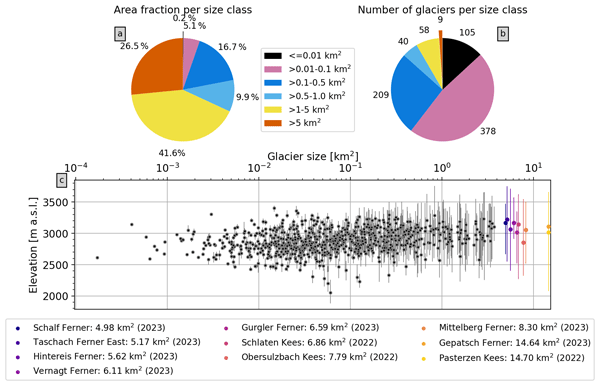
We mapped glacier outlines in Austria using recent, high resolution imagery. The resulting glacier inventory provides an update on glacier area in Austria in 2021-2023. More than 30% of glacier area was lost and 95 glaciers have disappeared since the mid-2000s. Glacier recession is accelerating and regular updates to glacier inventories are needed to understand downstream changes to the hydrological system, quantify glacier mass loss, and support planning and adaptation measures.
Marlena Reil, Julia Kaltenborn, Donovan J. M. Allum, Francis Pelletier, Sebastian Roessler, Samip Shrestha, Zhibang Lv, John Truckenbrodt, Gabriele Schwaizer, Thomas Nagler, John W. Pomeroy, Christopher B. Marsh, Benoit Montpetit, Tobias Jonas, Gabriel Tseng, David Rolnick, Andreas J. Dietz, and Celia A. Baumhoer
EGUsphere, https://doi.org/10.5194/egusphere-2026-3833, https://doi.org/10.5194/egusphere-2026-3833, 2026
This preprint is open for discussion and under review for The Cryosphere (TC).
Short summary
Short summary
Many communities rely on snowmelt from the mountains for their water supply. However, monitoring snow from space is challenging because clouds and other factors can obscure satellite observations. We present SnowGalileo, an AI model that combines data from multiple satellites to produce snow maps. The model can produce accurate maps even when clouds are present and high-resolution data are missing. This helps to improve our understanding of snow conditions and their impact on water resources.
Celia A. Baumhoer, Selina Straßburger, Sarah Leibrock, Andreas J. Dietz, and Christoph Mayer
EGUsphere, https://doi.org/10.5194/egusphere-2026-4768, https://doi.org/10.5194/egusphere-2026-4768, 2026
Short summary
Short summary
As glaciers move, cracks called crevasses form, and knowing where they occur matters both for science and for safety. We created the first nationwide map of visible crevasses across all glaciers in Austria, using aerial images. We found that crevasses are most common on steep, fast-moving glaciers and rarer on large, gently sloping ones, with surface shape and flow influencing where they appear. This dataset is already being used to improve hiking maps, helping people plan safer mountain routes
Zhangyu Sun, Tobias Bolch, Daniel Falaschi, Atanu Bhattacharya, and Lin Liu
EGUsphere, https://doi.org/10.5194/egusphere-2026-3678, https://doi.org/10.5194/egusphere-2026-3678, 2026
This preprint is open for discussion and under review for The Cryosphere (TC).
Short summary
Short summary
Ice-debris complexes (IDC) are common, but their evolution remains poorly understood. We investigated 4 IDCs and identified 3 major zones: a glacier, a glacier-affected, and a periglacial zone. Although glacier-affected and periglacial zones cover much smaller areas than glaciers, their ice volume losses are comparable. IDCs can evolve through multiple pathways, incl. gradual transformation of glacier into rock glaciers and the advance or embedding of glaciers onto pre-existing rock glaciers.
Daoxun Gao, Kunpeng Wu, Yunpeng Duan, Zhaoqi Ji, Danyu Ma, Tobias Bolch, Cheng Huang, and Shiyin Liu
The Cryosphere, 20, 3559–3579, https://doi.org/10.5194/tc-20-3559-2026, https://doi.org/10.5194/tc-20-3559-2026, 2026
Short summary
Short summary
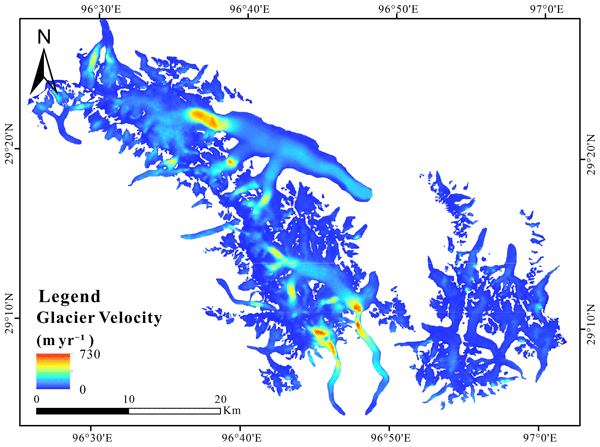
We mapped monthly glacier flow speeds in the Kangri Karpo region from 2015 to 2024 by combining measurements from several satellites and a drone survey. The merged maps are more complete and detailed than maps from any single source, with fewer gaps caused by clouds or difficult terrain. The results show where glaciers move fastest, how their speed changes through the year, and which glaciers have been speeding up or slowing down over the past decade.
Celia A. Baumhoer, Jonas Koehler, Bert Wouters, Stef Lhermitte, Andreas J. Dietz, and Claudia Kuenzer
Earth Syst. Sci. Data Discuss., https://doi.org/10.5194/essd-2025-569, https://doi.org/10.5194/essd-2025-569, 2026
Preprint under review for ESSD
Short summary
Short summary
PolarLakes is a new open dataset tracking meltwater lakes on Antarctic ice shelves every two weeks from 2015–2024. Using AI and satellite data from different sensors the monitoring of lakes is improved even during cloudy conditions. The record shows significant variations in ponding and lake formation, with a continent-wide peak occurring in 2020 within the observed period. To end, the PolarLakes dataset helps us to better understand the dynamics of surface hydrology in Antarctica.
Jakob Steiner, William Armstrong, Will Kochtitzky, Robert McNabb, Rodrigo Aguayo, Tobias Bolch, Fabien Maussion, Vibhor Agarwal, Iestyn Barr, Nathaniel R. Baurley, Mike Cloutier, Katelyn DeWater, Frank Donachie, Yoann Drocourt, Siddhi Garg, Gunjan Joshi, Byron Guzman, Stanislav Kutuzov, Thomas Loriaux, Caleb Mathias, Brian Menounos, Evan Miles, Aleksandra Osika, Kaleigh Potter, Adina Racoviteanu, Brianna Rick, Miles Sterner, Guy D. Tallentire, Levan Tielidze, Rebecca White, Kunpeng Wu, and Whyjay Zheng
Earth Syst. Sci. Data, 18, 1665–1681, https://doi.org/10.5194/essd-18-1665-2026, https://doi.org/10.5194/essd-18-1665-2026, 2026
Short summary
Short summary
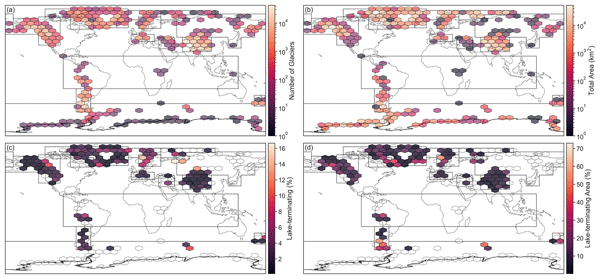
Many mountain glaciers around the world flow into lakes – exactly how many however, has never been mapped. Across a large team of experts we have now identified all glaciers that end in lakes. Only about 1% do so, but they are generally larger than those which end on land. This is important to understand, as lakes can influence the behaviour of glacier ice, including how fast it disappears. This new dataset allows us to better model glaciers at a global scale, accounting for the effect of lakes.
Celia A. Baumhoer, Amy B. Morgan, Xinyu Hou, Jowan L. Fromentin, Thorsten Hoeser, Andreas J. Dietz, Andrew Markham, Laura A. Stevens, and Claudia Kuenzer
Earth Syst. Sci. Data Discuss., https://doi.org/10.5194/essd-2025-758, https://doi.org/10.5194/essd-2025-758, 2026
Revised manuscript under review for ESSD
Short summary
Short summary
Researchers from DLR and University Oxford created Shelf-Bench, a dataset to help AI track Antarctic ice shelf edges using satellite radar images (1992–2021). Testing five AI models revealed ice shelf delineation remains challenging and requires new model developments. This public benchmark will help researchers build better tools for monitoring ice front changes, detecting iceberg calving events, supporting operational logistics, and generating up-to-date continental maps.
Andreas J. Dietz and Sebastian Roessler
The Cryosphere, 19, 3873–3877, https://doi.org/10.5194/tc-19-3873-2025, https://doi.org/10.5194/tc-19-3873-2025, 2025
Short summary
Short summary
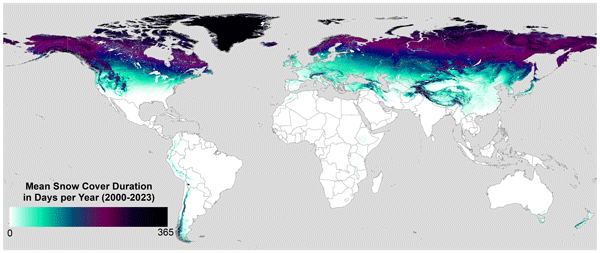
The "Global SnowPack" product of the German Aerospace Center (DLR) contains binary information about the presence or absence of snow on a global scale since the year 2000. Now incorporating new input datasets, it was possible to increase the spatial resolution to 370 m. The detailed accuracy assessment proves the feasibility of the applied methods to remove data gaps caused by clouds and polar darkness.
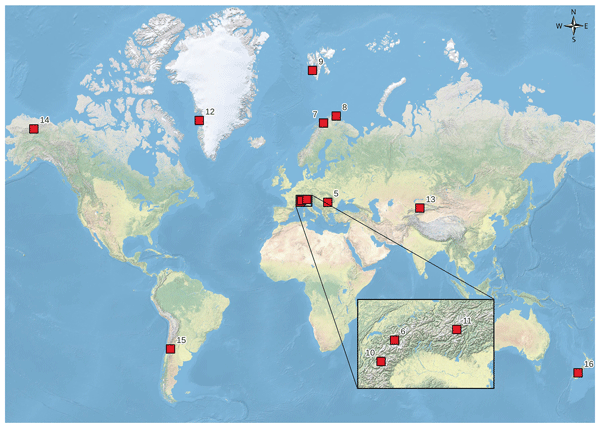
Line Rouyet, Tobias Bolch, Francesco Brardinoni, Rafael Caduff, Diego Cusicanqui, Margaret Darrow, Reynald Delaloye, Thomas Echelard, Christophe Lambiel, Cécile Pellet, Lucas Ruiz, Lea Schmid, Flavius Sirbu, and Tazio Strozzi
Earth Syst. Sci. Data, 17, 4125–4157, https://doi.org/10.5194/essd-17-4125-2025, https://doi.org/10.5194/essd-17-4125-2025, 2025
Short summary
Short summary
Rock glaciers are landforms generated by the creep of frozen ground (permafrost) in cold-climate mountains. Mapping rock glaciers contributes to documenting the distribution and the dynamics of mountain permafrost. We compiled inventories documenting the location, the characteristics, and the extent of rock glaciers in 12 mountain regions around the world. In each region, a team of operators performed the work following common rules and agreed on final solutions when discrepancies were identified.
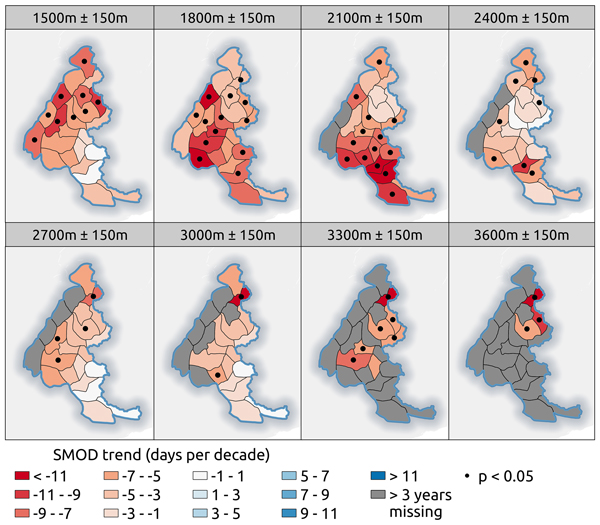
Zacharie Barrou Dumont, Simon Gascoin, Jordi Inglada, Andreas Dietz, Jonas Köhler, Matthieu Lafaysse, Diego Monteiro, Carlo Carmagnola, Arthur Bayle, Jean-Pierre Dedieu, Olivier Hagolle, and Philippe Choler
The Cryosphere, 19, 2407–2429, https://doi.org/10.5194/tc-19-2407-2025, https://doi.org/10.5194/tc-19-2407-2025, 2025
Short summary
Short summary
We generated annual maps of snow melt-out days at 20 m resolution over a period of 38 years from 10 different satellites. This study fills a knowledge gap regarding the evolution of mountain snow in Europe by covering a much longer period and characterizing trends at much higher resolutions than previous studies. We found a trend for earlier melt-out with average reductions of 5.51 d per decade over the French Alps and 4.04 d per decade over the Pyrenees for the period 1986–2023.
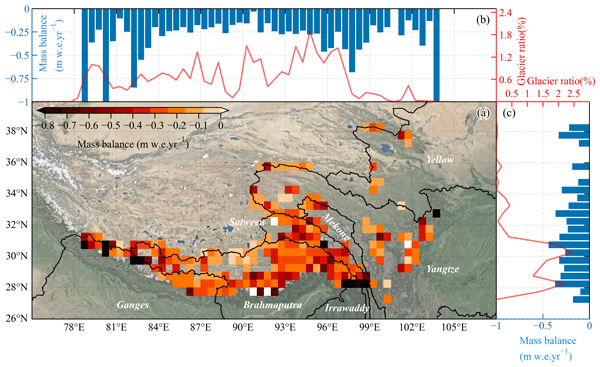
Yu Zhu, Shiyin Liu, Junfeng Wei, Kunpeng Wu, Tobias Bolch, Junli Xu, Wanqin Guo, Zongli Jiang, Fuming Xie, Ying Yi, Donghui Shangguan, Xiaojun Yao, and Zhen Zhang
Earth Syst. Sci. Data, 17, 1851–1871, https://doi.org/10.5194/essd-17-1851-2025, https://doi.org/10.5194/essd-17-1851-2025, 2025
Short summary
Short summary
This study compiled a near-complete inventory of glacier mass changes across the eastern Tibetan Plateau using topographical maps. These data enhance our understanding of glacier change variability before 2000. When combined with existing research, our dataset provides a nearly 5-decade record of mass balance, aiding hydrological simulations and assessments of mountain glacier contributions to sea-level rise.
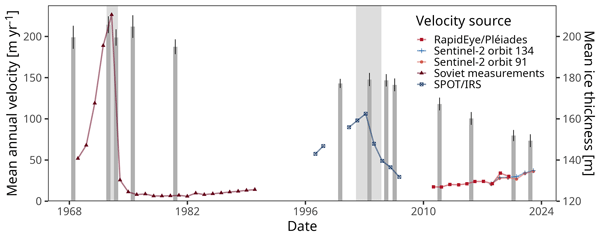
Enrico Mattea, Etienne Berthier, Amaury Dehecq, Tobias Bolch, Atanu Bhattacharya, Sajid Ghuffar, Martina Barandun, and Martin Hoelzle
The Cryosphere, 19, 219–247, https://doi.org/10.5194/tc-19-219-2025, https://doi.org/10.5194/tc-19-219-2025, 2025
Short summary
Short summary
We reconstruct the evolution of terminus position, ice thickness, and surface flow velocity of the reference Abramov glacier (Kyrgyzstan) from 1968 to present. We describe a front pulsation in the early 2000s and the multi-annual present-day buildup of a new pulsation. Such dynamic instabilities can challenge the representativity of Abramov as a reference glacier. For our work we used satellite‑based optical remote sensing from multiple platforms, including recently declassified archives.
Erik Loebel, Celia A. Baumhoer, Andreas Dietz, Mirko Scheinert, and Martin Horwath
Earth Syst. Sci. Data, 17, 65–78, https://doi.org/10.5194/essd-17-65-2025, https://doi.org/10.5194/essd-17-65-2025, 2025
Short summary
Short summary
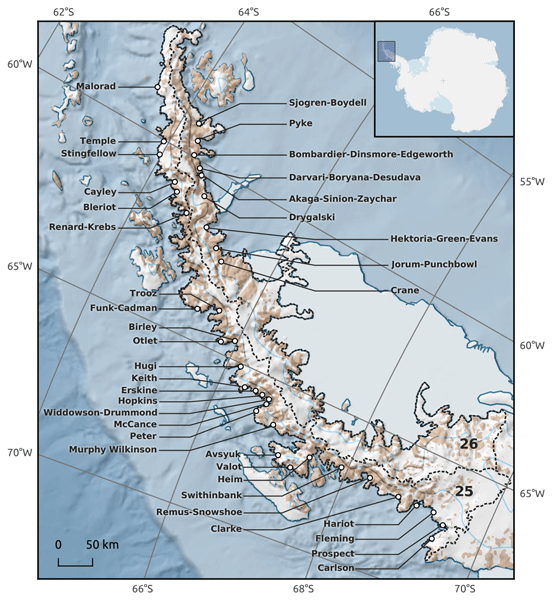
Glacier calving front positions are important for understanding glacier dynamics and constraining ice modelling. We apply a deep-learning framework to multi-spectral Landsat imagery to create a calving front record for 42 key outlet glaciers of the Antarctic Peninsula Ice Sheet. The resulting data product includes 4817 calving front locations from 2013 to 2023 and achieves sub-seasonal temporal resolution.
Livia Piermattei, Michael Zemp, Christian Sommer, Fanny Brun, Matthias H. Braun, Liss M. Andreassen, Joaquín M. C. Belart, Etienne Berthier, Atanu Bhattacharya, Laura Boehm Vock, Tobias Bolch, Amaury Dehecq, Inés Dussaillant, Daniel Falaschi, Caitlyn Florentine, Dana Floricioiu, Christian Ginzler, Gregoire Guillet, Romain Hugonnet, Matthias Huss, Andreas Kääb, Owen King, Christoph Klug, Friedrich Knuth, Lukas Krieger, Jeff La Frenierre, Robert McNabb, Christopher McNeil, Rainer Prinz, Louis Sass, Thorsten Seehaus, David Shean, Désirée Treichler, Anja Wendt, and Ruitang Yang
The Cryosphere, 18, 3195–3230, https://doi.org/10.5194/tc-18-3195-2024, https://doi.org/10.5194/tc-18-3195-2024, 2024
Short summary
Short summary
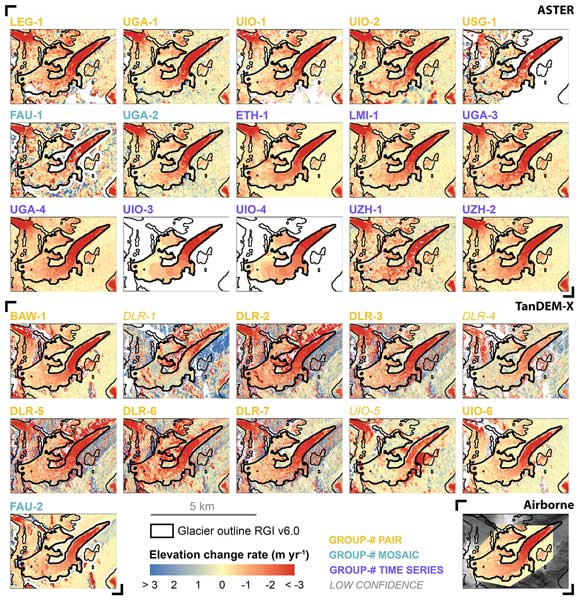
Satellites have made it possible to observe glacier elevation changes from all around the world. In the present study, we compared the results produced from two different types of satellite data between different research groups and against validation measurements from aeroplanes. We found a large spread between individual results but showed that the group ensemble can be used to reliably estimate glacier elevation changes and related errors from satellite data.
Daniel Falaschi, Atanu Bhattacharya, Gregoire Guillet, Lei Huang, Owen King, Kriti Mukherjee, Philipp Rastner, Tandong Yao, and Tobias Bolch
The Cryosphere, 17, 5435–5458, https://doi.org/10.5194/tc-17-5435-2023, https://doi.org/10.5194/tc-17-5435-2023, 2023
Short summary
Short summary
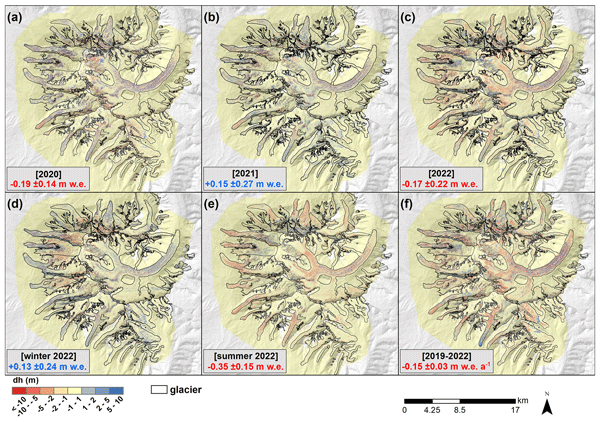
Because glaciers are crucial freshwater sources in the lowlands surrounding High Mountain Asia, constraining short-term glacier mass changes is essential. We investigate the potential of state-of-the-art satellite elevation data to measure glacier mass changes in two selected regions. The results demonstrate the ability of our dataset to characterize glacier changes of different magnitudes, allowing for an increase in the number of inaccessible glaciers that can be readily monitored.
Fanny Brun, Owen King, Marion Réveillet, Charles Amory, Anton Planchot, Etienne Berthier, Amaury Dehecq, Tobias Bolch, Kévin Fourteau, Julien Brondex, Marie Dumont, Christoph Mayer, Silvan Leinss, Romain Hugonnet, and Patrick Wagnon
The Cryosphere, 17, 3251–3268, https://doi.org/10.5194/tc-17-3251-2023, https://doi.org/10.5194/tc-17-3251-2023, 2023
Short summary
Short summary
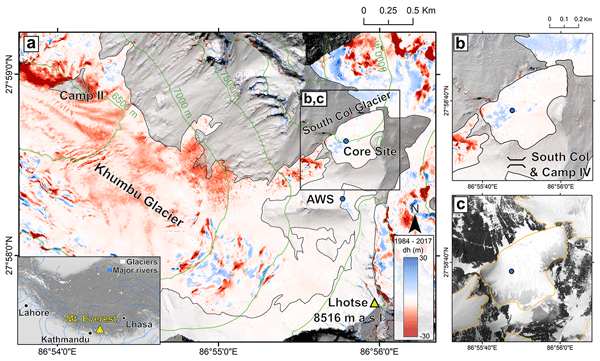
The South Col Glacier is a small body of ice and snow located on the southern ridge of Mt. Everest. A recent study proposed that South Col Glacier is rapidly losing mass. In this study, we examined the glacier thickness change for the period 1984–2017 and found no thickness change. To reconcile these results, we investigate wind erosion and surface energy and mass balance and find that melt is unlikely a dominant process, contrary to previous findings.
Sajid Ghuffar, Owen King, Grégoire Guillet, Ewelina Rupnik, and Tobias Bolch
The Cryosphere, 17, 1299–1306, https://doi.org/10.5194/tc-17-1299-2023, https://doi.org/10.5194/tc-17-1299-2023, 2023
Short summary
Short summary
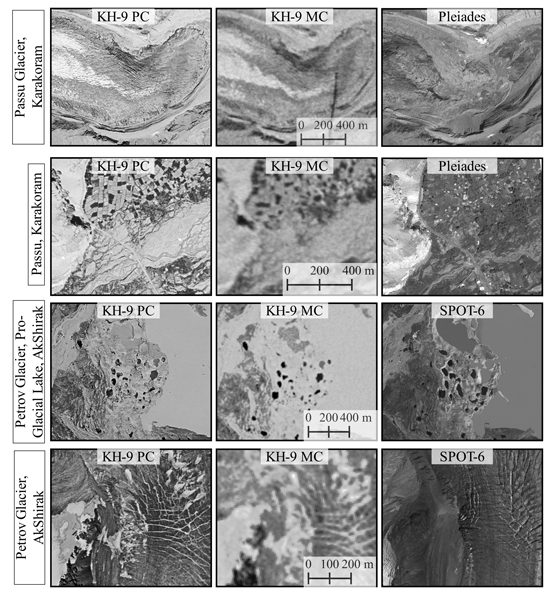
The panoramic cameras (PCs) on board Hexagon KH-9 satellite missions from 1971–1984 captured very high-resolution stereo imagery with up to 60 cm spatial resolution. This study explores the potential of this imagery for glacier mapping and change estimation. The high resolution of KH-9PC leads to higher-quality DEMs which better resolve the accumulation region of glaciers in comparison to the KH-9 mapping camera, and KH-9PC imagery can be useful in several Earth observation applications.
Fuming Xie, Shiyin Liu, Yongpeng Gao, Yu Zhu, Tobias Bolch, Andreas Kääb, Shimei Duan, Wenfei Miao, Jianfang Kang, Yaonan Zhang, Xiran Pan, Caixia Qin, Kunpeng Wu, Miaomiao Qi, Xianhe Zhang, Ying Yi, Fengze Han, Xiaojun Yao, Qiao Liu, Xin Wang, Zongli Jiang, Donghui Shangguan, Yong Zhang, Richard Grünwald, Muhammad Adnan, Jyoti Karki, and Muhammad Saifullah
Earth Syst. Sci. Data, 15, 847–867, https://doi.org/10.5194/essd-15-847-2023, https://doi.org/10.5194/essd-15-847-2023, 2023
Short summary
Short summary
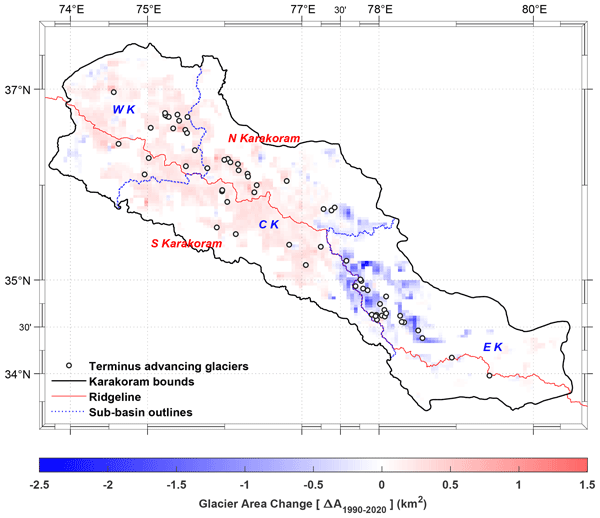
In this study, first we generated inventories which allowed us to systematically detect glacier change patterns in the Karakoram range. We found that, by the 2020s, there were approximately 10 500 glaciers in the Karakoram mountains covering an area of 22 510.73 km2, of which ~ 10.2 % is covered by debris. During the past 30 years (from 1990 to 2020), the total glacier cover area in Karakoram remained relatively stable, with a slight increase in area of 23.5 km2.
Yu Zhu, Shiyin Liu, Junfeng Wei, Kunpeng Wu, Tobias Bolch, Junli Xu, Wanqin Guo, Zongli Jiang, Fuming Xie, Ying Yi, Donghui Shangguan, Xiaojun Yao, and Zhen Zhang
Earth Syst. Sci. Data Discuss., https://doi.org/10.5194/essd-2022-473, https://doi.org/10.5194/essd-2022-473, 2023
Preprint withdrawn
Short summary
Short summary
In this study, we presented a nearly complete inventory of glacier mass change dataset across the eastern Tibetan Plateau by using topographical maps, which will enhance the knowledge on the heterogeneity of glacier change before 2000. Our dataset, in combination with the published results, provide a nearly five decades mass balance to support hydrological simulation, and to evaluate the contribution of mountain glacier loss to sea level.
Simon K. Allen, Ashim Sattar, Owen King, Guoqing Zhang, Atanu Bhattacharya, Tandong Yao, and Tobias Bolch
Nat. Hazards Earth Syst. Sci., 22, 3765–3785, https://doi.org/10.5194/nhess-22-3765-2022, https://doi.org/10.5194/nhess-22-3765-2022, 2022
Short summary
Short summary
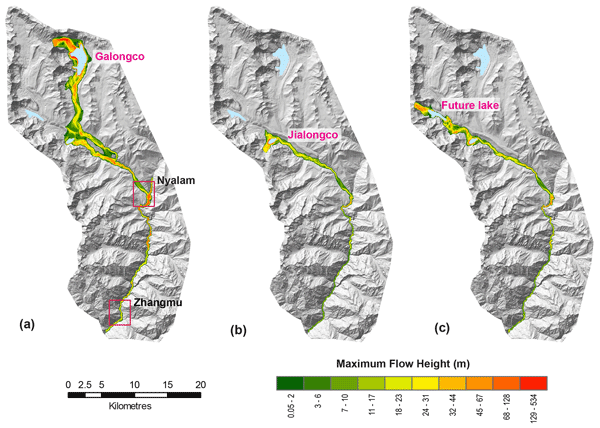
This study demonstrates how the threat of a very large outburst from a future lake can be feasibly assessed alongside that from current lakes to inform disaster risk management within a transboundary basin between Tibet and Nepal. Results show that engineering measures and early warning systems would need to be coupled with effective land use zoning and programmes to strengthen local response capacities in order to effectively reduce the risk associated with current and future outburst events.
Thorsten Hoeser, Stefanie Feuerstein, and Claudia Kuenzer
Earth Syst. Sci. Data, 14, 4251–4270, https://doi.org/10.5194/essd-14-4251-2022, https://doi.org/10.5194/essd-14-4251-2022, 2022
Short summary
Short summary
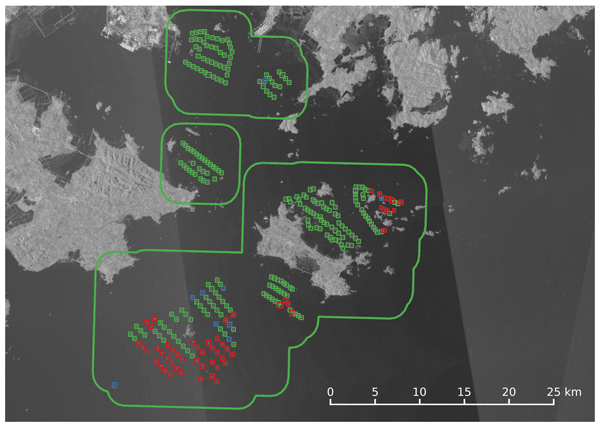
The DeepOWT (Deep-learning-derived Offshore Wind Turbines) data set provides offshore wind energy infrastructure locations and their temporal deployment dynamics from July 2016 until June 2021 on a global scale. It differentiates between offshore wind turbines, platforms under construction, and offshore wind farm substations. It is derived by applying deep-learning-based object detection to Sentinel-1 imagery.
Aldo Bertone, Chloé Barboux, Xavier Bodin, Tobias Bolch, Francesco Brardinoni, Rafael Caduff, Hanne H. Christiansen, Margaret M. Darrow, Reynald Delaloye, Bernd Etzelmüller, Ole Humlum, Christophe Lambiel, Karianne S. Lilleøren, Volkmar Mair, Gabriel Pellegrinon, Line Rouyet, Lucas Ruiz, and Tazio Strozzi
The Cryosphere, 16, 2769–2792, https://doi.org/10.5194/tc-16-2769-2022, https://doi.org/10.5194/tc-16-2769-2022, 2022
Short summary
Short summary
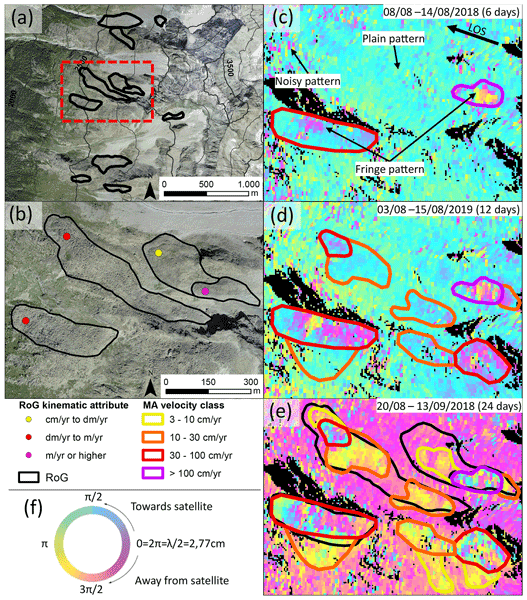
We present the guidelines developed by the IPA Action Group and within the ESA Permafrost CCI project to include InSAR-based kinematic information in rock glacier inventories. Nine operators applied these guidelines to 11 regions worldwide; more than 3600 rock glaciers are classified according to their kinematics. We test and demonstrate the feasibility of applying common rules to produce homogeneous kinematic inventories at global scale, useful for hydrological and climate change purposes.

Benjamin Aubrey Robson, Shelley MacDonell, Álvaro Ayala, Tobias Bolch, Pål Ringkjøb Nielsen, and Sebastián Vivero
The Cryosphere, 16, 647–665, https://doi.org/10.5194/tc-16-647-2022, https://doi.org/10.5194/tc-16-647-2022, 2022
Short summary
Short summary
This work uses satellite and aerial data to study glaciers and rock glacier changes in La Laguna catchment within the semi-arid Andes of Chile, where ice melt is an important factor in river flow. The results show the rate of ice loss of Tapado Glacier has been increasing since the 1950s, which possibly relates to a dryer, warmer climate over the previous decades. Several rock glaciers show high surface velocities and elevation changes between 2012 and 2020, indicating they may be ice-rich.
Gregoire Guillet, Owen King, Mingyang Lv, Sajid Ghuffar, Douglas Benn, Duncan Quincey, and Tobias Bolch
The Cryosphere, 16, 603–623, https://doi.org/10.5194/tc-16-603-2022, https://doi.org/10.5194/tc-16-603-2022, 2022
Short summary
Short summary
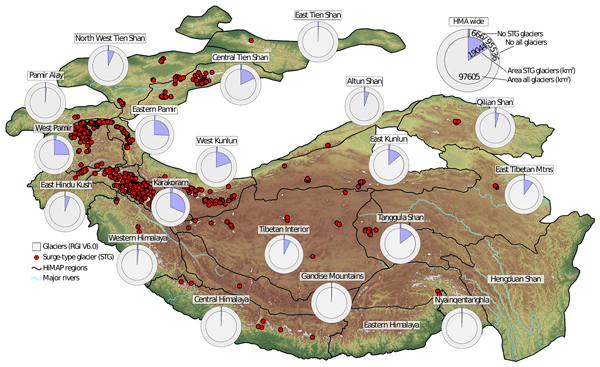
Surging glaciers show cyclical changes in flow behavior – between slow and fast flow – and can have drastic impacts on settlements in their vicinity.
One of the clusters of surging glaciers worldwide is High Mountain Asia (HMA).
We present an inventory of surging glaciers in HMA, identified from satellite imagery. We show that the number of surging glaciers was underestimated and that they represent 20 % of the area covered by glaciers in HMA, before discussing new physics for glacier surges.
Jan Bouke Pronk, Tobias Bolch, Owen King, Bert Wouters, and Douglas I. Benn
The Cryosphere, 15, 5577–5599, https://doi.org/10.5194/tc-15-5577-2021, https://doi.org/10.5194/tc-15-5577-2021, 2021
Short summary
Short summary
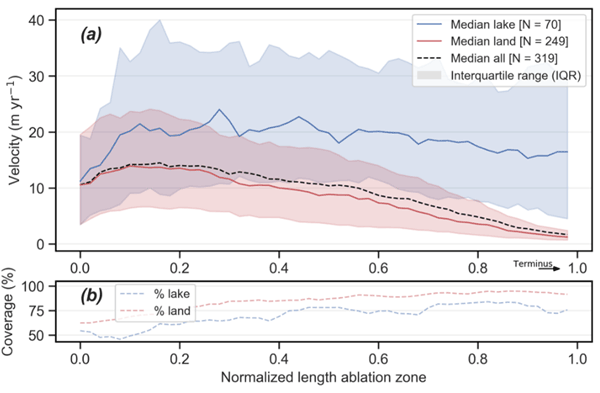
About 10 % of Himalayan glaciers flow directly into lakes. This study finds, using satellite imagery, that such glaciers show higher flow velocities than glaciers without ice–lake contact. In particular near the glacier tongue the impact of a lake on the glacier flow can be dramatic. The development of current and new meltwater bodies will influence the flow of an increasing number of Himalayan glaciers in the future, a scenario not currently considered in regional ice loss projections.
Cited articles
Adnan, M., Liu, S., Saifullah, M., Iqbal, M., Ali, A. F., and Mukhtar, M. A.: Spatiotemporal variations in runoff and runoff components in response to climate change in a glacierized subbasin of the Upper Indus Basin, Pakistan, Front. Earth Sci., 10, 970349, https://doi.org/10.3389/feart.2022.970349, 2022. a
Adnan, M., Liu, S., Saifullah, M., Iqbal, M., Saddique, Q., Ul Hussan, W., and Latif, Y.: Estimation of changes in runoff and its sources in response to future climate change in a critical zone of the Karakoram mountainous region, Pakistan in the near and far future, Geomatics, Nat. Hazard. Risk, 15, 2291330, https://doi.org/10.1080/19475705.2023.2291330, 2024. a
Ali, Z., Iqbal, M., Khan, I. U., Masood, M. U., Umer, M., Lodhi, M. U. K., and Tariq, M. A. U. R.: Hydrological response under CMIP6 climate projection in Astore River Basin, Pakistan, J. Mountain Sci., 20, 2263–2281, https://doi.org/10.1007/s11629-022-7872-x, 2023. a
Avanzi, F., Munerol, F., Milelli, M., Gabellani, S., Massari, C., Girotto, M., Cremonese, E., Galvagno, M., Bruno, G., Morra di Cella, U., Rossi, L., Altamura, M., and Ferraris, L.: Winter snow deficit was a harbinger of summer 2022 socio-hydrologic drought in the Po Basin, Italy, Commun. Earth Environ., 5, 1–12, https://doi.org/10.1038/s43247-024-01222-z, 2024. a
Ban, Z., Li, D., and Lettenmaier, D. P.: The Increasing Role of Seasonal Rainfall in Western U.S. Summer Streamflow, Geophys. Res. Lett., 50, e2023GL102892, https://doi.org/10.1029/2023gl102892, 2023. a
Barnett, T. P., Adam, J. C., and Lettenmaier, D. P.: Potential impacts of a warming climate on water availability in snow-dominated regions, Nature, https://doi.org/10.1038/nature04141, 2005. a, b, c
Beck, H. E., McVicar, T. R., Vergopolan, N., Berg, A., Lutsko, N. J., Dufour, A., Zeng, Z., Jiang, X., van Dijk, A. I. J. M., and Miralles, D. G.: High-resolution (1 km) Köppen-Geiger maps for 1901–2099 based on constrained CMIP6 projections, Sci. Data, 10, 724, https://doi.org/10.1038/s41597-023-02549-6, 2023. a, b, c, d, e
Bedoya-Maya, F., Shobayo, P., Beckers, J., and van Hassel, E.: The impact of critical water levels on container inland waterway transport, Trans. Res. Pt. D, 131, 104190, https://doi.org/10.1016/j.trd.2024.104190, 2024. a
Beria, H., Larsen, J. R., Ceperley, N. C., Michelon, A., Vennemann, T., and Schaefli, B.: Understanding snow hydrological processes through the lens of stable water isotopes, WIREs Water, 5, e1311, https://doi.org/10.1002/wat2.1311, 2018. a
Beyers, D. W.: Causal inference in environmental impact studies, J. North Am. Benthol. Soc., 17, 367–373, https://doi.org/10.2307/1468339, 1998. a
Biancamaria, S., Cazenave, A., Mognard, N. M., Llovel, W., and Frappart, F.: Satellite-based high latitude snow volume trend, variability and contribution to sea level over 1989/2006, Glob. Planet. Change, 75, 99–107, https://doi.org/10.1016/j.gloplacha.2010.10.011, 2011. a, b
Bolch, T., Kulkarni, A., Kääb, A., Huggel, C., Paul, F., Cogley, J. G., Frey, H., Kargel, J. S., Fujita, K., Scheel, M., Bajracharya, S., and Stoffel, M.: The State and Fate of Himalayan Glaciers, Science, 336, 310–314, https://doi.org/10.1126/science.1215828, 2012. a, b
Breiman, L.: Random Forests, Mach. Learn., 45, 5–32, https://doi.org/10.1023/a:1010933404324, 2001. a
Brooks, P. D., Solomon, D. K., Kampf, S., Warix, S., Bern, C., Barnard, D., Barnard, H. R., Carling, G. T., Carroll, R. W. H., Chorover, J., Harpold, A., Lohse, K., Meza, F., McIntosh, J., Neilson, B., Sears, M., and Wolf, M.: Groundwater dominates snowmelt runoff and controls streamflow efficiency in the western United States, Commun. Earth Environ., 6, 341, https://doi.org/10.1038/s43247-025-02303-3, 2025. a
Capua, G. D., Runge, J., Donner, R., Hurk, B. v. d., Turner, A., Vellore, R., Krishnan, R., and Coumou, D.: Dominant patterns of interaction between the tropics and mid-latitudes in boreal summer: causal relationships and the role of timescales, Weather Clim. Dynam., https://doi.org/10.5194/wcd-1-519-2020, 2020. a
Carlson, G., Massari, C., Rotiroti, M., Bonomi, T., Preziosi, E., Wilder, A., Whitaker, D., and Girotto, M.: Intensive irrigation buffers groundwater declines in key European breadbasket, Nat. Water, 3, 683–692, https://doi.org/10.1038/s44221-025-00445-4, 2025. a
Carroll, R. W. H., Niswonger, R. G., Ulrich, C., Varadharajan, C., Siirila-Woodburn, E. R., and Williams, K. H.: Declining groundwater storage expected to amplify mountain streamflow reductions in a warmer world, Nat. Water, 2, 419–433, https://doi.org/10.1038/s44221-024-00239-0, 2024. a
Chandel, V. and Ghosh, S.: Components of Himalayan River Flows in a Changing Climate, Water Resour. Res., https://doi.org/10.1029/2020wr027589, 2021. a
Chen, X., Parajka, J., Széles, B., Valent, P., Viglione, A., and Blöschl, G.: Impact of Climate and Geology on Event Runoff Characteristics at the Regional Scale, Water, 12, 3457, https://doi.org/10.3390/w12123457, 2020. a
Cicuendez, V., Litago, J., Huesca, M., Rodriguez-Rastrero, M., Recuero, L., Merino-de Miguel, S., and Palacios-Orueta, A.: Assessment of the gross primary production dynamics of a Mediterranean holm oak forest by remote sensing time series analysis, Agroforest.Syst., 89, 491–510, https://doi.org/10.1007/s10457-015-9786-x, 2015. a
Clarke, G. K. C., Jarosch, A. H., Anslow, F. S., Radic, V., and Menounos, B.: Projected deglaciation of western Canada in the twenty-first century, Nat. Geosci., 8, 372–377, https://doi.org/10.1038/ngeo2407, 2015. a
Coppola, E., Verdecchia, M., Giorgi, F., Colaiuda, V., Tomassetti, B., and Lombardi, A.: Changing hydrological conditions in the Po basin under global warming, Sci. Total Environ., 493, 1183–1196, https://doi.org/10.1016/j.scitotenv.2014.03.003, 2014. a
Cowherd, M., Ruby Leung, L., and Girotto, M.: Evolution of global snow drought characteristics from 1850 to 2100, Environ. Res. Lett., 18, 064043, https://doi.org/10.1088/1748-9326/acd804, 2023. a
Craig, H.: Isotopic Variations in Meteoric Waters, Science, https://doi.org/10.1126/science.133.3465.1702, 1961. a
DeWalle, D. R. and Rango, A.: Principles of Snow Hydrology, Cambridge University Press, ISBN 978-0-521-82362-3, 978-0-511-53567-3, 978-0-521-29032-6, https://doi.org/10.1017/cbo9780511535673, 2008. a, b, c
Do, H. X., Westra, S., Leonard, M., and Gudmundsson, L.: Global‐Scale Prediction of Flood Timing Using Atmospheric Reanalysis, Water Resour. Res., 56, e2019WR024945, https://doi.org/10.1029/2019wr024945, 2020. a
Docquier, D., Di Capua, G., Donner, R. V., Pires, C. A. L., Simon, A., and Vannitsem, S.: A comparison of two causal methods in the context of climate analyses, Nonl. Process. Geophys., 31, 115–136, https://doi.org/10.5194/npg-31-115-2024, 2024. a
Dorigo, W., Preimesberger, W., Reimer, C., Van der Schalie, R., Pasik, A., De Jeu, R., and Paulik, C.: Soil moisture gridded data from 1978 to present, v202212, ECMVF [data set], https://cds.climate.copernicus.eu/cdsapp#!/dataset/satellite-soil-moisture?tab=overview (last access: 10 November 2025), 2019. a
Eckert, N., Corona, C., Giacona, F., Gaume, J., Mayer, S., van Herwijnen, A., Hagenmuller, P., and Stoffel, M.: Climate change impacts on snow avalanche activity and related risks, Nat. Rev. Earth Environ., 5, 369–389, https://doi.org/10.1038/s43017-024-00540-2, 2024. a
Fang, B., Bevacqua, E., Rakovec, O., and Zscheischler, J.: An increase in the spatial extent of European floods over the last 70 years, Hydrol. Earth Syst. Sci., 28, 3755–3775, https://doi.org/10.5194/hess-28-3755-2024, 2024. a
Flynn, H., Fassnacht, S. R., MacDonald, M. S., and Pfohl, A. K. D.: Baseflow from Snow and Rain in Mountain Watersheds, Water, 16, 1665, https://doi.org/10.3390/w16121665, 2024. a
Ford, J. D., Pearce, T., Canosa, I. V., and Harper, S.: The rapidly changing Arctic and its societal implications, WIREs Clim. Change, 12, e735, https://doi.org/10.1002/wcc.735, 2021. a
Formetta, G., Tootle, G., and Therrell, M.: Regional Reconstruction of Po River Basin (Italy) Streamflow, Hydrology, 9, 163, https://doi.org/10.3390/hydrology9100163, 2022. a
François, H., Samacoïts, R., Bird, D. N., Köberl, J., Prettenthaler, F., and Morin, S.: Climate change exacerbates snow-water-energy challenges for European ski tourism, Nat. Clim. Change, 13, 935–942, https://doi.org/10.1038/s41558-023-01759-5, 2023. a
Geurts, P., Ernst, D., and Wehenkel, L.: Extremely randomized trees, Mach. Learn., 63, 3–42, https://doi.org/10.1007/s10994-006-6226-1, 2006. a
Girotto, M., Reichle, R., Rodell, M., and Maggioni, V.: Data Assimilation of Terrestrial Water Storage Observations to Estimate Precipitation Fluxes: A Synthetic Experiment, Remote Sens., 13, 1223, https://doi.org/10.3390/rs13061223, 2021. a
GMAO: Global Modeling and Assimilation Office. MERRA-2 tavg1_2d_lnd_Nx: 2d, 1-Hourly, Time-Averaged, Single-Level, Assimilation, Land Surface Diagnostics V5.12.4 [data set], https://doi.org/10.5067/RKPHT8KC1Y1T, 2015a. a
GMAO: Global Modeling and Assimilation Office. MERRA-2 tavg3_2d_glc_Nx: 2d, 3-Hourly, Time-Averaged, Single-Level, Assimilation, Land Ice Surface Diagnostics V5.12.4 [data set], https://doi.org/10.5067/9ETB4TT5J6US, 2015b. a, b
Gordeev, V. V., Pokrovsky, O. S., Zhulidov, A. V., Filippov, A. S., Gurtovaya, T. Y., Holmes, R. M., Kosmenko, L. S., McClelland, J. W., Peterson, B. J., and Tank, S. E.: Dissolved Major and Trace Elements in the Largest Eurasian Arctic Rivers: Ob, Yenisey, Lena, and Kolyma, Water, 16, 316, https://doi.org/10.3390/w16020316, 2024. a
Gordon, B. L., Brooks, P. D., Krogh, S. A., Boisrame, G. F. S., Carroll, R. W. H., McNamara, J. P., and Harpold, A. A.: Why does snowmelt-driven streamflow response to warming vary? A data-driven review and predictive framework, Environ. Res. Lett., 17, 053004, https://doi.org/10.1088/1748-9326/ac64b4, 2022. a, b
Gottlieb, A. R. and Mankin, J. S.: Evidence of human influence on Northern Hemisphere snow loss, Nature, 625, 293–300, https://doi.org/10.1038/s41586-023-06794-y, 2024. a, b, c
Granger, C. W. J.: Investigating Causal Relations by Econometric Models and Cross-spectral Methods, Econometrica, 37, 424–438, https://doi.org/10.2307/1912791, 1969. a, b
Grimaldi, S., Salamon, P., Disperati, J., Zsoter, E., Russo, C., Ramos, A., Carton De Wiart, C., Barnard, C., Hansford, E., Gomes, G., and Prudhomme, C.: River discharge and related historical data from the Global Flood Awareness System, v4.0, Copernicus Emergency Management Service (CEMS) [data set], https://doi.org/10.24381/cds.a4fdd6b9, 2022. a
Guastini, E., Zuecco, G., Errico, A., Castelli, G., Bresci, E., Preti, F., and Penna, D.: How does streamflow response vary with spatial scale? Analysis of controls in three nested Alpine catchments, J. Hydrol., 570, 705–718, https://doi.org/10.1016/j.jhydrol.2019.01.022, 2019. a
Guo, Y., Yang, Y., Yang, D., Zhang, L., Zheng, H., Xiong, J., Ruan, F., Han, J., and Liu, Z.: Warming leads to both earlier and later snowmelt floods over the past 70 years, Nat. Commun., 16, 3663, https://doi.org/10.1038/s41467-025-58832-0, 2025. a
Hall, D. K., Loomis, B. D., DiGirolamo, N. E., and Forman, B. A.: Snowfall Replenishes Groundwater Loss in the Great Basin of the Western United States, but Cannot Compensate for Increasing Aridification, Geophys. Res. Lett., 51, e2023GL107913, https://doi.org/10.1029/2023gl107913, 2024. a
Hamed, K. H. and Ramachandra Rao, A.: A modified Mann-Kendall trend test for autocorrelated data, J. Hydrol., 204, 182–196, https://doi.org/10.1016/S0022-1694(97)00125-X, 1998. a
Hammond, J. C. and Kampf, S. K.: Subannual Streamflow Responses to Rainfall and Snowmelt Inputs in Snow-Dominated Watersheds of the Western United States, Water Resour. Res., 56, e2019WR026132, https://doi.org/10.1029/2019wr026132, 2020. a
Han, J., Liu, Z., Woods, R., McVicar, T. R., Yang, D., Wang, T., Hou, Y., Guo, Y., Li, C., and Yang, Y.: Streamflow seasonality in a snow-dwindling world, Nature, 629, 1075–1081, https://doi.org/10.1038/s41586-024-07299-y, 2024. a, b, c
Hasan, M. F., Smith, R., Vajedian, S., Pommerenke, R., and Majumdar, S.: Global land subsidence mapping reveals widespread loss of aquifer storage capacity, Nat. Commun., 14, 6180, https://doi.org/10.1038/s41467-023-41933-z, 2023. a
Hasson, S., Böhner, J., and Lucarini, V.: Prevailing climatic trends and runoff response from Hindukush–Karakoram–Himalaya, upper Indus Basin, Earth Syst. Dynam., 8, 337–355, https://doi.org/10.5194/esd-8-337-2017, 2017. a
Hersbach, H., Bell, B., Berrisford, P., Biavati, G., Horányi, A., Muñoz Sabater, J., Nicolas, J., Peubey, C., Radu, R., Rozum, I., Schepers, D., Simmons, A., Soci, C., Dee, D., and Thépaut, J.-N.: ERA5 hourly data on single levels from 1940 to present, Copernicus Climate Change Service (C3S) Climate Data Store (CDS) [data set], https://doi.org/10.24381/cds.adbb2d47, 2023. a, b
Huning, L. S. and AghaKouchak, A.: Global snow drought hot spots and characteristics, P. Natl. Acad. Sci. USA, 117, 19753–19759, https://doi.org/10.1073/pnas.1915921117, 2020. a
Huss, M.: Present and future contribution of glacier storage change to runoff from macroscale drainage basins in Europe, Water Resour. Res., 47, https://doi.org/10.1029/2010wr010299, 2011. a
Huss, M. and Hock, R.: Global-scale hydrological response to future glacier mass loss, Nat. Clim. Change, 8, 135–140, https://doi.org/10.1038/s41558-017-0049-x, 2018. a, b
Immerzeel, W., Beek, L. V. v., and Bierkens, M.: Climate Change Will Affect the Asian Water Towers, Science, https://doi.org/10.1126/science.1183188, 2010. a, b
Immerzeel, W. W., Wanders, N., Lutz, A. F., Shea, J. M., and Bierkens, M. F. P.: Reconciling high-altitude precipitation in the upper Indus basin with glacier mass balances and runoff, Hydrol. Earth Syst. Sci., 19, 4673–4687, https://doi.org/10.5194/hess-19-4673-2015, 2015. a
Immerzeel, W. W., Lutz, A. F., Andrade, M., Bahl, A., Biemans, H., Bolch, T., Hyde, S., Brumby, S., Davies, B. J., Elmore, A. C., Emmer, A., Feng, M., Fernández, A., Haritashya, U., Kargel, J. S., Koppes, M., Kraaijenbrink, P. D. A., Kulkarni, A. V., Mayewski, P. A., Nepal, S., Pacheco, P., Painter, T. H., Pellicciotti, F., Rajaram, H., Rupper, S., Sinisalo, A., Shrestha, A. B., Viviroli, D., Wada, Y., Xiao, C., Yao, T., and Baillie, J. E. M.: Importance and vulnerability of the world's water towers, Nature, 577, 364–369, https://doi.org/10.1038/s41586-019-1822-y, 2020. a
Inouye, D. W.: Climate change and phenology, WIREs Clim. Change, 13, e764, https://doi.org/10.1002/wcc.764, 2022. a
Jiang, S., Bevacqua, E., and Zscheischler, J.: River flooding mechanisms and their changes in Europe revealed by explainable machine learning, Hydrol. Earth Syst. Sci., 26, 6339–6359, https://doi.org/10.5194/hess-26-6339-2022, 2022. a
Joshi, S. K., Swarnkar, S., Shukla, S., Kumar, S., Jain, S., and Gautam, S.: Snow/Ice Melt, Precipitation, and Groundwater Contribute to the Sutlej River System, Water Air Soil Pollut., 234, 719, https://doi.org/10.1007/s11270-023-06744-4, 2023. a
Julander, R. P. and Clayton, J. A.: Determining the proportion of streamflow that is generated by cold season processes versus summer rainfall in Utah, USA, J. Hydrol. Reg. Stud., 17, 36–46, https://doi.org/10.1016/j.ejrh.2018.04.005, 2018. a, b
Karmouche, S., Galytska, E., Runge, J., Meehl, G. A., Phillips, A. S., Weigel, K., and Eyring, V.: Regime-oriented causal model evaluation of Atlantic–Pacific teleconnections in CMIP6, Earth Syst. Dynam., 14, 309–344, https://doi.org/10.5194/esd-14-309-2023, 2023. a
Kashyap, A. and Behera, M. D.: Excess topography and outburst flood: Geomorphic imprint of October 2023 extreme flood event in the Teesta catchment of Eastern Himalayas, Glob. Planet. Change, 240, 104540, https://doi.org/10.1016/j.gloplacha.2024.104540, 2024. a
Kathpalia, A., Manshour, P., and Paluš, M.: Compression complexity with ordinal patterns for robust causal inference in irregularly sampled time series, Sci. Rep., 12, 14170, https://doi.org/10.1038/s41598-022-18288-4, 2022. a
Kim, H., Fastovich, D., Bhattacharya, T., and Tuttle, S.: Improving predictions of snow resources using midlatitude SSTs with convergent cross mapping, Environ. Res. Clim., 4, 021001, https://doi.org/10.1088/2752-5295/add362, 2025. a
Kolluru, V., John, R., Chen, J., Konkathi, P., Kolluru, S., Saraf, S., Henebry, G. M., Xiao, J., Jain, K., and Kussainova, M.: Dominant role of grazing and snow cover variability on vegetation shifts in the drylands of Kazakhstan, Commun. Earth Environ., 5, 424, https://doi.org/10.1038/s43247-024-01587-1, 2024. a
Koya, S. R., Kar, K. K., and Roy, T.: Northern Pacific sea-level pressure controls rain-on-snow in North America, Commun. Earth Environ., 5, 260, https://doi.org/10.1038/s43247-024-01431-6, 2024. a
Kretschmer, M., Coumou, D., Donges, J. F., and Runge, J.: Using Causal Effect Networks to Analyze Different Arctic Drivers of Midlatitude Winter Circulation, J. Clim., 29, 4069–4081, https://doi.org/10.1175/jcli-d-15-0654.1, 2016. a
Krogh, S. A. and Pomeroy, J. W.: Recent changes to the hydrological cycle of an Arctic basin at the tundra–taiga transition, Hydrol. Earth Syst. Sci., 22, 3993–4014, https://doi.org/10.5194/hess-22-3993-2018, 2018. a
Kumar, N., Ganguly, A., Biswal, K., Keesari, T., Pandey, A., and Deshpande, R.: Relative contribution from different water sources to supraglacial runoff in western Himalaya, J. Hydrol., 635, 131137, https://doi.org/10.1016/j.jhydrol.2024.131137, 2024. a
Kumar, S. V., Jasinski, M., Mocko, D. M., Rodell, M., Borak, J., Li, B., Beaudoing, H. K., and Peters-Lidard, C. D.: NCA-LDAS Land Analysis: Development and Performance of a Multisensor, Multivariate Land Data Assimilation System for the National Climate Assessment, J. Hydrometeorol., 20, 1571–1593, https://doi.org/10.1175/jhm-d-17-0125.1, 2019. a
Kurylyk, B. L. and Walvoord, M. A.: Permafrost Hydrogeology, in: Arctic Hydrology, Permafrost and Ecosystems, edited by: Yang, D. and Kane, D. L., Springer, Cham, https://doi.org/10.1007/978-3-030-50930-9_17, 2021. a, b
Lambrecht, A. and Mayer, C.: The role of the cryosphere for runoff in a highly glacierised alpine catchment, an approach with a coupled model and in situ data, J. Glaciol., 70, e33, https://doi.org/10.1017/jog.2024.48, 2024. a
Li, D., Wrzesien, M. L., Durand, M., Adam, J., and Lettenmaier, D. P.: How much runoff originates as snow in the western United States, and how will that change in the future?, Geophys. Res. Lett., 44, 6163–6172, https://doi.org/10.1002/2017gl073551, 2017. a
Li, D., Lettenmaier, D. P., Margulis, S. A., and Andreadis, K.: The Role of Rain‐on‐Snow in Flooding Over the Conterminous United States, Water Resour. Res., 55, 8492–8513, https://doi.org/10.1029/2019wr024950, 2019. a
Li, S., Wang, G., Zhu, C., Hannemann, M., Poyatos, R., Lu, J., Li, J., Ullah, W., Hagan, D. F. T., García-García, A., Liu, Y., Liu, Q., Ma, S., Liu, Q., Sun, S., Zhao, F., and Peng, J.: Spatial patterns and recent temporal trends in global transpiration modelled using eco-evolutionary optimality, Agr. Forest Meteorol., 342, 109702, https://doi.org/10.1016/j.agrformet.2023.109702, 2023. a
Liang, X. S. and Kleeman, R.: Information Transfer between Dynamical System Components, Phys. Rev. Lett., 95, 244101, https://doi.org/10.1103/PhysRevLett.95.244101, 2005. a
Lucianetti, G., Penna, D., Mastrorillo, L., and Mazza, R.: The Role of Snowmelt on the Spatio-Temporal Variability of Spring Recharge in a Dolomitic Mountain Group, Italian Alps, Water, https://doi.org/10.3390/w12082256, 2020. a
Lutz, A. F., Immerzeel, W. W., Shrestha, A. B., and Bierkens, M. F. P.: Consistent increase in High Asia's runoff due to increasing glacier melt and precipitation, Nat. Clim. Change, https://doi.org/10.1038/nclimate2237, 2014. a, b, c
López‐Moreno, J., Granados, I., Ceballos-Barbancho, A., Morán-Tejeda, E., Revuelto, J., Alonso‐González, E., Gascoin, S., Herrero, J., Deschamps-Berger, C., and Latron, J.: The signal of snowmelt in streamflow and stable water isotopes in a high mountain catchment in Central Spain, J. Hydrol. Reg. Stud., https://doi.org/10.1016/j.ejrh.2023.101356, 2023. a
Maina, F. Z. and Kumar, S. V.: Diverging Trends in Rain-On-Snow Over High Mountain Asia, Earth's Future, 11, e2022EF003009, https://doi.org/10.1029/2022ef003009, 2023. a
Mavromatis, V., Rinder, T., Prokushkin, A. S., Pokrovsky, O. S., Korets, M. A., Chmeleff, J., and Oelkers, E. H.: The effect of permafrost, vegetation, and lithology on Mg and Si isotope composition of the Yenisey River and its tributaries at the end of the spring flood, Geochim. Cosmochim. Ac., 191, 32–46, https://doi.org/10.1016/j.gca.2016.07.003, 2016. a
Miralles, D. G., Bonte, O., Koppa, A., Baez-Villanueva, O. M., Tronquo, E., Zhong, F., Beck, H. E., Hulsman, P., Dorigo, W., Verhoest, N. E. C., and Haghdoost, S.: GLEAM4: global land evaporation and soil moisture dataset at 0.1° resolution from 1980 to near present, Sci. Data, 12, 416, https://doi.org/10.1038/s41597-025-04610-y, 2025. a
Mohseni, F., Jamali, S., Ghorbanian, A., and Mokhtarzade, M.: Global soil moisture trend analysis using microwave remote sensing data and an automated polynomial-based algorithm, Glob. Planet. Change, 231, 104310, https://doi.org/10.1016/j.gloplacha.2023.104310, 2023. a
Mudryk, L., Mortimer, C., Derksen, C., Elias Chereque, A., and Kushner, P.: Benchmarking of snow water equivalent (SWE) products based on outcomes of the SnowPEx+ Intercomparison Project, The Cryosphere, 19, 201–218, https://doi.org/10.5194/tc-19-201-2025, 2025. a
Musselman, K. N., Clark, M. P., Liu, C., Ikeda, K., and Rasmussen, R.: Slower snowmelt in a warmer world, Nat. Clim. Change, 7, 214–219, https://doi.org/10.1038/nclimate3225, 2017. a
Musselman, K. N., Lehner, F., Ikeda, K., Clark, M. P., Prein, A. F., Liu, C., Barlage, M., and Rasmussen, R.: Projected increases and shifts in rain-on-snow flood risk over western North America, Nat. Clim. Change, https://doi.org/10.1038/s41558-018-0236-4, 2018. a
Norton, C. L., Dannenberg, M. P., Yan, D., Wallace, C. S. A., Rodriguez, J. R., Munson, S. M., van Leeuwen, W. J. D., and Smith, W. K.: Climate and Socioeconomic Factors Drive Irrigated Agriculture Dynamics in the Lower Colorado River Basin, Remote Sens., 13, 1659, https://doi.org/10.3390/rs13091659, 2021. a
Park, H., Kim, Y., Suzuki, K., and Hiyama, T.: Influence of snowmelt on increasing Arctic river discharge: numerical evaluation, Prog. Earth Planet. Sci., 11, 13, https://doi.org/10.1186/s40645-024-00617-y, 2024. a, b, c, d
Penna, D., Engel, M., Bertoldi, G., and Comiti, F.: Towards a tracer-based conceptualization of meltwater dynamics and streamflow response in a glacierized catchment, Hydrol. Earth Syst. Sci., 21, 23–41, https://doi.org/10.5194/hess-21-23-2017, 2017. a
Philippon, N., Mougin, E., Jarlan, L., and Frison, P. L.: Analysis of the linkages between rainfall and land surface conditions in the West African monsoon through CMAP, ERS-WSC, and NOAA-AVHRR data, J. Geophys. Res.-Atmos., 110, D24115, https://doi.org/10.1029/2005jd006394, 2005. a
Pritchard, H. D.: Asia's shrinking glaciers protect large populations from drought stress, Nature, 569, 649–654, https://doi.org/10.1038/s41586-019-1240-1, 2019. a, b, c
Pulliainen, J., Luojus, K., Derksen, C., Mudryk, L., Lemmetyinen, J., Salminen, M., Ikonen, J., Takala, M., Cohen, J., Smolander, T., and Norberg, J.: Patterns and trends of Northern Hemisphere snow mass from 1980 to 2018, Nature, https://doi.org/10.1038/s41586-020-2258-0, 2020. a
Pérez Valentín, J. M. and Müller, M. F.: Impact of Hurricane Maria on Beach Erosion in Puerto Rico: Remote Sensing and Causal Inference, Geophys. Res. Lett., 47, e2020GL087306, https://doi.org/10.1029/2020gl087306, 2020. a
Qin, Y., Hong, C., Zhao, H., Siebert, S., Abatzoglou, J. T., Huning, L. S., Sloat, L. L., Park, S., Li, S., Munroe, D. K., Zhu, T., Davis, S. J., and Mueller, N. D.: Snowmelt risk telecouplings for irrigated agriculture, Nat. Clim. Change, 12, 1007–1015, https://doi.org/10.1038/s41558-022-01509-z, 2022. a
Rawlins, M. A., Fahnestock, M., Frolking, S., and Vörösmarty, C. J.: On the evaluation of snow water equivalent estimates over the terrestrial Arctic drainage basin, Hydrol. Proc., 21, 1616–1623, https://doi.org/10.1002/hyp.6724, 2007. a
Reyes-García, V., García-Del-Amo, D., Porcuna-Ferrer, A., Schlingmann, A., Abazeri, M., Attoh, E. M. N. A. N., Vieira da Cunha Ávila, J., Ayanlade, A., Babai, D., Benyei, P., Calvet-Mir, L., Carmona, R., Caviedes, J., Chah, J., Chakauya, R., Cuní-Sanchez, A., Fernández-Llamazares, A., Galappaththi, E. K., Gerkey, D., Graham, S., Guillerminet, T., Huanca, T., Ibarra, J. T., Junqueira, A. B., Li, X., López-Maldonado, Y., Mattalia, G., Samakov, A., Schunko, C., Seidler, R., Sharakhmatova, V., Singh, P., Tofighi-Niaki, A., Torrents-Ticó, M., Álvarez Fernández, S., Bulamah, R. C., Chambon, M., Chao, O., Chen, Z., Chengula, F., Cruz-Gispert, A., Demichelis, C., Dudina, E., Gallois, S., Glauser, M., Guillerminet, T., Hirsch, E., Izquierdo, A. E., Junsberg, L., Mariel, J., Miara, M. D., Miñarro, S., Porcher, V., Shrestha, U. B., Sharma, A., Ulambayar, T., Wu, R., Zakari, I. S., Zant, M., and LICCI Consortium: Local studies provide a global perspective of the impacts of climate change on Indigenous Peoples and local communities, Sustain. Earth Rev., 7, 1, https://doi.org/10.1186/s42055-023-00063-6, 2024. a
RGI 7.0 Consortium: Randolph Glacier Inventory – A Dataset of Global Glacier Outlines, Version 7.0, https://doi.org/10.5067/f6jmovy5navz, 2023. a, b
Robinson, E. L. and Clark, D. B.: Using Gravity Recovery and Climate Experiment data to derive corrections to precipitation data sets and improve modelled snow mass at high latitudes, Hydrol. Earth Syst. Sci., 24, 1763–1779, https://doi.org/10.5194/hess-24-1763-2020, 2020. a
Runge, J.: Conditional independence testing based on a nearest-neighbor estimator of conditional mutual information, in: Proceedings of the Twenty-First International Conference on Artificial Intelligence and Statistics, 938–947, PMLR, https://proceedings.mlr.press/v84/runge18a.html (last access: 16 June 2026), 2018. a
Runge, J.: Discovering contemporaneous and lagged causal relations in autocorrelated nonlinear time series datasets, in: Proceedings of the 36th Conference on Uncertainty in Artificial Intelligence (UAI), edited by: Peters, J. and Sontag, D., Vol. 124, Proceedings of Machine Learning Research,1388–1397, PMLR, https://proceedings.mlr.press/v124/runge20a.html (last access: 16 June 2026), 2020. a, b, c
Runge, J.: Necessary and sufficient graphical conditions for optimal adjustment sets in causal graphical models with hidden variables, in: Advances in Neural Information Processing Systems, Vol. 34, 15762–15773, Curran Associates, Inc., https://proceedings.neurips.cc/paper/2021/hash/8485ae387a981d783f8764e508151cd9-Abstract.html (last access: 16 June 2026), 2021. a, b
Runge, J., Heitzig, J., Marwan, N., and Kurths, J.: Quantifying Causal Coupling Strength: A Lag-specific Measure For Multivariate Time Series Related To Transfer Entropy, Arxiv, https://doi.org/10.48550/arxiv.1210.2748, 2012. a
Schilling, S., Dietz, A., and Kuenzer, C.: Snow Water Equivalent Monitoring – A Review of Large-Scale Remote Sensing Applications, Remote Sens., 16, 1085, https://doi.org/10.3390/rs16061085, 2024. a, b, c, d
Schweighofer, J.: The impact of extreme weather and climate change on inland waterway transport, Nat. Hazard., 72, 23–40, https://doi.org/10.1007/s11069-012-0541-6, 2014. a
Sen, P. K.: Estimates of the Regression Coefficient Based on Kendall's Tau, J. Am. Stat. Assoc., 63, 1379–1389, https://doi.org/10.1080/01621459.1968.10480934, 1968. a
Shafeeque, M., Luo, Y., Arshad, A., Muhammad, S., Ashraf, M., and Pham, Q. B.: Assessment of climate change impacts on glacio-hydrological processes and their variations within critical zone, Nat. Hazard., 115, 2721–2748, https://doi.org/10.1007/s11069-022-05661-9, 2023. a
Sharif, M., Archer, D. R., Fowler, H. J., and Forsythe, N.: Trends in timing and magnitude of flow in the Upper Indus Basin, Hydrol. Earth Syst. Sci., 17, 1503–1516, https://doi.org/10.5194/hess-17-1503-2013, 2013. a
Shi, X., Qin, T., Nie, H., Weng, B., and He, S.: Changes in Major Global River Discharges Directed into the Ocean, Int. J. Environ. Res. Public Hea., 16, 1469, https://doi.org/10.3390/ijerph16081469, 2019. a
Slater, L. and Binley, A.: Advancing hydrological process understanding from long-term resistivity monitoring systems, WIREs Water, 8, e1513, https://doi.org/10.1002/wat2.1513, 2021. a
Slatyer, R. A., Umbers, K. D. L., and Arnold, P. A.: Ecological responses to variation in seasonal snow cover, Conserv. Biol., 36, e13727, https://doi.org/10.1111/cobi.13727, 2024. a
Snethlage, M., Geschke, J., Spehn, E., Ranipeta, A., Yoccoz, N., Körner, C., Jetz, W., Fischer, M., and Urbach, D.: GMBA Mountain Inventory v2, GMBA-EarthEnv, https://doi.org/10.48601/earthenv-t9k2-1407, 2022. a
Sogno, P., Klein, I., Uereyen, S., Bachofer, F., and Kuenzer, C.: Surface water dynamics of Africa: Analysing continental trends and identifying drivers for major lakes and reservoirs, Int. J. Remote Sens., 45, 9538–9568, https://doi.org/10.1080/01431161.2024.2412802, 2024. a
Soheb, M., Bastian, P., Schmidt, S., Singh, S., Kaushik, H., Ramanathan, A., and Nüsser, M.: Surface and subsurface flow of a glacierised catchment in the cold-arid region of Ladakh, Trans-Himalaya, J. Hydrol., 635, 131063, https://doi.org/10.1016/j.jhydrol.2024.131063, 2024. a
Soomro, S.-e.-h., Soomro, A. R., Batool, S., Guo, J., Li, Y., Bai, Y., Hu, C., Tayyab, M., Zeng, Z., Li, A., Zhen, Y., Rui, K., Hameed, A., and Wang, Y.: How does the climate change effect on hydropower potential, freshwater fisheries, and hydrological response of snow on water availability?, Appl. Water Sci., 14, 65, https://doi.org/10.1007/s13201-023-02070-6, 2024. a
Spirtes, P.: Discovering causal relations among latent variables in directed acyclic graphical models, Tech. rep., Carnegie Mellon, Pittsburgh, https://www.cmu.edu/dietrich/philosophy/docs/tech-reports/69_Spirtes.pdf (last access: 16 June 2026), 1996. a
Stagl, J. C. and Hattermann, F. F.: Impacts of Climate Change on the Hydrological Regime of the Danube River and Its Tributaries Using an Ensemble of Climate Scenarios, Water, 7, 6139–6172, https://doi.org/10.3390/w7116139, 2015. a, b
Sun, A. Y., Save, H., Rateb, A., Jiang, P., and Scanlon, B. R.: Deciphering the Role of Total Water Storage Anomalies in Mediating Regional Flooding, Geophys. Res. Lett., 51, e2023GL108126, https://doi.org/10.1029/2023gl108126, 2024. a
Sun, Q., Zhang, X., Zwiers, F., Westra, S., and Alexander, L. V.: A Global, Continental, and Regional Analysis of Changes in Extreme Precipitation, J. Clim., 34, 243–258, https://doi.org/10.1175/jcli-d-19-0892.1, 2021. a
Tague, C. and Grant, G. E.: Groundwater dynamics mediate low-flow response to global warming in snow-dominated alpine regions, Water Resour. Res., 45, https://doi.org/10.1029/2008wr007179, 2009. a, b
Talsma, C. J., Bennett, K. E., and Vesselinov, V. V.: Characterizing Drought Behavior in the Colorado River Basin Using Unsupervised Machine Learning, Earth Space Sci., 9, e2021EA002086, https://doi.org/10.1029/2021ea002086, 2022. a
Tangdamrongsub, N., Hwang, C., Borak, J. S., Prabnakorn, S., and Han, J.: Optimizing GRACE/GRACE-FO data and a priori hydrological knowledge for improved global terrestrial water storage component estimates, J. Hydrol., 598, 126463, https://doi.org/10.1016/j.jhydrol.2021.126463, 2021. a, b
Tong, J., Déry, S. J., Jackson, P. L., and Derksen, C.: Snow distribution from SSM/I and its relationships to the hydroclimatology of the Mackenzie River Basin, Canada, Adv. Water Resour., 33, 667–677, https://doi.org/10.1016/j.advwatres.2010.03.009, 2010. a
Uereyen, S., Bachofer, F., and Kuenzer, C.: A Framework for Multivariate Analysis of Land Surface Dynamics and Driving Variables – A Case Study for Indo-Gangetic River Basins, Remote Sens., 14, 197, https://doi.org/10.3390/rs14010197, 2022. a, b
Ultee, L., Coats, S., and Mackay, J.: Glacial runoff buffers droughts through the 21st century, Earth Syst. Dynam., 13, 935–959, https://doi.org/10.5194/esd-13-935-2022, 2022. a
UN DESA: United Nations Department of Economic and Social Affairs, World Population Prospects 2022: Summary of Results, Tech. Rep. 3, United Nations Department of Economic and Social Affairs, https://www.un.org/development/desa/pd/sites/www.un.org.development.desa.pd/files/wpp2022_summary_of_results.pdf (last access: 15 September 2025), 2022. a, b
Van Tiel, M., Van Loon, A. F., Seibert, J., and Stahl, K.: Hydrological response to warm and dry weather: do glaciers compensate?, Hydrol. Earth Syst. Sci., 25, 3245–3265, https://doi.org/10.5194/hess-25-3245-2021, 2021. a
Vezzoli, R., Mercogliano, P., Pecora, S., Zollo, A. L., and Cacciamani, C.: Hydrological simulation of Po River (North Italy) discharge under climate change scenarios using the RCM COSMO-CLM, Sci. Total Environ., 521/522, 346–358, https://doi.org/10.1016/j.scitotenv.2015.03.096, 2015. a
Viviroli, D., Dürr, H. H., Messerli, B., Meybeck, M., and Weingartner, R.: Mountains of the world, water towers for humanity: Typology, mapping, and global significance, Water Resour. Res., 43, https://doi.org/10.1029/2006wr005653, 2007. a
Vyshnevskyi, V. and Shevchuk, S.: Impact of climate change and human factors on the water regime of the Danube Delta, Acta Hydrol. Slov., 23, 207–216, https://doi.org/10.31577/ahs-2022-0023.02.0023, 2022. a
Wang, H., Liu, J., Klaar, M., Chen, A., Gudmundsson, L., and Holden, J.: Anthropogenic climate change has influenced global river flow seasonality, Science, 383, 1009–1014, https://doi.org/10.1126/science.adi9501, 2024. a
Wang, P., Huang, Q., Pozdniakov, S. P., Liu, S., Ma, N., Wang, T., Zhang, Y., Yu, J., Xie, J., Fu, G., Frolova, N. L., and Liu, C.: Potential role of permafrost thaw on increasing Siberian river discharge, Environ. Res. Lett., 16, 034046, https://doi.org/10.1088/1748-9326/abe326, 2021. a
Wang, S., Zhou, F., and Russell, H.: Estimating Snow Mass and Peak River Flows for the Mackenzie River Basin Using GRACE Satellite Observations, Remote Sens., 9, 256, https://doi.org/10.3390/rs9030256, 2017. a
Wang, Y., Shen, Y., and Zhang, X.: Shifts in snowmelt runoff timing and their driving factors in the Upper Indus Basin, Chinese Journal of Eco-Agriculture, 34, 1070–1083, https://doi.org/10.12357/cjea.20250451, 2026. a
Wang, Y.-R., Hessen, D. O., Samset, B. H., and Stordal, F.: Evaluating global and regional land warming trends in the past decades with both MODIS and ERA5-Land land surface temperature data, Remote Sens. Environ., 280, 113181, https://doi.org/10.1016/j.rse.2022.113181, 2022. a
Webb, R. W., Knowles, J. F., Fox, A., Fabricus, A., Corrie, T., Mooney, K., Gallais, J., Frimpong, N. A. G., Akurugu, C. A., Barron‐Gafford, G., Blanken, P. D., Burns, S. P., Frank, J., and Litvak, M.: Energy‐Water Asynchrony Principally Determines Water Available for Runoff From Snowmelt in Continental Montane Forests, Hydrol. Proc., 38, e15297, https://doi.org/10.1002/hyp.15297, 2024. a
Wenzl, M., Baumhoer, C. A., Dietz, A. J., and Kuenzer, C.: Vegetation Changes in the Arctic: A Review of Earth Observation Applications, Remote Sens., 16, 4509, https://doi.org/10.3390/rs16234509, 2024. a
Wolf, M. A., Jamison, L. R., Solomon, D. K., Strong, C., and Brooks, P. D.: Multi‐Year Controls on Groundwater Storage in Seasonally Snow‐Covered Headwater Catchments, Water Resour. Res., 59, e2022WR033394, https://doi.org/10.1029/2022wr033394, 2023. a, b
Woo, M.-k., Thorne, R., and Brown, L.: Comparison of runoff and river flow in two large northern basins, Hydrol. Res., 50, 1609–1622, https://doi.org/10.2166/nh.2018.199, 2018. a
Wu, X., Zhu, R., Long, Y., and Zhang, W.: Spatial Trend and Impact of Snowmelt Rate in Spring across China's Three Main Stable Snow Cover Regions over the Past 40 Years Based on Remote Sensing, Remote Sens., 14, 4176, https://doi.org/10.3390/rs14174176, 2022. a
Xu, C., Chen, Y., Hamid, Y., Tashpolat, T., Chen, Y., Ge, H., and Li, W.: Long-term change of seasonal snow cover and its effects on river runoff in the Tarim River basin, northwestern China, Hydrol. Proc., 23, 2045–2055, https://doi.org/10.1002/hyp.7334, 2009. a
Yang, D., Shrestha, R. R., Lung, J. L. Y., Tank, S., and Park, H.: Heat flux, water temperature and discharge from 15 northern Canadian rivers draining to Arctic Ocean and Hudson Bay, Glob. Planet. Change, 204, 103577, https://doi.org/10.1016/j.gloplacha.2021.103577, 2021. a
Yao, T., Bolch, T., Chen, D., Gao, J., Immerzeel, W., Piao, S., Su, F., Thompson, L., Wada, Y., Wang, L., Wang, T., Wu, G., Xu, B., Yang, W., Zhang, G., and Zhao, P.: The imbalance of the Asian water tower, Nat. Rev. Earth Environ., 3, 618–632, https://doi.org/10.1038/s43017-022-00299-4, 2022. a
Yuan, S., Liu, Y., Liu, Y., Zhang, K., Li, Y., Enwer, R., Li, Y., and Hu, Q.: Spatiotemporal variations of surface albedo in Central Asia and its influencing factors and confirmatory path analysis during the 21st century, Int. J. Appl. Earth Observ. Geo., 134, 104233, https://doi.org/10.1016/j.jag.2024.104233, 2024. a
Zakharova, E. A., Kouraev, A. V., Biancamaria, S., Kolmakova, M. V., Mognard, N. M., Zemtsov, V. A., Kirpotin, S. N., and Decharme, B.: Snow Cover and Spring Flood Flow in the Northern Part of Western Siberia (the Poluy, Nadym, Pur, and Taz Rivers), J. Hydrometeorol., 12, 1498–1511, https://doi.org/10.1175/jhm-d-11-017.1, 2011. a
Zhang, Y., He, B., Guo, L., and Liu, D.: Differences in Response of Terrestrial Water Storage Components to Precipitation over 168 Global River Basins, J. Hydrometeorol., 20, 1981–1999, https://doi.org/10.1175/jhm-d-18-0253.1, 2019. a, b, c
Zhang, Z., Wang, D., Wu, X., Mei, Y., Qiu, J., and Zhu, J.: Unveiling flood-generating mechanisms using circular statistics-based machine learning approach without the need for discharge data during inference, Hydrol. Res., 54, https://doi.org/10.2166/nh.2023.058, 2023. a
Zhou, H., Zhang, L., Liu, X., Liang, D., Zhu, Q., and Gou, Y.: Study of the Relationship between High Mountain Asia Snow Cover and Drought and Flood in the Yangtze River Basin during 1980–2019, Remote Sens., https://doi.org/10.3390/rs14153588, 2022. a
Zhu, L. and Meng, J.: Determining the relative importance of climatic drivers on spring phenology in grassland ecosystems of semi-arid areas, Int. J. Biometeorol., 59, 237–248, https://doi.org/10.1007/s00484-014-0839-z, 2015. a
Short summary
Snow stored in winter snowpacks supplies water to rivers that millions depend on. As warming reduces snow amounts, we studied whether melting snow still matters for river flow. Using long records from basins on four continents and cause-and-effect analysis, we found that in some basins, snowmelt's causal role in river flow is growing, even as both the snowpack and the river flow itself decline.
Snow stored in winter snowpacks supplies water to rivers that millions depend on. As warming...


Altmetrics
Final-revised paper
Preprint