
Articles | Volume 20, issue 9
https://doi.org/10.5194/tc-20-5401-2026
© Author(s) 2026. This work is distributed under
the Creative Commons Attribution 4.0 License.
the Creative Commons Attribution 4.0 License.
https://doi.org/10.5194/tc-20-5401-2026
© Author(s) 2026. This work is distributed under
the Creative Commons Attribution 4.0 License.
the Creative Commons Attribution 4.0 License.
Research article
| 
22 Sep 2026
Research article |
| 22 Sep 2026
| 22 Sep 2026
Seasonal to decadal evolution of firn properties and impacts on hydrology of the Juneau Icefield
Annika N. Horlings
CORRESPONDING AUTHOR

Institute of Arctic and Alpine Research, University of Colorado Boulder, Boulder, 80301, USA
Department of Geological Sciences, University of Colorado Boulder, Boulder, 80301, USA
Applied Physics Laboratory, University of Washington, Seattle, 98105, USA
Juliana Ruef
Institute of Arctic and Alpine Research, University of Colorado Boulder, Boulder, 80301, USA
Department of Geological Sciences, University of Colorado Boulder, Boulder, 80301, USA
C. Max Stevens
Cryospheric Sciences Laboratory, NASA Goddard Space Flight Center, Greenbelt, MD, 20771, USA
Mikaila Mannello
School of Earth and Climate Sciences, University of Maine, Orono, 04469, USA
Climate Change Institute, University of Maine, Orono, 04469, USA
Keegan Bellamy
School of Earth and Climate Sciences, University of Maine, Orono, 04469, USA
Climate Change Institute, University of Maine, Orono, 04469, USA
Tahi Wiggins
School of Earth and Climate Sciences, University of Maine, Orono, 04469, USA
Climate Change Institute, University of Maine, Orono, 04469, USA
Bradley Markle
Institute of Arctic and Alpine Research, University of Colorado Boulder, Boulder, 80301, USA
Department of Geological Sciences, University of Colorado Boulder, Boulder, 80301, USA
Seth Campbell
School of Earth and Climate Sciences, University of Maine, Orono, 04469, USA
Climate Change Institute, University of Maine, Orono, 04469, USA
Related authors
B. Ilyse Horlings, Annika N. Horlings, Kaitlin M. Keegan, Julia Marks Peterson, and Zoe Courville
EGUsphere, https://doi.org/10.5194/egusphere-2025-5040, https://doi.org/10.5194/egusphere-2025-5040, 2025
Short summary
Short summary
We investigate the spatial variation of firn microstructure between two cores from Allan Hills Blue Ice Area, Antarctica. Our data show differences in density and intricacy of the pore structure resulting from the presence or absence of wind crusts and faceted grains. Through modeling, we find that these differences are influenced by local variation of the surface slope and wind. Our findings show the importance of understanding firn microstructure across very low-accumulation regions.
Alice C. Frémand, Peter Fretwell, Julien A. Bodart, Hamish D. Pritchard, Alan Aitken, Jonathan L. Bamber, Robin Bell, Cesidio Bianchi, Robert G. Bingham, Donald D. Blankenship, Gino Casassa, Ginny Catania, Knut Christianson, Howard Conway, Hugh F. J. Corr, Xiangbin Cui, Detlef Damaske, Volkmar Damm, Reinhard Drews, Graeme Eagles, Olaf Eisen, Hannes Eisermann, Fausto Ferraccioli, Elena Field, René Forsberg, Steven Franke, Shuji Fujita, Yonggyu Gim, Vikram Goel, Siva Prasad Gogineni, Jamin Greenbaum, Benjamin Hills, Richard C. A. Hindmarsh, Andrew O. Hoffman, Per Holmlund, Nicholas Holschuh, John W. Holt, Annika N. Horlings, Angelika Humbert, Robert W. Jacobel, Daniela Jansen, Adrian Jenkins, Wilfried Jokat, Tom Jordan, Edward King, Jack Kohler, William Krabill, Mette Kusk Gillespie, Kirsty Langley, Joohan Lee, German Leitchenkov, Carlton Leuschen, Bruce Luyendyk, Joseph MacGregor, Emma MacKie, Kenichi Matsuoka, Mathieu Morlighem, Jérémie Mouginot, Frank O. Nitsche, Yoshifumi Nogi, Ole A. Nost, John Paden, Frank Pattyn, Sergey V. Popov, Eric Rignot, David M. Rippin, Andrés Rivera, Jason Roberts, Neil Ross, Anotonia Ruppel, Dustin M. Schroeder, Martin J. Siegert, Andrew M. Smith, Daniel Steinhage, Michael Studinger, Bo Sun, Ignazio Tabacco, Kirsty Tinto, Stefano Urbini, David Vaughan, Brian C. Welch, Douglas S. Wilson, Duncan A. Young, and Achille Zirizzotti
Earth Syst. Sci. Data, 15, 2695–2710, https://doi.org/10.5194/essd-15-2695-2023, https://doi.org/10.5194/essd-15-2695-2023, 2023
Short summary
Short summary
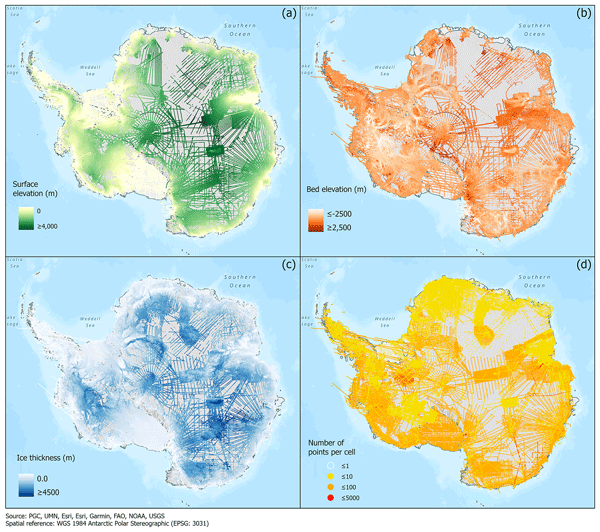
This paper presents the release of over 60 years of ice thickness, bed elevation, and surface elevation data acquired over Antarctica by the international community. These data are a crucial component of the Antarctic Bedmap initiative which aims to produce a new map and datasets of Antarctic ice thickness and bed topography for the international glaciology and geophysical community.
Ingalise Kindstedt, Andrew Johnson, Kristin M. Schild, Luke Copland, Christine Dow, Alison Criscitiello, Dominic Winski, Karl Kreutz, and Seth Campbell
EGUsphere, https://doi.org/10.5194/egusphere-2026-2431, https://doi.org/10.5194/egusphere-2026-2431, 2026
Short summary
Short summary
Mountain snow at high elevations is changing as warming causes more melting and water to linger within it. We use satellite radar images from 2015 to 2024 to track when melting starts and when snow refreezes across the Wrangell and St. Elias Mountains on the border of Alaska and Yukon. We find that melting now reaches nearly all elevations, and water often remains trapped well into fall. Only the highest areas stay fully dry, showing widespread impacts of warming on mountain snowpacks.
Steven Bernsen, Christopher Gerbi, Senthil Vel, Knut Christianson, and Seth Campbell
EGUsphere, https://doi.org/10.5194/egusphere-2026-1357, https://doi.org/10.5194/egusphere-2026-1357, 2026
Short summary
Short summary
We developed open-source software that simulates how elastic and electromagnetic waves travel through snow and ice with the aim to advance and make accessible ice and snow imaging methods. This helps researchers test survey designs and interpret field measurements without expensive or risky expeditions. Parameters influencing the mechanics of snow and ice are easily input from JSON files, and geometries can be generated using an image editor allowing for time effective production of models.
B. Ilyse Horlings, Annika N. Horlings, Kaitlin M. Keegan, Julia Marks Peterson, and Zoe Courville
EGUsphere, https://doi.org/10.5194/egusphere-2025-5040, https://doi.org/10.5194/egusphere-2025-5040, 2025
Short summary
Short summary
We investigate the spatial variation of firn microstructure between two cores from Allan Hills Blue Ice Area, Antarctica. Our data show differences in density and intricacy of the pore structure resulting from the presence or absence of wind crusts and faceted grains. Through modeling, we find that these differences are influenced by local variation of the surface slope and wind. Our findings show the importance of understanding firn microstructure across very low-accumulation regions.
Ingalise Kindstedt, Dominic Winski, C. Max Stevens, Emma Skelton, Luke Copland, Karl Kreutz, Mikaila Mannello, Renée Clavette, Jacob Holmes, Mary Albert, and Scott N. Williamson
The Cryosphere, 19, 3655–3680, https://doi.org/10.5194/tc-19-3655-2025, https://doi.org/10.5194/tc-19-3655-2025, 2025
Short summary
Short summary
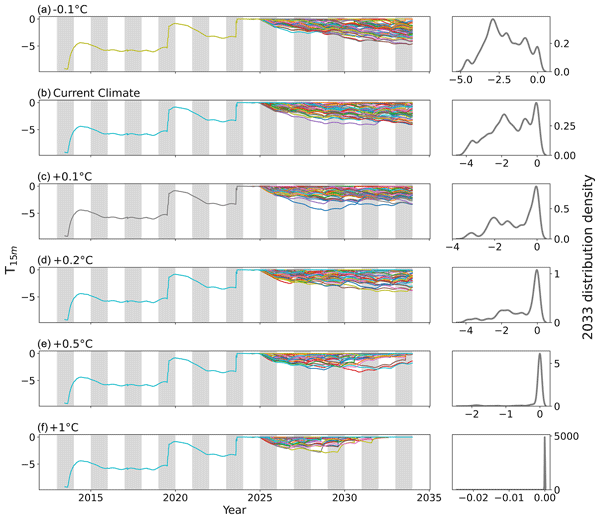
Atmospheric warming over mountain glaciers is leading to increased warming and melting of snow as it compresses into glacier ice. This affects both regional hydrology and climate records contained in the ice. Here we use field observations and modeling to show that surface melting and percolation at Eclipse Icefield (Yukon, Canada) are increasing with an increase in extreme melt events and that compressing snow at Eclipse is likely to continue warming even if air temperatures remain stable.
Joanne S. Johnson, John Woodward, Ian Nesbitt, Kate Winter, Seth Campbell, Keir A. Nichols, Ryan A. Venturelli, Scott Braddock, Brent M. Goehring, Brenda Hall, Dylan H. Rood, and Greg Balco
The Cryosphere, 19, 303–324, https://doi.org/10.5194/tc-19-303-2025, https://doi.org/10.5194/tc-19-303-2025, 2025
Short summary
Short summary
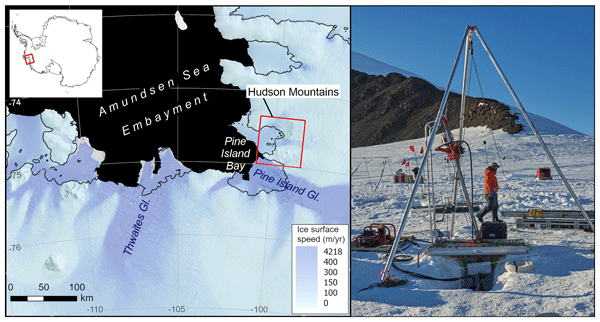
Determining where and when the Antarctic ice sheet was smaller than present requires recovery and exposure dating of subglacial bedrock. Here we use ice sheet model outputs and field data (geological and glaciological observations, bedrock samples, and ground-penetrating radar) to assess the suitability for subglacial drilling of sites in the Hudson Mountains, West Antarctica. We find that no sites are perfect, but two are feasible, with the most suitable being Winkie Nunatak (74.86°S, 99.77°W).
Elizabeth R. Thomas, Dieter Tetzner, Bradley Markle, Joel Pedro, Guisella Gacitúa, Dorothea Elisabeth Moser, and Sarah Jackson
Clim. Past, 20, 2525–2538, https://doi.org/10.5194/cp-20-2525-2024, https://doi.org/10.5194/cp-20-2525-2024, 2024
Short summary
Short summary
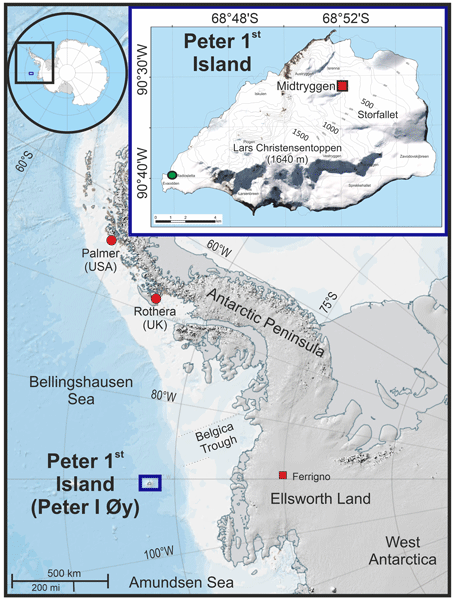
The chemical records contained in a 12 m firn (ice) core from Peter I Island, a remote sub-Antarctic island situated in the Pacific sector of the Southern Ocean (the Bellingshausen Sea), capture changes in snowfall and temperature (2002–2017 CE). This data-sparse region has experienced dramatic climate change in recent decades, including sea ice decline and ice loss from adjacent West Antarctic glaciers.
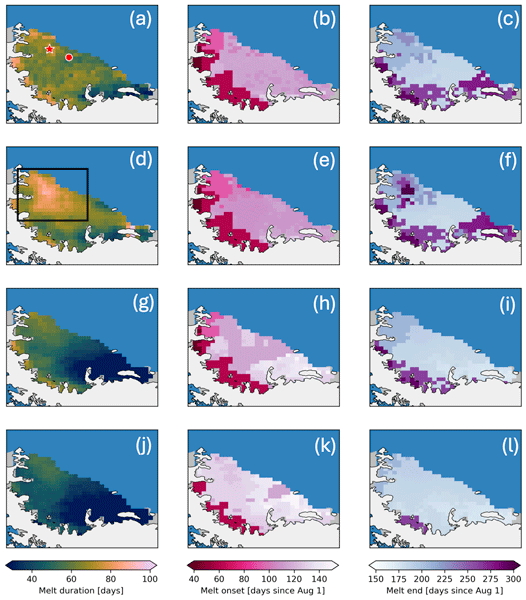
Marissa E. Dattler, Brooke Medley, and C. Max Stevens
The Cryosphere, 18, 3613–3631, https://doi.org/10.5194/tc-18-3613-2024, https://doi.org/10.5194/tc-18-3613-2024, 2024
Short summary
Short summary
We developed an algorithm based on combining models and satellite observations to identify the presence of surface melt on the Antarctic Ice Sheet. We find that this method works similarly to previous methods by assessing 13 sites and the Larsen C ice shelf. Unlike previous methods, this algorithm is based on physical parameters, and updates to this method could allow the meltwater present on the Antarctic Ice Sheet to be quantified instead of simply detected.
Megan Thompson-Munson, Jennifer E. Kay, and Bradley R. Markle
The Cryosphere, 18, 3333–3350, https://doi.org/10.5194/tc-18-3333-2024, https://doi.org/10.5194/tc-18-3333-2024, 2024
Short summary
Short summary
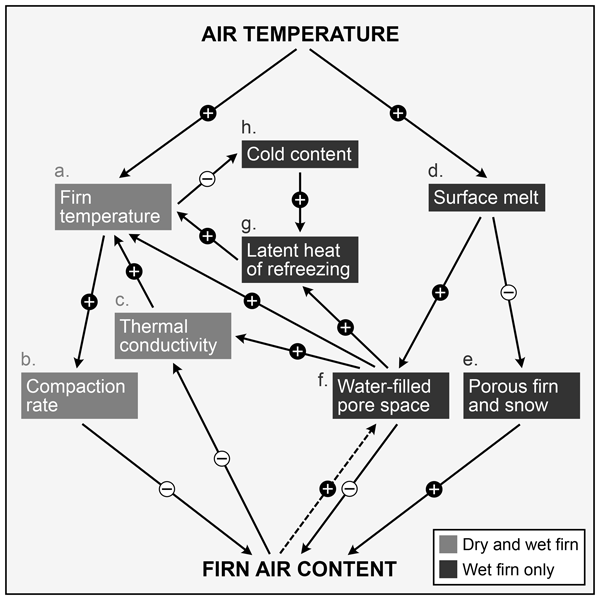
The upper layers of the Greenland Ice Sheet are absorbent and can store meltwater that would otherwise flow into the ocean and raise sea level. The amount of meltwater that the ice sheet can store changes when the air temperature changes. We use a model to show that warming and cooling have opposite but unequal effects. Warming has a stronger effect than cooling, which highlights the vulnerability of the Greenland Ice Sheet to modern climate change.
Ling Fang, Theo M. Jenk, Dominic Winski, Karl Kreutz, Hanna L. Brooks, Emma Erwin, Erich Osterberg, Seth Campbell, Cameron Wake, and Margit Schwikowski
The Cryosphere, 17, 4007–4020, https://doi.org/10.5194/tc-17-4007-2023, https://doi.org/10.5194/tc-17-4007-2023, 2023
Short summary
Short summary
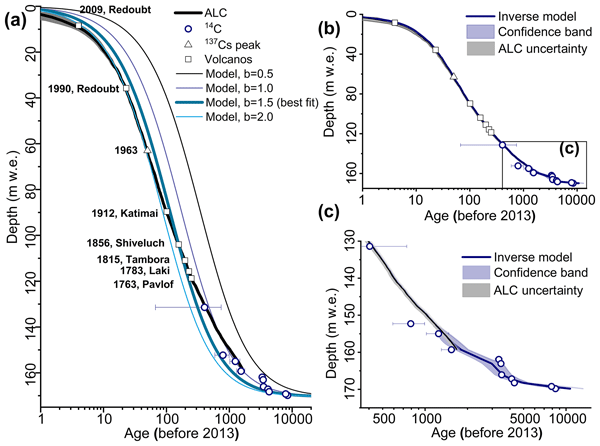
Understanding the behavior of ocean–atmosphere teleconnections in the North Pacific during warm intervals can aid in predicting future warming scenarios. However, majority ice core records from Alaska–Yukon region only provide data for the last few centuries. This study introduces a continuous chronology for Denali ice core from Begguya, Alaska, using multiple dating methods. The early-Holocene-origin Denali ice core will facilitate future investigations of hydroclimate in the North Pacific.
Alice C. Frémand, Peter Fretwell, Julien A. Bodart, Hamish D. Pritchard, Alan Aitken, Jonathan L. Bamber, Robin Bell, Cesidio Bianchi, Robert G. Bingham, Donald D. Blankenship, Gino Casassa, Ginny Catania, Knut Christianson, Howard Conway, Hugh F. J. Corr, Xiangbin Cui, Detlef Damaske, Volkmar Damm, Reinhard Drews, Graeme Eagles, Olaf Eisen, Hannes Eisermann, Fausto Ferraccioli, Elena Field, René Forsberg, Steven Franke, Shuji Fujita, Yonggyu Gim, Vikram Goel, Siva Prasad Gogineni, Jamin Greenbaum, Benjamin Hills, Richard C. A. Hindmarsh, Andrew O. Hoffman, Per Holmlund, Nicholas Holschuh, John W. Holt, Annika N. Horlings, Angelika Humbert, Robert W. Jacobel, Daniela Jansen, Adrian Jenkins, Wilfried Jokat, Tom Jordan, Edward King, Jack Kohler, William Krabill, Mette Kusk Gillespie, Kirsty Langley, Joohan Lee, German Leitchenkov, Carlton Leuschen, Bruce Luyendyk, Joseph MacGregor, Emma MacKie, Kenichi Matsuoka, Mathieu Morlighem, Jérémie Mouginot, Frank O. Nitsche, Yoshifumi Nogi, Ole A. Nost, John Paden, Frank Pattyn, Sergey V. Popov, Eric Rignot, David M. Rippin, Andrés Rivera, Jason Roberts, Neil Ross, Anotonia Ruppel, Dustin M. Schroeder, Martin J. Siegert, Andrew M. Smith, Daniel Steinhage, Michael Studinger, Bo Sun, Ignazio Tabacco, Kirsty Tinto, Stefano Urbini, David Vaughan, Brian C. Welch, Douglas S. Wilson, Duncan A. Young, and Achille Zirizzotti
Earth Syst. Sci. Data, 15, 2695–2710, https://doi.org/10.5194/essd-15-2695-2023, https://doi.org/10.5194/essd-15-2695-2023, 2023
Short summary
Short summary
This paper presents the release of over 60 years of ice thickness, bed elevation, and surface elevation data acquired over Antarctica by the international community. These data are a crucial component of the Antarctic Bedmap initiative which aims to produce a new map and datasets of Antarctic ice thickness and bed topography for the international glaciology and geophysical community.
Megan Thompson-Munson, Nander Wever, C. Max Stevens, Jan T. M. Lenaerts, and Brooke Medley
The Cryosphere, 17, 2185–2209, https://doi.org/10.5194/tc-17-2185-2023, https://doi.org/10.5194/tc-17-2185-2023, 2023
Short summary
Short summary
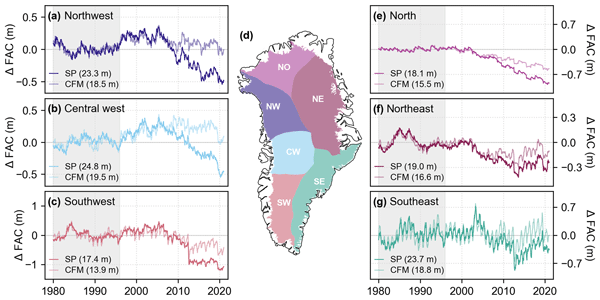
To better understand the Greenland Ice Sheet’s firn layer and its ability to buffer sea level rise by storing meltwater, we analyze firn density observations and output from two firn models. We find that both models, one physics-based and one semi-empirical, simulate realistic density and firn air content when compared to observations. The models differ in their representation of firn air content, highlighting the uncertainty in physical processes and the paucity of deep-firn measurements.
Greg Balco, Nathan Brown, Keir Nichols, Ryan A. Venturelli, Jonathan Adams, Scott Braddock, Seth Campbell, Brent Goehring, Joanne S. Johnson, Dylan H. Rood, Klaus Wilcken, Brenda Hall, and John Woodward
The Cryosphere, 17, 1787–1801, https://doi.org/10.5194/tc-17-1787-2023, https://doi.org/10.5194/tc-17-1787-2023, 2023
Short summary
Short summary
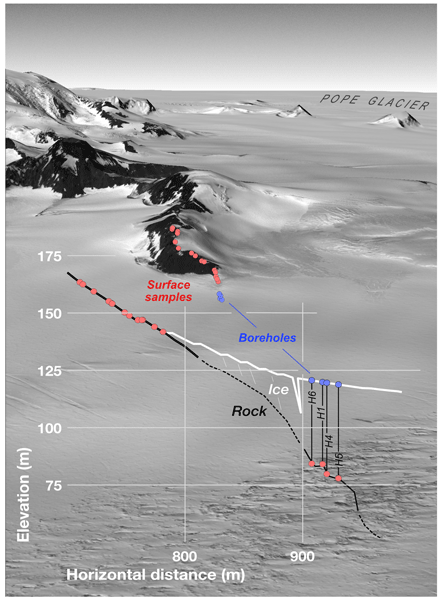
Samples of bedrock recovered from below the West Antarctic Ice Sheet show that part of the ice sheet was thinner several thousand years ago than it is now and subsequently thickened. This is important because of concern that present ice thinning in this region may lead to rapid, irreversible sea level rise. The past episode of thinning at this site that took place in a similar, although not identical, climate was not irreversible; however, reversal required at least 3000 years to complete.

Brooke Medley, Thomas A. Neumann, H. Jay Zwally, Benjamin E. Smith, and C. Max Stevens
The Cryosphere, 16, 3971–4011, https://doi.org/10.5194/tc-16-3971-2022, https://doi.org/10.5194/tc-16-3971-2022, 2022
Short summary
Short summary
Satellite altimeters measure the height or volume change over Earth's ice sheets, but in order to understand how that change translates into ice mass, we must account for various processes at the surface. Specifically, snowfall events generate large, transient increases in surface height, yet snow fall has a relatively low density, which means much of that height change is composed of air. This air signal must be removed from the observed height changes before we can assess ice mass change.
Ingalise Kindstedt, Kristin M. Schild, Dominic Winski, Karl Kreutz, Luke Copland, Seth Campbell, and Erin McConnell
The Cryosphere, 16, 3051–3070, https://doi.org/10.5194/tc-16-3051-2022, https://doi.org/10.5194/tc-16-3051-2022, 2022
Short summary
Short summary
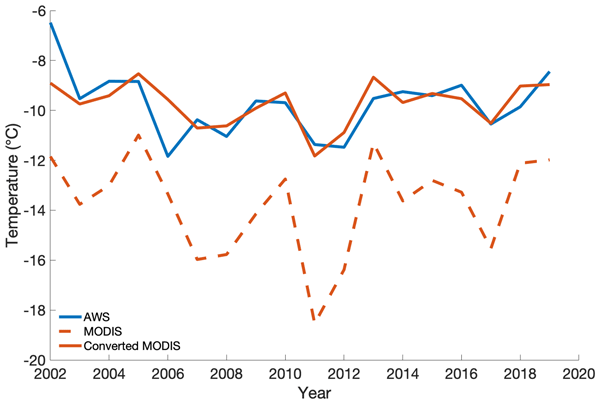
We show that neither the large spatial footprint of the MODIS sensor nor poorly constrained snow emissivity values explain the observed cold offset in MODIS land surface temperatures (LSTs) in the St. Elias. Instead, the offset is most prominent under conditions associated with near-surface temperature inversions. This work represents an advance in the application of MODIS LSTs to glaciated alpine regions, where we often depend solely on remote sensing products for temperature information.
Bradley R. Markle and Eric J. Steig
Clim. Past, 18, 1321–1368, https://doi.org/10.5194/cp-18-1321-2022, https://doi.org/10.5194/cp-18-1321-2022, 2022
Short summary
Short summary
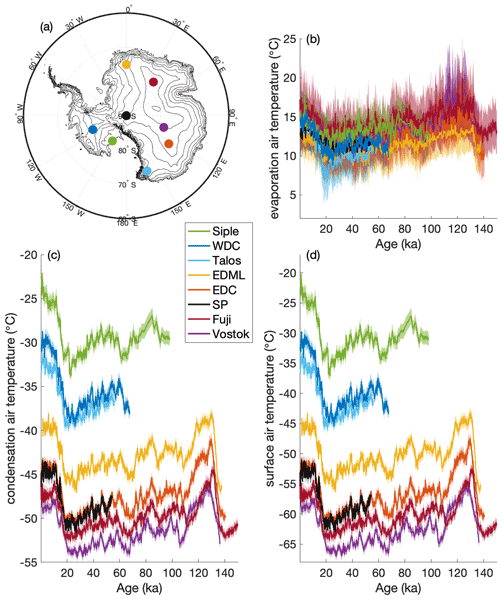
The geochemistry preserved in polar ice can provide detailed histories of Earth’s climate over millennia. Here we use the stable isotope ratios of ice from many Antarctic ice cores to reconstruct temperature variability of Antarctica and the midlatitude Southern Hemisphere over tens of thousands of years. We improve upon existing methods to estimate temperature from the geochemical measurements and investigate the patterns of climate change in the past.

Joanne S. Johnson, Ryan A. Venturelli, Greg Balco, Claire S. Allen, Scott Braddock, Seth Campbell, Brent M. Goehring, Brenda L. Hall, Peter D. Neff, Keir A. Nichols, Dylan H. Rood, Elizabeth R. Thomas, and John Woodward
The Cryosphere, 16, 1543–1562, https://doi.org/10.5194/tc-16-1543-2022, https://doi.org/10.5194/tc-16-1543-2022, 2022
Short summary
Short summary
Recent studies have suggested that some portions of the Antarctic Ice Sheet were less extensive than present in the last few thousand years. We discuss how past ice loss and regrowth during this time would leave its mark on geological and glaciological records and suggest ways in which future studies could detect such changes. Determining timing of ice loss and gain around Antarctica and conditions under which they occurred is critical for preparing for future climate-warming-induced changes.
Michael J. MacFerrin, C. Max Stevens, Baptiste Vandecrux, Edwin D. Waddington, and Waleed Abdalati
Earth Syst. Sci. Data, 14, 955–971, https://doi.org/10.5194/essd-14-955-2022, https://doi.org/10.5194/essd-14-955-2022, 2022
Short summary
Short summary
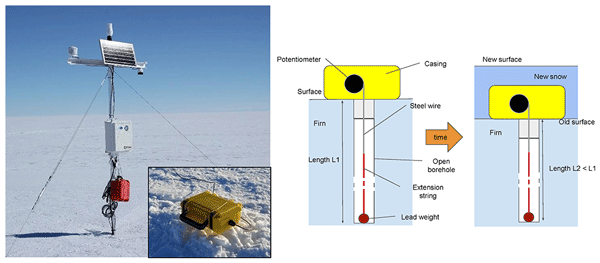
The vast majority of the Greenland ice sheet's surface is covered by pluriannual snow, also called firn, that accumulates year after year and is compressed into glacial ice. The thickness of the firn layer changes through time and responds to the surface climate. We present continuous measurement of the firn compaction at various depths for eight sites. The dataset will help to evaluate firn models, interpret ice cores, and convert remotely sensed ice sheet surface height change to mass loss.
Cited articles
Ashmore, D. W., Mair, D. W., and Burgess, D. O.: Meltwater percolation, impermeable layer formation and runoff buffering on Devon Ice Cap, Canada, J. Glaciol., 66, 61–73, https://doi.org/10.1017/jog.2019.80, 2020. a
Berthier, E., Larsen, C., Durkin, W. J., Willis, M. J., and Pritchard, M. E.: Brief communication: Unabated wastage of the Juneau and Stikine icefields (southeast Alaska) in the early 21st century, The Cryosphere, 12, 1523–1530, https://doi.org/10.5194/tc-12-1523-2018, 2018. a
Blaskey, D., Koch, J. C., Gooseff, M. N., Newman, A. J., Cheng, Y., O’Donnell, J. A., and Musselman, K. N.: Increasing Alaskan river discharge during the cold season is driven by recent warming, Environ. Res. Lett., 18, 024042, https://doi.org/10.1088/1748-9326/acb661, 2023. a
Bonnell, R., McGrath, D., Williams, K., Webb, R., Fassnacht, S. R., and Marshall, H.-P.: Spatiotemporal variations in liquid water content in a seasonal snowpack: implications for radar remote sensing, Remote Sens., 13, 4223, https://doi.org/10.3390/rs13214223, 2021. a
Clayton, W. S.: Measurement of unsaturated meltwater percolation flux in seasonal snowpack using self-potential, J. Glaciol., 68, 25–40, https://doi.org/10.1017/jog.2021.67, 2022. a
Clerx, N., Machguth, H., Tedstone, A., Jullien, N., Wever, N., Weingartner, R., and Roessler, O.: In situ measurements of meltwater flow through snow and firn in the accumulation zone of the SW Greenland Ice Sheet, The Cryosphere, 16, 4379–4401, https://doi.org/10.5194/tc-16-4379-2022, 2022. a
Colbeck, S.: Water flow through snow overlying an impermeable boundary, Water Resour. Res., 10, 119–123, https://doi.org/10.1029/WR010i001p00119, 1974. a, b
Coléou, C. and Lesaffre, B.: Irreducible water saturation in snow: experimental results in a cold laboratory, Ann. Glaciol., 26, 64–68, https://doi.org/10.3189/1998AoG26-1-64-68, 1998. a, b, c, d
Davies, B., Bendle, J., Carrivick, J., McNabb, R., McNeil, C., Pelto, M., Campbell, S., Holt, T., Ely, J., and Markle, B.: Topographic controls on ice flow and recession for Juneau Icefield (Alaska/British Columbia), Earth Surf. Proc. Land., 47, 2357–2390, https://doi.org/10.1002/esp.5383, 2022. a
Davies, B., McNabb, R., Bendle, J., Carrivick, J., Ely, J., Holt, T., Markle, B., McNeil, C., Nicholson, L., and Pelto, M.: Accelerating glacier volume loss on Juneau Icefield driven by hypsometry and melt-accelerating feedbacks, Nat. Commun., 15, 5099, https://doi.org/10.1038/s41467-024-49269-y, 2024. a, b, c, d, e
Forster, R. R., Box, J. E., Van Den Broeke, M. R., Miège, C., Burgess, E. W., Van Angelen, J. H., Lenaerts, J. T., Koenig, L. S., Paden, J., Lewis, C., Gogineni, S. P., Leuschen, C., and McConnell, J. R.: Extensive liquid meltwater storage in firn within the Greenland ice sheet, Nat. Geosci., 7, 95–98, https://doi.org/10.1038/ngeo2043, 2014. a, b, c
Fountain, A. G.: The storage of water in, and hydraulic characteristics of, the firn of South Cascade Glacier, Washington State, USA, Ann. Glaciol., 13, 69–75, https://doi.org/10.3189/S0260305500007667, 1989. a, b, c
Fountain, A. G.: Effect of snow and firn hydrology on the physical and chemical characteristics of glacial runoff, Hydrol. Process., 10, 509–521, https://doi.org/10.1002/(SICI)1099-1085(199604)10:4<509::AID-HYP389>3.0.CO;2-3, 1996. a, b
Fountain, A. G. and Walder, J. S.: Water flow through temperate glaciers, Rev. Geophys., 36, 299–328, https://doi.org/10.1029/97RG03579, 1998. a
Fox-Kemper, B., Hewitt, H., Xiao, C., et al.: Ocean, cryosphere and sea level change. Climate change 2021: the physical science basis. Contribution of Working Group I to the Sixth Assessment Report of the Intergovernmental Panel on Climate Change, Climate Change, https://doi.org/10.1017/9781009157896.011, 2021. a, b
Heilig, A., Mitterer, C., Schmid, L., Wever, N., Schweizer, J., Marshall, H.-P., and Eisen, O.: Seasonal and diurnal cycles of liquid water in snow – Measurements and modeling, J. Geophys. Res.-Earth Surf., 120, 2139–2154, https://doi.org/10.1002/2015JF003593, 2015. a
Heilig, A., Eisen, O., MacFerrin, M., Tedesco, M., and Fettweis, X.: Seasonal monitoring of melt and accumulation within the deep percolation zone of the Greenland Ice Sheet and comparison with simulations of regional climate modeling, The Cryosphere, 12, 1851–1866, https://doi.org/10.5194/tc-12-1851-2018, 2018. a
Hirashima, H., Avanzi, F., and Wever, N.: Wet-snow metamorphism drives the transition from preferential to matrix flow in snow, Geophys. Res. Lett., 46, 14548–14557, https://doi.org/10.1029/2019GL084152, 2019. a
Hock, R., Rasul, G., Adler, C., et al.: High mountain areas, in: IPCC special report on the ocean and cryosphere in a changing climate, 131–202, edited by: Pörtner, H.-O., Roberts, D. C., Masson-Delmotte, V., et al., Cambridge University Press Cambridge, UK, https://doi.org/10.1017/9781009157964, 2019. a, b
Horlings, A. N., Christianson, K., and Miège, C.: Expansion of firn aquifers in southeast Greenland, J. Geophys. Res.-Earth Surf., 127, e2022JF006753, https://doi.org/10.1029/2022JF006753, 2022. a
Horlings, A. N., Ruef, J., Stevens, C. M., Mannello, M. A., Bellamy, K., Wiggins, T., Markle, B., and Campbell, S.: Evolution of snow and firn on the Juneau Icefield, Alaska (2024), Arctic Data Center [data set], https://doi.org/10.18739/A2RX93G3P, 2025. a
Hugonnet, R., McNabb, R., Berthier, E., Menounos, B., Nuth, C., Girod, L., Farinotti, D., Huss, M., Dussaillant, I., Brun, F., and Kääb, A.: Accelerated global glacier mass loss in the early twenty-first century, Nature, 592, 726–731, https://doi.org/10.1038/s41586-021-03436-z, 2021. a
Humphrey, N. F., Harper, J. T., and Meierbachtol, T. W.: Physical limits to meltwater penetration in firn, J. Glaciol., 67, 952–960, https://doi.org/10.1017/jog.2021.44, 2021. a, b
Huss, M.: Density assumptions for converting geodetic glacier volume change to mass change, The Cryosphere, 7, 877–887, https://doi.org/10.5194/tc-7-877-2013, 2013. a
Jansson, P., Hock, R., and Schneider, T.: The concept of glacier storage: a review, J. Hydrol., 282, 116–129, https://doi.org/10.1016/S0022-1694(03)00258-0, 2003. a
Kindstedt, I., Winski, D., Stevens, C. M., Skelton, E., Copland, L., Kreutz, K., Mannello, M., Clavette, R., Holmes, J., Albert, M., and Williamson, S. N.: Ongoing firn warming at Eclipse Icefield, Yukon, indicates potential widespread meltwater percolation and retention in firn pack across the St. Elias Range, The Cryosphere, 19, 3655–3680, https://doi.org/10.5194/tc-19-3655-2025, 2025. a, b, c, d, e, f, g, h
Koenig, L. S., Miège, C., Forster, R. R., and Brucker, L.: Initial in situ measurements of perennial meltwater storage in the Greenland firn aquifer, Geophys. Res. Lett., 41, 81–85, https://doi.org/10.1002/2013GL058083, 2014. a
Kuipers Munneke, P., Ligtenberg, S. R. M., Noël, B. P. Y., Howat, I. M., Box, J. E., Mosley-Thompson, E., McConnell, J. R., Steffen, K., Harper, J. T., Das, S. B., and van den Broeke, M. R.: Elevation change of the Greenland Ice Sheet due to surface mass balance and firn processes, 1960–2014, The Cryosphere, 9, 2009–2025, https://doi.org/10.5194/tc-9-2009-2015, 2015. a, b, c, d
Lader, R., Bidlack, A., Walsh, J. E., Bhatt, U. S., and Bieniek, P. A.: Dynamical downscaling for southeast Alaska: Historical climate and future projections, J. Appl. Meteorol. Climatol., 59, 1607–1623, https://doi.org/10.1175/JAMC-D-20-0076.1, 2020. a, b, c
Larsen, C., Burgess, E., Arendt, A., O'neel, S., Johnson, A., and Kienholz, C.: Surface melt dominates Alaska glacier mass balance, Geophys. Res. Lett., 42, 5902–5908, https://doi.org/10.1002/2015GL064349, 2015. a, b
Machguth, H., MacFerrin, M., van As, D., Box, J. E., Charalampidis, C., Colgan, W., Fausto, R. S., Meijer, H. A., Mosley-Thompson, E., and van de Wal, R. S.: Greenland meltwater storage in firn limited by near-surface ice formation, Nat. Clim. Change, 6, 390–393, https://doi.org/10.1038/nclimate2899, 2016. a, b, c
Machguth, H., Tedstone, A. J., and Mattea, E.: Daily variations in Western Greenland slush limits, 2000–2021, J. Glaciol., 69, 191–203, https://doi.org/10.1017/jog.2022.65, 2023. a
Mannello, M.: Spatial and Temporal Variability in Snow Properties and Firn Volume Across the Juneau Icefield in Southeast Alaska, master's thesis, The University of Maine, https://www.proquest.com/dissertations-theses/spatial-temporal-variability-snow-properties-firn/docview/3098795204/se-2 (last access: 5 June 2026), 2023. a, b, c, d
McDowell, I. E., Keegan, K. M., Wever, N., Osterberg, E. C., Hawley, R. L., and Marshall, H.-P.: Firn Core Evidence of Two-Way Feedback Mechanisms Between Meltwater Infiltration and Firn Microstructure From the Western Percolation Zone of the Greenland Ice Sheet, J. Geophys. Res.-Earth Surf., 128, e2022JF006752, https://doi.org/10.1029/2022JF006752, 2023. a
McNeil, C., O'Neel, S., Loso, M., Pelto, M., Sass, L., Baker, E. H., and Campbell, S.: Explaining mass balance and retreat dichotomies at Taku and Lemon Creek Glaciers, Alaska, J. Glaciol., 66, 530–542, https://doi.org/10.1017/jog.2020.22, 2020. a, b, c
Medley, B., Neumann, T. A., Zwally, H. J., Smith, B. E., and Stevens, C. M.: Simulations of firn processes over the Greenland and Antarctic ice sheets: 1980–2021, The Cryosphere, 16, 3971–4011, https://doi.org/10.5194/tc-16-3971-2022, 2022. a
Miller, O., Solomon, D. K., Miège, C., Koenig, L., Forster, R., Schmerr, N., Ligtenberg, S. R., Legchenko, A., Voss, C. I., Montgomery, L., and McConnell, J. R.: Hydrology of a perennial firn aquifer in Southeast Greenland: an overview driven by field data, Water Resour. Res., 56, e2019WR026348, https://doi.org/10.1029/2019WR026348, 2020. a, b, c
Moser, D. E., Thomas, E. R., Nehrbass-Ahles, C., Eichler, A., and Wolff, E.: Review article: Melt-affected ice cores for polar research in a warming world, The Cryosphere, 18, 2691–2718, https://doi.org/10.5194/tc-18-2691-2024, 2024. a
Noël, B., Van De Berg, W. J., Lhermitte, S., Wouters, B., Schaffer, N., and van den Broeke, M. R.: Six decades of glacial mass loss in the Canadian Arctic Archipelago, J. Geophys. Res.-Earth Surf., 123, 1430–1449, https://doi.org/10.1029/2017JF004304, 2018. a
Noël, B., Jakobs, C. L., Van Pelt, W., Lhermitte, S., Wouters, B., Kohler, J., Hagen, J. O., Luks, B., Reijmer, C., Van de Berg, W. J., and van den Broeke, M. R.: Low elevation of Svalbard glaciers drives high mass loss variability, Nat. Commun., 11, 4597, https://doi.org/10.1038/s41467-020-18356-1, 2020. a
Ochwat, N. E., Marshall, S. J., Moorman, B. J., Criscitiello, A. S., and Copland, L.: Evolution of the firn pack of Kaskawulsh Glacier, Yukon: meltwater effects, densification, and the development of a perennial firn aquifer, The Cryosphere, 15, 2021–2040, https://doi.org/10.5194/tc-15-2021-2021, 2021. a, b, c, d, e
Oerter, H. and Rauert, W.: Core drilling on Vernagtferner (Oetztal Alps, Austria) in 1979: tritium contents, Zeitschrift für Gletscherkunde und Glazialgeologie, 1, 13–22, 1982. a
Pelto, M.: Exceptionally high 2018 equilibrium line altitude on Taku Glacier, Alaska, Remote Sens., 11, 2378, https://doi.org/10.3390/rs11202378, 2019. a
Pelto, M., Kavanaugh, J., and McNeil, C.: Juneau Icefield Mass Balance Program 1946–2011, Earth Syst. Sci. Data, 5, 319–330, https://doi.org/10.5194/essd-5-319-2013, 2013. a, b
Poinar, K., Joughin, I., Lilien, D., Brucker, L., Kehrl, L., and Nowicki, S.: Drainage of Southeast Greenland firn aquifer water through crevasses to the bed, Front. Earth Sci., 5, 5, https://doi.org/10.3389/feart.2017.00005, 2017. a, b
RGI Consortium: Randolph Glacier Inventory – A Dataset of Global Glacier Outlines (NSIDC-0770, Version 7), Boulder, Colorado USA, NASA National Snow and Ice Data Center Distributed Active Archive Center [data set], https://doi.org/10.5067/F6JMOVY5NAVZ, 2023. a
Saha, S., Moorthi, S., Pan, H.-L., Wu, X., Wang, J., Nadiga, S., Tripp, P., Kistler, R., Woollen, J., Behringer, D., Liu, H., Stokes, D., Grumbine, R., Gayno, G., Wang, J., Hou, Y.-T., Chuang, H.-y., Juang, H.-M. H., Sela, J., Iredell, M., Treadon, R., Kleist, D., Van Delst, P., Keyser, D., Derber, J., Ek, M., Meng, J., Wei, H., Yang, R., Lord, S., van den Dool, H., Kumar, A., Wang, W., Long, C., Chelliah, M., Xue, Y., Huang, B., Schemm, J.-K., Ebisuzaki, W., Lin, R., Xie, P., Chen, M., Zhou, S., Higgins, W., Zou, C.-Z., Liu, Q., Chen, Y., Han, Y., Cucurull, L., Reynolds, R. W., Rutledge, G., and Goldberg, M.: The NCEP climate forecast system reanalysis, B. Am. Meteorol. Soc., 91, 1015–1058, https://doi.org/10.1175/2010BAMS3001.1, 2010. a
Schneider, T.: Water movement in the firn of Storglaciären, Sweden, J. Glaciol., 45, 286–294, https://doi.org/10.3189/S0022143000001787, 1999. a
Schneider, T. and Jansson, P.: Internal accumulation in firn and its significance for the mass balance of Storglaciären, Sweden, J. Glaciol., 50, 25–34, https://doi.org/10.3189/172756504781830277, 2004. a, b
Shadab, M. A., Adhikari, S., Rutishauser, A., Grima, C., and Hesse, M. A.: A mechanism for ice layer formation in glacial firn, Geophys. Res. Lett., 51, e2024GL109893, https://doi.org/10.1029/2024GL109893, 2024. a
Stevens, C. M., Verjans, V., Lundin, J. M. D., Kahle, E. C., Horlings, A. N., Horlings, B. I., and Waddington, E. D.: The Community Firn Model (CFM) v1.0, Geosci. Model Dev., 13, 4355–4377, https://doi.org/10.5194/gmd-13-4355-2020, 2020 (code available at: https://github.com/UWGlaciology/CommunityFirnModel, last access: ). a, b, c, d
Techel, F. and Pielmeier, C.: Point observations of liquid water content in wet snow – investigating methodical, spatial and temporal aspects, The Cryosphere, 5, 405–418, https://doi.org/10.5194/tc-5-405-2011, 2011. a
The Firn Symposium Team: Firn on ice sheets, Nat. Rev. Earth Environ., 5, 79–99, https://doi.org/10.1038/s43017-023-00507-9, 2024. a, b, c, d
The GLAMBIE Team: Community estimate of global glacier mass changes from 2000 to 2023, Nature, 639, 382–388, https://doi.org/10.1038/s41586-024-08545-z, 2025. a, b
Thompson-Munson, M., Kay, J. E., and Markle, B. R.: Greenland's firn responds more to warming than to cooling, The Cryosphere, 18, 3333–3350, https://doi.org/10.5194/tc-18-3333-2024, 2024. a
Vandecrux, B., Mottram, R., Langen, P. L., Fausto, R. S., Olesen, M., Stevens, C. M., Verjans, V., Leeson, A., Ligtenberg, S., Kuipers Munneke, P., Marchenko, S., van Pelt, W., Meyer, C. R., Simonsen, S. B., Heilig, A., Samimi, S., Marshall, S., Machguth, H., MacFerrin, M., Niwano, M., Miller, O., Voss, C. I., and Box, J. E.: The firn meltwater Retention Model Intercomparison Project (RetMIP): evaluation of nine firn models at four weather station sites on the Greenland ice sheet, The Cryosphere, 14, 3785–3810, https://doi.org/10.5194/tc-14-3785-2020, 2020. a, b, c, d
Verjans, V., Leeson, A. A., Stevens, C. M., MacFerrin, M., Noël, B., and van den Broeke, M. R.: Development of physically based liquid water schemes for Greenland firn-densification models, The Cryosphere, 13, 1819–1842, https://doi.org/10.5194/tc-13-1819-2019, 2019. a
Webb, R., Jennings, K., Fend, M., and Molotch, N.: Combining ground-penetrating radar with terrestrial LiDAR scanning to estimate the spatial distribution of liquid water content in seasonal snowpacks, Water Resour. Res., 54, 10–339, https://doi.org/10.1029/2018WR022680, 2018. a
Webb, R. W., Marziliano, A., McGrath, D., Bonnell, R., Meehan, T. G., Vuyovich, C., and Marshall, H.-P.: In situ determination of dry and wet snow permittivity: Improving equations for low frequency radar applications, Remote Sens., 13, 4617, https://doi.org/10.3390/rs13224617, 2021. a, b
Winski, D., Osterberg, E., Kreutz, K., Wake, C., Ferris, D., Campbell, S., Baum, M., Bailey, A., Birkel, S., Introne, D., and Handley, M.: A 400-year ice core melt layer record of summertime warming in the Alaska Range, J. Geophys. Res.-Atmos., 123, 3594–3611, https://doi.org/10.1002/2017JD027539, 2018. a
Young, J. C., Pettit, E., Arendt, A., Hood, E., Liston, G. E., and Beamer, J.: A changing hydrological regime: Trends in magnitude and timing of glacier ice melt and glacier runoff in a high latitude coastal watershed, Water Resour. Res., 57, e2020WR027404, https://doi.org/10.1029/2020WR027404, 2021. a
Ziemen, F. A., Hock, R., Aschwanden, A., Khroulev, C., Kienholz, C., Melkonian, A., and Zhang, J.: Modeling the evolution of the Juneau Icefield between 1971 and 2100 using the Parallel Ice Sheet Model (PISM), J. Glaciol., 62, 199–214, https://doi.org/10.1017/jog.2016.13, 2016. a
Short summary
Firn, the permeable and porous material through which snow compacts into glacier ice, plays an important role in glacier hydrology, mass balance, and dynamics. We investigated seasonal to decadal evolution of firn on the Juneau Icefield using field measurements and firn modeling, and found that the firn is thinning and warming. Our study offers insights into consequent changes in firn hydrology, including declining refreezing capacity and inter-seasonal shifts in liquid-water retention.
Firn, the permeable and porous material through which snow compacts into glacier ice, plays an...


