
Articles | Volume 20, issue 7
https://doi.org/10.5194/tc-20-4017-2026
© Author(s) 2026. This work is distributed under
the Creative Commons Attribution 4.0 License.
the Creative Commons Attribution 4.0 License.
https://doi.org/10.5194/tc-20-4017-2026
© Author(s) 2026. This work is distributed under
the Creative Commons Attribution 4.0 License.
the Creative Commons Attribution 4.0 License.
Research article
| 
21 Jul 2026
Research article |
| 21 Jul 2026
| 21 Jul 2026
Investigating the drivers of wintertime Southern Ocean sea-ice leads using random forest algorithms

Department of Environmental Meteorology, Trier University, Trier, Germany
Department of Environmental Meteorology, Trier University, Trier, Germany
Günther Heinemann
Department of Environmental Meteorology, Trier University, Trier, Germany
Related authors
Umesh Dubey, Sascha Willmes, and Günther Heinemann
The Cryosphere, 19, 3535–3552, https://doi.org/10.5194/tc-19-3535-2025, https://doi.org/10.5194/tc-19-3535-2025, 2025
Short summary
Short summary
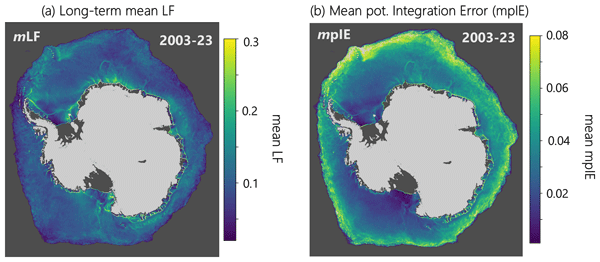
Sea-ice leads facilitate the exchange of heat and moisture between the ocean and the atmosphere during wintertime. We present a new dataset on monthly wintertime sea-ice leads in the Southern Ocean from 2003 to 2023. Our study reveals distinct regional patterns, seasonal variability, and small but significant trends. Here, we present initial findings on Southern Ocean lead dynamics to support future research into the complex pan-Antarctic interactions among sea ice, ocean, and atmosphere.
Umesh Dubey, Sascha Willmes, and Günther Heinemann
The Cryosphere, 19, 3535–3552, https://doi.org/10.5194/tc-19-3535-2025, https://doi.org/10.5194/tc-19-3535-2025, 2025
Short summary
Short summary
Sea-ice leads facilitate the exchange of heat and moisture between the ocean and the atmosphere during wintertime. We present a new dataset on monthly wintertime sea-ice leads in the Southern Ocean from 2003 to 2023. Our study reveals distinct regional patterns, seasonal variability, and small but significant trends. Here, we present initial findings on Southern Ocean lead dynamics to support future research into the complex pan-Antarctic interactions among sea ice, ocean, and atmosphere.
Vanessa Teske, Ralph Timmermann, Cara Nissen, Rolf Zentek, Tido Semmler, and Günther Heinemann
Ocean Sci., 21, 1205–1221, https://doi.org/10.5194/os-21-1205-2025, https://doi.org/10.5194/os-21-1205-2025, 2025
Short summary
Short summary
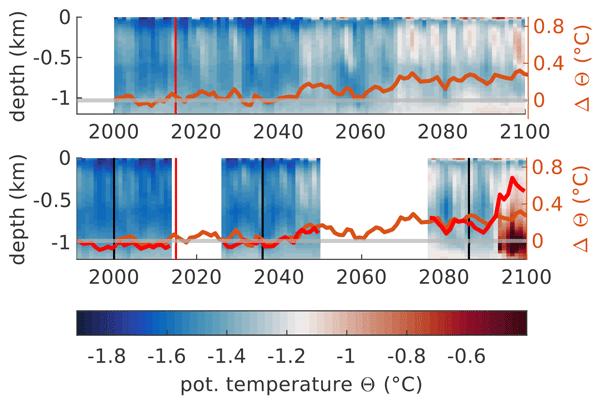
We investigate the structural changes the Antarctic Slope Front in the southern Weddell Sea experiences in a warming climate by conducting two ocean simulations driven by atmospheric data of different horizontal resolutions. Cross-slope currents associated with a regime shift from a cold to a warm Filchner Trough on the continental shelf temporarily disturb the structure of the slope front and reduce its depth, but the primary reason for a regime shift is the cross-slope density gradient.
Luisa von Albedyll, Stefan Hendricks, Nils Hutter, Dmitrii Murashkin, Lars Kaleschke, Sascha Willmes, Linda Thielke, Xiangshan Tian-Kunze, Gunnar Spreen, and Christian Haas
The Cryosphere, 18, 1259–1285, https://doi.org/10.5194/tc-18-1259-2024, https://doi.org/10.5194/tc-18-1259-2024, 2024
Short summary
Short summary
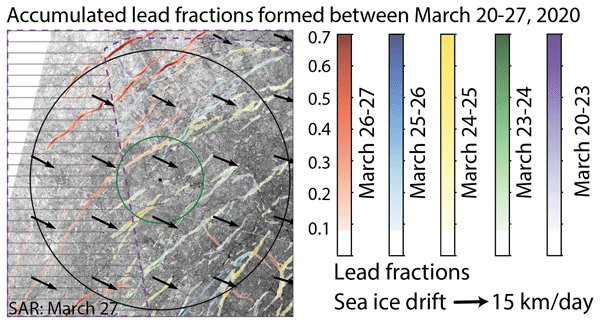
Leads (openings in sea ice cover) are created by sea ice dynamics. Because they are important for many processes in the Arctic winter climate, we aim to detect them with satellites. We present two new techniques to detect lead widths of a few hundred meters at high spatial resolution (700 m) and independent of clouds or sun illumination. We use the MOSAiC drift 2019–2020 in the Arctic for our case study and compare our new products to other existing lead products.
Lukrecia Stulic, Ralph Timmermann, Stephan Paul, Rolf Zentek, Günther Heinemann, and Torsten Kanzow
Ocean Sci., 19, 1791–1808, https://doi.org/10.5194/os-19-1791-2023, https://doi.org/10.5194/os-19-1791-2023, 2023
Short summary
Short summary
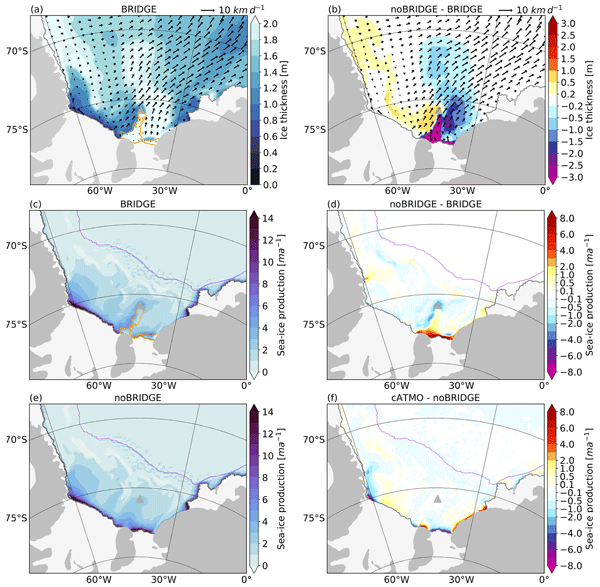
In the southern Weddell Sea, the strong sea ice growth in coastal polynyas drives formation of dense shelf water. By using a sea ice–ice shelf–ocean model with representation of the changing icescape based on satellite data, we find that polynya sea ice growth depends on both the regional atmospheric forcing and the icescape. Not just strength but also location of the sea ice growth in polynyas affects properties of the dense shelf water and the basal melting of the Filchner–Ronne Ice Shelf.
Sascha Willmes, Günther Heinemann, and Frank Schnaase
The Cryosphere, 17, 3291–3308, https://doi.org/10.5194/tc-17-3291-2023, https://doi.org/10.5194/tc-17-3291-2023, 2023
Short summary
Short summary
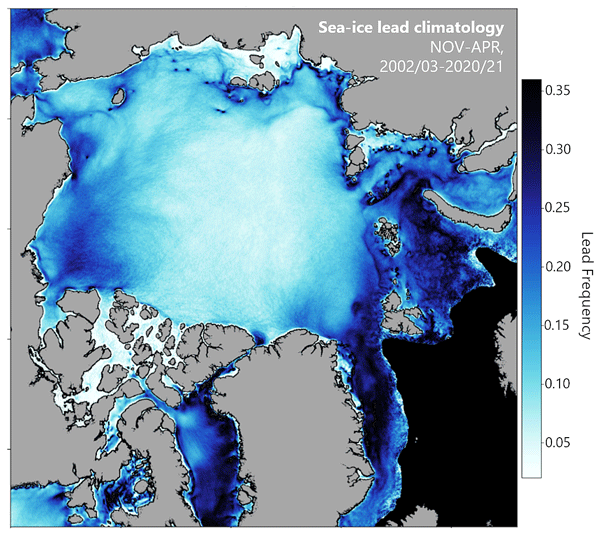
Sea ice is an important constituent of the global climate system. We here use satellite data to identify regions in the Arctic where the sea ice breaks up in so-called leads (i.e., linear cracks) regularly during winter. This information is important because leads determine, e.g., how much heat is exchanged between the ocean and the atmosphere. We here provide first insights into the reasons for the observed patterns in sea-ice leads and their relation to ocean currents and winds.
Cited articles
Alam, A. and Curry, J. A.: Determination of surface turbulent fluxes over leads in Arctic sea ice, J. Geophys. Res. 102, 3851–3860, https://doi.org/10.1029/96JC03606, 1997. a
Biau, G.: Analysis of a random forests model, J. Mach. Learn. Res., 13, 1063–1095, 2012. a
Blanchard-Wrigglesworth, E., Roach, L. A., Donohoe, A., and Ding, Q.: Impact of winds and Southern Ocean SSTs on Antarctic sea ice trends and variability, J. Climate, 34, 949–965, https://doi.org/10.1175/JCLI-D-20-0386.1, 2021. a
Breiman, L.: Random Forests, Mach. Learn., 45, 5–32, https://doi.org/10.1023/a:1010933404324, 2001. a, b, c
Cheon, W. G., Park, Y.-G., Toggweiler, J. R., and Lee, S.-K.: The relationship of Weddell Polynya and open-ocean deep convection to the Southern Hemisphere westerlies, J. Phys. Oceanogr., 44, 694–713, https://doi.org/10.1175/JPO-D-13-0112.1, 2014. a
Chi, J. and Kim, H.-c.: Prediction of Arctic Sea Ice Concentration Using a Fully Data Driven Deep Neural Network, Remote Sensing, 9, 1305, https://doi.org/10.3390/rs9121305, 2017. a
Curry, J. A., Schramm, J. L., and Ebert, E. E.: Sea Ice-Albedo Climate Feedback Mechanism, J. Climate, 8, 240–247, https://doi.org/10.1175/1520-0442(1995)008<0240:siacfm>2.0.co;2, 1995. a
Damm, E., Helmke, E., Thoms, S., Schauer, U., Nöthig, E., Bakker, K., and Kiene, R. P.: Methane production in aerobic oligotrophic surface water in the central Arctic Ocean, Biogeosciences, 7, 1099–1108, https://doi.org/10.5194/bg-7-1099-2010, 2010. a
Dubey, U., Willmes, S., and Heinemann, G.: AntLeads: Monthly wintertime sea-ice lead maps for the Antarctic, April–September, 2003–2023, PANGAEA [data set], https://doi.org/10.1594/PANGAEA.977634, 2025b. a, b
Fraser, A. D., Massom, R. A., Ohshima, K. I., Willmes, S., Kappes, P. J., Cartwright, J., and Porter-Smith, R.: High-resolution mapping of circum-Antarctic landfast sea ice distribution, 2000–2018, Earth Syst. Sci. Data, 12, 2987–2999, https://doi.org/10.5194/essd-12-2987-2020, 2020. a
Fraser, A. D., Massom, R. A., Handcock, M. S., Reid, P., Ohshima, K. I., Raphael, M. N., Cartwright, J., Klekociuk, A. R., Wang, Z., and Porter-Smith, R.: Eighteen-year record of circum-Antarctic landfast-sea-ice distribution allows detailed baseline characterisation and reveals trends and variability, The Cryosphere, 15, 5061–5077, https://doi.org/10.5194/tc-15-5061-2021, 2021. a
Golledge, N. R., Keller, E. D., Gossart, A., Malyarenko, A., Bahamondes-Dominguez, A., Krapp, M., Jendersie, S., Lowry, D. P., Alevropoulos-Borrill, A., and Notz, D.: Antarctic coastal polynyas in the global climate system, Nat. Rev. Earth Environ., 6, 126–139, https://doi.org/10.1038/s43017-024-00634-x, 2025. a
Hall, A. and Visbeck, M.: Synchronous variability in the Southern Hemisphere atmosphere, sea ice, and ocean resulting from the annular mode, J. Climate, 15, 3043–3057, https://doi.org/10.1175/1520-0442(2002)015<3043:SVITSH>2.0.CO;2, 2002. a
Haumann, F. A., Moorman, R., Riser, S. C., Sallée, J.-B., and Sarmiento, J. L.: Sea-ice transport driving Southern Ocean salinity and its recent trends, Nature, 537, 89–92, https://doi.org/10.1038/nature19101, 2016. a
Heil, P. and Allison, I.: The pattern and variability of Antarctic sea-ice drift in the Indian Ocean and western Pacific sectors, J. Geophys. Res., 104, 15789–15802, https://doi.org/10.1029/1999JC900076, 1999. a
Heinemann, G., Schefczyk, L., Willmes, S., and Shupe, M. D.: Evaluation of simulations of near-surface variables using the regional climate model CCLM for the MOSAiC winter period, Elementa: Science of the Anthropocene, 10, https://doi.org/10.1525/elementa.2022.00033, 2022. a
Hersbach, H., Bell, B., Berrisford, P., Hirahara, S., Horányi, A., Muñoz-Sabater, J., Nicolas, J., Peubey, C., Radu, R., Schepers, D., Simmons, A., Soci, C., Abdalla, S., Abellan, X., Balsamo, G., Bechtold, P., Biavati, G., Bidlot, J., Bonavita, M., De Chiara, G., Dahlgren, P., Dee, D., Diamantakis, M., Dragani, R., Flemming, J., Forbes, R., Fuentes, M., Geer, A., Haimberger, L., Healy, S., Hogan, R. J., Hólm, E., Janisková, M., Keeley, S., Laloyaux, P., Lopez, P., Lupu, C., Radnoti, G., de Rosnay, P., Rozum, I., Vamborg, F., Villaume, S., and Thépaut, J.-N.: The ERA5 global reanalysis, Q. J. Roy. Meteor. Soc., 146, 1999–2049, https://doi.org/10.1002/qj.3803, 2020. a, b, c
Hobbs, W. R., Massom, R., Stammerjohn, S., Reid, P., Williams, G., and Meier, W.: A review of recent changes in Southern Ocean sea ice, their drivers and forcings, Global Planet. Change, 143, 228–250, https://doi.org/10.1016/j.gloplacha.2016.06.008, 2016. a
Hoeber, H.: Sea-ice dynamics in the Weddell Sea in winter, Ann. Glaciol., 15, 9–16, https://doi.org/10.3189/1991aog15-1-9-16, 1991. a
Holland, P. R. and Kwok, R.: Wind-driven trends in Antarctic sea-ice drift, Nat. Geosci., 5, 872–875, https://doi.org/10.1038/ngeo1627, 2012. a, b, c
Hutchings, J. K., Roberts, A., Geiger, C. A., and Richter-Menge, J.: Spatial and temporal characterization of sea-ice deformation, Ann. Glaciol., 52, 360–368, https://doi.org/10.3189/172756411795931769, 2011. a, b
Key, J., Stone, R., Maslanik, J., and Ellefsen, E.: The detectability of sea-ice leads in satellite data as a function of atmospheric conditions and measurement scale, Ann. Glaciol., 17, 227–232, https://doi.org/10.3189/s026030550001288x, 1993. a
Kimura, N. and Wakatsuchi, M.: Relationship between sea‐ice motion and geostrophic wind in the northern hemisphere, Geophys. Res. Lett., 27, 3735–3738, https://doi.org/10.1029/2000gl011495, 2000. a, b
Kort, E. A., Wofsy, S. C., Daube, B. C., Diao, M., Elkins, J. W., Gao, R. S., Hintsa, E. J., Hurst, D. F., Jimenez, R., Moore, F. L., Spackman, J. R., and Zondlo, M. A.: Atmospheric observations of Arctic Ocean methane emissions up to 82° north, Nat. Geosci., 5, 318–321, https://doi.org/10.1038/ngeo1452, 2012. a
Leng, H., He, H., Chen, D., Lin, P., Yang, Y., and Wang, Z.: Bathymetry-constrained ocean geostrophic currents play a key role in shaping the sea ice circulation in the Canada Basin, Arctic Ocean, Environ. Res. Lett., 19, 094040, https://doi.org/10.1088/1748-9326/ad6baa, 2024. a, b
Lüpkes, C., Vihma, T., Birnbaum, G., and Wacker, U.: Influence of leads in sea ice on the temperature of the atmospheric boundary layer during polar lows: observational and model results, J. Geophys. Res. 113, D03 104, https://doi.org/10.1029/2007GL032461, 2008. a
Marcq, S. and Weiss, J.: Influence of sea ice lead-width distribution on turbulent heat transfer between the ocean and the atmosphere, The Cryosphere, 6, 143–156, https://doi.org/10.5194/tc-6-143-2012, 2012. a
Mathiot, P., Jourdain, N. C., Barnier, B., Gallée, H., Molines, J. M., Le Sommer, J., and Penduff, T.: Sensitivity of coastal polynyas and high-salinity shelf water production in the Ross Sea, Antarctica, to the atmospheric forcing, Ocean Dynam., 62, 701–723, https://doi.org/10.1007/s10236-012-0531-y, 2012. a, b
Meehl, G. A., Arblaster, J. M., Chung, C. T. Y., Holland, M. M., DuVivier, A., Thompson, L., Yang, D., and Bitz, C. M.: Sustained ocean changes contributed to sudden Antarctic sea ice retreat in late 2016, Nat. Commun., 10, 14, https://doi.org/10.1038/s41467-018-07865-9, 2019. a
Morales Maqueda, M. A., Willmott, A. J., and Biggs, N. R. T.: Polynya dynamics: a review of observations and modeling, Rev. Geophys., 42, RG1004, https://doi.org/10.1029/2002RG000116, 2004. a
Nihashi, S. and Cavalieri, D. J.: Observational evidence of a hemispheric‐wide ice–ocean albedo feedback effect on Antarctic sea‐ice decay, J. Geophys. Res.-Oceans, 111, https://doi.org/10.1029/2005jc003447, 2006. a
Ohshima, K. I., Fukamachi, Y., Williams, G. D., Nihashi, S., Roquet, F., Kitade, Y., Tamura, T., Hirano, D., Herraiz-Borreguero, L., Field, I., Hindell, M., Aoki, S., and Wakatsuchi, M.: Antarctic Bottom Water production by intense sea-ice formation in the Cape Darnley polynya, Nat. Geosci., 6, 235–240, https://doi.org/10.1038/ngeo1738, 2013. a
Palerme, C. and Müller, M.: Calibration of sea ice drift forecasts using random forest algorithms, The Cryosphere, 15, 3989–4004, https://doi.org/10.5194/tc-15-3989-2021, 2021. a
Pedregosa, F., Varoquaux, G., Gramfort, A., Michel, V., Thirion, B., Grisel, O., Blondel, M., Prettenhofer, P., Weiss, R., Dubourg, V., Vanderplas, J., Passos, A., Cournapeau, D., Brucher, M., Perrot, M., and Duchesnay, E.: Scikit-learn: Machine Learning in Python, J. Mach. Learn. Res., 12, 2825–2830, 2011. a
Reiser, F., Willmes, S., Hausmann, U., and Heinemann, G.: Predominant Sea Ice Fracture Zones Around Antarctica and Their Relation to Bathymetric Features, Geophys. Res. Lett., 46, 12117–12124, https://doi.org/10.1029/2019gl084624, 2019. a, b, c
Reiser, F., Willmes, S., and Heinemann, G.: A new algorithm for daily sea ice lead identification in the Arctic and Antarctic winter from thermal-infrared satellite imagery, Remote Sensing, 12, 1957, https://doi.org/10.3390/rs12121957, 2020. a, b, c
Rheinlænder, J. W., Davy, R., Ólason, E., Rampal, P., Spensberger, C., Williams, T. D., Korosov, A., and Spengler, T.: Driving Mechanisms of an Extreme Winter Sea Ice Breakup Event in the Beaufort Sea, Geophys. Res. Lett., 49, https://doi.org/10.1029/2022gl099024, 2022. a
Shen, X.-y., Zhang, J., Meng, J.-m., Zhang, J., and Ke, C.-q.: Sea ice type classification based on random forest machine learning with Cryosat-2 altimeter data, in: 2017 International Workshop on Remote Sensing with Intelligent Processing (RSIP), 1–5, IEEE, https://doi.org/10.1109/rsip.2017.7958792, 2017. a
Silvano, A., Rintoul, S. R., Peña-Molino, B., Hobbs, W. R., van Wijk, E., Aoki, S., Tamura, T., and Williams, G. D.: Freshening by glacial meltwater enhances melting of ice shelves and reduces formation of Antarctic Bottom Water, Science Advances, 4, https://doi.org/10.1126/sciadv.aap9467, 2018. a
Simmonds, I., Burke, C., and Keay, K.: Arctic climate change as manifest in cyclone behavior, Journal of Climate, 21, 5777–5796, https://doi.org/10.1175/2008JCLI2366.1, 2008. a
Smith, S. D., Muench, R. D., and Pease, C. H.: Polynyas and leads: An overview of physical processes and environment, J. Geophys. Res.-Oceans, 95, 9461–9479, https://doi.org/10.1029/jc095ic06p09461, 1990. a
Stewart, A. L., Klocker, A., and Menemenlis, D.: Acceleration and Overturning of the Antarctic Slope Current by Winds, Eddies, and Tides, J. Phys. Oceanogr., 49, 2043–2074, https://doi.org/10.1175/jpo-d-18-0221.1, 2019. a
Stirling, I.: The importance of polynyas, ice edges, and leads to marine mammals and birds, J. Marine Syst., 10, 9–21, https://doi.org/10.1016/s0924-7963(96)00054-1, 1997. a
Strobl, C., Boulesteix, A.-L., Zeileis, A., and Hothorn, T.: Bias in random forest variable importance measures: Illustrations, sources and a solution, BMC Bioinformatics, 8, https://doi.org/10.1186/1471-2105-8-25, 2007. a, b
Tian, T., Davy, R., Ponsoni, L., and Yang, S.: Impact of modulating surface heat flux through sea ice leads on Arctic sea ice in EC-Earth3 in different climates, The Cryosphere, 19, 2751–2768, https://doi.org/10.5194/tc-19-2751-2025, 2025. a
Tschudi, M., Meier, W. N., Stewart, J. S., Fowler, C., and Maslanik, J.: Polar Pathfinder Daily 25 km EASE-Grid Sea Ice Motion Vectors, Version 4, NASA National Snow and Ice Data Center Distributed Active Archive Center, Boulder, Colorado USA [data set], https://doi.org/10.5067/INAWUWO7QH7B, 2019. a, b, c
Turner, J., Phillips, T., Marshall, G. J., Hosking, J. S., Pope, J. O., Bracegirdle, T. J., and Deb, P.: Unprecedented springtime retreat of Antarctic sea ice in 2016, Geophys. Res. Lett., 44, 6868–6875, https://doi.org/10.1002/2017GL073656, 2017. a
Verdy, A. and Mazloff, M. R.: A data assimilating model for estimating Southern Ocean biogeochemistry, J. Geophys. Res.-Oceans, 122, 6968–6988, https://doi.org/10.1002/2016jc012650, 2017. a
Vihma, T., Pirazzini, R., Fer, I., Renfrew, I. A., Sedlar, J., Tjernström, M., Lüpkes, C., Nygård, T., Notz, D., Weiss, J., Marsan, D., Cheng, B., Birnbaum, G., Gerland, S., Chechin, D., and Gascard, J. C.: Advances in understanding and parameterization of small-scale physical processes in the marine Arctic climate system: a review, Atmos. Chem. Phys., 14, 9403–9450, https://doi.org/10.5194/acp-14-9403-2014, 2014. a
von Albedyll, L., Hendricks, S., Grodofzig, R., Krumpen, T., Arndt, S., Belter, H. J., Birnbaum, G., Cheng, B., Hoppmann, M., Hutchings, J., Itkin, P., J”akel, E., Jutila, A., Katlein, C., Kolabutin, N., Lei, R., Nicolaus, M., Ricker, R., Rohde, J., Suhrhoff, M., Timofeeva, A., Watkins, D., Webster, M., and Haas, C.: Link between multi-year sea ice and atmospheric boundary layer feedbacks in the Arctic, J. Geophys. Res.-Oceans, 127, e2022JC018774, https://doi.org/10.1029/2022JC018774, 2022. a
Wang, Q., Danilov, S., Jung, T., Kaleschke, L., and Wernecke, A.: Sea ice leads in the Arctic Ocean: Model assessment, interannual variability and trends, Geophys. Res. Lett., 43, 7019–7027, https://doi.org/10.1002/2016gl068696, 2016. a
Wang, Y., Ji, Q., Pang, X., Qu, M., Cha, M., Zhang, F., Yan, Z., and He, B.: Distribution Characteristics and Influencing Factors of Sea Ice Leads in the Weddell Sea, Antarctica, Remote Sensing, 15, 5568, https://doi.org/10.3390/rs15235568, 2023. a
Willmes, S., Heinemann, G., and Schnaase, F.: Patterns of wintertime Arctic sea-ice leads and their relation to winds and ocean currents, The Cryosphere, 17, 3291–3308, https://doi.org/10.5194/tc-17-3291-2023, 2023. a
Yuan, X.: ENSO-related impacts on Antarctic sea ice: a synthesis of phenomenon and mechanisms, Antarct. Sci., 16, 415–425, https://doi.org/10.1017/S0954102004002238, 2004. a
Zhang, J.: Modeling the Impact of Wind Intensification on Antarctic Sea Ice Volume, J. Climate, 27, 202–214, https://doi.org/10.1175/jcli-d-12-00139.1, 2014. a
Zhang, L., Shi, Q., Lepp”aranta, M., Liu, J., and Yang, Q.: Estimating winter Arctic sea ice motion based on random forest models, Remote Sensing, 16, 581, https://doi.org/10.3390/rs16030581, 2024. a
Zuo, H., Balmaseda, M. A., Tietsche, S., Mogensen, K., and Mayer, M.: The ECMWF operational ensemble reanalysis–analysis system for ocean and sea ice: a description of the system and assessment, Ocean Sci., 15, 779–808, https://doi.org/10.5194/os-15-779-2019, 2019. a, b, c
Short summary
Cracks and openings in sea ice, called leads, play an important role in regulating heat exchange between ocean and atmosphere, affecting global climate patterns. This study used a machine learning model trained on wintertime data from 2003 to 2023 to identify the key drivers of leads across the Southern Ocean and sub-regions. The analysis shows that directional wind components, ocean currents and ice divergence are the primary drivers, though their importance differs across regions and seasons.
Cracks and openings in sea ice, called leads, play an important role in regulating heat exchange...


