
Articles | Volume 20, issue 3
https://doi.org/10.5194/tc-20-1655-2026
© Author(s) 2026. This work is distributed under
the Creative Commons Attribution 4.0 License.
the Creative Commons Attribution 4.0 License.
https://doi.org/10.5194/tc-20-1655-2026
© Author(s) 2026. This work is distributed under
the Creative Commons Attribution 4.0 License.
the Creative Commons Attribution 4.0 License.
Research article
| 
20 Mar 2026
Research article |
| 20 Mar 2026
| 20 Mar 2026
How to model crevasse initiation? Lessons from the artificial drainage of a water-filled cavity on the Tête Rousse Glacier (Mont Blanc range, France)
Julien Brondex
CORRESPONDING AUTHOR

Univ. Grenoble Alpes, CNRS, IRD, Grenoble INP, INRAE, IGE, 38000 Grenoble, France
Olivier Gagliardini
Univ. Grenoble Alpes, CNRS, IRD, Grenoble INP, INRAE, IGE, 38000 Grenoble, France
Adrien Gilbert
Univ. Grenoble Alpes, CNRS, IRD, Grenoble INP, INRAE, IGE, 38000 Grenoble, France
Emmanuel Thibert
Univ. Grenoble Alpes, CNRS, IRD, Grenoble INP, INRAE, IGE, 38000 Grenoble, France
Related authors
Neige Calonne, Pascal Hagenmuller, Rémi Granger, Lisa Bouvet, Kévin Fourteau, Julien Brondex, François Tuzet, Yves Lejeune, Anne Dufour, Mathieu Fructus, Teruo Aoki, and Marie Dumont
Earth Syst. Sci. Data Discuss., https://doi.org/10.5194/essd-2026-718, https://doi.org/10.5194/essd-2026-718, 2026
Preprint under review for ESSD
Short summary
Short summary
We collected weekly measurements of snow microstructural properties over two winters at Col de Porte in the French Alps, a relatively warm alpine site, using complementary techniques including X-ray tomography, the SnowMicroPen, and optical instruments. The dataset captures snowpack evolution at fine vertical resolution and is a valuable resource for snow model evaluation and instrument comparisons. It also provides guidance for future snow monitoring campaigns in warm mountain environments.
Cyrille Mosbeux, Peter Råback, Adrien Gilbert, Julien Brondex, Fabien Gillet-Chaulet, Nicolas C. Jourdain, Mondher Chekki, Olivier Gagliardini, and Gaël Durand
Geosci. Model Dev., 19, 8269–8288, https://doi.org/10.5194/gmd-19-8269-2026, https://doi.org/10.5194/gmd-19-8269-2026, 2026
Short summary
Short summary
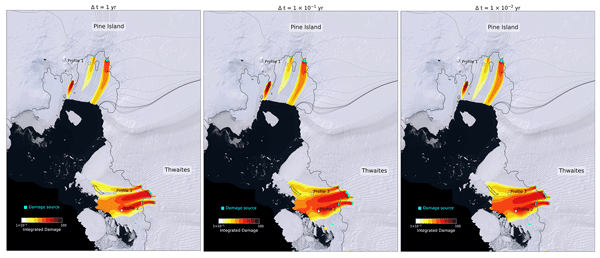
Transport processes like rocks carried by ice flow and damage evolution – a proxy for crevasses – are key in ice sheet modeling and should occur without diffusion. Yet, standard numerical methods often blur these features. We explore a particle-based Semi-Lagrangian approach, comparing it to a Discontinuous Galerkin method, and show it can accurately simulate such transport when run at high enough resolution.
Matthieu Lafaysse, Marie Dumont, Basile De Fleurian, Mathieu Fructus, Rafife Nheili, Léo Viallon-Galinier, Matthieu Baron, Aaron Boone, Axel Bouchet, Julien Brondex, Carlo Carmagnola, Bertrand Cluzet, Kévin Fourteau, Ange Haddjeri, Pascal Hagenmuller, Giulia Mazzotti, Marie Minvielle, Samuel Morin, Louis Quéno, Léon Roussel, Pierre Spandre, François Tuzet, and Vincent Vionnet
Geosci. Model Dev., 19, 6273–6334, https://doi.org/10.5194/gmd-19-6273-2026, https://doi.org/10.5194/gmd-19-6273-2026, 2026
Short summary
Short summary
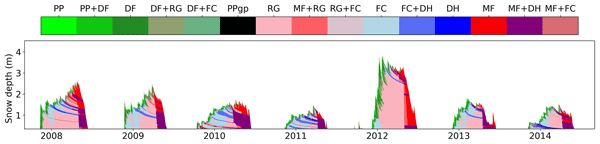
This article is a comprehensive description of the 3.0.2 stable release of the Crocus snowpack model. It describes various new implementations since the last reference article in 2012 and a review of the available scientific evaluations and applications of the model. This provides guidance for the future of numerical snow modelling.
Kévin Fourteau, Julien Brondex, Clément Cancès, and Marie Dumont
Geosci. Model Dev., 19, 3193–3212, https://doi.org/10.5194/gmd-19-3193-2026, https://doi.org/10.5194/gmd-19-3193-2026, 2026
Short summary
Short summary
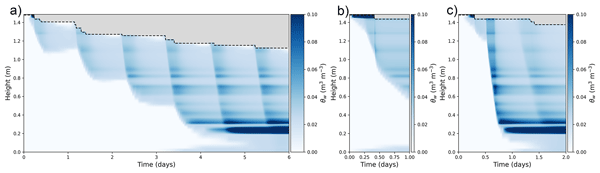
The percolation of liquid water down snowpacks is a complex phenomenon, and its representation can sometimes be complicated for snowpack models. The goal of this article is to transpose some state-of-the-art strategies used for modeling liquid percolation in other media (such as rocks or soil) into snowpack models. With this, snowpack models can be made more efficient, requiring less time and power to perform their computation.
Simon Filhol, Clément Misset, Noélie Bontemps, Diego Cusicanqui, Emmanuel Paquet, Marie Dumont, Olivier Gagliardini, Pascal Lacroix, Simon Gascoin, Guillaume Thirel, Julien Brondex, Pascal Hagenmuller, Eric Larose, Philipp Schoeneich, Denis Roy, Emmanuel Thibert, Nicolas Eckert, Félix de Montety, Robin Mainieri, Alexandre Hauet, Frédéric Gottardi, Johan Berthet, Alexandre Baratier, Frédéric Liébault, Małgorzata Chmiel, Guillaume Piton, Guillaume Chambon, Guillaume James, Philippe Frey, Philip Deline, Laurent Astrade, Christian Vincent, Dominique Laigle, Alain Recking, Fatima Karbou, Adrien Mauss, Mylène Bonnefoy-Demongeot, Firmin Fontaine, Mickael Langlais, Etienne Berthier, and Antoine Blanc
EGUsphere, https://doi.org/10.5194/egusphere-2026-971, https://doi.org/10.5194/egusphere-2026-971, 2026
Short summary
Short summary
On June 21 2024, the village of La Bérarde, in the French Alps, was devastated by a flood destroying centuries old buildings. This study is an interdisciplinary work to decipher the causes and chronology of the event. The flood started with decadal rain falling on a thick snowpack. A lake observed on top of a glacier few days prior, had drained post event. With climate change, should we expect more similar compound events for alpine communities?
Kévin Fourteau, Julien Brondex, Fanny Brun, and Marie Dumont
Geosci. Model Dev., 17, 1903–1929, https://doi.org/10.5194/gmd-17-1903-2024, https://doi.org/10.5194/gmd-17-1903-2024, 2024
Short summary
Short summary
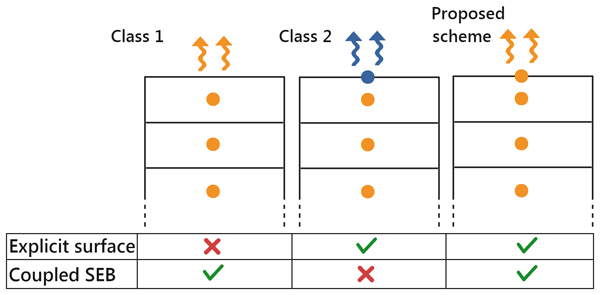
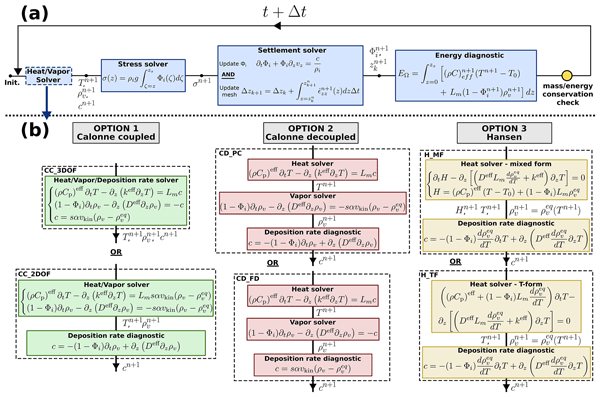
In this paper, we provide a novel numerical implementation for solving the energy exchanges at the surface of snow and ice. By combining the strong points of previous models, our solution leads to more accurate and robust simulations of the energy exchanges, surface temperature, and melt while preserving a reasonable computation time.
Julien Brondex, Kévin Fourteau, Marie Dumont, Pascal Hagenmuller, Neige Calonne, François Tuzet, and Henning Löwe
Geosci. Model Dev., 16, 7075–7106, https://doi.org/10.5194/gmd-16-7075-2023, https://doi.org/10.5194/gmd-16-7075-2023, 2023
Short summary
Short summary
Vapor diffusion is one of the main processes governing snowpack evolution, and it must be accounted for in models. Recent attempts to represent vapor diffusion in numerical models have faced several difficulties regarding computational cost and mass and energy conservation. Here, we develop our own finite-element software to explore numerical approaches and enable us to overcome these difficulties. We illustrate the capability of these approaches on established numerical benchmarks.
Fanny Brun, Owen King, Marion Réveillet, Charles Amory, Anton Planchot, Etienne Berthier, Amaury Dehecq, Tobias Bolch, Kévin Fourteau, Julien Brondex, Marie Dumont, Christoph Mayer, Silvan Leinss, Romain Hugonnet, and Patrick Wagnon
The Cryosphere, 17, 3251–3268, https://doi.org/10.5194/tc-17-3251-2023, https://doi.org/10.5194/tc-17-3251-2023, 2023
Short summary
Short summary
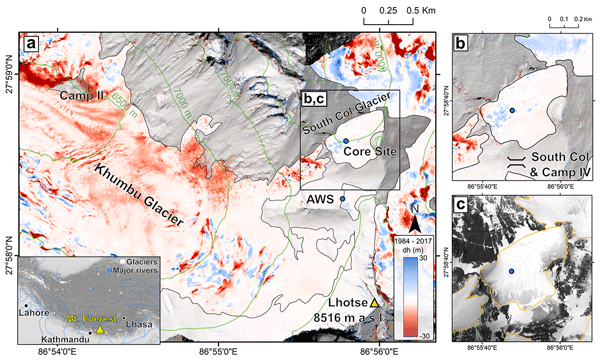
The South Col Glacier is a small body of ice and snow located on the southern ridge of Mt. Everest. A recent study proposed that South Col Glacier is rapidly losing mass. In this study, we examined the glacier thickness change for the period 1984–2017 and found no thickness change. To reconcile these results, we investigate wind erosion and surface energy and mass balance and find that melt is unlikely a dominant process, contrary to previous findings.
Neige Calonne, Pascal Hagenmuller, Rémi Granger, Lisa Bouvet, Kévin Fourteau, Julien Brondex, François Tuzet, Yves Lejeune, Anne Dufour, Mathieu Fructus, Teruo Aoki, and Marie Dumont
Earth Syst. Sci. Data Discuss., https://doi.org/10.5194/essd-2026-718, https://doi.org/10.5194/essd-2026-718, 2026
Preprint under review for ESSD
Short summary
Short summary
We collected weekly measurements of snow microstructural properties over two winters at Col de Porte in the French Alps, a relatively warm alpine site, using complementary techniques including X-ray tomography, the SnowMicroPen, and optical instruments. The dataset captures snowpack evolution at fine vertical resolution and is a valuable resource for snow model evaluation and instrument comparisons. It also provides guidance for future snow monitoring campaigns in warm mountain environments.
Cyrille Mosbeux, Peter Råback, Adrien Gilbert, Julien Brondex, Fabien Gillet-Chaulet, Nicolas C. Jourdain, Mondher Chekki, Olivier Gagliardini, and Gaël Durand
Geosci. Model Dev., 19, 8269–8288, https://doi.org/10.5194/gmd-19-8269-2026, https://doi.org/10.5194/gmd-19-8269-2026, 2026
Short summary
Short summary
Transport processes like rocks carried by ice flow and damage evolution – a proxy for crevasses – are key in ice sheet modeling and should occur without diffusion. Yet, standard numerical methods often blur these features. We explore a particle-based Semi-Lagrangian approach, comparing it to a Discontinuous Galerkin method, and show it can accurately simulate such transport when run at high enough resolution.
Adrien Gilbert, Fabrizio Troilo, Olivier Gagliardini, Christian Vincent, Paolo Perret, Luca Mondardini, Luc Piard, Olivier Laarman, and Emmanuel Le Meur
EGUsphere, https://doi.org/10.5194/egusphere-2026-4058, https://doi.org/10.5194/egusphere-2026-4058, 2026
This preprint is open for discussion and under review for The Cryosphere (TC).
Short summary
Short summary
This study reports on long-term temperature changes observed on the Whymper hanging glacier in Italy from 1997 to 2021, which are interpreted using a numerical modeling approach. Our results show that recent surface warming, driven by increased melting, has raised the glacier's basal temperature significantly, which could reach its melting point by 2050. However, this warming is partially offset by cooling from the mountain's cold north face, which may keep the glacier frozen and stable.

Christophe Ogier, Mauro A. Werder, Olivier Gagliardini, Ilaria Santin, Raphael Moser, Romain Hugonnet, Antoine Blanc, and Daniel Farinotti
Nat. Hazards Earth Syst. Sci., 26, 3901–3917, https://doi.org/10.5194/nhess-26-3901-2026, https://doi.org/10.5194/nhess-26-3901-2026, 2026
Short summary
Short summary
In June 2024, a destructive flood impacted the village of La Bérarde in the French Alps. Rain, snowmelt, and the drainage of a surface lake on a glacier cannot fully explain the flood magnitude. We used glacier topography to estimate how much water could also have been stored beneath the glacier before the event. Our results show that large volumes of hidden water may have existed and could have amplified the flood, highlighting an overlooked hazard in debris-covered mountain glaciers.
Matthieu Lafaysse, Marie Dumont, Basile De Fleurian, Mathieu Fructus, Rafife Nheili, Léo Viallon-Galinier, Matthieu Baron, Aaron Boone, Axel Bouchet, Julien Brondex, Carlo Carmagnola, Bertrand Cluzet, Kévin Fourteau, Ange Haddjeri, Pascal Hagenmuller, Giulia Mazzotti, Marie Minvielle, Samuel Morin, Louis Quéno, Léon Roussel, Pierre Spandre, François Tuzet, and Vincent Vionnet
Geosci. Model Dev., 19, 6273–6334, https://doi.org/10.5194/gmd-19-6273-2026, https://doi.org/10.5194/gmd-19-6273-2026, 2026
Short summary
Short summary
This article is a comprehensive description of the 3.0.2 stable release of the Crocus snowpack model. It describes various new implementations since the last reference article in 2012 and a review of the available scientific evaluations and applications of the model. This provides guidance for the future of numerical snow modelling.
Anuar Togaibekov, Adrien Gilbert, Florent Gimbert, and Andrea Walpersdorf
The Cryosphere, 20, 3257–3270, https://doi.org/10.5194/tc-20-3257-2026, https://doi.org/10.5194/tc-20-3257-2026, 2026
Short summary
Short summary
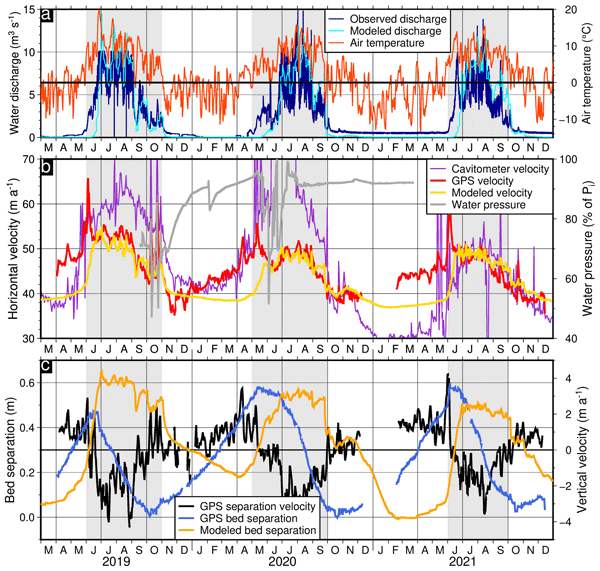
Changes in water reaching the base of glaciers strongly affect their sliding speed by altering water pressure beneath the ice. High water pressure is often thought to develop during summer melt, enlarging cavities at the glacier base and increasing sliding speed. Our observations show instead that the cavities mainly grow during winter, when water pressure builds up in isolated cavities. As the cavities become connected during the melt season, water pressure decreases and the glacier slows down.
Nicolás Acuña Reyes, Léo Martin, Adrien Gilbert, Vincent Jomelli, Antoine Rabatel, Simon Filhol, Deborah Verfaillie, Pierre-Henri Blard, and Jérôme Lavé
EGUsphere, https://doi.org/10.5194/egusphere-2026-2638, https://doi.org/10.5194/egusphere-2026-2638, 2026
Short summary
Short summary
Glacier landforms are often used to reconstruct past climate, but the same glacier shape can result from different combinations of temperature and snowfall. Using computer simulations of glaciers in the Bolivian Andes, we show that climate reconstructions based on a single glacier can lead to large uncertainties. By combining several neighboring glaciers, we estimate temperatures about 0.8°C cooler during the Little Ice Age and 1.3°C cooler during the Early Holocene (~10,000 years ago).
Kévin Fourteau, Julien Brondex, Clément Cancès, and Marie Dumont
Geosci. Model Dev., 19, 3193–3212, https://doi.org/10.5194/gmd-19-3193-2026, https://doi.org/10.5194/gmd-19-3193-2026, 2026
Short summary
Short summary
The percolation of liquid water down snowpacks is a complex phenomenon, and its representation can sometimes be complicated for snowpack models. The goal of this article is to transpose some state-of-the-art strategies used for modeling liquid percolation in other media (such as rocks or soil) into snowpack models. With this, snowpack models can be made more efficient, requiring less time and power to perform their computation.
Pierre Mathiot, Nicolas C. Jourdain, Benoit Urruty, Fabien Gillet-Chaulet, Olivier Gagliardini, and Gaël Durand
EGUsphere, https://doi.org/10.5194/egusphere-2026-927, https://doi.org/10.5194/egusphere-2026-927, 2026
Short summary
Short summary
How the Antarctic ice sheet responds to rapid ocean warming remains uncertain. To explore this, we used a coupled ocean–ice sheet model. We compared simulations under present-day conditions with simulations under strong future warming for 50 years, then returned to today’s climate. The ocean warmed quickly but recovered within decades. In contrast, several ice streams continued to retreat for centuries. This shows that even brief warming could cause lasting ice loss and sea-level rise.
Andrew Nolan, Gwenn E. Flowers, Andy Aschwanden, and Adrien Gilbert
EGUsphere, https://doi.org/10.5194/egusphere-2026-913, https://doi.org/10.5194/egusphere-2026-913, 2026
Short summary
Short summary
We used a computer model to study the effects of glacier "surges", or unusual fast-flow events, on the distribution of ice temperature in a glacier. The purpose of the study was to examine feedbacks that might influence the form and flow of these glaciers in a stable climate. We found surging glaciers to be smaller and colder than their ordinary counterparts, while strong regular surges induced an oscillation in glacier temperature and flow speed much longer than the interval between surges.
Simon Filhol, Clément Misset, Noélie Bontemps, Diego Cusicanqui, Emmanuel Paquet, Marie Dumont, Olivier Gagliardini, Pascal Lacroix, Simon Gascoin, Guillaume Thirel, Julien Brondex, Pascal Hagenmuller, Eric Larose, Philipp Schoeneich, Denis Roy, Emmanuel Thibert, Nicolas Eckert, Félix de Montety, Robin Mainieri, Alexandre Hauet, Frédéric Gottardi, Johan Berthet, Alexandre Baratier, Frédéric Liébault, Małgorzata Chmiel, Guillaume Piton, Guillaume Chambon, Guillaume James, Philippe Frey, Philip Deline, Laurent Astrade, Christian Vincent, Dominique Laigle, Alain Recking, Fatima Karbou, Adrien Mauss, Mylène Bonnefoy-Demongeot, Firmin Fontaine, Mickael Langlais, Etienne Berthier, and Antoine Blanc
EGUsphere, https://doi.org/10.5194/egusphere-2026-971, https://doi.org/10.5194/egusphere-2026-971, 2026
Short summary
Short summary
On June 21 2024, the village of La Bérarde, in the French Alps, was devastated by a flood destroying centuries old buildings. This study is an interdisciplinary work to decipher the causes and chronology of the event. The flood started with decadal rain falling on a thick snowpack. A lake observed on top of a glacier few days prior, had drained post event. With climate change, should we expect more similar compound events for alpine communities?
Thomas Chauve, Florent Gimbert, Adrien Gilbert, Olivier Gagliardini, Luc Piard, Arnaud Reboud, Olivier Laarman, Paolo Perret, William Boffelli, Pietro Di Sopra, Luca Mondardini, and Fabrizio Troilo
EGUsphere, https://doi.org/10.5194/egusphere-2025-5714, https://doi.org/10.5194/egusphere-2025-5714, 2025
Short summary
Short summary
A field campaign on the Planpincieux Glacier investigated how hidden heterogeneities inside the ice affect its deformation. A borehole logged with optical and acoustic tools and equipped with tilt sensors revealed that these heterogeneities cause strong deformation localization. Such weak zones significantly influence glacier motion, showing that internal structure is key to understanding how glaciers flow.
Léon Roussel, Marie Dumont, Marion Réveillet, Delphine Six, Marin Kneib, Pierre Nabat, Kévin Fourteau, Diego Monteiro, Simon Gascoin, Emmanuel Thibert, Antoine Rabatel, Jean-Emmanuel Sicart, Mylène Bonnefoy, Luc Piard, Olivier Laarman, Bruno Jourdain, Mathieu Fructus, Matthieu Vernay, and Matthieu Lafaysse
The Cryosphere, 19, 5201–5230, https://doi.org/10.5194/tc-19-5201-2025, https://doi.org/10.5194/tc-19-5201-2025, 2025
Short summary
Short summary
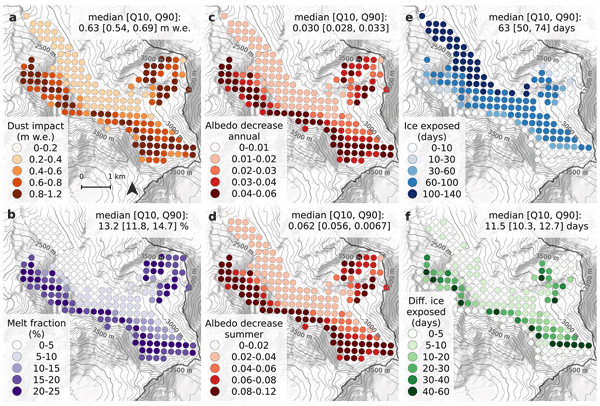
Saharan dust deposits frequently turn alpine glaciers orange. Mineral dust reduces snow albedo and increases snow and glaciers melt rate. Using physical modeling, we quantified the impact of dust on the Argentière Glacier over the period 2019–2022. We found that the contribution of mineral dust to the melt represents between 8 % and 16 % of Argentière Glacier summer melt. At specific locations, the impact of dust over one year can rise to an equivalent of 1.2 m of melted ice.
Juan-Pedro Roldán-Blasco, Adrien Gilbert, Luc Piard, Florent Gimbert, Christian Vincent, Olivier Gagliardini, Anuar Togaibekov, Andrea Walpersdorf, and Nathan Maier
The Cryosphere, 19, 267–282, https://doi.org/10.5194/tc-19-267-2025, https://doi.org/10.5194/tc-19-267-2025, 2025
Short summary
Short summary
The flow of glaciers and ice sheets results from ice deformation and basal sliding driven by gravitational forces. Quantifying the rate at which ice deforms under its own weight is critical for assessing glacier evolution. This study uses borehole instrumentation in an Alpine glacier to quantify ice deformation and constrain ice viscosity in a natural setting. Our results show that the viscosity of ice at 0 °C is largely influenced by interstitial liquid water, which enhances ice deformation.
Marin Kneib, Amaury Dehecq, Adrien Gilbert, Auguste Basset, Evan S. Miles, Guillaume Jouvet, Bruno Jourdain, Etienne Ducasse, Luc Beraud, Antoine Rabatel, Jérémie Mouginot, Guillem Carcanade, Olivier Laarman, Fanny Brun, and Delphine Six
The Cryosphere, 18, 5965–5983, https://doi.org/10.5194/tc-18-5965-2024, https://doi.org/10.5194/tc-18-5965-2024, 2024
Short summary
Short summary
Avalanches contribute to increasing the accumulation on mountain glaciers by redistributing snow from surrounding mountains slopes. Here we quantified the contribution of avalanches to the mass balance of Argentière Glacier in the French Alps, by combining satellite and field observations to model the glacier dynamics. We show that the contribution of avalanches locally increases the accumulation by 60–70 % and that accounting for this effect results in less ice loss by the end of the century.
Susanne Preunkert, Pascal Bohleber, Michel Legrand, Adrien Gilbert, Tobias Erhardt, Roland Purtschert, Lars Zipf, Astrid Waldner, Joseph R. McConnell, and Hubertus Fischer
The Cryosphere, 18, 2177–2194, https://doi.org/10.5194/tc-18-2177-2024, https://doi.org/10.5194/tc-18-2177-2024, 2024
Short summary
Short summary
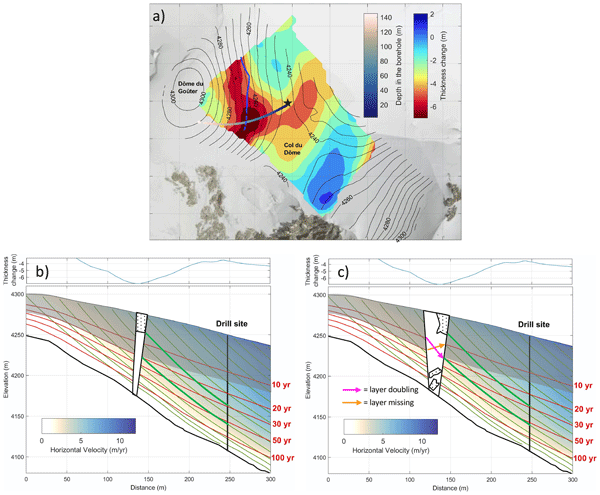
Ice cores from high-elevation Alpine glaciers are an important tool to reconstruct the past atmosphere. However, since crevasses are common at these glacier sites, rigorous investigations of glaciological conditions upstream of drill sites are needed before interpreting such ice cores. On the basis of three ice cores extracted at Col du Dôme (4250 m a.s.l; French Alps), an overall picture of a dynamic crevasse formation is drawn, which disturbs the depth–age relation of two of the three cores.
Kévin Fourteau, Julien Brondex, Fanny Brun, and Marie Dumont
Geosci. Model Dev., 17, 1903–1929, https://doi.org/10.5194/gmd-17-1903-2024, https://doi.org/10.5194/gmd-17-1903-2024, 2024
Short summary
Short summary
In this paper, we provide a novel numerical implementation for solving the energy exchanges at the surface of snow and ice. By combining the strong points of previous models, our solution leads to more accurate and robust simulations of the energy exchanges, surface temperature, and melt while preserving a reasonable computation time.
Julien Brondex, Kévin Fourteau, Marie Dumont, Pascal Hagenmuller, Neige Calonne, François Tuzet, and Henning Löwe
Geosci. Model Dev., 16, 7075–7106, https://doi.org/10.5194/gmd-16-7075-2023, https://doi.org/10.5194/gmd-16-7075-2023, 2023
Short summary
Short summary
Vapor diffusion is one of the main processes governing snowpack evolution, and it must be accounted for in models. Recent attempts to represent vapor diffusion in numerical models have faced several difficulties regarding computational cost and mass and energy conservation. Here, we develop our own finite-element software to explore numerical approaches and enable us to overcome these difficulties. We illustrate the capability of these approaches on established numerical benchmarks.
Emily A. Hill, Benoît Urruty, Ronja Reese, Julius Garbe, Olivier Gagliardini, Gaël Durand, Fabien Gillet-Chaulet, G. Hilmar Gudmundsson, Ricarda Winkelmann, Mondher Chekki, David Chandler, and Petra M. Langebroek
The Cryosphere, 17, 3739–3759, https://doi.org/10.5194/tc-17-3739-2023, https://doi.org/10.5194/tc-17-3739-2023, 2023
Short summary
Short summary
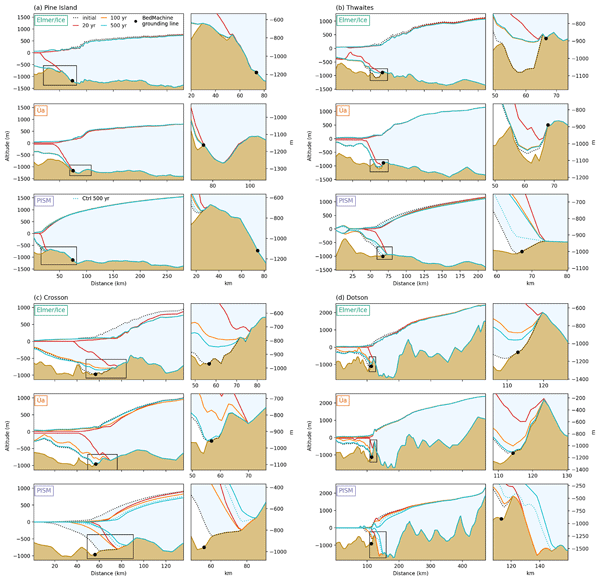
The grounding lines of the Antarctic Ice Sheet could enter phases of irreversible retreat or advance. We use three ice sheet models to show that the present-day locations of Antarctic grounding lines are reversible with respect to a small perturbation away from their current position. This indicates that present-day retreat of the grounding lines is not yet irreversible or self-enhancing.
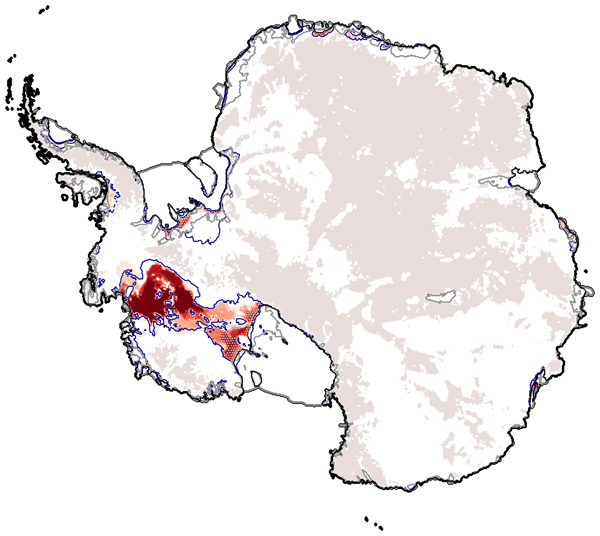
Ronja Reese, Julius Garbe, Emily A. Hill, Benoît Urruty, Kaitlin A. Naughten, Olivier Gagliardini, Gaël Durand, Fabien Gillet-Chaulet, G. Hilmar Gudmundsson, David Chandler, Petra M. Langebroek, and Ricarda Winkelmann
The Cryosphere, 17, 3761–3783, https://doi.org/10.5194/tc-17-3761-2023, https://doi.org/10.5194/tc-17-3761-2023, 2023
Short summary
Short summary
We use an ice sheet model to test where current climate conditions in Antarctica might lead. We find that present-day ocean and atmosphere conditions might commit an irreversible collapse of parts of West Antarctica which evolves over centuries to millennia. Importantly, this collapse is not irreversible yet.
Fanny Brun, Owen King, Marion Réveillet, Charles Amory, Anton Planchot, Etienne Berthier, Amaury Dehecq, Tobias Bolch, Kévin Fourteau, Julien Brondex, Marie Dumont, Christoph Mayer, Silvan Leinss, Romain Hugonnet, and Patrick Wagnon
The Cryosphere, 17, 3251–3268, https://doi.org/10.5194/tc-17-3251-2023, https://doi.org/10.5194/tc-17-3251-2023, 2023
Short summary
Short summary
The South Col Glacier is a small body of ice and snow located on the southern ridge of Mt. Everest. A recent study proposed that South Col Glacier is rapidly losing mass. In this study, we examined the glacier thickness change for the period 1984–2017 and found no thickness change. To reconcile these results, we investigate wind erosion and surface energy and mass balance and find that melt is unlikely a dominant process, contrary to previous findings.
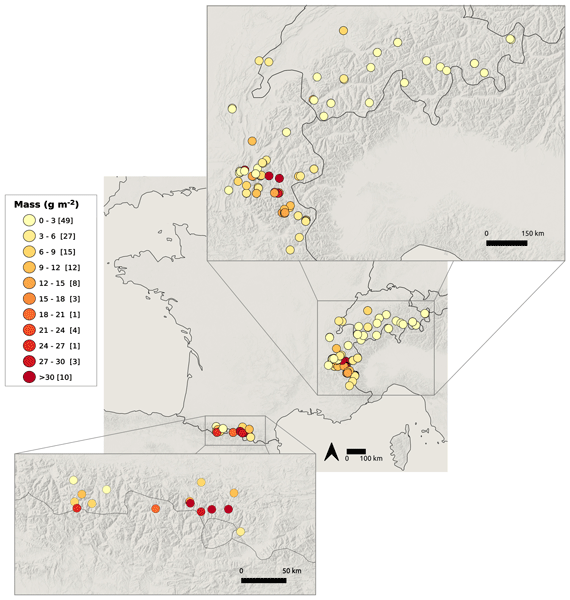
Marie Dumont, Simon Gascoin, Marion Réveillet, Didier Voisin, François Tuzet, Laurent Arnaud, Mylène Bonnefoy, Montse Bacardit Peñarroya, Carlo Carmagnola, Alexandre Deguine, Aurélie Diacre, Lukas Dürr, Olivier Evrard, Firmin Fontaine, Amaury Frankl, Mathieu Fructus, Laure Gandois, Isabelle Gouttevin, Abdelfateh Gherab, Pascal Hagenmuller, Sophia Hansson, Hervé Herbin, Béatrice Josse, Bruno Jourdain, Irene Lefevre, Gaël Le Roux, Quentin Libois, Lucie Liger, Samuel Morin, Denis Petitprez, Alvaro Robledano, Martin Schneebeli, Pascal Salze, Delphine Six, Emmanuel Thibert, Jürg Trachsel, Matthieu Vernay, Léo Viallon-Galinier, and Céline Voiron
Earth Syst. Sci. Data, 15, 3075–3094, https://doi.org/10.5194/essd-15-3075-2023, https://doi.org/10.5194/essd-15-3075-2023, 2023
Short summary
Short summary
Saharan dust outbreaks have profound effects on ecosystems, climate, health, and the cryosphere, but the spatial deposition pattern of Saharan dust is poorly known. Following the extreme dust deposition event of February 2021 across Europe, a citizen science campaign was launched to sample dust on snow over the Pyrenees and the European Alps. This campaign triggered wide interest and over 100 samples. The samples revealed the high variability of the dust properties within a single event.
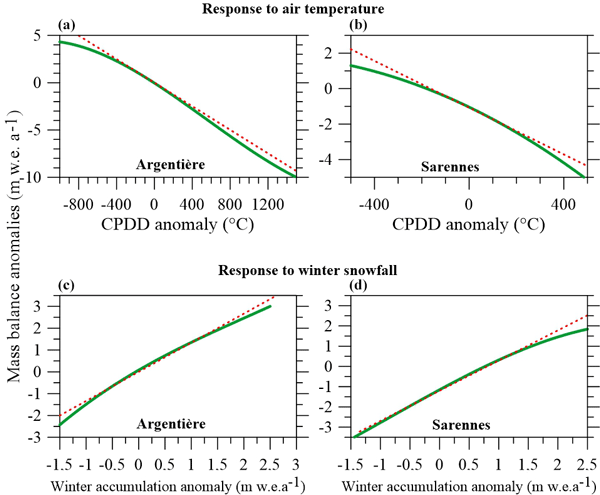
Christian Vincent and Emmanuel Thibert
The Cryosphere, 17, 1989–1995, https://doi.org/10.5194/tc-17-1989-2023, https://doi.org/10.5194/tc-17-1989-2023, 2023
Short summary
Short summary
Temperature-index models have been widely used for glacier mass projections in the future. The ability of these models to capture non-linear responses of glacier mass balance (MB) to high deviations in air temperature and solid precipitation has recently been questioned by mass balance simulations employing advanced machine-learning techniques. Here, we confirmed that temperature-index models are capable of detecting non-linear responses of glacier MB to temperature and precipitation changes.
Cited articles
Albrecht, T. and Levermann, A.: Fracture field for large-scale ice dynamics, J. Glaciol., 58, 165–176, https://doi.org/10.3189/2012JoG11J191, 2012. a
Albrecht, T. and Levermann, A.: Fracture-induced softening for large-scale ice dynamics, The Cryosphere, 8, 587–605, https://doi.org/10.5194/tc-8-587-2014, 2014. a
Bondesan, A. and Francese, R. G.: The climate-driven disaster of the Marmolada Glacier (Italy), Geomorphology, 431, 108687, https://doi.org/10.1016/j.geomorph.2023.108687, 2023. a
Borstad, C., Khazendar, A., Scheuchl, B., Morlighem, M., Larour, E., and Rignot, E.: A constitutive framework for predicting weakening and reduced buttressing of ice shelves based on observations of the progressive deterioration of the remnant Larsen B Ice Shelf, Geophys. Res. Lett., 43, 2027–2035, https://doi.org/10.1002/2015GL067365, 2016. a
Brondex, J.: jbrondex/TeteRousse_TC2025: v0.1.0 (v0.1.0), Zenodo [software], https://doi.org/10.5281/zenodo.19083935, 2026. a
Chmiel, M., Walter, F., Pralong, A., Preiswerk, L., Funk, M., Meier, L., and Brenguier, F.: Seismic Constraints on Damage Growth Within an Unstable Hanging Glacier, Geophys. Res. Lett., 50, e2022GL102007, https://doi.org/10.1029/2022GL102007, 2023. a
Choi, Y., Morlighem, M., Wood, M., and Bondzio, J. H.: Comparison of four calving laws to model Greenland outlet glaciers, The Cryosphere, 12, 3735–3746, https://doi.org/10.5194/tc-12-3735-2018, 2018. a, b, c
Christmann, J., Müller, R., and Humbert, A.: On nonlinear strain theory for a viscoelastic material model and its implications for calving of ice shelves, J. Glaciol., 65, 212–224, https://doi.org/10.1017/jog.2018.107, 2019. a
Chudley, T. R., Christoffersen, P., Doyle, S. H., Dowling, T. P. F., Law, R., Schoonman, C. M., Bougamont, M., and Hubbard, B.: Controls on Water Storage and Drainage in Crevasses on the Greenland Ice Sheet, J. Geophys. Res.-Earth, 126, e2021JF006287, https://doi.org/10.1029/2021JF006287, 2021. a, b
Clayton, T., Duddu, R., Siegert, M., and Martínez-Pañeda, E.: A stress-based poro-damage phase field model for hydrofracturing of creeping glaciers and ice shelves, Eng. Fract. Mech., 272, 108693, https://doi.org/10.1016/j.engfracmech.2022.108693, 2022. a
Duddu, R. and Waisman, H.: A temperature dependent creep damage model for polycrystalline ice, Mech. Mater., 46, 23–41, https://doi.org/10.1016/j.mechmat.2011.11.007, 2012. a
Duddu, R. and Waisman, H.: A nonlocal continuum damage mechanics approach to simulation of creep fracture in ice sheets, Comput. Mech., 51, 961–974, https://doi.org/10.1007/s00466-012-0778-7, 2013. a
Durand, G., Gagliardini, O., de Fleurian, B., Zwinger, T., and Le Meur, E.: Marine ice sheet dynamics: Hysteresis and neutral equilibrium, J. Geophys. Res.-Earth, 114, https://doi.org/10.1029/2008JF001170, 2009. a, b, c
Evatt, G. and Fowler, A.: Cauldron subsidence and subglacial floods, Ann. Glaciol., 45, 163–168, https://doi.org/10.3189/172756407782282561, 2007. a, b
Faillettaz, J., Sornette, D., and Funk, M.: Numerical modeling of a gravity-driven instability of a cold hanging glacier: reanalysis of the 1895 break-off of Altelsgletscher, Switzerland, J. Glaciol., 57, 817–831, https://doi.org/10.3189/002214311798043852, 2011. a
Faillettaz, J., Funk, M., and Vincent, C.: Avalanching glacier instabilities: Review on processes and early warning perspectives, Rev. Geophys., 53, 203–224, https://doi.org/10.1002/2014RG000466, 2015. a
Francfort, G. and Marigo, J.-J.: Revisiting brittle fracture as an energy minimization problem, J. Mech. Phys. Solids, 46, 1319–1342, https://doi.org/10.1016/S0022-5096(98)00034-9, 1998. a
Gagliardini, O. and Meyssonnier, J.: Flow simulation of a firn-covered cold glacier, Ann. Glaciol., 24, 242–248, https://doi.org/10.1017/S0260305500012246, 1997. a
Gagliardini, O., Gillet-Chaulet, F., Durand, G., Vincent, C., and Duval, P.: Estimating the risk of glacier cavity collapse during artificial drainage: The case of Tête Rousse Glacier, Geophys. Res. Lett., 38, https://doi.org/10.1029/2011GL047536, 2011. a, b
Gagliardini, O., Weiss, J., Duval, P., and Montagnat, M.: On Duddu and Waisman (2012, 2013) concerning continuum damage mechanics applied to crevassing and iceberg calving, J. Glaciol., 59, 797–798, https://doi.org/10.3189/2013JoG13J049, 2013. a
Garambois, S., Legchenko, A., Vincent, C., and Thibert, E.: Ground-penetrating radar and surface nuclear magnetic resonance monitoring of an englacial water-filled cavity in the polythermal glacier of Tête Rousse, Geophysics, 81, WA131–WA146, https://doi.org/10.1190/geo2015-0125.1, 2016. a, b, c
Gilbert, A., Vincent, C., Wagnon, P., Thibert, E., and Rabatel, A.: The influence of snow cover thickness on the thermal regime of Tête Rousse Glacier (Mont Blanc range, 3200 m a.s.l.): Consequences for outburst flood hazards and glacier response to climate change, J. Geophys. Res.-Earth, 117, https://doi.org/10.1029/2011JF002258, 2012. a, b, c
Glen, J. W.: The Creep of Polycrystalline Ice, P. Roy. Soc. Lond. A Mat., 228, 519–538, https://doi.org/10.1098/rspa.1955.0066, 1955. a
Hageman, T., Mejía, J., Duddu, R., and Martínez-Pañeda, E.: Ice viscosity governs hydraulic fracture that causes rapid drainage of supraglacial lakes, The Cryosphere, 18, 3991–4009, https://doi.org/10.5194/tc-18-3991-2024, 2024. a, b, c
Hayhurst, D.: Creep rupture under multi-axial states of stress, J. Mech. Phys. Solids, 20, 381–382, https://doi.org/10.1016/0022-5096(72)90015-4, 1972. a
Huth, A., Duddu, R., and Smith, B.: A Generalized Interpolation Material Point Method for Shallow Ice Shelves. 2: Anisotropic Nonlocal Damage Mechanics and Rift Propagation, J. Adv. Model. Earth Sy., 13, e2020MS002292, https://doi.org/10.1029/2020MS002277, 2021. a
Huth, A., Duddu, R., Smith, B., and Sergienko, O.: Simulating the processes controlling ice-shelf rift paths using damage mechanics, J. Glaciol., 1–14, https://doi.org/10.1017/jog.2023.71, 2023. a
Irvine-Fynn, T. D. L., Hodson, A. J., Moorman, B. J., Vatne, G., and Hubbard, A. L.: Polythermal glacier hydrology: A review, Rev. Geophys., 49, https://doi.org/10.1029/2010RG000350, 2011. a
Jiménez, S., Duddu, R., and Bassis, J.: An updated-Lagrangian damage mechanics formulation for modeling the creeping flow and fracture of ice sheets, Comput. Method. Appl. M., 313, 406–432, https://doi.org/10.1016/j.cma.2016.09.034, 2017. a
Jouvet, G., Picasso, M., Rappaz, J., Huss, M., and Funk, M.: Modelling and Numerical Simulation of the Dynamics of Glaciers Including Local Damage Effects, Math. Model. Nat. Pheno., 6, 263–280, https://doi.org/10.1051/mmnp/20116510, 2011. a
Legchenko, A., Descloitres, M., Vincent, C., Guyard, H., Garambois, S., Chalikakis, K., and Ezersky, M.: Three-dimensional magnetic resonance imaging for groundwater, New J. Phys., 13, 025022, https://doi.org/10.1088/1367-2630/13/2/025022, 2011. a
Legchenko, A., Vincent, C., Baltassat, J. M., Girard, J. F., Thibert, E., Gagliardini, O., Descloitres, M., Gilbert, A., Garambois, S., Chevalier, A., and Guyard, H.: Monitoring water accumulation in a glacier using magnetic resonance imaging, The Cryosphere, 8, 155–166, https://doi.org/10.5194/tc-8-155-2014, 2014. a, b
MacAyeal, D. R., Shabtaie, S., Bentley, C. R., and King, S. D.: Formulation of ice shelf dynamic boundary conditions in terms of a Coulomb rheology, J. Geophys. Res.-Sol. Ea., 91, 8177–8191, https://doi.org/10.1029/JB091iB08p08177, 1986. a, b
Mercenier, R., Lüthi, M. P., and Vieli, A.: Calving relation for tidewater glaciers based on detailed stress field analysis, The Cryosphere, 12, 721–739, https://doi.org/10.5194/tc-12-721-2018, 2018. a
Mercenier, R., Lüthi, M. P., and Vieli, A.: A Transient Coupled Ice Flow-Damage Model to Simulate Iceberg Calving From Tidewater Outlet Glaciers, J. Adv. Model. Earth Sy., 11, 3057–3072, https://doi.org/10.1029/2018MS001567, 2019. a, b, c, d
Mobasher, M. E., Duddu, R., Bassis, J. N., and Waisman, H.: Modeling hydraulic fracture of glaciers using continuum damage mechanics, J. Glaciol., 62, 794–804, https://doi.org/10.1017/jog.2016.68, 2016. a
Morlighem, M., Bondzio, J., Seroussi, H., Rignot, E., Larour, E., Humbert, A., and Rebuffi, S.: Modeling of Store Gletscher's calving dynamics, West Greenland, in response to ocean thermal forcing, Geophys. Res. Lett., 43, 2659–2666, https://doi.org/10.1002/2016GL067695, 2016. a
Mosbeux, C., Wagner, T. J. W., Becker, M. K., and Fricker, H. A.: Viscous and elastic buoyancy stresses as drivers of ice-shelf calving, J. Glaciol., 66, 643–657, https://doi.org/10.1017/jog.2020.35, 2020. a
Nadreau, J.-P. and Michel, B.: Yield and failure envelope for ice under multiaxial compressive stresses, Cold Reg. Sci. Technol., 13, 75–82, https://doi.org/10.1016/0165-232X(86)90009-1, 1986. a
Petrovic, J.: Review mechanical properties of ice and snow, J. Mater. Sci., 38, 1–6, https://doi.org/10.1023/A:1021134128038, 2003. a, b, c
Podolskiy, E. A., Fujita, K., Sunako, S., and Sato, Y.: Viscoelastic Modeling of Nocturnal Thermal Fracturing in a Himalayan Debris-Covered Glacier, J. Geophys. Res.-Earth, 124, 1485–1515, https://doi.org/10.1029/2018JF004848, 2019. a
Pralong, A. and Funk, M.: Dynamic damage model of crevasse opening and application to glacier calving, J. Geophys. Res.-Sol. Ea., 110, 1–12, https://doi.org/10.1029/2004JB003104, 2005. a, b, c
Ranganathan, M., Robel, A. A., Huth, A., and Duddu, R.: Glacier damage evolution over ice flow timescales, The Cryosphere, 19, 1599–1619, https://doi.org/10.5194/tc-19-1599-2025, 2025. a
Ruokolainen, J., Malinen, M., Råback, P., Zwinger, T., Takala, E.,Kataja, J., Gillet-Chaulet, F., Ilvonen, S., Gladstone, R., Byckling, M., Chekki, M., Gong, C., Ponomarev, P., van Dongen, E., Robertsen, F., Wheel, I., Cook, S., t7saeki, luzpaz, and Rich_B: ElmerCSC/elmerfem: Elmer 9.0 (release-9.0), Zenodo [software], https://doi.org/10.5281/zenodo.7892180, 2023. a
Ruokolainen, J., Råback, P., Malinen, M., and Zwinger, T.: ElmerFEM, GitHub [software], https://github.com/ElmerCSC/elmerfem, last access: 17 March 2026. a
Schmeltz, M., Rignot, E., and MacAyeal, D.: Tidal flexure along ice-sheet margins: comparison of InSAR with an elastic-plate model, Ann. Glaciol., 34, 202–208, https://doi.org/10.3189/172756402781818049, 2002. a
Schulson, E. M. and Duval, P.: Creep and Fracture of Ice, Cambridge University Press, ISBN 9781108463058, 2009. a
Sondershaus, R., Humbert, A., and Müller, R.: A phase field model for fractures in ice shelves, PAMM, 22, e202200256, https://doi.org/10.1002/pamm.202200256, 2023. a
Sun, S. and Gudmundsson, G. H.: The speedup of Pine Island Ice Shelf between 2017 and 2020: revaluating the importance of ice damage, J. Glaciol., 69, 1983–1991, https://doi.org/10.1017/jog.2023.76, 2023. a
Sun, X., Duddu, R., and Hirshikesh: A poro-damage phase field model for hydrofracturing of glacier crevasses, Extreme Mechanics Letters, 45, 101277, https://doi.org/10.1016/j.eml.2021.101277, 2021. a
Surawy-Stepney, T., Hogg, A. E., Cornford, S. L., and Davison, B. J.: Episodic dynamic change linked to damage on the Thwaites Glacier Ice Tongue, Nat. Geosci., 16, 37–43, https://doi.org/10.1038/s41561-022-01097-9, 2023. a
van der Veen, C.: Fracture mechanics approach to penetration of surface crevasses on glaciers, Cold Reg. Sci. Technol., 27, 31–47, https://doi.org/10.1016/S0165-232X(97)00022-0, 1998. a
Vaughan, D. G.: Tidal flexure at ice shelf margins, J. Geophys. Res.-Sol. Ea., 100, 6213–6224, https://doi.org/10.1029/94JB02467, 1995. a
Vincent, C., Garambois, S., Thibert, E., Lefèbvre, E., Le Meur, E., and Six, D.: Origin of the outburst flood from Glacier de Tête Rousse in 1892 (Mont Blanc area, France), J. Glaciol., 56, 688–698, https://doi.org/10.3189/002214310793146188, 2010. a
Vincent, C., Descloitres, M., Garambois, S., Legchenko, A., Guyard, H., and Gilbert, A.: Detection of a subglacial lake in Glacier de Tête Rousse (Mont Blanc area, France), J. Glaciol., 58, 866–878, https://doi.org/10.3189/2012JoG11J179, 2012. a
Vincent, C., Thibert, E., Gagliardini, O., Legchenko, A., Gilbert, A., Garambois, S., Condom, T., Baltassat, J., and Girard, J.: Mechanisms of subglacial cavity filling in Glacier de Tête Rousse, French Alps, J. Glaciol., 61, 609–623, https://doi.org/10.3189/2015JoG14J238, 2015. a, b, c, d, e, f, g, h, i
Weiss, J. and Schulson, E. M.: Coulombic faulting from the grain scale to the geophysical scale: lessons from ice, J. Phys. D Appl. Phys., 42, 214017, https://doi.org/10.1088/0022-3727/42/21/214017, 2009. a
Yu, H., Rignot, E., Morlighem, M., and Seroussi, H.: Iceberg calving of Thwaites Glacier, West Antarctica: full-Stokes modeling combined with linear elastic fracture mechanics, The Cryosphere, 11, 1283–1296, https://doi.org/10.5194/tc-11-1283-2017, 2017. a
Zarrinderakht, M., Schoof, C., and Peirce, A.: The effect of hydrology and crevasse wall contact on calving, The Cryosphere, 16, 4491–4512, https://doi.org/10.5194/tc-16-4491-2022, 2022. a
Zwinger, T., Nield, G. A., Ruokolainen, J., and King, M. A.: A new open-source viscoelastic solid earth deformation module implemented in Elmer (v8.4), Geosci. Model Dev., 13, 1155–1164, https://doi.org/10.5194/gmd-13-1155-2020, 2020. a
Short summary
We investigate crevasse initiation by analyzing the artificial drainage of a water-filled cavity at Tête Rousse Glacier (Mont Blanc, France). Using a numerical model, we compute stress fields in response to water level variations in the cavity and compare them to observed crevasse patterns. Results show that a non-linear viscous rheology and a maximum principal stress criterion (with a stress threshold of 100–130 kPa) best predict crevasse occurrence.
We investigate crevasse initiation by analyzing the artificial drainage of a water-filled cavity...


