
Articles | Volume 20, issue 1
https://doi.org/10.5194/tc-20-811-2026
© Author(s) 2026. This work is distributed under
the Creative Commons Attribution 4.0 License.
the Creative Commons Attribution 4.0 License.
https://doi.org/10.5194/tc-20-811-2026
© Author(s) 2026. This work is distributed under
the Creative Commons Attribution 4.0 License.
the Creative Commons Attribution 4.0 License.
Research article
| 
30 Jan 2026
Research article |
| 30 Jan 2026
| 30 Jan 2026
Satellite telemetry of surface ablation to inform spatial melt modelling and event-scale monitoring, Place Glacier, Canada
Alexandre R. Bevington
CORRESPONDING AUTHOR

Department of Geography, Earth and Environmental Sciences, University of Northern British Columbia, Prince George, Canada
Ministry of Forests, Province of British Columbia, Prince George, Canada
Brian Menounos
Department of Geography, Earth and Environmental Sciences, University of Northern British Columbia, Prince George, Canada
Geological Survey of Canada, Natural Resources Canada, Sidney, Canada
Hakai Institute, Campbell River, Canada
Mark Ednie
Geological Survey of Canada, Natural Resources Canada, Ottawa, Canada
Related authors
Madeleine C. Garibaldi, Philip P. Bonnaventure, Robert G. Way, Alexandre Bevington, Sharon L. Smith, Scott F. Lamoureux, Jean E. Holloway, Antoni G. Lewkowicz, and Hannah Ackerman
The Cryosphere, 20, 2375–2392, https://doi.org/10.5194/tc-20-2375-2026, https://doi.org/10.5194/tc-20-2375-2026, 2026
Short summary
Short summary
We assessed the sensitivity of a simple permafrost model to changes in parameter values using measured data across northern Canada. We altered the value of one parameter at a time to assess the changes in the resulting temperature. The model was most sensitive to changes in the freezing season parameters and least sensitive to changes in the thawing parameters. However, the importance of specific parameters varied across Canada. The findings of this study can aid in development of future models.
Olivia Meier-Legault, Nicholas Brown, Larry Adjun, Michel Allard, Alejandro Alvarez, Maude Auclair, Alex Bevington, Samuel Bilodeau, William Cable, Olivia Carpino, Ariane Castagner, Lin Chen, Alexandre Chiasson, Ryan Connon, Stephanie Coulombe, Jeffrey Crompton, Derek Cronmiller, Gautier Davesne, Mason Dominico, Marc-André Ducharme, Timothy Ensom, Louise Farquharson, Vanessa Foord, Daniel Fortier, Philippe Fortier, Duane Froese, Samuel Gagnon, Francis Gauthier, Marten Geertsema, Etienne Godin, Galina Jonat, Steven V. Kokelj, Michelle Landry, Antoni Lewkowicz, Panya Lipovsky, Emmanual L’Hérault, Hannah Macdonell, Lancelot Massé, Dmitry Nicolsky, Moya Painter, Leesee Papatsie, Victor Pozsgay, William Quinton, Vladimir Romanovsky, Ashley C.A. Rudy, Denis Sarrazin, Emilie Stewart-Jones, Donald Walker, Thomas Wright, Joseph Young, and Stephan Gruber
Earth Syst. Sci. Data Discuss., https://doi.org/10.5194/essd-2026-96, https://doi.org/10.5194/essd-2026-96, 2026
Revised manuscript accepted for ESSD
Short summary
Short summary
Ground temperature data is vital for permafrost and climate research yet data is often fragmented. We created a standardized collection of ground temperatures from over 900 sites across Canada. From 42 published and unpublished sources, we manually verified, cleaned and standardized data with a new software tool. This dataset supports permafrost research on a nationwide scale and can help improve models by acting as a reliable benchmark.
Madeleine C. Garibaldi, Philip P. Bonnaventure, Robert G. Way, Alexandre Bevington, Sharon L. Smith, Scott F. Lamoureux, Jean E. Holloway, Antoni G. Lewkowicz, and Hannah Ackerman
The Cryosphere, 20, 2375–2392, https://doi.org/10.5194/tc-20-2375-2026, https://doi.org/10.5194/tc-20-2375-2026, 2026
Short summary
Short summary
We assessed the sensitivity of a simple permafrost model to changes in parameter values using measured data across northern Canada. We altered the value of one parameter at a time to assess the changes in the resulting temperature. The model was most sensitive to changes in the freezing season parameters and least sensitive to changes in the thawing parameters. However, the importance of specific parameters varied across Canada. The findings of this study can aid in development of future models.
Olivia Meier-Legault, Nicholas Brown, Larry Adjun, Michel Allard, Alejandro Alvarez, Maude Auclair, Alex Bevington, Samuel Bilodeau, William Cable, Olivia Carpino, Ariane Castagner, Lin Chen, Alexandre Chiasson, Ryan Connon, Stephanie Coulombe, Jeffrey Crompton, Derek Cronmiller, Gautier Davesne, Mason Dominico, Marc-André Ducharme, Timothy Ensom, Louise Farquharson, Vanessa Foord, Daniel Fortier, Philippe Fortier, Duane Froese, Samuel Gagnon, Francis Gauthier, Marten Geertsema, Etienne Godin, Galina Jonat, Steven V. Kokelj, Michelle Landry, Antoni Lewkowicz, Panya Lipovsky, Emmanual L’Hérault, Hannah Macdonell, Lancelot Massé, Dmitry Nicolsky, Moya Painter, Leesee Papatsie, Victor Pozsgay, William Quinton, Vladimir Romanovsky, Ashley C.A. Rudy, Denis Sarrazin, Emilie Stewart-Jones, Donald Walker, Thomas Wright, Joseph Young, and Stephan Gruber
Earth Syst. Sci. Data Discuss., https://doi.org/10.5194/essd-2026-96, https://doi.org/10.5194/essd-2026-96, 2026
Revised manuscript accepted for ESSD
Short summary
Short summary
Ground temperature data is vital for permafrost and climate research yet data is often fragmented. We created a standardized collection of ground temperatures from over 900 sites across Canada. From 42 published and unpublished sources, we manually verified, cleaned and standardized data with a new software tool. This dataset supports permafrost research on a nationwide scale and can help improve models by acting as a reliable benchmark.
Jakob Steiner, William Armstrong, Will Kochtitzky, Robert McNabb, Rodrigo Aguayo, Tobias Bolch, Fabien Maussion, Vibhor Agarwal, Iestyn Barr, Nathaniel R. Baurley, Mike Cloutier, Katelyn DeWater, Frank Donachie, Yoann Drocourt, Siddhi Garg, Gunjan Joshi, Byron Guzman, Stanislav Kutuzov, Thomas Loriaux, Caleb Mathias, Brian Menounos, Evan Miles, Aleksandra Osika, Kaleigh Potter, Adina Racoviteanu, Brianna Rick, Miles Sterner, Guy D. Tallentire, Levan Tielidze, Rebecca White, Kunpeng Wu, and Whyjay Zheng
Earth Syst. Sci. Data, 18, 1665–1681, https://doi.org/10.5194/essd-18-1665-2026, https://doi.org/10.5194/essd-18-1665-2026, 2026
Short summary
Short summary
Many mountain glaciers around the world flow into lakes – exactly how many however, has never been mapped. Across a large team of experts we have now identified all glaciers that end in lakes. Only about 1% do so, but they are generally larger than those which end on land. This is important to understand, as lakes can influence the behaviour of glacier ice, including how fast it disappears. This new dataset allows us to better model glaciers at a global scale, accounting for the effect of lakes.
Adam C. Hawkins, Brent M. Goehring, and Brian Menounos
Geochronology, 7, 157–172, https://doi.org/10.5194/gchron-7-157-2025, https://doi.org/10.5194/gchron-7-157-2025, 2025
Short summary
Short summary
We use a method called cosmogenic nuclide dating on bedrock surfaces and moraine boulders to determine the relative length of time an alpine glacier was larger or smaller than its current extent over the past 15 000 years. We also discuss several important limitations to this method. This method gives information on the duration of past ice advances and is useful in areas without other materials that can be dated.
Etienne Berthier, Jérôme Lebreton, Delphine Fontannaz, Steven Hosford, Joaquín Muñoz-Cobo Belart, Fanny Brun, Liss M. Andreassen, Brian Menounos, and Charlotte Blondel
The Cryosphere, 18, 5551–5571, https://doi.org/10.5194/tc-18-5551-2024, https://doi.org/10.5194/tc-18-5551-2024, 2024
Short summary
Short summary
Repeat elevation measurements are crucial for monitoring glacier health and to understand how glaciers affect river flows and sea level. Until recently, high-resolution elevation data were mostly available for polar regions and High Mountain Asia. Our project, the Pléiades Glacier Observatory, now provides high-resolution topographies of 140 glacier sites worldwide. This is a novel and open dataset to monitor the impact of climate change on glaciers at high resolution and accuracy.
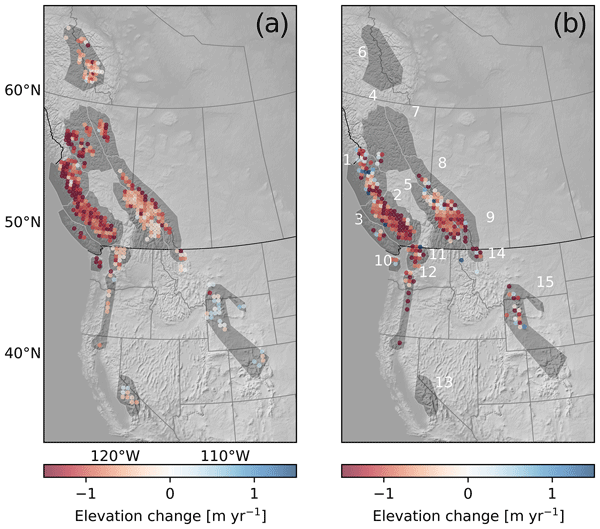
Brian Menounos, Alex Gardner, Caitlyn Florentine, and Andrew Fountain
The Cryosphere, 18, 889–894, https://doi.org/10.5194/tc-18-889-2024, https://doi.org/10.5194/tc-18-889-2024, 2024
Short summary
Short summary
Glaciers in western North American outside of Alaska are often overlooked in global studies because their potential to contribute to changes in sea level is small. Nonetheless, these glaciers represent important sources of freshwater, especially during times of drought. We show that these glaciers lost mass at a rate of about 12 Gt yr-1 for about the period 2013–2021; the rate of mass loss over the period 2018–2022 was similar.
Andrew G. Jones, Shaun A. Marcott, Andrew L. Gorin, Tori M. Kennedy, Jeremy D. Shakun, Brent M. Goehring, Brian Menounos, Douglas H. Clark, Matias Romero, and Marc W. Caffee
The Cryosphere, 17, 5459–5475, https://doi.org/10.5194/tc-17-5459-2023, https://doi.org/10.5194/tc-17-5459-2023, 2023
Short summary
Short summary
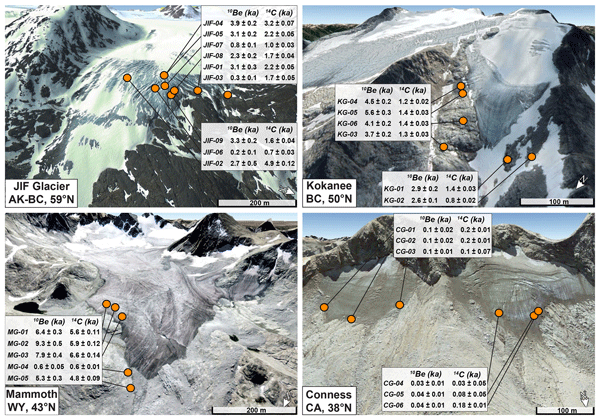
Mountain glaciers today are fractions of their sizes 140 years ago, but how do these sizes compare to the past 11,000 years? We find that four glaciers in the United States and Canada have reversed a long-term trend of growth and retreated to positions last occupied thousands of years ago. Notably, each glacier occupies a unique position relative to its long-term history. We hypothesize that unequal modern retreat has caused the glaciers to be out of sync relative to their Holocene histories.
Adam C. Hawkins, Brian Menounos, Brent M. Goehring, Gerald Osborn, Ben M. Pelto, Christopher M. Darvill, and Joerg M. Schaefer
The Cryosphere, 17, 4381–4397, https://doi.org/10.5194/tc-17-4381-2023, https://doi.org/10.5194/tc-17-4381-2023, 2023
Short summary
Short summary
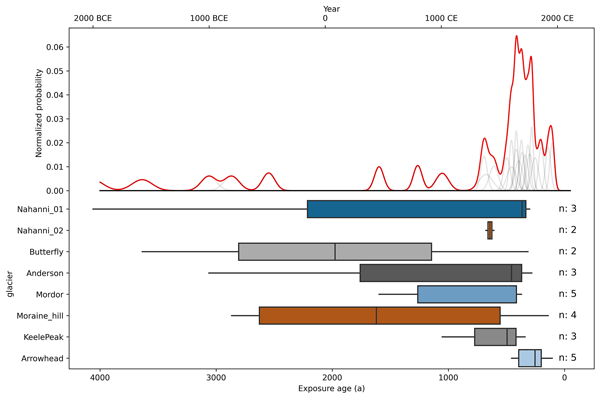
Our study developed a record of glacier and climate change in the Mackenzie and Selwyn mountains of northwestern Canada over the past several hundred years. We estimate temperature change in this region using several methods and incorporate our glacier record with models of climate change to estimate how glacier volume in our study area has changed over time. Models of future glacier change show that our study area will become largely ice-free by the end of the 21st century.
Sara E. Darychuk, Joseph M. Shea, Brian Menounos, Anna Chesnokova, Georg Jost, and Frank Weber
The Cryosphere, 17, 1457–1473, https://doi.org/10.5194/tc-17-1457-2023, https://doi.org/10.5194/tc-17-1457-2023, 2023
Short summary
Short summary
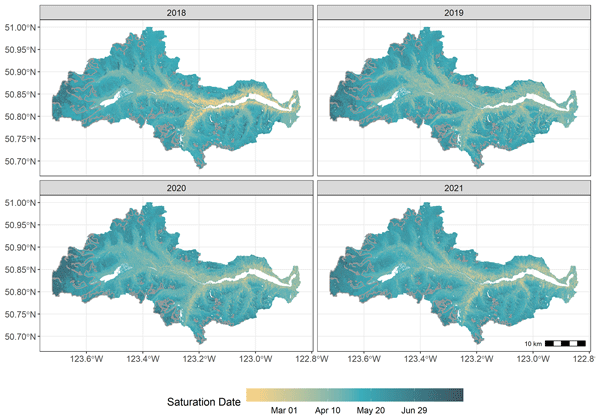
We use synthetic-aperture radar (SAR) and optical observations to map snowmelt timing and duration on the watershed scale. We found that Sentinel-1 SAR time series can be used to approximate snowmelt onset over diverse terrain and land cover types, and we present a low-cost workflow for SAR processing over large, mountainous regions. Our approach provides spatially distributed observations of the snowpack necessary for model calibration and can be used to monitor snowmelt in ungauged basins.
Christophe Kinnard, Olivier Larouche, Michael N. Demuth, and Brian Menounos
The Cryosphere, 16, 3071–3099, https://doi.org/10.5194/tc-16-3071-2022, https://doi.org/10.5194/tc-16-3071-2022, 2022
Short summary
Short summary
This study implements a physically based, distributed glacier mass balance model in a context of sparse direct observations. Carefully constraining model parameters with ancillary data allowed for accurately reconstructing the mass balance of Saskatchewan Glacier over a 37-year period. We show that the mass balance sensitivity to warming is dominated by increased melting and that changes in glacier albedo and air humidity are the leading causes of increased glacier melt under warming scenarios.
Brent M. Goehring, Brian Menounos, Gerald Osborn, Adam Hawkins, and Brent Ward
Geochronology, 4, 311–322, https://doi.org/10.5194/gchron-4-311-2022, https://doi.org/10.5194/gchron-4-311-2022, 2022
Short summary
Short summary
We explored surface exposure dating with two nuclides to date two sets of moraines from the Yukon Territory and explain the reasoning for the observed ages. Results suggest multiple processes, including preservation of nuclides from a prior exposure period, and later erosion of the moraines is required to explain the data. Our results only allow for the older moraines to date to Marine Isotope Stage 3 or 4 and the younger moraines to date to the very earliest Holocene.
Cited articles
Adafruit Feather M0 Adalogger: https://www.adafruit.com/product/2796, last access: 8 March 2025.
Adafruit Industries: SleepyDog: Arduino library to use the watchdog timer for system reset and low power sleep, https://github.com/adafruit/Adafruit_SleepyDog (last access: 27 January 2026), 2023.
Arduino: https://www.arduino.cc/, last access: 8 March 2025.
Ayala, A., Pellicciotti, F., and Shea, J. M.: Modeling 2 m air temperatures over mountain glaciers: Exploring the influence of katabatic cooling and external warming, J. Geophys. Res., 120, 3139–3157, https://doi.org/10.1002/2015jd023137, 2015.
Bash, E. A., Moorman, B. J., and Gunther, A.: Detecting short-term surface melt on an arctic glacier using UAV surveys, Remote Sens. (Basel), 10, 1547, https://doi.org/10.3390/rs10101547, 2018.
Beedle, M. J., Menounos, B., and Wheate, R.: An evaluation of mass-balance methods applied to Castle creek Glacier, British Columbia, Canada, J. Glaciol., 60, 262–276, https://doi.org/10.3189/2014jog13j091, 2014.
Bertoncini, A., Aubry-Wake, C., and Pomeroy, J. W.: Large-area high spatial resolution albedo retrievals from remote sensing for use in assessing the impact of wildfire soot deposition on high mountain snow and ice melt, Remote Sens. Environ., 278, 113101, https://doi.org/10.1016/j.rse.2022.113101, 2022.
Bevington, A.: Place Glacier Smart Ablation Stake Data (2024), Zenodo [data set], https://doi.org/10.5281/zenodo.18392420, 2026a.
Bevington, A.: RemoteLogger Code and Wiring Diagram for Glacier Monitoring. In The Cryosphere, Zenodo, https://doi.org/10.5281/zenodo.18392144, 2026b.
Bevington, A. R.: panetR: (early development) R tools to search, activate and download satellite imagery from the Planet API, GitHub [computer software/source code], https://github.com/bevingtona/planetR (last access: 8 March 2025), 2023.
Bevington, A. R.: Northern BC Hydrology Research, https://bcgov-env.shinyapps.io/nbchydro/ (last access: 8 March 2025), 2025.
Bevington, A. R. and Menounos, B.: Accelerated change in the glaciated environments of western Canada revealed through trend analysis of optical satellite imagery, Remote Sens. Environ., 270, 112862, https://doi.org/10.1016/j.rse.2021.112862, 2022.
Bevington, A. R. and Menounos, B.: Glaciers in western North America experience exceptional transient snowline rise over satellite era, Environ. Res. Lett., 20, 054044, https://doi.org/10.1088/1748-9326/adc9ca, 2025.
Bidlake, W. R., Josberger, E. G., and Savoca, M. E.: Modeled and measured glacier change and related glaciological, hydrological, and meteorological conditions at South Cascade Glacier, Washington, balance and water years 2006 and 2007, U.S. Geological Survey Scientific Investigations Report 2010–5143, 82 pp., 2010.
Braithwaite, R. J. and Zhang, Y.: Sensitivity of mass balance of five Swiss glaciers to temperature changes assessed by tuning a degree-day model, J. Glaciol., 46, 7–14, https://doi.org/10.3189/172756500781833511, 2000.
Carenzo, M., Pellicciotti, F., Rimkus, S., and Burlando, P.: Assessing the transferability and robustness of an enhanced temperature-index glacier-melt model, J. Glaciol., 55, 258–274, https://doi.org/10.3189/002214309788608804, 2009.
Chang, W., Cheng, J., Allaire, J. J., Sievert, C., Schloerke, B., Xie, Y., Allen, J., McPherson, J., Dipert, A., and Borges, B.: shiny: Web Application Framework for R, https://shiny.posit.co/ (last access: 8 March 2025), 2025.
Clarke, G. K. C., Anslow, F. S., Jarosch, A. H., Radić, V., Menounos, B., Bolch, T., and Berthier, E.: Ice volume and subglacial topography for western Canadian glaciers from mass balance fields, thinning rates, and a bed stress model, J. Climate, 26, 4282–4303, https://doi.org/10.1175/JCLI-D-12-00513.1, 2013.
Cogley, J. G., Hock, R., Rasmussen, L. A., Arendt, A. A., Bauder, A., Braithwaite, R. J., Jansson, P., Kaser, G., Möller, M., Nicholson, L., et al.: Glossary of glacier mass balance and related terms, IHP-VII technical documents in hydrology, 86, 965, 2011.
Cremona, A., Huss, M., Landmann, J. M., Borner, J., and Farinotti, D.: European heat waves 2022: contribution to extreme glacier melt in Switzerland inferred from automated ablation readings, The Cryosphere, 17, 1895–1912, https://doi.org/10.5194/tc-17-1895-2023, 2023.
Dehecq, A., Mannerfelt, E., Hugonnet, R., and Tedstone, A.: xDEM – A python library for reproducible DEM analysis and geodetic volume change calculations, EGU General Assembly 2022, Vienna, Austria, 23–27 May 2022, EGU22-5781, https://doi.org/10.5194/egusphere-egu22-5781, 2022.
Donahue, C. P., Menounos, B., Viner, N., Skiles, S. M., Beffort, S., Denouden, T., Arriola, S. G., White, R., and Heathfield, D.: Bridging the gap between airborne and spaceborne imaging spectroscopy for mountain glacier surface property retrievals, Remote Sens. Environ., 299, 113849, https://doi.org/10.1016/j.rse.2023.113849, 2023.
European Space Agency: Copernicus Global Digital Elevation Model, OpenTopography [data set], https://doi.org/10.5069/G9028PQB, 2024.
Feng, S., Cook, J. M., Onuma, Y., Naegeli, K., Tan, W., Anesio, A. M., Benning, L. G., and Tranter, M.: Remote sensing of ice albedo using harmonized Landsat and Sentinel 2 datasets: validation, Int. J. Remote Sens., 45, 7724–7752, https://doi.org/10.1080/01431161.2023.2291000, 2024.
Fitzpatrick, N., Radić, V., and Menounos, B.: Surface Energy Balance Closure and Turbulent Flux Parameterization on a Mid-Latitude Mountain Glacier, Purcell Mountains, Canada, Front Earth Sci. Chin., 5, 67, https://doi.org/10.3389/feart.2017.00067, 2017.
Gomez, C., Darroudi, S. M., Naranjo, H., and Paradells, J.: On the Energy Performance of Iridium Satellite IoT Technology, Sensors, 21, https://doi.org/10.3390/s21217235, 2021.
Greuell, W. and Böhm, R.: 2 m temperatures along melting mid-latitude glaciers, and implications for the sensitivity of the mass balance to variations in temperature, J. Glaciol., 44, 9–20, https://doi.org/10.3189/s0022143000002306, 1998.
Hock, R.: Temperature index melt modelling in mountain areas, J. Hydrol., 282, 104–115, https://doi.org/10.1016/S0022-1694(03)00257-9, 2003.
Horsburgh, J. S., Caraballo, J., Ramírez, M., Aufdenkampe, A. K., Arscott, D. B., and Damiano, S. G.: Low-Cost, Open-Source, and Low-Power: But What to Do With the Data?, Front Earth Sci. Chin., 7, https://doi.org/10.3389/feart.2019.00067, 2019.
HRXL-MaxSonar-WRS Datasheet: https://maxbotix.com/pages/hrxl-maxsonar-wrs-datasheet, last access: 19 March 2025.
Hugonnet, R., McNabb, R., Berthier, E., Menounos, B., Nuth, C., Girod, L., Farinotti, D., Huss, M., Dussaillant, I., Brun, F., and Kääb, A.: Accelerated global glacier mass loss in the early twenty-first century, Nature, 592, 726–731, https://doi.org/10.1038/s41586-021-03436-z, 2021.
IPCC: Climate Change 2023: Synthesis Report. Contribution of Working Groups I, II and III to the Sixth Assessment Report of the Intergovernmental Panel on Climate Change, edited by: Core Writing Team, edited by: Lee, H. and Romero, J., 35–115, https://doi.org/10.59327/IPCC/AR6-9789291691647, 2023.
IridiumSBD v2.0: https://github.com/mikalhart/IridiumSBD, last access: 31 March 2024.
Johnson, A. J., Larsen, C. F., Murphy, N., Arendt, A. A., and Zirnheld, S. L.: Mass balance in the Glacier Bay area of Alaska, USA, and British Columbia, Canada, 1995–2011, using airborne laser altimetry, J. Glaciol., 59, 632–648, 2013.
Kääb, A., Berthier, E., Nuth, C., Gardelle, J., and Arnaud, Y.: Contrasting patterns of early twenty-first-century glacier mass change in the Himalayas, Nature, 488, 495–498, https://doi.org/10.1038/nature11324, 2012.
Kaspari, S., McKenzie Skiles, S., Delaney, I., Dixon, D., and Painter, T. H.: Accelerated glacier melt on Snow Dome, Mount Olympus, Washington, USA, due to deposition of black carbon and mineral dust from wildfire, J. Geophys. Res., 120, 2793–2807, https://doi.org/10.1002/2014jd022676, 2015.
Kinnard, C., Larouche, O., Demuth, M. N., and Menounos, B.: Modelling glacier mass balance and climate sensitivity in the context of sparse observations: application to Saskatchewan Glacier, western Canada, The Cryosphere, 16, 3071–3099, https://doi.org/10.5194/tc-16-3071-2022, 2022.
Kodali, R. K.: Radio data infrastructure for remote monitoring system using lora technology, in: 2017 International Conference on Advances in Computing, Communications and Informatics (ICACCI), 2017 International Conference on Advances in Computing, Communications and Informatics (ICACCI), Udupi, 13–16 September 2017, https://doi.org/10.1109/icacci.2017.8125884, 2017.
Landmann, J. M., Künsch, H. R., Huss, M., Ogier, C., Kalisch, M., and Farinotti, D.: Assimilating near-real-time mass balance stake readings into a model ensemble using a particle filter, The Cryosphere, 15, 5017–5040, https://doi.org/10.5194/tc-15-5017-2021, 2021.
Litt, M., Shea, J., Wagnon, P., Steiner, J., Koch, I., Stigter, E., and Immerzeel, W.: Glacier ablation and temperature indexed melt models in the Nepalese Himalaya, Sci. Rep., 9, 5264, https://doi.org/10.1038/s41598-019-41657-5, 2019.
Liu, J., Gendreau, M., Enderlin, E. M., and Aberle, R.: Improved records of glacier flow instabilities using customized NASA autoRIFT (CautoRIFT) applied to PlanetScope imagery, The Cryosphere, 18, 3571–3590, https://doi.org/10.5194/tc-18-3571-2024, 2024.
Lorrey, A. M., Vargo, L., Purdie, H., Anderson, B., Cullen, N. J., Sirguey, P., Mackintosh, A., Willsman, A., Macara, G., and Chinn, W.: Southern Alps equilibrium line altitudes: four decades of observations show coherent glacier–climate responses and a rising snowline trend, J. Glaciol., 68, 1127–1140, https://doi.org/10.1017/jog.2022.27, 2022.
Menounos, B., Hugonnet, R., Shean, D., Gardner, A., Howat, I., Berthier, E., Pelto, B., Tennant, C., Shea, J., Noh, M., Brun, F., and Dehecq, A.: Heterogeneous changes in western North American glaciers linked to decadal variability in zonal wind strength, Geophys. Res. Lett., 46, 200–209, https://doi.org/10.1029/2018GL080942, 2019.
Menounos, B., Huss, M., Marshall, S., Ednie, M., Florentine, C., and Hartl, L.: Glaciers in Western Canada-conterminous US and Switzerland experience unprecedented mass loss over the last four years (2021–2024), Geophys. Res. Lett., 52, e2025GL115235, https://doi.org/10.1029/2025gl115235, 2025.
Microsoft Open Source, McFarland, M., Emanuele, R., Morris, D., and Augspurger, T.: microsoft/PlanetaryComputer: October 2022, Zenodo [code], https://doi.org/10.5281/zenodo.7261897, 2022.
Moore, R. D. and Demuth, M. N.: Mass balance and streamflow variability at Place Glacier, Canada, in relation to recent climate fluctuations, Hydrol. Process., 15, 3473–3486, https://doi.org/10.1002/hyp.1030, 2001.
Mukherjee, K., Menounos, B., Shea, J., Mortezapour, M., Ednie, M., and Demuth, M. N.: Evaluation of surface mass-balance records using geodetic data and physically-based modelling, Place and Peyto glaciers, western Canada, J. Glaciol., 69, 665–682, https://doi.org/10.1017/jog.2022.83, 2023.
Muñoz-Sabater, J., Dutra, E., Agustí-Panareda, A., Albergel, C., Arduini, G., Balsamo, G., Boussetta, S., Choulga, M., Harrigan, S., Hersbach, H., Martens, B., Miralles, D. G., Piles, M., Rodríguez-Fernández, N. J., Zsoter, E., Buontempo, C., and Thépaut, J.-N.: ERA5-Land: a state-of-the-art global reanalysis dataset for land applications, Earth Syst. Sci. Data, 13, 4349–4383, https://doi.org/10.5194/essd-13-4349-2021, 2021.
Munro, D. S. and Marosz-Wantuch, M.: Modeling Ablation on Place Glacier, British Columbia, from Glacier and Off-glacier Data Sets, Arct. Antarct. Alp. Res., 41, 246–256, https://doi.org/10.1657/1938-4246-41.2.246, 2009.
Nester, T., Kirnbauer, R., Parajka, J., and Blöschl, G.: Evaluating the snow component of a flood forecasting model, Hydrol. Res., 43, 762–779, https://doi.org/10.2166/nh.2012.041, 2012.
Nuth, C. and Kääb, A.: Co-registration and bias corrections of satellite elevation data sets for quantifying glacier thickness change, The Cryosphere, 5, 271–290, https://doi.org/10.5194/tc-5-271-2011, 2011.
Østrem, G.: The transient snowline and glacier mass balance in southern British Columbia and Alberta, Canada, Geogr. Ann. Ser. A. Phys. Geogr., 55, 93–106, https://doi.org/10.1080/04353676.1973.11879883, 1973.
Pearce, R. H., Chadwick, M. A., Main, B., Chan, K., Sayer, C. D., and Patmore, I. R.: Low-Cost Approach to an Instream Water Depth Sensor Construction Using Differential Pressure Sensors and Arduino Microcontrollers, Sensors, 24, https://doi.org/10.3390/s24082488, 2024.
Pellicciotti, F., Brock, B., Strasser, U., Burlando, P., Funk, M., and Corripio, J.: An enhanced temperature-index glacier melt model including the shortwave radiation balance: development and testing for Haut Glacier d'Arolla, Switzerland, J. Glaciol., 51, 573–587, https://doi.org/10.3189/172756505781829124, 2005.
Pelto, B. M., Menounos, B., and Marshall, S. J.: Multi-year evaluation of airborne geodetic surveys to estimate seasonal mass balance, Columbia and Rocky Mountains, Canada, The Cryosphere, 13, 1709–1727, https://doi.org/10.5194/tc-13-1709-2019, 2019.
Pelto, M.: Exceptionally High 2018 Equilibrium Line Altitude on Taku Glacier, Alaska, Remote Sens., 11, 2378, https://doi.org/10.3390/rs11202378, 2019.
Pelto, M. S., Dryak, M., Pelto, J., Matthews, T., and Perry, L. B.: Contribution of glacier runoff during heat waves in the Nooksack river basin USA, Water (Basel), 14, 1145, https://doi.org/10.3390/w14071145, 2022.
Podgórski, J., Kinnard, C., Pętlicki, M., and Urrutia, R.: Performance Assessment of TanDEM-X DEM for Mountain Glacier Elevation Change Detection, Remote Sens., 11, 187, https://doi.org/10.3390/rs11020187, 2019.
QGIS Development Team: QGIS Geographic Information System, Open Source Geospatial Foundation, 2023.
Rabatel, A., Bermejo, A., Loarte, E., Soruco, A., Gomez, J., Leonardini, G., Vincent, C., and Sicart, J. E.: Can the snowline be used as an indicator of the equilibrium line and mass balance for glaciers in the outer tropics?, J. Glaciol., 58, 1027–1036, https://doi.org/10.3189/2012JoG12J027, 2012.
Reyes, L. and Kramer, M. G.: High-elevation snowpack loss during the 2021 Pacific Northwest heat dome amplified by successive spring heatwaves, npj Climate and Atmospheric Science, 6, 1–12, https://doi.org/10.1038/s41612-023-00521-0, 2023.
RGI Consortium: Randolph Glacier Inventory (RGI) – A Dataset of Global Glacier Outlines: Version 6.0, Technical Report, Global Land Ice Measurements from Space, Digital Media Boulder, Colorado, USA, https://doi.org/10.7265/N5-RGI-60, 2017.
Richards, G. and Moore, R. D.: Suspended sediment dynamics in a steep, glacier-fed mountain stream, Place Creek, Canada, Hydrol. Process., 17, 1733–1753, https://doi.org/10.1002/hyp.1208, 2003.
Riggs, G. A., Hall, D. K., and Salomonson, V. V.: A snow index for the Landsat Thematic Mapper and Moderate Resolution Imaging Spectroradiometer, in: Proceedings of IGARSS '94 – 1994 IEEE International Geoscience and Remote Sensing Symposium, 1942–1944, vol. 4, https://doi.org/10.1109/IGARSS.1994.399618, 1994.
Shea, J., Dan Moore, R., and Stahl, K.: Derivation of melt factors from glacier mass-balance records in western Canada, J. Glaciol., 55, 123–130, https://doi.org/10.3189/002214309788608886, 2009.
Shea, J. M. and Moore, R. D.: Prediction of spatially distributed regional-scale fields of air temperature and vapor pressure over mountain glaciers, J. Geophys. Res., 115, https://doi.org/10.1029/2010jd014351, 2010.
Simoes, R., Souza, F., Zaglia, M., Queiroz, G. R., Santos, R., and Ferreira, K.: Rstac: An R Package to Access Spatiotemporal Asset Catalog Satellite Imagery, 2021 IEEE International Geoscience and Remote Sensing Symposium IGARSS, Brussels, Belgium, 2021, 7674–7677, https://doi.org/10.1109/IGARSS47720.2021.9553518, 2021.
Steger, C. R., Steger, B., and Schär, C.: HORAYZON v1.2: an efficient and flexible ray-tracing algorithm to compute horizon and sky view factor, Geosci. Model Dev., 15, 6817–6840, https://doi.org/10.5194/gmd-15-6817-2022, 2022.
Tarca, G., Hoelzle, M., and Guglielmin, M.: Using PlanetScope images to investigate the evolution of small glaciers in the Alps, Remote Sens. Appl. Soc. Environ., 32, 101013, https://doi.org/10.1016/j.rsase.2023.101013, 2023.
Walter, M. T., Brooks, E. S., McCool, D. K., King, L. G., Molnau, M., and Boll, J.: Process-based snowmelt modeling: does it require more input data than temperature-index modeling?, J. Hydrol. (Amst.), 300, 65–75, https://doi.org/10.1016/j.jhydrol.2004.05.002, 2005.
Wells, A., Rounce, D., Sass, L., Florentine, C., Garbo, A., Baker, E., and McNeil, C.: GNSS reflectometry from low-cost sensors for continuous in situ contemporaneous glacier mass balance and flux divergence, J. Glaciol., 70, e5, https://doi.org/10.1017/jog.2024.54, 2024.
WGMS: Fluctuations of Glaciers Database, World Glacier Monitoring Service (WGMS), Zurich, Switzerland [data set], https://doi.org/10.5904/wgms-fog-2021-05, 2024.
Wheler, B. and Flowers, G.: Glacier subsurface heat-flux characterizations for energy-balance modelling in the Donjek Range, southwest Yukon, Canada, J. Glaciol., 57, 121–133, https://doi.org/10.3189/002214311795306709, 2011.
Wickert, A. D., Sandell, C. T., Schulz, B., and Ng, G.-H. C.: Open-source Arduino-compatible data loggers designed for field research, Hydrol. Earth Syst. Sci., 23, 2065–2076, https://doi.org/10.5194/hess-23-2065-2019, 2019.
Wickert, A. D., Barnhart, K. R., Armstrong, W. H., Romero, M., Schulz, B., Ng, G.-H. C., Sandell, C. T., La Frenierre, J., Penprase, S. B., Van Wyk de Vries, M., and MacGregor, K. R.: Automated ablation stakes to constrain temperature-index melt models, Ann. Glaciol., 64, 425–438, https://doi.org/10.1017/aog.2024.21, 2023.
Williamson, S. N. and Menounos, B.: The influence of forest fire aerosol and air temperature on glacier albedo, western North America, Remote Sens. Environ., 267, 112732, https://doi.org/10.1016/j.rse.2021.112732, 2021.
Wood, L. J., Smith, D. J., and Demuth, M. N.: Extending the Place Glacier mass-balance record to AD 1585, using tree rings and wood density, Quat. Res., 76, 305–313, https://doi.org/10.1016/j.yqres.2011.07.003, 2011.
Zhang, M., Wang, X., Shi, C., and Yan, D.: Automated Glacier Extraction Index by Optimization of Red/SWIR and NIR /SWIR Ratio Index for Glacier Mapping Using Landsat Imagery, Water, 11, 1223, https://doi.org/10.3390/w11061223, 2019.
Short summary
We developed automated "smart stakes" to study how quickly glaciers melt during hot weather. The low-cost devices were installed on Place Glacier in British Columbia and sent data by satellite in 2024. We show that just three heat periods caused more than half of the glacier's total summer melt, even though these events lasted only one-third of the melt season. This system provided measurements that would be impossible with traditional methods and we show that the data can improved melt models.
We developed automated "smart stakes" to study how quickly glaciers melt during hot weather. The...


