
Articles | Volume 20, issue 11
https://doi.org/10.5194/tc-20-6883-2026
© Author(s) 2026. This work is distributed under
the Creative Commons Attribution 4.0 License.
https://doi.org/10.5194/tc-20-6883-2026
© Author(s) 2026. This work is distributed under
the Creative Commons Attribution 4.0 License.
Research article
| 
24 Nov 2026
Research article |
| 24 Nov 2026
An accurate present-day model of the Antarctic ice sheet is necessary but insufficient for an accurate projection of its future evolution

Institute for Marine and Atmospheric research Utrecht (IMAU), Utrecht University, Utrecht, the Netherlands
Jorge A. Bernales
Danish Meteorological Institute (DMI), Copenhagen, Denmark
Erwin Lambert
Royal Dutch Meteorological Institute (KNMI), De Bilt, the Netherlands
Roderik S. W. van de Wal
Institute for Marine and Atmospheric research Utrecht (IMAU), Utrecht University, Utrecht, the Netherlands
Royal Dutch Meteorological Institute (KNMI), De Bilt, the Netherlands
Department of Physical Geography, Faculty of Geosciences, Utrecht University, Utrecht, the Netherlands
Related authors
James R. Jordan, Frank Pattyn, Daniel Abele, Torsten Albrecht, Jorge Alvarez-Solas, Jowan M. Barnes, Tijn J. Berends, Jorge A. Bernales, Javier Blasco, Gong Cheng, Youngmin Choi, Stephen L. Cornford, Cruz Garcia-Molina, Fabien Gillet-Chaulet, G. Hilmar Gudmundsson, Angelika Humbert, Gunter R. Leguy, William H. Lipscomb, Marisa Montoya, Daniel Moreno-Parada, Mathieu Morlighem, Tyler Pelle, Alexander Robinson, Martin Rückamp, Hélène Seroussi, Yanmei Tian, Luisa Wagner, Roderick S. W. van de Wal, Liyun Zhao, and Thomas Zwinger
The Cryosphere, 20, 6453–6475, https://doi.org/10.5194/tc-20-6453-2026, https://doi.org/10.5194/tc-20-6453-2026, 2026
Short summary
Short summary
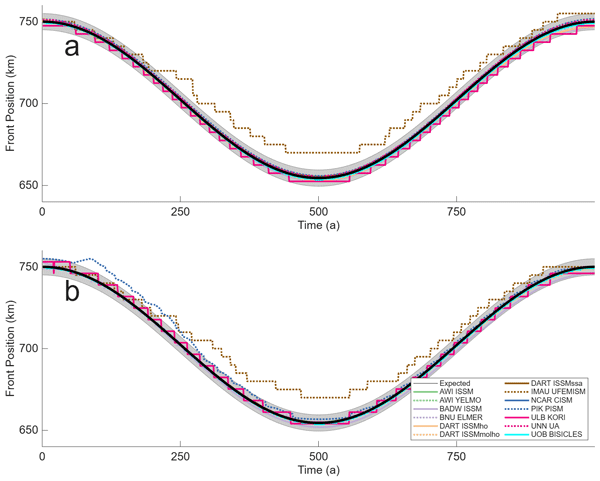
Ice calving is a recent inclusion in ice sheet models and there has not been a systematic test of how well it has been implemented. We show that models can accurately represent a given rate of ice calving, properties at the ice front evolve smoothly during calving, and that there are no consistent differences in ice behaviour between various approaches to representing calving in numerical ice models. This gives us confidence in their ability for use in sea level rise prediction simulations.
Erwin Lambert, Franka Jesse, and Constantijn J. Berends
Geosci. Model Dev., 19, 9441–9461, https://doi.org/10.5194/gmd-19-9441-2026, https://doi.org/10.5194/gmd-19-9441-2026, 2026
Short summary
Short summary
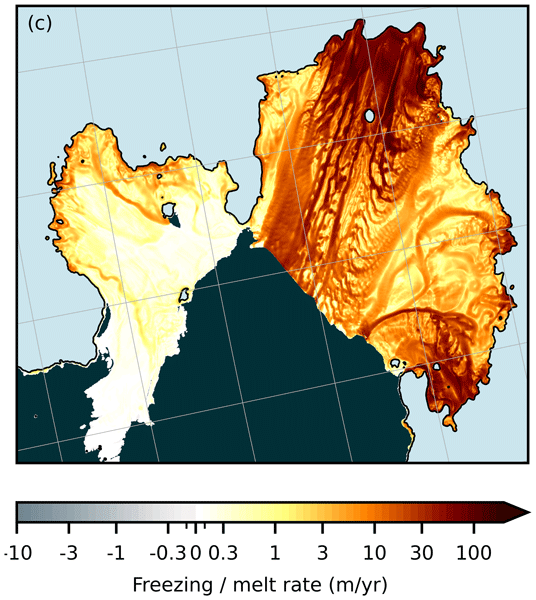
The future contribution of Antarctica to sea-level rise is strongly dependent on the melting of floating ice shelves by the underlying ocean. Here, we present version 2 of the two-dimensional ocean model LADDIE. We evaluate the model by comparing it to three-dimensional ocean models and satellite observations, showing good performance at low computational cost. With this open-source model, we hope to contribute to the evolution toward more realistic melting in ice sheet model simulations.
Franka Jesse, Erwin Lambert, Constantijn J. Berends, and Roderik S. W. van de Wal
EGUsphere, https://doi.org/10.5194/egusphere-2026-4237, https://doi.org/10.5194/egusphere-2026-4237, 2026
This preprint is open for discussion and under review for The Cryosphere (TC).
Short summary
Short summary
Strong ocean-driven melting can create gaps in floating ice shelves. Because the pathways of meltwater beneath these gaps are poorly understood, we tested two contrasting scenarios: one in which meltwater loses heat and momentum within the gaps, and another in which it continues to flow across them. These different representations substantially alter projected ice mass loss, highlighting meltwater treatment across ice-shelf gaps as a key source of uncertainty.

Heiko Goelzer, Constantijn J. Berends, Fredrik Boberg, Gael Durand, Tamsin L. Edwards, Xavier Fettweis, Fabien Gillet-Chaulet, Quentin Glaude, Philippe Huybrechts, Sébastien Le clec'h, Ruth Mottram, Brice Noël, Martin Olesen, Charlotte Rahlves, Jeremy Rohmer, Michiel van den Broeke, and Roderik S. W. van de Wal
The Cryosphere, 19, 6887–6906, https://doi.org/10.5194/tc-19-6887-2025, https://doi.org/10.5194/tc-19-6887-2025, 2025
Short summary
Short summary
We present an ensemble of ice sheet model projections for the Greenland ice sheet. The focus is on providing projections that improve our understanding of the range future sea-level rise and the inherent uncertainties over the next 100 to 300 years. Compared to earlier work we more fully account for some of the uncertainties in sea-level projections. We include a wider range of climate model output, more climate change scenarios and we extend projections schematically up to year 2300.
Johanna Beckmann, Ronja Reese, Felicity S. McCormack, Sue Cook, Lawrence Bird, Dawid Gwyther, Daniel Richards, Matthias Scheiter, Yu Wang, Hélène Seroussi, Ayako Abe‐Ouchi, Torsten Albrecht, Jorge Alvarez‐Solas, Xylar S. Asay‐Davis, Jean‐Baptiste Barre, Constantijn J. Berends, Jorge Bernales, Javier Blasco, Justine Caillet, David M. Chandler, Violaine Coulon, Richard Cullather, Christophe Dumas, Benjamin K. Galton‐Fenzi, Julius Garbe, Fabien Gillet‐Chaulet, Rupert Gladstone, Heiko Goelzer, Nicholas R. Golledge, Ralf Greve, G. Hilmar Gudmundsson, Holly Kyeore Han, Trevor R. Hillebrand, Matthew J. Hoffman, Philippe Huybrechts, Nicolas C. Jourdain, Ann Kristin Klose, Petra M. Langebroek, Gunter R. Leguy, William H. Lipscomb, Daniel P. Lowry, Pierre Mathiot, Marisa Montoya, Mathieu Morlighem, Sophie Nowicki, Frank Pattyn, Antony J. Payne, Tyler Pelle, Aurélien Quiquet, Alexander Robinson, Leopekka Saraste, Erika G. Simon, Sainan Sun, Jake P. Twarog, Luke D. Trusel, Benoit Urruty, Jonas Van Breedam, Roderik S. W. van de Wal, Chen Zhao, and Thomas Zwinger
EGUsphere, https://doi.org/10.5194/egusphere-2025-4069, https://doi.org/10.5194/egusphere-2025-4069, 2025
Short summary
Short summary
Antarctica holds enough ice to raise sea levels by many meters, but its future is uncertain. Warm ocean water melts ice shelves from below, letting inland ice flow faster into the sea. By 2300, Antarctica could add 0.6–4.4 m to sea levels. Our study identifies two key factors—how strongly shelves melt and how the ice responds. These explain much of the range, and refining them in models may improve future predictions.
Meike D. W. Scherrenberg, Constantijn J. Berends, and Roderik S. W. van de Wal
Clim. Past, 21, 1061–1077, https://doi.org/10.5194/cp-21-1061-2025, https://doi.org/10.5194/cp-21-1061-2025, 2025
Short summary
Short summary
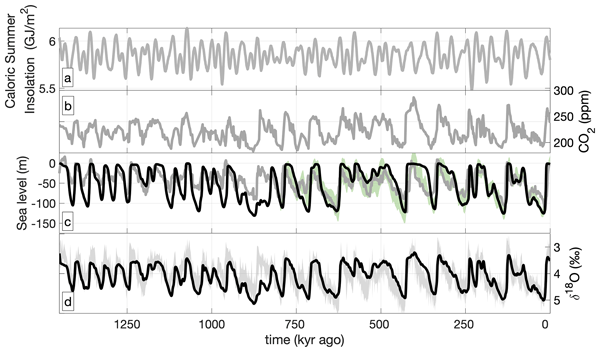
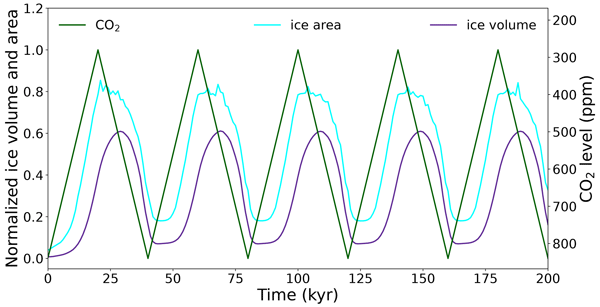
Glacial cycle duration changed from 41 000 to 100 000 years during the Mid-Pleistocene Transition (MPT), but the cause is still under debate. We simulate the MPT with an ice sheet model forced by prescribed CO2 and insolation and simple ice–climate interactions. Before the MPT, glacial cycles follow insolation. After the MPT, low CO2 levels may compensate for warming at insolation maxima, increasing the length of glacial cycles until the North American ice sheet becomes large and thereby unstable.

Constantijn J. Berends, Victor Azizi, Jorge A. Bernales, and Roderik S. W. van de Wal
Geosci. Model Dev., 18, 3635–3659, https://doi.org/10.5194/gmd-18-3635-2025, https://doi.org/10.5194/gmd-18-3635-2025, 2025
Short summary
Short summary
Ice-sheet models are computer programs that can simulate how the Greenland and Antarctic ice sheets will evolve in the future. The accuracy of these models depends on their resolution: how small the details are that the model can resolve. We have created a model with a variable resolution that can resolve a lot of detail in areas where lots of changes happen in the ice and less detail in areas where the ice does not move so much. This makes the model both accurate and fast.
Tim van den Akker, William H. Lipscomb, Gunter R. Leguy, Jorjo Bernales, Constantijn J. Berends, Willem Jan van de Berg, and Roderik S. W. van de Wal
The Cryosphere, 19, 283–301, https://doi.org/10.5194/tc-19-283-2025, https://doi.org/10.5194/tc-19-283-2025, 2025
Short summary
Short summary
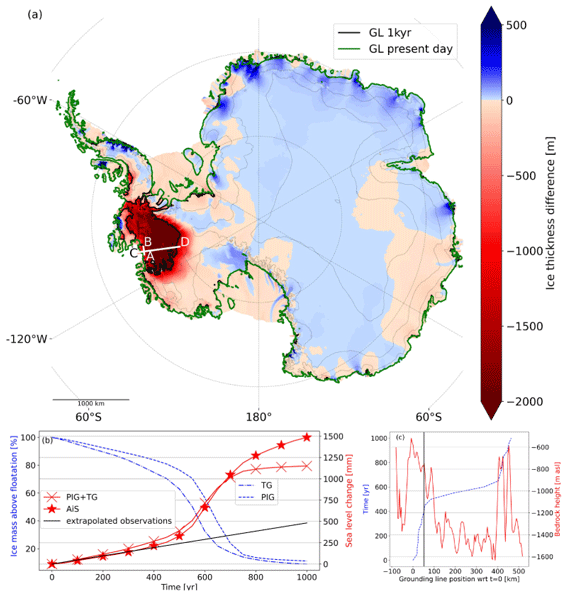
In this study, we present an improved way of representing ice thickness change rates in an ice sheet model. We apply this method using two ice sheet models of the Antarctic Ice Sheet. We found that the two largest outlet glaciers on the Antarctic Ice Sheet, Thwaites Glacier and Pine Island Glacier, will collapse without further warming on a timescale of centuries. This would cause a sea level rise of about 1.2 m globally.
Constantijn J. Berends
EGUsphere, https://doi.org/10.5194/egusphere-2024-3610, https://doi.org/10.5194/egusphere-2024-3610, 2024
Preprint archived
Short summary
Short summary
Computer models of ice sheets solve mathematical equations describing the physics of flowing ice. While observations from satellites or other sources can be used to check if these equations describe the ice sheet correctly, one must first ensure the model solves the equations correctly. I here present a small extension to a previously derived solution on paper to one of those equations, so that modellers can verify their models.
Meike D. W. Scherrenberg, Constantijn J. Berends, and Roderik S. W. van de Wal
Clim. Past, 20, 1761–1784, https://doi.org/10.5194/cp-20-1761-2024, https://doi.org/10.5194/cp-20-1761-2024, 2024
Short summary
Short summary
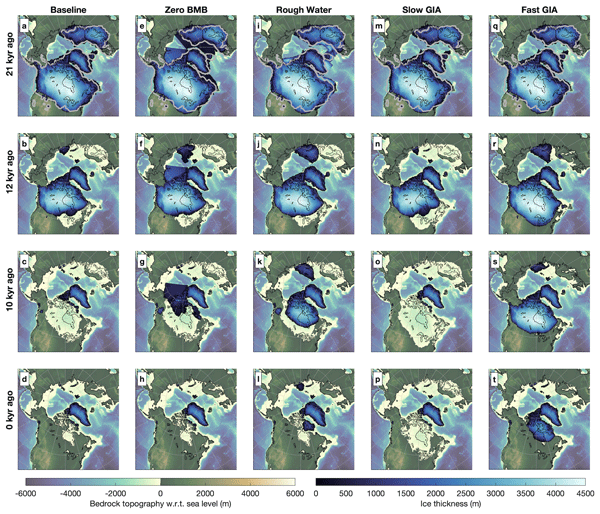
During Late Pleistocene glacial cycles, the Eurasian and North American ice sheets grew and melted, resulting in over 100 m of sea-level change. Studying the melting of past ice sheets can improve our understanding of how ice sheets might respond in the future. In this study, we find that melting increases due to proglacial lakes forming at the margins of the ice sheets, primarily due to the reduced basal friction of floating ice. Furthermore, bedrock uplift rates can strongly influence melting.
Lennert B. Stap, Constantijn J. Berends, and Roderik S. W. van de Wal
Clim. Past, 20, 257–266, https://doi.org/10.5194/cp-20-257-2024, https://doi.org/10.5194/cp-20-257-2024, 2024
Short summary
Short summary
Analysing simulations of Antarctic Ice Sheet variability during the early and mid-Miocene (23 to 14 Myr ago), we find that the ice sheet area adapts faster and more strongly than volume to climate change on quasi-orbital timescales. Considering the recent discovery that ice area, rather than volume, influences deep-ocean temperatures, this implies that the Miocene Antarctic Ice Sheet affects deep-ocean temperatures more than its volume suggests.
Constantijn J. Berends, Roderik S. W. van de Wal, Tim van den Akker, and William H. Lipscomb
The Cryosphere, 17, 1585–1600, https://doi.org/10.5194/tc-17-1585-2023, https://doi.org/10.5194/tc-17-1585-2023, 2023
Short summary
Short summary
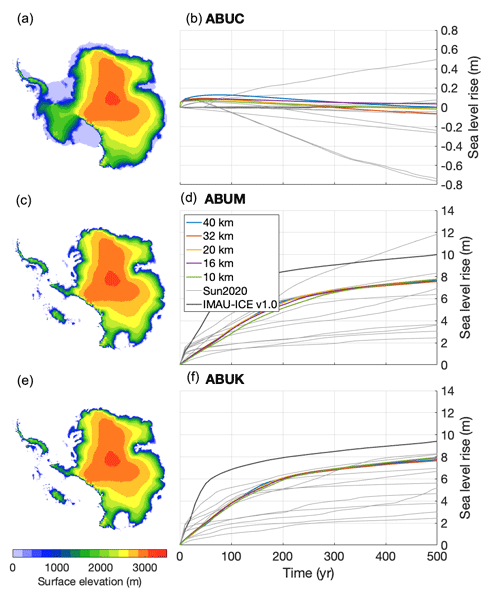
The rate at which the Antarctic ice sheet will melt because of anthropogenic climate change is uncertain. Part of this uncertainty stems from processes occurring beneath the ice, such as the way the ice slides over the underlying bedrock.
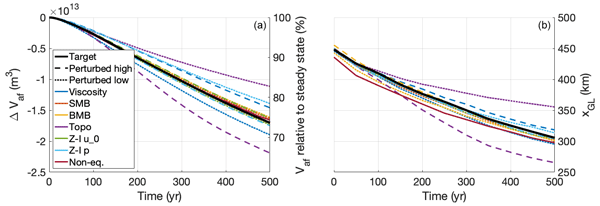
Inversion methodsattempt to use observations of the ice-sheet surface to calculate how these sliding processes work. We show that such methods cannot fully solve this problem, so a substantial uncertainty still remains in projections of sea-level rise.
Meike D. W. Scherrenberg, Constantijn J. Berends, Lennert B. Stap, and Roderik S. W. van de Wal
Clim. Past, 19, 399–418, https://doi.org/10.5194/cp-19-399-2023, https://doi.org/10.5194/cp-19-399-2023, 2023
Short summary
Short summary
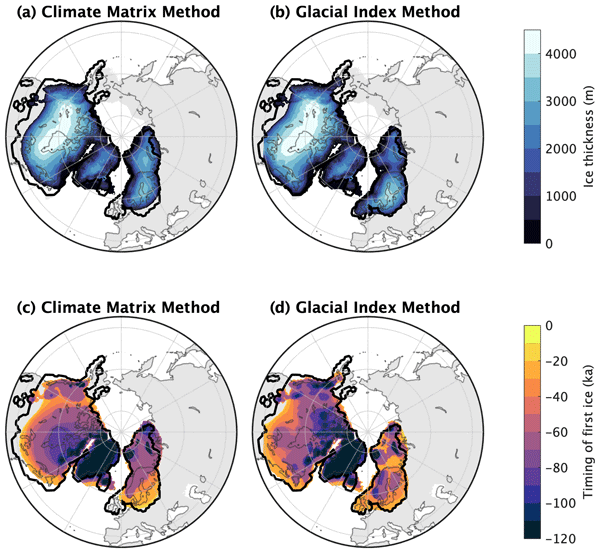
Ice sheets have a large effect on climate and vice versa. Here we use an ice sheet computer model to simulate the last glacial cycle and compare two methods, one that implicitly includes these feedbacks and one that does not. We found that when including simple climate feedbacks, the North American ice sheet develops from two domes instead of many small domes. Each ice sheet melts slower when including feedbacks. We attribute this difference mostly to air temperature–ice sheet interactions.
Constantijn J. Berends, Heiko Goelzer, Thomas J. Reerink, Lennert B. Stap, and Roderik S. W. van de Wal
Geosci. Model Dev., 15, 5667–5688, https://doi.org/10.5194/gmd-15-5667-2022, https://doi.org/10.5194/gmd-15-5667-2022, 2022
Short summary
Short summary
The rate at which marine ice sheets such as the West Antarctic ice sheet will retreat in a warming climate and ocean is still uncertain. Numerical ice-sheet models, which solve the physical equations that describe the way glaciers and ice sheets deform and flow, have been substantially improved in recent years. Here we present the results of several years of work on IMAU-ICE, an ice-sheet model of intermediate complexity, which can be used to study ice sheets of both the past and the future.
Lennert B. Stap, Constantijn J. Berends, Meike D. W. Scherrenberg, Roderik S. W. van de Wal, and Edward G. W. Gasson
The Cryosphere, 16, 1315–1332, https://doi.org/10.5194/tc-16-1315-2022, https://doi.org/10.5194/tc-16-1315-2022, 2022
Short summary
Short summary
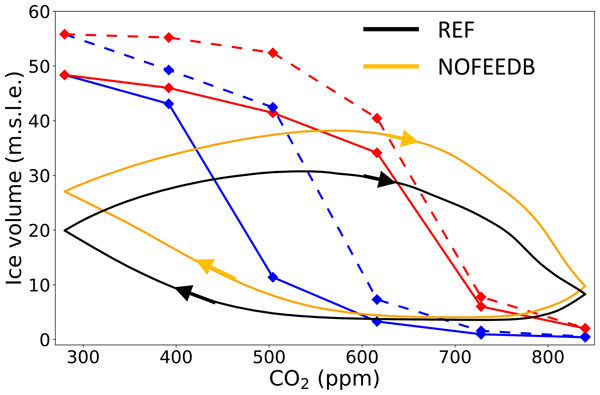
To gain understanding of how the Antarctic ice sheet responded to CO2 changes during past warm climate conditions, we simulate its variability during the Miocene. We include feedbacks between the ice sheet and atmosphere in our model and force the model using time-varying climate conditions. We find that these feedbacks reduce the amplitude of ice volume variations. Erosion-induced changes in the bedrock below the ice sheet that manifested during the Miocene also have a damping effect.
James R. Jordan, Frank Pattyn, Daniel Abele, Torsten Albrecht, Jorge Alvarez-Solas, Jowan M. Barnes, Tijn J. Berends, Jorge A. Bernales, Javier Blasco, Gong Cheng, Youngmin Choi, Stephen L. Cornford, Cruz Garcia-Molina, Fabien Gillet-Chaulet, G. Hilmar Gudmundsson, Angelika Humbert, Gunter R. Leguy, William H. Lipscomb, Marisa Montoya, Daniel Moreno-Parada, Mathieu Morlighem, Tyler Pelle, Alexander Robinson, Martin Rückamp, Hélène Seroussi, Yanmei Tian, Luisa Wagner, Roderick S. W. van de Wal, Liyun Zhao, and Thomas Zwinger
The Cryosphere, 20, 6453–6475, https://doi.org/10.5194/tc-20-6453-2026, https://doi.org/10.5194/tc-20-6453-2026, 2026
Short summary
Short summary
Ice calving is a recent inclusion in ice sheet models and there has not been a systematic test of how well it has been implemented. We show that models can accurately represent a given rate of ice calving, properties at the ice front evolve smoothly during calving, and that there are no consistent differences in ice behaviour between various approaches to representing calving in numerical ice models. This gives us confidence in their ability for use in sea level rise prediction simulations.
Erwin Lambert, Franka Jesse, and Constantijn J. Berends
Geosci. Model Dev., 19, 9441–9461, https://doi.org/10.5194/gmd-19-9441-2026, https://doi.org/10.5194/gmd-19-9441-2026, 2026
Short summary
Short summary
The future contribution of Antarctica to sea-level rise is strongly dependent on the melting of floating ice shelves by the underlying ocean. Here, we present version 2 of the two-dimensional ocean model LADDIE. We evaluate the model by comparing it to three-dimensional ocean models and satellite observations, showing good performance at low computational cost. With this open-source model, we hope to contribute to the evolution toward more realistic melting in ice sheet model simulations.
Ronja Reese, Nicolas C. Jourdain, Xylar S. Asay-Davis, Clara Burgard, Erwin Lambert, Yoshihiro Nakayama, Paul R. Holland, Kaitlin A. Naughten, Ralph Timmermann, Pierre Dutrieux, Shenjie Zhou, Golsa Talebigheshlaghi, and Yanmei Tian
EGUsphere, https://doi.org/10.5194/egusphere-2026-5337, https://doi.org/10.5194/egusphere-2026-5337, 2026
This preprint is open for discussion and under review for The Cryosphere (TC).
Short summary
Short summary
An important factor in projections of the Antarctic contribution to future sea level rise is the Southern Ocean. The Ice Sheet Model Intercomparison Project for CMIP7 aims to provide ice sheet projections, and here we introduce the protocol for handling the ocean in Antarctica. It describes how ocean changes from global atmosphere-ocean models can be used in Antarctic simulations and how ocean conditions can be translated into melt rates, taking into account oceanographic knowledge.
Franka Jesse, Erwin Lambert, Constantijn J. Berends, and Roderik S. W. van de Wal
EGUsphere, https://doi.org/10.5194/egusphere-2026-4237, https://doi.org/10.5194/egusphere-2026-4237, 2026
This preprint is open for discussion and under review for The Cryosphere (TC).
Short summary
Short summary
Strong ocean-driven melting can create gaps in floating ice shelves. Because the pathways of meltwater beneath these gaps are poorly understood, we tested two contrasting scenarios: one in which meltwater loses heat and momentum within the gaps, and another in which it continues to flow across them. These different representations substantially alter projected ice mass loss, highlighting meltwater treatment across ice-shelf gaps as a key source of uncertainty.
Eveline C. van der Linden, Klaus Wyser, Erwin Lambert, André Jüling, Dewi Le Bars, Sybren Drijfthout, and Irene Trombini
EGUsphere, https://doi.org/10.5194/egusphere-2026-4584, https://doi.org/10.5194/egusphere-2026-4584, 2026
Short summary
Short summary
As Antarctica loses more ice, increasing amounts of fresh water enter the ocean and can change Earth's climate. We used a climate model in which Antarctic ice loss responds to changing ocean conditions. We found that this feedback first increases warming near the ice shelves but later slows both Antarctic and global warming by changing the ocean, sea ice, and atmosphere. These results show that including these interactions is important for improving long-term sea-level and climate projections.
Florian Vacek, Faezeh M. Nick, Douglas Benn, Maarten P. A. Zwarts, Walter Immerzeel, and Roderik S. W. van de Wal
The Cryosphere, 20, 3827–3845, https://doi.org/10.5194/tc-20-3827-2026, https://doi.org/10.5194/tc-20-3827-2026, 2026
Short summary
Short summary
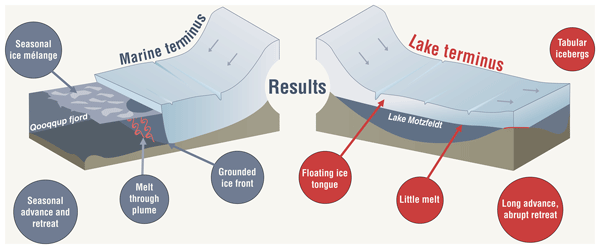
We studied a unique glacier in South Greenland that ends in both a lake and the ocean. Using satellite data and field work, we found that the two glacier fronts behave very differently even under the same climate. At the lake glacier we identify a floating ice tongue and we infer little melt below water. The lake glacier experienced a sudden large breakup. Our work suggests that lake and marine glacier fronts must be treated differently in model simulations.
Daniel Gunning, Kerim H. Nisancioglu, Emilie Capron, and Roderik S. W. van de Wal
EGUsphere, https://doi.org/10.5194/egusphere-2026-1151, https://doi.org/10.5194/egusphere-2026-1151, 2026
Short summary
Short summary
During the Early Pleistocene, glacial cycles closely follow Earth’s obliquity, even though summer insolation is strongly modulated by precession. Sensitivity experiments with a zonally averaged energy balance model show a pronounced obliquity cycle in polar temperatures. This arises from obliquity control on winter sea ice, which regulates ocean heat release, while precession has a weaker effect on sea ice and temperature.
Tim van den Akker, William H. Lipscomb, Gunter R. Leguy, Willem Jan van de Berg, and Roderik S. W. van de Wal
The Cryosphere, 20, 1405–1425, https://doi.org/10.5194/tc-20-1405-2026, https://doi.org/10.5194/tc-20-1405-2026, 2026
Short summary
Short summary
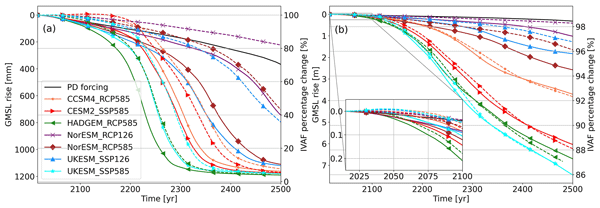
The Antarctic Ice Sheet is currently thinning, especially at major outlet glaciers. Including present-day ice thinning rates in models is a modeller's choice and can affect future projections. This study quantifies the impact of current imbalance on forced future projections, revealing strong regional and short-term (up to 2100) effects when these mass change rates are included.

Tim van den Akker, William H. Lipscomb, Gunter R. Leguy, Willem Jan van de Berg, and Roderik S. W. van de Wal
The Cryosphere, 20, 1217–1235, https://doi.org/10.5194/tc-20-1217-2026, https://doi.org/10.5194/tc-20-1217-2026, 2026
Short summary
Short summary
Ice sheet models to simulate future sea level rise require parameterizations, like for the friction at the bedrock. Studies have quantified the effect of using different parameterizations, and some have concluded that projections are sensitive to the choice of the specific parameterization. In this study, we show that you can make an ice sheet model sensitive to the basal friction parameterization, and that for different modellers choices you can also make the model insensitive to this.
Caroline J. van Calcar, Pippa L. Whitehouse, Roderik S. W. van de Wal, and Wouter van der Wal
The Cryosphere, 20, 757–775, https://doi.org/10.5194/tc-20-757-2026, https://doi.org/10.5194/tc-20-757-2026, 2026
Short summary
Short summary
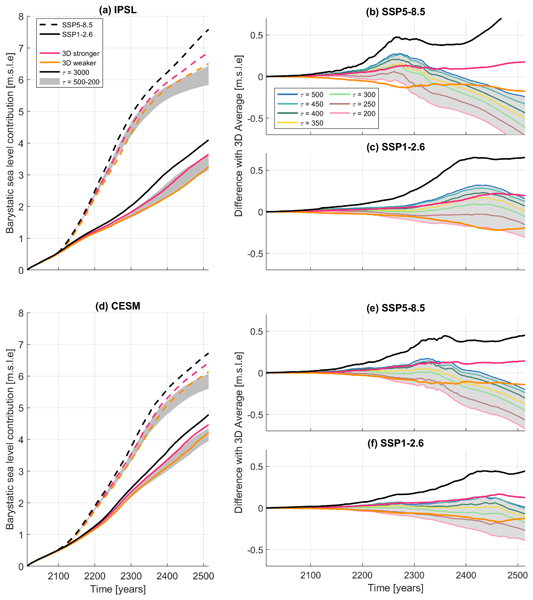
The bedrock deformation in response to a melting ice sheet provides significant negative feedback on Antarctic ice mass loss in the next 500 years. Current ice sheet models often use computationally fast but simplified Earth models. Our results show that projections of the Antarctic Ice Sheet contribution to sea-level rise using an ice sheet - 3D GIA (glacial isostatic adjustment) model can be approximated using a laterally varying ELRA (elastic lithosphere, relaxed asthenosphere) model or a 1D GIA model when the recommended parameters are used.
Heiko Goelzer, Constantijn J. Berends, Fredrik Boberg, Gael Durand, Tamsin L. Edwards, Xavier Fettweis, Fabien Gillet-Chaulet, Quentin Glaude, Philippe Huybrechts, Sébastien Le clec'h, Ruth Mottram, Brice Noël, Martin Olesen, Charlotte Rahlves, Jeremy Rohmer, Michiel van den Broeke, and Roderik S. W. van de Wal
The Cryosphere, 19, 6887–6906, https://doi.org/10.5194/tc-19-6887-2025, https://doi.org/10.5194/tc-19-6887-2025, 2025
Short summary
Short summary
We present an ensemble of ice sheet model projections for the Greenland ice sheet. The focus is on providing projections that improve our understanding of the range future sea-level rise and the inherent uncertainties over the next 100 to 300 years. Compared to earlier work we more fully account for some of the uncertainties in sea-level projections. We include a wider range of climate model output, more climate change scenarios and we extend projections schematically up to year 2300.
Tim H. J. Hermans, Chiheb Ben Hammouda, Simon Treu, Timothy Tiggeloven, Anaïs Couasnon, Julius J. M. Busecke, and Roderik S. W. van de Wal
Nat. Hazards Earth Syst. Sci., 25, 4593–4612, https://doi.org/10.5194/nhess-25-4593-2025, https://doi.org/10.5194/nhess-25-4593-2025, 2025
Short summary
Short summary
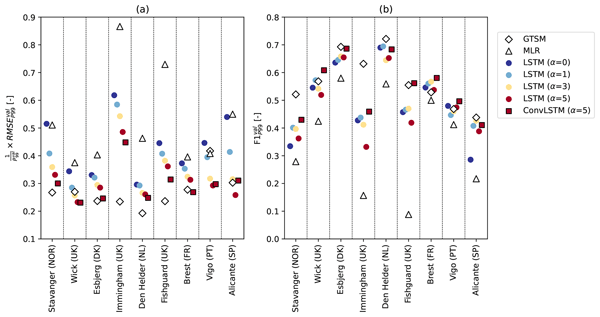
We studied the performance of different types of neural networks at predicting extreme storm surges. We found that that performance improves when during model training, storm surges that are rarer are given a higher weight than moderate storm surges. Additionally, we found that the performance of some of the neural networks approaches that of a state-of-the-art hydrodynamic model. This is promising for the future application of neural networks to climate model simulations.
Johanna Beckmann, Ronja Reese, Felicity S. McCormack, Sue Cook, Lawrence Bird, Dawid Gwyther, Daniel Richards, Matthias Scheiter, Yu Wang, Hélène Seroussi, Ayako Abe‐Ouchi, Torsten Albrecht, Jorge Alvarez‐Solas, Xylar S. Asay‐Davis, Jean‐Baptiste Barre, Constantijn J. Berends, Jorge Bernales, Javier Blasco, Justine Caillet, David M. Chandler, Violaine Coulon, Richard Cullather, Christophe Dumas, Benjamin K. Galton‐Fenzi, Julius Garbe, Fabien Gillet‐Chaulet, Rupert Gladstone, Heiko Goelzer, Nicholas R. Golledge, Ralf Greve, G. Hilmar Gudmundsson, Holly Kyeore Han, Trevor R. Hillebrand, Matthew J. Hoffman, Philippe Huybrechts, Nicolas C. Jourdain, Ann Kristin Klose, Petra M. Langebroek, Gunter R. Leguy, William H. Lipscomb, Daniel P. Lowry, Pierre Mathiot, Marisa Montoya, Mathieu Morlighem, Sophie Nowicki, Frank Pattyn, Antony J. Payne, Tyler Pelle, Aurélien Quiquet, Alexander Robinson, Leopekka Saraste, Erika G. Simon, Sainan Sun, Jake P. Twarog, Luke D. Trusel, Benoit Urruty, Jonas Van Breedam, Roderik S. W. van de Wal, Chen Zhao, and Thomas Zwinger
EGUsphere, https://doi.org/10.5194/egusphere-2025-4069, https://doi.org/10.5194/egusphere-2025-4069, 2025
Short summary
Short summary
Antarctica holds enough ice to raise sea levels by many meters, but its future is uncertain. Warm ocean water melts ice shelves from below, letting inland ice flow faster into the sea. By 2300, Antarctica could add 0.6–4.4 m to sea levels. Our study identifies two key factors—how strongly shelves melt and how the ice responds. These explain much of the range, and refining them in models may improve future predictions.
Franka Jesse, Erwin Lambert, and Roderik S. W. van de Wal
The Cryosphere, 19, 3849–3872, https://doi.org/10.5194/tc-19-3849-2025, https://doi.org/10.5194/tc-19-3849-2025, 2025
Short summary
Short summary
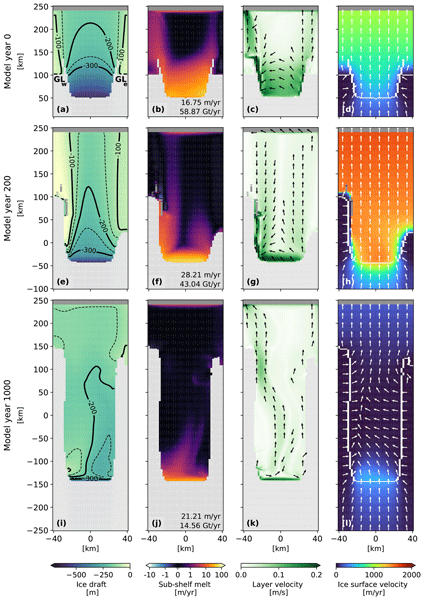
We introduce the coupling of a sub-shelf melt model with an ice sheet model to explore how horizontal meltwater flow below ice shelves affects ice sheet mass loss over time. We show that accurately modelling the meltwater flow direction leads to distinct feedbacks and transient volume loss not captured by melt parameterisations that simplify flow direction. Our results highlight the importance of refining the meltwater flow representation in ice sheet models to improve sea level projections.
Erwin Lambert, Dewi Le Bars, Eveline van der Linden, André Jüling, and Sybren Drijfhout
Earth Syst. Dynam., 16, 1303–1323, https://doi.org/10.5194/esd-16-1303-2025, https://doi.org/10.5194/esd-16-1303-2025, 2025
Short summary
Short summary
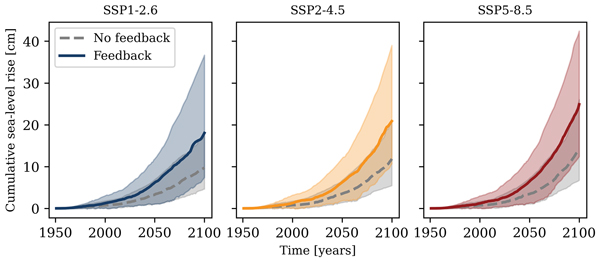
Ocean warming around Antarctica leads to ice melting and sea-level rise. The meltwater that flows into the surrounding ocean can lead to enhanced warming of the seawater, thereby again increasing melting and sea-level rise. This process, however, is not currently included in climate models. Through a simple mathematical approach, we find that this process can lead to more melting and greater sea-level rise, possibly increasing the Antarctic contribution to 21st century sea-level rise by 80 %.
Erwin Lambert and Clara Burgard
The Cryosphere, 19, 2495–2505, https://doi.org/10.5194/tc-19-2495-2025, https://doi.org/10.5194/tc-19-2495-2025, 2025
Short summary
Short summary
The effect of ocean warming on Antarctic ice-sheet melting is a major source of uncertainty in estimates of future sea level rise. We compare five melt models to show that ocean warming strongly increases melting. Despite their calibration based on present-day melting, the models disagree on the amount of melt increase. In some important regions, the difference reaches a factor 100. We conclude that using various melt models is important to accurately estimate uncertainties in future sea level rise.
Meike D. W. Scherrenberg, Constantijn J. Berends, and Roderik S. W. van de Wal
Clim. Past, 21, 1061–1077, https://doi.org/10.5194/cp-21-1061-2025, https://doi.org/10.5194/cp-21-1061-2025, 2025
Short summary
Short summary
Glacial cycle duration changed from 41 000 to 100 000 years during the Mid-Pleistocene Transition (MPT), but the cause is still under debate. We simulate the MPT with an ice sheet model forced by prescribed CO2 and insolation and simple ice–climate interactions. Before the MPT, glacial cycles follow insolation. After the MPT, low CO2 levels may compensate for warming at insolation maxima, increasing the length of glacial cycles until the North American ice sheet becomes large and thereby unstable.
Constantijn J. Berends, Victor Azizi, Jorge A. Bernales, and Roderik S. W. van de Wal
Geosci. Model Dev., 18, 3635–3659, https://doi.org/10.5194/gmd-18-3635-2025, https://doi.org/10.5194/gmd-18-3635-2025, 2025
Short summary
Short summary
Ice-sheet models are computer programs that can simulate how the Greenland and Antarctic ice sheets will evolve in the future. The accuracy of these models depends on their resolution: how small the details are that the model can resolve. We have created a model with a variable resolution that can resolve a lot of detail in areas where lots of changes happen in the ice and less detail in areas where the ice does not move so much. This makes the model both accurate and fast.
Daniel F. J. Gunning, Kerim H. Nisancioglu, Emilie Capron, and Roderik S. W. van de Wal
Geosci. Model Dev., 18, 2479–2508, https://doi.org/10.5194/gmd-18-2479-2025, https://doi.org/10.5194/gmd-18-2479-2025, 2025
Short summary
Short summary
This work documents the first results from ZEMBA: an energy balance model of the climate system. The model is a computationally efficient tool designed to study the response of climate to changes in the Earth's orbit. We demonstrate that ZEMBA reproduces many features of the Earth's climate for both the pre-industrial period and the Earth's most recent cold extreme – the Last Glacial Maximum. We intend to develop ZEMBA further and investigate the glacial cycles of the last 2.5 million years.
Kim de Wit, Kim M. Cohen, and Roderik S. W. van de Wal
Earth Syst. Sci. Data, 17, 545–577, https://doi.org/10.5194/essd-17-545-2025, https://doi.org/10.5194/essd-17-545-2025, 2025
Short summary
Short summary
In the Holocene, deltas and coastal plains developed due to relative sea level rise (RSLR). Past coastal and inland water levels are preserved in geological indicators, like basal peats. We present a dataset of 712 Holocene water level indicators from the Dutch coastal plain, relevant for studying RSLR and regional subsidence, compiled in HOLSEA workbook format. Our new, internally consistent, expanded documentation encourages multiple data uses and to report RSLR uncertainties transparently.
Tim van den Akker, William H. Lipscomb, Gunter R. Leguy, Jorjo Bernales, Constantijn J. Berends, Willem Jan van de Berg, and Roderik S. W. van de Wal
The Cryosphere, 19, 283–301, https://doi.org/10.5194/tc-19-283-2025, https://doi.org/10.5194/tc-19-283-2025, 2025
Short summary
Short summary
In this study, we present an improved way of representing ice thickness change rates in an ice sheet model. We apply this method using two ice sheet models of the Antarctic Ice Sheet. We found that the two largest outlet glaciers on the Antarctic Ice Sheet, Thwaites Glacier and Pine Island Glacier, will collapse without further warming on a timescale of centuries. This would cause a sea level rise of about 1.2 m globally.
Constantijn J. Berends
EGUsphere, https://doi.org/10.5194/egusphere-2024-3610, https://doi.org/10.5194/egusphere-2024-3610, 2024
Preprint archived
Short summary
Short summary
Computer models of ice sheets solve mathematical equations describing the physics of flowing ice. While observations from satellites or other sources can be used to check if these equations describe the ice sheet correctly, one must first ensure the model solves the equations correctly. I here present a small extension to a previously derived solution on paper to one of those equations, so that modellers can verify their models.
Bart van den Hurk, Nadia Pinardi, Alexander Bisaro, Giulia Galluccio, José A. Jiménez, Kate Larkin, Angélique Melet, Lavinia Giulia Pomarico, Kristin Richter, Kanika Singh, Roderik van de Wal, and Gundula Winter
State Planet, 3-slre1, 1, https://doi.org/10.5194/sp-3-slre1-1-2024, https://doi.org/10.5194/sp-3-slre1-1-2024, 2024
Short summary
Short summary
The Summary for Policymakers compiles findings from “Sea Level Rise in Europe: 1st Assessment Report of the Knowledge Hub on Sea Level Rise”. It covers knowledge gaps, observations, projections, impacts, adaptation measures, decision-making principles, and governance challenges. It provides information for each European basin (Mediterranean, Black Sea, North Sea, Baltic Sea, Atlantic, and Arctic) and aims to assist policymakers in enhancing the preparedness of European coasts for sea level rise.
Roderik van de Wal, Angélique Melet, Debora Bellafiore, Paula Camus, Christian Ferrarin, Gualbert Oude Essink, Ivan D. Haigh, Piero Lionello, Arjen Luijendijk, Alexandra Toimil, Joanna Staneva, and Michalis Vousdoukas
State Planet, 3-slre1, 5, https://doi.org/10.5194/sp-3-slre1-5-2024, https://doi.org/10.5194/sp-3-slre1-5-2024, 2024
Short summary
Short summary
Sea level rise has major impacts in Europe, which vary from place to place and in time, depending on the source of the impacts. Flooding, erosion, and saltwater intrusion lead, via different pathways, to various consequences for coastal regions across Europe. This causes damage to assets, the environment, and people for all three categories of impacts discussed in this paper. The paper provides an overview of the various impacts in Europe.
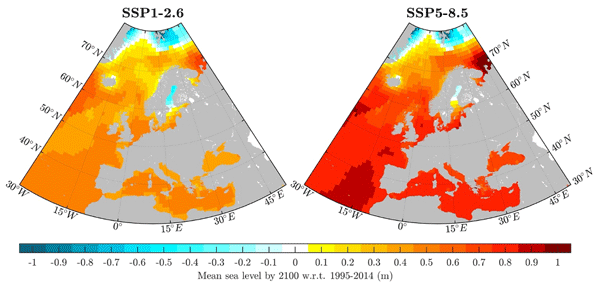
Angélique Melet, Roderik van de Wal, Angel Amores, Arne Arns, Alisée A. Chaigneau, Irina Dinu, Ivan D. Haigh, Tim H. J. Hermans, Piero Lionello, Marta Marcos, H. E. Markus Meier, Benoit Meyssignac, Matthew D. Palmer, Ronja Reese, Matthew J. R. Simpson, and Aimée B. A. Slangen
State Planet, 3-slre1, 4, https://doi.org/10.5194/sp-3-slre1-4-2024, https://doi.org/10.5194/sp-3-slre1-4-2024, 2024
Short summary
Short summary
The EU Knowledge Hub on Sea Level Rise’s Assessment Report strives to synthesize the current scientific knowledge on sea level rise and its impacts across local, national, and EU scales to support evidence-based policy and decision-making, primarily targeting coastal areas. This paper complements IPCC reports by documenting the state of knowledge of observed and 21st century projected changes in mean and extreme sea levels with more regional information for EU seas as scoped with stakeholders.
Meike D. W. Scherrenberg, Constantijn J. Berends, and Roderik S. W. van de Wal
Clim. Past, 20, 1761–1784, https://doi.org/10.5194/cp-20-1761-2024, https://doi.org/10.5194/cp-20-1761-2024, 2024
Short summary
Short summary
During Late Pleistocene glacial cycles, the Eurasian and North American ice sheets grew and melted, resulting in over 100 m of sea-level change. Studying the melting of past ice sheets can improve our understanding of how ice sheets might respond in the future. In this study, we find that melting increases due to proglacial lakes forming at the margins of the ice sheets, primarily due to the reduced basal friction of floating ice. Furthermore, bedrock uplift rates can strongly influence melting.
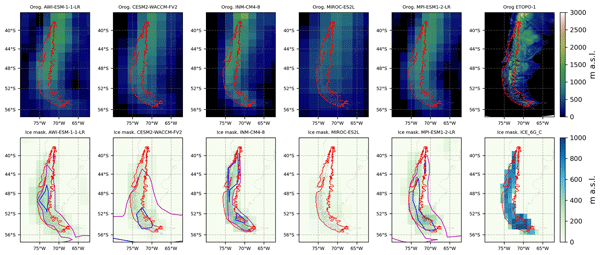
Andrés Castillo-Llarena, Franco Retamal-Ramírez, Jorge Bernales, Martín Jacques-Coper, Matthias Prange, and Irina Rogozhina
Clim. Past, 20, 1559–1577, https://doi.org/10.5194/cp-20-1559-2024, https://doi.org/10.5194/cp-20-1559-2024, 2024
Short summary
Short summary
During the last glacial period, the Patagonian Ice Sheet grew along the southern Andes, leaving marks on the landscape showing its former extents and timing. We use paleoclimate and ice sheet models to replicate its glacial history. We find that errors in the model-based ice sheet are likely induced by imprecise reconstructions of air temperature due to poorly resolved Andean topography in global climate models, while a fitting regional climate history is only captured by local sediment records.
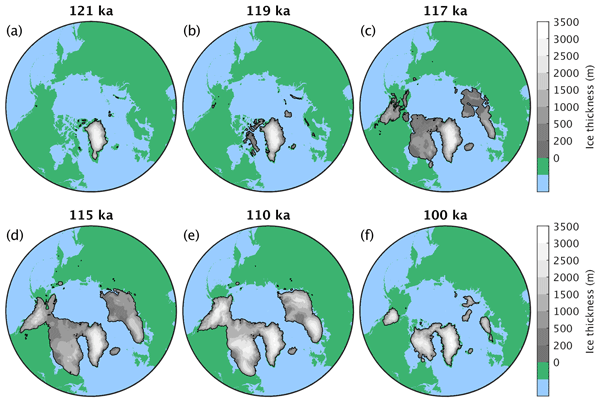
Matteo Willeit, Reinhard Calov, Stefanie Talento, Ralf Greve, Jorjo Bernales, Volker Klemann, Meike Bagge, and Andrey Ganopolski
Clim. Past, 20, 597–623, https://doi.org/10.5194/cp-20-597-2024, https://doi.org/10.5194/cp-20-597-2024, 2024
Short summary
Short summary
We present transient simulations of the last glacial inception with the coupled climate–ice sheet model CLIMBER-X showing a rapid increase in Northern Hemisphere ice sheet area and a sea level drop by ~ 35 m, with the vegetation feedback playing a key role. Overall, our simulations confirm and refine previous results showing that climate-vegetation–cryosphere–carbon cycle feedbacks play a fundamental role in the transition from interglacial to glacial states.
Lennert B. Stap, Constantijn J. Berends, and Roderik S. W. van de Wal
Clim. Past, 20, 257–266, https://doi.org/10.5194/cp-20-257-2024, https://doi.org/10.5194/cp-20-257-2024, 2024
Short summary
Short summary
Analysing simulations of Antarctic Ice Sheet variability during the early and mid-Miocene (23 to 14 Myr ago), we find that the ice sheet area adapts faster and more strongly than volume to climate change on quasi-orbital timescales. Considering the recent discovery that ice area, rather than volume, influences deep-ocean temperatures, this implies that the Miocene Antarctic Ice Sheet affects deep-ocean temperatures more than its volume suggests.
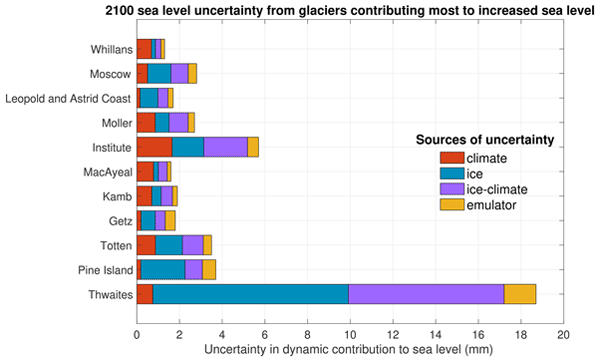
Hélène Seroussi, Vincent Verjans, Sophie Nowicki, Antony J. Payne, Heiko Goelzer, William H. Lipscomb, Ayako Abe-Ouchi, Cécile Agosta, Torsten Albrecht, Xylar Asay-Davis, Alice Barthel, Reinhard Calov, Richard Cullather, Christophe Dumas, Benjamin K. Galton-Fenzi, Rupert Gladstone, Nicholas R. Golledge, Jonathan M. Gregory, Ralf Greve, Tore Hattermann, Matthew J. Hoffman, Angelika Humbert, Philippe Huybrechts, Nicolas C. Jourdain, Thomas Kleiner, Eric Larour, Gunter R. Leguy, Daniel P. Lowry, Chistopher M. Little, Mathieu Morlighem, Frank Pattyn, Tyler Pelle, Stephen F. Price, Aurélien Quiquet, Ronja Reese, Nicole-Jeanne Schlegel, Andrew Shepherd, Erika Simon, Robin S. Smith, Fiammetta Straneo, Sainan Sun, Luke D. Trusel, Jonas Van Breedam, Peter Van Katwyk, Roderik S. W. van de Wal, Ricarda Winkelmann, Chen Zhao, Tong Zhang, and Thomas Zwinger
The Cryosphere, 17, 5197–5217, https://doi.org/10.5194/tc-17-5197-2023, https://doi.org/10.5194/tc-17-5197-2023, 2023
Short summary
Short summary
Mass loss from Antarctica is a key contributor to sea level rise over the 21st century, and the associated uncertainty dominates sea level projections. We highlight here the Antarctic glaciers showing the largest changes and quantify the main sources of uncertainty in their future evolution using an ensemble of ice flow models. We show that on top of Pine Island and Thwaites glaciers, Totten and Moscow University glaciers show rapid changes and a strong sensitivity to warmer ocean conditions.
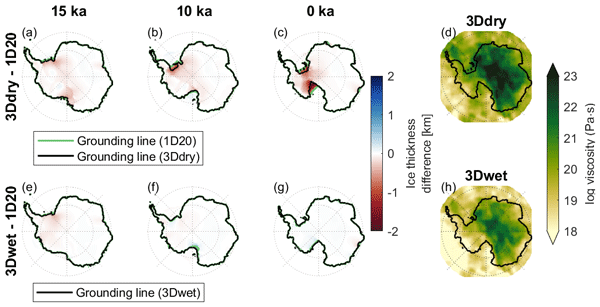
Caroline J. van Calcar, Roderik S. W. van de Wal, Bas Blank, Bas de Boer, and Wouter van der Wal
Geosci. Model Dev., 16, 5473–5492, https://doi.org/10.5194/gmd-16-5473-2023, https://doi.org/10.5194/gmd-16-5473-2023, 2023
Short summary
Short summary
The waxing and waning of the Antarctic ice sheet caused the Earth’s surface to deform, which is stabilizing the ice sheet and mainly determined by the spatially variable viscosity of the mantle. Including this feedback in model simulations led to significant differences in ice sheet extent and ice thickness over the last glacial cycle. The results underline and quantify the importance of including this local feedback effect in ice sheet models when simulating the Antarctic ice sheet evolution.
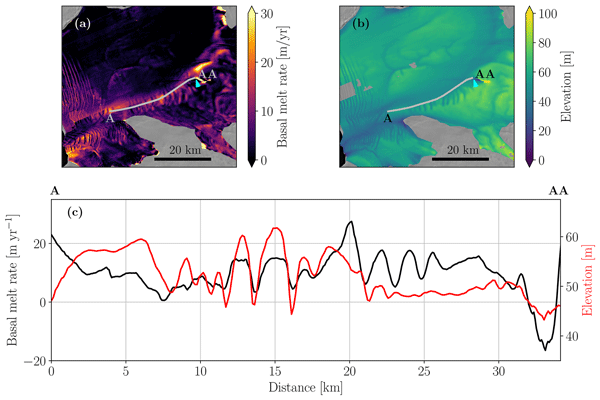
Ann-Sofie Priergaard Zinck, Bert Wouters, Erwin Lambert, and Stef Lhermitte
The Cryosphere, 17, 3785–3801, https://doi.org/10.5194/tc-17-3785-2023, https://doi.org/10.5194/tc-17-3785-2023, 2023
Short summary
Short summary
The ice shelves in Antarctica are melting from below, which puts their stability at risk. Therefore, it is important to observe how much and where they are melting. In this study we use high-resolution satellite imagery to derive 50 m resolution basal melt rates of the Dotson Ice Shelf. With the high resolution of our product we are able to uncover small-scale features which may in the future help us to understand the state and fate of the Antarctic ice shelves and their (in)stability.
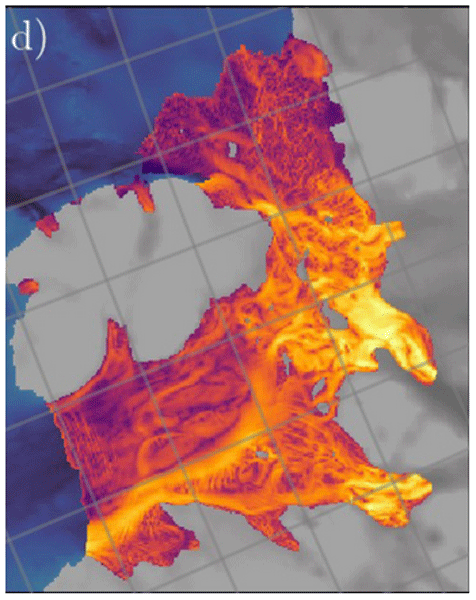
Erwin Lambert, André Jüling, Roderik S. W. van de Wal, and Paul R. Holland
The Cryosphere, 17, 3203–3228, https://doi.org/10.5194/tc-17-3203-2023, https://doi.org/10.5194/tc-17-3203-2023, 2023
Short summary
Short summary
A major uncertainty in the study of sea level rise is the melting of the Antarctic ice sheet by the ocean. Here, we have developed a new model, named LADDIE, that simulates this ocean-driven melting of the floating parts of the Antarctic ice sheet. This model simulates fine-scale patterns of melting and freezing and requires significantly fewer computational resources than state-of-the-art ocean models. LADDIE can be used as a new tool to force high-resolution ice sheet models.
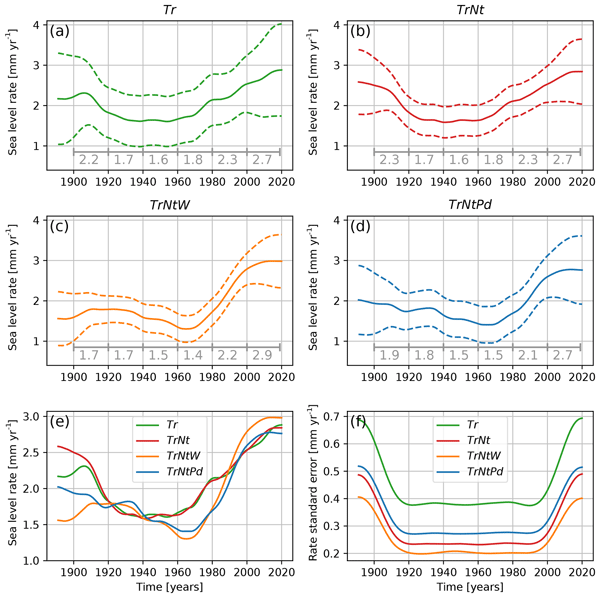
Iris Keizer, Dewi Le Bars, Cees de Valk, André Jüling, Roderik van de Wal, and Sybren Drijfhout
Ocean Sci., 19, 991–1007, https://doi.org/10.5194/os-19-991-2023, https://doi.org/10.5194/os-19-991-2023, 2023
Short summary
Short summary
Using tide gauge observations, we show that the acceleration of sea-level rise (SLR) along the coast of the Netherlands started in the 1960s but was masked by wind field and nodal-tide variations. This finding aligns with global SLR observations and expectations based on a physical understanding of SLR related to global warming.
Constantijn J. Berends, Roderik S. W. van de Wal, Tim van den Akker, and William H. Lipscomb
The Cryosphere, 17, 1585–1600, https://doi.org/10.5194/tc-17-1585-2023, https://doi.org/10.5194/tc-17-1585-2023, 2023
Short summary
Short summary
The rate at which the Antarctic ice sheet will melt because of anthropogenic climate change is uncertain. Part of this uncertainty stems from processes occurring beneath the ice, such as the way the ice slides over the underlying bedrock.
Inversion methodsattempt to use observations of the ice-sheet surface to calculate how these sliding processes work. We show that such methods cannot fully solve this problem, so a substantial uncertainty still remains in projections of sea-level rise.
Meike D. W. Scherrenberg, Constantijn J. Berends, Lennert B. Stap, and Roderik S. W. van de Wal
Clim. Past, 19, 399–418, https://doi.org/10.5194/cp-19-399-2023, https://doi.org/10.5194/cp-19-399-2023, 2023
Short summary
Short summary
Ice sheets have a large effect on climate and vice versa. Here we use an ice sheet computer model to simulate the last glacial cycle and compare two methods, one that implicitly includes these feedbacks and one that does not. We found that when including simple climate feedbacks, the North American ice sheet develops from two domes instead of many small domes. Each ice sheet melts slower when including feedbacks. We attribute this difference mostly to air temperature–ice sheet interactions.
Eveline C. van der Linden, Dewi Le Bars, Erwin Lambert, and Sybren Drijfhout
The Cryosphere, 17, 79–103, https://doi.org/10.5194/tc-17-79-2023, https://doi.org/10.5194/tc-17-79-2023, 2023
Short summary
Short summary
The Antarctic ice sheet (AIS) is the largest uncertainty in future sea level estimates. The AIS mainly loses mass through ice discharge, the transfer of land ice into the ocean. Ice discharge is triggered by warming ocean water (basal melt). New future estimates of AIS sea level contributions are presented in which basal melt is constrained with ice discharge observations. Despite the different methodology, the resulting projections are in line with previous multimodel assessments.
Constantijn J. Berends, Heiko Goelzer, Thomas J. Reerink, Lennert B. Stap, and Roderik S. W. van de Wal
Geosci. Model Dev., 15, 5667–5688, https://doi.org/10.5194/gmd-15-5667-2022, https://doi.org/10.5194/gmd-15-5667-2022, 2022
Short summary
Short summary
The rate at which marine ice sheets such as the West Antarctic ice sheet will retreat in a warming climate and ocean is still uncertain. Numerical ice-sheet models, which solve the physical equations that describe the way glaciers and ice sheets deform and flow, have been substantially improved in recent years. Here we present the results of several years of work on IMAU-ICE, an ice-sheet model of intermediate complexity, which can be used to study ice sheets of both the past and the future.
Lennert B. Stap, Constantijn J. Berends, Meike D. W. Scherrenberg, Roderik S. W. van de Wal, and Edward G. W. Gasson
The Cryosphere, 16, 1315–1332, https://doi.org/10.5194/tc-16-1315-2022, https://doi.org/10.5194/tc-16-1315-2022, 2022
Short summary
Short summary
To gain understanding of how the Antarctic ice sheet responded to CO2 changes during past warm climate conditions, we simulate its variability during the Miocene. We include feedbacks between the ice sheet and atmosphere in our model and force the model using time-varying climate conditions. We find that these feedbacks reduce the amplitude of ice volume variations. Erosion-induced changes in the bedrock below the ice sheet that manifested during the Miocene also have a damping effect.
Cited articles
Arthern, R. J. and Gudmundsson, G. H.: Initialization of ice-sheet forecasts viewed as an inverse Robin problem, J. Glaciol., 56, 527–533, 2010.
Arthern, R. J., Hindmarsh, R. C. A., and Williams, C. R.: Flow speed within the Antarctic ice sheet and its controls inferred from satellite observations, J. Geophys. Res.-Earth, 120, 1171–1188, 2015.
Asay-Davis, X. S., Cornford, S. L., Durand, G., Galton-Fenzi, B. K., Gladstone, R. M., Gudmundsson, G. H., Hattermann, T., Holland, D. M., Holland, D., Holland, P. R., Martin, D. F., Mathiot, P., Pattyn, F., and Seroussi, H.: Experimental design for three interrelated marine ice sheet and ocean model intercomparison projects: MISMIP v. 3 (MISMIP +), ISOMIP v. 2 (ISOMIP +) and MISOMIP v. 1 (MISOMIP1), Geosci. Model Dev., 9, 2471–2497, https://doi.org/10.5194/gmd-9-2471-2016, 2016.
Berends, C. J., Stap, L. B., and van de Wal, R. S. W.: Strong impact of sub-shelf melt parameterisation on ice-sheet retreat in idealised and realistic Antarctic topography, J. Glaciol., 69, 1434–1448, https://doi.org/10.1017/jog.2023.33, 2023a.
Berends, C. J., van de Wal, R. S. W., van den Akker, T., and Lipscomb, W. H.: Compensating errors in inversions for subglacial bed roughness: same steady state, different dynamic response, The Cryosphere, 17, 1585–1600, https://doi.org/10.5194/tc-17-1585-2023, 2023b.
Berends, C. J., Azizi, V., Bernales, J. A., and van de Wal, R. S. W.: The Utrecht Finite Volume Ice-Sheet Model (UFEMISM) version 2.0 – Part 1: Description and idealised experiments, Geosci. Model Dev., 18, 3635–3659, https://doi.org/10.5194/gmd-18-3635-2025, 2025.
Berends, T., Bernales, J., Azizi, V., and van de Wal, R.: UFEMISM2.0, Zenodo [computer software], https://doi.org/10.5281/zenodo.8434468, 2026.
Bett, D. T., Bradley, A. T., Miles, B. W. J., Williams, C. R., Holland, P. R., and Arthern, R. J.: Modelling the evolution of Thwaites Glacier over the 20th century, EGUsphere [preprint], https://doi.org/10.5194/egusphere-2026-669, 2026.
Burgard, C., Jourdain, N. C., Reese, R., Jenkins, A., and Mathiot, P.: An assessment of basal melt parameterisations for Antarctic ice shelves, The Cryosphere, 16, 4931–4975, https://doi.org/10.5194/tc-16-4931-2022, 2022.
Castleman, B. A., Schlegel, N.-J., Caron, L., Larour, E., and Khazendar, A.: Derivation of bedrock topography measurement requirements for the reduction of uncertainty in ice-sheet model projections of Thwaites Glacier, The Cryosphere, 16, 761–778, https://doi.org/10.5194/tc-16-761-2022, 2022.
Cheng, G., Lötstedt, P., and von Sydow, L.: Accurate and stable time stepping in ice sheet modeling, J. Comput. Phys., 329, 29–47, 2017.
Cornford, S. L., Seroussi, H., Asay-Davis, X. S., Gudmundsson, G. H., Arthern, R., Borstad, C., Christmann, J., Dias dos Santos, T., Feldmann, J., Goldberg, D., Hoffman, M. J., Humbert, A., Kleiner, T., Leguy, G., Lipscomb, W. H., Merino, N., Durand, G., Morlighem, M., Pollard, D., Rückamp, M., Williams, C. R., and Yu, H.: Results of the third Marine Ice Sheet Model Intercomparison Project (MISMIP+), The Cryosphere, 14, 2283–2301, https://doi.org/10.5194/tc-14-2283-2020, 2020.
Coulon, V., Klose, A. K., Kittel, C., Edwards, T., Turner, F., Winkelmann, R., and Pattyn, F.: Disentangling the drivers of future Antarctic ice loss with a historically calibrated ice-sheet model, The Cryosphere, 18, 653–681, https://doi.org/10.5194/tc-18-653-2024, 2024.
Coulon, V., Klose, A. K., Edwards, T., Turner, F., Pattyn, F., and Winkelmann, R.: From short-term uncertainties to long-term certainties in the future evolution of the Antarctic Ice Sheet, Nat. Commun., 16, 10385, https://doi.org/10.1038/s41467-025-66178-w, 2025.
DeConto, R. M. and Pollard, D.: Contribution of Antarctica to past and future sea-level rise, Nature, 531, 591–597, 2016.
Favier, L., Jourdain, N. C., Jenkins, A., Merino, N., Durand, G., Gagliardini, O., Gillet-Chaulet, F., and Mathiot, P.: Assessment of sub-shelf melting parameterisations using the ocean–ice-sheet coupled model NEMO(v3.6)–Elmer/Ice(v8.3) , Geosci. Model Dev., 12, 2255–2283, https://doi.org/10.5194/gmd-12-2255-2019, 2019.
Gagliardini, O., Zwinger, T., Gillet-Chaulet, F., Durand, G., Favier, L., de Fleurian, B., Greve, R., Malinen, M., Martín, C., Råback, P., Ruokolainen, J., Sacchettini, M., Schäfer, M., Seddik, H., and Thies, J.: Capabilities and performance of Elmer/Ice, a new-generation ice sheet model, Geosci. Model Dev., 6, 1299–1318, https://doi.org/10.5194/gmd-6-1299-2013, 2013.
Getraer, B. and Morlighem, M.: Increasing the Glen–Nye Power-Law Exponent Accelerates Ice-Loss Projections for the Amundsen Sea Embayment, West Antarctica, Geophys. Res. Lett., 52, e2024GL112516, https://doi.org/10.1029/2024GL112516, 2025.
Goelzer, H., Nowicki, S., Edwards, T., Beckley, M., Abe-Ouchi, A., Aschwanden, A., Calov, R., Gagliardini, O., Gillet-Chaulet, F., Golledge, N. R., Gregory, J., Greve, R., Humbert, A., Huybrechts, P., Kennedy, J. H., Larour, E., Lipscomb, W. H., Le clec'h, S., Lee, V., Morlighem, M., Pattyn, F., Payne, A. J., Rodehacke, C., Rückamp, M., Saito, F., Schlegel, N., Seroussi, H., Shepherd, A., Sun, S., van de Wal, R., and Ziemen, F. A.: Design and results of the ice sheet model initialisation experiments initMIP-Greenland: an ISMIP6 intercomparison, The Cryosphere, 12, 1433–1460, https://doi.org/10.5194/tc-12-1433-2018, 2018.
Goldberg, D. N.: A variationally derived, depth-integrated approximation to a higher-order glaciological flow model, J. Glaciol., 57, 157–170, 2011.
Goldberg, D. N. and Holland, P. R.: The Relative Impacts of Initialization and Climate Forcing in Coupled Ice Sheet-Ocean Modeling: Application to Pope, Smith, and Kohler Glaciers, J. Geophys. Res.-Earth, 127, e2021JF006570, https://doi.org/10.1029/2021JF006570, 2022.
Greve, R.: On non-dimensional forms of basal sliding laws and flow laws for ice-sheet and glacier modelling, J. Glaciol., 71, e123, https://doi.org/10.1017/jog.2025.10100, 2025.
Gudmundsson, G. H. and Raymond, M.: On the limit to resolution and information on basal properties obtainable from surface data on ice streams, The Cryosphere, 2, 167–178, https://doi.org/10.5194/tc-2-167-2008, 2008.
Jourdain, N. C., Asay-Davis, X., Hattermann, T., Straneo, F., Seroussi, H., Little, C. M., and Nowicki, S.: A protocol for calculating basal melt rates in the ISMIP6 Antarctic ice sheet projections, The Cryosphere, 14, 3111–3134, https://doi.org/10.5194/tc-14-3111-2020, 2020.
Kazmierczak, E., Sun, S., Coulon, V., and Pattyn, F.: Subglacial hydrology modulates basal sliding response of the Antarctic ice sheet to climate forcing, The Cryosphere, 16, 4537–4552, https://doi.org/10.5194/tc-16-4537-2022, 2022.
Klose, A. K., Coulon, V., Pattyn, F., and Winkelmann, R.: The long-term sea-level commitment from Antarctica, The Cryosphere, 18, 4463–4492, https://doi.org/10.5194/tc-18-4463-2024, 2024.
Larour, E., Seroussi, H., Morlighem, M., and Rignot, E.: Continental scale, high order, high spatial resolution, ice sheet modeling using the Ice Sheet System Model (ISSM), J. Geophys. Res., 117, F01022, https://doi.org/10.1029/2011JF002140, 2012.
Lambert, E. and Burgard, C.: Brief communication: Sensitivity of Antarctic ice shelf melting to ocean warming across basal melt models, The Cryosphere, 19, 2495–2505, https://doi.org/10.5194/tc-19-2495-2025, 2025.
Lecavalier, B. S. and Tarasov, L.: A history-matching analysis of the Antarctic Ice Sheet since the Last Interglacial – Part 1: Ice sheet evolution, The Cryosphere, 19, 919–953, https://doi.org/10.5194/tc-19-919-2025, 2025.
Leguy, G. R., Lipscomb, W. H., and Asay-Davis, X. S.: Marine ice sheet experiments with the Community Ice Sheet Model, The Cryosphere, 15, 3229–3253, https://doi.org/10.5194/tc-15-3229-2021, 2021.
Lipscomb, W. H., Leguy, G. R., Jourdain, N. C., Asay-Davis, X., Seroussi, H., and Nowicki, S.: ISMIP6-based projections of ocean-forced Antarctic Ice Sheet evolution using the Community Ice Sheet Model, The Cryosphere, 15, 633–661, https://doi.org/10.5194/tc-15-633-2021, 2021.
Locarnini, R. A., Mishonov, A. V., Baranova, O. K., Boyer, T. P., Zweng, M. M., Garcia, H. E., Reagan, J. R., Seidov, D., Weathers, K. W., Paver, C. R., and Smolyar, I. V.: World Ocean Atlas 2018, Volume 1: Temperature, Tech. Rep. Atlas NESDIS 81, NOAA, https://data.nodc.noaa.gov/woa/WOA18/DOC/woa18_vol1.pdf (last access: 14 October 2025), 2019.
Morlighem, M., Williams, C. N., Rignot, E., An, L., Arndt, J. E., Bamber, J. L., Catania, G., Chauché, N., Dowdeswell, J. A., Dorschel, B., Fenty, I., Hogan, K., Howat, I., Hubbard, A., Jakobsson, M., Jordan, T. M., Kjeldsen, K. K., Millan, R., Mayer, L., Mouginot, J., Noël, B. P. Y., O'Cofaigh, C., Palmer, S., Rysgaard, S., Seroussi, H., Siegert, M. J., Slabon, P., Straneo, F., van den Broeke, M. R., Weinrebe, W., Wood, M., and Zinglersen, K. B.: BedMachine v3: Complete Bed Topography and Ocean Bathymetry Mapping of Greenland From Multibeam Echo Sounding Combined With Mass Conservation, Geophys. Res. Lett., 11051–11061, 2017.
Noël, B., van Wessem, J. M., Wouters, B., Trusel, L., Lhermitte, S., and van den Broeke, M. R.: Higher Antarctic ice sheet accumulation and surface melt rates revealed at 2 km resolution, Nature Communications 14, 7949, https://doi.org/10.1038/s41467-023-43584-6, 2023.
Otosaka, I. N., Shepherd, A., Ivins, E. R., Schlegel, N.-J., Amory, C., van den Broeke, M. R., Horwath, M., Joughin, I., King, M. D., Krinner, G., Nowicki, S., Payne, A. J., Rignot, E., Scambos, T., Simon, K. M., Smith, B. E., Sørensen, L. S., Velicogna, I., Whitehouse, P. L., A, G., Agosta, C., Ahlstrøm, A. P., Blazquez, A., Colgan, W., Engdahl, M. E., Fettweis, X., Forsberg, R., Gallée, H., Gardner, A., Gilbert, L., Gourmelen, N., Groh, A., Gunter, B. C., Harig, C., Helm, V., Khan, S. A., Kittel, C., Konrad, H., Langen, P. L., Lecavalier, B. S., Liang, C.-C., Loomis, B. D., McMillan, M., Melini, D., Mernild, S. H., Mottram, R., Mouginot, J., Nilsson, J., Noël, B., Pattle, M. E., Peltier, W. R., Pie, N., Roca, M., Sasgen, I., Save, H. V., Seo, K.-W., Scheuchl, B., Schrama, E. J. O., Schröder, L., Simonsen, S. B., Slater, T., Spada, G., Sutterley, T. C., Vishwakarma, B. D., van Wessem, J. M., Wiese, D., van der Wal, W., and Wouters, B.: Mass balance of the Greenland and Antarctic ice sheets from 1992 to 2020, Earth Syst. Sci. Data, 15, 1597–1616, https://doi.org/10.5194/essd-15-1597-2023, 2023.
Pollard, D. and DeConto, R. M.: A simple inverse method for the distribution of basal sliding coefficients under ice sheets, applied to Antarctica, The Cryosphere, 6, 953–971, https://doi.org/10.5194/tc-6-953-2012, 2012.
Rignot, E., Mouginot, J., and Scheuchl, B.: Ice Flow of the Antarctic Ice Sheet, Science, 333, 1427–1430, 2011.
Robinson, A., Alvarez-Solas, J., Montoya, M., Goelzer, H., Greve, R., and Ritz, C.: Description and validation of the ice-sheet model Yelmo (version 1.0), Geosci. Model Dev., 13, 2805–2823, https://doi.org/10.5194/gmd-13-2805-2020, 2020.
Schoof, C.: The effect of cavitation on glacier sliding, P. R. Soc. A, 461, 609–627, 2005.
Seroussi, H., Nowicki, S., Simon, E., Abe-Ouchi, A., Albrecht, T., Brondex, J., Cornford, S., Dumas, C., Gillet-Chaulet, F., Goelzer, H., Golledge, N. R., Gregory, J. M., Greve, R., Hoffman, M. J., Humbert, A., Huybrechts, P., Kleiner, T., Larour, E., Leguy, G., Lipscomb, W. H., Lowry, D., Mengel, M., Morlighem, M., Pattyn, F., Payne, A. J., Pollard, D., Price, S. F., Quiquet, A., Reerink, T. J., Reese, R., Rodehacke, C. B., Schlegel, N.-J., Shepherd, A., Sun, S., Sutter, J., Van Breedam, J., van de Wal, R. S. W., Winkelmann, R., and Zhang, T.: initMIP-Antarctica: an ice sheet model initialization experiment of ISMIP6, The Cryosphere, 13, 1441–1471, https://doi.org/10.5194/tc-13-1441-2019, 2019.
Seroussi, H., Pelle, T., Lipscomb, W. H., Abe-Ouchi, A., Albrecht, T., Alvarez-Solas, J., Asay-Davis, X., Barre, J.-B., Berends, C. J., Bernales, J., Blasco, J., Caillet, J., Chandler, D. M., Coulon, V., Cullather, R., Dumas, C., Galton-Fenzi, B. K., Garbe, J., Gillet-Chaulet, F., Gladstone, R., Goelzer, H., Golledge, N., Greve, R., Gudmundsson, G. H., Han, H. K., Hillebrand, T. R., Hoffman, M. J., Huybrechts, P., Jourdain, N. C., Klose, A. K., Langebroek, P. M., Leguy, G. R., Lowry, D. P., Mathiot, P., Montoya, M., Morlighem, M., Nowicki, S., Pattyn, F., Payne, A. J., Quiquet, A., Reese, R., Robinson, A., Saraste, L., Simon, E. G., Sun, S., Twarog, J. P., Trusel, L. D., Urruty, B., Van Breedam, J., van de Wal, R. S. W., Wang, Y., Zhao, C., and Zwinger, T.: Evolution of the Antarctic Ice Sheet Over the Next Three Centuries From an ISMIP6 Model Ensemble, Earth's Future 12, e2024EF004561, https://doi.org/10.1029/2024EF004561, 2024.
Smith, B., Fricker, H. A., Gardner, A. S., Medley, B., Nilsson, J., Paolo, F. S., Holschuh, N., Adusumilli, S., Brunt, K., Csatho, B., Harbeck, K., Markus, T., Neumann, T., Siegfried, M. R., and Zwally, H. J.: Pervasive ice sheet mass loss reflects competing ocean and atmosphere processes, Science, 368, 1239–1242, 2020.
Sun, S., Pattyn, F., Simon, E. G., Albrecht, T., Cornford, S., Calov, R., Dumas, C., Gillet-Chaulet, F., Goelzer, H., Golledge, N. R., Greve, R., Hoffman, M. J., Humbert, A., Kazmierczak, E., Kleiner, T., Leguy, G. R., Lipscomb, W. H., Martin, D., Morlighem, M., Nowicki, S., Pollard, D., Price, S., Quiquet, A., Seroussi, H., Schlemm, T., Sutter, J., van de Wal, R. S. W., Winkelmann, R., and Zhang, T.: Antarctic ice sheet response to sudden and sustained ice-shelf collapse (ABUMIP), J. Glaciol., 66, 891–904, 2020.
Trevers, M., Payne, A. J., and Cornford, S. L.: Application of a regularised Coulomb sliding law to Jakobshavn Isbræ, western Greenland, The Cryosphere, 18, 5101–5115, https://doi.org/10.5194/tc-18-5101-2024, 2024.
Tsai, V. C., Stewart, A. L., and Thompson, A. F.: Marine ice-sheet profiles and stability under Coulomb basal conditions, J. Glaciol., 61, 205–215, 2015.
van den Akker, T., Lipscomb, W. H., Leguy, G. R., Bernales, J., Berends, C. J., van de Berg, W. J., and van de Wal, R. S. W.: Present-day mass loss rates are a precursor for West Antarctic Ice Sheet collapse, The Cryosphere, 19, 283–301, https://doi.org/10.5194/tc-19-283-2025, 2025.
van de Wal, R. S. W., Nicholls, R. J., Behar, D., McInnes, K., Stammer, D., Lowe, J. A., Church, J. A., DeConto, R., Fettweis, X., Goelzer, H., Haasnoot, M., Haigh, I. D., Hinkel, J., Horton, B. P., James, T. S., Jenkins, A., LeCozannet, G., Levermann, A., Lipscomb, W. H., Marzeion, B., Pattyn, F., Payne, A. J., Pfeffer, W. T., Price, S. F., Seroussi, H., Sun, S., Veatch, W., and White, K.: A High-End Estimate of Sea Level Rise for Practitioners, Earth's Future, 10, e2022EF002751, https://doi.org/10.1029/2022EF002751, 2022.
van Pelt, W. J. J., Oerlemans, J., Reijmer, C. H., Pettersson, R., Pohjola, V. A., Isaksson, E., and Divine, D.: An iterative inverse method to estimate basal topography and initialize ice flow models, The Cryosphere, 7, 987–1006, https://doi.org/10.5194/tc-7-987-2013, 2013.
Weertman, J.: On the sliding of glaciers, J. Glaciol., 3, 33–38, 1957.
Weertman, J.: Stability of the Junction of an Ice Sheet and an Ice Shelf, J. Glaciol., 13, 3–11, 1974.
Zoet, L. K. and Iverson, N. R.: A slip law for glaciers on deformable beds, Science, 368, 76–78, 2020.
Zwally, H. J., Giovinetto, M. B., Beckley, M. A., and Saba, J. L.: Antarctic and Greenland Drainage Systems, GSFC Cryospheric Sciences Laboratory, http://icesat4.gsfc.nasa.gov/cryo_data/ant_grn_drainage_systems.php (last access: 5 November 2025), 2012.
Zweng, M. M., Reagan, J. R., Seidov, D., Boyer, T. P., Locarnini, R., Garcia, H. E., Mishonov, A. V., Baranova, O. K., Weathers, K. W., Paver, C. R., and Smolyar, I. V.: World Ocean Atlas 2018, Volume 2: Salinity, Tech. Rep. Atlas NESDIS 82, NOAA, https://data.nodc.noaa.gov/woa/WOA18/DOC/woa18_vol2.pdf (last access: 14 October 2025), 2019.
Short summary
Computer models of the Antarctic ice sheet can project how much it will melt in response to climate change. That depends on the properties of the rock and the water beneath the ice, about which we know very little. That means the amount of sea-level in the future is very uncertain. Techniques to reduce that uncertainty do not always work as well as expected. We must get actual measurements of the bottom of the ice to improve our understanding of the ice sheet, and our knowledge of its future.
Computer models of the Antarctic ice sheet can project how much it will melt in response to...


Altmetrics
Final-revised paper
Preprint