
Articles | Volume 20, issue 10
https://doi.org/10.5194/tc-20-6003-2026
© Author(s) 2026. This work is distributed under
the Creative Commons Attribution 4.0 License.
the Creative Commons Attribution 4.0 License.
https://doi.org/10.5194/tc-20-6003-2026
© Author(s) 2026. This work is distributed under
the Creative Commons Attribution 4.0 License.
the Creative Commons Attribution 4.0 License.
Research article
| 
16 Oct 2026
Research article |
| 16 Oct 2026
| 16 Oct 2026
On the theoretical limitations of joint inversion for basal slipperiness and effective viscosity in ice-flow models
Camilla A. O. Schelpe
School of Geography and Natural Sciences, Northumbria University, Newcastle upon Tyne, UK
G. Hilmar Gudmundsson
CORRESPONDING AUTHOR
School of Geography and Natural Sciences, Northumbria University, Newcastle upon Tyne, UK
Related authors
No articles found.
Deborah Rhee, Sainan Sun, and G. Hilmar Gudmundsson
EGUsphere, https://doi.org/10.5194/egusphere-2026-4978, https://doi.org/10.5194/egusphere-2026-4978, 2026
This preprint is open for discussion and under review for Geoscientific Model Development (GMD).
Short summary
Short summary
The shallow-shelf approximation (SSA) is widely used to model the evolution of fast-flowing ice. Various numerical schemes are used to solve the equations resulting from the SSA. We find the range of parameters under which each scheme remains stable and accurate. The optimum tested scheme solves the equations simultaneously using the finite element method with Lax-Wendroff time stepping. Results in this manuscript inform the development of future models and parameter choices in current models.
James R. Jordan, Frank Pattyn, Daniel Abele, Torsten Albrecht, Jorge Alvarez-Solas, Jowan M. Barnes, Tijn Berends, Jorge A. Bernales, Javier Blasco, Gong Cheng, Youngmin Choi, Stephen L. Cornford, Cruz Garcia-Molina, Fabien Gillet-Chaulet, G. Hilmar Gudmundsson, Angelika Humbert, Gunter R. Leguy, William H. Lipscomb, Marisa Montoya, Daniel Moreno-Parada, Mathieu Morlighem, Tyler Pelle, Alexander Robinson, Martin Rückamp, Hélène Seroussi, Yanmei Tian, Luisa Wagner, Roderick S. W. van de Wal, Liyun Zhao, and Thomas Zwinger
EGUsphere, https://doi.org/10.5194/egusphere-2026-1962, https://doi.org/10.5194/egusphere-2026-1962, 2026
Short summary
Short summary
Ice calving is a recent inclusion in ice sheet models and there has not been a systematic test of how well it has been implemented. We show that models can accurately represent a given rate of ice calving, properties at the ice front evolve smoothly during calving, and that there are no consistent differences in ice behaviour between various approaches to representing calving in numerical ice models. This gives us confidence in their ability for use in sea level rise prediction simulations.
Jowan M. Barnes, G. Hilmar Gudmundsson, Daniel N. Goldberg, and Sainan Sun
The Cryosphere, 20, 777–790, https://doi.org/10.5194/tc-20-777-2026, https://doi.org/10.5194/tc-20-777-2026, 2026
Short summary
Short summary
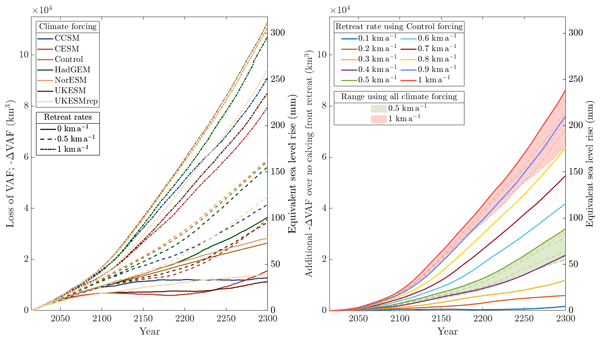
Calving is where ice breaks off the front of glaciers. It has not been included widely in modelling as it is difficult to represent. We use our ice flow model to investigate the effects of calving floating ice shelves in West Antarctica. More calving leads to more ice loss and greater sea level rise, with local differences due to the shape of the bedrock. We find that ocean forcing and calving should be considered equally when trying to improve how models represent the real world.
Johanna Beckmann, Ronja Reese, Felicity S. McCormack, Sue Cook, Lawrence Bird, Dawid Gwyther, Daniel Richards, Matthias Scheiter, Yu Wang, Hélène Seroussi, Ayako Abe‐Ouchi, Torsten Albrecht, Jorge Alvarez‐Solas, Xylar S. Asay‐Davis, Jean‐Baptiste Barre, Constantijn J. Berends, Jorge Bernales, Javier Blasco, Justine Caillet, David M. Chandler, Violaine Coulon, Richard Cullather, Christophe Dumas, Benjamin K. Galton‐Fenzi, Julius Garbe, Fabien Gillet‐Chaulet, Rupert Gladstone, Heiko Goelzer, Nicholas R. Golledge, Ralf Greve, G. Hilmar Gudmundsson, Holly Kyeore Han, Trevor R. Hillebrand, Matthew J. Hoffman, Philippe Huybrechts, Nicolas C. Jourdain, Ann Kristin Klose, Petra M. Langebroek, Gunter R. Leguy, William H. Lipscomb, Daniel P. Lowry, Pierre Mathiot, Marisa Montoya, Mathieu Morlighem, Sophie Nowicki, Frank Pattyn, Antony J. Payne, Tyler Pelle, Aurélien Quiquet, Alexander Robinson, Leopekka Saraste, Erika G. Simon, Sainan Sun, Jake P. Twarog, Luke D. Trusel, Benoit Urruty, Jonas Van Breedam, Roderik S. W. van de Wal, Chen Zhao, and Thomas Zwinger
EGUsphere, https://doi.org/10.5194/egusphere-2025-4069, https://doi.org/10.5194/egusphere-2025-4069, 2025
Short summary
Short summary
Antarctica holds enough ice to raise sea levels by many meters, but its future is uncertain. Warm ocean water melts ice shelves from below, letting inland ice flow faster into the sea. By 2300, Antarctica could add 0.6–4.4 m to sea levels. Our study identifies two key factors—how strongly shelves melt and how the ice responds. These explain much of the range, and refining them in models may improve future predictions.
Sebastian H. R. Rosier, G. Hilmar Gudmundsson, Adrian Jenkins, and Kaitlin A. Naughten
The Cryosphere, 19, 2527–2557, https://doi.org/10.5194/tc-19-2527-2025, https://doi.org/10.5194/tc-19-2527-2025, 2025
Short summary
Short summary
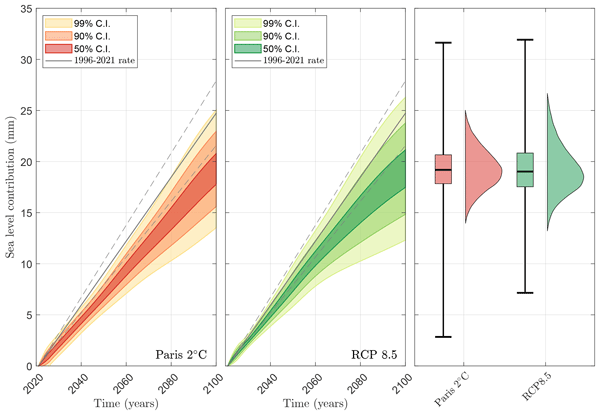
Glaciers in the Amundsen Sea region of Antarctica have been retreating and losing mass, but their future contribution to global sea level rise remains highly uncertain. We use an ice sheet model and uncertainty quantification methods to evaluate the probable range of mass loss from this region for two future climate scenarios. We find that the rate of ice loss until 2100 will likely remain similar to present-day observations, with little sensitivity to climate scenario over this short time frame.
Ole Richter, Ralph Timmermann, G. Hilmar Gudmundsson, and Jan De Rydt
Geosci. Model Dev., 18, 2945–2960, https://doi.org/10.5194/gmd-18-2945-2025, https://doi.org/10.5194/gmd-18-2945-2025, 2025
Short summary
Short summary
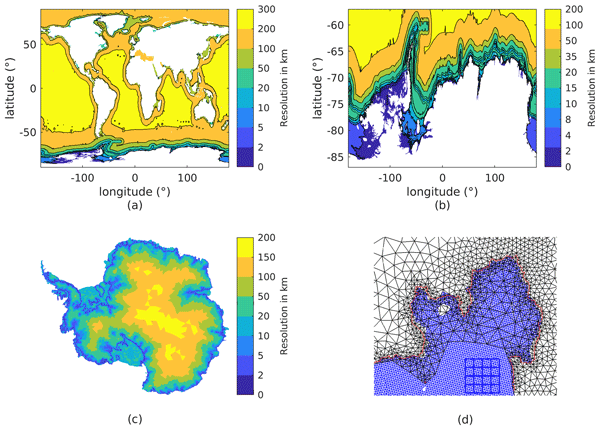
The new coupled ice sheet–ocean model addresses challenges related to horizontal resolution through advanced mesh flexibility, enabled by the use of unstructured grids. We describe the new model, verify its functioning in an idealised setting and demonstrate its advantages in a global-ocean–Antarctic ice sheet domain. The results of this study comprise an important step towards improving predictions of the Antarctic contribution to sea level rise over centennial timescales.
Richard Parsons, Sainan Sun, G. Hilmar Gudmundsson, Jan Wuite, and Thomas Nagler
The Cryosphere, 18, 5789–5801, https://doi.org/10.5194/tc-18-5789-2024, https://doi.org/10.5194/tc-18-5789-2024, 2024
Short summary
Short summary
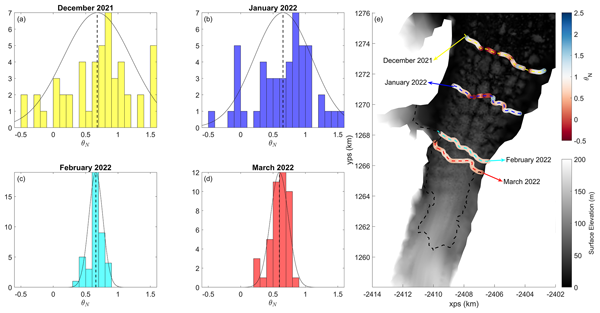
In 2022, multi-year landfast sea ice in Antarctica's Larsen B embayment disintegrated, after which time an increase in the rate at which Crane Glacier discharged ice into the ocean was observed. As the fast ice was joined to the glacier terminus, it could provide resistance against the glacier's flow, slowing down the rate of ice discharge. We used numerical modelling to quantify this resistive stress and found that the fast ice provided significant support to Crane prior to its disintegration.
Xianwei Wang, Hilmar Gudmundsson, and David Holland
EGUsphere, https://doi.org/10.5194/egusphere-2024-2790, https://doi.org/10.5194/egusphere-2024-2790, 2024
Preprint archived
Short summary
Short summary
Understanding why iceberg calved during drifting in the ocean is important to understand the life cycle and the influence on the surrounding ocean of an iceberg. This study explains why iceberg A68a calved when approaching the South Georgia Island in late 2020 during its drifting in the Southern Ocean using satellite observation and modeling, which was caused by collision with seamount.
Brad Reed, J. A. Mattias Green, Adrian Jenkins, and G. Hilmar Gudmundsson
The Cryosphere, 18, 4567–4587, https://doi.org/10.5194/tc-18-4567-2024, https://doi.org/10.5194/tc-18-4567-2024, 2024
Short summary
Short summary
We use a numerical ice-flow model to simulate the response of a 1940s Pine Island Glacier to changes in melting beneath its ice shelf. A decadal period of warm forcing is sufficient to push the glacier into an unstable, irreversible retreat from its long-term position on a subglacial ridge to an upstream ice plain. This retreat can only be stopped when unrealistic cold forcing is applied. These results show that short warm anomalies can lead to quick and substantial increases in ice flux.
Gong Cheng, Mathieu Morlighem, and G. Hilmar Gudmundsson
Geosci. Model Dev., 17, 6227–6247, https://doi.org/10.5194/gmd-17-6227-2024, https://doi.org/10.5194/gmd-17-6227-2024, 2024
Short summary
Short summary
We conducted a comprehensive analysis of the stabilization and reinitialization techniques currently employed in ISSM and Úa for solving level-set equations, specifically those related to the dynamic representation of moving ice fronts within numerical ice sheet models. Our results demonstrate that the streamline upwind Petrov–Galerkin (SUPG) method outperforms the other approaches. We found that excessively frequent reinitialization can lead to exceptionally high errors in simulations.
J. Rachel Carr, Emily A. Hill, and G. Hilmar Gudmundsson
The Cryosphere, 18, 2719–2737, https://doi.org/10.5194/tc-18-2719-2024, https://doi.org/10.5194/tc-18-2719-2024, 2024
Short summary
Short summary
The Greenland Ice Sheet is one of the world's largest glaciers and is melting quickly in response to climate change. It contains fast-flowing channels of ice that move ice from Greenland's centre to its coasts and allow Greenland to react quickly to climate warming. As a result, we want to predict how these glaciers will behave in the future, but there are lots of uncertainties. Here we assess the impacts of two main sources of uncertainties in glacier models.
Cristina Gerli, Sebastian Rosier, G. Hilmar Gudmundsson, and Sainan Sun
The Cryosphere, 18, 2677–2689, https://doi.org/10.5194/tc-18-2677-2024, https://doi.org/10.5194/tc-18-2677-2024, 2024
Short summary
Short summary
Recent efforts have focused on using AI and satellite imagery to track crevasses for assessing ice shelf damage and informing ice flow models. Our study reveals a weak connection between these observed products and damage maps inferred from ice flow models. While there is some improvement in crevasse-dense regions, this association remains limited. Directly mapping ice damage from satellite observations may not significantly improve the representation of these processes within ice flow models.
Ronja Reese, Julius Garbe, Emily A. Hill, Benoît Urruty, Kaitlin A. Naughten, Olivier Gagliardini, Gaël Durand, Fabien Gillet-Chaulet, G. Hilmar Gudmundsson, David Chandler, Petra M. Langebroek, and Ricarda Winkelmann
The Cryosphere, 17, 3761–3783, https://doi.org/10.5194/tc-17-3761-2023, https://doi.org/10.5194/tc-17-3761-2023, 2023
Short summary
Short summary
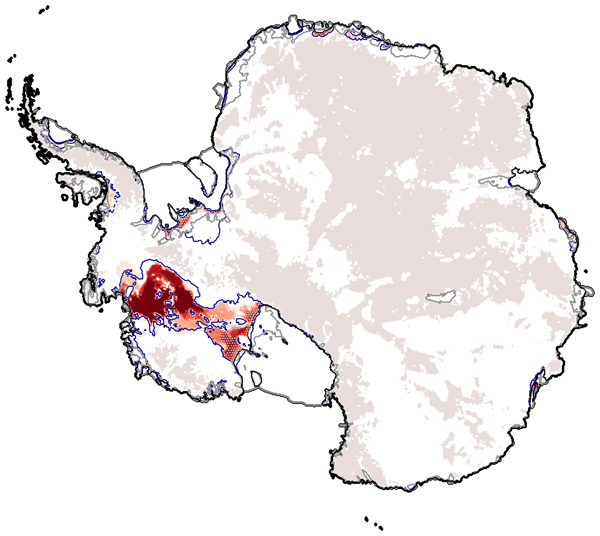
We use an ice sheet model to test where current climate conditions in Antarctica might lead. We find that present-day ocean and atmosphere conditions might commit an irreversible collapse of parts of West Antarctica which evolves over centuries to millennia. Importantly, this collapse is not irreversible yet.
Emily A. Hill, Benoît Urruty, Ronja Reese, Julius Garbe, Olivier Gagliardini, Gaël Durand, Fabien Gillet-Chaulet, G. Hilmar Gudmundsson, Ricarda Winkelmann, Mondher Chekki, David Chandler, and Petra M. Langebroek
The Cryosphere, 17, 3739–3759, https://doi.org/10.5194/tc-17-3739-2023, https://doi.org/10.5194/tc-17-3739-2023, 2023
Short summary
Short summary
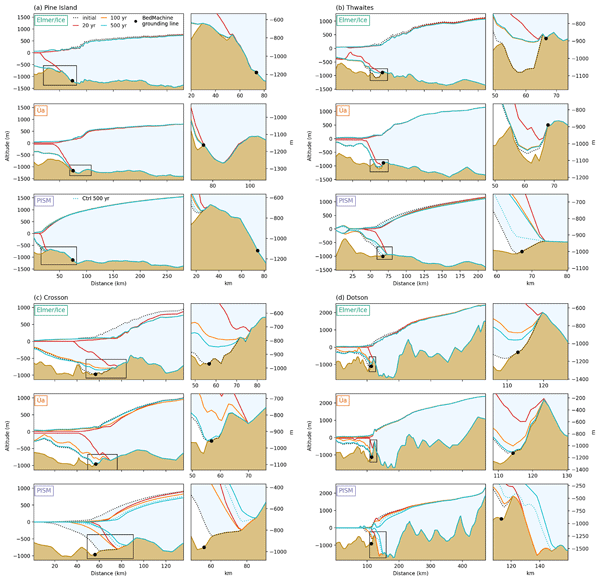
The grounding lines of the Antarctic Ice Sheet could enter phases of irreversible retreat or advance. We use three ice sheet models to show that the present-day locations of Antarctic grounding lines are reversible with respect to a small perturbation away from their current position. This indicates that present-day retreat of the grounding lines is not yet irreversible or self-enhancing.
Sebastian H. R. Rosier, Christopher Y. S. Bull, Wai L. Woo, and G. Hilmar Gudmundsson
The Cryosphere, 17, 499–518, https://doi.org/10.5194/tc-17-499-2023, https://doi.org/10.5194/tc-17-499-2023, 2023
Short summary
Short summary
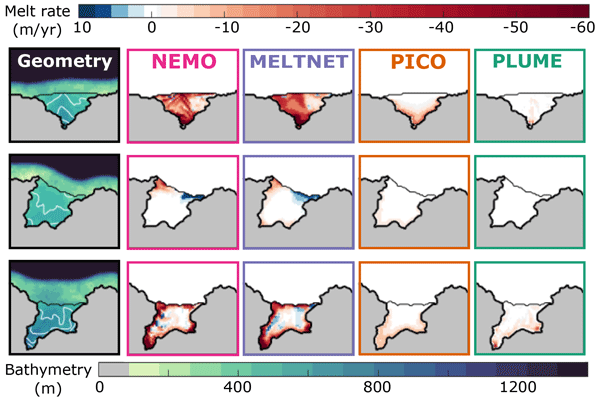
Future ice loss from Antarctica could raise sea levels by several metres, and key to this is the rate at which the ocean melts the ice sheet from below. Existing methods for modelling this process are either computationally expensive or very simplified. We present a new approach using machine learning to mimic the melt rates calculated by an ocean model but in a fraction of the time. This approach may provide a powerful alternative to existing methods, without compromising on accuracy or speed.

Bertie W. J. Miles, Chris R. Stokes, Adrian Jenkins, Jim R. Jordan, Stewart S. R. Jamieson, and G. Hilmar Gudmundsson
The Cryosphere, 17, 445–456, https://doi.org/10.5194/tc-17-445-2023, https://doi.org/10.5194/tc-17-445-2023, 2023
Short summary
Short summary
Satellite observations have shown that the Shirase Glacier catchment in East Antarctica has been gaining mass over the past 2 decades, a trend largely attributed to increased snowfall. Our multi-decadal observations of Shirase Glacier show that ocean forcing has also contributed to some of this recent mass gain. This has been caused by strengthening easterly winds reducing the inflow of warm water underneath the Shirase ice tongue, causing the glacier to slow down and thicken.
Jowan M. Barnes and G. Hilmar Gudmundsson
The Cryosphere, 16, 4291–4304, https://doi.org/10.5194/tc-16-4291-2022, https://doi.org/10.5194/tc-16-4291-2022, 2022
Short summary
Short summary
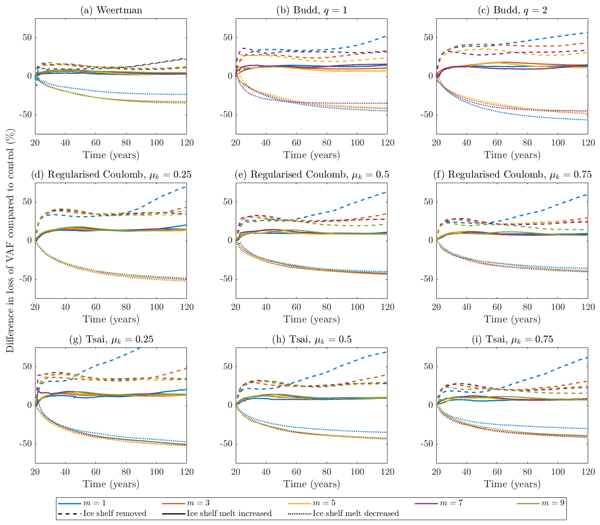
Models must represent how glaciers slide along the bed, but there are many ways to do so. In this paper, several sliding laws are tested and found to affect different regions of the Antarctic Ice Sheet in different ways and at different speeds. However, the variability in ice volume loss due to sliding-law choices is low compared to other factors, so limited empirical knowledge of sliding does not prevent us from making predictions of how an ice sheet will evolve.
Tom Mitcham, G. Hilmar Gudmundsson, and Jonathan L. Bamber
The Cryosphere, 16, 883–901, https://doi.org/10.5194/tc-16-883-2022, https://doi.org/10.5194/tc-16-883-2022, 2022
Short summary
Short summary
We modelled the response of the Larsen C Ice Shelf (LCIS) and its tributary glaciers to the calving of the A68 iceberg and validated our results with observations. We found that the impact was limited, confirming that mostly passive ice was calved. Through further calving experiments we quantified the total buttressing provided by the LCIS and found that over 80 % of the buttressing capacity is generated in the first 5 km of the ice shelf downstream of the grounding line.
Cited articles
Arthern, R. J., Hindmarsh, R. C. A., and Williams, C. R.: Flow speed within the Antarctic ice sheet and its controls inferred from satellite observations, J. Geophys. Res.-Earth, 120, 1171–1188, https://doi.org/10.1002/2014JF003239, 2015. a, b
Babaniyi, O., Nicholson, R., Villa, U., and Petra, N.: Inferring the basal sliding coefficient field for the Stokes ice sheet model under rheological uncertainty, The Cryosphere, 15, 1731–1750, https://doi.org/10.5194/tc-15-1731-2021, 2021. a
Badgeley, J. A., Morlighem, M., and Seroussi, H.: Increased sea-level contribution from northwestern Greenland for models that reproduce observations, P. Natl. Acad. Sci. USA, 122, e2411904122, https://doi.org/10.1073/pnas.2411904122, 2025. a
Balise, M. J. and Raymond, C. F.: Transfer of basal sliding variations to the surface of a linearly viscous glacier, J. Glaciol., 31, 308–318, 1985. a
Barnes, J. M., Dias dos Santos, T., Goldberg, D., Gudmundsson, G. H., Morlighem, M., and De Rydt, J.: The transferability of adjoint inversion products between different ice flow models, The Cryosphere, 15, 1975–2000, https://doi.org/10.5194/tc-15-1975-2021, 2021. a, b
Barth, A., Beckers, J.-M., Troupin, C., Alvera-Azcárate, A., and Vandenbulcke, L.: divand-1.0: n-dimensional variational data analysis for ocean observations, Geosci. Model Dev., 7, 225–241, https://doi.org/10.5194/gmd-7-225-2014, 2014. a
Caillet, J., Jourdain, N. C., Mathiot, P., Gillet-Chaulet, F., Urruty, B., Burgard, C., Amory, C., Chekki, M., and Kittel, C.: Uncertainty in the projected Antarctic contribution to sea level due to internal climate variability, Earth Syst. Dynam., 16, 293–315, https://doi.org/10.5194/esd-16-293-2025, 2025. a
Choi, Y., Seroussi, H., Morlighem, M., Schlegel, N.-J., and Gardner, A.: Impact of time-dependent data assimilation on ice flow model initialization and projections: a case study of Kjer Glacier, Greenland, The Cryosphere, 17, 5499–5517, https://doi.org/10.5194/tc-17-5499-2023, 2023. a
Cornford, S. L., Martin, D. F., Payne, A. J., Ng, E. G., Le Brocq, A. M., Gladstone, R. M., Edwards, T. L., Shannon, S. R., Agosta, C., van den Broeke, M. R., Hellmer, H. H., Krinner, G., Ligtenberg, S. R. M., Timmermann, R., and Vaughan, D. G.: Century-scale simulations of the response of the West Antarctic Ice Sheet to a warming climate, The Cryosphere, 9, 1579–1600, https://doi.org/10.5194/tc-9-1579-2015, 2015. a, b, c, d
De Rydt, J., Reese, R., Paolo, F. S., and Gudmundsson, G. H.: Drivers of Pine Island Glacier speed-up between 1996 and 2016, The Cryosphere, 15, 113–132, https://doi.org/10.5194/tc-15-113-2021, 2021. a
Gagliardini, O., Zwinger, T., Gillet-Chaulet, F., Durand, G., Favier, L., de Fleurian, B., Greve, R., Malinen, M., Martín, C., Råback, P., Ruokolainen, J., Sacchettini, M., Schäfer, M., Seddik, H., and Thies, J.: Capabilities and performance of Elmer/Ice, a new-generation ice sheet model, Geosci. Model Dev., 6, 1299–1318, https://doi.org/10.5194/gmd-6-1299-2013, 2013. a, b
Gillet-Chaulet, F., Gagliardini, O., Seddik, H., Nodet, M., Durand, G., Ritz, C., Zwinger, T., Greve, R., and Vaughan, D. G.: Greenland ice sheet contribution to sea-level rise from a new-generation ice-sheet model, The Cryosphere, 6, 1561–1576, https://doi.org/10.5194/tc-6-1561-2012, 2012. a
Goldberg, D. N. and Heimbach, P.: Parameter and state estimation with a time-dependent adjoint marine ice sheet model, The Cryosphere, 7, 1659–1678, https://doi.org/10.5194/tc-7-1659-2013, 2013. a, b
Goldberg, D. N., Heimbach, P., Joughin, I., and Smith, B.: Committed retreat of Smith, Pope, and Kohler Glaciers over the next 30 years inferred by transient model calibration, The Cryosphere, 9, 2429–2446, https://doi.org/10.5194/tc-9-2429-2015, 2015. a, b
Gudmundsson, G. H.: Transmission of basal variability to a glacier surface, J. Geophys. Res.-Sol. Ea., 108, 2253, https://doi.org/10.1029/2002JB002107, 2003. a, b, c
Hank, K., Arthern, R. J., Williams, C. R., Brisbourne, A. M., Smith, A. M., Smith, J. A., Wåhlin, A., and Anandakrishnan, S.: Inferring the ice sheet sliding law from seismic observations: A Pine Island Glacier case study, The Cryosphere, 20, 495–510, https://doi.org/10.5194/tc-20-495-2026, 2026. a
Hoffman, M. J., Perego, M., Price, S. F., Lipscomb, W. H., Zhang, T., Jacobsen, D., Tezaur, I., Salinger, A. G., Tuminaro, R., and Bertagna, L.: MPAS-Albany Land Ice (MALI): a variable-resolution ice sheet model for Earth system modeling using Voronoi grids, Geosci. Model Dev., 11, 3747–3780, https://doi.org/10.5194/gmd-11-3747-2018, 2018. a, b
Jager, E., Gillet-Chaulet, F., Mouginot, J., and Millan, R.: Validating ensemble historical simulations of Upernavik Isstrøm (1985–2019) using observations of surface velocity and elevation, J. Glaciol., 70, e36, https://doi.org/10.1017/jog.2024.10, 2024. a, b
Jóhannesson, T.: Landscape of temperate ice caps, University of Washington, https://scholar.google.com/scholar_lookup?hl=en (last access: October 2026), 1992. a
Jouvet, G.: Inversion of a Stokes glacier flow model emulated by deep learning, J. Glaciol., 69, 13–26, https://doi.org/10.1017/jog.2022.41, 2023. a, b
Jouvet, G., Cordonnier, G., Kim, B., Lüthi, M., Vieli, A., and Aschwanden, A.: Deep learning speeds up ice flow modelling by several orders of magnitude, J. Glaciol., 68, 651–664, https://doi.org/10.1017/jog.2021.120, 2022. a
Larour, E., Seroussi, H., Morlighem, M., and Rignot, E.: Continental scale, high order, high spatial resolution, ice sheet modeling using the Ice Sheet System Model, J. Geophys. Res., 117, F01022, https://doi.org/10.1029/2011JF002140, 2012. a, b
Lindgren, F., Rue, H., and Lindström, J.: An explicit link between Gaussian fields and Gaussian Markov random fields: the stochastic partial differential equation approach, J. R. Stat. Soc. B, 73, 423–498, https://doi.org/10.1111/j.1467-9868.2011.00777.x, 2011. a, b
MacAyeal, D. R.: Large-scale ice flow over a viscous basal sediment: Theory and application to ice stream B, Antarctica, J. Geophys. Res.-Sol. Ea., 94, 4071–4087, https://doi.org/10.1029/JB094iB04p04071, 1989. a
MacAyeal, D. R.: The basal stress distribution of Ice Stream E, Antarctica, inferred by control methods, J. Geophys. Res.-Sol. Ea., 97, 595–603, https://doi.org/10.1029/91JB02454, 1992. a
Ng, F. S. L., Ignéczi, A., Sole, A. J., and Livingstone, S. J.: Response of surface topography to basal variability along glacial flowlines, J. Geophys. Res.-Earth, 123, 2319–2340, https://doi.org/10.1029/2017JF004555, 2018. a
Perego, M., Price, S., and Stadler, G.: Optimal initial conditions for coupling ice sheet models to Earth system models, J. Geophys. Res.-Earth, 119, 1894–1917, https://doi.org/10.1002/2014JF003181, 2014. a
Ranganathan, M., Minchew, B., Meyer, C. R., and Gudmundsson, G. H.: A new approach to inferring basal drag and ice rheology in ice streams, with applications to West Antarctic Ice Streams, J. Glaciol., 67, 229–242, 2021. a
Raymond, M. J. and Gudmundsson, G. H.: On the relationship between surface and basal properties on glaciers, ice sheets, and ice streams, J. Geophys. Res.-Sol. Ea., 110, https://doi.org/10.1029/2005JB003681, 2005. a
Recinos, B., Goldberg, D., Maddison, J. R., and Todd, J.: A framework for time-dependent ice sheet uncertainty quantification, applied to three West Antarctic ice streams, The Cryosphere, 17, 4241–4266, https://doi.org/10.5194/tc-17-4241-2023, 2023. a
Rosier, S. H. R., Gudmundsson, G. H., Jenkins, A., and Naughten, K. A.: Calibrated sea level contribution from the Amundsen Sea sector, West Antarctica, under RCP8.5 and Paris 2C scenarios, The Cryosphere, 19, 2527–2557, https://doi.org/10.5194/tc-19-2527-2025, 2025. a, b
Schelpe, C. A. O. and Gudmundsson, G. H.: Incorporating Horizontal Density Variations Into Large-Scale Modeling of Ice Masses, J. Geophys. Res.-Earth, 128, e2022JF006744, https://doi.org/10.1029/2022JF006744, 2023. a, b
Schelpe, C. and Gudmundsson, G. H.: Model data for “On the theoretical limitations of joint inversion for basal slipperiness and effective viscosity in ice-flow models”, Zenodo [software and data set], https://doi.org/10.5281/zenodo.19403641, 2026. a, b
Surawy-Stepney, T., Cornford, S. L., and Hogg, A. E.: Using observations of surface fracture to address ill-posed ice softness estimation over Pine Island Glacier, The Cryosphere, 19, 5531–5545, https://doi.org/10.5194/tc-19-5531-2025, 2025. a, b
Trevers, M., Payne, A. J., and Cornford, S. L.: Application of a regularised Coulomb sliding law to Jakobshavn Isbræ, western Greenland, The Cryosphere, 18, 5101–5115, https://doi.org/10.5194/tc-18-5101-2024, 2024. a
Weertman, J.: On the sliding of glaciers, J. Glaciol., 3, 33–38, https://doi.org/10.3189/S0022143000024709, 1957. a
Short summary
In this study, we investigate the ability to extract information about ice viscosity at the same as basal slipperiness in the inversion procedure of large-scale ice-sheet models. This is an essential part of the initialisation of many large-scale computational ice-sheet models. However, there is a lack of consensus on whether a joint inversion is possible to determine these fields. We present a theoretical framework to better understand the factors influencing the retrieval.
In this study, we investigate the ability to extract information about ice viscosity at the same...


