
Articles | Volume 20, issue 9
https://doi.org/10.5194/tc-20-4973-2026
© Author(s) 2026. This work is distributed under
the Creative Commons Attribution 4.0 License.
the Creative Commons Attribution 4.0 License.
https://doi.org/10.5194/tc-20-4973-2026
© Author(s) 2026. This work is distributed under
the Creative Commons Attribution 4.0 License.
the Creative Commons Attribution 4.0 License.
Research article
| 
03 Sep 2026
Research article |
| 03 Sep 2026
| 03 Sep 2026
Dry snow initialization and densification over the Greenland and Antarctic ice sheets in the ORCHIDEE land surface model
Philippe Conesa
CORRESPONDING AUTHOR

Laboratoire des Sciences du Climat et de l’Environnement (LSCE), CEA, CNRS, UVSQ, Université Paris-Saclay, Gif-sur-Yvette, France
Institut Pierre-Simon Laplace (IPSL), Université Versailles Saint-Quentin, Guyancourt, France
Cécile Agosta
Laboratoire des Sciences du Climat et de l’Environnement (LSCE), CEA, CNRS, UVSQ, Université Paris-Saclay, Gif-sur-Yvette, France
Institut Pierre-Simon Laplace (IPSL), Université Versailles Saint-Quentin, Guyancourt, France
Sylvie Charbit
Laboratoire des Sciences du Climat et de l’Environnement (LSCE), CEA, CNRS, UVSQ, Université Paris-Saclay, Gif-sur-Yvette, France
Institut Pierre-Simon Laplace (IPSL), Université Versailles Saint-Quentin, Guyancourt, France
Christophe Dumas
Laboratoire des Sciences du Climat et de l’Environnement (LSCE), CEA, CNRS, UVSQ, Université Paris-Saclay, Gif-sur-Yvette, France
Institut Pierre-Simon Laplace (IPSL), Université Versailles Saint-Quentin, Guyancourt, France
Simon Beylat
Laboratoire des Sciences du Climat et de l’Environnement (LSCE), CEA, CNRS, UVSQ, Université Paris-Saclay, Gif-sur-Yvette, France
Institut Pierre-Simon Laplace (IPSL), Université Versailles Saint-Quentin, Guyancourt, France
Nina Raoult
European Centre for Medium-Range Weather Forecasts, Shinfield Park, Reading, RG2 9AX, UK
Related authors
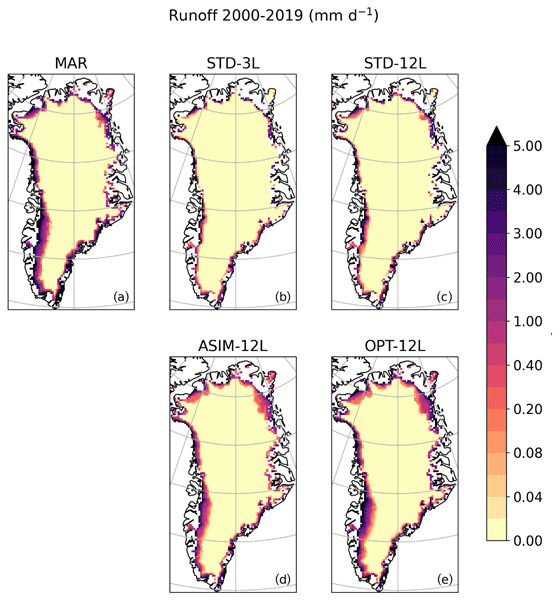
Sylvie Charbit, Christophe Dumas, Fabienne Maignan, Catherine Ottlé, Nina Raoult, Xavier Fettweis, and Philippe Conesa
The Cryosphere, 18, 5067–5099, https://doi.org/10.5194/tc-18-5067-2024, https://doi.org/10.5194/tc-18-5067-2024, 2024
Short summary
Short summary
The evolution of the Greenland ice sheet is highly dependent on surface melting and therefore on the processes operating at the snow–atmosphere interface and within the snow cover. Here we present new developments to apply a snow model to the Greenland ice sheet. The performance of this model is analysed in terms of its ability to simulate ablation processes. Our analysis shows that the model performs well when compared with the MAR regional polar atmospheric model.
Victor van Aanderen, Aurélien Quiquet, Christophe Dumas, Elisabeth Michel, Frederic Parrenin, Catherine Ritz, and Kévin Jiguet-Covex
EGUsphere, https://doi.org/10.5194/egusphere-2026-5288, https://doi.org/10.5194/egusphere-2026-5288, 2026
This preprint is open for discussion and under review for The Cryosphere (TC).
Short summary
Short summary
Ice cores from Dome C provide one of the longest climate records, and Beyond EPICA aims to extend it further. Interpreting these records requires knowing whether Dome C has remained fixed. Using an ice sheet model spanning 800,000 years, we show Dome C has shifted several km during glacial cycles, driven by grounding line migration in the Aurora Subglacial Basin. This displacement can introduce age errors of several tens of thousands of years when interpreting the ice-core record.
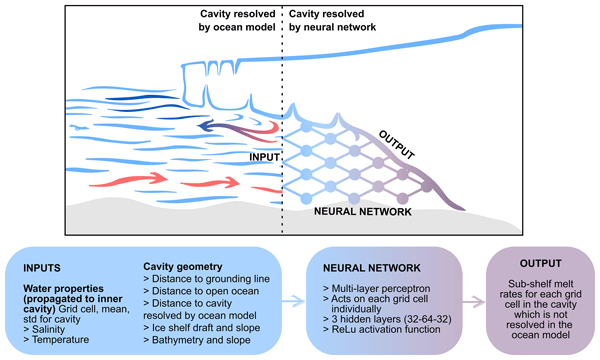
Helen Ockenden, Clara Burgard, Pierre Mathiot, Christoph Kittel, Achille Gellens, Cécile Agosta, and Nicolas C. Jourdain
Geosci. Model Dev., 19, 7979–8002, https://doi.org/10.5194/gmd-19-7979-2026, https://doi.org/10.5194/gmd-19-7979-2026, 2026
Short summary
Short summary
Since numerical computing is expensive, climate models must decide between having a high spatial resolution or running for long time periods. Here, we develop a simple neural network to emulate small-scale processes occurring beneath Antarctic ice shelves, which allows sub-shelf melt and ice–ocean interactions to be included in global ocean models which can run for multiple centuries. This neural network will help us to understand how ocean circulation may change in the future.
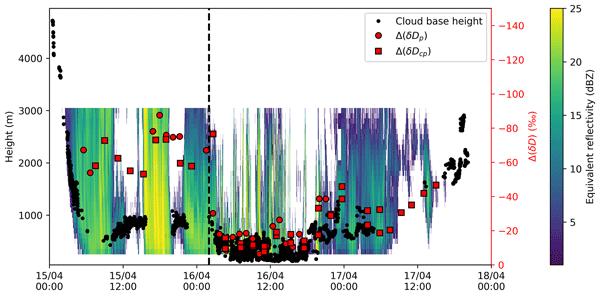
Thomas Lauwers, Elise Fourré, Niels Dutrievoz, Cécile Agosta, Olivier Jossoud, Bénédicte Minster, Frédéric Prié, Olivier Cattani, Valérie Masson-Delmotte, Mathieu Casado, Christophe Genthon, and Amaëlle Landais
Atmos. Meas. Tech., 19, 4743–4758, https://doi.org/10.5194/amt-19-4743-2026, https://doi.org/10.5194/amt-19-4743-2026, 2026
Short summary
Short summary
This study presents a new method to measure the isotopic composition of snowfall and atmospheric water vapor in Antarctica. With a single laser spectrometer, it enables continuous, high frequency observations without human intervention. Tests in East Antarctica show a very good agreement with conventionnal snow sampling. This new sampling method opens new opportunities to better understand snowfall formation, improve climate models, and refine the interpretation of ice core climate records.
Nina Raoult, Ewan Pinnington, Mario Santa Cruz, Florian Pinault, Baudouin Raoult, Natalie Zelenka, Gabriele Arduini, Gianpaolo Balsamo, Souhail Boussetta, Matthew Chantry, Patricia de Rosnay, Peter Dueben, and Christoph Rüdiger
EGUsphere, https://doi.org/10.5194/egusphere-2026-3620, https://doi.org/10.5194/egusphere-2026-3620, 2026
Short summary
Short summary
The land surface shapes our weather and climate by controlling how heat and water move between the ground and the air, so the models representing it matter enormously. But they are costly to run and carry built-in errors. We built a faster artificial-intelligence version of one, then used real measurements from sites worldwide to correct some of these errors. The result stays reliable over years and better captures these heat and water exchanges—a quicker, more accurate tool for forecasting.
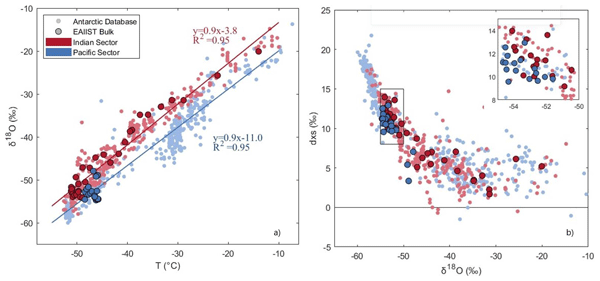
Agnese Petteni, Mathieu Casado, Christophe Leroy-Dos Santos, Amaelle Landais, Niels Dutrievoz, Cécile Agosta, Pete D. Akers, Joel Savarino, Andrea Spolaor, Massimo Frezzotti, and Barbara Stenni
The Cryosphere, 20, 3581–3598, https://doi.org/10.5194/tc-20-3581-2026, https://doi.org/10.5194/tc-20-3581-2026, 2026
Short summary
Short summary
We investigated the isotopic composition of surface snow in a previously unexplored region of East Antarctica to understand how differences in air mass origin influence its variability. By comparing observations with model data, we validated the model and quantified the impact of post-depositional processes at the snow–atmosphere interface. Our results offer valuable insights for reconstructing past temperatures from ice cores.
Victor van Aalderen, Sylvie Charbit, Aurélien Quiquet, and Christophe Dumas
EGUsphere, https://doi.org/10.5194/egusphere-2026-1137, https://doi.org/10.5194/egusphere-2026-1137, 2026
Short summary
Short summary
The last deglaciation provides a unique opportunity to study the processes driving large-scale ice sheet collapse. However, the mechanisms behind the retreat of the Barents-Kara Ice Sheet remain debated. Here, we use an ice sheet model to show that the collapse was caused by a mechanical instability triggered by rising atmospheric temperatures.
Natalie Douglas, Simon Beylat, Tristan Quaife, Philippe Peylin, Nina Raoult, and Ross Bannister
EGUsphere, https://doi.org/10.5194/egusphere-2026-132, https://doi.org/10.5194/egusphere-2026-132, 2026
Short summary
Short summary
This study investigates a statistical method, called 4DEnVar, to calibrate uncertain land surface model parameters against observations. This method is easy to use but can lead to unphysical parameter values. The study explores the causes of this while proposing a simple way to overcome the problem. We show that the 4DEnVar method exhibits considerable versatility by applying the method to two different land surface models, under different settings, to calibrate photosynthetic parameters.
Titouan Tcheng, Elise Fourré, Christophe Leroy-Dos Santos, Frédéric Parrenin, Emmanuel Le Meur, Frédéric Prié, Olivier Jossoud, Roxanne Jacob, Bénédicte Minster, Olivier Magand, Cécile Agosta, Niels Dutrievoz, Vincent Favier, Léa Baubant, Coralie Lassalle-Bernard, Mathieu Casado, Martin Werner, Alexandre Cauquoin, Laurent Arnaud, Bruno Jourdain, Ghislain Picard, Marie Bouchet, and Amaëlle Landais
The Cryosphere, 20, 1599–1618, https://doi.org/10.5194/tc-20-1599-2026, https://doi.org/10.5194/tc-20-1599-2026, 2026
Short summary
Short summary
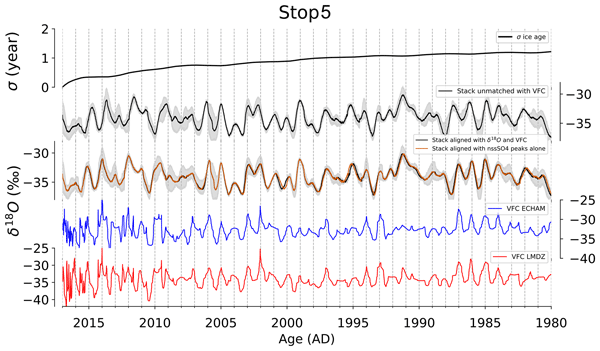
Studying Antarctic ice cores is crucial to assess past climate changes, as they hold historical climate data. This study examines multiple ice cores from three sites in coastal Adélie Land to see if combining cores improves data interpretability. It does at two sites, but at a third, wind-driven snow layer mixing limited benefits. We show that using multiple ice cores from one location can better uncover climate history, especially in areas with less wind disturbance.
Emma Samin, Amaëlle Landais, Elise Fourré, Mathieu Casado, Adrien Ooms, Niels Dutrievoz, Cécile Agosta, Valérie Masson-Delmotte, Thomas Combacal, Elsa Gautier, and Bénédicte Minster
EGUsphere, https://doi.org/10.5194/egusphere-2026-871, https://doi.org/10.5194/egusphere-2026-871, 2026
Short summary
Short summary
This study presents the water isotope profiles of two firn cores drilled at Little Dome C (LDC) in Antarctica and dated by identifying volcanic events, which enabled us to determine an accumulation rate at LDC of 24 mmwe.yr-1. Comparison of a virtual firn core model with these data allowed us to study the surface processes responsible for isotopic variability in firn. We therefore suggest that future models consider the mixing of the surface layer and re-quantify diffusion.
Niels Dutrievoz, Cécile Agosta, Cécile Davrinche, Amaëlle Landais, Sebastien Nguyen, Étienne Vignon, Inès Ollivier, Christophe Leroy-Dos Santos, Elise Fourré, Mathieu Casado, Jonathan Wille, Vincent Favier, Bénédicte Minster, and Frédéric Prié
The Cryosphere, 20, 1025–1046, https://doi.org/10.5194/tc-20-1025-2026, https://doi.org/10.5194/tc-20-1025-2026, 2026
Short summary
Short summary
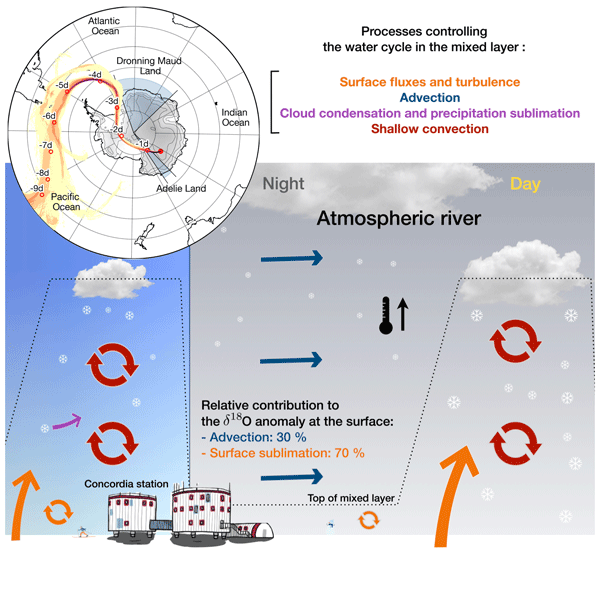
In December 2018, an atmospheric river event from the Atlantic reached Dome C, East Antarctica, causing a +18 °C warming, tripled water vapour, and a strong isotopic anomaly in water vapour (+ 17 ‰ for δ18O) at the surface. During the peak of the event, we found 70 % of the water vapour came from local snow sublimation, and 30 % from the atmospheric river itself, highlighting both long-range moisture advection and interactions between the boundary layer and the snowpack.
Étienne Vignon, Nicolas Chiabrando, Cécile Agosta, Charles Amory, Valentin Wiener, Justine Charrel, Thomas Dubos, and Christophe Genthon
Geosci. Model Dev., 19, 239–259, https://doi.org/10.5194/gmd-19-239-2026, https://doi.org/10.5194/gmd-19-239-2026, 2026
Short summary
Short summary
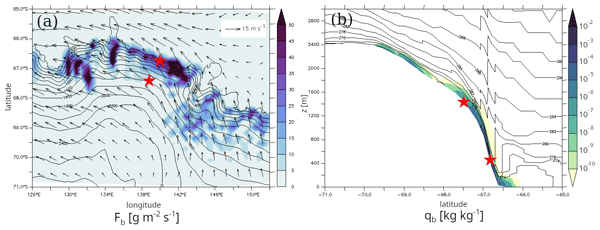
The erosion of surface snow by the wind is an important process for the Antarctic surface mass balance. This study presents the first development of a parameterisation of blowing snow for a global climate model. Simulations avec evaluated using measurements in Antarctica. Results show an overall decrease of the snow accumulation in the escarpment region of the ice sheet due to snow erosion and an increase at the coast due to blowing snow deposition and increase in precipitation.
Cécile Davrinche, Anaïs Orsi, Charles Amory, Christoph Kittel, and Cécile Agosta
The Cryosphere, 19, 6023–6042, https://doi.org/10.5194/tc-19-6023-2025, https://doi.org/10.5194/tc-19-6023-2025, 2025
Short summary
Short summary
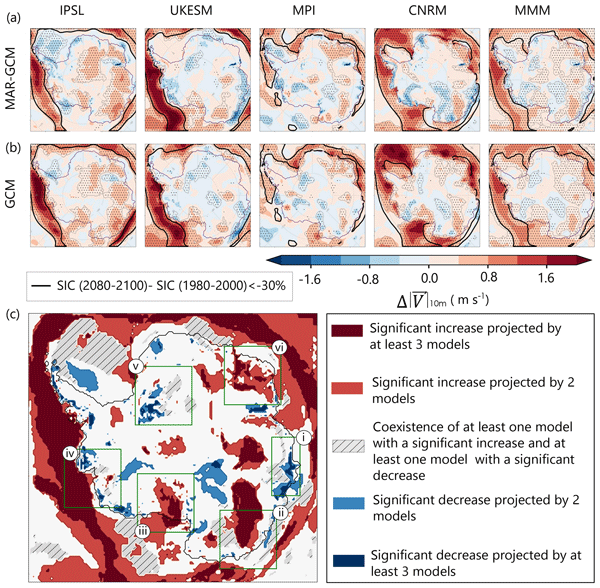
We analyse changes in Antarctic winter surface winds projected by 4 models. Depending on the area and model, changes on the continent by 2100 reveal opposing trends. Nevertheless, models agree on a strengthening of surface winds in Adélie Land for example and a weakening in some other areas such as the Amundsen region. We attribute the strengthening of near-surface winds to changes in the large-sale atmospheric circulation and the weakening to changes in the structure of the lower atmosphere.
Inès Ollivier, Thomas Lauwers, Niels Dutrievoz, Cécile Agosta, Mathieu Casado, Elise Fourré, Christophe Genthon, Olivier Jossoud, Frédéric Prié, Hans Christian Steen-Larsen, and Amaëlle Landais
Earth Syst. Sci. Data, 17, 5655–5674, https://doi.org/10.5194/essd-17-5655-2025, https://doi.org/10.5194/essd-17-5655-2025, 2025
Short summary
Short summary
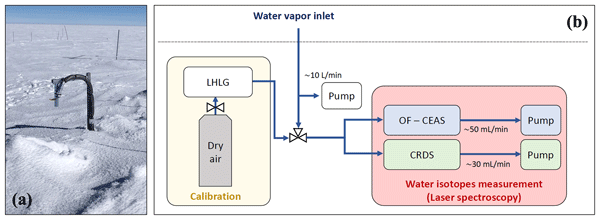
We present a novel 2.5-month record of the atmospheric water vapour isotopic composition during the austral summer 2023–2024 at Concordia Station on the Antarctic Plateau. We show that two independent laser spectrometers accurately record the diurnal variability of the atmospheric water vapour 𝛿18O, 𝛿D, and d-excess. We compare the measurements against outputs of the isotope-enabled general circulation model LMDZ6-iso to show how the data can be used to evaluate such models.
Simon Beylat, Nina Raoult, Cédric Bacour, Natalie Douglas, Tristan Quaife, Vladislav Bastrikov, Peter J. Rayner, and Philippe Peylin
Geosci. Model Dev., 18, 7501–7527, https://doi.org/10.5194/gmd-18-7501-2025, https://doi.org/10.5194/gmd-18-7501-2025, 2025
Short summary
Short summary
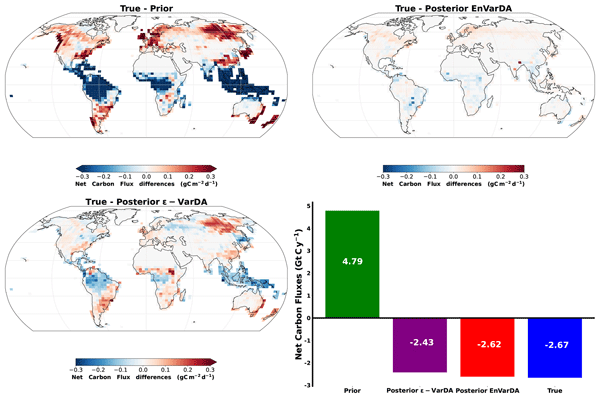
Land surface models are important tools for understanding and predicting the land components of the carbon cycle. Atmospheric CO2 concentration data are a valuable source of information that can be used to improve the accuracy of these models. In this study, we present a statistical ensemble-variational data assimilation method named EnVarDA to calibrate parameters of a land surface model using these data. We show that this method is easy to implement and more efficient and accurate than traditional methods.
Johanna Beckmann, Ronja Reese, Felicity S. McCormack, Sue Cook, Lawrence Bird, Dawid Gwyther, Daniel Richards, Matthias Scheiter, Yu Wang, Hélène Seroussi, Ayako Abe‐Ouchi, Torsten Albrecht, Jorge Alvarez‐Solas, Xylar S. Asay‐Davis, Jean‐Baptiste Barre, Constantijn J. Berends, Jorge Bernales, Javier Blasco, Justine Caillet, David M. Chandler, Violaine Coulon, Richard Cullather, Christophe Dumas, Benjamin K. Galton‐Fenzi, Julius Garbe, Fabien Gillet‐Chaulet, Rupert Gladstone, Heiko Goelzer, Nicholas R. Golledge, Ralf Greve, G. Hilmar Gudmundsson, Holly Kyeore Han, Trevor R. Hillebrand, Matthew J. Hoffman, Philippe Huybrechts, Nicolas C. Jourdain, Ann Kristin Klose, Petra M. Langebroek, Gunter R. Leguy, William H. Lipscomb, Daniel P. Lowry, Pierre Mathiot, Marisa Montoya, Mathieu Morlighem, Sophie Nowicki, Frank Pattyn, Antony J. Payne, Tyler Pelle, Aurélien Quiquet, Alexander Robinson, Leopekka Saraste, Erika G. Simon, Sainan Sun, Jake P. Twarog, Luke D. Trusel, Benoit Urruty, Jonas Van Breedam, Roderik S. W. van de Wal, Chen Zhao, and Thomas Zwinger
EGUsphere, https://doi.org/10.5194/egusphere-2025-4069, https://doi.org/10.5194/egusphere-2025-4069, 2025
Short summary
Short summary
Antarctica holds enough ice to raise sea levels by many meters, but its future is uncertain. Warm ocean water melts ice shelves from below, letting inland ice flow faster into the sea. By 2300, Antarctica could add 0.6–4.4 m to sea levels. Our study identifies two key factors—how strongly shelves melt and how the ice responds. These explain much of the range, and refining them in models may improve future predictions.
Luis-Enrique Olivera-Guerra, Catherine Ottlé, Nina Raoult, and Philippe Peylin
Hydrol. Earth Syst. Sci., 29, 261–290, https://doi.org/10.5194/hess-29-261-2025, https://doi.org/10.5194/hess-29-261-2025, 2025
Short summary
Short summary
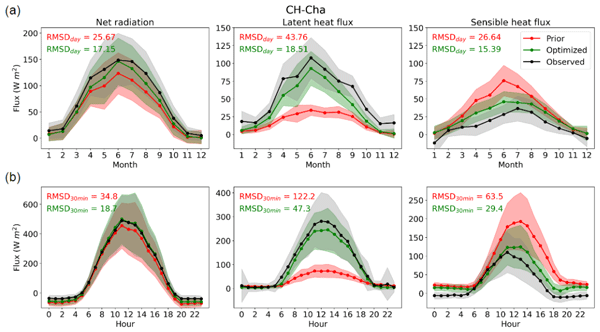
We assimilate the recent ESA-CCI land surface temperature (LST) product to optimize parameters of a land surface model (ORCHIDEE). We test different assimilation strategies to evaluate the best strategy over various in situ stations across Europe. We also provide advice on how to assimilate this LST product to better simulate LST and surface energy fluxes. Finally, we demonstrate the effectiveness of this optimization, which is essential to better simulate future projections.
Thi-Khanh-Dieu Hoang, Aurélien Quiquet, Christophe Dumas, Andreas Born, and Didier M. Roche
Clim. Past, 21, 27–51, https://doi.org/10.5194/cp-21-27-2025, https://doi.org/10.5194/cp-21-27-2025, 2025
Short summary
Short summary
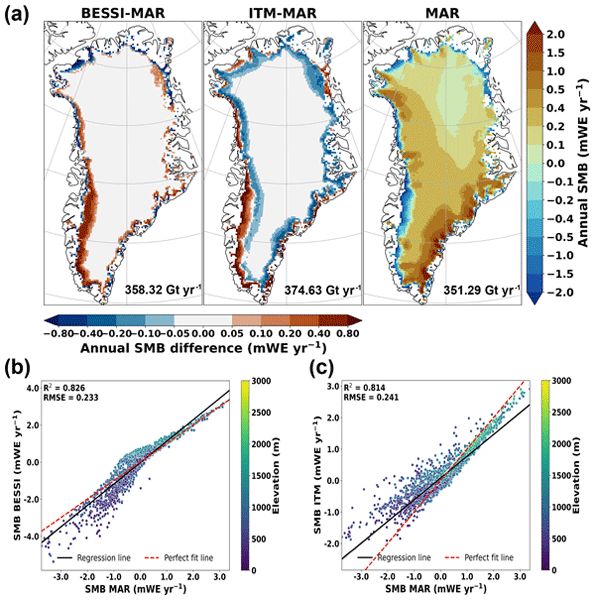
To improve the simulation of surface mass balance (SMB) that influences the advance–retreat of ice sheets, we run a snow model, the BErgen Snow SImulator (BESSI), with transient climate forcing obtained from an Earth system model, iLOVECLIM, over Greenland and Antarctica during the Last Interglacial (LIG; 130–116 ka). Compared to the simple existing SMB scheme of iLOVECLIM, BESSI gives more details about SMB processes with higher physics constraints while maintaining a low computational cost.
Sylvie Charbit, Christophe Dumas, Fabienne Maignan, Catherine Ottlé, Nina Raoult, Xavier Fettweis, and Philippe Conesa
The Cryosphere, 18, 5067–5099, https://doi.org/10.5194/tc-18-5067-2024, https://doi.org/10.5194/tc-18-5067-2024, 2024
Short summary
Short summary
The evolution of the Greenland ice sheet is highly dependent on surface melting and therefore on the processes operating at the snow–atmosphere interface and within the snow cover. Here we present new developments to apply a snow model to the Greenland ice sheet. The performance of this model is analysed in terms of its ability to simulate ablation processes. Our analysis shows that the model performs well when compared with the MAR regional polar atmospheric model.
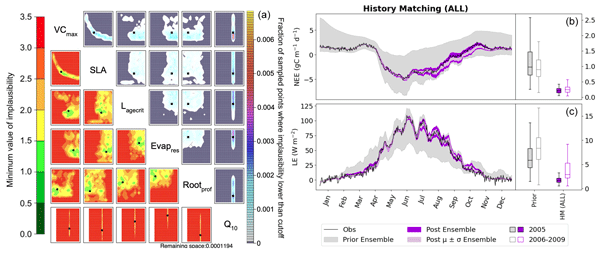
Nina Raoult, Simon Beylat, James M. Salter, Frédéric Hourdin, Vladislav Bastrikov, Catherine Ottlé, and Philippe Peylin
Geosci. Model Dev., 17, 5779–5801, https://doi.org/10.5194/gmd-17-5779-2024, https://doi.org/10.5194/gmd-17-5779-2024, 2024
Short summary
Short summary
We use computer models to predict how the land surface will respond to climate change. However, these complex models do not always simulate what we observe in real life, limiting their effectiveness. To improve their accuracy, we use sophisticated statistical and computational techniques. We test a technique called history matching against more common approaches. This method adapts well to these models, helping us better understand how they work and therefore how to make them more realistic.

Cécile Davrinche, Anaïs Orsi, Cécile Agosta, Charles Amory, and Christoph Kittel
The Cryosphere, 18, 2239–2256, https://doi.org/10.5194/tc-18-2239-2024, https://doi.org/10.5194/tc-18-2239-2024, 2024
Short summary
Short summary
Coastal surface winds in Antarctica are amongst the strongest winds on Earth. They are either driven by the cooling of the surface air mass by the ice sheet (katabatic) or by large-scale pressure systems. Here we compute the relative contribution of these drivers. We find that seasonal variations in the wind speed come from the katabatic acceleration, but, at a 3-hourly timescale, none of the large-scale or katabatic accelerations can be considered as the main driver.
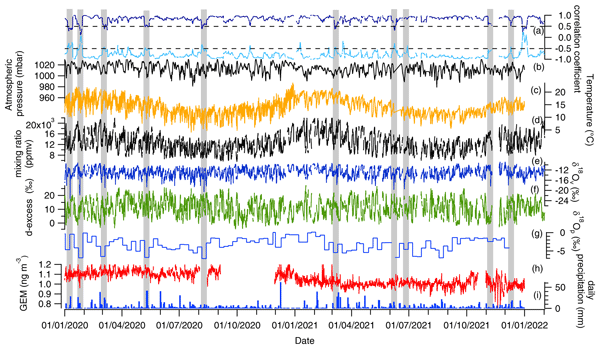
Amaelle Landais, Cécile Agosta, Françoise Vimeux, Olivier Magand, Cyrielle Solis, Alexandre Cauquoin, Niels Dutrievoz, Camille Risi, Christophe Leroy-Dos Santos, Elise Fourré, Olivier Cattani, Olivier Jossoud, Bénédicte Minster, Frédéric Prié, Mathieu Casado, Aurélien Dommergue, Yann Bertrand, and Martin Werner
Atmos. Chem. Phys., 24, 4611–4634, https://doi.org/10.5194/acp-24-4611-2024, https://doi.org/10.5194/acp-24-4611-2024, 2024
Short summary
Short summary
We have monitored water vapor isotopes since January 2020 on Amsterdam Island in the Indian Ocean. We show 11 periods associated with abrupt negative excursions of water vapor δ18Ο. Six of these events show a decrease in gaseous elemental mercury, suggesting subsidence of air from a higher altitude. Accurately representing the water isotopic signal during these cold fronts is a real challenge for the atmospheric components of Earth system models equipped with water isotopes.
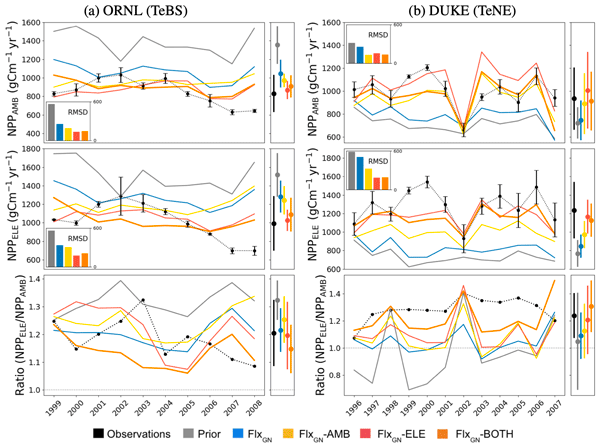
Nina Raoult, Louis-Axel Edouard-Rambaut, Nicolas Vuichard, Vladislav Bastrikov, Anne Sofie Lansø, Bertrand Guenet, and Philippe Peylin
Biogeosciences, 21, 1017–1036, https://doi.org/10.5194/bg-21-1017-2024, https://doi.org/10.5194/bg-21-1017-2024, 2024
Short summary
Short summary
Observations are used to reduce uncertainty in land surface models (LSMs) by optimising poorly constraining parameters. However, optimising against current conditions does not necessarily ensure that the parameters treated as invariant will be robust in a changing climate. Manipulation experiments offer us a unique chance to optimise our models under different (here atmospheric CO2) conditions. By using these data in optimisations, we gain confidence in the future projections of LSMs.
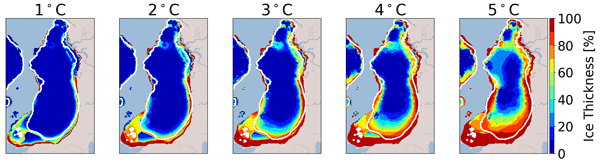
Victor van Aalderen, Sylvie Charbit, Christophe Dumas, and Aurélien Quiquet
Clim. Past, 20, 187–209, https://doi.org/10.5194/cp-20-187-2024, https://doi.org/10.5194/cp-20-187-2024, 2024
Short summary
Short summary
We present idealized numerical experiments to test the main mechanisms that triggered the deglaciation of the past Eurasian ice sheet. Simulations were performed with the GRISLI2.0 ice sheet model. The results indicate that the Eurasian ice sheet was primarily driven by surface melting, due to increased atmospheric temperatures. Basal melting below the ice shelves is only a significant driver if ocean temperatures increase by nearly 10 °C, in contrast with the findings of previous studies.
Aymeric P. M. Servettaz, Cécile Agosta, Christoph Kittel, and Anaïs J. Orsi
The Cryosphere, 17, 5373–5389, https://doi.org/10.5194/tc-17-5373-2023, https://doi.org/10.5194/tc-17-5373-2023, 2023
Short summary
Short summary
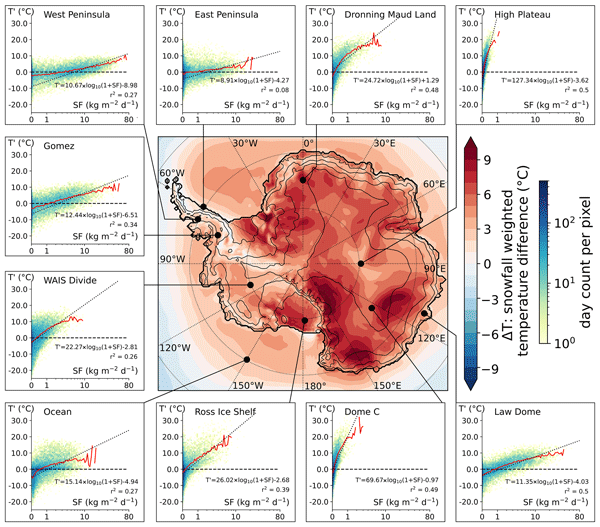
It has been previously observed in polar regions that the atmospheric temperature is warmer during precipitation events. Here, we use a regional atmospheric model to quantify the temperature changes associated with snowfall events across Antarctica. We show that more intense snowfall is statistically associated with a warmer temperature anomaly compared to the seasonal average, with the largest anomalies seen in winter. This bias may affect water isotopes in ice cores deposited during snowfall.
Christophe Leroy-Dos Santos, Elise Fourré, Cécile Agosta, Mathieu Casado, Alexandre Cauquoin, Martin Werner, Benedicte Minster, Frédéric Prié, Olivier Jossoud, Leila Petit, and Amaëlle Landais
The Cryosphere, 17, 5241–5254, https://doi.org/10.5194/tc-17-5241-2023, https://doi.org/10.5194/tc-17-5241-2023, 2023
Short summary
Short summary
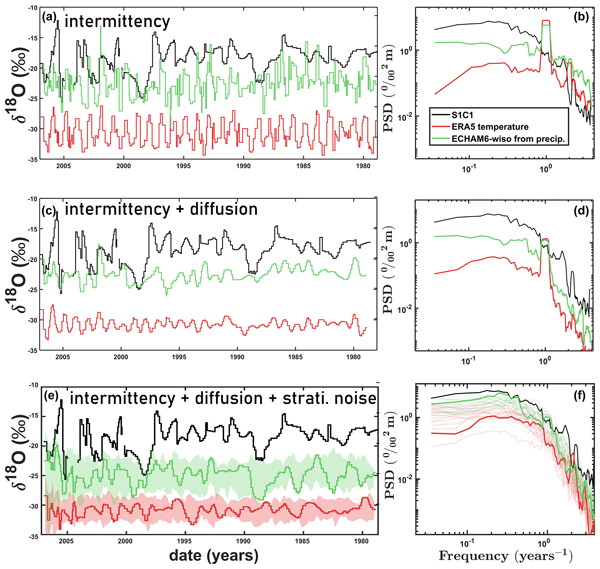
In the face of global warming, understanding the changing water cycle and temperatures in polar regions is crucial. These factors directly impact the balance of ice sheets in the Arctic and Antarctic. By studying the composition of water vapor, we gain insights into climate variations. Our 2-year study at Dumont d’Urville station, Adélie Land, offers valuable data to refine models. Additionally, we demonstrate how modeling aids in interpreting signals from ice core samples in the region.
Hélène Seroussi, Vincent Verjans, Sophie Nowicki, Antony J. Payne, Heiko Goelzer, William H. Lipscomb, Ayako Abe-Ouchi, Cécile Agosta, Torsten Albrecht, Xylar Asay-Davis, Alice Barthel, Reinhard Calov, Richard Cullather, Christophe Dumas, Benjamin K. Galton-Fenzi, Rupert Gladstone, Nicholas R. Golledge, Jonathan M. Gregory, Ralf Greve, Tore Hattermann, Matthew J. Hoffman, Angelika Humbert, Philippe Huybrechts, Nicolas C. Jourdain, Thomas Kleiner, Eric Larour, Gunter R. Leguy, Daniel P. Lowry, Chistopher M. Little, Mathieu Morlighem, Frank Pattyn, Tyler Pelle, Stephen F. Price, Aurélien Quiquet, Ronja Reese, Nicole-Jeanne Schlegel, Andrew Shepherd, Erika Simon, Robin S. Smith, Fiammetta Straneo, Sainan Sun, Luke D. Trusel, Jonas Van Breedam, Peter Van Katwyk, Roderik S. W. van de Wal, Ricarda Winkelmann, Chen Zhao, Tong Zhang, and Thomas Zwinger
The Cryosphere, 17, 5197–5217, https://doi.org/10.5194/tc-17-5197-2023, https://doi.org/10.5194/tc-17-5197-2023, 2023
Short summary
Short summary
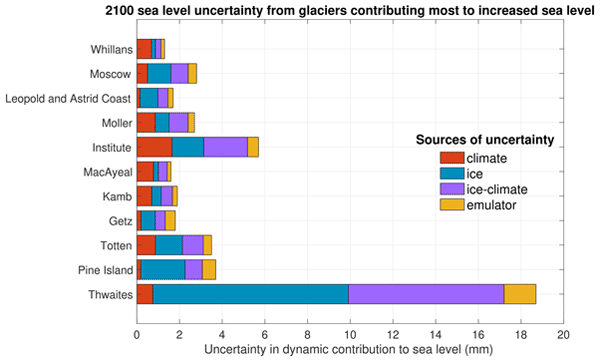
Mass loss from Antarctica is a key contributor to sea level rise over the 21st century, and the associated uncertainty dominates sea level projections. We highlight here the Antarctic glaciers showing the largest changes and quantify the main sources of uncertainty in their future evolution using an ensemble of ice flow models. We show that on top of Pine Island and Thwaites glaciers, Totten and Moscow University glaciers show rapid changes and a strong sensitivity to warmer ocean conditions.
Nina Raoult, Tim Jupp, Ben Booth, and Peter Cox
Earth Syst. Dynam., 14, 723–731, https://doi.org/10.5194/esd-14-723-2023, https://doi.org/10.5194/esd-14-723-2023, 2023
Short summary
Short summary
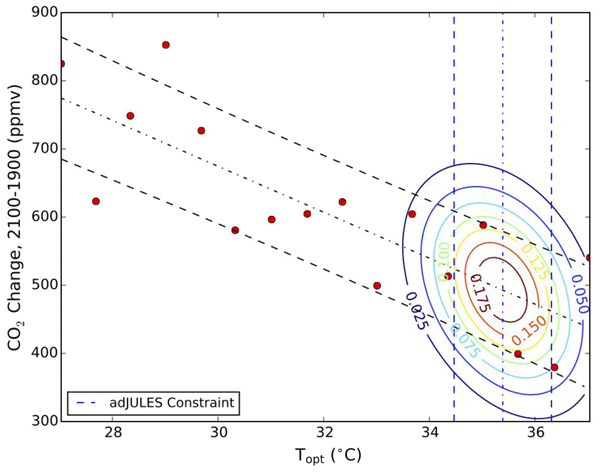
Climate models are used to predict the impact of climate change. However, poorly constrained parameters used in the physics of the models mean that we simulate a large spread of possible future outcomes. We can use real-world observations to reduce the uncertainty of parameter values, but we do not have observations to reduce the spread of possible future outcomes directly. We present a method for translating the reduction in parameter uncertainty into a reduction in possible model projections.
Nina Raoult, Sylvie Charbit, Christophe Dumas, Fabienne Maignan, Catherine Ottlé, and Vladislav Bastrikov
The Cryosphere, 17, 2705–2724, https://doi.org/10.5194/tc-17-2705-2023, https://doi.org/10.5194/tc-17-2705-2023, 2023
Short summary
Short summary
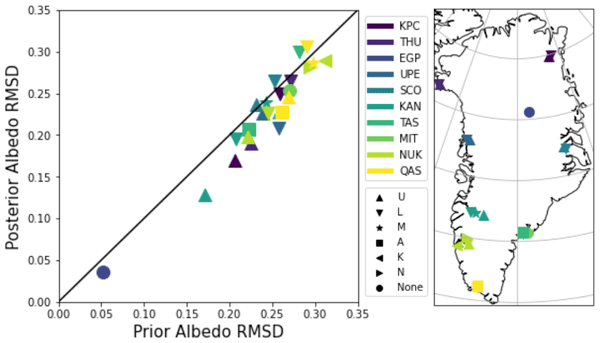
Greenland ice sheet melting due to global warming could significantly impact global sea-level rise. The ice sheet's albedo, i.e. how reflective the surface is, affects the melting speed. The ORCHIDEE computer model is used to simulate albedo and snowmelt to make predictions. However, the albedo in ORCHIDEE is lower than that observed using satellites. To correct this, we change model parameters (e.g. the rate of snow decay) to reduce the difference between simulated and observed values.
Inès N. Otosaka, Andrew Shepherd, Erik R. Ivins, Nicole-Jeanne Schlegel, Charles Amory, Michiel R. van den Broeke, Martin Horwath, Ian Joughin, Michalea D. King, Gerhard Krinner, Sophie Nowicki, Anthony J. Payne, Eric Rignot, Ted Scambos, Karen M. Simon, Benjamin E. Smith, Louise S. Sørensen, Isabella Velicogna, Pippa L. Whitehouse, Geruo A, Cécile Agosta, Andreas P. Ahlstrøm, Alejandro Blazquez, William Colgan, Marcus E. Engdahl, Xavier Fettweis, Rene Forsberg, Hubert Gallée, Alex Gardner, Lin Gilbert, Noel Gourmelen, Andreas Groh, Brian C. Gunter, Christopher Harig, Veit Helm, Shfaqat Abbas Khan, Christoph Kittel, Hannes Konrad, Peter L. Langen, Benoit S. Lecavalier, Chia-Chun Liang, Bryant D. Loomis, Malcolm McMillan, Daniele Melini, Sebastian H. Mernild, Ruth Mottram, Jeremie Mouginot, Johan Nilsson, Brice Noël, Mark E. Pattle, William R. Peltier, Nadege Pie, Mònica Roca, Ingo Sasgen, Himanshu V. Save, Ki-Weon Seo, Bernd Scheuchl, Ernst J. O. Schrama, Ludwig Schröder, Sebastian B. Simonsen, Thomas Slater, Giorgio Spada, Tyler C. Sutterley, Bramha Dutt Vishwakarma, Jan Melchior van Wessem, David Wiese, Wouter van der Wal, and Bert Wouters
Earth Syst. Sci. Data, 15, 1597–1616, https://doi.org/10.5194/essd-15-1597-2023, https://doi.org/10.5194/essd-15-1597-2023, 2023
Short summary
Short summary
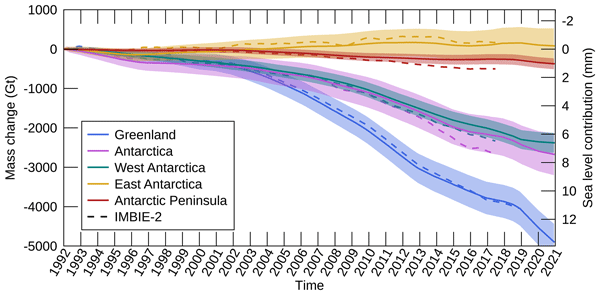
By measuring changes in the volume, gravitational attraction, and ice flow of Greenland and Antarctica from space, we can monitor their mass gain and loss over time. Here, we present a new record of the Earth’s polar ice sheet mass balance produced by aggregating 50 satellite-based estimates of ice sheet mass change. This new assessment shows that the ice sheets have lost (7.5 x 10¹²) t of ice between 1992 and 2020, contributing 21 mm to sea level rise.
Zun Yin, Kirsten L. Findell, Paul Dirmeyer, Elena Shevliakova, Sergey Malyshev, Khaled Ghannam, Nina Raoult, and Zhihong Tan
Hydrol. Earth Syst. Sci., 27, 861–872, https://doi.org/10.5194/hess-27-861-2023, https://doi.org/10.5194/hess-27-861-2023, 2023
Short summary
Short summary
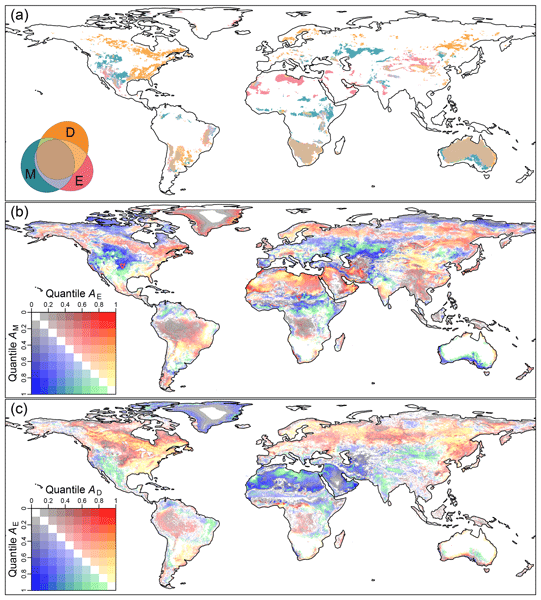
Land–atmosphere (L–A) interactions typically focus on daytime processes connecting the land state with the overlying atmospheric boundary layer. However, much prior L–A work used monthly or daily means due to the lack of daytime-only data products. Here we show that monthly smoothing can significantly obscure the L–A coupling signal, and including nighttime information can mute or mask the daytime processes of interest. We propose diagnosing L–A coupling within models or archiving subdaily data.
Christoph Kittel, Charles Amory, Stefan Hofer, Cécile Agosta, Nicolas C. Jourdain, Ella Gilbert, Louis Le Toumelin, Étienne Vignon, Hubert Gallée, and Xavier Fettweis
The Cryosphere, 16, 2655–2669, https://doi.org/10.5194/tc-16-2655-2022, https://doi.org/10.5194/tc-16-2655-2022, 2022
Short summary
Short summary
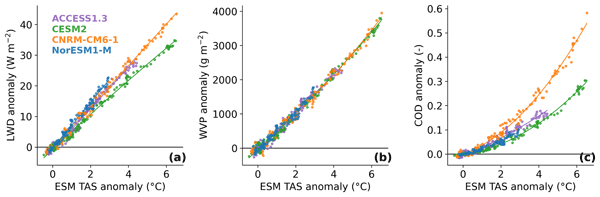
Model projections suggest large differences in future Antarctic surface melting even for similar greenhouse gas scenarios and warming rates. We show that clouds containing a larger amount of liquid water lead to stronger melt. As surface melt can trigger the collapse of the ice shelves (the safety band of the Antarctic Ice Sheet), clouds could be a major source of uncertainties in projections of sea level rise.
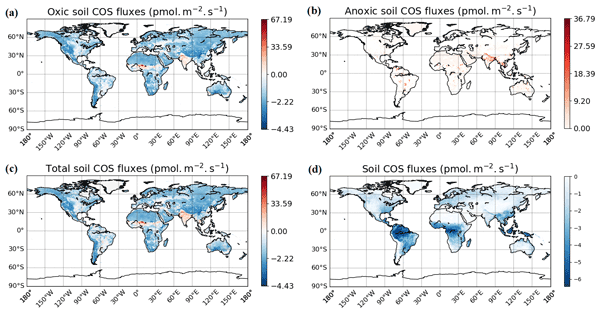
Camille Abadie, Fabienne Maignan, Marine Remaud, Jérôme Ogée, J. Elliott Campbell, Mary E. Whelan, Florian Kitz, Felix M. Spielmann, Georg Wohlfahrt, Richard Wehr, Wu Sun, Nina Raoult, Ulli Seibt, Didier Hauglustaine, Sinikka T. Lennartz, Sauveur Belviso, David Montagne, and Philippe Peylin
Biogeosciences, 19, 2427–2463, https://doi.org/10.5194/bg-19-2427-2022, https://doi.org/10.5194/bg-19-2427-2022, 2022
Short summary
Short summary
A better constraint of the components of the carbonyl sulfide (COS) global budget is needed to exploit its potential as a proxy of gross primary productivity. In this study, we compare two representations of oxic soil COS fluxes, and we develop an approach to represent anoxic soil COS fluxes in a land surface model. We show the importance of atmospheric COS concentration variations on oxic soil COS fluxes and provide new estimates for oxic and anoxic soil contributions to the COS global budget.
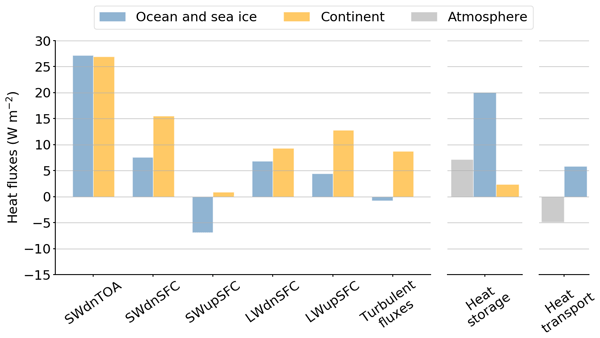
Marie Sicard, Masa Kageyama, Sylvie Charbit, Pascale Braconnot, and Jean-Baptiste Madeleine
Clim. Past, 18, 607–629, https://doi.org/10.5194/cp-18-607-2022, https://doi.org/10.5194/cp-18-607-2022, 2022
Short summary
Short summary
The Last Interglacial (129–116 ka) is characterised by an increased summer insolation over the Arctic region, which leads to a strong temperature rise. The aim of this study is to identify and quantify the main processes and feedback causing this Arctic warming. Using the IPSL-CM6A-LR model, we investigate changes in the energy budget relative to the pre-industrial period. We highlight the crucial role of Arctic sea ice cover, ocean and clouds on the Last Interglacial Arctic warming.
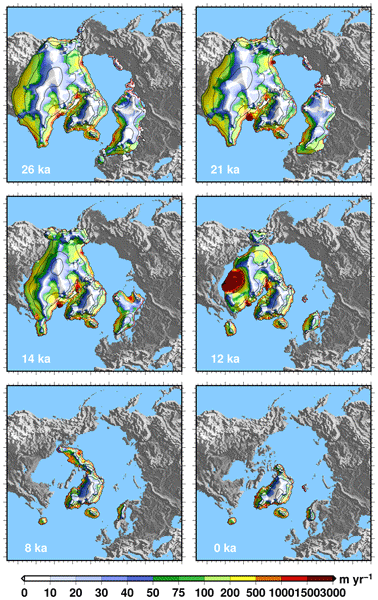
Aurélien Quiquet, Didier M. Roche, Christophe Dumas, Nathaëlle Bouttes, and Fanny Lhardy
Clim. Past, 17, 2179–2199, https://doi.org/10.5194/cp-17-2179-2021, https://doi.org/10.5194/cp-17-2179-2021, 2021
Short summary
Short summary
In this paper we discuss results obtained with a set of coupled ice-sheet–climate model experiments for the last 26 kyrs. The model displays a large sensitivity of the oceanic circulation to the amount of the freshwater flux resulting from ice sheet melting. Ice sheet geometry changes alone are not enough to lead to abrupt climate events, and rapid warming at high latitudes is here only reported during abrupt oceanic circulation recoveries that occurred when accounting for freshwater flux.
Cited articles
Agosta, C. and Conesa, P.: Init-snowpack module: Snowpack Initialization over the Greenland and Antarctic ice sheets, Zenodo [software], https://doi.org/10.5281/zenodo.21885232, 2026. a
Agosta, C., Amory, C., Kittel, C., Orsi, A., Favier, V., Gallée, H., van den Broeke, M. R., Lenaerts, J. T. M., van Wessem, J. M., van de Berg, W. J., and Fettweis, X.: Estimation of the Antarctic surface mass balance using the regional climate model MAR (1979–2015) and identification of dominant processes, The Cryosphere, 13, 281–296, https://doi.org/10.5194/tc-13-281-2019, 2019. a, b, c
Alley, R.: Firn densification by grain-boundary sliding: a first model, HAL Open Science, https://hal.science/file/index/docid/226281/filename/ajp-jphyscol198748C135.pdf (last access: 11 August 2026), 1987. a
Alley, R. B., Clark, P. U., Huybrechts, P., and Joughin, I.: Ice-Sheet and Sea-Level Changes, Science, 310, 456–460, https://doi.org/10.1126/science.1114613, 2005. a
Amory, C., Kittel, C., Le Toumelin, L., Agosta, C., Delhasse, A., Favier, V., and Fettweis, X.: Performance of MAR (v3.11) in simulating the drifting-snow climate and surface mass balance of Adélie Land, East Antarctica, Geosci. Model Dev., 14, 3487–3510, https://doi.org/10.5194/gmd-14-3487-2021, 2021. a, b
Amory, C., Buizert, C., Buzzard, S., Case, E., Clerx, N., Culberg, R., Datta, R. T., Dey, R., Drews, R., Dunmire, D., Eayrs, C., Hansen, N., Humbert, A., Kaitheri, A., Keegan, K., Kuipers Munneke, P., Lenaerts, J. T. M., Lhermitte, S., Mair, D., McDowell, I., Mejia, J., Meyer, C. R., Morris, E., Moser, D., Oraschewski, F. M., Pearce, E., de Roda Husman, S., Schlegel, N.-J., Schultz, T., Simonsen, S. B., Stevens, C. M., Thomas, E. R., Thompson-Munson, M., Wever, N., Wouters, B., and The Firn Symposium team: Firn on ice sheets, Nat. Rev. Earth Environ., 5, 79–99, https://doi.org/10.1038/s43017-023-00507-9, 2024. a, b
Arnaud, L., Lipenkov, V., Barnola, J. M., Gay, M., and Duval, P.: Modelling of the densification of polar firn: characterization of the snow–firn transition, Ann. Glaciol., 26, 39–44, https://doi.org/10.3189/1998AoG26-1-39-44, 1998. a, b, c, d
Arthern, R. J., Vaughan, D. G., Rankin, A. M., Mulvaney, R., and Thomas, E. R.: In situ measurements of Antarctic snow compaction compared with predictions of models, J. Geophys. Res.-Earth, 115, https://doi.org/10.1029/2009JF001306, 2010. a, b
Baker, E., Harper, A. B., Williamson, D., and Challenor, P.: Emulation of high-resolution land surface models using sparse Gaussian processes with application to JULES, Geosci. Model Dev., 15, 1913–1929, https://doi.org/10.5194/gmd-15-1913-2022, 2022. a
Barnola, J. M., Pimienta, P., Raynaud, D., and Korotkevich, Y. S.: CO2-climate relationship as deduced from the Vostok ice core: a re-examination based on new measurements and on a re-evaluation of the air dating, Tellus B, 43, 83–90, https://doi.org/10.1034/j.1600-0889.1991.t01-1-00002.x, 1991. a
Barrere, M., Domine, F., Decharme, B., Morin, S., Vionnet, V., and Lafaysse, M.: Evaluating the performance of coupled snow–soil models in SURFEXv8 to simulate the permafrost thermal regime at a high Arctic site, Geosci. Model Dev., 10, 3461–3479, https://doi.org/10.5194/gmd-10-3461-2017, 2017. a, b
Bartelt, P. and Lehning, M.: A physical SNOWPACK model for the Swiss avalanche warning: Part I: numerical model, Cold Regions Science and Technology, 35, 123–145, https://doi.org/10.1016/S0165-232X(02)00074-5, 2002. a
Beylat, S. and NRaoult: simonbeylat/History_Matching_ORCHIDEE: v1.0.1 (Dry_snow_init), Zenodo [data set], https://doi.org/10.5281/zenodo.17523380, 2025. a
Boone, A. and Etchevers, P.: An Intercomparison of Three Snow Schemes of Varying Complexity Coupled to the Same Land Surface Model: Local-Scale Evaluation at an Alpine Site, J. Hydrometeorol., 2, 374–394, https://doi.org/10.1175/1525-7541(2001)002<0374:AIOTSS>2.0.CO;2, 2001. a
Boucher, O., Servonnat, J., Albright, A. L., Aumont, O., Balkanski, Y., Bastrikov, V., Bekki, S., Bonnet, R., Bony, S., Bopp, L., Braconnot, P., Brockmann, P., Cadule, P., Caubel, A., Cheruy, F., Codron, F., Cozic, A., Cugnet, D., D'Andrea, F., Davini, P., de Lavergne, C., Denvil, S., Deshayes, J., Devilliers, M., Ducharne, A., Dufresne, J.-L., Dupont, E., Éthé, C., Fairhead, L., Falletti, L., Flavoni, S., Foujols, M.-A., Gardoll, S., Gastineau, G., Ghattas, J., Grandpeix, J.-Y., Guenet, B., Guez, Lionel, E., Guilyardi, E., Guimberteau, M., Hauglustaine, D., Hourdin, F., Idelkadi, A., Joussaume, S., Kageyama, M., Khodri, M., Krinner, G., Lebas, N., Levavasseur, G., Lévy, C., Li, L., Lott, F., Lurton, T., Luyssaert, S., Madec, G., Madeleine, J.-B., Maignan, F., Marchand, M., Marti, O., Mellul, L., Meurdesoif, Y., Mignot, J., Musat, I., Ottlé, C., Peylin, P., Planton, Y., Polcher, J., Rio, C., Rochetin, N., Rousset, C., Sepulchre, P., Sima, A., Swingedouw, D., Thiéblemont, R., Traore, A. K., Vancoppenolle, M., Vial, J., Vialard, J., Viovy, N., and Vuichard, N.: Presentation and Evaluation of the IPSL-CM6A-LR Climate Model, J. Adv. Model. Earth Sy., 12, e2019MS002010, https://doi.org/10.1029/2019MS002010, 2020. a
Box, J. E., Hubbard, A., Bahr, D. B., Colgan, W. T., Fettweis, X., Mankoff, K. D., Wehrlé, A., Noël, B., van den Broeke, M. R., Wouters, B., Bjørk, A. A., and Fausto, R. S.: Greenland ice sheet climate disequilibrium and committed sea-level rise, Nat. Clim. Change, 12, 808–813, https://doi.org/10.1038/s41558-022-01441-2, 2022. a
Brils, M., Kuipers Munneke, P., van de Berg, W. J., and van den Broeke, M.: Improved representation of the contemporary Greenland ice sheet firn layer by IMAU-FDM v1.2G, Geosci. Model Dev., 15, 7121–7138, https://doi.org/10.5194/gmd-15-7121-2022, 2022. a, b
Brun, E., Martin, E., Simon, V., Gendre, C., and Coleou, C.: An Energy and Mass Model of Snow Cover Suitable for Operational Avalanche Forecasting, J. Glaciol., 35, 333–342, https://doi.org/10.3189/S0022143000009254, 1989. a
Buizert, C., Fudge, T. J., Roberts, W. H. G., Steig, E. J., Sherriff-Tadano, S., Ritz, C., Lefebvre, E., Edwards, J., Kawamura, K., Oyabu, I., Motoyama, H., Kahle, E. C., Jones, T. R., Abe-Ouchi, A., Obase, T., Martin, C., Corr, H., Severinghaus, J. P., Beaudette, R., Epifanio, J. A., Brook, E. J., Martin, K., Chappellaz, J., Aoki, S., Nakazawa, T., Sowers, T. A., Alley, R. B., Ahn, J., Sigl, M., Severi, M., Dunbar, N. W., Svensson, A., Fegyveresi, J. M., He, C., Liu, Z., Zhu, J., Otto-Bliesner, B. L., Lipenkov, V. Y., Kageyama, M., and Schwander, J.: Antarctic surface temperature and elevation during the Last Glacial Maximum, Science, 372, 1097–1101, https://doi.org/10.1126/science.abd2897, 2021. a
Chalita, S. and Le Treut, H.: The albedo of temperate and boreal forest and the Northern Hemisphere climate: a sensitivity experiment using the LMD GCM, Clim. Dynam., 10, 231–240, https://doi.org/10.1007/BF00208990, 1994. a, b
Charbit, S., Dumas, C., Maignan, F., Ottlé, C., Raoult, N., Fettweis, X., and Conesa, P.: Modelling snowpack on ice surfaces with the ORCHIDEE land surface model: application to the Greenland ice sheet, The Cryosphere, 18, 5067–5099, https://doi.org/10.5194/tc-18-5067-2024, 2024. a, b, c, d, e, f, g, h, i, j, k, l, m
Cheruy, F., Ducharne, A., Hourdin, F., Musat, I., Vignon, É., Gastineau, G., Bastrikov, V., Vuichard, N., Diallo, B., Dufresne, J.-L., Ghattas, J., Grandpeix, J.-Y., Idelkadi, A., Mellul, L., Maignan, F., Ménégoz, M., Ottlé, C., Peylin, P., Servonnat, J., Wang, F., and Zhao, Y.: Improved Near-Surface Continental Climate in IPSL-CM6A-LR by Combined Evolutions of Atmospheric and Land Surface Physics, J. Adv. Model. Earth Sy., 12, e2019MS002005, https://doi.org/10.1029/2019MS002005, 2020. a, b
Coléou, C. and Lesaffre, B.: Irreducible water saturation in snow: experimental results in a cold laboratory, Ann. Glaciol., 26, 64–68, https://doi.org/10.3189/1998AoG26-1-64-68, 1998. a
Conesa, P.: Dry snow initialization and densification over the Greenland and Antarctic ice sheets in the ORCHIDEE land surface model: Scripts, Zenodo [code and data set], https://doi.org/10.5281/zenodo.20343298, 2026a. a
Conesa, P.: Dry snow initialization and densification over the Greenland and Antarctic ice sheets in the ORCHIDEE land surface model: Datasets and Model Outputs, Zenodo [data set], https://doi.org/10.5281/zenodo.20343275, 2026b. a
Couvreux, F., Hourdin, F., Williamson, D., Roehrig, R., Volodina, V., Villefranque, N., Rio, C., Audouin, O., Salter, J., Bazile, E., Brient, F., Favot, F., Honnert, R., Lefebvre, M.-P., Madeleine, J.-B., Rodier, Q., and Xu, W.: Process-Based Climate Model Development Harnessing Machine Learning: I. A Calibration Tool for Parameterization Improvement, J. Adv. Model. Earth Sy., 13, e2020MS002217, https://doi.org/10.1029/2020MS002217, 2021. a, b, c
Davrinche, C., Orsi, A., Agosta, C., Amory, C., and Kittel, C.: Understanding the drivers of near-surface winds in Adélie Land, East Antarctica, The Cryosphere, 18, 2239–2256, https://doi.org/10.5194/tc-18-2239-2024, 2024. a
de la Peña, S., Howat, I. M., Nienow, P. W., van den Broeke, M. R., Mosley-Thompson, E., Price, S. F., Mair, D., Noël, B., and Sole, A. J.: Changes in the firn structure of the western Greenland Ice Sheet caused by recent warming, The Cryosphere, 9, 1203–1211, https://doi.org/10.5194/tc-9-1203-2015, 2015. a
Decharme, B., Brun, E., Boone, A., Delire, C., Le Moigne, P., and Morin, S.: Impacts of snow and organic soils parameterization on northern Eurasian soil temperature profiles simulated by the ISBA land surface model, The Cryosphere, 10, 853–877, https://doi.org/10.5194/tc-10-853-2016, 2016. a, b
Delhasse, A., Kittel, C., Amory, C., Hofer, S., van As, D., S. Fausto, R., and Fettweis, X.: Brief communication: Evaluation of the near-surface climate in ERA5 over the Greenland Ice Sheet, The Cryosphere, 14, 957–965, https://doi.org/10.5194/tc-14-957-2020, 2020. a
Domine, F., Barrere, M., and Morin, S.: The growth of shrubs on high Arctic tundra at Bylot Island: impact on snow physical properties and permafrost thermal regime, Biogeosciences, 13, 6471–6486, https://doi.org/10.5194/bg-13-6471-2016, 2016. a
Ekaykin, A. A., Bolshunov, A. V., Lipenkov, V. Y., Scheinert, M., Eberlein, L., Brovkov, E., Popov, S. V., and Turkeev, A. V.: First glaciological investigations at Ridge B, central East Antarctica, Antarct. Sci., 33, 418–427, https://doi.org/10.1017/S0954102021000171, 2021. a
Ekaykin, A. A., Tchikhatchev, K. B., Veres, A. N., Lipenkov, V. Y., Tebenkova, N. A., and Turkeev, A. V.: Vertical profile of snow-firn density in the vicinity of Vostok station, Central Antarctica, Ice and Snow, 62, 504–511, https://doi.org/10.31857/s2076673422040147, 2023. a
Fausto, R. S., Box, J. E., Vandecrux, B., van As, D., Steffen, K., MacFerrin, M. J., Machguth, H., Colgan, W., Koenig, L. S., McGrath, D., Charalampidis, C., and Braithwaite, R. J.: A Snow Density Dataset for Improving Surface Boundary Conditions in Greenland Ice Sheet Firn Modeling, Front. Earth Sci., 6, https://doi.org/10.3389/feart.2018.00051, 2018. a, b, c
Favier, V., Agosta, C., Parouty, S., Durand, G., Delaygue, G., Gallée, H., Drouet, A.-S., Trouvilliez, A., and Krinner, G.: An updated and quality controlled surface mass balance dataset for Antarctica, The Cryosphere, 7, 583–597, https://doi.org/10.5194/tc-7-583-2013, 2013. a
Fettweis, X., Box, J. E., Agosta, C., Amory, C., Kittel, C., Lang, C., van As, D., Machguth, H., and Gallée, H.: Reconstructions of the 1900–2015 Greenland ice sheet surface mass balance using the regional climate MAR model, The Cryosphere, 11, 1015–1033, https://doi.org/10.5194/tc-11-1015-2017, 2017. a, b
Fettweis, X., Hofer, S., Krebs-Kanzow, U., Amory, C., Aoki, T., Berends, C. J., Born, A., Box, J. E., Delhasse, A., Fujita, K., Gierz, P., Goelzer, H., Hanna, E., Hashimoto, A., Huybrechts, P., Kapsch, M.-L., King, M. D., Kittel, C., Lang, C., Langen, P. L., Lenaerts, J. T. M., Liston, G. E., Lohmann, G., Mernild, S. H., Mikolajewicz, U., Modali, K., Mottram, R. H., Niwano, M., Noël, B., Ryan, J. C., Smith, A., Streffing, J., Tedesco, M., van de Berg, W. J., van den Broeke, M., van de Wal, R. S. W., van Kampenhout, L., Wilton, D., Wouters, B., Ziemen, F., and Zolles, T.: GrSMBMIP: intercomparison of the modelled 1980–2012 surface mass balance over the Greenland Ice Sheet, The Cryosphere, 14, 3935–3958, https://doi.org/10.5194/tc-14-3935-2020, 2020. a
Fettweis, X., Ambroise, B., David, P.-M., Ghilain, N., Paul, P., and Wuest, C.: Évolution actuelle (1960–2021) de l'enneigement dans les Vosges à l'aide du modèle régional du climat MAR, Bulletin de la Société Géographique de Liège, https://doi.org/10.25518/0770-7576.7049, 2023. a
Feulner, G., Rahmstorf, S., Levermann, A., and Volkwardt, S.: On the Origin of the Surface Air Temperature Difference between the Hemispheres in Earth's Present-Day Climate, J. Climate, 26, 7136–7150, https://doi.org/10.1175/JCLI-D-12-00636.1, 2013. a, b, c
Forsberg, R., Sørensen, L., and Simonsen, S.: Greenland and Antarctica Ice Sheet Mass Changes and Effects on Global Sea Level, Surv. Geophys., 38, 89–104, https://doi.org/10.1007/s10712-016-9398-7, 2017. a
Genthon, C., Six, D., Scarchilli, C., Ciardini, V., and Frezzotti, M.: Meteorological and snow accumulation gradients across Dome C, East Antarctic plateau, Int. J. Climatol., 36, 455–466, https://doi.org/10.1002/joc.4362, 2016. a
Gerber, F., Sharma, V., and Lehning, M.: CRYOWRF—Model Evaluation and the Effect of Blowing Snow on the Antarctic Surface Mass Balance, J. Geophys. Res.-Atmos., 128, e2022JD037744, https://doi.org/10.1029/2022JD037744, 2023. a
Goujon, C., Barnola, J.-M., and Ritz, C.: Modeling the densification of polar firn including heat diffusion: Application to close-off characteristics and gas isotopic fractionation for Antarctica and Greenland sites, J. Geophys. Res.-Atmos., 108, https://doi.org/10.1029/2002JD003319, 2003. a, b, c
Groot Zwaaftink, C. D., Cagnati, A., Crepaz, A., Fierz, C., Macelloni, G., Valt, M., and Lehning, M.: Event-driven deposition of snow on the Antarctic Plateau: analyzing field measurements with SNOWPACK, The Cryosphere, 7, 333–347, https://doi.org/10.5194/tc-7-333-2013, 2013. a, b, c
Hanna, E., Huybrechts, P., Janssens, I., Cappelen, J., Steffen, K., and Stephens, A.: Runoff and mass balance of the Greenland ice sheet: 1958–2003, J. Geophys. Res.-Atmos., 110, https://doi.org/10.1029/2004JD005641, 2005. a, b, c
Helsen, M. M., van de Wal, R. S. W., Reerink, T. J., Bintanja, R., Madsen, M. S., Yang, S., Li, Q., and Zhang, Q.: On the importance of the albedo parameterization for the mass balance of the Greenland ice sheet in EC-Earth, The Cryosphere, 11, 1949–1965, https://doi.org/10.5194/tc-11-1949-2017, 2017. a
Herron, M. M. and Langway Jr., C. C.: Firn Densification: An Empirical Model, J. Glaciol., 25, 373–385, https://doi.org/10.3189/S0022143000015239, 1980. a, b, c
Hersbach, H., Bell, B., Berrisford, P., Hirahara, S., Horányi, A., Muñoz-Sabater, J., Nicolas, J., Peubey, C., Radu, R., Schepers, D., Simmons, A., Soci, C., Abdalla, S., Abellan, X., Balsamo, G., Bechtold, P., Biavati, G., Bidlot, J., Bonavita, M., De Chiara, G., Dahlgren, P., Dee, D., Diamantakis, M., Dragani, R., Flemming, J., Forbes, R., Fuentes, M., Geer, A., Haimberger, L., Healy, S., Hogan, R. J., Hólm, E., Janisková, M., Keeley, S., Laloyaux, P., Lopez, P., Lupu, C., Radnoti, G., de Rosnay, P., Rozum, I., Vamborg, F., Villaume, S., and Thépaut, J.-N.: The ERA5 global reanalysis, Q. J. Roy. Meteor. Soc., 146, 1999–2049, https://doi.org/10.1002/qj.3803, 2020. a
Hourdin, F., Williamson, D., Rio, C., Couvreux, F., Roehrig, R., Villefranque, N., Musat, I., Fairhead, L., Diallo, F. B., and Volodina, V.: Process-Based Climate Model Development Harnessing Machine Learning: II. Model Calibration From Single Column to Global, J. Adv. Model. Earth Sy., 13, e2020MS002225, https://doi.org/10.1029/2020MS002225, 2021. a, b, c
Hourdin, F., Ferster, B., Deshayes, J., Mignot, J., Musat, I., and Williamson, D.: Toward machine-assisted tuning avoiding the underestimation of uncertainty in climate change projections, Science Advances, 9, eadf2758, https://doi.org/10.1126/sciadv.adf2758, 2023. a
Howat, I. M.: Temporal variability in snow accumulation and density at Summit Camp, Greenland ice sheet, J. Glaciol., 68, 1076–1084, https://doi.org/10.1017/jog.2022.21, 2022. a
IPSL Data Catalogue: ORCHIDEE-ICE_init_density, IPSL Data Catalogue [code], https://doi.org/10.14768/ec44f2dc-f822-4838-82ec-7678232eba46, 2025. a
Jafari, M. and Lehning, M.: Convection of snow: when and why does it happen?, Front. Earth Sci., 11, https://doi.org/10.3389/feart.2023.1167760, publisher: Frontiers, 2023. a
Keenan, E., Wever, N., Dattler, M., Lenaerts, J. T. M., Medley, B., Kuipers Munneke, P., and Reijmer, C.: Physics-based SNOWPACK model improves representation of near-surface Antarctic snow and firn density, The Cryosphere, 15, 1065–1085, https://doi.org/10.5194/tc-15-1065-2021, 2021. a, b
Kipfstuhl, S., Faria, S. H., Azuma, N., Freitag, J., Hamann, I., Kaufmann, P., Miller, H., Weiler, K., and Wilhelms, F.: Evidence of dynamic recrystallization in polar firn, J. Geophys. Res.-Sol. Ea., 114, https://doi.org/10.1029/2008JB005583, 2009. a
Kittel, C., Amory, C., Agosta, C., Jourdain, N. C., Hofer, S., Delhasse, A., Doutreloup, S., Huot, P.-V., Lang, C., Fichefet, T., and Fettweis, X.: Diverging future surface mass balance between the Antarctic ice shelves and grounded ice sheet, The Cryosphere, 15, 1215–1236, https://doi.org/10.5194/tc-15-1215-2021, 2021. a, b, c, d
Krinner, G., Viovy, N., de Noblet-Ducoudré, N., Ogée, J., Polcher, J., Friedlingstein, P., Ciais, P., Sitch, S., and Prentice, I. C.: A dynamic global vegetation model for studies of the coupled atmosphere-biosphere system, Global Biogeochem. Cy., 19, https://doi.org/10.1029/2003GB002199, 2005. a
Kuipers Munneke, P., Reijmer, C. H., van den Broeke, M. R., König-Langlo, G., Stammes, P., and Knap, W. H.: Analysis of clear-sky Antarctic snow albedo using observations and radiative transfer modeling, J. Geophys. Res.-Atmos., 113, https://doi.org/10.1029/2007JD009653, 2008. a
Lafaysse, M., Cluzet, B., Dumont, M., Lejeune, Y., Vionnet, V., and Morin, S.: A multiphysical ensemble system of numerical snow modelling, The Cryosphere, 11, 1173–1198, https://doi.org/10.5194/tc-11-1173-2017, 2017. a, b
Leduc-Leballeur, M., Picard, G., Mialon, A., Arnaud, L., Lefebvre, E., Possenti, P., and Kerr, Y.: Modeling L-Band Brightness Temperature at Dome C in Antarctica and Comparison With SMOS Observations, IEEE T. Geosci. Remote, 53, 4022–4032, https://doi.org/10.1109/TGRS.2015.2388790, 2015. a, b, c
Leduc-Leballeur, M., Picard, G., Macelloni, G., Mialon, A., and Kerr, Y. H.: Melt in Antarctica derived from Soil Moisture and Ocean Salinity (SMOS) observations at L band, The Cryosphere, 14, 539–548, https://doi.org/10.5194/tc-14-539-2020, 2020. a
Lenaerts, J. T. M., van den Broeke, M. R., Déry, S. J., van Meijgaard, E., van de Berg, W. J., Palm, S. P., and Sanz Rodrigo, J.: Modeling drifting snow in Antarctica with a regional climate model: 1. Methods and model evaluation, J. Geophys. Res.-Atmos., 117, https://doi.org/10.1029/2011JD016145, 2012. a, b, c, d
Ligtenberg, S. R. M., Kuipers Munneke, P., Noël, B. P. Y., and van den Broeke, M. R.: Brief communication: Improved simulation of the present-day Greenland firn layer (1960–2016), The Cryosphere, 12, 1643–1649, https://doi.org/10.5194/tc-12-1643-2018, 2018. a
Liston, G. E. and Sturm, M.: Winter Precipitation Patterns in Arctic Alaska Determined from a Blowing-Snow Model and Snow-Depth Observations, J. Hydrometeorol., 3, 646–659, https://doi.org/10.1175/1525-7541(2002)003<0646:WPPIAA>2.0.CO;2, 2002. a
Loeppky, J. L., Sacks, J., and Welch, W. J.: Choosing the Sample Size of a Computer Experiment: A Practical Guide, Technometrics, 51, 366–376, https://doi.org/10.1198/TECH.2009.08040, 2009. a, b
MacBean, N., Bacour, C., Raoult, N., Bastrikov, V., Koffi, E. N., Kuppel, S., Maignan, F., Ottlé, C., Peaucelle, M., Santaren, D., and Peylin, P.: Quantifying and Reducing Uncertainty in Global Carbon Cycle Predictions: Lessons and Perspectives From 15 Years of Data Assimilation Studies With the ORCHIDEE Terrestrial Biosphere Model, Global Biogeochem. Cy., 36, e2021GB007177, https://doi.org/10.1029/2021GB007177, 2022. a
Marquetto, L., Kaspari, S., and Cardia Simões, J.: Refractory black carbon (rBC) variability in a 47-year West Antarctic snow and firn core, The Cryosphere, 14, 1537–1554, https://doi.org/10.5194/tc-14-1537-2020, 2020. a
Marsh, P. and Woo, M.-K.: Wetting front advance and freezing of meltwater within a snow cover: 1. Observations in the Canadian Arctic, Water Resour. Res., 20, 1853–1864, https://doi.org/10.1029/WR020i012p01853, 1984. a
McNeall, D., Robertson, E., and Wiltshire, A.: Constraining the carbon cycle in JULES-ES-1.0, Geosci. Model Dev., 17, 1059–1089, https://doi.org/10.5194/gmd-17-1059-2024, 2024. a
McNeall, D. J., Challenor, P. G., Gattiker, J. R., and Stone, E. J.: The potential of an observational data set for calibration of a computationally expensive computer model, Geosci. Model Dev., 6, 1715–1728, https://doi.org/10.5194/gmd-6-1715-2013, 2013. a
Monin, A. and Obukhov, A.: Basic laws of turbulent mixing in the surface layer of the atmosphere, Semantic Scholar, https://www.semanticscholar.org/paper/Basic-laws-of-turbulent-mixing-in-the-surface-layer-Monin-Obukhov/7282151445417410c4aef151dcad98aac530fc7e (last access: 11 August 2026), 2009. a
Morris, M. D. and Mitchell, T. J.: Exploratory designs for computational experiments, J. Stat. Plan. Infer., 43, 381–402, https://doi.org/10.1016/0378-3758(94)00035-T, 1995. a
Mouginot, J., Rignot, E., Bjørk, A. A., van den Broeke, M., Millan, R., Morlighem, M., Noël, B., Scheuchl, B., and Wood, M.: Forty-six years of Greenland Ice Sheet mass balance from 1972 to 2018, P. Natl. Acad. Sci. USA, 116, 9239–9244, https://doi.org/10.1073/pnas.1904242116, 2019. a, b
Mousavi, M., Colliander, A., Miller, J. Z., Entekhabi, D., Johnson, J. T., Shuman, C. A., Kimball, J. S., and Courville, Z. R.: Evaluation of Surface Melt on the Greenland Ice Sheet Using SMAP L-Band Microwave Radiometry, IEEE J. Sel. Top. Appl., 14, 11439–11449, https://doi.org/10.1109/JSTARS.2021.3124229, 2021. a
Oppenheimer, M., Glavovic, B. C., Hinkel, J., van de Wal, R., Magnan, A. K., Abd-Elgawad, A., Cai, R., Cifuentes-Jara, M., DeConto, R. M., Ghosh, T., Hay, J., Isla, F., Marzeion, B., Meyssignac, B., and Sebesvari, Z.: Sea Level Rise and Implications for Low-Lying Islands, Coasts and Communities. In: IPCC Special Report on the Ocean and Cryosphere in a Changing Climate, edited by: Pörtner, H.-O., Roberts, D. C., Masson-Delmotte, V., Zhai, P., Tignor, M., Poloczanska, E., Mintenbeck, K., Alegría, A., Nicolai, M., Okem, A., Petzold, J., Rama, B., and Weyer, N. M., Cambridge University Press, Cambridge, UK and New York, NY, USA, 321–445, https://doi.org/10.1017/9781009157964.006, 2019. a, b
Otosaka, I. N., Shepherd, A., Ivins, E. R., Schlegel, N.-J., Amory, C., van den Broeke, M. R., Horwath, M., Joughin, I., King, M. D., Krinner, G., Nowicki, S., Payne, A. J., Rignot, E., Scambos, T., Simon, K. M., Smith, B. E., Sørensen, L. S., Velicogna, I., Whitehouse, P. L., A, G., Agosta, C., Ahlstrøm, A. P., Blazquez, A., Colgan, W., Engdahl, M. E., Fettweis, X., Forsberg, R., Gallée, H., Gardner, A., Gilbert, L., Gourmelen, N., Groh, A., Gunter, B. C., Harig, C., Helm, V., Khan, S. A., Kittel, C., Konrad, H., Langen, P. L., Lecavalier, B. S., Liang, C.-C., Loomis, B. D., McMillan, M., Melini, D., Mernild, S. H., Mottram, R., Mouginot, J., Nilsson, J., Noël, B., Pattle, M. E., Peltier, W. R., Pie, N., Roca, M., Sasgen, I., Save, H. V., Seo, K.-W., Scheuchl, B., Schrama, E. J. O., Schröder, L., Simonsen, S. B., Slater, T., Spada, G., Sutterley, T. C., Vishwakarma, B. D., van Wessem, J. M., Wiese, D., van der Wal, W., and Wouters, B.: Mass balance of the Greenland and Antarctic ice sheets from 1992 to 2020, Earth Syst. Sci. Data, 15, 1597–1616, https://doi.org/10.5194/essd-15-1597-2023, 2023. a, b
Pfeffer, W. T. and Humphrey, N. F.: Determination of timing and location of water movement and ice-layer formation by temperature measurements in sub-freezing snow, J. Glaciol., 42, 292–304, https://doi.org/10.3189/S0022143000004159, 1996. a
Polashenski, C., Courville, Z., Benson, C., Wagner, A., Chen, J., Wong, G., Hawley, R., and Hall, D.: Observations of pronounced Greenland ice sheet firn warming and implications for runoff production, Geophys. Res. Lett., 41, 4238–4246, https://doi.org/10.1002/2014GL059806, 2014. a
Raoult, N., Charbit, S., Dumas, C., Maignan, F., Ottlé, C., and Bastrikov, V.: Improving modelled albedo over the Greenland ice sheet through parameter optimisation and MODIS snow albedo retrievals, The Cryosphere, 17, 2705–2724, https://doi.org/10.5194/tc-17-2705-2023, 2023. a, b
Raoult, N., Beylat, S., Salter, J. M., Hourdin, F., Bastrikov, V., Ottlé, C., and Peylin, P.: Exploring the potential of history matching for land surface model calibration, Geosci. Model Dev., 17, 5779–5801, https://doi.org/10.5194/gmd-17-5779-2024, 2024. a, b
Ridder, K. D. and Schayes, G.: The IAGL Land Surface Model, J. Appl. Meteorol. Clim., 36, 167–182, https://doi.org/10.1175/1520-0450(1997)036<0167:TILSM>2.0.CO;2, 1997. a
Rignot, E., Mouginot, J., Scheuchl, B., van den Broeke, M., van Wessem, M. J., and Morlighem, M.: Four decades of Antarctic Ice Sheet mass balance from 1979–2017, P. Natl. Acad. Sci. USA, 116, 1095–1103, https://doi.org/10.1073/pnas.1812883116, 2019. a
Shepherd, A., Ivins, E., Rignot, E., Smith, B., van den Broeke, M., Velicogna, I., Whitehouse, P., Briggs, K., Joughin, I., Krinner, G., Nowicki, S., Payne, T., Scambos, T., Schlegel, N., A, G., Agosta, C., Ahlstrøm, A., Babonis, G., Barletta, V., Blazquez, A., Bonin, J., Csatho, B., Cullather, R., Felikson, D., Fettweis, X., Forsberg, R., Gallee, H., Gardner, A., Gilbert, L., Groh, A., Gunter, B., Hanna, E., Harig, C., Helm, V., Horvath, A., Horwath, M., Khan, S., Kjeldsen, K. K., Konrad, H., Langen, P., Lecavalier, B., Loomis, B., Luthcke, S., McMillan, M., Melini, D., Mernild, S., Mohajerani, Y., Moore, P., Mouginot, J., Moyano, G., Muir, A., Nagler, T., Nield, G., Nilsson, J., Noel, B., Otosaka, I., Pattle, M. E., Peltier, W. R., Pie, N., Rietbroek, R., Rott, H., Sandberg-Sørensen, L., Sasgen, I., Save, H., Scheuchl, B., Schrama, E., Schröder, L., Seo, K.-W., Simonsen, S., Slater, T., Spada, G., Sutterley, T., Talpe, M., Tarasov, L., van de Berg, W. J., van der Wal, W., van Wessem, M., Vishwakarma, B. D., Wiese, D., Wouters, B., and The IMBIE team: Mass balance of the Antarctic Ice Sheet from 1992 to 2017, Nature, 558, 219–222, https://doi.org/10.1038/s41586-018-0179-y, 2018. a
Skiles, S. M., Flanner, M., Cook, J. M., Dumont, M., and Painter, T. H.: Radiative forcing by light-absorbing particles in snow, Nat. Clim. Change, 8, 964–971, https://doi.org/10.1038/s41558-018-0296-5, 2018. a
Sommer, C. G., Lehning, M., and Fierz, C.: Wind tunnel experiments: saltation is necessary for wind-packing, J. Glaciol., 63, 950–958, https://doi.org/10.1017/jog.2017.53, 2017. a, b
Steger, C. R., Reijmer, C. H., van den Broeke, M. R., Wever, N., Forster, R. R., Koenig, L. S., Kuipers Munneke, P., Lehning, M., Lhermitte, S., Ligtenberg, S. R. M., Miège, C., and Noël, B. P. Y.: Firn Meltwater Retention on the Greenland Ice Sheet: A Model Comparison, Front. Earth Sci., 5, https://doi.org/10.3389/feart.2017.00003, 2017. a
Stevens, C. M., Verjans, V., Lundin, J. M. D., Kahle, E. C., Horlings, A. N., Horlings, B. I., and Waddington, E. D.: The Community Firn Model (CFM) v1.0, Geosci. Model Dev., 13, 4355–4377, https://doi.org/10.5194/gmd-13-4355-2020, 2020. a
Sturm, M., Liston, G. E., Benson, C. S., and Holmgren, J.: Characteristics and Growth of a Snowdrift in Arctic Alaska, U. S. A., Arct. Antarct. Alp. Res., 33, 319–329, https://doi.org/10.1080/15230430.2001.12003436, 2001. a
Valt, M., Guyennon, N., Salerno, F., Petrangeli, A. B., Salvatori, R., Cianfarra, P., and Romano, E.: Predicting new snow density in the Italian Alps: A variability analysis based on 10 years of measurements, Hydrol. Process., 32, 3174–3187, https://doi.org/10.1002/hyp.13249, 2018. a
van Angelen, J. H., M. Lenaerts, J. T., van den Broeke, M. R., Fettweis, X., and van Meijgaard, E.: Rapid loss of firn pore space accelerates 21st century Greenland mass loss, Geophys. Res. Lett., 40, 2109–2113, https://doi.org/10.1002/grl.50490, 2013. a
Vandecrux, B., Fausto, R. S., Langen, P. L., van As, D., MacFerrin, M., Colgan, W. T., Ingeman-Nielsen, T., Steffen, K., Jensen, N. S., Møller, M. T., and Box, J. E.: Drivers of Firn Density on the Greenland Ice Sheet Revealed by Weather Station Observations and Modeling, J. Geophys. Res.-Earth, 123, 2563–2576, https://doi.org/10.1029/2017JF004597, 2018. a
Vandecrux, B., MacFerrin, M., Machguth, H., Colgan, W. T., van As, D., Heilig, A., Stevens, C. M., Charalampidis, C., Fausto, R. S., Morris, E. M., Mosley-Thompson, E., Koenig, L., Montgomery, L. N., Miège, C., Simonsen, S. B., Ingeman-Nielsen, T., and Box, J. E.: Firn data compilation reveals widespread decrease of firn air content in western Greenland, The Cryosphere, 13, 845–859, https://doi.org/10.5194/tc-13-845-2019, 2019. a
Vandecrux, B., Mottram, R., Langen, P. L., Fausto, R. S., Olesen, M., Stevens, C. M., Verjans, V., Leeson, A., Ligtenberg, S., Kuipers Munneke, P., Marchenko, S., van Pelt, W., Meyer, C. R., Simonsen, S. B., Heilig, A., Samimi, S., Marshall, S., Machguth, H., MacFerrin, M., Niwano, M., Miller, O., Voss, C. I., and Box, J. E.: The firn meltwater Retention Model Intercomparison Project (RetMIP): evaluation of nine firn models at four weather station sites on the Greenland ice sheet, The Cryosphere, 14, 3785–3810, https://doi.org/10.5194/tc-14-3785-2020, 2020. a, b, c, d
Vandecrux, B., Amory, C., Ahlstrøm, A. P., et al.: The SUMup collaborative database: Surface mass balance, subsurface temperature and density measurements from the Greenland and Antarctic ice sheets (2025 release), Arctic Data Center [data set], https://doi.org/10.18739/A2M61BR5M, 2025. a, b, c
van den Broeke, M.: Depth and Density of the Antarctic Firn Layer, Arct. Antarct. Alp. Res., 40, 432–438, https://doi.org/10.1657/1523-0430(07-021)[BROEKE]2.0.CO;2, 2008. a, b
van den Broeke, M. R., Enderlin, E. M., Howat, I. M., Kuipers Munneke, P., Noël, B. P. Y., van de Berg, W. J., van Meijgaard, E., and Wouters, B.: On the recent contribution of the Greenland ice sheet to sea level change, The Cryosphere, 10, 1933–1946, https://doi.org/10.5194/tc-10-1933-2016, 2016. a, b
van Kampenhout, L., Lenaerts, J. T. M., Lipscomb, W. H., Sacks, W. J., Lawrence, D. M., Slater, A. G., and van den Broeke, M. R.: Improving the Representation of Polar Snow and Firn in the Community Earth System Model, J. Adv. Model. Earth Sy., 9, 2583–2600, https://doi.org/10.1002/2017MS000988, 2017. a, b, c, d, e, f
Villefranque, N., Blanco, S., Couvreux, F., Fournier, R., Gautrais, J., Hogan, R. J., Hourdin, F., Volodina, V., and Williamson, D.: Process-Based Climate Model Development Harnessing Machine Learning: III. The Representation of Cumulus Geometry and Their 3D Radiative Effects, J. Adv. Model. Earth Sy., 13, e2020MS002423, https://doi.org/10.1029/2020MS002423, 2021. a
Vionnet, V., Brun, E., Morin, S., Boone, A., Faroux, S., Le Moigne, P., Martin, E., and Willemet, J.-M.: The detailed snowpack scheme Crocus and its implementation in SURFEX v7.2, Geosci. Model Dev., 5, 773–791, https://doi.org/10.5194/gmd-5-773-2012, 2012. a, b, c
Walter, B., Weigel, H., Wahl, S., and Löwe, H.: Wind tunnel experiments to quantify the effect of aeolian snow transport on the surface snow microstructure, The Cryosphere, 18, 3633–3652, https://doi.org/10.5194/tc-18-3633-2024, 2024. a, b
Wang, T., Ottlé, C., Boone, A., Ciais, P., Brun, E., Morin, S., Krinner, G., Piao, S., and Peng, S.: Evaluation of an improved intermediate complexity snow scheme in the ORCHIDEE land surface model, J. Geophys. Res.-Atmos., 118, 6064–6079, https://doi.org/10.1002/jgrd.50395, 2013. a, b, c
Wang, Y., Ding, M., Wessem, J. M. v., Schlosser, E., Altnau, S., Broeke, M. R. v. d., Lenaerts, J. T. M., Thomas, E. R., Isaksson, E., Wang, J., and Sun, W.: A Comparison of Antarctic Ice Sheet Surface Mass Balance from Atmospheric Climate Models and In Situ Observations, J. Climate, 29, 5317–5337, https://doi.org/10.1175/JCLI-D-15-0642.1, 2016. a
Williamson, D., Goldstein, M., Allison, L., Blaker, A., Challenor, P., Jackson, L., and Yamazaki, K.: History matching for exploring and reducing climate model parameter space using observations and a large perturbed physics ensemble, Clim. Dynam., 41, 1703–1729, https://doi.org/10.1007/s00382-013-1896-4, 2013. a, b
Williamson, D. B., Blaker, A. T., and Sinha, B.: Tuning without over-tuning: parametric uncertainty quantification for the NEMO ocean model, Geosci. Model Dev., 10, 1789–1816, https://doi.org/10.5194/gmd-10-1789-2017, 2017. a, b
Yen, Y.: Review of Thermal Properties of Snow, Ice and Sea Ice, Semantic Scholar, https://www.semanticscholar.org/paper/Review-of-Thermal-Properties-of-Snow%2C-Ice-and-Sea-Yen/51bfc79621ac31fb86fd5cd01ba01c36de7839fb (last access: 11 August 2026), 1981. a
Short summary
As Greenland and Antarctic ice sheets are almost entirely covered by snow, a proper modelling of the internal snowpack processes is essential to predict their evolution. This study evaluates the snow densification over ice sheets in the ORCHIDEE (Organising Carbon and Hydrology In Dynamic Ecosystems) land surface model. The development of a new formulation for the surface snow density and the calibration of densification parameters improve the model agreement with polar snow observations.
As Greenland and Antarctic ice sheets are almost entirely covered by snow, a proper modelling of...


