Articles | Volume 20, issue 7
https://doi.org/10.5194/tc-20-4037-2026
© Author(s) 2026. This work is distributed under
the Creative Commons Attribution 4.0 License.
https://doi.org/10.5194/tc-20-4037-2026
© Author(s) 2026. This work is distributed under
the Creative Commons Attribution 4.0 License.
Freshly calved icebergs from Sermeq Kujalleq in Kangia, Greenland: is their blue ice temperate?

Antoine Zaninetti
CORRESPONDING AUTHOR
Institute of Geography, University of Zurich, 8052 Zurich, Switzerland
Martin P. Lüthi
Institute of Geography, University of Zurich, 8052 Zurich, Switzerland
Adrien Wehrlé
Institute of Geography, University of Zurich, 8052 Zurich, Switzerland
Janneke van Ginkel
Swiss Seismological Service SED, ETH Zurich, 8092 Zurich, Switzerland
Institute of Geography, University of Zurich, 8052 Zurich, Switzerland
Related authors
No articles found.
Anne Solgaard, Anders Kusk, John Peter Merryman Boncori, Jørgen Dall, Andreas P. Ahlstrøm, Signe B. Andersen, Michele Citterio, Penelope How, Nanna B. Karlsson, Kristian K. Kjeldsen, Signe H. Larsen, Mads C. Lund, Anja Løkkegaard, Martin P. Lüthi, Jessica Mejia, Kenneth D. Mankoff, Dirk van As, Shin Sugiyama, and Robert S. Fausto
Earth Syst. Sci. Data Discuss., https://doi.org/10.5194/essd-2026-221, https://doi.org/10.5194/essd-2026-221, 2026
Preprint under review for ESSD
Short summary
Short summary
We present the PROMICE ice-velocity dataset, a time series of maps showing how fast the Greenland Ice Sheet flows. The time series is created using satellite radar images from Sentinel-1 since 2016 and is updated with a new map every 12 days providing a detailed view of ice sheet wide dynamics for more than a decade. Continuous updates and improvements, such as those presented here, are essential for maintaining long, consistent, high-quality records of key climate variables for research.
Lou-Anne Chevrollier, Adrien Wehrlé, Joseph M. Cook, Norbert Pirk, Liane G. Benning, Alexandre M. Anesio, and Martyn Tranter
The Cryosphere, 19, 1527–1538, https://doi.org/10.5194/tc-19-1527-2025, https://doi.org/10.5194/tc-19-1527-2025, 2025
Short summary
Short summary
Light-absorbing particles (LAPs) are often present as a mixture on snow surfaces and are important to disentangle because their darkening effects vary but also because the processes governing their presence and accumulation on snow surfaces are different. This study presents a novel method to retrieve the concentration and albedo-reducing effect of different LAPs present at the snow surface from surface spectral albedo. The method is then successfully applied to ground observations on seasonal snow.
Janneke van Ginkel, Fabian Walter, Fabian Lindner, Miroslav Hallo, Matthias Huss, and Donat Fäh
The Cryosphere, 19, 1469–1490, https://doi.org/10.5194/tc-19-1469-2025, https://doi.org/10.5194/tc-19-1469-2025, 2025
Short summary
Short summary
This study on Glacier de la Plaine Morte in Switzerland employs various passive seismic analysis methods to identify complex hydraulic behaviours at the ice–bedrock interface. In 4 months of seismic records, we detect spatio-temporal variations in the glacier's basal interface, following the drainage of an ice-marginal lake. We identify a low-velocity layer, whose properties are determined using modelling techniques. This low-velocity layer results from temporary water storage subglacially.
Martin Peter Lüthi, Diego Wasser, and Luc Moreau
EGUsphere, https://doi.org/10.5194/egusphere-2025-832, https://doi.org/10.5194/egusphere-2025-832, 2025
Preprint archived
Short summary
Short summary
Glacier ice often contains liquid water. How much exactly depends on the history of ice formation, the internal heat sources, and on the drainage pathways between ice crystals. The liquid water content strongly influences many properties of the ice, such as its softness. We measured in two glacier caves the water content directly in the ice walls by cooling the ice. Water contents of 1–2 % were found, which agrees with previous measurements.
Anja Løkkegaard, Kenneth D. Mankoff, Christian Zdanowicz, Gary D. Clow, Martin P. Lüthi, Samuel H. Doyle, Henrik H. Thomsen, David Fisher, Joel Harper, Andy Aschwanden, Bo M. Vinther, Dorthe Dahl-Jensen, Harry Zekollari, Toby Meierbachtol, Ian McDowell, Neil Humphrey, Anne Solgaard, Nanna B. Karlsson, Shfaqat A. Khan, Benjamin Hills, Robert Law, Bryn Hubbard, Poul Christoffersen, Mylène Jacquemart, Julien Seguinot, Robert S. Fausto, and William T. Colgan
The Cryosphere, 17, 3829–3845, https://doi.org/10.5194/tc-17-3829-2023, https://doi.org/10.5194/tc-17-3829-2023, 2023
Short summary
Short summary
This study presents a database compiling 95 ice temperature profiles from the Greenland ice sheet and peripheral ice caps. Ice viscosity and hence ice flow are highly sensitive to ice temperature. To highlight the value of the database in evaluating ice flow simulations, profiles from the Greenland ice sheet are compared to a modeled temperature field. Reoccurring discrepancies between modeled and observed temperatures provide insight on the difficulties faced when simulating ice temperatures.
Adrien Wehrlé, Martin P. Lüthi, and Andreas Vieli
The Cryosphere, 17, 309–326, https://doi.org/10.5194/tc-17-309-2023, https://doi.org/10.5194/tc-17-309-2023, 2023
Short summary
Short summary
We characterized short-lived episodes of ice mélange weakening (IMW) at the front of three major Greenland outlet glaciers. Through a continuous detection at the front of Kangerdlugssuaq Glacier during the June-to-September period from 2018 to 2021, we found that 87 % of the IMW episodes occurred prior to a large-scale calving event. Using a simple model for ice mélange motion, we further characterized the IMW process as self-sustained through the existence of an IMW–calving feedback.
Janneke van Ginkel, Elmer Ruigrok, Jan Stafleu, and Rien Herber
Nat. Hazards Earth Syst. Sci., 22, 41–63, https://doi.org/10.5194/nhess-22-41-2022, https://doi.org/10.5194/nhess-22-41-2022, 2022
Short summary
Short summary
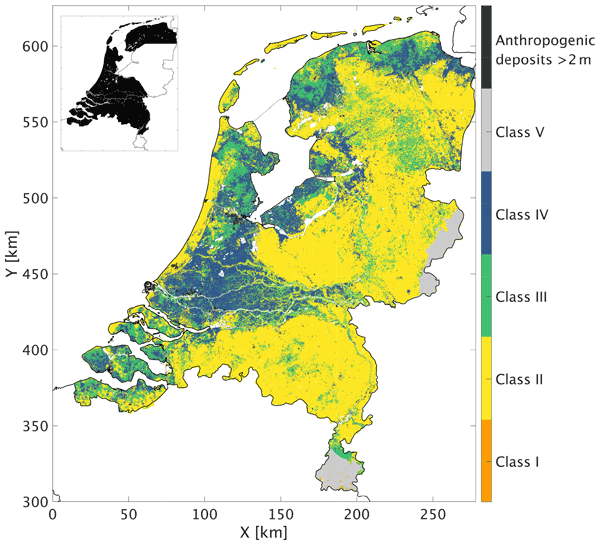
A soft, shallow subsurface composition has the tendency to amplify earthquake waves, resulting in increased ground shaking. Therefore, this paper presents a workflow in order to obtain a map classifying the response of the subsurface based on local geology, earthquake signals, and background noise recordings for the Netherlands. The resulting map can be used as a first assessment in regions with earthquake hazard potential by mining or geothermal energy activities, for example.
Adrien Wehrlé, Martin P. Lüthi, Andrea Walter, Guillaume Jouvet, and Andreas Vieli
The Cryosphere, 15, 5659–5674, https://doi.org/10.5194/tc-15-5659-2021, https://doi.org/10.5194/tc-15-5659-2021, 2021
Short summary
Short summary
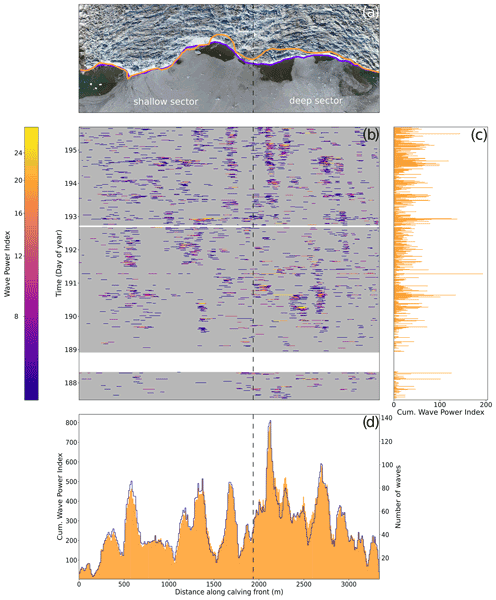
We developed a novel automated method for the detection and the quantification of ocean waves generated by glacier calving. This method was applied to data recorded with a terrestrial radar interferometer at Eqip Sermia, Greenland. Results show a high calving activity at the glacier front sector ending in deep water linked with more frequent meltwater plumes. This suggests that rising subglacial meltwater plumes strongly affect glacier calving in deep water, but weakly in shallow water.
Cited articles
Ambach, W.: Über die Strahlungsdurchlässigkeit des Gletschereises, Sitzungsberichte d. Österr, Akademie d. Wissenschaften, Math.-naturwiss. Klasse, 164, 483–494, 1955. a
An, L., Rignot, E., Elieff, S., Morlighem, M., Millan, R., Mouginot, J., Holland, D. M., Holland, D., and Paden, J.: Bed elevation of Jakobshavn Isbræ, West Greenland, from high-resolution airborne gravity and other data, Geophys. Res. Lett., 44, 3728–3736, https://doi.org/10.1002/2017GL073245, 2017. a
Bohren, C. F.: Colors of snow, frozen waterfalls, and icebergs, J. Opt. Soc. Am., 73, 1646–1652, https://doi.org/10.1364/JOSA.73.001646, 1983. a
Bondzio, J. H., Morlighem, M., Seroussi, H., Kleiner, T., Rückamp, M., Mouginot, J., Moon, T., Larour, E. Y., and Humbert, A.: The mechanisms behind Jakobshavn Isbræ's acceleration and mass loss: A 3-D thermomechanical model study, Geophys. Res. Lett., 44, 6252–6260, https://doi.org/10.1002/2017GL073309, 2017. a
Copernicus Climate Change Service: Greenland ice sheet annual gridded velocity data from 2017 to present derived from satellite observation, Copernicus Climate Change Service (C3S) Climate Data Store (CDS) [data set], https://doi.org/10.24381/cds.0b96b838, 2020. a
Dadic, R., Mullen, P. C., Schneebeli, M., Brandt, R. E., and Warren, S. G.: Effects of bubbles, cracks, and volcanic tephra on the spectral albedo of bare ice near the Transantarctic Mountains: Implications for sea glaciers on Snowball Earth, J. Geophys. Res. Earth Surf., 118, 1658–1676, https://doi.org/10.1002/jgrf.20098, 2013. a
Du, J., Zhou, H., Jacinthe, P.-A., and Song, K.: Retrieval of lake water surface albedo from Sentinel-2 remote sensing imagery, J. Hydrol., 617, 128904, https://doi.org/10.1016/j.jhydrol.2022.128904, 2023. a
Funk, M., Echelmeyer, K., and Iken, A.: Mechanisms of fast flow in Jakobshavns Isbræ, West Greenland: Part II. Modeling of englacial temperatures, J. Glaciol., 40, 569–585, https://doi.org/10.3189/S0022143000012466, 1994. a, b, c
Hori, M., Aoki, T., Tanikawa, T., Motoyoshi, H., Hachikubo, A., Sugiura, K., Yasunari, T. J., Eide, H., Storvold, R., Nakajima, Y., and Takahashi, F.: In-situ measured spectral directional emissivity of snow and ice in the 8–14 µm atmospheric window, Remote Sens. Environ., 100, 486–502, https://doi.org/10.1016/j.rse.2005.11.001, 2006. a
Hui, F., Ci, T., Cheng, X., Scambo, T. A., Liu, Y., Zhang, Y., Chi, Z., Huang, H., Wang, X., Wang, F., Zhao, C., Jin, Z., and Wang, K.: Mapping blue-ice areas in Antarctica using ETM+ and MODIS data, Ann. Glaciol., 55, 129–137, https://doi.org/10.3189/2014AoG66A069, 2014. a, b
Iken, A., Echelmeyer, K., Harrison, W., and Funk, M.: Mechanisms of fast flow in Jakobshavns Isbræ, West Greenland: Part I. Measurements of temperature and water level in deep boreholes, J. Glaciol., 39, 15–25, https://doi.org/10.3189/S0022143000015689, 1993. a, b, c
Irujo, G. P.: IRimage: open source software for processing images from infrared thermal cameras, PeerJ Comput. Sci., 8, e977, https://doi.org/10.7717/peerj-cs.977, 2022. a
Joughin, I., Howat, I., Smith, B., and Scambos, T.: MEaSUREs Greenland Ice Velocity: Selected Glacier Site Velocity Maps from InSAR, Version 1 [updated 2019], https://doi.org/10.5067/MEASURES/CRYOSPHERE/NSIDC-0481.001, 2011. a, b
Lüthi, M. P., Funk, M., Iken, A., Gogineni, S., and Truffer, M.: Mechanisms of fast flow in Jakobshavns Isbrae, Greenland; Part III: measurements of ice deformation, temperature and cross-borehole conductivity in boreholes to the bedrock, J. Glaciol., 48, 369–385, https://doi.org/10.3189/172756502781831322, 2002. a, b, c
Mankoff, K. D., Solgaard, A., Colgan, W., Ahlstrøm, A. P., Khan, S. A., and Fausto, R. S.: Greenland Ice Sheet solid ice discharge from 1986 through March 2020, Earth Syst. Sci. Data, 12, 1367–1383, https://doi.org/10.5194/essd-12-1367-2020, 2020. a
Morlighem, M., Williams, C., Rignot, E., An, L., Arndt, J. E., Bamber, J., Catania, G., Chauché, N., Dowdeswell, J. A., Dorschel, B., Fenty, I., Hogan, K., Howat, I., Hubbard, A., Jakobsson, M., Jordan, T. M., Kjeldsen, K. K., Millan, R., Mayer, L., Mouginot, J., Noël, B., O'Cofaigh, C., Palmer, S. J., Rysgaard, S., Seroussi, H., Siegert, M. J., Slabon, P., Straneo, F., van den Broeke, M. R., Weinrebe, W., Wood, M., and Zinglersen, K.: IceBridge BedMachine Greenland, Version 6, NASA National Snow and Ice Data Center Distributed Active Archive Center [data set], https://doi.org/10.5067/6B6B225B8V2D, 2025. a
Ohno, H., Lipenkov, V. Y., and Hondoh, T.: Formation of air clathrate hydrates in polar ice sheets: heterogeneous nucleation induced by micro-inclusions, J. Glaciol., 56, 917–921, https://doi.org/10.3189/002214310794457317, 2010. a
Pettersson, R., Jansson, P., and Blatter, H.: Spatial variability in water content at the cold-temperate transition surface of the polythermal Storglaciären, Sweden, J. Geophys. Res., 109, F02009, https://doi.org/10.1029/2003JF000110, 2004. a
Poinar, K., Joughin, I., Lenaerts, J. T. M., and van den Broeke, M. R.: Englacial Latent-Heat Transfer Has Limited Influence on Seaward Ice Flux in Western Greenland, J. Glaciol., 63, 1–16, https://doi.org/10.1017/jog.2016.103, 2017. a
Pope, A. and Rees, G.: Using in situ spectra to explore Landsat classification of glacier surfaces, Int. J. Appl. Earth Obs. Geoinf., 27, 42–52, https://doi.org/10.1016/j.jag.2013.08.007, 2014. a
Rignot, E. and Kanagaratnam, P.: Changes in the Velocity Structure of the Greenland Ice Sheet, Science, 311, 986–990, https://doi.org/10.1126/science.1121381, 2006. a
Rignot, E. and Mouginot, J.: Ice flow in Greenland for the International Polar Year 2008–2009, Geophys. Res. Lett., 39, https://doi.org/10.1029/2012GL051634, 2012. a
Sentinel Hub: Sentinel Hub EO Browser, https://apps.sentinel-hub.com/eo-browser/ (last access: 15 May 2024), 2017–2023. a
Shapero, D. R., Joughin, I. R., Poinar, K., Morlighem, M., and Gillet-Chaulet, F.: Basal resistance for three of the largest Greenland outlet glaciers, J. Geophys. Res. Earth Surf., 121, 168–180, https://doi.org/10.1002/2015JF003643, 2016. a
Stibal, M., Box, J. E., Cameron, K. A., Langen, P. L., Yallop, M. L., Mottram, R. H., Khan, A. L., Molotch, N. P., Chrismas, N. A. M., Calì Quaglia, F., Remias, D., Smeets, C. J. P. P., van den Broeke, M. R., Ryan, J. C., Hubbard, A., Tranter, M., van As, D., and Ahlstrøm, A. P.: Algae Drive Enhanced Darkening of Bare Ice on the Greenland Ice Sheet, Geophys. Res. Lett., 44, 11463–11471, https://doi.org/10.1002/2017GL075958, 2017. a, b
Warren, S. G., Roesler, C. S., Brandt, R. E., and Curran, M.: Green Icebergs Revisited, J. Geophys. Res. Oceans, 124, 925–938, https://doi.org/10.1029/2018JC014479, 2019. a
Winther, J.-G.: Spectral bi-directional reflectance of snow and glacier ice measured in Dronning Maud Land, Antarctica, Ann. Glaciol., 20, 1–5, https://doi.org/10.3189/1994AoG20-1-1-5, 1994. a
Zaninetti, A.: antoineontheglaciers/blue_icebergs_analysis: v1.0 (v1.0) [code/data set], Zenodo, https://doi.org/10.5281/zenodo.20052867, 2026. a
Zhang, Y., Sachau, T., Franke, S., Yang, H., Li, D., Weikusat, I., and Bons, P. D.: Formation mechanisms of large-scale folding in Greenland's ice sheet, Geophys. Res. Lett., 51, e2024GL109492, https://doi.org/10.1029/2024GL109492, 2024. a
Short summary
We investigate the spectral and thermal properties of the strikingly blue ice present on freshly calved icebergs from polar ice streams using satellite multispectral imaging and on-site thermal imaging. Blue ice exhibits unique properties. Several hypotheses have been proposed, but none can fully explain the phenomenon which might be crucial for the understanding of the fast, complex flow dynamics of ice streams.
We investigate the spectral and thermal properties of the strikingly blue ice present on freshly...