
Articles | Volume 20, issue 7
https://doi.org/10.5194/tc-20-3875-2026
© Author(s) 2026. This work is distributed under
the Creative Commons Attribution 4.0 License.
the Creative Commons Attribution 4.0 License.
https://doi.org/10.5194/tc-20-3875-2026
© Author(s) 2026. This work is distributed under
the Creative Commons Attribution 4.0 License.
the Creative Commons Attribution 4.0 License.
Research article
| 
14 Jul 2026
Research article |
| 14 Jul 2026
| 14 Jul 2026
Compounding sub-seasonal variations in Greenland outlet glacier dynamics revealed by high-resolution observations
Enze Zhang
Institute of Geophysics, University of Texas at Austin, Austin, TX, USA
Department of Civil and Environmental Engineering, Hong Kong University of Science and Technology, Hong Kong, China
Ginny Catania
CORRESPONDING AUTHOR

Institute of Geophysics, University of Texas at Austin, Austin, TX, USA
Department of Geological Sciences, University of Texas at Austin, Austin, TX, USA
Ben Smith
Applied Physics Laboratory, Polar Science Center, University of Washington, Seattle, WA, USA
Denis Felikson
Cryospheric Sciences Laboratory, NASA Goddard Space Flight Center, Greenbelt, MD, USA
Beata Csatho
Department of Geological Sciences, University at Buffalo, Buffalo, NY, USA
Daniel T. Trugman
Nevada Seismological Laboratory, Nevada Geosciences, University of Nevada, Reno, NV, USA
Related authors
Enze Zhang, Ginny Catania, and Daniel T. Trugman
The Cryosphere, 17, 3485–3503, https://doi.org/10.5194/tc-17-3485-2023, https://doi.org/10.5194/tc-17-3485-2023, 2023
Short summary
Short summary
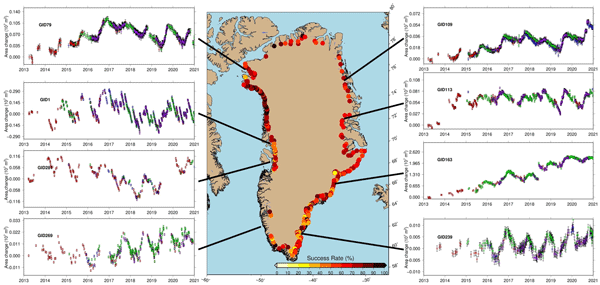
Glacier termini are essential for studying why glaciers retreat, but they need to be mapped automatically due to the volume of satellite images. Existing automated mapping methods have been limited due to limited automation, lack of quality control, and inadequacy in highly diverse terminus environments. We design a fully automated, deep-learning-based method to produce termini with quality control. We produced 278 239 termini in Greenland and provided a way to deliver new termini regularly.
Sophie Goliber, Taryn Black, Ginny Catania, James M. Lea, Helene Olsen, Daniel Cheng, Suzanne Bevan, Anders Bjørk, Charlie Bunce, Stephen Brough, J. Rachel Carr, Tom Cowton, Alex Gardner, Dominik Fahrner, Emily Hill, Ian Joughin, Niels J. Korsgaard, Adrian Luckman, Twila Moon, Tavi Murray, Andrew Sole, Michael Wood, and Enze Zhang
The Cryosphere, 16, 3215–3233, https://doi.org/10.5194/tc-16-3215-2022, https://doi.org/10.5194/tc-16-3215-2022, 2022
Short summary
Short summary
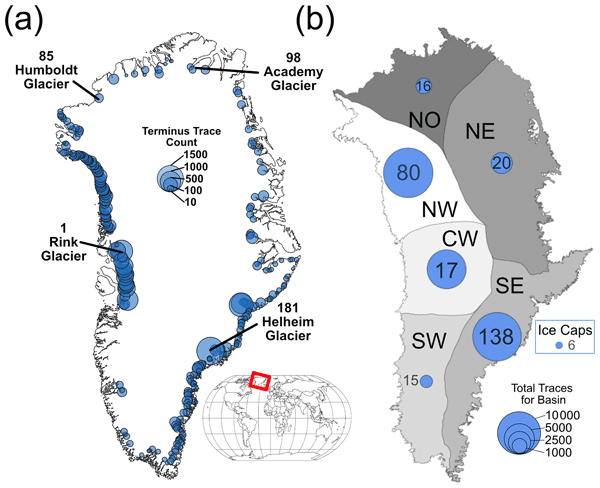
Terminus traces have been used to understand how Greenland's glaciers have changed over time; however, manual digitization is time-intensive, and a lack of coordination leads to duplication of efforts. We have compiled a dataset of over 39 000 terminus traces for 278 glaciers for scientific and machine learning applications. We also provide an overview of an updated version of the Google Earth Engine Digitization Tool (GEEDiT), which has been developed specifically for the Greenland Ice Sheet.
Ana Carolina Moraes Luzardi, Sophie Nowicki, Beata Csatho, Jason Briner, Mohammad Salmani, Hui Gao, Denis Felikson, Josh Cuzzone, and Kristin Poinar
EGUsphere, https://doi.org/10.5194/egusphere-2026-5841, https://doi.org/10.5194/egusphere-2026-5841, 2026
This preprint is open for discussion and under review for The Cryosphere (TC).
Short summary
Short summary
Before the satellite era, observations of Greenland ice sheet elevation were sparse in space and time. We reconstruct ice sheet-wide surface elevation for 1850 and 1980 using a 127-member ensemble. The reconstructions agree with observations and historical evidence, reveal patterns of thinning since the preindustrial era, and provide a resource for evaluating and initializing ice sheet simulations.
Natalia H. Andersen, Sebastian B. Simonsen, Karina Nielsen, Mai Winstrup, Baptiste Vandecrux, Hui Gao, Beata Csatho, Anton Schenk, and Louise Sandberg Sørensen
The Cryosphere, 20, 4327–4344, https://doi.org/10.5194/tc-20-4327-2026, https://doi.org/10.5194/tc-20-4327-2026, 2026
Short summary
Short summary
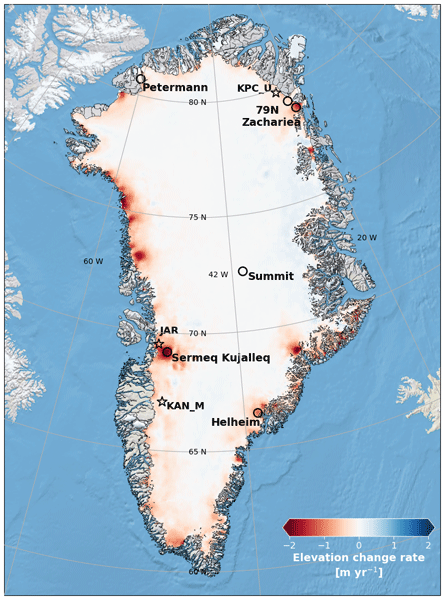
We developed a new statistical approach to track monthly changes in the surface height of the Greenland Ice Sheet using radar data from the CryoSat-2 satellite (2011–2025). The method lets seasonal and long-term variations emerge directly from the data, creating a consistent record of elevation change that helps reveal how Greenland responds to ongoing climate change.
Andrew O. Hoffman, Paul T. Summers, Jenny Suckale, Knut Christianson, Ginny Catania, and Howard Conway
The Cryosphere, 20, 3977–4003, https://doi.org/10.5194/tc-20-3977-2026, https://doi.org/10.5194/tc-20-3977-2026, 2026
Short summary
Short summary
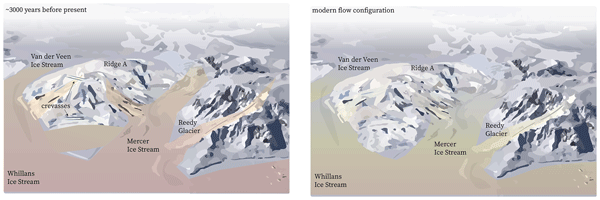
In Antarctica, fast-flowing ice streams drive most ice loss. Radar data from Conway Ice Ridge reveal that the van der Veen and Mercer Ice Streams were wider ~3000 years ago and narrowed progressively. Numerical modeling demonstrates that small thickness changes can rapidly alter shear-margin locations. These findings offer crucial insights into Late Holocene Ice Sheet readvance.
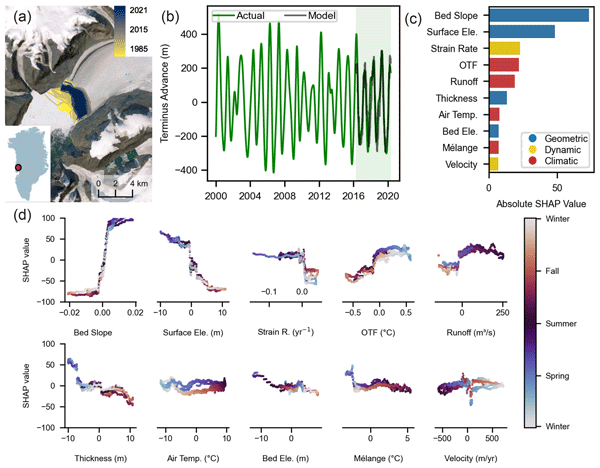
Kevin Shionalyn, Ginny Catania, Daniel T. Trugman, Michael G. Shahin, Leigh A. Stearns, and Denis Felikson
The Cryosphere, 20, 1725–1744, https://doi.org/10.5194/tc-20-1725-2026, https://doi.org/10.5194/tc-20-1725-2026, 2026
Short summary
Short summary
The ocean-facing front of a glacier changes with the seasons. We know this cycle is controlled by the shape and speed of the glacier as well as by the climate, but we do not have a full understanding of these processes. Our study uses 20 years of data and a machine learning model to predict this pattern and identifies which factors matter most. We find that while several factors influence the seasonal cycle, the shape of the glacier plays a key role in how much a glacier changes annually.

Derek J. Pickell, Robert L. Hawley, Denis Felikson, and Jamie C. Good
The Cryosphere, 20, 483–494, https://doi.org/10.5194/tc-20-483-2026, https://doi.org/10.5194/tc-20-483-2026, 2026
Short summary
Short summary
We compared ICESat-2 ice surface height measurements in interior Greenland with ground-based Global Positioning System (GPS) observations, finding sub-centimeter biases and centimeter-scale precision with no detectable long-term drift. We also apply an autonomous validation method using Global Navigation Satellite System (GNSS) interferometric reflectometry (GNSS-IR) to measure surface elevation, producing comparable results and enabling more frequent, spatially distributed comparisons.
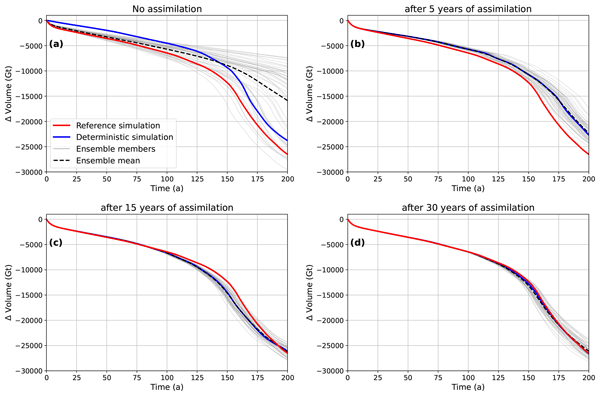
Youngmin Choi, Alek Petty, Denis Felikson, and Jonathan Poterjoy
The Cryosphere, 19, 5423–5444, https://doi.org/10.5194/tc-19-5423-2025, https://doi.org/10.5194/tc-19-5423-2025, 2025
Short summary
Short summary
We combined numerical models with satellite observations using the ensemble Kalman filter to improve predictions of glacier states and their basal conditions. Our simulations show that incorporating more data generally improves prediction accuracy. We also tested different types of data and found that the high-resolution observations provide the greatest improvements. This method can help guide the design of future observing systems and improve long-term projections of ice sheet change.
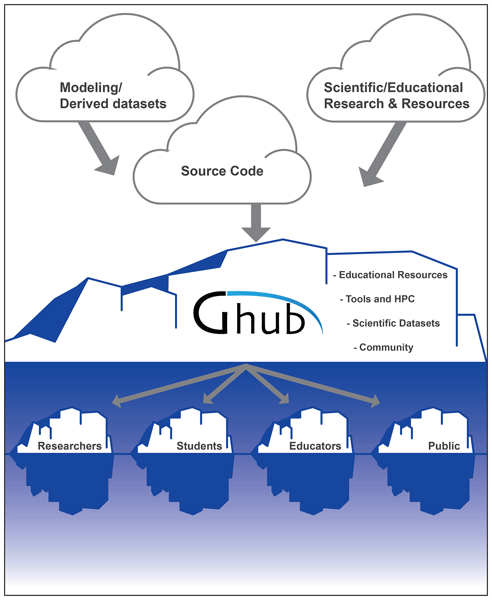
Joseph P. Tulenko, Sophie A. Goliber, Renette Jones-Ivey, Justin Quinn, Abani Patra, Kristin Poinar, Sophie Nowicki, Beata M. Csatho, and Jason P. Briner
The Cryosphere, 19, 4327–4333, https://doi.org/10.5194/tc-19-4327-2025, https://doi.org/10.5194/tc-19-4327-2025, 2025
Short summary
Short summary
Ghub is an online platform that hosts tools, datasets, and educational resources related to ice sheet science. These resources are provided by ice sheet researchers and allow other researchers, students, educators, and interested members of the general public to analyze, visualize, and download datasets that researchers use to study past and present ice sheet behavior. We describe how users can interact with Ghub, showcase some available resources, and describe the future of the Ghub project.
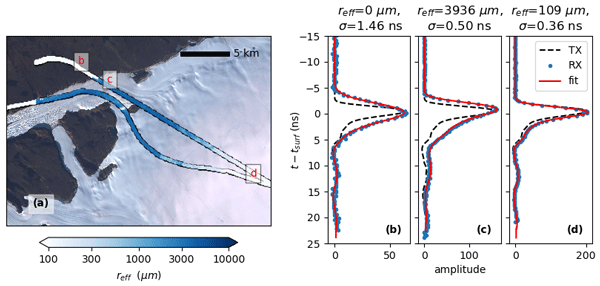
Benjamin E. Smith, Michael Studinger, Tyler Sutterley, Zachary Fair, and Thomas Neumann
The Cryosphere, 19, 975–995, https://doi.org/10.5194/tc-19-975-2025, https://doi.org/10.5194/tc-19-975-2025, 2025
Short summary
Short summary
This study investigates errors (biases) that may result when green lasers are used to measure the elevation of glaciers and ice sheets. These biases are important because if the snow or ice on top of the ice sheet changes, it can make the elevation of the ice appear to change by the wrong amount. We measure these biases over the Greenland Ice Sheet with a laser system on an airplane and explore how the use of satellite data can let us correct for the biases.
Beata Csatho, Tony Schenk, and Tom Neumann
Int. Arch. Photogramm. Remote Sens. Spatial Inf. Sci., XLVIII-3-2024, 83–88, https://doi.org/10.5194/isprs-archives-XLVIII-3-2024-83-2024, https://doi.org/10.5194/isprs-archives-XLVIII-3-2024-83-2024, 2024
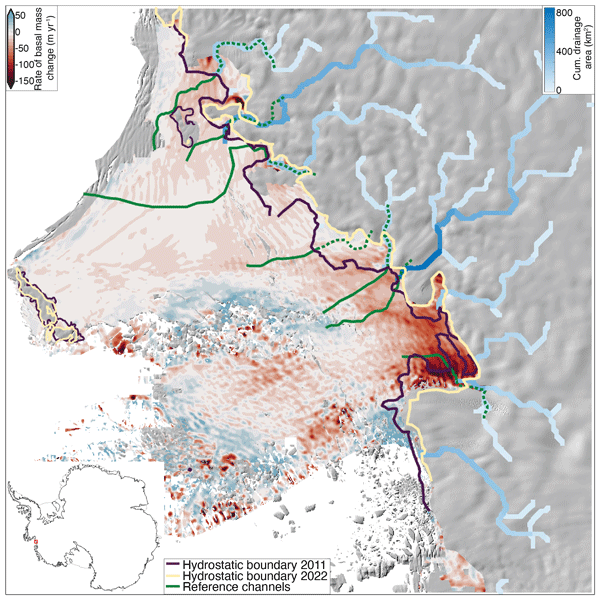
Allison M. Chartrand, Ian M. Howat, Ian R. Joughin, and Benjamin E. Smith
The Cryosphere, 18, 4971–4992, https://doi.org/10.5194/tc-18-4971-2024, https://doi.org/10.5194/tc-18-4971-2024, 2024
Short summary
Short summary
This study uses high-resolution remote-sensing data to show that shrinking of the West Antarctic Thwaites Glacier’s ice shelf (floating extension) is exacerbated by several sub-ice-shelf meltwater channels that form as the glacier transitions from full contact with the seafloor to fully floating. In mapping these channels, the position of the transition zone, and thinning rates of the Thwaites Glacier, this work elucidates important processes driving its rapid contribution to sea level rise.

Nicole Abib, David A. Sutherland, Rachel Peterson, Ginny Catania, Jonathan D. Nash, Emily L. Shroyer, Leigh A. Stearns, and Timothy C. Bartholomaus
The Cryosphere, 18, 4817–4829, https://doi.org/10.5194/tc-18-4817-2024, https://doi.org/10.5194/tc-18-4817-2024, 2024
Short summary
Short summary
The melting of ice mélange, or dense packs of icebergs and sea ice in glacial fjords, can influence the water column by releasing cold fresh water deep under the ocean surface. However, direct observations of this process have remained elusive. We use measurements of ocean temperature, salinity, and velocity bookending an episodic ice mélange event to show that this meltwater input changes the density profile of a glacial fjord and has implications for understanding tidewater glacier change.
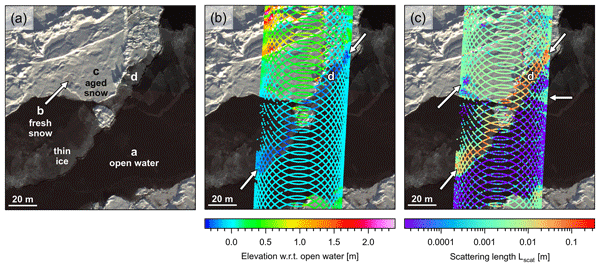
Michael Studinger, Benjamin E. Smith, Nathan Kurtz, Alek Petty, Tyler Sutterley, and Rachel Tilling
The Cryosphere, 18, 2625–2652, https://doi.org/10.5194/tc-18-2625-2024, https://doi.org/10.5194/tc-18-2625-2024, 2024
Short summary
Short summary
We use green lidar data and natural-color imagery over sea ice to quantify elevation biases potentially impacting estimates of change in ice thickness of the polar regions. We complement our analysis using a model of scattering of light in snow and ice that predicts the shape of lidar waveforms reflecting from snow and ice surfaces based on the shape of the transmitted pulse. We find that biased elevations exist in airborne and spaceborne data products from green lidars.
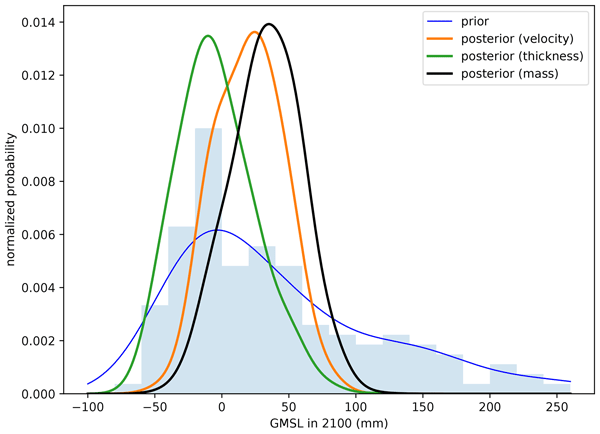
Denis Felikson, Sophie Nowicki, Isabel Nias, Beata Csatho, Anton Schenk, Michael J. Croteau, and Bryant Loomis
The Cryosphere, 17, 4661–4673, https://doi.org/10.5194/tc-17-4661-2023, https://doi.org/10.5194/tc-17-4661-2023, 2023
Short summary
Short summary
We narrow the spread in model simulations of the Greenland Ice Sheet using velocity change, dynamic thickness change, and mass change observations. We find that the type of observation chosen can lead to significantly different calibrated probability distributions. Further work is required to understand how to best calibrate ensembles of ice sheet simulations because this will improve probability distributions of projected sea-level rise, which is crucial for coastal planning and adaptation.
Enze Zhang, Ginny Catania, and Daniel T. Trugman
The Cryosphere, 17, 3485–3503, https://doi.org/10.5194/tc-17-3485-2023, https://doi.org/10.5194/tc-17-3485-2023, 2023
Short summary
Short summary
Glacier termini are essential for studying why glaciers retreat, but they need to be mapped automatically due to the volume of satellite images. Existing automated mapping methods have been limited due to limited automation, lack of quality control, and inadequacy in highly diverse terminus environments. We design a fully automated, deep-learning-based method to produce termini with quality control. We produced 278 239 termini in Greenland and provided a way to deliver new termini regularly.
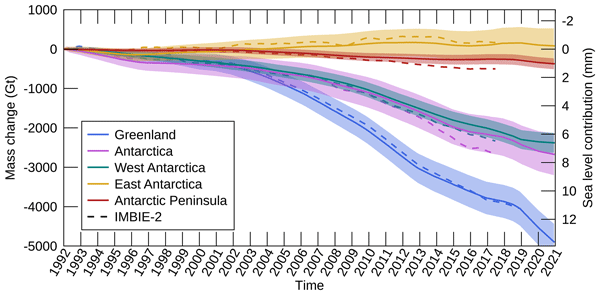
Inès N. Otosaka, Andrew Shepherd, Erik R. Ivins, Nicole-Jeanne Schlegel, Charles Amory, Michiel R. van den Broeke, Martin Horwath, Ian Joughin, Michalea D. King, Gerhard Krinner, Sophie Nowicki, Anthony J. Payne, Eric Rignot, Ted Scambos, Karen M. Simon, Benjamin E. Smith, Louise S. Sørensen, Isabella Velicogna, Pippa L. Whitehouse, Geruo A, Cécile Agosta, Andreas P. Ahlstrøm, Alejandro Blazquez, William Colgan, Marcus E. Engdahl, Xavier Fettweis, Rene Forsberg, Hubert Gallée, Alex Gardner, Lin Gilbert, Noel Gourmelen, Andreas Groh, Brian C. Gunter, Christopher Harig, Veit Helm, Shfaqat Abbas Khan, Christoph Kittel, Hannes Konrad, Peter L. Langen, Benoit S. Lecavalier, Chia-Chun Liang, Bryant D. Loomis, Malcolm McMillan, Daniele Melini, Sebastian H. Mernild, Ruth Mottram, Jeremie Mouginot, Johan Nilsson, Brice Noël, Mark E. Pattle, William R. Peltier, Nadege Pie, Mònica Roca, Ingo Sasgen, Himanshu V. Save, Ki-Weon Seo, Bernd Scheuchl, Ernst J. O. Schrama, Ludwig Schröder, Sebastian B. Simonsen, Thomas Slater, Giorgio Spada, Tyler C. Sutterley, Bramha Dutt Vishwakarma, Jan Melchior van Wessem, David Wiese, Wouter van der Wal, and Bert Wouters
Earth Syst. Sci. Data, 15, 1597–1616, https://doi.org/10.5194/essd-15-1597-2023, https://doi.org/10.5194/essd-15-1597-2023, 2023
Short summary
Short summary
By measuring changes in the volume, gravitational attraction, and ice flow of Greenland and Antarctica from space, we can monitor their mass gain and loss over time. Here, we present a new record of the Earth’s polar ice sheet mass balance produced by aggregating 50 satellite-based estimates of ice sheet mass change. This new assessment shows that the ice sheets have lost (7.5 x 10¹²) t of ice between 1992 and 2020, contributing 21 mm to sea level rise.

Benjamin E. Smith, Brooke Medley, Xavier Fettweis, Tyler Sutterley, Patrick Alexander, David Porter, and Marco Tedesco
The Cryosphere, 17, 789–808, https://doi.org/10.5194/tc-17-789-2023, https://doi.org/10.5194/tc-17-789-2023, 2023
Short summary
Short summary
We use repeated satellite measurements of the height of the Greenland ice sheet to learn about how three computational models of snowfall, melt, and snow compaction represent actual changes in the ice sheet. We find that the models do a good job of estimating how the parts of the ice sheet near the coast have changed but that two of the models have trouble representing surface melt for the highest part of the ice sheet. This work provides suggestions for how to better model snowmelt.
Evan Carnahan, Ginny Catania, and Timothy C. Bartholomaus
The Cryosphere, 16, 4305–4317, https://doi.org/10.5194/tc-16-4305-2022, https://doi.org/10.5194/tc-16-4305-2022, 2022
Short summary
Short summary
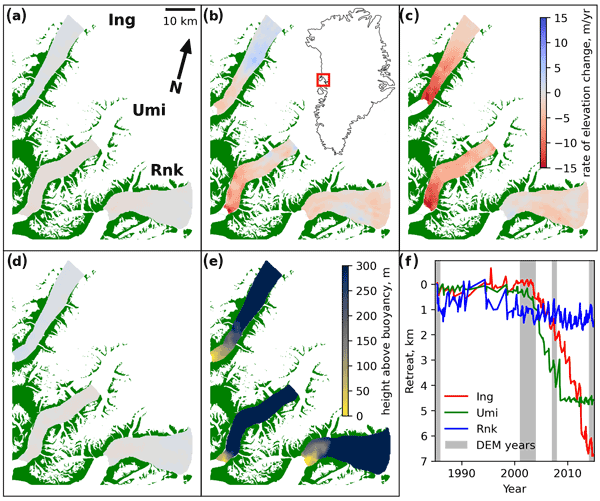
The Greenland Ice Sheet primarily loses mass through increased ice discharge. We find changes in discharge from outlet glaciers are initiated by ocean warming, which causes a change in the balance of forces resisting gravity and leads to acceleration. Vulnerable conditions for sustained retreat and acceleration are predetermined by the glacier-fjord geometry and exist around Greenland, suggesting increases in ice discharge may be sustained into the future despite a pause in ocean warming.

Brooke Medley, Thomas A. Neumann, H. Jay Zwally, Benjamin E. Smith, and C. Max Stevens
The Cryosphere, 16, 3971–4011, https://doi.org/10.5194/tc-16-3971-2022, https://doi.org/10.5194/tc-16-3971-2022, 2022
Short summary
Short summary
Satellite altimeters measure the height or volume change over Earth's ice sheets, but in order to understand how that change translates into ice mass, we must account for various processes at the surface. Specifically, snowfall events generate large, transient increases in surface height, yet snow fall has a relatively low density, which means much of that height change is composed of air. This air signal must be removed from the observed height changes before we can assess ice mass change.
Sophie Goliber, Taryn Black, Ginny Catania, James M. Lea, Helene Olsen, Daniel Cheng, Suzanne Bevan, Anders Bjørk, Charlie Bunce, Stephen Brough, J. Rachel Carr, Tom Cowton, Alex Gardner, Dominik Fahrner, Emily Hill, Ian Joughin, Niels J. Korsgaard, Adrian Luckman, Twila Moon, Tavi Murray, Andrew Sole, Michael Wood, and Enze Zhang
The Cryosphere, 16, 3215–3233, https://doi.org/10.5194/tc-16-3215-2022, https://doi.org/10.5194/tc-16-3215-2022, 2022
Short summary
Short summary
Terminus traces have been used to understand how Greenland's glaciers have changed over time; however, manual digitization is time-intensive, and a lack of coordination leads to duplication of efforts. We have compiled a dataset of over 39 000 terminus traces for 278 glaciers for scientific and machine learning applications. We also provide an overview of an updated version of the Google Earth Engine Digitization Tool (GEEDiT), which has been developed specifically for the Greenland Ice Sheet.

Joseph A. MacGregor, Winnie Chu, William T. Colgan, Mark A. Fahnestock, Denis Felikson, Nanna B. Karlsson, Sophie M. J. Nowicki, and Michael Studinger
The Cryosphere, 16, 3033–3049, https://doi.org/10.5194/tc-16-3033-2022, https://doi.org/10.5194/tc-16-3033-2022, 2022
Short summary
Short summary
Where the bottom of the Greenland Ice Sheet is frozen and where it is thawed is not well known, yet knowing this state is increasingly important to interpret modern changes in ice flow there. We produced a second synthesis of knowledge of the basal thermal state of the ice sheet using airborne and satellite observations and numerical models. About one-third of the ice sheet’s bed is likely thawed; two-fifths is likely frozen; and the remainder is too uncertain to specify.
John Erich Christian, Alexander A. Robel, and Ginny Catania
The Cryosphere, 16, 2725–2743, https://doi.org/10.5194/tc-16-2725-2022, https://doi.org/10.5194/tc-16-2725-2022, 2022
Short summary
Short summary
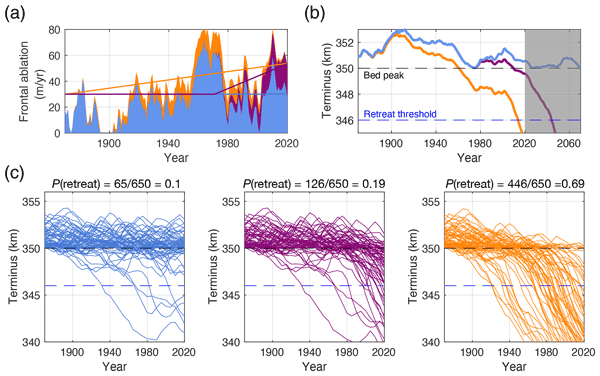
Marine-terminating glaciers have recently retreated dramatically, but the role of anthropogenic forcing remains uncertain. We use idealized model simulations to develop a framework for assessing the probability of rapid retreat in the context of natural climate variability. Our analyses show that century-scale anthropogenic trends can substantially increase the probability of retreats. This provides a roadmap for future work to formally assess the role of human activity in recent glacier change.
Christian J. Taubenberger, Denis Felikson, and Thomas Neumann
The Cryosphere, 16, 1341–1348, https://doi.org/10.5194/tc-16-1341-2022, https://doi.org/10.5194/tc-16-1341-2022, 2022
Short summary
Short summary
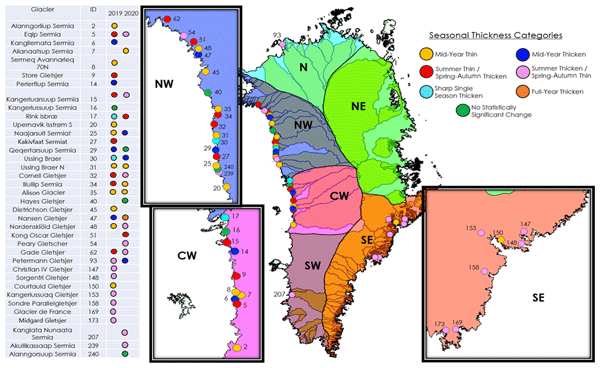
Outlet glaciers are projected to account for half of the total ice loss from the Greenland Ice Sheet over the 21st century. We classify patterns of seasonal dynamic thickness changes of outlet glaciers using new observations from the Ice, Cloud and land Elevation Satellite-2 (ICESat-2). Our results reveal seven distinct patterns that differ across glaciers even within the same region. Future work can use our results to improve our understanding of processes that drive seasonal ice sheet changes.
Cited articles
An, L., Rignot, E., Mouginot, J., and Millan, R.: A Century of Stability of Avannarleq and Kujalleq Glaciers, West Greenland, Explained Using High-Resolution Airborne Gravity and Other Data, Geophys. Res. Lett., 45, 3156–3163, https://doi.org/10.1002/2018GL077204, 2018. a
Bartholomaus, T. C., Anderson, R. S., and Anderson, S. P.: Response of glacier basal motion to transient water storage, Nat. Geosci., 1, 33–37, https://doi.org/10.1038/ngeo.2007.52, 2008. a
Bartholomaus, T. C., Anderson, R. S., and Anderson, S. P.: Growth and collapse of the distributed subglacial hydrologic system of Kennicott Glacier, Alaska, USA, and its effects on basal motion, J. Glaciol., 57, 9850–1002, https://doi.org/10.3189/002214311798843269, 2011. a
Bartholomew, I., Nienow, P., Mair, D., Hubbard, A., King, M. A., and Sole, A.: Seasonal evolution of subglacial drainage and acceleration in a Greenland outlet glacier, Nat. Geosci., 3, 408–411, https://doi.org/10.1038/ngeo863, 2010. a, b
Bézu, C. and Bartholomaus, T. C.: Greenland Ice Sheet's Distinct Calving Styles Are Identified in Terminus Change Timeseries, Geophys. Res. Lett., 51, https://doi.org/10.1029/2024gl110224, 2024. a, b
Black, T. E. and Joughin, I.: Weekly to monthly terminus variability of Greenland's marine-terminating outlet glaciers, The Cryosphere, 17, 1–13, https://doi.org/10.5194/tc-17-1-2023, 2023. a
Boon, S. and Sharp, M.: The role of hydrologically-driven ice fracture in drainage system evolution on an Arctic glacier, Geophys. Res. Lett., 30, https://doi.org/10.1029/2003GL018034, 2003. a
Carnahan, E., Catania, G., and Bartholomaus, T. C.: Observed mechanism for sustained glacier retreat and acceleration in response to ocean warming around Greenland, The Cryosphere, 16, 4305–4317, https://doi.org/10.5194/tc-16-4305-2022, 2022. a
Carr, J. R., Vieli, A., and Stokes, C.: Influence of sea ice decline, atmospheric warming, and glacier width on marine-terminating outlet glacier behavior in northwest Greenland at seasonal to interannual timescales, J. Geophys. Res.: Earth Surf., 118, 1210–1226, https://doi.org/10.1002/jgrf.20088, 2013. a
Catania, G. A., Neumann, T. A., and Price, S. F.: Characterizing englacial drainage in the ablation zone of the Greenland ice sheet, J. Glaciol., 54, 567–578, https://doi.org/10.3189/002214308786570854, 2017. a
Catania, G. A., Stearns, L. A., Sutherland, D. A., Fried, M. J., Bartholomaus, T. C., Morlighem, M., Shroyer, E., and Nash, J.: Geometric controls on tidewater glacier retreat in central western Greenland, J. Geophys. Res.: Earth Surf., 123, 2024–2038, https://doi.org/10.1029/2017JF004499, 2018. a, b, c
Davison, B. J., Sole, A. J., Cowton, T. R., Lea, J. M., Slater, D. A., Fahrner, D., and Nienow, P. W.: Subglacial Drainage Evolution Modulates Seasonal Ice Flow Variability of Three Tidewater Glaciers in Southwest Greenland, J. Geophys. Res.: Earth Surf., 125, e2019JF005492, https://doi.org/10.1029/2019JF005492, 2020. a, b
Enderlin, E. M., Howat, I. M., Jeong, S., Noh, M.-J., van Angelen, J. H., and van den Broeke, M. R.: An improved mass budget for the Greenland ice sheet, Geophys. Res. Lett., 41, 866–872, https://doi.org/10.1002/2013GL059010, 2014. a
Felikson, D., Bartholomaus, T. C., Catania, G. A., Korsgaard, N. J., Kjær, K. H., Morlighem, M., Noël, B., Van Den Broeke, M., Stearns, L. A., Shroyer, E. L., and Sutherland, D. A.: Inland thinning on the Greenland ice sheet controlled by outlet glacier geometry, Nat. Geosci., 10, 366–369, https://doi.org/10.1038/ngeo2934, 2017. a
Felikson, D., A. Catania, G., Bartholomaus, T. C., Morlighem, M., and Noël, B. P. Y.: Steep Glacier Bed Knickpoints Mitigate Inland Thinning in Greenland, Geophys. Res. Lett., 48, e2020GL090112, https://doi.org/10.1029/2020GL090112, 2021. a, b, c, d
Felikson, D., Nowicki, S., Nias, I., Morlighem, M., and Seroussi, H.: Seasonal Tidewater Glacier Terminus Oscillations Bias Multi-Decadal Projections of Ice Mass Change, J. Geophys. Res.: Earth Surf., 127, e2021JF006249, https://doi.org/10.1029/2021JF006249, 2022. a
Fried, M. J., Catania, G. A., Stearns, L. A., Sutherland, D. A., Bartholomaus, T. C., Shroyer, E., and Nash, J.: Reconciling Drivers of Seasonal Terminus Advance and Retreat at 13 Central West Greenland Tidewater Glaciers, J. Geophys. Res.: Earth Surf., 123, 1590–1607, https://doi.org/10.1029/2018JF004628, 2018. a, b, c
Gardner, A. S., Moholdt, G., Scambos, T., Fahnstock, M., Ligtenberg, S., Van Den Broeke, M., and Nilsson, J.: Increased West Antarctic and unchanged East Antarctic ice discharge over the last 7 years, The Cryosphere, 12, 521–547, https://doi.org/10.5194/tc-12-521-2018, 2018. a
Gardner, A. S., Fahnestock, M. A., and Scambos, T. A.: ITS_LIVE Regional Glacier and Ice Sheet Surface Velocities (Version 1), National Snow and Ice Data Center [data set], https://doi.org/10.5067/6II6VW8LLWJ7, 2023. a, b, c
Goliber, S. A. and Catania, G. A.: Glacier Terminus Morphology Informs Calving Style, Geophys. Res. Lett., 51, https://doi.org/10.1029/2024gl108530, 2024. a
Holland, D. M., Thomas, R. H., De Young, B., Ribergaard, M. H., and Lyberth, B.: Acceleration of Jakobshavn Isbræ triggered by warm subsurface ocean waters, Nat. Geosci., 1, 659–664, https://doi.org/10.1038/ngeo316, 2008. a
Howat, I. M., Joughin, I., Tulaczyk, S., and Gogineni, S.: Rapid retreat and acceleration of Helheim Glacier, east Greenland, Geophys. Res. Lett., 32, L22502, https://doi.org/10.1029/2005GL024737, 2005. a
Howat, I. M., Joughin, I., Fahnestock, M., Smith, B. E., and Scambos, T. A.: Synchronous retreat and acceleration of southeast Greenland outlet glaciers 2000–06: ice dynamics and coupling to climate, J. Glaciol., 54, 646–660, https://doi.org/10.3189/002214308786570908, 2008. a
IPCC: Climate Change 2022: Mitigation of Climate Change, Cambridge University Press, Cambridge, UK, and New York, NY, USA, https://doi.org/10.1017/9781009157926, 2022. a
Joughin, I., Das, S. B., King, M. A., Smith, B. E., Howat, I. M., and Moon, T.: Seasonal speedup along the Western flank of the Greenland Ice Sheet, Science, 320, 781–783, https://doi.org/10.1126/science.1153288, 2008. a
Joughin, I., Smith, B. E., Howat, I. M., Floricioiu, D., Alley, R. B., Truffer, M., and Fahnestock, M.: Seasonal to decadal scale variations in the surface velocity of Jakobshavn Isbrae, Greenland: Observation and model-based analysis, J. Geophys. Res.: Earth Surf., 117, F02030, https://doi.org/10.1029/2011JF002110, 2012. a, b, c, d, e, f, g, h, i
Kane, E., Rignot, E., Mouginot, J., Millan, R., Li, X., Scheuchl, B., and Fahnestock, M.: Impact of Calving Dynamics on Kangilernata Sermia, Greenland, Geophys. Res. Lett., 47, e2020GL088524, https://doi.org/10.1029/2020GL088524, 2020. a, b
Karlsson, N. B., Solgaard, A. M., Mankoff, K. D., Gillet-Chaulet, F., MacGregor, J. A., Box, J. E., Citterio, M., Colgan, W. T., Larsen, S. H., Kjeldsen, K. K., Korsgaard, N. J., Benn, D. I., Hewitt, I. J., and Fausto, R. S.: A first constraint on basal melt-water production of the Greenland ice sheet, Nat. Commun., 12, 3461, https://doi.org/10.1038/s41467-021-23739-z, 2021. a
King, M. D., Howat, I. M., Jeong, S., Noh, M. J., Wouters, B., Noël, B., and van den Broeke, M. R.: Seasonal to decadal variability in ice discharge from the Greenland Ice Sheet, The Cryosphere, 12, 3813–3825, https://doi.org/10.5194/tc-12-3813-2018, 2018. a
King, M. D., Howat, I. M., Candela, S. G., Noh, M. J., Jeong, S., Noël, B. P., van den Broeke, M. R., Wouters, B., and Negrete, A.: Dynamic ice loss from the Greenland Ice Sheet driven by sustained glacier retreat, Commun. Earth Environ., 1, 1, https://doi.org/10.1038/s43247-020-0001-2, 2020. a, b
Kneib-Walter, A., Lüthi, M. P., Moreau, L., and Vieli, A.: Drivers of Recurring Seasonal Cycle of Glacier Calving Styles and Patterns, Front. Earth Sci., 9, https://doi.org/10.3389/feart.2021.667717, 2021. a
Kneib-Walter, A., Lüthi, M. P., Funk, M., Jouvet, G., and Vieli, A.: Observational constraints on the sensitivity of two calving glaciers to external forcings, J. Glaciol., 69, 459–474, https://doi.org/10.1017/jog.2022.74, 2023. a
Lüthi, M. P., Vieli, A., Moreau, L., Joughin, I., Reisser, M., Small, D., and Stober, M.: A century of geometry and velocity evolution at Eqip Sermia, West Greenland, J. Glaciol., 62, 640–654, https://doi.org/10.1017/jog.2016.38, 2016. a
Medley, B., Neumann, T. A., Zwally, H. J., Smith, B. E., and Stevens, C. M.: Simulations of firn processes over the Greenland and Antarctic ice sheets: 1980–2021, The Cryosphere, 16, 3971–4011, https://doi.org/10.5194/tc-16-3971-2022, 2022. a
Moon, T., Joughin, I., Smith, B., and Howat, I.: 21st-Century evolution of Greenland outlet glacier velocities, Science, 336, 576–578, https://doi.org/10.1126/science.1219985, 2012. a
Moon, T., Joughin, I., and Smith, B.: Seasonal to multiyear variability of glacier surface velocity, terminus position, and sea ice/ice mélange in northwest Greenland, J. Geophys. Res.: Earth Surf., 120, 818–833, https://doi.org/10.1002/2015JF003494, 2015. a
Moon, T., Gardner, A., Csatho, B., Parmuzin, I., and Fahnestock, M.: Rapid reconfiguration of the Greenland Ice Sheet coastal margin, J. Geophys. Res.: Earth Surf., 125, https://doi.org/10.1029/2020jf005585, 2020. a
Moon, T., Fisher, M., Stafford, T., and Thurber, A.: QGreenland (v3), National Snow and Ice Data Center [data set], https://doi.org/10.5281/zenodo.8326507, 2023. a, b
Morlighem, M., Williams, C. N., Rignot, E., An, L., Arndt, J. E., Bamber, J. L., Catania, G., Chauché, N., Dowdeswell, J. A., Dorschel, B., Fenty, I., Hogan, K., Howat, I., Hubbard, A., Jakobsson, M., Jordan, T. M., Kjeldsen, K. K., Millan, R., Mayer, L., Mouginot, J., Noël, B. P. Y., O'Cofaigh, C., Palmer, S., Rysgaard, S., Seroussi, H., Siegert, M. J., Slabon, P., Straneo, F., van den Broeke, M. R., Weinrebe, W., Wood, M., and Zinglersen, K. B.: BedMachine v3: Complete bed topography and ocean bathymetry mapping of Greenland from multibeam echo dounding combined with mass conservation, Geophys. Res. Lett., 44, 11,051–11,061, https://doi.org/10.1002/2017GL074954, 2017. a
Morlighem, M., Williams, C. N., Rignot, E., An, L., Arndt, J. E., Bamber, J. L., Catania, G., Chauché, N., Dowdeswell, J. A., Dorschel, B., Fenty, I., Hogan, K., Howat, I., Hubbard, A., Jakobsson, M., Jordan, T. M., Kjeldsen, K. K., Millan, R., Mayer, L., Mouginot, J., Noël, B. P. Y., O'Cofaigh, C., Palmer, S., Rysgaard, S., Seroussi, H., Siegert, M. J., Slabon, P., Straneo, F., van den Broeke, M. R., Weinrebe, W., Wood, M., and Zinglersen, K. B.: IceBridge BedMachine Greenland, Version 5, National Snow and Ice Data Center [data set], https://doi.org/10.5067/GMEVBWFLWA7X, 2022. a, b
Noël, B., van de Berg, W. J., Lhermitte, S., and Van Den Broeke, M.: Rapid ablation zone expansion amplifies north Greenland mass loss, Sci. Adv., 5, eaaw0123, https://doi.org/10.1126/sciadv.aaw0123, 2019. a, b
Poinar, K.: Seasonal Flow Types of Glaciers in Sermilik Fjord, Greenland, Over 2016–2021, J. Geophys. Res.: Earth Surf., 128, e2022JF006901, https://doi.org/10.1029/2022JF006901, 2023. a, b
Porter, C., Morin, P., Howat, I. M., Noh, M.-J., Bates, B., Peterman, K., Keesey, S., Schlenk, M., Gardiner, J., Tomko, K., Willis, M. J., Kelleher, C., Cloutier, M., Husby, E., Foga, S., Nakamura, H., Platson, M., Wethington, M. J., Williamson, C. J., Bauer, G., Enos, J., Arnold, G., Kramer, W., Becker, P., Doshi, A., D'Souza, C., Cummens, P., Laurier, F., and Bojesen, M.: ArcticDEM – Strips (Version 4.1), Harvard Dataverse [data set], https://doi.org/10.7910/DVN/C98DVS, 2022. a, b
Robel, A. A., Roe, G. H., and Haseloff, M.: Response of marine-terminating glaciers to forcing: time scales, sensitivities, instabilities and stochastic dynamics, J. Geophys. Res.: Earth Surf., 1–62, https://doi.org/10.1029/2018jf004709, 2018. a
Schoof, C. G.: Ice-sheet acceleration driven by melt supply variability, Nature, 468, 803 806, https://doi.org/10.1038/nature09618, 2010. a
Sergienko, O. V.: Marine outlet glacier dynamics, steady states and steady-state stability, J. Glaciol., 68, 946–960, https://doi.org/10.1017/jog.2022.13, 2022. a
Shepherd, A., Ivins, E. R., A, G., Barletta, V. R., Bentley, M. J., Bettadpur, S., Briggs, K. H., Bromwich, D. H., Forsberg, R., Galin, N., Horwath, M., Jacobs, S., Joughin, I., King, M. A., Lenaerts, J. T. M., Li, J., Ligtenberg, S. R. M., Luckman, A., Luthcke, S. B., McMillan, M., Meister, R., Milne, G., Mouginot, J., Muir, A., Nicolas, J. P., Paden, J., Payne, A. J., Pritchard, H., Rignot, E., Rott, H., Sørensen, L. S., Scambos, T. A., Scheuchl, B., Schrama, E. J. O., Smith, B., Sundal, A. V., van Angelen, J. H., van de Berg, W. J., van den Broeke, M. R., Vaughan, D. G., Velicogna, I., Wahr, J., Whitehouse, P. L., Wingham, D. J., Yi, D., Young, D., and Zwally, H. J.: A reconciled estimate of ice-sheet mass balance, Science, 338, 1183–1189, https://doi.org/10.1126/science.1228102, 2012. a
Smith, L. C., Yang, K., Pitcher, L. H., Overstreet, B. T., Chu, V. W., Åsa K. Rennermalm, Ryan, J. C., Cooper, M. G., Gleason, C. J., Tedesco, M., Jeyaratnam, J., van As, D., van den Broeke, M. R., van de Berg, W. J., Noël, B., Langen, P. L., Cullather, R. I., Zhao, B., Willis, M. J., Hubbard, A., Box, J. E., Jenner, B. A., and Behar, A. E.: Direct measurements of meltwater runoff on the Greenland ice sheet surface, Proc. Natl. Aca. Sci. USA, 114, E10622–E10631, https://doi.org/10.1073/pnas.1707743114, 2017. a
Solgaard, A. M., Rapp, D., Noël, B. P. Y., and Hvidberg, C. S.: Seasonal Patterns of Greenland Ice Velocity From Sentinel-1 SAR Data Linked to Runoff, Geophys. Res. Lett., 49, e2022GL100343, https://doi.org/10.1029/2022GL100343, 2022. a
Stevens, L. A., Behn, M. D., Das, S. B., Joughin, I., Noël, B. P. Y., van den Broeke, M. R., and Herring, T.: Greenland Ice Sheet flow response to runoff variability, Geophys. Res. Lett., 43, 11295–11303, https://doi.org/10.1002/2016GL070414, 2016. a
Stevens, L. A., Nettles, M., Davis, J. L., Creyts, T. T., Kingslake, J., Hewitt, I. J., and Stubblefield, A.: Tidewater-glacier response to supraglacial lake drainage, Nat. Commun., 13, 6065, https://doi.org/10.1038/s41467-022-33763-2, 2022. a
Sundal, A. V., Shepherd, A., Nienow, P., Hanna, E., Palmer, S., and Huybrechts, P.: Melt-induced speed-up of Greenland ice sheet offset by efficient subglacial drainage, Nature, 469, 521–524, https://doi.org/10.1038/nature09740, 2011. a
The GlaMBIE Team: Community estimate of global glacier mass changes from 2000 to 2023, Nature, 639, 382–388, https://doi.org/10.1038/s41586-024-08545-z, 2025. a
Ultee, L., Felikson, D., Minchew, B., Stearns, L. A., and Riel, B.: Helheim Glacier ice velocity variability responds to runoff and terminus position change at different timescales, Nat. Commun., 13, 6022, https://doi.org/10.1038/s41467-022-33292-y, 2022. a
van den Broeke, M. R., Enderlin, E. M., Howat, I. M., Kuipers Munneke, P., Noël, B. P. Y., van de Berg, W. J., van Meijgaard, E., and Wouters, B.: On the recent contribution of the Greenland ice sheet to sea level change, The Cryosphere, 10, 1933–1946, https://doi.org/10.5194/tc-10-1933-2016, 2016. a
van der Veen, C. J.: Fundamentals of glacier dynamics, 2nd ed., CRC Press, New York, https://doi.org/10.1201/b14059, 2013. a, b
van der Veen, C. J., Plummer, J., and Stearns, L. A.: Controls on the recent speed-up of Jakobshavn Isbrae, West Greenland, J. Glaciol., 57, 770–782, 2011. a
Vieli, A., Jania, J., Blatter, H., and Funk, M.: Short-term velocity variations on Hansbreen, a tidewater glacier in Spitsbergen, J. Glaciol., 50, 389–398, https://doi.org/10.3189/172756504781829963, 2004. a
Vijay, S., King, M. D., Howat, I. M., Solgaard, A. M., Khan, S. A., and Noël, B.: Greenland ice-sheet wide glacier classification based on two distinct seasonal ice velocity behaviors, J. Glaciol., 67, 1241–1248, https://doi.org/10.1017/jog.2021.89, 2021. a, b, c
Walter, J. I., Box, J. E., Tulaczyk, S. M., Brodsky, E. E., Howat, I. M., Ahn, Y., and Brown, A. A.: Oceanic mechanical forcing of a marine-terminating Greenland glacier, Ann. Glaciol., 53, 181–192, https://doi.org/10.3189/2012aog60a083, 2012. a
Werder, M. A., Hewitt, I. J., Schoof, C. G., and Flowers, G. E.: Modeling channelized and distributed subglacial drainage in two dimensions, J. Geophys. Res.: Earth Surf., 118, 2140–2158, https://doi.org/10.1002/jgrf.20146, 2013. a
Wood, M., Rignot, E., Fenty, I., An, L., Bjørk, A., Van Den Broeke, M., Cai, C., Kane, E., Menemenlis, D., Millan, R., Morlighem, M., Mouginot, J., Noël, B., Scheuchl, B., Velicogna, I., Willis, J. K., and Zhang, H.: Ocean forcing drives glacier retreat in Greenland, Sci. Adv., 7, eaba7282, https://doi.org/10.1126/sciadv.aba7282, 2021. a
Zhang, E.: Compounding seasonal variations in outlet glacier dynamics revealed by high-resolution observations, Zenodo [data set], https://doi.org/10.5281/zenodo.8428196, 2023. a
Zhang, E., Liu, L., and Huang, L.: Automatically delineating the calving front of Jakobshavn Isbræ from multitemporal TerraSAR-X images: a deep learning approach, The Cryosphere, 13, 1729–1741, https://doi.org/10.5194/tc-13-1729-2019, 2019. a
Zhang, E., Catania, G., and Trugman, D. T.: AutoTerm: an automated pipeline for glacier terminus extraction using machine learning and a “big data” repository of Greenland glacier termini, The Cryosphere, 17, 3485–3503, https://doi.org/10.5194/tc-17-3485-2023, 2023. a, b, c
Short summary
Understanding seasonal changes in Greenland glaciers is vital for studying long-term trends. We use a simple model and high-resolution observation to reveal how multiple processes influence seasonal glacier velocity either alternately or simultaneously each year. Additional tests suggest a steepening glacier surface increases sensitivity of the surface velocity to terminus changes. Our approach can be applied to other glaciers decompose seasonal changes of glacier velocity.
Understanding seasonal changes in Greenland glaciers is vital for studying long-term trends. We...


