
Articles | Volume 20, issue 6
https://doi.org/10.5194/tc-20-3511-2026
© Author(s) 2026. This work is distributed under
the Creative Commons Attribution 4.0 License.
the Creative Commons Attribution 4.0 License.
https://doi.org/10.5194/tc-20-3511-2026
© Author(s) 2026. This work is distributed under
the Creative Commons Attribution 4.0 License.
the Creative Commons Attribution 4.0 License.
Research article
| 
17 Jun 2026
Research article |
| 17 Jun 2026
| 17 Jun 2026
Multi-annual and seasonal patterns of Murtèl rock glacier borehole deformation, environmental controls and implications for kinematic monitoring

Glaciology and Geomorphodynamics Group, Geography Department, University of Zurich, 8057 Zürich, Switzerland
Isabelle Gärtner-Roer
Glaciology and Geomorphodynamics Group, Geography Department, University of Zurich, 8057 Zürich, Switzerland
Jan Beutel
Department of Computer Science, University of Innsbruck, 6020 Innsbruck, Austria
Andreas Vieli
Glaciology and Geomorphodynamics Group, Geography Department, University of Zurich, 8057 Zürich, Switzerland
Related authors
No articles found.
Sebastian H. R. Rosier, Thomas Gregov, Guillaume Jouvet, and Andreas Vieli
EGUsphere, https://doi.org/10.5194/egusphere-2026-5523, https://doi.org/10.5194/egusphere-2026-5523, 2026
This preprint is open for discussion and under review for The Cryosphere (TC).
Short summary
Short summary
Mountain glacier projections usually rely on flowline models or simplified ice flow, because higher order models are too slow to run many times or at high resolution. We built a training set of 350,000 flow solutions across tens of thousands of synthetic glaciers, far larger than anything before, and trained a neural network on both these solutions and the flow physics itself. It matches the original solver on glaciers it has never seen, and is cheap enough to make large ensembles affordable.
Florian Hardmeier, James C. Ferguson, and Andreas Vieli
The Cryosphere, 20, 5365–5392, https://doi.org/10.5194/tc-20-5365-2026, https://doi.org/10.5194/tc-20-5365-2026, 2026
Short summary
Short summary
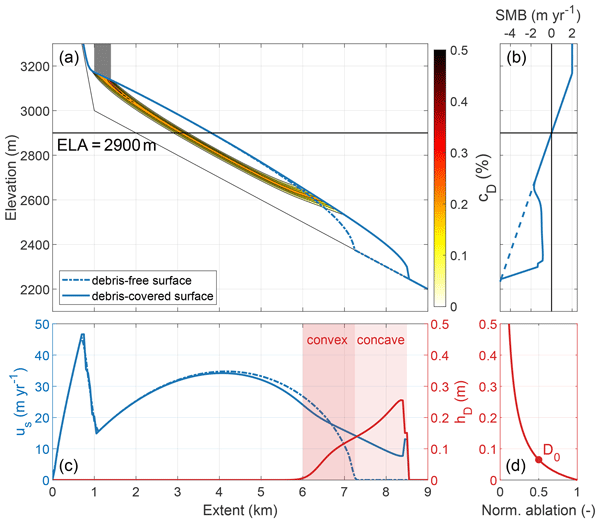
As mountain glaciers are retreating, they are becoming increasingly debris-covered. We want to better understand how these glaciers respond to a changing climate. Here, we present an improved model that simulates transport of debris within and on the glacier. We find that short-term changes have a low impact due to long response times. However, long-term warming can lead to fast collapse of the glacier tongue after a phase of thinning, where debris cover expands and thickens.
Ilaria Santin, Huw J. Horgan, Raphael Moser, Nanna Bjørnholt Karlsson, Faezeh M. Nick, Andreas Vieli, Anja Rutishauser, Hansruedi Maurer, and Daniel Farinotti
The Cryosphere, 20, 3435–3441, https://doi.org/10.5194/tc-20-3435-2026, https://doi.org/10.5194/tc-20-3435-2026, 2026
Short summary
Short summary
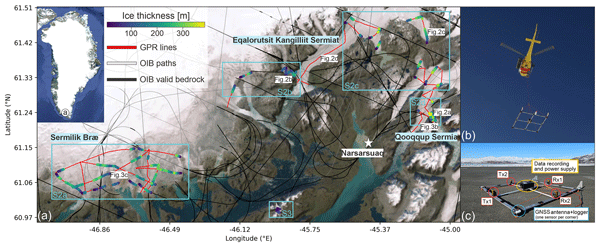
Ice thickness near Greenland’s coast is still poorly measured, yet it is vital for predicting sea level rise. We flew a helicopter ice-penetrating radar over three outlet glaciers in southern Greenland and mapped the glacier bed where basal reflections were clear. We measured ice up to about 340 meters thick, with reliable penetration typically to about 300 meters, providing new constraints that can improve regional bed maps.
Tancrède P. M. Leger, Guillaume Jouvet, Sarah Kamleitner, Brandon D. Finley, Maxime Bernard, Balthazar Allegri, Frédéric Herman, Andreas Vieli, Andreas Henz, and Samuel U. Nussbaumer
Earth Surf. Dynam., 14, 361–389, https://doi.org/10.5194/esurf-14-361-2026, https://doi.org/10.5194/esurf-14-361-2026, 2026
Short summary
Short summary
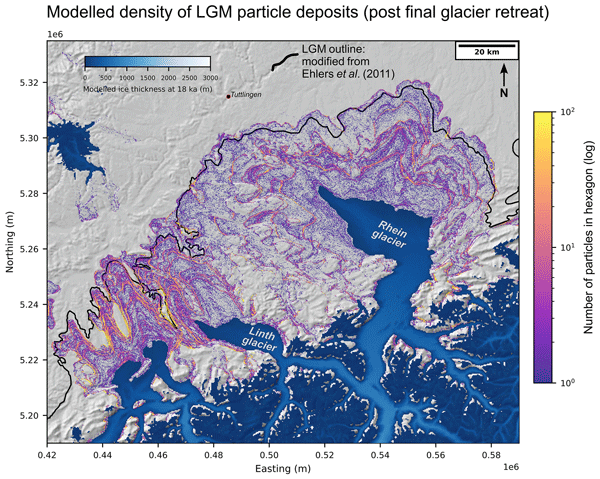
This study reconstructs for the first time the transport-pathways of sediments by glaciers during the last glaciation of the European Alps, 24000 years ago. This helps us understand how the European Alps were shaped by past glaciations and helps us better constrain the mechanisms of iceflow, glacier erosion and the movement of large sediment masses by ice. This breakthrough is achieved by coupling a smart particle-tracking algorithm to a machine-learning-enhanced glacier evolution model.
Armin Dachauer, Andrea Kneib-Walter, Dominik Gräff, and Andreas Vieli
The Cryosphere, 20, 2099–2125, https://doi.org/10.5194/tc-20-2099-2026, https://doi.org/10.5194/tc-20-2099-2026, 2026
Short summary
Short summary
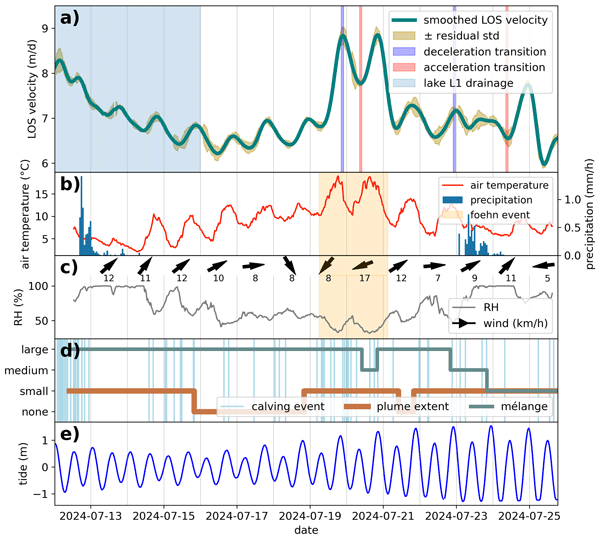
Terrestrial radar observations were used to investigate flow speed changes at Eqalorutsit Kangilliit Sermiat, a marine-terminating glacier in Greenland. The velocity varied on both daily and multi-day timescales, showing that the glacier speeds up markedly when meltwater or lake drainage increases basal water pressure. Usually speed changes move downstream with time towards the glacier front, but during multi-day speed-up events they start at the front and travel upstream.
Kathrin Naegeli, Jennifer Susan Adams, Gabriele Bramati, Isabelle Gärtner-Roer, Julian Gröbner, and Nils Rietze
EGUsphere, https://doi.org/10.5194/egusphere-2026-787, https://doi.org/10.5194/egusphere-2026-787, 2026
Short summary
Short summary
We investigate the potential of drone-based thermal cameras in the Swiss Alps and found they can misread surface temperatures when the camera warms or cools. Lab and field checks showed some correction methods exaggerate extremes. Calibrating on site with ground sensors gave the best results as well as the implementation of a site-specific validation. This improves temperature maps needed to track melting snow and ice, and unstable ground in rapidly changing mountains.
Samuel Weber, Andreas Vieli, Marcia Phillips, and Alessandro Cicoira
The Cryosphere, 19, 6727–6748, https://doi.org/10.5194/tc-19-6727-2025, https://doi.org/10.5194/tc-19-6727-2025, 2025
Short summary
Short summary
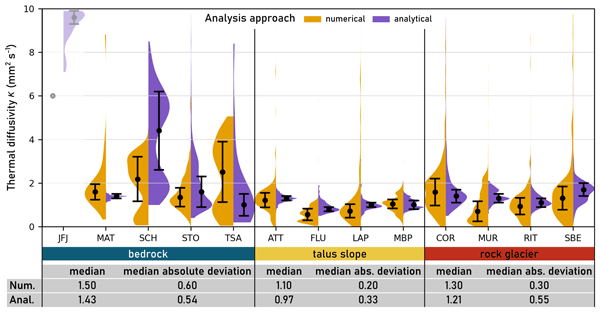
The properties of the permafrost ground depend on its temperature and composition. We used temperature data from 29 boreholes in Switzerland to study how heat moves through different types of mountain permafrost landforms, supporting a physically meaningful interpretation of thermal properties in terms of ice content, water saturation, and porosity. Understanding changes is important because they can affect how stable mountain slopes are and how easy it is to build things in mountain areas.
Andreas Henz, Johannes Reinthaler, Samuel U. Nussbaumer, Tancrède P. M. Leger, Sarah Kamleitner, Guillaume Jouvet, and Andreas Vieli
The Cryosphere, 19, 5913–5937, https://doi.org/10.5194/tc-19-5913-2025, https://doi.org/10.5194/tc-19-5913-2025, 2025
Short summary
Short summary
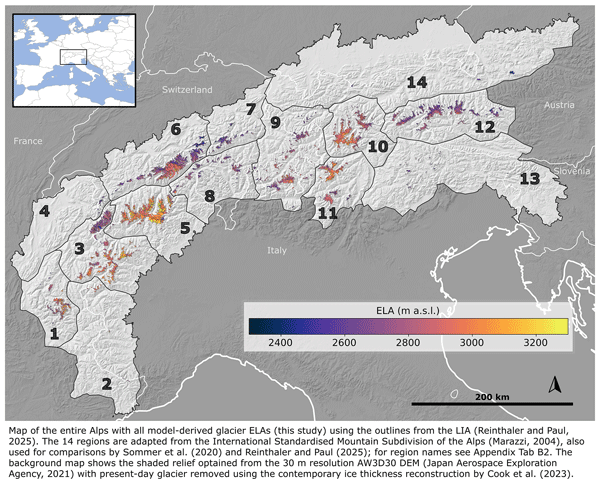
Glaciers are key to understanding climate change, reflecting historical variability. Using glacier models on the computer, we reconstructed European Alps glaciers during the Little Ice Age, with a total ice volume of 283 ± 42 cubic kilometres. Also, the study determines equilibrium line altitudes (ELAs) for over 4000 glaciers, showing patterns influenced by temperature, precipitation, and solar radiation. After all, we introduce a new ELA correction approach based on solar incidence.
Samuel Weber, Jan Beutel, Michael Dietze, Alexander Bast, Robert Kenner, Marcia Phillips, Johannes Leinauer, Simon Mühlbauer, Felix Pfluger, and Michael Krautblatter
Earth Surf. Dynam., 13, 1157–1179, https://doi.org/10.5194/esurf-13-1157-2025, https://doi.org/10.5194/esurf-13-1157-2025, 2025
Short summary
Short summary
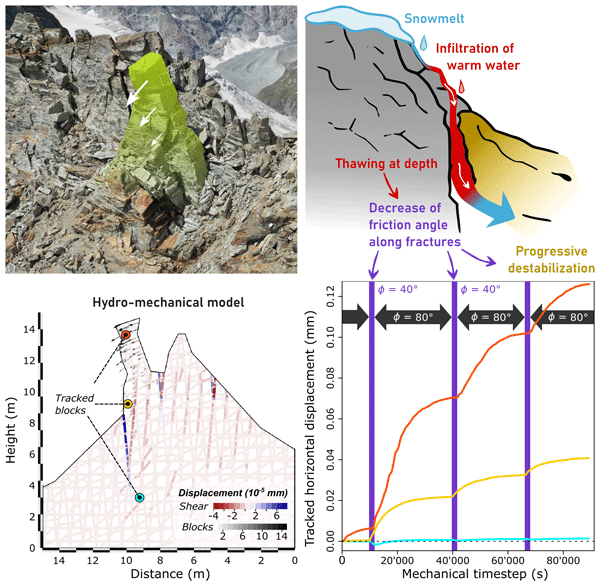
On 13 June 2023, a freestanding rock pillar on the Matterhorn collapsed after years of weakening. Our study examines this progressive destabilization by analyzing field data and integrating lab experiments into a hydro-mechanical model. We highlight the critical role of water infiltration into frozen rock, intensified by climate warming, as a widespread driver of the rising frequency of rockfalls in high mountain permafrost regions.
Julie Wee, Sebastián Vivero, Tamara Mathys, Coline Mollaret, Christian Hauck, Christophe Lambiel, Jan Beutel, and Wilfried Haeberli
The Cryosphere, 18, 5939–5963, https://doi.org/10.5194/tc-18-5939-2024, https://doi.org/10.5194/tc-18-5939-2024, 2024
Short summary
Short summary
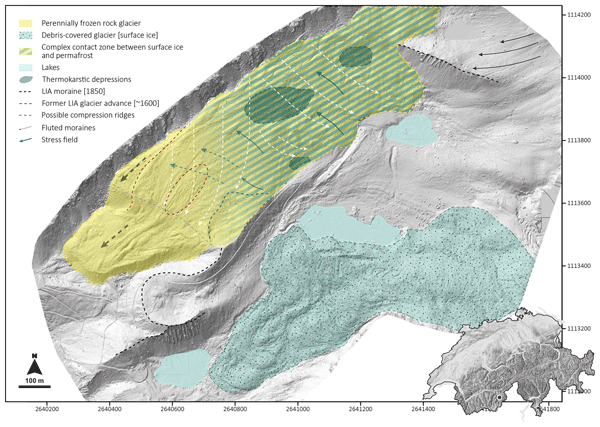
This study highlights the importance of a multi-method and multi-disciplinary approach to better understand the influence of the internal structure of the Gruben glacier-forefield-connected rock glacier and adjacent debris-covered glacier on their driving thermo-mechanical processes and associated surface dynamics. We were able to discriminate glacial from periglacial processes as their spatio-temporal patterns of surface dynamics and geophysical signatures are (mostly) different.
Adrien Wehrlé, Martin P. Lüthi, and Andreas Vieli
The Cryosphere, 17, 309–326, https://doi.org/10.5194/tc-17-309-2023, https://doi.org/10.5194/tc-17-309-2023, 2023
Short summary
Short summary
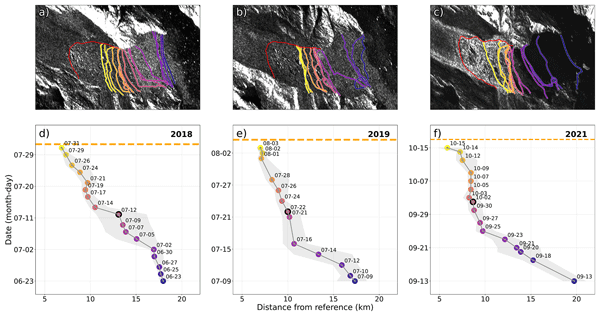
We characterized short-lived episodes of ice mélange weakening (IMW) at the front of three major Greenland outlet glaciers. Through a continuous detection at the front of Kangerdlugssuaq Glacier during the June-to-September period from 2018 to 2021, we found that 87 % of the IMW episodes occurred prior to a large-scale calving event. Using a simple model for ice mélange motion, we further characterized the IMW process as self-sustained through the existence of an IMW–calving feedback.
Alessandro Cicoira, Samuel Weber, Andreas Biri, Ben Buchli, Reynald Delaloye, Reto Da Forno, Isabelle Gärtner-Roer, Stephan Gruber, Tonio Gsell, Andreas Hasler, Roman Lim, Philippe Limpach, Raphael Mayoraz, Matthias Meyer, Jeannette Noetzli, Marcia Phillips, Eric Pointner, Hugo Raetzo, Cristian Scapozza, Tazio Strozzi, Lothar Thiele, Andreas Vieli, Daniel Vonder Mühll, Vanessa Wirz, and Jan Beutel
Earth Syst. Sci. Data, 14, 5061–5091, https://doi.org/10.5194/essd-14-5061-2022, https://doi.org/10.5194/essd-14-5061-2022, 2022
Short summary
Short summary
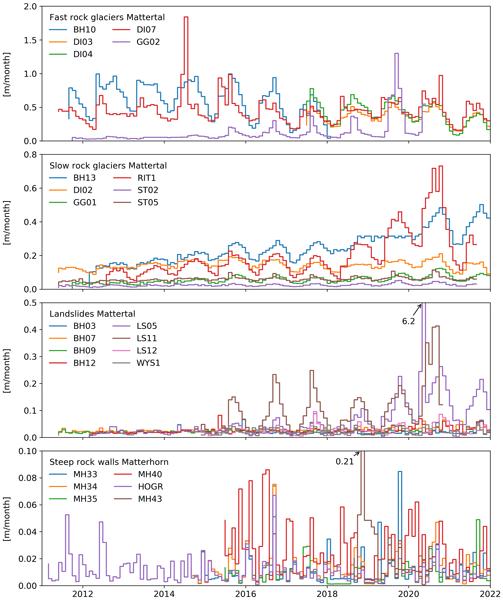
This paper documents a monitoring network of 54 positions, located on different periglacial landforms in the Swiss Alps: rock glaciers, landslides, and steep rock walls. The data serve basic research but also decision-making and mitigation of natural hazards. It is the largest dataset of its kind, comprising over 209 000 daily positions and additional weather data.
Isabelle Gärtner-Roer, Nina Brunner, Reynald Delaloye, Wilfried Haeberli, Andreas Kääb, and Patrick Thee
The Cryosphere, 16, 2083–2101, https://doi.org/10.5194/tc-16-2083-2022, https://doi.org/10.5194/tc-16-2083-2022, 2022
Short summary
Short summary
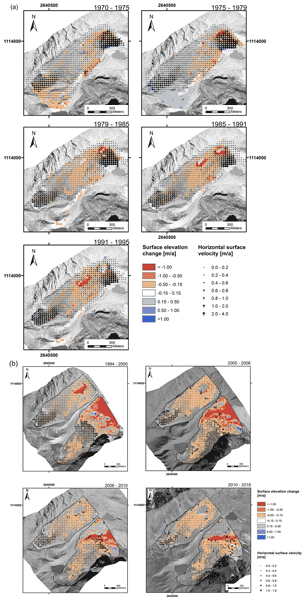
We intensely investigated the Gruben site in the Swiss Alps, where glaciers and permafrost landforms closely interact, to better understand cold-climate environments. By the interpretation of air photos from 5 decades, we describe long-term developments of the existing landforms. In combination with high-resolution positioning measurements and ground surface temperatures, we were also able to link these to short-term changes and describe different landform responses to climate forcing.
Adrien Wehrlé, Martin P. Lüthi, Andrea Walter, Guillaume Jouvet, and Andreas Vieli
The Cryosphere, 15, 5659–5674, https://doi.org/10.5194/tc-15-5659-2021, https://doi.org/10.5194/tc-15-5659-2021, 2021
Short summary
Short summary
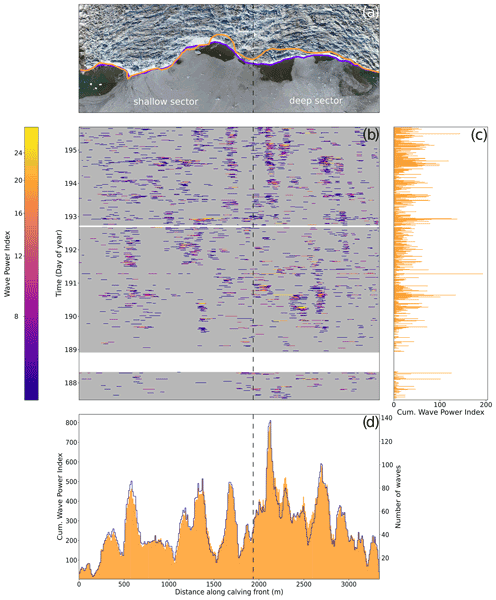
We developed a novel automated method for the detection and the quantification of ocean waves generated by glacier calving. This method was applied to data recorded with a terrestrial radar interferometer at Eqip Sermia, Greenland. Results show a high calving activity at the glacier front sector ending in deep water linked with more frequent meltwater plumes. This suggests that rising subglacial meltwater plumes strongly affect glacier calving in deep water, but weakly in shallow water.
Cited articles
Amschwand, D., Scherler, M., Hoelzle, M., Krummenacher, B., Haberkorn, A., Kienholz, C., and Gubler, H.: Surface heat fluxes at coarse blocky Murtèl rock glacier (Engadine, eastern Swiss Alps), The Cryosphere, 18, 2103–2139, https://doi.org/10.5194/tc-18-2103-2024, 2024. a, b, c
Amschwand, D., Tschan, S., Scherler, M., Hoelzle, M., Krummenacher, B., Haberkorn, A., Kienholz, C., Aschwanden, L., and Gubler, H.: Seasonal ice storage changes and meltwater generation at Murtèl rock glacier (Engadine, eastern Swiss Alps): estimates from measurements and energy budgets in the coarse blocky active layer, Hydrol. Earth Syst. Sci., 29, 2219–2253, https://doi.org/10.5194/hess-29-2219-2025, 2025. a
Barsch, D. and Hell, G.: Photogrammetrische Bewegungsmessungen am Blockgletscher Murtèl I, Oberengadin, Schweizer Alpen, Zeitschrift für Gletscherkunde und Glazialgeologie, 11, 111–142, 1976. a
Benedict, J. B., Benedict, R. J., and Sanville, D.: Arapaho Rock Glacier, Front Range, Colorado, U.S.A.: A 25-Year Resurvey, Arct. Alp. Res., 18, 349–352, https://doi.org/10.1080/00040851.1986.12004096, 1986. a
Buchli, T., Merz, K., Zhou, X., Kinzelbach, W., and Springman, S. M.: Characterization and Monitoring of the Furggwanghorn Rock Glacier, Turtmann Valley, Switzerland: Results from 2010 to 2012, Vadose Zone J., 12, 1–15, https://doi.org/10.2136/vzj2012.0067, 2013. a, b
Buchli, T., Laue, J., and Springman, S. M.: Amendments to Interpretations of SAAF Inclinometer Data from the Furggwanghorn Rock Glacier, Turtmann Valley, Switzerland: Results from 2010 to 2012, Vadose Zone J., 15, 1–3, https://doi.org/10.2136/vzj2015.09.0132, 2016. a
Bucki, A. K. and Echelmeyer, K. A.: The flow of Fireweed rock glacier, Alaska, U.S.A., J. Glaciol., 50, 76–86, https://doi.org/10.3189/172756504781830213, 2004. a
Cicoira, A., Beutel, J., Faillettaz, J., Gärtner-Roer, I., and Vieli, A.: Resolving the influence of temperature forcing through heat conduction on rock glacier dynamics: a numerical modelling approach, The Cryosphere, 13, 927–942, https://doi.org/10.5194/tc-13-927-2019, 2019a. a
Cicoira, A., Beutel, J., Faillettaz, J., and Vieli, A.: Water controls the seasonal rhythm of rock glacier flow, Earth Planet. Sc. Lett., 528, 115844, https://doi.org/10.1016/j.epsl.2019.115844, 2019b. a, b, c, d
Cicoira, A., Marcer, M., Gärtner‐Roer, I., Bodin, X., Arenson, L. U., and Vieli, A.: A general theory of rock glacier creep based on in‐situ and remote sensing observations, Permafrost Periglac., 32, 139–153, https://doi.org/10.1002/ppp.2090, 2021. a, b, c
Cicoira, A., Weber, S., Biri, A., Buchli, B., Delaloye, R., Da Forno, R., Gärtner-Roer, I., Gruber, S., Gsell, T., Hasler, A., Lim, R., Limpach, P., Mayoraz, R., Meyer, M., Noetzli, J., Phillips, M., Pointner, E., Raetzo, H., Scapozza, C., Strozzi, T., Thiele, L., Vieli, A., Vonder Mühll, D., Wirz, V., and Beutel, J.: In situ observations of the Swiss periglacial environment using GNSS instruments, Earth Syst. Sci. Data, 14, 5061–5091, https://doi.org/10.5194/essd-14-5061-2022, 2022. a, b
Emmert, A. and Kneisel, C.: Internal structure of two alpine rock glaciers investigated by quasi-3-D electrical resistivity imaging, The Cryosphere, 11, 841–855, https://doi.org/10.5194/tc-11-841-2017, 2017. a
Fey, C. and Krainer, K.: Analyses of UAV and GNSS based flow velocity variations of the rock glacier Lazaun (Ötztal Alps, South Tyrol, Italy), Geomorphology, 365, 107261, https://doi.org/10.1016/j.geomorph.2020.107261, 2020. a
Gärtner-Roer, I. and Hoelzle, M.: Rockglaciers of the Engadine, in: Landscapes and Landforms of Switzerland, edited by: Reynard, E., pp. 235–248, Springer International Publishing, Cham, ISBN 978-3-030-43201-0 978-3-030-43203-4, https://doi.org/10.1007/978-3-030-43203-4_16, 2021. a
Haberkorn, A., Kenner, R., Noetzli, J., and Phillips, M.: Changes in Ground Temperature and Dynamics in Mountain Permafrost in the Swiss Alps, Front. Earth Sci., 9, 626686, https://doi.org/10.3389/feart.2021.626686, 2021. a
Haeberli, W., Hoelzle, M., Kääb, A., Keller, F., Mühll, D. V., and Wagner, S.: Ten years after the drilling through the permafrost of the active rock glacier Murtel, eastern Swiss Alps : Answered questions and new perspectives, vol. 55, pp. 403–410, Collection Nordicana, Yellowknife, Canada, https://api.semanticscholar.org/CorpusID:51799942 (last access: 1 June 2024), 1998. a
Haeberli, W., Hallet, B., Arenson, L., Elconin, R., Humlum, O., Kääb, A., Kaufmann, V., Ladanyi, B., Matsuoka, N., Springman, S., and Mühll, D. V.: Permafrost creep and rock glacier dynamics, Permafrost Periglac., 17, 189–214, https://doi.org/10.1002/ppp.561, 2006. a
Hoelzle, M., Wegmann, M., and Krummenacher, B.: Miniature Temperature Dataloggers for mapping and monitoring of permafrost in high mountain areas: First experience from the Swiss Alps, Permafrost Periglac., 10, 113–124, https://doi.org/10.1002/(SICI)1099-1530(199904/06)10:2<113::AID-PPP317>3.0.CO;2-A, 1999. a, b
Hoelzle, M., Mühll, D. V., and Haeberli, W.: Thirty years of permafrost research in the Corvatsch‐Furtschellas area, Eastern Swiss Alps: A review, Norsk Geografisk Tidsskrift – Norwegian Journal of Geography, 56, 137–145, https://doi.org/10.1080/002919502760056468, 2002. a
Hu, Y., Arenson, L. U., Barboux, C., Bodin, X., Cicoira, A., Delaloye, R., Gärtner‐Roer, I., Kääb, A., Kellerer‐Pirklbauer, A., Lambiel, C., Liu, L., Pellet, C., Rouyet, L., Schoeneich, P., Seier, G., and Strozzi, T.: Rock Glacier Velocity: An Essential Climate Variable Quantity for Permafrost, Rev. Geophys., 63, e2024RG000847, https://doi.org/10.1029/2024RG000847, 2025. a, b
Ikeda, A., Matsuoka, N., and Kääb, A.: Fast deformation of perennially frozen debris in a warm rock glacier in the Swiss Alps: An effect of liquid water, J. Geophys. Res.-Earth Surf., 113, 2007JF000859, https://doi.org/10.1029/2007JF000859, 2008. a, b, c, d
Kääb, A., Frauenfelder, R., and Roer, I.: On the response of rockglacier creep to surface temperature increase, Glob. Planet. Change, 56, 172–187, https://doi.org/10.1016/j.gloplacha.2006.07.005, 2007. a, b
Keller, F.: Interaktionen zwischen Schnee und Permalrost: eine Grundlagenstudie im Oberengadin., Tech. Rep. 127, Versuchsanstalt für Wasserbau, Hydrologie und Glaziologie, ETH Zürich, 1994. a
Kellerer-Pirklbauer, A., Bodin, X., Delaloye, R., Lambiel, C., Gärtner-Roer, I., Bonnefoy-Demongeot, M., Carturan, L., Damm, B., Eulenstein, J., Fischer, A., Hartl, L., Ikeda, A., Kaufmann, V., Krainer, K., Matsuoka, N., Morra Di Cella, U., Noetzli, J., Seppi, R., Scapozza, C., Schoeneich, P., Stocker-Waldhuber, M., Thibert, E., and Zumiani, M.: Acceleration and interannual variability of creep rates in mountain permafrost landforms (rock glacier velocities) in the European Alps in 1995–2022, Environ. Res. Lett., 19, 034022, https://doi.org/10.1088/1748-9326/ad25a4, 2024. a, b, c, d, e
Kellerer-Pirklbauer, A., Bodin, X., Delaloye, R., Lambiel, C., Gärtner-Roer, I., Damm, B., Ikeda, A., Kaufmann, V., Krainer, K., Seppi, R., Scapozza, C., Stocker-Waldhuber, M., and Thibert, E.: Rock glacier velocity monitored by annual in-situ geodetic surveys: Long-term challenges, solutions and suggestions, Geomorphology, 495, 110117, https://doi.org/10.1016/j.geomorph.2025.110117, 2026. a
Kenner, R., Phillips, M., Beutel, J., Hiller, M., Limpach, P., Pointner, E., and Volken, M.: Factors Controlling Velocity Variations at Short‐Term, Seasonal and Multiyear Time Scales, Ritigraben Rock Glacier, Western Swiss Alps, Permafrost Periglac., 28, 675–684, https://doi.org/10.1002/ppp.1953, 2017. a, b, c, d
Krainer, K. and Mostler, W.: Hydrology of Active Rock Glaciers: Examples from the Austrian Alps, Arct. Antarct. Alp. Res., 34, 142–149, https://doi.org/10.1080/15230430.2002.12003478, 2002. a
Ladanyi, B.: Rheology of ice/rock systems and interfaces, Permafrost, 1–2, 621–626, https://www.arlis.org/docs/vol1/ICOP/55700698/Pdf/Chapter_110.pdf (last access: 29 April 2025), 2003. a
Lambiel, C. and Delaloye, R.: Contribution of real‐time kinematic GPS in the study of creeping mountain permafrost: examples from the Western Swiss Alps, Permafrost Periglac., 15, 229–241, https://doi.org/10.1002/ppp.496, 2004. a
Lugon, R. and Stoffel, M.: Rock-glacier dynamics and magnitude–frequency relations of debris flows in a high-elevation watershed: Ritigraben, Swiss Alps, Glob. Planet. Change, 73, 202–210, https://doi.org/10.1016/j.gloplacha.2010.06.004, 2010. a
Mittaz, C., Hoelzle, M., and Haeberli, W.: First results and interpretation of energy-flux measurements over Alpine permafrost, Ann. Glaciol., 31, 275–280, https://doi.org/10.3189/172756400781820363, 2000. a
Moore, P. L.: Deformation of debris-ice mixtures: Deformation of debris ice mixtures, Rev. Geophys., 52, 435–467, https://doi.org/10.1002/2014RG000453, 2014. a, b, c
Noetzli, J., Arenson, L. U., Bast, A., Beutel, J., Delaloye, R., Farinotti, D., Gruber, S., Gubler, H., Haeberli, W., Hasler, A., Hauck, C., Hiller, M., Hoelzle, M., Lambiel, C., Pellet, C., Springman, S. M., Vonder Muehll, D., and Phillips, M.: Best Practice for Measuring Permafrost Temperature in Boreholes Based on the Experience in the Swiss Alps, Front. Earth Sci., 9, 607875, https://doi.org/10.3389/feart.2021.607875, 2021. a
Noetzli, J., Isaksen, K., Barnett, J., Christiansen, H. H., Delaloye, R., Etzelmüller, B., Farinotti, D., Gallemann, T., Guglielmin, M., Hauck, C., Hilbich, C., Hoelzle, M., Lambiel, C., Magnin, F., Oliva, M., Paro, L., Pogliotti, P., Riedl, C., Schoeneich, P., Valt, M., Vieli, A., and Phillips, M.: Enhanced warming of European mountain permafrost in the early 21st century, Nat. Commun., 15, 10508, https://doi.org/10.1038/s41467-024-54831-9, 2024. a
Nye, J. F.: The Mechanics of Glacier Flow, J. Glaciol., 2, 82–93, https://doi.org/10.3189/S0022143000033967, 1952. a
RGIK: Rock Glacier Velocity as an associated parameter of ECV Permafrost: Baseline concepts (Version 3.2), https://bigweb.unifr.ch/Science/Geosciences/Geomorphology/Pub/Website/IPA/CurrentVersion/Current_RockGlacierVelocity.pdf (last access: 16 June 2026), 2023. a
Roer, I., Kääb, A., and Dikau, R.: Rockglacier acceleration in the Turtmann valley (Swiss Alps): Probable controls, Norsk Geografisk Tidsskrift – Norwegian Journal of Geography, 59, 157–163, https://doi.org/10.1080/00291950510020655, 2005. a
Saibene, G.: Borehole deformation data 2016–2023 from Murtèl rock glacier (Engadine, Switzerland), Zenodo [data set], https://doi.org/10.5281/zenodo.15782682, 2025. a
Scherler, M., Schneider, S., Hoelzle, M., and Hauck, C.: A two-sided approach to estimate heat transfer processes within the active layer of the Murtèl–Corvatsch rock glacier, Earth Surf. Dynam., 2, 141–154, https://doi.org/10.5194/esurf-2-141-2014, 2014. a, b
Schneider, S., Hoelzle, M., and Hauck, C.: Influence of surface and subsurface heterogeneity on observed borehole temperatures at a mountain permafrost site in the Upper Engadine, Swiss Alps, The Cryosphere, 6, 517–531, https://doi.org/10.5194/tc-6-517-2012, 2012. a
SwissTopo: https://www.swisstopo.admin.ch/de (last access: 26 May 2026), 2025. a
Vonder Mühll, D. and Haeberli, W.: Thermal Characteristics of the Permafrost within an Active Rock Glacier (Murtèl/Corvatsch, Grisons, Swiss Alps), J. Glaciol., 36, 151–158, https://doi.org/10.3189/S0022143000009382, 1990. a, b, c
Wahrhaftig, C. and Cox, A.: Rock glaciers in the Alaska range, Geol. Soc. Am. Bull., 70, 383, https://doi.org/10.1130/0016-7606(1959)70[383:RGITAR]2.0.CO;2, 1959. a
Wirz, V., Gruber, S., Purves, R. S., Beutel, J., Gärtner-Roer, I., Gubler, S., and Vieli, A.: Short-term velocity variations at three rock glaciers and their relationship with meteorological conditions, Earth Surf. Dynam., 4, 103–123, https://doi.org/10.5194/esurf-4-103-2016, 2016. a, b, c
Short summary
Rock glaciers are bodies of frozen ground found in mountain regions. They move downslope and are mainly studied at the surface. Here, we analyze deformation data from a borehole, providing continuous data for almost eight years. The data shows that the acceleration in the summer movement happens in the uppermost layer, while long-term movement is mostly occurring in a deeper layer. This is important for the interpretation of surface movements, which are used as climate indicators.
Rock glaciers are bodies of frozen ground found in mountain regions. They move downslope and are...


