
Articles | Volume 20, issue 5
https://doi.org/10.5194/tc-20-3073-2026
© Author(s) 2026. This work is distributed under
the Creative Commons Attribution 4.0 License.
the Creative Commons Attribution 4.0 License.
https://doi.org/10.5194/tc-20-3073-2026
© Author(s) 2026. This work is distributed under
the Creative Commons Attribution 4.0 License.
the Creative Commons Attribution 4.0 License.
Research article
| 
28 May 2026
Research article |
| 28 May 2026
| 28 May 2026
Langmuir turbulence in the Arctic Ocean: insights from a coupled sea ice–wave model
Aikaterini Tavri
CORRESPONDING AUTHOR

Brown University, Providence, RI, USA
Chris Horvat
Brown University, Providence, RI, USA
Brodie Pearson
Oregon State University, Corvallis, OR, USA
Guillaume Boutin
Nansen Environmental and Remote Sensing Center and Bjerknes Centre for Climate Research, Bergen, Norway
Anne Hansen
Oregon State University, Corvallis, OR, USA
Ara Lee
Oregon State University, Corvallis, OR, USA
Related authors
Ara Lee, Jenny Hutchings, Chris Horvat, Aikaterini Tavri, and Brodie Pearson
EGUsphere, https://doi.org/10.5194/egusphere-2025-4239, https://doi.org/10.5194/egusphere-2025-4239, 2025
Short summary
Short summary
When sea ice melts, narrow cracks called leads expose the ocean to wind and waves, altering air–sea exchange. Using computer simulations, we show that wind and waves mix water beneath the lead and drive circulation around it. Waves intensify vertical mixing, deepen sinking plumes, create upward flows under adjacent ice, and change heat and freshwater exchange. We develop equations linking these processes to system parameters, improving understanding of Arctic climate impacts.
Jonathan Winfield Rheinlænder, Einar Örn Ólason, Céline Heuzé, and Guillaume Boutin
EGUsphere, https://doi.org/10.5194/egusphere-2026-5106, https://doi.org/10.5194/egusphere-2026-5106, 2026
This preprint is open for discussion and under review for The Cryosphere (TC).
Short summary
Short summary
Polynyas are "holes" in the sea-ice cover where large amounts of new ice form, but they are not represented in climate models. We used a novel sea-ice model, compared against satellite data, to study Arctic polynya activity over 18 winters. We found that polynyas account for up to 11 % of total winter ice production in the Arctic, despite only covering a small area. Our results suggest that earlier satellite estimates may have been too high.
Einar Ólason, Guillaume Boutin, Timothy Williams, Anton Korosov, Heather Regan, Jonathan Rheinlænder, Pierre Rampal, Daniela Flocco, Abdoulaye Samaké, Richard Davy, Timothy Spain, and Sean Chua
Geosci. Model Dev., 19, 6467–6496, https://doi.org/10.5194/gmd-19-6467-2026, https://doi.org/10.5194/gmd-19-6467-2026, 2026
Short summary
Short summary
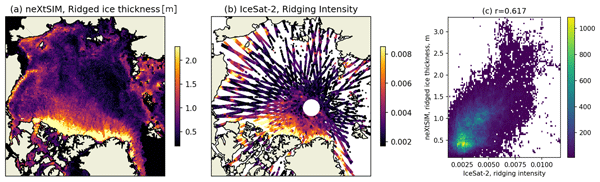
This paper introduces a new version of the neXtSIM sea-ice model. NeXtSIM is unique among sea-ice models in how it represents sea-ice dynamics, focusing on features such as cracks and ridges and how these impact interactions between the atmosphere and ocean where sea ice is present. The new version introduces some physical parameterisations and model options detailed and explained in the paper. Following the paper's publication, the neXtSIM code will be released publicly for the first time.
Flossie Brown, Sabine Bischof, Brodie Pearson, Aditya Sengupta, Pauline Bonnet, Swen Brands, Jayasankar C.B., James Carruthers, Marion Devilliers, F. Feba, Mehmet Sedat Gözlet, Saurabh Kelkar, Sifan A. Koriche, Michael Lai, Andre Lanfer Marquez, Xiaohan Sally Li, Yiwen Li, Abhnil Prasad, Angelica R. Rodriguez, Serena Schroeter, Gopika Suresh, and Rebecca Varney
EGUsphere, https://doi.org/10.5194/egusphere-2026-3510, https://doi.org/10.5194/egusphere-2026-3510, 2026
Short summary
Short summary
The Coupled Model Intercomparison Project (CMIP) creates simulations of the Earth and climate, but its representation of many features are imperfect. In this review, we show how these biases are connected across the atmosphere, land and ocean and discuss current understanding of their causes and effects. In addition, we provide a perspective on the modelling advances expected in CMIP7 aimed at end users, those new to CMIP data and those looking to connect different aspects of the Earth system.
Valentin Ludwig, Caroline Ribere, Sara Fleury, Christian Haas, Michel Tsamados, Mahmoud El Hajj, Jerome Bouffard, Michele Scagliola, Marion Bocquet, Eric de Boisseson, Vincent Boulenger, Guillaume Boutin, Laurence Connor, Léo Edel, Stefan Hendricks, Ferran Hernández Macià, Marcus Huntemann, Lars Kaleschke, Frank Kauker, Jack Landy, Tom Megain, Alek Petty, Till Soya Rasmussen, Mads Hvid Ribergaard, Robert Ricker, Axel Schweiger, Hoyeon Shi, Xiangshan Tian-Kunze, Donghui Yi, and Alessandro Di Bella
EGUsphere, https://doi.org/10.5194/egusphere-2025-6201, https://doi.org/10.5194/egusphere-2025-6201, 2026
Short summary
Short summary
Our paper compares Arctic sea-ice thickness datasets from models, reanalyses, satellite-only, and multi-product sources. We validate them against Beaufort Sea reference data, compare large-scale products, and analyse time series. Cross-product biases range from 0.2–0.4 m, RMSDs from 0.4–0.9 m, and correlations from 0.5–0.8. We find no 2010–2023 trend, but 1995–2023 thinning of ~ 0.5 m in November and ~ 0.3 m in March.
Nicolas Guillaume Alexandre Mokus, Véronique Dansereau, Guillaume Boutin, Jean-Pierre Auclair, and Alexandre Tlili
Geosci. Model Dev., 19, 261–288, https://doi.org/10.5194/gmd-19-261-2026, https://doi.org/10.5194/gmd-19-261-2026, 2026
Short summary
Short summary
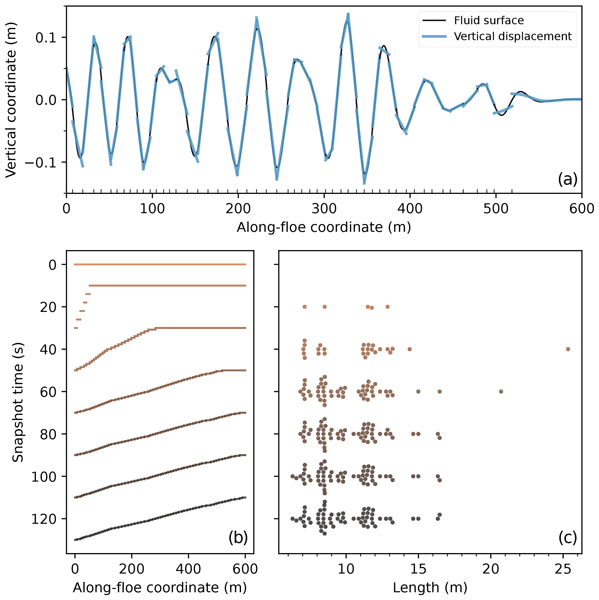
Arctic sea ice recedes, and is thus more exposed to waves, which can fracture continuous pack ice into smaller floes. These are more mobile and easier to melt. Ice fracture itself is not well understood, because of harsh field conditions. We propose a novel criterion parametrising this process, and incorporate it into a numerical model that simulates wave propagation. This criterion can be compared to existing ones. We relate our results to lab experiments, and find qualitative agreement.
Ara Lee, Jenny Hutchings, Chris Horvat, Aikaterini Tavri, and Brodie Pearson
EGUsphere, https://doi.org/10.5194/egusphere-2025-4239, https://doi.org/10.5194/egusphere-2025-4239, 2025
Short summary
Short summary
When sea ice melts, narrow cracks called leads expose the ocean to wind and waves, altering air–sea exchange. Using computer simulations, we show that wind and waves mix water beneath the lead and drive circulation around it. Waves intensify vertical mixing, deepen sinking plumes, create upward flows under adjacent ice, and change heat and freshwater exchange. We develop equations linking these processes to system parameters, improving understanding of Arctic climate impacts.
Ellen M. Buckley, Christopher Horvat, and Pittayuth Yoosiri
The Cryosphere, 19, 4805–4818, https://doi.org/10.5194/tc-19-4805-2025, https://doi.org/10.5194/tc-19-4805-2025, 2025
Short summary
Short summary
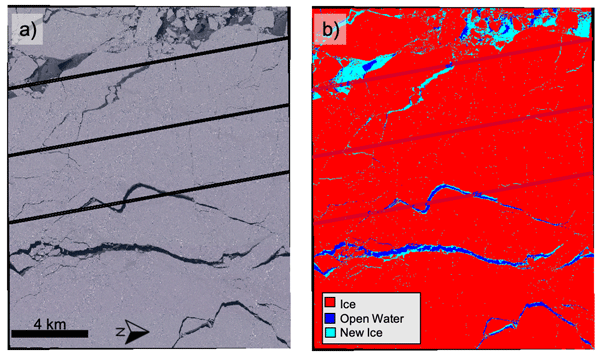
Sea ice coverage is a key indicator of changes in polar and global climate. There is a long (over 40 years) record of sea ice concentration and area from passive microwave measurements. In this work we show the biases in these data based on high-resolution imagery. We also suggest the use of ICESat-2, a high- resolution satellite laser, that can supplement the passive microwave estimates.
Christopher Horvat, Ellen Buckley, and Madelyn Stewart
The Cryosphere, 19, 4819–4833, https://doi.org/10.5194/tc-19-4819-2025, https://doi.org/10.5194/tc-19-4819-2025, 2025
Short summary
Short summary
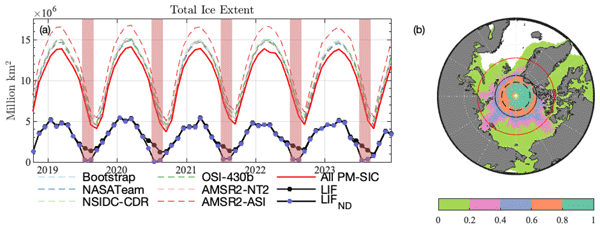
Since the late 1970s, standard methods for observing sea ice area from satellites have contrasted its passive microwave emissions to those of the ocean. Since 2018, a new satellite, ICESat-2, may have offered a unique and independent way to sample sea ice area at high skill and resolution, using laser altimetry. We develop a new product of sea ice area for the Arctic using ICESat-2 and constrain the biases associated with the use of altimetry instead of passive microwave emissions.
Charlotte Durand, Tobias Sebastian Finn, Alban Farchi, Marc Bocquet, Guillaume Boutin, and Einar Ólason
The Cryosphere, 18, 1791–1815, https://doi.org/10.5194/tc-18-1791-2024, https://doi.org/10.5194/tc-18-1791-2024, 2024
Short summary
Short summary
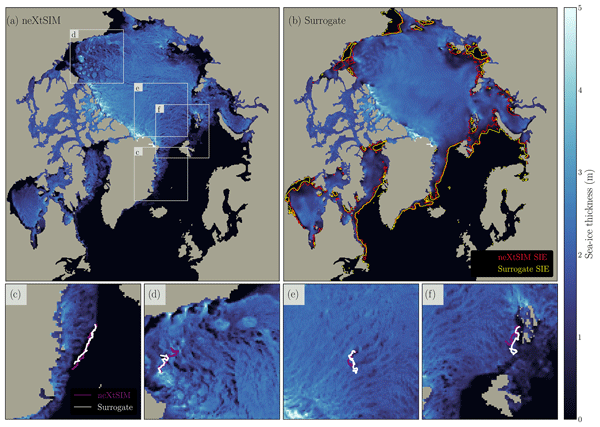
This paper focuses on predicting Arctic-wide sea-ice thickness using surrogate modeling with deep learning. The model has a predictive power of 12 h up to 6 months. For this forecast horizon, persistence and daily climatology are systematically outperformed, a result of learned thermodynamics and advection. Consequently, surrogate modeling with deep learning proves to be effective at capturing the complex behavior of sea ice.
Momme C. Hell and Christopher Horvat
The Cryosphere, 18, 341–361, https://doi.org/10.5194/tc-18-341-2024, https://doi.org/10.5194/tc-18-341-2024, 2024
Short summary
Short summary
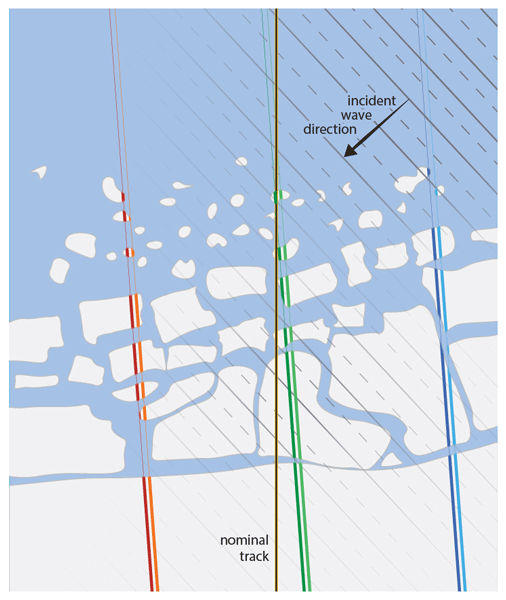
Sea ice is heavily impacted by waves on its margins, and we currently do not have routine observations of waves in sea ice. Here we propose two methods to separate the surface waves from the sea-ice height observations along each ICESat-2 track using machine learning. Both methods together allow us to follow changes in the wave height through the sea ice.
Yanan Wang, Byongjun Hwang, Adam William Bateson, Yevgeny Aksenov, and Christopher Horvat
The Cryosphere, 17, 3575–3591, https://doi.org/10.5194/tc-17-3575-2023, https://doi.org/10.5194/tc-17-3575-2023, 2023
Short summary
Short summary
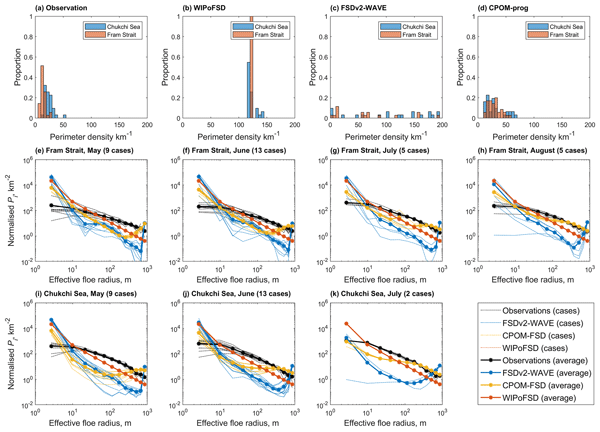
Sea ice is composed of small, discrete pieces of ice called floes, whose size distribution plays a critical role in the interactions between the sea ice, ocean and atmosphere. This study provides an assessment of sea ice models using new high-resolution floe size distribution observations, revealing considerable differences between them. These findings point not only to the limitations in models but also to the need for more high-resolution observations to validate and calibrate models.
Heather Regan, Pierre Rampal, Einar Ólason, Guillaume Boutin, and Anton Korosov
The Cryosphere, 17, 1873–1893, https://doi.org/10.5194/tc-17-1873-2023, https://doi.org/10.5194/tc-17-1873-2023, 2023
Short summary
Short summary
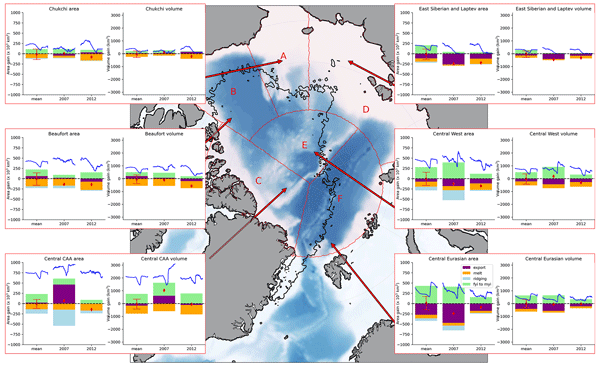
Multiyear ice (MYI), sea ice that survives the summer, is more resistant to changes than younger ice in the Arctic, so it is a good indicator of sea ice resilience. We use a model with a new way of tracking MYI to assess the contribution of different processes affecting MYI. We find two important years for MYI decline: 2007, when dynamics are important, and 2012, when melt is important. These affect MYI volume and area in different ways, which is important for the interpretation of observations.
Guillaume Boutin, Einar Ólason, Pierre Rampal, Heather Regan, Camille Lique, Claude Talandier, Laurent Brodeau, and Robert Ricker
The Cryosphere, 17, 617–638, https://doi.org/10.5194/tc-17-617-2023, https://doi.org/10.5194/tc-17-617-2023, 2023
Short summary
Short summary
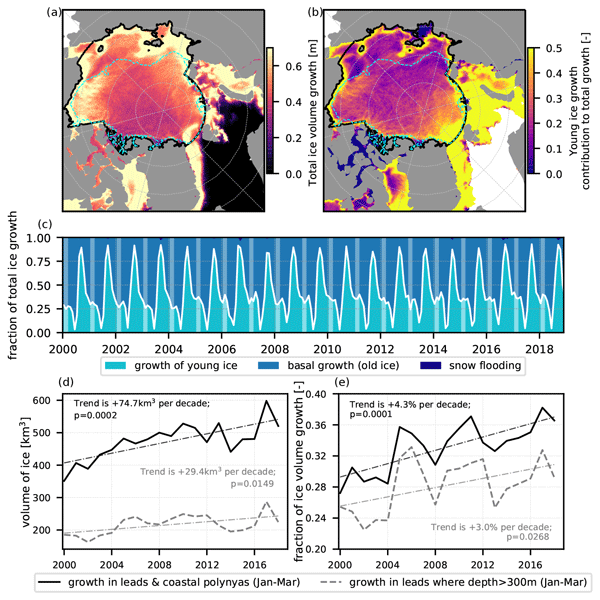
Sea ice cover in the Arctic is full of cracks, which we call leads. We suspect that these leads play a role for atmosphere–ocean interactions in polar regions, but their importance remains challenging to estimate. We use a new ocean–sea ice model with an original way of representing sea ice dynamics to estimate their impact on winter sea ice production. This model successfully represents sea ice evolution from 2000 to 2018, and we find that about 30 % of ice production takes place in leads.
Jill Brouwer, Alexander D. Fraser, Damian J. Murphy, Pat Wongpan, Alberto Alberello, Alison Kohout, Christopher Horvat, Simon Wotherspoon, Robert A. Massom, Jessica Cartwright, and Guy D. Williams
The Cryosphere, 16, 2325–2353, https://doi.org/10.5194/tc-16-2325-2022, https://doi.org/10.5194/tc-16-2325-2022, 2022
Short summary
Short summary
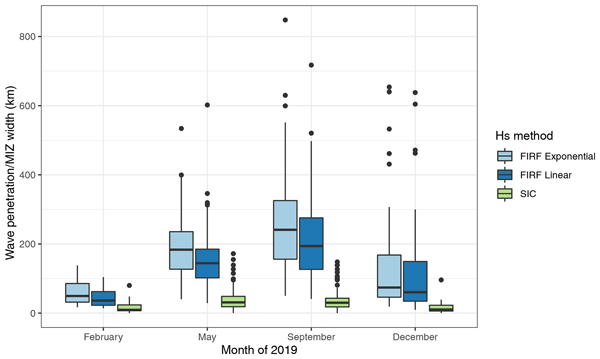
The marginal ice zone is the region where ocean waves interact with sea ice. Although this important region influences many sea ice, ocean and biological processes, it has been difficult to accurately measure on a large scale from satellite instruments. We present new techniques for measuring wave attenuation using the NASA ICESat-2 laser altimeter. By measuring how waves attenuate within the sea ice, we show that the marginal ice zone may be far wider than previously realised.
Christopher Horvat and Lettie A. Roach
Geosci. Model Dev., 15, 803–814, https://doi.org/10.5194/gmd-15-803-2022, https://doi.org/10.5194/gmd-15-803-2022, 2022
Short summary
Short summary
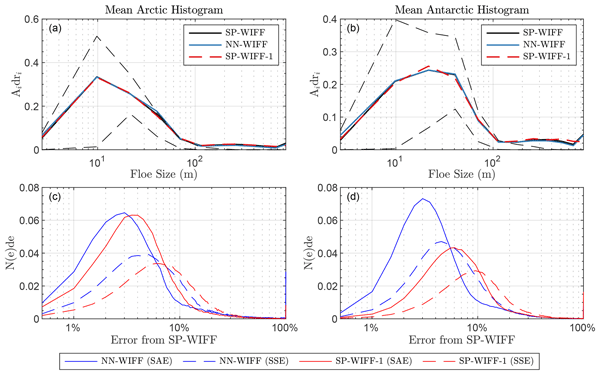
Sea ice is a composite of individual pieces, called floes, ranging in horizontal size from meters to kilometers. Variations in sea ice geometry are often forced by ocean waves, a process that is an important target of global climate models as it affects the rate of sea ice melting. Yet directly simulating these interactions is computationally expensive. We present a neural-network-based model of wave–ice fracture that allows models to incorporate their effect without added computational cost.
Cited articles
Ardhuin, F., Boutin, G., Stopa, J., Girard-Ardhuin, F., Melsheimer, C., Thomson, J., Kohout, A., Doble, M., and Wadhams, P.: Wave attenuation through an Arctic marginal ice zone on 12 October 2015: 2. Numerical modeling of waves and associated ice breakup, J. Geophys. Res.-Oceans, 123, 5652–5668, 2018. a, b, c
Ardhuin, F., Otero, M., Merrifield, S., Grouazel, A., and Terrill, E.: Ice breakup controls dissipation of wind waves across southern ocean sea ice, Geophys. Res. Lett., 47, e2020GL087699, https://doi.org/10.1029/2020GL087699, 2020. a
Armitage, T. W. K., Bacon, S., Ridout, A. L., Petty, A. A., Wolbach, S., and Tsamados, M.: Arctic Ocean surface geostrophic circulation 2003–2014, The Cryosphere, 11, 1767–1780, https://doi.org/10.5194/tc-11-1767-2017, 2017. a
Belcher, S. E., Grant, A. L. M., Hanley, K. E., Fox-Kemper, B., Van Roekel, L., Sullivan, P. P., Large, W. G., Brown, A., Hines, A., Calvert, D., Rutgersson, A., Pettersson, H., Bidlot, J.-R., Janssen, P. A. E. M., and Polton, J. A.: A global perspective on Langmuir turbulence in the ocean surface boundary layer, Geophys. Res. Lett., 39, L18605, https://doi.org/10.1029/2012GL052932, 2012. a, b, c, d, e, f
Boutin, G., Ardhuin, F., Dumont, D., Sévigny, C., Girard-Ardhuin, F., and Accensi, M.: Floe size effect on wave-ice interactions: Possible effects, implementation in wave model, and evaluation, J. Geophys. Res.-Oceans, 123, 4779–4805, 2018. a
Boutin, G., Lique, C., Ardhuin, F., Rousset, C., Talandier, C., Accensi, M., and Girard-Ardhuin, F.: Towards a coupled model to investigate wave–sea ice interactions in the Arctic marginal ice zone, The Cryosphere, 14, 709–735, https://doi.org/10.5194/tc-14-709-2020, 2020. a
Boutin, G., Williams, T., Rampal, P., Olason, E., and Lique, C.: Wave–sea-ice interactions in a brittle rheological framework, The Cryosphere, 15, 431–457, https://doi.org/10.5194/tc-15-431-2021, 2021. a
Brenner, S. and Horvat, C.: Scaling simulations of local wind-waves amid sea ice floes, J. Geophys. Res.-Oceans, 129, e2024JC021629, https://doi.org/10.1029/2024JC021629, 2024. a, b
Brenner, S., Rainville, L., Thomson, J., Cole, S., and Lee, C.: Comparing observations and parameterizations of ice-ocean drag through an annual cycle across the Beaufort Sea, J. Geophys. Res.-Oceans, 126, e2020JC016977, https://doi.org/10.1029/2020JC016977, 2021. a
Brenner, S., Horvat, C., Hall, P., Lo Piccolo, A., Fox-Kemper, B., Labbé, S., and Dansereau, V.: Scale-dependent air-sea exchange in the polar oceans: Floe-floe and floe-flow coupling in the generation of ice-ocean boundary layer turbulence, Geophys. Res. Lett., 50, e2023GL105703, https://doi.org/10.1029/2023GL105703, 2023. a
Cooper, V. T., Roach, L., Thomson, J., Brenner, S., Smith, M., Meylan, M., and Bitz, C.: Wind waves in sea ice of the western Arctic and a global coupled wave-ice model, Philos. T. R. Soc. A, 380, 20210258, https://doi.org/10.1098/rsta.2021.0258, 2022. a, b
Craik, A. D. and Leibovich, S.: A rational model for Langmuir circulations, J. Fluid Mech., 73, 401–426, 1976. a
D'Asaro, E. A.: Turbulence in the upper-ocean mixed layer, Annu. Rev. Mar. Sci., 6, 101–115, 2014. a
Dethleff, D. and Kempema, E.: Langmuir circulation driving sediment entrainment into newly formed ice: Tank experiment results with application to nature (Lake Hattie, United States; Kara Sea, Siberia), J. Geophys. Res.-Oceans, 112, C02004, https://doi.org/10.1029/2005JC003259, 2007. a
Dosser, H. V. and Rainville, L.: Dynamics of the changing near-inertial internal wave field in the Arctic Ocean, J. Phys. Oceanogr., 46, 395–415, 2016. a
Drucker, R., Martin, S., and Moritz, R.: Observations of ice thickness and frazil ice in the St. Lawrence Island polynya from satellite imagery, upward looking sonar, and salinity/temperature moorings, J. Geophys. Res.-Oceans, 108, 3149, https://doi.org/10.1029/2001JC001213, 2003. a
Fan, Y. and Griffies, S. M.: Impacts of parameterized Langmuir turbulence and nonbreaking wave mixing in global climate simulations, J. Climate, 27, 4752–4775, 2014. a
Gargett, A. and Grosch, C.: Turbulence process domination under the combined forcings of wind stress, the Langmuir vortex force, and surface cooling, J. Phys. Oceanogr., 44, 44–67, 2014. a
Harcourt, R. R.: An improved second-moment closure model of Langmuir turbulence, J. Phys. Oceanogr., 45, 84–103, 2015. a
Harcourt, R. R. and D’Asaro, E. A.: Large-eddy simulation of Langmuir turbulence in pure wind seas, J. Phys. Oceanogr., 38, 1542–1562, 2008. a
Herman, A.: Wave-induced stress and breaking of sea ice in a coupled hydrodynamic discrete-element wave–ice model, The Cryosphere, 11, 2711–2725, https://doi.org/10.5194/tc-11-2711-2017, 2017. a
Horvat, C., Blanchard-Wrigglesworth, E., and Petty, A.: Observing waves in sea ice with ICESat-2, Geophys. Res. Lett., 47, e2020GL087629, https://doi.org/10.1029/2020GL087629, 2020. a
Kirillov, S. A., Dmitrenko, I. A., Hölemann, J. A., Kassens, H., and Bloshkina, E.: The penetrative mixing in the Laptev Sea coastal polynya pycnocline layer, Cont. Shelf Res., 63, 34–42, 2013. a
Kukulka, T., Plueddemann, A. J., Trowbridge, J. H., and Sullivan, P. P.: Rapid mixed layer deepening by the combination of Langmuir and shear instabilities: A case study, J. Phys. Oceanogr., 40, 2381–2400, 2010. a
Kukulka, T., Plueddemann, A. J., and Sullivan, P. P.: Inhibited upper ocean restratification in nonequilibrium swell conditions, Geophys. Res. Lett., 40, 3672–3676, 2013. a
Lee, A., Hutchings, J., Horvat, C., Tavri, A., and Pearson, B.: Impact of Surface Waves on Mixing and Circulation in a Summertime Lead, EGUsphere [preprint], https://doi.org/10.5194/egusphere-2025-4239, 2025. a
Leibovich, S.: The form and dynamics of Langmuir circulations, Annu. Rev. Fluid Mech., 15, 391–427, 1983. a
Li, Q., Webb, A., Fox-Kemper, B., Craig, A., Danabasoglu, G., Large, W. G., and Vertenstein, M.: Langmuir mixing effects on global climate: WAVEWATCH III in CESM, Ocean Model., 103, 145–160, 2016. a
Li, Q., Fox-Kemper, B., Breivik, Ø., and Webb, A.: Statistical models of global Langmuir mixing, Ocean Model., 113, 95–114, 2017. a
Li, Q., Reichl, B. G., Fox-Kemper, B., Adcroft, A. J., Belcher, S. E., Danabasoglu, G., Grant, A. L., Griffies, S. M., Hallberg, R., Hara, T., Harcourt, R. R., Kukulka, T., Large, W. G., McWilliams, J. C., Pearson, B., Sullivan, P. P., Van Roekel, L., Wang, P., and Zheng, Z.: Comparing ocean surface boundary vertical mixing schemes including Langmuir turbulence, J. Adv. Model. Earth Sy., 11, 3545–3592, 2019. a, b, c
Liu, A. K. and Mollo-Christensen, E.: Wave propagation in a solid ice pack, J. Phys. Oceanogr., 18, 1702–1712, 1988. a
Lo Piccolo, A., Horvat, C., and Fox-Kemper, B.: Energetics and Transfer of Submesoscale Brine-Driven Eddies at a Sea Ice Edge, J. Phys. Oceanogr., 54, 1489–1501, 2024. a
Manucharyan, G. E. and Thompson, A. F.: Submesoscale sea ice-ocean interactions in marginal ice zones, J. Geophys. Res.-Oceans, 122, 9455–9475, 2017. a
McWilliams, J. C.: Submesoscale currents in the ocean, P. R. Soc. A, 472, 20160117, https://doi.org/10.1098/rspa.2016.0117, 2016. a
Morison, J. H., Long, C. E., and Levine, M. D.: Internal wave dissipation under sea ice, J. Geophys. Res.-Oceans, 90, 11959–11966, 1985. a
Muilwijk, M., Hattermann, T., Martin, T., and Granskog, M. A.: Future sea ice weakening amplifies wind-driven trends in surface stress and Arctic Ocean spin-up, Nat. Commun., 15, 6889, https://doi.org/10.1038/s41467-024-50874-0, 2024. a
Ólason, E., Boutin, G., Williams, T., Korosov, A., Regan, H., Rheinlænder, J., Rampal, P., Flocco, D., Samaké, A., Davy, R., Spain, T., and Chua, S.: The next generation sea-ice model neXtSIM, version 2, EGUsphere [preprint], https://doi.org/10.5194/egusphere-2024-3521, 2025. a, b
Pearson, B. C., Grant, A. L., Polton, J. A., and Belcher, S. E.: Langmuir turbulence and surface heating in the ocean surface boundary layer, J. Phys. Oceanogr., 45, 2897–2911, 2015. a
Pearson, B. C., Grant, A. L., and Polton, J. A.: Pressure–strain terms in Langmuir turbulence, J. Fluid Mech., 880, 5–31, 2019. a
Pinkel, R.: Near-inertial wave propagation in the western Arctic, J. Phys. Oceanogr., 35, 645–665, 2005. a
Polton, J. A. and Belcher, S. E.: Langmuir turbulence and deeply penetrating jets in an unstratified mixed layer, J. Geophys. Res.-Oceans, 112, C09020, https://doi.org/10.1029/2007JC004205, 2007. a
Rainville, L., Lee, C. M., and Woodgate, R. A.: Impact of wind-driven mixing in the Arctic Ocean, Oceanography, 24, 136–145, 2011. a
Rampal, P., Bouillon, S., Ólason, E., and Morlighem, M.: neXtSIM: a new Lagrangian sea ice model, The Cryosphere, 10, 1055–1073, https://doi.org/10.5194/tc-10-1055-2016, 2016. a
Reichl, B. G. and Li, Q.: A parameterization with a constrained potential energy conversion rate of vertical mixing due to Langmuir turbulence, J. Phys. Oceanogr., 49, 2935–2959, 2019. a
Reichl, B. G., Wang, D., Hara, T., Ginis, I., and Kukulka, T.: Langmuir turbulence parameterization in tropical cyclone conditions, J. Phys. Oceanogr., 46, 863–886, 2016. a
Skyllingstad, E. D. and Denbo, D. W.: An ocean large-eddy simulation of Langmuir circulations and convection in the surface mixed layer, J. Geophys. Res.-Oceans, 100, 8501–8522, 1995. a
Skyllingstad, E. D. and Denbo, D. W.: Turbulence beneath sea ice and leads: A coupled sea ice/large-eddy simulation study, J. Geophys. Res.-Oceans, 106, 2477–2497, 2001. a
Squire, V. A.: A fresh look at how ocean waves and sea ice interact, Philos. T. R. Soc. A, 376, 20170342, https://doi.org/10.1098/rsta.2017.0342, 2018. a
Stopa, J. E., Ardhuin, F., and Girard-Ardhuin, F.: Wave climate in the Arctic 1992–2014: seasonality and trends, The Cryosphere, 10, 1605–1629, https://doi.org/10.5194/tc-10-1605-2016, 2016. a
Sullivan, P. P., McWILLIAMS, J. C., and Melville, W. K.: Surface gravity wave effects in the oceanic boundary layer: Large-eddy simulation with vortex force and stochastic breakers, J. Fluid Mech., 593, 405–452, 2007. a
Tavri, A.: atavri/Langmuir_turbulence_Arctic: Langmuir turbulence in the Arctic Ocean: insights from a coupled sea ice–wave model -DOI (Version figure2), Zenodo [code], https://doi.org/10.5281/zenodo.20186548, 2026. a
Tavri, A., Horvat, C., Boutin, G., and Pearson, B.: Langmuir Turbulence in the Arctic Ocean: Insights From a Coupled Sea Ice–Wave Model, Zenodo [data set], https://doi.org/10.5281/zenodo.17372007, 2025. a
Tavri, A., Boutin, G., Horvat, C., and Pearson, B.: Langmuir Turbulence in the Arctic Ocean: Insights From a Coupled Sea Ice -Wave Model, Arctic Data Center [data set], https://doi.org/10.18739/A26W96B9Q, 2026. a
Thomson, J.: Wave propagation in the marginal ice zone: connections and feedback mechanisms within the air–ice–ocean system, Philos. T. R. Soc. A, 380, 20210251, https://doi.org/10.1098/rsta.2021.0251, 2022. a, b
Thomson, J. and Rogers, W. E.: Swell and sea in the emerging Arctic Ocean, Geophys. Res. Lett., 41, 3136–3140, 2014. a
Tolman, H. L.: User Manual and System Documentation of WAVEWATCH III TM Version 3.14, NOAA/NWS/NCEP/MMAB Technical Note 276, 220 pp., https://polar.ncep.noaa.gov/mmab/papers/tn276/MMAB_276.pdf (last access: 14 May 2026), 2009. a
Voermans, J., Babanin, A., Thomson, J., Smith, M., and Shen, H.: Wave attenuation by sea ice turbulence, Geophys. Res. Lett., 46, 6796–6803, 2019. a
Webb, A. and Fox-Kemper, B.: Wave spectral moments and Stokes drift estimation, Ocean Model., 40, 273–288, 2011. a
Yang, D., Chamecki, M., and Meneveau, C.: Inhibition of oil plume dilution in Langmuir ocean circulation, Geophys. Res. Lett., 41, 1632–1638, 2014. a
Short summary
In the Arctic, declining sea ice allows waves to penetrate farther into ice-covered regions, altering ocean–atmosphere exchanges of heat and momentum. Wave–wind interactions can enhance upper-ocean mixing and influence heat storage, but this process is poorly understood in sea ice. Using a coupled wave–sea ice model, we show that such mixing is intermittent and localized, yet likely to become more important as Arctic sea ice continues to decline.
In the Arctic, declining sea ice allows waves to penetrate farther into ice-covered regions,...


