
Articles | Volume 20, issue 5
https://doi.org/10.5194/tc-20-2999-2026
© Author(s) 2026. This work is distributed under
the Creative Commons Attribution 4.0 License.
the Creative Commons Attribution 4.0 License.
https://doi.org/10.5194/tc-20-2999-2026
© Author(s) 2026. This work is distributed under
the Creative Commons Attribution 4.0 License.
the Creative Commons Attribution 4.0 License.
Research article
| 
22 May 2026
Research article |
| 22 May 2026
| 22 May 2026
Future Retreat of Great Aletsch Glacier and Hintereisferner – application of a full-Stokes model to two valley glaciers in the European Alps

Bavarian Academy of Sciences and Humanities, Munich, Germany
Gong Cheng
Department of Earth Sciences, Dartmouth College, Hanover, NH, USA
College of Surveying and Geo-Informatics, Tongji University, Shanghai, China
Karlheinz Gutjahr
Joanneum Research Forschungsgesellschaft mbH, Graz, Austria
Marco Möller
Bavarian Academy of Sciences and Humanities, Munich, Germany
Petri K. E. Pellikka
Earth Change Observation Laboratory, Department of Geosciences and Geography, University of Helsinki, Helsinki, Finland
State Key Laboratory for Information Engineering in Surveying, Mapping and Remote Sensing, Wuhan University, Wuhan 430079, China
Christoph Mayer
Bavarian Academy of Sciences and Humanities, Munich, Germany
Related authors
Mariia Usoltseva, Roland Pail, Christoph Mayer, Martin Rückamp, and Anja Wendt
EGUsphere, https://doi.org/10.5194/egusphere-2026-4284, https://doi.org/10.5194/egusphere-2026-4284, 2026
This preprint is open for discussion and under review for The Cryosphere (TC).
Short summary
Short summary
This study investigates how two neighbouring glaciers in southern Chile changed between 2000 and 2026 using digital elevation models and climate data. Although both glaciers experienced warming temperatures and reduced snowfall, their responses were very different. The glacier with large outlets at low elevations lost mass rapidly, while the ice-cap glacier remained relatively stable for longer. The results show that glacier shape strongly influences how glaciers respond to climate change.
James R. Jordan, Frank Pattyn, Daniel Abele, Torsten Albrecht, Jorge Alvarez-Solas, Jowan M. Barnes, Tijn Berends, Jorge A. Bernales, Javier Blasco, Gong Cheng, Youngmin Choi, Stephen L. Cornford, Cruz Garcia-Molina, Fabien Gillet-Chaulet, G. Hilmar Gudmundsson, Angelika Humbert, Gunter R. Leguy, William H. Lipscomb, Marisa Montoya, Daniel Moreno-Parada, Mathieu Morlighem, Tyler Pelle, Alexander Robinson, Martin Rückamp, Hélène Seroussi, Yanmei Tian, Luisa Wagner, Roderick S. W. van de Wal, Liyun Zhao, and Thomas Zwinger
EGUsphere, https://doi.org/10.5194/egusphere-2026-1962, https://doi.org/10.5194/egusphere-2026-1962, 2026
Short summary
Short summary
Ice calving is a recent inclusion in ice sheet models and there has not been a systematic test of how well it has been implemented. We show that models can accurately represent a given rate of ice calving, properties at the ice front evolve smoothly during calving, and that there are no consistent differences in ice behaviour between various approaches to representing calving in numerical ice models. This gives us confidence in their ability for use in sea level rise prediction simulations.
Theresa Dobler, Wilfried Hagg, Martin Rückamp, Thorsten Seehaus, and Christoph Mayer
The Cryosphere, 20, 2531–2555, https://doi.org/10.5194/tc-20-2531-2026, https://doi.org/10.5194/tc-20-2531-2026, 2026
Short summary
Short summary
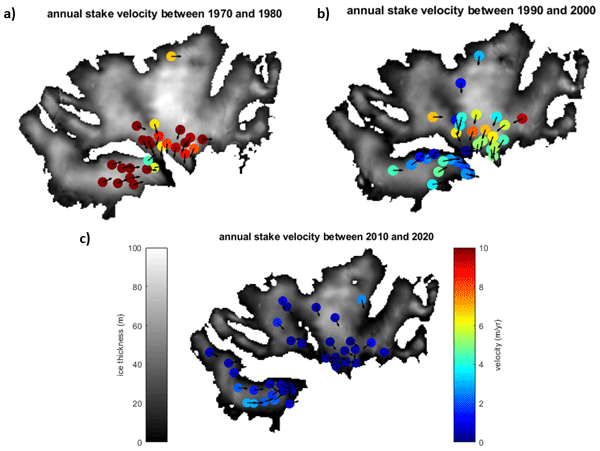
We studied how a glacier in the Austrian Alps moves more slowly over time due to climate change. By combining long-term field data with recent aerial images, we show how thinning reduce glacier flow. Our findings help understand changes in glacier behavior in a warming climate.
Angelika Humbert, Veit Helm, Ole Zeising, Niklas Neckel, Matthias H. Braun, Shfaqat Abbas Khan, Martin Rückamp, Holger Steeb, Julia Sohn, Matthias Bohnen, and Ralf Müller
The Cryosphere, 19, 3009–3032, https://doi.org/10.5194/tc-19-3009-2025, https://doi.org/10.5194/tc-19-3009-2025, 2025
Short summary
Short summary
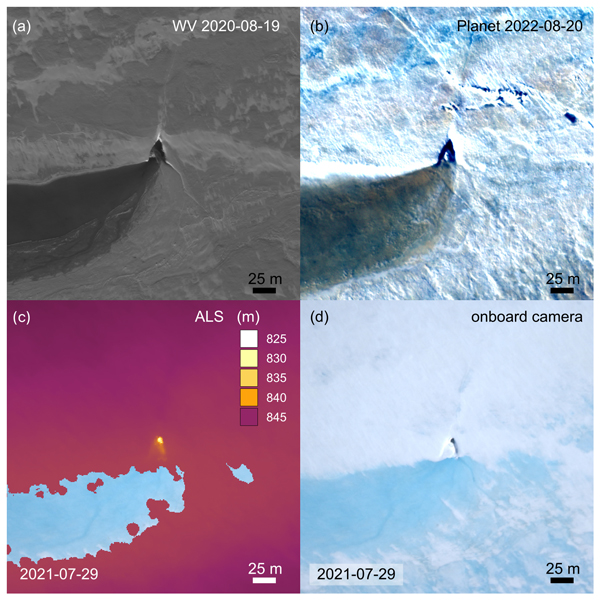
We study the evolution of a massive lake on the Greenland Ice Sheet using satellite and airborne data and some modelling. The lake is emptying rapidly. Water flows to the glacier's base through cracks and triangular-shaped moulins that remain visible over the years. Some of them become reactivated. We find features inside the glacier that stem from drainage events with a width of even 1 km. These features are persistent over the years, although they are changing in shape.

Lea-Sophie Höyns, Thomas Kleiner, Andreas Rademacher, Martin Rückamp, Michael Wolovick, and Angelika Humbert
The Cryosphere, 19, 2133–2158, https://doi.org/10.5194/tc-19-2133-2025, https://doi.org/10.5194/tc-19-2133-2025, 2025
Short summary
Short summary
The sliding of glaciers over bedrock is influenced by water pressure in the underlying hydrological system and the roughness of the land underneath the glacier. We estimate this roughness through a modeling approach that optimizes this unknown parameter. Additionally, we simulate water pressure, enhancing the reliability of the computed drag at the ice sheet base. The resulting data are provided to other modelers and scientists conducting geophysical field observations.
Angelika Humbert, Veit Helm, Niklas Neckel, Ole Zeising, Martin Rückamp, Shfaqat Abbas Khan, Erik Loebel, Jörg Brauchle, Karsten Stebner, Dietmar Gross, Rabea Sondershaus, and Ralf Müller
The Cryosphere, 17, 2851–2870, https://doi.org/10.5194/tc-17-2851-2023, https://doi.org/10.5194/tc-17-2851-2023, 2023
Short summary
Short summary
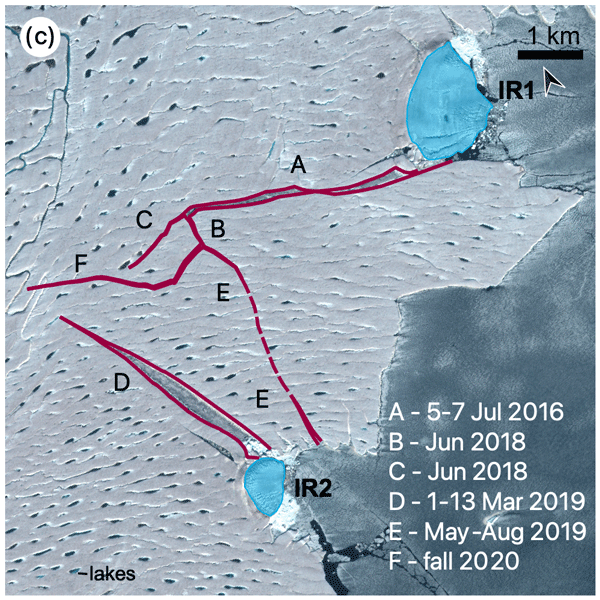
The largest floating glacier mass in Greenland, the 79° N Glacier, is showing signs of instability. We investigate how crack formation at the glacier's calving front has changed over the last decades by using satellite imagery and airborne data. The calving front is about to lose contact to stabilizing ice islands. Simulations show that the glacier will accelerate as a result of this, leading to an increase in ice discharge of more than 5.1 % if its calving front retreats by 46 %.
Yannic Fischler, Martin Rückamp, Christian Bischof, Vadym Aizinger, Mathieu Morlighem, and Angelika Humbert
Geosci. Model Dev., 15, 3753–3771, https://doi.org/10.5194/gmd-15-3753-2022, https://doi.org/10.5194/gmd-15-3753-2022, 2022
Short summary
Short summary
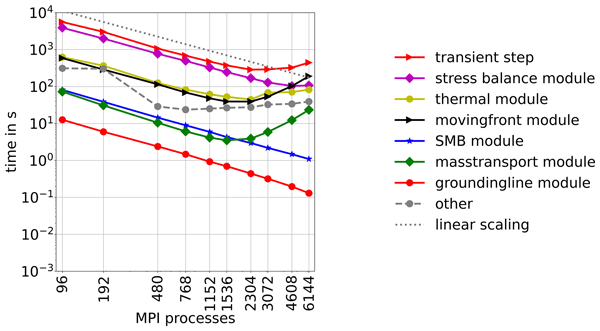
Ice sheet models are used to simulate the changes of ice sheets in future but are currently often run in coarse resolution and/or with neglecting important physics to make them affordable in terms of computational costs. We conducted a study simulating the Greenland Ice Sheet in high resolution and adequate physics to test where the ISSM ice sheet code is using most time and what could be done to improve its performance for future computer architectures that allow massive parallel computing.
Martin Rückamp, Thomas Kleiner, and Angelika Humbert
The Cryosphere, 16, 1675–1696, https://doi.org/10.5194/tc-16-1675-2022, https://doi.org/10.5194/tc-16-1675-2022, 2022
Short summary
Short summary
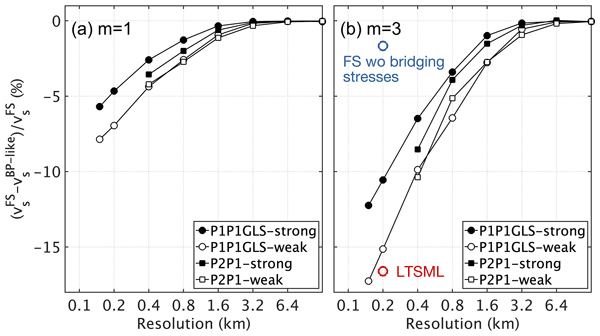
We present a comparative modelling study between the full-Stokes (FS) and Blatter–Pattyn (BP) approximation applied to the Northeast Greenland Ice Stream. Both stress regimes are implemented in one single ice sheet code to eliminate numerical issues. The simulations unveil minor differences in the upper ice stream but become considerable at the grounding line of the 79° North Glacier. Model differences are stronger for a power-law friction than a linear friction law.
Mariia Usoltseva, Roland Pail, Christoph Mayer, Martin Rückamp, and Anja Wendt
EGUsphere, https://doi.org/10.5194/egusphere-2026-4284, https://doi.org/10.5194/egusphere-2026-4284, 2026
This preprint is open for discussion and under review for The Cryosphere (TC).
Short summary
Short summary
This study investigates how two neighbouring glaciers in southern Chile changed between 2000 and 2026 using digital elevation models and climate data. Although both glaciers experienced warming temperatures and reduced snowfall, their responses were very different. The glacier with large outlets at low elevations lost mass rapidly, while the ice-cap glacier remained relatively stable for longer. The results show that glacier shape strongly influences how glaciers respond to climate change.
Lea Hartl, Jakob Abermann, Ayla Akgün, Giulia Bertolotti, Tobias Bolch, Svenja Conzelmann, Codrut-Andrei Diaconu, Iris Hansche, Anne Hartig, Anna Haut, Kay Helfricht, Bernhard Hynek, Marie Sophie Kaucher, Andreas Kellerer-Pirklbauer, Ann Christin Kogel, Julie Krippes, Marcela Violeta Lauria, Christoph Mayer, Jan-Christoph Otto, Rainer Prinz, Sina Prölß, Lorenzo Rieg, Lea Schönleber, Gabriele Schwaizer, Bernd Seiser, Martin Stocker-Waldhuber, Markus Strudl, Martin Verhounik, and Harald Zandler
The Cryosphere, 20, 5157–5180, https://doi.org/10.5194/tc-20-5157-2026, https://doi.org/10.5194/tc-20-5157-2026, 2026
Short summary
Short summary
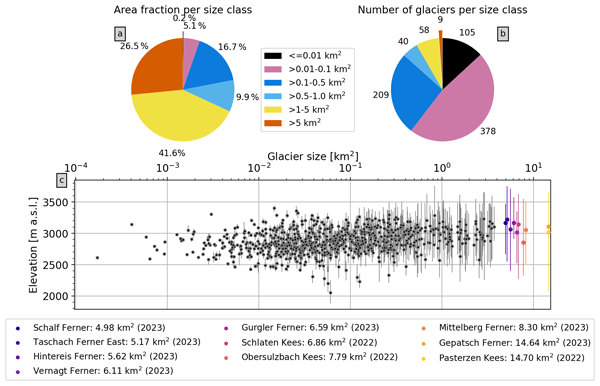
We mapped glacier outlines in Austria using recent, high resolution imagery. The resulting glacier inventory provides an update on glacier area in Austria in 2021-2023. More than 30% of glacier area was lost and 95 glaciers have disappeared since the mid-2000s. Glacier recession is accelerating and regular updates to glacier inventories are needed to understand downstream changes to the hydrological system, quantify glacier mass loss, and support planning and adaptation measures.
Celia A. Baumhoer, Selina Straßburger, Sarah Leibrock, Andreas J. Dietz, and Christoph Mayer
EGUsphere, https://doi.org/10.5194/egusphere-2026-4768, https://doi.org/10.5194/egusphere-2026-4768, 2026
This preprint is open for discussion and under review for The Cryosphere (TC).
Short summary
Short summary
As glaciers move, cracks called crevasses form, and knowing where they occur matters both for science and for safety. We created the first nationwide map of visible crevasses across all glaciers in Austria, using aerial images. We found that crevasses are most common on steep, fast-moving glaciers and rarer on large, gently sloping ones, with surface shape and flow influencing where they appear. This dataset is already being used to improve hiking maps, helping people plan safer mountain routes
Akash M. Patil, Christoph Mayer, Theo M. Jenk, Astrid Lambrecht, Thorsten Seehaus, Alexander R. Groos, and Michelle Worek
The Cryosphere, 20, 4927–4955, https://doi.org/10.5194/tc-20-4927-2026, https://doi.org/10.5194/tc-20-4927-2026, 2026
Short summary
Short summary
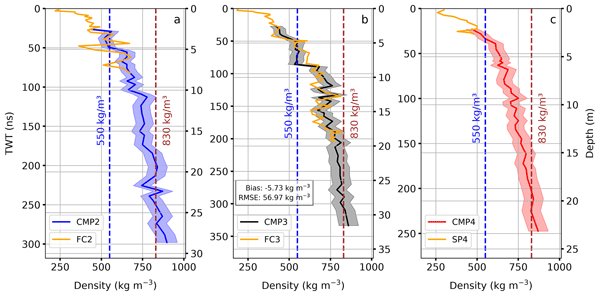
Our study focused on understanding how a warming climate affects the Aletsch Glacier accumulation area. We used multi-year radar measurements and direct firn‑core analyses to estimate changes in density and compaction rate of snow-to-ice over a year. Our results show that the upper layers of the glacier are changing faster due to stronger summer melt in the lower parts of the accumulation zone. Our findings help to improve firn densification models and glacier mass-balance estimation.
Richard Ladstädter, Karlheinz Gutjahr, Erich Riegler, and Roland Perko
Int. Arch. Photogramm. Remote Sens. Spatial Inf. Sci., XLIX-B1-2026, 103–112, https://doi.org/10.5194/isprs-archives-XLIX-B1-2026-103-2026, https://doi.org/10.5194/isprs-archives-XLIX-B1-2026-103-2026, 2026
Mansa Krishna, Gong Cheng, and Mathieu Morlighem
The Cryosphere, 20, 3533–3558, https://doi.org/10.5194/tc-20-3533-2026, https://doi.org/10.5194/tc-20-3533-2026, 2026
Short summary
Short summary
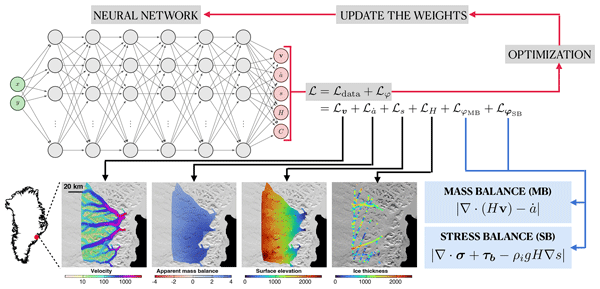
Estimates of the Greenland Ice Sheet’s contribution to sea level rise are affected by uncertainties in the bed topography. Traditional, physics-based methods for inferring the bed elevation are limited to fast-flowing areas of the ice sheet. We use machine learning models informed with two physical laws to infer the bed elevation for different regions in Greenland, showing that this method can be used to infer the bed elevation in slower-moving, sparsely surveyed regions of the ice sheet.
James R. Jordan, Frank Pattyn, Daniel Abele, Torsten Albrecht, Jorge Alvarez-Solas, Jowan M. Barnes, Tijn Berends, Jorge A. Bernales, Javier Blasco, Gong Cheng, Youngmin Choi, Stephen L. Cornford, Cruz Garcia-Molina, Fabien Gillet-Chaulet, G. Hilmar Gudmundsson, Angelika Humbert, Gunter R. Leguy, William H. Lipscomb, Marisa Montoya, Daniel Moreno-Parada, Mathieu Morlighem, Tyler Pelle, Alexander Robinson, Martin Rückamp, Hélène Seroussi, Yanmei Tian, Luisa Wagner, Roderick S. W. van de Wal, Liyun Zhao, and Thomas Zwinger
EGUsphere, https://doi.org/10.5194/egusphere-2026-1962, https://doi.org/10.5194/egusphere-2026-1962, 2026
Short summary
Short summary
Ice calving is a recent inclusion in ice sheet models and there has not been a systematic test of how well it has been implemented. We show that models can accurately represent a given rate of ice calving, properties at the ice front evolve smoothly during calving, and that there are no consistent differences in ice behaviour between various approaches to representing calving in numerical ice models. This gives us confidence in their ability for use in sea level rise prediction simulations.
Theresa Dobler, Wilfried Hagg, Martin Rückamp, Thorsten Seehaus, and Christoph Mayer
The Cryosphere, 20, 2531–2555, https://doi.org/10.5194/tc-20-2531-2026, https://doi.org/10.5194/tc-20-2531-2026, 2026
Short summary
Short summary
We studied how a glacier in the Austrian Alps moves more slowly over time due to climate change. By combining long-term field data with recent aerial images, we show how thinning reduce glacier flow. Our findings help understand changes in glacier behavior in a warming climate.
Yinhe Liu, Yingxin Wu, Faith Karanja, Xian Xu, Mark K. Boitt, Ruiyi Yang, Petri Pellikka, and Yanfei Zhong
Int. Arch. Photogramm. Remote Sens. Spatial Inf. Sci., XLVIII-4-W21-2025, 19–24, https://doi.org/10.5194/isprs-archives-XLVIII-4-W21-2025-19-2026, https://doi.org/10.5194/isprs-archives-XLVIII-4-W21-2025-19-2026, 2026
Francesca Pellicciotti, Adrià Fontrodona-Bach, David R. Rounce, Catriona L. Fyffe, Leif S. Anderson, Álvaro Ayala, Ben W. Brock, Pascal Buri, Stefan Fugger, Koji Fujita, Prateek Gantayat, Alexander R. Groos, Walter Immerzeel, Marin Kneib, Christoph Mayer, Shelley MacDonell, Michael McCarthy, James McPhee, Evan Miles, Heather Purdie, Ekaterina Rets, Akiko Sakai, Thomas E. Shaw, Jakob Steiner, Patrick Wagnon, and Alex Winter-Billington
The Cryosphere, 20, 1895–1928, https://doi.org/10.5194/tc-20-1895-2026, https://doi.org/10.5194/tc-20-1895-2026, 2026
Short summary
Short summary
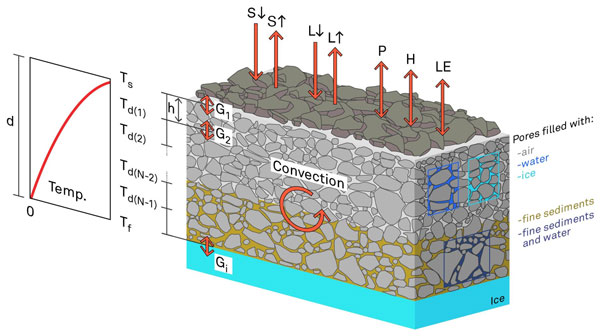
Rock debris covers many of the world glaciers, modifying the transfer of atmospheric energy to the debris and into the ice. Models of different complexity simulate this process, and we compare 15 models at 9 sites to show that the most complex models at the debris-atmosphere interface have the highest performance. However, we lack debris properties and their derivation from measurements is ambiguous, hindering global modelling and calling for both model development and data collection.
Bo Tang, Pengfeng Xiao, Xueliang Zhang, Hao Liu, Yantao Liu, Petri Pellikka, Yumeng Jia, and Jinhang Wu
EGUsphere, https://doi.org/10.5194/egusphere-2026-242, https://doi.org/10.5194/egusphere-2026-242, 2026
Short summary
Short summary
Our study reveals how snowpack changes affect winter ecosystem respiration across the northern hemisphere through snowpack insulation. The effects of snowpack (depth, density, and duration) on winter ecosystem respiration are more crucial and widespread than climate factors. We found examining these factors in isolation could considerably underestimate the impact of snowpack on winter ecosystem respiration. Our findings provide insights for improving climate-carbon feedback predictions.
Muhammad Shafeeque, Jan-Hendrik Malles, Anouk Vlug, Marco Möller, and Ben Marzeion
The Cryosphere, 20, 875–903, https://doi.org/10.5194/tc-20-875-2026, https://doi.org/10.5194/tc-20-875-2026, 2026
Short summary
Short summary
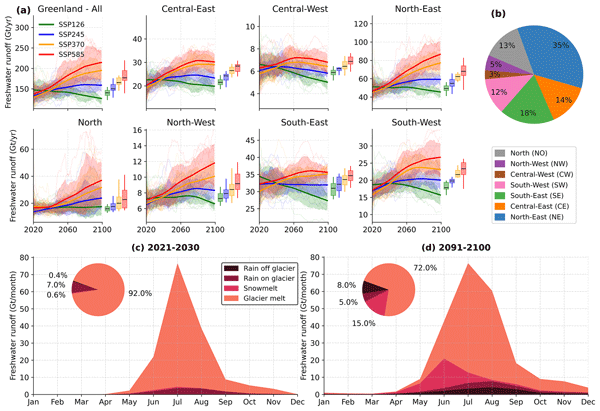
This study projects Greenland's peripheral glaciers' response to climate change using the Open Global Glacier Model (OGGM). They may lose up to 52 % of ice mass by 2100. We predict changes in ice discharge versus melting, affecting fjords, sea levels, and ocean currents. Freshwater runoff composition and peak water timing vary by region and scenario. Our findings highlight the importance of reducing emissions to minimize impacts on these glaciers and their influence on ecosystems.
Akash M. Patil, Christoph Mayer, Thorsten Seehaus, Alexander R. Groos, and Andreas Bauder
The Cryosphere, 19, 5547–5577, https://doi.org/10.5194/tc-19-5547-2025, https://doi.org/10.5194/tc-19-5547-2025, 2025
Short summary
Short summary
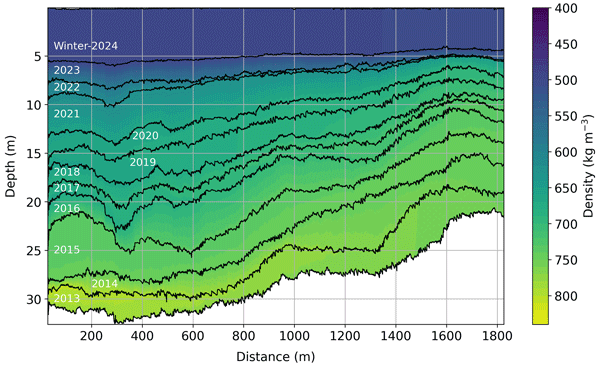
We studied how the density of snow to ice transition varies with depth in the Aletsch glacier using radar-based field measurements and some simple models. We showed that it is possible to track how much snow has accumulated in the last 10–14 years. This helps improve the uncertainties in glacier mass balance estimates. Overall, by utilising non-invasive radar techniques and models, we provide a novel approach to understanding the evolution of glaciers under regional climate conditions.
Gong Cheng, Mansa Krishna, and Mathieu Morlighem
Geosci. Model Dev., 18, 5311–5327, https://doi.org/10.5194/gmd-18-5311-2025, https://doi.org/10.5194/gmd-18-5311-2025, 2025
Short summary
Short summary
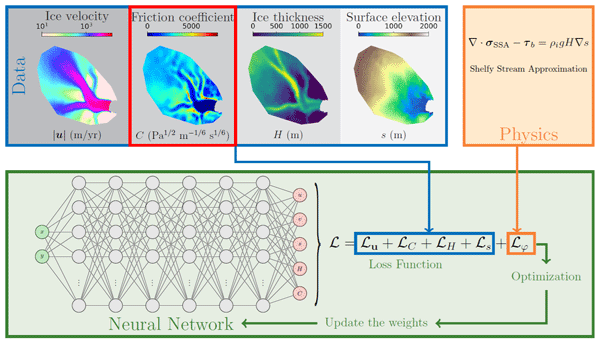
Predicting ice sheet contributions to sea level rise is challenging due to limited data and uncertainties in key processes. Traditional models require complex methods that lack flexibility. We developed PINNICLE (Physics-Informed Neural Networks for Ice and CLimatE), an open-source Python library that integrates machine learning with physical laws to improve ice sheet modeling. By combining data and physics, PINNICLE enhances predictions and adaptability, providing a powerful tool for climate research and sea level rise projections.
Angelika Humbert, Veit Helm, Ole Zeising, Niklas Neckel, Matthias H. Braun, Shfaqat Abbas Khan, Martin Rückamp, Holger Steeb, Julia Sohn, Matthias Bohnen, and Ralf Müller
The Cryosphere, 19, 3009–3032, https://doi.org/10.5194/tc-19-3009-2025, https://doi.org/10.5194/tc-19-3009-2025, 2025
Short summary
Short summary
We study the evolution of a massive lake on the Greenland Ice Sheet using satellite and airborne data and some modelling. The lake is emptying rapidly. Water flows to the glacier's base through cracks and triangular-shaped moulins that remain visible over the years. Some of them become reactivated. We find features inside the glacier that stem from drainage events with a width of even 1 km. These features are persistent over the years, although they are changing in shape.
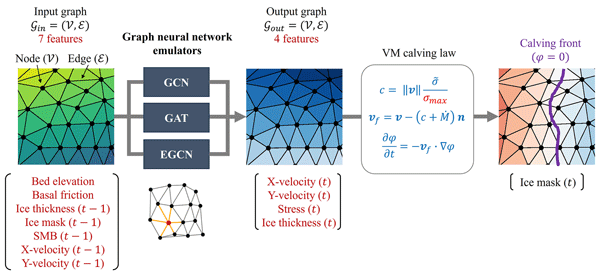
Younghyun Koo, Gong Cheng, Mathieu Morlighem, and Maryam Rahnemoonfar
The Cryosphere, 19, 2583–2599, https://doi.org/10.5194/tc-19-2583-2025, https://doi.org/10.5194/tc-19-2583-2025, 2025
Short summary
Short summary
Calving, the breaking of ice bodies from the terminus of a glacier, plays an important role in the mass losses of Greenland ice sheets. However, calving parameters have been poorly understood because of the intensive computational demands of traditional numerical models. To address this issue and find the optimal calving parameter that best represents real observations, we develop deep-learning emulators based on graph neural network architectures.
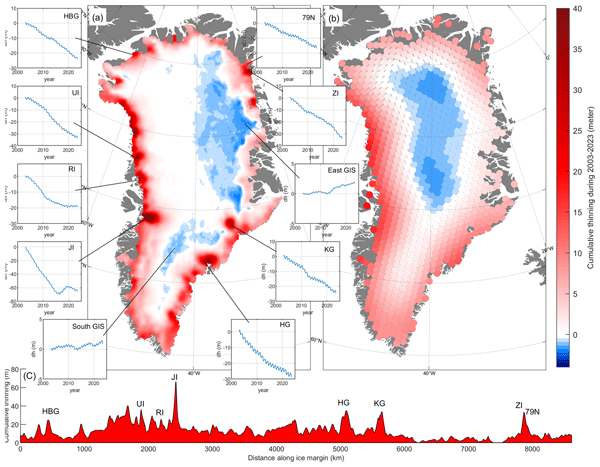
Shfaqat A. Khan, Helene Seroussi, Mathieu Morlighem, William Colgan, Veit Helm, Gong Cheng, Danjal Berg, Valentina R. Barletta, Nicolaj K. Larsen, William Kochtitzky, Michiel van den Broeke, Kurt H. Kjær, Andy Aschwanden, Brice Noël, Jason E. Box, Joseph A. MacGregor, Robert S. Fausto, Kenneth D. Mankoff, Ian M. Howat, Kuba Oniszk, Dominik Fahrner, Anja Løkkegaard, Eigil Y. H. Lippert, Alicia Bråtner, and Javed Hassan
Earth Syst. Sci. Data, 17, 3047–3071, https://doi.org/10.5194/essd-17-3047-2025, https://doi.org/10.5194/essd-17-3047-2025, 2025
Short summary
Short summary
The surface elevation of the Greenland Ice Sheet is changing due to surface mass balance processes and ice dynamics, each exhibiting distinct spatiotemporal patterns. Here, we employ satellite and airborne altimetry data with fine spatial (1 km) and temporal (monthly) resolutions to document this spatiotemporal evolution from 2003 to 2023. This dataset of fine-resolution altimetry data in both space and time will support studies of ice mass loss and be useful for GIS ice sheet modeling.
Lea-Sophie Höyns, Thomas Kleiner, Andreas Rademacher, Martin Rückamp, Michael Wolovick, and Angelika Humbert
The Cryosphere, 19, 2133–2158, https://doi.org/10.5194/tc-19-2133-2025, https://doi.org/10.5194/tc-19-2133-2025, 2025
Short summary
Short summary
The sliding of glaciers over bedrock is influenced by water pressure in the underlying hydrological system and the roughness of the land underneath the glacier. We estimate this roughness through a modeling approach that optimizes this unknown parameter. Additionally, we simulate water pressure, enhancing the reliability of the computed drag at the ice sheet base. The resulting data are provided to other modelers and scientists conducting geophysical field observations.
Richard Ladstädter, Karlheinz Gutjahr, Roland Perko, and Helmut Woschitz
Int. Arch. Photogramm. Remote Sens. Spatial Inf. Sci., XLVIII-1-W4-2025, 73–80, https://doi.org/10.5194/isprs-archives-XLVIII-1-W4-2025-73-2025, https://doi.org/10.5194/isprs-archives-XLVIII-1-W4-2025-73-2025, 2025
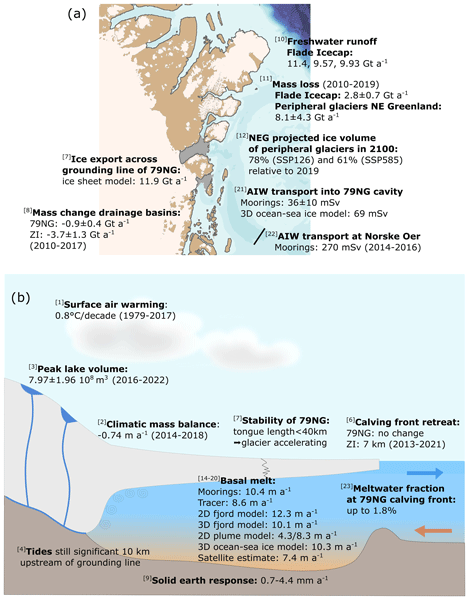
Torsten Kanzow, Angelika Humbert, Thomas Mölg, Mirko Scheinert, Matthias Braun, Hans Burchard, Francesca Doglioni, Philipp Hochreuther, Martin Horwath, Oliver Huhn, Maria Kappelsberger, Jürgen Kusche, Erik Loebel, Katrina Lutz, Ben Marzeion, Rebecca McPherson, Mahdi Mohammadi-Aragh, Marco Möller, Carolyne Pickler, Markus Reinert, Monika Rhein, Martin Rückamp, Janin Schaffer, Muhammad Shafeeque, Sophie Stolzenberger, Ralph Timmermann, Jenny Turton, Claudia Wekerle, and Ole Zeising
The Cryosphere, 19, 1789–1824, https://doi.org/10.5194/tc-19-1789-2025, https://doi.org/10.5194/tc-19-1789-2025, 2025
Short summary
Short summary
The Greenland Ice Sheet represents the second-largest contributor to global sea-level rise. We quantify atmosphere, ice and ocean processes related to the mass balance of glaciers in northeast Greenland, focusing on Greenland’s largest floating ice tongue, the 79° N Glacier. We find that together, the different in situ and remote sensing observations and model simulations reveal a consistent picture of a coupled atmosphere–ice sheet–ocean system that has entered a phase of major change.
Janne Heiskanen, Hanna Haurinen, Chemuku Wekesa, and Petri Pellikka
ISPRS Ann. Photogramm. Remote Sens. Spatial Inf. Sci., X-3-2024, 179–185, https://doi.org/10.5194/isprs-annals-X-3-2024-179-2024, https://doi.org/10.5194/isprs-annals-X-3-2024-179-2024, 2024
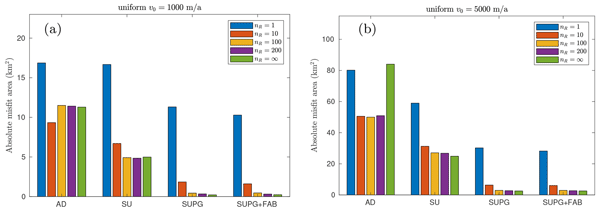
Gong Cheng, Mathieu Morlighem, and G. Hilmar Gudmundsson
Geosci. Model Dev., 17, 6227–6247, https://doi.org/10.5194/gmd-17-6227-2024, https://doi.org/10.5194/gmd-17-6227-2024, 2024
Short summary
Short summary
We conducted a comprehensive analysis of the stabilization and reinitialization techniques currently employed in ISSM and Úa for solving level-set equations, specifically those related to the dynamic representation of moving ice fronts within numerical ice sheet models. Our results demonstrate that the streamline upwind Petrov–Galerkin (SUPG) method outperforms the other approaches. We found that excessively frequent reinitialization can lead to exceptionally high errors in simulations.
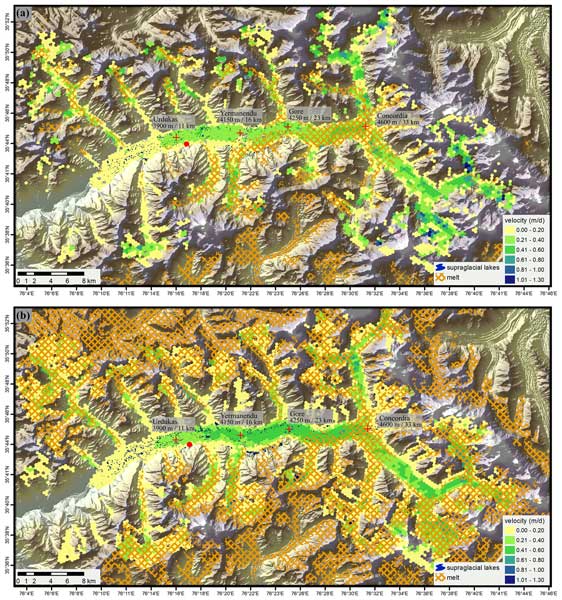
Anna Wendleder, Jasmin Bramboeck, Jamie Izzard, Thilo Erbertseder, Pablo d'Angelo, Andreas Schmitt, Duncan J. Quincey, Christoph Mayer, and Matthias H. Braun
The Cryosphere, 18, 1085–1103, https://doi.org/10.5194/tc-18-1085-2024, https://doi.org/10.5194/tc-18-1085-2024, 2024
Short summary
Short summary
This study analyses the basal sliding and the hydrological drainage of Baltoro Glacier, Pakistan. The surface velocity was characterized by a spring speed-up, summer peak, and autumn speed-up. Snow melt has the largest impact on the spring speed-up, summer velocity peak, and the transition from inefficient to efficient drainage. Drainage from supraglacial lakes contributed to the fall speed-up. Increased summer temperatures will intensify the magnitude of meltwater and thus surface velocities.
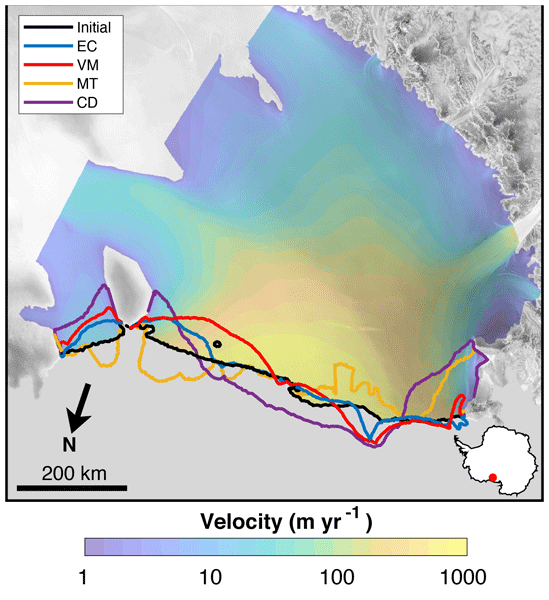
Joel A. Wilner, Mathieu Morlighem, and Gong Cheng
The Cryosphere, 17, 4889–4901, https://doi.org/10.5194/tc-17-4889-2023, https://doi.org/10.5194/tc-17-4889-2023, 2023
Short summary
Short summary
We use numerical modeling to study iceberg calving off of ice shelves in Antarctica. We examine four widely used mathematical descriptions of calving (
calving laws), under the assumption that Antarctic ice shelf front positions should be in steady state under the current climate forcing. We quantify how well each of these calving laws replicates the observed front positions. Our results suggest that the eigencalving and von Mises laws are most suitable for Antarctic ice shelves.
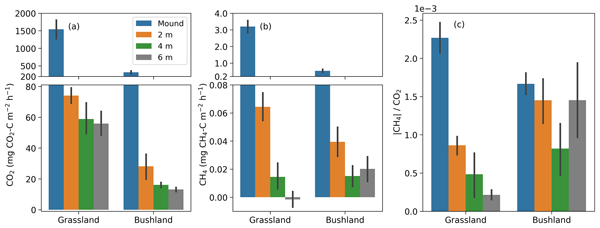
Matti Räsänen, Risto Vesala, Petri Rönnholm, Laura Arppe, Petra Manninen, Markus Jylhä, Jouko Rikkinen, Petri Pellikka, and Janne Rinne
Biogeosciences, 20, 4029–4042, https://doi.org/10.5194/bg-20-4029-2023, https://doi.org/10.5194/bg-20-4029-2023, 2023
Short summary
Short summary
Fungus-growing termites recycle large parts of dead plant material in African savannas and are significant sources of greenhouse gases. We measured CO2 and CH4 fluxes from their mounds and surrounding soils in open and closed habitats. The fluxes scale with mound volume. The results show that emissions from mounds of fungus-growing termites are more stable than those from other termites. The soil fluxes around the mound are affected by the termite colonies at up to 2 m distance from the mound.
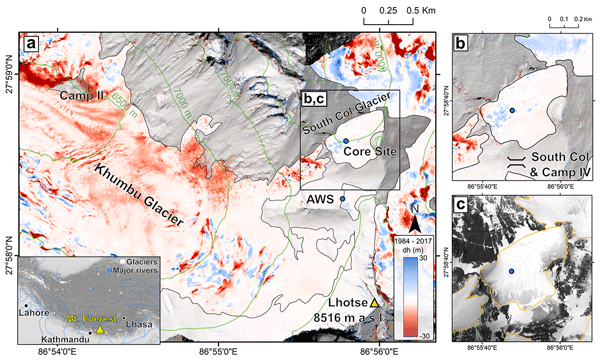
Fanny Brun, Owen King, Marion Réveillet, Charles Amory, Anton Planchot, Etienne Berthier, Amaury Dehecq, Tobias Bolch, Kévin Fourteau, Julien Brondex, Marie Dumont, Christoph Mayer, Silvan Leinss, Romain Hugonnet, and Patrick Wagnon
The Cryosphere, 17, 3251–3268, https://doi.org/10.5194/tc-17-3251-2023, https://doi.org/10.5194/tc-17-3251-2023, 2023
Short summary
Short summary
The South Col Glacier is a small body of ice and snow located on the southern ridge of Mt. Everest. A recent study proposed that South Col Glacier is rapidly losing mass. In this study, we examined the glacier thickness change for the period 1984–2017 and found no thickness change. To reconcile these results, we investigate wind erosion and surface energy and mass balance and find that melt is unlikely a dominant process, contrary to previous findings.
Angelika Humbert, Veit Helm, Niklas Neckel, Ole Zeising, Martin Rückamp, Shfaqat Abbas Khan, Erik Loebel, Jörg Brauchle, Karsten Stebner, Dietmar Gross, Rabea Sondershaus, and Ralf Müller
The Cryosphere, 17, 2851–2870, https://doi.org/10.5194/tc-17-2851-2023, https://doi.org/10.5194/tc-17-2851-2023, 2023
Short summary
Short summary
The largest floating glacier mass in Greenland, the 79° N Glacier, is showing signs of instability. We investigate how crack formation at the glacier's calving front has changed over the last decades by using satellite imagery and airborne data. The calving front is about to lose contact to stabilizing ice islands. Simulations show that the glacier will accelerate as a result of this, leading to an increase in ice discharge of more than 5.1 % if its calving front retreats by 46 %.

Lena Katharina Schmidt, Till Francke, Peter Martin Grosse, Christoph Mayer, and Axel Bronstert
Hydrol. Earth Syst. Sci., 27, 1841–1863, https://doi.org/10.5194/hess-27-1841-2023, https://doi.org/10.5194/hess-27-1841-2023, 2023
Short summary
Short summary
We present a suitable method to reconstruct sediment export from decadal records of hydroclimatic predictors (discharge, precipitation, temperature) and shorter suspended sediment measurements. This lets us fill the knowledge gap on how sediment export from glacierized high-alpine areas has responded to climate change. We find positive trends in sediment export from the two investigated nested catchments with step-like increases around 1981 which are linked to crucial changes in glacier melt.
Iris Johanna Aalto, Eduardo Eiji Maeda, Janne Heiskanen, Eljas Kullervo Aalto, and Petri Kauko Emil Pellikka
Biogeosciences, 19, 4227–4247, https://doi.org/10.5194/bg-19-4227-2022, https://doi.org/10.5194/bg-19-4227-2022, 2022
Short summary
Short summary
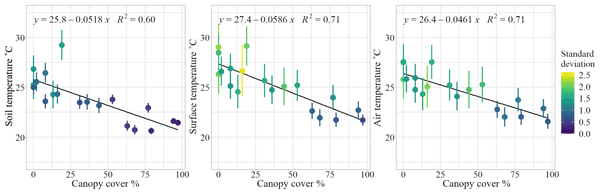
Tree canopies are strong moderators of understory climatic conditions. In tropical areas, trees cool down the microclimates. Using remote sensing and field measurements we show how even intermediate canopy cover and agroforestry trees contributed to buffering the hottest temperatures in Kenya. The cooling effect was the greatest during hot days and in lowland areas, where the ambient temperatures were high. Adopting agroforestry practices in the area could assist in mitigating climate change.

Astrid Oetting, Emma C. Smith, Jan Erik Arndt, Boris Dorschel, Reinhard Drews, Todd A. Ehlers, Christoph Gaedicke, Coen Hofstede, Johann P. Klages, Gerhard Kuhn, Astrid Lambrecht, Andreas Läufer, Christoph Mayer, Ralf Tiedemann, Frank Wilhelms, and Olaf Eisen
The Cryosphere, 16, 2051–2066, https://doi.org/10.5194/tc-16-2051-2022, https://doi.org/10.5194/tc-16-2051-2022, 2022
Short summary
Short summary
This study combines a variety of geophysical measurements in front of and beneath the Ekström Ice Shelf in order to identify and interpret geomorphological evidences of past ice sheet flow, extent and retreat.
The maximal extent of grounded ice in this region was 11 km away from the continental shelf break.
The thickness of palaeo-ice on the calving front around the LGM was estimated to be at least 305 to 320 m.
We provide essential boundary conditions for palaeo-ice-sheet models.
Yannic Fischler, Martin Rückamp, Christian Bischof, Vadym Aizinger, Mathieu Morlighem, and Angelika Humbert
Geosci. Model Dev., 15, 3753–3771, https://doi.org/10.5194/gmd-15-3753-2022, https://doi.org/10.5194/gmd-15-3753-2022, 2022
Short summary
Short summary
Ice sheet models are used to simulate the changes of ice sheets in future but are currently often run in coarse resolution and/or with neglecting important physics to make them affordable in terms of computational costs. We conducted a study simulating the Greenland Ice Sheet in high resolution and adequate physics to test where the ISSM ice sheet code is using most time and what could be done to improve its performance for future computer architectures that allow massive parallel computing.
Martin Rückamp, Thomas Kleiner, and Angelika Humbert
The Cryosphere, 16, 1675–1696, https://doi.org/10.5194/tc-16-1675-2022, https://doi.org/10.5194/tc-16-1675-2022, 2022
Short summary
Short summary
We present a comparative modelling study between the full-Stokes (FS) and Blatter–Pattyn (BP) approximation applied to the Northeast Greenland Ice Stream. Both stress regimes are implemented in one single ice sheet code to eliminate numerical issues. The simulations unveil minor differences in the upper ice stream but become considerable at the grounding line of the 79° North Glacier. Model differences are stronger for a power-law friction than a linear friction law.
Peifeng Su, Jorma Joutsensaari, Lubna Dada, Martha Arbayani Zaidan, Tuomo Nieminen, Xinyang Li, Yusheng Wu, Stefano Decesari, Sasu Tarkoma, Tuukka Petäjä, Markku Kulmala, and Petri Pellikka
Atmos. Chem. Phys., 22, 1293–1309, https://doi.org/10.5194/acp-22-1293-2022, https://doi.org/10.5194/acp-22-1293-2022, 2022
Short summary
Short summary
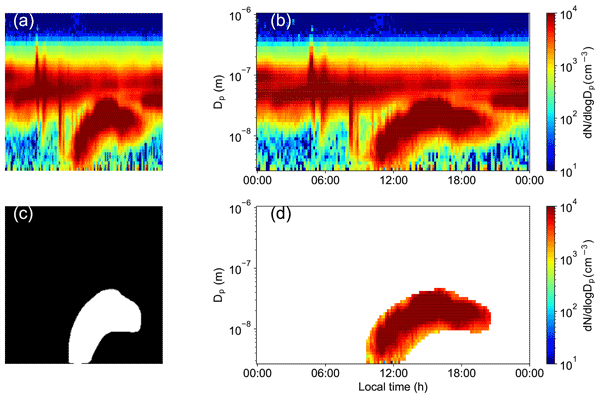
We regarded the banana shapes in the surface plots as a special kind of object (similar to cats) and applied an instance segmentation technique to automatically identify the new particle formation (NPF) events (especially the strongest ones), in addition to their growth rates, start times, and end times. The automatic method generalized well on datasets collected in different sites, which is useful for long-term data series analysis and obtaining statistical properties of NPF events.
Cited articles
Alduchov, O. A. and Eskridge, R. E.: Improved Magnus Form Approximation of Saturation Vapor Pressure, Journal of Applied Meteorology (1988–2005), 35, 601–609, http://www.jstor.org/stable/26187406 (last access: 11 May 2026), 1996. a
Bauder, A., Funk, M., and Huss, M.: Ice-volume changes of selected glaciers in the Swiss Alps since the end of the 19th century, Ann. Glaciol., 46, 145–149, https://doi.org/10.3189/172756407782871701, 2007. a
Bondzio, J. H., Seroussi, H., Morlighem, M., Kleiner, T., Rückamp, M., Humbert, A., and Larour, E. Y.: Modelling calving front dynamics using a level-set method: application to Jakobshavn Isbræ, West Greenland, The Cryosphere, 10, 497–510, https://doi.org/10.5194/tc-10-497-2016, 2016. a
Borstad, C. P., Rignot, E., Mouginot, J., and Schodlok, M. P.: Creep deformation and buttressing capacity of damaged ice shelves: theory and application to Larsen C ice shelf, The Cryosphere, 7, 1931–1947, https://doi.org/10.5194/tc-7-1931-2013, 2013. a
Brooks, A. N. and Hughes, T. J.: Streamline upwind/Petrov-Galerkin formulations for convection dominated flows with particular emphasis on the incompressible Navier-Stokes equations, Comput. Method. Appl. M., 32, 199–259, https://doi.org/10.1016/0045-7825(82)90071-8, 1982. a
Chadwick, C., Gironás, J., González-Leiva, F., and Aedo, S.: Bias adjustment to preserve changes in variability: the unbiased mapping of GCM changes, Hydrolog. Sci. J., 68, 1184–1201, https://doi.org/10.1080/02626667.2023.2201450, 2023. a, b
Chen, C. and Zebker, H.: Phase unwrapping for large SAR interferograms: statistical segmentation and generalized network models, IEEE T. Geosci. Remote, 40, 1709–1719, https://doi.org/10.1109/tgrs.2002.802453, 2002. a
Cheng, G., Lötstedt, P., and von Sydow, L.: A full Stokes subgrid scheme in two dimensions for simulation of grounding line migration in ice sheets using Elmer/ICE (v8.3), Geosci. Model Dev., 13, 2245–2258, https://doi.org/10.5194/gmd-13-2245-2020, 2020. a
Cheng, G., Morlighem, M., and Gudmundsson, G. H.: Numerical stabilization methods for level-set-based ice front migration, Geosci. Model Dev., 17, 6227–6247, https://doi.org/10.5194/gmd-17-6227-2024, 2024. a
Cook, S. J., Jouvet, G., Millan, R., Rabatel, A., Zekollari, H., and Dussaillant, I.: Committed Ice Loss in the European Alps Until 2050 Using a Deep-Learning-Aided 3D Ice-Flow Model With Data Assimilation, Geophys. Res. Lett., 50, e2023GL105029, https://doi.org/10.1029/2023GL105029, 2023. a, b, c
Courant, R., Friedrichs, K., and Lewy, H.: Über die Partiellen Differenzengleichungen der Mathematischen Physik, Math. Ann., 100, 32–74, 1928. a
Cuffey, K. M. and Paterson, W. S. B.: The physics of glaciers, Academic Press, 4 edn., ISBN 978-0-12-369461-4, 2010. a
Dussaillant, I., Hugonnet, R., Huss, M., Berthier, E., Bannwart, J., Paul, F., and Zemp, M.: Annual mass change of the world's glaciers from 1976 to 2024 by temporal downscaling of satellite data with in situ observations, Earth Syst. Sci. Data, 17, 1977–2006, https://doi.org/10.5194/essd-17-1977-2025, 2025. a
Evatt, G. W., Abrahams, I. D., Heil, M., Mayer, C., Kingslake, J., Mitchell, S. L., Fowler, A. C., and Clark, C. D.: Glacial melt under a porous debris layer, J. Glaciol., 61, 825–836, https://doi.org/10.3189/2015JoG14J235, 2015. a, b, c, d
Eyring, V., Bony, S., Meehl, G. A., Senior, C. A., Stevens, B., Stouffer, R. J., and Taylor, K. E.: Overview of the Coupled Model Intercomparison Project Phase 6 (CMIP6) experimental design and organization, Geosci. Model Dev., 9, 1937–1958, https://doi.org/10.5194/gmd-9-1937-2016, 2016. a
Farinotti, D., Huss, M., Bauder, A., and Funk, M.: An estimate of the glacier ice volume in the Swiss Alps, Global Planet. Change, 68, 225–231, https://doi.org/10.1016/j.gloplacha.2009.05.004, 2009. a, b
Ferguson, J. C. and Vieli, A.: Modelling steady states and the transient response of debris-covered glaciers, The Cryosphere, 15, 3377–3399, https://doi.org/10.5194/tc-15-3377-2021, 2021. a
Fischer, A.: Glaciers and climate change: Interpretation of 50 years of direct mass balance of Hintereisferner, Global Planet. Change, 71, 13–26, https://doi.org/10.1016/j.gloplacha.2009.11.014, 2010. a, b, c
Fischer, A. and Kuhn, M.: Ground-penetrating radar measurements of 64 Austrian glaciers between 1995 and 2010, Ann. Glaciol., 54, 179–188, https://doi.org/10.3189/2013aog64a108, 2013. a, b
Fischer, A., Markl, G., and Kuhn, M.: Glacier mass balances and elevation zones of Hintereisferner, Ötztal Alps, Austria, 1952/1953 to 2010/2011, PANGAEA [data set], https://doi.org/10.1594/PANGAEA.818898, 2013. a
Fowler, A. C. and Larson, D. A.: On the flow of polythermal glaciers – I. Model and preliminary analysis, P. R. Soc. Lond. A, 217–242, https://doi.org/10.1098/rspa.1978.0165, 1978. a
Frei, C. and Schär, C.: A precipitation climatology of the Alps from high-resolution rain-gauge observations, Int. J. Climatol., 18, 873–900, https://doi.org/10.1002/(sici)1097-0088(19980630)18:8<873::aid-joc255>3.0.co;2-9, 1998. a
Gabbi, J., Carenzo, M., Pellicciotti, F., Bauder, A., and Funk, M.: A comparison of empirical and physically based glacier surface melt models for long-term simulations of glacier response, J. Glaciol., 60, 1140–1154, https://doi.org/10.3189/2014JoG14J011, 2014. a, b
Gilbert, A., Sinisalo, A., Gurung, T. R., Fujita, K., Maharjan, S. B., Sherpa, T. C., and Fukuda, T.: The influence of water percolation through crevasses on the thermal regime of a Himalayan mountain glacier, The Cryosphere, 14, 1273–1288, https://doi.org/10.5194/tc-14-1273-2020, 2020. a
GlacierMIP: Glacier Model Intercomparison Project, https://climate-cryosphere.org/glaciermip/ (last access: 11 May 2026), 2025. a
GLAMOS: Swiss Glacier Mass Balance (release 2025), Glacier Monitoring Switzerland [data set], https://doi.org/10.18750/MASSBALANCE.2025.R2025, 2025. a, b, c, d
Glen, J. W.: The Creep of Polycrystalline Ice, P. R. Soc. Lond. A, 228, 519–538, https://doi.org/10.1098/rspa.1955.0066, 1955. a
Goelzer, H., Nowicki, S., Edwards, T., Beckley, M., Abe-Ouchi, A., Aschwanden, A., Calov, R., Gagliardini, O., Gillet-Chaulet, F., Golledge, N. R., Gregory, J., Greve, R., Humbert, A., Huybrechts, P., Kennedy, J. H., Larour, E., Lipscomb, W. H., Le clec'h, S., Lee, V., Morlighem, M., Pattyn, F., Payne, A. J., Rodehacke, C., Rückamp, M., Saito, F., Schlegel, N., Seroussi, H., Shepherd, A., Sun, S., van de Wal, R., and Ziemen, F. A.: Design and results of the ice sheet model initialisation experiments initMIP-Greenland: an ISMIP6 intercomparison, The Cryosphere, 12, 1433–1460, https://doi.org/10.5194/tc-12-1433-2018, 2018. a, b
Goelzer, H., Nowicki, S., Payne, A., Larour, E., Seroussi, H., Lipscomb, W. H., Gregory, J., Abe-Ouchi, A., Shepherd, A., Simon, E., Agosta, C., Alexander, P., Aschwanden, A., Barthel, A., Calov, R., Chambers, C., Choi, Y., Cuzzone, J., Dumas, C., Edwards, T., Felikson, D., Fettweis, X., Golledge, N. R., Greve, R., Humbert, A., Huybrechts, P., Le clec'h, S., Lee, V., Leguy, G., Little, C., Lowry, D. P., Morlighem, M., Nias, I., Quiquet, A., Rückamp, M., Schlegel, N.-J., Slater, D. A., Smith, R. S., Straneo, F., Tarasov, L., van de Wal, R., and van den Broeke, M.: The future sea-level contribution of the Greenland ice sheet: a multi-model ensemble study of ISMIP6, The Cryosphere, 14, 3071–3096, https://doi.org/10.5194/tc-14-3071-2020, 2020. a
Grab, M., Mattea, E., Bauder, A., Huss, M., Rabenstein, L., Hodel, E., Linsbauer, A., Langhammer, L., Schmid, L., Church, G., Hellmann, S., Délèze, K., Schaer, P., Lathion, P., Farinotti, D., and Maurer, H.: Ice thickness distribution of all Swiss glaciers based on extended ground-penetrating radar data and glaciological modeling, J. Glaciol., 67, 1074–1092, https://doi.org/10.1017/jog.2021.55, 2021. a
Gresho, P. and Sani, R.: Incompressible flow and the finite element method, vol 1: Advection-diffusion and isothermal laminar flow, J. Fluid Mech., 411, 378–381, 2000. a
Greve, R. and Blatter, H.: Dynamics of Ice Sheets and Glaciers, Springer, Berlin, Germany etc., ISBN 978-3-642-03414-5, https://doi.org/10.1007/978-3-642-03415-2, 2009. a, b
Gutjahr, K. and Rückamp, M.: ERS-1/2 DInSAR surface velocity of Hintereisferner for 1995/1996, Zenodo [data set], https://doi.org/10.5281/zenodo.15269581, 2025. a
Gutjahr, K., Raggam, H., and Franke, M.: Potentials and limitations of Alpine glacier monitoring using differential SAR interferometry, in: Proceedings of 4th Int. Symposium on Retrieval of Bio-and Geophysical Parameters from SAR Data for Land Applications, Innsbruck, Austria, 148–155, https://www.researchgate.net/publication/404723091_POTENTIALS_AND_LIMITATIONS_OF_ALPINE_GLACIER_MONITORING_USING_DIFFERENTIAL_SAR_INTERFEROMETRY#fullTextFileContent (last access: 11 May 2026), 2004. a
Hanzer, F., Förster, K., Nemec, J., and Strasser, U.: Projected cryospheric and hydrological impacts of 21st century climate change in the Ötztal Alps (Austria) simulated using a physically based approach, Hydrol. Earth Syst. Sci., 22, 1593–1614, https://doi.org/10.5194/hess-22-1593-2018, 2018. a, b
Hartl, L., Schmitt, P., Schuster, L., Helfricht, K., Abermann, J., and Maussion, F.: Recent observations and glacier modeling point towards near-complete glacier loss in western Austria (Ötztal and Stubai mountain range) if 1.5 °C is not met, The Cryosphere, 19, 1431–1452, https://doi.org/10.5194/tc-19-1431-2025, 2025. a, b, c
Hersbach, H., Bell, B., Berrisford, P., Hirahara, S., Horányi, A., Muñoz-Sabater, J., Nicolas, J., Peubey, C., Radu, R., Schepers, D., Simmons, A., Soci, C., Abdalla, S., Abellan, X., Balsamo, G., Bechtold, P., Biavati, G., Bidlot, J., Bonavita, M., De Chiara, G., Dahlgren, P., Dee, D., Diamantakis, M., Dragani, R., Flemming, J., Forbes, R., Fuentes, M., Geer, A., Haimberger, L., Healy, S., Hogan, R. J., Hólm, E., Janisková, M., Keeley, S., Laloyaux, P., Lopez, P., Lupu, C., Radnoti, G., de Rosnay, P., Rozum, I., Vamborg, F., Villaume, S., and Thépaut, J.-N.: The ERA5 global reanalysis, Q. J. Roy. Meteor. Soc., 146, 1999–2049, https://doi.org/10.1002/qj.3803, 2020. a
Hindmarsh, R. C. A.: A numerical comparison of approximations to the Stokes equations used in ice sheet and glacier modeling, J. Geophys. Res.-Earth, 109, https://doi.org/10.1029/2003JF000065, 2004. a
Hock, R.: A distributed temperature-index ice- and snowmelt model including potential direct solar radiation, J. Glaciol., 45, 101–111, https://doi.org/10.3189/S0022143000003087, 1999. a
Hock, R., Bliss, A., Marzeion, B., Giesen, R. H., Hirabayashi, Y., Huss, M., Radic, V., and Slangen, A. B. A.: GlacierMIP – A model intercomparison of global-scale glacier mass-balance models and projections, J. Glaciol., 65, 453–467, https://doi.org/10.1017/jog.2019.22, 2019. a
Huss, M. and Hock, R.: A new model for global glacier change and sea-level rise, Frontiers in Earth Science, 3, https://doi.org/10.3389/feart.2015.00054, 2015. a
Huss, M., Bauder, A., Funk, M., and Hock, R.: Determination of the seasonal mass balance of four Alpine glaciers since 1865, J. Geophys. Res.-Earth, 113, https://doi.org/10.1029/2007jf000803, 2008. a, b, c
IPCC: Climate Change 2013: The Physical Science Basis. Contribution of Working Group I to the Fifth Assessment Report of the Intergovernmental Panel on Climate Change, Cambridge University Press, Cambridge, United Kingdom and New York, NY, USA, ISBN 978-1-107-66182-0, https://doi.org/10.1017/CBO9781107415324, 2013. a
IPCC: Climate Change 2023: Synthesis Report. Contribution of Working Groups I, II and III to the Sixth Assessment Report of the Intergovernmental Panel on Climate Change, edited by: Core Writing Team, Lee, H., and Romero, H., IPCC, Geneva, Switzerland, https://doi.org/10.59327/ipcc/ar6-9789291691647, 2023. a
Jacob, D., Petersen, J., Eggert, B., Alias, A., Christensen, O. B., Bouwer, L. M., Braun, A., Colette, A., Déqué, M., Georgievski, G., et al.: EURO-CORDEX: new high-resolution climate change projections for European impact research, Reg. Environ. Change, 14, 563–578, https://doi.org/10.1007/s10113-013-0499-2, 2014. a
Jarvis, A., Guevara, E., Reuter, H., and Nelson, A.: Hole-filled SRTM for the globe: version 4: data grid, CGIAR-CSI [data set], http://srtm.csi.cgiar.org (last access: 11 May 2026), 2008. a
Jiskoot, H., Curran, C. J., Tessler, D. L., and Shenton, L. R.: Changes in Clemenceau Icefield and Chaba Group glaciers, Canada, related to hypsometry, tributary detachment, length–slope and area–aspect relations, Ann. Glaciol., 50, 133–143, https://doi.org/10.3189/172756410790595796, 2009. a
Joughin, I., Smith, B. E., Howat, I. M., Scambos, T., and Moon, T.: Greenland flow variability from ice-sheet-wide velocity mapping, J. Glaciol., 56, 415–430, https://doi.org/10.3189/002214310792447734, 2010. a
Jouvet, G.: Inversion of a Stokes ice flow model emulated by deep learning, J. Glaciol., https://doi.org/10.1017/jog.2022.41, 2022. a, b
Jouvet, G. and Cordonnier, G.: Ice-flow model emulator based on physics-informed deep learning, J. Glaciol., https://doi.org/10.1017/jog.2023.73, 2023. a, b
Jouvet, G., Huss, M., Blatter, H., Picasso, M., and Rappaz, J.: Numerical simulation of Rhonegletscher from 1874 to 2100, J. Comput. Phys., 228, 6426–6439, https://doi.org/10.1016/j.jcp.2009.05.033, 2009. a
Jouvet, G., Huss, M., Funk, M., and Blatter, H.: Modelling the retreat of Grosser Aletschgletscher, Switzerland, in a changing climate, J. Glaciol., 57, 1033–1045, https://doi.org/10.3189/002214311798843359, 2011. a, b, c, d
Kenyi, L. and Kaufmann, V.: Estimation of rock glacier surface deformation using sar interferometry data, IEEE T. Geosci. Remote, 41, 1512–1515, https://doi.org/10.1109/tgrs.2003.811996, 2003. a
Klug, C., Bollmann, E., Galos, S. P., Nicholson, L., Prinz, R., Rieg, L., Sailer, R., Stötter, J., and Kaser, G.: Geodetic reanalysis of annual glaciological mass balances (2001–2011) of Hintereisferner, Austria, The Cryosphere, 12, 833–849, https://doi.org/10.5194/tc-12-833-2018, 2018. a
Kotlarski, S., Keuler, K., Christensen, O. B., Colette, A., Déqué, M., Gobiet, A., Goergen, K., Jacob, D., Lüthi, D., van Meijgaard, E., Nikulin, G., Schär, C., Teichmann, C., Vautard, R., Warrach-Sagi, K., and Wulfmeyer, V.: Regional climate modeling on European scales: a joint standard evaluation of the EURO-CORDEX RCM ensemble, Geosci. Model Dev., 7, 1297–1333, https://doi.org/10.5194/gmd-7-1297-2014, 2014. a
Lambrecht, A. and Kuhn, M.: Glacier changes in the Austrian Alps during the last three decades, derived from the new Austrian glacier inventory, Ann. Glaciol., 46, 177–184, https://doi.org/10.3189/172756407782871341, 2007. a, b
Lange, S.: Trend-preserving bias adjustment and statistical downscaling with ISIMIP3BASD (v1.0), Geosci. Model Dev., 12, 3055–3070, https://doi.org/10.5194/gmd-12-3055-2019, 2019. a, b
Larour, E., Seroussi, H., Morlighem, M., and Rignot, E.: Continental scale, high order, high spatial resolution, ice sheet modeling using the Ice Sheet System Model (ISSM), J. Geophys. Res.-Earth, 117, https://doi.org/10.1029/2011JF002140, 2012. a, b, c
Leinss, S. and Bernhard, P.: TanDEM-X:Deriving InSAR Height Changes and Velocity Dynamics of Great Aletsch Glacier, IEEE J. Sel. Top. Appl., 14, 4798–4815, https://doi.org/10.1109/jstars.2021.3078084, 2021. a, b, c, d
Le Meur, E., Gagliardini, O., Zwinger, T., and Ruokolainen, J.: Glacier flow modelling: a comparison of the Shallow Ice Approximation and the full-Stokes solution, C. R. Phys., 5, 709–722, https://doi.org/10.1016/j.crhy.2004.10.001, 2004. a
Li, Z., Ding, X., Huang, C., Zhu, J., and Chen, Y.: Improved filtering parameter determination for the Goldstein radar interferogram filter, ISPRS J. Photogramm., 63, 621–634, https://doi.org/10.1016/j.isprsjprs.2008.03.001, 2008. a
Maraun, D.: Bias correcting climate change simulations-a critical review, Current Climate Change Reports, 2, 211–220, https://doi.org/10.1007/s40641-016-0050-x, 2016. a
Marty, C., Philipona, R., Fröhlich, C., and Ohmura, A.: Altitude dependence of surface radiation fluxes and cloud forcing in the alps: results from the alpine surface radiation budget network, Theor. Appl. Climatol., 137–155, https://doi.org/10.1007/s007040200019, 2002. a
Marzeion, B., Hock, R., Anderson, B., Bliss, A., Champollion, N., Fujita, K., Huss, M., Immerzeel, W. W., Kraaijenbrink, P., Malles, J.-H., Maussion, F., Radić, V., Rounce, D. R., Sakai, A., Shannon, S., van de Wal, R., and Zekollari, H.: Partitioning the Uncertainty of Ensemble Projections of Global Glacier Mass Change, Earth's Future, 8, e2019EF001470, https://doi.org/10.1029/2019EF001470, 2020. a, b, c, d
Matiu, M., Napoli, A., Kotlarski, S., Zardi, D., Bellin, A., and Majone, B.: Elevation-dependent biases of raw and bias-adjusted EURO-CORDEX regional climate models in the European Alps, Clim. Dynam., 62, 9013–9030, https://doi.org/10.1007/s00382-024-07376-y, 2024. a, b
Maussion, F., Butenko, A., Champollion, N., Dusch, M., Eis, J., Fourteau, K., Gregor, P., Jarosch, A. H., Landmann, J., Oesterle, F., Recinos, B., Rothenpieler, T., Vlug, A., Wild, C. T., and Marzeion, B.: The Open Global Glacier Model (OGGM) v1.1, Geosci. Model Dev., 12, 909–931, https://doi.org/10.5194/gmd-12-909-2019, 2019. a, b, c
Mayer, C. and Licciulli, C.: The Concept of Steady State, Cyclicity and Debris Unloading of Debris-Covered Glaciers, Frontiers in Earth Science, 9, https://doi.org/10.3389/feart.2021.710276, 2021. a, b
Meinshausen, M., Nicholls, Z. R. J., Lewis, J., Gidden, M. J., Vogel, E., Freund, M., Beyerle, U., Gessner, C., Nauels, A., Bauer, N., Canadell, J. G., Daniel, J. S., John, A., Krummel, P. B., Luderer, G., Meinshausen, N., Montzka, S. A., Rayner, P. J., Reimann, S., Smith, S. J., van den Berg, M., Velders, G. J. M., Vollmer, M. K., and Wang, R. H. J.: The shared socio-economic pathway (SSP) greenhouse gas concentrations and their extensions to 2500, Geosci. Model Dev., 13, 3571–3605, https://doi.org/10.5194/gmd-13-3571-2020, 2020. a
Meredith, M., Sommerkorn, M., Cassotta, S., Derksen, C., Ekaykin, A., Hollowed, A., Kofinas, G., Mackintosh, A., Melbourne-Thomas, J., Muelbert, M., Ottersen, G., Pritchard, H., and Schuur, E.: Polar Regions, in: IPCC Special Report on the Ocean and Cryosphere in a Changing Climate, edited by: Pörtner, H.-O., Roberts, D., Masson-Delmotte, V., Zhai, P., Tignor, M., Poloczanska, E., Mintenbeck, K., Alegría, A., Nicolai, M., Okem, A., Petzold, J., Rama, B., and Weyer, N., chap. 3, Cambridge University Press, Cambridge, United Kingdom and New York, NY, USA, 203–320, https://doi.org/10.1017/9781009157964.005, 2019. a
MeteoSwiss: The climate of Switzerland, https://www.meteoswiss.admin.ch/climate/the-climate-of-switzerland.html (last access: 11 May 2026), 2025. a
Morlighem, M., Rignot, E., Seroussi, H., Larour, E., Ben Dhia, H., and Aubry, D.: Spatial patterns of basal drag inferred using control methods from a full‐Stokes and simpler models for Pine Island Glacier, West Antarctica, Geophys. Res. Lett., 37, https://doi.org/10.1029/2010gl043853, 2010. a, b
Morlighem, M., Seroussi, H., Larour, E., and Rignot, E.: Inversion of basal friction in Antarctica using exact and incomplete adjoints of a higher‐order model, J. Geophys. Res.-Earth, 118, 1746–1753, https://doi.org/10.1002/jgrf.20125, 2013. a
Moss, R. H., Edmonds, J. A., Hibbard, K. A., Manning, M. R., Rose, S. K., van Vuuren, D. P., Carter, T. R., Emori, S., Kainuma, M., Kram, T., Meehl, G. A., Mitchell, J. F. B., Nakicenovic, N., Riahi, K., Smith, S. J., Stouffer, R. J., Thomson, A. M., Weyant, J. P., and Wilbanks, T. J.: The next generation of scenarios for climate change research and assessment, Nature, 463, 747–756, https://doi.org/10.1038/nature08823, 2010. a
Nagler, T., Mayer, C., and Rott, H.: Feasibility of DINSAR for mapping complex motion fields of Alpine ice-and rock-glaciers, in: In: Proceedings of the Third International Symposium on Retrieval of Bio-and Geophysical Parameters from SAR Data for Land Applications, 11–14 September, 2001, Sheffield, UK, edited by: Wilson, A., scientific coordination: Quegan, S., ESA SP-475, Noordwijk, Netherlands: ESA Publications Division, vol. 475, 377–382, ISBN 92-9092-741-0, 2002. a
Nela, B. R., Bandyopadhyay, D., Singh, G., Glazovsky, A. F., Lavrentiev, I. I., Kromova, T. E., and Arigony-Neto, J.: Glacier Flow Dynamics of the Severnaya Zemlya Archipelago in Russian High Arctic Using the Differential SAR Interferometry (DInSAR) Technique, Water, 11, 2466, https://doi.org/10.3390/w11122466, 2019. a
Oerlemans, J.: Climate sensitivity of glaciers in southern Norway: application of an energy-balance model to Nigardsbreen, Hellstugubreen and Alfotbreen, J. Glaciol., 38, 223–232, https://doi.org/10.3189/S0022143000003634, 1992. a, b
Oerlemans, J. and Knap, W. H.: A 1 year record of global radiation and albedo in the ablation zone of Morteratschgletscher, Switzerland, J. Glaciol., 44, 231–238, https://doi.org/10.3189/S0022143000002574, 1998. a, b
Oppenheimer, M., Glavovic, B., Hinkel, J., van de Wal, R., Magnan, A., Abd-Elgawad, A., Cai, R., Cifuentes-Jara, M., DeConto, R., Ghosh, T., Hay, J., Isla, F., Marzeion, B., Meyssignac, B., and Sebesvari, T.: Sea level rise and implications for low-lying islands, coasts and communities, in: IPCC Special Report on the Ocean and Cryosphere in a Changing Climate, edited by: Pörtner, H.-O., Roberts, D., Masson-Delmotte, V., Zhai, P., Tignor, M., Poloczanska, E., Mintenbeck, K., Alegría, A., Nicolai, M., Okem, A., Petzold, J., Rama, B., and Weyer, N., chap. 4, Cambridge University Press, Cambridge, United Kingdom and New York, NY, USA, 321–445, https://doi.org/10.1017/9781009157964.006, 2019. a
Østrem, G.: Ice Melting under a Thin Layer of Moraine, and the Existence of Ice Cores in Moraine Ridges, Geogr. Ann., 41, 228–230, https://doi.org/10.1080/20014422.1959.11907953, 1959. a
Otten, M. and Visser, P.: ERS Orbit Validation Report, ESA technical note, Document ID: DOPS-SYS-TN-101-OPS-GN, https://earth.esa.int/eogateway/documents/20142/37627/ERS-Orbit-Validation-Report.pdf (last access: 11 May 2026), 2019. a
Pellikka, P. and Rees, W. G.: Remote sensing of glaciers: techniques for topographic, spatial and thematic mapping of glaciers, CRC press, ISBN 978-0-415-40166-1, 2009. a
Peyaud, V., Bouchayer, C., Gagliardini, O., Vincent, C., Gillet-Chaulet, F., Six, D., and Laarman, O.: Numerical modeling of the dynamics of the Mer de Glace glacier, French Alps: comparison with past observations and forecasting of near-future evolution, The Cryosphere, 14, 3979–3994, https://doi.org/10.5194/tc-14-3979-2020, 2020. a
Réveillet, M., Rabatel, A., Gillet-Chaulet, F., and Soruco, A.: Simulations of changes to Glaciar Zongo, Bolivia (16° S), over the 21st century using a 3-D full-Stokes model and CMIP5 climate projections, Ann. Glaciol., 56, 89–97, https://doi.org/10.3189/2015AoG70A113, 2015. a
RGI Consortium: Randolph Glacier Inventory – A Dataset of Global Glacier Outlines, Version 7, National Snow and Ice Data Center [data set], https://doi.org/10.5067/F6JMOVY5NAVZ, 2023. a
Rignot, E., Mouginot, J., and Scheuchl, B.: Ice Flow of the Antarctic Ice Sheet, Science, 333, 1427–1430, https://doi.org/10.1126/science.1208336, 2011. a
Robin, G. d. Q.: Ice Movement and Temperature Distribution in Glaciers and Ice Sheets, J. Glaciol., 2, 523–532, https://doi.org/10.3189/002214355793702028, 1955. a
Rounce, D. R., Hock, R., and Shean, D. E.: Glacier Mass Change in High Mountain Asia Through 2100 Using the Open-Source Python Glacier Evolution Model (PyGEM), Frontiers in Earth Science, 7, https://doi.org/10.3389/feart.2019.00331, 2020. a, b
Rounce, D. R., Hock, R., Maussion, F., Hugonnet, R., Kochtitzky, W., Huss, M., Berthier, E., Brinkerhoff, D., Compagno, L., Copland, L., Farinotti, D., Menounos, B., and McNabb, R. W.: Global glacier change in the 21st century: Every increase in temperature matters, Science, 379, 78–83, https://doi.org/10.1126/science.abo1324, 2023. a
Rückamp, M., Cheng, G., Gutjahr, K., Möller, M. amd Pellikka, P., and Mayer, C.: Dataset of “Future Retreat of Great Aletsch Glacier and Hintereisferner – an East-West comparison of two valley glaciers in the Alps with a full-Stokes model”, Zenodo [data set], https://doi.org/10.5281/zenodo.15234334, 2026. a
Sailer, R., Geist, T., Stötter, J., and Strasser, U.: Hintereisferner (Ötztal, Tyrol, Austria) Digital Elevation Models (10 × 10 m) from Airborne Laser Scanning Data Set 2001–2013, links to GeoTIFFs, PANGAEA [data set], https://doi.org/10.1594/PANGAEA.875889, 2017. a, b
Schwarb, M., Daly, C., Frei, C., and Schär, C.: Mean annual and seasonal precipitation in the European Alps 1971–1990, Hydrological Atlas of Switzerland, https://hydrologicalatlas.ch/downloads/01/content/Tafel_26.pdf (last access: 11 May 2026), 2001. a
Seroussi, H., Nowicki, S., Simon, E., Abe-Ouchi, A., Albrecht, T., Brondex, J., Cornford, S., Dumas, C., Gillet-Chaulet, F., Goelzer, H., Golledge, N. R., Gregory, J. M., Greve, R., Hoffman, M. J., Humbert, A., Huybrechts, P., Kleiner, T., Larour, E., Leguy, G., Lipscomb, W. H., Lowry, D., Mengel, M., Morlighem, M., Pattyn, F., Payne, A. J., Pollard, D., Price, S. F., Quiquet, A., Reerink, T. J., Reese, R., Rodehacke, C. B., Schlegel, N.-J., Shepherd, A., Sun, S., Sutter, J., Van Breedam, J., van de Wal, R. S. W., Winkelmann, R., and Zhang, T.: initMIP-Antarctica: an ice sheet model initialization experiment of ISMIP6, The Cryosphere, 13, 1441–1471, https://doi.org/10.5194/tc-13-1441-2019, 2019. a
Slater, A. G., Pitman, A. J., and Desborough, C. E.: The validation of a snow parameterization designed for use in general circulation models, Int. J. Climatol., 18, 595–617, https://doi.org/10.1002/(sici)1097-0088(199805)18:6<595::aid-joc275>3.0.co;2-o, 1998. a
Span, N., Fischer, A., Kuhn, M., Massimo, M., and Butschek, M.: Radarmessungen der Eisdicke österreichischer Gletscher, Band I: Messungen 1995 bis 1998, Osterreich. Beitr. Meteorol. Geophys, 33, https://opac.geologie.ac.at/ais312/dokumente/OEBMG_33.pdf (last access: 18 May 2026), 2005. a
Steinemann, S.: Results of Preliminary Experiments on the Plasticity of Ice Crystals, J. Glaciol., 2, 404–416, https://doi.org/10.3189/002214354793702533, 1954. a
Strasser, U., Marke, T., Braun, L., Escher-Vetter, H., Juen, I., Kuhn, M., Maussion, F., Mayer, C., Nicholson, L., Niedertscheider, K., Sailer, R., Stötter, J., Weber, M., and Kaser, G.: The Rofental: a high Alpine research basin (1890–3770 m a.s.l.) in the Ötztal Alps (Austria) with over 150 years of hydrometeorological and glaciological observations, Earth Syst. Sci. Data, 10, 151–171, https://doi.org/10.5194/essd-10-151-2018, 2018. a, b
Taylor, K. E., Stouffer, R. J., and Meehl, G. A.: An Overview of CMIP5 and the Experiment Design, B. Am. Meteorol. Soc., 93, 485–498, https://doi.org/10.1175/BAMS-D-11-00094.1, 2012. a
UNFCCC: Adoption of the Paris Agreement, Decision 1/CP.21 of FCCC/CP/2015/10/Add.1, http://unfccc.int/resource/docs/2015/cop21/eng/10a01.pdf (last access: July 2025), 2015. a
Van Tricht, L., Zekollari, H., Huss, M., Rounce, D. R., Schuster, L., Aguayo, R., Schmitt, P., Maussion, F., Tober, B., and Farinotti, D.: Peak glacier extinction in the mid-twenty-first century, Nat. Clim. Change, https://doi.org/10.1038/s41558-025-02513-9, 2025. a
Weathers, M., Rounce, D. R., Fasullo, J., and Maussion, F.: Evaluating the Role of Internal Climate Variability and Bias Adjustment Methods on Decadal Glacier Projections, Earth’s Future, 13, https://doi.org/10.1029/2024ef005624, 2025. a
WGMS: Fluctuations of Glaciers (FoG) Database, WGMS [data set], https://doi.org/10.5904/WGMS-FOG-2025-02B, 2025. a, b, c
Widlund, O. and Toselli, A.: Domain decomposition methods - algorithms and theory, vol. 34 of Springer Series in Computational Mathematics, Springer, ISBN 978-3-540-20696-5, 2005. a
Wolovick, M., Humbert, A., Kleiner, T., and Rückamp, M.: Regularization and L-curves in ice sheet inverse models: a case study in the Filchner–Ronne catchment, The Cryosphere, 17, 5027–5060, https://doi.org/10.5194/tc-17-5027-2023, 2023. a
Wood, A., Leung, L., Sridhar, V., and Lettenmaier, D. P.: Hydrologic Implications of Dynamical and Statistical Approaches to Downscaling Climate Model Outputs., Climatic Change, 62, 189–216, https://doi.org/10.1023/B:CLIM.0000013685.99609.9e, 2004. a
Yan, Z., Leng, W., Wang, Y., Xiao, C., and Zhang, T.: A comparison between three-dimensional, transient, thermomechanically coupled first-order and Stokes ice flow models, J. Glaciol., 69, 513–524, https://doi.org/10.1017/jog.2022.77, 2023. a
Yin, X. and Busch, W.: Nutzung der Sentinel-1 Aufnahmekongurationen zur Ableitung von Bodenbewegungskomponenten im Rahmen eines radarinterferometrischen Bodenbewegungsmonitorings, Tagungsband Geomonitoring, 119–138, https://www.ige.tu-clausthal.de/fileadmin/IGE/images/Markscheiderische_Geoinformation/Dokumente/Tagungsband_GeoMonitoring_2018_Yin_Busch.pdf (last access: 11 May 2026), 2018. a
Zekollari, H., Fürst, J. J., and Huybrechts, P.: Modelling the evolution of Vadret da Morteratsch, Switzerland, since the Little Ice Age and into the future, J. Glaciol., 60, 1155–1168, https://doi.org/10.3189/2014JoG14J053, 2014. a
Zekollari, H., Huss, M., Farinotti, D., and Lhermitte, S.: Ice‐Dynamical Glacier Evolution Modeling – A Review, Rev. Geophys., 60, https://doi.org/10.1029/2021rg000754, 2022. a, b, c
Zekollari, H., Huss, M., Schuster, L., Maussion, F., Rounce, D. R., Aguayo, R., Champollion, N., Compagno, L., Hugonnet, R., Marzeion, B., Mojtabavi, S., and Farinotti, D.: Twenty-first century global glacier evolution under CMIP6 scenarios and the role of glacier-specific observations, The Cryosphere, 18, 5045–5066, https://doi.org/10.5194/tc-18-5045-2024, 2024. a, b, c, d
Zemp, M., Jakob, L., Dussaillant, I., Nussbaumer, S. U., Gourmelen, N., Dubber, S., A, G., Abdullahi, S., Andreassen, L. M., Berthier, E., Bhattacharya, A., Blazquez, A., Boehm Vock, L. F., Bolch, T., Box, J., Braun, M. H., Brun, F., Cicero, E., Colgan, W., Eckert, N., Farinotti, D., Florentine, C., Floricioiu, D., Gardner, A., Harig, C., Hassan, J., Hugonnet, R., Huss, M., Jóhannesson, T., Liang, C.-C. A., Ke, C.-Q., Khan, S. A., King, O., Kneib, M., Krieger, L., Maussion, F., Mattea, E., McNabb, R., Menounos, B., Miles, E., Moholdt, G., Nilsson, J., Pálsson, F., Pfeffer, J., Piermattei, L., Plummer, S., Richter, A., Sasgen, I., Schuster, L., Seehaus, T., Shen, X., Sommer, C., Sutterley, T., Treichler, D., Velicogna, I., Wouters, B., Zekollari, H., and Zheng, W.: Community estimate of global glacier mass changes from 2000 to 2023, Nature, 639, 382–388, https://doi.org/10.1038/s41586-024-08545-z, 2025. a
Short summary
The study simulates the 21st-century evolution of Great Aletsch Glacier and Hintereisferner using full-Stokes ice dynamics and surface mass balance under different emission scenarios. Results show significant ice loss, with Hintereisferner expected to disappear by mid-century. Great Aletsch Glacier vanish by the end of the century under high-emission scenarios, but persist under lower-emission scenarios. These trends agree with large-scale models except some variability.
The study simulates the 21st-century evolution of Great Aletsch Glacier and Hintereisferner...


