
Articles | Volume 20, issue 5
https://doi.org/10.5194/tc-20-2961-2026
© Author(s) 2026. This work is distributed under
the Creative Commons Attribution 4.0 License.
the Creative Commons Attribution 4.0 License.
https://doi.org/10.5194/tc-20-2961-2026
© Author(s) 2026. This work is distributed under
the Creative Commons Attribution 4.0 License.
the Creative Commons Attribution 4.0 License.
Research article
| 
22 May 2026
Research article |
| 22 May 2026
| 22 May 2026
An ice-sheet modelling framework to determine vulnerable regions of the Greenland Ice Sheet in the past
Benjamin A. Keisling
CORRESPONDING AUTHOR

University of Texas Institute for Geophysics, Jackson School of Geosciences, 10601 Exploration Way Building 196, Austin, TX 78758, USA
Joerg M. Schaefer
Lamont-Doherty Earth Observatory, Columbia University, 61 US-9W, Palisades, NY 10964, USA
Department of Earth and Environmental Sciences, Columbia University, 116th and Broadway, New York, NY 10027, USA
Robert M. DeConto
Department of Earth, Geographic, and Climate Sciences, University of Massachusetts, 300 Massachusetts Ave, Amherst, MA 01003, USA
Jason P. Briner
Department of Earth Sciences, University at Buffalo, 126 Cooke Hall, University at Buffalo, Buffalo NY 14260, USA
Nicolás E. Young
Lamont-Doherty Earth Observatory, Columbia University, 61 US-9W, Palisades, NY 10964, USA
Caleb K. Walcott-George
Department of Earth Sciences, University at Buffalo, 126 Cooke Hall, University at Buffalo, Buffalo NY 14260, USA
Department of Earth and Environmental Sciences, University of Kentucky, 101 Slone Building, Lexington, KY 40506, USA
Gisela Winckler
Lamont-Doherty Earth Observatory, Columbia University, 61 US-9W, Palisades, NY 10964, USA
Columbia Climate School, Columbia University, Hogan Hall, 2910 Broadway, New York, NY 10025, USA
Allie Balter-Kennedy
Department of Earth and Climate Sciences, Tufts University, 503 Boston Ave, Medford, MA 02155, USA
Sridhar Anandakrishnan
Department of Geosciences, Pennsylvania State University, 201 Old Main, University Park, PA 16802, USA
Related authors
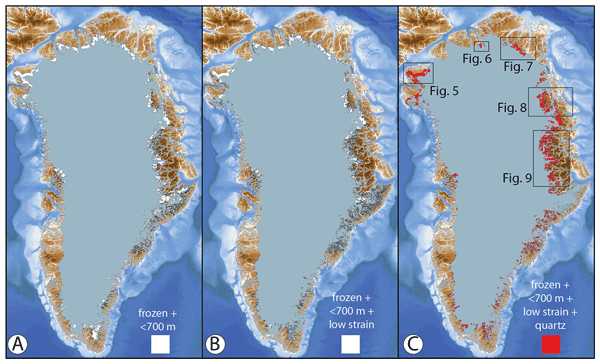
Jason P. Briner, Caleb K. Walcott, Joerg M. Schaefer, Nicolás E. Young, Joseph A. MacGregor, Kristin Poinar, Benjamin A. Keisling, Sridhar Anandakrishnan, Mary R. Albert, Tanner Kuhl, and Grant Boeckmann
The Cryosphere, 16, 3933–3948, https://doi.org/10.5194/tc-16-3933-2022, https://doi.org/10.5194/tc-16-3933-2022, 2022
Short summary
Short summary
The 7.4 m of sea level equivalent stored as Greenland ice is getting smaller every year. The uncertain trajectory of ice loss could be better understood with knowledge of the ice sheet's response to past climate change. Within the bedrock below the present-day ice sheet is an archive of past ice-sheet history. We analyze all available data from Greenland to create maps showing where on the ice sheet scientists can drill, using currently available drills, to obtain sub-ice materials.
Ana Carolina Moraes Luzardi, Sophie Nowicki, Beata Csatho, Jason Briner, Mohammad Salmani, Hui Gao, Denis Felikson, Josh Cuzzone, and Kristin Poinar
EGUsphere, https://doi.org/10.5194/egusphere-2026-5841, https://doi.org/10.5194/egusphere-2026-5841, 2026
This preprint is open for discussion and under review for The Cryosphere (TC).
Short summary
Short summary
Before the satellite era, observations of Greenland ice sheet elevation were sparse in space and time. We reconstruct ice sheet-wide surface elevation for 1850 and 1980 using a 127-member ensemble. The reconstructions agree with observations and historical evidence, reveal patterns of thinning since the preindustrial era, and provide a resource for evaluating and initializing ice sheet simulations.
John Michael N. Aguilar, Elizabeth K. Thomas, Diana S. Aga, Paul R. Bierman, Jason P. Briner, Isla S. Castañeda, and Andrew J. Christ
Clim. Past, 22, 1757–1779, https://doi.org/10.5194/cp-22-1757-2026, https://doi.org/10.5194/cp-22-1757-2026, 2026
Short summary
Short summary
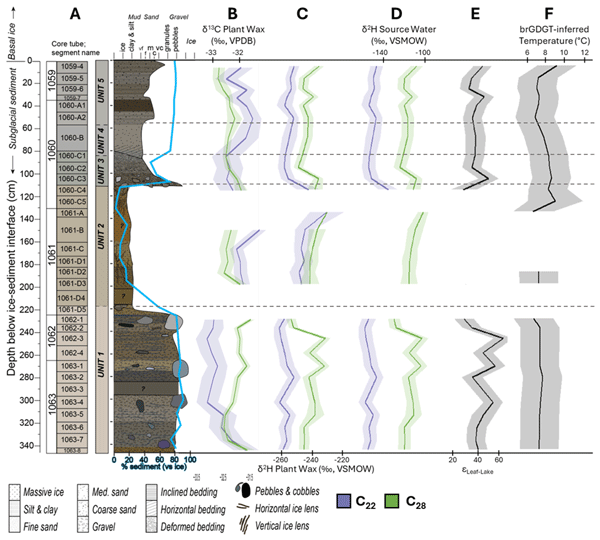
As the Arctic warms, the Greenland Ice Sheet is losing mass, with implications for global sea levels. We analyzed biomarkers from sediments beneath 1387 m of ice at Camp Century, Greenland, deposited when the ice sheet was smaller. Reconstructed summer temperature and precipitation isotopes from ~ 400 000 years ago show summers ~ 4.7 °C warmer than today, with more local moisture from reduced ice. This result highlights that both how warm and how long warming lasts matter to reduce ice loss.
Natalie Mahowald, Hannah Liddy, Jennifer Marlon, Kostas Tsigaridis, Gisela Winckler, Douglas Hamilton, Jasper Kok, Michael Sigl, Jordan Abell, Adwoa Aboagye-Okyere, Joe Adabouk Amooli, Samuel Albani, Susanne Bauer, Emilie Beaudon, Hunter Brown, Nathan Chellman, Nicolás Cosentino, Nathalie Goodkin, Christopher Guiterman, Stijn Hantson, Chengfei He, Aviva Intveld, Jed Kaplan, Jeremy Klavans, Fabrice Lambert, Haobo Liu, Marie-France Loutre, Joe McConnell, Zachary McGraw, Keren Mezuman, Ron Miller, Nicholas O’Mara, Maria Rosabelle Ong, Gavin Schmidt, Richard Vachula, Lily Wu, and Bingqing Zhang
EGUsphere, https://doi.org/10.5194/egusphere-2026-4532, https://doi.org/10.5194/egusphere-2026-4532, 2026
This preprint is open for discussion and under review for Atmospheric Chemistry and Physics (ACP).
Short summary
Short summary
Aerosols are poorly known in past climates, and yet it is very important to understand how aerosols are changing in different climates. In this paper we review available proxy data and modeling approaches to characterize aerosols in past climates. In addition, we propose future studies that can help improve our understanding.
Sudip Acharya, Allison A. Cluett, Amy L. Grogan, Jason P. Briner, Isla S. Castañeda, and Elizabeth K. Thomas
Clim. Past, 22, 1401–1421, https://doi.org/10.5194/cp-22-1401-2026, https://doi.org/10.5194/cp-22-1401-2026, 2026
Short summary
Short summary
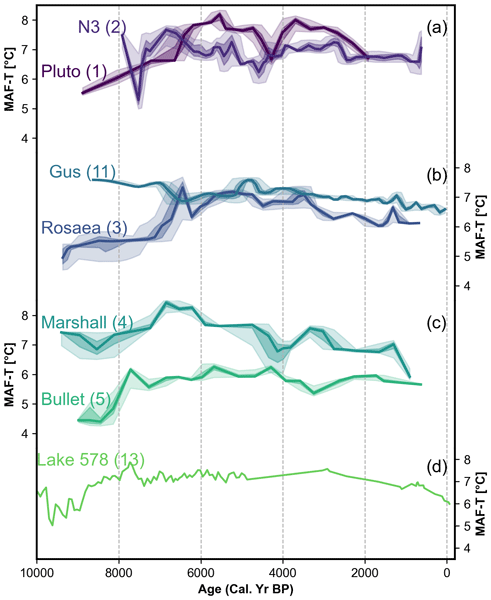
We generated five new and compiled previously published Holocene temperature timeseries from southwestern Greenland. We found temperature maxima between 7500 and 5000 years ago, with temperatures approx. 2–5 °C higher than 1994–2024. Afterward, temperatures gradually cooled towards the present, following maximum summer insolation. Local variations in the magnitude and timing of the thermal maximum are related to topography and proximity to the ice sheet and the ocean.
Jordan T. Abell, Frank J. Pavia, Jennifer L. Middleton, and Gisela Winckler
EGUsphere, https://doi.org/10.5194/egusphere-2026-1583, https://doi.org/10.5194/egusphere-2026-1583, 2026
Short summary
Short summary
Marine sediments provide a unique window into Earth's past, preserving material derived from deserts, volcanoes, rivers, ocean life, and even space. Quantifying how quickly these materials accumulate over time can reveal changes in past environments. Traditional methods for calculating accumulation rates can be unreliable, but a newer approach that uses minute space dust particles offers a more accurate way to track long-term changes in the Earth system.
Kevin Hank, Robert J. Arthern, C. Rosie Williams, Alex M. Brisbourne, Andrew M. Smith, James A. Smith, Anna Wåhlin, and Sridhar Anandakrishnan
The Cryosphere, 20, 495–510, https://doi.org/10.5194/tc-20-495-2026, https://doi.org/10.5194/tc-20-495-2026, 2026
Short summary
Short summary
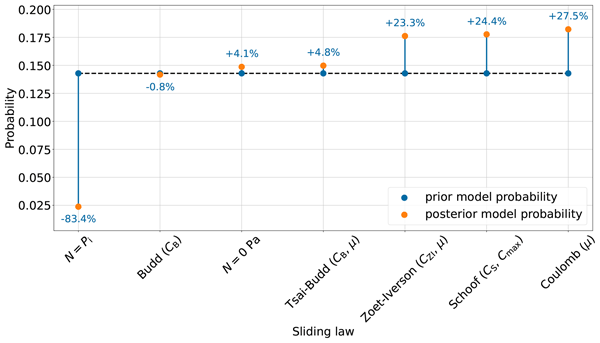
The slipperiness at the ice base is a key uncertainty in sea level rise projections. Alternative formulations of the sliding law exist, but limited access to the ice base makes it difficult to validate them. We introduce a new approach using observations and model output to infer a basal sliding law. For Pine Island Glacier, currently the largest single contributor to sea level rise in Antarctica, the results provide support for a Coulomb-type sliding law and widespread low effective pressures.
Jacob T. H. Anderson, Nicolás E. Young, Allie Balter-Kennedy, Karlee K. Prince, Caleb K. Walcott-George, Brandon L. Graham, Joanna Charton, Jason P. Briner, and Joerg M. Schaefer
Clim. Past, 21, 2263–2281, https://doi.org/10.5194/cp-21-2263-2025, https://doi.org/10.5194/cp-21-2263-2025, 2025
Short summary
Short summary
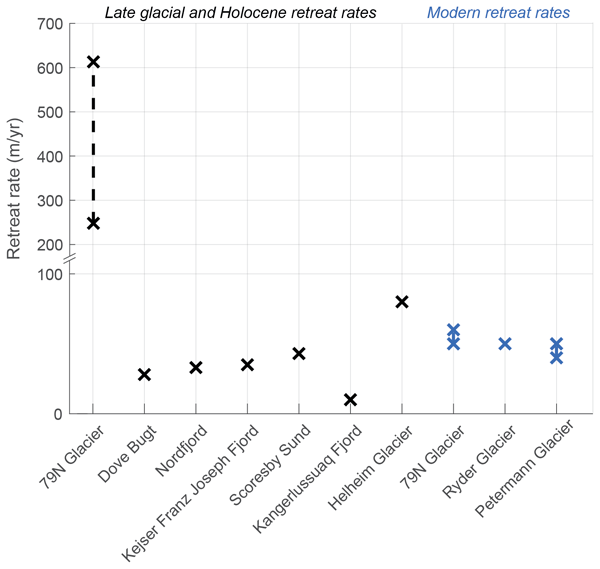
We investigated retreat of the Greenland Ice Sheet during the last deglaciation by dating glacial deposits exposed as the ice margin retreated. Our results from eastern and northeastern Greenland reveal ice margin retreat rates of 43 m/yr and 28 m/yr at two marine-terminating outlet glaciers. These retreat rates are consistent with late glacial and Holocene estimates across East Greenland, and are comparable to modern retreat rates observed in northeastern and northwestern Greenland.
Joseph P. Tulenko, Sophie A. Goliber, Renette Jones-Ivey, Justin Quinn, Abani Patra, Kristin Poinar, Sophie Nowicki, Beata M. Csatho, and Jason P. Briner
The Cryosphere, 19, 4327–4333, https://doi.org/10.5194/tc-19-4327-2025, https://doi.org/10.5194/tc-19-4327-2025, 2025
Short summary
Short summary
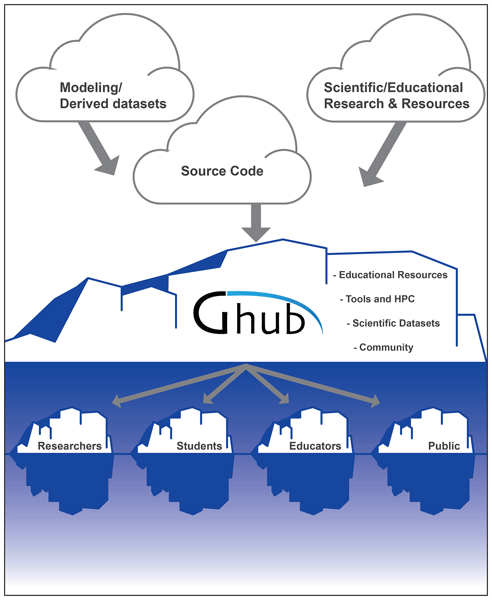
Ghub is an online platform that hosts tools, datasets, and educational resources related to ice sheet science. These resources are provided by ice sheet researchers and allow other researchers, students, educators, and interested members of the general public to analyze, visualize, and download datasets that researchers use to study past and present ice sheet behavior. We describe how users can interact with Ghub, showcase some available resources, and describe the future of the Ghub project.
Caleb K. Walcott-George, Allie Balter-Kennedy, Jason P. Briner, Joerg M. Schaefer, and Nicolás E. Young
The Cryosphere, 19, 2067–2086, https://doi.org/10.5194/tc-19-2067-2025, https://doi.org/10.5194/tc-19-2067-2025, 2025
Short summary
Short summary
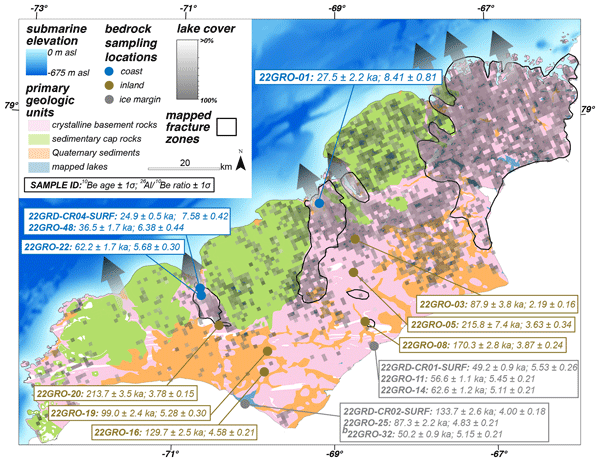
Understanding the history and drivers of Greenland Ice Sheet change is important for forecasting future ice sheet retreat. We combined geologic mapping and cosmogenic nuclide measurements to investigate how the Greenland Ice Sheet formed the landscape of Inglefield Land, northwestern Greenland. We found that Inglefield Land was covered by warm- and cold-based ice during multiple glacial cycles and that much of Inglefield Land is an ancient landscape.
Gordon R. M. Bromley, Greg Balco, Margaret S. Jackson, Allie Balter-Kennedy, and Holly Thomas
Clim. Past, 21, 145–160, https://doi.org/10.5194/cp-21-145-2025, https://doi.org/10.5194/cp-21-145-2025, 2025
Short summary
Short summary
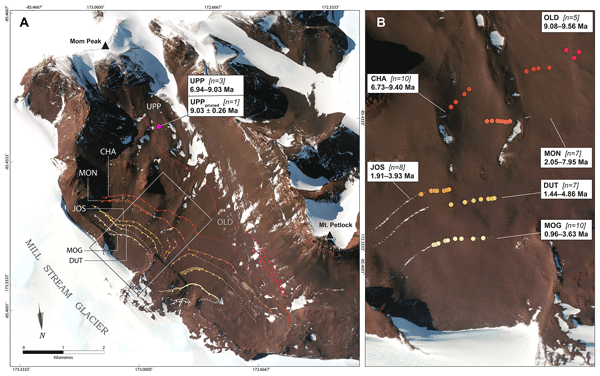
We constructed a geologic record of East Antarctic Ice Sheet thickness from deposits at Otway Massif to directly assess how Earth's largest ice sheet responds to warmer-than-present climate. Our record confirms the long-term dominance of a cold polar climate but lacks a clear ice sheet response to the mid-Pliocene Warm Period, a common analogue for the future. Instead, an absence of moraines from the late Miocene–early Pliocene suggests the ice sheet was less extensive than present at that time.
Allie Balter-Kennedy, Joerg M. Schaefer, Greg Balco, Meredith A. Kelly, Michael R. Kaplan, Roseanne Schwartz, Bryan Oakley, Nicolás E. Young, Jean Hanley, and Arianna M. Varuolo-Clarke
Clim. Past, 20, 2167–2190, https://doi.org/10.5194/cp-20-2167-2024, https://doi.org/10.5194/cp-20-2167-2024, 2024
Short summary
Short summary
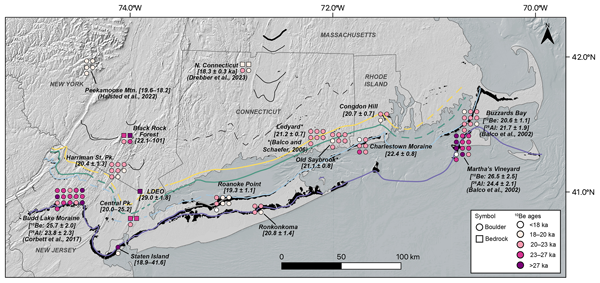
We date sedimentary deposits showing that the southeastern Laurentide Ice Sheet was at or near its southernmost extent from ~ 26 000 to 21 000 years ago, when sea levels were at their lowest, with climate records indicating glacial conditions. Slow deglaciation began ~ 22 000 years ago, shown by a rise in modeled local summer temperatures, but significant deglaciation in the region did not begin until ~ 18 000 years ago, when atmospheric CO2 began to rise, marking the end of the last ice age.
Karlee K. Prince, Jason P. Briner, Caleb K. Walcott, Brooke M. Chase, Andrew L. Kozlowski, Tammy M. Rittenour, and Erica P. Yang
Geochronology, 6, 409–427, https://doi.org/10.5194/gchron-6-409-2024, https://doi.org/10.5194/gchron-6-409-2024, 2024
Short summary
Short summary
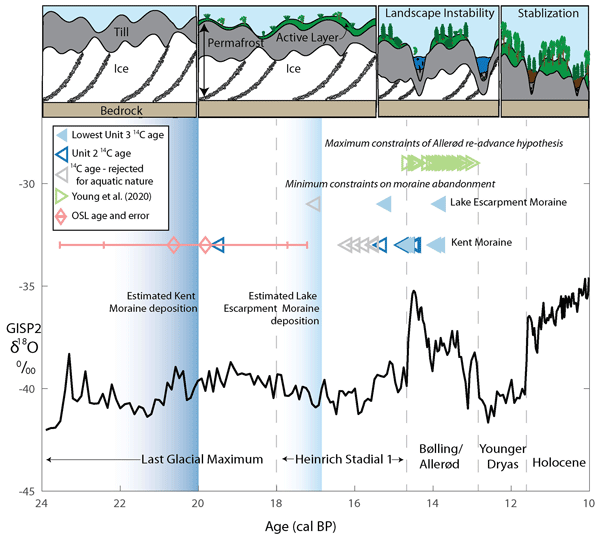
We fill a spatial data gap in the ice sheet retreat history of the Laurentide Ice Sheet after the Last Glacial Maximum and investigate a hypothesis that the ice sheet re-advanced into western New York, USA, at ~13 ka. With radiocarbon and optically stimulated luminescence (OSL) dating, we find that ice began retreating from its maximum extent after 20 ka, but glacial ice persisted in glacial landforms until ~15–14 ka when they finally stabilized. We find no evidence of a re-advance at ~13 ka.
Jennifer L. Middleton, Julia Gottschalk, Gisela Winckler, Jean Hanley, Carol Knudson, Jesse R. Farmer, Frank Lamy, Lorraine E. Lisiecki, and Expedition 383 Scientists
Geochronology, 6, 125–145, https://doi.org/10.5194/gchron-6-125-2024, https://doi.org/10.5194/gchron-6-125-2024, 2024
Short summary
Short summary
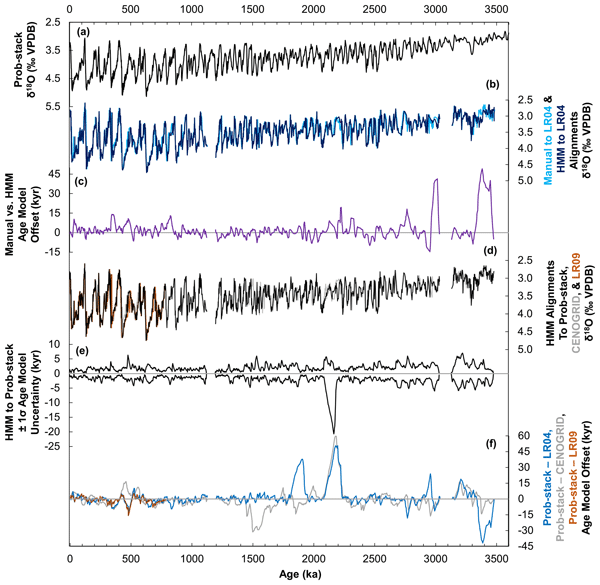
We present oxygen isotope data for a new sediment core from the South Pacific and assign ages to our record by aligning distinct patterns in observed oxygen isotope changes to independently dated target records with the same patterns. We examine the age uncertainties associated with this approach caused by human vs. automated alignment and the sensitivity of outcomes to the choice of alignment target. These efforts help us understand the timing of past climate changes.
Joseph P. Tulenko, Jason P. Briner, Nicolás E. Young, and Joerg M. Schaefer
Clim. Past, 20, 625–636, https://doi.org/10.5194/cp-20-625-2024, https://doi.org/10.5194/cp-20-625-2024, 2024
Short summary
Short summary
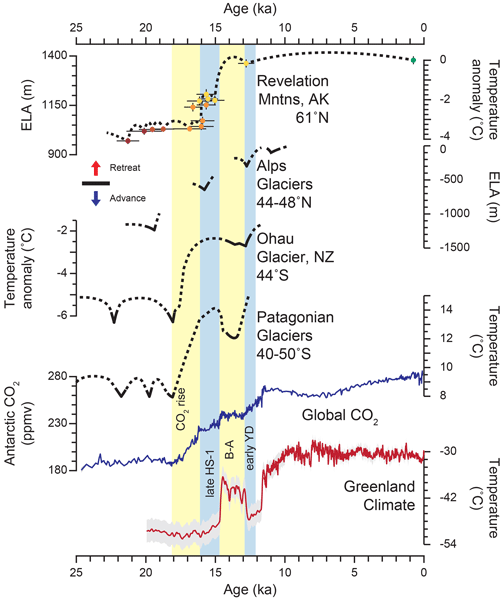
We take advantage of a site in Alaska – where climate records are limited and a former alpine glacier deposited a dense sequence of moraines spanning the full deglaciation – to construct a proxy summer temperature record. Building on age constraints for moraines in the valley, we reconstruct paleo-glacier surfaces and estimate the summer temperatures (relative to the Little Ice Age) for each moraine. The record suggests that the influence of North Atlantic climate forcing extended to Alaska.
Caleb K. Walcott, Jason P. Briner, Joseph P. Tulenko, and Stuart M. Evans
Clim. Past, 20, 91–106, https://doi.org/10.5194/cp-20-91-2024, https://doi.org/10.5194/cp-20-91-2024, 2024
Short summary
Short summary
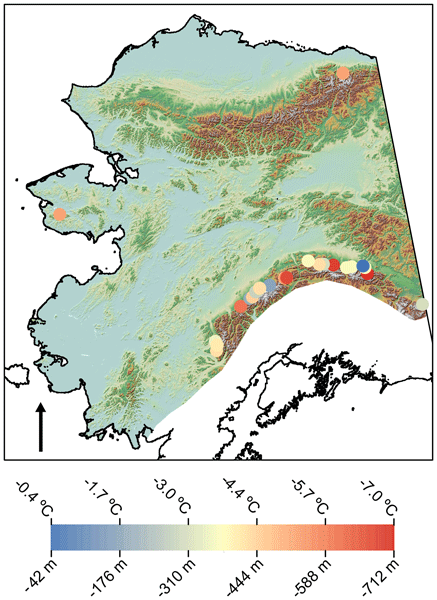
Available data suggest that Alaska was not as cold as many of the high-latitude areas of the Northern Hemisphere during the Last Ice Age. These results come from isolated climate records, climate models, and data synthesis projects. We used the extents of mountain glaciers during the Last Ice Age and Little Ice Age to show precipitation gradients across Alaska and provide temperature data from across the whole state. Our findings support a relatively warm Alaska during the Last Ice Age.
Gifford H. Miller, Simon L. Pendleton, Alexandra Jahn, Yafang Zhong, John T. Andrews, Scott J. Lehman, Jason P. Briner, Jonathan H. Raberg, Helga Bueltmann, Martha Raynolds, Áslaug Geirsdóttir, and John R. Southon
Clim. Past, 19, 2341–2360, https://doi.org/10.5194/cp-19-2341-2023, https://doi.org/10.5194/cp-19-2341-2023, 2023
Short summary
Short summary
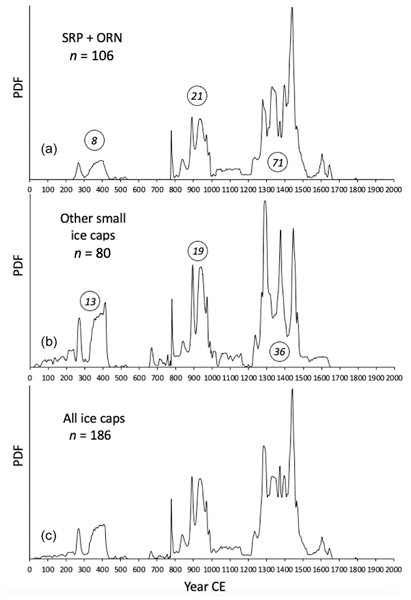
Receding Arctic ice caps reveal moss killed by earlier ice expansions; 186 moss kill dates from 71 ice caps cluster at 250–450, 850–1000 and 1240–1500 CE and continued expanding 1500–1880 CE, as recorded by regions of sparse vegetation cover, when ice caps covered > 11 000 km2 but < 100 km2 at present. The 1880 CE state approached conditions expected during the start of an ice age; climate models suggest this was only reversed by anthropogenic alterations to the planetary energy balance.
Brandon L. Graham, Jason P. Briner, Nicolás E. Young, Allie Balter-Kennedy, Michele Koppes, Joerg M. Schaefer, Kristin Poinar, and Elizabeth K. Thomas
The Cryosphere, 17, 4535–4547, https://doi.org/10.5194/tc-17-4535-2023, https://doi.org/10.5194/tc-17-4535-2023, 2023
Short summary
Short summary
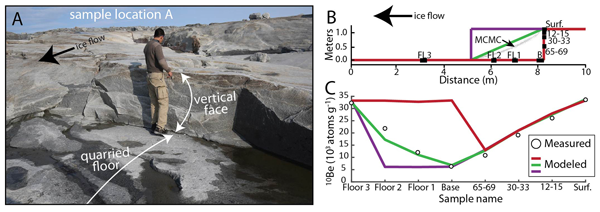
Glacial erosion is a fundamental process operating on Earth's surface. Two processes of glacial erosion, abrasion and plucking, are poorly understood. We reconstructed rates of abrasion and quarrying in Greenland. We derive a total glacial erosion rate of 0.26 ± 0.16 mm per year. We also learned that erosion via these two processes is about equal. Because the site is similar to many other areas covered by continental ice sheets, these results may be applied to many places on Earth.
Adam C. Hawkins, Brian Menounos, Brent M. Goehring, Gerald Osborn, Ben M. Pelto, Christopher M. Darvill, and Joerg M. Schaefer
The Cryosphere, 17, 4381–4397, https://doi.org/10.5194/tc-17-4381-2023, https://doi.org/10.5194/tc-17-4381-2023, 2023
Short summary
Short summary
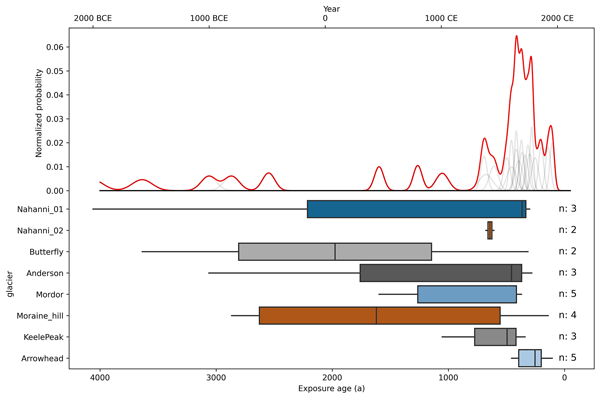
Our study developed a record of glacier and climate change in the Mackenzie and Selwyn mountains of northwestern Canada over the past several hundred years. We estimate temperature change in this region using several methods and incorporate our glacier record with models of climate change to estimate how glacier volume in our study area has changed over time. Models of future glacier change show that our study area will become largely ice-free by the end of the 21st century.
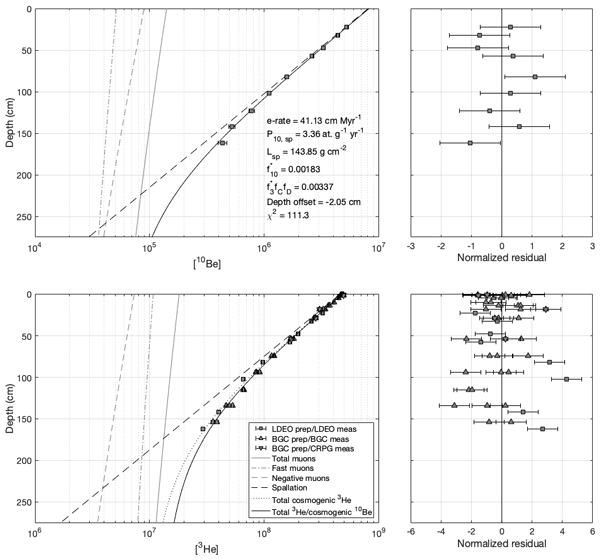
Allie Balter-Kennedy, Joerg M. Schaefer, Roseanne Schwartz, Jennifer L. Lamp, Laura Penrose, Jennifer Middleton, Jean Hanley, Bouchaïb Tibari, Pierre-Henri Blard, Gisela Winckler, Alan J. Hidy, and Greg Balco
Geochronology, 5, 301–321, https://doi.org/10.5194/gchron-5-301-2023, https://doi.org/10.5194/gchron-5-301-2023, 2023
Short summary
Short summary
Cosmogenic nuclides like 10Be are rare isotopes created in rocks exposed at the Earth’s surface and can be used to understand glacier histories and landscape evolution. 10Be is usually measured in the mineral quartz. Here, we show that 10Be can be reliably measured in the mineral pyroxene. We use the measurements to determine exposure ages and understand landscape processes in rocks from Antarctica that do not have quartz, expanding the use of this method to new rock types.
Jason P. Briner, Caleb K. Walcott, Joerg M. Schaefer, Nicolás E. Young, Joseph A. MacGregor, Kristin Poinar, Benjamin A. Keisling, Sridhar Anandakrishnan, Mary R. Albert, Tanner Kuhl, and Grant Boeckmann
The Cryosphere, 16, 3933–3948, https://doi.org/10.5194/tc-16-3933-2022, https://doi.org/10.5194/tc-16-3933-2022, 2022
Short summary
Short summary
The 7.4 m of sea level equivalent stored as Greenland ice is getting smaller every year. The uncertain trajectory of ice loss could be better understood with knowledge of the ice sheet's response to past climate change. Within the bedrock below the present-day ice sheet is an archive of past ice-sheet history. We analyze all available data from Greenland to create maps showing where on the ice sheet scientists can drill, using currently available drills, to obtain sub-ice materials.

Joshua K. Cuzzone, Nicolás E. Young, Mathieu Morlighem, Jason P. Briner, and Nicole-Jeanne Schlegel
The Cryosphere, 16, 2355–2372, https://doi.org/10.5194/tc-16-2355-2022, https://doi.org/10.5194/tc-16-2355-2022, 2022
Short summary
Short summary
We use an ice sheet model to determine what influenced the Greenland Ice Sheet to retreat across a portion of southwestern Greenland during the Holocene (about the last 12 000 years). Our simulations, constrained by observations from geologic markers, show that atmospheric warming and ice melt primarily caused the ice sheet to retreat rapidly across this domain. We find, however, that iceberg calving at the interface where the ice meets the ocean significantly influenced ice mass change.
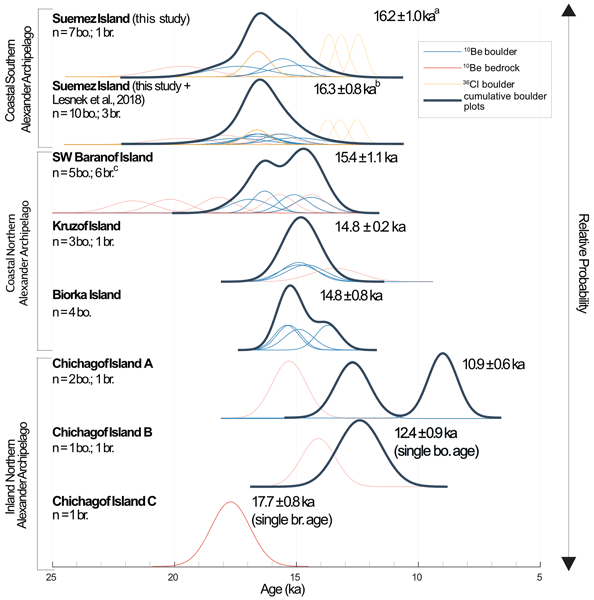
Caleb K. Walcott, Jason P. Briner, James F. Baichtal, Alia J. Lesnek, and Joseph M. Licciardi
Geochronology, 4, 191–211, https://doi.org/10.5194/gchron-4-191-2022, https://doi.org/10.5194/gchron-4-191-2022, 2022
Short summary
Short summary
We present a record of ice retreat from the northern Alexander Archipelago, Alaska. During the last ice age (~ 26 000–19 000 years ago), these islands were covered by the Cordilleran Ice Sheet. We tested whether islands were ice-free during the last ice age for human migrants moving from Asia to the Americas. We found that these islands became ice-free between ~ 15 100 years ago and ~ 16 000 years ago, and thus these islands were not suitable for human habitation during the last ice age.

María H. Toyos, Gisela Winckler, Helge W. Arz, Lester Lembke-Jene, Carina B. Lange, Gerhard Kuhn, and Frank Lamy
Clim. Past, 18, 147–166, https://doi.org/10.5194/cp-18-147-2022, https://doi.org/10.5194/cp-18-147-2022, 2022
Short summary
Short summary
Past export production in the southeast Pacific and its link to Patagonian ice dynamics is unknown. We reconstruct biological productivity changes at the Pacific entrance to the Drake Passage, covering the past 400 000 years. We show that glacial–interglacial variability in export production responds to glaciogenic Fe supply from Patagonia and silica availability due to shifts in oceanic fronts, whereas dust, as a source of lithogenic material, plays a minor role.
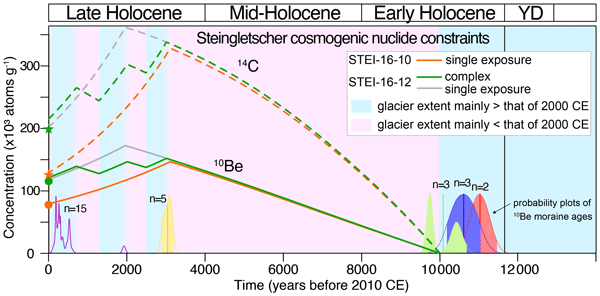
Irene Schimmelpfennig, Joerg M. Schaefer, Jennifer Lamp, Vincent Godard, Roseanne Schwartz, Edouard Bard, Thibaut Tuna, Naki Akçar, Christian Schlüchter, Susan Zimmerman, and ASTER Team
Clim. Past, 18, 23–44, https://doi.org/10.5194/cp-18-23-2022, https://doi.org/10.5194/cp-18-23-2022, 2022
Short summary
Short summary
Small mountain glaciers advance and recede as a response to summer temperature changes. Dating of glacial landforms with cosmogenic nuclides allowed us to reconstruct the advance and retreat history of an Alpine glacier throughout the past ~ 11 000 years, the Holocene. The results contribute knowledge to the debate of Holocene climate evolution, indicating that during most of this warm period, summer temperatures were similar to or warmer than in modern times.
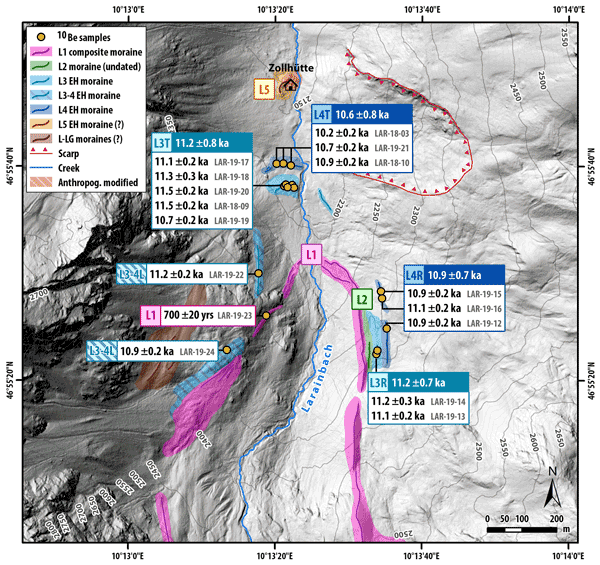
Sandra M. Braumann, Joerg M. Schaefer, Stephanie M. Neuhuber, Christopher Lüthgens, Alan J. Hidy, and Markus Fiebig
Clim. Past, 17, 2451–2479, https://doi.org/10.5194/cp-17-2451-2021, https://doi.org/10.5194/cp-17-2451-2021, 2021
Short summary
Short summary
Glacier reconstructions provide insights into past climatic conditions and elucidate processes and feedbacks that modulate the climate system both in the past and present. We investigate the transition from the last glacial to the current interglacial and generate beryllium-10 moraine chronologies in glaciated catchments of the eastern European Alps. We find that rapid warming was superimposed by centennial-scale cold phases that appear to have influenced large parts of the Northern Hemisphere.
Andrew J. Christ, Paul R. Bierman, Jennifer L. Lamp, Joerg M. Schaefer, and Gisela Winckler
Geochronology, 3, 505–523, https://doi.org/10.5194/gchron-3-505-2021, https://doi.org/10.5194/gchron-3-505-2021, 2021
Short summary
Short summary
Cosmogenic nuclide surface exposure dating is commonly used to constrain the timing of past glacier extents. However, Antarctic exposure age datasets are often scattered and difficult to interpret. We compile new and existing exposure ages of a glacial deposit with independently known age constraints and identify surface processes that increase or reduce the likelihood of exposure age scatter. Then we present new data for a previously unmapped and undated older deposit from the same region.
Cited articles
Abe-Ouchi, A., Segawa, T., and Saito, F.: Climatic Conditions for modelling the Northern Hemisphere ice sheets throughout the ice age cycle, Clim. Past, 3, 423–438, https://doi.org/10.5194/cp-3-423-2007, 2007.
Alley, R. B. and Anandakrishnan, S.: Variations in melt-layer frequency in the GISP2 ice core: implications for Holocene summer temperatures in central Greenland, Ann. Glaciol., 21, 64–70, https://doi.org/10.3189/S0260305500015615, 1995.
Aschwanden, A., Fahnestock, M. A., Truffer, M., Brinkerhoff, D. J., Hock, R., Khroulev, C., Mottram, R., and Khan, S. A.: Contribution of the Greenland Ice Sheet to sea level over the next millennium, Science Advances, 5, eaav9396, https://doi.org/10.1126/sciadv.aav9396, 2019.
Austermann, J., Pollard, D., Mitrovica, J. X., Moucha, R., Forte, A. M., DeConto, R. M., Rowley, D. B., and Raymo, M. E.: The impact of dynamic topography change on Antarctic ice sheet stability during the mid-Pliocene warm period, Geology, 43, 927–930, https://doi.org/10.1130/G36988.1, 2015.
Badgeley, J. A., Steig, E. J., Hakim, G. J., and Fudge, T. J.: Greenland temperature and precipitation over the last 20 000 years using data assimilation, Clim. Past, 16, 1325–1346, https://doi.org/10.5194/cp-16-1325-2020, 2020.
Balter-Kennedy, A., Young, N. E., Briner, J. P., Graham, B. L., and Schaefer, J. M.: Centennial- and Orbital-Scale Erosion Beneath the Greenland Ice Sheet Near Jakobshavn Isbræ, JGR Earth Surface, 126, https://doi.org/10.1029/2021JF006429, 2021.
Barnett, R. L., Austermann, J., Dyer, B., Telfer, M. W., Barlow, N. L. M., Boulton, S. J., Carr, A. S., and Creel, R. C.: Constraining the contribution of the Antarctic Ice Sheet to Last Interglacial sea level, Sci. Adv., 9, eadf0198, https://doi.org/10.1126/sciadv.adf0198, 2023.
Bennike, O. and Weidick, A.: Late Quaternary history around Nioghalvfjerdsfjorden and Jøkelbugten, North-East Greenland, Boreas, 30, 205–227, https://doi.org/10.1111/j.1502-3885.2001.tb01223.x, 2001.
Bereiter, B., Eggleston, S., Schmitt, J., Nehrbass-Ahles, C., Stocker, T. F., Fischer, H., Kipfstuhl, S., and Chappellaz, J.: Revision of the EPICA Dome C CO 2 record from 800 to 600 kyr before present, Geophysical Research Letters, 42, 542–549, https://doi.org/10.1002/2014GL061957, 2015.
Bierman, P. R., Corbett, L. B., Graly, J. A., Neumann, T. A., Lini, A., Crosby, B. T., and Rood, D. H.: Preservation of a preglacial landscape under the center of the Greenland Ice Sheet, Science, 344, 402–405, 2014.
Bochow, N., Poltronieri, A., Robinson, A., Montoya, M., Rypdal, M., and Boers, N.: Overshooting the critical threshold for the Greenland ice sheet, Nature, 622, 528–536, https://doi.org/10.1038/s41586-023-06503-9, 2023.
Born, A. and Nisancioglu, K. H.: Melting of Northern Greenland during the last interglaciation, The Cryosphere, 6, 1239–1250, https://doi.org/10.5194/tc-6-1239-2012, 2012.
Box, J. E., Yang, L., Bromwich, D. H., and Bai, L.-S.: Greenland Ice Sheet Surface Air Temperature Variability: 1840–2007, J. Climate, 22, 4029–4049, https://doi.org/10.1175/2009JCLI2816.1, 2009.
Briner, J. P., Cuzzone, J. K., Badgeley, J. A., Young, N. E., Steig, E. J., Morlighem, M., Schlegel, N.-J., Hakim, G. J., Schaefer, J. M., Johnson, J. V., Lesnek, A. J., Thomas, E. K., Allan, E., Bennike, O., Cluett, A. A., Csatho, B., de Vernal, A., Downs, J., Larour, E., and Nowicki, S.: Rate of mass loss from the Greenland Ice Sheet will exceed Holocene values this century, Nature, 586, 70–74, https://doi.org/10.1038/s41586-020-2742-6, 2020.
Briner, J. P., Walcott, C. K., Schaefer, J. M., Young, N. E., MacGregor, J. A., Poinar, K., Keisling, B. A., Anandakrishnan, S., Albert, M. R., Kuhl, T., and Boeckmann, G.: Drill-site selection for cosmogenic-nuclide exposure dating of the bed of the Greenland Ice Sheet, The Cryosphere, 16, 3933–3948, https://doi.org/10.5194/tc-16-3933-2022, 2022.
Buizert, C., Gkinis, V., Severinghaus, J. P., He, F., Lecavalier, B. S., Kindler, P., Leuenberger, M., Carlson, A. E., Vinther, B., Masson-Delmotte, V., White, J. W. C., Liu, Z., Otto-Bliesner, B., and Brook, E. J.: Greenland temperature response to climate forcing during the last deglaciation, Science, 345, 1177, https://doi.org/10.1126/science.1254961, 2014.
Buizert, C., Keisling, B. A., Box, J. E., He, F., Carlson, A. E., Sinclair, G., and DeConto, R. M.: Greenland-Wide Seasonal Temperatures During the Last Deglaciation, Geophysical Research Letters, 45, 1905–1914, https://doi.org/10.1002/2017GL075601, 2018.
Christ, A. J., Bierman, P. R., Schaefer, J. M., Dahl-Jensen, D., Steffensen, J. P., Corbett, L. B., Peteet, D. M., Thomas, E. K., Steig, E. J., Rittenour, T. M., Tison, J.-L., Blard, P.-H., Perdrial, N., Dethier, D. P., Lini, A., Hidy, A. J., Caffee, M. W., and Southon, J.: A multimillion-year-old record of Greenland vegetation and glacial history preserved in sediment beneath 1.4 km of ice at Camp Century, Proc. Natl. Acad. Sci. USA, 118, e2021442118, https://doi.org/10.1073/pnas.2021442118, 2021.
Christ, A. J., Rittenour, T. M., Bierman, P. R., Keisling, B. A., Knutz, P. C., Thomsen, T. B., Keulen, N., Fosdick, J. C., Hemming, S. R., Tison, J.-L., Blard, P.-H., Steffensen, J. P., Caffee, M. W., Corbett, L. B., Dahl-Jensen, D., Dethier, D. P., Hidy, A. J., Perdrial, N., Peteet, D. M., Steig, E. J., and Thomas, E. K.: Deglaciation of northwestern Greenland during Marine Isotope Stage 11, Science, 381, 330–335, https://doi.org/10.1126/science.ade4248, 2023.
Cornford, S. L., Seroussi, H., Asay-Davis, X. S., Gudmundsson, G. H., Arthern, R., Borstad, C., Christmann, J., Dias dos Santos, T., Feldmann, J., Goldberg, D., Hoffman, M. J., Humbert, A., Kleiner, T., Leguy, G., Lipscomb, W. H., Merino, N., Durand, G., Morlighem, M., Pollard, D., Rückamp, M., Williams, C. R., and Yu, H.: Results of the third Marine Ice Sheet Model Intercomparison Project (MISMIP+), The Cryosphere, 14, 2283–2301, https://doi.org/10.5194/tc-14-2283-2020, 2020.
Coulon, V., Bulthuis, K., Whitehouse, P. L., Sun, S., Haubner, K., Zipf, L., and Pattyn, F.: Contrasting Response of West and East Antarctic Ice Sheets to Glacial Isostatic Adjustment, J. Geophys. Res. Earth Surf., 126, https://doi.org/10.1029/2020JF006003, 2021.
Coulson, S., Dangendorf, S., Mitrovica, J. X., Tamisiea, M. E., Pan, L., and Sandwell, D. T.: A detection of the sea level fingerprint of Greenland Ice Sheet melt, Science, 377, 1550–1554, https://doi.org/10.1126/science.abo0926, 2022.
Cuzzone, J. K., Schlegel, N.-J., Morlighem, M., Larour, E., Briner, J. P., Seroussi, H., and Caron, L.: The impact of model resolution on the simulated Holocene retreat of the southwestern Greenland ice sheet using the Ice Sheet System Model (ISSM), The Cryosphere, 13, 879–893, https://doi.org/10.5194/tc-13-879-2019, 2019.
Dahl-Jensen, D., Mosegaard, K., Gundestrup, N., Clow, G. D., Johnsen, S. J., Hansen, A. W., and Balling, N.: Past Temperatures Directly from the Greenland Ice Sheet, Science, 282, 268–271, https://doi.org/10.1126/science.282.5387.268, 1998.
Dalton, A. S., Finkelstein, S. A., Forman, S. L., Barnett, P. J., Pico, T., and Mitrovica, J. X.: Was the Laurentide Ice Sheet significantly reduced during Marine Isotope Stage 3?, Geology, 47, 111–114, https://doi.org/10.1130/G45335.1, 2019.
DeConto, R. M., Pollard, D., Wilson, P. A., Pälike, H., Lear, C. H., and Pagani, M.: Thresholds for Cenozoic bipolar glaciation, Nature, 455, 652–656, https://doi.org/10.1038/nature07337, 2008.
DeConto, R. M., Pollard, D., Alley, R. B., Velicogna, I., Gasson, E., Gomez, N., Sadai, S., Condron, A., Gilford, D. M., Ashe, E. L., Kopp, R. E., Li, D., and Dutton, A.: The Paris Climate Agreement and future sea-level rise from Antarctica, Nature, 593, 83–89, https://doi.org/10.1038/s41586-021-03427-0, 2021.
Dutton, A., Carlson, A. E., Long, A. J., Milne, G. A., Clark, P. U., DeConto, R., Horton, B. P., Rahmstorf, S., and Raymo, M. E.: Sea-level rise due to polar ice-sheet mass loss during past warm periods, Science, 349, aaa4019–aaa4019, https://doi.org/10.1126/science.aaa4019, 2015.
Dutton, A., Villa, A., and Chutcharavan, P. M.: Compilation of Last Interglacial (Marine Isotope Stage 5e) sea-level indicators in the Bahamas, Turks and Caicos, and the east coast of Florida, USA, Earth Syst. Sci. Data, 14, 2385–2399, https://doi.org/10.5194/essd-14-2385-2022, 2022.
Dyer, B., Austermann, J., D'Andrea, W. J., Creel, R. C., Sandstrom, M. R., Cashman, M., Rovere, A., and Raymo, M. E.: Sea-level trends across The Bahamas constrain peak last interglacial ice melt, Proc. Natl. Acad. Sci. USA, 118, e2026839118, https://doi.org/10.1073/pnas.2026839118, 2021.
Edwards, T. L., Fettweis, X., Gagliardini, O., Gillet-Chaulet, F., Goelzer, H., Gregory, J. M., Hoffman, M., Huybrechts, P., Payne, A. J., Perego, M., Price, S., Quiquet, A., and Ritz, C.: Effect of uncertainty in surface mass balance–elevation feedback on projections of the future sea level contribution of the Greenland ice sheet, The Cryosphere, 8, 195–208, https://doi.org/10.5194/tc-8-195-2014, 2014.
Fahnestock, M., Abdalati, W., Joughin, I., Brozena, J., and Gogineni, P.: High Geothermal Heat Flow, Basal Melt, and the Origin of Rapid Ice Flow in Central Greenland, Science, 294, 2338–2342, https://doi.org/10.1126/science.1065370, 2001.
Felikson, D., Bartholomaus, T. C., Catania, G. A., Korsgaard, N. J., Kjær, K. H., Morlighem, M., Noël, B., Van Den Broeke, M., Stearns, L. A., Shroyer, E. L., Sutherland, D. A., and Nash, J. D.: Inland thinning on the Greenland ice sheet controlled by outlet glacier geometry, Nat. Geosci., 10, 366–369, https://doi.org/10.1038/ngeo2934, 2017.
Funder, S., Kjeldsen, K. K., Kjær, K. H., and Ó Cofaigh, C.: The Greenland Ice Sheet During the Past 300,000 Years: A Review, in: Developments in Quaternary Sciences, vol. 15, Elsevier, 699–713, 2011.
Geisler, C. and Currens, B.: Impediments to inland resettlement under conditions of accelerated sea level rise, Land Use Policy, 66, 322–330, https://doi.org/10.1016/j.landusepol.2017.03.029, 2017.
Goelzer, H., Nowicki, S., Edwards, T., Beckley, M., Abe-Ouchi, A., Aschwanden, A., Calov, R., Gagliardini, O., Gillet-Chaulet, F., Golledge, N. R., Gregory, J., Greve, R., Humbert, A., Huybrechts, P., Kennedy, J. H., Larour, E., Lipscomb, W. H., Le clec'h, S., Lee, V., Morlighem, M., Pattyn, F., Payne, A. J., Rodehacke, C., Rückamp, M., Saito, F., Schlegel, N., Seroussi, H., Shepherd, A., Sun, S., van de Wal, R., and Ziemen, F. A.: Design and results of the ice sheet model initialisation experiments initMIP-Greenland: an ISMIP6 intercomparison, The Cryosphere, 12, 1433–1460, https://doi.org/10.5194/tc-12-1433-2018, 2018.
Greve, R.: Relation of measured basal temperatures and the spatial distribution of the geothermal heat flux for the Greenland ice sheet, Ann. Glaciol., 42, 424–432, https://doi.org/10.3189/172756405781812510, 2005.
Halberstadt, A. R. W., Balco, G., Buchband, H., and Spector, P.: Cosmogenic-nuclide data from Antarctic nunataks can constrain past ice sheet instabilities, The Cryosphere, 17, 1623–1643, https://doi.org/10.5194/tc-17-1623-2023, 2023.
Hamlington, B. D., Gardner, A. S., Ivins, E., Lenaerts, J. T. M., Reager, J. T., Trossman, D. S., Zaron, E. D., Adhikari, S., Arendt, A., Aschwanden, A., Beckley, B. D., Bekaert, D. P. S., Blewitt, G., Caron, L., Chambers, D. P., Chandanpurkar, H. A., Christianson, K., Csatho, B., Cullather, R. I., DeConto, R. M., Fasullo, J. T., Frederikse, T., Freymueller, J. T., Gilford, D. M., Girotto, M., Hammond, W. C., Hock, R., Holschuh, N., Kopp, R. E., Landerer, F., Larour, E., Menemenlis, D., Merrifield, M., Mitrovica, J. X., Nerem, R. S., Nias, I. J., Nieves, V., Nowicki, S., Pangaluru, K., Piecuch, C. G., Ray, R. D., Rounce, D. R., Schlegel, N., Seroussi, H., Shirzaei, M., Sweet, W. V., Velicogna, I., Vinogradova, N., Wahl, T., Wiese, D. N., and Willis, M. J.: Understanding of Contemporary Regional Sea-Level Change and the Implications for the Future, Reviews of Geophysics, 58, e2019RG000672, https://doi.org/10.1029/2019RG000672, 2020.
Han, H. K., Gomez, N., Pollard, D., and DeConto, R.: Modeling Northern Hemispheric Ice Sheet Dynamics, Sea Level Change, and Solid Earth Deformation Through the Last Glacial Cycle, JGR Earth Surface, 126, e2020JF006040, https://doi.org/10.1029/2020JF006040, 2021.
Hanna, E., Topál, D., Box, J. E., Buzzard, S., Christie, F. D. W., Hvidberg, C., Morlighem, M., De Santis, L., Silvano, A., Colleoni, F., Sasgen, I., Banwell, A. F., Van Den Broeke, M. R., DeConto, R., De Rydt, J., Goelzer, H., Gossart, A., Gudmundsson, G. H., Lindbäck, K., Miles, B., Mottram, R., Pattyn, F., Reese, R., Rignot, E., Srivastava, A., Sun, S., Toller, J., Tuckett, P. A., and Ultee, L.: Short- and long-term variability of the Antarctic and Greenland ice sheets, Nat. Rev. Earth Environ., 5, 193–210, https://doi.org/10.1038/s43017-023-00509-7, 2024.
Hardy, R. D., Milligan, R. A., and Heynen, N.: Racial coastal formation: The environmental injustice of colorblind adaptation planning for sea-level rise, Geoforum, 87, 62–72, https://doi.org/10.1016/j.geoforum.2017.10.005, 2017.
Hay, C., Mitrovica, J. X., Gomez, N., Creveling, J. R., Austermann, J., and Kopp, R.: The sea-level fingerprints of ice-sheet collapse during interglacial periods, Quaternary Science Reviews, 87, 60–69, https://doi.org/10.1016/j.quascirev.2013.12.022, 2014.
Hay, C. C., Morrow, E., Kopp, R. E., and Mitrovica, J. X.: Probabilistic reanalysis of twentieth-century sea-level rise, Nature, 517, 481–484, https://doi.org/10.1038/nature14093, 2015.
Helsen, M. M., van de Berg, W. J., van de Wal, R. S. W., van den Broeke, M. R., and Oerlemans, J.: Coupled regional climate–ice-sheet simulation shows limited Greenland ice loss during the Eemian, Clim. Past, 9, 1773–1788, https://doi.org/10.5194/cp-9-1773-2013, 2013.
Hugonnet, R., McNabb, R., Berthier, E., Menounos, B., Nuth, C., Girod, L., Farinotti, D., Huss, M., Dussaillant, I., Brun, F., and Kääb, A.: Accelerated global glacier mass loss in the early twenty-first century, Nature, 592, 726–731, https://doi.org/10.1038/s41586-021-03436-z, 2021.
IPCC: IPCC Special Report on the Ocean and Cryosphere in a Changing Climate, edited by: Pörtner, H.-O., Roberts, D. C., Masson-Delmotte, V., Zhai, P., Tignor, M., Poloczanska, E., Mintenbeck, K., Alegría, A., Nicolai, M., Okem, A., Petzold, J., Rama, B., Weyer, N. M., Cambridge University Press, Cambridge, UK and New York, NY, USA, 755 pp., https://doi.org/10.1017/9781009157964, 2019.
Irvalı, N., Galaasen, E. V., Ninnemann, U. S., Rosenthal, Y., Born, A., and Kleiven, H. F.: A low climate threshold for south Greenland Ice Sheet demise during the Late Pleistocene, Proc. Natl. Acad. Sci. USA, 117, 190–195, https://doi.org/10.1073/pnas.1911902116, 2020.
Jevrejeva, S., Jackson, L. P., Grinsted, A., Lincke, D., and Marzeion, B.: Flood damage costs under the sea level rise with warming of 1.5 ° C and 2 ° C, Environmental Research Letters, 13, 074014, https://doi.org/10.1088/1748-9326/aacc76, 2018.
Jones, R. S., Mackintosh, A. N., Norton, K. P., Golledge, N. R., Fogwill, C. J., Kubik, P. W., Christl, M., and Greenwood, S. L.: Rapid Holocene thinning of an East Antarctic outlet glacier driven by marine ice sheet instability, Nat. Commun., 6, 8910, https://doi.org/10.1038/ncomms9910, 2015.
Kappelsberger, M. T., Strößenreuther, U., Scheinert, M., Horwath, M., Groh, A., Knöfel, C., Lunz, S., and Khan, S. A.: Modeled and Observed Bedrock Displacements in North-East Greenland Using Refined Estimates of Present-Day Ice-Mass Changes and Densified GNSS Measurements, JGR Earth Surface, 126, e2020JF005860, https://doi.org/10.1029/2020JF005860, 2021.
Keisling, B.: Idealized Greenland Ice Sheet Deglaciation Experiments (2025), Arctic Data Center [data set], https://doi.org/10.18739/A2M32NC5R, 2025.
Keisling, B.: bkeisling/sea-level-potential: Scripts to reproduce analysis and figures from Keisling et al. (2026) (v.1.0-cryosphere), Zenodo [code], https://doi.org/10.5281/zenodo.19803361, 2026.
Khan, N. S., Ashe, E., Horton, B. P., Dutton, A., Kopp, R. E., Brocard, G., Engelhart, S. E., Hill, D. F., Peltier, W. R., Vane, C. H., and Scatena, F. N.: Drivers of Holocene sea-level change in the Caribbean, Quaternary Science Reviews, 155, 13–36, https://doi.org/10.1016/j.quascirev.2016.08.032, 2017.
Koenig, S. J., DeConto, R. M., and Pollard, D.: Impact of reduced Arctic sea ice on Greenland ice sheet variability in a warmer than present climate, Geophys. Res. Lett., 41, 3933–3942, https://doi.org/10.1002/2014GL059770, 2014.
Koerner, R. M. and Fisher, D. A.: A record of Holocene summer climate from a Canadian high-Arctic ice core, Nature, 343, 630–631, https://doi.org/10.1038/343630a0, 1990.
Larour, E., Ivins, E. R., and Adhikari, S.: Should coastal planners have concern over where land ice is melting?, Science Advances, 3, e1700537, 2017.
Larsen, N. K., Find, J., Kristensen, A., Bjørk, A. A., Kjeldsen, K. K., Odgaard, B. V., Olsen, J., and Kjær, K. H.: Holocene ice marginal fluctuations of the Qassimiut lobe in South Greenland, Scientific Reports, 6, 22362, https://doi.org/10.1038/srep22362, 2016.
Le Meur, E. and Huybrechts, P.: A comparison of different ways of dealing with isostasy: examples from modelling the Antarctic ice sheet during the last glacial cycle, Annals of Glaciology, 23, 309–317, 1996.
Lecavalier, B. S., Fisher, D. A., Milne, G. A., Vinther, B. M., Tarasov, L., Huybrechts, P., Lacelle, D., Main, B., Zheng, J., Bourgeois, J., and Dyke, A. S.: High Arctic Holocene temperature record from the Agassiz ice cap and Greenland ice sheet evolution, Proc. Natl. Acad. Sci. USA, 114, 5952–5957, https://doi.org/10.1073/pnas.1616287114, 2017.
Liu, Z., Otto-Bliesner, B. L., He, F., Brady, E. C., Tomas, R., Clark, P. U., Carlson, A. E., Lynch-Stieglitz, J., Curry, W., Brook, E., Erickson, D., Jacob, R., Kutzbach, J., and Cheng, J.: Transient Simulation of Last Deglaciation with a New Mechanism for Bolling-Allerod Warming, Science, 325, 310–314, https://doi.org/10.1126/science.1171041, 2009.
Martínez-Botí, M. A., Foster, G. L., Chalk, T. B., Rohling, E. J., Sexton, P. F., Lunt, D. J., Pancost, R. D., Badger, M. P. S., and Schmidt, D. N.: Plio-Pleistocene climate sensitivity evaluated using high-resolution CO2 records, Nature, 518, 49–54, https://doi.org/10.1038/nature14145, 2015.
Morlighem, M., Williams, C. N., Rignot, E., An, L., Arndt, J. E., Bamber, J. L., Catania, G., Chauché, N., Dowdeswell, J. A., Dorschel, B., Fenty, I., Hogan, K., Howat, I., Hubbard, A., Jakobsson, M., Jordan, T. M., Kjeldsen, K. K., Millan, R., Mayer, L., Mouginot, J., Noël, B. P. Y., O'Cofaigh, C., Palmer, S., Rysgaard, S., Seroussi, H., Siegert, M. J., Slabon, P., Straneo, F., van den Broeke, M. R., Weinrebe, W., Wood, M., and Zinglersen, K. B.: BedMachine v3: Complete Bed Topography and Ocean Bathymetry Mapping of Greenland From Multibeam Echo Sounding Combined With Mass Conservation: BEDMACHINE GREENLAND V3, Geophysical Research Letters, https://doi.org/10.1002/2017GL074954, 2017.
Mouginot, J., Rignot, E., Bjørk, A. A., van den Broeke, M., Millan, R., Morlighem, M., Noël, B., Scheuchl, B., and Wood, M.: Forty-six years of Greenland Ice Sheet mass balance from 1972 to 2018, P. Natl. Acad. Sci. USA, 116, 201904242, https://doi.org/10.1073/pnas.1904242116, 2019.
NEEM community members: Eemian interglacial reconstructed from a Greenland folded ice core, Nature, 493, 489–494, https://doi.org/10.1038/nature11789, 2013.
Nerem, R. S., Beckley, B. D., Fasullo, J. T., Hamlington, B. D., Masters, D., and Mitchum, G. T.: Climate-change–driven accelerated sea-level rise detected in the altimeter era, Proceedings of the National Academy of Sciences, 115, 2022–2025, https://doi.org/10.1073/pnas.1717312115, 2018.
Oerlemans, J.: Quantifying Global Warming from the Retreat of Glaciers, Science, 264, 243–245, https://doi.org/10.1126/science.264.5156.243, 1994.
Osman, M. B., Tierney, J. E., Zhu, J., Tardif, R., Hakim, G. J., King, J., and Poulsen, C. J.: Globally resolved surface temperatures since the Last Glacial Maximum, Nature, 599, 239–244, https://doi.org/10.1038/s41586-021-03984-4, 2021.
Past Interglacials Working Group of PAGES: Interglacials of the last 800,000 years, Rev. Geophys., 54, 162–219, https://doi.org/10.1002/2015RG000482, 2016.
Payne, A. J., Nowicki, S., Abe-Ouchi, A., Agosta, C., Alexander, P., Albrecht, T., Asay-Davis, X., Aschwanden, A., Barthel, A., Bracegirdle, T. J., Calov, R., Chambers, C., Choi, Y., Cullather, R., Cuzzone, J., Dumas, C., Edwards, T. L., Felikson, D., Fettweis, X., Galton-Fenzi, B. K., Goelzer, H., Gladstone, R., Golledge, N. R., Gregory, J. M., Greve, R., Hattermann, T., Hoffman, M. J., Humbert, A., Huybrechts, P., Jourdain, N. C., Kleiner, T., Munneke, P. K., Larour, E., Le clec'h, S., Lee, V., Leguy, G., Lipscomb, W. H., Little, C. M., Lowry, D. P., Morlighem, M., Nias, I., Pattyn, F., Pelle, T., Price, S. F., Quiquet, A., Reese, R., Rückamp, M., Schlegel, N., Seroussi, H., Shepherd, A., Simon, E., Slater, D., Smith, R. S., Straneo, F., Sun, S., Tarasov, L., Trusel, L. D., Van Breedam, J., Wal, R., Broeke, M., Winkelmann, R., Zhao, C., Zhang, T., and Zwinger, T.: Future Sea Level Change Under Coupled Model Intercomparison Project Phase 5 and Phase 6 Scenarios From the Greenland and Antarctic Ice Sheets, Geophys. Res. Lett., 48, https://doi.org/10.1029/2020GL091741, 2021.
Pico, T., Birch, L., Weisenberg, J., and Mitrovica, J. X.: Refining the Laurentide Ice Sheet at Marine Isotope Stage 3: A data-based approach combining glacial isostatic simulations with a dynamic ice model, Quaternary Science Reviews, 195, 171–179, https://doi.org/10.1016/j.quascirev.2018.07.023, 2018.
Plach, A., Nisancioglu, K. H., Le clec'h, S., Born, A., Langebroek, P. M., Guo, C., Imhof, M., and Stocker, T. F.: Eemian Greenland SMB strongly sensitive to model choice, Clim. Past, 14, 1463–1485, https://doi.org/10.5194/cp-14-1463-2018, 2018.
Pollard, D. and DeConto, R. M.: A simple inverse method for the distribution of basal sliding coefficients under ice sheets, applied to Antarctica, The Cryosphere, 6, 953–971, https://doi.org/10.5194/tc-6-953-2012, 2012a.
Pollard, D. and DeConto, R. M.: Description of a hybrid ice sheet-shelf model, and application to Antarctica, Geosci. Model Dev., 5, 1273–1295, https://doi.org/10.5194/gmd-5-1273-2012, 2012b.
Pollard, D. and DeConto, R. M.: Improvements in one-dimensional grounding-line parameterizations in an ice-sheet model with lateral variations (PSUICE3D v2.1), Geosci. Model Dev., 13, 6481–6500, https://doi.org/10.5194/gmd-13-6481-2020, 2020.
Reyes, A. V., Carlson, A. E., Beard, B. L., Hatfield, R. G., Stoner, J. S., Winsor, K., Welke, B., and Ullman, D. J.: South Greenland ice-sheet collapse during Marine Isotope Stage 11, Nature, 510, 525–528, https://doi.org/10.1038/nature13456, 2014.
Ritz, C., Rommelaere, V., and Dumas, C.: Modeling the evolution of Antarctic ice sheet over the last 420,000 years: Implications for altitude changes in the Vostok region, J. Geophys. Res., 106, 31943–31964, https://doi.org/10.1029/2001JD900232, 2001.
Robinson, A., Calov, R., and Ganopolski, A.: Greenland ice sheet model parameters constrained using simulations of the Eemian Interglacial, Clim. Past, 7, 381–396, https://doi.org/10.5194/cp-7-381-2011, 2011.
Robinson, A., Calov, R., and Ganopolski, A.: Multistability and critical thresholds of the Greenland ice sheet, Nature Climate Change, 2, 429–432, https://doi.org/10.1038/nclimate1449, 2012.
Rogozhina, I., Petrunin, A. G., Vaughan, A. P. M., Steinberger, B., Johnson, J. V., Kaban, M. K., Calov, R., Rickers, F., Thomas, M., and Koulakov, I.: Melting at the base of the Greenland ice sheet explained by Iceland hotspot history, Nature Geoscience, 9, 366–369, https://doi.org/10.1038/ngeo2689, 2016.
Schaefer, J. M., Finkel, R. C., Balco, G., Alley, R. B., Caffee, M. W., Briner, J. P., Young, N. E., Gow, A. J., and Schwartz, R.: Greenland was nearly ice-free for extended periods during the Pleistocene, Nature, 540, 252–255, https://doi.org/10.1038/nature20146, 2016.
Sellevold, R., Lenaerts, J. T. M., and Vizcaino, M.: Influence of Arctic sea-ice loss on the Greenland ice sheet climate, Clim. Dyn., https://doi.org/10.1007/s00382-021-05897-4, 2021.
Solgaard, A. M. and Langen, P. L.: Multistability of the Greenland ice sheet and the effects of an adaptive mass balance formulation, Clim. Dynam., 39, 1599–1612, https://doi.org/10.1007/s00382-012-1305-4, 2012.
Sommers, A. N., Otto-Bliesner, B. L., Lipscomb, W. H., Lofverstrom, M., Shafer, S. L., Bartlein, P. J., Brady, E. C., Kluzek, E., Leguy, G., Thayer-Calder, K., and Tomas, R. A.: Retreat and Regrowth of the Greenland Ice Sheet During the Last Interglacial as Simulated by the CESM2-CISM2 Coupled Climate–Ice Sheet Model, Paleoceanog. and Paleoclimatol., 36, https://doi.org/10.1029/2021PA004272, 2021.
Stevens, N. T., Parizek, B. R., and Alley, R. B.: Enhancement of volcanism and geothermal heat flux by ice-age cycling: A stress modeling study of Greenland, Journal of Geophysical Research: Earth Surface, 121, 1456–1471, https://doi.org/10.1002/2016JF003855, 2016.
Stone, E. J. and Lunt, D. J.: The role of vegetation feedbacks on Greenland glaciation, Climate Dynamics, 40, 2671–2686, https://doi.org/10.1007/s00382-012-1390-4, 2013.
Straneo, F. and Heimbach, P.: North Atlantic warming and the retreat of Greenland's outlet glaciers, Nature, 504, 36–43, https://doi.org/10.1038/nature12854, 2013.
Vyverberg, K., Dechnik, B., Dutton, A., Webster, J. M., Zwartz, D., and Portell, R. W.: Episodic reef growth in the granitic Seychelles during the Last Interglacial: Implications for polar ice sheet dynamics, Marine Geology, 399, 170–187, https://doi.org/10.1016/j.margeo.2018.02.010, 2018.
Weertman, J.: Stability of ice-age ice sheets, J. Geophys. Res., 66, 3783–3792, https://doi.org/10.1029/JZ066i011p03783, 1961.
Wood, M., Rignot, E., Fenty, I., An, L., Bjørk, A., van den Broeke, M., Cai, C., Kane, E., Menemenlis, D., Millan, R., Morlighem, M., Mouginot, J., Noël, B., Scheuchl, B., Velicogna, I., Willis, J. K., and Zhang, H.: Ocean forcing drives glacier retreat in Greenland, Sci. Adv., 7, eaba7282, https://doi.org/10.1126/sciadv.aba7282, 2021.
Yau, A. M., Bender, M. L., Blunier, T., and Jouzel, J.: Setting a chronology for the basal ice at Dye-3 and GRIP: Implications for the long-term stability of the Greenland Ice Sheet, Earth and Planetary Science Letters, 451, 1–9, https://doi.org/10.1016/j.epsl.2016.06.053, 2016.
Young, N. E., Lesnek, A. J., Cuzzone, J. K., Briner, J. P., Badgeley, J. A., Balter-Kennedy, A., Graham, B. L., Cluett, A., Lamp, J. L., Schwartz, R., Tuna, T., Bard, E., Caffee, M. W., Zimmerman, S. R. H., and Schaefer, J. M.: In situ cosmogenic 10Be–14C–26Al measurements from recently deglaciated bedrock as a new tool to decipher changes in Greenland Ice Sheet size, Clim. Past, 17, 419–450, https://doi.org/10.5194/cp-17-419-2021, 2021.
Short summary
Understanding how much the Greenland ice sheet melted in response to past warmth helps better predicting future sea-level change. Here we present a framework called sea-level potential for using numerical ice-sheet model simulations to provide constraints on how much mass the ice sheet loses before different areas become ice-free. As observations from subglacial archives become more abundant, this framework can guide future subglacial sampling efforts.
Understanding how much the Greenland ice sheet melted in response to past warmth helps better...


