Articles | Volume 20, issue 1
https://doi.org/10.5194/tc-20-135-2026
© Author(s) 2026. This work is distributed under
the Creative Commons Attribution 4.0 License.

https://doi.org/10.5194/tc-20-135-2026
© Author(s) 2026. This work is distributed under
the Creative Commons Attribution 4.0 License.
Modelled dynamics of floating and grounded icebergs, with application to the Amundsen Sea

British Antarctic Survey, Cambridge, UK
Paul R. Holland
British Antarctic Survey, Cambridge, UK
Kelly A. Hogan
British Antarctic Survey, Cambridge, UK
James A. Smith
British Antarctic Survey, Cambridge, UK
Nicolas C. Jourdain
Univ. Grenoble Alpes/CNRS/IRD/G-INP/INRAE, Institut des Géosciences de l'Environnement, Grenoble, France
Pierre Mathiot
Univ. Grenoble Alpes/CNRS/IRD/G-INP/INRAE, Institut des Géosciences de l'Environnement, Grenoble, France
Anna Olivé Abelló
Univ. Grenoble Alpes/CNRS/IRD/G-INP/INRAE, Institut des Géosciences de l'Environnement, Grenoble, France
Andrew H. Fleming
British Antarctic Survey, Cambridge, UK
Andrew J. S. Meijers
British Antarctic Survey, Cambridge, UK
Related authors
Yavor Kostov, Marie-José Messias, Herlé Mercier, David P. Marshall, and Helen L. Johnson
Ocean Sci., 20, 521–547, https://doi.org/10.5194/os-20-521-2024, https://doi.org/10.5194/os-20-521-2024, 2024
Short summary
Short summary
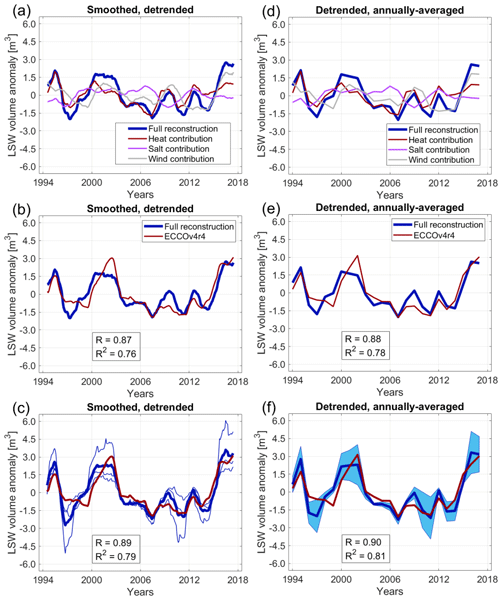
We examine factors affecting variability in the volume of Labrador Sea Water (LSW), a water mass that is important for the uptake and storage of heat and carbon in the Atlantic Ocean. We find that LSW accumulated in the Labrador Sea exhibits a lagged response to remote conditions: surface wind stress, heat flux, and freshwater flux anomalies, especially along the pathways of the North Atlantic Current branches. We use our results to reconstruct and attribute historical changes in LSW volume.
Luisa E. Avilés-Podgurski, Patrick Martineau, Hua Lu, Ayako Yamamoto, Amanda C. Maycock, Andrew Orr, Tony Phillips, Thomas J. Bracegirdle, Anna E. Hogg, Grzegorz Muszynski, and Andrew Fleming
EGUsphere, https://doi.org/10.5194/egusphere-2025-6285, https://doi.org/10.5194/egusphere-2025-6285, 2026
This preprint is open for discussion and under review for Weather and Climate Dynamics (WCD).
Short summary
Short summary
Atmospheric rivers (ARs) are narrow filaments transporting vast amounts of water vapour poleward. Rarely, they reach the Arctic, driving strong warming and melt. In April 2020, two ARs reached the central Arctic within one week, raising near-surface temperatures by up to 30 °C and leading to extreme precipitation. Their distinct paths and thermodynamic evolution reveal diverse AR impacts on Arctic sea ice and precipitation extremes.
Gavin A. Schmidt, Kenneth D. Mankoff, Jonathan L. Bamber, Clara Burgard, Dustin Carroll, David M. Chandler, Violaine Coulon, Benjamin J. Davison, Matthew H. England, Paul R. Holland, Nicolas C. Jourdain, Qian Li, Juliana M. Marson, Pierre Mathiot, Clive R. McMahon, Twila A. Moon, Ruth Mottram, Sophie Nowicki, Anna Olivé Abelló, Andrew G. Pauling, Thomas Rackow, and Damien Ringeisen
Geosci. Model Dev., 18, 8333–8361, https://doi.org/10.5194/gmd-18-8333-2025, https://doi.org/10.5194/gmd-18-8333-2025, 2025
Short summary
Short summary
The impact of increasing mass loss from the Greenland and Antarctic ice sheets has not so far been included in historical climate model simulations. This paper describes the protocols and data available for modeling groups to add this anomalous freshwater to their ocean modules to better represent the impacts of these fluxes on ocean circulation, sea ice, salinity and sea level.
Katie Lowery, Pierre Dutrieux, Paul R. Holland, Anna E. Hogg, Noel Gourmelen, and Benjamin J. Wallis
The Cryosphere, 19, 4893–4911, https://doi.org/10.5194/tc-19-4893-2025, https://doi.org/10.5194/tc-19-4893-2025, 2025
Short summary
Short summary
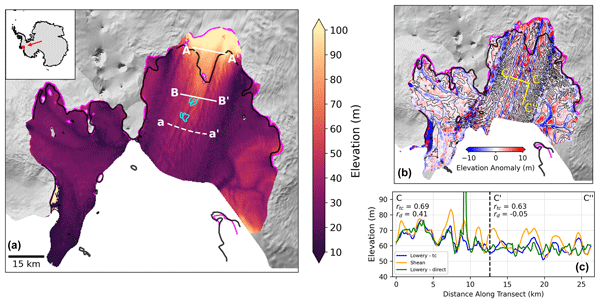
Using CryoSat-2, we observe monthly changes in the Pine Island Glacier (PIG) ice shelf surface and derive oceanic melt at its base. Basal channels, kilometres wide, are reflected in the ice surface and captured in our observations. We demonstrate that melt is concentrated on the western walls of channels, that channels play a role in grounding pinning points, and that PIG's main channel geometry is inherited upstream of the grounding line. These results highlight the importance of channels to ice shelf stability.
Johanna Beckmann, Ronja Reese, Felicity S. McCormack, Sue Cook, Lawrence Bird, Dawid Gwyther, Daniel Richards, Matthias Scheiter, Yu Wang, Hélène Seroussi, Ayako Abe‐Ouchi, Torsten Albrecht, Jorge Alvarez‐Solas, Xylar S. Asay‐Davis, Jean‐Baptiste Barre, Constantijn J. Berends, Jorge Bernales, Javier Blasco, Justine Caillet, David M. Chandler, Violaine Coulon, Richard Cullather, Christophe Dumas, Benjamin K. Galton‐Fenzi, Julius Garbe, Fabien Gillet‐Chaulet, Rupert Gladstone, Heiko Goelzer, Nicholas R. Golledge, Ralf Greve, G. Hilmar Gudmundsson, Holly Kyeore Han, Trevor R. Hillebrand, Matthew J. Hoffman, Philippe Huybrechts, Nicolas C. Jourdain, Ann Kristin Klose, Petra M. Langebroek, Gunter R. Leguy, William H. Lipscomb, Daniel P. Lowry, Pierre Mathiot, Marisa Montoya, Mathieu Morlighem, Sophie Nowicki, Frank Pattyn, Antony J. Payne, Tyler Pelle, Aurélien Quiquet, Alexander Robinson, Leopekka Saraste, Erika G. Simon, Sainan Sun, Jake P. Twarog, Luke D. Trusel, Benoit Urruty, Jonas Van Breedam, Roderik S. W. van de Wal, Chen Zhao, and Thomas Zwinger
EGUsphere, https://doi.org/10.5194/egusphere-2025-4069, https://doi.org/10.5194/egusphere-2025-4069, 2025
This preprint is open for discussion and under review for The Cryosphere (TC).
Short summary
Short summary
Antarctica holds enough ice to raise sea levels by many meters, but its future is uncertain. Warm ocean water melts ice shelves from below, letting inland ice flow faster into the sea. By 2300, Antarctica could add 0.6–4.4 m to sea levels. Our study identifies two key factors—how strongly shelves melt and how the ice responds. These explain much of the range, and refining them in models may improve future predictions.
Robin S. Smith, Tarkan A. Bilge, Thomas J. Bracegirdle, Paul R. Holland, Till Kuhlbrodt, Charlotte Lang, Spencer Liddicoat, Tom Mitcham, Jane Mulcahy, Kaitlin A. Naughten, Andrew Orr, Julien Palmieri, Antony J. Payne, Steven Rumbold, Marc Stringer, Ranjini Swaminathan, Sarah Taylor, Jeremy Walton, and Colin Jones
EGUsphere, https://doi.org/10.5194/egusphere-2025-4476, https://doi.org/10.5194/egusphere-2025-4476, 2025
Short summary
Short summary
There is a dangerous amount of uncertainty in our predictions of climate change in polar regions because some of feedbacks that might lead to changes that are too rapid for us to adapt to, or that cannot be reversed. We have run a set of simulations with a state-of-the-art Earth System Model that helps improve our understanding of how climate in these regions might change. Some of the aspects we investigate are reversible but many are not, especially those affecting ice sheets and sea level.
Jonathan Wiskandt and Nicolas C. Jourdain
The Cryosphere, 19, 3253–3258, https://doi.org/10.5194/tc-19-3253-2025, https://doi.org/10.5194/tc-19-3253-2025, 2025
Short summary
Short summary
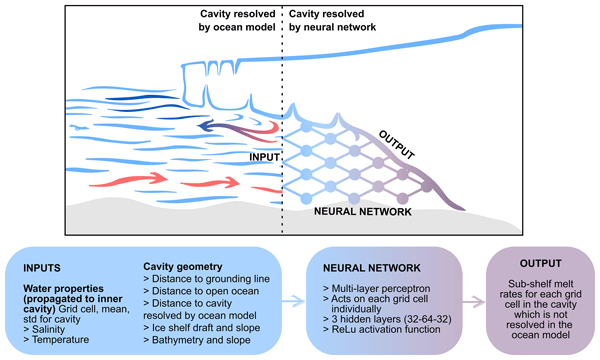
In ocean models, submarine melt of ice shelves is parameterized based on the heat budget at the ice–ocean interface. The heat budget includes the ocean heat transport, the heat conducted into the ice, and the heat available for melting. Here we compare three different approaches to estimating the heat conduction into the ice. We show that the most used approximation is not the most accurate one: it overestimates the melt by up to 25 % compared to the more accurate approximations.
Dorothée Vallot, Nicolas C. Jourdain, and Pierre Mathiot
EGUsphere, https://doi.org/10.5194/egusphere-2025-2866, https://doi.org/10.5194/egusphere-2025-2866, 2025
Short summary
Short summary
Some recent studies show that the topography at the base of an ice shelf has consequences for its interaction with the ocean. To describe friction velocity in the melt parameterisation, we use a drag coefficient dependent on the distance of the first wet cell to the ice and the basal topography rather than a fixed-tuned parameter. We find that it is less dependent on the choice of vertical resolution and, while providing similar total melt, it gives more weight to highly crevassed areas.
Cyrille Mosbeux, Peter Råback, Adrien Gilbert, Julien Brondex, Fabien Gillet-Chaulet, Nicolas C. Jourdain, Mondher Chekki, Olivier Gagliardini, and Gaël Durand
EGUsphere, https://doi.org/10.5194/egusphere-2025-3039, https://doi.org/10.5194/egusphere-2025-3039, 2025
Short summary
Short summary
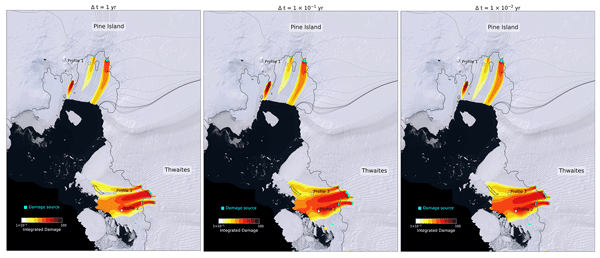
Transport processes like rocks carried by ice flow and damage evolution – a proxy for crevasses – are key in ice sheet modeling and should occur without diffusion. Yet, standard numerical methods often blur these features. We explore a particle-based Semi-Lagrangian approach, comparing it to a Discontinuous Galerkin method, and show it can accurately simulate such transport when run at high enough resolution.
Ciara Pimm, Andrew J. S. Meijers, Dani C. Jones, and Richard G. Williams
Ocean Sci., 21, 1237–1253, https://doi.org/10.5194/os-21-1237-2025, https://doi.org/10.5194/os-21-1237-2025, 2025
Short summary
Short summary
Subantarctic mode water in the South Pacific Ocean is important due to its role in the uptake and transport of anthropogenic heat and carbon. The Subantarctic mode water region can be split into two pools using mixed-layer-depth properties. Sensitivity experiments are used to understand the effects of heating and wind on each pool. It is found that the optimal conditions to form large amounts of Subantarctic mode water in the South Pacific are local cooling and upstream warming combined.
Ben Richard Evans, Alan Lowe, Anna Crawford, Andrew Fleming, and J. Scott Hosking
EGUsphere, https://doi.org/10.5194/egusphere-2025-2886, https://doi.org/10.5194/egusphere-2025-2886, 2025
Short summary
Short summary
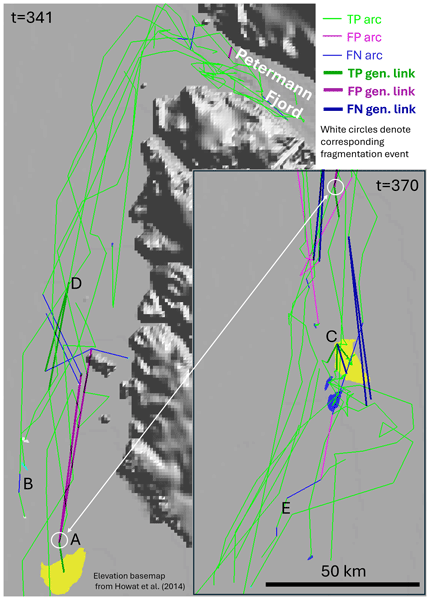
Icebergs account for about half of the fresh water lost from Antarctica. Because they can drift for long periods of time and across great distances, it is hard to know where in the oceans that water ends up, yet this is crucially important to ocean circulations and global climate. We have developed a digital tool that can help us to understand the dynamics and effects of icebergs by recognising them through time and doing ‘jigsaw puzzles’ to reconstruct their family trees when they break apart.
Claire K. Yung, Xylar S. Asay-Davis, Alistair Adcroft, Christopher Y. S. Bull, Jan De Rydt, Michael S. Dinniman, Benjamin K. Galton-Fenzi, Daniel Goldberg, David E. Gwyther, Robert Hallberg, Matthew Harrison, Tore Hattermann, David M. Holland, Denise Holland, Paul R. Holland, James R. Jordan, Nicolas C. Jourdain, Kazuya Kusahara, Gustavo Marques, Pierre Mathiot, Dimitris Menemenlis, Adele K. Morrison, Yoshihiro Nakayama, Olga Sergienko, Robin S. Smith, Alon Stern, Ralph Timmermann, and Qin Zhou
EGUsphere, https://doi.org/10.5194/egusphere-2025-1942, https://doi.org/10.5194/egusphere-2025-1942, 2025
Short summary
Short summary
ISOMIP+ compares 12 ocean models that simulate ice-ocean interactions in a common, idealised, static ice shelf cavity setup, aiming to assess and understand inter-model variability. Models simulate similar basal melt rate patterns, ocean profiles and circulation but differ in ice-ocean boundary layer properties and spatial distributions of melting. Ice-ocean boundary layer representation is a key area for future work, as are realistic-domain ice sheet-ocean model intercomparisons.
Alexander T. Bradley, David T. Bett, C. Rosie Williams, Robert J. Arthern, Paul R. Holland, James Bryne, and Tamsin L. Edwards
EGUsphere, https://doi.org/10.5194/egusphere-2025-2315, https://doi.org/10.5194/egusphere-2025-2315, 2025
Short summary
Short summary
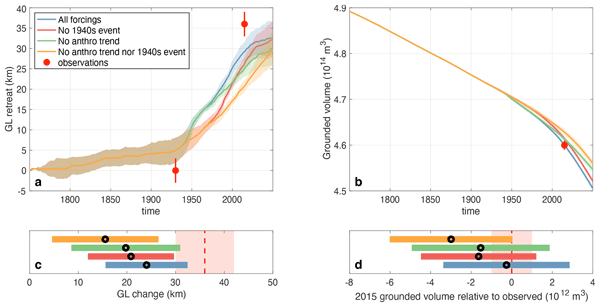
At least since we started measuring in detail, the West Antarctic Ice Sheet has lost a lot of ice, but we don't know if climate change is responsible. In this work, we put a number on the role of climate change in retreat of a glacier in this ice sheet, for the first time. We show that climate change made the shrinking of this glacier much worse. Our work also suggests that what happened on very long timescales (the last 10,000 years) might also matter for retreat of the ice sheets today.
David Storkey, Pierre Mathiot, Michael J. Bell, Dan Copsey, Catherine Guiavarc'h, Helene T. Hewitt, Jeff Ridley, and Malcolm J. Roberts
Geosci. Model Dev., 18, 2725–2745, https://doi.org/10.5194/gmd-18-2725-2025, https://doi.org/10.5194/gmd-18-2725-2025, 2025
Short summary
Short summary
The Southern Ocean is a key region of the world ocean in the context of climate change studies. We show that the Met Office Hadley Centre coupled model with intermediate ocean resolution struggles to accurately simulate the Southern Ocean. Increasing the frictional drag that the seafloor exerts on ocean currents and introducing a representation of unresolved ocean eddies both appear to reduce the large-scale biases in this model.
Nicolas C. Jourdain, Charles Amory, Christoph Kittel, and Gaël Durand
The Cryosphere, 19, 1641–1674, https://doi.org/10.5194/tc-19-1641-2025, https://doi.org/10.5194/tc-19-1641-2025, 2025
Short summary
Short summary
A mixed statistical–physical approach is used to reproduce the behaviour of a regional climate model. From that, we estimate the contribution of snowfall and melting at the surface of the Antarctic Ice Sheet to changes in global mean sea level. We also investigate the impact of surface melting in a warmer climate on the stability of the Antarctic ice shelves that provide back stress on the ice flow to the ocean.
Asmara A. Lehrmann, Rebecca L. Totten, Julia S. Wellner, Claus-Dieter Hillenbrand, Svetlana Radionovskaya, R. Michael Comas, Robert D. Larter, Alastair G. C. Graham, James D. Kirkham, Kelly A. Hogan, Victoria Fitzgerald, Rachel W. Clark, Becky Hopkins, Allison P. Lepp, Elaine Mawbey, Rosemary V. Smyth, Lauren E. Miller, James A. Smith, and Frank O. Nitsche
J. Micropalaeontol., 44, 79–105, https://doi.org/10.5194/jm-44-79-2025, https://doi.org/10.5194/jm-44-79-2025, 2025
Short summary
Short summary
Thwaites Glacier's retreat is driven by warm ocean water melting its ice shelf. Seafloor-dwelling marine protists, benthic foraminifera, reflect their environment. Here, ice margins, oceanography, and sea ice cover control live foraminiferal populations. Including dead foraminifera in the analyses shows the calcareous test preservation's role in the assemblage make-up. Understanding these modern communities helps interpret past glacial retreat controls through foraminifera in sediment records.
Kevin Hank, Robert J. Arthern, C. Rosie Williams, Alex M. Brisbourne, Andrew M. Smith, James A. Smith, Anna Wåhlin, and Sridhar Anandakrishnan
EGUsphere, https://doi.org/10.5194/egusphere-2025-764, https://doi.org/10.5194/egusphere-2025-764, 2025
Short summary
Short summary
The slipperiness beneath ice sheets is a key source of uncertainty in sea level rise projections. Using both observations and model output, we infer the most probable representation of basal slipperiness in ice sheet models, enabling more accurate projections. For Pine Island Glacier, our results provide support for a Coulomb-type sliding law and widespread low effective pressures, potentially increasing sliding velocities in prognostic simulations and, hence, sea level rise projections.
Justine Caillet, Nicolas C. Jourdain, Pierre Mathiot, Fabien Gillet-Chaulet, Benoit Urruty, Clara Burgard, Charles Amory, Mondher Chekki, and Christoph Kittel
Earth Syst. Dynam., 16, 293–315, https://doi.org/10.5194/esd-16-293-2025, https://doi.org/10.5194/esd-16-293-2025, 2025
Short summary
Short summary
Internal climate variability, resulting from processes intrinsic to the climate system, modulates the Antarctic response to climate change by delaying or offsetting its effects. Using climate and ice-sheet models, we highlight that irreducible internal climate variability significantly enlarges the likely range of Antarctic contribution to sea-level rise until 2100. Thus, we recommend considering internal climate variability as a source of uncertainty for future ice-sheet projections.
Catherine Guiavarc'h, David Storkey, Adam T. Blaker, Ed Blockley, Alex Megann, Helene Hewitt, Michael J. Bell, Daley Calvert, Dan Copsey, Bablu Sinha, Sophia Moreton, Pierre Mathiot, and Bo An
Geosci. Model Dev., 18, 377–403, https://doi.org/10.5194/gmd-18-377-2025, https://doi.org/10.5194/gmd-18-377-2025, 2025
Short summary
Short summary
The Global Ocean and Sea Ice configuration version 9 (GOSI9) is the new UK hierarchy of model configurations based on the Nucleus for European Modelling of the Ocean (NEMO) and available at three resolutions. It will be used for various applications, e.g. weather forecasting and climate prediction. It improves upon the previous version by reducing global temperature and salinity biases and enhancing the representation of Arctic sea ice and the Antarctic Circumpolar Current.
Caroline R. Holmes, Thomas J. Bracegirdle, Paul R. Holland, Julienne Stroeve, and Jeremy Wilkinson
The Cryosphere, 18, 5641–5652, https://doi.org/10.5194/tc-18-5641-2024, https://doi.org/10.5194/tc-18-5641-2024, 2024
Short summary
Short summary
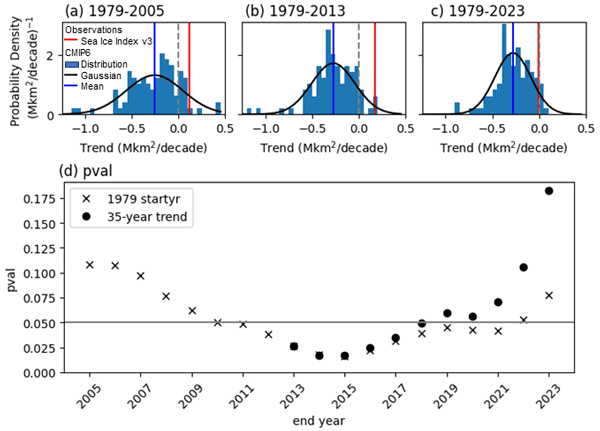
Until recently, satellite data showed an increase in Antarctic sea ice area since 1979, but climate models simulated a decrease over this period. This mismatch was one reason for low confidence in model projections of 21st-century sea ice loss. We show that following low Antarctic sea ice in 2022 and 2023, we can no longer conclude that modelled and observed trends differ. However, differences in the manner of the decline mean that model sea ice projections should still be viewed with caution.
Jan De Rydt, Nicolas C. Jourdain, Yoshihiro Nakayama, Mathias van Caspel, Ralph Timmermann, Pierre Mathiot, Xylar S. Asay-Davis, Hélène Seroussi, Pierre Dutrieux, Ben Galton-Fenzi, David Holland, and Ronja Reese
Geosci. Model Dev., 17, 7105–7139, https://doi.org/10.5194/gmd-17-7105-2024, https://doi.org/10.5194/gmd-17-7105-2024, 2024
Short summary
Short summary
Global climate models do not reliably simulate sea-level change due to ice-sheet–ocean interactions. We propose a community modelling effort to conduct a series of well-defined experiments to compare models with observations and study how models respond to a range of perturbations in climate and ice-sheet geometry. The second Marine Ice Sheet–Ocean Model Intercomparison Project will continue to lay the groundwork for including ice-sheet–ocean interactions in global-scale IPCC-class models.
Indrani Das, Jowan Barnes, James Smith, Renata Constantino, Sidney Hemming, and Laurie Padman
EGUsphere, https://doi.org/10.5194/egusphere-2024-1564, https://doi.org/10.5194/egusphere-2024-1564, 2024
Short summary
Short summary
George VI Ice Shelf (GVIIS) on the Antarctic Peninsula is currently thinning and the glaciers feeding it are accelerating. Geologic evidence indicates that GVIIS had disintegrated several thousand years ago due to ocean and atmosphere warming. Here, we use remote sensing and numerical modeling to show that strain thinning reduces buttressing of grounded ice, creating a positive feedback of accelerated ice inflow to the southern GVIIS, likely making it more vulnerable than the northern sector.
David T. Bett, Alexander T. Bradley, C. Rosie Williams, Paul R. Holland, Robert J. Arthern, and Daniel N. Goldberg
The Cryosphere, 18, 2653–2675, https://doi.org/10.5194/tc-18-2653-2024, https://doi.org/10.5194/tc-18-2653-2024, 2024
Short summary
Short summary
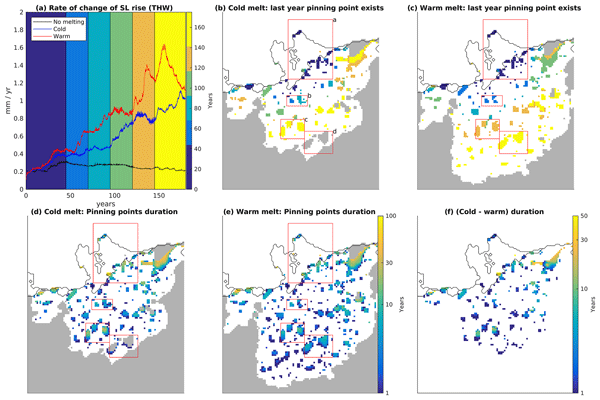
A new ice–ocean model simulates future ice sheet evolution in the Amundsen Sea sector of Antarctica. Substantial ice retreat is simulated in all scenarios, with some retreat still occurring even with no future ocean melting. The future of small "pinning points" (islands of ice that contact the seabed) is an important control on this retreat. Ocean melting is crucial in causing these features to go afloat, providing the link by which climate change may affect this sector's sea level contribution.
Allison P. Lepp, Lauren E. Miller, John B. Anderson, Matt O'Regan, Monica C. M. Winsborrow, James A. Smith, Claus-Dieter Hillenbrand, Julia S. Wellner, Lindsay O. Prothro, and Evgeny A. Podolskiy
The Cryosphere, 18, 2297–2319, https://doi.org/10.5194/tc-18-2297-2024, https://doi.org/10.5194/tc-18-2297-2024, 2024
Short summary
Short summary
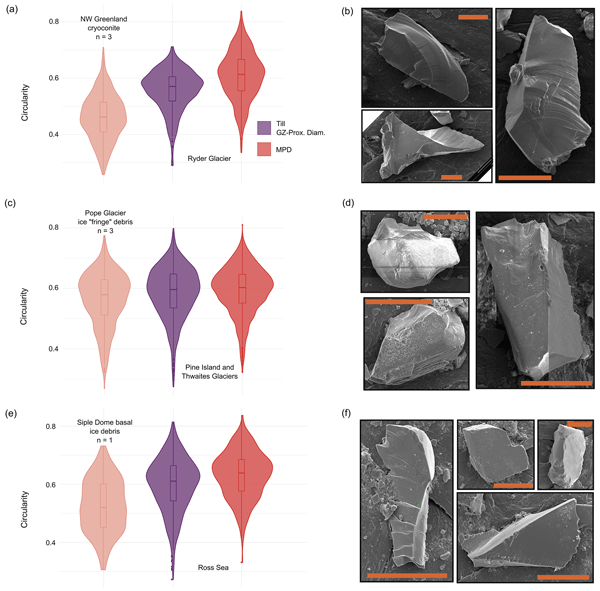
Shape and surface texture of silt-sized grains are measured to connect marine sediment records with subglacial water flow. We find that grain shape alteration is greatest in glaciers where high-energy drainage events and abundant melting of surface ice are inferred and that the surfaces of silt-sized sediments preserve evidence of glacial transport. Our results suggest grain shape and texture may reveal whether glaciers previously experienced temperate conditions with more abundant meltwater.
Yavor Kostov, Marie-José Messias, Herlé Mercier, David P. Marshall, and Helen L. Johnson
Ocean Sci., 20, 521–547, https://doi.org/10.5194/os-20-521-2024, https://doi.org/10.5194/os-20-521-2024, 2024
Short summary
Short summary
We examine factors affecting variability in the volume of Labrador Sea Water (LSW), a water mass that is important for the uptake and storage of heat and carbon in the Atlantic Ocean. We find that LSW accumulated in the Labrador Sea exhibits a lagged response to remote conditions: surface wind stress, heat flux, and freshwater flux anomalies, especially along the pathways of the North Atlantic Current branches. We use our results to reconstruct and attribute historical changes in LSW volume.
Hélène Seroussi, Vincent Verjans, Sophie Nowicki, Antony J. Payne, Heiko Goelzer, William H. Lipscomb, Ayako Abe-Ouchi, Cécile Agosta, Torsten Albrecht, Xylar Asay-Davis, Alice Barthel, Reinhard Calov, Richard Cullather, Christophe Dumas, Benjamin K. Galton-Fenzi, Rupert Gladstone, Nicholas R. Golledge, Jonathan M. Gregory, Ralf Greve, Tore Hattermann, Matthew J. Hoffman, Angelika Humbert, Philippe Huybrechts, Nicolas C. Jourdain, Thomas Kleiner, Eric Larour, Gunter R. Leguy, Daniel P. Lowry, Chistopher M. Little, Mathieu Morlighem, Frank Pattyn, Tyler Pelle, Stephen F. Price, Aurélien Quiquet, Ronja Reese, Nicole-Jeanne Schlegel, Andrew Shepherd, Erika Simon, Robin S. Smith, Fiammetta Straneo, Sainan Sun, Luke D. Trusel, Jonas Van Breedam, Peter Van Katwyk, Roderik S. W. van de Wal, Ricarda Winkelmann, Chen Zhao, Tong Zhang, and Thomas Zwinger
The Cryosphere, 17, 5197–5217, https://doi.org/10.5194/tc-17-5197-2023, https://doi.org/10.5194/tc-17-5197-2023, 2023
Short summary
Short summary
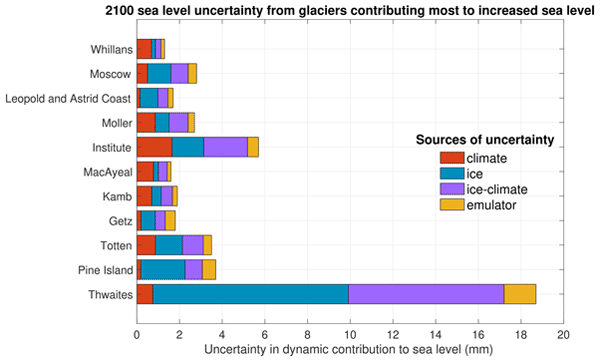
Mass loss from Antarctica is a key contributor to sea level rise over the 21st century, and the associated uncertainty dominates sea level projections. We highlight here the Antarctic glaciers showing the largest changes and quantify the main sources of uncertainty in their future evolution using an ensemble of ice flow models. We show that on top of Pine Island and Thwaites glaciers, Totten and Moscow University glaciers show rapid changes and a strong sensitivity to warmer ocean conditions.
Pierre Mathiot and Nicolas C. Jourdain
Ocean Sci., 19, 1595–1615, https://doi.org/10.5194/os-19-1595-2023, https://doi.org/10.5194/os-19-1595-2023, 2023
Short summary
Short summary
How much the Antarctic ice shelf basal melt rate can increase in response to global warming remains an open question. To achieve this, we compared an ocean simulation under present-day atmospheric condition to a one under late 23rd century atmospheric conditions. The ocean response to the perturbation includes a decrease in the production of cold dense water and an increased intrusion of warmer water onto the continental shelves. This induces a substantial increase in ice shelf basal melt rates.
Gemma K. O'Connor, Paul R. Holland, Eric J. Steig, Pierre Dutrieux, and Gregory J. Hakim
The Cryosphere, 17, 4399–4420, https://doi.org/10.5194/tc-17-4399-2023, https://doi.org/10.5194/tc-17-4399-2023, 2023
Short summary
Short summary
Glaciers in West Antarctica are rapidly melting, but the causes are unknown due to limited observations. A leading hypothesis is that an unusually large wind event in the 1940s initiated the ocean-driven melting. Using proxy reconstructions (e.g., using ice cores) and climate model simulations, we find that wind events similar to the 1940s event are relatively common on millennial timescales, implying that ocean variability or climate trends are also necessary to explain the start of ice loss.
Erwin Lambert, André Jüling, Roderik S. W. van de Wal, and Paul R. Holland
The Cryosphere, 17, 3203–3228, https://doi.org/10.5194/tc-17-3203-2023, https://doi.org/10.5194/tc-17-3203-2023, 2023
Short summary
Short summary
A major uncertainty in the study of sea level rise is the melting of the Antarctic ice sheet by the ocean. Here, we have developed a new model, named LADDIE, that simulates this ocean-driven melting of the floating parts of the Antarctic ice sheet. This model simulates fine-scale patterns of melting and freezing and requires significantly fewer computational resources than state-of-the-art ocean models. LADDIE can be used as a new tool to force high-resolution ice sheet models.
Kelly A. Hogan, Katarzyna L. P. Warburton, Alastair G. C. Graham, Jerome A. Neufeld, Duncan R. Hewitt, Julian A. Dowdeswell, and Robert D. Larter
The Cryosphere, 17, 2645–2664, https://doi.org/10.5194/tc-17-2645-2023, https://doi.org/10.5194/tc-17-2645-2023, 2023
Short summary
Short summary
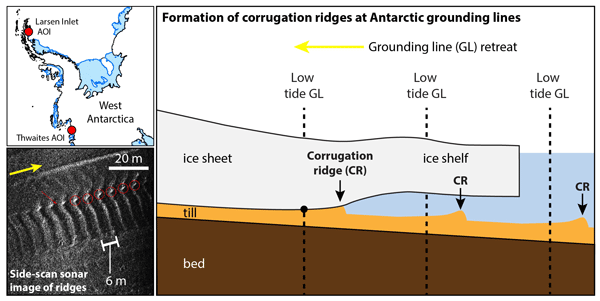
Delicate sea floor ridges – corrugation ridges – that form by tidal motion at Antarctic grounding lines record extremely fast retreat of ice streams in the past. Here we use a mathematical model, constrained by real-world observations from Thwaites Glacier, West Antarctica, to explore how corrugation ridges form. We identify
till extrusion, whereby deformable sediment is squeezed out from under the ice like toothpaste as it settles down at each low-tide position, as the most likely process.
Katherine Hutchinson, Julie Deshayes, Christian Éthé, Clément Rousset, Casimir de Lavergne, Martin Vancoppenolle, Nicolas C. Jourdain, and Pierre Mathiot
Geosci. Model Dev., 16, 3629–3650, https://doi.org/10.5194/gmd-16-3629-2023, https://doi.org/10.5194/gmd-16-3629-2023, 2023
Short summary
Short summary
Bottom Water constitutes the lower half of the ocean’s overturning system and is primarily formed in the Weddell and Ross Sea in the Antarctic due to interactions between the atmosphere, ocean, sea ice and ice shelves. Here we use a global ocean 1° resolution model with explicit representation of the three large ice shelves important for the formation of the parent waters of Bottom Water. We find doing so reduces salt biases, improves water mass realism and gives realistic ice shelf melt rates.
Dani C. Jones, Maike Sonnewald, Shenjie Zhou, Ute Hausmann, Andrew J. S. Meijers, Isabella Rosso, Lars Boehme, Michael P. Meredith, and Alberto C. Naveira Garabato
Ocean Sci., 19, 857–885, https://doi.org/10.5194/os-19-857-2023, https://doi.org/10.5194/os-19-857-2023, 2023
Short summary
Short summary
Machine learning is transforming oceanography. For example, unsupervised classification approaches help researchers identify underappreciated structures in ocean data, helping to generate new hypotheses. In this work, we use a type of unsupervised classification to identify structures in the temperature and salinity structure of the Weddell Gyre, which is an important region for global ocean circulation and for climate. We use our method to generate new ideas about mixing in the Weddell Gyre.
Michael J. Bentley, James A. Smith, Stewart S. R. Jamieson, Margaret R. Lindeman, Brice R. Rea, Angelika Humbert, Timothy P. Lane, Christopher M. Darvill, Jeremy M. Lloyd, Fiamma Straneo, Veit Helm, and David H. Roberts
The Cryosphere, 17, 1821–1837, https://doi.org/10.5194/tc-17-1821-2023, https://doi.org/10.5194/tc-17-1821-2023, 2023
Short summary
Short summary
The Northeast Greenland Ice Stream is a major outlet of the Greenland Ice Sheet. Some of its outlet glaciers and ice shelves have been breaking up and retreating, with inflows of warm ocean water identified as the likely reason. Here we report direct measurements of warm ocean water in an unusual lake that is connected to the ocean beneath the ice shelf in front of the 79° N Glacier. This glacier has not yet shown much retreat, but the presence of warm water makes future retreat more likely.
James A. Smith, Louise Callard, Michael J. Bentley, Stewart S. R. Jamieson, Maria Luisa Sánchez-Montes, Timothy P. Lane, Jeremy M. Lloyd, Erin L. McClymont, Christopher M. Darvill, Brice R. Rea, Colm O'Cofaigh, Pauline Gulliver, Werner Ehrmann, Richard S. Jones, and David H. Roberts
The Cryosphere, 17, 1247–1270, https://doi.org/10.5194/tc-17-1247-2023, https://doi.org/10.5194/tc-17-1247-2023, 2023
Short summary
Short summary
The Greenland Ice Sheet is melting at an accelerating rate. To understand the significance of these changes we reconstruct the history of one of its fringing ice shelves, known as 79° N ice shelf. We show that the ice shelf disappeared 8500 years ago, following a period of enhanced warming. An important implication of our study is that 79° N ice shelf is susceptible to collapse when atmospheric and ocean temperatures are ~2°C warmer than present, which could occur by the middle of this century.
Jeff Polton, James Harle, Jason Holt, Anna Katavouta, Dale Partridge, Jenny Jardine, Sarah Wakelin, Julia Rulent, Anthony Wise, Katherine Hutchinson, David Byrne, Diego Bruciaferri, Enda O'Dea, Michela De Dominicis, Pierre Mathiot, Andrew Coward, Andrew Yool, Julien Palmiéri, Gennadi Lessin, Claudia Gabriela Mayorga-Adame, Valérie Le Guennec, Alex Arnold, and Clément Rousset
Geosci. Model Dev., 16, 1481–1510, https://doi.org/10.5194/gmd-16-1481-2023, https://doi.org/10.5194/gmd-16-1481-2023, 2023
Short summary
Short summary
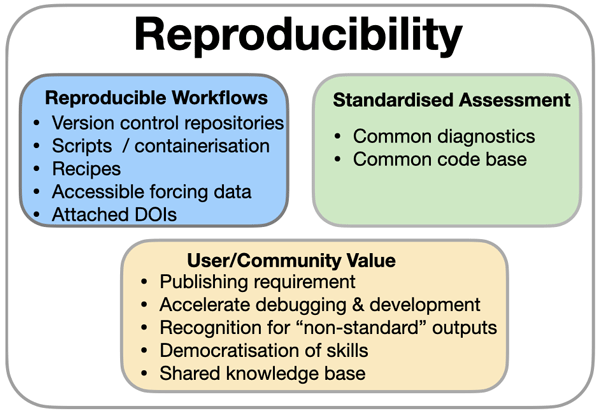
The aim is to increase the capacity of the modelling community to respond to societally important questions that require ocean modelling. The concept of reproducibility for regional ocean modelling is developed: advocating methods for reproducible workflows and standardised methods of assessment. Then, targeting the NEMO framework, we give practical advice and worked examples, highlighting key considerations that will the expedite development cycle and upskill the user community.
Paul R. Holland, Gemma K. O'Connor, Thomas J. Bracegirdle, Pierre Dutrieux, Kaitlin A. Naughten, Eric J. Steig, David P. Schneider, Adrian Jenkins, and James A. Smith
The Cryosphere, 16, 5085–5105, https://doi.org/10.5194/tc-16-5085-2022, https://doi.org/10.5194/tc-16-5085-2022, 2022
Short summary
Short summary
The Antarctic Ice Sheet is losing ice, causing sea-level rise. However, it is not known whether human-induced climate change has contributed to this ice loss. In this study, we use evidence from climate models and palaeoclimate measurements (e.g. ice cores) to suggest that the ice loss was triggered by natural climate variations but is now sustained by human-forced climate change. This implies that future greenhouse-gas emissions may influence sea-level rise from Antarctica.
Clara Burgard, Nicolas C. Jourdain, Ronja Reese, Adrian Jenkins, and Pierre Mathiot
The Cryosphere, 16, 4931–4975, https://doi.org/10.5194/tc-16-4931-2022, https://doi.org/10.5194/tc-16-4931-2022, 2022
Short summary
Short summary
The ocean-induced melt at the base of the floating ice shelves around Antarctica is one of the largest uncertainty factors in the Antarctic contribution to future sea-level rise. We assess the performance of several existing parameterisations in simulating basal melt rates on a circum-Antarctic scale, using an ocean simulation resolving the cavities below the shelves as our reference. We find that the simple quadratic slope-independent and plume parameterisations yield the best compromise.
Antony Siahaan, Robin S. Smith, Paul R. Holland, Adrian Jenkins, Jonathan M. Gregory, Victoria Lee, Pierre Mathiot, Antony J. Payne, Jeff K. Ridley, and Colin G. Jones
The Cryosphere, 16, 4053–4086, https://doi.org/10.5194/tc-16-4053-2022, https://doi.org/10.5194/tc-16-4053-2022, 2022
Short summary
Short summary
The UK Earth System Model is the first to fully include interactions of the atmosphere and ocean with the Antarctic Ice Sheet. Under the low-greenhouse-gas SSP1–1.9 (Shared Socioeconomic Pathway) scenario, the ice sheet remains stable over the 21st century. Under the strong-greenhouse-gas SSP5–8.5 scenario, the model predicts strong increases in melting of large ice shelves and snow accumulation on the surface. The dominance of accumulation leads to a sea level fall at the end of the century.
Christoph Kittel, Charles Amory, Stefan Hofer, Cécile Agosta, Nicolas C. Jourdain, Ella Gilbert, Louis Le Toumelin, Étienne Vignon, Hubert Gallée, and Xavier Fettweis
The Cryosphere, 16, 2655–2669, https://doi.org/10.5194/tc-16-2655-2022, https://doi.org/10.5194/tc-16-2655-2022, 2022
Short summary
Short summary
Model projections suggest large differences in future Antarctic surface melting even for similar greenhouse gas scenarios and warming rates. We show that clouds containing a larger amount of liquid water lead to stronger melt. As surface melt can trigger the collapse of the ice shelves (the safety band of the Antarctic Ice Sheet), clouds could be a major source of uncertainties in projections of sea level rise.
Charles Pelletier, Thierry Fichefet, Hugues Goosse, Konstanze Haubner, Samuel Helsen, Pierre-Vincent Huot, Christoph Kittel, François Klein, Sébastien Le clec'h, Nicole P. M. van Lipzig, Sylvain Marchi, François Massonnet, Pierre Mathiot, Ehsan Moravveji, Eduardo Moreno-Chamarro, Pablo Ortega, Frank Pattyn, Niels Souverijns, Guillian Van Achter, Sam Vanden Broucke, Alexander Vanhulle, Deborah Verfaillie, and Lars Zipf
Geosci. Model Dev., 15, 553–594, https://doi.org/10.5194/gmd-15-553-2022, https://doi.org/10.5194/gmd-15-553-2022, 2022
Short summary
Short summary
We present PARASO, a circumpolar model for simulating the Antarctic climate. PARASO features five distinct models, each covering different Earth system subcomponents (ice sheet, atmosphere, land, sea ice, ocean). In this technical article, we describe how this tool has been developed, with a focus on the
coupling interfacesrepresenting the feedbacks between the distinct models used for contribution. PARASO is stable and ready to use but is still characterized by significant biases.
Charlotte L. Spencer-Jones, Erin L. McClymont, Nicole J. Bale, Ellen C. Hopmans, Stefan Schouten, Juliane Müller, E. Povl Abrahamsen, Claire Allen, Torsten Bickert, Claus-Dieter Hillenbrand, Elaine Mawbey, Victoria Peck, Aleksandra Svalova, and James A. Smith
Biogeosciences, 18, 3485–3504, https://doi.org/10.5194/bg-18-3485-2021, https://doi.org/10.5194/bg-18-3485-2021, 2021
Short summary
Short summary
Long-term ocean temperature records are needed to fully understand the impact of West Antarctic Ice Sheet collapse. Glycerol dialkyl glycerol tetraethers (GDGTs) are powerful tools for reconstructing ocean temperature but can be difficult to apply to the Southern Ocean. Our results show active GDGT synthesis in relatively warm depths of the ocean. This research improves the application of GDGT palaeoceanographic proxies in the Southern Ocean.
Christoph Kittel, Charles Amory, Cécile Agosta, Nicolas C. Jourdain, Stefan Hofer, Alison Delhasse, Sébastien Doutreloup, Pierre-Vincent Huot, Charlotte Lang, Thierry Fichefet, and Xavier Fettweis
The Cryosphere, 15, 1215–1236, https://doi.org/10.5194/tc-15-1215-2021, https://doi.org/10.5194/tc-15-1215-2021, 2021
Short summary
Short summary
The future surface mass balance (SMB) of the Antarctic ice sheet (AIS) will influence the ice dynamics and the contribution of the ice sheet to the sea level rise. We investigate the AIS sensitivity to different warmings using physical and statistical downscaling of CMIP5 and CMIP6 models. Our results highlight a contrasting effect between the grounded ice sheet (where the SMB is projected to increase) and ice shelves (where the future SMB depends on the emission scenario).
William H. Lipscomb, Gunter R. Leguy, Nicolas C. Jourdain, Xylar Asay-Davis, Hélène Seroussi, and Sophie Nowicki
The Cryosphere, 15, 633–661, https://doi.org/10.5194/tc-15-633-2021, https://doi.org/10.5194/tc-15-633-2021, 2021
Short summary
Short summary
This paper describes Antarctic climate change experiments in which the Community Ice Sheet Model is forced with ocean warming predicted by global climate models. Generally, ice loss begins slowly, accelerates by 2100, and then continues unabated, with widespread retreat of the West Antarctic Ice Sheet. The mass loss by 2500 varies from about 150 to 1300 mm of equivalent sea level rise, based on the predicted ocean warming and assumptions about how this warming drives melting beneath ice shelves.
Marion Donat-Magnin, Nicolas C. Jourdain, Christoph Kittel, Cécile Agosta, Charles Amory, Hubert Gallée, Gerhard Krinner, and Mondher Chekki
The Cryosphere, 15, 571–593, https://doi.org/10.5194/tc-15-571-2021, https://doi.org/10.5194/tc-15-571-2021, 2021
Short summary
Short summary
We simulate the West Antarctic climate in 2100 under increasing greenhouse gases. Future accumulation over the ice sheet increases, which reduces sea level changing rate. Surface ice-shelf melt rates increase until 2100. Some ice shelves experience a lot of liquid water at their surface, which indicates potential ice-shelf collapse. In contrast, no liquid water is found over other ice shelves due to huge amounts of snowfall that bury liquid water, favouring refreezing and ice-shelf stability.
Xuewei Li, Qinghua Yang, Lejiang Yu, Paul R. Holland, Chao Min, Longjiang Mu, and Dake Chen
The Cryosphere Discuss., https://doi.org/10.5194/tc-2020-359, https://doi.org/10.5194/tc-2020-359, 2021
Preprint withdrawn
Short summary
Short summary
The Arctic sea ice thickness record minimum is confirmed occurring in autumn 2011. The dynamic and thermodynamic processes leading to the minimum thickness is analyzed based on a daily sea ice thickness reanalysis data covering the melting season. The results demonstrate that the dynamic transport of multiyear ice and the subsequent surface energy budget response is a critical mechanism actively contributing to the evolution of Arctic sea ice thickness in 2011.
Cited articles
Adcroft, A., Hill, C., and Marshall, J.: Representation of Topography by Shaved Cells in a Height Coordinate Ocean Model, Mon. Wea. Rev., 125, 2293–2315, https://doi.org/10.1175/1520-0493(1997)125<2293:ROTBSC>2.0.CO;2, 1997.
Aguiar, W., Lee, S.-K., Lopez, H., Dong, S., Seroussi, H., Jones, D. C., and Morrison, A. K.: Antarctic Bottom Water sensitivity to spatio-temporal variations in Antarctic meltwater fluxes, Geophys. Res. Lett., 50, e2022GL101595, https://doi.org/10.1029/2022GL101595, 2023.
Arrigo, K. R., Lowry, K. E., and van Dijken, G. L.: Annual changes in sea ice and phytoplankton in polynyas of the Amundsen Sea, Antarctica, Deep-Sea Res. Pt. II, 71–76, 5–15, https://doi.org/10.1016/j.dsr2.2012.03.006, 2012.
Asay-Davis, X. S., Cornford, S. L., Durand, G., Galton-Fenzi, B. K., Gladstone, R. M., Gudmundsson, G. H., Hattermann, T., Holland, D. M., Holland, D., Holland, P. R., Martin, D. F., Mathiot, P., Pattyn, F., and Seroussi, H.: Experimental design for three interrelated marine ice sheet and ocean model intercomparison projects: MISMIP v. 3 (MISMIP +), ISOMIP v. 2 (ISOMIP +) and MISOMIP v. 1 (MISOMIP1), Geosci. Model Dev., 9, 2471–2497, https://doi.org/10.5194/gmd-9-2471-2016, 2016.
Barnes, P. W. and Lien, R.: Icebergs rework shelf sediments to 500-m off Antarctica, Geology, 16, 1130–1133, 1988.
Bass, D. W.: Stability of Icebergs, Ann. Glaciol., 1, 43–47, https://doi.org/10.3189/S0260305500016943, 1980.
Bett, D. T., Holland, P. R., Naveira Garabato, A. C., Jenkins, A., Dutrieux, P., Kimura, S., and Fleming, A.: The impact of the Amundsen Sea freshwater balance on ocean melting of the West Antarctic Ice Sheet, J. Geophys. Res.-Oceans, 125, e2020JC016305, https://doi.org/10.1029/2020JC016305, 2020.
Bigg, G. R., Wadley, M. R., Stevens, D. P., and Johnson, J. A.: Prediction of iceberg trajectories for the North Atlantic and Arctic oceans, Geophys. Res. Lett., 23, 3587–3590, 1996.
Bigg, G. R., Wadley, M. R., Stevens, D. P., and Johnson, J. A.: Modelling the dynamics and thermodynamics of icebergs, Cold Reg. Sci. Technol., 26, 113–135, https://doi.org/10.1016/S0165-232X(97)00012-8, 1997.
Bigg, G. R., Cropper, T. E., O'Neill, C. K., Arnold, A. K., Fleming, A. H., Marsh, R., Ivchenko, V., Fournier, N., Osborne, M., and Stephens, R.: A model for assessing iceberg hazard, Nat. Hazards, 92, 1113–1136, https://doi.org/10.1007/s11069-018-3243-x, 2018.
Brown, C. S., Newton, A. M. W., Huuse, M., and Buckley, F.: Iceberg scours, pits, and pockmarks in the North Falkland Basin, Mar. Geol., 386, 140–152, https://doi.org/10.1016/j.margeo.2017.03.001, 2017.
Caillet, J., Jourdain, N., Mathiot, P., Hellmer, H., and Mouginot, J.: Drivers and Reversibility of Abrupt Ocean State Transitions in the Amundsen Sea, Antarctica, J. Geophys. Res.-Oceans, 128, e2022JC018929, https://doi.org/10.1029/2022JC018929, 2022.
Cefarelli, A., Ferrario, M., and Vernet, M.: Diatoms (Bacillariophyceae) associated with free-drifting Antarctic icebergs: taxonomy and distribution, Polar Biol., 39, 443–459, https://doi.org/10.1007/s00300-015-1791-z, 2016.
Cenedese, C. and Straneo, F.: Icebergs Melting, Annu. Rev. Fluid Mech., 55, 377–402, 2023.
Chari, T. R.: Some geotechnical aspects of iceberg grounding, Doctoral (PhD) thesis, Memorial University of Newfoundland, https://hdl.handle.net/20.500.14783/10514 (last access: 18 December 2025), 1975.
Chari, T. R., Peters, G. R., and Muthukrishnaiah, K.: Environmental factors affecting iceberg scour estimates, Cold Reg. Sci. Technol., 1, 223–230, https://doi.org/10.1016/0165-232X(80)90050-6, 1980.
Clark, R. W., Wellner, J. S., Hillenbrand, C., Totten, R. L., Smith, J. A., Miller, L. E., Larter, R. D., Hogan, K. A., Graham, A. G. C., Nitsche, F. O., Lehrmann, A. A., Lepp, A. P., Kirkham, J. D., Fitzgerald, V. T., Garcia-Barrera, G., Ehrmann, W., and Wacker, L.: Synchronous retreat of Thwaites and Pine Island glaciers in response to external forcings in the presatellite era, P. Natl. Acad. Sci. USA, 121, e2211711120, https://doi.org/10.1073/pnas.2211711120, 2024.
Condron, A. and Hill, J. C.: Timing of iceberg scours and massive ice-rafting events in the subtropical North Atlantic, Nat. Commun., 12, 3668, https://doi.org/10.1038/s41467-021-23924-0, 2021.
Davis, P. E. D., Nicholls, K. W., Holland, D. M., Schmidt, B. E., Washam, P., Riverman, K. L., Arthern, R. J., Vaňková, I., Eayrs, C., Smith, J. A., Anker, P. G. D., Mullen, A. D., Dichek, D., Lawrence, J. D., Meister, M. M., Clyne, E., Basinski-Ferris, A., Rignot, E., Queste, B. Y., Boehme, L., Heywood, K. J., Anandakrishnan, S., and Makinson, K.: Suppressed basal melting in the eastern Thwaites Glacier grounding zone, Nature, 614, 479–485, https://doi.org/10.1038/s41586-022-05586-0, 2023.
Davison, B. J., Hogg, A .E., Gourmelen, N., Jakob, L., Wuite, J., Nagler, T., Greene, C. A., Andreasen, J., and Engdahl, M. E.: Annual mass budget of Antarctic ice shelves from 1997 to 2021, Sci. Adv., 9, eadi0186, https://doi.org/10.1126/sciadv.adi0186, 2023.
Darwin, C. R.: On the power of icebergs to make rectilinear uniformly-directed grooves across a submarine undulatory surface, The London, Edinburgh and Dublin Philosophical Magazine, 10, 96–98, https://doi.org/10.1080/14786445508641938, 1855.
Dowdeswell, J. A. and Bamber J. L.: Keel depths of modern Antarctic icebergs and implications for sea-floor scouring in the geological record, Mar. Geol., 243, 120–131, 2007.
Duprat, L., Bigg, G., and Wilton, D.: Enhanced Southern Ocean marine productivity due to fertilization by giant icebergs, Nat. Geosci., 9, 219–221, https://doi.org/10.1038/ngeo2633, 2016.
Dutrieux, P., De Rydt, J., Jenkins, A., Holland, P. R., Ha, H. K., Lee, S. H., Steig, E. J., Ding, Q., Abrahamsen, E. P., and Schröder, M.: Strong Sensitivity of Pine Island Ice-Shelf Melting to Climatic Variability, Science, 343, 174–178, https://doi.org/10.1126/science.1244341, 2014.
England, M. R., Wagner, T. J. W., and Eisenman, I.: Modeling the breakup of tabular icebergs, Sci. Adv., 6, eabd1273, https://doi.org/10.1126/sciadv.abd1273, 2020.
FitzMaurice, A., Straneo, F., Cenedese, C., and Andres, M.: Effect of a sheared flow on iceberg motion and melting, Geophys. Res. Lett., 43, 12520–12527, https://doi.org/10.1002/2016GL071602, 2016.
Fowler, A. C.: Weertman, Lliboutry and the development of sliding theory, J. Glaciol., 56, 965–972, https://doi.org/10.3189/002214311796406112, 2010.
Fox-Kemper, B., Adcroft, A., Böning, C. W., Chassignet, E. P., Curchitser, E., Danabasoglu, G., Eden, C., England, M. H., Gerdes, R., Greatbatch, R. J., Griffies, S. M., Hallberg, R.W., Hanert, E., Heimbach, P., Hewitt, H. T., Hill, C. N., Komuro, Y., Legg, S., Le Sommer, J., Masina, S., Marsland, S. J., Penny, S. G., Qiao, F., Ringler, T. D., Treguier, A. M., Tsujino, H., Uotila, P., and Yeager, S. G.: Challenges and Prospects in Ocean Circulation Models, Front. Mar. Sci., 6, 65, https://doi.org/10.3389/fmars.2019.00065, 2019.
Gladstone, R. M., Bigg, G. R., and Nicholls, K. W.: Iceberg trajectory modeling and meltwater injection in the Southern Ocean, J. Geophys. Res., 106, 19903–19915, https://doi.org/10.1029/2000JC000347, 2001.
Gohl, K.: Basement control on past ice sheet dynamics in the Amundsen Sea Embayment, West Antarctica. Palaeogeography, Palaeoclimatology, Palaeoecology 335–336, 35–41, https://doi.org/10.1016/j.palaeo.2011.02.022, 2012.
Gohl, K., Uenzelmann-Neben, G., Larter, R. D., Hillenbrand, C.-D., Hochmuth, K., Kalberg, T., Weigelt, E., Davy, B., Kuhn, G., and Nitsche, F. O.: Seismic stratigraphic record of the Amundsen Sea Embayment shelf from pre-glacial to recent times: Evidence for a dynamic West Antarctic ice sheet, Marine Geol., 344, 115–131, 2013.
Gohl, K., Freudenthal, T., Hillenbrand, C.-D., Klages, J., Larter, R., Bickert, T., Bohaty, S., Ehrmann, W., Esper, O., Frederichs, T., Gebhardt, C., Küssner, K., Kuhn, G., Pälike, H., Ronge, T., Simões Pereira, P., Smith, J., Uenzelmann-Neben, G., van de Flierdt, C., and the Science Team of Expedition PS104: MeBo70 seabed drilling on a polar continental shelf: Operational report and lessons from drilling in the Amundsen Sea Embayment of West Antarctica, Geochemistry, Geophysics, Geosystems, 18, 4235–4250, https://doi.org/10.1002/2017GC007081, 2017.
Graham, A. G. C., Larter, R. D., Gohl, K., Hillenbrand, C.-D., Smith, J. A., and Kuhn, G.: Bedform signature of a West Antarctic palaeo-ice stream reveals a multi-temporal record of flow and substrate control, Quaternary Sci. Rev., 28, 2774–2793, 2009.
Hawkings, J. R., Wadham, J. L., Benning, L. G., Hendry, K. R., Tranter, M., Tedstone, A., Nienow, P., and Raiswell, R.: Ice sheets as a missing source of silica to the polar oceans, Nat. Commun., 8, 14198, https://doi.org/10.1038/ncomms14198, 2017.
Hill, J. and Condron, A.: Subtropical iceberg scours and meltwater routing in the deglacial western North Atlantic, Nat. Geosci., 7, 806–810, https://doi.org/10.1038/ngeo2267, 2014.
Hogan, K. A., Larter, R. D., Graham, A. G. C., Arthern, R., Kirkham, J. D., Totten, R. L., Jordan, T. A., Clark, R., Fitzgerald, V., Wåhlin, A. K., Anderson, J. B., Hillenbrand, C.-D., Nitsche, F. O., Simkins, L., Smith, J. A., Gohl, K., Arndt, J. E., Hong, J., and Wellner, J.: Revealing the former bed of Thwaites Glacier using sea-floor bathymetry: implications for warm-water routing and bed controls on ice flow and buttressing, The Cryosphere, 14, 2883–2908, https://doi.org/10.5194/tc-14-2883-2020, 2020.
Hopwood, M. J., Carroll, D., Höfer, J., Achterberg, E. P., Meire, L., Le Moigne, F. A. C., Bach, L. T., Eich, C., Sutherland, D. A., and González, H. E.: Highly variable iron content modulates iceberg-ocean fertilisation and potential carbon export, Nat. Commun., 10, 5261, https://doi.org/10.1038/s41467-019-13231-0, 2019.
Huth, A., Adcroft, A., and Sergienko, O.: Parameterizing tabular-iceberg decay in an ocean model, J. Adv. Model. Earth Sy., 14, e2021MS002869, https://doi.org/10.1029/2021MS002869, 2022.
Jacobs, S., Jenkins, A., Hellmer, H., Giulivi, C., Nitsche, F., Huber, B., and Guerrero, R.: The Amundsen Sea and the Antarctic Ice Sheet, Oceanography, 25, 154–163, https://doi.org/10.5670/oceanog.2012.90, 2012.
Jakobsson, M., Anderson, J. B., Nitsche, F. O., Dowdeswell, J. A., Gyllencreutz, R., Kirchner, N., Mohammad, R., O'Regan, M., Alley, R. B. Anandakrishnan, S., Eriksson, B., Kirshner, A., Fernandez, R., Stolldorf, T., Totten, R., and Majewski, W.: Geological record of ice shelf break-up and grounding line retreat, Pine Island Bay, West Antarctica, Geology, 39, 691–694, 2011.
Jenkins, A., Nicholls, K. W., and Corr, H. F. J.: Observation and Parameterization of Ablation at the Base of Ronne Ice Shelf, Antarctica, J. Phys. Oceanogr., 40, 2298–2312, https://doi.org/10.1175/2010JPO4317.1, 2010.
Joughin, I. Shapero, D., Smith, B., Dutrieux, P., and Barham, M.: Ice-shelf retreat drives recent Pine Island Glacier speedup, Sci. Adv., 7, eabg3080, https://doi.org/10.1126/sciadv.abg3080, 2021.
Jourdain, N. C., Molines, J.-M., Le Sommer, J., Mathiot, P., Chanut, J., de Lavergne, C., and Madec, G.: Simulating or prescribing the influence of tides on the Amundsen Sea ice shelves, Ocean Model., 133, 44–55, https://doi.org/10.1016/j.ocemod.2018.11.001, 2019.
Kostov, Y., Holland, P. R., Hogan, K. A., Smith, J. A., Jourdain, N. C., Mathiot, P., Olivé Abelló, A., Fleming, A. H., and Meijers, A. J. S.: Modelled dynamics of floating and grounded icebergs, with application to the Amundsen Sea, TIB AV-Portal [video], https://doi.org/10.5446/70447, 2025a.
Kostov, Y., Holland, P. R., Hogan, K. A., Smith, J. A., Jourdain, N. C., Mathiot, P., Olivé Abelló, A., Fleming, A. H., and Meijers, A. J. S.: Updates to the NEMO iceberg dynamics and grounding, Version 2, Zenodo [code and data set], https://doi.org/10.5281/zenodo.15484879, 2025b.
Large, W. G. and Yeager, S. G.: The global climatology of an interannually varying air–sea flux data set, Clim. Dyn., 33, 341–364, https://doi.org/10.1007/s00382-008-0441-3, 2009.
Lemieux, J.-F., Dupont, F., Blain, P., Roy, F., Smith, G. C., and Flato, G. M.: Improving the simulation of landfast ice by combining tensile strength and a parameterization for grounded ridges, J. Geophys. Res.-Oceans, 121, 7354–7368, https://doi.org/10.1002/2016JC012006, 2016.
Lien, R., Solheim, A., Elverhoi, A., and Rokoengen, K.: Iceberg scouring and sea bed morphology on the eastern Weddell Sea shelf, Antarctica, Pol. Res., 7, 43–57, 1989.
Lopez, R., Chari, T. R., Moore, E., Peters, G. R., and Zielinski, A..: Hydrodynamic Effects On Iceberg Gouging, Cold Reg. Sci. Technol., 4, 55–61, https://doi.org/10.1016/0165-232X(81)90030-6, 1981.
Lucas, N., Brearley, J., Hendry, K., Spira, T., Braakmann-Folgmann, A., Povl Abrahamsen, E., Meredith, M., and Tarling, G.: Giant icebergs increase mixing and stratification in upper-ocean layers, Research Square [preprint], https://doi.org/10.21203/rs.3.rs-4425629/v1, 10 June 2024.
MacAyeal, D. R., Scambos, T. A., Hulbe, C. L., and Fahnestock, M. A.: Catastrophic ice-shelf break-up by an ice-shelf-fragment-capsize mechanism, J. Glaciol., 49, 22–36, 2003.
Madec, G. and NEMO-Team: Note du Pôle de modélisation de l'Institut Pierre-Simon Laplace No 27, in: NEMO ocean engine, version 3.6 stable, technical report, IPSL, France, ISSN No. 1288-1619, 2016.
Madec, G. and NEMO System Team: NEMO ocean engine, Version v4.2, Zenodo, https://doi.org/10.5281/zenodo.6334656, 2022.
Marsh, R., Ivchenko, V. O., Skliris, N., Alderson, S., Bigg, G. R., Madec, G., Blaker, A. T., Aksenov, Y., Sinha, B., Coward, A. C., Le Sommer, J., Merino, N., and Zalesny, V. B.: NEMO–ICB (v1.0): interactive icebergs in the NEMO ocean model globally configured at eddy-permitting resolution, Geosci. Model Dev., 8, 1547–1562, https://doi.org/10.5194/gmd-8-1547-2015, 2015.
Marsh, R., Bigg, G., Zhao, Y., Martin, M. J., Blundell, J. R., Josey, S. A., Hanna, E., and Ivchenko, V.: Prospects for seasonal forecasting of iceberg distributions in the North Atlantic, Nat. Hazards, 91, 447–471, https://doi.org/10.1007/s11069-017-3136-4, 2018.
Marson, J. M., Myers, P. G., Garbo, A., Copland, L., and Mueller, D.: Sea ice-driven iceberg drift in Baffin Bay, J. Geophys. Res.-Oceans, 129, e2023JC020697, https://doi.org/10.1029/2023JC020697, 2024.
Martin, T. and Adcroft, A.: Parameterizing the fresh-water flux from land ice to ocean with interactive icebergs in a coupled climate model, Ocean Model., 34, 111–124, https://doi.org/10.1016/j.ocemod.2010.05.001, 2010.
Mathiot, P. and Jourdain, N. C.: Southern Ocean warming and Antarctic ice shelf melting in conditions plausible by late 23rd century in a high-end scenario, Ocean Sci., 19, 1595–1615, https://doi.org/10.5194/os-19-1595-2023, 2023.
Mathiot, P., Jenkins, A., Harris, C., and Madec, G.: Explicit representation and parametrised impacts of under ice shelf seas in the z* coordinate ocean model NEMO 3.6, Geosci. Model Dev., 10, 2849–2874, https://doi.org/10.5194/gmd-10-2849-2017, 2017.
Mazur, A. K., Wahlin, A. K., and Kalén, O.: The life cycle of small-to medium-sized icebergs in the Amundsen Sea Embayment, Pol. Res., 38, 3313, https://doi.org/10.33265/polar.v38.3313, 2019.
Merino, N., Le Sommer, J., Durand, G., Jourdain, N. C., Madec, G., Mathiot, P., and Tournadre, J.: Antarctic icebergs melt over the Southern Ocean: Climatology and impact on sea ice, Ocean Model., 104, 99–110, https://doi.org/10.1016/j.ocemod.2016.05.001, 2016.
Miles, B. W. J., Stokes, C. R., Jenkins, A., Jordan, J. R., Jamieson, S. S. R., and Gudmundsson, G. H.: Intermittent structural weakening and acceleration of the Thwaites Glacier Tongue between 2000 and 2018, J. Glaciol., 66, 485–495, https://doi.org/10.1017/jog.2020.20, 2020.
Morlighem, M., Rignot, E., Binder, T., Blankenship, D., Drews, R., Eagles, G., Eisen, O., Ferraccioli, F., Forsberg, R., Fretwell, P., Goel, V., Greenbaum, J. S., Gudmundsson, H., Guo, J., Helm, V., Hofstede, C., Howat, I., Humbert, A., Jokat, W., Karlsson, N. B., Lee, W. S., Matsuoka, K., Millan, R., Mouginot, J., Paden, J., Pattyn, F., Roberts, J., Rosier, S., Ruppel, A., Seroussi, H., Smith, E. C. Steinhage, D., Sun, B., van den Broeke, M. R., van Ommen, T. D., van Wessem, M., and Young, D. A.: Deep glacial troughs and stabilizing ridges unveiled beneath the margins of the Antarctic ice sheet, Nat. Geosci., 13, 132–137, https://doi.org/10.1038/s41561-019-0510-8, 2020.
Mouginot, J., Rignot, E., and Scheuchl, B.: Sustained increase in ice discharge from the Amundsen Sea Embayment, West Antarctica, from 1973 to 2013, Geophys. Res. Lett., 41, 1576–1584, https://doi.org/10.1002/2013GL059069, 2014.
Mountain, D. G.: On predicting iceberg drift, Cold Reg. Sci. Technol., 1, 273–282, https://doi.org/10.1016/0165-232X(80)90055-5, 1980.
Naughten, K. A., Holland, P. R., Dutrieux, P., Kimura, S., Bett, D. T., and Jenkins, A.: Simulated twentieth-century ocean warming in the Amundsen Sea, West Antarctica, Geophys. Res. Lett., 49, e2021GL094566, https://doi.org/10.1029/2021GL094566, 2022.
Nakayama, Y., Timmermann, R., Schröder, M., and Hellmer, H.: On the difficulty of modeling Circumpolar Deep Water intrusions onto the Amundsen Sea continental shelf, Ocean Model., 84, 26–34, https://doi.org/10.1016/j.ocemod.2014.09.007, 2014.
Niessen, F., Magens, D., and Gebhardt, A. C.: Physical properties of the AND-1B Core, ANDRILL McMurdo ice shelf project, Antarctica, Terra Antartica, 14, 155–166, 2007.
Olivé Abelló, A., Mathiot, P., Jourdain, N. C., Kostov, Y., Holland, P. R., Gascoin, S., and Rousset, C.: Iceberg grounding enhances the release of freshwater on the Antarctic continental shelf, J. Geophys. Res.-Oceans, 130, e2025JC022857, https://doi.org/10.1029/2025JC022857, 2025.
Person, R., Aumont, O., Madec, G., Vancoppenolle, M., Bopp, L., and Merino, N.: Sensitivity of ocean biogeochemistry to the iron supply from the Antarctic Ice Sheet explored with a biogeochemical model, Biogeosciences, 16, 3583–3603, https://doi.org/10.5194/bg-16-3583-2019, 2019.
Reinardy, B. T. I., Pudsey, C. J., Hillenbrand, C.-D., Murray, T., and Evans, J.: Contrasting sources for glacial and interglacial shelf sediments used to interpret changing ice flow directions in the Larsen Basin, Northern Antarctic Peninsula, Mar. Geol., 266, 156–171, https://doi.org/10.1016/j.margeo.2009.08.003, 2009.
Ruffman, A.: The First Known Attempts Off Eastern Canada 'to Tow, or Cant' Icebergs: a seed to the understanding of iceberg scour processes at the seafloor, CMOS Bulletin SCMO, 33, 99–123, http://cmosarchives.ca/Bulletin/b3304.pdf (last access: 12 December 2025), 2005.
Shepherd, A., Gilbert, L., Muir, A. S., Konrad, H., McMillan, M., Slater, T., Briggs, K. H., Sundal, A. V., Hogg, A. E., and Engdahl, M. E.: Trends in Antarctic Ice Sheet elevation and mass, Geophys. Res. Lett., 46, 8174–8183, https://doi.org/10.1029/2019GL082182, 2019.
Smith, J. A. and Hogan, K. A.: Glaciomarine sediments and processes. in: Encyclopedia of Quaternary Science, third edn., edited by: Elias, S., Elsevier, 380–397, https://doi.org/10.1016/B978-0-323-99931-1.00225-7, 2025.
Smith, K. L., Robison, B. H., Helly, J. J., Kaufmann, R. S., Ruhl, H. A., Shaw, T. J., Twining, B. S., and Vernet, M.: Free-drifting icebergs: Hot spots of chemical and biological enrichment in the Weddell Sea, Science, 317, 478–482, https://doi.org/10.1126/science.1142834, 2007.
Smith, S. D. and Banke, E. G.: The influence of winds, currents and towing forces on the drift of icebergs, Cold Reg. Sci. Technol., 6, 241–255, https://doi.org/10.1016/0165-232X(83)90045-9, 1983.
Smith, J. A., Hillenbrand, C.-D., Kuhn, G., Larter, R. D., Graham, A. G. C., Ehrmann, W., Moreton, S. G., and Forwick, M.: Deglacial history of the West Antarctic Ice Sheet in the western Amundsen Sea Embayment, Quaternary Sci. Rev., 30, 488–505, https://doi.org/10.1016/j.quascirev.2010.11.020, 2011.
Starr, A., Hall, I.R., Barker, S., Rackow, T., Zhang, X., Hemming, S. R., van der Lubbe, H. J. L., Knorr, G., Berke, M. A., Bigg, Grant, R., Cartagena-Sierra, A., Jiménez-Espejo, F. J., Gong, X., Gruetzner, J., Lathika, N., LeVay, L. J., Robinson, R. S., Ziegler, M., Brentegani, L., Caley, T., Charles, C. D., Coenen, J. J., Crespin, J. G., Franzese, A. M., Han, X., Hines, Sophia K. V., Jimenez Espejo, F. J., Just, J., Koutsodendris, A., Kubota, K., Norris, R. D., dos Santos, T. P., Rolison, J. M., Simon, M. H., Tangunan, D., van der Lubbe, H. J. L., Yamane, M., and Zhang, H.: Antarctic icebergs reorganize ocean circulation during Pleistocene glacials, Nature, 589, 236–241, https://doi.org/10.1038/s41586-020-03094-7, 2021.
Stern, A. A., Johnson, E., Holland, D. M., Wagner, T. J. W., Wadhams, P., Bates, R., Abrahamsen, E. P., Nicholls, K. W., Crawford, A., Gagnon, J., and Tremblay, J.-E.: Wind-driven upwelling around grounded tabular icebergs, J. Geophys. Res.-Oceans, 120, 5820–5835, https://doi.org/10.1002/2015JC010805, 2015.
Stern, A. A., Adcroft, A., and Sergienko, O.: The effects of Antarctic iceberg calving-size distribution in a global climate model, J. Geophys. Res.-Oceans, 121, 5773–5788, https://doi.org/10.1002/2016JC011835, 2016.
Stern, A. A., Adcroft, A., Sergienko, O., and Marques, G.: Modeling tabular icebergs submerged in the ocean, J. Adv. Model. Earth Sy., 9, 1948–1972, https://doi.org/10.1002/2017MS001002, 2017.
St-Laurent, P., Klinck, J. M., and Dinniman, M. S.: Impact of local winter cooling on the melt of Pine Island Glacier, Antarctica, J. Geophys. Res.-Oceans, 120, 6718–6732, https://doi.org/10.1002/2015JC010709, 2015.
St-Laurent, P., Yager, P. L., Sherrell, R. M., Oliver, H., Dinniman, M. S., and Stammerjohn, S. E.: Modeling the seasonal cycle of iron and carbon fluxes in the Amundsen Sea Polynya, Antarctica, J. Geophys. Res.-Oceans, 124, 1544–1565, https://doi.org/10.1029/2018JC014773, 2019.
St-Laurent, P., Stammerjohn, S. E., and Maksym, T.: Response of onshore oceanic heat supply to yearly changes in the Amundsen Sea icescape (Antarctica), J. Geophys. Res.-Oceans, 129, e2023JC020467, https://doi.org/10.1029/2023JC020467, 2024.
Tarling, G. A., Thorpe, S. E., Henley, S. F., Burson, A., Liszka, C. M., Manno, C., Lucas, N. S., Ward, F., Hendry, K. R., Woodward, E. M. S., Wootton, M., and Abrahamsen, E. P.: Collapse of a giant iceberg in a dynamic Southern Ocean marine ecosystem: in situ observations of A-68A at South Georgia, Prog. Oceanogr., 226, 103297, https://doi.org/10.1016/j.pocean.2024.103297, 2024.
Tsujino, H., Urakawa, S., Nakano, H., Small, R. J., Kim, W. M., Yeager, S. G., Danabasoglu, G., Suzuki, T., Bamber, J. L., Bentsen, M., Böning, C. W., Bozec, A., Chassignet, E. P., Curchitser, E., Boeira Dias, F., Durack, P. J., Griffies, S. M., Harada, Y., Ilicak, M., Josey, S. A., Kobayashi, C., Kobayashi, S., Komuro, Y., Large, W. G., Le Sommer, J., Marsland, S. J., Masina, S., Scheinert, M., Tomita, H., Valdivieso, M., and Yamazaki, D.: JRA-55 based surface dataset for driving ocean–sea-ice models (JRA55-do), Ocean Model., 130, 79–139, https://doi.org/10.1016/j.ocemod.2018.07.002, 2018.
Vancoppenolle, M., Rousset, C., Blockley, E., Aksenov, Y., Feltham, D., Fichefet, T., Garric, G., Guémas, V., Iovino, D., Keeley, S., Madec, G., Massonnet, F., Ridley, J., Schroeder, D., and Tietsche, S.: SI3, the NEMO Sea Ice Engine (4.2release_doc1.0), Zenodo [code], https://doi.org/10.5281/zenodo.7534900, 2023.
Veldhuijsen, S. B. M., van de Berg, W. J., Brils, M., Kuipers Munneke, P., and van den Broeke, M. R.: Characteristics of the 1979–2020 Antarctic firn layer simulated with IMAU-FDM v1.2A, The Cryosphere, 17, 1675–1696, https://doi.org/10.5194/tc-17-1675-2023, 2023.
Wagner, T. J. W., Dell, R. W., and Eisenman, I.: An Analytical Model of Iceberg Drift, J. Phys. Oceanogr., 47, 1605–1616, https://doi.org/10.1175/JPO-D-16-0262.1, 2017.
Wagner, T. J. W., Eisenman, I., Ceroli, A. M., and Constantinou, N. C.: How Winds and Ocean Currents Influence the Drift of Floating Objects, J. Phys. Oceanogr., 52, 907–916, https://doi.org/10.1175/JPO-D-20-0275.1, 2022.
Weeks, W. F. and Mellor, M.: Some Elements of Iceberg Technology, Technical report, Cold Regions Research and Engineering Laboratory, https://doi.org/10.1016/B978-0-08-022916-4.50015-7, 1978.
Wise, M. G., Dowdeswell, J. A., Jakobsson, M. J., and Larter, R. D.: Evidence of marine ice-cliff instability in Pine Island Bay from iceberg-keel plough marks, Nature, 550, 506—510, 2017.
Short summary
Icebergs ground when they reach shallow topography such as Bear Ridge in the Amundsen Sea. Grounded icebergs can block the transport of sea-ice and create areas of higher and lower sea-ice concentration. We introduce a physically and observationally motivated representation of grounding in an ocean model. In addition, we improve the way simulated icebergs respond to winds, ocean currents, and density differences in sea water. We analyse the forces acting on freely floating and grounded icebergs.
Icebergs ground when they reach shallow topography such as Bear Ridge in the Amundsen Sea....