
Articles | Volume 20, issue 1
https://doi.org/10.5194/tc-20-1-2026
© Author(s) 2026. This work is distributed under
the Creative Commons Attribution 4.0 License.
the Creative Commons Attribution 4.0 License.
https://doi.org/10.5194/tc-20-1-2026
© Author(s) 2026. This work is distributed under
the Creative Commons Attribution 4.0 License.
the Creative Commons Attribution 4.0 License.
Research article
| 
06 Jan 2026
Research article |
| 06 Jan 2026
| 06 Jan 2026
Drivers of observed winter–spring sea-ice and snow thickness at a coastal site in East Antarctica

Environmental and Geophysical Sciences (ENGEOS) Lab, Earth Sciences Department, Khalifa University, Abu Dhabi, 127788, United Arab Emirates
Ricardo Fonseca
Environmental and Geophysical Sciences (ENGEOS) Lab, Earth Sciences Department, Khalifa University, Abu Dhabi, 127788, United Arab Emirates
Narendra Nelli
Environmental and Geophysical Sciences (ENGEOS) Lab, Earth Sciences Department, Khalifa University, Abu Dhabi, 127788, United Arab Emirates
Petra Heil
Australian Antarctic Division, Department of Climate Change, Energy, the Environment and Water, Kingston, Tasmania, Australia
Australian Antarctic Program Partnership, Institute for Marine and Antarctic Studies, University of Tasmania, Hobart, Tasmania, Australia
Institute Snow and Avalanche Research, Swiss Federal Institute for Forest, Snow and Landscape Research, Davos, Switzerland
Jonathan D. Wille
Institute for Atmospheric and Climate Science, ETH Zurich, Zurich, Switzerland
Irina V. Gorodetskaya
Interdisciplinary Centre of Marine and Environmental Research, University of Porto, Porto, Portugal
Robert A. Massom
Australian Antarctic Division, Department of Climate Change, Energy, the Environment and Water, Kingston, Tasmania, Australia
Australian Antarctic Program Partnership, Institute for Marine and Antarctic Studies, University of Tasmania, Hobart, Tasmania, Australia
The Australian Centre for Excellence in Antarctic Science, University of Tasmania, Hobart, Tasmania, Australia
Related authors
Christopher R. Oxford, Haihui Zhu, Maya Mehrotra, Xuan Liu, Yuxuan Ren, Maya Arnott, Isaac Abionum Adimula, Taiye Benjamin Ajibolataiye, Clement Akoshile, Omar Amador-Munoz, Araya Asfaw, Rachel Ying-Wen Chang, Sagnik Dey, Ann M. Dillner, David J. Diner, Connor J. Flynn, Diana Francis, Paterne Gahungu, Rebecca M. Garland, Michel Grutter, Sina Hasheminassab, Fahad Imam, Jhoon Kim, Kristy Langerman, Pei-Chen Lee, Puji Lestari, Po-Hsiung Lin, S. Marcela Loria-Salazar, Tesfaye Mamo, Olga L. Mayol-Bracero, Mogesh Naidoo, Narendra Nelli, Sang Seo Park, Abdus Salam, Bighnaraj Sarangi, Trailokya Saud, Robyn Schofield, Yoav Schechner, Sachchida N. Tripathi, Emily K. West, Eli Windwer, Ming-Tsang Wu, Qiang Zhang, Michael Brauer, Yinon Rudich, Jay R. Turner, and Randall V. Martin
EGUsphere, https://doi.org/10.5194/egusphere-2026-3224, https://doi.org/10.5194/egusphere-2026-3224, 2026
Short summary
Short summary
A high-sensitivity balance, controlled temperature and relative humidity chamber, and filter samples collected around the world were used to develop a mass as a function of relative humidity relationship. We subsequently measured the chemical composition of these same samples. A relationship between the chemical composition and water mass was created and used to calculate aerosol water content showing how composition and water content varies worldwide.
Yesobu Yarragunta, Diana Francis, Ricardo Fonseca, and Narendra Nelli
Atmos. Chem. Phys., 25, 1685–1709, https://doi.org/10.5194/acp-25-1685-2025, https://doi.org/10.5194/acp-25-1685-2025, 2025
Short summary
Short summary
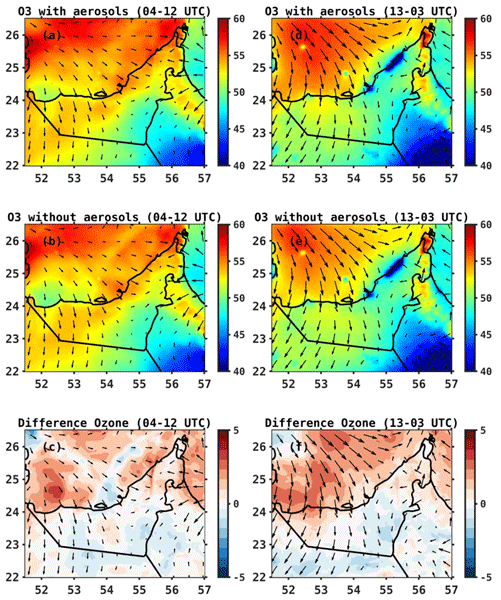
This study evaluates the Weather Research and Forecasting model with chemistry (WRF-Chem) in simulating air pollutants over the United Arab Emirates using satellite observations. The model accurately captured ozone and carbon monoxide but showed discrepancies for nitrogen dioxide. WRF-Chem was moderately correlated with aerosol optical depth observations and performed well in simulating meteorological parameters, demonstrating its suitability for atmospheric modelling.
Diana Francis, Ricardo Fonseca, Kyle S. Mattingly, Stef Lhermitte, and Catherine Walker
The Cryosphere, 17, 3041–3062, https://doi.org/10.5194/tc-17-3041-2023, https://doi.org/10.5194/tc-17-3041-2023, 2023
Short summary
Short summary
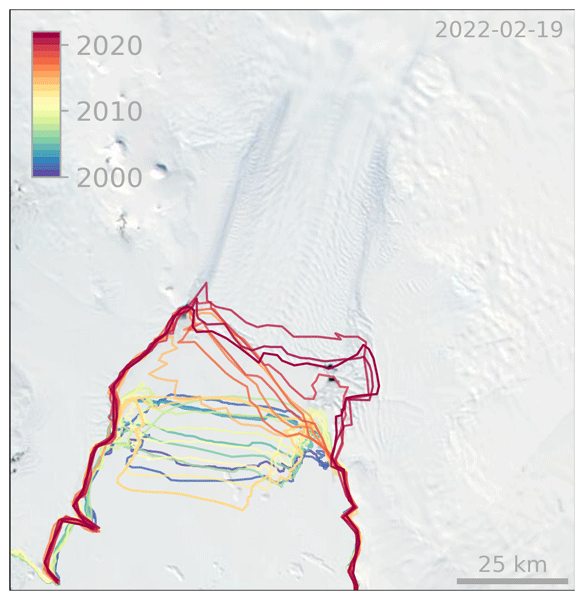
Role of Foehn Winds in ice and snow conditions at the Pine Island Glacier, West Antarctica.
Rachid Abida, Narendra Nelli, Diana Francis, Olivier Masson, Ricardo Fonseca, Emmanuel Bosc, and Marouane Temimi
EGUsphere, https://doi.org/10.5194/egusphere-2023-956, https://doi.org/10.5194/egusphere-2023-956, 2023
Preprint archived
Short summary
Short summary
This study is the first application of the Eddy Covariance (EC) framework to measure the fog droplet deposition velocity in a hyperarid coastal site. The average deposition velocity of fog droplets is around 3 cm s-1. The ratio of the time-integrated ground deposition of 137Cs under foggy conditions to that under clear sky conditions, showed that the fog contributed to the total ground deposition of 137Cs by up to 40 %.
Marta Stentella, Ghislain Picard, Petra Heil, Jacqueline Boutin, Emmanuel Dinnat, and Stuart Corney
The Cryosphere, 20, 4465–4489, https://doi.org/10.5194/tc-20-4465-2026, https://doi.org/10.5194/tc-20-4465-2026, 2026
Short summary
Short summary
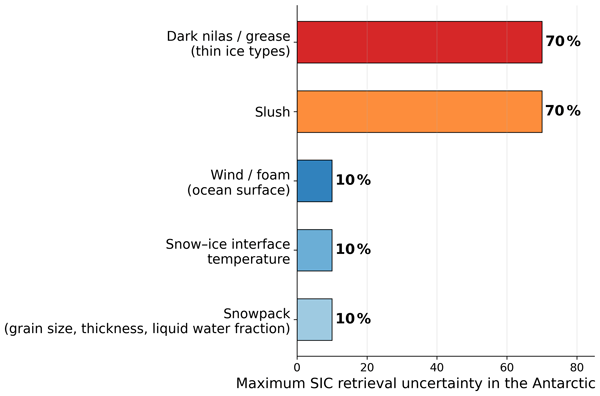
Passive microwave radiometers are the primary tool for monitoring Antarctic sea ice, but their reliability decreases in the marginal ice zone between the pack ice and the open ocean. We simulate satellite observations to assess the impact of varying physical parameters on sea ice concentration retrievals. The largest errors are due to flooded/wet snow, thin ice, and roughened ocean surfaces. These findings can improve our interpretation of satellite observations and forecast sea ice changes.
Nathan J. Teder, Luke G. Bennetts, Phillp A. Reid, and Robert A. Massom
EGUsphere, https://doi.org/10.5194/egusphere-2026-3544, https://doi.org/10.5194/egusphere-2026-3544, 2026
Short summary
Short summary
Motivated by evidence of Antarctic ice shelf calving events being triggered by sea ice loss allowing ocean swell to flex ice shelf fronts, we use data and models to assess the flexural stress imposed on 14 ice shelves over a decade. We quantify major increases in ice shelf flexure during the record sea ice lows of 2022–2023 alongside identifying the drivers of this increase. We use future scenarios to highlight the most vulnerable Antarctic ice shelves to sea ice loss and swell impacts.
Victoire Buffet, Vincent Favier, Benjamin Pohl, and Jonathan D. Wille
Weather Clim. Dynam., 7, 1189–1210, https://doi.org/10.5194/wcd-7-1189-2026, https://doi.org/10.5194/wcd-7-1189-2026, 2026
Short summary
Short summary
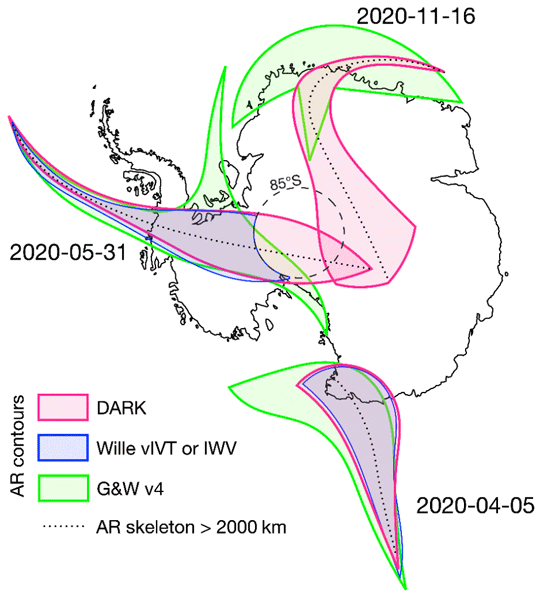
We improve the detection of long corridors of intense moisture transport, known as atmospheric rivers, that affect Antarctica. Our new method can track these rivers even when they curve, cross the South Pole, or break into smaller parts. We show that they cause even more heavy snowfall and warm weather on the continent than previously thought, clarifying their role in shaping Antarctic climate and ice loss.
Christopher R. Oxford, Haihui Zhu, Maya Mehrotra, Xuan Liu, Yuxuan Ren, Maya Arnott, Isaac Abionum Adimula, Taiye Benjamin Ajibolataiye, Clement Akoshile, Omar Amador-Munoz, Araya Asfaw, Rachel Ying-Wen Chang, Sagnik Dey, Ann M. Dillner, David J. Diner, Connor J. Flynn, Diana Francis, Paterne Gahungu, Rebecca M. Garland, Michel Grutter, Sina Hasheminassab, Fahad Imam, Jhoon Kim, Kristy Langerman, Pei-Chen Lee, Puji Lestari, Po-Hsiung Lin, S. Marcela Loria-Salazar, Tesfaye Mamo, Olga L. Mayol-Bracero, Mogesh Naidoo, Narendra Nelli, Sang Seo Park, Abdus Salam, Bighnaraj Sarangi, Trailokya Saud, Robyn Schofield, Yoav Schechner, Sachchida N. Tripathi, Emily K. West, Eli Windwer, Ming-Tsang Wu, Qiang Zhang, Michael Brauer, Yinon Rudich, Jay R. Turner, and Randall V. Martin
EGUsphere, https://doi.org/10.5194/egusphere-2026-3224, https://doi.org/10.5194/egusphere-2026-3224, 2026
Short summary
Short summary
A high-sensitivity balance, controlled temperature and relative humidity chamber, and filter samples collected around the world were used to develop a mass as a function of relative humidity relationship. We subsequently measured the chemical composition of these same samples. A relationship between the chemical composition and water mass was created and used to calculate aerosol water content showing how composition and water content varies worldwide.
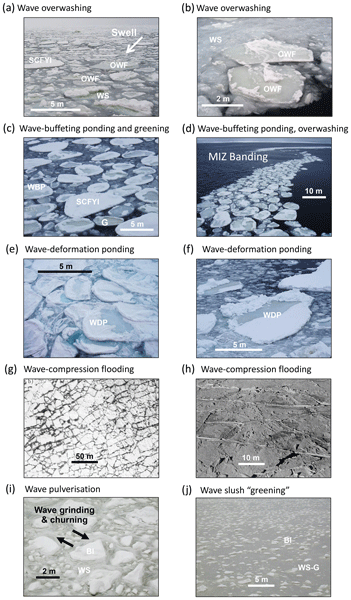
Robert A. Massom, Phillip A. Reid, Stephen G. Warren, Bonnie Light, Donald K. Perovich, Luke G. Bennetts, Petteri Uotila, Siobhan P. O'Farrell, Michael H. Meylan, Klaus M. Meiners, Pat Wongpan, Alexander D. Fraser, Alessandro Toffoli, Giulio Passerotti, Peter G. Strutton, Sean M. T. Chua, and Melissa Fedrigo
The Cryosphere, 20, 3271–3298, https://doi.org/10.5194/tc-20-3271-2026, https://doi.org/10.5194/tc-20-3271-2026, 2026
Short summary
Short summary
This paper advances understanding of why and how Antarctic sea ice can retreat so rapidly each summer, and identifies critical gaps in climate models, by highlighting 3 previously-neglected wave-driven processes and 5 associated feedbacks that accelerate seasonal ice melting and link physics to biology (wave flooding, wave pulverisation and wave greening). There are major implications for Earth’s radiation budget, Antarctic ecosystems and the accuracy of future sea-ice and climate projections.
Xinlong Liu, Stuart Paul Corney, Rachel Louise Tilling, and Petra Heil
EGUsphere, https://doi.org/10.5194/egusphere-2026-662, https://doi.org/10.5194/egusphere-2026-662, 2026
Short summary
Short summary
Antarctic sea-ice thickness from satellites depends on how snow is treated. We compared four widely used CryoSat-2 radar products for winters 2013–2018 on the same map grid. All show similar large-scale patterns, but each gives systematically higher or lower values, with the biggest differences in the snowier western Weddell Sea. Year-to-year changes are similar across products, yet these offsets can shift thickness estimates, so users should account for product choice and snow assumptions.
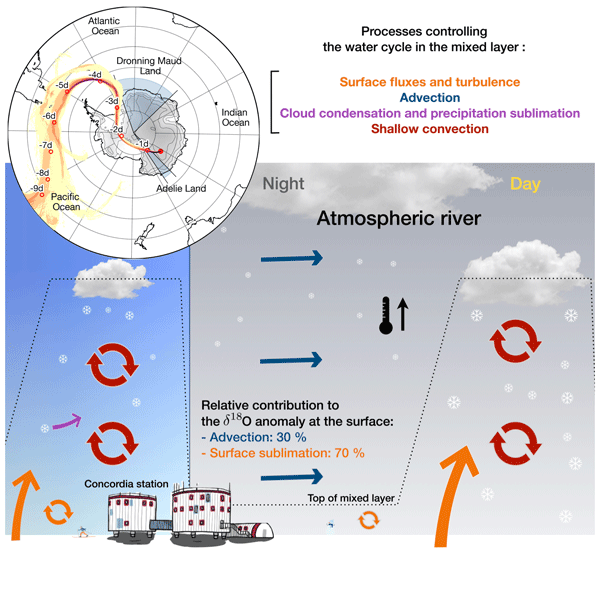
Niels Dutrievoz, Cécile Agosta, Cécile Davrinche, Amaëlle Landais, Sebastien Nguyen, Étienne Vignon, Inès Ollivier, Christophe Leroy-Dos Santos, Elise Fourré, Mathieu Casado, Jonathan Wille, Vincent Favier, Bénédicte Minster, and Frédéric Prié
The Cryosphere, 20, 1025–1046, https://doi.org/10.5194/tc-20-1025-2026, https://doi.org/10.5194/tc-20-1025-2026, 2026
Short summary
Short summary
In December 2018, an atmospheric river event from the Atlantic reached Dome C, East Antarctica, causing a +18 °C warming, tripled water vapour, and a strong isotopic anomaly in water vapour (+ 17 ‰ for δ18O) at the surface. During the peak of the event, we found 70 % of the water vapour came from local snow sublimation, and 30 % from the atmospheric river itself, highlighting both long-range moisture advection and interactions between the boundary layer and the snowpack.
Jean Rabault, Joey Voermans, Takehiko Nose, Graig Sutherland, Alexander Babanin, Takuji Waseda, Tsubasa Kodaira, Atle Jensen, Lars Willas Dreyer, Øyvind Breivik, Gaute Hope, Malte Müller, Zhaohui Cheng, Lichuan Wu, Aleksey Marchenko, Brian Ward, Kai H. Christensen, Petra Heil, and Karsten Trulsen
EGUsphere, https://doi.org/10.48550/arXiv.2507.19034, https://doi.org/10.48550/arXiv.2507.19034, 2025
Short summary
Short summary
We observe harmonics of the main incoming wave peak in sea ice motion data. These harmonics match non-linear 3-wave interactions predicted from the dispersion relation. This may indicate that wave in ice triads are empirically observed, which suggests that non-linear energy transfers play a role in wave in ice propagation.
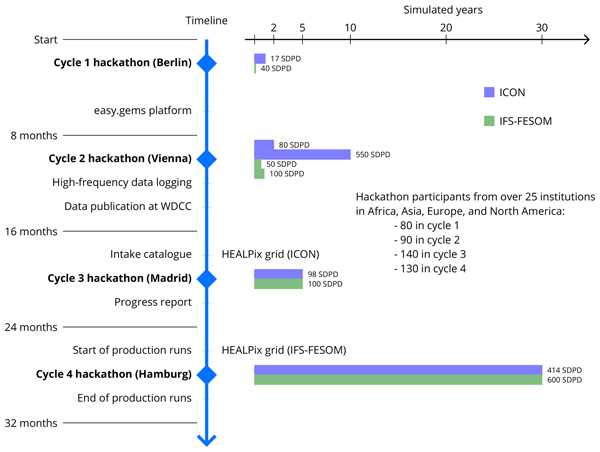
Hans Segura, Xabier Pedruzo-Bagazgoitia, Philipp Weiss, Sebastian K. Müller, Thomas Rackow, Junhong Lee, Edgar Dolores-Tesillos, Imme Benedict, Matthias Aengenheyster, Razvan Aguridan, Gabriele Arduini, Alexander J. Baker, Jiawei Bao, Swantje Bastin, Eulàlia Baulenas, Tobias Becker, Sebastian Beyer, Hendryk Bockelmann, Nils Brüggemann, Lukas Brunner, Suvarchal K. Cheedela, Sushant Das, Jasper Denissen, Ian Dragaud, Piotr Dziekan, Madeleine Ekblom, Jan Frederik Engels, Monika Esch, Richard Forbes, Claudia Frauen, Lilli Freischem, Diego García-Maroto, Philipp Geier, Paul Gierz, Álvaro González-Cervera, Katherine Grayson, Matthew Griffith, Oliver Gutjahr, Helmuth Haak, Ioan Hadade, Kerstin Haslehner, Shabeh ul Hasson, Jan Hegewald, Lukas Kluft, Aleksei Koldunov, Nikolay Koldunov, Tobias Kölling, Shunya Koseki, Sergey Kosukhin, Josh Kousal, Peter Kuma, Arjun U. Kumar, Rumeng Li, Nicolas Maury, Maximilian Meindl, Sebastian Milinski, Kristian Mogensen, Bimochan Niraula, Jakub Nowak, Divya Sri Praturi, Ulrike Proske, Dian Putrasahan, René Redler, David Santuy, Domokos Sármány, Reiner Schnur, Patrick Scholz, Dmitry Sidorenko, Dorian Spät, Birgit Sützl, Daisuke Takasuka, Adrian Tompkins, Alejandro Uribe, Mirco Valentini, Menno Veerman, Aiko Voigt, Sarah Warnau, Fabian Wachsmann, Marta Wacławczyk, Nils Wedi, Karl-Hermann Wieners, Jonathan Wille, Marius Winkler, Yuting Wu, Florian Ziemen, Janos Zimmermann, Frida A.-M. Bender, Dragana Bojovic, Sandrine Bony, Simona Bordoni, Patrice Brehmer, Marcus Dengler, Emanuel Dutra, Saliou Faye, Erich Fischer, Chiel van Heerwaarden, Cathy Hohenegger, Heikki Järvinen, Markus Jochum, Thomas Jung, Johann H. Jungclaus, Noel S. Keenlyside, Daniel Klocke, Heike Konow, Martina Klose, Szymon Malinowski, Olivia Martius, Thorsten Mauritsen, Juan Pedro Mellado, Theresa Mieslinger, Elsa Mohino, Hanna Pawłowska, Karsten Peters-von Gehlen, Abdoulaye Sarré, Pajam Sobhani, Philip Stier, Lauri Tuppi, Pier Luigi Vidale, Irina Sandu, and Bjorn Stevens
Geosci. Model Dev., 18, 7735–7761, https://doi.org/10.5194/gmd-18-7735-2025, https://doi.org/10.5194/gmd-18-7735-2025, 2025
Short summary
Short summary
The Next Generation of Earth Modeling Systems project (nextGEMS) developed two Earth system models that use horizontal grid spacing of 10 km and finer, giving more fidelity to the representation of local phenomena, globally. In its fourth cycle, nextGEMS simulated the Earth System climate over the 2020–2049 period under the SSP3-7.0 scenario. Here, we provide an overview of nextGEMS, insights into the model development, and the realism of multi-decadal, kilometer-scale simulations.
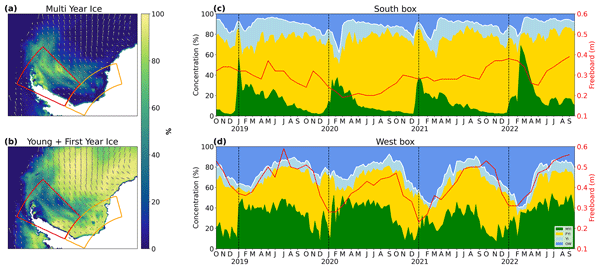
Mukund Gupta, Heather Regan, Younghyun Koo, Sean Minhui Tashi Chua, Xueke Li, and Petra Heil
The Cryosphere, 19, 1241–1257, https://doi.org/10.5194/tc-19-1241-2025, https://doi.org/10.5194/tc-19-1241-2025, 2025
Short summary
Short summary
The sea ice cover is composed of floes, whose shapes set the material properties of the pack. Here, we use a satellite product (ICESat-2) to investigate these floe shapes within the Weddell Sea in Antarctica. We find that floes tend to become smaller during the melt season, while their thickness distribution exhibits different behavior between the western and southern regions of the pack. These metrics will help calibrate models and improve our understanding of sea ice physics across scales.
Yesobu Yarragunta, Diana Francis, Ricardo Fonseca, and Narendra Nelli
Atmos. Chem. Phys., 25, 1685–1709, https://doi.org/10.5194/acp-25-1685-2025, https://doi.org/10.5194/acp-25-1685-2025, 2025
Short summary
Short summary
This study evaluates the Weather Research and Forecasting model with chemistry (WRF-Chem) in simulating air pollutants over the United Arab Emirates using satellite observations. The model accurately captured ozone and carbon monoxide but showed discrepancies for nitrogen dioxide. WRF-Chem was moderately correlated with aerosol optical depth observations and performed well in simulating meteorological parameters, demonstrating its suitability for atmospheric modelling.
Zhenhai Zhang, F. Martin Ralph, Xun Zou, Brian Kawzenuk, Minghua Zheng, Irina V. Gorodetskaya, Penny M. Rowe, and David H. Bromwich
The Cryosphere, 18, 5239–5258, https://doi.org/10.5194/tc-18-5239-2024, https://doi.org/10.5194/tc-18-5239-2024, 2024
Short summary
Short summary
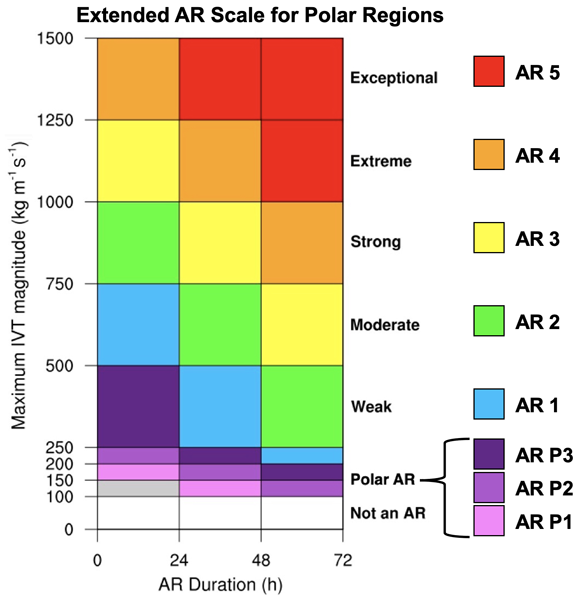
Atmospheric rivers (ARs) are long, narrow corridors of strong water vapor transport in the atmosphere. ARs play an important role in extreme weather in polar regions, including heavy rain and/or snow, heat waves, and surface melt. The standard AR scale is developed based on the midlatitude climate and is insufficient for polar regions. This paper introduces an extended version of the AR scale tuned to polar regions, aiming to quantify polar ARs objectively based on their strength and impact.
Manfred Wendisch, Susanne Crewell, André Ehrlich, Andreas Herber, Benjamin Kirbus, Christof Lüpkes, Mario Mech, Steven J. Abel, Elisa F. Akansu, Felix Ament, Clémantyne Aubry, Sebastian Becker, Stephan Borrmann, Heiko Bozem, Marlen Brückner, Hans-Christian Clemen, Sandro Dahlke, Georgios Dekoutsidis, Julien Delanoë, Elena De La Torre Castro, Henning Dorff, Regis Dupuy, Oliver Eppers, Florian Ewald, Geet George, Irina V. Gorodetskaya, Sarah Grawe, Silke Groß, Jörg Hartmann, Silvia Henning, Lutz Hirsch, Evelyn Jäkel, Philipp Joppe, Olivier Jourdan, Zsofia Jurányi, Michail Karalis, Mona Kellermann, Marcus Klingebiel, Michael Lonardi, Johannes Lucke, Anna E. Luebke, Maximilian Maahn, Nina Maherndl, Marion Maturilli, Bernhard Mayer, Johanna Mayer, Stephan Mertes, Janosch Michaelis, Michel Michalkov, Guillaume Mioche, Manuel Moser, Hanno Müller, Roel Neggers, Davide Ori, Daria Paul, Fiona M. Paulus, Christian Pilz, Felix Pithan, Mira Pöhlker, Veronika Pörtge, Maximilian Ringel, Nils Risse, Gregory C. Roberts, Sophie Rosenburg, Johannes Röttenbacher, Janna Rückert, Michael Schäfer, Jonas Schaefer, Vera Schemann, Imke Schirmacher, Jörg Schmidt, Sebastian Schmidt, Johannes Schneider, Sabrina Schnitt, Anja Schwarz, Holger Siebert, Harald Sodemann, Tim Sperzel, Gunnar Spreen, Bjorn Stevens, Frank Stratmann, Gunilla Svensson, Christian Tatzelt, Thomas Tuch, Timo Vihma, Christiane Voigt, Lea Volkmer, Andreas Walbröl, Anna Weber, Birgit Wehner, Bruno Wetzel, Martin Wirth, and Tobias Zinner
Atmos. Chem. Phys., 24, 8865–8892, https://doi.org/10.5194/acp-24-8865-2024, https://doi.org/10.5194/acp-24-8865-2024, 2024
Short summary
Short summary
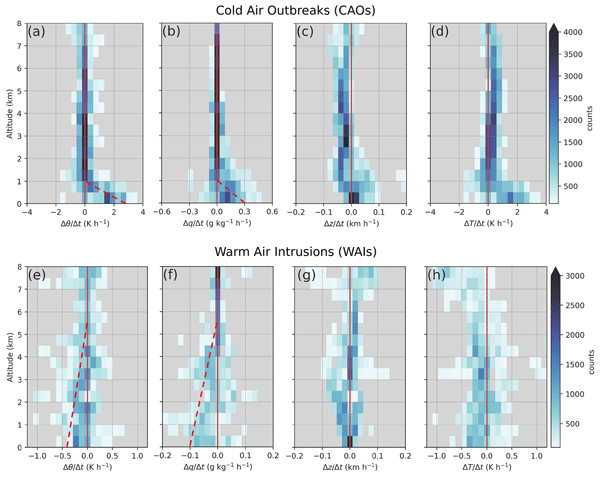
The Arctic is warming faster than the rest of the globe. Warm-air intrusions (WAIs) into the Arctic may play an important role in explaining this phenomenon. Cold-air outbreaks (CAOs) out of the Arctic may link the Arctic climate changes to mid-latitude weather. In our article, we describe how to observe air mass transformations during CAOs and WAIs using three research aircraft instrumented with state-of-the-art remote-sensing and in situ measurement devices.
Andreas Walbröl, Janosch Michaelis, Sebastian Becker, Henning Dorff, Kerstin Ebell, Irina Gorodetskaya, Bernd Heinold, Benjamin Kirbus, Melanie Lauer, Nina Maherndl, Marion Maturilli, Johanna Mayer, Hanno Müller, Roel A. J. Neggers, Fiona M. Paulus, Johannes Röttenbacher, Janna E. Rückert, Imke Schirmacher, Nils Slättberg, André Ehrlich, Manfred Wendisch, and Susanne Crewell
Atmos. Chem. Phys., 24, 8007–8029, https://doi.org/10.5194/acp-24-8007-2024, https://doi.org/10.5194/acp-24-8007-2024, 2024
Short summary
Short summary
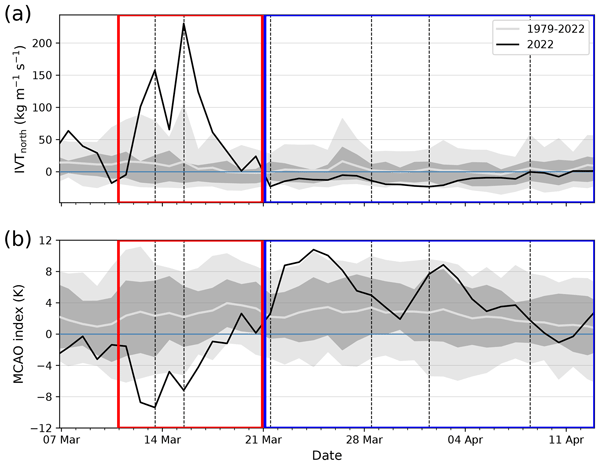
To support the interpretation of the data collected during the HALO-(AC)3 campaign, which took place in the North Atlantic sector of the Arctic from 7 March to 12 April 2022, we analyze how unusual the weather and sea ice conditions were with respect to the long-term climatology. From observations and ERA5 reanalysis, we found record-breaking warm air intrusions and a large variety of marine cold air outbreaks. Sea ice concentration was mostly within the climatological interquartile range.
Melanie Lauer, Annette Rinke, Irina Gorodetskaya, Michael Sprenger, Mario Mech, and Susanne Crewell
Atmos. Chem. Phys., 23, 8705–8726, https://doi.org/10.5194/acp-23-8705-2023, https://doi.org/10.5194/acp-23-8705-2023, 2023
Short summary
Short summary
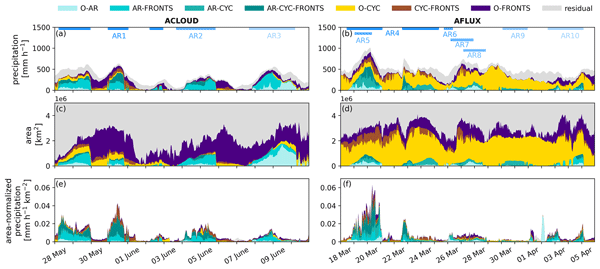
We present a new method to analyse the influence of atmospheric rivers (ARs), cyclones, and fronts on the precipitation in the Arctic, based on two campaigns: ACLOUD (early summer 2017) and AFLUX (early spring 2019). There are differences between both campaign periods: in early summer, the precipitation is mostly related to ARs and fronts, especially when they are co-located, while in early spring, cyclones isolated from ARs and fronts contributed most to the precipitation.
Rachid Abida, Narendra Nelli, Diana Francis, Olivier Masson, Ricardo Fonseca, Emmanuel Bosc, and Marouane Temimi
EGUsphere, https://doi.org/10.5194/egusphere-2023-956, https://doi.org/10.5194/egusphere-2023-956, 2023
Preprint archived
Short summary
Short summary
This study is the first application of the Eddy Covariance (EC) framework to measure the fog droplet deposition velocity in a hyperarid coastal site. The average deposition velocity of fog droplets is around 3 cm s-1. The ratio of the time-integrated ground deposition of 137Cs under foggy conditions to that under clear sky conditions, showed that the fog contributed to the total ground deposition of 137Cs by up to 40 %.
Diana Francis, Ricardo Fonseca, Kyle S. Mattingly, Stef Lhermitte, and Catherine Walker
The Cryosphere, 17, 3041–3062, https://doi.org/10.5194/tc-17-3041-2023, https://doi.org/10.5194/tc-17-3041-2023, 2023
Short summary
Short summary
Role of Foehn Winds in ice and snow conditions at the Pine Island Glacier, West Antarctica.
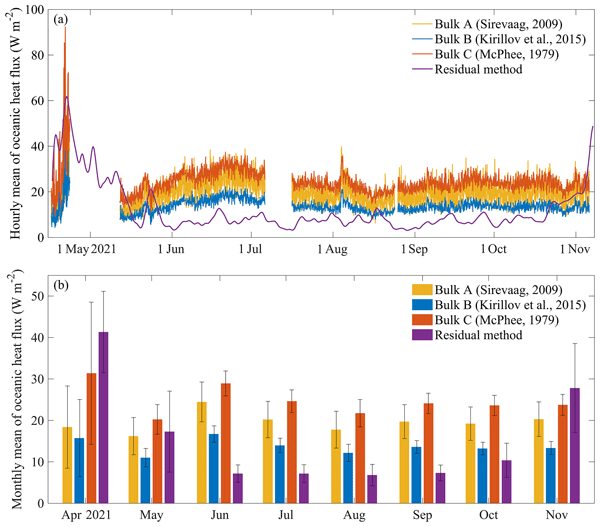
Haihan Hu, Jiechen Zhao, Petra Heil, Zhiliang Qin, Jingkai Ma, Fengming Hui, and Xiao Cheng
The Cryosphere, 17, 2231–2244, https://doi.org/10.5194/tc-17-2231-2023, https://doi.org/10.5194/tc-17-2231-2023, 2023
Short summary
Short summary
The oceanic characteristics beneath sea ice significantly affect ice growth and melting. The high-frequency and long-term observations of oceanic variables allow us to deeply investigate their diurnal and seasonal variation and evaluate their influences on sea ice evolution. The large-scale sea ice distribution and ocean circulation contributed to the seasonal variation of ocean variables, revealing the important relationship between large-scale and local phenomena.
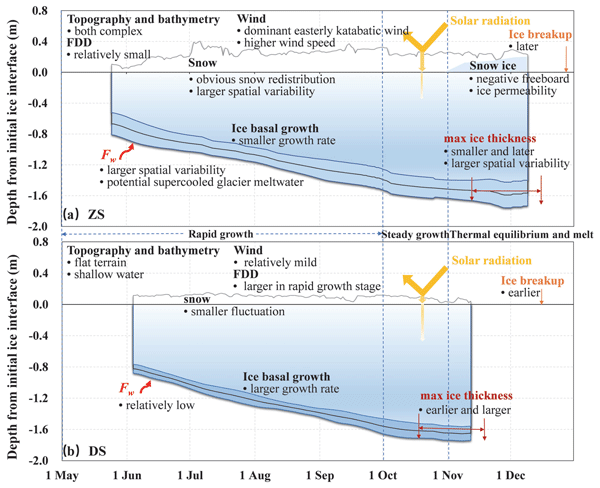
Na Li, Ruibo Lei, Petra Heil, Bin Cheng, Minghu Ding, Zhongxiang Tian, and Bingrui Li
The Cryosphere, 17, 917–937, https://doi.org/10.5194/tc-17-917-2023, https://doi.org/10.5194/tc-17-917-2023, 2023
Short summary
Short summary
The observed annual maximum landfast ice (LFI) thickness off Zhongshan (Davis) was 1.59±0.17 m (1.64±0.08 m). Larger interannual and local spatial variabilities for the seasonality of LFI were identified at Zhongshan, with the dominant influencing factors of air temperature anomaly, snow atop, local topography and wind regime, and oceanic heat flux. The variability of LFI properties across the study domain prevailed at interannual timescales, over any trend during the recent decades.
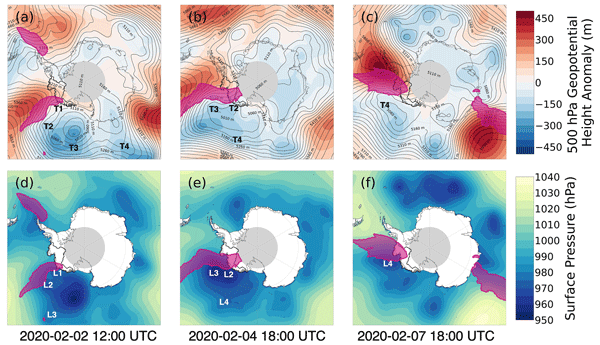
Michelle L. Maclennan, Jan T. M. Lenaerts, Christine A. Shields, Andrew O. Hoffman, Nander Wever, Megan Thompson-Munson, Andrew C. Winters, Erin C. Pettit, Theodore A. Scambos, and Jonathan D. Wille
The Cryosphere, 17, 865–881, https://doi.org/10.5194/tc-17-865-2023, https://doi.org/10.5194/tc-17-865-2023, 2023
Short summary
Short summary
Atmospheric rivers are air masses that transport large amounts of moisture and heat towards the poles. Here, we use a combination of weather observations and models to quantify the amount of snowfall caused by atmospheric rivers in West Antarctica which is about 10 % of the total snowfall each year. We then examine a unique event that occurred in early February 2020, when three atmospheric rivers made landfall over West Antarctica in rapid succession, leading to heavy snowfall and surface melt.
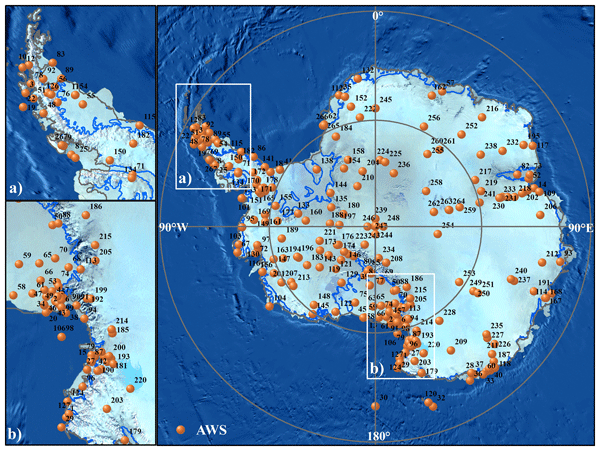
Yetang Wang, Xueying Zhang, Wentao Ning, Matthew A. Lazzara, Minghu Ding, Carleen H. Reijmer, Paul C. J. P. Smeets, Paolo Grigioni, Petra Heil, Elizabeth R. Thomas, David Mikolajczyk, Lee J. Welhouse, Linda M. Keller, Zhaosheng Zhai, Yuqi Sun, and Shugui Hou
Earth Syst. Sci. Data, 15, 411–429, https://doi.org/10.5194/essd-15-411-2023, https://doi.org/10.5194/essd-15-411-2023, 2023
Short summary
Short summary
Here we construct a new database of Antarctic automatic weather station (AWS) meteorological records, which is quality-controlled by restrictive criteria. This dataset compiled all available Antarctic AWS observations, and its resolutions are 3-hourly, daily and monthly, which is very useful for quantifying spatiotemporal variability in weather conditions. Furthermore, this compilation will be used to estimate the performance of the regional climate models or meteorological reanalysis products.
Minghu Ding, Xiaowei Zou, Qizhen Sun, Diyi Yang, Wenqian Zhang, Lingen Bian, Changgui Lu, Ian Allison, Petra Heil, and Cunde Xiao
Earth Syst. Sci. Data, 14, 5019–5035, https://doi.org/10.5194/essd-14-5019-2022, https://doi.org/10.5194/essd-14-5019-2022, 2022
Short summary
Short summary
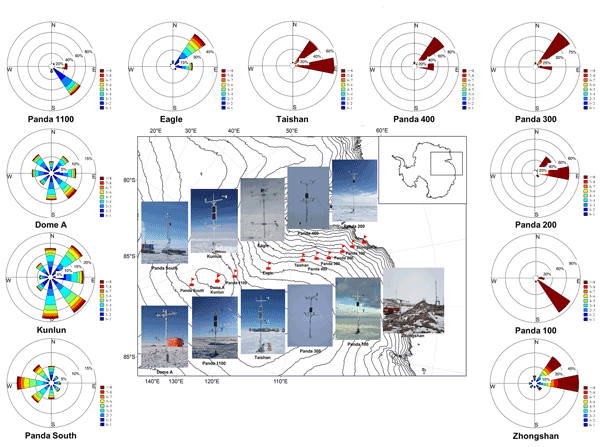
The PANDA automatic weather station (AWS) network consists of 11 stations deployed along a transect from the coast (Zhongshan Station) to the summit of the East Antarctic Ice Sheet (Dome A). It covers the different climatic and topographic units of East Antarctica. All stations record hourly air temperature, relative humidity, air pressure, wind speed and direction at two or three heights. The PANDA AWS dataset commences from 1989 and is planned to be publicly available into the future.
Annakaisa von Lerber, Mario Mech, Annette Rinke, Damao Zhang, Melanie Lauer, Ana Radovan, Irina Gorodetskaya, and Susanne Crewell
Atmos. Chem. Phys., 22, 7287–7317, https://doi.org/10.5194/acp-22-7287-2022, https://doi.org/10.5194/acp-22-7287-2022, 2022
Short summary
Short summary
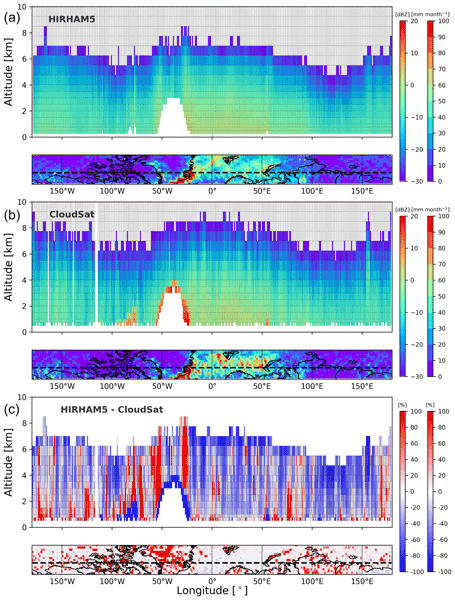
Snowfall is an important climate indicator. However, microphysical snowfall processes are challenging for atmospheric models. In this study, the performance of a regional climate model is evaluated in modeling the spatial and temporal distribution of Arctic snowfall when compared to CloudSat satellite observations. Excellent agreement in averaged annual snowfall rates is found, and the shown methodology offers a promising diagnostic tool to investigate the shown differences further.
Fengguan Gu, Qinghua Yang, Frank Kauker, Changwei Liu, Guanghua Hao, Chao-Yuan Yang, Jiping Liu, Petra Heil, Xuewei Li, and Bo Han
The Cryosphere, 16, 1873–1887, https://doi.org/10.5194/tc-16-1873-2022, https://doi.org/10.5194/tc-16-1873-2022, 2022
Short summary
Short summary
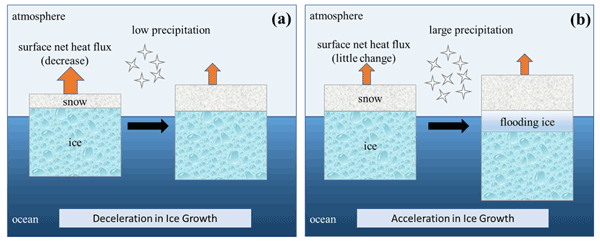
The sea ice thickness was simulated by a single-column model and compared with in situ observations obtained off Zhongshan Station in the Antarctic. It is shown that the unrealistic precipitation in the atmospheric forcing data leads to the largest bias in sea ice thickness and snow depth modeling. In addition, the increasing snow depth gradually inhibits the growth of sea ice associated with thermal blanketing by the snow.
Tian R. Tian, Alexander D. Fraser, Noriaki Kimura, Chen Zhao, and Petra Heil
The Cryosphere, 16, 1299–1314, https://doi.org/10.5194/tc-16-1299-2022, https://doi.org/10.5194/tc-16-1299-2022, 2022
Short summary
Short summary
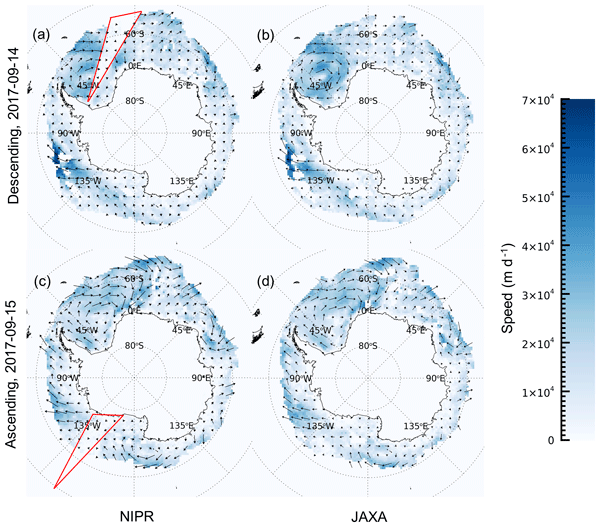
This study presents a comprehensive validation of a satellite observational sea ice motion product in Antarctica by using drifting buoys. Two problems existing in this sea ice motion product have been noticed. After rectifying problems, we use it to investigate the impacts of satellite observational configuration and timescale on Antarctic sea ice kinematics and suggest the future improvement of satellite missions specifically designed for retrieval of sea ice motion.
Carolina Viceto, Irina V. Gorodetskaya, Annette Rinke, Marion Maturilli, Alfredo Rocha, and Susanne Crewell
Atmos. Chem. Phys., 22, 441–463, https://doi.org/10.5194/acp-22-441-2022, https://doi.org/10.5194/acp-22-441-2022, 2022
Short summary
Short summary
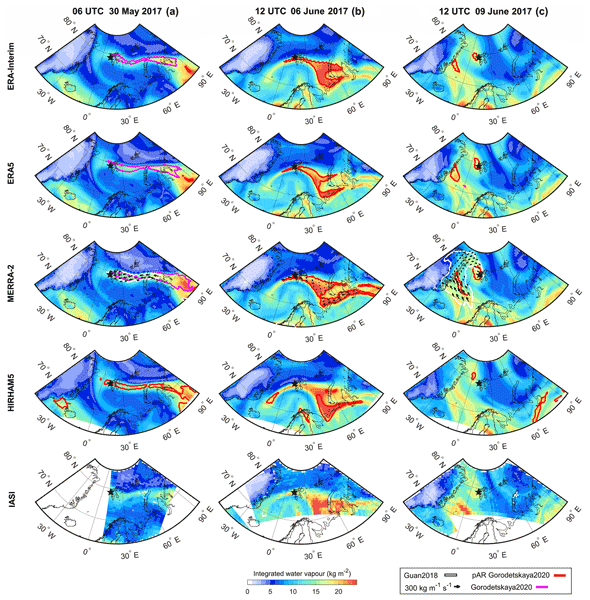
We focus on anomalous moisture transport events known as atmospheric rivers (ARs). During ACLOUD and PASCAL, three AR events were identified: 30 May, 6 June, and 9 June 2017. We explore their spatio-temporal evolution and precipitation patterns using measurements, reanalyses, and a model. We show the importance of the following: Atlantic and Siberian pathways during spring–summer in the Arctic, AR-associated heat/moisture increase, precipitation phase transition, and high-resolution datasets.
Hélène Bresson, Annette Rinke, Mario Mech, Daniel Reinert, Vera Schemann, Kerstin Ebell, Marion Maturilli, Carolina Viceto, Irina Gorodetskaya, and Susanne Crewell
Atmos. Chem. Phys., 22, 173–196, https://doi.org/10.5194/acp-22-173-2022, https://doi.org/10.5194/acp-22-173-2022, 2022
Short summary
Short summary
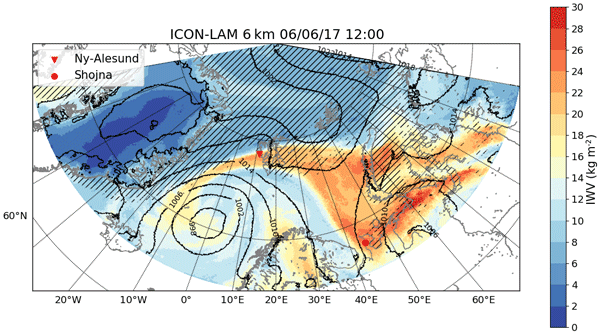
Arctic warming is pronounced, and one factor in this is the poleward atmospheric transport of heat and moisture. This study assesses the 4D structure of an Arctic moisture intrusion event which occurred in June 2017. For the first time, high-resolution pan-Arctic ICON simulations are performed and compared with global models, reanalysis, and observations. Results show the added value of high resolution in the event representation and the impact of the intrusion on the surface energy fluxes.
Joey J. Voermans, Qingxiang Liu, Aleksey Marchenko, Jean Rabault, Kirill Filchuk, Ivan Ryzhov, Petra Heil, Takuji Waseda, Takehiko Nose, Tsubasa Kodaira, Jingkai Li, and Alexander V. Babanin
The Cryosphere, 15, 5557–5575, https://doi.org/10.5194/tc-15-5557-2021, https://doi.org/10.5194/tc-15-5557-2021, 2021
Short summary
Short summary
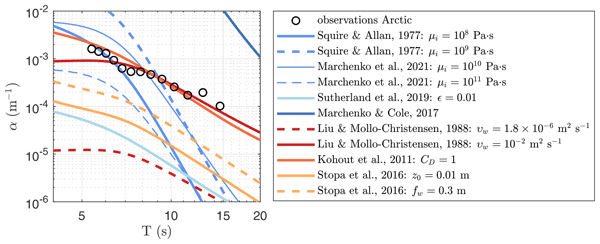
We have shown through field experiments that the amount of wave energy dissipated in landfast ice, sea ice attached to land, is much larger than in broken ice. By comparing our measurements against predictions of contemporary wave–ice interaction models, we determined which models can explain our observations and which cannot. Our results will improve our understanding of how waves and ice interact and how we can model such interactions to better forecast waves and ice in the polar regions.
Sebastian Landwehr, Michele Volpi, F. Alexander Haumann, Charlotte M. Robinson, Iris Thurnherr, Valerio Ferracci, Andrea Baccarini, Jenny Thomas, Irina Gorodetskaya, Christian Tatzelt, Silvia Henning, Rob L. Modini, Heather J. Forrer, Yajuan Lin, Nicolas Cassar, Rafel Simó, Christel Hassler, Alireza Moallemi, Sarah E. Fawcett, Neil Harris, Ruth Airs, Marzieh H. Derkani, Alberto Alberello, Alessandro Toffoli, Gang Chen, Pablo Rodríguez-Ros, Marina Zamanillo, Pau Cortés-Greus, Lei Xue, Conor G. Bolas, Katherine C. Leonard, Fernando Perez-Cruz, David Walton, and Julia Schmale
Earth Syst. Dynam., 12, 1295–1369, https://doi.org/10.5194/esd-12-1295-2021, https://doi.org/10.5194/esd-12-1295-2021, 2021
Short summary
Short summary
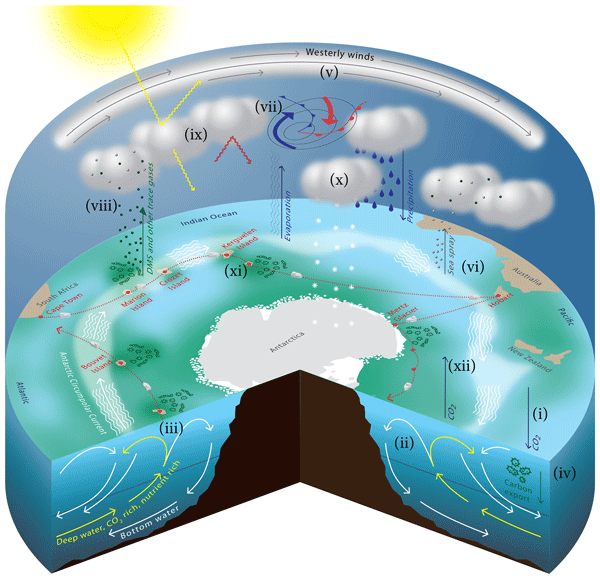
The Antarctic Circumnavigation Expedition surveyed a large number of variables describing the dynamic state of ocean and atmosphere, freshwater cycle, atmospheric chemistry, ocean biogeochemistry, and microbiology in the Southern Ocean. To reduce the dimensionality of the dataset, we apply a sparse principal component analysis and identify temporal patterns from diurnal to seasonal cycles, as well as geographical gradients and
hotspotsof interaction. Code and data are open access.
Cited articles
AADC: Antarctic Climate Data Collected by Australian Agencies, Australian Antarctic Data Center, Australian Antarctic Data Centre [data set], https://data.aad.gov.au/ (last access: 22 April 2024), 2022.
Alapaty, K., Herwehe, J. A., Otte, T. L., Nolte, C. G., Bullock, O. R., Mallard, M. S., Kain, J. S., and Dudhia, J.: Introducing subgrid-scale cloud feedbacks to radiation for regional meteorological and climate modeling, Geophys. Res. Lett., 39, L24809, https://doi.org/2012GL054031, 2012.
Attada, R., Kunchala, R. K., Dasari, H. P., Sivareddy, S., Yesubabu, V., Knio, O., and Hoteit, I.: Representation of Arabian Peninsula summer climate in a regional atmospheric model using spectral nudging, Theor. Appl. Climatol., 145, 13–30, https://doi.org/10.1007/s00704-021-03617-w, 2021.
AWI: WRMC-BSRN, World Radiation Monitoring Center – Baseline Surface Radiation Network [data set], https://bsrn.awi.de/ (last access: 15 April 2024), 2024.
Barber, D. G. and Massom, R. A.: The Role of Sea Ice in Arctic and Antarctic Polynyas, in: Polynyas: Windows to the World's Oceans, edited by: Smith, W. O. and Barber, D. G., 1–54, Elsevier, Amsterdam, https://www.sciencedirect.com/science/chapter/bookseries/abs/pii/S0422989406740016 (last access: 1 August 2024), 2007.
Bowman, K. P.: An Introduction to Programming with IDL: Interactive Data Language, Academic Press [Software], 304 pp., ISBN-10: 012088559X, ISBN-13: 978-0120885596, 2005.
Box, J. E., Nielsen, K. P., Yang, X., Niwano, M., Wehrle, A., van As, D., Fettweis, X., Koltzow, M. A. O., Palmason, B., Fausto, R. S., van den Broeke, M. R., Huai, B., Ahlstrom, A. P., Langley, K., and Dachauer, A., Noel, B.: Greenland ice sheet rainfall climatology, extremes and atmospheric river rapids, Meteorol. Appl., 30, e2134, https://doi.org/10.1002/met.2134, 2023.
Bozkurt, D., Rondanelli, R., Marin, J. C., and Garreaud, R.: Foehn event triggered by an atmospheric river underlies record-setting temperature along continental Antarctica, J. Geophys. Res.-Atmos., 123, 3871–3892, https://doi.org/10.1002/2017JD027796, 2018.
Bromwich, D. H., Otieno, F. O., Hines, K. M., Manning, K. W., and Shilo, E.: Comprehensive evaluation of polar weather research and forecasting model performance in the Antarctic, J. Geophys. Res.-Atmos., 118, 274–292, https://doi.org/10.1029/2012JD018139, 2013.
Bromwich, D. H., Powers, J. G., Manning, K. W., and Zou, X.: Antarctic data impact experiments with Polar WRF during the YOPP-SH summer special observing period, Q. J. R. Meteorol. Soc., 148, 2194–2218, https://doi.org/10.1002/qj.4298, 2022.
Chen, F. and Dudhia, J.: Coupling an Advanced Land Surface-Hydrology Model with the Penn State – NCAR MM5 Modeling System, Part I: Model Implementation and Sensitivity, Mon. Weather Rev., 129, 569–585, https://doi.org/10.1175/1520-0493(2001)129<0569:CAALSH>2.0.CO;2, 2001.
Chinta, S. and Balaji, C.: Calibration of WRF model parameters using multiobjective adaptive surrogate model-based optimization to improve the prediction of the Indian summer monsoon, Clim. Dynam., 55, 631–650, https://doi.org/10.1007/s00382-020-05288-1, 2020.
Dare, R. A. and Budd, W. F.: Analysis of Surface Winds at Mawson, Antarctica, Wea. Forecast., 16, 416–431, https://doi.org/10.1175/1520-0434(2001)016<0416:AOSWAM>2.0.CO;2, 2001.
Djoumna, G. and Holland, D. M.: Atmospheric rivers, warm air intrusions, and surface radiation balance in the Amundsen Sea Embayment, J. Geophys. Res.-Atmos., 126, e2020JD034119, https://doi.org/10.1029/2020JD034119, 2021.
Dery, S. J. and Yau, M. K.: Large-scale mass balance effects of blowing snow and surface sublimation, J. Geophys. Res., 107, 4679, https://doi.org/10.1029/2001JD001251, 2002.
Dong, X., Wang, Y., Hou, S., Ding, M., Yin, B., and Zhang, Y.: Robustness of the Recent Global Atmospheric Reanalyses for Antarctic Near-Surface Wind Speed Climatology, J. Clim., 33, 4027–4043, https://doi.org/10.1175/JCLI-D-19-0648.1, 2020.
Eayrs, C., Holland, D. M., Francis, D., Wagner, T. J. W., Kumar, R., and Li, X.: Understanding the seasonal cycle of Antarctic sea ice extent in the context of long-term variability, Rev. Geophys., 57, 1037–1064, https://doi.org/10.1029/2018RG000631, 2019.
Eayrs, C., Li, X., Raphael, M. N., and Holland, D. M.: Rapid decline in Antarctic sea ice in recent years hints at future change, Nat. Geosci., 14, 460–464, https://doi.org/10.1038/s41561-021-00768-3, 2021.
Elvidge, A. D., Munneke, K., King, P., Renfrew, I. A., and Gilbert, E.: Atmospheric drivers of melt on Larsen C Ice Shelf: Surface energy budget regimes and the impact of foehn, J. Geophys. Res.-Atmos., 125, e2020JD032463, https://doi.org/10.1029/2020JD032463, 2020.
England, M. R., Wagner, T. J. W., and Eisenman, I.: Modeling the breakup of tabular icebergs, Sci. Adv., 6, eabd1273, https://doi.org/10.1126/sciadv.abd1273, 2020.
EUMETSAT: Global Low Resolution Sea Ice Drift, Ocean and Sea Ice Satellite Application Facility [data set], https://osi-saf.eumetsat.int/products/osi-405-c (last access: 12 August 2024), 2024.
Feng, Z., Leung, L. R., Liu, N., Wang, J., Houze, R. A. Jr., Li, J., Hardin, J. C., Chen, D., and Guo, J.: A global high-resolution mesoscale convective system database using satellite-derived cloud tops, surface precipitation, and tracking, J. Geophys. Res.-Atmos., 126, e2020JD034202, https://doi.org/10.1029/2020JD034202, 2021.
Finlon, J. A., Rauber, R. M., Wu, W., Zaremba, T. J., McFarquhar, G. M., Nesbitt, S. W., Schnaiter, M., Jarvinen, E., Waitz, F., Hill, T. C. J., and DeMott, P. J.: Structure of an atmospheric river over Australia and the Southern Ocean: II. Microphysical evolution, J. Geophys. Res.-Atmos., 125, e2020JD032514, https://doi.org/10.1029/2020JD032514, 2020.
Fogt, R. L., Bromwich, D. H., and Hines, K. M.: Understanding the SAM influence on the South Pacific ENSO teleconnection, Clim. Dynam., 36, 1555–1576, https://doi.org/10.1007/s00382-010-0905-0, 2011.
Fonseca, R., Francis, D., Aulicino, G., Mattingly, K., Fusco, G., and Budillon, G.: Atmospheric controls on the Terra Nova Bay polynya occurrence in Antarctica, Clim. Dynam., 61, 5147–5169, https://doi.org/10.1007/s00382-023-06845-0, 2023.
Francis, D., Eayrs, C., Cuesta, J., and Holland, D.: Polar cyclones at the origin of the reoccurrence of the Maud Rise Polynya in austral winter 2017, J. Geophys. Res.-Atmos., 124, 5251–5267, https://doi.org/10.1029/2019JD030618, 2019.
Francis, D., Fonseca, R., Bozkurt, D., Nelli, N., and Guan, B.: Atmospheric River Rapids and Their Role in the Extreme Rainfall Event of April 2023 in the Middle East, Geophys. Res. Lett., 51, e2024GL109446, https://doi.org/10.1029/2024GL109446, 2024.
Francis, D., Mattingly, K. S., Lhermitte, S., Temimi, M., and Heil, P.: Atmospheric extremes caused high oceanward sea surface slope triggering the biggest calving event in more than 50 years at the Amery Ice Shelf, The Cryosphere, 15, 2147–2165, https://doi.org/10.5194/tc-15-2147-2021, 2021.
Francis, D., Fonseca, R., Nelli, N., Bozkurt, D., Picard, G., and Guan, B.: Atmospheric rivers drive exceptional Saharan dust transport towards Europe, Atmos. Res., 266, 105959, https://doi.org/10.1016/j.atmosres.2021.105959, 2022a.
Francis, D., Fonseca, R., Mattingly, K. S., Marsh, O. J., Lhermitte, S., and Cherif, C.: Atmospheric triggers of the Brunt Ice Shelf calving in February 2021, J. Geophys. Res.-Atmos., 127, e2021JD036424, https://doi.org/10.1029/2021JD036424, 2022b.
Francis, D., Mattingly, K. S., Temimi, M., Massom, R., and Heil, P.: On the crucial role of atmospheric rivers in the two major Weddell Polynya events in 1973 and 2017 in Antarctica, Sci. Adv., 6, eabc2695, https://doi.org/10.1126/sciadv.abc2695, 2020.
Francis, F., Fonseca, R., Mattingly, K. S., Lhermitte, S., and Walker, C.: Foehn winds at Pine Island Glacier and their role in ice changes, The Cryosphere, 17, 3041–3062, https://doi.org/10.5194/tc-17-3041-2023, 2023.
Fraser, A. D., Wongpan, P., Langhorne, P. J., Klekociuk, A. R., Kusahara, K., Lannuzel, D., Massom, R. A., Meiners, K. M., Swadling, K. M., Atwater, D. P., Brett, G. M., Corkill, M., Dalman, L. A., Fiddes, S., Granata, A., Guglielmo, L., Heil, P., Leonard, G. H., Mahoney, A. R., McMinn, A., van der Merwe, P., Weldrick, C. K., and Wienecke, B.: Antarctic landfast sea ice: A review of its physics, biogeochemistry and ecology, Rev. Geophys., 61, e2022RG000770, https://doi.org/10.1029/2022RG000770, 2023.
Gehring, J., Vignon, E., Billault-Roux, A. C., Ferrone, A., Protat, A., Alexander, S. P., and Berne, A.: Orographic flow influence on precipitation during an atmospheric river event at Davis, Antarctica, J. Geophys. Res.-Atmos., 127, e2021JD035210, https://doi.org/10.1029/2021JD035210, 2022.
Ghiz, M.L., Scott, R. C., Vogelmann, A. M., Lenaerts, J. T. M., Lazzara, M., and Lubin, D.: Energetics of surface melt in West Antarctica, The Cryosphere, 15, 3459–3494, https://doi.org/10.5194/tc-15-3459-2021, 2021.
Gilbert, E., Pishniak, D., Torres, J. A., Orr, A., Maclennan, M., Wever, N., and Verro, K.: Extreme precipitation associated with atmospheric rivers over West Antarctic ice shelves: insights from the kilometre-scale regional climate modeling, The Cryosphere, 19, 597–618, https://doi.org/10.5194/tc-19-597-2025, 2025.
Goosse, H., Contador, A., Bitz, C., Blanchard-Wrigglesworth, C. M., Eayrs, E., Fichefet, C., Himmich, T., Huot, K., Klein, P.-V., Marchi, F., Massonnet, S., Mezzina, F., Pelletier, B., Roach, C., Vancoppenolle, L., and van Lipzig, N. P. M.: Modulation of the seasonal cycle of the Antarctic sea ice extent by sea ice processes and feedbacks with the ocean and the atmosphere, The Cryosphere, 17, 407–425, https://doi.org/10.5194/tc-17-407-2023, 2023.
Gorodetskaya, I. V., Van Lipzig, N. P. M., Van den Broeke, M. R., Mangold, A., Boot, W., and Reijmer, C. H.: Meteorological regimes and accumulation patterns at Utsteinen, Dronning Maud Land, East Antarctica: Analysis of two contrasting years, J. Geophys. Res.-Atmos., 118, 1700–1715, https://doi.org/10.1002/jgrd.50177, 2013.
Gorodetskaya, I. V., Silva, T., Schmithusen, H., and Hirasawa, N.: Atmospheric river signatures in radiosonde profiles and reanalyses at the Dronning Maud Land Coast, East Antarctica, Adv. Atmos. Sci., 37, 455-476, https://doi.org/10.1007/s00376-020-9221-8, 2020.
Gorodetskaya, I. V., Duran-Alarcon, C., Gonzalez-Herrero, S., Clem, K. R., Zou, X., Rowe, P., Imazio, P. R., Campos, D., Leroy-Dos Santos, C., Dutrievoz, N., Wille, J. D., Chyhareva, A., Favier, V., Blanchet, J., Pohl, B., Cordero, R. R., Prak, S.-J., Colwell, S., Lazzara, M. A., Carrasco, J., Gulisano, A. M., Krakovska, S., Ralph, F. M., Dethinne, T., and Picard, G.: Record-high Antarctic Peninsula temperatures and surface melt in February 2022: a compound event with an intense atmospheric river, npj Clim. Atmos. Sci., 6, 202, https://doi.org/10.1038/s41612-023-00529-6, 2023.
Gossart, A., Helsen, S., Lenaerts, J. T. M., Vanden Broucke, S., van Lipzig, N. P. M., and Souverijns, N.: An Evaluation of Surface Climatology in State-of-the-Art Reanalyses over the Antarctic Ice Sheet, J. Clim., 32, 6899–6915, https://doi.org/10.1175/JCLI-D-19-0030.1, 2019.
Guest, P. S.: Inside katabatic winds over the Terra Nova Bay polynya: 2. Dynamic and thermodynamic analyses, J. Geophys. Res., 126, e2021JD034904, https://doi.org/10.1029/2021JD034904, 2021.
Haas, C.: Sea ice thickness distribution, in: Sea Ice, edited by: Thomas, D. N., Blackwell Science, https://doi.org/10.1002/9781118778371.ch2, 2017.
Haumann, F. A., Gruber, N., Munnich, M., Frenger, I., and Kern, S.: Sea-ice transport driving Southern Ocean salinity and its recent trends, Nature, 537, 89–92, https://doi.org/10.1038/nature19101, 2016.
Heil, P.: Atmospheric conditions and fast ice at Davis, East Antarctica: A case study, J. Geophys. Res., 111, C05009, https://doi.org/10.1029/2005JC002904, 2006.
Heil, P., Allison, I., and Lytle, V. I.: Seasonal and interannual variations of the oceanic heat flux under a landfast Antarctic sea ice cover, J. Geophys. Res., 101, 25741–25752, https://doi.org/10.1029/96JC01921, 1996.
Hersbach, H., Bell, B., Berrisford, P., Hirahara, S., Horanyi, A., Munoz-Sabater, J., Nicolas, J., Peavey, C., Radu, R., Schepers, D., Simmons, A., Soci, C., Abdalla, S., Abellan, X., Balsamo, G., Bechtold, P., Biavati, G., Bidiot, J., Bonavita, M., De Chiara, G., Dahlgren, P., Dee, D., Diamantakis, M., Dragani, R., Fleming, J., Forbes, R., Fuentes, M., Geer, A., Haimberger, L., Healy, S., Hogan, R. J., Holm, E., Janiskova, M., Keeley, S., Laloyaux, P., Lopez, P., Lulu, C., Radnoti, G., de Rosnay, P., Rozum, I., Vamborg, F., Villaume, S., and Thepaut, J.-N.: The ERA5 global reanalysis, Q. J. R. Meteorol. Soc., 146, 1999–2049, https://doi.org/10.1002/qj.3803, 2020.
Hersbach, H., Bell, B., Berrisford, P., Biavati, G., Horanyi, A., Munoz Sabater, J., Nicolas, J., Peavey, C., Radu, R., Rozum, I., Schepers, D., Simmons, A., Soci, C., Dee, D., and Thepaut, J.-N.: ERA5 hourly data on single levels from 1940 to present, Copernicus Climate Change Service (C3S) Climate Data Store (CDS) [data set], https://doi.org/10.24381/cds.adbb2d47, 2023a.
Hersbach, H., Bell, B., Berrisford, P., Biavati, G., Horanyi, A., Munoz Sabater, J., Nicolas, J., Peavey, C., Radu, R., Rozum, I., Schepers, D., Simmons, A., Soci, C., Dee, D., and Thepaut, J.-N.: ERA5 hourly data on pressure levels from 1940 to present, Copernicus Climate Change Service (C3S) Climate Data Store (CDS) [data set], doi10.24381/cds.bd0915c6, 2023b.
Hines, K. M., Bromwich, D. H., Wang, S.-H., Silber, I., Verlinde, J., and Lubin, D.: Microphysics of summer clouds in central West Antarctica simulated by the Polar Weather Research and Forecasting Model (WRF) an the Antarctic Mesoscale Prediction System (AMPS), Atm. Chem. Phys., 19, 12431–12454, https://doi.org/10.5194/acp-19-12431-2019, 2019.
Hines, K. M., Bromwich, D. H., Silber, I., Russell, L. M., and Bai, L.: Predicting frigid mixed-phase clouds for pristine coastal Antarctica, J. Geophys. Res.-Atmos., 126, e2021JD035112, https://doi.org/10.1029/2021JD035112, 2021.
Hobbs, W., Spence, P., Meyer, A., Schroeter, S., Fraser, A. D., Reid, P., Tian, R. T., Wang, Z., Liniger, G., Doddridge, E. W., and Boyd, P. W.: Observational Evidence for a Regime Shift in Summer Antarctic Sea Ice, J. Clim., 37, 2263–2275, https://doi.org/10.1175/JCLI-D-23-0479.1, 2024.
Hoppmann, M., Nicolaus, M., Hunkeler, P. A., Heil, P., Behrens, L.-K., König-Langlo, G., Gerdes, R.: Seasonal evolution of an ice-shelf influenced fast-ice regime, derived from an autonomous thermistor chain, J. Geophys. Res.-Ocean., 120, 1703–1724, https://doi.org/10.1002/2014JC010327, 2015.
Hoskins, B., Fonseca, R., Blackburn, M., and Jung, T.: Relaxing the Tropics to an “observed” state: analysis using a simple baroclinic model, Q. J. R. Meteorol. Soc., 138, 1618–1626, https://doi.org/10.1002/qj.1881, 2012.
Hoskins, B. J. and Karoly, D. J.: The Steady Linear Response of a Spherical Atmosphere to Thermal and Orographic Forcing, J. Atmos. Sci., 38, 1179–1196, https://doi.org/10.1175/1520-0469(1981)038<1179:TSLROA>2.0.CO;2, 1981.
Hoskins, B. J. and Valdes, P. J.: On the Existence of Storm-Tracks, J. Atmos. Soc., 47, 1854–1864, https://doi.org/10.1175/1520-0469(1990)047<1854:OTEOST>2.0.CO;2, 1990.
Houze Jr., R. A.: Mesoscale convective systems, Rev. Geophys., 42, RG4003, https://doi.org/10.1029/2004RG000150, 2004.
Hu, H., Zhao, J., Heil, P., Qin, Z., Ma, J., Hui, F., and Cheng, X.: Annual evolution of the ice-ocean interaction beneath landfast ice in Prydz Bay, East Antarctica, The Cryosphere, 17, 2231–2244, https://doi.org/10.5194/tc-17-2231-2023, 2023.
Iacono, M. J., Delamere, J. S., Mlawer, E. J., Shephard, M. W., Clough, S. A., and Collins, W. D.: Radiative forcing by long-lived greenhouse gasses: Calculations with the AER radiative transfer models, J. Geophys. Res., 113, D13103, https://doi.org/10.1029/2008JD009944, 2008.
Jackson, K., J. Wilkinson, T. Maksym, D. Meldrum, J. Beckers, C. Haas, and D. Mackenzie: A Novel and Low Cost Sea Ice Mass Balance Buoy, J. Atmos. Ocean. Tech., 30, 2676–2688, https://doi.org/10.1175/JTECH-D-13-00058.1, 2013.
Kacimi, S. and Kwok, R.: The Antarctic sea ice cover from ICESat-2 and CryoSat-2: freeboard, snow depth, and ice thickness, The Cryosphere, 14, 4453–4474, https://doi.org/10.5194/tc-14-4453-2020, 2020.
Kain, J. S.: The Kain-Fritsch convective parameterization: An update, J. Appl. Meteorol., 43, 170–181, 2004.
Kawamura, T., Takizawa, T., Ohshima, K. I., and Ushio, S.: Data of sea-ice cores obtained in Lutzow-Holm Bay from 1990 to 1992 (JARE-31, -32) in the period of Japanese Antarctic climate research, JARE Data Rep. 204 (Glaciol. 24), 42 pp., National Institute of Polar Research, Tokyo, ISSN 0075-3343, 1995.
Koh, T.-Y., Wang, S., and Bhatt, B. C.: A diagnostic suite to assess NWP performance, J. Geophys. Res., 117, D13109, https://doi.org/10.1029/2011JD017103, 2012.
Kuipers Munneke, P., McGrath, D., Medley, B., Luckman, A., Bevan, S., Kulessa, B., Jansen, D., Booth, A., Smeets, P., Hubbard, B., Ashmore, D., Van den Broeke, M., Sevestre, H., Steffen, K., Shepherd, A., and Gourmelen, N.: Observationally constrained surface mass balance of Larsen C ice shelf, Antarctica, The Cryosphere, 11, 2411–2426, https://doi.org/10.5194/tc-11-2411-2017, 2017.
Kurtz, N. T. and Markus, T.: Satellite observations of Antarctic sea ice thickness and volume, J. Geophys. Res., 117, C08025, https://doi.org/10.1029/2012JC008141, 2012.
Lavergne, T., Eastwood, S., Teffah, Z., Schuberg, H., and Breivik, L.-A.: Sea ice motion from low-resolution satellite sensors: an alternative method and its validation in the Arctic, J. Geophys. Res.-Ocean., 115, C10032, https://doi.org/10.1029/2009JC005958, 2010.
Laffin, M. K., Zender, C. S., Singh, S., Van Wessem, J. M., Smeets, C. J. P. P., and Reijmer, C. H.: Climatology and evolution of the Antarctic Peninsula fohn wind-induced melt regime from 1979–2018, J. Geophys. Res.-Atmos., 126, e2020JD033682, https://doi.org/10.1029/2020JD033682, 2021.
Lazzara, M.: AMRDC Repository, Antarctic Meteorological Research Center & Automatic Weather Stations Project [data set], https://amrc.ssec.wisc.edu/ (last access: 12 May 2024), 2024.
Lea, E. J., Jamieson, S. S. R., and Bentley, M. J.: Alpine topography of the Gamburtsev Subglacial Mountains, Antarctica, mapped from ice sheet surface morphology, The Cryosphere, 18, 1733–1751, https://doi.org/10.5194/tc-18-1733-2024, 2024.
Li, H. and Fedorov, A. V.: Persistent freshening of the Arctic Ocean and changes in the North Atlantic salinity caused by Arctic sea ice decline, Clim. Dynam., 57, 2995–3013, https://doi.org/10.1007/s00382-021-05850-5, 2021.
Li, X.-Q., Hui, F.-M., Zhao, J.-C., Zhai, M.-X., and Cheng, X.: Thickness simulation of landfast ice along Mawson Coast, East Antarctica based on a snow/ice high-resolution thermodynamic model, Adv. Clim. Change Res., 13, 375–384, https://doi.org/10.1016/j.accre.2022.05.005, 2022.
Liang, K., Wang, J., Luo, H., and Yang, Q.: The role of atmospheric rivers in Antarctic sea ice variations, Geophys. Res. Lett., 50, e2022GL102588, https://doi.org/10.1029/2022GL102588, 2023.
Liao, S., Luo, H., Wang, J., Shi, Q., Zhang, J., and Yang, Q.: An evaluation of Antarctic sea-ice thickness from the Global Ice-Ocean Modeling and Assimilation System based on it situ and satellite observations, The Cryosphere, 16, 1807–1819, https://doi.org/10.5194/tc-16-1807-2022, 2022.
Liao, Z., Cheng, B., Zhao, J., Vihma, T., Jackson, K., Yang, Q., Yang, Y., Zhang, L., Li, Z., Qiu, Y., and Cheng, X.: Snow depth and ice thickness derived from SIMBA ice mass balance buoy data using an automated algorithm, Int. J. Digit. Earth., 12, 962–979, https://doi.org/10.1080/17538947.2018.1545877, 2018.
Lim, S., Gim, H.-J., Lee, E., Lee, S., Lee, W. Y., Lee, Y. H., Cassardo, C., and Park, S. K.: Optimization of snow-related parameters in the Noah land surface model (v3.4.1) using a micro-genetic algorithm (v1.7a), Geosci. Mod. Dev., 15, 8541–8559, https://doi.org/10.5194/gmd-15-8541-2022, 2022.
Maksym, T. and Markus, T.: Antarctic sea ice thickness and snow-to-ice conversion from atmospheric reanalysis and passive microwave snow depth, J. Geophys. Res., 113, C02S12, https://doi.org/10.1029/2006JC004085, 2008.
Maksym, T., Stammerjohn, S., Ackley, S., and Massom, R.: Antarctic sea ice – A polar opposite?, Oceanography, 25, 140–151, https://doi.org/10.5670/oceanog.2012.88, 2012.
Marengo, J. A., Soares, W. R., Saulo, C., and Nicolini, M.: Climatology of the Low-Level Jet East of the Andes as Derived from the NCEP-NCAR Reanalyses: Characteristics and Temporal Variability, J. Clim., 17, 2261–2280, https://doi.org/10.1175/1520-0442(2004)017<2261:COTLJE>2.0.CO;2, 2004.
Marshall, G. J.: Trends in the Southern Annular Mode from Observations and Reanalyses, J. Clim., 16, 4134–4143, https://doi.org/10.1175/1520-0442(2003)016<4134:TITSAM>2.0.CO;2, 2003.
Massom, R.A., Eicken, H., Haas, C., Jeffries M. O., Drinkwater, M. R., Sturm, M., Worby, A. P., Wu, X., Lytle, V. I., Ushio, S., Morris, K., Reid, P. A., Warren, S., and Allison, I.: Snow on Antarctic sea ice, Rev. Geophys., 39, 413–445, https://doi.org/10.1029/2000RG000085, 2001.
Massom, R. A., Pook, M. J., Comiso, J. C., Adams, N., Turner, J., Lachlan-Cope, T., and Gibson, T. T.: Precipitation over the interior East Antarctic Ice Sheet related to mid-latitude blocking-high activity, J. Clim., 17, 1914–1928, https://doi.org/10.1175/1520-0442(2004)017<1914:POTIEA>2.0.CO;2, 2004.
Massonnet, F., Mathiot, P., Fichefet, T., Goosse, H., Beatty, C. K., Vancopenolle, M., and Lavergne, T.: A model reconstruction of the Antarctic sea ice thickness and volume changes over 1980-2008 using data assimilation, Ocean Model., 64, 67–75, https://doi.org/10.1016/j.ocemod.2013.01.003, 2013.
Matejka, M., Laska, K., Jeklova, K., and Hosek, J.: High-Resolution Numerical Modeling of Near-Surface Atmospheric Fields in the Complex Terrain of James Ross Island, Antarctic Peninsula, Atmosphere, 12, 360, https://doi.org/10.3390/atmos12030360, 2021.
Mathworks: Math, Graphics, Programming, Mathworks [software], https://uk.mathworks.com/products/matlab.html (last access: 18 March 2024), 2024.
Maclennan, M. L., Lenaerts, J. T. M., Shields, C., and Wille, J. D.: Contribution of atmospheric rivers to Antarctic precipitation, Geophys. Res. Lett., 49, e2022GL100585, https://doi.org/10.1029/2022GL100585, 2022.
Maclennan, M. L., Lenaerts, J. T. M., Shields, C. A., Hoffman, A. O., Wever, N., Thompson-Munson, M., Winters, A. C., Pettit, E. C., Scambos, T. A., and Wille, J. D.: Climatology and surface impacts of atmospheric rivers on West Antarctica, The Cryosphere, 17, 865–881, https://doi.org/10.5194/tc-17-865-2023, 2023.
Meredith, M. P., Stammerjohn, S. E., Ducklow, H. W., Leng, M. J., Arrowsmith, C., Brearley, J. A., Venables, H. J., Barham, M., van Wessem, J. M., Schofield, O., and Waite, N.: Local- and large-scale drivers of variability in the coastal freshwater budget of the Western Antarctic Peninsula, J. Geophys. Res.-Ocean., 126, e2021JC017172, https://doi.org/10.1029/2021JC017172, 2021.
Miles, B. W. J., Stokes, C. R., and Jamieson, S. S. R.: Simultaneous disintegration of outlet glaciers in Porpoise Bay (Wilkes Land), East Antarctica, driven by sea ice break-up, The Cryosphere, 11, 427–442, https://doi.org/10.5194/tc-11-427-2017, 2017.
Mills, C. M.: Modification of the Weather Research and Forecasting Model's treatment of sea ice albedo over the Arctic Ocean, WRF3.3.1 Code Submission Doc., 2 pp., http://publish.illinois.edu/catrinmills/files/2012/10/Mills_WRFIceAlbedoProj_Summary.pdf (last access: 19 August 2024), 2011.
Montini, T. L., Jones, C., and Carvalho, L. M. V.: The South American low-level jet: A new climatology, variability, and changes, J. Geophys. Res.-Atmos., 124, 1200–1218, https://doi.org/10.1029/2018JD029634, 2019.
Morrison, H. and Milbrandt, J. A.: Parameterization of Cloud Microphysics Based on the Prediction of Bulk Ice Particle Properties, Part I: Scheme Description and Idealized Tests, J. Atmos. Sci., 72, 287–311, https://doi.org/10.1175/JAS-D-14-0065.1, 2015.
Nakanishi, M. and Niino, H.: An improved Mellor-Yamada level-3 model: Its numerical stability and application to a regional prediction of advection fog, Bound.-Lay. Meteorol., 119, 397–407, https://doi.org/10.1007/s10546-005-9030-8, 2006.
Nelli, N. R., Francis, D., Fonseca, R., Abida, R., Weston, M., Wehbe, Y., and Al Hosary, T.: The atmospheric controls of extreme convective events over the southern Arabian Peninsula during the spring season, Atm. Res., 262, 105788, https://doi.org/10.1016/j.atmosres.2021.105788, 2021.
Niu, G.-Y., Yang, Z.-L., Mitchell, K. E., Chen, F., Ek, M. B., Barlage, M., Kumar, A., Manning, K., Niyogi, D., Rosero, E., Tewari, M., and Xia, Y.: The community Noah land surface model with multiparameterization options (Noah-MP): 1. Model description and evaluation with local-scale measurements, J. Geophys. Res., 116, D12109, https://doi.org/10.1029/2010JD015139, 2011.
NOAA ARL: HYSPLIT for Linux - Public (unregistered) version download, National Oceanic and Atmospheric Administration Air Resources Laboratory [software], https://www.ready.noaa.gov/HYSPLIT_linuxtri (last access: 4 July 2024), 2024.
NOAA/NWS: Cold & Warm Episodes by Season, National Oceanic and Atmospheric Administration/National Weather Service Climate Prediction Center [data set], https://origin.cpc.ncep.noaa.gov/products/analysis_monitoring/ensostuff/ONI_v5.php (last access: 24 July 2024), 2024.
Oliveira, F. N. M., Carvalho, L. M. V., and Ambrizzi, T.: A new climatology for Southern Hemisphere blockings in the winter and the combine defect of ENSO and SAM phases, Int. J. Climatol., 34, 676–1692, https://doi.org/10.1002/joc.3795, 2013.
Oolman, L.: University of Wyoming – atmospheric soundings, Zenodo [data set], https://weather.uwyo.edu/upperair/sounding.html (last access: 4 July 2024), 2025.
Parkinson, C. L.: A 40-y record reveals gradual Antarctic sea ice increases followed by decreases at rates far exceeding the rates seen in the Arctic, Environ. Sci., 116, 14414–14423, https://doi.org/10.1073/pnas.1906556116, 2019.
Parkinson, C. L. and Cavalieri, D. J.: Antarctic sea ice variability and trends, 1979–2010, The Cryosphere, 6, 871–880, https://doi.org/10.5194/tc-6-871-2012, 2012.
Plante, M., Lemieux, J.-F., Tremblay, L. B., Tivy, A., Angnatok, J., Roy, F., Smith, G., Dupont, F., and Turner, A. K.: Using Icepack to reproduce ice mass balance buoy observations in landfast ice: improvements from the mushy-layer thermodynamics, The Cryosphere, 18, 1685–1708, https://doi.org/10.5194/tc-18-1685-2024, 2024.
Pook, M. J., Risbey, J. S., McIntosh, P. C., Ummenhofer, C. C., Marshall, A. G., and Meyers, G. A.: The seasonal cycle of blocking and associated physical mechanisms in the Australian region and relationship with rainfall, Mon. Wea. Rev., 141, 4534–4553, https://doi.org/10.1175/MWR-D-13-00040.1, 2013.
Purich, A. and Doddridge, E. W.: Record low Antarctic sea ice coverage indicates a new sea ice state, Comm. Earth Environ., 4, 314, https://doi.org/10.1038/s43247-023-00961-9, 2023.
PWRF: The Polar WRF, Byrd Polar and Climate Research Center, The Ohio State University [model], https://polarmet.osu.edu/PWRF/ (last access: 8 April 2024), 2024.
Quan, J., Di, Z., Duan, Q., Gong, W., Wang, C., Gan, Y., Ye, A., and Miao, C.: An evaluation of parametric sensitivities of different meteorological variables simulated by the WRF model, Q. J. R. Meterol. Soc., 142, 2925–2934, https://doi.org/10.1002/qj.2885, 2016.
Raphael, M. N., Hobbs, W., and Wainer, I.: The effect of Antarctic sea ice on the Southern Hemisphere atmosphere during the southern summer, Clim. Dynam., 36, 1403–1417, https://doi.org/10.1007/s00382-010-0892-1, 2011.
Rauber, R., M., Hu, H., Dominguez, F., Nesbitt, S. W., McFarquhar, G. M., Zaremba, T. J., and Finlon, J. A.: Structure of an atmospheric river over Australia and the Southern Ocean. Part I: Tropical and midlatitude water vapor fluxes, J. Geophys. Res.-Atmos., 125, e2020JD032513, https://doi.org/10.1029/2020JD032513, 2020.
Reid, P., Stammerjohn, S., Massom, R. A., Barreira, S., Scambos, T., and Lieser, J. L.: Sea-ice extent, concentration, and seasonality [in “State of the Climate in 2023”], Bull. Am. Meteorol. Soc., 105, 350–353, https://doi.org/10.1175/BAMS-D-24-0099.1, 2024.
Riihelä, A., Bright, R. M., and Anttila, K.: Recent strengthening of snow and ice albedo feedback driven by Antarctic sea-ice loss, Nat. Geosci., 14, 832–836, https://doi.org/10.1038/s41561-021-00841-x, 2021.
Roach, L. A., Dorr, J., Holmes, C. R., Massonnet, F., BLockley, E. W., Notz, D., Rackow, T., Raphael, M. N., O'Farrell, S. P., Bailey, D. A., and Bitz, C. M.: Antarctic Sea Ice Area in CMIP6, Geophys. Res. Lett., 47, e2019GL086729, https://doi.org/10.1029/2019GL086729, 2020.
Schroeter, S. and Sandery, P. A.: Large-ensemble analysis of Antarctic sea ice model sensitivity to parameter uncertainty, Ocean Model., 177, 102090, https://doi.org/10.1016/j.ocemod.2022.102090, 2022.
Sledd, A., Shupe, M. D., Solomon, A., Cox, C. J., Perovich, D., and Lei, R.: Snow thermal conductivity and conductive flux in the Central Arctic: Estimates from observations and implications for models, Elementa-Sci. Anthro., 12, 00086, https://doi.org/10.1525/elementa.2023.00086, 2024.
Skamarock, W. C., Klemp, J. B., Dudhia, J., Gill, D. O., Liu, Z., Berner, J., Wang, W., Powers, J. G., Duda, M. G., Barker, D., and Huang, X.-Y.: Description of the Advanced Research WRF Model Version 4.3 (No. NCAR/TN-556+STR), https://opensky.ucar.edu/islandora/object/opensky:2898 (last access: 3 June 2024), 2019.
Spreen, G., Kaleschke, L., and Heygster, G.: Sea ice remote sensing using AMSR-E 89-GHz channels, J. Geophys. Res., 113, C02S03, https://doi.org/10.1029/2005JC003384, 2008.
Stein, A. F., Draxler, R. R., Rolph, G. D., Stunder, B. J. B., Cohen, M. D., and Ngan, F.: NOAA's HYSPLIT atmospheric transport and dispersion modeling system, Bull. Am. Meteorol. Soc., 96, 2059–2077, https://doi.org/10.1175/BAMS-D-14-00110.1, 2015.
Szapiro, N. and Cavallo, S.: TPVTrack v1.0: A watershed segmentation and overlap correspondence method for tracking tropopause polar vortices, Geosci. Model Dev., 11, 5173–5187, https://doi.org/10.5194/gmd-11-5173-2018, 2018.
Takaya, K. and Nakamura, H.: A Formulation of a Phase-Independent Wave-Activity Flux for Stationary and Migratory Quasigeostrophic Eddies on a Zonally Varying Basic Flow, J. Atmos. Sci., 58, 608–627, https://doi.org/10.1175/1520-0469(2001)058<0608:AFOAPI>2.0.CO;2, 2001.
Tewari, K., Mishra, S. K., Salunke, P., Ozawa, H., and Dewan, A.: Potential effects of the projected Antarctic sea-ice loss on the climate system, Clim. Dyn., 60, 589–601, https://doi.org/10.1007/s00382-022-06320-2, 2023.
Tewari, M., Chen, F., Wang, W., Dudhia, J., Lemone, M. A., Mitchell, K. E., Ek, M. B., Gayno, G., Wegiel, J. W., and Cuenca, R.: Implementation and verification of the unified NOAH land surface model in the WRF model, 20th Conference on Weather Analysis and Forecasting/16th Conference on Numerical Weather Prediction, Seattle, W, American Meteorological Society, 14.2.a, https://opensky.ucar.edu/islandora/object/conference:1576 (last access: 25 January 2024), 2004.
Thomas, D: Sea Ice, 3rd Edn., Wiley-Blackwell, New York (USA) and Oxford (UK), 664 pp., ISBN: 978-1-118-77838-8, 2017.
Terpstra, A., Gorodetskaya, I. V., and Sodemann, H.: Linking sub-tropical evaporation and extreme precipitation over East Antarctica: An atmospheric river case study, J. Geophys. Res.-Atmos., 126, e2020JD033617, https://doi.org/10.1029/2020JD033617, 2021.
Trusel, L. D., Kromer, J. D., and Datta, R. T.: Atmospheric Response to Antarctic Sea-Ice Reductions Drives Ice Sheet Surface Mass Balance Increase, J. Clim., 19, 6879–6896, https://doi.org/10.1175/JCLI-D-23-0056.1, 2023.
UoB: University of Bremen, Sea Ice Remote Sensing, data [data set], https://data.seaice.uni-bremen.de/ (last access: 1 August 2024), 2024.
Vignon, E., Traulle, O., and Berne, A.: On the fine vertical structure of the low troposphere over coastal margins of East Antarctica, Atmos. Chem. Phys., 19, 4659–4683, https://doi.org/10.5194/acp-19-4659-2019, 2019.
Vignon, E., Alexander, S. P., DeMott, P. J., Sotiropoulou, G., Gerber, F., Hill, T. C. J., Marchand, R., Nenes, A., and Berne, A.: Challenging and improving the simulation of mid-level mixed-phase clouds over the high-latitude Southern Ocean, J. Geophys. Res.-Atmos., 126, e2020JD033490, https://doi.org/10.1029/2020JD033490, 2021.
Wallace, J. M. and Hobbs, P. V.: Atmospheric science: An introductory survey, 504 pp., Academic Press Inc., second edition, ISBN-10: 012732951X, ISBN-13: 978-0127329512, 2006.
Wang, J., Massonnet, F., Goosse, H., Luo, H., Barthelemy, A., and Wang, Q.: Synergistic atmosphere-ocean-ice influences have driven the 2023 all-time Antarctic sea-ice record low, Comm. Earth Environ., 5, 415, https://doi.org/10.1038/s43247-024-01523-3, 2024.
Wang, M., Linhardt, F., Lion, V., and Oppelt, N.: Melt Pond Evolution along the MOSAiC Drift: Insights from Remote Sensing and Modeling, Remote Sens., 16, 3748, https://doi.org/10.3390/rs16193748, 2024.
Wang, Z., Li, Z., Zeng, J., Liang, S., Zhang, P., Tang, F., Chen, S., and Ma, X.: Spatial and temporal variations of Arctic sea ice from 2002 to 2017, Earth Space Sci., 7, e2020EA001278, https://doi.org/10.1029/2020EA001278, 2020.
Webster, M., Gerland, S., Holland, M., Hunke. E., Kwok, R., Lecomte, O., Masson, R., Perovich, D., and Sturm, M.: Snow in the changing sea-ice system, Nat. Clim. Change, 8, 945–954, https://doi.org/10.1038/s41558-018-0286-7, 2018.
Wille, J. D., Bromwich, D. H., Nigro, M. A., Cassano, J. J., Mateling, M., Lazzara, M. A., and Wang, S.-H.: Evaluation of the AMPS Boundary Layer Simulations on the Ross Ice Shelf with Tower Observations, J. Appl. Meteorol. Clim., 55, 2349–2367, https://doi.org/10.1175/JAMC-D-16-0032.1, 2016.
Wille, J. D., Bromwich, D. H., Cassano, J. J., Nigro, M. A., Mateling, M. E., and Lazzara, M. A.: Evaluation of the AMPS Boundary Layer Simulations on the Ross Ice Shelf, Antarctica, with Unmanned Aircraft Observations, J. Appl. Meteorol. Clim., 56, 2239–2258, https://doi.org/10.1175/JAMC-D-16-0339.1, 2017.
Wille, J. D., Favier, V., Dufour, A., Gorodetskaya, I. V., Turner, J., Agosta, C., and Codron, F.: West Antarctic surface melt triggered by atmospheric rivers, Nat. Geosci., 12, 911–916, https://doi.org/10.1038/s41561-019-0460-1, 2019.
Wille, J. D., Favier, V., Gorodetskaya, I. V., Agosta, C., Kittel, C., Beeman, J. C., Jourdain, N. C., Lenaerts, J. T. M., and Codron, F.: Antarctic atmospheric river climatology and precipitation impacts, J. Geophys. Res.-Atmos., 126, e2020JD033788, https://doi.org/10.1029/2020JD033788, 2021.
Wille, J. D., Alexander, S. P., Amory, C., Baiman, R., Barthelemy, L., Bergstrom, D. M., Berne, A., Binder, H., Blanchet, J., Bozkurt, D., Bracegirdle, T. J., Casado, M., Choi, T., Clem, K. R., Cordron, F., Datta, R., Di Battista, S., Favier, V., Francis, D., Fraser, A. D., Fourre, E., Garreaud, R. D., Genthon, C., Goorodetskaya, I. V., Gonzalez-Herrero, S., Heinrich, V. J., Hubert, G., Joos, H., Kim, S.-J., King, J. C., Kittel, C., Landais, A., Lazzara, M., Leonard, G. H., Lieser, J. L., Maclennan, M., Mikolajczyk, D., Neff, P., Ollivier, I., Picard, G., Pohl, B., Ralph, F. M., Rowe, P., Schlosser, E., Shields, C. A., Smith, I. J., Sprenger, M., Trusel, L., Udy, D., Vance, T., Vignon, E., Walker, C., Wever, N., and Zou, X.: The Extraordinary March 2022 East Antarctica “Heat” Wave, Part I: Observations and Meteorological Drivers, J. Clim., 37, 757–778, https://doi.org/10.1175/JCLI-D-23-0175.1, 2024a.
Wille, J. D., Alexander, S. P., Amory, C., Baiman, R., Barthelemy, L., Bergstrom, D. M., Berne, A., Binder, H., Blanchet, J., Bozkurt, D., Bracegirdle, T. J., Casado, M., Choi, T., Clem, K. R., Cordron, F., Datta, R., Di Battista, S., Favier, V., Francis, D., Fraser, A. D., Fourre, E., Garreaud, R. D., Genthon, C., Goorodetskaya, I. V., Gonzalez-Herrero, S., Heinrich, V. J., Hubert, G., Joos, H., Kim, S.-J., King, J. C., Kittel, C., Landais, A., Lazzara, M., Leonard, G. H., Lieser, J. L., Maclennan, M., Mikolajczyk, D., Neff, P., Ollivier, I., Picard, G., Pohl, B., Ralph, F. M., Rowe, P., Schlosser, E., Shields, C. A., Smith, I. J., Sprenger, M., Trusel, L., Udy, D., Vance, T., Vignon, E., Walker, C., Wever, N., and Zou, X.: The Extraordinary March 2022 East Antarctica “Heat” Wave, Part II: Impacts on the Antarctic Ice Sheet, J. Clim., 37, 779–799, https://doi.org/10.1175/JCLI-D-23-0176.1, 2024b.
Wille, J. D., Pohl, B., Favier, V., Winters, A. C., Baiman, R., Cavallo, S. M., Leroy-Dos Santos, C., Clem, K., Udy, D. G., Vance, T. R., Gorodetskaya, I., Codron, F., and Berchet, A.: Examining atmospheric river life cycles in East Antarctica, J. Geophys. Res.-Atmos., 129, e2023JD039970, https://doi.org/10.1029/2023JD039970, 2024c.
Wille, J. D., Favier, V., Gorodetskaya, I. V., Agosta, C., Baiman, R., Barrett, J. E., Barthelemy, L., Boza, B., Bozkurt, D., Casado, M., Chyhareva, A., Clem, K. R., Codron, F., Datta, R. T., Duran-Alarcon, C., Francis, D., Hoffman, A. O., Kolbe, M., Krakosvska, S., Linscott, G., Maclennan, M. L., Mattingly, K. S., Mu, Y., Pohl, B., Santos, C. L.-D., Shields, C. A., Toker, E., Winters, A. C., Yin, Z., Zou, X., Zhang, C., and Zhang, Z.: Atmospheric rivers in Antarctica, Nat. Rev. Earth Environ., 6, 178–192, https://doi.org/10.1038/s43017-024-00638-7, 2025.
Williams, N., Byrne, N., Feltham, D., Van Leeuwen, P. J., Bannister, R., Schroeder, D., Ridout, A., and Nerger, L.: The effects of assimilating a sub-grid-scale sea ice thickness distribution in a new Arctic sea ice data assimilation system, The Cryosphere, 17, 2509–2532, https://doi.org/10.5194/tc-17-2509-2023, 2023.
Worby, A. P., Steer, A., Lieser, J. L., Heil, P., Yi, D., Markus, T., Allison, I., Massom, R. A., Galin, N., and Zwally, J.: Regional-scale sea-ice and snow thickness distribution from in situ and satellite measurements over East Antarctica during SIPEX 2007, Deep-Sea Res. Pt. II, 58, 1125–1136, https://doi.org/10.1016/j.dsr2.2010.12.001, 2011.
Xie, H., Ackley, S. F., Yi, D., Zwally, H. J., Wagner, P., Weissling, B., Lewis, M., and Ye, K.: Sea-ice thickness distribution of the Bellingshausen Sea from surface measurements and ICESat altimetry, Deep-Sea Res. Pt. II, 58, 1039–1051, https://doi.org/10.1016/j.dsr2.2010.10.038, 2011.
Xue, J., Xiao, Z., Bromwich, D. H., and Bai, L.: Polar WRF V4.1.1 simulation and evaluation for the Antarctic and Southern Ocean, Front. Earth Sci., 16, 1005–1024, https://doi.org/10.1007/s11707-022-0971-8, 2022.
Yang, J., Xiao, X., Liu, J., Li, and Qin, D.: Variability of Antarctic sea ice extent over the past 200 years, Sci. Bull., 66, 2394–2404, https://doi.org/10.1016/j.scib.2021.07.028, 2021.
Zhang, J.: Modeling the Impact of Wind Intensification on Antarctic Sea Ice Volume, J. Cim., 27, 202–214, https://doi.org/10.1175/JCLI-D-12-00139.1, 2014.
Zhang, R. and Screen, J. A.: Diverse Eurasian winter temperature responses to Barents-Kara sea ice anomalies of different magnitudes and seasonality, Geophys. Res. Lett., 48, e2021GL092726, https://doi.org/10.1029/2021GL092726, 2021.
Zeng, X. and Beljaars, A.: A prognostic scheme of sea surface skin temperature for modeling and data assimilation, Geophys. Res. Lett., 32, L14605, https://doi.org/10.1029/2005GL023030, 2005.
Zou, X., Bromwich, D. H., Montenegro, A., Wang, S.-H., and Bai, L.: Major surface melting over the Ross Ice Shelf part I: Foehn effect, Q. J. R. Meteorol. Soc., 147, 2874–2894, https://doi.org/10.1002/qj.4104, 2021a.
Zou, X., Bromwich, D. H., Montenegro, A., Wang, S.-H., and Bai, L.: Major surface melting over the Ross Ice Shelf part II: Surface energy balance, Q. J. R. Meteorol. Soc., 147, 2895–2916, https://doi.org/10.1002/qj.4105, 2021b.
Zou, X., Rowe, P. M., Gorodetskaya, I., Bromwich, D. H., Lazzara, M. A., Cordero, R. R., Zhang, Z., Kawzenuk, B., Cordeira, J. M., Wille, J. D., Ralph, F. M., and Bai, L.-S.: Strong warming over the Antarctic Peninsula during combined atmospheric River and foehn events: Contribution of shortwave radiation and turbulence, J. Geophys. Res.-Atmos., 128, e2022JD038138, https://doi.org/10.1029/2022JD038138, 2023.
Short summary
This study investigates the role of atmospheric dynamics in sea-ice thickness and snow depth at a coastal site in East Antarctica using in situ measurements and numerical modeling. The snow thickness variability is impacted by atmospheric forcing, with significant contributions from precipitation, Foehn effects, blowing snow, and episodic warm and moist air intrusions, which led to changes of up to 0.08 m within a day for a field that is in the range of 0.02–0.18 m during July–November 2022.
This study investigates the role of atmospheric dynamics in sea-ice thickness and snow depth at...


