
Articles | Volume 19, issue 12
https://doi.org/10.5194/tc-19-6527-2025
© Author(s) 2025. This work is distributed under
the Creative Commons Attribution 4.0 License.
the Creative Commons Attribution 4.0 License.
https://doi.org/10.5194/tc-19-6527-2025
© Author(s) 2025. This work is distributed under
the Creative Commons Attribution 4.0 License.
the Creative Commons Attribution 4.0 License.
Research article
| 
04 Dec 2025
Research article |
| 04 Dec 2025
| 04 Dec 2025
Characterizing sea ice melt pond fraction and geometry in relation to surface morphology

Alfred-Wegener-Institut, Helmholtz-Zentrum für Polar- und Meeresforschung, Bremerhaven, Germany
Thomas Krumpen
Alfred-Wegener-Institut, Helmholtz-Zentrum für Polar- und Meeresforschung, Bremerhaven, Germany
Niklas Neckel
Alfred-Wegener-Institut, Helmholtz-Zentrum für Polar- und Meeresforschung, Bremerhaven, Germany
Melinda A. Webster
Polar Science Center, University of Washington, Seattle, USA
Gerit Birnbaum
Alfred-Wegener-Institut, Helmholtz-Zentrum für Polar- und Meeresforschung, Bremerhaven, Germany
Niels Fuchs
Institute of Oceanography, University of Hamburg, Hamburg, Germany
Philipp Heuser
Helmholtz Imaging, Deutsches Elektronen-Synchrotron DESY, Hamburg, Germany
Ole Johannsen
Division of Medical Image Computing, German Cancer Research Center (DKFZ), Heidelberg, Germany
Helmholtz Imaging, German Cancer Research Center (DKFZ), Heidelberg, Germany
Christian Haas
Alfred-Wegener-Institut, Helmholtz-Zentrum für Polar- und Meeresforschung, Bremerhaven, Germany
Institute of Environmental Physics, University of Bremen, Bremen, Germany
Related authors
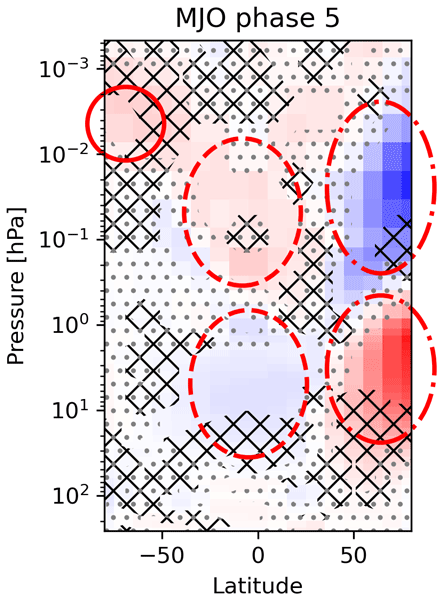
Christoph G. Hoffmann, Lena G. Buth, and Christian von Savigny
Atmos. Chem. Phys., 23, 12781–12799, https://doi.org/10.5194/acp-23-12781-2023, https://doi.org/10.5194/acp-23-12781-2023, 2023
Short summary
Short summary
The Madden–Julian oscillation is an important feature of weather in the tropics. Although it is mainly active in the troposphere, we show that it systematically influences the air temperature in the layers above, up to about 100 km altitude and from pole to pole. We have linked this to another known far-reaching process, interhemispheric coupling. This is basic research on atmospheric couplings and variability but might also be of interest for intraseasonal weather forecasting models.
Lena G. Buth, Valeria Di Biase, Peter Kuipers Munneke, Stef Lhermitte, Sanne B. M. Veldhuijsen, Sophie de Roda Husman, Michiel R. van den Broeke, and Bert Wouters
EGUsphere, https://doi.org/10.5194/egusphere-2023-2000, https://doi.org/10.5194/egusphere-2023-2000, 2023
Preprint archived
Short summary
Short summary
Liquid meltwater which is stored in air bubbles in the compacted snow near the surface of Antarctica can affect ice shelf stability. In order to detect the presence of such firn aquifers over large scales, satellite remote sensing is needed. In this paper, we present our new detection method using radar satellite data as well as the results for the whole Antarctic Peninsula. Firn aquifers are found in the north and northwest of the peninsula, in agreement with locations predicted by models.
Lena G. Buth, Bert Wouters, Sanne B. M. Veldhuijsen, Stef Lhermitte, Peter Kuipers Munneke, and Michiel R. van den Broeke
The Cryosphere Discuss., https://doi.org/10.5194/tc-2022-127, https://doi.org/10.5194/tc-2022-127, 2022
Manuscript not accepted for further review
Short summary
Short summary
Liquid meltwater which is stored in air bubbles in the compacted snow near the surface of Antarctica can affect ice shelf stability. In order to detect the presence of such firn aquifers over large scales, satellite remote sensing is needed. In this paper, we present our new detection method using radar satellite data as well as the results for the whole Antarctic Peninsula. Firn aquifers are found in the north and northwest of the peninsula, in agreement with locations predicted by models.
Mara Neudert, Daria Paul, Sacha van der Vleuten, Stefanie Arndt, and Christian Haas
EGUsphere, https://doi.org/10.5194/egusphere-2026-5496, https://doi.org/10.5194/egusphere-2026-5496, 2026
This preprint is open for discussion and under review for The Cryosphere (TC).
Short summary
Short summary
Icebergs can strongly change how snow and ice develop on Antarctic coastal sea ice, but their effects are poorly understood. We combined drone mapping with measurements of snow and ice thickness and ice cores to examine these changes. We found that thick snow on the windward side of icebergs promotes flooding and freezes into solid snow-ice, greatly increasing ice thickness while reducing ice growth from below. Snow-free areas in the lee, in contrast, had thicker ice grown from below.
Patrick C. Taylor, Armin Sorooshian, Rei Ueyama, Sebastian Schmidt, Ihab Abboud, Quincy Allison, Kevin Barry, Sebastian Becker, Holly A. Bender, Joseph R. Bennett, James B. Blair, Niklas Bohn, Linette Boisvert, Matthew D. Brown, Roelof Bruintjes, Anthony Bucholtz, Megan Buzanowicz, Brian Cairns, Filippo Calì Quaglia, Eduard Chemyakin, Bo Chen, Gao Chen, Hong Chen, Yu-Wen Chen, Zezhen Cheng, Swarup China, Dan Chirica, Yonghoon Choi, Peter Colarco, Brian Collister, Ewan Crosbie, Maurice J. Cross, Janet Daniels, Paul DeMott, Joshua P. DiGangi, Alcide Giorgio di Sarra, Glenn S. Diskin, Erica K. Dolinar, Eva-Lou Edwards, Samuel Ephraim, Nikolaos Evangeliou, Romanos Foskinis, Francesca Gallo, Lan Gao, José Luis Gómez-Amo, Daisy Gonzalez, Christine Groot Zwaaftink, Pawan Gupta, Ivan Heckman, Michael Hendrickson, Miguel Ricardo A. Hilario, Ken Hirata, Michelle Hofton, Andrew L. Holen, Ulas Im, Alia L. Khan, Ralph Kahn, Alexei V. Korolev, Sonia Kreidenweis, Thomas Krumpen, Nathan Kurtz, Leslie Lait, Bradley Lamkin, Jack Landy, Nurun Nahar Lata, Paul Lawson, Samuel LeBlanc, Sean Leavor, Jing Li, Thorsten Markus, Hal Maring, Andreas H. Massling, Camille Mavis, Flynn McGinnity, Kerry Meyer, Gabriel Mojica, Richard H. Moore, Parker Morris, Giovanni Muscari, Vikas Nataraja, Amin R. Nehrir, Athanasios Nenes, Edward P. Nowottnick, Matteo Ottaviani, Chelsea Parker, Ryan Patnaude, Michael Perez, Russell J. Perkins, Colten Peterson, Alek Petty, Stevie Phothisane, Chris Polashenski, Kerri A. Pratt, Kayla M. Preisler, John Prytherch, David Rabine, Jens Redemann, Ju-Mee Ryoo, Joseph S. Schlosser, Vanessa Selimovic, Michael A. Shook, Morgan Silverman, Henrik Skov, Alexander Smirnov, Cassidy Soloff, Amy Solomon, Snorre Stamnes, Azusa Takeishi, David R. Thompson, K. Lee Thornhill, Rachel Tilling, Michael Tjernström, Monica Tosco, Pedro C. Valdelomar, David Van Gilst, Jian Wang, Zhien Wang, Andrzej Wasilewski, Manfred Wendisch, Brent Wilder, Edward L. Winstead, Albert Wu, Peng Xian, Lauren M. Zamora, Jiaoshi Zhang, Lei Zhang, Lu Zhang, Luke Ziemba, and Paquita Zuidema
Earth Syst. Sci. Data Discuss., https://doi.org/10.5194/essd-2026-241, https://doi.org/10.5194/essd-2026-241, 2026
Preprint under review for ESSD
Short summary
Short summary
This article summarizes the data sets collected during the Arctic Radiation Cloud aerosol Sea ice Interaction eXperiment (ARCSIX), NASA's most comprehensive Arctic field campaign to date. The overarching goal was to quantify the contributions of surface, clouds, aerosol particles, and precipitation to summer sea ice melt. This paper describes the ARCSIX implementation including the flight strategy, instruments, complementary data sets, access, and usage details.
Julien Meloche, Melody Sandells, Henning Löwe, Nick Rutter, Ghislain Picard, Richard Essery, Randall K. Scharien, Alexandre Langlois, Matthias Jaggi, Josh King, Peter Toose, Michele Scagliola, Jerome Bouffard, Alessandro Di Bella, and Christian Haas
EGUsphere, https://doi.org/10.5194/egusphere-2026-3615, https://doi.org/10.5194/egusphere-2026-3615, 2026
Short summary
Short summary
Sea ice thickness is essential for climate studies. Radar altimetry has provided sea ice thickness measurements, but uncertainty arises from the interaction of the signal with the snow cover. Therefore, modelling the signal interaction with the snow is necessary to improve retrieval. A radar model was used to simulate the radar signal from the snow-covered sea ice. This work paved the way to improved physical algorithms to retrieve snow depth and sea ice thickness for radar altimeter missions.
Rebecca McPherson, Wilken-Jon von Appen, Laura de Steur, Luise Becker, Monica Ionita, Thomas Krumpen, Gunnar Spreen, and Finn Ole Heukamp
EGUsphere, https://doi.org/10.5194/egusphere-2026-2955, https://doi.org/10.5194/egusphere-2026-2955, 2026
Short summary
Short summary
The East Greenland Current carries cold, fresh water and sea ice from the Arctic toward the North Atlantic. Using seven years of ocean measurements off northeast Greenland, we found that the current occasionally develops a northward component on the continental slope that can persist for weeks. These events are driven by specific wind patterns that reorganise the current and push warm water into the Arctic — a previously unknown heat pathway, which has regional consequences for sea ice.
Ethan C. Campbell, Stephen C. Riser, and Melinda A. Webster
EGUsphere, https://doi.org/10.5194/egusphere-2026-2089, https://doi.org/10.5194/egusphere-2026-2089, 2026
Short summary
Short summary
The processes controlling snow evolution on Antarctic sea ice are poorly constrained from observations and models. We developed a new model that parameterizes key snow erosion and transformation mechanisms and calibrated it with snow buoy data. The simulation shows that more than one-third of deposited snow is lost before sea ice melt. Snow on sea ice is found to be a larger source of freshwater to the Southern Ocean than previously estimated, with implications for water mass transformation.
Niklas Neckel, Niels Fuchs, Jonathan Kolar, Thomas Kordes, and Christian Haas
EGUsphere, https://doi.org/10.5194/egusphere-2026-714, https://doi.org/10.5194/egusphere-2026-714, 2026
Short summary
Short summary
This study summarizes challenges of operating consumer-grade UAVs over high-latitude Arctic pack ice. High ice-floe drift and the lack of commercial grid-mission solutions north of 85° N hinder the generation of void-free orthomosaics and DEMs. We present an autonomous high-latitude grid-flight approach with pre- and post-flight drift correction, applied during ArcWatch-2 (Aug/Sep 2024), enabling ice thickness, surface type and pond depth retrievals.
Valentin Ludwig, Caroline Ribere, Sara Fleury, Christian Haas, Michel Tsamados, Mahmoud El Hajj, Jerome Bouffard, Michele Scagliola, Marion Bocquet, Eric de Boisseson, Vincent Boulenger, Guillaume Boutin, Laurence Connor, Léo Edel, Stefan Hendricks, Ferran Hernández Macià, Marcus Huntemann, Lars Kaleschke, Frank Kauker, Jack Landy, Tom Megain, Alek Petty, Till Soya Rasmussen, Mads Hvid Ribergaard, Robert Ricker, Axel Schweiger, Hoyeon Shi, Xiangshan Tian-Kunze, Donghui Yi, and Alessandro Di Bella
EGUsphere, https://doi.org/10.5194/egusphere-2025-6201, https://doi.org/10.5194/egusphere-2025-6201, 2026
Short summary
Short summary
Our paper compares Arctic sea-ice thickness datasets from models, reanalyses, satellite-only, and multi-product sources. We validate them against Beaufort Sea reference data, compare large-scale products, and analyse time series. Cross-product biases range from 0.2–0.4 m, RMSDs from 0.4–0.9 m, and correlations from 0.5–0.8. We find no 2010–2023 trend, but 1995–2023 thinning of ~ 0.5 m in November and ~ 0.3 m in March.
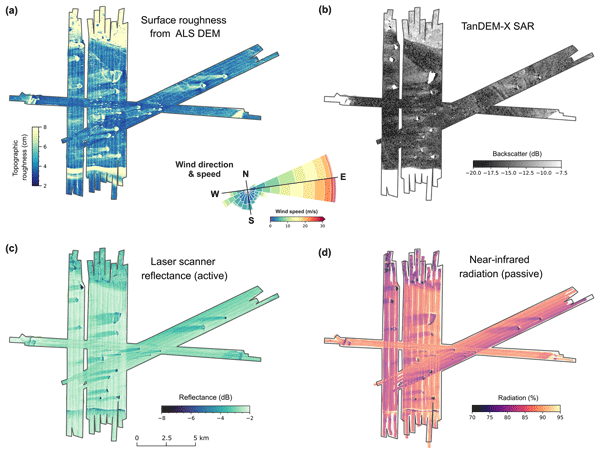
Steven Franke, Mara Neudert, Veit Helm, Arttu Jutila, Océane Hames, Niklas Neckel, Stefanie Arndt, and Christian Haas
The Cryosphere, 19, 6319–6339, https://doi.org/10.5194/tc-19-6319-2025, https://doi.org/10.5194/tc-19-6319-2025, 2025
Short summary
Short summary
Our research explored how icebergs affect the distribution of snow and flooding on Antarctic coastal sea ice. Using aircraft-based radar and laser scanning, we found that icebergs create thick snow drifts on their wind-facing sides and leave snow-free zones in their lee. The weight of these snow drifts often causes the ice below to flood, forming slush. These patterns, driven by wind and iceberg placement, are crucial for understanding sea ice changes and improving climate models.
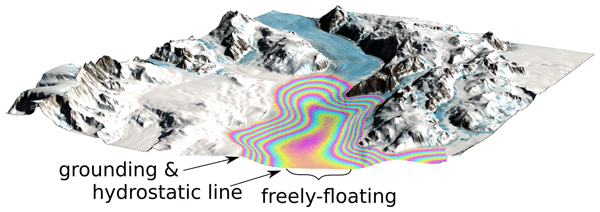
Christian T. Wild, Reinhard Drews, Niklas Neckel, Joohan Lee, Sihyung Kim, Hyangsun Han, Won Sang Lee, Veit Helm, Sebastian Harry Reid Rosier, Oliver J. Marsh, and Wolfgang Rack
The Cryosphere, 19, 4533–4554, https://doi.org/10.5194/tc-19-4533-2025, https://doi.org/10.5194/tc-19-4533-2025, 2025
Short summary
Short summary
The stability of the Antarctic Ice Sheet depends on how resistance along the sides of large glaciers slows down the flow of ice into the ocean. We present a method to map ice strength using the effect of ocean tides on floating ice shelves. Incorporating weaker ice in shear zones improves the accuracy of model predictions, compared with satellite observations. This demonstrates the untapped potential of radar satellites to map ice stiffness in the most critical areas for ice sheet stability.
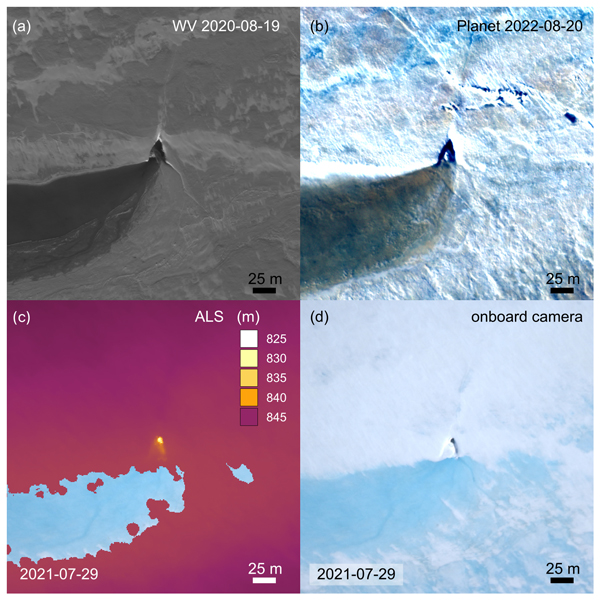
Angelika Humbert, Veit Helm, Ole Zeising, Niklas Neckel, Matthias H. Braun, Shfaqat Abbas Khan, Martin Rückamp, Holger Steeb, Julia Sohn, Matthias Bohnen, and Ralf Müller
The Cryosphere, 19, 3009–3032, https://doi.org/10.5194/tc-19-3009-2025, https://doi.org/10.5194/tc-19-3009-2025, 2025
Short summary
Short summary
We study the evolution of a massive lake on the Greenland Ice Sheet using satellite and airborne data and some modelling. The lake is emptying rapidly. Water flows to the glacier's base through cracks and triangular-shaped moulins that remain visible over the years. Some of them become reactivated. We find features inside the glacier that stem from drainage events with a width of even 1 km. These features are persistent over the years, although they are changing in shape.
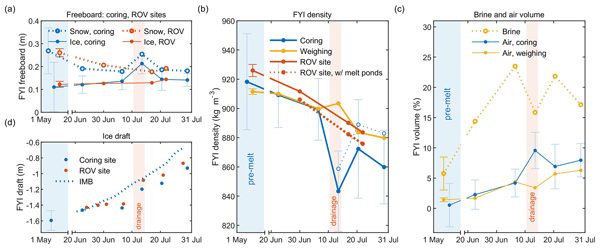
Evgenii Salganik, Odile Crabeck, Niels Fuchs, Nils Hutter, Philipp Anhaus, and Jack Christopher Landy
The Cryosphere, 19, 1259–1278, https://doi.org/10.5194/tc-19-1259-2025, https://doi.org/10.5194/tc-19-1259-2025, 2025
Short summary
Short summary
To measure Arctic ice thickness, we often check how much ice sticks out of the water. This method depends on knowing the ice's density, which drops significantly in summer. Our study, validated with sonar and laser data, shows that these seasonal changes in density can complicate melt measurements. We stress the importance of considering these density changes for more accurate ice thickness readings.
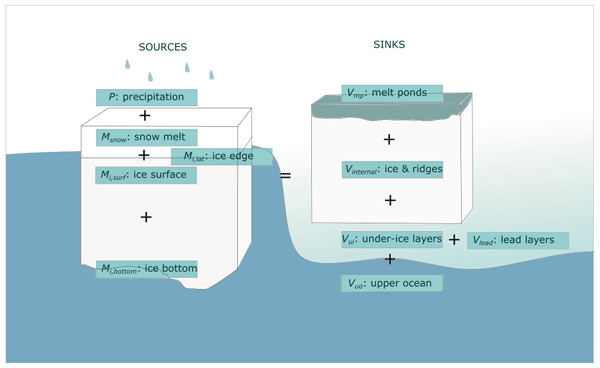
Madison M. Smith, Niels Fuchs, Evgenii Salganik, Donald K. Perovich, Ian Raphael, Mats A. Granskog, Kirstin Schulz, Matthew D. Shupe, and Melinda Webster
The Cryosphere, 19, 619–644, https://doi.org/10.5194/tc-19-619-2025, https://doi.org/10.5194/tc-19-619-2025, 2025
Short summary
Short summary
The fate of freshwater from Arctic sea ice and snowmelt impacts interactions of the atmosphere, sea ice, and ocean. We complete a comprehensive analysis of datasets from a 2020 central Arctic field campaign to understand the drivers of the sea ice freshwater budget and the fate of this water. Over half of the freshwater comes from surface melt, and a majority fraction is incorporated into the ocean. Results suggest that the representation of melt ponds is a key area for future development.
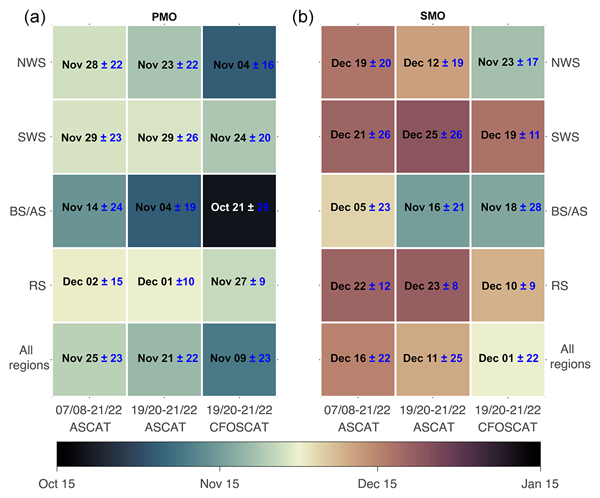
Rui Xu, Chaofang Zhao, Stefanie Arndt, and Christian Haas
The Cryosphere, 18, 5769–5788, https://doi.org/10.5194/tc-18-5769-2024, https://doi.org/10.5194/tc-18-5769-2024, 2024
Short summary
Short summary
The onset of snowmelt on Antarctic sea ice is an important indicator of sea ice change. In this study, we used two radar scatterometers to detect the onset of snowmelt on perennial Antarctic sea ice. Results show that since 2007, snowmelt onset has demonstrated strong interannual and regional variabilities. We also found that the difference in snowmelt onsets between the two scatterometers is closely related to snow metamorphism.
Yi Zhou, Xianwei Wang, Ruibo Lei, Arttu Jutila, Donald K. Perovich, Luisa von Albedyll, Dmitry V. Divine, Yu Zhang, and Christian Haas
EGUsphere, https://doi.org/10.5194/egusphere-2024-2821, https://doi.org/10.5194/egusphere-2024-2821, 2024
Preprint archived
Short summary
Short summary
This study examines how the bulk density of Arctic sea ice varies seasonally, a factor often overlooked in satellite measurements of sea ice thickness. From October to April, we found significant seasonal variations in sea ice bulk density at different spatial scales using direct observations as well as airborne and satellite data. New models were then developed to indirectly predict sea ice bulk density. This advance can improve our ability to monitor changes in Arctic sea ice.
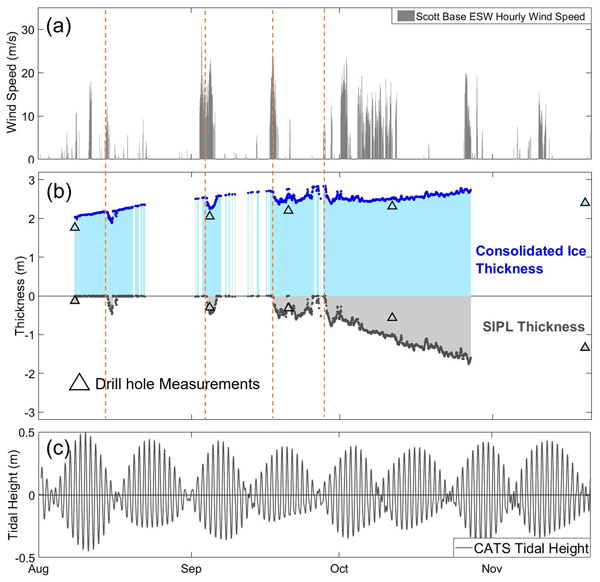
Gemma M. Brett, Greg H. Leonard, Wolfgang Rack, Christian Haas, Patricia J. Langhorne, Natalie J. Robinson, and Anne Irvin
The Cryosphere, 18, 3049–3066, https://doi.org/10.5194/tc-18-3049-2024, https://doi.org/10.5194/tc-18-3049-2024, 2024
Short summary
Short summary
Glacial meltwater with ice crystals flows from beneath ice shelves, causing thicker sea ice with sub-ice platelet layers (SIPLs) beneath. Thicker sea ice and SIPL reveal where and how much meltwater is outflowing. We collected continuous measurements of sea ice and SIPL. In winter, we observed rapid SIPL growth with strong winds. In spring, SIPLs grew when tides caused offshore circulation. Wind-driven and tidal circulation influence glacial meltwater outflow from ice shelf cavities.
Niels Fuchs, Luisa von Albedyll, Gerit Birnbaum, Felix Linhardt, Natascha Oppelt, and Christian Haas
The Cryosphere, 18, 2991–3015, https://doi.org/10.5194/tc-18-2991-2024, https://doi.org/10.5194/tc-18-2991-2024, 2024
Short summary
Short summary
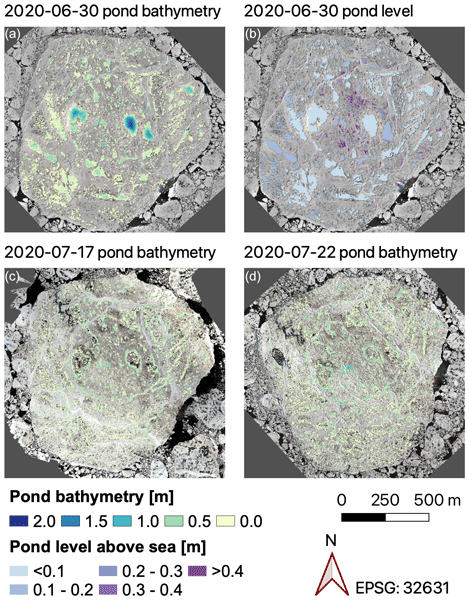
Melt ponds are key components of the Arctic sea ice system, yet methods to derive comprehensive pond depth data are missing. We present a shallow-water bathymetry retrieval to derive this elementary pond property at high spatial resolution from aerial images. The retrieval method is presented in a user-friendly way to facilitate replication. Furthermore, we provide pond properties on the MOSAiC expedition floe, giving insights into the three-dimensional pond evolution before and after drainage.
Yi Zhou, Xianwei Wang, Ruibo Lei, Luisa von Albedyll, Donald K. Perovich, Yu Zhang, and Christian Haas
EGUsphere, https://doi.org/10.5194/egusphere-2024-1240, https://doi.org/10.5194/egusphere-2024-1240, 2024
Preprint archived
Short summary
Short summary
This study examines how the density of Arctic sea ice varies seasonally, a factor often overlooked in satellite measurements of sea ice thickness. From October to April, using direct observations and satellite data, we found that sea ice density decreases significantly until mid-January due to increased porosity as the ice ages, and then stabilizes until April. We then developed new models to estimate sea ice density. This advance can improve our ability to monitor changes in Arctic sea ice.

Karl Kortum, Suman Singha, Gunnar Spreen, Nils Hutter, Arttu Jutila, and Christian Haas
The Cryosphere, 18, 2207–2222, https://doi.org/10.5194/tc-18-2207-2024, https://doi.org/10.5194/tc-18-2207-2024, 2024
Short summary
Short summary
A dataset of 20 radar satellite acquisitions and near-simultaneous helicopter-based surveys of the ice topography during the MOSAiC expedition is constructed and used to train a variety of deep learning algorithms. The results give realistic insights into the accuracy of retrieval of measured ice classes using modern deep learning models. The models able to learn from the spatial distribution of the measured sea ice classes are shown to have a clear advantage over those that cannot.
Ole Zeising, Niklas Neckel, Nils Dörr, Veit Helm, Daniel Steinhage, Ralph Timmermann, and Angelika Humbert
The Cryosphere, 18, 1333–1357, https://doi.org/10.5194/tc-18-1333-2024, https://doi.org/10.5194/tc-18-1333-2024, 2024
Short summary
Short summary
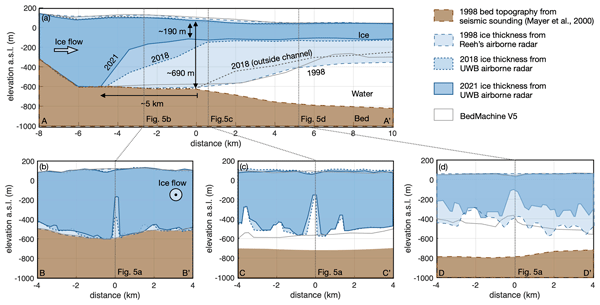
The 79° North Glacier in Greenland has experienced significant changes over the last decades. Due to extreme melt rates, the ice has thinned significantly in the vicinity of the grounding line, where a large subglacial channel has formed since 2010. We attribute these changes to warm ocean currents and increased subglacial discharge from surface melt. However, basal melting has decreased since 2018, indicating colder water inflow into the cavity below the glacier.
Luisa von Albedyll, Stefan Hendricks, Nils Hutter, Dmitrii Murashkin, Lars Kaleschke, Sascha Willmes, Linda Thielke, Xiangshan Tian-Kunze, Gunnar Spreen, and Christian Haas
The Cryosphere, 18, 1259–1285, https://doi.org/10.5194/tc-18-1259-2024, https://doi.org/10.5194/tc-18-1259-2024, 2024
Short summary
Short summary
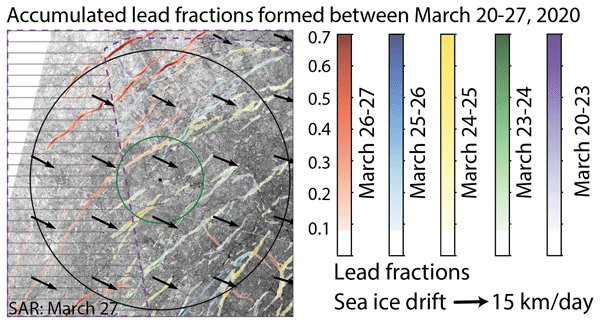
Leads (openings in sea ice cover) are created by sea ice dynamics. Because they are important for many processes in the Arctic winter climate, we aim to detect them with satellites. We present two new techniques to detect lead widths of a few hundred meters at high spatial resolution (700 m) and independent of clouds or sun illumination. We use the MOSAiC drift 2019–2020 in the Arctic for our case study and compare our new products to other existing lead products.
Christoph G. Hoffmann, Lena G. Buth, and Christian von Savigny
Atmos. Chem. Phys., 23, 12781–12799, https://doi.org/10.5194/acp-23-12781-2023, https://doi.org/10.5194/acp-23-12781-2023, 2023
Short summary
Short summary
The Madden–Julian oscillation is an important feature of weather in the tropics. Although it is mainly active in the troposphere, we show that it systematically influences the air temperature in the layers above, up to about 100 km altitude and from pole to pole. We have linked this to another known far-reaching process, interhemispheric coupling. This is basic research on atmospheric couplings and variability but might also be of interest for intraseasonal weather forecasting models.
Lena G. Buth, Valeria Di Biase, Peter Kuipers Munneke, Stef Lhermitte, Sanne B. M. Veldhuijsen, Sophie de Roda Husman, Michiel R. van den Broeke, and Bert Wouters
EGUsphere, https://doi.org/10.5194/egusphere-2023-2000, https://doi.org/10.5194/egusphere-2023-2000, 2023
Preprint archived
Short summary
Short summary
Liquid meltwater which is stored in air bubbles in the compacted snow near the surface of Antarctica can affect ice shelf stability. In order to detect the presence of such firn aquifers over large scales, satellite remote sensing is needed. In this paper, we present our new detection method using radar satellite data as well as the results for the whole Antarctic Peninsula. Firn aquifers are found in the north and northwest of the peninsula, in agreement with locations predicted by models.
Ellen M. Buckley, Sinéad L. Farrell, Ute C. Herzfeld, Melinda A. Webster, Thomas Trantow, Oliwia N. Baney, Kyle A. Duncan, Huilin Han, and Matthew Lawson
The Cryosphere, 17, 3695–3719, https://doi.org/10.5194/tc-17-3695-2023, https://doi.org/10.5194/tc-17-3695-2023, 2023
Short summary
Short summary
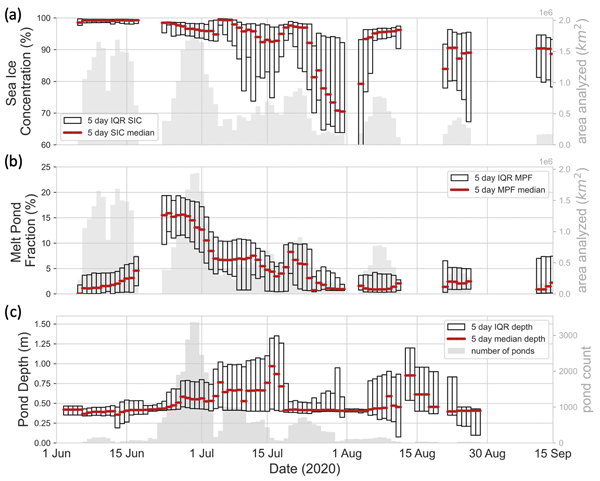
In this study, we use satellite observations to investigate the evolution of melt ponds on the Arctic sea ice surface. We derive melt pond depth from ICESat-2 measurements of the pond surface and bathymetry and melt pond fraction (MPF) from the classification of Sentinel-2 imagery. MPF increases to a peak of 16 % in late June and then decreases, while depth increases steadily. This work demonstrates the ability to track evolving melt conditions in three dimensions throughout the summer.
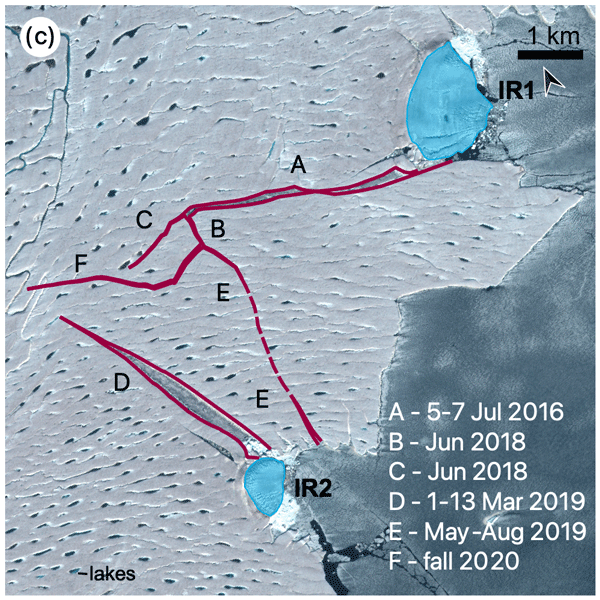
Angelika Humbert, Veit Helm, Niklas Neckel, Ole Zeising, Martin Rückamp, Shfaqat Abbas Khan, Erik Loebel, Jörg Brauchle, Karsten Stebner, Dietmar Gross, Rabea Sondershaus, and Ralf Müller
The Cryosphere, 17, 2851–2870, https://doi.org/10.5194/tc-17-2851-2023, https://doi.org/10.5194/tc-17-2851-2023, 2023
Short summary
Short summary
The largest floating glacier mass in Greenland, the 79° N Glacier, is showing signs of instability. We investigate how crack formation at the glacier's calving front has changed over the last decades by using satellite imagery and airborne data. The calving front is about to lose contact to stabilizing ice islands. Simulations show that the glacier will accelerate as a result of this, leading to an increase in ice discharge of more than 5.1 % if its calving front retreats by 46 %.
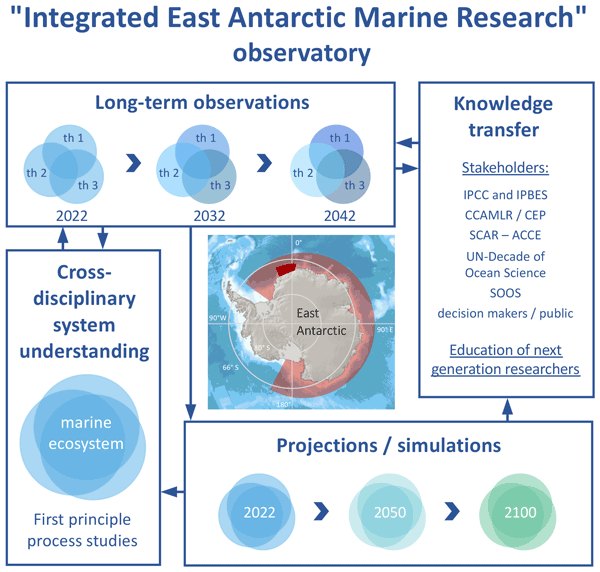
Julian Gutt, Stefanie Arndt, David Keith Alan Barnes, Horst Bornemann, Thomas Brey, Olaf Eisen, Hauke Flores, Huw Griffiths, Christian Haas, Stefan Hain, Tore Hattermann, Christoph Held, Mario Hoppema, Enrique Isla, Markus Janout, Céline Le Bohec, Heike Link, Felix Christopher Mark, Sebastien Moreau, Scarlett Trimborn, Ilse van Opzeeland, Hans-Otto Pörtner, Fokje Schaafsma, Katharina Teschke, Sandra Tippenhauer, Anton Van de Putte, Mia Wege, Daniel Zitterbart, and Dieter Piepenburg
Biogeosciences, 19, 5313–5342, https://doi.org/10.5194/bg-19-5313-2022, https://doi.org/10.5194/bg-19-5313-2022, 2022
Short summary
Short summary
Long-term ecological observations are key to assess, understand and predict impacts of environmental change on biotas. We present a multidisciplinary framework for such largely lacking investigations in the East Antarctic Southern Ocean, combined with case studies, experimental and modelling work. As climate change is still minor here but is projected to start soon, the timely implementation of this framework provides the unique opportunity to document its ecological impacts from the very onset.
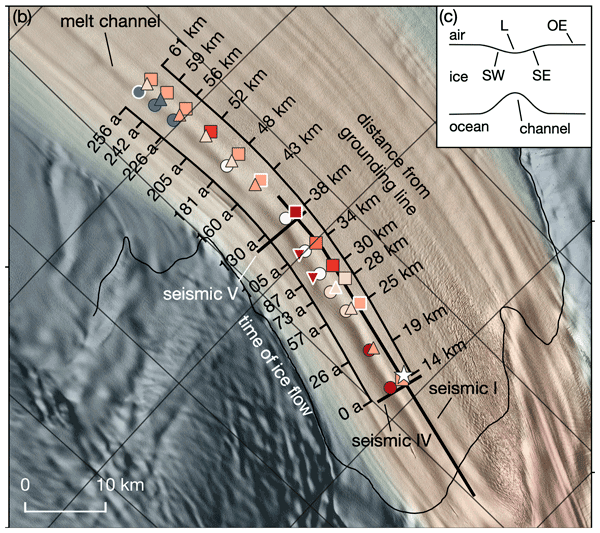
Angelika Humbert, Julia Christmann, Hugh F. J. Corr, Veit Helm, Lea-Sophie Höyns, Coen Hofstede, Ralf Müller, Niklas Neckel, Keith W. Nicholls, Timm Schultz, Daniel Steinhage, Michael Wolovick, and Ole Zeising
The Cryosphere, 16, 4107–4139, https://doi.org/10.5194/tc-16-4107-2022, https://doi.org/10.5194/tc-16-4107-2022, 2022
Short summary
Short summary
Ice shelves are normally flat structures that fringe the Antarctic continent. At some locations they have channels incised into their underside. On Filchner Ice Shelf, such a channel is more than 50 km long and up to 330 m high. We conducted field measurements of basal melt rates and found a maximum of 2 m yr−1. Simulations represent the geometry evolution of the channel reasonably well. There is no reason to assume that this type of melt channel is destabilizing ice shelves.
Lena G. Buth, Bert Wouters, Sanne B. M. Veldhuijsen, Stef Lhermitte, Peter Kuipers Munneke, and Michiel R. van den Broeke
The Cryosphere Discuss., https://doi.org/10.5194/tc-2022-127, https://doi.org/10.5194/tc-2022-127, 2022
Manuscript not accepted for further review
Short summary
Short summary
Liquid meltwater which is stored in air bubbles in the compacted snow near the surface of Antarctica can affect ice shelf stability. In order to detect the presence of such firn aquifers over large scales, satellite remote sensing is needed. In this paper, we present our new detection method using radar satellite data as well as the results for the whole Antarctic Peninsula. Firn aquifers are found in the north and northwest of the peninsula, in agreement with locations predicted by models.
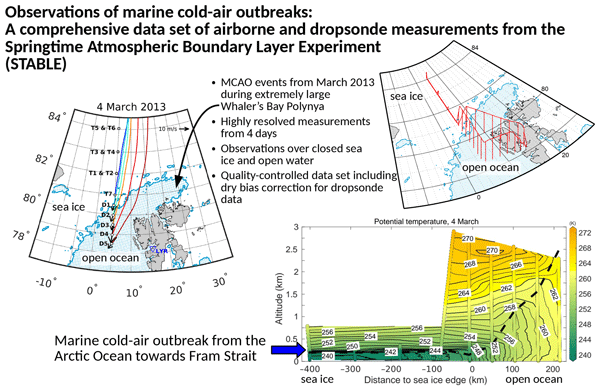
Janosch Michaelis, Amelie U. Schmitt, Christof Lüpkes, Jörg Hartmann, Gerit Birnbaum, and Timo Vihma
Earth Syst. Sci. Data, 14, 1621–1637, https://doi.org/10.5194/essd-14-1621-2022, https://doi.org/10.5194/essd-14-1621-2022, 2022
Short summary
Short summary
A major goal of the Springtime Atmospheric Boundary Layer Experiment (STABLE) aircraft campaign was to observe atmospheric conditions during marine cold-air outbreaks (MCAOs) originating from the sea-ice-covered Arctic ocean. Quality-controlled measurements of several meteorological variables collected during 15 vertical aircraft profiles and by 22 dropsondes are presented. The comprehensive data set may be used for validating model results to improve the understanding of future trends in MCAOs.
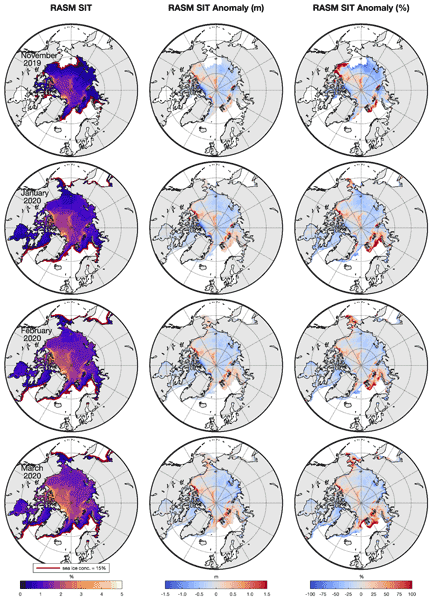
Klaus Dethloff, Wieslaw Maslowski, Stefan Hendricks, Younjoo J. Lee, Helge F. Goessling, Thomas Krumpen, Christian Haas, Dörthe Handorf, Robert Ricker, Vladimir Bessonov, John J. Cassano, Jaclyn Clement Kinney, Robert Osinski, Markus Rex, Annette Rinke, Julia Sokolova, and Anja Sommerfeld
The Cryosphere, 16, 981–1005, https://doi.org/10.5194/tc-16-981-2022, https://doi.org/10.5194/tc-16-981-2022, 2022
Short summary
Short summary
Sea ice thickness anomalies during the MOSAiC (Multidisciplinary drifting Observatory for the Study of Arctic Climate) winter in January, February and March 2020 were simulated with the coupled Regional Arctic climate System Model (RASM) and compared with CryoSat-2/SMOS satellite data. Hindcast and ensemble simulations indicate that the sea ice anomalies are driven by nonlinear interactions between ice growth processes and wind-driven sea-ice transports, with dynamics playing a dominant role.
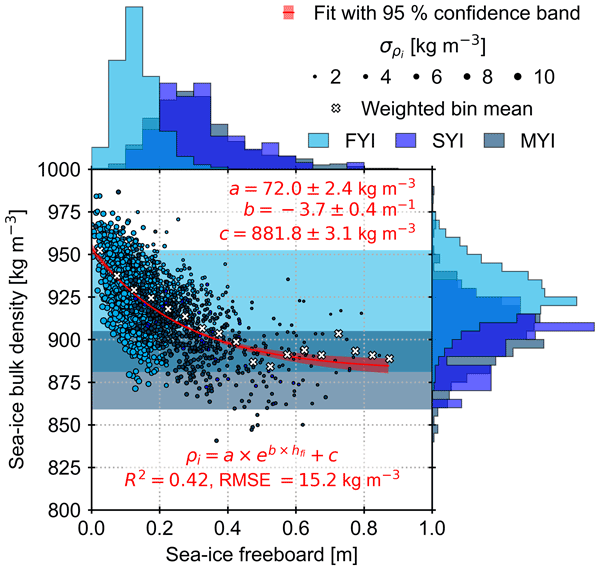
Arttu Jutila, Stefan Hendricks, Robert Ricker, Luisa von Albedyll, Thomas Krumpen, and Christian Haas
The Cryosphere, 16, 259–275, https://doi.org/10.5194/tc-16-259-2022, https://doi.org/10.5194/tc-16-259-2022, 2022
Short summary
Short summary
Sea-ice thickness retrieval from satellite altimeters relies on assumed sea-ice density values because density cannot be measured from space. We derived bulk densities for different ice types using airborne laser, radar, and electromagnetic induction sounding measurements. Compared to previous studies, we found high bulk density values due to ice deformation and younger ice cover. Using sea-ice freeboard, we derived a sea-ice bulk density parameterisation that can be applied to satellite data.
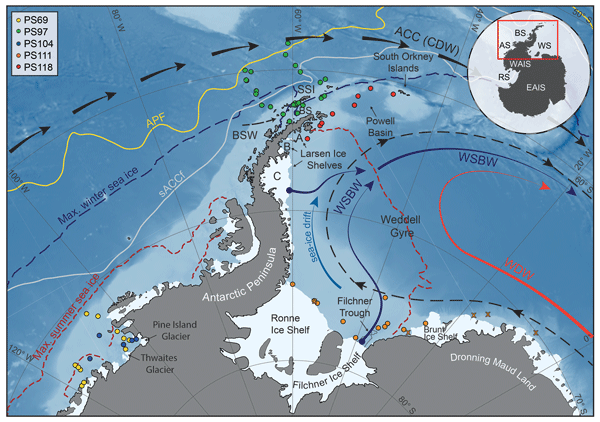
Nele Lamping, Juliane Müller, Jens Hefter, Gesine Mollenhauer, Christian Haas, Xiaoxu Shi, Maria-Elena Vorrath, Gerrit Lohmann, and Claus-Dieter Hillenbrand
Clim. Past, 17, 2305–2326, https://doi.org/10.5194/cp-17-2305-2021, https://doi.org/10.5194/cp-17-2305-2021, 2021
Short summary
Short summary
We analysed biomarker concentrations on surface sediment samples from the Antarctic continental margin. Highly branched isoprenoids and GDGTs are used for reconstructing recent sea-ice distribution patterns and ocean temperatures respectively. We compared our biomarker-based results with data obtained from satellite observations and estimated from a numerical model and find reasonable agreements. Further, we address caveats and provide recommendations for future investigations.
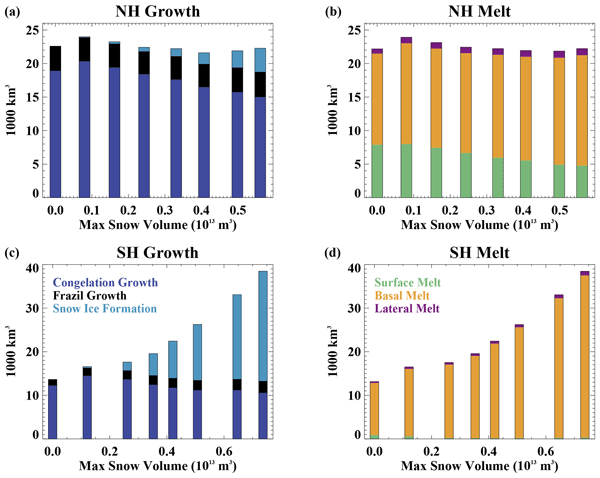
Marika M. Holland, David Clemens-Sewall, Laura Landrum, Bonnie Light, Donald Perovich, Chris Polashenski, Madison Smith, and Melinda Webster
The Cryosphere, 15, 4981–4998, https://doi.org/10.5194/tc-15-4981-2021, https://doi.org/10.5194/tc-15-4981-2021, 2021
Short summary
Short summary
As the most reflective and most insulative natural material, snow has important climate effects. For snow on sea ice, its high reflectivity reduces ice melt. However, its high insulating capacity limits ice growth. These counteracting effects make its net influence on sea ice uncertain. We find that with increasing snow, sea ice in both hemispheres is thicker and more extensive. However, the drivers of this response are different in the two hemispheres due to different climate conditions.
Cited articles
Alstott, J., Bullmore, E., and Plenz, D.: powerlaw: A Python Package for Analysis of Heavy-Tailed Distributions, PLoS ONE, 9, e85777, https://doi.org/10.1371/journal.pone.0085777, 2014. a
Andersen, O. B., Rose, S. K., Abulaitijiang, A., Zhang, S., and Fleury, S.: The DTU21 global mean sea surface and first evaluation, Earth Syst. Sci. Data, 15, 4065–4075, https://doi.org/10.5194/essd-15-4065-2023, 2023. a
Arrigo, K. R., Perovich, D. K., Pickart, R. S., Brown, Z. W., van Dijken, G. L., Lowry, K. E., Mills, M. M., Palmer, M. A., Balch, W. M., Bahr, F., Bates, N. R., Benitez-Nelson, C., Bowler, B., Brownlee, E., Ehn, J. K., Frey, K. E., Garley, R., Laney, S. R., Lubelczyk, L., Mathis, J., Matsuoka, A., Mitchell, B. G., Moore, G. W. K., Ortega-Retuerta, E., Pal, S., Polashenski, C. M., Reynolds, R. A., Schieber, B., Sosik, H. M., Stephens, M., and Swift, J. H.: Massive Phytoplankton Blooms Under Arctic Sea Ice, Science, 336, 1408–1408, https://doi.org/10.1126/science.1215065, 2012. a, b
Barber, D. G. and Yackel, J.: The physical, radiative and microwave scattering characteristics of melt ponds on Arctic landfast sea ice, International Journal of Remote Sensing, 20, 2069–2090, https://doi.org/10.1080/014311699212353, 1999. a
Belter, H. J., Krumpen, T., von Albedyll, L., Alekseeva, T. A., Birnbaum, G., Frolov, S. V., Hendricks, S., Herber, A., Polyakov, I., Raphael, I., Ricker, R., Serovetnikov, S. S., Webster, M., and Haas, C.: Interannual variability in Transpolar Drift summer sea ice thickness and potential impact of Atlantification, The Cryosphere, 15, 2575–2591, https://doi.org/10.5194/tc-15-2575-2021, 2021. . a, b, c
Bowen, B., Strong, C., and Golden, K.: Modeling the fractal geometry of Arctic melt ponds using the level sets of random surfaces, Journal of Fractal Geometry, 5, 121–142, https://doi.org/10.4171/JFG/58, 2018. a
Buckley, E. M., Farrell, S. L., Duncan, K., Connor, L. N., Kuhn, J. M., and Dominguez, R. T.: Classification of Sea Ice Summer Melt Features in High‐Resolution IceBridge Imagery, Journal of Geophysical Research: Oceans, 125, e2019JC015738, https://doi.org/10.1029/2019JC015738, 2020. a, b
Buth, L. G., Buth, L. G., Krumpen, T., Neckel, N., and Birnbaum, G.: Processed aerial images and surface classifications of Arctic sea ice during the TIFAX 2016 and ASIMBO 2018 campaigns north of Greenland [Data set], Zenodo [data set], https://doi.org/10.5281/zenodo.17222941, 2025. a
Carlsen, T., Birnbaum, G., Ehrlich, A., Helm, V., Jäkel, E., Schäfer, M., and Wendisch, M.: Parameterizing anisotropic reflectance of snow surfaces from airborne digital camera observations in Antarctica, The Cryosphere, 14, 3959–3978, https://doi.org/10.5194/tc-14-3959-2020, 2020. a
Driscoll, S., Carrassi, A., Brajard, J., Bertino, L., Bocquet, M., and Ólason, E.: Parameter sensitivity analysis of a sea ice melt pond parametrisation and its emulation using neural networks, Journal of Computational Science, 79, 102231, https://doi.org/10.1016/j.jocs.2024.102231, 2024. a
Ehrlich, A., Bierwirth, E., Wendisch, M., Herber, A., and Gayet, J.-F.: Airborne hyperspectral observations of surface and cloud directional reflectivity using a commercial digital camera, Atmos. Chem. Phys., 12, 3493–3510, https://doi.org/10.5194/acp-12-3493-2012, 2012. a
Eicken, H., Tucker, W. B., and Perovich, D. K.: Indirect measurements of the mass balance of summer Arctic sea ice with an electromagnetic induction technique, Annals of Glaciology, 33, 194–200, https://doi.org/10.3189/172756401781818356, 2001. a
Eicken, H., Krouse, H. R., Kadko, D., and Perovich, D. K.: Tracer studies of pathways and rates of meltwater transport through Arctic summer sea ice, Journal of Geophysical Research: Oceans, 107, https://doi.org/10.1029/2000JC000583, 2002. a, b
Fetterer, F. and Untersteiner, N.: Observations of melt ponds on Arctic sea ice, Journal of Geophysical Research: Oceans, 103, 24821–24835, https://doi.org/10.1029/98JC02034, 1998. a
Flocco, D., Schroeder, D., Feltham, D. L., and Hunke, E. C.: Impact of melt ponds on Arctic sea ice simulations from 1990 to 2007, Journal of Geophysical Research: Oceans, 117, https://doi.org/10.1029/2012JC008195, 2012. a
Flocco, D., Feltham, D. L., Bailey, E., and Schroeder, D.: The refreezing of melt ponds on Arctic sea ice, Journal of Geophysical Research: Oceans, 120, 647–659, https://doi.org/10.1002/2014JC010140, 2015. a
Frey, K. E., Perovich, D. K., and Light, B.: The spatial distribution of solar radiation under a melting Arctic sea ice cover, Geophysical Research Letters, 38, https://doi.org/10.1029/2011GL049421, 2011. a
Fuchs, N.: PASTA-ice Github Repository, Zenodo [code], https://doi.org/10.5281/zenodo.7548469, 2023b. a
Fuchs, N., Von Albedyll, L., Birnbaum, G., Linhardt, F., Oppelt, N., and Haas, C.: Sea ice melt pond bathymetry reconstructed from aerial photographs using photogrammetry: a new method applied to MOSAiC data, The Cryosphere, 18, 2991–3015, https://doi.org/10.5194/tc-18-2991-2024, 2024. a, b
Fuchs, N., Birnbaum, G., Neckel, N., Kagel, T., Webster, M., and Wernecke, A.: Predicting Melt Pond Coverage on Arctic Sea Ice From Pre‐Melt Surface Topography, Geophysical Research Letters, 52, https://doi.org/10.1029/2025gl115033, 2025. a
Gerum, R. C., Richter, S., Winterl, A., Mark, C., Fabry, B., Le Bohec, C., and Zitterbart, D. P.: CameraTransform: A Python package for perspective corrections and image mapping, SoftwareX, 10, 100333, https://doi.org/10.1016/j.softx.2019.100333, 2019. a
Heuser, P. and Johannsen, O.: Cable Removal with Inpainting for https://doi.org/10.5194/egusphere-2025-1103 (0.1), Zenodo [code], https://doi.org/10.5281/zenodo.17790272, 2025. a
Hohenegger, C., Alali, B., Steffen, K. R., Perovich, D. K., and Golden, K. M.: Transition in the fractal geometry of Arctic melt ponds, The Cryosphere, 6, 1157–1162, https://doi.org/10.5194/tc-6-1157-2012, 2012. a, b
Horvat, C., Flocco, D., Rees Jones, D. W., Roach, L., and Golden, K. M.: The Effect of Melt Pond Geometry on the Distribution of Solar Energy Under First-Year Sea Ice, Geophysical Research Letters, 47, https://doi.org/10.1029/2019GL085956, 2020. a, b
Huang, W., Lu, P., Lei, R., Xie, H., and Li, Z.: Melt pond distribution and geometry in high Arctic sea ice derived from aerial investigations, Annals of Glaciology, 57, 105–118, https://doi.org/10.1017/aog.2016.30, 2016. a, b
Jordahl, K.: GeoPandas: Python tools for geographic data, GitHub [code], https://github.com/geopandas/geopandas (last access: 19 January 2025), 2014. a
Katlein, C., Perovich, D. K., and Nicolaus, M.: Geometric Effects of an Inhomogeneous Sea Ice Cover on the under Ice Light Field, Frontiers in Earth Science, 4, https://doi.org/10.3389/feart.2016.00006, 2016. a
Kim, D.-j., Hwang, B., Chung, K. H., Lee, S. H., Jung, H.-S., and Moon, W. M.: Melt Pond Mapping With High-Resolution SAR: The First View, Proceedings of the IEEE, 101, 748–758, https://doi.org/10.1109/JPROC.2012.2226411, 2013. a
Krumpen, T.: AWI ICETrack: Antarctic and Arctic Sea Ice Monitoring and Tracking Tool, Vers. 1.3, https://doi.org/10013/epic.9ee550b6-5966-4db6-a042-f4256810ec3f, 2018. a
Krumpen, T., Birrien, F., Kauker, F., Rackow, T., von Albedyll, L., Angelopoulos, M., Belter, H. J., Bessonov, V., Damm, E., Dethloff, K., Haapala, J., Haas, C., Harris, C., Hendricks, S., Hoelemann, J., Hoppmann, M., Kaleschke, L., Karcher, M., Kolabutin, N., Lei, R., Lenz, J., Morgenstern, A., Nicolaus, M., Nixdorf, U., Petrovsky, T., Rabe, B., Rabenstein, L., Rex, M., Ricker, R., Rohde, J., Shimanchuk, E., Singha, S., Smolyanitsky, V., Sokolov, V., Stanton, T., Timofeeva, A., Tsamados, M., and Watkins, D.: The MOSAiC ice floe: sediment-laden survivor from the Siberian shelf, The Cryosphere, 14, 2173–2187, https://doi.org/10.5194/tc-14-2173-2020, 2020. a
Krumpen, T., von Albedyll, L., Goessling, H. F., Hendricks, S., Juhls, B., Spreen, G., Willmes, S., Belter, H. J., Dethloff, K., Haas, C., Kaleschke, L., Katlein, C., Tian-Kunze, X., Ricker, R., Rostosky, P., Rückert, J., Singha, S., and Sokolova, J.: MOSAiC drift expedition from October 2019 to July 2020: sea ice conditions from space and comparison with previous years, The Cryosphere, 15, 3897–3920, https://doi.org/10.5194/tc-15-3897-2021, 2021. a
Krumpen, T., Haas, C., and Hendricks, S.: Laser altimeter data obtained over sea-ice during the TIFAX campaign in Jul-Aug, 2016, PANGAEA [data set], https://doi.org/10.1594/PANGAEA.971077, 2024a. a, b
Krumpen, T., Haas, C., and Hendricks, S.: Laser altimeter data obtained over sea-ice during the IceBird Summer campaign in Jul-Aug, 2018, PANGAEA [data set], https://doi.org/10.1594/PANGAEA.970640, 2024b. a, b
Krumpen, T., Von Albedyll, L., Bünger, H. J., Castellani, G., Hartmann, J., Helm, V., Hendricks, S., Hutter, N., Landy, J. C., Lisovski, S., Lüpkes, C., Rohde, J., Suhrhoff, M., and Haas, C.: Smoother sea ice with fewer pressure ridges in a more dynamic Arctic, Nature Climate Change, 15, 66–72, https://doi.org/10.1038/s41558-024-02199-5, 2025 (code available at: https://gitlab.awi.de/sitem/sbla_processing, last access: 26 February 2024). a, b, c, d
Landy, J., Ehn, J., Shields, M., and Barber, D.: Surface and melt pond evolution on landfast first-year sea ice in the Canadian Arctic Archipelago, Journal of Geophysical Research: Oceans, 119, 3054–3075, https://doi.org/10.1002/2013JC009617, 2014. a, b, c, d
Landy, J. C., Ehn, J. K., and Barber, D. G.: Albedo feedback enhanced by smoother Arctic sea ice, Geophysical Research Letters, 42, https://doi.org/10.1002/2015GL066712, 2015. a
Lavergne, T.: Validation and Monitoring of the OSI SAF Low Resolution Sea Ice Drift Product (v5), Tech. rep., The EUMETSAT Network of Satellite Application Facilities (OSI SAF, 2016), https://osisaf-hl.met.no/sites/osisaf-hl.met.no/files/validation_reports/osisaf_cdop2_ss2_valrep_sea-ice-drift-lr_v5p0.pdf (last access: 4 February 2025), 2016. a
Mandelbrot, B.: How Long Is the Coast of Britain? Statistical Self-Similarity and Fractional Dimension, Science, 156, 636–638, https://doi.org/10.1126/science.156.3775.636, 1967. a
Markus, T., Stroeve, J. C., and Miller, J.: Recent changes in Arctic sea ice melt onset, freezeup, and melt season length, Journal of Geophysical Research: Oceans, 114, 2009JC005436, https://doi.org/10.1029/2009JC005436, 2009. a
Nasonova, S., Scharien, R., Haas, C., and Howell, S.: Linking Regional Winter Sea Ice Thickness and Surface Roughness to Spring Melt Pond Fraction on Landfast Arctic Sea Ice, Remote Sensing, 10, 37, https://doi.org/10.3390/rs10010037, 2017. a, b
Neckel, N., Fuchs, N., Birnbaum, G., Hutter, N., Jutila, A., Buth, L., Von Albedyll, L., Ricker, R., and Haas, C.: Helicopter-borne RGB orthomosaics and photogrammetric digital elevation models from the MOSAiC Expedition, Scientific Data, 10, 426, https://doi.org/10.1038/s41597-023-02318-5, 2023. a, b
Nicolaus, M., Katlein, C., Maslanik, J., and Hendricks, S.: Changes in Arctic sea ice result in increasing light transmittance and absorption, Geophysical Research Letters, 39, https://doi.org/10.1029/2012GL053738, 2012. a
Pedersen, C., Hall, R., Gerland, S., Sivertsen, A., Svenøe, T., and Haas, C.: Combined airborne profiling over Fram Strait sea ice: Fractional sea-ice types, albedo and thickness measurements, Cold Regions Science and Technology, 55, 23–32, https://doi.org/10.1016/j.coldregions.2008.08.004, 2009. a
Peeken, I., Primpke, S., Beyer, B., Gütermann, J., Katlein, C., Krumpen, T., Bergmann, M., Hehemann, L., and Gerdts, G.: Arctic sea ice is an important temporal sink and means of transport for microplastic, Nature Communications, 9, 1505, https://doi.org/10.1038/s41467-018-03825-5, 2018. a
Perovich, D. K. and Tucker, W. B.: Arctic sea-ice conditions and the distribution of solar radiation during summer, Annals of Glaciology, 25, 445–450, https://doi.org/10.3189/S0260305500014439, 1997. a
Perovich, D. K., Grenfell, T. C., Light, B., and Hobbs, P. V.: Seasonal evolution of the albedo of multiyear Arctic sea ice, Journal of Geophysical Research: Oceans, 107, SHE 20-1–SHE 20-13, https://doi.org/10.1029/2000JC000438, 2002a. a
Perovich, D. K., Tucker, W. B., and Ligett, K. A.: Aerial observations of the evolution of ice surface conditions during summer, Journal of Geophysical Research: Oceans, 107, https://doi.org/10.1029/2000JC000449, 2002b. a, b, c
Petrich, C., Eicken, H., Polashenski, C. M., Sturm, M., Harbeck, J. P., Perovich, D. K., and Finnegan, D. C.: Snow dunes: A controlling factor of melt pond distribution on Arctic sea ice, Journal of Geophysical Research: Oceans, 117, 2012JC008192, https://doi.org/10.1029/2012JC008192, 2012. a
Polashenski, C., Perovich, D., and Courville, Z.: The mechanisms of sea ice melt pond formation and evolution, Journal of Geophysical Research: Oceans, 117, 2011JC007231, https://doi.org/10.1029/2011JC007231, 2012. a
Popović, P. and Abbot, D.: A simple model for the evolution of melt pond coverage on permeable Arctic sea ice, The Cryosphere, 11, 1149–1172, https://doi.org/10.5194/tc-11-1149-2017, 2017. a, b
Popović, P., Cael, B., Silber, M., and Abbot, D. S.: Simple Rules Govern the Patterns of Arctic Sea Ice Melt Ponds, Physical Review Letters, 120, 148701, https://doi.org/10.1103/PhysRevLett.120.148701, 2018. a, b
Rabenstein, L., Hendricks, S., Martin, T., Pfaffhuber, A., and Haas, C.: Thickness and surface‐properties of different sea‐ice regimes within the Arctic Trans Polar Drift: Data from summers 2001, 2004 and 2007, Journal of Geophysical Research: Oceans, 115, 2009JC005846, https://doi.org/10.1029/2009JC005846, 2010. a
Renner, A. H., Dumont, M., Beckers, J., Gerland, S., and Haas, C.: Improved characterisation of sea ice using simultaneous aerial photography and sea ice thickness measurements, Cold Regions Science and Technology, 92, 37–47, https://doi.org/10.1016/j.coldregions.2013.03.009, 2013. a
Skyllingstad, E. D. and Polashenski, C.: Estimated Heat Budget During Summer Melt of Arctic First‐Year Sea Ice, Geophysical Research Letters, 45, https://doi.org/10.1029/2018GL080349, 2018. a
Suhrhoff, M.: Sea Ice Surface Roughness from Single Beam Laser Altimeter Measurements, Bsc thesis, University of Trier, https://doi.org/10013/epic.30c63deb-b1f5-4c1e-927b-3d8a8d495b82, 2021. a
Suvorov, R., Logacheva, E., Mashikhin, A., Remizova, A., Ashukha, A., Silvestrov, A., Kong, N., Goka, H., Park, K., and Lempitsky, V.: Resolution-robust Large Mask Inpainting with Fourier Convolutions, arXiv [preprint], https://doi.org/10.48550/arXiv.2109.07161, 2021. a
Thielke, L., Fuchs, N., Spreen, G., Tremblay, B., Birnbaum, G., Huntemann, M., Hutter, N., Itkin, P., Jutila, A., and Webster, M. A.: Preconditioning of Summer Melt Ponds From Winter Sea Ice Surface Temperature, Geophysical Research Letters, 50, https://doi.org/10.1029/2022gl101493, 2023. a
Van der Walt, S., Schönberger, J. L., Nunez-Iglesias, J., Boulogne, F., Warner, J. D., Yager, N., Gouillart, E., and Yu, T.: scikit-image: image processing in Python, PeerJ, 2, e453, https://doi.org/10.7717/peerj.453, 2014. a
Wadhams, P.: A Comparison of Sonar and Laser Profiles along Corresponding Tracks in the Arctic Ocean, Sea Ice Processes and Models, University of Washington Press, Seattle, Washington, 283–299, https://www.researchgate.net/profile/P-Wadhams/publication/237706374_A_Comparison_of_Sonar_ and_Laser_Profiles_along_Corresponding_Tracks_in_the_ Arctic_Ocean/links/0deec53c643a29ea34000000/A-Comparison-of-Sonar-and-Laser-Profiles-along-Corresponding-Tracks-in-the-Arctic-Ocean.pdf (last access: 5 February 2025), 1980. a
Webster, M. A., Rigor, I. G., Perovich, D. K., Richter‐Menge, J. A., Polashenski, C. M., and Light, B.: Seasonal evolution of melt ponds on Arctic sea ice, Journal of Geophysical Research: Oceans, 120, 5968–5982, https://doi.org/10.1002/2015JC011030, 2015. a, b
Webster, M. A., Holland, M., Wright, N. C., Hendricks, S., Hutter, N., Itkin, P., Light, B., Linhardt, F., Perovich, D. K., Raphael, I. A., Smith, M. M., von Albedyll, L., and Zhang, J.: Spatiotemporal evolution of melt ponds on Arctic sea ice: MOSAiC observations and model results, Elementa: Science of the Anthropocene, 10, 000072, https://doi.org/10.1525/elementa.2021.000072, 2022. a, b
Wright, N. C. and Polashenski, C. M.: Open-source algorithm for detecting sea ice surface features in high-resolution optical imagery, The Cryosphere, 12, 1307–1329, https://doi.org/10.5194/tc-12-1307-2018, 2018. a, b
Wright, N. C., Polashenski, C. M., McMichael, S. T., and Beyer, R. A.: Observations of sea ice melt from Operation IceBridge imagery, The Cryosphere, 14, 3523–3536, https://doi.org/10.5194/tc-14-3523-2020, 2020. a, b
Short summary
Arctic sea ice is becoming smoother, raising the question of how these changes affect melt pond coverage and thereby surface albedo. Using airborne imagery and laser altimeter data, we investigated how pressure ridges influence melt ponds. The presence of ridges does not directly control pond fraction, but it does influence pond size distribution and pond geometry. Small ponds have a more complex shape on rough ice than on smooth ice, while the opposite is true for large ponds.
Arctic sea ice is becoming smoother, raising the question of how these changes affect melt pond...


