
Articles | Volume 20, issue 11
https://doi.org/10.5194/tc-20-6521-2026
© Author(s) 2026. This work is distributed under
the Creative Commons Attribution 4.0 License.
the Creative Commons Attribution 4.0 License.
https://doi.org/10.5194/tc-20-6521-2026
© Author(s) 2026. This work is distributed under
the Creative Commons Attribution 4.0 License.
the Creative Commons Attribution 4.0 License.
Research article
| 
12 Nov 2026
Research article |
| 12 Nov 2026
| 12 Nov 2026
Effects of snow redistribution parameterization on simulated snow thickness validated by MOSAiC observations
Fengguan Gu
College of Meteorology and Oceanography, National University of Defense Technology, Changsha, China
School of Atmospheric Sciences, Sun Yat-sen University, and Southern Marine Science and Engineering Guangdong Laboratory (Zhuhai), Zhuhai, China
Changwei Liu
School of Atmospheric Sciences, Sun Yat-sen University, and Southern Marine Science and Engineering Guangdong Laboratory (Zhuhai), Zhuhai, China
Bo Han
School of Atmospheric Sciences, Sun Yat-sen University, and Southern Marine Science and Engineering Guangdong Laboratory (Zhuhai), Zhuhai, China
Qinghua Yang
School of Atmospheric Sciences, Sun Yat-sen University, and Southern Marine Science and Engineering Guangdong Laboratory (Zhuhai), Zhuhai, China
Jiping Liu
CORRESPONDING AUTHOR

School of Atmospheric Sciences, Sun Yat-sen University, and Southern Marine Science and Engineering Guangdong Laboratory (Zhuhai), Zhuhai, China
Related authors
Chao-Yuan Yang, Fengguan Gu, Jiping Liu, Annette Rinke, Hu Yang, and Xiaoxu Shi
Geosci. Model Dev., 19, 10595–10624, https://doi.org/10.5194/gmd-19-10595-2026, https://doi.org/10.5194/gmd-19-10595-2026, 2026
Short summary
Short summary
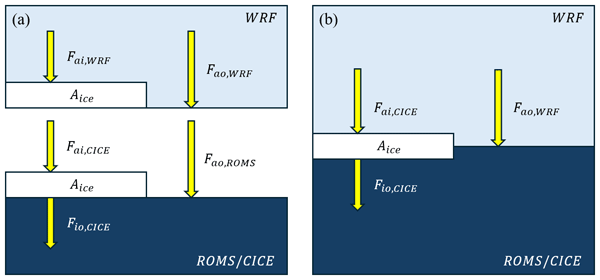
Accurately exchanging energy between the atmosphere and the ocean-ice systems through surface heat fluxes is crucial for climate modelling. We present an improved version of Coupled Arctic Prediction System (CAPS) by revising flux coupling for conservation of heat. Our results show that the model with improved flux coupling can better simulate sea ice conditions during the period of Multidisciplinary drifting Observatory for the Study of Arctic Climate (MOSAiC).
Fengguan Gu, Qinghua Yang, Frank Kauker, Changwei Liu, Guanghua Hao, Chao-Yuan Yang, Jiping Liu, Petra Heil, Xuewei Li, and Bo Han
The Cryosphere, 16, 1873–1887, https://doi.org/10.5194/tc-16-1873-2022, https://doi.org/10.5194/tc-16-1873-2022, 2022
Short summary
Short summary
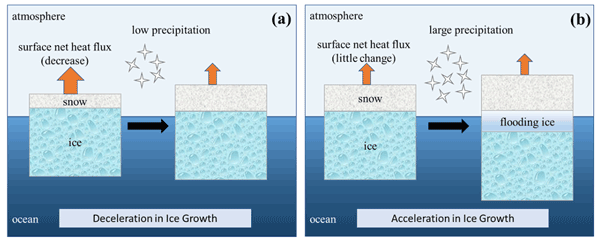
The sea ice thickness was simulated by a single-column model and compared with in situ observations obtained off Zhongshan Station in the Antarctic. It is shown that the unrealistic precipitation in the atmospheric forcing data leads to the largest bias in sea ice thickness and snow depth modeling. In addition, the increasing snow depth gradually inhibits the growth of sea ice associated with thermal blanketing by the snow.
Chao-Yuan Yang, Jiping Liu, Xiaoqi Xu, Xiaoxu Shi, and Hu Yang
EGUsphere, https://doi.org/10.5194/egusphere-2026-5582, https://doi.org/10.5194/egusphere-2026-5582, 2026
This preprint is open for discussion and under review for The Cryosphere (TC).
Short summary
Short summary
Using a newly developed atmosphere–ocean–wave–sea-ice model, we show that ocean waves affect Antarctic sea ice through indirect thermodynamics pathways. Wave-induced heat fluxes and Langmuir-enhanced mixing produce modest sea-ice and ocean responses under the constrained atmosphere component, but much stronger and more heterogeneous responses when atmospheric feedbacks are allowed.
Chao-Yuan Yang, Fengguan Gu, Jiping Liu, Annette Rinke, Hu Yang, and Xiaoxu Shi
Geosci. Model Dev., 19, 10595–10624, https://doi.org/10.5194/gmd-19-10595-2026, https://doi.org/10.5194/gmd-19-10595-2026, 2026
Short summary
Short summary
Accurately exchanging energy between the atmosphere and the ocean-ice systems through surface heat fluxes is crucial for climate modelling. We present an improved version of Coupled Arctic Prediction System (CAPS) by revising flux coupling for conservation of heat. Our results show that the model with improved flux coupling can better simulate sea ice conditions during the period of Multidisciplinary drifting Observatory for the Study of Arctic Climate (MOSAiC).
Hang Wang, Hu Yang, Xiaoxu Shi, Jiping Liu, Gerrit Lohmann, Jiawang Wu, Jun Tian, Francisco W. Cruz, Jianbo Cheng, and Dake Chen
EGUsphere, https://doi.org/10.5194/egusphere-2026-5495, https://doi.org/10.5194/egusphere-2026-5495, 2026
This preprint is open for discussion and under review for Climate of the Past (CP).
Short summary
Short summary
Geological records of past Saharan climate are often incomplete and difficult to date, while long climate simulations require extensive computing. We therefore developed an efficient empirical model from 30 climate simulations and records of Earth's orbit, carbon dioxide and sea level. It provides a practical way to study long-term Saharan climate change and can guide future simulations, field sampling and the dating of geological and archaeological records.
Siran Chen, Jiping Liu, and Xianxian Han
Ocean Sci., 22, 2691–2709, https://doi.org/10.5194/os-22-2691-2026, https://doi.org/10.5194/os-22-2691-2026, 2026
Short summary
Short summary
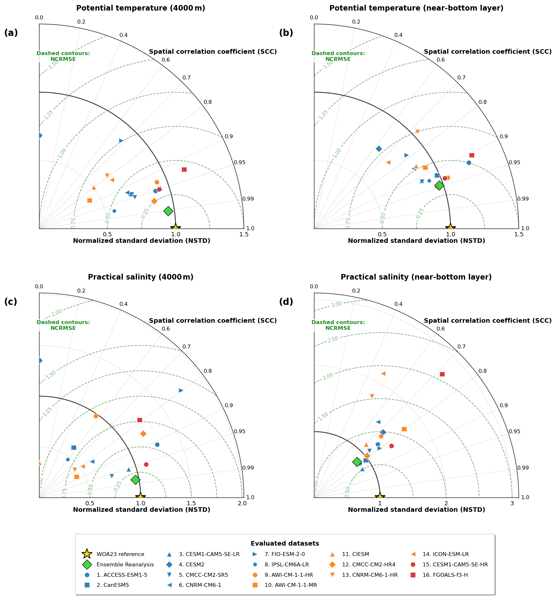
Antarctic Bottom Water influences global ocean circulation, heat storage, and carbon uptake. We compared an observational atlas, an ocean reconstruction, and 16 climate models by separating this water into three regional types. The reconstruction matched the observed large-scale patterns well, but many climate models showed substantial regional temperature and salinity errors. Correcting average biases improved some models, although errors in spatial structure remained.
An Yi, Jiping Liu, Ian Renfrew, Chaoyuan Yang, Changming Dong, Xiangzhou Song, and Qinghua Yang
Earth Syst. Sci. Data Discuss., https://doi.org/10.5194/essd-2026-476, https://doi.org/10.5194/essd-2026-476, 2026
Preprint under review for ESSD
Short summary
Short summary
This dataset quantifies the critical but overlooked role of sea spray in Southern Ocean air-sea heat exchange. We present a new gridded dataset of spray-mediated latent and sensible heat fluxes incorporating a full spray microphysical model, where spray generation depends on wind and wave states. Results show spray can double turbulent heat fluxes during extreme cyclones compared to bulk algorithms. This data is vital for understanding the Southern Ocean's impact on the global energy budget.
Xiaoxu Shi, Xiya Liu, Jiping Liu, Martin Werner, Hu Yang, Francisco W. Cruz, Chaoyuan Yang, and Gerrit Lohmann
EGUsphere, https://doi.org/10.5194/egusphere-2026-3894, https://doi.org/10.5194/egusphere-2026-3894, 2026
Short summary
Short summary
Cave stalagmites record the oxygen isotope of past rainfall and are used to reconstruct how monsoons changed, but due to the complexity of isotope impacting factors, what these records tell us is debated. We performed a 8300-year simulation with an isotope-enabled climate model, and show that rainfall amount is the key stable driver across global monsoons, while temperature and moisture pathways vary with region and time. Single-site records are noisy, but regional averages recover the signal.
Chengyan Liu, Zhaomin Wang, Dake Chen, Xianxian Han, Hengling Leng, Xi Liang, Liangjun Yan, Xiang Li, Craig Stevens, Andrew McC. Hogg, Kazuya Kusahara, Kaihe Yamazaki, Kay I. Ohshima, Meng Zhou, Xiao Cheng, Dongxiao Wang, Changming Dong, Jiping Liu, Qinghua Yang, Xichen Li, Ruibo Lei, Minghu Ding, Zhaoru Zhang, Dujuan Kang, Di Qi, Tongya Liu, Jihai Dong, Lu An, Ru Chen, Tong Zhang, Xiaoming Hu, Bo Han, Haibo Bi, Qi Shu, Longjiang Mu, Shiming Xu, Hu Yang, Hailong Liu, Tingfeng Dou, Zhixuan Feng, Lei Zheng, Xueyuan Tang, Guitao Shi, Yongqing Cai, Bingrui Li, Yang Wu, Xia Lin, Wenjin Sun, Yu Liu, Kai Yu, Yu Zhang, Weizeng Shao, Xiaoyu Wang, Shaojun Zheng, Chengyi Yuan, Chunxia Zhou, Jian Liu, Yang Liu, Yue Xia, Xiaoyu Pan, Jiabao Zeng, Kechen Liu, Jiahao Fan, Chen Cheng, and Qi Li
Geosci. Model Dev., 19, 2985–3033, https://doi.org/10.5194/gmd-19-2985-2026, https://doi.org/10.5194/gmd-19-2985-2026, 2026
Short summary
Short summary
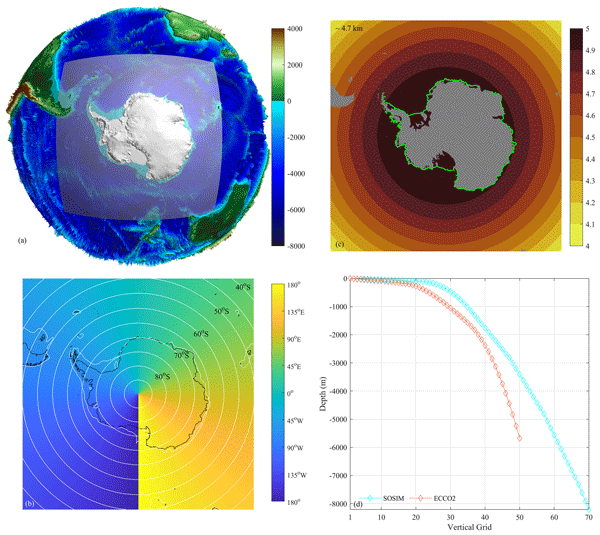
We developed a high-resolution computer model to simulate how the ocean, sea ice, and ice shelves interact around Antarctica. This helps us understand their critical role in global climate and sea-level rise. Our model successfully captures essential features like major currents and seasonal ice changes. Despite some remaining biases, it provides a useful tool for predicting future changes in this vital and rapidly evolving region.
Jinfei Wang, Maike Sonnewald, Noé Pirlet, François Massonnet, Hugues Goosse, Dake Chen, and Qinghua Yang
EGUsphere, https://doi.org/10.5194/egusphere-2026-1301, https://doi.org/10.5194/egusphere-2026-1301, 2026
Short summary
Short summary
Antarctic sea ice has shifted from expansion to rapid decline since 2016. Using model outputs and data mining, we identified six sea ice regimes, shaped by different dynamic and thermodynamic conditions. A coastal regime, featured by sea ice transport and new ice formation, has shown area loss since 1979, accelerating after 2016. This coastal regime and a pack ice regime together control overall sea ice variability. Our work offers a new framework for understanding Antarctic sea ice changes.
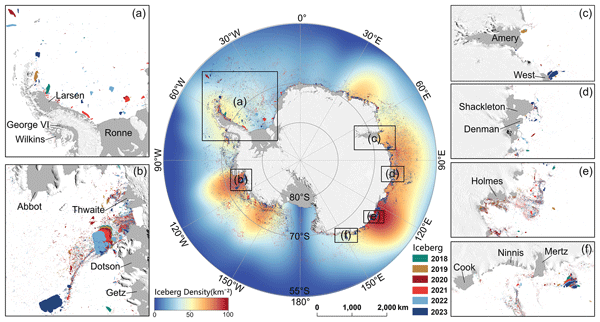
Zilong Chen, Xuying Liu, Zhenfu Guan, Teng Li, Xiao Cheng, Tian Li, Yan Liu, Qi Liang, Lei Zheng, and Jiping Liu
Earth Syst. Sci. Data, 18, 147–166, https://doi.org/10.5194/essd-18-147-2026, https://doi.org/10.5194/essd-18-147-2026, 2026
Short summary
Short summary
Our study uses Google Earth Engine to create a dataset of Antarctic icebergs in the Southern Ocean (south of 55° S) from October 2018 to 2023. The dataset includes icebergs larger than 0.04 km², with details on their locations, sizes, and shapes. It shows significant changes in iceberg number and area, mainly driven by major ice shelf calving events – especially in the Weddell Sea. This resource fills key gaps in understanding iceberg impacts on the ocean and climate.
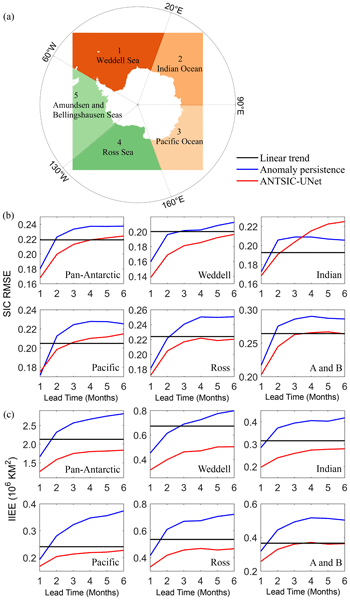
Ziying Yang, Jiping Liu, Mirong Song, Yongyun Hu, Qinghua Yang, Ke Fan, Rune Grand Graversen, and Lu Zhou
The Cryosphere, 19, 6381–6402, https://doi.org/10.5194/tc-19-6381-2025, https://doi.org/10.5194/tc-19-6381-2025, 2025
Short summary
Short summary
Antarctic sea ice has changed rapidly in recent years. Here we developed a deep learning model trained by multiple climate variables for extended seasonal Antarctic sea ice prediction. Our model shows high predictive skills up to 6 months in advance, particularly in predicting extreme events. It also shows skillful predictions at the sea ice edge and year-to-year sea ice changes. Variable importance analyses suggest what variables are more important for prediction at different lead times.
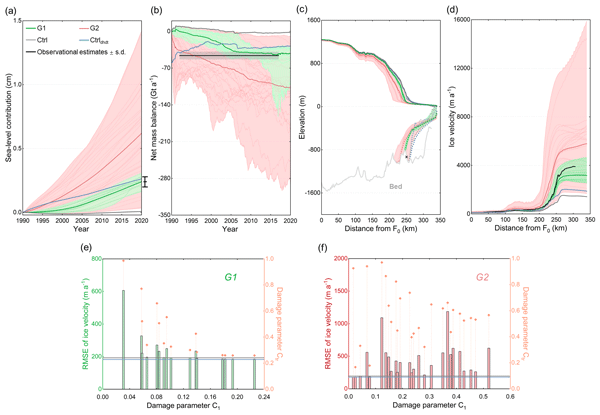
Yanjun Li, Violaine Coulon, Javier Blasco, Gang Qiao, Qinghua Yang, and Frank Pattyn
The Cryosphere, 19, 4373–4390, https://doi.org/10.5194/tc-19-4373-2025, https://doi.org/10.5194/tc-19-4373-2025, 2025
Short summary
Short summary
We incorporate ice damage processes into an ice-sheet model and apply the new model to Thwaites Glacier. The upgraded model more accurately captures the observed ice mass loss of Thwaites Glacier over 1990–2020. Our simulations show that ice damage has a notable impact on the ice mass loss, grounding-line retreat, ice velocity, and ice thickness of the Thwaites Glacier basin. This study highlights the necessity for incorporating ice damage into ice-sheet models.
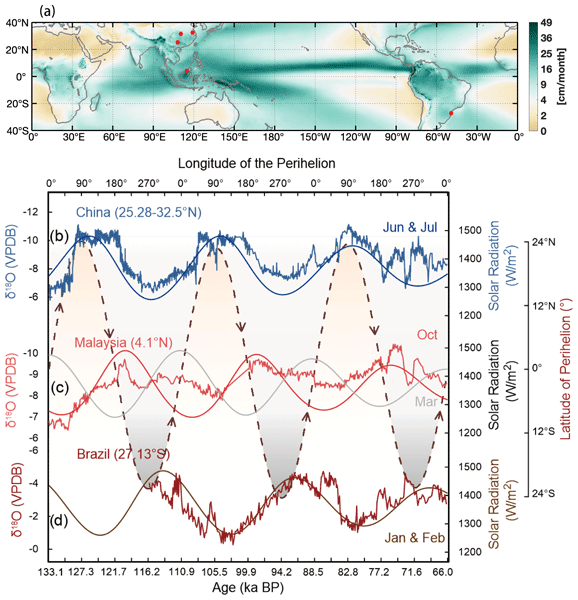
Hu Yang, Xiaoxu Shi, Xulong Wang, Qingsong Liu, Yi Zhong, Xiaodong Liu, Youbin Sun, Yanjun Cai, Fei Liu, Gerrit Lohmann, Martin Werner, Zhimin Jian, Tainã M. L. Pinho, Hai Cheng, Lijuan Lu, Jiping Liu, Chao-Yuan Yang, Qinghua Yang, Yongyun Hu, Xing Cheng, Jingyu Zhang, and Dake Chen
Clim. Past, 21, 1263–1279, https://doi.org/10.5194/cp-21-1263-2025, https://doi.org/10.5194/cp-21-1263-2025, 2025
Short summary
Short summary
For 1 century, the hemispheric summer insolation is proposed as a key pacemaker of astronomical climate change. However, an increasing number of geologic records reveal that the low-latitude hydrological cycle shows asynchronous precessional evolutions that are very often out of phase with the summer insolation. Here, we propose that the astronomically driven low-latitude hydrological cycle is not paced by summer insolation but by shifting perihelion.

Chenhui Ning, Shiming Xu, Yan Zhang, Xuantong Wang, Zhihao Fan, and Jiping Liu
Geosci. Model Dev., 17, 6847–6866, https://doi.org/10.5194/gmd-17-6847-2024, https://doi.org/10.5194/gmd-17-6847-2024, 2024
Short summary
Short summary
Sea ice models are mainly based on non-moving structured grids, which is different from buoy measurements that follow the ice drift. To facilitate Lagrangian analysis, we introduce online tracking of sea ice in Community Ice CodE (CICE). We validate the sea ice tracking with buoys and evaluate the sea ice deformation in high-resolution simulations, which show multi-fractal characteristics. The source code is openly available and can be used in various scientific and operational applications.
Chao-Yuan Yang, Jiping Liu, and Dake Chen
The Cryosphere, 18, 1215–1239, https://doi.org/10.5194/tc-18-1215-2024, https://doi.org/10.5194/tc-18-1215-2024, 2024
Short summary
Short summary
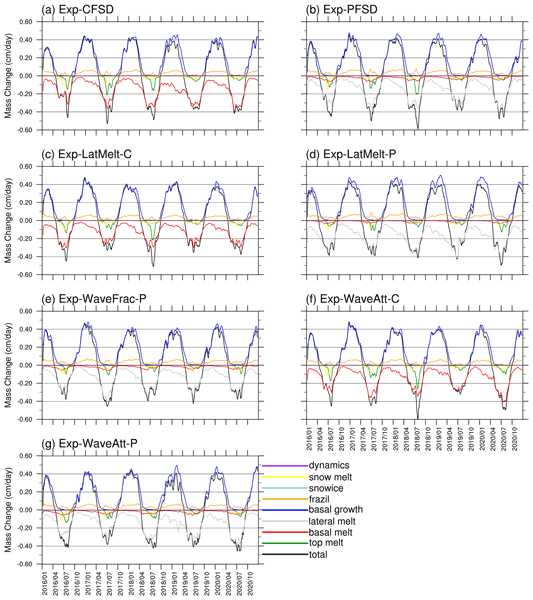
We present a new atmosphere–ocean–wave–sea ice coupled model to study the influences of ocean waves on Arctic sea ice simulation. Our results show (1) smaller ice-floe size with wave breaking increases ice melt, (2) the responses in the atmosphere and ocean to smaller floe size partially reduce the effect of the enhanced ice melt, (3) the limited oceanic energy is a strong constraint for ice melt enhancement, and (4) ocean waves can indirectly affect sea ice through the atmosphere and the ocean.
Xiaoxu Shi, Martin Werner, Hu Yang, Roberta D'Agostino, Jiping Liu, Chaoyuan Yang, and Gerrit Lohmann
Clim. Past, 19, 2157–2175, https://doi.org/10.5194/cp-19-2157-2023, https://doi.org/10.5194/cp-19-2157-2023, 2023
Short summary
Short summary
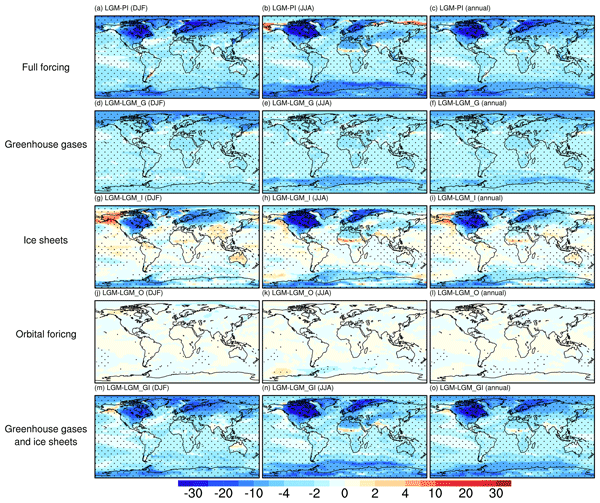
The Last Glacial Maximum (LGM) marks the most recent extremely cold and dry time period of our planet. Using AWI-ESM, we quantify the relative importance of Earth's orbit, greenhouse gases (GHG) and ice sheets (IS) in determining the LGM climate. Our results suggest that both GHG and IS play important roles in shaping the LGM temperature. Continental ice sheets exert a major control on precipitation, atmospheric dynamics, and the intensity of El Niño–Southern Oscillation.
Shijie Peng, Qinghua Yang, Matthew D. Shupe, Xingya Xi, Bo Han, Dake Chen, Sandro Dahlke, and Changwei Liu
Atmos. Chem. Phys., 23, 8683–8703, https://doi.org/10.5194/acp-23-8683-2023, https://doi.org/10.5194/acp-23-8683-2023, 2023
Short summary
Short summary
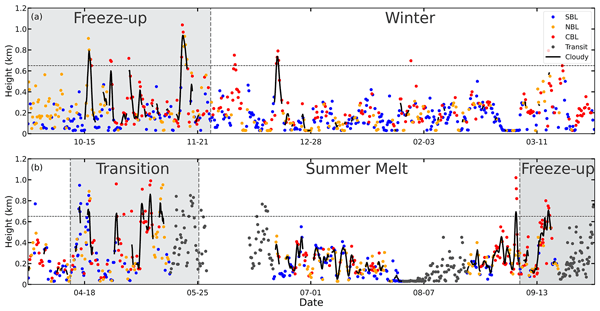
Due to a lack of observations, the structure of the Arctic atmospheric boundary layer (ABL) remains to be further explored. By analyzing a year-round radiosonde dataset collected over the Arctic sea-ice surface, we found the annual cycle of the ABL height (ABLH) is primarily controlled by the evolution of ABL thermal structure, and the surface conditions also show a high correlation with ABLH variation. In addition, the Arctic ABLH is found to be decreased in summer compared with 20 years ago.
Jinfei Wang, Chao Min, Robert Ricker, Qian Shi, Bo Han, Stefan Hendricks, Renhao Wu, and Qinghua Yang
The Cryosphere, 16, 4473–4490, https://doi.org/10.5194/tc-16-4473-2022, https://doi.org/10.5194/tc-16-4473-2022, 2022
Short summary
Short summary
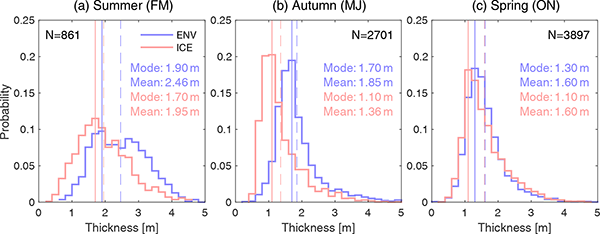
The differences between Envisat and ICESat sea ice thickness (SIT) reveal significant temporal and spatial variations. Our findings suggest that both overestimation of Envisat sea ice freeboard, potentially caused by radar backscatter originating from inside the snow layer, and the AMSR-E snow depth biases and sea ice density uncertainties can possibly account for the differences between Envisat and ICESat SIT.
Fengguan Gu, Qinghua Yang, Frank Kauker, Changwei Liu, Guanghua Hao, Chao-Yuan Yang, Jiping Liu, Petra Heil, Xuewei Li, and Bo Han
The Cryosphere, 16, 1873–1887, https://doi.org/10.5194/tc-16-1873-2022, https://doi.org/10.5194/tc-16-1873-2022, 2022
Short summary
Short summary
The sea ice thickness was simulated by a single-column model and compared with in situ observations obtained off Zhongshan Station in the Antarctic. It is shown that the unrealistic precipitation in the atmospheric forcing data leads to the largest bias in sea ice thickness and snow depth modeling. In addition, the increasing snow depth gradually inhibits the growth of sea ice associated with thermal blanketing by the snow.
Sutao Liao, Hao Luo, Jinfei Wang, Qian Shi, Jinlun Zhang, and Qinghua Yang
The Cryosphere, 16, 1807–1819, https://doi.org/10.5194/tc-16-1807-2022, https://doi.org/10.5194/tc-16-1807-2022, 2022
Short summary
Short summary
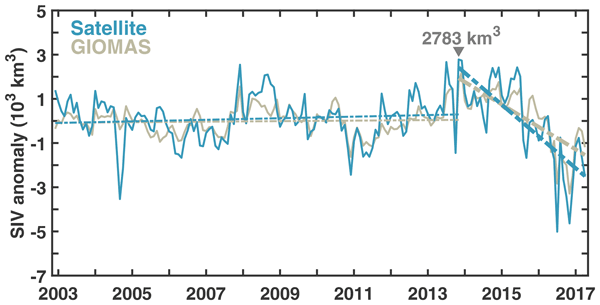
The Global Ice-Ocean Modeling and Assimilation System (GIOMAS) can basically reproduce the observed variability in Antarctic sea-ice volume and its changes in the trend before and after 2013, and it underestimates Antarctic sea-ice thickness (SIT) especially in deformed ice zones. Assimilating additional sea-ice observations with advanced assimilation methods may result in a more accurate estimation of Antarctic SIT.
Cited articles
Bitz, C. M.: Description of initial conditions and forcing data for the SHEBA single column model runs, University of Washington, https://atmos.washington.edu/~bitz/column_model/notes_forcing_data, last access: 16 January 2026.
Bliss, A. C., Hutchings, J. K., and Watkins, D. M.: Sea ice drift tracks from autonomous buoys in the MOSAiC Distributed Network, Sci. Data, 10, 403, https://doi.org/10.1038/s41597-023-02311-y, 2023.
Briegleb, B. P. and Light, B.: A Delta-Eddington multiple scattering parameterization for solar radiation in the sea ice component of the Community Climate System Model, NCAR Technical Note NCAR/TN-472+STR, National Center for Atmospheric Research, Boulder, CO, USA, https://doi.org/10.5065/D6B27S71, 2007.
Callaghan, T. V., Johansson, M., Brown, R. D., Groisman, P. Ya., Labba, N., Radionov, V., Barry, R. G., Bulygina, O. N., Essery, R. L. H., Frolov, D. M., Golubev, V. N., Grenfell, T. C., Petrushina, M. N., Razuvaev, V. N., Robinson, D. A., Romanov, P., Shindell, D., Shmakin, A. B., Sokratov, S. A., Warren, S., and Yang, D.: The Changing Face of Arctic Snow Cover: A Synthesis of Observed and Projected Changes, AMBIO, 40, 17–31, https://doi.org/10.1007/s13280-011-0212-y, 2011.
Cheng, B., Launiainen, J., and Vihma, T.: Modelling of Superimposed Ice Formation and SubSurface Melting in the Baltic Sea, Geophysica, 39, 31–50, 2003.
Chung, Y.-C., Bélair, S., and Mailhot, J.: Blowing snow on Arctic sea ice: Results from an improved sea ice-snow-blowing snow coupled system, J. Hydrometeorol., 12, 678–689, https://doi.org/10.1175/2011JHM1293.1, 2011.
Clemens-Sewall, D., Smith, M. M., Holland, M. M., Polashenski, C., and Perovich, D.: Snow redistribution onto young sea ice: Observations and implications for climate models, Elementa: Science of the Anthropocene, 10, 00115, https://doi.org/10.1525/elementa.2021.00115, 2022.
Clemens-Sewall, D., Polashenski, C., Frey, M. M., Cox, C. J., Granskog, M. A., Macfarlane, A. R., Fons, S. W., Schmale, J., Hutchings, J. K., von Albedyll, L., Arndt, S., Schneebeli, M., and Perovich, D.: Snow Loss Into Leads in Arctic Sea Ice: Minimal in Typical Wintertime Conditions, but High During a Warm and Windy Snowfall Event, Geophys. Res. Lett., 50, e2023GL102816, https://doi.org/10.1029/2023GL102816, 2023.
Cox, C., Gallagher, M., Shupe, M., Persson, O., Solomon, A., Ayers, T., Costa, D., Hutchings, J., Leach, J., Morris, S., Osborn, J., Pezoa, S., and Uttal, T.: Atmospheric Surface Flux Station #30 measurements (Level 1 Raw), Multidisciplinary Drifting Observatory for the Study of Arctic Climate (MOSAiC), central Arctic, October 2019–September 2020, Arctic Data Center [data set], https://doi.org/10.18739/A20C4SM1J, 2021a.
Cox, C., Gallagher, M., Shupe, M., Persson, O., Solomon, A., Ayers, T., Costa, D., Hutchings, J., Leach, J., Morris, S., Osborn, J., Pezoa, S., and Uttal, T.: Atmospheric Surface Flux Station #40 measurements (Level 1 Raw), Multidisciplinary Drifting Observatory for the Study of Arctic Climate (MOSAiC), central Arctic, October 2019–September 2020, Arctic Data Center [data set], https://doi.org/10.18739/A2CJ87M7G, 2021b.
Cox, C., Gallagher, M., Shupe, M., Persson, O., Solomon, A., Ayers, T., Costa, D., Hutchings, J., Leach, J., Morris, S., Osborn, J., Pezoa, S., and Uttal, T.: Atmospheric Surface Flux Station #50 measurements (Level 1 Raw), Multidisciplinary Drifting Observatory for the Study of Arctic Climate (MOSAiC), central Arctic, October 2019–September 2020, Arctic Data Center [data set], https://doi.org/10.18739/A2445HD46, 2021c.
Cox, C., Gallagher, M., Shupe, M., Persson, O., Blomquist, B., Grachev, A., Riihimaki, L., Kutchenreiter, M., Morris, V., Solomon, A., Brooks, I., Costa, D., Gottas, D., Hutchings, J., Osborn, J., Morris, S., Preusser, A., and Uttal, T.: Met City meteorological and surface flux measurements (Level 3 Final), Multidisciplinary Drifting Observatory for the Study of Arctic Climate (MOSAiC), central Arctic, October 2019–September 2020, Arctic Data Center [data set], https://doi.org/10.18739/A2PV6B83F, 2023.
Déry, S. J. and Tremblay, L. B.: Modeling the effects of wind redistribution on the snow mass budget of polar sea ice, J. Phys. Oceanogr., 34, 258–271, https://doi.org/10.1175/1520-0485(2004)034<0258:MTEOWR>2.0.CO;2, 2004.
Déry, S. J. and Yau, M. K.: Large-scale mass balance effects of blowing snow and surface sublimation, J. Geophys. Res.-Atmos., 107, ACL 8-1–ACL 8-17, https://doi.org/10.1029/2001JD001251, 2002.
Eicken, H., Grenfell, T. C., Perovich, D. K., Richter-Menge, J. A., and Frey, K.: Hydraulic controls of summer Arctic pack ice albedo, J. Geophys. Res.-Oceans, 109, https://doi.org/10.1029/2003JC001989, 2004.
Granskog, M. A., Rösel, A., Dodd, P. A., Divine, D., Gerland, S., Martma, T., and Leng, M. J.: Snow contribution to first-year and second-year Arctic sea ice mass balance north of Svalbard, J. Geophys. Res.-Oceans, 122, 2539-2549, https://doi.org/10.1002/2016JC012398, 2017.
Grosfeld, K., Treffeisen, R., Asseng, J., Bartsch, A., Bräuer, B., Fritzsch, B., Gerdes, R., Hendricks, S., Hiller, W., Heygster, G., Krumpen, T., Lemke, P., Melsheimer, C., Nicolaus, M., Ricker, R., and Weigelt, M.: Online sea-ice knowledge and data platform, Polarforschung, 85, 143–155, https://doi.org/10.2312/polfor.2016.011, 2016.
Gu, F., Yang, Q., Kauker, F., Liu, C., Hao, G., Yang, C.-Y., Liu, J., Heil, P., Li, X., and Han, B.: The sensitivity of landfast sea ice to atmospheric forcing in single-column model simulations: a case study at Zhongshan Station, Antarctica, The Cryosphere, 16, 1873–1887, https://doi.org/10.5194/tc-16-1873-2022, 2022.
Gu, F., Kauker, F., Yang, Q., Han, B., Fang, Y., and Liu, C.: Effects of Freezing Temperature Parameterization on Simulated Sea-Ice Thickness Validated by MOSAiC Observations, Geophys. Res. Lett., 51, e2024GL108281, https://doi.org/10.1029/2024GL108281, 2024.
Hao, G., Shen, H., and Sun, Y.: Simulation and analysis of the snow blowing on landfast sea ice, Antarctica, Acta Oceanol. Sin., 44, 161–171, https://doi.org/10.1007/s13131-025-2464-6, 2025.
Huang, L., Stroeve, J., Newman, T., Mallett, R., Willatt, R., Zhou, L., Johansson, M., Nab, C., and Fallows, A.: Snow depth distributions on sea ice of different ages and thicknesses from regional field campaigns, The Cryosphere, 20, 2825–2849, https://doi.org/10.5194/tc-20-2825-2026, 2026.
Hunke, E., Allard, R., Bailey, D. A., Blain, P., Craig, T., Dupont, F., DuVivier, A., Grumbine, R., Hebert, D., Holland, M., Jeffery, N., Lemieux, J.-F., Rasmussen, T., Ribergaard, M., and Roberts, A.: CICE-Consortium/Icepack: Icepack 1.3.2, Zenodo [code], https://doi.org/10.5281/zenodo.6967671, 2022.
Itkin, P., Hendricks, S., Webster, M., von Albedyll, L., Arndt, S., Divine, D., Jaggi, M., Oggier, M., Raphael, I., Ricker, R., Rohde, J., Schneebeli, M., and Liston, G. E.: Sea ice and snow characteristics from year-long transects at the MOSAiC Central Observatory, Elementa: Science of the Anthropocene, 11, 00048, https://doi.org/10.1525/elementa.2022.00048, 2023.
Jeffries, M. O., Krouse, H. R., Hurst-Cushing, B., and Maksym, T.: Snow-ice accretion and snow-cover depletion on Antarctic first-year sea-ice floes, Ann. Glaciol., 33, 51–60, https://doi.org/10.3189/172756401781818266, 2001.
Jenkins, A., Nicholls, K. W., and Corr, H. F. J.: Observation and parameterization of ablation at the base of Ronne Ice Shelf, Antarctica, J. Phys. Oceanogr., 40, 2298–2312, https://doi.org/10.1175/2010JPO4317.1, 2010.
Kwok, R.: Arctic sea ice thickness, volume, and multiyear ice coverage: losses and coupled variability (1958–2018), Environ. Res. Lett., 13, 105005, https://doi.org/10.1088/1748-9326/aae3ec, 2018.
Lecomte, O., Fichefet, T., Vancoppenolle, M., Domine, F., Massonnet, F., Mathiot, P., Morin, S., and Barriat, P. Y.: On the formulation of snow thermal conductivity in large-scale sea ice models, J. Adv. Model. Earth Sy., 5, 542–557, https://doi.org/10.1002/jame.20039, 2013.
Lecomte, O., Fichefet, T., Flocco, D., Schroeder, D., and Vancoppenolle, M.: Interactions between wind-blown snow redistribution and melt ponds in a coupled ocean-sea ice model, Ocean Model., 87, 67–80, https://doi.org/10.1016/j.ocemod.2014.12.003, 2015.
Lei, R., Cheng, B., and Hoppmann, M.: Snow depth and sea ice thickness derived from the measurements of SIMBA buoys deployed in the Arctic Ocean during the Legs 1a, 1, and 3 of the MOSAiC campaign in 2019-2020, PANGAEA [data set], https://doi.org/10.1594/PANGAEA.938244, 2021.
Lei, R., Cheng, B., Hoppmann, M., Zhang, F., Zuo, G., Hutchings, J. K., Lin, L., Lan, M., Wang, H., Regnery, J., Krumpen, T., Haapala, J., Rabe, B., Perovich, D. K., and Nicolaus, M.: Seasonality and timing of sea ice mass balance and heat fluxes in the Arctic transpolar drift during 2019–2020, Elementa: Science of the Anthropocene, 10, 000089, https://doi.org/10.1525/elementa.2021.000089, 2022.
Leonard, K. C. and Maksym, T.: The importance of wind-blown snow redistribution to snow accumulation on Bellingshausen Sea ice, Ann. Glaciol., 52, 271–278, https://doi.org/10.3189/172756411795931651, 2011.
Leppäranta, M.: A Growth Model for Black Ice, Snow Ice and Snow Thickness in Subarctic Basins, Hydrol. Res., 14, 59–70, https://doi.org/10.2166/nh.1983.0006, 1983.
Liston, G. E., Itkin, P., Stroeve, J., Tschudi, M., Stewart, J. S., Pedersen, S. H., Reinking, A. K., and Elder, K.: A Lagrangian Snow-Evolution System for Sea-Ice Applications (SnowModel-LG): Part I – Model Description, J. Geophys. Res.-Oceans, 125, e2019JC015913, https://doi.org/10.1029/2019JC015913, 2020.
Luo, L. and Zhang, J.: Blowing Snow Contributes to Positive Surface Energy Budget and Negative Surface Mass Balance During a Melting Season of Larsen C Ice Shelf, Antarctic Peninsula, Geophys. Res. Lett., 49, e2022GL098864, https://doi.org/10.1029/2022GL098864, 2022.
Macfarlane, A., Schneebeli, M., Dadic, R., Tavri, A., Immerz, A., Polashenski, C., Krampe, D., Clemens-Sewall, D., Wagner, D., Perovich, D., Hannula, H.-R., Raphael, I., Matero, I., Regnery, J., Smith, M., Nicolaus, M., Jaggi, M., Oggier, M., Webster, M., and Fons, S.: A Database of Snow on Sea Ice in the Central Arctic Collected during the MOSAiC expedition, Sci. Data, 10, https://doi.org/10.1038/s41597-023-02273-1, 2023.
Maksym, T. and Jeffries, M. O.: A one-dimensional percolation model of flooding and snow ice formation on Antarctic sea ice, J. Geophys. Res.-Oceans, 105, 26313–26331, https://doi.org/10.1029/2000JC900130, 2000.
Mallett, R. D. C., Stroeve, J. C., Tsamados, M., Willatt, R., Newman, T., Nandan, V., Landy, J. C., Itkin, P., Oggier, M., Jaggi, M., and Perovich, D.: Sub-kilometre scale distribution of snow depth on Arctic sea ice from Soviet drifting stations, J. Glaciol., 68, 1014–1026, https://doi.org/10.1017/jog.2022.18, 2022.
Massom, R. A., Eicken, H., Hass, C., Jeffries, M. O., Drinkwater, M. R., Sturm, M., Worby, A. P., Wu, X., Lytle, V. I., Ushio, S., Morris, K., Reid, P. A., Warren, S. G., and Allison, I.: Snow on Antarctic sea ice, Rev. Geophys., 39, 413–445, https://doi.org/10.1029/2000RG000085, 2001.
Maykut, G. A. and McPhee, M. G.: Solar heating of the Arctic mixed layer, J. Geophys. Res.-Oceans, 100, 24691–24703, https://doi.org/10.1029/95JC02554, 1995.
Maykut, G. A. and Untersteiner, N.: Some results from a time-dependent thermodynamic model of sea ice, J. Geophys. Res., 76, 1550–1575, https://doi.org/10.1029/JC076i006p01550, 1971.
Melsheimer, C. and Spreen, G.: AMSR2 ASI sea ice concentration data, Arctic, version 5.4 (NetCDF), PANGAEA [data set], https://doi.org/10.1594/PANGAEA.898399, 2019.
Merkouriadi, I., Cheng, B., Graham, R. M., Rösel, A., and Granskog, M. A.: Critical Role of Snow on Sea Ice Growth in the Atlantic Sector of the Arctic Ocean, Geophys. Res. Lett., 44, 10479–10485, https://doi.org/10.1002/2017GL075494, 2017.
Merkouriadi, I., Liston, G. E., Graham, R. M., and Granskog, M. A.: Quantifying the Potential for Snow-Ice Formation in the Arctic Ocean, Geophys. Res. Lett., 47, e2019GL085020, https://doi.org/10.1029/2019GL085020, 2020.
Merkouriadi, I., Jutila, A., Liston, G. E., Preußer, A., and Webster, M. A.: Investigating snow sinks on level sea ice: A case study in the western Arctic, J. Glaciol., 71, e66, https://doi.org/10.1017/jog.2025.34, 2025.
Perovich, D. K., Grenfell, T. C., Light, B., and Hobbs, P. V.: Seasonal evolution of the albedo of multiyear Arctic sea ice, J. Geophys. Res.-Oceans, 107, SHE 20-1–SHE 20-13, https://doi.org/10.1029/2000JC000438, 2002.
Perovich, D., Raphael, I., Moore, R., Clemens-Sewall, D., Lei, R., Sledd, A., and Polashenski, C.: Sea ice heat and mass balance measurements from four autonomous buoys during the MOSAiC drift campaign, Elementa: Science of the Anthropocene, 11, 00017, https://doi.org/10.1525/elementa.2023.00017, 2023.
Petty, A. A., Webster, M., Boisvert, L., and Markus, T.: The NASA Eulerian Snow on Sea Ice Model (NESOSIM) v1.0: initial model development and analysis, Geosci. Model Dev., 11, 4577–4602, https://doi.org/10.5194/gmd-11-4577-2018, 2018.
Polashenski, C., Perovich, D., and Courville, Z.: The mechanisms of sea ice melt pond formation and evolution, J. Geophys. Res.-Oceans, 117, 2011JC007231, https://doi.org/10.1029/2011JC007231, 2012.
Rabe, B., Heuzé, C., Regnery, J., Aksenov, Y., Allerholt, J., Athanase, M., Bai, Y., Basque, C., Bauch, D., Baumann, T. M., Chen, D., Cole, S. T., Craw, L., Davies, A., Damm, E., Dethloff, K., Divine, D. V., Doglioni, F., Ebert, F., Fang, Y.-C., Fer, I., Fong, A. A., Gradinger, R., Granskog, M. A., Graupner, R., Haas, C., He, H., He, Y., Hoppmann, M., Janout, M., Kadko, D., Kanzow, T., Karam, S., Kawaguchi, Y., Koenig, Z., Kong, B., Krishfield, R. A., Krumpen, T., Kuhlmey, D., Kuznetsov, I., Lan, M., Laukert, G., Lei, R., Li, T., Torres-Valdés, S., Lin, L., Lin, L., Liu, H., Liu, N., Loose, B., Ma, X., McKay, R., Mallet, M., Mallett, R. D. C., Maslowski, W., Mertens, C., Mohrholz, V., Muilwijk, M., Nicolaus, M., O'Brien, J. K., Perovich, D., Ren, J., Rex, M., Ribeiro, N., Rinke, A., Schaffer, J., Schuffenhauer, I., Schulz, K., Shupe, M. D., Shaw, W., Sokolov, V., Sommerfeld, A., Spreen, G., Stanton, T., Stephens, M., Su, J., Sukhikh, N., Sundfjord, A., Thomisch, K., Tippenhauer, S., Toole, J. M., Vredenborg, M., Walter, M., Wang, H., Wang, L., Wang, Y., Wendisch, M., Zhao, J., Zhou, M., and Zhu, J.: Overview of the MOSAiC expedition: Physical oceanography, Elementa: Science of the Anthropocene, 10, 00062, https://doi.org/10.1525/elementa.2021.00062, 2022.
Robinson, J., Jaeglé, L., Palm, S. P., Shupe, M. D., Liston, G. E., and Frey, M. M.: ICESat-2 observations of blowing snow over Arctic sea ice during the 2019–2020 MOSAiC expedition, J. Geophys. Res.-Atmos., 130, e2025JD043919, https://doi.org/10.1029/2025JD043919, 2025.
Robinson, J., Jaeglé, L., Palm, S. P., and Liston, G. E.: Blowing snow contributions to the Arctic snow-on-sea ice budget using ICESat-2 observations, The Cryosphere, 20, 3217–3233, https://doi.org/10.5194/tc-20-3217-2026, 2026.
Ruti, P. M., Marullo, S., D'Ortenzio, F., and Tremant, M.: Comparison of analyzed and measured wind speeds in the perspective of oceanic simulations over the Mediterranean basin: Analyses, QuikSCAT and buoy data, J. Marine Syst., 70, 33–48, https://doi.org/10.1016/j.jmarsys.2007.02.026, 2008.
Salganik, E., Lange, B. A., Itkin, P., Divine, D., Katlein, C., Nicolaus, M., Hoppmann, M., Neckel, N., Ricker, R., Høyland, K. V., and Granskog, M. A.: Different mechanisms of Arctic first-year sea-ice ridge consolidation observed during the MOSAiC expedition, Elementa: Science of the Anthropocene, 11, 00008, https://doi.org/10.1525/elementa.2023.00008, 2023.
Schmidt, R. A.: Vertical profiles of wind speed, snow concentration, and humidity in blowing snow, Bound.-Lay. Meteorol., 23, 223–246, https://doi.org/10.1007/BF00123299, 1982.
Spreen, G., Kaleschke, L., and Heygster, G.: Sea ice remote sensing using AMSR-E 89-GHz channels, J. Geophys. Res.-Oceans, 113, https://doi.org/10.1029/2005JC003384, 2008.
Sturm, M., Holmgren, J., and Perovich, D. K.: Winter snow cover on the sea ice of the Arctic Ocean at the Surface Heat Budget of the Arctic Ocean (SHEBA): Temporal evolution and spatial variability, J. Geophys. Res.-Oceans, 107, SHE 23-1–SHE 23-17, https://doi.org/10.1029/2000JC000400, 2002.
Tsamados, M., Feltham, D. L., Schroeder, D., Flocco, D., Farrell, S. L., Kurtz, N., Laxon, S. W., and Bacon, S.: Impact of variable atmospheric and oceanic form drag on simulations of Arctic sea ice, J. Phys. Oceanogr., 44, 1329–1353, https://doi.org/10.1175/JPO-D-13-0215.1, 2014.
Turner, A. K., Hunke, E. C., and Bitz, C. M.: Two modes of sea-ice gravity drainage: A parameterization for large-scale modeling, J. Geophys. Res.-Oceans, 118, 2279–2294, https://doi.org/10.1002/jgrc.20171, 2013.
von Albedyll, L.: Sea ice lead fractions from SAR-derived sea ice divergence in the Transpolar Drift during MOSAiC 2019/2020, PANGAEA [data set], https://doi.org/10.1594/PANGAEA.963671, 2024.
Wagner, D. N., Shupe, M. D., Cox, C., Persson, O. G., Uttal, T., Frey, M. M., Kirchgaessner, A., Schneebeli, M., Jaggi, M., Macfarlane, A. R., Itkin, P., Arndt, S., Hendricks, S., Krampe, D., Nicolaus, M., Ricker, R., Regnery, J., Kolabutin, N., Shimanshuck, E., Oggier, M., Raphael, I., Stroeve, J., and Lehning, M.: Snowfall and snow accumulation during the MOSAiC winter and spring seasons, The Cryosphere, 16, 2373–2402, https://doi.org/10.5194/tc-16-2373-2022, 2022.
Wang, C., Cheng, B., Wang, K., Gerland, S., and Pavlova, O.: Modelling snow ice and superimposed ice on landfast sea ice in Kongsfjorden, Svalbard, Polar Research, 34, 20828, https://doi.org/10.3402/polar.v34.20828, 2015.
Webster, M., Gerland, S., Holland, M., Hunke, E., Kwok, R., Lecomte, O., Massom, R., Perovich, D., and Sturm, M.: Snow in the changing sea-ice systems, Nat. Clim. Change, 8, 946–953, https://doi.org/10.1038/s41558-018-0286-7, 2018.
Yin, H., Su, J., and Cheng, B.: The effect of snow density evolution on modelled snow depth in the Arctic, Haiyang Xuebao, 43, 75–89, https://doi.org/10.12284/hyxb2021143, 2021.
Zhao, J., Lu, Y., Zhao, H., Wang, X., and Liu, J.: Influence of Snow Redistribution and Melt Pond Schemes on Simulated Sea Ice Thickness During the MOSAiC Expedition, Journal of Marine Science and Engineering, 13, 1317, https://doi.org/10.3390/jmse13071317, 2025.
Short summary
Snow on Arctic sea ice acts like a blanket that traps heat and reflects sunlight, so it matters for the climate. Drawing on measurements from a year-long Arctic expedition, we improved models that simulate snow on the ice. Without wind-driven snow movement, the models overestimated snow depth. Adding a wind-driven scheme cut the average error by more than half. After tuning, simulated snow matched observations. The findings help project how Arctic sea ice may evolve in a warming climate.
Snow on Arctic sea ice acts like a blanket that traps heat and reflects sunlight, so it matters...


Altmetrics
Final-revised paper
Preprint