
Articles | Volume 20, issue 11
https://doi.org/10.5194/tc-20-6221-2026
© Author(s) 2026. This work is distributed under
the Creative Commons Attribution 4.0 License.
the Creative Commons Attribution 4.0 License.
https://doi.org/10.5194/tc-20-6221-2026
© Author(s) 2026. This work is distributed under
the Creative Commons Attribution 4.0 License.
the Creative Commons Attribution 4.0 License.
Research article
| 
02 Nov 2026
Research article |
| 02 Nov 2026
| 02 Nov 2026
Investigating the transition in ice dynamics from a land- to lake-terminating glacier using a simple glacier dynamics model
Jaime Otero
CORRESPONDING AUTHOR

School of Geosciences, University of Edinburgh, Edinburgh, UK
ETSI de Telecomunicación, Universidad Politécnica de Madrid, Madrid, Spain
Daniel Goldberg
School of Geosciences, University of Edinburgh, Edinburgh, UK
Peter Nienow
School of Geosciences, University of Edinburgh, Edinburgh, UK
Yefan Wang
School of Geosciences, University of Edinburgh, Edinburgh, UK
Related authors
No articles found.
Daniel N. Goldberg, Paul R. Holland, and Kaitlin A. Naughten
EGUsphere, https://doi.org/10.5194/egusphere-2026-3779, https://doi.org/10.5194/egusphere-2026-3779, 2026
Short summary
Short summary
Antarctica’s Amundsen Sea glaciers are major contributors to sea-level rise. Using multi-century, high-resolution coupled ice–ocean simulations of the region, we show that 21st century predictions depend strongly on how ice-sheet models are initialized, especially for Thwaites Glacier. By the 22nd century, however, ocean warming becomes the dominant driver, leading to much faster ice loss under high-emissions scenarios, highlighting the importance of improving coupled climate–ice models.
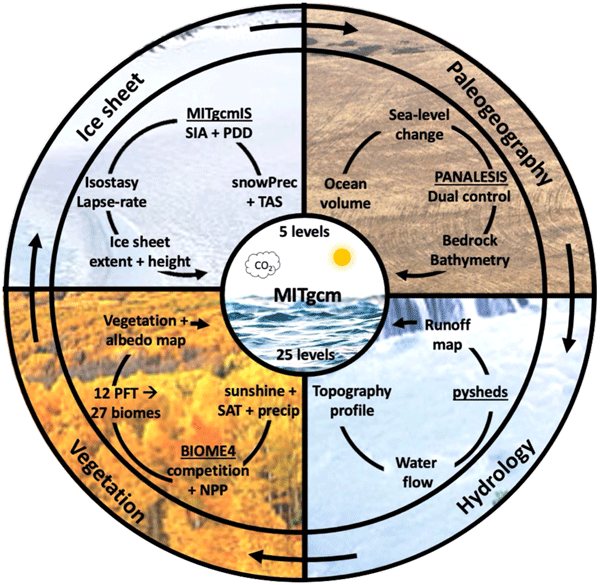
Laure Moinat, Florian Franziskakis, Christian Vérard, Daniel Nathan Goldberg, and Maura Brunetti
Geosci. Model Dev., 19, 4357–4384, https://doi.org/10.5194/gmd-19-4357-2026, https://doi.org/10.5194/gmd-19-4357-2026, 2026
Short summary
Short summary
We describe a new tool, BIG-MITgcm, that consistently reproduces the global-scale dynamics of the ocean, atmosphere, vegetation and ice on multimillennial timescales at a low computational cost. Evaluated against observations and state-of-the-art Earth system models, it includes asynchronous coupling to models of vegetation, hydrology and a newly developed global-scale ice sheet. Using arbitrary continental configurations, it enables studies of past and present climates on Earth or exoplanets.
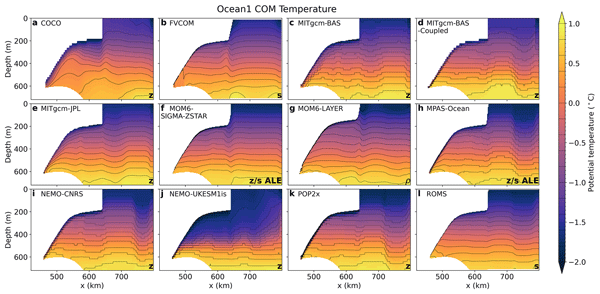
Claire K. Yung, Xylar S. Asay-Davis, Alistair Adcroft, Christopher Y. S. Bull, Jan De Rydt, Michael S. Dinniman, Benjamin K. Galton-Fenzi, Daniel Goldberg, David E. Gwyther, Robert Hallberg, Matthew Harrison, Tore Hattermann, David M. Holland, Denise Holland, Paul R. Holland, James R. Jordan, Nicolas C. Jourdain, Kazuya Kusahara, Gustavo Marques, Pierre Mathiot, Dimitris Menemenlis, Adele K. Morrison, Yoshihiro Nakayama, Olga Sergienko, Robin S. Smith, Alon Stern, Ralph Timmermann, and Qin Zhou
The Cryosphere, 20, 2053–2088, https://doi.org/10.5194/tc-20-2053-2026, https://doi.org/10.5194/tc-20-2053-2026, 2026
Short summary
Short summary
The second Ice Shelf-Ocean Model Intercomparison Project, ISOMIP+, compares 12 ice shelf-ocean models with a common, idealised, static configuration, aiming to assess inter-model variability. Models show similar basal melt rate patterns, ocean profiles and circulation but differ in ice-ocean boundary layer properties. Ice-ocean boundary layer representation is a key area for future work, as are realistic-domain ice sheet-ocean model intercomparisons.
Gillian M. A. Smith, Daniel N. Goldberg, Guillaume Jouvet, James R. Maddison, and Hamish D. Pritchard
EGUsphere, https://doi.org/10.5194/egusphere-2026-788, https://doi.org/10.5194/egusphere-2026-788, 2026
Short summary
Short summary
We estimate the thickness of a large glacier in the Himalaya, using recently available thickness measurements and a computational model which uses higher-order physics to match estimated thickness with satellite-observed velocity. Our velocity inversion achieves similar accuracy to leading thickness estimates, while thickness-constrained inversions show increased accuracy, but limited interpolative power. We make recommendations for future measurement locations and for choosing model parameters.
Brad Reed, Jan De Rydt, Kaitlin A. Naughten, and Daniel N. Goldberg
EGUsphere, https://doi.org/10.5194/egusphere-2026-931, https://doi.org/10.5194/egusphere-2026-931, 2026
Short summary
Short summary
Melting beneath Antarctic ice shelves drives ice loss and raises sea levels, but the computer models we use to predict this are poorly constrained. We improved how these models are set up by using multiple real-world observations of ice thinning and glacier speed, rather than melt rates alone. This better captures how the ice and ocean interact. Our projections show this approach adds 14 mm of extra sea-level rise by 2100, which is more than switching to a warmer climate scenario alone.
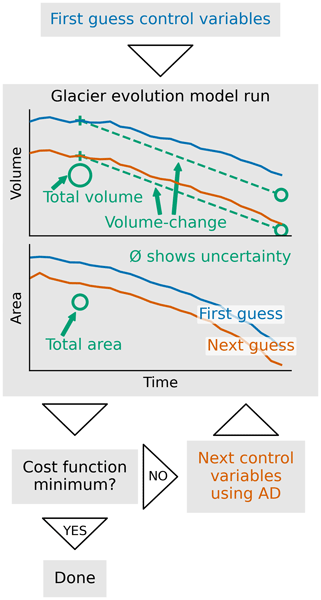
Patrick Schmitt, Fabien Maussion, Daniel N. Goldberg, and Philipp Gregor
Geosci. Model Dev., 19, 1301–1319, https://doi.org/10.5194/gmd-19-1301-2026, https://doi.org/10.5194/gmd-19-1301-2026, 2026
Short summary
Short summary
To improve large-scale understanding of glaciers, we developed a new data assimilation method that integrates available observations in a dynamically consistent way, while taking their timestamps into account. It is designed to flexibly include new glacier data as it becomes available. We tested the method with idealized experiments and found promising results in terms of accuracy and efficiency, showing strong potential for real-world applications.
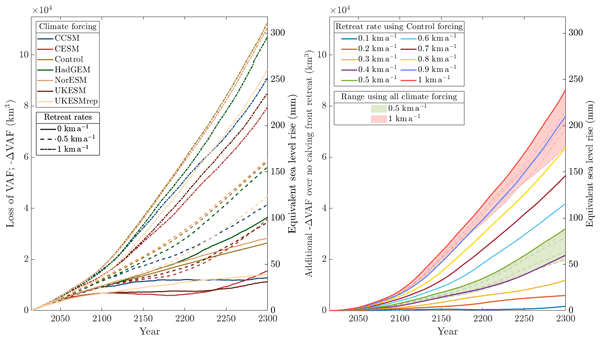
Jowan M. Barnes, G. Hilmar Gudmundsson, Daniel N. Goldberg, and Sainan Sun
The Cryosphere, 20, 777–790, https://doi.org/10.5194/tc-20-777-2026, https://doi.org/10.5194/tc-20-777-2026, 2026
Short summary
Short summary
Calving is where ice breaks off the front of glaciers. It has not been included widely in modelling as it is difficult to represent. We use our ice flow model to investigate the effects of calving floating ice shelves in West Antarctica. More calving leads to more ice loss and greater sea level rise, with local differences due to the shape of the bedrock. We find that ocean forcing and calving should be considered equally when trying to improve how models represent the real world.
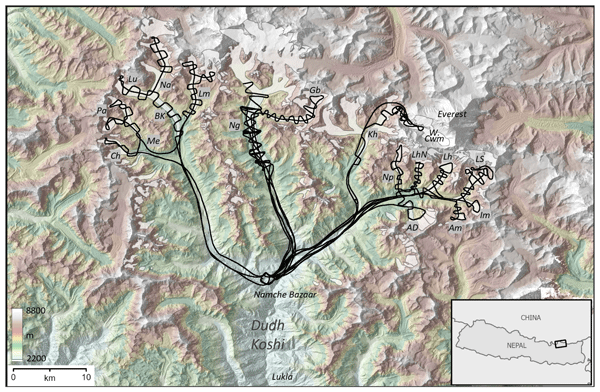
Hamish D. Pritchard, Edward C. King, David J. Goodger, Douglas Boyle, Daniel N. Goldberg, Beatriz Recinos, Andrew Orr, and Dhananjay Regmi
Earth Syst. Sci. Data, 18, 199–217, https://doi.org/10.5194/essd-18-199-2026, https://doi.org/10.5194/essd-18-199-2026, 2026
Short summary
Short summary
We present a new and uniquely extensive dataset of glacier thickness from the Khumbu Himal around Mount Everest that stretches for 119 km, doubling the extent of thickness measurements in High Mountain Asia. Such measurements are key inputs for models that estimate how much ice is stored on the whole mountain range scale and for models that predict how this ice reserve will change in future, and what impact this will have on water supply for the large populations living downstream.
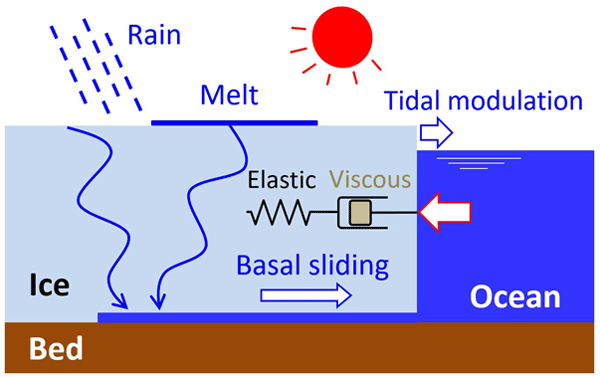
Shin Sugiyama, Shun Tsutaki, Daiki Sakakibara, Izumi Asaji, Ken Kondo, Yefan Wang, Evgeny Podolskiy, Guillaume Jouvet, and Martin Funk
The Cryosphere, 19, 525–540, https://doi.org/10.5194/tc-19-525-2025, https://doi.org/10.5194/tc-19-525-2025, 2025
Short summary
Short summary
We report flow speed variations near the front of a tidewater glacier in Greenland. Ice flow near the glacier front is crucial for the mass loss of the Greenland ice sheet, but in situ data are hard to obtain. Our unique in situ GPS data revealed fine details of short-term speed variations associated with melting, ocean tides, and rain. The results are important for understanding the response of tidewater glaciers to changing environments, such as warming, more frequent rain, and ice thinning.
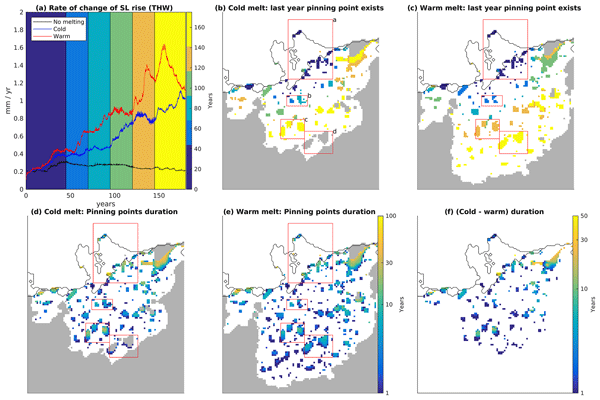
David T. Bett, Alexander T. Bradley, C. Rosie Williams, Paul R. Holland, Robert J. Arthern, and Daniel N. Goldberg
The Cryosphere, 18, 2653–2675, https://doi.org/10.5194/tc-18-2653-2024, https://doi.org/10.5194/tc-18-2653-2024, 2024
Short summary
Short summary
A new ice–ocean model simulates future ice sheet evolution in the Amundsen Sea sector of Antarctica. Substantial ice retreat is simulated in all scenarios, with some retreat still occurring even with no future ocean melting. The future of small "pinning points" (islands of ice that contact the seabed) is an important control on this retreat. Ocean melting is crucial in causing these features to go afloat, providing the link by which climate change may affect this sector's sea level contribution.
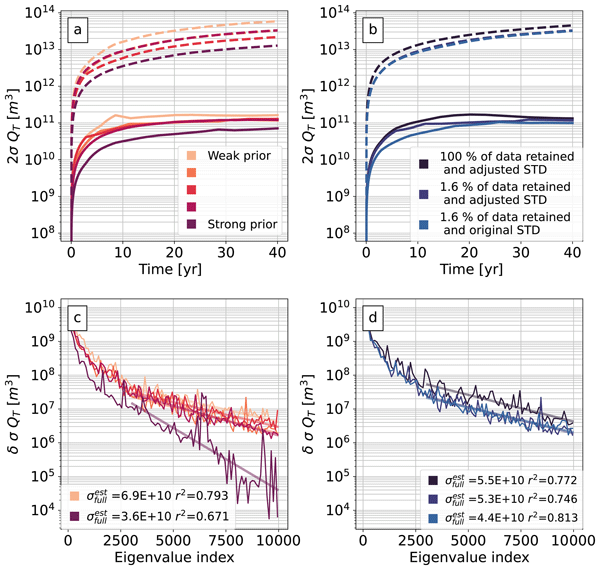
Beatriz Recinos, Daniel Goldberg, James R. Maddison, and Joe Todd
The Cryosphere, 17, 4241–4266, https://doi.org/10.5194/tc-17-4241-2023, https://doi.org/10.5194/tc-17-4241-2023, 2023
Short summary
Short summary
Ice sheet models generate forecasts of ice sheet mass loss, a significant contributor to sea level rise; thus, capturing the complete range of possible projections of mass loss is of critical societal importance. Here we add to data assimilation techniques commonly used in ice sheet modelling (a Bayesian inference approach) and fully characterize calibration uncertainty. We successfully propagate this type of error onto sea level rise projections of three ice streams in West Antarctica.
Helen Ockenden, Robert G. Bingham, Andrew Curtis, and Daniel Goldberg
The Cryosphere, 16, 3867–3887, https://doi.org/10.5194/tc-16-3867-2022, https://doi.org/10.5194/tc-16-3867-2022, 2022
Short summary
Short summary
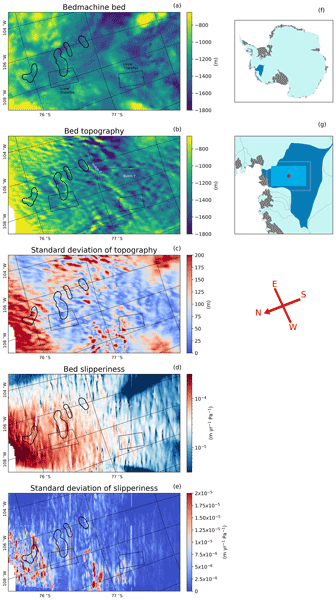
Hills and valleys hidden under the ice of Thwaites Glacier have an impact on ice flow and future ice loss, but there are not many three-dimensional observations of their location or size. We apply a mathematical theory to new high-resolution observations of the ice surface to predict the bed topography beneath the ice. There is a good correlation with ice-penetrating radar observations. The method may be useful in areas with few direct observations or as a further constraint for other methods.
Alexander Robinson, Daniel Goldberg, and William H. Lipscomb
The Cryosphere, 16, 689–709, https://doi.org/10.5194/tc-16-689-2022, https://doi.org/10.5194/tc-16-689-2022, 2022
Short summary
Short summary
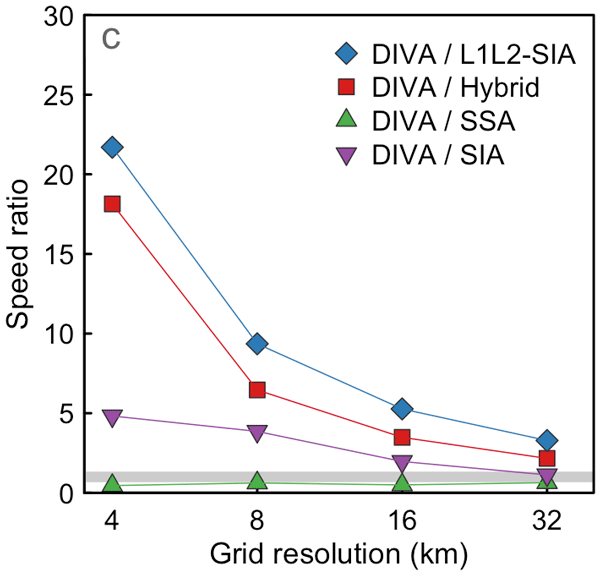
Here we investigate the numerical stability of several commonly used methods in order to determine which of them are capable of resolving the complex physics of the ice flow and are also computationally efficient. We find that the so-called DIVA solver outperforms the others. Its representation of the physics is consistent with more complex methods, while it remains computationally efficient at high resolution.
Cited articles
Aðalgeirsdóttir, G., Magnússon, E., Pálsson, F., Thorsteinsson, T., Belart, J. M. C., Jóhannesson, T., Hannesdóttir, H., Sigurðsson, O., Gunnarsson, A., Einarsson, B., Berthier, E., Schmidt, L. S., Haraldsson, H. H., and Björnsson, H.: Glacier changes in Iceland from ∼ 1890 to 2019, Front. Earth Sci., 8, https://doi.org/10.3389/feart.2020.523646, 2020.
Baurley, N.: Dataset for five lake-terminating glaciers in Iceland 2008–2020, Version v1, Zenodo [data set], https://doi.org/10.5281/zenodo.13142806, 2024.
Baurley, N. R., Robson, B. A., and Hart, J. K.: Long-term impact of the proglacial lake Jökulsárlón on the flow velocity and stability of Breiðamerkurjökull glacier, Iceland, Earth Surf. Process. Landf., 45, 2647–2663, https://doi.org/10.1002/esp.4920, 2020.
Baurley, N. R., Andrews, A., Robson, B., Attia, S., Martinez, K., and Hart, J. K.: Contrasting Dynamic Behaviour of Five Lake-terminating Glaciers Draining the Vatnajökull Ice Cap and Links to Bedrock Topography, Remote Sens. Earth Syst. Sci., 8, 696–717, https://doi.org/10.1007/s41976-025-00213-8, 2025.
Benn, D. I., Hulton, N. R. J., and Mottram, R. H.: “Calving laws”, “sliding laws” and the stability of tidewater glaciers, Ann. Glaciol., 46, 123–130, 2007a.
Benn, D. I., Warren, C. R., and Mottram, R. H.: Calving processes and the dynamics of calving glaciers, Earth. Sci. Rev., 82, 143–179, https://doi.org/10.1016/j.earscirev.2007.02.002, 2007b.
Bondzio, J. H., Seroussi, H., Morlighem, M., Kleiner, T., Rückamp, M., Humbert, A., and Larour, E. Y.: Modelling calving front dynamics using a level-set method: application to Jakobshavn Isbræ, West Greenland, The Cryosphere, 10, 497–510, https://doi.org/10.5194/tc-10-497-2016, 2016.
Carrivick, J. L. and Tweed, F. S.: Proglacial Lakes: Character, behaviour and geological importance, Quat. Sci. Rev., 78, 34–52, https://doi.org/10.1016/j.quascirev.2013.07.028, 2013.
Carrivick, J. L., Tweed, F. S., Sutherland, J. L., and Mallalieu, J.: Toward Numerical Modeling of Interactions Between Ice-Marginal Proglacial Lakes and Glaciers, Front. Earth Sci., 8, https://doi.org/10.3389/feart.2020.577068, 2020.
Cook, S., Rutt, I. C., Murray, T., Luckman, A., Zwinger, T., Selmes, N., Goldsack, A., and James, T. D.: Modelling environmental influences on calving at Helheim Glacier in eastern Greenland, The Cryosphere, 8, 827–841, https://doi.org/10.5194/tc-8-827-2014, 2014.
Cuffey, K. M. and Paterson, W. S. B.: The physics of glaciers, Elsevier/BH, ISBN 978-0-12-369461-4, 2010.
Davison, B. J., Sole, A. J., Livingstone, S. J., Cowton, T. R., and Nienow, P. W.: The influence of hydrology on the dynamics of land-terminating sectors of the Greenland ice sheet, Front Earth Sci., 7, https://doi.org/10.3389/feart.2019.00010, 2019.
Dell, R., Carr, R., Phillips, E., and Russell, A. J.: Response of glacier flow and structure to proglacial lake development and climate at Fjallsjökull, south-east Iceland, J. Glaciol., 65, 321–336, https://doi.org/10.1017/jog.2019.18, 2019.
Foresta, L., Gourmelen, N., Pálsson, F., Nienow, P., Björnsson, H., and Shepherd, A.: Surface elevation change and mass balance of Icelandic ice caps derived from swath mode CryoSat-2 altimetry, Geophys. Res. Lett., 43, 12138–12145, https://doi.org/10.1002/2016GL071485, 2016.
Gagliardini, O. and Werder, M. A.: Influence of increasing surface melt over decadal timescales on land-terminating Greenland-type outlet glaciers, J. Glaciol., 64, 700–710, https://doi.org/10.1017/jog.2018.59, 2018.
Gagliardini, O., Cohen, D., Räback, P., and Zwinger, T.: Finite-element modeling of subglacial cavities and related friction law, J. Geophys. Res. Earth Surf., 112, 1–11, https://doi.org/10.1029/2006JF000576, 2007.
Gagliardini, O., Zwinger, T., Gillet-Chaulet, F., Durand, G., Favier, L., de Fleurian, B., Greve, R., Malinen, M., Martín, C., Råback, P., Ruokolainen, J., Sacchettini, M., Schäfer, M., Seddik, H., and Thies, J.: Capabilities and performance of Elmer/Ice, a new-generation ice sheet model, Geosci. Model Dev., 6, 1299–1318, https://doi.org/10.5194/gmd-6-1299-2013, 2013.
Geuzaine, C. and Remacle, J. F.: Gmsh: A 3-D finite element mesh generator with built-in pre- and post-processing facilities, Int. J. Numer. Methods Eng., 79, 1309–1331, https://doi.org/10.1002/nme.2579, 2009.
Gudmundsson, M. T., Thordarson, T., Hoskuldsson, A., Larsen, G., Bjornsson, H., Prata, F. J., Oddsson, B., Magnusson, E., Hognadottir, T., Petersen, G. N., Hayward, C. L., Stevenson, J. A., and Jonsdottir, I.: Ash generation and distribution from the April–May 2010 eruption of Eyjafjallajökull, Iceland, Sci. Rep., 2, https://doi.org/10.1038/srep00572, 2012.
Guðmundsson, S., Björnsson, H., Pálsson, F., Magnússon, E., Sæmundsson, Þ., and Jóhannesson, T.: Terminus lakes on the south side of Vatnajökull ice cap, SE-Iceland, Jokull, 2019, 1–34, https://doi.org/10.33799/jokull2019.69.001, 2019.
Hannesdóttir, H., Björnsson, H., Pálsson, F., Aðalgeirsdóttir, G., and Guðmundsson, Sv.: Changes in the southeast Vatnajökull ice cap, Iceland, between ∼ 1890 and 2010, The Cryosphere, 9, 565–585, https://doi.org/10.5194/tc-9-565-2015, 2015.
Holt, E., Nienow, P., and Medina-Lopez, E.: Terminus thinning drives recent acceleration of a Greenlandic lake-terminating outlet glacier, J. Glaciol., 70, https://doi.org/10.1017/jog.2024.30, 2024.
Howat, I. M., Joughin, I., Tulaczyk, S., and Gogineni, S.: Rapid retreat and acceleration of Helheim Glacier, east Greenland, Geophys. Res. Lett., 32, 1–4, https://doi.org/10.1029/2005GL024737, 2005.
Iken, A. and Bindschadler, R. A.: Combined measurements of subglacial water pressure and surface velocity of Findelengletscher, Switzerland: conclusions about drainage system and sliding mechanism, J. Glaciol., 32, 101–119, 1986.
Jenkins, A.: Convection-driven melting near the grounding lines of ice shelves and tidewater glaciers, J. Phys. Oceanogr., 41, 2279–2294, https://doi.org/10.1175/JPO-D-11-03.1, 2011.
Jóhannesson, T., Björnsson, H., Magnússon, E., Gudmundsson, S., Pálsson, F., Sigurdsson, O., Thorsteinsson, T., and Berthier, E.: Ice-volume changes, bias estimation of mass-balance measurements and changes in subglacial lakes derived by lidar mapping of the surface of Icelandic glaciers, Ann. Glaciol., 54, 63–74, https://doi.org/10.3189/2013AoG63A422, 2013.
Jóhannesson, T., Pálmason, B., Hjartarson, Á., Jarosch, A. H., Magnússon, E., Belart, J. M. C., and Gudmundsson, M. T.: Non-surface mass balance of glaciers in Iceland, J. Glaciol., 66, 685–697, https://doi.org/10.1017/jog.2020.37, 2020.
Jouvet, G.: A multilayer ice-flow model generalising the shallow shelf approximation, J. Fluid Mech., 764, 26–51, https://doi.org/10.1017/jfm.2014.689, 2014.
King, O., Bhattacharya, A., Bhambri, R., and Bolch, T.: Glacial lakes exacerbate Himalayan glacier mass loss, Sci. Rep., 9, https://doi.org/10.1038/s41598-019-53733-x, 2019.
Kirkbride, M. P.: The temporal significance of transitions from melting to calving termini at glaciers in the central Southern Alps of New Zealand, Holocene, 3, 232–240, https://doi.org/10.1177/095968369300300305, 1993.
Lea, J. M.: The Google Earth Engine Digitisation Tool (GEEDiT) and the Margin change Quantification Tool (MaQiT) – simple tools for the rapid mapping and quantification of changing Earth surface margins, Earth Surf. Dynam., 6, 551–561, https://doi.org/10.5194/esurf-6-551-2018, 2018.
Magnússon, E., Pálsson, F., Björnsson, H., and Guðmundsson, S.: Removing the ice cap of Öræfajökull central volcano, SE-Iceland: Mapping and interpretation of bedrock topography, ice volumes, subglacial troughs and implications for hazards assessments, Jokull, 62, 131–150, 2012.
Magnússon, E., Pálsson, F., Björnsson, H., and Guðmundsson, S.: Erratum in; Removing the ice cap of Öraefajökull central volcano, SE-Iceland: Mapping and interpretation of bedrock topography, ice volumes, subglacial troughs and implications for hazards assessments, Jokull, 64, 83–84, https://doi.org/10.33799/jokull2014.64.083o, 2014.
Martin, M. A., Winkelmann, R., Haseloff, M., Albrecht, T., Bueler, E., Khroulev, C., and Levermann, A.: The Potsdam Parallel Ice Sheet Model (PISM-PIK) – Part 2: Dynamic equilibrium simulation of the Antarctic ice sheet, The Cryosphere, 5, 727–740, https://doi.org/10.5194/tc-5-727-2011, 2011.
McNabb, R. W. and Hock, R.: Alaska tidewater glacier terminus positions, 1948-2012, J. Geophys. Res. Earth Surf., 119, 153–167, https://doi.org/10.1002/2013JF002915, 2014.
McNabb, R. W., Hock, R., and Huss, M.: Variations in Alaska tidewater glacier frontal ablation, 1985–2013, J. Geophys. Res. Earth Surf., 120, 120–136, https://doi.org/10.1002/2014JF003276, 2015.
Minowa, M., Schaefer, M., Sugiyama, S., Sakakibara, D., and Skvarca, P.: Frontal ablation and mass loss of the Patagonian icefields, Earth Planet. Sci. Lett., 561, 116811, https://doi.org/10.1016/j.epsl.2021.116811, 2021.
Moon, T. and Joughin, I.: Changes in ice front position on Greenland's outlet glaciers from 1992 to 2007, J. Geophys. Res. Earth Surf., 113, https://doi.org/10.1029/2007JF000927, 2008.
Noël, B., Aðalgeirsdóttir, G., Pálsson, F., Wouters, B., Lhermitte, S., Haacker, J. M., and van den Broeke, M. R.: North Atlantic Cooling is Slowing Down Mass Loss of Icelandic Glaciers, Geophys. Res. Lett., 49, https://doi.org/10.1029/2021GL095697, 2022a.
Noël, B., Aðalgeirsdóttir, G., Pálsson, F., Wouters, B., Lhermitte, S., Haacker, J., and van den Broeke, M.: Data set: North Atlantic cooling is slowing down mass loss of Icelandic glaciers, Zenodo [data set], https://doi.org/10.5281/zenodo.5836476, 2022b.
Nuth, C. and Kääb, A.: Co-registration and bias corrections of satellite elevation data sets for quantifying glacier thickness change, The Cryosphere, 5, 271–290, https://doi.org/10.5194/tc-5-271-2011, 2011.
Osmanoglu, B., Navarro, F. J., Hock, R., Braun, M., and Corcuera, M. I.: Surface velocity and mass balance of Livingston Island ice cap, Antarctica, The Cryosphere, 8, 1807–1823, https://doi.org/10.5194/tc-8-1807-2014, 2014.
Otero, J., Goldberg, D. N., Nienow, P., and Wang, Y.: Dataset: ”Investigating the transition in ice dynamics from a land- to lake-terminating glacier using a simple glacier dynamics model”, Zenodo [data set], https://doi.org/10.5281/zenodo.23335783, 2026.
Patton, H., Swift, D. A., Clark, C. D., Livingstone, S. J., and Cook, S. J.: Distribution and characteristics of overdeepenings beneath the Greenland and Antarctic ice sheets: Implications for overdeepening origin and evolution, Quat. Sci. Rev., 148, 128–145, https://doi.org/10.1016/j.quascirev.2016.07.012, 2016.
Pfeffer, W. T.: A simple mechanism for irreversible tidewater glacier retreat, J. Geophys. Res. Earth Surf., 112, https://doi.org/10.1029/2006JF000590, 2007.
Porter, C., Morin, P., Howat, I., Noh, M.-J., Bates, B., Peterman, K., Keesey, S., Schlenk, M., Gardiner, J., Tomko, K., Willis, M., Kelleher, C., Cloutier, M., Husby, E., Foga, S., Nakamura, H., Platson, M., Wethington Michael, Jr., Williamson, C., Bauer, G., Enos, J., Arnold, G., Kramer, W., Becker, P., Doshi, A., D'Souza, C., Cummens, P., Laurier, F., and Bojesen, M.: ArcticDEM , Version 3, Harvard Dataverse [data set], https://doi.org/10.7910/DVN/OHHUKH, 2018.
Porter, C., Howat, I., Noh, M.-J., Husby, E., Khuvis, S., Danish, E., Tomko, K., Gardiner, J., Negrete, A., Yadav, B., Klassen, J., Kelleher, C., Cloutier, M., Bakker, J., Enos, J., Arnold, G., Bauer, G., and Morin, P.: ArcticDEM – Strips, Version 4.1, Harvard Dataverse [data set], https://doi.org/10.7910/DVN/C98DVS, 2022.
Pronk, J. B., Bolch, T., King, O., Wouters, B., and Benn, D. I.: Contrasting surface velocities between lake- and land-terminating glaciers in the Himalayan region, The Cryosphere, 15, 5577–5599, https://doi.org/10.5194/tc-15-5577-2021, 2021.
RGI Consortium: Randolph Glacier Inventory – A Dataset of Global Glacier Outlines, Version 6, NSIDC [data set], https://doi.org/10.7265/4m1f-gd79, 2017.
Rignot, E., Mouginot, J., Morlighem, M., Seroussi, H., and Scheuchl, B.: Widespread, rapid grounding line retreat of Pine Island, Thwaites, Smith, and Kohler glaciers, West Antarctica, from 1992 to 2011, Geophys. Res. Lett., 41, 3502–3509, https://doi.org/10.1002/2014GL060140, 2014.
Robinson, A., Goldberg, D., and Lipscomb, W. H.: A comparison of the stability and performance of depth-integrated ice-dynamics solvers, The Cryosphere, 16, 689–709, https://doi.org/10.5194/tc-16-689-2022, 2022.
Röhl, K.: Thermo-erosional notch development at fresh-water-calving Tasman Glacier, New Zealand, J. Glaciol., 52, 203–213, https://doi.org/10.3189/172756506781828773, 2006.
Ruokolainen, J., Råback, P., Malinen, M., Zwinger, T., Kataja, J., Ilvonen, S., Lyly, M., Byckling, M., Takala, E., Gillet-Chaulet, F., Gagliardini, O., Todd, J., Gladstone, R., Gong, C., Cook, S., Robertsen, F., Wheel, I., Chekki, M., Ponomarev, P., van Dongen, E., Thies, J., Saeki, T., Löfgren, A., Rodenberg, B., and Schannwell, C.: ElmerFEM, Zenodo [code], https://doi.org/10.5281/zenodo.19888172, 2026.
Schomacker, A.: Expansion of ice-marginal lakes at the Vatnajökull ice cap, Iceland, from 1999 to 2009, Geomorphology, 119, 232–236, https://doi.org/10.1016/j.geomorph.2010.03.022, 2010.
Schoof, C.: The effect of cavitation on glacier sliding, P. R. Soc. A, 461, 609–627, https://doi.org/10.1098/rspa.2004.1350, 2005.
Shugar, D. H., Burr, A., Haritashya, U. K., Kargel, J. S., Watson, C. S., Kennedy, M. C., Bevington, A. R., Betts, R. A., Harrison, S., and Strattman, K.: Rapid worldwide growth of glacial lakes since 1990, Nat. Clim. Chang., 10, 939–945, https://doi.org/10.1038/s41558-020-0855-4, 2020.
Sugiyama, S., Skvarca, P., Naito, N., Enomoto, H., Tsutaki, S., Tone, K., Marinsek, S., and Aniya, M.: Ice speed of a calving glacier modulated by small fluctuations in basal water pressure, Nat. Geosci., 4, 597–600, https://doi.org/10.1038/ngeo1218, 2011.
Sutherland, J. L., Carrivick, J. L., Gandy, N., Shulmeister, J., Quincey, D. J., and Cornford, S. L.: Proglacial Lakes Control Glacier Geometry and Behavior During Recession, Geophys. Res. Lett., 47, https://doi.org/10.1029/2020GL088865, 2020.
Thomas, R. H.: Force-perturbation analysis of recent thinning and acceleration of Jakobshavn Isbræ, Greenland, J. Glaciol., 50, 57–66, https://doi.org/10.3189/172756504781830321, 2004.
Truffer, M. and Motyka, R. J.: Where glaciers meet water: Subaqueous melt and its relevance to glaciers in various settings, Rev. Geophys., 54, 220–239, https://doi.org/10.1002/2015RG000494, 2016.
Trüssel, B. L., Motyka, R. J., Truffer, M., and Larsen, C. F.: Rapid thinning of lake-calving Yakutat Glacier and the collapse of the Yakutat Icefield, southeast Alaska, USA, J. Glaciol., 59, 149–161, https://doi.org/10.3189/2013J0G12J081, 2013.
Tsutaki, S., Nishimura, D., Yoshizawa, T., and Sugiyama, S.: Changes in glacier dynamics under the influence of proglacial lake formation in Rhonegletscher, Switzerland, Ann. Glaciol., 52, 31–36, https://doi.org/10.3189/172756411797252194, 2011.
Tsutaki, S., Fujita, K., Nuimura, T., Sakai, A., Sugiyama, S., Komori, J., and Tshering, P.: Contrasting thinning patterns between lake- and land-terminating glaciers in the Bhutanese Himalaya, The Cryosphere, 13, 2733–2750, https://doi.org/10.5194/tc-13-2733-2019, 2019.
Van Der Veen, C. J.: Fracture mechanics approach to penetration of surface crevasses on glaciers, Cold Reg. Sci. Technol., 27, 31–47, https://doi.org/10.1016/S0165-232X(97)00022-0, 1998.
Weis, M., Greve, R., and Hutter, K.: Theory of shallow ice shelves, Continuum Mech. Thermodyn, Springer-Verlag, 15–50, https://doi.org/10.1007/s001610050102, 1999.
Wu, K., Bolch, T., Cheng, P., Baldacchino, F., Duan, Y., Ma, D., and Liu, S.: Assessing the dynamic changes and the effect of buoyancy of lake-terminating Yanong Glacier in the southeastern Tibetan Plateau with UAV surveys, J. Hydrol. Reg. Stud., 59, https://doi.org/10.1016/j.ejrh.2025.102385, 2025.
xDEM contributors: xDEM, Version v0.1.0, Zenodo [software], https://doi.org/10.5281/zenodo.11492983, 2024.
Yang, R., Hock, R., Rounce, D. R., and Kang, S.: Regional-Scale Response of Glacier Speed to Seasonal Runoff Variations on the Kenai Peninsula, Alaska, Geophys. Res. Lett., 52, https://doi.org/10.1029/2025GL115248, 2025.
Zhang, G., Carrivick, J. L., Emmer, A., Shugar, D. H., Veh, G., Wang, X., Labedz, C., Mergili, M., Mölg, N., Huss, M., Allen, S., Sugiyama, S., and Lützow, N.: Characteristics and changes of glacial lakes and outburst floods, Nat. Rev. Earth Environ., 5, 447–462, https://doi.org/10.1038/s43017-024-00554-w, 2024a.
Zhang, T., Wang, W., and An, B.: Heterogeneous changes in global glacial lakes under coupled climate warming and glacier thinning, Commun. Earth Environ., 5, https://doi.org/10.1038/s43247-024-01544-y, 2024b.
Short summary
As climate change creates new lakes at the front of retreating glaciers, these ice bodies often accelerate and lose mass more quickly. We used a computer model to study this process at an Icelandic glacier. Our results show that thinning ice is the main driver for recent acceleration, with 37 % of the total ice loss resulting from the presence of the lake. These findings imply that as lakes grow globally, glaciers could vanish more rapidly than predicted, enhancing the rate of sea level rise.
As climate change creates new lakes at the front of retreating glaciers, these ice bodies often...


Altmetrics
Final-revised paper
Preprint