Articles | Volume 20, issue 10
https://doi.org/10.5194/tc-20-5867-2026
© Author(s) 2026. This work is distributed under
the Creative Commons Attribution 4.0 License.
https://doi.org/10.5194/tc-20-5867-2026
© Author(s) 2026. This work is distributed under
the Creative Commons Attribution 4.0 License.
Subseasonal forecast improvements from sea ice concentration data assimilation in the Antarctic

Atmospheric and Oceanic Sciences Program, Princeton University, Princeton, New Jersey, USA
now at: Xinchang, Zhejiang, China
Mitchell Bushuk
National Oceanic and Atmospheric Administration/Geophysical Fluid Dynamics Laboratory, Princeton, New Jersey, USA
Michael Winton
National Oceanic and Atmospheric Administration/Geophysical Fluid Dynamics Laboratory, Princeton, New Jersey, USA
William Gregory
Atmospheric and Oceanic Sciences Program, Princeton University, Princeton, New Jersey, USA
Bill Hurlin
National Oceanic and Atmospheric Administration/Geophysical Fluid Dynamics Laboratory, Princeton, New Jersey, USA
Liwei Jia
National Oceanic and Atmospheric Administration/Geophysical Fluid Dynamics Laboratory, Princeton, New Jersey, USA
University Corporation for Atmospheric Research, Boulder, Colorado, USA
Feiyu Lu
Atmospheric and Oceanic Sciences Program, Princeton University, Princeton, New Jersey, USA
Related authors
No articles found.
Michael Jacox, Dmitry Dukhovskoy, Jessie Liu, Michael Alexander, Elizabeth Drenkard, Andrew Ross, Natalie Freeman, Dillon Amaya, Steven Bograd, Allison Cluett, Nicole Lovenduski, Samuel Mogen, Mercedes Pozo Buil, Charles Stock, Wei Cheng, Albert Hermann, Liwei Jia, Nathaniel Johnson, Kelly Kearney, Colleen McHugh, and Darren Pilcher
EGUsphere, https://doi.org/10.5194/egusphere-2026-5844, https://doi.org/10.5194/egusphere-2026-5844, 2026
This preprint is open for discussion and under review for Ocean Science (OS).
Short summary
Short summary
We present a new system to predict conditions in the Northeast Pacific Ocean up to one year in advance. By comparing past forecasts with ocean measurements, we show that we can accurately predict temperature and oxygen levels several months in advance. These predictions will soon be available to the public, enabling coastal communities, managers, and industries to make better proactive decisions.
Alek Petty, Christopher Cardinale, Michel Tsamados, William Gregory, and Alex Cabaj
Earth Syst. Sci. Data Discuss., https://doi.org/10.5194/essd-2026-700, https://doi.org/10.5194/essd-2026-700, 2026
Preprint under review for ESSD
Short summary
Short summary
We combine laser-altimeter measurements with daily passive-microwave estimates of thin ice using Gaussian-process regression. The resulting dataset provides complete daily Arctic sea ice thickness maps across seven winter growth seasons, substantially improving spatial and temporal coverage, particularly during autumn freeze-up. It also better represents thin ice and enables consistent estimates of Arctic sea ice volume.
Andrew Ross, Charles Stock, Vimal Koul, Liwei Jia, Nathaniel Johnson, and Colleen McHugh
EGUsphere, https://doi.org/10.5194/egusphere-2026-5262, https://doi.org/10.5194/egusphere-2026-5262, 2026
This preprint is open for discussion and under review for Ocean Science (OS).
Short summary
Short summary
This paper examines the accuracy of forecasts of ocean oxygen and acidity, both critical for the healthy functioning of fish and marine ecosystems, along the continental shelf off the Northeast U.S. coastline. The forecasts are produced using a novel numerical model able to resolve fine oceanographic details. Comparison with a reference dataset shows that the model often accurately predicts oxygen and acidity up to several months in advance.
Xiao Liu, John P. Dunne, Liwei Jia, Charles A. Stock, Xiaosong Yang, Matthew J. Harrison, Liping Zhang, and Anthony Rosati
EGUsphere, https://doi.org/10.5194/egusphere-2026-4194, https://doi.org/10.5194/egusphere-2026-4194, 2026
Short summary
Short summary
This study uses NOAA GFDL’s SPEAR model to improve predictions of how the ocean absorbs human emitted CO2. While standard models capture long-term trends, they struggle with yearly fluctuations. Researchers found that "initializing" the model with observed data significantly boosts their prediction accuracy for up to two years. This framework helps separate the predictions of natural variability from human-driven carbon changes, a vital step for verifying future marine carbon removal efforts.
Joseph Fogarty, Elie Bou-Zeid, Mitchell Bushuk, and Linette Boisvert
The Cryosphere, 18, 4335–4354, https://doi.org/10.5194/tc-18-4335-2024, https://doi.org/10.5194/tc-18-4335-2024, 2024
Short summary
Short summary
We hypothesize that using a broad set of surface characterization metrics for polar sea ice surfaces will lead to more accurate representations in general circulation models. However, the first step is to identify the minimum set of metrics required. We show via numerical simulations that sea ice surface patterns can play a crucial role in determining boundary layer structures. We then statistically analyze a set of high-resolution sea ice surface images to obtain this minimal set of parameters.
Zachary D. Lawrence, Marta Abalos, Blanca Ayarzagüena, David Barriopedro, Amy H. Butler, Natalia Calvo, Alvaro de la Cámara, Andrew Charlton-Perez, Daniela I. V. Domeisen, Etienne Dunn-Sigouin, Javier García-Serrano, Chaim I. Garfinkel, Neil P. Hindley, Liwei Jia, Martin Jucker, Alexey Y. Karpechko, Hera Kim, Andrea L. Lang, Simon H. Lee, Pu Lin, Marisol Osman, Froila M. Palmeiro, Judith Perlwitz, Inna Polichtchouk, Jadwiga H. Richter, Chen Schwartz, Seok-Woo Son, Irene Erner, Masakazu Taguchi, Nicholas L. Tyrrell, Corwin J. Wright, and Rachel W.-Y. Wu
Weather Clim. Dynam., 3, 977–1001, https://doi.org/10.5194/wcd-3-977-2022, https://doi.org/10.5194/wcd-3-977-2022, 2022
Short summary
Short summary
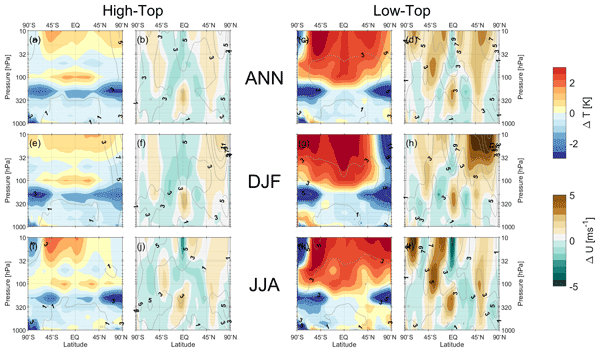
Forecast models that are used to predict weather often struggle to represent the Earth’s stratosphere. This may impact their ability to predict surface weather weeks in advance, on subseasonal-to-seasonal (S2S) timescales. We use data from many S2S forecast systems to characterize and compare the stratospheric biases present in such forecast models. These models have many similar stratospheric biases, but they tend to be worse in systems with low model tops located within the stratosphere.
Peter Hitchcock, Amy Butler, Andrew Charlton-Perez, Chaim I. Garfinkel, Tim Stockdale, James Anstey, Dann Mitchell, Daniela I. V. Domeisen, Tongwen Wu, Yixiong Lu, Daniele Mastrangelo, Piero Malguzzi, Hai Lin, Ryan Muncaster, Bill Merryfield, Michael Sigmond, Baoqiang Xiang, Liwei Jia, Yu-Kyung Hyun, Jiyoung Oh, Damien Specq, Isla R. Simpson, Jadwiga H. Richter, Cory Barton, Jeff Knight, Eun-Pa Lim, and Harry Hendon
Geosci. Model Dev., 15, 5073–5092, https://doi.org/10.5194/gmd-15-5073-2022, https://doi.org/10.5194/gmd-15-5073-2022, 2022
Short summary
Short summary
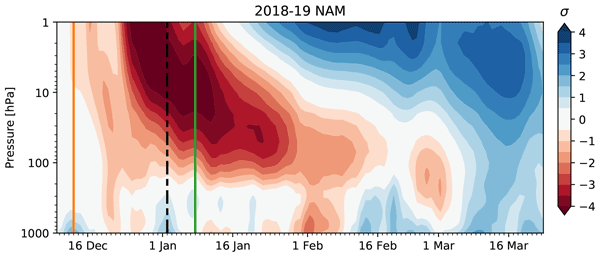
This paper describes an experimental protocol focused on sudden stratospheric warmings to be carried out by subseasonal forecast modeling centers. These will allow for inter-model comparisons of these major disruptions to the stratospheric polar vortex and their impacts on the near-surface flow. The protocol will lead to new insights into the contribution of the stratosphere to subseasonal forecast skill and new approaches to the dynamical attribution of extreme events.
William Gregory, Julienne Stroeve, and Michel Tsamados
The Cryosphere, 16, 1653–1673, https://doi.org/10.5194/tc-16-1653-2022, https://doi.org/10.5194/tc-16-1653-2022, 2022
Short summary
Short summary
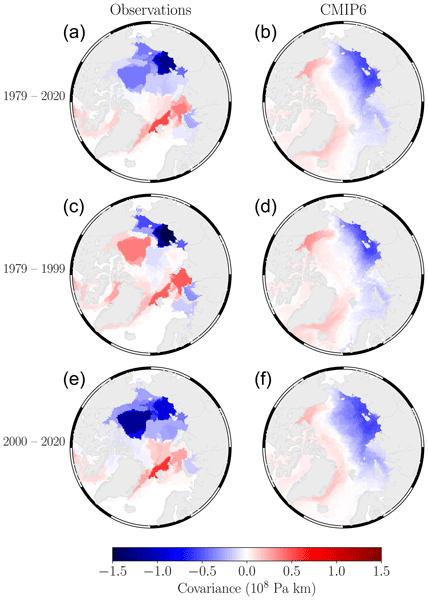
This research was conducted to better understand how coupled climate models simulate one of the large-scale interactions between the atmosphere and Arctic sea ice that we see in observational data, the accurate representation of which is important for producing reliable forecasts of Arctic sea ice on seasonal to inter-annual timescales. With network theory, this work shows that models do not reflect this interaction well on average, which is likely due to regional biases in sea ice thickness.
Yunhe Wang, Xiaojun Yuan, Haibo Bi, Mitchell Bushuk, Yu Liang, Cuihua Li, and Haijun Huang
The Cryosphere, 16, 1141–1156, https://doi.org/10.5194/tc-16-1141-2022, https://doi.org/10.5194/tc-16-1141-2022, 2022
Short summary
Short summary
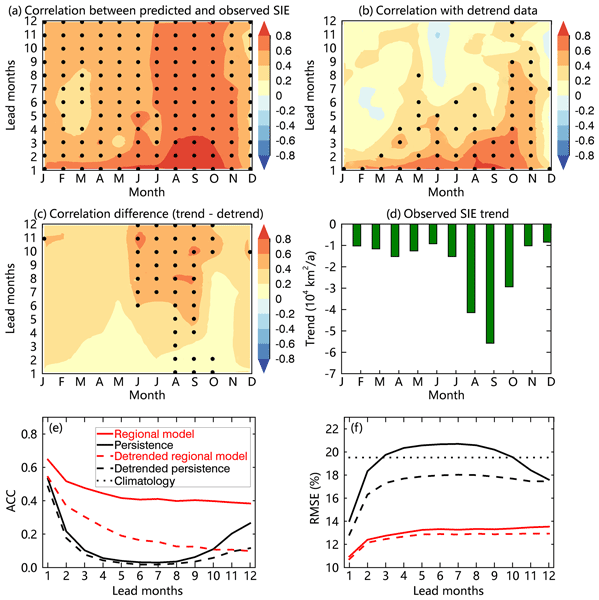
We develop a regional linear Markov model consisting of four modules with seasonally dependent variables in the Pacific sector. The model retains skill for detrended sea ice extent predictions for up to 7-month lead times in the Bering Sea and the Sea of Okhotsk. The prediction skill, as measured by the percentage of grid points with significant correlations (PGS), increased by 75 % in the Bering Sea and 16 % in the Sea of Okhotsk relative to the earlier pan-Arctic model.
Cited articles
Anderson, J., Hoar, T., Raeder, K., Liu, H., Collins, N., Torn, R., and Avellano, A.: The data assimilation research testbed: A community facility, B. Am. Meteorol. Soc., 90, 1283–1296, 2009. a
Anderson, J. L.: An ensemble adjustment Kalman filter for data assimilation, Mon. Weather Rev., 129, 2884–2903, 2001. a
Blanchard-Wrigglesworth, E., Armour, K. C., Bitz, C. M., and DeWeaver, E.: Persistence and inherent predictability of Arctic sea ice in a GCM ensemble and observations, J. Climate, 24, 231–250, 2011. a
Bushuk, M., Winton, M., Haumann, F. A., Delworth, T., Lu, F., Zhang, Y., Jia, L., Zhang, L., Cooke, W., Harrison, M., Hurlin, B., Johnson, N. C., Kapnick, S. B., McHugh, C., Murakami, H., Rosati, A., Tseng, K.-C., Wittenberg, A., Yang, X., and Zeng, F.: Seasonal prediction and predictability of regional Antarctic sea ice, J. Climate, 34, 6207–6233, 2021. a, b, c, d, e, f
Bushuk, M., Zhang, Y., Winton, M., Hurlin, B., Delworth, T., Lu, F., Jia, L., Zhang, L., Cooke, W., Harrison, M., Johnson, N. C., Kapnick, S., McHugh, C., Murakami, H., Rosati, A., Tseng, K.-C., Wittenberg, A. T., Yang, X., and Zeng, F.: Mechanisms of Regional Arctic Sea Ice Predictability in Two Dynamical Seasonal Forecast Systems, J. Climate, 35, 4207–4231, 2022. a
Bushuk, M., Ali, S., Bailey, D. A., Bao, Q., Batté, L., Bhatt, U. S., Blanchard-Wrigglesworth, E., Blockley, E., Cawley, G., Chi, J., Counillon, F., Coulombe, P. G., Cullather, R. I., Diebold, F. X., Dirkson, A., Exarchou, E., Göbel, M., Gregory, W., Guemas, V., Hamilton, L., He, B., Horvath, S., Ionita, M., Kay, J. E., Kim, E., Kimura, N., Kondrashov, D., Lobe, Z. M., Lee, W., Lee, Y. J., Li, C., Li, X., Lin, Y., Liu, Y., Maslowski, W., Massonnet, F., Meier, W. N., Merryfield, W. J., Myint, H., Acosta Navarro, J. C., Petty, A., Qiao, F., Schröder, D., Schweiger, A., Shu, Q., Sigmond, M., Steele, M., Stroeve, J., Sun, N., Tietsche, S., Tsamados, M., Wang, K., Wang, J., Wang, W., Wang, Y., Wang, Y., Williams, J., Yang, Q., Yuan, X., Zhang, J., and Zhang, Y.: Predicting September Arctic Sea Ice: A Multi-Model Seasonal Skill Comparison, B. Am. Meteorol. Soc., 105, E1170–E1202, https://doi.org/10.1175/BAMS-D-23-0163.1, 2024. a
Cavalieri, D. and Parkinson, C.: Antarctic sea ice variability and trends, 1979–2006, J. Geophys. Res.-Oceans, 113, C07004, https://doi.org/10.1029/2007JC004564, 2008. a
Delworth, T. L., Cooke, W. F., Adcroft, A., Bushuk, M., Chen, J.-H., Dunne, K. A., Ginoux, P., Gudgel, R., Hallberg, R. W., Harris, L., Harrison, M., Johnson, N., Kapnick, S. B., Lin, S.-J., Malyshev, S., Milly, P. C., Murakami, H., Naik, V., Pascale, S., Paynter, D., Rosati, A. Schwarzkopf, M. D., Shevliakova, E., Underwood, S., Wittenberg, A. T., Xiang, B., Yang, X., Zeng, F., Zhang, H., Zhang, L., and Zhao, M.: SPEAR: The next generation GFDL modeling system for seasonal to multidecadal prediction and projection, J. Adv. Model. Earth Sy., 12, e2019MS001895, https://doi.org/10.1029/2019MS001895, 2020. a
DuVivier, A. K., Holland, M. M., Kay, J. E., Tilmes, S., Gettelman, A., and Bailey, D. A.: Arctic and Antarctic sea ice mean state in the Community Earth System Model version 2 and the influence of atmospheric chemistry, J. Geophys. Res.-Oceans, 125, e2019JC015934, https://doi.org/10.1029/2019JC015934, 2020. a
Gao, Y., Xiu, Y., Nie, Y., Luo, H., Yang, Q., Zampieri, L., Lv, X., and Uotila, P.: An assessment of subseasonal prediction skill of the Antarctic sea ice edge, J. Geophys. Res.-Oceans, 129, e2024JC021499, https://doi.org/10.1029/2024JC021499, 2024. a, b
Goessling, H. and Jung, T.: A probabilistic verification score for contours: Methodology and application to Arctic ice-edge forecasts, Q. J. Roy. Meteor. Soc., 144, 735–743, 2018. a
Gregory, W., Bushuk, M., Adcroft, A., Zhang, Y., and Zanna, L.: Deep learning of systematic sea ice model errors from data assimilation increments, J. Adv. Model. Earth Sy., 15, e2023MS003757, https://doi.org/10.1029/2023MS003757, 2023. a
Gregory, W., Bushuk, M., Zhang, Y., Adcroft, A., and Zanna, L.: Machine learning for online sea ice bias correction within global ice-ocean simulations, Geophys. Res. Lett., 51, e2023GL106776, https://doi.org/10.1029/2023GL106776, 2024. a
Guemas, V., Blanchard-Wrigglesworth, E., Chevallier, M., Day, J. J., Déqué, M., Doblas-Reyes, F. J., Fučkar, N. S., Germe, A., Hawkins, E., Keeley, S., Koenigk, T., Salas y Mélia, D., and Tietsche, S.: A review on Arctic sea-ice predictability and prediction on seasonal to decadal time-scales, Q. J. Roy. Meteor. Soc., 142, 546–561, https://doi.org/10.1002/qj.2401, 2016. a
Liao, S., Luo, H., Wang, J., Shi, Q., Zhang, J., and Yang, Q.: An evaluation of Antarctic sea-ice thickness from the Global Ice-Ocean Modeling and Assimilation System based on in situ and satellite observations, The Cryosphere, 16, 1807–1819, https://doi.org/10.5194/tc-16-1807-2022, 2022. a
Lu, F., Harrison, M. J., Rosati, A., Delworth, T. L., Yang, X., Cooke, W. F., Jia, L., McHugh, C., Johnson, N. C., Bushuk, M., Zhang, Y., and Adcroft, A.: GFDL's SPEAR seasonal prediction system: Initialization and ocean tendency adjustment (OTA) for coupled model predictions, J. Adv. Model. Earth Sy., 12, e2020MS002149, https://doi.org/10.1029/2020MS002149, 2020. a
Massonnet, F., Barreira, S., Barthélemy, A., Bilbao, R., Blanchard-Wrigglesworth, E., Blockley, E., Bromwich, D. H., Bushuk, M., Dong, X., Goessling, H. F., Hobbs, W., Iovino, D., Lee, W.-S., Li, C., Meier, W. N., Merryfield, W. J., Moreno-Chamarro, E., Morioka, Y., Li, X., Niraula, B., Petty, A., Sanna, A., Scilingo, M., Shu, Q., Sigmond, M., Sun, N., Tietsche, S., Wu, X., Yang, Q., and Yuan, X.: SIPN South: six years of coordinated seasonal Antarctic sea ice predictions, Front. Marine Sci., 10, 1148899, https://doi.org/10.3389/fmars.2023.1148899, 2023. a
Mazloff, M. R., Heimbach, P., and Wunsch, C.: An eddy-permitting Southern Ocean state estimate, J. Phys. Oceanogr., 40, 880–899, 2010. a
Ordoñez, A. C., Bitz, C. M., and Blanchard-Wrigglesworth, E.: Processes controlling Arctic and Antarctic sea ice predictability in the Community Earth System Model, J. Climate, 31, 9771–9786, 2018. a
Parkinson, C. L. and Cavalieri, D. J.: Antarctic sea ice variability and trends, 1979–2010, The Cryosphere, 6, 871–880, https://doi.org/10.5194/tc-6-871-2012, 2012. a
Payne, R., Martin, J., Monahan, A., and Sigmond, M.: Seasonal predictions of regional and pan-Antarctic sea ice with a dynamical forecast system, Atmosphere-Ocean, 61, 273–292, 2023. a
Purich, A. and Doddridge, E. W.: Record low Antarctic sea ice coverage indicates a new sea ice state, Commun. Earth Environ., 4, 314, https://doi.org/10.1038/s43247-023-00961-9, 2023. a
Raphael, M. N. and Handcock, M. S.: A new record minimum for Antarctic sea ice, Nat. Rev. Earth Environ., 3, 215–216, 2022. a
Schlosser, E., Haumann, F. A., and Raphael, M. N.: Atmospheric influences on the anomalous 2016 Antarctic sea ice decay, The Cryosphere, 12, 1103–1119, https://doi.org/10.5194/tc-12-1103-2018, 2018. a
Selivanova, J., Iovino, D., and Vichi, M.: Limited benefits of increased spatial resolution for sea ice in HighResMIP simulations, Geophys. Res. Lett., 51, e2023GL107969, https://doi.org/10.1029/2023GL107969, 2024. a
Shi, Q., Yang, Q., Mu, L., Wang, J., Massonnet, F., and Mazloff, M. R.: Evaluation of sea-ice thickness from four reanalyses in the Antarctic Weddell Sea, The Cryosphere, 15, 31–47, https://doi.org/10.5194/tc-15-31-2021, 2021. a
Shu, Q., Song, Z., and Qiao, F.: Assessment of sea ice simulations in the CMIP5 models, The Cryosphere, 9, 399–409, https://doi.org/10.5194/tc-9-399-2015, 2015. a
Stuecker, M. F., Bitz, C. M., and Armour, K. C.: Conditions leading to the unprecedented low Antarctic sea ice extent during the 2016 austral spring season, Geophys. Res. Lett., 44, 9008–9019, 2017. a
Tietsche, S., Day, J. J., Guemas, V., Hurlin, W. J., Keeley, S. P. E., Matei, D., Msadek, R., Collins, M., and Hawkins, E.: Seasonal to interannual Arctic sea ice predictability in current global climate models, Geophys. Res. Lett., 41, 1035–1043, https://doi.org/10.1002/2013GL058755, 2014. a
Tsujino, H., Urakawa, S., Nakano, H., Small, R. J., Kim, W. M., Yeager, S. G., Danabasoglu, G., Suzuki, T., Bamber, J. L., Bentsen, M., Böning, C. W., Bozec, A., Chassignet, E. P., Curchitser, E., Boeira Dias, F., Durack, P. J., Griffies, S. M., Harada, Y., Ilicak, M., Josey, S. A., Kobayashi, C., Kobayashi, S., Komuro, Y., Large, W. G., Le Sommer, J., Marsland, S. J., Masina, S., Scheinert, M., Tomita, H., Valdivieso, M., and Yamazaki, D.: JRA-55 based surface dataset for driving ocean–sea-ice models (JRA55-do), Ocean Model., 130, 79–139, https://doi.org/10.1016/j.ocemod.2018.07.002, 2018. a
Turner, J., Hosking, J. S., Bracegirdle, T. J., Marshall, G. J., and Phillips, T.: Recent changes in Antarctic sea ice, Philos. T. R. Soc. A, 373, 20140163, https://doi.org/10.1098/rsta.2014.0163, 2015. a
Turner, J., Phillips, T., Marshall, G. J., Hosking, J. S., Pope, J. O., Bracegirdle, T. J., and Deb, P.: Unprecedented springtime retreat of Antarctic sea ice in 2016, Geophys. Res. Lett., 44, 6868–6875, 2017. a
Verdy, A. and Mazloff, M. R.: A data assimilating model for estimating Southern Ocean biogeochemistry, J. Geophys. Res.-Oceans, 122, 6968–6988, 2017. a
Wang, Y., Yuan, X., Ren, Y., Bushuk, M., Shu, Q., Li, C., and Li, X.: Subseasonal prediction of regional Antarctic sea ice by a deep learning model, Geophys. Res. Lett., 50, e2023GL104347, https://doi.org/10.1029/2023GL104347, 2023. a
Xiu, Y., Wang, Y., Luo, H., Garcia-Oliva, L., and Yang, Q.: Impact of ocean, sea ice or atmosphere initialization on seasonal prediction of regional Antarctic sea ice, J. Adv. Model. Earth Sy., 17, e2024MS004382, https://doi.org/10.1029/2024MS004382, 2025. a
Zhang, J. and Rothrock, D. A.: Modeling global sea ice with a thickness and enthalpy distribution model in generalized curvilinear coordinates, Mon. Weather Rev., 131, 845–861, 2003. a
Zhang, L., Delworth, T. L., Cooke, W., and Yang, X.: Natural variability of Southern Ocean convection as a driver of observed climate trends, Nat. Clim. Change, 9, 59–65, 2019. a
Zhang, L., Delworth, T. L., Yang, X., Zeng, F., Lu, F., Morioka, Y., and Bushuk, M.: The relative role of the subsurface Southern Ocean in driving negative Antarctic Sea ice extent anomalies in 2016–2021, Commun. Earth Environ., 3, 302, https://doi.org/10.1038/s43247-022-00628-x, 2022a. a
Zhang, Y.: SICDA_Antarctic, figshare [data set], https://doi.org/10.6084/m9.figshare.27984179.v1, 2024. a
Zunz, V., Goosse, H., and Dubinkina, S.: Impact of the initialisation on the predictability of the Southern Ocean sea ice at interannual to multi-decadal timescales, Clim. Dynam., 44, 2267–2286, 2015. a
Zwally, H. J., Comiso, J. C., Parkinson, C. L., Cavalieri, D. J., and Gloersen, P.: Variability of Antarctic sea ice 1979–1998, J. Geophys. Res.-Oceans, 107, 3041, https://doi.org/10.1029/2000JC000733, 2002. a
Short summary
Antarctic sea ice has shifted from its overall increasing trend in the past decades to the recent decline, which attracted attention from the research community. Providing more accurate subseasonal predictions of Antarctic sea ice is critical to managing the accelerating human activities. We demonstrate that by incorporating satellite observations of sea ice concentration with modeling, the subseasonal predictions of Antarctic sea ice can be improved significantly.
Antarctic sea ice has shifted from its overall increasing trend in the past decades to the...