
Articles | Volume 20, issue 10
https://doi.org/10.5194/tc-20-5653-2026
© Author(s) 2026. This work is distributed under
the Creative Commons Attribution 4.0 License.
the Creative Commons Attribution 4.0 License.
https://doi.org/10.5194/tc-20-5653-2026
© Author(s) 2026. This work is distributed under
the Creative Commons Attribution 4.0 License.
the Creative Commons Attribution 4.0 License.
Research article
| 
05 Oct 2026
Research article |
| 05 Oct 2026
| 05 Oct 2026
Seasonal evolution of suncup roughness describes broadband albedo decay on alpine snow
Francesca Carletti
CORRESPONDING AUTHOR

WSL Institute for Snow and Avalanche Research SLF, Davos Dorf, Switzerland
School of Architecture, Civil and Environmental Engineering, École Polytechnique Fédérale de Lausanne EPFL, Lausanne, Switzerland
Nora Helbig
WSL Institute for Snow and Avalanche Research SLF, Davos Dorf, Switzerland
Nander Wever
WSL Institute for Snow and Avalanche Research SLF, Davos Dorf, Switzerland
Loïc Brouet
WSL Institute for Snow and Avalanche Research SLF, Davos Dorf, Switzerland
Mathias Bavay
WSL Institute for Snow and Avalanche Research SLF, Davos Dorf, Switzerland
Benjamin Walter
WSL Institute for Snow and Avalanche Research SLF, Davos Dorf, Switzerland
Michael Lehning
WSL Institute for Snow and Avalanche Research SLF, Davos Dorf, Switzerland
School of Architecture, Civil and Environmental Engineering, École Polytechnique Fédérale de Lausanne EPFL, Lausanne, Switzerland
Related authors
Francesca Carletti, Carlo Marin, Chiara Ghielmini, Mathias Bavay, and Michael Lehning
The Cryosphere, 19, 5579–5612, https://doi.org/10.5194/tc-19-5579-2025, https://doi.org/10.5194/tc-19-5579-2025, 2025
Short summary
Short summary
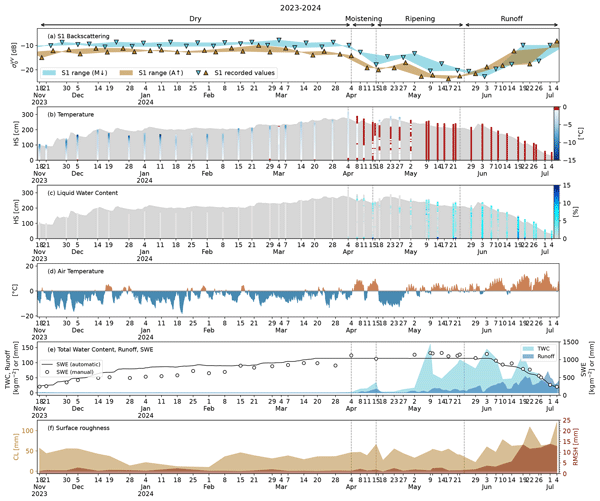
This work presents the first high-resolution dataset of wet-snow properties for satellite applications. With it, we validate links between Sentinel-1 backscatter and snowmelt stages and investigate scattering mechanisms through a radiative transfer model. We disclose the influence of liquid water content and surface roughness at different melting stages and address future challenges, such as capturing large-scale scattering mechanisms and enhancing radiative transfer modules for wet snow.
Riccardo Barella, Mathias Bavay, Francesca Carletti, Nicola Ciapponi, Valentina Premier, and Carlo Marin
The Cryosphere, 18, 5323–5345, https://doi.org/10.5194/tc-18-5323-2024, https://doi.org/10.5194/tc-18-5323-2024, 2024
Short summary
Short summary
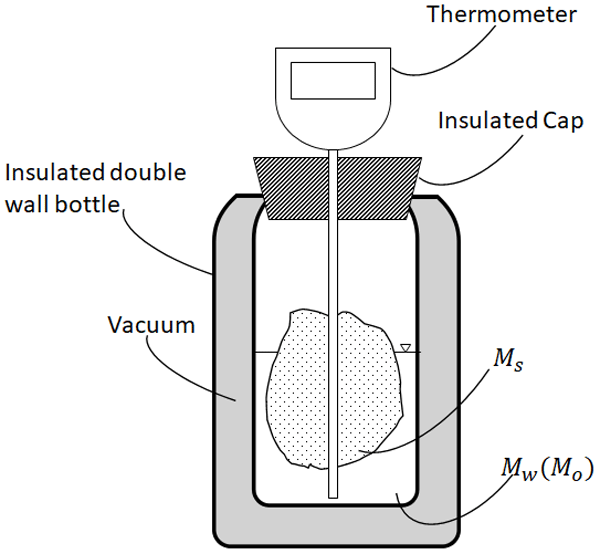
This research revisits a classic scientific technique, melting calorimetry, to measure snow liquid water content. This study shows with a novel uncertainty propagation framework that melting calorimetry, traditionally less trusted than freezing calorimetry, can produce accurate results. The study defines optimal experiment parameters and a robust field protocol. Melting calorimetry has the potential to become a valuable tool for validating other liquid water content measuring techniques.
Riccardo Barella, Mathias Bavay, Francesca Carletti, Nicola Ciapponi, Valentina Premier, and Carlo Marin
EGUsphere, https://doi.org/10.5194/egusphere-2023-2892, https://doi.org/10.5194/egusphere-2023-2892, 2024
Preprint archived
Short summary
Short summary
Unlocking the potential of melting calorimetry, traditionally confined to school labs, this paper demonstrates its application in the field for accurate measurement of liquid water content in snow. Dispelling misconceptions about measurement uncertainty, it provide a robust protocol and quantifies associated uncertainties. The findings endorse the broader adoption of melting calorimetry for quantification of snow liquid water content in operational context.

Francesca Carletti, Adrien Michel, Francesca Casale, Alice Burri, Daniele Bocchiola, Mathias Bavay, and Michael Lehning
Hydrol. Earth Syst. Sci., 26, 3447–3475, https://doi.org/10.5194/hess-26-3447-2022, https://doi.org/10.5194/hess-26-3447-2022, 2022
Short summary
Short summary
High Alpine catchments are dominated by the melting of seasonal snow cover and glaciers, whose amount and seasonality are expected to be modified by climate change. This paper compares the performances of different types of models in reproducing discharge among two catchments under present conditions and climate change. Despite many advantages, the use of simpler models for climate change applications is controversial as they do not fully represent the physics of the involved processes.
Tiziana Lazzarina Zendrini, Luca Carturan, Michael Lehning, Mathias Bavay, Federico Cazorzi, Paolo Gabrielli, Nander Wever, and Giancarlo Dalla Fontana
The Cryosphere, 20, 5199–5224, https://doi.org/10.5194/tc-20-5199-2026, https://doi.org/10.5194/tc-20-5199-2026, 2026
Short summary
Short summary
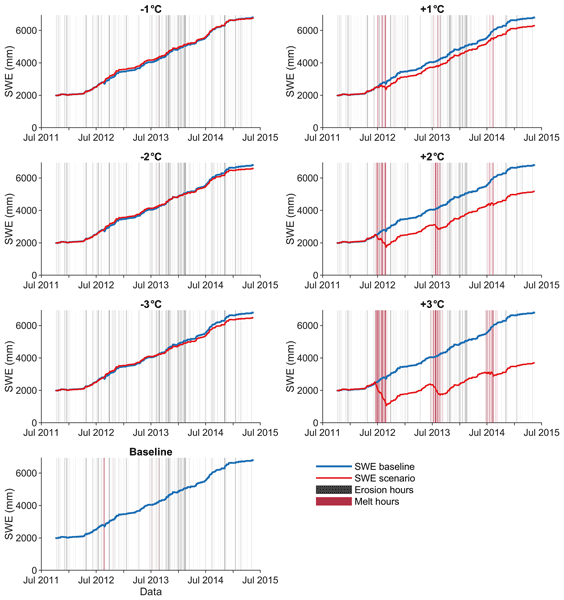
By combining in situ mass balance data with a physics‐based snow model at Mt. Ortles, in the Italian Alps, we investigate snow accumulation, erosion and melt processes, and their sensitivity to air temperature. We found that wind erosion is currently the major ablation process at this high-elevation site, whereas melt plays a minor role. Quickly rising air temperature is affecting this partitioning and suggests a future shift from an erosion-dominated to a melt-dominated mass balance regime.
Leah Gaillard Festa, Bettina Richter, Lars Mewes, Matthias Jaggi, and Benjamin Walter
EGUsphere, https://doi.org/10.5194/egusphere-2026-4846, https://doi.org/10.5194/egusphere-2026-4846, 2026
This preprint is open for discussion and under review for The Cryosphere (TC).
Short summary
Short summary
We studied snow changes through winter using the SnowMicroPen, which precisely measures snow density and specific surface area. Based on 10 years of daily measurements, we tracked how these properties evolved throughout winter. We found that the RHOSSA parametrization, developed from one winter, performs well across a wider range of conditions. Accounting for instrument biases and temperature effects improves the results and the use of this unique time series.
Gwendolyn Dasser, Valentin T. Bickel, Marius Rüetschi, Mylène Jacquemart, Mathias Bavay, Elisabeth Hafner-Aeschbacher, Alec van Herwijnen, David Small, and Andrea Manconi
The Cryosphere, 20, 4811–4837, https://doi.org/10.5194/tc-20-4811-2026, https://doi.org/10.5194/tc-20-4811-2026, 2026
Short summary
Short summary
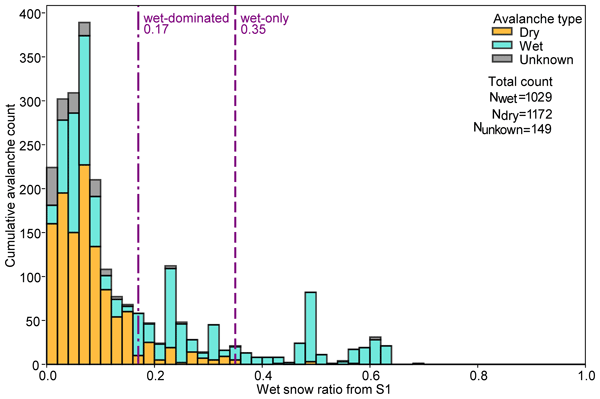
Understanding snowpack wetness is key to predicting wet snow avalanche releases, but detailed data is often limited. Using satellite radar, we monitored snowmelt over several seasons. We extracted a wet snow ratio threshold where the change from dry to wet snow avalanche dominated conditions is expected. By using local resolution weighting composites, we improved spatial resolution and showed our product to be more feasible for use in practice than the publicly available SAR Wet Snow layer.
Isabella Anglin, Adriaan J. Teuling, Marius G. Floriancic, Michael Lehning, and Harsh Beria
EGUsphere, https://doi.org/10.5194/egusphere-2026-4268, https://doi.org/10.5194/egusphere-2026-4268, 2026
Short summary
Short summary
Snow sublimation is the direct vapor loss of snow to the atmosphere, reducing spring snowmelt that recharges soils, groundwater, and rivers. Using eddy-covariance measurements over a full winter in the eastern Swiss Alps, we found that sublimation removed about 25 mm of water, or nearly 6 % of the season’s peak snow water storage. Sublimation losses were highest late in the season, showing that this hidden process can meaningfully reduce mountain water supplies.
Pia Ruttner, Nora Helbig, Annelies Voordendag, Andreas Wieser, and Yves Bühler
The Cryosphere, 20, 4185–4208, https://doi.org/10.5194/tc-20-4185-2026, https://doi.org/10.5194/tc-20-4185-2026, 2026
Short summary
Short summary
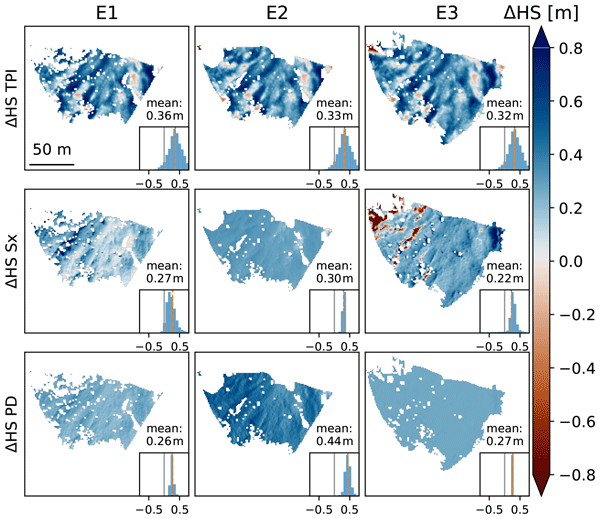
The spatial variability of snow depth distribution in avalanche release areas is key for avalanche forecasting but is strongly influenced by the interaction of wind with the terrain. We generate maps of high resolution snow depth changes during three snowfall events by using low-cost terrestrial laser scanner measurements and compare them to the results of selected snow depth distribution models. We show that basic terrain derivations have the highest correlations to our measurement results.
Shaakir Dar, Olga Silantyeva, Pertti Ala-aho, Benjamin Walter, John Hult, Valtteri Hyöky, Jeffrey Welker, and Hannu Marttila
EGUsphere, https://doi.org/10.5194/egusphere-2026-2589, https://doi.org/10.5194/egusphere-2026-2589, 2026
Short summary
Short summary
Snow can lose water directly to the air, but this process also changes the natural chemical fingerprints stored in snow. We used controlled wind-tunnel experiments with different snow types and airflow conditions to test why these changes vary. We found that wind controls how much snow is lost, but snow structure controls how strongly its fingerprints change. This means climate, water, and ice-record studies may misread snow signals if they ignore snow structure.
Mahdi Jafari and Michael Lehning
The Cryosphere, 20, 2439–2467, https://doi.org/10.5194/tc-20-2439-2026, https://doi.org/10.5194/tc-20-2439-2026, 2026
Short summary
Short summary
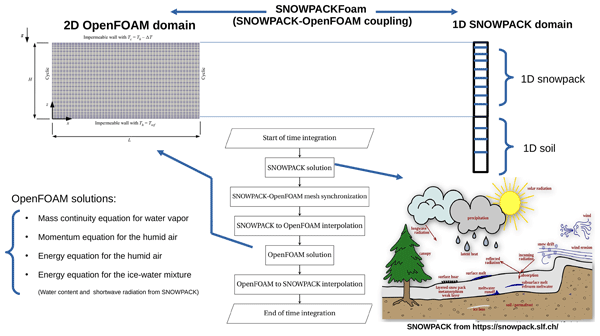
We studied how air moves within snow in Arctic regions and how this affects the snow's structure. Using a new method that links two computer models, we found that cold weather can trigger air movement inside the snow, creating vertical channels and changing the snow's density and temperature. These changes are not captured by traditional models, so our work helps improve how snow and climate processes are simulated in cold environments.
Samuele Viaro, Armin Sigmund, Evan Thomas, and Michael Lehning
EGUsphere, https://doi.org/10.5194/egusphere-2026-2132, https://doi.org/10.5194/egusphere-2026-2132, 2026
Preprint archived
Short summary
Short summary
Our research focuses in understanding snow processes at the surface-atmosphere interface, and their influence at larger scales. The use of our advanced numerical model, which includes blowing snow equations, proved to be valuable in predicting the observed ice crystal concentration number at an alpine site. We further demonstrate the effect of blowing snow particles in precipitation and erosion-deposition patterns. Finally, secondary ice production mechanisms are also treated.
Brandon Jacobus Adrianus van Schaik, Alice Juliette Baruzier, Clément Loyer, Hendrik Huwald, and Michael Lehning
Wind Energ. Sci. Discuss., https://doi.org/10.5194/wes-2025-271, https://doi.org/10.5194/wes-2025-271, 2025
Preprint under review for WES
Short summary
Short summary
We created a new way to estimate how much energy a wind turbine can produce by using the full change of wind with height instead of a single measurement. Testing it on turbines in the Swiss Alps showed that it predicts energy production more accurately and smoothly than current industry methods. It performs as well as advanced models but is much faster, helping guide future wind projects in complex landscapes.
Francesca Carletti, Carlo Marin, Chiara Ghielmini, Mathias Bavay, and Michael Lehning
The Cryosphere, 19, 5579–5612, https://doi.org/10.5194/tc-19-5579-2025, https://doi.org/10.5194/tc-19-5579-2025, 2025
Short summary
Short summary
This work presents the first high-resolution dataset of wet-snow properties for satellite applications. With it, we validate links between Sentinel-1 backscatter and snowmelt stages and investigate scattering mechanisms through a radiative transfer model. We disclose the influence of liquid water content and surface roughness at different melting stages and address future challenges, such as capturing large-scale scattering mechanisms and enhancing radiative transfer modules for wet snow.
Hongxiang Yu, Li Guang, Benjamin Walter, Jianping Huang, Ning Huang, and Michael Lehning
The Cryosphere, 19, 5389–5402, https://doi.org/10.5194/tc-19-5389-2025, https://doi.org/10.5194/tc-19-5389-2025, 2025
Short summary
Short summary
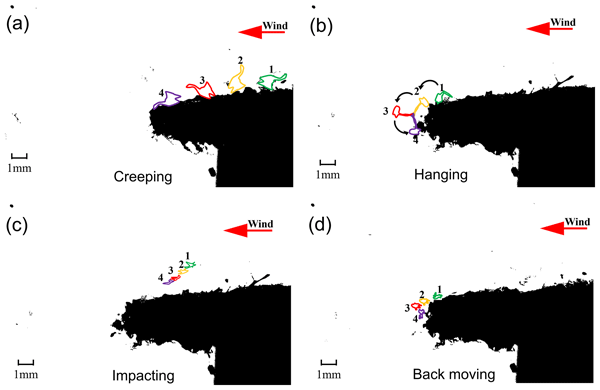
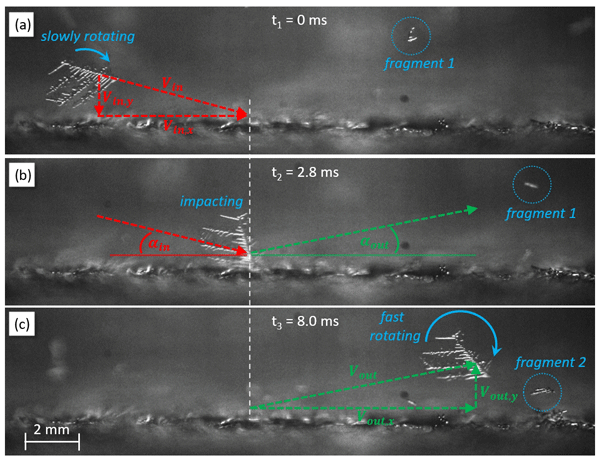
Cornices are overhanging snow accumulations that form on mountain crests. Using wind-tunnel experiments and high-speed photography, the study tracks particle trajectories around cornices and finds distinct differences between edge and surface deposition. A static adhesion model for edge deposition was developed and validated to predict how particle size and shape affect adhesion. The work clarifies the microdynamics of early cornice growth and provides a foundation for avalanche modeling.
Elizaveta Sharaborova, Michael Lehning, Nander Wever, Marcia Phillips, and Hendrik Huwald
The Cryosphere, 19, 4277–4301, https://doi.org/10.5194/tc-19-4277-2025, https://doi.org/10.5194/tc-19-4277-2025, 2025
Short summary
Short summary
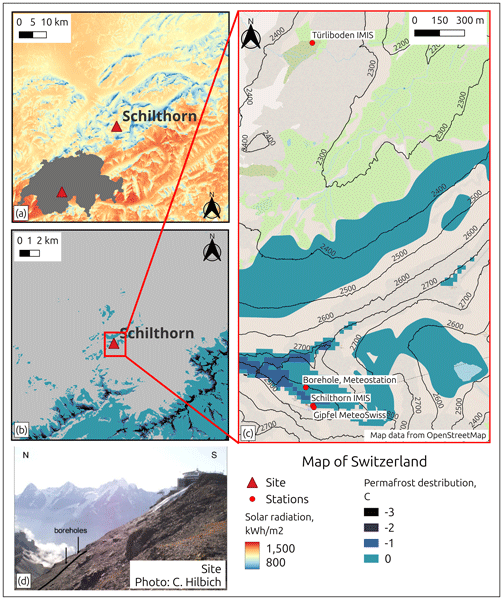
Global warming provokes permafrost to thaw, damaging landscapes and infrastructure. This study explores methods to slow this thawing at an alpine site. We investigate different methods based on passive and active cooling. The best approach mixes both methods and manages heat flow, potentially allowing excess energy to be used locally.
Ella Gilbert, Denis Pishniak, José Abraham Torres, Andrew Orr, Michelle Maclennan, Nander Wever, and Kristiina Verro
The Cryosphere, 19, 597–618, https://doi.org/10.5194/tc-19-597-2025, https://doi.org/10.5194/tc-19-597-2025, 2025
Short summary
Short summary
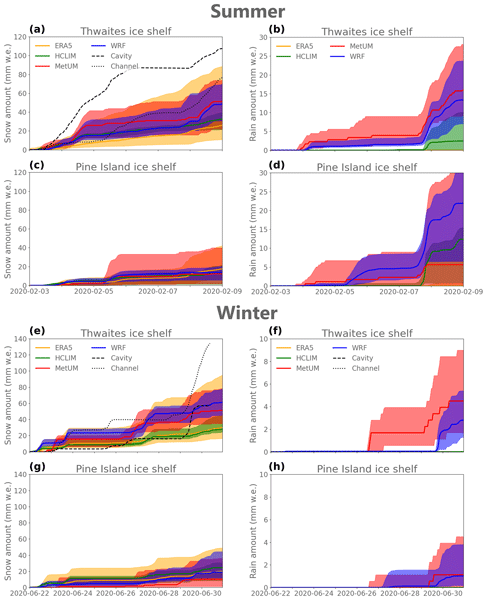
We use three sophisticated climate models to examine extreme precipitation in a critical region of West Antarctica. We found that rainfall probably occurred during the two cases we examined and that it was generated by the interaction of air with steep topography. Our results show that kilometre-scale models are useful tools for exploring extreme precipitation in this region and that more observations of rainfall are needed.
Riccardo Barella, Mathias Bavay, Francesca Carletti, Nicola Ciapponi, Valentina Premier, and Carlo Marin
The Cryosphere, 18, 5323–5345, https://doi.org/10.5194/tc-18-5323-2024, https://doi.org/10.5194/tc-18-5323-2024, 2024
Short summary
Short summary
This research revisits a classic scientific technique, melting calorimetry, to measure snow liquid water content. This study shows with a novel uncertainty propagation framework that melting calorimetry, traditionally less trusted than freezing calorimetry, can produce accurate results. The study defines optimal experiment parameters and a robust field protocol. Melting calorimetry has the potential to become a valuable tool for validating other liquid water content measuring techniques.
Sonja Wahl, Benjamin Walter, Franziska Aemisegger, Luca Bianchi, and Michael Lehning
The Cryosphere, 18, 4493–4515, https://doi.org/10.5194/tc-18-4493-2024, https://doi.org/10.5194/tc-18-4493-2024, 2024
Short summary
Short summary
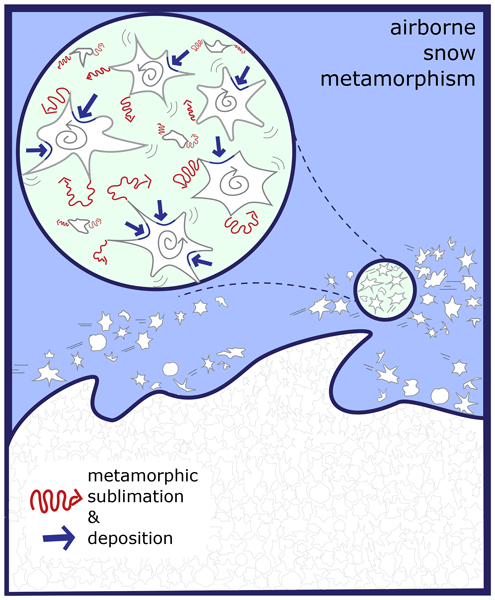
Wind-driven airborne transport of snow is a frequent phenomenon in snow-covered regions and a process difficult to study in the field as it is unfolding over large distances. Thus, we use a ring wind tunnel with infinite fetch positioned in a cold laboratory to study the evolution of the shape and size of airborne snow. With the help of stable water isotope analyses, we identify the hitherto unobserved process of airborne snow metamorphism that leads to snow particle rounding and growth.
Dylan Reynolds, Louis Quéno, Michael Lehning, Mahdi Jafari, Justine Berg, Tobias Jonas, Michael Haugeneder, and Rebecca Mott
The Cryosphere, 18, 4315–4333, https://doi.org/10.5194/tc-18-4315-2024, https://doi.org/10.5194/tc-18-4315-2024, 2024
Short summary
Short summary
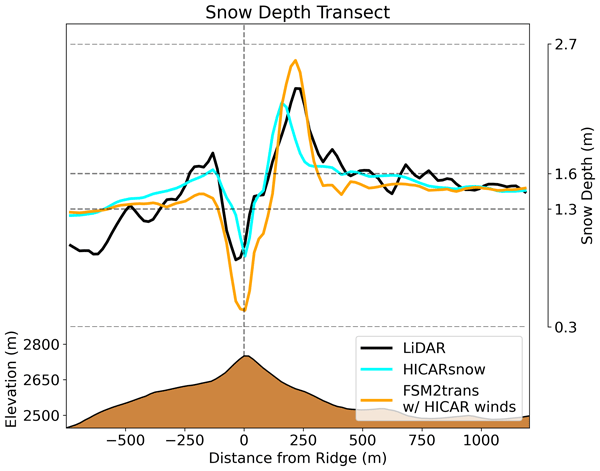
Information about atmospheric variables is needed to produce simulations of mountain snowpacks. We present a model that can represent processes that shape mountain snowpack, focusing on the accumulation of snow. Simulations show that this model can simulate the complex path that a snowflake takes towards the ground and that this leads to differences in the distribution of snow by the end of winter. Overall, this model shows promise with regard to improving forecasts of snow in mountains.
Benjamin Walter, Hagen Weigel, Sonja Wahl, and Henning Löwe
The Cryosphere, 18, 3633–3652, https://doi.org/10.5194/tc-18-3633-2024, https://doi.org/10.5194/tc-18-3633-2024, 2024
Short summary
Short summary
The topmost layer of a snowpack forms the interface to the atmosphere and is critical for the reflectance of solar radiation and avalanche formation. The effect of wind on the surface snow microstructure during precipitation events is poorly understood and quantified. We performed controlled lab experiments in a ring wind tunnel to systematically quantify the snow microstructure for different wind speeds, temperatures and precipitation intensities and to identify the relevant processes.
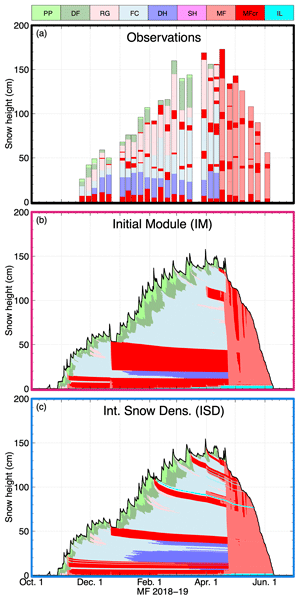
Benjamin Bouchard, Daniel F. Nadeau, Florent Domine, Nander Wever, Adrien Michel, Michael Lehning, and Pierre-Erik Isabelle
The Cryosphere, 18, 2783–2807, https://doi.org/10.5194/tc-18-2783-2024, https://doi.org/10.5194/tc-18-2783-2024, 2024
Short summary
Short summary
Observations over several winters at two boreal sites in eastern Canada show that rain-on-snow (ROS) events lead to the formation of melt–freeze layers and that preferential flow is an important water transport mechanism in the sub-canopy snowpack. Simulations with SNOWPACK generally show good agreement with observations, except for the reproduction of melt–freeze layers. This was improved by simulating intercepted snow microstructure evolution, which also modulates ROS-induced runoff.
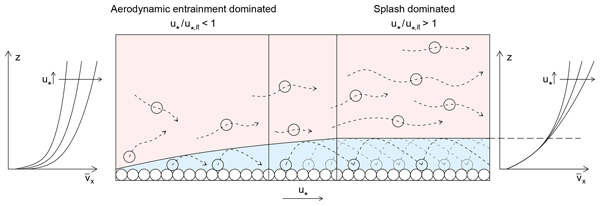
Daniela Brito Melo, Armin Sigmund, and Michael Lehning
The Cryosphere, 18, 1287–1313, https://doi.org/10.5194/tc-18-1287-2024, https://doi.org/10.5194/tc-18-1287-2024, 2024
Short summary
Short summary
Snow saltation – the transport of snow close to the surface – occurs when the wind blows over a snow-covered surface with sufficient strength. This phenomenon is represented in some climate models; however, with limited accuracy. By performing numerical simulations and a detailed analysis of previous works, we show that snow saltation is characterized by two regimes. This is not represented in climate models in a consistent way, which hinders the quantification of snow transport and sublimation.
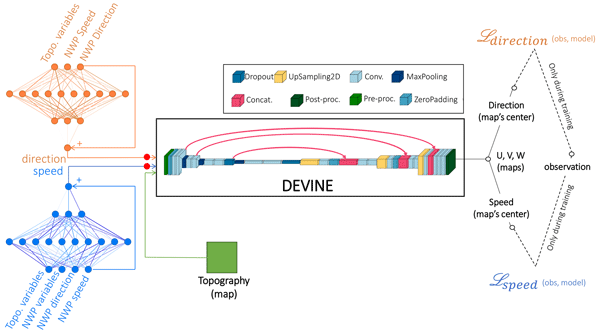
Louis Le Toumelin, Isabelle Gouttevin, Clovis Galiez, and Nora Helbig
Nonlin. Processes Geophys., 31, 75–97, https://doi.org/10.5194/npg-31-75-2024, https://doi.org/10.5194/npg-31-75-2024, 2024
Short summary
Short summary
Forecasting wind fields over mountains is of high importance for several applications and particularly for understanding how wind erodes and disperses snow. Forecasters rely on operational wind forecasts over mountains, which are currently only available on kilometric scales. These forecasts can also be affected by errors of diverse origins. Here we introduce a new strategy based on artificial intelligence to correct large-scale wind forecasts in mountains and increase their spatial resolution.
Riccardo Barella, Mathias Bavay, Francesca Carletti, Nicola Ciapponi, Valentina Premier, and Carlo Marin
EGUsphere, https://doi.org/10.5194/egusphere-2023-2892, https://doi.org/10.5194/egusphere-2023-2892, 2024
Preprint archived
Short summary
Short summary
Unlocking the potential of melting calorimetry, traditionally confined to school labs, this paper demonstrates its application in the field for accurate measurement of liquid water content in snow. Dispelling misconceptions about measurement uncertainty, it provide a robust protocol and quantifies associated uncertainties. The findings endorse the broader adoption of melting calorimetry for quantification of snow liquid water content in operational context.
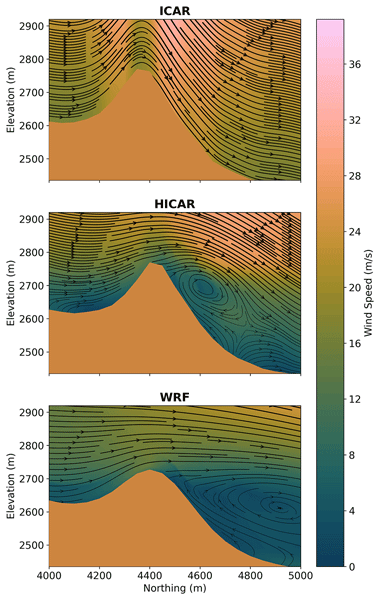
Dylan Reynolds, Ethan Gutmann, Bert Kruyt, Michael Haugeneder, Tobias Jonas, Franziska Gerber, Michael Lehning, and Rebecca Mott
Geosci. Model Dev., 16, 5049–5068, https://doi.org/10.5194/gmd-16-5049-2023, https://doi.org/10.5194/gmd-16-5049-2023, 2023
Short summary
Short summary
The challenge of running geophysical models is often compounded by the question of where to obtain appropriate data to give as input to a model. Here we present the HICAR model, a simplified atmospheric model capable of running at spatial resolutions of hectometers for long time series or over large domains. This makes physically consistent atmospheric data available at the spatial and temporal scales needed for some terrestrial modeling applications, for example seasonal snow forecasting.
Eric Keenan, Nander Wever, Jan T. M. Lenaerts, and Brooke Medley
Geosci. Model Dev., 16, 3203–3219, https://doi.org/10.5194/gmd-16-3203-2023, https://doi.org/10.5194/gmd-16-3203-2023, 2023
Short summary
Short summary
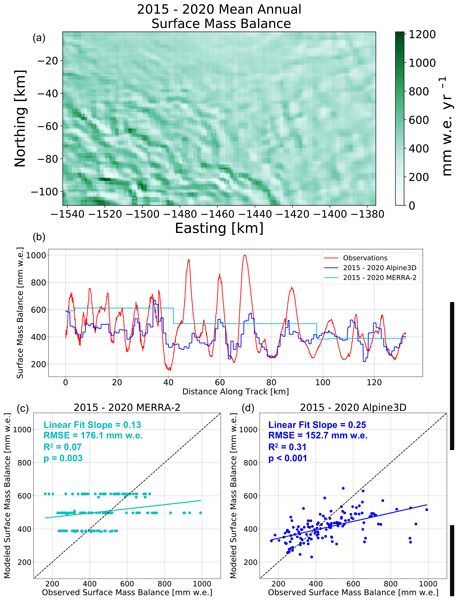
Ice sheets gain mass via snowfall. However, snowfall is redistributed by the wind, resulting in accumulation differences of up to a factor of 5 over distances as short as 5 km. These differences complicate estimates of ice sheet contribution to sea level rise. For this reason, we have developed a new model for estimating wind-driven snow redistribution on ice sheets. We show that, over Pine Island Glacier in West Antarctica, the model improves estimates of snow accumulation variability.
Megan Thompson-Munson, Nander Wever, C. Max Stevens, Jan T. M. Lenaerts, and Brooke Medley
The Cryosphere, 17, 2185–2209, https://doi.org/10.5194/tc-17-2185-2023, https://doi.org/10.5194/tc-17-2185-2023, 2023
Short summary
Short summary
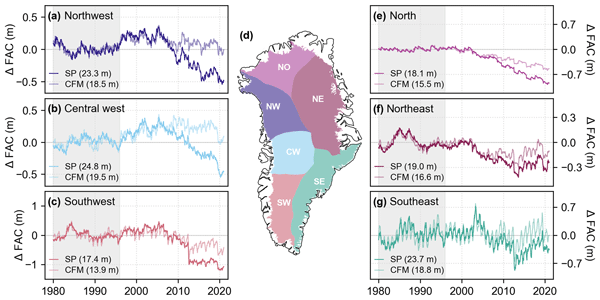
To better understand the Greenland Ice Sheet’s firn layer and its ability to buffer sea level rise by storing meltwater, we analyze firn density observations and output from two firn models. We find that both models, one physics-based and one semi-empirical, simulate realistic density and firn air content when compared to observations. The models differ in their representation of firn air content, highlighting the uncertainty in physical processes and the paucity of deep-firn measurements.
Michelle L. Maclennan, Jan T. M. Lenaerts, Christine A. Shields, Andrew O. Hoffman, Nander Wever, Megan Thompson-Munson, Andrew C. Winters, Erin C. Pettit, Theodore A. Scambos, and Jonathan D. Wille
The Cryosphere, 17, 865–881, https://doi.org/10.5194/tc-17-865-2023, https://doi.org/10.5194/tc-17-865-2023, 2023
Short summary
Short summary
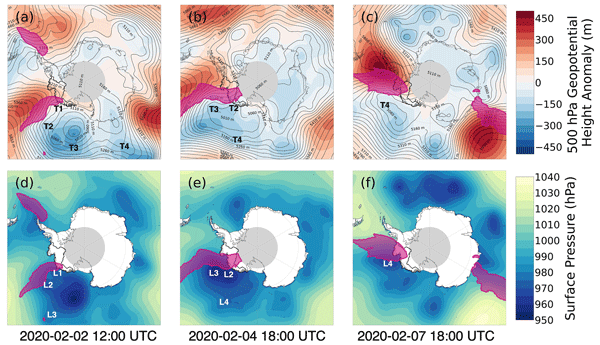
Atmospheric rivers are air masses that transport large amounts of moisture and heat towards the poles. Here, we use a combination of weather observations and models to quantify the amount of snowfall caused by atmospheric rivers in West Antarctica which is about 10 % of the total snowfall each year. We then examine a unique event that occurred in early February 2020, when three atmospheric rivers made landfall over West Antarctica in rapid succession, leading to heavy snowfall and surface melt.

Hongxiang Yu, Guang Li, Benjamin Walter, Michael Lehning, Jie Zhang, and Ning Huang
The Cryosphere, 17, 639–651, https://doi.org/10.5194/tc-17-639-2023, https://doi.org/10.5194/tc-17-639-2023, 2023
Short summary
Short summary
Snow cornices lead to the potential risk of causing snow avalanche hazards, which are still unknown so far. We carried out a wind tunnel experiment in a cold lab to investigate the environmental conditions for snow cornice accretion recorded by a camera. The length growth rate of the cornices reaches a maximum for wind speeds approximately 40 % higher than the threshold wind speed. Experimental results improve our understanding of the cornice formation process.
Varun Sharma, Franziska Gerber, and Michael Lehning
Geosci. Model Dev., 16, 719–749, https://doi.org/10.5194/gmd-16-719-2023, https://doi.org/10.5194/gmd-16-719-2023, 2023
Short summary
Short summary
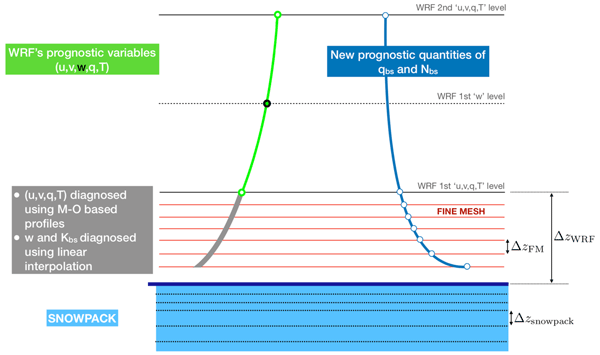
Most current generation climate and weather models have a relatively simplistic description of snow and snow–atmosphere interaction. One reason for this is the belief that including an advanced snow model would make the simulations too computationally demanding. In this study, we bring together two state-of-the-art models for atmosphere (WRF) and snow cover (SNOWPACK) and highlight both the feasibility and necessity of such coupled models to explore underexplored phenomena in the cryosphere.
Nicole Clerx, Horst Machguth, Andrew Tedstone, Nicolas Jullien, Nander Wever, Rolf Weingartner, and Ole Roessler
The Cryosphere, 16, 4379–4401, https://doi.org/10.5194/tc-16-4379-2022, https://doi.org/10.5194/tc-16-4379-2022, 2022
Short summary
Short summary
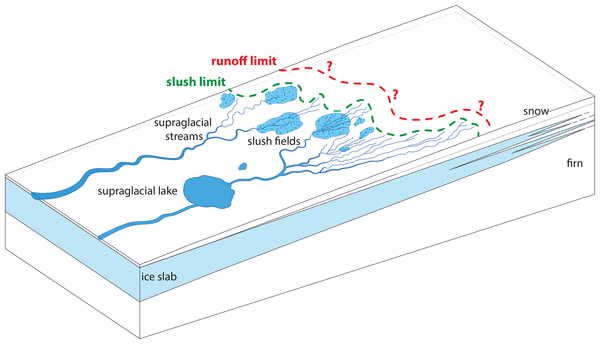
Meltwater runoff is one of the main contributors to mass loss on the Greenland Ice Sheet that influences global sea level rise. However, it remains unclear where meltwater runs off and what processes cause this. We measured the velocity of meltwater flow through snow on the ice sheet, which ranged from 0.17–12.8 m h−1 for vertical percolation and from 1.3–15.1 m h−1 for lateral flow. This is an important step towards understanding where, when and why meltwater runoff occurs on the ice sheet.
Océane Hames, Mahdi Jafari, David Nicholas Wagner, Ian Raphael, David Clemens-Sewall, Chris Polashenski, Matthew D. Shupe, Martin Schneebeli, and Michael Lehning
Geosci. Model Dev., 15, 6429–6449, https://doi.org/10.5194/gmd-15-6429-2022, https://doi.org/10.5194/gmd-15-6429-2022, 2022
Short summary
Short summary
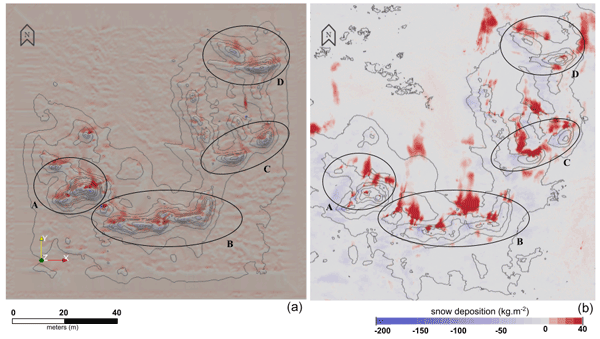
This paper presents an Eulerian–Lagrangian snow transport model implemented in the fluid dynamics software OpenFOAM, which we call snowBedFoam 1.0. We apply this model to reproduce snow deposition on a piece of ridged Arctic sea ice, which was produced during the MOSAiC expedition through scan measurements. The model appears to successfully reproduce the enhanced snow accumulation and deposition patterns, although some quantitative uncertainties were shown.
Francesca Carletti, Adrien Michel, Francesca Casale, Alice Burri, Daniele Bocchiola, Mathias Bavay, and Michael Lehning
Hydrol. Earth Syst. Sci., 26, 3447–3475, https://doi.org/10.5194/hess-26-3447-2022, https://doi.org/10.5194/hess-26-3447-2022, 2022
Short summary
Short summary
High Alpine catchments are dominated by the melting of seasonal snow cover and glaciers, whose amount and seasonality are expected to be modified by climate change. This paper compares the performances of different types of models in reproducing discharge among two catchments under present conditions and climate change. Despite many advantages, the use of simpler models for climate change applications is controversial as they do not fully represent the physics of the involved processes.
David N. Wagner, Matthew D. Shupe, Christopher Cox, Ola G. Persson, Taneil Uttal, Markus M. Frey, Amélie Kirchgaessner, Martin Schneebeli, Matthias Jaggi, Amy R. Macfarlane, Polona Itkin, Stefanie Arndt, Stefan Hendricks, Daniela Krampe, Marcel Nicolaus, Robert Ricker, Julia Regnery, Nikolai Kolabutin, Egor Shimanshuck, Marc Oggier, Ian Raphael, Julienne Stroeve, and Michael Lehning
The Cryosphere, 16, 2373–2402, https://doi.org/10.5194/tc-16-2373-2022, https://doi.org/10.5194/tc-16-2373-2022, 2022
Short summary
Short summary
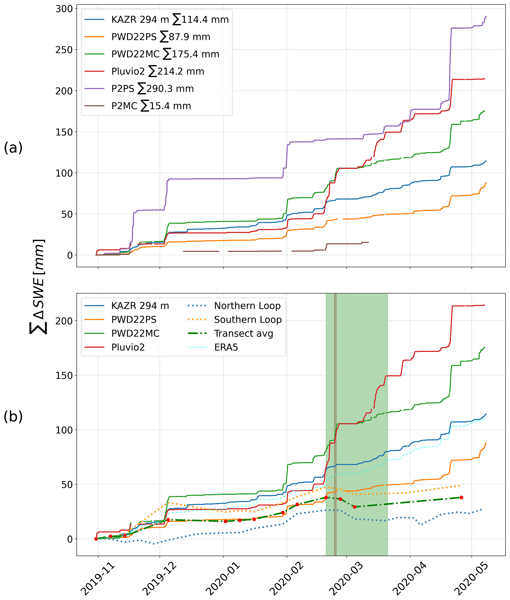
Based on measurements of the snow cover over sea ice and atmospheric measurements, we estimate snowfall and snow accumulation for the MOSAiC ice floe, between November 2019 and May 2020. For this period, we estimate 98–114 mm of precipitation. We suggest that about 34 mm of snow water equivalent accumulated until the end of April 2020 and that at least about 50 % of the precipitated snow was eroded or sublimated. Further, we suggest explanations for potential snowfall overestimation.
Joel Fiddes, Kristoffer Aalstad, and Michael Lehning
Geosci. Model Dev., 15, 1753–1768, https://doi.org/10.5194/gmd-15-1753-2022, https://doi.org/10.5194/gmd-15-1753-2022, 2022
Short summary
Short summary
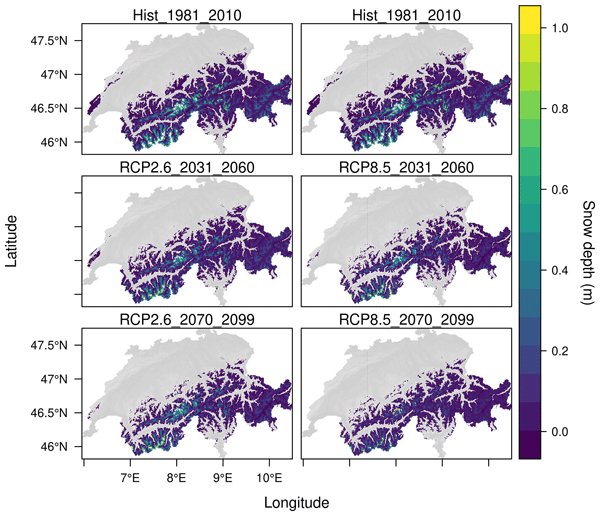
This study describes and evaluates a new downscaling scheme that addresses the need for hillslope-scale atmospheric forcing time series for modelling the local impact of regional climate change on the land surface in mountain areas. The method has a global scope and is able to generate all model forcing variables required for hydrological and land surface modelling. This is important, as impact models require high-resolution forcings such as those generated here to produce meaningful results.
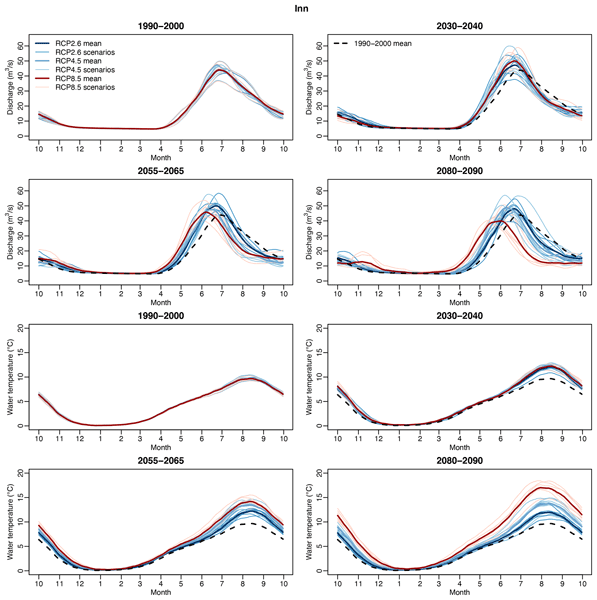
Adrien Michel, Bettina Schaefli, Nander Wever, Harry Zekollari, Michael Lehning, and Hendrik Huwald
Hydrol. Earth Syst. Sci., 26, 1063–1087, https://doi.org/10.5194/hess-26-1063-2022, https://doi.org/10.5194/hess-26-1063-2022, 2022
Short summary
Short summary
This study presents an extensive study of climate change impacts on river temperature in Switzerland. Results show that, even for low-emission scenarios, water temperature increase will lead to adverse effects for both ecosystems and socio-economic sectors throughout the 21st century. For high-emission scenarios, the effect will worsen. This study also shows that water seasonal warming will be different between the Alpine regions and the lowlands. Finally, efficiency of models is assessed.
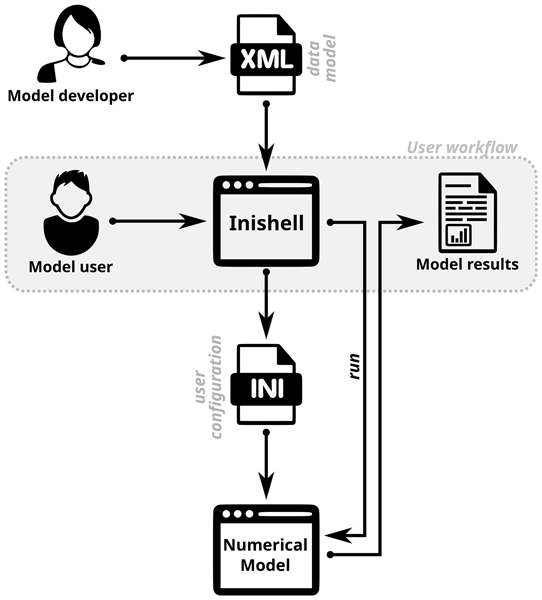
Mathias Bavay, Michael Reisecker, Thomas Egger, and Daniela Korhammer
Geosci. Model Dev., 15, 365–378, https://doi.org/10.5194/gmd-15-365-2022, https://doi.org/10.5194/gmd-15-365-2022, 2022
Short summary
Short summary
Most users struggle with the configuration of numerical models. This can be improved by relying on a GUI, but this requires a significant investment and a specific skill set and does not fit with the daily duties of model developers, leading to major maintenance burdens. Inishell generates a GUI on the fly based on an XML description of the required configuration elements, making maintenance very simple. This concept has been shown to work very well in our context.
Cited articles
Amory, C., Gallée, H., Naaim-Bouvet, F., Favier, V., Vignon, E., Picard, G., Trouvilliez, A., Piard, L., Genthon, C., and Bellot, H.: Seasonal variations in drag coefficient over a Sastrugi-covered snowfield in coastal east Antarctica, Bound.-Lay. Meteorol., 164, 107–133, https://doi.org/10.1007/s10546-017-0242-5, 2017. a, b, c, d
Anderson, G. P., Clough, S. A., Kneizys, F. X., Chetwynd, J. H., and Shettle, E. P.: AFGL Atmospheric Constituent Profiles (0–120 km), Environmental Research Papers No. 954 AFGL-TR-86-0110, Air Force Geophysics Lab., Hanscom AFB, MA, USA, DTIC ADA175173, 1986. a
Armstrong, R. L. and Brodzik, M. J.: Recent northern hemisphere snow extent: a comparison of data derived from visible and microwave satellite sensors, Geophys. Res. Lett., 28, 3673–3676, https://doi.org/10.1029/2000GL012556, 2001. a
Bair, E. H., Dozier, J., Davis, R. E., Colee, M. T., and Claffey, K. J.: CUES – a study site for measuring snowpack energy balance in the Sierra Nevada, Front. Earth Sci., 3, https://doi.org/10.3389/feart.2015.00058, 2015. a
Bair, E. H., Rittger, K., Davis, R. E., Painter, T. H., and Dozier, J.: Validating reconstruction of snow water equivalent in California's Sierra Nevada using measurements from the NASA Airborne Snow Observatory, Water Resour. Res., 52, 8437–8460, https://doi.org/10.1002/2016WR018704, 2016. a
Bair, E. H., Dozier, J., Stern, C., LeWinter, A., Rittger, K., Savagian, A., Stillinger, T., and Davis, R. E.: Divergence of apparent and intrinsic snow albedo over a season at a sub-alpine site with implications for remote sensing, The Cryosphere, 16, 1765–1778, https://doi.org/10.5194/tc-16-1765-2022, 2022. a, b, c, d, e, f, g, h
Bartelt, P. and Lehning, M.: A physical SNOWPACK model for the Swiss avalanche warning: Part I: numerical model, Cold Reg. Sci. Technol., 35, 123–145, https://doi.org/10.1016/S0165-232X(02)00074-5, 2002. a
Bavay, M. and Egger, T.: MeteoIO 2.4.2: a preprocessing library for meteorological data, Geosci. Model Dev., 7, 3135–3151, https://doi.org/10.5194/gmd-7-3135-2014, 2014. a
Bavay, M. and Theile, T.: Optimal dataset: combination of AWS data at Weissfluhjoch Versuchsfeld in order to get the best possible forcings for snow cover and snow hydrology modeling (Version 1.0), Zenodo [data set], https://doi.org/10.5281/zenodo.22304449, 2026. a, b
Betterton, M. D.: Theory of structure formation in snowfields motivated by penitentes, suncups, and dirt cones, Phys. Rev. E, 63, 056129, https://doi.org/10.1103/PhysRevE.63.056129, 2001. a, b, c, d
Bond, T. C. and Bergstrom, R. W.: Light absorption by carbonaceous particles: an investigative review, Aerosol Sci. Tech., 40, 27–67, https://doi.org/10.1080/02786820500421521, 2006. a
Brun, E.: Investigation on wet-snow metamorphism in respect of liquid-water content, Ann. Glaciol., 13, 22–26, https://doi.org/10.3189/S0260305500007576, 1989. a
Calonne, N., Richter, B., Löwe, H., Cetti, C., ter Schure, J., Van Herwijnen, A., Fierz, C., Jaggi, M., and Schneebeli, M.: The RHOSSA campaign: multi-resolution monitoring of the seasonal evolution of the structure and mechanical stability of an alpine snowpack, The Cryosphere, 14, 1829–1848, https://doi.org/10.5194/tc-14-1829-2020, 2020. a, b
Caponi, L., Formenti, P., Massabó, D., Di Biagio, C., Cazaunau, M., Pangui, E., Chevaillier, S., Landrot, G., Andreae, M. O., Kandler, K., Piketh, S., Saeed, T., Seibert, D., Williams, E., Balkanski, Y., Prati, P., and Doussin, J.-F.: Spectral- and size-resolved mass absorption efficiency of mineral dust aerosols in the shortwave spectrum: a simulation chamber study, Atmos. Chem. Phys., 17, 7175–7191, https://doi.org/10.5194/acp-17-7175-2017, 2017. a
Carletti, F., Bavay, M., Ghielmini, C., Bonardi, M., Leibersperger, P., Philippe, V. M., Bozzoli, M., Marin, C., Steijn, C., Geiser, M., Bertoldi, G., Grünenfelder, L. N., Premier, V., and Barella, R.: SnowTinel high-temporal-resolution ground truth dataset for SAR remote sensing of snow, EnviDat [data set], https://doi.org/10.16904/envidat.574, 2025a. a, b, c, d
Carletti, F., Marin, C., Ghielmini, C., Bavay, M., and Lehning, M.: Multitemporal analysis of Sentinel-1 backscatter during snowmelt using high-resolution field measurements and radiative transfer modelling, The Cryosphere, 19, 5579–5612, https://doi.org/10.5194/tc-19-5579-2025, 2025b. a, b, c, d
Carletti, F., Walter, B., Bavay, M., Brouet, L., and Allegri, B.: High-elevation alpine snow surface roughness: multi-year manual and LiDAR observations at Weissfluhjoch, EnviDat [data set], https://doi.org/10.16904/envidat.761, 2026. a
Carroll, J. J.: The effect of surface striations on the absorption of shortwave radiation, J. Geophys. Res.-Oceans, 87, 9647–9652, https://doi.org/10.1029/JC087iC12p09647, 1982. a
Chevrollier, L.-A., Cook, J. M., Halbach, L., Jakobsen, H., Benning, L. G., Anesio, A. M., and Tranter, M.: Light absorption and albedo reduction by pigmented microalgae on snow and ice, J. Glaciol., 69, 333–341, https://doi.org/10.1017/jog.2022.64, 2023. a, b, c, d
Corbett, J. and Su, W.: Accounting for the effects of sastrugi in the CERES clear-sky Antarctic shortwave angular distribution models, Atmos. Meas. Tech., 8, 3163–3175, https://doi.org/10.5194/amt-8-3163-2015, 2015. a
Corripio, J. G. and Purves, R. S.: Surface Energy Balance of High Altitude Glaciers in the Central Andes: The Effect of Snow Penitentes, Chap. 3, John Wiley and Sons, Ltd, https://doi.org/10.1002/0470858249.ch3, 15–27, 2005. a
Cuevas-Agulló, E., Barriopedro, D., García, R. D., Alonso-Pérez, S., González-Alemán, J. J., Werner, E., Suárez, D., Bustos, J. J., García-Castrillo, G., García, O., Barreto, Á., and Basart, S.: Sharp increase in Saharan dust intrusions over the western Euro-Mediterranean in February–March 2020–2022 and associated atmospheric circulation, Atmos. Chem. Phys., 24, 4083–4104, https://doi.org/10.5194/acp-24-4083-2024, 2024. a
Di Mauro, B., Garzonio, R., Rossini, M., Filippa, G., Pogliotti, P., Galvagno, M., Morra di Cella, U., Migliavacca, M., Baccolo, G., Clemenza, M., Delmonte, B., Maggi, V., Dumont, M., Tuzet, F., Lafaysse, M., Morin, S., Cremonese, E., and Colombo, R.: Saharan dust events in the European Alps: role in snowmelt and geochemical characterization, The Cryosphere, 13, 1147–1165, https://doi.org/10.5194/tc-13-1147-2019, 2019. a, b
Doherty, S. J., Grenfell, T. C., Forsström, S., Hegg, D. L., Brandt, R. E., and Warren, S. G.: Observed vertical redistribution of black carbon and other insoluble light-absorbing particles in melting snow, J. Geophys. Res.-Atmos., 118, 5553–5569, https://doi.org/10.1002/jgrd.50235, 2013. a, b, c, d, e
Domine, F., Salvatori, R., Legagneux, L., Salzano, R., Fily, M., and Casacchia, R.: Correlation between the specific surface area and the short wave infrared (SWIR) reflectance of snow, Cold Reg. Sci. Technol., 46, 60–68, https://doi.org/10.1016/j.coldregions.2006.06.002, 2006. a
Donahue, C., Skiles, S. M., and Hammonds, K.: Mapping liquid water content in snow at the millimeter scale: an intercomparison of mixed-phase optical property models using hyperspectral imaging and in situ measurements, The Cryosphere, 16, 43–59, https://doi.org/10.5194/tc-16-43-2022, 2022. a, b
Dumont, M., Arnaud, L., Picard, G., Libois, Q., Lejeune, Y., Nabat, P., Voisin, D., and Morin, S.: In situ continuous visible and near-infrared spectroscopy of an alpine snowpack, The Cryosphere, 11, 1091–1110, https://doi.org/10.5194/tc-11-1091-2017, 2017. a, b, c, d
Dumont, M., Gascoin, S., Réveillet, M., Voisin, D., Tuzet, F., Arnaud, L., Bonnefoy, M., Bacardit Peñarroya, M., Carmagnola, C., Deguine, A., Diacre, A., Dürr, L., Evrard, O., Fontaine, F., Frankl, A., Fructus, M., Gandois, L., Gouttevin, I., Gherab, A., Hagenmuller, P., Hansson, S., Herbin, H., Josse, B., Jourdain, B., Lefevre, I., Le Roux, G., Libois, Q., Liger, L., Morin, S., Petitprez, D., Robledano, A., Schneebeli, M., Salze, P., Six, D., Thibert, E., Trachsel, J., Vernay, M., Viallon-Galinier, L., and Voiron, C.: Spatial variability of Saharan dust deposition revealed through a citizen science campaign, Earth Syst. Sci. Data, 15, 3075–3094, https://doi.org/10.5194/essd-15-3075-2023, 2023. a
Emde, C., Buras-Schnell, R., Kylling, A., Mayer, B., Gasteiger, J., Hamann, U., Kylling, J., Richter, B., Pause, C., Dowling, T., and Bugliaro, L.: The libRadtran software package for radiative transfer calculations (version 2.0.1), Geosci. Model Dev., 9, 1647–1672, https://doi.org/10.5194/gmd-9-1647-2016, 2016. a
Fassnacht, S., Williams, M., and Corrao, M.: Changes in the surface roughness of snow from millimetre to metre scales, Ecol. Complex., 6, 221–229, https://doi.org/10.1016/j.ecocom.2009.05.003, 2009. a, b, c, d
Fassnacht, S. R., Toro Velasco, M., Meiman, P. J., and Whitt, Z. C.: The effect of aeolian deposition on the surface roughness of melting snow, Byers Peninsula, Antarctica, Hydrol. Process., 24, 2007–2013, https://doi.org/10.1002/hyp.7661, 2010. a
Fassnacht, S. R., Suzuki, K., Sanow, J. E., Sexstone, G. A., Pfohl, A. K. D., Tedesche, M. E., Simms, B. M., and Thomas, E. S.: Snow surface roughness across spatio-temporal scales, Water-Sui., 15, 2196, https://doi.org/10.3390/w15122196, 2023. a, b
Filhol, S. and Sturm, M.: Snow bedforms: a review, new data, and a formation model, J. Geophys. Res.-Earth, 120, 1645–1669, https://doi.org/10.1002/2015JF003529, 2015. a
Flanner, M. G., Zender, C. S., Randerson, J. T., and Rasch, P. J.: Present-day climate forcing and response from black carbon in snow, J. Geophys. Res.-Atmos., 112, https://doi.org/10.1029/2006JD008003, 2007. a
Flanner, M. G., Shell, K. M., Barlage, M., Perovich, D. K., and Tschudi, M. A.: Radiative forcing and albedo feedback from the Northern Hemisphere cryosphere between 1979 and 2008, Nat. Geosci., 4, 151–155, https://doi.org/10.1038/ngeo1062, 2011. a
Gabbi, J., Huss, M., Bauder, A., Cao, F., and Schwikowski, M.: The impact of Saharan dust and black carbon on albedo and long-term mass balance of an Alpine glacier, The Cryosphere, 9, 1385–1400, https://doi.org/10.5194/tc-9-1385-2015, 2015. a, b, c
Green, R. O., Painter, T. H., Roberts, D. A., and Dozier, J.: Measuring the expressed abundance of the three phases of water with an imaging spectrometer over melting snow, Water Resour. Res., 42, https://doi.org/10.1029/2005WR004509, 2006. a
Grenfell, T. C., Warren, S. G., and Mullen, P. C.: Reflection of solar radiation by the Antarctic snow surface at ultraviolet, visible, and near-infrared wavelengths, J. Geophys. Res.-Atmos., 99, 18669–18684, https://doi.org/10.1029/94JD01484, 1994. a
Helbig, N., Löwe, H., Mayer, B., and Lehning, M.: Explicit validation of a surface shortwave radiation balance model over snow covered complex terrain, J. Geophys. Res.-Atmos., 115, https://doi.org/10.1029/2010jd013970, 2010. a
Huang, C.: Quantification of soil microtopography and surface roughness, in: Fractals in Soil Science, edited by: Baveye, P., Parlange, J.-Y., and Stewart, B. A., Chap. 5, CRC Press, Boca Raton, FL, USA, 153–168, ISBN 978-1-56670-105-1, https://doi.org/10.1201/9781315151052-5, 1998. a
Jahn, A. and Kłapa, M.: On the origin of ablation hollows (polygons) on snow, J. Glaciol., 7, 299–312, https://doi.org/10.3189/S0022143000031063, 1968. a
Kau, D., Greilinger, M., Vukićević, A., Bielecki, J., Kronlachner, L., and Kasper-Giebl, A.: Light-absorbing snow impurities: nine years (2016–2024) of snowpack sampling close to Sonnblick Observatory, Austrian Alps, The Cryosphere, 20, 1619–1633, https://doi.org/10.5194/tc-20-1619-2026, 2026. a, b
Kokhanovsky, A. A.: Light penetration in snow layers, J. Quant. Spectrosc. Ra., 278, 108040, https://doi.org/10.1016/j.jqsrt.2021.108040, 2022. a
Kokhanovsky, A. A. and Zege, E. P.: Scattering optics of snow, Appl. Optics, 43, 1589–1602, https://doi.org/10.1364/AO.43.001589, 2004. a
Kurucz, R. L.: Synthetic infrared spectra, in: Infrared Solar Physics, edited by: Rabin, D. M., Jefferies, J. T., and Lindsey, C., Springer Netherlands, Dordrecht, 523–531, ISBN 978-0-7923-2523-9, https://doi.org/10.1007/978-94-011-1926-9_62, 1994. a
Lacroix, P., Legrésy, B., Langley, K., Hamran, S., Kohler, J., Roques, S., Rémy, F., and Dechambre, M.: In situ measurements of snow surface roughness using a laser profiler, J. Glaciol., 54, 753–762, https://doi.org/10.3189/002214308786570863, 2008. a
Larue, F., Picard, G., Arnaud, L., Ollivier, I., Delcourt, C., Lamare, M., Tuzet, F., Revuelto, J., and Dumont, M.: Snow albedo sensitivity to macroscopic surface roughness using a new ray-tracing model, The Cryosphere, 14, 1651–1672, https://doi.org/10.5194/tc-14-1651-2020, 2020. a, b, c, d, e, f, g, h, i, j, k, l, m, n, o, p, q, r
Lehning, M., Bartelt, P., Brown, B., Fierz, C., and Satyawali, P.: A physical SNOWPACK model for the Swiss avalanche warning: Part II. Snow microstructure, Cold Reg. Sci. Technol., 35, 147–167, https://doi.org/10.1016/S0165-232X(02)00073-3, 2002. a
Leroux, C. and Fily, M.: Modeling the effect of sastrugi on snow reflectance, J. Geophys. Res.-Planet., 103, 25779–25788, https://doi.org/10.1029/98JE00558, 1998. a
Lettau, H.: Note on aerodynamic roughness-parameter estimation on the basis of roughness-element description, J. Appl. Meteorol., 8, 828–832, 1969. a
Lhermitte, S., Abermann, J., and Kinnard, C.: Albedo over rough snow and ice surfaces, The Cryosphere, 8, 1069–1086, https://doi.org/10.5194/tc-8-1069-2014, 2014. a, b
Libois, Q., Picard, G., France, J. L., Arnaud, L., Dumont, M., Carmagnola, C. M., and King, M. D.: Influence of grain shape on light penetration in snow, The Cryosphere, 7, 1803–1818, https://doi.org/10.5194/tc-7-1803-2013, 2013. a, b, c
Libois, Q., Picard, G., Dumont, M., Arnaud, L., Sergent, C., Pougatch, E., Sudul, M., and Vial, D.: Experimental determination of the absorption enhancement parameter of snow, J. Glaciol., 60, 714–724, https://doi.org/10.3189/2014JoG14J015, 2014. a
Manninen, A.: Surface roughness of Baltic sea ice, J. Geophys. Res.-Oceans, 102, 1119–1139, 1997. a
Manninen, A.: Multiscale surface roughness description for scattering modelling of bare soil, Physica A, 319, 535–551, https://doi.org/10.1016/S0378-4371(02)01505-4, 2003. a
Manninen, T., Anttila, K., Jæskeläinen, E., Riihelä, A., Peltoniemi, J., Räisänen, P., Lahtinen, P., Siljamo, N., Thölix, L., Meinander, O., Kontu, A., Suokanerva, H., Pirazzini, R., Suomalainen, J., Hakala, T., Kaasalainen, S., Kaartinen, H., Kukko, A., Hautecoeur, O., and Roujean, J.-L.: Effect of small-scale snow surface roughness on snow albedo and reflectance, The Cryosphere, 15, 793–820, https://doi.org/10.5194/tc-15-793-2021, 2021. a, b, c, d, e, f, g, h
Marin, C., Bertoldi, G., Premier, V., Callegari, M., Brida, C., Hürkamp, K., Tschiersch, J., Zebisch, M., and Notarnicola, C.: Use of Sentinel-1 radar observations to evaluate snowmelt dynamics in alpine regions, The Cryosphere, 14, 935–956, https://doi.org/10.5194/tc-14-935-2020, 2020. a, b
Matthes, F. E.: Ablation of snow-fields at high altitudes by radiant solar heat, EOS T. Am. Geophys. Un., 15, 380–385, https://doi.org/10.1029/TR015i002p00380, 1934. a, b
Mitchell, K. A. and Tiedje, T.: Growth and fluctuations of suncups on alpine snowpacks, J. Geophys. Res.-Earth, 115, https://doi.org/10.1029/2010JF001724, 2010. a
Neville, R. A., Shipman, P. D., Fassnacht, S. R., Sanow, J. E., Pasquini, R., and Oprea, I.: A new formulation and code to compute aerodynamic roughness length for gridded geometry – tested on lidar-derived snow surfaces, Remote Sens.-Basel, 17, https://doi.org/10.3390/rs17121984, 2025. a, b, c
O'Brien, H. W., Koh, G., Cold Regions Research and Engineering Laboratory (U. S.), and United States. Army. Corps of Engineers: Near-infrared Reflectance of Snow-covered Substrates, U.S. Army Cold Regions Research and Engineering Laboratory, Hanover, NH, USA, CRREL Report 81-21, 1981. a
Painter, T. H., Duval, B., Thomas, W. H., Mendez, M., Heintzelman, S., and Dozier, J.: Detection and quantification of snow algae with an airborne imaging spectrometer, Appl. Environ. Microb., 67, 5267–5272, https://doi.org/10.1128/AEM.67.11.5267-5272.2001, 2001. a
Picard, G. and Libois, Q.: Simulation of snow albedo and solar irradiance profile with the Two-streAm Radiative TransfEr in Snow (TARTES) v2.0 model, Geosci. Model Dev., 17, 8927–8953, https://doi.org/10.5194/gmd-17-8927-2024, 2024. a
Picard, G., Dumont, M., Lamare, M., Tuzet, F., Larue, F., Pirazzini, R., and Arnaud, L.: Spectral albedo measurements over snow-covered slopes: theory and slope effect corrections, The Cryosphere, 14, 1497–1517, https://doi.org/10.5194/tc-14-1497-2020, 2020. a
Pons, F., Alberti, T., Messori, G., Dulac, F., and Faranda, D.: Assessing climate change impacts on the March 2024 compound floods and Saharan dust outbreak in Europe, J. Geophys. Res.-Atmos., 130, e2024JD042218, https://doi.org/10.1029/2024JD042218, 2025. a
Post, A. and LaChapelle, E. R.: Glacier Ice, University of Washington Press and International Glaciological Society, Seattle, WA, USA, ISBN 0-295-97910-0, 2000. a
Reindl, D., Beckman, W., and Duffie, J.: Diffuse fraction correlations, Sol. Energy, 45, 1–7, https://doi.org/10.1016/0038-092x(90)90060-p, 1990. a
Réveillet, M., Dumont, M., Gascoin, S., Lafaysse, M., Nabat, P., Ribes, A., Nheili, R., Tuzet, F., Ménégoz, M., Morin, S., Picard, G., and Ginoux, P.: Black carbon and dust alter the response of mountain snow cover under climate change, Nat. Commun., 13, 5279, https://doi.org/10.1038/s41467-022-32501-y, 2022. a, b
Richardson, W. E. and Harper, R. D. M.: Ablation polygons on snow – further observations and theories, J. Glaciol., 3, 25–27, https://doi.org/10.3189/S0022143000024667, 1957. a
Robledano, A., Picard, G., Dumont, M., Flin, F., Arnaud, L., and Libois, Q.: Unraveling the optical shape of snow, Nat. Commun., 14, 3955, https://doi.org/10.1038/s41467-023-39671-3, 2023. a
Roussel, L., Dumont, M., Gascoin, S., Monteiro, D., Bavay, M., Nabat, P., Ezzedine, J. A., Fructus, M., Lafaysse, M., Morin, S., and Maréchal, E.: Snowmelt duration controls red algal blooms in the snow of the European Alps, P. Natl. Acad. Sci. USA, 121, https://doi.org/10.1073/pnas.2400362121, 2024. a, b, c, d, e, f
Ruttner, P., Voordendag, A., Hartmann, T., Glaus, J., Wieser, A., and Bühler, Y.: Monitoring snow depth variations in an avalanche release area using low-cost lidar and optical sensors, Nat. Hazards Earth Syst. Sci., 25, 1315–1330, https://doi.org/10.5194/nhess-25-1315-2025, 2025. a
Sanow, J. E., Fassnacht, S. R., and Suzuki, K.: How does a dynamic surface roughness affect snowpack modeling?, Polar Sci., 41, 101110, https://doi.org/10.1016/j.polar.2024.101110, 2024. a
Schaepman-Strub, G., Schaepman, M., Painter, T., Dangel, S., and Martonchik, J.: Reflectance quantities in optical remote sensing – definitions and case studies, Remote Sens. Environ., 103, 27–42, https://doi.org/10.1016/j.rse.2006.03.002, 2006. a
Schlögl, S., Lehning, M., and Mott, R.: How are turbulent sensible heat fluxes and snow melt rates affected by a changing snow cover fraction?, Front. Earth Sci., 6, https://doi.org/10.3389/feart.2018.00154, 2018. a
Shettle, E. P.: Models of Aerosols, Clouds and Precipitation for Atmospheric Propagation Studies, in: Atmospheric Propagation in the UV, Visible, IR and MM-Region and Related System Aspects, no. 454 in AGARD Conference, AGARD Conference Proceedings, Advisory Group for Aerospace Research and Development (AGARD), Neuilly-sur-Seine, France, 15-1–15-13, 1989. a
Singer, I. A.: Steadiness of the wind, J. Appl. Meteorol., 6, 1033–1038, https://doi.org/10.1175/1520-0450(1967)006<1033:SOTW>2.0.CO;2, 1967. a, b, c, d
Skiles, S. M., Flanner, M., Cook, J. M., Dumont, M., and Painter, T. H.: Radiative forcing by light-absorbing particles in snow, Nat. Clim. Change, 8, 964–971, https://doi.org/10.1038/s41558-018-0296-5, 2018. a, b
Sommer, C. G., Lehning, M., and Fierz, C.: Wind tunnel experiments: influence of erosion and deposition on wind-packing of new snow, Front. Earth Sci., 6, https://doi.org/10.3389/feart.2018.00004, 2018. a
Sterle, K. M., McConnell, J. R., Dozier, J., Edwards, R., and Flanner, M. G.: Retention and radiative forcing of black carbon in eastern Sierra Nevada snow, The Cryosphere, 7, 365–374, https://doi.org/10.5194/tc-7-365-2013, 2013. a
Stewart, A., Rioux, D., Boyer, F., Gielly, L., Pompanon, F., Saillard, A., Thuiller, W., Valay, J.-G., Maréchal, E., and Coissac, E.: Altitudinal zonation of green algae biodiversity in the French Alps, Front. Plant Sci., 12, https://doi.org/10.3389/fpls.2021.679428, 2021. a
Stull, R.: Wet-bulb temperature from relative humidity and air temperature, J. Appl. Meteorol., 50, 2267–2269, https://doi.org/10.1175/JAMC-D-11-0143.1, 2011. a, b
Takahashi, S.: A study on ablation hollows on a melting snow surface, Low Temperature Science Series A, 37, 13–46, 1978. a
Tapakis, R., Charalambides, A., and Michaelides, S.: Influence of solar altitude on diffuse fraction correlations in Cyprus, in: Proceedings of the EuroSun 2014 Conference, EuroSun 2014, International Solar Energy Society, https://doi.org/10.18086/eurosun.2014.08.11, 1–7, 2015. a
Tiedje, T., Mitchell, K. A., Lau, B., Ballestad, A., and Nodwell, E.: Radiation transport model for ablation hollows on snowfields, J. Geophys. Res.-Earth, 111, https://doi.org/10.1029/2005JF000395, 2006. a
Tuzet, F., Dumont, M., Lafaysse, M., Picard, G., Arnaud, L., Voisin, D., Lejeune, Y., Charrois, L., Nabat, P., and Morin, S.: A multilayer physically based snowpack model simulating direct and indirect radiative impacts of light-absorbing impurities in snow, The Cryosphere, 11, 2633–2653, https://doi.org/10.5194/tc-11-2633-2017, 2017. a, b, c, d
Tuzet, F., Dumont, M., Arnaud, L., Voisin, D., Lamare, M., Larue, F., Revuelto, J., and Picard, G.: Influence of light-absorbing particles on snow spectral irradiance profiles, The Cryosphere, 13, 2169–2187, https://doi.org/10.5194/tc-13-2169-2019, 2019. a, b
Tuzet, F., Dumont, M., Picard, G., Lamare, M., Voisin, D., Nabat, P., Lafaysse, M., Larue, F., Revuelto, J., and Arnaud, L.: Quantification of the radiative impact of light-absorbing particles during two contrasted snow seasons at Col du Lautaret (2058 m a.s.l., French Alps), The Cryosphere, 14, 4553–4579, https://doi.org/10.5194/tc-14-4553-2020, 2020. a, b, c, d
Vionnet, V., Brun, E., Morin, S., Boone, A., Faroux, S., Le Moigne, P., Martin, E., and Willemet, J.-M.: The detailed snowpack scheme Crocus and its implementation in SURFEX v7.2, Geosci. Model Dev., 5, 773–791, https://doi.org/10.5194/gmd-5-773-2012, 2012. a
Walter, B., Brouet, L., Jaggi, M., and Löwe, H.: Automated LiDAR remote sensing for measuring the spatial and temporal evolution of surface hoar formation, in: Proceedings of the International Snow Science Workshop (ISSW), Bend, Oregon, USA, https://www.researchgate.net/publication/380104650 (last access: 8 September 2026), 2023. a
Warren, S. G.: Optical properties of snow, Rev. Geophys., 20, 67–89, https://doi.org/10.1029/RG020i001p00067, 1982. a, b, c
Warren, S. G.: Can black carbon in snow be detected by remote sensing?, J. Geophys. Res.-Atmos., 118, 779–786, https://doi.org/10.1029/2012JD018476, 2013. a
Warren, S. G. and Wiscombe, W. J.: A model for the spectral albedo of snow. II: Snow containing atmospheric aerosols, J. Atmos. Sci., 37, 2734–2745, https://doi.org/10.1175/1520-0469(1980)037<2734:AMFTSA>2.0.CO;2, 1980. a
Wever, N., Fierz, C., Mitterer, C., Hirashima, H., and Lehning, M.: Solving Richards Equation for snow improves snowpack meltwater runoff estimations in detailed multi-layer snowpack model, The Cryosphere, 8, 257–274, https://doi.org/10.5194/tc-8-257-2014, 2014. a
Wever, N., Würzer, S., Fierz, C., and Lehning, M.: Simulating ice layer formation under the presence of preferential flow in layered snowpacks, The Cryosphere, 10, 2731–2744, https://doi.org/10.5194/tc-10-2731-2016, 2016. a
Wiscombe, W. J. and Warren, S. G.: A model for the spectral albedo of snow. I: Pure snow, J. Atmos. Sci., 37, 2712–2733, https://doi.org/10.1175/1520-0469(1980)037<2712:AMFTSA>2.0.CO;2, 1980. a, b
Würzer, S., Wever, N., Juras, R., Lehning, M., and Jonas, T.: Modelling liquid water transport in snow under rain-on-snow conditions – considering preferential flow, Hydrol. Earth Syst. Sci., 21, 1741–1756, https://doi.org/10.5194/hess-21-1741-2017, 2017. a
Yang, S., Xu, B., Cao, J., Zender, C. S., and Wang, M.: Climate effect of black carbon aerosol in a Tibetan Plateau glacier, Atmos. Environ., 111, 71–78, https://doi.org/10.1016/j.atmosenv.2015.03.016, 2015. a
Zhang, W., Qi, J., Wan, P., Wang, H., Xie, D., Wang, X., and Yan, G.: An easy-to-use airborne LiDAR data filtering method based on cloth simulation, Remote Sens.-Basel, 8, https://doi.org/10.3390/rs8060501, 2016. a
Zheng, Z., Zheng, L., Wang, K., Clow, G. D., and Cheng, X.: UAV oblique imagery reveals order-of-magnitude changes in snow aerodynamic roughness length under shifting meteorological regimes at Qinling Station, East Antarctica, J. Geophys. Res.-Earth, 131, e2025JF008781, https://doi.org/10.1029/2025JF008781, 2026. a, b
Zhuravleva, T. B. and Kokhanovsky, A. A.: Influence of surface roughness on the reflective properties of snow, J. Quant. Spectrosc. Ra., 112, 1353–1368, https://doi.org/10.1016/j.jqsrt.2011.01.004, 2011. a
Short summary
Melting alpine snowfields develop cup-shaped hollows that reduce how much sunlight the snow reflects, accelerating melt. Over three seasons in the Swiss Alps, we monitored how these hollows form and grow with a laser scanner. Two processes reduce reflectivity at the same time: hollows trap light through internal reflections, and meltwater washes dark particles into them. Because they are difficult to separate, surface roughness alone emerges as a proxy for overall reflectivity loss.
Melting alpine snowfields develop cup-shaped hollows that reduce how much sunlight the snow...


