
Articles | Volume 20, issue 10
https://doi.org/10.5194/tc-20-5585-2026
© Author(s) 2026. This work is distributed under
the Creative Commons Attribution 4.0 License.
the Creative Commons Attribution 4.0 License.
https://doi.org/10.5194/tc-20-5585-2026
© Author(s) 2026. This work is distributed under
the Creative Commons Attribution 4.0 License.
the Creative Commons Attribution 4.0 License.
Research article
| 
01 Oct 2026
Research article |
| 01 Oct 2026
| 01 Oct 2026
Reduced surface hoar in a warming world

Earth and Environmental Sciences Area, Lawrence Berkeley National Laboratory, Berkeley, CA, USA
Dan Feldman
Earth and Environmental Sciences Area, Lawrence Berkeley National Laboratory, Berkeley, CA, USA
Adrienne Marshall
Hydrologic Science and Engineering Program, Colorado School of Mines, Golden, CO, USA
Arielle Koshkin
Hydrologic Science and Engineering Program, Colorado School of Mines, Golden, CO, USA
Related authors
Felix Yu, Daniel Feldman, Leah Gibson, and William Rudisill
EGUsphere, https://doi.org/10.5194/egusphere-2026-2547, https://doi.org/10.5194/egusphere-2026-2547, 2026
Short summary
Short summary
Dust-on-snow deposition is a major factor affecting snowmelt timing and amount in the Upper Colorado River Basin, yet deposition types (wet vs. dry) and amounts have not been quantified across the region. Our analysis shows wet deposition comprises 73.8 % of the total, with areas around the Gunnison Watershed experiencing higher-than-average monthly wet deposition by 16 %. These findings highlight the importance of estimating dust deposition when planning water resources in dusty regions.
William Rudisill, Alejandro Flores, and Rosemary Carroll
Geosci. Model Dev., 16, 6531–6552, https://doi.org/10.5194/gmd-16-6531-2023, https://doi.org/10.5194/gmd-16-6531-2023, 2023
Short summary
Short summary
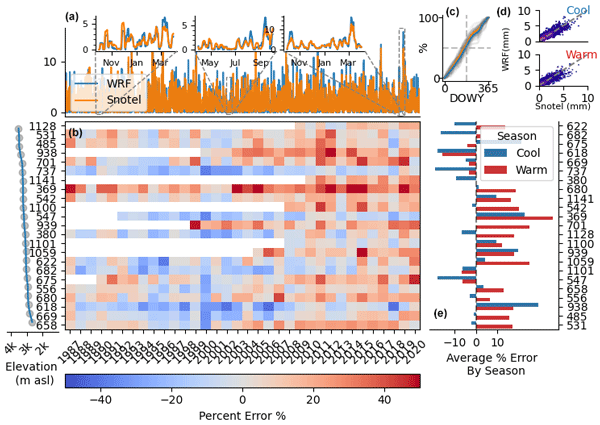
It is important to know how well atmospheric models do in mountains, but there are not very many weather stations. We evaluate rain and snow from a model from 1987–2020 in the Upper Colorado River basin against the available data. The model works rather well, but there are still some uncertainties in remote locations. We then use snow maps collected by aircraft, streamflow measurements, and some advanced statistics to help identify how well the model works in ways we could not do before.
Lauren H. North, Adrienne M. Marshall, Glenn A. Tootle, Lisa Davis, Andy W. Wood, and Eric J. Anderson
Hydrol. Earth Syst. Sci., 30, 5195–5214, https://doi.org/10.5194/hess-30-5195-2026, https://doi.org/10.5194/hess-30-5195-2026, 2026
Short summary
Short summary
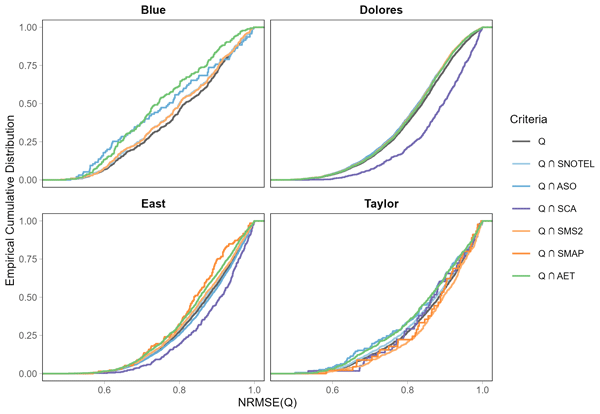
We assessed the U.S. National Hydrologic Model's ability to simulate several components of the water cycle using multiple datasets of environmental variables. We find that the model's accuracy in streamflow simulation is positively and negatively impacted by the additional constraints, and more model parameters are identified as important. Our results inform operational hydrologic modeling by illuminating the complexities of using the continually expanding suite of data products.
Arielle Koshkin and Adrienne M. Marshall
The Cryosphere, 20, 3467–3481, https://doi.org/10.5194/tc-20-3467-2026, https://doi.org/10.5194/tc-20-3467-2026, 2026
Short summary
Short summary
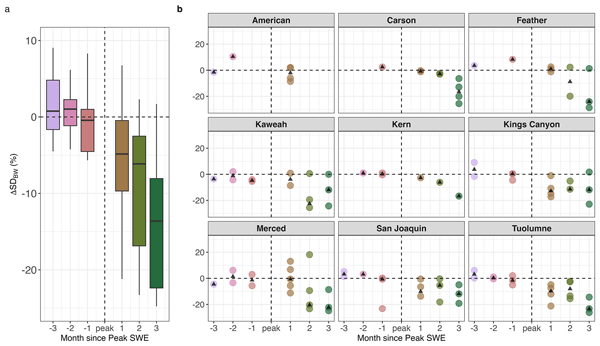
Wildfires are burning higher in elevation and changing how snow accumulates and melts, disrupting the magnitude and timing of streamflow. Using machine learning and high resolution snow maps, we found that burned forests hold less snow compared to unburned forests, especially in spring, at higher elevations, and on south-facing slopes. These results show how fire reshapes mountain snowpacks, with important implications for water resources in a warming climate.
Felix Yu, Daniel Feldman, Leah Gibson, and William Rudisill
EGUsphere, https://doi.org/10.5194/egusphere-2026-2547, https://doi.org/10.5194/egusphere-2026-2547, 2026
Short summary
Short summary
Dust-on-snow deposition is a major factor affecting snowmelt timing and amount in the Upper Colorado River Basin, yet deposition types (wet vs. dry) and amounts have not been quantified across the region. Our analysis shows wet deposition comprises 73.8 % of the total, with areas around the Gunnison Watershed experiencing higher-than-average monthly wet deposition by 16 %. These findings highlight the importance of estimating dust deposition when planning water resources in dusty regions.
Ethan Ritchie, Andrew W. Wood, Ryan Johnson, Adrienne Marshall, Josh Sturtevant, Dane Liljestrand, and Emily Golitzin
EGUsphere, https://doi.org/10.5194/egusphere-2025-5514, https://doi.org/10.5194/egusphere-2025-5514, 2025
Short summary
Short summary
Snow water equivalent (SWE) is a critical water resource to many regions globally. Estimating SWE remains a challenge in hydrology highlighting the need for consistent evaluation frameworks. This study applied a standard approach for SWE evaluation across a range of datasets in the western US, using the Airborne Snow Observatory (ASO) SWE dataset as the reference observational dataset. We outline and demonstrate an example of a community evaluation protocol using datasets in this study.
William Rudisill, Alejandro Flores, and Rosemary Carroll
Geosci. Model Dev., 16, 6531–6552, https://doi.org/10.5194/gmd-16-6531-2023, https://doi.org/10.5194/gmd-16-6531-2023, 2023
Short summary
Short summary
It is important to know how well atmospheric models do in mountains, but there are not very many weather stations. We evaluate rain and snow from a model from 1987–2020 in the Upper Colorado River basin against the available data. The model works rather well, but there are still some uncertainties in remote locations. We then use snow maps collected by aircraft, streamflow measurements, and some advanced statistics to help identify how well the model works in ways we could not do before.
Jake J. Gristey, K. Sebastian Schmidt, Hong Chen, Daniel R. Feldman, Bruce C. Kindel, Joshua Mauss, Mathew van den Heever, Maria Z. Hakuba, and Peter Pilewskie
Atmos. Meas. Tech., 16, 3609–3630, https://doi.org/10.5194/amt-16-3609-2023, https://doi.org/10.5194/amt-16-3609-2023, 2023
Short summary
Short summary
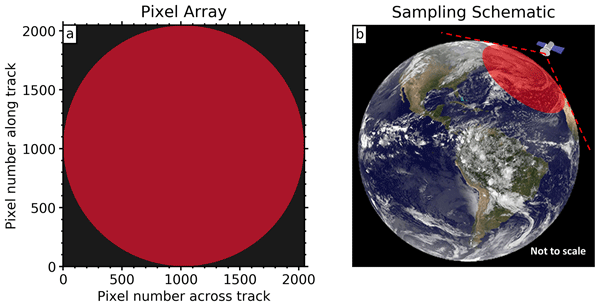
The concept of a satellite-based camera is demonstrated for sampling the angular distribution of outgoing radiance from Earth needed to generate data products for new radiation budget spectral channels.

Zexuan Xu, Erica R. Siirila-Woodburn, Alan M. Rhoades, and Daniel Feldman
Hydrol. Earth Syst. Sci., 27, 1771–1789, https://doi.org/10.5194/hess-27-1771-2023, https://doi.org/10.5194/hess-27-1771-2023, 2023
Short summary
Short summary
The goal of this study is to understand the uncertainties of different modeling configurations for simulating hydroclimate responses in the mountainous watershed. We run a group of climate models with various configurations and evaluate them against various reference datasets. This paper integrates a climate model and a hydrology model to have a full understanding of the atmospheric-through-bedrock hydrological processes.
Cited articles
Adler, B., Wilczak, J., Bianco, L., Bariteau, L., Cox, C. J., de Boer, G., Djalalova, I., Gallagher, M., Intrieri, J. M., Meyers, T., Myers, T., Olson, J. B., Pezoa, S., Sedlar, J., Smith, E., Turner, D. D., and White, A.: Impact of seasonal snow-cover change on the observed and simulated state of the atmospheric boundary layer in a high-altitude mountain valley, J. Geophys. Res., 128, e2023JD038497, https://doi.org/10.1029/2023jd038497, 2023. a
Adler, B., Caicedo, V., Butterworth, B. J., Bianco, L., Cox, C. J., de Boer, G., Gutman, E., Intrieri, J. M., Meyers, T., Sedlar, J., Turner, D. D., and Wilczak, J.: The short life of upvalley wind in a high‐altitude valley in the Colorado Rocky Mountains, J. Geophys. Res.-Atmos., 30, e2025JD043455, https://doi.org/10.1029/2025jd043455, 2025. a
Andreas, E. L., Horst, T. W., Grachev, A. A., Persson, P. O., Fairall, C. W., Guest, P. S., and Jordan, R. E.: Parametrizing turbulent exchange over summer sea ice and the marginal ice zone, Q. J. Roy. Meteor. Soc., 136, 927–943, https://doi.org/10.1002/qj.618, 2010. a
Arduini, G., Balsamo, G., Dutra, E., Day, J. J., Sandu, I., Boussetta, S., and Haiden, T.: Impact of a multi-layer snow scheme on near-surface weather forecasts, J. Adv. Model. Earth Sy., 11, 4687–4710, https://doi.org/10.1029/2019ms001725, 2019. a
Bartholomew, M. J.: Weighing Bucket Rain Gauge Instrument Handbook, Doe/sc-arm-tr-232, ARM User Facility, https://doi.org/10.2172/1572341, 2020. a
Beniston, M., Farinotti, D., Stoffel, M., Andreassen, L. M., Coppola, E., Eckert, N., Fantini, A., Giacona, F., Hauck, C., Huss, M., Huwald, H., Lehning, M., López-Moreno, J.-I., Magnusson, J., Marty, C., Morán-Tejéda, E., Morin, S., Naaim, M., Provenzale, A., Rabatel, A., Six, D., Stötter, J., Strasser, U., Terzago, S., and Vincent, C.: The European mountain cryosphere: a review of its current state, trends, and future challenges, The Cryosphere, 12, 759–794, https://doi.org/10.5194/tc-12-759-2018, 2018. a
Bergfeld, B., van Herwijnen, A., Bobillier, G., Rosendahl, P. L., Weißgraeber, P., Adam, V., Dual, J., and Schweizer, J.: Temporal evolution of crack propagation characteristics in a weak snowpack layer: conditions of crack arrest and sustained propagation, Nat. Hazards Earth Syst. Sci., 23, 293–315, https://doi.org/10.5194/nhess-23-293-2023, 2023. a
Betts, A. K., Desjardins, R., Worth, D., Wang, S., and Li, J.: Coupling of winter climate transitions to snow and clouds over the Prairies, J. Geophys. Res., 119, 1118–1139, https://doi.org/10.1002/2013jd021168, 2014. a
Birkeland, K. W.: Terminology and predominant processes associated with the formation of weak layers of near-surface faceted crystals in the mountain snowpack, Arct. Alp. Res., 30, 193–199, https://doi.org/10.2307/1552134, 1998. a
Brutsaert, W.: On a derivable formula for long-wave radiation from clear skies, Water Resour. Res., 11, 742–744, https://doi.org/10.1029/wr011i005p00742, 1975. a
Champollion, N., Picard, G., Arnaud, L., Lefebvre, E., and Fily, M.: Hoar crystal development and disappearance at Dome C, Antarctica: observation by near-infrared photography and passive microwave satellite, The Cryosphere, 7, 1247–1262, https://doi.org/10.5194/tc-7-1247-2013, 2013. a
Clark, M. P., Nijssen, B., Lundquist, J. D., Kavetski, D., Rupp, D. E., Woods, R. A., Freer, J. E., Gutmann, E. D., Wood, A. W., Brekke, L. D., Arnold, J. R., Gochis, D. J., and Rasmussen, R. M.: A unified approach for process-based hydrologic modeling: 1. Modeling concept, Water Resour. Res., 51, 2498–2514, https://doi.org/10.1002/2015wr017198, 2015. a, b, c
Clothiaux, E. E., Ackerman, T. P., Mace, G. G., Moran, K. P., Marchand, R. T., Miller, M. A., and Martner, B. E.: Objective Determination of Cloud Heights and Radar Reflectivities Using a Combination of Active Remote Sensors at the ARM CART Sites, J. Appl. Meteorol. Clim., 39, 645–665, https://doi.org/10.1175/1520-0450(2000)039<0645:ODOCHA>2.0.CO;2, 2000. a
Cowherd, M., Mital, U., Rahimi, S., Girotto, M., Schwartz, A., and Feldman, D.: Climate change-resilient snowpack estimation in the Western United States, Commun. Earth Environ., 5, 337, https://doi.org/10.1038/s43247-024-01496-3, 2024. a
Cox, C. J., Intrieri, J. M., Butterworth, B. J., de Boer, G., Gallagher, M. R., Hamilton, J., Hulm, E., Meyers, T., Morris, S. M., Osborn, J., Persson, P. O. G., Schmatz, B., Shupe, M. D., and Wilczak, J. M.: Observations of surface energy fluxes and meteorology in the seasonally snow-covered high-elevation East River watershed during SPLASH, 2021–2023, Earth Syst. Sci. Data, 17, 1481–1499, https://doi.org/10.5194/essd-17-1481-2025, 2025. a, b, c, d
Cristea, N. C., Bennett, A., Nijssen, B., and Lundquist, J. D.: When and where are multiple snow layers important for simulations of snow accumulation and melt?, Water Resour. Res., 58, e2020WR028993, https://doi.org/10.1029/2020wr028993, 2022. a, b
de Boer, G., White, A., Cifelli, R., Intrieri, J., Hughes, M., Mahoney, K., Meyers, T., Lantz, K., Hamilton, J., Currier, W., Sedlar, J., Cox, C., Hulm, E., Riihimaki, L. D., Adler, B., Bianco, L., Morales, A., Wilczak, J., Elston, J., Stachura, M., Jackson, D., Morris, S., Chandrasekar, V., Biswas, S., Schmatz, B., Junyent, F., Reithel, J., Smith, E., Schloesser, K., Kochendorfer, J., Meyers, M., Gallagher, M., Longenecker, J., Olheiser, C., Bytheway, J., Moore, B., Calmer, R., Shupe, M. D., Butterworth, B., Heflin, S., Palladino, R., Feldman, D., Williams, K., Pinto, J., Osborn, J., Costa, D., Hall, E., Herrera, C., Hodges, G., Soldo, L., Stierle, S., and Webb, R. S.: Supporting Advancement in Weather and Water Prediction in the Upper Colorado River Basin: The SPLASH Campaign, B. Am. Meteor. Soc., 10, E1853–E1874, https://doi.org/10.1175/BAMS-D-22-0147.1, 2023. a, b, c
Eckert, N., Corona, C., Giacona, F., Gaume, J., Mayer, S., van Herwijnen, A., Hagenmuller, P., and Stoffel, M.: Climate change impacts on snow avalanche activity and related risks, Nat. Rev. Earth Environ., 5, 369–389, https://doi.org/10.1038/s43017-024-00540-2, 2024. a
Eyring, V., Bony, S., Meehl, G. A., Senior, C. A., Stevens, B., Stouffer, R. J., and Taylor, K. E.: Overview of the Coupled Model Intercomparison Project Phase 6 (CMIP6) experimental design and organization, Geosci. Model Dev., 9, 1937–1958, https://doi.org/10.5194/gmd-9-1937-2016, 2016. a
Feick, S., Kronholm, K., and Schweizer, J.: Field observations on spatial variability of surface hoar at the basin scale, J. Geophys. Res., 112, https://doi.org/10.1029/2006jf000587, 2007. a, b, c, d
Feldman, D. R., Aiken, A. C., Boos, W. R., Carroll, R. W. H., Chandrasekar, V., Collis, S., Creamean, J. M., de Boer, G., Deems, J., DeMott, P. J., Fan, J., Flores, A. N., Gochis, D., Grover, M., Hill, T. C. J., Hodshire, A., Hulm, E., Hume, C. C., Jackson, R., Junyent, F., Kennedy, A., Kumjian, M., Levin, E. J. T., Lundquist, J. D., O’Brien, J., Raleigh, M. S., Reithel, J., Rhoades, A., Rittger, K., Rudisill, W., Sherman, Z., Siirila-Woodburn, E., Skiles, S. M., Smith, J. N., Sullivan, R. C., Theisen, A., Tuftedal, M., Varble, A. C., Wiedlea, A., Wielandt, S., Williams, K., and Xu, Z.: The Surface Atmosphere Integrated Field Laboratory (SAIL) campaign, B. Am. Meteor. Soc., 104, E2192–E2222, https://doi.org/10.1175/bams-d-22-0049.1, 2023. a, b
Flanner, M. G. and Zender, C. S.: Linking snowpack microphysics and albedo evolution, J. Geophys. Res., 111, https://doi.org/10.1029/2005jd006834, 2006. a, b
Foken, T.: 50 years of the Monin–obukhov similarity theory, Bound.-Lay. Meteorol., 119, 431–447, https://doi.org/10.1007/s10546-006-9048-6, 2006. a
Foken, T. and Wichura, B.: Tools for quality assessment of surface-based flux measurements, Agr. Forest Meteorol., 78, 83–105, https://doi.org/10.1016/0168-1923(95)02248-1, 1996. a
Föhn, P.: Simulation of surface-hoar layers for snow-cover models, Ann. Glaciol., 32, 19–26, https://doi.org/10.3189/172756401781819490, 2001. a
Gottlieb, A. R. and Mankin, J. S.: Evidence of human influence on Northern Hemisphere snow loss, Nature, 625, 293–300, https://doi.org/10.1038/s41586-023-06794-y, 2024. a
Hall, A., Rahimi, S., Norris, J., Ban, N., Siler, N., Leung, L. R., Ullrich, P., Reed, K. A., Prein, A. F., and Qian, Y.: An evaluation of dynamical downscaling methods used to project regional climate change, J. Geophys. Res., 129, e2023JD040591, https://doi.org/10.1029/2023jd040591, 2024. a
Harder, P., Pomeroy, J. W., and Helgason, W.: Local-Scale Advection of Sensible and Latent Heat During Snowmelt, Geophys. Res. Lett., 44, 9769–9777, https://doi.org/10.1002/2017GL074394, 2017. a
Hausfather, Z.: CMIP6: The Next Generation of Climate Models Explained, https://www.carbonbrief.org/cmip6-the-next-generation-of-climate-models-explained/ (last access: 14 July 2025), 2019. a
Hausfather, Z.: An assessment of current policy scenarios over the 21st century and the reduced plausibility of high-emissions pathways, Dialogues on Climate Change, 2, 26–32, https://doi.org/10.1177/29768659241304854, 2025. a
Hori, M., Aoki, T., Tanikawa, T., Motoyoshi, H., Hachikubo, A., Sugiura, K., Yasunari, T. J., Eide, H., Storvold, R., Nakajima, Y., and Takahashi, F.: In-situ measured spectral directional emissivity of snow and ice in the 8–14 μm atmospheric window, Remote Sens. Environ., 100, 486–502, https://doi.org/10.1016/j.rse.2005.11.001, 2006. a
Horton, S. and Jamieson, B.: Spectral measurements of surface hoar crystals, J. Glaciol., 63, 477–486, https://doi.org/10.1017/jog.2017.6, 2017. a
Horton, S., Bellaire, S., and Jamieson, B.: Modelling the formation of surface hoar layers and tracking post-burial changes for avalanche forecasting, Cold Reg. Sci. Technol., 97, 81–89, https://doi.org/10.1016/j.coldregions.2013.06.012, 2014. a
Horton, S., Schirmer, M., and Jamieson, B.: Meteorological, elevation, and slope effects on surface hoar formation, The Cryosphere, 9, 1523–1533, https://doi.org/10.5194/tc-9-1523-2015, 2015. a, b
Huang, J.: A simple accurate formula for calculating saturation vapor pressure of water and ice, J. Appl. Meteorol. Clim., 57, 1265–1272, https://doi.org/10.1175/JAMC-D-17-0334.1, 2018. a, b
Huang, X., Chen, X., Zhou, D. K., and Liu, X.: An observationally based global band-by-band surface emissivity dataset for climate and weather simulations, J. Atmos. Sci., 73, 3541–3555, https://doi.org/10.1175/jas-d-15-0355.1, 2016. a
Hultstrand, D. M. and Fassnacht, S. R.: The sensitivity of snowpack sublimation estimates to instrument and measurement uncertainty perturbed in a Monte Carlo framework, Front. Earth Sci., 12, 728–738, https://doi.org/10.1007/s11707-018-0721-0, 2018. a
Jamieson, B. and Schweizer, J.: Texture and strength changes of buried surface-hoar layers with implications for dry snow-slab avalanche release, J. Glaciol., 46, 151–160, https://doi.org/10.3189/172756500781833278, 2000. a
Jensen, M., Giangrande, S., Fairless, T., and Zhou, A.: Interpolated Sonde (INTERPOLATEDSONDE), Atmospheric Radiation Measurement (ARM) user facility [data set], https://doi.org/10.5439/1095316, 2021. a
Johnson, K., Giangrande, S., and Toto, T.: Active Remote Sensing of CLouds (ARSCL) product using Ka-band ARM Zenith Radars (ARSCLKAZR1KOLLIAS), Atmospheric Radiation Measurement (ARM) user facility [data set], https://doi.org/10.5439/1393437, 2021. a
Kyrouac, J., Shi, Y., and Tuftedal, M.: Surface Meteorological Instrumentation (MET), Atmospheric Radiation Measurement (ARM) user facility [data set], https://doi.org/10.5439/1786358, 2021. a, b
Lafaysse, M., Dumont, M., De Fleurian, B., Fructus, M., Nheili, R., Viallon-Galinier, L., Baron, M., Boone, A., Bouchet, A., Brondex, J., Carmagnola, C., Cluzet, B., Fourteau, K., Haddjeri, A., Hagenmuller, P., Mazzotti, G., Minvielle, M., Morin, S., Quéno, L., Roussel, L., Spandre, P., Tuzet, F., and Vionnet, V.: Version 3.0.2 of the Crocus snowpack model, Geosci. Model Dev., 19, 6273–6334, https://doi.org/10.5194/gmd-19-6273-2026, 2026. a, b
Lang, R. M., Leo, B., and Brown, R. L.: Observations on the growth process and strength characteristics of surface Hoar, Proceedings of the International Snow Science Workshop, 188–195, 1984. a
Lapo, K., Nijssen, B., and Lundquist, J. D.: Evaluation of turbulence stability schemes of land models for stable conditions, J. Geophys. Res., 124, 3072–3089, https://doi.org/10.1029/2018jd028970, 2019. a
Lee, X.: Fundamentals of boundary-layer meteorology, Springer International Publishing, https://doi.org/10.1007/978-3-031-32668-4, 2023. a
Lehning, M., Bartelt, P., Brown, B., and Fierz, C.: A physical SNOWPACK model for the Swiss avalanche warning, Cold Reg. Sci. Technol., 35, https://doi.org/10.1016/s0165-232x(02)00072-1, 2002. a, b
Libois, Q., Picard, G., Arnaud, L., Dumont, M., Lafaysse, M., Morin, S., and Lefebvre, E.: Summertime evolution of snow specific surface area close to the surface on the Antarctic Plateau, The Cryosphere, 9, 2383–2398, https://doi.org/10.5194/tc-9-2383-2015, 2015. a
Long, C. N. and Shi, Y.: The QCRad value added product: Surface radiation measurement quality control testing, including climatology configurable limits, Atmospheric Radiation Measurement Program, https://doi.org/10.2172/1019540, 2006. a
Mahrt, L.: Bulk formulation of surface fluxes extended to weak‐wind stable conditions, Q. J. Roy. Meteor. Soc., 134, 1–10, https://doi.org/10.1002/qj.197, 2008. a
Mahrt, L. and Vickers, D.: Moisture fluxes over snow with and without protruding vegetation, Q. J. Roy. Meteor. Soc., 131, 1251–1270, https://doi.org/10.1256/qj.04.66, 2005. a
Marshall, A. M., Abatzoglou, J. T., Rahimi, S., Lettenmaier, D. P., and Hall, A.: California's 2023 snow deluge: Contextualizing an extreme snow year against future climate change, P. Natl. Acad. Sci. USA, 121, e2320600121, https://doi.org/10.1073/pnas.2320600121, 2024. a
Mather, J. H. and Voyles, J. W.: The Arm Climate Research Facility: A Review of Structure and Capabilities, B. Am. Meteor. Soc., 94, 377–392, https://doi.org/10.1175/BAMS-D-11-00218.1, 2013. a
Mauder, M., Cuntz, M., Drüe, C., Graf, A., Rebmann, C., Schmid, H. P., Schmidt, M., and Steinbrecher, R.: A strategy for quality and uncertainty assessment of long-term eddy-covariance measurements, Agr. Forest Meteorol., 169, 122–135, https://doi.org/10.1016/j.agrformet.2012.09.006, 2013. a
Mayer, S., Hendrick, M., Michel, A., Richter, B., Schweizer, J., Wernli, H., and van Herwijnen, A.: Impact of climate change on snow avalanche activity in the Swiss Alps, The Cryosphere, 18, 5495–5517, https://doi.org/10.5194/tc-18-5495-2024, 2024. a
Meloche, J., Leroux, N. R., Montpetit, B., Vionnet, V., and Derksen, C.: Radar-equivalent snowpack: reducing the number of snow layers while retaining their microwave properties and bulk snow mass, The Cryosphere, 19, 2949–2962, https://doi.org/10.5194/tc-19-2949-2025, 2025. a, b
Morstad, B. W., Adams, E. E., and McKittrick, L. R.: Experimental and analytical study of radiation-recrystallized near-surface facets in snow, Cold Reg. Sci. Technol., 47, 90–101, https://doi.org/10.1016/j.coldregions.2006.08.023, 2007. a
Notarnicola, C.: Hotspots of snow cover changes in global mountain regions over 2000–2018, Remote Sens. Environ., 243, 111781, https://doi.org/10.1016/j.rse.2020.111781, 2020. a
NSF-NCAR/EOL-ISFS: SOS: ISFS Surface Meteorology and Flux Products, https://doi.org/10.26023/CYK2-SR3N-880J, 2024. a
Ohmura, A.: Physical basis for the temperature-based melt-index method, J. Appl. Meteorol., 40, 753–761, https://doi.org/10.1175/1520-0450(2001)040<0753:pbfttb>2.0.co;2, 2001. a, b
Oldroyd, H. J., Katul, G., Pardyjak, E. R., and Parlange, M. B.: Momentum balance of katabatic flow on steep slopes covered with short vegetation, Geophys. Res. Lett., 41, 4761–4768, https://doi.org/10.1002/2014gl060313, 2014. a
Powers, J. G., Klemp, J. B., Skamarock, W. C., Davis, C. A., Dudhia, J., Gill, D. O., Coen, J. L., Gochis, D. J., Ahmadov, R., Peckham, S. E., Grell, G. A., Michalakes, J., Trahan, S., Benjamin, S. G., Alexander, C. R., Dimego, G. J., Wang, W., Schwartz, C. S., Romine, G. S., Liu, Z., Snyder, C., Chen, F., Barlage, M. J., Yu, W., and Duda, M. G.: The Weather Research and Forecasting Model: Overview, System Efforts, and Future Directions, B. Am. Meteor. Soc., 98, 1717–1737, https://doi.org/10.1175/BAMS-D-15-00308.1, 2017. a
Rahimi, S., Huang, L., Norris, J., Hall, A., Goldenson, N., Krantz, W., Bass, B., Thackeray, C., Lin, H., Chen, D., Dennis, E., Collins, E., Lebo, Z. J., Slinskey, E., Graves, S., Biyani, S., Wang, B., Cropper, S., and the UCLA Center for Climate Science Team: An overview of the Western United States Dynamically Downscaled Dataset (WUS-D3), Geosci. Model Dev., 17, 2265–2286, https://doi.org/10.5194/gmd-17-2265-2024, 2024. a, b, c, d, e
Raleigh, M. S., Landry, C. C., Hayashi, M., Quinton, W. L., and Lundquist, J. D.: Approximating snow surface temperature from standard temperature and humidity data: New possibilities for snow model and remote sensing evaluation, Water Resour. Res., 49, 8053–8069, https://doi.org/10.1002/2013wr013958, 2013. a
Rangwala, I.: Amplified water vapour feedback at high altitudes during winter, Int. J. Climatol., 33, 897–903, https://doi.org/10.1002/joc.3477, 2013. a
Rudisill, W.: Reduced Surface Hoar in a Warming World – SUMMA Model Output and Codes, Zenodo [code], https://doi.org/10.5281/zenodo.18667221, 2026. a
Rudisill, W., Flores, A., and Carroll, R.: Evaluating 3 decades of precipitation in the Upper Colorado River basin from a high-resolution regional climate model, Geosci. Model Dev., 16, 6531–6552, https://doi.org/10.5194/gmd-16-6531-2023, 2023a. a
Rudisill, W. J., Flores, A. N., Marshall, H. P., Siirila-Woodburn, E., Feldman, D. R., Rhoades, A. M., Xu, Z., and Morales, A.: Cold-Season Precipitation Sensitivity to Microphysical Parameterizations: Hydrologic Evaluations Leveraging Snow Lidar Datasets, J. Hydrometeorol., 1, https://doi.org/10.1175/JHM-D-22-0217.1, 2023b. a, b, c
Rudisill, W., Rhoades, A., Xu, Z., and Feldman, D.: Are atmospheric models too cold in the mountains? The state of science and insights from the SAIL field campaign, B. Am. Meteor. Soc., 105, E1237–E1264, https://doi.org/10.1175/BAMS-D-23-0082.1, 2024. a
Rudisill, W., Feldman, D., Cox, C. J., Riihimaki, L., and Sedlar, J.: Seasonality and Albedo Dependence of Cloud Radiative Forcing in the Upper Colorado River Basin, J. Geophys. Res., 130, e2024JD042366, https://doi.org/10.1029/2024JD042366, 2025. a, b, c, d
Schwat, E., Hogan, D., Paw U, K. T., Cox, C. J., Butterworth, B. J., Gutmann, E., Vano, J. A., and Lundquist, J. D.: Estimating snow sublimation in complex terrain: A season of intensive field measurements and the role of vertical water vapor flux divergence, J. Hydrometeorol., 26, 1455–1473, https://doi.org/10.1175/jhm-d-25-0022.1, 2025. a, b
Schweizer, J., Jamieson, B., and M, S.: Snow avalanche formation, Rev. Geophys., 41, 1–25, https://doi.org/10.1029/2002RG000123, 2003. a
Sedlar, J., Meyers, T., Cox, C. J., and Adler, B.: Low-Level Liquid-Bearing Clouds Contribute to Seasonal Lower Atmosphere Stability and Surface Energy Forcing over a High-Mountain Watershed Environment, J. Hydrometeorol., 25, 827–845, https://doi.org/10.1175/JHM-D-23-0144.1, 2024. a
Sexstone, G. A., Clow, D. W., Fassnacht, S. R., Liston, G. E., Hiemstra, C. A., Knowles, J. F., and Penn, C. A.: Snow sublimation in mountain environments and its sensitivity to forest disturbance and climate warming, Water Resour. Res., 54, 1191–1211, https://doi.org/10.1002/2017wr021172, 2018. a
Shi, J. and Dozier, J.: Inferring snow wetness using C-band data from SIR-C's polarimetric synthetic aperture radar, IEEE T. Geosci. Remote, 33, 905–914, https://doi.org/10.1109/36.406676, 1995. a
Shiogama, H., Fujimori, S., Hasegawa, T., Hayashi, M., Hirabayashi, Y., Ogura, T., Iizumi, T., Takahashi, K., and Takemura, T.: Important distinctiveness of SSP3-7.0 for use in impact assessments, Nat. Clim. Change, 13, 1276–1278, https://doi.org/10.1038/s41558-023-01883-2, 2023. a
Siirila-Woodburn, E. R., Rhoades, A. M., Hatchett, B. J., Huning, L. S., Szinai, J., Tague, C., Nico, P. S., Feldman, D. R., Jones, A. D., Collins, W. D., and Kaatz, L.: A low-to-no snow future and its impacts on water resources in the western United States, Nature Reviews Earth & Environment, 2, 800–819, https://doi.org/10.1038/s43017-021-00219-y, 2021. a
Slater, A. G., Schlosser, C. A., Desborough, C. E., and Pitman, A. J.: The Representation of Snow in Land Surface Schemes: Results from PILPS 2(d), J. Hydrometeorol., 2, 7–25, https://doi.org/10.1175/1525-7541(2001)002<0007:TROSIL>2.0.CO;2, 2001. a
Slaughter, A. E., Adams, E. E., Staron, P. J., and Shertzer, R. H.: Field investigation of near-surface metamorphism of snow, J. Glaciol., 57, 441–452, https://doi.org/10.3189/002214311796905695, 2011. a, b
Snehmani, Singh, M. K., Gupta, R. D., Bhardwaj, A., and Joshi, P. K.: Remote sensing of mountain snow using active microwave sensors: a review, Geocarto Int., 30, 1–27, https://doi.org/10.1080/10106049.2014.883434, 2015. a
Sturm, M. and Benson, C. S.: Vapor transport, grain growth and depth-hoar development in the subarctic snow, J. Glaciol., 43, 42–59, https://doi.org/10.3189/S0022143000002793, 1997. a
Sturm, M., Holmgren, J., König, M., and Morris, K.: The thermal conductivity of seasonal snow, J. Glaciol., 43, 26–41, https://doi.org/10.3189/s0022143000002781, 1997. a, b
Style, R. W. and Worster, G. M.: Frost flower formation on sea ice and lake ice, Geophys. Res. Lett., 36, L11501, https://doi.org/10.1029/2009GL037304, 2009. a
Sun, J., Bhimireddy, S. R., Kristovich, D. A. R., Wang, J., Hiscox, A. L., Mahrt, L., and Petty, G. W.: Impacts of terrain slope and surface roughness variations on turbulence generation in the nighttime stable boundary layer, J. Geophys. Res.-Atmos., 130, e2024JD041 815, https://doi.org/10.1029/2024jd041815, 2025. a
Wallace, J. M. and Hobbs, P. V.: Atmospheric Science: An Introductory Survey, Elsevier, https://doi.org/10.1016/C2009-0-00034-8, 2006. a
Walton, D. B., Hall, A., Berg, N., Schwartz, M., and Sun, F.: Incorporating snow albedo feedback into downscaled temperature and snow cover projections for California’s Sierra Nevada, J. Climate, 30, 1417–1438, https://doi.org/10.1175/jcli-d-16-0168.1, 2017. a
Warren, S. G.: Optical properties of snow, Rev. Geophys., 20, 67–89, https://doi.org/10.1029/RG020i001p00067, 1982. a
Whiteman, C. D. and Barr, S.: Atmospheric mass transport by along-valley wind systems in a deep Colorado valley, J. Clim. Appl. Meteorol., 25, 1205–1212, https://doi.org/10.1175/1520-0450(1986)025<1205:amtbav>2.0.co;2, 1986. a
Whiteman, D. C.: Mountain Meteorology: Fundamentals and Applications, Oxford University Press, https://doi.org/10.1093/oso/9780195132717.001.0001, 2000. a
Wilczak, J. M., Oncley, S. P., and Stage, S. A.: Sonic Anemometer Tilt Correction Algorithms, Bound.-Lay. Meteorol., 99, 127–150, https://doi.org/10.1023/A:1018966204465, 2001. a
Xu, Z., Siirila-Woodburn, E. R., Rhoades, A. M., and Feldman, D.: Sensitivities of subgrid-scale physics schemes, meteorological forcing, and topographic radiation in atmosphere-through-bedrock integrated process models: a case study in the Upper Colorado River basin, Hydrol. Earth Syst. Sci., 27, 1771–1789, https://doi.org/10.5194/hess-27-1771-2023, 2023. a
Zelinka, M. D., Randall, D. A., Webb, M. J., and Klein, S. A.: Clearing clouds of uncertainty, Nat. Clim. Change, 7, 674–678, https://doi.org/10.1038/nclimate3402, 2017. a
Zhang, D.: Data Quality Assessment for ARM Radiation Data (QCRAD1LONG), Atmospheric Radiation Measurement (ARM) user facility [data set], https://doi.org/10.5439/1227214, 2021. a
Short summary
Surface hoar crystals occasionally grow on the top of snowpacks overnight. Little work has focused on climatic conditions leading to surface hoar. We use data from three field campaigns in the Colorado Rockies to investigate. We show that surface hoar events decline as the climate warms, and that there may be 14 % fewer events per year in the future. There is still work needed to reconcile measured amounts of surface hoar crystals, models, and the relationship with turbulent air.
Surface hoar crystals occasionally grow on the top of snowpacks overnight. Little work has...


