
Articles | Volume 20, issue 9
https://doi.org/10.5194/tc-20-5491-2026
© Author(s) 2026. This work is distributed under
the Creative Commons Attribution 4.0 License.
the Creative Commons Attribution 4.0 License.
https://doi.org/10.5194/tc-20-5491-2026
© Author(s) 2026. This work is distributed under
the Creative Commons Attribution 4.0 License.
the Creative Commons Attribution 4.0 License.
Research article
| 
25 Sep 2026
Research article |
| 25 Sep 2026
| 25 Sep 2026
Variability of internal snow properties over Antarctic late summer sea ice on different spatial scales

Alfred-Wegener Institut, Helmholtz-Zentrum für Polar- und Meeresforschung, Bremerhaven, Germany
University of Hamburg, Hamburg, Germany
Danu Caus
Helmholtz-Zentrum Hereon, Geesthacht, Germany
Helmholtz AI, Neuherberg, Germany
Paul Keil
Helmholtz-Zentrum Hereon, Geesthacht, Germany
Helmholtz AI, Neuherberg, Germany
Christopher Kadow
German Climate Computing Center (DKRZ), Hamburg, Germany
Stefanie Arndt
Alfred-Wegener Institut, Helmholtz-Zentrum für Polar- und Meeresforschung, Bremerhaven, Germany
University of Hamburg, Hamburg, Germany
Related authors
Mara Neudert, Daria Paul, Sacha van der Vleuten, Stefanie Arndt, and Christian Haas
EGUsphere, https://doi.org/10.5194/egusphere-2026-5496, https://doi.org/10.5194/egusphere-2026-5496, 2026
This preprint is open for discussion and under review for The Cryosphere (TC).
Short summary
Short summary
Icebergs can strongly change how snow and ice develop on Antarctic coastal sea ice, but their effects are poorly understood. We combined drone mapping with measurements of snow and ice thickness and ice cores to examine these changes. We found that thick snow on the windward side of icebergs promotes flooding and freezes into solid snow-ice, greatly increasing ice thickness while reducing ice growth from below. Snow-free areas in the lee, in contrast, had thicker ice grown from below.
Laura Köhler, Julia Windmiller, Dariusz Baranowski, Michał Brennek, Michał Ciuryło, Lennéa Hayo, Daniel Kȩpski, Stefan Kinne, Beata Latos, Bertrand Lobo, Tobias Marke, Timo Nischik, Daria Paul, Piet Stammes, Artur Szkop, and Olaf Tuinder
Earth Syst. Sci. Data, 17, 633–659, https://doi.org/10.5194/essd-17-633-2025, https://doi.org/10.5194/essd-17-633-2025, 2025
Short summary
Short summary
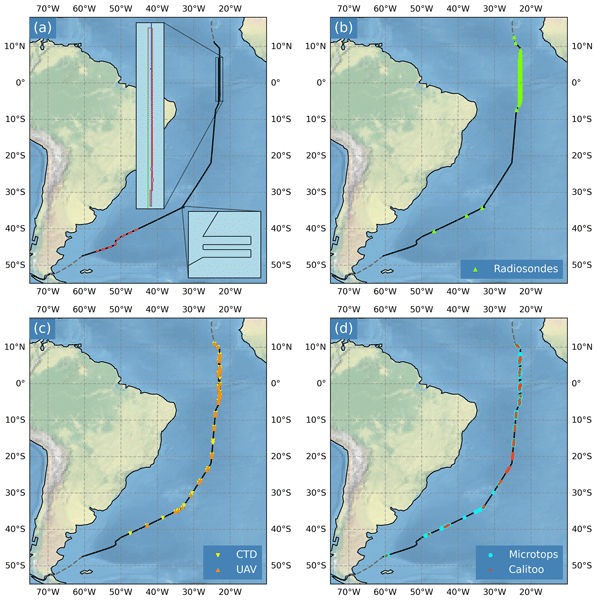
We present atmospheric and oceanic data from the Atlantic References and Convection ship campaign with the Maria S. Merian from Mindelo to Punta Arenas observed with the integrated ship sensors; humidity and temperature profiler; ceilometer; aerosol instruments (Calitoo, Microtops, and DustTrak); radiosondes; uncrewed aircraft vehicles; and conductivity, temperature, and depth scans. The data include three complete profiles of the Intertropical Convergence Zone and a storm in the South Atlantic.
Mara Neudert, Daria Paul, Sacha van der Vleuten, Stefanie Arndt, and Christian Haas
EGUsphere, https://doi.org/10.5194/egusphere-2026-5496, https://doi.org/10.5194/egusphere-2026-5496, 2026
This preprint is open for discussion and under review for The Cryosphere (TC).
Short summary
Short summary
Icebergs can strongly change how snow and ice develop on Antarctic coastal sea ice, but their effects are poorly understood. We combined drone mapping with measurements of snow and ice thickness and ice cores to examine these changes. We found that thick snow on the windward side of icebergs promotes flooding and freezes into solid snow-ice, greatly increasing ice thickness while reducing ice growth from below. Snow-free areas in the lee, in contrast, had thicker ice grown from below.
Laura Schild, Simeon Lisovski, Peter Ewald, Julia Walsch, Danu Caus, and Ulrike Herzschuh
EGUsphere, https://doi.org/10.5194/egusphere-2026-4084, https://doi.org/10.5194/egusphere-2026-4084, 2026
Short summary
Short summary
This study presents a method for turning fossil pollen records into detailed maps of past land cover. Applied to Alaska and western Canada, it reconstructs vegetation change across 119 time periods at 300 m resolution. The maps show mostly stable recent landscapes, stronger changes around 10,000 years ago, and increasing uncertainty further back in time. The dataset helps study long-term ecosystem responses to climate change.
Piers M. Forster, Tristram Walsh, Chris Smith, William F. Lamb, Robin Lamboll, Christophe Cassou, Mathias Hauser, Zeke Hausfather, June-Yi Lee, Matthew D. Palmer, Karina von Schuckmann, Aimée B. A. Slangen, Sophie Szopa, Blair Trewin, Jeongeun Yun, Nathan P. Gillett, Stuart Jenkins, H. Damon Matthews, Krishnan Raghavan, Aurélien Ribes, Joeri Rogelj, Debbie Rosen, Xuebin Zhang, Myles Allen, Robbie M. Andrew, Chris Atkinson, Richard A. Betts, Antonio Bombelli, Samantha N. Burgess, Lijing Cheng, Helen E. Claxton, Pierre Friedlingstein, Thomas L. Frölicher, Catia M. Domingues, Thomas Gasser, Catherine H. Gregory, Rachel M. Hoesly, Daniel Huppmann, Masayoshi Ishii, Christopher Kadow, Alexia Karwat, John Kennedy, Rachel E. Killick, Mahesh V. M. Kovilakam, Paul B. Krummel, Xin Lan, Jean-François Lamarque, Aurélien Liné, Belén Martín-Míguez, Didier P. Monselesan, Colin Morice, Jens Mühle, Pino Mussak, Glen P. Peters, Anna Pirani, Julia Pongratz, Matthew Rigby, Robert Rohde, Abhishek Savita, Sonia I. Seneviratne, Steven J. Smith, Ghassan Taha, Caterina Tassone, Peter Thorne, Christopher Wells, Luke M. Western, Guido R. van der Werf, Susan E. Wijffels, Marco Zecchetto, Junting Zhong, Xiao-Ye Zhang, Valérie Masson-Delmotte, and Panmao Zhai
Earth Syst. Sci. Data, 18, 3889–3933, https://doi.org/10.5194/essd-18-3889-2026, https://doi.org/10.5194/essd-18-3889-2026, 2026
Short summary
Short summary
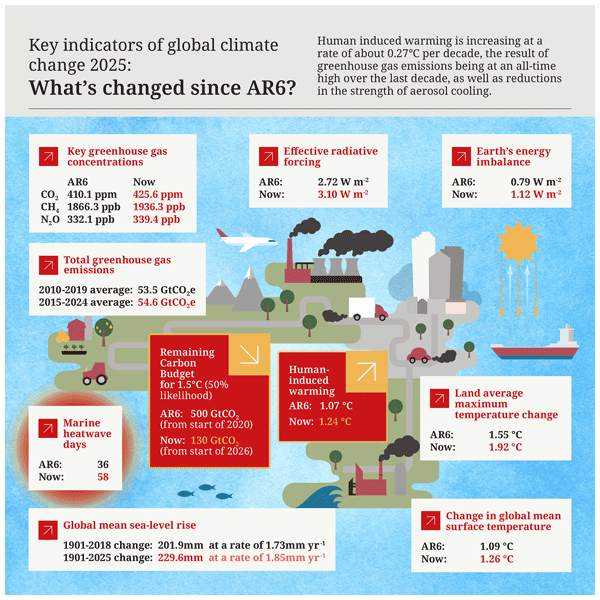
We give our annual update of key climate indicators. Our work quantifies the human contribution to global warming and the pace of climate change. This represents a large effort by the international community akin to an Intergovernmental Panel on Climate Change (IPCC) report.
Peter W. Thorne, John M. Nicklas, John J. Kennedy, Bruce Calvert, Baylor Fox-Kemper, Mark T. Richardson, Adrian Simmons, Ed Hawkins, Robert Rhode, Kathryn Cowtan, Nerilie J. Abram, Axel Andersson, Simon Noone, Phillipe Marbaix, Nathan Lenssen, Dirk Olonscheck, Tristram Walsh, Stephen Outten, Ingo Bethke, Bjorn H. Samset, Chris Smith, Anna Pirani, Jan Fuglestvedt, Lavanya Rajamani, Richard A. Betts, Elizabeth C. Kent, Blair Trewin, Colin Morice, Tim Osborn, Samantha N. Burgess, Oliver Geden, Andrew Parnell, Piers M. Forster, Chris Hewitt, Zeke Hausfather, Valerie Masson-Delmotte, Jochem Marotzke, Nathan Gillett, Sonia I. Seneviratne, Gavin A. Schmidt, Duo Chan, Stefan Brönnimann, Andy Reisinger, Matthew Menne, Maisa Rojas Corradi, Christopher Kadow, Peter Huybers, David B. Stephenson, Emily Wallis, Joeri Rogelj, Andrew Schurer, Karen McKinnon, Panmao Zhai, Fatima Driouech, Wilfran Moufouma Okia, Saeed Vazifehkhah, Sophie Szopa, Christopher J. Merchant, Shoji Hirahara, Masayoshi Ishii, Francois A. Engelbrecht, Qingxiang Li, June-Yi Lee, Alex J. Cannon, Christophe Cassou, Karina von Schuckmann, Amir H. Delju, and Ellie Murtagh
Earth Syst. Sci. Data Discuss., https://doi.org/10.5194/essd-2025-825, https://doi.org/10.5194/essd-2025-825, 2026
Preprint under review for ESSD
Short summary
Short summary
We reassess the basis for determining the present level of long-term global warming. Unbiased estimates of both realised warming and anthropogenic warming are possible that approximate a 20-year retrospective mean. Our resulting estimates of 1.40 [1.23–1.58] °C (realised) and 1.34 [1.18–1.50] °C (anthropogenic) as at end of 2024 highlight the urgency of immediate, far-reaching and sustained climate mitigation actions if we are to meet the long term temperature goal of the Paris Agreement.
Steven Franke, Mara Neudert, Veit Helm, Arttu Jutila, Océane Hames, Niklas Neckel, Stefanie Arndt, and Christian Haas
The Cryosphere, 19, 6319–6339, https://doi.org/10.5194/tc-19-6319-2025, https://doi.org/10.5194/tc-19-6319-2025, 2025
Short summary
Short summary
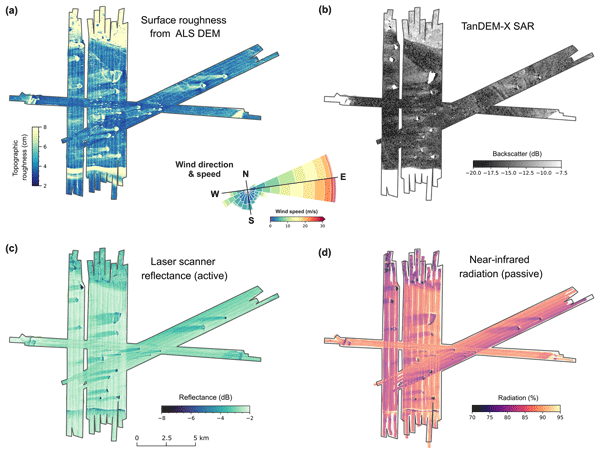
Our research explored how icebergs affect the distribution of snow and flooding on Antarctic coastal sea ice. Using aircraft-based radar and laser scanning, we found that icebergs create thick snow drifts on their wind-facing sides and leave snow-free zones in their lee. The weight of these snow drifts often causes the ice below to flood, forming slush. These patterns, driven by wind and iceberg placement, are crucial for understanding sea ice changes and improving climate models.
Valerie Reppert, Olaf Eisen, Holger Schmithüsen, Stefanie Arndt, Guido Ascenso, Linda Ort, and Zsófia Jurányi
EGUsphere, https://doi.org/10.5194/egusphere-2025-5199, https://doi.org/10.5194/egusphere-2025-5199, 2025
Short summary
Short summary
We analyzed 33 years of snow accumulation measurements at Neumayer Station, Antarctica, to understand changes in the amount of snow building up on the surface over time. The long-term, high-resolution data show mostly stable accumulation, but rare positive extremes appeared in 2021 and 2023. Seasonal and multi-year patterns were identified, providing valuable data to improve climate models and satellite observations.
Yubing Cheng, Bin Cheng, Roberta Pirazzini, Amy R. Macfarlane, Timo Vihma, Wolfgang Dorn, Ruzica Dadic, Martin Schneebeli, Stefanie Arndt, and Annette Rinke
The Cryosphere, 19, 6001–6021, https://doi.org/10.5194/tc-19-6001-2025, https://doi.org/10.5194/tc-19-6001-2025, 2025
Short summary
Short summary
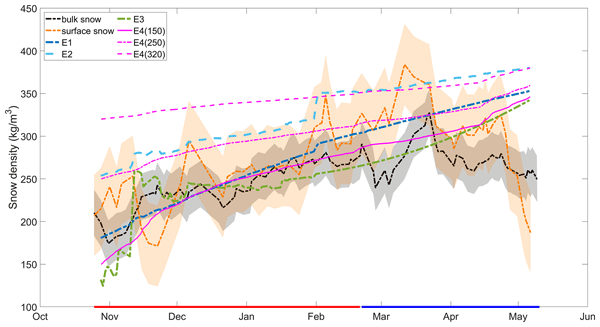
We study snow density from the MOSAiC expedition. Several snow density schemes were tested and compared with observation. A thermodynamic ice model was employed to assess the impact of snow density and precipitation on the thermal regime of sea ice. The parameterized mean snow densities are consistent with observations. Increased snow density reduces snow and ice temperatures, promoting ice growth, while increased precipitation leads to warmer snow and ice temperatures and reduced ice thickness.
Johannes Meuer, Laurens M. Bouwer, Frank Kaspar, Roman Lehmann, Wolfgang Karl, Thomas Ludwig, and Christopher Kadow
Hydrol. Earth Syst. Sci., 29, 3687–3701, https://doi.org/10.5194/hess-29-3687-2025, https://doi.org/10.5194/hess-29-3687-2025, 2025
Short summary
Short summary
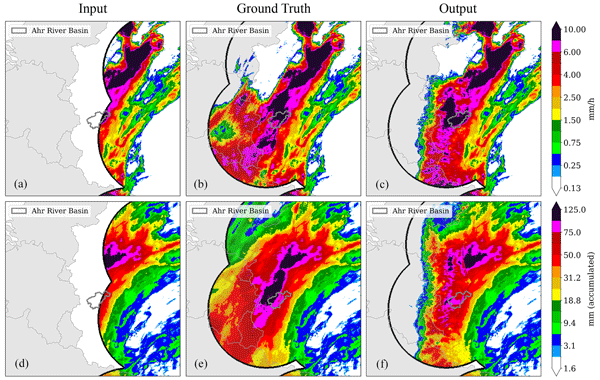
Our study focuses on filling in missing precipitation data using an advanced neural network model. Traditional methods for estimating missing climate information often struggle in large regions where data are scarce. Our solution, which incorporates recent advances in machine learning, captures the intricate patterns of precipitation over time, especially during extreme weather events. Our model shows good performance in reconstructing large regions of missing rainfall radar data.
Piers M. Forster, Chris Smith, Tristram Walsh, William F. Lamb, Robin Lamboll, Christophe Cassou, Mathias Hauser, Zeke Hausfather, June-Yi Lee, Matthew D. Palmer, Karina von Schuckmann, Aimée B. A. Slangen, Sophie Szopa, Blair Trewin, Jeongeun Yun, Nathan P. Gillett, Stuart Jenkins, H. Damon Matthews, Krishnan Raghavan, Aurélien Ribes, Joeri Rogelj, Debbie Rosen, Xuebin Zhang, Myles Allen, Lara Aleluia Reis, Robbie M. Andrew, Richard A. Betts, Alex Borger, Jiddu A. Broersma, Samantha N. Burgess, Lijing Cheng, Pierre Friedlingstein, Catia M. Domingues, Marco Gambarini, Thomas Gasser, Johannes Gütschow, Masayoshi Ishii, Christopher Kadow, John Kennedy, Rachel E. Killick, Paul B. Krummel, Aurélien Liné, Didier P. Monselesan, Colin Morice, Jens Mühle, Vaishali Naik, Glen P. Peters, Anna Pirani, Julia Pongratz, Jan C. Minx, Matthew Rigby, Robert Rohde, Abhishek Savita, Sonia I. Seneviratne, Peter Thorne, Christopher Wells, Luke M. Western, Guido R. van der Werf, Susan E. Wijffels, Valérie Masson-Delmotte, and Panmao Zhai
Earth Syst. Sci. Data, 17, 2641–2680, https://doi.org/10.5194/essd-17-2641-2025, https://doi.org/10.5194/essd-17-2641-2025, 2025
Short summary
Short summary
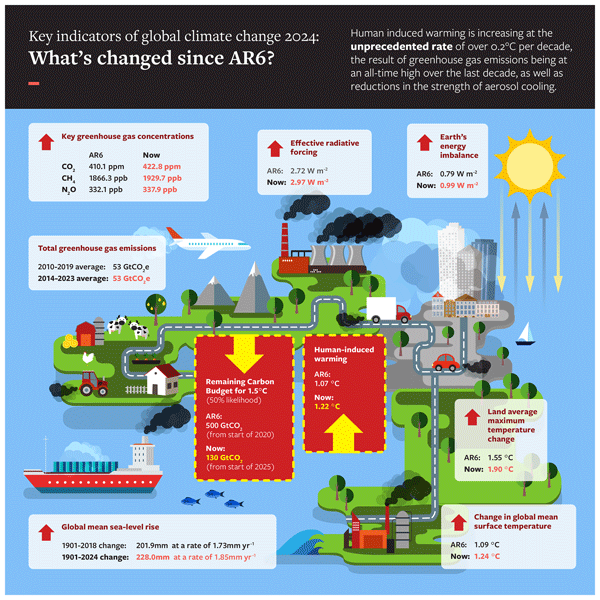
In a rapidly changing climate, evidence-based decision-making benefits from up-to-date and timely information. Here we compile monitoring datasets to track real-world changes over time. To make our work relevant to policymakers, we follow methods from the Intergovernmental Panel on Climate Change (IPCC). Human activities are increasing the Earth's energy imbalance and driving faster sea-level rise compared to the IPCC assessment.
Laura Köhler, Julia Windmiller, Dariusz Baranowski, Michał Brennek, Michał Ciuryło, Lennéa Hayo, Daniel Kȩpski, Stefan Kinne, Beata Latos, Bertrand Lobo, Tobias Marke, Timo Nischik, Daria Paul, Piet Stammes, Artur Szkop, and Olaf Tuinder
Earth Syst. Sci. Data, 17, 633–659, https://doi.org/10.5194/essd-17-633-2025, https://doi.org/10.5194/essd-17-633-2025, 2025
Short summary
Short summary
We present atmospheric and oceanic data from the Atlantic References and Convection ship campaign with the Maria S. Merian from Mindelo to Punta Arenas observed with the integrated ship sensors; humidity and temperature profiler; ceilometer; aerosol instruments (Calitoo, Microtops, and DustTrak); radiosondes; uncrewed aircraft vehicles; and conductivity, temperature, and depth scans. The data include three complete profiles of the Intertropical Convergence Zone and a storm in the South Atlantic.
Rui Xu, Chaofang Zhao, Stefanie Arndt, and Christian Haas
The Cryosphere, 18, 5769–5788, https://doi.org/10.5194/tc-18-5769-2024, https://doi.org/10.5194/tc-18-5769-2024, 2024
Short summary
Short summary
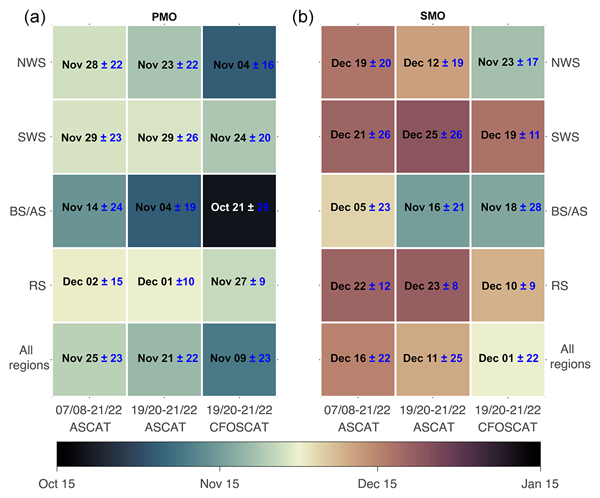
The onset of snowmelt on Antarctic sea ice is an important indicator of sea ice change. In this study, we used two radar scatterometers to detect the onset of snowmelt on perennial Antarctic sea ice. Results show that since 2007, snowmelt onset has demonstrated strong interannual and regional variabilities. We also found that the difference in snowmelt onsets between the two scatterometers is closely related to snow metamorphism.

Lu Zhou, Julienne Stroeve, Vishnu Nandan, Rosemary Willatt, Shiming Xu, Weixin Zhu, Sahra Kacimi, Stefanie Arndt, and Zifan Yang
The Cryosphere, 18, 4399–4434, https://doi.org/10.5194/tc-18-4399-2024, https://doi.org/10.5194/tc-18-4399-2024, 2024
Short summary
Short summary
Snow over Antarctic sea ice, influenced by highly variable meteorological conditions and heavy snowfall, has a complex stratigraphy and profound impact on the microwave signature. We employ advanced radiation transfer models to analyse the effects of complex snow properties on brightness temperatures over the sea ice in the Southern Ocean. Great potential lies in the understanding of snow processes and the application to satellite retrievals.
Piers M. Forster, Chris Smith, Tristram Walsh, William F. Lamb, Robin Lamboll, Bradley Hall, Mathias Hauser, Aurélien Ribes, Debbie Rosen, Nathan P. Gillett, Matthew D. Palmer, Joeri Rogelj, Karina von Schuckmann, Blair Trewin, Myles Allen, Robbie Andrew, Richard A. Betts, Alex Borger, Tim Boyer, Jiddu A. Broersma, Carlo Buontempo, Samantha Burgess, Chiara Cagnazzo, Lijing Cheng, Pierre Friedlingstein, Andrew Gettelman, Johannes Gütschow, Masayoshi Ishii, Stuart Jenkins, Xin Lan, Colin Morice, Jens Mühle, Christopher Kadow, John Kennedy, Rachel E. Killick, Paul B. Krummel, Jan C. Minx, Gunnar Myhre, Vaishali Naik, Glen P. Peters, Anna Pirani, Julia Pongratz, Carl-Friedrich Schleussner, Sonia I. Seneviratne, Sophie Szopa, Peter Thorne, Mahesh V. M. Kovilakam, Elisa Majamäki, Jukka-Pekka Jalkanen, Margreet van Marle, Rachel M. Hoesly, Robert Rohde, Dominik Schumacher, Guido van der Werf, Russell Vose, Kirsten Zickfeld, Xuebin Zhang, Valérie Masson-Delmotte, and Panmao Zhai
Earth Syst. Sci. Data, 16, 2625–2658, https://doi.org/10.5194/essd-16-2625-2024, https://doi.org/10.5194/essd-16-2625-2024, 2024
Short summary
Short summary
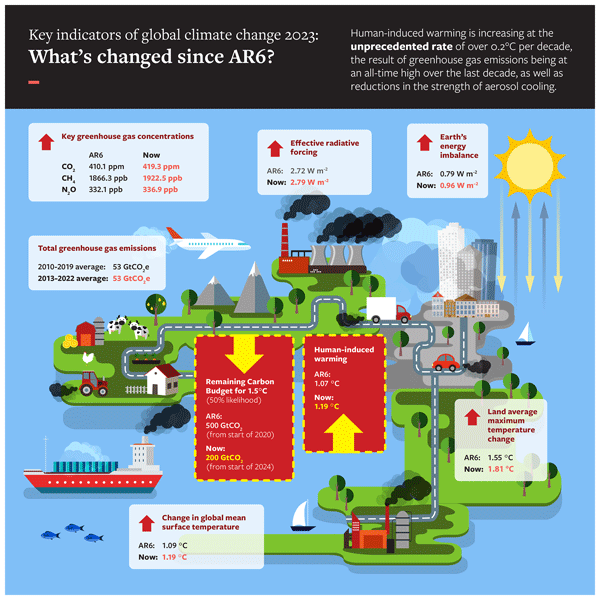
This paper tracks some key indicators of global warming through time, from 1850 through to the end of 2023. It is designed to give an authoritative estimate of global warming to date and its causes. We find that in 2023, global warming reached 1.3 °C and is increasing at over 0.2 °C per decade. This is caused by all-time-high greenhouse gas emissions.
Bjorn Stevens, Stefan Adami, Tariq Ali, Hartwig Anzt, Zafer Aslan, Sabine Attinger, Jaana Bäck, Johanna Baehr, Peter Bauer, Natacha Bernier, Bob Bishop, Hendryk Bockelmann, Sandrine Bony, Guy Brasseur, David N. Bresch, Sean Breyer, Gilbert Brunet, Pier Luigi Buttigieg, Junji Cao, Christelle Castet, Yafang Cheng, Ayantika Dey Choudhury, Deborah Coen, Susanne Crewell, Atish Dabholkar, Qing Dai, Francisco Doblas-Reyes, Dale Durran, Ayoub El Gaidi, Charlie Ewen, Eleftheria Exarchou, Veronika Eyring, Florencia Falkinhoff, David Farrell, Piers M. Forster, Ariane Frassoni, Claudia Frauen, Oliver Fuhrer, Shahzad Gani, Edwin Gerber, Debra Goldfarb, Jens Grieger, Nicolas Gruber, Wilco Hazeleger, Rolf Herken, Chris Hewitt, Torsten Hoefler, Huang-Hsiung Hsu, Daniela Jacob, Alexandra Jahn, Christian Jakob, Thomas Jung, Christopher Kadow, In-Sik Kang, Sarah Kang, Karthik Kashinath, Katharina Kleinen-von Königslöw, Daniel Klocke, Uta Kloenne, Milan Klöwer, Chihiro Kodama, Stefan Kollet, Tobias Kölling, Jenni Kontkanen, Steve Kopp, Michal Koran, Markku Kulmala, Hanna Lappalainen, Fakhria Latifi, Bryan Lawrence, June Yi Lee, Quentin Lejeun, Christian Lessig, Chao Li, Thomas Lippert, Jürg Luterbacher, Pekka Manninen, Jochem Marotzke, Satoshi Matsouoka, Charlotte Merchant, Peter Messmer, Gero Michel, Kristel Michielsen, Tomoki Miyakawa, Jens Müller, Ramsha Munir, Sandeep Narayanasetti, Ousmane Ndiaye, Carlos Nobre, Achim Oberg, Riko Oki, Tuba Özkan-Haller, Tim Palmer, Stan Posey, Andreas Prein, Odessa Primus, Mike Pritchard, Julie Pullen, Dian Putrasahan, Johannes Quaas, Krishnan Raghavan, Venkatachalam Ramaswamy, Markus Rapp, Florian Rauser, Markus Reichstein, Aromar Revi, Sonakshi Saluja, Masaki Satoh, Vera Schemann, Sebastian Schemm, Christina Schnadt Poberaj, Thomas Schulthess, Cath Senior, Jagadish Shukla, Manmeet Singh, Julia Slingo, Adam Sobel, Silvina Solman, Jenna Spitzer, Philip Stier, Thomas Stocker, Sarah Strock, Hang Su, Petteri Taalas, John Taylor, Susann Tegtmeier, Georg Teutsch, Adrian Tompkins, Uwe Ulbrich, Pier-Luigi Vidale, Chien-Ming Wu, Hao Xu, Najibullah Zaki, Laure Zanna, Tianjun Zhou, and Florian Ziemen
Earth Syst. Sci. Data, 16, 2113–2122, https://doi.org/10.5194/essd-16-2113-2024, https://doi.org/10.5194/essd-16-2113-2024, 2024
Short summary
Short summary
To manage Earth in the Anthropocene, new tools, new institutions, and new forms of international cooperation will be required. Earth Virtualization Engines is proposed as an international federation of centers of excellence to empower all people to respond to the immense and urgent challenges posed by climate change.
Stefanie Arndt, Nina Maaß, Leonard Rossmann, and Marcel Nicolaus
The Cryosphere, 18, 2001–2015, https://doi.org/10.5194/tc-18-2001-2024, https://doi.org/10.5194/tc-18-2001-2024, 2024
Short summary
Short summary
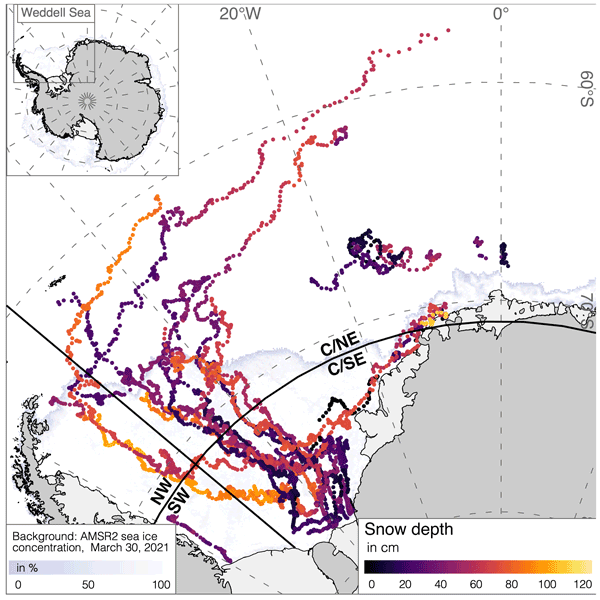
Antarctic sea ice maintains year-round snow cover, crucial for its energy and mass budgets. Despite its significance, snow depth remains poorly understood. Over the last decades, Snow Buoys have been deployed extensively on the sea ice to measure snow accumulation but not actual depth due to snow transformation into meteoric ice. Therefore, in this study we utilize sea ice and snow models to estimate meteoric ice fractions in order to calculate actual snow depth in the Weddell Sea.
Moein Mellat, Amy R. Macfarlane, Camilla F. Brunello, Martin Werner, Martin Schneebeli, Ruzica Dadic, Stefanie Arndt, Kaisa-Riikka Mustonen, Jeffrey M. Welker, and Hanno Meyer
EGUsphere, https://doi.org/10.5194/egusphere-2024-719, https://doi.org/10.5194/egusphere-2024-719, 2024
Preprint archived
Short summary
Short summary
Our research, utilizing data from the Arctic MOSAiC expedition, reveals how snow on Arctic sea ice changes due to weather conditions. By analyzing snow samples collected over a year, we found differences in snow layers that tell us about their origins and how they've been affected by the environment. We discovered variations in snow and vapour that reflect the influence of weather patterns and surface processes like wind and sublimation.
Hauke Schmidt, Sebastian Rast, Jiawei Bao, Amrit Cassim, Shih-Wei Fang, Diego Jimenez-de la Cuesta, Paul Keil, Lukas Kluft, Clarissa Kroll, Theresa Lang, Ulrike Niemeier, Andrea Schneidereit, Andrew I. L. Williams, and Bjorn Stevens
Geosci. Model Dev., 17, 1563–1584, https://doi.org/10.5194/gmd-17-1563-2024, https://doi.org/10.5194/gmd-17-1563-2024, 2024
Short summary
Short summary
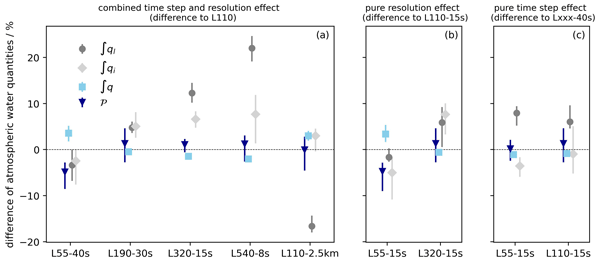
A recent development in numerical simulations of the global atmosphere is the increase in horizontal resolution to grid spacings of a few kilometers. However, the vertical grid spacing of these models has not been reduced at the same rate as the horizontal grid spacing. Here, we assess the effects of much finer vertical grid spacings, in particular the impacts on cloud quantities and the atmospheric energy balance.
Piers M. Forster, Christopher J. Smith, Tristram Walsh, William F. Lamb, Robin Lamboll, Mathias Hauser, Aurélien Ribes, Debbie Rosen, Nathan Gillett, Matthew D. Palmer, Joeri Rogelj, Karina von Schuckmann, Sonia I. Seneviratne, Blair Trewin, Xuebin Zhang, Myles Allen, Robbie Andrew, Arlene Birt, Alex Borger, Tim Boyer, Jiddu A. Broersma, Lijing Cheng, Frank Dentener, Pierre Friedlingstein, José M. Gutiérrez, Johannes Gütschow, Bradley Hall, Masayoshi Ishii, Stuart Jenkins, Xin Lan, June-Yi Lee, Colin Morice, Christopher Kadow, John Kennedy, Rachel Killick, Jan C. Minx, Vaishali Naik, Glen P. Peters, Anna Pirani, Julia Pongratz, Carl-Friedrich Schleussner, Sophie Szopa, Peter Thorne, Robert Rohde, Maisa Rojas Corradi, Dominik Schumacher, Russell Vose, Kirsten Zickfeld, Valérie Masson-Delmotte, and Panmao Zhai
Earth Syst. Sci. Data, 15, 2295–2327, https://doi.org/10.5194/essd-15-2295-2023, https://doi.org/10.5194/essd-15-2295-2023, 2023
Short summary
Short summary
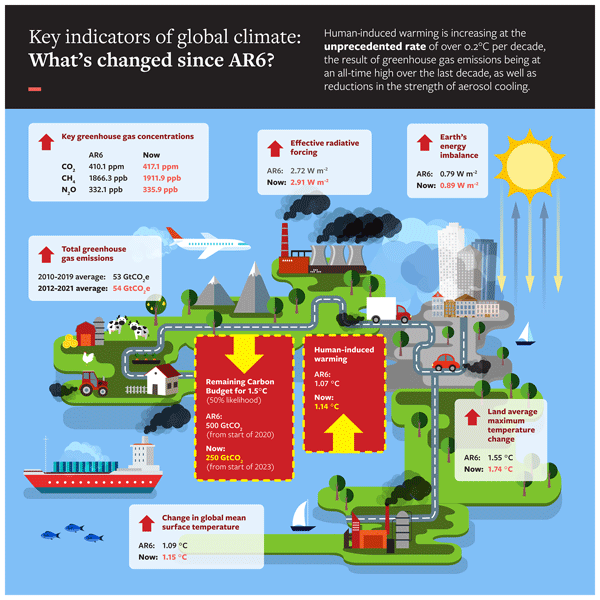
This is a critical decade for climate action, but there is no annual tracking of the level of human-induced warming. We build on the Intergovernmental Panel on Climate Change assessment reports that are authoritative but published infrequently to create a set of key global climate indicators that can be tracked through time. Our hope is that this becomes an important annual publication that policymakers, media, scientists and the public can refer to.
Julian Gutt, Stefanie Arndt, David Keith Alan Barnes, Horst Bornemann, Thomas Brey, Olaf Eisen, Hauke Flores, Huw Griffiths, Christian Haas, Stefan Hain, Tore Hattermann, Christoph Held, Mario Hoppema, Enrique Isla, Markus Janout, Céline Le Bohec, Heike Link, Felix Christopher Mark, Sebastien Moreau, Scarlett Trimborn, Ilse van Opzeeland, Hans-Otto Pörtner, Fokje Schaafsma, Katharina Teschke, Sandra Tippenhauer, Anton Van de Putte, Mia Wege, Daniel Zitterbart, and Dieter Piepenburg
Biogeosciences, 19, 5313–5342, https://doi.org/10.5194/bg-19-5313-2022, https://doi.org/10.5194/bg-19-5313-2022, 2022
Short summary
Short summary
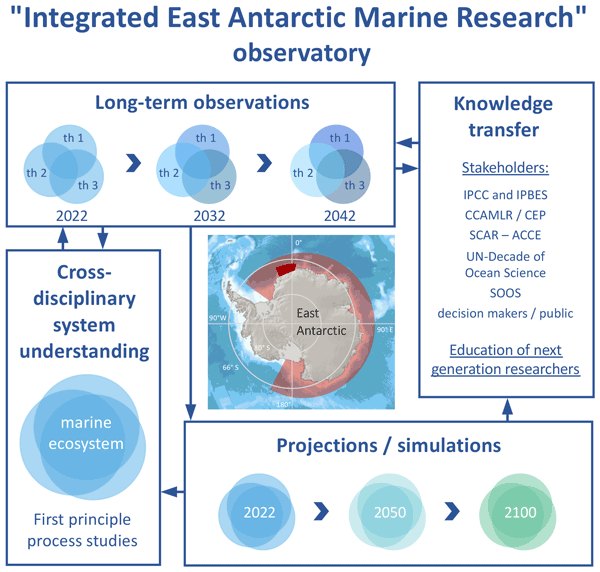
Long-term ecological observations are key to assess, understand and predict impacts of environmental change on biotas. We present a multidisciplinary framework for such largely lacking investigations in the East Antarctic Southern Ocean, combined with case studies, experimental and modelling work. As climate change is still minor here but is projected to start soon, the timely implementation of this framework provides the unique opportunity to document its ecological impacts from the very onset.
David N. Wagner, Matthew D. Shupe, Christopher Cox, Ola G. Persson, Taneil Uttal, Markus M. Frey, Amélie Kirchgaessner, Martin Schneebeli, Matthias Jaggi, Amy R. Macfarlane, Polona Itkin, Stefanie Arndt, Stefan Hendricks, Daniela Krampe, Marcel Nicolaus, Robert Ricker, Julia Regnery, Nikolai Kolabutin, Egor Shimanshuck, Marc Oggier, Ian Raphael, Julienne Stroeve, and Michael Lehning
The Cryosphere, 16, 2373–2402, https://doi.org/10.5194/tc-16-2373-2022, https://doi.org/10.5194/tc-16-2373-2022, 2022
Short summary
Short summary
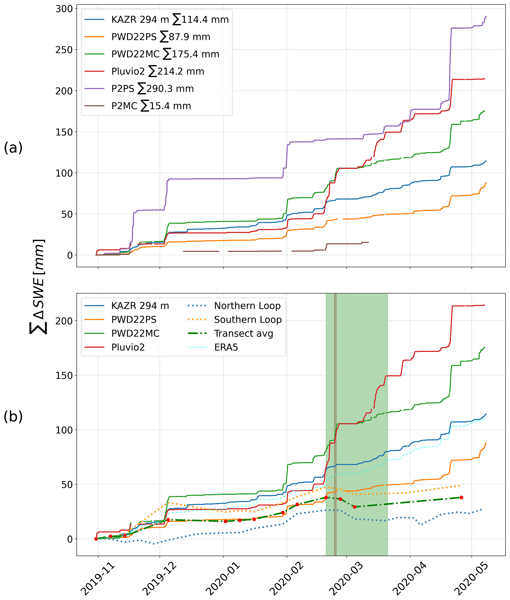
Based on measurements of the snow cover over sea ice and atmospheric measurements, we estimate snowfall and snow accumulation for the MOSAiC ice floe, between November 2019 and May 2020. For this period, we estimate 98–114 mm of precipitation. We suggest that about 34 mm of snow water equivalent accumulated until the end of April 2020 and that at least about 50 % of the precipitated snow was eroded or sublimated. Further, we suggest explanations for potential snowfall overestimation.
Cited articles
Andreas, E. L. and Ackley, S. F.: On the Differences in Ablation Seasons of Arctic and Antarctic Sea Ice, J. Atmos. Sci., 39, 440–447, https://doi.org/10.1175/1520-0469(1982)039<0440:OTDIAS>2.0.CO;2, 1982. a
Arndt, Stoll, N. A., Winkelmann, R., Huntemann, M, and Reese, R.: Chapter Sea Ice Physics in: The Expedition PS111 of the Research POLARSTERN to the Southern Weddell Sea in 2018, Tech. Rep., Alfred-Wegener-Institut, Helmholtz-Zentrum für Polar- und Meeresforschung, https://doi.org/10.2312/BzPM_0718_2018, 2018. a, b, c
Arndt, S.: Snow Stratigraphy Measurements at Ice Stations during POLARSTERN Cruise PS118, PANGAEA [data set], https://doi.org/10.1594/PANGAEA.929010, 2021. a, b
Arndt, S.: SnowMicroPen (SMP) Force Profiles Collected during RV POLARSTERN Cruise PS111, PANGAEA [data set], https://doi.org/10.1594/PANGAEA.945787, 2022b. a, b
Arndt, S.: Snow Stratigraphy Measurements at Ice Stations during RV POLARSTERN Cruise PS111, PANGAEA [data set], https://doi.org/10.1594/PANGAEA.945858, 2022c. a, b, c
Arndt, S. and Haas, C.: SnowMicroPen (SMP) Force Profiles Collected during RV POLARSTERN Cruise PS118, PANGAEA [data set], https://doi.org/10.1594/PANGAEA.945791, 2022a. a, b
Arndt, S. and Haas, C.: SnowMicroPen (SMP) Force Profiles Collected during RV POLARSTERN Cruise PS124, PANGAEA [data set], https://doi.org/10.1594/PANGAEA.945875, 2022b. a, b
Arndt, S. and Haas, C.: Snow Stratigraphy Measurements at Ice Stations during RV POLARSTERN Cruise PS124, PANGAEA [data set], https://doi.org/10.1594/PANGAEA.945857, 2022c. a, b
Arndt, S., Haas, C., Meyer, H., Peeken, I., and Krumpen, T.: Recent observations of superimposed ice and snow ice on sea ice in the northwestern Weddell Sea, The Cryosphere, 15, 4165–4178, https://doi.org/10.5194/tc-15-4165-2021, 2021. a, b, c
Bocquet, M., Fleury, S., Rémy, F., and Piras, F.: Arctic and Antarctic Sea Ice Thickness and Volume Changes From Observations Between 1994 and 2023, J. Geophys. Res.-Oceans, 129, https://doi.org/10.1029/2023JC020848, 2024. a
Calonne, N., Richter, B., Löwe, H., Cetti, C., ter Schure, J., Van Herwijnen, A., Fierz, C., Jaggi, M., and Schneebeli, M.: The RHOSSA campaign: multi-resolution monitoring of the seasonal evolution of the structure and mechanical stability of an alpine snowpack, The Cryosphere, 14, 1829–1848, https://doi.org/10.5194/tc-14-1829-2020, 2020. a, b, c, d, e
Domine, F., Taillandier, A.-S., and Simpson, W. R.: A Parameterization of the Specific Surface Area of Seasonal Snow for Field Use and for Models of Snowpack Evolution, J. Geophys. Res.-Earth, 112, https://doi.org/10.1029/2006JF000512, 2007. a
Durand, M., Kim, E. J., Margulis, S. A., and Molotch, N. P.: A First-Order Characterization of Errors From Neglecting Stratigraphy in Forward and Inverse Passive Microwave Modeling of Snow, IEEE Geosci. Remote S., 8, 730–734, https://doi.org/10.1109/LGRS.2011.2105243, 2011. a, b
Eicken, H., Fischer, H., and Lemke, P.: Effects of the Snow Cover on Antarctic Sea Ice and Potential Modulation of Its Response to Climate Change, Ann. Glaciol., 21, 369–376, https://doi.org/10.3189/S0260305500016086, 1995. a
EUMETSAT OSI SAF: Global Sea Ice Concentration Climate Data Record v3.0 (AMSR) – Multimission, https://doi.org/10.15770/EUM_SAF_OSI_0015, 2022. a
EUMETSAT OSI SAF: AMSR2 Global Sea Ice Concentration Interim Climate Data Record Release 3 – GCOM, https://doi.org/10.15770/EUM_SAF_OSI_0024, 2026. a
Fierz, C., Armstrong, R., Durand, Y., Etchevers, P., Greene, E., Mcclung, D. M., Nishimura, K., Satyawali, P., and Sokratov, S.: The international classification for seasonal snow on the ground, Tech. rep., UNESCO-IHP, Paris, Paris, publication Title: IHPVII Technical Documents in Hydrology No. 83, IACS Contribution No. 1, 2009. a, b
Gupta, M., Regan, H., Koo, Y., Chua, S. M. T., Li, X., and Heil, P.: Inferring the seasonality of sea ice floes in the Weddell Sea using ICESat-2, The Cryosphere, 19, 1241–1257, https://doi.org/10.5194/tc-19-1241-2025, 2025. a
Haas, C., Thomas, D. N., and Bareiss, J.: Surface Properties and Processes of Perennial Antarctic Sea Ice in Summer, J. Glaciol., 47, 613–625, https://doi.org/10.3189/172756501781831864, 2001. a, b
Haas, C., Arndt, S., Peeken, I., Eggers, S. L., and Neudert, M: Chapter Sea Ice Geophysics and Biogeochemistry in: The Expedition PS124 of the Research Vessel POLARSTERN to the Weddell Sea in 2021, Berichte Zur Polar-und Meeresforschung – Reports on Polar and Marine Research, Tech. Rep., Alfred-Wegener-Institut, Helmholtz-Zentrum für Polar- und Meeresforschung, https://doi.org/10.48433/BzPM_0755_2021, 2021. a, b, c
Kiranyaz, S., Avci, O., Abdeljaber, O., Ince, T., Gabbouj, M., and Inman, D. J.: 1D Convolutional Neural Networks and Applications: A Survey, Mech. Syst. Signal Pr., 151, 107398, https://doi.org/10.1016/j.ymssp.2020.107398, 2021. a
Komarov, A. Y., Seliverstov, Y. G., Grebennikov, P. B., and Sokratov, S. A.: Spatial Variability of Snow Water Equivalent – The Case Study from the Research Site in Khibiny Mountains, Russia, J. Hydrol. Hydromech., 67, 110–112, https://doi.org/10.2478/johh-2018-0016, 2018. a
Lavergne, T., Sørensen, A. M., Kern, S., Tonboe, R., Notz, D., Aaboe, S., Bell, L., Dybkjær, G., Eastwood, S., Gabarro, C., Heygster, G., Killie, M. A., Brandt Kreiner, M., Lavelle, J., Saldo, R., Sandven, S., and Pedersen, L. T.: Version 2 of the EUMETSAT OSI SAF and ESA CCI sea-ice concentration climate data records, The Cryosphere, 13, 49–78, https://doi.org/10.5194/tc-13-49-2019, 2019. a
López-Moreno, J. I., Leppänen, L., Luks, B., Holko, L., Picard, G., Sanmiguel-Vallelado, A., Alonso-González, E., Finger, D. C., Arslan, A. N., Gillemot, K., Sensoy, A., Sorman, A., Ertaş, M. C., Fassnacht, S. R., Fierz, C., and Marty, C.: Intercomparison of Measurements of Bulk Snow Density and Water Equivalent of Snow Cover with Snow Core Samplers: Instrumental Bias and Variability Induced by Observers, Hydrol. Process., 34, 3120–3133, https://doi.org/10.1002/hyp.13785, 2020. a
Löwe, H. and Van Herwijnen, A.: A Poisson Shot Noise Model for Micro-Penetration of Snow, Cold Reg. Sci. Technol., 70, 62–70, https://doi.org/10.1016/j.coldregions.2011.09.001, 2012. a
Macfarlane, A. R., Löwe, H., Gimenes, L., Wagner, D. N., Dadic, R., Ottersberg, R., Hämmerle, S., and Schneebeli, M.: Temporospatial variability of snow's thermal conductivity on Arctic sea ice, The Cryosphere, 17, 5417–5434, https://doi.org/10.5194/tc-17-5417-2023, 2023. a
Massom, R. A., Eicken, H., Hass, C., Jeffries, M. O., Drinkwater, M. R., Sturm, M., Worby, A. P., Wu, X., Lytle, V. I., Ushio, S., Morris, K., Reid, P. A., Warren, S. G., and Allison, I.: Snow on Antarctic Sea Ice, Rev. Geophys., 39, 413–445, https://doi.org/10.1029/2000RG000085, 2001. a
Moran, P. A. P.: Notes on Continuous Stochastic Phenomena, Oxford University Press on behalf of Biometrika Trust, Biometrika, Vol. 37, No. 1/2 (June 1950), 17–23, https://doi.org/10.2307/2332142, 1950. a
Nakano, M. and Sugiyama, D.: Discriminating Seismic Events Using 1D and 2D CNNs: Applications to Volcanic and Tectonic Datasets, Earth, Planets and Space, 74, 134, https://doi.org/10.1186/s40623-022-01696-1, 2022. a
Nicolaus, M., Haas, C., Bareiss, J., and Willmes, S.: A Model Study of Differences of Snow Thinning on Arctic and Antarctic First-Year Sea Ice during Spring and Summer, Ann. Glaciol., 44, 147–153, https://doi.org/10.3189/172756406781811312, 2006. a
Nicolaus, M., Haas, C., and Willmes, S.: Evolution of First-year and Second-year Snow Properties on Sea Ice in the Weddell Sea during Spring-summer Transition, J. Geophys. Res.-Atmos., 114, https://doi.org/10.1029/2008JD011227, 2009. a, b, c
Price, D., Soltanzadeh, I., Rack, W., and Dale, E.: Snow-driven uncertainty in CryoSat-2-derived Antarctic sea ice thickness – insights from McMurdo Sound, The Cryosphere, 13, 1409–1422, https://doi.org/10.5194/tc-13-1409-2019, 2019. a
Proksch, M., Löwe, H., and Schneebeli, M.: Density, Specific Surface Area, and Correlation Length of Snow Measured by High-Resolution Penetrometry, J. Geophys. Res.-Earth, 120, 346–362, https://doi.org/10.1002/2014JF003266, 2015. a, b
Ross, Z. E., Meier, M.-A., Hauksson, E., and Heaton, T. H.: Generalized Seismic Phase Detection with Deep Learning, B. Seismol. Soc. Am., 108, 2894–2901, https://doi.org/10.1785/0120180080, 2018. a
Royer, A., Roy, A., Montpetit, B., Saint-Jean-Rondeau, O., Picard, G., Brucker, L., and Langlois, A.: Comparison of Commonly-Used Microwave Radiative Transfer Models for Snow Remote Sensing, Remote Sens. Environ., 190, 247–259, https://doi.org/10.1016/j.rse.2016.12.020, 2017. a, b
Sandven, S., Spreen, G., Heygster, G., Girard-Ardhuin, F., Farrell, S. L., Dierking, W., and Allard, R. A.: Sea Ice Remote Sensing – Recent Developments in Methods and Climate Data Sets, Surv. Geophys., 44, 1653–1689, https://doi.org/10.1007/s10712-023-09781-0, 2023. a
Schneebeli, M. and Johnson, J. B.: A Constant-Speed Penetrometer for High-Resolution Snow Stratigraphy, Ann. Glaciol., 26, 107–111, https://doi.org/10.3189/1998AoG26-1-107-111, 1998. a
Sommerfeld, R. A. and LaChapelle, E.: The Classification of Snow Metamorphism, J. Glaciol., 9, 3–18, https://doi.org/10.3189/S0022143000026757, 1970. a
Techel, F., Pielmeier, C., and Schneebeli, M.: The first wetting of snow: micro-structural hardness measurements using a snow micro penetrometer, International Snow Science Workshop, https://arc.lib.montana.edu/snow-science/objects/P__8125.pdf (last access: 12 March 2026), 2008. a
Tian, L., Gao, Y., Weissling, B., and Ackley, S. F.: Snow-Ice Contribution to the Structure of Sea Ice in the Amundsen Sea, Antarctica, Ann. Glaciol., 61, 369–378, https://doi.org/10.1017/aog.2020.55, 2020. a, b
Tonboe, R. T., Nandan, V., Mäkynen, M., Pedersen, L. T., Kern, S., Lavergne, T., Øelund, J., Dybkjær, G., Saldo, R., and Huntemann, M.: Simulated Geophysical Noise in Sea Ice Concentration Estimates of Open Water and Snow-Covered Sea Ice, IEEE J. Sel. Top. Appl., 15, 1309–1326, https://doi.org/10.1109/JSTARS.2021.3134021, 2022. a, b
Toyota, T., Massom, R., Tateyama, K., Tamura, T., and Fraser, A.: Properties of Snow Overlying the Sea Ice off East Antarctica in Late Winter, 2007, Deep Sea Res.-Pt. II, 58, 1137–1148, https://doi.org/10.1016/j.dsr2.2010.12.002, 2011. a
Short summary
We studied how snow and its properties vary across Antarctic sea ice using detailed field measurements combined with machine learning methods. We found that differences between ice types are mainly due to how snow layers are arranged rather than their basic properties. Snow changes over short distances, meaning single measurements often miss this complexity. Capturing this variability is key to improving climate models and satellite estimates.
We studied how snow and its properties vary across Antarctic sea ice using detailed field...


