
Articles | Volume 20, issue 9
https://doi.org/10.5194/tc-20-5061-2026
© Author(s) 2026. This work is distributed under
the Creative Commons Attribution 4.0 License.
the Creative Commons Attribution 4.0 License.
https://doi.org/10.5194/tc-20-5061-2026
© Author(s) 2026. This work is distributed under
the Creative Commons Attribution 4.0 License.
the Creative Commons Attribution 4.0 License.
Brief communication
| 
08 Sep 2026
Brief communication |
| 08 Sep 2026
| 08 Sep 2026
Brief communication: Shared parameterisation for estimating snow water equivalent through cosmic ray neutron sensors in the Italian Alps

Earth Sciences Department – DST, University of Torino, Torino, 10125, Italy
Department of Environmental Sciences, Informatics and Statistics – DAIS, Ca' Foscari University of Venice, Mestre, 30172, Italy
Centro Interdipartimentale sui Rischi Naturali in Ambiente Montano e Collinare – NatRisk, Grugliasco, 10095, Italy
Nicola Colombo
Department of Agricultural, Forest and Food Sciences – DISAFA, University of Torino, Grugliasco, 10095, Italy
Enrico Gazzola
Finapp S.p.A., Montegrotto Terme, 35036, Italy
Mauro Valt
Agency for Environmental Prevention and Protection of Veneto – ARPAV, Belluno, 32100, Italy
Christian Ronchi
Department of Natural and Environmental Risks, Regional Agency for Environmental Protection of Piemonte – ARPA Piemonte, Torino, 10135, Italy
Luca Lanteri
Department of Natural and Environmental Risks, Regional Agency for Environmental Protection of Piemonte – ARPA Piemonte, Torino, 10135, Italy
Roberto Dinale
Office for Hydrology and Dams, Autonomous Province of Bolzano, Bolzano, 39100, Italy
Rudi Nadalet
Office for Hydrology and Dams, Autonomous Province of Bolzano, Bolzano, 39100, Italy
Stefano Ferraris
Interuniversity Department of Regional Studies and Planning – DIST, University of Torino and Polytechnic University of Torino, Torino, 10125, Italy
Alessio Gentile
Interuniversity Department of Regional Studies and Planning – DIST, University of Torino and Polytechnic University of Torino, Torino, 10125, Italy
Davide Gisolo
Interuniversity Department of Regional Studies and Planning – DIST, University of Torino and Polytechnic University of Torino, Torino, 10125, Italy
Marco Giardino
Earth Sciences Department – DST, University of Torino, Torino, 10125, Italy
Centro Interdipartimentale sui Rischi Naturali in Ambiente Montano e Collinare – NatRisk, Grugliasco, 10095, Italy
Sesia Valgrande UNESCO Global Geopark, Varallo, 13019, Italy
Michele Freppaz
Department of Agricultural, Forest and Food Sciences – DISAFA, University of Torino, Grugliasco, 10095, Italy
Centro Interdipartimentale sui Rischi Naturali in Ambiente Montano e Collinare – NatRisk, Grugliasco, 10095, Italy
Fiorella Acquaotta
Earth Sciences Department – DST, University of Torino, Torino, 10125, Italy
Centro Interdipartimentale sui Rischi Naturali in Ambiente Montano e Collinare – NatRisk, Grugliasco, 10095, Italy
Related authors
No articles found.
Katharina Theresa Scheidt, Rafael Pimentel, Paolo Deidda, Carlo Marin, Davide Gisolo, Davide Canone, María José Polo, Claudia Notarnicola, and Manuela Lehner
EGUsphere, https://doi.org/10.5194/egusphere-2026-3417, https://doi.org/10.5194/egusphere-2026-3417, 2026
This preprint is open for discussion and under review for The Cryosphere (TC).
Short summary
Short summary
Snowmelt can be strongly influenced by energy exchange between the atmosphere and the snow surface, but these exchanges are difficult to estimate in mountain regions. Using measurements from twelve sites across the European Alps, we assessed the effects of measurement errors and common modeling assumptions. We found that uncertainties can be large and that widely used assumptions do not always hold, highlighting the need for caution when applying these methods in complex terrain.
Francesco Parizia, Samuele De Petris, Luigi Perotti, Marco Giardino, and Enrico Borgogno-Mondino
The Cryosphere, 20, 1715–1724, https://doi.org/10.5194/tc-20-1715-2026, https://doi.org/10.5194/tc-20-1715-2026, 2026
Short summary
Short summary
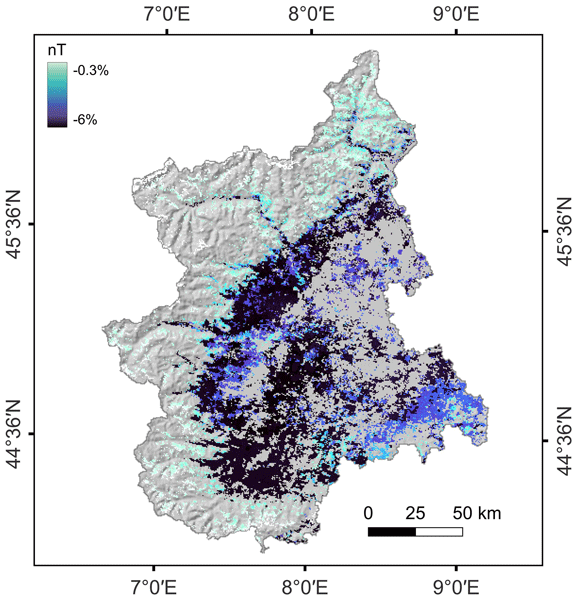
This study introduces innovative methods in cryospheric research by mapping and quantifying multi-decadal snow cover changes in the Western Alps using remote sensing. The normalized trend (nT) index offers a novel metric for analyzing annual mean snow events. This enables intensity analysis of climate change impacts on snow dynamics, highlighting critical vulnerabilities in water management and regional economic systems.
Alessio Gentile, Davide Gisolo, Stefano Brighenti, Giulia Zuecco, Chiara Marchina, Davide Canone, Tanzeel Hamza, Stefano Ferrari, Stefano Bechis, and Stefano Ferraris
EGUsphere, https://doi.org/10.5194/egusphere-2025-6329, https://doi.org/10.5194/egusphere-2025-6329, 2026
Short summary
Short summary
This study explores how snowmelt and rainfall supply water to plants and groundwater in a high-elevation mountain grassland. Using field data and model simulations, we tracked how snowmelt and summer rain move through the soil. Snowmelt mainly supplies deep drainage, while rain mainly feeds plants. Nevertheless, during a very dry year, snowmelt contributed more than usual to plant water use. These results show how reduced snowfalls and droughts may affect the mountain water cycle.
Susen Shrestha, Stefano Terzi, Davide Zoccatelli, Mattia Zaramella, Marco Borga, Andrea Galletti, Mattia Callegari, Roberto Dinale, Massimiliano Pittore, and Giacomo Bertoldi
EGUsphere, https://doi.org/10.5194/egusphere-2025-6387, https://doi.org/10.5194/egusphere-2025-6387, 2026
Short summary
Short summary
Glaciers and snow contribute to buffer river streamflow during droughts. Due to climate change, their role is shrinking with severe implications for water management. Here we investigated the role of glaciers to buffer the 2003, 2005 and 2022 droughts that occurred in the upper Adige River Basin (Italy). Glaciers provided 4 to 12 % of summer water during droughts and their buffering is weakening due to their retreat with lower contribution in 2022 compared to the similar drought of 2003.
Roberto Giovanni Francese, Roberto Valentino, Wilfried Haeberli, Aldino Bondesan, Massimo Giorgi, Stefano Picotti, Franco Pettenati, Denis Sandron, Gianni Ramponi, and Mauro Valt
Nat. Hazards Earth Syst. Sci., 25, 3027–3053, https://doi.org/10.5194/nhess-25-3027-2025, https://doi.org/10.5194/nhess-25-3027-2025, 2025
Short summary
Short summary
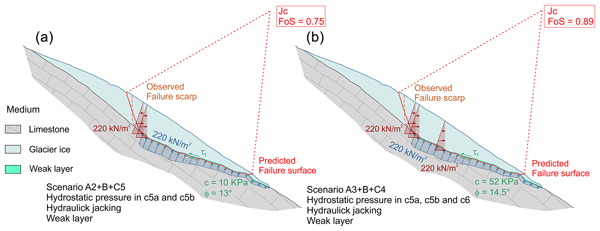
The Marmolada Glacier collapse (3 July 2022), one of the deadliest in the Alps, caused 11 fatalities and occurred during an anomalously warm summer. Analysis links the failure to the combined action of permafrost degradation, elevated ice temperatures, hydrostatic pressure, hydraulic jacking and reduced basal friction. No single factor alone explains the failure. The event highlights how climate-driven thermal and hydraulic factors increasingly threaten the stability of cold mountain glaciers.
Andrea Securo, Costanza Del Gobbo, Giovanni Baccolo, Carlo Barbante, Michele Citterio, Fabrizio De Blasi, Marco Marcer, Mauro Valt, and Renato R. Colucci
The Cryosphere, 19, 1335–1352, https://doi.org/10.5194/tc-19-1335-2025, https://doi.org/10.5194/tc-19-1335-2025, 2025
Short summary
Short summary
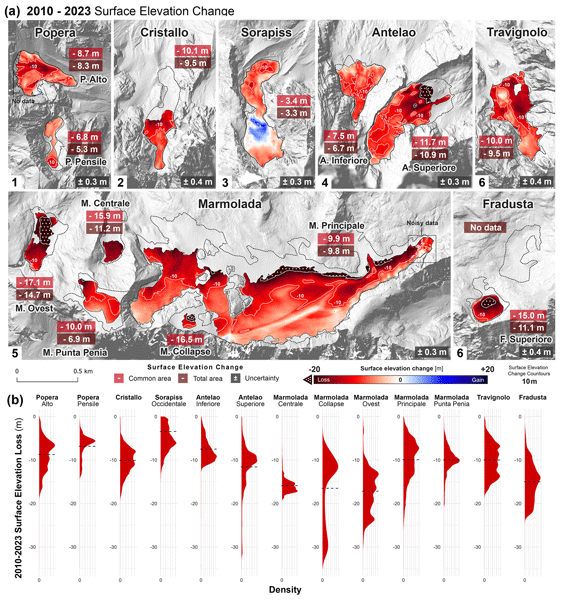
We have reconstructed the multi-decadal (1980s–2023) ice mass changes for all the current mountain glaciers in the Dolomites. We used historical aerial photographs, drone surveys, and lidar to fill the glaciological data gap for the region. We observed an alarming decline in both glacier area and volume, with some of the glaciers showing smaller losses due to local topography and debris cover feedback. We strongly recommend more specific monitoring of these glaciers.
Chalachew Muluken Liyew, Elvira Di Nardo, Rosa Meo, and Stefano Ferraris
Adv. Stat. Clim. Meteorol. Oceanogr., 10, 173–194, https://doi.org/10.5194/ascmo-10-173-2024, https://doi.org/10.5194/ascmo-10-173-2024, 2024
Short summary
Short summary
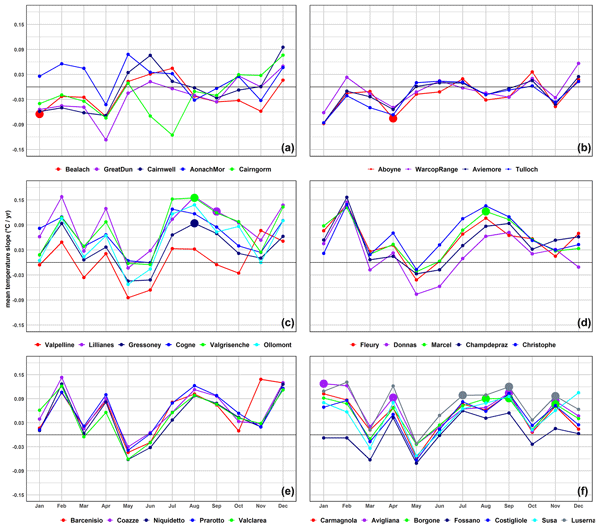
Global warming is a big issue: it is necessary to know more details to make a forecast model and plan adaptation measures. Warming varies in space and time and models often average it over large areas. However, it shows great variations between months of the year. It also varies between regions of the world and between lowland and highland regions. This paper uses statistical and machine learning techniques to quantify such differences between Italy and the UK at different altitudes.
Alessio Gentile, Jana von Freyberg, Davide Gisolo, Davide Canone, and Stefano Ferraris
Hydrol. Earth Syst. Sci., 28, 1915–1934, https://doi.org/10.5194/hess-28-1915-2024, https://doi.org/10.5194/hess-28-1915-2024, 2024
Short summary
Short summary
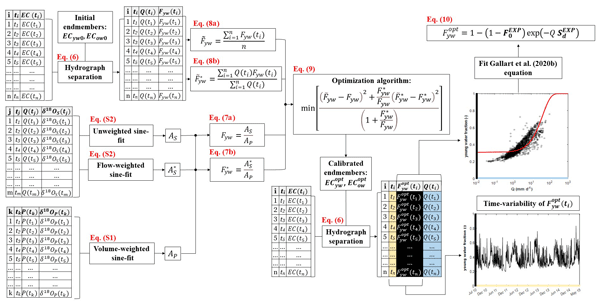
Can we leverage high-resolution and low-cost EC measurements and biweekly δ18O data to estimate the young water fraction at higher temporal resolution? Here, we present the EXPECT method that combines two widespread techniques: EC-based hydrograph separation and sine-wave models of the seasonal isotope cycles. The method is not without its limitations, but its application in three small Swiss catchments is promising for future applications in catchments with different characteristics.
Giorgio Baiamonte, Carmelo Agnese, Carmelo Cammalleri, Elvira Di Nardo, Stefano Ferraris, and Tommaso Martini
Adv. Stat. Clim. Meteorol. Oceanogr., 10, 51–67, https://doi.org/10.5194/ascmo-10-51-2024, https://doi.org/10.5194/ascmo-10-51-2024, 2024
Short summary
Short summary
In hydrology, the probability distributions are used to determine the probability of occurrence of rainfall events. In this study, two different methods for modeling rainfall time characteristics have been applied: a direct method and an indirect method that make it possible to relax the assumptions of the renewal process. The analysis was extended to two additional time variables that may be of great interest for practical hydrological applications: wet chains and dry chains.
Luca Carturan, Fabrizio De Blasi, Roberto Dinale, Gianfranco Dragà, Paolo Gabrielli, Volkmar Mair, Roberto Seppi, David Tonidandel, Thomas Zanoner, Tiziana Lazzarina Zendrini, and Giancarlo Dalla Fontana
Earth Syst. Sci. Data, 15, 4661–4688, https://doi.org/10.5194/essd-15-4661-2023, https://doi.org/10.5194/essd-15-4661-2023, 2023
Short summary
Short summary
This paper presents a new dataset of air, englacial, soil surface and rock wall temperatures collected between 2010 and 2016 on Mt Ortles, which is the highest summit of South Tyrol, Italy. Details are provided on instrument type and characteristics, field methods, and data quality control and assessment. The obtained data series are available through an open data repository. This is a rare dataset from a summit area lacking observations on permafrost and glaciers and their climatic response.
Alessio Gentile, Davide Canone, Natalie Ceperley, Davide Gisolo, Maurizio Previati, Giulia Zuecco, Bettina Schaefli, and Stefano Ferraris
Hydrol. Earth Syst. Sci., 27, 2301–2323, https://doi.org/10.5194/hess-27-2301-2023, https://doi.org/10.5194/hess-27-2301-2023, 2023
Short summary
Short summary
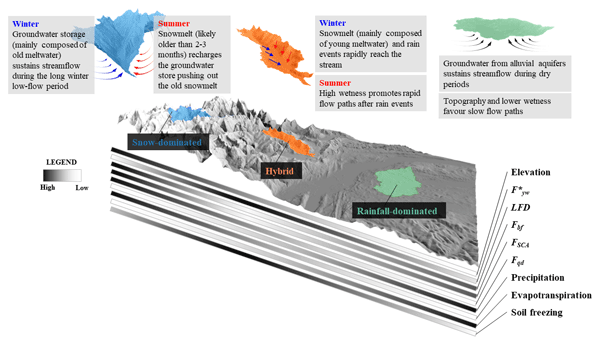
What drives young water fraction, F*yw (i.e., the fraction of water in streamflow younger than 2–3 months), variations with elevation? Why is F*yw counterintuitively low in high-elevation catchments, in spite of steeper topography? In this paper, we present a perceptual model explaining how the longer low-flow duration at high elevations, driven by the persistence of winter snowpacks, increases the proportion of stored (old) water contributing to the stream, thus reducing F*yw.
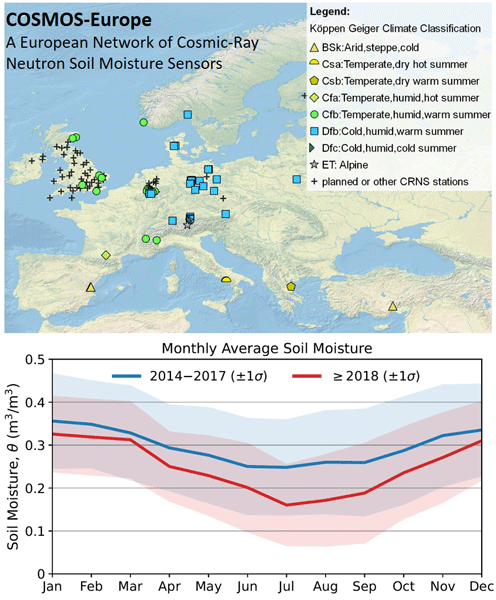
Heye Reemt Bogena, Martin Schrön, Jannis Jakobi, Patrizia Ney, Steffen Zacharias, Mie Andreasen, Roland Baatz, David Boorman, Mustafa Berk Duygu, Miguel Angel Eguibar-Galán, Benjamin Fersch, Till Franke, Josie Geris, María González Sanchis, Yann Kerr, Tobias Korf, Zalalem Mengistu, Arnaud Mialon, Paolo Nasta, Jerzy Nitychoruk, Vassilios Pisinaras, Daniel Rasche, Rafael Rosolem, Hami Said, Paul Schattan, Marek Zreda, Stefan Achleitner, Eduardo Albentosa-Hernández, Zuhal Akyürek, Theresa Blume, Antonio del Campo, Davide Canone, Katya Dimitrova-Petrova, John G. Evans, Stefano Ferraris, Félix Frances, Davide Gisolo, Andreas Güntner, Frank Herrmann, Joost Iwema, Karsten H. Jensen, Harald Kunstmann, Antonio Lidón, Majken Caroline Looms, Sascha Oswald, Andreas Panagopoulos, Amol Patil, Daniel Power, Corinna Rebmann, Nunzio Romano, Lena Scheiffele, Sonia Seneviratne, Georg Weltin, and Harry Vereecken
Earth Syst. Sci. Data, 14, 1125–1151, https://doi.org/10.5194/essd-14-1125-2022, https://doi.org/10.5194/essd-14-1125-2022, 2022
Short summary
Short summary
Monitoring of increasingly frequent droughts is a prerequisite for climate adaptation strategies. This data paper presents long-term soil moisture measurements recorded by 66 cosmic-ray neutron sensors (CRNS) operated by 24 institutions and distributed across major climate zones in Europe. Data processing followed harmonized protocols and state-of-the-art methods to generate consistent and comparable soil moisture products and to facilitate continental-scale analysis of hydrological extremes.
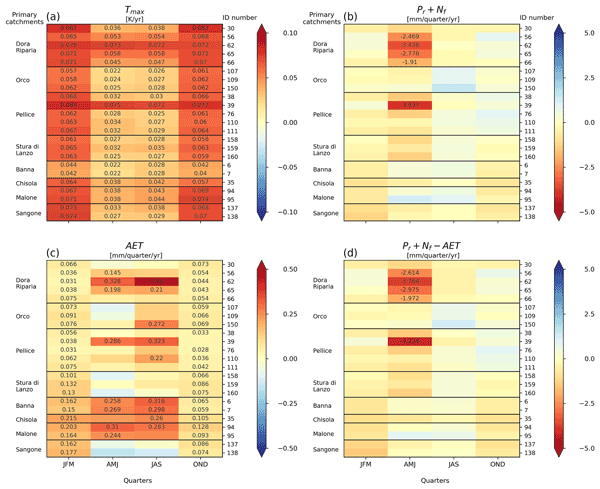
Elisa Brussolo, Elisa Palazzi, Jost von Hardenberg, Giulio Masetti, Gianna Vivaldo, Maurizio Previati, Davide Canone, Davide Gisolo, Ivan Bevilacqua, Antonello Provenzale, and Stefano Ferraris
Hydrol. Earth Syst. Sci., 26, 407–427, https://doi.org/10.5194/hess-26-407-2022, https://doi.org/10.5194/hess-26-407-2022, 2022
Short summary
Short summary
In this study, we evaluate the past, present and future quantity of groundwater potentially available for drinking purposes in the metropolitan area of Turin, north-western Italy. In order to effectively manage water resources, a knowledge of the water cycle components is necessary, including precipitation, evapotranspiration and subsurface reservoirs. All these components have been carefully evaluated in this paper, using observational datasets and modelling approaches.
Cited articles
Beniston, M.: Impacts of climatic change on water and associated economic activities in the Swiss Alps, J. Hydrol., 412–413, 291–296, https://doi.org/10.1016/j.jhydrol.2010.06.046, 2012.
Berni, A. and Giancanelli, E.: La campagna di rilievi nivometrici effettuata dall'ENEL nel periodo febbraio–giugno 1966, Energia Elettrica, 9, 533–542, 1966.
Bogena, H. R., Herrmann, F., Jakobi, J., Brogi, C., Ilias, A., Huisman, J. A., Panagopoulos, A., and Pisinaras, V.: Monitoring of snowpack dynamics with cosmic-ray neutron probes: a comparison of four conversion methods, Frontiers in Water, 2, 19, https://doi.org/10.3389/frwa.2020.00019, 2020.
Bogena, H. R., Schrön, M., Jakobi, J., Ney, P., Zacharias, S., Andreasen, M., Baatz, R., Boorman, D., Duygu, M. B., Eguibar-Galán, M. A., Fersch, B., Franke, T., Geris, J., González Sanchis, M., Kerr, Y., Korf, T., Mengistu, Z., Mialon, A., Nasta, P., Nitychoruk, J., Pisinaras, V., Rasche, D., Rosolem, R., Said, H., Schattan, P., Zreda, M., Achleitner, S., Albentosa-Hernández, E., Akyürek, Z., Blume, T., del Campo, A., Canone, D., Dimitrova-Petrova, K., Evans, J. G., Ferraris, S., Frances, F., Gisolo, D., Güntner, A., Herrmann, F., Iwema, J., Jensen, K. H., Kunstmann, H., Lidón, A., Looms, M. C., Oswald, S., Panagopoulos, A., Patil, A., Power, D., Rebmann, C., Romano, N., Scheiffele, L., Seneviratne, S., Weltin, G., and Vereecken, H.: COSMOS-Europe: a European network of cosmic-ray neutron soil moisture sensors, Earth Syst. Sci. Data, 14, 1125–1151, https://doi.org/10.5194/essd-14-1125-2022, 2022.
Brugnara, Y. and Maugeri, M.: Daily precipitation variability in the southern Alps since the late 19th century, Int. J. Climatol., 39, 3492–3504, https://doi.org/10.1002/joc.6034, 2019.
Capelli, A., Koch, F., Henkel, P., Lamm, M., Appel, F., Marty, C., and Schweizer, J.: GNSS signal-based snow water equivalent determination for different snowpack conditions along a steep elevation gradient, The Cryosphere, 16, 505–531, https://doi.org/10.5194/tc-16-505-2022, 2022.
Colombo, N., Valt, M., Romano, E., Salerno, F., Godone, D., Cianfarra, P., Freppaz, M., Maugeri, M., Guyennon, N.: Long-term trend of snow water equivalent in the Italian Alps, J. Hydrol., 614, 128532, https://doi.org/10.1016/j.jhydrol.2022.128532, 2022.
Davies, P., Baatz, R., Schattan, P., Quansah, E. K., Amekudzi, L. K., and Bogena, H. R.: On the variability of the barometric effect and its relation to cosmic-ray neutron sensing, Sensors, 26, 925, https://doi.org/10.3390/s26030925, 2026.
Egli, L., Jonas, T., and Meister, R.: Comparison of different automatic methods for estimating snow water equivalent, Cold Reg. Sci. Technol., 57, 107–115, https://doi.org/10.1016/j.coldregions.2009.02.008, 2009.
Gianessi, S., Polo, M., Stevanato, L., Lunardon, M., Francke, T., Oswald, S. E., Said Ahmed, H., Toloza, A., Weltin, G., Dercon, G., Fulajtar, E., Heng, L., and Baroni, G.: Testing a novel sensor design to jointly measure cosmic-ray neutrons, muons and gamma rays for non-invasive soil moisture estimation, Geosci. Instrum. Method. Data Syst., 13, 9–25, https://doi.org/10.5194/gi-13-9-2024, 2024.
Gottardi, F., Carrier, P., Paquet, E., and Laval, M. T.: Le NRC: une décennie de mesures de l'équivalent en eau du manteau neigeux dans les massifs montagneux français, International Snow Science Workshop 2013, 33, 926–930, https://arc.lib.montana.edu/snow-science/objects/ISSW13_paper_O2-08.pdf (last access: 1 September 2026), 2013.
Gugerli, R., Salzmann, N., Huss, M., and Desilets, D.: Continuous and autonomous snow water equivalent measurements by a cosmic ray sensor on an alpine glacier, The Cryosphere, 13, 3413–3434, https://doi.org/10.5194/tc-13-3413-2019, 2019.
Gugerli, R., Desilets, D., and Salzmann, N.: Brief communication: Application of a muonic cosmic ray snow gauge to monitor the snow water equivalent on alpine glaciers, The Cryosphere, 16, 799–806, https://doi.org/10.5194/tc-16-799-2022, 2022.
Guyennon, N., Valt, M., Salerno, F., Petrangeli, A. B., Romano, E.: Estimating the snow water equivalent from snow depth measurements in the Italian Alps, Cold Reg. Sci. Technol., 167, 102859, https://doi.org/10.1016/j.coldregions.2019.102859, 2019.
Hammond, J. C., Saavedra, F. A., Kampf, S. K.: Global snow zone maps and trends in snow persistence 2001–2016, Int. J. Climatol., 38, 4369–4383, https://doi.org/10.1002/joc.5674, 2018.
Immerzeel, W. W., Lutz, A. F., Andrade, M., Bahl, A., Biemans, T., Bolch, T., Hyde, S., Brumby, S., Davies, B. J., Elmore, A. C., Emmer, A., Feng, M., Fernández, A., Haritashya, U., Kargel, J. S., Koppes, M., Kraaijenbrink, P. D. A., Kulkarni, A. V., Mayewski, P. A., Nepal, S., Pacheco, P., Painter, T., H., Pellicciotti, F., Rajaram, H., Rupper, S., Sinisalo, A., Shrestha, A. B., Viviroli, D., Wada, Y., Xiao, C., Yao, T., and Baillie, J. E. M.: Importance and vulnerability of the world's water towers, Nature, 577, 364–369, https://doi.org/10.1038/s41586-019-1822-y, 2020.
Jitnikovitch, A., Marsh, P., Walker, B., and Desilets, D.: Snow water equivalent measurement in the Arctic based on cosmic ray neutron attenuation, The Cryosphere, 15, 5227–5239, https://doi.org/10.5194/tc-15-5227-2021, 2021.
Kinar, N. J. and Pomeroy, J. W.: Measurement of the physical properties of the snowpack, Rev. Geophys., 53, 481–544, https://doi.org/10.1002/2015RG000481, 2015.
López-Moreno, J. I., Fassnacht, S. R., Heath, J. T., Musselman, K. N., Revuelto, J., Latron, J., Morán-Tejeda, E., Jonas, T.: Small scale spatial variability of snow density and depth over complex alpine terrain: Implications for estimating snow water equivalent, Adv. Water Resour., 55, 40–52, https://doi.org/10.1016/j.advwatres.2012.08.010, 2013.
López-Moreno, J. I., Pomeroy, J. W., Alonso-Gonzalez, E., Moran-Tejeda, E., and Revuelto, J.: Decoupling of warming mountain snowpacks from hydrological regimes, Environ. Res. Lett., 15, 114006, https://doi.org/10.1088/1748-9326/abb55f, 2020a.
López-Moreno, J. I., Leppänen, L., Luks, B., Holko, L., Picard, G., Sanmiguel-Vallelado, A., Alonso-González, E., Finger, D. C., Arslan, A. N., Gillemot, K., Sensoy, A., Sorman, A., Ertaş, M. C., Fassnacht, S. R., Fierz, C., and Marty, C.: Intercomparison of measurements of bulk snow density and water equivalent of snow cover with snow core samplers: instrumental bias and variability induced by observers, Hydrol. Process., 34, 3120–3133, https://doi.org/10.1002/hyp.13785, 2020b.
Mankin, J. S., Viviroli, D., Singh, D., Hoesktra, A. Y., and Diffenbaugh, N. S.: The potential for snow to supply human water demand in the present and future, Environ. Res. Lett., 10, 114016, https://doi.org/10.1088/1748-9326/10/11/114016, 2015.
McJannet, D. L. and Desilets, D.: Incoming neutron flux corrections for cosmic-ray soil and snow sensors using the global neutron monitor network, Water Resour. Res., 59, e2022WR033889, https://doi.org/10.1029/2022WR033889, 2023.
Pokhrel, N., Wagnon, P., Brun, F., Khadka, A., Matthews, T., Goutard, A., Shrestha, D., Perry, B., and Réveillet, M.: Brief communication: Accurate and autonomous snow water equivalent measurements using a cosmic ray sensor on a Himalayan glacier, The Cryosphere, 18, 5913–5920, https://doi.org/10.5194/tc-18-5913-2024, 2024.
Pritchard, H. D., Farinotti, D., and Colwell, S.: Measuring changes in snowpack SWE continuously on a landscape scale using lake water pressure, J. Hydrometeorol., 22, 795–811, 2021.
Schattan, P., Baroni, G., Oswald, S. E., Schöber, J., Fey, C., Kormann, C., Huttenlau, M., and Achleitner, S.: Continuous monitoring of snowpack dynamics in alpine terrain by aboveground neutron sensing, Water Resour. Res., 53, 3615–3634, https://doi.org/10.1002/2016WR020234, 2017.
Schmid, L., Heilig, A., Mitterer, C., Schweizer, J., Maurer, H., Okorn, R., and Eisen, O.: Continuous snowpack monitoring using upward-looking ground-penetrating radar technology, J. Glaciol., 60, 509–525, https://doi.org/10.3189/2014JoG13J084, 2014.
Sigouin, M. J. P. and Si, B. C.: Calibration of a non-invasive cosmic-ray probe for wide area snow water equivalent measurement, The Cryosphere, 10, 1181–1190, https://doi.org/10.5194/tc-10-1181-2016, 2016.
Stevanato, L., Baroni, G., Oswald, S. E., Lunardon, M., Mares, V., Marinello, F., Moretto, S., Polo, M., Sartori, P., Schattan, P., and Ruehm, W.: An alternative incoming correction for cosmic-ray neutron sensing observations using local muon measurement, Geophys. Res. Lett., 49, e2021GL095383, https://doi.org/10.1029/2021GL095383, 2022.
Valt, M., Chiambretti, I., and Dellavedova, P.: YETI-a software to service the avalanche forecaster, in: Proceedings of Advances in avalanche forecasting – Section 2 New approaches and tools for avalanche forecasting, Podbanské, Slovakia, 22 October 2012, pp. 38–43, 2012.
Valt, M.: Criticità nelle misure per la stima dello SWE, in: Proceedings of IV Interconfronto SWE, Val di Susa, Italy 19–20 March 2018, 2018.
Viviroli, D., Kummu, M., Meybeck, M., Kallio, M., and Wada, Y.: Increasing dependence of lowland populations on mountain water resources, Nat. Sustain., 3, 917–928, https://doi.org/10.1038/s41893-020-0559-9, 2020.
Vorkauf, M., Marty, C., Kahmen, A., and Hiltbrunner, E.: Past and future snowmelt trends in the Swiss Alps: the role of temperature and snowpack, Clim. Change, 165, 44, https://doi.org/10.1007/s10584-021-03027-x, 2021.
Wallace, J. M. and Hobbs, P. V.: Atmospheric Science: An Introductory Survey, 2nd edn., https://doi.org/10.1016/C2009-0-00034-8, 1–488, 2006.
Short summary
We present a network of 26 sensors measuring snow water equivalent through cosmic rays across the Italian Alps. We study the application of a parameterisation shared by all the probes. The parameters were defined and validated with data taken during two seasons at 13 sites. We show that the parameterisation gives a good estimate of the water equivalent. This finding can contribute to expand data availability by installing similar probes in sites at high elevations and in inaccessible locations.
We present a network of 26 sensors measuring snow water equivalent through cosmic rays across...


