
Articles | Volume 20, issue 7
https://doi.org/10.5194/tc-20-3759-2026
© Author(s) 2026. This work is distributed under
the Creative Commons Attribution 4.0 License.
the Creative Commons Attribution 4.0 License.
https://doi.org/10.5194/tc-20-3759-2026
© Author(s) 2026. This work is distributed under
the Creative Commons Attribution 4.0 License.
the Creative Commons Attribution 4.0 License.
Research article
| 
03 Jul 2026
Research article |
| 03 Jul 2026
| 03 Jul 2026
Mapping daily snow depth with machine learning and airborne lidar across two contrasting snowpacks
Caleb G. Pan
CORRESPONDING AUTHOR

Geospatial Research Laboratory, Engineer Research and Development Center, US Army Corps of Engineers, Alexandria, VA, 22315, USA
Jeremy Johnston
Earth Systems Research Center, Institute for the Study of Earth, Oceans, and Space, University of New Hampshire,Durham, NH, USA
Jennifer M. Jacobs
Earth Systems Research Center, Institute for the Study of Earth, Oceans, and Space, University of New Hampshire,Durham, NH, USA
Department of Civil and Environmental Engineering, University of New Hampshire, Durham, NH, USA
Shad O'Neel
Cold Regions Research Engineering Laboratory, Engineer Research and Development Center, US Army Corps of Engineers, Boise, ID, USA
Related authors
Caleb G. Pan, Kristofer Lasko, Sean P. Griffin, John S. Kimball, Jinyang Du, Tate G. Meehan, and Peter B. Kirchner
The Cryosphere, 19, 2797–2819, https://doi.org/10.5194/tc-19-2797-2025, https://doi.org/10.5194/tc-19-2797-2025, 2025
Short summary
Short summary
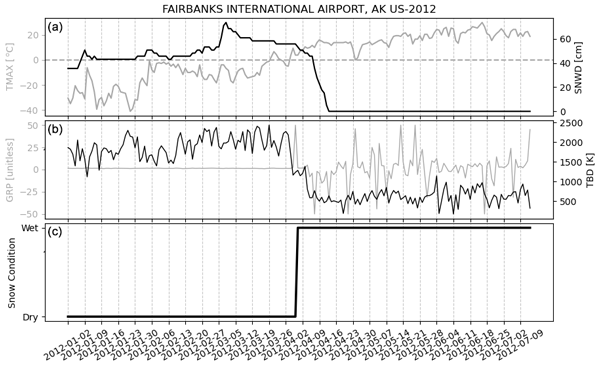
This study examines 35 years of snow cover changes in Alaska’s Yukon River Basin using machine learning to track snowmelt timing and disappearance. Results show snow is melting earlier and disappearing faster due to rising temperatures, highlighting the effects of climate change on water resources, ecosystems, and communities. The findings improve understanding of snow dynamics and provide critical insights for addressing climate-driven challenges in the region.
Zachary Hoppinen, Hans-Peter Marshall, Ross Palomaki, Coleman Kane, Siobhan Ciafone, Shad O'Neel, and Thomas Van Der Weide
EGUsphere, https://doi.org/10.5194/egusphere-2026-5140, https://doi.org/10.5194/egusphere-2026-5140, 2026
This preprint is open for discussion and under review for The Cryosphere (TC).
Short summary
Short summary
Mountain snow stores water for millions of people, but no satellite yet maps how much water it holds. The new NISAR radar satellite may be able to, because its signal slows down as it passes through snow. We tested this over a mountain site in Idaho by comparing the satellite measurement of new snow with maps of snow depth change from an airplane-mounted laser scanner. The two agreed well, especially in open terrain, giving the first evidence that NISAR can measure snowfall from space.
Minsun Kang, Adam Hunsaker, Mahsa Moradi, Dan R. Glaser, and Jennifer M. Jacobs
EGUsphere, https://doi.org/10.5194/egusphere-2026-3105, https://doi.org/10.5194/egusphere-2026-3105, 2026
This preprint is open for discussion and under review for Hydrology and Earth System Sciences (HESS).
Short summary
Short summary
Seasonal snow is a key water source, yet its amount and timing are hard to estimate in shallow, wet regions. Using a drone with ground-penetrating radar and laser scanner, alongside field measurements in New Hampshire, we tracked snow depth, density, and wetness. The snow shifted rapidly from dry to wet, and a physically based mixing model best matched the radar response. These observations help study spatially variable snowpacks and melt transitions that challenge field and remote sensing data.
Farhaan Cooverji, Eunsang Cho, Bailing Li, Carrie Vuyovich, Jennifer M. Jacobs, Eunsaem Cho, Eric A. Sproles, and Samuel E. Tuttle
EGUsphere, https://doi.org/10.5194/egusphere-2026-4186, https://doi.org/10.5194/egusphere-2026-4186, 2026
Short summary
Short summary
Quantifying how much snowmelt feeds mountain rivers is hard. In a Missouri Headwater watershed, we estimated the region's water cycle, focusing on snowmelt generation. Well-validated hydrological data were more accurate individually, but the land surface model better balanced the annual water budget. It also underestimates evaporation and sublimation, inflating runoff estimates. This approach shows snowmelt supplies only about 32 % of runoff, well below earlier estimates near 65 %.
Eunsaem Cho, Eunsang Cho, Carrie M. Vuyovich, Bailing Li, and Jennifer M. Jacobs
EGUsphere, https://doi.org/10.5194/egusphere-2025-5557, https://doi.org/10.5194/egusphere-2025-5557, 2025
Short summary
Short summary
This study evaluated how different parameterization schemes in the Noah-MP land surface model affect snow and runoff processes in the Missouri River Basin. By comparing simulations with USGS streamflow and University of Arizona snow data across 50 subbasins, we found that alternative schemes improve groundwater, evapotranspiration, frozen soil, and snowmelt-runoff representation, supporting better flood prediction and water management.
Mahsa Moradi, Andrew G. Fleming, Adam Hunsaker, and Jennifer M. Jacobs
EGUsphere, https://doi.org/10.5194/egusphere-2025-4371, https://doi.org/10.5194/egusphere-2025-4371, 2025
Short summary
Short summary
Images from Unoccupied aerial systems (UAS) allow us to map snow more accurately, especially where snow is shallow and does not last long. We used UAS with visible imagery and tested different methods of mapping snow (including a few machine learning methods) in open areas in southern New Hampshire, USA. We found that using the full color information gives the most reliable results. We showed how UAS surveys can be planned to create accurate snow maps, helping track snow in changing conditions.
Eunsang Cho, Megan Verfaillie, Jennifer M. Jacobs, Adam G. Hunsaker, Franklin B. Sullivan, Michael Palace, and Cameron Wagner
Hydrol. Earth Syst. Sci., 29, 4539–4556, https://doi.org/10.5194/hess-29-4539-2025, https://doi.org/10.5194/hess-29-4539-2025, 2025
Short summary
Short summary
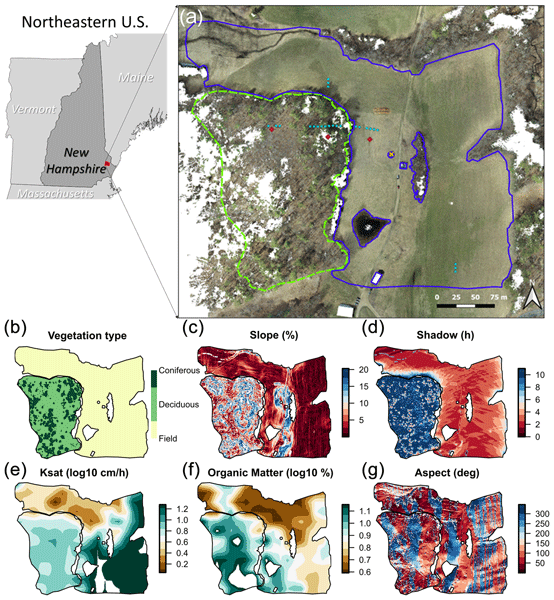
Unpiloted aerial system (UAS) lidar and structure-from-motion (SfM) photogrammetry effectively map high-resolution snow depths. Our study found that UAS lidar outperformed SfM, particularly in capturing stable snow distribution patterns. Vegetation type was the primary factor influencing snow depth across forest and field areas, reflecting soil variables, such as organic matter. When analyzed separately, slope and forest canopy shadowing played key roles.
Caleb G. Pan, Kristofer Lasko, Sean P. Griffin, John S. Kimball, Jinyang Du, Tate G. Meehan, and Peter B. Kirchner
The Cryosphere, 19, 2797–2819, https://doi.org/10.5194/tc-19-2797-2025, https://doi.org/10.5194/tc-19-2797-2025, 2025
Short summary
Short summary
This study examines 35 years of snow cover changes in Alaska’s Yukon River Basin using machine learning to track snowmelt timing and disappearance. Results show snow is melting earlier and disappearing faster due to rising temperatures, highlighting the effects of climate change on water resources, ecosystems, and communities. The findings improve understanding of snow dynamics and provide critical insights for addressing climate-driven challenges in the region.
Rainey Aberle, Ellyn Enderlin, Shad O'Neel, Caitlyn Florentine, Louis Sass, Adam Dickson, Hans-Peter Marshall, and Alejandro Flores
The Cryosphere, 19, 1675–1693, https://doi.org/10.5194/tc-19-1675-2025, https://doi.org/10.5194/tc-19-1675-2025, 2025
Short summary
Short summary
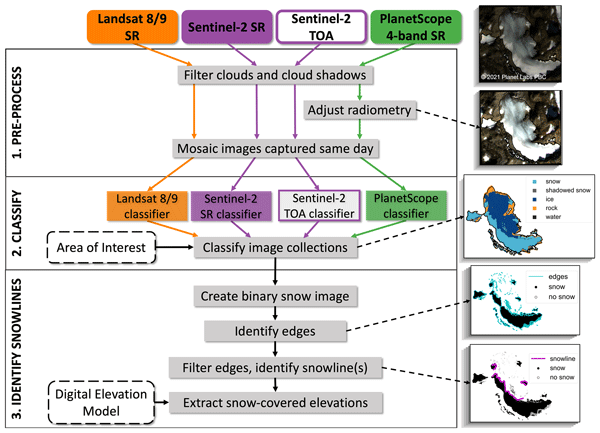
Tracking seasonal snow on glaciers is critical for understanding glacier health. Yet previous work has not directly compared machine learning algorithms for snow classification across satellite image products. To address this, we developed a new automated workflow for tracking seasonal snow on glaciers using several image products and machine learning models. Applying this method can help provide insights into glacier health, water resources, and the effects of climate change on snow cover.
Tate G. Meehan, Ahmad Hojatimalekshah, Hans-Peter Marshall, Elias J. Deeb, Shad O'Neel, Daniel McGrath, Ryan W. Webb, Randall Bonnell, Mark S. Raleigh, Christopher Hiemstra, and Kelly Elder
The Cryosphere, 18, 3253–3276, https://doi.org/10.5194/tc-18-3253-2024, https://doi.org/10.5194/tc-18-3253-2024, 2024
Short summary
Short summary
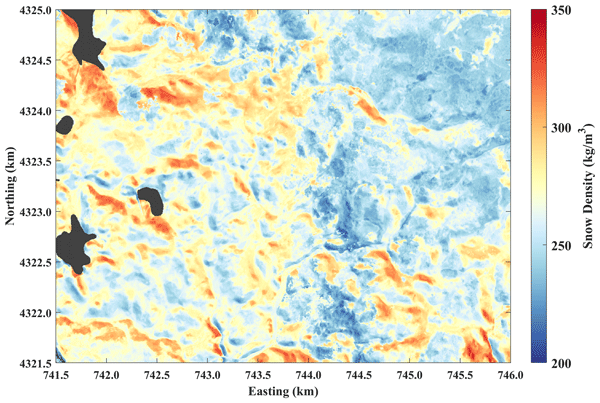
Snow water equivalent (SWE) is a critical parameter for yearly water supply forecasting and can be calculated by multiplying the snow depth by the snow density. We combined high-spatial-resolution snow depth information with ground-based radar measurements to solve for snow density. Extrapolated density estimates over our study area resolved detailed patterns that agree with the known interactions of snow with wind, terrain, and vegetation and were utilized in the calculation of SWE.
Holly Proulx, Jennifer M. Jacobs, Elizabeth A. Burakowski, Eunsang Cho, Adam G. Hunsaker, Franklin B. Sullivan, Michael Palace, and Cameron Wagner
The Cryosphere, 17, 3435–3442, https://doi.org/10.5194/tc-17-3435-2023, https://doi.org/10.5194/tc-17-3435-2023, 2023
Short summary
Short summary
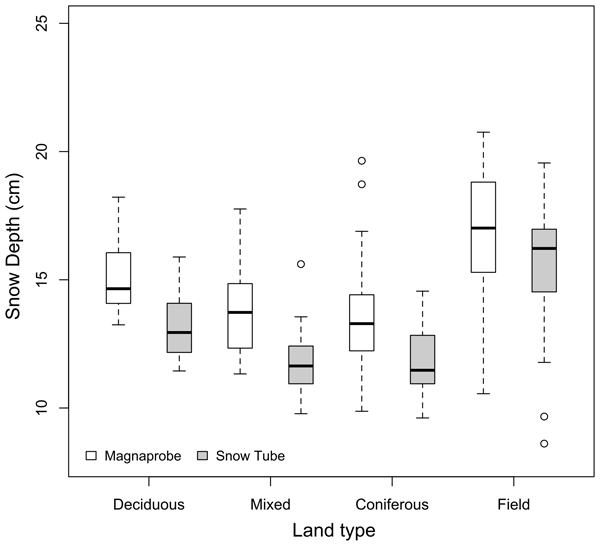
This study compares snow depth measurements from two manual instruments in a field and forest. Snow depths measured using a magnaprobe were typically 1 to 3 cm deeper than those measured using a snow tube. These differences were greater in the forest than in the field.

Eunsang Cho, Carrie M. Vuyovich, Sujay V. Kumar, Melissa L. Wrzesien, Rhae Sung Kim, and Jennifer M. Jacobs
Hydrol. Earth Syst. Sci., 26, 5721–5735, https://doi.org/10.5194/hess-26-5721-2022, https://doi.org/10.5194/hess-26-5721-2022, 2022
Short summary
Short summary
While land surface models are a common approach for estimating macroscale snow water equivalent (SWE), the SWE accuracy is often limited by uncertainties in model physics and forcing inputs. In this study, we found large underestimations of modeled SWE compared to observations. Precipitation forcings and melting physics limitations dominantly contribute to the SWE underestimations. Results provide insights into prioritizing strategies to improve the SWE simulations for hydrologic applications.
Holly Proulx, Jennifer M. Jacobs, Elizabeth A. Burakowski, Eunsang Cho, Adam G. Hunsaker, Franklin B. Sullivan, Michael Palace, and Cameron Wagner
The Cryosphere Discuss., https://doi.org/10.5194/tc-2022-7, https://doi.org/10.5194/tc-2022-7, 2022
Manuscript not accepted for further review
Short summary
Short summary
This study compares snow depth measurements from two manual instruments and an airborne platform in a field and forest. The manual instruments’ snow depths differed by 1 to 3 cm. The airborne measurements , which do not penetrate the leaf litter, were consistently shallower than either manual instrument. When combining airborne snow depth maps with manual density measurements, corrections may be required to create unbiased maps of snow properties.
Cited articles
Adebisi, N., Marshall, H.-P., Vuyovich, C., Elder, K., Hiemstra, C., and Durand, M.: SnowEx20-21 QSI Lidar Snow Depth 0.5m UTM Grid, Version 1, Boulder, Colorado USA, NASA National Snow and Ice Data Center Distributed Active Archive Center [data set], https://doi.org/10.5067/VBUN16K365DG, 2022.
Alonso-González, E., López-Moreno, J. I., Ertaş, M. C., Şensoy, A., and Şorman, A. A.: A performance assessment of gridded snow products in the Upper Euphrates, Cuadernos de Investigación Geográfica, 49, 55–68, https://doi.org/10.18172/cig.5275, 2022.
Breiman, L.: Random Forests, Mach. Learn., 45, 5–32, https://doi.org/10.1023/A:1010933404324, 2001.
Broxton, P., Ehsani, M. R., and Behrangi, A.: Improving Mountain Snowpack Estimation Using Machine Learning With Sentinel-1, the Airborne Snow Observatory, and University of Arizona Snowpack Data, Earth Space Sci., 11, https://doi.org/10.1029/2023ea002964, 2024.
Callaghan, T. V., Johansson, M., Brown, R. D., Groisman, P. Ya., Labba, N., Radionov, V., Bradley, R. S., Blangy, S., Bulygina, O. N., Christensen, T. R., Colman, J. E., Essery, R. L. H., Forbes, B. C., Forchhammer, M. C., Golubev, V. N., Honrath, R. E., Juday, G. P., Meshcherskaya, A. V., Phoenix, G. K., Pomeroy, J., Rautio, A., Robinson, D. A., Schmidt, N. M., Serreze, M. C., Shevchenko, V. P., Shiklomanov, A. I., Shmakin, A. B., Sköld, P., Sturm, M., Woo, M., and Wood, E. F.: Multiple Effects of Changes in Arctic Snow Cover, AMBIO, 40, 32–45, https://doi.org/10.1007/s13280-011-0213-x, 2011.
Chang, A. T., Foster, J. L., and Hall, D. K.: Nimbus-7 SMMR derived global snow cover parameters, Ann. Glaciol., 9, 39–44, 1987.
Ciafone, S., ONeel, S., Adebisi, N., Zikan, K., Enterkine, J., van der Weide, T., Wilder, B., Hoppinen, Z., Filiano, D., and Marshall, H. P.: SnowEx Mores Creek Summit (MCS) Airborne LiDAR Survey Raw, Version 1, Boulder, Colorado USA, NASA National Snow and Ice Data Center Distributed Active Archive Center [data set], https://doi.org/10.5067/OYF98UGSOUQY, 2024.
Deems, J. S., Painter, T. H., and Finnegan, D. C.: Lidar measurement of snow depth: a review, J. Glaciol., 59, 467–479, https://doi.org/10.3189/2013jog12j154, 2013.
Diffenbaugh, N. S., Swain, D. L., and Touma, D.: Anthropogenic warming has increased drought risk in California, P. Natl. Acad. Sci. USA, 112, 3931–3936, https://doi.org/10.1073/pnas.1422385112, 2015.
Dong, C.: Remote sensing, hydrological modeling and in situ observations in snow cover research: A review, J. Hydrol., 561, 573–583, https://doi.org/10.1016/j.jhydrol.2018.04.027, 2018.
Dunmire, D., Lievens, H., Boeykens, L., and De Lannoy, G. J. M.: A machine learning approach for estimating snow depth across the European Alps from Sentinel-1 imagery, Remote Sens. Environ., 314, 114369, https://doi.org/10.1016/j.rse.2024.114369, 2024.
Ford, C. M., Kendall, A. D., and Hyndman, D. W.: Snowpacks decrease and streamflows shift across the eastern US as winters warm, Sci. Total Environ., 793, 148483, https://doi.org/10.1016/j.scitotenv.2021.148483, 2021.
Gascoin, S., Grizonnet, M., Bouchet, M., Salgues, G., and Hagolle, O.: Theia Snow collection: high-resolution operational snow cover maps from Sentinel-2 and Landsat-8 data, Earth Syst. Sci. Data, 11, 493–514, https://doi.org/10.5194/essd-11-493-2019, 2019.
Gascoin, S., Luojus, K., Nagler, T., Lievens, H., Masiokas, M., Jonas, T., Zheng, Z., and De Rosnay, P.: Remote sensing of mountain snow from space: status and recommendations, Front. Earth Sci., 12, 1381323, https://doi.org/10.3389/feart.2024.1381323, 2024.
Geissler, J., Rathmann, L., and Weiler, M.: Combining Daily Sensor Observations and Spatial LiDAR Data for Mapping Snow Water Equivalent in a Sub-Alpine Forest, Water Resour. Res., 59, e2023WR034460, https://doi.org/10.1029/2023WR034460, 2023.
Herbert, J., Raleigh, M. S., and Small, E. E.: sing a random forest model to combine airborne lidar and Snotel data for daily estimates of snow depth across mountain drainage basins of Colorado, Water Resour. Res., 61, e2024WR039775, https://doi.org/10.1029/2024WR039775, 2025.
Hoppinen, Z., Wilder, B., O'Neel, S., and Adebisi, N.: ice-road-copters: v1.0.0, Zenodo, https://doi.org/10.5281/zenodo.8184592, 2023.
Intergovernmental Panel On Climate Change (IPCC): Climate Change 2021 – The Physical Science Basis: Working Group I Contribution to the Sixth Assessment Report of the Intergovernmental Panel on Climate Change, 1st ed., Cambridge University Press, https://doi.org/10.1017/9781009157896, 2023.
Jacobs, J. M., Hunsaker, A. G., Sullivan, F. B., Palace, M., Burakowski, E. A., Herrick, C., and Cho, E.: Snow depth mapping with unpiloted aerial system lidar observations: a case study in Durham, New Hampshire, United States, The Cryosphere, 15, 1485–1500, https://doi.org/10.5194/tc-15-1485-2021, 2021.
Johnston, J., Jacobs, J. M., Vardaman, M., and Cho, E.: The snow meteorology and phenology classification (SnowMAP): global snow cover observations enhance snow's representation, Sci. Rep., 16, 14075, https://doi.org/10.1038/s41598-026-44321-x, 2026
Kelly, R. E., Chang, A. T., Tsang, L., and Foster, J. L.: A prototype AMSR-E global snow area and snow depth algorithm, IEEE T. Geosci. Remote, 41, 230–242, https://doi.org/10.1109/tgrs.2003.809118, 2003.
Kendall, M. G.: Rank Correlation Methods, Hafner Publishing Company, ISBN 0-85264-199-0, 1962.
Kim, Y., Kimball, J. S., Glassy, J., and Du, J.: An extended global Earth system data record on daily landscape freeze–thaw status determined from satellite passive microwave remote sensing, Earth Syst. Sci. Data, 9, 133–147, https://doi.org/10.5194/essd-9-133-2017, 2017.
Kirchner, P. B., Bales, R. C., Molotch, N. P., Flanagan, J., and Guo, Q.: LiDAR measurement of seasonal snow accumulation along an elevation gradient in the southern Sierra Nevada, California, Hydrol. Earth Syst. Sci., 18, 4261–4275, https://doi.org/10.5194/hess-18-4261-2014, 2014.
Li, D., Wrzesien, M. L., Durand, M., Adam, J., and Lettenmaier, D. P.: How much runoff originates as snow in the western United States, and how will that change in the future?, Geophys. Res. Lett., 44, 6163–6172, https://doi.org/10.1002/2017gl073551, 2017.
Lievens, H., Brangers, I., Marshall, H.-P., Jonas, T., Olefs, M., and De Lannoy, G.: Sentinel-1 snow depth retrieval at sub-kilometer resolution over the European Alps, The Cryosphere, 16, 159–177, https://doi.org/10.5194/tc-16-159-2022, 2022.
Liston, G. E. and Elder, K.: A Distributed Snow-Evolution Modeling System (SnowModel), J. Hydrometeorol., 7, 1259–1276, https://doi.org/10.1175/JHM548.1, 2006.
López-Moreno, J. I., Revuelto, J., Fassnacht, S. R., Azorín-Molina, C., Vicente-Serrano, S. M., Morán-Tejeda, E., and Sexstone, G. A.: Snowpack variability across various spatio-temporal resolutions, Hydrol. Process., 29, 1213–1224, https://doi.org/10.1002/hyp.10245, 2015.
Lundberg, S. and Lee, S.-I.: A Unified Approach to Interpreting Model Predictions, arXiv [preprint], https://doi.org/10.48550/arXiv.1705.07874, 25 November 2017.
Marks, D., Domingo, J., Susong, D., Link, T., and Garen, D.: A spatially distributed energy balance snowmelt model for application in mountain basins, Hydrol. Process., 13, 1935–1959, https://doi.org/10.1002/(SICI)1099-1085(199909)13:12/13<1935::AID-HYP868>3.0.CO;2-C, 1999.
Meloche, J., Langlois, A., Rutter, N., McLennan, D., Royer, A., Billecocq, P., and Ponomarenko, S.: High-resolution snow depth prediction using Random Forest algorithm with topographic parameters: A case study in the Greiner watershed, Nunavut, Hydrol. Process., 36, e14546, https://doi.org/10.1002/hyp.14546, 2022.
Meromy, L., Molotch, N. P., Link, T. E., Fassnacht, S. R., and Rice, R.: Subgrid variability of snow water equivalent at operational snow stations in the western USA, Hydrol. Process., 27, 2383–2400, https://doi.org/10.1002/hyp.9355, 2013.
Mortimer, C., Mudryk, L., Derksen, C., Luojus, K., Brown, R., Kelly, R., and Tedesco, M.: Evaluation of long-term Northern Hemisphere snow water equivalent products, The Cryosphere, 14, 1579–1594, https://doi.org/10.5194/tc-14-1579-2020, 2020.
Muñoz Sabater, J.: ERA5-Land hourly data from 1950 to present, in: Copernicus Climate Change Service (C3S) Climate Data Store (CDS), edited by: Hersbach, H. and C3S/ECMWF Team, Hourly data, 0.1° (9 km), https://doi.org/10.24381/cds.e2161bac, 2019.
National Academies of Sciences, Engineering and Medicine: Thriving on Our Changing Planet: A Decadal Strategy for Earth Observation from Space, The National Academies Press, Washington, DC, https://doi.org/10.17226/24938, 2018.
Nolin, A. W.: Recent advances in remote sensing of seasonal snow, J. Glaciol., 56, 1141–1150, https://doi.org/10.3189/002214311796406077, 2010.
Pan, C., Johnston, J., Jacobs, J., and O'Neel, S.: Mapping daily snow depth with machine learning and airborne lidar across two contrasting snowpacks, Zenodo [code], https://doi.org/10.5281/zenodo.20814771, 2026.
Rosen, P. A., Bawden, G. W., Barela, P., Chapman, B., Fattahi, H., Jones, C. E., Joughin, I. R., Lavalle, M., Lohman, R. B., Simons, M., Siqueira, P., Das, A., Desai, N. M., Kumar, R., Putrevu, D., Sharma, R., and Shrikant, C.: The NASA-ISRO SAR Mission: A summary, IEEE Geoscience and Remote Sensing Magazine, 13, 8–34, https://doi.org/10.1109/MGRS.2025.3578258, 2025.
Painter, T. H., Berisford, D. F., Boardman, J. W., Bormann, K. J., Deems, J. S., Gehrke, F., Hedrick, A., Joyce, M., Laidlaw, R., Marks, D., Mattmann, C., McGurk, B., Ramirez, P., Richardson, M., Skiles, S. M., Seidel, F. C., and Winstral, A.: The Airborne Snow Observatory: Fusion of scanning lidar, imaging spectrometer, and physically-based modeling for mapping snow water equivalent and snow albedo, Remote Sens. Environ., 184, 139–152, https://doi.org/10.1016/j.rse.2016.06.018, 2016.
Pan, C. G., Lasko, K., Griffin, S. P., Kimball, J. S., Du, J., Meehan, T. G., and Kirchner, P. B.: A random-forest-derived 35-year snow phenology record reveals climate trends in the Yukon River Basin, The Cryosphere, 19, 2797–2819, https://doi.org/10.5194/tc-19-2797-2025, 2025.
Pedregosa, F., Pedregosa, F., Varoquaux, G., Varoquaux, G., Org, N., Gramfort, A., Gramfort, A., Michel, V., Michel, V., Fr, L., Thirion, B., Thirion, B., Grisel, O., Grisel, O., Blondel, M., Prettenhofer, P., Prettenhofer, P., Weiss, R., Dubourg, V., Dubourg, V., Vanderplas, J., Passos, A., Tp, A., and Cournapeau, D.: Scikit-learn: Machine Learning in Python, Machine Learning in Python, 12, 2825–2830, 2011.
Pflug, J. M. and Lundquist, J. D.: Inferring Distributed Snow Depth by Leveraging Snow Pattern Repeatability: Investigation Using 47 Lidar Observations in the Tuolumne Watershed, Sierra Nevada, California, Water Resour. Res., 56, https://doi.org/10.1029/2020wr027243, 2020.
Pflug, J. M., Hughes, M., and Lundquist, J. D.: Downscaling Snow Deposition Using Historic Snow Depth Patterns: Diagnosing Limitations From Snowfall Biases, Winter Snow Losses, and Interannual Snow Pattern Repeatability, Water Resour. Res., 57, e2021WR029999, https://doi.org/10.1029/2021WR029999, 2021.
Qiao, D., Chen, X., Zhou, J., Liang, S., and Liu, G.: Improving the accuracy of gridded snow depth estimation through multi-source data and a machine learning fusion model, Sci. Rep., 15, 40917, https://doi.org/10.1038/s41598-025-22347-x, 2025.
Raleigh, M. S., Small, E. E., Bair, E. H., Wobus, C., and Rittger, K.: Snow monitoring at strategic locations improves water supply forecasting more than basin-wide mapping, Commun. Earth Environ., 6, 665, https://doi.org/10.1038/s43247-025-02660-z, 2025.
Reichstein, M., Camps-Valls, G., Stevens, B., Jung, M., Denzler, J., Carvalhais, N., and Prabhat: Deep learning and process understanding for data-driven Earth system science, Nature, 566, 195–204, https://doi.org/10.1038/s41586-019-0912-1, 2019.
Reu, J. D., Bourgeois, J., Bats, M., Zwertvaegher, A., Gelorini, V., Smedt, P. D., Chu, W., Antrop, M., Maeyer, P. D., Finke, P., Meirvenne, M. V., Verniers, J., and Crombé, P.: Application of the topographic position index to heterogeneous landscapes, Geomorphology, 186, 39–49, https://doi.org/10.1016/j.geomorph.2012.12.015, 2013.
Revuelto, J., Billecocq, P., Tuzet, F., Cluzet, B., Lamare, M., Larue, F., and Dumont, M.: Random forests as a tool to understand the snow depth distribution and its evolution in mountain areas, Hydrol. Process., 34, 5384–5401, https://doi.org/10.1002/hyp.13951, 2020.
Stahle, L. and Wold, S.: Analysis of variance (ANOVA), Chemometr. Intell. Lab., 6, 259–272, https://doi.org/10.1016/0169-7439(89)80095-4, 1989.
Stillinger, T., Rittger, K., Raleigh, M. S., Michell, A., Davis, R. E., and Bair, E. H.: Landsat, MODIS, and VIIRS snow cover mapping algorithm performance as validated by airborne lidar datasets, The Cryosphere, 17, 567–590, https://doi.org/10.5194/tc-17-567-2023, 2023.
Sturm, M. and Liston, G. E.: Revisiting the Global Seasonal Snow Classification: An Updated Dataset for Earth System Applications, J. Hydrometeorol., https://doi.org/10.1175/JHM-D-21-0070.1, 2021.
Van Der Weide, T., Ciafone, S., Wadhwani, Y., Alabi, I., O'Neel, S., and Marshall, H.: NIVAL Mores Creek Summit Snow Depth, Canopy Height, and DTM from Airborne LiDAR, (NIVAL_MCS_Lidar, Version 1), Boulder, Colorado USA, NASA National Snow and Ice Data Center Distributed Active Archive Center [data set], https://doi.org/10.5067/DPFDH2M49DQG, 2026.
Winstral, A. and Marks, D.: Simulating wind fields and snow redistribution using terrain-based parameters to model snow accumulation and melt over a semi-arid mountain catchment, Hydrol. Process., 16, 3585–3603, https://doi.org/10.1002/hyp.1238, 2002.
Yang, J., Jiang, L., Luojus, K., Pan, J., Lemmetyinen, J., Takala, M., and Wu, S.: Snow depth estimation and historical data reconstruction over China based on a random forest machine learning approach, The Cryosphere, 14, 1763–1778, https://doi.org/10.5194/tc-14-1763-2020, 2020.
Short summary
We developed a simple method to turn a few airborne snow-mapping flights and one daily snow record into continuous maps showing how snow depth changes each day. Tested in Idaho and New Hampshire, the approach works well in both deep and shallow snow regions and helps plan when and how often to fly lidar surveys for the best results.
We developed a simple method to turn a few airborne snow-mapping flights and one daily snow...


