
Articles | Volume 20, issue 5
https://doi.org/10.5194/tc-20-2757-2026
© Author(s) 2026. This work is distributed under
the Creative Commons Attribution 4.0 License.
the Creative Commons Attribution 4.0 License.
https://doi.org/10.5194/tc-20-2757-2026
© Author(s) 2026. This work is distributed under
the Creative Commons Attribution 4.0 License.
the Creative Commons Attribution 4.0 License.
Research article
| 
18 May 2026
Research article |
| 18 May 2026
| 18 May 2026
Ice motion across incised fjord landscapes

University of Bergen, Department of Earth Science, Bergen, Norway
now at: University of Bergen, Department of Biological Sciences, Bergen, Norway
Robert Law
University of Bergen, Department of Earth Science, Bergen, Norway
Bjerknes Centre for Climate Research, Bergen, Norway
Laboratory of Hydraulics, Hydrology and Glaciology (VAW), ETH Zurich, Zurich, Switzerland
Swiss Federal Institute for Forest, Snow and Landscape Research (WSL), bâtiment ALPOLE, Sion, Switzerland
Andreas Born
University of Bergen, Department of Earth Science, Bergen, Norway
Bjerknes Centre for Climate Research, Bergen, Norway
Thomas Chudley
Durham University, Department of Geography, Durham, UK
Stefanie Brechtelsbauer
Stockholm University, Department of Meteorology, Stockholm, Sweden
Related authors
Sjur Barndon, Augusto Lima, David M. Chandler, Abe T. Wiersma, Tancrède P. M. Leger, Raúl Pérez Prats, Eline S. Rentier, and Suzette G.A. Flantua
Earth Syst. Sci. Data Discuss., https://doi.org/10.5194/essd-2026-404, https://doi.org/10.5194/essd-2026-404, 2026
Preprint under review for ESSD
Short summary
Short summary
Mountain glacier history is hard to trace because field evidence is patchy and often erased by later ice advances. We used a fast computer model to simulate how glaciers grew and shrank over the last 130,000 years in nine mountain regions, and compared the results with mapped past and modern glaciers. By combining many plausible simulations, we map where glacier changes are reliable and where they are uncertain. The results provide a new baseline for studies of water, landscapes, and ecosystems.
Sjur Barndon, Augusto Lima, David M. Chandler, Abe T. Wiersma, Tancrède P. M. Leger, Raúl Pérez Prats, Eline S. Rentier, and Suzette G.A. Flantua
Earth Syst. Sci. Data Discuss., https://doi.org/10.5194/essd-2026-404, https://doi.org/10.5194/essd-2026-404, 2026
Preprint under review for ESSD
Short summary
Short summary
Mountain glacier history is hard to trace because field evidence is patchy and often erased by later ice advances. We used a fast computer model to simulate how glaciers grew and shrank over the last 130,000 years in nine mountain regions, and compared the results with mapped past and modern glaciers. By combining many plausible simulations, we map where glacier changes are reliable and where they are uncertain. The results provide a new baseline for studies of water, landscapes, and ecosystems.
Robert Law, Mylène Jacquemart, Matthias Bühler, Mauro Angelo Werder, and Janosch Beer
EGUsphere, https://doi.org/10.5194/egusphere-2026-3329, https://doi.org/10.5194/egusphere-2026-3329, 2026
Short summary
Short summary
To understand how glaciers move and predict related hazards, we need detailed measurements of ice deformation. We tested a new approach using fibre-optic cables down a borehole drilled into a small Swiss Alpine glacier. The cables successfully tracked ice movement at an incredibly fine scale, supporting laboratory experiments showing nearly linear flow for ice close to its melting point. This method marks an important advance for studying glacier motion and predicting ice-related hazards.
Ina Nagler, Helene Asbjørnsen, and Andreas Born
EGUsphere, https://doi.org/10.5194/egusphere-2026-2588, https://doi.org/10.5194/egusphere-2026-2588, 2026
Short summary
Short summary
This study explores the physical mechanisms behind large multidecadal North Atlantic circulation shifts, which remain poorly understood under forcing from human activity. We use 100 simulations of a single climate model to identify the common physical processes of these shifts. The results reveal three types of strong circulation changes. Weakening shifts after 1985 show a transition toward a regime where human-induced warming and reduced heat loss dominate these dynamics.
Rebekka Frøystad and Andreas Born
EGUsphere, https://doi.org/10.5194/egusphere-2026-1090, https://doi.org/10.5194/egusphere-2026-1090, 2026
Short summary
Short summary
Projections of future glacier change remain highly uncertain because different climate models produce a wide range of outcomes. In this study, we examine how this range influences projections for a Norwegian ice cap. We introduce a new downscaling approach that represents coarse climate models by high-resolution data. Our results show that the ice cap’s future is strongly influenced by emission scenario and we highlight the importance of accounting for uncertainty in climate impact studies.

Robert Law, Andreas Born, Philipp Voigt, Joseph A. MacGregor, and Claire Marie Guimond
The Cryosphere, 20, 1071–1086, https://doi.org/10.5194/tc-20-1071-2026, https://doi.org/10.5194/tc-20-1071-2026, 2026
Short summary
Short summary
Convection has been previously, yet contentiously, suggested for ice sheets, but never before comprehensively explored using numerical models. We use mantle dynamics code to test the hypothesis that convection gives rise to enigmatic plume-like features observed in radio-stratigraphy observations of the Greenland Ice Sheet. Our results provide very good agreement with field observations, but could imply that ice in northern Greenland is significantly softer than commonly thought.
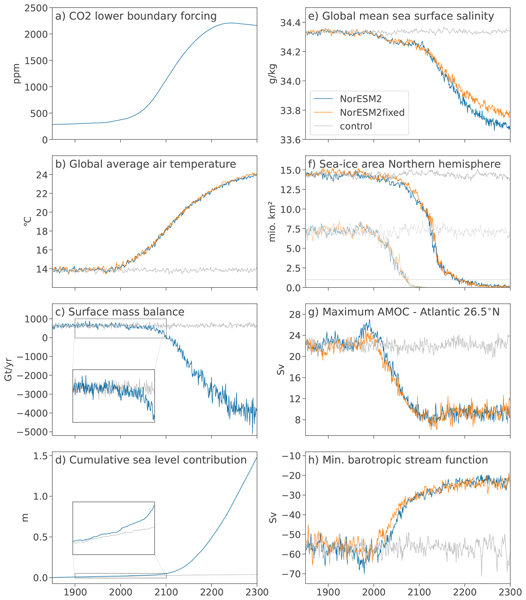
Konstanze Haubner, Heiko Goelzer, and Andreas Born
Earth Syst. Dynam., 17, 57–80, https://doi.org/10.5194/esd-17-57-2026, https://doi.org/10.5194/esd-17-57-2026, 2026
Short summary
Short summary
We add a new dynamic component – an ice sheet model simulating the Greenland ice sheet – to an Earth system model that already captures the global climate evolution including ocean, atmosphere, land and sea ice. Under a strong warming scenario, the global warming of 10°C over 250 years is dominating the climate evolution. Changes from the ice-climate interaction are mainly local yet impacting the evolution of the Greenland ice sheet. Hence, ice-climate feedbacks should be considered beyond 2100.
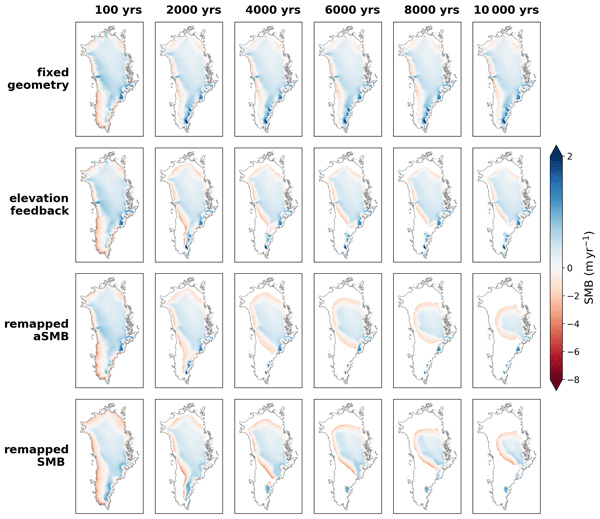
Charlotte Rahlves, Heiko Goelzer, Andreas Born, and Petra M. Langebroek
The Cryosphere, 19, 6403–6419, https://doi.org/10.5194/tc-19-6403-2025, https://doi.org/10.5194/tc-19-6403-2025, 2025
Short summary
Short summary
We present a method to better simulate how Greenland’s ice sheet may change over thousands of years in response to climate change. Using a stand-alone ice sheet model, we adjust snowfall and melting patterns based on changes in the ice sheet’s shape. This approach avoids complex coupled models and enables faster testing of many future scenarios to understand the long-term stability of Greenland’s ice.
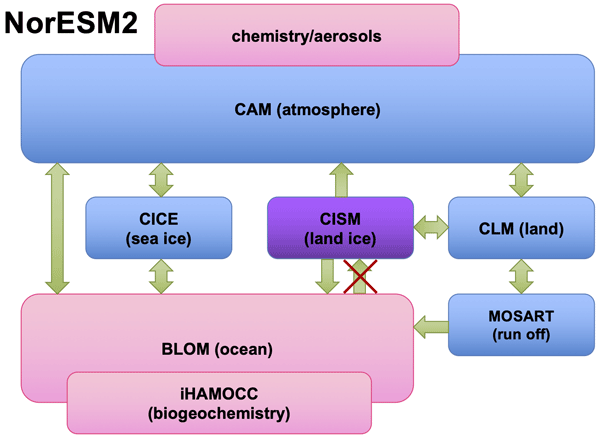
Heiko Goelzer, Petra M. Langebroek, Andreas Born, Stefan Hofer, Konstanze Haubner, Michele Petrini, Gunter Leguy, William H. Lipscomb, and Katherine Thayer-Calder
Geosci. Model Dev., 18, 7853–7867, https://doi.org/10.5194/gmd-18-7853-2025, https://doi.org/10.5194/gmd-18-7853-2025, 2025
Short summary
Short summary
On the backdrop of observed accelerating ice sheet mass loss over the last few decades, there is growing interest in the role of ice sheet changes in global climate projections. In this regard, we have coupled an Earth system model with an ice sheet model and have produced an initial set of climate projections including an interactive coupling with a dynamic Greenland ice sheet.
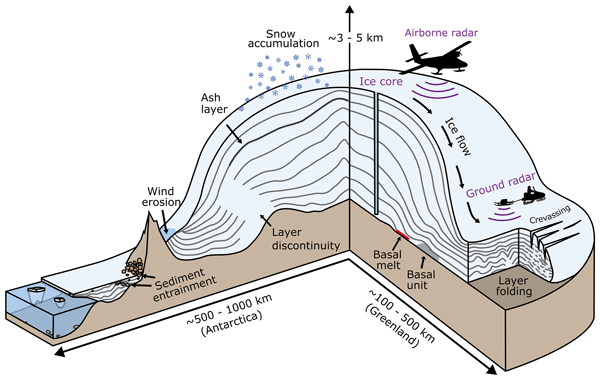
Robert G. Bingham, Julien A. Bodart, Marie G. P. Cavitte, Ailsa Chung, Rebecca J. Sanderson, Johannes C. R. Sutter, Olaf Eisen, Nanna B. Karlsson, Joseph A. MacGregor, Neil Ross, Duncan A. Young, David W. Ashmore, Andreas Born, Winnie Chu, Xiangbin Cui, Reinhard Drews, Steven Franke, Vikram Goel, John W. Goodge, A. Clara J. Henry, Antoine Hermant, Benjamin H. Hills, Nicholas Holschuh, Michelle R. Koutnik, Gwendolyn J.-M. C. Leysinger Vieli, Emma J. MacKie, Elisa Mantelli, Carlos Martín, Felix S. L. Ng, Falk M. Oraschewski, Felipe Napoleoni, Frédéric Parrenin, Sergey V. Popov, Therese Rieckh, Rebecca Schlegel, Dustin M. Schroeder, Martin J. Siegert, Xueyuan Tang, Thomas O. Teisberg, Kate Winter, Shuai Yan, Harry Davis, Christine F. Dow, Tyler J. Fudge, Tom A. Jordan, Bernd Kulessa, Kenichi Matsuoka, Clara J. Nyqvist, Maryam Rahnemoonfar, Matthew R. Siegfried, Shivangini Singh, Vjeran Višnjević, Rodrigo Zamora, and Alexandra Zuhr
The Cryosphere, 19, 4611–4655, https://doi.org/10.5194/tc-19-4611-2025, https://doi.org/10.5194/tc-19-4611-2025, 2025
Short summary
Short summary
The ice sheets covering Antarctica have built up over millenia through successive snowfall events which become buried and preserved as internal surfaces of equal age detectable with ice-penetrating radar. This paper describes an international initiative working together on these archival data to build a comprehensive 3-D picture of how old the ice is everywhere across Antarctica and how this is being used to reconstruct past and to predict future ice and climate behaviour.
Lise Seland Graff, Jerry Tjiputra, Ada Gjermundsen, Andreas Born, Jens Boldingh Debernard, Heiko Goelzer, Yan-Chun He, Petra Margaretha Langebroek, Aleksi Nummelin, Dirk Olivié, Øyvind Seland, Trude Storelvmo, Mats Bentsen, Chuncheng Guo, Andrea Rosendahl, Dandan Tao, Thomas Toniazzo, Camille Li, Stephen Outten, and Michael Schulz
Earth Syst. Dynam., 16, 1671–1698, https://doi.org/10.5194/esd-16-1671-2025, https://doi.org/10.5194/esd-16-1671-2025, 2025
Short summary
Short summary
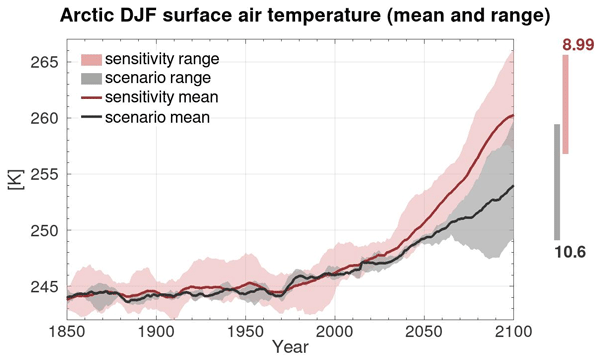
The magnitude of future Arctic amplification is highly uncertain. Using the Norwegian Earth System Model, we explore the effect of improving the representation of clouds, ocean eddies, the Greenland ice sheet, sea ice, and ozone on the projected Arctic winter warming in a coordinated experiment set. These improvements all lead to enhanced projected Arctic warming, with the largest changes found in the sea ice retreat regions and the largest uncertainty found on the Atlantic side.
Sina Loriani, Yevgeny Aksenov, David I. Armstrong McKay, Govindasamy Bala, Andreas Born, Cristiano Mazur Chiessi, Henk A. Dijkstra, Jonathan F. Donges, Sybren Drijfhout, Matthew H. England, Alexey V. Fedorov, Laura C. Jackson, Kai Kornhuber, Gabriele Messori, Francesco S. R. Pausata, Stefanie Rynders, Jean-Baptiste Sallée, Bablu Sinha, Steven C. Sherwood, Didier Swingedouw, and Thejna Tharammal
Earth Syst. Dynam., 16, 1611–1653, https://doi.org/10.5194/esd-16-1611-2025, https://doi.org/10.5194/esd-16-1611-2025, 2025
Short summary
Short summary
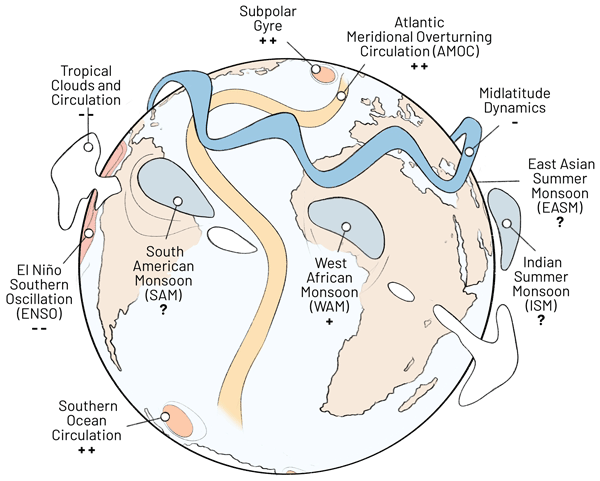
In this work, we draw on palaeo-records, observations, and modelling studies to review tipping points in the ocean overturning circulations, monsoon systems, and global atmospheric circulations. We find indications for tipping in the ocean overturning circulations and the West African monsoon, with potentially severe impacts on the Earth system and humans. Tipping in the other considered systems is regarded as conceivable but is currently not sufficiently supported by evidence.
Charlotte Rahlves, Heiko Goelzer, Andreas Born, and Petra M. Langebroek
The Cryosphere, 19, 1205–1220, https://doi.org/10.5194/tc-19-1205-2025, https://doi.org/10.5194/tc-19-1205-2025, 2025
Short summary
Short summary
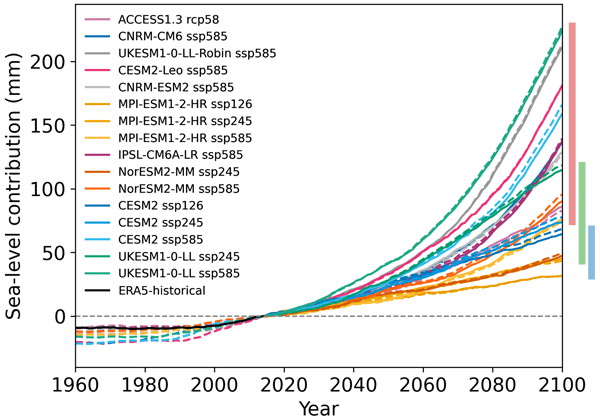
Mass loss from the Greenland ice sheet significantly contributes to rising sea levels, threatening coastal communities globally. To improve future sea-level projections, we simulated ice sheet behavior until 2100, initializing the model with observed geometry and using various climate models. Predictions indicate a sea-level rise of 32 to 228 mm by 2100, with climate model uncertainty being the main source of variability in projections.
Thi-Khanh-Dieu Hoang, Aurélien Quiquet, Christophe Dumas, Andreas Born, and Didier M. Roche
Clim. Past, 21, 27–51, https://doi.org/10.5194/cp-21-27-2025, https://doi.org/10.5194/cp-21-27-2025, 2025
Short summary
Short summary
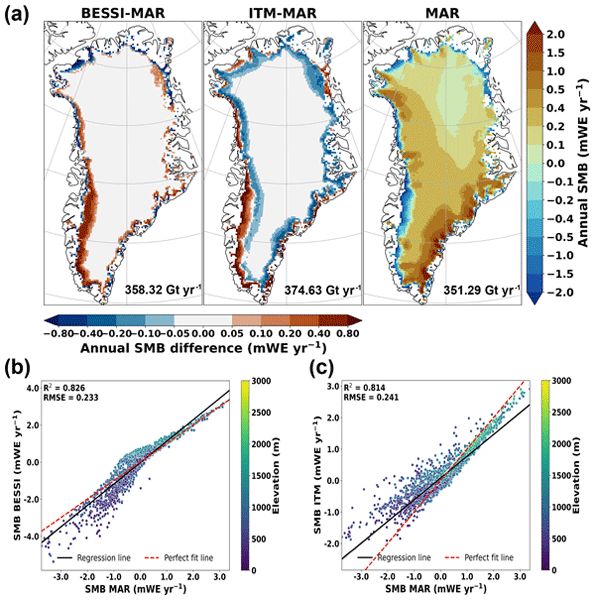
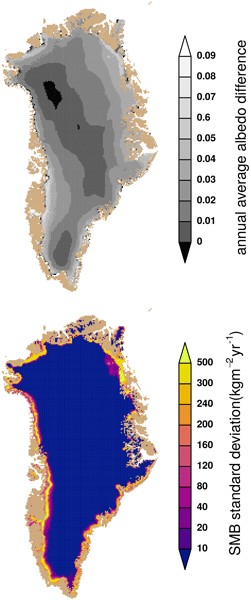
To improve the simulation of surface mass balance (SMB) that influences the advance–retreat of ice sheets, we run a snow model, the BErgen Snow SImulator (BESSI), with transient climate forcing obtained from an Earth system model, iLOVECLIM, over Greenland and Antarctica during the Last Interglacial (LIG; 130–116 ka). Compared to the simple existing SMB scheme of iLOVECLIM, BESSI gives more details about SMB processes with higher physics constraints while maintaining a low computational cost.
Tobias Zolles and Andreas Born
The Cryosphere, 18, 4831–4844, https://doi.org/10.5194/tc-18-4831-2024, https://doi.org/10.5194/tc-18-4831-2024, 2024
Short summary
Short summary
The Greenland ice sheet largely depends on the climate state. The uncertainties associated with the year-to-year variability have only a marginal impact on our simulated surface mass budget; this increases our confidence in projections and reconstructions. Basing the simulations on proxies, e.g., temperature, results in overestimates of the surface mass balance, as climatologies lead to small amounts of snowfall every day. This can be reduced by including sub-monthly precipitation variability.
Therese Rieckh, Andreas Born, Alexander Robinson, Robert Law, and Gerrit Gülle
Geosci. Model Dev., 17, 6987–7000, https://doi.org/10.5194/gmd-17-6987-2024, https://doi.org/10.5194/gmd-17-6987-2024, 2024
Short summary
Short summary
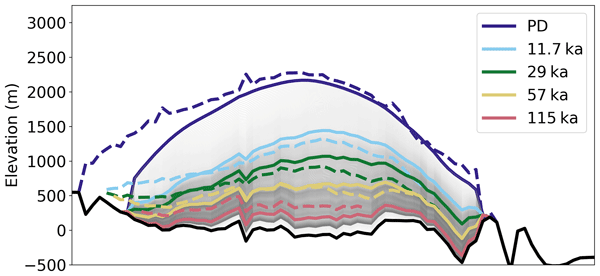
We present the open-source model ELSA, which simulates the internal age structure of large ice sheets. It creates layers of snow accumulation at fixed times during the simulation, which are used to model the internal stratification of the ice sheet. Together with reconstructed isochrones from radiostratigraphy data, ELSA can be used to assess ice sheet models and to improve their parameterization. ELSA can be used coupled to an ice sheet model or forced with its output.
Gustav Jungdal-Olesen, Jane Lund Andersen, Andreas Born, and Vivi Kathrine Pedersen
The Cryosphere, 18, 1517–1532, https://doi.org/10.5194/tc-18-1517-2024, https://doi.org/10.5194/tc-18-1517-2024, 2024
Short summary
Short summary
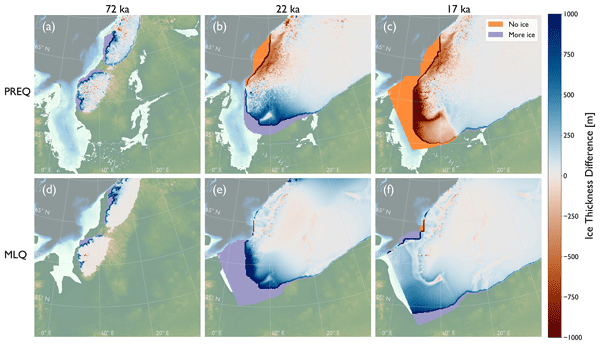
We explore how the shape of the land and underwater features in Scandinavia affected the former Scandinavian ice sheet over time. Using a computer model, we simulate how the ice sheet evolved during different stages of landscape development. We discovered that early glaciations were limited in size by underwater landforms, but as these changed, the ice sheet expanded more rapidly. Our findings highlight the importance of considering landscape changes when studying ice-sheet history.
Anja Løkkegaard, Kenneth D. Mankoff, Christian Zdanowicz, Gary D. Clow, Martin P. Lüthi, Samuel H. Doyle, Henrik H. Thomsen, David Fisher, Joel Harper, Andy Aschwanden, Bo M. Vinther, Dorthe Dahl-Jensen, Harry Zekollari, Toby Meierbachtol, Ian McDowell, Neil Humphrey, Anne Solgaard, Nanna B. Karlsson, Shfaqat A. Khan, Benjamin Hills, Robert Law, Bryn Hubbard, Poul Christoffersen, Mylène Jacquemart, Julien Seguinot, Robert S. Fausto, and William T. Colgan
The Cryosphere, 17, 3829–3845, https://doi.org/10.5194/tc-17-3829-2023, https://doi.org/10.5194/tc-17-3829-2023, 2023
Short summary
Short summary
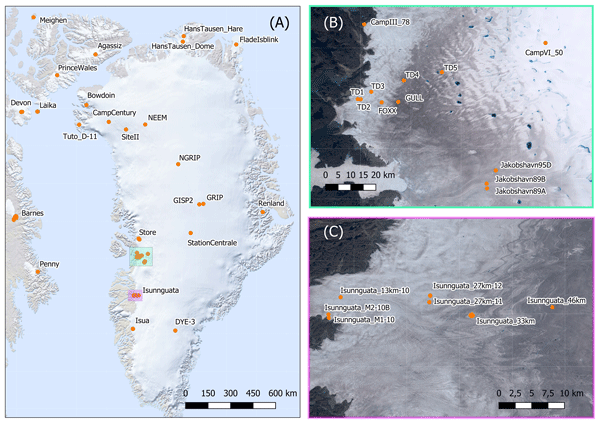
This study presents a database compiling 95 ice temperature profiles from the Greenland ice sheet and peripheral ice caps. Ice viscosity and hence ice flow are highly sensitive to ice temperature. To highlight the value of the database in evaluating ice flow simulations, profiles from the Greenland ice sheet are compared to a modeled temperature field. Reoccurring discrepancies between modeled and observed temperatures provide insight on the difficulties faced when simulating ice temperatures.
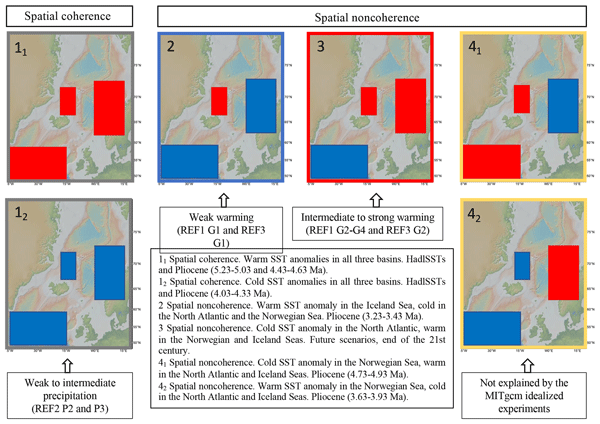
Bjørg Risebrobakken, Mari F. Jensen, Helene R. Langehaug, Tor Eldevik, Anne Britt Sandø, Camille Li, Andreas Born, Erin Louise McClymont, Ulrich Salzmann, and Stijn De Schepper
Clim. Past, 19, 1101–1123, https://doi.org/10.5194/cp-19-1101-2023, https://doi.org/10.5194/cp-19-1101-2023, 2023
Short summary
Short summary
In the observational period, spatially coherent sea surface temperatures characterize the northern North Atlantic at multidecadal timescales. We show that spatially non-coherent temperature patterns are seen both in further projections and a past warm climate period with a CO2 level comparable to the future low-emission scenario. Buoyancy forcing is shown to be important for northern North Atlantic temperature patterns.
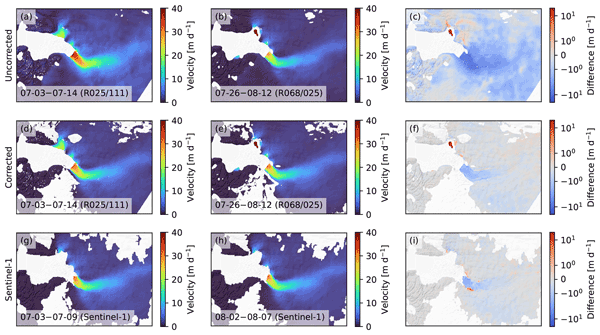
Thomas R. Chudley, Ian M. Howat, Bidhyananda Yadav, and Myoung-Jong Noh
The Cryosphere, 16, 2629–2642, https://doi.org/10.5194/tc-16-2629-2022, https://doi.org/10.5194/tc-16-2629-2022, 2022
Short summary
Short summary
Sentinel-2 images are subject to distortion due to orthorectification error, which makes it difficult to extract reliable glacier velocity fields from images from different orbits. Here, we use a complete record of velocity fields at four Greenlandic outlet glaciers to empirically estimate the systematic error, allowing us to correct cross-track glacier velocity fields to a comparable accuracy to other medium-resolution satellite datasets.
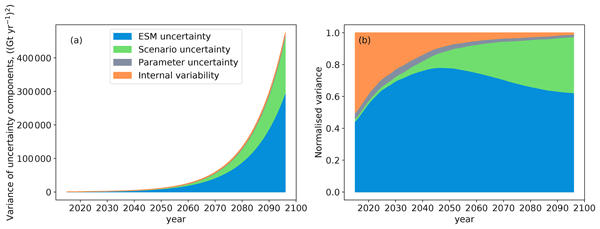
Katharina M. Holube, Tobias Zolles, and Andreas Born
The Cryosphere, 16, 315–331, https://doi.org/10.5194/tc-16-315-2022, https://doi.org/10.5194/tc-16-315-2022, 2022
Short summary
Short summary
We simulated the surface mass balance of the Greenland Ice Sheet in the 21st century by forcing a snow model with the output of many Earth system models and four greenhouse gas emission scenarios. We quantify the contribution to uncertainty in surface mass balance of these two factors and the choice of parameters of the snow model. The results show that the differences between Earth system models are the main source of uncertainty. This effect is localised mostly near the equilibrium line.
Cited articles
Adams, C. J. C., Iverson, N. R., Helanow, C., Zoet, L. K., and Bate, C. E.: Softening of temperate ice by interstitial water, Front. Earth Sci., 9, https://doi.org/10.3389/feart.2021.702761, 2021. a
Aschwanden, A., Bartholomaus, T. C., Brinkerhoff, D. J., and Truffer, M.: Brief communication: A roadmap towards credible projections of ice sheet contribution to sea level, The Cryosphere, 15, 5705–5715, https://doi.org/10.5194/tc-15-5705-2021, 2021. a
Barndon, S.: Supplementary data for “Ice motion across incised fjord landscapes”, Zenodo [code], https://doi.org/10.5281/zenodo.15052902, 2025. a, b
Berends, C. J., van de Wal, R. S. W., van den Akker, T., and Lipscomb, W. H.: Compensating errors in inversions for subglacial bed roughness: same steady state, different dynamic response, The Cryosphere, 17, 1585–1600, https://doi.org/10.5194/tc-17-1585-2023, 2023. a
Bernard, M., Steer, P., Gallagher, K., and Egholm, D. L.: The impact of lithology on fjord morphology, Geophys. Res. Lett., 48, e2021GL093101, https://doi.org/10.1029/2021GL093101, 2021. a
Briner, J. P., Miller, G. H., Finkel, R., and Hess, D. P.: Glacial erosion at the fjord onset zone and implications for the organization of ice flow on Baffin Island, Arctic Canada, Geomorphology, 97, 126–134, https://doi.org/10.1016/j.geomorph.2007.02.039, 2008. a
Castleman, B. A., Schlegel, N.-J., Caron, L., Larour, E., and Khazendar, A.: Derivation of bedrock topography measurement requirements for the reduction of uncertainty in ice-sheet model projections of Thwaites Glacier, The Cryosphere, 16, 761–778, https://doi.org/10.5194/tc-16-761-2022, 2022. a
Christ, A. J., Rittenour, T. M., Bierman, P. R., Keisling, B. A., Knutz, P. C., Thomsen, T. B., Keulen, N., Fosdick, J. C., Hemming, S. R., Tison, J.-L., Blard, P.-H., Steffensen, J. P., Caffee, M. W., Corbett, L. B., Dahl-Jensen, D., Dethier, D. P., Hidy, A. J., Perdrial, N., Peteet, D. M., Steig, E. J., and Thomas, E. K.: Deglaciation of northwestern Greenland during Marine Isotope Stage 11, Science, 381, 330–335, https://doi.org/10.1126/science.ade4248, 2023. a
Cook, S. J., Christoffersen, P., Todd, J., Slater, D., and Chauché, N.: Coupled modelling of subglacial hydrology and calving-front melting at Store Glacier, West Greenland , The Cryosphere, 14, 905–924, https://doi.org/10.5194/tc-14-905-2020, 2020. a
Copernicus DEM: Copernicus DEM – Global and European Digital Elevation Model, European Space Agency (ESA) [data set], https://doi.org/10.5270/ESA-c5d3d65, https://dataspace.copernicus.eu/explore-data/data-collections/copernicus-contributing-missions/collections-description/COP-DEM (last access: 18 March 2025), 2024. a
Cuffey, K. M. and Paterson, W. S. B.: The Physics of Glaciers, Butterworth-Heinemann, Academic Press, https://doi.org/10.3189/002214311796405906, 2010. a, b
Egholm, D. L., Jansen, J. D., Brædstrup, C. F., Pedersen, V. K., Andersen, J. L., Ugelvig, S. V., Larsen, N. K., and Knudsen, M. F.: Formation of plateau landscapes on glaciated continental margins, Nat. Geosci., 10, 592–597, https://doi.org/10.1038/ngeo2980, 2017. a
Florinsky, I. V.: An illustrated introduction to general geomorphometry, Prog. Phys. Geog., 41, 723–752, https://doi.org/10.1177/0309133317733667, 2017. a
Frank, T., Åkesson, H., de Fleurian, B., Morlighem, M., and Nisancioglu, K. H.: Geometric controls of tidewater glacier dynamics, The Cryosphere, 16, 581–601, https://doi.org/10.5194/tc-16-581-2022, 2022. a
Gagliardini, O., Cohen, D., Råback, P., and Zwinger, T.: Finite-element modeling of subglacial cavities and related friction law, J. Geophys. Res.-Earth, 112, https://doi.org/10.1029/2006JF000576, 2007. a, b
Gagliardini, O., Zwinger, T., Gillet-Chaulet, F., Durand, G., Favier, L., de Fleurian, B., Greve, R., Malinen, M., Martín, C., Råback, P., Ruokolainen, J., Sacchettini, M., Schäfer, M., Seddik, H., and Thies, J.: Capabilities and performance of Elmer/Ice, a new-generation ice sheet model, Geosci. Model Dev., 6, 1299–1318, https://doi.org/10.5194/gmd-6-1299-2013, 2013. a
Gee, D. G., Fossen, H., Henriksen, N., and Higgins, A. K.: From the Early Paleozoic Platforms of Baltica and Laurentia to the Caledonide Orogen of Scandinavia and Greenland, J. Int. Geosci., 31, 44–51, https://doi.org/10.18814/epiiugs/2008/v31i1/007, 2008. a
Glasser, N. F. and Ghiglione, M. C.: Structural, tectonic and glaciological controls on the evolution of fjord landscapes, Geomorphology, 105, 291–302, https://doi.org/10.1016/j.geomorph.2008.10.007, 2009. a
Glen, J. W.: The creep of polycrystalline ice, P. Roy. Soc. A-Math. Phy., 228, 519–538, 1955. a
Gudmundsson, G. H.: Basal-flow characteristics of a non-linear flow sliding frictionless over strongly undulating bedrock, J. Glaciol., 43, 80–89, https://doi.org/10.3189/S0022143000002835, 1997. a, b, c
Harbor, J. M.: Numerical modeling of the development of U-shaped valleys by glacial erosion, GSA Bulletin, 104, 1364–1375, https://doi.org/10.1130/0016-7606(1992)104<1364:NMOTDO>2.3.CO;2, 1992. a
Harbor, J. M., Hallet, B., and Raymond, C. F.: A numerical model of landform development by glacial erosion, Nature, 333, 347–349, https://doi.org/10.1038/333347a0, 1988. a
Haseloff, M., Hewitt, I. J., and Katz, R. F.: Englacial pore water localizes shear in temperate ice stream margins, J. Geophys. Res.-Earth, 124, 2521–2541, https://doi.org/10.1029/2019JF005399, 2019. a
Hindmarsh, R. C.: Sliding over anisotropic beds, Ann. Glaciol., 30, 137–145, https://doi.org/10.3189/172756400781820840, 2000. a
Iken, A.: The effect of the subglacial water pressure on the sliding velocity of a glacier in an idealized numerical model, J. Glaciol., 27, 407–421, https://doi.org/10.3189/S0022143000011448, 1981. a
Joughin, I.: MEaSUREs Greenland Annual Ice Sheet Velocity Mosaics from SAR and Landsat, Version 4, NASA National Snow and Ice Data Center Distributed Active Archive Center [data set], https://doi.org/10.5067/RS8GFZ848ZU9, 2022. a
Joughin, I., Smith, B. E., Howat, I. M., Scambos, T., and Moon, T.: Greenland flow variability from ice-sheet-wide velocity mapping, J. Glaciol., 56, 415–430, https://doi.org/10.3189/002214310792447734, 2010. a
Jungdal-Olesen, G., Andersen, J. L., Born, A., and Pedersen, V. K.: The influence of glacial landscape evolution on Scandinavian ice-sheet dynamics and dimensions, The Cryosphere, 18, 1517–1532, https://doi.org/10.5194/tc-18-1517-2024, 2024. a, b, c, d
Kessler, M. A., Anderson, R. S., and Briner, J. P.: Fjord insertion into continental margins driven by topographic steering of ice, Nat. Geosci., 1, 365–369, https://doi.org/10.1038/ngeo201, 2008. a
Kleman, J., Hättestrand, C., Borgström, I., and Stroeven, A.: Fennoscandian palaeoglaciology reconstructed using a glacial geological inversion model, J. Glaciol., 43, 283–299, https://doi.org/10.3189/S0022143000003233, 1997. a
Kyrke-Smith, T. M., Gudmundsson, G. H., and Farrell, P. E.: Relevance of detail in basal topography for basal slipperiness inversions: a case study on Pine Island Glacier, Antarctica, Front. Earth Sci., 6, https://doi.org/10.3389/feart.2018.00033, 2018. a
Law, R., Christoffersen, P., MacKie, E., Cook, S., Haseloff, M., and Gagliardini, O.: Complex motion of Greenland Ice Sheet outlet glaciers with basal temperate ice, Science Advances, 9, eabq5180, https://doi.org/10.1126/sciadv.abq5180, 2023. a, b, c, d
Løkkegaard, A., Mankoff, K. D., Zdanowicz, C., Clow, G. D., Lüthi, M. P., Doyle, S. H., Thomsen, H. H., Fisher, D., Harper, J., Aschwanden, A., Vinther, B. M., Dahl-Jensen, D., Zekollari, H., Meierbachtol, T., McDowell, I., Humphrey, N., Solgaard, A., Karlsson, N. B., Khan, S. A., Hills, B., Law, R., Hubbard, B., Christoffersen, P., Jacquemart, M., Seguinot, J., Fausto, R. S., and Colgan, W. T.: Greenland and Canadian Arctic ice temperature profiles database, The Cryosphere, 17, 3829–3845, https://doi.org/10.5194/tc-17-3829-2023, 2023. a
MacGregor, J. A., Fahnestock, M. A., Catania, G. A., Paden, J. D., Prasad Gogineni, S., Young, S. K., Rybarski, S. C., Mabrey, A. N., Wagman, B. M., and Morlighem, M.: Radiostratigraphy and age structure of the Greenland Ice Sheet, J. Geophys. Res.-Earth, 120, 212–241, https://doi.org/10.1002/2014JF003215, 2015. a
MacGregor, J. A., Colgan, W. T., Paxman, G. J. G., Tinto, K. J., Csathó, B., Darbyshire, F. A., Fahnestock, M. A., Kokfelt, T. F., MacKie, E. J., Morlighem, M., and Sergienko, O. V.: Geologic provinces beneath the Greenland ice sheet constrained by geophysical data synthesis, Geophys. Res. Lett., 51, e2023GL107357, https://doi.org/10.1029/2023GL107357, 2024. a
Maier, N., Gimbert, F., Gillet-Chaulet, F., and Gilbert, A.: Basal traction mainly dictated by hard-bed physics over grounded regions of Greenland, The Cryosphere, 15, 1435–1451, https://doi.org/10.5194/tc-15-1435-2021, 2021. a, b
Minchew, B. and Joughin, I.: Toward a universal glacier slip law, Science, 368, 29–30, https://doi.org/10.1126/science.abb3566, 2020. a
Moffatt, H.: Viscous eddies near a sharp corner (Viscous eddy behavior near sharp corner, considering outer boundary conditions and stream function), Arch. Mech., 16, 365–372, 1964a. a
Moffatt, H. K.: Viscous and resistive eddies near a sharp corner, J. Fluid Mech., 18, 1–18, https://doi.org/10.1017/S0022112064000015, 1964b. a
Moon, T. A., Fisher, M., Stafford, T., and Thurber, A.: QGreenland (v3), National Snow and Ice Data Center [data set] https://qgreenland.org, https://doi.org/10.5281/zenodo.8247895, 2023. a
Morlighem, M., Williams, C. N., Rignot, E., An, L., Arndt, J. E., Bamber, J. L., Catania, G., Chauché, N., Dowdeswell, J. A., Dorschel, B., Fenty, I., Hogan, K., Howat, I., Hubbard, A., Jakobsson, M., Jordan, T. M., Kjeldsen, K. K., Millan, R., Mayer, L., Mouginot, J., Noël, B. P. Y., O'Cofaigh, C., Palmer, S., Rysgaard, S., Seroussi, H., Siegert, M. J., Slabon, P., Straneo, F., van den Broeke, M. R., Weinrebe, W., Wood, M., and Zinglersen, K. B.: BedMachine v3: complete bed topography and ocean bathymetry mapping of Greenland from multibeam echo sounding combined with mass conservation, Geophys. Res. Lett., 44, 11,051–11,061, https://doi.org/10.1002/2017GL074954, 2017. a
Nye, J. F.: The flow law of ice from measurements in glacier tunnels, laboratory experiments and the Jungfraufirn borehole experiment, P. Roy. Soc. A-Math. Phy., 219, 477–489, 1953. a
Ottesen, D., Dowdeswell, J. A., and Rise, L.: Submarine landforms and the reconstruction of fast-flowing ice streams within a large Quaternary ice sheet: the 2500-km-long Norwegian-Svalbard margin (57°–80°N), Geol. Soc. Am. Bull., 117, 1033–1050, https://doi.org/10.1130/B25577.1, 2005. a
Paxman, G. J.: Patterns of valley incision beneath the Greenland Ice Sheet revealed using automated mapping and classification, Geomorphology, 436, 108778, https://doi.org/10.1016/j.geomorph.2023.108778, 2023. a
Paxman, G. J. G., Jamieson, S. S. R., Dolan, A. M., and Bentley, M. J.: Subglacial valleys preserved in the highlands of south and east Greenland record restricted ice extent during past warmer climates, The Cryosphere, 18, 1467–1493, https://doi.org/10.5194/tc-18-1467-2024, 2024. a, b
Roldán-Blasco, J.-P., Gilbert, A., Piard, L., Gimbert, F., Vincent, C., Gagliardini, O., Togaibekov, A., Walpersdorf, A., and Maier, N.: Creep enhancement and sliding in a temperate, hard-bedded alpine glacier, The Cryosphere, 19, 267–282, https://doi.org/10.5194/tc-19-267-2025, 2025. a
Schohn, C. M., Iverson, N. R., Zoet, L. K., Fowler, J. R., and Morgan-Witts, N.: Linear-viscous flow of temperate ice, Science, 387, 182–185, https://doi.org/10.1126/science.adp7708, 2025. a
Schoof, C.: The effect of cavitation on glacier sliding, P. Roy. Soc. A-Math. Phy., 461, 609–627, https://doi.org/10.1098/rspa.2004.1350, 2005. a, b, c
Schoof, C. and Hewitt, I. J.: A model for polythermal ice incorporating gravity-driven moisture transport, J. Fluid Mech., 797, 504–535, https://doi.org/10.1017/jfm.2016.251, 2016. a
Sergienko, O. V., Creyts, T. T., and Hindmarsh, R. C. A.: Similarity of organized patterns in driving and basal stresses of Antarctic and Greenland ice sheets beneath extensive areas of basal sliding, Geophys. Res. Lett., 41, 3925–3932, https://doi.org/10.1002/2014GL059976, 2014. a
Svendsen, J. I. and Mangerud, J.: Late Weichselian and holocene sea-level history for a cross-section of western Norway, J. Quaternary Sci., 2, 113–132, https://doi.org/10.1002/jqs.3390020205, 1987. a
Tsai, V. C., Stewart, A. L., and Thompson, A. F.: Marine ice-sheet profiles and stability under Coulomb basal conditions, J. Glaciol., 61, 205–215, https://doi.org/10.3189/2015JoG14J221, 2015. a
Weertman, J.: On the sliding of glaciers, J. Glaciol., 3, 33–38, https://doi.org/10.3189/S0022143000024709, 1957. a, b
Weertman, J.: The unsolved general glacier sliding problem, J. Glaciol., 23, 97–115, https://doi.org/10.3189/S0022143000029762, 1979. a
Wernecke, A., Edwards, T. L., Holden, P. B., Edwards, N. R., and Cornford, S. L.: Quantifying the impact of bedrock topography uncertainty in Pine Island Glacier projections for this century, Geophys. Res. Lett., 49, e2021GL096589, https://doi.org/10.1029/2021GL096589, 2022. a
Young, D. A., Wright, A. P., Roberts, J. L., Warner, R. C., Young, N. W., Greenbaum, J. S., Schroeder, D. M., Holt, J. W., Sugden, D. E., Blankenship, D. D., van Ommen, T. D., and Siegert, M. J.: A dynamic early East Antarctic Ice Sheet suggested by ice-covered fjord landscapes, Nature, 474, 72–75, https://doi.org/10.1038/nature10114, 2011. a, b
Zoet, L. K. and Iverson, N. R.: A slip law for glaciers on deformable beds, Science, 368, 76–78, https://doi.org/10.1126/science.aaz1183, 2020. a
Short summary
By simulating a section of the Scandinavian Ice Sheet over a deep fjord, we aim to understand the behaviour of ice sheets over rough landscapes. For perpendicular flow, we find reduced speed within the fjord and reverse flow at its base. Comparing real and smoothed topography shows that low-resolution models fail to capture these effects. Our findings have implications for Greenland ice sheet models, as commonly used bedrock resolutions likely overlook the influence of similar rough landscapes.
By simulating a section of the Scandinavian Ice Sheet over a deep fjord, we aim to understand...


