
Articles | Volume 20, issue 5
https://doi.org/10.5194/tc-20-2735-2026
© Author(s) 2026. This work is distributed under
the Creative Commons Attribution 4.0 License.
the Creative Commons Attribution 4.0 License.
https://doi.org/10.5194/tc-20-2735-2026
© Author(s) 2026. This work is distributed under
the Creative Commons Attribution 4.0 License.
the Creative Commons Attribution 4.0 License.
Research article
| 
12 May 2026
Research article |
| 12 May 2026
| 12 May 2026
Assessing the potential for an ice core in the southern Antarctic Peninsula to elucidate Holocene climate history

School of GeoSciences, University of Edinburgh, Edinburgh, UK
Robert G. Bingham
School of GeoSciences, University of Edinburgh, Edinburgh, UK
Carlos Martín
British Antarctic Survey, Cambridge, UK
Elizabeth R. Thomas
British Antarctic Survey, Cambridge, UK
Andrew S. Hein
School of GeoSciences, University of Edinburgh, Edinburgh, UK
Anna E. Hogg
School of Earth and Environment, University of Leeds, Leeds, UK
Related authors
Robert G. Bingham, Julien A. Bodart, Marie G. P. Cavitte, Ailsa Chung, Rebecca J. Sanderson, Johannes C. R. Sutter, Olaf Eisen, Nanna B. Karlsson, Joseph A. MacGregor, Neil Ross, Duncan A. Young, David W. Ashmore, Andreas Born, Winnie Chu, Xiangbin Cui, Reinhard Drews, Steven Franke, Vikram Goel, John W. Goodge, A. Clara J. Henry, Antoine Hermant, Benjamin H. Hills, Nicholas Holschuh, Michelle R. Koutnik, Gwendolyn J.-M. C. Leysinger Vieli, Emma J. MacKie, Elisa Mantelli, Carlos Martín, Felix S. L. Ng, Falk M. Oraschewski, Felipe Napoleoni, Frédéric Parrenin, Sergey V. Popov, Therese Rieckh, Rebecca Schlegel, Dustin M. Schroeder, Martin J. Siegert, Xueyuan Tang, Thomas O. Teisberg, Kate Winter, Shuai Yan, Harry Davis, Christine F. Dow, Tyler J. Fudge, Tom A. Jordan, Bernd Kulessa, Kenichi Matsuoka, Clara J. Nyqvist, Maryam Rahnemoonfar, Matthew R. Siegfried, Shivangini Singh, Vjeran Višnjević, Rodrigo Zamora, and Alexandra Zuhr
The Cryosphere, 19, 4611–4655, https://doi.org/10.5194/tc-19-4611-2025, https://doi.org/10.5194/tc-19-4611-2025, 2025
Short summary
Short summary
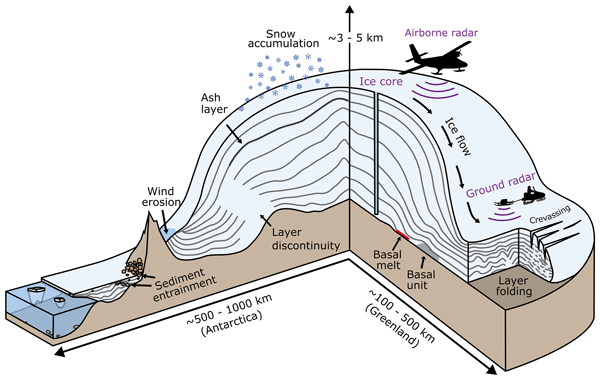
The ice sheets covering Antarctica have built up over millenia through successive snowfall events which become buried and preserved as internal surfaces of equal age detectable with ice-penetrating radar. This paper describes an international initiative working together on these archival data to build a comprehensive 3-D picture of how old the ice is everywhere across Antarctica and how this is being used to reconstruct past and to predict future ice and climate behaviour.
Dorothea Elisabeth Baur, Andrea Spolaor, Federico Scoto, and Elizabeth R. Thomas
The Cryosphere, 20, 5533–5558, https://doi.org/10.5194/tc-20-5533-2026, https://doi.org/10.5194/tc-20-5533-2026, 2026
Short summary
Short summary
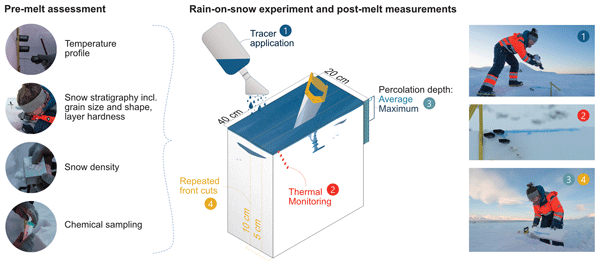
The Arctic is warming rapidly, and winter rain-on-snow events are becoming more common. These events can alter snow layers and disturb climate information stored in glaciers. We studied how small rain-on-snow events affect snow structure and water isotopes near Ny-Ålesund, Svalbard. Field experiments show that meltwater flow creates complex features, but isotope changes remain confined to them, meaning seasonal climate signals can still be preserved where enough snow accumulates.
Mae E. Evans, Anna E. Hogg, Trystan Surawy-Stepney, Benjamin J. Wallis, Ross A. W. Slater, and Richard Rigby
EGUsphere, https://doi.org/10.5194/egusphere-2026-5527, https://doi.org/10.5194/egusphere-2026-5527, 2026
This preprint is open for discussion and under review for The Cryosphere (TC).
Short summary
Short summary
We studied how 66 glaciers in central and southeast Greenland changed speed over the last decade using satellite observations. Most glaciers sped up between 2016 and 2020, with some more than doubling their speed, before slowing down after 2020. The timing coincided with unusually warm ocean water and reduced sea ice. We show that glacier speed changes in this region were larger and more widespread than previously reported, highlighting how sensitive this region is to environmental change.
Isabelle F. M. White, Oana Dragomir, Alessandro Silvano, Alberto C. Naveira Garabato, Anna E. Hogg, Pierre Dutrieux, Laura Herraiz-Borreguero, and Jennifer Cocks
EGUsphere, https://doi.org/10.5194/egusphere-2026-4414, https://doi.org/10.5194/egusphere-2026-4414, 2026
This preprint is open for discussion and under review for Earth Observation (EO).
Short summary
Short summary
We present a 22-year sea surface height product in the ice-covered Southern Ocean from Envisat and CryoSat-2 satellite altimetry data. Our product is 1° longitude by 0.5° latitude from 50° S to the Antarctic coast. Validation with in-situ, independent satellite and reanalysis data shows it captures seasonal and interannual variability. This supports long-term study of large-scale sea level trends and processes in the Southern Ocean, a region that is observing rapid sea ice and ice sheet melting.
Benjamin J. Davison, Andrew J. Sole, Gregoire Guillet, Douglas I. Benn, Jonathan Kingslake, Jeremy C. Ely, Stephen J. Livingstone, Christopher D. Stringer, Jonathan L. Carrivick, and Anna E. Hogg
The Cryosphere, 20, 4293–4311, https://doi.org/10.5194/tc-20-4293-2026, https://doi.org/10.5194/tc-20-4293-2026, 2026
Short summary
Short summary
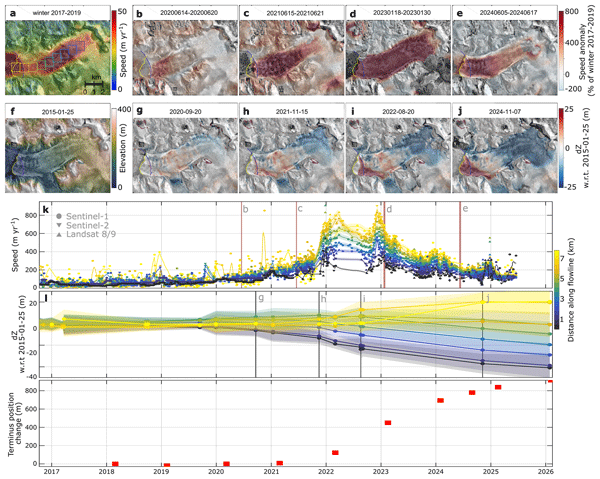
Some glaciers flow slowly for many years before dramatically accelerating. This is usually a sign of a surge. Theory and observations suggest that surges occur in certain climates. The Antarctic Peninsula has such a climate yet only one surge has been observed there. We present detailed observations of three glaciers that surged recently. We explore how climate change over the past hundred years, and projected climate change up to 2150, has and will affect surging behaviour on the Peninsula.
Yikai Zhu, Anna E. Hogg, Benjamin J. Wallis, Ross A. W. Slater, and Oliver J. Marsh
EGUsphere, https://doi.org/10.5194/egusphere-2026-3795, https://doi.org/10.5194/egusphere-2026-3795, 2026
This preprint is open for discussion and under review for The Cryosphere (TC).
Short summary
Short summary
Satellite measurements are widely used to monitor how fast Antarctic ice is flowing, but the rise and fall of ocean tides can make the ice appear to move faster or slower than it really does. We developed a new way to remove this effect using satellite observations alone and applied it across all Antarctic ice shelves. The corrected measurements provide a more reliable picture of ice movement, improving studies of ice-sheet change and future sea-level rise.

Amy C. F. King, Thomas K. Bauska, Amaëlle Landais, Carlos Martín, and Eric W. Wolff
Clim. Past, 22, 1291–1304, https://doi.org/10.5194/cp-22-1291-2026, https://doi.org/10.5194/cp-22-1291-2026, 2026
Short summary
Short summary
We show how measurements of nitrogen isotopes in Antarctic ice core records can be used to show dramatic thinning of an ice sheet during ice mass changes in the Holocene. Combining such measurements with proxies for ice sheet elevation could be a powerful tool for constraining the history of ice dynamics at sites which are sensitive to rapid changes, and could contribute to constraining ice sheet models.
Neil Ross, Rebecca J. Sanderson, Bernd Kulessa, Martin Siegert, Guy J. G. Paxman, Keir A. Nichols, Matthew R. Siegfried, Stewart S. R. Jamieson, Michael J. Bentley, Tom A. Jordan, Christine L. Batchelor, David Small, Olaf Eisen, Kate Winter, Robert G. Bingham, S. Louise Callard, Rachel Carr, Christine F. Dow, Helen A. Fricker, Emily Hill, Benjamin H. Hills, Coen Hofstede, Hafeez Jeofry, Felipe Napoleoni, and Wilson Sauthoff
The Cryosphere, 20, 3705–3737, https://doi.org/10.5194/tc-20-3705-2026, https://doi.org/10.5194/tc-20-3705-2026, 2026
Short summary
Short summary
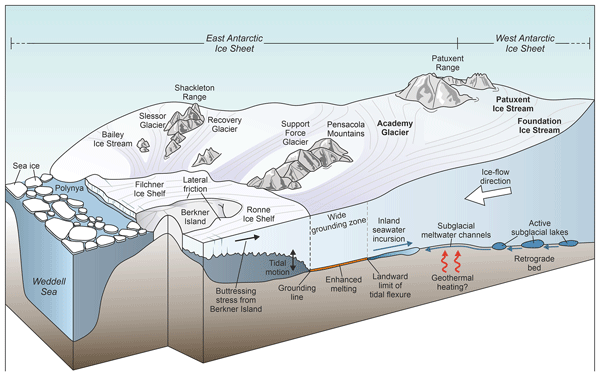
We review research about a group of fast-flowing Antarctic ice streams, the Foundation-Patuxent-Academy System. Previously, we knew little about how these ice streams flow, how they interact with each other and the ocean, what their geological history was, and how they might evolve in a warming world. By reviewing existing research, we have identified the future research needed to determine how these ice streams function, and how they might contribute to future global sea level rise.
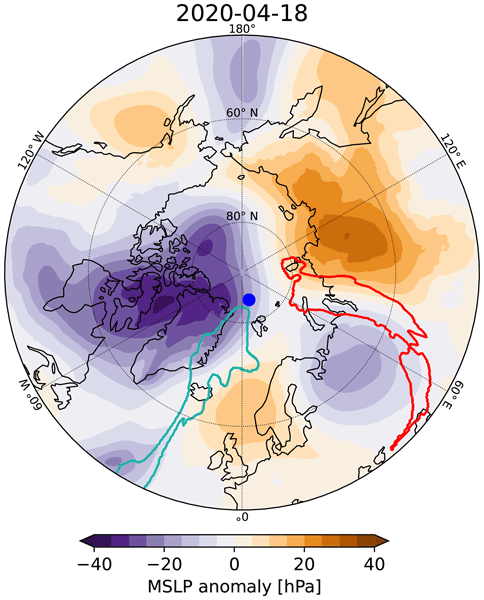
Luisa E. Avilés-Podgurski, Patrick Martineau, Hua Lu, Ayako Yamamoto, Amanda C. Maycock, Andrew Orr, Tony Phillips, Thomas J. Bracegirdle, Anna E. Hogg, Grzegorz Muszynski, and Andrew Fleming
Weather Clim. Dynam., 7, 1051–1071, https://doi.org/10.5194/wcd-7-1051-2026, https://doi.org/10.5194/wcd-7-1051-2026, 2026
Short summary
Short summary
Atmospheric rivers (ARs) are narrow filaments of intense poleward water vapour transport. On rare occasions, they reach the Arctic, driving strong warming and melt. In April 2020, two ARs intruded into the central Arctic within one week, raising near-surface temperatures by up to 30°C and leading to extreme precipitation. Their distinct paths and thermodynamic evolution reveal diverse AR impacts on Arctic sea ice and precipitation extremes.
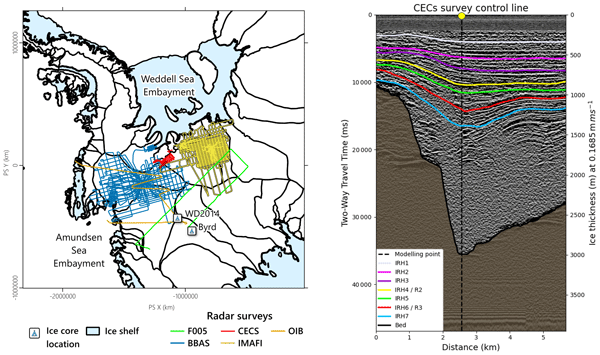
Felipe Napoleoni, Michael J. Bentley, Neil Ross, Stewart S. R. Jamieson, José A. Uribe, Jonathan Oberreuter, Rodrigo Zamora, Andrés Rivera, Andrew M. Smith, Robert G. Bingham, and Kenichi Matsuoka
The Cryosphere, 20, 2793–2824, https://doi.org/10.5194/tc-20-2793-2026, https://doi.org/10.5194/tc-20-2793-2026, 2026
Short summary
Short summary
We mapped buried layers inside West Antarctic ice across 13,000 km² near the Amundsen–Weddell divide using radar. Some layers may be up to 17 kyr old. The layers remain well preserved in slow-moving ice but become distorted where ice flows faster. Snowfall has long been greater on one side of the divide, suggesting the ice divide has remained stable for thousands of years. Our study helps connect climate records across West Antarctica and improve models used to predict future ice-sheet change.
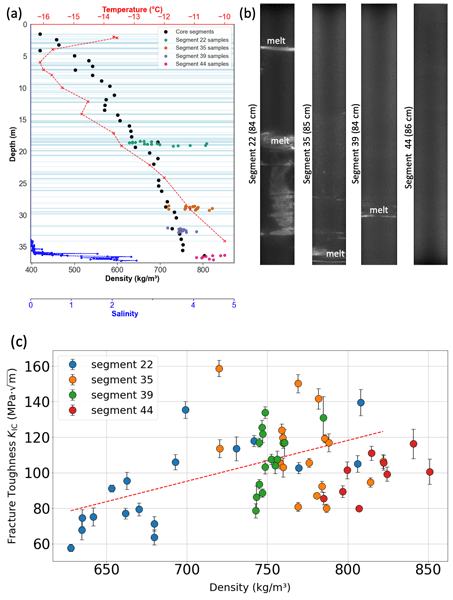
Emma Pearce, Oliver J. Marsh, Thomas M. Mitchell, Jukka Tuhkuri, Elizabeth R. Thomas, and Siobhan Johnson
The Cryosphere, 20, 2723–2734, https://doi.org/10.5194/tc-20-2723-2026, https://doi.org/10.5194/tc-20-2723-2026, 2026
Short summary
Short summary
Ice shelves slow the flow of Antarctic glaciers into the sea and help limit their contribution to sea level rise. Their stability depends on how different types of ice respond to stress. We collected a 37 m ice core from the Brunt Ice Shelf and carried out fracture experiments to measure ice strength. We found that refrozen surface melt strengthens the ice, while salty seawater weakens it, affecting how cracks grow and how ice-shelf break-up should be modelled.
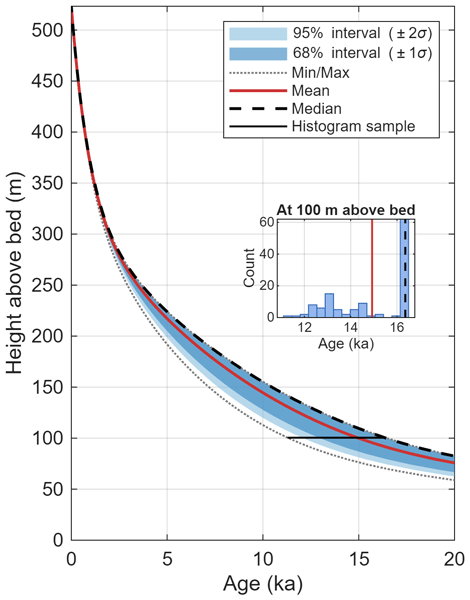
Vikram Goel, Carlos Martín, Kenichi Matsuoka, Bhanu Pratap, Geir Moholdt, Rahul Dey, Chavarukonam M. Laluraj, and Meloth Thamban
The Cryosphere, 20, 1363–1378, https://doi.org/10.5194/tc-20-1363-2026, https://doi.org/10.5194/tc-20-1363-2026, 2026
Short summary
Short summary
We identified an ideal site in coastal East Antarctica for extracting ice core that contain detailed climate records dating back 20 000 years. We surveyed two ice rises combining radar measurements with ice flow modeling to assess their suitability. One site emerged as optimal, offering well-preserved climate history with high temporal resolution. An ice core record from this site could help us understand historical interactions between sea ice, winds, and precipitation patterns in the region.
Sarah Leibrock, Ross A. W. Slater, Anna E. Hogg, and Celia A. Baumhoer
EGUsphere, https://doi.org/10.5194/egusphere-2025-5492, https://doi.org/10.5194/egusphere-2025-5492, 2025
Preprint archived
Short summary
Short summary
Using satellite data from 2013 to 2024, we studied 42 Antarctic Peninsula glaciers and observed widespread but spatially heterogeneous retreat and ice flow acceleration, with some glaciers more than doubling in speed. In addition to these long-term trends, glacier dynamics exhibited significant seasonal variability, underscoring the highly dynamic nature of glaciers in this region driven by a combination of glacier-specific and environmental factors.
Trystan Surawy-Stepney, Stephen L. Cornford, and Anna E. Hogg
The Cryosphere, 19, 5531–5545, https://doi.org/10.5194/tc-19-5531-2025, https://doi.org/10.5194/tc-19-5531-2025, 2025
Short summary
Short summary
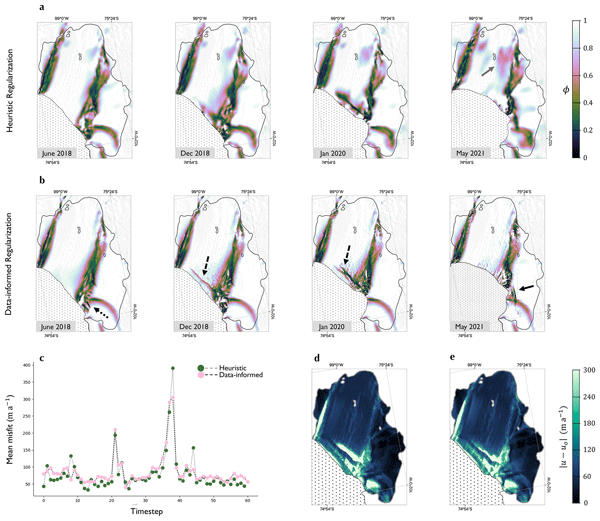
The speed at which Antarctic ice flows is dependent on its viscosity and the slipperiness of the ice/bedrock interface. Often, these unknown variables are inferred from observations of ice speed. This article presents an attempt to make this difficult procedure easier by making use of additional information in the form of observations of crevasses, which make ice appear less viscous to numerical models. We find in some circumstances that this leads to more appealing solutions to this problem.
Frédéric Parrenin, Ailsa Chung, and Carlos Martín
Geosci. Model Dev., 18, 8203–8216, https://doi.org/10.5194/gmd-18-8203-2025, https://doi.org/10.5194/gmd-18-8203-2025, 2025
Short summary
Short summary
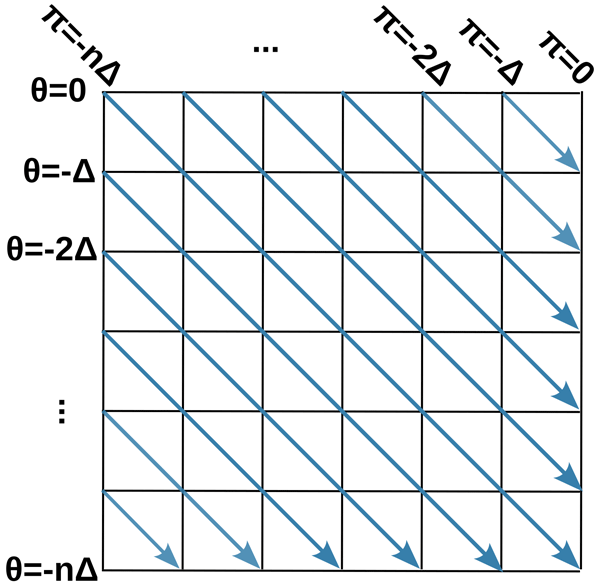
We developed a new numerical age solver for a pseudo-steady flow tube of an ice sheet. Thanks to a new coordinate system which tracks the trajectories and a change of the time variable, our scheme combines the advantages of Eulerian and Lagrangian schemes: no numerical diffusion and no dilution of tracers. Our model is so fast that it is easy to optimize its parameters. Our model is made available to the ice sheet community as an easy to use open-source software coded in python.
Katie Lowery, Pierre Dutrieux, Paul R. Holland, Anna E. Hogg, Noel Gourmelen, and Benjamin J. Wallis
The Cryosphere, 19, 4893–4911, https://doi.org/10.5194/tc-19-4893-2025, https://doi.org/10.5194/tc-19-4893-2025, 2025
Short summary
Short summary
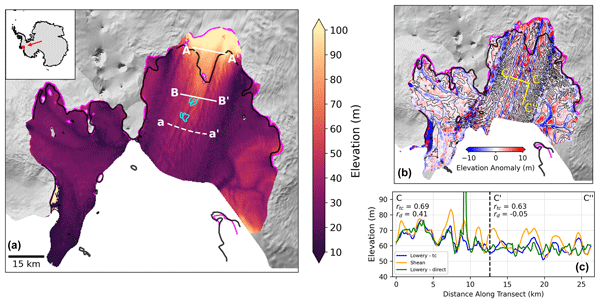
Using CryoSat-2, we observe monthly changes in the Pine Island Glacier (PIG) ice shelf surface and derive oceanic melt at its base. Basal channels, kilometres wide, are reflected in the ice surface and captured in our observations. We demonstrate that melt is concentrated on the western walls of channels, that channels play a role in grounding pinning points, and that PIG's main channel geometry is inherited upstream of the grounding line. These results highlight the importance of channels to ice shelf stability.
Álvaro Arenas-Pingarrón, Alex M. Brisbourne, Carlos Martín, Hugh F. J. Corr, Carl Robinson, Tom A. Jordan, and Paul V. Brennan
The Cryosphere, 19, 4657–4670, https://doi.org/10.5194/tc-19-4657-2025, https://doi.org/10.5194/tc-19-4657-2025, 2025
Short summary
Short summary
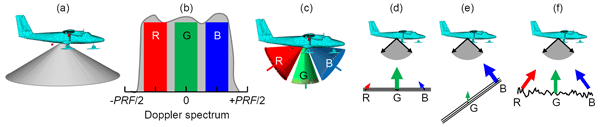
Synthetic Aperture Radar (SAR) imaging is essential for deep englacial observations. Each pixel is formed by averaging the radar echoes within an antenna beamwidth, but the echo diversity is lost after the average. We improve the SAR interpretation if three sub-images are formed with different sub-beamwidths: each is coloured in red, green, or blue, and they are overlapped, creating a coloured image. Interpreters will better identify the slopes of internal layers, crevasses, and layer roughness.
Robert G. Bingham, Julien A. Bodart, Marie G. P. Cavitte, Ailsa Chung, Rebecca J. Sanderson, Johannes C. R. Sutter, Olaf Eisen, Nanna B. Karlsson, Joseph A. MacGregor, Neil Ross, Duncan A. Young, David W. Ashmore, Andreas Born, Winnie Chu, Xiangbin Cui, Reinhard Drews, Steven Franke, Vikram Goel, John W. Goodge, A. Clara J. Henry, Antoine Hermant, Benjamin H. Hills, Nicholas Holschuh, Michelle R. Koutnik, Gwendolyn J.-M. C. Leysinger Vieli, Emma J. MacKie, Elisa Mantelli, Carlos Martín, Felix S. L. Ng, Falk M. Oraschewski, Felipe Napoleoni, Frédéric Parrenin, Sergey V. Popov, Therese Rieckh, Rebecca Schlegel, Dustin M. Schroeder, Martin J. Siegert, Xueyuan Tang, Thomas O. Teisberg, Kate Winter, Shuai Yan, Harry Davis, Christine F. Dow, Tyler J. Fudge, Tom A. Jordan, Bernd Kulessa, Kenichi Matsuoka, Clara J. Nyqvist, Maryam Rahnemoonfar, Matthew R. Siegfried, Shivangini Singh, Vjeran Višnjević, Rodrigo Zamora, and Alexandra Zuhr
The Cryosphere, 19, 4611–4655, https://doi.org/10.5194/tc-19-4611-2025, https://doi.org/10.5194/tc-19-4611-2025, 2025
Short summary
Short summary
The ice sheets covering Antarctica have built up over millenia through successive snowfall events which become buried and preserved as internal surfaces of equal age detectable with ice-penetrating radar. This paper describes an international initiative working together on these archival data to build a comprehensive 3-D picture of how old the ice is everywhere across Antarctica and how this is being used to reconstruct past and to predict future ice and climate behaviour.
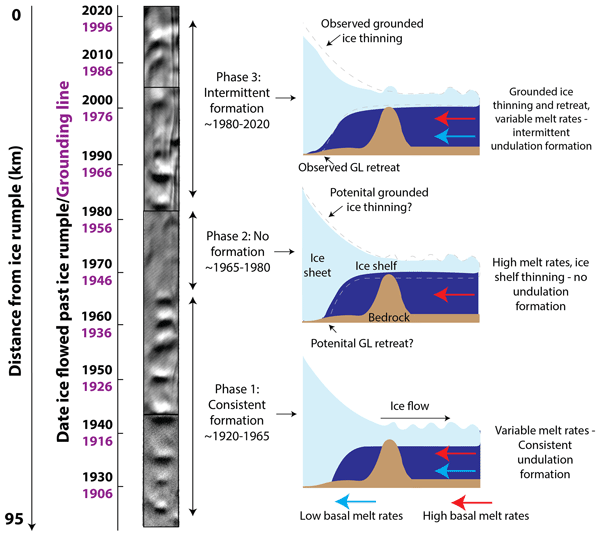
Bertie W. J. Miles, Tian Li, and Robert G. Bingham
The Cryosphere, 19, 4027–4043, https://doi.org/10.5194/tc-19-4027-2025, https://doi.org/10.5194/tc-19-4027-2025, 2025
Short summary
Short summary
Totten Glacier, East Antarctica's largest mass-loss source, has thinned since at least the 1990s. No sustained acceleration has occurred since 1973, but earlier grounding-line retreat suggests prior loss. A ~20-year gap in surface undulations implies a mid-20th-century warm period that may have triggered ongoing loss. Collapse of a nearby ice shelf supports this. Current ~30-year satellite records are too short to capture full decadal melt-rate variability.
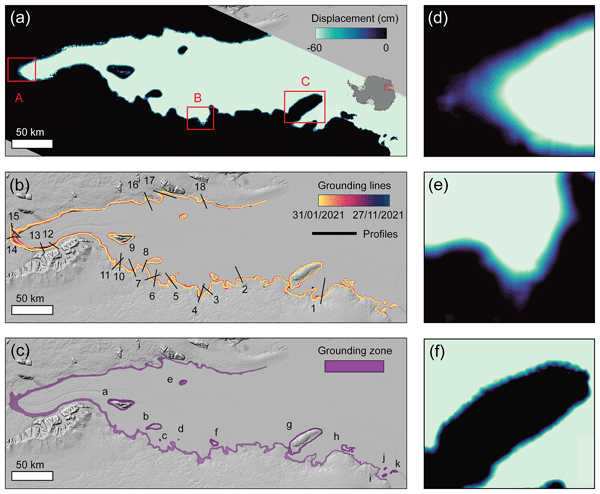
Yikai Zhu, Anna E. Hogg, Andrew Hooper, and Benjamin J. Wallis
The Cryosphere, 19, 3971–3989, https://doi.org/10.5194/tc-19-3971-2025, https://doi.org/10.5194/tc-19-3971-2025, 2025
Short summary
Short summary
This study investigates the long- and short-term changes in the grounding line of the Amery Ice Shelf in East Antarctica, using satellite observations and a method called Differential Range Offset Tracking (DROT). Our findings show how the grounding line behaves in response to tides and other environmental factors, with implications for understanding ice shelf stability.
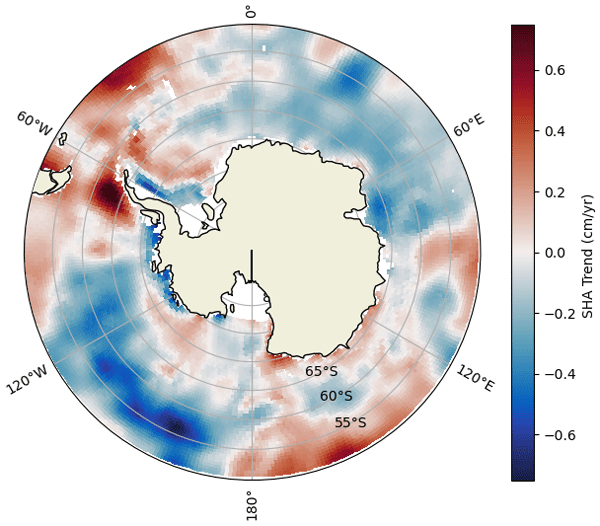
Jennifer Cocks, Alessandro Silvano, Alberto C. Naveira Garabato, Oana Dragomir, Noémie Schifano, Anna E. Hogg, and Alice Marzocchi
Ocean Sci., 21, 1609–1625, https://doi.org/10.5194/os-21-1609-2025, https://doi.org/10.5194/os-21-1609-2025, 2025
Short summary
Short summary
Heat and freshwater fluxes in the Southern Ocean mediate global ocean circulation and abyssal ventilation. These fluxes manifest as changes in steric height: sea level anomalies from changes in ocean density. We compute the steric height anomaly of the Southern Ocean using satellite data and validate it against in situ observations. We analyse trends and variability in steric height, drawing links to climate variability, and discuss the effectiveness of the method, highlighting issues with its application.
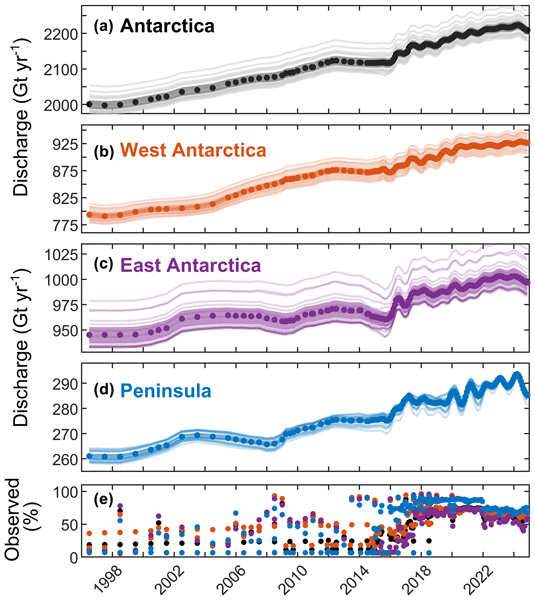
Benjamin J. Davison, Anna E. Hogg, Thomas Slater, Richard Rigby, and Nicolaj Hansen
Earth Syst. Sci. Data, 17, 3259–3281, https://doi.org/10.5194/essd-17-3259-2025, https://doi.org/10.5194/essd-17-3259-2025, 2025
Short summary
Short summary
Grounding line discharge is a measure of the amount of ice entering the ocean from an ice mass. This paper describes a dataset of grounding line discharge for the Antarctic Ice Sheet and each of its glaciers. The dataset shows that Antarctic Ice Sheet grounding line discharge has increased since 1996.
Ole Zeising, Álvaro Arenas-Pingarrón, Alex M. Brisbourne, and Carlos Martín
The Cryosphere, 19, 2355–2363, https://doi.org/10.5194/tc-19-2355-2025, https://doi.org/10.5194/tc-19-2355-2025, 2025
Short summary
Short summary
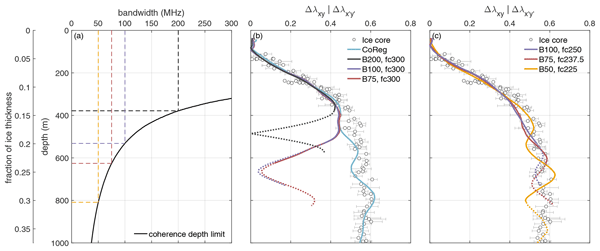
Ice crystal orientation influences how glacier ice deforms. Radar polarimetry is commonly used to study the bulk ice crystal orientation, but the often used coherence method only provides information of the shallow ice in fast-flowing areas. This study shows that reducing the bandwidth of high-bandwidth radar data significantly enhances the depth limit of the coherence method. This improvement helps us to better understand ice dynamics in fast-flowing ice streams.
Heather L. Selley, Anna E. Hogg, Benjamin J. Davison, Pierre Dutrieux, and Thomas Slater
The Cryosphere, 19, 1725–1738, https://doi.org/10.5194/tc-19-1725-2025, https://doi.org/10.5194/tc-19-1725-2025, 2025
Short summary
Short summary
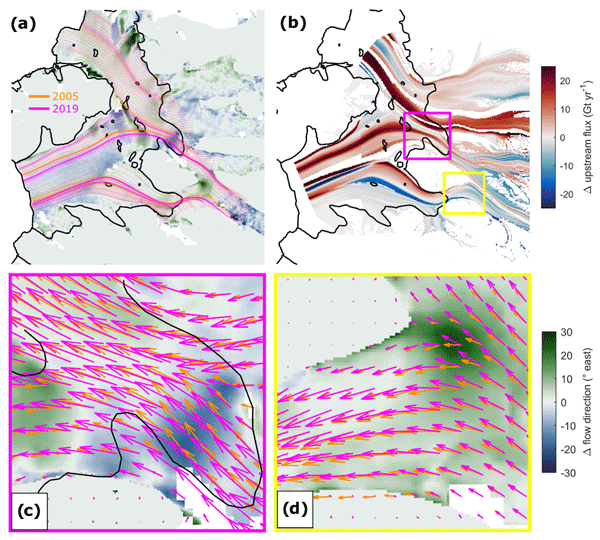
We used satellite observations to measure recent changes in ice speed and flow direction in the Pope, Smith, and Kohler region of West Antarctica (2005–2022). We found substantial speed-up on seven ice streams of up to 87 %. However, Kohler West Glacier has slowed by 10 %, due to the redirection of ice flow into its rapidly thinning neighbour. This process of “ice piracy” has not previously been directly observed on this rapid timescale and may influence future ice shelf and sheet mass changes.
Elizabeth R. Thomas, Dieter Tetzner, Bradley Markle, Joel Pedro, Guisella Gacitúa, Dorothea Elisabeth Moser, and Sarah Jackson
Clim. Past, 20, 2525–2538, https://doi.org/10.5194/cp-20-2525-2024, https://doi.org/10.5194/cp-20-2525-2024, 2024
Short summary
Short summary
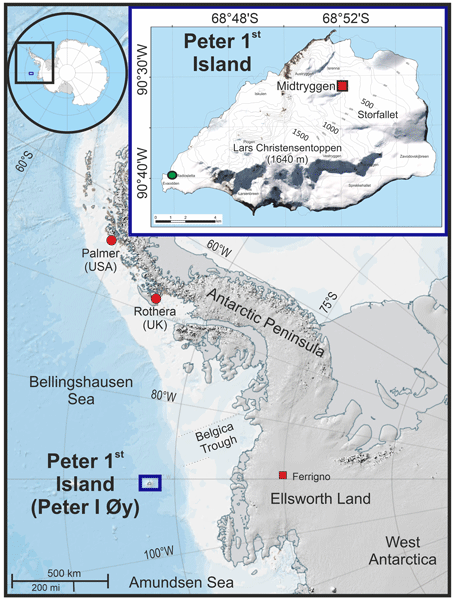
The chemical records contained in a 12 m firn (ice) core from Peter I Island, a remote sub-Antarctic island situated in the Pacific sector of the Southern Ocean (the Bellingshausen Sea), capture changes in snowfall and temperature (2002–2017 CE). This data-sparse region has experienced dramatic climate change in recent decades, including sea ice decline and ice loss from adjacent West Antarctic glaciers.
Benjamin J. Wallis, Anna E. Hogg, Yikai Zhu, and Andrew Hooper
The Cryosphere, 18, 4723–4742, https://doi.org/10.5194/tc-18-4723-2024, https://doi.org/10.5194/tc-18-4723-2024, 2024
Short summary
Short summary
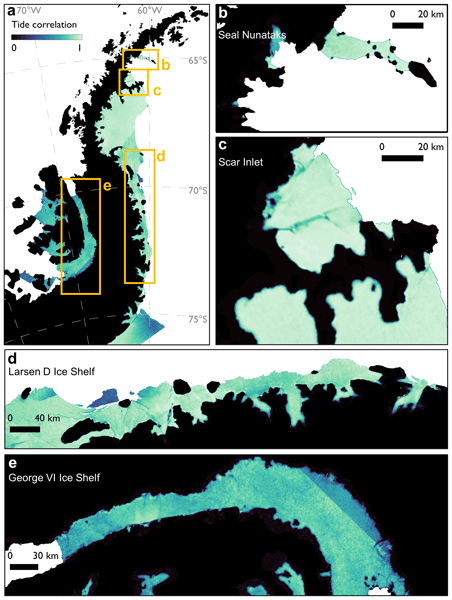
The grounding line, where ice begins to float, is an essential variable to understand ice dynamics, but in some locations it can be challenging to measure with established techniques. Using satellite data and a new method, Wallis et al. measure the grounding line position of glaciers and ice shelves in the Antarctic Peninsula and find retreats of up to 16.3 km have occurred since the last time measurements were made in the 1990s.
Benjamin J. Davison, Anna E. Hogg, Carlos Moffat, Michael P. Meredith, and Benjamin J. Wallis
The Cryosphere, 18, 3237–3251, https://doi.org/10.5194/tc-18-3237-2024, https://doi.org/10.5194/tc-18-3237-2024, 2024
Short summary
Short summary
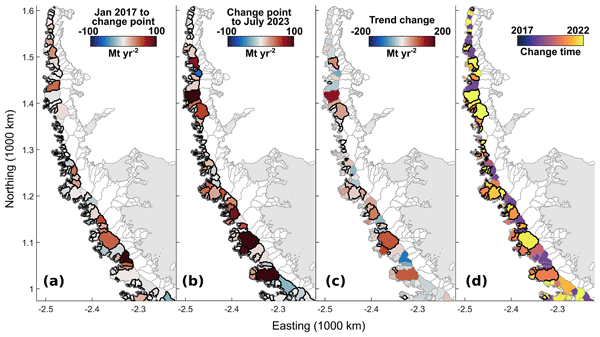
Using a new dataset of ice motion, we observed glacier acceleration on the west coast of the Antarctic Peninsula. The speed-up began around January 2021, but some glaciers sped up earlier or later. Using a combination of ship-based ocean temperature observations and climate models, we show that the speed-up coincided with a period of unusually warm air and ocean temperatures in the region.
Dorothea Elisabeth Moser, Elizabeth R. Thomas, Christoph Nehrbass-Ahles, Anja Eichler, and Eric Wolff
The Cryosphere, 18, 2691–2718, https://doi.org/10.5194/tc-18-2691-2024, https://doi.org/10.5194/tc-18-2691-2024, 2024
Short summary
Short summary
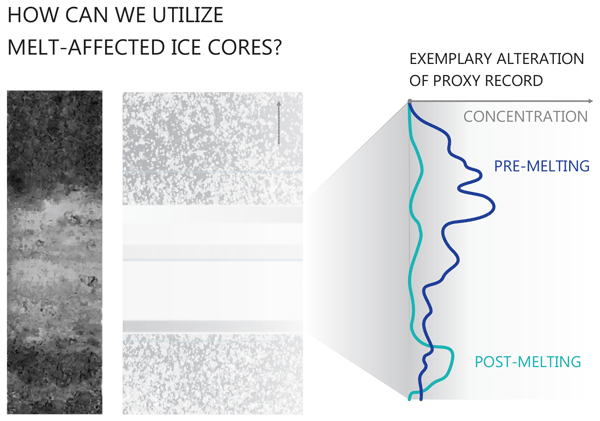
Increasing temperatures worldwide lead to more melting of glaciers and ice caps, even in the polar regions. This is why ice-core scientists need to prepare to analyse records affected by melting and refreezing. In this paper, we present a summary of how near-surface melt forms, what structural imprints it leaves in snow, how various signatures used for ice-core climate reconstruction are altered, and how we can still extract valuable insights from melt-affected ice cores.
Trystan Surawy-Stepney, Anna E. Hogg, Stephen L. Cornford, Benjamin J. Wallis, Benjamin J. Davison, Heather L. Selley, Ross A. W. Slater, Elise K. Lie, Livia Jakob, Andrew Ridout, Noel Gourmelen, Bryony I. D. Freer, Sally F. Wilson, and Andrew Shepherd
The Cryosphere, 18, 977–993, https://doi.org/10.5194/tc-18-977-2024, https://doi.org/10.5194/tc-18-977-2024, 2024
Short summary
Short summary
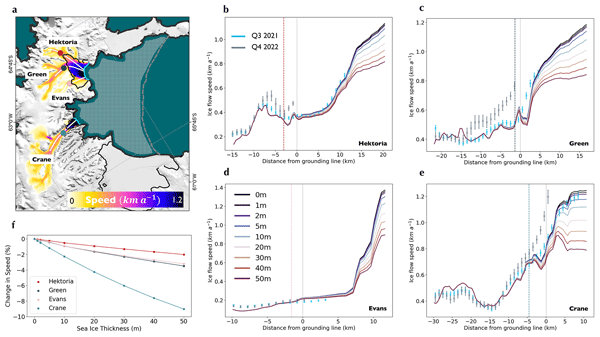
Here, we use satellite observations and an ice flow model to quantify the impact of sea ice buttressing on ice streams on the Antarctic Peninsula. The evacuation of 11-year-old landfast sea ice in the Larsen B embayment on the East Antarctic Peninsula in January 2022 was closely followed by major changes in the calving behaviour and acceleration (30 %) of the ocean-terminating glaciers. Our results show that sea ice buttressing had a negligible direct role in the observed dynamic changes.
Rebecca J. Sanderson, Kate Winter, S. Louise Callard, Felipe Napoleoni, Neil Ross, Tom A. Jordan, and Robert G. Bingham
The Cryosphere, 17, 4853–4871, https://doi.org/10.5194/tc-17-4853-2023, https://doi.org/10.5194/tc-17-4853-2023, 2023
Short summary
Short summary
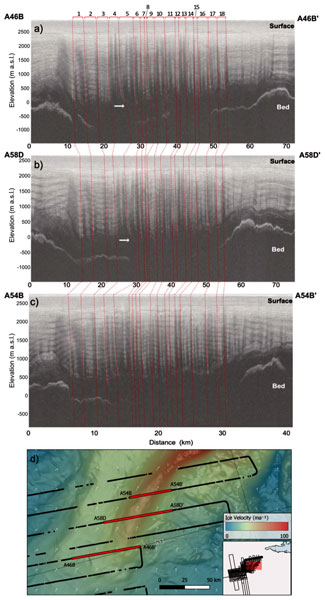
Ice-penetrating radar allows us to explore the internal structure of glaciers and ice sheets to constrain past and present ice-flow conditions. In this paper, we examine englacial layers within the Lambert Glacier in East Antarctica using a quantitative layer tracing tool. Analysis reveals that the ice flow here has been relatively stable, but evidence for former fast flow along a tributary suggests that changes have occurred in the past and could change again in the future.
Trystan Surawy-Stepney, Anna E. Hogg, Stephen L. Cornford, and David C. Hogg
The Cryosphere, 17, 4421–4445, https://doi.org/10.5194/tc-17-4421-2023, https://doi.org/10.5194/tc-17-4421-2023, 2023
Short summary
Short summary
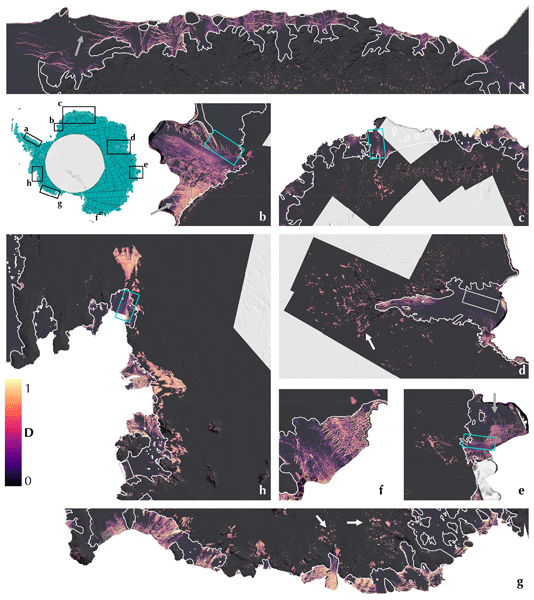
The presence of crevasses in Antarctica influences how the ice sheet behaves. It is important, therefore, to collect data on the spatial distribution of crevasses and how they are changing. We present a method of mapping crevasses from satellite radar imagery and apply it to 7.5 years of images, covering Antarctica's floating and grounded ice. We develop a method of measuring change in the density of crevasses and quantify increased fracturing in important parts of the West Antarctic Ice Sheet.
Bryony I. D. Freer, Oliver J. Marsh, Anna E. Hogg, Helen Amanda Fricker, and Laurie Padman
The Cryosphere, 17, 4079–4101, https://doi.org/10.5194/tc-17-4079-2023, https://doi.org/10.5194/tc-17-4079-2023, 2023
Short summary
Short summary
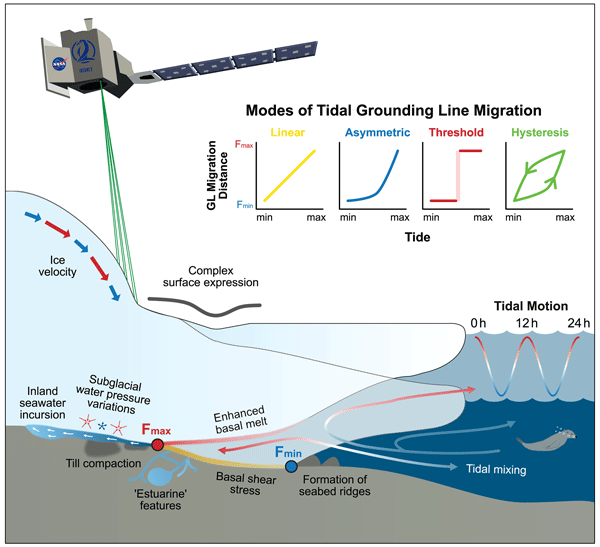
We develop a method using ICESat-2 data to measure how Antarctic grounding lines (GLs) migrate across the tide cycle. At an ice plain on the Ronne Ice Shelf we observe 15 km of tidal GL migration, the largest reported distance in Antarctica, dominating any signal of long-term migration. We identify four distinct migration modes, which provide both observational support for models of tidal ice flexure and GL migration and insights into ice shelf–ocean–subglacial interactions in grounding zones.
Ailsa Chung, Frédéric Parrenin, Daniel Steinhage, Robert Mulvaney, Carlos Martín, Marie G. P. Cavitte, David A. Lilien, Veit Helm, Drew Taylor, Prasad Gogineni, Catherine Ritz, Massimo Frezzotti, Charles O'Neill, Heinrich Miller, Dorthe Dahl-Jensen, and Olaf Eisen
The Cryosphere, 17, 3461–3483, https://doi.org/10.5194/tc-17-3461-2023, https://doi.org/10.5194/tc-17-3461-2023, 2023
Short summary
Short summary
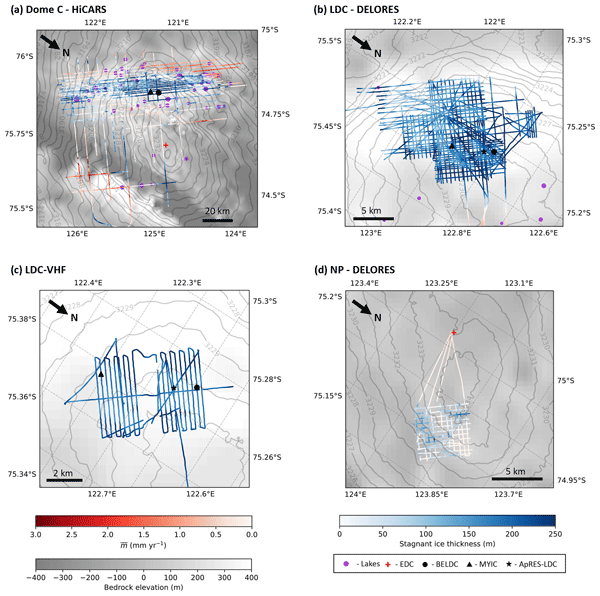
We combined a numerical model with radar measurements in order to determine the age of ice in the Dome C region of Antarctica. Our results show that at the current ice core drilling sites on Little Dome C, the maximum age of the ice is almost 1.5 Ma. We also highlight a new potential drill site called North Patch with ice up to 2 Ma. Finally, we explore the nature of a stagnant ice layer at the base of the ice sheet which has been independently observed and modelled but is not well understood.
Isobel Rowell, Carlos Martin, Robert Mulvaney, Helena Pryer, Dieter Tetzner, Emily Doyle, Hara Madhav Talasila, Jilu Li, and Eric Wolff
Clim. Past, 19, 1699–1714, https://doi.org/10.5194/cp-19-1699-2023, https://doi.org/10.5194/cp-19-1699-2023, 2023
Short summary
Short summary
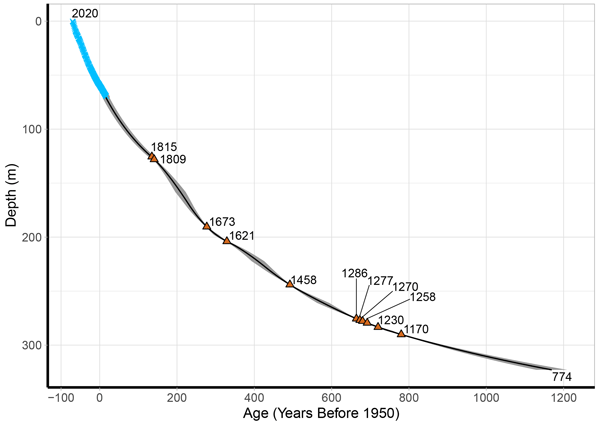
We present an age scale for a new type of ice core from a vulnerable region in West Antarctic, which is lacking in longer-term (greater than a few centuries) ice core records. The Sherman Island core extends to greater than 1 kyr. We provide modelling evidence for the potential of a 10 kyr long core. We show that this new type of ice core can be robustly dated and that climate records from this core will be a significant addition to existing regional climate records.
Alice C. Frémand, Peter Fretwell, Julien A. Bodart, Hamish D. Pritchard, Alan Aitken, Jonathan L. Bamber, Robin Bell, Cesidio Bianchi, Robert G. Bingham, Donald D. Blankenship, Gino Casassa, Ginny Catania, Knut Christianson, Howard Conway, Hugh F. J. Corr, Xiangbin Cui, Detlef Damaske, Volkmar Damm, Reinhard Drews, Graeme Eagles, Olaf Eisen, Hannes Eisermann, Fausto Ferraccioli, Elena Field, René Forsberg, Steven Franke, Shuji Fujita, Yonggyu Gim, Vikram Goel, Siva Prasad Gogineni, Jamin Greenbaum, Benjamin Hills, Richard C. A. Hindmarsh, Andrew O. Hoffman, Per Holmlund, Nicholas Holschuh, John W. Holt, Annika N. Horlings, Angelika Humbert, Robert W. Jacobel, Daniela Jansen, Adrian Jenkins, Wilfried Jokat, Tom Jordan, Edward King, Jack Kohler, William Krabill, Mette Kusk Gillespie, Kirsty Langley, Joohan Lee, German Leitchenkov, Carlton Leuschen, Bruce Luyendyk, Joseph MacGregor, Emma MacKie, Kenichi Matsuoka, Mathieu Morlighem, Jérémie Mouginot, Frank O. Nitsche, Yoshifumi Nogi, Ole A. Nost, John Paden, Frank Pattyn, Sergey V. Popov, Eric Rignot, David M. Rippin, Andrés Rivera, Jason Roberts, Neil Ross, Anotonia Ruppel, Dustin M. Schroeder, Martin J. Siegert, Andrew M. Smith, Daniel Steinhage, Michael Studinger, Bo Sun, Ignazio Tabacco, Kirsty Tinto, Stefano Urbini, David Vaughan, Brian C. Welch, Douglas S. Wilson, Duncan A. Young, and Achille Zirizzotti
Earth Syst. Sci. Data, 15, 2695–2710, https://doi.org/10.5194/essd-15-2695-2023, https://doi.org/10.5194/essd-15-2695-2023, 2023
Short summary
Short summary
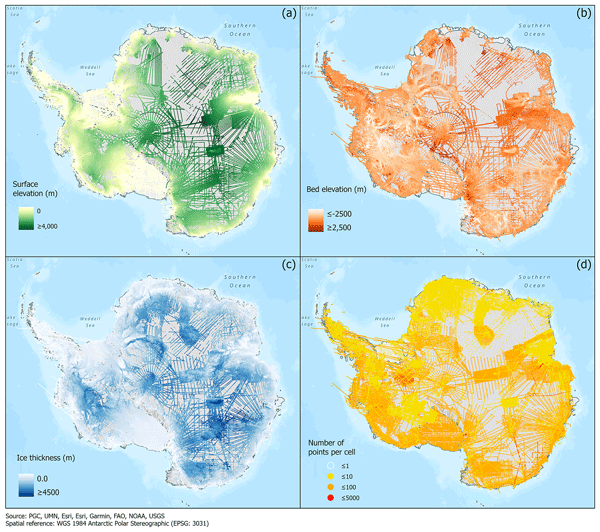
This paper presents the release of over 60 years of ice thickness, bed elevation, and surface elevation data acquired over Antarctica by the international community. These data are a crucial component of the Antarctic Bedmap initiative which aims to produce a new map and datasets of Antarctic ice thickness and bed topography for the international glaciology and geophysical community.
Elizabeth R. Thomas, Diana O. Vladimirova, Dieter R. Tetzner, B. Daniel Emanuelsson, Nathan Chellman, Daniel A. Dixon, Hugues Goosse, Mackenzie M. Grieman, Amy C. F. King, Michael Sigl, Danielle G. Udy, Tessa R. Vance, Dominic A. Winski, V. Holly L. Winton, Nancy A. N. Bertler, Akira Hori, Chavarukonam M. Laluraj, Joseph R. McConnell, Yuko Motizuki, Kazuya Takahashi, Hideaki Motoyama, Yoichi Nakai, Franciéle Schwanck, Jefferson Cardia Simões, Filipe Gaudie Ley Lindau, Mirko Severi, Rita Traversi, Sarah Wauthy, Cunde Xiao, Jiao Yang, Ellen Mosely-Thompson, Tamara V. Khodzher, Ludmila P. Golobokova, and Alexey A. Ekaykin
Earth Syst. Sci. Data, 15, 2517–2532, https://doi.org/10.5194/essd-15-2517-2023, https://doi.org/10.5194/essd-15-2517-2023, 2023
Short summary
Short summary
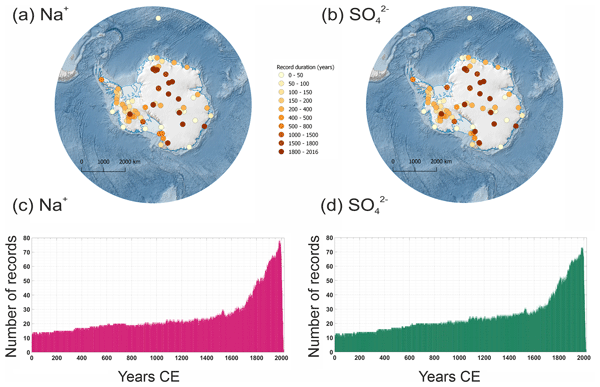
The concentration of sodium and sulfate measured in Antarctic ice cores is related to changes in both sea ice and winds. Here we have compiled a database of sodium and sulfate records from 105 ice core sites in Antarctica. The records span all, or part, of the past 2000 years. The records will improve our understanding of how winds and sea ice have changed in the past and how they have influenced the climate of Antarctica over the past 2000 years.
Julia R. Andreasen, Anna E. Hogg, and Heather L. Selley
The Cryosphere, 17, 2059–2072, https://doi.org/10.5194/tc-17-2059-2023, https://doi.org/10.5194/tc-17-2059-2023, 2023
Short summary
Short summary
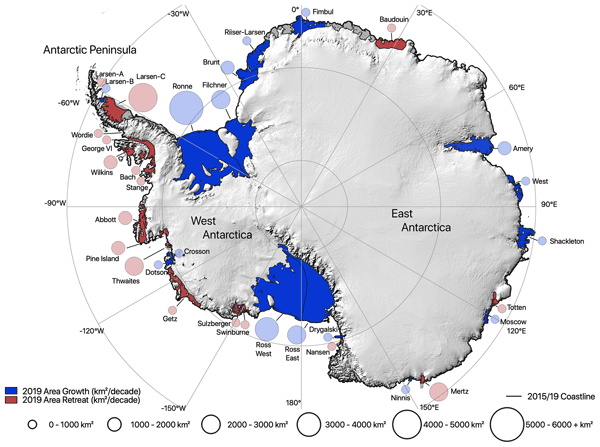
There are few long-term, high spatial resolution observations of ice shelf change in Antarctica over the past 3 decades. In this study, we use high spatial resolution observations to map the annual calving front location on 34 ice shelves around Antarctica from 2009 to 2019 using satellite data. The results provide a comprehensive assessment of ice front migration across Antarctica over the last decade.
Julien A. Bodart, Robert G. Bingham, Duncan A. Young, Joseph A. MacGregor, David W. Ashmore, Enrica Quartini, Andrew S. Hein, David G. Vaughan, and Donald D. Blankenship
The Cryosphere, 17, 1497–1512, https://doi.org/10.5194/tc-17-1497-2023, https://doi.org/10.5194/tc-17-1497-2023, 2023
Short summary
Short summary
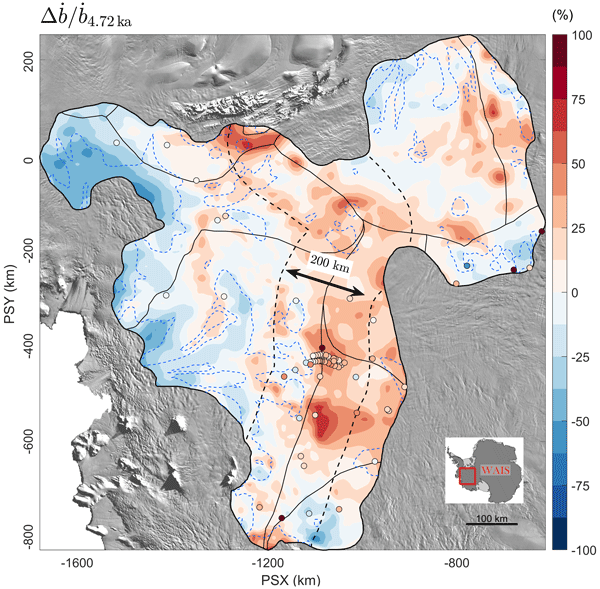
Estimating how West Antarctica will change in response to future climatic change depends on our understanding of past ice processes. Here, we use a reflector widely visible on airborne radar data across West Antarctica to estimate accumulation rates over the past 4700 years. By comparing our estimates with current atmospheric data, we find that accumulation rates were 18 % greater than modern rates. This has implications for our understanding of past ice processes in the region.
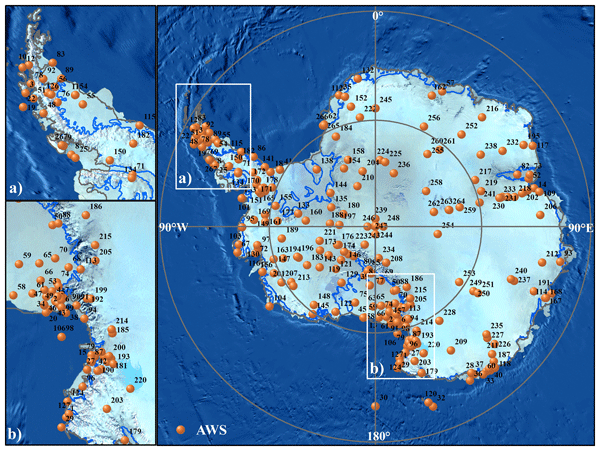
Yetang Wang, Xueying Zhang, Wentao Ning, Matthew A. Lazzara, Minghu Ding, Carleen H. Reijmer, Paul C. J. P. Smeets, Paolo Grigioni, Petra Heil, Elizabeth R. Thomas, David Mikolajczyk, Lee J. Welhouse, Linda M. Keller, Zhaosheng Zhai, Yuqi Sun, and Shugui Hou
Earth Syst. Sci. Data, 15, 411–429, https://doi.org/10.5194/essd-15-411-2023, https://doi.org/10.5194/essd-15-411-2023, 2023
Short summary
Short summary
Here we construct a new database of Antarctic automatic weather station (AWS) meteorological records, which is quality-controlled by restrictive criteria. This dataset compiled all available Antarctic AWS observations, and its resolutions are 3-hourly, daily and monthly, which is very useful for quantifying spatiotemporal variability in weather conditions. Furthermore, this compilation will be used to estimate the performance of the regional climate models or meteorological reanalysis products.

Tancrède P. M. Leger, Andrew S. Hein, Ángel Rodés, Robert G. Bingham, Irene Schimmelpfennig, Derek Fabel, Pablo Tapia, and ASTER Team
Clim. Past, 19, 35–59, https://doi.org/10.5194/cp-19-35-2023, https://doi.org/10.5194/cp-19-35-2023, 2023
Short summary
Short summary
Over the past 800 thousand years, variations in the Earth’s orbit and tilt have caused antiphased solar insolation intensity in the Northern and Southern Hemispheres. Paradoxically, glacial records suggest that global ice sheets have responded synchronously to major cold glacial and warm interglacial episodes. To address this puzzle, we present a new detailed glacier chronology that estimates the timing of multiple Patagonian ice-sheet waxing and waning cycles over the past 300 thousand years.
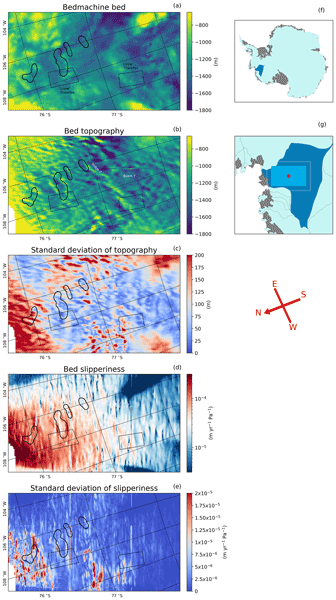
Helen Ockenden, Robert G. Bingham, Andrew Curtis, and Daniel Goldberg
The Cryosphere, 16, 3867–3887, https://doi.org/10.5194/tc-16-3867-2022, https://doi.org/10.5194/tc-16-3867-2022, 2022
Short summary
Short summary
Hills and valleys hidden under the ice of Thwaites Glacier have an impact on ice flow and future ice loss, but there are not many three-dimensional observations of their location or size. We apply a mathematical theory to new high-resolution observations of the ice surface to predict the bed topography beneath the ice. There is a good correlation with ice-penetrating radar observations. The method may be useful in areas with few direct observations or as a further constraint for other methods.
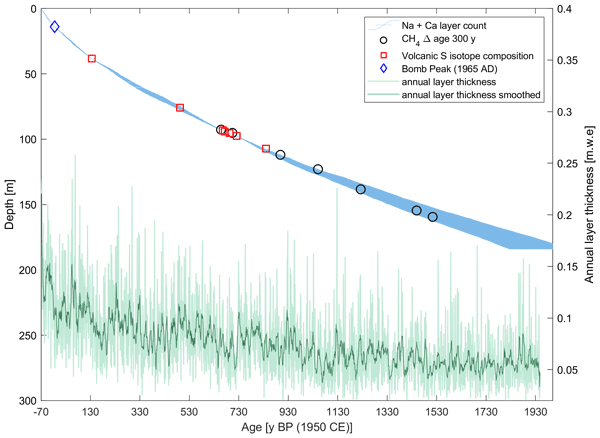
Helene M. Hoffmann, Mackenzie M. Grieman, Amy C. F. King, Jenna A. Epifanio, Kaden Martin, Diana Vladimirova, Helena V. Pryer, Emily Doyle, Axel Schmidt, Jack D. Humby, Isobel F. Rowell, Christoph Nehrbass-Ahles, Elizabeth R. Thomas, Robert Mulvaney, and Eric W. Wolff
Clim. Past, 18, 1831–1847, https://doi.org/10.5194/cp-18-1831-2022, https://doi.org/10.5194/cp-18-1831-2022, 2022
Short summary
Short summary
The WACSWAIN project (WArm Climate Stability of the West Antarctic ice sheet in the last INterglacial) investigates the fate of the West Antarctic Ice Sheet during the last warm period on Earth (115 000–130 000 years before present). Within this framework an ice core was recently drilled at Skytrain Ice Rise. In this study we present a stratigraphic chronology of that ice core based on absolute age markers and annual layer counting for the last 2000 years.
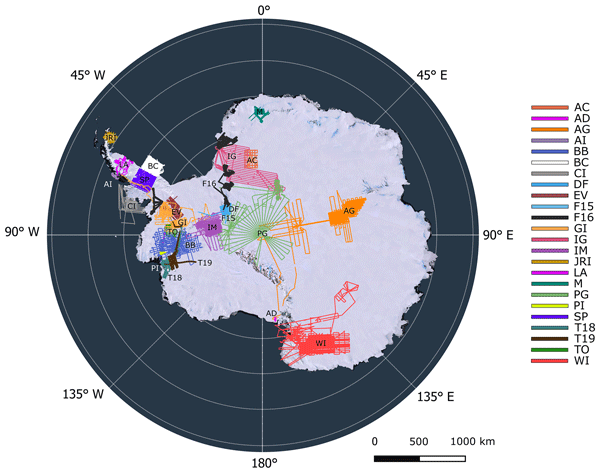
Alice C. Frémand, Julien A. Bodart, Tom A. Jordan, Fausto Ferraccioli, Carl Robinson, Hugh F. J. Corr, Helen J. Peat, Robert G. Bingham, and David G. Vaughan
Earth Syst. Sci. Data, 14, 3379–3410, https://doi.org/10.5194/essd-14-3379-2022, https://doi.org/10.5194/essd-14-3379-2022, 2022
Short summary
Short summary
This paper presents the release of large swaths of airborne geophysical data (including gravity, magnetics, and radar) acquired between 1994 and 2020 over Antarctica by the British Antarctic Survey. These include a total of 64 datasets from 24 different surveys, amounting to >30 % of coverage over the Antarctic Ice Sheet. This paper discusses how these data were acquired and processed and presents the methods used to standardize and publish the data in an interactive and reproducible manner.
Dieter R. Tetzner, Elizabeth R. Thomas, Claire S. Allen, and Mackenzie M. Grieman
Clim. Past, 18, 1709–1727, https://doi.org/10.5194/cp-18-1709-2022, https://doi.org/10.5194/cp-18-1709-2022, 2022
Short summary
Short summary
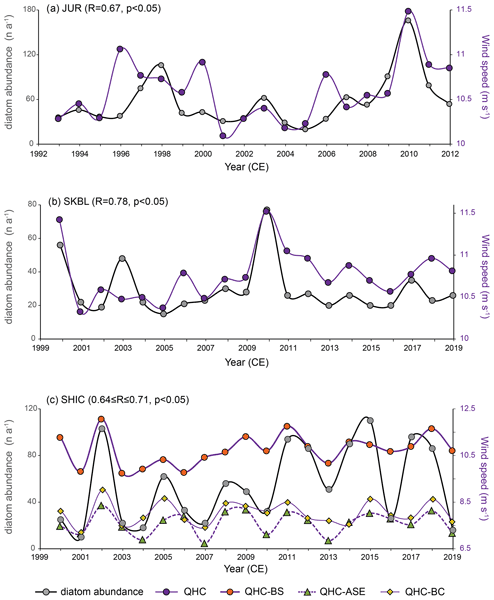
Changes in the Southern Hemisphere westerly winds are drivers of recent environmental changes in West Antarctica. However, our understanding of this relationship is limited by short and sparse observational records. Here we present the first regional wind study based on the novel use of diatoms preserved in Antarctic ice cores. Our results demonstrate that diatom abundance is the optimal record for reconstructing wind strength variability over the Southern Hemisphere westerly wind belt.
M. Reza Ershadi, Reinhard Drews, Carlos Martín, Olaf Eisen, Catherine Ritz, Hugh Corr, Julia Christmann, Ole Zeising, Angelika Humbert, and Robert Mulvaney
The Cryosphere, 16, 1719–1739, https://doi.org/10.5194/tc-16-1719-2022, https://doi.org/10.5194/tc-16-1719-2022, 2022
Short summary
Short summary
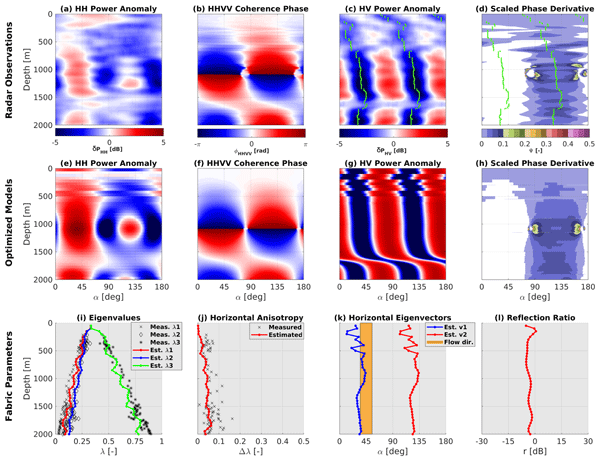
Radio waves transmitted through ice split up and inform us about the ice sheet interior and orientation of single ice crystals. This can be used to infer how ice flows and improve projections on how it will evolve in the future. Here we used an inverse approach and developed a new algorithm to infer ice properties from observed radar data. We applied this technique to the radar data obtained at two EPICA drilling sites, where ice cores were used to validate our results.

Joanne S. Johnson, Ryan A. Venturelli, Greg Balco, Claire S. Allen, Scott Braddock, Seth Campbell, Brent M. Goehring, Brenda L. Hall, Peter D. Neff, Keir A. Nichols, Dylan H. Rood, Elizabeth R. Thomas, and John Woodward
The Cryosphere, 16, 1543–1562, https://doi.org/10.5194/tc-16-1543-2022, https://doi.org/10.5194/tc-16-1543-2022, 2022
Short summary
Short summary
Recent studies have suggested that some portions of the Antarctic Ice Sheet were less extensive than present in the last few thousand years. We discuss how past ice loss and regrowth during this time would leave its mark on geological and glaciological records and suggest ways in which future studies could detect such changes. Determining timing of ice loss and gain around Antarctica and conditions under which they occurred is critical for preparing for future climate-warming-induced changes.
Tobias Erhardt, Matthias Bigler, Urs Federer, Gideon Gfeller, Daiana Leuenberger, Olivia Stowasser, Regine Röthlisberger, Simon Schüpbach, Urs Ruth, Birthe Twarloh, Anna Wegner, Kumiko Goto-Azuma, Takayuki Kuramoto, Helle A. Kjær, Paul T. Vallelonga, Marie-Louise Siggaard-Andersen, Margareta E. Hansson, Ailsa K. Benton, Louise G. Fleet, Rob Mulvaney, Elizabeth R. Thomas, Nerilie Abram, Thomas F. Stocker, and Hubertus Fischer
Earth Syst. Sci. Data, 14, 1215–1231, https://doi.org/10.5194/essd-14-1215-2022, https://doi.org/10.5194/essd-14-1215-2022, 2022
Short summary
Short summary
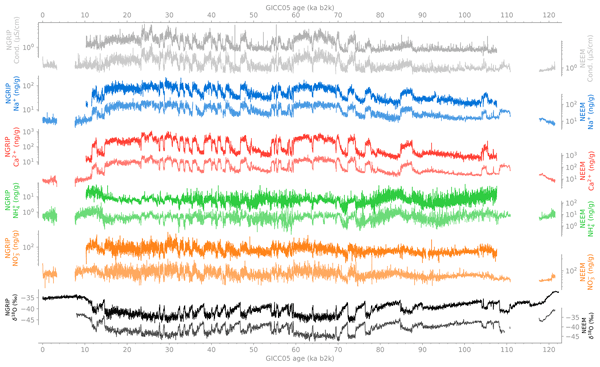
The datasets presented alongside this manuscript contain high-resolution concentration measurements of chemical impurities in deep ice cores, NGRIP and NEEM, from the Greenland ice sheet. The impurities originate from the deposition of aerosols to the surface of the ice sheet and are influenced by source, transport and deposition processes. Together, these records contain detailed, multi-parameter records of past climate variability over the last glacial period.
Dieter R. Tetzner, Claire S. Allen, and Elizabeth R. Thomas
The Cryosphere, 16, 779–798, https://doi.org/10.5194/tc-16-779-2022, https://doi.org/10.5194/tc-16-779-2022, 2022
Short summary
Short summary
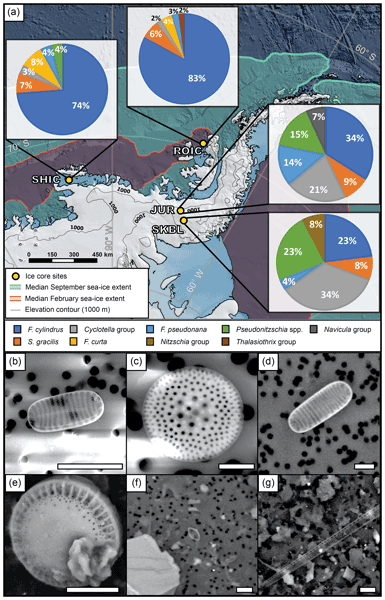
The presence of diatoms in Antarctic ice cores has been scarcely documented and poorly understood. Here we present a detailed analysis of the spatial and temporal distribution of the diatom record preserved in a set of Antarctic ice cores. Our results reveal that the timing and amount of diatoms deposited present a strong geographical division. This study highlights the potential of the diatom record preserved in Antarctic ice cores to provide useful information about past environmental changes.
Martin Horwath, Benjamin D. Gutknecht, Anny Cazenave, Hindumathi Kulaiappan Palanisamy, Florence Marti, Ben Marzeion, Frank Paul, Raymond Le Bris, Anna E. Hogg, Inès Otosaka, Andrew Shepherd, Petra Döll, Denise Cáceres, Hannes Müller Schmied, Johnny A. Johannessen, Jan Even Øie Nilsen, Roshin P. Raj, René Forsberg, Louise Sandberg Sørensen, Valentina R. Barletta, Sebastian B. Simonsen, Per Knudsen, Ole Baltazar Andersen, Heidi Ranndal, Stine K. Rose, Christopher J. Merchant, Claire R. Macintosh, Karina von Schuckmann, Kristin Novotny, Andreas Groh, Marco Restano, and Jérôme Benveniste
Earth Syst. Sci. Data, 14, 411–447, https://doi.org/10.5194/essd-14-411-2022, https://doi.org/10.5194/essd-14-411-2022, 2022
Short summary
Short summary
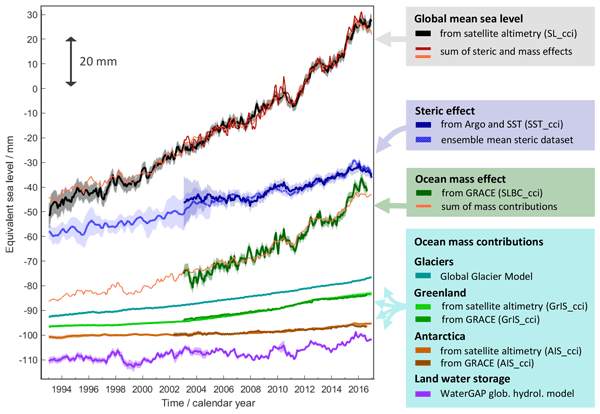
Global mean sea-level change observed from 1993 to 2016 (mean rate of 3.05 mm yr−1) matches the combined effect of changes in water density (thermal expansion) and ocean mass. Ocean-mass change has been assessed through the contributions from glaciers, ice sheets, and land water storage or directly from satellite data since 2003. Our budget assessments of linear trends and monthly anomalies utilise new datasets and uncertainty characterisations developed within ESA's Climate Change Initiative.
Cited articles
Alley, R. B., Anandakrishnan, S., Christianson, K., Horgan, H. J., Muto, A., Parizek, B. R., Pollard, D., and Walker, R. T.: Oceanic Forcing of Ice-Sheet Retreat: West Antarctica and More, Annu. Rev. Earth Pl. Sc., 43, 207–231, https://doi.org/10.1146/annurev-earth-060614-105344, 2015. a
Arnold, E., Leuschen, C., Rodriguez-Morales, F., Li, J., Paden, J., Hale, R., and Keshmiri, S.: CReSIS airborne radars and platforms for ice and snow sounding, Ann. Glaciol., 61, 58–67, https://doi.org/10.1017/aog.2019.37, 2020. a
Ashmore, D. W., Bingham, R. G., Hindmarsh, R. C. A., Corr, H. F. J., and Joughin, I. R.: The relationship between sticky spots and radar reflectivity beneath an active West Antarctic ice stream, Ann. Glaciol., 55, 29–38, https://doi.org/10.3189/2014AoG67A052, 2014. a
Ashmore, D. W., Bingham, R. G., Ross, N., Siegert, M. J., Jordan, T. A., and Mair, D. W. F.: Englacial Architecture and Age-Depth Constraints Across the West Antarctic Ice Sheet, Geophys. Res. Lett., 47, e2019GL086663, https://doi.org/10.1029/2019GL086663, 2020. a
Bentley, M. J., Ó Cofaigh, C., Anderson, J. B., Conway, H., Davies, B., Graham, A. G. C., Hillenbrand, C.-D., Hodgson, D. A., Jamieson, S. S. R., Larter, R. D., Mackintosh, A., Smith, J. A., Verleyen, E., Ackert, R. P., Bart, P. J., Berg, S., Brunstein, D., Canals, M., Colhoun, E. A., Crosta, X., Dickens, W. A., Domack, E., Dowdeswell, J. A., Dunbar, R., Ehrmann, W., Evans, J., Favier, V., Fink, D., Fogwill, C. J., Glasser, N. F., Gohl, K., Golledge, N. R., Goodwin, I., Gore, D. B., Greenwood, S. L., Hall, B. L., Hall, K., Hedding, D. W., Hein, A. S., Hocking, E. P., Jakobsson, M., Johnson, J. S., Jomelli, V., Jones, R. S., Klages, J. P., Kristoffersen, Y., Kuhn, G., Leventer, A., Licht, K., Lilly, K., Lindow, J., Livingstone, S. J., Massé, G., McGlone, M. S., McKay, R. M., Melles, M., Miura, H., Mulvaney, R., Nel, W., Nitsche, F. O., O'Brien, P. E., Post, A. L., Roberts, S. J., Saunders, K. M., Selkirk, P. M., Simms, A. R., Spiegel, C., Stolldorf, T. D., Sugden, D. E., van der Putten, N., van Ommen, T., Verfaillie, D., Vyverman, W., Wagner, B., White, D. A., Witus, A. E., and Zwartz, D.: A community-based geological reconstruction of Antarctic Ice Sheet deglaciation since the Last Glacial Maximum, Quaternary Sci. Rev., 100, 1–9, https://doi.org/10.1016/j.quascirev.2014.06.025, 2014. a
Bingham, R. G., Bodart, J. A., Cavitte, M. G. P., Chung, A., Sanderson, R. J., Sutter, J. C. R., Eisen, O., Karlsson, N. B., MacGregor, J. A., Ross, N., Young, D. A., Ashmore, D. W., Born, A., Chu, W., Cui, X., Drews, R., Franke, S., Goel, V., Goodge, J. W., Henry, A. C. J., Hermant, A., Hills, B. H., Holschuh, N., Koutnik, M. R., Leysinger Vieli, G. J.-M. C., MacKie, E. J., Mantelli, E., Martín, C., Ng, F. S. L., Oraschewski, F. M., Napoleoni, F., Parrenin, F., Popov, S. V., Rieckh, T., Schlegel, R., Schroeder, D. M., Siegert, M. J., Tang, X., Teisberg, T. O., Winter, K., Yan, S., Davis, H., Dow, C. F., Fudge, T. J., Jordan, T. A., Kulessa, B., Matsuoka, K., Nyqvist, C. J., Rahnemoonfar, M., Siegfried, M. R., Singh, S., Višnjević, V., Zamora, R., and Zuhr, A.: Review article: AntArchitecture – building an age–depth model from Antarctica's radiostratigraphy to explore ice-sheet evolution, The Cryosphere, 19, 4611–4655, https://doi.org/10.5194/tc-19-4611-2025, 2025. a, b, c
Bodart, J. A., Bingham, R. G., Ashmore, D. W., Karlsson, N. B., Hein, A. S., and Vaughan, D. G.: Age-Depth Stratigraphy of Pine Island Glacier Inferred From Airborne Radar and Ice-Core Chronology, J. Geophys. Res.-Earth, 126, e2020JF005927, https://doi.org/10.1029/2020JF005927, 2021. a, b, c, d, e, f, g
Bodart, J. A., Bingham, R. G., Young, D. A., MacGregor, J. A., Ashmore, D. W., Quartini, E., Hein, A. S., Vaughan, D. G., and Blankenship, D. D.: High mid-Holocene accumulation rates over West Antarctica inferred from a pervasive ice-penetrating radar reflector, The Cryosphere, 17, 1497–1512, https://doi.org/10.5194/tc-17-1497-2023, 2023. a
Buizert, C., Cuffey, K. M., Severinghaus, J. P., Baggenstos, D., Fudge, T. J., Steig, E. J., Markle, B. R., Winstrup, M., Rhodes, R. H., Brook, E. J., Sowers, T. A., Clow, G. D., Cheng, H., Edwards, R. L., Sigl, M., McConnell, J. R., and Taylor, K. C.: The WAIS Divide deep ice core WD2014 chronology – Part 1: Methane synchronization (68–31 ka BP) and the gas age–ice age difference, Clim. Past, 11, 153–173, https://doi.org/10.5194/cp-11-153-2015, 2015. a, b, c, d, e, f, g
Burton-Johnson, A., Dziadek, R., and Martin, C.: Review article: Geothermal heat flow in Antarctica: current and future directions, The Cryosphere, 14, 3843–3873, https://doi.org/10.5194/tc-14-3843-2020, 2020. a, b, c, d
Cavitte, M. G. P., Blankenship, D. D., Young, D. A., Schroeder, D. M., Parrenin, F., Lemeur, E., Macgregor, J. A., and Siegert, M. J.: Deep radiostratigraphy of the East Antarctic plateau: connecting the Dome C and Vostok ice core sites, J. Glaciol., 62, 323–334, https://doi.org/10.1017/jog.2016.11, 2016. a
Cavitte, M. G. P., Young, D. A., Mulvaney, R., Ritz, C., Greenbaum, J. S., Ng, G., Kempf, S. D., Quartini, E., Muldoon, G. R., Paden, J., Frezzotti, M., Roberts, J. L., Tozer, C. R., Schroeder, D. M., and Blankenship, D. D.: A detailed radiostratigraphic data set for the central East Antarctic Plateau spanning from the Holocene to the mid-Pleistocene, Earth Syst. Sci. Data, 13, 4759–4777, https://doi.org/10.5194/essd-13-4759-2021, 2021. a
Christie, F. D. W., Bingham, R. G., Gourmelen, N., Tett, S. F. B., and Muto, A.: Four-decade record of pervasive grounding line retreat along the Bellingshausen margin of West Antarctica, Geophys. Res. Lett., 43, 5741–5749, https://doi.org/10.1002/2016GL068972, 2016. a, b, c
Clark, P. U., Dyke, A. S., Shakun, J. D., Carlson, A. E., Clark, J., Wohlfarth, B., Mitrovica, J. X., Hostetler, S. W., and McCabe, A. M.: The Last Glacial Maximum, Science, 325, 710–714, https://doi.org/10.1126/science.1172873, 2009. a
Cole-Dai, J., Ferris, D. G., Kennedy, J. A., Sigl, M., McConnell, J. R., Fudge, T. J., Geng, L., Maselli, O. J., Taylor, K. C., and Souney, J. M.: Comprehensive Record of Volcanic Eruptions in the Holocene (11,000 years) From the WAIS Divide, Antarctica Ice Core, J. Geophys. Res.-Atmos., 126, e2020JD032855, https://doi.org/10.1029/2020JD032855, 2021. a
Corr, H.: Processed airborne radio-echo sounding data from the GRADES-IMAGE survey covering the Evans and Rutford Ice Streams, and ice rises in the Ronne Ice Shelf, West Antarctica (2006/2007) (Version 1.0), NERC EDS UK Polar Data Centre [data set], https://doi.org/10.5285/c7ea5697-87e3-4529-a0dd-089a2ed638fb, 2021. a
Davis, H. J.: Code – Assessing the potential for an ice core in the southern Antarctic Peninsula to elucidate Holocene climate history, v2.0, Zenodo [code], https://doi.org/10.5281/zenodo.19096564, 2026a. a
Davis, H. J.: Dated radar stratigraphy over Ferrigno Ice Stream, West Antarctica, v2.0, Zenodo [data set], https://doi.org/10.5281/zenodo.19351726, 2026b. a
Dowdeswell, J. A. and Evans, S.: Investigations of the form and flow of ice sheets and glaciers using radio-echo sounding, Rep. Prog. Phys., 67, 1821, https://doi.org/10.1088/0034-4885/67/10/R03, 2004. a
Edwards, T. L., Nowicki, S., Marzeion, B., Hock, R., Goelzer, H., Seroussi, H., Jourdain, N. C., Slater, D. A., Turner, F. E., Smith, C. J., McKenna, C. M., Simon, E., Abe-Ouchi, A., Gregory, J. M., Larour, E., Lipscomb, W. H., Payne, A. J., Shepherd, A., Agosta, C., Alexander, P., Albrecht, T., Anderson, B., Asay-Davis, X., Aschwanden, A., Barthel, A., Bliss, A., Calov, R., Chambers, C., Champollion, N., Choi, Y., Cullather, R., Cuzzone, J., Dumas, C., Felikson, D., Fettweis, X., Fujita, K., Galton-Fenzi, B. K., Gladstone, R., Golledge, N. R., Greve, R., Hattermann, T., Hoffman, M. J., Humbert, A., Huss, M., Huybrechts, P., Immerzeel, W., Kleiner, T., Kraaijenbrink, P., Le clec', S., Lee, V., Leguy, G. R., Little, C. M., Lowry, D. P., Malles, J.-H., Martin, D. F., Maussion, F., Morlighem, M., O'Neill, J. F., Nias, I., Pattyn, F., Pelle, T., Price, S. F., Quiquet, A., Radić, V., Reese, R., Rounce, D. R., Rückamp, M., Sakai, A., Shafer, C., Schlegel, N.-J., Shannon, S., Smith, R. S., Straneo, F., Sun, S., Tarasov, L., Trusel, L. D., Van Breedam, J., van de Wal, R., van den Broeke, M., Winkelmann, R., Zekollari, H., Zhao, C., Zhang, T., and Zwinger, T.: Projected land ice contributions to twenty-first-century sea level rise, Nature, 593, 74–82, https://doi.org/10.1038/s41586-021-03302-y, 2021. a
Emanuelsson, B. D., Thomas, E. R., Tetzner, D. R., Humby, J. D., and Vladimirova, D. O.: Ice Core Chronologies from the Antarctic Peninsula: The Palmer, Jurassic, and Rendezvous Age-Scales, Geosciences, 12, 87, https://doi.org/10.3390/geosciences12020087, 2022. a
Fretwell, P., Pritchard, H. D., Vaughan, D. G., Bamber, J. L., Barrand, N. E., Bell, R., Bianchi, C., Bingham, R. G., Blankenship, D. D., Casassa, G., Catania, G., Callens, D., Conway, H., Cook, A. J., Corr, H. F. J., Damaske, D., Damm, V., Ferraccioli, F., Forsberg, R., Fujita, S., Gim, Y., Gogineni, P., Griggs, J. A., Hindmarsh, R. C. A., Holmlund, P., Holt, J. W., Jacobel, R. W., Jenkins, A., Jokat, W., Jordan, T., King, E. C., Kohler, J., Krabill, W., Riger-Kusk, M., Langley, K. A., Leitchenkov, G., Leuschen, C., Luyendyk, B. P., Matsuoka, K., Mouginot, J., Nitsche, F. O., Nogi, Y., Nost, O. A., Popov, S. V., Rignot, E., Rippin, D. M., Rivera, A., Roberts, J., Ross, N., Siegert, M. J., Smith, A. M., Steinhage, D., Studinger, M., Sun, B., Tinto, B. K., Welch, B. C., Wilson, D., Young, D. A., Xiangbin, C., and Zirizzotti, A.: Bedmap2: improved ice bed, surface and thickness datasets for Antarctica, The Cryosphere, 7, 375–393, https://doi.org/10.5194/tc-7-375-2013, 2013. a
Fudge, T. J., Markle, B. R., Cuffey, K. M., Buizert, C., Taylor, K. C., Steig, E. J., Waddington, E. D., Conway, H., and Koutnik, M.: Variable relationship between accumulation and temperature in West Antarctica for the past 31,000 years, Geophys. Res. Lett., 43, 3795–3803, https://doi.org/10.1002/2016GL068356, 2016. a, b, c, d, e, f, g, h
Fujita, S., Matsuoka, T., Ishida, T., Matsuoka, K., and Mae, S.: A summary of the complex dielectric permittivity of ice in the megahertz range and its applications for radar sounding of polar ice sheets, International Symposium on Physics of Ice Core Records, Shikotsukohan, Hokkaido, Japan, 14–17 September 1998, 185–212, https://hdl.handle.net/2115/32469 (last access: 4 November 2025), 2000. a
Fujita, S., Parrenin, F., Severi, M., Motoyama, H., and Wolff, E. W.: Volcanic synchronization of Dome Fuji and Dome C Antarctic deep ice cores over the past 216 kyr, Clim. Past, 11, 1395–1416, https://doi.org/10.5194/cp-11-1395-2015, 2015. a
Gardner, A. S., Moholdt, G., Scambos, T., Fahnstock, M., Ligtenberg, S., van den Broeke, M., and Nilsson, J.: Increased West Antarctic and unchanged East Antarctic ice discharge over the last 7 years, The Cryosphere, 12, 521–547, https://doi.org/10.5194/tc-12-521-2018, 2018. a
Gow, A. J.: Relaxation of ice in Deep Drill Cores from Antarctica, J. Geophys. Res., 76, 2533–2541, https://doi.org/10.1029/JB076i011p02533, 1971. a
Grieman, M. M., Hoffmann, H. M., Humby, J. D., Mulvaney, R., Nehrbass-Ahles, C., Rix, J., Thomas, E. R., Tuckwell, R., and Wolff, E. W.: Continuous flow analysis methods for sodium, magnesium and calcium detection in the Skytrain ice core, J. Glaciol., 68, 90–100, https://doi.org/10.1017/jog.2021.75, 2022. a
Grieman, M. M., Nehrbass-Ahles, C., Hoffmann, H. M., Bauska, T. K., King, A. C. F., Mulvaney, R., Rhodes, R. H., Rowell, I. F., Thomas, E. R., and Wolff, E. W.: Abrupt Holocene ice loss due to thinning and ungrounding in the Weddell Sea Embayment, Nat. Geosci., 17, 227–232, https://doi.org/10.1038/s41561-024-01375-8, 2024. a, b, c, d, e, f, g, h
Hansen, P. C.: The L-curve and its use in the numerical treatment of inverse problems, in: Computational Inverse Problems in Electrocardiology, no. 5 in Advances in Computational Bioengineering, WIT Press, 119–142, ISBN 978-1-85312-614-7, 2001. a
Hazzard, J. A. N. and Richards, F. D.: Antarctic Geothermal Heat Flow, Crustal Conductivity and Heat Production Inferred From Seismological Data, Geophys. Res. Lett., 51, e2023GL106274, https://doi.org/10.1029/2023GL106274, 2024. a, b
Hein, A. S., Marrero, S. M., Woodward, J., Dunning, S. A., Winter, K., Westoby, M. J., Freeman, S. P. H. T., Shanks, R. P., and Sugden, D. E.: Mid-Holocene pulse of thinning in the Weddell Sea sector of the West Antarctic ice sheet, Nat. Commun., 7, 12511, https://doi.org/10.1038/ncomms12511, 2016. a, b
Hoffmann, H. M., Grieman, M. M., King, A. C. F., Epifanio, J. A., Martin, K., Vladimirova, D., Pryer, H. V., Doyle, E., Schmidt, A., Humby, J. D., Rowell, I. F., Nehrbass-Ahles, C., Thomas, E. R., Mulvaney, R., and Wolff, E. W.: The ST22 chronology for the Skytrain Ice Rise ice core – Part 1: A stratigraphic chronology of the last 2000 years, Clim. Past, 18, 1831–1847, https://doi.org/10.5194/cp-18-1831-2022, 2022. a, b
Jones, R. S., Johnson, J. S., Lin, Y., Mackintosh, A. N., Sefton, J. P., Smith, J. A., Thomas, E. R., and Whitehouse, P. L.: Stability of the Antarctic Ice Sheet during the pre-industrial Holocene, Nat. Rev. Earth Environ., 3, 500–515, https://doi.org/10.1038/s43017-022-00309-5, 2022. a, b
Karlsson, N. B., Bingham, R. G., Rippin, D. M., Hindmarsh, R. C., Corr, H. F., and Vaughan, D. G.: Constraining past accumulation in the central Pine Island Glacier basin, West Antarctica, using radio-echo sounding, J. Glaciol., 60, 553–562, https://doi.org/10.3189/2014JoG13J180, 2014. a
King, A. C. F., Bauska, T. K., Landais, A., Martin, C., and Wolff, E. W.: Ice core nitrogen isotopes archive dramatic changes in West Antarctic Ice Sheet thinning, EGUsphere [preprint], https://doi.org/10.5194/egusphere-2025-3305, 2025. a
King, E. C.: The precision of radar-derived subglacial bed topography: a case study from Pine Island Glacier, Antarctica, Ann. Glaciol., 61, 154–161, https://doi.org/10.1017/aog.2020.33, 2020. a, b, c
Kingslake, J., Scherer, R. P., Albrecht, T., Coenen, J., Powell, R. D., Reese, R., Stansell, N. D., Tulaczyk, S., Wearing, M. G., and Whitehouse, P. L.: Extensive retreat and re-advance of the West Antarctic Ice Sheet during the Holocene, Nature, 558, 430–434, https://doi.org/10.1038/s41586-018-0208-x, 2018. a, b
Koutnik, M. R., Fudge, T. J., Conway, H., Waddington, E. D., Neumann, T. A., Cuffey, K. M., Buizert, C., and Taylor, K. C.: Holocene accumulation and ice flow near the West Antarctic Ice Sheet Divide ice core site, J. Geophys. Res.-Earth, 121, 907–924, https://doi.org/10.1002/2015JF003668, 2016. a, b, c
Lagarias, J. C., Reeds, J. A., Wright, M. H., and Wright, P. E.: Convergence Properties of the Nelder–Mead Simplex Method in Low Dimensions, SIAM J. Optimiz., 9, 112–147, https://doi.org/10.1137/S1052623496303470, 1998. a
Larter, R. D., Anderson, J. B., Graham, A. G. C., Gohl, K., Hillenbrand, C.-D., Jakobsson, M., Johnson, J. S., Kuhn, G., Nitsche, F. O., Smith, J. A., Witus, A. E., Bentley, M. J., Dowdeswell, J. A., Ehrmann, W., Klages, J. P., Lindow, J., Cofaigh, C. Ã., and Spiegel, C.: Reconstruction of changes in the Amundsen Sea and Bellingshausen Sea sector of the West Antarctic Ice Sheet since the Last Glacial Maximum, Quaternary Sci. Rev., 100, 55–86, https://doi.org/10.1016/j.quascirev.2013.10.016, 2014. a
Leysinger Vieli, G. J.-M. C., Martín, C., Hindmarsh, R. C. A., and Lüthi, M. P.: Basal freeze-on generates complex ice-sheet stratigraphy, Nat. Commun., 9, 4669, https://doi.org/10.1038/s41467-018-07083-3, 2018. a, b
Lilien, D. A., Steinhage, D., Taylor, D., Parrenin, F., Ritz, C., Mulvaney, R., Martín, C., Yan, J.-B., O'Neill, C., Frezzotti, M., Miller, H., Gogineni, P., Dahl-Jensen, D., and Eisen, O.: Brief communication: New radar constraints support presence of ice older than 1.5 Myr at Little Dome C, The Cryosphere, 15, 1881–1888, https://doi.org/10.5194/tc-15-1881-2021, 2021. a, b
Lliboutry, L. A.: A critical review of analytical approximate solutions for steady state velocities and temperatures in cold ice sheets, Z. Gletscherkde. Glazialgeol., 15, 135–148, 1979. a
Lythe, M. B. and Vaughan, D. G.: BEDMAP: A new ice thickness and subglacial topographic model of Antarctica, J. Geophys. Res.-Sol. Ea., 106, 11335–11351, https://doi.org/10.1029/2000JB900449, 2001. a
MacGregor, J. A., Boisvert, L. N., Medley, B., Petty, A. A., Harbeck, J. P., Bell, R. E., Blair, J. B., Blanchard-Wrigglesworth, E., Buckley, E. M., Christoffersen, M. S., Cochran, J. R., Csathó, B. M., De Marco, E. L., Dominguez, R. T., Fahnestock, M. A., Farrell, S. L., Gogineni, S. P., Greenbaum, J. S., Hansen, C. M., Hofton, M. A., Holt, J. W., Jezek, K. C., Koenig, L. S., Kurtz, N. T., Kwok, R., Larsen, C. F., Leuschen, C. J., Locke, C. D., Manizade, S. S., Martin, S., Neumann, T. A., Nowicki, S. M., Paden, J. D., Richter-Menge, J. A., Rignot, E. J., Rodríguez-Morales, F., Siegfried, M. R., Smith, B. E., Sonntag, J. G., Studinger, M., Tinto, K. J., Truffer, M., Wagner, T. P., Woods, J. E., Young, D. A., and Yungel, J. K.: The Scientific Legacy of NASA's Operation IceBridge, Rev. Geophys., 59, e2020RG000712, https://doi.org/10.1029/2020RG000712, 2021. a
Martín, C. and Gudmundsson, G. H.: Effects of nonlinear rheology, temperature and anisotropy on the relationship between age and depth at ice divides, The Cryosphere, 6, 1221–1229, https://doi.org/10.5194/tc-6-1221-2012, 2012. a, b
Matsuoka, K., Skoglund, A., Roth, G., de Pomereu, J., Griffiths, H., Headland, R., Herried, B., Katsumata, K., Le Brocq, A., Licht, K., Morgan, F., Neff, P. D., Ritz, C., Scheinert, M., Tamura, T., Van de Putte, A., van den Broeke, M., von Deschwanden, A., Deschamps-Berger, C., Van Liefferinge, B., Tronstad, S., and Melvær, Y.: Quantarctica, an integrated mapping environment for Antarctica, the Southern Ocean, and sub-Antarctic islands, Environ. Modell. Softw., 140, 105015, https://doi.org/10.1016/j.envsoft.2021.105015, 2021. a
Mercer, J. H.: West Antarctic ice sheet and CO2 greenhouse effect: a threat of disaster, Nature, 271, 321–325, https://doi.org/10.1038/271321a0, 1978. a, b
Miles, B. W. J. and Bingham, R. G.: Progressive unanchoring of Antarctic ice shelves since 1973, Nature, 626, 785–791, https://doi.org/10.1038/s41586-024-07049-0, 2024. a
Monnin, E., Steig, E. J., Siegenthaler, U., Kawamura, K., Schwander, J., Stauffer, B., Stocker, T. F., Morse, D. L., Barnola, J.-M., Bellier, B., Raynaud, D., and Fischer, H.: Evidence for substantial accumulation rate variability in Antarctica during the Holocene, through synchronization of CO2 in the Taylor Dome, Dome C and DML ice cores, Earth Planet. Sc. Lett., 224, 45–54, https://doi.org/10.1016/j.epsl.2004.05.007, 2004. a
Morlighem, M., Williams, C. N., Rignot, E., An, L., Arndt, J. E., Bamber, J. L., Catania, G., Chauché, N., Dowdeswell, J. A., Dorschel, B., Fenty, I., Hogan, K., Howat, I., Hubbard, A., Jakobsson, M., Jordan, T. M., Kjeldsen, K. K., Millan, R., Mayer, L., Mouginot, J., Noël, B. P. Y., O'Cofaigh, C., Palmer, S., Rysgaard, S., Seroussi, H., Siegert, M. J., Slabon, P., Straneo, F., van den Broeke, M. R., Weinrebe, W., Wood, M., and Zinglersen, K. B.: BedMachine v3: Complete Bed Topography and Ocean Bathymetry Mapping of Greenland From Multibeam Echo Sounding Combined With Mass Conservation, Geophys. Res. Lett., 44, 11051–11061, https://doi.org/10.1002/2017GL074954, 2017. a
Mulvaney, R., Wolff, E. W., Grieman, M. M., Hoffmann, H. H., Humby, J. D., Nehrbass-Ahles, C., Rhodes, R. H., Rowell, I. F., Parrenin, F., Schmidely, L., Fischer, H., Stocker, T. F., Christl, M., Muscheler, R., Landais, A., and Prié, F.: The ST22 chronology for the Skytrain Ice Rise ice core – Part 2: An age model to the last interglacial and disturbed deep stratigraphy, Clim. Past, 19, 851–864, https://doi.org/10.5194/cp-19-851-2023, 2023. a
Mutter, E. L. and Holschuh, N.: Advancing interpretation of incoherent scattering in ice-penetrating radar data used for ice core site selection, The Cryosphere, 19, 3159–3176, https://doi.org/10.5194/tc-19-3159-2025, 2025. a, b, c
Narcisi, B., Robert Petit, J., and Tiepolo, M.: A volcanic marker (92 ka) for dating deep east Antarctic ice cores, Quaternary Sci. Rev., 25, 2682–2687, https://doi.org/10.1016/j.quascirev.2006.07.009, 2006. a
Neff, P. D.: A review of the brittle ice zone in polar ice cores, Ann. Glaciol., 55, 72–82, https://doi.org/10.3189/2014AoG68A023, 2014. a
Neumann, T. A., Conway, H., Price, S. F., Waddington, E. D., Catania, G. A., and Morse, D. L.: Holocene accumulation and ice sheet dynamics in central West Antarctica, J. Geophys. Res.-Earth, 113, https://doi.org/10.1029/2007JF000764, 2008. a
Nilsson, J., Gardner, A. S., and Paolo, F. S.: Elevation change of the Antarctic Ice Sheet: 1985 to 2020, Earth Syst. Sci. Data, 14, 3573–3598, https://doi.org/10.5194/essd-14-3573-2022, 2022. a, b, c
Nye, J. F.: Correction Factor for Accumulation Measured by the Thickness of the Annual Layers in an Ice Sheet, J. Glaciol., 4, 785–788, https://doi.org/10.3189/S0022143000028367, 1963. a
Otosaka, I. N., Shepherd, A., Ivins, E. R., Schlegel, N.-J., Amory, C., van den Broeke, M. R., Horwath, M., Joughin, I., King, M. D., Krinner, G., Nowicki, S., Payne, A. J., Rignot, E., Scambos, T., Simon, K. M., Smith, B. E., Sørensen, L. S., Velicogna, I., Whitehouse, P. L., A, G., Agosta, C., Ahlstrøm, A. P., Blazquez, A., Colgan, W., Engdahl, M. E., Fettweis, X., Forsberg, R., Gallée, H., Gardner, A., Gilbert, L., Gourmelen, N., Groh, A., Gunter, B. C., Harig, C., Helm, V., Khan, S. A., Kittel, C., Konrad, H., Langen, P. L., Lecavalier, B. S., Liang, C.-C., Loomis, B. D., McMillan, M., Melini, D., Mernild, S. H., Mottram, R., Mouginot, J., Nilsson, J., Noël, B., Pattle, M. E., Peltier, W. R., Pie, N., Roca, M., Sasgen, I., Save, H. V., Seo, K.-W., Scheuchl, B., Schrama, E. J. O., Schröder, L., Simonsen, S. B., Slater, T., Spada, G., Sutterley, T. C., Vishwakarma, B. D., van Wessem, J. M., Wiese, D., van der Wal, W., and Wouters, B.: Mass balance of the Greenland and Antarctic ice sheets from 1992 to 2020, Earth Syst. Sci. Data, 15, 1597–1616, https://doi.org/10.5194/essd-15-1597-2023, 2023. a
Palmer, A. S., van Ommen, T. D., Curran, M. A. J., Morgan, V., Souney, J. M., and Mayewski, P. A.: High-precision dating of volcanic events (A.D. 1301–1995) using ice cores from Law Dome, Antarctica, J. Geophys. Res.-Atmos., 106, 28089–28095, https://doi.org/10.1029/2001JD000330, 2001. a, b
Parrenin, F., Dreyfus, G., Durand, G., Fujita, S., Gagliardini, O., Gillet, F., Jouzel, J., Kawamura, K., Lhomme, N., Masson-Delmotte, V., Ritz, C., Schwander, J., Shoji, H., Uemura, R., Watanabe, O., and Yoshida, N.: 1-D-ice flow modelling at EPICA Dome C and Dome Fuji, East Antarctica, Clim. Past, 3, 243–259, https://doi.org/10.5194/cp-3-243-2007, 2007. a, b, c
Pattyn, F. and Morlighem, M.: The uncertain future of the Antarctic Ice Sheet, Science, 367, 1331–1335, https://doi.org/10.1126/science.aaz5487, 2020. a
Pritchard, H. D., Arthern, R. J., Vaughan, D. G., and Edwards, L. A.: Extensive dynamic thinning on the margins of the Greenland and Antarctic ice sheets, Nature, 461, 971–975, https://doi.org/10.1038/nature08471, 2009. a
Pritchard, H. D., Fretwell, P. T., Fremand, A. C., Bodart, J. A., Kirkham, J. D., Aitken, A., Bamber, J., Bell, R., Bianchi, C., Bingham, R. G., Blankenship, D. D., Casassa, G., Christianson, K., Conway, H., Corr, H. F. J., Cui, X., Damaske, D., Damm, V., Dorschel, B., Drews, R., Eagles, G., Eisen, O., Eisermann, H., Ferraccioli, F., Field, E., Forsberg, R., Franke, S., Goel, V., Gogineni, S. P., Greenbaum, J., Hills, B., Hindmarsh, R. C. A., Hoffman, A. O., Holschuh, N., Holt, J. W., Humbert, A., Jacobel, R. W., Jansen, D., Jenkins, A., Jokat, W., Jong, L., Jordan, T. A., King, E. C., Kohler, J., Krabill, W., Maton, J., Gillespie, M. K., Langley, K., Lee, J., Leitchenkov, G., Leuschen, C., Luyendyk, B., MacGregor, J. A., MacKie, E., Moholdt, G., Matsuoka, K., Morlighem, M., Mouginot, J., Nitsche, F. O., Nost, O. A., Paden, J., Pattyn, F., Popov, S., Rignot, E., Rippin, D. M., Rivera, A., Roberts, J. L., Ross, N., Ruppel, A., Schroeder, D. M., Siegert, M. J., Smith, A. M., Steinhage, D., Studinger, M., Sun, B., Tabacco, I., Tinto, K. J., Urbini, S., Vaughan, D. G., Wilson, D. S., Young, D. A., and Zirizzotti, A.: Bedmap3 updated ice bed, surface and thickness gridded datasets for Antarctica, Scientific Data, 12, 414, https://doi.org/10.1038/s41597-025-04672-y, 2025. a, b, c, d, e, f, g
Raynaud, D. and Lebel, B.: Total gas content and surface elevation of polar ice sheets, Nature, 281, 289–291, https://doi.org/10.1038/281289a0, 1979. a, b
Rodriguez-Morales, F., Gogineni, S., Leuschen, C. J., Paden, J. D., Li, J., Lewis, C. C., Panzer, B., Gomez-Garcia Alvestegui, D., Patel, A., Byers, K., Crowe, R., Player, K., Hale, R. D., Arnold, E. J., Smith, L., Gifford, C. M., Braaten, D., and Panton, C.: Advanced Multifrequency Radar Instrumentation for Polar Research, IEEE T. Geosci. Remote, 52, 2824–2842, https://doi.org/10.1109/TGRS.2013.2266415, 2014. a
Ross, N., Bingham, R. G., Corr, H. F. J., Ferraccioli, F., Jordan, T. A., Le Brocq, A., Rippin, D. M., Young, D., Blankenship, D. D., and Siegert, M. J.: Steep reverse bed slope at the grounding line of the Weddell Sea sector in West Antarctica, Nat. Geosci., 5, 393–396, https://doi.org/10.1038/ngeo1468, 2012. a
Rowell, I., Martin, C., Mulvaney, R., Pryer, H., Tetzner, D., Doyle, E., Talasila, H. M., Li, J., and Wolff, E.: An age scale for new climate records from Sherman Island, West Antarctica, Clim. Past, 19, 1699–1714, https://doi.org/10.5194/cp-19-1699-2023, 2023. a, b
Scambos, T. A., Bell, R. E., Alley, R. B., Anandakrishnan, S., Bromwich, D. H., Brunt, K., Christianson, K., Creyts, T., Das, S. B., DeConto, R., Dutrieux, P., Fricker, H. A., Holland, D., MacGregor, J., Medley, B., Nicolas, J. P., Pollard, D., Siegfried, M. R., Smith, A. M., Steig, E. J., Trusel, L. D., Vaughan, D. G., and Yager, P. L.: How much, how fast?: A science review and outlook for research on the instability of Antarctica's Thwaites Glacier in the 21st century, Global Planet. Change, 153, 16–34, https://doi.org/10.1016/j.gloplacha.2017.04.008, 2017. a
Shepherd, A., Gilbert, L., Muir, A. S., Konrad, H., McMillan, M., Slater, T., Briggs, K. H., Sundal, A. V., Hogg, A. E., and Engdahl, M. E.: Trends in Antarctic Ice Sheet Elevation and Mass, Geophys. Res. Lett., 46, 8174–8183, https://doi.org/10.1029/2019GL082182, 2019. a, b, c, d
Siegert, M., Ross, N., Corr, H., Kingslake, J., and Hindmarsh, R.: Late Holocene ice-flow reconfiguration in the Weddell Sea sector of West Antarctica, Quaternary Sci. Rev., 78, 98–107, https://doi.org/10.1016/j.quascirev.2013.08.003, 2013. a
Siegert, M. J.: On the origin, nature and uses of Antarctic ice-sheet radio-echo layering, Prog. Phys. Geog., 23, 159–179, https://doi.org/10.1177/030913339902300201, 1999. a
Siegert, M. J. and Payne, A. J.: Past rates of accumulation in central West Antarctica, Geophys. Res. Lett., 31, https://doi.org/10.1029/2004GL020290, 2004. a
Sigl, M., Fudge, T. J., Winstrup, M., Cole-Dai, J., Ferris, D., McConnell, J. R., Taylor, K. C., Welten, K. C., Woodruff, T. E., Adolphi, F., Bisiaux, M., Brook, E. J., Buizert, C., Caffee, M. W., Dunbar, N. W., Edwards, R., Geng, L., Iverson, N., Koffman, B., Layman, L., Maselli, O. J., McGwire, K., Muscheler, R., Nishiizumi, K., Pasteris, D. R., Rhodes, R. H., and Sowers, T. A.: The WAIS Divide deep ice core WD2014 chronology – Part 2: Annual-layer counting (0–31 ka BP), Clim. Past, 12, 769–786, https://doi.org/10.5194/cp-12-769-2016, 2016. a
Sigl, M., Toohey, M., McConnell, J. R., Cole-Dai, J., and Severi, M.: Volcanic stratospheric sulfur injections and aerosol optical depth during the Holocene (past 11 500 years) from a bipolar ice-core array, Earth Syst. Sci. Data, 14, 3167–3196, https://doi.org/10.5194/essd-14-3167-2022, 2022. a
Slater, R. A. W., Hogg, A. E., Dutrieux, P., Davison, B. J., and Rigby, R.: Trends in Antarctic Ice Speed 2014-2023 From Big Data Processing of Satellite Observations, EGU General Assembly 2024, Vienna, Austria, 14–19 Apr 2024, EGU24-15497, https://doi.org/10.5194/egusphere-egu24-15497, 2024. a
Souney, J. M., Twickler, M. S., Hargreaves, G. M., Bencivengo, B. M., Kippenhan, M. J., Johnson, J. A., Cravens, E. D., Neff, P. D., Nunn, R. M., Orsi, A. J., Popp, T. J., Rhoades, J. F., Vaughn, B. H., Voigt, D. E., Wong, G. J., and Taylor, K. C.: Core handling and processing for the WAIS Divide ice-core project, Ann. Glaciol., 55, 15–26, https://doi.org/10.3189/2014AoG68A008, 2014. a
Staniforth, A. and Côté, J.: Semi-Lagrangian Integration Schemes for Atmospheric Models – A Review, Mon. Weather Rev., 2206–2223, https://doi.org/10.1175/1520-0493(1991)119<2206:SLISFA>2.0.CO;2, 1991. a
Sutter, J., Fischer, H., and Eisen, O.: Investigating the internal structure of the Antarctic ice sheet: the utility of isochrones for spatiotemporal ice-sheet model calibration, The Cryosphere, 15, 3839–3860, https://doi.org/10.5194/tc-15-3839-2021, 2021. a
Thomas, E. R. and Bracegirdle, T. J.: Precipitation pathways for five new ice core sites in Ellsworth Land, West Antarctica, Clim. Dynam., 44, 2067–2078, https://doi.org/10.1007/s00382-014-2213-6, 2014. a, b, c
Thomas, E. R., Bracegirdle, T. J., Turner, J., and Wolff, E. W.: A 308 year record of climate variability in West Antarctica, Geophys. Res. Lett., 40, 5492–5496, https://doi.org/10.1002/2013GL057782, 2013. a, b, c
Thomas, E. R., van Wessem, J. M., Roberts, J., Isaksson, E., Schlosser, E., Fudge, T. J., Vallelonga, P., Medley, B., Lenaerts, J., Bertler, N., van den Broeke, M. R., Dixon, D. A., Frezzotti, M., Stenni, B., Curran, M., and Ekaykin, A. A.: Regional Antarctic snow accumulation over the past 1000 years, Clim. Past, 13, 1491–1513, https://doi.org/10.5194/cp-13-1491-2017, 2017. a
Thomas, R. H. and Bentley, C. R.: A Model for Holocene Retreat of the West Antarctic Ice Sheet, Quaternary Res., 10, 150–170, https://doi.org/10.1016/0033-5894(78)90098-4, 1978. a
Turner, J., Orr, A., Gudmundsson, G. H., Jenkins, A., Bingham, R. G., Hillenbrand, C.-D., and Bracegirdle, T. J.: Atmosphere-ocean-ice interactions in the Amundsen Sea Embayment, West Antarctica, Rev. Geophys., 55, 235–276, https://doi.org/10.1002/2016RG000532, 2017. a
Vaughan, D. G., Corr, H. F. J., Ferraccioli, F., Frearson, N., O'Hare, A., Mach, D., Holt, J. W., Blankenship, D. D., Morse, D. L., and Young, D. A.: New boundary conditions for the West Antarctic ice sheet: Subglacial topography beneath Pine Island Glacier, Geophys. Res. Lett., 33, https://doi.org/10.1029/2005GL025588, 2006. a, b
Weertman, J.: Stability of the Junction of an Ice Sheet and an Ice Shelf, J. Glaciol., 13, 3–11, https://doi.org/10.3189/S0022143000023327, 1974. a
Wolff, E. W., Mulvaney, R., Grieman, M. M., Hoffmann, H. M., Humby, J., Nehrbass-Ahles, C., Rhodes, R. H., Rowell, I. F., Sime, L. C., Fischer, H., Stocker, T. F., Landais, A., Parrenin, F., Steig, E. J., Dütsch, M., and Golledge, N. R.: The Ronne Ice Shelf survived the last interglacial, Nature, 1–5, https://doi.org/10.1038/s41586-024-08394-w, 2025. a, b, c
Wolovick, M., Humbert, A., Kleiner, T., and Rückamp, M.: Regularization and L-curves in ice sheet inverse models: a case study in the Filchner–Ronne catchment, The Cryosphere, 17, 5027–5060, https://doi.org/10.5194/tc-17-5027-2023, 2023. a, b, c, d
Wouters, B., Martin-Español, A., Helm, V., Flament, T., van Wessem, J. M., Ligtenberg, S. R. M., van den Broeke, M. R., and Bamber, J. L.: Dynamic thinning of glaciers on the Southern Antarctic Peninsula, Science, 348, 899–903, https://doi.org/10.1126/science.aaa5727, 2015. a, b, c
Short summary
Ice in the southern Antarctic Peninsula is experiencing major ice changes today and predicting the rate at which this may continue is important. One way to address this knowledge gap would be to retrieve a past climate record from an ice core. We identify a suitable site using a model constrained by radar and shallow ice core data. We find a climate record spanning the Holocene can certainly be extracted here, but a potential continuous climate record here could extend back ~ 30 000 years.
Ice in the southern Antarctic Peninsula is experiencing major ice changes today and predicting...


