
Articles | Volume 20, issue 4
https://doi.org/10.5194/tc-20-2589-2026
© Author(s) 2026. This work is distributed under
the Creative Commons Attribution 4.0 License.
the Creative Commons Attribution 4.0 License.
https://doi.org/10.5194/tc-20-2589-2026
© Author(s) 2026. This work is distributed under
the Creative Commons Attribution 4.0 License.
the Creative Commons Attribution 4.0 License.
Research article
| 
30 Apr 2026
Research article |
| 30 Apr 2026
| 30 Apr 2026
The Eurasian and North American ice sheets at the Last and Penultimate glacial maxima: coupled atmosphere–ice sheet model sensitivity and calibration

School of Earth, Environment and Sustainability, University of Leeds, Leeds, UK
Lauren J. Gregoire
School of Earth, Environment and Sustainability, University of Leeds, Leeds, UK
Ruza F. Ivanovic
School of Earth, Environment and Sustainability, University of Leeds, Leeds, UK
Niall Gandy
Institute of Social Science, Sheffield Hallam University, Sheffield, UK
Stephen Cornford
School of Geographical Sciences, University of Bristol, Bristol, UK
Jonathan Owen
School of Earth, Environment and Sustainability, University of Leeds, Leeds, UK
Sam Sherriff-Tadano
School of Earth, Environment and Sustainability, University of Leeds, Leeds, UK
Faculty of Science, University of the Ryukyus, Okinawa, Japan
Robin S. Smith
NCAS, Department of Meteorology, University of Reading, Reading, UK
Related authors
Violet L. Patterson, Lauren J. Gregoire, Ruza F. Ivanovic, Niall Gandy, Jonathan Owen, Robin S. Smith, Oliver G. Pollard, Lachlan C. Astfalck, and Paul J. Valdes
Clim. Past, 20, 2191–2218, https://doi.org/10.5194/cp-20-2191-2024, https://doi.org/10.5194/cp-20-2191-2024, 2024
Short summary
Short summary
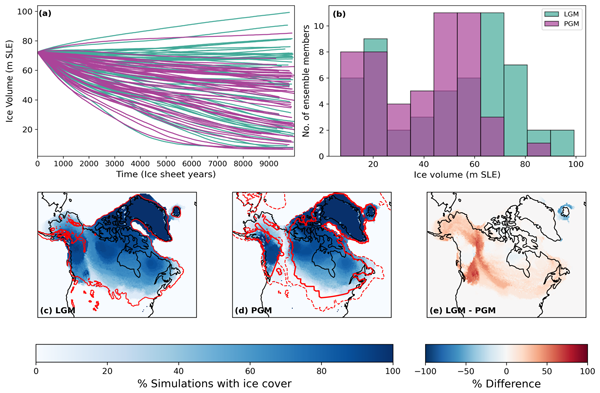
Simulations of the last two glacial periods are run using a computer model in which the atmosphere and ice sheets interact. The results show that the initial conditions used in the simulations are the primary reason for the difference in simulated North American ice sheet volume between each period. Thus, the climate leading up to the glacial maxima and other factors, such as vegetation, are important contributors to the differences in the ice sheets at the Last and Penultimate glacial maxima.
Reinhard K. H. Schiemann, Grenville Lister, Rosalyn Hatcher, Dan Hodson, Bryan Lawrence, Len Shaffrey, Jeff Cole, Andrea Dittus, Jenny Mecking, Jon Robson, Simon Wilson, Yevgeny Aksenov, Adam T. Blaker, Ben Harvey, Oscar Martínez-Alvarado, Annette Osprey, Stephanie Rynders, Sharar Ahmadi, Jake Aylmer, Laura Baker, David Case, Emanuele Silvio Gentile, Steve George, Kevin Hodges, Eliza Karlowska, Charlotte Lang, Hua Lu, Niamh O'Callaghan, Weronika Osmolska, Scott Osprey, Tony Phillips, David Schröder, Robin Smith, Andrew G. Turner, Steve Woolnough, Martin Andrews, Andrew Coward, Steven Hardiman, James Harle, John W. Rostron, David M. H. Sexton, Bablu Sinha, Jonny Williams, and Chris Wilson
EGUsphere, https://doi.org/10.5194/egusphere-2026-2281, https://doi.org/10.5194/egusphere-2026-2281, 2026
This preprint is open for discussion and under review for Geoscientific Model Development (GMD).
Short summary
Short summary
This paper presents a new large ensemble of climate model simulations: The CANARI HadGEM3 Large Ensemble (CANARI LE). The CANARI LE has a comparatively high resolution, provides sub-daily output on atmospheric pressure levels, and boundary conditions for driving regional model simulations. The CANARI LE is thus a community resource that lends itself for the study of physical coupled climate processes, weather systems, and impacts in a changing climate.
Matt Trevers, Stephen L. Cornford, and Antony J. Payne
EGUsphere, https://doi.org/10.5194/egusphere-2026-4400, https://doi.org/10.5194/egusphere-2026-4400, 2026
Short summary
Short summary
Pine Island and Thwaites glaciers in West Antarctica are rapidly losing ice to the ocean, and may be vulnerable to irreversible future retreat. We use models to probe their sensitivity to melting of their floating ice shelves and the reduction of friction at the bed. Pine Island is sensitive to ocean melting, while Thwaites is controlled by the reduction of bed friction. Thwaites’ short term behaviour doesn’t depend on ocean melting, presenting challenges in predicting its long term evolution.
James R. Jordan, Frank Pattyn, Daniel Abele, Torsten Albrecht, Jorge Alvarez-Solas, Jowan M. Barnes, Tijn Berends, Jorge A. Bernales, Javier Blasco, Gong Cheng, Youngmin Choi, Stephen L. Cornford, Cruz Garcia-Molina, Fabien Gillet-Chaulet, G. Hilmar Gudmundsson, Angelika Humbert, Gunter R. Leguy, William H. Lipscomb, Marisa Montoya, Daniel Moreno-Parada, Mathieu Morlighem, Tyler Pelle, Alexander Robinson, Martin Rückamp, Hélène Seroussi, Yanmei Tian, Luisa Wagner, Roderick S. W. van de Wal, Liyun Zhao, and Thomas Zwinger
EGUsphere, https://doi.org/10.5194/egusphere-2026-1962, https://doi.org/10.5194/egusphere-2026-1962, 2026
Short summary
Short summary
Ice calving is a recent inclusion in ice sheet models and there has not been a systematic test of how well it has been implemented. We show that models can accurately represent a given rate of ice calving, properties at the ice front evolve smoothly during calving, and that there are no consistent differences in ice behaviour between various approaches to representing calving in numerical ice models. This gives us confidence in their ability for use in sea level rise prediction simulations.
Robin S. Smith, Tarkan A. Bilge, Thomas J. Bracegirdle, Paul R. Holland, Till Kuhlbrodt, Charlotte Lang, Spencer Liddicoat, Tom Mitcham, Jane Mulcahy, Kaitlin A. Naughten, Andrew Orr, Julien Palmieri, Antony J. Payne, Steven Rumbold, Marc Stringer, Ranjini Swaminathan, Sarah Taylor, Jeremy Walton, and Colin Jones
Earth Syst. Dynam., 17, 475–493, https://doi.org/10.5194/esd-17-475-2026, https://doi.org/10.5194/esd-17-475-2026, 2026
Short summary
Short summary
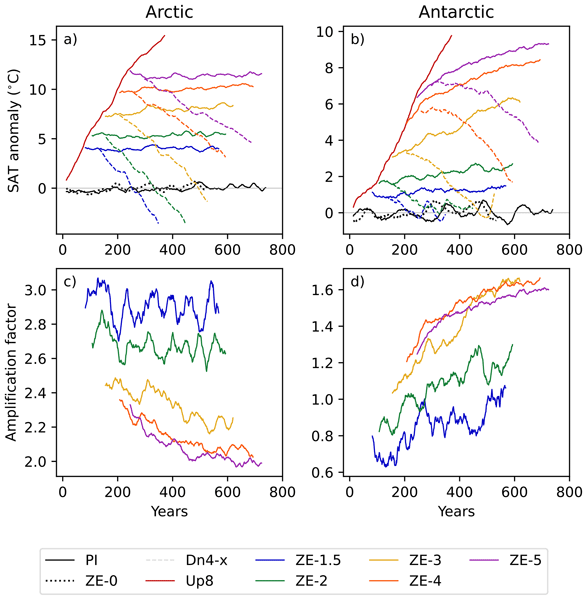
There is a dangerous amount of uncertainty in our predictions of climate change in polar regions because some of feedbacks that might lead to changes that are too rapid for us to adapt to, or that cannot be reversed. We have run a set of simulations with a state-of-the-art Earth System Model that helps improve our understanding of how climate in these regions might change. Some of the aspects we investigate are reversible but many are not, especially those affecting ice sheets and sea level.
Nozomi Arima, Masakazu Yoshimori, Ayako Abe-Ouchi, Ryouta O'ishi, Wing-Le Chan, Sam Sherriff-Tadano, and Tomoo Ogura
Clim. Past, 22, 891–913, https://doi.org/10.5194/cp-22-891-2026, https://doi.org/10.5194/cp-22-891-2026, 2026
Short summary
Short summary
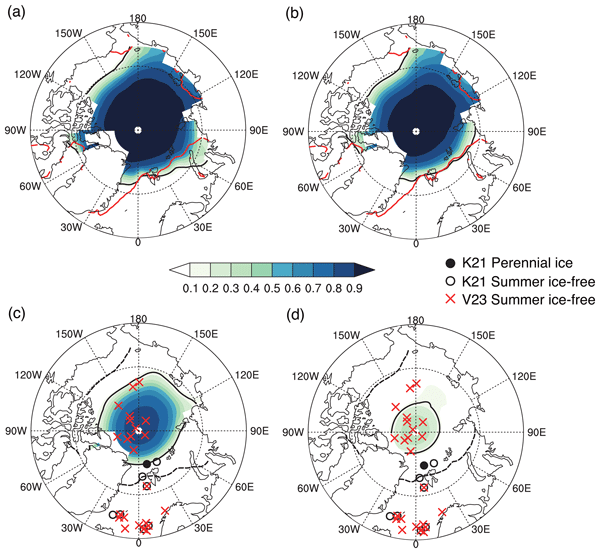
During the Last Interglacial period, spanning 129 000 to 116 000 years ago, the Arctic was considered warmer than during the preindustrial period. Many climate models do not simulate an ice-free Arctic Ocean in summer, as suggested by recent reconstructions. Here, we examine the importance of how the liquid or solid phase of cloud particles is determined in models. It is found that the representation of cloud phase indeed has a substantial impact on the simulation of summer sea ice cover.
Yue Li, Gang Tang, Eleanor O'Rourke, Samar Minallah, Martim Mas e Braga, Sophie Nowicki, Robin S. Smith, David M. Lawrence, George C. Hurtt, Daniele Peano, Gesa Meyer, Birgit Hassler, Jiafu Mao, Yongkang Xue, and Martin Juckes
Geosci. Model Dev., 19, 3129–3155, https://doi.org/10.5194/gmd-19-3129-2026, https://doi.org/10.5194/gmd-19-3129-2026, 2026
Short summary
Short summary
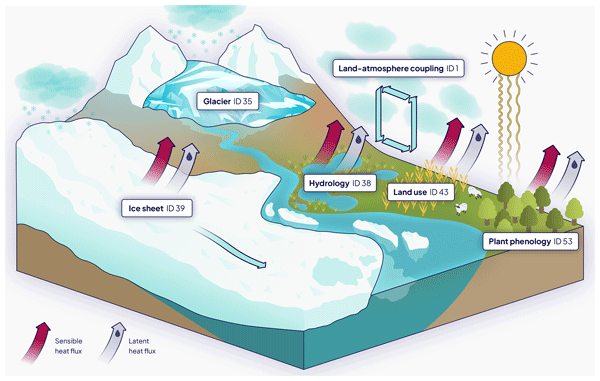
Land and Land Ice Theme Opportunities describe a list that contains 25 variable groups with 716 variables, which are potentially available to the broad scientific audience for performing analysis in land–atmosphere coupling, hydrological processes and freshwater systems, glacier and ice sheet mass balance and their influence on the sea levels, land use, and plant phenology.
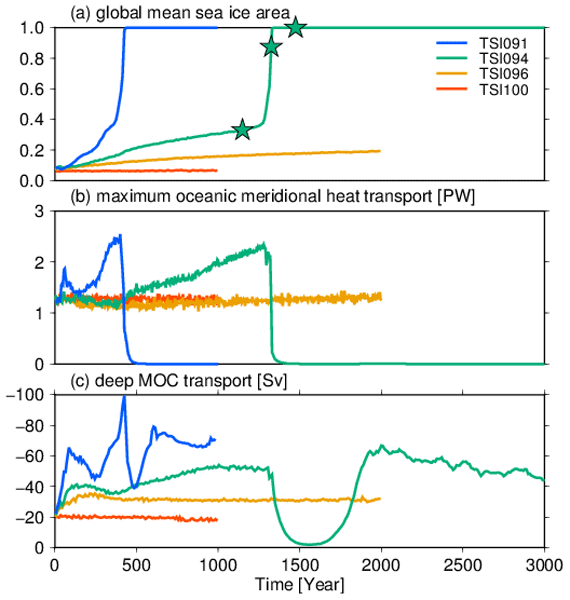
Takashi Obase, Takanori Kodama, Takao Kawasaki, Sam Sherriff-Tadano, Daisuke Takasuka, Ayako Abe-Ouchi, and Masakazu Fujii
Clim. Past, 22, 845–859, https://doi.org/10.5194/cp-22-845-2026, https://doi.org/10.5194/cp-22-845-2026, 2026
Short summary
Short summary
In the past, Earth might have experienced its surface completely covered with ice. Using an atmosphere-ocean climate model, we examined the evolution in the ocean circulation from modern to the snowball Earth. We found that the deep ocean ocean circulation experienced drastic weakening before the snowball onset by salinity changes, and after that the ocean circulation resumed. The ocean circulation changes have implications for understanding climate system feedback on the past snowball events.
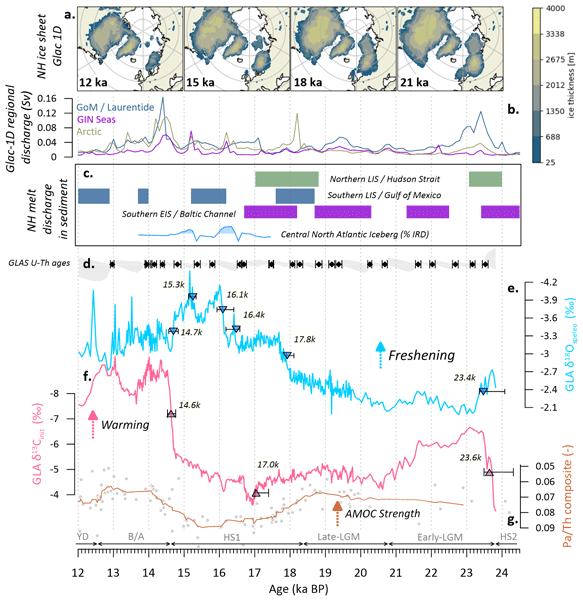
Laura Endres, Carlos Pérez-Mejías, Ruza Ivanovic, Lauren Gregoire, Anna L. C. Hughes, Hai Cheng, and Heather Stoll
Clim. Past, 22, 797–824, https://doi.org/10.5194/cp-22-797-2026, https://doi.org/10.5194/cp-22-797-2026, 2026
Short summary
Short summary
Stable isotope data of a precisely dated stalagmite from northwestern Iberia indicate gradual North Atlantic meltwater input during the last glacial maximum, followed by abrupt surges early in the last deglaciation. The first abrupt surge was decoupled from first cooling about 810 years later – unlike later events – which reveals that the Atlantic circulation’s sensitivity to meltwater is variable and related to the evolving background climate boundary conditions.
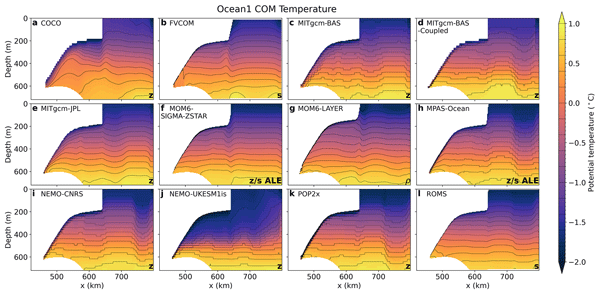
Claire K. Yung, Xylar S. Asay-Davis, Alistair Adcroft, Christopher Y. S. Bull, Jan De Rydt, Michael S. Dinniman, Benjamin K. Galton-Fenzi, Daniel Goldberg, David E. Gwyther, Robert Hallberg, Matthew Harrison, Tore Hattermann, David M. Holland, Denise Holland, Paul R. Holland, James R. Jordan, Nicolas C. Jourdain, Kazuya Kusahara, Gustavo Marques, Pierre Mathiot, Dimitris Menemenlis, Adele K. Morrison, Yoshihiro Nakayama, Olga Sergienko, Robin S. Smith, Alon Stern, Ralph Timmermann, and Qin Zhou
The Cryosphere, 20, 2053–2088, https://doi.org/10.5194/tc-20-2053-2026, https://doi.org/10.5194/tc-20-2053-2026, 2026
Short summary
Short summary
The second Ice Shelf-Ocean Model Intercomparison Project, ISOMIP+, compares 12 ice shelf-ocean models with a common, idealised, static configuration, aiming to assess inter-model variability. Models show similar basal melt rate patterns, ocean profiles and circulation but differ in ice-ocean boundary layer properties. Ice-ocean boundary layer representation is a key area for future work, as are realistic-domain ice sheet-ocean model intercomparisons.
Didier Swingedouw, Laura Jackson, Aixue Hu, Anastasia Romanou, Nicole C. Laureanti, Wilbert Weijer, Sina Loriani, Bette Otto-Bliesner, Ayako Abe-Ouchi, Lucas Almeida, Alessio Bellucci, Reyk Börner, Gokhan Danabasoglu, Donovan P. Dennis, Marion Devilliers, Sybren Drijfhout, Jonathan Donges, Friederike Fröb, Thomas L. Frölicher, Guillaume Gastineau, Heiko Goelzer, Chuncheng Guo, Urs Hofmann, Anna Höse, Colin Jones, Torben Koenigk, Ann Kristin Klose, Valerio Lembo, Jose Licon-Salaiz, Ken Mankoff, Virna Meccia, Irina Melnikova, Oliver Mehling, Laurie Menviel, Juliette Mignot, Jon I. Robson, Gavin A. Schmidt, Robin Smith, Yuchen Sun, Irene Trombini, Matteo Willeit, Richard Wood, Fanghua Wu, Lin Zhaohui, and Ricarda Winkelmann
EGUsphere, https://doi.org/10.5194/egusphere-2026-1698, https://doi.org/10.5194/egusphere-2026-1698, 2026
Short summary
Short summary
This study presents a plan for climate model experiments to better understand how changes in freshwater in the North Atlantic affect major ocean currents. We designed coordinated simulations to test their response to warming, added freshwater, and possible recovery after weakening. Comparing results across models and past climate evidence helps improve confidence in projections and assess risks of large ocean circulation changes.

Leighton A. Regayre, Léa M. C. Prévost, Kunal Ghosh, Jill S. Johnson, Jeremy E. Oakley, Jonathan Owen, Iain Webb, and Ken S. Carslaw
Atmos. Chem. Phys., 26, 2293–2317, https://doi.org/10.5194/acp-26-2293-2026, https://doi.org/10.5194/acp-26-2293-2026, 2026
Short summary
Short summary
Tiny particles called aerosols affect how much sunlight the Earth reflects back into space – one of the biggest climate uncertainties. We use a large set of climate model simulations and find that uncertainty drops in some regions, but persists in other areas, after comparing models to observations. By identifying the specific processes that cause the remaining uncertainty, we guide future efforts to reduce the aerosol forcing uncertainty so we can make more reliable climate predictions.
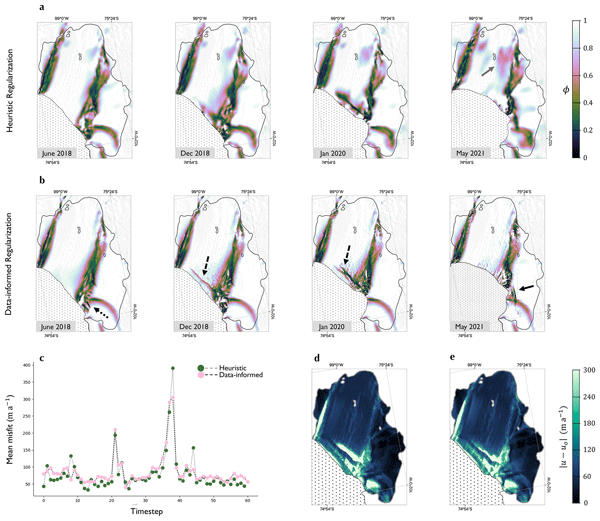
Trystan Surawy-Stepney, Stephen L. Cornford, and Anna E. Hogg
The Cryosphere, 19, 5531–5545, https://doi.org/10.5194/tc-19-5531-2025, https://doi.org/10.5194/tc-19-5531-2025, 2025
Short summary
Short summary
The speed at which Antarctic ice flows is dependent on its viscosity and the slipperiness of the ice/bedrock interface. Often, these unknown variables are inferred from observations of ice speed. This article presents an attempt to make this difficult procedure easier by making use of additional information in the form of observations of crevasses, which make ice appear less viscous to numerical models. We find in some circumstances that this leads to more appealing solutions to this problem.
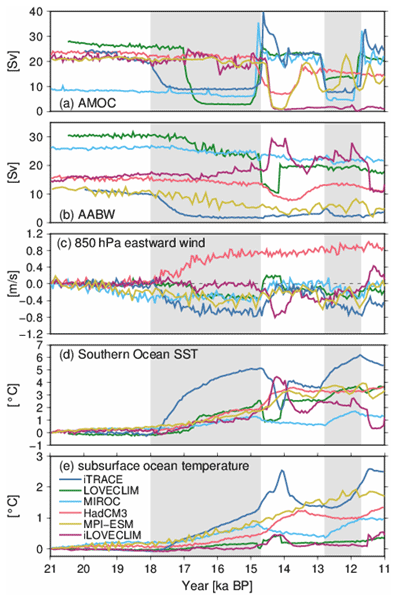
Takashi Obase, Laurie Menviel, Ayako Abe-Ouchi, Tristan Vadsaria, Ruza Ivanovic, Brooke Snoll, Sam Sherriff-Tadano, Paul J. Valdes, Lauren Gregoire, Marie-Luise Kapsch, Uwe Mikolajewicz, Nathaelle Bouttes, Didier Roche, Fanny Lhardy, Chengfei He, Bette Otto-Bliesner, Zhengyu Liu, and Wing-Le Chan
Clim. Past, 21, 1443–1463, https://doi.org/10.5194/cp-21-1443-2025, https://doi.org/10.5194/cp-21-1443-2025, 2025
Short summary
Short summary
This study analyses transient simulations of the last deglaciation performed by six climate models to understand the processes driving high-southern-latitude temperature changes. We find that atmospheric CO2 and AMOC (Atlantic Meridional Overturning Circulation) changes are the primary drivers of the warming and cooling during the middle stage of the deglaciation. The analysis highlights the model's sensitivity of CO2 and AMOC to meltwater and the meltwater history of temperature changes at high southern latitudes.
Ricarda Winkelmann, Donovan P. Dennis, Jonathan F. Donges, Sina Loriani, Ann Kristin Klose, Jesse F. Abrams, Jorge Alvarez-Solas, Torsten Albrecht, David Armstrong McKay, Sebastian Bathiany, Javier Blasco Navarro, Victor Brovkin, Eleanor Burke, Gokhan Danabasoglu, Reik V. Donner, Markus Drüke, Goran Georgievski, Heiko Goelzer, Anna B. Harper, Gabriele Hegerl, Marina Hirota, Aixue Hu, Laura C. Jackson, Colin Jones, Hyungjun Kim, Torben Koenigk, Peter Lawrence, Timothy M. Lenton, Hannah Liddy, José Licón-Saláiz, Maxence Menthon, Marisa Montoya, Jan Nitzbon, Sophie Nowicki, Bette Otto-Bliesner, Francesco Pausata, Stefan Rahmstorf, Karoline Ramin, Alexander Robinson, Johan Rockström, Anastasia Romanou, Boris Sakschewski, Christina Schädel, Steven Sherwood, Robin S. Smith, Norman J. Steinert, Didier Swingedouw, Matteo Willeit, Wilbert Weijer, Richard Wood, Klaus Wyser, and Shuting Yang
EGUsphere, https://doi.org/10.5194/egusphere-2025-1899, https://doi.org/10.5194/egusphere-2025-1899, 2025
Short summary
Short summary
The Tipping Points Modelling Intercomparison Project (TIPMIP) is an international collaborative effort to systematically assess tipping point risks in the Earth system using state-of-the-art coupled and stand-alone domain models. TIPMIP will provide a first global atlas of potential tipping dynamics, respective critical thresholds and key uncertainties, generating an important building block towards a comprehensive scientific basis for policy- and decision-making.
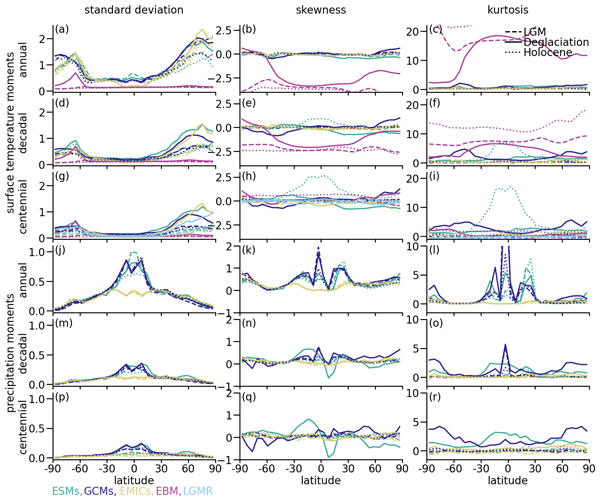
Elisa Ziegler, Nils Weitzel, Jean-Philippe Baudouin, Marie-Luise Kapsch, Uwe Mikolajewicz, Lauren Gregoire, Ruza Ivanovic, Paul J. Valdes, Christian Wirths, and Kira Rehfeld
Clim. Past, 21, 627–659, https://doi.org/10.5194/cp-21-627-2025, https://doi.org/10.5194/cp-21-627-2025, 2025
Short summary
Short summary
During the Last Deglaciation, global surface temperature rose by about 4–7 °C over several millennia. We show that changes in year-to-year up to century-to-century fluctuations of temperature and precipitation during the Deglaciation were mostly larger than during either the preceding or succeeding more stable periods in 15 climate model simulations. The analysis demonstrates how ice sheets, meltwater, and volcanism influence simulated variability to inform future simulation protocols.
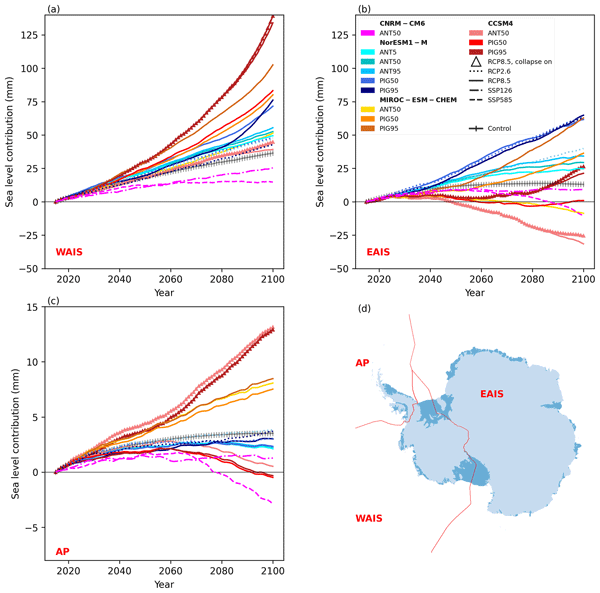
James F. O'Neill, Tamsin L. Edwards, Daniel F. Martin, Courtney Shafer, Stephen L. Cornford, Hélène L. Seroussi, Sophie Nowicki, Mira Adhikari, and Lauren J. Gregoire
The Cryosphere, 19, 541–563, https://doi.org/10.5194/tc-19-541-2025, https://doi.org/10.5194/tc-19-541-2025, 2025
Short summary
Short summary
We use an ice sheet model to simulate the Antarctic contribution to sea level over the 21st century under a range of future climates and varying how sensitive the ice sheet is to different processes. We find that ocean temperatures increase and more snow falls on the ice sheet under stronger warming scenarios. When the ice sheet is sensitive to ocean warming, ocean melt-driven loss exceeds snowfall-driven gains, meaning that the sea level contribution is greater with more climate warming.
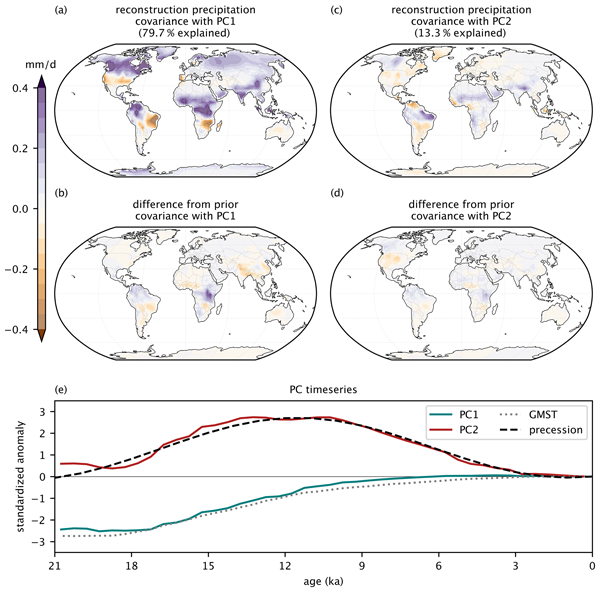
Christopher L. Hancock, Michael P. Erb, Nicholas P. McKay, Sylvia G. Dee, and Ruza F. Ivanovic
Clim. Past, 20, 2663–2684, https://doi.org/10.5194/cp-20-2663-2024, https://doi.org/10.5194/cp-20-2663-2024, 2024
Short summary
Short summary
We reconstruct global hydroclimate anomalies for the past 21 000 years using a data assimilation methodology blending observations recorded in lake sediments with the climate dynamics simulated by climate models. The reconstruction resolves data–model disagreement in east Africa and North America, and we find that changing global temperatures and associated circulation patterns, as well as orbital forcing, are the dominant controls on global precipitation over this interval.
Matt Trevers, Antony J. Payne, and Stephen L. Cornford
The Cryosphere, 18, 5101–5115, https://doi.org/10.5194/tc-18-5101-2024, https://doi.org/10.5194/tc-18-5101-2024, 2024
Short summary
Short summary
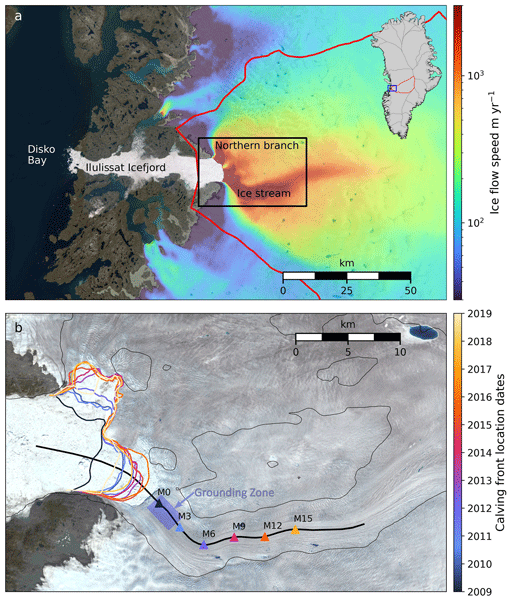
The form of the friction law which determines the speed of ice sliding over the bedrock remains a major source of uncertainty in ice sheet model projections of future sea level rise. Jakobshavn Isbræ, the fastest-flowing glacier in Greenland, which has undergone significant changes in the last few decades, is an ideal case for testing sliding laws. We find that a regularised Coulomb friction law reproduces the large seasonal and inter-annual flow speed variations most accurately.
Violet L. Patterson, Lauren J. Gregoire, Ruza F. Ivanovic, Niall Gandy, Jonathan Owen, Robin S. Smith, Oliver G. Pollard, Lachlan C. Astfalck, and Paul J. Valdes
Clim. Past, 20, 2191–2218, https://doi.org/10.5194/cp-20-2191-2024, https://doi.org/10.5194/cp-20-2191-2024, 2024
Short summary
Short summary
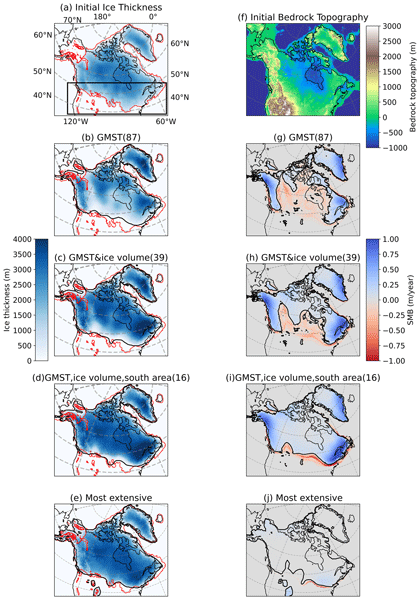
Simulations of the last two glacial periods are run using a computer model in which the atmosphere and ice sheets interact. The results show that the initial conditions used in the simulations are the primary reason for the difference in simulated North American ice sheet volume between each period. Thus, the climate leading up to the glacial maxima and other factors, such as vegetation, are important contributors to the differences in the ice sheets at the Last and Penultimate glacial maxima.
Sam Sherriff-Tadano, Ruza Ivanovic, Lauren Gregoire, Charlotte Lang, Niall Gandy, Jonathan Gregory, Tamsin L. Edwards, Oliver Pollard, and Robin S. Smith
Clim. Past, 20, 1489–1512, https://doi.org/10.5194/cp-20-1489-2024, https://doi.org/10.5194/cp-20-1489-2024, 2024
Short summary
Short summary
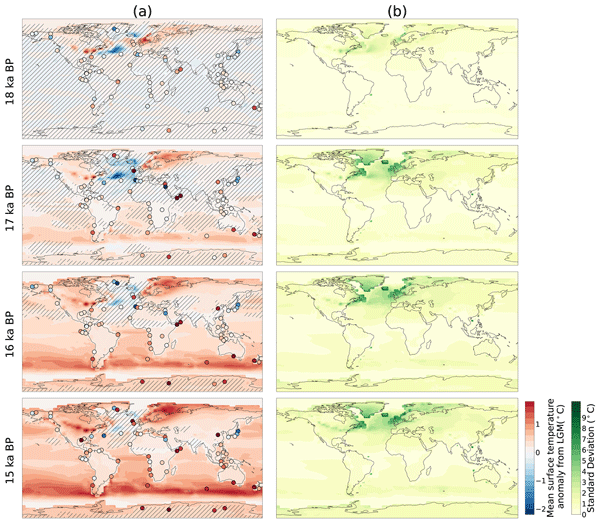
Ensemble simulations of the climate and ice sheets of the Last Glacial Maximum (LGM) are performed with a new coupled climate–ice sheet model. Results show a strong sensitivity of the North American ice sheet to the albedo scheme, while the Greenland ice sheet appeared more sensitive to basal sliding schemes. Our result implies a potential connection between the North American ice sheet at the LGM and the future Greenland ice sheet through the albedo scheme.
Brooke Snoll, Ruza Ivanovic, Lauren Gregoire, Sam Sherriff-Tadano, Laurie Menviel, Takashi Obase, Ayako Abe-Ouchi, Nathaelle Bouttes, Chengfei He, Feng He, Marie Kapsch, Uwe Mikolajewicz, Juan Muglia, and Paul Valdes
Clim. Past, 20, 789–815, https://doi.org/10.5194/cp-20-789-2024, https://doi.org/10.5194/cp-20-789-2024, 2024
Short summary
Short summary
Geological records show rapid climate change throughout the recent deglaciation. The drivers of these changes are still misunderstood but are often attributed to shifts in the Atlantic Ocean circulation from meltwater input. A cumulative effort to understand these processes prompted numerous simulations of this period. We use these to explain the chain of events and our collective ability to simulate them. The results demonstrate the importance of the meltwater amount used in the simulation.
Trystan Surawy-Stepney, Anna E. Hogg, Stephen L. Cornford, Benjamin J. Wallis, Benjamin J. Davison, Heather L. Selley, Ross A. W. Slater, Elise K. Lie, Livia Jakob, Andrew Ridout, Noel Gourmelen, Bryony I. D. Freer, Sally F. Wilson, and Andrew Shepherd
The Cryosphere, 18, 977–993, https://doi.org/10.5194/tc-18-977-2024, https://doi.org/10.5194/tc-18-977-2024, 2024
Short summary
Short summary
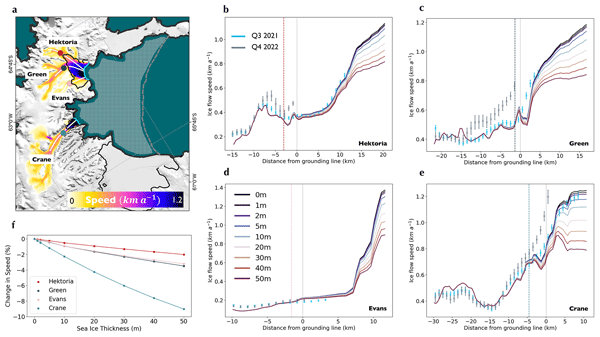
Here, we use satellite observations and an ice flow model to quantify the impact of sea ice buttressing on ice streams on the Antarctic Peninsula. The evacuation of 11-year-old landfast sea ice in the Larsen B embayment on the East Antarctic Peninsula in January 2022 was closely followed by major changes in the calving behaviour and acceleration (30 %) of the ocean-terminating glaciers. Our results show that sea ice buttressing had a negligible direct role in the observed dynamic changes.
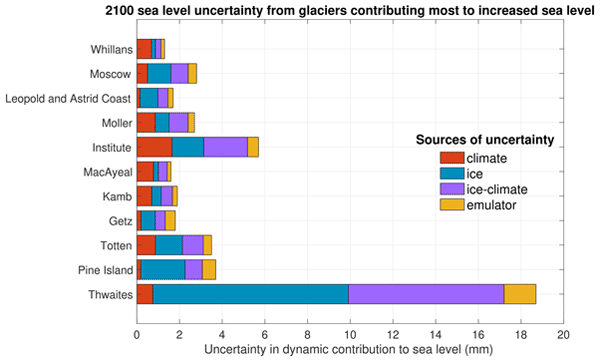
Hélène Seroussi, Vincent Verjans, Sophie Nowicki, Antony J. Payne, Heiko Goelzer, William H. Lipscomb, Ayako Abe-Ouchi, Cécile Agosta, Torsten Albrecht, Xylar Asay-Davis, Alice Barthel, Reinhard Calov, Richard Cullather, Christophe Dumas, Benjamin K. Galton-Fenzi, Rupert Gladstone, Nicholas R. Golledge, Jonathan M. Gregory, Ralf Greve, Tore Hattermann, Matthew J. Hoffman, Angelika Humbert, Philippe Huybrechts, Nicolas C. Jourdain, Thomas Kleiner, Eric Larour, Gunter R. Leguy, Daniel P. Lowry, Chistopher M. Little, Mathieu Morlighem, Frank Pattyn, Tyler Pelle, Stephen F. Price, Aurélien Quiquet, Ronja Reese, Nicole-Jeanne Schlegel, Andrew Shepherd, Erika Simon, Robin S. Smith, Fiammetta Straneo, Sainan Sun, Luke D. Trusel, Jonas Van Breedam, Peter Van Katwyk, Roderik S. W. van de Wal, Ricarda Winkelmann, Chen Zhao, Tong Zhang, and Thomas Zwinger
The Cryosphere, 17, 5197–5217, https://doi.org/10.5194/tc-17-5197-2023, https://doi.org/10.5194/tc-17-5197-2023, 2023
Short summary
Short summary
Mass loss from Antarctica is a key contributor to sea level rise over the 21st century, and the associated uncertainty dominates sea level projections. We highlight here the Antarctic glaciers showing the largest changes and quantify the main sources of uncertainty in their future evolution using an ensemble of ice flow models. We show that on top of Pine Island and Thwaites glaciers, Totten and Moscow University glaciers show rapid changes and a strong sensitivity to warmer ocean conditions.
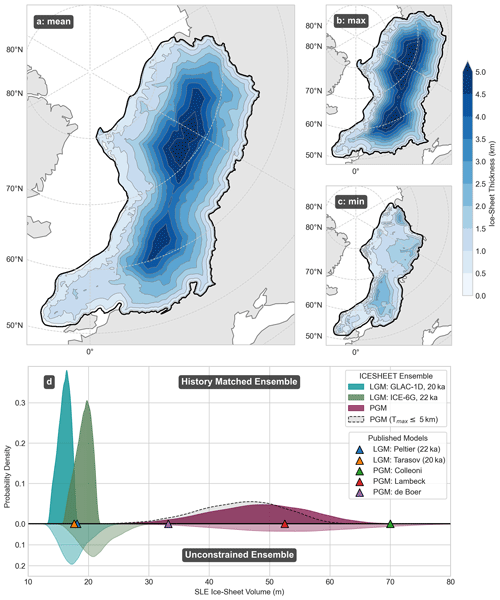
Oliver G. Pollard, Natasha L. M. Barlow, Lauren J. Gregoire, Natalya Gomez, Víctor Cartelle, Jeremy C. Ely, and Lachlan C. Astfalck
The Cryosphere, 17, 4751–4777, https://doi.org/10.5194/tc-17-4751-2023, https://doi.org/10.5194/tc-17-4751-2023, 2023
Short summary
Short summary
We use advanced statistical techniques and a simple ice-sheet model to produce an ensemble of plausible 3D shapes of the ice sheet that once stretched across northern Europe during the previous glacial maximum (140,000 years ago). This new reconstruction, equivalent in volume to 48 ± 8 m of global mean sea-level rise, will improve the interpretation of high sea levels recorded from the Last Interglacial period (120 000 years ago) that provide a useful perspective on the future.
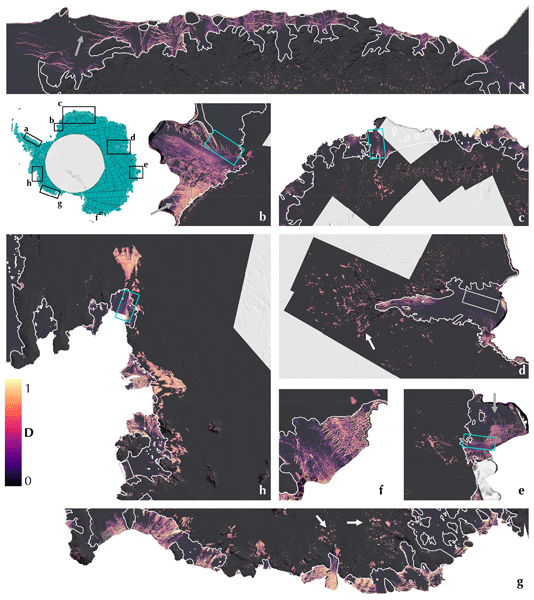
Trystan Surawy-Stepney, Anna E. Hogg, Stephen L. Cornford, and David C. Hogg
The Cryosphere, 17, 4421–4445, https://doi.org/10.5194/tc-17-4421-2023, https://doi.org/10.5194/tc-17-4421-2023, 2023
Short summary
Short summary
The presence of crevasses in Antarctica influences how the ice sheet behaves. It is important, therefore, to collect data on the spatial distribution of crevasses and how they are changing. We present a method of mapping crevasses from satellite radar imagery and apply it to 7.5 years of images, covering Antarctica's floating and grounded ice. We develop a method of measuring change in the density of crevasses and quantify increased fracturing in important parts of the West Antarctic Ice Sheet.
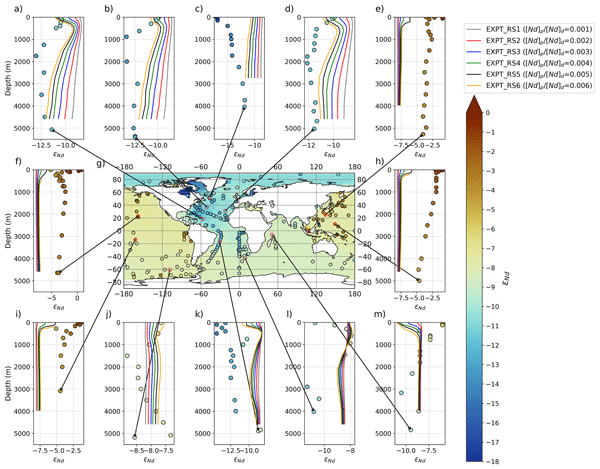
Suzanne Robinson, Ruza F. Ivanovic, Lauren J. Gregoire, Julia Tindall, Tina van de Flierdt, Yves Plancherel, Frerk Pöppelmeier, Kazuyo Tachikawa, and Paul J. Valdes
Geosci. Model Dev., 16, 1231–1264, https://doi.org/10.5194/gmd-16-1231-2023, https://doi.org/10.5194/gmd-16-1231-2023, 2023
Short summary
Short summary
We present the implementation of neodymium (Nd) isotopes into the ocean model of FAMOUS (Nd v1.0). Nd fluxes from seafloor sediment and incorporation of Nd onto sinking particles represent the major global sources and sinks, respectively. However, model–data mismatch in the North Pacific and northern North Atlantic suggest that certain reactive components of the sediment interact the most with seawater. Our results are important for interpreting Nd isotopes in terms of ocean circulation.
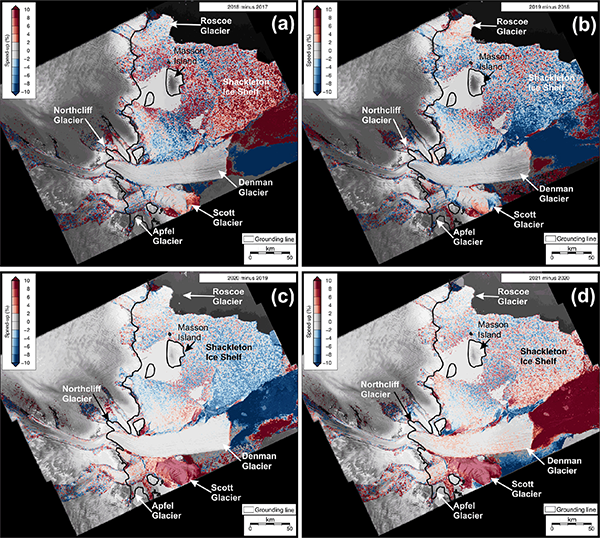
Sarah S. Thompson, Bernd Kulessa, Adrian Luckman, Jacqueline A. Halpin, Jamin S. Greenbaum, Tyler Pelle, Feras Habbal, Jingxue Guo, Lenneke M. Jong, Jason L. Roberts, Bo Sun, and Donald D. Blankenship
The Cryosphere, 17, 157–174, https://doi.org/10.5194/tc-17-157-2023, https://doi.org/10.5194/tc-17-157-2023, 2023
Short summary
Short summary
We use satellite imagery and ice penetrating radar to investigate the stability of the Shackleton system in East Antarctica. We find significant changes in surface structures across the system and observe a significant increase in ice flow speed (up to 50 %) on the floating part of Scott Glacier. We conclude that knowledge remains woefully insufficient to explain recent observed changes in the grounded and floating regions of the system.
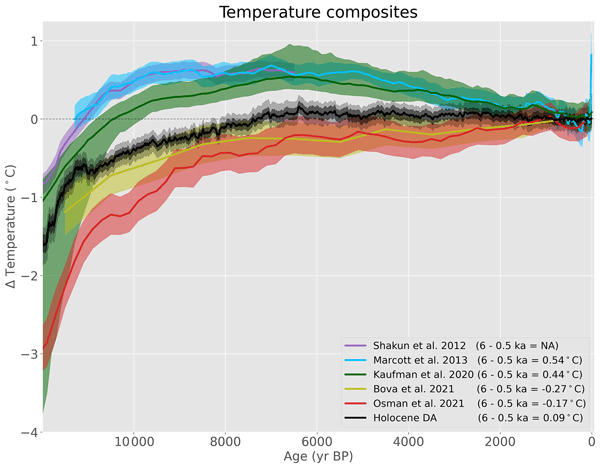
Michael P. Erb, Nicholas P. McKay, Nathan Steiger, Sylvia Dee, Chris Hancock, Ruza F. Ivanovic, Lauren J. Gregoire, and Paul Valdes
Clim. Past, 18, 2599–2629, https://doi.org/10.5194/cp-18-2599-2022, https://doi.org/10.5194/cp-18-2599-2022, 2022
Short summary
Short summary
To look at climate over the past 12 000 years, we reconstruct spatial temperature using natural climate archives and information from model simulations. Our results show mild global mean warmth around 6000 years ago, which differs somewhat from past reconstructions. Undiagnosed seasonal biases in the data could explain some of the observed temperature change, but this still would not explain the large difference between many reconstructions and climate models over this period.
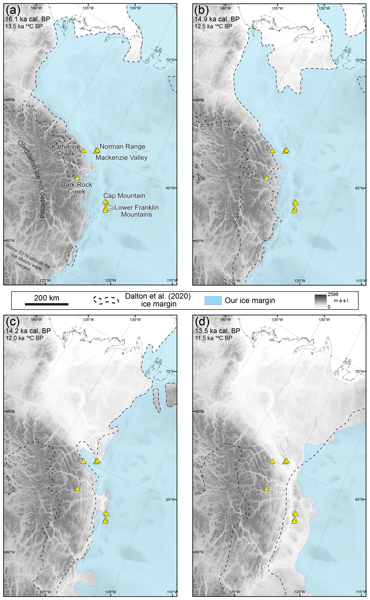
Benjamin J. Stoker, Martin Margold, John C. Gosse, Alan J. Hidy, Alistair J. Monteath, Joseph M. Young, Niall Gandy, Lauren J. Gregoire, Sophie L. Norris, and Duane Froese
The Cryosphere, 16, 4865–4886, https://doi.org/10.5194/tc-16-4865-2022, https://doi.org/10.5194/tc-16-4865-2022, 2022
Short summary
Short summary
The Laurentide Ice Sheet was the largest ice sheet to grow and disappear in the Northern Hemisphere during the last glaciation. In northwestern Canada, it covered the Mackenzie Valley, blocking the migration of fauna and early humans between North America and Beringia and altering the drainage systems. We reconstruct the timing of ice sheet retreat in this region and the implications for the migration of early humans into North America, the drainage of glacial lakes, and past sea level rise.
Suzanne Robinson, Ruza Ivanovic, Lauren Gregoire, Lachlan Astfalck, Tina van de Flierdt, Yves Plancherel, Frerk Pöppelmeier, and Kazuyo Tachikawa
EGUsphere, https://doi.org/10.5194/egusphere-2022-937, https://doi.org/10.5194/egusphere-2022-937, 2022
Preprint archived
Short summary
Short summary
The neodymium (Nd) isotope (εNd) scheme in the ocean model of FAMOUS is used to explore a benthic Nd flux to seawater. Our results demonstrate that sluggish modern Pacific waters are sensitive to benthic flux alterations, whereas the well-ventilated North Atlantic displays a much weaker response. In closing, there are distinct regional differences in how seawater acquires its εNd signal, in part relating to the complex interactions of Nd addition and water advection.
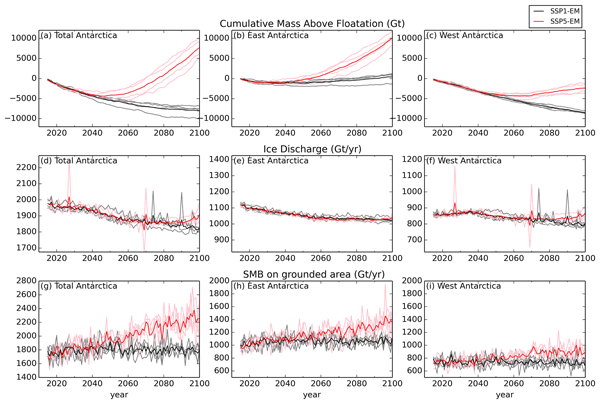
Antony Siahaan, Robin S. Smith, Paul R. Holland, Adrian Jenkins, Jonathan M. Gregory, Victoria Lee, Pierre Mathiot, Antony J. Payne, Jeff K. Ridley, and Colin G. Jones
The Cryosphere, 16, 4053–4086, https://doi.org/10.5194/tc-16-4053-2022, https://doi.org/10.5194/tc-16-4053-2022, 2022
Short summary
Short summary
The UK Earth System Model is the first to fully include interactions of the atmosphere and ocean with the Antarctic Ice Sheet. Under the low-greenhouse-gas SSP1–1.9 (Shared Socioeconomic Pathway) scenario, the ice sheet remains stable over the 21st century. Under the strong-greenhouse-gas SSP5–8.5 scenario, the model predicts strong increases in melting of large ice shelves and snow accumulation on the surface. The dominance of accumulation leads to a sea level fall at the end of the century.
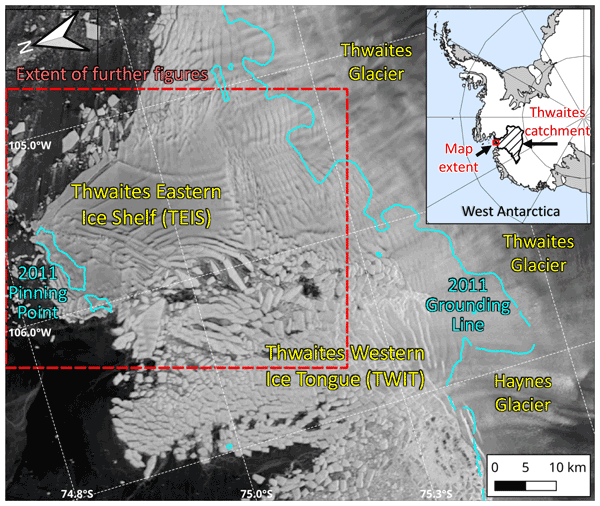
Douglas I. Benn, Adrian Luckman, Jan A. Åström, Anna J. Crawford, Stephen L. Cornford, Suzanne L. Bevan, Thomas Zwinger, Rupert Gladstone, Karen Alley, Erin Pettit, and Jeremy Bassis
The Cryosphere, 16, 2545–2564, https://doi.org/10.5194/tc-16-2545-2022, https://doi.org/10.5194/tc-16-2545-2022, 2022
Short summary
Short summary
Thwaites Glacier (TG), in West Antarctica, is potentially unstable and may contribute significantly to sea-level rise as global warming continues. Using satellite data, we show that Thwaites Eastern Ice Shelf, the largest remaining floating extension of TG, has started to accelerate as it fragments along a shear zone. Computer modelling does not indicate that fragmentation will lead to imminent glacier collapse, but it is clear that major, rapid, and unpredictable changes are underway.
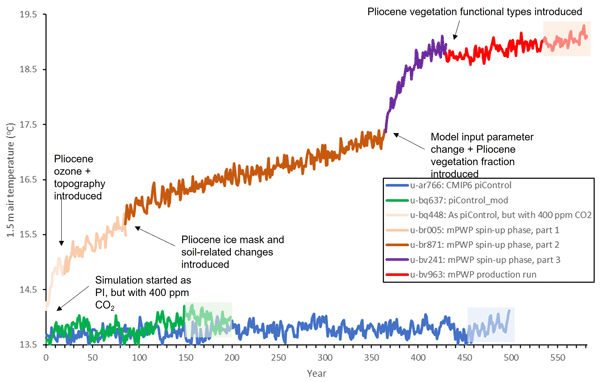
Charles J. R. Williams, Alistair A. Sellar, Xin Ren, Alan M. Haywood, Peter Hopcroft, Stephen J. Hunter, William H. G. Roberts, Robin S. Smith, Emma J. Stone, Julia C. Tindall, and Daniel J. Lunt
Clim. Past, 17, 2139–2163, https://doi.org/10.5194/cp-17-2139-2021, https://doi.org/10.5194/cp-17-2139-2021, 2021
Short summary
Short summary
Computer simulations of the geological past are an important tool to improve our understanding of climate change. We present results from a simulation of the mid-Pliocene (approximately 3 million years ago) using the latest version of the UK’s climate model. The simulation reproduces temperatures as expected and shows some improvement relative to previous versions of the same model. The simulation is, however, arguably too warm when compared to other models and available observations.
Cited articles
Abe-Ouchi, A., Saito, F., Kageyama, M., Braconnot, P., Harrison, S. P., Lambeck, K., Otto-Bliesner, B. L., Peltier, W. R., Tarasov, L., Peterschmitt, J.-Y., and Takahashi, K.: Ice-sheet configuration in the CMIP5/PMIP3 Last Glacial Maximum experiments, Geosci. Model Dev., 8, 3621–3637, https://doi.org/10.5194/gmd-8-3621-2015, 2015. a, b
Albrecht, T., Winkelmann, R., and Levermann, A.: Glacial-cycle simulations of the Antarctic Ice Sheet with the Parallel Ice Sheet Model (PISM) – Part 1: Boundary conditions and climatic forcing, The Cryosphere, 14, 599–632, https://doi.org/10.5194/tc-14-599-2020, 2020. a
Alder, J. R. and Hostetler, S. W.: Applying the Community Ice Sheet Model to evaluate PMIP3 LGM climatologies over the North American ice sheets, Clim. Dynam., 53, 2807–2824, https://doi.org/10.1007/s00382-019-04663-x, 2019. a
Alvarez-Solas, J., Banderas, R., Robinson, A., and Montoya, M.: Ocean-driven millennial-scale variability of the Eurasian ice sheet during the last glacial period simulated with a hybrid ice-sheet–shelf model, Clim. Past, 15, 957–979, https://doi.org/10.5194/cp-15-957-2019, 2019. a, b, c
Annan, J. D. and Hargreaves, J. C.: A new global reconstruction of temperature changes at the Last Glacial Maximum, Clim. Past, 9, 367–376, https://doi.org/10.5194/cp-9-367-2013, 2013. a
Annan, J. D., Hargreaves, J. C., and Mauritsen, T.: A new global surface temperature reconstruction for the Last Glacial Maximum, Clim. Past, 18, 1883–1896, https://doi.org/10.5194/cp-18-1883-2022, 2022. a
Barnett, R. L., Austermann, J., Dyer, B., Telfer, M. W., Barlow, N. L. M., Boulton, S. J., Carr, A. S., and Creel, R. C.: Constraining the contribution of the Antarctic Ice Sheet to Last Interglacial sea level, Sci. Adv., 9, https://doi.org/10.1126/sciadv.adf0198, 2023. a
Bastos, L. S. and O'Hagan, A.: Diagnostics for Gaussian Process Emulators, Technometrics, 51, 425–438, https://doi.org/10.1198/TECH.2009.08019, 2009. a
Batchelor, C. L., Margold, M., Krapp, M., Murton, D. K., Dalton, A. S., Gibbard, P. L., Stokes, C. R., Murton, J. B., and Manica, A.: The configuration of Northern Hemisphere ice sheets through the Quaternary, Nat. Commun., 10, 3713, https://doi.org/10.1038/s41467-019-11601-2, 2019. a, b, c, d, e, f, g, h
Beckmann, A. and Goosse, H.: A parameterization of ice shelf–ocean interaction for climate models, Ocean Model., 5, 157–170, https://doi.org/10.1016/S1463-5003(02)00019-7, 2003. a
Beghin, P., Charbit, S., Dumas, C., Kageyama, M., and Ritz, C.: How might the North American ice sheet influence the northwestern Eurasian climate?, Clim. Past, 11, 1467–1490, https://doi.org/10.5194/cp-11-1467-2015, 2015. a
Berends, C. J., Stap, L. B., and Wal, R. S. W. v. d.: Strong impact of sub-shelf melt parameterisation on ice-sheet retreat in idealised and realistic Antarctic topography, J. Glaciol., 69, 1434–1448, https://doi.org/10.1017/jog.2023.33, 2023. a, b
Blasco, J., Alvarez-Solas, J., Robinson, A., and Montoya, M.: Exploring the impact of atmospheric forcing and basal drag on the Antarctic Ice Sheet under Last Glacial Maximum conditions, The Cryosphere, 15, 215–231, https://doi.org/10.5194/tc-15-215-2021, 2021. a
Blatter, H., Greve, R., and Abe-Ouchi, A.: A short history of the thermomechanical theory and modeling of glaciers and ice sheets, J. Glaciol., 56, 1087–1094, https://doi.org/10.3189/002214311796406059, 2010. a
Bradley, S. L., Sellevold, R., Petrini, M., Vizcaino, M., Georgiou, S., Zhu, J., Otto-Bliesner, B. L., and Lofverstrom, M.: Surface mass balance and climate of the Last Glacial Maximum Northern Hemisphere ice sheets: simulations with CESM2.1, Clim. Past, 20, 211–235, https://doi.org/10.5194/cp-20-211-2024, 2024. a, b, c, d
Briggs, R. D., Pollard, D., and Tarasov, L.: A data-constrained large ensemble analysis of Antarctic evolution since the Eemian, Quaternary Sci. Rev., 103, 91–115, https://doi.org/10.1016/j.quascirev.2014.09.003, 2014. a
Bueler, E. and van Pelt, W.: Mass-conserving subglacial hydrology in the Parallel Ice Sheet Model version 0.6, Geosci. Model Dev., 8, 1613–1635, https://doi.org/10.5194/gmd-8-1613-2015, 2015. a
Capron, É., Govin, A., and Stone, E. J.: Recent advances on the dynamical representation and our understanding of the warmer-than-present last interglacial climate, Quat. Rev. Assoc. Fr. Pour L'étude Quat., 28, https://doi.org/10.4000/quaternaire.8029, 2017. a, b
Charbit, S., Ritz, C., Philippon, G., Peyaud, V., and Kageyama, M.: Numerical reconstructions of the Northern Hemisphere ice sheets through the last glacial-interglacial cycle, Clim. Past, 3, 15–37, https://doi.org/10.5194/cp-3-15-2007, 2007. a
Clark, C. D., Ely, J. C., Hindmarsh, R. C. A., Bradley, S., Ignéczi, A., Fabel, D., Ó Cofaigh, C., Chiverrell, R. C., Scourse, J., Benetti, S., Bradwell, T., Evans, D. J. A., Roberts, D. H., Burke, M., Callard, S. L., Medialdea, A., Saher, M., Small, D., Smedley, R. K., Gasson, E., Gregoire, L., Gandy, N., Hughes, A. L. C., Ballantyne, C., Bateman, M. D., Bigg, G. R., Doole, J., Dove, D., Duller, G. A. T., Jenkins, G. T. H., Livingstone, S. L., McCarron, S., Moreton, S., Pollard, D., Praeg, D., Sejrup, H. P., Van Landeghem, K. J. J., and Wilson, P.: Growth and retreat of the last British–Irish Ice Sheet, 31 000 to 15 000 years ago: the BRITICE-CHRONO reconstruction, 51, 699–758, https://doi.org/10.1111/bor.12594, 2022. a, b
Clark, P. U., He, F., Golledge, N. R., Mitrovica, J. X., Dutton, A., Hoffman, J. S., and Dendy, S.: Oceanic forcing of penultimate deglacial and last interglacial sea-level rise, Nature, 577, 660–664, https://doi.org/10.1038/s41586-020-1931-7, 2020. a, b, c
Colleoni, F., Wekerle, C., Näslund, J.-O., Brandefelt, J., and Masina, S.: Constraint on the penultimate glacial maximum Northern Hemisphere ice topography (≈ 140 kyrs BP), Quaternary Sci. Rev., 137, 97–112, https://doi.org/10.1016/j.quascirev.2016.01.024, 2016. a
Cornford, S. L., Martin, D. F., Graves, D. T., Ranken, D. F., Le Brocq, A. M., Gladstone, R. M., Payne, A. J., Ng, E. G., and Lipscomb, W. H.: Adaptive mesh, finite volume modeling of marine ice sheets, 232, 529–549, https://doi.org/10.1016/j.jcp.2012.08.037, 2013. a, b
Cornford, S. L., Martin, D. F., Payne, A. J., Ng, E. G., Le Brocq, A. M., Gladstone, R. M., Edwards, T. L., Shannon, S. R., Agosta, C., van den Broeke, M. R., Hellmer, H. H., Krinner, G., Ligtenberg, S. R. M., Timmermann, R., and Vaughan, D. G.: Century-scale simulations of the response of the West Antarctic Ice Sheet to a warming climate, The Cryosphere, 9, 1579–1600, https://doi.org/10.5194/tc-9-1579-2015, 2015. a
Couette, P.-O., Lajeunesse, P., Ghienne, J.-F., Dorschel, B., Gebhardt, C., Hebbeln, D., and Brouard, E.: Evidence for an extensive ice shelf in northern Baffin Bay during the Last Glacial Maximum, Commun. Earth Environ., 3, 225, https://doi.org/10.1038/s43247-022-00559-7, 2022. a
Dalton, A. S., Margold, M., Stokes, C. R., Tarasov, L., Dyke, A. S., Adams, R. S., Allard, S., Arends, H. E., Atkinson, N., Attig, J. W., Barnett, P. J., Barnett, R. L., Batterson, M., Bernatchez, P., Borns, H. W., Breckenridge, A., Briner, J. P., Brouard, E., Campbell, J. E., Carlson, A. E., Clague, J. J., Curry, B. B., Daigneault, R.-A., Dubé-Loubert, H., Easterbrook, D. J., Franzi, D. A., Friedrich, H. G., Funder, S., Gauthier, M. S., Gowan, A. S., Harris, K. L., Hétu, B., Hooyer, T. S., Jennings, C. E., Johnson, M. D., Kehew, A. E., Kelley, S. E., Kerr, D., King, E. L., Kjeldsen, K. K., Knaeble, A. R., Lajeunesse, P., Lakeman, T. R., Lamothe, M., Larson, P., Lavoie, M., Loope, H. M., Lowell, T. V., Lusardi, B. A., Manz, L., McMartin, I., Nixon, F. C., Occhietti, S., Parkhill, M. A., Piper, D. J. W., Pronk, A. G., Richard, P. J. H., Ridge, J. C., Ross, M., Roy, M., Seaman, A., Shaw, J., Stea, R. R., Teller, J. T., Thompson, W. B., Thorleifson, L. H., Utting, D. J., Veillette, J. J., Ward, B. C., Weddle, T. K., and Wright, H. E.: An updated radiocarbon-based ice margin chronology for the last deglaciation of the North American Ice Sheet Complex, Quaternary Sci. Rev., 234, 106223, https://doi.org/10.1016/j.quascirev.2020.106223, 2020. a, b, c, d, e, f, g, h, i
Dalton, A. S., Stokes, C. R., and Batchelor, C. L.: Evolution of the Laurentide and Innuitian ice sheets prior to the Last Glacial Maximum (115 ka to 25 ka), Earth-Sci. Rev., 224, 103875, https://doi.org/10.1016/j.earscirev.2021.103875, 2022. a, b
Dalton, A. S., Dulfer, H. E., Margold, M., Heyman, J., Clague, J. J., Froese, D. G., Gauthier, M. S., Hughes, A. L. C., Jennings, C. E., Norris, S. L., and Stoker, B. J.: Deglaciation of the north American ice sheet complex in calendar years based on a comprehensive database of chronological data: NADI-1, Quaternary Sci. Rev., 321, 108345, https://doi.org/10.1016/j.quascirev.2023.108345, 2023. a
DeConto, R. M. and Pollard, D.: Contribution of Antarctica to past and future sea-level rise, Nature, 531, 591–597, https://doi.org/10.1038/nature17145, 2016. a
Dentith, J. E., Ivanovic, R. F., Gregoire, L. J., Tindall, J. C., and Robinson, L. F.: Simulating stable carbon isotopes in the ocean component of the FAMOUS general circulation model with MOSES1 (XOAVI), Geosci. Model Dev., 13, 3529–3552, https://doi.org/10.5194/gmd-13-3529-2020, 2020. a, b
Depoorter, M. A., Bamber, J. L., Griggs, J. A., Lenaerts, J. T. M., Ligtenberg, S. R. M., van den Broeke, M. R., and Moholdt, G.: Calving fluxes and basal melt rates of Antarctic ice shelves, Nature, 502, 89–92, https://doi.org/10.1038/nature12567, 2013. a
Dong, B. and Valdes, P. J.: Climates at the Last Glacial Maximum: Influence of Model Horizontal Resolution, J. Climate, 13, 1554–1573, https://doi.org/10.1175/1520-0442(2000)013<1554:CATLGM>2.0.CO;2, 2000. a, b
Drew, M. and Tarasov, L.: Surging of a Hudson Strait-scale ice stream: subglacial hydrology matters but the process details mostly do not, The Cryosphere, 17, 5391–5415, https://doi.org/10.5194/tc-17-5391-2023, 2023. a
Dutton, A. and Lambeck, K.: Ice Volume and Sea Level During the Last Interglacial, Science, 337, 216–219, https://doi.org/10.1126/science.1205749, 2012. a
Dutton, A., Carlson, A. E., Long, A. J., Milne, G. A., Clark, P. U., DeConto, R., Horton, B. P., Rahmstorf, S., and Raymo, M. E.: Sea-level rise due to polar ice-sheet mass loss during past warm periods, Science, 349, https://doi.org/10.1126/science.aaa4019, 2015. a
Dyer, B., Austermann, J., D'Andrea, W. J., Creel, R. C., Sandstrom, M. R., Cashman, M., Rovere, A., and Raymo, M. E.: Sea-level trends across The Bahamas constrain peak last interglacial ice melt, P. Natl. Acad. Sci. USA, 118, e2026839118, https://doi.org/10.1073/pnas.2026839118, 2021. a
Dyke, A. S., Andrews, J. T., Clark, P. U., England, J. H., Miller, G. H., Shaw, J., and Veillette, J. J.: The Laurentide and Innuitian ice sheets during the Last Glacial Maximum, Quaternary Sci. Rev., 21, 9-31, https://doi.org/10.1016/S0277-3791(01)00095-6, 2002. a
Edwards, T. L., Brandon, M. A., Durand, G., Edwards, N. R., Golledge, N. R., Holden, P. B., Nias, I. J., Payne, A. J., Ritz, C., and Wernecke, A.: Revisiting Antarctic ice loss due to marine ice-cliff instability, Nature, 566, 58–64, https://doi.org/10.1038/s41586-019-0901-4, 2019. a
Ehlers, J., Gibbard, P. L., and Hughes, P. D.: Chapter 4 – Quaternary Glaciations and Chronology, in Past Glacial Environment, Second Edn., edited by: Menzies, J. and van der Meer, J. J. M., Elsevier, 77–101, https://doi.org/10.1016/B978-0-08-100524-8.00003-8, 2018. a, b
Essery, R. L. H., Best, M. J., Betts, R. A., Cox, P. M., and Taylor, C. M.: Explicit Representation of Subgrid Heterogeneity in a GCM Land Surface Scheme, J. Hydrometeorol., 4, 530–543, https://doi.org/10.1175/1525-7541(2003)004<0530:EROSHI>2.0.CO;2, 2003. a
Favier, L., Jourdain, N. C., Jenkins, A., Merino, N., Durand, G., Gagliardini, O., Gillet-Chaulet, F., and Mathiot, P.: Assessment of sub-shelf melting parameterisations using the ocean–ice-sheet coupled model NEMO(v3.6)–Elmer/Ice(v8.3) , Geosci. Model Dev., 12, 2255–2283, https://doi.org/10.5194/gmd-12-2255-2019, 2019. a, b
Fettweis, X., Franco, B., Tedesco, M., van Angelen, J. H., Lenaerts, J. T. M., van den Broeke, M. R., and Gallée, H.: Estimating the Greenland ice sheet surface mass balance contribution to future sea level rise using the regional atmospheric climate model MAR, The Cryosphere, 7, 469–489, https://doi.org/10.5194/tc-7-469-2013, 2013. a, b
Fyke, J., Sergienko, O., Löfverström, M., Price, S., and Lenaerts, J. T. M.: An Overview of Interactions and Feedbacks Between Ice Sheets and the Earth System, Rev. Geophys., 56, 361–408, https://doi.org/10.1029/2018RG000600, 2018. a
Fyke, J. G., Sacks, W. J., and Lipscomb, W. H.: A technique for generating consistent ice sheet initial conditions for coupled ice sheet/climate models, Geosci. Model Dev., 7, 1183–1195, https://doi.org/10.5194/gmd-7-1183-2014, 2014. a
Gandy, N., Gregoire, L. J., Ely, J. C., Clark, C. D., Hodgson, D. M., Lee, V., Bradwell, T., and Ivanovic, R. F.: Marine ice sheet instability and ice shelf buttressing of the Minch Ice Stream, northwest Scotland, The Cryosphere, 12, 3635–3651, https://doi.org/10.5194/tc-12-3635-2018, 2018. a, b
Gandy, N., Gregoire, L. J., Ely, J. C., Cornford, S. L., Clark, C. D., and Hodgson, D. M.: Exploring the ingredients required to successfully model the placement, generation, and evolution of ice streams in the British-Irish Ice Sheet, Quat. Sci. Rev., 223, 105915, https://doi.org/10.1016/j.quascirev.2019.105915, 2019. a, b, c, d, e, f, g, h, i, j
Gandy, N., Gregoire, L. J., Ely, J. C., Cornford, S. L., Clark, C. D., and Hodgson, D. M.: Collapse of the Last Eurasian Ice Sheet in the North Sea Modulated by Combined Processes of Ice Flow, Surface Melt, J. Geophys. Res.-Earth, 126, e2020JF005755, https://doi.org/10.1029/2020JF005755, 2021. a, b, c, d
Gandy, N., Astfalck, L. C., Gregoire, L. J., Ivanovic, R. F., Patterson, V. L., Sherriff-Tadano, S., Smith, R. S., Williamson, D., and Rigby, R.: De-Tuning Albedo Parameters in a Coupled Climate Ice Sheet Model to Simulate the North American Ice Sheet at the Last Glacial Maximum, J. Geophys. Res.-Earth, 128, e2023JF007250, https://doi.org/10.1029/2023JF007250, 2023. a, b, c, d, e, f, g, h, i
Ganopolski, A., Calov, R., and Claussen, M.: Simulation of the last glacial cycle with a coupled climate ice-sheet model of intermediate complexity, Clim. Past, 6, 229–244, https://doi.org/10.5194/cp-6-229-2010, 2010. a, b
Gomez, N., Mitrovica, J. X., Huybers, P., and Clark, P. U.: Sea level as a stabilizing factor for marine-ice-sheet grounding lines, Nat. Geosci., 3, 850–853, https://doi.org/10.1038/ngeo1012, 2010. a
Govin, A., Capron, E., Tzedakis, P. C., Verheyden, S., Ghaleb, B., Hillaire-Marcel, C., St-Onge, G., Stoner, J. S., Bassinot, F., Bazin, L., Blunier, T., Combourieu-Nebout, N., El Ouahabi, A., Genty, D., Gersonde, R., Jimenez-Amat, P., Landais, A., Martrat, B., Masson-Delmotte, V., Parrenin, F., Seidenkrantz, M.-S., Veres, D., Waelbroeck, C., and Zahn, R.: Sequence of events from the onset to the demise of the Last Interglacial: Evaluating strengths and limitations of chronologies used in climatic archives, Quaternary Sci. Rev., 129, 1–36, https://doi.org/10.1016/j.quascirev.2015.09.018, 2015. a
Gregoire, L. J., Valdes, P. J., Payne, A. J., and Kahana, R.: Optimal tuning of a GCM using modern and glacial constraints, Clim. Dynam., 37, 705–719, https://doi.org/10.1007/s00382-010-0934-8, 2011. a, b
Gregoire, L. J., Payne, A. J., and Valdes, P. J.: Deglacial rapid sea level rises caused by ice-sheet saddle collapses, Nature, 487, 219–222, https://doi.org/10.1038/nature11257, 2012. a, b, c
Gregoire, L. J., Otto-Bliesner, B., Valdes, P. J., and Ivanovic, R.: Abrupt Bølling warming and ice saddle collapse contributions to the Meltwater Pulse 1a rapid sea level rise, Geophys. Res. Lett., 43, 9130–9137, https://doi.org/10.1002/2016GL070356, 2016. a, b
Gregoire, L. J., Ivanovic, R. F., Maycock, A. C., Valdes, P. J., and Stevenson, S.: Holocene lowering of the Laurentide ice sheet affects North Atlantic gyre circulation and climate, Clim. Dynam., 51, 3797–3813, https://doi.org/10.1007/s00382-018-4111-9, 2018. a
Gregory, J. M., Browne, O. J. H., Payne, A. J., Ridley, J. K., and Rutt, I. C.: Modelling large-scale ice-sheet–climate interactions following glacial inception, Clim. Past, 8, 1565–1580, https://doi.org/10.5194/cp-8-1565-2012, 2012. a
Gregory, J. M., George, S. E., and Smith, R. S.: Large and irreversible future decline of the Greenland ice sheet, The Cryosphere, 14, 4299–4322, https://doi.org/10.5194/tc-14-4299-2020, 2020. a
Heine, J. T. and Mctigue, D. F.: A case for cold-based continental ice sheets — a transient thermal model, J. Glaciol., 42, 37–42, https://doi.org/10.3189/S0022143000030513, 1996. a
Hemming, S. R.: Heinrich events: Massive late Pleistocene detritus layers of the North Atlantic and their global climate imprint, Rev. Geophys., 42, https://doi.org/10.1029/2003RG000128, 2004. a
Heymsfield, A. J.: Precipitation development in stratiform ice cloud.: A microphysical and dynamical study, J. Atmos. Sci., 34, 367–381, https://doi.org/10.1175/1520-0469(1977)034<0367:PDISIC>2.0.CO;2, 1977. a
Hindmarsh, R. C. A.: Consistent generation of ice-streams via thermo-viscous instabilities modulated by membrane stresses, Geophys. Res. Lett., 36, https://doi.org/10.1029/2008GL036877, 2009. a
Hofer, S., Tedstone, A. J., Fettweis, X., and Bamber, J. L.: Decreasing cloud cover drives the recent mass loss on the Greenland Ice Sheet, Sci. Adv., 3, https://doi.org/10.1126/sciadv.1700584, 2017. a
Holden, P. B., Edwards, N. R., Oliver, K. I. C., Lenton, T. M., and Wilkinson, R. D.: A probabilistic calibration of climate sensitivity and terrestrial carbon change in GENIE-1, Clim. Dynam., 35, 785–806, https://doi.org/10.1007/s00382-009-0630-8, 2010. a
Holland, P. R., Jenkins, A., and Holland, D. M.: The Response of Ice Shelf Basal Melting to Variations in Ocean Temperature, J. Climate, 21, 2558–2572, https://doi.org/10.1175/2007JCLI1909.1, 2008. a
Hubbard, A., Bradwell, T., Golledge, N., Hall, A., Patton, H., Sugden, D., Cooper, R., and Stoker, M.: Dynamic cycles, ice streams and their impact on the extent, Quaternary Sci. Rev., 28, 758–776, https://doi.org/10.1016/j.quascirev.2008.12.026, 2009. a
Hughes, P. D. and Gibbard, P. L.: Global glacier dynamics during 100 ka Pleistocene glacial cycles, Quaternary Res., 90, 222–243, https://doi.org/10.1017/qua.2018.37, 2018. a, b
Ivanovic, R. F., Gregoire, L. J., Kageyama, M., Roche, D. M., Valdes, P. J., Burke, A., Drummond, R., Peltier, W. R., and Tarasov, L.: Transient climate simulations of the deglaciation 21–9 thousand years before present (version 1) – PMIP4 Core experiment design and boundary conditions, Geosci. Model Dev., 9, 2563–2587, https://doi.org/10.5194/gmd-9-2563-2016, 2016. a
Izeboud, M., Lhermitte, S., Van Tricht, K., Lenaerts, J. T. M., Van Lipzig, N. P. M., and Wever, N.: The Spatiotemporal Variability of Cloud Radiative Effects on the Greenland Ice Sheet Surface Mass Balance, Geophys. Res. Lett., 47, e2020GL087315, https://doi.org/10.1029/2020GL087315, 2020. a
Izumi, K., Valdes, P., Ivanovic, R., and Gregoire, L.: Impacts of the PMIP4 ice sheets on Northern Hemisphere climate during the last glacial period, Clim. Dynam., 60, 2481–2499, https://doi.org/10.1007/s00382-022-06456-1, 2023. a
Jakobsson, M., Nilsson, J., Anderson, L., Backman, J., Björk, G., Cronin, T. M., Kirchner, N., Koshurnikov, A., Mayer, L., Noormets, R., O'Regan, M., Stranne, C., Ananiev, R., Barrientos Macho, N., Cherniykh, D., Coxall, H., Eriksson, B., Flodén, T., Gemery, L., Gustafsson, Ó., Jerram, K., Johansson, C., Khortov, A., Mohammad, R., and Semiletov, I.: Evidence for an ice shelf covering the central Arctic Ocean during the penultimate glaciation, Nat. Commun., 7, 10365, https://doi.org/10.1038/ncomms10365, 2016. a
Jennings, C. E.: Terrestrial ice streams—a view from the lobe, Geomorphology, 75, 100–124, https://doi.org/10.1016/j.geomorph.2005.05.016, 2006. a
Joughin, I., Smith, B. E., Howat, I. M., Scambos, T., and Moon, T.: Greenland flow variability from ice-sheet-wide velocity mapping, J. Glaciol., 56, 415–430, https://doi.org/10.3189/002214310792447734, 2010. a
Jourdain, N. C., Mathiot, P., Burgard, C., Caillet, J., and Kittel, C.: Ice Shelf Basal Melt Rates in the Amundsen Sea at the End of the 21st Century, Geophys. Res. Lett., 49, e2022GL100629, https://doi.org/10.1029/2022GL100629, 2022. a
Kachuck, S. B., Martin, D. F., Bassis, J. N., and Price, S. F.: Rapid Viscoelastic Deformation Slows Marine Ice Sheet Instability at Pine Island Glacier, Geophys. Res. Lett., 47, e2019GL086446, https://doi.org/10.1029/2019GL086446, 2020. a
Kageyama, M., Albani, S., Braconnot, P., Harrison, S. P., Hopcroft, P. O., Ivanovic, R. F., Lambert, F., Marti, O., Peltier, W. R., Peterschmitt, J.-Y., Roche, D. M., Tarasov, L., Zhang, X., Brady, E. C., Haywood, A. M., LeGrande, A. N., Lunt, D. J., Mahowald, N. M., Mikolajewicz, U., Nisancioglu, K. H., Otto-Bliesner, B. L., Renssen, H., Tomas, R. A., Zhang, Q., Abe-Ouchi, A., Bartlein, P. J., Cao, J., Li, Q., Lohmann, G., Ohgaito, R., Shi, X., Volodin, E., Yoshida, K., Zhang, X., and Zheng, W.: The PMIP4 contribution to CMIP6 – Part 4: Scientific objectives and experimental design of the PMIP4-CMIP6 Last Glacial Maximum experiments and PMIP4 sensitivity experiments, Geosci. Model Dev., 10, 4035–4055, https://doi.org/10.5194/gmd-10-4035-2017, 2017. a
Kageyama, M., Harrison, S. P., Kapsch, M.-L., Lofverstrom, M., Lora, J. M., Mikolajewicz, U., Sherriff-Tadano, S., Vadsaria, T., Abe-Ouchi, A., Bouttes, N., Chandan, D., Gregoire, L. J., Ivanovic, R. F., Izumi, K., LeGrande, A. N., Lhardy, F., Lohmann, G., Morozova, P. A., Ohgaito, R., Paul, A., Peltier, W. R., Poulsen, C. J., Quiquet, A., Roche, D. M., Shi, X., Tierney, J. E., Valdes, P. J., Volodin, E., and Zhu, J.: The PMIP4 Last Glacial Maximum experiments: preliminary results and comparison with the PMIP3 simulations, Clim. Past, 17, 1065–1089, https://doi.org/10.5194/cp-17-1065-2021, 2021. a
Kazmierczak, E., Sun, S., Coulon, V., and Pattyn, F.: Subglacial hydrology modulates basal sliding response of the Antarctic ice sheet to climate forcing, The Cryosphere, 16, 4537–4552, https://doi.org/10.5194/tc-16-4537-2022, 2022. a
Kennedy, M. C. and O'Hagan, A.: Bayesian Calibration of Computer Models, J. R. Stat. Soc. Ser. B Stat. Methodol., 63, 425–464, https://doi.org/10.1111/1467-9868.00294, 2001. a
Knies, J., Kleiber, H.-P., Matthiessen, J., Müller, C., and Nowaczyk, N.: Marine ice-rafted debris records constrain maximum extent of Saalian and Weichselian ice-sheets along the northern Eurasian margin, Global Planet. Change, 31, 45–64, https://doi.org/10.1016/S0921-8181(01)00112-6, 2001. a
Kopp, R. E., DeConto, R. M., Bader, D. A., Hay, C. C., Horton, R. M., Kulp, S., Oppenheimer, M., Pollard, D., and Strauss, B. H.: Evolving Understanding of Antarctic Ice-Sheet Physics and Ambiguity in Probabilistic Sea-Level Projections, Earths Future, 5, 1217–1233, https://doi.org/10.1002/2017EF000663, 2017. a
Lambeck, K., Purcell, A., Funder, S., KJæR, K. H., Larsen, E., and Moller, P.: Constraints on the Late Saalian to early Middle Weichselian ice sheet of Eurasia from field data and rebound modelling, Boreas, 35, 539–575, https://doi.org/10.1080/03009480600781875, 2006. a, b, c
Lambeck, K., Purcell, A., and Zhao, S.: The North American Late Wisconsin ice sheet and mantle viscosity from glacial rebound analyses, Quaternary Sci. Rev., 158, 172–210, https://doi.org/10.1016/j.quascirev.2016.11.033, 2017. a
Lee, V., Cornford, S. L., and Payne, A. J.: Initialization of an ice-sheet model for present-day Greenland, Ann. Glaciol., 56, 129–140, https://doi.org/10.3189/2015AoG70A121, 2015. a
Liakka, J., Nilsson, J., and Löfverström, M.: Interactions between stationary waves and ice sheets: linear versus nonlinear atmospheric response, Clim. Dynam., 38, 1249–1262, https://doi.org/10.1007/s00382-011-1004-6, 2012. a
Liakka, J., Löfverström, M., and Colleoni, F.: The impact of the North American glacial topography on the evolution of the Eurasian ice sheet over the last glacial cycle, Clim. Past, 12, 1225–1241, https://doi.org/10.5194/cp-12-1225-2016, 2016. a, b, c
Liu, Z., Bao, Y., Thompson, L. G., Mosley-Thompson, E., Tabor, C., Zhang, G. J., Yan, M., Lofverstrom, M., Montanez, I., and Oster, J.: Tropical mountain ice core δ18O: A Goldilocks indicator for global temperature change, Sci. Adv., 9, https://doi.org/10.1126/sciadv.adi6725, 2023. a
Lofverstrom, M. and Liakka, J.: The influence of atmospheric grid resolution in a climate model-forced ice sheet simulation, The Cryosphere, 12, 1499–1510, https://doi.org/10.5194/tc-12-1499-2018, 2018. a, b, c
Löfverström, M., Caballero, R., Nilsson, J., and Kleman, J.: Evolution of the large-scale atmospheric circulation in response to changing ice sheets over the last glacial cycle, Clim. Past, 10, 1453–1471, https://doi.org/10.5194/cp-10-1453-2014, 2014. a, b
Löfverström, M., Caballero, R., Nilsson, J., and Messori, G.: Stationary Wave Reflection as a Mechanism for Zonalizing the Atlantic Winter Jet at the LGM, J. Atmos. Sci., 73, 2368–2385, https://doi.org/10.1175/JAS-D-15-0295.1, 2016. a
Löfverström, M. and Lora, J. M.: Abrupt regime shifts in the North Atlantic atmospheric circulation over the last deglaciation, Geophys. Res. Lett., 44, 8047–8055, https://doi.org/10.1002/2017GL074274, 2017. a, b
Margari, V., Skinner, L. C., Hodell, D. A., Martrat, B., Toucanne, S., Grimalt, J. O., Gibbard, P. L., Lunkka, J. P., and Tzedakis, P. C.: Land-ocean changes on orbital and millennial time scales and the penultimate glaciation, Geology, 42, 183–186, https://doi.org/10.1130/G35070.1, 2014. a
Margold, M., Stokes, C. R., and Clark, C. D.: Reconciling records of ice streaming and ice margin retreat to produce a palaeogeographic reconstruction of the deglaciation of the Laurentide Ice Sheet, Quaternary Sci. Rev., 189, 1–30, https://doi.org/10.1016/j.quascirev.2018.03.013, 2018. a, b, c, d, e
Martin, M. A., Winkelmann, R., Haseloff, M., Albrecht, T., Bueler, E., Khroulev, C., and Levermann, A.: The Potsdam Parallel Ice Sheet Model (PISM-PIK) – Part 2: Dynamic equilibrium simulation of the Antarctic ice sheet, The Cryosphere, 5, 727–740, https://doi.org/10.5194/tc-5-727-2011, 2011. a
Matero, I. S. O., Gregoire, L. J., Ivanovic, R. F., Tindall, J. C., and Haywood, A. M.: The 8.2 ka cooling event caused by Laurentide ice saddle collapse, Earth Planet. Sc. Lett., 473, 205–214, https://doi.org/10.1016/j.epsl.2017.06.011, 2017. a
Matero, I. S. O., Gregoire, L. J., and Ivanovic, R. F.: Simulating the Early Holocene demise of the Laurentide Ice Sheet with BISICLES (public trunk revision 3298), Geosci. Model Dev., 13, 4555–4577, https://doi.org/10.5194/gmd-13-4555-2020, 2020. a
Menviel, L., Capron, E., Govin, A., Dutton, A., Tarasov, L., Abe-Ouchi, A., Drysdale, R. N., Gibbard, P. L., Gregoire, L., He, F., Ivanovic, R. F., Kageyama, M., Kawamura, K., Landais, A., Otto-Bliesner, B. L., Oyabu, I., Tzedakis, P. C., Wolff, E., and Zhang, X.: The penultimate deglaciation: protocol for Paleoclimate Modelling Intercomparison Project (PMIP) phase 4 transient numerical simulations between 140 and 127 ka, version 1.0, Geosci. Model Dev., 12, 3649–3685, https://doi.org/10.5194/gmd-12-3649-2019, 2019. a, b, c
Merz, N., Raible, C. C., and Woollings, T.: North Atlantic eddy-driven jet in interglacial and glacial winter climates, J. Climate, 28, 3977–3997, https://doi.org/10.1175/JCLI-D-14-00525.1, 2015. a
Moreno-Parada, D., Alvarez-Solas, J., Blasco, J., Montoya, M., and Robinson, A.: Simulating the Laurentide Ice Sheet of the Last Glacial Maximum, The Cryosphere, 17, 2139–2156, https://doi.org/10.5194/tc-17-2139-2023, 2023. a, b, c
Mostue, I. A., Hofer, S., Storelvmo, T., and Fettweis, X.: Cloud- and ice-albedo feedbacks drive greater Greenland Ice Sheet sensitivity to warming in CMIP6 than in CMIP5, The Cryosphere, 18, 475–488, https://doi.org/10.5194/tc-18-475-2024, 2024. a
Naafs, B. D. A., Hefter, J., and Stein, R.: Millennial-scale ice rafting events and Hudson Strait Heinrich(-like) Events during the late Pliocene and Pleistocene: a review, Quaternary Sci. Rev., 80, 1–28, https://doi.org/10.1016/j.quascirev.2013.08.014, 2013. a
Nias, I. J., Cornford, S. L., and Payne, A. J.: New Mass-Conserving Bedrock Topography for Pine Island Glacier Impacts Simulated Decadal Rates of Mass Loss, Geophys. Res. Lett., 45, 3173–3181, https://doi.org/10.1002/2017GL076493, 2018. a
Niu, L., Lohmann, G., Hinck, S., Gowan, E. J., and Krebs-Kanzow, U.: The sensitivity of Northern Hemisphere ice sheets to atmospheric forcing during the last glacial cycle using PMIP3 models, J. Glaciol., 65, 645–661, https://doi.org/10.1017/jog.2019.42, 2019. a
NOAA National Centers for Environmental Information: Monthly Global Climate Report for Annual 2022, National Oceanic and Atmospheric Administration, https://www.ncei.noaa.gov/access/metadata/landing-page/bin/iso?id=gov.noaa.ncdc:C00672 (last access: 7 January 2026), 2023. a
Oakley, J. E. and O'Hagan, A.: Probabilistic Sensitivity Analysis of Complex Models: A Bayesian Approach, J. R. Stat. Soc. B-Stat., 66, 751–769, https://doi.org/10.1111/j.1467-9868.2004.05304.x, 2004. a
Obase, T., Abe-Ouchi, A., and Saito, F.: Abrupt climate changes in the last two deglaciations simulated with different Northern ice sheet discharge and insolation, Sci. Rep., 11, 22359, https://doi.org/10.1038/s41598-021-01651-2, 2021. a, b
Obrochta, S. P., Crowley, T. J., Channell, J. E. T., Hodell, D. A., Baker, P. A., Seki, A., and Yokoyama, Y.: Climate variability and ice-sheet dynamics during the last three glaciations, Earth Planet. Sc. Lett., 406, 198–212, https://doi.org/10.1016/j.epsl.2014.09.004, 2014. a
Osman, M. B., Tierney, J. E., Zhu, J., Tardif, R., Hakim, G. J., King, J., and Poulsen, C. J.: Globally resolved surface temperatures since the Last Glacial Maximum, Nature, 599, 239–244, https://doi.org/10.1038/s41586-021-03984-4, 2021. a
Parker, R. L., Foster, G. L., Gutjahr, M., Wilson, P. A., Littler, K. L., Cooper, M. J., Michalik, A., Milton, J. A., Crocket, K. C., and Bailey, I.: Laurentide Ice Sheet extent over the last 130 thousand years traced by the Pb isotope signature of weathering inputs to the Labrador Sea, Quaternary Sci. Rev., 287, 107564, https://doi.org/10.1016/j.quascirev.2022.107564, 2022. a
Patmore, R. D., Holland, P. R., Vreugdenhil, C. A., Jenkins, A., and Taylor, J. R.: Turbulence in the Ice Shelf–Ocean Boundary Current and Its Sensitivity to Model Resolution, J. Phys. Oceanogr., 53, 613–633, https://doi.org/10.1175/JPO-D-22-0034.1, 2023. a
Patterson, V., Gregoire, L., Ivanovic, R., Gandy, N., Cornford, S., Owen, J., Sherriff-Tadano, S., and Smith, R.: FAMOUS-BISICLES simulation data with interactive Northern Hemisphere ice sheets (21 ka and 140 ka), NERC EDS Centre for Environmental Data Analysis [data set], https://doi.org/10.5285/4CE75927EAB444B89B5439E33ECF1A80, 2025. a
Patterson, V. L., Gregoire, L. J., Ivanovic, R. F., Gandy, N., Owen, J., Smith, R. S., Pollard, O. G., Astfalck, L. C., and Valdes, P. J.: Contrasting the Penultimate Glacial Maximum and the Last Glacial Maximum (140 and 21 ka) using coupled climate–ice sheet modelling, Clim. Past, 20, 2191–2218, https://doi.org/10.5194/cp-20-2191-2024, 2024. a, b, c, d, e, f, g, h, i, j, k, l, m, n, o, p, q, r
Patton, H., Andreassen, K., Bjarnadóttir, L. R., Dowdeswell, J. A., Winsborrow, M. C. M., Noormets, R., Polyak, L., Auriac, A., and Hubbard, A.: Geophysical constraints on the dynamics and retreat of the Barents Sea ice sheet as a paleobenchmark for models of marine ice sheet deglaciation, Rev. Geophys., 53, 1051–1098, https://doi.org/10.1002/2015RG000495, 2015. a
Patton, H., Hubbard, A., Andreassen, K., Winsborrow, M., and Stroeven, A. P.: The build-up, configuration, Quaternary Sci. Rev., 153, 97–121, https://doi.org/10.1016/j.quascirev.2016.10.009, 2016. a
Patton, H., Hubbard, A., Andreassen, K., Auriac, A., Whitehouse, P. L., Stroeven, A. P., Shackleton, C., Winsborrow, M., Heyman, J., and Hall, A. M.: Deglaciation of the Eurasian ice sheet complex, Quaternary Sci. Rev., 169, 148–172, https://doi.org/10.1016/j.quascirev.2017.05.019, 2017. a, b
Pattyn, F., Schoof, C., Perichon, L., Hindmarsh, R. C. A., Bueler, E., de Fleurian, B., Durand, G., Gagliardini, O., Gladstone, R., Goldberg, D., Gudmundsson, G. H., Huybrechts, P., Lee, V., Nick, F. M., Payne, A. J., Pollard, D., Rybak, O., Saito, F., and Vieli, A.: Results of the Marine Ice Sheet Model Intercomparison Project, MISMIP, The Cryosphere, 6, 573–588, https://doi.org/10.5194/tc-6-573-2012, 2012. a
Pelt, W. J. J. V. and Oerlemans, J.: Numerical simulations of cyclic behaviour in the Parallel Ice Sheet Model (PISM), J. Glaciol., 58, 347–360, https://doi.org/10.3189/2012JoG11J217, 2012. a
Peltier, W. R., Argus, D. F., and Drummond, R.: Space geodesy constrains ice age terminal deglaciation: The global ICE-6G_C (VM5a) model, J. Geophys. Res.-Sol. Ea., 120, 450–487, https://doi.org/10.1002/2014JB011176, 2015. a, b
Petrini, M., Colleoni, F., Kirchner, N., Hughes, A. L. C., Camerlenghi, A., Rebesco, M., Lucchi, R. G., Forte, E., Colucci, R. R., Noormets, R., and Mangerud, J.: Simulated last deglaciation of the Barents Sea Ice Sheet primarily driven by oceanic conditions, Quaternary Sci. Rev., 238, 106314, https://doi.org/10.1016/j.quascirev.2020.106314, 2020. a, b, c
Peyaud, V.: Rôle de la dynamique des calottes glaciaires dans les grands changements climatiques des périodes glaciaires-interglaciaires, PhD thesis, Université Joseph-Fourier – Grenoble I, https://theses.hal.science/tel-00310259v1 (last access: 29 April 2026), 2006. a
Pollard, D. and DeConto, R. M.: Description of a hybrid ice sheet-shelf model, and application to Antarctica, Geosci. Model Dev., 5, 1273–1295, https://doi.org/10.5194/gmd-5-1273-2012, 2012. a
Pollard, O. G., Barlow, N. L. M., Gregoire, L. J., Gomez, N., Cartelle, V., Ely, J. C., and Astfalck, L. C.: Quantifying the uncertainty in the Eurasian ice-sheet geometry at the Penultimate Glacial Maximum (Marine Isotope Stage 6), The Cryosphere, 17, 4751–4777, https://doi.org/10.5194/tc-17-4751-2023, 2023. a, b, c, d, e, f
Pollard, O. G., Barlow, N. L. M., Gregoire, L. J., and Gomez, N.: Relative sea-level sensitivity in the Eurasian region to Earth and ice-sheet model uncertainty during the Last Interglacial, Quaternary Sci. Rev., 343, 108908, https://doi.org/10.1016/j.quascirev.2024.108908, 2024. a
Quiquet, A. and Roche, D. M.: Investigating similarities and differences of the penultimate and last glacial terminations with a coupled ice sheet–climate model, Clim. Past, 20, 1365–1385, https://doi.org/10.5194/cp-20-1365-2024, 2024. a, b
Quiquet, A., Roche, D. M., Dumas, C., Bouttes, N., and Lhardy, F.: Climate and ice sheet evolutions from the last glacial maximum to the pre-industrial period with an ice-sheet–climate coupled model, Clim. Past, 17, 2179–2199, https://doi.org/10.5194/cp-17-2179-2021, 2021. a, b, c
Reed, B., Green, J. A. M., Jenkins, A., and Gudmundsson, G. H.: Recent irreversible retreat phase of Pine Island Glacier, Nat. Clim. Change, 14, 75–81, https://doi.org/10.1038/s41558-023-01887-y, 2024. a
Rignot, E. and Jacobs, S. S.: Rapid Bottom Melting Widespread near Antarctic Ice Sheet Grounding Lines, Science, 296, https://doi.org/10.1126/science.1070942, 2002. a
Rignot, E., Mouginot, J., and Scheuchl, B.: Ice Flow of the Antarctic Ice Sheet, Science, 333, 1427–1430, https://doi.org/10.1126/science.1208336, 2011. a
Rignot, E., Jacobs, S., Mouginot, J., and Scheuchl, B.: Ice-Shelf Melting Around Antarctica, Science, 341, 266–270, https://doi.org/10.1126/science.1235798, 2013. a
Robel, A. A. and Tziperman, E.: The role of ice stream dynamics in deglaciation, J. Geophys. Res.-Earth, 121, 1540–1554, https://doi.org/10.1002/2016JF003937, 2016. a
Roberts, W. H. G., Valdes, P. J., and Payne, A. J.: Topography's crucial role in Heinrich Events, P. Natl. Acad. Sci. USA, 111, 16688–16693, https://doi.org/10.1073/pnas.1414882111, 2014. a
Roberts, W. H. G., Li, C., and Valdes, P. J.: The Mechanisms that Determine the Response of the Northern Hemisphere's Stationary Waves to North American Ice Sheets, 32, 3917–3940, https://doi.org/10.1175/JCLI-D-18-0586.1, 2019. a
Roe, G. H. and Lindzen, R. S.: The Mutual Interaction between Continental-Scale Ice Sheets and Atmospheric Stationary Waves, J. Climate, 14, 1450–1465, https://doi.org/10.1175/1520-0442(2001)014<1450:TMIBCS>2.0.CO;2, 2001. a
Rohling, E. J., Hibbert, F. D., Williams, F. H., Grant, K. M., Marino, G., Foster, G. L., Hennekam, R., de Lange, G. J., Roberts, A. P., Yu, J., Webster, J. M., and Yokoyama, Y.: Differences between the last two glacial maxima and implications for ice-sheet, δ18O, and sea-level reconstructions, Quaternary Sci. Rev., 176, 1–28, https://doi.org/10.1016/j.quascirev.2017.09.009, 2017. a, b, c, d, e
Romé, Y.: Abrupt climate changes during the last ice age: a study of millennial-scale variability in climate simulations, PhD thesis, University of Leeds, 2024. a
Romé, Y. M., Ivanovic, R. F., Gregoire, L. J., Sherriff-Tadano, S., and Valdes, P. J.: Millennial-Scale Climate Oscillations Triggered by Deglacial Meltwater Discharge in Last Glacial Maximum Simulations, Paleoceanography and Paleoclimatology, 37, e2022PA004451, https://doi.org/10.1029/2022PA004451, 2022. a
Romé, Y. M., Ivanovic, R. F., Gregoire, L. J., Swingedouw, D., Sherriff-Tadano, S., and Börner, R.: Simulated millennial-scale climate variability driven by a convection–advection oscillator, Clim. Dynam., 63, 150, https://doi.org/10.1007/s00382-025-07630-x, 2025. a
Rougier, J., Maute, A., Guillas, S., and Richmond, A. D.: Expert Knowledge and Multivariate Emulation: The Thermosphere-lonosphere Electrodynamics General Circulation Model (TIE-GCM), Technometrics, 51, 414–424, https://doi.org/10.1198/TECH.2009.07123, 2009. a
Ryan, J. C., Smith, L. C., Cooley, S. W., Pearson, B., Wever, N., Keenan, E., and Lenaerts, J. T. M.: Decreasing surface albedo signifies a growing importance of clouds for Greenland Ice Sheet meltwater production, Nat. Commun., 13, 4205, https://doi.org/10.1038/s41467-022-31434-w, 2022. a
Saltelli, A.: Making best use of model evaluations to compute sensitivity indices, Comput. Phys. Commun., 145, 280–297, https://doi.org/10.1016/S0010-4655(02)00280-1, 2002. a
Santner, T. J., Williams, B. J., and Notz, W. I.: The Design and Analysis of Computer Experiments, Springer Series in Statistics, Springer New York, NY, https://doi.org/10.1007/978-1-4939-8847-1, 2003. a
Scherrenberg, M. D. W., Berends, C. J., Stap, L. B., and van de Wal, R. S. W.: Modelling feedbacks between the Northern Hemisphere ice sheets and climate during the last glacial cycle, Clim. Past, 19, 399–418, https://doi.org/10.5194/cp-19-399-2023, 2023. a, b, c
Scherrenberg, M. D. W., Berends, C. J., and van de Wal, R. S. W.: Late Pleistocene glacial terminations accelerated by proglacial lakes, Clim. Past, 20, 1761–1784, https://doi.org/10.5194/cp-20-1761-2024, 2024. a, b
Schmittner, A., Urban, N. M., Shakun, J. D., Mahowald, N. M., Clark, P. U., Bartlein, P. J., Mix, A. C., and Rosell-Melé, A.: Climate Sensitivity Estimated from Temperature Reconstructions of the Last Glacial Maximum, Science, 334, 1385–1388, https://doi.org/10.1126/science.1203513, 2011. a
Schneider von Deimling, T., Ganopolski, A., Held, H., and Rahmstorf, S.: How cold was the Last Glacial Maximum?, Geophys. Res. Lett., 33, https://doi.org/10.1029/2006GL026484, 2006. a
Schoof, C.: A variational approach to ice stream flow, J. Fluid Mech., 556, 227–251, https://doi.org/10.1017/S0022112006009591, 2006. a
Schoof, C. and Hindmarsh, R. C. A.: Thin-Film Flows with Wall Slip: An Asymptotic Analysis of Higher Order Glacier Flow Models, Q. J. Mech. Appl. Math., 63, 73–114, https://doi.org/10.1093/qjmam/hbp025, 2010. a
Sherriff-Tadano, S., Abe-Ouchi, A., Yoshimori, M., Oka, A., and Chan, W.-L.: Influence of glacial ice sheets on the Atlantic meridional overturning circulation through surface wind change, Clim. Dynam., 50, 2881–2903, https://doi.org/10.1007/s00382-017-3780-0, 2018. a
Sherriff-Tadano, S., Abe-Ouchi, A., and Oka, A.: Impact of mid-glacial ice sheets on deep ocean circulation and global climate, Clim. Past, 17, 95–110, https://doi.org/10.5194/cp-17-95-2021, 2021. a, b
Sherriff-Tadano, S., Ivanovic, R., Gregoire, L., Lang, C., Gandy, N., Gregory, J., Edwards, T. L., Pollard, O., and Smith, R. S.: Large-ensemble simulations of the North American and Greenland ice sheets at the Last Glacial Maximum with a coupled atmospheric general circulation–ice sheet model, Clim. Past, 20, 1489–1512, https://doi.org/10.5194/cp-20-1489-2024, 2024. a, b, c, d, e, f, g, h, i, j, k, l, m, n, o, p, q, r
Siahaan, A., Smith, R. S., Holland, P. R., Jenkins, A., Gregory, J. M., Lee, V., Mathiot, P., Payne, A. J. ., Ridley, J. K. ., and Jones, C. G.: The Antarctic contribution to 21st-century sea-level rise predicted by the UK Earth System Model with an interactive ice sheet, The Cryosphere, 16, 4053–4086, https://doi.org/10.5194/tc-16-4053-2022, 2022. a
Simms, A. R., Lisiecki, L., Gebbie, G., Whitehouse, P. L., and Clark, J. F.: Balancing the last glacial maximum (LGM) sea-level budget, Quaternary Sci. Rev., 205, 143–153, https://doi.org/10.1016/j.quascirev.2018.12.018, 2019. a, b, c
Smith, R. N. B.: A scheme for predicting layer clouds and their water content in a general circulation model, Q. J. Roy. Meteor. Soc., 116, 435–460, https://doi.org/10.1002/qj.49711649210, 1990. a, b, c
Smith, R. S. and Gregory, J.: The last glacial cycle: transient simulations with an AOGCM, Clim. Dynam., 38, 1545–1559, https://doi.org/10.1007/s00382-011-1283-y, 2012. a
Smith, R. S., George, S., and Gregory, J. M.: FAMOUS version xotzt (FAMOUS-ice): a general circulation model (GCM) capable of energy- and water-conserving coupling to an ice sheet model, Geosci. Model Dev., 14, 5769–5787, https://doi.org/10.5194/gmd-14-5769-2021, 2021. a, b, c, d, e, f, g, h, i, j, k
Snoll, B., Ivanovic, R., Gregoire, L. J., Sherriff-Tadano, S., and Romé, Y.: Competing effects of sea ice change control the pace and amplitude of millennial-scale climate oscillations, Critical Insights in Climate Change, 1, 2557072, https://doi.org/10.1080/29931495.2025.2557072, 2025. a
Sobol', I. M.: Global sensitivity indices for nonlinear mathematical models and their Monte Carlo estimates, Math. Comput. Simul., 55, 271–280, https://doi.org/10.1016/S0378-4754(00)00270-6, 2001. a
Sommers, A. N., Otto-Bliesner, B. L., Lipscomb, W. H., Lofverstrom, M., Shafer, S. L., Bartlein, P. J., Brady, E. C., Kluzek, E., Leguy, G., Thayer-Calder, K., and Tomas, R. A.: Retreat and Regrowth of the Greenland Ice Sheet During the Last Interglacial as Simulated by the CESM2-CISM2 Coupled Climate–Ice Sheet Model, Paleoceanogr. Paleoclimatology, 36, e2021PA004272, https://doi.org/10.1029/2021PA004272, 2021. a
Stokes, C. R. and Clark, C. D.: Palaeo-ice streams, Quaternary Sci. Rev., 20, 1437–1457, https://doi.org/10.1016/S0277-3791(01)00003-8, 2001. a, b
Sutherland, J. L., Carrivick, J. L., Gandy, N., Shulmeister, J., Quincey, D. J., and Cornford, S. L.: Proglacial Lakes Control Glacier Geometry and Behavior During Recession, Geophys. Res. Lett., 47, e2020GL088865, https://doi.org/10.1029/2020GL088865, 2020. a, b
Svendsen, J. I., Alexanderson, H., Astakhov, V. I., Demidov, I., Dowdeswell, J. A., Funder, S., Gataullin, V., Henriksen, M., Hjort, C., Houmark-Nielsen, M., Hubberten, H. W., Ingólfsson, Ó., Jakobsson, M., Kjær, K. H., Larsen, E., Lokrantz, H., Lunkka, J. P., Lyså, A., Mangerud, J., Matiouchkov, A., Murray, A., Möller, P., Niessen, F., Nikolskaya, O., Polyak, L., Saarnisto, M., Siegert, C., Siegert, M. J., Spielhagen, R. F., and Stein, R.: Late Quaternary ice sheet history of northern Eurasia, Quaternary Sci. Rev., 23, 1229–1271, https://doi.org/10.1016/j.quascirev.2003.12.008, 2004. a, b, c
Tsai, V. C., Stewart, A. L., and Thompson, A. F.: Marine ice-sheet profiles and stability under Coulomb basal conditions, J. Glaciol., 61, 205–215, https://doi.org/10.3189/2015JoG14J221, 2015. a, b
Ullman, D. J., LeGrande, A. N., Carlson, A. E., Anslow, F. S., and Licciardi, J. M.: Assessing the impact of Laurentide Ice Sheet topography on glacial climate, Clim. Past, 10, 487–507, https://doi.org/10.5194/cp-10-487-2014, 2014. a, b
van Aalderen, V., Charbit, S., Dumas, C., and Quiquet, A.: Relative importance of the mechanisms triggering the Eurasian ice sheet deglaciation, EGUsphere [preprint], https://doi.org/10.5194/egusphere-2023-34, 2023. a, b
van Aalderen, V., Charbit, S., Dumas, C., and Quiquet, A.: Relative importance of the mechanisms triggering the Eurasian ice sheet deglaciation in the GRISLI2.0 ice sheet model, Clim. Past, 20, 187–209, https://doi.org/10.5194/cp-20-187-2024, 2024. a, b
van Kampenhout, L., Rhoades, A. M., Herrington, A. R., Zarzycki, C. M., Lenaerts, J. T. M., Sacks, W. J., and van den Broeke, M. R.: Regional grid refinement in an Earth system model: impacts on the simulated Greenland surface mass balance, The Cryosphere, 13, 1547–1564, https://doi.org/10.5194/tc-13-1547-2019, 2019. a, b
Wainer, K. A. I., Rowe, M. P., Thomas, A. L., Mason, A. J., Williams, B., Tamisiea, M. E., Williams, F. H., Düsterhus, A., and Henderson, G. M.: Speleothem evidence for MIS 5c and 5a sea level above modern level at Bermuda, Earth Planet. Sc. Lett., 457, 325–334, https://doi.org/10.1016/j.epsl.2016.10.005, 2017. a
Wekerle, C., Colleoni, F., Näslund, J.-O., Brandefelt, J., and Masina, S.: Numerical reconstructions of the penultimate glacial maximum Northern Hemisphere ice sheets: sensitivity to climate forcing and model parameters, J. Glaciol., 62, 607–622, https://doi.org/10.1017/jog.2016.45, 2016. a, b, c
Willeit, M., Calov, R., Talento, S., Greve, R., Bernales, J., Klemann, V., Bagge, M., and Ganopolski, A.: Glacial inception through rapid ice area increase driven by albedo and vegetation feedbacks, Clim. Past, 20, 597–623, https://doi.org/10.5194/cp-20-597-2024, 2024. a
Williams, J. H. T., Smith, R. S., Valdes, P. J., Booth, B. B. B., and Osprey, A.: Optimising the FAMOUS climate model: inclusion of global carbon cycling, Geosci. Model Dev., 6, 141–160, https://doi.org/10.5194/gmd-6-141-2013, 2013. a
Williamson, D.: Exploratory ensemble designs for environmental models using k-extended Latin Hypercubes, Environmetrics, 26, 268–283, https://doi.org/10.1002/env.2335, 2015. a
Zhang, X., Lohmann, G., Knorr, G., and Purcell, C.: Abrupt glacial climate shifts controlled by ice sheet changes, Nature, 512, 290–294, https://doi.org/10.1038/nature13592, 2014. a
Zhang, X.-Y., Trame, M. N., Lesko, L. J., and Schmidt, S.: Sobol Sensitivity Analysis: A Tool to Guide the Development and Evaluation of Systems Pharmacology Models, CPT Pharmacomet. Syst. Pharmacol., 4, 69–79, https://doi.org/10.1002/psp4.6, 2015. a
Zhu, J., Otto-Bliesner, B. L., Brady, E. C., Gettelman, A., Bacmeister, J. T., Neale, R. B., Poulsen, C. J., Shaw, J. K., McGraw, Z. S., and Kay, J. E.: LGM Paleoclimate Constraints Inform Cloud Parameterizations and Equilibrium Climate Sensitivity in CESM2, J. Adv. Model. Earth Sy., 14, e2021MS002776, https://doi.org/10.1029/2021MS002776, 2022. a
Ziemen, F. A., Rodehacke, C. B., and Mikolajewicz, U.: Coupled ice sheet–climate modeling under glacial and pre-industrial boundary conditions, Clim. Past, 10, 1817–1836, https://doi.org/10.5194/cp-10-1817-2014, 2014. a, b, c, d
Zweck, C. and Huybrechts, P.: Modeling of the northern hemisphere ice sheets during the last glacial cycle and glaciological sensitivity, J. Geophys. Res.-Atmos., 110, https://doi.org/10.1029/2004JD005489, 2005. a, b, c
Short summary
Simulations of the last two glacial periods are ran using a computer model in which the atmosphere and ice sheets interact. The model is able to produce ice sheet volumes, extents and dynamics in good agreement with data. Sensitivity analysis is undertaken and shows the Northern Hemisphere ice sheet size is particularly sensitive to the albedo of the ice in the model but the different ice sheets display different sensitivities to other processes.
Simulations of the last two glacial periods are ran using a computer model in which the...


