
Articles | Volume 20, issue 4
https://doi.org/10.5194/tc-20-2237-2026
© Author(s) 2026. This work is distributed under
the Creative Commons Attribution 4.0 License.
the Creative Commons Attribution 4.0 License.
https://doi.org/10.5194/tc-20-2237-2026
© Author(s) 2026. This work is distributed under
the Creative Commons Attribution 4.0 License.
the Creative Commons Attribution 4.0 License.
Research article
| 
20 Apr 2026
Research article |
| 20 Apr 2026
| 20 Apr 2026
Modelling L-band microwave brightness temperature time series for firn aquifers
Haokui Xu
Department of Electrical Engineering and Computer Sciences, University of Michigan, Ann Arbor, MI 48105, USA

Department of Electrical Engineering and Computer Sciences, University of Michigan, Ann Arbor, MI 48105, USA
Julie Miller
Earth Science and Observation Center, Cooperative Institute for Research in Environmental Sciences, University of Colorado Boulder, Boulder, CO 80309, USA
Brooke C. Medley
Earth Science Divisions, NASA Goddard Space Flight Center, Green Belt, MD 20771, USA
Joel T. Johnson
ElectroScience Lab, The Ohio State University, Columbus, OH 43210, USA
Related authors
Haokui Xu, Brooke Medley, Leung Tsang, Joel T. Johnson, Kenneth C. Jezek, Marco Brogioni, and Lars Kaleschke
The Cryosphere, 17, 2793–2809, https://doi.org/10.5194/tc-17-2793-2023, https://doi.org/10.5194/tc-17-2793-2023, 2023
Short summary
Short summary
The density profile of polar ice sheets is a major unknown in estimating the mass loss using lidar tomography methods. In this paper, we show that combing the active radar data and passive radiometer data can provide an estimation of density properties using the new model we implemented in this paper. The new model includes the short and long timescale variations in the firn and also the refrozen layers which are not included in the previous modeling work.
Hui Jiang, Firoz Borah, Leung Tsang, Zhenming Huang, Alamgir Hossan, and Andreas Colliander
EGUsphere, https://doi.org/10.5194/egusphere-2026-3022, https://doi.org/10.5194/egusphere-2026-3022, 2026
Short summary
Short summary
Liquid water in snow affects how meltwater is stored and released from the Greenland ice sheet, but it is hard to measure from space. We developed a model that treats water in wet snow as both thin films on ice grains and larger water pockets. Using satellite microwave observations, we estimated liquid water at six Greenland sites. The results show that the shape and location of water in snow strongly change the satellite signal and should be included in future meltwater studies.
Alamgir Hossan, Andreas Colliander, Nicole-Jeanne Schlegel, Joel Harper, Lauren Andrews, Jana Kolassa, Julie Z. Miller, and Richard Cullather
The Cryosphere, 19, 6077–6102, https://doi.org/10.5194/tc-19-6077-2025, https://doi.org/10.5194/tc-19-6077-2025, 2025
Short summary
Short summary
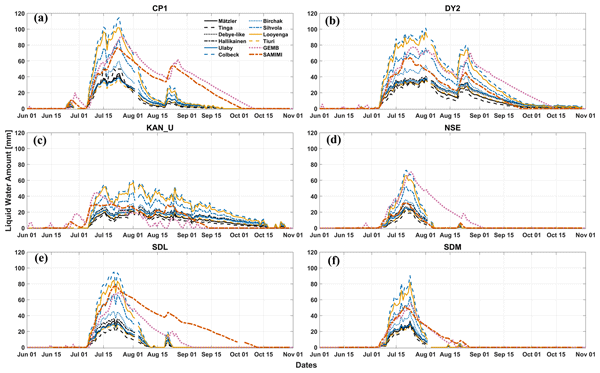
Microwave L-band radiometry offers a promising new tool for estimating the total surface-to-subsurface liquid water amount (LWA) in the snow and firn in polar ice sheets. An accurate modelling of wet snow effective permittivity is a key to this. Here, we evaluated the performance of ten commonly used microwave dielectric mixing models for estimating LWA in the percolation zone of the Greenland Ice Sheet to help an appropriate choice of dielectric mixing model for LWA retrieval algorithms.
Alamgir Hossan, Andreas Colliander, Baptiste Vandecrux, Nicole-Jeanne Schlegel, Joel Harper, Shawn Marshall, and Julie Z. Miller
The Cryosphere, 19, 4237–4258, https://doi.org/10.5194/tc-19-4237-2025, https://doi.org/10.5194/tc-19-4237-2025, 2025
Short summary
Short summary
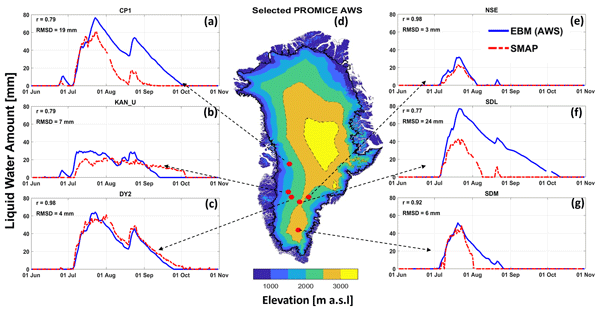
We used L-band observations from the Soil Moisture Active Passive (SMAP) mission to quantify the surface and subsurface liquid water amounts (LWAs) in the percolation zone of the Greenland ice sheet. The algorithm is described, and the validation results are provided. The results demonstrate the potential for creating an LWA data product across the Greenland ice sheet (GrIS), which will advance our understanding of ice sheet physical processes for better projection of Greenland’s contribution to global sea level rise.
Marissa E. Dattler, Brooke Medley, and C. Max Stevens
The Cryosphere, 18, 3613–3631, https://doi.org/10.5194/tc-18-3613-2024, https://doi.org/10.5194/tc-18-3613-2024, 2024
Short summary
Short summary
We developed an algorithm based on combining models and satellite observations to identify the presence of surface melt on the Antarctic Ice Sheet. We find that this method works similarly to previous methods by assessing 13 sites and the Larsen C ice shelf. Unlike previous methods, this algorithm is based on physical parameters, and updates to this method could allow the meltwater present on the Antarctic Ice Sheet to be quantified instead of simply detected.
Firoz Kanti Borah, Jonas-Fredrick Jans, Zhenming Huang, Leung Tsang, Hans Lievens, and Edward Kim
EGUsphere, https://doi.org/10.5194/egusphere-2024-1825, https://doi.org/10.5194/egusphere-2024-1825, 2024
Preprint archived
Short summary
Short summary
In this paper, we study radar data collected by Sentinel-1 over mountain regions of Alps. Using physical models of snow and soil surface scattering, we show the reasons for the high sensitivity of cross-polarized observations with snow depth. This accurate modelling for cross-pol using physical models can be then used to retrieve snow depth at for very deep snow at mountain regions using the cross-pol signal.
Riley Culberg, Roger J. Michaelides, and Julie Z. Miller
The Cryosphere, 18, 2531–2555, https://doi.org/10.5194/tc-18-2531-2024, https://doi.org/10.5194/tc-18-2531-2024, 2024
Short summary
Short summary
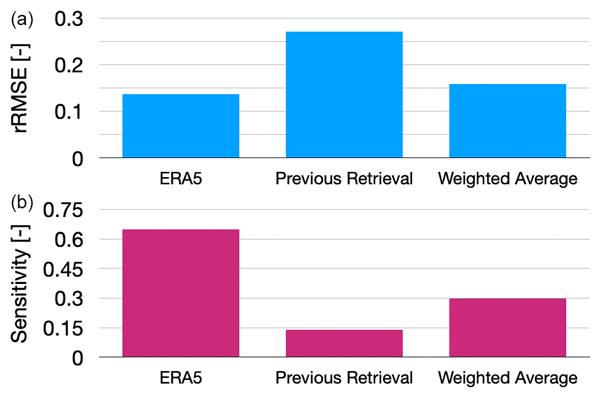
Ice slabs enhance meltwater runoff from the Greenland Ice Sheet. Therefore, it is important to understand their extent and change in extent over time. We present a new method for detecting ice slabs in satellite radar data, which we use to map ice slabs at 500 m resolution across the entire ice sheet in winter 2016–2017. Our results provide better spatial coverage and resolution than previous maps from airborne radar and lay the groundwork for long-term monitoring of ice slabs from space.
Michael Durand, Joel T. Johnson, Jack Dechow, Leung Tsang, Firoz Borah, and Edward J. Kim
The Cryosphere, 18, 139–152, https://doi.org/10.5194/tc-18-139-2024, https://doi.org/10.5194/tc-18-139-2024, 2024
Short summary
Short summary
Seasonal snow accumulates each winter, storing water to release later in the year and modulating both water and energy cycles, but the amount of seasonal snow is one of the most poorly measured components of the global water cycle. Satellite concepts to monitor snow accumulation have been proposed but not selected. This paper shows that snow accumulation can be measured using radar, and that (contrary to previous studies) does not require highly accurate information about snow microstructure.
Haokui Xu, Brooke Medley, Leung Tsang, Joel T. Johnson, Kenneth C. Jezek, Marco Brogioni, and Lars Kaleschke
The Cryosphere, 17, 2793–2809, https://doi.org/10.5194/tc-17-2793-2023, https://doi.org/10.5194/tc-17-2793-2023, 2023
Short summary
Short summary
The density profile of polar ice sheets is a major unknown in estimating the mass loss using lidar tomography methods. In this paper, we show that combing the active radar data and passive radiometer data can provide an estimation of density properties using the new model we implemented in this paper. The new model includes the short and long timescale variations in the firn and also the refrozen layers which are not included in the previous modeling work.
Eric Keenan, Nander Wever, Jan T. M. Lenaerts, and Brooke Medley
Geosci. Model Dev., 16, 3203–3219, https://doi.org/10.5194/gmd-16-3203-2023, https://doi.org/10.5194/gmd-16-3203-2023, 2023
Short summary
Short summary
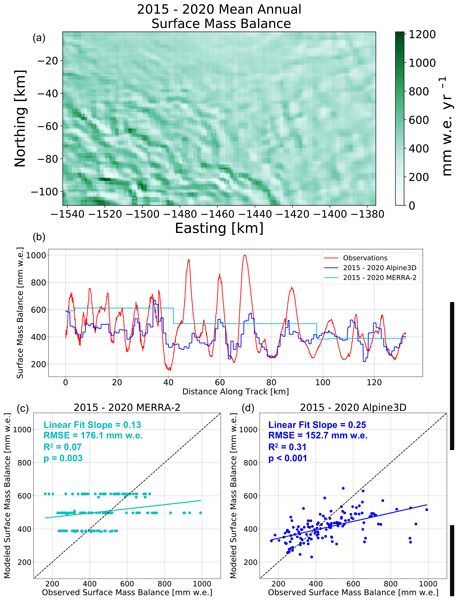
Ice sheets gain mass via snowfall. However, snowfall is redistributed by the wind, resulting in accumulation differences of up to a factor of 5 over distances as short as 5 km. These differences complicate estimates of ice sheet contribution to sea level rise. For this reason, we have developed a new model for estimating wind-driven snow redistribution on ice sheets. We show that, over Pine Island Glacier in West Antarctica, the model improves estimates of snow accumulation variability.
Megan Thompson-Munson, Nander Wever, C. Max Stevens, Jan T. M. Lenaerts, and Brooke Medley
The Cryosphere, 17, 2185–2209, https://doi.org/10.5194/tc-17-2185-2023, https://doi.org/10.5194/tc-17-2185-2023, 2023
Short summary
Short summary
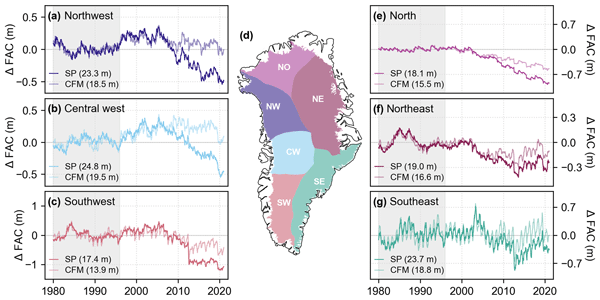
To better understand the Greenland Ice Sheet’s firn layer and its ability to buffer sea level rise by storing meltwater, we analyze firn density observations and output from two firn models. We find that both models, one physics-based and one semi-empirical, simulate realistic density and firn air content when compared to observations. The models differ in their representation of firn air content, highlighting the uncertainty in physical processes and the paucity of deep-firn measurements.

Benjamin E. Smith, Brooke Medley, Xavier Fettweis, Tyler Sutterley, Patrick Alexander, David Porter, and Marco Tedesco
The Cryosphere, 17, 789–808, https://doi.org/10.5194/tc-17-789-2023, https://doi.org/10.5194/tc-17-789-2023, 2023
Short summary
Short summary
We use repeated satellite measurements of the height of the Greenland ice sheet to learn about how three computational models of snowfall, melt, and snow compaction represent actual changes in the ice sheet. We find that the models do a good job of estimating how the parts of the ice sheet near the coast have changed but that two of the models have trouble representing surface melt for the highest part of the ice sheet. This work provides suggestions for how to better model snowmelt.
Marco Brogioni, Mark J. Andrews, Stefano Urbini, Kenneth C. Jezek, Joel T. Johnson, Marion Leduc-Leballeur, Giovanni Macelloni, Stephen F. Ackley, Alexandra Bringer, Ludovic Brucker, Oguz Demir, Giacomo Fontanelli, Caglar Yardim, Lars Kaleschke, Francesco Montomoli, Leung Tsang, Silvia Becagli, and Massimo Frezzotti
The Cryosphere, 17, 255–278, https://doi.org/10.5194/tc-17-255-2023, https://doi.org/10.5194/tc-17-255-2023, 2023
Short summary
Short summary
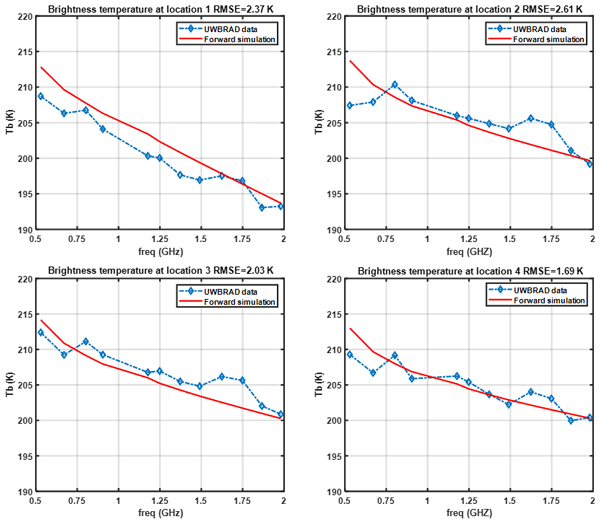
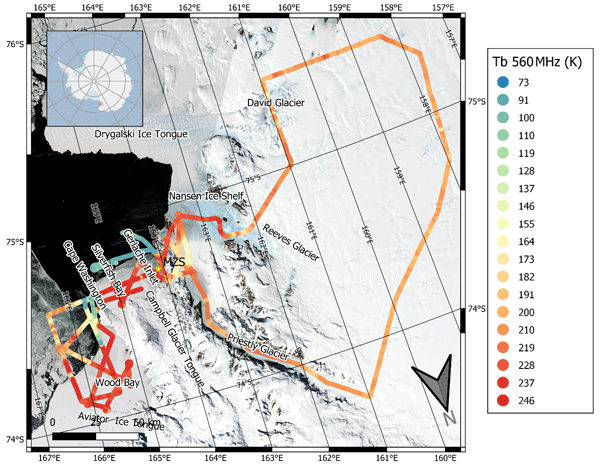
In 2018 the first Antarctic campaign of UWBRAD was carried out. UWBRAD is a new radiometer able to collect microwave spectral signatures over 0.5–2 GHz, thus outperforming existing similar sensors. It allows us to probe thicker sea ice and ice sheet down to the bedrock. In this work we tried to assess the UWBRAD potentials for sea ice, glaciers, ice shelves and buried lakes. We also highlighted the wider range of information the spectral signature can provide to glaciological studies.

Brooke Medley, Thomas A. Neumann, H. Jay Zwally, Benjamin E. Smith, and C. Max Stevens
The Cryosphere, 16, 3971–4011, https://doi.org/10.5194/tc-16-3971-2022, https://doi.org/10.5194/tc-16-3971-2022, 2022
Short summary
Short summary
Satellite altimeters measure the height or volume change over Earth's ice sheets, but in order to understand how that change translates into ice mass, we must account for various processes at the surface. Specifically, snowfall events generate large, transient increases in surface height, yet snow fall has a relatively low density, which means much of that height change is composed of air. This air signal must be removed from the observed height changes before we can assess ice mass change.
Leung Tsang, Michael Durand, Chris Derksen, Ana P. Barros, Do-Hyuk Kang, Hans Lievens, Hans-Peter Marshall, Jiyue Zhu, Joel Johnson, Joshua King, Juha Lemmetyinen, Melody Sandells, Nick Rutter, Paul Siqueira, Anne Nolin, Batu Osmanoglu, Carrie Vuyovich, Edward Kim, Drew Taylor, Ioanna Merkouriadi, Ludovic Brucker, Mahdi Navari, Marie Dumont, Richard Kelly, Rhae Sung Kim, Tien-Hao Liao, Firoz Borah, and Xiaolan Xu
The Cryosphere, 16, 3531–3573, https://doi.org/10.5194/tc-16-3531-2022, https://doi.org/10.5194/tc-16-3531-2022, 2022
Short summary
Short summary
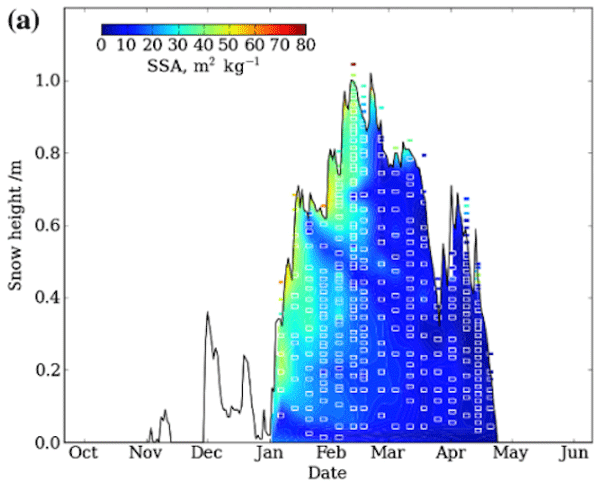
Snow water equivalent (SWE) is of fundamental importance to water, energy, and geochemical cycles but is poorly observed globally. Synthetic aperture radar (SAR) measurements at X- and Ku-band can address this gap. This review serves to inform the broad snow research, monitoring, and application communities about the progress made in recent decades to move towards a new satellite mission capable of addressing the needs of the geoscience researchers and users.
Julie Z. Miller, Riley Culberg, David G. Long, Christopher A. Shuman, Dustin M. Schroeder, and Mary J. Brodzik
The Cryosphere, 16, 103–125, https://doi.org/10.5194/tc-16-103-2022, https://doi.org/10.5194/tc-16-103-2022, 2022
Short summary
Short summary
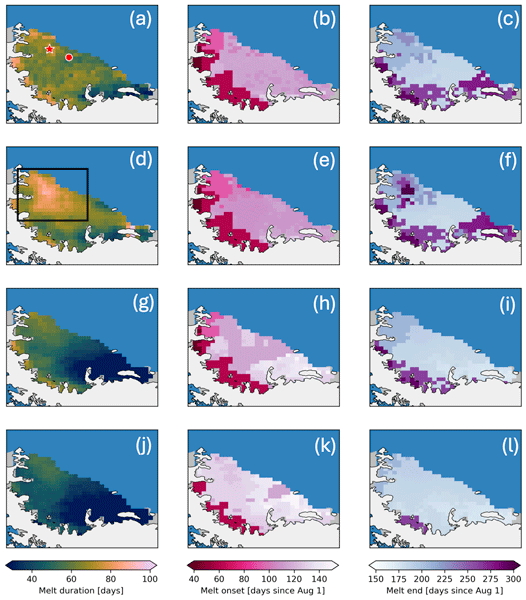
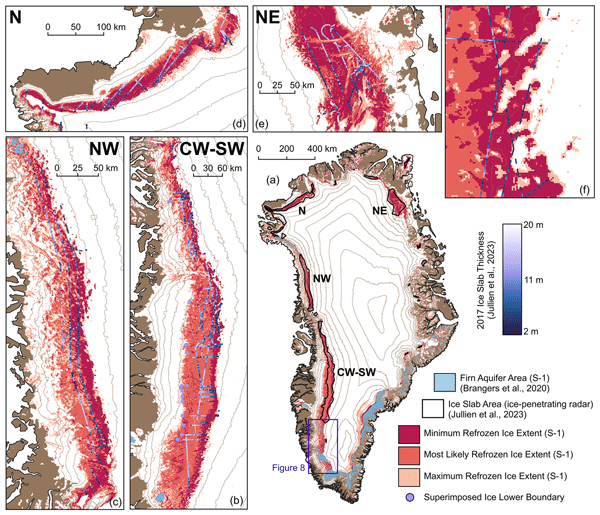
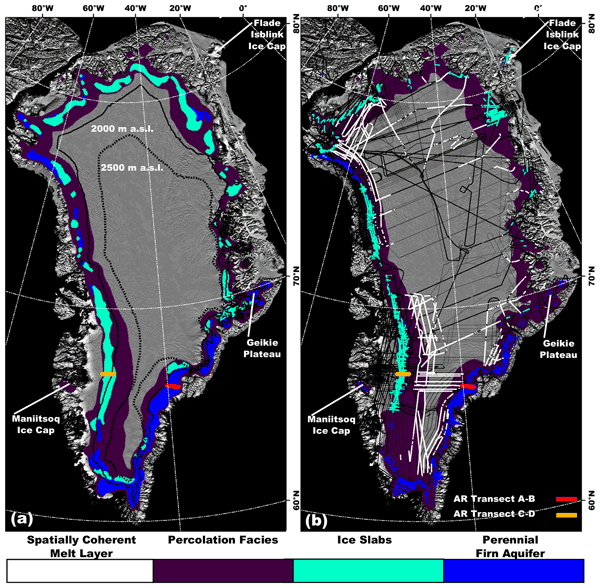
We use L-band brightness temperature imagery from NASA's Soil Moisture Active Passive (SMAP) satellite to map the extent of perennial firn aquifer and ice slab areas within the Greenland Ice Sheet. As Greenland's climate continues to warm and seasonal surface melting increases in extent, intensity, and duration, quantifying the possible rapid expansion of perennial firn aquifers and ice slab areas has significant implications for understanding the stability of the Greenland Ice Sheet.
Cited articles
van den Akker, T., van Pelt, W., Petterson, R., and Pohjola, V. A.: Long-term development of a perennial firn aquifer on the Lomonosovfonna ice cap, Svalbard, The Cryosphere, 19, 1513–1525, https://doi.org/10.5194/tc-19-1513-2025, 2025.
Baker, I.: Microstructural characterization of snow, firn and ice, Philos. T. R. Soc. A., 377, 20180162, https://doi.org/10.1098/rsta.2018.0162, 2019.
Bamber, J. L., Westaway, R. M., Marzeion, B., and Wouters, B.: The land ice contribution to sea level during the satellite era, Environ. Res. Lett., 13, 063008, https://doi.org/10.1088/1748-9326/aac2f0, 2018.
Brangers, I., Lievens, H., Miège, C., Demuzere, M., Brucker, L., and De Lannoy, G. J. M.: Sentinel-1 Detects Firn Aquifers in the Greenland Ice Sheet, Geophys. Res. Lett., 47, e2019GL085192, https://doi.org/10.1029/2019GL085192, 2020.
Bringer, A., Miller, J., Johnson, J. T., and Jezek, K. C.: Radiative transfer modeling of the brightness temperature signatures of firn aquifers, in: AGU Fall Meeting Abstracts, C11A-0899, https://ui.adsabs.harvard.edu/abs/2017AGUFM.C11A0899B/abstract (last access: 1 April 2026), 2017.
Christianson, K., Kohler, J., Alley, R. B., Nuth, C., and Van Pelt, W. J. J.: Dynamic perennial firn aquifer on an Arctic glacier, Geophys. Res. Lett., 42, 1418–1426, https://doi.org/10.1002/2014GL062806, 2015.
Chu, W., Schroeder, D. M., and Siegfried, M. R.: Retrieval of Englacial Firn Aquifer Thickness From Ice-Penetrating Radar Sounding in Southeastern Greenland, Geophys. Res. Lett., 45, https://doi.org/10.1029/2018GL079751, 2018.
CReSIS: L1B accumulation radar product, https://data.cresis.ku.edu/data/accum/ (last access: 1 April 2026), 2024.
Ding, K.-H., Xu, X., and Tsang, L.: Electromagnetic Scattering by Bicontinuous Random Microstructures With Discrete Permittivities, IEEE T. Geosci. Remote, 48, 3139–3151, https://doi.org/10.1109/TGRS.2010.2043953, 2010.
Entekhabi, D., Njoku, E. G., O'Neill, P. E., Kellogg, K. H., Crow, W. T., Edelstein, W. N., Entin, J. K., Goodman, S. D., Jackson, T. J., Johnson, J., Kimball, J., Piepmeier, J. R., Koster, R. D., Martin, N., McDonald, K. C., Moghaddam, M., Moran, S., Reichle, R., Shi, J. C., Spencer, M. W., Thurman, S. W., Tsang, L., and Van Zyl, J.: The Soil Moisture Active Passive (SMAP) Mission, Proc. IEEE, 98, 704–716, https://doi.org/10.1109/JPROC.2010.2043918, 2010.
Forster, R. R., Box, J. E., Van Den Broeke, M. R., Miège, C., Burgess, E. W., Van Angelen, J. H., Lenaerts, J. T. M., Koenig, L. S., Paden, J., Lewis, C., Gogineni, S. P., Leuschen, C., and McConnell, J. R.: Extensive liquid meltwater storage in firn within the Greenland ice sheet, Nat. Geosci., 7, 95–98, https://doi.org/10.1038/ngeo2043, 2014.
Huang, Z., Xu, H., Borah, F., Tsang, L., Medley, B., Johnson, J. T., and De Roo, R. D.: L-Band Full-Wave Simulations of the Effective Permittivity of Bi/Tri-Continuous Media With Applications to Firn Aquifer in Polar Regions and Terrestrial Wet Snow, IEEE T. Geosci. Remote, 62, 1–12, https://doi.org/10.1109/TGRS.2024.3455236, 2024.
Haokui, X.: Jokerleonxv/firn-aquifer: Firn aquifer simulation code v1.0 (firn_aquifer), Zenodo [code], https://doi.org/10.5281/zenodo.19369396, 2026.
Koenig, L. S., Miège, C., Forster, R. R., and Brucker, L.: Initial in situ measurements of perennial meltwater storage in the Greenland firn aquifer, Geophys. Res. Lett., 41, 81–85, https://doi.org/10.1002/2013GL058083, 2014.
Lenaerts, J. T. M., Medley, B., van den Broeke, M. R., and Wouters, B.: Observing and Modeling Ice-Sheet Surface Mass Balance, Rev. Geophys., 57, 376–420, https://doi.org/10.1029/2018RG000622, 2019.
Long, D. and Ulaby, F.: Microwave Radar and Radiometric Remote Sensing, Artech, Ann. Arbor., ISBN: 978-0-472-11935-6, 2015.
Long, D. G., Brodzik, M. J., and Hardman, M. A.: Enhanced-Resolution SMAP Brightness Temperature Image Products, IEEE Trans. Geosci. Remote Sens., 57, 4151–4163, https://doi.org/10.1109/TGRS.2018.2889427, 2019.
Mankoff, K. D., Fettweis, X., Langen, P. L., Stendel, M., Kjeldsen, K. K., Karlsson, N. B., Noël, B., van den Broeke, M. R., Solgaard, A., Colgan, W., Box, J. E., Simonsen, S. B., King, M. D., Ahlstrøm, A. P., Andersen, S. B., and Fausto, R. S.: Greenland ice sheet mass balance from 1840 through next week, Earth Syst. Sci. Data, 13, 5001–5025, https://doi.org/10.5194/essd-13-5001-2021, 2021.
Matzler, C.: Microwave permittivity of dry snow, IEEE Trans. Geosci. Remote Sens., 34, 573–581, https://doi.org/10.1109/36.485133, 1996.
Miège, C., Forster, R. R., Brucker, L., Koenig, L. S., Solomon, D. K., Paden, J. D., Box, J. E., Burgess, E. W., Miller, J. Z., McNerney, L., Brautigam, N., Fausto, R. S., and Gogineni, S.: Spatial extent and temporal variability of Greenland firn aquifers detected by ground and airborne radars, J. Geophys. Res.-Earth, 121, 2381–2398, https://doi.org/10.1002/2016JF003869, 2016.
Miège, C., Forster, R., Brucker, L., Koenig, L., Miller, O., Solomon, K., and Schmerr, N.: Firn temperatures (2013–2017) and water-level changes (2015–2017) collected at three locations in a firn-aquifer region of the southeastern part of the Greenland Ice Sheet, Arctic Data Center [data set], https://doi.org/10.18739/A2R785P5W, 2020a.
Miège, C., Forster, R., Koenig, L., Miller, J., Miller, O., Montgomery, L., et al.: Density, hydrology and geophysical measurements from the Wilkins Ice Shelf firn aquifer, U.S. Antarctic Program (USAP) Data Center [data set], https://doi.org/10.15784/601390, 2020b.
Miller, J. Z., Long, D. G., Jezek, K. C., Johnson, J. T., Brodzik, M. J., Shuman, C. A., Koenig, L. S., and Scambos, T. A.: Brief communication: Mapping Greenland's perennial firn aquifers using enhanced-resolution L-band brightness temperature image time series, The Cryosphere, 14, 2809–2817, https://doi.org/10.5194/tc-14-2809-2020, 2020a.
Miller, J. Z., Culberg, R., Long, D. G., Shuman, C. A., Schroeder, D. M., and Brodzik, M. J.: An empirical algorithm to map perennial firn aquifers and ice slabs within the Greenland Ice Sheet using satellite L-band microwave radiometry, The Cryosphere, 16, 103–125, https://doi.org/10.5194/tc-16-103-2022, 2022.
Miller, O., Solomon, D. K., Miège, C., Koenig, L., Forster, R., Schmerr, N., Ligtenberg, S. R. M., and Montgomery, L.: Direct Evidence of Meltwater Flow Within a Firn Aquifer in Southeast Greenland, Geophys. Res. Lett., 45, 207–215, https://doi.org/10.1002/2017GL075707, 2018.
Miller, O., Solomon, D. K., Miège, C., Koenig, L., Forster, R., Schmerr, N., Ligtenberg, S. R. M., Legchenko, A., Voss, C. I., Montgomery, L., and McConnell, J. R.: Hydrology of a Perennial Firn Aquifer in Southeast Greenland: An Overview Driven by Field Data, Water Resour. Res., 56, e2019WR026348, https://doi.org/10.1029/2019WR026348, 2020b.
Miller, O. L., Solomon, D. K., Miège, C., Koenig, L. S., Forster, R. R., Montgomery, L. N., Schmerr, N., Ligtenberg, S. R. M., Legchenko, A., and Brucker, L.: Hydraulic Conductivity of a Firn Aquifer in Southeast Greenland, Front. Earth Sci., 5, 38, https://doi.org/10.3389/feart.2017.00038, 2017.
Montgomery, L., Koenig, L., and Alexander, P.: The SUMup dataset: compiled measurements of surface mass balance components over ice sheets and sea ice with analysis over Greenland, Earth Syst. Sci. Data, 10, 1959–1985, https://doi.org/10.5194/essd-10-1959-2018, 2018.
Montgomery, L., Miège, C., Miller, J., Scambos, T. A., Wallin, B., Miller, O., Solomon, D. K., Forster, R., and Koenig, L.: Hydrologic Properties of a Highly Permeable Firn Aquifer in the Wilkins Ice Shelf, Antarctica, Geophys. Res. Lett., 47, e2020GL089552, https://doi.org/10.1029/2020GL089552, 2020.
Nghiem, S. V., Hall, D. K., Mote, T. L., Tedesco, M., Albert, M. R., Keegan, K., Shuman, C. A., DiGirolamo, N. E., and Neumann, G.: The extreme melt across the Greenland ice sheet in 2012, Geophys. Res. Lett., 39, 2012GL053611, https://doi.org/10.1029/2012GL053611, 2012.
Shepherd, A., Ivins, E. R., A, G., Barletta, V. R., Bentley, M. J., Bettadpur, S., Briggs, K. H., Bromwich, D. H., Forsberg, R., Galin, N., Horwath, M., Jacobs, S., Joughin, I., King, M. A., Lenaerts, J. T. M., Li, J., Ligtenberg, S. R. M., Luckman, A., Luthcke, S. B., McMillan, M., Meister, R., Milne, G., Mouginot, J., Muir, A., Nicolas, J. P., Paden, J., Payne, A. J., Pritchard, H., Rignot, E., Rott, H., Sørensen, L. S., Scambos, T. A., Scheuchl, B., Schrama, E. J. O., Smith, B., Sundal, A. V., Van Angelen, J. H., Van De Berg, W. J., Van Den Broeke, M. R., Vaughan, D. G., Velicogna, I., Wahr, J., Whitehouse, P. L., Wingham, D. J., Yi, D., Young, D., and Zwally, H. J.: A Reconciled Estimate of Ice-Sheet Mass Balance, Science, 338, 1183–1189, https://doi.org/10.1126/science.1228102, 2012.
Sihvola, A. H.: Electromagnetic Mixing Formulas and Applications, Institution of Electrical Engineers, ISBN: 978-0-85296-772-0, 1999.
Slater, T., Lawrence, I. R., Otosaka, I. N., Shepherd, A., Gourmelen, N., Jakob, L., Tepes, P., Gilbert, L., and Nienow, P.: Review article: Earth's ice imbalance, The Cryosphere, 15, 233–246, https://doi.org/10.5194/tc-15-233-2021, 2021.
Stevens, M., Vo, H., emmakahle, and Jboat: UWGlaciology/CommunityFirnModel: Version 1.1.6, Zenodo [code], https://doi.org/10.5281/zenodo.5719748, 2021.
Tiuri, M., Sihvola, A., Nyfors, E., and Hallikaiken, M.: The complex dielectric constant of snow at microwave frequencies, IEEE J. Ocean. Eng., 9, 377–382, https://doi.org/10.1109/JOE.1984.1145645, 1984.
Tsang, L., Kong, J. A., and Ding, K. H.: Scattering of Electromagnetic Waves: Theories and Applications, Wiley, ISBN: 9780471387992, 2004.
Xu, H.: Electromagnetic Modelling for the Active and Passive Remote Sensing of Polar Ice Sheet and Signal of Opportunity (SoOp) Land Observation., University of Michigan, Ann Arbor, 141 pp., PhD Thesis, ISBN: 9798382738222, 2024.
Xu, H., Medley, B., Tsang, L., Johnson, J. T., Jezek, K. C., Brogioni, M., and Kaleschke, L.: Polar firn properties in Greenland and Antarctica and related effects on microwave brightness temperatures, The Cryosphere, 17, 2793–2809, https://doi.org/10.5194/tc-17-2793-2023, 2023.
Short summary
This paper provides a physical model to analyze the brightness temperature time series over the firn aquifer in Greenland and Antarctica. The model can match the Vertical polarized and Horizontal polarized brightness temperature time series well. This model provides a potential to study the aquifer water table depth and liquid water content with radiometry.
This paper provides a physical model to analyze the brightness temperature time series over the...


