
Articles | Volume 20, issue 4
https://doi.org/10.5194/tc-20-2181-2026
© Author(s) 2026. This work is distributed under
the Creative Commons Attribution 4.0 License.
the Creative Commons Attribution 4.0 License.
https://doi.org/10.5194/tc-20-2181-2026
© Author(s) 2026. This work is distributed under
the Creative Commons Attribution 4.0 License.
the Creative Commons Attribution 4.0 License.
Research article
| 
20 Apr 2026
Research article |
| 20 Apr 2026
| 20 Apr 2026
Rockwall permafrost dynamics evidenced by repeated and Automated Electrical Resistivity Tomography at Aiguille du Midi (3842 m a.s.l., French Alps)
Feras Abdulsamad
CORRESPONDING AUTHOR

EDYTEM, CNRS – Université Savoie Mont-Blanc, 73370 Le Bourget du Lac, France
Naga Geophysics, 229 rue Joseph Fontanet 73000 Chambéry, France
Josué Bock
EDYTEM, CNRS – Université Savoie Mont-Blanc, 73370 Le Bourget du Lac, France
Florence Magnin
EDYTEM, CNRS – Université Savoie Mont-Blanc, 73370 Le Bourget du Lac, France
Emmanuel Malet
EDYTEM, CNRS – Université Savoie Mont-Blanc, 73370 Le Bourget du Lac, France
André Revil
EDYTEM, CNRS – Université Savoie Mont-Blanc, 73370 Le Bourget du Lac, France
Matan Ben-Asher
EDYTEM, CNRS – Université Savoie Mont-Blanc, 73370 Le Bourget du Lac, France
Jessy Richard
EDYTEM, CNRS – Université Savoie Mont-Blanc, 73370 Le Bourget du Lac, France
Naga Geophysics, 229 rue Joseph Fontanet 73000 Chambéry, France
Pierre-Allain Duvillard
Naga Geophysics, 229 rue Joseph Fontanet 73000 Chambéry, France
Marios Karaoulis
School of Geology, Geophysics Department, Aristotle University of Thessaloniki, Thessaloniki, Greece
Thomas Condom
Univ. Grenoble Alpes, IRD, CNRS, INRAE, Grenoble-INP, IGE, 38000 Grenoble, France
Ludovic Ravanel
EDYTEM, CNRS – Université Savoie Mont-Blanc, 73370 Le Bourget du Lac, France
Philip Deline
EDYTEM, CNRS – Université Savoie Mont-Blanc, 73370 Le Bourget du Lac, France
Related authors
No articles found.
Olivier Champagne, Flora Branger, Anthony Lemoine, Jordi Bolibar, Louise Mimeau, Gilles Delaygue, Isabelle Gouttevin, Sophie Cauvy-Fraunié, and Thomas Condom
EGUsphere, https://doi.org/10.5194/egusphere-2026-3523, https://doi.org/10.5194/egusphere-2026-3523, 2026
This preprint is open for discussion and under review for Hydrology and Earth System Sciences (HESS).
Short summary
Short summary
This study using a hydrological model shows the projections of icemelt contribution to streamflow until the end of the century in many rivers in the Rhône basin. The results show a streamflow decrease in summer, due to the decrease of precipitations, snowmelt, and glacier melt. In many catchments, icemelt will completely disappear by the end of the century. In the Arve and highly glaciated catchments of the upper Rhône, icemelt will remains sufficiently large to sustain streamflow in summer.
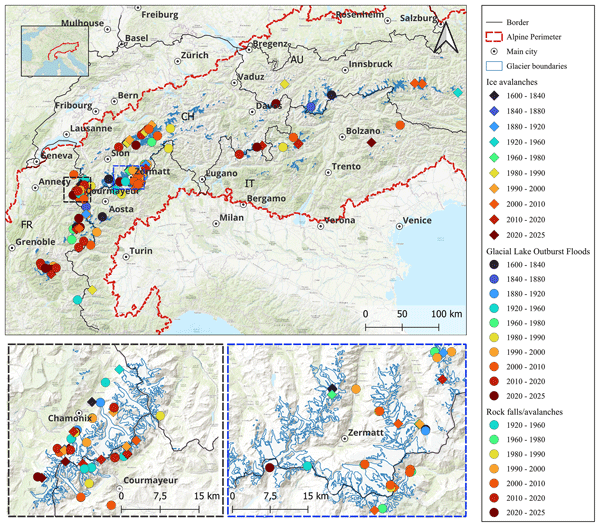
Juliette Bazin, Ludovic Ravanel, and Sandrine Caroly
Nat. Hazards Earth Syst. Sci., 26, 2955–2973, https://doi.org/10.5194/nhess-26-2955-2026, https://doi.org/10.5194/nhess-26-2955-2026, 2026
Short summary
Short summary
Through a geo-historical study, we compile an inventory of glacial and periglacial events that have prompted risk management actions in the Alps. Analysed through eight guiding principles, this research examines how methods have evolved across Alpine countries. Certain events mark turning points in risk perception. Today, management benefits from improved understanding of both hazards and vulnerabilities.
Ben Robson, James Irving, Florence Magnin, Ludovic Ravanel, Coline Mollaret, Ludovic Baron, André Revil, Jessy Richard, Jérémie Gentizon, and Christophe Lambiel
EGUsphere, https://doi.org/10.5194/egusphere-2026-2455, https://doi.org/10.5194/egusphere-2026-2455, 2026
Short summary
Short summary
We investigated a hanging glacier in the Swiss Alps to resolve poorly known geometry, thermal conditions and response to climate forcing. Using up to five years of data from drone surveys, ground penetrating radar, temperature measurements and modelling, we show the glacier lost up to 7 m (20–45 % of the 2021 thickness), while the surrounding permafrost is degrading. The glacier is transitioning towards polythermal conditions, due to meltwater infiltration, increasing future instability risk.
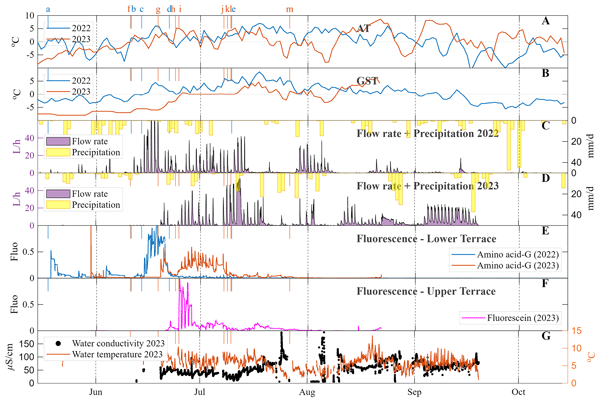
Matan Ben-Asher, Antoine Chabas, Jean-Yves Josnin, Josué Bock, Emmanuel Malet, Amaël Poulain, Yves Perrette, and Florence Magnin
Hydrol. Earth Syst. Sci., 30, 1735–1754, https://doi.org/10.5194/hess-30-1735-2026, https://doi.org/10.5194/hess-30-1735-2026, 2026
Short summary
Short summary
We studied how water moves through fractured rock walls in a high mountain area in the Alps. Using sensors and tracers over two years, in a high-altitude site, we tracked where the water came from and when it flowed. Most of it came from melting snow, but some came from rain and older ice. The results show that heat and water flow can speed up the melting of frozen ground, which may affect mountain stability. This helps us understand how climate change influences these fragile environments.
Simon Filhol, Clément Misset, Noélie Bontemps, Diego Cusicanqui, Emmanuel Paquet, Marie Dumont, Olivier Gagliardini, Pascal Lacroix, Simon Gascoin, Guillaume Thirel, Julien Brondex, Pascal Hagenmuller, Eric Larose, Philipp Schoeneich, Denis Roy, Emmanuel Thibert, Nicolas Eckert, Félix de Montety, Robin Mainieri, Alexandre Hauet, Frédéric Gottardi, Johan Berthet, Alexandre Baratier, Frédéric Liébault, Małgorzata Chmiel, Guillaume Piton, Guillaume Chambon, Guillaume James, Philippe Frey, Philip Deline, Laurent Astrade, Christian Vincent, Dominique Laigle, Alain Recking, Fatima Karbou, Adrien Mauss, Mylène Bonnefoy-Demongeot, Firmin Fontaine, Mickael Langlais, Etienne Berthier, and Antoine Blanc
EGUsphere, https://doi.org/10.5194/egusphere-2026-971, https://doi.org/10.5194/egusphere-2026-971, 2026
Short summary
Short summary
On June 21 2024, the village of La Bérarde, in the French Alps, was devastated by a flood destroying centuries old buildings. This study is an interdisciplinary work to decipher the causes and chronology of the event. The flood started with decadal rain falling on a thick snowpack. A lake observed on top of a glacier few days prior, had drained post event. With climate change, should we expect more similar compound events for alpine communities?
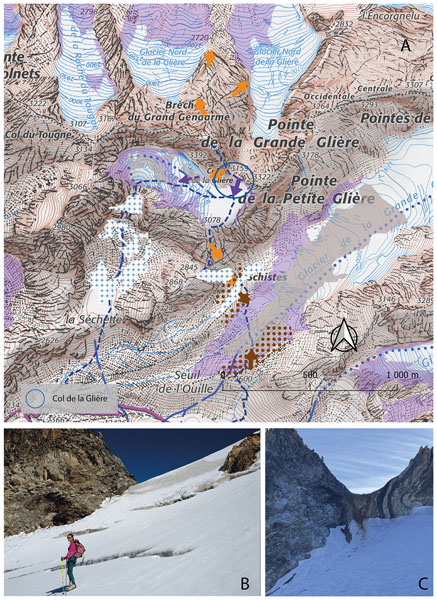
Xavier Cailhol, Ludovic Ravanel, and Jacques Mourey
Geogr. Helv., 80, 527–544, https://doi.org/10.5194/gh-80-527-2025, https://doi.org/10.5194/gh-80-527-2025, 2025
Short summary
Short summary
This study examines the impact of climate change on Alpine climbing routes in the western European Alps. By identifying the routes most frequented by French mountain guides across various Alpine massifs, the research combines historical comparisons, contemporary surveys and detailed mapping of geomorphological and glaciological processes.
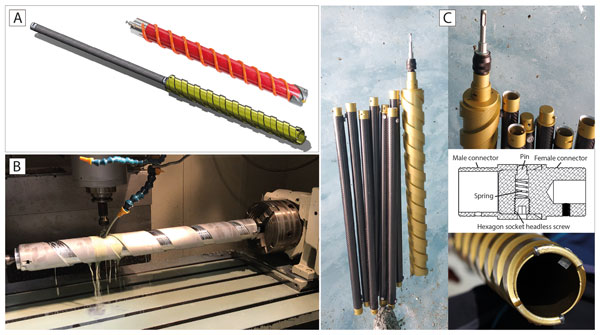
Ludovic Ravanel, Romain Duphil, Emmanuel Malet, Christine Piot, Olivier Alemany, Xavier Cailhol, and Michel Fauquet
Geogr. Helv., 80, 455–465, https://doi.org/10.5194/gh-80-455-2025, https://doi.org/10.5194/gh-80-455-2025, 2025
Short summary
Short summary
Ice aprons are little-known ice masses on steep Alpine rock faces. They are also paleo-environmental archives as their ice is several thousand years old. A special corer has been developed to sample the ice before analysing it.
Léa Courtial-Manent, Jean-Louis Mugnier, Anta-Clarisse Sarr, Ludovic Ravanel, Julien Carcaillet, Riccardo Vassallo, and Arthur Schwing
Geogr. Helv., 80, 339–362, https://doi.org/10.5194/gh-80-339-2025, https://doi.org/10.5194/gh-80-339-2025, 2025
Short summary
Short summary
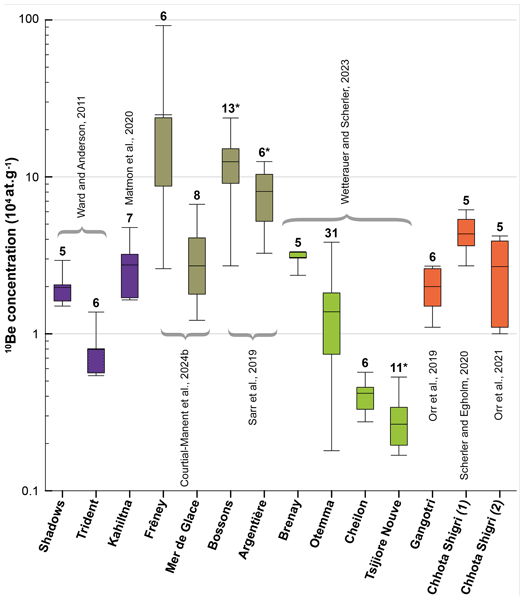
This study explores how rocks on glacier surfaces originating from rockfalls help measure erosion rates using a chemical marker called 10Be. By analyzing data from 31 glaciers we found that erosion rates vary widely but can be accurately estimated and reveal links to rock exposure, glacier movement, and climate effects. Comparing 10Be erosion rates to other exhumation rates shows cases of balance, slower erosion, or faster erosion, offering insights into the complex drivers of rockwall erosion.
Nilo Lima-Quispe, Denis Ruelland, Antoine Rabatel, Waldo Lavado-Casimiro, and Thomas Condom
Hydrol. Earth Syst. Sci., 29, 655–682, https://doi.org/10.5194/hess-29-655-2025, https://doi.org/10.5194/hess-29-655-2025, 2025
Short summary
Short summary
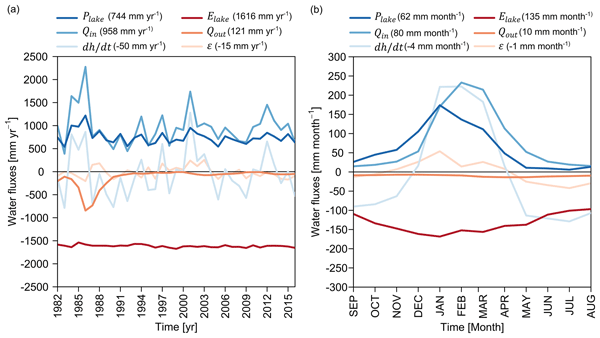
This study estimated the water balance of Lake Titicaca using an integrated modeling framework that considers natural hydrological processes and net irrigation consumption. The proposed approach was implemented at a daily scale for a period of 35 years. This framework is able to simulate lake water levels with good accuracy over a wide range of hydroclimatic conditions. The findings demonstrate that a simple representation of hydrological processes is suitable for use in poorly gauged regions.
Alexis Caro, Thomas Condom, Antoine Rabatel, Nicolas Champollion, Nicolás García, and Freddy Saavedra
The Cryosphere, 18, 2487–2507, https://doi.org/10.5194/tc-18-2487-2024, https://doi.org/10.5194/tc-18-2487-2024, 2024
Short summary
Short summary
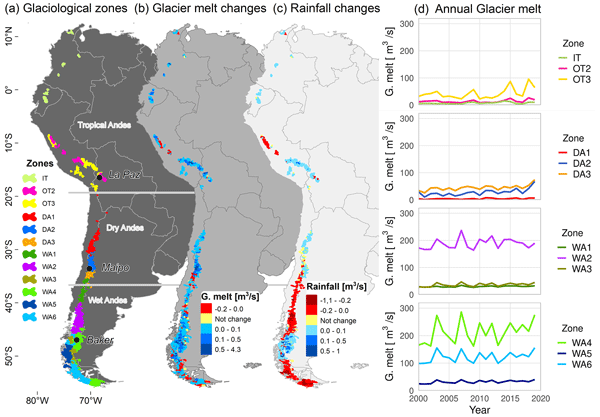
The glacier runoff changes are still unknown in most of the Andean catchments, thereby increasing uncertainties in estimating water availability, especially during the dry season. Here, we simulate glacier evolution and related glacier runoff changes across the Andes between 2000 and 2019. Our results indicate a glacier reduction in 93 % of the catchments, leading to a 12 % increase in glacier melt. These results can be downloaded and integrated with discharge measurements in each catchment.
Marco Marcer, Pierre-Allain Duvillard, Soňa Tomaškovičová, Steffen Ringsø Nielsen, André Revil, and Thomas Ingeman-Nielsen
The Cryosphere, 18, 1753–1771, https://doi.org/10.5194/tc-18-1753-2024, https://doi.org/10.5194/tc-18-1753-2024, 2024
Short summary
Short summary
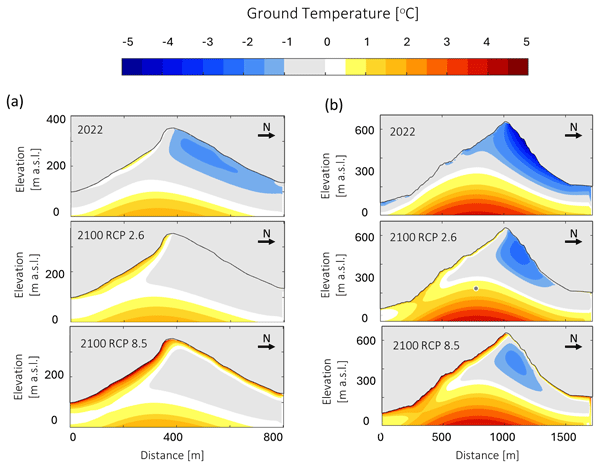
This study models present and future rock wall temperatures in the mountains near Sisimiut, creating knowledge on mountain permafrost in Greenland for the first time. Bedrock is mostly frozen but also has temperatures near 0 oC, making it very sensitive to climate changes. Future climatic scenarios indicate a reduction in frozen rock wall areas. Since mountain permafrost thaw is linked to an increase in landslides, these results call for more efforts addressing mountain permafrost in Greenland.
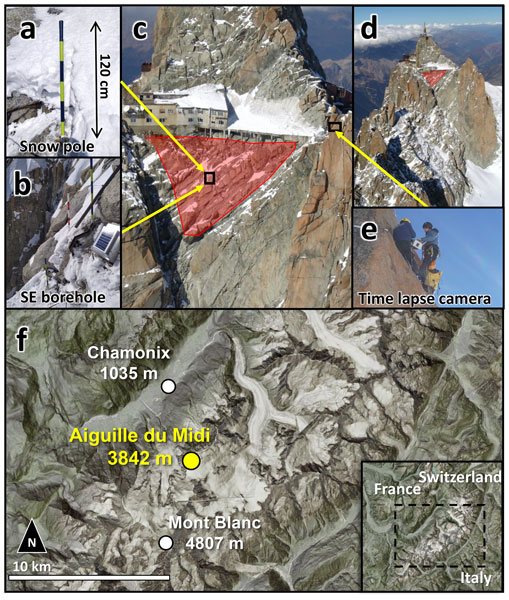
Matan Ben-Asher, Florence Magnin, Sebastian Westermann, Josué Bock, Emmanuel Malet, Johan Berthet, Ludovic Ravanel, and Philip Deline
Earth Surf. Dynam., 11, 899–915, https://doi.org/10.5194/esurf-11-899-2023, https://doi.org/10.5194/esurf-11-899-2023, 2023
Short summary
Short summary
Quantitative knowledge of water availability on high mountain rock slopes is very limited. We use a numerical model and field measurements to estimate the water balance at a steep rock wall site. We show that snowmelt is the main source of water at elevations >3600 m and that snowpack hydrology and sublimation are key factors. The new information presented here can be used to improve the understanding of thermal, hydrogeological, and mechanical processes on steep mountain rock slopes.
Catharina Dieleman, Philip Deline, Susan Ivy Ochs, Patricia Hug, Jordan Aaron, Marcus Christl, and Naki Akçar
EGUsphere, https://doi.org/10.5194/egusphere-2023-1873, https://doi.org/10.5194/egusphere-2023-1873, 2023
Preprint withdrawn
Short summary
Short summary
Valleys in the Alps are shaped by glaciers, rivers, mass movements, and slope processes. An understanding of such processes is of great importance in hazard mitigation. We focused on the evolution of the Frébouge cone, which is composed of glacial, debris flow, rock avalanche, and snow avalanche deposits. Debris flows started to form the cone prior to ca. 2 ka ago. In addition, the cone was overrun by a 10 Mm3 large rock avalanche at 1.3 ± 0.1 ka and by the Frébouge glacier at 300 ± 40 a.
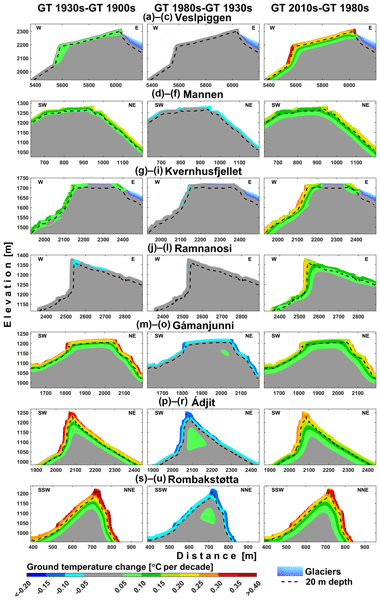
Justyna Czekirda, Bernd Etzelmüller, Sebastian Westermann, Ketil Isaksen, and Florence Magnin
The Cryosphere, 17, 2725–2754, https://doi.org/10.5194/tc-17-2725-2023, https://doi.org/10.5194/tc-17-2725-2023, 2023
Short summary
Short summary
We assess spatio-temporal permafrost variations in selected rock walls in Norway over the last 120 years. Ground temperature is modelled using the two-dimensional ground heat flux model CryoGrid 2D along nine profiles. Permafrost probably occurs at most sites. All simulations show increasing ground temperature from the 1980s. Our simulations show that rock wall permafrost with a temperature of −1 °C at 20 m depth could thaw at this depth within 50 years.
Sebastian Westermann, Thomas Ingeman-Nielsen, Johanna Scheer, Kristoffer Aalstad, Juditha Aga, Nitin Chaudhary, Bernd Etzelmüller, Simon Filhol, Andreas Kääb, Cas Renette, Louise Steffensen Schmidt, Thomas Vikhamar Schuler, Robin B. Zweigel, Léo Martin, Sarah Morard, Matan Ben-Asher, Michael Angelopoulos, Julia Boike, Brian Groenke, Frederieke Miesner, Jan Nitzbon, Paul Overduin, Simone M. Stuenzi, and Moritz Langer
Geosci. Model Dev., 16, 2607–2647, https://doi.org/10.5194/gmd-16-2607-2023, https://doi.org/10.5194/gmd-16-2607-2023, 2023
Short summary
Short summary
The CryoGrid community model is a new tool for simulating ground temperatures and the water and ice balance in cold regions. It is a modular design, which makes it possible to test different schemes to simulate, for example, permafrost ground in an efficient way. The model contains tools to simulate frozen and unfrozen ground, snow, glaciers, and other massive ice bodies, as well as water bodies.
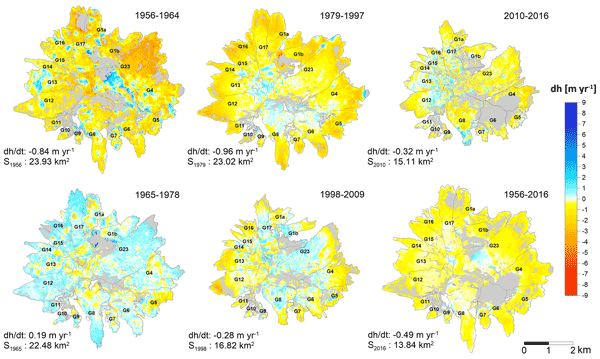
Rubén Basantes-Serrano, Antoine Rabatel, Bernard Francou, Christian Vincent, Alvaro Soruco, Thomas Condom, and Jean Carlo Ruíz
The Cryosphere, 16, 4659–4677, https://doi.org/10.5194/tc-16-4659-2022, https://doi.org/10.5194/tc-16-4659-2022, 2022
Short summary
Short summary
We assessed the volume variation of 17 glaciers on the Antisana ice cap, near the Equator. We used aerial and satellite images for the period 1956–2016. We highlight very negative changes in 1956–1964 and 1979–1997 and slightly negative or even positive conditions in 1965–1978 and 1997–2016, the latter despite the recent increase in temperatures. Glaciers react according to regional climate variability, while local humidity and topography influence the specific behaviour of each glacier.
Suvrat Kaushik, Ludovic Ravanel, Florence Magnin, Yajing Yan, Emmanuel Trouve, and Diego Cusicanqui
The Cryosphere, 16, 4251–4271, https://doi.org/10.5194/tc-16-4251-2022, https://doi.org/10.5194/tc-16-4251-2022, 2022
Short summary
Short summary
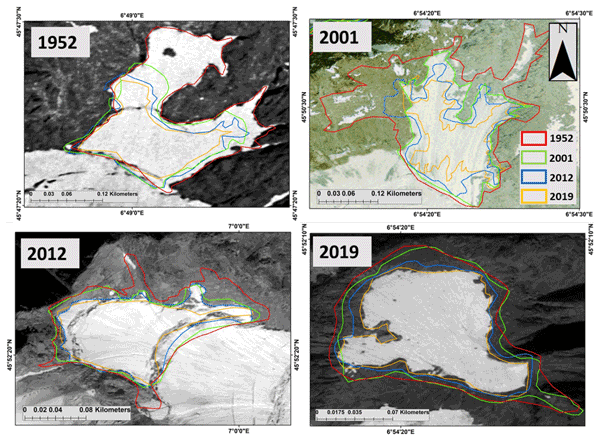
Climate change impacts all parts of the cryosphere but most importantly the smaller ice bodies like ice aprons (IAs). This study is the first attempt on a regional scale to assess the impacts of the changing climate on these small but very important ice bodies. Our study shows that IAs have consistently lost mass over the past decades. The effects of climate variables, particularly temperature and precipitation and topographic factors, were analysed on the loss of IA area.
Josué Bock, Jan Kaiser, Max Thomas, Andreas Bott, and Roland von Glasow
Geosci. Model Dev., 15, 5807–5828, https://doi.org/10.5194/gmd-15-5807-2022, https://doi.org/10.5194/gmd-15-5807-2022, 2022
Short summary
Short summary
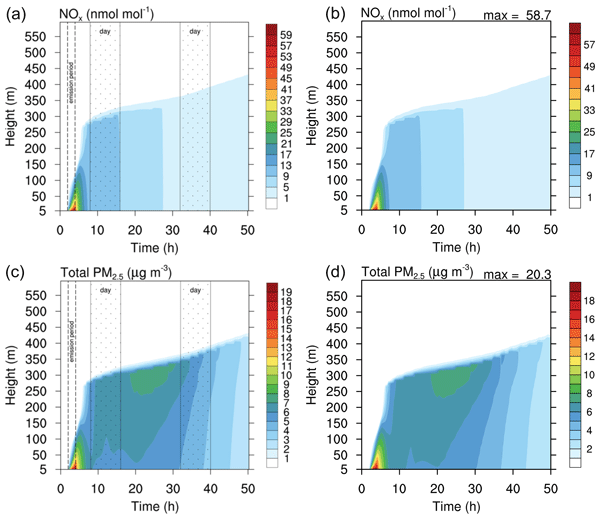
MISTRA-v9.0 is an atmospheric boundary layer chemistry model. The model includes a detailed particle description with regards to the microphysics, gas–particle interactions, and liquid phase chemistry within particles. Version 9.0 is the first release of MISTRA as an open-source community model. This paper presents a thorough description of the model characteristics and components. We show some examples of simulations reproducing previous studies with MISTRA with good consistency.

Emilio I. Mateo, Bryan G. Mark, Robert Å. Hellström, Michel Baraer, Jeffrey M. McKenzie, Thomas Condom, Alejo Cochachín Rapre, Gilber Gonzales, Joe Quijano Gómez, and Rolando Cesai Crúz Encarnación
Earth Syst. Sci. Data, 14, 2865–2882, https://doi.org/10.5194/essd-14-2865-2022, https://doi.org/10.5194/essd-14-2865-2022, 2022
Short summary
Short summary
This article presents detailed and comprehensive hydrological and meteorological datasets collected over the past two decades throughout the Cordillera Blanca, Peru. With four weather stations and six streamflow gauges ranging from 3738 to 4750 m above sea level, this network displays a vertical breadth of data and enables detailed research of atmospheric and hydrological processes in a tropical high mountain region.
S. Kaushik, S. Leinss, L. Ravanel, E. Trouvé, Y. Yan, and F. Magnin
ISPRS Ann. Photogramm. Remote Sens. Spatial Inf. Sci., V-3-2022, 325–332, https://doi.org/10.5194/isprs-annals-V-3-2022-325-2022, https://doi.org/10.5194/isprs-annals-V-3-2022-325-2022, 2022
Romina Llanos, Patricia Moreira-Turcq, Bruno Turcq, Raúl Espinoza Villar, Yizet Huaman, Thomas Condom, and Bram Willems
Biogeosciences Discuss., https://doi.org/10.5194/bg-2022-47, https://doi.org/10.5194/bg-2022-47, 2022
Manuscript not accepted for further review
Short summary
Short summary
Our results highlight a marked decrease of high carbon accumulation rates in Andean peatlands over the last decades due to the diminution in melt water inflow generated by the retreat of glaciers as a consequence of regional warming. These marked changes stress the high ecological sensitivity of these peatlands, endangering their outstanding role in the regional (and even global) C cycle as large C sinks that contribute to the mitigation of global climate change.
Jacques Mourey, Pascal Lacroix, Pierre-Allain Duvillard, Guilhem Marsy, Marco Marcer, Emmanuel Malet, and Ludovic Ravanel
Nat. Hazards Earth Syst. Sci., 22, 445–460, https://doi.org/10.5194/nhess-22-445-2022, https://doi.org/10.5194/nhess-22-445-2022, 2022
Short summary
Short summary
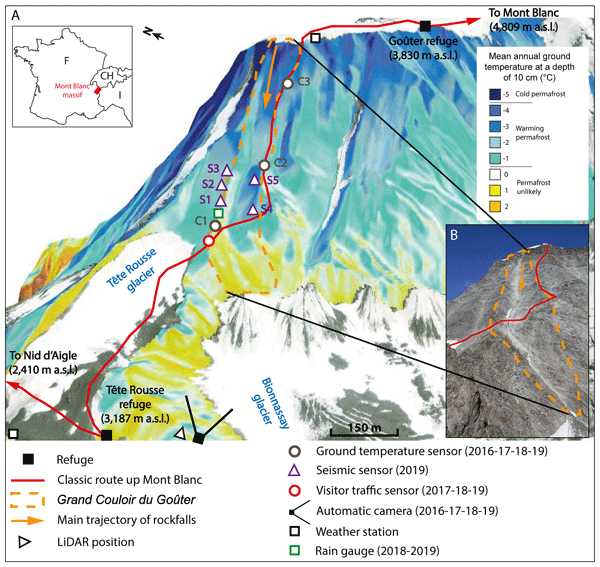
More frequent rockfalls in high alpine environments due to climate change are a growing threat to mountaineers. This hazard is particularly important on the classic route up Mont Blanc. Our results show that rockfalls are most frequent during snowmelt periods and the warmest hours of the day, and that mountaineers do not adapt to the local rockfall hazard when planning their ascent. Disseminating the knowledge acquired from our study caused management measures to be implemented for the route.
Bernd Etzelmüller, Justyna Czekirda, Florence Magnin, Pierre-Allain Duvillard, Ludovic Ravanel, Emanuelle Malet, Andreas Aspaas, Lene Kristensen, Ingrid Skrede, Gudrun D. Majala, Benjamin Jacobs, Johannes Leinauer, Christian Hauck, Christin Hilbich, Martina Böhme, Reginald Hermanns, Harald Ø. Eriksen, Tom Rune Lauknes, Michael Krautblatter, and Sebastian Westermann
Earth Surf. Dynam., 10, 97–129, https://doi.org/10.5194/esurf-10-97-2022, https://doi.org/10.5194/esurf-10-97-2022, 2022
Short summary
Short summary
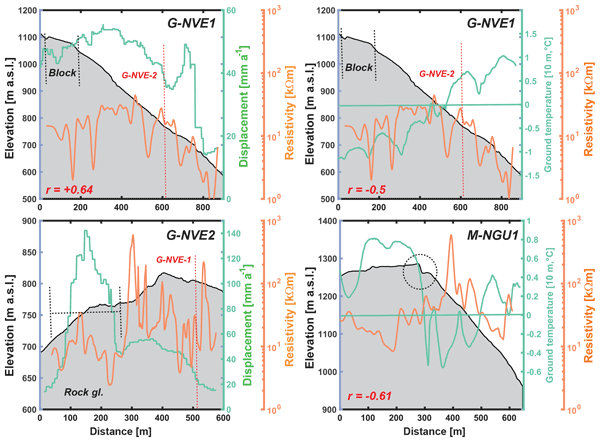
This paper is a multi-authored study documenting the possible existence of permafrost in permanently monitored rockslides in Norway for the first time by combining a multitude of field data, including geophysical surveys in rock walls. The paper discusses the possible role of thermal regime and rockslide movement, and it evaluates the possible impact of atmospheric warming on rockslide dynamics in Norwegian mountains.
Cited articles
Abdulsamad, F., Revil, A., Ghorbani, A., Toy, V., Kirilova, M., Coperey, A., Duvillard, P. A., Ménard, G., and Ravanel, L.: Complex conductivity of graphitic schists and sandstones, J. Geophys. Res. Sol. Ea., 124, 8223–8249, https://doi.org/10.1029/2019JB017628, 2019.
Ben-Asher, M., Magnin, F., Westermann, S., Bock, J., Malet, E., Berthet, J., Ravanel, L., and Deline, P.: Estimating surface water availability in high mountain rock slopes using a numerical energy balance model, Earth Surf. Dynam., 11, 899–915, https://doi.org/10.5194/esurf-11-899-2023, 2023.
Ben-Asher, M., Chabas, A., Josnin, J.-Y., Bock, J., Malet, E., Poulain, A., Perrette, Y., and Magnin, F.: Water flow timing, quantity, and sources in a fractured high mountain permafrost rock wall, Hydrol. Earth Syst. Sci., 30, 1735–1754, https://doi.org/10.5194/hess-30-1735-2026, 2026.
Binley, A. and Kemna, A.: DC Resistivity and Induced Polarization Methods, in: Hydrogeophysics, Water Science and Technology Library book series, edited by: Rubin, Y. and Hubbard, S. S., vol. 50, Springer, Dordrecht, 129–156, https://doi.org/10.1007/1-4020-3102-5_5, 2005.
Bruel, R., Arthaud, F., Magnin, F., Napoleoni, R., Van Reeth, C., Augé, V., Sagot, C., Fructus, M., Birck, C., Choler, P.: Different temperature responses of mountain rockwalls, soils, and lakes to summer heat waves, Reg. Environ. Change, 26, 34, https://doi.org/10.1007/s10113-025-02517-3, 2026.
Campbell, S., Affleck, R. T., and Sinclair, S.: Ground-penetrating radar studies of permafrost, periglacial, and near-surface geology at McMurdo Station, Antarctica, Cold Reg. Sci. Technol., 148, 38–49, https://doi.org/10.1016/j.coldregions.2017.12.008, 2018.
Cathala, M., Bock, J., Abdulsamad, F., Deline, P., Josnin, J.-Y., Ravanel, L., Revil, A., Richard, J., Verroust, F., and Magnin, F.: Assessing the role of permafrost in the preconditioning and triggering factors of the September 2020 Crête des Grangettes rockfall (southern French Alps), Géomorphologie, 30, 3, 171–188, https://doi.org/10.4000/12yqn, 2024.
Cimpoiasu, M. O., Kuras, O., Harrison, H., Wilkinson, P. B., Meldrum, P., Chambers, J. E., Liljestrand, D., Oroza, C., Schmidt, S. K., Sommers, P., Vimercati, L., Irons, T. P., Lyu, Z., Solon, A., and Bradley, J. A.: High-resolution 4D electrical resistivity tomography and below-ground point sensor monitoring of High Arctic deglaciated sediments capture zero-curtain effects, freeze–thaw transitions, and mid-winter thawing, The Cryosphere, 19, 401–421, https://doi.org/10.5194/tc-19-401-2025, 2025.
Coperey, A., Revil, A., Abdulsamad, F., Stutz, B., Duvillard, P. A., and Ravanel, L.: Low frequency induced polarization of porous media undergoing freezing: preliminary observations and modeling, J. Geophys. Res.-Sol. Ea., 124, https://doi.org/10.1029/2018JB017015, 2019.
Dahlin, T. and Zhou, B.: A numerical comparison of 2D resistivity imaging with 10 electrode arrays, Geophys. Prospect., 52, 379–398, https://doi.org/10.1111/j.1365-2478.2004.00423.x, 2004.
Doetsch, J., Ingeman-Nielsen, T., Christiansen, A. V., Fiandaca, G., Auken, E., and Elberling, B.: Direct current (DC) resistivity and induced polarization (IP) monitoring of active layer dynamics at high temporal resolution, Cold Reg. Sci. Technol., 119, 16–28, https://doi.org/10.1016/j.coldregions.2015.07.002, 2015.
Draebing, D.: Application of refraction seismics in alpine permafrost studies: A review, Earth-Sci. Rev., 155, 136–152, https://doi.org/10.1016/j.earscirev.2016.02.006, 2016.
Duvillard, P. A., Revil, A., Qi, Y., Soueid Ahmed, A., Coperey, A., and Ravanel, L.: Three-Dimensional Electrical Conductivity and Induced Polarization Tomography of a Rock Glacier, J. Geophys. Res.-Sol. Ea., 123, 9528–9554, https://doi.org/10.1029/2018JB015965, 2018.
Duvillard, P. A., Magnin, F., Revil, A., Legay, A., Ravanel, L., Abdulsamad, F., and Coperey, A.: Temperature distribution in a permafrost-affected rock ridge from conductivity and induced polarization tomography, Geophys. J. Int., 225, 1207–1221, https://doi.org/10.1093/gji/ggaa597, 2021.
Edwards, S. L.: A modified pseudosection for resistivity and IP, Geophysics, 42, 1020–1036, https://doi.org/10.1190/1.1440762, 1977.
Etzelmüller, B., Czekirda, J., Magnin, F., Duvillard, P.-A., Ravanel, L., Malet, E., Aspaas, A., Kristensen, L., Skrede, I., Majala, G. D., Jacobs, B., Leinauer, J., Hauck, C., Hilbich, C., Böhme, M., Hermanns, R., Eriksen, H. Ø., Lauknes, T. R., Krautblatter, M., and Westermann, S.: Permafrost in monitored unstable rock slopes in Norway – new insights from temperature and surface velocity measurements, geophysical surveying, and ground temperature modelling, Earth Surf. Dynam., 10, 97–129, https://doi.org/10.5194/esurf-10-97-2022, 2022.
Farzamian, M., Vieira, G., Monteiro Santos, F. A., Yaghoobi Tabar, B., Hauck, C., Paz, M. C., Bernardo, I., Ramos, M., and de Pablo, M. A.: Detailed detection of active layer freeze–thaw dynamics using quasi-continuous electrical resistivity tomography (Deception Island, Antarctica), The Cryosphere, 14, 1105–1120, https://doi.org/10.5194/tc-14-1105-2020, 2020.
Günther, T., Rücker, C., and Spitzer, K.: Three-dimensional modelling and inversion of dc resistivity data incorporating topography – II. Inversion, Geophys. J. Int., 166, 506–517, https://doi.org/10.1111/j.1365-246X.2006.03011.x, 2006.
Hartmeyer, I., Delleske, R., Keuschnig, M., Krautblatter, M., Lang, A., Schrott, L., and Otto, J.-C.: Current glacier recession causes significant rockfall increase: the immediate paraglacial response of deglaciating cirque walls, Earth Surf. Dynam., 8, 729–751, https://doi.org/10.5194/esurf-8-729-2020, 2020.
Hasler, A., Gruber. S., Font, M., and Dubois. A.: Advective Heat Transport in Frozen Rock Clefts: Conceptual Model, Laboratory Experiments and Numerical Simulation, Permafrost Periglac., 22, 378–389, https://doi.org/10.1002/ppp.737, 2011.
Hauck, C., Böttcher, M., and Maurer, H.: A new model for estimating subsurface ice content based on combined electrical and seismic data sets, The Cryosphere, 5, 453–468, https://doi.org/10.5194/tc-5-453-2011, 2011.
Hauck, C. and Hilbich, C.: Preconditioning of mountain permafrost towards degradation detected by electrical resistivity, Environ. Res. Lett., 19, 064010, https://doi.org/10.1088/1748-9326/ad3c55, 2024.
Herring, T., Lewkowicz, A. G., Hauck, C., Hilbich, C., Mollaret, C., Oldenborger, G. A., Uhlemann, S., Farzamian, M., Calmels, F., and Scandroglio, R.: Best practices for using electrical resistivity tomography to investigate permafrost, Permafrost Periglac., 34, 494–512, https://doi.org/10.1002/ppp.2207, 2023.
Hilbich, C., Hauck, C., Hoelzle, M., Scherler, M., Schudel, L., Völksch, I., Vonder Mühll, D., and Mäusbacher, R.: Monitoring Mountain permafrost evolution using electrical resistivity tomography: A 7 year study of seasonal, annual, and long-term variations at Schilthorn, Swiss Alps, J. Geophys. Res.-Earth, 113, F01S90, https://doi.org/10.1029/2007JF000799, 2008.
Hilbich, C., Marescot, L., Hauck, C., Loke, M. H., and Mäusbacher, R.: Applicability of Electrical Resistivity Tomography Monitoring to Coarse Blocky and Ice-rich Permafrost Landforms, Permafrost Periglac., 20, 269–284, https://doi.org/10.1002/ppp.652, 2009.
Jacquemart, M., Weber, S., Chiarle, M., Chmiel, M., Cicoira, A., Corona, C., Eckert, N., Gaume, J., Giacona, F., Hirschberg, J., Kaitna, R., Magnin, F., Mayer, S., Moos, C., van Herwijnen, A., and Stoffel, M.: Detecting the impact of climate change on alpine mass movements in observational records from the European Alps, Earth-Sci. Rev., 258, 104886, https://doi.org/10.1016/j.earscirev.2024.104886, 2024.
Karaoulis, M., Tsourlos, P., Kim, J., and Revil, A.: 4D time-lapse ERT inversion: introducing combined time and space constraints, Near Surf. Geophys., 12, 25–34, https://doi.org/10.3997/1873-0604.2013004, 2013.
Keuschnig, M., Krautblatter, M., Hartmeyer, I., Fuss, C., and Schrott, L.: Automated electrical resistivity tomography testing for early warning in unstable permafrost rock walls around Alpine infrastructure, Permafrost Periglac., 28, 158–171, https://doi.org/10.1002/ppp.1916, 2017.
Krautblatter, M. and Hauck, C.: Electrical resistivity tomography monitoring of permafrost in solid rock walls, J. Geophys. Res., 112, F02S20, https://doi.org/10.1029/2006JF000546, 2007.
Krautblatter, M., Verleysdonk, S., Flores-Orozco, A., and Kemna, A.: Temperature-calibrated imaging of seasonal changes in permafrost rock walls by quantitative electrical resistivity tomography (Zugspitze, German/Austrian Alps), J. Geophys. Res., 115, F02003, https://doi.org/10.1029/2008JF001209, 2010.
Krautblatter, M., Funk, D., and Günzel, F. K.: Why permafrost rocks become unstable: a rock–ice-mechanical model in time and space, Earth Surf. Proc. Land., 38, 876–887, https://doi.org/10.1002/esp.3374, 2013.
Loke, M. H.: Time-Lapse resistivity imaging inversion, European Association of Geoscientists & Engineers, 5th EEGS-ES Meeting, Sep, cp-35-00030, https://doi.org/10.3997/2214-4609.201406397, 1999.
Magnin, F., Krautblatter, M., Deline, P., Ravanel, L., Malet, E., and Bevington, A.: Determination of warm, sensitive permafrost areas in near-vertical rockwalls and evaluation of distributed models by electrical resistivity tomography, J. Geophys. Res.-Earth, 120, 745–762, https://doi.org/10.1002/2014JF003351, 2015a.
Magnin, F., Deline, P., Ravanel, L., Noetzli, J., and Pogliotti, P.: Thermal characteristics of permafrost in the steep alpine rock walls of the Aiguille du Midi (Mont Blanc Massif, 3842 m a.s.l), The Cryosphere, 9, 109–121, https://doi.org/10.5194/tc-9-109-2015, 2015b.
Magnin, F., Josnin, J.-Y., Ravanel, L., Pergaud, J., Pohl, B., and Deline, P.: Modelling rock wall permafrost degradation in the Mont Blanc massif from the LIA to the end of the 21st century, The Cryosphere, 11, 1813–1834, https://doi.org/10.5194/tc-11-1813-2017, 2017.
Magnin, F. and Josnin, J.-Y.: Water flows in Rock Wall permafrost: a numerical approach coupling hydrological and thermal processes, J. Geophys. Res.-Earth, 126, e2021JF006394, https://doi.org/10.1029/2021JF006394, 2021.
Magnin, F., Ravanel, L., Bodin, X., Deline, P., Malet, E., Krysiecki, J.-M., and Schoeneich, P.: Main results of permafrost monitoring in the French Alps through the PermaFrance network over the period 2010–2022, Permafrost Periglac., 35, 3–23, https://doi.org/10.1002/ppp.2209, 2024.
Maierhofer, T., Flores Orozco, A., Roser, N., Limbrock, J. K., Hilbich, C., Moser, C., Kemna, A., Drigo, E., Morra di Cella, U., and Hauck, C.: Spectral induced polarization imaging to monitor seasonal and annual dynamics of frozen ground at a mountain permafrost site in the Italian Alps, The Cryosphere, 18, 3383–3414, https://doi.org/10.5194/tc-18-3383-2024, 2024.
Mamot, P., Weber, S., Schröder, T., and Krautblatter, M.: A temperature- and stress-controlled failure criterion for ice-filled permafrost rock joints, The Cryosphere, 12, 3333–3353, https://doi.org/10.5194/tc-12-3333-2018, 2018
Mewes, B., Hilbich, C., Delaloye, R., and Hauck, C.: Resolution capacity of geophysical monitoring regarding permafrost degradation induced by hydrological processes, The Cryosphere, 11, 2957–2974, https://doi.org/10.5194/tc-11-2957-2017, 2017.
Mollaret, C., Hilbich, C., Pellet, C., Flores-Orozco, A., Delaloye, R., and Hauck, C.: Mountain permafrost degradation documented through a network of permanent electrical resistivity tomography sites, The Cryosphere, 13, 2557–2578, https://doi.org/10.5194/tc-13-2557-2019, 2019.
Mollaret, C., Wagner, F. M., Hilbich, C., Scapozza, C., and Hauck, C.: Petrophysical Joint Inversion Applied to Alpine Permafrost Field Sites to Image Subsurface Ice, Water, Air, and Rock Contents, Front. Earth Sci., 8, 1–25, https://doi.org/10.3389/feart.2020.00085, 2020.
Noetzli, J., Gruber, S., Kohl, T., Salzmann, N., Haeberli, W.: Three-dimensional distribution and evolution of permafrost temperatures in idealized high-mountain topography, J. Geophys. Res.-Earth, 112, https://doi.org/10.1029/2006JF000545, 2007.
Noetzli, J., Isaksen, K., Barnett, J., Christiansen, H. H., Delaloye, R., Etzelmüller, B., Farinotti, D., Gallemann, T., Guglielmin, M., Hauck, C., Hilbich, C., Hoelzle, M., Lambiel, C., Magnin, F., Oliva, M., Paro, L., Pogliotti, P., Riedl, C., Schoeneich, P., Valt, M., Vieli, A., and Phillips, M.: Enhanced warming of European mountain permafrost in the early 21st century, Nat. Commun., 15, 10508, https://doi.org/10.1038/s41467-024-54831-9, 2024.
Moser, C., Morra di Cella, U., Hauck, C., and Flores Orozco, A.: Spectral induced polarization survey for the estimation of hydrogeological parameters in an active rock glacier, The Cryosphere, 19, 143–171, https://doi.org/10.5194/tc-19-143-2025, 2025.
Offer, M., Weber, S., Krautblatter, M., Hartmeyer, I., and Keuschnig, M.: Pressurised water flow in fractured permafrost rocks revealed by borehole temperature, electrical resistivity tomography, and piezometric pressure, The Cryosphere, 19, 485–506, https://doi.org/10.5194/tc-19-485-2025, 2025.
Pavoni, M., Boaga, J., Wagner, F. M., Bast, A., Phillips, M.: Characterization of rock glaciers environments combining structurally-coupled and petrophysically-coupled joint inversions of electrical resistivity and seismic refraction datasets, J. Appl. Geophys., 215, 105097, https://doi.org/10.1016/j.jappgeo.2023.105097, 2023.
Piolat, L., Revil, A., Richard, J., Ghorbani, G., Cosme, P., Géraud, Y., Casotti, C., Vaudelet, P., Diraison, M., and Favier, A.: Induced polarization of volcanic rocks. 8. The case of intrusive igneous rocks, Geophys. J. Int., 241, 1348–1372, https://doi.org/10.1093/gji/ggaf102, 2025.
Ravanel, L., Magnin, F., and Deline, P.: Impacts of the 2003 and 2015 summer heatwaves on permafrost-affected rock-walls in the Mont Blanc massif, Sci. Total Environ., 609, 132–143, https://doi.org/10.1016/j.scitotenv.2017.07.055, 2017.
Revil, A., Cathles, L. M., Losh, S., and Nunn, J. A.: Electrical conductivity in shaly sands with geophysical applications, J. Geophys. Res., 103, 23925–23936, https://doi.org/10.1029/98JB02125, 1998.
Revil, A., Coperey, A., Mao, D., Abdulsamad, F., Ghorbani, A., Rossi, M., and Gasquet, D.: Induced polarization response of porous media with metallic particles – Part 8: Influence of temperature and salinity, Geophysics, 83, E435–E456, https://doi.org/10.1190/geo2018-0089.1, 2018.
Revil, A., Ghorbani, A., Zhao, X., Mouyeaux, A., Barrère, L., Richard, J., Peyras, L., and Vaudelet, P.: Groundwater flow paths using combined self-potential, electrical resistivity, and induced polarization signals, Geophys. J. Int., 239, 2, 798–820, https://doi.org/10.1093/gji/ggae291, 2024.
Revil, A., Richard, J., Ghorbani, A., Magnin, F., Duvillard, P. A., Marcer, M., Abdulsamad, F., Ingeman-Nielsen, T., Ravanel, L., Lambiel, C., Bodin, X., Cai, H., Hu, X., and Vaudelet, P.: Induced polarization as a tool to characterize permafrost 1. Theory and laboratory experiments, Geophys. J. Int., 244, 1, https://doi.org/10.1093/gji/ggaf443, 2026a.
Revil, A., Duvillard, P. A., Marcer, M., Richard, J., Ingeman-Nielsen, T., Abdulsamad, F., Magnin, F., Charonnat, B., Cai, H., Hu, X., Ravanel, L., and Schoeneich, P.: Induced polarization as a tool to characterize permafrost. 2. Applications to low and high-porosity environments, Geophys. J. Int., 244, 1, https://doi.org/10.1093/gji/ggaf464, 2026b.
Rücker, C., Günther, T., and Wagner, F. M.: pyGIMLi: An open-source library for modelling and inversion in geophysics, Comput. Geosci., 109, 106–123, https://doi.org/10.1016/j.cageo.2017.07.011, 2017.
Sass, O.: Rock Moisture Fluctuations During Freeze–Thaw Cycles: Preliminary Results from Electrical Resistivity Measurements, Polar Geogr., 28, 13–31, https://doi.org/10.1080/789610157, 2004.
Scandroglio, R., Draebing, D., Offer, M., Krautblatter, M.: 4D quantification of alpine permafrost degradation in steep rock walls using a laboratory-calibrated electrical resistivity tomography approach, Near Surf. Geophys., 19, 241–260, https://doi.org/10.1002/nsg.12149, 2021.
Smith, S. L., O'Neill, H. B., Isaksen, K., Noetzli, J., and Romanovsky, E.-V.: The changing thermal state of permafrost, Nat. Rev. Earth Environ., 3, 10–23, https://doi.org/10.1038/s43017-021-00240-1, 2022.
Steiner, M., Wagner, F. M., and Flores Orozco, A.: Improved characterization of alpine permafrost through structurally constrained inversion of refraction seismic data, The Cryosphere Discuss. [preprint], https://doi.org/10.5194/tc-2019-52, 2019.
Steiner, M., Wagner, F. M., Maierhofer, T., Schöner, W., and Flores Orozco, A.: Improved estimation of ice and water contents in alpine permafrost through constrained petrophysical joint inversion: The Hoher Sonnblick case study, Geophysics, 86, WB61–WB75, https://doi.org/10.1190/geo2020-0592.1, 2021.
Wagner, F. M., Mollaret, C., Kemna, A., and Hauck, C.: Quantitative imaging of water, ice and air in permafrost systems through petrophysical joint inversion of seismic refraction and electrical resistivity data, Geophys. J. Int., 219, 1866–1875, https://doi.org/10.1093/gji/ggz402, 2019.
Zimmermann, E., Kemna, A., Berwix, J., Glaas, W., Münch, H. M., and Huisman, J. A.: A high accuracy impedance spectrometer for measuring sediments with low polarizability, Meas. Sci. Technol., 19, 105603, https://doi.org/10.1088/0957-0233/19/10/105603, 2008.
Short summary
Permafrost dynamics at Aiguille du Midi in the French Alps was investigated using Automated Electrical Resistivity Tomography (A-ERT) during four years. A-ERT reveals seasonal and multi-year permafrost changes. Temperatures estimated using resistivity measurements provide a good agreement with measured temperature in borehole in frozen zone. Variations in active layer thickness across different faces were observed, along with a slight decrease in permafrost resistivity suggesting warming.
Permafrost dynamics at Aiguille du Midi in the French Alps was investigated using Automated...


