
Articles | Volume 19, issue 3
https://doi.org/10.5194/tc-19-1013-2025
© Author(s) 2025. This work is distributed under
the Creative Commons Attribution 4.0 License.
the Creative Commons Attribution 4.0 License.
https://doi.org/10.5194/tc-19-1013-2025
© Author(s) 2025. This work is distributed under
the Creative Commons Attribution 4.0 License.
the Creative Commons Attribution 4.0 License.
Research article
| 
06 Mar 2025
Research article |
| 06 Mar 2025
| 06 Mar 2025
Spatiotemporal patterns of accumulation and surface roughness in interior Greenland with a GNSS-IR network

Department of Earth Sciences, Dartmouth College, Hanover, New Hampshire, USA
Robert L. Hawley
Department of Earth Sciences, Dartmouth College, Hanover, New Hampshire, USA
Adam LeWinter
Cold Regions Research and Engineering Laboratory, Hanover, New Hampshire, USA
Related authors

Derek J. Pickell, Robert L. Hawley, Denis Felikson, and Jamie C. Good
The Cryosphere, 20, 483–494, https://doi.org/10.5194/tc-20-483-2026, https://doi.org/10.5194/tc-20-483-2026, 2026
Short summary
Short summary
We compared ICESat-2 ice surface height measurements in interior Greenland with ground-based Global Positioning System (GPS) observations, finding sub-centimeter biases and centimeter-scale precision with no detectable long-term drift. We also apply an autonomous validation method using Global Navigation Satellite System (GNSS) interferometric reflectometry (GNSS-IR) to measure surface elevation, producing comparable results and enabling more frequent, spatially distributed comparisons.
Michela Savignano, Alison F. Banwell, Waleed Abdalati, Robin E. Bell, Alexandra Boghosian, W. Roger Buck, Sarah E. Esenther, Emily Glazer, Adam L. LeWinter, Laurence C. Smith, and Leigh A. Stearns
The Cryosphere, 20, 5247–5263, https://doi.org/10.5194/tc-20-5247-2026, https://doi.org/10.5194/tc-20-5247-2026, 2026
Short summary
Short summary
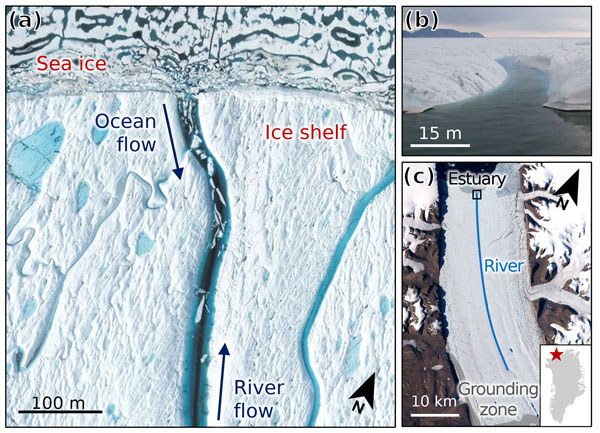
Surface rivers can transport meltwater from floating ice-shelves into the ocean, limiting ponding. However, if a river channel deepens to sea level, seawater can flow up into it and form an ice-shelf estuary. This adds load to the ice shelf and increases stresses that weaken the ice. Using high-resolution satellite imagery, we develop a new way to measure how quickly these rivers deepen, which we use to constrain the timing of Petermann Ice Shelf’s estuary formation over multiple melt seasons.
Anne Sledd, Michael R. Gallagher, Matthew D. Shupe, Christopher J. Cox, Robert Hawley, Michael S. Town, Heather Guy, Hans-Peter Marshall, Ryan R. Neely III, Claire Pettersen, Von P. Walden, Catherine Hebson, Andrew Martin, Erik Olson, and Derek Pickell
EGUsphere, https://doi.org/10.5194/egusphere-2026-1842, https://doi.org/10.5194/egusphere-2026-1842, 2026
Short summary
Short summary
Understanding energetic processes at the surface is important for understanding how the Greenland ice sheet melts. However, most temperature observations of firn are insufficient for studying energetic processes near the surface where melt happens. In this work we present new ground observations of high-resolution temperature profiles in the top meter of firn near the southwest coast of Greenland. Using these observations we characterize how temperature and energy vary during the melt season.
Derek J. Pickell, Robert L. Hawley, Denis Felikson, and Jamie C. Good
The Cryosphere, 20, 483–494, https://doi.org/10.5194/tc-20-483-2026, https://doi.org/10.5194/tc-20-483-2026, 2026
Short summary
Short summary
We compared ICESat-2 ice surface height measurements in interior Greenland with ground-based Global Positioning System (GPS) observations, finding sub-centimeter biases and centimeter-scale precision with no detectable long-term drift. We also apply an autonomous validation method using Global Navigation Satellite System (GNSS) interferometric reflectometry (GNSS-IR) to measure surface elevation, producing comparable results and enabling more frequent, spatially distributed comparisons.
Ian A. Raphael, Donald K. Perovich, Christopher M. Polashenski, and Robert L. Hawley
The Cryosphere, 19, 6059–6076, https://doi.org/10.5194/tc-19-6059-2025, https://doi.org/10.5194/tc-19-6059-2025, 2025
Short summary
Short summary
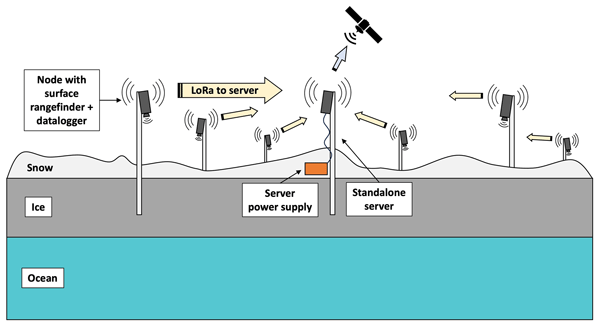
Snow plays competing roles in the sea ice cycle by reflecting sunlight during summer (reducing melt) and insulating the ice from the cold atmosphere during winter (reducing growth). Observing where, when, and how much snow accumulates on sea ice is thus central to understanding the Arctic. Here, we describe a new snow depth observation system that is substantially cheaper and lighter than existing tools and present a study demonstrating its potential to improve snow measurements on sea ice.
Alexander C. Ronan, Robert L. Hawley, and Jonathan W. Chipman
The Cryosphere, 18, 5673–5683, https://doi.org/10.5194/tc-18-5673-2024, https://doi.org/10.5194/tc-18-5673-2024, 2024
Short summary
Short summary
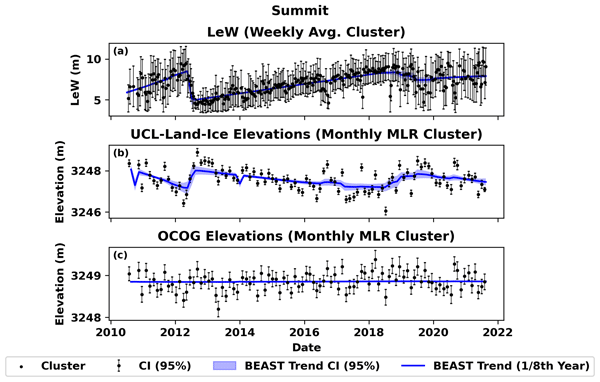
We generate a 2010–2021 time series of CryoSat-2 waveform shape metrics on the Greenland Ice Sheet, and we compare it to CryoSat-2 elevation data to investigate the reliability of two algorithms used to derive elevations from the SIRAL radar altimeter. Retracked elevations are found to depend on a waveform's leading-edge width in the dry-snow zone. The study indicates that retracking algorithms must consider significant climate events and snow conditions when assessing elevation change.
Ian E. McDowell, Kaitlin M. Keegan, S. McKenzie Skiles, Christopher P. Donahue, Erich C. Osterberg, Robert L. Hawley, and Hans-Peter Marshall
The Cryosphere, 18, 1925–1946, https://doi.org/10.5194/tc-18-1925-2024, https://doi.org/10.5194/tc-18-1925-2024, 2024
Short summary
Short summary
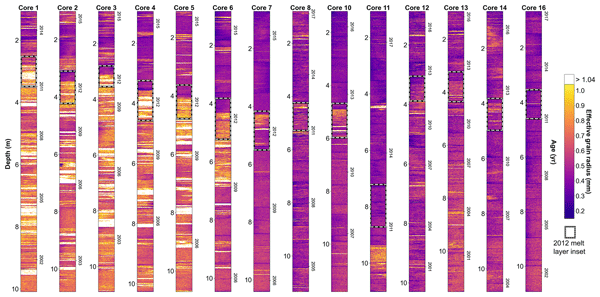
Accurate knowledge of firn grain size is crucial for many ice sheet research applications. Unfortunately, collecting detailed measurements of firn grain size is difficult. We demonstrate that scanning firn cores with a near-infrared imager can quickly produce high-resolution maps of both grain size and ice layer distributions. We map grain size and ice layer stratigraphy in 14 firn cores from Greenland and document changes to grain size and ice layer content from the extreme melt summer of 2012.
Sarah E. Esenther, Laurence C. Smith, Adam LeWinter, Lincoln H. Pitcher, Brandon T. Overstreet, Aaron Kehl, Cuyler Onclin, Seth Goldstein, and Jonathan C. Ryan
Geosci. Instrum. Method. Data Syst., 12, 215–230, https://doi.org/10.5194/gi-12-215-2023, https://doi.org/10.5194/gi-12-215-2023, 2023
Short summary
Short summary
Meltwater runoff estimates from the Greenland ice sheet contain uncertainty. To better understand ice sheet hydrology, we installed a weather station and river stage sensors along three proglacial rivers in a cold-bedded area of NW Greenland without firn, crevasse, or moulin influence. The first 3 years (2019–2021) of observations have given us a first look at the seasonal and annual weather and hydrological patterns of this understudied region.
Edward H. Bair, Jeff Dozier, Charles Stern, Adam LeWinter, Karl Rittger, Alexandria Savagian, Timbo Stillinger, and Robert E. Davis
The Cryosphere, 16, 1765–1778, https://doi.org/10.5194/tc-16-1765-2022, https://doi.org/10.5194/tc-16-1765-2022, 2022
Short summary
Short summary
Understanding how snow and ice reflect solar radiation (albedo) is important for global climate. Using high-resolution topography, darkening from surface roughness (apparent albedo) is separated from darkening by the composition of the snow (intrinsic albedo). Intrinsic albedo is usually greater than apparent albedo, especially during melt. Such high-resolution topography is often not available; thus the use of a shade component when modeling mixtures is advised.
Cited articles
Albert, M. R. and Hawley, R. L.: Seasonal changes in snow surface roughness characteristics at Summit, Greenland: Implications for snow and firn ventilation, Ann. Glaciol., 35, 510–514, https://doi.org/10.3189/172756402781816591, 2002. a, b, c
Bolzan, J. F. and Strobel, M.: Accumulation-rate variations around Summit, Greenland, J. Glaciol., 40, 56–66, https://doi.org/10.3189/S0022143000003798, 1994. a
Bourlier, C., Pinel, N., and Fabbro, V.: Illuminated height PDF of a random rough surface and its impact on the forward propagation above oceans at grazing angles, in: 2006 First European Conference on Antennas and Propagation, Nice, France, 6–10 November 2006, 1–6, https://doi.org/10.1109/EUCAP.2006.4584894, 2006. a
Dahl-Jensen, T. S., Citterio, M., Jakobsen, J., Ahlstrøm, A. P., Larson, K. M., and Khan, S. A.: Snow depth measurements by GNSS-IR at an automatic weather station, NUK-K, Remote Sens., 14, 2563, https://doi.org/10.3390/rs14112563, 2022. a, b
Dibb, J. E. and Fahnestock, M.: Snow accumulation, surface height change, and firn densification at Summit, Greenland: Insights from 2 years of in situ observation, J. Geophys. Res.-Atmos., 109, D24113, https://doi.org/10.1029/2003JD004300, 2004. a, b, c
Filhol, S. and Sturm, M.: Snow bedforms: A review, new data, and a formation model, J. Geophys. Res.-Earth Surf., 120, 1645–1669, https://doi.org/10.1002/2015JF003529, 2015. a, b
Fisher, D. A., Reeh, N., and Clausen, H. B.: Stratigraphic noise in time series derived from ice cores, Ann. Glaciol., 7, 76–83, https://doi.org/10.3189/S0260305500005942, 1985. a
Georgiadou, P. Y. and Kleusberg, A.: On carrier signal multipath effects in relative GPS positioning, Manuscripta geodaetica, 13, 172–179, https://research.utwente.nl/en/publications/on-carrier-signal-multipath-effects-in-relative-gps-positioning (last access: 20 August 2024), 1988. a
Global Modeling And Assimilation Office and Pawson, S.: MERRA-2 tavg1_2d_flx_Nx: 2d,1-Hourly,Time-Averaged,Single-Level,Assimilation,Surface Flux Diagnostics V5.12.4, https://doi.org/10.5067/7MCPBJ41Y0K6, 2015. a
Gossart, A., Helsen, S., Lenaerts, J. T. M., Broucke, S. V., Lipzig, N. P. M. v., and Souverijns, N.: An evaluation of surface climatology in state-of-the-art reanalyses over the Antarctic Ice Sheet, J. Geophys. Res.-Atmos., 32, 6899–6915, https://doi.org/10.1175/JCLI-D-19-0030.1, 2019. a
Gutmann, E. D., Larson, K. M., Williams, M. W., Nievinski, F. G., and Zavorotny, V.: Snow measurement by GPS interferometric reflectometry: An evaluation at Niwot Ridge, Colorado, Hydrol. Process., 26, 2951–2961, https://doi.org/10.1002/hyp.8329, 2012. a, b
Hawley, R. L., Pickell, D. J., McConnell, J. R., Neumann, T. A., and Dorsi, S. W.: Index of /mirror/summit/ftp/science/bamboo_forest/ [data set], https://conus.summitcamp.org/mirror/summit/ftp/science/bamboo_forest/, last access: 20 August 2024. a
Howat, I. M.: Temporal variability in snow accumulation and density at Summit Camp, Greenland ice sheet, J. Glaciol., 68, 1076–1084, https://doi.org/10.1017/jog.2022.21, 2022. a, b
Howat, I. M., Negrete, A., and Smith, B. E.: The Greenland Ice Mapping Project (GIMP) land classification and surface elevation data sets, The Cryosphere, 8, 1509–1518, https://doi.org/10.5194/tc-8-1509-2014, 2014. a
Howat, I. M., de la Peña, S., Desilets, D., and Womack, G.: Autonomous ice sheet surface mass balance measurements from cosmic rays, The Cryosphere, 12, 2099–2108, https://doi.org/10.5194/tc-12-2099-2018, 2018. a
Hristov, H. D.: Fresnal Zones in Wireless Links, Zone Plate Lenses and Antennas, Artech House, Inc., USA, 1st edn., ISBN 978-0-89006-849-6, 2000. a
Kuhns, H., Davidson, C., Dibb, J., Stearns, C., Bergin, M., and Jaffrezo, J.-L.: Temporal and spatial variability of snow accumulation in central Greenland, J. Geophys. Res.-Atmos., 102, 30059–30068, https://doi.org/10.1029/97JD02760, 1997. a
Larson, K.: gnssrefl: an open source python software package for environmental GNSS interferometric reflectometry applications, Zenodo [software], https://doi.org/10.5281/zenodo.10796409, 2024. a, b
Larson, K. M.: GPS interferometric reflectometry: Applications to surface soil moisture, snow depth, and vegetation water content in the western United States, WIREs Water, 3, 775–787, https://doi.org/10.1002/wat2.1167, 2016. a
Larson, K. M. and Nievinski, F. G.: GPS snow sensing: results from the EarthScope Plate Boundary Observatory, GPS Solutions, 17, 41–52, https://doi.org/10.1007/s10291-012-0259-7, 2013. a, b
Larson, K. M. and Small, E. E.: Estimation of snow depth using L1 GPS signal-to-noise ratio data, IEEE J. Sel. Top. Appl. Earth Obs., 9, 4802–4808, https://doi.org/10.1109/JSTARS.2015.2508673, 2016. a, b
Larson, K. M., Gutmann, E. D., Zavorotny, V. U., Braun, J. J., Williams, M. W., and Nievinski, F. G.: Can we measure snow depth with GPS receivers?, Geophys. Res. Lett., 36, L17502, https://doi.org/10.1029/2009GL039430, 2009. a
Larson, K. M., MacFerrin, M., and Nylen, T.: Brief Communication: Update on the GPS reflection technique for measuring snow accumulation in Greenland, The Cryosphere, 14, 1985–1988, https://doi.org/10.5194/tc-14-1985-2020, 2020. a, b
Lenaerts, J. T. M., van den Broeke, M. R., van Angelen, J. H., van Meijgaard, E., and Déry, S. J.: Drifting snow climate of the Greenland ice sheet: a study with a regional climate model, The Cryosphere, 6, 891–899, https://doi.org/10.5194/tc-6-891-2012, 2012. a
McConnell, J. R., Bales, R. C., and Davis, D. R.: Recent intra-annual snow accumulation at South Pole: Implications for ice core interpretation, J. Geophys. Res.-Atmos., 102, 21947–21954, https://doi.org/10.1029/97JD00848, 1997. a
McConnell, J. R., Arthern, R. J., Mosley-Thompson, E., Davis, C. H., Bales, R. C., Thomas, R., Burkhart, J. F., and Kyne, J. D.: Changes in Greenland ice sheet elevation attributed primarily to snow accumulation variability, Nature, 406, 877–879, https://doi.org/10.1038/35022555, 2000. a
McCreight, J. L., Small, E. E., and Larson, K. M.: Snow depth, density, and SWE estimates derived from GPS reflection data: Validation in the western U. S, Water Resour. Res., 50, 6892–6909, https://doi.org/10.1002/2014WR015561, 2014. a
Montgomery, L., Koenig, L., and Alexander, P.: The SUMup dataset: compiled measurements of surface mass balance components over ice sheets and sea ice with analysis over Greenland, Earth Syst. Sci. Data, 10, 1959–1985, https://doi.org/10.5194/essd-10-1959-2018, 2018. a
Nievinski, F. G. and Larson, K. M.: Inverse modeling of GPS multipath for snow depth estimation – part I: Formulation and simulations, IEEE T. Geosci. Remote, 52, 6555–6563, https://doi.org/10.1109/TGRS.2013.2297681, 2014. a
Pettersen, C., Bennartz, R., Merrelli, A. J., Shupe, M. D., Turner, D. D., and Walden, V. P.: Precipitation regimes over central Greenland inferred from 5 years of ICECAPS observations, Atmos. Chem. Phys., 18, 4715–4735, https://doi.org/10.5194/acp-18-4715-2018, 2018. a
Picard, G., Arnaud, L., Caneill, R., Lefebvre, E., and Lamare, M.: Observation of the process of snow accumulation on the Antarctic Plateau by time lapse laser scanning, The Cryosphere, 13, 1983–1999, https://doi.org/10.5194/tc-13-1983-2019, 2019. a, b
Pickell, D. J.: glaciology/OGRE: v3.0, Zenodo [software], https://doi.org/10.5281/zenodo.14893707, 2025. a
Pickell, D. J. and Hawley, R. L.: An east-west network of twelve global navigation satellite system (GNSS) stations in the Summit region of Greenland: RINEX data, 2022–2024, Arctic Data Center [data set], https://doi.org/10.18739/A2736M41C, 2024a. a
Pickell, D. J. and Hawley, R. L.: Performance characterization of a new, low-cost multi-GNSS instrument for the cryosphere, J. Glaciol., 70, e41, https://doi.org/10.1017/jog.2023.97, 2024b. a
Pinat, E., Defraigne, P., Bergeot, N., Chevalier, J.-M., and Bertrand, B.: Long-term snow height variations in Antarctica from GNSS interferometric reflectometry, Remote Sens., 13, 1164, https://doi.org/10.3390/rs13061164, 2021. a
Roesler, C. and Larson, K. M.: Software tools for GNSS interferometric reflectometry (GNSS-IR), GPS Solutions, 22, 80, https://doi.org/10.1007/s10291-018-0744-8, 2018. a, b
Scanlan, K. M., Rutishauser, A., and Simonsen, S. B.: Observing the Near-Surface Properties of the Greenland Ice Sheet, Geophys. Res. Lett., 50, e2022GL101702, https://doi.org/10.1029/2022GL101702, 2023. a
Shean, D. E., Christianson, K., Larson, K. M., Ligtenberg, S. R. M., Joughin, I. R., Smith, B. E., Stevens, C. M., Bushuk, M., and Holland, D. M.: GPS-derived estimates of surface mass balance and ocean-induced basal melt for Pine Island Glacier ice shelf, Antarctica, The Cryosphere, 11, 2655–2674, https://doi.org/10.5194/tc-11-2655-2017, 2017. a
Smith, B., Fricker, H. A., Gardner, A. S., Medley, B., Nilsson, J., Paolo, F. S., Holschuh, N., Adusumilli, S., Brunt, K., Csatho, B., Harbeck, K., Markus, T., Neumann, T., Siegfried, M. R., and Zwally, H. J.: Pervasive ice sheet mass loss reflects competing ocean and atmosphere processes, Science, 368, 1239–1242, https://doi.org/10.1126/science.aaz5845, 2020. a
Takahashi, S. and Kameda, T.: Snow density for measuring surface mass balance using the stake method, J. Glaciol., 53, 677–680, https://doi.org/10.3189/002214307784409360, 2007. a, b
van den Broeke, M. R., Enderlin, E. M., Howat, I. M., Kuipers Munneke, P., Noël, B. P. Y., van de Berg, W. J., van Meijgaard, E., and Wouters, B.: On the recent contribution of the Greenland ice sheet to sea level change, The Cryosphere, 10, 1933–1946, https://doi.org/10.5194/tc-10-1933-2016, 2016. a
van der Veen, C. J. and Bolzan, J. F.: Interannual variability in net accumulation on the Greenland Ice Sheet: Observations and implications for mass balance measurements, J. Geophys. Res.-Atmos., 104, 2009–2014, https://doi.org/10.1029/1998JD200082, 1999. a
van Tiggelen, M., Smeets, P. C. J. P., Reijmer, C. H., Wouters, B., Steiner, J. F., Nieuwstraten, E. J., Immerzeel, W. W., and van den Broeke, M. R.: Mapping the aerodynamic roughness of the Greenland Ice Sheet surface using ICESat-2: evaluation over the K-transect, The Cryosphere, 15, 2601–2621, https://doi.org/10.5194/tc-15-2601-2021, 2021. a, b
Wang, W., Zender, C. S., van As, D., and Miller, N. B.: Spatial distribution of melt season cloud radiative effects over Greenland: Evaluating satellite observations, reanalyses, and model simulations against in situ measurements, J. Geophys. Res.-Atmos., 124, 57–71, https://doi.org/10.1029/2018JD028919, 2019. a
Wells, A., Rounce, D., Sass, L., Florentine, C., Garbo, A., Baker, E., and McNeil, C.: GNSS reflectometry from low-cost sensors for continuous in situ contemporaneous glacier mass balance and flux divergence, J. Glaciol., 70, e5, https://doi.org/10.1017/jog.2024.54, 2024. a
Zuhr, A. M., Münch, T., Steen-Larsen, H. C., Hörhold, M., and Laepple, T.: Local-scale deposition of surface snow on the Greenland ice sheet, The Cryosphere, 15, 4873–4900, https://doi.org/10.5194/tc-15-4873-2021, 2021. a, b, c, d
Short summary
We use a low-cost, low-power GNSS network to measure surface accumulation in Greenland's interior using the interferometric reflectometry technique. Additionally, we extend this method to also estimate centimeter- to meter-scale surface roughness. Our results closely align with a validation record and highlight a period of unusually high accumulation from late 2022 to 2023, along with seasonal variations in surface roughness.
We use a low-cost, low-power GNSS network to measure surface accumulation in Greenland's...


